It was winter. The gray old mansion of Mr.
Robert Selfridge, of Fayette County, Ky., was
wrapped in its usual mantle of winter sombreness,
and the ample plantation stretching in
every direction thereabout was one level plain
of unflecked whiteness. At a distance from the
house the cabins of the negroes stretched away
in a long, broken black line that stood out in
bold relief against the extreme whiteness of
their surroundings.
About the centre of the line, as dark and uninviting
as the rest, with its wide chimney of
scrap limestone turning clouds of dense smoke
into the air, stood a cabin.
There was nothing in its appearance to distinguish
it from the other huts clustered about.
The logs that formed its sides were just as
seamy, the timbers of the roof had just the same
abashed, brow-beaten look; and the keenest eye
could not have detected the slightest shade of
difference between its front and the bare, unwhitewashed
fronts of its scores of fellows.
Indeed, it would not have been mentioned at
all, but for the fact that within its confines lived
and thrived the heroine of this story.
Of all the girls of the Selfridge estate, black,
brown, or yellow, Anner ’Lizer was, without
dispute, conceded to be the belle. Her black
eyes were like glowing coals in their sparkling
brightness; her teeth were like twin rows of
shining ivories; her brown skin was as smooth
and soft as silk; and the full lips that enclosed
her gay and flexile tongue were tempting enough
to make the heart of any dusky swain throb and
his mouth water.
Was it any wonder, then, that Sam Merritt—strapping,
big Sam, than whom there was not
a more popular man on the place—should pay
devoted court to her?
Do not gather from this that it was Sam
alone who paid his devoirs to this brown beauty.
Oh, no! Anner ’Lizer was the “bright, particular
star” of that plantation, and the most
desired of all blessings by the young men thereabout.
But Sam, with his smooth but fearless
ways, Sam, with his lightsome foot, so airy in
the dance, Sam, handsome Sam, was the all-preferred.
If there was a dance to go to, a
corn-husking to attend, a social at the rude little
log church, Sam was always the lucky man who
was alert and able to possess himself of Anner
’Lizer’s “comp’ny.” And so, naturally, people
began to connect their names, and the rumour
went forth, as rumours will, that the two were
engaged; and, as far as engagements went
among the slaves in those days, I suppose it was
true. Sam had never exactly prostrated himself
at his sweetheart’s feet and openly declared his
passion; nor had she modestly snickered behind
her fan, and murmured yes in the approved
fashion of the present. But he had looked his
feelings, and she had looked hers; while numerous
little attentions bestowed on each other, too
subtle to be detailed, and the attraction which
kept them constantly together, were earnests of
their intentions more weighty than words could
give. And so, let me say, without further explanation,
that Sam and Anner ’Lizer were
engaged. But when did the course of true
love ever run smooth?
There was never a time but there were some
rocks in its channel around which the little
stream had to glide or over which it had to
bound and bubble; and thus it was with the
loves of our young friends. But in this case
the crystal stream seemed destined neither to
bound over nor glide by the obstacle in its path,
but rather to let its merry course be checked
thereby.
It may, at first, seem a strange thing to say,
but it was nevertheless true, that the whole
sweep and torrent of the trouble had rise in the
great religious revival that was being enthusiastically
carried on at the little Baptist meeting-house.
Interest, or, perhaps more correctly
speaking, excitement ran high, and regularly as
night came round all the hands on the neighbouring
plantations flocked to the scene of their
devotions.
There was no more regular attendant at
these meetings, nor more deeply interested listener
to the pastor’s inflammatory exhortations,
than Anner ’Lizer. The weirdness of the
scene and the touch of mysticism in the services—though,
of course, she did not analyse it thus—reached
her emotional nature and stirred her
being to its depths. Night after night found
her in her pew, the third bench from the rude
pulpit, her large eyes, dilated to their fullest
capacity, following the minister through every
motion, seeming at times in their steadfastness
to look through him and beyond to the regions
he was describing,—the harp-ringing heaven of
bliss or the fire-filled home of the damned.
Now Sam, on the other hand, could not be
induced to attend these meetings; and when
his fellow-servants were at the little church
praying, singing, and shouting, he was to be
found sitting in one corner of his cabin, picking
his banjo, or scouring the woods, carrying axe
and taper, and, with a dog trotting at his heels,
hunting for that venison of the negro palate,—’coon.
Of course this utter irreverence on the part
of her lover shocked Anner ’Lizer; but she had
not entered far enough into the regions of the
ecstasy to be a proselyte; so she let Sam go his
way, albeit with reluctance, while she went to
church unattended. But she thought of Sam;
and many a time when she secretly prayed to
get religion she added a prayer that she might
retain Sam.
He, the rogue, was an unconscious but pronounced
sceptic; and day by day, as Anner
’Lizer became more and more possessed by
religious fervour, the breach between them
widened; still widening gradually until the one
span that connected the two hearts was suddenly
snapped asunder on the night when Anner
’Lizer went to the mourner’s bench.
She had not gone to church with that intention;
indeed not, although she had long been deeply
moved by a consciousness of her lost estate.
But that night, when the preacher had pictured
the boundless joys of heaven, and then, leaning
over the pulpit and stretching out his arms
before him, had said in his softest tone, “Now
come, won’t you, sinnahs? De Lawd is jes’
on de othah side; jes’ one step away, waitin’
to receibe you. Won’t you come to him?
Won’t you tek de chance o’ becomin’ j’int ’ars
o’ dat beautiful city whar de streets is gol’ an’
de gates is pearl? Won’t you come to him,
sinnah? Don’t you see de pityin’ look he’s
a-givin’ you, a-sayin’ Come, come?” she lost
herself. Some irresistible power seemed dominating
her, and she arose and went forward,
dropping at the altar amid a great shouting and
clapping of hands and cries of “Bless de Lawd,
one mo’ recruit fu’ de Gospel ahmy.”
Some one started the hymn, “We’ll bow
around the altar,” and the refrain was taken up
by the congregation with a fervour that made
the rafters of the little edifice ring again.
The conquest of Anner ’Lizer, the belle of
that section of Kentucky, was an event of great
moment; and in spite of the concentration of
the worshippers’ minds on their devotions, the
unexpected occurrence called forth a deal of
discussion among the brothers and sisters.
Aunt Hannah remarked to Aunt Maria, over
the back of the seat, that she “nevah knowed
de gal was unner c’nviction.” And Aunt
Maria answered solemnly, “You know, sistah,
de Lawd wuks in a myste’ious way his wondahs
to pu’fo’m.”
Meanwhile the hymn went on, and above it
rose the voice of the minister: “We want all
de Christuns in de house to draw up aroun’ de
altah, whar de fiah is bu’nin’: you know in de
wintah time when hit’s col’ you crowds up clost
to de fiahplace; so now ef you wants to git
spi’tually wa’m, you mus’ be up whar de fiah
is.” There was a great scrambling and shuffling
of feet as the members rose with one
accord to crowd, singing, around the altar.
Two of the rude benches had been placed
end to end before the pulpit, so that they
extended nearly the full width of the little
church; and at these knelt a dozen or more
mourners, swaying and writhing under the burden
of their sins.
The song being ended, the preacher said:
“Brer’ Adams, please tek up de cross.” During
the momentary lull that intervened between
the end of the song and the prayer, the wails
and supplications of the mourners sounded out
with weird effect. Then Brer’ Adams, a white-haired
patriarch, knelt and “took up the cross.”
Earnestly he besought the divine mercy in
behalf of “de po’ sinnahs, a-rollin’ an’ a-tossin’
in de tempes’ of dere sins. Lawd,” he prayed,
“come down dis evenin’ in Sperit’s powah to
seek an’ to save-ah; let us heah de rumblin’
of yo’ cha’iot wheels-ah lak de thundah f’om
Mount Sinai-ah; oh, Lawd-ah, convert mou’nahs
an’ convict sinnahs-ah; show ’em dat dey mus’
die an’ cain’t lib an’ atter death to judg-a-ment;
tu’n ’em aroun’ befo’ it is evahlastin’ an’
eternally too late.” Then warming more and
more, and swaying his form back and forth, as
he pounded the seat in emphasis, he began to
wail out in a sort of indescribable monotone:
“O Lawd, save de mou’nah!”
“Save de mou’nah!” came the response
from all over the church.
“He’p ’em out of de miah an’ quicksan’s
of dere sins!”
“He’p, Lawd!”
“And place deir feet upon de evahlastin’
an’ eternal rock-ah!”
“Do, Lawd!”
“O Lawd-ah, shake a dyin’ sinnah ovah
hell an’ fo’bid his mighty fall-ah!”
“O Lawd, shake ’em!” came from the
congregation.
By this time every one was worked up to a
high state of excitement, and the prayer came
to an end amid great commotion. Then a
rich, mellow voice led out with:
“Sabe de mou’nah jes’ now,
Sabe de mou’nah jes’ now,
Sabe de mou’nah jes’ now,
Only trust Him jes’ now,
Only trust Him jes’ now,
He’p de sinnah jes’ now;”
and so to indefinite length the mournful minor
melody ran along like a sad brook flowing
through autumn woods, trying to laugh and
ripple through tears.
Every now and then some mourner would
spring half up, with a shriek, and then sink
down again trembling and jerking spasmodically.
“He’s a-doubtin’, he’s a-doubtin’!”
the cry would fly around; “but I tell you he
purt’ nigh had it that time.”
Finally, the slender form of Anner ’Lizer began
to sway backward and forward, like a sapling in the
wind, and she began to mourn and weep aloud.
“Praise de Lawd!” shouted Aunt Hannah,
“de po’ soul’s gittin’ de evidence: keep on,
honey, de Lawd ain’t fa’ off.” The sudden
change attracted considerable attention, and in
a moment a dozen or more zealous altar-workers
gathered around Anner ’Lizer, and began
to clap and sing with all their might, keeping
time to the melodious cadence of their music
with heavy foot-pats on the resounding floor.
“Git on boa’d-ah, little childering,
Git on boa’d-ah, little childering,
Git on boa’d-ah, little childering,
Dere’s room fo’ many mo’.
“De gospel ship is sailin’,
It’s loaded down wid souls.
If you want to mek heab’n yo’ happy home,
You mus’ ketch it ’fo’ it goes.
Git on boa’d, etc.
“King Jesus at de hellum,
Fu’ to guide de ship erright.
We gwine fu’ to put into heab’n’s po’t
Wid ouah sails all shinin’ white.
Git on boa’d,” etc.
With a long dwell on the last word of the
chorus, the mellow cadence of the song died
away.
“Let us bow down fu’ a season of silent
praar,” said the minister.
“Lawd, he’p us to pray,” responded Uncle
Eben Adams.
The silence that ensued was continually
broken by the wavering wail of the mourners.
Suddenly one of them, a stalwart young man,
near the opening of the aisle, began to writhe
and twist himself into every possible contortion,
crying: “O Lawd, de devil’s a-ridin’ me; tek
him off—tek him off!”
“Tek him off, Lawd!” shouted the congregation.
Then suddenly, without warning, the mourner
rose straight up into the air, shouting, “Hallelujah,
hallelujah, hallelujah!”
“He’s got it—he’s got it!” cried a dozen
eager worshippers, leaping to their feet and
crowding around the happy convert; “bless de
Lawd, he’s got it.” A voice was raised, and
soon the church was ringing with
“Loose him and let him go,
Let him shout to glory.”
On went the man, shouting “Hallelujah,”
shaking hands, and bounding over seats in the
ecstasy of his bliss.
His conversion kindled the flame of the meeting
and set the fire going. You have seen
corn in the popper when the first kernel springs
up and flares open, how quickly the rest follow,
keeping up the steady pop, pop, pop; well,
just so it was after this first conversion. The
mourners popped up quickly and steadily as the
strength of the spiritual fire seemed to reach
their swelling souls. One by one they left the
bench on which, figuratively speaking, they
may be said to have laid down their sins and
proclaimed themselves possessors of religion;
until, finally, there was but one left, and that
one—Anner ’Lizer. She had ceased from her
violent activity, and seemed perfectly passive
now.
The efforts of all were soon concentrated on
her, and such stamping and clapping and singing
was never heard before. Such cries of
“Jes’ look up, sistah, don’t you see Him at
yo’ side? Jes’ reach out yo’ han’ an’ tech de
hem of His ga’ment. Jes’ listen, sistah, don’t
you heah de angels singin’? don’t you heah de
rumblin’ of de cha’iot wheels? He’s a-comin’,
He’s a-comin’, He’s a-comin’!”
But Anner ’Lizer was immovable; with her
face lying against the hard bench, she moaned
and prayed softly to herself. The congregation
redoubled its exertions, but all to no effect,
Anner ’Lizer wouldn’t “come thoo.”
It was a strange case.
Aunt Maria whispered to her bosom friend:
“You min’ me, Sistah Hannah, dere’s sump’n’
on dat gal’s min’.” And Aunt Hannah answered:
“I believe you.”
Josephine, or more commonly Phiny, a former
belle whom Anner ’Lizer’s superior charms had
deposed, could not lose this opportunity to have
a fling at her successful rival. Of course such
cases of vindictiveness in women are rare, and
Phiny was exceptional when she whispered to
her fellow-servant, Lucy: “I reckon she’d git
’ligion if Sam Me’itt was heah to see her.”
Lucy snickered, as in duty bound, and whispered
back: “I wisht you’d heish.”
Well, after all their singing, in spite of all
their efforts, the time came for closing the meeting
and Anner ’Lizer had not yet made a
profession.
She was lifted tenderly up from the mourner’s
bench by a couple of solicitous sisters, and after
listening to the preacher’s exhortation to “pray
constantly, thoo de day an’ thoo de night, in de
highways an’ de byways an’ in yo’ secret closet,”
she went home praying in her soul, leaving the
rest of the congregation to loiter along the way
and gossip over the night’s events.
All the next day Anner ’Lizer, erstwhile so
cheerful, went about her work sad and silent;
every now and then stopping in the midst of
her labours and burying her face in her neat
white apron to sob violently. It was true,
as Aunt Hannah expressed, that “de Sperit
had sholy tuk holt of dat gal wid a powahful
han’.”
All of her fellow-servants knew that she was
a mourner, and with that characteristic reverence
for religion which is common to all their
race, and not lacking even in the most hardened
sinner among them, they respected her feelings.
Phiny alone, when she met her, tossed her head
and giggled openly. But Phiny’s actions never
troubled Anner ’Lizer, for she felt herself so far
above her. Once though, in the course of the
day, she had been somewhat disturbed, when
she had suddenly come upon her rival, standing
in the spring-house talking and laughing with
Sam. She noticed, too, with a pang, that Phiny
had tied a bow of red ribbon on her hair. She
shut her lips and only prayed the harder. But
an hour later, somehow, a ribbon as red as
Phiny’s had miraculously attached itself to her
thick black plaits. Was the temporal creeping
in with the spiritual in Anner ’Lizer’s mind?
Who can tell? Perhaps she thought that,
while cultivating the one, she need not utterly
neglect the other; and who says but that she
was right?
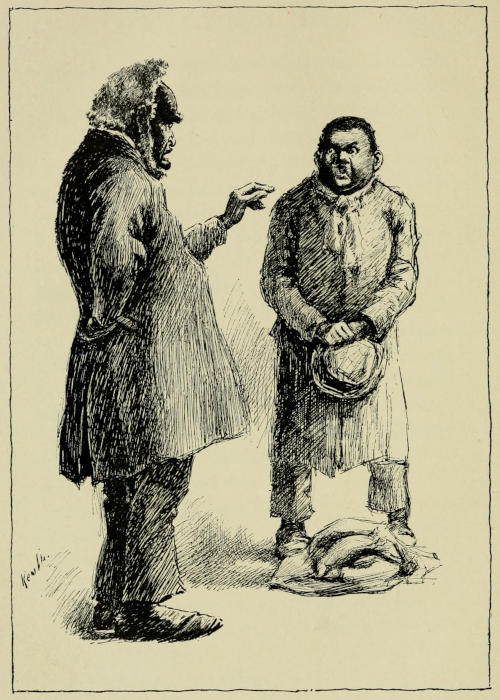
Uncle Eben, however, did not take this view
of the matter when he came hobbling up in the
afternoon to exhort her a little. He found Anner
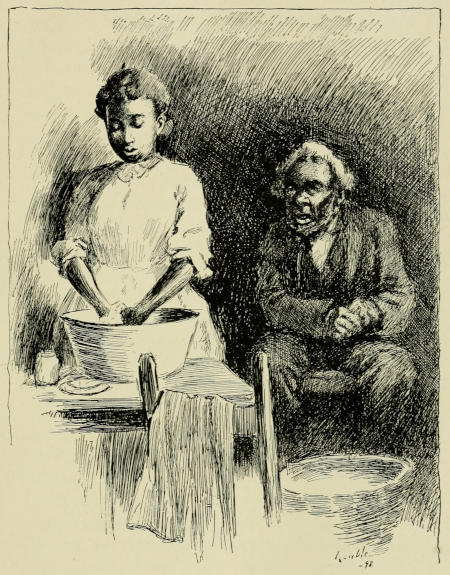
’Lizer in the kitchen washing dishes. Engrossed
in the contemplation of her spiritual state, or
praying for deliverance from the same, through
the whole day she had gone about without speaking
to any one. But with Uncle Eben it was,
of course, different; for he was a man held in
high respect by all the negroes and, next to the
minister, the greatest oracle in those parts; so
Anner ’Lizer spoke to him.
“Howdy, Uncl’ Eben,” she said, in a lugubrious
tone, as the old man hobbled in and
settled down in a convenient corner.
“Howdy, honey, howdy,” he replied, crossing
one leg over the other, as he unwound his
long bandana, placed it in his hat, and then
deposited his heavy cane on the white floor.
“I jes’ thought I’d drap in to ax you how do
you do to-day?”
“Po’ enough, Uncl’ Eben, fu’ sho.”
“Ain’t foun’ no res’ fu’ yo’ soul yit?”
“No res’ yit,” answered Anner ’Lizer, again
applying the apron to her already swollen eyes.
A VISIT FROM UNCLE EBEN.
“Um-m,” sighed the old man, meditatively
tapping his foot; and then the gay flash of
Anner ’Lizer’s ribbon caught his eye and he
gasped: “Bless de Lawd, Sis ’Lizer; you don’t
mean to tell me dat you’s gwin ’bout heah
seekin’ wid yo’ har tied up in ribbon? Whut!
tek it off, honey, tek it off; ef yo’ wants yo’
soul saved, tek it off!”
Anner ’Lizer hesitated, and raised her eyes
in momentary protest; but they met the horrified
gaze of the old man, and she lowered them
again as her hand went reluctantly up to her
head to remove the offending bit of finery.
“You see, honey,” Uncle Eben went on,
“when you sta’ts out on de Christian jou’ney,
you’s got to lay aside evry weight dat doeth
so easy beset you an’ keeps you f’om pergressin’;
y’ ain’t got to think nothin’ ’bout pussunal
’dornment; you’s jes’ got to shet yo’ eyes
an’ open yo’ hea’t an’ say, Lawd, come; you
mustn’t wait fu’ to go to chu’ch to pray, nuther,
you mus’ pray any whar an’ ev’rywhar. Why,
when I was seekin’, I ust to go ’way off up in
de big woods to pray, an’ dere’s whar de Lawd
answered me, an’ I’m a-rejoicin’ to-day in de
powah of de same salvation. Honey, you’s
got to pray, I tell you. You’s got to brek de
backbone of yo’ pride an’ pray in earnes’;
an’ ef you does dat, you’ll git he’p, fu’ de
Lawd is a praar-heahin’ Lawd an’ plenteous in
mussy.”
Anner ’Lizer listened attentively to the exhortation,
and evidently profited by it; for soon
after Uncle Eben’s departure she changed her
natty little dress for one less pretentious, and
her dainty, frilled white muslin apron gave way
to a broad dark calico one. If grace was to be
found by self-abnegation in the matter of dress,
Anner ’Lizer was bound to have it at any
price.
As afternoon waned and night came on, she
grew more and more serious, and more frequent
recourse was had to the corner of her apron.
She even failed to see Phiny when that enterprising
young person passed her, decked out in
the whitest of white cuffs and collars setting off
in pleasant contrast her neat dark dress. Phiny
giggled again and put up her hand, ostensibly
to brush some imaginary dust from her bosom,
but really to show her pretty white cuffs with
their big bone buttons. But it was all lost
on Anner ’Lizer; her gaze was downcast and
her thoughts far away. If any one was ever
“seekin’” in earnest, this girl was.
Night came, and with it the usual services.
Anner ’Lizer was one of the earliest of the
congregation to arrive, and she went immediately
to the mourner’s bench. In the language
of the congregation, “Eldah Johnsing sholy did
preach a powahful sermon” that night. More
sinners were convicted and brought to their
knees, and, as before, these recruits were converted
and Anner ’Lizer left. What was the
matter?
That was the question which every one
asked, but there were none found who could
answer it. The circumstance was all the more
astounding from the fact that this unsuccessful
mourner had not been a very wicked girl. Indeed,
it was to have been expected that she
might shake her sins from her shoulders as
she would discard a mantle, and step over on
the Lord’s side. But it was not so.
But when a third night came and passed with
the same result, it became the talk of three
plantations. To be sure, cases were not lacking
where people had “mourned” a week, two
weeks, or even a month; but they were woful
sinners and those were times of less spiritual
interest; but under circumstances so favourable
as were now presented, that one could long
refrain from “gittin’ religion” was the wonder
of all. So, after the third night, everybody
wondered and talked, and not a few began to
lean to Phiny’s explanation, that “de ole snek
in de grass had be’n a-goin’ on doin’ all her
dev’ment on de sly, so’s people wouldn’t know
it; but de Lawd he did, an’ he payin’ her up
fu’ it now.”
Sam Merritt alone did not talk, and seemed
perfectly indifferent to all that was said; when
he was in Phiny’s company and she rallied him
about the actions of his “gal,” he remained
silent.
On the fourth night of Anner ’Lizer’s
mourning, the congregation gathered as usual at
the church. For the first half-hour all went
on as usual, and the fact that Anner ’Lizer was
absent caused no remark, for every one thought
she would come in later. But time passed and
she did not come. “Eldah Johnsing’s” flock
became agitated. Of course there were other
mourners, but the one particular one was absent;
hence the dissatisfaction. Every head in the
house was turned toward the door, whenever
it was opened by some late comer; and around
flew the whisper, “I wunner ef she’s quit
mou’nin’; you ain’t heerd of her gittin’ ’ligion,
have you?” No one had.
Meanwhile the object of their solicitude was
praying just the same, but in a far different
place. Grasping, as she was, at everything
that seemed to give her promise of relief, somehow
Uncle Eben’s words had had a deep effect
upon her. So, when night fell and her work
was over, she had gone up into the woods to
pray. She had prayed long without success,
and now she was crying aloud from the very
fulness of her heart, “O Lawd, sen’ de light—sen’
de light!” Suddenly, as if in answer to
her prayer, a light appeared before her some
distance away.
The sudden attainment of one’s desires often
shocks one; so with our mourner. For a moment
her heart stood still and the thought came
to her to flee; but her mind flashed back over
the words of one of the hymns she had heard
down at church, “Let us walk in de light;”
and she knew that before she walked in the
light she must walk toward it. So she rose and
started in the direction of the light. How it
flickered and flared, disappeared and reappeared,
rose and fell, even as her spirits, as she stumbled
and groped her way over fallen logs and through
briers. Her limbs were bruised and her dress
torn by the thorns. But she heeded it not, she
had fixed her eye—physical and spiritual—on
the light before her. It drew her with an irresistible
fascination. Suddenly she stopped. An
idea had occurred to her! Maybe this light
was a Jack-o’-lantern! For a moment she
hesitated, then promptly turned her pocket
wrong side out, murmuring, “De Lawd’ll tek
keer o’ me.” On she started; but, lo! the light
had disappeared! What! had the turning of
the pocket indeed worked so potent a charm?
But no! it reappeared as she got beyond
the intervention of a brush pile which had obscured
it. The light grew brighter as she grew
fainter; but she clasped her hands and raised
her eyes in unwavering faith, for she found
that the beacon did not recede, but glowed with
a steady and stationary flame.
As she drew near, the sound of sharp strokes
came to her ears, and she wondered. Then, as
she slipped into the narrow circle of light, she
saw that it was made by a taper which was set
on a log. The strokes came from a man who
was chopping down a tree in which a ’coon
seemed to have taken refuge. It needed no
second glance at the stalwart shoulders to tell
her that the man was—Sam. Her step attracted
his attention, and he turned.
“Sam!”
“Anner ’Lizer!”
And then they both stood still, too amazed
to speak. Finally she walked across to where
he was standing, and said: “Sam, I didn’t
come out heah to fin’ you, but de Lawd has
’p’inted it so, ’ca’se he knowed I orter speak to
you.” Sam leaned hopelessly on his axe; he
thought she was going to exhort him.
Anner ’Lizer went on: “Sam, you’s my
stumblin’ block in de highroad to salvation; I’s
be’n tryin’ to git ’ligion fu’ fou’ nights, an’ I
cain’t do it jes’ on yo’ ’count; I prays an’
I prays, an’ jes’ as I’s a’mos’ got it, jes’ as I
begin to heah de cha’iot wheels a-rollin’, yo’
face comes right in ’tween an’ drives it all away.
Tell me, now, Sam, so’s to put me out ov my
’spense, does you want to ma’y me, er is you
goin’ to ma’y Phiny? I jes’ wants you to tell
me, not dat I keers pussonally, but so’s my
min’ kin be at res’ spi’tu’lly, an’ I kin git ’ligion.
Jes’ say yes er no; I wants to be settled one
way er ’t other.”
“Anner ’Lizer,” said Sam, reproachfully,
“you know I wants to ma’y you jes’ ez soon
ez Mas’ Rob’ll let me.”
“Dere now,” said Anner ’Lizer, “bless de
Lawd!” And, somehow, Sam had dropped
the axe and was holding her in his arms.
It boots not whether the ’coon was caught
that night or not; but it is a fact that Anner
’Lizer set the whole place afire by getting religion
at home early the next morning. And the
same night the minister announced “dat de
Lawd had foun’ out de sistah’s stumblin’ block
an’ removed it f’om de path.”
THE ORDEAL AT MT. HOPE
THE ORDEAL AT MT. HOPE
“And this is Mt. Hope,” said the Rev. Howard
Dokesbury to himself as he descended, bag in
hand, from the smoky, dingy coach, or part of
a coach, which was assigned to his people, and
stepped upon the rotten planks of the station
platform. The car he had just left was not a
palace, nor had his reception by his fellow-passengers
or his intercourse with them been of
such cordial nature as to endear them to him.
But he watched the choky little engine with
its three black cars wind out of sight with a
look as regretful as if he were witnessing the
departure of his dearest friend. Then he turned
his attention again to his surroundings, and a
sigh welled up from his heart. “And this is
Mt. Hope,” he repeated. A note in his voice
indicated that he fully appreciated the spirit of
keen irony in which the place had been named.
The colour scheme of the picture that met
his eyes was in dingy blacks and grays. The
building that held the ticket, telegraph, and
train despatchers’ offices was a miserably old
ramshackle affair, standing well in the foreground
of this scene of gloom and desolation. Its windows
were so coated with smoke and grime that
they seemed to have been painted over in order
to secure secrecy within. Here and there a lazy
cur lay drowsily snapping at the flies, and at the
end of the station, perched on boxes or leaning
against the wall, making a living picture of equal
laziness, stood a group of idle Negroes exchanging
rude badinage with their white counterparts
across the street.
After a while this bantering interchange would
grow more keen and personal, a free-for-all
friendly fight would follow, and the newspaper
correspondent in that section would write it up
as a “race war.” But this had not happened
yet that day.
“This is Mt. Hope,” repeated the new-comer;
“this is the field of my labours.”
Rev. Howard Dokesbury, as may already
have been inferred, was a Negro,—there could
be no mistake about that. The deep dark brown
of his skin, the rich over-fulness of his lips, and
the close curl of his short black hair were evidences
that admitted of no argument. He was
a finely proportioned, stalwart-looking man, with
a general air of self-possession and self-sufficiency
in his manner. There was firmness in the set
of his lips. A reader of character would have
said of him, “Here is a man of solid judgment,
careful in deliberation, prompt in execution, and
decisive.”
It was the perception in him of these very
qualities which had prompted the authorities of
the little college where he had taken his degree
and received his theological training, to urge him
to go among his people at the South, and there
to exert his powers for good where the field was
broad and the labourers few.
Born of Southern parents from whom he had
learned many of the superstitions and traditions
of the South, Howard Dokesbury himself had
never before been below Mason and Dixon’s line.
But with a confidence born of youth and a consciousness
of personal power, he had started
South with the idea that he knew the people
with whom he had to deal, and was equipped
with the proper weapons to cope with their
shortcomings.
But as he looked around upon the scene which
now met his eye, a doubt arose in his mind.
He picked up his bag with a sigh, and approached
a man who had been standing apart from the
rest of the loungers and regarding him with
indolent intentness.
“Could you direct me to the house of Stephen
Gray?” asked the minister.
The interrogated took time to change his
position from left foot to right and to shift his
quid, before he drawled forth, “I reckon you’s
de new Mefdis preachah, huh?”
“Yes,” replied Howard, in the most conciliatory
tone he could command, “and I hope I
find in you one of my flock.”
“No, suh, I’s a Babtist myse’f. I wa’n’t
raised up no place erroun’ Mt. Hope; I’m nachelly
f’om way up in Adams County. Dey jes’
sont me down hyeah to fin’ you an’ to tek you
up to Steve’s. Steve, he’s workin’ to-day an’
couldn’t come down.”
He laid particular stress upon the “to-day,”
as if Steve’s spell of activity were not an everyday
occurrence.
“Is it far from here?” asked Dokesbury.
“’Tain’t mo’ ’n a mile an’ a ha’f by de shawt
cut.”
“Well, then, let’s take the short cut, by all
means,” said the preacher.
They trudged along for a while in silence, and
then the young man asked, “What do you men
about here do mostly for a living?”
“Oh, well, we does odd jobs, we saws an’
splits wood an’ totes bundles, an’ some of ’em
raises gyahden, but mos’ of us, we fishes. De
fish bites an’ we ketches ’em. Sometimes we
eats ’em an’ sometimes we sells ’em; a string
o’ fish’ll bring a peck o’ co’n any time.”
“And is that all you do?”
“’Bout.”
“Why, I don’t see how you live that way.”
“Oh, we lives all right,” answered the man;
“we has plenty to eat an’ drink, an’ clothes to
wear, an’ some place to stay. I reckon folks
ain’t got much use fu’ nuffin’ mo’.”
Dokesbury sighed. Here indeed was virgin
soil for his ministerial labours. His spirits
were not materially raised when, some time later,
he came in sight of the house which was to be
his abode. To be sure, it was better than most
of the houses which he had seen in the Negro
part of Mt. Hope; but even at that it was far
from being good or comfortable-looking. It
was small and mean in appearance. The
weather boarding was broken, and in some places
entirely fallen away, showing the great unhewn
logs beneath; while off the boards that remained
the whitewash had peeled in scrofulous
spots.
The minister’s guide went up to the closed
door, and rapped loudly with a heavy stick.
“G’ ’way f’om dah, an’ quit you’ foolin’,”
came in a large voice from within.
The guide grinned, and rapped again. There
was a sound of shuffling feet and the pushing
back of a chair, and then the same voice saying:
“I bet I’ll mek you git away f’om dat do’.”
“Dat’s A’nt Ca’line,” the guide said, and
laughed.
The door was flung back as quickly as its
worn hinges and sagging bottom would allow,
and a large body surmounted by a face like a
big round full moon presented itself in the
opening. A broomstick showed itself aggressively
in one fat shiny hand.
“It’s you, Tom Scott, is it—you trif’nin’—”
and then, catching sight of the stranger, her whole
manner changed, and she dropped the broomstick
with an embarrassed “’Scuse me, suh.”
Tom chuckled all over as he said, “A’nt
Ca’line, dis is yo’ new preachah.”
The big black face lighted up with a broad
smile as the old woman extended her hand and
enveloped that of the young minister’s.
“Come in,” she said. “I’s mighty glad to
see you—that no-’count Tom come put’ nigh
mekin’ me ’spose myse’f.” Then turning to
Tom, she exclaimed with good-natured severity,
“An’ you go ’long, you scoun’ll you!”
The preacher entered the cabin—it was
hardly more—and seated himself in the rush-bottomed
chair which A’nt Ca’line had been
industriously polishing with her apron.
“An’ now, Brothah—”
“Dokesbury,” supplemented the young man.
“Brothah Dokesbury, I jes’ want you to
mek yo’se’f at home right erway. I know
you ain’t use to ouah ways down hyeah; but you
jes’ got to set in an’ git ust to ’em. You
mus’n’t feel bad ef things don’t go yo’ way f’om
de ve’y fust. Have you got a mammy?”
The question was very abrupt, and a lump
suddenly jumped up in Dokesbury’s throat and
pushed the water into his eyes. He did have a
mother away back there at home. She was all
alone, and he was her heart and the hope of her
life.
“Yes,” he said, “I’ve got a little mother up
there in Ohio.”
“Well, I’s gwine to be yo’ mothah down
hyeah; dat is, ef I ain’t too rough an’ common
fu’ you.”
“Hush!” exclaimed the preacher, and he
got up and took the old lady’s hand in both
of his own. “You shall be my mother down
here; you shall help me, as you have done to-day.
I feel better already.”
“I knowed you would;” and the old face
beamed on the young one. “An’ now jes’ go
out de do’ dah an’ wash yo’ face. Dey’s a
pan an’ soap an’ watah right dah, an’ hyeah’s
a towel; den you kin go right into yo’ room,
fu’ I knows you want to be erlone fu’ a while.
I’ll fix yo’ suppah while you rests.”
He did as he was bidden. On a rough bench
outside the door, he found a basin and a bucket
of water with a tin dipper in it. To one side,
in a broken saucer, lay a piece of coarse soap.
The facilities for copious ablutions were not
abundant, but one thing the minister noted with
pleasure: the towel, which was rough and hurt
his skin, was, nevertheless, scrupulously clean.
He went to his room feeling fresher and better,
and although he found the place little and dark
and warm, it too was clean, and a sense of
its homeness began to take possession of him.
The room was off the main living-room
into which he had been first ushered. It had
one small window that opened out on a fairly
neat yard. A table with a chair before it stood
beside the window, and across the room—if
the three feet of space which intervened could
be called “across”—stood the little bed with
its dark calico quilt and white pillows. There
was no carpet on the floor, and the absence of
a washstand indicated very plainly that the occupant
was expected to wash outside. The young
minister knelt for a few minutes beside the bed,
and then rising cast himself into the chair to
rest.
It was possibly half an hour later when his
partial nap was broken in upon by the sound of
a gruff voice from without saying, “He’s hyeah,
is he—oomph! Well, what’s he ac’ lak?
Want us to git down on ouah knees an’ crawl
to him? If he do, I reckon he’ll fin’ dat Mt.
Hope ain’t de place fo’ him.”
The minister did not hear the answer, which
was in a low voice and came, he conjectured,
from Aunt ‘Ca’line’; but the gruff voice subsided,
and there was the sound of footsteps going
out of the room. A tap came on the preacher’s
door, and he opened it to the old woman. She
smiled reassuringly.
“Dat ’uz my ol’ man,” she said. “I sont
him out to git some wood, so ’s I’d have time
to post you. Don’t you mind him; he’s lots
mo’ ba’k dan bite. He’s one o’ dese little
yaller men, an’ you know dey kin be powahful
contra’y when dey sets dey hai’d to it. But jes’
you treat him nice an’ don’t let on, an’ I’ll be
boun’ you’ll bring him erroun’ in little er no
time.”
The Rev. Mr. Dokesbury received this advice
with some misgiving. Albeit he had assumed
his pleasantest manner when, after his return to
the living-room, the little “yaller” man came
through the door with his bundle of wood.
He responded cordially to Aunt Caroline’s,
“Dis is my husband, Brothah Dokesbury,” and
heartily shook his host’s reluctant hand.
“I hope I find you well, Brother Gray,” he
said.
“Moder’t, jes’ moder’t,” was the answer.
“Come to suppah now, bofe o’ you,” said
the old lady, and they all sat down to the evening
meal, of crisp bacon, well-fried potatoes,
egg-pone, and coffee.
The young man did his best to be agreeable,
but it was rather discouraging to receive only
gruff monosyllabic rejoinders to his most interesting
observations. But the cheery old wife
came bravely to the rescue, and the minister
was continually floated into safety on the flow
of her conversation. Now and then, as he
talked, he could catch a stealthy upflashing of
Stephen Gray’s eye, as suddenly lowered again,
that told him that the old man was listening.
But, as an indication that they would get on
together, the supper, taken as a whole, was not
a success. The evening that followed proved
hardly more fortunate. About the only remarks
that could be elicited from the “little yaller man”
were a reluctant “oomph” or “oomph-uh.”
It was just before going to bed that, after a
period of reflection, Aunt Caroline began slowly:
“We got a son”—her husband immediately
bristled up and his eyes flashed, but the old
woman went on; “he named ’Lias, an’ we thinks
a heap o’ ’Lias, we does; but—” the old man
had subsided, but he bristled up again at the
word—“he ain’t jes’ whut we want him to
be.” Her husband opened his mouth as if to
speak in defence of his son, but was silent in
satisfaction at his wife’s explanation: “’Lias
ain’t bad; he jes’ ca’less. Sometimes he stays
at home, but right sma’t o’ de time he stays
down at”—she looked at her husband and
hesitated—“at de colo’ed s’loon. We don’t
lak dat. It ain’t no fitten place fu’ him. But
’Lias ain’t bad, he jes’ ca’less, an’ me an’ de
ol’ man we ’membahs him in ouah pra’ahs, an’
I jes’ t’ought I’d ax you to ’membah him too,
Brothah Dokesbury.”
The minister felt the old woman’s pleading
look and the husband’s intense gaze upon his
face, and suddenly there came to him an intimate
sympathy in their trouble and with it an
unexpected strength.
“There is no better time than now,” he said,
“to take his case to the Almighty Power; let
us pray.”
Perhaps it was the same prayer he had prayed
many times before; perhaps the words of supplication
and the plea for light and guidance
were the same; but somehow to the young man
kneeling there amid those humble surroundings,
with the sorrow of these poor ignorant people
weighing upon his heart, it seemed very different.
It came more fervently from his lips, and
the words had a deeper meaning. When he
arose, there was a warmth at his heart just the
like of which he had never before experienced.
Aunt Caroline blundered up from her knees,
saying, as she wiped her eyes, “Blessed is dey
dat mou’n, fu’ dey shall be comfo’ted.” The
old man, as he turned to go to bed, shook the
young man’s hand warmly and in silence; but
there was a moisture in the old eyes that told
the minister that his plummet of prayer had
sounded the depths.
Alone in his own room Howard Dokesbury
sat down to study the situation in which he had
been placed. Had his thorough college training
anticipated specifically any such circumstance as
this? After all, did he know his own people?
Was it possible that they could be so different
from what he had seen and known? He had
always been such a loyal Negro, so proud of his
honest brown; but had he been mistaken?
Was he, after all, different from the majority
of the people with whom he was supposed to
have all thoughts, feelings, and emotions in
common?
These and other questions he asked himself
without being able to arrive at any satisfactory
conclusion. He did not go to sleep soon after
retiring, and the night brought many thoughts.
The next day would be Saturday. The ordeal
had already begun,—now there were twenty-four
hours between him and the supreme trial.
What would be its outcome? There were moments
when he felt, as every man, howsoever
brave, must feel at times, that he would like to
shift all his responsibilities and go away from
the place that seemed destined to tax his powers
beyond their capability of endurance. What
could he do for the inhabitants of Mt. Hope?
What was required of him to do? Ever
through his mind ran that world-old question:
“Am I my brother’s keeper?” He had never
asked, “Are these people my brothers?”
He was up early the next morning, and as
soon as breakfast was done, he sat down to add
a few touches to the sermon he had prepared as
his introduction. It was not the first time that
he had retouched it and polished it up here and
there. Indeed, he had taken some pride in it.
But as he read it over that day, it did not sound
to him as it had sounded before. It appeared
flat and without substance. After a while he
laid it aside, telling himself that he was nervous
and it was on this account that he could not see
matters as he did in his calmer moments. He
told himself, too, that he must not again take
up the offending discourse until time to use it,
lest the discovery of more imaginary flaws should
so weaken his confidence that he would not be
able to deliver it with effect.
In order better to keep his resolve, he put on
his hat and went out for a walk through the
streets of Mt. Hope. He did not find an encouraging
prospect as he went along. The
Negroes whom he met viewed him with ill-favour,
and the whites who passed looked on
him with unconcealed distrust and contempt.
He began to feel lost, alone, and helpless. The
squalor and shiftlessness which were plainly in
evidence about the houses which he saw filled
him with disgust and a dreary hopelessness.
He passed vacant lots which lay open and
inviting children to healthful play; but instead
of marbles or leap-frog or ball, he found little
boys in ragged knickerbockers huddled together
on the ground, “shooting craps” with precocious
avidity and quarrelling over the pennies
that made the pitiful wagers. He heard glib
profanity rolling from the lips of children who
should have been stumbling through baby catechisms;
and his heart ached for them.
He would have turned and gone back to his
room, but the sound of shouts, laughter, and
the tum-tum of a musical instrument drew him
on down the street. At the turn of a corner,
the place from which the noise emanated met
his eyes. It was a rude frame building, low and
unpainted. The panes in its windows whose
places had not been supplied by sheets of tin
were daubed a dingy red. Numerous kegs and
bottles on the outside attested the nature of the
place. The front door was open, but the interior
was concealed by a gaudy curtain stretched
across the entrance within. Over the door
was the inscription, in straggling characters,
“Sander’s Place;” and when he saw half-a-dozen
Negroes enter, the minister knew instantly
that he now beheld the colored saloon which
was the frequenting-place of his hostess’s son
’Lias; and he wondered, if, as the mother said,
her boy was not bad, how anything good could
be preserved in such a place of evil.
The cries and boisterous laughter mingled
with the strumming of the banjo and the shuffling
of feet told him that they were engaged in
one of their rude hoe-down dances. He had
not passed a dozen paces beyond the door when
the music was suddenly stopped, the sound of a
quick blow followed, then ensued a scuffle, and
a young fellow half ran, half fell through the
open door. He was closely followed by a
heavily built ruffian who was striking him as he
ran. The young fellow was very much the
weaker and slighter of the two, and was suffering
great punishment. In an instant all the
preacher’s sense of justice was stung into sudden
life. Just as the brute was about to give his
victim a blow that would have sent him into
the gutter, he felt his arm grasped in a detaining
hold and heard a commanding voice,—“Stop!”
He turned with increased fury upon this
meddler, but his other wrist was caught and held
in a vice-like grip. For a moment the two men
looked into each other’s eyes. Hot words rose
to the young man’s lips, but he choked them
back. Until this moment he had deplored the
possession of a spirit so easily fired that it had
been a test of his manhood to keep from “slugging”
on the football field; now he was glad of
it. He did not attempt to strike the man, but
stood holding his arms and meeting the brute
glare with manly flashing eyes. Either the
natural cowardice of the bully or something in
his new opponent’s face had quelled the big fellow’s
spirit, and he said doggedly: “Lemme go.
I wasn’t a-go’n’ to kill him nohow, but ef I
ketch him dancin’ with my gal anymo’, I’ll—”
He cast a glance full of malice at his victim, who
stood on the pavement a few feet away, as much
amazed as the dumfounded crowd which thronged
the door of “Sander’s Place.” Loosing his
hold, the preacher turned, and, putting his hand
on the young fellow’s shoulder, led him away.
For a time they walked on in silence. Dokesbury
had to calm the tempest in his breast
before he could trust his voice. After a while he
said: “That fellow was making it pretty hot for
you, my young friend. What had you done to
him?”
“Nothin’,” replied the other. “I was jes’
dancin’ ’long an’ not thinkin’ ’bout him, when
all of a sudden he hollered dat I had his gal an’
commenced hittin’ me.”
“He’s a bully and a coward, or he would not
have made use of his superior strength in that
way. What’s your name, friend?”
“’Lias Gray,” was the answer, which startled
the minister into exclaiming,—
“What! are you Aunt Caroline’s son?”
“Yes, suh, I sho is; does you know my
mothah?”
“Why, I’m stopping with her, and we were
talking about you last night. My name is
Dokesbury, and I am to take charge of the
church here.”
“I thought mebbe you was a preachah, but I
couldn’t scarcely believe it after I seen de way
you held Sam an’ looked at him.”
Dokesbury laughed, and his merriment seemed
to make his companion feel better, for the sullen,
abashed look left his face, and he laughed a little
himself as he said: “I wasn’t a-pesterin’ Sam,
but I tell you he pestered me mighty.”
Dokesbury looked into the boy’s face,—he
was hardly more than a boy,—lit up as it was
by a smile, and concluded that Aunt Caroline was
right. ’Lias might be ’ca’less,’ but he wasn’t
a bad boy. The face was too open and the
eyes too honest for that. ’Lias wasn’t bad; but
environment does so much, and he would be if
something were not done for him. Here, then,
was work for a pastor’s hands.
“You’ll walk on home with me, ’Lias, won’t
you?”
“I reckon I mout ez well,” replied the boy.
“I don’t stay erroun’ home ez much ez I
oughter.”
“You’ll be around more, of course, now
that I am there. It will be so much less lonesome
for two young people than for one. Then,
you can be a great help to me, too.”
The preacher did not look down to see how
wide his listener’s eyes grew as he answered:
“Oh, I ain’t fittin’ to be no he’p to you, suh.
Fust thing, I ain’t nevah got religion, an’ then I
ain’t well larned enough.”
“Oh, there are a thousand other ways in which
you can help, and I feel sure that you will.”
“Of co’se, I’ll do de ve’y bes’ I kin.”
“There is one thing I want you to do soon,
as a favour to me.”
“I can’t go to de mou’nah’s bench,” cried
the boy, in consternation.
“And I don’t want you to,” was the calm
reply.
Another look of wide-eyed astonishment took
in the preacher’s face. These were strange
words from one of his guild. But without
noticing the surprise he had created, Dokesbury
went on: “What I want is that you will take
me fishing as soon as you can. I never get
tired of fishing and I am anxious to go here.
Tom Scott says you fish a great deal about
here.”
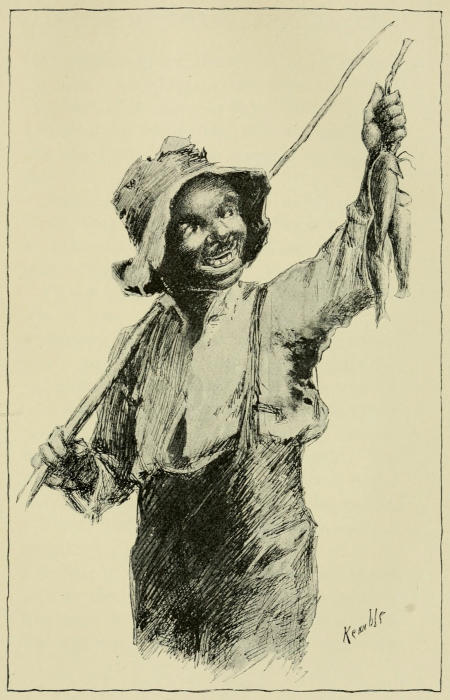
“Why, we kin go dis ve’y afternoon,” exclaimed
’Lias, in relief and delight; “I’s mighty
fond o’ fishin’, myse’f.”
“All right; I’m in your hands from now on.”
’Lias drew his shoulders up, with an unconscious
motion. The preacher saw it, and mentally
rejoiced. He felt that the first thing the
boy beside him needed was a consciousness of
responsibility, and the lifted shoulders meant progress
in that direction, a sort of physical straightening
up to correspond with the moral one.
On seeing her son walk in with the minister,
Aunt ‘Ca’line’s’ delight was boundless. “La!
Brothah Dokesbury,” she exclaimed, “wha’d
you fin’ dat scamp?”
“Oh, down the street here,” the young man
replied lightly. “I got hold of his name and
made myself acquainted, so he came home to
go fishing with me.”
“’Lias is pow’ful fon’ o’ fishin’, hisse’f. I
’low he kin show you some mighty good places.
Cain’t you, ’Lias?”
“I reckon.”
’Lias was thinking. He was distinctly grateful
that the circumstances of his meeting with
the minister had been so deftly passed over. But
with a half idea of the superior moral responsibility
under which a man in Dokesbury’s position
laboured, he wondered vaguely—to put it
in his own thought-words—“ef de preachah
hadn’t put’ nigh lied.” However, he was willing
to forgive this little lapse of veracity, if such
it was, out of consideration for the anxiety it
spared his mother.
When Stephen Gray came in to dinner, he
was no less pleased than his wife to note the
terms of friendship on which the minister received
his son. On his face was the first smile
that Dokesbury had seen there, and he awakened
from his taciturnity and proffered much information
as to the fishing-places thereabout. The
young minister accounted this a distinct gain.
Anything more than a frowning silence from
the “little yaller man” was gain.
The fishing that afternoon was particularly
good. Catfish, chubs, and suckers were landed
in numbers sufficient to please the heart of any
amateur angler.
’Lias was happy, and the minister was in the
best of spirits, for his charge seemed promising.
He looked on at the boy’s jovial face, and laughed
within himself; for, mused he, “it is so much
harder for the devil to get into a cheerful heart
than into a sullen, gloomy one.” By the time
they were ready to go home Harold Dokesbury
had received a promise from ’Lias to attend
service the next morning and hear the sermon.
There was a great jollification over the fish
supper that night, and ’Lias and the minister
were the heroes of the occasion. The old man
again broke his silence, and recounted, with infinite
dryness, ancient tales of his prowess with
rod and line; while Aunt ‘Ca’line’ told of famous
fish suppers that in the bygone days she had
cooked for “de white folks.” In the midst of
it all, however, ’Lias disappeared. No one had
noticed when he slipped out, but all seemed to
become conscious of his absence about the same
time. The talk shifted, and finally simmered
into silence.
When the Rev. Mr. Dokesbury went to bed
that night, his charge had not yet returned.
The young minister woke early on the Sabbath
morning, and he may be forgiven that the
prospect of the ordeal through which he had to
pass drove his care for ’Lias out of mind for the
first few hours. But as he walked to church,
flanked on one side by Aunt Caroline in the
stiffest of ginghams and on the other by her
husband stately in the magnificence of an antiquated
“Jim-swinger,” his mind went back to
the boy with sorrow. Where was he? What
was he doing? Had the fear of a dull church
service frightened him back to his old habits and
haunts? There was a new sadness at the
preacher’s heart as he threaded his way down
the crowded church and ascended the rude
pulpit.
The church was stiflingly hot, and the morning
sun still beat relentlessly in through the
plain windows. The seats were rude wooden
benches, in some instances without backs. To
the right, filling the inner corner, sat the pillars
of the church, stern, grim, and critical. Opposite
them, and, like them, in seats at right angles to
the main body, sat the older sisters, some of
them dressed with good old-fashioned simplicity,
while others yielding to newer tendencies were
gotten up in gaudy attempts at finery. In the
rear seats a dozen or so much beribboned
mulatto girls tittered and giggled, and cast bold
glances at the minister.
The young man sighed as he placed the manuscript
of his sermon between the leaves of the
tattered Bible. “And this is Mt. Hope,” he
was again saying to himself.
It was after the prayer and in the midst
of the second hymn that a more pronounced
titter from the back seats drew his attention.
He raised his head to cast a reproving glance at
the irreverent, but the sight that met his eyes
turned that look into one of horror. ’Lias had
just entered the church, and with every mark of
beastly intoxication was staggering up the aisle
to a seat, into which he tumbled in a drunken
heap. The preacher’s soul turned sick within
him, and his eyes sought the face of the mother
and father. The old woman was wiping her
eyes, and the old man sat with his gaze bent
upon the floor, lines of sorrow drawn about his
wrinkled mouth.
All of a sudden a great revulsion of feeling
came over Dokesbury. Trembling he rose and
opened the Bible. There lay his sermon, polished
and perfected. The opening lines seemed
to him like glints from a bright cold crystal.
What had he to say to these people, when the
full realisation of human sorrow and care and
of human degradation had just come to him?
What had they to do with firstlies and secondlies,
with premises and conclusions? What they
wanted was a strong hand to help them over
the hard places of life and a loud voice to cheer
them through the dark. He closed the book
again upon his precious sermon. A something
new had been born in his heart. He let his
glance rest for another instant on the mother’s
pained face and the father’s bowed form, and
then turning to the congregation began, “Come
unto me, all ye that labour and are heavy laden,
and I will give you rest. Take my yoke upon
you, and learn of me: for I am meek and lowly
in heart: and ye shall find rest unto your souls.”
Out of the fulness of his heart he spoke unto
them. Their great need informed his utterance.
He forgot his carefully turned sentences and
perfectly rounded periods. He forgot all save
that here was the well-being of a community
put into his hands whose real condition he had
not even suspected until now. The situation
wrought him up. His words went forth like
winged fire, and the emotional people were
moved beyond control. They shouted, and
clapped their hands, and praised the Lord loudly.
When the service was over, there was much
gathering about the young preacher, and hand-shaking.
Through all ’Lias had slept. His
mother started toward him; but the minister
managed to whisper to her, “Leave him to me.”
When the congregation had passed out, Dokesbury
shook ’Lias. The boy woke, partially
sobered, and his face fell before the preacher’s
eyes.
“Come, my boy, let’s go home.” Arm in
arm they went out into the street, where a
number of scoffers had gathered to have a laugh
at the abashed boy; but Harold Dokesbury’s
strong arm steadied his steps, and something in
his face checked the crowd’s hilarity. Silently
they cleared the way, and the two passed among
them and went home.
The minister saw clearly the things which
he had to combat in his community, and through
this one victim he determined to fight the general
evil. The people with whom he had to
deal were children who must be led by the
hand. The boy lying in drunken sleep upon
his bed was no worse than the rest of them.
He was an epitome of the evil, as his parents
were of the sorrows, of the place.
He could not talk to Elias. He could not
lecture him. He would only be dashing his
words against the accumulated evil of years of
bondage as the ripples of a summer sea beat
against a stone wall. It was not the wickedness
of this boy he was fighting or even the wrong-doing
of Mt. Hope. It was the aggregation
of the evils of the fathers, the grandfathers, the
masters and mistresses of these people. Against
this what could talk avail?
The boy slept on, and the afternoon passed
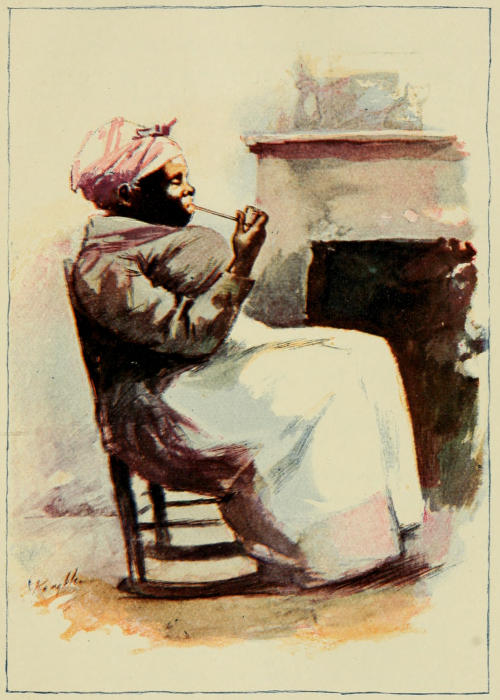
heavily away. Aunt Caroline was finding solace
in her pipe, and Stephen Gray sulked in
moody silence beside the hearth. Neither of
them joined their guest at evening service.
“AUNT CAROLINE WAS FINDING SOLACE IN THE PIPE.”
He went, however. It was hard to face
those people again after the events of the morning.
He could feel them covertly nudging each
other and grinning as he went up to the pulpit.
He chided himself for the momentary annoyance
it caused him. Were they not like so
many naughty, irresponsible children?
The service passed without unpleasantness,
save that he went home with an annoyingly
vivid impression of a yellow girl with red ribbons
on her hat, who pretended to be impressed
by his sermon and made eyes at him from
behind her handkerchief.
On the way to his room that night, as he
passed Stephen Gray, the old man whispered
huskily, “It’s de fus’ time ’Lias evah done
dat.”
It was the only word he had spoken since
morning.
A sound sleep refreshed Dokesbury, and restored
the tone to his overtaxed nerves. When
he came out in the morning, Elias was already
in the kitchen. He too had slept off his indisposition,
but it had been succeeded by a painful
embarrassment that proved an effectual barrier
to all intercourse with him. The minister
talked lightly and amusingly, but the boy never
raised his eyes from his plate, and only spoke
when he was compelled to answer some direct
questions.
Harold Dokesbury knew that unless he could
overcome this reserve, his power over the youth
was gone. He bent every effort to do it.
“What do you say to a turn down the street
with me?” he asked as he rose from breakfast.
’Lias shook his head.
“What! You haven’t deserted me already?”
The older people had gone out, but young
Gray looked furtively about before he replied:
“You know I ain’t fittin’ to go out with you—aftah—aftah—yestiddy.”
A dozen appropriate texts rose in the
preacher’s mind, but he knew that it was not
a preaching time, so he contented himself with
saying,—
“Oh, get out! Come along!”
“No, I cain’t. I cain’t. I wisht I could!
You needn’t think I’s ashamed, ’cause I ain’t.
Plenty of ’em git drunk, an’ I don’t keer nothin’
’bout dat”—this in a defiant tone.
“Well, why not come along, then?”
“I tell you I cain’t. Don’t ax me no mo’.
It ain’t on my account I won’t go. It’s you.”
“Me! Why, I want you to go.”
“I know you does, but I mustn’t. Cain’t
you see that dey’d be glad to say dat—dat you
was in cahoots wif me an’ you tuk yo’ dram
on de sly?”
“I don’t care what they say so long as it isn’t
true. Are you coming?”
“No, I ain’t.”
He was perfectly determined, and Dokesbury
saw that there was no use arguing with him.
So with a resigned “All right!” he strode out the
gate and up the street, thinking of the problem
he had to solve.
There was good in Elias Gray, he knew. It
was a shame that it should be lost. It would
be lost unless he were drawn strongly away from
the paths he was treading. But how could it
be done? Was there no point in his mind that
could be reached by what was other than evil?
That was the thing to be found out. Then he
paused to ask himself if, after all, he were not
trying to do too much,—trying, in fact, to play
Providence to Elias. He found himself involuntarily
wanting to shift the responsibility of
planning for the youth. He wished that something
entirely independent of his intentions
would happen.
Just then something did happen. A piece
of soft mud hurled from some unknown source
caught the minister square in the chest, and
spattered over his clothes. He raised his eyes
and glanced about quickly, but no one was in
sight. Whoever the foe was, he was securely
ambushed.
“Thrown by the hand of a man,” mused
Dokesbury, “prompted by the malice of a
child.”
He went on his way, finished his business,
and returned to the house.
“Oh, that’s where one of our good citizens
left his card.”
“You don’ mean to say none o’ dem low-life
scoun’els—”
“I don’t know who did it. He took particular
pains to keep out of sight.”
“’Lias!” the old woman cried, turning on
her son, “wha’ ’d you let Brothah Dokesbury go
off by hisse’f fu’? Whyn’t you go ’long an’
tek keer o’ him?”
The old lady stopped even in the midst of
her tirade, as her eyes took in the expression on
her son’s face.
“I’ll kill some o’ dem damn—”
“’Lias!”
“’Scuse me, Mistah Dokesbury, but I feel
lak I’ll bus’ ef I don’t ’spress myse’f. It
makes me so mad. Don’t you go out o’ hyeah
no mo’ ’dout me. I’ll go ’long an’ I’ll brek
somebody’s haid wif a stone.”
“’Lias! how you talkin’ fo’ de ministah?”
“Well, dat’s whut I’ll do, ’cause I kin out-th’ow
any of ’em an’ I know dey hidin’-places.”
“I’ll be glad to accept your protection,”
said Dokesbury.
He saw his advantage, and was thankful for
the mud,—the one thing that without an effort
restored the easy relations between himself and
his protégé.
Ostensibly these relations were reversed, and
Elias went out with the preacher as a guardian
and protector. But the minister was laying his
nets. It was on one of these rambles that he
broached to ’Lias a subject which he had been
considering for some time.
“Look here, ’Lias,” he said, “what are
you going to do with that big back yard of
yours?”
“Oh, nothin’. ’Tain’t no ’count to raise
nothin’ in.”
“It may not be fit for vegetables, but it will
raise something.”
“What?”
“Chickens. That’s what.”
Elias laughed sympathetically.
“I’d lak to eat de chickens I raise. I
wouldn’t want to be feedin’ de neighbourhood.”
“Plenty of boards, slats, wire, and a good
lock and key would fix that all right.”
“Yes, but whah’m I gwine to git all dem
things?”
“Why, I’ll go in with you and furnish the
money, and help you build the coops. Then
you can sell chickens and eggs, and we’ll go
halves on the profits.”
“Hush, man!” cried ’Lias, in delight.
So the matter was settled, and, as Aunt
Caroline expressed it, “Fu’ a week er sich a
mattah, you nevah did see sich ta’in’ down an’
buildin’ up in all yo’ bo’n days.”
’Lias went at the work with zest, and Dokesbury
noticed his skill with tools. He let fall the
remark: “Say, ’Lias, there’s a school near here
where they teach carpentering; why don’t
you go and learn?”
“What I gwine to do with bein’ a
cyahpenter?”
“Repair some of these houses around Mt.
Hope, if nothing more,” Dokesbury responded,
laughing; and there the matter rested.
The work prospered, and as the weeks went
on, ’Lias’ enterprise became the town’s talk.
One of Aunt Caroline’s patrons who had come
with some orders about work regarded the
changed condition of affairs, and said, “Why,
Aunt Caroline, this doesn’t look like the same
place. I’ll have to buy some eggs from you;
you keep your yard and hen-house so nice, it’s
an advertisement for the eggs.”
“Don’t talk to me nothin’ ’bout dat ya’d,
Miss Lucy,” Aunt Caroline had retorted.
“Dat ’long to ’Lias an’ de preachah. Hit
dey doin’s. Dey done mos’ nigh drove me out
wif dey cleanness. I ain’t nevah seed no sich
ca’in’ on in my life befo’. Why, my ’Lias
done got right brigity an’ talk about bein’
somep’n’.”
Dokesbury had retired from his partnership
with the boy save in so far as he acted as a
general supervisor. His share had been sold
to a friend of ’Lias, Jim Hughes. The two
seemed to have no other thought save of raising,
tending, and selling chickens.
Mt. Hope looked on and ceased to scoff.
Money is a great dignifier, and Jim and ’Lias
were making money. There had been some
sniffs when the latter had hinged the front gate
and whitewashed his mother’s cabin, but even
that had been accepted now as a matter of
course.
Dokesbury had done his work. He, too,
looked on, and in some satisfaction.
“Let the leaven work,” he said, “and all
Mt. Hope must rise.”
It was one day, nearly a year later, that “old
lady Hughes” dropped in on Aunt Caroline for
a chat.
“Well, I do say, Sis’ Ca’line, dem two boys
o’ ourn done sot dis town on fiah.”
“What now, Sis’ Lizy?”
“Why, evah sence ’Lias tuk it into his
haid to be a cyahpenter an’ Jim ’cided to go
’long an’ lu’n to be a blacksmif, some o’ dese
hyeah othah young people’s been tryin’ to do
somep’n’.”
“All dey wanted was a staht.”
“Well, now will you b’lieve me, dat no-’count
Tom Johnson done opened a fish sto’, an’ he
has de boys an’ men bring him dey fish all de
time. He give ’em a little somep’n’ fu’ dey
ketch, den he go sell ’em to de white folks.”
“Lawd, how long!”
“An’ what you think he say?”
“I do’ know, sis’.”
“He say ez soon ’z he git money enough, he
gwine to dat school whah ’Lias an’ Jim gone
an’ lu’n to fahm scientific.”
“Bless de Lawd! Well, ’um, I don’ put
nothin’ pas’ de young folks now.”
Mt. Hope had at last awakened. Something
had come to her to which she might aspire,—something
that she could understand and reach.
She was not soaring, but she was rising above
the degradation in which Harold Dokesbury had
found her. And for her and him the ordeal had
passed.
THE COLONEL’S AWAKENING
THE COLONEL’S AWAKENING
It was the morning before Christmas. The
cold winter sunlight fell brightly through the
window into a small room where an old man
was sitting. The room, now bare and cheerless,
still retained evidences of having once been
the abode of refinement and luxury. It was
the one open chamber of many in a great
rambling old Virginia house, which in its time
had been one of the proudest in the county.
But it had been in the path of the hurricane of
war, and had been shorn of its glory as a tree is
stripped of its foliage. Now, like the bare tree,
dismantled, it remained, and this one old man,
with the aristocratic face, clung to it like the
last leaf.
He did not turn his head when an ancient
serving-man came in and began laying the things
for breakfast. After a while the servant spoke:
“I got a monst’ous fine breakfus’ fu’ you dis
mo’nin’, Mas’ Estridge. I got fresh aigs, an’
beat biscuits, an Lize done fried you a young
chicken dat’ll sholy mek yo’ mouf worter.”
“Thank you, Ike, thank you,” was the dignified
response. “Lize is a likely girl, and she’s
improving in her cooking greatly.”
“Yes, Mas’ Estridge, she sho is a mighty
fine ooman.”
“And you’re not a bad servant yourself,
Ike,” the old man went on, with an air of
youthful playfulness that ill accorded with his
aged face. “I expect some day you’ll be
coming around asking me to let you marry Lize,
eh! What have you got to say to that?”
“Well, we shall see about it when the time
comes; we shall see about it.”
“Lawd, how long!” mumbled the old servant
to himself as he went on about his work.
“Ain’t Mas’ Bob nevah gwine to git his almanec
straight? He been gwine on dis way
fu’ ovah twenty yeahs now. He cain’t git it
thoo’ his haid dat time been a-passin’. Hyeah
I done been ma’ied to Lize fu’ lo dese many
yeahs, an’ we’ve got ma’ied chillum, but he
still think I’s a-cou’tin’ huh.”
To Colonel Robert Estridge time had not
passed and conditions had not changed for a
generation. He was still the gallant aristocrat
he had been when the war broke out,—a little
past the age to enlist himself, but able and glad
to give two sons to the cause of the South.
They had gone out, light-hearted and gay, and
brave in their military trappings and suits of
gray. The father had watched them away
with moist eyes and a swelling bosom. After
that the tide of war had surged on and on, had
even rolled to his very gates, and the widowed
man watched and waited for it to bring his boys
back to him. One of them came. They
brought him back from the valley of the Shenandoah,
and laid him in the old orchard out
there behind the house. Then all the love of
the father was concentrated upon the one remaining
son, and his calendar could know but
one day and that the one on which his Bob, his
namesake and his youngest, should return to
him. But one day there came to him the news
that his boy had fallen in the front of a terrific
fight, and in the haste of retreat he had been
buried with the unknown dead. Into that
trench, among the unknown, Colonel Robert
Estridge had laid his heart, and there it had
stayed. Time stopped, and his faculties wandered.
He lived always in the dear past. The
present and future were not. He did not even
know when the fortunes of war brought an
opposing host to his very doors. He was unconscious
of it all when they devoured his substance
like a plague of locusts. It was all a
blank to him when the old manor house was
fired and he was like to lose his possessions and
his life. When his servants left him he did
not know, but sat and gave orders to the one
faithful retainer as though he were ordering the
old host of blacks. And so for more than a
generation he had lived.
“Hope you gwine to enjoy yo’ Christmas
Eve breakfus’, Mas’ Estridge,” said the old
servant.
“Christmas Eve, Christmas Eve? Yes, yes,
so it is. To-morrow is Christmas Day, and
I’m afraid I have been rather sluggish in getting
things ready for the celebration. I reckon the
darkies have already begun to jubilate and to
shirk in consequence, and I won’t be able to
get a thing done decently for a week.”
“Don’t you bother ’bout none o’ de res’, Mas’
Estridge; you kin ’pend on me—I ain’t gwine
to shu’k even ef ’t is Christmus.”
“That’s right, Ike. I can depend upon you.
You’re always faithful. Just you get things done
up right for me, and I’ll give you that broadcloth
suit of mine. It’s most as good as new.”
“Thanky, Mas’ Bob, thanky.” The old
Negro said it as fervently as if he had not worn
out that old broadcloth a dozen years ago.
“It’s late and we’ve got to hurry if we
want things prepared in time. Tell Lize that
I want her to let herself out on that dinner.
Your Mas’ Bob and your Mas’ Stanton are
going to be home to-morrow, and I want to
show them that their father’s house hasn’t lost
any of the qualities that have made it famous in
Virginia for a hundred years. Ike, there ain’t
anything in this world for making men out of
boys like making them feel the debt they owe
to their name and family.”
“Yes, suh, Mas’ Bob an’ Mas’ Stant sholy
is mighty fine men.”
“There ain’t two finer in the whole country,
sir,—no, sir, not in all Virginia, and that of
necessity means the whole country. Now, Ike,
I want you to get out some of that wine up in
the second cellar, and when I say some I mean
plenty. It ain’t seen the light for years, but it
shall gurgle into the glasses to-morrow in honour
of my sons’ home-coming. Good wine makes
good blood, and who should drink good wine if
not an Estridge of Virginia, sir, eh, Ike?”
The wine had gone to make good cheer
when a Federal regiment had lighted its campfires
on the Estridge lawn, but old Ike had
heard it too often before and knew his business
too well to give any sign.
“I want you to take some things up to Miss
Clarinda Randolph to-morrow, too, and I’ve
got a silver snuffbox for Thomas Daniels. I
can’t make many presents this year. I’ve got
to devote my money to the interest of your
young masters.”
There was a catch in the Negro’s voice as he
replied, “Yes, Mas’ Estridge, dey needs it mos’,
dey needs it mos’.”
The old colonel’s spell of talking seldom
lasted long, and now he fell to eating in silence;
but his face was the face of one in a dream.
Ike waited on him until he had done, and then,
clearing the things away, slipped out, leaving
him to sit and muse in his chair by the window.
“Look hyeah, Lize,” said the old servant,
as he entered his wife’s cabin a little later.
“Pleggoned ef I didn’t come purt’ nigh brekin’
down dis mo’nin’.”
“Wha’ ’s de mattah wif you, Ike?”
“Jes’ a-listenin’ to ol’ Mas’ a-sittin’ dah
a-talkin’ lak it was de ol’ times,—a-sendin’
messages to ol’ Miss Randolph, dat’s been daid
too long to talk about, an’ to Mas’ Tom Daniels,
dat went acrost de wateh ruther ’n tek de oaf
o’ ’legiance.”
“Oomph,” said the old lady, wiping her eyes
on her cotton apron.
“Den he expectin’ Mas’ Bob an’ Mas’ Stant
home to-morrer. ’Clah to goodness, when he
say dat I lak to hollahed right out.”
“Den you would ’a’ fixed it, wouldn’t you?
Set down an’ eat yo’ breakfus’, Ike, an’ don’t
you nevah let on when Mas’ Estridge talkin’,
you jes’ go ’long ’bout yo’ wuk an’ keep yo’
mouf shet, ’ca’se ef evah he wake up now he
gwine to die right straight off.”
“Lawd he’p him not to wake up den, ’ca’se
he ol’, but we needs him. I do’ know whut I’d
do ef I didn’t have Mas’ Bob to wuk fu’. You
got ol’ Miss Randolph’s present ready fu’ him?”
“Co’se I has. I done made him somep’n’
diffunt dis yeah.”
“Made him somep’n’ diffunt—whut you say,
Lize?” exclaimed the old man, laying his knife
and fork on his plate and looking up at his wife
with wide-open eyes. “You ain’t gwine change
afteh all dese yeahs?”
“Yes. I jes’ pintly had to. It’s been de
same thing now fu’ mo’ ’n twenty yeahs.”
“Whut you done made fu’ him?”
“I’s made him a comfo’t to go roun’ his
naik.”
“But, Lize, ol’ Miss Cla’indy allus sont him
gloves knit wif huh own han’. Ain’t you feared
Mas’ Estridge gwine to ’spect?”
“No, he ain’t gwine to ’spect. He don’t tek
no notice o’ nuffin’, an’ he jes’ pintly had to have
dat comfo’t fu’ his naik, ’ca’se he boun’ to go out
in de col’ sometime er ruther an’ he got plenty
gloves.”
“I’s feared,” said the old man, sententiously,
“I’s mighty feared. I wouldn’t have Mastah
know we been doin’ fu’ him an’ a-sendin’ him
dese presents all dis time fu’ nuffin’ in de worl’.
It ’u’d hu’t him mighty bad.”
“He ain’t foun’ out all dese yeahs, an’ he ain’t
gwine fin’ out now.” The old man shook his
head dubiously, and ate the rest of his meal in
silence.
It was a beautiful Christmas morning as he
wended his way across the lawn to his old
master’s room, bearing the tray of breakfast
things and “ol’ Miss Randolph’s present,”—a
heavy home-made scarf. The air was full of
frosty brightness. Ike was happy, for the frost
had turned the persimmons. The ’possums had
gorged themselves, and he had one of the fattest
of them for his Christmas dinner. Colonel
Estridge was sitting in his old place by the window.
He crumbled an old yellow envelope in
his hand as Ike came in and set the things down.
It looked like the letter which had brought the
news of young Robert Estridge’s loss, but it
could not be, for the old man sitting there had
forgotten that and was expecting the son home
on that day.
Ike took the comforter to his master, and began
in the old way: “Miss Cla’iny Randolph mek
huh comperments to you, Mas’ Bob, an’ say—”
But his master had turned and was looking him
square in the face, and something in the look
checked his flow of words. Colonel Estridge
did not extend his hand to take the gift. “Clarinda
Randolph,” he said, “always sends me
gloves.” His tone was not angry, but it was
cold and sorrowful. “Lay it down,” he went
on more kindly and pointing to the comforter,
“and you may go now. I will get whatever I
want from the table.” Ike did not dare to demur.
He slipped away, embarrassed and distressed.
“Wha’ ’d I tell you?” he asked Lize, as soon
as he reached the cabin. “I believe he done
woke up.” But the old woman could only
mourn and wring her hands.
“Well, nevah min’,” said Ike, after his first
moment of sad triumph was over. “I guess it
wasn’t the comfo’t nohow, ’ca’se I seed him wif
a letteh when I went in, but I didn’t ’spicion
nuffin’ tell he look at me an’ talk jes’ ez sensible
ez me er you.”
It was not until dinner-time that Ike found
courage to go back to his master’s room, and
then he did not find him sitting in his accustomed
place, nor was he on the porch or in the hall.
Growing alarmed, the old servant searched
high and low for him, until he came to the door
of a long-disused room. A bundle of keys
hung from the keyhole.
“Hyeah’s whah he got dat letteh,” said Ike.
“I reckon he come to put it back.” But even
as he spoke, his eyes bulged with apprehension.
He opened the door farther, and went in. And
there at last his search was ended. Colonel Estridge
was on his knees before an old oak chest.
On the floor about him were scattered pair on pair
of home-knit gloves. He was very still. His
head had fallen forward on the edge of the chest.
Ike went up to him and touched his shoulder.
There was no motion in response. The black
man lifted his master’s head. The face was
pale and cold and lifeless. In the stiffening
hand was clenched a pair of gloves,—the last
Miss Randolph had ever really knit for him.
The servant lifted up the lifeless form, and laid
it upon the bed. When Lize came she would
have wept and made loud lamentations, but Ike
checked her. “Keep still,” he said. “Pray if
you want to, but don’t hollah. We ought to be
proud, Lize.” His shoulders were thrown back
and his head was up. “Mas’ Bob’s in glory.
Dis is Virginia’s Christmas gif’ to Gawd!”
THE TRIAL SERMONS ON BULL-SKIN
THE TRIAL SERMONS ON BULL-SKIN
The congregation on Bull-Skin Creek was
without a pastor. You will probably say that
this was a deficiency easily remedied among a
people who possess so much theological material.
But you will instantly perceive how different a
matter it was, when you learn that the last
shepherd who had guided the flock at Bull-skin
had left that community under a cloud. There
were, of course, those who held with the departed
minister, as well as those who were
against him; and so two parties arose in the
church, each contending for supremacy. Each
party refused to endorse any measure or support
any candidate suggested by the other; and as
neither was strong enough to run the church
alone, they were in a state of inactive equipoise
very gratifying to that individual who is supposed
to take delight in the discomfort of the
righteous.
It was in this complicated state of affairs that
Brother Hezekiah Sneedon, who was the representative
of one of the candidates for the vacant
pastorate, conceived and proposed a way out of
the difficulty. Brother Sneedon’s proposition
was favourably acted upon by the whole congregation,
because it held out the promise of victory
to each party. It was, in effect, as follows:
Each faction—it had come to be openly recognised
that there were two factions—should
name its candidate, and then they should be invited
to preach, on successive Sundays, trial
sermons before the whole congregation, the
preacher making the better impression to be
called as pastor.
“And,” added Brother Sneedon, pacifically,
“in ordah dat dis little diffunce between de
membahs may be settled in ha’mony, I do hope
an’ pray dat de pahty dat fin’s itse’f outpreached
will give up to de othah in Christun submission,
an’ th’ow in all deir might to hol’ up de
han’s of whatever pastor de Lawd may please
to sen’.”
BROTHER HEZEKIAH SNEEDON.
Sister Hannah Williams, the leader of the
opposing faction, expressed herself as well
pleased with the plan, and counselled a like
submission to the will of the majority. And
thus the difficulty at Bull-skin seemed in a fair
way to settlement. But could any one have
read that lady’s thoughts as she wended her
homeward way after the meeting, he would have
had some misgivings concerning the success of
the proposition which she so willingly endorsed.
For she was saying to herself,—
“Uh huh! ol’ Kiah Sneedon thinks he’s
mighty sma’t, puttin’ up dat plan. Reckon he
thinks ol’ Abe Ma’tin kin outpreach anything
near an’ fur, but ef Brothah ’Lias Smith don’t
fool him, I ain’t talkin’.”
And Brother Sneedon himself was not entirely
guiltless of some selfish thought as he hobbled
away from the church door.
“Ann,” said he to his wife, “I wunner ef
Hannah Williams ca’culates dat ’Lias Smith kin
beat Brother Abe Ma’tin preachin’, ki yi! but
won’t she be riley when she fin’s out how mistaken
she is? Why, dey ain’t nobody ’twixt
hyeah an’ Louisville kin beat Brothah Abe
Ma’tin preachin’. I’s hyeahed dat man preach
’twell de winders rattled an’ it seemed lak de
skies mus’ come down anyhow, an’ sinnahs was
a-fallin’ befo’ de Wo’d lak leaves in a Novembah
blas’; an’ she ’lows to beat him, oomph!”
The “oomph” meant disgust, incredulity, and,
above all, resistance.
The first of the momentous Sundays had been
postponed two weeks, in order, it was said, to
allow the members to get the spiritual and temporal
elements of the church into order that
would be pleasing to the eyes of a new pastor.
In reality, Brother Sneedon and Sister Williams
used the interval of time to lay their plans and
to marshal their forces. And during the two
weeks previous to the Sunday on which, by
common consent, it had been agreed to invite
the Reverend Elias Smith to preach, there was
an ominous quiet on the banks of Bull-Skin,—the
calm that precedes a great upheaval, when
clouds hang heavy with portents and forebodings,
but silent withal.
But there were events taking place in which
the student of diplomacy might have found food
for research and reflection. Such an event was
the taffy-pulling which Sister Williams’ daughters,
Dora and Caroline, gave to the younger
members of the congregation on Thursday
evening. Such were the frequent incursions of
Sister Williams herself upon the domains of the
neighbours, with generous offerings of “a taste
o’ my ketchup” or “a sample o’ my jelly.”
She did not stop with rewarding her own allies,
but went farther, gift-bearing, even into the
camp of the enemy himself.
It was on Friday morning that she called on
Sister Sneedon. She found the door ajar and
pushed it open, saying, “You see, Sis’ Sneedon,
I’s jes’ walkin’ right in.”
“Oh, it’s you, Sis’ Williams; dat’s right,
come in. I was jes’ settin’ hyeah sawtin’ my
cyahpet rags, de mof do seem to pestah ’em so.
Tek dis cheer”—industriously dusting one
with her apron. “How you be’n sence I seen
you las’?”
“Oh, jes’ sawt o’ so.”
“How’s Do’ an’ Ca’line?”
“Oh, Ca’line’s peart enough, but Do’s
feelin’ kind o’ peekid.”
“Don’t you reckon she grow too fas’?”
“’Spec’ dat’s about hit; dat gal do sutny
seem to run up lak a weed.”
“It don’t nevah do ’em no good to grow
so fas’, hit seem to tek away all deir strengf.”
“Yes, ’m, it sholy do; gals ain’t whut dey
used to be in yo’ an’ my day, nohow.”
“Lawd, no; dey’s ez puny ez white folks
now.”
“Well, dem sholy is lovely cyahpet rags—put’
nigh all wool, ain’t dey?”
“Yes, ma’am, dey is wool, evah speck an’
stitch; dey ain’t a bit o’ cotton among ’em. I
ain’t lak some folks; I don’t b’lieve in mixin’
my rags evah-which-way. Den when you gits
’em wove have de cyahpet wah in holes, ’cause
some’ll stan’ a good deal o’ strain an’ some
won’t; yes, ’m, dese is evah one wool.”
“An’ you sholy have be’n mighty indust’ous
in gittin’ ’em togethah.”
“I’s wo’ked ha’d an’ done my level bes’,
dat’s sho.”
“Dat’s de mos’ any of us kin do. But I
mustn’t be settin’ hyeah talkin’ all day an’
keepin’ you f’om yo’ wo’k. Why, la! I’d
mos’ nigh fu’got what I come fu’—I jes’
brung you ovah a tas’e o’ my late greens.
I knows how you laks greens, so I thought
mebbe you’d enjoy dese.”
“Why, sho enough; now ain’t dat good o’
you, Sis’ Williams? Dey’s right wa’m, too, an’
tu’nip tops—bless me! Why, dese mus’ be
de ve’y las’ greens o’ de season.”
“Well, I reely don’t think you’ll fin’ none
much latah. De fros’ had done teched dese,
but I kin’ o’ kivered ’em up wif leaves ontwell
dey growed up wuf cuttin’.”
“Well, I knows I sholy shell relish dem.”
Mrs. Sneedon beamed as she emptied the dish
and insisted upon washing it for her visitor to
take home with her. “Fu’,” she said, by way
of humour, “I’s a mighty po’ han’ to retu’n
nice dishes when I gits ’em in my cu’boa’d
once.”
Sister Williams rose to go. “Well, you’ll
be out to chu’ch Sunday to hyeah Broth’ ’Lias
Smith; he’s a powahful man, sho.”
“Dey do tell me so. I’ll be thah. You
kin ’pend on me to be out whenevah thah’s to
be any good preachin’.”
“Well, we kin have dat kin’ o’ preachin’ all
de time ef we gits Broth’ ’Lias Smith.”
“Yes, ’m.”
“Dey ain’t no ’sputin’ he’ll be a movin’
powah at Bull-Skin.”
“Yes, ’m.”
“We sistahs’ll have to ban’ togethah an’ try
to do whut is bes’ fu’ de chu’ch.”
“Yes, ’m.”
“Co’se, Sistah Sneedon, ef you’s pleased wif
his sermon, I suppose you’ll be in favoh o’
callin’ Broth’ ’Lias Smith.”
“Well, Sis’ Williams, I do’ know; you see
Hezekier’s got his hea’t sot on Broth’ Abe
Ma’tin fum Dokesville; he’s mighty sot on
him, an’ when he’s sot he’s sot, an’ you know
how it is wif us women when de men folks
says dis er dat.”
Sister Williams saw that she had overshot her
mark. “Oh, hit’s all right, Sis’ Sneedon, hit’s
all right. I jes’ spoke of it a-wunnerin’. What
we women folks wants to do is to ban’ togethah
to hol’ up de han’ of de pastah dat comes,
whoms’ever he may be.”
“Dat’s hit, dat’s hit,” assented her companion;
“an’ you kin ’pend on me thah, fu’ I’s
a powahful han’ to uphol’ de ministah whoms’ever
he is.”
“An’ you right too, fu’ dey’s de shepuds of
de flock. Well, I mus’ be goin’—come ovah.”
“I’s a-comin’—come ag’in yo’se’f, good-bye.”
As soon as her visitor was gone, Sister Sneedon
warmed over the greens and sat down to
the enjoyment of them. She had just finished
the last mouthful when her better half entered.
He saw the empty plate and the green liquor.
Evidently he was not pleased, for be it said that
Brother Sneedon had himself a great tenderness
for turnip greens.
“Wha’d you git dem greens?” he asked.
“Sistah Hannah Williams brung ’em ovah
to me.”
“Sistah Hannah—who?” ejaculated he.
“Sis’ Williams, Sis’ Williams, you know
Hannah Williams.”
“What! dat wolf in sheep’s clothin’ dat’s
a-gwine erroun’ a-seekin’ who she may devowah,
an’ you hyeah a-projickin’ wif huh, eatin’ de
greens she gives you! How you know whut’s
in dem greens?”
“Oh, g’long, ’Kiah, you so funny! Sis’ Williams
ain’t gwine conju’ nobidy.”
“You hyeah me, you hyeah me now. Keep
on foolin’ wif dat ooman, she’ll have you
crawlin’ on yo’ knees an’ ba’kin, lak a dog. She
kin do it, she kin do it, fu’ she’s long-haided, I
tell you.”
“Well, ef she wants to hu’t me it’s done,
fu’ I’s eat de greens now.”
“Yes,” exclaimed Brother Sneedon, “you
eat ’em up lak a hongry hog an’ never saved me
a smudgeon.”
“Oomph! I thought you’s so afeard o’ gittin’
conju’ed.”
“Heish up! you’s allus tryin’ to raise some
kin’ er contentions in de fambly. I nevah seed
a ooman lak you.” And old Hezekiah strode
out of the cabin in high dudgeon.
And so, smooth on the surface, but turbulent
beneath, the stream of days flowed on until the
Sunday on which Reverend Elias Smith was to
preach his trial sermon. His fame as a preacher,
together with the circumstances surrounding this
particular sermon, had brought together such a
crowd as the little church on Bull-Skin had
never seen before even in the heat of the most
successful revivals. Outsiders had come from
as far away as Christiansburg, which was twelve,
and Fox Run, which was fifteen miles distant,
and the church was crowded to the doors.
Sister Williams with her daughters Dora and
Caroline were early in their seats. Their ribbons
were fluttering to the breeze like the banners
of an aggressive host. There were smiles
of anticipated triumph upon their faces. Brother
and Sister Sneedon arrived a little later. They
took their seat far up in the “amen corner,”
directly behind the Williams family. Sister
Sneedon sat very erect and looked about her,
but her spouse leaned his chin upon his cane
and gazed at the floor, nor did he raise his head,
when, preceded by a buzz of expectancy, the
Reverend Elias Smith, accompanied by Brother
Abner Williams, who was a local preacher, entered
and ascended to the pulpit, where he knelt
in silent prayer.
At the entrance of their candidate, the female
portion of the Williams family became instantly
alert.
They were all attention when the husband
and father arose and gave out the hymn: “Am
I a Soldier of the Cross?” They joined lustily
in the singing, and at the lines, “Sure I must
fight if I would reign,” their voices rose in a
victorious swell far above the voices of the rest
of the congregation. Prayer followed, and then
Brother Williams rose and said,—
“Brothahs an’ sistahs, I teks gret pleasuah
in interducin’ to you Eldah Smith, of Dokeville,
who will preach fu’ us at dis howah.
I want to speak fu’ him yo’ pra’ful attention.”
Sister Williams nodded her head in approval,
even this much was good; but Brother Sneedon
sighed aloud.
The Reverend Elias Smith arose and glanced
over the congregation. He was young, well-appearing,
and looked as though he might have
been unmarried. He announced his text in a
clear, resonant voice: “By deir fruits shell you
know dem.”
The great change that gave to the blacks
fairly trained ministers from the schools had not
at this time succeeded their recently accomplished
emancipation. And the sermon of Elder Smith
was full of all the fervour, common-sense, and
rude eloquence of the old plantation exhorter.
He spoke to his hearers in the language that they
understood, because he himself knew no other.
He drew his symbols and illustrations from the
things which he saw most commonly about him,—things
which he and his congregation understood
equally well. He spent no time in dallying
about the edge of his subject, but plunged immediately
into the middle of things, and soon had about
him a shouting, hallooing throng of frantic people.
Of course it was the Williams faction who
shouted. The spiritual impulse did not seem to
reach those who favoured Brother Sneedon’s candidate.
They sat silent and undemonstrative.
That earnest disciple himself still sat with his
head bent upon his cane, and still at intervals
sighed audibly. He had only raised his head
once, and that was when some especially powerful
period in the sermon had drawn from the
partner of his joys and sorrows an appreciative
“Oomph!” Then the look that he shot forth
from his eyes, so full of injury, reproach, and
menace, repressed her noble rage and settled her
back into a quietude more consonant with her
husband’s ideas.
Meanwhile, Sister Hannah Williams and her
sylph-like daughters “Do” and “Ca’line” were
in an excess of religious frenzy. Whenever any
of the other women in the congregation seemed
to be working their way too far forward, those
enthusiastic sisters shouted their way directly
across the approach to the pulpit, and held place
there with such impressive and menacing
demonstrativeness that all comers were warned
back. There had been times when, actuated by
great religious fervour, women had ascended the
rostrum and embraced the minister. Rest assured,
nothing of that kind happened in this
case, though the preacher waxed more and more
eloquent as he proceeded,—an eloquence more
of tone, look, and gesture than of words. He
played upon the emotions of his willing hearers,
except those who had steeled themselves against
his power, as a skilful musician upon the strings
of his harp. At one time they were boisterously
exultant, at another they were weeping and
moaning, as if in the realisation of many sins.
The minister himself lowered his voice to a soft
rhythmical moan, almost a chant, as he said,—
“You go ’long by de road an’ you see an ol’
shabby tree a-standin’ in de o’chud. It ain’t ha’dly
got a apple on it. Its leaves are put’ nigh all
gone. You look at de branches, dey’s all rough
an’ crookid. De tree’s all full of sticks an’
stones an’ wiah an’ ole tin cans. Hit’s all
bruised up an’ hit’s a ha’d thing to look at
altogether. You look at de tree an’ whut do
you say in yo’ hea’t? You say de tree ain’t no
’count, fu’ ‘by deir fruits shell you know dem.’
But you wrong, my frien’s, you wrong. Dat
tree did ba’ good fruit, an’ by hits fruit was hit
knowed. John tol’ Gawge an’ Gawge tol’ Sam,
an’ evah one dat passed erlong de road had to
have a shy at dat fruit. Dey be’n th’owin’ at
dat tree evah sence hit begun to ba’ fruit, an’
dey’s ’bused hit so dat hit couldn’t grow
straight to save hits life. Is dat whut’s de
mattah wif you, brothah, all bent ovah yo’ staff
an’ a-groanin’ wif yo’ burdens? Is dat whut’s
de mattah wif you, brothah, dat yo’ steps are
a-weary an’ you’s longin’ fu’ yo’ home? Have
dey be’n th’owin’ stones an’ cans at you?
Have dey be’n beatin’ you wif sticks? Have
dey tangled you up in ol’ wiah twell you couldn’t
move han’ ner foot? Have de way be’n all
trouble? Have de sky be’n all cloud? Have
de sun refused to shine an’ de day be’n all da’kness?
Don’t git werry, be consoled. Whut de
mattah! Why, I tell you you ba’in’ good fruit,
an’ de debbil cain’t stan’ it—‘By deir fruits shell
you know dem.’
“You go ’long de road a little furder an’ you
see a tree standin’ right by de fence. Standin’
right straight up in de air, evah limb straight out
in hits place, all de leaves green an’ shinin’ an’
lovely. Not a stick ner a stone ner a can in
sight. You look ’way up in de branches, an’
dey hangin’ full o’ fruit, big an’ roun’ an’ solid.
You look at dis tree an’ whut now do you say in
yo’ hea’t? You say dis is a good tree, fu’ ‘by deir
fruits shell you know dem.’ But you wrong,
you wrong ag’in, my frien’s. De apples on dat
tree are so sowah dat dey’d puckah up yo’ mouf
wuss ’n a green pu’simmon, an’ evahbidy knows
hit, by hits fruit is hit knowed. Dey don’t want
none o’ dat fruit, an’ dey pass hit by an’ don’t
bothah dey haids about it.
“Look out, brothah, you gwine erlong thoo
dis worl’ sailin’ on flowery beds of ease. Look
out, my sistah, you’s a-walkin’ in de sof’ pafs
an’ a-dressin’ fine. Ain’t nobidy a-troublin’
you, nobidy ain’t a-backbitin’ you, nobidy ain’t
a-castin’ yo’ name out as evil. You all right
an’ movin’ smoov. But I want you to stop an’
’zamine yo’se’ves. I want you to settle whut
kin’ o’ fruit you ba’in’, whut kin’ o’ light you
showin’ fo’f to de worl’. An’ I want you to
stop an’ tu’n erroun’ when you fin’ out dat you
ba’in’ bad fruit, an’ de debbil ain’t bothahed
erbout you ’ca’se he knows you his’n anyhow.
‘By deir fruits shell you know dem.’”
The minister ended his sermon, and the spell
broke. Collection was called for and taken, and
the meeting dismissed.
“Wha’ ’d you think o’ dat sermon?” asked
Sister Williams of one of her good friends; and
the good friend answered,—
“Tsch, pshaw! dat man jes’ tuk his tex’ at
de fust an’ nevah lef’ it.”
Brother Sneedon remarked to a friend: “Well,
he did try to use a good deal o’ high langgidge,
but whut we want is grace an’ speritual feelin’.”
The Williams faction went home with colours
flying. They took the preacher to dinner.
They were exultant. The friends of Brother
Sneedon were silent but thoughtful.
It was true, beyond the shadow of a doubt,
that the Reverend Elias Smith had made a wonderful
impression upon his hearers,—an impression
that might not entirely fade away before
the night on which the new pastor was to be
voted for. Comments on the sermon did not
end with the closing of that Sabbath day. The
discussion of its excellences was prolonged into
the next week, and continued with a persistency
dangerous to the aspirations of any rival candidate.
No one was more fully conscious of this
menacing condition of affairs than Hezekiah
Sneedon himself. He knew that for the minds
of the people to rest long upon the exploits of
Elder Smith would be fatal to the chances of his
own candidate; so he set about inventing some
way to turn the current of public thought into
another channel. And nothing but a powerful
agency could turn it. But in fertility of resources
Hezekiah Sneedon was Napoleonic. Though
his diplomacy was greatly taxed in this case,
he came out victorious and with colours flying
when he hit upon the happy idea of a “’possum
supper.” That would give the people something
else to talk about beside the Reverend
Elias Smith and his wonderful sermon. But
think not, O reader, that the intellect that conceived
this new idea was so lacking in the essential
qualities of diplomacy as to rush in his
substitute, have done with it, and leave the
public’s attention to revert to its former object.
Brother Sneedon was too wary for this. Indeed,
he did send his invitations out early to the congregation;
but this only aroused discussion and
created anticipation which was allowed to grow
and gather strength until the very Saturday
evening on which the event occurred.
Sister Hannah Williams saw through the
plot immediately, but she could not play counter,
so she contented herself with saying: “Dat
Hezekiah Sneedon is sholy de bigges’ scamp dat
evah trod shoe-leathah.” But nevertheless, she
did not refuse an invitation to be present at the
supper. She would go, she said, for the purpose
of seeing “how things went on.” But
she added, as a sort of implied apology to her
conscience, “and den I’s powahful fond o’
’possum, anyhow.”
In inviting Sister Williams, Brother Sneedon
had taken advantage of the excellent example
which that good woman had set him, and was
carrying the war right into the enemy’s country;
but he had gone farther in one direction, and
by the time the eventful evening arrived had
prepared for his guests a coup d’état which was
unanticipated even by his own wife.
He had been engaged in a secret correspondence,
the result of which was seen when,
just after the assembling of the guests in the
long, low room which was parlour, sitting, and
dining room in the Sneedon household, the
wily host ushered in and introduced to the
astonished people the Reverend Abram Martin.
They were not allowed to recover from their
surprise before they were seated at the table,
grace said by the reverend brother, and the
supper commenced. And such a supper as it
was,—one that could not but soften the feelings
and touch the heart of any Negro. It was a
supper that disarmed opposition. Sister Hannah
was seated at the left of Reverend Abram
Martin, who was a fluent and impressive talker;
and what with his affability and the delight of
the repast, she grew mollified and found herself
laughing and chatting. The other members of
her faction looked on, and, seeing her pleased
with the minister, grew pleased themselves.
The Reverend Abram Martin’s magnetic influence
ran round the board like an electric
current.
He could tell a story with a dignified humour
that was irresistible,—and your real Negro is a
lover of stories and a teller of them. Soon,
next to the ’possum, he was the centre of
attraction around the table, and he held forth
while the diners listened respectfully to his profound
observations or laughed uproariously at
his genial jokes. All the while Brother Sneedon
sat delightedly by, watchful, but silent,
save for the occasional injunction to his guests
to help themselves. And they did so with a
gusto that argued well for their enjoyment of
the food set before them. As the name by
which the supper was designated would imply,
’possum was the principal feature, but, even
after including the sweet potatoes and brown
gravy, that was not all. There was hog jole
and cold cabbage, ham and Kentucky oysters,
more widely known as chittlings. What more
there was it boots not to tell. Suffice it to say
that there was little enough of anything left to
do credit to the people’s dual powers of listening
and eating, for in all this time the Reverend
Abram Martin had not abated his conversational
efforts nor they their unflagging attention.
Just before the supper was finished, the
preacher was called upon, at the instigation of
Hezekiah Sneedon, of course, to make a few
remarks, which he proceeded to do in a very
happy and taking vein. Then the affair broke
up, and the people went home with myriad
comments on their tongues. But one idea
possessed the minds of all, and that was that
the Reverend Abram Martin was a very able
man, and charming withal.
It was at this hour, when opportunity for
sober reflection returned, that Sister Williams
first awakened to the fact that her own conduct
had compromised her cause. She did not sleep
that night—she lay awake and planned, and
the result of her planning was a great fumbling
the next morning in the little bag where she
kept her earnings, and the despatching of her
husband on an early and mysterious errand.
The day of meeting came, and the church
presented a scene precisely similar to that of the
previous Sunday. If there was any difference,
it was only apparent in the entirely alert and
cheerful attitude of Brother Sneedon and the
reversed expressions of the two factions. But
even the latter phase was not so marked, for the
shrewd Sister Williams saw with alarm that her
forces were demoralised. Some of them were
sitting near the pulpit with expressions of pleasant
anticipation on their faces, and as she looked
at them she groaned in spirit. But her lips
were compressed in a way that to a close observer
would have seemed ominous, and ever
and anon she cast anxious and expectant glances
toward the door. Her husband sat upon her
left, an abashed, shamefaced expression dominating
his features. He continually followed
her glances toward the door with a furtive, half-frightened
look; and when Sneedon looked his
way, he avoided his eye.
That arch schemer was serene and unruffled.
He had perpetrated a stroke of excellent policy
by denying himself the pleasure of introducing
the new minister, and had placed that matter in
the hands of Isaac Jordan, a member of the opposing
faction and one of Sister Williams’ stanchest
supporters. Brother Jordan was pleased and
flattered by the distinction, and converted.
The service began. The hymn was sung,
the prayer said, and the minister, having been
introduced, was already leading out from his
text, when, with a rattle and bang that instantly
drew every eye rearward, the door opened and a
man entered. Apparently oblivious to the fact
that he was the centre of universal attention, he
came slowly down the aisle and took a seat far
to the front of the church. A gleam of satisfaction
shot from the eye of Sister Williams, and
with a sigh she settled herself in her seat and
turned her attention to the sermon. Brother
Sneedon glanced at the new-comer and grew
visibly disturbed. One sister leaned over and
whispered to another,—
“I wunner whut Bud Lewis is a-doin’
hyeah?”
“I do’ know,” answered the other, “but I
do hope an’ pray dat he won’t git into none o’
his shoutin’ tantrums to-day.”
“Well, ef he do, I’s a-leavin’ hyeah, you
hyeah me,” rejoined the first speaker.
The sermon had progressed about one-third
its length, and the congregation had begun to
show frequent signs of awakening life, when
on an instant, with startling suddenness, Bud
Lewis sprang from his seat and started on a
promenade down the aisle, swinging his arms
in sweeping semi-circles, and uttering a sound
like the incipient bellow of a steamboat.
“Whough! Whough!” he puffed, swinging
from side to side down the narrow passageway.
At the first demonstration from the new-comer,
people began falling to right and left out
of his way. The fame of Bud Lewis’ “shoutin’
tantrums” was widespread, and they who knew
feared them. This unregenerate mulatto was
without doubt the fighting man of Bull-Skin.
While, as a general thing, he shunned the
church, there were times when a perverse spirit
took hold of him, and he would seek the meeting-house,
and promptly, noisily, and violently
“get religion.” At these times he made it a
point to knock people helter-skelter, trample on
tender toes, and do other mischief, until in many
cases the meeting broke up in confusion. The
saying finally grew to be proverbial among the
people in the Bull-Skin district that they would
rather see a thunderstorm than Bud Lewis get
religion.
On this occasion he made straight for the
space in front of the pulpit, where his vociferous
hallelujahs entirely drowned the minister’s voice;
while the thud, thud, thud of his feet upon the
floor, as he jumped up and down, effectually
filled up any gap of stillness which his hallelujahs
might have left.
Hezekiah Sneedon knew that the Reverend
Mr. Martin’s sermon would be ruined, and he
saw all his cherished hopes destroyed in a
moment. He was a man of action, and one
glance at Sister Williams’ complacent countenance
decided him. He rose, touched Isaac
Jordan, and said, “Come on, let’s hold him.”
Jordan hesitated a minute; but his leader was
going on, and there was nothing to do but to
follow him. They approached Lewis, and
each seized an arm. The man began to struggle.
Several other men joined them and laid
hold on him.
“Quiet, brother, quiet,” said Hezekiah
Sneedon; “dis is de house o’ de Lawd.”
“You lemme go,” shrieked Bud Lewis.
“Lemme go, I say.”
“But you mus’ be quiet, so de res’ o’ de
congregation kin hyeah.”
“I don’t keer whethah dey hyeahs er not.
I reckon I kin shout ef I want to.” The
minister had paused in his sermon, and the
congregation was alert.
“Brother, you mus’ not distu’b de meetin’.
Praise de Lawd all you want to, but give somebidy
else a chance too.”
“I won’t, I won’t; lemme go. I’s paid fu’
shoutin’, an’ I’s gwine to shout.” Hezekiah
Sneedon caught the words, and he followed up
his advantage.
“You’s paid fu’ shoutin’! Who paid you?”
“Hannah Williams, dat’s who! Now you
lemme go; I’s gwine to shout.”
The effect of this declaration was magical.
The brothers, by their combined efforts, lifted
the struggling mulatto from his feet and carried
him out of the chapel, while Sister Williams’
face grew ashen in hue.
The congregation settled down, and the sermon
was resumed. Disturbance and opposition
only seemed to have heightened the minister’s
power, and he preached a sermon that is remembered
to this day on Bull-Skin. Before it
was over, Bud Lewis’ guards filed back into
church and listened with enjoyment to the
remainder of the discourse.
The service closed, and under cover of the
crowd that thronged about the altar to shake the
minister’s hand Hannah Williams escaped.
As the first item of business at the church
meeting on the following Wednesday evening,
she was formally “churched” and expelled from
fellowship with the flock at Bull-Skin for
planning to interrupt divine service. The next
business was the unanimous choice of Reverend
Abram Martin for the pastorate of the church.
JIMSELLA
JIMSELLA
No one could ever have accused Mandy Mason
of being thrifty. For the first twenty years
of her life conditions had not taught her the
necessity for thrift. But that was before she
had come North with Jim. Down there at
home one either rented or owned a plot of
ground with a shanty set in the middle of it, and
lived off the products of one’s own garden and
coop. But here it was all very different: one
room in a crowded tenement house, and the
necessity of grinding day after day to keep the
wolf—a very terrible and ravenous wolf—from
the door. No wonder that Mandy was
discouraged and finally gave up to more than
her old shiftless ways.
Jim was no less disheartened. He had been
so hopeful when he first came, and had really
worked hard. But he could not go higher than
his one stuffy room, and the food was not so
good as it had been at home. In this state of
mind, Mandy’s shiftlessness irritated him. He
grew to look on her as the source of all his disappointments.
Then, as he walked Sixth or
Seventh Avenue, he saw other coloured women
who dressed gayer than Mandy, looked smarter,
and did not wear such great shoes. These he
contrasted with his wife, to her great disadvantage.
“Mandy,” he said to her one day, “why
don’t you fix yo’se’f up an’ look like people?
You go ’roun’ hyeah lookin’ like I dunno
what.”
“Whyn’t you git me somep’n’ to fix myse’f
up in?” came back the disconcerting answer.
“Ef you had any git up erbout you, you’d
git somep’n’ fu’ yo’se’f an’ not wait on me to
do evahthing.”
“Well, ef I waits on you, you keeps me
waitin’, fu’ I ain’ had nothin’ fit to eat ner
waih since I been up hyeah.”
“Nev’ min’! You’s mighty free wid yo’
talk now, but some o’ dese days you won’t be so
free. You’s gwine to wake up some mo’nin’
an’ fin’ dat I’s lit out; dat’s what you will.”
“Well, I ’low nobody ain’t got no string to
you.”
“WHYN’T YOU GIT ME SOMEP’N’ TO FIX MYSELF UP IN?”
Mandy took Jim’s threat as an idle one, so
she could afford to be independent. But the
next day had found him gone. The deserted
wife wept for a time, for she had been fond of
Jim, and then she set to work to struggle on
by herself. It was a dismal effort, and the
people about her were not kind to her. She
was hardly of their class. She was only a simple,
honest countrywoman, who did not go out
with them to walk the avenue.
When a month or two afterward the sheepish
Jim returned, ragged and dirty, she had forgiven
him and taken him back. But immunity from
punishment spoiled him, and hence of late his
lapses had grown more frequent and of longer
duration.
He walked in one morning, after one of his
absences, with a more than usually forbidding
face, for he had heard the news in the neighbourhood
before he got in. During his absence
a baby had come to share the poverty of his
home. He thought with shame at himself,
which turned into anger, that the child must be
three months old and he had never seen it.
“Back ag’in, Jim?” was all Mandy said as
he entered and seated himself sullenly.
“Yes, I’s back, but I ain’t back fu’ long. I
jes’ come to git my clothes. I’s a-gwine away
fu’ good.”
“Gwine away ag’in! Why, you been gone
fu’ nigh on to fou’ months a’ready. Ain’t you
nevah gwine to stay home no mo’?”
“I tol’ you I was gwine away fu’ good,
didn’t I? Well, dat’s what I mean.”
“Ef you didn’t want me, Jim, I wish to
Gawd dat you’d ’a’ lef’ me back home among
my folks, whaih people knowed me an’ would ’a’
give me a helpin’ han’. Dis hyeah No’f ain’t
no fittin’ place fu’ a lone colo’ed ooman less’n
she got money.”
“It ain’t no place fu’ nobody dat’s jes’ lazy
an’ no ’count.”
“I ain’t no ’count. I ain’t wuffless. I does
de bes’ I kin. I been wo’kin’ like a dog to try
an’ keep up while you trapsein’ ’roun’, de Lawd
knows whaih. When I was single I could git
out an’ mek my own livin’. I didn’t ax nobody
no odds; but you wa’n’t satisfied ontwell
I ma’ied you, an’ now, when I’s tied down wid
a baby, dat’s de way you treats me.”
The woman sat down and began to cry, and
the sight of her tears angered her husband the
more.
“Oh, cry!” he exclaimed. “Cry all you
want to. I reckon you’ll cry yo’ fill befo’ you
gits me back. What do I keer about de baby!
Dat’s jes’ de trouble. It wa’n’t enough fu’
me to have to feed an’ clothe you a-layin’
’roun’ doin’ nothin’, a baby had to go an’ come
too.”
“It’s yo’n, an’ you got a right to tek keer of
it, dat’s what you have. I ain’t a-gwine to
waih my soul-case out a-tryin’ to pinch along
an’ sta’ve to def at las’. I’ll kill myse’f an’ de
chile, too, fus.”
The man looked up quickly. “Kill yo’se’f,”
he said. Then he laughed. “Who evah
hyeahed tell of a niggah killin’ hisse’f?”
“Nev’ min’, nev’ min’, you jes’ go on yo’
way rejoicin’. I ’spect you runnin’ ’roun’ aftah
somebody else—dat’s de reason you cain’t
nevah stay at home no mo’.”
“Who tol’ you dat?” exclaimed the man,
fiercely. “I ain’t runnin’ aftah nobody else—’tain’t
none o’ yo’ business ef I is.”
The denial and implied confession all came
out in one breath.
“Ef hit ain’t my bus’ness, I’d like to know
whose it gwine to be. I’s yo’ lawful wife an’
hit’s me dat’s a-sta’vin’ to tek keer of yo’
chile.”
“Doggone de chile; I’s tiahed o’ hyeahin’
’bout huh.”
“You done got tiahed mighty quick when
you ain’t nevah even seed huh yit. You done
got tiahed quick, sho.”
“No, an’ I do’ want to see huh, neithah.”
“You do’ know nothin’ ’bout de chile, you
do’ know whethah you wants to see huh er
not.”
“Look hyeah, ooman, don’t you fool wid me.
I ain’t right, nohow!”
Just then, as if conscious of the hubbub she
had raised, and anxious to add to it, the baby
awoke and began to wail. With quick mother
instinct, the black woman went to the shabby
bed, and, taking the child in her arms, began to
croon softly to it: “Go s’eepy, baby; don’
you be ’f’aid; mammy ain’ gwine let nuffin’
hu’t you, even ef pappy don’ wan’ look at huh
li’l face. Bye, bye, go s’eepy, mammy’s li’l
gal.” Unconsciously she talked to the baby in
a dialect that was even softer than usual. For
a moment the child subsided, and the woman
turned angrily on her husband: “I don’ keer
whethah you evah sees dis chile er not. She’s a
blessed li’l angel, dat’s what she is, an’ I’ll
wo’k my fingahs off to raise huh, an’ when she
grows up, ef any nasty niggah comes erroun’
mekin’ eyes at huh, I’ll tell huh ’bout huh
pappy an’ she’ll stay wid me an’ be my comfo’t.”
“Keep yo’ comfo’t. Gawd knows I do’
want huh.”
“De time’ll come, though, an’ I kin wait
fu’ it. Hush-a-bye, Jimsella.”
The man turned his head slightly.
“What you call huh?”
“I calls huh Jimsella, dat’s what I calls
huh, ’ca’se she de ve’y spittin’ image of you. I
gwine to jes’ lun to huh dat she had a pappy, so
she know she’s a hones’ chile an’ kin hol’ up
huh haid.”
“Oomph!”
They were both silent for a while, and then
Jim said, “Huh name ought to be Jamsella—don’t
you know Jim’s sho’t fu’ James?”
“I don’t keer what it’s sho’t fu’.” The
woman was holding the baby close to her breast
and sobbing now. “It wasn’t no James dat
come a-cou’tin’ me down home. It was jes’ plain
Jim. Dat’s what de mattah, I reckon you done
got to be James.” Jim didn’t answer, and
there was another space of silence, only interrupted
by two or three contented gurgles from
the baby.
“I bet two bits she don’t look like me,” he
said finally, in a dogged tone that was a little
tinged with curiosity.
“I know she do. Look at huh yo’se’f.”
“I ain’ gwine look at huh.”
“Yes, you’s ’fraid—dat’s de reason.”
“I ain’ ’fraid nuttin’ de kin’. What I got
to be ’fraid fu’? I reckon a man kin look at
his own darter. I will look jes’ to spite you.”
He couldn’t see much but a bundle of rags,
from which sparkled a pair of beady black eyes.
But he put his finger down among the rags.
The baby seized it and gurgled. The sweat
broke out on Jim’s brow.
“Cain’t you let me hold de baby a minute?”
he said angrily. “You must be ’fraid I’ll run
off wid huh.” He took the child awkwardly in
his arms.
The boiling over of Mandy’s clothes took her
to the other part of the room, where she was
busy for a few minutes. When she turned to
look for Jim, he had slipped out, and Jimsella
was lying on the bed trying to kick free of the
coils which swaddled her.
At supper-time that evening Jim came in
with a piece of “shoulder-meat” and a head of
cabbage.
“You’ll have to git my dinnah ready fu’ me
to ca’y to-morrer. I’s wo’kin’ on de street, an’
I cain’t come home twell night.”
“Don’t bothah me, ooman,” said Jim. “Is
Jimsella ’sleep?”
MT. PISGAH’S CHRISTMAS ’POSSUM
MT. PISGAH’S CHRISTMAS ’POSSUM
No more happy expedient for raising the revenues
of the church could have been found than
that which was evolved by the fecund brain of
the Reverend Isaiah Johnson. Mr. Johnson
was wise in his day and generation. He knew
his people, their thoughts and their appetites,
their loves and their prejudices. Also he
knew the way to their hearts and their pocket-books.
As far ahead as the Sunday two weeks before
Christmas, he had made the announcement that
had put the congregation of Mt. Pisgah church
into a flurry of anticipatory excitement.
“Brothahs an’ sistahs,” he had said, “you all
reckernizes, ez well ez I does, dat de revenues
of dis hyeah chu’ch ain’t whut dey ought to be.
De chu’ch, I is so’y to say, is in debt. We has
a mo’gage on ouah buildin’, an’ besides de int’rus’
on dat, we has fuel to buy an’ lightin’ to do.
Fu’thahmo’, we ain’t paid de sexton but
twenty-five cents on his salary in de las’ six
months. In conserquence of de same, de dus’
is so thick on de benches dat ef you’d jes’ lay a
clof ovah dem, dey’d be same ez upholstahed
fu’niture. Now, in o’dah to mitigate dis condition
of affairs, yo’ pastoh has fo’med a plan
which he wishes to p’nounce dis mo’nin’ in yo’
hyeahin’ an’ to ax yo’ ’proval. You all knows
dat Chris’mus is ’proachin’, an’ I reckon dat you
is all plannin’ out yo’ Chris’mus dinnahs. But
I been a-plannin’ fu’ you when you was asleep,
an’ my idee is dis,—all of you give up yo’
Chris’mus dinnahs, tek fifteen cents er a qua’tah
apiece an’ come hyeah to chu’ch an’ have a
’possum dinnah.”
“Amen!” shouted one delighted old man
over in the corner, and the whole congregation
was all smiles and acquiescent nods.
“I puceive on de pa’t of de cong’egation a
disposition to approve of de pastoh’s plan.”
“Yes, yes, indeed,” was echoed on all sides.
“Well, den I will jes’ tek occasion to say
fu’thah dat I already has de ’possums, fo’ of de
fattes’ animals I reckon you evah seen in all
yo’ bo’n days, an’ I’s gwine to tu’n ’em ovah to
Brothah Jabez Holly to tek keer of dem an’
fatten ’em wuss ag’in de happy day.”
The eyes of Jabez Holly shone with pride
at the importance of the commission assigned to
him. He showed his teeth in a broad smile as
he whispered to his neighbour, ’Lishy Davis,
“I ’low when I gits thoo wif dem ’possums dey
won’t be able to waddle;” and ’Lishy slapped
his knee and bent double with appreciation. It
was a happy and excited congregation that filed
out of Mt. Pisgah church that Sunday morning,
and how they chattered! Little knots and
clusters of them, with their heads together in
deep converse, were gathered all about, and all
the talk was of the coming dinner. This, as
has already been said, was the Sunday two weeks
before Christmas. On the Sunday following,
the shrewd, not to say wily, Mr. Johnson delivered
a stirring sermon from the text, “He
prepareth a table before me in the presence of
mine enemies,” and not one of his hearers but
pictured the Psalmist and his brethren sitting at
a ’possum feast with the congregation of a rival
church looking enviously on. After the service
that day, even the minister sank into insignificance
beside his steward, Jabez Holly, the
custodian of the ’possums. He was the most
sought man on the ground.
“How dem ’possums comin’ on?” asked one.
“Comin’ on!” replied Jabez. “‘Comin’ on’
ain’t no name fu’ it. Why, I tell you, dem
animals is jes’ a-waddlin’ a’ready.”
“O-o-mm!” groaned a hearer, “Chris’mus
do seem slow a-comin’ dis yeah.”
“Why, man,” Jabez went on, “it ’u’d mek
you downright hongry to see one o’ dem critters.
Evah time I looks at ’em I kin jes’ see de grease
a-drippin’ in de pan, an’ dat skin all brown an’
crispy, an’ de smell a-risin’ up—”
“Heish up, man!” exclaimed the other; “ef
you don’t, I’ll drap daid befo’ de time comes.”
“Huh-uh! no, you won’t; you know dat day’s
wuf livin’ fu’. Brothah Jackson, how’d yo’
crap o’ sweet pertaters tu’n out dis yeah?”
“Fine, fine! I’s got dem mos’ plenteous in
my cellah.”
“Well, don’t eat em too fas’ in de nex’ week,
’ca’se we ’spects to call on you fu’ some o’ yo’
bes’. You know dem big sweet pertaters cut right
in two and laid all erroun’ de pan teks up lots of
de riches’ grease when ol’ Mistah ’Possum git
too wa’m in de oven an’ git to sweatin’ it out.”
“Have mercy!” exclaimed the impressionable
one. “I know ef I don’t git erway f’om
dis chu’ch do’ right now, I’ll be foun’ hyeah on
Chris’mus day wif my mouf wide open.”
But he did not stay there until Christmas
morning, though he arrived on that momentous
day bright and early like most of the rest. Half
the women of the church had volunteered to help
cook the feast, and the other half were there to
see it done right; so by the time for operations
to commence, nearly all of Mt. Pisgah’s congregation
was assembled within its chapel walls.
And what laughing and joking there was!
“O-omph!” exclaimed Sister Green, “I see
Brothah Bill Jones’ mouf is jes’ sot fu’ ’possum
now.”
“Yes, indeed, Sis’ Green; hit jes’ de same ’s a
trap an’ gwine to spring ez soon ez dey any
’possum in sight.”
“Hyah, hyah, you ain’t de on’iest one in dat
fix, Brothah Jones; I see some mo’ people roun’
hyeah lookin’ mighty ’spectious.”
“Yes, an’ I’s one of ’em,” said some one
else. “I do wish Jabez Holly ’ud come on,
my mouf’s jest p’intly worterin’.”
“Let’s sen’ a c’mittee aftah him, dat’ll be
a joke.” This idea was taken up, and with
much merriment the committee was despatched
to find and bring in the delinquent Jabez.
Every one who has ever cooked a ’possum—and
who has not?—knows that the animal must
be killed the day before and hung out of doors
over night to freeze “de wil’ tas’e outen him.”
This duty had been intrusted to Jabez, and
shouts of joy went up from the assembled
people when he appeared, followed by the committee
and bearing a bag on his shoulder. He
set the bag on the floor, and as the crowd
closed round him, he put his arm far down
into it, and drew forth by the tail a beautiful
white fat cleaned ’possum.
“O-om, jes’ look at dat! Ain’t dat a possum
fu’ you? Go on, Brothah Jabez, let’s see anothah.”
Jabez hesitated.
“Dat’s one ’possum dah, ain’t it?” he said.
“Yes, yes, go on, let’s see de res’.”
Those on the inside of the circle were looking
hard at Jabez.
“Now, dat’s one ’possum,” he repeated.
“Yes, yes, co’se it is.” There was breathless
expectancy.
“Well, dat’s all dey is.”
“I SEE ’POSSUM GREASE ON YO’ MOUF.”
The statement fell like a thunder-clap. No
one found voice till the Reverend Isaiah Johnson
broke in with, “Wha’, what dat you say,
Jabez Holly?”
“I say dat’s all de ’possum dey is, dat’s what
I say.”
“Whah’s dem othah ’possums, huh! whah’s
de res’?”
“I put ’em out to freeze las’ night, an’ de
dogs got ’em.”
A groan went up from the disappointed souls
of Mt. Pisgah. But the minister went on:
“Whah’d you hang dem?”
“Up ag’in de side o’ de house.”
“How’d de dogs git ’em dah?”
“Mebbe it mout ’a’ been cats.”
“Why didn’t dey git dat un?”
“Why, why—’ca’se—’ca’se—Oh, don’t
questun me, man. I want you to know dat I’s
a honer’ble man.”
“Jabez Holly,” said the minister, impressively,
“don’t lie hyeah in de sanctua’y. I see ’possum
grease on yo’ mouf.”
Jabez unconsciously gave his lips a wipe with
his sleeve. “On my mouf, on my mouf!” he
exclaimed. “Don’t you say you see no ’possum
grease on my mouf! I mek you prove it. I’s
a honer’ble man, I is. Don’t you ’cuse me of
nuffin’!”
Murmurs had begun to arise from the crowd,
and they had begun to press in upon the accused.
“Don’t crowd me!” he cried, his eyes bulging,
for he saw in the faces about him the energy
of attack which should have been directed against
the ’possum all turned upon him. “I didn’t eat
yo’ ol’ ’possum, I do’ lak ’possum nohow.”
“Hang him,” said some one, and the murmur
rose louder as the culprit began to be hustled.
But the preacher’s voice rose above the storm.
“Ca’m yo’se’ves, my brethren,” he said; “let
us thank de Lawd dat one ’possum remains unto
us. Brothah Holly has been put undah a gret
temptation, an’ we believe dat he has fell; but it
is a jedgment. I ought to knowed bettah dan
to ’a’ trusted any colo’ed man wif fo’ ’possums.
Let us not be ha’d upon de sinnah. We mus’
not be violent, but I tu’ns dis assembly into a
chu’ch meetin’ of de brothahs to set on Brothah
Holly’s case. In de mean time de sistahs will
prepah de remainin’ ’possum.”
The church-meeting promptly found Brother
Holly guilty of having betrayed his trust, and
expelled him in disgrace from fellowship with
Mt. Pisgah church.
The excellence of the one ’possum which the
women prepared only fed their angry feelings, as
it suggested what the whole four would have
been; but the hungry men, women, and children
who had foregone their Christmas dinners at
home ate as cheerfully as possible, and when
Mt. Pisgah’s congregation went home that day,
salt pork was in great demand to fill out the void
left by the meagre fare of Christmas ’possum.
A FAMILY FEUD
A FAMILY FEUD
I wish I could tell you the story as I heard it
from the lips of the old black woman as she sat
bobbing her turbaned head to and fro with the
motion of her creaky little rocking-chair, and
droning the tale forth in the mellow voice of
her race. So much of the charm of the story
was in that voice, which even the cares of
age had not hardened.
OLD AUNT DOSHY.
It was a sunny afternoon in late November,
one of those days that come like a backward
glance from a reluctantly departing summer.
I had taken advantage of the warmth and brightness
to go up and sit with old Aunt Doshy
on the little porch that fronted her cottage.
The old woman had been a trusted house-servant
in one of the wealthiest of the old Kentucky
families, and a visit to her never failed
to elicit some reminiscence of the interesting
past. Aunt Doshy was inordinately proud of
her family, as she designated the Venables, and
was never weary of detailing accounts of their
grandeur and generosity. What if some of the
harshness of reality was softened by the distance
through which she looked back upon
them; what if the glamour of memory did put
a halo round the heads of some people who were
never meant to be canonised? It was all plain
fact to Aunt Doshy, and it was good to hear her
talk. That day she began:—
“I reckon I hain’t never tol’ you ’bout ole
Mas’ an’ young Mas’ fallin’ out, has I? Hit’s
all over now, an’ things is done change so dat
I reckon eben ef ole Mas’ was libin’, he wouldn’t
keer ef I tol’, an’ I knows young Mas’ Tho’nton
wouldn’t. Dey ain’t nuffin’ to hide ’bout it nohow,
’ca’se all quality families has de same kin’
o’ ’spectable fusses.
“Hit all happened ’long o’ dem Jamiesons
whut libed jinin’ places to our people, an’ whut
ole Mas’ ain’t spoke to fu’ nigh onto thutty
years. Long while ago, when Mas’ Tom Jamieson
an’ Mas’ Jack Venable was bofe young mans,
dey had a qua’l ’bout de young lady dey bofe was
a-cou’tin’, an’ by-an’-by dey had a du’l an’ Mas’
Jamieson shot Mas’ Jack in de shouldah, but
Mas’ Jack ma’ied de lady, so dey was eben.
Mas’ Jamieson ma’ied too, an’ after so many
years dey was bofe wid’ers, but dey ain’t fu’give
one another yit. When Mas’ Tho’nton was big
enough to run erroun’, ole Mas’ used to try
to ’press on him dat a Venable mus’n’ never
put his foot on de Jamieson lan’; an’ many
a tongue-lashin’ an’ sometimes wuss de han’s on
our place got fu’ mixin’ wif de Jamieson servants.
But, la! young Mas’ Tho’nton was
wuss’n de niggers. Evah time he got a chance
he was out an’ gone, over lots an’ fiel’s an’
into de Jamieson ya’d a-playin’ wif little Miss
Nellie, whut was Mas’ Tom’s little gal. I
never did see two chillun so ’tached to one
another. Dey used to wander erroun’, han’ in
han’, lak brother an’ sister, an’ dey’d cry lak
dey little hea’ts ’u’d brek ef either one of dey
pappys seed ’em an’ pa’ted ’em.
“I ’member once when de young Mastah was
erbout eight year ole, he was a-settin’ at de
table one mo’nin’ eatin’ wif his pappy, when all
of er sudden he pause an’ say, jes’ ez solerm-lak,
‘When I gits big, I gwine to ma’y Nellie.’
His pappy jump lak he was shot, an’ tu’n right
pale, den he say kin’ o’ slow an’ gaspy-lak,
‘Don’t evah let me hyeah you say sich a thing
ergin, Tho’nton Venable. Why, boy, I’d raver
let evah drap o’ blood outen you, dan to see a
Venable cross his blood wif a Jamieson.’
“I was jes’ a-bringin’ in de cakes whut Mastah
was pow’ful fon’ of, an’ I could see bofe dey
faces. But, la! honey, dat chile didn’t look a
bit skeered. He jes’ sot dah lookin’ in his
pappy’s face,—he was de spittin’ image of him,
all ’cept his eyes, dey was his mother’s,—den he
say, ‘Why, Nellie’s nice,’ an’ went on eatin’
a aig. His pappy laid his napkin down an’ got
up an’ went erway f’om de table. Mas’ Tho’nton
say, ‘Why, father didn’t eat his cakes.’
‘I reckon yo’ pa ain’t well,’ says I, fu’ I
knowed de chile was innercent.
“Well, after dat day, ole Mas’ tuk extry pains
to keep de chillun apa’t—but ’twa’n’t no use.
’Tain’t never no use in a case lak dat. Dey jes’
would be together, an’ ez de boy got older, it
seemed to grieve his pappy mighty. I reckon
he didn’t lak to jes’ fu’bid him seein’ Miss
Nellie, fu’ he know how haidstrong Mas’ Tho’nton
was, anyhow. So things kep’ on dis way, an’
de boy got handsomer evah day. My, but his
pappy did set a lot o’ sto’ by him. Dey wasn’t
nuffin’ dat boy eben wished fu’ dat his pappy
didn’t gin him. Seemed lak he fa’ly wusshipped
him. He’d jes’ watch him ez he went
erroun’ de house lak he was a baby yit. So hit
mus’ ’a’ been putty ha’d wif Mas’ Jack when
hit come time to sen’ Mas’ Tho’nton off to
college. But he never showed it. He seed
him off wif a cheerful face, an’ nobidy would ’a’
ever guessed dat it hu’t him; but dat afternoon
he shet hisse’f up an’ hit was th’ee days befo’
anybody ’cept me seed him, an’ nobidy ’cept
me knowed how his vittels come back not
teched. But after de fus’ letter come, he got
better. I hyeahd him a-laffin’ to hisse’f ez he
read it, an’ dat day he et his dinner.
“Well, honey, dey ain’t no tellin’ whut Mas’
Jack’s plans was, an’ hit ain’t fu’ me to try an’
guess ’em; but ef he had sont Mas’ Tho’nton
erway to brek him off f’om Miss Nellie, he
mout ez well ’a’ let him stayed at home; fu’
Jamieson’s Sal whut nussed Miss Nellie tol’ me
dat huh mistis got a letter f’om Mas’ Tho’nton
evah day er so. An’ when he was home fu’
holidays, you never seed nuffin’ lak it. Hit was
jes’ walkin’ er ridin’ er dribin’ wif dat young
lady evah day of his life. An’ dey did look so
sweet together dat it seemed a shame to pa’t ’em—him
wif his big brown eyes an’ sof’ curly
hair an’ huh all white an’ gentle lak a little
dove. But de ole Mas’ couldn’t see hit dat
erway, an’ I knowed dat hit was a-troublin’ him
mighty bad. Ez well ez he loved his son, hit
allus seemed lak he was glad when de holidays
was over an’ de boy was back at college.
“Endurin’ de las’ year dat de young Mastah
was to be erway, his pappy seemed lak he was
jes’ too happy an’ res’less fu’ anything. He
was dat proud of his son, he didn’t know whut
to do. He was allus tellin’ visitors dat come to
de house erbout him, how he was a ’markable
boy an’ was a-gwine to be a honour to his name.
An’ when ’long to’ds de ve’y end of de term, a
letter come sayin’ dat Mas’ Tho’nton had done
tuk some big honour at de college, I jes’ thought
sho Mas’ Jack ’u’d plum bus’ hisse’f, he was so
proud an’ tickled. I hyeahd him talkin’ to his
ole frien’ Cunnel Mandrey an’ mekin’ great
plans ’bout whut he gwine to do when his son
come home. He gwine tek him trav’lin’ fus’
in Eur’p, so’s to ‘finish him lak a Venable ought
to be finished by seein’ somep’n’ of de worl’—’
dem’s his ve’y words. Den he was a-gwine to
come home an’ ‘model de house an’ fit it up,
’fu’’—I never shell fu’git how he said it,—‘fu’
I ’spec’ my son to tek a high place in de society
of ole Kintucky an’ to mo’ dan surstain de reputation
of de Venables.’ Den when de las’ day
come an’ young Mastah was home fu’ sho, so
fine an’ clever lookin’ wif his new mustache—sich
times ez dey was erbout dat house nobidy
never seed befo’. All de frien’s an’ neighbours,
’scusin’, o’ co’se, de Jamiesons, was invited to
a big dinner dat lasted fu’ hours. Dey was
speeches by de gent’men, an’ evahbidy drinked
de graderate’s health an’ wished him good luck.
But all de time I could see dat Mas’ Tho’nton
wasn’t happy, dough he was smilin’ an’ mekin’
merry wif evahbidy. It ’pressed me so dat I
spoke erbout hit to Aunt Emmerline. Aunt
Emmerline was Mas’ Tho’nton’s mammy, an’
sence he’d growed up, she didn’t do much but
he’p erroun’ de house a little.
“‘You don’ mean to tell me dat you noticed
dat too?’ says she when I tol’ huh erbout it.
“‘Yes, I did,’ says I, ‘an’ I noticed hit
strong.’
“‘Dey’s somep’n’ ain’t gwine right wif my
po’ chile,’ she say, ‘an’ dey ain’t no tellin’ whut
it is.’
“‘Hain’t you got no idee, Aunt Emmerline?’
I say.
“‘La! chile,’ she say in a way dat mek me
think she keepin’ somep’n’ back, ‘la! chile,
don’ you know young mans don’ come to dey
mammys wif dey secuts lak dey do when dey’s
babies? How I gwine to know whut’s pesterin’
Mas’ Tho’nton?’
“Den I knowed she was hidin’ somep’n’, an’
jes’ to let huh know dat I’d been had my eyes
open too, I say slow an’ ’pressive lak, ‘Aunt
Emmerline, don’ you reckon hit Miss Nellie
Jamieson?’ She jumped lak she was skeered,
an’ looked at me right ha’d; den she say, ‘I
ain’ reck’nin’ nuffin’ ’bout de white folks’ bus’ness.’
An’ she pinched huh mouf up right
tight, an’ I couldn’t git another word outen huh;
but I knowed dat I’d hit huh jes’ erbout right.
“One mo’nin’ erbout a week after de big
dinner, jes’ ez dey was eatin’, Mas’ Tho’nton
say, ‘Father, I’d lak to see you in de liberry ez
soon ez you has de time. I want to speak to
you ’bout somep’n’ ve’y impo’tant.’ De ole
man look up right quick an’ sha’p, but he say
ve’y quiet lak, ‘Ve’y well, my son, ve’y well;
I’s at yo’ service at once.’
“Dey went into de liberry, an’ Mas’ Tho’nton
shet de do’ behin’ him. I could hyeah dem
talkin’ kin’ o’ low while I was cl’arin’ erway de
dishes. After while dey ’menced to talk louder.
I had to go out an’ dus’ de hall den near de
liberry do’, an’ once I hyeahd ole Mas’ say right
sho’t an’ sha’p, ‘Never!’ Den young Mas’ he
say, ‘But evah man has de right to choose fu’
his own se’f.’
“‘Man, man!’ I hyeahd his pappy say in a
way I had never hyeahd him use to his son
befo’, ‘evah male bein’ dat wahs men’s clothes
an’ has a mustache ain’t a man.’
“‘Man er whut not,’ po’ young Mastah’s
voice was a-tremblin’, ‘I am at leas’ my father’s
son an’ I deserve better dan dis at his han’s.’
I hyeahd somebody a-walkin’ de flo’, an’ I was
feared dey’d come out an’ think dat I was a-listenin’,
so I dus’es on furder down de hall, an’
didn’t hyeah no mo’ ontwell Mas’ Tho’nton
come hurryin’ out an’ say, ‘Ike, saddle my
hoss.’ He was ez pale ez he could be, an’
when he spoke sho’t an’ rough lak dat, he was
so much lak his father dat hit skeered me. Ez
soon ez his hoss was ready, he jumped into de
saddle an’ went flyin’ outen de ya’d lak mad,
never eben lookin’ back at de house. I didn’t
see Mas’ Jack fu’ de res’ of de day, an’ he didn’t
come in to suppah. But I seed Aunt Emmerline
an’ I knowed dat she had been somewhah an’
knowed ez much ez I did erbout whut was
gwine on, but I never broached a word erbout
hit to huh. I seed she was oneasy, but I kep’
still ’twell she say, ‘Whut you reckon keepin’
Mas’ Tho’nton out so late?’ Den I jes’ say,
‘I ain’t reck’nin’ ’bout de white folks’ bus’ness.’
She looked a little bit cut at fus’, den she jes’ go
on lak nuffin’ hadn’t happened: ‘I’s mighty
’sturbed ’bout young Mas’; he never stays erway
f’om suppah ’dout sayin’ somep’n’.’
“‘Oh, I reckon he kin fin’ suppah somewhah
else.’ I says dis don’t keer lak jes’ fu’ to lead
huh on.
“‘I ain’t so much pestered ’bout his suppah,’
she say; ‘I’s feared he gwine do somep’n’ he
hadn’t ought to do after dat qua’l ’twixt him an’
his pappy.’
“‘Did dey have a qua’l?’ says I.
“‘G’long!’ Aunt Emmerline say, ‘you wasn’t
dus’in’ one place in de hall so long fu’ nuffin’.
You knows an’ I knows eben ef we don’t talk
a heap. I’s troubled myse’f. Hit jes’ in
dat Venable blood to go right straight an’ git
Miss Nellie an’ ma’y huh right erway, an’ ef he
do it, I p’intly know his pa’ll never fu’give
him.’ Den Aunt Emmerline ’mence to cry,
an’ I feel right sorry fu’ huh, ’ca’se Mas’
Tho’nton huh boy, an’ she think a mighty
heap o’ him.
“Well, we hadn’t had time to say much mo’
when we hyeahd a hoss gallopin’ into de ya’d.
Aunt Emmerline jes’ say, ‘Dat’s Gineral’s lope!’
an’ she bus’ outen de do’. I waits, ’spectin’ huh
to come back an’ say dat Mas’ Tho’nton done
come at las’. But after while she come in wif
a mighty long face an’ say, ‘Hit’s one o’ Jamieson’s
darkies; he brung de hoss back an’ a note
Mas’ gin him fu’ his pappy. Mas’ Tho’nton
done gone to Lexin’ton wif Miss Nellie an’ got
ma’ied.’ Den she jes’ brek down an’ ’mence
a-cryin’ ergin an’ a-rockin’ huhse’f back an’ fofe
an’ sayin’, ‘Oh, my po’ chile, my po’ boy, whut’s
to ’come o’ you!’
“I went upstairs an’ lef’ huh—we bofe stayed
at de big house—but I didn’t sleep much, ’ca’se
all thoo de night I could hyeah ole Mas’
a-walkin’ back an’ fofe ercross his flo’, an’ when
Aunt Emmerline come up to baid, she mou’ned
all night, eben in huh sleep. I tell you, honey,
dem was mou’nin’ times.
“Nex’ mo’nin’ when ole Mas’ come down to
brekfus’, he looked lak he done had a long spell
o’ sickness. But he wasn’t no man to ’spose his
feelin’s. He never let on, never eben spoke
erbout Mas’ Tho’nton bein’ erway f’om de table.
He didn’t eat much, an’ fin’ly I see him look
right long an’ stiddy at de place whah Mas’
Tho’nton used to set an’ den git up an’ go ’way
f’om de table. I knowed dat he was done filled
up. I went to de liberry do’ an’ I could hyeah
him sobbin’ lak a chile. I tol’ Aunt Emmerline
’bout it, but she jes’ shuck huh haid an’ didn’t
say nuffin’ a’-tall.
“Well, hit went dis erway fu’ ’bout a week.
Mas’ Jack was gittin’ paler an’ paler evah day,
an’ hit jes’ ’menced to come to my min’ how ole
he was. One day Aunt Emmerline say she
gwine erway, an’ she mek Jim hitch up de
spring wagon an’ she dribe on erway by huhse’f.
Co’se, now, Aunt Emmerline she do putty much
ez she please, so I don’t think nuffin’ ’bout hit.
When she come back, ’long to’ds ebenin’, I say,
‘Aunt Emmerline, whah you been all day?’
“‘Nemmine, honey, you see,’ she say, an’
laff. Well, I ain’t seed nobidy laff fu’ so long
dat hit jes’ mek me feel right wa’m erroun’ my
hea’t, an’ I laff an’ keep on laffin’ jes’ at nuffin’.
“Nex’ mo’nin’ Aunt Emmerline mighty oneasy,
an’ I don’ know whut de matter ontwell I
hyeah some un say, ‘Tek dat hoss, Ike, an’ feed
him, but keep de saddle on.’ Aunt Emmerline jes’
fa’ly fall out de do’ an’ I lak to drap, ’ca’se hit’s
Mas’ Tho’nton’s voice. In a minute he come
to me an’ say, ‘Doshy, go tell my father I’d
lak to speak to him.’
“I don’ skeercely know how I foun’ my way
to de liberry, but I did. Ole Mas’ was a-settin’
dah wif a open book in his han’, but his eyes
was jes’ a-starin’ at de wall, an’ I knowed he
wasn’t a-readin’. I say, ‘Mas’ Jack,’ an’ he
sta’t jes’ lak he rousin’ up, ‘Mas’ Jack, Mas’
Tho’nton want to speak to you.’ He jump up
quick, an’ de book fall on de flo’, but he grab a
cheer an’ stiddy hisse’f. I done tol’ you Mas’
Jack wasn’t no man to ’spose his feelin’s. He
jes’ say, slow lak he hol’in’ hisse’f, ‘Sen’ him
in hyeah.’ I goes back an’ ’livers de message,
den I flies roun’ to de po’ch whah de liberry
winder opens out, ’ca’se, I ain’t gwine lie erbout
it, I was mighty tuk up wif all dis gwine on
an’ I wanted to see an’ hyeah,—an’ who you
reckon ’roun’ dah but Aunt Emmerline! She
jes’ say, ‘S-sh!’ ez I come ’roun’, an’ clas’ huh
han’s. In a minute er so, de liberry do’ open
an’ Mas’ Tho’nton come in. He shet hit
behin’ him, an’ den stood lookin’ at his pa, dat
ain’t never tu’ned erroun’ yit. Den he say sof’,
‘Father.’ Mas’ Jack tu’ned erroun’ raal slow
an’ look at his son fu’ a while. Den he say,
‘Do you still honour me wif dat name?’ Mas’
Tho’nton got red in de face, but he answer,
‘I don’ know no other name to call you.’
“‘Will you set down?’ Mas’ speak jes’
lak he was a-talkin’ to a stranger.
“‘Ef you desiah me to.’ I see Mas’ Tho’nton
was a-bridlin’ up too. Mas’ jes’ th’owed back
his haid an’ say, ‘Fa’ be it f’om any Venable to
fu’git cou’tesy to his gues’.’ Young Mas’ moved
erway f’om de cheer whah he was a-gwine to
set, an’ his haid went up. He spoke up slow
an’ delibut, jes’ lak his pa, ‘I do not come, suh,
in dat cha’acter, I is hyeah ez yo’ son.’
“Well, ole Mas’ eyes fa’ly snapped fiah. He
was white ez a sheet, but he still spoke slow
an’ quiet, hit made me creep, ‘You air late in
’memberin’ yo’ relationship, suh.’
“‘I hab never fu’got it.’
“‘Den, suh, you have thought mo’ of yo’
rights dan of yo’ duties.’ Mas’ Jack was mad
an’ so was Mas’ Tho’nton; he say, ‘I didn’t
come hyeah to ’scuss dat.’ An’ he tu’ned to’ds
de do’. I hyeah Aunt Emmerline groan jes’ ez
Mas’ say, ‘Well, whut did you come fu’?’
“‘To be insulted in my father’s house by my
father, an’ I’s got all dat I come fu’!’ Mas’
Tho’nton was ez white ez his pa now, an’ his
han’ was on de do’-knob. Den all of a sudden
I hyeah de winder go up, an’ I lak to fall over
gittin’ outen de way to keep f’om bein’ seed.
Aunt Emmerline done opened de winder an’
gone in. Dey bofe tu’ned an’ looked at huh
s’prised lak, an’ Mas’ Jack sta’ted to say
somep’n’, but she th’owed up huh han’ an’ say
‘Wait!’ lak she owned de house. ‘Mas’ Jack,’
she say, ‘you an’ Mas’ Tho’nton ain’t gwine
pa’t dis way. You mus’n’t. You’s father an’
son. You loves one another. I knows I ain’t
got no bus’ness meddlin’ in yo’ ’fairs, but I cain’t
see you all qua’l dis way. Mastah, you’s bofe
stiffnecked. You’s bofe wrong. I know Mas’
Tho’nton didn’t min’ you, but he didn’t mean
no ha’m—he couldn’t he’p it—it was in de
Venable blood, an’ you mus’n’t ’spise him
fu’ it.’
“‘Emmerline’—ole Mas’ tried to git in a
word, but she wouldn’t let him.
“‘Yes, Mastah, yes, but I nussed dat boy an’
tuk keer o’ him when he was a little bit of a
he’pless thing; an’ when his po’ mammy went
to glory, I ’member how she look up at me wif
dem blessed eyes o’ hern an’ lay him in my arms
an’ say, “Emmerline, tek keer o’ my baby.” I’s
done it, Mastah, I’s done it de bes’ I could.
I’s nussed him thoo sickness when hit seemed
lak his little soul mus’ foller his mother anyhow,
but I’s seen de look in yo’ eyes, an’
prayed to God to gin de chile back to you. He
done it, he done it, an’ you sha’n’t th’ow erway
de gif’ of God!’ Aunt Emmerline was
a-cryin’ an’ so was Mas’ Tho’nton. Ole Mas’
mighty red, but he clared his th’oat an’ said wif
his voice tremblin’, ‘Emmerline, leave de room.’
De ole ooman come out a-cryin’ lak huh hea’t
’u’d brek, an’ jes’ ez de do’ shet behin’ huh, ole
Mas’ brek down an’ hol’ out his arms, cryin’,
‘My son, my son.’ An’ in a minute he an’
Mas’ Tho’nton was a-hol’in’ one another lak
dey’d never let go, an’ his pa was a-pattin’ de
boy’s haid lak he was a baby. All of a sudden
ole Mas’ hel’ him off an’ looked at him an’ say,
‘Dat ole fool talkin’ to me erbout yo’ mother’s
eyes, an’ you stannin’ hyeah a-lookin’ at me wif
’em.’ An’ den he was a-cryin’ ergin, an’ dey
was bofe huggin’.
“Well, after while dey got all settled down,
an’ Mas’ Tho’nton tol’ his pa how Aunt
Emmerline drib to Lexin’ton an’ foun’ him
an’ made him come home. ‘I was wrong,
father,’ he say, ‘but I reckon ef it hadn’t ’a’
been fu’ Aunt Emmerline, I would ’a’ stuck it
out.’
“‘It was in de Venable blood,’ his pa say,
an’ dey bofe laff. Den ole Mas’ say, kin’ o’
lak it hu’t him, ‘An’ whah’s yo’ wife?’
Young Mas’ got mighty red ergin ez he
answer, ‘She ain’t fu’ erway.’
“‘Go bring huh,’ Mas’ Jack say.
“Well, I reckon Mas’ Tho’nton lak to flew,
an’ he had Miss Nellie dah in little er no time.
When dey come, Mas’ he say, ‘Come hyeah,’
den he pause awhile—‘my daughter.’ Den
Miss Nellie run to him, an’ dey was another
cryin’ time, an’ I went on to my work an’ lef’
’em talkin’ an’ laffin’ an’ cryin’.
“Well, Aunt Emmerline was skeered to def.
She jes’ p’intly knowed dat she was gwine to
git a tongue-lashin’. I don’ know whether she
was mos’ skeered er mos’ happy. Mas’ sont
fu’ huh after while, an’ I listened when she went
in. He was tryin’ to talk an’ look pow’ful
stern, but I seed a twinkle in his eye. He say,
‘I want you to know, Emmerline, dat hit ain’t
yo’ place to dictate to yo’ mastah whut he
shell do—Shet up, shet up! I don’ want
a word outen you. You been on dis place
so long, an’ been bossin’ de other darkies an’
yo’ Mas’ Tho’nton erroun’ so long, dat I ’low
you think you own de place. Shet up, not a
word outen you! Ef you an’ yo’ young Mas’ ’s
a-gwine to run dis place, I reckon I’d better
step out. Humph! You was so sma’t to go
to Lexin’ton de other day, you kin go back dah
ergin. You seem to think you’s white, an’
hyeah’s de money to buy a new dress fu’ de ole
fool darky dat nussed yo’ son an’ made you
fu’give his foo’ishness when you wanted to be a
fool yo’se’f.’ His voice was sof’ ergin, an’
he put de money in Aunt Emmerline’s han’ an’
pushed huh out de do’, huh a-cryin’ an’ him
put’ nigh it.
“After dis, Mas’ Jack was jes’ bent an’
boun’ dat de young people mus’ go on a
weddin’ trip. So dey got ready, an’ Miss Nellie
went an’ tol’ huh pa goo’bye. Min’ you, dey
hadn’t been nuffin’ said ’bout him an’ Mas’ not
bein’ frien’s. He done fu’give Miss Nellie
right erway fu’ runnin’ off. But de mo’nin’
dey went erway, we all was out in de ya’d, an’
Aunt Emmerline settin’ on de seat wif Jim,
lookin’ ez proud ez you please. Mastah was
ez happy ez a boy. ‘Emmerline,’ he hollahs
ez dey drib off, ‘tek good keer o’ dat Venable
blood.’ De ca’iage stopped ez it went out de
gate, an’ Mas’ Tom Jamieson kissed his daughter.
He had rid up de road to see de las’ of
huh. Mastah seed him, an’ all of a sudden
somep’n’ seemed to tek holt o’ him an’ he
hollahed, ‘Come in, Tom.’
“‘Don’ keer ef I do,’ Mas’ Jamieson say,
a-tu’nin’ his hoss in de gate. ‘You Venables
has got de res’ o’ my fambly.’ We all was
mos’ s’prised to def.
“Mas’ Jamieson jumped offen his hoss, an’
Mas’ Venable come down de steps to meet him.
Dey shuk han’s, an’ Mas’ Jack say, ‘Dey ain’t
no fool lak a ole fool.’
“‘An’ fu’ unekaled foo’ishness,’ Mas’ Tom
say, ‘reckermen’ me to two ole fools.’ Dey
went into de house a-laffin’, an’ I knowed hit
was all right ’twixt ’em, fu’ putty soon I seed
Ike out in de ya’d a-getherin’ mint.”
AUNT MANDY’S INVESTMENT
AUNT MANDY’S INVESTMENT
The Coloured American Investment Company
was organised for the encouragement and benefit
of the struggling among Americans of African
descent; at least, so its constitution said.
Though truth was, Mr. Solomon Ruggles, the
efficient president and treasurer of the institution,
usually represented the struggling when
there were any benefits to receive.
Indeed, Mr. Ruggles was the Coloured American
Investment Company. The people whom
he persuaded to put their money into his concern
were only accessories. Though a man of
slight education, he was possessed of a liberal
amount of that shrewd wit which allows its
possessor to feed upon the credulity of others.
Mr. Ruggles’s motto was “It is better to be
plausible than right,” and he lived up to his
principles with a fidelity that would have been
commendable in a better cause. He was seldom
right, but he was always plausible. No one
knew better than he how to bring out the good
point of a bad article. He would have sold you
a blind horse and convinced you that he was
doing you a favour in giving you an animal that
would not be frightened by anything he saw.
No one but he could have been in a city so
short a time and yet gained to such an extent
the confidence and cash of the people about
him.
When a coloured man wishes to start a stock
company, he issues a call and holds a mass meeting.
This is what Solomon Ruggles did. A
good many came. Some spoke for and some
against the movement, but the promoter’s
plausible argument carried the day.
“Gent’men,” he said, “my fellow colo’ed
brotheren, I jest want to say this to you, that
we Af’-Americans been ca’yin’ a leaky bucket
to the well too long. We git the stream from
the ground, an’ back to the ground it goes befoah
we kin git any chance to make use o’ what
we’ve drawed. But, not to speak in meterphers,
this is what I mean. I mean that we
work for the white folks for their money. All
they keer about us is ouah work, an’ all we keer
about them is their money; but what do we do
with it when we git it? I’ll tell you what we
do with it; we take an’ give it right back to
the white folks fu’ somef’n’ or other we want,
an’ so they git ouah labour, an’ ouah money too.
Ain’t that the truth?”
There were cries of “Yes, indeed, that’s so;
you’re right, sho!”
“Well, now, do you want this hyeah thing
to go on?”
“No!” from a good many voices.
“Then how are we going to stop it?” Mr.
Ruggles paused. No one answered. “Why,”
he resumed, “by buyin’ from ourselves, that’s
how. We all put in so much ev’ry week till
we git enough to buy things of ouah own; then
we’ll jest pat’onise ouahselves. Don’t you see
it can’t fail?”
The audience did.
Brother Jeremiah Buford rose and “hea’tily
concuhed in what the brothah had said;” and
dapper little Spriggins, who was said to be studying
law, and to be altogether as smart as a whip,
expressed his pleasure that a man of such enterprise
had come among them to wake the coloured
people up to a sense of their condition and to
show them a way out of it. So the idea which
had been formulated in the fecund brain of
Solomon Ruggles became a living, active reality.
His project once on foot, it was easy enough
to get himself elected president and treasurer.
This was quite little enough to do for a man
whose bright idea might make them all rich, so
thought the stockholders or prospective stockholders
who attended the meeting, and some
who came to scoff remained to pay. It was
thus that the famous Coloured Improvement
Company sprang into life.
It was a Saturday afternoon of the third week
after the formation of the company that Mr.
Ruggles sat in the “firm’s” office alone. There
was a cloud upon his face. It was the day
when most of the stockholders brought in
their money, but there had been a picnic the
day before, and in consequence a distinct falling
off in the receipts of the concern. This state
of affairs especially annoyed the president and
treasurer, because that dual official had just involved
himself in some new obligations on the
strength of what that day would bring him. It
was annoying. Was it any wonder, then, that
his brow cleared and a smile lightened up his
rather pleasant features when the door opened
and an old woman entered?
“Ah, madam, good afternoon,” said the
Coloured American Investment Company, rubbing
its hands; “and what kin I do fer you?”
The old lady timidly approached the table
which the official used as a desk. “Is you
Mistah Ruggles?” she asked.
“I have the honah to bear that name,” was
the bland response.
“Well, I got a little money dat I wants to
’vest in yo’ comp’ny. I’s hyeahd tell dat ef
you put yo’ money in dere hit jes’ lays and
grows.”
“That’s the princerple we go on, to take
small investments and give back big profits.”
“Well, I’s sho’ dat my ’vestment’s small
’nough, but I been savin’ it a mighty long
while.” The old woman drew a weather-beaten
purse from her pocket, and Solomon
Ruggles’s eyes glistened with expectation as he
saw it. His face fell, though, when he saw
that it held but little. However, every little
helps, and he brightened again as the old lady
counted, slowly and tremblingly, the small store
of only five dollars in all.
Ruggles took the money in his eager palms.
“Of course, Mrs.—”
“Mandy Smif’s my name.”
“Of course, we can’t promise you no fortune
in return fu’ an investment of fi’ dollahs, but
we’ll do the bes’ we kin fu’ you.”
“I do’ want no fortune ner nothin’ lak dat.
What I wants is a little mo’ money—’cause—’cause
I got a boy; he allus been a good boy
to me an’ tuk keer o’ me, but he thought
he would do bettah out West, so he went
out dere, an’ fu’ a while he got along all
right an’ sent me money reg’lar. Den he took
down sick an’ got out o’ work. It was ha’d fu’
me to git along ’dout his he’p, ’cause I’s old.
But dat ain’t what hu’ts me. I don’ keer nuffin’
’bout myse’f. I’s willin’ to sta’ve ef I could
jes’ sen’ fu’ dat boy an’ bring him home so’s I
could nuss him. Dat’s de reason I’s a-’vestin’
dis money.”
Solomon Ruggles fingered the bills nervously.
“You know when a boy’s sick dey ain’t nobidy
kin nuss lak his own mothah kin, fu’ she
nussed him when he was a baby; he’s pa’t o’
huh, an’ she knows his natur’. Yo’ mothah
livin’, Mistah Ruggles?”
“Yes, ’way down South—she’s ve’y ol’.”
“I reckon some o’ us ol’ folks does live too
long past dey times.”
“No, you don’t; you couldn’t. I wish to
God the world was full of jest sich ol’ people as
you an’ my mothah is.”
“Bless you, honey, I laks to hyeah you talk
dat way ’bout yo’ mammy. I ain’ ’fred to trus’
my money wif no man dat knows how to ’spect
his mothah.” The old woman rose to go.
Ruggles followed her to the door. He was
trembling with some emotion. He shook the
investor warmly by the hand as he bade her
good-bye. “I shall do the ve’y bes’ I kin fu’
you,” he said.
“How soon kin I hyeah ’bout it?”
“I’ve took yo’ address, an’ you kin expect
to hyeah from me in a week’s time—that’s
sooner than we do anything fu’ most of ouah
customers.”
“Thanky, sir, fu’ the favour; thanky, an’
good-bye, Mistah Ruggles.”
The head of the company went in and sat
for a long time dreaming over his table.
A week later an angry crowd of coloured
investors stood outside the office of the Coloured
Improvement Company. The office was closed
to all business, and diligent search failed to
reveal the whereabouts of Mr. Solomon Ruggles.
The investors knew themselves to be the victims
of a wily swindler, and they were furious.
Dire imprecations were hurled at the head of
the defaulting promoter. But, as the throng
was spending its breath in vain anger, an old
woman with smiling face worked her way
through them toward the door.
“Let me th’oo,” she said; “I want to fin’
Mistah Ruggles.”
“Yes, all of us do. Has he cheated you,
too, Auntie?”
“Cheated me? What’s de matter wif you,
man? I put fi’ dollahs in hyeah las’ week, an’
look at dat!”
The old woman waved some bills in the air
and a letter with them. Some one took it from
her hand and read:—
Dear Mrs. Smith,—I am glad to say that yore int’rust
’cumulated faster than usu’l, so I kan inklose
you heerwith $15. I am sorry I shall not see you
again, az I am kalled away on bizness.
Very respectably yores,
S. Ruggles.
The men looked at each other in surprise,
and then they began to disperse. Some one
said: “I reckon he mus’ be all right, aftah all.
Aunt Mandy got huh div’den’.”
“I reckon he’s comin’ back all right,” said
another.
But Mr. Ruggles did not come back.
THE INTERVENTION OF PETER
THE INTERVENTION OF PETER
No one knows just what statement it was of
Harrison Randolph’s that Bob Lee doubted.
The annals of these two Virginia families have
not told us that. But these are the facts:—
It was at the home of the Fairfaxes that a
few of the sons of the Old Dominion were
giving a dinner,—not to celebrate anything in
particular, but the joyousness of their own
souls,—and a brave dinner it was. The
courses had come and gone, and over their
cigars they had waxed more than merry. In
those days men drank deep, and these men
were young, full of the warm blood of the
South and the joy of living. What wonder
then that the liquor that had been mellowing
in the Fairfax cellars since the boyhood of their
revolutionary ancestor should have its effect
upon them?
It is true that it was only a slight thing which
Bob Lee affected to disbelieve, and that his tone
was jocosely bantering rather than impertinent.
But sometimes Virginia heads are not less hot
than Virginia hearts. The two young men
belonged to families that had intermarried.
They rode together. They hunted together,
and were friends as far as two men could be
who had read the message of love in the dark
eyes of the same woman. So perhaps there was
some thought of the long-contested hand of
Miss Sallie Ford in Harrison Randolph’s mind
when he chose to believe that his honour had
been assailed.
His dignity was admirable. There was no
scene to speak of. It was all very genteel.
“Mr. Lee,” he said, “had chosen to doubt
his word, which to a gentleman was the final
insult. But he felt sure that Mr. Lee would not
refuse to accord him a gentleman’s satisfaction.”
And the other’s face had waxed warm and red
and his voice cold as he replied: “I shall be
most happy to give you the satisfaction you
demand.”
Here friends interposed and attempted to
pacify the two. But without avail. The wine
of the Fairfaxes has a valiant quality in it, and
these two who had drunken of it could not be
peaceably reconciled.
Each of the young gentlemen nodded to a
friend and rose to depart. The joyous dinner-party
bade fair to end with much more serious
business.
“You shall hear from me very shortly,” said
Randolph, as he strode to the door.
“I shall await your pleasure with impatience,
sir, and give you such a reply as even you
cannot disdain.”
It was all rather high-flown, but youth is
dramatic and plays to the gallery of its own
eyes and ears. But to one pair of ears there
was no ring of anything but tragedy in the
grandiloquent sentences. Peter, the personal
attendant of Harrison Randolph, stood at the
door as his master passed out, and went on
before him to hold his stirrup. The young
master and his friend and cousin, Dale, started
off briskly and in silence, while Pete, with wide
eyes and disturbed face, followed on behind.
Just as they were turning into the avenue of
elms that led to their own house, Randolph
wheeled his horse and came riding back to
his servant.
“Pete,” said he, sternly, “what do you
know?”
“Nuffin’, Mas’ Ha’ison, nuffin’ ’t all. I do’
know nuffin’.”
“I don’t believe you.” The young master’s
eyes were shining through the dusk. “You’re
always slipping around spying on me.”
“Now dah you goes, Mas’ Randolph. I ain’t
done a t’ing, and you got to ’mence pickin’ on
me—”
“I just want you to remember that my business
is mine.”
“Well, I knows dat.”
“And if you do know anything, it will be
well for you to begin forgetting right now.”
They were at the door now and in the act of
dismounting. “Take Bess around and see her
attended to. Leave Dale’s horse here, and—I
won’t want you any more to-night.”
“Now how does you an’ Mas’ Dale ’spect
dat you gwine to wait on yo’se’ves to-night?”
“I shall not want you again to-night, I tell
you.”
Pete turned away with an injured expression
on his dark face. “Bess,” he said to the
spirited black mare as he led her toward the
stables, “you jes’ bettah t’ank yo’ Makah dat
you ain’t no human-bein’, ’ca’se human-bein’s
is cur’ous articles. Now you’s a hoss, ain’t
you? An’ dey say you ain’t got no soul, but
you got sense, Bess, you got sense. You got
blood an’ fiah an’ breedin’ in you too, ain’t
you? Co’se you has. But you knows how to
answah de rein. You’s a high steppah, too:
but you don’ go to work an’ try to brek yo’
naik de fus’ chanst you git. Bess, I ’spect you
’ca’se you got jedgment, an’ you don’ have to
have a black man runnin’ ’roun aftah you all
de time plannin’ his haid off jes’ to keep you
out o’ trouble. Some folks dat’s human-bein’s
does. Yet an’ still, Bess, you ain’t nuffin’ but
a dumb beas’, so dey says. Now, what I gwine
to do? Co’se dey wants to fight. But whah
an’ when an’ how I gwine to stop hit? Do’
want me to wait on him to-night, huh! No,
dey want to mek dey plans an’ do’ want me
’roun’ to hyeah, dat’s what’s de mattah. Well,
I lay I’ll hyeah somep’n’ anyhow.”
Peter hurried through his work and took
himself up to the big house and straight to his
master’s room. He heard voices within, but
though he took many liberties with his owner,
eavesdropping was not one of them. It proved
too dangerous. So, though “he kinder lingered
on the mat, some doubtful of the sekle,” it was
not for long, and he unceremoniously pushed the
door open and walked in. With a great show of
haste, he made for his master’s wardrobe and
began busily searching among the articles therein.
Harrison Randolph and his cousin were in the
room, and their conversation, which had been
animated, suddenly ceased when Peter entered.
“I thought I told you I didn’t want you any
more to-night.”
“I’s a-lookin’ fu’ dem striped pants o’ yo’n.
I want to tek ’em out an’ bresh ’em: dey’s
p’intly a livin’ sight.”
“You get out o’ here.”
“But, Mas’ Ha’ison, now—now—look—a—hyeah—”
“Get out, I tell you—”
Pete shuffled from the room, mumbling as he
went: “Dah now, dah now! driv’ out lak a
dog! How’s I gwine to fin’ out anyt’ing
dis away? It do ’pear lak Mas’ Ha’ison do
try to gi’e me all de trouble he know how.
Now he plannin’ an’ projickin’ wif dat cousin
Dale, an’ one jes’ ez scattah-brained ez de
othah. Well, I ’low I got to beat dey time
somehow er ruther.”
He was still lingering hopeless and worried
about the house when he saw young Dale Randolph
come out, mount his horse and ride away.
After a while his young master also came out
and walked up and down in the soft evening
air. The rest of the family were seated about
on the broad piazza.
“I wonder what is the matter with Harrison
to-night,” said the young man’s father, “he
seems so preoccupied.”
“Thinking of Sallie Ford, I reckon,” some
one replied; and the remark passed with a laugh.
Pete was near enough to catch this, but he did
not stop to set them right in their conjectures.
He slipped into the house as noiselessly as
possible.
It was less than two hours after this when
Dale Randolph returned and went immediately
to his cousin’s room, where Harrison followed
him.
“Well?” said the latter, as soon as the door
closed behind them.
“It’s all arranged, and he’s anxious to
hurry it through for fear some one may interfere.
Pistols, and to-morrow morning at daybreak.”
“And the place?”
“The little stretch of woods that borders
Ford’s Creek. I say, Harrison, it isn’t too late
to stop this thing yet. It’s a shame for you
two fellows to fight. You’re both too decent
to be killed for a while yet.”
“He insulted me.”
“Without intention, every one believes.”
“Then let him apologise.”
“As well ask the devil to take Communion.”
“We’ll fight then.”
“All right. If you must fight, you must.
But you’d better get to bed; for you’ll need a
strong arm and a steady hand to-morrow.”
If a momentary paleness struck into the young
fellow’s face, it was for a moment only, and he
set his teeth hard before he spoke.
“I am going to write a couple of letters,” he
said, “then I shall lie down for an hour or so.
Shall we go down and drink a steadier?”
“One won’t hurt, of course.”
“And, by the way, Dale, if I—if it happens
to be me to-morrow, you take Pete—he’s a
good fellow.”
The cousins clasped hands in silence and
passed out. As the door closed behind them, a
dusty form rolled out from under the bed, and
the disreputable, eavesdropping, backsliding Pete
stood up and rubbed a sleeve across his eyes.
“It ain’t me dat’s gwine to be give to nobody
else. I hates to do it, but dey ain’t no othah
way. Mas’ Ha’ison cain’t be spaihed.” He
glided out mysteriously, some plan of salvation
working in his black head.
Just before daybreak next morning, three
stealthy figures crept out and made their way
toward Ford’s Creek. One skulked behind the
other two, dogging their steps and taking advantage
of the darkness to keep very near to them.
At the grim trysting-place they halted and were
soon joined by other stealthy figures, and together
they sat down to wait for the daylight. The
seconds conferred for a few minutes. The
ground was paced off, and a few low-pitched
orders prepared the young men for business.
“I will count three, gentlemen,” said Lieutenant
Custis. “At three, you are to fire.”
At last daylight came, gray and timid at first,
and then red and bold as the sun came clearly
up. The pistols were examined and the men
placed face to face.
“Are you ready, gentlemen?”
But evidently Harrison Randolph was not.
He was paying no attention to the seconds.
His eyes were fixed on an object behind his
opponent’s back. His attitude relaxed and his
mouth began twitching. Then he burst into a
peal of laughter.
“Pete,” he roared, “drop that and come out
from there!” and away he went into another
convulsion of mirth. The others turned just in
time to see Pete cease his frantic grimaces of
secrecy at his master, and sheepishly lower an
ancient fowling-piece which he had had levelled
at Bob Lee.
“What were you going to do with that gun
levelled at me?” asked Lee, his own face
twitching.
“I was gwine to fiah jes’ befo’ dey said free.
I wa’n’t gwine to kill you, Mas’ Bob. I was
on’y gwine to lame you.”
Another peal of laughter from the whole
crowd followed this condescending statement.
“You unconscionable scoundrel, you! If I
was your master, I’d give you a hundred lashes.”
“Pete,” said his master, “don’t you know
that it is dishonourable to shoot a man from behind?
You see you haven’t in you the making
of a gentleman.”
“I do’ know nuffin’ ’bout mekin’ a gent’man,
but I does know how to save one dat’s already
made.”
The prime object of the meeting had been
entirely forgotten. They gathered around Pete
and examined the weapon.
“Gentlemen,” said Randolph, “we have been
saved by a miracle. This old gun, as well as I
can remember and count, has been loaded for
the past twenty-five years, and if Pete had tried
to fire it, it would have torn up all of this part
of the county.” Then the eyes of the two
combatants met. There was something irresistibly
funny in the whole situation, and they found
themselves roaring again. Then, with one impulse,
they shook hands without a word.
And Pete led the way home, the willing butt
of a volume of good-natured abuse.
NELSE HATTON’S VENGEANCE
NELSE HATTON’S VENGEANCE
It was at the close of a summer day, and the
sun was sinking dimly red over the hills of the
little Ohio town which, for convenience, let
us call Dexter.
The people had eaten their suppers, and the
male portion of the families had come out in
front of their houses to smoke and rest or read
the evening paper. Those who had porches
drew their rockers out on them, and sat with
their feet on the railing. Others took their
more humble positions on the front steps, while
still others, whose houses were flush with the
street, went even so far as to bring their chairs
out upon the sidewalk, and over all there was
an air of calmness and repose save when a
glance through the open doors revealed the
housewives busy at their evening dishes, or
the blithe voices of the children playing in the
street told that little Sally Waters was a-sitting
in a saucer or asserted with doubtful veracity
that London Bridge was falling down. Here
and there a belated fisherman came straggling
up the street that led from the river, every now
and then holding up his string of slimy, wiggling
catfish in answer to the query “Wha’
’d you ketch?”
To one who knew the generous and unprejudiced
spirit of the Dexterites, it was no matter
of wonder that one of their soundest and most
highly respected citizens was a coloured man,
and that his home should nestle unrebuked
among the homes of his white neighbours.
Nelse Hatton had won the love and respect
of his fellow-citizens by the straightforward
honesty of his conduct and the warmth of his
heart. Everybody knew him. He had been
doing chores about Dexter,—cutting grass in
summer, cleaning and laying carpets in the
spring and fall, and tending furnaces in the
winter,—since the time when, a newly emancipated
man, he had passed over from Kentucky
into Ohio. Since then through thrift he had
attained quite a competence, and, as he himself
expressed it, “owned some little propity.”
He was one among the number who had arisen
to the dignity of a porch; and on this evening
he was sitting thereon, laboriously spelling out
the sentences in the Evening News—his reading
was a post-bellum accomplishment—when
the oldest of his three children, Theodore, a boy
of twelve, interrupted him with the intelligence
that there was an “old straggler at the back
door.”
“WHA’ ’D YOU KETCH?”
After admonishing the hope of his years as
to the impropriety of applying such a term to
an unfortunate, the father rose and sought the
place where the “straggler” awaited him.
Nelse’s sympathetic heart throbbed with
pity at the sight that met his eye. The
“straggler,” a “thing of shreds and patches,”
was a man about his own age, nearing fifty;
but what a contrast he was to the well-preserved,
well-clothed black man! His gray hair straggled
carelessly about his sunken temples, and the
face beneath it was thin and emaciated. The
hands that pulled at the fringe of the ragged
coat were small and bony. But both the face
and the hands were clean, and there was an
open look in the bold, dark eye.
In strong contrast, too, with his appearance
was the firm, well-modulated voice, somewhat
roughened by exposure, in which he said, “I
am very hungry; will you give me something
to eat?” It was a voice that might have
spoken with authority. There was none of the
beggar’s whine in it. It was clear and straightforward;
and the man spoke the simple sentence
almost as if it had been a protest against his sad
condition.
“Jes’ set down on the step an’ git cool,”
answered Nelse, “an’ I’ll have something put
on the table.”
The stranger silently did as he was bidden,
and his host turned into the house.
Eliza Hatton had been quietly watching proceedings,
and as her husband entered the kitchen
she said, “Look a-here, Nelse, you shorely
ain’t a-goin’ to have that tramp in the kitchen
a-settin’ up to the table?”
“Why, course,” said Nelse; “he’s human,
ain’t he?”
“That don’t make no difference. I bet none
of these white folks round here would do it.”
“That ain’t none of my business,” answered
her husband. “I believe in every person doin’
their own duty. Put somethin’ down on the
table; the man’s hungry. An’ don’t never git
stuck up, ’Lizy; you don’t know what our
children have got to come to.”
Nelse Hatton was a man of few words; but
there was a positive manner about him at
times that admitted of neither argument nor
resistance.
His wife did as she was bidden, and then
swept out in the majesty of wounded dignity, as
the tramp was ushered in and seated before the
table whose immaculate white cloth she had
been prudent enough to change for a red one.
The man ate as if he were hungry, but always
as if he were a hungry gentleman. There was
something in his manner that impressed Nelse
that he was not feeding a common tramp as he
sat and looked at his visitor in polite curiosity.
After a somewhat continued silence he addressed
the man: “Why don’t you go to your own
people when you’re hungry instead of coming
to us coloured folks?”
There was no reproof in his tone, only
inquiry.
The stranger’s eyes flashed suddenly.
“Go to them up here?” he said; “never.
They would give me my supper with their
hypocritical patronage and put it down to charity.
You give me something to eat as a favour.
Your gift proceeds from disinterested kindness;
they would throw me a bone because
they thought it would weigh something in the
balance against their sins. To you I am an
unfortunate man; to them I am a tramp.”
The stranger had spoken with much heat and
no hesitation; but his ardour did not take the
form of offence at Nelse’s question. He seemed
perfectly to comprehend the motive which actuated
it.
Nelse had listened to him with close attention,
and at the end of his harangue he said,
“You hadn’t ought to be so hard on your own
people; they mean well enough.”
“My own people!” the stranger flashed
back. “My people are the people of the
South,—the people who have in their veins the
warm, generous blood of Dixie!”
“I don’t see what you stay in the North fur
ef you don’t like the people.”
“I am not staying; I’m getting away from
it as fast as I can. I only came because I
thought, like a lot of other poor fools, that the
North had destroyed my fortunes and it might
restore them; but five years of fruitless struggle
in different places out of Dixie have shown me
that it isn’t the place for a man with blood in
his veins. I thought that I was reconstructed;
but I’m not. My State didn’t need it, but I
did.”
“Where’re you from?”
“Kentucky; and there’s where I’m bound
for now. I want to get back where people have
hearts and sympathies.”
The coloured man was silent. After a while
he said, and his voice was tremulous as he
thought of the past, “I’m from Kintucky,
myself.”
“I knew that you were from some place in
the South. There’s no mistaking our people,
black or white, wherever you meet them.
Kentucky’s a great State, sir. She didn’t
secede; but there were lots of her sons on the
other side. I was; and I did my duty as clear
as I could see it.”
“That’s all any man kin do,” said Nelse;
“an’ I ain’t a-blamin’ you. I lived with as
good people as ever was. I know they wouldn’t
’a’ done nothin’ wrong ef they’d ’a’ knowed it;
an’ they was on the other side.”
“You’ve been a slave, then?”
“Oh, yes, I was born a slave; but the War
freed me.”
“I reckon you wouldn’t think that my folks
ever owned slaves; but they did. Everybody
was good to them except me, and I was young
and liked to show my authority. I had a little
black boy that I used to cuff around a good
deal, altho’ he was near to me as a brother.
But sometimes he would turn on me and give
me the trouncing that I deserved. He would
have been skinned for it if my father had found
it out; but I was always too much ashamed of
being thrashed to tell.”
The speaker laughed, and Nelse joined him.
“Bless my soul!” he said, “ef that ain’t jes’
the way it was with me an’ my Mas’ Tom—”
“Mas’ Tom!” cried the stranger; “man,
what’s your name?”
“Nelse Hatton,” replied the Negro.
“Heavens, Nelse! I’m your young Mas’
Tom. I’m Tom Hatton; don’t you know
me, boy?”
“You can’t be—you can’t be!” exclaimed
the Negro.
“I am, I tell you. Don’t you remember the
scar I got on my head from falling off old
Baldy’s back? Here it is. Can’t you see?”
cried the stranger, lifting the long hair away
from one side of his brow. “Doesn’t this
convince you?”
“It’s you—it’s you; ’tain’t nobody else but
Mas’ Tom!” and the ex-slave and his former
master rushed joyously into each other’s arms.
There was no distinction of colour or condition
there. There was no thought of superiority
on the one hand, or feeling of inferiority on
the other. They were simply two loving friends
who had been long parted and had met again.
After a while the Negro said, “I’m sure
the Lord must ’a’ sent you right here to this
house, so’s you wouldn’t be eatin’ off o’ none
o’ these poor white people ’round here.”
“I reckon you’re religious now, Nelse; but
I see it ain’t changed your feeling toward poor
white people.”
“I don’t know about that. I used to be
purty bad about ’em.”
“Indeed you did. Do you remember the
time we stoned the house of old Nat, the white
wood-sawyer?”
“Well, I reckon I do! Wasn’t we awful,
them days?” said Nelse, with forced contrition,
but with something almost like a chuckle in his
voice.
And yet there was a great struggle going on
in the mind of this black man. Thirty years of
freedom and the advantages of a Northern State
made his whole soul revolt at the word “master.”
But that fine feeling, that tender sympathy,
which is natural to the real Negro, made
him hesitate to make the poor wreck of former
glory conscious of his changed estate by using
a different appellation. His warm sympathies
conquered.
“I want you to see my wife and boys, Mas’
Tom,” he said, as he passed out of the room.
Eliza Hatton sat in her neatly appointed little
front room, swelling with impotent rage.
If this story were chronicling the doings of
some fanciful Negro, or some really rude plantation
hand, it might be said that the “front
room was filled with a conglomeration of cheap
but pretentious furniture, and the walls covered
with gaudy prints”—this seems to be the usual
phrase. But in it the chronicler too often forgets
how many Negroes were house-servants,
and from close contact with their master’s
families imbibed aristocratic notions and quiet
but elegant tastes.
This front room was very quiet in its appointments.
Everything in it was subdued except—Mrs.
Hatton. She was rocking back and forth
in a light little rocker that screeched the indignation
she could not express. She did not
deign to look at Nelse as he came into the
room; but an acceleration of speed on the part
of the rocker showed that his presence was
known.
Her husband’s enthusiasm suddenly died out
as he looked at her; but he put on a brave face
as he said,—
“’Lizy, I bet a cent you can’t guess who
that pore man in there is.”
The rocker suddenly stopped its violent motion
with an equally violent jerk, as the angry
woman turned upon her husband.
“No, I can’t guess,” she cried; “an’ I don’t
want to. It’s enough to be settin’ an on’ry ol’
tramp down to my clean table, without havin’
me spend my time guessin’ who he is.”
“But look a-here, ’Lizy, this is all different;
an’ you don’t understand.”
“Don’t care how different it is, I do’ want
to understand.”
“You’ll be mighty su’prised, I tell you.”
“I ’low I will; I’m su’prised already at you
puttin’ yourself on a level with tramps.” This
with fine scorn.
“Be careful, ’Lizy, be careful; you don’t
know who a tramp may turn out to be.”
“That ol’ humbug in there has been tellin’
you some big tale, an’ you ain’t got no more
sense ’an to believe it; I ’spect he’s crammin’
his pockets full of my things now. Ef you
don’t care, I do.”
The woman rose and started toward the door,
but her husband stopped her. “You mustn’t
go out there that way,” he said. “I want you
to go out, you an’ the childern; but I want you to
go right—that man is the son of my ol’ master,
my young Mas’ Tom, as I used to call him.”
She fell back suddenly and stared at him with
wide-open eyes.
“Your master!”
“Yes, it’s young Mas’ Tom Hatton.”
“An’ you want me an’ the childern to see
him, do you?”
“Why, yes, I thought—”
“Humph! that’s the slave in you yet,” she
interrupted. “I thought thirty years had made
you free! Ain’t that the man you told me used
to knock you ’round so?”
“Yes, ’Lizy; but—”
“Ain’t he the one that made you haul him in
the wheelbar’, an’ whipped you because you
couldn’t go fast enough?”
“Yes, yes; but that—”
“Ain’t he the one that lef’ that scar there?”
she cried, with a sudden motion of her hand
toward his neck.
“Yes,” said Nelse, very quietly; but he put
his hand up and felt the long, cruel scar that the
lash of a whip had left, and a hard light came
into his eyes.
His wife went on: “An’ you want to take
me an’ the childern in to see that man? No!”
The word came with almost a snarl. “Me an’
my childern are free born, an’, ef I kin help it,
they sha’n’t never look at the man that laid the
lash to their father’s back! Shame on you,
Nelse, shame on you, to want your childern,
that you’re tryin’ to raise independent,—to
want ’em to see the man that you had to call
‘master’!”
The man’s lips quivered, and his hand opened
and shut with a convulsive motion; but he said
nothing.
“What did you tell me?” she asked. “Didn’t
you say that if you ever met him again in this
world you’d—”
“Kill him!” burst forth the man; and all the
old, gentle look had gone out of his face, and
there was nothing but fierceness and bitterness
there, as his mind went back to his many
wrongs.
“Go on away from the house, ’Lizy,” he said
hoarsely; “if anything happens, I do’ want you
an’ the childern around.”
“I do’ want you to kill him, Nelse, so you’ll
git into trouble; but jes’ give him one good
whippin’ for those he used to give you.”
“Go on away from the house;” and the
man’s lips were tightly closed. She threw a
thin shawl over her head and went out.
As soon as she had gone Nelse’s intense feeling
got the better of him, and, falling down with
his face in a chair, he cried, in the language
which the Sunday sermons had taught him,
“Lord, Lord, thou hast delivered mine enemy
into my hands!”
But it was not a prayer; it was rather a cry
of anger and anguish from an overburdened
heart. He rose, with the same hard gleam in
his eyes, and went back toward the kitchen.
One hand was tightly clinched till the muscles
and veins stood out like cords, and with the
other he unconsciously fingered the lash’s scar.
“Couldn’t find your folks, eh, Nelse?” said
the white Hatton.
“No,” growled Nelse; and continued hurriedly,
“Do you remember that scar?”
“Well enough—well enough,” answered
the other, sadly; “and it must have hurt you,
Nelse.”
“Hurt me! yes,” cried the Negro.
“Ay,” said Tom Hatton, as he rose and put
his hand softly on the black scar; “and it has
hurt me many a day since, though time and time
again I have suffered pains that were as cruel as
this must have been to you. Think of it, Nelse;
there have been times when I, a Hatton, have
asked bread of the very people whom a few
years ago I scorned. Since the War everything
has gone against me. You do not know how I
have suffered. For thirty years life has been a
curse to me; but I am going back to Kentucky
now, and when I get there I’ll lay it down
without a regret.”
All the anger had melted from the Negro’s
face, and there were tears in his eyes as he
cried, “You sha’n’t do it, Mas’ Tom,—you
sha’n’t do it.”
His destructive instinct had turned to one of
preservation.
“But, Nelse, I have no further hopes,” said
the dejected man.
“You have, and you shall have. You’re
goin’ back to Kintucky, an’ you’re goin’ back a
gentleman. I kin he’p you, an’ I will; you’re
welcome to the last I have.”
“God bless you, Nelse—”
“Mas’ Tom, you used to be jes’ about my
size, but you’re slimmer now; but—but I
hope you won’t be mad ef I ask you to put on
a suit o’ mine. It’s put’ nigh brand-new, an’—”
“Nelse, I can’t do it! Is this the way you
pay me for the blows—”
“Heish your mouth; ef you don’t I’ll slap
you down!” Nelse said it with mock solemnity,
but there was an ominous quiver about his
lips.
“Come in this room, suh;” and the master
obeyed. He came out arrayed in Nelse’s best
and newest suit. The coloured man went to a
drawer, over which he bent laboriously. Then
he turned and said: “This’ll pay your passage
to Kintucky, an’ leave somethin’ in your pocket
besides. Go home, Mas’ Tom,—go home!”
“Nelse, I can’t do it; this is too much!”
“Doggone my cats, ef you don’t go on—”
The white man stood bowed for a moment;
then, straightening up, he threw his head back.
“I’ll take it, Nelse; but you shall have every
cent back, even if I have to sell my body to a
medical college and use a gun to deliver the
goods! Good-bye, Nelse, God bless you! good-bye.”
“Good-bye, Mas’ Tom, but don’t talk that
way; go home. The South is changed, an’
you’ll find somethin’ to suit you. Go home—go
home; an’ ef there’s any of the folks
a-livin’, give ’em my love, Mas’ Tom—give
’em my love—good-bye—good-bye!”
The Negro leaned over the proffered hand,
and his tears dropped upon it. His master
passed out, and he sat with his head bowed in
his hands.
After a long while Eliza came creeping in.
“Wha’ ’d you do to him, Nelse—wha’ ’d you
do to him?” There was no answer. “Lawd,
I hope you ain’t killed him,” she said, looking
fearfully around. “I don’t see no blood.”
“I ain’t killed him,” said Nelse. “I sent
him home—back to the ol’ place.”
“You sent him home! how’d you send him,
huh?”
“I give him my Sunday suit and that money—don’t
git mad, ’Lizy, don’t git mad—that
money I was savin’ for your cloak. I couldn’t
help it, to save my life. He’s goin’ back home
among my people, an’ I sent ’em my love.
Don’t git mad an’ I’ll git you a cloak anyhow.”
“Pleggone the cloak!” said Mrs. Hatton,
suddenly, all the woman in her rising in her
eyes. “I was so ’fraid you’d take my advice
an’ do somethin’ wrong. Ef you’re happy,
Nelse, I am too. I don’t grudge your master
nothin’—the ol’ devil! But you’re jes’ a
good-natured, big-hearted, weak-headed ol’
fool!” And she took his head in her arms.
Great tears rolled down the man’s cheeks,
and he said: “Bless God, ’Lizy, I feel as good
as a young convert.”
AT SHAFT 11
AT SHAFT 11
Night falls early over the miners’ huts that
cluster at the foot of the West Virginia mountains.
The great hills that give the vales their
shelter also force upon them their shadow.
Twilight lingers a short time, and then gives
way to that black darkness which is possible only
to regions in the vicinity of high and heavily
wooded hills.
Through the fast-gathering gloom of a mid-spring
evening, Jason Andrews, standing in his
door, peered out into the open. It was a sight
of rugged beauty that met his eyes as they
swept the broken horizon. All about the mountains
raised their huge forms,—here bare, sharp,
and rocky; there undulating, and covered with
wood and verdure, whose various shades melted
into one dull, blurred, dark green, hardly distinguishable
in the thick twilight. At the foot
of the hills all was in shadow, but their summits
were bathed in the golden and crimson glory of
departing day.
Jason Andrews, erstwhile foreman of Shaft 11,
gazed about him with an eye not wholly unappreciative
of the beauty of the scene. Then,
shading his eyes with one brawny hand, an act
made wholly unnecessary by the absence of the
sun, he projected his vision far down into the
valley.
His hut, set a little way up the mountain-side,
commanded an extended view of the road, which,
leaving the slope, ran tortuously through the
lower land. Evidently something that he saw
down the road failed to please the miner, for he
gave a low whistle and re-entered the house with
a frown on his face.
“I’ll be goin’ down the road a minute, Kate,”
he said to his wife, throwing on his coat and
pausing at the door. “There’s a crowd gathered
down toward the settlement. Somethin’ ’s goin’
on, an’ I want to see what’s up.” He slammed
the door and strode away.
“Jason, Jason,” his wife called after him,
“don’t you have nothin’ to do with their goin’s-on,
neither one way nor the other. Do you
hear?”
“Oh, I’ll take care o’ myself.” The answer
came back out of the darkness.
“I do wish things would settle down some way
or other,” mused Mrs. Andrews. “I don’t see
why it is men can’t behave themselves an’ go
’long about their business, lettin’ well enough
alone. It’s all on account o’ that pesky walkin’
delegate too. I wisht he’d ’a’ kept walkin’. If
all the rest o’ the men had had the common-sense
that Jason has, he wouldn’t never ’a’ took
no effect on them. But most of ’em must set
with their mouths open like a lot o’ ninnies
takin’ in everything that come their way, and
now here’s all this trouble on our hands.”
There were indeed troublous times at the little
mining settlement. The men who made up the
community were all employees, in one capacity
or another, of the great Crofton West Virginia
Mining Co. They had been working on, contented
and happy, at fair wages and on good
terms with their employers, until the advent
among them of one who called himself, alternately,
a benefactor of humanity and a labour
agitator. He proceeded to show the men how
they were oppressed, how they were withheld
from due compensation for their labours, while
the employers rolled in the wealth which the
workers’ hands had produced. With great adroitness
of argument and elaboration of phrase, he
contrived to show them that they were altogether
the most ill-treated men in America. There
was only one remedy for the misery of their
condition, and that was to pay him two dollars
and immediately organise a local branch of the
Miners’ Labour Union. The men listened. He
was so perfectly plausible, so smooth, and so
clear. He found converts among them. Some
few combated the man’s ideas, and none among
these more forcibly than did Jason Andrews, the
foreman of Shaft 11. But the heresy grew, and
the opposition was soon overwhelmed. There
are always fifty fools for every fallacy. Of
course, the thing to do was to organise against
oppression, and accordingly, amid great enthusiasm,
the union was formed. With the exception
of Jason Andrews, most of the men, cowed
by the majority opposed to them, yielded their
ground and joined. But not so he. It was
sturdy, stubborn old Scotch blood that coursed
through his veins. He stayed out of the society
even at the expense of the friendship of some
of the men who had been his friends. Taunt
upon taunt was thrown into his face.
“He’s on the side of the rich. He’s for capital
against labour. He’s in favour of supporting
a grinding monopoly.” All this they said in
the ready, pat parlance of their class; but the
foreman went his way unmoved, and kept his
own counsel.
Then, like the falling of a thunderbolt, had
come the visit of the “walking-delegate” for the
district, and his command to the men to “go
out.” For a little time the men demurred; but
the word of the delegate was law. Some other
company had failed to pay its employees a proper
price, and the whole district was to be made an
example of. Even while the men were asking
what it was all about, the strike was declared
on.
The usual committee, awkward, shambling,
hat in hand, and uncomfortable in their best
Sunday clothes, called upon their employers to
attempt to explain the grievances which had
brought about the present state of affairs. The
“walking-delegate” had carefully prepared it all
for them, with the new schedule of wages based
upon the company’s earnings.
The three men who had the local affairs of
the company in charge heard them through
quietly. Then young Harold Crofton, acting as
spokesman, said, “Will you tell us how long
since you discovered that your wages were
unfair?”
The committee severally fumbled its hat and
looked confused. Finally Grierson, who had
been speaking for them, said: “Well, we’ve been
thinkin’ about it fur a good while. Especially
ever sence, ahem—”
“Yes,” went on Crofton, “to be plain and
more definite, ever since the appearance among
you of Mr. Tom Daly, the agitator, the destroyer
of confidence between employer and employed,
the weasel who sucks your blood and tells you
that he is doing you a service. You have discovered
the unfairness of your compensation
since making his acquaintance.”
“Well, I guess he told us the truth,” growled
Grierson.
“That is a matter of opinion.”
“But look what you all are earnin’.”
“That’s what we’re in the business for. We
haven’t left comfortable homes in the cities to
come down to this hole in the mountains for our
health. We have a right to earn. We brought
capital, enterprise, and energy here. We give
you work and pay you decent wages. It is none
of your business what we earn.” The young
man’s voice rose a little, and a light came into
his calm gray eyes. “Have you not been comfortable?
Have you not lived well and been
able to save something? Have you not been
treated like men? What more do you want?
What real grievance have you? None. A
scoundrel and a sneak has come here, and for
his own purposes aroused your covetousness.
But it is unavailing, and,” turning to his colleagues,
“these gentlemen will bear me out in
what I say,—we will not raise your wages one-tenth
of one penny above what they are. We
will not be made to suffer for the laxity of other
owners, and if within three hours the men are
not back at work, they may consider themselves
discharged.” His voice was cold, clear, and
ringing.
Surprised, disappointed, and abashed, the committee
heard the ultimatum, and then shuffled
out of the office in embarrassed silence. It was
all so different from what they had expected.
They thought that they had only to demand
and their employers would accede rather than
have the work stop. Labour had but to make a
show of resistance and capital would yield. So
they had been told. But here they were, the
chosen representatives of labour, skulking away
from the presence of capital like felons detected.
Truly this was a change. Embarrassment gave
way to anger, and the miners who waited the
report of their committee received a highly
coloured account of the stand-offish way in which
they had been met. If there had been anything
lacking to inflame the rising feelings of the
labourers, this new evidence of the arrogance of
plutocrats supplied it, and with one voice the
strike was confirmed.
Soon after the three hours’ grace had passed,
Jason Andrews received a summons to the company’s
office.
“Andrews,” said young Crofton, “we have
noticed your conduct with gratitude since this
trouble has been brewing. The other foremen
have joined the strikers and gone out. We
know where you stand and thank you for your
kindness. But we don’t want it to end with
thanks. It is well to give the men a lesson and
bring them to their senses, but the just must not
suffer with the unjust. In less than two days the
mine will be manned by Negroes with their own
foreman. We wish to offer you a place in the
office here at the same wages you got in the
mine.”
The foreman raised his hand in a gesture of
protest. “No, no, Mr. Crofton. That would
look like I was profiting by the folly of the men.
I can’t do it. I am not in their union, but I
will take my chances as they take theirs.”
“That’s foolish, Andrews. You don’t know
how long this thing may last.”
“Well, I’ve got a snug bit laid by, and if
things don’t brighten in time, why, I’ll go
somewhere else.”
“We’d be sorry to lose you, but I want you
to do as you think best. This change may
cause trouble, and if it does, we shall hope for
your aid.”
“I am with you as long as you are in the
right.”
The miner gave the young man’s hand a
hearty grip and passed out.
“Steel,” said Crofton the younger.
“Gold,” replied his partner.
“Well, as true as one and as good as the
other, and we are both right.”
As the young manager had said, so matters
turned out. Within two days several car-loads
of Negroes came in and began to build their
huts. With the true racial instinct of colonisation,
they all flocked to one part of the settlement.
With a wisdom that was not entirely
instinctive, though it may have had its origin in
the Negro’s social inclination, they built one large
eating-room a little way from their cabin and
up the mountain-side. The back of the place
was the bare wall of a sheer cliff. Here their
breakfasts and suppers were to be taken, the
midday meal being eaten in the mine.
The Negro who held Jason Andrews’ place as
foreman of Shaft 11, the best yielding of all the
mines, and the man who seemed to be the
acknowledged leader of all the blacks, was known
as big Sam Bowles. He was a great black fellow,
with a hand like a sledge-hammer, but with
an open, kindly face and a voice as musical as
a lute.
On the first morning that they went in a
body to work in the mines, they were assailed
by the jeers and curses of the strikers, while
now and then a rock from the hand of some
ambushed foe fell among them. But they did
not heed these things, for they were expected.
For several days nothing more serious than
this happened, but ominous mutterings foretold
the coming storm. So matters stood on the
night that Jason Andrews left his cabin to find
out what was “up.”
He went on down the road until he reached
the outskirts of the crowd, which he saw to be
gathered about a man who was haranguing
them. The speaker proved to be “Red”
Cleary, one of Daly’s first and most ardent
converts. He had worked the men up to a
high pitch of excitement, and there were cries
of, “Go it, Red, you’re on the right track!”
“What’s the matter with Cleary? He’s all
right!” and, “Run the niggers out. That’s
it!” On the edge of the throng, half in the
shadow, Jason Andrews listened in silence, and
his just anger grew.
The speaker was saying, “What are we
white men goin’ to do? Set still an’ let niggers
steal the bread out of our mouths? Ain’t it
our duty to rise up like free Americans an’ drive
’em from the place? Who dares say no to
that?” Cleary made the usual pause for dramatic
effect and to let the incontrovertibility of
his argument sink into the minds of his hearers.
The pause was fatal. A voice broke the stillness
that followed his question, “I do!” and
Andrews pushed his way through the crowd to
the front. “There ain’t anybody stealin’ the
bread out of our mouths, niggers ner nobody
else. If men throw away their bread, why, a
dog has the right to pick it up.”
There were dissenting murmurs, and Cleary
turned to his opponent with a sneer. “Humph,
I’d be bound for you, Jason Andrews, first on
the side of the bosses and then takin’ up for the
niggers. Boys, I’ll bet he’s a Republican!”
A laugh greeted this sally. The red mounted
into the foreman’s face and made his tan seem
darker.
“I’m as good a Democrat as any of you,”
he said, looking around, “and you say that
again, Red Cleary, and I’ll push the words
down your throat with my fist.”
Cleary knew his man and turned the matter
off. “We don’t care nothin’ about what party
you vote with. We intend to stand up for our
rights. Mebbe you’ve got something to say
ag’in that.”
“I’ve got something to say, but not against
any man’s rights. There’s men here that have
known me and are honest, and they will say
whether I’ve acted on the square or not since
I’ve been among you. But there is right as
well as rights. As for the niggers, I ain’t any
friendlier to ’em than the rest of you. But I
ain’t the man to throw up a job and then howl
when somebody else gets it. If we don’t want
our hoe-cake, there’s others that do.”
The plain sense of Andrews’ remarks calmed
the men, and Cleary, seeing that his power was
gone, moved away from the centre of the crowd,
“I’ll settle with you later,” he muttered, as he
passed Jason.
“There ain’t any better time than now,” replied
the latter, seizing his arm and drawing him
back.
“Here, here, don’t fight,” cried some one.
“Go on, Cleary, there may be something better
than a fellow-workman to try your muscle on
before long.” The crowd came closer and
pushed between the two men. With many
signs of reluctance, but willingly withal, Cleary
allowed himself to be hustled away. The
crowd dispersed, but Jason Andrews knew that
he had only temporarily quieted the turmoil in
the breasts of the men. It would break out very
soon again, he told himself. Musing thus, he
took his homeward way. As he reached the
open road on the rise that led to his cabin, he
heard the report of a pistol, and a shot clipped a
rock three or four paces in front of him.
“With the compliments of Red Cleary,”
said Jason, with a hard laugh. “The coward!”
All next day, an ominous calm brooded over
the little mining settlement. The black workmen
went to their labours unmolested, and the
hope that their hardships were over sprang up
in the hearts of some. But there were two
men who, without being informed, knew better.
These were Jason Andrews and big Sam, and
chance threw the two together. It was as the
black was returning alone from the mine after
the day’s work was over.
“The strikers didn’t bother you any to-day,
I noticed,” said Andrews.
Sam Bowles looked at him with suspicion,
and then, being reassured by the honest face
and friendly manner, he replied: “No, not
to-day, but there ain’t no tellin’ what they’ll
do to-night. I don’t like no sich sudden
change.”
“You think something is brewing, eh?”
“It looks mighty like it, I tell you.”
“Well, I believe that you’re right, and you’ll
do well to keep a sharp lookout all night.”
“I, for one, won’t sleep,” said the Negro.
“Can you shoot?” asked Jason.
The Negro chuckled, and, taking a revolver
from the bosom of his blouse, aimed at the top
of a pine-tree which had been grazed by lightning,
and showed white through the fading light
nearly a hundred yards away. There was a
crack, and the small white space no larger than
a man’s hand was splintered by the bullet.
“Well, there ain’t no doubt that you can
shoot, and you may have to bring that gun of
yours into action before you expect. In a case
like this it’s your enemy’s life against yours.”
Andrews kept on his way, and the Negro
turned up to the large supper-room. Most of
them were already there and at the meal.
“Well, boys,” began big Sam, “you’d just
as well get it out of your heads that our trouble
is over here. It’s jest like I told you. I’ve
been talkin’ to the fellow that used to have my
place,—he ain’t in with the rest of the strikers,—an’
he thinks that they’re goin’ to try an’
run us out to-night. I’d advise you, as soon as
it gets dark-like, to take what things you want
out o’ yore cabins an’ bring ’em up here. It
won’t do no harm to be careful until we find
out what kind of a move they’re goin’ to
make.”
The men had stopped eating, and they stared
at the speaker with open mouths. There were
some incredulous eyes among the gazers, too.
“I don’t believe they’d dare come right out
an’ do anything,” said one.
“Stay in yore cabin, then,” retorted the
leader angrily.
There was no more demur, and as soon as
night had fallen, the Negroes did as they were
bidden, though the rude, ill-furnished huts contained
little or nothing of value. Another
precaution taken by the blacks was to leave
short candles burning in their dwellings so as
to give the impression of occupancy. If nothing
occurred during the night, the lights would
go out of themselves and the enemy would be
none the wiser as to their vigilance.
In the large assembly room the men waited
in silence, some drowsing and some smoking.
Only one candle threw its dim circle of light in
the centre of the room, throwing the remainder
into denser shadow. The flame flickered and
guttered. Its wavering faintness brought out the
dark strained faces in fantastic relief, and gave
a weirdness to the rolling white eyeballs and
expanded eyes. Two hours passed. Suddenly,
from the window where big Sam and a colleague
were stationed, came a warning “S-sh!” Sam
had heard stealthy steps in the direction of
the nearest cabin. The night was so black
that he could see nothing, but he felt that
developments were about to begin. He
could hear more steps. Then the men heard a
cry of triumph as the strikers threw themselves
against the cabin doors, which yielded easily.
This was succeeded from all parts by exclamations
of rage and disappointment. In the
assembly room the Negroes were chuckling to
themselves. Mr. “Red” Cleary had planned
well, but so had Sam Bowles.
After the second cry there was a pause, as
if the men had drawn together for consultation.
Then some one approached the citadel a little
way and said: “If you niggers’ll promise to
leave here to-morrow morning at daylight, we’ll
let you off this time. If you don’t, there won’t
be any of you to leave to-morrow.”
Some of the blacks were for promising, but
their leader turned on them like a tiger. “You
would promise, would you, and then give them
a chance to whip you out of the section! Go,
all of you that want to; but as for me, I’ll stay
here an’ fight it out with the blackguards.”
The man who had spoken from without had
evidently waited for an answer. None coming,
his footsteps were heard retreating, and then,
without warning, there was a rattling fusillade.
Some of the shots crashed through the thin pine
boarding, and several men were grazed. One
struck the man who stood at big Sam’s side at
the window. The blood splashed into the
black leader’s face, and his companion sunk to
the floor with a groan. Sam Bowles moved
from the window a moment and wiped the
blood drops from his cheek. He looked down
upon the dead man as if the deed had dazed
him. Then, with a few sharp commands, he
turned again to the window.
Some over-zealous fool among the strikers
had fired one of the huts, and the growing flames
discovered their foes to the little garrison.
“Put out that light,” ordered big Sam. “All
of you that can, get to the two front windows—you,
Toliver, an’ you, Moten, here with me.
All the rest of you lay flat on the floor. Now,
as soon as that light gets bright, pick out yore
man,—don’t waste a shot, now—fire!” Six
pistols spat fire out into the night. There were
cries of pain and the noise of scurrying feet as
the strikers fled pell-mell out of range.
“Now, down on the floor!” commanded
Sam.
The order came not a moment too soon, for
an answering volley of shots penetrated the walls
and passed harmlessly over the heads of those
within. Meanwhile, some one seeing the mistake
of the burning cabin had ordered it extinguished;
but this could not be done without the
workmen being exposed to the fire from the
blacks’ citadel. So there was nothing to do
save to wait until the shanty had burned down.
The dry pine was flaming brightly now, and lit
up the scene with a crimson glare. The great
rocks and the rugged mountain-side, with patches
of light here and there contrasting with the
deeper shadows, loomed up threatening and
terrible, and the fact that behind those boulders
lay armed men thirsty for blood made the scene
no less horrible.
In his cabin, farther up the mountain side,
Jason Andrews had heard the shouts and firing,
seen the glare of the burning cabin through his
window, and interpreted it aright. He rose and
threw on his coat.
“Jason,” said his wife, “don’t go down there.
It’s none of your business.”
“I’m not going down there, Kate,” he said;
“but I know my duty and have got to do it.”
The nearest telegraph office was a mile away
from his cabin. Thither Jason hurried. He
entered, and, seizing a blank, began to write
rapidly, when he was interrupted by the voice of
the operator, “It’s no use, Andrews, the wires
are cut.” The foreman stopped as if he had
been struck; then, wheeling around, he started
for the door just as Crofton came rushing in.
“Ah, Andrews, it’s you, is it?—and before
me. Have you telegraphed for troops?”
“It’s no use, Mr. Crofton, the wires are cut.”
“My God!” exclaimed the young man,
“what is to be done? I did not think they
would go to this length.”
“We must reach the next station and wire
from there.”
“But it’s fifteen miles away on a road where
a man is liable to break his neck at any minute.”
“I’ll risk it, but I must have a horse.”
“Take mine. He’s at the door,—God
speed you.” With the word, Jason was in the
saddle and away like the wind.
“He can’t keep that pace on the bad
ground,” said young Crofton, as he turned
homeward.
At the centre of strife all was still quiet. The
fire had burned low, and what remained of it
cast only a dull light around. The assailants
began to prepare again for action.
“Here, some one take my place at the window,”
said Sam. He left his post, crept to the
door and opened it stealthily, and, dropping on
his hands and knees, crawled out into the darkness.
In less than five minutes he was back
and had resumed his station. His face was
expressionless. No one knew what he had done
until a new flame shot athwart the darkness, and
at sight of it the strikers burst into a roar of rage.
Another cabin was burning, and the space about
for a hundred yards was as bright as day. In
the added light, two or three bodies were distinguishable
upon the ground, showing that the
shots of the blacks had told. With deep chagrin
the strikers saw that they could do nothing while
the light lasted. It was now nearly midnight,
and the men were tired and cramped in their
places. They dared not move about much, for
every appearance of an arm or a leg brought a
shot from the besieged. Oh for the darkness,
that they might advance and storm the stronghold!
Then they could either overpower the
blacks by force of numbers, or set fire to the
place that held them and shoot them down as
they tried to escape. Oh for darkness!
As if the Powers above were conspiring against
the unfortunates, the clouds, which had been
gathering dark and heavy, now loosed a downpour
of rain which grew fiercer and fiercer as
the thunder crashed down from the mountains
echoing and re-echoing back and forth in the
valley. The lightning tore vivid, zigzag gashes
in the inky sky. The fury of the storm burst
suddenly, and before the blacks could realise
what was happening, the torrent had beaten
the fire down, and the way between them and
their enemies lay in darkness. The strikers gave
a cheer that rose even over the thunder.
As the young manager had said, the road over
which Jason had to travel was a terrible one.
It was rough, uneven, and treacherous to the step
even in the light of day. But the brave man
urged his horse on at the best possible speed.
When he was half-way to his destination, a sudden
drop in the road threw the horse and he
went over the animal’s head. He felt a sharp
pain in his arm, and he turned sick and dizzy,
but, scrambling to his feet, he mounted, seized
the reins in one hand, and was away again. It
was half-past twelve when he staggered into the
telegraph office. “Wire—quick!” he gasped.
The operator who had been awakened from a
nap by the clatter of the horse’s hoofs, rubbed
his eyes and seized a pencil and blank.
“Troops at once—for God’s sake—troops
at once—Crofton’s mine riot—murder being
done!” and then, his mission being over, nature
refused longer to resist the strain and Jason
Andrews swooned.
His telegram had been received at Wheeling,
and another ordering the instant despatch of the
nearest militia, who had been commanded to
sleep in their armories in anticipation of some
such trouble, before a physician had been
secured for Andrews. His arm was set and he
was put to bed. But, loaded on flat-cars and
whatever else came handy, the troops were on
their way to the scene of action.
While this was going on, the Negroes had
grown disheartened. The light which had disclosed
to them their enemy had been extinguished,
and under cover of the darkness and
storm they knew their assailants would again
advance. Every flash of lightning showed them
the men standing boldly out from their shelter.
Big Sam turned to his comrades. “Never say
die, boys,” he said. “We’ve got jest one more
chance to scatter ’em. If we can’t do it, it’s
hand to hand with twice our number. Some of
you lay down on the floor here with your faces
jest as clost to the door as you can. Now some
more of you kneel jest above. Now above them
some of you bend, while the rest stand up.
Pack that door full of gun muzzles while I watch
things outside.” The men did as he directed, and
he was silent for a while. Then he spoke again
softly: “Now they’re comin’. When I say
‘Ready!’ open the door, and as soon as a flash of
lightning shows you where they are, let them
have it.”
They waited breathlessly.
“Now, ready!”
The door was opened, and a moment thereafter
the glare of the lightning was followed by
another flash from the doorway. Groans, shrieks,
and curses rang out as the assailants scampered
helter-skelter back to their friendly rocks, leaving
more of their dead upon the ground behind them.
“That was it,” said Sam. “That will keep
them in check for a while. If we can hold ’em
off until daybreak, we are safe.”
The strikers were now angry and sore and
wet through. Some of them were wounded.
“Red” Cleary himself had a bullet through his
shoulder. But his spirits were not daunted, although
six of his men lay dead upon the ground.
A long consultation followed the last unsuccessful
assault. At last Cleary said: “Well, it
won’t do any good to stand here talkin’. It’s
gettin’ late, an’ if we don’t drive ’em out to-night,
it’s all up with us an’ we’d jest as well be lookin’
out fur other diggin’s. We’ve got to crawl up
as near as we can an’ then rush ’em. It’s the
only way, an’ what we ought to done at first.
Get down on your knees. Never mind the
mud—better have it under you than over you.”
The men sank down, and went creeping forward
like a swarm of great ponderous vermin. They
had not gone ten paces when some one said,
“Tsch! what is that?” They stopped where
they were. A sound came to their ears. It
was the laboured puffing of a locomotive as it
tugged up the incline that led to the settlement.
Then it stopped. Within the room they had
heard it, too, and there was as great suspense
as without.
With his ear close to the ground, “Red”
Cleary heard the tramp of marching men, and
he shook with fear. His fright was communicated
to the others, and with one accord they
began creeping back to their hiding-places.
Then, with a note that was like the voice of
God to the besieged, through the thunder and
rain, a fife took up the strains of “Yankee
Doodle” accompanied by the tum-tum of a
sodden drum. This time a cheer went up from
within the room,—a cheer that directed the
steps of the oncoming militia.
“It’s all up!” cried Cleary, and, emptying
his pistol at the wood fort, he turned and fled.
His comrades followed suit. A bullet pierced
Sam Bowles’s wrist. But he did not mind it.
He was delirious with joy. The militia advanced
and the siege was lifted. Out into the
storm rushed the happy blacks to welcome and
help quarter their saviours. Some of the Negroes
were wounded, and one dead, killed at the first
fire. Tired as the men were, they could not
sleep, and morning found them still about their
fires talking over the night’s events. It found
also many of the strikers missing besides those
who lay stark on the hillside.
For the next few days the militia took charge
of affairs. Some of the strikers availed themselves
of the Croftons’ clemency, and went back
to work along with the blacks; others moved
away.
When Jason Andrews was well enough to be
moved, he came back. The Croftons had already
told of his heroism, and he was the admiration
of white and black alike. He has general
charge now of all the Crofton mines, and his
assistant and stanch friend is big Sam.
THE DELIBERATION OF MR. DUNKIN
THE DELIBERATION OF MR. DUNKIN
Miltonville had just risen to the dignity of
being a school town. Now, to the uninitiated
and unconcerned reader this may appear to be
the most unimportant statement in the world;
but one who knows Miltonville, and realises all
the facts in the case, will see that the simple
remark is really fraught with mighty import.
When for two years a growing village has had
to crush its municipal pride and send its knowledge-seeking
youth to a rival town two miles
away, when that rival has boasted and vaunted
its superiority, when a listless school-board has
been unsuccessfully prodded, month after month,
then the final decision in favour of the institution
and the renting of a room in which to establish it
is no small matter. And now Fox Run, with its
most plebeian name but arrogantly aristocratic
community, could no longer look down upon
Miltonville.
The coloured population of this town was
sufficiently large and influential to merit their
having a member on the school-board. But Mr.
Dunkin, the incumbent, had found no employment
for his energies until within the last two
months, when he had suddenly entered the school
fight with unwonted zest. Now it was an assured
thing, and on Monday Miss Callena Johnson was
to start the fountain of knowledge a-going. This
in itself was enough to set the community in a
commotion.
Much had been heard of Miss Callena before
she had been selected as the guiding genius of the
new venture. She had even visited Fox Run,
which prided itself greatly on the event. Flattering
rumours were afloat in regard to her beauty
and brilliancy. She was from Lexington. What
further recommendation as to her personal
charms did she need? She was to come in on
Saturday evening, and as the railroad had not
deigned to come nearer to Miltonville than Fox
Run station,—another thorn in the side of the
Miltonvillians,—Mr. Dunkin, as the important
official in the affair, was delegated to go and
bring the fair one into her kingdom.
Now, Mr. Dunkin was a man of deliberation.
He prided himself upon that. He did nothing
in a hurry. Nothing came from him without
due forethought. So, in this case, before going
for Miss Callena, he visited Mr. Alonzo Taft.
Who was Mr. Taft? Of course you have
never been to Miltonville or you would never
have asked that question. Mr. Alonzo Taft
was valet to Major Richardson, who lived in the
great house on the hill overlooking the town.
He not only held this distinguished position in
that aristocratic household, but he was the black
beau ideal and social mentor for all the town.
Him, then, did Mr. Dunkin seek, and delivered
himself as follows: “Mistah Tat’, you
reco’nise de dooty dat is laid upon me by bein’
a membah of de school-boa’d. I has got to go
to de depot aftah Miss Callena Johnson to-morrow
aftahnoon. Now, Mistah Taf’, I is a
delibut man myse’f. I is mighty keerful what I
does an’ how I does it. As you know, I ain’t
no man fu’ society, an’ conserkently I is not
convusant wid some of de manipulations of
comp’ny. So I t’ought I’d come an’ ax yo’
advice about sev’al t’ings,—what to waih, an’
which side o’ de wagon to have Miss Callena
on, an’ how to he’p huh in, an’ so fofe.”
“Why, of co’se, Mr. Dunkin,” said the
elegant Alonzo, “I shell be happy to administah
any instructions to you dat lies within my
powah.”
Mr. Taft was a perfect second edition of
Major Richardson bound in black hide.
“But,” he went on in a tone of dignified
banter, “we shell have to keep a eye on you
prosp’ous bachelors. You may be castin’ sheep-eyes
at Miss Callena.”
“Dat ’u’d be mo’ nachul an’ fittener in a
young man lak you,” said Mr. Dunkin, deliberately.
“Oh, I has been located in my affections too
long to lif’ anchor now.”
“You don’ say,” said the “prosp’ous bachelor,”
casting a quick glance at the speaker.
“Yes, indeed, suh.”
So they chatted on, and in the course of time
the deliberate Dunkin got such information as
he wished, and departed in the happy consciousness
that on the morrow he should do the proper
and only the proper thing.
After he was gone, Alonzo Taft rubbed his
chin and mused: “I wonder what ol’ man
Dunkin’s got in his head. Dey say he’s too
slow an’ thinks too long evah to git married.
But you watch dem thinkin’ people when dey
do make up deir minds.”
On the morrow, when Mr. Dunkin went
forth, he outshone Solomon in all his glory.
When he came back, the eyes of all the town
saw Miss Callena Johnson, beribboned and
smiling, sitting on his right and chatting away
vivaciously. As to her looks, the half had not
been told. As to her manners, those smiles and
head-tossings gave promise of unheard-of graces,
and the hearts of all Miltonville throbbed as one.
Alonzo Taft was lounging carelessly on the
corner as the teacher and her escort passed
along. He raised his hat to them with that
sweeping, graceful gesture which was known to
but two men in that vicinity, himself and Major
Richardson. After some hesitation as to which
hand should retain the reins, Mr. Dunkin returned
the salute.
The next day being Sunday, and universal
calling-day in Miltonville, Eli Thompson’s
house, where Miss Callena had taken up her
abode, was filled with guests. All the beaux in
town were there, resplendent in their Sunday
best. Many a damsel sat alone that afternoon
whose front room no Sunday before had seen
untenanted. Mr. Taft was there, and also one
who came early and stayed late,—Mr. Dunkin.
The younger men thought that he was rather
overplaying his rôle of school trustee. He was
entirely too conscientious as to his duty to
Miss Callena. What the young beaux wanted
to know was whether it was entirely in his official
position that he sat so long with Miss Callena
that first Sabbath.
On Monday morning the school opened with
great éclat. There were exercises. The trustee
was called upon to make a speech, and, as speech-making
is the birthright of his race, acquitted
himself with credit. The teacher was seen to
smile at him as he sat down.
Now, under ordinary circumstances a smile
is a small thing. It is given, taken, and forgotten
all in a moment. At other times it is
the keynote to the tragedy or comedy of a life.
Miss Callena’s smile was like an electric spark
setting fire to a whole train of combustibles.
Those who saw it marvelled and told their
neighbours, and their neighbours asked them what
it meant. Before night, that smile and all the
import it might carry was the town’s talk.
Alonzo Taft had seen it. Unlike the others,
he said nothing to his neighbours. He questioned
himself only. To him that smile meant familiarity,
good-fellowship, and a thorough mutual
understanding. He looked into the dark, dancing
eyes of Miss Callena, and in spite of his
statement of a few days ago that he had
been located too long to “lif’ anchor,” he felt
a pang at his heart that was like the first stab
of jealousy. So he was deeply interested that
evening when Maria, his fellow-servant, told
him that Mr. Dunkin was waiting to see him.
He hurried through with his work, even leaving
a speck of lint on the major’s coat,—an unprecedented
thing,—and hastened down to his
guest.
A look of great seriousness and determination
was fixed upon the features of the “prosp’ous
bachelor” as his host made his appearance and
invited him up to his room.
Mr. Dunkin was well seated and had his pipe
going before he began: “Mistah Taf’, I allus
has ’lowed dat you was a sensible young man
an’ a pu’son of mo’ dan o’dina’y intel’gence.”
“You flattah me, Mistah Dunkin, you flattah
me, suh.”
“Now I’s a man, Mistah Taf’, dat don’t
do nuffin’ in a hu’y. I don’ mek up my min’
quick ’bout myse’f ner ’bout othah people. But
when my min’ is made up, it’s made up. Now
I come up hyeah to cornfide in you ’bout somep’n’.
I was mighty glad to hyeah you say de
othah day dat yo’ ’fections was done sot an’
located, because hit meks me free to talk to you
’bout a mattah, seein’ dat hit’s a mattah of my
own ’fections.”
“This is ve’y int’rustin’, Mistah Dunkin; go
on.”
“I’s a-cornfidin’ in you because you is a
young man of presentment an’ knows jes’ how
to pu’sue a co’se of cou’tin’. I unnerstan’ dat
you is ingaged to Miss Marfy Madison.”
Mr. Taft smiled with a sudden accession of
modesty, either real or assumed.
“Now, I ain’t nevah had no experunce in
cou’tin’ ladies, because I nevah ’spected to ma’y.
But hit’s nachul dat a man should change his
min’, Mistah Taf’, ’specially ’bout sich a mattah
as matermony.”
“Nothin’ mo’ nachul in de world.”
“So, when I seed dat it was pos’ble to bring
sich a young lady as I hyeahed Miss Callena
Johnson was, to Miltonville, by jes’ havin’ a
school, I wo’ks to have de school.”
“Oh, dat’s de reason you commence to tek
sich a int’rus’, huh!” The expression slipped
from Alonzo’s lips.
“Don’ narrow me down, Mistah Taf’, don’
narrow me down! Dat was one o’ de reasons.
Howsomevah, we has de school an’
Miss Callena is hyeah. So fa’ my wo’k is
good. But I ’low dat no man dat ain’t experunced
in cou’tin’ ort to tek de ’sponsibility
alone.”
“Of co’se not!” said Alonzo.
“So I t’ought I’d ax you to he’p me by
drappin’ roun’ to Miss Callena’s ’casionally an’
puttin’ in a word fu’ me. I unnerstan’ dat
women-folks laks to hyeah ’bout de man dat’s
cou’tin’ dem, f’om de outside. Now, you kin
be of gret suhvice to me, an’ you won’t lose
nothin’ by it. Jes’ manage to let Miss Callena
know ’bout my propity, an’ ’bout my hogs an’
my hosses an’ my chickens, an’ dat I’s buyin’
mo’ lan’. Drap it kind o’ delikit lak. Don’
mention my name too often. Will you he’p
me out dat-away?”
“W’y, co’se I will, Mr. Dunkin. It’ll gi’
me gret pleasuah to he’p you in dis way, an’ I’ll
be jes’ as delikit as anybody kin.”
“Dat’s right; dat’s right.”
“I won’t mention yo’ name too much.”
“Dat’s right.”
“I’ll jes’ hint an’ hint an’ hint.”
“Dat’s right. You jes’ got it right ezactly,
an’ you sha’n’t lose nothin’ by it, I tell you.”
The “prosp’ous bachelor” rose in great elation,
and shook Mr. Taft’s hand vigorously as he
departed.
“Miss Marfy, Miss Callena: Miss Callena,
Miss Marfy,” repeated Mr. Taft, as he stood
musing after his visitor had gone.
It may have been zeal in the cause of his
good friend, or it may have been some very
natural desire for appreciation of his own merits,
that prompted Alonzo Taft to dress with such
extreme care for his visit to Miss Callena
Johnson on the next night. He did explain
his haste to make the call by telling himself
that if he was going to do anything for
Mr. Dunkin he had better be about it. But
this anxiety on his protégé’s account did not
explain why he put on his fawn-coloured waistcoat,
which he had never once worn when visiting
Miss Martha, nor why he needed to be so
extraordinarily long in tying his bow tie. His
beaver was rubbed and caressed until it shone
again. Major Richardson himself had not
looked better in that blue Prince Albert coat,
when it was a year newer. Thus arrayed,
stepping manfully and twirling a tiny cane,
did the redoubtable Mr. Taft set out for the
conquest of Miss Callena Johnson. It is just
possible that it was Alonzo’s absorption in his
own magnificence that made him forgetfully
walk down the very street on which Miss
Martha Madison’s cottage was situated. Miss
Martha was at the gate. He looked up and
saw her, but too late to retreat.
“La! Mistah Taf’,” said Miss Martha, smiling
as she opened the gate for him. “I wasn’t
expectin’ you dis evenin’. Walk right in.”
“I—I—I—thank you, Miss Marfy, thank
you,” replied the dark beau, a bit confused but
stepping through the gateway. “It’s a mighty
fine evenin’ we’re havin’.”
“I don’t wunner you taken yo’se’f out fu’ a
walk. I was thinkin’ ’bout goin’ out myse’f
ontwell I seen you comin’ along. You mus’
’a’ been mighty tuk up wif de weathah, ’cause
you hahdly knowed when you got to de gate. I
thought you was a-goin’ to pass on by.”
“Oh, I couldn’t pass dis gate. I’m so used
to comin’ hyeah dat I reckon my feet ’u’d jes’
tu’n up de walk of dey own accord.”
“Dey didn’t tu’n up dat walk much Sunday.
Whaih was you all day aftah mo’nin’
chu’ch? I ’spected you up in de aft’noon.”
“I—I—would ’a’ been”—Mr. Taft was
beginning to writhe upon his chair—“but I
had to go out to mek some calls.”
“Oh, yes,” retorted Miss Martha, good-naturedly,
“I reckon you was one o’ dem gent’mans
dat was settin’ up at de schoolteachah’s house.”
“I fu’ one was callin’ on Miss Callena. Hit’s
only propah when a strange lady come to town
fu’ de gent’men to call an’ pay deir ’spects.”
“I reckon hit ain’t propah fu’ de gent’mans
to tek none o’ de ladies to call.”
“I ain’t ’scussin’ dat,” said Mr. Taft, with
some acerbity.
“Of co’se you ain’t. Well, hit ain’t none
o’ my bus’ness, to be sho. I ain’t thinkin’
nothin’ ’bout myse’f or none o’ de things you
been sayin’ to me. But all I got to say
is, you bettah leave Miss Callena, as you call
huh, alone, ’cause evahbody say ol’ man Dunkin
got his eyes sot on huh, an’ he gwine to win.
Dey do say, too, dat he outsot you all, Sunday.”
Nothing could have hurt Alonzo Taft’s pride
more than this, or more thoroughly aroused his
dignity.
“Ef I wanted Miss Callena Johnson,” he said,
“I wouldn’t stan’ back fu’ nobody like ol’ man
Dunkin.”
“I reckon you wouldn’t, but you might set
in an’ git jes’ nachully sot back;” and Martha
laughed maliciously.
“I ain’t boastin’ ’bout what I could do ef I
had a min’ to, but I ’low ef I wan’ed to set my
cap fu’ any young lady, I wouldn’t be feared o’
no ol’ man dat don’t know nothin’ but hogs an’
chickens.”
“Nevah min’! Dem hogs an’ chickens
fetches money, an’ dat’s what yo’ fine city ladies
wants, an’ don’t you fu’git it.”
“Money ain’t a-gwine to mek no ol’ man
young.”
“De ol’ man wa’n’t too ol’ to outset you
all young men anyhow.”
“Dey’s somep’n’ mo’ to cou’tin’ ’sides
settin’.”
“Yes, but a long set an’ a long pocket is
mighty big evidence.”
“I don’t keer ef it is. Wha—what’s de use
of argyin’? I do’ want Miss Callena nohow—I
do’ want huh.”
“You stahted de argyment; I didn’t staht it.
You ain’t goin’, is you?”
“I got to go,” said Alonzo, with his hand on
the door-knob; “I done ovahstayed my time now.”
“Whaih you gwine to?”
“I—I—oh, I’m goin’ down de street.
Don’ ax whaih I’m a-goin’ to, Miss Marfy; it
ain’t good raisin’.”
“I unnerstan’ you, ’Lonzo Taf’. I unnerstood
you when you fus’ come in, all rigged out
in yo’ fines’ clothes. You did’n’ ’low to stop
hyeah nohow. You gwine down to see dat
teachah, dat’s whaih you gwine.”
“Well, s’posin’ I am, s’posin’ I am?”
“Well, s’posin’ you is,” repeated Miss
Martha. “Why, go on. But I hope you
won’t run acrost ol’ man Dunkin ag’in an’ git
outsot.”
“I ain’t afeard o’ runnin’ acrost ol’ man
Dunkin,” said Alonzo, as he went out; and he
smiled an inscrutable smile.
Martha watched him as he went down the
street and faded into the darkness. Then she
went in and locked her door.
“I don’t keer,” she said to herself, “I don’t
keer a bit. Ef he wants huh, he kin go ’long
an’ git huh. I ’low she’ll be glad enough to
have him. I ain’t gwine to try an’ hol’ him a
bit.” Then, to fortify her resolution, she buried
her face in her apron and sobbed out the fulness
of her heart.
Mr. Taft’s good-humour and gallantry came
back to him as he knocked at Eli Thompson’s
door and asked for the teacher. Yes, she was
in, and came smiling into the front room to see
him. He carefully picked his phrases of greeting,
shook her hand gently, and hoped that she
was enjoying good health.
Alonzo rather prided himself on the elegance
of his conversation. His mind rebelled against
the idea of having to talk hogs to this divine
creature, and for some one else besides.
“Reely, Miss Callena, I do’ know as de
gent’men ought to bothah you by callin’ ’roun’
in de evenin’. Haid wo’k is so hahd dat aftah
yo’ dooties endurin’ de day you mus’ be mos’
nigh wo’ out when night comes.”
“Oh, I assure you you are wrong, Mr. Taft.
I am not very tired, and if I were there is nothing
that rests the mind like agreeable company.”
And oh, the ravishing smile as she said this!
Alonzo felt his head going.
“I don’t reckon even agreeable company ’u’d
res’ me aftah labourin’ wif some o’ de childern
you’ve got in yo’ school; I knows ’em.”
“Well, it’s true they’re not all of them
saints.”
“No, indeed, they’re not saints. I don’t see
how a slendah, delikit lady like yo’se’f kin manage
’em, ’less ’n you jes’ ’spire ’em wif respect.”
“I can see already,” she answered, “that it
is going to take something more than inspiration
to manage the rising generation of Miltonville.”
Here was Alonzo’s opportunity. He cast his
eyes romantically toward the ceiling.
“I c’nfess,” he said, “dat I am one o’ dem
dat believes dat yo’ sex ought to be mo’ fu’
o’nament. You ought to have de strong ahms
of a man to pertect you an’ manage fu’ you.”
If that was a twinkle which for an instant
lightened the dark eyes of Miss Callena, Mr.
Taft did not see it, for his own orbs were still
feelingly contemplating the ceiling.
“Ah, yes,” sighed the teacher, “the strong
arms of man would save poor woman a great
deal; but it is always the same difficulty, to
find them both strong and willing.”
“Oh, I know ef you was de lady in question,
dey’d be plenty dat was willin’ right hyeah
in dis town.” Alonzo went on impetuously,
“Men dat owns houses an’ lan’ an’ hosses an’
hogs, even dey’d be willin’ ef it was you.”
Miss Callena’s eyes were discreetly cast down.
“Oh, you flatter me, Mr. Taft.”
“Flattah you! No, ma’am. You don’t
know lak I do. You have sholy brought new
life into dis hyeah town, an’ all Miltonville’ll
tek off its hat to you. Dat’s de way we feel
to’ds you.”
“I am sure I appreciate these kind words
of yours, and I hope that I shall be able to keep
the good opinion of Miltonville.”
“Jes’ as Miltonville hopes dat it may be
pu’mitted to keep you,” said Alonzo, gallantly.
And so the conversation went along merrily.
It was after ten o’clock before the enamoured
caller could tear himself away from the soft
glance and musical voice of the teacher. Then
he told her: “Miss Callena, I sholy have injoyed
dis evenin’. It has been one of de most
unctious in all my life. I shell nevah fu’git it
so long as I am pu’mitted to remain on dis
earth.”
In return, she said that the pleasure had been
mutual, and it had been so kind of him to come
in and take her mind off the cares of the day,
and she did so hope that he would call again.
Would he call again! Could he stay away?
He went away walking on air. The beaver
was tilted far back on his head, and the cane was
more furiously twirled. The blue Prince Albert
was thrown wide, showing the fawn-coloured
waistcoat in all its glory.
“Miss Callena, Miss Marfy, Mr. Dunkin an’
me!” said Mr. Taft; and he chuckled softly to
himself. Then he added: “Well, I did speak
’bout de hosses an’ de hogs an’ de lan’, didn’t
I; well, what mo’ could I do? Of co’se, I
didn’t say whose dey was; but he didn’t want
me to mention no names—jes’ to hint, an’ I
did hint. Nobody couldn’t ask no mo’ dan
dat.”
Thus does that duplicity which is resident
in the hearts of men seek to deceive even
itself, making shining virtues of its shadiest acts.
In the days that ensued, Alonzo availed himself
of Miss Callena’s invitation to call, and
went often. If he was trying or had succeeded
in deceiving himself as to his feelings, in the
minds of two sagacious women there was yet no
doubt about his intentions. The clear eyes of
the teacher could do something besides sparkle;
they could see. And she wondered and smiled
at the beau’s veiled wooing. From the first
gorgeous moment of the fawn-coloured waistcoat
and the blue Prince Albert, the other
woman, Martha, had seen through her recreant
lover as by inspiration. She constantly brooded
over his infidelity. He had entirely deserted
her now, not even making any pretence of
caring what she thought of him. For a while
the girl went stolidly about her own business,
and tried to keep her mind from dwelling
on him. But his elegance and grace would
come back to her with the memory of their
pleasant days of courtship, and fill her heart
with sorrow. Did she care for him still? Of
course she did. The admission hurt her pride,
but fostered in her a strong determination. If
she did love him and had dared to confess so
much to herself, she had already reached the
lowest depths of humiliation. It could be no
worse to make an effort to retain her lover.
This resolution gave her warrant to accost Mr.
Dunkin the next time she saw him pass the
house.
“Howdy, Mistah Dunkin?—how you come
on?”
“Jes’ tol’able, Miss Marfy. How’s yo’se’f?”
“Mode’t’, thanky, jes’ mode’t’. How de
school-house come on?”
“I would ax you how de teachah, but hit do
seem dat Mistah Taf’ done beat yo’ time so
claih dat you wouldn’t know nothin’ ’bout
it.”
“Haw, haw, Miss Marfy, you sholy is de
beatenes’ one to have yo’ joke.”
“I ’claih to goodness, Mistah Dunkin, I’s
s’prised at a man o’ yo’ position lettin’ Mistah
Taf’ git de bes’ of him dat way.”
“Nemmine, Miss Marfy, I ’low dat young
man o’ yo’n done let out my secut, but you
cain’t rig me ’bout hit.”
“I don’t unnerstan’ you. What young man,
an’ what secut?”
“Oh, I reckon you an’ Mistah Taf’ ’ll soon
be man an’ wife, an’ hit ain’t no hahm fu’ de
wife to know what de husban’ know.”
“I do’ know huccome you say dat; Mistah
Taf’ don’ have nothin’ to say to me; he cou’tin’
Miss Callena Johnson.”
“Don’ have nothin’ to say to you! Cou’tin’
Miss Callena!”
“Dat’s de reason I wants to know huccome
you back out.”
“Back out! Who back out? Me back
out? I ain’t nevah backed out: Mistah Taf’
foolin’ you.”
“’Tain’ me he’s a-foolin’. He may be
foolin’ some folks, but hit ain’t Marfy Jane
Madison. La, Mistah Dunkin, I knows colo’ed
folks, I kin shet my eyes an’ put my han’s on
’em in de da’k. Co’se hit ain’t none o’ my
business, but I know he ain’t puttin’ on his bes’
clothes, an’ gwine to see dat teachah th’ee
times a week, ’less ’n he got notions in his haid.
’Tain’t in human natur, leastways not colo’ed
human natur as I knows it. ’Tain’t me he’s
a-foolin’.”
“Do he put on his best clothes an’ go th’ee
times a week?”
“Dat he do, an’ ca’ies huh flowahs f’om ol’
Major Richardson’s pusservatory besides, an’
you ain’t makin’ a move.”
“Ain’t Mistah Taf’ nevah tol’ you nothin’?”
“Tol’ me nothin’! No, suhree. What he
got to tell me?”
“Uh huh!” said Mr. Dunkin, thoughtfully.
“Well, good-night, Miss Marfy. I’s glad I
seed you; but I mus’ be gittin’ along. I got
to delibe’ate ovah dis question.”
“Oh, yes; you go on an’ delibe’ate, dat’s
right, an’ while you delibe’atin’, Mistah Taf’ he
walk off wid de lady. But ’tain’t none o’ my
business, ’tain’t none o’ my business.”
Mr. Dunkin deliberated as he walked down
the street. Could there be any truth in Martha
Madison’s surmises? He had talked with
Alonzo only the day before, and been assured
that everything was going right. Could it be
that his lieutenant was playing him false? Some
suspicious circumstances now occurred to his
mind. When he had spoken of going himself
to see Miss Callena, he remembered now how
Alonzo had insisted that he had matters in such
a state that the interference of Mr. Dunkin just
at that point would spoil everything. It looked
dark. His steps were taking him toward
Major Richardson’s. He heard a footstep, and
who should be coming toward him, arrayed even
as Martha Madison had said, but the subject of
his cogitations? Mr. Dunkin thought he saw
Alonzo start as their eyes met. He had a bouquet
in his hand.
“Hey ho, ’Lonzo. Gwine down to Miss
Callena’s?”
“Why—why—ye’—yes. I jes’ thought
I would walk down that way in yo’ int’rus’.”
“My! but you sholy has got yo’se’f up fit to
kill.”
“When de genul sen’s his messengers out to
negoterate, dey mus’ go in full unifo’m, so’s to
impress de people dat dey genul is somebody.”
“Jesso,” assented the elder man, “but I
don’t want you to be waihin’ out yo’ clothes in
my suhvice, ’Lonzo.”
“Oh, dat’s all right, Mistah Dunkin; hit’s
a pleasuah, I assuah you.”
“How’s things comin’ on, anyhow, down to
Miss Callena’s?”
“Couldn’t be bettah, suh; dey’s most puspicious.
Hit’ll soon be time fu’ you to come
in an’ tek mattahs in yo’ own han’s.”
“Do you tell Miss Callena ’bout de houses
an’ lan’?”
“Oh, yes; I tells huh all about dat.”
“What she say?”
“Oh, she jes’ smiles.”
“I reckon you tol’ huh ’bout de hogs an’ de
chickens an’ de hosses?”
“Yes, indeed, I sholy done dat.”
“What she do den?”
“She jes’ smiled.”
“Did you th’ow out a hint ’bout me buyin’
mo’ lan’?”
“Why, co’se I wa’n’t go’n’ to leave dat paht
out.”
“Well, den, what did she say?”
“She smiled ag’in.”
“Huh! she mus’ be a gone smiler. ’Pears
to me, ’Lonzo, ’bout time she sayin’ somep’n’.”
“Oh, she smile ’cause she kin do dat so
purty, dat’s de reason she smile.”
“Uh huh! Well, go ’long, I mus’ be gittin’
home.”
Alonzo Taft smiled complacently as he passed
on. “Yes,” he said to himself, “it’ll soon be
time fu’ Mistah Dunkin to come in an’ tek
mattahs in his own han’s. It’ll soon be time.”
He had lost all scruples at his course, and
ceased self-questioning.
Mr. Dunkin gave no sign of perturbation of
mind as he walked down the street to his cottage.
He walked neither faster nor slower than
he had gone before seeing Martha Madison.
But when he sank down into the depths of his
arm-chair in the privacy of his own apartment,
he said: “Miss Marfy say dat while I delibe’atin’
Mistah Taf’ walk off wif de lady. Huh
uh! Well, I jes’ delibe’ate a little mo’ while I’s
a-changin’ my clothes.”
Who shall tell of the charms which Miss
Callena displayed that night,—how her teeth
gleamed and her eyes sparkled and her voice was
alternately merry or melting? It is small wonder
that the heart of Alonzo Taft throbbed, and
that words of love rushed to his lips and burst into
speech. But even then some lingering sense of
loyalty made his expressions vague and ambiguous.
There was the sea before him, but he
hated, nay, feared to plunge in. Miss Callena
watched him as he dallied upon the shore of an
open declaration, and admired a timidity so rare
in a man of Taft’s attainments.
“I know you boun’ to look down on me,
Miss Callena,” he said, with subdued ardour,
“’cause I’m a ign’ant man. I ain’t had no
ejication nor no schoolin’. I’m jes’ a se’f-made
man. All I know I’ve lunned f’om de white
folks I’ve wo’ked fu’.”
“It isn’t always education that makes the
man, Mr. Taft,” said the school-teacher, encouragingly.
“I’ve seen a great many men in my
life who had all the education and schooling that
heart could wish, but when that was said, all
was said. They hadn’t anything here.” She
pressed her hand feelingly and impressively upon
her heart. “It’s the noble heart, after all, that
makes the real man.”
Mr. Taft also pressed his hand against his
heart and sighed. They were both so absorbed
that neither of them saw the shadow that fell
on the floor from a form that stood in the
doorway.
“As for being self-made,” Miss Callena
went on, “why, Mr. Taft, what can be nobler
or better for a man to know than that all he
has he has got by his own efforts?”
The shadow disappeared, and the form receded
from the doorway as the suitor was saying: “I
tek no credit to myse’f fu’ what I’ve got, neither
in sense or money. But I am glad to say dat I
wo’ked fu’ everything myse’f.”
“You have reason to be proud of such a
fact.”
They were visibly warming up. Alonzo
moved his chair a little nearer, and possessed
himself of Miss Callena’s hand. She did not
draw it away nor repulse him. She even hung
her head. Yes, the proud, educated, queenly
Callena Johnson hung her head. Meanwhile, in
the darkness of the doorway the form stood and
glowered upon them.
“Miss Callena, at a time like dis, I hates to
talk to you about de o’dina’y things of life, but
when anything se’ious arises, it is allus well fu’
de pahties to know each othah’s circumstances.”
“You are a very sensible man, Mr. Taft.”
“Call me ’Lonzo,” he murmured, patting her
hand. “But, as I was going to say, it’s necessary
dat you should know de circumstances of
anybody who wanted to ax fu’ dis han’ dat I’m
a-holdin’.”
Miss Callena turned her head away and was
silent. In fact, she held her breath.
“Miss Johnson—Callena—what ’u’d you
think of a nice cottage wif no encumbrances on
it, a couple o’ nice hosses, a cow an’ ha’f a
dozen of de fines’ hogs in Miltonville—”
“An’ all o’ dem mine!” thundered the voice
of the form, striding into the middle of the
room.
Miss Callena shrieked. Alonzo had been
about falling on his knees, but he assumed an
erect position with an alacrity that would have
done credit to a gymnast.
“Co’se, of co’se, Mistah Dunkin! I was
jes’ a-comin’ to dat!”
“I jes’ come down fu’ feah you’d fu’git to
tell Miss Callena who all dem things ’longed to,
an’ who’s a-layin’ dem at huh feet,” said Mr.
Dunkin.
“I ’low Miss Callena unnerstan’ dat,” said
Mr. Taft, bobbing his head sheepishly.
“I don’t remember that Mr. Taft explained
this before,” said Miss Johnson, turning coldly
from him. “Do have a seat, dear Mr. Dunkin.”
Alonzo saw with grief that the idol of his
heart had transferred her affectionate smiles to
the rightful owner of the other property that had
been in question. He made his stay short, leaving
Mr. Dunkin in undisputed possession of the
field.
That gentleman took no further time for
deliberation. He promptly proposed and was
accepted. Perhaps even the romantic Miss
Callena had an eye to the main chance.
The day after the announcement of the engagement,
he met his erstwhile lieutenant on the
street.
“Well, well, Mistah Dunkin, we winned huh,
didn’t we?” said Alonzo.
“’Lonzo Taf’,” said Mr. Dunkin, deliberately,
“I fu’give you, but you ain’t de man I teken
you to be.”