We have seen that water-worship was a cult of hoary antiquity.
The belief that every locality has its presiding genius gave
rise to the deification of fountains and rivers just as it led to the
deification of hills and trees and other phases of animism. The
emphasis of animism lies in its localisation, in the local spirits
which, to quote Tylor’s words, belong to mountain and rock
and valley, to well and stream and lake, in brief, to those natural
objects which in early ages aroused the savage mind to mythological
ideas.[11] Some localities may not have in their midst such
weird places as mountains and rivers, groves and forests, but
scarcely any district is devoid of a well or a pool of water. Of
all nature-worship, therefore, well-worship is the most widespread.
Just the same scenes as one witnesses to-day at wells
and tanks in India were beheld for ages in other parts of the
world. Just the same stories as one hears to-day of the mysterious
ways and powers of water-spirits were everywhere heard
before. We have already seen that it was a general cult with
the ancient Iranians and with the help of Professor Robertson
Smith and Professor Curtiss we have also noticed how in
Arabia the fountain was treated as a living thing and the source
itself honoured as a divine being.
Max Müller, however, puts a different construction on the
deification of natural objects. He points out that it is in India
more than anywhere else that animism has been made to disclose
its secret cause, namely, the necessity of deriving all appellative
nouns from roots necessarily expressive, as Noire has shown,
of action, so that, whether we like it or not, the sun whether
called Svar or Vishnu, bull, swan or any other name, becomes ipso
nomine an agent, the shiner or the wanderer, the strong man,
the swift bird. By the same process the wind is the blower, the
night the calmer, the moon, Soma, the rainer. What is classed as
animism in ancient Aryan mythology, he observes, is often no
more than a poetical conception of nature which enables the poets
to address the sun and moon, and rivers and trees as if they
could hear and understand his words. “Sometimes however,”
he continues, “what is called animism is a superstition which
after having recognised agents in sun and moon, rivers and trees,
postulates on the strength of analogy the existence of agents or
spirits dwelling in other parts of nature also, haunting our
houses, bringing misfortunes upon us, though sometimes conferring
blessings also.” It lies beyond the scope of this work
to enter into any discussion of this theory, but we shall see as we
proceed that the theory of poetic personification does not harmonize
with the myriad details of folklore of wells and springs.
One might be inclined to attribute the worship of water to
the great economic value which water possesses in the hot and
dry regions of the east where wells and springs are veritable
assets of the people, the most precious gifts of the gods. But it
was not in arid lands only that wells received divine honour.
There is ample evidence to show that people inhabiting lands
rich in springs and fountains also held them sacred and worshipped
the divine beings under whose protection the streams flowed
bubbling across their fields. It would seem, therefore, that the
spiritual element has been the uppermost in the worship of
water. It was in view of the religious awe in which the Greeks
held rivers that they raised their prayers to the springs, as may
be gathered from the prayers offered by Odysseus to the
river after his vicissitudes in the deep and from the description
given by Homer in the Iliad of the sacrifice offered at
flowing springs.
According to the Old Testament water was an important
factor during the first three days of Creation. On the first day
“the spirit of God moved upon the face of the waters”; on the
second day the nether waters were divided from the upper,
and the latter were transformed into the “rakia” or “firmament”;
and on the third day the nether waters were assigned
to their allotted place, which received the name of “sea.” The
Gnostics regarded water as the original element and through
their influence and the influence of the Greeks similar beliefs
gained currency among the Jews, so that Judah ben Pazi
transmitted the following saying in the name of R. Ismael:
“In the beginning the world consisted of water within water;
the water was then changed into ice and again transformed by
God into earth. The earth itself, however, rests upon the
waters, and the waters on the mountains” (i.e. the clouds).[12]
Nature withheld stone and wood from the Babylonian, but bestowed
upon him by way of compensation another invaluable gift—the
sea and the rivers. The Babylonian fully realized its value
as an incentive to civilization. In his work on the Evolution of the
Aryan Rudolph von Ibering points out that in his conception of
the God Nun the Babylonian personified the idea that water was
the source of all life, that historically the earth came forth from
the water as well as that water was the source of all blessing,
the quickening element of creation. Indeed, in Mesopotamia
more than anywhere else one could vividly realize the fact that
the inhabited soil had once formed the bottom of the sea and had
become dry land through the retreat of the waters. In Egypt
Shu, the air, rises from water which existed before the gods and
goddesses some of whom like Vishnu, Vira-Kocha and Aphrodite,
have actually sprung from waters. In the Quran Lord Almighty
says: “We clave the heavens and earth asunder, and by
means of water, we gave life to everything.” This is also one of
the Ebionite doctrines. The Akkad triad of gods was formed
of Ea, the ocean-god, who was also known as “the lord of the
earth” with Na, the Sky, and Mul-ge, the lord of the underworld.
They had no local water-deities, but from the earliest
times we come across two stages of development of one central
idea—the conception of the natural element as an animated
being itself and the separation of its animating fetish-soul as a
distinct spiritual deity. In the Land of the Hittites Garstang
says that the Hittites seem to have absorbed into their pantheon
a number of acceptable nature-cults, like the worship of
mountains and streams and of the mother-goddess of earth,
already practised by an earlier population whom they overlaid.
In the history of Polybius is recorded an oath made by
Hannibal to Philip of Macedon containing two triads sacred
to the Phœnicians: “Sun, Moon and Earth”; “Rivers,
Meadows and Waters.”
In the Puranas the Vedic God Varuna is the “lord of the
waters.” He rides on the Makara, half crocodile, half fish,
rules the soft west winds and controls the salt seas and the
“seminal principle.”[13] The noose of Varuna is called the Nâgapâsa,
or snake-noose, from which the wicked cannot escape.
Every twinkle of man’s eyes and his inward thoughts are known
to Varuna. “He sees as if he were always near: none can flee
from his presence, nor be rid of Varuna. If we flee beyond
the sky, he is there; he knows our uprising and lying down.”
Originally Mithra and Varuna were merely the names for day
and night and it is interesting to note how the conception of the
night served to convey the idea of the ocean. “The night,”
says Kunte,[14] “presents the phenomenon of an expanse which
resembles that of the ocean in colour, in extent, in depth, and
in undulating motion. Hence the idea of the one naturally
expressed the idea of the other. The god of night became the
god of waters.” The same author thus sums up the different
stages of the development of the idea of Varuna:
1. Varuna, darkness or night and one possessed of meshes.
2. Varuna, ocean or firmament.
3. Varuna, lord of waters.
4. One who aided sailors, a beneficent god.
Turning to the classic world, we find that the early Greeks,
like the Babylonians, regarded the ocean as a broad river surrounding
the earth, the abode whence spirits came, and to which
they returned, and so a “river of life and death.” They called
Okeanos, the ocean, the son of heaven and earth, and his wife
was Tēthis, or Tēthus; together they were the parents of all
waters.
“To the great Olympian assembly in the halls of cloud-compelling
Zeus came the Rivers, all save Ocean, and thither
came the nymphs who dwell in lovely groves and at the springs
of streams, and in the grassy meads; and they sate upon the
polished seats. Even against Hephaistos, the Fire-god, a River-god
dared to stand opposed, deep-eddying Xanthos, called of
men Skamandros. He rushed down to overwhelm Achilles and
bury him in sand and slime, and though Hephaistos prevailed
against him with his flames, and forced him, with the fish
skurrying hither and thither in his boiling waves and the willows
scorched upon his banks, to rush on no more but stand,
yet at the word of white-armed Here, that it was not fit for
mortals’ sake to handle so roughly an immortal god, Hephaistos
quenched his furious fire, and the returning flood sped again
along his channel.”
Neptune was the Latin Sea-god, “the lord of dwelling waves.”
When Kleomenes marched down to Thyrea, having slaughtered
a bull to the sea, he embarked his army in ships for the Tirynthian
land and Nauplia. Cicero makes Cotta remark to Balbus
that “our generals, embarking on the sea, have been accustomed
to immolate a victim to the waves,” and he goes on to argue
that if the Earth herself is a goddess she is no other than Tellus
and if the earth, the sea too referred to by Balbus as Neptune.
Here, says Tylor[15], is direct nature-worship in its extremest sense
of fetish-worship. But in the anthropomorphic stage appear
that dim pre-Olympian figure of Nēreus, the Old Man of the Sea,
father of the Nereids in their ocean-caves, and the Homeric
Poseidon, the Earth-shaker, “who stables his coursers in his
cave in the Ægean deeps, who harnesses the gold-maned steeds
to his chariot and drives through the dividing waves, while the
subject sea-beasts come up at the passing of their lord, a king so
little bound to the element he governs, that he can come from
the brine to sit in the midst of the gods in the assembly on Olympos,
and ask the will of Zeus.”
The third greatest god of the Scandinavians was Niörd, born
in Vanaheim (the water home), and living among sailors in Noatun
(ship town) ruling the winds, and sea, and quenching the fires
of day in his waves. To the Vanir, or sea folk, he was the
“rich and beneficent one,” and his children were Frey and
Freya. Skadi, “the scathing one”, daughter of Thiassi the
giant god of land, took him as her husband, but land and water
did not long agree. His consort is also Nerthus, the earth-goddess
of Rugen, called by the Germans, the iron lady.
Japan deifies separately on land and at sea the lords of the
waters. Midsuno Kami, the water-god, is worshipped during
the rainy season and Jebisu, the sea-god, is younger brother of
the Sun to whom the Japanese offer cloth, rice and bottles of
rum, just as the Greek sacrificed a bull to Poseidon and the
Romans to Neptune, before a voyage. The Peruvian sea-god
Virakocha, “foam of the lake” or “of the waters,” was often
identified with the Creator. Arising from the waters he made
the sun and the planets, gave life to stones and created all
things.
“It appears from Bosman’s account, about 1700,” says Tylor,
“that in the religion of Whydah, the sea ranked only as younger
brother in the three divine orders, below the serpents and trees.
But at present, as appears from Captain Burton’s evidence, the
religion of Whydah extends through Dahowe, and the Divine
Sea has risen in rank. The youngest brother of the triad is
Hu, the ocean or sea. Formerly, it was subject to chastisement,
like the Hellespont, if idle or useless. The Huno, or
ocean priest, is now considered the highest of all, a fetish king,
at Whydah, where he has 500 wives. At stated times he repairs
to the beach, begs ‘Agbwe’, the ocean-god, not to be
boisterous, and throws in rice and corn, oil and beans, cloth,
cowries and other valuables. At times the King sends as an
ocean sacrifice from Agbowe a man carried in a hammock, with
the dress, the stool, and the umbrella of a caboceer; a canoe
takes him out to sea, where he is thrown to the sharks. While
in these descriptions the individual divine personality of the sea
is so well marked, an account of the closely related slave coast
religion states that a great god dwells in the sea, and it is to
him, not to the sea itself, that offerings are cast in. In South
America the idea of the divine sea is clearly marked in the
Peruvian worship of Mamacocha, Mother Sea, giver of food to
men.”[16]
The Egyptians gratefully recognize how much they owe to
the Nile and in their hymns they thank the Nile-god. Statues
of the god are painted green and red, representing the colour of
the river in June when it is a bright green before the inundation
and the ruddy hue when its wells are charged with the red mud
brought down from the Abyssinian mountains. We have already
noticed that the spring was and is still adored as Lord Almighty’s
daughter by the Zoroastrians. The Zoroastrian scriptures
record how she was worshipped by the Heavenly Father Himself
when He wanted her assistance in inducing Zarathushtra to
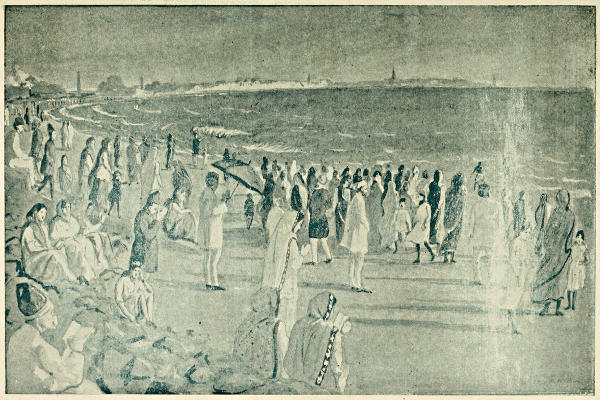
become His prophet. Even to this day a festival is held in her
honour by the Parsis in Bombay on the tenth day of the eighth
month of the Parsi year. This day as well as the month bear
the name Aban. The Parsis flock in numbers on this auspicious
day to the sea-beach to offer prayers.
Not unlike the Iranians the Greeks also adored their marine
goddess Aphrodite, “born in the foam of the sea.” Greek
folklore tells us how this goddess rose from the sea opposite the
island of Cythera. She was also the goddess of love and was in
earlier times regarded as the goddess of domestic life and of the
relations between families, being in some places associated with
Eileithyia, the goddess of childbirth, or regarded, like Artemis,
as a guardian of children and young maidens. Odysseus invoked
the river of Scheria, Skamandros had his priest and Spercheios
his grove, and sacrifice was given to the river-god Acheloos,
eldest of the three thousand river-children, and old Okeanos.
Greek saints were believed to bestow wells of water endowed
with miraculous properties, and frequently on their feast days
an extra supply made the wells overflow. The monastery of
Plemmyri, in the south-east of Rhodes, possesses a well of this
nature. The priest walks round it, offering up certain prayers
and sometimes the water rises in answer to his invocation and
flows over into the Court. Another such interesting well exists
in the Church of the Virgin at Balukli, outside the walls of
Constantinople.[17]
Similarly, the Romans had their water-nymph Egeria. Women
with child used to offer sacrifices to her, because she was believed
to be able, like Ardevi Sur Anahita and Diana, to grant
them an easy delivery. Every day Roman Vestals fetched
water from her spring to wash the temple of Vesta, carrying it
in earthenware pitchers on their heads. In his Golden Bough
Sir James Frazer observes that the remains of baths which
were discovered near that site together with many terra cotta
models of various parts of the human body suggest that the
waters of Egeria were used to heal the sick who may have
signified their hopes or testified their gratitude by dedicating
likenesses of the diseased members to the goddess, in accordance
with a custom which is still observed in many parts of Europe.
Examples of the survival of this custom in modern times are
given by Blunt in his Vestiges of Ancient Manners and Customs
in Modern Italy and Sicily. It is also widespread among the
Catholic population in Southern Germany and the Christian
missionaries from those parts have brought the custom to India
also. Almost every Sunday the Goans and Native Christians of
Bombay, for instance, will be seen dedicating likenesses of
diseased limbs made of wax to Virgin Mary at Mount Mary’s
chapel at Bandra in gratitude for the cures effected through
her grace. The custom has spread amongst other communities
and I have heard of several cases in which Parsi ladies have
taken such offerings to the Chapel.
This parallelism of beliefs and catholicity of cures remind
one of the faith which not only the Greeks and the Roman
Catholics, but the Turks and the Jews had in the miracles
wrought by the Greek Saints. The best known instance of this,
given by Miss Hamilton in her illuminating work on Greek
Saints and their Festivals, is the large marble fountain standing
in the court of the Panagia’s Church at Tenos. It was the gift
of a grateful Turk cured, according to his own conviction, by the
Panagia of the Christians. To a certain extent a feeling was
prevalent against permitting unbelievers to participate in these
boons, but it was futile in effect and the cures of infidels
continued. Within the Smyrna Cathedral there is a holy
well the water of which is specially renowned for the cure
of ophthalmia. Turks, along with Greeks, shared in its
benefits to an extent which excited the jealousy of the officials
and they resolved to give ordinary water in response to the
demands of infidels. This stratagem was, however, ineffectual
for the eyes of the Turks were cured nevertheless with the
unsanctified medium just as thoroughly as with the holy water.
This might have shaken the faith of the believers in the holy
well, but fortunately for them no such rude awakening appears
to have marred their confidence in the miraculous powers of
the well or of the saints.
Numerous proofs of water-worship in Great Britain exist
to-day. English folklore is full of these and we shall notice
them presently. There is also archæological evidence establishing
the prevalence of the cult. On a pavement at Sydney
Park, Gloucestershire, on the western bank of the Severn, has
been carved the figure of one of the English river divinities.
The principal figure is a youthful deity crowned with rays like
Phoebus and standing in a chariot drawn, as in the case of Banu
Ardevi Sur Anahita of the Iranians, by four horses. Three inscriptions
are preserved: (1) Devo Nodenti; (2) D. M. Nodonti
and (3) Deo Nudente M. The form Nodens has been identified
by Professor Rhys with the Welsh Lludd and with the Irish
Nuada. This monumental relic by no means presents the
British embodiment of the water-god, the work being Roman
it evidently bears the stamp of the Roman interpretation of
the British belief in the local god and has been modelled on
the Roman standard of the water-god Neptune. The whole
find has been fully described and illustrated in a special volume
by the Rev. W. H. Bathurst and C. W. King.
In Tylor’s Primitive Culture we find the following American
examples of animistic ideas concerning water. “Who makes
this river flow?” asks the Algonquin hunter in a medicine
song, and his answer is, “The spirit, he makes this river flow.”
In any great river, or lake, or cascade, there dwell such spirits,
looked upon as mighty manitus. Thus Carver mentions the
habit of the Red Indians, when they reached the shores of
Lake Superior or the banks of the Mississippi, or any great body
of water, to present to the spirit who resides there some kind
of offering; this he saw done by a Winnebago chief who went
with him to the Falls of St. Anthony. Franklin saw a similar
sacrifice made by an Indian, whose wife had been afflicted with
sickness by the water-spirits and who accordingly to appease
them tied up in a small bundle a knife and a piece of tobacco
and some other trifling articles, and committed them to the
rapids. On the river-bank the Peruvians would scoop up a
handful of water and drink it, praying the river deity to let
them cross or to give them some fish, and they threw maize
into the stream as a propitiating offering. Even to this day
the Indians of the Cordilleras perform the ceremonial sip before
they will pass a river on foot or horseback, just as the Hindus
and Parsis throw cocoanuts and flowers and sugar.
Tylor also gives the following African rites of water-worship.
In the East, among the Wanika, every spring has its spirit, to
which oblations are made. In the West, in the Akra district,
lakes, ponds and rivers received worship as local deities. In
the South, among the Kafirs, streams are venerated as personal
beings, or the abodes of personal deities, as when a man crossing
a river will ask leave of its spirit, or having crossed will throw
in a stone; or when the dwellers by a stream will sacrifice a
beast to it in time of drought, or, warned by illness in the tribe
that their river is angry, will cast into it a few handfuls of millet
or the entrails of a slaughtered ox. Not less strongly marked,
says Tylor, are such ideas among the Tartar races of the north.
Thus the Ostyaks venerate the river Ob, and when fish is scanty
will hang a stone about a rein-deer’s neck and cast it in for a
sacrifice. Among the Buræts, who are professing Buddhists,
the old worship may still be seen at the picturesque little mountain
lake of Ikeougoun, where they come to the wooden temple
on the shore to offer sacrifices of milk and butter and the fat of
the animals which they burn on the altars.
It is not necessary to overlay this chapter with countless
other European and Indian examples. We shall examine these
more fully in the subsequent chapters.
Throughout the West the cult of water was flourishing along
with the cult of trees and stones when Christianity found its
way to Europe. The holy wells which were then plentiful
have since changed their names, but a few have still retained
their old names. Thus there is or was a spring called Woden’s
well in Gloucestershire, which supplies water to the moat
around Wandswell Court, also a Thor’s Well, or Thorskill, in
Yorkshire. When the faith and usages of the Celtics and the
Anglo-Saxons came in contact with Christianity, together with
the still older faiths and customs which the Celt and Teuton
had continued or allowed to continue, the new religion did not
distinguish between the various shades of beliefs and usages.
It merely treated all alike as pagan. Kings, Popes and Church
Councils issued edict after edict condemning non-Christian
practices. Let us cite some of these. The second Council of
Arles, held about the year 452, issued the following canon:
“If in the territory of a bishop infidels light torches or
venerate trees, fountains, or stones, and he neglects to abolish
this usage, he must know that he is guilty of sacrilege.”
King Canute in England and Charlemagne in Europe also
conducted vigorous campaigns against these relics of paganism.
Here is an extract from Charlemagne’s edict:
“With respect to trees, stones, and fountains, where certain
foolish people light torches or practise other superstitions, we
earnestly ordain that the most evil custom detestable to God,
wherever it be found, should be removed and destroyed.”
It was too much, however, to hope for the total eradication
of those faiths and customs of age-long existence. Pope Gregory
was not slow to realize this, as will be seen from the following
extract from his famous letter to the Abbot Mellitus in the
year 601:—
“When, therefore, Almighty God shall bring you to
the most reverend Bishop Augustine our Brother, tell
him what I have, upon mature deliberation on the affair
of the English, determined upon, namely that the
temples of the idols (fana idolorum) in that nation
(gente) ought not to be destroyed; but let the idols that
are in them be destroyed; let holy water be made and
sprinkled upon the said temples, let altars be erected
and relics placed. For if these temples be well built,
it is requisite that they may be converted from the
worship of devils (dæmonum) to the worship of the
true God; that the nation seeing that their temples
are not destroyed may remove error from their hearts,
and knowing and adoring the true God may the more
familiarly resort to the places to which they have been
accustomed. And because they have been used to
slaughter many oxen in the sacrifices to devils some
solemnity must be exchanged for them on this account,
so that on the day of the dedication, or the nativities
of the holy martyrs whose relics are there deposited,
they may build themselves huts of the boughs of trees
about those churches which have been turned to that
use from temples and celebrate the solemnity with religious
feasting and no more offer beasts to the devil
(diabolo), but kill cattle to the praise of God in their
eating, and return thanks to the giver of all things for
their sustenance.”
Thus did the early Christian missionaries come to regard
the old phase of water-worship tenderly. Adopting what they
could not abolish, they blessed the waters of holy wells and
used them for baptism of converts and erected chapels or oratories
near by or placed an image of the Virgin, or some saint,
near sacred trees and rivers or over holy wells and fountains.
Thus did the new faith which aimed in principle at the purity
of Christian doctrine permit in practice a continuance of pagan
worship under Christian auspices. Curious was the result.
Under the transformation of beliefs thus unconsciously
wrought the simple-hearted Christians beheld in brilliant
images of the virgin and the saints fresh dwelling-places for
the presiding deities of the waters whom they and their
forefathers had venerated in the past. The belief in the miraculous
power of water became linked with the name of Madonna
or some saintly messenger of God and so enduring was this
combination that it gave a new lease of life to the old beliefs.
One by one the old ideas and customs which were firmly rooted
in the multitude came to be absorbed into Christianity. A dual
system of belief thus sprang up and this is very strikingly reflected
in the supplication of an old Scottish peasant when he went
to worship at a sacred well:
“O Lord, Thou knowest that well would it be for me
this day an I had stoopit my knees and my heart
before Thee in spirit and in truth as often as I have
stoopit them after this well. But we maun keep the
customs of our fathers.”[18]
What is true of well-worship is true of other phases of nature-worship.
A vivid picture of the result of the Christian tolerance
of paganism has been drawn by Grimm in the preface to the
second edition of his Teutonic Mythology. For our present
purpose it will suffice to quote from it only two or three sentences
which have a direct bearing on the question of water-worship:
“Sacred wells and fountains,” says he, “were rechristened after
saints, to whom their sanctity was transferred. Law usages,
particularly the ordeals and oath-takings, but also the beating
of bounds, consecrations, image processions, spells and formula,
while retaining their heathen character, were simply clothed in
Christian forms. In some customs there was little to change:
the heathen practice of sprinkling a new-born babe with water
closely resembled Christian baptism.”
This reference to adapted pagan rites in connection with the
baptismal ceremony recalls the words in which Mr. Edward Clodd
in Tom Tit Tot traces the early beginnings of the order of the
Christian clergy to a prehistoric past. “The priest who christens
the child in the name of the Father, Son and Holy Ghost,”
says he, “is the lineal descendant, the true apostolic successor
of the medicine-man. He may deny the spiritual father who
begot him, and vaunt his descent from St. Peter. But the first
Bishop of Rome, granting that title to the apostle, was himself
a parvenu compared to the barbaric priest who uttered his
incantations on the hill now crowned by the Vatican.”
“We think with sympathy,” continues Mr. Clodd, “of that
‘divine honour’ which Gildas tells us our forefathers paid to
wells and streams; of the food-bringing rivers which, in the old
Celtic faith, were ‘mothers’; of the eddy in which the water-demon
lurked; of the lakes ruled by lovely queens; of the
nymphs who were the presiding genii of wells.”
With the learned author of Tom Tit Tot we also think with
sympathy of the worship of the saint Khwaja Khizr, who is
believed by the Syrians to have caused water to flow in the
Sabbati fountain in northern Syria and who is ranked among
the prophets by the Mahomedans and recognised by the Hindus
as a patron saint of boatmen, his Moslem name being Hinduised
into Râjâ Kidar or Kawaj or Pir Badra. He is, however,
most widely known as the patron saint of the water of
immortality. When the great Sikandar, Alexander of Macedon,
went in quest of the blessed waters, Khizr accompanied him,
as a guide, to Zulmat, the region of darkness, where the spring
of the water of immortality was believed to exist. When they
reached Zulmat, Khizr said that only 12 persons should enter
that region on 12 mares and that each mare’s colt should be
tied outside so that should any one lose his way, the mare
on which he rode might lead him back to the starting point,
following the direction from which she would hear the neighing
of her colt. This course was followed. According to one
account, the party succeeded in reaching the coveted spring.
Khizr drank from it first and then asked Sikandar to drink
as much as he liked. The conqueror of the East, however,
stood still. He saw before him some very aged birds in a
pitiable condition, longing for death and muttering maut, maut,
maut, death, death, death! Death, however, would not come
to them as they had tasted the water of immortality.
This was enough to unnerve Alexander and he turned
back without tasting the water. According to another
tradition, Khizr slipped away in the region of darkness,
went alone to the spring and drank from it. Alexander
and his comrades lost their way and were only able to
emerge from the darkness with the help of their mares who
instinctively followed the direction whence they heard the
neighing of their colts.
In India the fish is believed to be the vehicle of Khwaja
Khizr. Its image is therefore painted over the doors of Hindus
and Mahomedans in Northern India and it became the family
crest of one of the royal families of Oudh. When a Mahomedan
lad is shaved for the first time, a prayer is offered to the saint
and a little boat is launched in his honour in a tank or river.
The Hindus as well as the Mahomedans in Upper India
invoke his help when their boats go adrift and they worship
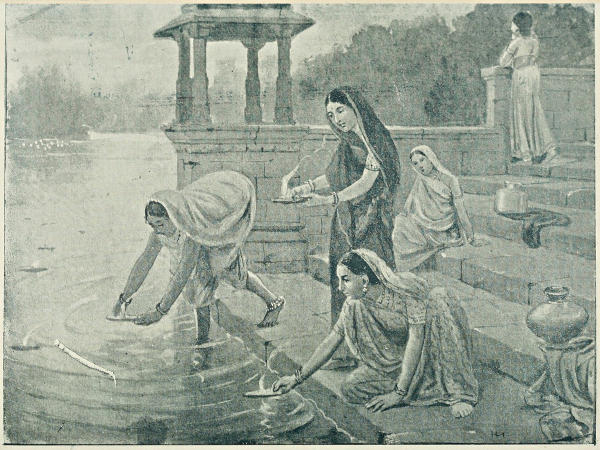
him by burning lamps and by setting afloat on a village pond
a little raft of grass with a lighted lamp placed upon it. A
Mahomedan friend who has often taken part in this ceremony
which is known as Khwaja Saheb ka Dalya, has favoured me
with the following description of it: “On the evening of the
ceremony people congregate by the side of the river and bring
with them a quantity of dalya, a confection of wheat, and a
tiny boat prepared for the occasion. They then light a diva
or ghee lamp, and place it by the side of the dalya, which is
then consecrated in the name of Khwaja Khizr by reading
Fatiha over it. A portion of the confection is then placed in
the boat which is launched in the river with the small lamp
in it. The remaining portion is distributed amongst friends
and relations and the poor.”
As a rule the Mahomedans do not worship water. They,
however, hold the well Zumzum in Mecca in great veneration.
It is believed that this single well supplies water to the whole
city and that its water comes up bubbling on occasions of
religious fervour. The water of the well is also credited with
miraculous properties and on their return from the pilgrimage
to the holy city almost all the Hajis (pilgrims) bring home the
water of Zumzum in small tins and distribute it amongst
friends who use it as a cure for several diseases and also
sprinkle it on the sheet covering the dead.
No other holy well attracts the followers of Islam, but for
the Hindus the number of such places of pilgrimage is
legion. Particularly do they flock in numbers to the sacred
rivers which are regarded as the dwelling places of some of the
most benevolent deities. In Northern India the Ganges
and the Jumna are known as “Ganga Mâi”, or Mother
Ganges, and “Jumnaji” or Lady Jumna. Foremost
in the rank of the holy rivers is the Ganges, which, like
other rivers, is specially sacred at certain auspicious
conjunctions of the planets when crowds of people are seen
bathing on her banks. This sanctity is shared by several towns
along the shores of the river such as Hardwar, Bithur, Allahabad,
Benares and Ganga Sagar. No less sacred is the Godavari,
believed to be the site of the hermitage of Gautama. When the
planet Brihaspati (Jupiter) enters the Sinha Rashi (the constellation
of Leo), a phenomenon which takes place once in twelve
years, the holy Ganges goes to the Godavari and remains there
for one year and during that year all the gods bathe in this
river. Hence the pilgrimage of thousands of Hindus to Nasik
to offer prayers to the Godavari. A pilgrimage similar to this is
common in Russia. There, an annual ceremony of blessing the
waters of the Neva is usually performed in the presence of the
Czar.[19] Multitudes flock to the site and struggle for some of
the newly blessed water with which they cross themselves and
sprinkle their clothes.
In his “Popular Religion and Folklore of Northern India”
Crooke observes that many of the holy wells in Northern India
are connected with the wanderings of Rama and Sita after
their exile from Ayodhya. Sita’s kitchen (Sita ki rasoi) is shown
in various places, as at Kanauj and Deoriya in the Allahabad
District. Her well is on the Bindhachal hill in Mirzapur, and
is a famous resort of pilgrims. There is another near Monghyr
and a third in the Sultanpur District in Oudh. The Monghyr
well has been invested with a special legend. Sita was suspected
of faithlessness during her captivity in the kingdom of Ravana.
She threw herself into a pit filled with fire, where the hot spring
now flows, and came out purified. When Dr. Buchanan visited
the place, he heard a new story in connection with it. Shortly
before, it was said, the water became so cool as to allow bathing
in it. The Governor prohibited the practice as it made the
water so dirty that Europeans could not drink it. “But on
the very day when the bricklayers began to build a wall in order
to exclude the bathers, the water became so hot that no one
could dare to touch it, so that the precaution being unnecessary,
the work of the infidels was abandoned.”[20]
A bath in the waters of wells is believed to have the same
efficacy for expiating sin as a bath in the holy rivers. This belief
rests on the theory that springs and rivers flow under the agency
of an indwelling spirit which is generally benignant and that
bathing brings the sinner into communion with the spirit and
purifies him in the moral more than in the physical sense. It
is believed that even the dead are benefited by such ceremonies.
A very typical case of the efficacy of such religious baths
is that of King Trisanku, who had committed three deadly
sins. According to one story he tried to win his way to heaven
by a great sacrifice which his priest, Vashishtha, declined to
perform. According to another account he ran away with the
wife of a citizen, and killed in a time of famine the wondrous
cow of Vashishtha. Another story accused him of having
married his step-mother. After he had been sufficiently chastised,
the saint Viswamitra took pity on him and having collected
water from all the sacred places in the world, washed him clean
of all offences.
The Brahmins also wash themselves of sins with the washing
of their sacred thread every year, with a ceremony of sprinkling of
water and cow’s urine. This ceremony is known as Shrávani
amongst the Marathas and Mārjan Vidhi amongst the Gujeratis.
It would be impossible to enumerate the numerous sacred
wells of India. A few instances may, however, be cited from
the Folklore Notes of Gujarat.
Six miles to the east of Dwarka there is a kund called Pind
tarak, where many persons go to perform the Shrâddha and the
Nârâyan-bali ceremonies. They first bathe in the kund; then,
with its water, they prepare pindas, and place them in a metal
dish; red lac is applied to the pindas, and a piece of cotton
thread wound round them; the metal dish being then dipped in
the kund, when the pindas, instead of sinking, are said to
remain floating on the water. The process is believed to earn a
good status for the spirits of departed ancestors in heaven. It
is further said that physical ailments brought on by the avagati,
degradation or fallen condition, of ancestors in the other world,
are remedied by the performance of Shrâddha on this kund.
The Damodar kund is situated near Junagadh. It is said that
if the bones of a deceased person remaining unburnt after
cremation are dipped in this kund, his soul obtains moksha
or final emancipation.
There is a vav or reservoir on Mount Girnar, known as Rasakupika-vav.
It is believed that the body of a person bathing
in it becomes as hard as marble, and that if a piece of stone or
iron is dipped in the vav, it is instantly transformed into gold.
But the vav is only visible to saints and sages who are gifted
with a supernatural vision.
Kashipuri (Benares) contains a vav called Gnyan-vav, in
which there is an image of Vishweshwar (the Lord of the Universe,
i.e., Shiva). A bath in the water from this vav is
believed to confer upon a person the gift of divine knowledge.
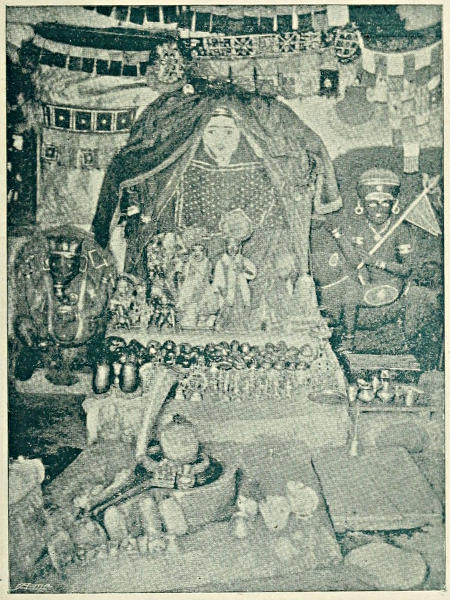
Ganga Mâi.
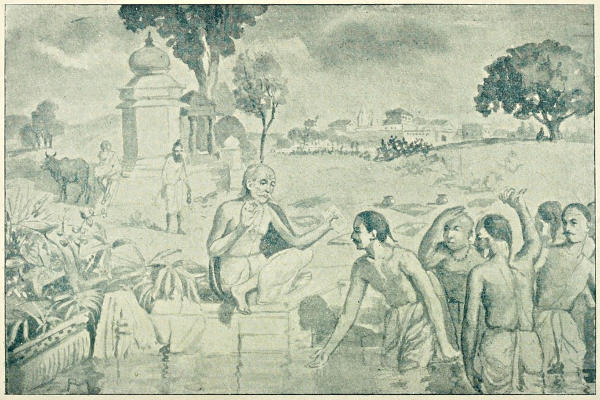
Marjan Vidhi: Washing away of sins with the changing of
the Sacred Thread.
In the village of Chunval, a few miles to the north of Viramgam,
there is a kund known as Loteshwar, near which stands
a pipal tree. Persons possessed by ghosts or devils are freed
from possession by pouring water at the foot of the tree and
taking turns round it, remaining silent the while.
There is a kund called Zelāka near Zinzuvadá with a temple
of Naleshwar Māhadev near it. The kund is said to have been
built at the time of King Nala. It is believed locally that every
year, on the 15th day of the bright half of Bhādrapad, the holy
Ganges visits the kund by an underground route. A great
fair is held there on that day, when people bathe in the kund
and give alms to the poor. There is also another kund close
by, known as Bholava, where the river Saraswati is believed to
have halted and manifested herself on her way to the sea.
In Bhadakon near Chuda there is a kund called Garigavo.
The place is celebrated as the spot of the hermitage of the sage
Bhrigu and a fair is held there annually on the last day of
Bhādrapad.
Persons anxious to attain heaven bathe in the Mrigi kund
on Mount Girnar; and a bath in the Revati kund, which is in
the same place, confers male issue on the bather. There is also
a kund of the shape of an elephant’s footprint Pagahein on
Mount Girnar. It never empties and is held most sacred by
pilgrims. People bathe in the Gomati kund near Dwarka and
take a little of the earth from its bed for the purification of their
souls. In the village of Babera, Babhruvāhan the son of
Arjun is said to have constructed several kunds, all of which
are believed to be holy.
A man is said to be released from re-birth if he takes a bath
in the kund named Katkale-tirtha near Nasik.
A pond near Khapoli in the Kolaba district is held very
sacred. The following story is related in connection with it.
The villagers say that the water nymphs in the pond used to
provide pots for marriage festivities if a written application
was made to them a day previous to the wedding. The pots
were, however, required to be returned within a limited time.
Once a man failed to comply with this condition and the nymphs
have ceased to lend pots.
The nymphs of a pond at Varsai in the Kolaba district were
also believed to lend pots on festive occasions. Persons held
unclean, e.g., women in their menstrual period, are not allowed to
touch it. Similarly, a pool at Pushkar in Northern India turns
red if the shadow of a woman during the period falls upon it.
There are seven sacred ponds at Nirmal in the Thana
district, forming a large lake. These ponds are said to have
been formed from the blood of the demon Vimalsur.
There are sacred pools of hot water in the Vaitarna river
in the Thana district, in which people bathe on the 13th day
of the dark half of chaitra.
At Shahapur there is a holy spring of hot water under a
pipal tree, called Ganga.
It is held holy to bathe in the kunds that are situated
in the rivers Jansa and Banganga.
The Manikarnika well at Benares was produced by an
ear-ring of Shiva falling into it. If one drinks its water, it brings
wisdom. The water of the Jânavâpi well in Benares also
possesses the same property.[21]
At Sarkuhiya in the Basti district there is a well where
Buddha struck the ground with his arrow and brought forth
water just as Moses did from the rock.
Crooke says that he was shown a well in the Muzaffarnagar
district into which a Faqir once spat, which for a long time after
the visit of the holy man ran with excellent milk. The supply
had, however, ceased before the visit.
A bath in the Man-sarovar near Bahucharaji is said to cause
the wishes of the bather to be fulfilled. There is a local
tradition that a Rajput woman was turned into a male
Rajput of the Solanki class by a bath in its waters.
The cult of the bath for the purification of the soul is not confined
to India and the Indian people. It was also widespread
amongst the European people and prevails even to-day on the
Continent. We have already seen that water-worship flourished
in Europe before the advent of Christianity and that the new faith
though antagonistic to it in principle was considerably tolerant in
practice. It is not surprising, therefore, that the old practice
should, with a varnish of Christianity, survive up to the present
day. In an article contributed not long ago to the Good Words
magazine, Mr. Colin Bennett observed: “Of all the remnants
of ancient pagan worship that which is dying hardest, or more
probably has not started to die at all, is the veneration of holy
wells and belief in their miraculous properties.”
In the year 1893 was published The Legendary Lore of the
Holy Wells of England, including Rivers, Lakes, Fountains
and Springs, by R. C. Hope. Unfortunately, I have not been
able to obtain a copy of this book, but from the reviews of
the work that appeared in the Academy and in the Athenæum
in August 1893, one gathers that although confessedly imperfect
Mr. Hope’s catalogue gives 129 names of saints in whose
honour English wells have been dedicated. The reviewers give
additional instances and point out that if inquiries were made,
many more such wells would be discovered. From the list
it appears that with the exception of Virgin Mary, who has
29 wells, and all Saints to whom 33 wells are dedicated, wells
under the patronage of St. Helen are the most numerous.
St. Helen was very popular in England, partly as being the
mother of Constantine, the First Christian Emperor, and partly
because two English cities, York and Colchester, claimed
her as a native. The reviewer of Mr. Hope’s work in the
Athenæum suggested a third reason also for her popularity. She
discovered what was reputed to be the holy cross, hence in many
parts of England May 3rd, the festival of “The Invention of
the Cross”, was called “St. Helen’s Day in Spring”, and became
an important day in village affairs. Menor court rolls bear
witness, says the writer, that on that day commons were thrown
open for the pasturage of cattle, and occupiers of land adjoining
rivers well knew that it was the last day for repairing
their banks.
An interesting chapter on Holy Wells is also given in
Knowlson’s Origins of Popular Superstitions. On a little
island near the centre of Lough Fine there used to be a place
for pilgrims anxious to get rid of their sins, the journey
over the water being an important part of the business. In
Scotland (Tullie Beltane) there is a Druid temple of eight
up-right stones. Some distance away is another temple, and
near it a well still held in great veneration, says a writer in the
Gentleman’s Magazine (1811). “On Beltane morning superstitious
people go to this well and drink of it; then they make
a procession round it nine times; after this they in like manner
go round the temple. So deep-rooted is this heathenish superstition
in the minds of many who reckon themselves good
Protestants, that they will not neglect these rites even when
Beltane falls on a Sabbath.”
Thomas Quiller-Couch took a deep interest in the holy wells
of Cornwall. He visited many of them and the notes taken
by him he intended to weave into a volume illustrative of
their history and the superstitions which had gathered around
them. Unfortunately the intention could not be carried out
during his lifetime, but with the help of these notes a volume
was subsequently published on the Ancient and Holy Wells of
Cornwall by M. and L. Quiller-Couch. This volume is not
obtainable in Bombay and in this case also I owe my information
concerning the work to the review which appeared in the
Athenæum of 10th August 1895. During a pilgrimage of several
months’ duration the joint authors were able to discover more
than ninety of such wells. From the account given by the
authors it would seem that the Cornish wells are rarely haunted
by spirits of any kind. They are holy, and cure all kinds of
sickness, madness included. They also tell us of the future,
provided proper rites are observed, and we may secure good
fortune by dropping a pin or a small coin into the water.
Major-General Forlong cites St. Peter’s well at Houston in
Renfrewshire, St. Ninian’s well at Stirling with its vaulted
cell, St. Catherine’s well at Liberton, St. Michael’s well near
the Linlithgow cathedral, and the well of Loch Maree as
some of the examples. Another sacred well is St. Mungo’s
over which the Glasgow cathedral stands. In Ireland “we
everywhere find peasants kneeling at sacred wells.” Of the
well of St. Margaret under the black precipitous cliffs of
Edinburgh Castle Major-General Forlong says that it is exactly
such a spot as he had seen in Central India, “where pious
persons precipitated themselves from the rock to please Siva
or Kali.”[22]
Many of these wells are renowned no less for their medicinal
properties than for their sanctity. Their waters are believed
to be under the care of sanitary guardians and are held to be
extremely efficacious in curing many a distemper.
The use of water for therapeutic purposes is mentioned in
the Old Testament, where it is stated that Naaman, who suffered
from skin disease, dipped himself seven times in the Jordan and
was cured. The New Testament records a case of congenital
blindness cured by washing in the River Siloa. Balneotherapy
and Hydrotherapy were not unknown in Talmudic times. The
Talmud mentions a special season between Easter and Whitsun
during which people used to go to the spas to take the waters or
mudbaths. The cure lasted twenty-one days. In the Temple a
special doctor was appointed to attend the priests for intestinal
trouble caused by their excessive eating of the flesh of sacrifices
and the treatment prescribed for them was the drinking of the
water of Siloa.[23]
In Bombay the Manmala tank at Matunga, the major
portion of which has been recently filled up and on which
the Sassoon Reformatory now stands, has a reputation for
curing measles. People from distant parts bring their
children to this tank and the nymphs residing in it seldom
fail to cure them of the malady. We are not aware of any
other city well or tank gifted with such healing powers, but
there are several in the Bombay Presidency. The Folklore
notes of Gujarat mention a few. The water of the Krukalas
well in the island of Shankhodwar is believed to cure fever
and diseases caused by morbid heat. A draught of the
water of the Gomukhi-Ganga, near Girnar, gives one absolute
immunity from an attack of cholera. The water of a gozara well
(i.e., a well which is polluted owing to a person drowned in it)
cures children of bronchitis and cough. There is a well near
Ramdorana, of which the water is effective against cough, and
the water of the Bahamania well near Vasawad is credited with
the same virtue. The water of the Mrigi Kund near Junagadh
cures leprosy. The Pipli well near Talawad is well-known
for the stimulating effect of its water on the digestive organs.
The residents of Bombay, however, need not go to Talawad
for this boon. There are in the city the Bhikha Behram
well on Churchgate Street and the High Court well on Mayo
Road renowned for similar properties of their water. In Northern
India hydrophobia is believed to be cured if the patient
looks down seven wells in succession, while in Gujarat when a
person is bitten by a rabid dog, he goes to a well inhabited by
a Vâchharo, the spirit who curses hydrophobia, with two earthen
cups filled with milk with a pice in each, and empties the contents
into the water. In the island of Shiel there is a vav called Than-vav
where mothers who cannot suckle their children for want of
milk wash their bodices which, when subsequently put on,
are believed to cause the necessary secretion of milk.
It was recently brought to my notice that the guardian spirit
of a well in Lonavla also possessed the gift of blessing mothers
with milk. After that well had been dug, a goat was offered by
the owner of the well to the spirit. This offering proved most
unacceptable and the waters of the well at once dried up. The
owner implored pardon and vowed that no animal sacrifice
would ever again be offered, and that milk and ghee would
be presented instead. This had the desired effect and the
guardian spirit of the water has since been most friendly.
“A few months ago,” said my informant, “a young lady was
desirous of getting milk for her new-born babe. After fruitless
attempts for a fortnight, she took an oath that she would
present to the water-saint ghadas of milk and ghee and she
was forthwith blest with milk for the infant.”
In the Konkan the water of a well drawn without touching
the earth or without being placed upon the ground is given as
medicine for indigestion.
There are ponds at Manora in the Goa State and Vetore in the
Savantwadi State, the water of which is used for the cure of persons
suffering from the poison of snakes, mice, spiders and scorpions.
If a person is bitten by a snake or other poisonous reptile,
no medicine is administered to him, but holy water brought
from the temple of the village goddess is given to him to drink
and it is said that the patient is cured.
At Shivam in the Ratnagiri district people use the tirtha of a
deity, or the water in which its idol is washed, as medicine for
diseases due to poison. It is the sole remedy they resort to
in such cases.
The water of seven tanks, or at least of one pond, in which
lotuses grow, is said to check the virulence of measles and smallpox.
A bath in a tank in the Mahim district is said to cure
persons suffering from skin diseases.
The well at Sihor in Rajputana is sacred to Gautama and
is considered efficacious in the cure of various disorders.
In Satara King Sateshwar asked the saint Sumitra for water.
The sage was wrapped in contemplation, and did not answer him.
The angry monarch took some lice from the ground and threw
them at the saint, who cursed the king with vermin all over his
body. This affliction the wretched monarch endured for twelve
years, until he was cured by ablution at the sacred fountain of
Devarâshta.[24]
The birth of a child under the mul nakshatra endangers the
life of its father, but the misfortune is averted if the child and
its parents bathe in the water drawn from 108 wells. A
draught of such water is said to cure Sannipat or delirium.
One of the sacred tanks of India is “the Lake of Immortality”
at Amritsar. The name of the city is taken from the
sacred tank in which the Golden Temple is built. Originally,
the place was only a natural pool of water and a favourite
resort of Guru Nanak, the founder of the Sikh religion. It was
known at first as Guru-ka-chall, but later when the tank was
built, the name Amritsar was adopted, amrit meaning water
of immortality and sar meaning a tank. A holy woman
once took pity on a leper, and carried him to the banks of the
tank. As he lay there, a crow swooped into the water and
came out a dove as white as snow. Seeing the miracle, the
leper was tempted to bathe in the river and was healed. The
woman could not recognize her friend, and withdrew in horror
from his embraces. But the Guru Ram Dâs came and explained
matters, and “the grateful pair assisted him in embellishing
the tank, which has now become the centre of the
Sikh religion.”[25]
The tank at Lalitpur is similarly famous for the cure of
leprosy. One day, a Râjâ afflicted with the disease was
passing by, and his Râni dreamt that he should eat some of
the confervæ on the surface. He ate it, and was cured;
next night the Râni dreamt that there was a vast treasure
concealed there, which when dug up was sufficient to pay the
cost of excavation. At Qasur is the tank of the saint Basant
Shâh, in which children are bathed to cure them of boils.[26]
There are several hot springs in India renowned for their
curative powers. These also are believed to be sacred to certain
deities. A typical example is that of the hot kund, called
Devki-Unai, about 30 miles to the south of Surat. Many
pilgrims visit the place on the fifteenth day of the bright half of
Chaitra, when the waters are cool, to offer money, cocoanuts, and
red lead to the Unai Mata, whose temple stands near the kund.
It is said that king Rama built this kund while performing
a sacrifice and brought water from the pâtâl (nether regions) by
shooting an arrow into the earth.
Similarly, the famous hot springs forming one group in a line
along the bed of the Tansa river in the village of Vadavli are
sacred to the goddess Vajrabai or Vajreshvari, the Lady of
the Thunderbolt. According to tradition, this neighbourhood
being full of demons the goddess Vajrabai became incarnate in
the locality to clear it of the wicked spirits. She routed the
whole lot of them, and the hot water of these springs is nothing
but the blood of one of the demons slain by her. Her
chronicle, or Mahatmya, is kept at the village of Gunj, some
six miles to the north, and her temple is placed at the top of a
flight of steps on a spur of the Sumatra range. A large fair is
held here in Chaitra (April). There are other hot springs in the
neighbouring villages of Akloli, known as the Rameshwar hot
springs, whose waters are gathered out in stone cisterns. In the
eighteenth century these springs were much used both by
Indians and Europeans as a cure for fevers. In his Oriental
Memoirs James Forbes describes the springs as consisting
of small cisterns of water with a temperature of 120°. “Except
that it wanted a small element of iron the water tasted like that
of Bath in England.” In the Ganeshpuri village, about three
miles west of Vajrabai, are the two hottest springs of the group.
These are resorted to by people troubled with skin diseases.
The Arabs regard the hot springs at Terka Main to be under
the control of a Vali who makes the fire and keeps it burning.
Those who go there to be healed of rheumatism invoke the
saint and keep up the fire so that the water may be hot. At
the Lunatic Asylum of Hamath there is a pool believed to be
the abode of a Vali who is the patron saint of all insane people.
He appears in the night and blesses the insane by touching
them. Even troublesome children come under the spell of his
influence. The Arabs take the robes of refractory urchins to
the pool and wash them in it so as to instil wisdom and
obedience in the children.
Similarly, the special function of the Altarnum well was the
cure of madness. The afflicted person was made to stand with
his back to the pool and was then tumbled headlong into the
water by a sudden blow in the breast. In the water again
stood a strong fellow who took him and tossed him up and down.[27]
This ritual appears to be a survival of human sacrifice, while the
ritual followed in connection with St. Tecla’s well, renowned
for the cure of epilepsy, bears testimony to the practice of
offering animal sacrifices to the presiding spirits of water.
In his Tour in Wales, speaking of the village of Llandegla,
where is a church dedicated to St. Tecla, virgin and martyr, who
after her conversion by St. Paul suffered under Nero at Iconium,
Pennant says: “About two hundred yards from the church, in
a quillet called Gwern Degla, rises a small spring. The water
is under the tutelage of the saint, and to this day held to be
extremely beneficial in the falling sickness. The patient washes
his limbs in the well; makes an offering into it of four-pence;
walks round it three times; and thrice repeats the Lord’s Prayer.
These ceremonies are never begun till after sunset, in order to
inspire the votaries with greater awe. If the afflicted be of the
male sex, like Socrates, he makes an offering of a cock to his
Aesculapius, or rather to Tecla, Hygeia; if of the fair sex, a
hen. The fowl is carried in a basket, first round the well, after
that into the churchyard, when the same orisons and the same
circumambulations are performed round the church. The
votary then enters the church, gets under the communion-table,
lies down with the Bible under his or her head, is
covered with the carpet or cloth, and rests there till break of
day, departing after offering six pence, and leaving the
fowl in the church. If the bird dies, the cure is supposed
to have been effected and the disease transferred to the
devoted victim.”
The most famous healing well in England is perhaps the
Holywell, the Lourdes of Wales. The story of this well
is the story of St. Winefride, the waters of whose fount were
declared by the Protestant antiquarian, Pennant, to be
“almost as sanative as those of the Pool of Bethesda.” In
the 7th century the picturesque valley of Sychnant had
as its chieftain Thewith, whose wife was the sister of St. Beuno,
and whose daughter, Winefride, was a very beautiful girl, who
had many suitors, but who resolved to consecrate herself to
God in a life of virginity. One of the most persistent of her
suitors was Prince Caradoc, who, enraged at his rejection,
made a furious onslaught on the girl, compelling her to seek
safety in flight. With drawn sword he pursued and overtook
her on the majestic hill which overlooked the town. Here
he cut off her head, which rolled to the foot of the hill. Till
then, Sychnant had been waterless—its name, indeed, signifies
the dry valley, but at the spot where the severed head rested,
a copious stream burst forth, forming a well, the sides of which
were lined with fragrant moss, whilst the stones at the bottom
were tinctured with the youthful martyr’s blood. The head
itself was reunited by St. Beuno to Winefride’s body, which was
immediately restored to life by the Almighty in response to the
saint’s prayers. Winefride subsequently became a nun, dying
at Gwytherin on November 3rd, 1660.
Around the Well in Sychnant Valley grew a town which the
Saxons named Treffynion, and which became known to the
Normans as Haliwell, the hallowed or holy well, to which pilgrims
fared from all parts of the kingdom, inspired by the
belief that through the intercession of St. Winefride they would
obtain spiritual and temporal blessings. Through the centuries
preceding the Reformation, the Welsh Princes, the monarchs of
England and the nobles of both countries delighted to bestow
marks of their favour on Holywell and its shrine and Well of
St. Winefride. One of the greatest of these benefactors was the
mother of Henry VII., Margaret, Countess of Richmond and
Derby, who, in the fifteenth century, erected the handsome
Gothic chapel and the Well beneath it. The water was received
in a magnificent polygonal basin, covered by a groined arch,
supported on pillars. The roof was elaborately carved in stone,
and many fine ribs secured the arch, whose intersections were
completed with sculpture. On one side of the wall was painted
the history of St. Winefride, whilst the arms of the foundress
and those of Henry VII., Henry VIII., Catherine of Aragon,
and other benefactors were incorporated in the decorations.
Though the church of Holywell was devoted to other uses
after the Reformation, and recourse to the well was regarded as
a “superstitious practice,” the tide of visitors never completely
ceased to flow. In 1629, for example, a spy is found reporting
Sir Cuthbert Clifton as being one of a great number of “Papists
and priests assembled at St. Winefride’s Well on St. Winefride’s
Day.”
The following paragraph from Archbishop Laud’s account
of his Province for the year 1633 also shows that in spite of
all repressive measures pilgrims resorted in great numbers to
the well:—
“The Bishop of St. Asaph returns. That all is exceedingly
well in his diocese—save only that the number and boldness of
some Romish Recusants increaseth much in many Places, and
is encouraged by the superstitions and frequent concourse of
some of that party to Holy-Well, otherwise called St. Winifride’s
Well. Whether this Concourse be by way of Pilgrimage or no,
I know not; but I am sure it hath long been complained of
without remedy.”
One of the visitors in the year 1686 was James II: and in the
following year Father Thomas Roberts was appointed priest in
charge. The well has ever since been a favourite resort of stricken
pilgrims and the modern tourist in North Wales can still witness
numerous pilgrims journeying to St. Winefride’s in the hope of
leaving their infirmities behind them. The deaf, the dumb, the
blind and the paralysed have for centuries betaken themselves
to this well in search of spiritual as well as physical health and
the votive crutches, chairs and barrows left hanging over the
well by the pilgrims who have been able to discard them bear
testimony to the healing virtues of its water or at least to the
faith of the people in such virtues.
In Lilly’s History of his life and times a story is given of
Sir George Peckham, Kt., who died in St. Winefride’s Well,
“having continued so long mumbling his paternosters and
Sancta Winifreda ora pro me, that the cold struck into his body
and after his coming forth of that well he never spoke more.”
Two recent Holywell cures were reported in the Catholic
Times and Catholic Opinion of 21st July 1916. Mr. John MacMullan,
whose address was 49 Station-Road, Shettleston, Glasgow,
decided to try the water of St. Winefride’s Well after suffering
for three years with chronic spinal disease. He bathed in the
waters for the first time on July 5th, and again on July 6th,
when he experienced a sharp shooting pain all through the body.
On July 10th after getting in the well he found that he was
able to walk up the steps which descended into the outer basin
of the well quite unaided and up to the 12th of July, when he
returned to Scotland, he was able to walk about freely.
The other noteworthy case following on a visit to St. Winefride’s
Well is that of Miss Elizabeth Stanley of 54, John Thomas
Street, Blackburn. She had her hand cut in a mill while
working as a weaver and was unable to work for two years.
In quest of a cure she made a pilgrimage to St. Winefride’s
Well on the Feast of Corpus Christi. “Since her return
from Holywell,” it is reported, “she has followed her work
without any ill effects and is at present in the best of health.”
While this chapter was being written, a great calamity befell
Holywell. Owing to the boring operations of the Halken
Draining Company the waters of this famous well that had been
flowing for 1400 years were drained away on the 5th January
1917. The valley of Sychnant became once more “the dry
valley”, but to the great joy of the people of Holywell and of the
Catholic community everywhere the water was restored to
the well on the 22nd September 1917.
A few more healing wells in Great Britain may be noted.
The “Hooping Stone” on a farm near Athol, is a channeled
boulder which catches rain, and the water, especially if ladled
out with a spoon made from the horn of a living cow, cures
many ailments. The “Fever Well” hard by is also still in
high repute. The Mayor and Burgesses of Shaftesbury still go
to dance round the sacred springs of Enmore Green, hand in
hand to the sound of music—or did so until recently. They
carried a broom decked with feathers, gold rings, and jewels,
called a “prize bezant”, and presented to the bailiff of the
manor of Gillingham (where are the springs) a pair of gloves, a
raw calf’s head, a gallon of beer and two penny loaves.[28]
Another holy well, Roche Holy Well of Cornwall, is famous
for curing eye diseases. This well, which is dedicated to the
lonely hermit by name St. Conan, is endowed on Holy
Thursday, and also the two Thursdays following, with the
property of curing eye diseases alike in young and old.
At Chapel Uny rickety children are dipped three times in the
well against the sun, and dragged three times round the well in
the same direction.
In several instances such miraculous cures appear to be
well authenticated. Mr. Colin Bennett says that Jesus Well,
St. Minver, and Madron Holy Well, near Penzance, are cases
in point. Bishop Hall, of Exeter, who visited the latter well
in 1640, absolutely vouches, in his treatise on the Invisible
World, for the cure of a man by name John Trelille who had
been lame from birth and had to crawl on all fours from place
to place. At last he decided to try the virtue of the waters of
this holy well for his complaint and, like Naaman of old, bathed
himself in the little spring, afterwards reclining for an hour and
a half on a grassy bank situated near by and known as St. Madrne’s
bed while a friend offered up simple prayers on his behalf.
On the first occasion of this treatment he got some relief,
on the second he was able to stand on his legs with the aid of
a staff and on the third occasion he found himself entirely cured.
It is even said that in later life he enlisted in the army and was
eventually killed in battle, having previously done good work
for his country’s cause. Others have also been cured of the
same affliction in later times by precisely the same means.
Close by this well is the ancient oratory of St. Madrne, where
on the first Sunday in May a service is still held by the Wesleyans
in commemoration of the saintly man who once preached
in that lonely spot the word of God. After the service the
Holy Well is visited by the people, some of whom, says Mr. Bennett,
“go so far as to consult it concerning futurity.”
Many springs in Macedonia are known and venerated as
“sacred waters”; dedicated to St. Friday and St. Solomoné
among feminine saints, or to St. Paul and St. Elias among their
male colleagues. The water of these springs is regarded as efficacious
against diseases, especially eye-complaints. Even so
stood enclosed the “fair-flowing fountain built by man’s hand,
whence the citizens of Ithaca drew water,” and close to it “an
altar erected in honour of the Nymphs, upon which the wayfarers
offered sacrifice.” Like the Homeric “fountain of the Nymphs”
many a modern “holy spring” is overshadowed by “water-bred
poplars or broad-leaved fig-trees, and weeping willows.”[29]
Hundreds of cures are effected even now at the Church of
the Annunciation over the Chapel of the well during the Festival
of Annunciation at Tenos. During her visit to the place
Miss Hamilton saw priests spooning out the sacred water to
an eager crowd, one by one, “after the fashion of a medicine-giving
nurse.” Miss Hamilton is, however, guilty of repeating
a very blasphemous story concerning a spring of therapeutic
fame. Up to quite recent times the festival at Kaisariani
was very popular among the Athenians and sick people were
taken there for cure at the spring on the Ascension Day, the
only day on which the spring water ran into the little Chapel, and
in a miraculous way a white dove, the Holy Spirit, appeared
and wet its wings in the holy water. Then all the sick people
drank of the water or washed in it and expected to be healed.
One festival day this dove failed to appear, and the priest
knocked with his foot and whispered, “Let out the Holy
Spirit.” A voice from the hole replied audibly, “The cat has
eaten it.” This was enough to suppress the miracle.
The pilgrimage described by Miss Hamilton recalls the vivid
scenes in Emile Zola’s famous novel Lourdes. In that masterpiece
of his the great master of Médan has given us a marvellously
animated and poetic narrative of the annual national
pilgrimage to the famous Continental shrine. The idea of human
suffering pervades the whole story and the woful account of the
despairing sufferers given up by science and by man and of
the religious enthusiasm with which they address themselves
to a higher Power in the hope of relief and hasten to Lourdes
and crowd themselves round the miraculous Grotto, is touching
indeed. The author, no doubt, accompanies the stricken
pilgrims without sharing their belief in the virtues of the water
of Lourdes. He witnesses several instances of real cure, accepts
the extraordinary manifestations of the healing power of the
waters, but tries to account for them on scientific grounds.
Be the explanation as it may, Lourdes affords striking
illustrations of the faith of the people in the miracles of the
enchanted fountain.
Water-spirits being authors of fertility in general, it is natural
that they should be credited with the power of fertilizing human
beings as well as animals. In many places the power of bestowing
offspring is ascribed to them, and several wells in India have
a reputation for conferring the blessings of parenthood.
The Hindus believe that “a son secures three worlds, a
grandson bliss, and a great grandson a seat even above the
highest heavens. By begetting a virtuous son one saves oneself
as well as the seven preceding and seven succeeding generations.”
Childless women, therefore, resort to various expedients.
Of these pilgrimages to shrines of saints and visits
to Faqirs and Mullas who have miraculous charms in their
possession are most common. But the most effective charm
is water. In many parts of India the water of seven wells is
collected on the night of the Dewali, or feast of lamps, and
barren women bathe in it as a means of procuring children.
A more elaborate ritual is observed by the domiciled Hindus
of Baluchistan. There the childless woman takes water from
seven different wells, tanks or springs and places into it leaves
of seven kinds of fruit-bearing trees. She then doffs her
clothes, wraps a cotton sheet around her and sits over the
board of a spinning wheel under the wooden spout of a house,
with some of the leaves under her feet. Another woman,
blest with living children, mounts to the top of the house,
and pours the mystical water on the roof so that it trickles
over the childless woman through the spout. After the
bath she dons new clothes and greets her husband and impregnation
takes place immediately. The same ceremony is resorted
to in cases in which successive girls have been born,
and the birth of a son is assured.[30]
In a vav in Orissa priests throw betel-nuts into the mud
and barren women scramble for them. Those who find
them will have their desire for children gratified. For
the same reason, the mother is taken after childbirth to
worship the village well. She walks round it in the course
of the sun and smears the platform with red lead, which
is a survival of the original rite of blood sacrifice. In Dharwar
the child of a Brahman is taken in the third month to
worship water at the village well. There is also a belief in
Gujarat that barren couples get children if they bathe in a
waterfall and offer cocoanuts.
In the Punjab sterile women desiring offspring are let down
into a well on a Sunday or a Tuesday night during the Dewali.
After the bath they are drawn up again and they perform the
Chaukpurna ceremony with incantations. When this ceremony
has been performed, the well is supposed to run dry. Its quickening
and fertilizing virtue has been abstracted by the woman.[31]
This practice has its counterpart in a custom observed by Syrian
women at the present day. Some of the channels of the Orontos
are used for irrigation, but at a certain season of the year
the streams are turned off and the dry bed of the channels
is cleared of mud and other impurities, obstructing a free flow
of water. The first night that the water is turned on again, it
is said to have the power of procreation. Accordingly, barren
women take their places in the channel, waiting for the entrance
of the water-spirit in the rush of the stream.
Sir James Frazer says that in Scotland the same fertilizing
virtue used to be, and probably still is, ascribed to certain
springs. Wives who wished to become mothers formerly resorted
to the well of St. Fillan at Comrie and to the wells of
St. Mary at Whitekirk and in the Isle of May. In the Aran
Islands, off the coast of Galway, women desirous of children
pray at St. Eany’s Well and the men pray at the Rag Well by
the Church of the Four Comely Ones at Onaght. Similarly,
Child’s Well in Oxford was supposed to have “the virtue of
making barren women to bring forth.” Near Bingfield in
Northumberland there is a copious sulphur spring known as the
Borewell. About Midsummer day a great fair is held there and
barren women pray at the well that they might become mothers.
Some folklorists, Sir James Frazer included, consider that
sterility was believed by people to be a disease due, as in the case
of other maladies, to the work of demoniacal agency. They
therefore include this practice of bathing in wells for the
blessings of motherhood in the same category in which they place
the cult of the bath based on popular faith in the healing powers
of water. But there is probably another explanation for this
practice. Students of the rites and customs observed by the
Semitic people are aware that procreative power was attributed
by these people to the spirits. Professor Curtiss bears
testimony to this and he says that even Moslems and Christians
of Syria conceived of God as possessed of a complete male
organism. It was a common belief amongst the Syrians that the
genii, both male and female, had sexual intercourse with human
beings and the view that the spirits of the dead may beget children
also prevailed. When a man had been executed for murder
in Jerusalem, about fifty years ago, some barren women rushed
up to the corpse. It may be, says Curtiss, that they felt that,
inasmuch as the man had been released by death from previous
nuptials and was free, as a disembodied spirit, he was endowed
with supernatural power to give them the joy of motherhood
by proximity to his dead body. After his recent researches
in Syria Curtiss says that this belief in the procreative powers
of the dead is still common.
There are three places at the so-called baths of Solomon in
Syria, where the hot air comes out of the ground. One of these
hot air vents, called Abu Rabah, is a famous shrine for women
who are barren and desire children. They in fact regard the
Vali (Saint) of the shrine as the father of children born after such
a visit, as appears from the English rendering of an Arabic
couplet, which they repeat as they go inside the small inclosure
and allow the hot air to steam up their bodies:
“Oh, Abu Rabah,
To thee come the white ones,
To thee come the fair ones;
With thee is the generation,
With us is the conception.”
These verses clearly unfold the minds of the women who woo
the spirits for the joys of motherhood. May not the corresponding
faith of Indian women in sanctified waters be traced to
similar ideas? The Bombay and Orissa practices described
above do not materially support that view, but the Punjab
practice and the belief of the Punjabis that the well runs dry
after the bath and that its fertilizing virtue is abstracted by
the women bathing in it are very significant.
The Jews also believed in the possibility of conception occurring
in a bath in quo spermatizaverat homo. Ben Sira was said to
have been the son of a daughter of Jeremiah who became enceinte
from her father in that way. “Indeed,” says Dr. Feldman,
“the Rabbi who expressed himself as a believer in such an occurrence
was Simon ben Zoma, a sage of the second century A.D.,
who devoted a good deal of his time to metaphysical problems,
and whose mind gave way in consequence. The question that
was asked of him, no doubt sarcastically, was whether the High
Priest, who may only marry a virgin, was allowed to marry a
pregnant virgin. Ben Zoma answered the question in the
affirmative, because, said he, conception was possible in a bath
in which a man had just before washed himself.”[32]
This theory, observes Dr. Feldman, was still in vogue even
among physicians of the twelfth century. Averroes, an Arabian
physician who died in 1198, records that an acquaintance of his,
whose bona fide was beyond dispute, stated on her oath that
impregnata fuerat subito in balneo lavelti aquæ calidæ in quo
spermatizaverunt mali homines cum essent balneati in illo
balneo. Another author explains the possibility of such an
occurrence as follows: Quia vulva trahit sperma propter suam
propriam virtutem.
“In the sixteenth century,” continues Dr. Feldman, “we
find the Portuguese Amatus Lusitanus (1550) making use of the
same theory to explain the delivery of a mole by a nun; and,
according to Stern, this belief is prevalent in Turkey even at the
present day. The Rabbis of the Middle Ages also believed in
such a possibility. Even as late as the beginning of the eighteenth
century this belief prevailed, and R. Juda Rozanes, Rabbi
of Constantinople, who, on the authority of Maimonides, considered
such an occurrence improbable, was reprimanded by
Azulai.”
In Scotland persons who bore the name of the river Tweed
were supposed to have as ancestors the genii of the river
of that name. Could this curious belief have sprung from
similar ideas concerning the procreative powers of the water-spirits?
These conceptions of the generative power of water have
their parallel in a Semong tradition. These people, among
whom marital relationship is preceded by great ante-nuptial
freedom, have a legend of a people in their old home, composed
of women only. “These women know not men, but when the
moon is at the full, they dance naked in the grassy places near
the salt lakes, the evening wind is their only spouse, and
through him they conceive and bear children.”[33]
In East and West alike there are oracular wells inhabited
by spirits gifted with powers of divination. The instance
of the well in Ghoga Street in Bombay has already been noted.
There is a kund in Baladana near Wadhawan, dedicated
to Hol, the favourite mata of the Charans. In this kund,
black or red gagar bedinus pieces of cotton thread are
sometimes seen floating on the water. They appear only for
a moment, and sink if any one endeavours to seize them. The
appearance of black pieces forbodes famine; but the red ones
foretell prosperity. At Askot, in the Himalayas, there is a
holy well which is used for divining the prospects of the
harvest. If the spring in a given time fills the brass vessel
to the brim into which the water falls, there will be a good
season; if only a little water comes, drought may be expected.
In a well in Kashmir those who have any special desires throw
a nut. If it floats, it is considered an omen of success. If it
sinks, it is a sign of misfortune.
With this may be compared the divinations performed by
sailors at the fountain of Recoverance or St. Laurent. To
know the future state of the weather they cast on the waters
of the fountain a morsel of bread. If the bread floats, says
Evans Wentz in Fairy Faith in Celtic Countries, it is a sure
sign of fair weather, but if it sinks, of weather so bad that no
one should venture to go out in the fishing boats. Similarly,
in some wells, pins are dropped by lovers. If the pins float,
the water-spirits give a promise of favourable auspices, but if
the pins sink, the maiden is unhappy, and will hesitate in
accepting the proposal of marriage.
The most famous modern oracle in Greece is the well at Amorgos.
It stands in a little side shrine, where the priest offers
a prayer to St. George. Then he draws some water from
the well in a small vessel and diagnoses the contents. The
rules for the interpretation are quite lengthy, but the answers
are usually ambiguous. These answers are given according
to the foreign matter in the water. For example, hair denotes
trouble and sickness.
Near Kirkmichael in Banff there is a fountain, once
highly celebrated and anciently dedicated to St. Michael. Many
a patient has by its waters been restored to health, and many
more have attested the efficacy of their virtues. But, as the
presiding power is sometimes capricious, and apt to desert his
charge, the fountain now lies neglected, choked with weeds,
unhonoured and unfrequented. In better days, it was not
so; for the winged guardian, under the semblance of a fly,
was never absent from his duty. If the sober matron wished to
know the issue of her husband’s ailment, and the love-sick
nymph that of her languishing swain, they visited the
well of St. Michael. Every movement of the sympathetic fly
was regarded in silent awe; and as he appeared cheerful or
dejected, the anxious votaries drew their presages; and their
breasts vibrated with corresponding emotions.[34]
Similarly, at a Cornish well, people used to go and inquire
about absent friends. If the person “be living and in health,
the still, quiet waters of the well-pit will instantly bubble
or boil up as a pot of clear, crystal-like water; if sick, foul
and puddled water; if dead, it will neither boil nor bubble
up, nor alter its colour or stillness.”
In his Monastic Remains, More refers to the existence of two
wishing wells in Walsingham Chapel. “The wishing wells,”
he observes, “still remain, two circular stone pits filled with water,
enclosed with a square wall, where the pilgrims used to kneel
and throw in a piece of gold whilst they prayed for the accomplishment
of their wishes.”
Pennant in his account of St. Winefride’s well says: “Near
the steps, two feet beneath the water is a large stone, called
the wishing stone. It receives many a kiss from the faithful
who are supposed never to fail in experiencing the completion
of their desires, provided the wish is delivered with full devotion
and confidence.”
Another famous wishing well is in Cornwall, named the Fairy
Well, Carbis Bay. After the enquirer has formed his wish with
his back to the well, he throws a pin over his left shoulder.
If it strikes the water he obtains his wish, if it falls on the bank,
he is disappointed. “The little well,” says Mr. Colin Bennett
in the Good Words Magazine, “is much resorted to at the
present day by tourists and all those who have a sense of the
quaintness or romance of such ancient observances.”
The priestess of Gulval Well in Fosses Moor was an old woman
who instructed the devotees in their ceremonial observances.
They had to kneel down and lean over the well so as to see
their faces in the water and repeat after their instructor a
rhyming incantation, after which, the reply of the spirit of
the well was interpreted by the bubbling of the water or its
quiescence.
Just as there are wishing wells, there are cursing wells also,
scattered through Europe, particularly in Celtic countries.
The Kelts of Bretagne, says Major-General Forlong,[35] still fear
not only “our Lady of Hate,” but also the “Well of Cursing.”
The belief was, and perhaps still is, that if certain evil rites
are performed, and a stone inscribed with the enemy’s name is
thrown into such a well, the victim will pine away and die,
unless he who has inflicted the curse relents, and removes the
baneful charm ere it be too late.[36]
Near the well of St. Aelian, not far from Betteas Abergeley
in Denbighshire, resided a woman who officiated as a kind of
priestess. Any one who wished to inflict a curse upon an enemy
resorted to this priestess, and for a trifling sum she registered
in a book kept for the purpose the name of the person on whom
the curse was intended to fall. A pin was then dropped into
the well in the name of the victim and the curse was
complete.[37]
Varied indeed are the virtues of Holy Wells and the wonders
connected with them. A peculiar property of the water of
St. Keyne is that whoever first drinks of it after marriage
becomes the ruler in the household. “I know not,”
says Fuller, “whether it be worth the reporting, that there is
in Cornwall, near the parish of St. Neots, a well, arched over
with the robes of four kinds of trees, withy, oak, elm, and ash,
dedicated to St. Keyne. The reported virtue of the water is
this, that whether husband or wife come first to drink thereof,
they get the mastery thereby.” After his visit to Cornwall
Southey celebrated this well in the famous poem, “The Well
of St. Keyne.”
“St. Keyne,” quoth the Cornish-man, “many a time
Drank of this crystal Well,
And before the Angel summon’d her,
She laid on the water a spell.
“If the Husband of this gifted Well
Shall drink before his Wife,
A happy man thenceforth is he,
For he shall be Master for life.
“But if the Wife should drink of it first,
God help the husband then!”
The Stranger stoopt to the Well of St. Keyne,
And drank of the water again.
“You drank of the Well I warrant betimes?”
He to the Cornish-man said:
But the Cornish-man smiled as the Stranger spake,
And sheepishly shook his head.
“I hasten’d as soon as the wedding was done,
And left my Wife in the porch;
But i’ faith she had been wiser than me,
For she took a bottle to Church.”
At the foot of Carn Brea Hill is a little well dedicated to St.
Eunius. To be baptised in the water drawn from this is a
sure safeguard against death by hanging.
Of the Rin Mochan pool the Brahmins say that any one
who bathes there becomes free from debt.
Strange traditions are not wanting, says Mr. Colin Bennett,[38]
to account for the wonderful state in which these wells are
preserved. It is impossible to remove the stones of the well of
St. Cleer, which is situated near Liskeard. True, they may be
carted away at daytime, but they all return at night and
deposit themselves in heaps on the site from which they were
taken. Similar stories are related of the marvellous powers of
the basin which catches the water as it issues from the spring at
St. Nun’e Well, Pelynt, near Looe and of the Bisland Holy
Well the ground surrounding which can never be broken for
tillage on penalty of disaster to the family of the person
attempting to do so.
So far we have met beneficent spirits of the divine sea and
blessed springs and wells. Let us not forget that there are also
maleficent deities and mischievous water-goblins infesting ill-omened
streams and wells. In India where the lives
and fortunes of cattle and people alike hang on the precarious
seasonal rainfall, the water-spirits are as a rule regarded as
friendly dispensers of life and fertility. Even the sea-gods are
on the whole beneficent beings. The Darya-Pirs of the Luvanas
(merchants) and Kharvas (sailors) are devoid of mischief and are
regarded as patron saints. Elsewhere, however, the perils of
the deep and rapid rivers and treacherous pools gave the water-spirits
a bad name and their fury emphasized the need for
propitiating them with sacrifices. Thus it comes to pass
that western folklore abounds in blood-thirsty water-demons
who are very often conceived as hideous serpents or dragons.
But, as we have already noticed, people of India also have
their mischievous water-sprites, the Mâtâs and Shankhinies
who haunt wayside wells and either drown or enterthe
persons of those who go near their wells. These ghosts and
goblins—bhuts and prets—are known as Jalachar, i.e., living in
water, as contrasted with Bhuchar, those hovering on the earth.
One has to propitiate these malignant deities and spirits.
It is believed that most of the demons haunting wells and
tanks are the spirits of those who have met death by drowning.
There are also the spirits of those who die of accidents
before the fulfilment of their worldly desires or the souls
of the deceased who do not receive the funeral pindas with the
proper obsequies. These fallen souls in their avagati or
degraded condition reside near the scene of their death and
molest those who approach the water. There is a vav called
Nilkanth vav near Movaiya, in which a Pinjari (a female cotton
carder) is said to have been drowned and to have been turned
into a ghost, in which form she occasionally presents herself to
the people.
Another vav in Vadhwan is haunted by a ghost called Mahda,
who drowns one human being every third year as a victim.
But a male spirit, named Kshetrapal, resides in the kotta (or
entrance) of the vav, and saves those who fall near the entrance.
Those who fall in any other part are, however, sure to be
drowned.
There is in Mirzapur a famous water-hole, known as Barewa.
A herdsman was once grazing his buffaloes near the place,
when the waters rose in fury and carried him off with his cattle.
The drowned buffaloes have now taken the form of a dangerous
demon known as Bhainsasura, or the buffalo-demon,
and he lives there in company with the Naga and the Nagin
and none dare fish there until he has propitiated these demons
with the offerings of a fowl, eggs and goat.
Until recently the Bengalis believed that a water-spirit
in the form of an old hag called Jaté Buddi haunted
tanks and ponds and fettered with an invisible chain the feet
of persons who approached her territories. Even to this day
the name of this witch is taken to frighten naughty children.
Another Bengal spirit, called Jakh, was believed to reside
in tanks and to guard hidden treasure. Woe to the man who
threw covetous eyes on that treasure! The Sion Indians
believe in a water-demon called Unk-tahe who, like the Siamese
spirit Pnuk, drags underneath the water those who go to bathe
in it.[39]
Corresponding to these haunted wells are the water holes
in Scotland, known as the “cups of the fairies,” and the Trinity
Well in Ireland into which no one can gaze with impunity,
and from which the river Bayne once burst forth in pursuit of
a lady who had insulted it.
In Indian folklore this wicked class of water-nymphs is
known as Apsarás. The village of Mith-Báv in Ratnagiri is
a well-known resort of these nymphs and the villagers relate
many a thrilling story of persons drowned and carried off by
them in the river. Another favourite habitat of these water-spirits
is a tank in the village of Hindalem in the same district.
Every reservoir of water in Thana is believed to be a habitat
of water-nymphs. Some, however, believe that they dwell
only in those lakes in which lotuses grow. The images of seven
apsarás are particularly worshipped by the people, viz., Machhi,
Kurmi, Karkati, Darduri, Jatupi, Somapa and Makari.
Greek folklore represents these nymphs as tall and slim, clad in
white, with flowing golden hair, and divinely beautiful, so much
so that the highest compliment that can be paid to a Greek maiden
is to compare her in loveliness to a Neraida. Such beauty, however,
is fatal to the beholder and many a story is related of people
who having exposed themselves to its fascination were bereft of
speech or suffered otherwise. A single illustration will suffice.
In the island of Chios is a bridge called the Maid’s Bridge, which is
popularly believed to be haunted by a water-spirit. Early one
morning a man was crossing the bridge on his way from the village
of Daphnona to the capital city, when he met a tall young
woman dressed in white. She took him by the hand and made
him dance with her. He was foolish enough to speak and was
immediately struck dumb. He recovered, however, some days
after, thanks to the prayers and exorcisms of a priest.
So too the sirens frequent an island near the coast of Italy
and entice seamen by the sweetness of their song which is so
bewitching that the listeners forget everything and die of
hunger. In Homeric mythology there were only two sirens,
later writers named three, and the number has since been
augmented by those who loved “lords many and gods many.”
Plato says there are three kinds of sirens—the celestial,
the generative and the cathartic. The first are under the
government of Jupiter, the second under the government of
Neptune, and the third under the government of Pluto. When
the soul is in heaven, the sirens seek, by harmonic motion, to
unite it to the divine life of the celestial host; and when in
Hades, to conform them to the infernal regimen, but on earth
they produce generation, of which the sea is emblematic.
We may tarry a little here to greet a beneficent class of sea-nymphs.
These are the Nereids, fifty in number, named after
Nereid, daughter of Nereus, the sea-god whose sway extended
over the Ægean Sea. Camoens, in his Lusiad, has spiritualised
their office, and he makes them the sea-guardians of the virtuous.
According to a legend they went before the fleet of Vasco da
Gama, and when the treacherous pilot supplied by the King
of Mozambique steered his ship towards a sunken rock, these
guardian nymphs pressed against the prow, lifting it from the
water and turning it round.
To turn back to the malevolent spirits. At Dervinato, a
village in the island of Chios, there is a fountain-head, or “water
mother,” the common Greek expression for a spring, called
Plaghia, which is reputed to be the haunt of a Black Giant.
This monster is a crafty demon of Oriental origin who lures the
guileless to destruction by various stratagems, generally
by assuming the form of a fair maid. He is a being mortally
dreaded by the peasantry, and is not so often met with as
the water-spirit.
There is also the Drakos, a cousin-german to the Black
Giant. Like the Black Giant he also haunts the wells and
works mischief on the people by withholding the water. This
trick of the monster is alluded to in the following lines, which
form the beginning of a song heard at Nigrita:—
Yonder at St. Theodore’s, yonder at St. George’s,
A fair was held, a great fair.
The space was narrow and the crowd was large.
The Drakos held back the water and the people were athirst,
Athirst was also a lady who was heavy with child.
In Greek legends the Drakos figures as a large uncouth
monster akin to the Troll of Norse and the Ogre and Giant of
British and Continental fairy tales. His simplicity of mind is
only equalled by his might and he is easily bamboozled. He
is also regarded as a performer of superhuman feats. As in
Ireland there is a Giant’s Causeway, so in Macedonia we find a
“Drakos’s Weight” (a big stone to the south of Nigrita), a
“Drakos’s Shovelful,” (a mound of earth), a “Drakos’s Tomb,”
a rock in the same neighbourhood, resembling a high-capped
Dervish, resting against the slope of the hill, and a “Drakos’s
Quoits,” two solitary rocks standing in the plain of Serres.
Various superstitions concerning drowning can be easily traced
to this belief in mischievous water-spirits. These spirits
demand human sacrifices and those who get drowned are
supposed to be their victims. Thus, when in Germany a
person comes by his death from drowning, the Germans say:
“The river-spirit claims his annual sacrifice,” or that “the nix
has taken the drowned man.” In India pujas are invariably
offered to propitiate these spirits before any member of a family
starts on a journey involving the crossing of the deep or of the
rivers. While passing over creeks and streams, travellers on
the Indian Railways will notice even to-day many a traveller,
Hindu and Parsi, male and female, throwing from the train
cocoanuts, sugar and flowers in the water in the devout hope
of averting accidents. The followers of Islam, however, believe
that God Almighty would, by reason of the benign influence
of His name, preserve them from drowning. Therefore, whilst
starting on a voyage they chant the following couplet from
Surah Nooh of the Koran, as a protective from drowning:—
Bismillaheh Majriha O Mursaha inna Rabi-ul-ghafur ul-Rahim,
meaning, “The moving and stopping (of this boat, Noah’s
Ark) depends upon the influence of the Name of God,
for, in truth, our Lord is pre-eminently a Pardoner of sins and
merciful.”
In the same way Bengal boatmen cry “Badar,” “Badar,”
when a boat is in danger of capsizing, in the hope that the
saint Khwaja Khizr would protect them.
Others wear amulets to ward off the danger of drowning.
In “Unbeaten Tracks in Japan,” Miss Bird says that the
amulet which saves the Japs from drowning is “a certain cure
for choking, if courageously swallowed.” Some sailors believe
that if a portion of the cowl which covers the face of some
children at the time of birth be worn as an amulet round the
neck, the person wearing it will not get drowned, while some
Bengalees believe that if a person accidentally eats ants along
with sweets or any foodstuff, he will not get drowned.[40]
Once, however, a man is in the grip of the water-spirit,
to venture to save him is, according to various widespread
beliefs, sure to bring on disaster. In several places, therefore,
including Great Britain, people show great reluctance to save
a drowning person, because, as suggested by Tylor, they fear
the vengeance of the water-spirit, who would, in consequence,
be deprived of his prey.
Thus we gather from Tudor’s Orkney and Shetland, that
amongst the seamen of those places it was deemed unlucky
to rescue persons from drowning since it was held as a matter
of religious faith that the sea was entitled to certain victims, and
that, if deprived, it would avenge itself on those who interfere.
The still more cautious and considerate people in the Solomon
Islands go a step further. If a man accidentally falls into the
river and a shark attacks him, he is not allowed to escape.
If he does succeed in eluding the shark, his fellow-tribesmen
will throw him back to his doom, believing him to be marked
out for sacrifice to the god of the river.[41]
In his “Folk Medicine” Black accounts for this superstition
on the ground that it is believed that the spirits of people
who have died a violent death may return to earth if they can
find a substitute and that hence the soul of the last dead man
would feel insulted or injured by anyone preventing another
from taking his place. Some people on the other hand believe
that the reluctance to save drowning persons is due to the belief
that the person rescued from being drowned would inflict
mischief on the man who saves his life. It would seem from
Walter Scott’s novel[42] that this belief prevailed in Scotland.
In it asks the pedlar Bryce: “Are you mad? You that have
lived so long in Zetland to risk the saving of a drowning man?
Wot ye not if we bring him to life again, he will be sure to do
you capital injury?”
This superstition appears to have been confined to the West
only. In the East, luckily, there is no such antipathy to extend
a helping hand to the drowning. It may be mentioned, however,
that in his Popular Religion and Folklore of Northern India
Crooke seems to suggest that this feeling is also common in
India, but he cites no examples although he gives several
instances and quotes several authorities concerning the Western
ideas on the subject. We, however, find no such instance
recorded anywhere. In the year 1893 Mr. Sarat Chandra Mitra
read before the Anthropological Society of Bombay a paper on
some superstitions regarding drowning. He quoted several
Western examples concerning the aversion to save drowning
people but gave no parallel for any of these from the folklore
of Bengal and Upper India with which he is intimately
familiar. If such antipathy did exist, that indefatigable student
of Indian folklore would have certainly heard of it.
Crooke appears to have confounded two separate, though
analogous, ideas, and to have assumed that the prevalence of
one connotes the existence of the other. There is, of course,
abundant evidence in Indian folklore to show that it was believed
throughout this country that the spirits of those persons
who got drowned wandered for a hundred years if their
corpses were not properly and solemnly buried with all the requisite
ceremonies. The spirits of the drowned are, therefore,
believed to haunt those rivers and wells and tanks in which
they have found their graves, just as the fisher-folk of England
believed that the spirits of the sailors who were drowned by a
shipwreck frequented those parts of the shores near which the
shipwreck took place. In his “Romances in the West of
England” Hunt refers to these superstitions. The mere prevalence,
however, of one of the superstitious beliefs of the
same class in two countries does not warrant the sweeping
assertion that the other beliefs also prevail in both the countries.
The worst of all ill-omened streams in India is the dread
Vaitaranî, the river of death, which is localized in Orissa and
which pours its stream of ordure and blood on the confines of
the realm of Yama.[43] Ill fares the man who in that dread hour
lacks the aid of a priest and the holy cow to help him to the
other shore. But the Indian water furies are easily propitiated.
Goats, or fish, or fowl, or even flowers and cocoanuts are enough
to appease them. Thus the Tapti and the Sutlej receive goats,
whereas the Jata Rohini, the Deo infesting the Karsa, a river
in Mirzapur, is pleased with a fish caught by the Buiga and
presented to him. Many of the continental water deities, however,
must needs have human sacrifices, just as the African
river spirit Prah, who must have every year in October two
human sacrifices, one male and one female. Thus in England
the River Tees, the Skerne, and the Ribble have each a sprite,
who, in popular belief, demands human victims. The Ribble’s
sprite is known by the name of Peg O’Nell, and a spring in the
grounds of Waddow bears her name and is graced by a stone
image, now headless, which, according to Sir Laurence Gomme,[44]
is said to represent her. A tradition connects the Peg O’Nell
with an ill-used servant at Waddow Hall, who, in revenge for
her mistress’s successful malediction in causing her death, was
inexorable in demanding every seven years a life to be
quenched in the waters of the Ribble. “Peg’s night” was the
closing night of the septenniate, and when it came round, unless
a bird, a cat, or a dog was drowned in the stream, some human
being was certain to fall a victim there.
The sprite of the Tees is called Peg Powler, a sort of Lorelei,
says Henderson in his Folklore of Northern Counties, with green
tresses and an insatiable desire for human life. Children were
warned from playing on the banks of this river by threats that
Peg Powler would drag them into the water.
A horrid Kelpie or water-horse is said to infest the Yore,
near Middleham. Every evening he rises from the stream and
ramps along the meadows searching for prey, and it is believed
that the Kelpie claims at least one human victim annually.
The River Spey must also have at least one victim yearly, while
Blood-thirsty Dee
Each year needs three.
Another curious belief concerning the Dee may also be noted.
In his Itinerary through Wales Giraldus Cambrensis states that
the inhabitants of places near Chester assert that the waters of
the river change their fords every month and that as it
inclines more towards England or Wales they can with
certainty prognosticate which nation will be successful or
unfortunate during the year.
The saying runs that “St. John the Baptist must have a
runner, must have a swimmer, must have a climber.” As if
this were not enough, in Cologne he requires no less than seven
swimmers and seven climbers.
Even to this day some German rivers, such as the Saale and
the Spree, require their victims on Midsummer Day. During that
parlous season people are careful not to bathe in it. Again,
where the beautiful Neckar flows under the ruins of Heidleberg
Castle, the spirit of the river seeks to drown three persons,
one on Midsummer Eve, one on Midsummer Day, and one on
the day after. On these nights if you hear a shriek, as of a
drowning man or woman from the water, beware of running
to the rescue; for it is only the water-fairy shrieking to lure
you to your doom. In Voigtland it was formerly the practice
to set up a fine May tree, adorned with all kinds of things, on
St. John’s Day. The people danced round it, and when the
lads had fetched down the things with which it was tricked
out, the tree was thrown into the water. But before this was
done, they sought out somebody whom they treated in the
same manner, and the victim of this horseplay was called “the
John.” The brawls and disorders, which this custom provoked,
led to a suppression of the whole ceremony which was obviously
only a modification of an older custom of actually drowning a
human being. At Rotenberg on the Neckar people throw a
loaf of bread into the water on St. John’s Day, otherwise
the river-god would grow angry and carry away a man.
Elsewhere, however, the water-sprite is content with flowers.
In Bohemia people cast garlands in the water on Midsummer
Eve and if the water-sprite pulls one of them down, it
is a sign that the person who threw the garland in will die.
In the villages of Hesse the girl who first comes to a well
early in the morning of Midsummer Day places on the mouth
of the well a gay garland of many sorts of flowers culled by her
from fields and meadows. Sometimes a number of such garlands
are twined together to form a crown with which the well is
decked. At Fluda, in addition to the floral decorations of the
wells, the neighbours choose a Lord of the Wells and announce
his election by sending him a great nosegay of flowers. His
house is decorated with green boughs and children walk in
procession to it. He goes from house to house collecting materials
for a feast, of which the neighbours partake on the following
Sunday. What the other duties of the Lord of Wells may be,
we are not told. We may however conjecture, says Sir James
Frazer, that in old days he had to see to it that the spirits
of the water received their dues from men and maidens on
that important day.[45]
In those moments of the civilized man’s life when he casts
off hard dull science, and returns to childhood’s fancy, the world-old
book of animated nature is open to him anew. Then, says
Tylor, the well-worn thoughts come back fresh to him, of the
stream’s life that is so like his own; once more he can see the rill
leap down the hillside like a child, to wander playing among the
flowers; or can follow it as, grown to a river, it rushes through
a mountain gorge, henceforth in sluggish strength to carry heavy
burdens across the plain. In all that water does, the poet’s
fancy can discern its personality of life. It gives fish to the
fisher, and crops to the husbandman; it swells in fury and lays
waste the land; it grips the bather with chill and cramp, and
holds with inexorable grasp its drowning victim:—
“Tweed said to Till,
‘What gars ye tin sae still?’
Till said to Tweed,
‘Though ye rin wi’ speed,
And I rin slaw,
Yet, where ye drown ae man,
I drown twa.’”
What ethnography has to teach of that great element of the
religion of mankind, the worship of well and lake, brook and
river, is simply this that what is poetry to us was philosophy to
early man; that to his mind water acted not by laws of force,
but by life and will; that the water-spirits of primeval mythology
are as souls which cause the water’s rush and rest, its kindness
and its cruelty; that lastly man finds, in the beings which
with such power can work him weal and woe, deities with a wider
influence over his life, deities to be feared and loved, to be
prayed to and praised and propitiated with sacrificial gifts.[46]
“In Australia,” continues Tylor, “special water-demons
infest pools and watering places. In the native theory of disease
and death, no personage is more prominent than the water-spirit,
which afflicts those who go into unlawful pools or bathe at unlawful
times, the creature which causes women to pine and die,
and whose very presence is death to the beholder, save to the
native doctors, who may visit the water-spirit’s subaqueous abode
and return with bleared eyes and wet clothes to tell the wonders
of their stay. It would seem that creatures with such attributes
come naturally into the category of spiritual beings, but in such
stories as that of the bunyip living in the lakes and rivers
and seen floating as big as a calf, which carries off native
women to his retreat below the waters, there appears that confusion
between the spiritual water-demon and the material
water-monster, which runs on into the midst of European mythology
in such conceptions as that of the water-kelpie and the sea-serpent.”
The same confusion of ideas is seen in the Macedonian ballad
of the Haunted Well. Here too the spirit or demon of the well
is confounded with the water-serpent. The ballad, as quoted
in Mr. Abbott’s Macedonian Folklore, runs as follows:—
THE HAUNTED WELL.
Four and five, nine brothers,
Eighteen cousins, lads of little luck:
A message came to them from the King, bidding them
To go forth and fight in the far-off land of the Franks:
“Thy blessing, mother, that we may go forth!”
“May ye go forth nine brothers and come back eight;
May John the youngest never return!”
They set forth, and as they crossed the vast plain,
They lived forty days without bread,
Forty-five more without water,
And then they found a dear little fount; but it was a spirit-haunted well:
’Twas thirty fathoms in depth; in breadth twenty.
“Halt, dear brothers and let us cast lots,
He on whom the lot will fall, let him go in,”
The lot falls on John, the youngest.
They bind John and let him down:
“Draw, dear brothers, draw me out,
Here there is no water; but only a Spirit.”
“We are drawing, John, we are drawing; but thou stirrest not.”
“The serpent has wound itself round my body, the Spirit is holding me.
Come, set the Black One also to help you.”
When the Black One heard, he neighed loud.
He reared on his haunches to draw him out.
When he drew out his arms, the mountains gleamed,
He draws out his sword also, and the sea gleamed.
They drew out John together with the spirit,
They lifted their knives to cut it asunder,
But instead of cutting the Spirit they cut the rope,
And John falls in together with the Spirit:
“Leave me, brothers, leave me and go home,
Do not tell my dear mother that I am dead,
Tell her, brothers, that I am married,
That I have taken the tombstone for a mother-in-law, Black Earth for a wife,
And the fine grass blades all for brothers and sisters-in-law.”
The maleficent deities are also responsible for floods. When
therefore, heavy floods threatened a village or a city in Gujarat,
the king or the headman used to go in procession to propitiate
the river with flowers, cocoanuts, and other offerings, so that
the floods should subside. Similarly, in the Punjab, when a
village is in danger of being flooded, the headman makes an
offering of a cocoanut and a rupee to the flood-demon. The
cocoanut represents the head of a human being and is believed
to be acceptable to the water-demon in lieu of a human victim.
The headman stands in the water and holds the offering in his
hand. When the flood rises high enough to wash the offering
from his hand, it is understood that the waters will abate.
Some people throw seven handfuls of boiled wheat and sugar
into the stream and distribute the remainder among the persons
present. Some take a male buffalo, a horse, or a ram, and after
boring the right ear of the victim, throw it into the water. If the
victim is a horse, it is saddled before it is offered.
In Bengal goats are sacrificed to propitiate the river-goddess
in her malignant form when she devastates the land with floods
or engulfs the swimmers. The goats are often thrown alive
into the water and are taken out by men of the boatman caste,
who eat their flesh. Many ascetics perform a special penance in
her honour, which consists in spending every night in the month
of January, when the cold is intense, seated on a small platform
erected over the river and engaged in such prayer and
meditation as their sufferings from the cold will allow.[47] Crooke
says that when the town and temples at Hardwar were in
imminent danger during the Gohna flood, the Brahmans poured
vessels of milk, rice and flowers into the waters of Mother
Ganges and prayed to her to spare them. Similarly, a story
is related in the Folklore Notes of Gujarat of the occurrence of
heavy floods in a village in the Jalalpur taluka, when a certain
lady placed an earthen vessel (ordinarily used for curdling
milk), containing ghee, afloat on the floods, whereupon the
waters were at once seen to recede.
A few years ago the river Musi overflowed and caused terrible
destruction. His Highness the Nizam thereupon went to the river,
took off his turban, and threw it into the water in the hope that such
submissiveness of a prince might appease the wrath of the river.[48]
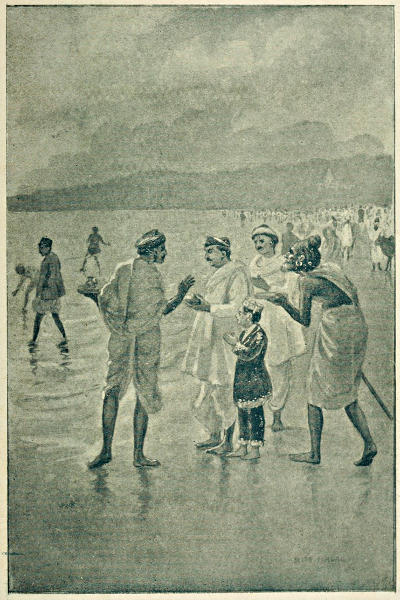
Ocean-Worship.
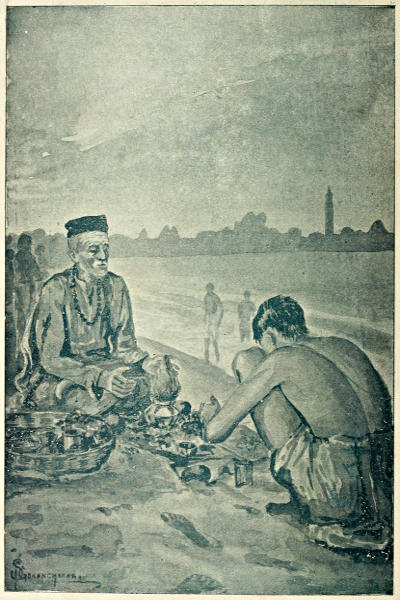
Narali Purnima or Cocoanut Day.
The calamity of floods should not, however, be exclusively
attributed to sheer demoniacal influence of malignant spirits.
It may, in some cases, be due to the offence given to patron saints
of water. Curtiss relates,[49] on the authority of Rev. J. Steward
Crawford, an old resident in Syria, a remarkable incident which
occurred at Nebk. The town derives its water-supply from a
series of wells connected with one another. Once, owing to
heavy rains, there came a succession of three floods which
washed away the wells which had been repaired after each
catastrophe. This left no room for doubt that the Vali of the
wells had been offended. They began to ascertain the reason
and discovered that the sacrifices which had been offered to the
saint at an annual festival had been intermitted, that people
used to perform their ablutions in a portion of the stream which
was inside of the courtyard of the mukam (shrine), thus defiling
it, and that a dead body had been carried across the stream.
All this had angered the saint. Sacrifices were, therefore, offered
to propitiate him. A number of sheep were stationed over
the stream and their throats were cut so that the blood would
run into the water.
It is refreshing to turn from these river wraiths to the spirits
of the sea, who are more powerful but less exacting. A cocoanut
is enough to keep them in good humour, and a special day is
named for this offering, called Narali Purnima, or Cocoanut
Holiday. On that day multitudes of people flock to the sea-shore
in Bombay to offer their puja to the sea to keep it quiet
after the monsoon. The Brahmin first offers prayers, then the
votary throws into the sea the holy water which the Brahmin
pours into the hollow of his hands, then some red
lead, then a few flowers and some rice, and last of all the
cocoanut. The safety of the seas during the fair season is
thus insured.
Whence arose the fear of evil spirits? Who were those water
demons? Both philology and history confirm the view that
the Devas or demons of old were in many cases either the
conquered aborigines of the various lands in which the ancient
Aryans settled themselves, or hostile races dwelling along their
frontiers. Out of this hostility of races coming in close contact
with one another sprang various superstitions. In some cases
the armies of the aborigines were represented as accompanied
by their own guardian spirits, who waged war upon the newcomers
and who were therefore regarded as demoniacal. In
other cases, the aborigines were themselves credited with the
power of exercising demon functions or assuming demon forms.
Thus the people of Iran believed that the land of Turan was full
of demons. This influence of the conquered people did not die
out after the struggle with them was over. Not only did the
aborigines continue to believe in their own demoniacal powers
and to observe their old rites and customs in the new régime,
but they also spread the beliefs in many ways among their
conquerors.
All untoward occurrences and unusual natural phenomena
thus came to be attributed to the malignant action of those
evil spirits. Storms, floods, famines, disease and death all proceeded
from the Devas, who in the Yasna Haptanhaiti of the
Zoroastrians are described as “the wicked, bad, wrongful
originators of mischief, the most baneful, destructive and
basest of beings.” Professor Robertson Smith relegates
demonism to the position of a cult hostile to and separate
from the tribal beliefs of early people and Mr. Walhouse
points out[50] that these beliefs in demons “belong to the
Turanian races and are antagonistic to the Aryan genius and
feelings.”
No doubt, Max Müller holds a different view. He considers
that there is no difficulty in tracing a belief in evil, unclean and
maleficent spirits, such as abound in Atharva-Veda, to the same
soil which produced a faith in good and beneficent spirits.
“We need not go for them,” says he, “to the original inhabitant
of India or the Blacks of Australia. Some of the great Vedic
gods like Rudra and the Maruts often assume a double aspect.
They are unkind as well as kind, they cause disease though
they likewise heal them. We have plenty of evil spirits in the
Veda, such as Vritras, Rakshasas, Yâmdhânas, Pisâkas. Of
course, nothing is easier than to say that they were borrowed from
the native races of India, but this, which was formerly a very
favourite expedient, would hardly commend itself now to any
serious scholar, excepting always the cases where Dravidian
words can actually be discovered in Sanscrit.”
These comments, however, merely contain a warning not
to stretch too widely a partial explanation of the origin of
evil spirits. The race-origin of the lesser malignant spirits may
not account for the existence of the Vedic giants and demons.
Neither has anyone attempted to do so. There is, however, no
doubt that several of the myths of bhuts and dâkans, giants and
dwarfs, are connected with traditions of hostile races. Folklore
throws considerable light on this question and a good deal of
evidence has been brought forward by Grimm and other
folklorists. Tylor has endorsed this evidence and the influence
of the hostility of races on the beliefs of people in
many lands is very skilfully examined by Sir Laurence Gomme
in a chapter entitled the “Mythic influence of a conquered
race” in his Ethnology of Folklore, and also in a chapter on
“Ethnological conditions” in his later work, Folklore as an
Historical Science. For our present purpose one or two examples
from Indian Folklore will suffice. On Bombay side, when a person
is possessed, generally the evil spirit is of a low caste, a Mahar,
or Bhanghi or a Mochi or a Pinjari. The dâkans (witches) who
haunt our wayside wells and trees and cemeteries also belong
to such low castes, as Kolis, Vaghris and Charans. The mountain
ranges and jungle tracts of Southern India are still inhabited by
semi-savage tribes, who, there is good reason to believe, once held
the fertile open plains. As pointed out by Walhouse in the
Journal of the Anthropological Society, the contempt and loathing
in which they are ordinarily held, are curiously tinctured with
superstitious fear; for they are believed to possess secret powers
of magic and witchcraft and influence with the old malignant
deities of the soil who can direct good or evil fortune. To this
day the people of Chota Nagpur believe that the Moondahs
possess powers of sorcery and can transform themselves into
tigers and other beasts of prey with a view to devouring their
enemies. Similarly, the Kathodis are believed to transform
themselves into tigers. Many closely parallel beliefs can be
quoted from the history of demonism in the western world and
Sir Laurence Gomme points out that the general characteristics
of the superstitions brought about by the contact between the
Aryan conquerors of India and the non-Aryan aborigines are
also represented in the cult of European witchcraft. Underneath
the emblems of the foreign civilisation lie the traditional
custom and belief, “the attributes of the native
uncivilisation.”
A notable illustration is given by Evans Wentz in Fairy Faith
in Celtic Countries. The only true Cornish Fairy, says the
author, is the Piksy, of the race which is the Pohel Vean or
Little People, and the Spriggan is only one of his aspects. The
Piksy would seem to be the “Brownie” of the Lowland Scot,
the Duine Sith of the Highlanders, and if we may judge from
an interesting note in Scott’s Pirate, the “Peight” of the
Orkneys. If Duine Sith really means “the Folk of the Mounds
(burrows),” not the “People of Peace,” it is possible that there is
something in the theory that Brownie, Duine Sith, and “Peight,”
which is Pict, are only in their origin ways of expressing the little
dark-complexioned aboriginal folk who were supposed to inhabit
the burrows, cromlechs, and allées couvertes, and whose cunning,
their only effective weapon against the mere strength of the
Aryan invader, earned them a reputation for magical powers.[51]
Let us now see how far this view of the case helps us in understanding
the Parsi beliefs in the Mahomedan guardian spirits of
wells, to which reference has already been made. The relations
of the Parsis with the Hindus and Mahomedans in the land of
their adoption were not exactly those of conquered aborigines
to the conquerors, but were, until the advent of the English,
practically the same as those of subject races to the rulers.
It was, however, no case of contact with a higher culture, rather
it was the case of assimilation of a ruder culture. No doubt, the
Parsis had taken to India from their ancient home a belief in
the existence of a presiding genius of water. That, however,
was a belief considerably different from that which in India
gave the water-spirits a local habitation and a name. But by
long contact with the Hindus and Mahomedans the community
came to believe in several local deities and absorbed several
local rituals. No doubt, the primary factor in inducing this
recognition and worship of local deities was the fear of their
power to do harm, but with it must also have been blended the
desire to please the neighbouring communities and the hope of
receiving favours at the hands of the spirits if properly adored
and propitiated.
This it was that seems to have led many a Parsi in the
mofussil to offer oil at the temple of Hanuman or to take
flowers to the shrines of Mahomedan saints, whose aid they
sought and who did not fail to appear to them, warning them and
directing them, mostly in dreams. When they went to Bombay
they had already absorbed the Hindu ideas concerning the
spirits lurking in or near deserted tanks and wells and regarded
them as the haunts of evil spirits such as dâkans and sankhinis,
bhuts and prets. When, however, they dug wells in their
own houses, in the absence of any well-spirit in the Zoroastrian
pantheon and in the absence of any Hindu guardian-spirits
of household wells, they appear to have invariably
peopled their private wells with sayyids and pirs in whose virtues
they had already come to believe and whom they had
already venerated at their shrines and whom it was thus
convenient for them to honour in their own houses by giving
them a sthan or thanak in their wells.
Thus we see that what was at first a purely Scriptural belief
in the sanctity of water and its presiding genius is now a
medley of many divergent elements owing to the fusion of
divers local traditions with the fundamental tribal belief during
the long intercourse of the community with the Hindus and Mahomedans.
There is no country in the world where people live
under more varied social and religious conditions and where
they are more exposed to the influence of neighbours than
in India and of all the cities of this cosmopolitan country there
is none more cosmopolitan than the city of Bombay.
Possibly, if we carry on local research in the Bombay Presidency
and try to localise the beliefs and customs concerning
well-worship, a good deal of fresh light may be thrown on
this question. The work is by no means very difficult and with
the aid of European folklorists, who have already shown us the
way, it should be easy to carry on research throughout India.
Sir Laurence Gomme, for instance, has given us in a luminous
chapter on the localisation of primitive beliefs, a very skilful
analysis of the different phases in which water-worship is still
found in the United Kingdom. All the survivals of this cult
he has allocated and explained by their ethnological bearing.
Commencing with the Teutonic centres of England, Sir
Laurence Gomme shows that the middle and south-eastern
counties almost fix the boundary of one form of well-worship, a
form which has lost all local colour, all distinct ritual, and
remains only in the dedication of the well or spring to a saint
of the Christian Church, in the tradition of its name as a
“holy well,” or else in the memory of some sort of reverence
formerly paid to the waters, which in many cases are
nameless. Proceeding from small beginnings where the survival
of the ancient cult is represented by the simple idea of
reverence for wells mostly dedicated to a Christian saint, he
takes us through stages where a ceremonial is faintly
traced in the well-dressing with garlands decked with flowers
and ribbons, where shrubs and trees growing near the well
are the recipients of offerings by devotees to the spirit of the
well, where disease and sickness of all kinds are ministered to,
where aid is sought against enemies, where the gift of rain is
obtained, where the spirits appear in general forms as fairies
and in specific form as animal or fish, and finally, it may be
in anthropomorphic form as Christian saints, where priestesses
attend the well to preside over the ceremonies. With the several
variants overlapping at every stage and thus keeping the whole
group of superstition and custom in touch, one section with
another, he shows that there is every reason to identify this
cult as the most widespread and the most lasting in connection
with local natural objects. He points out, moreover, that it
is in the Celtic-speaking districts where the rudest and most
uncivilised ceremonial is extant, and further, that it is in the
country of the Goidelic or earliest branch of the Celts, where
this finds its most pronounced types.
To show how this may be translated into terms of ethnology
he has given us the following table showing where the survivals
of the cult are the most perfect, that is to say, less
touched by the incoming civilisations which have swept over
them:—
|
Form of worship. |
Offerings. |
Deity or spirit. |
Human priest or priestess. |
| Simple reverence. |
Cure of disease. |
Wishing and divination. |
Rain producing. |
Sun-worship influences. |
Garland-dressing. |
Pins. |
Rag-bushes. |
Saint. |
Fairy. |
Animal genius. |
| England: |
|
|
|
|
|
|
|
|
|
|
|
|
| Eastern and South-eastern |
+ |
|
|
|
|
|
|
|
+ |
|
|
|
| Isle of Wight |
+ |
|
|
|
|
+ |
|
|
+ |
|
|
|
| Western (middle) |
+ |
|
|
|
|
+ |
|
|
+ |
|
|
|
| Western |
|
+ |
+ |
|
|
+ |
+ |
|
+ |
|
|
|
| Northern (a) |
|
+ |
+ |
|
|
+ |
+ |
|
+ |
|
|
|
| Do. (b) |
|
+ |
+ |
|
|
|
+ |
+ |
|
+ |
|
|
| Wales |
|
+ |
+ |
|
+ |
|
+ |
|
|
|
+ |
+ |
| Cornwall |
|
+ |
+ |
|
+ |
|
|
|
|
|
+ |
+ |
| Ireland |
|
+ |
+ |
+ |
+ |
|
|
+ |
|
|
+ |
|
| Scotland |
|
+ |
+ |
+ |
+ |
|
|
+ |
|
|
+ |
+ |
It may be gathered from this table that the acts of simple reverence,
garland-dressing, and dedication to a Christian saint are
to be taken as the late expressions in popular tradition of the
earlier and more primitive acts and practices tabulated above.
Taking the more primitive elements as the basis, the author
shows that the lowest point is obtained from English ground,
which only rises into the primitive stages in the northern
counties where rag-bushes are found. On Welsh ground the
highest point of primitive culture is the tradition of an animal
guardian-spirit. On Irish ground the highest point is the
identification of the well deity with the rain-god, while on
Scottish ground the highest points recognisable elsewhere are
accentuated in degree.
The author also shows that garland-dressing, pins and rag-bushes,
the three forms in which offerings to the well-deities
are made, are but variants of one primitive form—namely, the
offerings of rags or parts of clothing upon bushes sacred to the
well. This species of offerings, according to a summary given
by General Pitt-Rivers, extends throughout Northern Africa
from west to east. Mungo Park mentions it in Western Africa;
Sir Samuel Baker speaks of it on the confines of Abyssinia, and
says that the people who practised it were unable to assign a
reason for doing so; Burton also found the same custom in
Arabia during his pilgrimage to Mecca; in Persia Sir William
Ouseley saw a tree close to a large monolith covered with these
rags, and he describes it as a practice appertaining to a religion
long since proscribed in that country; Colonel Leslie says that
in the Dekkan and Ceylon the trees in the neighbourhood of
wells may be seen covered with similar scraps of cotton; Dr. A.
Campbell speaks of it as being practised by the Limboos near
Darjeeling in the Himalayas, where it is associated, as in Ireland,
with large heaps of stones; and Huc in his travels mentions
it among the Tartars. We shall examine the ideas underlying
the practice of rag-offering in different countries in a separate
chapter. Meanwhile, the conclusion that Sir Laurence Gomme
draws from this summary may be noted in his own words:—
“Here not only do we get evidence of the cult in an Aryan
country like Persia being proscribed, but, as General Pitt-Rivers
observes, ‘it is impossible to believe that so singular
a custom as this, invariably associated with cairns, megalithic
monuments, holy wells, or some such early Pagan institutions,
could have arisen independently in all these countries.’ That
the area over which it is found is coterminous with the area
of the megalithic monuments, that these monuments take us
back to pre-Aryan people and suggest the spread of this people
over the area covered by their remains, are arguments in favour
of a megalithic date for well-worship and rag-offerings.”
This ramble of ours through many ages and many lands in
search of evidence of water-worship may now be brought
to a close. Let us now witness the ceremonies connected
with the digging of wells and the different customs of
decorating wells and the varied offerings proffered to the
nymphs and spirits residing in the waters. With the picture
that will be thus presented of Indian wells decked with
jalis (trellis work) of flowers and illumined with ghee-lamps,
their pavements strewn with cocoanuts, sugar and sweets and
milk and ghee, and smeared with red lead in lieu of blood, but
daubed also in some places with the blood of animal-sacrifice,
it will be interesting to contrast the picture of English wells
fantastically tapestried about with old rags and practically
unlit and unembellished, save for a little garland-dressing here
and there, and filled with pins and needles, buttons and coins.