Although facts disappointed many over-sanguine
expectations that the billions of
dollars invested in aëronautics during the war
would pay direct dividends already in 1919, the
year brought us a long step nearer the age of
universal flight. Meantime, commercial aviation
is still a long way from the stage at which
bankers regard its undertakings as good security
for loans.
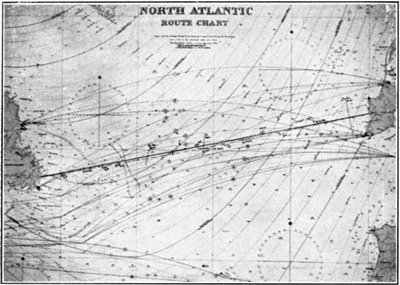
CHART OF THE NORTH ATLANTIC SHOWING COURSE OF THE FLIGHT
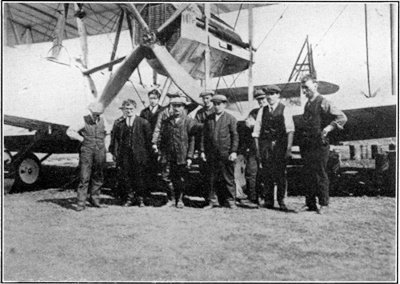
THE MEN WHO WORKED WITHOUT GLORY TO MAKE THE FLIGHT POSSIBLE
Air routes have been opened up in most parts
of the world. Captain Ross-Smith has shown,
by his magnificent journey from England to
Australia in a Vickers-Vimy aëroplane, that
long-distance flights over the most out-of-the-way
lands and ocean tracts can be made even
under the present unsatisfactory conditions, before
terminals, landing grounds and wireless
stations are provided for air pilots and navigators.
The Atlantic has been crossed four times,
twice by a dirigible, once by an aëroplane and
once by a flying boat. Aëroplanes have flown
from England to India. Aircraft have been
used for commercial purposes in every part of
Western Europe, in most countries of North
and South America, in Australia, India, Egypt
and South Africa. Important exhibitions of
modern aircraft, similar to automobile shows,
have been held in London, New York, Paris,
Amsterdam and elsewhere.
To-day all the Great Powers can show commercial
air services in full operation. Of these
the most important are perhaps the triangular
airways around London, Paris and Brussels.
One French and two British companies operate
daily between London and Paris; British craft
travel backwards and forwards between London
and Brussels three times a week; and
French machines fly between Paris and Brussels
every day.
The London-Paris services have established a
magnificent record for efficiency and regularity.
Valuable and urgent freight of every kind, including
furs, dresses, jewelry, documents, a
bunch of keys, perfume, a grand piano and even
a consignment of lobsters, have been delivered
in safety. Forty pounds of assorted London
newspapers are taken each morning to Paris,
where they are sold in the streets on the day of
publication instead of next morning, as was the
case when they were forwarded by train and
packet-boat. Leading London papers, such as
the Times, the Telegraph, the Morning Post, the
Daily Mail, and the Daily Express, have regular
contracts with one of the companies.
As for passengers, men of every occupation
take advantage of the opportunity to travel
comfortably from London to Paris in two and
one-quarter hours. There is seldom a vacant
seat on the larger machines; although the fare
is at present rather high, ranging from $75 to
$105 for the single journey.
Moreover, the accommodation on two of the
types of aëroplane now used—the Handley-Page
W-8 and the Airco DH-18—is more
attractive than that of a Pullman car. The
Handley-Page W-8 carries fifteen to twenty
passengers with personal luggage, or two tons
of freight. The Airco DH-18 takes eight passengers,
with their personal luggage.
The past year saw no specially important developments
of commercial aviation inside Great
Britain itself. A week-end service between
Southampton and Havre was inaugurated, and
passengers and mails were flown from London
to Leeds. The most important undertaking was
perhaps the delivery by air of newspapers. For
a time the Manchester edition of the Daily
Mail was taken by air for distribution in Carlisle,
Dundee and Aberdeen, the last-named
place being reached in three and one-quarter
hours instead of the thirteen hours of train
journey. Evening newspapers were carried
daily during the summer from London to various
resorts on the South coast.
The London-Leeds undertaking is the only
regular service between English towns that has
lasted for long. Elsewhere the air rates proved
to be too high, and although there were plenty
of aërodromes, the promoters of aërial transport
companies could not compete with the all-embracing
network of railways. During the
great railway strike of October, however, valuable
transport work was done by aircraft. For
the rest, aëroplanes in England are chartered
as aërial taxicabs for special trips, and last
summer one or two companies reaped a moderate
harvest by organizing pleasure trips at
the seaside resorts. An airship or two have
taken tours around the battlefields of France
and Flanders. A few wealthy amateurs have
bought aëroplanes for their private use.
Other European countries—France, Italy,
Holland, Belgium, Scandinavia, Spain and Portugal—have
made rather less progress in the
manufacture and development of aëroplanes or
dirigibles; but their use of aircraft for commercial
purposes was about the same as that of
Britain—newspaper distribution, some special
journeys, and many joyrides. French aviators
have opened tentative airways to Morocco,
Senegal and Tunis. For regular passenger or
goods services in continental Europe the high
cost of fuel and accessories makes the rates too
high. Also aërodromes and landing grounds
are too few; and seldom can aëroplanes compete
on a large scale with railways over comparatively
short distances. Exceptions are the
Paris-Lyons and Madrid-Lisbon airways.
Germany, throughout what was for her a terrible
year, made further progress with her
Zeppelin dirigibles. A number of return voyages
were made over the route Berlin-Munich-Vienna-Constantinople.
The latest type of Zeppelin
is so efficient that no weather conditions,
except a strong cross-hangar wind, prevents the
airship Bodensee from making its daily flight of
three hundred and ninety miles between Friedrichshafen
and Staalsen, thirteen miles from
Berlin. The passenger carrying Zeppelins,
which prior to the war provided the only important
example of commercial aircraft, claim
a remarkable record. They have carried more
than one hundred and forty thousand people,
and yet not one of the passengers has been
killed or injured in an accident; although some
members of the crews lost their lives in the
early days of the pioneer Zeppelins.
The vast distances of the United States offer
better opportunities for aëroplane traffic than
the comparatively small and closely-railwayed
countries of Western Europe. There is no
doubt that, had the United States government
supported its aircraft companies to the same
extent as did the British government, commercial
aviation in America would have traveled
along a smooth road. Even without this support
it has made excellent progress. Successful
regular services are established between Los
Angeles and San Diego, and elsewhere in the
West, and in the East many passengers have
been carried between New York and Atlantic
City, and around the coast of Florida. Plans
are being laid for various other airways, including
one between Key West and Havana.
While no continuous service for aërial goods
traffic exist in the United States, aëroplanes are
often chartered for special deliveries. This is
particularly the case in the oil countries of
Texas and Oklahoma, where newly-grown and
important centers are off the beaten railroad
track. One company in Oklahoma regularly
sends its employees' pay by aëroplane from
town to oilfield camp, thus assuring a quick and
safe delivery, free from the necessity of armed
guards and the danger of hold-ups. Other items
worth noting in the United States' aërial history
of the past twelve months are that aëroplanes
have performed survey work and located
forest fires, that thirty-two cities have applied
for commercial aërodromes for postal, passenger
and express purposes, and that an advertising
agency is soliciting aërial business that will
include display work on dirigibles, balloons and
aëroplanes, the dropping of pamphlets from the
air, and aërial photography.
Where the United States undoubtedly leads
the way is in the ownership and use of privately
owned aëroplanes—a circumstance partly explained
by the great quantities of new money
being spent. For a time some of the American
manufacturers were months behind their post-war
orders, and were selling everything that
could fly. One famous company disposed of
hundreds of pleasure craft at $7,500 apiece.
Many buyers, impatient of delay, accepted immediate
delivery of training machines, rather
than wait for the pleasure craft. Reputable
agencies dealing in second-hand aëroplanes
bought from the United States and Canadian
governments, disposed of thousands of machines
and could not obtain enough to satisfy
all their clients. An interesting development
was the idea of community aëroplanes, purchased
and maintained jointly by small groups
of people living in the same residential district.
The United States postal authorities have
satisfactorily maintained aërial mail services
over the route New York-Washington-Cleveland-Chicago.
After some preliminary fiascos
these became reliable, besides being very
speedy, as compared with train schedules. For
June the Washington-New York air mail
achieved ninety-nine per cent. efficiency, and the
Cleveland-Chicago route one hundred per cent.
The latter never missed a day in May and June,
and not a single forced landing occurred during
the first seventy days. At the close of 1919
the air mails showed a surplus of $19,000 of
revenue over working costs, on a basis of two
cents charge for each ounce of mail matter carried.
Better results are expected now that
specially constructed machines, with freight
capacities of one thousand pounds and upward,
are ready for use.
The British dominions and dependencies take
a great interest in aëronautics, and last year
saw satisfactory beginnings in some of them.
In Australia, for example, a passenger and
freight service links Sydney and Port Darwin,
over a distance of twenty-five hundred miles,
with intervening stations. Plans are ready for
regular flights from North to South of the continent,
and also from East to West, across the
difficult country between New South Wales and
Victoria on the one hand, and Western Australia
on the other.
Canada has found a highly successful use for
aëroplanes in prospecting the Labrador timber
country. A group of machines returned from
an exploration with valuable photographs and
maps of hundreds of thousands of dollars'
worth of forest land. Aërial fire patrols, also,
have been sent out over the forests. While no
important air route for passenger carrying is
yet utilized in Canada, there is a certain amount
of private flying, and air journeys for business
purposes are common. Plans have been prepared
for a regular service between Newfoundland
and cities on the mainland, thus saving
many hours over the time schedules perpetrated
by the little Newfoundland railway.
In the South African Union, where the railway
system by no means corresponds with the
vast distances, many passengers and mails are
carried by air from Johannesburg to Pretoria,
Maritzburg, Durban and Cape Town. Later,
when the services over these routes are better
organized, they will doubtless be extended to
important centers in Rhodesia, the East Africas
and what was German South-West Africa.
Aëroplanes in India take passengers over the
route Calcutta-Simla in twelve to fourteen
hours of cool roominess, as compared with
forty-two hours of stuffy oppressiveness on a
train. Other Indian air routes in preparation
are Calcutta-Bombay, Calcutta-Darjeeling and
Calcutta-Puri. The air fare in India averages
about 11 cents a mile.
Aërodromes and landing grounds are already
prepared between Egypt and India, and several
machines have made the journey from Cairo to
Delhi, via Damascus, the Syrian Desert, Bagdad,
Bandar Abbas and Karachi. Elsewhere
in the East—the Malay Peninsula, Singapore,
Borneo, Java and China—similar routes are
planned. The whole of Eastern Africa, from
Cairo to Cape Town, has been mapped out for
the use of aircraft, with landing grounds at
short intervals.
So much for accomplishment during the past
year. What the future and the near-future
have in store for aëronautics is problematical,
and any detailed analysis must be conjecture.
The general trend of development during the
next two years may be forecast, however, with a
fair degree of accuracy.
Anybody who blends sane imagination with
some knowledge of the history of aëronautics
must realize that what has been achieved is very
little in comparison with what can be achieved.
It is unnecessary to make trite comparisons
with the first stages of steam locomotives or
motor cars.
Yet, it is folly to expect an air age now. Its
coming will be delayed by the necessity of slow,
painstaking research, and by the fact that in the
countries which are encouraging aviation to the
greatest degree, capital is no longer fluid and
plentiful, and money in substantial sums cannot
be risked on magnificent experiments. The
cost of building fleets of dirigibles and hosts of
air terminals, for example, must be enormous;
and until it has been demonstrated beyond question
that they will be paying propositions, financiers
and investors are unlikely to be interested
in their concrete possibilities on a large scale.
Unless some startling innovation—a much
cheaper fuel for example, or a successful helicopter—revolutionizes
commercial aviation, its
near-future is unlikely to stray beyond the extension
of airways over distances of about five
hundred to two thousand miles. These are
likely to be covered mostly by heavier-than-air
craft, although, as in Germany, dirigibles will
have their place.
Extension of air traffic is especially probable
in industrial and agricultural countries of large
area, such as the United States, Canada, Australia,
India and the South American republics.
Another projected development with immediate
possibilities is the linking of regions that are
separated by a comparatively narrow expanse
of water. Obvious examples, in addition to
Britain and France, are England and Ireland,
the Mediterranean coast of France and the
Mediterranean coast of Africa, and Florida and
Cuba.
Traffic across the ocean or a great lake offers
to air travel the best time-saving inducement.
To connect two places separated by one hundred
and fifty miles of water, an average steamship
needs ten hours. A passenger on it must
spend at least one night away from home, while
transacting his business. An air passenger
covers the same distance in one and one-half to
two hours, and can return on the same day.
For such transport the seaplane and the flying
boat will have their chance.
Besides the carriage of passengers, mails and
valuable freight, aviation will have many additional
functions. Maps may be made and
checked with absolute accuracy by means of
aërial photography. Another important function
of the aëroplane and the aërial camera is
to explore and prospect undeveloped districts.
In places remote from the ordinary facilities of
civilization aircraft may be used for the discovery
of fire, flood and lawlessness. Already
the Canadian Northwest Mounted Police have
captured wrongdoers by means of aëroplane patrols.
Aircraft offer particular advantages as carriers
in regions where the natural obstacles on
the ground prohibit railway or road transport.
In Alaska valuable metals and furs are brought
to civilization on sleds drawn by dogs, over
paths that are circuitous and dangerous. They
could be taken in safety, and with an immense
saving of time, by aëroplanes fitted with skids
suitable for landing on ice and snow. Again,
copper is transported from mines in the Andes
by llamas, which are slow and must jog over
devious tracks. Aëroplanes could make the
journey directly and speedily, from mine to
coast, without regard to precipice, marsh or
forest.
South America is likely to be a happy hunting-ground
for aëronautical pioneers. The
mountain-range of the Andes, which for hundreds
of miles sharply divides America into two
parts, gives aviation an incontestable opportunity.
The eastern section of South America
could be brought days nearer the western section
by high-climbing aircraft, which would provide
a pleasant alternative to the roundabout,
uncomfortable journeying now necessary. The
air mails between the two great commercial
centers of South America—Rio de Janeiro and
Buenos Ayres—should also save many days of
valuable time. Many owners of ranches and
plantations in the Argentine, Uruguay, Paraguay
and Brazil are buying aëroplanes to bring
their isolated, up-country properties in closer
contact with the towns.
Asia and Africa have similar geographical
problems, to which air traffic might find a ready
solution. Each of these continents has enormous
areas that, because of the absence of good
railways, are either unproductive or much less
productive than their resources warrant. A
few of many such cases are Turkestan, Central
Arabia, parts of China, Siberia, Thibet, and
the whole of Central Africa. Most of these are
rich in minerals. Meanwhile, aëroplanes have
flown between the desert marts of Damascus
and Bagdad in eight to ten hours. These cities
are not yet linked by railroad and a camel caravan
over the Syrian desert covers the same
route in two weeks to a month. The same conditions
apply to the Gobi desert.
So far I have dealt with the future of commercial
aëronautics almost entirely in terms of
heavier-than-air machines. These—land planes,
seaplanes and flying boats—have at present a
useful radius of non-stop flight confined to distances
of under one thousand miles. The limitation
must remain until changes in the basic
principles of aëroplane construction are so altered
as to give a much greater speed in proportion
to fuel consumption. One such change
may be the introduction of wings with variable
camber. This, by permitting variations in the
angle of incidence, would make possible a quick
ascent at a steep inclination, and a very fast forward
speed once the required height had been
attained. The benefits from variable camber
could be increased by the introduction of a propeller
with a variable pitch. Going still further
in the same direction, we may find any day that
one of the attempts in various countries to design
and construct a successful helicopter has
matured, producing a machine which, by reason
of a very powerful propeller on a moveable
shaft that can be inclined in any direction,
will not only rise and descend vertically, but
also may be made to travel forward at a great
speed and to perform such acrobatic tricks as
sudden halts, retreats and jumps.
All this, however, is surmise; and we are
faced with the fact that until the design of aëroplanes
differs radically from its present form,
heavier-than-air flying apparatuses are limited
as to maximum size by certain structural principles
too complicated for explanation in this
non-technical analysis. A further limitation is
imposed by the space needed by the largest
machines for leaving the ground or landing.
Within these bounds it has been found that
the maximum capacity for passengers and
freight does not greatly exceed one and one-half
to two tons for a non-stop journey of five
hundred miles in still air. Lesser distances do
not increase the useful load appreciably, but
greater distances decrease it; until for a radius
of about twenty-five hundred miles the whole
of the disposable lift is needed for fuel, and
nothing else may be carried.
For long journeys over land, therefore, the
aëroplane must come to earth for replenishment
of fuel every five hundred miles. Even for this
distance it cannot take more than one and one-half
to two tons beyond the weight of fuel and
crew. If heavier loads are to be transported,
more machines must be used. Finally there
comes a point at which a single airship, carrying
a heavy freight over five hundred miles, is
more economical than several aëroplanes. For
non-stop flights of over one thousand miles the
same considerations make the airship always
more economical than the aëroplane.
Over the ocean the flying boat can beat the
dirigible in time and cost up to five hundred
miles. Even at one thousand miles it is a commercial
proposition, but it must then have all
in its favor. For longer distances the airship
has no competitor. It may be deduced that in
years to come, when the world's airways are in
general operation, heavier-than-air machines
will bring freight to the great airports, there
to be transferred to dirigibles and by them carried
to the earth's uttermost ends.
The time for this seeming Utopia is not yet,
however, although a group of airship interests
in England are now planning airship services
that may eventually set London within two and
a half days of New York, one and a half days
of Cairo, four of Rio de Janeiro, five and a half
of Cape Town and seven of Australia. But first
must come bold expenditure, very careful organization,
many-sided research and improved
invention.
Although no claim is made that present-day
airships can compete for reliability with railroad
trains and ocean liners, there is no doubt
that a sufficient number of passengers are prepared
to pay relatively higher rates for the
great saving in time taken for long distance
journeys, particularly over the ocean.
The demand would be mainly for the carriage
of express freight and mail matter and for
passenger traffic to serve people who wish to
get from center to center in the shortest possible
time. Another use for large airships
would be the carrying of freight of high intrinsic
value, such as valuable ores, from places
otherwise inaccessible, or not provided with
other means of direct transport.
To meet the requirements of various purposes
for which airships may be utilized, dirigibles
of four kinds are projected:
First, the airship of moderate size and high
speed for carrying express, mails and passengers.
Secondly, the air liner solely for passenger
traffic, of a large size and speed.
Thirdly, the large airship of comparatively
slow speed, and great carrying capacity, for
general transport.
Fourthly, the small non-rigid airship for
private purchase and upkeep as an aërial yacht.
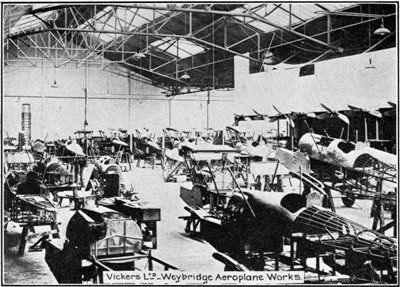
THE VICKERS AEROPLANE WORKS AT WEYBRIDGE, ENGLAND
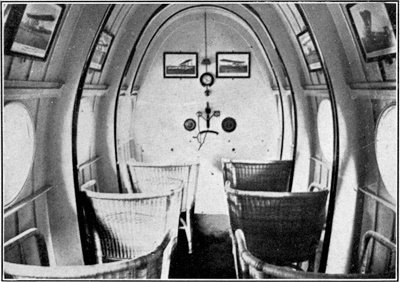
COMFORT CAN BE ENJOYED IN AIR TRAVEL TO-DAY
The rigid airship is as yet only at the beginning
of its development, particularly as regards
size and carrying capacity. The airship of
three million, five hundred thousand cubic feet
capacity, for immediate use on the fast passenger
services, carrying a load of passengers of
fifteen tons for a distance of forty-eight hundred
miles, might be built immediately, and
could be housed in sheds at present available.
As the lift and speed efficiency of a rigid airship
increases rapidly in proportion to the vessel's
size, it will be advantageous to use the
largest airships that can be economically operated.
A rigid dirigible able to carry fifty tons
of passengers and freight for ten thousand
miles at a speed of eighty miles an hour is quite
feasible; and the design and construction of
such an airship could be undertaken immediately
if it were justified by the demand for air
transport.
The ships of three million, five hundred thousand
cubic feet capacity, which can be housed
and flown for commercial purposes as soon as
the required terminals and navigational facilities
are ready, will approximate to those described
as being suitable for a transatlantic
service. If standardized for adaptation to all
conditions and world routes, they should be
capable of a non-stop flight of about eighty
hours, at an average speed of sixty miles an
hour.
To prevent wastage and reduce the running
costs, several economical devices for dealing
with height equilibrium are needed. On long
flights the greatest problems are maintenance
of the airship at a constant height, and avoidance
of the loss of gas consequent on expansion
when the ship rises as it loses weight by the
consumption of fuel. Owing to the great variation
in temperature between day and night, the
ship becomes heavy at night owing to the lower
temperature, and light during the day, as a result
of the higher temperature. A discharge of
ballast at nightfall, and of gas in the morning,
is needed to keep it in equilibrium. To obviate
discharge of gas, and the necessity of starting
with a large weight of ballast, it is proposed
to run a proportion of the engines on hydrogen
fuel, so that the hydrogen can be consumed at
such a rate that the loss of lift equals the loss
of weight of fuel consumed by the other engines,
thus economically using hydrogen which otherwise
would be lost through the discharge of the
gas valves.
I make the supposition that hydrogen, and
not helium, will be the sustaining gas. For commercial
aviation it has many advantages, for
helium is dearer and rarer, and has about
twenty per cent. less lift. Contrary to general
belief, a flight in an airship filled with hydrogen,
subject to proper precautions, has no greater
fire risk than living near a gas factory. Helium
is a necessity only for airships used in war, as,
unlike hydrogen, it is not ignited by incendiary
bullets from hostile aircraft. The United States
has almost a monopoly of the world's quantitative
supply of helium, which fact should be a
tremendous asset in wartime.
The ballast difficulty can be met by apparatus
to condense the water of combustion from the
exhaust gases of the engines. Experiments
have shown that it is practicable to recover
water of slightly greater weight than the gasoline
fuel consumed, thus avoiding any variation
in lift due to gasoline consumption. Further,
water ballast could be picked up periodically
from the sea by descending and taking in water
through a pump suspended from a flexible hose,
or direct into tanks in the gondolas through sea-valves.
Still further reduction of running costs may
be effected by fuel economy. This would be
difficult with internal combustion engines of the
type in use at present, for greater thermal efficiency
(the ratio between the amount of heat
contained in the fuel consumed and the amount
of useful work delivered by the engine) necessitates
heavier machinery. The reduction in
gasoline consumption is thus offset by a decrease
in the disposable lift. It is probable that
a saving on large dirigibles might result from
substituting for the internal combustion method
of generating power engines that burn cheap
oils. Although such engines are much heavier,
and although the crude oils weigh a good deal
more than gasoline, the difference would be
more than covered on long flights, for gasoline
is nearly four times dearer than crude oil.
Moreover, the weight of oil actually consumed
would be about twenty per cent. less than that
of the gasoline burned by internal combustion
engines over the same distance.
The solution may be in the employment of
steam. For the rather low standards of horsepower
on which dirigibles are driven, heavy
steam engines of the ordinary type, although
much more reliable, would be less economical
than internal combustion engines, owing to the
latter's better thermal efficiency. Engineers are
attempting to evolve a light type of steam turbine
that will overcome this drawback.
Of equal importance to fuel economy is a better
system of airship navigation. This is similar
in principle to steamship navigation, but it
is made more complicated by the much greater
drift of atmospheric currents. Moreover, air
currents can never be charted as exactly as sea
currents. An excellent meteorological organization,
for reporting motions of the air at given
times, is therefore essential.
When flying over land a navigator can determine
the drift of his vessel by taking observation
on a suitable fixed point on the earth's surface,
and adjusting his compass course accordingly.
It is probable that a gyroscopic compass
will be the standard type for dirigibles. Many
aviators have experienced difficulties with the
magnetic compass on long flights; although it
has served me well always, especially on my
transatlantic flight as Captain Alcock's navigator.
Over the sea no fixed point is available, so
that the motion of the wind must be checked
periodically. One method is for the navigator
to make astronomical observations, and from
them deduce his position on the chart. Another
may be the use of bombs which ignite on the
water and give out a dense smoke or a bright
light, lasting for several minutes. During the
day the navigator sights on the smoke, and during
the night on the light, and thus discovers
the wind's velocity and direction. An invention
that could simplify navigation would be some
form of ground-speed meter, showing at a
glance the rate of progress over the earth (as
distinct from air speed), with either a following
or a contrary wind.
The most valuable means of airship navigation
will be that of directional wireless. Communication
from two separate stations, which
could be either land terminals or stationary
ships in the ocean, gives the direction of the
transmitted wireless waves and signals to the
dirigible its bearings. The position is then laid
off on the chart, and the course regulated accordingly.
This method was used by the German
Zeppelins during the war.
Of equal importance to the structural and
navigational equipment of airships is the provision
of suitable terminals for each route.
These would require, among other necessities,
an aërodrome of about one mile square; a double
airship shed capable of housing two vessels; a
mooring-out tower; mechanical gear for transferring
an airship from the mooring tower to
the shed; hydrogen generating and storage
plant; repair workshops and stores; meteorological
offices; wireless telegraphy installation;
electrical night signaling and landing arrangements;
a station on the local railway from the
main part of the city; a hotel; a garage; and
customs and booking offices.
The aërodrome must be a short distance from
the city served by the airship service. If possible
it should be near a chemical works where
hydrogen could be produced as a by-product.
The ground would be preferably on a site remote
from hills and other topographical features
likely to cause air disturbances.
The double sheds for housing vessels of the
size specified, three million, five hundred thousand
cubic feet capacity, would have two berths,
the minimum dimensions of each of which must
be eight hundred and fifty feet long, one hundred
and fifty feet wide, and one hundred and
fifteen feet high. Their contents should include
hydrogen filling mains and gear for slinging
the airships from the roof when deflated for
overhaul. Special arrangements would be made
for rapid replenishment of the ships with gas,
fuel, and water ballast.
If no industrial supply of hydrogen were provided
by a nearby factory, the aërodrome
should have a generating plant capable of producing
fifty thousand cubic feet of hydrogen per
hour. Gasometer storage, with a capacity of
about five hundred thousand cubic feet, is also
a necessity.
The meteorological office would issue weather
reports for the guidance of airship navigators,
and issue navigating instructions to them by
means of the wireless installation. The latter
should have a range of at least five thousand
miles.
Each aërodrome would be provided with
suitable electric light signals to indicate the
position of the landing ground to incoming ships
at night, as well as landing lights to point the
way to the mooring tower. Trolleys running
on guide rails, with electrically driven gear,
could move a dirigible from the tower to the
shed with a minimum of man power.
A suitable mooring tower constitutes an
enormous saving of time and labor. The Vickers
Patent Mooring Gear, which has been tested
satisfactorily, can be worked by half a dozen
men; whereas the old method of rope pulling
and dragging needs two to four hundred men
for landing an airship of three million, five hundred
thousand cubic feet capacity.
With existing methods, a rigid airship must
be housed in a suitable shed when not in flight.
The danger and difficulty of removing the ship
from its shed, and returning it safely thereto
after a journey, restricts the number of actual
flying days in the year to those on which such
operations can be performed without risk of
damage, although a modern rigid airship may
be in the air with efficiency and perfect safety in
practically any state of the weather. The Patent
Mooring Gear renders the landing independent
of the weather, while calling for the
attendance of only six men to actuate the various
mechanical devices employed.
In principle, the gear consists of a tall steel
mast, of such a height that when the ship is attached
by the nose it rides on an even keel at a
height of upwards of one hundred feet. The
mast has at the top a platform or deck. The
head of the tower is entirely enclosed and contains
the necessary apparatus for bringing a
vessel to rest. This top portion is designed to
rotate, so that a ship, when moored, may always
lie directly head to wind.
Access to the upper deck of the masthead is
obtained by means of an elevator, which allows
passengers to enter the ship in comfort. Behind
the deck is a compartment containing the
landing gear. This consists of an electrically
driven winding engine, fitted with about one
thousand feet of the highest quality flexible
steel wire rope, together with any automatic
coupling. In the compartment are also pipes
for the supply to the ship of hydrogen, gasoline,
oil and water from the main reservoirs, situated
on the ground at the foot of the mast. The
vessel itself is fitted with apparatus complementary
to that housed in the masthead. From
the nose projects the attachment which is
gripped by the automatic coupling, while in the
bow is situated a storage drum and winch for
six hundred feet of wire rope.
On approaching the aërodrome, the ship wirelesses
its intention to land. The masthead
mooring rope is then threaded through the
automatic coupling, and paid out until the free
end reaches the ground below. This end of the
rope is attached by a shackle to the rear of a
light car, which is driven away from the mast
in the direction from which the ship is approaching,
while the rope uncoils from the drum
above. When at a distance of seven hundred or
eight hundred feet from the foot of the mast
the men in charge of the gear unshackle the
rope, and spread landing signs that indicate to
the airship pilot their position on the ground.
On arrival over the landing party, the ship's
bow mooring rope is released, and runs out
from the bow attachment under the influence of
a weight of several hundred pounds in the form
of sandbags. Two men of the party on the
ground below take charge of the rope, unshackle
the sandbags, and effect a junction with
the mooring mast rope, which is in the hands
of the remaining men of the landing party. The
rope ends are coupled together by means of a
self-locking coupling, which enables the junction
to be made within five seconds.
The dirigible is now connected with the head
of the mooring mast by a long length of steel
wire rope. On receiving a signal from the
ground party, the men in charge of the winding
gear in the masthead haul in. As the rope
tautens, ballast is discharged from the ship,
which is slowly hauled into connection with the
automatic coupling already set in the open position
to receive the attachment on the nose.
When once this coupling is closed, the mooring
ropes can be dispensed with, the ship's rope being
re-wound on to the storage drum in the
bows.
After landing at the masthead, connection is
made with the hydrogen, gasoline, oil, and water
mains, and fresh gas, fuel and water ballast are
placed on board, so that the ship may be kept in
trim during the discharge of cargo, and so the
embarkation of passengers and stores be effected.
When all is ready to leave the masthead for
flight, the pulling of a lever in the automatic
coupling releases the ship. The latter then
draws astern and upward, under the influence of
the prevailing wind, until it is well clear of the
landing station and can proceed on its course.
The design of this apparatus is such that the
landing of an airship is as easy in a wind as
in complete calm. With its help an airship can
land in any speed of wind in which it is safe to
fly. Should the wind be so high (over 60 or 70
miles per hour) that the vessel cannot reach a
given mast, it will always be possible to learn
by wireless the nearest station at which favorable
conditions allow it to come down.
The release of the ship from the mast can
take place in any wind-speed. Owing to the
comparatively local nature of a big storm
(storms are known not to cover districts greater
than two hundred miles in diameter) the vessel,
after slipping its moorings, is able to circumnavigate
the disturbed area by making a
small initial deviation from the true course.
A part of the aërodrome should be given over
to aëroplanes, used for the bringing of mails
and urgent freight from places distant from the
terminal. Heavier-than-air machines, in fact,
will be the veins leading to the great arteries
of the world's air routes, operated by dirigibles.
A strong searchlight, for the guidance of aëroplane
pilots flying in fog, might be necessary.
Given improved landing facilities, means might
be found for them to coast down the searchlight,
if the ground away from it were invisible.
Another method of delivering mails, before
leaving for a landing ground away from
the fog belt, is to drop them, attached to a parachute.
When the package reaches earth it can
be located by an electric bell, which rings on impact
and continues ringing.
The mail services of to-day, by railway and
boat, can in many cases be greatly speeded up
if part of a long journey be covered by aëroplane.
A good instance is the route between
Great Britain and South America. If a merchant
in London posts three letters to correspondents
in New York, Rio de Janeiro and
Buenos Ayres respectively, he may have a reply
from New York before the Brazil man has had
time to read his communication, and four or
five days before the man in the Argentine has
received his. An aërial short cut to Dakar—already
several machines have flown there from
Paris—would lessen by six or seven days the
transit time for mailbags sent from England to
Rio de Janeiro or Buenos Ayres.
As long as the internal combustion engine is
used in aëronautics, and mechanical failure is
always a possibility to be reckoned with, the
cost of maintaining aëroplane routes, even if
they be only auxiliary to dirigible or steamship
services, will be greatly swollen by the need of
maintaining frequent landing grounds. Every
ten miles would be an ideal interval for them;
every twenty miles is a minimum for first-rate
insurance against risk. From a height of five
thousand feet, the probable average minimum
elevation for commercial air navigation, a pilot
can without difficulty cover a distance of five
miles while planing down without the aid of
motors. From ten thousand feet he can cover
ten miles under the same conditions; so that
at this height he would never be outside gliding
distance of landing grounds prepared every
twenty miles.
Given these safeguards, the element of risk
in present day aviation is no greater than it
was in the early days of railways and steamboats;
and little, if any, greater than in modern
motoring. Many people, possessing only a
newspaper acquaintance with aërial affairs,
still believe mechanical flight to be perilous.
In exactly the same manner men shunned the
infant steamboat, railway train, bicycle and
motor-car. Yet, proportionately, the aëroplane
and the dirigible are responsible for no more
deaths than the train or the automobile. The
seeming discrepancy is because so much attention
is paid to air fatalities. Every week-end
motor-car accidents cause scores of fatalities.
Yet the death in harness of a single aviator
produces more comment than all of these.
Partly, no doubt, the intense horror with which
humanity regards death by falling from a great
height is due to its novelty among human experiences.
The airways of the world offer some pretty
problems of international politics, involving
commerce, rights of landing, customs duties, air
smuggling, air traffic regulations and air laws.
All these were dealt with in the International
Aërial Commission at the Peace Conference,
which agreed upon the following principles:
1. Recognition of the greatest possible freedom
of aërial navigation, as far as that freedom
of navigation is reconcilable with the principle
of the sovereignty of each state in the air above
its territory, with the security of the state affected,
and in conformity with a strict enforcement
of safety regulations.
2. Regulation under obligatory permits for
pilots and other aëronautical personnel to be
recognized mutually by the signatory states.
3. The establishment of international air
rules, including signals, lights, methods of
avoiding collisions and regulations for landing.
4. The recognition of the special treatment of
army, navy and state machines when on duty
for the state.
5. Recognition of the right to utilize all public
aërodromes in other states, under a charge
to be uniform for the aircraft of all nations, including
the home nation.
6. Recognition of the right of crossing one
country to another, with the privilege of landing,
but under the reservation of the right of
the state crossed to apply its local rules, and
if necessary to force the landing of the visiting
machines on signal.
7. Recognition of the principle of mutual indemnity
to cover damages to persons or property
due to aircraft—the state of the offending
machine to make reparation and then to recoup
itself in any way it sees fit.
8. Recognition of the necessity of a permanent
international aëronautical commission, in
order to keep the development of the legal side
of aviation abreast of the development of the
science itself.
9. Recognition of the obligation of each state
to regulate its internal legislation along the
lines of the clauses of the international agreement.
The main airways of the world are still hypothetical,
but some of their main terminals, in
relation to the centers of industry and population
and the trade routes, will certainly be London,
New York, San Francisco, Tokio, Delhi,
Colombo, Cairo, Cape Town, and Rio de Janeiro.
In particular London, New York, Cairo
and Rio de Janeiro are fitted to be great junctions
for air traffic. London is the logical distribution
center for passengers and freight
from North and South America bound for Continental
Europe or the East. The New York
terminal should link the transatlantic airways
from Europe with the airways of North America.
Rio de Janeiro should perform the same
function for South America, and also be the
center of seaplane traffic up the Amazon. Cairo
is destined to be the junction for the air routes
between Europe, Asia, Africa and Australia.
From it dirigibles or aëroplanes may pass to
India (via Damascus and Bagdad), to Cape
Town (via Nairobi), to Australia (via Aden and
Colombo, or Delhi and Singapore), and to London
(via Algiers or some point in Southern
Italy). Cairo is also likely to be an important
base for seaplanes and flying boats plying up
and down the tremendous waterways of the Nile
and the Great Lakes.
The British Empire is especially bound up
with the airways of the future. The geographical
position of the Briton forces him to think
in Imperial terms. In 1776 Great Britain lost
her most valuable colonies largely because the
Atlantic Ocean made adequate representation
of the colonial interest physically impossible.
Since that day cables, steamships and the wireless
have helped to overcome the distances that
separate the overseas dominions from the British
Isles. Aircraft and well-organized British
air routes should be the greatest step in the consolidation
of the far-flung Empire.
To this end British official experts mapped
out the stages of the aërial route to Australia
from Egypt, via Damascus, Bagdad, Karachi,
Delhi, Calcutta, Singapore and Sumatra. Although
the successive landing grounds were not
ready in time for Captain Ross-Smith's magnificent
flight from England to Australia, the
information and advice collected by the official
surveyors were of inestimable value to him. It
is noteworthy that nearly the whole of the proposed
airway from Egypt to Australia is over
British territory or the sea.
The same is true of the proposed route from
Cairo to Cape Town. This was planned out
very carefully by three parties of military aviators,
who covered the whole length of civilized
and uncivilized Africa in their search for landing
grounds. The absorption of German East
Africa by the South African Union makes an
all British corridor for aircraft from Cairo to
Cape Town, by way of Egypt, the Sudan, British
East Africa, British Central Africa, German
East Africa, Rhodesia, the Transvaal and Cape
Colony. There is an alternative water route
over the Nile, the Great Lakes, the Zambezi
River and along the coast to Cape Town. Being
the junction of the airways to India, Australia
and South Africa, Egypt is destined to
be the nerve center of an air-linked British Empire,
just as the Suez Canal has been its jugular
vein.
But the laying out of great air routes to the
East and South does not complete Britain's
plans. She must connect them up with London—a
task which is much more complicated from
the standpoint of high politics, because it involves
routes over the territory of other nations.
An aëroplane can fly from London to Cairo via
Gibraltar without passing over foreign territory
or foreign territorial waters. But the air
route would be long and the aërodrome bases
great distances apart, in comparison with the
proposed land route of two thousand miles
across France, down the length of Italy and
Greece and across the Mediterranean to Cairo.
Such a route necessitates an entente cordiale
with the nations of Western Europe, and is one
of the reasons why Great Britain can never contemplate
easily a loosening of the bonds that
now hold together the Allies of Western Europe.
The French, for their part, are also thinking
of air routes in terms of their colonial possessions.
For them the international situation is
much the same as for the London-Cairo airway.
French pilots need not fly over foreign territory
to Algiers or Morocco. A long flight across the
Mediterranean, or skirting the west coast of
Spain, is a possibility. But Spanish territory
is the logical corridor from France to Africa.
It was over Spain that a trip was made from
Toulouse to Casablanca, the eighteen hundred
miles being covered in eleven hours of actual
flying. The ordinary postal service takes six
days. For direct aërial communication with
Syria, also, France must have an entente with
several intervening countries.
Not only will the aëroplane connect France
more closely with Africa; it will likewise bind
together the various sections of France's colonial
territory in Africa, The Sahara Desert
will become a less formidable obstacle to intercommunication.
French pilots have made
experimental flights over parts of the Sahara in
a search for the best routes and landing places,
as links in communication between Morocco and
the Ivory Coast.
When technical progress and perfected organization
place the world's main airways in
operation, there will be enormous saving of
time on the longer routes. The estimated time
for transatlantic flights from London to New
York by the three million, five hundred thousand
cubic feet dirigibles is two to two and one-half
days, Other likely figures for various
services are as follows:
| London to India and Australia: |
|
| London to Cairo |
2,050 miles |
| Cairo to Colombo (via Aden) |
3,400 miles |
| Colombo to Perth (Australia) |
3,150 miles |
At an average speed of sixty miles per hour,
and with a stop of twelve hours at each station
for re-fueling, the times taken would be
| London to Cairo |
34 hours, or 1-1/2 days |
| London to Colombo |
34 + 12 + 58 hours = 104 hours, or 4-1/2 days |
By train and mail steamer, the journey to
Ceylon at present takes fifteen days, and to Australia
over thirty days.
| Cairo to Cape Town: |
|
| Cairo to British East Africa (Nairobi) |
2,100 miles—35 hours |
| Nairobi to Cape Town |
2,200 miles—37 hours |
| Total time from Cairo to Cape Town, allowing for a break of twelve hours at Nairobi |
84 hours |
Owing to variation in the weather conditions,
latitude in estimating the time of arrival must
be permitted in each case. Where, however,
there is a saving of several days in comparison
with steamship travel, the difference of a few
hours matters little.
In years to come, with the development
of airship transport to the most distant centers
of the world, it is conceivable that no important
city will be further from London than
ten days' journey. The following table, as applied
to a London terminal, is by no means fantastic:
| To New York |
2—2-1/2 days |
| " San Francisco |
4-1/2 days |
| " Cairo |
1-1/2 days |
| " Colombo |
4-1/2 days |
| " Perth |
7 days |
| " Nairobi |
3-1/2 days |
| " Cape Town |
5-1/2 days |
| " Rio de Janeiro |
4 days |
As the maximum distance of direct flight between
intermediate stations is not more than
three thousand, five hundred miles, it would be
practicable to run these services with the size
of airship described three million, five hundred
thousand cubic feet capacity. The cost of operation
for regular services would be approximately
as for the Atlantic service—passengers
at the rate of eight cents per mile, and mails at
the rate of six cents per ounce. With the development
of larger airships, carrying greater
loads, the cost should be more economical.
I admit that such a near-Utopia of an air age
may not be seen by the present decade, and that
its attainment demands great results from science,
statesmanship and business organization.
Yet even to come within sight of world intercommunication
as rapid as is indicated by the
signposts of present-day aëronautics would
make possible an era of greater prosperity,
peace and friendliness. If people, their written
communications and their goods can be
taken from continent to continent as quickly, or
nearly as quickly, as a cablegram, the twin evils
of state parochialism and international misunderstanding
will less often be dragged from the
cupboard in which the world's racial skeletons
are kept. The airship and the aëroplane may
well become a greater influence towards internationalization
than the signed covenant of the
league of nations.