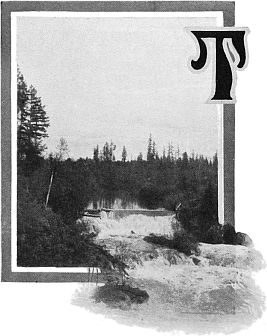
 A Place to be Remembered
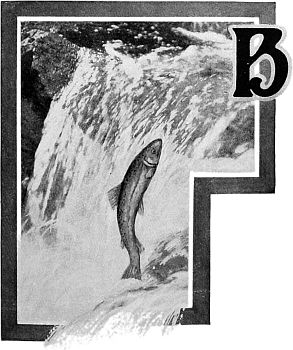
O MANY people a trout is merely a trout, with no distinction
as to variety or origin; and some there be who know him
only as a fish, to be eaten without grace and with much
gossip. Again, there are those who have written at great
length of this and that species and sub-species, with many
words and nice distinctions relative to vomerine teeth, branchiostegal
rays and other anatomical differences. I would not lead
you, even if your patience permitted, along the tedious path of
the scientist, but will follow the middle path and note only such
differences in the members of this interesting family as may be
apparent to the unpracticed eye and by which the novice may
distinguish between the varieties that come to his creel.
In a letter to Doctor David Starr Jordan, in September,
1889, Hon. Marshall McDonald, then U. S. Commissioner of
Fish and Fisheries, wrote, "I have proposed to undertake
to stock these waters with different species of Salmonidae,
reserving a distinct river basin for each." Every one
will commend the wisdom of the original intent as it existed
in the mind of Mr. McDonald. It implied that a
careful study would be made of the waters of each basin to
determine the volume and character of the current, its temperature,
the depth to which it froze during the sub-arctic winters,
and the kinds and quantities of fish-food found in each. With
this data well established, and knowing, as fish culturists have
for centuries, what conditions are favorable to the most desirable
kinds of trout, there was a field for experimentation and
improvement probably not existing elsewhere.
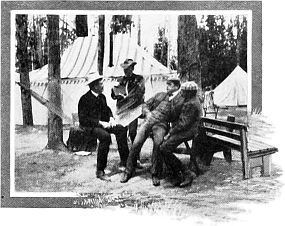
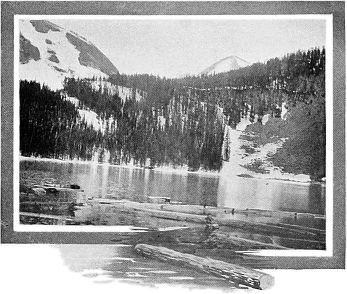
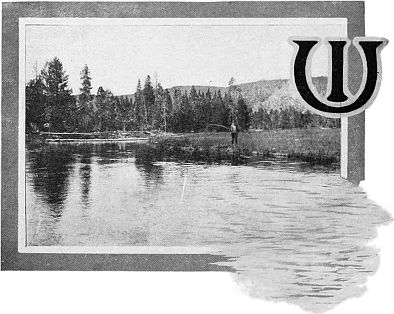
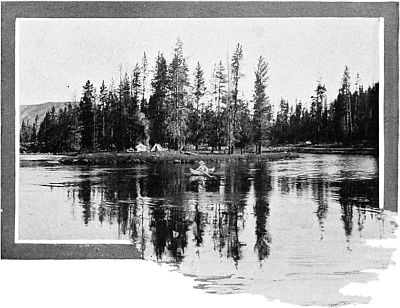
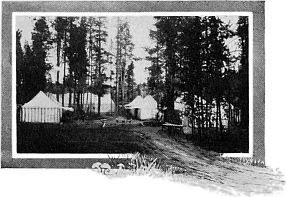 Willow Park Camp
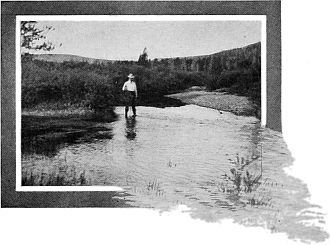 Klahowya
The commission began its labors in 1889, and the record for
that year shows among other plants, the placing of a
quantity of Loch Leven trout in the Firehole above the
Kepler Cascade. The year following nearly ten thousand
German trout fry were planted in Nez Perce Creek, the principal tributary of the Firehole. Either
the agents of the commission authorized to make these plants
were ignorant of the purpose of the Commissioner at Washington,
or they did not know with what immunity fish will
pass over the highest falls. Whatever the reason for this
error, the die is cast, and the only streams that have a single
distinct variety are the upper Gardiner and its tributaries,
where the eastern brook trout has the field, or rather the
waters, to himself. The first attempt to stock any stream
was a transfer of the native trout of another stream to Lava
Creek above the falls. I mention this because the presence
of the native trout in this locality has led some to believe
that they were there from the first, and thus constituted an
exception to the rule that no trout
were found in streams above vertical
waterfalls.
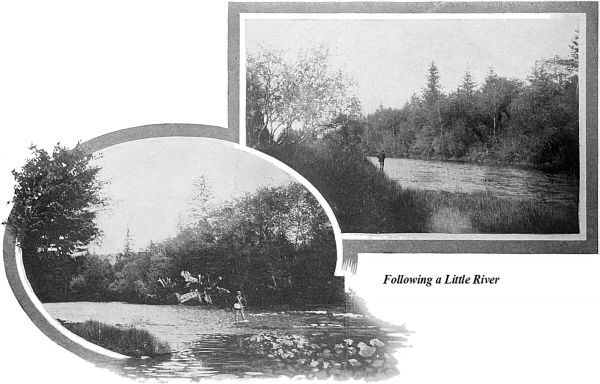
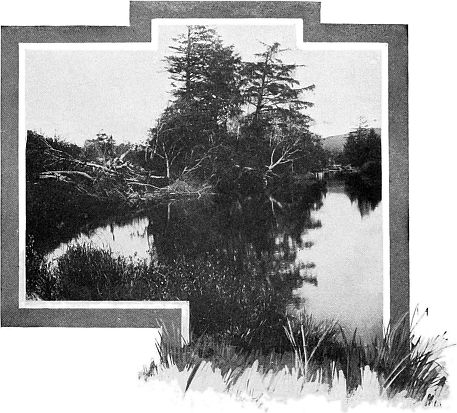
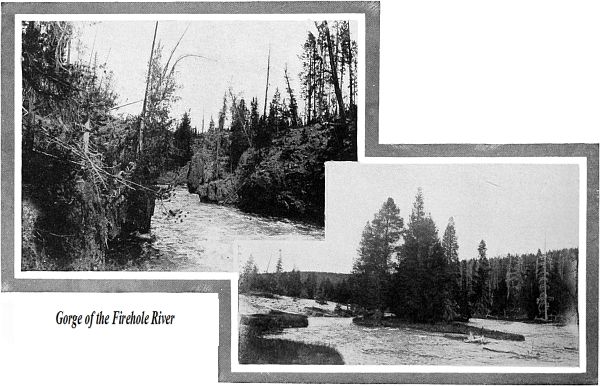
 The Little Firehole
Many are confused by the variety
of names applied to the native trout
of the Yellowstone, Salmo lewisi.
Red-throat trout, cut-throat trout,
black-spotted trout, mountain trout,
Rocky Mountain trout, salmon trout,
and a host of other less generally
known local names have been applied
to him. This is in a measure due to the widely different localities and conditions under which he is found,
and to the very close resemblance he bears to his first cousins, Salmo clarkii, of the streams flowing into the
Pacific from northern California to southern Alaska; and to Salmo mykiss of the Kamchatkan rivers.
Perhaps the very abundance of this trout has cheapened the estimate in which he is held by some
anglers. Nevertheless, he is a royal fish. In streams with rapid currents he is always a hard fighter, and
his meat is high-colored and well-flavored.
The name "black-spotted" trout describes this fish more accurately than any other of his cognomens.
The spots are carbon-black and have none of the vermilion and purple colors that characterize
the brook trout. The spots are not, however, always uniform in size and number. In some instances
they are entirely wanting on the anterior part of the body, but their absence is not sufficiently important
to constitute a varietal distinction. The red dash under the throat (inner edge of the mandible)
from which the names "cut-throat" and "red-throat" are derived, is never absent in specimens taken
here, and, as no other trout of this locality is so marked, it affords the tyro an unfailing means of
determining the nature of his catch.
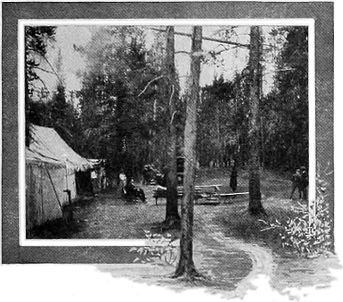 The Path Through the Pines
If the eastern brook trout, Salvelinus fontinalis, could read and
understand but a part of the praises that have been sung of him in
prose and verse through all the years, what a pampered princeling
and nuisance he would become! But to his credit, he has gone on
being the same sensible, shrewd, wary and delightful fish, adapting
himself to all sorts of mountain streams, lakes, ponds and rivers, and
always giving the largest returns to the angler in the way of health
and happiness. The literature concerning the methods employed
in his capture alone would make a library in which we should find
the names of soldiers, statesmen and sovereigns, and the great of
the earth. Aelian, who lived in the second century A. D., describes,
in his De Animalium Natura, how the Macedonians
took a fish with speckled skin from
a certain river by means of a hook tied
about with red wool, to which were fitted
two feathers from a cock's wattle. More
than four hundred years prior to this
Theocritus mentioned a method of fishing
with a "fallacious bait suspended from a
rod," but unfortunately failed to tell us how
the fly was made. If by any chance you
have never met the brook trout you may
know him infallibly from his brethren by
the dark olive, worm-like lines, technically
called "vermiculations," along the back, as
he alone displays these heraldic markings.
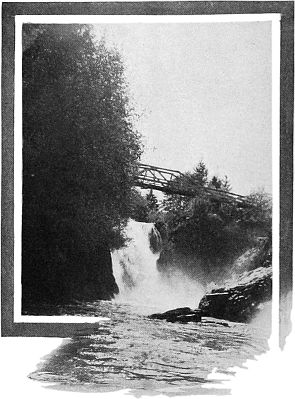
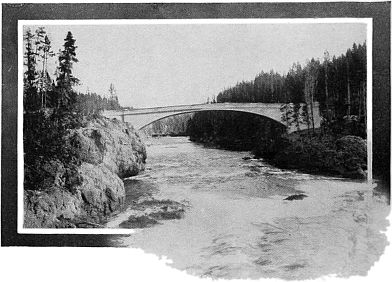 The Melan Bridge
Throughout the northwest the brown
trout, Salmo fario, is generally known as the "von Behr"
trout, from the name of the German fish-culturist who sent the first shipment of their eggs to this country.
This fish may be distinguished at sight by the coarse scales which give his body a dark grayish
appearance, slightly resembling a mullet, and by the large dull red spots along the lateral line. There
are also three beautiful red spots on the adipose fin.
The Loch Leven trout, Salmo levenensis, comes from a lake of that name in southern Scotland.
He is a canny, uncertain fellow, and nothing like as hardy as we might expect from his origin. In the
Park waters he has not justified the fame for gameness which he brings from abroad, but there are
occasions, particularly in the vicinity of the Lone Star geyser, when he comes on with a very pretty
rush. In general appearance he somewhat resembles
the von Behr trout, but is a more graceful and finely
organized fish than the latter. He is the only trout
of this locality that has no red on his body, and its
absence is sufficient to distinguish him from all others.
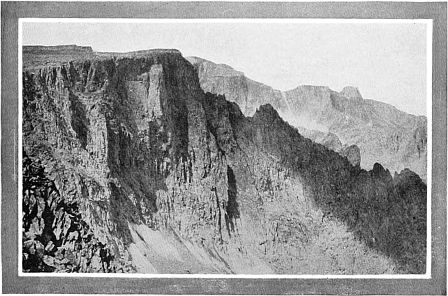
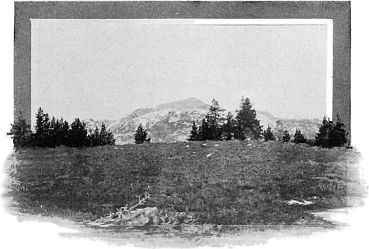 Distant View of Mt. Holmes
No one can possibly mistake the rainbow trout,
Salmo irideus, for any other species. The large,
brilliant spots with which his silvery-bluish body is
covered, and that filmy iridescence so admired
by every one, will identify him anywhere. There
is, however, a marked difference in the brilliance
of this iridescence between fish of different ages
as well as between stream-raised and hatchery-bred
specimens, and even among fish from the
upper and lower courses of the same stream.
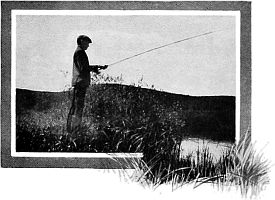 Learning to Cast
The question as to which is the more beautiful, the rainbow
or the brook trout, has often been debated with much feeling by
their respective champions, and will doubtless remain undecided
so long as both may be taken from clear-flowing brooks, where
sky and landscape blend with the soul of man to make him as
supremely happy as it is ever the lot of mortals to become. For
it is the joy within and around you that supplies a mingled
pleasure far deeper than that afforded by the mere beauty of the
fish. You will remember that "Doctor Boteler" said of the
strawberry, "Doubtless God could have made a better berry, but
doubtless God never did." So, I have said at different times of both brook
and rainbow trout, "Doubtless God could have made a more beautiful fish
than this, but doubtless God never did."
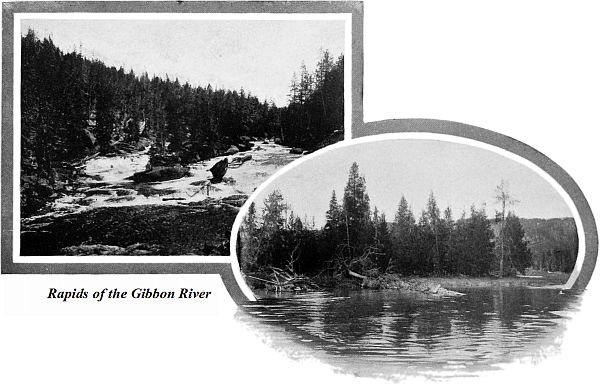
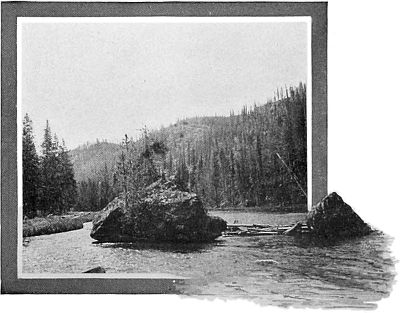
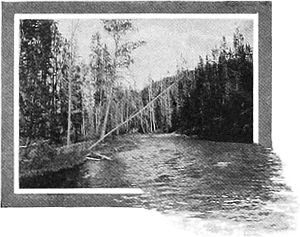 Scene on the Gibbon River
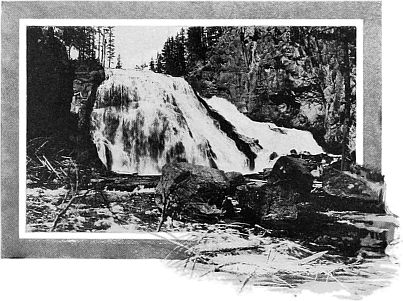
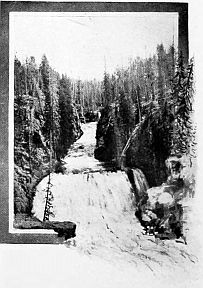 Above Kepler Cascade
During a recent trip through the Rocky Mountains I remained over night
in a town of considerable mining importance. In the evening I walked up
the main street passing an almost unbroken line of saloons, gambling
houses and dance halls, then crossed the street to return, and found
the same conditions on that side, except that, if possible, the crowds
were noisier. Just before reaching the hotel, I came upon a small
restaurant in the window of which was an aquarium containing a number
of rainbow trout. One beautiful fish rested quivering, pulsating, resplendent, poised apparently
in mid air, while the rays from an electric light within were so refracted
that they formed an aureola about the fish, seemingly transfiguring it. I
paused long in meditation on the scene, till aroused from my revery by
the blare of a graphophone from a resort across the street. It sang:
"Last night as I lay sleeping, there came a dream so fair,
I stood in old Jerusalem, beside the temple there;
I heard the children singing and ever as they sang
Methought the voice of angels from heaven in answer rang,
Jerusalem, Jerusalem, lift up your gates and sing
Hosanna in the highest, hosanna to your king."
I made the sign of Calvary in the vapor on the glass and departed
into the night pondering of many things.