For numerous helpful suggestions, lists of common flowers, herbarium
and fresh specimens for use in preparing illustrations, and for assistance
in many other ways, the author and illustrator proffer sincere thanks to
the following: Glen Bean, L. Floyd Keller, Walter B. McDougall, and
William R. Supernaugh of the National Park Service; Dr. Norman C.
Cooper, research associate, Allen Hancock Foundation; Mrs. Robert
Gibbs, Isle Royale National Park, Mich.; Leslie M. Goodding, St. David,
Arizona; Edmund C. Jaeger, Riverside Junior College, California;
Thomas H. Kearney, California Academy of Sciences; Robert H.
Peebles (who kindly reviewed the manuscript), director of the U. S.
Field Service Station, Department of Agriculture, Sacaton, Arizona;
Paul Ricker, president, Wildflower Preservation Society, Washington,
D. C.; and Barton H. Warnock, head of biology department, Sul Ross
State College, Alpine, Texas.
9
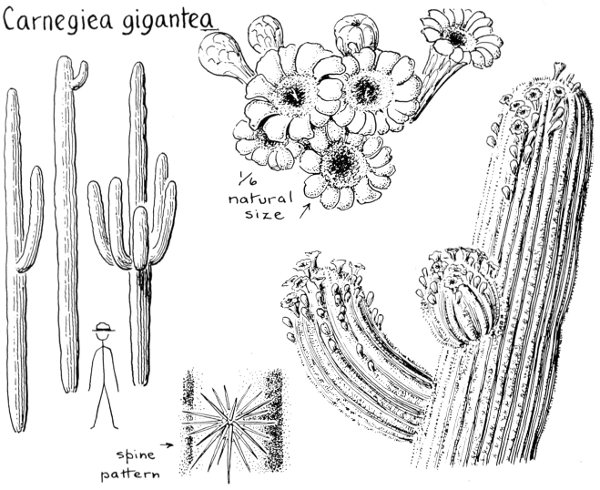
- Common Names: GIANT CACTUS, (SAGUARO)
- Arizona desert. (Carnegiea gigantea). Waxy white. May-June.
- Cactus family. Size: Up to 50 feet tall and 12 tons in weight.
Largest of the U. S. cacti, this species occurs only in southern and
western Arizona and adjoining northwestern Mexico and sparingly
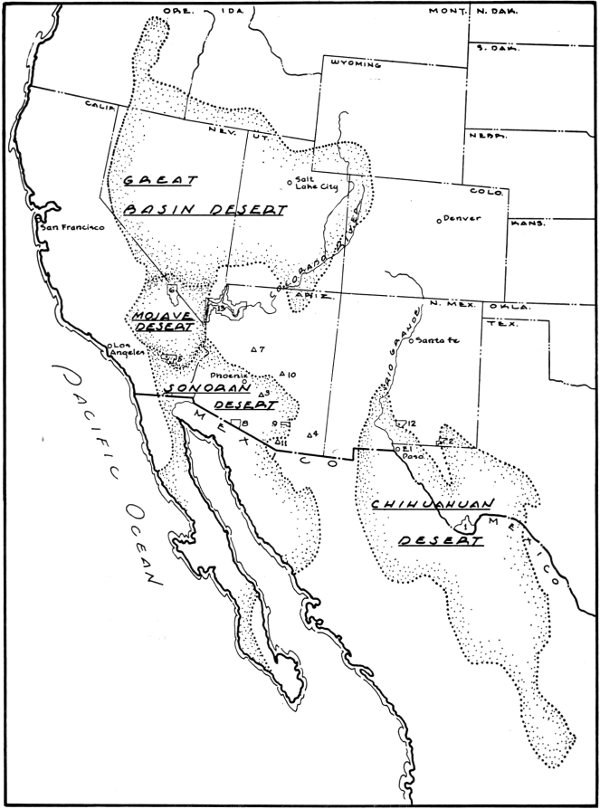
in extreme southeast California. It is an indicator of the Sonoran Desert.
This giant is such a spectacular example of desert vegetation that it
is used as a trademark of the desert. It is the state flower of Arizona.
Blossoms unfold at night, remaining open until late the following afternoon,
attracting swarms of insects which in turn attract birds. Fruits
mature in July, resembling small, egg-shaped cucumbers. When ripe,
they burst open revealing a scarlet lining and deep red pulp filled with
tiny black seeds. Fruits are eagerly sought by birds and rodents.
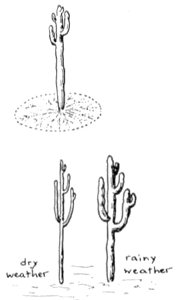
Because of its enormous capacity for storing water in its spongy stem
tissue, the Saguaro (sah-WAR-oh) produces flowers and fruits even during
droughts of long duration. When other foods failed, the Pima and
Papago Indians could depend upon the Saguaro harvest.
Saguaros are believed to live to a maximum age of
200 years, usually succumbing to a necrosis disease transmitted
by the larvæ of a small moth. Grazing cattle
trample out the young plants and much of the desert
occupied by Saguaros is being placed
under cultivation. Both Saguaro
National Monument and Organ Pipe
Cactus National Monument preserve
and protect spectacular stands of
these desert behemoths.
WHITE
10
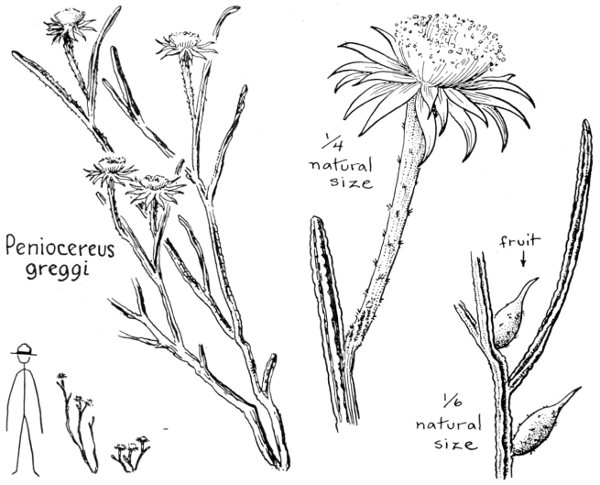
- Common Names: NIGHTBLOOMING CEREUS, (Reina-de-la-noche)
- Arizona and Texas deserts. (Peniocereus greggi). White. June-July.
- Cactus family. Size: 2 to 5 feet tall.
One of the most delicately beautiful of the flowers for which the
desert is famous, “Queen of the Night” is waxy-white with thread-like
stamens that give it the appearance of wearing a halo. The night on
which the Cereus blooms is eagerly awaited by desert dwellers of long
residence. All of the buds on a single plant, from two to six or seven in
number, may open on the same night or may time their opening over a
period of a week or more, usually in late June or early July, depending
upon the season and other factors.
It is not unusual for nearly all of the plants in one locality to blossom
on the same night. Buds unfold in the early evening, the flowers wilting
permanently soon after sunrise the following morning. Fragrant, with a
heavy, cloying perfume, they attract large numbers of night-flying insects.
The long, slender, fluted, lead-colored stems of the Nightblooming
Cereus are inconspicuous and unattractive. Usually growing upward
from beneath a Creosotebush or other desert shrub, they are partially
supported and almost entirely hidden by the larger plant.
The beet-like root, which serves as a moisture-storage organ, may
weigh from 5 to 85 pounds and is reportedly eaten by desert Indians.
Fruits are podlike, pointed at the ends, and the size of a large pickle.
They turn dull red when mature.
WHITE
11
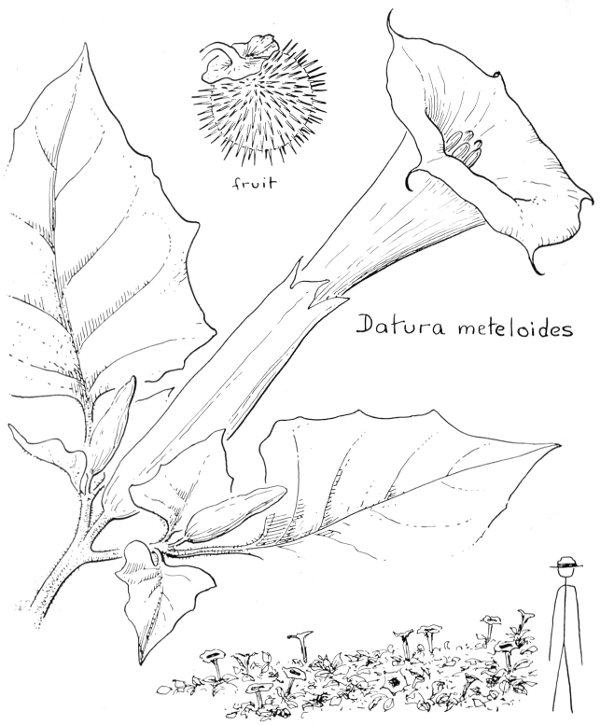
- Common Names: WESTERN-JIMSON, THORNAPPLE, GIANT-JIMSON, SACRED DATURA
- Arizona, California, and Texas deserts. (Datura meteloides). White. May-October.
- Potato family. Size: Up to 3 feet tall, and spreading over as much as 50 square feet of ground.
All portions of this coarse, vine-like herb are poisonous, and are used
by some Indians as a narcotic to induce visions.
Seeds are sometimes administered to prevent miscarriage.
The plants with their large, gray-green leaves and showy, white,
sometimes lavender-tinted flowers which open at night and close soon
after contact by rays of the morning sun, are a common and arresting
sight along roadsides and washes at elevations from 1,000 to 6,500 feet
in Texas, New Mexico, southern Utah, southern California, and Mexico.
WHITE
12
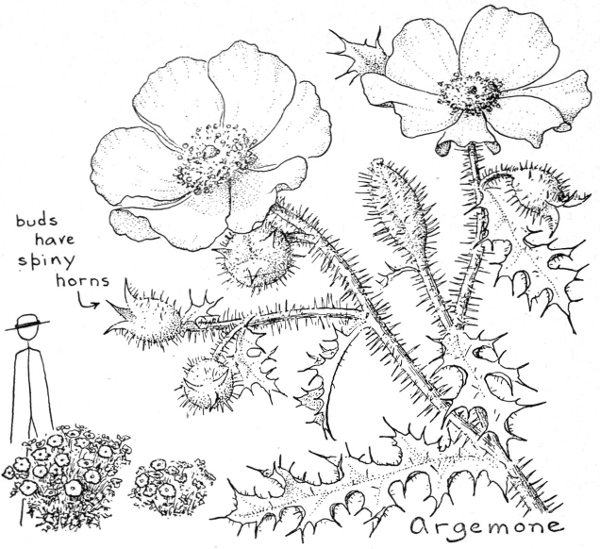
- Common Names: PRICKLYPOPPY, THISTLEPOPPY, (CHICALOTE)
- Arizona, California, and Texas deserts. (Argemone platyceras). White. Blooms all year.
- Poppy family. Size: Up to 30 inches in height.
One of the commonest and most noticeable perennials of the Southwest,
the Pricklypoppy ranges from South Dakota and Wyoming to
Texas, Arizona, southern California, and northern Mexico. A coarse,
prickly plant with large flowers and yellowish sap, it is easily recognized.
It is sometimes facetiously called “cowboys’ fried egg.”
Flowers are normally white with large, tissue-paper petals and yellow
centers. In southern Arizona an occasional plant with pale yellow petals
is found; and in Big Bend National Park, Texas, a form with rose-colored
petals and a deep red center is occasionally encountered.
Plants are drought-resistant, unpalatable to livestock, and may be
found in blossom during any month in the year, although much more
prolific during the spring and summer. When abundant on cattle range,
they are an indication of over-grazing. Seeds are reported to contain a
narcotic more potent than opium.
WHITE
13
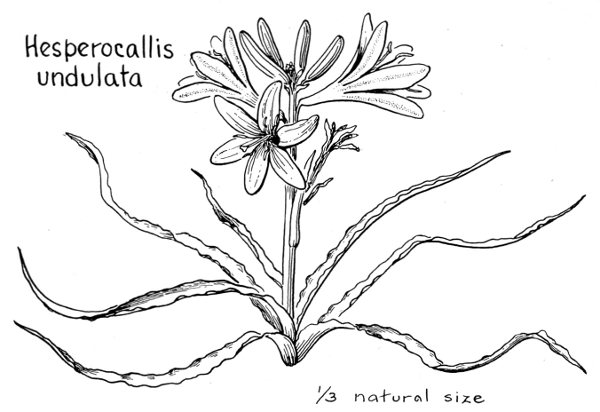
- Common Names: DESERTLILY, (AJO)
- Arizona and California deserts. (Hesperocallis undulata). White. March-April.
- Lily family. Size: Narrow-leafed perennial, 6 inches to 2 feet.
One of the showiest and most famous of the desert wildflowers,
although limited in distribution to sandy areas below 2,000 feet elevation,
the Desertlily greatly resembles the Easterlily of greenhouse habitat.
In some seasons, the blossoms are abundant and their delicate fragrance
perfumes the surrounding atmosphere. During “off” seasons, visitors
may scour the desert to find only a very few of the fragile blossoms.
Named “Ajo” by Spanish explorers because of the large, edible bulb
resembling garlic, the Lily has passed on its name to a mountain range,
a broad valley, and a thriving town in southwestern Arizona where it
grows in profusion. Its range is limited to southwestern Arizona, southeastern
California, and probably northern Sonora.
Papago Indians eat the bulbs which have an onion-like flavor. Bulbs
are difficult to obtain because they grow at a depth of 18 inches to two
feet beneath the surface of the hard-packed desert soil. Flowers remain
open during the day, and propagation is principally by seeds.
WHITE
14
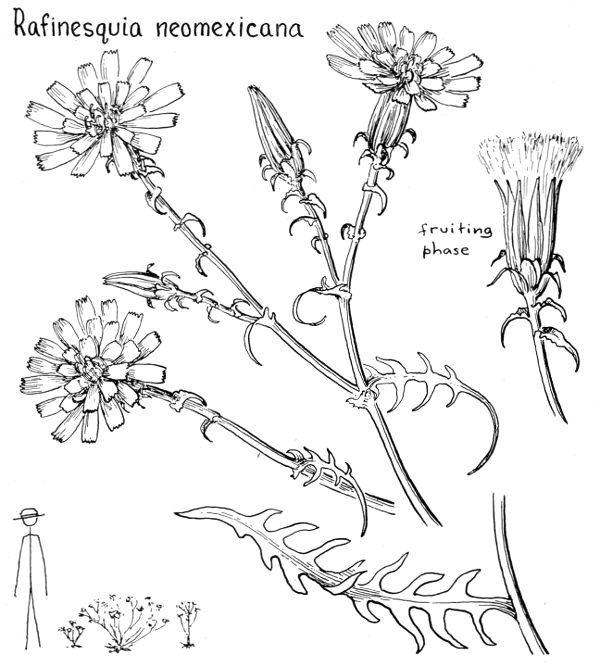
- Common Names: DESERT-DANDELION, GOATSBEARD
- Arizona and Texas deserts. (Rafinesquia neomexicana). Bright white. March-May.
- California desert. (Rafinesquia californica). Dull white. April-May.
- Sunflower family. Size: About a foot high.
In early springs that follow winters of more than average rainfall the
Desert-Dandelion is one of the conspicuous annuals helping to carpet
the deserts with a ground-cover of flowers.
Although much more delicate, longer stemmed, and less coarse and
robust than the common Dandelion, the flowers sufficiently resemble
those of the better-known yellow Dandelion to stimulate recognition.
Desert-Dandelion is found below 4,000 feet in desert situations from
western Texas to Lower California and northward to southern Utah.
WHITE
15
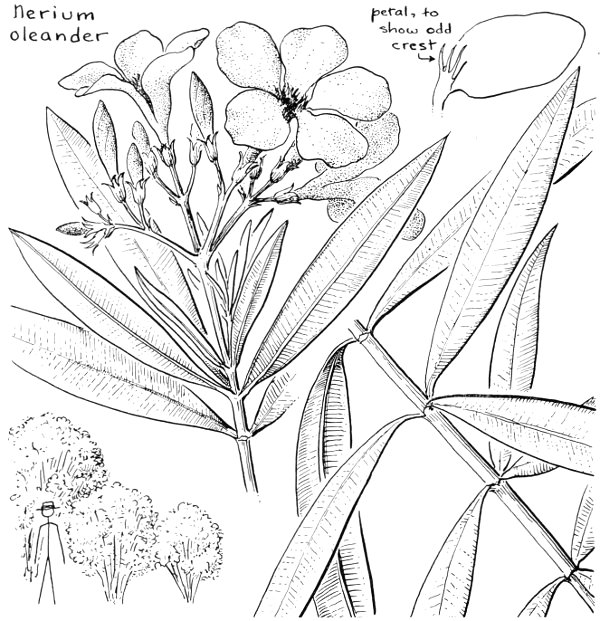
- Common name: OLEANDER
- Arizona, California, and Texas deserts. (Nerium oleander). White, yellow, or red. Spring and summer.
- Dogbane family. Size: Robust, spreading shrub up to 20 feet high.
Well known and widely grown because of its large clusters of red or
white blossoms and glossy, evergreen leaves, the Oleander is one of the
handsomest shrubs found under cultivation in towns and cities of the
desert. Requiring sub-tropical conditions, easily rooted from cuttings,
and rapid in growth, the Oleander thrives in Southwestern desert areas
if supplied with plenty of water. It is used individually and as hedgerows
in ornamental plantings.
Although blossoms may be present at almost any time of year, the
principal flowering season extends from early spring well through the
summer. Both the red-flowered and the white-flowered plants are popular
and may be grown separately or intermixed. Recently a yellow-flowered
form has come into use.
These handsome shrubs immediately attract the attention of northerners
visiting desert towns, and arouse their curiosity as to their identity.
WHITE
16
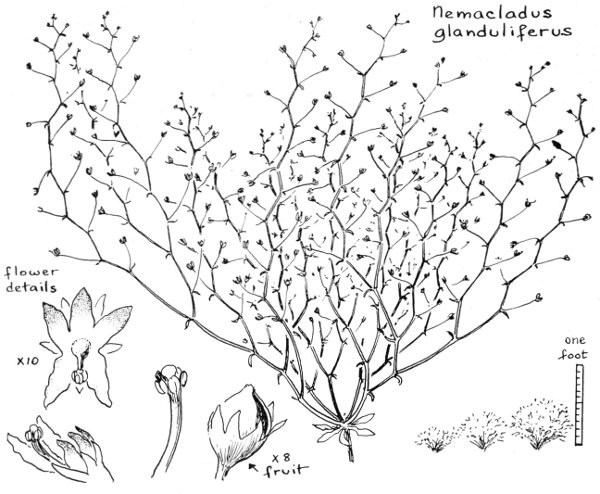
- Common name: THREADPLANT
- Arizona desert. (Nemacladus glanduliferus). Purple-white. March-May.
- California desert. (Nemacladus rigidus). Purple-white. March-May.
- Bellflower family. Size: 2 to 12 inches tall.
The tiny, slender-stemmed, profusely-branched Threadplant is so
small that it is completely overlooked by the majority of visitors to the
Southwest, yet it is one of the most common and most attractive of desert
flowers. Under a magnifying glass, the shape and coloring of the minute,
delicate flowers make them appear as beautiful as orchids. The white
flowers are touched with tints of red, brown, yellow, or purple.
Plants are abundant below 1,800 feet elevation on dry, gravelly or
rocky soils, frequently along the shoulders of highways from Nevada
throughout western Arizona and southern California to Lower California.
Be on the lookout for this small but interesting and beautiful
plant.
WHITE
17
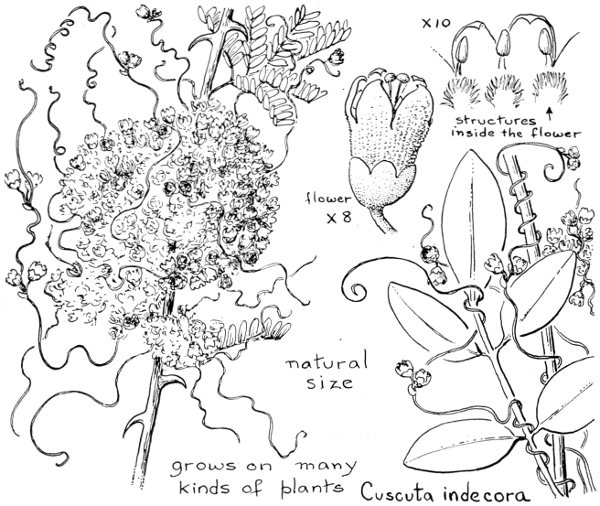
- Common name: DODDER
- Arizona and Texas deserts. (Cuscuta indecora). White. July-August.
- California desert. (Cuscuta denticulata). Pale yellow. July-August.
- Convolvulus family. Size: Vine-like, covering host plant.
Rootless, leafless, and with pale yellow to brownish stems which twine
in vine-like embrace about the host, the parasitic Dodders are immediately
noticeable because of their strange appearance.
Frequently the automobile traveler’s attention is arrested by a pale
yellowish blotch in the green of the roadside vegetation. Examination
shows this to be caused by the matted yellowish stems and the white to
pale yellow, fleshy blossoms. These flowers are attractive and often
abundant enough to make a showy display.
Dodder is found widespread throughout the United States and
is often a serious parasitic pest on crops of economic importance.
Desert species are usually found infesting Mesquite, Goldenrod, Aster,
Burrobush, Seepwillow, and Arrowweed. Although certain Dodders show
a preference in choosing hosts (C. denticulata common on Creosotebush),
most of them grow readily upon various plants.
WHITE
18
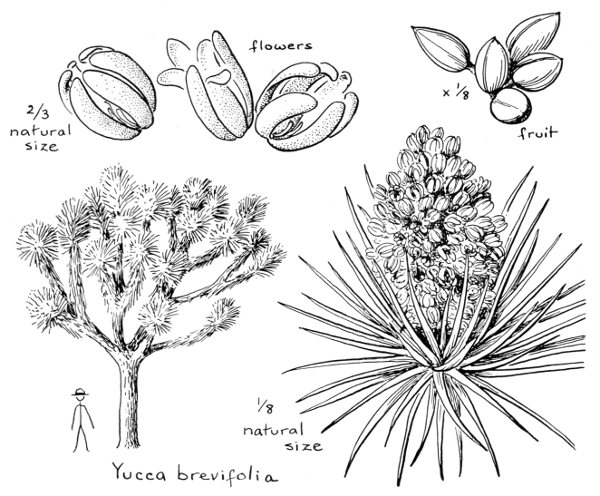
- Common Names: JOSHUA-TREE, TREE YUCCA, GIANT JOSHUA
- California desert. (Yucca brevifolia). Green-white. February-April.
- Lily family. Size: 15 to 35 feet high; spread of 20 feet.
Because the presence of the grotesque Joshua-tree marks, more
effectively than any other plant, the limits and extent of the Mohave
Desert, this species is worthy of special recognition. This tree Yucca
holds, in the Mohave Desert, similar status to the Saguaro in the Sonoran
Desert. Strangely enough, in west-central Arizona, the Saguaro and
Joshua-tree are found growing together and there the Sonoran and
Mohave Deserts overlap.
And, just as in southern Arizona an area has been set aside as Saguaro
National Monument to preserve and protect that species, so in southern
California we find the Joshua Tree National Monument.
The Joshua-tree is outstanding among the many species of Yucca
because of its short leaves growing in dense bunches or clusters, and
because the plant has a definite trunk with numerous branches forming
a crown. Great forests of these sturdy trees are found in parts of southern
California, southern Nevada, southwestern Utah, and northwestern Arizona
where rainfall averages 8 to 10 inches per year.
Flowers of this Yucca develop as tight clusters of greenish-white buds
at the ends of the branches, but do not open wide as do the flowers of
other Yuccas. Joshua-trees do not bloom every year, the interval apparently
being determined by rainfall and temperature. Birds, a small lizard,
wood rats, and several species of insects are closely associated with the
Joshua-tree, making use of it for food, shelter, or nest-building materials.
Indians use the smallest roots, which are red, for patterns in their baskets.
The name “Joshua-tree” was given by the Mormons because the tree
seemed to be lifting its arms in supplication as did the Biblical Joshua.
WHITE
19
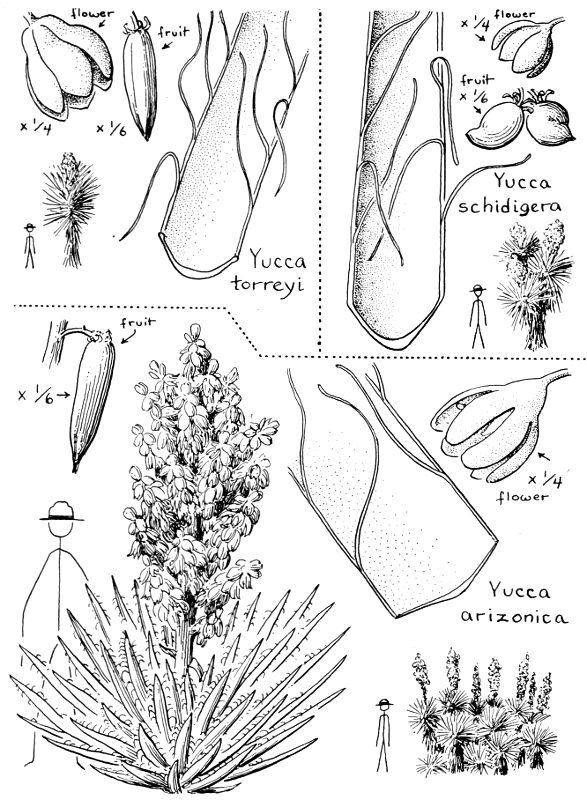
- Common Names: BROAD-LEAF YUCCAS, SPANISH BAYONET, (AMOLE), (DATIL), SOAPWEED
- Arizona desert. (Yucca arizonica). Creamy. April-May.
- California desert. (Yucca schidigera). White-purple. March-April.
- Texas desert. (Yucca torreyi). Creamy. March-April.
- Lily family. Size: Reaches height of 10 to 15 feet.
Although, in general, the Broad-leafed Yuccas do not reach tree size,
20
the Giant Dagger (Yucca carnerosana) of Big Bend National Park
reaches a height of 20 feet. In dense stands or “forests” these Yuccas,
with their huge clusters of creamy, wax-like, lightly scented, bell-shaped
flowers produce a never-to-be-forgotten display in blooming season.
The Yucca is the state flower of New Mexico.
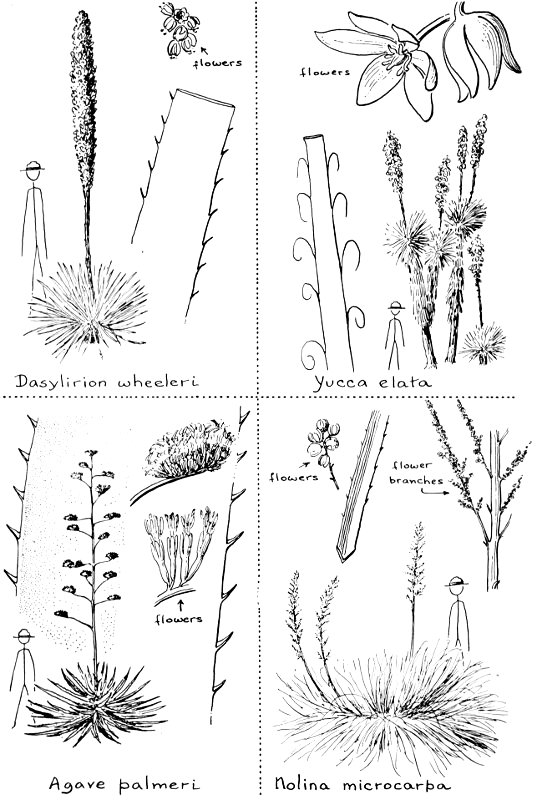
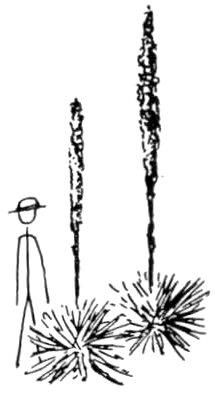
Yuccas are often confused by newcomers to the desert with three
other groups of plants: the Agaves (Century Plant), Dasylirion (Sotol)
and Nolinas (Beargrass).
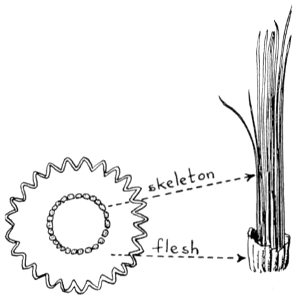
The plate on the opposite page has been devoted to a comparison of
the four groups, and by studying it carefully, the characteristics by
which each may be identified can be determined.
Yucca leaf fibers have long been used by Indians for fabricating rope,
matting, sandals, basketry, and coarse cloth. Indians also ate the buds,
flowers, and emerging flower stalks. The large, pulpy fruits were eaten
raw or roasted, and the seeds ground into meal.
Roots of the Yuccas have saponifying properties and are still gathered
by some tribes and used as soap, especially for washing the hair. Flowers
are browsed by livestock. (See Narrow-leaf Yuccas and Joshua-tree).
Yucca baccata, a broad-leaf species found in the Southwest outside of the
desert areas, is discussed in “Flowers of the Southwest Mesas.”
CREAM
- Common Names: BEARGRASS, BASKETGRASS, (SACAHUISTE)
- Arizona desert: (Nolina microcarpa). Tan-cream. May-June.
- California desert: (Nolina parryi). White-cream. May-June.
- Texas desert: (Nolina erumpens). White-cream. May-June.
- Lily family. Size: Ragged clumps 4 to 8 feet in diameter and flower stalks up to 8 feet high.
The Nolinas are sometimes confused with Sotol and the Yuccas and
occasionally with the Agaves. However, the Nolinas resemble huge
clumps of long-bladed grass, whereas Sotol leaves are ribbon-like and
Yucca leaves taper to a sharp point. Flower stalks of the Nolinas are
usually drooping and plume-like, and the numerous flowers are tiny.
The many papery, dry-winged fruits often remain on the stalk until
late autumn.
Beargrass does not grow on the flat mesas or sandy flats as do the
Yuccas, but is confined to exposed locations on rocky slopes above the
3,000-foot elevation. The Parry Nolina of the California Desert is a
larger and more spectacular plant than the species found in the Arizona
and Texas-New Mexico Deserts. Indians
are reported to use the very young
flower stalks for food. Leaves are browsed
by livestock in times of drought, sometimes
with harmful results in the case of
sheep or goats.
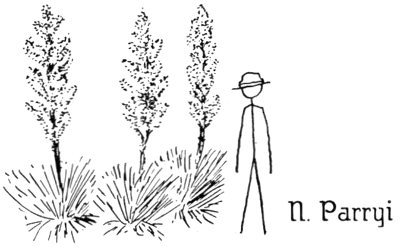
Nolina parryi
CREAM
21
- Common Names: SOTOL, SPOONPLANT
- Arizona desert: (Dasylirion wheeleri). Creamy. May-August.
- Texas desert: (Dasylirion leiophyllum). Creamy. May-August.
- Lily family. Size: Leaves 3 feet; flower stem 5 to 15 feet.
At first glance, this plant may readily be mistaken for a Yucca, but
its ribbon-like leaves (which are usually split at the tips instead of sharp-pointed)
and tiny flowers instead of the bell-like blossoms of the Yucca,
are distinguishing characteristics. The round heads of these plants
grow close to the ground with the thick, woody stem beneath the soil.
22
Leaves, when stripped from the head, come away with
a broad, curving blade.
When trimmed and polished, they are sold as curios
called “desert spoons.” In some portions of the desert
near large cities, exploitation of the plants for this purpose
has endangered the species and aroused the ire of
conservationists.
The cabbage-like base, after the leaves are removed,
is split and fed to livestock as an emergency ration during
periods of drought.
The rounded heads of these plants are high in sugar which is dissolved
in the sap of the bud stalk. This sap, when gathered and fermented,
produces a potent beverage called “sotol,” which is the “bootleg”
of northern Mexico.
CREAM
- Common Names: NARROW-LEAF YUCCA, (PALMILLA), OUR-LORD’S-CANDLE, SPANISH-DAGGER, SOAPWEED, SPANISH-BAYONET
- Arizona and Texas deserts: (Yucca elata). Creamy. May-July.
- California desert: (Yucca whipplei). Creamy-white. May-June.
- Lily family. Clumps 8-12 feet; Y. elata sometimes to 20 feet.
CREAM
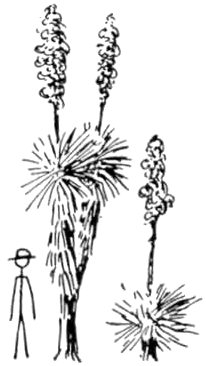
The Narrow-leaf Yuccas are frequently confused with the Agaves
(Century plant), Dasylirion (Sotol), and Nolinas (Beargrass) but may
readily be recognized by the fibers protruding from the margins of the
leaves. To permit comparison and bring out the differences so that the
four groups may be recognized and confusion avoided, sketches of all
four appear on the same plate (p. 21).
In many grassland areas of western Texas and southern New Mexico,
Y. elata dominates the landscape for miles. This species has been used as
emergency rations for range stock during periods of drought, the chopped
stems being mixed with concentrates such as cottonseed meal. A substitute
for jute has been made from the leaf fibers. Indians eat the young
flower stalks, which grow rapidly and are relatively tender.
In its relationship with a moth of the genus Pronuba, the Yucca
illustrates one of Nature’s interesting partnerships. The moth, which
visits the Yucca flowers at night, lays her eggs in the ovary of a flower
where the larvae will feed upon the developing seeds. But to be sure that
the seeds do develop, the moth must place pollen on the stigma of the
flower. Dependent upon the moth for this vital act of pollenization, the
Yucca repays its winged benefactor by sacrificing some of
its developing seeds as food for the moth’s larvæ. Fruits
of the Narrow-leaf are dry capsules in contrast to the
fleshy fruits of the Broad-leaf Yuccas.
Yucca whipplei is a much smaller plant than Y. elata,
but produces a stouter flower stalk with a great spreading
plume of small, delicate flowers. These graceful plumes
appear at night as if aglow with an inner light, hence
the name “Our Lord’s Candle.” (See Broad-leaf Yucca
[p. 19] and Joshua-tree [p. 18].)
23
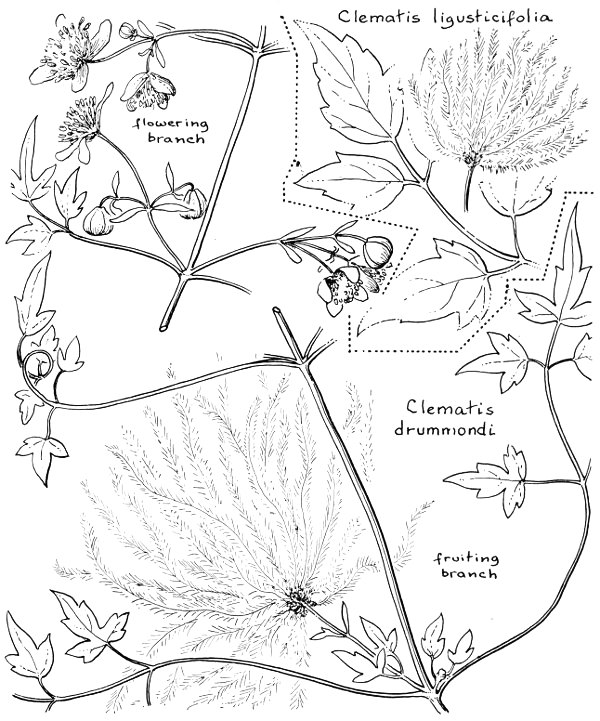
- Common Names: CLEMATIS, LEATHERFLOWER
- Arizona and Texas deserts: (Clematis drummondi). Cream. March-September.
- California desert: (Clematis ligusticifolia). Cream. May-September.
- Crowfoot family. Size: Climbing, vine-like perennial with stems 6 to 8 feet long.
By no means limited to the desert, Clematis is found throughout the
Southwest. Several species are grown as ornamentals, foliage, flower
clusters and the cotton-like masses of hairy fruits all being effective.
Petals are absent or rudimentary, the sepals which furnish color to the
blossoms being either creamy or purplish-brown. The name “Leatherflower”
has been applied to the latter group.
CREAM
24
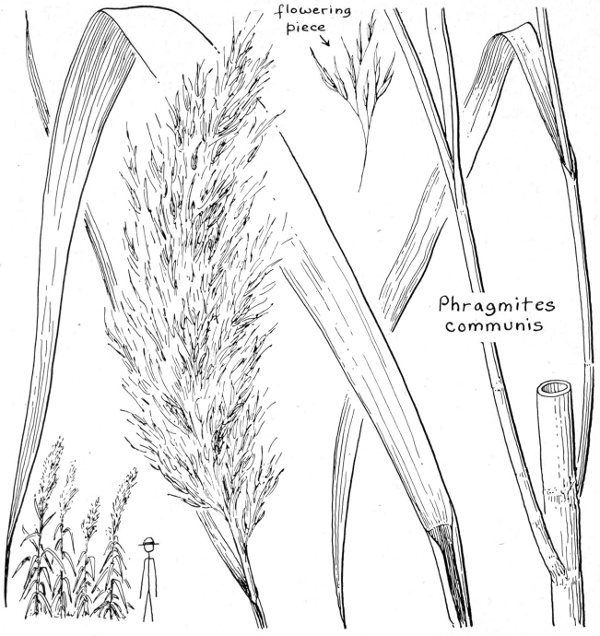
- Common Names: COMMON REED, (CARRIZO), RIVERCANE, GIANTREED
- Arizona, California, and Texas deserts: (Phragmites communis). Creamy. July-October.
- Grass family. Size: 8 to 12 feet tall.
Among the largest of the grasses, the Common Reed and its close
relative Giantreed (Arundo donax) with their jointed stems resembling
Bamboo, are coarse perennials with broad, flat, grass-like leaves found in
marshes and stock tanks, along irrigation canals, and on river banks
throughout the desert country of the Southwest. Common Reed is found
throughout the world where conditions are suitable. The flower stalks
are long, tassel-like, and at the ends of the stems.
In Arizona and New Mexico, Common Reed is called Carrizo. The
hollow stems were used by the Indians for making arrow shafts, prayer
sticks, pipe stems, and loom rods. Mats, screens, nets, and cordage, as well
as thatching, are made from the leaves. The plants are useful as windbreaks
and in controlling soil erosion along streams.
CREAM
25
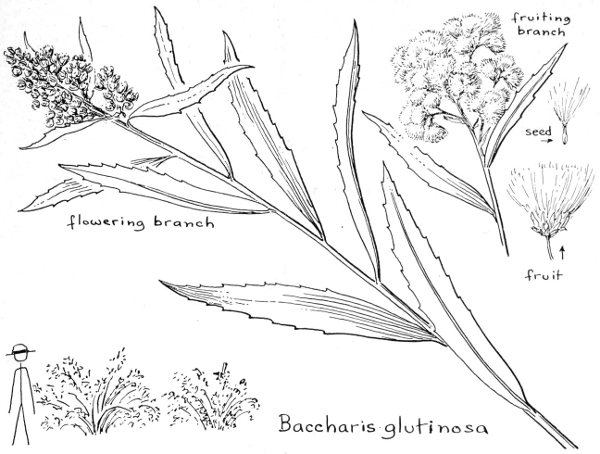
- Common Names: SEEPWILLOW, WATERMOTIE, WATERWALLY, WATERWILLOW, BROOM BACCHARIS, ROSINBUSH, (HIERBA-DEL-PASMO)
- Arizona and Texas deserts: (Baccharis glutinosa). Creamy. March-December.
- California desert: (Baccharis sarathroides). Yellow-white. September-February.
- Sunflower family. Size: Up to 7 feet tall.
Genus Baccharis is composed, in the desert, of coarse shrubs with a
number of common species. The flowers themselves are not beautiful, but
the female plants with their flower heads that develop glaring-white
pappus hairs, are spectacular and quite attractive.
B. glutinosa is a common shrub along watercourses, often forming
dense thickets. The straight stems are used in native houses as matting
across ceiling timbers to support the mud roof. B. sarathroides and several
other species are often referred to as the Desert Brooms. They are common
along desert washes and roadsides in sandy soil, their pale yellow,
bristly flower heads, during the fall and winter months, appearing in
sharp contrast to the vivid green branchlets and dark stems of the bushes.
Among some Indians, the stems are chewed as a toothache remedy.
CREAM
26
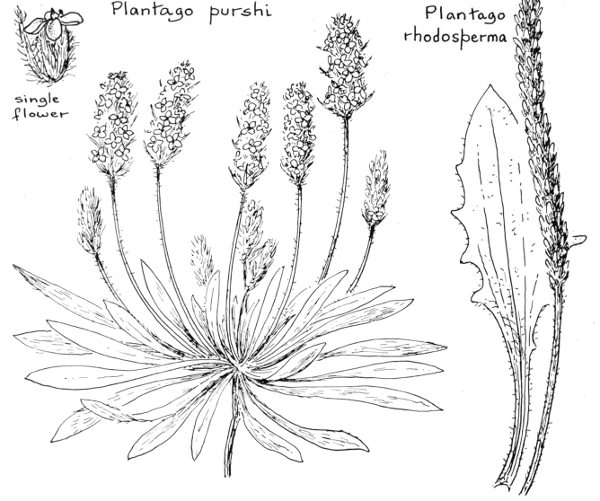
- Common Names: PLANTAIN, WOOLLY-PLANTAIN
- Arizona desert: (Plantago purshi). Buff. February-July.
- California desert: (Plantago insularis). Straw. January-May.
- Texas-New Mexico desert: (Plantago argyraea). Straw. June-August.
- Plantain family. Size: A few inches to 2 feet tall.
Plantains are not noted for the beauty of their blossoms but the larger,
coarser species are sufficiently noticeable to attract attention, both in
their blossoming and fruiting stages. The smaller winter annuals known
as Indianwheat carpet the desert floor, in January and February, in
some places, producing a straw-colored “pile” of tiny blossom spikes.
CREAM
27
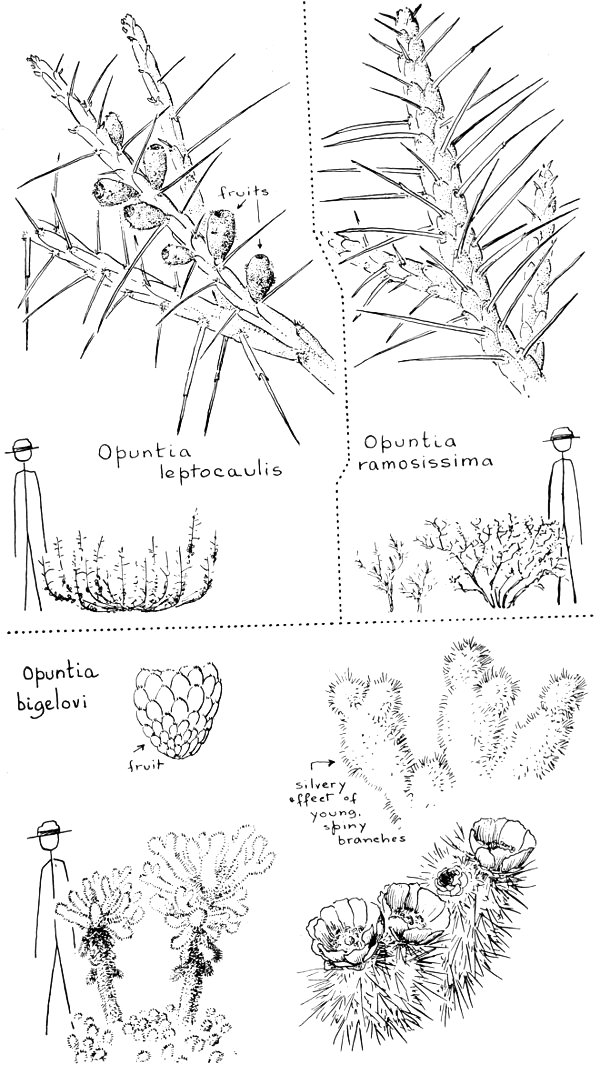
- Common Names: (TASAJILLO), CHRISTMAS CHOLLA, DIAMOND CACTUS, (TESAJO), DARNING-NEEDLE CACTUS, PENCIL-JOINT CHOLLA, HOLYCROSS.
- Arizona and Texas deserts: (Opuntia leptocaulis). Green-yellow. May-June.
- California desert: (Opuntia ramosissima). Green-yellow. May-September.
- Cactus family. Size: Much branched, shrubby, 2 to 4 feet tall.
Flowers of these small, slender-stemmed, shrubby chollas (CHOH-yahs)
are small, sparse, and so inconspicuous as to be rarely noticed.
However, the fruits, particularly those of O. Leptocaulis, are scarlet, egg-shaped,
about 1 inch in length, and occur in such profusion that they
immediately attract attention to the plants during the late fall and winter
months, giving these plants the appropriate name of Christmas Cholla.
A large Cholla, O. bigelovi, also has greenish to pale yellow flowers
but inconspicuous fruits and short, heavy joints so densely covered with
silvery spines as to give it the name Teddybear Cholla. Found in south
central and southwestern Arizona and westward into southern California,
southern Nevada, and south into Sonora and Lower California, the Silver
Cholla is noticeable at any season. Propagation is chiefly by joints which
drop from the plant and take root, the new plants forming dense thickets
on desert hillsides. Because the joints are so easily detached, they actually
seem to jump at a passerby, this characteristic giving the plant the name
Jumping Cactus.
YELLOW
28
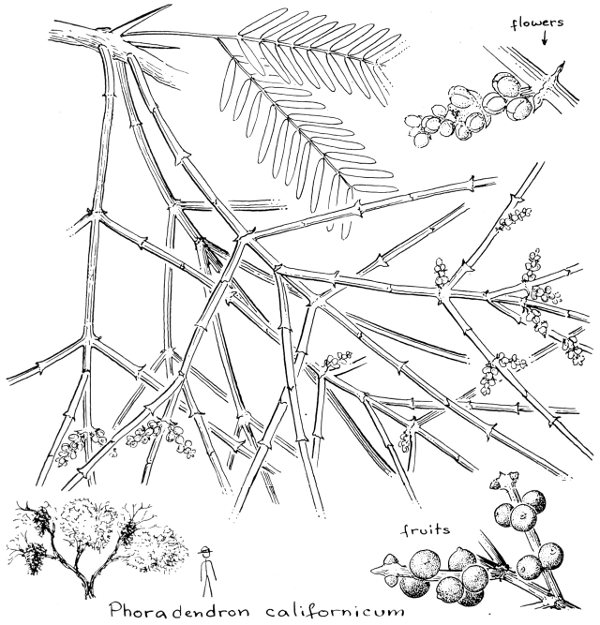
- Common Names: MISTLETOE, DESERT MISTLETOE
- Arizona and California deserts: (Phoradendron californicum). Yellow-green. March.
- Texas-New Mexico deserts: (Phoradendron cockerelli). Yellow-green. Spring.
- Mistletoe family. Size: Pendant, vine-like strands several feet long.
Because they form conspicuous, dense, shapeless masses in Mesquite,
Ironwood, Acacia, Cottonwood, or other trees (depending upon the
species of Mistletoe), these parasitic plants attract the attention and
arouse the curiosity of persons unfamiliar with the desert. P. macrophyllum,
which parasitizes Cottonwood trees, is widespread throughout
the Southwest, and, because of its large gray-green leaves and glistening
white berries is much in demand as a Christmas green. The Mistletoe is
the state flower of Oklahoma.
The species of Mistletoe that parasitize such trees as Ironwood, Mesquite,
and Catclaw have small, scale-like tawny-brown leaves and stems.
The tiny yellow-green flowers which appear in spring are fragrant and
secrete nectar which attracts Honeybees and other insects. The handsome
coral-pink berries are a major food, during the winter months, for
29
Phainopeplas and other birds. The Arizona Verdin often builds its nest
in the protected center of a clump of Mistletoe. Birds are believed to be
instrumental in spreading this parasite from tree to tree.
Mistletoe saps the energy of the host tree and, where abundant, may
cause considerable damage, killing branches and sometimes the entire tree.
Papago Indians dry the berries in the sun and store them for winter food.
YELLOW
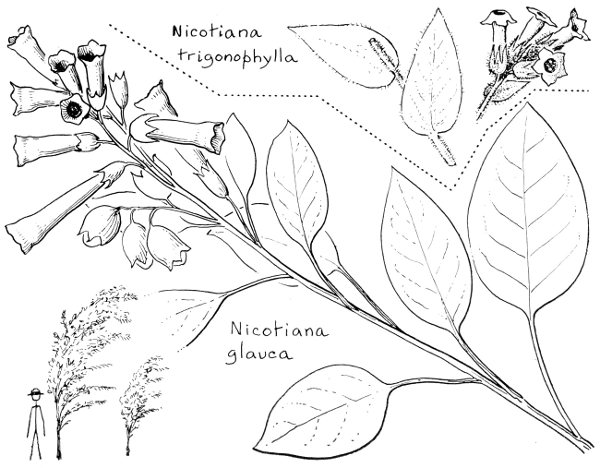
- Common Names: DESERT-TOBACCO, TREE-TOBACCO
- Arizona and Texas deserts: (Nicotiana glauca). Pale yellow. All year.
- California desert: (Nicotiana trigonophylla). Green-yellow. All year.
- Potato family. Size: Tree-tobacco (N. glauca) up to 12 feet. Desert-tobacco, 1 to 3 feet high.
Several species of wild tobacco are found in the desert. Of these,
Tree-tobacco is conspicuous because of its rank growth, its large leaves,
and the spectacular clusters of tubular, yellow flowers. In addition to
nicotine, Tree-tobacco contains an alkaloid, anabasine. This conspicuous
plant occurs in moist locations below 3,000 feet elevation and bears
flowers throughout the entire year. Although now thoroughly naturalized
in the Southwest, it is a native of South America.
Desert-tobacco, sometimes perennial in southwestern Arizona, is a
dark-green herb common and widespread throughout the desert areas of
the Southwest. It is not nearly as noticeable as its larger relative although
it, too, blossoms the year around. Flowers are a pale yellow, almost greenish-white.
It provides dense ground cover in rocky canyons and along
desert washes.
Leaves, which are somewhat bad smelling, were smoked (and still are
during ceremonials) by the Yuma and Havasupai Indians who are
reported to have cleared land, burned the brush, and scattered the seeds
of Desert-tobacco in an effort to promote the growth of strong plants
with many large leaves.
YELLOW
30
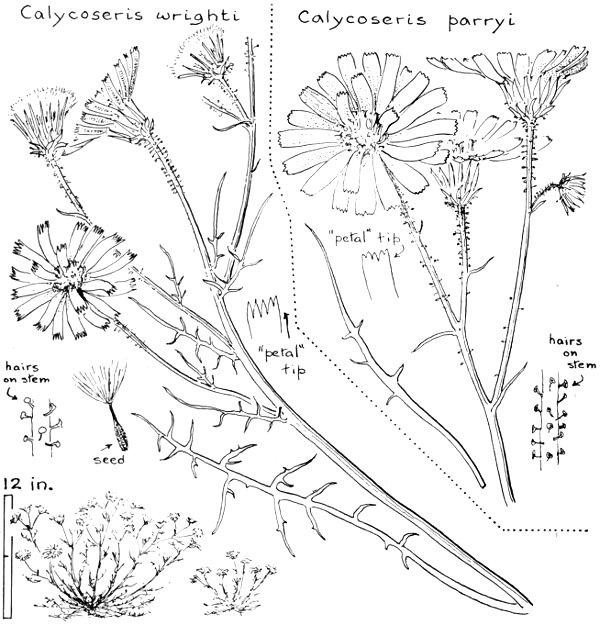
- Common Names: TACKSTEM
- Arizona desert: (Calycoseris wrighti). White. March-May.
- California desert: (Calycoseris parryi). Yellow. March-April.
- Sunflower family. Size: 4 inches to a foot tall.
One of the handsomest of desert spring annuals, Calycoseris is common
on plains, mesas, and rocky slopes at elevations between 1,200 and
4,000 feet from western Texas to southern Utah, southern California,
and south into Mexico.
The name Tackstem comes from the presence of numerous tack-shaped
glands which protrude from the stems.
Taking advantage of the cool, moist weather of winter, the
Tackstems produce their beautiful rose, white, or yellow blossoms
in early spring, and mature their seeds before the advent of hot, dry
weather.
YELLOW
31
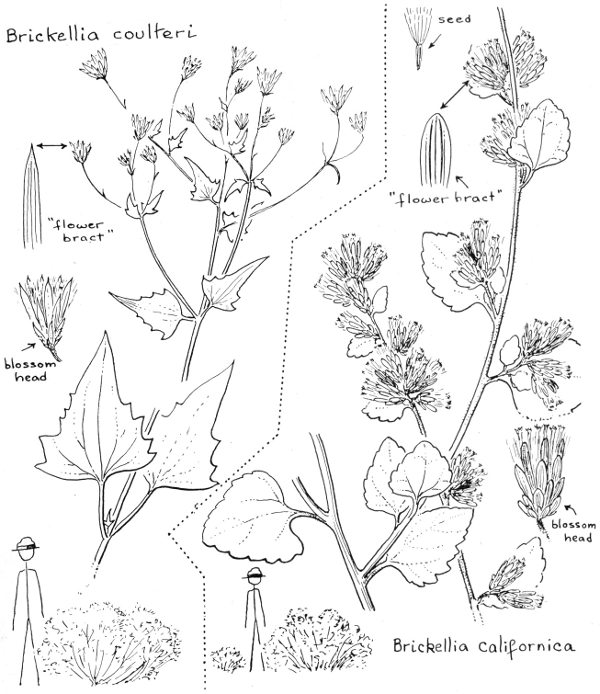
- Common Names: BRICKELLBUSH, DESERT BRICKELLIA, (PACHABA)
- Arizona desert: (Brickellia coulteri). Yellow-white. September.
- California desert: (Brickellia desertorum). Pale yellow. Midsummer.
- Texas-New Mexico deserts: (Brickellia californica). Yellow-white. July-October.
- Sunflower family. Size: Small, much-branched perennial shrub, up to 3 feet in height.
Intricately branched and brittle-stemmed, this shrub with blossom
heads holding from 8 to 18 yellowish flowers is common throughout the
Southwest from western Texas and Colorado to Nevada, Sonora and
Lower California.
It grows among rocks and in rocky locations throughout much of the
desert country from 3,000 up to 7,000 feet.
YELLOW
32
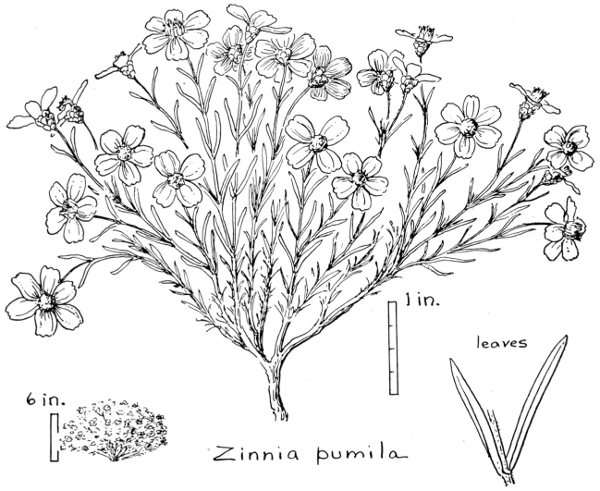
- Common Names: WILD-ZINNIA
- Arizona and Texas deserts: (Zinnia pumila). Pale yellow. April-October.
- Sunflower family. Size: Low, dense-growing perennials in rounded clumps, 4 to 8 inches high.
Closely related to the garden Zinnia, which is a native of Mexico,
desert Zinnias are attractive herbs suitable for trial as ornamental border
plantings.
Z. pumila prefers caliche soils and is found on dry mesas and slopes
from Texas westward to southern Arizona and northern Mexico. It
is often found blossoming in association with the Paperflower (Psilostrophe
cooperi) which it superficially resembles. The pale yellow flowers
of the Wild-zinnia turn white with age.
Z. pumila may be easily recognized by the single heavy rib running
the length of each narrow leaf.
YELLOW
33
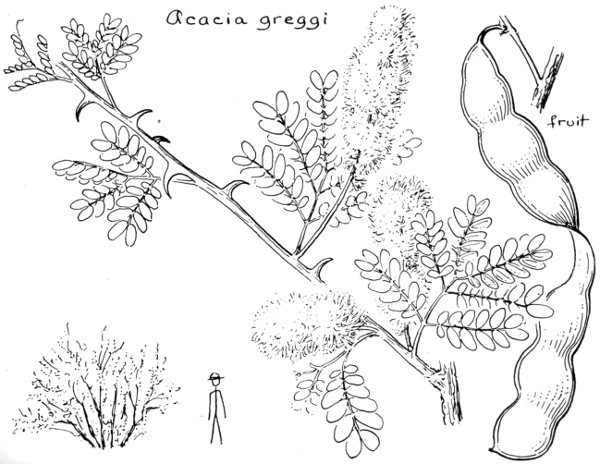
- Common Names: CATCLAW, CAT’S-CLAW, TEARBLANKET, DEVILSCLAW
- Arizona, California, and Texas deserts: (Acacia greggi). Pale yellow. April-October.
- Pea family. Size: Up to 20 feet tall.
The numerous thorns, short and curved like a cat’s claw, serve readily
to identify this common, often abundant, shrub or small tree.
There are several species, some with large, bright-yellow flowers, but
A. greggi is the most common and occurs throughout all of the deserts
of the Southwest, at elevations below 4,000 feet, often forming thickets
along streams and washes.
Flowers, like pale yellow, fuzzy caterpillars, are one of the important
sources of nectar for honeybees, the trees being alive with insects during
the period of heaviest blooming in April and May.
In mid-August, the light green fruit pods begin to turn reddish and,
if abundant, make a colorful display.
Seeds of the Catclaw were at one time widely used as food by the
Indians of Arizona and Mexican tribes. They were ground into meal and
eaten as mush or cakes.
Catclaw is one of the most heartily disliked plants in the Southwest,
especially by riders and hikers, because of the strong thorns which tear
clothing and lacerate the flesh.
YELLOW
34
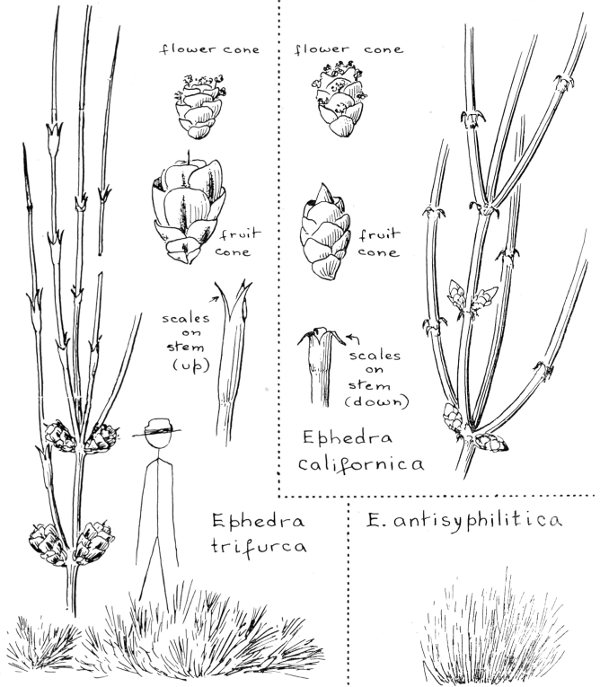
- Common Names: MORMON-TEA, BRIGHAM-TEA, JOINTER, (POPOTILLA), (TEPOSOTE), (CANATILLA)
- Arizona and Texas deserts: (Ephedra trifurca). Pale yellow. Spring.
- California desert: (Ephedra californica). Pale yellow. Spring.
- Jointfir family. Size: Harsh, stringy perennials, from 2 to 10 feet tall and sometimes 5 or 6 feet in diameter.
Apparently leafless, these common Southwestern shrubs do have leaves,
although they are reduced to tiny scales. The harsh, stringy stems are
green to yellow-green and, when dried, were used with the flowers in
making a palatable brew, particularly by the Utah pioneers; hence the
names Mormon-tea and Brigham-tea. The beverage was also popular
with Indians and settlers in treating syphilis and other afflictions, as it
contains tannin and certain alkaloids. Flowers are small, pale yellow, and
35
appear in the spring at which time the plants are quite noticeable, and
attract large numbers of insects.
YELLOW
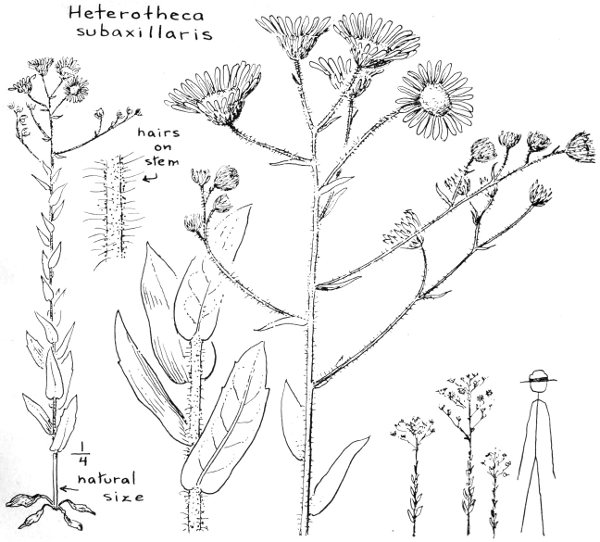
- Common Names: TELEGRAPH PLANT, CAMPHOR-WEED
- Arizona and Texas deserts: (Heterotheca subaxillaris). Pale yellow. March-November.
- Sunflower family. Size: Grows 2 to 6 feet tall.
The flowers are not particularly attractive, but become conspicuous
as the seed-heads develop, because of the white, densely-haired tufts.
Stems are tall and straight “like telegraph poles,” and the crushed
leaves give off a slight camphor-like odor.
Although the plant occurs from the east coast across the southern
portion of the United States, it is found in the desert at elevations
between 1,000 and 5,000 feet.
Camphor-weed is a tall, coarse, robust, straight-stemmed plant
which is abundant and conspicuous along roads and ditchbanks, and
in the open desert following winters of heavy precipitation.
YELLOW
36
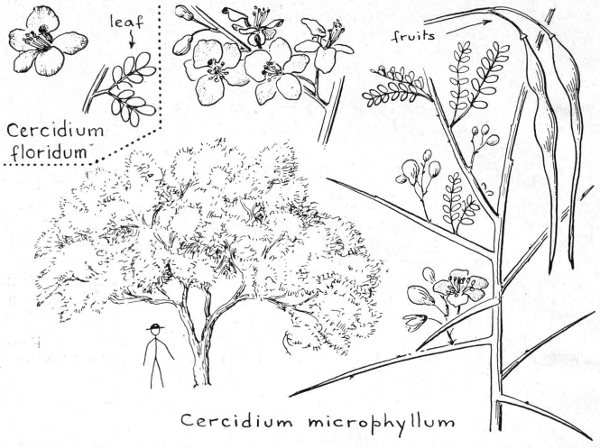
- Common Names: PALOVERDE, YELLOW PALOVERDE, BLUE PALOVERDE
- Arizona deserts: (Cercidium microphyllum). Pale yellow. April-May.
- Arizona desert. (Cercidium floridum). Bright yellow. April-May.
- Pea family. Size: Green-barked tree up to 25 feet high.
Arizona Paloverdes (meaning green stick) are large shrubs or small
trees abundant along washes in the hotter, drier portions of the Sonoran
Desert. When in blossom in the springtime, they appear as masses of
pale yellow or golden bloom, and are a glorious sight, both as individual
trees and massed as borders along the courses of washes which they
mark with a line of color winding across the desert floor. During the
dry season, they are without leaves, but are readily recognized by the
bark, yellowish green in the case of C. microphyllum; blue green in
C. floridum.
After the petals form, seeds form in bean-like pods which are not
relished by livestock, but are eaten during periods of drought and when
other forage is scarce. Indians ground the seeds into meal.
When the trees are in blossom, they attract myriads of insects, some
of which, including Honeybees, seek the nectar. Wood is soft and the
branches are brittle and easily broken. It is unsuited for fuel as it burns
rapidly, leaves no coals, and gives off an unpleasant odor.
YELLOW
37
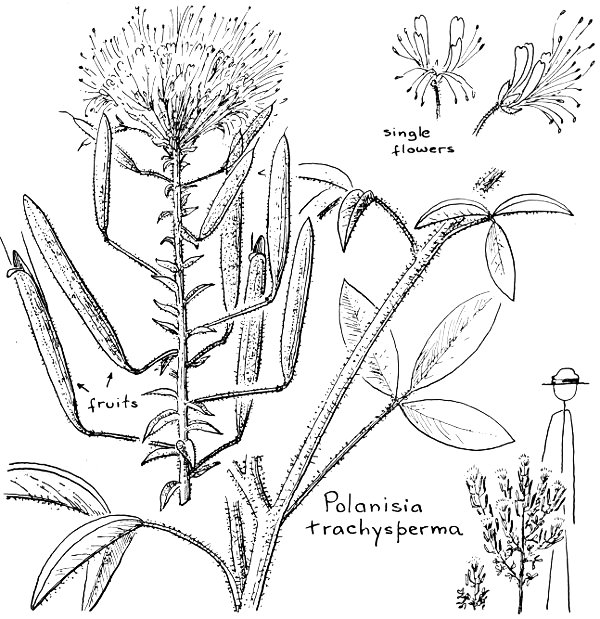
- Common name: CLAMMYWEED
- Arizona desert: (Polanisia trachysperma). Pale yellow. June-September.
- Texas desert: (Polanisia uniglandulosa). Pale yellow. June-September.
- Caper family. Size: 1 to 3 feet tall.
Clammyweed is not limited in its range to desert areas, but is found
as far north as Saskatchewan and British Columbia. However, it is also
a common annual in Texas, New Mexico, and Arizona at elevations
between 1,200 and 6,000 feet, and is usually found in abundance in the
sandy channels of dry stream beds.
It somewhat resembles both Yellow Beeweed (Cleome lutea) and
Jackass-clover (Wislizenia refracta.)
YELLOW
38
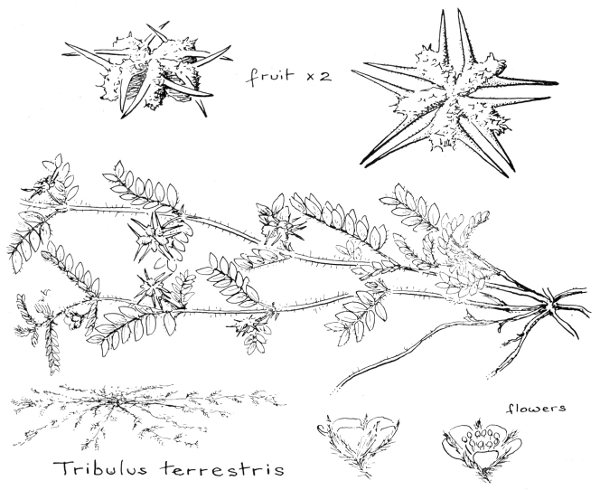
- Common names: PUNCTUREVINE, BURNUT, BULLHEAD, (TORRITO)
- Arizona, California, and Texas deserts: (Tribulus terrestris). Pale yellow. Summer.
- Caltrop family. Size: Prostrate, stems 2 to 6 feet long.
A troublesome annual vine-like weed naturalized from southern
Europe, the Puncturevine has established itself throughout the Southwest
below 7,000 feet. Although fairly readily controlled by cultivation,
the plant spreads rapidly in sandy, dry wastelands, often taking over
vacant lots in towns, and areas in the desert where it finds sufficient
moisture.
The fruits, which are produced in quantities, are armed with strong
spurs which become embedded in the feet and fur of animals and in
automobile tires. Fruits are also carried by irrigation or flood waters.
Although the spurs are too short to puncture automobile tires, they
make bicycles almost useless in some localities, and are an aggravation
to children who go barefoot—and to dogs.
Flowers and fruits in various stages of maturity may be found on
this fast-growing plant at almost any time during the summer months.
Botanically, Puncturevine is closely related to the Creosotebush and also
to the Arizona-poppy.
YELLOW
39
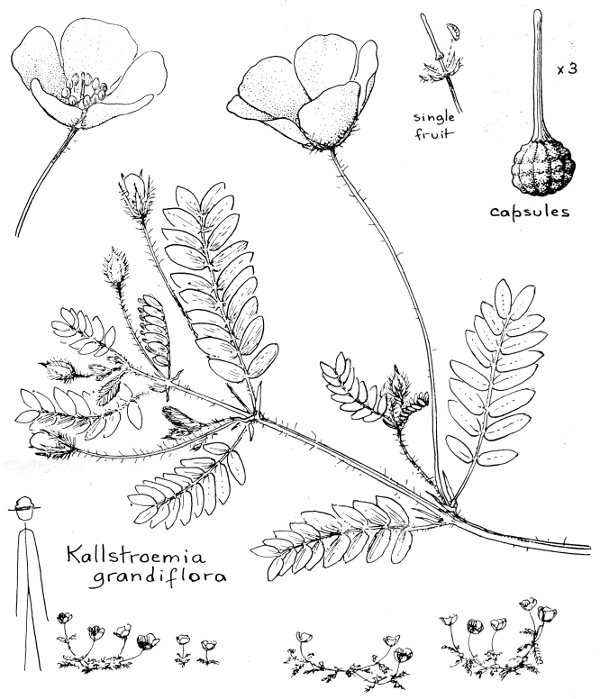
- Common names: ARIZONA-POPPY, CALTROP
- Arizona and Texas deserts: (Kallstroemia grandiflora). Bright yellow. February-September.
- Caltrop family. Size: 1 to 2 feet tall.
Although superficially resembling in size, shape, and color the blossoms
of the Goldpoppy, the blossoms of the large-flowered Caltrop have
five petals instead of four, and the plant is a close relative of the Puncturevine
and the Creosotebush. One of the most attractive of the desert’s summer
annuals, Arizona-poppy is found at elevations below 5,000 feet in the
drylands of Texas, New Mexico, Arizona, and northern Mexico.
Large-flowered Caltrop may be distinguished from Goldpoppy by (1)
sprawling open habit of growth, (2) compound leaves, (3) season of blossoming,
and (4) the fact that the plants grow singly rather than in masses.
YELLOW
40
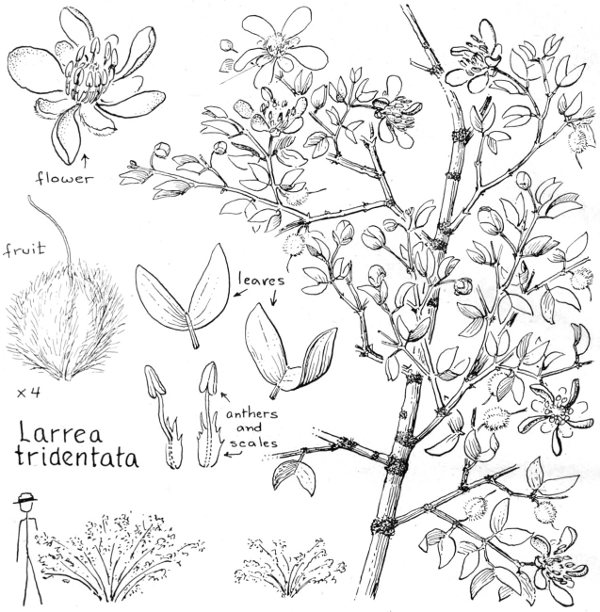
- Common names: GREASEWOOD, CREOSOTEBUSH, (HEDIONDILLA)
- Arizona, California, and Texas deserts: (Larrea tridentata). Yellow. Spring.
- Caltrop family. Size: Shrub, 2 to 8 feet high.
No one could justifiably question the statement that Creosotebush is
the most successful, widespread, and readily recognized desert plant of
the hot, arid regions of North America. It often occurs over wide areas
in such pure stands as to constitute true Larrea plains. Its common companion
is the grayish Burrobush or Bur-sage.
Following winter rains, the Creosotebush may put out a few yellow
blossoms in January, but usually bursts into full flower in April or May, to
be followed in a short time with the equally spectacular fuzzy white seed
balls making the bushes appear to be covered with a light frosting of
snow. After a rain, the plants give off a musty, resinous odor which is the
basis of the Mexican name Hediondilla (freely translated, “Little
Stinker”). Lac occurs as a resinous incrustation on the branches, and was
used by the Indians for mending pottery, making mosaics, and for fixing
arrow points.
Leaves of the Creosotebush are covered with a “varnish” which often
41
glistens in the sunlight, and helps reduce evaporative moisture loss,
thereby enabling the plant to resist the desiccating effect of hot, dry winds.
YELLOW
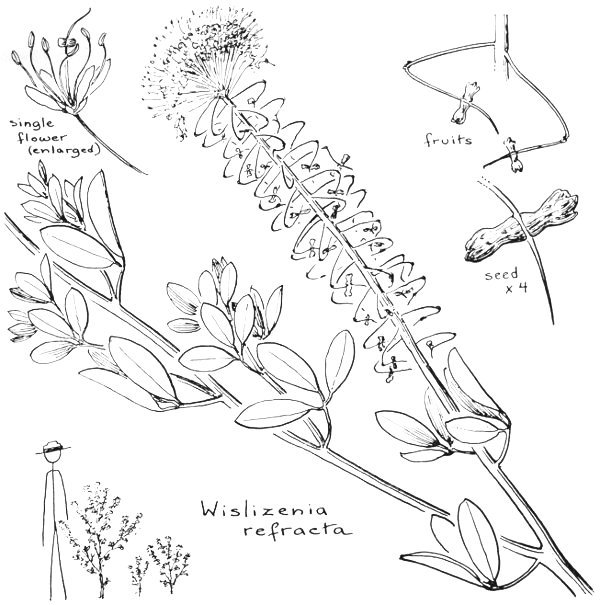
- Common name: JACKASS-CLOVER
- Arizona desert: (Wislizenia refracta). Yellow. May-September.
- Caper family. Size: Up to 4 feet in height.
Conspicuous in late summer along roadsides and dry streambeds, the
large number of yellow flowers and the widespread presence of these
much branched, annual plants justify the inclusion of Jackass-clover in
this booklet as one of the common flowers of the desert.
The plant ranges across the Southwest from western Texas to southern
California at elevations between 1,000 and 6,500 feet. The flowers themselves
are small, although the flower heads are quite conspicuous.
Since the leaves somewhat resemble the tri-foliate leaves of Clover, the
plant is commonly called Jackass-clover. It is usually found in sandy
locations.
YELLOW
42
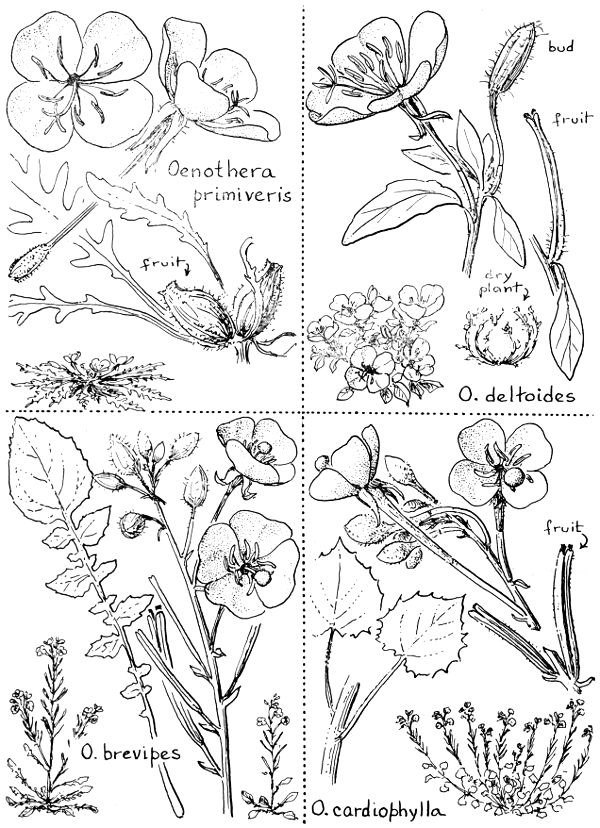
- Common names: EVENING-PRIMROSE, SUNDROP
- Arizona and California deserts: (Oenothera brevipes). Yellow. March-May.
- Texas-New Mexico deserts: (Oenothera primiveris). Yellow. March-May.
- Evening-primrose family. Size: Usually low, but some up to 5 feet.
Among the commonest but most beautiful and delicate of the flowering
plants of the desert are the Evening-primroses. Flowers are usually
large, with the four petals either white or yellow, turning to red or pink
with age. Many species are low-growing herbs with large, delicate petals;
while others may be shrub-like, sometimes attaining a height of 5 feet. As
the name implies, the flowers open in the evening and wilt soon after sunrise.
In the low, warmer sections of the desert, plants in blossom may be
found as early as February.
YELLOW
43
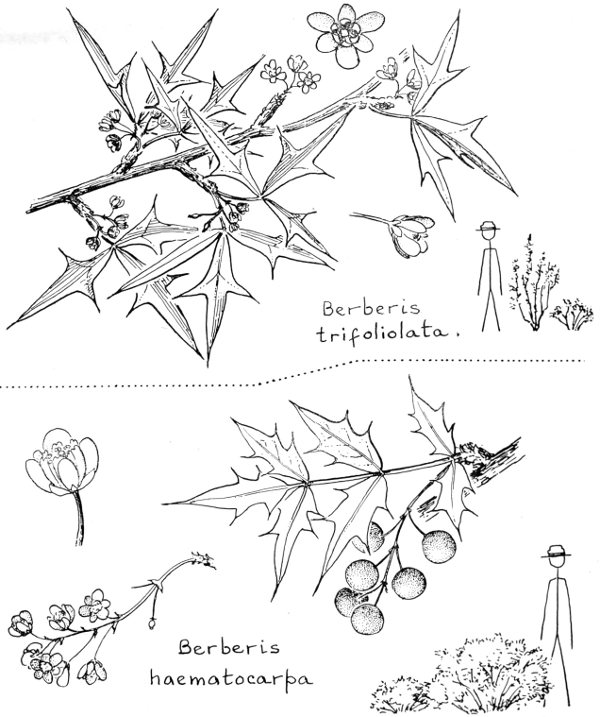
- Common names: ALGERITA, BARBERRY, HOLLYGRAPE
- Arizona desert: (Berberis haematocarpa). Yellow. February-April.
- California desert: (Berberis fremonti). Yellow. May-July.
- Texas desert. (Berberis trifoliolata). Yellow. Spring.
- Barberry family. Size: Shrubs, 3 to 8 feet.
The pendant clusters of golden blossoms are particularly noticeable
because of their delightful fragrance, and the small purple berries are
juicy and of pleasant flavor. They make excellent jelly and are readily
eaten by birds and some of the small mammals. Due to the holly-like
leaves and the fragrant blossoms and fruits, the plants would make attractive
ornamentals for landscape and decorative plantings were it not for
the fact that they are secondary hosts for the black stem rust of the
cereals, hence cannot be used in communities where grains are grown.
Indians use the root as a tonic, and obtain from it a brilliant yellow
dye.
Some botanists prefer to use the generic name Mahonia or Odostemon
for this group of plants.
YELLOW
44
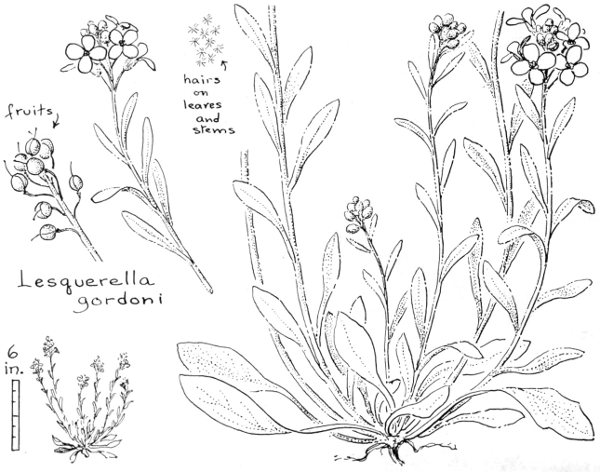
- Common names: BLADDERPOD, BEAD-POD
- Arizona and Texas deserts: (Lesquerella gordoni). Yellow. February-May.
- California desert: (Lesquerella palmeri). Yellow. March-May.
- Mustard family. Size: 6 to 8 inches high.
Extensive sections of the desert are gilded in springtime with
this low-growing annual herb which is one of the earliest of the desert
flowers.
Following moist winters, it covers dry mesas and plains below 4,000
feet from Oklahoma west to Utah, and southward into northern Mexico.
After the seed pods have matured, the plant is reported to furnish valuable
forage for range stock.
YELLOW
45
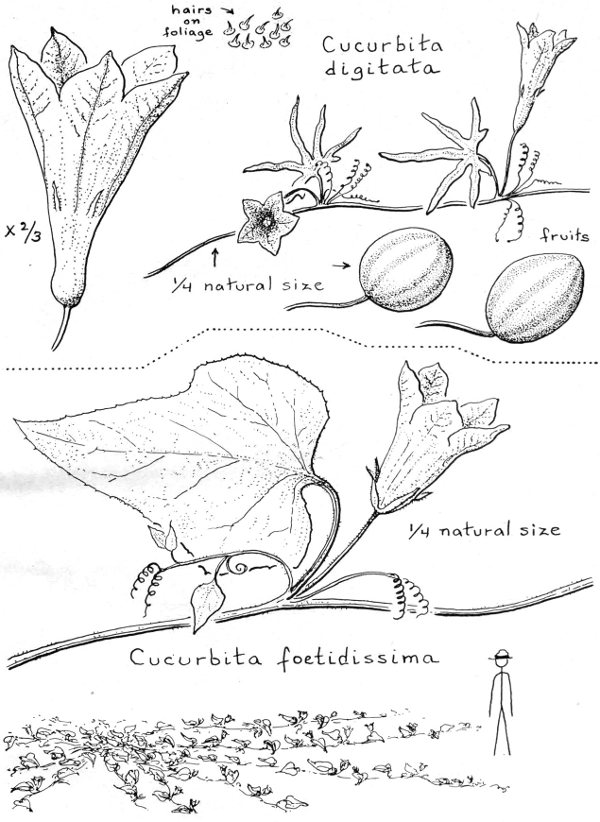
- Common names: BUFFALO-GOURD, COYOTE-MELON, (CALABAZILLA), (CHILI COYOTE)
- Arizona desert: (Cucurbita digitata). Yellow. June-October.
- California desert: (Cucurbita palmata). Yellow. July-September.
- Texas desert: (Cucurbita foetidissima). Yellow. May-August.
- Gourd family. Size: Trailing perennial with stems 4 to 15 feet long.
Gourds are conspicuous, trailing, rank-growing plants common along
roadsides and in the open desert. Leaves are grayish-green, and blossoms
yellow and trumpet-shaped. The striped fruits are about the size and
shape of a tennis ball, although some are egg-shaped.
The fruits which are very conspicuous after the vines and leaves have
been winter-killed, are sometimes collected, painted in gay colors, and
used as ornaments about the house.
Although Indians considered the fruits as inferior and suitable only
for coyotes, they ate them either cooked or dried, and made the seeds into
a mush. Pioneers used the crushed roots of these plants as a cleansing
agent in washing clothes.
YELLOW
46
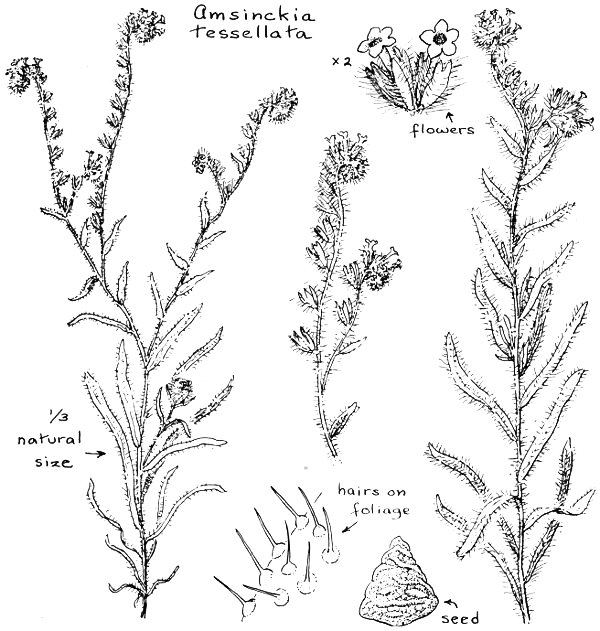
- Common names: FIDDLENECK
- Arizona desert: (Amsinckia intermedia). Yellow. Spring.
- California desert: (Amsinckia tessellata). Yellow. Spring.
- Borage family. Size: Bristly erect herbs, 8 to 18 inches.
An annual of the Creosotebush belt, and very abundant on gravelly or
sandy soils in dry, open places, Fiddleneck is found from western New
Mexico to California and north to eastern Washington.
A. tessellata occurs also in Chile and Argentina. Plants are reported
to make good spring forage where they grow in heavy stands, but indications
have been found that cirrhosis of the liver may result in cattle,
sheep and horses that eat the nutlets.
Following moist winters, Fiddleneck is often so abundant as to form
vast fields of yellow or orange-yellow blossoms, especially on the Mohave
Desert in southern California.
The curling habit of the opening flower heads somewhat resembles
the neck of a violin, hence the name.
YELLOW
47
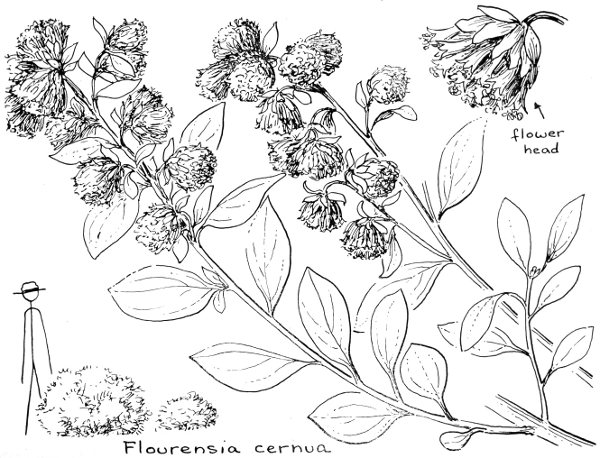
- Common names: TARBUSH, VARNISHBUSH
- Arizona and Texas deserts: (Flourensia cernua). Yellow. July-December.
- Sunflower family. Size: A small shrub 3 feet, occasionally 6 or 7 feet high.
These resinous, much-branched, perennial shrubs are found on plains
and mesas at elevations around 4,000 feet from western Texas to eastern
Arizona and south into Mexico. The yellow, nodding flower heads are
small, and the leaves have a hop-like odor and a bitter flavor unpalatable
to cattle.
In northern Mexico the leaves and dried flower heads are sold in
the drug markets under the name of hojase, recommended, in the form
of a brew, as a remedy for indigestion.
YELLOW
48
49
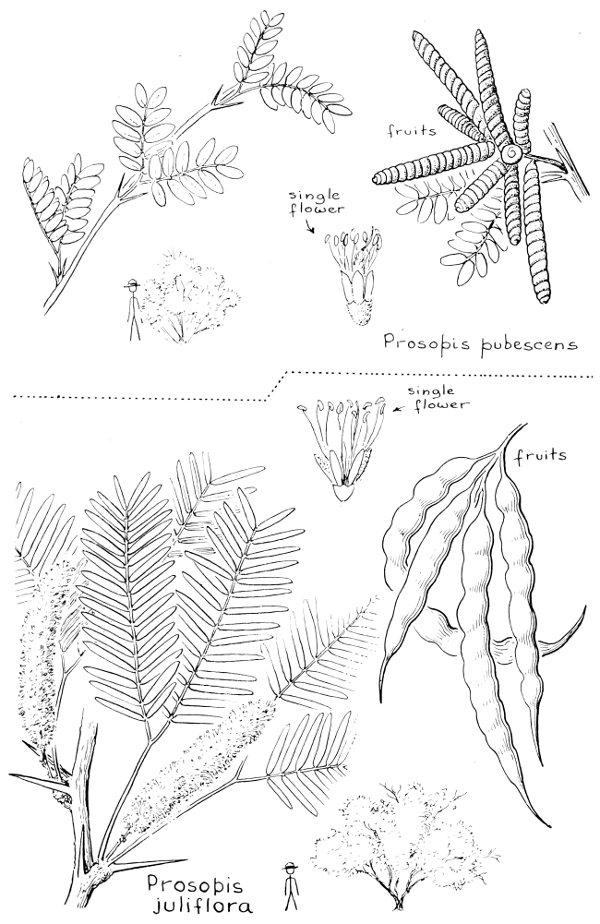
- Common names: MESQUITE, HONEY MESQUITE
- Arizona, California and Texas deserts: (Prosopis juliflora). Yellow. April-June.
- Pea family. Size: Tree 15 to 25, rarely 30 feet high.
Mesquite (mess-KEET) is one of the commonest and most widespread
of desert trees, often growing in extensive thickets. It occurs at
elevations below 5,000 feet, usually along streams, desert washes, or in
locations where the water table is relatively high, from Kansas to California
and south into Mexico. Roots are reported to penetrate to a depth
of 60 feet with more wood below ground than above. In some parts of
the desert, blowing sand settles around Mesquite clumps forming hummocks
through which rodents tunnel.
The numerous branches are armed with sturdy, straight thorns. In the
spring when covered with bright green leaves and laden with catkin-like
clusters of greenish-yellow flowers, Mesquite is a particularly handsome
shrub or tree. Blossoms are fragrant and attract myriads of insects,
including Honeybees.
During pioneer days, Mesquite wood was of the utmost importance to
settlers as fuel, and was also used extensively in building corrals and in
making furniture and utensils. With the exception of Ironwood, Mesquite
is the best firewood to be found in the desert, giving off a characteristic
aroma and forming a long-lived bed of coals.
Fruits of the Mesquite, which resemble string beans, ripen in autumn
and are eaten by domestic livestock and other animals. They are rich in
sugar and still form a staple food among natives. Indians made wide use
of Mesquite, the fruits often carrying them over periods when their crops
failed. Pinole, a meal made by grinding the long, sweet pods, was served
in many ways. When fermented, it formed a favorite intoxicating drink of
the Pimas. The gum, which exudes through the bark, was eaten as candy,
and was used as a pottery-mending cement, and as a black dye.
YELLOW
- Common names: SCREWBEAN, FREMONT SCREWBEAN, SCREWPOD MESQUITE, (TORNILLO)
- Arizona, Texas, and California deserts: (Prosopis pubescens). Yellow. May-June.
- Pea family. Size: Shrub, or tree up to 20 feet.
Although the Screwbean, so called because of the tight spiral curl
formed by the seed pod, is not as common as Honey Mesquite, it is nearly
as widespread, being found below 4,000 feet from western Texas to
southern Nevada, and southern California to northern Mexico. The
majority of the trees are small and shrubby.
Fruits, in common with those of Honey Mesquite, are used by Indians
and livestock for food. Bark from the roots was used by the Pima Indians
to treat wounds. Where abundant, the wood is used for fence posts, tool
handles, and fuel. Birds, particularly the Crissal Thrasher, make use of
the shreddy bark for nest-lining material.
Where Screwbean and Honey Mesquite grow together, they may be
distinguished in the winter when trees are leafless and fruits have fallen
or been removed by animals, by the gray-barked twigs of the Screwbean,
those of the Honey Mesquite being brownish red.
Some botanists prefer to classify Screwbean as genus Strombocarpa.
YELLOW
50
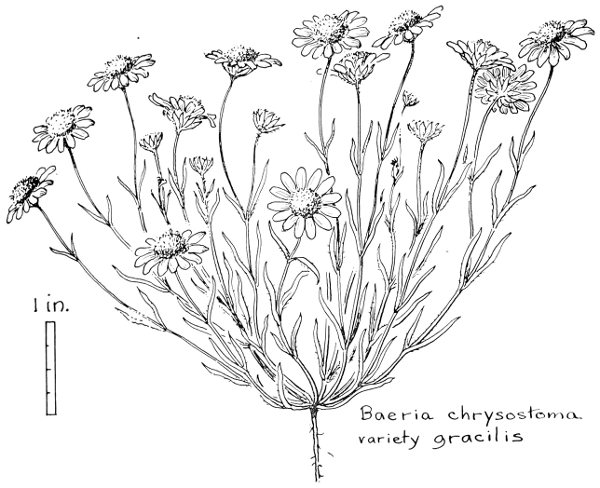
- Common names: GOLDFIELDS
- Arizona desert: (Baeria chrysostoma). Yellow. March-May.
- Sunflower family. Size: Low growing, usually under 6 inches.
After winters of particularly heavy precipitation, these small close-growing
annuals with their sunflower-like blossoms cover large patches of
desert with a carpet of gold. Individual flowers are so small and so inconspicuous
among larger plants that they are easily passed unnoticed, but
millions of the plants all in blossom at the same time make a spectacular
display that attracts visitors from considerable distances.
They occur in Arizona below 3,600 feet, westward to California,
Lower California, and north to Oregon. A plant of winter and early
springtime, Goldfields takes advantage of winter moisture and cool
spring weather to produce its flowers and mature its seeds. Thus it
escapes the heat and drought of the desert by lying dormant in the seed
stage until the moisture and cool temperatures of the following winter
awaken it.
In common with Goldpoppy and other annuals that mature their
seeds before the summer heat descends upon the desert, Goldfields cannot
correctly be called a “desert plant.” Actually these are plants of cooler
climes which have found winter conditions in the desert ideal for their
needs and have established themselves.
These plants demonstrate effectively one method, that of escaping
the heat and drought, by which plants have adapted themselves to survival
in the desert. Like the winter tourist, they take advantage of ideal
climatic conditions of winter and spring. Since, unlike the winter tourist,
they cannot return north for the summer, they take the next best course
and pass through the hot, dry period in the dormancy of the seed phase
of their life cycles.
YELLOW
51
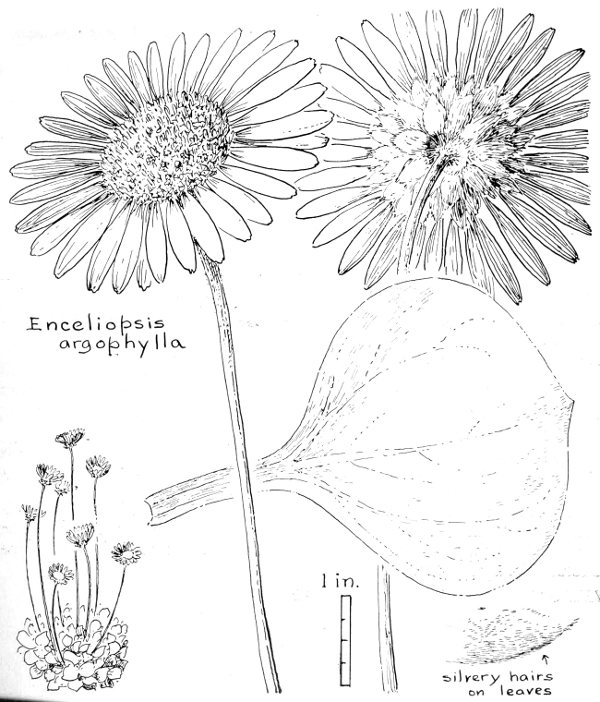
- Common name: SUNRAY
- Arizona desert: (Enceliopsis argophylla). Bright yellow. April-June.
- California desert: (Enceliopsis covillei). Lemon-yellow. April-June.
- Sunflower family. Size: Perennial, 1 to 2½ feet tall.
The large, solitary, coarse flower heads with their yellow petals
make the Sunrays among the most impressive composites of the desert.
Flowers rise on stout stems above a luxuriant growth of leaves
that make the plants appear almost egotistical in their elegant
arrogance.
They are at their best in sandy washes and on dry slopes at elevations
between 1,000 and 3,500 feet, often where other plants seem too
hard pressed eking out an existence to produce the garish foliage and
bloom achieved by the Sunray.
YELLOW
52
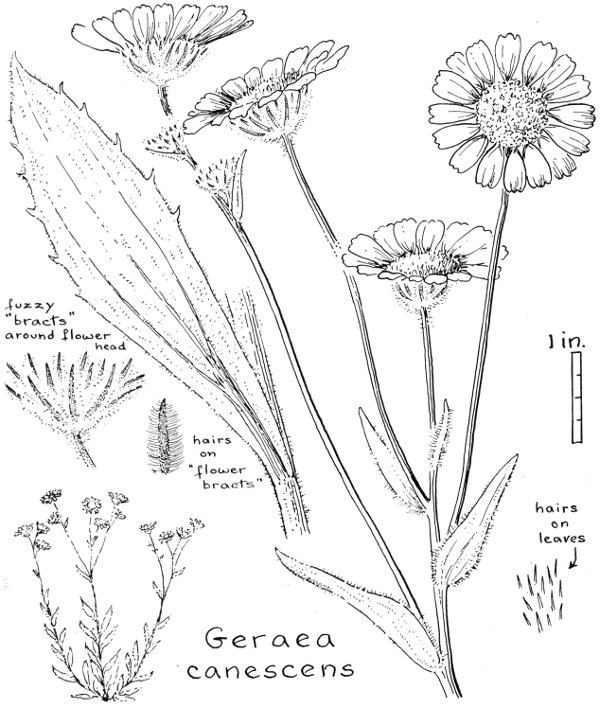
- Common names: DESERT-SUNSHINE, DESERT-SUNFLOWER, DESERT GOLD, HAIRY-HEADED SUNFLOWER
- Arizona, California, and Texas deserts: (Geraea canescens). Yellow. January-June.
- Sunflower family. Size: An annual, 6 inches to 2 feet tall.
One of the showiest of the Sunflowers. Desert-sunflowers often form
sweet-scented gardens of luxuriant bloom along roadsides and in sandy
basins early in the spring.
Its seeds form a dependable source of food for small rodents, especially
Pocket Mice, which store them in quantities. Wild bees and Hummingbird
Moths are attracted to the fragrant flowers.
This species is common in areas of sandy soil below 1,500 feet in elevation
from Utah and southeastern Colorado to southern Arizona and
Sonora, Mexico. It is one of the showy roadside flowers of Organ Pipe
Cactus National Monument.
YELLOW
53
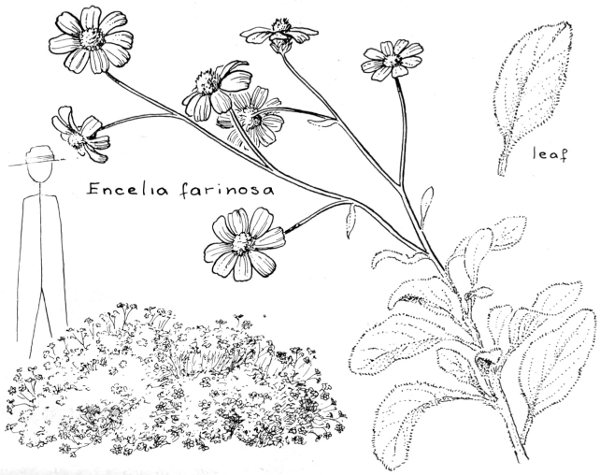
- Common names: BRITTLEBUSH, (INCIENSO)
- Arizona and California deserts: (Encelia farinosa). Yellow. November-May.
- Sunflower family. Size: Perennial shrubs, 2 to 3 feet high.
These low, branching shrubs with gray-green leaves are common on
rocky slopes and benches where they lighten the winter landscape with
their bright flower heads and create a spectacular mass of bloom during
early spring. Flower stems rise several inches above the brittle leaf-covered
branches, thus hiding the plant under a blanket of blossoms at
the height of the blooming period.
Plants are abundant on rocky slopes below 3,000 feet from southern
Nevada to Lower California and eastward through Arizona.
Stems exude a gum prized as incense by the early-day Catholic priests.
Indians chewed this gum, and also heated it to smear on their bodies
for the relief of pain.
YELLOW
54
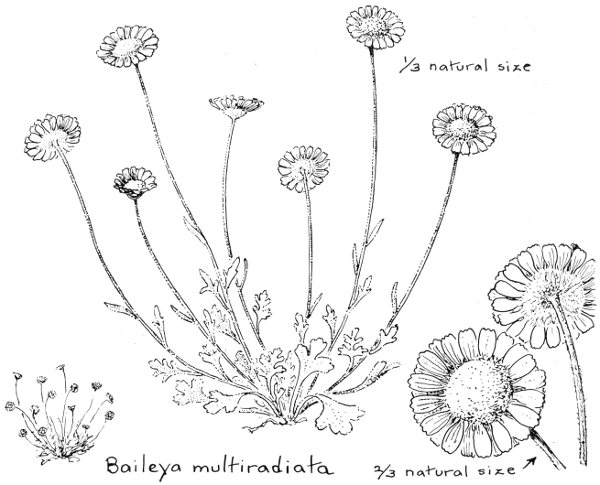
- Common names: WOOLLY-MARIGOLD, DESERT-MARIGOLD, PAPER-DAISY
- Arizona and Texas deserts: (Baileya multiradiata). Yellow. March-October.
- California desert: (Baileya pleniradiata). Yellow. March-November.
- Sunflower family. Size: 4 inches up to 2 feet high.
This low-growing, woolly, annual herb with showy, yellow flowers on
long, solitary stems is one of the commonest bloomers gracing the desert
roadsides and making patches of bright color along otherwise drab and
dry, sandy desert washes. It is particularly noticeable because of its
luxurious crop of flowers and long period of bloom.
At first glance, Desert-marigold may be confused with Crownbeard, to
which it is quite similar in color, size, and habit of growing in groups.
However, the regular, circular shape of Marigold blooms and the considerable
difference in leaf shape make the two readily distinguishable.
In California, Desert-marigold is cultivated for the flower trade.
Fatal poisoning of sheep on over-grazed ranges has been laid at the
door of this plant, although horses crop the flower heads, apparently
without harmful effect. Blossom petals become bleached and papery as
the blossoms age, thus giving the plant in some localities the name
Paperdaisy.
Desert-marigold, of which there are but few species, is common
throughout desert areas of the Southwest from Utah and Nevada to
Lower California, Sonora and Chihuahua.
YELLOW
55
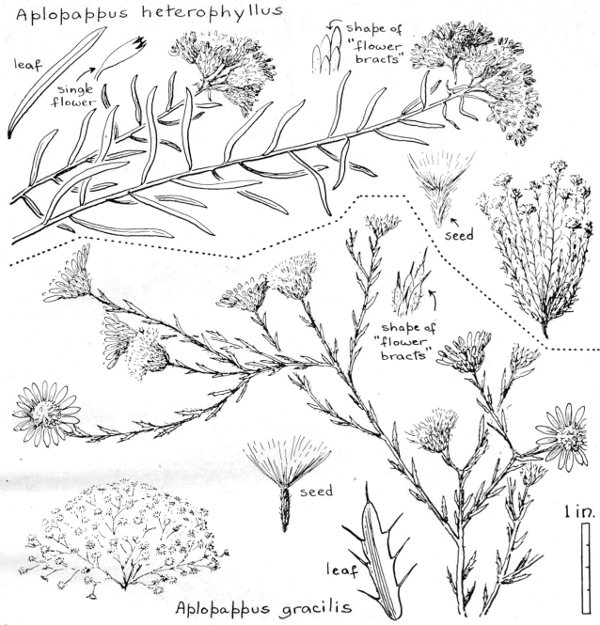
- Common names: JIMMYWEED, RAYLESS-GOLDENROD, GOLDENBUSH, GOLDENWEED
- Arizona desert: (Aplopappus lacrifolius). Yellow. August-November.
- California desert: (Aplopappus gracilis). Yellow. February-November.
- Texas-New Mexico desert: (Aplopappus heterophyllus). Yellow. June-September.
- Sunflower family. Size: Herbs or small shrubs 2 to 18 inches.
The genus Aplopappus (sometimes spelled Haplopappus) is represented
in the Southwest by a great many species, both annuals and perennials,
which range from elevations of 2,000 feet up to 9,000 feet. Desert
forms prefer open, dry canyon slopes and mesas.
A. linearifolius is conspicuous in the springtime, at elevations between
3,000 and 5,000 feet because of its many, showy flower heads.
A. heterophyllus often takes over heavily grazed rangeland since it
is generally unpalatable to livestock and replaces vegetation destroyed
by overgrazing.
YELLOW
56
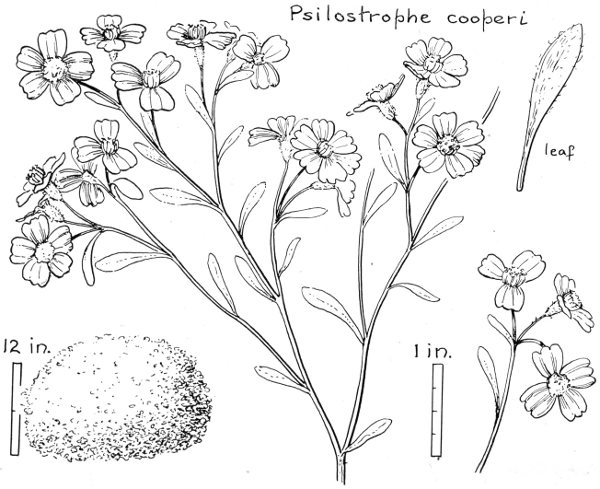
- Common name: PAPERFLOWER
- Arizona and Texas deserts: (Psilostrophe cooperi). Bright yellow. Year around.
- Texas-New Mexico deserts: (Psilostrophe sparsiflora). Bright yellow. May-September.
- Sunflower family. Size: Rounded bush 12 to 18 inches high.
One man of the writer’s acquaintance, confused by the great number
of yellow flowers on the desert, refers to them all as “yellow composites.”
The Paperflower is one of these.
It is noticeable because of the conspicuous, bright yellow flowers
which sometimes cover the plants almost completely, often during periods
of the year when bloom is quite scarce on the desert.
The flowers are persistent, petals become papery, fade to a pale yellow,
and remain on the plants intact for weeks.
Although the Paperflower does not form great masses of color, the
blossom-covered clumps are conspicuous among the Cactus, Mesquite,
and Creosotebush of the desert.
It is common at elevations below 5,000 feet from southern Utah to
Lower California, with similar species ranging eastward through southern
New Mexico and northern Chihuahua.
Some species are reported to be poisonous to sheep.
YELLOW
57
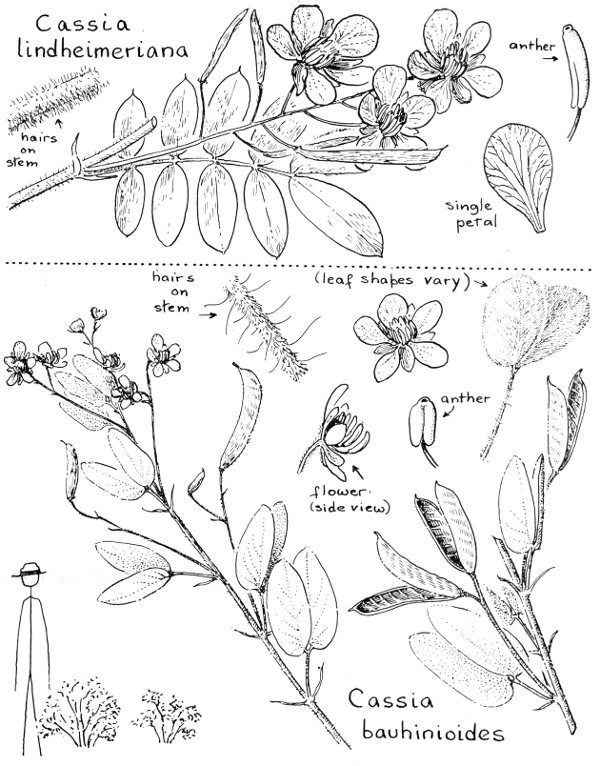
- Common names: DESERT-SENNA, RATTLEWEED
- Arizona desert: (Cassia bauhinoides). Yellow. May-August.
- California desert: (Cassia armata). Yellow. April-May.
- Texas desert: (Cassia lindheimeriana). Golden. June-September.
- Pea family. Size: Low, branching shrub up to 3 feet.
Members of this large genus are chiefly tropical, the majority having
golden to bronze flowers and brown, woody seed pods. They are quite
common along desert roadsides, and a few species are cultivated as
ornamentals.
In some localities, following moist winters, Desert-senna bursts into a
riot of color in April and May adding a golden glory to the spring floral
display.
Representatives of the several desert species occur at elevations
between 2,000 and 5,000 feet from Texas westward to southern California
and south into Mexico.
YELLOW
58
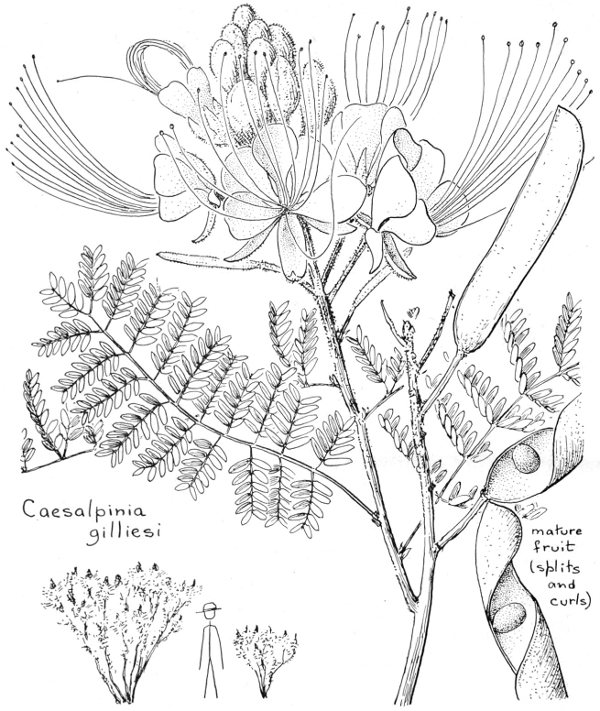
- Common names: BIRD-OF-PARADISE-FLOWER
- Arizona desert: (Caesalpinia gilliesi). Yellow-and-red. May-August.
- Pea family. Size: Shrub, up to 10 feet tall.
Widely grown as a decorative shrub by the people of Mexico, this
spectacular import from South America is quite commonly used as an
ornamental in yards and around houses in desert areas of the Southwest.
Under suitable conditions, it may escape and grow wild. The very showy
blossoms with yellow petals and long, thread-like, red filaments are certain
to attract attention.
In contrast to the striking showiness of the blossoms, the plant itself
is straggling and unsymmetrical, and gives off an unpleasant odor.
YELLOW
59
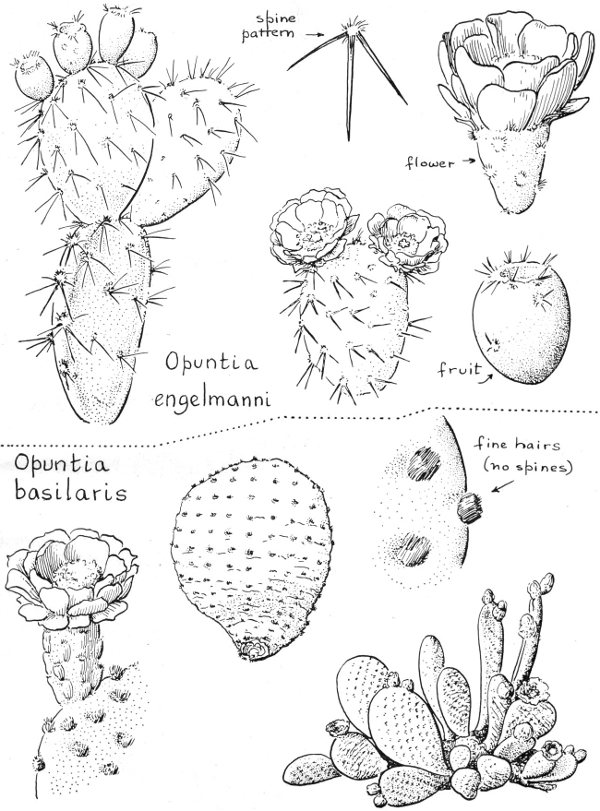
- Common names: PRICKLYPEAR, (TUNA), BEAVERTAIL
- Arizona desert: (Opuntia engelmanni). Yellow. April-June.
- California desert: (Opuntia basilaris). Magenta. March-April.
- Texas desert: (Opuntia engelmanni). Yellow. May-July.
- Cactus family. Size: Clumps, sometimes 5 feet high and 10 feet in diameter.
The flattened pods, or stem joints, of the Pricklypears growing, as
they do, in huge clumps make them the best known of the Cacti throughout
60
the West. There are many species found throughout the United
States, but the plants reach their greatest size and luxuriant growth in
the desert areas of the Southwest. The large, red to purple and mahogany,
juicy, pear-shaped fruits are known as tunas, and are eaten by many
animals as well as by the native peoples. Flowers are large and spectacular.
Although a number of species of Pricklypears are found in all of the
desert areas, O. engelmanni with its bright yellow flowers is the commonest
form in both the Sonoran and Chihuahuan Deserts, while the
Beavertail cactus with its magenta flowers and lack of large spines is the
common and spectacular form of the Mohave Desert.
Pricklypears are increasing in parts of the desert where conditions are
favorable, especially where heavy grazing has given them an advantage
over plants that are favorable to livestock.
YELLOW
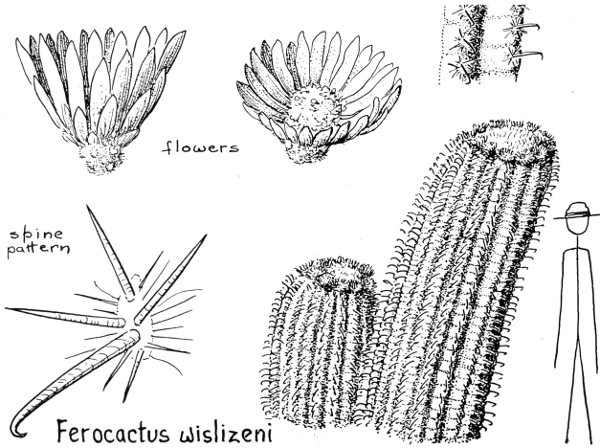
- Common names: BARREL CACTUS, COMPASS CACTUS, DEVILSHEAD CACTUS, (BISNAGA), (BISNAGRE)
- Arizona desert: (Ferocactus wislizeni). Orange-yellow. July-September.
- California desert: (Ferocactus acanthodes). Yellow. March-May.
- Texas desert: (Echinocactus horizonthalonius). Rose-pink. May-June.
- Cactus family. Size: 2 to 8 feet high.
Well known among the desert figures are the heavy-bodied Barrel
Cacti which are sometimes pointed out as sources of water for travelers
suffering from thirst. Under extreme conditions, it is possible to hack off
the tops of these tough, spine-protected plants and obtain, by squeezing
the macerated tissues, enough juice to sustain life.
Growing faster on the shaded side, the taller-growing plants tend to
lean toward the south, hence the name “Compass” cactus. Flowers range
in color from yellow to orange and rose-pink, depending on the species,
and the pale yellow, egg-shaped fruits which ripen early in the winter, are
a favorite food of deer and rodents. Flowers, and the resulting fruits,
form a ring around the crown of the plant.
61
The flesh of the Barrel cactus, cooked in sugar, forms the base of
cactus candy.
YELLOW
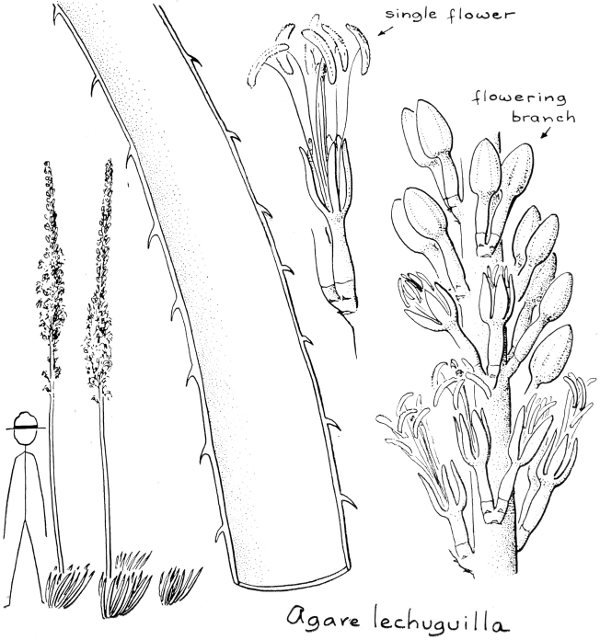
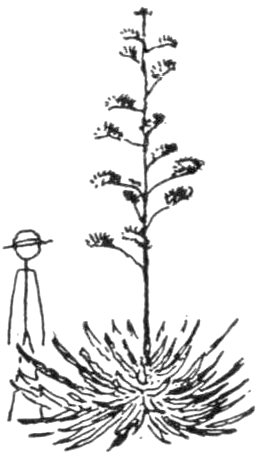
- Common names: AGAVE, CENTURYPLANT, (MESCAL), (LECHUGUILLA)
- Arizona desert: (Agave palmeri). Yellow-purple. July-Aug.
- California desert: (Agave deserti). Yellow. May.
- Texas-New Mexico desert: (Agave lechuguilla). Lavender-brown. April-May.
- Amaryllis family. Size: Flower stalks 8 to 25 feet tall.
Many species of Agave are found in various parts of the desert, hence
it is difficult to settle on those which should be given particular recognition.
Their blossoms, in general, are various shades of yellow. The larger
species are called Centuryplant or Mescal (mess-KAHL), while the small
ones are spoken of as Lechuguillas (letch-you-GHEE-ahs). The Lechuguilla,
covering hundreds of square miles in Texas, New Mexico, and
northern Mexico, is an indicator of the Chihuahuan Desert, holding the
position in that desert which the Saguaro does in the Sonoran desert and
the Joashua-tree in the Mohave Desert.
From its leaf fibers the Mexicans weave a coarse fabric. Its plumelike
flower stalks, relished by deer and cattle, form one of the spectacular
sights of the Chihuahuan Desert in springtime.
YELLOW
62
Agave plants require a number of years to store sufficient plant foods
for the production of the huge flower stalk which grows
with amazing rapidity to produce the many flowers and
seeds, after which the plant dies. This long pre-blossom
period of a dozen to 15 or more years is the basis for the
name “Centuryplant.” If the young flower stalk is cut off,
the sweet sap may be collected and fermented to form
highly intoxicating beverages, some of which are distilled
commercially. Among these are mescal, pulque (POOL-kay),
and tequila (tay-KEEL-ah). Indians cut the young
bud stalks, and roast them in rock-lined pits.
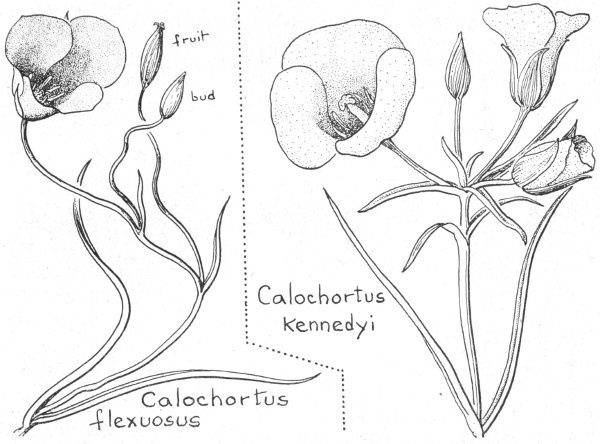
- Common names: MARIPOSA, DESERT-MARIPOSA
- Arizona and California deserts: (Calochortus kennedyi). Orange. March-May.
- Lily family. Size: Perennial, about 2 feet tall.
Under favorable weather conditions, this short-stemmed Mariposa
presents a gorgeous display of spring color. Closely related to the white-flowered
Twisted-stem Mariposa (C. flexuosus) and to the Sego-lily
(state flower of Utah), the Desert-mariposa is found below 5,000 feet in
Nevada, southern California, southern Arizona, and northern Sonora.
When growing beneath taller shrubs, it forsakes its short-stemmed habit
and forces its way up through the low branches, displaying its blossom
above.
The Mariposas, of which there are several species, are among the
most beautiful wildflowers of the Southwest.
ORANGE
63
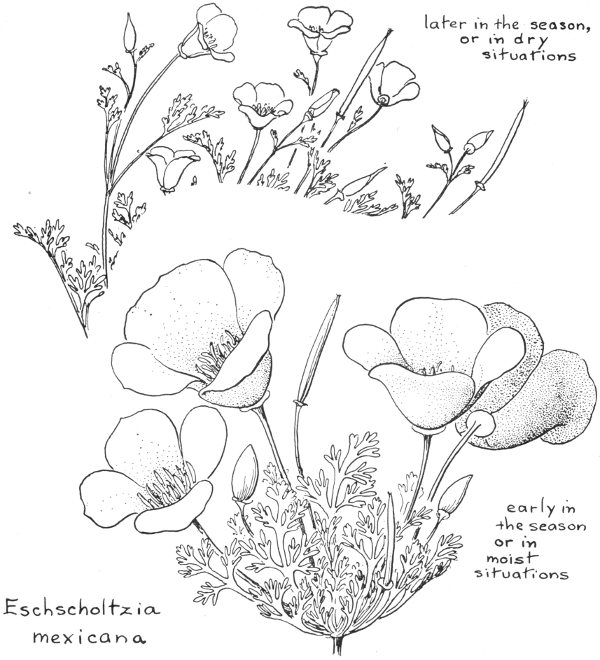
- Common names: GOLDPOPPY, DESERTPOPPY, (COPRA-DE-ORO), MEXICAN POPPY
- Arizona desert: (Eschscholtzia mexicana). Orange. February-May.
- California desert: (Eschscholtzia glyptosperma). Bright yellow. March-May.
- Poppy family. Size: 3 inches to a foot high, with many flower stems.
Because of their abundance and dense growth, following winters of
heavy precipitation, these annual poppies often cover portions of the desert
with “a cloth of gold.” They are closely related to the well-known California
Poppy, state flower of California, and a common border or bedding
plant in home flower gardens. In the desert, Goldpoppies are sometimes
mixed with Owlclover, Lupines, and other spring flowers forming a multi-colored
carpet that attracts visitors from great distances. (See cover.)
ORANGE
64
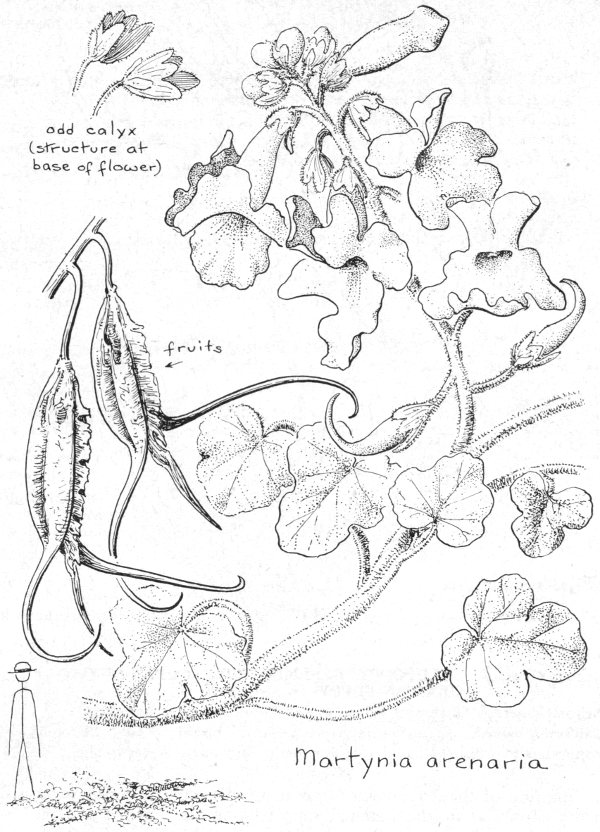
- Common names: DEVILSCLAW, UNICORNPLANT, ELEPHANT-TUSKS
- Arizona desert: (Martynia parviflora). Orange-purple. April-October.
- California desert: (Martynia altheaefolia). Coppery yellow. July-September.
- Texas desert: (Martynia arenaria). Coppery yellow. July-September.
- Martynia family. Size: Trailing, with stems 2 to 5 feet long.
The showy flowers, which are large enough to attract attention, are
relatively few. Even more spectacular are the large, black, woody pods
ending in two curved, prong-like appendages that hook about the fetlocks
of burros or the fleece of sheep, thereby carrying the pod away from the
mother plant and scattering the seeds. Young pods are sometimes eaten by
desert Indians as a vegetable, and the mature fruits are gathered by the
Pima and Papago Indians, who strip off the black outer covering and use
it in weaving designs into basketry.
Blossoms of the small-flowered species are reddish purple to white
streaked with orange and yellow, while the large-flowered species have
coppery yellow blossoms, the throat spotted with purple and the edge of
the cup streaked with orange.
COPPERY
65
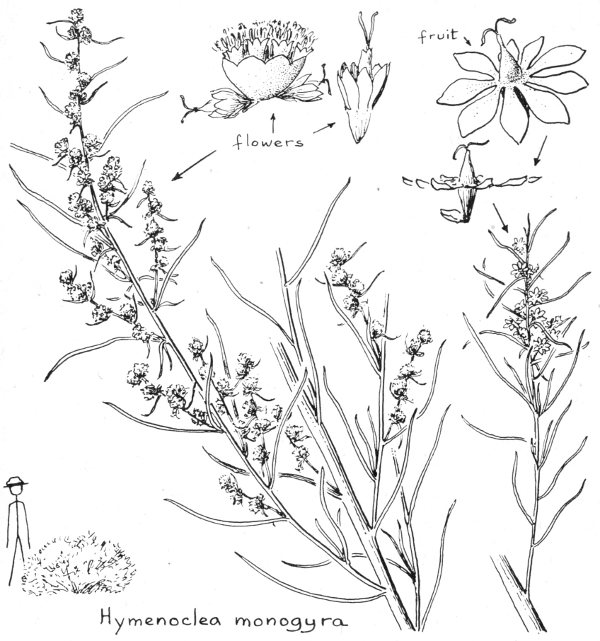
- Common names: BURROBUSH, CHEESEWEED
- Arizona and California deserts: (Hymenoclea salsola). Silvery red. March-April.
- Texas-New Mexico deserts: (Hymenoclea monogyra). Silvery red. September.
- Sunflower family. Size: Much-branched shrub, 2 to 3 feet tall.
Burrobush is another of the common desert shrubs whose fruits are
much more conspicuous than the blossoms. The shrub itself is bright green
in color, and somewhat resembles the common Russian-thistle. It is widespread,
and abundant in sandy washes, where it tends to form thickets.
In some localities it is called “Cheeseweed” because of the cheesy odor
of the crushed foliage.
It occurs throughout the Southwest at elevations below 4,000 feet,
from western Texas to southern California and northern Mexico.
RED
66
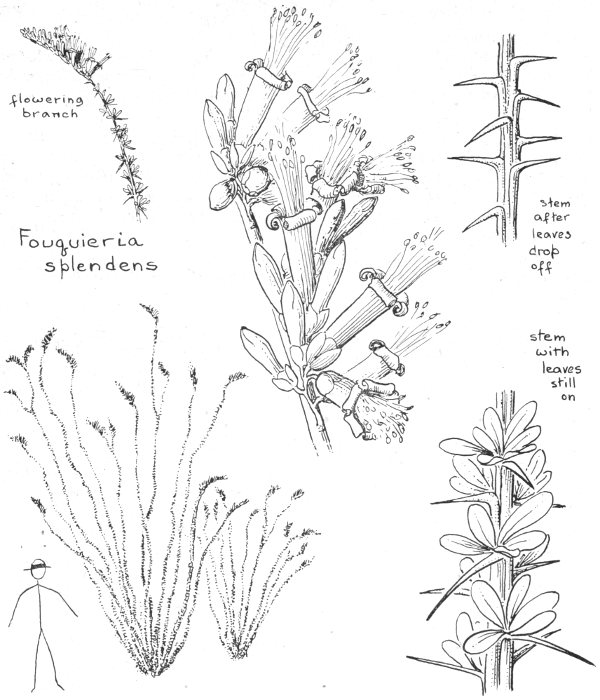
- Common names: OCOTILLO, SLIMWOOD, COACHWHIP, CANDLEWOOD, FLAMINGSWORD
- Arizona, California and Texas deserts: (Fouquieria splendens). Bright red. April-May.
- Ocotillo family. Size: Up to 15 feet tall.
One of the few flower families restricted to the desert, the unique
Ocotillo (oh-koh-TEE-oh) with its long, unbranching stems is found on
rocky hillsides below 5,000 feet from western Texas to southern California
and south into Mexico. It is one of the commonest, queerest, and most
spectacular of desert plants, especially when the tips of its long, slender
stems seem afire with dense clusters of bright red blossoms. Following
rains, leaves clothe the thorny stems with green, but after the soil becomes
dry, the leaves turn brown and fall. The heavily thorned stems are covered
with green bark which takes over the functions of leaves during
periods of drought. The plant thus becomes semi-dormant during hot dry
67
periods and, in sections of the desert visited by showers, may go through
this cycle several times during a year.
Because of its sharp thorns, strangers to the desert may think that the
Ocotillo is one of the Cacti, but it is more closely related to both the Violet
and the Tamarix than to the Cacti.
Stems of the Ocotillo are used by natives in building huts. They are
sometimes cut and, when planted close together in rows, take root and
form living fences and corrals.
RED
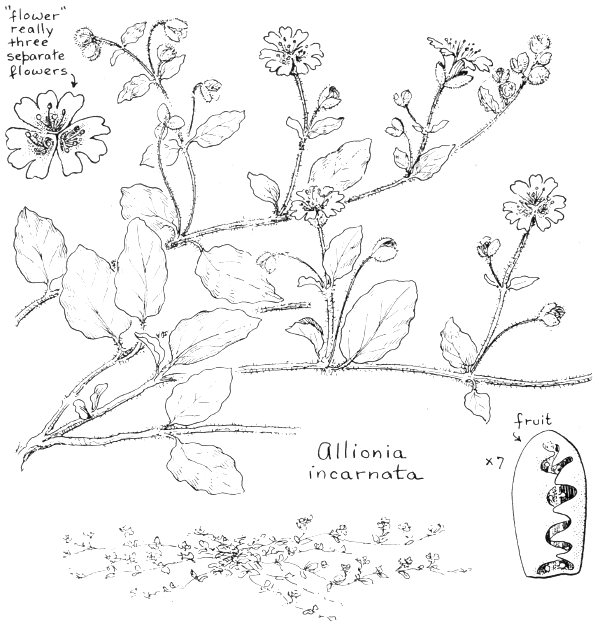
- Common names: WINDMILLS, PINK THREE-FLOWER, TRAILING-FOUR-O’CLOCK
- Arizona and Texas deserts: (Allionia incarnata). Purple pink. April-October.
- California desert: (Allionia albida). Rose pink. July-October.
- Four-o’clock family. Size: Spreading annual with branches 30 inches.
Slender, trailing stems up to 30 inches in length with clusters of three
rose-purple to pink blossoms serve to identify the Trailing-four-o’clock
which is a conspicuous plant of the open plains and mesas. The plants
prefer dry, sandy benches where they are quite conspicuous with their
68
prostrate, somewhat sticky stems weighted with clinging grains of sand.
Blossoms are usually showy and colorful, rarely pale rose to white.
Fruits of A. incarnata are conspicuously toothed.
PINK
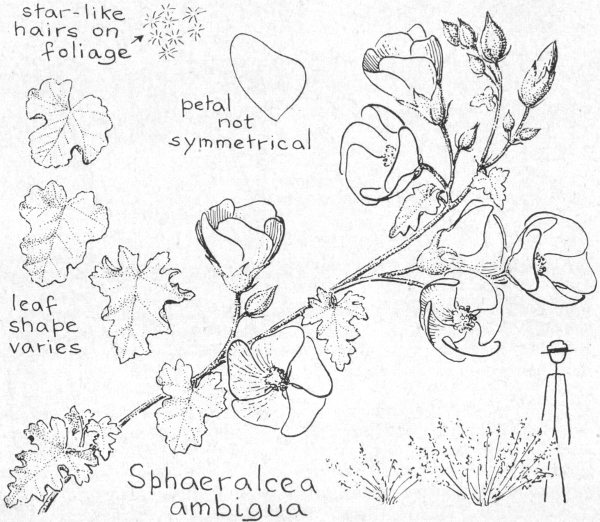
- Common names: GLOBEMALLOW, APRICOT-MALLOW, SORE-EYE POPPY, DESERTMALLOW
- Arizona and California deserts: (Sphaeralcea ambigua). Peach-pink. February-May.
- Texas-New Mexico deserts: (Sphaeralcea angustifolia). Pink. May-October.
- Mallow family. Size: 1 to 5 feet tall, often clustered.
Common throughout all of the Southwest, the Mallows range in size
from small herbs 5 or 6 inches high to coarse, straggling, woody-stemmed
plants with stems 4 or 5 feet long. Their flowers range in color from white
and pale yellow to lavender, apricot, and red. Some species, including
Ambigua, grow in large clumps with as many as 100 stems from a single
root. The smaller species often cover the desert floor in early spring with
a dense growth of flowers giving an apricot tinge to the landscape. Several
species flower in spring and again after the summer rains.
A local belief that hairs of the plant are irritating to the eyes has given
the name “Sore-eye Poppies,” an appellation carried out in the Mexican
name Mal-de-ojos. In Lower California, Mallows are called Plantas Muy
Malas, meaning very bad plants. In contrast, the Pima Indian name is
translated to mean “a cure for sore eyes.”
PINK
69
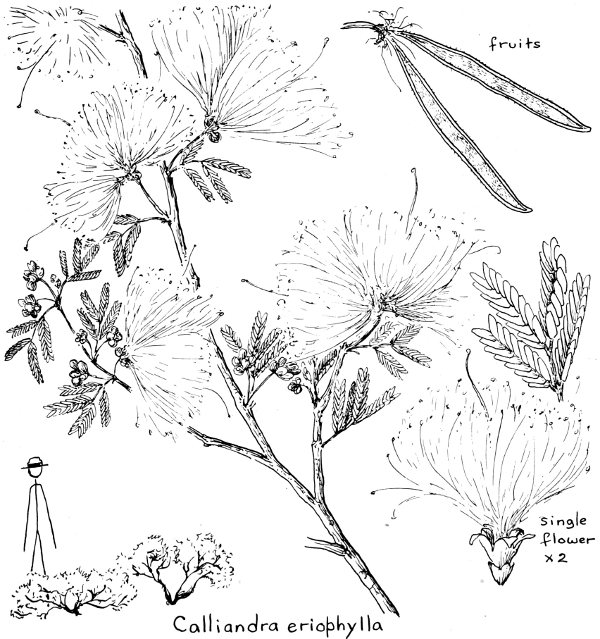
- Common names: FAIRYDUSTER, FALSE-MESQUITE, (MESQUITILLA), HAIRY-LEAVED CALLIANDRA
- Arizona, California and Texas deserts: (Calliandra eriophylla). Pink. February-May.
- Pea family. Size: From a few inches up to 3½ feet tall.
This straggling, perennial shrub with fine, Mimosa-type leaves is common
over much of the desert, lining banks of arroyos or dotting open
hillsides. It is particularly conspicuous when in flower because of the
spectacular tassel-like blossoms which are white and scarlet, or generally
pink in appearance. The small leaves are nutritious and are highly palatable
to deer and to livestock. The petite Fairyduster adds much to the
color and springtime atmosphere of the desert. It is particularly noticeable
along the base of the Tanque Verde hills in Saguaro National Monument.
PINK
70
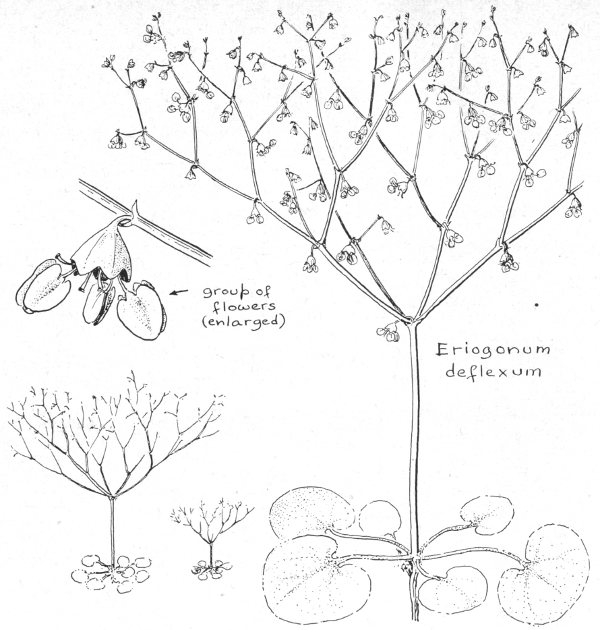
- Common names: SKELETONWEED, DESERT BUCKWHEAT
- Arizona desert: (Eriogonum densum). Pink. May-October.
- California desert: (Eriogonum deflexum). Pink-white. All year.
- Texas desert: (Eriogonum polycladon). Pink. June-November.
- Buckwheat family. Size: 6 inches to 30 inches high.
Eriogonum is a very large genus, many species of which are common,
and contains both annuals and biennials. Although the flowers are small,
they are usually numerous and conspicuous. E. densum is often very
abundant in semi-desert areas, particularly along roadsides, where it is
especially noticeable because it monopolizes the pavement edges for miles.
It is extremely resistant to drought and flourishes when many other
herbaceous plants have dried out completely. Although it bears flowers at
almost any time throughout the year, during the autumn months the
branches are loaded with myriads of pendant, pearly flowers the size of
rice kernels. In winter, the stalks turn maroon in color and are quite
conspicuous.
E. polycladon is often so common along roadsides and desert washes
as to color the landscape with its greyish stems and pink flowers.
E. inflatum always attracts attention because of its swollen stems
which resemble tall, slender bottles.
PINK
71
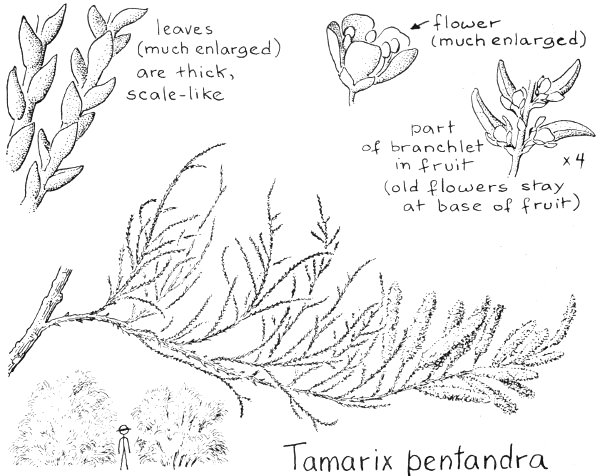
- Common names: SALTCEDAR, TAMARISK
- Arizona, California, and Texas deserts: (Tamarix pentandra). Pink to white. March-August.
- Tamarix family. Size: Shrubs to trees up to 15-20 feet high.
Purists could object to inclusion of the Saltcedar in this booklet
because it is not native. However, due to a number of importations (eight
species being introduced by the Department of Agriculture between 1899
and 1915) and to its ability to spread rapidly under suitable conditions,
Saltcedar is now widespread throughout the Southwest.
It grows as a graceful shrub or small tree with drooping branches covered
with small, scale-like leaves and is abundant in moist locations below
5,000 feet. It prefers a hot climate, low humidity, and saline soils. In
river bottoms, it often forms dense thickets which require immense quantities
of water, hence rob the few desert streams of a high percentage of
their moisture.
Honeybees obtain nectar from the blossoms, which are particularly
noticeable in the spring and early summer, as they completely cover the
branches which appear as light pink, drooping plumes. The thickets are
valuable as wind breaks and in erosion control, and once established, are
very difficult to control and because of the deep shade cast by their dense
growth and the heavy feeding of the shallow roots, they prevent cropping.
The name Tamarisk is often confused with the name of the Larch
or Tamarack tree. There is little similarity except in the name.
The larger Tamarix aphylla is similar in appearance but much larger
and suitable for cultivation as a shade and decorative tree. It is subject to
winterkill, but does not have the bad habit of spreading, characteristic of
T. pentandra.
PINK
72
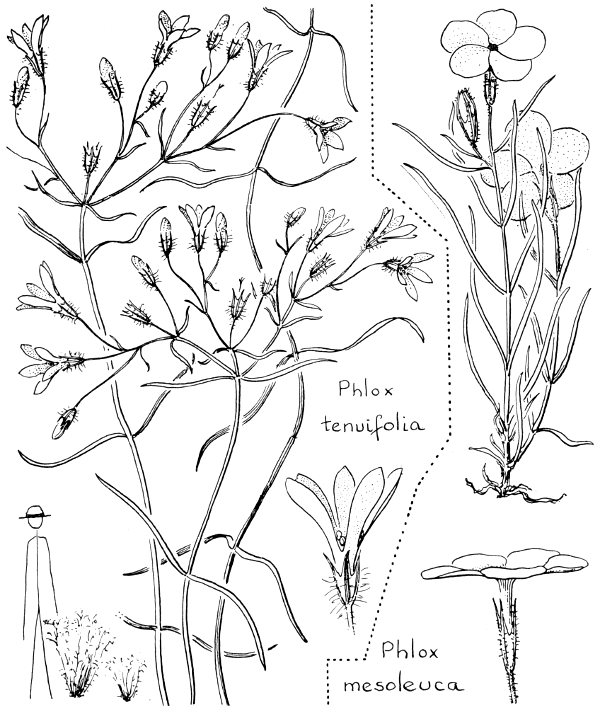
- Common name: DESERT-PHLOX
- Arizona desert: (Phlox tenuifolia). White-lavender. Spring.
- California desert: (Phlox stansburyi). Pinkish-red. May-July.
- Texas desert: (Phlox mesoleuca). Pink-white. June-August.
- Phlox family. Size: Low-growing perennials, in clumps; or shrubby plants in tufts up to 3 feet tall.
Representatives of the Phlox genus are found from the hot desert lowlands
to the mountain tops well above the timberline. Certain species are
limited in their range to the desert areas of the Southwest, and it is in
these that we are interested here. The plants sometimes present a mass
of heavy bloom twice yearly: heaviest in the spring, and again following
the summer rains. Several of the native species have been brought under
cultivation, particularly P. tenuifolia, in desert gardens, as it grows
naturally in a brushy habitat similar to that formed by the shrubs planted
around a house. Other forms grow as low, creeping mats forming fragrant,
colorful floral carpets.
LAVENDER
73
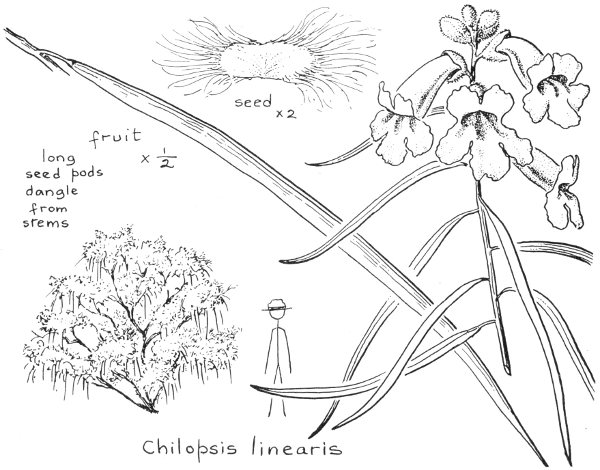
- Common names: DESERTWILLOW, DESERT-CATALPA
- Arizona, California, and Texas deserts: (Chilopsis linearis). Pink-lavender. April-August.
- Bignonia family. Size: Shrubby tree, 6 to 15 feet high.
Although a close relative of the Catalpa, the willow-like foliage of
this small tree has given it the name Desertwillow. A small and inconspicuous
part of the desert vegetation when not in flower, unnoticed
among the heavier growth of trees and shrubs that crowd the banks of
desert washes, the tree’s beautiful orchid-like flowers of white to lavender
mottled with dots and splotches of brown and purple bring exclamations
of delight from persons viewing them for the first time. Because of the
beauty of the tree when in bloom, it is sometimes cultivated as an
ornamental.
Leaves are rarely browsed by livestock, and the durable, black-barked
wood is used for fenceposts. In Mexico, a tea made by steeping the dried
flowers is considered to be of medicinal value. By early autumn, the violet-scented
flowers which appear after summer rains are replaced by the
long, slender seed pods which remain dangling from the branches and
serve to identify the tree long after the flowers are gone.
Although Desertwillows are never found in pure stands, growing
singly and rather infrequently among other trees and shrubs lining desert
washes, the species is quite common below 4,000 feet across the entire
desert from western Texas to southern Nevada, southern California and
southward into Mexico.
LAVENDER
74
- Common names: ORGANPIPE CACTUS, SINITA; (PITAHAYA DULCE)
- Arizona desert: (Lemaireocereus thurberi). Pink lavender. May-June.
- Arizona desert: (Lophocereus schotti). Pink. April-August.
- Cactus family. Size: In clumps, stems up to 15 feet.
Two somewhat similar, columnar cacti occur in the United States
only in Organ Pipe Cactus National Monument and in its immediate
vicinity. Both are fairly common in northwestern Mexico.
These two spectacular desert giants with their clumps of erect
branches are sufficiently similar to be readily confused at first glance.
However, the stems of the Organpipe (L. thurberi) are longer and contain
more but much smaller ridges than do the stems of the Sinita or
“Whisker cactus.” The name “Sinita” (meaning old age) refers to the
long, gray, hair-like spines covering the upper ends of the Sinita stems.
Both species are night-blooming, the flowers, which appear along the
sides and at the tips of the stems, closing soon after sunrise the following
morning. Fruits of the Organpipe are harvested by the Papago Indians.
75
Although these two species of cactus are restricted to a very limited
area, they are sufficiently spectacular and interesting to be considered
worthy of inclusion in this booklet. It was to protect these species,
threatened with extinction in the United States, and other rare and
interesting forms of desert plants and animals, that Organ Pipe Cactus
National Monument was established.
LAVENDER
- Common names: PINCUSHION CACTUS, FISHHOOK CACTUS, CORKSEED CACTUS, NIPPLE CACTUS, BUTTON CACTUS
- Arizona desert: (Mammillaria microcarpa). Lavender. June-July.
- California desert: (Mammillaria tetrancistra). Lavender. June-July.
- Texas-New Mexico deserts: (Mammillaria micromeris). Lavender. Early summer.
- Cactus family. Size: Cucumber-shaped and 3 to 10 inches high.
Unlike blossoms of many of the Cacti, flowers of the little
Mammallarias often last for several days. Blossoms are pink or lavender,
occasionally yellow, while the fruits are finger- or club-shaped and red.
Being small and forming low clumps, or with single pincushion-like
stems, they often escape attention except when glorified with bright, comparatively
large flowers, which often form a crown around the top of the
plant. The long spines are curved at the tips giving the plant the appearance
of being covered with unbarbed fishhooks.
The Pincushion cacti, of which there are a number of species
throughout the Southwest, occur in dry, sandy hills from southern Utah
to western Texas and in southern California and northern Mexico. The
red fruits are bare, without scales, spines, or hairs.
LAVENDER
76
- Common names: GILIA, STARFLOWER
- Arizona desert: (Gilia filifolia). Lavender. April-May.
- California desert: (Gilia latifolia). Pink-lavender. March-April.
- Texas desert: (Gilia longiflora). Blue-lavender. April-October.
- Phlox family. Size: 6 to 24 inches high.
Although the Gilias are not generally well known, they are common,
77
quite widely distributed throughout the Southwest, and their
beauty deserves wider recognition. There are a great many species (of
which early flowering G. inconspicua is perhaps the commonest) at
higher elevations as well as throughout the desert. Many of these are
worthy of cultivation as ornamentals. Desert species, in general, are pale
blue, white, or lavender while those of the higher elevations are pink,
coral, or yellow to scarlet; although this is by no means a hard-and-fast
rule.
Following winters of above-normal precipitation, desert species sometimes
produce such heavy stands that the flowers cover large areas with a
delicate pale blue or lavender carpet. Some species are attractive to
Hummingbirds.
LAVENDER
- Common names: PHACELIA, SCORPIONWEED, WILD-HELIOTROPE
- Arizona desert: (Phacelia crenulata). Violet-purple. February-June.
- California desert: (Phacelia distans). Blue-violet. March-May.
- Texas desert: (Phacelia coerulea). Violet-purple. March-April.
- Waterleaf family. Size: 4 to 16 inches tall.
Although strongly scented, it is not accurate to refer to these annuals
as fragrant, for they are sometimes unpleasant in odor, and occasionally
actually foul-smelling. Some are described as having an onion-like odor.
P. crenulata with its rich, violet-purple flowers is conspicuous across
southern New Mexico, Arizona and California to Lower California. This
species is often called Wild-heliotrope.
The name Scorpionweed comes from the curling habit of the blossoming
flower heads which somewhat resemble the flexed tail of a scorpion
in striking position.
78
- Common names: SQUAW-THORN, RABBIT-THORN, DESERT-THORN, WOLFBERRY, SQUAWBERRY, (TOMATILLO)
- Arizona desert: (Lycium pallidum). Green-lavender. April-June.
- California desert: (Lycium andersoni). Lavender. February-April.
- Texas desert: (Lycium berlanderi). Lavender-cream. March-September.
- Potato family. Size: Thorny shrubs, stiff and brushy, up to 6 feet.
Noticeable in winter because of their off-season greenery and early
flowers which cover the bushes and attract many insects, and attractive
in late spring and summer due to the numerous tomato-colored berries
hanging from their stiff, thorny stems, the Squaw-thorns are widely
distributed throughout the desert.
These plants have contributed much to the subsistence of the Indians,
their insipid, slightly bitter, juicy berries being eaten raw or prepared as
a sauce. These berries are eagerly sought by birds, which also use the stiff
shrubs for cover and for protective roosts at night.
Early spring is the normal blooming season, but some flower again
following summer or early fall rains.
VIOLET
79
- Common names: CENIZA, SENISA, ASHPLANT, WILD-LILAC
- Texas desert: (Leucophyllum frutescens). Lilac-violet. August-October. (Leucophyllum texanum). Violet-purple. August-October.
- Figwort family. Size: Bushy shrub, 3 to 4 feet high.
In southern Texas, thick patches of this shrub are sometimes found,
although they commonly occur singly or a few together, usually on limestone
soils. Since the leaves are a light gray-green, plants appear to be
ashy in color, giving rise to the name “Ceniza,” meaning “ashy.”
Spectacular in Big Bend National Park.
So sensitive is this plant to moisture, that it may burst into blossom
within a few hours after a soaking rain, this phenomenon giving rise to
the local belief that the plant actually blossoms before the rain, thereby
forecasting precipitation; hence the name “Barometerbush.” During
recent years, Ceniza has become one of the popular native shrubs used
in landscaping.
Under normal conditions, plants blossom in September.
VIOLET
80
- Common names: FILEREE OR FILAREE, HERONBILL, (ALFILERIA)
- Arizona and Texas deserts: (Erodium texanum). Pink-violet. February-March.
- California desert. (Erodium cicutarium). Rose-violet. February-March.
- Geranium family. Size: 3 to 12 inches high.
Believed to have been introduced from the Mediterranean countries
at an early date by the Spaniards, Alfileria is now widespread and
extensively naturalized throughout the Southwest. In the desert, it is one
of the common winter annuals and furnishes excellent spring forage
especially following moist winters. The plants remain green for only a
few weeks, but are good forage even after the stems have dried.
Although the blossoms are not large nor sufficiently numerous to make
a colorful display, they are attractive and welcome, as they are among
the first spring flowers to put in an appearance. “Tails” of the fruits are
long and slender, somewhat resembling a Heron’s bill, and upon maturity
twist into a tight spiral when dry. Upon becoming moist, they uncoil,
driving the sharp-tipped seeds into the soil. Seeds are gathered and stored
by Ants which discard the husks and coiled “tails” outside their nests,
thus building up a circular band of chaff around the Ant-hill.
VIOLET
81
- Common names: IRONWOOD, DESERT-IRONWOOD, TESOTA, (PALO-DE-HIERRO)
- Arizona and California deserts: (Olneya tesota). Violet-purple. May-June.
- Pea family. Size: Wide-crowned tree up to 35 feet.
Ironwood is one of the desert’s most beautiful trees, being particularly
colorful when the new, dark-green leaves and violet, wisteria-like flowers
give it a lavender glow in late May or early June. Since the tree survives
only in warm locations, it has for years served as a guide to citrus
growers in selecting sites for orange, lemon, or grapefruit plantings.
Foliage of the Ironwood is dense and evergreen, and the wood is very
heavy and so hard that it cannot be worked with ordinary tools. When
thoroughly dry, it makes high-quality firewood, and as a result it has
been cut and removed over much of the desert, hence mature trees are
becoming relatively scarce. Indians used the wood for arrow points and
as tool handles.
Ironwood trees grow along desert washes, often in company with
Mesquite and Paloverde. Blossoms are much more numerous in some years
than in others. Although the trees, when in bloom, make a spectacular
showing, they are very difficult to capture on color film, and photographs
that do them justice are rare. Seeds, which mature late in the summer,
are roasted and eaten by desert Indians who prize them for their peanut-like
flavor. They are eaten also by various desert animals.
In Organ Pipe Cactus National Monument and in some other parts
of the desert, Ironwood trees have become heavily infested with Mistletoe
which stunts or kills the branches and produces grotesque, tumor-like
swellings.
VIOLET
82
- Common names: ASTER, DESERT ASTER, MOHAVE-ASTER, TANSY ASTER
- Arizona desert: (Aster tephrodes). Amethyst blue. April-October.
- California desert: (Aster abatus). Violet to lavender. March-May.
- Texas desert: (Aster tanacetifolius). Bright violet. June-October.
- Sunflower family. Size: Few inches to 2½ feet tall.
Since the Aster is one of the most widespread and
best-known of the flowers, it is usually easily recognized.
There are many species, principally perennials, ranging
from low-growing, single-stemmed plants, sprawling,
many-stemmed plants with large flowers, to tall bushes.
Desert species are found on dry, rocky hillsides and
along roadsides and on waste ground.
Aster tanacetifolius leaf shapes
The Aster is by no means restricted to the desert.
Over much of the United States they are considered as
fall bloomers, but many species blossom in the spring
while others are at their floral best in midsummer.
VIOLET
83
- Common names: PENTSTEMON, BEARDTONGUE
- Arizona desert: (Pentstemon pseudospectabilis). Rose-purple. April-July.
- California desert. (Pentstemon thurberi). Blue-purple. April-June.
- Texas desert: (Pentstemon fendleri). Blue-purple. April-June.
- Figwort family. Size: Perennial herbs from a few inches high to 3 feet or more tall.
Widespread through the Southwest at nearly all elevations, the
Penstemons are conspicuous herbs or small shrubs with showy flowers that
attract attention and admiration when they are in bloom in the spring
and early summer on the desert.
PURPLE
84
- Common names: LUPINE, BLUEBONNET
- Arizona desert: (Lupinus sparsiflorus). Violet-purple. January-May.
- California desert: (Lupinus odoratus). Royal purple. April-May.
- Texas desert: (Lupinus havardi). Blue-purple. March-April.
- Pea family. Size: Bushy, and up to 2 or 2½ feet tall.
Lupines are among the old dependables of spring display flowers of
the desert, usually mingling with other blossoming herbs to create the
bright color pattern for which the desert is famous in early spring, but
occasionally growing in pure stands. Ranging in color from pale pink to
deep purple, the Lupines are usually considered as blue flowers.
The name “Lupine” comes from the Latin word meaning wolf and
was applied to these plants because they were believed to rob the soil of
its fertility. Actually, they prefer the poorer, sandy soils and, by fixing in
the soil nitrogen that they, in common with other plants of the pea family,
are able to obtain from the air, they actually improve the land on which
they grow.
Perhaps the best known display of Lupines takes place each spring in
85
Texas. Here the “Bluebonnet” (L. texensis and L. subcarnosus) has been
named the state flower of Texas, and the annual spring display attracts
thousands of people to the areas of heavy bloom. The majority of Lupines
have handsome flowers, some species are fragrant, and several species are
cultivated as ornamentals. The seeds of a few species contain alkaloids
which are poisonous to livestock, especially sheep.
PURPLE
- Common names: BROOMRAPE, BURROWED STRANGLER, CANCER-ROOT
- Arizona, California, and Texas deserts: (Orobanche ludoviciana). Brownish-purple. March-July.
- Broomrape family. Size: 4 to 15 inches tall.
This root parasite, although not common, is sufficiently strange and
striking in appearance to arrest attention. Its purple to yellowish-brown,
leafless flower stalks somewhat resembling coarse shoots of asparagus rise
above the desert soil, usually in open, sandy locations.
Broomrape, of which there are several species, is found throughout the
Southwest from southern Utah and Nevada to Texas, California, and
Mexico.
The plant is parasitic on the roots of a number of different plants, but
the desert species usually parasitize Burrobush, Bur-sage, and other composites.
Flowers are small, purple with brown and white markings, and
monopolize the plant stalk in the absence of foliage.
Underground parts of the plant were eaten by Southwestern Indians.
The name “Cancer-root” refers to the reported efficacy of treatment in
applying the stems of the plant to ulcers.
PURPLE
86
- Common names: MILKVETCH, LOCOWEED, RATTLEWEED, WOOLLY-LOCO
- Arizona and California deserts: (Astragalus nuttalianus). White-purple. February-May.
- Texas deserts: (Astragalus mollissimus). Purple. April-May.
- Pea family. Size: 4 to 12 inches high.
A very large genus of plants, with 78 species recorded in Arizona
alone, Astragalus ranges from the driest, hottest parts of the desert to
high mountain peaks and the far north. A. nuttalianus is the commonest
of the desert species and is found on dry plains, mesas, and slopes below
4,000 feet from Arkansas and Texas westward to California and south
into Mexico.
Some of the species, of which Mollisimus (Wooly-loco) is one, contain
a poisonous constituent causing the well-known and often fatal loco
disease of livestock, particularly horses. (Loco is a Spanish word meaning
“crazy.”) Other species which prefer soils rich in selenium take up enough
of that toxic mineral to make them poisonous to livestock, especially sheep.
Nearly all of the species are colorful and spectacular when in blossom,
and some of them have a rank, disagreeable odor.
PURPLE
87
- Common names: PURPLE NIGHTSHADE, GROUNDCHERRY, WILD POTATO, (TROMPILLO), HORSENETTLE
- Arizona and California deserts: (Solanum xanti). Purple. April-August.
- Texas desert: (Solanum elaeagnifolium). Purple-violet. May-September.
- Potato family. Size: Up to 3 feet.
Quite showy when in flower, these common roadside plants attract
considerable attention during the late spring and summer. Some species
become troublesome in cultivated fields and are difficult to eradicate.
An alkaloid, solanin, reported as present in the leaves and unripe fruits
of several species, renders them poisonous. Pima Indians add the crushed
berries of S. elaeagnofolium to milk in making cheese.
The yellow-flowered S. rostratum is heavily covered with spines,
including both stems and fruit, giving it the name of Buffalobur. This
species is said to be the original host of the now widespread pest, the
Colorado Potato Beetle.
PURPLE
88
- Common names: WILD-HELIOTROPE, QUAILPLANT, CHINESE-PUSLEY
- Arizona, California and Texas deserts: (Heliotropium curassavicum). Purple. March-April.
- Borage family. Size: Spreading, weak stems up to 18 inches.
Widely distributed on salty and alkaline soils throughout the warmer
parts of the Western Hemisphere, there are several species and varieties
of Wild-heliotrope. The flowers, which are almost white, shading to a
pale purple in the corolla throat, open as the spike uncoils, perfuming the
desert air with their fragrance. The name “Pusley” which is applied to
this plant in some localities is possibly a corruption of “Purslane.”
Pima Indians are reported to powder the dried roots of these plants,
applying the dust to wounds or sores. The name “Wild-heliotrope” is also
applied to another desert flower, Phacelia crenulata (which see), causing
no little confusion.
PURPLE
89
- Common names: ARROWWEED, MARSH-FLEABANE
- Arizona, California, and Texas deserts: (Pluchea sericea). Roseate purple. Spring.
- Sunflower family. Size: Perennial, 3 to 10 feet tall.
Seldom found above 3,000 feet elevation, the rank-smelling Arrowweed
forms dense, willow-like thickets in stream beds and in moist, saline
soils. It is common in moist locations from Texas to southern Utah and
south into California and Mexico; usually in pure, dense stands.
The green foliage gives off an agreeable odor, but when the plant dries
this becomes rank and unpleasant, clinging to the plant long after it has
been cut. This odor is often a characteristic of native dwellings where
Arrowweed has been used as a ceiling mat above the rafters.
Arrowweed is browsed by deer, and sometimes by horses and cattle.
The straight stems were used by Indians in making arrowshafts, and are
still important as a construction material in the walls and roofs of mud
huts. The stems are used, also, by desert Indians in basketmaking, and
in fabricating storage bins and animal cages. From the foliage of the
stem tips, Pima Indians brewed a tea which they used as an eye wash.
The flowers are reported to furnish considerable nectar gathered by
Honeybees. The blossoms are inconspicuous and develop into tawny-tufted
seed-heads.
PURPLE
90
- Common name: MONKEYFLOWER
- Arizona and California deserts: (Mimulus bigelovi). Red-purple. February-April.
- Texas desert: (Mimulus glabratus). Yellow. June.
- Figwort family. Size: Branching, creeping annual up to 8 inches.
Disproportionately large flowers for the size of the low-growing,
small-leafed plant make it particularly conspicuous in the open, sandy
locations where it blossoms in the springtime.
Although the Monkeyflower is usually thought of as moisture-loving,
there are a number of desert species. The flowers are quite easy to recognize,
as they closely resemble the Monkeyflowers which grow in the
moist places surrounding seeps and springs, and they also are somewhat
similar in appearance to their close relatives the Snapdragons and
Pentstemons.
The desert species are well worthy of consideration for cultivation
as garden ornamentals.
PURPLE
91
- Common names: PURPLEMAT, PURPLE ROLL-LEAF
- Arizona, California and Texas deserts: (Nama demissum). Red-purple. March-May.
- Waterleaf family. Size: Tiny plant, an inch or so high.
Although the plants are very small, they grow close together and the
blossoms are often quite large in comparison. The reddish-purple color
of the flowers stands out in sharp contrast to the green of spring vegetation
so that a widespread growth of the plants forms patches or mats
of colorful desert carpeting.
Masses of the plants are usually found on open flats, often
among Creosotebush, and on either clay or sandy soils. In dry
years, growth is restricted and a tiny plant may bear but a single
flower, the blossom sometimes almost as large as the rest of the
plant.
PURPLE
92
- Common names: SPIDERLING, WEST INDIAN BOERHAAVIA
- Arizona, California and Texas deserts: (Boerhaavia caribaea). Red-purple. May-September.
- Four-o’clock family. Size: Trailing stems up to 4 feet in length.
A common roadside perennial, Spiderling becomes an annoying
garden weed when it invades open fields and areas of cultivation.
Its trailing stems and sticky foliage interfere with tillage. The
flowers are small but numerous and grow in attractive, colorful
clusters. This species is widely distributed, not only throughout
the deserts of the Southwest, but also in tropical and subtropical
America.
In addition to B. caribaea, other species of Boerhaavia are widespread
throughout areas of the Southwest below 5,500 feet elevations.
The plants usually grow where they are exposed to full sunlight,
although sometimes found in open brushlands, and reach full flower
in late summer and autumn months.
PURPLE
93
- Common names: OWLCLOVER, (ESCOBITA)
- Arizona and California deserts: (Orthocarpus purpurascens). Red-purple. March-May.
- Figwort family. Size: 4 to 8 inches high.
This short, leafy annual ranging in color from rich velvet red to
purple is noticeable even as an individual plant, but, following
winters of above average rainfall, it often grows en masse, covering
portions of the desert floor with a carpet of bright purple; sometimes
in pure stands, often mixed with Goldpoppy, Lupine, and other
spring flowers.
Since Escobita is limited in range to southern and western Arizona,
California, and Lower California at elevations below 3,000 feet, Organ
Pipe Cactus National Monument is well within its range, and in that
area can be seen at its spectacular best.
The California variety has the lower lip of the blossom tipped with
rich yellow.
PURPLE
94
- Common names: CHOLLA, CANE CACTUS, WALKINGSTICK CHOLLA, BUCKHORN CHOLLA
- Arizona desert: (Opuntia spinosior). Red-purple. May-June.
- California desert: (Opuntia acanthocarpa). Yellow-purple. April-May.
- Texas desert: (Opuntia imbricata). Red-purple. May-June.
- Cactus family. Size: Shrubby, from 3 to 8 feet high.
Aside from the true Tree Cholla (Opuntia fulgida), which is the
largest of the branching, cylindrical-jointed cacti and is very common in
restricted portions of the desert in the Tucson-Phoenix area, the species
listed above are the largest, most representative, and most widely spread
of the Chollas (CHOH-yahs).
The bright red to purple flowers of O. spinosior and O. imbricata
make them particularly attractive during the blossoming season, while the
extreme variability, from yellow to red and purple, of the flowers of
O. acanthocarpa make its identification by this means always a matter of
uncertainty. Fruits of spinosior and imbricata are quite large, yellow,
and at a distance may be mistaken for blossoms.
Flowers of O. fulgida are small, pink, and appear in midsummer
followed by fruits which remain on the plant to form long hanging
clusters relished by cattle. A hybrid between spinosior and fulgida is
reported along the Gila River west of Florence, Arizona.
PURPLE
95
- Common names: THISTLE, WAVY THISTLE
- Arizona desert: (Cirsium neomexicanum). Pink-purple. March-September.
- California desert: (Cirsium mohavense). Pink-white. Summer.
- Texas desert: (Cirsium undulatum). Red-purple. October.
- Sunflower family. Size: 2 to 4 feet tall, sometimes taller.
Sometimes called Bullthistles, these biennials or perennials with spiny
stems, prickly leaves, and heavy flower heads ranging in color from white
to purple need no introduction to most people.
The Mohave Thistle is the commonest form found in southern California,
being abundant, sometimes in dense stands, in open gravelly valleys,
on rocky slopes, or about alkaline seeps in the Mohave Desert. Range
of the New Mexico Thistle extends westward to the eastern borders of the
Mohave Desert. Cirsium californica, with white blossoms, occurs in Death
Valley National Monument at elevations between 4,000 and 5,000 feet.
Navajo and Hopi Indians are reported to use the Thistle plant for
medicinal purposes.
PURPLE
96
- Common name: SANDVERBENA
- Arizona and California deserts: (Abronia villosa). Pink-purple. March-April.
- Texas desert: (Abronia angustifolia). Pink-purple. March-July.
- Four-o’clock family. Size: Trailing annual, stems sometimes 2 feet in length.
Sandverbenas are attractive, low-growing herbs with pink-purple
to lavender, fragrant flowers forming clusters or heads which cover
the plants. Desert species are conspicuous in the springtime when they
line roadsides and carpet open, sandy locations, such as dry streambeds,
with a mass of purple. Although they are often found in solid patches,
they frequently intermingle with other spring flowers such as the
Bladderpod producing a gay pattern of color.
Other species are found at higher elevations and are common during
the summer months.
Some of the desert species blossom a second time in September.
PURPLE
97
- Common names: HEDGEHOG CACTUS, STRAWBERRY CACTUS, CALICO CACTUS
- Arizona and California deserts: (Echinocereus engelmanni). Lavender-purple. March-April.
- Texas desert: (Echinocereus fendleri). Pink-purple. May-June.
- Cactus family. Size: 6 to 18 inches high.
Growing in open clumps with stems resembling spine-covered cucumbers
standing on end, the Hedgehog is the first cactus to blossom in the
spring. Flowers vary considerably in color ranging from lavender through
purple to a rich red.
Fruits (called “pitayas” in Texas) are dark mahogany red, juicy, rich
in sugar, and may be eaten like strawberries, hence the name Strawberry
Cactus. They form an important item in the diet of birds and rodents.
Pima Indians consider them a delicacy.
98
A close relative, the Rainbow Cactus (Echinocereus rigidissimus) is
restricted in its distribution to elevations between 4,000 and 6,000 feet.
It is called “Rainbow” Cactus because of alternating bands of red and
white spines encircling the stem and marking growth of different seasons
and years. The blossoms of the Rainbow Cactus are pinkish (yellow in
western Texas) and are large and showy in comparison with the small
size of the single-stemmed plant.
PURPLE
- Common names: DESERT-HYACINTH, PAPAGOLILY, BLUEDICKS, COVENA, GRASSNUTS
- Arizona and California deserts: (Dichelostemma pulchellum). Light blue. February-May.
- Lily family. Size: About 1 foot high.
Very common and abundant in early spring, the pale blue to violet
flowers of this small, delicate perennial Lily are conspicuous on open
slopes and mesas. Found below 5,000 feet from southwestern New Mexico
to California and northward to Oregon, they are widely scattered over the
desert areas of the Southwest. Pima and Papago Indians ate the small
bulbs, as also did the early white settlers who named them Grassnuts.
BLUE
99
- Common name: WILD-MORNINGGLORY
- Arizona desert: (Evolvulus arizonicus). Sky blue. April-October.
- Texas desert: (Evolvulus alsinoides). Azure blue. April-September.
- Convolvulus family. Size: Spreading perennial herbs up to 2 feet.
Although E. arizonicus is considered one of the desert’s most beautiful
wildflowers, members of the genus are by no means limited to the desert.
They are found in sunny locations on desert grasslands, open plains and
dry mesas below 5,000 feet from the Dakotas and Montana to Argentina.
The flowers, although rarely more than ½ inch in diameter, are
bright azure or sky blue, and seem large in comparison with the small
leaves and weak, spreading stems of the plant that bears them.
Although the genus Ipomoea is the true Morningglory, blossoms of
Evolvus are similar in appearance, although flattened, hence are
sometimes called Wild-morningglory.
BLUE
100
- Common names: CHIA, SAGE, DESERT-SAGE
- Arizona desert: (Salvia carnosa). Sky-blue. Spring.
- California desert: (Salvia columbariae). Blue. March-April.
- Texas desert: (Salvia arizonica). Indigo blue. July-September.
- Mint family. Size: Herbs and shrubs up to 3 feet high.
The word “Sage” is derived from the idea that these plants had the
power to make a person wise or sage. Please do not confuse the Desert-sage
with Sagebrush (Artemisia) which does not grow in low-elevation
deserts but which, due to popular writings and “western” movies, is
associated in the public mind with any brushy plant found in the west.
Seeds of the Chia at one time formed a staple article of diet among
southwestern Indians, and are still used by natives in Mexico for food
and for making mucilaginous poultices.
The flowers of several species of Chia are very ornamental and the
plants are quite common, usually in sandy soil.
BLUE
101
- Common names: LARKSPUR, WILD-DELPHINIUM
- Arizona desert: (Delphinium scaposum). Royal blue. March-May.
- California desert: (Delphinium parishi) Sky blue. Spring.
- Texas desert: (Delphinium carolinianum). Blue. Spring.
- Crowfoot family. Size: Up to 2 feet in height.
Desert Larkspurs are low-growing, spring or early summer-flowering
in habit, often occurring in colonies, and frequently intermingle with
other spring flowers thereby adding their blue to the colorful tapestry of
ground cover. They are readily recognized because of their resemblance
to the cultivated varieties called Delphiniums, and because of the tubular
extension or “spur.” D. amabile is the most drought-resistant of all southwestern
species and may blossom in the desert as early as February.
Because they contain delphinine and other toxic alkaloids, Larkspurs
are poisonous to livestock, particularly sheep. On the desert, the plants
are small and bear few but beautiful blossoms. They prefer open,
gravelly soil.
It is reported that the Hopi Indians grind Larkspur blossoms with
corn to produce blue meal.
BLUE
102
- Common names: SMOKETREE, INDIGOBUSH, PEABUSH
- Arizona and California deserts: (Dalea spinosa). Blue-violet. April-June.
- Texas deserts: (Dalea formosa). Purple. March-June.
- Pea family. Size: Up to 10 or 12 feet tall.
Famous, although not common, throughout the frostless areas of the
desert, the Smoketree, because of its gray-green, leafless, plume-like
growth resembles at a distance a gray cloud of smoke hovering over a
desert campfire. When in flower, in May or June, it is one of the handsomest
of desert shrubs. It is always found in the bed of a sandy wash
where it obtains moisture from runoff following summer showers or
winter rains.
In California, it occurs in portions of both the Mohave and the
Colorado Deserts, and in Arizona is restricted to the western part of the
state. It is fairly abundant near Quitobaquito in the southwestern corner
of Organ Pipe Cactus National Monument.
Other species of Indigobush, of which there are many, are less famous
than the Smoketree, but all have purple or indigo flowers and most of
them are beautiful and noticeable when in blossom. Indians used an
extract from the twigs for dyeing basket material and ate the roots of
D. terminalis.
BLUE
103
- Common names: WILD-RHUBARB, DOCK, SORREL, CANAIGRE
- Arizona and California deserts: (Rumex hymenosepalus). Pink-green. March-April.
- Texas desert: (Rumex mexicanus). Pink-green. Summer.
- Buckwheat family. Size: Coarse perennial up to 2 feet tall.
Sturdy, conspicuous flower and seed heads together with the large
leaves of these coarse, roadside plants, although hardly to be considered
as beautiful, attract considerable attention and arouse the curiosity of
the observer. Some species are garden weeds introduced from Europe. In
the desert, the large, coarse leaves and pinkish flower stalks make quite
a showing in sandy washes and along the roadsides as early as March
and April. The plant is being considered as a source of tannin (from its
tubers) to replace that formerly obtained from Chestnuts.
GREEN
104
- Common names: GOATNUT, DEERNUT, (JOJOBA), WILD-HAZEL, COFFEEBERRY
- Arizona and California deserts: (Simmondsia chinensis). Green-yellow. December-July.
- Box family. Size: Shrub, 2 to 5 feet high.
Jojoba (hoh-HOH-bah) is another of the desert plants which is
noticeable, not because of its flowers, but due to its leathery, gray-green
foliage which persists throughout the year. These shrubs are numerous
at elevations between 1,000 and 4,300 feet in the lower levels of desert
mountain ranges, particularly on the alluvial fans at the mouths of
canyons.
The acorn-like nuts, which taste something like filberts, but are bitter
because of their tannin content, were long an important item of food
among the Indians and the early settlers. The thickly set, evergreen leaves
are browsed by Deer and other animals, and the nuts are gathered by
Ground Squirrels.
The nuts contain an edible oil (actually a liquid wax) which has
some medicinal value and is used in small quantities in the manufacture
of hair oil. Attempts to raise the nut in commercial quantities have not
proved successful. On occasions the nuts have been roasted and used as
a substitute for coffee.
GREEN
105
- Common names: DESERT MILKWEED, BEDSTRAW MILKWEED, (AJAMENTE)
- Arizona desert: (Asclepias subulata). Green-yellow. April-October.
- California desert: (Asclepias erosa). Green-white. September-October.
- Texas desert: (Asclepias texana). Green-white. Autumn.
- Milkweed family. Size: Perennials, up to 5 feet.
Readily recognizable because of their milky sap and the pods filled
106
with silky-winged seeds, the Milkweeds are generally considered as poisonous
to livestock, although rarely eaten. Appreciable quantities of rubber
are found in the sap of some species.
GREEN
- Common names: ALLTHORN, CROWN-OF-THORNS, CRUCIFIXION-THORN, (CORONA-DE-CRISTO)
- Arizona desert: (Koeberlinia spinosa). Greenish. May-June.
- California desert: (Holacantha emoryi). Yellow-green. June-July.
- Texas desert: (Koeberlinia spinosa). Greenish. May-June.
- Koeberlinia is Junco family.
- Holacantha is Simaruba family. Size: From 2 to 10 feet high.
Two intricately branched, thorny shrubs with green bark and leaves
reduced to small scales and otherwise resembling each other are both
popularly known by the names of Crown-of-thorns and Crucifixion-thorn,
although they are not closely related botanically.
Flowers of both are small and inconspicuous, although when the
bushes are in full bloom, they are quite noticeable. Even so, it is the
unusual and eye-arresting appearance of these shrubs which appear as
leafless masses of robust thorns, making them a conspicuous feature of the
desert and arousing the interest and curiosity of observers.
107
In some locations these shrubs are sufficiently abundant to form
thickets which repel livestock. Fruits of H. emoryi remain on the plant
for years, and it is usually possible to identify each season’s fruit clusters
by the degree of weathering. These masses of brown to black fruits are
very noticeable and are often mistaken for parasitic growths or the results
of a disease. A somewhat similar shrub, sometimes attaining tree size and
superficially resembling the Paloverde (see p. 36), is the Mohave-thorn
(Canotia holocantha). It is found at elevations between 2,500 and 4,500
feet, over much of southern and western Arizona and northern Sonora,
and blossoms from May to August.
- Common names: BUR-SAGE, BURROWEED, BURROBUSH
- Arizona desert: (Franseria deltoidea). Greenish. December-April.
- California desert: (Franseria dumosa). Greenish. April-November.
- Sunflower family. Size: Up to 3 feet high.
Noticeable because of its ashy foliage, Bur-sage is a low, rounded,
white-barked shrub, the several species of which are very common on the
dry plains and mesas up to 3,000 feet. The flowers are small, without
petals, and colorless inasmuch as they are wind-pollenated and do not
need to attract insects.
It is classed by A. A. Nichol as one of the major plants of the Paloverde-Bur-sage-Cacti
plant association, one of the three plant communities
of the Sonoran Desert.
Bur-sage is one of the favorite foods of burros and sheep, and is said
to be preferred also by horses.
GREEN
108
- Common names: INKWEED, SEEPWEED, IODINEBUSH, (QUELITE-SALADO)
- Arizona and Texas deserts: (Suaeda suffrutescens). Greenish. March-July.
- California desert: (Suaeda torreyana). Greenish. July-September.
- Goosefoot family. Size: Up to 6 feet tall, and branching.
Seepweed, which is usually an indicator of alkaline soil, is browsed to
some extent by cattle when other feed is scarce. The young plants are
used for greens by the Pimas and other desert Indians, sometimes eaten
with cactus fruits. Pinole was made by roasting the seeds. Coahuila Indians
extracted from the plants a black dye which they used in art work.
Flowers of the Seepweed are small, greenish, and without petals.
Since the pollen is carried by the wind, color to attract insects to the
flowers is not necessary. Because of its tolerance for somewhat salty or
alkaline soils, Seepweed thrives along the margins of dry lakes and on salt
flats where moisture is near the surface. On the desert of southern California
it is often associated with Mesquite and Quailbrush, the sooty-green
to brown plants standing out in sharp contrast.
Because it is so common in moist locations throughout the Southwest,
and sufficiently unusual in appearance to arouse curiosity as to its identity,
Seepweed is included in this publication regardless of the fact that its
flowers are small and inconspicuous.
GREEN
109