We live in a mighty ocean whose waves are
ever rushing hither and thither, always
according to law, with velocity inconceivable,
almost immeasurable. These waves lave the shore
of that island of space which is our home, travelling
to it from remotest regions, and making known to us
all that we know of what lies outside our small abode.
We call these waves, or rather their effects, by the name
of Light. We recognise in light—
"offspring of Heav'n's first-born
And of th' Eternal co-eternal beam"—
the antecedent of all else that exists in the universe;
or, as Sir John Herschel said, "the superior in point of
rank and conception to all other products or results of
creative power in the physical world. It is light which
alone can give, and does give us, the assurance of a
uniform and all-pervading energy—a mechanism almost
beyond conception, complex, minute, and powerful, by
which that influence, or rather that movement, is propagated.
Our evidence of the existence of gravitation
fails us beyond the region of the double stars, or leaves
at best only a presumption amounting to moral conviction
in its favour. But the argument for a unity of
design and action afforded by light stands unweakened
by distance, and is co-extensive with the universe itself."
What, then, is light? What is that mysterious movement
of some essence pervading all space, whereby,
from remotest depths, news is brought to us, after
journeys lasting many years, though space is traversed
at a rate exceeding more than ten million times the
velocity of the swiftest express train?
Light is in reality the result of undulations in what is
called the ether of space, a perfectly transparent, almost
perfectly elastic medium, occupying not only void space,
but flowing as freely through the densest solids as the
summer breeze flows through the forest trees. The
waves of light cannot in this way pass through solid
or liquid, or even aerial bodies, but either they are
sooner or later brought to rest, or else they are more
or less gradually deflected; just as the waves which
traverse the ocean come to their end, or are deflected,
when they meet the shore or shallows near the shore.
All light, however, has its real origin, not in the
ethereal ocean itself, but in the movements of the
minute particles of which all forms of matter known to
us are composed. A tiny atom, far too small to be perceived
with a microscope, even though one should be
made ten thousand times more powerful than any yet
constructed, when set in rapid vibration, raises minute
waves in the ethereal ocean, just as a small body, vibrating
on the surface of a sheet of water, would generate
waves there. And as the water-waves would travel
radially away from the place of their birth, so do the
light-waves generated by the vibrations of one of the
atoms composing a luminous body radiate forth in all
directions through the ethereal ocean until, encountering
some obstacle, they are sent (reduced in size) in a new
direction.
In some luminous bodies there are atoms vibrating
in many different periods (all very small) so as to
cause light-waves of many different kinds to proceed
from the body. In other cases the atoms all vibrate
at one rate, or at two or three or some definite number
of rates, so that only light-waves of certain kinds
proceed from the body. But in all cases these light-waves
only cause us to see the body when they flow in
through the pupil of the eye, and falling upon the retina
(or the choroid membrane, or whatever part of the eye
it may be which finally receives the waves), convey to
the optic nerve, and thence to the brain, the information
that such and such a body, so coloured, so shaped, so
moving, exists towards that direction from which the
light-waves seem to come. The body so seen, as we call
it, may be the original source of light, or may be a body
on which light has been reflected to us.
It is in this way that we receive information from light-waves.
It will be conceived how minute they must be,
how perfectly they must retain their separate character,
multitudinous though they are, in traversing the ether
(even when that ether is clogged by the gross matter of
our ordinary air), if we remember how through the tiny
eye-pupil we often receive light-waves telling us of all the
details, all the varieties of colour and brightness, all
the movements in a rich landscape.
Even more startling are the thoughts suggested by a
view of the starlit heavens. From hundreds of suns at
once the light-waves which have traversed varying but all
enormous distances pour in upon the small circle of the
eye-pupil, waves of many kinds coming in together from
each sun. The waves which thus reach the eye from one
bright star have been but a few years upon their journey;
all that time they have been traversing an ocean swept
in every part by untold millions of other waves, and yet
they arrive as perfect in order and regularity as rollers
which have traversed a wide sea pour in upon a level
shore. From another star, as bright as the first, they
have been years in travelling; from some among the
fainter stars, hundreds, perhaps thousands of years. Yet
still they flow on, each order of waves in perfect uniformity
as when they first left their parent sun.
But even this is not all. Among the waves which reach
the eye many, nay, most, are so small that ordinary vision
cannot perceive their action. Take, however, a telescope,
and so gather them together as to intensify this action,
and they are rendered perceptible, just as the unnoticed
heaving of ocean becomes a manifest wave-motion when
it reaches a regularly narrowing inlet. Thus, from stars
so remote that their light has required thousands, or,
even in some cases, perhaps, hundreds of thousands
of years in reaching us, the light-waves flow steadily
in upon us. So small are these waves, that the breadth
of from forty to sixty thousand of them would occupy but
a single inch. Through every point in space waves from
all the hundred millions of stars are at all times simultaneously
rushing at the rate of one hundred and eighty-five
thousand miles in every second of time: yet they
travel on altogether undisturbed, and each tells its story
as distinctly as though the ether had conveyed no other
message, and that message but for a short distance.
It would be difficult to say which thought, considered
in its real significance, is more striking,—the thought of
what is done for us by light regarded as a terrestrial phenomenon,
or the thought of what light is doing, and has
done, in presenting to us a view of the starlit heavens.
When the sun rises in splendour above the eastern
horizon, tinting the sky with varied colours, lighting up
the clouds which till then have been but dark patches on
the heavens, bringing out the colours of hill and dale,
rock and river, fields and woods, the heart gladdens at
the spectacle. A pleasing melancholy falls on us as the
light fades away at eventide, tint after tint vanishing,
until at length the gloom of night enshrouds all. The
full splendour of mid-day, the chastened splendour of a
moonlit night, and the glory of the heavens when "all
the stars shine, and the shepherd gladdens in his heart,"
stir the soul in like manner; and it might seem to many
that to analyse these glories, to explain their scientific
meaning, would be to rob the mind of the pleasure it
had before found in such scenes. Many would be disposed
to think that a purer enjoyment is expressed by
Augustine than any student of science could find in the
wonders of light, in those words in which he expresses
his sense of the loveliness of fair forms and brilliant
colours. "For light, queen of the colours," he says,
"bathing all I can look upon, from morning till evening,
let me go where I will, will still keep gliding by me in
unnumbered guises, and soothe me whilst I am busy at
other things, and am thinking nothing of her." But the
sensuous pleasure afforded by light is enhanced, while a
purer and higher enjoyment is superadded, when the real
meaning of the display is understood. As the astronomer
sees in the sun a more glorious object than the sun of
the poet, recognising in imagination not only the visible
splendour of that orb, but the mighty energy with which
it is swaying the motions of a scheme of circling worlds,
the wondrous activities at work throughout its entire
frame, the inconceivable tumult which must prevail in
that seemingly silent globe, so the glories of light, rightly
understood, are far more impressive than as they appeal
simply to the senses.
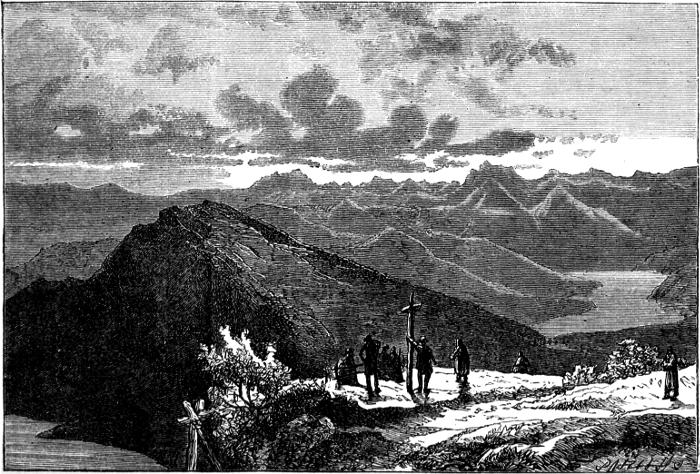
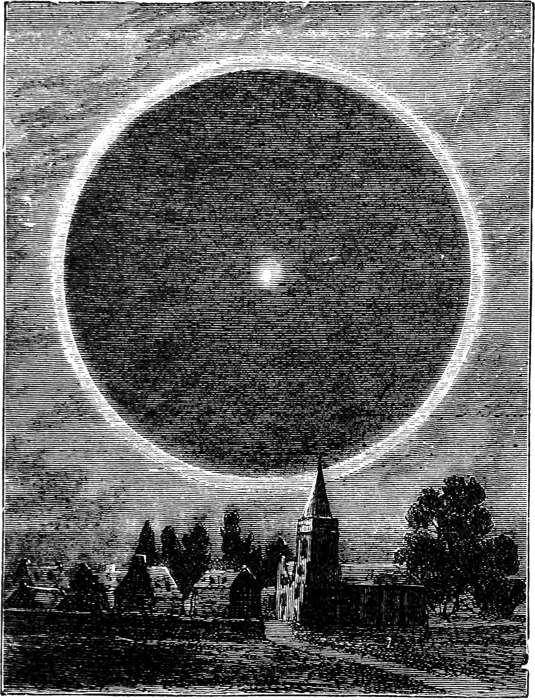
Fig. 1.—Sunrise on the Righi.
Consider, for instance, the real meaning of sunrise.
The orb seemingly rising above the horizon, but, in
reality, at rest, is the source of all the glory which is
spreading over the fair face of earth. The atoms of that
remote body, vibrating with intensest activity, send forth
in all directions ethereal waves, and of these relatively
but a very few, about one in two thousand millions, fall
upon our earth, producing the phenomena of sunlight.
They have been little more than eight minutes on the
road, but in that short time they have traversed more
than 90,000,000 of miles. Were they to fall directly
upon our earth, we should see few of the splendours
which attend the uprising of the sun. The deep air
clothing our earth receives the onward rushing waves,
and reflects them in all directions. To use Biot's simile,
"The air is a sort of brilliant veil, which multiplies and
diversifies the sunlight by an infinity of repercussions."
Nor is the wonder of the scene, or its effect in filling the
mind with solemn and poetic thoughts, diminished—on
the contrary, it is enhanced—by the recollection
that the gradually growing glory of day is brought about
by the slow turning of the mighty earth,—
"that spinning sleeps
On her soft axle, as she paces even,
And bears us soft with the smooth air along."
But if this is true of a scene of terrestrial splendour,
how much more fully may it be said of the glories of the
heavens? No poet, if unaware of the real meaning of
modern discoveries respecting the celestial bodies, can
be moved by the starlit depths as the astronomer is, at
least the astronomer whose study of science is not limited
to mere observation and calculation. Hundreds of
bright points of light sparkling, and sometimes varying
strangely in colour, form, no doubt, a beautiful scene;
but the scene is not less beautiful, and certainly it is far
more impressive, when we remember that every one of
these points of light is a sun, mighty in attractive energy
like ours, its whole surface glowing with fiery heat, and
every particle of its substance constantly in motion, if
not always in the fierce rush of cosmic hurricanes, yet
with the ceaseless vibrations which generate the ethereal
light-waves telling us of the star's existence.
There is one strange thought connected with the
motion of light-waves through the ether of space which
has not, I think, received the attention it deserves.
Every one knows that when we look at the heavens we
do not see the celestial bodies where they are, but where
they were, and again, not where they were at any one
moment of time, but some where they were a short time
ago, others where they were very long ago. But it is
not so generally known, or remembered by those who do
know it, that if light were not so active as it is the result
would be that utterly incorrect pictures of the celestial
depths would continually be presented to us. As matters
actually are no orb in space can appear very far from its
true place. We see the sun, for instance, at any moment,
not where he is, but where he was (or rather towards the
direction in which he lay) about eight minutes before.
But as the real velocity of the earth, and therefore the
apparent velocity of the sun, amounts only to about
eighteen miles per second, the sun is only thrown about
9000 miles out of his true position, which is but about
the ninetieth part of his diameter: so that we see the sun
very nearly in his right place. Now it might seem that
a star whose light takes, say, twenty years in reaching us,
must be seen very far from its true place, supposing the
star to be travelling along very quickly; and, in one
sense, this is true. If such a star is moving at the rate
of fifty miles per second, athwart the line of sight, it
will be out of place by so considerable a distance as
315,000,000,000 of miles. Yet the star will appear very
nearly in its true position, simply because, at the star's
enormous distance from us, even the great distance just
named is reduced to a very small apparent amount.
Such a star would, in fact, be displaced by only about
the thirtieth part of the sun's or moon's apparent diameters,
or by about a fifteenth part of the distance separating
the middle star of the Great Bear's tail from its
small companion, sometimes called Jack by the Middle
Horse. Thus the stellar heavens present very truly to us
the positions of the stars; for such athwart motion as I
have just imagined would be very much larger than the
motion of far the greater number of the stars. But we
only thus see the heavens truly pictured because of the
enormous velocity with which light travels. If light
swept along only at the rate of a hundred miles in a
second (a velocity still far beyond our powers of conception),
there would be no believing what we should see,
for every star, and our own sun, and all the planets, and
even our own companion planet, the moon, would be
thrown in appearance very far from their true positions.
If they were all shifted in position by the same amount
and in the same direction the picture would still be true,
in a sense, just as we see a true picture of an object at
the bottom of a clear lake, though the picture is displaced
by the refractive action of the water on the
rays of light. But, in the imagined case, the sun,
and moon, and planets, and stars would be shifted
by different amounts and in different ways, simply
because they are moving at different rates and in
different directions. The scene presented to us would
have been utterly untrue. Astronomy as a science
could probably have had no existence in such a case.
Assuredly it could have had no existence until students
of the heavenly bodies had learned to accept as the
first axiom of their science the doctrine that "Seeing
is not believing."
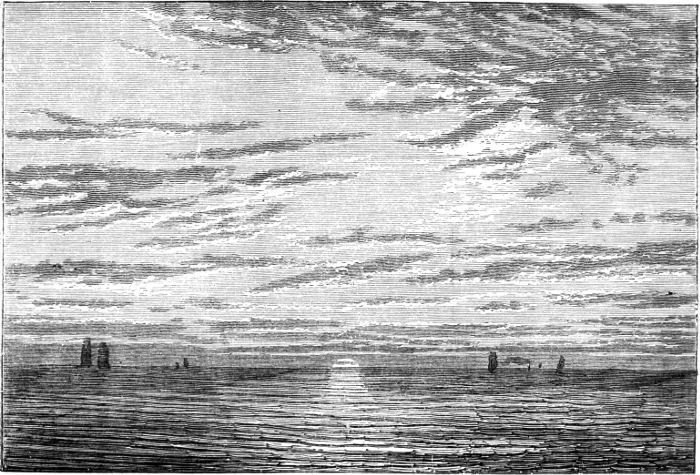
Fig 2.—Sunset at Sea.
A strange thought truly, that so active are the orbs
peopling space, so swiftly do they rush onwards upon
their orbits, that light, carrying its message at a rate
exceeding six thousand times the velocity of the swiftest
express train, would be utterly unable to give a true
account of the position and movements of the celestial
bodies. Fortunately light gives a true record, because
the qualities of the cosmic ether are such that the message
of light is transmitted hundreds of times more
swiftly than the swiftest bodies in the universe travel
onwards upon their orbits around each other or in
space.
II. SPACE
Although astronomy tells us in clearest
words of the vast depths of space which
surround our earth on all sides, we are not
thereby enabled to realize their enormous extension. It
is not merely that the unknown depths beyond the range
of our most powerful telescopes are inconceivable, but
that the parts of space which we can examine are on too
large a scale for us to conceive their real dimensions.
It is hardly going too far to say that our powers of
actual conception are limited to the extent of space
over which the eye seems to range in the daytime. Of
course in the daytime, at least in clear weather, there
is one direction in which the eyesight ranges over a
distance of many millions of miles,—namely, where we
see the sun. But the sense of sight is not cognisant of
that enormous distance, and simply presents the sun to
us as a bright disc in the sky, or perhaps rather nearer to
us than the sky. Even the distance of the sky itself is
under-estimated. A portion of the light we receive from
the sky on a clear day comes from parts of the atmosphere
distant more than thirty or forty miles from us;
but the eye does not recognise the fact. The blue sky
seems a little farther off than the clouds, but not much;
the light clouds of summer seem a little but not much
farther off than the heavier clouds of a winter sky; a
cloud-covered winter sky seems a little farther off than
heavy rain-clouds. The actual varieties of distance
among clouds of various kinds are not much more
clearly discerned than the actual varieties of distance
among the heavenly bodies. The estimate formed of
the distance of a cloud-covered sky overhead probably
amounts to little more than a mile, and it is very doubtful
whether the mind presents the remotest depths of a
blue sky overhead at more than two miles. Towards
the horizon the distance seems greater, and probably on
a cloudy day the sky near the horizon is unconsciously
regarded as at a distance of about five miles, while
blue sky near the horizon may be regarded as lying at a
distance of six or seven miles, the arch of a blue sky
seeming to be far more deeply curved than that of a
cloud-covered sky.
It is to distances such as these that the mind unconsciously
refers the celestial bodies. We know that the
moon is about 2,000 miles in diameter, but the mind
refuses to present her to us as other than a round
disc much smaller than those other objects in sight
which occupy a much larger portion of the field of
vision. The sun cannot be conceived to exceed the
moon enormously in size, seeing that he appears no
larger; and all the multitude of stars are judged by
the sight to be mere bright points of light in reality as
they appear to be.
How, then, can we hope to appreciate the vastness of
space whereof astronomy tells us? To the student of
science attempting to conceive the immensities of whose
existence he is assured, the same lesson might be taught
in parable which the child of St. Augustine's vision
taught the Numidian theologian. As reasonably might
an infant hope to pour the waters of ocean into a hollow,
scooped with his tiny fingers in the sand, as man to
picture in his narrow mind the length and breadth and
depth of the abysses of space in which our earth is lost.
Yet, as a picture of a great mansion may be so drawn
on a small scrap of paper as to convey just ideas of its
proportions, so may the great truths which astronomy
has taught us about the depths of space be so presented
that just conceptions may be formed of the proportions
of at least those parts of the universe which lie within
the range of scientific vision, though it would be hopeless
to attempt to conceive their real dimensions.
Thus, when we learn that a globe as large as our
earth, suspended beside the moon, would seem to have a
diameter exceeding hers nearly four times, so that the
globe would cover a space in the heavens about thirteen
times as large as the moon covers, we form a just conception
of the size of the moon as compared with the earth,
though the mind cannot conceive such a body as the
moon or the earth really is. When, in turn, we are told
that if a globe as large as the earth, but glowing as brightly
as the sun, were set beside the sun, it would look a mere
point of light, we not only learn to picture rightly to ourselves
how largely the sun exceeds the earth, but also
how enormous must be the real distance of the sun.
Another step leads us to a standpoint whence we can
form a correct estimate of the vast distance of the fixed
stars; for we learn that so enormous is the distance of
even the nearest fixed star, that the tremendous space
separating the earth from that star sinks in turn into the
merest point, insomuch that if a globe as bright as the
sun had the earth's orbit as a close fitting girdle, then
this glorious orb (with a diameter of some 184,000,000
of miles) would look very much smaller than such a
globe as our earth would look at the sun's distance—would,
in fact, occupy but about one-fortieth part of the
space in the sky which she, though she would then look
a mere point, would occupy if viewed from that distance.
But there is a way of viewing the immensities of space
which, though not aiding us indeed to conceive them,
enables the mind to picture their proportions better than
any other. The dimensions of the earth's path around
the sun sink into insignificance beside those of the
outermost planets; but these in their turn dwindle into
nothingness beside those of some among the comets.
From the paths of these comets, if only sentient and
reasoning beings could trace out in a comet's company
those mighty orbits, and could have for the duration
of their existence not the brief span of time which
measures the longest human life, but many circuits of
their comet home around the same ruling orb (as
we live during many circuits of our globe around the
sun), the dimensions of the star-depths, which even to
scientific insight are all but immeasurable, would be
directly discernible. Not only would the proportions
of that mighty system be perceived, whose fruits and
blossoms are suns and worlds, but even the gradually
changing arrangement of its parts could be discerned.
Some comets, indeed, as I pointed out in an essay on
comets several months ago (see Expanse of Heaven,
p. 149), do not travel around the sun, but flit from
sun to sun on journeys lasting millions of years, paying
each sun but a single visit. A being inhabiting such
a comet, and having these interstellar journeys as the
years of his existence, so that he could live through
many of them, would have a wonderful insight into the
economy of the stellar system. If his powers of conception
as far exceeded ours as the range of his travels
and the duration of his existence, he would be able to
recognise the proportions of a large part of the stellar
universe as clearly as we recognise the proportions of
the solar system.
But leaving these wonderful wanderers, whose journeys
are as far beyond our powers of conception as the immensity
of the regions of star-strewn space, we may find,
among the comets belonging to the sun's domain, bodies
whose range of travel would give their inhabitants far
clearer views of the architecture of the heavens than
even the profoundest terrestrial astronomer can possibly
obtain.
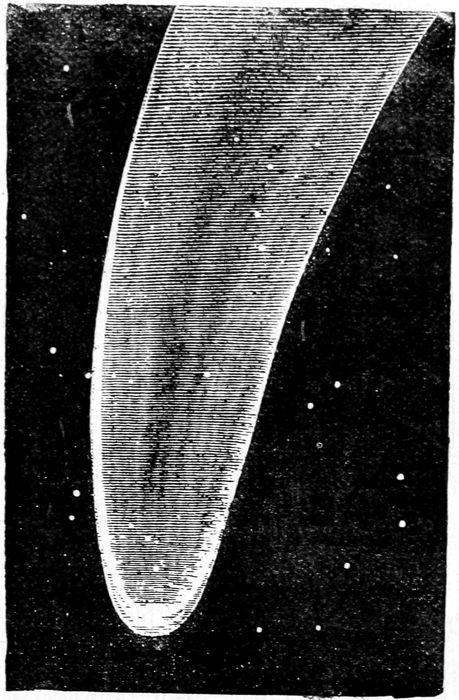
Such a comet as Halley's (fig. 3) for instance, though
one of comparatively limited range in space, yet travels so
far from the sun that, from the extreme part of its path,
it sees the stars displaced nearly twenty times as much
(owing to its own change of position) as they are from
the earth on opposite sides of her comparatively narrow
orbit. And the length of this comet's year, if it indicated
the length of the lives of all creatures travelling
along with it, would suggest a power of patiently watching
the progress of changes lasting not a few of our
years only, but for centuries.
Seventy-five or
seventy-six years elapse
between each return of
this comet to the sun's
neighbourhood, and
one who should have
lived during sixty or
seventy circuits of this
body around its mighty
orbit would have been
able to watch the rush
of stars, with their velocities
of many miles
per second, until visible
displacements had
taken place in their positions.
Fig. 3.—Halley's Comet of 1835.
This, however, is as nothing compared with the
mighty range in space and the enormous period of the
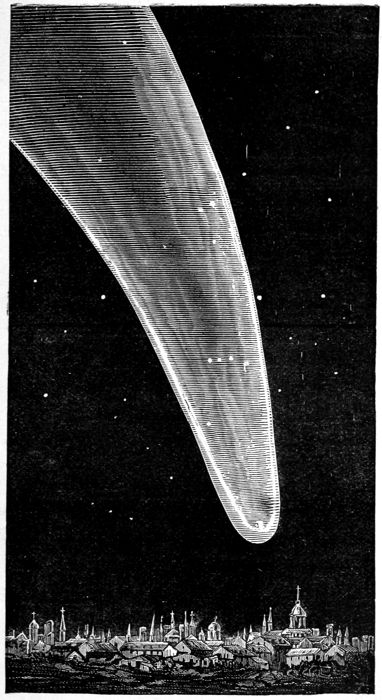
orbit of the great comet of the year 1811 (fig. 4). This
comet is, on the whole, the most remarkable ever known.
It was visible for nearly seventeen months, and though
it did not approach the sun within 100,000,000 miles,
and was therefore not subject to that violence of action
which has caused enormous tails to be thrown out from
comets which have come within a few million miles
of him, or even within less than a quarter of his own
diameter, it flourished forth a tail 120,000,000 of miles
in length. Its orbit has, according to the calculations of
the astronomer Argelander, a space exceeding the earth's
distance from the sun 211 times, and thus surpassing
even the mighty distance of Neptune fully seven times.
It occupies in circuiting this mighty path no less than
3065 of our years (with a possible error either way of
about forty-three years). So that, according to Bible
chronology, this comet's last appearance probably occurred
during the rule of the judge Tola, son of Puah,
son of Dodo, over the children of Israel, though it may
have occurred during the rule of his predecessor Abimelech,
or during that of his successor Jair.[1] During
one half of the enormous interval between that time
and 1811 the comet was rushing outwards into space,
reaching the remotest part of its path somewhere about
the year 278 (A.D.), and from that time to 1811 it was on
its return journey. It is strange to think, however, that
though the remotest part of its path lay 211 times farther
from the sun than the earth's orbit, yet even this mighty
path, requiring more than 3000 years for a single circuit,
cannot be said to have carried the comet into the star-depths.
If the earth were to shift its position by the
same enormous amount the nearest fixed star would have
its apparent position changed only by about an eighth
part of the apparent diameter of the sun or moon, or by
about one-quarter of the distance separating the middle
star of the Bear's tail from its close companion.
Fig. 4.—Comet of 1811.
But this fact of itself is most strikingly suggestive of
the vast distance of the stars. For consider what it
means. Imagine the middle star of the Bear's tail to be
the really nearest of all the stars instead of lying probably
twenty or thirty times farther away. Conceive a comet
belonging to that sun after making its nearest approach
to it to travel away upon an orbit requiring 3000 years for
each circuit. Then (supposing that star equal to our sun
in mass), the comet, though rushing away from its sun
with inconceivable velocity during 1500 years, would, at
the end of that vast period, seem to be no farther away
than one-fourth of the distance separating the sun from its
near companion. Look at the middle star of the Bear's
tail on any clear night, and on its small satellite, remembering
this fact, and the awful immensity of the star
depths are strongly impressed upon the mind. But the
observer must not fail to remember that the star really
is many times more remote than we have here for a
moment supposed, and that such a comet's range of
travel would be proportionately reduced. Moreover,
many among the stars are, doubtless, hundreds, even
thousands, of times still farther away.
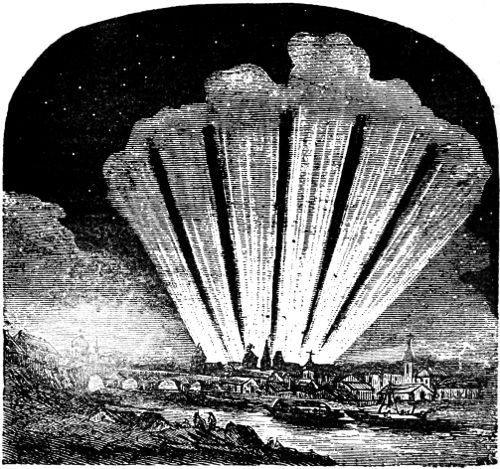
Fig. 5—Six-tailed Comet of 1744.
Let us turn lastly to the amazing comet of the year
1744, pictured, at the time, as shown in fig. 5 (though
probably the drawing is greatly exaggerated). We find
that though it had the longest period of any which
has ever been assigned to a comet as the result of actual
mathematical calculation, yet its range in space would
scarcely suffice to change the position of the stars in
such sort that the aspect of the familiar constellations
would be materially altered. Euler, the eminent mathematician,
calculated for this comet a period of 122,683
years, which would correspond, I find, to a distance of
recession equal to 2469 times the distance of the earth
from the sun, or about eighty times the distance of
Neptune. Yet this is but little more than twelve times
the greatest distance of the comet of 1811. Probably
the actual range of such an orbit from the middle star of
the Bear's tail would be equal in appearance to the range
described above on the supposition that the star is no
farther from us than the nearest known star (Alpha
Centauri). That is, such a comet, if it could be seen
and watched during a period of about 122,000 years,
would seem to recede from the star to a distance equal to
about one-fourth the space separating it from its close
companion, and then to return to the point of nearest
approach to its ruling sun.
Such are the immensities of star-strewn space! The
journey of a comet receding from the sun with inconceivable
velocity during hundreds of thousands of years
carries it but so small a distance from him compared
with the distance of the nearest star as scarcely to change
the appearance of the celestial landscape; and yet the
distances separating the sun from the nearest of his
fellow suns are but as hair-breadths to leagues when
compared with the proportions of the scheme of suns to
which he belongs. These distances, though so mighty
that by comparison with them the inconceivable dimensions
of our own earth sink into utter nothingness, do
not bring us even to the threshold of the outermost
court of that region of space to which the scrutiny of
our telescopes extends. Yet the whole of that region is
but an atom in the infinity of space.
III. OF THE INFINITELY MINUTE.
When I speak of the infinitely minute, I use
the word infinitely not in its absolute sense,
but relatively. Actual infinity of minuteness
is as utterly beyond our conceptions as actual
infinity of vastness. But we may speak of what is very
much less than the least object of which our senses can
make us directly conscious as for us infinitely minute.
Among the greatest wonders science has to deal with are
those relating to bodies and movements thus beyond the
direct ken of our senses. There is a universe within the
universe which our senses reveal to us,—a universe whose
structure is so fine that the minutest particle which the
microscope can reveal to us is, by comparison, like one
of the suns which people our universe compared with
the unseen particles constituting matter.
It is a strange thought that the objects constituting
our universe, so long regarded by man as the only universe,
are in a sense pervaded by the materials of an
utterly different universe,—which yet is as essential to
our very existence as what we commonly call matter.
We cannot live without light and heat, for instance, and
again, light and heat affect matter as we know it; but
they thus exist and affect such matter by means only of
a form of matter unlike any which we can conceive.
It is certain that if absolute vacancy separated our earth
from the sun, even by the narrowest imaginable gap, his
heat and light could never reach us. They could no
more pass that vacant space than the wave-motion of
water can cross a space where water itself is wanting.
It is because of relations such as these that it has been
said, and justly, that matter is the less important half
of the material constituting the physical universe.
Our knowledge of this universe within our universe
has been obtained within comparatively recent years.
Men were unwilling or at least they spoke and thought
as if they were unwilling, to believe that the universe
of matter which they had so long recognised was dependent
on another universe for its chief if not all its
properties. They regarded heat as some sort of substance,
which might, with more delicate means than they
possessed, admit of being dealt with as chemists had
dealt with the gases. The sun was full of this fluid, this
phlogiston, as it was called. Light, in so far as it could
be distinguished from heat, was another fluid; electricity
was another. These were the imponderables, or unweighable
substances of last century's science,—not as
with us, the effects of modes of motion taking place in a
universe which, though material, is yet not made of
matter such as we know, or even such as we can at
present conceive.
This is the greatest of all human scientific marvels,—the
greatest because it includes all others. We know of
a universe which is as infinite in extent, and doubtless in
duration, as our own universe; which pervades all forms
of matter: and yet we know of this universe only indirectly;
by the effects of movements taking place within
it, not by any perception of these movements themselves.
Waves are ever beating upon the shores of our material
universe, and constantly changing the form and condition
of the coast line, but the waves themselves are unseen.
We only know of their existence through the changes
wrought by them.
We speak of the ether of space, and of waves traversing
it, as though the ether were simply some fluid very
much more attenuated than the rarest gas, even in a so-called
vacuum. But in reality, so soon as we attempt to
apply to the movements taking place in such an ether
the mechanical considerations which suffice for the
motions of all ordinary forms of matter, we perceive that
it must of necessity be utterly unlike any kind of substance
known to us. For instance, we find that though
it is like a gas in being elastic, its elasticity is infinite
compared with that of any material gas. Again, it is like
a solid in retaining each of its particles always very near
to a fixed position; but again, no solid we know of
can be compared with it for a moment as respects this
kind of rigidity. It is at once infinitely elastic and
infinitely rigid. We cannot, for example, explain the
phenomena of light unless we suppose the elasticity of
the ether at least 800,000,000,000 times greater than
the elasticity of air at the sea-level; and yet, as Sir J.
Herschel long since pointed out, every phenomenon of
light points strongly to the conclusion that none of the
particles of the ether can be "supposed capable of interchanging
places, or of bodily transfer to any measurable
distance from their own special and assigned localities
in the universe. Again, how are we to explain the continuance
of the ether in its present condition, when we
recognise the fact that a gas of similar elastic power
would expand in all directions with irresistible force,
diminishing correspondingly in density; yet the ether of
space remains always, so far as we can judge, absolutely
unchanged in position. Its characteristics certainly remained
unchanged. Light travels at the same rate now
as it did last year, last century, a million years ago. The
ether, then, that bears it has presumably remained unchanged.
If it were gaseous, and bounded on all sides
by vacuum, it would expand with inconceivable velocity.
To suppose it infinite in extent is to get rid of the difficulty
perfectly; but only by introducing a difficulty far
greater."[2]
A wonderful feature of the infinitely tenuous ether
is, that while its ultimate particles must be inconceivably
more minute than the ultimate atoms of ordinary
matter, the movements taking place in it are transmitted
with enormous velocities. The structure of our
universe is on a grander scale; its least atom may comprise
millions of millions of the largest component
portions of that infinitely tenuous ether. But amid
that ether motions are transmitted with velocities transcending
all but infinitely those which take place among
the particles of matter composing the universe in which
we "live and move and have our being." The planets,
immense aggregates of matter such as we know it,
sweep onwards upon their immense orbits, traversing
many thousands of miles in an hour; but light and
heat sweep along the ether of space, and by virtue of
motions taking place within that ether at the rate of
many tens of thousands of miles per second. The
suns which people space rush onwards with mightier
momentum, but less swiftly than the planets in their
orbits. Comets attain the greatest velocities of all the
bodies that science deals with, rushing sometimes, in
their periastral swoop, with a velocity of hundreds of
miles per second,—though yet in mid-space the comets
of widest orbital range lag slowly enough, insomuch
that some of those which, when nearest our sun, travel
at the rate of two or three hundred miles per second,
move more slowly when very far from him than many
of our rivers. Taking even the swiftest rush of a
comet within the solar domain, we find that light speeds
along five hundred times more quickly,—so that if we
represent the velocity of light by that of an express
train (reducing light's velocity in scale to about
one-10,000,000th part of its real value), the velocity of
the most swiftly-moving comet would be represented
by that of a walk at the rate of one-eighth of a mile
per hour,—a very slow walk indeed.
It is not only amid the depths of space that these
wonderfully swift motions take place in the ethereal
universe. As I have said, that universe pervades ours
throughout its entire extent. The densest of our
solids is as freely traversed by the ether as a forest by
the summer breeze. As the foliage of a thick forest
may prevent the passage of fierce winds, so may a solid
body prevent the passage of light-waves—though all
solid bodies, as we know, do not prevent, and some
scarcely even modify, the passage of light. But substances
which prevent the passage of light are yet
found capable of transmitting ethereal motions of
similar velocity. According to Wheatstone's experiments
electricity travels at the rate of more than
200,000 miles per second along stout copper wire.
Fizeau's experiments gave a lower speed; but they did
not negative Wheatstone's, the conditions not being the
same. Can anything be more wonderful than the
thought of the transmission of electricity with this enormous
velocity? What really happens we do not know.
Perhaps if we were told what really takes place between
and among the particles of the wire, we should
find ourselves utterly unable to conceive it—for, as
we have seen, the properties of the ether, and, therefore,
the processes taking place in the ethereal universe,
are probably unlike any within our experience. But
this we know—a certain condition of the molecules of
the wire is transmitted, by virtue of the ethereal medium
pervading the wire, at a rate so enormous that, if the
wire itself could move at that rate, the force required
to bring its mass to rest would suffice to generate
enough heat to turn many times as much metal into
the vaporous state.
Nay, even as regards the energy of their action on the
matter of our universe, these movements in the ethereal
universe enormously exceed the forces we are accustomed
to regard as most powerful. The effects produced
by gravity, for instance, are almost evanescent
compared with those produced by heat. The sun's
rays poured on a piece of metal for a few minutes produce
motions in every one of the ultimate particles of
the metal. Each particle vibrates with inconceivable
rapidity (referring to the rate at which the vibrations
succeed each other), and with great actual velocity of
motion. Summing up the energy thus pervading the
piece of metal, we find that it incalculably exceeds the
energy represented by the velocity which the sun's
attraction would communicate in the same interval to
that piece of metal, supposed to be entirely under its
influence at the earth's distance from the sun.
Or take another instance. "Think for a moment,"
say the authors of the "Unseen Universe," "of the
fundamental experiments in electricity and magnetism,
known to men for far more than 2000 years,—the lifting
of light bodies in general by rubbed amber and
of iron filings by a loadstone. To produce the same
effect by gravitation-attraction,—at least, if the attracting
body had the moderate dimensions of a hand-specimen
of amber or loadstone,—we should require it
to be of so dense a material as to weigh, at the very
least, 1,000,000,000 pounds, instead of (as usual) a
mere fraction of a pound. Hence it is at once
obvious that the imposing nature of the force of
gravity, as usually compared with other attractive
forces, is due, not to its superior qualitative magnitude,
but to the enormous masses of the bodies which
exercise it."
We may put this illustration in another form. When
we place a powerful magnet near a piece of iron, say at
a distance of one inch, and the magnet lifts that piece
of iron by virtue of its attractive power, a contest has been
waged, if one may so speak, between the attractive
powers of the small magnet and of the mighty earth,
and the magnet has conquered the earth. Now the
magnet has been much nearer than the earth to the
piece of iron, for we know that the earth's attractive
influence has been the same as though the entire mass
of the earth were gathered at its centre, say 4000 miles
from the piece of iron. A distance of 4000 miles contains
4000 times 1760 times thirty-six inches, or, roughly,
250 millions of inches. (This is in truth very near
the true number of inches in the earth's radius, insomuch
that many suppose the inch to have been originally
taken as the 500,000,000th part of the earth's
diameter. A British inch is about one-500,000,000th
part of the polar diameter of the earth.) Since attraction
diminishes as the square of the distances increases, and
vice versâ, it follows that if the earth's entire mass could
act on the piece of iron, at a distance of one inch, the
attraction would exceed that actually exerted by the
earth 250 million times 250 million times, or 62,500
millions of millions of times. In this degree, then, the
earth is at a disadvantage compared with the magnet
as respects distance. And one-62,500,000,000,000,000th
part of the earth's mass would be capable of attracting
the piece of iron as strongly as the earth actually
attracts it, if that fraction of the earth's mass could
exert its pull from a distance of only one inch. But a
62,500,000,000,000,000th part of the earth would be
an enormous mass. It would weigh about 97,500 tons,
or some 218 millions of pounds. Thus a magnet
which a child can lift exerts a greater attraction on
the piece of iron at the same distance than a mass at
least 1000 million times its weight could exert by its
gravity only.
In fact we see from this illustration that gravity,
though it produces effects so tremendous, though it
sways the moon round the earth, the earth and all
the other planets around the sun, and urges the sun
and his fellow-suns through space, is, after all, but a
puny force in itself. A child can lift his own weight
against the attraction of the mighty earth; and by
combined strength as many children as would have a
weight equal to the earth's would easily bear a weight
exceeding the earth's, if the force could be wholly and
directly applied to such work.[3]
The attraction of gravity must, however, be regarded
as only one manifestation of the energies of the infinitely
minute. It is in this sense well worthy of
careful study. I propose to present in a future paper
some of the strange thoughts which are suggested by
the action of this wonderful force, the range of whose
activity is seemingly co-extensive with the material
universe.
IV. THE MYSTERY OF GRAVITY.
The law of gravity, or of the mutual attraction
of masses of matter upon each other,
accounts so perfectly for all the observed
motions of the heavenly bodies, that we are apt to
regard Newton's discovery of the great law as though
it had finally solved the mystery of these motions.
Many accept the verdict given by the poet Pope in the
famous epitaph which he suggested for Newton,—
"Nature and Nature's laws lay hid in night:
God said, Let Newton be! and all was Light."
But Newton, who probably knew as much about his
work as Pope, was of another opinion. Every one
knows how he compared himself to a child who had
picked up a few shells on the shore, while the ocean
of truth lay unexplored before him. He has, however,
spoken definitely of the great discovery which has
rendered his name illustrious, in terms which show that
he did not find that all was light. Among the questions
which he specially would have had answered, amongst
the secrets of nature concealed beneath the ocean of
truth, the mystery of gravity was probably the chief.
When Newton asked of the Ocean of Truth what Mrs.
Hemans later said, and in another sense, of the natural
sea—
"What hidest thou in thy treasure-caves and cells,
Thou hollow-sounding and mysterious main?"
he had in his thoughts the very power which he is
commonly supposed to have explained, but which was
in truth for him, more than for any man that had ever
lived, the mystery of mysteries.
It may be well to consider the very words of the great
philosopher, so far at least as our more diffuse language
can present the concise expressions of the original Latin:
"Hitherto we have explained," he says, "the phenomena
of the heavens and of our sea by the power of
gravity, but have not yet assigned the cause of this
power. This is certain" (we must hearken attentively
here, for when a man like Newton speaks of aught as
certain, we have sure ground to go upon),—"this is certain,
that it must proceed from a cause that penetrates
to the very centres of the sun and planets, without suffering
the least diminution of its forces; that operates, not
according to the quantity of surfaces of particles on
which it acts (as mechanical causes usually do), but
according to the quantity of the solid matter which they
contain, and propagates its virtue on all sides to immense
distances, decreasing always as the squares of the distances.
Gravitation towards the sun is made up of the
gravitations towards the several particles of which the
body of the sun is composed, and in receding from the
sun decreases accurately as the square of the distances
as far as the path of Saturn..., nay, and even to
the remotest parts of the paths of comets.... But
hitherto I have not been able to discover the cause of
those properties of gravity from phenomena; and I
frame no hypotheses:[4] for, whatever is not deduced
from phenomena is to be called an hypothesis; and
hypotheses, whether metaphysical or physical, whether
of occult qualities or mechanical, have no place in experimental
philosophy.... To us it is enough that
gravity does really exist, and act according to the laws
which we have explained, and abundantly serves to
account for all the motions of the celestial bodies and of
our sea."
"Hitherto I have not been able to discover the cause
of the properties of gravity." Such is the simple statement
of the man who discovered those properties.
And now let us inquire a little into this law of gravity,
not with the hope of explaining this great mystery of
nature,—though, for my own part, I believe that the
time is not far distant when the progress of discovery
will enable man to make this approach towards the mystery
of mysteries,—but in order to recognise the real
nature of the mystery, which is a very different thing
from explaining it.
In the first place the study of gravity brings us at once
to the consideration of the infinitely minute,—at least of
what is for us practically infinite in its minuteness. If
we consider the above quotation attentively, we perceive
that this quality of gravity was recognised by Newton.
"It is not the quantity of the surfaces of particles," he
says, "but the quantity of solid matter which they contain,"
that gives to gravity its power. Gravity resides in
the ultimate particles of matter. We cannot conceive of
matter so divided, no matter how finely, that non-gravitating
particles could be separated from gravitating particles.
Without entering into the question what atoms
are, we perceive that these ultimate constituents of
matter must contain, each according to the quantity of
matter in it, the gravitating energy. Only, observe how
incongruously we are compelled to speak. (It is always
so when we deal with the infinite, whether the infinitely
great or the infinitely minute.) We are speaking of
atoms as the ultimate constituents of matter, and yet we
are compelled, in describing their gravitating energy, to
speak of the quantity of matter contained in each atom,—in
other words, we speak in the same breath of an
atom as not admitting of being divided or diminished,
and of its containing matter by quantity, that is, by more
or less. May we not, however, reasonably accept both
views? The reasoning is sound by which science has
proved that, so far as our material universe is concerned,
there is a limit beyond which the division of matter cannot
be supposed to go,—insomuch that Sir W. Thomson
has indicated the actual limits of size of the atoms composing
matter. Yet, passing in imagination beyond the
bounds of our visible universe, and so entering into the
next order of universe below it (in scale of construction),—the
ether of space,—the atoms of our universe may be
infinitely divisible in that universe, may be, in fact, compared
with its particles, as the suns and worlds of our
universe are to our atoms and molecules.
But while gravity thus draws us to the contemplation
of the infinitely minute, it also leads us to the consideration
of what is for us the infinitely vast.
Newton was only able to speak confidently of the
action of gravity at the distance of Saturn, the remotest
planet known in his day. He did, indeed, refer to the
comets as probably obeying, even in the remotest parts
of their paths, the force of the sun's gravity; but he
could not be certain on that point, because in his time
no comet had been proved to travel back to the sun
after receding to the remotest portion of its track. We
now know not only that the sun's attraction extends to
the farthest parts of the solar system, having thus a
domain in space nearly thirty times larger than the
sphere of Saturn, but we perceive that many among the
stars exert a similar force; for around them travel other
stars even as the planets travel around the sun. Thus
we know that gravity is exerted in regions lying hundreds
of thousands of times farther from the sun than Saturn
is. We have, indeed, every reason to believe, not only
that star unto star extendeth this mysterious attractive
influence, but that the least particle in the inmost depths
of sun or world exerts in full force on each particle, even
of suns lying millions of times beyond the range of the
most powerful telescope yet constructed by man, the full
energy corresponding (i.) to the quantity of matter in
itself and such particle, and (ii.) to the distance separating
each from each.
This is amazing enough; but there is something
more perplexing and mysterious in gravity even than
this. Not only does gravity lead us to consider the
infinitely minute in space on the one hand, and the
infinitely vast in space on the other, but also it leads us
to consider the infinitely minute and the infinitely vast in
time also, and this in such a way as to suggest a difficulty
which, as yet, no man has been able to solve.
Light travels, as we know, with a velocity so enormous,
that, by comparison with it, all the velocities we are
familiar with seem absolutely as rest. But gravity acts
so quickly that even the velocity of light becomes as rest
by comparison with the velocity of the propagation of
gravity. Laplace had occasion, now nearly a century
ago, to inquire whether a certain change in the moon's
motion, by which she seemed to be gradually hastening
her motion round the earth, might not be caused by the
circumstance that gravity requires time for its action to
be propagated over great distances. He found that if
the whole of that change had to be explained in this
way, which would be giving to gravity the slowest admissible
rate of transmission, the velocity with which gravity
is propagated would be eight million times greater than
the velocity of light. If, on the other hand, that change
in the moon's motion could be satisfactorily explained in
some other way, then the velocity of gravity must be at
least 16,000,000 times greater than the velocity of light.
He himself soon after discovered what was in his day
regarded as a complete explanation of the hastening of
the moon's motion; and though in our own time Adams
of Cambridge has shewn that only half the hastening
can be accounted for by Laplace's reasoning, the general
explanation of the remaining half is that it is not a real
hastening of the moon, but is only an apparent hastening
caused by the gradual slowing of the earth's rate of
turning on her axis. This makes the day by which we
measure the moon's motion seem longer (very slightly,
however).[5] Supposing, however, half the moon's hastening
were left unexplained, and that the non-instantaneous
transmission of gravity were the only way of accounting
for it, even then it would be certain that gravity is propagated
at a rate exceeding 12,000,000 times the velocity
of light.
Indeed, at present, owing to the more exact observations
available, and the greater range of time over which
they extend, it may safely be said that the rate of propagation
of gravity is far greater than this. It is even held
by some that gravity acts instantaneously over any distance,
however vast.
Fig. 6.
Although I cannot here indicate the exact nature of
the reasoning by which the enormous rapidity of the
action of gravity is inferred, I must briefly indicate the
general argument, that the reader may not suppose the
matter to be merely speculative. Suppose that the action
of gravity were propagated at the same rate as light.
Then the earth would feel the pull of the sun eight
minutes or so after she had been in the place where the
sun began to exert that particular pull. The direction
of the pull then would not be that of the straight line
connecting the earth and sun at the moment when the
pull was felt, but that of the straight line connecting the
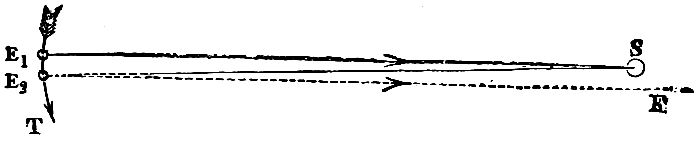
sun and the earth eight minutes or so before. For instance,
when the earth is at E1, fig. 6, the sun at S would
begin to exert a pull in the line E1 S, but the earth would
only feel this pull when she got to E2, her place eight
minutes later, when it would act upon her in the direction
E2 F, parallel to E1 S. Now this pull, E2 F, may be
divided into two parts, one along E2 S, pulling the earth
towards the sun S, the other along E2 T in the earth's
course, hastening her therefore. But the maintenance
by the earth of the same constant track depends entirely
on the action of gravity sunwards. If there is any action
in addition, hastening the earth, then she will not keep
her course,[6] but will travel in a constantly widening path,—or,
in a sort of spiral, very slowly retreating from the
sun, but retreating constantly. The change of distance
would not be measurable in millions of years; but the
increase in the length of the year would, before long, be
observable. Because there is no such increase, astronomers
feel well assured that gravity is not only propagated
more swiftly than light, but many times, even, as
we have seen, many millions of times, more swiftly.
It is then in an infinitely minute time that the action
of gravity traverses all ordinary distances. The earth's
pull on the moon takes less than the 50,000,000th part
of a second in reaching the moon,—and the particles
constituting the mass of the earth act on ourselves, and
on all the objects which lie near the earth's surface, in
far less than the 10,000,000th part even of this utterly
minute time-interval.
Yet age after age has passed during which this
infinitely active force has been at work without diminution,
and age after age will continue to pass without
any change in its activity. For millions of millions
of æons it has lasted and will last, so permanent is
it; while its operation is felt simultaneously at points
millions of millions of star-distances apart. What
infinities of distance has this wonderful attractive
force traversed!
But even these considerations do not present the
greatest of the marvels of gravity. It is wonderful, indeed,
to consider a form of attraction possessed by the
infinitely minute, and exerted over the infinitely vast,
operating in portions of time immeasurably small, and
extending its operations throughout time infinite. But
the mystery of mysteries is not here. The marvel of
marvels is this, that, so far as we can perceive, the force
of gravity is exerted without any material connection
with the objects moved by it. Matter seems to act
where it is not, to use the phraseology of the schools.
Of this "action at a distance," Newton himself said, that
it is inconceivable, that in point of fact it is impossible.
"No man," he said, "who has, in philosophical matters,
a competent faculty of thinking," can "for a moment
believe that a body can act through a vacuum, without
the intervention of anything else by or through which the
force may be conveyed from one body to another." Yet
this is precisely what gravity seems to do. The ether
occupies, indeed, all space; but there is nothing at
present known to us by which we can understand how
the ether can transmit the force of gravity. The power
of the ether in the rapid transmission of undulations
seems to attain its limit in the propagation of light and
heat and electricity at the rate of nearly 200,000 miles
per second. How the ether can act so as to serve as a
medium of communication between bodies at all distances,
transmitting impressions 10,000,000 times faster,
at least, than light travels, nothing at present known to
us enables us to say. I have, in a lecture which I gave
in America upon the mysteries of the universe, indicated
a way in which gravity may be conceived to be generated
and transmitted; and I may hereafter describe the conception
(based partly on the views of Le Sage). But it
is only a conception. There is no phenomenon (except
the very form of attraction which has to be explained)
tending to show that the conception is correct And
even if it be accepted, it brings us face to face with
only greater marvels.
At present, however, let this simply be said in conclusion—that
the apparent action of gravity at a distance
is, of all physical wonders, the greatest yet known to
man. If we accept the opinion of Newton, which, indeed,
seems to me indisputable, that matter cannot act
through a vacuum, then we must admit the existence of
properties, as yet unthought of, in the ether of space, or
in some still more subtle universe permeating that ether.
If, on the other hand, we accept the belief that matter
can act at a distance, then is there no miracle, either of
those believed in by mankind generally, or of those more
generally rejected, which exceeds in marvellousness this
wonder of all the wonders of physical science.
V. THE END OF MANY WORLDS.
A sign has recently appeared in the heavens
which has been interpreted in a way suggesting
that many worlds like our own have
undergone a terrible catastrophe, every living creature
upon them being consumed as by fire. I propose briefly
to consider some of the thoughts suggested by this
strange event.
It is difficult when we look at the star-lit heavens,
suggestive as they are of solemn peace, to conceive
the stupendous energy, the fierce uproar and tumult,
of which even the faintest visible star in reality tells
us. Pythagoras spoke of the harmony of the celestial
spheres, which we are only prevented from hearing by
its continuity. "There's not the smallest orb which thou
beholdest," said the science of the middle ages,
"But in his motion like an angel sings,
Still quiring to the young-eyed cherubim."
The science of our own time tells us a still stranger story.
There's not the smallest orb which thou beholdest, she
says, but in his motion throbs like a mighty heart, still
pulsating life to the worlds which circle round it. But
while our powers of vision are limited to the narrow
range of our present telescopes, we cannot watch the
action of these great centres of energy, nor can we
hope that the uproar of those remote fires will ever
reach mortal ears, though to the mind's ear clear and
distinct. It is no longer a mere fancy that each star is a
sun. Science has made this an assured fact, which no
astronomer thinks of doubting. We know that in certain
general respects each star resembles our sun. Each is
glowing like our sun with an intense heat. Around
each, as around our sun, are the vapours of many
elements. In each the fires are maintained, as they
are maintained in our sun, in some way which may be
partly mechanical, partly chemical, but which certainly
does not in the least resemble combustion. We know
that in each star processes resembling in violence those
taking place in our own sun must be continually in
progress, and that such processes must be accompanied
by a noise and tumult compared with which
all the forms of uproar known upon our earth are as
absolute silence. The crash of the thunderbolt, the
bellowing of the volcano, the awful groaning of the
earthquake, the roar of the hurricane, the reverberating
peals of loudest thunder, any of these, or all
combined, are as nothing compared with the tumult
raging over every square mile, every square yard, of
the surface of each one among the stars.
If we remember this when we hear of stars varying in
brightness, we shall perceive that the least change which
could be recognised from our remote stand-point must
represent an accession or falling off of energy corresponding
to far more than all the energies existing on our
earth, or indeed on all the members of the solar system
taken together. Astronomers recognise our sun as in
one sense a variable star; for we can hardly suppose
that he shines with the same degree of brilliancy when
many spots mark his surface as when he is quite free
from spots; and astronomers know that these changes in
the sun's condition correspond to wonderful changes
in his activity. When spots are most numerous, the
coloured flames rage with fierce energy over his whole
globe, metallic vapours are shot forth from below his
visible surface with velocities of many miles per second.
Whereas, when he has no spots, the coloured flames sink
down from their former height of tens of thousands of
miles, till they are but a few thousand miles in height;
while metallic vapours are seldom emitted, and never
to the same height, or with the same velocity, as when
the spots are most numerous. But though the sun thus
varies in condition, and probably in his total brightness,
we cannot suppose that such variations could be recognised
from the distance of even the nearest among the
fixed stars. What, then, must be the nature of changes
taking place in a star, that we, at our enormous distance,
should be able to recognise them! We may well
believe that the entire aspect of such a star must be
changed to the inhabitants, if such there are, of worlds
circling around them.
If, however, the changes taking place in stars, whose
variations of brightness can just be recognised, must be
amazing, how stupendous must be the changes affecting
a star which alternates from brightness to invisibility,
like Mira, the Star Wonderful, in the constellation of
the Whale! how destructive those affecting a star like
Eta, of the ship Argo, which has varied from the fourth
magnitude to a lustre nearly equalling that of Sirius, and
thence to the lowest limit of visibility, in the course of
the last hundred years!
Even these changes, however, though justly regarded
as among the chief wonders and mysteries of the star-depths,
seem in turn to sink into nothingness by comparison
with the sudden appearance of a new star, as
interpreted by modern scientific observations. Of old,
when a new star appeared, it was thought for awhile to
be a fresh creation; a new sun set in the centre of a new
system of worlds,—a thought which was not then so
startling as in our own times it would be reckoned.
When the new star was seen slowly to die out until at
last it became invisible, men were content to regard it as
a sign set in the heavens for a special purpose. Nor did
they find much difficulty in associating such a phenomenon
with some event of importance occurring during
its continuance, or soon after the new star had died out.
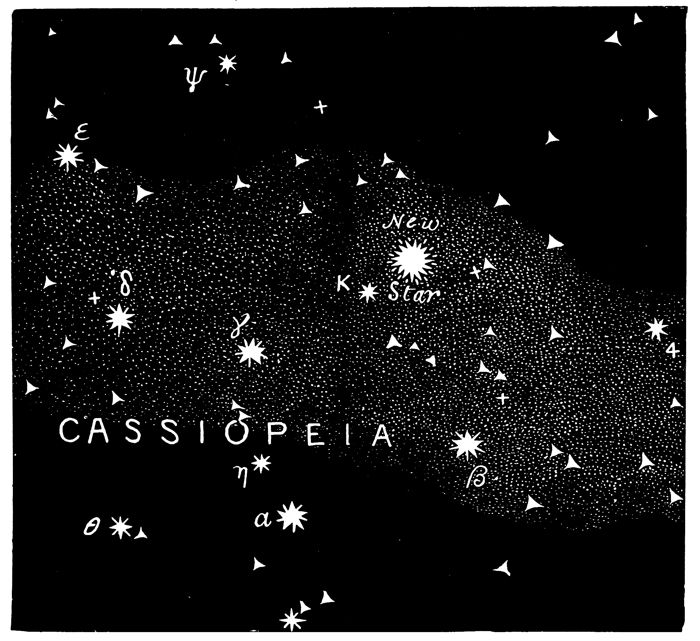
Such were the explanations offered respecting the exceedingly
bright star which made its appearance in the
constellation Cassiopeia in the year 1572. The place
in which it appeared is shown in fig. 7. It must have
sprung into its full glory in a very short time, for Tycho
Brahé, the celebrated astronomer, tells us that, returning
on November 1, 1572, from his laboratory to his dwelling-house,
he saw the new star, which he was certain had not
been visible an hour before, shining more brightly than
any before seen. It surpassed all the stars in the heavens
in brilliancy, and even Jupiter when that planet is at its
brightest. Only Venus at her brightest was superior to
the new star. For three weeks it shone with full lustre,
after which it began slowly to decline. Being situated
in a part of the heavens always above the horizon (for
European observatories), the star's entire history could
be followed. It remained for sixteen months steadfast
in its position like the other stars. As it decreased in
size it varied in colour. "At first," says an old writer;
"its light was white and extremely bright; it then became
yellowish; afterwards of a ruddy colour like
Mars; and finished with a pale, livid white, resembling
the colour of Saturn."
Fig. 7.—Cassiopeia; showing where a new star appeared in the year 1572.
In passing it may be remarked that there are reasons
for expecting the return of Tycho Brahé's star in the
course of a few years. For other new stars have been
recorded as seen in the same part of the heavens in the
years 945 and 1264, and though the interval from 945
to 1264 (or 319 years) exceeds by 11 years the interval
from 1264 to 1572 (or 308 years), yet the difference is
but small by comparison with either entire interval;
and we may not unreasonably believe that the three new
stars seen in Cassiopeia have been only three apparitions
of one and the same star, which shines out, with superior
lustre, for a few months, once in a period averaging
about 313 years. It seems to me not at all unlikely that,
some time during the next twenty years, astronomers
will have an opportunity of examining, with the telescope
and spectroscope, a star which last appeared before
either instrument had been invented.
Already facts are known respecting the so-called new
stars which will not permit us to accept the explanations
of old so readily offered and admitted, simply because so
little was certainly known.
In the year 1866 a star appeared suddenly in the
constellation of the Northern Crown, where no star had
before been visible to the naked eye. It was a little
below the arc of stars forming the celestial coronet.[7]
It shone as a second magnitude star when first seen, but
very rapidly diminished in lustre. It increased our
knowledge in two important respects.
First, on examining Argelander's charts of the northern
heavens, the new star was found to have been observed
and charted as a tenth magnitude star, that is, four
magnitudes below the lowest limit of naked eye vision.
It was not, then, a new sun, though it might still truly
be called a new star, in this sense, that it was a new
member of the set of stars which adorn our skies as seen
by ordinary vision.
In the second place, the star was subject to the
searching scrutiny of spectroscopic analysis, with results
of a most interesting character.
The reader is no doubt aware that when the light of
a star is analysed into its component colours by the
instrument called the spectroscope, it is found that all
the colours of the rainbow are present, as in the case of
solar light, but (also in the sun's case) not all the tints of
these colours. Certain dark lines athwart the rainbow-tinted
streak, called the spectrum of the star, indicate the
presence of absorbing vapours in the star's atmosphere.
This general statement is true of every fixed star, though
the dark lines of some stars differ in number and position
from the dark lines of others, showing that other absorbing
vapours are present. In the case of the new star in
the Crown, the usual stellar spectrum was shewn,—a
rainbow-tinted streak crossed by a number of dark lines.
But besides these, there were seen four very bright lines,—lines
so bright that the rainbow-tinted streak appeared
as a dark background. The meaning of this is well
understood by spectroscopists. It signifies that besides
the vapours which, being cooler than the star, absorbed
a portion of its light, and produced the dark lines, some
vapours were present in the star's atmosphere which
were a great deal hotter than the star, and so produced
bright lines. Now two of the lines corresponded in
position with two of the well known lines of the gas
hydrogen, showing that this was one of the gases which
had been raised to an unusual degree of heat.
It was inferred that there had been some tremendous
disturbance in that remote star, by which the hydrogen
and some other vapours present in its atmosphere had
been intensely heated. But astronomers were unable to
decide whether the disturbance was of the nature of a
conflagration, the hydrogen actually burning, or whether
the heat was occasioned in some other way, as by the
downfall of some immense mass upon that remote sun.
For burning hydrogen and glowing hydrogen, though
either could give the observed bright lines, are very
different things. In the former case a chemical change
is taking place, as in the case of burning wood or coal;
the latter case resembles that of redhot iron, which is
not burning itself (not changing into a different form as
everything does which burns), though it will burn other
things,—in the ordinary, and incorrect, use of the expression.
The general belief was that there had been a downfall
of matter on the star in the Crown, by which the whole
globe of that sun had been excited to an intense degree
of heat, especially at the surface, near which lies the
hydrogen atmosphere of the star.
I must leave, however, to the next part, the further
consideration of the strange thoughts suggested by the
outburst of this star. I wish to use the small space
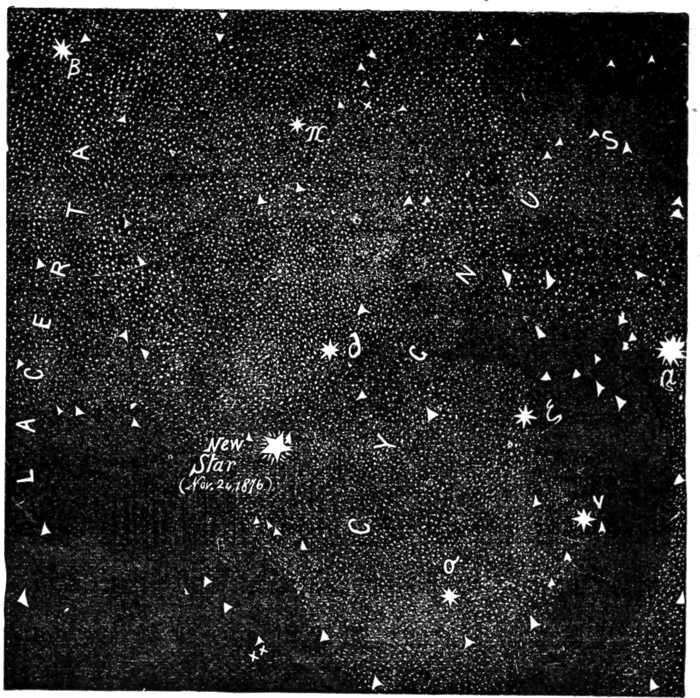
remaining at present to indicate the place where another
new star burst forth last November, so that any readers
of these pages who have telescopes may know where to
look for a sun which is now dying out, but was shining
a few weeks ago as a third magnitude star. Fig. 8
presents a portion of the well-known constellation
Cygnus or the Swan. Any star atlas will indicate the
place of the lettered stars shown in the figure. The
constellation itself does not show at all well at this
season of the year.[8] The part shown in the figure is
close to the horizon, and directly under the pole-star, at
about half-past ten in the middle of February; but a
little higher up, between north and north-east, at midnight.
Professor Schmidt, of the Athens Observatory,
noticed a new star, in the place shown, on November
24th last. It must have shone out suddenly, for
Schmidt had been observing in that region on the night
of November 22nd (the last preceding clear night). It
has since gradually faded, until now a small telescope is
required to show it, shining as a seventh magnitude star,
with a well-marked orange tint.
Fig. 8.—Part of Cygnus, showing the place of new star (November 24, 1876).
We have now to consider the history of this star, and
discuss the general questions suggested by the sudden
blazing out of suns which had for many years, and
probably for many centuries, shone continuously with a
far feebler lustre. It is clear that we have good reason
to be interested in these questions, seeing that, for
aught we know, our sun may be one of those exposed
to sudden great increase of lustre.
It seems certain, in the first place, that this star leapt
very suddenly to its full splendour. Schmidt had been
observing the same regions of the heavens only two
evenings before, and is sure the star was not then
shining visibly to the naked eye. Again, astronomy
is now studied by so many persons, and so many more
who are not students of astronomy are now well acquainted
with the constellations, that it is very difficult
for a new star to shine many hours without being
detected. For example, the new star in the Crown,
which appeared in May, 1866, though not so well
placed for observation, was detected by many observers
at widely distant stations within a few hours of each
other. It is probable that the star acquired its full
lustre in a few hours at the utmost, and quite possible
that, had any one been watching the place where the
star appeared, he would have been able to see the star
grow into full brightness by visible change of lustre,
just as the lustre of a revolving light in a distant lighthouse
visibly waxes and wanes. It may be, of course,
that the increase of the star from its ordinary lustre,
up to the stage when first it was visible to the naked
eye, occupied many days, or even many months or
years; but it seems more likely that as the later stages
of increase were rapid, so also was the entire development
of the new lustre. In that case, if there were
inhabited worlds circling around that remote sun, they
had but brief warning of the fate in store for them, as
presently to be described.
Like the star in the Northern Crown, the new star in
Cygnus was subjected to the searching scrutiny of the
spectroscope. The results, though similar in general
respects, were even more interesting than in the case
of the brighter new star. In the interval between 1866
and 1876 spectroscopic analysis has developed largely.
It has thus become possible to analyse more completely
the light even of faint stars than the light of bright stars
could be analysed a decade of years since.
The spectrum of the new star as examined by M.
Cornu, of the Paris Observatory, showed the bright lines
of hydrogen, indicating the presence of enormous
quantities of glowing hydrogen, in a state of intense
heat. But beside these bright lines, others also could
be seen. One of these was an orange-yellow line. It
will be understood that the faint spectrum of a star
cannot be so readily lengthened by increasing the dispersion
as a bright spectrum; for with too great dispersion
the light fades out altogether. And though this
is not strictly the case with the bright lines, which are
merely thrown farther apart by dispersion, yet still it
remains true that one cannot deal with a star spectrum
even of bright lines as one can with the solar spectrum.
So that M. Cornu was not able to determine whether
the orange-yellow line belonged to sodium, or to
that other substance, whatever it may be, which produces
the orange-yellow line seen in the spectrum of
a solar prominence.[9] Another bright line, green in
colour, agreed in position with a triple line belonging
to the metal magnesium. Lastly, a bright yellowish-green
line was seen, which is known to be present in
the spectrum of the sun's corona and of the low-lying
ruddy matter round the sun, called the sierra by some,
and by others (apparently unfamiliar with the Greek
language) the chromosphere.
Now all this agrees very well with what had been
noticed in the case of the star in the Northern Crown.
For, unquestionably, if a sun increases so much in heat
and lustre that the hydrogen outside it glows more
brightly than the body of the star, then other matter
outside that sun might also be expected to share the
great increase of heat. We see that, outside our own
sun, hydrogen, a certain unknown vapour of an orange
yellow colour, magnesium, and another unknown vapour
of greenish-yellow colour are present in enormous
quantities; and it seems, therefore, reasonable to believe
that other suns have these gases extending far outside
the rest of their substance. It is certain that, if
our sun were caused to glow with far more than its
present degree of heat, the gases whose increase of
brightness would be most discernible from a distant
station (as a world circling around some remote star)
would be just those gases which were glowing so resplendency
around the star in Cygnus last November—or
rather at the time when that light which reached
us last November set out from the remote star in the
Swan.
When we view the outburst of that remote sun
in this way the thoughts suggested are not altogether
satisfactory. That sun shows far too much resemblance
to our own, and behaved, so far as can be
judged, far too much as our own sun would behave if
roused to many times its present degree of heat and
splendour. When we hear of a railway accident it is
a matter of special interest to us (if we travel much)
to learn whether the conditions under which the
accident took place resembled those under which the
trains proceed by which we chiefly travel. When an
express train suffers in such a way as to show some
special danger arising from great velocity, we find ourselves
to some degree concerned personally in the investigation
which follows, if we travel generally by quick
trains. If a bridge breaks down, and we have often
to traverse bridges in railway journeying, we are similarly
concerned, especially if any of the bridges we have
to cross resemble in structure the one which has given
way. So also of many other special forms of danger
in railway travelling. Now, on the same principle,
we cannot but regard with considerable interest the
circumstance that, apparently, a catastrophe has taken
place in the star in Cygnus, which has not only affected
a sun resembling our own very closely in constitution,
but has produced effects very closely corresponding to
those which would affect our own sun if, through any
cause, he were excited to many times his present degree
of heat.
Let us pause a little to reflect upon the effects which
would follow a great increase of the sun's lustre. A
change in our own sun, such as affected the star in
Cygnus, or that other star in the Northern Crown, would
unquestionably destroy every living creature on the face
of this earth; nor could any even escape which may exist
on the other planets of the solar system. The star in the
Northern Crown shone out with more than 800 times
its former lustre: the star in Cygnus with from 500 to
many thousand times its former lustre, according as we
take the highest possible estimate of its brightness before
the catastrophe, or consider that it may have been very
much fainter. Now, if our sun were to increase tenfold in
brightness, all the higher forms of animal life and nearly
all vegetable life would inevitably be destroyed on this
earth. A few stubborn animalcules might survive, and,
possibly, a few of the lowest forms of vegetation, but
naught else. If the sun increased a hundredfold in
lustre his heat would doubtless sterilise the whole earth.
The same would happen in other planets. The heat
falling on the remotest members of the solar system
would not, indeed, be excessive according to our conceptions.
But if we regard Neptune, Uranus, Saturn, and
Jupiter as the abode of life (which, for my own part, I
consider altogether improbable), we cannot but suppose
the orders of living creatures in each of these planets to
be well fitted to exist under the conditions subsisting
around them. If this is so—as who can for a moment
doubt?—a sudden enormous increase in the sun's heat,
though not making the supply received by those planets
much greater than, or even equal to, the supply which
we receive from the sun, would prove as fatal to living
creatures there as to living creatures on our earth.
If, then, the sun increased in splendour as the stars
have increased which the astronomers call new stars or
temporary stars, there would be an end of life upon this
earth; and nothing short of either the spontaneous
development of life, or of the creation of various forms
of life, could people our earth afresh. Science knows
nothing of spontaneous generation, and believers in revelation
reject the doctrine. Science knows nothing of
the creation of living forms, but believers in revelation
accept the doctrine. Certain it is that if our sun ever
undergoes the baptism of fire which has affected some few
among his brother suns, one or other of these processes
(if creation can be called a process) must come into
operation, or else our earth and her companion worlds
would for ever after remain absolutely devoid of life.
But if our sun, without suffering so great a change,
underwent a change of less degree, it might well happen
that though there would be enormous destruction of life
upon the earth and other planets, some life (presumably
the strongest and best) would survive. In that case,
after a long period of time, the earth would again be well
peopled, and it might even be that the various races of
terrestrial creatures would be improved, by the desolation
which the great solar conflagration had wrought.
It is somewhat curious, considering how little there is
in the ordinary progress of events to suggest the idea,
that most of the ancient systems of cosmogony recognised
the periodical destruction of living creatures on the earth
by fire as well as by water. Each form of destruction was
supposed to be brought about by planetary influences.
The Ecpyrosis, or destruction by fire, was effected when
all the planets were in conjunction with Cancer; the
Cataclysm, or destruction by flood, when all the planets
were in conjunction with Capricorn. Each form of destruction
was supposed also to purify the human race.
"Towards the termination of each era," writes Lyell,
speaking of these old ideas, "the gods could no longer
bear with the wickedness of men, and a shock of the
elements or a deluge overwhelmed them; after which
calamity Astrea again descended on the earth, to renew
the golden age." The Greeks undoubtedly borrowed all
such doctrines from the Egyptians, who "believed the
world to be subject to occasional conflagrations and
deluges, whereby the gods arrested the career of human
wickedness, and purified the earth from guilt. After
each regeneration mankind was in a state of virtue and
happiness, from which they gradually degenerated again
into vice and immorality."
Considering that we have every reason to believe the
records of great floods to relate to events which actually
occurred, however imperfectly remembered, it seems not
unreasonable to believe that the tradition of great heats
had its origin in observed phenomena. As neither ordinary
conflagrations nor volcanic outbursts would have
suggested traditions of the kind, it would seem not impossible
that at certain times our sun may have acquired
for a time unusual lustre and heat, causing great and
widely spread destruction among all forms of animal and
vegetable life.
This idea may possibly seem to many, especially at
a first view, too wild to be entertained for a moment.
Our sun shines, so far as appears to ordinary observation,
with steadfast lustre from year to year, and also from age
to age. If an occasional hot season suggests for a while
to some that the sun has grown hotter, or a cool season
that he has grown cooler, the restoration of cool or
warmer weather, as the case may be, causes the thought
to be quickly cast on one side that a change of either
kind has taken place. Again, if we examine the historical
records of past ages, we find little to suggest the idea, or
even the possibility, that the sun in former times shone
with greater splendour or with less than at present. The
men of those days were formed like the men of our own
day, and could not have supported any much greater degree
of heat or of cold than men can support at present.
Any sudden accession (or diminution) of solar light and
heat, such as we are considering, would certainly have
attracted marked attention, and have been recorded for
the benefit of future ages. The geologic record, again,
does, indeed, suggest variations in the sun's emission of
heat as constituting one among the few available explanations
of the existence of tropical forms of life in
certain strata and of arctic forms in other strata. But
even if this explanation be the true one, which is by no
means established, such variations must of necessity have
been slow, the condition of increased heat continuing for
many ages in succession, and the like with the condition
of diminished heat. We have no evidence, historical or
geological, of the occurrence of any sudden accession
of solar heat, followed by a quick return to the normal
temperature, unless we find such evidence in the tradition
prevalent among Egyptian, Indian, and Chinese cosmogonists,
that at certain recurring epochs in the past our
earth has undergone destruction and renovation by fire.
Yet, as I shall now show, it appears that the one only
natural interpretation which can be given of the outburst
of a new or temporary sun indicates an event which might
happen to our own sun, and an event which if it happened
at all would happen periodically. Moreover, while it will
appear that there is no reason for fearing the possible
occurrence (which would, in such case, be really the
recurrence) of such a catastrophe in the case of our own
sun as has affected the stars in the Crown and in Cygnus,
there is no reason for rejecting as incredible the idea that
catastrophes very serious in their character may have
affected our sun; and there is abundant reason for
believing that small alterations in the sun's total emission
of light and heat take place very often, in some cases
periodically; in others—so far as we can yet judge—periodically.
Lastly, it will be seen that there is always a possibility
that our own or any other sun may undergo precisely
such a change as the stars in Cygnus and the Northern
Crown. Some indeed, even among men of science
(as the Abbé Moigno, for example) believe that it was
an event of this sort which St. Peter predicted when
he wrote, that as the old world, being overflowed with
water, perished, so "the heavens and the earth which
are now, by the same word are kept in store, reserved
unto fire." According to that view, the day of destruction
will come "as a thief in the night; in the which
the heavens shall pass away with a great noise, and the
elements shall melt with fervent heat, the earth also, and
the works that are therein shall be burned up."
Let us consider how the sudden brightness of a new
star may be explained.
I must confess that for my own part I do not attach
much weight to the suggestion once made by Mr.
Huggins, that an actual conflagration had taken place
in the case of the new star in the Northern Crown. It
does not seem to me that any process of mere burning
could account for the enormous accession of light and
heat which that sun underwent.
Consider the case of our own sun. His heat is very
far beyond that which would be given out by any matter
known to us undergoing any known process of true combustion.
That is to say, if a mass as large as the sun of
any known substance were caused to burn, under any
conditions we can imagine, the momentary emission of
heat by that mass would be very much less than the
momentary emission of heat by the sun.
Now it is quite conceivable that by some great
accession of combustible matter, some supply of fuel
exceeding many times his entire mass, the sun's entire
emission of heat might be very largely increased. But
though such an idea is conceivable, it seems altogether
far-fetched. The conception is, in fact, inadmissible as
an explanation of the increase of heat of a temporary
star, not because of the improbability of the sudden
accession of so enormous a quantity of matter (though
that improbability is very great), but because if so enormous
a quantity of matter fell upon the sun, many times
as much heat would be generated by the mechanical
effect of the impact as by the combustion of the freshly
received matter. So that even with the daring assumption
here made, combustion would account for only a
small portion of the increase of light and heat.
Huggins' idea was indeed somewhat different. He
supposed that in consequence of some great internal
convulsion of the sun in the Northern Crown a large
volume of hydrogen and other gases was evolved from
the interior, the hydrogen then by burning giving out
the light corresponding to the bright lines. At the same
time, the mass of the sun would be intensely heated by
the surrounding mass of glowing hydrogen. When the
liberation of gas from the interior ceased the flame
would die out, and the sun's surface would gradually
cool. But if we judge by the case of our own sun, the
heat of the burning hydrogen would be nothing near
so great as the heat of the glowing hydrogen already
outside and within the visible globe of a sun.
On the whole it seems altogether more probable that
the accession of splendour observed in the case of temporary
stars is due to the downfall of enormous masses
of matter upon the surface of these suns. It is, no
doubt, well known to most of my readers that the downfall
of meteoric matter upon the surface of our own sun
has been considered a sufficient explanation of the sun's
entire emission of light and heat. The theory that the
sun's heat and light are thus excited has long since
been abandoned; but not because the cause would be
insufficient. It has been abundantly proved that a
downfall of meteors, not sufficient in quantity to add
appreciably to the sun's size in many thousands of years,
would generate more heat and light than he emits in
that time. The meteoric theory has been abandoned
simply because it has been shown that no such downfall
is taking place.
The reason why meteoric impact would suffice to
warm the sun to his present temperature if the meteoric
showers were heavy, and to warm him far beyond his
present temperature if for a few days very heavy meteoric
showers fell upon him, is simply that his attraction upon
matter approaching him from without is capable of
generating a tremendous velocity. We know that when
a cannon-ball strikes a metal target, with a velocity
perhaps of some 400 yards per second, great heat is
excited, and there is a momentary flash of light. If the
velocity were doubled, the quantity of heat would be
doubled also. Conceive, then, the tremendous heat
which would be excited if a cannon-ball could be caused
to strike a target with a velocity exceeding that just named
some 1500 times! The ball and target would both be
vaporised by the shock, if—which, however, could never
happen—the target resisted the blow and brought the
ball to rest. Now matter which reaches the sun from
without, under the influence of his tremendous attraction,
strikes his globe with a velocity 1500 times greater than
that of a cannon ball striking a target at a distance of two
or three hundred yards. The heat excited is, therefore,
very intense; and if meteors were showering at all times
and in dense flights upon the sun's surface, we should
require no other explanation of the sun's heat.
But it appears that meteoric systems are neither so
numerous nor so rich as to account for the sun's uniform
emission of heat, though occasional meteoric showers
upon the sun may be heavy enough to increase appreciably
the amount of heat he emits. It would seem, from
experiments which have been made by Professor Piazzi
Smyth, of the Edinburgh Observatory, and later by the
Astronomer Royal at Greenwich, that from time to time
the sun's emission of heat really is greater than usual.
It seems not at all improbable that the increase is due to
the occasional fall of large masses of meteors in great
numbers upon the sun.
Again, it seems that such falls occur periodically,
or rather that at regular intervals great meteoric
streams pour upon the sun's surface. For instance,
the periodic increase and decrease in the number of
sun-spots is accompanied (so far as we can judge by
the observations made at Edinburgh and Greenwich)
by an accession and diminution of the solar heat; and
if the change is attributed to the passage of a meteoric
stream athwart the sun, we should have to assign
to such a stream a period of rather more than eleven
years. This, from what we know about the association
between meteors and comets, would correspond simply
to the existence of a comet whose path intersects the
sun's globe, and which is followed by a train of millions
of large meteoric masses, many of which are consumed
at each passage of the rich portion of the train athwart
the globe of the sun. This comet must of necessity be
inconspicuous, since it has hitherto escaped detection.
In fact, its head and nucleus must long since have been
entirely destroyed. Only the meteoric train, far more
widely scattered, remains, simply because at each passage
past the sun, though many are captured, far greater
numbers get safely past.
I am careful to remind the reader that though I
have, for convenience, used the indicative mood in
describing these matters, I am in reality presenting
merely a theory. It may be that the solar spots and
the accessions of heat are produced in some other way.
But I must admit I find strong reasons for regarding
as probable the general theory, that the alternations
of solar activity (not the solar activity itself be it
noted) are excited from without. And since we know,
as a matter of fact, that meteors exist in enormous
numbers within the solar system, and that they
aggregate with rapidly increasing density in the sun's
neighbourhood, we must believe that they fall upon the
sun in enormous numbers. We also perceive that the
supply cannot be uniform, but must vary greatly from
time to time; while what we know about the periodicity
of meteoric showers on our own earth suggests the belief,
we may almost say the certainty, that there must be
periodic downfalls of very heavy meteoric showers upon
the sun's surface. We have, then, strong probability in
favour of the belief that events may occur which, if
they occurred, might be expected, with a high degree of
probability, to produce effects resembling those actually
observed,—viz., the production of a heat more intense than
usual, accompanied by signs of great disturbance like the
sun-spots. It does, therefore, seem at least not improbable
that these accessions of heat and these signs of great
disturbance really are brought about in the way supposed.
A further argument in favour of the meteoric origin of
solar alternations of heat is to be found in the fact that,
on one occasion at least, a solar phenomenon, corresponding
precisely to what we should expect to see, if
great meteoric masses fell upon the sun, has been followed
by precisely the same signs of terrestrial disturbance
which accompany and follow the formation of great
solar spots. I refer to the remarkable occurrence witnessed
by Carrington and Hodgson (at different observatories)
in September, 1859, when two intensely bright
points of light were seen travelling beside each other at
the rate of about 120 miles per second along a short arc
of the sun's surface,—an arc only equal in length to some
four-and-a-half times the diameter of our earth.
On that occasion the emission of solar heat may or
may not have been increased in an appreciable degree
for several minutes. My own belief is that it must have
been; but we certainly have no means of proving that it
was. What we do know certainly is, that on that day all
the phenomena which usually accompany the existence
of many and large sun-spots showed themselves with
exaggerated intensity. The magnetic needle was greatly
disturbed, auroras displayed their coloured streamers in
both hemispheres, telegraphic communication was interrupted,
and everything tended to show that a disturbance
of the same general character as that which produces
sun-spots, but much more active while it lasted, had
affected the sun. It seems, then, altogether reasonable
to infer that sun-spots are due to the same cause as the
disturbance which then occurred. So that if we conclude,
with most astronomers competent to form an
opinion, that the disturbance witnessed by Carrington
and Hodgson was due to the downfall of two very large
meteoric masses upon the sun, it would follow that sun-spots
are due to more wide-spread meteoric showers, not
consisting of masses so large.
The reader will long since have guessed, no doubt, to
what all this tends. If the periodical variations of the
sun's surface are due to meteoric and cometic systems
whose orbits intersect the sun's globe, their periods being
short (that is, lasting but a few years), it may well be
that more important meteoric and cometic systems intersecting
the sun's globe exist, which have much longer
periods. When next one of these makes its passage
athwart the sun, far more important solar disturbances
may take place than those which occur when the regularly
recurring systems salute the sun. Two or three times in
the history of science comets have approached very
close to the surface of the sun, as in 1680, and again in
1843, but without actually impinging upon it. Very
slight changes in the motions of those comets, owing to
the disturbing influences of the planets, would cause their
very nuclei to strike the sun, and their meteoric trains
to pour afterwards in a full stream upon him for many
days, or even for many months and years in succession.
Now I do not think our sun would necessarily suffer
very much from any of these known comets. They
may long since have parted with the greater quantity of
their substance. But it is quite possible that even one
of those well-known comets of the solar system might
cause very serious outbursts of solar heat and light; and
it is certainly not only possible but extremely probable
that other comets, such as have visited the solar system
on paths fortunately not bringing them near to the sun,
would have worked much mischief had their paths been
differently situated.
We know that Newton held this opinion. He considered
the real danger from comets to reside, not
in the possibility that one might strike our earth, but
in the possibility that one, falling upon the sun, might
excite that orb to a degree of heat so intense that
all life on this earth would be destroyed. It is true
that, in Newton's time, physical laws were not so well
understood as at present, and a considerable portion
of Newton's reasoning was consequently inexact. But
nothing which is now known opposes itself to the belief
which Newton adopted on this subject. On the contrary,
whereas Newton only recognised the danger arising from
the consumption of a comet as fuel for the sun, we now
recognise a far more serious danger, from the force of
meteoric impact, and the heat excited as the thermal
equivalent of the destroyed velocities. Of this part of
the danger Newton had no clear conception, the relations
between mechanical energy and heat not having been
established until quite recent times.
It appears to me, however, that the danger in the
case of our own sun—or may we not say our danger?—arises
only from the possibility that some one of the
comets which visit us from the star-depths may make
straight for the sun; and this danger is exceedingly
small. Almost certainly a comet which, leaving the
domain of another sun, falls under the attractive influence
of our own, would approach him on a path passing
many millions of miles from his surface. The chances
against a more direct approach are so great that they
may be regarded as, to all intents and purposes, overwhelming.
A comet might visit us from the star-depth
on a destructive course, just as a single black ball might
be drawn at the first trial from a bag containing a million
white balls and only that single black one. But the
danger is exceedingly small.
We see, indeed, that other suns have suffered in this
way, assuming cometic downfall to be the true cause of
stellar outbursts. There are so many millions of suns,
however, in the region of space to which telescopic
survey extends that the occurrence of ten or twelve such
outbursts in the course of four or five centuries need not
be regarded as implying any serious danger. Moreover,
all the suns which have thus suffered lie within a particular
region of the heavens,—viz., in the Milky Way,
and in that half of the Milky Way which is most irregular,
one may almost say ragged, in structure. (With one
exception—the star in the Northern Crown, which, nevertheless,
lies on a faint outlying streamer of the Milky
Way not discernible to ordinary vision.) If then our sun
belongs to this region of space, the danger for him and
for us is somewhat greater than my previous argument
would indicate. For, in that case, we must compare the
number of outbursts, not with the total number of stars
within telescopic range, but with the number of those
stars which lie within this particular region of space. On
the other hand, if our sun does not lie within that region
of space, the danger for him and for us is very much
less; for instead of a certain small number of accidents
among his fellow suns, there have been no such accidents,
only accidents affecting other suns which must be differently
classed.
The case may be compared to the estimation
of the dangers, let us say, of travelling by ocean
steamships on a particular route. If we take the
total number of accidents, for instance, to steamships
travelling between England and the United States, we
should estimate the risk of the journey as very small, the
number of passengers who have lost their lives being
very small compared with the number who have made the
journey. But even this small risk is diminished if we
estimate the danger for a passenger by Cunard steamships,
simply because no passenger has yet lost his life
through accident to one of these Cunard vessels.
So in the case of our sun, the danger of an outburst
such as has affected the stars in the Northern Crown and
Cygnus is small enough when we estimate it by comparing
the number of such accidents with the total
number of stars, but vanishes almost into nothingness
when we note that no insulated star like our sun
seems hitherto to have undergone one of these tremendous
catastrophes.
But as regards the fate of worlds circling round suns
which have suffered in this way, we can form but one
opinion. Beyond all doubt, if such worlds existed and
were inhabited when their central orb blazed forth with
many hundred times its former lustre, all life must have
perished from their surface. We may believe, as many
do, that no conditions are too unlike those we are
familiar with on earth to render life impossible; that the
creatures subsisting in a world exposed to the most fiery
heat or to the most intense cold are adapted as perfectly
to the conditions under which they subsist as we are to
the circumstances of terrestrial life. But even adopting
this view, though it seems to accord ill with what we
know of our own earth,—where life ceases towards the
polar and over large tracts of the equatorial regions,—we
could not believe that creatures thus adapted to the
conditions prevailing around them could endure an
entire change of those conditions. With the accessions
of heat in the stars in Cygnus and the Crown, such
change must inevitably have taken place. Therefore, as
I think, we must regard the catastrophes affecting those
remote suns as assuredly involving "The End of many
Worlds."
Note.—What is stated in the latter portion of this chapter applies
now only to the star in the Northern Crown; for the star in Cygnus
has not faded into a small star, but into a small nebula! For the
further history of this star, the reader is referred to my forthcoming
treatise entitled, "Pleasant Ways in Science."
VI. THE AURORA BOREALIS.
Among the objects in view, when the recent
Polar expedition was fitted out, was the hope
that during the winter of 1875-76 the scientific
observers who accompanied the expedition might be
able to study the Aurora Borealis under unusually favourable
conditions. This hope was, as most of my readers
doubtless know, disappointed. Few auroras were seen,
and those seen were not remarkable either for brilliancy
or for beauty of colour. Yet in the very disappointment
of the hope which had been entertained on this subject
there was very significant evidence respecting the aurora,
as will presently be shown. The quiescence, at that
time, of the forces which produce the auroral streamers
had its meaning, and a very strange one.
The aurora is one of those phenomena of nature which
are characterized by exceeding beauty, and sometimes by
an imposing grandeur, but are unaccompanied by any
danger, and indeed, so far as can be determined, by any
influence whatever upon the conditions which affect our
well-being. Comparing the aurora with a phenomenon
akin to it in origin—lightning—we find in this respect
the most marked contrast. Both phenomena are caused
by electrical discharges; both are exceedingly beautiful.
It is doubtful which is the more imposing so far as visible
effects are concerned. When the auroral crown is fully
formed, and the vault of heaven is covered with the
auroral banners, waving hither and thither silently, now
fading from view, anon glowing with more intense
splendour, the mind is not less impressed with a sense
of the wondrous powers which surround us than when,
as the forked lightnings leap from the thundercloud,
the whole heavens glow with violet light, and then
sink suddenly into darkness. The solemn stillness of
the auroral display is as impressive in its kind as the
crashing peal of the thunderbolt. But there is a striking
contrast between the feelings with which we regard the
safe splendours of the aurora and the terrible glory of
the lightning flash. One display we contemplate with the
calmness engendered by absolute security; the other—no
matter how little the fear of death may affect the
reason—cannot be regarded without exciting the consciousness
of danger. We witness in safety, so far as
itself is concerned, the flash whose light illuminates the
cloud masses above and around us, but for aught we
know it may be the last we shall ever see, since no man
killed by lightning ever saw the flash which brought his
death.
I do not purpose to consider here at any length those
facts respecting the aurora which properly find their place
in text-books of science, but those only which are less
commonly dealt with, and seem at once most suggestive
and most perplexing.
The reader is no doubt aware that auroras, or polar
streamers, as they are sometimes called, are appearances
seen not around the true poles of the earth, but around
the magnetic poles, which lie very far away from those
geographical poles which our arctic and antarctic seamen
have in vain attempted to reach. We in England,
though much nearer to the north pole than the inhabitants
of Canada, see far fewer auroras than they do, and
those we see are far less splendid, simply because we are
farther away from the northern magnetic pole. This will
be seen from the accompanying pair of maps (from my
"Elementary Physical Geography"), showing where the
northern and southern magnetic poles lie. Again, you
will see from the northern map, that from England
the northern magnetic pole lies towards the west of due
north. That is why when we see a fully developed
auroral arch in this country its crown lies towards the
west of north (almost midway between north and north-west).
I may have occasion at another time to consider
the curious changes which affect the actual position of
the magnetic poles and lines; in this place I merely note
that what is now said respecting them only refers to the
present time.
Fig. 9.—The Northern Magnetic Meridians and Lines of Equal Dip.
Fig. 10.—The Southern Magnetic Meridians and Lines of Equal Dip.
The formation of auroral streamers around the magnetic
poles of the earth shows that these lights are due
to electrical discharges, just as the general magnetic
phenomena of the earth indicate the existence of electrical
currents. The earth, in fact, with its envelope of air,
moist and dense near the surface, rare and dry above
may be regarded as an enormous magnetic instrument,
a core surrounded by conducting matter, in which electrical
currents pass whenever the condition of the earth's
magnetism changes. The discharges of electricity,
though only visible at night, take place in reality in the
daytime also. According to their extent and position,
varying with the varying conditions under which they
take place, their aspect changes. Moreover, from
different parts of the earth the appearance of the aurora
is different. From low latitudes (I speak now of magnetic
latitudes as indicated by the closed curves around the
magnetic poles in the maps), the auroral arch is seen
towards the north in our hemisphere, towards the south
in the other hemisphere. From points nearer the magnetic
pole it is seen overhead, and when that pole is
approached still nearer, the crown of the arch is seen on
the side remote from the pole,—that is, towards the
south in our hemisphere, towards the north in the
southern hemisphere.
Remembering that the aurora is due to electrical discharges
in the upper regions of the air, it is interesting to
learn what are the appearances presented by the aurora
at places where the auroral arch is high above the horizon,—these
being, in fact, places nearly under the auroral
arch. M. Ch. Martins, who observed a great number
of auroras at Spitzbergen in 1839, thus writes (as translated
by Mr. Glaisher) respecting them: "At times they
are simple diffused gleams or luminous patches; at
others, quivering rays of pure white which run across the
sky, starting from the horizon as if an invisible pencil
were being drawn over the celestial vault; at times it
stops in its course, the incomplete rays do not reach the
zenith, but the aurora continues at some other point; a
bouquet of rays darts forth, spreads out into a fan, then
becomes pale, and dies out. At other times long golden
draperies float above the head of the spectator, and take
a thousand folds and undulations as if agitated by the
wind. They appear to be but at a slight elevation in
the atmosphere, and it seems strange that the rustling
of the folds as they double back on each other is not
audible. Generally, a luminous bow is seen in the north;
a black segment separates it from the horizon, the dark
colour forming a contrast with the pure white or bright
red of the bow, which darts forth rays, extends, becomes
divided, and soon presents the appearance of a luminous
fan, which fills the northern sky, and mounts nearly to the
zenith, where the rays, uniting, form a crown, which in
its turn darts forth luminous jets in all directions. The
sky then looks like a cupola of fire; the blue, the green,
the yellow, the red, and the white vibrate in the palpitating
rays of the aurora. But this brilliant spectacle
lasts only a few minutes; the crown first ceases to emit
luminous jets, and then gradually dies out; a diffused
light fills the sky; here and there a few luminous patches,
resembling light clouds, open and close with incredible
rapidity, like a heart that is beating fast. They soon get
pale in their turn, everything fades away and becomes
confused, the aurora seems to be in its death-throes; the
stars, which its light had obscured, shine with a renewed
brightness; and the long polar night, sombre and profound,
again assumes its sway over the icy solitudes of
earth and ocean."
The association between auroral phenomena and
those of terrestrial magnetism has long been placed
beyond a doubt. Wargentin in 1750 first established
the fact, which had been previously noted, however, by
Halley and Celsius. But the extension of the relation
to phenomena occurring outside the earth—very far
away from the earth—belongs to recent times.
The first point to be noticed, as showing that the
aurora depends partly on extra-terrestrial circumstances,
is the fact that the frequency of its appearance varies
greatly from time to time. It is said that the aurora was
hardly ever seen in England during the seventeenth
century, though the northern magnetic pole was then
much nearer to England than it is at present. Halley
states that before the great aurora of 1716 none had
been seen (or at least recorded) in England for more than
eighty years, and no remarkable aurora since 1574. In
the records of the Paris Academy of Sciences no aurora is
mentioned between 1666 and 1716. At Berlin one was
recorded in 1707 as a very unusual phenomenon; and the
one seen at Bologna in 1723 was described as the first
which had ever been seen there. Celsius, who described
in 1733 no less than three hundred and sixteen observations
of the aurora in Sweden between 1706 and 1732,
states that the oldest inhabitants of Upsala considered
the phenomenon as a great rarity before 1716. Anderson,
of Hamburg, states that in Iceland the frequent occurrence
of auroras between 1716 and 1732 was regarded
with great astonishment. In the sixteenth century, however,
they had been frequent.
Here, then, we seem to find the evidence of some
cause external to the earth, as producing auroras, or at
least as tending to make their occurrence more or less
frequent. The earth has remained to all appearance
unchanged in general respects during the last three
centuries, yet in the sixteenth her magnetic poles have
been frequently surrounded by auroral streamers; during
the seventeenth these streamers have been seldom seen;
during the last two-thirds of the seventeenth century
auroras have again been frequent; and during the present
century they have occurred sometimes frequently during
several years in succession, at others very seldom.
Let us inquire a little more closely into the circumstances
attending auroral displays, in order to ascertain
what external cause it is which thus influences their
occurrence.
Connected as auroras are with the phenomena of
terrestrial magnetism, we may expect to find some help
in our inquiry from the study of these phenomena.
Now it appears certain that magnetic phenomena are
partly influenced by changes in the sun's condition. We
may well believe that they are in the main due to the
sun's ordinary action, but the peculiarities which affect
them seem to depend on changes in the sun's action. It
is found that the daily oscillation of the magnetic needle
corresponds with the diurnal change in the position of
the sun owing to the earth's rotation. An annual change
affecting that oscillation depends on the varying distance
of the sun as the year proceeds. The daily change is
not only greater than the annual, but is characterized by
irregularities, when the face of the sun shows the greatest
number of spots. It was found by General Sabine, says
Mr. Balfour Stewart, "that the aggregate value of magnetic
disturbances at Toronto attained a maximum in
1848, nor was he slow to remark that this was also
Schwabe's period of maximum sun-spots. It was afterwards
found, by observations made at Kew, that 1859
(another of Schwabe's years) was also a year of maximum
magnetic disturbance.... There is also some reason to
believe that on one occasion our luminary was caught
in the very act. On the first of September, 1869, two
astronomers, Carrington and Hodgson, were independently
observing the sun's disc, which exhibited at that
time a very large spot, when, about a quarter past eleven,
they noticed a very bright star of light suddenly break
out over the spot and move with great velocity across the
sun's surface. On Mr. Carrington sending afterwards to
Kew Observatory, at which place the position of the
magnet is recorded continuously by photography, it was
found that a magnetic disturbance had broken out at the
very moment when this singular appearance had been
observed." The dip of the magnetic needle, its deflection
from the north, the inferiority of its directive force,
were all three simultaneously and abruptly altered, and
continued so for many hours.
Nor are we left in any doubt as to the connection
between such well-marked disturbances of the magnetic
needle. While the needle was thus violently displaced,
vivid auroras occurred over the greater part of both the
northern and southern (magnetic) hemispheres. They
were seen in latitudes where usually auroras are as infrequent
as rain in Peru,—at Rome, in the West Indies,
even within eighteen degrees of the equator.
The disturbance of the earth's electrical condition was
well shown in other ways. Mr. C. V. Walker, the telegraphist,
found that strong electrical currents affected the
various telegraphic lines throughout England. These
currents changed in direction every two or three minutes.
In many places it was impossible to send telegraphic
messages. In America some of the signalmen received
severe electric shocks. "At a station in Norway," says
Sir J. Herschel, "the telegraphic apparatus was set fire
to; and at Boston, in North America, a flame of fire
followed the pen of Bain's electric telegraph (which writes
down the message upon chemically prepared paper)."
Many of my readers will doubtless remember the
auroras of May 13, 1869, and October 24, 1870, both
of which occurred when the sun's surface was marked
by many spots, and both of which were accompanied by
remarkable disturbance of the earth's magnetism.
It may, then, fairly be assumed that the occurrence of
auroras depends in some way, directly or indirectly, on
the condition of the sun. But what the real nature of
that connection may be is not to be easily determined.
It is clear that the eleven-year-period of sun-spots is not
the only, or even the chief period affecting auroras, for
we have seen that sometimes for a full century, or even
more, very few auroras are seen. It is not by any means
certain that the connection between the sun's condition
and the occurrence of auroras is of the nature of
cause and effect; quite probably sun-spots and auroras
depend on some common cause as yet undetected,—and
possibly never to be detected by man.
Regarding the auroral streamers as terrestrial lights
only, but in some sense like the light reflected by planets
in having their real source in the sun, we can no longer
speak, as Humboldt was wont to do, of our planet
possessing a power of emitting light of its own. Yet
his manner of dealing with auroral light still possesses
interest for us, especially in relation to the question
whether these polar lights are emitted by other
planets and may possibly be discerned from our earth.
"It results from the phenomena of the aurora," said
Humboldt, "that the earth is endowed with the property
of emitting a light distinct from that of the sun.
The intensity of this light is rather greater than that
of the moon in its first quarter. It is at times, as on
January 7, 1831, strong enough to admit of one's reading
printed characters without difficulty. This light
of the earth, the emission of which towards the poles
is almost continuous" (this, however, is not strictly the
case), "reminds us of the light of Venus, the part of
which not lighted by the sun often glimmers with a dim
phosphorescent light. Other planets may also possess
a light evolved out of their own substance."
I would venture, however, to express strong doubts
as to the possibility of discerning, either on Venus or
on any other planet, the auroral gleams which may
very probably illuminate at times their nocturnal skies.
It must be remembered that the aurora, when at its
brightest and covering a large part of the sky, only
gives about as much light as the moon in her first
quarter,—that is, as one half of a disc so small that
180,000 such discs would not equal the entire sky.
The luminosity of the aurora is then in reality very
small; probably far less than that of the earth's surface
when illuminated by the full moon. A distant
hill on which the rays of the full moon are falling
seems strongly illuminated, and yet its light is really
so faint that we could scarcely discern it at all save
for the favouring effect of contrast. We know this,
because we often see portions of the moon's surface
which are illuminated by earthshine (when we see what
is called the old moon in the new moon's arms), and
these portions are quite faint by comparison with the
rest of the moon; yet earthshine exceeds moonshine
at least twelve times, and probably more nearly twenty
times in splendour.
The glimmering phosphorescent light, supposed to
have been seen on parts of Venus not lighted by the
moon, is a phenomenon about which experienced telescopists
are somewhat doubtful, though Webb speaks
of the appearance as remarkably well attested, quoting,
amongst others, the following cases. In 1715, Derham,
in his "Astro-Theology," says that "the sphericity or
rotundity is manifest in our moon, yea, and in Venus,
too, in whose greatest falcations" (i.e., when they appear
as crescents) "the dark parts of their globes may be
perceived, exhibiting themselves under the appearance
of a dull and rusty colour." In 1806, the phenomenon
displayed itself beautifully to Harding three times
and to Schröter once within five weeks. "Guthrie and
others noticed it a few years ago, with small reflectors,
in Scotland; Purchas, at Ross, in England; De Vico
and Palomba, many times in Italy." Winnecke records
a similar observation, though very faint, 1871, September
25, a little before noon. Van Hahn also says
he saw it repeatedly, by day as well as by night, and
with several instruments; he was, however, an inferior
observer. The dark side is sometimes described as grey,
sometimes as reddish. The phenomenon has, on the
other hand, been looked for specially, on several occasions,
by practised observers, using very fine instruments,
who have failed to recognise any trace of it.
One of the most remarkable observations ever made
on Venus must here be mentioned. Mädler states that
on one occasion, when he was observing the planet,
he saw a number of brushes of light diverging from the
circular side (i.e., the outside of the planet's crescent),
lasting as long as the planet could be seen that evening,
and remaining unchanged when he changed the
position of the telescopic eye-piece, or used a different
one. "He attempts no explanation," says Webb, "but
thinks it could not have been an optical illusion. This
is certainly possible, but it is an instructive instance of
the oversights which may be incidental even to great
philosophers, that it never seems to have occurred to
him to try another telescope!" It cannot be doubted
that the evidence would have been greatly strengthened
had he changed telescope as well as eye-piece; though
it is not readily to be explained how a known telescope,
frequently used as well before as after this strange
appearance was seen, could for one evening only have
played so strange a trick as Mädler's must have done,
if what he saw was merely an instrumental illusion.
However, whether we have telescopic evidence or not
respecting auroral lights surrounding the polar regions
of other planets, we can have very little doubt that
some among the planets, if not all of them, resemble
our earth in this as in so many other respects. The
aurora is a cosmical phenomenon, not one peculiar
to our own earth. It is not, indeed, altogether certain
that our sun himself may not be girt round by mighty
auroral streamers, and that the light of these may not
constitute a noteworthy portion of the corona of glory
seen around him during the time of total eclipse.
This view, indeed, although it has not been definitely
entertained as I have here expressed it, has been suggested
by reasoning which led others to suppose that the
coloured prominences around the sun may be auroras.
Perceiving the nature of the connection between terrestrial
magnetism and auroras, Balfour Stewart reasoned
that we may extend our inquiries and ask, "If the sun's
action is able to create a terrestrial aurora, why may
he not also create an aurora in his own atmosphere?"
It occurred independently to General Sabine, Prof.
Challis, and himself, that the red flames visible during
a total solar eclipse "may be solar auroræ." We now
know that the solar flames are not auroræ, nor, properly
speaking, flames at all, but great masses of glowing
vapour. It is not, however, by any means so clear
that the solar corona is not auroral in its nature. The
following reasoning, applied by Balfour Stewart to the
sun's prominences, applies with much greater force to
the corona. After mentioning the height (from 70,000
to 80,000) which some prominences attain, he proceeds,
"Considering the gravity of the sun, we are naturally
unwilling to suppose that there can be any considerable
amount of atmosphere at such a distance from his
surface; and we are therefore induced to seek for an
explanation of these red flames amongst those phenomena
which require the smallest possible amount of
atmosphere for their manifestation. Now the experiments
of Mr. Gassiot and the observed height of the
terrestrial aurora alike convince us that this meteor
will answer our requirements best. And besides this,
the curved appearance of these red flames, and their
high actinic power, in virtue of which one of them,
not visible to the eye, was photographed by Mr. De la
Rue, are bonds of union between these and terrestrial
auroræ."
All this and much more may be said of the solar
corona. Its streamers extend not 70,000 or 80,000
miles, but 700,000 or 800,000 miles, from the surface
of the sun, where the pressure must be far smaller
than near the summits of even the loftiest prominences.
They are curved and striated, like those of the aurora,
whereas the shapes of the prominences bear only a
distant resemblance to auroral streamers. They possess
a high actinic (i.e., photographic) power, as is shewn
by the readiness with which, during the total eclipse
of December, 1871, they were photographed, no less
than six well-defined negatives being taken both
by Col. Tennant, at Ootacamund, and by Mr. Davis,
at Baikal, during the brief continuance (only a few
minutes) of total obscuration. In every respect the
solar corona accords far better than do the solar
coloured prominences with the appearance we should
expect to recognise in solar auroras.
In particular, it has always seemed to me that the
curved, especially the doubly curved, streamers of the
corona can only be well explained by regarding the
corona as in the main an auroral phenomenon. If
mighty currents prevailed in the higher regions of a
rare atmosphere, extending hundreds of thousands of
miles from the sun's surface, appearances such as these
curved streamers would undoubtedly be explained. But
no one who considers the effect of the sun's tremendous
attractive power on such an atmosphere can fail to
perceive that, according to the known laws connecting
gaseous pressure and density, the density of that atmosphere
would be enormously great, even at a very great
distance from the sun's surface, if the curved streamers
really were caused by atmospheric currents. We know,
on the contrary, from the behaviour of comets which
have passed very near to the sun, that the atmosphere
above his visible surface must be very rare indeed.
It must not be understood, however, that I regard
the corona as simply a great solar aurora. It is certain
that the whole region filled by the corona is occupied
by immense numbers of scattered meteors, and extremely
probable that large quantities of cometic matter exist
within the same region. Vaporous masses may also be
there, circling independently around the sun. But that
this region is illuminated constantly by auroral light,
varying greatly in intensity and position, seems very
strongly indicated by all that we know about the
corona, as seen during different total eclipses of the
sun.
If we so viewed the solar corona, and found our earth,
therefore, in this respect resembling the great central
orb of the solar system, we could not but regard as extremely
probable the theory that other planets also
resemble the central body in this respect. We might
then picture to ourselves every orb in the solar system
carrying onward its faintly luminous crowns of boreal
and austral light, not shining with constant lustre, or
in the same constant position, but at one time leaping
in coloured steamers to a great distance from the body
they adorned, and anon sinking down and growing
fainter and fainter, or occasionally disappearing altogether.
Then, when some great disturbance affected
the central sun, and caused his auroral banners to shine
out more brilliantly and to attain a greater extension, suddenly
the auroral streamers of all the planets would leap
out into new light and life, playing around the northern
and southern magnetic poles of those orbs, even as
electric brushes play around the positive and negative
electrodes of a Geissler's tube. "Suddenly" at least
so far as each planet is concerned, but not suddenly
throughout the whole system. For the magnetic influences,
like the light and heat of the sun, require
time for their transmission. Yet, so rapidly do they
travel that, in a few hours, the auroral illumination
would extend from the central sun to the outermost
limits of his system.
It remains that I should make a few remarks on the
evidence which that wonderful instrument of research,
the spectroscope, has afforded respecting the light of
the aurora.
Angström was the first to observe the spectrum of the
aurora borealis. He found that the greater part of the
auroral light, as observed in 1867, was of one colour,
yellow, but three faint bands of green and greenish
blue colour were also seen. The aurora of April 15,
1869, was seen under very favourable conditions in
America. Prof. Winlock, observing it at New York,
found its spectrum to consist of five bright lines, of
which the brightest was the yellow line just mentioned.
One of the others seems to agree very nearly, if not
exactly, in position with a green line, which is the most
conspicuous feature of the spectrum of the solar corona.
During the aurora of October 6, 1869, Flögel noticed
the strong yellow line and a faint green band. Schmidt,
on April 5, 1870, made a similar observation. He saw
the strong yellow line, and from it there extended towards
the violet end of the spectrum a faint greenish
band, which, however, at times showed three defined
lines, fainter, than the yellow line.
It was not till the magnificent aurora of October 24,
25, 1870, that any red lines were seen in the spectrum
of an aurora. On that occasion the background of
auroral light was ruddy, and on the ruddy background
there were seen three deep red streamers very well
defined. The ruddy streamers, on the night of October
25, converged towards the auroral crown, which was on
that occasion singularly well seen. Förster of Berlin
failed to see any red line or band despite the marked
ruddiness of the auroral light. But Capron at Guildford
saw a faint line in the red part of the spectrum;
and Elger at Bedford observed a red band in the light
of the red streamers, the band disappearing, however,
when the spectroscope was directed on the white rays
of the aurora.
As yet the auroral spectrum has not been interpreted.
It is not a spectrum which can be (at present) artificially
produced. We understand the spectrum of the sun and
stars, because spectra of the same order can be produced
in our laboratories. The spectra of the planets,
so far as they differ from the spectrum of reflected sunlight
in showing signs of the absorptive action of the
planetary atmosphere, have been similarly interpreted.
So also the spectra of the coloured solar prominences
are understood, while those of nebulæ and comets,
though not as yet thoroughly explained, have been
partly interpreted, because of their partial agreement
with the known spectra of earthly elements. But as
yet neither the spectrum of the aurora nor that of the
solar corona has been explained. The reason probably
is, that the conditions under which the light of the
aurora as of the corona is formed are not such as have
been or perhaps can be attained or even approached in
laboratory experiments.
VII. THE LUNAR HALO.
There are some phenomena of nature which
suggest false ideas. For instance, when we
look at the broad expanse of ocean on a
moonlit night, and see a path of glory on its surface,
directed towards the moon's place, we seem to be assured
by the sense of sight that that broad track is illuminated
while the waters all around are dark. A little consideration,
however, assures us that the impression is a false
one, that in this case seeing is not believing. The moon's
rays really illumine the whole surface which lies before
us, and we fail to receive light from other parts than the
track below the moon, not because they receive no light,
but because the light which they receive is not reflected
towards us. An observer, stationed a mile or two towards
the right or towards the left of our station, sees a different
track of light, while the part which seems bright to us
seems dark to him.
The rainbow is another phenomenon of this deceptive
kind. We seem to see an arch of many colours suspended
in the air,—and when we learn that it is due to
the presence of drops of water in the air, we are apt to
infer that where we see the red arch there are drops lit
up with red light, where the yellow, green, or violet arch,
that the drops are aglow with yellow, green, or violet
light. But in reality this is not so; the same drops
which seem green to us will seem red to another observer,
violet to another, and to yet other observers will
show none of the prismatic colours, but only the dull
grey colour of the cloud on which the rainbow is seen.
We have here a pretty emblem of the varied aspects
which events of the same real nature present to different
persons, or according to the different circumstances under
which the same person may see them. One shall see
events in rosy tints, or with the freshness of spring
hues, or with the melancholy symbolled by the
deeper indigo (as when
The heavy-skirted evening droops with frost)—
while to others the same events shall show only the
ordinary tints of common-place life.
The lunar halo is one of the phenomena thus deceptive
to the view. We see all around the moon a circle
or arc of light, nearly white, though sometimes faint
tints of colour can be perceived in it, while the space
within the circle seems manifestly darker than the space
outside. The appearance of the halo as seen under
favourable conditions is shown in fig. 11, on the next
page. In this country the dark space round the moon
is not generally so well seen as in countries where the
air is clearer. But this is in reality the characteristic
feature of the halo, as its name shows. For the name is
derived from a Greek word signifying threshing-floor (the
old threshing-floors being round), and thus naturally
describes a round space relatively clear, surrounded on
all sides by a ring of aggregated matter.
We seem in looking at the lunar halo, then, to see the
moon at the centre of a dark space, surrounded by a
ring of bright particles, outside which again are particles
not quite so brightly illuminated as those forming the
ring, but more brightly than those within the ring.
But in reality this impression, which, so far as the sense
of sight is concerned, seems forced upon the mind, is
entirely erroneous. There is no real distinction between
the space which looks dark all round the moon, the
space beyond which does not look dark, and the ring
between the two spaces which looks bright. These are
all equally illuminated by the moon, in the same sense,
at least, that we say the surface of a moonlit sea is all
equally illuminated, neglecting slight differences which
do not concern the point we are specially dealing with.
Precisely as the path of light on the ocean is not a
real path of illumination, bounded on either side by
dark spaces, so the ring of light round the moon is not
a real ring of light, bounded on one side by a less bright
region, and within by a dark space.
Fig. 11.—Lunar Halo
Although my object in these essays is not specially to
deal with scientific matters, but rather with the thoughts
(much more important in my belief) which they suggest—so
that, in dealing with my present subject, I wish
rather to call attention to the manifold ways in which our
senses may deceive us unless their evidence is carefully
cross-examined—yet it may be worth while to notice how
the particular illusion here considered has deceived even
the scientific elect.
It had been noticed by Tyndall, in certain experiments,
that a very sensitive measurer of heat, when placed
under the moon's rays, gathered together by a powerful
condenser, seemed to indicate cooling rather than heating,
as we should expect. On this a French student of
science pointed to the darkening under the moon where
the lunar halo is seen as evidence that our satellite
possesses a certain power of clearing away vaporous
matter from the air. "On peut dire," he said, speaking
of the dark space within the halo, "que la lune ouvre
alors une porte par laquelle s'échappe le calorique que
l'action solaire a emmagasiné dans les couches inférieures."
"One may say," that is, "that the moon then opens a door
through which the heat escapes, which the sun's action
has stored up in the lower layers" (of the air). It will be
manifest, if we remember that a lunar halo can often be
seen at the same time from stations hundreds of miles
apart, that there can be no such opening of clear air.
For the cloud layer in which the halo is formed is but
a few miles above the observer; and therefore, if one
observer saw a circular opening in this layer, with the
moon at its centre, another, a hundred miles from him,
would see the space in a very different direction. The
moon would not only not be at the centre of the space
for this second observer, but would not be visible through
the space at all. Moreover, the space could not possibly
seem round to both observers; if it seemed round to
one, it would look like a very flat oval of darkness
(almost a mere line) to the other.
The real explanation of the lunar halo is very different.
When you see such a halo, you may be certain that there
is, high up in the air, a layer of light feathery cloud—the
cirrus cloud, as it is called—composed of tiny crystals of
ice. These crystals, as we know from those which in
winter sometimes fall (not as snow, but as little ice-stars),
have all a definite shape. They are in fact little prisms
of ice, with angles like those of an equilateral triangle.
These little prisms deflect the light which falls upon
them, just as one of the drops of a chandelier deflects
any light which falls upon it. If you hold a prism-drop
of a chandelier between the eye and a light, you will see
that the prism looks dark; it is really lit up, but it sends
the light away in such a direction that the eye receives
none. Now move it gradually away from the line of
sight to the light, and at a certain distance it appears full
of light; or, to speak more correctly, it sends the light
it receives directly towards your eye. Beyond that position
it again looks dark, but not so dark as when it was
nearly between the eye and the light.
The little crystals of ice perform the same part with
respect to the moon, when we see a lunar halo. Those
between us and the moon, or within a certain distance
from the line of sight to the moon, are, in reality, lit up
by the moon's rays; but they send off those rays in such
directions that we do not receive the light. Thus, all the
space lying towards the moon, and for a certain distance
all round, looks dark. But, at a certain distance, these
little crystals send us light. If we could see them
separately, they would seem to be full of light. That is
the distance where ice-crystals of their known shape act
most favourably in deflecting light,—that is, send off
most for all the varying positions (not places) they can
be in. At greater distances, a small proportion send us
light. Thus, at that distance we have a ring of light,
and outside the ring we have a gradual falling off in the
quantity of light.
But the reader will be apt, perhaps, to say, How can
all this be proved? No one has ever been among the
ice-crystals of the feathery clouds when they are performing
this work. When Coxwell and Glaisher made
their highest ascent, the feather-clouds seemed almost as
high above them as ever. Nor, if any one could reach
those clouds, could he see the ice-crystals at their work.
Yet there are few points about which science is more
certainly assured than about this explanation of the halo.
For we know the shape constantly assumed by ice-crystals;
we know according to what precise law ice bends rays of
light falling upon it; hence we can calculate quite certainly
where, if ice-crystals make the halo, its rings should
be seen. And the halo has the precise position thus calculated
from the known laws of optics, and the known
facts about ice and ice-crystals. The diameter of the
halo should be, and is, about eighty times the apparent
diameter of the moon, or somewhat less than half the
arc which separates the point overhead from the
horizon.
There is, however, yet stronger evidence. Haloes
form around the sun as well as round the moon,—in fact,
more frequently. Solar haloes have so much more light
in them that we can recognise varieties of tint. Now, it
follows from the laws of optics that, for the red part of
the sun's light, the halo ring should have a smaller
diameter than the halo ring for the violet part, intermediate
colours having their corresponding intermediate
halo rings. Thus, the halo ring, as a whole, should
be rainbow-tinted, red on the inside, then orange, yellow,
green, blue, indigo, and violet; and these colours are
shown (under favourable conditions) in this order.
The student looking out for haloes, solar or lunar,
must be careful not to confound them with solar and
lunar coronas, that is, not the corona of astronomy, but
rings of light around the sun and moon, much smaller
than the true halo rings. What I have said above
about the size of the true halo will suffice to prevent
such a mistake. Coronas are not nearly so easily,
though they have been quite as thoroughly, explained
by science, as haloes.
It is singular to observe how utterly unlike the interpretation
of the halo by science is from the natural
interpretation. The observer would say, There surely is
a dark space all round the moon, and round that a ring
of light,—I see these things, and seeing is believing.
Science says there is no dark space, and there is no ring
of light; while the eye of science perceives something
where the lunar halo shines which ordinary vision cannot
recognise. Up yonder, many miles above the earth,
science sees millions of crystals of ice, carried hither
and thither—so light are they—by every movement of
the air. Science sees these ice crystals deflecting the
rays of moonlight, sifting the red rays from the orange,
and these from the yellow, yellow from green, green from
blue, blue from indigo, and indigo from violet. Science,
in fine, perceives processes taking place in those higher
regions of air compared with which the most delicate
analyses of the laboratory are utterly coarse and imperfect.
There is a purer and nobler poetry in the lunar halo
as thus understood than in its mere visible phenomena,
attractive and beautiful though these are. Idle indeed
is the fear that the interpretation of this special mystery
of nature will leave the number of nature's mysteries
diminished by one. On the contrary, for the one mystery
explained many deeper mysteries are suggested.
The phenomena discernible by the sense of sight are
explained, but only by bringing into the range of a purer
and more piercing vision phenomena infinitely more
wonderful. If one could see through some amazing
extension of visual power, or if even the imagination
could adequately picture, the rush of light waves of all
orders of length upon the line of crystal breakers, their
deflection in all directions, their separation into their
various orders of wave-length; if one could perceive the
actual illumination of the ice-crystals, even where they
seem dark to us, and the continual fluctuations of the
troubled sea of ether between the crystal breakers and
the earth below,—the scene would infinitely transcend in
interest and mystery, the picture would be infinitely more
suggestive of solemn thoughts, than the scene—beautiful
though it doubtless is—presented by the halo-girt moon
to ordinary vision. Truly they know little of the real
meaning of science who regard it as depriving natural
phenomena of their effect on the imagination, as robbing
Nature of her poetic influence.
VIII. MOONLIGHT.
The light of the moon and the changes of
the moon were probably the first phenomena
which led men to study the motions of the
heavenly bodies. In our times, when most men live
where artificial illumination is used at night, we can
scarcely appreciate the full value of moonlight to men
who cannot obtain artificial light. Especially must
moonlight have been valuable to the class of men
among whom, according to all traditions, the first
astronomers appeared. The tiller of the soil might
fare tolerably well without nocturnal light, though even
he,—as indeed the familiar designation of the harvest-moon
shows us,—finds special value, sometimes, in
moonlight. But to the shepherd moonlight and its
changes must have been of extreme importance as he
watched his herds and flocks by night. We can understand
how carefully he would note the change from the
new moon to the time when throughout the whole night,
or at least of the darkest hours, the full moon illuminated
the hills and valleys over which his watch extended, and
thence to the time when the sickle of the fast waning
moon shone but for a short time before the rising of the
sun. To him, naturally, the lunar month, and its subdivision,
the week, would be the chief measure of time.
He would observe—or rather he could not help observing—the
passage of the moon around the zodiacal band,
some twenty moon-breadths wide, which is the lunar roadway
among the stars. These would be the first purely
astronomical observations made by man; so that we
learn without surprise that before the present division of
the zodiac was adopted the old Chaldean astronomers
(as well as the Indian, Persian, Egyptian, and Chinese
astronomers, who still follow the practice) divided the
zodiac into 28 lunar mansions, each mansion corresponding
nearly to one day's motion of the moon among
the stars.
It is easy to understand how the first rough observations
of moonlight and its changes taught men the
true nature of the moon, as an opaque globe circling
round the earth, and borrowing her light from the sun.
They perceived, first, that the moon was only full when
she was opposite the sun, shining at her highest in the
south at midnight when the sun was at his lowest
beneath the northern horizon. Before the time of full
moon, they saw that more or less of the moon's disc was
illuminated as he was nearer or farther from the position
opposite the sun, the illuminated side being towards the
west—that is, towards the sun; while after full moon
the same law was perceived in the amount of light,
the illuminated side being still towards the sun, that is,
towards the east. They could not fail to observe the
horned moon sometimes in the daytime, with her horns
turned directly from the sun, and showing as plainly, by
her aspect, whence her light was derived, as does any
terrestrial ball lit up either by a lamp or by the sun.
The explanation they gave was the explanation still
given by astronomers. Let us briefly consider it. In
doing so I propose to modify the ordinary text-book
illustration which has always seemed to me ingeniously
calculated (with its double set of diversely illuminated
moons around the earth) to make a simple subject
obscure.
In fig. 12, let E represent the earth one half in darkness,
the other half illuminated by the rays of the sun S,
which should be supposed placed at a much greater
distance to the left,—in fact, about five yards away
from E. To preserve the right proportions, also, the sun
ought to be much smaller and the earth a mere point.
I mention this to prevent the reader from adopting
erroneous ideas as to the size of these bodies. In
reality it is quite impossible
to show in
such figures the true
proportions of the
heavenly bodies and
of their distances.
Next let M1, M2, M3,
etc., represent the
moon in different positions
along her circuit
around the earth at E.
Fig. 12.—Explaining the Moon's changes.
Fig. 13.—Illustrating the Moon's changes.
Now, it is clear
that when the moon
is at M1, her illuminated
face is turned
from the earth, E.
She therefore cannot
be seen; and accordingly,
in fig. 12, she is
presented as a black
disc at 1 to correspond
with her invisibility when she is as at M1. She
passes on to M2; and now from E a part of her illuminated
half can be seen towards the sun, which would be
towards the right, if we imagine an eye at E looking
towards M2. Her appearance then is as shown at 2,
fig. 13. In any intermediate portion
between M1 and M2, the sickle of light is
visible but narrower. We see also that all
this time the moon's place on the sky
cannot be far from the sun's place, for the
line from E to M2 is not greatly inclined
to the line from E to S. When the moon
has got round to M3, the observer on the
earth sees as much of the dark half as of
the bright half of the moon, the bright
half being seen, of course, towards the
sun. Thus the moon appears as at 3, fig.
13, Again as to position, the moon is now
a quarter of a circuit of the heavens from
the sun, for the line from E to M3 is
square to the line from E to S. We see
similarly that when at M4 the moon appears
as shown at 4, fig. 13, for now the
observer at E sees as small a part of the
moon's dark side as he had seen of her
bright side when she was at M2. When
she is at M5 the observer at E sees her bright face only,
the dark face being turned directly from him. She,
therefore, appears as at 5, fig. 13. Also being now exactly
opposite the sun, as we see from fig. 12, she is at her
highest when the sun is at his lowest, or at midnight;
and at this time she rules the night as the sun rules the
day.[10] As the moon passes on to M6, a portion of her
dark half comes into view, the bright side being now
towards the left, as we look at M5 from E, fig. 12. Her
appearance, therefore, is as shown at 5. When at M7 she
is seen as at 7, half-bright and half-dark, as when she was
at M3, but the halves interchanged. At M8 she appears
as at 8, and, lastly, at M1 she is again undiscernible.
The ancient Chaldean astronomers could have little
doubt as to the validity of this explanation. In fact,
while it is the explanation obviously suggested by observed
facts, one cannot see how any other could have
occurred to them.
But if they had had any doubts for a while, the occurrence
of eclipses would soon have removed those doubts.
They must early have noticed that at times the full
moon became first partly obscured, then either wholly
disappeared or changed in colour to a deep coppery red,
and after a while reappeared. Sometimes the darkening
was less complete, so that at the time of greatest darkness
a portion of the moon seemed eaten out, though
not by a well defined or black shadow. These phenomena,
they would find, occurred only at the time of full
moon. And if they were closely observant, they would
find that these eclipses of the moon only occurred when
the full moon was on or near the great circle round the
stellar heavens, which they had learned to be the sun's
track. They could hardly fail to infer that these darkenings
of the moon were caused by the earth's shadow, near
which the moon must always pass when she is full, and
through which she must sometimes pass more or less
fully; in fact, whenever, at the time of full, she is on or
near the plane in which the earth travels round the sun.
Solar eclipses would probably be observed later. For
though a total eclipse of the sun is a much more striking
phenomenon than a total eclipse of the moon, yet the
latter are far more common. A partial eclipse of the
sun may readily pass unnoticed, unless the sun's rays are
so mitigated by haze or mist that it is possible to look at
his disc without pain. Whenever solar eclipses came to
be noted, and we know from the Chaldean discovery of
the great eclipse period, called the Saros, that they were
observed at least two thousand years before the Christian
era, the fact that the moon is an opaque body circling
round the earth, and much nearer to the earth than
the sun is, must be regarded as demonstrated. Not only
would eclipses of the sun be observed to occur only when
the moon was passing between the earth and the sun,
but in an eclipse of the sun, whether total or partial, the
round black body cutting off the sun's light wholly or
partially would be seen to have the familiar dimensions
of the lunar orb.
Leaving solar and lunar eclipses for description
on another occasion, I will now proceed to consider
a peculiarity of moonlight which must very early have
attracted attention,—I mean the phenomenon called the
harvest-moon.
The moon circuits the heavens in a path but slightly
inclined to that of the sun, called the ecliptic, and for
our present purpose we may speak of the moon as
travelling in the ecliptic. Now we know that during the
winter half of the year the sun is south of the equator,
the circle of the heavenly sphere which passes through
the east and west points of the horizon, and has its plane
square to the polar axis of the heavens. During the
other or summer half of the year he is north of the
equator. In the former case the sun is above the
horizon less than half the twenty-four hours, day being
so much shorter as the sun is farther south of the
equator; whereas in the latter case the sun is above
the horizon more than twelve hours, day being so much
the longer as the sun is farther north of the equator.
Precisely similar changes affect the moon, only, instead
of taking place in a year (the time in which the sun
circuits the stellar heavens), they occur in what is called
a sidereal month, the time in which the moon completes
her circuit of the stellar heavens. For about a fortnight
the moon is above the horizon longer than she is below
the horizon, while during the next fortnight she is below
the horizon longer than she is above the horizon. Now
clearly when the length of what we may call the moon's
diurnal path (meaning her path above the horizon) is
lengthening most, the time of her rising on successive
nights must change least. She comes to the south later
and later each successive night by about 50½ minutes,
because she is always travelling towards the east at such
a rate as to complete one circuit in about four weeks;
and losing thus one day in 28, she losses about 50½
minutes per day. If the interval between her rising and
her arriving to the south were always the same, she
would rise 50½ minutes later night after night. But if
the interval is lengthening, say by 10 minutes per night,
she would of course rise only 40½ minutes later: if the
interval is lengthening 20 minutes per night, she would
rise only 30½ minutes later, and so forth. But the lunar
diurnal arc is lengthening all the time she is passing from
her position farthest south of the equator to her position
farthest north, just in the same way as the solar day
is lengthening from mid-winter to midsummer, only to
a much greater degree. And as the solar day lengthens
fastest at spring when the sun crosses the equator from
south to north, so the time the moon is above the
horizon lengthens most, day by day, when the moon is
crossing the equator from south to north. It lengthens,
then, from an hour to an hour and 20 minutes in one
day, that is, the interval between moon-rise and moon-setting
increases from 30 to 40 minutes. At this time,
then, whenever it happens in each lunar month, the
moon's time of rising changes least: instead of the
moon rising night after night 50½ minutes later, the
actual difference varies only from 10 to 20 minutes.
Now if this happens at a time when the moon is
not nearly full, it is not specially noticed, because the
moon's light is not then specially useful. But if it
happens when the moon is nearly full, it is noticed,
because her light is then so useful. A moon nearly full,
afterwards quite full, and then for a day or two still
nearly full, rising night after night at nearly the same
time, remaining also night after night longer above the
horizon, manifestly serves man for the time being in the
most convenient way possible. But it is clear that as
the full moon is opposite the sun, and as to fulfil the
condition described we have seen that she must be
crossing the equator from south to north, the sun,
opposite to her, must be at the part of his path where he
crosses the equator from north to south. In other
words, the time of year must be the autumnal equinox.
Thus the moon which comes to "full" nearest to September
22 or 23 will behave in the convenient way
described. At this time, moreover, when she rises night
after night nearly at the same time, the nights are
lengthening fastest while the time the moon is above the
horizon is lengthening still more, and therefore, in all
respects, the moon is then doing her best, so to speak,
to illuminate the nights. At this season the moon is
called the harvest-moon, from the assistance she sometimes
renders to harvesters.
The moon which is full nearest to September 22-23
may precede or follow that date. In the former case
only can it properly be called a harvest-moon. In the
latter it is sometimes called the hunter's moon. The full
moon occurring nearest to harvest time will always partake
more or less of the qualities of a full moon occurring
at the autumnal equinox: and similarly of a full
moon following the autumnal equinox. So that, in almost
every year, there may be said to be a harvest-moon and
a hunter's moon. But, of course, it will very often
happen that in any particular agricultural district the
harvest has to be gathered in during the wrong half of
the lunar month, that is, during the last and first, instead
of the second and third quarters.
The reader must not fall into the mistake of supposing,
as I have seen sometimes stated in text-books of astronomy,
that we are more favoured in this respect than the
inhabitants of the southern hemisphere. It is quite true
that the same full moon shines on us as on our friends in
New Zealand, Australia, and Cape Colony, and also that
our autumn is their spring, and their spring our autumn.
But the full moon we have in autumn behaves in the
southern hemisphere not as with us, but as our spring
full moon behaves; and the full moon of our spring,
which is their autumn, behaves with them as our autumn
moon behaves with us. It is, therefore, for them a
harvest-moon if it occur before the equinox, and a
hunter's moon if it occur after the equinox. A very
little consideration will show why this is. In fact if, in
the explanation given above, the words north and south
be interchanged, and March 21-22 written for September
22-23, the explanation will be precisely that which
I should have given respecting the harvest (or March)
moon of the southern hemisphere, if I had been writing
for southern readers.
Having thus considered the moon as a light-giver,
both in respect of her monthly changes and of that
yearly change which causes her services to be most useful
in harvest time, let us consider what science tells us
of the orb which thus usefully reflects to us the solar
rays.
The moon is a globe about 2159½ miles in diameter,
travelling round the earth at a mean distance of 238,818
miles. Her path round the earth is not, however, a
circle, but an ellipse, which itself is constantly varying
in shape. The average eccentricity of the moon's path
is such that her greatest and least distances, as she
circuits round it, are 251,953 miles and 225,683 miles
respectively; but when it is most eccentric, her greatest
and least distances are 252,948 miles and 221,593 miles
respectively; while, when it is least eccentric, they are
respectively 250,324 miles and 227,312 miles. The
earth's surface exceeds the moon's nearly 13½ times,
the actual number of square miles in the moon's surface
amounting to 14,600,000. This is nearly equal to
Europe and Africa together, or, more nearly still, to
North and South America together, without their
islands. In volume our earth exceeds the moon rather
more than 49¼ times: or, more nearly, if the earth's
volume be represented by 10,000, the moon's will be
represented by 209. The materials of the moon's globe
are either lighter or (more probably) they are less
closely compacted than those forming our earth,—for,
according to the best modern estimates, the earth
exceeds the moon in mass nearly 81½ times. Assuming
as the most probable value of the earth's mean
density about 5-7/10 times the density of water, the moon's
mean density is equal to 3-46/100 times that of water.
Gravity at her surface is accordingly much less than at
the surface of the earth; a quantity of matter weighing
six pounds at the surface of the earth would weigh
almost exactly one pound at the surface of the moon.
The moon circuits once round the earth in 27d. 7h.
43m. 11.5s. This is the time in which, viewed from
the earth, she seems to complete one circuit round the
stellar heavens, and is therefore called a sidereal month.
But as the earth is all the time travelling the same way
round the sun, the lunar month is longer. Thus,
suppose S (fig. 14) to be the sun, E the earth at the
beginning of a lunar month, M1 M2 M3 M4 the moon's
path, and M1 the moon's place on the line joining E
and S. If the earth remained at rest while the moon
went round the path M1 M3, then after completing one
circuit the moon would again be at M1 on the line
joining E and S, or it would be new moon again. But
the earth is moving onwards along the arc EE´ of her
circuit round the sun. So that when the moon has
completed one circuit she is at M4 (E´m1 drawn parallel
to EM1) and has still to travel some distance before she
gets round to M´ on the line joining S and E´. The
lunation, or interval between successive new moons, has
an average duration of 29d. 12h. 44m. 38s., exceeding
a sidereal month by 2d. 5h.
Fig. 14.—Explaining the difference between a sidereal lunar month
and a common lunar month or lunation.
It would not, however, be correct to regard the earth
as the true centre of the moon's motion. The moon is
in reality a planet circling round the sun, but largely
perturbed by the attraction of its companion planet
the earth. If the moon's path in the course of a year
were carefully drawn to scale, or, better, were modelled
by means of a fine wire, it would scarcely be distinguishable
from a similar picture or model of the earth's path
round the sun. Or thus, the entire width of the moon's
track is about 477,636 miles, while the diameter of the
orbit along which she and the earth both travel is nearly
104,000,000 miles, or 385 times as great. If we draw
then a circle 3-85/100 inches in diameter to represent the
earth's path round the sun, somewhat eccentrically placed,
and the circular line is 1-100th of an inch wide, the
moon's track would be fairly represented by a curve
touching alternately the inside and the outside edge of
this circular line, at equidistant points dividing the
circle into about 24¾ parts.
Regarding the moon as a planet, she may be said to
have a year, and seasons, and day and night, as the
earth has, but very unlike our seasons and days. Her
axis is inclined only 1½ degrees from uprightness to
her path, whereas our earth's axis is inclined 23½
degrees. The sun's range of mid-day altitude is in fact
not quite equal to the range of our sun in mid-day
height, from four days before to four days after either
spring or autumn. The lunar day lasts a lunar month,
daytime and night-time each lasting rather more than
a fortnight. The lunar year of seasons is not, as is
commonly stated, the same in length as ours. She
goes round the sun in the same time, so that her sidereal
year is the same as ours; but owing to the swaying
round of her axis her year of seasons or tropical
year is shorter. Our tropical year is also shorter than
the sidereal year, but very little shorter, because the
earth's axis sways round once only in 25,868 years. The
moon's axis sways round once in 18⅗ years, and accordingly
the year of seasons is much more effectively
shortened. It lasts, in fact, only 346d. 14h. 34m. of
our time; and contains only 11¾ lunar days. So that
I cannot altogether agree with Sir W. Herschel's statement,
that "the moon's situation with respect to the
sun is much like that of our earth, and by a rotation on
its axis it enjoys an agreeable variety of seasons, and of
day and night."
When the moon is examined with a telescope her
surface is seen to be marked by many irregularities.
There are large dark regions which were formerly
thought to be seas, but are now known to be land-surfaces.
Some of these regions are singularly level,
and have been thought to be old sea-bottoms. Mountains
and mountain ranges are another important feature
of the moon's surface. Some, like our Rocky Mountains
and Andes, form long continuous chains; others form
elevated plateaus whence ridges extend in various directions.
A very striking form is that of narrow ridges little
raised above the general level, but reaching over enormous
areas of the moon's globe. It is a system of this kind,
radiating from a great lunar crater called Tycho, which
gives to small photographs of the moon the appearance of
a peeled orange. They are supposed to indicate the
action of tremendous forces of upheaval, in past ages,
bursting open portions of the moon's crust.
But the most characteristic of all the lunar features
are the crater mountains, which exist on a scale not
only much larger relatively to the moon's globe than
the scale on which terrestrial craters are formed, but
much larger absolutely. They are also far more numerous.
Some parts of the moon's surface, especially in
the bright south-western quarter of her face, are literally
crowded with craters of various dimensions.
There are few signs of the former emission of lava
from the lunar craters. Within some of them recent
changes have been suspected. A remarkable instance
is that of the crater Linné, marked in Mädler's map as
a deep, well-walled crater, some four miles in diameter.
At present only a small crater can be seen in its place.
The surrounding region is rather conspicuously bright.
It is not necessary to infer that there has been any
volcanic disturbance, however. Far more probably the
walls have been thrown down through the long-continued
action of that alternate expansion and contraction, which
must affect the moon's crust as the long fortnightly day
proceeds, and then the equally long lunar night.
There are many well-marked valleys on the moon,
besides clefts and ravines. The features called rilles are
among the most perplexing objects on the moon's surface.
Webb, in his charming and most useful little book,
"Celestial Objects for Common Telescopes," thus describes
them: "These most singular furrows pass chiefly
through levels, intersect craters (proving a more recent
date), reappear beyond obstructing mountains, as though
carried through by a tunnel, and commence and terminate
with little reference to any conspicuous feature
of the neighbourhood. The idea of artificial formation
is negatived by their magnitude; they have been
more probably referred to cracks in a shrinking surface."
Some observations would seem to show that they have
been formed from rows of closely-adjacent small craters.
Faults, also, or closed cracks where the surface is higher
on one side than on the other, have been recognised
from the careful study of the shadows on the moon's
disc.
From measurements of the shadows of lunar mountains,
it appears that their average height is about five
miles. In comparing this elevation with that assigned
to terrestrial mountains, it must be remembered that
these are measured from the sea-level; if the average
height of terrestrial mountains were determined with
reference to the sea-bottom it would be far greater. Still,
even taking this circumstance into account, the average
height of the lunar mountains bears a far greater ratio to
the diameter of the globe on which they stand than the
average height of our mountains to the earth's diameter.
Several circumstances agree in showing that the moon's
atmosphere must be exceedingly rare. The shadows of
lunar mountains are either actually black or nearly so.
When the moon hides the sun in total eclipse, no sign
can be seen of any refractive effort exerted on the sun's
rays. When a star is hidden (or occulted) by the moon,
the star vanishes in an instant and reappears with equal
suddenness. It is certain from these phenomena that
the moon has either no air, or air exceedingly tenuous. It
is equally clear that she has no water, for if she had we
should undoubtedly be able to recognise the occasional
formation or dissipation of mist and vapour over parts of
the moon's surface. No signs of such phenomena have
ever been observed. The moon is certainly at present a
waterless globe, so far at least as her surface is concerned.
It has been thought that though there is no water and
very little air on the side of the moon turned towards the
earth, there may be both water and air on the farther
unseen side. The theory has been long since given up,
but the reasoning on which it depends is worth noting.
Owing to the strange circumstance that the moon rotates
on her axis in the same time in which she revolves round
the earth, she always presents the same face towards the
earth, or very nearly so. If her axis were exactly square
to the path in which she circuits the earth, and if she
revolved at a uniform rate, we should have exactly the
same side constantly turned towards us. But as the axis
is inclined about 6⅔° from uprightness to the path round
the earth (which, be it remembered, is not in the same
plane as the path round the sun, but inclined 5° 8´
to it), the northern and southern parts of the moon
are alternately swayed over by about 6⅔° into view.
This apparent swaying is called a libration, and the
libration just described is called the libration in latitude.
Again, as the moon does not travel at a uniform rate
round the earth, but faster than her mean rate when
nearer to us, and slower when farther from us, she alternately
gains and loses in her motion of revolution as
compared with her motion of rotation, by a quantity
varying between 5° and 7¾°, to which varying extent the
parts east and west of her mean disc are alternately
swayed into view. This is called the libration in
longitude. Thus we see, beyond the edge of the mean
half turned towards us, a considerable fringe of the other
half. If a globe, as PAP´B, fig. 15, were divided into two
halves to represent the farther and nearer halves of the
moon, and held so that that dividing circle were seen as
PEP´ in the figure, then Ppep´P´ would represent the
part brought into view at different times by the apparent
swaying described above; while Ppep´P´ would represent
the parts swayed out of view. The regions thus alternately
in view and out of view have their greatest breadth,
not at the poles or east and west, but at mMm and
m´M´m´, where the two librations act together. The
narrow fringe bordering these regions is that brought
into or out of view by changes in the place of the observer
on earth, due to the earth's rotation. It is called the
parallactic fringe, any change in the apparent position of
a heavenly body, or part of one, on account of the earth's
rotation, being termed parallax.
Fig. 15.—Illustrating lunar libration.
Lastly, let us return to the consideration of moonlight,
as depending on the condition of the moon's surface,
To one who observes the moon as seen on the sky, her
light appears white; but it must not be supposed that
she is a white body. Careful estimates of the quantity
of light she reflects show that she is more nearly black
than white, though in reality she is neither one nor the
other. It has been said, and truly, that if the surface of
the moon were covered with black velvet she would still
appear white; for even black velvet reflects some light,
and whatever light the moon reflected would show her
by contrast with the blackness of the sky, as a luminous
body or white. It follows from the observations made
by Zöllner that if the moon's surface were covered with
white snow she could give us about 4½ times as much
light as she actually does. If she were covered with
white paper she would give more than 4 times as much
light as she does. If she had a surface of white sandstone
her light would be nearly half as great again as it
is. She gives rather more light than she would if her surface
consisted entirely of weathered grey sandstone, or
of clay marl, and more than twice as much light as she
would give if her surface were of moist earth, or dark
grey syenite. As some parts of her surface are obviously
much brighter than others, we must infer that some
parts shine with much more, and others with much less,
brightness than weathered grey sandstone. Probably
some parts are much brighter than white sandstone, and
some much darker than dark grey syenite. From the
degree in which her lustre changes with her changing
aspect, Zöllner infers that her mountains have an average
slope of about fifty-two degrees.
IX. THE PLANET MARS.
Every one who notices the stars at all,—and
who that thinks and can see does not?—must
have observed during the autumn
of 1877 two bright stars in the southern heavens. One
of these shone with a lustre which but for its ruddy hue
would have caused the star to be taken for the planet
Jupiter; the other shone with a somewhat yellowish
light, and was much fainter, though surpassing most of
the fixed stars in brightness. The former was the planet
Mars, the latter the ringed planet Saturn. The motions
of these two stars with respect to each other and to
the neighbouring stars were sufficiently conspicuous to
attract attention. During October these stars attracted
still more attention, because they drew nearer and nearer
together, to all appearance, until on November 4th
they were at their nearest, when the distance separating
them was about one-third the apparent diameter
of the moon, so that in a telescope showing at one view
the whole disc of the moon, Mars and Saturn on the
night of November 4th appeared like a splendid double
star, the primary a fine red orb, the companion a smaller
body, but attended by a splendid ring system and companion
moons.
It was strange when we looked at these two stars, the
yellow one apparently much smaller than the brighter,
and the pair seemingly close together, to consider how
thoroughly the reality differed from these appearances.
The fainter and seemingly the smaller of the two stars
was in reality some four thousand times larger than the
brighter, and had, among eight orbs attending upon it,
one nearly as large as the ruddy planet which as actually
seen so completely outshone Saturn himself. Again,
instead of being near each other, those two bodies were in
reality separated by a distance exceeding some sixteen
times that which separated us from the nearer of the two.
I propose now to consider some of the more interesting
characteristics of these two planets, presenting specially
those features which mark Saturn as the representative
of one family of bodies, and Mars as the representative
of another and an entirely different family.
Fig. 16.—The paths of Mars and Saturn during the autumn of 1877.
It will be well to consider Mars first; for although,
as will presently be seen, Saturn came earlier of the two
to the portion of his path where he was most favourably
seen, there was nothing specially remarkable about the
approach of Saturn on that occasion, whereas Mars in
the year 1877 made a nearer approach to the earth
than he has for thirty-two years past, or will for some
forty-seven years to come.
In the first place, let us note the apparent paths
on which the two planets have been and are now
travelling.
Fig. 16 presents that part of the zodiac along which lay
the apparent paths of Mars and Saturn in 1877. The
stars marked with Greek letters belong to the constellation
Aquarius, or the Water-Bearer (his jar is formed by the
stars in the upper right-hand corner of the picture),—with
a single exception, the star marked κ, which, with those
close to it not lettered, belongs to the constellation Pisces,
or the Fishes. Thus the loops traversed by the two
planets in 1877 both fell in the constellation of the
Water-Bearer; but, as will be seen from the symbols on
the ecliptic, these loops lie in the zodiacal sign Pisces,
which begins at κ and ends at γ. The signs have long
since passed away, in fact, from the constellations to
which they originally belonged.
It will be noticed that Mars described a wide loop
ranging to a considerable distance from the ecliptic (or
sun's track). Saturn, on the other hand, travelled on a
narrow and shorter loop lying much nearer to the ecliptic,
his whole track, except just where he was turning,—his
stationary points,—lying nearly parallel to the ecliptic.
It may be well to mention the reason of this well-marked
difference. Mars does not in reality range even quite so
widely from the plane of the ecliptic as Saturn does. Nay,
his path is even less inclined to the ecliptic. (This may
sound like repetition, but the inclination of a planet's
path to the ecliptic is one thing, the range of the planet
north and south of the ecliptic, in miles, is another.
Mercury, for example, has of all planets the path most
inclined to the ecliptic, but Mercury never attains anything
like the same distance from the plane of the ecliptic
which is attained by the remote planet Uranus, whose
path is of all others the least inclined to the plane of
the ecliptic. In fact, none of the planets, except Venus
and Mars, have so small a range from the ecliptic in
actual distance as Mercury has.) The reason why the
range of Mars from the ecliptic appeared so much greater
than that of Saturn, in 1877, is similar to the reason why
Mars, though much smaller than Saturn, largely outshone
him. Mars looked larger because he was nearer, his loop
looked larger because his real path was nearer. For the
same reason that a hut close by seems to stand higher above
the horizon than a palace at a distance, or a mountain
yet further away, so the displacement of Mars from the
ecliptic plane appeared greater than that of Saturn, though
in reality much less.
Let us consider how the paths of these planets are
really situated. I know of no better way of showing this
than by drawing the paths of the two families of planets
separately. It is in fact utterly impossible to give an
accurate yet clear view of the solar system in a single
picture; and the student may take it for granted that
every drawing or plate in which this has ever been
attempted is from one cause or another misleading.
In figs. 17 and 18 the shape and position of the planetary
paths are correctly shown. Very little description is
necessary, but it may be mentioned that on each orbit
the point nearest to the sun is indicated by the initial
letter of the planet, while the point farthest from the sun is
indicated by the same letter accented. The places where
each path crosses the plane of the earth's—which is supposed
to be the plane of the paper—are marked ☊ and
☋, the former sign marking where the planet in travelling
round in the direction shown by the arrows crosses the
plane of the earth's path from below upwards, while the
latter marks the place where the planet in travelling round
crosses the plane of the earth's path from above downwards.
Fig. 17.—The paths of Mercury, Venus, the Earth, and Mars, around the Sun.
Fig. 17 shows the paths of the inner family of planets
of which our earth is a member. Fig. 18 shows the outer
family of planets, and inside of it the ring of small
planets called asteroids. Inside that ring, again, we see
the paths of the inner family of planets; but they
appear on a very small scale indeed. In fact, the
scales appended to the two figures show that a length
which represents 50,000,000 miles in fig. 17, represents
1,000,000,000 miles in fig. 18; or, in other words, the
scale of fig. 18 is only one-twentieth of the scale of
fig. 17. On the scale of fig. 17 the sun would be fairly
represented by an ordinary pin-hole; on the scale of fig.
18 the sun would be scarcely visible. The dots round
the orbits show the planets' places at intervals of 10
days in fig. 17, and of 1000 days in fig. 18, starting always
from the left side of orbit (on horizontal line through sun).
Fig. 18.—The paths of Jupiter, Saturn, Uranus, and Neptune, around the ring of
small planets.
Now looking at fig. 18 and noting how small is the
distance of the path of Mars from the earth's path, compared
with the distance of Saturn's path, we understand
why Saturn, despite his far superior size, shines far less
brightly in our skies than Mars does. In fact, in October,
1877, the Earth and Mars were on the parts of their
tracks which lay nearest together, that is, the parts occupying
the lower right-hand corner of fig. 17; and turning
to fig. 18, we perceive that the distance separating the
two paths here is very small indeed compared with
Saturn's distance.
So that, when we looked at Mars and Saturn as they
shone in conjoined splendour in our skies, in 1877,
we saw in the bright orb of Mars the planet whose
track lies nearest to us in that direction, whereas in
looking at Saturn the range of view passed athwart
the track of Mars, through the ring of asteroids, and
past the orbit of Jupiter, before entering the wide and
barren region which separates the orbits of the two giant
members of the solar system.
We study Mars under much more favourable conditions
than either Jupiter or Saturn. And yet, at a
first view, the telescopic aspect of this interesting planet
is exceedingly disappointing. Galileo, who quite easily
discovered the moons of Jupiter with his largest telescope,
could barely detect with it the fact that Mars is not quite
round at all times, but is seen sometimes in the shape of
the moon two or three days before or after full. "I dare
not affirm," he wrote on December 30, 1610, to his
friend Castelli, "that I can observe the phases of Mars;
yet, unless I mistake, I think I already perceive that he
is not perfectly round." But even in a large telescope
one can see very little except under very favourable conditions.
It has only been by long and careful study,
and piecing together the information obtained at various
times, that astronomers have obtained a knowledge of
the facts which appear in our text-books of astronomy.
The possessor of a telescope who should expect, on
turning the instrument towards Mars, to perceive what
he has read in descriptions of the planet, would be considerably
disappointed.
First noticed among the features of the planet were
two white spots of light occupying the northern and
southern parts of his disc. These are now known to be
regions of snow and ice, like those which surround the
poles of our own earth. But how different the reality
must be from what we seem to see in the telescope!
These two tiny white specks represent hundreds of thousands
of square miles covered over with great masses of
snow and ice, which doubtless are moved by disturbing
forces similar to those which make our arctic regions for
the most part impassable even for the most daring of our
seamen.
The snow-caps of Mars change in size as the planet
circuits round the sun, completing his year of seasons
(which lasts 687 of our days). They are largest in the
winter of Mars, smallest in the Martian summer; so that,
as it is winter for one hemisphere when it is summer for
the other, one of the snow-caps is larger than the other at
the winter and summer seasons. In the same way, our
arctic snows extend more widely during our winter, while
the antarctic snows then retreat; whereas, during our
summer, when it is winter in the southern hemisphere,
the antarctic snows advance and our arctic snows retreat.
But we have still to learn why these white spots are
known to be masses of snow. They might well from
analogy be considered to be snows, since they behave
like the snows of our polar regions. Yet that would be
very different from proving them to be snow masses. I
shall now show how this has been done, and afterwards
describe the lands and seas of the planet, and give a
short account of the recent interesting discovery of two
moons attending on the planet which Tennyson had
called the "moonless Mars."
Even before the poles of Mars had been discovered,
observers had perceived that the planet has marks upon
its surface. Cassini, in 1666, at Paris, found by observing
these spots that the planet turns on its axis once in about
twenty-four hours forty minutes. In the same year Dr.
Hooke observed Mars. He was in doubt whether the
planet turned once round or twice round in about twenty-four
hours; for with his imperfect telescope two opposite
faces of the planet seemed so much alike that he was
doubtful whether they really were two different faces or
the same. Fortunately he published two pictures of the
planet, taken on the same night in March, 1666, and we
have been able to keep such good count of Mars's turning
on his axis, that we know exactly how many times he has
turned since that distant time. However, at present, we
need not further consider the turning motion of Mars,
but rather what the telescope has shown us about him.
Only, let it be remembered that he has a day of about
twenty-four hours thirty-seven minutes, and is in this
respect much like our earth.
Maraldi, Cassini's nephew, early in the last century
observed several spots on Mars, and, in particular, one
somewhat triangular dark spot, which was one of Hooke's
markings, but more clearly seen by Maraldi. About this
time it was seen that the darker markings have a somewhat
greenish colour; and towards the end of last
century, or, more exactly, about a hundred years ago,
the idea was maintained by Sir W. Herschel that the
dark-greenish markings are seas, while the lighter parts
of Mars, to which the planet owes its somewhat ruddy
colour, are lands. Sir W. Herschel also was the first to
show that Mars, like our earth, has seasons. It had
been supposed by Cassini, Maraldi, and others, that the
axis of Mars is upright to the level of the path in which
he travels. Of course, if this were so, the light of the
sun would always fall on the planet in the same way; for
the sun is in that level. But the axis, like that of our
own earth, is bowed considerably from uprightness; so
that at one part of his year the sun's rays fall more
fully on his northern regions, and his southern regions
are correspondingly turned away from the sun; then it
is summer in his northern regions, winter in his southern.
At the opposite season the reverse holds, and then winter
prevails over his northern and summer over his southern
regions. Midway between these two seasons, the sun's
rays are equably distributed over both hemispheres of
Mars, and then the days and nights are equal, and it is
spring in that hemisphere which is passing from winter
to summer, and autumn in the other hemisphere which
is passing from summer to winter. All these changes
are precisely like those which take place in the case of
our own earth. Only, the year of Mars, and therefore
his seasons, are longer. He takes 687 days in travelling
round the sun, giving nearly 172 days, or more than five
and a half of our months, for each season.
Fig. 19. Fig. 20. Fig. 21.
Figs. 19-21.—Three Views of Mars.
Figs. 19, 20, and 21 are three views of Mars, drawn
by Mr. Nathaniel Green, an excellent observer, who has
paid special attention to this planet. Fig. 19 shows a
faintly-marked sea running north and south (the upper
part of the picture being the south, because that is the
way in which the telescope used by astronomers inverts
objects.) This is one of the markings which deceived
Hooke. This picture was drawn on May 30, 1873, at
half-past seven in the evening. The second picture was
drawn two days earlier, at eight in the evening; but it
shows the planet as it would have looked on May 30
at about a quarter past nine in the evening, by which
time the sea running north and south had been carried
over to the right and lost to view. But another north
and south sea had come into view on the right. The
third picture shows a view taken three hours later, or at
eleven on May 28, when the planet appeared precisely
as he would have appeared at a quarter past eleven in
the early morning of May 31, had weather then permitted
Mr. Green to continue his observations. You
see in it the great north and south sea which Maraldi had
noticed, the other of those two which had deceived Hooke.
It will be seen from these drawings, which, be it
remembered, were taken at the telescope, that it is
possible from a great number of such drawings to make
a chart of Mars, showing its lands and seas not as they
are seen in the telescope, but as they might be laid down
by inhabitants of Mars in a map or planisphere. This
has been done, with gradually increasing accuracy,—first
by Sir W. Herschel, next by Beer and Mädler, then by
Phillips, and lastly by myself. (In claiming for my own
chart greater accuracy, I am simply asserting the superior
completeness of the list of telescopic drawings which
I was able to consult.) The result is shown in the
accompanying chart (fig. 22), which presents the whole
surface of Mars divided into lands and seas and polar
snows, with the names attached of various observers who
have at sundry times contributed to our knowledge of
the planet's features.
But now it will be asked by the thoughtful reader, how
can any one possibly be sure that the regions called continents
and seas do really consist of land and water?
At any rate, the doubt might well be entertained respecting
the water. For land is a wide term, including all
kinds of rock surface, sand, earthy soil, and so forth;
but it may seem to require proof that the substance we
call water really exists out yonder in space, either in the
form of snow and ice at the Martian poles, or as flowing
water in the Martian seas, or in the vaporous form in the
planet's air.
Fig. 22.—Chart of Mars, from 27 drawings by Mr. Dawes.
Very strange, then, at first must the statement seem,
that we are as sure of the existence of water in all these
forms on Mars as if we had sent some messenger to the
planet who had brought back for study by our chemists a
block of Martian ice, a vessel full of Martian water, and
a flask of Martian air saturated with aqueous vapour.
Indeed, I do not know of any discovery effected by man
which more strikingly displays the power of human ingenuity
in mastering difficulties which, at a first view,
seem altogether insuperable. When we know that a
mass of ice as large as Great Britain would appear at
the distance of Mars a mere bright point; that a sea as
large as the Mediterranean would appear like a faint,
greenish-blue, streak; and that cloud masses such as
would cover the whole of Europe would only present
the appearance of a whitish glare, how hopeless seems
the task of attempting to determine what is the real
chemical constitution of objects thus seen! It might
well be thought that no possible explanation of the
method used by astronomers could serve to establish
its validity. Yet nothing can be simpler than the
principle of the method, or more satisfactory than its
application in this special case.
First, let the reader rid his mind of the difficulty
arising from the enormous distance of the celestial
bodies. To do this let him note that there are some
things which a body close by can tell us no more certainly
than a remote body. For instance, we are just as
certain that Mars is a body capable of reflecting sunlight
as we are that a cricket-ball is. We know as certainly,
too, that the quality of Mars is such that more of the red
of the sun's light is sent to us than of the other colours.
For we perceive that Mars is a ruddy planet. Since
distance in no way interferes with our perception of
these general facts, and others like them, we need not
necessarily find in mere distance any difficulty in the
way of recognising some other facts. All that we require
to be shown before admitting the validity of the evidence
is, that it is of such a kind that distance does not affect
its quality, however much distance may and must affect
the quantity of evidence.
Now there is a means of taking the light which comes
from a body shining either with its own or with reflected
light, and analyzing it into its component colours. The
spectroscope is the instrument by which this is accomplished.
I do not propose to describe here the
nature of this instrument, or the details of the various
methods in which it is employed. I note only that it
separates the rays of different colour coming from an
object, and lays them side by side for us,—the red rays
by themselves, the orange rays by themselves, and so
with the yellow, green, blue, indigo, and violet. And
not only are the rays of these colours set by themselves,
but the red rays are sorted in order, from the deepest
brown-red[11] to a tint of red (the lightest) which must
almost be called orange; the orange in order, from orange
which must almost be called red to a tint (the lightest
orange) which must almost be called yellow; the yellow,
from an almost orange yellow to a yellow just beginning
to be tinged with green; the green, from an almost yellow
green (the lightest) to a green which may almost be called
blue (the darkest); the blue, from this tint to the beginning
of the indigo; the indigo, from this tint to the first
rays of the violet; and lastly the violet, through all the
tints of this beautiful colour to a blackish-brown violet,
where the visible spectrum ends. All these tints are
sorted in order by the spectroscope, just as a skilful
colourist might range in due sequence a myriad tints of
colour. But this is only true of really white light, such
light as comes from a glowing mass of metal burning at
a white heat. In other cases (even when the light may
seem white to the eye) some of the tints are found, when
the spectroscope spreads out the colours for us, to be
missing. And we know that this may be caused in two
ways. Either the source of light never gave out those
missing tints; or, the source of light gave them out, but
some absorbing medium stopped them on their way
before they reached the spectroscope with which we
examine them. There may be cases where we cannot
tell very easily which of these is the true cause. But
sometimes we can, as the instances I have now to deal
with will show you.
The sun's own light shows under this method of
spectroscopic analysis millions of tints, in fact I might
say millions of red tints, and so forth, right through the
spectral list of colours. But also many thousands of
tints are wanting. Imagine a rainbow-coloured ribbon,
the colours ranged along its length, so that the ribbon is
black at both ends, and that from the black of one end
the colour merges into very deep red, and thence by insensible
gradations through orange, yellow, green, blue,
indigo, and violet, into the black of the other end.
Then suppose that tens of thousands of the fine threads
which run athwart the ribbon—i.e., the short cross
threads—are drawn out. Then the ribbon, laid on a
dark background showing through the spaces where the
threads were drawn out, would represent the solar spectrum.
We know then that the light of the sun's glowing
mass either wants particular tints originally, or shines
through vapours which prevent the free passage of rays
of those colours. Both causes might be at work, not
one only. At present we are not concerned with this
particular point; but I only mention that, in reality, no
tints are actually wanting, though some are very much
enfeebled.
The sun's light falling on any opaque object is reflected.
If the object is white, the light gives exactly
the same spectrum, only fainter. Thus, I take a piece
of white paper on which the sun's rays are falling, and
examine its light with one of Browning's spectroscopes.
I get the ordinary solar spectrum. The cold white
paper gives me in fact a spectrum which speaks of a
heat so intense that the most stubborn metals are not
merely melted but vaporized in it. But this heat resides
in the sun, not in the paper.
Now, speaking generally, Mars also sends us sunlight,
so that when we spread out with the spectroscope the
rays coming from this planet, we get the solar spectrum,
only of course very much enfeebled. But close examination
shows that other tints besides those missing from
the solar spectrum are missing from the spectrum of
Mars. He reflects to us the sunlight, almost as it
reaches him, but he abstracts from it a few tints on his
own account.
When we inquire what these tints are, we find that
they are tints which are sometimes wanting even from
direct sunlight. When the sun sinks very low and looks
like a great red ball through the moisture-laden air, his
spectrum is not the same exactly as that of the sun
shining high in the mid heaven. It shows other gaps
than those corresponding to the ordinary myriads of
missing tints. Its red colour shows indeed that some
thing has happened to the sunlight; but, oddly enough
(at first sight at least), the gaps are chiefly in the red
part of the spectrum, just what one would expect if the
sun's light showed a want instead of an excess of ruddy
light. The fact is, however, that the violet, indigo, and
blue are weakened altogether, not by the mere abstraction
of tints here and there. The red suffers under a few
abstractions of tint, but remains on the whole little
weakened. Now the same gaps which at such times
appear in the spectrum of the sun are found (generally,
if not always) in the spectrum of the planet Mars, even
when he is shining high in the heavens, so that his light
is not at the time absorbed by the denser portions of our
air. In fact the gaps have been seen in the spectrum of
Mars when the planet has been shining higher in the
heavens than the moon, whose spectrum was found on
trial (at the time) not to show the same gaps,—as of
course it must have done, and even more markedly, if
the missing tints had been abstracted by our own air.
No doubt can remain, then, that the sun's light, which
reaches us after falling on Mars, has suffered at Mars
the same absorption which our own air produces on the
rays of the sun when he is low down. But we know
what it is in our air which causes this absorption. It is
the aqueous vapour. We know this from several independent
series of researches. It was proved first by an
American physicist, Professor Cooke of Harvard, who
found that these lines in the red are always darker when
the air is moister. Then by Janssen, who observed the
spectrum of great bonfires lit at a distance of many miles,
on the Swiss mountains, finding these same lines in the
spectrum of the fire-light when the air was heavily laden
with moisture. Wherefore we know that the air of Mars
must also contain the same substance—the vapour of
water—which, in our own air, produces these dark lines.
We can, indeed, understand that the ruddy colour of
Mars is in part due to this moisture, which, precisely as
in our own air it makes the sun and moon look red,
would, in the air of a planet, make the planet itself
look red.
But how much follows from the discovery that there
is moisture in the air of Mars! This moisture can only
come from water in sufficient quantities. There must,
therefore, be seas on Mars. We should be sure of this
from the spectroscopic evidence, even without the evidence
given by the telescope. We cannot doubt for a
moment, however, knowing as we do how the telescope
shows greenish markings on Mars, that these really are
the seas and oceans of the planet. And again, the white
spots at the poles of Mars can no longer be regarded
doubtfully. If we could not see them, but knew only,
from the spectroscopic evidence, that Mars must have
large seas, we should be sure that his polar regions must
be covered with everlasting ice and snow, varying with
the seasons, but always surrounding, in enormous masses,
the poles themselves. Seeing that the telescope presents
spots to our view which, long before the spectroscopic
evidence had been obtained or hoped for, had been
regarded as analogues of our polar snows, we can now
entertain no manner of doubt that they really are so.
But again, recognising the presence of enormous
masses of snow and ice around the poles of Mars, and
knowing that not only are there wide oceans, seas, and
lakes, but that there is an atmosphere capable of carrying
mist and cloud, how many circumstances, corresponding
to those which we associate with the wants of living
creatures, present themselves to our consideration! It
remains that I should now consider some of these
points.
We have seen that Mars has water in all its forms, solid,
liquid, and vaporous. We perceive also that his polar
regions do not extend very much farther towards his
equator than do the polar ice and snows of our own
earth. (Of course the former do not extend so far in
actual distance; I refer to their extent compared with
the globe they belong to.) It would appear then, at a
first view, that the climate of Mars cannot be very unlike
that of our earth. Yet this is scarcely possible. For
Mars is so much farther than we are from the sun that
he receives less than half as much light and heat from
that luminary. And it is not easy to conceive that the
deficiency can be compensated by any effects due to the
nature of the Martian air. It is more likely by far that
this air is much rarer than that it is much denser than
ours. For not only can it be shown that with the same
relative quantity of air a smaller planet would have a
smaller quantity above each square mile of its surface
than would a larger one,[12] but the gravity at the surface
of the smaller planet being less, the air there is much
less compressed by its own weight (having in fact much
less weight), and is therefore rarer. Thus the probability
is that the air of Mars is like that at (or even above) the
summits of our highest mountains, where we know that
an intense cold prevails. It is not that the sun's rays do
not fall there with as much heating power as at the sea-level,
for experiment shows that they fall with even
greater power. But there is less air to be warmed and
to retain the heat. The difference may be compared in
fact to that between a well-watered country near the sea
and an arid desert. The sun's rays fall as fiercely on one
as on the other, but because there is no moisture in the
desert to receive (after the fashion characteristic of water)
the solar heat and retain it, the heat passes away so
soon as the sun has set, and intense cold prevails, while
over the well-watered region the temperature is much
more uniform, and warm nights prevail. So is it at the
summits of lofty mountains. The sun's rays are poured
on them as hotly as elsewhere, but there is little air to
retain the moisture, so that the heat passes away almost
as quickly as it is received, and during the night as much
fresh snow is formed as had been melted during the day.
And so it would certainly be with Mars, if, other things
being the same, the air were as rare as it is at the summits
of our loftiest mountains. If, as seems probable,
the air is still rarer than this, the cold would be still
more intense.
It would seem, then, that either some important difference
exists, by which the Martian air is enabled to retain
the sun's heat even more effectively than our air does
(for the climate as indicated by the limits of the polar
snows seems the same, though the distance from the
sun is greater); or else there is some mistake in the
supposition that the same general state of things prevails
on Mars as on our own earth.
I confess that though Professor Tyndall has shown
clearly how the atmosphere of a more distant planet
might make up for the deficient supply of solar heat, by
more effectively retaining the heat, I know of nothing in
either the telescopic or the spectroscopic evidence respecting
any of the planets which tends to show, or even
renders it likely, that any such arrangement exists,—excepting
always the peculiarity in Mars's case which we
are now endeavouring to explain. Insomuch that should
any other explanation of the difficulty be suggested, and
appear to have weight in its favour, I apprehend that the
mere possibility of an atmospheric arrangement, such as
has been suggested, should not prevent our admitting
this other explanation.
I am inclined to think that there is such an explanation.
It seems to me that there are good reasons for
regarding Mars as a planet which has passed to a much
later stage of planetary life than that through which our
earth is now passing, and that in this circumstance some
of the peculiarities of his appearance find their explanation.
As a planet outside the earth, Mars must probably
be regarded as one formed somewhat before the earth.
As a much smaller planet, he would be not only less
heated when first found (whatever theory of planetary
formation we adopt), but would also have parted much
more rapidly (relatively) with his heat, according to the
same law which makes a small mass of metal cool more
quickly than a large one. If he has a rarer atmosphere
he would be a colder planet on that account also. Being
also remoter from the sun, he receives less heat from
that orb, and we thus have a fourth reason for regarding
Mars as a much colder planet than our earth, both as to
inherent heat and as to heat received from without. It
seems to me that we may in this consideration find the
real meaning of the comparatively limited extension of
the Martian snows. It has been well pointed out by
Professor Tyndall that for the formation of great glacial
masses, not great cold only, but great heat also is required.
The snows which fall on mountain slopes, to be
compacted into ice and afterwards to form great glaciers,
were raised into the air by the sun's heat. Every ice
particle represents the action of that heat upon the
particles of water at the surface of ocean, sea, or lake, or
of wet soil. If the sun's heat suddenly died out, there
would prevail an intense cold, and the snows and ice
now existing would assuredly remain. The waters also
of the earth would congeal. But no new snows would
fall. The congealed seas viewed from some remote
planet would appear unchanged. For they would not
be covered with snow and broken ice, nor therefore
white; but would consist of pure ice throughout, retaining
the partial transparency and greenish colour of deep-sea
water. No winds would disturb the surface of the
frozen seas, for winds have their origin in heat, and with
the death of the solar heat the winds would utterly die
out also.
If we are to choose between these two explanations,—one
that the snows and ice have not the great range we
should expect, because the temperature is somehow
raised despite Mars's greater distance to the same temperature
which we experience, and the other that it
is not heat but cold which diminishes the quantity of
Martian snow, I conceive that there is every reason the
case admits of for accepting the latter instead of the
former explanation. As extreme cold would certainly
prevent glacial masses from being very large and deep,
simply because the stores whence the ice was gathered
would be less, the snow caps of a very cold planet would
vary as readily with varying seasons as those of a planet
like our earth. For though less heat would be poured
upon them with the returning summer, less heat would
be required to melt away their outskirts.
I think we may fairly regard Mars as in all probability
a somewhat old and decrepit planet. He is not absolutely
dead, like our own moon, where we see neither
seas nor clouds, neither snow nor ice, no effects, in fine,
of either heat or cold. But I think he has passed far on
the road towards planetary death,—that is, towards that
stage of a planet's existence when at least the higher
forms of life can no longer exist upon the planet's
surface.
There is one peculiarity of the planet's appearance
which seems strikingly to accord with this view that Mars
holds a position intermediate between that of our earth
and the moon,—as indeed we might fairly expect from
his intermediate proportions. The seas of our earth
cover nearly three-quarters of her entire globe. The
moon has no visible water on her surface. If we
examine the chart of Mars at page 167, we see that
the seas and oceans of the planet are much smaller
(relatively as well as actually) than are the seas of our
own earth. I have carefully estimated their relative
extent in the following simple but effective way. I drew
a chart such as the above-mentioned, but on a projection
of my own invention, in which equal surfaces on a globe
are represented by equal surfaces on the planisphere.
Then I cut out with a pair of scissors the parts representing
land and the parts representing water (leaving the
polar parts as doubtful), and carefully weighed these in a
delicate balance. I found that they were almost exactly
equal: whatever preponderance there was seemed to be
in favour of the land. Thus, if we assume that, when in
the same stage of planetary existence, Mars had as great
a relative extent of water surface as our earth, or that
about 72/100 of the surface of Mars were originally water,
we should have to admit that the water had so far been
withdrawn into the planet's interior as to diminish the
water-surface by 22/100 (for there are now barely 50/100). At
a very fair assumption as to the slopes of the Martian
sea-bottoms, it would follow that more than half the
Martian water originally existing above the surface had
been withdrawn into the interior, as the planet's mass
gradually cooled.
I am aware the assumption above mentioned is in
itself somewhat daring, and is not supported by direct
evidence. But, since we have very strong reasons for
considering that the moon once had seas, which have
been withdrawn in the way suggested, and since Mars
unquestionably holds a position midway between the
earth and moon as to size and presumably as to age,[13] it
seems not unreasonable to find in the character of her
seas,—less extended relatively than the earth's, but, unlike
the moon's, still existing,—the evidence that she has
gone partially through the process through which the
moon has long since passed completely.
I think it very likely that the recent discovery of two
Martian satellites will lead many to look with more disfavour
than ever on the idea that Mars may not at
present be the abode of life. For moons seem so manifestly
convenient additions to a planet's surroundings, as
light-givers, time-measurers, and tide-rulers, that many
will regard the mere fact that these conveniences exist as
proof positive that they are at this present time subserving
the purposes which they are capable of subserving. I
would point out, however, that our own moon must have
existed for ages before any living creatures, far less any
reasoning beings, could profit by her light, or by the
regularity of her motions, or by her action in swaying the
waters of ocean. And doubtless she will continue to
exist for ages after all life shall have passed away from the
earth. Again, there can be no question that our earth
would present a most attractive scene if she were viewed
from the moon, and would be a most useful ornament of
the lunar skies. Yet we have every reason to believe
that there is not a living creature on the moon at present
to profit by her light. The case may well be the same
(apart from the actual evidence that it is the same) with
Mars. His satellites may long since have served most
useful purposes to his inhabitants; but it by no means
follows that because if there were inhabitants on Mars
now the same purposes would still be subserved, therefore
there are inhabitants there.
Let us, however, without considering the question
whether the satellites of Mars serve such special purposes
for creatures living on the planet, consider briefly the
history of their discovery, their nature, and the laws of
their motion around the planet.
Astronomers had long examined the neighbourhood of
Mars with very powerful telescopes, in the hope of discovering
Martian moons. But the hope had so thoroughly
been abandoned for many years that the planet had come
to be known as "moonless Mars." The construction, however,
of the fine telescope which has been mounted at
Washington, with an object-glass twenty-six inches in
diameter, caused at least American astronomers to hope
that after all a Martian moon or two might be discovered.
Taking advantage of the exceptionally favourable opportunity
presented during the planet's close approach to
our earth in the autumn of 1877, Prof. Asaph Hall, of the
Washington Observatory, paid special attention to the
search for Martian moons. At last, on August 16, 1877,
he detected close by the planet a faint point of light,
which he was unable to examine further at the time (to
see if it behaved as a satellite, or as one of the fixed stars).
But on the 18th he saw it again, and determined its nature.
He also saw another still fainter point of light closer to
the planet; and subsequent observations shewed that this
object also was a satellite. During the next few weeks
both the moons were observed as closely as possible, in
fact, whenever weather permitted, and the result is that
we now know the true nature of their paths.
In fig. 23 these paths are shown as they appeared in
1877. Of course the paths themselves are not seen;
but if the satellites left behind them a fine train or wake
of light, the shape of this train would be as shown in fig.
23. The satellites themselves could not be shown at all
in a picture on so small a scale—the diameter of either
would certainly be less than the cross-breadth of the fine
elliptical line representing its track. The size of the
planet is correctly indicated, and the true pose of the
planet in 1877 is shown in the figure, his southern
pole being somewhat bowed towards the earth. This is
the uppermost pole; for the figure represents the planet
and his satellites' orbits as they would appear in an astronomical
telescope, which inverts objects.
Fig. 23.—Mars and the paths of the Martian satellites as at present situated.
The outer satellite is probably not more than ten
miles or so in diameter, the inner one, perhaps, the
same; but neither can be measured. In the most
powerful telescopes they appear as mere points of light.
Nor is it easy to determine, from their lustre, or rather
from their faintness, their true dimensions; for we cannot
compare them directly in this respect with objects of
known size, because their visibility is partly affected by
the proximity of the planet, whose overpowering light
dims their feeble rays. This remark applies with special
force to the inner satellite.
The distance of the outer satellite from Mars's centre
is about 14,300 miles, from Mars's surface about 12,000
miles. The inner travels at a distance of about 5,750
miles from the centre, and about 3,450 miles from the
surface of Mars.
The motions of the satellites as seen from Mars must
be very different from those of our own moon. Thus,
our moon moves so slowly among the stars that she
requires nearly an hour to traverse a distance equal to
her own apparent diameter. The outer moon of Mars
traverses a similar distance—that is, not her own apparent
diameter, but an arc on the stellar heavens equal
to our moon's apparent diameter—in about two and a
half minutes, while the inner moon moves so rapidly as
to traverse the same distance in about forty seconds.
To both moons, therefore, but to the inner in particular,
Job's description of our moon as "walking in brightness"
would seem singularly applicable, so far at least as the
rapidity of their motions is concerned. Their brightness,
however, cannot be comparable to our moon's. For
notwithstanding their much greater proximity, it is easily
shown that they must present much smaller discs, and
being illuminated by a more distant sun, their discs cannot
shine so brightly as our moon's. That is, not only
are the discs smaller, but their intrinsic brightness is less.
Assuming the outer moon to be ten miles, the inner
fifteen miles in diameter, it is easily shown that the two
together, if full at the same time, can hardly give one-twelfth
as much light to Martians as our moon gives to
us.
Yet there can be no doubt that the Martian moons must
be (or have been) most useful additions to the Martian
skies. They do not give a useful measure of time intermediate
in length between the day and the year, as our
moon does; for the outer travels round the planet in
about thirty and a quarter hours, the inner in about seven
and a half hours. Nor can they exert an influence upon
the Martian seas corresponding to that exerted by our
own moon in generating the lunar tidal wave. But their
motions must serve usefully to indicate the progress of
time, both by night and by day, for they must be
visible by day unless very close to the sun. They must
be even more useful than our moon in indicating the
longitude of ships at sea, seeing that the accuracy with
which a moon indicates longitude is directly proportional
to her velocity of motion among the stars.
I have said that there does not seem to be any valid
reason for considering that now is the accepted time with
these moons; their services may have been of immense
value in long past ages, and now be valueless for want of
any creatures to be benefited by them. But those who
not only believe that no object in nature was made without
some special purpose, but that we are able to assign
to each object its original purpose, should be well satisfied
if they find reason for believing that, during millions
of years long, long ago, the moons lately discovered by
our astronomers were measuring time for past races of
Martians, swaying tides in wider seas than those which
now lave the shores of Martian continents, and enabling
Martian travellers to guide their course over the trackless
ocean and arid desert with far greater safety than can our
voyagers by sea and land despite all the advances of
modern science.
X. THE PLANET JUPITER.
Two or three years ago I had occasion to consider
in the Day of Rest the giant planet
Jupiter, the largest and most massive of
all the bodies circling around the sun. I then presented
a new theory respecting Jupiter's condition, to
which I had been led in 1869, when I was visiting other
worlds than ours. Since then, in fact within the last few
months, observations have been made which place the
new theory on a somewhat firm basis; and I propose
now briefly to reconsider the subject in the light of these
latest observations.
In the first place I would call the reader's attention to
the way in which modern science has altered our ideas
respecting time as well as space, though the change has
only been noticed specially as it affects space. In former
ages men regarded the region of space over which they
in some sense had rule as very extensive indeed. This
earth was the most important body in the universe, all
others being not only made for the service of the earth,
but being in all respects, in size, in range, and so forth,
altogether subordinate to it. Step by step men passed
from this to an entirely different conception of our earth's
position in space. Shown first to be a globe within the
domain of the heavenly bodies, then to be a globe subordinate
to the sun, then to be a member of one family
among thousands each with its ruling sun, then to belong
to a galaxy of suns which is but one among myriads of
millions of such galaxies, and lastly shown to the eye of
reason, though not to direct observation, as belonging to
a galaxy of galaxies itself but one among millions of the
same order, which in turn belong to higher and higher
orders endlessly, the earth has come to be regarded,
despite its importance to ourselves, as but a point in
space. The minutest particle by which a mathematician
might attempt to picture the conception of a mathematical
point, comparing that particle with any near object
however large, a house, a mountain, the earth itself,
would be but the grossest representation of a point, by
comparison with the massive earth, when she is considered
with reference to the universe of the fixed stars
or rather to that portion of the universe, itself but a point
in space, over which the survey of the astronomer extends.
All this has been admitted. Men have fully learned to
recognise, though they are quite unable to conceive, the
utter minuteness, one may say the evanescence, of their
abode in space.
But along with the extension of our ideas respecting
space, a corresponding extension has been made, or
should have been made, in our conceptions respecting
time. We have learned to recognise the time during
which our earth has been and will be a fit abode for living
creatures as exceedingly short compared with the time
during which she was being fashioned into fitness for that
purpose, and with the æons of æons to follow, after life
has disappeared from her surface. This, however, is but
one step towards the eternities to which modern science
points. The earth is but one of many bodies of a
system; and though it has been the custom to regard the
birth of that system as if it had been effected, if one may
so speak, in a single continuous effort (lasting millions of
millions of years, mayhap, but bringing all the planets
and their central sun simultaneously into fitness for their
purpose), there is no reason whatever for supposing this
to have been really the case, while there are many reasons
for regarding it as utterly unlikely. It seems as though
men could not divest themselves of the idea that our
earth's history is the history of the solar system and of
the universe. Precisely as children can hardly be
brought to understand, for a long time, what history
really means, how generation after generation of their
own race has passed away, and how their own race has
succeeded countless others, so science, still young, seems
scarcely to appreciate the real meaning of its own discoveries.
It follows directly from these that world after
world like our earth, in this our own system or among
the millions peopling space, has had its day, and that
the systems themselves, on which such worlds attend, are
but the existent representatives of their order, and succeed
countless other systems which have long since served
their purpose.
Yet, strangely enough, students of science continue for
the most part to speak of other worlds, and other suns,
and other systems, as though this present era, this "bank
and shoal of time," were the sole period to which to refer
in considering the condition of those worlds and suns
and systems. It does not seem to occur to them that,—not
possibly or probably, but most certainly,—myriads
among the celestial bodies must be passing through
stages preceding those which are compatible with the
existence or support of life, while myriads of others must
long since have passed that stage. And thus ideas
appear strange and fanciful to them which, rightly apprehended,
are alone in strict accordance with analogy.
To consider Jupiter or Saturn as in the extreme youth of
planetary existence, still glowing with such heat as pervaded
the whole frame of our earth before she became a
habitable world, still enveloped in cloud masses containing
within them the very oceans of those future worlds,
all this is regarded as fanciful and sensational. Yet those
who so regard such theories do not hesitate to admit that
every planet must once in its life pass through the fiery
stage of planetary existence, nor are they prepared to
show any reason why the stage must be regarded as past
in the case of every planet or even of most of the planets.
Seeing that, on the other hand, there are abundant
reasons for believing that planets differ very widely as
regards the duration of the various stages of their life,
and that our earth is by no means one of the longest
lived, we may very fairly expect to find among the
planets some which are very much younger than our
earth,—not younger, it will be understood, in years,
but younger in the sense of being less advanced in
development. When we further find that all the evidence
accords with this view, we may regard it as the
one to which true science points.
All that we know about the processes through which
our earth has passed suggests the probability, I will even
say the certainty, that planets so much larger than she
is as are Jupiter and Saturn must require much longer
periods for every one of those processes. A vast mass
like Jupiter would not cool down from the temperature
which our earth possessed when her surface was molten
to that which she at present possesses in the same time
as the earth, but in a period many times longer.
Supposing Bischoff to be right in assigning 340,000,000
years to that era of our earth's past, I have calculated
that Jupiter would require about seven times and Saturn
nearly five times as long, or about 2,380,000,000 and
1,500,000,000 years respectively, and by these respective
periods would they be behind the earth as respects
this stage of development. Suppose, however, on the
other hand, that Bischoff has greatly overrated the length
of that era—and I must confess that experiments on
the cooling of small masses of rock, such as he dealt
with, seem to afford very unsatisfactory evidence respecting
the cooling of a great globe like our earth. Say that
instead of 340,000,000 years we must assign but a tenth
part of that time to the era in question. Even then
we find for the corresponding era of Jupiter's existence
about 238,000,000 years, and for that of Saturn's
150,000,000 years, or in one case more than 200,000,000
years longer, in the other more than 110,000,000 years
longer than in our earth's case.
This relates to but one era only of our earth's past.
That era was preceded by others which are usually
considered to have lasted much longer. The earth,
according to the nebular theory of Laplace, was once a
mighty ring surrounding the sun, and had to contract
into globe form, a process requiring many millions of
years. When first formed into a globe she was vaporous,
and had to contract—forming the moon in so doing—until
she became a mass, first of liquid, then of plastic
half solid matter, glowing with fire and covered with
tracts of fluent heat. Here was another stage of her past
existence, requiring probably many hundreds of millions
of years. Jupiter and Saturn had to pass through similar
stages of development, and required many times as many
years for each of them. Is it then reasonable to suppose
that they have arrived at the same stage of development
as our earth, or indeed as each other.
Supposing for a moment that we were fully assured
that Jupiter and Saturn had separate existence, hundreds
of millions of years before our earth had been separated
from the great glowing mass of vapour formerly constituting
the solar system, and that having this enormous
start, so to speak, they need not necessarily be
regarded as now very greatly in arrear as respects development,
or might even be in advance of the earth, it is
altogether improbable that either of them, and far more
improbable that both of them, are passing through
precisely the same stage of development. If we knew
only of two ships, that one had to travel from New York
to London, and another from Canton to Liverpool, some
time during the year, and that the one which had to
make the longer journey was likely to start several weeks
before the other, would it not be rather unsafe to conclude,
when the former had entered the mouth of the
Thames, that in all probability the other was sailing up
the Mersey? Yet something like this, or in reality
much wilder than this, is the reasoning which permits
the student of science to believe, independently of
the evidence, or altogether against all evidence, that
Jupiter and Saturn are necessarily passing through the
very stage of planetary existence through which the one
planet we know much about is passing.
It seems to me that the student of science should be
prepared to widen his conceptions of time even as he has
been compelled to widen his conceptions of space. As
he knows that the planets are not, as was once supposed,
mere attendants upon our earth and belonging to her
special domain in space, so should he understand that
neither do the other planets appertain of necessity to the
domain of time in which our earth's existence has been
cast, or only do so in the same sense that like her they
occupy a certain domain in space, not her domain, but
the sun's. Their history in time, like hers, doubtless
belongs to the history of the solar system, but the duration
of that system enormously surpasses the duration of
the earth as a planet, and immeasurably surpasses the
duration of that particular stage of life through which
she is now passing.
Prepared thus to view the other planets independently
of preconceived ideas as to their resemblance to our own
earth, we shall not find much occasion to hesitate, I
think, in accepting the conclusion that Jupiter is a very
much younger planet.
We have seen already that the enormous mass of
Jupiter, surpassing that of our earth 340 times, is suggestive
of the enormous duration of every stage of his
existence, and therefore of his present extreme youth.
His bulk yet more enormously exceeds that of our earth,
as, according to the best measurements, no less than 1230
globes, as large as our earth, might be formed out of the
mighty volume of the prince of planets. In this superiority
of bulk, nearly four times greater than his vast
superiority of mass, we find the first direct evidence from
observation in favour of the theory that Jupiter is still
intensely hot. How can a mass so vast, possessing an
attractive power in its own substance so great that, under
similar conditions, it should be compressed to a far
greater degree than our earth, and be, therefore, considerably
more dense, come to be considerably rarer?
We no longer believe that there is any great diversity of
material throughout the solar system. We cannot suppose,
as Whewell once invited us to do, that Jupiter
consists wholly or almost wholly of water. Nor can we
imagine that any material much lighter than ordinary
rocks constitutes the chief portion of his bulk. We are,
to all intents and purposes, forced to believe that the
contractive effect due to his mighty attractive energy is
counteracted by some other force. Nor can we hesitate,
since this is admitted, to look for the resisting force in the
expansive effects due to heat. We know that in the case
of the sun, where a much mightier contractive power is at
work, a much more intense heat so resists it that the sun
has a mean density no greater than Jupiter's. We have
every reason, then, which bulk and mass can supply, to
believe that Jupiter is far hotter than the earth—that
in fact, as the sun, exceeding Jupiter more than 1000
times in volume, is many times hotter than he is, so
Jupiter, exceeding our earth 1200 times in volume, is
very much hotter than the earth.
Fig. 24.—The Planet Jupiter.
But when we consider the aspect of Jupiter we find
that similar reasoning applies to his atmosphere. The
telescope shows Jupiter as an orb continually varying in
aspect, so as to assure us that we do not see his real
surface. The variable envelope we do see presents,
further, all the appearance of being laden with enormously
deep clouds. The figure (24) shows the planet as
seen by Herr Lohse on February 5, 1872, and serves
to illustrate the rounded clouds often seen in Jupiter's
equatorial zone, as though floating in the deep atmosphere
there. Although rounded clouds such as these
are not constantly present, they are very often seen;
their appearance, even on a few occasions only, would
suffice for the argument I now propose to draw from
them. It is impossible to regard them as flat round
clouds. Manifestly they are globular. Now they may
not be quite as deep as they are long, or even broad,
but supposing them only half as deep as they are broad,
that would correspond to much more than a third of
the diameter of our earth, shown in the same picture.
The atmosphere in which they float would necessarily
be deeper still, but that depth alone would be about
3,000 miles. Now an atmosphere 3,000 miles deep
under the tremendous attraction of Jupiter's mass would
be compressed near its base to a density many times
exceeding that of the densest solids if (which of course
is impossible) it could remain in the gaseous form with
such density. The fact, then, that an atmosphere, certainly
gaseous, exists around Jupiter to this enormous
depth at least, proves to demonstration that there must
be some power resisting its attractive energy; and again,
we have little choice but to admit that that power is no
other than the planet's intense heat.
As we extend our scrutiny into the evidence from
direct observation, we find still other proofs independent
of those just considered. One proof alone, be it remembered,
is all that is required, but it will be found
that there are many.
We have found reasons for believing that the planet
Jupiter is expanded by heat in such sort that the
contractive or condensing power of his own mighty
attractive energy is overcome. We know certainly that,
regarding the planet we see as a whole, its globe is
of very small density. We have every reason to believe
that it is made of the same materials, speaking
generally, as our earth. We know that its mass as
a whole possesses many times the gravitating power
of our earth's mass. It is highly probable, therefore,
that the condition of its substance is very different
from that of our earth's substance. And as we know
of no cause save heat which could keep the planet in
this state, it is altogether probable that the planet is
extremely hot. The argument, be it noticed, is independent
of that based on the probability that Jupiter,
owing to his enormous mass, has not cooled nearly so
much as our earth has.
We then noticed another very powerful argument,
similar in kind, but also quite independent, derived
from the aspect of the planet. Jupiter's appearance
indicates clearly that he has a deep cloud-laden atmosphere,
and we know that such an atmosphere, if of the
same temperature as our earth's, would be compressed
enormously, whereas the observed mobility of Jupiter's
cloud-envelope, and other circumstances, indicate that
this enormous compression does not exist. We infer,
then, that some cause is at work expanding the atmosphere;
and we know of no other cause but heat which
could do so effectively.
But now let us consider certain details which the
telescope has brought to our knowledge.
In the first place, a number of circumstances indicate
a tremendous activity in that deep cloud-laden air.
The cloud-belts sometimes change remarkably in
appearance and shape in a very short time. Mr. Webb,
in his excellent little treatise, "Celestial Objects for
Common Telescopes," gives instances from the observations
of South, which I here translate into non-technical
terms:—On June 3, 1839, at about nine in the evening,
South saw with his large telescope, just below the
principal belt of Jupiter, a spot of enormous size. It
was dark, and therefore probably represented an opening
in a great cloud-layer by which a lower or inner
layer was brought into view. (For though the planet's
real globe may be so intensely hot as to emit a great
deal of light, it is probable that most of the light so
emitted is concealed by the enwrapping cloud masses,
and that the greater part of the light we receive from
the planet is reflected sunlight; so that the inner cloud-layers
would be the darker.) South estimated this spot
as about 20,000 miles in diameter. "I showed it," he
says, "to some gentlemen who were present; its enormous
extent was such that on my wishing to have a
portrait of it, one of the gentlemen, who was a good
draughtsman, kindly undertook to draw me one; whilst
I, on the other hand, extremely desirous that its actual
magnitude should not rest on estimation, proposed, on
account of the scandalous unsteadiness of the large
instrument, to measure it with my five-feet telescope.
Having obtained for my companion the necessary
drawing instruments, I went to work, he preparing himself
to commence his." But on looking into the telescope,
South was astonished to find that the large dark
spot, except at its eastern and western edges, had become
much whiter than any of the other parts of the
planet; and thirty-four minutes after these observations
had commenced, "these" [query three?] "miserable
scraps were the only remains of a spot which but a few
minutes before had extended over at least 20,000 miles,—or
two and a half times the diameter of the earth."
The cloud envelope, then, of Jupiter is certainly not
in a state of quiescence. Of course we need not suppose
that winds had carried cloud masses athwart the tremendous
opening seen by South. That would imply
a motion of 10,000 miles in the half-hour or so of
observation,—supposing contrary winds to have rushed towards
the centre,—or double that velocity if the entire
breadth of the spot had been traversed in that time.
A velocity of 20,000 miles, and still more of 40,000
miles per hour, may fairly be regarded as incredible.
It would exceed more than a hundred-fold (taking the
least number) the velocity of our most tremendous
hurricanes. And although the solar hurricanes would
seem to have a velocity, at times, of 300,000 or 400,000
miles per hour, we have no reason for supposing that
winds of tens of thousands of miles per hour could be
raised in the atmosphere of Jupiter. As I have said,
however, it is not necessary to suppose this. We may
conceive that clouds had formed very rapidly at the
higher elevation where before they had been wanting.
Clouds may form as readily and quickly over an area
a thousand miles across as over an area two or three
miles across. Indeed Webb, referring to such changes
as South witnessed, says that Sir J. Herschel once
observed a cloud-bank in our own air, which formed
so rapidly that it crossed the sky at the rate of 300
miles an hour, not moving, of course, at that rate, but
being formed along different parts of its apparent progress
almost simultaneously, so as to appear to travel
with this enormous velocity.
But now I wish the reader specially to notice how
this observation of South's may serve to explain another,
equally remarkable and at first sight far more perplexing;
and how, when the two observations are brought
together, a very singular piece of information is obtained
respecting Jupiter's cloud-envelope.
Let a b, fig. 25, represent the great dark space seen
by South, just below the principal belt, and let us suppose
the planet turned round until this dark space, or rather
this opening in the planet's outer cloud-envelope, is
brought to the edge as at a c d, fig. 26. Then this
opening would really cause a depression in the planet's
outline at d c, the shaded part being depressed. The
depression might not be observable in any ordinary
telescope. For at the edge of Jupiter the features of
the belt are generally lost, and the outline is at all times
smoothed in appearance by that peculiarity of vision
which makes all bright objects seen on a dark background
appear somewhat larger than they actually are.
(This is really due to a fringing, as it were, of the image
on the retina of the eye.) But though the depression
might not be recognisable, it would exist, and, as we shall
presently see, it might be detected in another way than
by being actually seen. When the clouds formed which
concealed the spot,—we do not know how quickly, but
certainly in less than thirty-four minutes,—the depression,
had the spot been at the edge, would have been removed.
This change, however, like the existence of the depression,
would doubtless not have been discernible by ordinary
vision.
Fig. 25. Fig. 26.
Now, let us consider the second observation mentioned
above.
Fig. 27. Fig. 28. Fig. 29.
On Thursday, June 26, 1828, the second satellite of
Jupiter was about to make a passage across the planet's
face. It was observed, just before this passage or transit
began, in the position shown in fig. 27 by the late Admiral
Smyth. He was using an excellent telescope. It gradually
made its entry, looking for a few minutes like a small
white mountain on the edge of the planet, and finally
disappeared. The reader must understand that the moon
was not hiding itself behind the planet, but was on this
side of it, and simply lost to view because its brightness
was the same, or very nearly the same, as that of the
planet's edge. (Its place is shown in fig. 28, but of course
the little dark ring was not so seen.) "At least 12 or 13
minutes must have elapsed," says Smyth, "when, accidentally
turning to Jupiter again, to my astonishment I
perceived the same satellite outside the disc," as shown
in fig. 29. It remained visible there for at least four
minutes, and then suddenly vanished. To show that
the observation was not due to any local or personal
peculiarity, it is only necessary to mention that two
other astronomers, Mr. Maclear at Biggleswade, and Dr.
Pearson at South Kilworth, observed the same extraordinary
behaviour of Jupiter's second satellite. The three
telescopes are thus described by Admiral Smyth,—
Mr. Maclear's, 3⅓ inches in opening, 3½ feet long;
Dr. Pearson's, 6¾ inches in opening, 12 feet long;
Adm. Smyth's, 3½ inches in opening, 5 feet long;
all good observing telescopes. Now, of course, the
satellite did not really stop. Nothing short of a miracle
could have stopped the satellite, or, if the satellite could
have stopped, have set it travelling on again as usual.
For the satellite did not lose one mile, or change its
velocity by the thousandth part of a mile per hour or even
per annum.
But suppose such a change had taken place at the edge
of Jupiter as we have seen would certainly have taken
place there if the changes affecting the spot which South
saw had occurred to a region at the edge, as in fig. 26,
instead of the middle, as in fig. 25. Then Smyth's
observation would be perfectly explained. We require,
indeed, to suppose the change occurring in a different
order, the outer cloud-layer being in the first instance
well-developed and very rapidly becoming dissipated, so
that the outline which had at first been at its usual level,
was very rapidly depressed to the inner cloud-layer.
But, of course, if the rapid formation of clouds by condensation
can occur on Jupiter, so also can the rapid
dissipation occur, especially at that particular part where
Smyth saw the satellite behave so strangely. For that
part is being carried, by the planet's swift rotation, into
sunlight, and the extra heat to which it is thus exposed
might readily effect the dissipation of widely extended
cloud strata, supposing the temperature near that critical
value at which clouds form or are dissipated.
Here, then, is an explanation of a phenomenon which
otherwise seems utterly inexplicable. The explanation
requires only that a process like one which has been
observed to occur on Jupiter's disc should occur at a
part of his surface forming at the moment a portion
of his outline. If we had never known of such changes
as South and other observers have noted in the markings
of Jupiter, we should be compelled by Smyth's observation
to admit their possibility. If we had never known
of Smyth's observation we should be compelled by
South's to admit that such a change of outline as is
indicated by Smyth's observation must be possible,—must,
in fact, occur whenever cloud-masses form or are
dissipated over wide areas at the apparent edge of the
planet. When we have both forms of evidence it seems
altogether unreasonable to entertain any further doubt
on this point.
But Smyth's observation, thus interpreted, indicates
an enormous distance between the outer and inner cloud-layers
which formed the planet's edge near the satellite
in figs. 28 and 29 respectively. I find after making every
possible allowance for errors in his estimate of time, not
taken it would seem from his observatory clock, that the
distance separating these cloud-layers cannot have been
less than 3,500 miles, or not far from half the diameter
of our earth. It is the startling nature of this result
which perhaps deters many from accepting the explanation
of Smyth's observation here advanced. But there
is no other explanation. The satellite cannot have
stopped in its course; Jupiter cannot have shifted his
place bodily; the satellite was on this side of the planet,—therefore
no effects of the planet's atmosphere on the
line of sight from the planet can help us; three observers
at different stations saw the phenomenon,—therefore
neither effects of our earth's atmosphere nor personal
peculiarities can account for the strange phenomenon.
"Explanation is set at defiance," says Webb; "demonstrably
neither in the atmosphere of the earth nor
Jupiter, where and what could have been the cause?"
The explanation I have advanced is the only possible
answer to this question.
I might occupy twenty times the space here available
to me in detailing various other phenomena all pointing
in the same way,—that is, all tending to show that Jupiter
is a planet glowing with intense heat, surrounded by a
deep cloud-laden atmosphere, intensely hot in its lower
portions, but not necessarily so in the parts we see, and
undergoing changes (consequences of heat) of a stupendous
nature, such as the small heat of the remote sun,
which shines on Jupiter with less than the 27th part of
the heat we receive, could not by any possibility produce.
But partly because space will not permit, partly because
most of these phenomena have been described in my
"Orbs Around Us," and "Other Worlds," I content
myself by describing a singular observation recently
made, which, with South's and Smyth's, seems to place
the theory I have advanced beyond the possibility of
doubt or cavil.
Mr. Todd of Adelaide has recently obtained for his
observatory a fine 8-inch telescope by Mr. Cooke. With
this instrument, mounted in December, 1874, he has
made many valuable observations of the motions of
Jupiter's satellites. Ordinarily, of course, the entry of
each satellite on the planet's face and the egress therefrom,
the disappearance of each satellite behind the
planet or in the planet's shadow (not necessarily the
same thing) and the reappearance, are effected in what
may be called the normal way; and Mr. Todd's experience
in this respect has been like that of other observers.
But on two occasions he and his assistant, Mr. Ringwood,
observed that a satellite, when passing behind the
planet's edge, did not disappear at once, but remained
visible as if seen through the edge, for about two minutes.
The same satellite behaved thus on each occasion,—viz.
the satellite nearest the planet. As this satellite travels
at the rate of about 645 miles per minute, it would follow
that the satellite was seen through a depth of nearly
1300 miles, or, after making all possible allowance for
optical illusions, some 900 or 1000 miles. The effect of
refraction cannot then be great in the air of Jupiter, to
this depth below the usual limit of the upper clouds,—for
otherwise the satellite would have been altogether
distorted. And this very fact, that for 1000 miles or
so below the highest clouds the change of atmospheric
density is not sufficient to produce any noticeable refractive
effects, implies that the true base of the atmosphere
of Jupiter lies very far lower yet—perhaps many hundreds
of miles lower.
If the reader now look again at the picture at page 201,
he will understand, I think, how those great round white
clouds in the chief belt,—clouds thousands of miles long
and broad,—are probably hundreds of miles deep also,
and float in an atmosphere still deeper.
All that we know about Jupiter, in fine, from direct
observation, as well as all that we can infer respecting
the past history of the solar system, tends to show that
he is still an extremely young planet. He is the giant
of the solar family in bulk, and probably he is far
older than our earth in years; but in development he
is, in all probability, the youngest of the sun's family
of planets, and certainly far younger than the earth on
which we live.
XI THE RINGED PLANET SATURN.
Very different from the ruddy planet which
approached so closely to him in November,
1877, is Saturn, the ringed world, the most
wonderful of all the planets if the complexity of the
system attending on him is considered, and in size
inferior only to the giant Jupiter.
It will have been noticed, perhaps, by those who are
familiar with the aspect of the planets, that the contrast
between Mars and Saturn during their late approach to
us was not only greater than usual, but greater than was
to be expected even when account was taken of the unusual
lustre of Mars. I have often wondered whether
the ancient astronomers were ever perplexed by the
varying lustre of Saturn. They recognised the fact that
Mars has an orbit of great eccentricity (see the picture
of the orbits of Mars, Venus, etc., at page 156);
and there was nothing in the varying lustre of Mars
which could not be perfectly well explained by his
known variations of distance, whether the Ptolemaic or
the Copernican system were accepted. But with Saturn
the case is different. His distance at successive returns
to our midnight skies is subject to moderate changes
only. Yet his brilliancy varies in a remarkable manner.
We now know that those changes are due to the opening
and closing of that marvellous system of rings which
renders this planet the most beautiful of all the objects
of telescopic observation which the heavens present to
us. When the edge of the rings is turned towards
the earth, we see only the most delicate thread of light
on either side of the planet's disc. But when the rings
are opened out to their full extent they reflect towards
us as much light as we receive from the disc. At such
times the planet presents a much more brilliant appearance
than when the ring is turned nearly edgewise; in
fact to the naked eye he seems very nearly twice as
bright. Now at present the rings are turned nearly
edgewise towards the earth. In July and August, 1869,
the planet presented in the telescope the appearance
presented in fig. 30, where it will be seen that the
shorter axis of the oval into which any one of the ring-outlines
is thrown is nearly equal to half the larger axis.
Since then the rings have been slowly closing up; and
at present the rings are so little open that the corresponding
shorter axis, if it could be directly seen, would
appear to be about one-sixteenth only of the larger axis.
The rings were turned exactly edgewise towards the sun
at two in the afternoon, on St. Valentine's day, 1878,
according to calculations which I made in 1864, and
published in a table under the head "Passages of the
Rings plane through the Sun between the years 1600
and 2000," in my treatise entitled "Saturn and its
System." The Nautical Almanac for 1878, indeed
makes the passage of the rings plane through the sun
occur somewhat earlier, stating that at noon on February
14 the sun's centre would pass south of the ring's
horizon by about one-fifth of its apparent diameter (as
seen by us). But my own calculation took into account
certain small details which, in matters of this sort, the
Nautical Almanac computers neglect. After all, it mattered
very little to terrestrial observers whether the sun's
light passed from the northern to the southern side of the
rings a few hours earlier or later: the moment when it
passed could not possibly be observed, even if it had
occurred during the night hours. In the present instance
it occurred at midday, and unfortunately none of the
interesting phenomena presented in powerful telescopes
when the rings are turned edgewise to the sun or earth
could be observed, for they occurred when Saturn and
the sun were nearly in the same part of the heavens,
and when the planet therefore was utterly lost in the
splendour of the solar rays.
Fig. 30.—The planet Saturn in July and August, 1869.
But now let us briefly consider what is known or may
be surmised respecting the noble planet which was so
far outshone in November, 1877, by the comparatively
minute orb of Mars.
Saturn travels at a distance from the sun exceeding
rather more than nine and a half times that of our own
earth. The second figure of orbits (see page 157)
shows the wide span of his orbit compared with the
earth's, and yet it will be seen that the orbits of Uranus
and Neptune, planets unknown to the ancients, are
so wide that the path of Saturn becomes in turn small
by comparison.
Saturn has a globe about 70,000 miles in diameter,
where it bulges out at the equator; but he is somewhat
flattened at his poles, so that his polar diameter is about
7000 miles less than the equatorial diameter. In volume
he exceeds our earth about 700 times; but in mass only
about ninety times: for his mean density is but about
13/100 of the earth's. In fact, if we could imagine an ocean
of water wide enough and deep enough for the planets
to be all set in it, Saturn would float with about one-fourth
of his bulk out of water,—always supposing that
no change took place in his density directly after he was
immersed. Saturn, indeed, would float highest of all the
planets, or rather all of them would sink except Saturn
and Neptune, and Saturn would float higher than Neptune.
Uranus would just sink. Jupiter is half as heavy
again as he should be to float. All the terrestrial planets,
Mercury, Venus, the Earth, and Mars, would go to the
bottom at once.
It is almost impossible to regard any feature of Saturn
as better deserving to be considered first than his ring
system. Yet for the sake of preserving a due sequence
of ideas we must first consider his globe.
We find ourselves at once in presence of difficulties
like those we encountered when we considered the planet
Jupiter. How is it that the mighty mass of a planet
like Saturn, constructed, we have every reason to believe,
of materials resembling those which constitute our earth,
has so failed to gather in its substance that the mean
density is much less than that of the earth's globe? It
must be remembered that gravity prevails throughout
the frame of Saturn as throughout our earth's frame.
Every particle of that enormous globe is drawn towards
the centre with a force almost exactly the same as would
be exerted by the attraction of the entire mass of that
portion of the planet which lies nearer to the centre than
the particle, if this mass were collected at the centre.
But this is not all. It is not merely the attraction exerted
on each particle of Saturn's mass which has to be considered,
but the entire weight of all the superincumbent
matter. The distinction between attraction and weight,
by the way, is very commonly overlooked in considering
the planets' interiors. I think it was Sir David Brewster
who argued that as attraction can easily be shown to
diminish downwards towards the centre, it is possible to
conceive that the interior of a planet may be hollow.
The error is readily perceived, if we take a familiar
instance where the attraction is the same yet the effect
of pressure very much greater. (Without voyaging to
the centre of the earth, which is troublesome, and certainly
not a familiar experience, we cannot reach places
where the attraction of gravity is greatly less than at the
surface.) Take a massive arch of brickwork: the bricks
near the top are subject to the same attraction as those
belonging to the foundation; but the pressure to which
the foundation bricks are exposed is very much greater
than that affecting the upper bricks. So again with a
deep sea: the particles at the bottom of such a sea are
subject to no greater attraction than the particles near
the top; but we know that a strong hollow case of metal
which near the top of such a sea would be scarcely
pressed at all, and would suffer no change of shape,
will be crushed perfectly flat under the tremendous
pressure to which it will be exposed when sunk to the
bottom.
There is, in fact, no escape from the conclusion that
the interior portions of a planet like Saturn or Jupiter,
nay, even of a body like our earth or the moon, must be
subject to tremendous pressure, a pressure exceeding
many hundred-fold the greatest which we can obtain
experimentally, and that under that enormous pressure
the density of the materials composing those central
parts must be increased. How is it then that Saturn is
of much smaller density than the earth? I can imagine
no other explanation at once so natural and so complete
as this, that an intense heat pervading the entire frame
of the planet enables it to resist the tremendous pressure
due to mere weight. The planet's mass is expanded by
the heat; large portions which at ordinary temperatures
would be solid are liquified or even vaporised; matters
which are liquid on our earth are vaporised; and, in
fine, the planet assumes (as seen from our distant station)
the appearance of being very much larger than it really
is. We measure not the true globe, which, for aught that
is known, may be exceedingly dense, but the dimensions
of cloud-layers floating high in the planet's atmosphere.
In describing Jupiter, I considered the changes which
have been noticed in that planet's outline, and observed
that it is impossible adequately to explain the evidence,
without assuming that the changes of outline are real.
The outline is not that of a solid globe, however, but of
cloud-layers surrounding such a globe, and probably at a
great distance from its surface.
Fig. 31.—Saturn's square-shouldered aspect.
In Saturn's case we have very singular evidence to the
same purpose. It was observed by Sir W. Herschel in
April, 1805, that Saturn occasionally appears distorted,
as though bulging out in the latitudes midway between
the pole and the equator of the planet. Fig. 31 represents
the appearance of the planet so far as shape is concerned,
but the ring was not, when Sir W. Herschel observed it,
so narrow as it is shown in fig. 31. In fact the ring had
been turned edgewise to the earth two years before; and
when Herschel noticed the abnormal appearance of
Saturn, the rings had begun to open out, though their
outermost outline was still far within the regions of the
planet which seemed to project as shown. Fig. 31 in fact
represents Saturn as seen by Schröter in 1803, when, as
he said, the planet did not seem to present a truly
spheroidal figure. Herschel tested his observations by
using several telescopes of different dimensions,—ten,
seven, twenty, and forty feet in length. In 1818, when
the rings were scarcely visible, Kitchener saw the planet
as shown in fig. 31, or "square-shouldered," as some have
called it. On one occasion the present Astronomer-Royal
saw the planet of that figure. In January, 1855,
Coolidge, using the fine refractor of the Cambridge U.S.
Observatory, noticed that the equatorial diameter was
not the greatest; on the 9th the planet seemed of its
usual shape; but on December 6, Coolidge writes, "I
cannot persuade myself that it is an optical illusion which
makes the maximum diameter of the ball intersect the
limb half-way between the northern edge of the equatorial
belt, and the inner ellipse of the inner bright ring."
This was at a time when the rings were nearly at their
greatest opening; so that, including Schröter's observation,
we have Saturn out of shape when his ring has
presented every shape between that shown in fig. 30 and
that shown in fig. 31. Again, in the report of the Greenwich
Observatory for 1860-61, when the ring was nearly
closed, it is stated that "Saturn has sometimes appeared
to assume the square-shouldered aspect." Lastly, the
eminent observers, G. Bond and G. P. Bond, father and
son, have seen Saturn abnormally shaped, flattened unduly
in the north polar regions in 1848, when the ring
was turned edgewise towards us, and unsymmetrical in
varying ways in 1855-57, when the ring was most
widely opened.
Yet the planet's outline is usually a perfect oval, and
has been shown to be so by careful measurements effected
in some instances by the same observers, who, making
equally careful measurements, have found the planet to
be distorted.
Does it not seem abundantly clear that the great
cloud-layers which float in the atmosphere of Saturn have
a widely varying range in height, and that therefore as
we see and measure the outline of the cloud-layers, we
see and measure in effect a planet which is variable in
figure? This seems so natural and complete an explanation
of the observed peculiarities that it appears
idle on the one hand to reject the evidence of some
among the most skilful observers who have ever lived;
or, on the other, to imagine that the solid frame of
the planet has undergone changes so tremendous as
would be involved by the observed variations of outline
if they really signified that a solid planet had changed
in shape.
The mighty globe of Saturn turns upon its axis nearly
as quickly as Jupiter. It will be remembered that the
Jovian day lasts only 9½ of our hours, and as the diameter
of Jupiter is about ten times the earth's, the equatorial
parts of the giant planet travel some twenty-six or twenty-seven
times as fast as those of our own earth, which
move (rotationally) at the rate of more than a thousand
miles an hour. Saturn's equatorial parts do not move
quite so fast,—in fact, in this respect, Jupiter comes first
of all the members of the solar system, including the sun
himself. Saturn's equatorial circuit being almost nine
times the earth's, while his day is little more than five-twelfths
of the earth's, it follows that his equatorial parts
move twelve-fifths of nine times, or nearly twenty-two
times faster than the earth's. Their actual rotational
rate is rather more than 22,000 miles an hour, or 367
miles a minute, or more than six miles a second. This
is a wonderful rate of motion. It always seems to me
one of the most striking results of modern astronomical
research that we have to recognise in bodies like that dull
looking star,—the heavy slow-moving Saturn, as the
ancients called him,[14]—motions of such tremendous
swiftness. The planet is not only rushing bodily along
through space with a velocity of nearly six miles per
second, but his equatorial parts are being carried round
with a velocity somewhat exceeding six miles per second.
(The coincidence must be regarded as accidental, but it
has this curious effect, that the equatorial parts of Saturn
near the middle of the disc we see are actually almost at
rest with respect to the sun, being carried forward with
the planet at the rate of about five miles and nine-tenths
per second, and backward round the planet at the rate of
about six miles and one-tenth per second. In fact there
are always two points on the disc which are almost
exactly at rest with respect to the sun, viz., those two
points north and south of the equator where the rotational
velocity is about five miles and nine-tenths per
second, the velocity of Saturn in his orbit.)[15]
But let us turn from the contemplation of Saturn's
globe, interesting though it undoubtedly is, to study
those marvellous objects, the Saturnian rings.
The history of their discovery is interesting, but
must not here detain us long. Briefly, it runs as
follows:—
Galileo, in July, 1610, observing the planet Saturn
with a telescope not powerful enough to show the rings,
imagined at first that Saturn had two companion planets,
one on either side of him, as though helping the planet
along upon his road. (From a table relating to the rings,
in my treatise on "Saturn and its System," the aspect of
the ring, at the time of any such observation, can at once
be inferred. In the present case, for example, it will be
seen from the table that the rings were closing up as the
time of their disappearance, December 28, 1612, drew
near.) A year and a half later, Galileo looked again at
Saturn, and lo! the companion planets were gone. He
was perplexed beyond measure. "What is to be said
concerning so strange a metamorphosis?" he asked.
"Are the two lesser stars consumed after the manner of
the solar spots? Have they vanished or suddenly fled?
Has Saturn, perhaps, devoured his own children? Or
were the appearances indeed an illusion or fraud, with
which the glasses have so long deceived me, as well as
many others to whom I have shown them? Now, perhaps,
is the time come to revive the well-nigh withered
hopes of those who, guided by more profound contemplations,
have discovered the fallacy of the new observations,
and demonstrated the utter impossibility of their
existence. I do not know what to say in a case so
surprising, so unlooked for, and so novel. The shortness
of the time, the unexpected nature of the event, the
weakness of my understanding, and the fear of being
mistaken, have greatly confounded me."
Hevelius was similarly perplexed by the constantly
varying appearance of the planet. "Saturn," he informed
his contemporaries, "presents five various figures to the
observer, to wit—first, the mono-spherical; secondly,
the tri-spherical; thirdly, the spherico-ansated; fourthly,
the elliptico-ansated; fifthly, and finally, the spherico-cuspidated;"
of which we can only say, like Mr.
Gilbert's Ferdinando, that "we know it's very clever;
but we do not understand it."
It was not till 1659 that Huyghens, using a telescope
forty yards long, was able to make out the real meaning
of the appendages which had so perplexed Galileo and
Hevelius. He announced to the world, in an anagram,
his discovery that Saturn is girdled about by a flat ring
nowhere touching the planet.
Huyghens also discovered the largest of Saturn's
moons. He looked for no more, having the idea that,
since six planets and six moons were now known, no
more moons existed.
In 1663 the Brothers Ball discovered that the rings
are divided into two, or, at any rate, that a broad black
stripe, such as is shown in fig. 30, separates the outer
portion of the ring from the inner. Two years later
these observers saw the stripe on the northern side of
the rings, when the rings had so shifted in position
that observers saw their southern side. Dominic Cassini
recognised a corresponding stripe on the southern side.
This was regarded as proving that there is a real division
between the rings. The width of the gap thus separating
the outside of the inner ring from the inside of the outer
cannot be less than 1,600 miles.
Cassini also detected another Saturnian moon in
October, 1671, and, later, he discovered three others,
making five Saturnian moons in all.
Sir W. Herschel observed the rings with great care.
He confirmed the discovery of the great division between
the rings; but rejected the idea which was beginning to
be entertained in his time, that there are many divisions.
He found reasons for suspecting, but never actually
proved, that the outer ring turns round in about 10½ hours.
He also detected two small moons close to the outer
ring. One other moon, detected independently by Bond
at the Harvard Observatory, Cambridge, U.S., and by
Lassell in this country in 1848, completes the set of
eight moons now known to revolve around the planet
Saturn. We need not here say much more about these
moons, saving, perhaps, to note that the span of the
entire Saturnian system of moons amounts to about
4,400,000 miles, nearly double that of the Jovian system.
This is the largest system of satellites known to us. It
is wonderful to reflect, when we look at the dull, slow-moving
Saturn, that not only is the planet itself 700 times
larger than the earth, not only is it girdled about by a
ring system having a span exceeding more than 20 times
the diameter of this earth on which we live, but that
the entire span of the system over which that distant
planet rules exceeds more than eighteen-fold the distance
separating our earth from the moon.
Return we now, however, to the consideration of the
Saturnian ring-system.
In 1850 a singular discovery was made. It was found
by Bond, in America, and, a few days later, independently,
by Dawes, in England, that inside the inner
bright ring there is a dark ring almost as wide as the
outer bright ring. One of the strangest circumstances
about this inner ring is that where it crosses Saturn's disc
the outline of the planet can be distinctly traced through
the dark ring, which is thus, in a sense, a semi-transparent
body. I say "in a sense," because it does not follow
that it really consists of semi-transparent matter any more
than it follows from our being able to see through a
gauze veil that the individual threads forming the gauze
are made of a semi-transparent material.
On examining recorded observations of the planet
evidence was found that this dark ring is not, as was at
first supposed, a recent formation. Where it crosses
Saturn it had been mistaken in former times for a
dark belt.
It had always been supposed that the rings are solid,
or at any rate continuous bodies. The younger Cassini,
indeed, ventured to express doubts on the subject, but
with this solitary exception, no suspicion had ever existed
among astronomers that the rings are otherwise than
continuous, until the discovery of the dark ring.
When the singular fact was discovered that the body
of the planet can be seen through the slate-coloured
ring, the solidity of this ring, at any rate, began naturally
to be questioned. The idea was suggested that
this formation may be fluid. Mathematicians applied
rigorous processes of investigation to the question
whether a fluid ring can possibly exist in such a position.
The inquiry led to a re-examination of the whole subject
of the ring-system and its stability. Mathematicians
took up the question where Laplace had left it more
than half a century before. He had decided that solid
rings might, under certain conditions, revolve around a
planet without being broken. But his inquiry had not
been carried to a conclusion. Now, when the work was
completed, it was found that the requisite conditions
are certainly not fulfilled by the Saturnian ring-system.
The rings should be situated eccentrically, and heavier
at one side than the opposite. In fact they should have
a perceptible "bias." They exhibit, on the contrary, the
most perfect symmetry of figure—this symmetry, indeed,
constitutes the great charm of Saturn's telescopic appearance;
and although, occasionally, the ball has not seemed
to be quite in the middle of the ring-system, the displacement
has never approached that which theory requires.
The conclusion to which mathematicians arrived was
accordingly the following:—
The rings may be held to be formed of a multitude of
tiny satellites, travelling nearly in one plane, each pursuing
its own course around Saturn, according to the laws
of satellite motion, though of course disturbed by the
attraction of its fellow-satellites.
We owe this theory principally to the labours of
Professor J. Clerk Maxwell, who gained the Adams Prize
offered by the University of Cambridge for the best
mathematical essay upon the conditions under which a
ring-system such as Saturn's can exist. But Professor
Pierce, of America, had (somewhat earlier) supplied a
complete refutation of the idea that the rings are solid
and continuous bodies.
When the rings are fully open, as in fig. 30, the
Saturnian system affords as charming an object for
telescopic observation as the astronomer can desire.
The rings are then exhibited in their full beauty. The
divisions, the dark ring, and the strange shading of the
middle ring, can be well seen in a telescope of adequate
power. The telescopic view is still more interesting
when (as in fig. 30) the planet throws a well-marked
shadow upon the rings.
But perhaps the most beautiful of all the features
which Saturn presents to the telescopist is the strange
variety of colour to be observed upon his surface, and
upon that of the rings. Mr. Browning, the eminent
optician, thus describes the colours which the planet
presents in his 12-inch reflector:—
"The colours I have used," he says, referring to a
painting of the planet, "were—for the rings, yellow-ochre
(shaded with the same) and sepia; for the globe,
yellow ochre and brown madder, orange and purple,
shaded with sepia. The great division in the rings is
coloured sepia" (not black as commonly described).
"The pole and the narrow belts situated near it on the
globe are pale cobalt blue." "These tints," he adds,
"are the nearest I could find to those seen on the planet;
but there is a muddiness about all terrestrial colours when
compared with the colours of the objects seen in the
heavens. These colours could not be represented in all
their brilliancy and purity, unless we could dip our pencil
in a rainbow, and transfer the prismatic tints to our
paper."
I can corroborate these remarks from observations
made upon the planet with an 8½-inch reflector. It is,
indeed, a circumstance worthy of note, that the colours
of the planets are much more strikingly exhibited by
reflecting telescopes than by refractors, insomuch that,
while Sir W. Herschel and Messrs. De la Rue and
Lassell, making use of the former class of instruments,
have all recorded the marked impression which the
colours of Saturn and Jupiter have made upon them, we
find that few corresponding observations have been
made by observers who have been armed with even the
most perfect specimens of the refracting telescope.
It must be noticed, however, that the colours of Saturn
and his ring-system can only be seen in the most favourable
observing weather.
XII. FANCIED FIGURES AMONG THE STARS.
I THINK that every thoughtful student of the
stars must have wondered how the figures of
the various objects now pictured in our star-maps
came to be imagined in the heavens themselves.
It is a convenient answer to inquiries of the sort to say
that it became necessary at an early stage in the progress
of astronomy to have some means of identifying and
naming star-groups, and that the arrangement into constellations
was as suitable as any other that could have
been desired. But it seems to me altogether unlikely
that, in the infancy of a science, a mere arbitrary arrangement,
such as this explanation supposes, should have
been adopted. If we try to imagine the position of the
first observers of the stars, what they wanted, and what
they were likely to do,—and this a priori method of
dealing with such questions is, I believe, the only safe
one,—we perceive that the division of the stars into
sets named after animals and other objects, without any
real resemblance to suggest such nomenclature, is as
unlikely a course as could possibly be conceived. Beyond
all question, I think, the first watchers of the skies
(they can scarcely be called astronomers) would have
taken advantage of imagined similarity, more or less
close, between each remarkable group of stars and some
known object, to identify the group, and to obtain a
name by which to speak of it.
Yet it must be admitted that, as the constellations are
at present arranged and figured, it is very difficult, in the
great majority of cases, to imagine the least resemblance
between a constellation and the object from which it
derives its name. This is not only true of the modern
constellations, the preposterous pneumatic machines,
printing presses, microscopes, and so forth, with which
Hevelius and his successors foolishly crowded the
heavens. Even the oldest of the old constellations of
Ptolemy, nay, some even of those which are found
among all nations, present, according to their present
configuration, scarce any resemblance to their antitypes.
For instance, it is well known that the Great Bear was
recognised by many nations besides the Greeks and those,
whoever they may have been, from whom the Greeks
derived the constellation. We learn that when America
was discovered the Iroquois Indians called this constellation
Okouari, or the Bear. So the inhabitants of
Northern Asia, the Phœnicians, the Persians, and others,
called this constellation the Bear. The Egyptians, not
knowing the bear, called the constellation the Hippopotamus,
an animal resembling the bear in several respects,
as in its heavy body, short inconspicuous tail, small
head, and short ears. Yet the constellation, as at present
figured, is certainly not in the remotest degree like a
bear. Apart from the enormous tail given in the pictures
to the bear (almost tailless in reality), it is impossible for
the liveliest imagination to recognise a bear as the constellation
is at present formed. Flammarion says that,
"even if we take in the smaller stars that stand in the
feet and head, no ingenuity can make it in this or any
other way resemble a bear," adding the absurd explanation
given by Aristotle, "that the name is derived from
the fact that of all human animals the bear was thought
to be the only one that dared to venture into the frozen
regions of the north, and tempt their solitude and cold."
As though the shepherds and tillers of the soil, who first
gave names to the stars, were likely to consider such far-fetched
reasons, even if they had known either the habits
of the polar bears or had considered the relation of the
northern star-groups to the polar regions of the earth.
Now the question whether any real resemblance
attracted the attention of the earlier observers in such
cases as this is by no means without interest. If such
a resemblance formerly existed, and does not now exist,
it would follow that quite a considerable proportion of
the stars have changed in brightness. Considering that
each star is a sun, the centre, most probably, of a system
like that which circles around our own sun, such a conclusion
would be very startling indeed. It would have
a special interest for ourselves, somewhat in the same
way that the news that many railway accidents occur
has an interest for those who travel much by rail. If
accidents frequently happen to those other suns, in such
sort that they either lose or gain greatly in brightness, an
accident of one or other kind might well happen to our
own sun, in which case the inhabitants of this earth
would perish. For many of the stars, by our supposition,
would have changed so much as either to lose their
character as the defining stars of a constellation or by
accession of brightness to acquire that character which
in old times they had not possessed. Now, assuredly, a
change of brightness competent to affect our sun's character
(as viewed from any remote star system) in equal
degree, would be destructive to the inhabitants of the
earth. None at least of the higher races of animals or
plants could bear the intense cold resulting from a change
of the former kind, or the intense heat resulting from a
change of the latter kind. Yet, if the constellations were
once named because of their imagined resemblance to
various objects, and if no such resemblance can now be
even imagined, a change of one or other kind in the
condition of our sun must be regarded as probable,—much
in the same way that a regular traveller by train
on any line must be regarded as exposed to danger, if
accidents are known to be continually happening on that
line.
What I now propose to do is to inquire whether we
may not find the true figures and proportions of the
ancient constellations in another way—viz., not by
looking for them among the constellations as at present
bounded and figured in our star-maps, but by searching
the heavens themselves for them. This general method
of search occurred to me very long ago while I was
preparing various star-atlases, but the special mode of
illustration here adopted occurred to me lately, while
preparing for young astronomers in the United States a
series of monthly maps showing the skies towards the
north, south, east, and west, at different times of the
night all the year round, and in various latitudes within
the limits of the States. When I was in America I
noticed, as I travelled about over a tolerably wide range
of latitude, that the varying attitudes assumed by several
of the constellations suggested features of resemblance
to different objects. In constructing maps, simple in
appearance, but based in reality on careful calculations,
this characteristic came out more clearly. Adopting a
particular way of presenting the connection between the
various stars of a constellation, I often found the figure
suggested which had actually been associated with the
group of stars thus connected. Lastly, the idea of
extending this method to other cases naturally occurred
to me, and some of the results are presented in the
present essay.
The method of delineation referred to is simply that
of connecting the stars of a group by lines, ad libitum,
that is, not merely introducing so many lines as will
connect all the stars into a single set, but where necessary
to complete the delineation of the imagined figure,
adding other lines connecting pairs of stars belonging to
the group, yet not so many that every pair of stars is connected
by a line. The lines, again, need not be straight.
On the contrary, where a group of stars forms a stream,
the natural way of joining them is by lines so curved as
to follow the serpentine course thus suggested. And
in other cases a slight curvature of the lines joining pairs
of stars will seem permissible, because corresponding to
a configuration suggested by the stars themselves.
It is easily seen that in some of the simplest cases, the
figure associated with a constellation is at once suggested
by this method of delineation. For instance, take the
case of the Northern Crown.
Fig. 32.—The Northern Crown.
Fig. 33.—The Dolphin.
In this constellation we have a group which, while
consisting of only a few stars, yet suggests very naturally
the idea of a coronet of gems, as shown in fig. 32. The
same is true also, though perhaps in less degree, of the
Dolphin, as shown in fig. 33. It is noteworthy, by the
way, that this constellation can hardly have been invented
by landsmen. For though in our own time when the
pictures of sea-creatures are accurately drawn, so that
persons who have never been to sea may have a correct
idea of the figure of such creatures, in old times it was
exceedingly unlikely that any but sailors would have such
familiar knowledge of the dolphin as to be reminded of
that creature by a group of stars.
Fig. 34.—The Scorpion.
A much more complex constellation than either of
those just mentioned—the Scorpion,—is even better
represented by lineation, as shown in fig. 34. It is not,
however, with cases so remarkable as these that the
difficulty suggested at the outset is really connected.
The instances of really remarkable resemblance are so
few that they must be regarded as altogether exceptional.
The best proof that the Scorpion is unmistakably
pictured by the stars is to be found in the fact that the
modern map-makers have not in this case departed much
from the older delineations. No one, in fact, who knows
what a Scorpion is like, could have any doubt as to
the configuration of the body, at least, of the celestial
Scorpion. So that though such a case illustrates well the
way in which the method of delineation I have suggested
may be made to picture the object seen by the ancient
observers in the heavens, it does not afford any answer
to the difficulty indicated by those who assert that the
Great Bear, the Lion, the Ship, and other of the old constellation
figures, have no real existence among the stars.
Before leaving the Scorpion, however, I must call
attention to one or two points which this remarkable
constellation seems to establish. First, it is clear that in
its case real resemblance suggested the association of a
group of stars with a familiar object. Since this resemblance
remains, we infer that the group of stars presents
now an appearance closely resembling that which it presented
four or five thousand years ago. And as there
is no special reason why the stars of the Scorpion more
than those of other constellations should retain their
lustre unchanged, we gain a certain probability for the
belief that all the constellations are now very much as
they were when first named. Indeed, it so happens that
the region occupied by the Scorpion is perhaps that part
of the heavens where changes would on the whole most
probably occur, the region of the Milky Way crossed by
the Scorpion being exceptionally irregular. We may
note also that the part of the earth where the observers
lived who called this constellation the Scorpion must
have been one where the reptile is well known, a conclusion
which seems to dispose of the belief that the
first astronomers lived in high latitudes.
Let us, now, however, take some of the more difficult
cases. We cannot do better, perhaps, than take at the
very outset the Great Bear, a constellation of which many
astronomers have asserted that it no longer presents and
probably never did present the slightest resemblance to a
bear.
I would lay down, in the first place, the hypothesis
that the stars in the region of the heavens now occupied
by the Great Bear must have reminded the earliest
observers of a large, heavily-bodied, small-headed, short-eared,
and short-tailed creature, such as either a bear or
a hippopotamus. Next, it may be taken for granted that
the creature of which they were thus reminded was one
with which they were familiar; and as we have already
seen that the inventors of the oldest constellations cannot
have lived in very high latitudes, we may conclude with
great probability that the bear imagined in the heavens
was not the Polar bear, but the bear from which the first
shepherd astronomers had to defend their herds and flocks,—the
Syrian bear, as it is commonly called, though the
species inhabited also the greater part of Asia Minor in
former times. The Indians may be supposed to have
seen the grizzly bear, not the smaller black bear, in the
heavens. The features to be looked for, then, among
the stars, are those common to the bears of comparatively
low latitudes—not those of the polar bear.
So much premised we may proceed to inquire whether
the region of the heavens occupied by the Great Bear
presents such a creature with sufficient distinctness to
suggest the idea of the animal to persons familiar with
its aspect.
It is perhaps hardly necessary to remark that we must
not expect to find a complete far less a perfect picture
of a bear, or lion, or ship, in a large region of the
heavens such as is occupied by these constellations.
If some characteristic feature of a bear could be
recognised in a group of stars, the ancient observer
would be content to recognise the region of the heavens
which would be occupied by the entire figure of the
animal, as belonging to a Great Bear, unless some
marked peculiarity in the stars of that region absolutely
prevented the most lively imagination from conceiving
a bear's body there. As an instance of the
latter kind may be mentioned the Bull and the Ship,
both of which constellation figures are seen only in
part. The Bull's head is exceedingly well marked, as is
the stern of the ship Argo, but the liveliest imagination
cannot recognise the body and tail of a bull, or the
fore-part of a ship, where these should be. Consequently
the ancients always regarded the Bull as a half bull,
and (as Aratus is careful to mention) they recognised
only the stern of the good ship Argo. But in general,
where only some marked feature of an object could
be imagined, or perhaps two or three, they yet conceived
the whole object to be shown in the heavens,
though it may have been altogether impossible to
distribute the other stars over the remaining portion
of the object in such a way as to show any natural
association.
Fig. 35.—The Great Bear.
The Great Bear seems to have been a constellation of
this sort. One can recognise the head of an animal like
the bear or the hippopotamus, and also the feet of such a
creature, but the proper disposal of the stars forming the
animal's body is not so easy. This would not interfere,
however, with the choice of the bear to represent the
region of stars occupied by the constellation. Every one
who has seen faces and figures in the fire—and who has
not?—knows that one or two features will suffice to
suggest a resemblance; either the imagination does all
the rest, or else the idea is suggested that some other
object partially conceals that portion of the imagined
figure which is wanting.
Fig. 35 shows how, as I conceive, a bear was figured in
the heavens by those who, in various nations, gave to
the stars of this part of the sky the name of the Great
Bear.
Fig. 36.—The Bear's Head.
It will be noticed in the first place that the famous
Septentriones (the seven stars of the Plough, as in England
the set is called, the Dipper as it is called in America,
the Corn-measurer as it was called by the ancient Chinese)
has little or nothing to do with the configuration of the
Bear, though forming a part of the constellation. It is
the set of small stars forming the head which seems to
have suggested the idea of a bear, though two of the
paws are also well defined by the stars. But the outlining
of the head of a bear or hippopotamus is really
sufficiently close to require no very lively imagination to
fill it in. Fig. 36, giving these
stars only, serves to show this,
I think. That the entire figure
of a bear or hippopotamus was
not recognised seems further
shown by the figure assigned
to the constellation in the
Zodiac of Tentyra, or Denderah,
where it appears as in fig. 37. The smaller figure
is supposed to represent the Little Bear.
Fig. 37.—The constellations of the Bears, represented as a hippopotamus (?)
and wolf (?) in the Denderah Zodiac.
In the second place, the reader familiar with the constellations
will perceive that several stars not at present
appertaining to the Great Bear are included within the
configuration itself of the animal in fig. 35. Thus the
third magnitude star behind the right ear belongs to
the constellation of the Dragon; the third magnitude star
near the hind quarters is Cor Caroli, the chief star of
the modern constellation Canes Venatici, or the Hunting
Dogs. It appears to me that we ought not to expect
that the first observers of the heavens, in recognising
imaginary features of resemblance between a group of
stars and some known object, would be careful to inquire
whether some among those stars were included in a
group which they had compared or might afterwards
compare with another object. It is very necessary for
the astronomer of our time, nay, it may have even been
very necessary for the astronomers of the times of Hipparchus,
Ptolemy, etc., to have the limits of the constellations
clearly defined, and to let no conspicuous star
be common to different constellations. But as regards
the figures fancied in the heavens by the first observers
of the stars, considerations of that sort would be of no
importance whatever. Indeed, it is worthy of notice
that even so late as the time of Bayer, who gave to the
stars their Greek letters, the constellations were not
separated from each other. He called the star now
known as Beta Tauri only, Gamma Auriga also, so that
now Auriga has stars Alpha, Beta, Delta, and so forth,
but no Gamma. Similarly, we look in vain for any
star Delta in the constellation Pegasus, simply because
Bayer called one and the same star Alpha Andromedæ
and Delta Pegasi, the astronomers of our own time
retaining only the former name for this star,—the bright
one adorning the head of Andromeda. Even in our time
it has been found impossible properly to separate
the older constellations from each other, so that to
this day the Scorpion remains entangled with the legs
of Ophiuchus, who is further inextricably mixed up
with the Serpent. In fact, the Serpent is divided into
two separate parts by the body of Ophiuchus, map-makers
having no choice but either to allow Ophiuchus
to divide the Serpent, or the Serpent to divide
Ophiuchus.
Fig. 38.—The Original Constellation of the Lion.
In the next case, that of the Great Lion, we have still
further to depart from the modern configuration of the
constellation. No one can imagine the remotest resemblance
between any part of a lion and the grouping of
stars falling on the corresponding portion of Leo in the
modern constellation. The nose of the Lion now falls
near λ (fig. 38); μ and ρ forming the outline of the
mane, β the end of the tail, ε the nearer fore-paw, τ the
nearer hind-paw. The original Lion, I cannot doubt,
was imagined somewhat as pictured in fig. 38. The
head and mane are unmistakably pictured among the
stars, the paws fairly, the relatively small quarters and
the tufted tail exceedingly well—always remembering
that anything like very close resemblance is not to be
looked for between a widely extended group of stars
and the figure of an animal or other large object. If
we remember also that uncultured nations, like children,
are much quicker in imagining resemblances than those
carefully trained to recognise the artistic delineation of
objects, we cannot be surprised to find that nearly all
those nations who were acquainted with the lion imagined
a large leonine figure in the part of the heavens now
centrally occupied by our modern and most puny Lion,
but including portions of Cancer, the whole of Leo
Minor (one of Hevelius's absurd inventions), the Hair of
Berenice, and a star or two belonging to Virgo.
Fig. 39.—The Original Ship "Argo."
We have to treat in a similar way the constellation
Argo of our present maps, to get the good ship Argo, as
the ancients must have conceived the constellation.
Fig. 39 shows the Ship as I imagine she was originally
pictured. The stars which mark her curved poop belong
in part at present (as doubtless they have long belonged)
to the Larger Dog, while those which mark the steering-oar
belong to the modern constellation Columba Noachi,
or Noah's Dove. It must be observed that the bright
star Canopus, shown in the water, was not visible in the
time of the first observers in the latitude where they
probably dwelt. The mighty gyrating motion of the
earth has caused these stars to be brought five or six
degrees further from the southern pole of the heavens.
But Canopus and a few of the small stars near it are
the only stars which have thus been added to the constellation
as seen from the regions inhabited by the first
observers. (Canopus was known to the Arabian and
Egyptian astronomers.)
This introduces another point which seems worth
noticing. At present the ship Argo is never seen from
any part of the earth's surface as pictured in fig. 39.
When due south, the position whence in all northern
latitudes the constellation is most favourably seen, the
ship is always tilted up at the stern: one would say, in
more nautical phrase, she is down by the head, if the
ship had any fore-part; but from time immemorial she
has been a half-ship only. Some 4,000 years ago, however,
Argo stood nearly on an even keel when due south.
Again, it is to the mighty gyrational motion of the
earth that we have to look for the cause of the great
change in the apparent position of the ship. The sphere
of the fixed stars has remained all the time unchanged,
or very nearly so, but the direction in which the earth's
axis of rotation points has swayed round (much as the
axis of a reeling top sways round) through about one-sixth
part of a complete gyration.
In the regions where astronomy first began as a science,
Argo not only stood on an even keel but almost on the
horizon when due south; and the features of resemblance
to a ship, which I have endeavoured to portray in fig. 39,
must have seemed much more striking there (and then)
than now.
The fore-part of the ship, or rather that region of the
heavens where the fore-part should be, is occupied by
great masses of the Milky Way in one of its brightest and
most remarkable portions. I have sometimes fancied
that in some of the old Zodiac temples of star-worshippers
the constellation Argo was depicted as a mighty ship,
gemmed with stars, and heavily laden in its fore-part
with great masses of gilded cloud to represent the
Milky Way, and that from such representations of the
constellation came the tradition of the ship Argo and
its cargo of golden fleece. Many parts of the story of
Jason and his companions seem to relate to objects
depicted in the old constellation-domes,—as those relating
to the Dragon, to Hercules, Castor and Pollux, the
Centaur, etc. There is also a curious reference, in the
tradition, to the stern of the ship, which is much like
what we can imagine as resulting from an attempt to
explain the appearance of this part only, in the set of
constellation figures. We read that the entrance to the
Euxine Sea was fabled to be closed up by certain rocks
called Symplegades (the Clashers), which floated on the
water, and when anything attempted to pass through
came together with such velocity that not even birds
could escape. Phineas advised them to let a bird fly
through, and if the bird passed safely, to venture the
passage. It passed with only the loss of its tail; and
the Argo, favoured by Juno, and impelled by the utmost
efforts of its heroic crew, passed also, though so narrowly
that the meeting rocks carried away part of her stern-works,
which remained fixed there thenceforward.
For my own part, I think we may not only regard the
story of the ship Argo as in reality a version, though
much modified, of the account of Noah's deluge, but
consider the series of constellations, Aquarius, Cetus,
Eridanus, Argo, Corvus, Centaurus, Ara, and Sagittarius,
as typifying the same narrative. It is somewhat curious
that if we place these constellations in their original
position,—that is, as they were before the changes which
the earth's great gyration has introduced during the last
four thousand years or so,—we find the following coincidences
with the account of the deluge. First comes
Aquarius (whose beginning would correspond with the
sun's position on or about the seventeenth day of the
second month of the old Pleiades year) pouring water.
His range on the ecliptic (or the space he occupies in
the annual range represented in the zodiac temple) is
about forty days. Then came the watery constellations
Eridanus, the river, and Cetus, the sea monster, having,
with the ship Argo, a range of about 150 days of the
annual circuit. About forty days later in the circuit we
find Corvus, the raven, whose feet rest on Hydra, the
great celestial sea-serpent, as though no dry land could
be found by the bird. A dove also, if we accept the interpretation
above given of the Argo narrative, may have
been represented in this part of the star temple. Next
we have the Centaur, originally we know represented as
a man only, offering an animal as sacrifice on the altar
Ara. There is a cloud of stars rising from the altar:
we may recall Manilius's account of the constellation,—
In this cloud is the Bow of Sagittarius, the bow being
originally alone shown, as it is indeed the only figure
which can be imagined among the stars of this region.
So that these constellation figures seem to typify Noah
offering sacrifice on the Altar, and the Bow of Promise
set in the cloud above the altar. It is curious, too, that
while the time of Noah's leaving the ark was a year and
ten days from the beginning of the rains, the constellation
Sagittarius overlaps the conjoined watery signs
Capricornus and Aquarius (running south of them) by
about so much as would correspond to ten days of the
annual circuit of the heavens.
The objections to the view of matters above indicated
are, first, that the constellations referred to seem to have
been formed because of real resemblance between the
star-groups and the figures associated with them; and,
secondly, that the Zodiac temples were probably erected
by star-worshippers, and would scarcely have been employed
to typify such a narrative as that of the Deluge.
The theory that the narrative itself was an attempt to
interpret pictures represented on a Zodiac temple will, of
course, be objectionable to many readers; though they
may not be unwilling to believe that the fable of the
Argonautic expedition had its origin in some such way.
It will have been noticed that in the figures which I
have given of the Great Bear, Lion, and Ship, I have
not altogether adhered to my idea of simply connecting
the stars of a group by lines. To say the truth, although
a rough notion of a bear, lion, or ship may thus be
given, the figure so presented is not altogether satisfactory
to the mind. In any case, as for instance even
in the Scorpion (of all these figures the best marked),
the line-figure is very imperfect. But in some cases it
does suggest the idea of an animal or figure, or a part of
either, much in the same way that the idea of a human
figure can be suggested by a few lines forming a skeleton
figure, such as our old friend Tommy Traddles used
to draw. Now the Lion, Bear, and Ship are not well
suited for this sort of delineation, as anyone will find
who tries to suggest the idea of a bear, lion, or ship (of
the old-fashioned heavily-sterned sort) by means of a
few lines.
In order, however, to show that in some cases a
skeleton figure can be formed by joining the stars of
a constellation, and that the figure thus formed represents
(of course in an utterly inartistic sort of way) the
object associated with those stars, I will now take one or
two instances in which such resemblance suggested itself
to me without being specially sought for. I might add
to the Crown, Dolphin, and Scorpion, the Chair of
Cassiopeia, the figure of Orion, and the constellation of
the Cup; I omit these, however, not because they are
unfit for my purpose, but because they so obviously
illustrate my argument. No one, with the least power of
imagination, can fail to see how a chair, a belted giant,
and a cup, are pictured, as it were, in these constellations.
I will take others where the resemblance is less obvious.
Thus, I think scarcely anyone who is acquainted
with the constellation Andromeda can have failed to be
perplexed by the association of the figure of a chained
lady with this group of stars. In the arrangement of
the stars themselves, without lines drawn to connect
them, no such figure can be imagined; at least I fail
utterly for my own part when I attempt to picture such
a figure, even now that I recognise how the figure is
formed, skeleton-wise, by connecting lines. I cannot but
think this figure must have been imagined from pictures
of the groups of stars with lines connecting them, and
not from the stars themselves. There is this reason,
among others, for so thinking. The lady's head is represented
by a single star, Alpherat. Now a single star in
the sky, however bright, is not large enough to represent
the head of a human figure like Andromeda's. But
the representation of a bright star like Alpherat in a
chart or sculpture has sufficient size to serve for a head,
because size is the only way in which brightness can be
indicated.
In fig. 40 the stars forming the constellation Andromeda
are shown; also the chair of Cassiopeia; and, on
the right, one of the fishes and the triangle. A group of
stars in the upper left-hand corner marks the place of
the rock to which the chains are fastened which bind
Andromeda's right hand.
Fig. 40.—Andromeda.
It cannot be said that the skeleton picture shewn
in fig. 40 is very graceful or artistic; but, on the other
hand, it cannot, I think, be doubted that there is enough
in it to suggest the idea of a chained person. The
fish naturally suggests the idea that the place is by the
sea-shore. And the chair suggests the idea of some one
on the shore waiting and watching. In our own time,
probably, the idea suggested would be that of a person
taking a bath, while some one sat in a chair on the sands
and waited for their turn. But to the old observers of
the heavens, unfamiliar as they were with sea-side diversions,
the notion would more naturally occur of a woman
chained to a rock,
Lifting her long white arms, widespread, to the walls of the basalt;
while not far off was imagined among the stars the
monster Cetus coming onward,
bulky and black as a galley,
Lazily coasting along, as the fish fled leaping before it.
One of these fish is seen close by the figure of the chained
Andromeda. Near at hand they imagined the father
and mother of the lady; Cassiopeia sitting close to the
shore; but
Cepheus far in the palace
Sat in the midst of his hall, on his throne, like a shepherd of people,
Choking his woe dry-eyed, while the slaves wailed loudly around him.
The story of Andromeda, as the reader doubtless
knows, is not of Greek origin. Its real origin is lost in a
far antiquity. The Indians have the same story in their
astronomical mythology, and almost the same names.
Thus Wilford, in his Asiatic Researches, relating his
conversation with an Indian astronomer, says, "I asked
him to show me in the heavens the constellation of Antarmada,
and he immediately pointed to Andromeda,
though I had not given him any information about it
beforehand. He afterwards brought me a very rare and
curious work in Sanscrit, which contained a chapter
devoted to Upanachatras, or extra-zodiacal constellations,
with drawings of Capuja (Cepheus), and of Casyapi
(Cassiopeia), seated and holding a lotus flower in her
hand; of Antarmada, chained, with the fish beside her;
and last, of Parasiea (Perseus), who, according to the
explanation of the book, held the head of a monster
which he had slain in combat; blood was dropping from
it, and for hair it had snakes."
As another illustration of the method I have described,
I give the constellation Pegasus, or, as it was
sometimes called, the Half-horse. I do not assert that
fig. 41 presents a very well shaped steed, any more than
that in fig. 40 a lady of exquisite proportions is pictured.
But one can perceive how the stars suggest the idea of a
horse in one case, and of a human figure with upraised
fastened arms in the other. It is commonly stated that
Pegasus is one of the constellations showing no resemblance
at all to the figure associated with it. I think
fig. 41 suffices to show that there is some slight resemblance
at least.
Fig. 41.—Pegasus.
It may be mentioned, in passing, that all the nations
of antiquity would not be likely to form equally clear
conceptions of figures in the heavens. There are
marked differences between the various races of the
human family in this respect, just as there are marked
differences between various persons in the power of
imagining figures under different conditions. Some
persons see figures at once in a cloud, in the outline of a
tree, in a fire, in a group of accidental markings, and
so forth; while others not only do not see such figures,
but cannot imagine them even when their outlines are
indicated. So it is with different races of men. There
have been some which, even when only just emerging
from the utterly savage state, possessed so much of the
imaginative power as to be able to picture for themselves,
by lines cut with rude flint instruments on pieces of bone,
horn, or ivory, the animals with which they were familiar.
We have even among such pictures some belonging to
an age so remote that the mammoth (or hairy elephant)
had not yet entirely disappeared from Europe; for, in
the cave of La Madeleine, at Dordogne, among other
relics of the stone age, there has actually been found a
drawing of the mammoth scratched on a piece of mammoth
tusk. On the other hand, there are some races in
existence at the present day, in a more advanced stage
of civilization, who cannot perceive even in well-executed
coloured drawings any resemblance to the objects
pictured. An aboriginal New Hollander, says Oldfield,
"being shown a coloured engraving" of a member of his
own tribe, "declared it to be a ship, another a kangaroo,
and so on; not one of a dozen identifying the portrait as
having any connection with himself." A rude drawing,
with all the lesser parts much exaggerated, they can
realise. Thus, to give them an idea of a man, the head
must be drawn disproportionately large. Dr. Collingwood
tells us that when he showed a copy of the Illustrated
London News to the Kibalaus of Formosa, he found
it impossible to interest them by pointing out the most
striking illustrations, "which they did not appear to
comprehend." Denham (I quote throughout from Lubbock's
most valuable and interesting work on the Origin
of Civilization) says that Bookhaloum, a man otherwise
of considerable intelligence, though he readily recognised
figures, could not understand a landscape. "I could
not," he says, "make him understand the print of the
sand-wind in the desert, which is really so well described
by Captain Lyons' drawing. He would look at
it upside down; and when I twice reversed it for him he
exclaimed, 'Why! why! it's all the same.' A camel or
a human figure was all I could make him understand,
and at these he was all agitation and delight. 'Gieb!
Gieb!—wonderful! wonderful!' The eyes first took his
attention, then the other features; at the sight of the
sword, he exclaimed, 'Allah! Allah!' and, on discovering
the guns, instantly exclaimed, 'Where is the powder?'"
We have in the consideration of this diversity of
character between different races and nations, as respects
the power as well of imagining as of delineating figures
(the two are closely connected), one means of judging
to what race we owe the original constellations. For
although some figures in the heavens are manifest
enough, others require a considerable power of imagination.
And it should be noted that this must have been
true even if we suppose (which I think I have succeeded
in showing we need not do) that many of the stars have
changed in brightness, and that thus resemblances have
disappeared which formerly existed. For, in any case,
the heavens four, ten, or twenty thousand years ago, or
at whatever remote period we set the original invention
of the constellations, must have presented the same
characteristics as at present. It can never have been the
case that all the star-groups could be compared at once,
obviously, with the figures of men and animals. So that
only a race of lively imagination could have found figures
for all the star-groups, as was certainly done in very
remote times by some race.
The race, then, to whom we owe the general system
of constellations, was probably one with so much talent
for artistic delineation that in later ages this people
would have become distinguished for skill in painting and
sculpture. I think the sculptures found in Babylon, and
the traditions left of the artistic skill of the Babylonians,
correspond well with the belief that the constellations
had their origin, and astronomy its first development,
among that people or a kindred race.
But the chief lesson to be derived (and I think it may
fairly be derived) from the study of the constellation-groups
is, that enough resemblance still remains, if only
the arbitrary boundaries invented for the constellation
figures in recent times are overlooked, to assure us that
no very great changes have taken place in the aspect of
the heavens for thousands of years. A few stars here
and there have certainly changed greatly in brightness,
and some few have changed considerably even in
position; while a considerable number have probably
changed slightly in brightness, and all, or very nearly
all, have changed somewhat in position. But on the
whole the aspect of the stellar heavens now is the
same as it was when the constellation figures were first
imagined.
This thought not only assures us of the permanence
of our own sun (seeing that among the thousands of
his fellow-suns which spangle the heavens so few have
changed in lustre), but seems to me to give to the study
of the stars a singular charm. Our antiquaries and
archæologists present for our study the relics of long
past ages, and we may often rest assured that the objects
thus gathered for us were really used in old times,
though probably in a manner not understood by us, and
when in a condition very unlike that in which they have
reached our times. In nearly all such instances, however,
doubt exists as to the antiquity of the relic, as to the
race to whom it really belonged, and as to its real use
and purport. But as regards the stellar heavens we
have no doubt. Of all the objects on which the eyes of
remote races have rested, the celestial bodies are undoubtedly
the most ancient, while at the same time they
and they alone were most certainly contemplated by all
mankind. From the very earliest ages, from the time
when the child-man first turned his thoughts from mere
animal wants to the wonders of nature, the stars, and the
sun and moon and planets must have drawn to themselves
the attention of all who had eyes to see even though
they had no power to understand the glories of the star-depths.
Men pictured among the stars the objects most
familiar to them, the herds and flocks which they tended,
the herdsman himself, the waggoner, the huntsman, the
birds of the air, the beasts of the field, the fishes of the
sea, the ship, the altar, the bow, the arrow, and, one may
say, all that according to their knowledge existed in the
heavens above, in the earth beneath, and in the waters
under the earth. Imperfect and anomalous as these
meanings are, in relation to modern astronomy, with its
exact methods, elaborate instruments, and profound
investigations into the meaning of all the phenomena of
the heavens, they nevertheless retain their place, and are
likely long to do so, in virtue of the hold which they took,
in remote ages, on the imagination of mankind in general.
XIII. TRANSITS OF VENUS. — FOOTNOTES: — Transcriber's Notes:
As a transit of Venus, visible in this country,
occurs in December, 1882, my readers,
although they may not care for an account of
the mathematical relations involved in the observation
and calculation of a transit, will probably be interested
by a simple explanation of the reasons why transits of
Venus are so important in astronomy.
Of course it is known that a transit of Venus is the
apparent passage of the planet across the face of the
sun, when, in passing between the earth and sun, as she
does about eight times in thirteen years, she chances to
come so close to the imaginary line joining the centres
of those bodies that, as seen from the earth, she appears
to be upon the face of the sun. We may compare her
to a dove circling round a dovecot, and coming once in
each circuit between an observer and her house. If in
her circuit she flew now higher, now lower, or, in other
words, if the plane of her path were somewhat aslant,
she would appear to pass sometimes above the cot,
and sometimes below it, but from time to time she
would seem to fly right across it. So Venus, in circuiting
round the sun, appears sometimes, when she
comes between us and the sun, to pass above his face,
and sometimes to pass below it; but occasionally passes
right across it. In such a case she is said to transit the
sun's disc, and the phenomenon is called a transit of
Venus. She has a companion in these circuiting motions,
the planet Mercury, though this planet travels much
nearer to the sun. It is as though, while a dove were
flying around a dovecot at a distance of several yards,
a sparrow were circling round the cot at a little more
than half the distance, flying a good deal more quickly.
It will be understood that Mercury also crosses the face
of the sun from time to time—in fact, a great deal oftener
than Venus; but, for a reason presently to be explained,
the transits of Mercury are of no great importance in
astronomy. One occurred in 1861, another in 1868;
another in May, 1878; yet very little attention was
paid to those events; and before the next transit of
Venus, in 1882, there will be a transit of Mercury, in
November, 1881; yet no arrangements have been made
for observing Mercury in transit on these occasions;
whereas astronomers began to lay their plans for observing
the transit of Venus in 1882, as far back as 1857.
The illustration which I have already used will serve
excellently to show the general principles on which the
value of a transit of Venus depends; and as, for some
inscrutable reasons, any statement in which Venus, the
sun, and the earth are introduced, seems by many to be
regarded as, of its very nature, too perplexing for anyone
but the astronomer even to attempt to understand, my
talk in the next few paragraphs shall be about a dove, a
dovecot, and a window, whereby, perhaps, some may be
tempted to master the essential points of the astronomical
question who would be driven out of hearing if I spoke
about planets and orbits, ascending nodes and descending
nodes, ingress and egress, and contacts internal and
external.
Suppose D, fig. 42, to be a dove flying between the
window A B and the dovecot C c, and let us suppose
that a person looking at the dove just over the bar A
sees her apparently cross the cot at the level a, at
the foot of one row of openings, while another person
looking at the dove just over the bar B sees her cross
the cot apparently at the level b, at the foot of the
row of openings next above the row a. Now suppose
that the observer does not know the distance or size of
the cot, but that he does know in some way that the
dove flies just midway between the window and the
cot; then it is perfectly clear that the distance a b
between the two rows of openings is exactly the same
as the distance A B between the two window-bars; so
that our observers need only measure A B with a foot-rule
to know the scale on which the dovecot is made.
If A B is one foot, for instance, then a b is also one
foot; and if the dovecot has three equal divisions,
as shown at the side, then C c is exactly one yard
in height.
Fig. 42.
Thus we have here a case where two observers, without
leaving their window, can tell the size of a distant
object.
And it is quite clear that wherever the dove may pass
between the window and the house, the observers will
be equally able to determine the size of the cot, if
only they know the relative distances of the dove and
dovecot.
Fig. 43.
Fig. 44.
Fig. 45.
Thus, if D a is twice as great as D A, as in fig. 43,
then a b is twice as great as A B, the length which the
observers know; and if D a is only equal to half D A,
as in fig. 44, then a b is only equal to half the known
length A B. In every possible case the length of a b
is known. Take one other case in which the proportion
is not quite so simple:—Suppose that D a is greater
than D A in the proportion of 18 to 7, as in fig. 45;
then b a is greater than A B in the same proportion; so
that, for instance, if A B is a length of 7 inches, b a is
a length of 18 inches.
We see from these simple cases how the actual size of a
distant object can be learned by two observers who do
not leave their room, so long only as they know the relative
distances of that object and of another which comes:
between it and them. We need not specially concern
ourselves by inquiring how they could determine this
last point: it is enough that it might become known
to them in many ways. To mention only one. Suppose
the sun was shining so as to throw the shadow
of the dove on a uniformly paved court between the
house and the dovecot, then it is easy to conceive
how the position of the shadow on the uniform paving
would enable the observers to determine (by counting
rows) the relative distances of dove and dovecot.
Now, Venus comes between the earth and sun precisely
as the dove in fig. 45 comes between the window
A B and the dovecot b a. The relative distances are
known exactly, and have been known for hundreds of
years. They were first learned by direct observation;
Venus going round and round the sun, within the path
of the earth, is seen now on one side (the eastern side)
of the sun as an evening star, and now on the other side
(the western side) as a morning star, and when she
seems farthest away from the sun in direction E V (fig.
46) in one case, or E v in the other case, we know that
the line E V or E v, as the case may be, must just touch
her path; and perceiving how far her place in the
heavens is from the sun's place at those times, we know,
in fact, the size of either angle S E V or S E v, and,
therefore, the shape of either triangle S E V or S E v.
But this amounts to saying that we know what proportion
S E bears to S V—that is, what proportion the
distance of the earth bears to the distance of Venus.[17]
Fig. 46.
This proportion has been found to be very nearly
that of 100 to 72; so that when Venus is on a line
between the earth and sun, her distances from these
two bodies are as 28 to 72, or as 7 to 18.
Fig. 47.
These distances are proportioned precisely then as
D A to D a in fig. 45; and the very same reasoning
which was true in the case of dove and dovecot is
true when for the dove and dovecot we substitute Venus
and the sun respectively, while for the two observers
looking out from a window we substitute two observers
stationed at two different parts of the earth. It makes
no difference in the essential principles of the problem
that in one case we have to deal with inches, and in
the other with thousands of miles; just as in speaking of
fig. 45 we reasoned that if A B, the distance between
the eye-level of the two observers, is 7 inches, then
b a is 18 inches, so we say that if two stations, A and B,
fig. 47, on the earth E, are 7000 miles apart (measuring
the distance in a straight line), and an observer at A
sees Venus' centre on the sun's disc at a, while an
observer at B sees her centre on the sun's disc at b,
then b a (measured in a straight line, and regarded
as part of the upright diameter of the sun) is equal
to 18,000 miles. So that if two observers, so placed,
could observe Venus at the same instant, and note
exactly where her centre seemed to fall, then since they
would thus have learned what proportion b a is of
the whole diameter S S' of the sun, they would know
how many miles there are in that diameter. Suppose,
for instance, they found, on comparing notes, that b a
is about the 47th part of the whole diameter, they
would know that the diameter of the sun is about 47
times 18,000 miles, or about 846,000 miles.
Now, finding the real size of an object like the sun,
whose apparent size we can so easily measure, is the
same thing as finding his distance. Any one can tell
how many times its own diameter the sun is removed
from us. Take a circular disc an inch in diameter,—a
halfpenny, for instance—and see how far away it
must be placed to exactly hide the sun. The distance
will be found to be rather more than 107 inches, so
that the sun, like the halfpenny which hides his face,
must be rather more than 107 times his own diameter
from us. But 107 times 846,000 miles amounts to
90,522,000 miles. This, therefore, if the imagined
observations were correctly made, would be the sun's
distance.
I shall next show how Halley and Delisle contrived
two simple plans to avoid the manifest difficulty of carrying
out in a direct manner the simultaneous observations
just described, from stations thousands of miles
apart.
We have seen that the determination of the sun's distance
by observing Venus on the sun's face would be a
matter of perfect simplicity if we could be quite sure
that two observations were correctly made, and at exactly
the same moment, by astronomers stationed one far to
the north, the other far to the south.
Fig. 48.
The former would see Venus as at A, fig. 48, the other
would see her as at B; and the distance between the
two lines a a´ and b b´ along which her centre is travelling,
as watched by these two observers, is known quite
certainly to be 18,000 miles, if the observers' stations are
7,000 miles apart in a north-and-south direction (measured
in a straight line). Thence the diameter S S´ of
the sun is determined, because it is observed that the
known distance a b is such and such a part of it. And
the real diameter in miles being known, the distance
must be 107 times as great, because the sun looks as
large as any globe would look which is removed to a
distance exceeding its own diameter (great or small)
107 times.
But unfortunately it is no easy matter to get the
distance a b, fig. 48, determined in this simple manner.
The distance 18,000 miles is known; but the difficulty
is to determine what proportion the distance bears to
the diameter of the sun S S´. All that we have heard
about Halley's method and Delisle's method relates only
to the contrivances devised by astronomers to get over
this difficulty. It is manifest that the difficulty is very
great.
Fig. 49.
For, first, the observers would be several thousand
miles apart. How then are they to ensure that their
observations shall be made simultaneously? Again,
the distance a b is really a very minute quantity, and
a very slight mistake in observation would cause a very
great mistake in the measurement of the sun's distance.
Accordingly, Halley devised a plan by which one observer
in the north (or as at A, fig. 47) would watch
Venus as she traversed the sun's face along a lower path,
as a a´fig. 49; while another in the south (or as at B,
fig. 47) would watch her as she traversed a higher path,
as b b´fig. 49. By timing her they could tell how long
these paths were, and therefore how placed on the sun's
face, as in fig. 49; that is, how far apart, which is the
same thing as determining b a, fig. 48. This was Halley's
plan, and as it requires that the duration of the transit
should be timed, it is called the method of durations.
Delisle proposed another method—viz., that one observer
should time the exact moment when Venus, seen
from one station, began to traverse the path a a´, while
another should time the exact moment when she began
to traverse the path b b´; this would show how much b
is in advance of a, and thence the position of the two
paths can be determined. Or two observers might note
the end of the transit, thus finding how much a´ is in
advance of b´ This is Delisle's method, and it has this
advantage over Halley's—that an observer is only required
to see either the beginning or the end of the
transit, not both.
I shall not here consider, except in a general way, the
various astronomical conditions which affect the application
of these two methods. Of course, all the time that
a transit lasts, the earth is turning on her axis; and as a
transit may last as long as eight hours, and generally lasts
from four to six hours, it is clear that the face of the
earth turned towards the sun must change considerably
between the beginning and end of a transit. So that
Halley's method, which requires that the whole duration
of a transit should be seen, is hampered with the difficulty
arising from the fact that a station exceedingly well
placed for observing the beginning of the transit might be
very ill placed for observing the end, and vice versâ.
Delisle's method is free from this objection, because an
observer has only to note the beginning or the end, not
both. But it is hampered by another. Two observers
who employ Halley's method have each of them only to
consider how long the passage of Venus over the sun's
face lasts; and they are so free from all occasion to
know the exact time at which the transit begins and
ends, that theoretically each observer might use such
an instrument as a stop-watch, setting it going (right
or wrong as to the time it showed) when the transit
began, and stopping it when the transit was over. But
for Delisle's method this rough-and-ready method would
not serve. The two observers have to compare the two
moments at which they severally saw the transit begin,—and
to do this, being many thousand miles apart, they
must know the exact time. Suppose they each had a
chronometer which had originally been set to Greenwich
time, and which, being excellently constructed and carefully
watched, might be trusted to show exact Greenwich
time, even though several months had elapsed since it
was set. Then all the requirements of the method
would be quite as well satisfied as those of the other
method would be if the stop-watches just spoken of
went at a perfectly true rate during the hours that the
transit lasted. But it is one thing to construct a time-measure
which will not lose or gain a few seconds in a
few hours, and quite another to construct one which will
not lose or gain a few seconds in a journey of many thousand
miles, followed perhaps by two or three months'
stay at the selected station. An error of five seconds
would be perfectly fatal in applying Delisle's method,
and no chronometer could be trusted under the conditions
described to show true time within ten or twelve
seconds. Hence astronomers had to provide for other
methods of getting true time (say Greenwich time) than
the use of chronometers; and on the accuracy of these
astronomical methods of getting true time depended
the successful use of Delisle's method.
Fig. 50.
Fig. 51.
Then another difficulty had to be considered, which
affected both methods. It was agreed by both Halley
and Delisle that the proper moment to time the beginning
or end of transit was the instant when Venus was
just within the sun's disc, as in fig. 50, either having just
completed her entry, or being just about to begin to pass
off the sun's face. If at this moment Venus presented a
neatly defined round disc, exactly touching the edge of
the sun, also neatly defined, this plan would be perfect.
At the very instant when the contact ceased at the entry
of Venus, the sun's light would break through between
the edges of the two discs, and the observer would only
have to note that instant; while, when Venus was leaving
the sun, he would only have to notice the instant when
the fine thread of light was suddenly divided by a dark
point. But unfortunately Venus does not behave in
this way, at least not always. With a very powerful and
very excellent telescope, in perfectly calm, clear weather,
and with the sun high above the horizon, she probably
behaves much as Halley and Delisle expected. But
under less favourable conditions, she presents at the
moment of entry or exit some such appearance as is
shown in figures 51, 52, and 53, while with a very low
sun she assumes all sorts of shapes, continually changing,
being for one moment, perhaps, as in one or other
of figs. 51, 52, and 53, and in the next distorted into
some such pleasing shape as is pictured in fig. 54.
Fig. 52.
Fig. 53.
Accordingly, many astronomers are disposed to regard
both Halley's method and Delisle's as obsolete, and to
place reliance on the simple method of direct observation
first described. They would, however, of course bring to
their aid all the ingenious devices of modern astronomical
observation in order to overcome the difficulties inherent
in that method. One of the contrivances naturally suggested
to meet such difficulties is to photograph the sun
with Venus upon his face. The American astronomers,
in particular, consider that the photographic results
obtained during the transit of 1874 will outweigh those
obtained by all the other methods. The German and
Russian astronomers, as well as those of Lord Lindsay's
expedition, while placing great reliance on photography,
employed also a method of measuring the position of
Venus on the sun's disc, by means of a kind of telescope
specially constructed for such work, the peculiarities of
which need not be here considered.
Fig. 54.
The observations made in 1769 were so imperfect that
astronomers deduced a distance fully 3,000,000 miles
too great. Of late, other methods of observation had
set them much nearer the true distance, which has been
judged to lie certainly between 91,800,000 miles and
92,600,000 miles—a tolerably wide range.
But it may perhaps occur to some that the distance of
the sun may be changing. The earth might be drawing
steadily in towards the sun, and so all our measurements
might be deceptive. Nay, the painful thought might
present itself that when the observations of 1769 were
made, the sun really was farther away than at present by
more than 3,000,000 of miles. If this were so, the earth
would, in the course of a century, have reduced her distance
by fully one-thirtieth part, so that, supposing the
approach to continue, she would in 3,000 years fall into
the sun, while, long before that period had elapsed, the
increased heat to which she would be exposed would
render life impossible.
Fortunately, we know quite certainly that no such
approach is taking place. It is known that the distance
of the earth from the sun cannot change without a
corresponding change in her period of revolution—that
is, in the length of the year. The law connecting these
two (indicated in the note, page 279) is such that, on the
reduction of the distance by any moderate portion the
period would be reduced by a portion half as great again.
For instance: if the distance of the earth from the sun
were reduced by a thirtieth part (or about 3,000,000
miles) the length of the year would be reduced by a
thirtieth and half a thirtieth—that, is, by a twentieth
part, or by more than eighteen days. We know that no
such change has taken place during the last century, or
since the beginning of history. Nay, from the Chaldean
estimate of the length of the year, which only
exceeded ours by about two minutes, it is easily shown
that the distance of the earth from the sun has not
diminished 200 miles within the last 2,500 years. So
that, assuming even that the earth is approaching the
sun at this rate, or eight miles in a century, it would be
1,250,000 years before the distance would be diminished
by 100,000 miles, which is the probable limit of error in
the determination of the sun's distance.
If, finally, it be asked, What, after all, is the use of
determining the sun's distance? the answer we shall give
must depend on the answer given to the question, What,
after all, is the use of knowing any facts in astronomy
other than those useful in navigation, surveying, and so on?
And I think that this question would introduce another
and a wider one—viz., What is the use of that quality in
man's nature which makes him seek after knowledge
for its own sake? I certainly do not propose to consider
this question, nor do I think that the reader will find
any difficulty in understanding why I do not. But
accepting the facts: (1) that we are so constituted
as to seek after knowledge; and (2) that knowledge
about the celestial orbs is interesting to us, quite
apart from the use of such knowledge in navigation
and surveying, it is easy to show that the determination
of the sun's distance is a matter full of interest.
For on our estimate of the sun's distance depend our
ideas as to the scale, not only of the solar system,
but of the whole of the visible universe. The size of
the sun, his mass, and therefore his might, the scale
of those wonderful operations which we know to be
taking place upon, and within, and around the sun;
all these relations, as well as our estimate of the size and
mass of every planet, and therefore our estimate of the
earth's relative importance in the solar system, depend
absolutely and directly on the estimate we form of the
sun's distance. Such being the case (this being in point
of fact the cardinal problem of dimensional astronomy) it
cannot but be thought that, great as were the trouble
and expense of the expeditions sent out to observe
the transit of 1874, they were devoted to an altogether
worthy cause.
Hazell, Watson, and Viney, Printers, London and Aylesbury.
[1] It might be suggested that the appearance of this blazing comet
among the stars drove the more superstitious of the Israelites at that
time to the worship of star-gods, as we read how, during the judgeship
of Jair, they "served Baalim, and Ashtaroth, and the gods of
Syria, and the gods of Moab, and the gods of the Philistines, and
forsook the Lord and served not Him." To a people like the Jews,
who seem to have been in continual danger of returning to the
Sabaistic worship of their Chaldean ancestors, the appearance of a
blazing comet may have been a frequent occasion of backsliding.
[2] I do not say we can in any way avoid this far greater difficulty.
Our own material universe cannot even be conceived as limited in
any way save by void space of infinite extent; and it is as impossible
for us to conceive an infinite void as to conceive the infinite extension
of matter. Some modern mathematicians, indeed, assert that
space is not necessarily infinite, but they accompany the assertion
(very justly) with the admission that we cannot possibly conceive any
boundary to space; and as one of the things they ask mathematicians
to admit is the possibility that a straight line indefinitely produced
both ways will at length re-enter into itself, while another is the
possibility that in other parts of the universe two and two may
make three or five, they are not likely, I conceive, to persuade most
mathematicians (profoundly mathematical though they are themselves)
that the mystery of infinity has been as yet entirely expounded.
[3] Of course the reader will understand that when I here speak
of the earth's weight, I mean simply the pressure which would be
exerted by the quantity of matter contained in the earth, if each
portion were only subjected to an attractive force equal to that of
gravity at the earth's surface. The actual force with which the
earth is drawn in any direction, as a weight at the earth's surface
is drawn downwards, depends on the distance and mass of the
attracting body as well as on the mass of the earth; and strictly
speaking, we ought not to say that the earth weighs so many
millions of tons, but that she contains so many million times as
much matter as a mass which at her surface weighs a ton.
[4] The words of Newton, "Hypotheses non fingo," have been
often quoted in such sort as to give an entirely incorrect idea of his
real opinion as to the relation between theoretical and practical
science. As too commonly understood, they would, in fact, make
his discovery of gravitation a great exception to his own rule. They
must be taken in connection with his definition of a hypothesis, as
"whatsoever is not deduced from phenomena." It is a part of true
science, nay, it is the highest office of the student of science to
deduce theories from phenomena. Such research stands as high
above the simple observation of phenomena as architecture stands
above brick-making or stone-cutting. But to frame hypotheses as
the old Greeks did, trusting to the power of the understanding independently
of the observation of phenomena, is to make bricks
without straw and to build with them upon the sand.
[5] The point is explained in a paper called "Our Chief Timepiece
Losing Time," in the first series of my "Light Science for Leisure
Hours."
[6] In the popular, but incorrect way of speaking, the balance
between the centrifugal and the centripetal force will no longer be
maintained: the increase of velocity will give the centrifugal force
the advantage, and it will slowly draw the body away from the
centre. In reality there is no centrifugal force, the only force acting
on the earth in her course round the sun being the sun's attraction
upon her, which, however, must keep bending her course from the
straight line, if she is to maintain her distance. In the case above
imagined it would not bend her course actively enough.
[7] Its place is indicated in my School Atlas, as well as (of course)
in my Library Atlas, from the latter of which the small maps illustrating
the present article have been pricked off. The new star is
marked T in the Crown (Map VIII.), and must not be confounded
with the star τ, as in Roscoe's Treatise on Spectral Analysis, and
in some astronomical works. The star τ is a well known fifth
magnitude star, which has shone with no perceptible increase or
diminution of splendour since Bayer's time certainly, and probably
for thousands of years before.
[8] This chapter was first published in February, 1877, when the
star was already invisible to the naked eye.
[9] It will be remembered by those familiar with the history of
solar observation, that when the spectrum of the solar prominence
was first observed, the orange-yellow bright line was supposed to
be the well-known double sodium line. It is so near to this pair
of lines, that while they are called D 1 and D 2, it has been called
D 3; and in a spectroscope of small dispersive power the three
would be seen as one.
[10] It has been thought by some that, in the beginning, the moon
was always opposite the sun, thus always ruling the night. Milton
thus understood the account given in the first book of Genesis.
For he says,—
Less bright the morn,
But opposite in levell'd west was set
His mirror, with full face, borrowing her light
From him; for other light she needed none
In that aspect; and still that distance keeps
Till night, then in the east her turn she shines,
Revolv'd on Heav'n's great axle.
It was only as a consequence of Adam's transgression that he conceives
the angels sought to punish the human race by altering the
movements of the celestial bodies—
To the blank moon
Her office they prescribe—
It is hardly necessary to say, perhaps, that this interpretation is not
scientifically admissible.
[11] Brown is not the right word for the tint of red where the visible
spectrum begins. I know, however, of no word properly expressing
the colour.
[12] Suppose there are two planets A and B of equal density, of which
A has a diameter twice as great as that of B. Then the volume of A
is eight times greater than B's volume. So that if the volume of its
atmosphere exceed the volume of B's air in the same degree, the
planet A has eight times as much air as the planet B. But the surface
of A is only four times as great as the surface of B; so that
if A had only four times as much air as B, there would be the
same quantity of air above each square mile of A's surface as above
each of B's surface. Since then A has eight times—not merely four
times—as much air as B, it follows that A has twice as much air over
each square mile of surface as B has. And similarly in all such cases,
the general law being that the larger planet has more air over each
square mile of surface in the same degree that its diameter exceeds
that of the other.
[13] By age here I do not mean absolute age, but relative age. I
speak of Mars and the Moon as older than the earth in the same
sense that I should speak of a fly in autumn as older than a five-year-old
raven.
[14] Who assigned to him, as his representative metal, lead—a metal
"heavy, dull, and slow," as Don Armado puts it, in "Love's
Labour's Lost."
[15] Attention has lately been called, by the astronomers of the
Washington Observatory, to the fact that the statement usually
made in our books of astronomy, that Sir W. Herschel's latest
determination of Saturn's rotation period was 10h. 29m., is incorrect.
His only determination of the period gave 10h. 16m. 44s. for the
Saturnian day.
[16] "The altar, bearing fire of incense, pictured by stars." A remarkably
bright and complex portion of the Milky Way lies near
the constellation Ara, giving the appearance of smoke ascending
from the altar, only the altar must be set upright, as in my Gnomonic
Atlas, not inverted as in all the modern maps. (It is shown properly
in the old Farnese globe).
[17] There is, however, a much more perfect way of determining
this proportion, by applying the law which Kepler found to connect
the distances of the planets from the sun with the times in
which they complete the circuits of their orbits. The law is that,
if we take any two planets, and write down the numbers expressing
their periods of circuit (say in days), and the numbers expressing
their distances from the sun (say in miles) in the same order; then
if we multiply each number of the first pair into itself, and each
number of the second pair twice into itself, the four numbers thus
obtained will be proportional; that is to say, as the first is to the
second, so will the third be to the fourth. Now, as every one
knows who has worked sums in the rule of three, when any three
are given out of four proportionals, the fourth can always be
found; but we know the periods of circuit both of the earth and
Venus (365·2564 days and 224·7008 days respectively) very exactly
indeed, because they have traversed their orbits so many times since
they began to be observed by astronomers. We can call the earth's
distance 100, and then applying the rule just stated, we get Venus'
distance relatively to the earth's. The reader who cares to work
out this little sum will find no difficulty whatever—if at least he is
able to extract the cube roots of any number. The proportion
runs thus:—
Work out this sum and we get for Venus' distance 72·333. The
ratio of Venus' distance to the earth's is almost exactly expressed
by the numbers 217 and 300.
Obvious printer’s errors corrected.
Every effort has been made to replicate this text as faithfully as possible, including non-standard punctuation, inconsistently hyphenated words, and other inconsistencies.