The émigrés—Duchesse de Noailles—The nuns—Camp at
Brighton—The Prince as a soldier—His debts—Interview
with the King—Breaks with Mrs. Fitzherbert—Her account—Satirical
prints—Newspaper paragraphs.
ABOUT this time the émigrés poured into
Brighton, and happy were those who
could thus save their lives. Here is a contemporary
account, given in the Sussex
Weekly Advertiser, September 3, 1792:
'Brighton once favoured the escape of a sovereign
from his enraged subjects. The former town is now
become the refuge of the persecuted noblesse of a neighbouring
state. The former returned to his country
and kingdom, untaught by affliction, and ungrateful to
loyalty that had bled in his service. And it is to be
feared, that if the bayonets of combined despotism
restore the latter to their late rank and power, petty
tyranny will revive, and human nature, exhausted in
the unequal struggle for freedom, again lick the feet of
her oppressors, in debility and despair.
'On Wednesday last (Aug. 29) Madame (Duchesse de)
Noailles arrived at Brighton from France, and was
received with the most polite and cordial hospitality,
by his Royal Highness the Prince of Wales, and Mrs.
Fitzherbert. Her husband being a counter revolutionist,
she found it very unsafe to remain any longer in Paris,
or any other part of France, and sent her child and
nurse before her, who took their passages from Dieppe
to Brighton, where they arrived about a week ago. The
lady, herself, had more difficulty in leaving her native
land; but we are far from vouching for the reality of
all the sufferings which are said to have attended her
emigration. Travelling in breeches[68] was no very great
distress; but the coil of cable which is said to have
enclosed her for fourteen hours, smells not less of the
marvellous, than the tar. This, in the hands of a
novelist, might be spun out to something monstrous
pathetic.
'It is also said that the Marchioness de Bouillé
(? Beaulé), whose safety in France might have been no
less precarious than that of the other fair fugitive, hired
an open boat at Dieppe, in which she committed herself
to the mercy of the winds and waves; and, after a very
tempestuous passage, arrived safe, on Wednesday last,
at Brighton.
'Some Frenchmen, seemingly of distinction, landed
last Wednesday morning, after a very rough passage,
in an open boat, at Newhaven; and, on Friday, went
post from this town for the Capital.'
September 10.—'On Wednesday and Thursday last,
no less than one hundred and seventy French emigrants,
mostly priests, were landed from the packets, and an
open boat at Brighton. More are daily arriving; and,
many of them being observed to labour under very
distressed circumstances, we hear a subscription has
been opened for their relief, at Mr. Crawford's library.
'On Friday and Saturday last, near three hundred
unfortunate Frenchmen of the above description were
put on shore at Eastbourne, many of whom were
hospitably received by Lord George Cavendish, Lord
Bayham, A. Piggott, Esqre, and many other of the
Nobility and Gentry of that place. They, afterwards,
took different routes for the Metropolis. Many, from
the above place and Brighton, came to this town, and
such as could not get places on the stage coach, hired
carts for their conveyance. Five of them, seemingly of
a superior order, who brought a letter of recommendation
to a gentleman of this town, have fixed their abode
there.
* * * * *
'Mrs. Fitzherbert, the Duchess de Noailles, and many
other ladies of distinction, were present at the Cricket
match, and dined in a marquee pitched on the ground,
for that purpose. The Prince's band of music attended,
and played during the whole time the ladies were at
dinner. In the evening, Mrs. Fitzherbert, the Duchess,
Lady Clermont, and Miss Piggott, walked round the
ground, seemingly the better to gratify the spectators
with a sight of the French lady.
'The Duchess de Noailles appears to be 21, or 22
years of age, is very handsome, and her figure and
deportment are remarkably interesting.'
September 17, 1792.—'Upwards of five hundred unfortunate
emigrants were, last week, landed on our
coast, who have had the fury of the elements to contend
with, after escaping that of their barbarous countrymen.
The Brighton packets, heavily laden with them,
were driven by the winds far eastward of their usual
track; and, with difficulty, made Hastings, Pevensey,
and Eastbourne. At the former place, on Wednesday
morning, seventy six, all ecclesiastics, came on shore;
among whom were the Bishop of Avranches, the Dean
of Rouen, and several other dignitaries. The Bishop,
with great difficulty, escaped from Avranches with the
assistance of one of his Grand Vicars, who, with one of
his domestics, accompanied him to Rouen, where they
were, for some days, concealed. The populace, however,
having discovered them, they were, again, obliged
to fly. They travelled thence, on foot, in disguise, to
Dieppe, at which place they arrived in the night, and
took refuge, for a few hours, at a hotel. Thence, at
the time appointed for the departure of the packet, they
ran to the sea side, and, as it was, providentially for
them, high water, they were enabled to put off, and
instantly get out of the reach of the rabble, who, in
less than one minute afterwards, pursued them to the
shore, and, with savage fury, declared that it was their
intention to have murdered them on the spot.
'The Bishop and his Grand Vicar were hospitably received
at Hastings by the Rev. Mr. Whitear, who entertained
them till Saturday, when they left that place for
London. It is the duty of every Magistrate and
Gentleman to prevent the lower classes in this country
from imposing upon these poor fugitives. We are
sorry to learn that, at Hastings, the exactions of the
boatmen, on Wednesday last, were shameful in the
extreme. They refused to bring any of the Frenchmen
on shore for less than four shillings a man; and some
even raised their fare to five shillings.—Among English
mariners, we thought that such unjust and unfeeling
wretches were not to be found.'
A notice of the nuns who took refuge here must
close this episode:
October 29, 1792.—'The Nuns, whose arrival at
Brighthelmstone was mentioned in our last paper, were
driven from a convent at Lisle. At the time of their
debarkation they had only about thirty pounds in
specie remaining, all the valuables of their convent
having been seized on by the regenerate French. The
Prince and Mrs. Fitzherbert paid them a very long visit
at the New Ship Inn; after which, his Royal Highness
set on foot a subscription for their relief, which, in a
short time, amounted to upwards of one hundred
pounds.
'The above ladies, on the evening of their arrival,
celebrated High Mass, with great solemnity, in an
apartment at their inn.
''Twas remarkable that no two of the above nuns
could be prevailed on to sleep in one bed.'
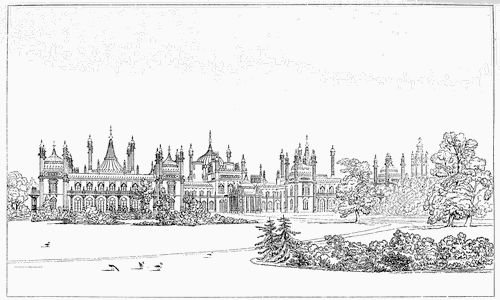
October 1, 1792.—'The Prince, we hear, has it in
contemplation, to take down, and entirely rebuild, on a
much larger scale, his Marine Pavilion at Brighthelmstone;'
but he did not do it just then, as he was
woefully hard up.
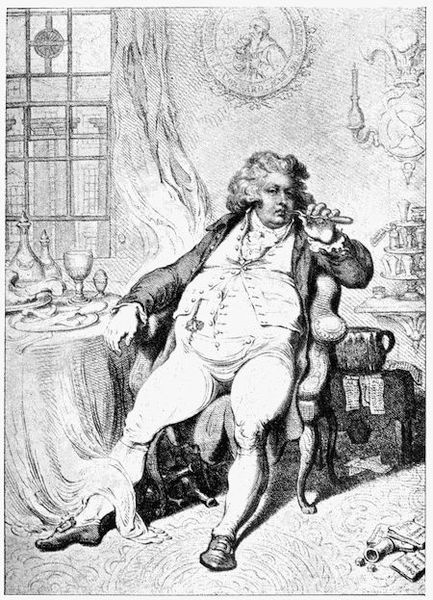
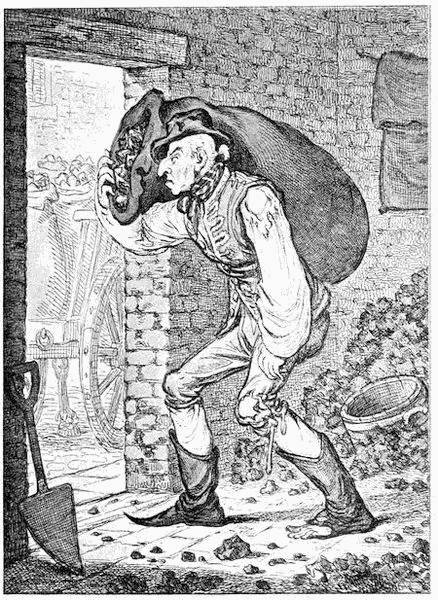
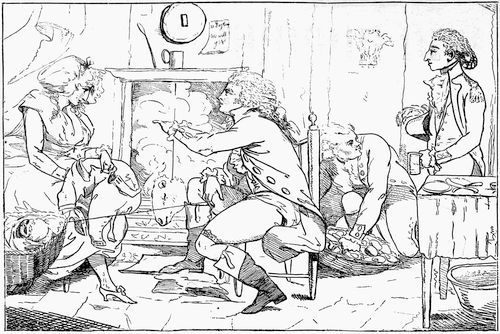
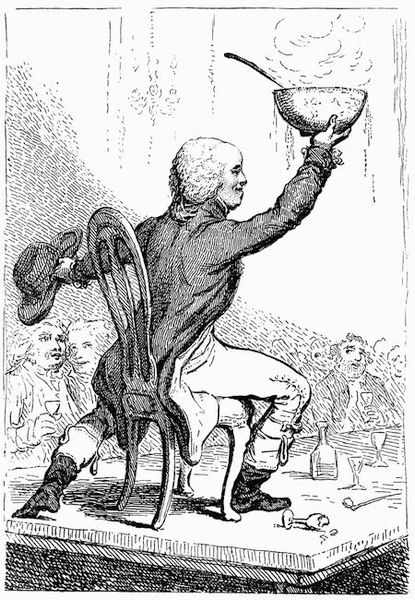
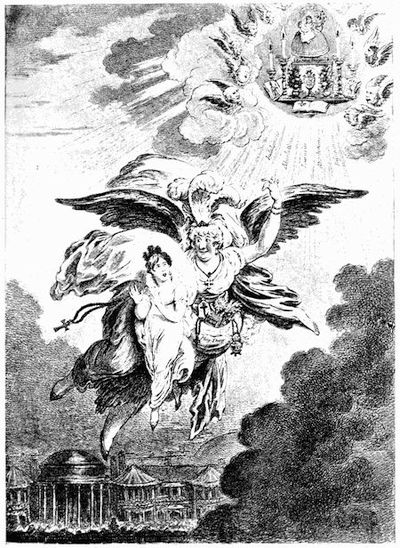
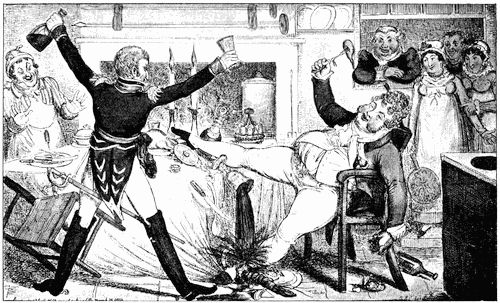
A VOLUPTUARY UNDER THE HORRORS OF DIGESTION.
Of course, during the year the Prince did not escape
the pencil of the satirist, and there was a print published
on May 23, to understand which it must be premised
that formerly, at the opening of Courts of Assize and
Quarter Sessions in England, a proclamation against
vice and immorality was always read. This print is
called 'Vices overlooked in the New Proclamation,'
in which are depicted the King and Queen as Avarice,
the Prince as Drunkenness, the Duke of York as
Gambling, and the Duke of Clarence and Mrs. Jordan
as Debauchery.
Another, published July 2, is 'A Voluptuary under
the Horrors of Digestion.'
This is an excellent likeness of the Prince, who, with
unbuttoned waistcoat, lolls in an armchair, picking his
teeth with a fork. On the ground are dice, a Newmarket
List, Debts of Honour unpaid, and Faro partnership
Account, Self, Archer,[69] Hobart and Co.
In February, 1793, war was declared between France
and England, and volunteers were enrolled for the
defence of their country. Camps were formed at
different parts of the coast, and there was one at
Brighton in August of that year. Needless to say that
the Prince's regiment was quartered there, and he himself
showed in great force. A contemporary[70] gives us
an account of this camp, written by a volunteer:
'Brighton Camp, August 22.—On the Monday,
whatever mistakes (if commanders can make any) had
prolonged the order of march from Waterdown, they
were removed, and the line reached Chailey in good
time. With equal glee and regularity, they set off, the
next morning, for Brighton: about four miles before
they arrived on their ground, their regiments were
formed in battalions, in which order they moved, keeping
good wheeling distance. The irregularity of the
Downs frequently gave an opportunity of seeing every
regiment with a coup d'œil. Numbers of people came
out to meet us. The town, with the sea and the music,
and the universal animation around, somewhat dissipated
the fatigue of a long march. Conspicuous
among the spectators, was the Prince of Wales, in the
honourable garb of his regiment, looking both the
Soldier and the Prince. We marched by his Royal
Highness by divisions, officers saluting, and then
wheeled round the town to our new ground, which
appeared a little Paradise, in comparison.
'The water at our former stations had too much
chalybeate in it to be pleasant. On Chailey common it
was good; and, on our arrival here, we had the luxury
of finding it could not be better. This necessary part
of the comforts of life, with the delightful ground we
are encamped upon, a full advantage of the sea breeze,
and the lively scene continually passing and repassing
in our front, make us hope we shall have more opportunities
of frequenting the Steine Parade than we had
of visiting Tunbridge Wells. Besides, the Commander
in Chief wonderfully gave us an overslaugh from Wednesday
until Monday; on which day we were out six
hours and a half; five of the hours dragged on with the
usual having nothing to do. We then began to form
columns and lines. This intention was by way of drilling
in the new system. General Dundas, the modeller of it,
gave his personal assistance; and I could not help
remarking how gracefully and expeditiously he moved
his sun burnt hand, explanatory of his formation of the
divisions into battalion. I dare say, when we have
brought his theory to practical perfection, we shall
never be a hair's breadth out. Old officers, who have
been accustomed to fight after the old school, find great
fault with many parts of this celebrated system.'
This camp consisted of about 10,000 men, regulars,
militia, and volunteers, and was situated at Hove, where
it continued till October 28. Two new batteries were
built, one on the west cliff, which mounted eight
twenty-four pounders, and the other on the east cliff,
where were four guns of the same weight.
The Annual Register, August 21, gives the following:
'Last Sunday, the Rev. Dr. Knox (a gentleman well
known in the literary world as the author of several
essays) preached at Brighton church. He took his
text from St. Luke; "Glory to God in the highest,
and on earth peace and good will towards men!" In
enlarging on this subject, he spoke in very strong terms
of the calamities of war, and said that the tinsel of
military parade was but a poor compensation for the
innumerable miseries that were the too sure attendants
upon a state of warfare; that the voice of religion was
but little heard amidst the roar of cannon, the shouts
of conquerors, and the splendour of victory. In another
part of his discourse, he said that religion and philosophy
seemed to have but little weight in the councils of the
rulers of the world.
'Several military officers in the church, officiously
took upon themselves to think that the sermon was an
attack upon the constitution of the country, and that it
contained improper reflections upon the profession to
which they belonged.
'Last night, Dr. Knox and his family being in one
of the boxes at the theatre, there were, also, several
officers in the house. At the end of the play, a note
was handed by the boxkeeper, to Dr. Knox, stating
that it was the desire of several gentlemen then present,
that he should withdraw. The note being without a
signature, Dr. Knox took no notice of it. Several
officers then stood up, and insisted on his leaving the
house immediately.
'A scene of much confusion, nearly bordering on
personal violence, ensued. Dr. Knox attempted to
speak, but was, absolutely, forcibly hindered from proceeding;
and himself, Mrs. Knox, and two or three of
their little children, were compelled to leave the house,
to avoid military coercion.'
Florizel, commanding his regiment, and playing at
soldiers, was in his element, as the following extracts
from the St. James's Chronicle show:
August 13-15.—'Monday, being the anniversary of
the Prince of Wales' birth, the same was celebrated at
Brighton; the morning was ushered in by the ringing
of bells; and, at one o'clock, the guns of the salute
battery were fired. Several of the nobility, who went
down to pay their compliments to the Prince, visited
his Royal Highness in the Pavilion, who gave a very
superb entertainment to the officers of his regiment, etc.,
in his Marquee. In the evening there was a grand ball
in the Castle, which was numerously attended.'
September 5-7.—'In the high winds of Wednesday
night, the Prince of Wales's Marquee, in the Camp at
Brighton, was blown down; his Royal Highness, however,
suffered nothing; for, except on the nights when
he is Colonel of the Camp, his residence is in the
Pavilion. Many of the officers and men had their tents
blown down on the same night.'
This marquee was a very splendid and spacious affair,
with a kitchen and all sorts of conveniences attached.
Indeed, Florizel was ever attentive to his own comfort,
vide the following account of his new travelling-carriage:
August 22-24.—'The Prince of Wales has just built
a long carriage for travelling—it is so constructed, that,
in a few moments, it forms a neat chamber, with a
handsome bed, and every other convenience for passing
the night in it, on the road, or in a camp.'
It is all very nice to have travelling-carriages and
marquees, and whatever one's soul desires, but if the
income is a fixed one, albeit over £70,000 a year, there
must be a limit to expenditure. Poor Florizel was
deeply in debt, and one of his best friends, the Earl of
Malmesbury, tells us about it:[71]
'Landed at Dover on Saturday, June 2nd, 1792....
Saw Prince of Wales early the 4th—he was very well
pleased with what I had done at Berlin, thanked me
for it, etc.—Stated his affairs to me as more distressed
than ever—Several executions had been in his house—Lord
Rawdon had saved him from one—that his debts
amounted to £370,000. He said he was trying,
through the Chancellor, to prevail on the King to
apply to Parliament to increase his income.
'On the Wednesday following, I was with him by
appointment. He repeated the same again; said that
if the King would raise his revenue to £100,000 a year,
he would appropriate £35,000 of it to pay the interest
of his debts, and establish a Sinking fund. That, if
this could not be done, he must break up his establishment,
reduce his income to £10,000 a year, and go
abroad. He made a merit of having given up the turf,
and blamed the Duke of York for remaining on it.
He said (which I well knew before), that his racing
stable cost him upwards of £30,000 yearly. He was
very anxious, and, as is usual on these occasions, nervous
and agitated. He said (on my asking him the question),
that he did not stand so well with the King, as
he did some months ago, but that he was better than
ever with the Queen—that she had advised him to
press the King, through the Chancellor, to propose to
Mr. Pitt to bring an increase of the Prince's income
before Parliament, and that, if this was done, she would
use her influence to promote it.
'I strongly recommended his pressing the Queen.
He suggested the idea of going to Mr. Pitt directly
through the Chancellor, etc. I doubted both the
consent of the Chancellor to such a step, at the
moment he was going out, and his influence and
weight if he did consent to it. I took the liberty
of disapproving his going abroad, on any terms, and,
particularly, under the circumstances he mentioned;
said, that if he should, unfortunately, be reduced to the
necessity of lowering his income to the degree he had
mentioned, it would be much better to live in England,
than out of it. That the showing, in England, that he
could reduce his expences, and live economically, would
do him credit, prove him in earnest, and if he kept up
to such a plan, would, in the event, be much more
likely to induce the public to take his situation into
consideration, than any attempts through Ministry,
Opposition, or even the Queen herself.
'I saw the Prince again on the 7th June, at Carlton
House, as before. He repeated the same things, and
added, that, if he could not obtain some assurance from
the King that he would apply to Parliament in the
next Session of Parliament, before this ended, that he
should be ruined, and must go abroad—I, again, combated
this idea; but he appeared to have a wish and
some whim about going abroad, I could not discover.—He
talked coldly and unaffectionately about the Duke
and Duchess of York, and very slightingly of the Duke
of Clarence.
'Colonel St. Leger called on me on the 8th June.
He said the Prince was more attached to Mrs. Fitzherbert
than ever; that he had been living with Mrs.
Crouch[72]; that she (Mrs. Fitzherbert) piqued him by
treating this with ridicule, and coquetted on her side.
This hurt his vanity, and brought him back; and he is,
now, more under her influence than ever.'
And yet he could sacrifice her, in order to get his
debts paid, and himself have a larger income to
squander. There was but one way out of his mess:
that he must commit bigamy, and deliberately repudiate
his wife.
On August 24, 1794, the King wrote thus to Pitt
from Weymouth:
'Agreeable to what I mentioned to Mr. Pitt before
I came here, I have this morning seen the Prince of
Wales, who has acquainted me with his having broken
off all connection with Mrs. Fitzherbert, and his desire
of entering into a more creditable line of life, by marrying;
expressing, at the same time, that his wish is that
my niece, the Princess of Brunswick, may be the person.
Undoubtedly she is the person who, naturally, must be
most agreeable to me. I expressed my approbation of
the idea, provided his plan was to lead a life that would
make him appear respectable, and, consequently, render
the Princess happy. He assured me that he perfectly
coincided with me in opinion. I then said that till
Parliament assembled, no arrangement could be taken,
except my sounding my sister, that no idea of any other
marriage may be encouraged.
'G. R.'
At this time Lady Jersey, a lady of mature age, had
great influence over the Prince, and this probably
made his rupture with Mrs. Fitzherbert the easier.
The caricaturist (this time J. Cruikshank), who always
seems to have been as well posted up in any Court
scandal as one of our Society papers, has a picture,
August 26, 1794, 'My Grandmother, alias the Jersey
Jig, alias the Rival Widows.' Old Lady Jersey, who
is taking snuff, sits on the knee of the Prince, who says:
'I've kissed & I've prattled with fifty Grand Dames,
And changed them as oft, do you see;
But of all the Grand Mammys that dance on the Steine,
The Widow of Jersey give me.'
Mrs. Fitzherbert, one hand clasping her forehead, and
in the other holding a bond for £6,000 per annum,
cries distractedly: 'Was it for this Paltry Consideration
I sacrificed my—my—my—? for this only I submitted
to—to—? Oh! shame for ever on my ruin'd
Greatness!!!'
It came very suddenly. Both Mrs. Fitzherbert and
the Prince were to dine with the Duke of Clarence;
the lady was there, but Florizel was not; instead, a
letter from him was handed to his wife repudiating her.
Lord Stourton had the story from her own lips. Let
him tell it:
'Her first separation from the Prince was preceded
by no quarrel, or even coolness, and came upon her
quite unexpectedly. She received, when sitting down
to dinner at the table of William the Fourth, then
Duke of Clarence, the first intimation of the loss of her
ascendancy over the affections of the Prince; having,
only the preceding day, received a note from his Royal
Highness, written in his usual strain of friendship, and
speaking of their appointed engagement to dine at the
house of the Duke of Clarence. The Prince's letter
was written from Brighton, where he had met Lady
Jersey. From that time she never saw the Prince, and
this interruption of their intimacy was followed by
his marriage with Queen Caroline; brought about, as
Mrs. Fitzherbert conceived, under the twofold influence
of the pressure of his debts on the mind of the Prince,
and a wish on the part of Lady Jersey to enlarge the
Royal Establishment, in which she was to have an
important situation.
'Upon her speaking to me of this union (confiding
in her own desire that I should disguise from her
nothing that I might conceive to be of doubtful
character as affecting her conduct to the Prince), I
told her I had been informed that some proposals had
been made to her immediately preceding the marriage
of the Prince, of which her uncle, Mr. Errington, had
been the channel, offering some terms upon which his
Royal Highness was disposed to give up the match.
She told me there was no truth whatever in the report;
that a day or two preceding the marriage, he had been
seen passing rapidly on horseback before her house at
Marble Hill, but that his motive for doing so, was
unknown to her; and that, afterwards, when they were
reconciled, she cautiously abstained from alluding to
such topics; as the greatest interruptions to their
happiness, at that period, were his bitter and passionate
regrets and self accusations for his conduct,
which she always met by saying—"We must look to
the present and the future, and not think of the past."
'I ventured, also, to mention another report, that
George the Third, the day before the marriage, had
offered to take upon himself the responsibility of
breaking off the match with the Princess of Brunswick,
should the Prince desire it. Of this, too, she told me,
she knew nothing; but added, that it was not improbable,
for the King was a good and religious man. She
owned, that she was deeply distressed and depressed in
spirits at this formal abandonment, with all its consequences,
as it affected her reputation in the eyes of the
world.
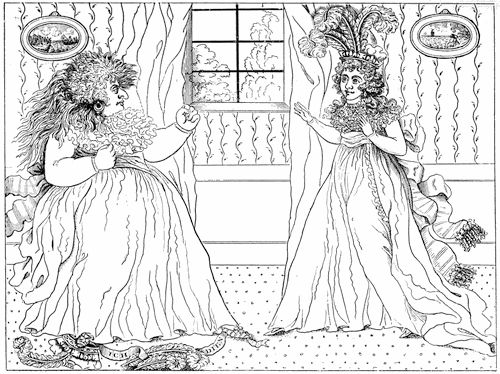
THE RAGE.
'One of her great friends and advisers, Lady Claremont,
supported her on this trying occasion, and counselled
her to rise above her own feelings, and to open
her house to the town of London. She adopted the
advice, much as it cost her to do so; and all the
fashionable world, including all the Royal Dukes,
attended her parties. Upon this, as upon all other
occasions, she was principally supported by the Duke
of York, with whom, through life, she was always
united in the most friendly and confidential relations.
Indeed, she frequently assured me, that there was not
one of the Royal family who had not acted with kindness
to her. She particularly instanced the Queen;
and, as for George the Third, from the time she set
foot in England, till he ceased to reign, had he been
her own father, he could not have acted towards her
with greater tenderness and affection. She had made
it her constant rule to have no secrets of which the
Royal Family were not informed by frequent messages,
of which, the Duke of York was, generally, the organ
of communication, and, to that rule, she attributed, at
all periods, much of her own contentment and ease in
extricating herself from embarrassments which would,
otherwise, have been insurmountable.'
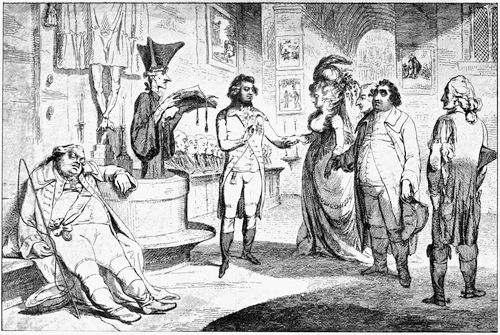
Compare this paragraph with the ideas of the pictorial
satirist on her abandonment. Take, for instance,
'The Rage,' published November 21, 1794. Here we
see Mrs. Fitzherbert, having thrown off her Princess of
Wales's coronet, with clenched fists and dishevelled hair,
sparring at the new Princess of Wales.
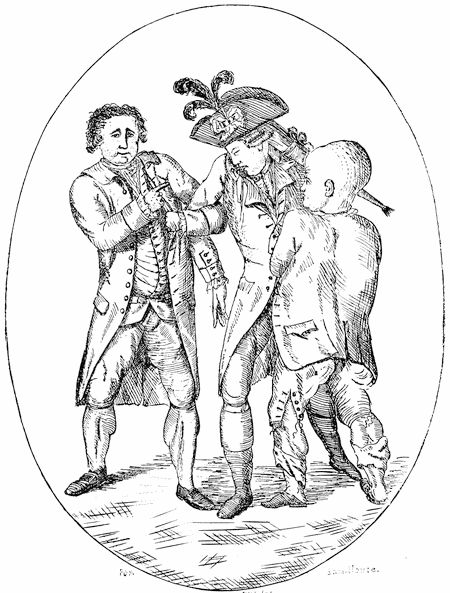
Another, which is of the same date, and is called
'Penance for past Folly,' shows Mrs. Fitzherbert weeping,
and on her knees, before a Roman Catholic priest,
who holds a birch rod in his hand.
The newspapers had an early inkling of the state of
affairs between Mrs. Fitzherbert and the Prince, and
the following cuttings from the Times of 1794 do not
redound much to the paper's credit, or knowledge:
July 21.—'A certain lady has not been so improvident
as the beauteous harlot in the days of
Edward. She has, wisely, laid up ample provision for a
rainy day; and, therefore, her approach, unlike to that
of Shore, is still as likely as ever to make "a little
holiday!"'
July 23.—'We have, hitherto, forborne to mention
the report in circulation for many days past, of the
final separation between a Gentleman of the most
distinguished rank, and a Lady who resides in Pall
Mall, until we had an opportunity to ascertain the fact
beyond all doubt.
'We are now enabled to state from the most undoubted
authority, that a final separation between the
parties in question has actually taken place; that the
agreements formerly entered into, have been given up
by mutual consent; that a new contract has been
signed, by which the lady is secured in the possession of
£4,000 per annum, for her life, besides retaining her
house in Pall Mall, plate, jewels, etc.
'Mrs. Fitzherbert has no intention of retiring into
Switzerland, as has been reported. She is looking out
for a house at, or near, Margate, where she means to
reside for six months, in the society of the Duchess of
Cumberland, Lady E. Luttrell, Mrs. Concannon,[73] and
others of her old acquaintance.'
August 5.—'Mrs. Fitzherbert, we learn, wished to
have a title and £4,000 annuity settled on her, but this
was peremptorily refused.'
August 7.—'Much has been said respecting the
jointure settled on Mrs. Fitzherbert, in consequence of
a late separation; but the precise fact has never been
hitherto stated.—The truth is this:—When the incumbrances
of a certain great personage were put in a
state of settlement, two, or three years since, £3,000 a
year was allotted out of his revenues, for Mrs. Fitzherbert,
which has been punctually paid by Mr. Coutts,
the banker. This sum has been lately settled on
the lady for life; which, with her own private fortune
of £1,800 annually, will make her present income
£4,800 a year. Unincumbered as she now is, the lady
will, probably, be a happier woman than she has ever
been.'





 persons unletted
by any provisions there.'
persons unletted
by any provisions there.'