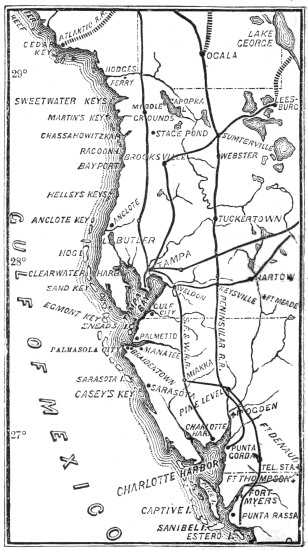
The Warners, Mother and Sons—Palmasola City—Steam Saw-mill and
other Improvements—Sam Nichols and his Shell-mound—Palmasola
Bay—Sarasota Bay and its Surroundings—Snead’s
Island—Shell-mound—Date-palm and Olive Trees—Uncle Joe and his
Dogs with Glass Eyes—Sapp’s Point—Palmetto—The Patten and Turner
Plantations—Judah P. Benjamin—Oak Hill—Terraceia Island—Landing
of De Soto in 1539.
WESTWARD of Fogartyville, on the south side of the bay, among the most
prominent residences, are those of the Warners, mother and sons. Thence
westward, across a bayou, on a sand-spit projecting into the bay, stands
the steam saw and planing-mill of Messrs. W. S. Warner & Co., just
completed. This mill, wharf and warehouse are the nuclei of Palmasola
City, which is soon to skirt the adjacent sand hills, and cause the
surrounding “wilderness to blossom as the rose.” Mr. Warner is a Bay
State Yankee of indomitable pluck, and his partner, Mr. J. S. Beach, who
resides at Terre Haute, Ind., controls the money bags of a national
bank. If capital and pluck wean build a city, the success of Palmasola
may be set down as assured. Along the bay, west of the Warners, are the
ranches of Messrs. Sweetzer, Burgess, Sykes and Bishop. A few miles
further west is Shaw’s Point, at the mouth of the bay. Here, on an
immense shell-mound, surrounded by hammock and pine land, Mr. Sam
Nichols, a native of Alabama, has entered a homestead of 160 acres of
land. Although severely wounded during our late “unpleasantness,” Mr.
Nichols has beaten his musket into a plowshare, his sword into a
pruning-hook, and, like a good citizen, is earning his bread by the
sweat of his brow.
Along the Gulf coast, southward, skirting Palmasola and Sarasota Bays,
may be found the hospitable homes of Messrs. Farrar, Adams, Moore,
Buckner, Harp, Stephonse, Tyler, Spang, Crowley, Dorch, Callan, Riggin,
Dunham, Smith, Helveston, Whitaker, Willard, Bidwell, Edmondson, C. E.
and M. R. Abbe, Liddell, Greer, Yonge, Boardman, Young, Lancaster,
Cunliff, Woodworth, Jones, Anderson, Crocker, Hansen, Bronson Bros.,
Clower, Lowe, Webb, Griffith, Bacon, Knight, Guptrel and Roberts.
On the north side of Manatee Bay, at its entrance into Tampa Bay, is
Snead’s Island, separated from the mainland by a narrow and shallow
“cut-off” leading into Terraceia Bay, and also by a wider and deeper
channel opening into Tampa Bay, and separating it from Terraceia
Island. Midway of the island, fronting on Manatee Bay, is a curiosity
in the shape of a shell-mound or earth-work, crescent-shaped, and some
forty feet in height. The distance between the points of the crescent on
the bank of the bay, is five hundred feet. On the highest point of the
mound, and nearly in the centre, stands a frame dwelling, somewhat
dilapidated, erected by a former owner of the place. On the eastern
angle are two date-palm and two olive trees. The former are fifteen
inches in diameter and forty feet in height. The latter are eighteen
inches in diameter two feet above the ground, and fifty feet in height.
Both the olive and date-palms bear fruit; the former in large
quantities. On the mound in the centre of the crescent, and near the
house, are two olibanum trees, eighteen inches in diameter and fifty
feet in height. Was this mound an Indian burial place, or was it thrown
up by the early Spanish invaders as a defense against the Natchez, a
warlike and semi-civilized tribe of Indians, who, at the time of the
Spanish conquest, inhabited this part of Florida? Quien sabe?
The only human occupants of the island at this time are uncle Joe
Franklin and his wife, an aged couple. Uncle Joe lives in a palmetto hut
with a shell floor, and with the old ’oman and two glasseyed dogs as
companions,
“His hours in cheerful labor fly.”
Uncle Joe is a character, and all visitors to the Manatee should call on
him, examine his mammoth wild fig tree and hedge of century plants.
Mem. Ask him to chain his dogs before you go ashore, otherwise the
seat of your inexpressibles will require repairs. I have been there.
Eastward, above the Terraceia cut-off, is Sapp’s Point. Further along,
and directly opposite Braidentown, is Palmetto, a young town containing
two stores and a post-office. The reader will perceive that Uncle Sam
distributes post-offices in Florida with a lavish hand. We have three of
these convenient institutions within a radius of one and a half
miles—Braidentown, Manatee, Palmetto—and Palmasola City, only three
miles distant, will have one as soon as Postmaster Warner shall build an
office to protect the mail matter of that growing city.
Immediately in the rear of Palmetto is a prairie of several miles in
extent. North-east of the town, about one mile distant in the hammock,
Mr. Hendricks, of Palmetto, has a promising six-years-old orange grove,
grown from seeds planted with his own hands. Mr. Hendricks cultivates
vegetables between the rows of his orange trees, and last year he
realized several hundred dollars by shipping his early tomatoes,
cucumbers and snap-beans to New York and other Northern markets. To Mr.
Hendricks belongs the credit of starting the early vegetable boom in
the Manatee region.
Mr. David Zehner, from Louisiana, has recently purchased a strip of
scrub hammock, east of the town, where he intends to make the
cultivation of grapes and strawberries a specialty. He has already
received several thousand cuttings and plants of the choicest varieties.
A few miles further eastward, you reach the plantation of Major W. I.
Turner, the god-father of Braidentown, who has forty acres in tomatoes,
cucumbers, squashes and beans. He has already commenced shipping his
vegetables to the Northern markets.
Half a mile east of Major Turner’s is the extensive plantation of Major
George Patten. General Hiram W. Leffingwell, ex-United States Marshal
for the Eastern District of Missouri, has recently purchased 200 acres
of this land, and is negotiating for more. Two of the general’s sons,
with their families and an unmarried nephew, are now encamped on the
land, and are busily engaged in erecting dwelling-houses and the
necessary out-buildings. The general and his wife will arrive later in
the season. In addition to the cultivation of the various fruits of the
citrus family, the general will devote his attention to general farm
crops and the growing of early vegetables for the Northern and Western
markets. Another St. Louis gentleman, Mr. C. G. B. Drummond, Assistant
U. S. District Attorney, has purchased 120 acres of land on the Rogers’
hammock near Oak Hill, on which he will set out an orange grove this
summer.
Mr. H. O. Cannon, a California Argonaut, and late resident of New
Albany, Ind., after having spent several winters prospecting Florida,
has, like a sensible man, concluded to pitch his tent on the Patten
plantation. With this view, he has purchased twenty acres of land, which
he has commenced grubbing and fencing, preparatory to planting an orange
and lemon grove. Mr. C. H. Walworth, of Milwaukee, has purchased twenty
acres of land adjoining Mr. Cannon, which he will have cleared, grubbed
and planted in orange and lemon trees this year.
In ante bellum times, the present Patten plantation was known first as
the Gamble, and afterward as the Cofield and Davis plantation, and was
the largest and most thoroughly equipped sugar plantation in the State
of Florida. The owners worked 200 hands, and had 1,400 acres of
sugar-cane in one field. Their sugar-mill and refinery contained all the
modern appliances, and, at the commencement of the war, was worth half a
million dollars. Soon after the breaking out of hostilities, most of the
slaves were sent to Louisiana, and work on the plantation was abandoned.
During the last year of the war, a Federal gunboat entered the Manatee
Bay, and a boat’s crew, commanded by an officer, blew up the sugar-house
and set fire to the refinery. The destruction was complete; and to-day
may be seen the ponderous fly-wheel of the engine, broken shafts and
crumbling walls—sad mementos of the event. The family mansion, a large
two-story brick structure, with galleries around three sides of both
stories, escaped the hand of the destroyer. Although bearing the
finger-marks of time, it is at this day, a substantial structure, and,
with slight repairs, would weather the storms of another century.
Connected with this old mansion is a history, now for the first time
published.
Within these walls during the last days of the Southern Confederacy,
when that fabric (on paper) was fast crumbling to pieces, Judah P.
Benjamin, a fugitive from justice, and flying for his life under the
assumed name of Charles Howard, was the guest for nearly two months of
Captain Archibald McNeill, its then occupant. When on that memorable
Sunday, in the spring of 1865, Jeff. Davis and his cabinet hastily fled
from Richmond, Benjamin and Breckinridge struck out for the wilds of
Florida, which seemed to offer a secure retreat. Arrived at Gainsville,
Breckinridge sought refuge on the Atlantic coast, and Benjamin, under
the guidance of Captain L. G. Leslie, started for the Gulf coast, via
Tampa, and arrived safely at the mansion of Captain McNeill. After
remaining nearly two months at Captain McNeill’s, Benjamin was conveyed
in a boat to Manatee, and from thence to Sarasoto Bay in a horse-cart,
by Rev. E. Glazier, of Manatee; from thence to Cape Florida in a small
sail-boat, commanded by Captain Fred. Tresca, also a resident of
Manatee. At Cape Florida a larger boat was procured, and after several
hair-breadth escapes from Federal gunboats and the perils of the sea,
Captain Tresca landed his charge safely on one of the islands of the
Bahama group, and returned to Manatee $1,500 richer than when he left
home. Benjamin reached England safely, where he has acquired fame and
fortune. Should this page by chance meet his eye, he will no doubt be
pleased to learn that Captain McNeill, past threescore and ten, has
retired from active life and settled in Manatee, surrounded by a large
family. Captain Tresca, or Captain “Fred.,” as he is called by his
friends, lives with his wife and two children on a small plantation near
Braidentown. Although he counts his years away up among the nineties, he
is still a well-preserved “old salt.” Rev. E. Glazier is still a
resident of Manatee, and looks as though he had renewed his lease of
life for another half century. Judas betrayed his Master for the paltry
sum of thirty pieces of silver. Twenty-five thousand dollars was the
price offered by the United States Government for the corpus of the
fugitive. The example of Judas was not followed by those who assisted
Benjamin to escape.
There are more than a thousand acres of the rich hammock land belonging
to this plantation for sale at from $15 to $25 per acre, according to
location. When the fact that it cost originally $75 per acre to clear
this land, is taken into consideration, it will be seen that the price
at which it is now offered is very low, and places it within the reach
of persons of small means. The land will be sold in lots to suit
purchasers.
Adjoining the grounds of the Patten mansion is the residence of Hamet J.
Craig, who has a young orange grove of three hundred trees and ten acres
of hammock land under cultivation. Five miles further on, in a
north-easterly direction, is Oak Hill, the former residence of Major W.
I. Turner. At this place the major has a bearing orange grove of several
hundred trees, and also one of the most promising six-years-old groves
of six hundred trees to be found in the Manatee region. Adjoining Major
Turner is the grove of Walter Tresca, just coming into bearing, and near
by is the young grove of Mr. William Gillett.
Terraceia Island, separated from Snead’s Island by a narrow channel, is
bounded on the west by Tampa Bay, on the north by Frog Creek, and on the
east by Terraceia Bay. This island contains several tracts of excellent
hammock land, most of which is under improvement. On this island are
located the bearing orange groves of Messrs. Hallock, Lennard and
Williams; Messrs. Kennedy, Howard, Gifford, Watkins, Hobart, Patten and
Wyatt are also located on this island. Judge Cessna, of Gainesville, has
recently purchased a plantation on the island, and will soon locate
there. Other persons on the line of the Transit Railroad having become
disgusted with frost and ice, are seeking homes in the Manatee region.
On the mainland, on the east side, and about midway of Terraceia Bay, is
the plantation of Mr. John Craig. Mr. Craig raises the finest cane and
has the reputation of making the best sugar in Manatee County.
A short distance north of Terraceia Island, on the mainland, Hernando De
Soto, fresh from the conquest of Peru, where he was associated with
Francisco Pizarro, landed his troops in the latter part of May, 1539. He
sailed from Havana on Sunday, May 18th, 1539, with his troops embarked
in five large ships, two caravels and two brigantines. The disastrous
fate of his predecessors in Florida cast no gloom on the mind of De
Soto, and his assurances of success imparted confidence to those who
accompanied him. He had never been defeated in battle, and was believed
by his soldiers to be invincible. His officers were men of valor and
ripe experience, and his troops were well disciplined, a majority of
them having served in many campaigns, and all were well acquainted with
Indian warfare.
His wife, Dona Isabella, did not share his enthusiasm, and desired to
accompany him and share the dangers she believed he was about to
encounter; but De Soto strenuously opposed her wishes, and encouraged
her to believe that the time of reunion was not far distant. The
conquest of Florida appeared to De Soto to be an easy task, from which
he could soon return with large accessions of wealth and glory.
Contrary and baffling winds kept the squadron tossing about in the Gulf
of Mexico for several days. De Soto and his troops obtained their first
view of the Land of Flowers on the morning of the 25th day of May, and
in the afternoon of the same day they came to anchor about two leagues
from the shore. The shoals which extended along the coast prevented the
ships from coming nearer. They had, in the meantime, been discovered by
the natives, who had kindled beacon-fires along the beach, now known as
Pinellas, as signals to collect their forces and be in readiness to
repel their enemies. De Soto’s vessels were anchored off the mouth of
Tampa Bay, called by the Spaniards the Bay of Espiritu Santo.
The Natchez, who inhabited the neighboring country, were governed by a
chief named Ucita, whose hatred of the Spaniards is easily explained.
When Pamphilo de Narvaez visited this region in 1528, he was kindly
received and hospitably entertained by the Chief Ucita, and a treaty of
peace between them was formed; yet, on a very slight pretense, the wily
and bloodthirsty Pamphilo caused the chief’s nose to be cut off, and his
aged mother to be torn to pieces by dogs! Hence, the reason why Ucita
displayed implacable resentment in his behavior to De Soto and his
companions in arms.
Thus, it will be seen that from the earliest history of our country, the
aborigines have been treated with the most impolitic and
unchristian-like barbarity; and it is highly probable that much of that
ferocity which characterizes the Indians of the far West at this time,
may be ascribed to the harsh and merciless treatment which their
ancestors received from the early Spanish explorers, who acted on the
principle that the Indians had no rights that a white man was bound to
respect.
Wishing to avoid a collision with the Indians at that time, De Soto
weighed anchor, and proceeded with his fleet two leagues further up the
bay, where he disembarked his troops in boats. The place where he landed
was on the eastern shore of Hillsborough Bay, above the mouth of the
Little Manatee River, and near the line which separates Hillsborough and
Manatee Counties.
The Indians being anxious to get rid of De Soto and his followers,
informed them that El Dorado, for which they were seeking, was further
northward. De Soto sent his ships back to Havana, and commenced his
toilsome march overland, which ended with his death and burial in the
Mississippi River, on the 5th day of June, 1542, three years and one
month after the date of his arrival in Tampa Bay.

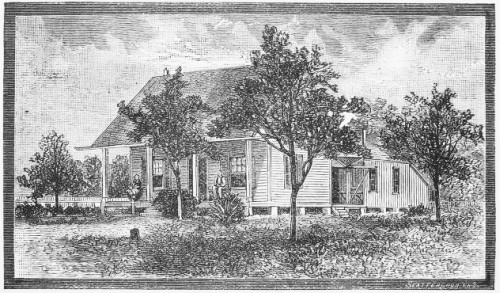 SUNNYSIDE COTTAGE.
The Residence of Samuel C. Upham, Braidentown, Florida.