By the ancient law of 1 and 2 William IV., chap. 32, under the
designation of game, were included “hares, pheasants, partridges,
grouse, heath or moor game, black game, and bustards.”
Hunting and hawking date back to the earliest days of knight-errantry,
when parties of cavaliers and ladies fair, mounted on their mettlesome
steeds caparisoned with all the skill of the cunning artificers of those
days, pursued certain birds of the air with the falcon, and followed the
royal stag through the well preserved and extensive forests with packs
of hounds. The term game, therefore, had an early significance and
positive application, but was confined to the creatures pursued in one
or the other of these two modes.
The gun was first used for the shooting of feathered game in the early
part of the eighteenth century; it soon became the favorite implement of
the sportsman, and was brought into use, not only against the birds,
but the beasts, of game. The huntsman no longer depends upon his brave
dog and cloth-yard shaft, but upon his own powers of endurance and of
marksmanship. Instead of watching the savage falcon strike his prey far
up in the heavens, he follows his high-bred setters, till their
wonderful natural instinct betrays to him the presence of the game.
Where he once rode after the yelping pack, sounding the merry notes of
his bugle horn, he now climbs and crawls laboriously, until he brings
the wary stag within range of the deadly rifle. No more brilliant
parties of lovely dames and gallant men, chatting merrily on the
incidents of the day, ride gaily decked steeds; no more the luxury of
the beautiful faces and pleasant companionship of the gentler sex is to
be enjoyed; the ladies of modern times—except in England, where they
occasionally follow foxes, which are rather vermin than game—preferring
the excitement of ball-room flirtations to outdoor sports and pleasures,
take no part in the pursuits of the chase.
Together with the change in the mode of capturing game, comes a
necessity for a change in its former restricted meaning. Who would think
of not including among game birds, the gamest of them all—the
magnificent woodcock; nor the stylish English snipe, nor even possibly
the brave little quail—unless he can be scientifically proved to be a
partridge—which is at least doubtful! Migratory birds were not included
in the sacred list, and the quail in England, as the woodcock and snipe
of both England and America, are migratory, although the mere temporary
character of their residence does not, in our view, at all alter the
nature of their claims. The larger European woodcock is by no means so
delicious or highly flavored a bird as our yellow-breasted, round-eyed
beauty, and is much scarcer; while the foreign quail, on the other hand,
is smaller than ours, and in southern Europe is found in vast flocks;
but both are entitled to high rank among modern sportsmen.
The term Game Birds, therefore, should be, and has been by general
consent, greatly extended in its application, and applied to all the
numerous species which, whether migratory or not, are killed not alone
for the market, but for sport; and which are followed on the stubble
fields, in brown November, with the strong-limbed and keen-nosed setter,
or shot from blind in scorching August; slain from battery in freezing
December, or chased in a boat, or misled by decoys. All wild birds that
furnish sport as well as profit are therefore game; and the gentle
dowitchers along our sea-coast, lured to the deceitful stools, are as
much entitled to the name as the stately ruffed grouse of our wild
woods, or the royal turkey of the far west.
To constitute a legitimate object of true sport, the bird must be
habitually shot on the wing, and the greater the skill required in its
capture, the higher its rank. The turkey, therefore, although frequently
killed on the wing, is more a game bird by sufferance than by right, and
partly from his gastronomic as well as from his other qualities. Under
this classification, then, we must include, not merely the ruffed and
pinnated grouse, which, although the only species in our country coming
within the ancient definition, furnish far less sport than many other
varieties, but woodcock, snipe, quail, geese, ducks, bay birds, plover,
and rail; without regard to the fact that all, except the quail, are
migratory, and most were unknown to our British ancestry. It has been
even supposed that the quail, in parts of our country free from deep
rivers and impassable barriers, are also in a measure migratory; but
this has no other foundation than their habit of wandering from place to
place in search of food, and collecting late in the season, as they will
do where they are numerous and undisturbed in large packs.
To the protection of this vast variety of game it is the sportsman’s
duty to address himself, in spite of the opposition of the market-man
and restaurateur, the mean-spirited poaching of the pot-hunter, and the
lukewarmness of the farmer. The latter can be enlisted in the cause; he
has indirectly the objects of the sportsman at heart; and with proper
enlightenment will assist, not merely to preserve his fields from
ruthless injury, but to save from destruction his friends the
song-birds.
As the true sportsman turns his attention only to legitimate sport,
destroying those birds that are but little if at all useful to the
farmer; and as at the same time, out of gratitude for the kindness with
which the latter generally receives him, he is careful never to invade
the high grass or the ripening grain—so also, from his innate love of
nature, and of everything that makes nature more beautiful, he spares
and defends the warblers of the woods and the innocent worm-devourers
that stand guardian over the trees and crops. The smaller birds destroy
immense numbers of worms; cedar-birds have been known to eat hundreds of
caterpillars, and in this city have cleared the public squares in a
morning’s visit of the disgusting measuring-worms, that were hanging by
thousands pendent from the branches. And who has not heard the
“woodpecker tapping” all day long in pursuit of his prey?
With the barbarous and senseless destruction of our small birds, the
ravages of the worms have augmented, until we hear from all the
densely-settled portions of the country loud complaints of their
attacks. Peach-trees perish; cherries are no longer the beautiful fruit
they once were; apples are disfigured, and plums have almost ceased to
exist. Worms appear upon every vegetable thing; the borers dig their way
beneath the bark of the trunk and cut long alleys through the wood;
weevils pierce the grain and eat out its pith; the leaf-eaters of
various sorts punch out the delicate membrane by individual effort; or
collecting in bodies, throw their nets, like a spider-web, over the
branches, and by combined attacks deliberately devour every leaf. While
these species are at work openly and in full sight, others are at the
roots digging and destroying and multiplying; until the tree that at
first gave evidence of hardiness and promise of long utility to man,
pauses in its growth, becomes delicate, fades, and finally dies.
The destruction of these vermicular pests is a question of life or death
to the farmer. He may attempt it either with his own labor, by tarring
his trees, fastening obstructions on the trunks, or by killing
individuals; or he may have it done for him, free of expense, by
innumerable flocks of the denizens of the air. The increase of worms
must be stopped; the means of doing so is a question of serious public
concern, and none have yet been invented so effectual as the natural
course—the restoration of the equipoise of nature. It is true that the
robin, as we call him, now and then steals a cherry, and has been blamed
as though he were nothing more than a cherry-thief; but surely we can
spare him a little fruit for his dessert, when we remember that his meal
has been composed mainly of the deadly enemies of that very fruit!
Swallows are accused of breeding lice, which, if true, would not be a
serious charge, considering that their nests are generally in the
loftiest and least accessible corner they can find; but when we consider
how many millions of noxious flies and poisonous mosquitoes they
destroy, how they hover over the swamps and meadows for this especial
purpose, and how much annoyance their labors save to human kind, we owe
them gratitude instead of abuse.
Every tribe of birds has its allotted part to play; and if destroyed,
not only will its pleasant songs and bright feathers, gleaming amid the
green leaves, be missed, but some species of bug or insect, some
disgusting caterpillar or injurious fly, will escape well merited
destruction, and increasingly visit upon man the punishment of his
cruelty and folly.
The beautiful blue-birds, the numerous woodpeckers, the tiny wrens, the
graceful swallows and noisy martins, are sacred to the sportsman, and
constitute one great division of the creatures that he desires to
protect. It is true that enthusiastic foreigners, with cast-iron guns,
are seen peering into trees and lurking through the woods, proud of a
dirty bag half filled with robins, thrushes, and woodpeckers; but let no
ignorant reader confound such persons with sportsmen. Their satisfaction
in slaying one beautiful little warbler, as full of melody as it is bare
of meat, with a deadly charge of No. 4 shot; or in chasing from tree to
tree the agile red squirrel, who, with bushy tail erect, leaps from one
limb to another, emulating the very birds themselves with his agility,
is as unsportsmanlike as to kill a cheeping quail, that, struggling from
the thick weeds in September before the pointer’s nose, with feeble
wings, skirts the low brush; or to murder the brooding woodcock, that
flutters up before the dog in June, and, with holy maternal instinct,
endeavours to lead the pursuer from her infant brood.
From such acts the veritable sportsman turns with horror; they are
cruelty—the slaughter of what is useless for food, or what, by its
death, will produce misery to others; and no persons in the community
have done more to repress this wantonness of destruction than the
Sportsmen’s Clubs. It was at their request that the killing of
song-birds was prohibited altogether; and they are the most earnest to
restrict the times of lawful sport to such periods as will not, by any
possibility, permit its being followed during the season of incubation.
Not alone by obtaining the passage of appropriate laws and their
vigorous enforcement, have these clubs effected a great reform; but by
their personal example and social influence, often, too, at considerable
loss to themselves. For while the poacher, taking the chance of a legal
conviction as an accident of business, and but a slight reduction of his
unlawful profits, anticipates the appointed time, true sportsmen,
restrained by a feeling of honor and self-respect, although they know
that the birds are being killed daily in defiance of the statute, wait
till the lawful day arrives, and thus often, especially in woodcock
shooting, sacrifice their entire season’s sport for a principle.
This honorable spirit, if encouraged and extended, is the best
protection for song-birds and game that can be had. The laws are only
necessary to deter those who are dead to honor and decency, and to fix
the proper times—which ought to be uniform throughout our entire
country. But to enforce them requires the assistance of public opinion.
Every encouragement should be given to sportsmen’s associations. The
absurd prejudice that has originated from confounding them with a very
different class of the community should be overcome, and their efforts
to have good laws passed, and to make them effectual, should be
sustained. The vulgar idea, that confounds laws for the protection of
the wild creatures of wood, meadow, lake, and stream, with the monstrous
game-laws of olden time—that made killing a hare more criminal than
killing a man—should be corrected.
In this country, where every man is expected to be a sort of
volunteer-policeman, all should unite in enforcing the laws; and then,
in spite of the irrepressible obstinacy of the German enthusiast, and
the mean cunning of the sneaking poacher, our cities would soon be rid
of the disgusting worms that make their trees hideous, our farms
protected from the devastations of the curculio, the weevil, the borer,
and the army-worm; the country would once more be populated with its
native feathered game, and our fields would resound with the glad songs
of the little birds that there build their homes.
So long as the ignorant of our nouveaux riches, imagining themselves
to be epicures, will pay for unseasonable game an extravagant price, so
long will unscrupulous market-men purchase, and loafing, disreputable,
tavern-haunting poachers shoot or otherwise kill their prey. It must be
made a disgrace, and if necessary punished as a crime, for any modern
Lucullus to insult his guests by presenting to them game out of season;
and eating-house keepers should not only be taught—by persistent
espionage, if necessary—that illegal profits will not equal legal
punishments; but their customers should also discourage, by withdrawing
their patronage, conduct that is so injurious to the public interests.
Woodcock would not be shot in spring, nor quail in summer, unless the
demand for them were sufficiently great to pay both the expense of
capture and the danger of exposure; and, with a diminution of
purchasers, will be an increased diminution of the number of birds
improperly killed.
Birds and fish, except in their proper seasons, are always tasteless,
and often unhealthy food. A setting quail or a spawning trout is
absolutely unfit to eat, and to do without them is no sacrifice; but for
the sportsman to restrain his ardor as the close-time draws towards an
end, and when others less scrupulous are filling their bags daily, or
when in the wilder sections of country there is no one to complain or
object, requires the heroism of self-denial. Nevertheless, the effect of
example should not be forgotten, and the duty of the true sportsman is
clear and unmistakable: he must abide by the law; or, where there is no
law, must govern himself by analogous rules.
In the wilderness, it is true, where birds are abundant to excess, he
may without blame supply his pot with cheeping grouse or wood-duck
flappers, if he can offer hunger as an excuse; but not even there,
unless driven by extremity, can he slay the parent of a brood that will
starve without parental care. In the settled regions, no matter how
great the provocation, the true sportsman will never forget the
chivalric motto, noblesse oblige.
The close-times of the present statutes are not altogether correct; and
in so extensive a locality as the United States, where diverse interests
are to be considered, it is nearly impracticable to make the laws
perfect. For instance, where quail are abundant, as in the South, there
is no objection to killing them during the entire month of January; but,
as at that period they are often lean and tough, and have to contend, in
the Northern States, against dangers of the elements and rapacious
vermin, with not too favorable a chance for life—it is undesirable,
where they are in the least scarce, to continue the pursuit after
December.
If it were possible to make a uniform law for the entire Union, and to
enforce it everywhere, English snipe and ducks should not be killed at
all during the spring. The latter at the time of their flight northward
are poor and fishy; but if they can be slain in New Jersey, it is hardly
worth while to protect them in New York. For every duck or snipe that
passes towards the hatching-grounds of British America in the early part
of the year, four or five return in the fall and winter. Could proper
protection, therefore, be enforced, the sport in the latter season would
be four times as great as in the former.
As matters stand, however, the seasons for killing game birds should be:
For woodcock, from July fourth to December thirty-first; for ruffed and
pinnated grouse, from September first—and quail from November
first—to the same period, both days inclusive; for wood-duck from
August first till they migrate southward. It is desirable to fix upon
anniversaries or days that are easily remembered. Woodcock are often
young and weak in early summer, and the three days gained between the
first and the fourth of July are quite an advantage. Although the first
brood of quail may be fully grown in October, a vast number of the birds
are too small, and the brush is too dense and thick before the first of
the ensuing month; whereas it is simply monstrous to slay pinnated
grouse, put up by the panting, overheated pointer from the high grass of
the western prairie, in the month of August, ere they can half fly. But
the migratory birds of the coast—the waterfowl and snipe, the waders
and plovers—may continue to be shot when they can be found, till their
rapidly diminishing numbers shall compel a more sensible and considerate
treatment.
The bay-snipe lead the advancing army of the game birds that have sought
the cool and secluded marshes of Hudson’s Bay and the Northern Ocean to
raise their young, and are hastening south from approaching cold and
darkness to more congenial climes. Next come the beautiful wood-duck,
and, almost simultaneously, the English snipe; then the swift but
diminutive teal; after him the broad-bill or the blue-bill of the west;
and then a host of other ducks, till the hardy canvas-backs and geese
bring up the rear. From July, when the yellow-legs and dowitchers
abound; throughout August, in which month the larger bay-birds are
continuously streaming by; during September, when the English snipe are
on the meadows and the wood-ducks in the lily-pad marshes of the
fresh-water lakes; in October, when the teal and blue-bills are abundant
in the great west; all through the fall and into winter, when the geese
and canvas-backs arrive, the bayman finds his sport in perfection.
Many of the upland birds are disappearing; the quail is being killed
with merciless energy, and his loved haunts of dense brush are cleared
away from year to year; the woodcock can hardly rest in peace long
enough to rear her young, and finds many of her favorite secluded spots
drained by the enterprising farmer; the ruffed grouse disappears with
the receding forest, and the prairie chicken with the cultivation of the
open land. But although innumerable ducks, snipe, and plovers are killed
every season, and by unjustifiable measures are driven from certain
localities, their vast flights throughout the whole country—amounting
to myriads in the west—are apparently as innumerable as ever.
From the first of August to the last of December they stretch athwart
the sky from the Atlantic to the Pacific; and although in localities
they may appear scarce, still constitute countless hosts. Were it
possible to stand on some peak of the Rocky Mountains, and take in at a
glance the vast stretch of heavens from ocean to ocean, with the moving
myriads of migratory flocks, the mind would be astonished; and it would
seem impossible ever to reduce their numbers. This is to a certain
degree true; for so long as the lagoons of the South shall remain
undisturbed, and the shores of the bays and rivers unoccupied to any
great extent, this abundance of the migratory birds will continue.
But who can tell how long this will last? The methods of destruction are
being perfected, the number of destroyers is increasing, until now the
reverberation of the fowling piece accompanies the water-fowl from the
rocky shores of Maine to the sandy coasts of North Carolina with the
unceasing roar of threatened death. Twenty years ago, and “batteries,”
as they are called, the sunken floats which are the most fatal ambushes
of the gunner, were almost unknown south of Havre de Grace; now they are
so abundant throughout the waters of North Carolina that the migratory
bird is never out of ear-shot of them during his entire journey.
It would be better for the permanence of wild-fowl shooting never to use
batteries where fair sport can be obtained from points or blinds. Ducks,
geese, and, above all, swans have great faith in the sharpness of their
eyes and the acuteness of their noses. Dangers that they can see they
are rather tempted to scorn. They learn to shun points where man may
conceal his murderous propensities, and are not to be inveigled by the
apparent security of the deceitful likenesses of themselves which are
innocently nestling near by. They seek the safety of the open water,
and feed in the narrow bays and marsh-encompassed ponds during moonlight
nights, if they belong to the tribes that are compelled to gain their
living by grubbing at the bottom, with heads down and tails up. And no
matter how they are harried in certain places, they feel safe in others
close at hand. But the battery, sunken to a level with the water and
hidden by the stand of decoys around it, placed on their favorite
feeding grounds and in the broad bosom of the open bays, is too much for
their courage or sagacity. To see a man, a merciless and murderous
mortal, arise in all his horrid aspect from the depths of the sea, from
the middle of a body of their fellows, is a terror that custom never
stales. After a few such experiences, they lose faith in themselves,
and, if possible, take flight to safer and more propitious realms.
To those who are accustomed to it, there is no more delightful method of
shooting than from a battery, but a novice will find much trouble in
becoming accustomed to the confined position and the awkwardness of
motion. I remember, years ago, hearing Mr. Dominy, who then kept the
famous sporting hostelry at Fire Island, say that if he was to shoot on
a wager for his life, he would prefer to shoot from a battery rather
than in any other way. To one not used to the narrow box and constrained
position, lying on one’s back does not seem to be the most cheerful
manner of killing any species of game. There is everything in habit, and
certainly the exhilaration of watching the approach of the birds as
they come nearer and nearer, and grow larger and larger, from mere
specks on the horizon to the size of broad-bills, canvas-backs, or
perhaps brant or geese, is hardly to be surpassed by any kind of sport.
In most of the Southern waters the destructive nature of these machines
is so well recognized, that non-residents are not permitted to use them,
and the natives keep this method of wild-fowling to themselves.
The shooter lies on his back in this modified coffin, and whenever a
flock approaches he rises to a sitting posture and fires. He cannot
leave his floating home, and is unable to retrieve his ducks without the
aid of an assistant. There have been many accidents arising from
carelessness or inexperience, not merely in the use of the machine
itself, but from the fault of the tender; and so many guns have blown
holes in the bottom of the box, that it is the habit of the gunners on
the south side of Long Island always to warn green hands, and instruct
them how to rest and hold their guns. In two instances within my own
knowledge, the sailing boat that accompanies the shooter, and serves as
his tender and protector, was unable to return to him. In one case it
was driven to leeward, and could not work back to windward, and in the
other it went aground on a falling tide just before dark, when the
thermometer ranged but little above zero. In both cases the sportsmen
were saved, but in both the hand of death grazed them closely.
Night shooting is a still more deleterious practice. Wild fowl must be
allowed to rest at night; indeed, the same might be said of most other
animals, including the human family. If they are not, they will
inevitably wend their way elsewhere. The discharge of one shot at night,
with its accompaniment of flame, and its noise reverberating more
horribly in the still and silent hours, will do more to frighten away
the marsh ducks than any amount of daylight shooting. As the night
begins to fall, the fowl begin to seek the marshes. They rise from the
open water where they have been resting, perhaps without being able to
feed at all, and move towards the shore, coming on in a steady unbroken
flight, until they have all found nesting and feeding grounds in the
shoal water. Drive them from such places in the night, and there will be
no shooting during the day.
The use of pivot-guns is another reprehensible practice that has been so
earnestly condemned, even among market-gunners, that it has been in a
great measure abandoned. Still, however, in some quiet bay of one of the
great lakes of the West, where there is no one to observe the iniquity,
or of a moonlight night on the Chesapeake, the poaching murderer,
sculling his boat down upon an unsuspicious flock crowded together and
feeding or asleep, will discharge a pound or two of coarse shot from his
diminutive cannon; and wounding hundreds, will kill scores of ducks at
the one fatal discharge. The noise, however, reverberating over land and
water, scatters the tidings of the guilty act far and wide; and often
brings upon the criminal detection and punishment. To avoid this the
pivot-shooter will sometimes, as soon as he has fired, throw his gun
overboard with a buoy attached to it, and if pursued, pretend he has
used nothing but his small fowling-piece. The practice of
pivot-shooting, however, has almost ceased, never having been
extensively adopted; and has nothing whatever sportsmanlike about it,
being a mixture of cruelty and theft.
Another mode of pursuing ducks, which is at the same time attractive,
exciting, and injurious, is by the use of a sail-boat. Not only is there
the excitement of the pursuit, the rushing down wind with bellying sail
and hissing water—the crested waves parting at the prow and lengthening
out behind in two long lines of foam—but there is the free motion and
the pleasant breeze to stimulate the sportsman. This is really a
delightful sport, combining the excitement of shooting with the
exhilaration of sailing; but as it disturbs the flocks upon their
feeding-grounds, as it gives them no rest during the noontide hours,
when it appears that ducks—like all other sensible people—love to
indulge in a quiet nap, it eventually drives them away; and not only
makes them shy of the locality, but injures the sport of the
point-shooter, who depends upon their regular flights for his success.
It is not often very remunerative, but is uncommonly attractive, and is
only condemned with great reluctance on proof of its injurious results.
But while sailing for ducks is wisely forbidden by the laws of New York
and of most of the older States, that prohibition should not be
stretched beyond the true meaning and intent of the statute. Coots, the
big black sea coot of the coast and his congeners, not the little mud
coot or blue peter of the fresh waters, may be ducks from a scientific
point of view, but they were never intended to be included in the
prohibition. These dusky gentlemen are wonderful divers, they swim under
water almost as readily and rapidly as they fly above it, and seek their
food at the bottom. They do not so much live on fish, in fact I have
never noticed fish in their stomachs, although some authorities say that
they feed on them, but they devour incredible numbers of small clams and
oysters. They are not content to take the full grown bivalve, two or
three of which would make a solid meal even for a voracious coot, but
they invariably select the tiny fellows just starting in life, and of
whom it takes a great many to furnish forth a breakfast or dinner. There
is little sport in shooting these tough fellows, and no sport except in
killing them from a sailboat when underway.
In this chapter on the obligations that man owes to his feathered
friends, his naturalized assistants must not be forgotten. The imported
sparrow, though small in himself, has done a great work for our country,
and still more for our cities. We all know that gratitude is a fleeting
sentiment, and looks rather to things hoped for than to those which
have already been conferred, and it is somewhat the fashion to decry the
bustling busy immigrant from abroad; but those who remember the
condition of our streets and parks, hung full with disgusting measuring
worms pendent from every tree and branch, till to pass through them was
an annoyance, will not wholly forget our debt to the English sparrow. He
has been, wrongfully I think, accused of driving away our native birds,
but before we condemn him it will have to be shown, not only that he has
done so, but in addition that he has driven away birds more useful than
himself.
It is but a few years since he was first brought among us, and already
have the caterpillars so thoroughly disappeared, that one is rarely seen
in our streets, and the trees are allowed to bear their foliage in
peace, instead of being reduced to bare boughs, as was their invariable
fate in old times. The sparrow has been accused, and has been compelled
to plead guilty of the crime of not eating the hairy as well as the
smooth-skinned caterpillar, but it ought to be urged in mitigation,
before he is condemned to condign punishment, that his adversaries do
not do so either, while they are guilty of the further crime of not even
eating the smooth-skinned kinds.
To the young sportsman, armed with the finest of implements, and
trusting much to them for his success, it is a matter of mortification
and surprise how well a bad gun will shoot in good hands; nevertheless,
no true sportsman ever lived but, if he were able by any self-denial to
scrape the means together, would purchase a valuable and necessarily
expensive fowling-piece. Not only is a well made and handsomely finished
gun safer and lighter than a cheap affair manufactured for the wholesale
trade; not only does it ordinarily carry closer and recoil less; but it
needs fewer repairs, lasts infinitely longer, and is always a matter of
pride and delight to its owner.
Many guns of inferior workmanship throw shot as strongly as those turned
out by the best makers—although this is not the fact in general—but
greater weight has to be given to insure tolerable safety, and the
locks, if not the barrels, are sure to give out in a few years; whereas
the high-priced article will be as perfect at the end of a dozen
years—which have accustomed its owner to its easy, rapid, and effective
management—as it was in the beginning, and will endure until failing
sight, wasting disease, or accumulating years, shall compel its
transfer into younger hands.
Unless a man has continual practice, or is an excellent shot, it is a
serious undertaking to change his gun and accustom himself to another,
which, although apparently identical in weight and shape, will
inevitably differ in some slight point that will be sufficient to
destroy, for a time, accuracy in aim and prompt execution in cover. Some
persons require months to acquire the effective use of a new gun under
difficult circumstances; and in those dense thickets where so much of
our shooting is done, and where it is by instinct founded upon long
habit that the sportsman is enabled at all to kill his game, and where
he cannot indulge in the deliberate care that more open shooting
allows—this deficiency will be most painfully apparent. For such
persons to purchase a new piece, is equivalent to throwing away the
sport of an entire summer or fall, and when we consider that few of us
can expect to average more than forty summers or falls, the loss of
one-fortieth part of life’s enjoyment is no trivial deprivation.
A very cheap gun is dangerous; but it is not expected that any person
reading these lines will trust his life with an instrument that common
sense tells him is manufactured to kill at both ends. A gun of moderate
price, that is, from forty to fifty dollars, is as safe as the most
expensive—the iron is not so tough, but more of it is used; but in a
short time the barrels will wear away; the locks, losing their original
quick spring and sharp click, will become dull and weak, till they will
scarcely discharge the cap; and the stock, warping with the weather,
will exhibit yawning fissures between itself and the iron lock-plates or
false breech.
In lightness, however, is the great superiority of the highly wrought
implement; and in hard tramping through a dense swamp of a hot July day,
or deep wading in a soft snipe-meadow, or in a wearisome trudge over
hill and dale after November quail, a pound will make itself felt in the
additional weight of the fowling-piece, and not only so, but a light gun
can be handled more readily. In open shooting, especially for the wild
fowl of our bays and coasts, mere weight is a positive advantage; but in
the tangled thickets, where birds flash out of sight like gleams of
party-colored light, and the instantaneous use of the piece can alone
secure success, a light gun is an absolute necessity.
Moreover, on certain occasions, when the barrels are exposed to an
extraordinary strain, when the piece built for light charges and upland
shooting is used temporarily upon the larger game of the coasts or
woods, and the two and a half drachms of powder and ounce of fine shot
are replaced by a dozen buck-shot, or an ounce and a half of No. 3
driven by five drachms of powder—then it is pleasant to feel that the
iron is of the utmost possible tenacity and the workmanship in every way
faultless.
A learned dissertation on the science of gunnery is neither appropriate
to the occasion nor possible to the author, and would probably prove as
little entertaining as instructive to the reader. The majority of
purchasers cannot form an exact opinion relative to the merits of a gun
prepared with the utmost skill and ingenuity to deceive them, and must
rely mainly on the word of the seller or reputation of the maker. There
is something, to be sure, in the smooth working of the locks, and still
more in the perfect fitting of the stock; but after all, even to the
experienced sportsman, there is little difference in appearance between
the Shamdamn and the purest laminated steel.
American importers have a peculiarly moral and respectable habit of
vending German guns stamped with the names of English makers, and pacify
their consciences with the idea that the manufactures of Germany are not
inferior to those of England; but they would give more satisfaction to
the public and more ease to their consciences by proving this in open
contest, and establishing the reputation of the German makers, than by
appropriating the names and reputations that good work has made famous.
So far is this deception carried, that some houses even order from the
Belgian manufacturers a certain number, nominally, of each of the
leading gun-makers. It may be that there is little real difference,
although on the continental guns you sometimes pay for useless ornament,
money that should have been expended where it would tell, on locks and
barrels; but the mode of proceeding is certainly not creditable.
In a highly finished article the locks usually work with a smooth
oiliness that can be distinguished with a little practice, and are
fitted with great accuracy into the stock, so that projections of wood
will be left standing not thicker than a piece of blotting-paper. The
barrels will be without flaw or indentation, and if looked through with
the breech removed, will exhibit a perfect ring of light flowing up
evenly, as they are raised or lowered. The mountings will be faultless,
and the cuts in all the screw-heads will point in the same direction;
the screws will work easily and yet perfectly, and the triggers and
trigger-plate, which are invariably neglected in a poor gun, will be
admirably finished and fitted. Examine all these particulars, but
especially the last, and you can form some judgment whether the piece
comes from a good maker or a spurious imitator.
The greatest attention, however, in the selection of a gun should be
paid to the form of the stock and the pull of the triggers; if the
former is unsuited to the shape of the purchaser, or the latter are
stiff or dissimilar, the consequence will be utter failure that no
amount of practice will remedy. If the purchaser’s arms and neck are
long, the stock may be long and crooked; but if the contrary is the
case, the stock must be short and straight.
If possible, the person intending to use a gun should select it for
himself; and if it does not “come up right” the first time he brings it
to his eye, he should refuse it positively. He must not allow himself
to be persuaded to try it again and again; for after one or two trials
he will instinctively adapt his eye to its construction, and will
imagine the gun suits him—an impression that the rapid flight of the
first quail he endeavors to cover will dissipate. The triggers should
give back at a weight of four or five pounds; the hammers of a
muzzle-loader at ten or twelve, and of a breech-loader at twelve or
fourteen. For the former, the best cone is what is called the inverted,
where the bore is larger at the top and receives the entire flame from
the cap.
The shape of the breech for the muzzle-loader formerly gave rise to much
learned disquisition and many plausible theories; but, in all
probability, had no influence on the shooting, which is due mainly to
the form and quality of the barrels. Joe Manton founded his fame on the
idea that the lines of force, if reflected from a hollow cup, like rays
of light from a reflector, would be directed parallel to one another and
lengthwise of the barrel; but later experiments have tended to destroy
this theory. The simple fact appears to be, that powder exerts just so
much force, and, as it cannot escape sideways, it must go out at the end
of the barrel; and that the shape of the breech, except so far as it may
affect the rapidity of ignition, has no influence whatever.
These questions, however, are being effectually disposed of by the march
of events and the general diffusion of breech-loaders; to the latter, as
they are not universally known or appreciated in our country—to which,
by its nature and its game, they are peculiarly adapted—the writer’s
remarks will be mainly confined. Feeling entirely convinced, even from a
short experience, of their superiority in most particulars, and their
equality in all, he regards the consequence as inevitable that they will
utterly supersede the old-fashioned fowling-piece; the few defects that
were originally alleged to exist in them having been either removed or
remedied, and the supply of ammunition for them in this country having
become sufficient. They have won their way slowly into public favor
against the interested opposition of gun-makers on one hand, and the
ignorance and superstitious dread of change of gun-users on the other.
They are a French invention of forty years’ standing, and proved their
superiority long ago; but prejudice was too strong for them, as it has
been for many another good thing. Their merits, nevertheless, slowly
conquered opposition, convinced the intelligent, and confounded the
obstinate; till at last in England—the very hot-bed of prejudice and
the favorite abiding-place of antiquated ideas—there are now sold fifty
breech-loaders to one muzzle-loader. As they are not universally used
with us, the description of them will have to be somewhat minute, and
would be better understood if the reader would take the trouble to
examine one for himself.
The best and most generally adopted of the various kinds is the
Lefaucheux, or some slight modification of it; and to that the
attention will be principally directed. In this gun the breech, which
in the muzzle-loader screws into the barrel, is omitted, and the
barrels are open at both ends; they are fastened to the stock by a pin
and joint a few inches beyond the guard. When free, the muzzle hangs
down, and the breech end presents itself several inches above the stock,
so that the cartridge can be readily inserted; when the barrels are
pressed back into their place for firing, they are caught by a bolt that
can be opened or closed by a lever lying along the under part of the
stock, between the guard and the joint. The false breech is flat, solid,
and heavy, and completes the barrels, taking the place and performing
the duty of the breech in the muzzle-loader. The hammers have a flat
surface on the striking end, and the locks are back-actioned, to avoid
interfering with the other mechanism.
The pin cartridge is made of paper, shaped like a short section of the
barrel, with a brass capsule on one end and open at the other; it is two
or three inches long, and has a pad of thick paper beneath the capsule.
In this pad a hole is punched on the inside and the percussion-cap is
inserted, with a brass pin resting in it and projecting above the
capsule on the outside. The percussion-cap is entirely within the
cartridge-case, and the brass pin passes through a hole drilled in one
side of the capsule, just large enough to admit it and exclude moisture
entirely. A blow on the projecting end of the pin drives the other end
into the cap, and discharges the latter. The cartridge-case is prepared
already capped, and is sold in England for from thirty to fifty
shillings the thousand; it may be recapped by an instrument made for the
purpose with a peculiar cap, and may be used, on an average, three
times.
The cartridge must be loaded as the gun would be, only by the use of a
short ramrod or a special loading implement; the powder is poured in, a
wad placed above it, and the shot and another wad follow. The cartridge
may then be trimmed down and the end bent over, so as to retain the load
securely, if it is to be carried for a considerable distance; but where
the shooting is from a boat or stand, the case should be left untrimmed
and of full length. A chamber is cut away in the lower part of the
barrel, which corresponds exactly with the cartridge-case, so that the
latter fits perfectly in it; but, if there is an interval between the
end of the cartridge and the shoulder in the barrel, no injury to the
charge or the shooting appears to result. A small notch is cut in the
upper edge of the barrel to contain the brass pin, and allow it to
project so as to receive the blow from the hammer.
When the bolt is withdrawn and the barrels are allowed to fall so as to
bring the open breech fairly into view, the loaded cartridge is
inserted, the barrels are sprung back to their place with a sharp snap
that sends them home at once, and are ready to be discharged. To allow
the cartridge to be inserted, the hammers must be drawn to half or full
cock; and when the trigger is pulled, they fall upon the pin, which
penetrates the cap and fires the load. The entire mechanism is so simple
that it can hardly become deranged, and will last as long as the
barrels. The greatest care is necessary in making the chamber that
receives the cartridge of a proper shape, for if this is faulty the
cartridges are apt to stick after explosion.
There is no decided improvement on the original Lefaucheux model, except
in the modification of the machinery, and a convenient method of
separating the barrels from the stock; and no other innovation of a like
character need be particularly described. The needle-gun, which is made
on a somewhat similar principle, is more curious than valuable, being
both dangerous and complicated, and possesses no advantages over the
other pattern. In it the cartridge has a percussion-cap so disposed at
its base that it is penetrated by a needle, which is projected by a
spring through a hole in the lower end of the cartridge; but the
composition of the cartridge, and the manner of its insertion, are
altogether different from the same in the Lefaucheux gun.
According to the arrangement of some English guns, on a plan invented by
Jeffries, the lever, instead of closing forward, lies under the
trigger-guard, when the barrels are closed; and provision is made for
tightening the bolt, in case it wears loose by long usage. This
invention permits of the use of forward-action locks, and the easy
separation of the barrels from the stock, and has come into vogue in
England; it is undoubtedly convenient in both these particulars, and has
as yet developed no corresponding drawbacks.
Personally, the writer has always preferred British to French or Belgian
guns, although chance has compelled him to own as many of the latter as
the former. The English gun is made for work; even when cheaply
manufactured, it will be found effective where efficiency is necessary;
and it is far more beautiful to the eye of a true sportsman, with its
plain blued lock-plates, and total deficiency of ornament, than the
Continental weapon, covered with engraving and ornamentation, but
defective in some of those minutiæ that lend nothing to its beauty, but
add much to its usefulness. This is particularly the case with
breech-loaders, which, if not manufactured carefully, are almost
useless, and which, although originally invented in France, are at this
day produced in more serviceable style—unless where the highest-priced
article is obtained—in England than in the country of their origin.
Great discredit was brought upon breech-loaders among us at their first
introduction, in consequence of the importation of inferior articles,
and they still labor under the disadvantages of that failure, although
rapidly overcoming all objections.
There are a few implements that are necessary to the use of a
breech-loader, which are much simpler than they at first appear. To load
the cartridge is required either a short ramrod and a machine for
turning over the edges of the case upon the wad, to retain it in its
place, or an apparatus, also invented by Jeffries, that combines all the
requisites for loading, and by the aid of which a hundred cartridges
can be loaded in an hour. As the case can be used several times, and the
cap, which is of a peculiar size, has to be placed in its exact position
to receive the pin, a capper invented for the purpose is employed, by
which the cap is inserted, and the pin pressed into it without the least
difficulty; a pair of tweezers are used to withdraw the pin after a
discharge, in order to free the old cap and make room for the new, and a
large gimlet will be found useful for extracting any discharged caps
that may happen to stick.
A cleaning-apparatus is also occasionally used, consisting of a brush at
one end of a string and a small weight at the other; the weight is
dropped through the open barrel and the brush drawn after it; but, as
the gun may be fired ten times as often as a muzzle-loader without
fouling, a plain rag and cleaning-rod will answer. Cartridge-cases, of
course, cannot be obtained like powder and shot at every country store,
and to obviate the danger of finding oneself, after extraordinary
good-luck with a gun, without the means of firing it, it is well to
carry a couple of brass cases, which can be used with a common French
cap, and reloaded indefinitely almost as quickly as a muzzle-loader.
The sportsman, by the aid of these implements and a couple of scoops
with handles for powder and shot, recaps the cartridges which have been
discharged, loads them as he would a gun, only much more rapidly, and
lays them aside for future use. In the field, he carries them in a
leather case, or, which is the preferable plan, in a belt round the
waist, or in his pockets, being able to store in the pockets of his vest
alone at least twenty. The English sportsmen carry them loose in the
pockets of their shooting-coats; but a belt is convenient and
commodious, holding from thirty to fifty, and distributes the weight
pleasantly. Where the shooting is to be done from a boat or stand, of
course they will be kept in an ammunition-box, without having their
edges turned over, as there will be nothing to loosen the wads.
The reader may naturally suppose that there is risk in carrying a number
of loaded cartridges about the person; but in this he is entirely
mistaken. In the first place, the difficulty of discharging a cartridge,
except in the gun, is surprising; no pressure will explode the cap, and
no ordinary blow, unless the cartridge is retained in a fixed position;
and if one falls, the weight of the shot compels it inevitably to fall
on the end: but in case these difficulties are overcome, the result is
merely the discharge of a large fire-cracker.
The writer instituted a number of experiments, and having succeeded,
after many trials, in setting off the cartridge, found that the powder
burst the paper, but failed to drive the wad out of the case. This was
tried with cartridges in all positions, horizontal and perpendicular,
but produced invariably the same result, with unimportant modifications;
and it was further ascertained that the fire from one would not
communicate to another. So that, if a cartridge does explode
accidentally, it may scorch the clothes or even burn the person
slightly, but can inflict no serious injury. These remarks, however, do
not apply to the brass cartridge-cases, which must be handled more
carefully. The common paper-cases may therefore be carried with perfect
impunity, and transported, if carefully packed, without risk.
A more curious idea—for the dread of danger from the loaded cartridge
is natural—prevailed at one time, that the barrels were weakened
because they were open behind, instead of being closed by the
breech-screw; as if a cylinder would be rendered more cohesive by
screwing another piece of metal into one end. In fact, if the
breech-screw has any effect whatever upon the strength of the gun, its
presence is probably an injury. The charge, it will be observed, presses
against the shot on one side and the false breech on the other, and
would not be retained any more securely by the addition of a
breech-screw, which tends to separate instead of closing the barrel. So,
also, it must be borne in mind there is no strain worth mentioning on
the hinge-bolt, and no danger of the barrels blowing away with the
charge; while the disposal of the metal at the false breech, and the
omission of the ramrod, tends to make the gun light at the muzzle—a
great advantage in snap-shooting.
There is absolutely no escape of gas at the break-off; none can escape
unless the brass capsule, which closes the joint hermetically, can be
driven out, and this is a sheer impossibility. The gas cannot penetrate
the paper of the cartridge, and if it bursts the latter, still cannot
escape except through the brass; and although the least perceptible
amount may come out alongside of the pin, it is scarcely traceable, and
nothing like what is lost at the percussion-cap in the common gun. These
cartridges are wonderfully close, as the reader may conclude when he is
informed that a loaded breech-loader, left entirely under water for
fifteen minutes, was discharged as promptly as though it had never been
wet; while a muzzle-loader, that had not been half so long exposed,
would not go at all, and required an hour’s cleaning. In fact, the
breech-loader is entirely impervious to any ordinary wetting, will not
fail in the worst rain, and the average number of miss-fires, in well
made cartridges, is one in a thousand.
In the handling of this gun there is one peculiarity: the pins rise from
the middle of the cartridge, and not at one side, like the ordinary
cones, thus bringing the hammers closer together. To the beginner this
may appear awkward, but is no real disadvantage. It would seem also
desirable to use more powder with a breech-loader, although this is not
necessary to so great an extent as it was formerly; but, on the other
hand, the weight at the breech appears either to diminish the recoil or
reduce its effects on the shooter; as the testimony of persons using
breech-loaders is unanimous that the recoil is less perceptible than
with muzzle-loaders, although the scales have refused to verify their
impression.
One immense advantage of the breech-loader is its safety in loading,
especially in a confined position, as on a boat or in a battery.
Whereas, in the muzzle-loader, immediately after the discharge, while
the smoke is still pouring from the barrel, and while the fire may be
smouldering invisible below, the sportsman deliberately pours in a fresh
charge of powder, holding his hand and the entire flask over the muzzle,
endangering his life, and incurring injury far more frequently than most
persons suppose; with the breech-loader, the barrels are opened and fall
into such a position that no discharge can take place, and never point
towards the person of their owner.
Several of the writer’s friends have been maimed for life by the
premature discharge of a load in the muzzle-loader from a spark
remaining in the barrel; the risk connected with it has always seemed
very great; and even with the patent flasks, which are hardly practical
inventions, more or less unavoidable. This danger is entirely obviated
by the breech-loader, which cannot go off until the barrels are restored
to position after the charges are inserted; cannot leave hidden sparks
to imperil the owner’s life or limb; never expose the hand over the
loaded barrel, that may have been left at half-cock, if the sportsman is
liable to thoughtlessness or over-excitement; and which can be loaded
without difficulty in the most confined position. So, not only do we
have rapidity, but entire safety in loading.
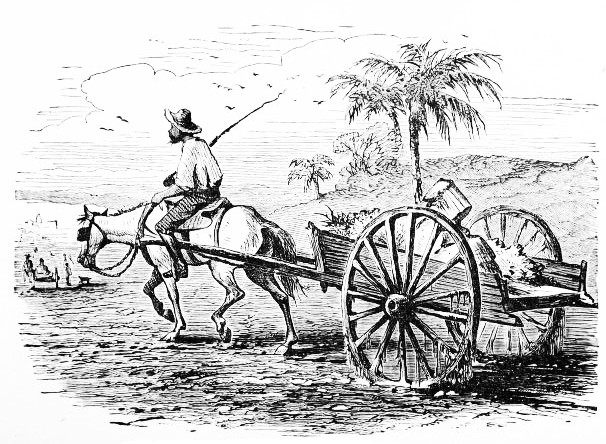
 GATES OF ST. AUGUSTINE, FLORIDA.
The objections, however, urged against breech-loaders have not been few,
and, if well founded, forbid the use of the gun; if, as has been said,
the target is not so good, nor the shot sent with as much force, the
requisites of a first-class sporting implement are wanting. These
charges, freely advanced, have been sustained in a measure by the
wretched performance of poor guns, but were early been brought to the
only true test—actual experience, under equal conditions; and by this
test have been so utterly annihilated that their discussion is only
necessary on account of popular ignorance of the experiments. When
breech-loaders first came prominently before the English public, their
supposed merits and demerits were discussed in the sporting papers in an
animated and violent manner; and in order to settle the questions at
issue, the editor of the London Field determined to have an open
trial, where the breech-loaders and muzzle-loaders could be fairly
matched against one another. The contests took place in 1858 and 1859,
and being carefully conducted, settled the dispute for the time being,
and, even before the latest improvements, established more fully the
superiority of the breech-loader. The best guns and gun-makers of
England were represented; and in spite of occasional variation and
accidental luck—as in the pattern of the first muzzle-loader—the
prejudices against the modern arm were so entirely dissipated that the
old-fashioned guns are at present rarely sold.
Since that trial considerable advance has been made in the minutiæ of
the manufacture; and now it is the general impression of those
acquainted with the arm, that the breech-loader, with a slight
additional increase of powder, shoots both stronger and closer than its
rival. In the pigeon-matches, with scarcely an exception, held both in
this country, of late years, as well as in Great Britain, where it is to
be supposed that the best implements the country could furnish would be
used, and where some of the shooting was done at thirty yards, the
favorite and most successful weapons have been breech-loaders. With all
allowance for the quality of the marksman, the quality of the gun that
wins a match at English “blue-rocks” must unquestionably be good; and
this, the universal experience of those matter-of-fact John Bulls, who
test everything by success, has entirely confirmed.
A trial of guns was made in 1859, and the results were published in
tabular form in The Shot-Gun and Sporting Rifle, by Stonehenge, p.
304. The targets were made of double bag-cap paper, 90 lbs. to the ream,
circular, thirty inches in diameter, with a centre of twelve inches
square, and were nailed against a smooth surface of deal boards. The
centres were composed of forty thicknesses for forty yards, and twenty
for sixty yards, and weighed eighteen and nine ounces respectively, with
such slight variation as will always occur in brown paper. The powder
was Laurence’s No. 2, the shot No. 6, containing 290 pellets to the
ounce, and the charges were weighed in every instance.
TABLES OF THE FIELD TRIAL.
| Kind of Gun. |
Bore. |
Length
of
Barrel. |
Weight
of
Gun.
|
Charge
of
Powder.
|
Charge
of
Shot.
|
No. of Marks on
Face of Targets.
|
No. of
Sheets
pierced. |
No. of
Shots
through
20 sheets.
|
Total on
face
of 4
targets.
|
Tot’l
thro’gh
4
targets.
|
Recoil in
pounds. |
| |
|
in. |
lb. oz. |
drs. |
oz. |
at 40 yds. |
at 60 yds. |
at 40 yds. |
at 60 yds. |
|
|
|
| Muzzle-loader |
12 |
30 |
6.11 |
2¾ |
1¼ |
158 |
118 |
68 |
60 |
28 |
33 |
5 |
2 |
399 |
68 |
68 |
62 |
| " |
12 |
30 |
7.6 |
2¾ |
1¼ |
148 |
98 |
52 |
65 |
28 |
22 |
1 |
2 |
363 |
58 |
66 |
65 |
| " |
12 |
29½ |
6.8 |
2¾ |
1¼ |
116 |
129 |
46 |
40 |
25 |
28 |
1 |
1 |
331 |
55 |
68 |
64 |
| Breech-loader |
12 |
30 |
7.8 |
3 |
1¼ |
144 |
90 |
32 |
58 |
28 |
30 |
0 |
2 |
324 |
60 |
untested. |
| " |
12 |
30 |
7.2 |
3 |
1¼ |
103 |
93 |
60 |
62 |
24 |
31 |
2 |
4 |
318 |
61 |
" |
| " |
12 |
30 |
7.0 |
3 |
1¼ |
132 |
93 |
55 |
38 |
26 |
33 |
2 |
3 |
318 |
64 |
70 |
68 |
| Muzzle-loader |
13 |
30 |
7.0 |
2¾ |
1¼ |
117 |
71 |
47 |
61 |
29 |
37 |
4 |
8 |
296 |
78 |
untested. |
| Breech-loader |
13 |
29 |
6.10 |
3 |
1⅛ |
65 |
135 |
24 |
54 |
29 |
39 |
0 |
1 |
278 |
69 |
64 |
62 |
| Muzzle-loader |
13 |
28 |
6.14 |
2¾ |
1⅛ |
113 |
113 |
24 |
46 |
23 |
34 |
0 |
1 |
296 |
58 |
68 |
68 |
| " |
12 |
29½ |
6.10 |
2½ |
13/16 |
106 |
103 |
35 |
31 |
22 |
32 |
0 |
0 |
275 |
54 |
59 |
61 |
| Breech-loader |
16 |
30 |
7.4 |
3 |
1¼ |
95 |
105 |
50 |
31 |
20 |
27 |
2 |
0 |
281 |
49 |
untested. |
| " |
16 |
28 |
7.4 |
2¾ |
1 |
73 |
99 |
22 |
42 |
30 |
40 |
0 |
1 |
236 |
71 |
64 |
66 |
| " |
13 |
28½ |
7.4 |
3 |
1⅓ |
97 |
95 |
31 |
20 |
22 |
26 |
0 |
0 |
243 |
48 |
65 |
61 |
| " |
12 |
31 |
7.8 |
3 |
1⅓ |
100 |
77 |
32 |
28 |
33 |
25 |
0 |
0 |
237 |
58 |
72 |
69 |
| " |
12 |
30 |
7.4 |
3 |
1¼ |
88 |
91 |
37 |
31 |
22 |
27 |
2 |
1 |
247 |
52 |
76 |
73 |
| " |
13 |
28 |
5.4 |
3 |
1 |
90 |
87 |
20 |
28 |
20 |
31 |
1 |
0 |
225 |
52 |
64 |
68 |
| " |
14 |
29½ |
7.8 |
3 |
1⅓ |
60 |
48 |
31 |
40 |
25 |
23 |
0 |
0 |
179 |
48 |
74 |
68 |
| Averages |
|
|
|
|
|
106 |
97 |
33 |
43 |
26 |
30 |
1 |
1½ |
285 |
59 |
67 |
66 |
| Kind of Gun. |
Bore. |
Length
of
Barrel. |
Weight
of
Gun.
|
Charge
of
Powder.
|
Charge
of
Shot.
|
No. of Marks on
Face of Targets.
|
No. of
Sheets
pierced. |
No. of
Shots
through
20 sheets.
|
Total on
face
of 4
targets.
|
Tot’l
thro’gh
4
targets.
|
Recoil in
pounds. |
| |
|
in. |
lb. oz. |
drs. |
oz. |
at 40 yds. |
at 60 yds. |
at 40 yds. |
at 60 yds. |
|
|
|
| Muzzle loader |
15 |
30 |
6.14 |
2¾ |
1⅓ |
101 |
121 |
48 |
55 |
38 |
22 |
3 |
5 |
325 |
68 |
63 |
58 |
| " |
14 |
28½ |
6.11 |
2¼ |
1⅓ |
147 |
85 |
42 |
48 |
24 |
19 |
0 |
0 |
322 |
48 |
53 |
54 |
| " |
14 |
27 |
5.14 |
2½ |
1 |
180 |
92 |
30 |
60 |
25 |
27 |
2 |
0 |
312 |
54 |
65 |
63 |
| " |
16 |
31 |
6.12 |
2½ |
1 |
122 |
86 |
36 |
57 |
27 |
28 |
2 |
0 |
301 |
57 |
64 |
62 |
| " |
14 |
29 |
6.0 |
2¼ |
1⅓ |
101 |
103 |
30 |
55 |
21 |
25 |
0 |
1 |
289 |
47 |
60 |
44 |
| Breech-loader |
15 |
30 |
6.14 |
8 |
1¼ |
105 |
106 |
63 |
26 |
29 |
33 |
6 |
1 |
300 |
69 |
69 |
76 |
| " |
15 |
29 |
6.8 |
8 |
1¼ |
129 |
57 |
45 |
52 |
20 |
28 |
0 |
3 |
283 |
51 |
64 |
60 |
| Muzzle-loader |
14 |
29 |
6.4 |
2¾ |
1⅓ |
99 |
99 |
34 |
42 |
32 |
27 |
0 |
8 |
274 |
67 |
68 |
74 |
| Breech-loader |
15 |
30 |
7.0 |
8 |
1 |
77 |
100 |
41 |
31 |
33 |
26 |
5 |
0 |
249 |
64 |
71 |
78 |
| Muzzle-loader |
14 |
30 |
7.0 |
2¾ |
1 |
71 |
92 |
52 |
27 |
20 |
29 |
0 |
0 |
242 |
49 |
69 |
64 |
| " |
15 |
30½ |
6.8 |
2¾ |
1⅓ |
83 |
55 |
44 |
24 |
28 |
29 |
5 |
0 |
206 |
62 |
68 |
67 |
| Breech-loader |
15 |
28 |
6.4 |
2¾ |
1⅓ |
83 |
101 |
34 |
7 |
18 |
28 |
0 |
0 |
225 |
46 |
68 |
72 |
| Averages |
|
|
|
|
|
104 |
92 |
42 |
40 |
26 |
27 |
2 |
1½ |
277 |
56 |
65 |
64 |
The guns were classified according to their weight. The breech-loaders,
which used one quarter of a drachm more powder, showed about an equal
recoil; the recoil differed surprisingly, ranging from 44 to 76 lbs.,
and was no indication of the power with which the shot was driven—a
greater number of sheets being pierced where the recoil was under the
average. The patterns produced by the muzzle-loaders varied from those
of the breech-loaders less than they did from one another, and far less
than that of one barrel differed from that of the other; in fact, the
right-hand barrel seems to have shot much the best, and some of the guns
that excelled at 40 yards fell far behindhand at 60 yards.
In penetration, which is a more valuable quality in a gun than even
pattern, the breech-loaders took the lead; one pierced through 40 sheets
and another through 39 sheets, so that the vaunted superiority of the
old gun in this particular was found not to exist. It was further noted
that a great improvement in this particular had taken place in the
breech-loaders since the trial of the year previous, which improvement
has been going on steadily since. The trial also proved that, although
the breech-loaders required an extra amount of powder to give them
force, it caused in them no additional recoil, and was objectionable in
so far only as it entailed extra expense and weight of ammunition. The
muzzle-loader was left, to offset its numerous inferiorities, nothing
more than a claim to diminished weight of gun and ammunition, and a
trifling saving in expense; in force and pattern it was equalled; in
safety and handiness it was far surpassed by its competitor.
These trials were continued afterwards, but none were or could be more
conclusive than the first which I have given, and there is no need of
troubling the reader with them. Indeed, it would almost seem unnecessary
to give time and space to the consideration of the superiorities of
breech-loaders over muzzle-loaders at this day, so universally are the
former accepted in the better informed localities, but in so extensive a
country as ours, there are parts which are late to learn and hard to be
convinced. To-day, while the muzzle-loader has nearly disappeared from
the Northern and Eastern States, it still holds its own in the South and
far West, and there are at present as many of them in service throughout
the length and breadth of our land, as there are of breech-loaders.
One change that was early made in the cartridges was to do away with the
pin and substitute a central fire, and so much was this change admired,
that pin-fire guns have almost gone out of use. Nevertheless, I have
never been convinced that this was any improvement, and believe, that if
the pin-fire gun had come into general use before it was introduced, it
would not have been accepted. However, admitted facts cannot be ignored,
and to-day the pin-fire system has been almost as fully and far less
intelligently relegated to the past, as the muzzle-loader itself. I am
also no admirer of the snapaction, which has to a certain extent been
substituted for the lever, on the ground that, while the lever never
gets out of order, the spring of the snap often breaks. I may say, that
no guns could have been more severely tried than mine that were
manufactured by Lefaucheux, one of which was the second that was ever
permanently used in this country, and that they have never given out in
their working parts, while the oldest and most hardly used has never
given out at all, although shot in all weathers and under very trying
circumstances.
Indeed I go farther and insist that there have been no important
improvements made in breech-loaders since the original Lefaucheux
pattern until the introduction of the hammerless guns. These are still
imperfect, but they will probably be soon perfected, so that the last
serious danger from a breech-loader will be removed, that of premature
discharge in the field. Were it not for this discovery, it is my belief
that sportsmen would yet give up the central-fire, and return to the
pin-fire, there being no advantages in a central fire, while there are
several disadvantages. The principal of these consists in the fact that
no one can tell whether it is loaded or not, and a secondary danger lies
in the loading of the cartridges, which has already cost several lives.
As yet, however, the hammerless gun is not entirely safe. It is thrown
back to full cock in opening, and when closed with a hard snap it will
sometimes jar off. This happens very rarely, but often enough to make
the gun dangerous.
It will foul about the working parts of the breech when it is used hard
without cleaning, so that the springs will not act, and a premature
discharge may follow, and it sometimes catches on the edge of the bent
in the tumbler without slipping into it. As soon as these defects are
absolutely remedied, the graceful and convenient hammerless gun will
take the place of all others. I know very well it is claimed that these,
and all other defects have been removed by the introduction of the
safety block, which interposes before the tumbler, and thus between the
strikers and the cap, and I do not intend to enter into an argument
which would lead to no practical result. There are men ever ready to
take certain risks in order to be ahead of their fellows. Let such
disregard the advice, which common sense suggests, and make experiments,
from which they cannot be dissuaded, and by which others may profit. I
would, however, say that I am sustained in my objections by so high an
authority, as “Stonehenge,” but am willing to admit that even as they
are, I think a hammerless gun is safer than a central fire, for they
avoid one of the greatest risks which the sportsman runs, that of the
trigger catching on a twig as he is going through the bushes. Those who
have used them sufficiently to get accustomed to them, say that they can
shoot better with them than with the old gun, a fact which they
attribute to the absence of the hammers.
The various writers on the different kinds of sport in our country have
generally devoted their attention to upland shooting; to the quail,
woodcock, English snipe, ruffed grouse of the hills, dales, and meadows,
to the prairie-chicken of the far west, or to the larger game—the
ducks, geese, and swans of our coast; and the few suggestions to be
found in Frank Forester’s Field Sports, or Lewis’s American
Sportsman, are of little assistance in discussing the mode of capture
of their less fashionable and less marketable brethren called bay-snipe.
I shall inevitably make mistakes and omissions. The later works on
water-fowl shooting are limited to the consideration of ducks, geese,
and brant, as though bay snipe belonged to the upland. But I consider
them nearly as much of a water-bird as the black duck, for, like the
latter, they are shot mostly at pond holes in the marshes or from sedgy
points.
The birds that are shot along our shores upon the sand-bars or broad
salt meadows, or even upon the adjoining fields of upland, are among
sportsmen termed bay-birds or bay-snipe; and although including several
distinct varieties, present a general similarity in manners and habits.
They are ordinarily killed by stratagem over decoys, and not by open
pursuit; different varieties frequent the same locality, so that many
species will be collected in the same bag; they are for the most part,
except the upland birds, tough and sedgy, and at times hardly fit for
the table; and they arrive and may be killed at certain periods in vast
numbers.
Although despised by the upland sportsman, who regards the use of the
dog as essential to the pure exercise of his art; and by the pot-hunter,
because they do not generally bring high prices in market;—to the
genuine lover of nature and the gun they furnish splendid sport,
requiring, if not as high a degree of skill as may be needed to cut down
a quail in the dense coverts, at least as many fine qualities in the
sportsman, and as thorough a knowledge of their habits as any other
bird. In upland shooting the dog does the largest part of the work, and
invariably deserves the credit for a super-excellent bag; and truly
glorious is it to follow the dog that can make that bag, and wonderful
to watch his powers;—but in bay-snipe shooting there is no trusty dog
to look to, who can retrieve by his superiority his master’s
blunderings. The man relies upon himself, and himself alone; he it is
that must, with quick observant eye, catch the faint outline of the
distant flock, and with sharp ear distinguish the first audible call;
his experience must determine the nature of the birds, his powers of
imitation bring them within gun-shot, and his skill drop them
advantageously from the crowded flock. To excel in all this requires
long patience, much experience, and great qualities of mind and body;
and few are the sportsmen who ever deserve the compliment paid by old
Paulus Enos of Quogue, when he remarked, “Colonel P. is a werry
destructive man—a werry destructive man in a flock of birds.”
It is true that quail-shooting is almost a certainty; and day after day
of fair weather, with well-trained animals and good marksmen, will
produce nearly the same average, so that an entire failure will be
almost impossible; whereas, with bay-snipe everything, in the first
instance, depends upon the flight; and if there are no birds, the result
must be a total blank; but when the season is propitious—and this can
be determined by the experienced sportsman with tolerable accuracy—the
sport is prodigious, and the number of shots enormous.
Nor is it so easy to kill the gentle game that approaches the decoys
with such entire confidence, and often at so moderate a pace. The upland
sportsman, who can cover the quail through the thick scrub-oaks, or the
woodcock in the dense foliage of the shady swamp, and send his charge
after them with astonishing precision, and who will expect easy work
with the bay-snipe, will find himself wonderfully bothered by their
curious motions and irregular flight, till he has acquired the knack of
anticipating their intentions. He will learn that their speed is
irregular; that while at times they will hang almost motionless in the
air, at others they will dart past at the rate of a hundred miles an
hour; that although usually flying steadily, they will frequently flirt
and twist as unexpectedly as an English snipe; and that often they will
either suddenly drop from before his gun and alight, or, taking the
alarm, will whirl fifty feet into the air; and when one barrel has been
discharged into a flock, the rest will “skiver” so as to puzzle even the
best marksman. It is not enough to kill one bird with each barrel from a
flock, as in quail-shooting, but a number must be selected at the moment
they cross one another, so that several may be secured with each barrel;
to do this will require much practice and entail many total misses, and
is rarely thoroughly learned by the upland sportsman. It will not answer
to follow the example of an enthusiastic French gentleman, whom I once
left in the stand while I went to the house for dinner; and who, on my
return, in an excited way remarked:
“Ah! I have vun beautifool shot, I make ze lovely shot; tree big birds
come along—vat you call him?”
“Willet?” I suggested.
“No, no; ze big brown birds.”
“Sickle-bills!”
“No, not ze seeckle-bills.”
“Jacks?”
“No, no; not ze jacks.”
“Marlin!”
“Yes, yes; tree big marlin come close by, right ovair ze stool; zay all
fly near ze other; I am sure to kill zem, it was such beautifool shot. I
take ze gun and miss zem all!”
Moreover, the excitement of a rapid flight is intense; the birds arrive
much faster than the muzzle-loader can be charged, and a flock will
hover round the stand, returning again and again in the most bewildering
manner; as there are usually two sportsmen in each stand, and the stands
are often in sight of one another, a sense of rivalry is added to the
other difficulties of the position.
As the birds approach, great judgment is required in selecting the
proper time to fire, both as regards the condition of the flock and
their position relative to the associate sportsman; they must be allowed
to come well within the reach of both, and yet be taken when they are
most together, and not allowed to pass so far as to endanger the success
of the second barrel. Each sportsman must invariably fire at his side of
the flock, and wait till it is well abreast of him, and never either
shoot over his neighbor’s corner of the stand or at his portion of the
birds. Nothing is so disagreeable as to have a gun discharged close to
one’s head, except perhaps to have it discharged at one’s head; the
noise and jar produce painful and dangerous effects, and unsettle a
person’s nerves for hours. No man who will fire by his associate without
presenting his gun well before him, can know the first principles of
gunnery—or who, if knowing them, wilfully disregards their effects, is
a fit companion. The concussion from the explosion is exceedingly
unpleasant, even if the gun is several feet off, and will produce a
slight deafness.
Of the number of birds which can be bagged, it is hardly possible to
speak within bounds—more than a hundred having been killed at one
shot—but probably a hundred separate shots are occasionally fired by
each sportsman in the course of a day, and with the breech-loader even
more. There have been times when twenty-five pounds of shot have been
expended by one gun, but those days exist no longer, and it is rare to
use more than five pounds where the load does not exceed an ounce and a
quarter.
The uncertainty of the flight is the principal drawback to bay-snipe
shooting, although experience can in a measure overcome the difficulty;
but to the citizen confined to certain days, a selection of time is an
impossibility. The height of the season extends from August 15th to the
25th for the bay-birds proper; and from August 28th to September 8th,
for golden plover; and if a north-easterly storm should occur at this
period, it will be followed by an immense flight.
Dry seasons are never good, and so long as the weather remains warm the
birds will tarry in their northern latitudes; when the meadows are
parched for want of rain, they become too hard for the birds to
perforate, and the latter, being unable to feed, must migrate elsewhere;
but when they are soft with moisture, the older snipe that have left
their progeny at the far north, linger on the feeding-grounds and wait
for the latter to arrive. They seem to make it a point to send back
portions of their number from time to time to look after the young; and
on such occasions, both the messengers and the young stool admirably.
Thus flocks of old birds will frequently be seen wending their way
towards the north, while the main flight is directed southward; and
these flocks will invariably come to the decoys, although the main body
will take no notice of them.
Of course when the meadows are too parched to furnish food, the birds
cannot return on their tracks, but must continue their flight to more
hospitable shores, and in this way one of the best chances for good
shooting is lost. There are probably, in addition, many ease-loving
gluttons among the troupe, who if they find the feeding-grounds well
supplied, stop for a time to enjoy the luxury after their long
abstinence in the inclement north; and in passing to and from their
favorite spots, are said by the native human species to have established
“a trade” to those places. These birds, of course, wherever they see a
flock apparently partaking of a plentiful repast, naturally pause to
obtain their share, and thus fall a prey to their appetites.
Bay-snipe fly during the day and night high up in the heavens, or close
to the earth, in rain or shine, but especially during a cold
north-easterly storm, which, from its direction, is favorable to their
southerly migrations; and they have a vigor of wing that enables them to
traverse immense distances in a short time. In proceeding with the wind,
it is usually at a considerable distance from the earth; but when facing
an adverse current, they keep close to the surface, and consequently are
apt to be attracted by the stools. They do not move much during foggy
weather, for the simple reason that they cannot see their course, but do
not seem to be troubled by a rain. Although clear—that is to say, not
rainy—weather is preferable on many accounts, for their pursuit, good
sport is frequently had, especially on Long Island, during a rain.
Their line of flight is peculiar. Except the plover, they do not follow
the entire coast, and are not found to the eastward of Massachusetts,
but appear to strike directly from their northern haunts to Cape Cod,
where, in the neighborhood of Barnstable, there was in former times
excellent shooting; thence they proceed to Point Judith, or even
somewhat to the westward of it, and then they cross Long Island Sound,
rarely much to the eastward of Quogue; from Long Island they make one
flight to Squan Beach, and so on along the bays and lagoons of the
southern coast to the Equator, or perhaps beyond it to the Antarctic
region. The plovers follow the coast more closely, and strike the
easternmost end of Long Island in their career.
It is very remarkable, that these birds which generally pass northward
in May, and require only three months for incubation and growth of
young, live the other nine months apparently in comparative idleness at
the south. This peculiarity has led to the suggestion that they may
travel to the Antarctic ocean during their absence from the
north—which, although probable, is as yet, from our entire ignorance of
their habits, a mere suggestion.
During the northward flight in May, there is often good sport, but the
time is more uncertain than in August; nor do the birds, which are old
and wary, stool quite so well as on their return. In the spring they
pursue the same course as in the autumnal flight; which, although it is
the most direct line, and follows the principal expanse of salt meadow,
necessitates considerable journeys far out at sea. But it is doubtless
the fact that these birds, in consequence of their stretch and power of
wing, could sustain an unbroken flight from north to south, and
accomplish the distance in a wonderfully short space of time. Unabated
speed of one hundred miles an hour is equivalent to twenty-four hundred
miles in a day, and portions of the flock may not pause between Labrador
and the swamps of Florida.
When the wind is strong and continuous from the westward, it is supposed
that they pass far out to sea; and during these seasons there will be no
flight of birds either at Long Island or on the Jersey coast. At such
periods sportsmen often conclude that the entire race has been
destroyed, till the easterly winds and soaking rains of the following
year, bring them back more numerous than ever. As they must migrate, and
are not to be found anywhere on the land, it is clear that they must
have the power of completing their journey in one unbroken flight.
The principal varieties are the sickle-bill, jack-curlew, the marlin and
ring-tailed marlin, the willet, the black-breast or bull-head, and
golden plovers, the yelper, yellow-legs, robin-snipe, dowitchers,
brant-bird, and krieker. The upland or grass-plover is pursued in a
different manner, and the smaller birds are not pursued for sport at
all.
The sickle-bills, so named after the beautiful sweeping curve of the
bill, which has been known to measure eleven inches in length, are the
largest of them all. They are colored much like a marlin, have a
beautiful bright eye, a short reed-like call, and a steady, dignified
flight. In stretch of wings they exceed three feet, and nothing can be
more impressive than the approach of a large flock of these birds with
wings and bills extended and legs dropped in preparation for alighting
amid the stools.
They are often shy in the first instance, but as soon as one of their
number is killed, they return again and again to the fatal
spot—apparently in blind confidence that he must have alighted instead
of fallen, or out of brotherly anxiety for his fate. I have on several
occasions attracted a large flock that was hesitating whether to
approach or not, and almost resolving to depart, by killing one of their
number that incautiously ventured within long range—for immediately on
seeing him fall, they approached, in spite of the report, with full
confidence.
They are easily killed, by reason of their moderate speed and customary
steadiness, although they can dart rapidly when alarmed, and will often,
like all the bay-birds, carry off much shot. Their flesh is tough, very
dark, and scarcely fit for the table, except perhaps when they first
come on from feeding on the more dainty repasts famished by the uplands
of Labrador.
The jack-curlew is a still more wary bird, and although he comes to the
stools, rarely pauses over them, and never returns after being once
fired at. He is seldom seen in large flocks, and flies rapidly and
steadily. His cry is longer than that of the sickle-bill, and, like it,
easy to imitate. From his wariness and rarity he is regarded as the
greatest prize of the sportsman, although his flesh is little better
than that of the sickle-bill.
The marlin is quite common, very gentle, stools admirably, and goes in
large flocks. In color it is similar to the sickle-bill, but it is much
smaller and has a straight, if not slightly recurved, bill. It is
attracted by the same call, and is equally tough and sedgy as food. The
ring-tailed marlin differs from it entirely in color, resembling a
willet—except that its wings are darker, and its tail black with a
white ring—but it has the long, straight, marlin bill. It is a rare
bird, seldom collects in large flocks, and is often fat and tolerable
eating. It does not stool as well as its plainer brother, but from its
scarcity and higher gastronomic claims, it is more highly prized.
The willet is greyish in general color, with a white belly and broad
bands of black and white across its wings. It has a loud, shrill shriek,
stools well, flies steadily, congregates in large flocks, and when fat
is quite eatable. It often associates with marlins and sickle-bills,
where its light colors make a beautiful contrast.
The last four varieties are nearly similar in size and greatly exceed
the following, but are far less desirable in an epicurean point of view.
The golden plover is one of the finest birds that flies; it associates
in flocks of a thousand, stools well, is extremely fat, is delicious on
the table, and has a peculiarly musical whistle. It frequents the
uplands, and feeds on grasshoppers. Its back is marked with a greenish
red that faintly resembles gold, and gives rise to its name. The young
are quite different in plumage.
The black-breast or bull-head is a shy and rather solitary
bird—although it occasionally collects in large flocks—but it is quite
fat, and frequently killed in the salt marshes over the stools used for
the ordinary bay-birds.
The yelper has a strong, rapid, and often irregular flight, and a loud
cry. It stools well, but escapes rapidly as soon as shot at, darting
from side to side in a confusing way, and returns less confidently than
the willet or marlin. It pursues its course generally high in the
clouds, whence it will drop like a stone when coming to the stools. On
Long Island it goes by the name of big yellow-legs; its call can be
heard at an immense distance, and is repeated continually as it flies.
Gastronomically considered, it is passable, and, when fat, really
excellent.
The yellow-legs, or little yellow-legs, as it is termed on Long Island,
is similar in appearance to the yelper, but has a softer and more
flute-like note, and congregates in larger flocks. It stools admirably,
and is killed in immense numbers. Its flight is rapid and irregular,
especially when it is frightened; and, as food, it ranks with the
yelper.
The brant-bird is a beautiful bird, and stools well; it rarely consorts
in large flocks, and is quite acceptable on the table.
The robin-snipe is a graceful, beautiful, and delicious bird; its
favorite localities are the meadow-islands of the salt bays and lagoons;
its flight is steady, and it does not collect in such immense flocks as
the last named variety. Its whistle consists of two clear shrill notes,
by which it is readily attracted; and its predominant colors are grey on
the back and red on the breast.
The dowitcher, which is considered ornithologically as the only true
snipe of them all, has the habits of the sandpiper and the distinctive
attributes of the scolopax; it is abundant, extremely gentle, and
excellent eating. It stools admirably, coming to any whistle whatever;
and although it can skiver when alarmed, it usually flies steadily. It
associates with the smaller birds.
The krieker feeds on the meadows, remains till late in October, becomes
extremely fat, and is an epicurean delicacy; it utters a creaking cry,
but will not stool at all. It also flies with the smaller snipe.
Having thus mentioned the peculiar distinctive qualities and
characteristics of each bird, of which a fuller description will be
given in another place, we will now pass to a consideration of the best
mode of their pursuit. This being by stratagem, the more thorough the
deception, the more favorable will be the result; and although they can
frequently be attracted by an accurate imitation of their call within
reach of their destroyer, crouched in the open field and unaided by
decoys, they will approach much better to the concealed sportsman and
well made stools. A stand is usually erected near some pond or bar where
the birds are in the habit of alighting—and this can be built in half
an hour of bushes or reeds—high enough to conceal the sportsman
comfortably seated in his arm-chair; and as the grass has become by the
latter part of August a dull yellowish green, he may even shelter
himself from the sun’s rays by a brown cotton umbrella, if he be
delicate or ease-loving. His clothes should assimilate to the color of
the landscape, and be as cool as possible—for the temperature is often
oppressively hot; and a waterproof should always be at hand in case of
rain, to cover, not so much the sportsman as his gun and ammunition,
which may be seriously injured by dampness and salt air combined.
If it is impracticable to build a stand, and the locality is sandy, a
hole may be dug, with the excavated sand banked around it, and the
sportsman may deposit himself upon his Mackintosh at the bottom.
However, to one unaccustomed to the posture, it is difficult to rise and
shoot from such a position, and a comfortable seat is far preferable;
and besides, the mosquitoes are thicker near the earth; the breeze has
less effect and the sun more.
The stools should be so placed that they can be readily seen from the
line of flight, not too high above the water, and the farthest not more
than thirty-five yards from the shooter. If too near a bank, they will
be confounded with the grass, and be invisible even to the keen eye of
the snipe. They should be scattered sufficiently to allow each one to be
distinct, and must be headed in different directions, so that some may
present their broadsides to every quarter of the heavens. They should
tail down wind, in a measure, from the stand, as the birds, no matter
what direction they come from, head up wind in order to alight, and will
make a circle to do so. In this way they reach the lower end of the
imitation flock first, and are led safely close to the sportsman, giving
him an admirable opportunity to make his selection from their ranks.
As the tide varies according to the wind and moon, and will often cover
with several feet of water places usually dry, it is well to have two
sets of sticks—one set for deep water much longer than those for
ordinary use; otherwise, it will occasionally be found impossible to set
out the stools at all, or they will stand so high above the ground as to
resemble bean-poles more than birds.
It is customary to have in the flock, which should not be less than
forty, imitations of the different species—some being brown to
represent marlin, others grey, with white breasts and a white and black
streak over the tail to stand for willet, and so on; but a more
important point is to have them large. Small stools cannot be seen far
enough to attract a yelper sailing amid the clouds, or a marlin sweeping
along the distant horizon; and although it is pretty and appropriate to
have them of suitable colors, size is more necessary. A sickle-bill is a
large bird, and I have seen one tethered among the stools towering above
them, so that the imitations looked puny by comparison, although larger
than they were usually made. The word stool is derived from the Danish
stoel, and signifies something set up on less than four legs, but of
the mode or reason of its adoption we have no record; it is in universal
use, to the exclusion of the more elegant and appropriate term, decoy,
which is confined to imitation of wild fowl. Stools are ordinarily made
of wood, and occasionally painted with great artistic care and skill;
and although a rough affair, coarsely daubed, seems often to answer
nearly as well, there are times when the birds, rendered wild by many
hair-breadth escapes, look sharply ere they draw near, and will not
approach unsightly blocks of wood, no matter how sweetly they seem to
whistle.
As wooden stools take up much room and are troublesome to carry for any
distance, tin ones have been made that will pack together in a small
space. By heading these, different ways, they present a good view to the
snipe, except when the latter are high in air, from which position they
are invisible. To remedy this defect, it has been suggested that a strip
of tin of the width of the body may be soldered along the upper edge;
and thus, while they pack snugly, a section of the object is presented
in every direction.
Wooden stools are decidedly the best, especially where it is desirable
that the birds should alight, and are in general use. They are made of
pine, and painted the distinctive colors of their prototypes; thus
sickle-bills, marlin, and jacks, are all brown with dark spots on the
back and wings; willet, as heretofore described; yellow-legs, dark
mottled grey on the back and wings, and white beneath; dowitchers brown
on the back and wings, and yellowish-white below; bull-head plover light
on the back, with dark breasts; robin-snipe light grey on the back and
side, and reddish beneath. But the snipe are not always discriminating,
and a few varieties will answer every purpose.
Stools are easily made and moderate in cost, and every sportsman should
have not less than twenty-five of his own, so that in case those that he
finds at the country taverns for the public use are engaged, he may have
some to fall back upon—although twenty-five are not a full supply. They
may be carried in a bag or basket, with their feet and bills removed;
and the basket will be useful to hold lunch, ammunition, or game.
Extempore representations can be made from the dead birds, although they
are not quite so good as the wooden ones, by cutting a forked stick with
one end much longer than the other, and thrusting the longer point into
the bird’s neck and the shorter one into its body. It may then be stood
up in the sand, and will make a decoy scarcely distinguishable by man
from the living prototype, but apparently more unnatural to the
birds—which are sometimes alarmed at its ghastly appearance—than the
ordinary stools.
Very perfect stools are made of India-rubber, which, being compressible
and light, can be readily transported, and are a deceptive imitation;
their principal defects are their liability to injury from shot—which
is also the case with wooden ones—and the facility with which the hole
where their long leg is inserted becomes torn—an accident that entirely
destroys their usefulness. They can be packed in a small compass, and
are infinitely the best article where they are to be carried long
distances. Although of necessity undersized, their full plump shape
makes them visible at a considerable distance.
To prevent the bills, which are the most delicate part, from being
injured, it is necessary to make them rather thicker than those of the
living bird; they are to be painted dark-brown, blue, or grey, according
to circumstances; and their loss, although it may not diminish the
attractiveness, destroys the beauty of the fictitious flock. More
important than perfection of decoys, is accuracy in whistling; this
should be a perfect imitation and answer to the call of the bird, and
will often allure him to the fowler without any decoys whatever. It is
impossible to describe the calls on paper, and long practice will alone
give a thorough knowledge of them; they are generally shrill and loud;
the shriller and louder the better—for man’s best efforts will rarely
equal the bird’s natural powers. The yelper has a clear, bold cry, and
the willet a fierce shriek that can be heard for miles; and if listened
to from a distance, it will be found that the bird’s call can be heard
twice the distance of the man’s answer. It is true that when the snipe
are near at hand and about alighting, a lower whistle is better, for the
reason that it is more perfect, and because the cry changes to a note of
welcome when the flock receives its fellows. And often, when the birds
once head for the stools, if not distracted by neighboring stands, or
alarmed, they will come straight on without any whistling, although this
is by no means invariably the case.
Many persons find insuperable difficulty in whistling the clear, shrill,
sharp calls; and for them artificial whistles have been manufactured
with a hole at the lower end, which, being opened or closed by the
finger, like the holes in a flute, regulates the sound. These artificial
whistles are not so good as a perfectly trained natural one; the sound
is not sufficiently reed-like, and they occupy and confine one hand when
it should be free to seek the gun. They are suspended from the
button-hole by a string, so that they can be dropped in an instant; but
are only used out of necessity.
A curious one, to be held in the mouth, has been invented of a
wedge-shaped piece of tin in the form of an axe-head, with two holes
through the sides. The sound is regulated by the tongue, and is
altogether more correct than that of any other whistle; but more time
and patience are required to learn the use of this invention than of the
lips. It will be far better for the sportsman who intends to pursue this
sport, to practise with the organs that nature has given him, however
much time or perseverance may be necessary, and then there will be no
danger of leaving his whistle at home.
As before remarked, the great drawback to the sport of shooting
bay-snipe is its uncertainty; if the flight has not come on, or a
westerly wind has driven the birds to sea, or a heavy north-easter
carries them with it high in air and prevents their stopping—there will
be no shooting; and the most experienced hand will often receive the
comforting assurance which is always bestowed upon the inexperienced,
that if he had only come two weeks sooner, or deferred his visit two
weeks longer, he would have been sure of fine sport. There are
nevertheless certain general rules that furnish a tolerable criterion;
and laying aside the spring shooting, which occurs in May, and is
extremely uncertain, the main flight of small birds—such as dowitchers
and yellow-legs—commences about the tenth of July, and of large birds
about the fifteenth of August. Each lasts about two weeks.
The flight of large birds usually terminates with a short flight of
yellow-legs, and is followed by the plover, which are succeeded by the
kriekers. An easterly storm generally brings the birds, either by
bearing them from their northern homes, or by forcing them in from the
sea, where the main body is supposed to fly; and if such a storm occur
at either of these periods, and be succeeded by a south-westerly wind,
it will surely be followed by an abundance of the appropriate birds.
During an easterly blow they will be seen passing by Point Judith in an
almost unbroken line; and after it, they abound throughout the whole
length of the coast, as though they had been carried to all parts of it
at once. But if no such storm occur, the catching the flight is a mere
chance; and where the summer has been dry, the snipe will be scarce. If
the meadows have been kept moist by continual showers, there will be a
moderate supply of game the summer through; but if there has been a
drought, the surface becomes too hard for the snails and insects to
inhabit, or for the birds to penetrate; a scarcity of food results, and
there will be no flight whatever.
Scattering birds, wandering away from their fellows and exhausted with
hunger, delighted at beholding their friends apparently feeding, will be
killed perhaps in numbers sufficient to make now and then a decent bag;
but what is known as the “flight”—when the great army moves its vast
cohorts, division after division, regiment after regiment, company after
company—will not take place. How they reach the south no one can
accurately tell; they either fly inland or out at sea high in the air,
or late at night; but their returning myriads in the spring following,
prove that in some way they did reach their southern winter homes.
Notwithstanding the greatest experience, and despite the most favorable
signs, the oldest gunner will find that more or less uncertainty exists
in obtaining sport, and that his unlucky expeditions generally outnumber
his lucky ones. Often a flight will commence unexpectedly and without
any apparent reason; and a change of weather, after a long continuance
of wind from one quarter, will be followed by good shooting for some
days, although such weather is not intrinsically favorable. The follower
of bay-birds must therefore make up his mind to disappointment, and on
such occasions live on his hopes for the future, or his recollections of
the past.
For this sport a heavy gun, such as is commonly employed for ducks, is
not at all necessary; inasmuch as many of the birds are small and the
flocks frequently scattered, it is rarely desirable to use two ounces of
shot and five drachms of powder; and to fire such a charge at a solitary
dowitcher, as is often done, is simply ridiculous. A light field-gun,
with an ounce and a quarter of shot and three drachms and a half of
powder, (or, as I prefer, an ounce of shot and three drachms of powder,)
is amply sufficient—will confer more pleasure and require more skill in
the use, will cut down a reasonable number from a flock, and will kill a
single bird handsomely.
The gun should be kept at half-cock, and may be laid upon a bench beside
the sportsman; there is always time to cock it, even if a flock is not
seen till it is over the stools; and a gun at full cock in a stand, is a
danger that no reasonable man will encounter. In field-shooting, I do
not approve of carrying the gun at half-cock, believing, for certain
reasons unnecessary here to repeat, that it is less dangerous at
full-cock; but in a stand or in a house, or in fact anywhere but in the
field where it is always in the sportsman’s hand, it should be never
otherwise than at half-cock. It is common to pass in front of guns lying
on the bench in the stand, and they often fall off, and are usually
reached for by the sportsman while his eye is on the advancing flock,
and does not note whether his hand grasps the barrel or the triggers;
and there is an excitement, when the flight is rapid, sufficiently
perilous of itself in connexion with fire-arms, without uselessly
increasing it. Every precaution should therefore be taken; and if by
accident the gun which cannot go off at half-cock shall be discharged in
cocking or uncocking it, it will point forward, away from the stand, and
in such a direction that injury to human life cannot follow.
Next in importance to care in preventing the gun’s injuring a
fellow-creature, is care in preventing its being injured. The least
dampness, whether from fog or rain, and even the salt air alone, will
rust the delicate steel and iron, and, penetrating farther and farther,
make indentations that will spoil its beauty and injure its
effectiveness permanently. To prevent this, oil frequently applied is
the only remedy; a rag well oiled, and a bottle to replenish from,
should be among the ordinary equipments, and invariably taken to the
shooting-ground; the first symptom of rust or even discoloration should
be removed, and every portion of the iron-work kept well lubricated. At
night a waterproof covering should be used, and the charge invariably
left undrawn, as the dirt prevents oxydization for a time; and during a
rain the utmost care should be taken to protect, if not the entire gun,
at least the locks and trigger-plate. Kerosene oil is excellent to
remove rust, but is too thin to form a coating, and not so good a
protection as sweet or whale oil. Varnish is highly recommended, but I
have never known any one to try it; and in case no oil can be obtained,
the gunners on Long Island are in the habit of shooting a small snipe,
which is often extremely fat, and using its skin as an oiled rag.
Of course with a breech-loader the charge is withdrawn, and the cleaning
apparatus may be forced through every evening, although this is
unnecessary, as the dirt is rather a protection; and after the cleaning,
whether of the muzzle-loader or breech-loader, the barrels should be
well oiled both inside and out. If, however, the gun is to be left for a
long time unused and exposed to salt air, a piece of greasy rag wound
upon a stick may be thrust into the barrels to the bottom, and oil
should be liberally applied to the exposed parts. Moreover, the locks,
however well they may fit, will be injured after a while, and should be
removed and examined occasionally. The size of shot used should be
changed according to the season and character of the flight; in July,
when the yellow-legs and dowitchers are the principal victims, No. 8 is
abundantly large; but in August, when curlews, marlin, and willets are
flying, all of which are able to endure severe punishment, No. 6 is
preferable. Eley’s cartridges are often useful with grass-plover,
although they ball so frequently that the majority of sportsmen have
lost faith in them.
Favorable seasons for snipe, when heavy or repeated rains have saturated
the meadows, and filled every hollow with stagnant pools of dirty water,
are also favorable for mosquitoes. Persons who suffer from the bites of
this pestiferous insect—and the difference between individuals upon
this subject is remarkable—should prepare themselves with mosquito-nets
and ill-scented oils, as they would for a visit to the wild woods; while
those who are much affected by the sun should bring unguents with which
to temper its intensity and assuage the pain that its burning rays
inflict.
Shoes are the proper things for the feet, as boots become heated and
uncomfortable; and a brown linen jacket with white flannel pantaloons,
thick enough to resist the attacks of a mosquito, and with the necessary
underclothes for an exceptionally cold day, constitute the most
practical rig.
If the sportsman use a muzzle-loader—which he should not do if he can
afford to buy a breech-loader—he must have a loading-stick which he can
extemporize from his cleaning-rod by substituting a ramrod head for the
jag. This he does by simply having a piece of brass of the proper size
and shape to screw into the place of the latter. He should also have two
guns, or he loses the chance at the returning flock, which is the most
exciting, as it is often the most successful shot.
The powder should be coarse; the large grain of the ducking-powder being
alone fitted to withstand the deleterious effects of the moisture that
is an invariable concomitant of the salt atmosphere of the ocean.
One great difficulty that the writer has encountered in preparing this
work, is a proper selection of names—the natural history of our country
is popularly so little understood; to copy English names and apply them
to creatures bearing a faint resemblance in general coloring, though
neither in habits nor scientific distinctions, was so natural to the
first immigrants, and the introduction of a proper appellation is so
nearly impossible, that the confusion in nomenclature of our birds,
beasts, and fishes is hardly surprising. This confusion existing in
every department of natural history—confounding fish of all varieties,
leaving birds nameless, or giving them too many names—culminates among
the bay-snipe.
Although the bony-fish or mossbunkers of New York become the menhaden of
the Eastern States, and king-fish are transformed into barb in New
Jersey, and perch become pickerel in the west—there are rarely more
than two names, and every fish has some designation; but with bay-snipe,
after an infinite multiplication of names for certain species, others
are left entirely unnamed. Many that are frequently killed are without a
popular designation, and more still are called frost-birds, and
meadow-snipe, and beach-birds—names that might with justice be applied
to the entire class, and which are so utterly confused, that persons
from different sections of the country do not know what others are
talking about. To make matters worse, the scientific gentlemen have
stepped in, and after indulging in plenty of bad Latin, have added fresh
English appellations, more unmeaning and less appropriate if possible
than the common ones.
From this mass of incongruities the writer has endeavored, while
preserving the best name, to select the one in general use, bearing in
mind that names are mere substitutes, and not descriptive adjectives.
The name frost-bird or frost-snipe—which belongs to entirely different
creatures—is applicable to every bird that appears after a frost, and
as nearly a hundred varieties are in this category, it is not
distinctive; the names meadow-snipe and beach-bird are ridiculous, but
the latter, being applied to an unimportant class, is allowed to stand.
The snipe that is herein called a krieker, or, as it may be spelled,
creaker, which utters a hoarse, creaking note, is called in various
places meadow-snipe—although most of the bay-birds haunt the meadows;
fat-bird, whereas others are equally fat; and short neck, in spite of
the fact that its neck is longer than some species; while ornithologists
call it pectoral sandpiper, probably because it has a breast. So also
with the brant-bird, which is called on the coast of New Jersey
horsefoot-snipe, because it feeds on the spawn of the horsefoot;
notwithstanding that the yellow-legs and several others do the same.
The name, however, is not satisfactory on account of its similarity to
the brant or brent-goose; and probably the scientific designation,
turnstone, if it were at all in common acceptation, would be better. It
is to be hoped these names will at some day be harmonized by universal,
consent, and these pages will at least make mutual comprehension open
the way for that desirable result. The sickle-bill, jack-curlew, marlin,
willet, golden-plover, yelper, dowitcher, and krieker, are excellent;
and the ring-tailed marlin, black-breast plover, yellow-legs, and
robin-snipe, are at least descriptive. Were these generally accepted, a
simple and tolerably accurate system of nomenclature would be obtained;
and it has been my effort, while placing the preferable name at the head
of the description of each variety, to collate all the other names that
in any section of our vast territory are applied to the same bird. In
this attempt I can only be partially successful; for the ingenuity of
the American people in coining new names, added to a profound ignorance
of ornithology, has produced a confusion that no one man can reduce to
order.
Bay-snipe, except the plovers, kriekers, and a few others, are not
considered delicate eating, contracting along the salt marshes a sedgy
flavor; but on the shores of the western lakes, where the fresh water
appears to remove this peculiarity, the yellow-legs and yelpers—which
are often found in considerable numbers, and are called by the general
appellation of plovers—are almost equal in tender,
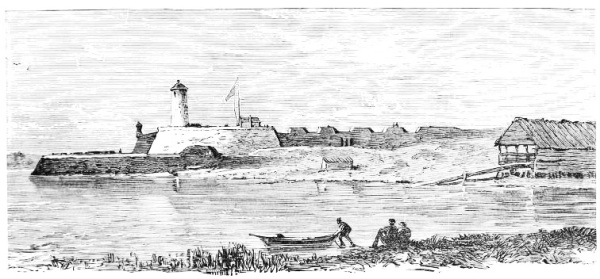 FORT MARION. ST. AUGUSTINE, FLORIDA.
juicy delicacy to the English snipe. Whether the same change is
noticeable in the larger varieties, I cannot say of my own knowledge.
The gunners have an ingenious way of stringing them in bunches of a half
dozen each, on the longest feathers taken from their wings, a pair of
these being tied together by the feather ends, and the quillpoints
thrust through the nostrils of the birds. It is desirable to put them up
in small bunches, as under the warm temperature of summer they will,
unless every precaution is exercised, soon become tainted. To prevent
this, the entrails should also be carefully removed without disturbing
the plumage; and a little salt, or, as many persons recommend, coffee,
rubbed inside, and they should be at all times carefully protected from
the sun. Their sedgy flavor grows stronger with every day they are kept;
and being extremely oily, the least taint renders them, together with
all the wild inhabitants of the coast, unfit for food.
Bay-snipe are essentially migratory, rarely stopping on our shores to
build their nests and rear their young; during the spring months they
pass to or beyond the coast of Labrador, and attend to the duties of
maternity in the vast levels and swamps that surround Hudson’s Bay, and
constitute a large portion of the northern part of British North
America. In my ramblings through the Provinces, I was frequently
informed that they abounded during the latter part of summer on the
marshes near the Bay Chaleur in New Brunswick. This must evidently have
been during their return flight; but whether they were our bay-birds in
their vast variety, or whether they were merely the flocks of golden
plover that follow the winding of the coast and subsequently visit
Nantucket and Montauk Point, I had no opportunity to determine by
personal experience.
With us they make their appearance in the neighborhood of Boston Bay,
and thence they are found, with various intermissions, caused by the
nature of the ground, all the way to the State of Texas. The innumerable
bays, sounds, and lagoons of our Southern States, inclosed by broad
meadows and including thousands of marshy islands, are their favorite
feeding-grounds, and are visited by them in unnumbered thousands. The
larger varieties may be seen there all through the fall quietly feeding,
and scarcely noticing the approach of man. In Texas they seem to
congregate in vast bodies, and probably move off to or beyond the
equator in the early winter months, although this has never been
positively ascertained.
They are not killed as game south of Virginia, and rarely south of New
Jersey; in fact, it may be said that only on Cape Cod, Long Island, and
the shore line of New Jersey, are they scientifically pursued. At these
places the sport has greatly diminished of late years; a few years ago
Barnstable beach was a celebrated resort; and at Quogue, parties used no
stools, but stationed themselves along the narrow neck that connects the
beach with the main land, and fired till their guns were dirty or their
ammunition exhausted. Then it was no unusual thing to expend
twenty-five pounds of shot in a day, where now the sportsman that could
use up five would be fortunate.
Of all the locations on this extent of meadow and beach, no place is so
famous, from its natural advantages and its ancient reputation, as
Quogue. Once on a time the best pond was permanently occupied by a
famous Governor, a still more famous General, and a notorious
Colonel—although the latter was not “in the bond;” but there are other
good stands, and for small birds—yellow-legs, dowitchers, and
robin-snipe—it has no equal. Although many flocks pass it high in air,
all those that follow the coast, low down to the earth, must cross the
meadows that are compressed to a narrow strip at this point, which is
the dividing-ground between the two great bays on the south side of Long
Island.
Unfortunately, a watering-place for the summer resort of the exquisites
of New York has been established in the vicinity, and the consequent
advantages of comfortable beds and a good table are more than overborne
by the annoyance of such companionship. If there be a flight of birds,
every unfledged sportsman takes out his elegant fowling-piece, and,
daintily dressed, proceeds to the meadow, where he would be
comparatively harmless, and dangerous only to himself, were there room
for him and his fellows. But as the ground is limited, and the favorable
points few, he is sure to interfere; and, while killing nothing himself,
ruins the prospects of those who could do better. At Quogue, decoys
were first used about the year 1850, and the best day’s sport of late
was one hundred and thirty-eight birds.
West of Quogue there are some snipe, and occasionally a good flight at
South Oyster Bay, and more rarely still at Rockaway; but the large birds
are not numerous north of New Jersey. Squan Beach, Barnegat, Egg Harbor,
and Brigantine Beach are famous for the large birds—the sickle-bills,
curlews, willets, and marlins—that visit them; the same number of shots
cannot be obtained as at Quogue, but the bag is larger. At the former
places there is also a flight, of greater or less extent, of dowitchers
and yellow-legs, but these are not so abundant as along the margin of
the Great South Bay of Long Island. On the other hand, a bag of one
hundred of the larger varieties is not unusual; while at Egg Harbor the
robin-snipe, which affect marshy islands are exceedingly numerous.
Twenty years ago there was good bay-snipe shooting at what is termed
“Fire Island,” and even in the year 1883 there was a remarkable flight
late in the fall. But the cry of old George, which the gunners of “long
ago” welcomed in their youth, is never heard now; George and his
salutation have departed, and “Wake up, all them as is goin’ sniping” is
a thing of the past.
Why is it that every one who visits New Jersey comes away with an
ecstatic impression of Jersey girls that he never can forget? Lovely
they are, it is true, but not more beautiful than other fair ones of
America; affable, gentle, graceful, sprightly—but these qualities are
common in our angel-favored country. Yet no one that has been blessed
with their company can forget them, but carries for ever in his heart
the image of one, if not two or three, Jersey girls.
These reflections were suggested to the writer by the recollection of
his first trip, many years ago, to the Jersey coast. The summer had been
oppressively hot, and being detained in town during the fore part of
August, he was glad to avail himself of the first chance to escape from
the city and betake himself to the cool, invigorating breezes of the
seashore. Not knowing precisely what route to follow, he trusted himself
on board the train without any definite destination, and, upon inquiry,
was informed that a good place for bay-shooting was at Tommy Cook’s,
near the coast, and about four miles from one of the last stations on
the road, where, under the charge of the Quaker host, considerable
comfort could be had.
To Cook’s, therefore, upon reaching the station, the writer told the
driver of what seemed to be a mongrel public coach, that he wanted to
go; but in thoughtlessness, never conceiving that there could be two
Cooks, he omitted the Tommy that should have preceded the direction. His
surprise was by no means moderate to find, upon reaching his
destination, the supposed Quaker host slightly inebriated, dancing a
solitary hornpipe to an admiring circle. Thinking perhaps that that was
the custom of Jersey Quakers—for the State is exceptional in certain
things—he took a glass of bad whiskey with the jovial landlord, made
proposals, much to every one’s surprise, to go shooting the day
following, and retired early.
Next morning a short walk dissipated all idea of finding game, and
having made the discovery that he was still fifteen miles from the
proper shooting-ground on the beach, he returned to the house, and in
order to enjoy a few hours ere the wagon for his further transportation
would be ready, joined a bathing party. It was quite a sociable affair;
both sexes, dressed in their bathing clothes—the girls without
shoes—crowded down in the bottom of an open wagon. But surely it is not
fair to tell how one of the flannel-encased nymphs nearly fell from the
wagon, and was caught in the arms of the writer, who had jumped out for
the purpose; nor how the rest drove off to leave them; nor how he bore
his lovely burden—plastic grace and beauty personified—bravely in
pursuit; nor how his foot chanced to trip—accidentally, of course—and
they fell and rolled in the sand together. If he would tell, he could
not; words do not exist for the purpose.
He had, however, all he could do to explain the accident and pacify the
nymph. If she had known how much of solidity there was in her
loveliness, and how little of romance in the deep yielding sand, she
might have more readily accepted the excuse of weariness. If the
grasshopper becomes a burden under certain circumstances, why may not a
naiad?
The road to the beach lay through a village formerly known by the
euphonious and distinctive title of Crab Town—a village of a thousand
inhabitants. It was evening ere Crab Town was reached, and just beyond,
the driver came upon a bevy of female acquaintances. In a moment the
suggestion was made that they should ride; after a little demur they
accepted, and were crowded in. The stage was not large, but there would
have been room if they had been twice as numerous; they filled every
seat, and every lap besides.
There are days in one’s lifetime that should be celebrated as
anniversaries; and if any gentleman has carried in his arms, albeit with
true tenderness, one charming Jersey girl in the morning, and has had
another equally charming sit on his lap in the evening, he may look upon
that day as never likely to repeat itself.
There was a hum of pleasant voices—words like, “Oh! Deb, we should not
have got in;” “Why, Mary, we may as well ride—it’s all in our way.”
“But these gentlemen are strangers, and may think it wrong of us.” “Oh,
Lib, don’t talk that way; they know better.” We assured them that
nothing could be more perfectly proper. So situated, the ride appeared
very short, and the next mile, which was as far as our delightful
freight would go, was passed seemingly in about a minute and a half,
decidedly the fastest time on record. At the end of it, on a suggestion
from the driver, who lived in that section and knew the country, toll
was taken of their rosy lips as passage-money. Jersey is a glorious
place.
Passing Charley’s, as he is generally called, the son of the old man,
who for years was famous as the first hunter in that land, we turned off
beyond, down the beach. The bay between the mainland and the sand-bar,
known everywhere as “The Beach,” was narrow, widening slowly as we
advanced, until, at the end of our seven miles’ journey, it was nearly
three miles across. There was little vegetation beside salt grass and
bay-berry bushes; but of the animal kingdom the only
representatives—the mosquitoes—were thicker than the mind of man can
conceive; they rose in crowds, pursuing us fiercely, covering the horses
in an unbroken mass, settling upon ourselves, flying into our eyes,
crawling upon our necks, stinging through our clothes, and filling the
air. Although small, the were hungry beyond belief, and, following
their prey relentlessly, compelled us to fight them off with bushes of
bay-berry for our lives.
Mosquitoes are found plentifully at our summer watering-places, and
still more numerously in the wild woods, grow abundantly in Canada, and
are over-plentiful at Lake Superior; but nowhere are they so merciless,
fierce, and numerous, as, on occasions, at the New Jersey beach. They
are a beautiful little creature, delicate, graceful, and elegant, but
obtrusive in their attentions; although the ardent lover was anxious to
be bitten by the same mosquito that had bitten his lady-love, that their
blood might mingle in the same body.
One good effect they had, however, was to compel the driver to urge on
his weary team, and leave him no time to gossip at Jakey’s Tavern, over
the beach party that was to be held there next day. A beach party is
another delightful institution of the Jerseyites, and consists of a
congregation of the youths of both sexes, especially the female,
collected from the main shore, and meeting on the beach for a frolic, a
dance, and a bath. As it rarely breaks up till daylight, the pleasantest
intimacies are sometimes formed, and soft words uttered that could not
be wrung from blushing beauty in broad day.
The establishment of the “old man”—the sporting “old man,” not the
political one—since he has been gathered to his forefathers, is kept up
by his son-in-law, usually known by the abbreviation—Bill. It is not an
elegant place; sportsmen do not demand elegance, and willingly sleep,
if not in the same room, in chambers that lead into one another; but it
is situated within a hundred yards of the best shooting ground, and is
as well kept as any other tavern on the beach. Sportsmen do not mind
waiting their turn to use the solitary wash basin, drawing water from
the hogshead, or wiping on the same towel, but are thankful for good
food, and the luxury of a well filled ice-house.
In addition to the general directions heretofore given, it may be well
in this connexion to describe more particularly the mode of killing
bay-snipe. A number of imitation birds, usually called stools, are cut
from wood, and painted to resemble the various species; they have a long
stick, or leg, inserted into the lower part of the body, and a
sufficient number to constitute a large flock are set up in shallow
water, or upon some bar where the birds are accustomed to feed. They are
made from thin wood, or even from tin, and are headed various ways so as
to show in all directions; the coarsest and least perfect imitations
will answer.
The most remarkable trait of the shore birds, or bay-snipe, is their
gregarious nature and sociability. A flock flying high in air,
apparently intent upon some settled course, will, the moment they see
another flock feeding, turn and join it. Their natural history, or the
object which they evidently have in thus joining forces, does not seem
to be understood; but the baymen, by imitation-birds and calls, take
advantage of this instinct. Farther south, along the shores of Florida
and Texas, these snipe collect in crowds; and either this is the first
step towards that purpose, or they are merely attracted by the feeding
birds to a promising place for a plentiful repast.
Although ordinarily they will come to the stools of themselves, if they
happen to be at a distance flying fast and high, the gunner must trust
to the shrillness of his whistle and the perfection of his call, to
attract their attention. If they turn towards the decoys and answer the
whistle—which they will do at an immense distance—they are almost sure
to come straight on, and their confidence once gained, rarely wavers.
There is a common expression among the baymen, that birds have a trade,
or are trading up and down over a certain course, by which they mean
that they fly backward and forward at regular hours, and to and from
regular places. Snipe that are thus engaged trading are not only in the
finest condition, but come to the decoys, or stool, as it is termed, the
most readily. They are probably stopping on the meadows, and fly to
their feeding-grounds in the morning and back at night. The great
migratory bodies, which frequently stretch in broken lines almost across
the horizon, and which are pursuing their steady course to their
southern homes, rarely heed the whistle, or turn to the silly flock that
is eating while it should be travelling.
The best days are those with a cloudy sky, and a south-westerly wind. On
such occasions the birds often come in myriads, delighting the
sportsman’s heart, testing his nerves, and filling his bag to
repletion. When the object is to kill the greatest number possible, they
are permitted to alight among the stools and collect together before the
gun is fired; then the first discharge is followed rapidly by the
second, which tears among their thinned ranks as they rise; and, if
there be a second gun, by the third and fourth barrel, till frequently
all are killed. The scientific and sportsmanlike mode is to fire before
they alight, selecting two or three together and firing at the foremost.
It is a glorious thing to see a flock of marlin or willet, or perhaps
the chief of all, the sickle-bills, swerve from their course away up in
the heavens, and after a moment’s uncertainty reply to the sportsman’s
deceitful call and turn towards his false copies of themselves. As they
approach, the rich sienna brown of the marlin and curlew seems to color
the sky and reflect a ruddy hue upon surrounding objects; or the black
and white of the barred wings of the willet makes them resemble birds
hewn from veined marble. The sportsman’s heart leaps to his throat, as
crouching down with straining eye and nerve, grasping his faithful gun,
he awaits with eager anxiety the proper moment; then, rising ere they
are aware of the danger, he selects the spot where their crowding bodies
and jostling wings shut out the clouds beyond, and pours in his first
most deadly barrel; and quickly bringing to bear the other as best he
may among the now frightened creatures as they dart about, he delivers
it before he has noticed how many fell to the first. Dropping back to
his position of concealment, he recommences whistling, and the poor
things, forgetting their fright and anxious to know why their friends
alighted amid a roar like thunder, return to the fatal spot, and again
give the fortunate sportsman a chance for his reloaded gun.
It was for such glorious sport as this, with fair promise of
success—for the flight was on, as the saying is, when the snipe are
moving—that I prepared myself the next morning. Rising at earliest
daybreak, a friend, the gunner, and myself sallied out to the blind, and
having set out our stools, possessed our souls in patience for what
might follow. A blind is another ingenious invention of the devil—as
personified by a bayman, in pursuit of wild fowl—and is constructed by
planting bushes thickly in a circle round a bench. Seated upon this
bench and concealed from the suspicious eyes of the snipe by the dense
foliage of the bayberry bushes, the sportsman, in comparative comfort,
awaits his prey. In less civilized localities he hides himself among the
long sedge grass or scoops out a hole in the sand and lies at length
upon a waterproof blanket.
The wind had hauled, in nautical language, to the south’ard and
west’ard, and the sun’s rays driving aside the hazy clouds, illuminated
the eastern sky with fiery glory. The land and water, dim with the heavy
night fog, stretched out in broad, undefined outline, and the heavens
seemed close down upon the earth. Through the hazy atmosphere and
sluggish darkness the rays of light penetrated slowly, bringing out
feature after feature of the landscape, lighting the tops of distant
hills, and revealing the fleecy coursers of the sky.
Amid the fading darkness we soon heard the welcome cry of the bay-snipe
pursuing his course, guided by light that had not yet reached our
portion of the earth’s surface. Instantly we responded with a vigor and
rapidity on behalf of each, that must have impressed the travelling
birds with the belief that we constituted an immense flock. Again and
again, long before our straining eyes could catch the outline of their
forms, came the answering cry. Our eagerness increased with the
approaching sound, until from out the dim air rushed a glorious flock of
marbled willet, and swooping down to our stools dropped their long legs
to alight—we feeling as though little shining goddesses were descending
upon us.
Without pausing to discuss their angelic character, but mercilessly
bringing our double-barrels to bear upon the crowded ranks, we poured in
a destructive broadside that hurled a dozen upon the bloodied sand.
Startled at the fearful report and its terrible consequences, they rose,
darting and crossing in their alarm, and fled at full speed; but hearing
again the familiar call, after flying a few hundred yards, they turned
and came once more straight for the decoys. Then my friend thought
highly of me and my breech-loading gun, for ere he had reloaded I had
discharged my two barrels three times, adding six birds to those
already upon the sand. Eighteen willet from the first flock, and ere the
sun was fairly up, gave us a good start; and after the birds were
gathered, the favorable send-off was duly celebrated in a few drops of
water with enough spirit to take the danger out.
And now myriads of swallows made their appearance, skimming close along
the water, but in one steady course, as though they were going out for
the day, and would not be back till night-fall. They were followed by
scattering snipe that furnished neat but easy shooting till six o’clock,
when the regular flight began with a splendid flock of marlin that came
rapidly from the south’ard, and after hovering over the stools and
giving us one chance, returned for two more favors from the
breech-loader, and left sixteen of their number.
Sportsmen of any experience know that nothing is easier than to select
from a flock a single bird with each barrel; but in bay-shooting, a man
who claims to excel, must kill several with the first barrel, and one,
at least, with the second. If, however, to the ordinary excitement be
added the natural emulation arising from the presence of several
sportsmen in the same stand, the foregoing desirable result is not
always attained. If, therefore, the reader shrewdly suspects we should
have killed more birds than we did, let him place himself in a similar
position, and record his success.
Shore birds of the various species, beginning with the magnificent
sickle-bill, and including the wary jack-curlew, the noisy, larger
yellow-legs or yelper, and the smaller one, down to the pretty
simple-hearted dowitcher, went to make up our morning’s bag. The
scorching sun when it hung high over our heads stopped the flight, and,
aided by venomous mosquitoes, drove us to the shelter of the house, and
turned our thoughts towards dinner.
The stands being convenient to the tavern, we had run in and snatched a
hasty breakfast, but now collected to clean guns, load cartridges, and
talk over results. The breech-loader being at that time something of a
novelty, attracted considerable attention, and was accused of that
defect popularly attributed to it, of not shooting strongly. As there
were several expensive guns present—among them one of William Moore—in
all of which the owners had great faith, the question was soon tested
and settled to the satisfaction of the most sceptical.
That being concluded, black-breast, or bull-head plover, was the
occasion of a terrible contest over the entire plover family—some of
the sportsmen insisting there were three, others four or five well-known
kinds. They all agreed as to there being the grass-plover, the
bull-head, and the golden-plover; but some claimed in addition, the
frost bird and the red-backed plover. At last one burst forth:
“There is Barnwell; he ought to know: what does he say?”
As they turned inquiringly, feeling the momentous nature of the
occasion, and that now was the chance to establish my reputation for
ever, with an air of deep learning, I commenced:
“In the first place, you are mistaken in including among plovers the
grass or grey-plover, as it is commonly called; it is not a plover at
all——”
“Oh! that is nonsense,” they burst forth unanimously; “you don’t know
what you’re talking about.”
Never was a growing reputation more suddenly nipped. Instantly reduced
to a state of meekness, and only too glad to save a shred of character,
I mildly suggested that Giraud’s work on the birds of Long Island was in
my valise, and probably contained the desired information.
“Well,” said one, “let’s hear what he says.”
So I procured the book and read as follows:
“‘Tringa Bartramia—Wilson.
BARTRAM’S SANDPIPER.
Bartram’s Sandpiper, Tringa Bartramia, Wil. Amer. Orn.
Totanus Bartramius Bonap. Syn.
Totanus Bartramius Bartram Tatler, Su. & Rich. Bartramian
Tatler, Nutt. Man.
Bartramian Sandpiper. Totanus Bartramius Aud. Orn.
Biog.’
“After giving the specific character, and a spirited account of the
well-known manner of shooting them from a wagon, which is not followed
with any other bird, as you well know, he proceeds as follows:
“‘In Massachusetts, Rhode Island, New Jersey, and on the Shinnecock and
Hempstead Plains, Long Island, it is common, where it is known by the
name of “gray,” “grass,” “field,” or “upland” plover. It is very wary,
and difficult to be approached. On the ground it has an erect and
graceful gait. When alarmed it runs rapidly for a short distance before
taking wing, uttering a whistling note as it rises; its flight is rapid,
frequently going out of sight before alighting. It usually keeps on the
open, dry grounds—feeding on grasshoppers, insects, and seeds. In the
month of August it is generally in fine condition, and highly prized as
game. When feeding, for greater security, this species scatter about;
the instant the alarm is given, all move off. In the latter part of
August it migrates southward, and, it is said, performs the journey at
night. Stragglers frequently remain behind until late in September.’”
“It is evident he knew the bird,” replied one of the objectors; “but as
he calls it by six or seven names—the English ones being both
sand-piper and tatler—he evidently did not know what it should be
called.”
“That is the way with naturalists,” replied another; “they each give a
name to a species, but in this case all agree that it is not a plover.
What is the name plover derived from?”
“It comes from the French word Pluvier, rain-bird, because it
generally flies during a rain. But naturalists found distinctions more
upon the shape of bill and claws than on the habits of any species.
According to them, plovers proper have no hind toe, or, at most, only a
knob in its place.”
“Do you know what Frank Forester says on the subject?”
Feeling my reputation rising a little, I resumed: “He confuses
frost-bird and grass-plover, quoting Audubon as his authority; but he
points out the distinctive peculiarity of the plover.”
“If he thinks a grass-plover and a frost-bird are alike, he knows very
little of his subject. Why, the frost-bird stools admirably, while the
plover never stools at all.”
“Not so fast! Frank Forester was a splendid writer, and upon matters
with which he was familiar he was thorough. He has conferred an immense
favor upon the American sporting world; but where he had not personal
experience—and no one can know everything—he had to rely upon others.
He has done as much to correct and elevate sportsmanship in this
country, to introduce a proper vocabulary, and to enforce obedience to
gentlemanly rules, as any man possibly could. As a body, we owe it to
him that we are sportsmen, and not pot-hunters. Probably in some places
the grass-plover is called a frost-bird.”
“I have more faith in Giraud, and would like to hear what he can tell us
about the golden-plover, unless he says that is a sandpiper also.”
“He begins with a description of the black-bellied plover, which is
known to us as bull-head, the charadrius helveticus, and then
describes the American golden-plover, or charadrius pluvialis, and
uses these words: ‘It is better known to our gunners by the name of
frost-bird, so called from being more plentiful during the early frosts
of autumn, at which season it is generally in fine condition, and
exceedingly well flavored.’ Then follow the ring-plover, or
ring-neck—charadrius semipalmatus, Wilson’s plover; the
piping-plover, or beach-bird—charadrius melodius; and the kildeer
plover—charadrius vociferus, these being all the varieties of
American plover.”
Bill could stand it no longer; but rising as the book was closed, burst
forth at once:
“Those writers are queer fellows; they put the oddest, hardest, longest
names to birds that ever I heard. Who would have thought of their
calling a two-penny beach-bird, a radish mellow-deuce! What I have to
say is—we baymen will never learn these new-fangled names.”
“That is exactly the trouble,” I replied. “You baymen will, in different
sections of the country, call the same bird by various names, till no
one can tell what you are talking about; and the man of science has to
step in and dig up a third name, usually some Latin affair, which nobody
will accept. Thus it is that the older frost-birds, which, strange to
say, invariably arrive before the young, are known as golden-plover, and
their progeny as frost-birds.”
“Speaking of the seasons,” replied Bill, evasively, “have you noticed
that they are changing every year? The springs are later than they used
to be. In old times the English snipe arrived from the south early in
March; now they hardly come till June; so, the ducks come later and stay
later. The springs are colder, and the autumns warmer, than when I was
young, and the bay-snipe appear in September instead of August, as it
once was.”
“As to the English snipe you are undoubtedly correct, but this is due
probably to their increasing scarcity; and although we have no spring,
and the summer extends frequently into September, this appears to result
from the changes in climate effected by clearing the woods. As the
forests are cut down, the cold winds of spring, and the burning suns of
summer, produce a greater effect, and each in its turn lasts longer.
Altogether, however, our seasons seem to be moderating.”
At this interesting point in our discussion, some one discovered by the
aid of a telescope that a flock of willet had settled on the sand-bank
among the stools. The announcement was followed by a general seizure of
weapons and rush for the blinds. My friend and myself hastened to the
little boat, used in floating quietly down upon ducks, and called a
“sneak box,” and embarking, glided silently towards our stand. The tide
had left bare a long bank of sand, upon which was collected a glorious
flock, or, more properly speaking, two flocks united, one of marlin and
the other of willet.
All unconscious of approaching danger, the pretty creatures were busily
engaged, some in feeding, others in washing—dipping under and throwing
the water over their graceful bodies—others in running actively about,
or jumping up and taking short flights to dry their wings. A happy
murmur ran through the flock, and so innocent and beautiful were they
that we remained watching them in silent admiration, unwilling to
disturb the romance of the charming scene. The rich brown feathers of
the imposing marlin formed an exquisite contrast to the white and black
of the elegant willet, as the different species mixed unreservedly
together.
They did not exhibit the slightest alarm when our boat, after we had
ceased rowing, was borne towards them by the wind, and allowed us to
approach till it grounded on the flat. Having feasted our eyes on the
magnificent spectacle, we at last gave the word to fire. At the report
they rose wildly, and receiving the second discharge, made the best of
their way to safer quarters. Both barrels of my friend’s gun missed
fire, and we gathered only seven birds, as the flock, although numbering
at least seventy birds, was widely scattered and offered a poor mark.
No sooner were we again ensconced in our blind, than the exhilarating
sport of the morning was renewed—sport such as only those who have
tried it can appreciate—sport that makes the heart beat and the nerves
tingle—sport that overweighs humanity and compels the remorseless
slaughter of these beautiful birds. Flock after flock, seen at great
distance, and watched in their approach through changing hopes and
fears, or darting unexpectedly from over our heads and first noticed
when rushing with extended wings down to our stools, presented their
crowded ranks to our delighted gaze. From the very clouds, would come
the shrill whistle of the yelper, or from the horizon, the long shriek
of the willet, or nearer at hand would be heard the plaintive note of
the gentle dowitcher; they appeared from all quarters, sailing low along
the water or pitching directly down from out the sky.
Towards evening the flight diminished, and when the horn announced that
supper was ready, the different parties met once more at the house to
compare notes and relate adventures. All had met with excellent success,
but our stand carried off the palm.
“Bill,” commenced some unhappy person, after we had left the close, hot
dining-room, “why do you not enlarge your house?”
“Bill is waiting for another wreck,” was the volunteer response; “the
whole coast is fed, clothed, and sheltered by the wrecks. The house is
built from the remnants of unfortunate ships, as you perceive by the
name-boards of the Arion, Pilgrim, Samuel Willets, J. Harthorn, and
Johanna, that form so conspicuous a part of the front under the porch.
When a vessel is driven ashore, and the crew and passengers who are not
quite dead are disposed of by the aid of a stone in the corner of a
handkerchief, which makes an unsuspicious bruise, the prize is fought
for by the natives, and not only the cargo, but the very ribs and planks
of the vessel appropriated.”
“Now that’s not fair,” replied Bill, aroused; “no man, except my
father-in-law, has done more to save drowning men than I have. I tell
you it’s an awful sight to see the poor creatures clinging to the
rigging and bowsprit, to see them washed off before your eyes, sometimes
close to you, without your being able to help them, and their dead
bodies thrown up by the waves on the sand. You don’t feel like stealing
or murder at such times; and besides, I never knew a dead man come
ashore that had anything in his pockets.”
A peal of laughter greeted this naïve remark, together with the ready
response: “Bill, you were too late; some Barnegat pirate had been before
you.”
“No, the Barnegat pirates are kinder than the Government. We do our best
to save the poor fellows, but the Government puts men in charge of their
station-houses that know nothing about their business. My father-in-law
was the first man that threw a line with the cannon over a ship, and he
was presented with a medal by the Humane Society. He never was paid a
dollar for taking charge of the station, the life-boat, and the cannon.
Since he died I kept it for five years, and was paid two years; now men
are selected for their politics. One lives back on the main land two
miles from his station-house, another never fired a gun, and a third
never rowed a boat. The last got a crew of us together once to go out to
a ship in the life-boat and undertook to steer, but we told him not one
of us would go unless he stayed on shore. It is a dangerous thing to
have a green hand at the helm, or even at an oar, in times like that.”
“How far can you reach a ship with the cannon?” we inquired.
“The line, you know, is fastened to the ball with a short wire, so that
it won’t burn off, and is coiled up beside the gun, and of course it
keeps the ball back, and then people forget we always have to fire
against the wind, as vessels are never wrecked with the wind off shore;
so although the guns are expected to carry five hundred yards, they will
not carry more than one hundred and eighty. That is enough, though, if
they only have the right sort of men to manage them; but how is a
landsman to tell whether he must use the cannon or is safe in going off
in the boat? In one case, while the station-master was trying to drag
his cannon down to a ship, a party of us took a common boat and landed
her crew and passengers before he arrived. I don’t care about the pay,
for I kept it three years without; but I hate to see lives sacrificed
for politics. Would you like to see the medal they gave to the old man?”
We responded in the affirmative; and he soon produced a silver medal,
with an inscription on one side recording the circumstances, and on the
other an embossed picture of a ship in distress, a cannon from which the
ball and rope attached had been discharged and were visible in mid air,
several men standing around the gun, and a life-boat climbing the seas.
“But, Bill, tell us about the Barnegat pirates leading a lame horse with
a lantern tied to his neck over the sand hills in imitation of a ship’s
light, and thus inveigling vessels ashore.”
“I can only say I have never heard of it. As quick as a vessel comes
ashore, the insurance agent is telegraphed for, and he takes charge of
everything. Why, we even buy the wrecks and pay well for them, too. Now
and then something is washed up like that coal in front of the house,
but it is not often.”
“What do you mean by the stations?”
“They are houses built by the Government and placed at regular distances
along the beach. The gun, and rope, and life-boat, and life-car, and all
other things that are needed in case of shipwreck, are kept in them.
Then there is a stove and coal ready to make a fire, for if a poor
wretch got ashore in mid-winter he would soon freeze if he couldn’t get
to a fire. And if the man who has charge of the station lives two miles
off across a bay that he can’t cross in a bad storm, what can the poor
half-drowned fellows do, if they are too much benumbed to break open the
door? I’d stave it in for them pretty quick if I was there, law or no
law.”
“It is a shame that a matter like that should not be free from
politics.”
“So it was once,” Bill went on fluently; for on this subject he felt
that his family had a right to be eloquent; “at one time some department
had it in charge that never would either appoint or remove a man on
political account; but that is all changed now, and the men are expected
to go out with every administration, and shipwrecked passengers die
while political favorites draw the two hundred dollars a year pay for
the station-master.”
“Now, Bill, stop your talk about the public wrongs, and tell us
something more interesting. Have you ever heard one of Bill’s ghost
stories?” This inquiry was addressed to the public.
Bill’s face lengthened; he sat silently nursing his leg and smoking his
brierwood pipe, while a shadow seemed to settle on his countenance.
“Come, Bill,” we responded, “let’s have the story.”
Bill answered not, and the shadow deepened, and the smoke was puffed in
heavier masses from his lips.
“Bill is afraid; he don’t like ghosts, and don’t dare to talk of them.”
“I am not easily skeered,” he answered at last; “but if you had seen
what I have on this shore, you would not talk so easy about it ’Lige, do
you remember the time we saw that ship? There had been a heavy storm,
and when we got up next day early, there lay a vessel on the beach; she
must have been most everlastingly a harpin’ it.”
“What is that?” was asked wonderingly, on the utterance of this peculiar
expression.
“Why, she had come clear in over the bar, and must have been going some
to do that; for there she lay, bow on, with her bowsprit sticking way up
ashore, just below the station yonder. Her masts were standing, and we
clapped on our clothes and started for the beach. The wind was blowin’
hard, and the sand and drizzle driving in our faces as we walked over,
and we kept our heads down most of the time. When we got to the
sand-hills we looked up, and the ship was gone. I thought that likely
enough, for she must have broken up and gone to pieces soon in that
surf, so we hurried along as fast as we could; and sure enough, when we
rounded the point, the little cove in which she lay was full of truck.
’Lige was there, and he saw it as plain as I did. The water was full of
drift-boxes, barrels, planks, and all sorts of things, pitching and
rolling about; and some of them had been carried up onto the sand and
were strewed about in all directions.
“It was early, and the day was misty, but we could see plain enough, and
we saw all that stuff knocking about as plain as I see you now. There
was a big timber in my way—a stick—well, thirty feet long and two feet
or two and a half square, so that I had to raise my foot high to clear
it; I stepped one leg over, and drew the other along to feel it, but it
didn’t touch anything; then I stopped and looked down—there was no
timber there; I looked back towards the sea—the drift had disappeared,
the barrels and boxes and truck of one sort or another was gone. There
was nothing on shore nor in the water. Now you may laugh, but ’Lige
knows whether what I’ve told you is true.”
“Bill, that is a pretty good story, but it is not the one I meant,”
persisted the individual who had commenced the attack.
“Well, another time, Zeph and I were at work getting the copper bolts
out of an old wreck, when we happened to look up and saw two carriages
coming along, up the beach. I spoke to Zeph about it, but as they came
along slowly, we went on with our work, and when we looked up again
there was only one. That came on closer and closer till I could tell the
horses; they were two bays of squire Jones’ down at the inlet; they
drove right on towards us till they were so near that I did not like to
stare the people in the face, and looked down again to my work. There
were two men, and I saw them so plain that I should know ’em anywhere.
Well, I raised my head a second after, and they were gone; and there
never had been any wagon, for Zeph and I hunted all over the beach to
find the tracks in the sand.”
“I guess that was another misty day, and you hadn’t had your
eye-opener,” was the appreciative response.
“No, it was three o’clock in the day, and bright sunshine; but at that
time, as near as can be, Tommy Smith was drowned down at the inlet, and
the very next day at the very same hour, the ’Squire’s wagon did come up
the beach, with the same two men driving, and the body in a box in the
back part.”
“Now, Bill,” continued the persistent individual, “this is all very
well, but it is not the story. Come, out with it; you know what I mean.”
Bill fell silent, again looking off into the distance as though he saw
something that others could not see; he pulled away nervously on his
pipe, which had gone out, but answered not.
“Bill’s afraid;” was the tantalizing suggestion.
“There’s Sam,” said Bill suddenly; “he’s not afeard of man or devil; ask
him what he saw.”
The person referred to was a large, broad-shouldered, pleasant-faced
man, with a clear blue eye that looked as though it would not quail
easily, and he responded at once:
“I never saw anything; but one night when I was coming by the cove where
the Johanna was cast away, and where three hundred bodies were picked up
and buried, I heard a loud scream. It sounded like a woman’s voice, and
was repeated three or four times; but I couldn’t find anything, although
I spent an hour hunting among the sand-hills, and it was bright
moonlight. It may have been some sort of animal, but I don’t know
exactly what.”
“Bill’s adventure happened in the same neighborhood, so let’s have it,”
continued the persistent man.
“As Sam says,” commenced Bill, at last, “the Johanna went ashore one
awful north-easter in winter about six miles above here, near Old
Jackey’s tavern; she broke up before we could do anything for her, and
three hundred men, women, and children—for she was an emigrant
ship—were washed ashore during the following week; most of them had
been drifted by the set of the tide into the cove, and they were buried
there; so you see it ain’t a nice place of a dark night.
“I was driving down the beach about a year after she was lost, with my
old jagger wagon, and a heavy load on of groceries and stores of one
kind or other. It was about one o’clock at night, mighty cold, but
bright moonlight; and I was coming along by the corner of the fence, you
know, just above Jackey’s, when the mare stopped short. Now, she was
just the best beast to drive you ever saw. I could drive her into the
bay or right over into the ocean, and she was never skeered at anything.
But this time, she come right back in the shafts and began to tremble
all over; I gave her a touch of the whip, and she was just as full of
spirit as a horse need be, but she only reared up and snorted and
trembled worse than ever. So I knew something must be wrong, and looked
ahead pretty sharp; and there, sure enough, right across the road, lay a
man. Jackey was a little too fond of rum at that time, and I made up my
mind he had got drunk and tumbled down on his way home; it was cold, and
I didn’t want to get out of the wagon where I was nicely tucked in, and
thought I would drive round out of the road and wake him up with my whip
as I passed. I tried to pull the mare off to one side to go by, but she
only reared and snorted and trembled, so that I was afraid she would
fall. She had a tender mouth, but although I pulled my best I could not
budge her; at last, getting mad, I laid the gad over her just as hard as
I could draw it. Instead of obeying the rein, however, she plunged
straight on, made a tremendous leap over the body, and dragged the
wagon after her. I pulled her in all I knew how, and no mistake; but it
was no use, and I felt the front wheels strike, lift, and go over him,
and then the hind wheels, but I couldn’t stop her. That was a heavy
load, and enough to crush any one, and as soon as I could fetch the mare
down—for she had started to run—I jumped out quick enough then, you
may bet your life. I tied her up to the fence, although she was still so
uneasy I daresen’t hardly leave her, and hurried back to see if I could
do anything for Jackey. Would you believe it, there was nothing there! I
tell you I felt the wagon go over him, and what’s more, I looked down as
I passed and saw his clothes and his hair straggling out over the snow,
for he had no hat on; though I noticed at the time that I didn’t see any
flesh, but supposed his face was turned from me. There was no rise in
the ground and not a cloud in the sky; the moon was nearly full, and
there wasn’t any man, and never had been any man there; but whatever
there was, the mare saw it as plain as I did.”
“Now let’s turn in,” said a sleepy individual, who had first been
nodding over Bill’s statement of public wrongs, and had taken several
short naps in the course of his ghost story; “and as there was something
said yesterday about a smoke driving away mosquitoes, for heaven’s sake
let’s make a big one; the infernal pests kept me awake all last night.”
This was excellent advice, and not only was an entire newspaper consumed
in our common sleeping apartment, but a quantity of powder was squibbed
off, till the place smelt like the antechamber of Tartarus. The
mosquitoes were expelled or silenced at the cost of a slight suffocation
to ourselves, but we gained several hours sleep till the smoke escaped
and allowed the villains to return to their prey.
One sporting day resembles another in its essential features, although
not often so entirely as with the Englishman, who, having devoted his
life to woodcock shooting, and being called upon to relate his
experiences, replied that he had shot woodcock for forty years, but
never noticed anything worth recording. Our next day, however, was
enlivened by sport of an unexpected kind. We had heard there was some
dispute about the ownership of the stands; in fact, that the one
occupied by my friend and myself belonged to the Ortleys, a family
represented as decidedly uninviting; while both Bill and the Ortleys
claimed that, where another party was located.
In the disputed stand were Bill, a New York gentleman, who, as events
proved, seemed to be something of an athlete, and a sedate,
unimpassionable Jersey lawyer of considerable eminence. Elijah was with
us, when two villanous, red-haired, freckle-skinned objects presented
themselves, and, after some preliminary remarks and a refusal on their
part of a friendly glass, which is a desperate sign in a Jerseyman,
mildly suggested that they would like a little remuneration for the use
of the stand. As their suggestion was moderate, reasonable, and just,
and they undoubtedly owned the land, we complied, and beheld them
proceed, to Elijah’s great delight, for the same purpose towards the
other stand. Elijah prophetically announced they would probably get more
than they demanded.
The other stand was distant about a hundred yards, in full view, and we
perceived at once that a commotion was caused by the unexpected arrival.
The athletic man was shortly seen outside the blind, flinging his arms
wildly about in front of the two Ortley brothers, and, as we were
afterwards informed, offering to fight either or both of them. Matters
then seemed to progress more favorably, till suddenly Bill and the
younger Ortley emerged, locked in an unfriendly embrace, and commenced
dragging each other round the sand-bank, while the demonstrative
sportsman was seen dancing actively in front of the other Ortley, and
preventing his interference.
Of course we dropped our guns and hastened across the shallow,
intervening water, having just time to perceive that Bill had thrown his
adversary and remained on top. The first words we heard were: “Take him
off! Oh, my God! take him off. Enough, enough, take him off,” from the
one on the ground, whose eye—the only vulnerable part to uninstructed
anger—Bill was busily endeavoring to gouge out, while the other shouted
frantically: “He is killing my brother; let me get to him; he is gouging
his eye out. He will kill him, he will kill him.”
“Never mind,” answered the athletic man, swinging his arms ominously,
and dexterously interposing between the victim and his brother,
whenever the latter attempted to dodge past him. “Let him be killed, it
would serve him right; he came over here for a fight, and he shall have
enough of it if both of his eyes are gouged out.”
Elijah arrived in time to prevent the latter catastrophe, and being of a
peaceable and humane disposition, pulled off his brother before anything
more serious than a little scratching had occurred. In fact, there is no
position in which ignorance renders a person more pitiably inefficient,
than in fighting; and, while a skilful man could have killed his
opponent during the time Bill had enjoyed, the latter had really
effected nothing worth mentioning. The ugly wretch was awfully
frightened, however; his face being ghostly pale, streaked with bloody
red, and he commenced whining at once:
“I am nothing but a boy, only twenty-two last spring, and he’s a man
grown.”
“You know boys have to be whipped to keep them in order,” was the
consolatory response; for we naturally took part with our landlord.
“Gentlemen, just look at me.”
“Don’t come so close, you’re covered with blood; keep back, keep back.”
“But look at me; he’s bigger than I am, and I am only a boy.”
“Then you shouldn’t strike a man.”
“Oh! gentlemen, I didn’t strike him first, indeed I didn’t; he struck me
when I wasn’t thinking; indeed he did.”
“Yes,” broke in his brother, who was just recovering from the spell
first put upon him by our athlete’s continual offers to accommodate him
in any way he wished. “Yes, it will be a dear blow for you; I saw you
strike him.”
“No,” said the lawyer, advancing for the first time from behind the
blind where he had been an unmoved and impartial umpire of the fray,
“you should not say that; your brother certainly struck first; I saw him
distinctly.” His manner was solemn, and convincing, and conclusive,
taken in connexion with his perfect equanimity during the affair; but,
of course, he was met by contradiction and protestation from the two
brothers. This dispute would have been endless, but at that moment a
fine flock of willets was descried advancing towards the stools.
“Down, down,” every one shouted, and, true to the bayman’s instinct,
friend and foe crowded down on the sand together, waiting breathlessly
the arrival of the birds. The latter came up handsomely, were received
with four barrels, and left several of their number as keepsakes or
peace-offerings; for, of course, anger was dissipated, and the defeated
enemy retired amid a few merry suggestions, and the excellent advice
that they had better not repeat their joke.
Such squabbles—for it can be called nothing graver—lower one’s opinion
of human kind, and it makes one ashamed to think that two men may hug
and pull one another about, and roll on the sand for fifteen minutes,
with the best will in the world to do each other all the damage
possible, and only inflict, in the feebleness of uneducated humanity, a
few miserable scratches. Any of the lower animals would, in that time,
have left serious marks of its anger; but the pitiful results of these
human efforts were, that Bill’s beard was pulled and Ortley’s face
scratched. It makes one blush to think he is a man.
As our party returned to the blind we had left, Elijah spoke, softly
ruminating aloud:
“Well, it only costs thirty-five dollars anyhow, and it was worth that.”
Our humane, peaceable friend, it seems, had been cast in a similar case,
and had to pay six cents damages and thirty-five dollars costs of court.
There is probably nothing that has so soothing and pacifying an
influence on the New Jersey mind as costs of court. The words alone act
like a charm upon a Jerseyman in the acme of frenzy, and are as
effective as a policeman in uniform. If a man commits assault and
battery, he is fined six cents damages and costs of court; if he is
guilty of trespass it is the same; if he kisses his neighbor’s wife
against her will, if he slanders a friend’s character, it is always six
cents damages and costs of court; and Jerseymen will probably expect in
the next world to get off with six cents damages and costs of court.
The shooting was excellent during the whole day, and evening found us
collected in the bar-room, well satisfied and particularly jocose over
the amusing pugilistic encounter we had witnessed. It lent point to
many a good hit at Bill’s expense; even his wife, who is a fine,
resolute-looking woman, saying that if she had seen it sooner, she would
have taken a broomstick and flogged them both. The general impression
was, she could have made her words good.
The pleasure of indulging in fun at the expense of a fellow-creature is
very great, and Bill’s adventure was certainly fair game. When our wit
was exhausted, and the craving for tobacco mollified by the steady use
of our pipes, our thoughts and voices turned to our never-wearying
passion, and one of the party commenced:
“I have shot a number of the birds you call kriekers; they are a fat
bird, but do not seem to stool. I have never before shot them, except
occasionally on the meadows.”
“They don’t stool,” said Bill, “and only utter a krieking kind of cry;
but in October they come here very thick, and we walk them up over the
meadows. Why, you can shoot a hundred a day.”
“A most excellent bird they are, too—fat and delicate. They are the
latest of the bay-snipe in returning from the summer breeding-places;
and as they rise and fly from you, they afford extremely pretty
shooting. They are sometimes called short-neck, and are, in a
gastronomic point of view, the best bay-snipe that is put upon the
table.”
“We call the bay-birds usually snipe,” said the first speaker; “but I
have been told they are not snipe at all. Refer to Giraud again and
give us the truth.”
This fell, of course, to my share, and I commenced as follows:
“I read you yesterday about the plovers, and immediately after them we
find an account of the turnstone, strepsilas interpres, which is
nothing else than our beautiful brant-bird or horse-foot snipe, as it is
called farther south, because it feeds on the spawn of the horse-foot.
This pretty but unfortunate bird belongs to no genus whatever, and has
been to the ornithologists a source of great tribulation. They have
sometimes considered it a sandpiper and sometimes not, so you may
probably call it what you please; and as brant-bird is a rhythmical
name, it will answer as well as strepsilas interpres; if you have not
a fluent tongue, perhaps somewhat better. Of the snipes, or
scolopacidæ, the only true representative is the dowitcher, scolopax
noveboracensis.
“Hold on,” shouted Bill; “say that last word over again.”
“Noveboracensis.”
“That is only the half of it; let’s have the whole.”
“Scolopax noveboracensis.”
“Scoly packs never borrow a census; that is a good sized name for a
little dowitch, and beats the radish altogether. Go ahead, we’ll learn
something before we get through.”
“Why, that is only Latin for New York snipe.”
“Oh, pshaw!” responded Bill, in intense disgust, “I thought it meant a
whole bookful of things.”
“The sandpipers, however, come under the family of snipes, and are
called tringæ. Among these are enumerated the robin-snipe and the
grass-plover, as I told you before, the black-breast, the krieker, or
short-neck, and several scarcer varieties. The yelpers and yellow-legs,
the tiny teeter, and the willet are tattlers, genus totanus, while the
marlin is the godwit limosa. The sickle-bills, jacks, and futes are
curlews, genus numenius.”
“And now that you have got through,” grumbled Bill again, “can you
whistle a snipe any better or shoot him any easier? Do you know why he
stools well in a south-westerly wind, why one stools better than
another, or why any of them stool at all? Do you know why he flies after
a storm, or why some go in flocks and others don’t, or why there is
usually a flight on the fifteenth and twenty-fifth of August? When books
tell us these things, I shall think more of the writers.”
“These matters are not easy to find out; even you gunners, who have been
on the bay all your lives, where your fathers lived before you, do not
know. But now tell us what other sport you have here.”
“On the mainland there are a good many English snipe in spring, while in
the fall we catch bluefish and shoot ducks. The black ducks and teal
will soon be along; but ever since the inlet was closed, the
canvas-backs and red-heads have been scarce.”
“What do you mean by the inlet’s closing?”
“There used to be several inlets across the beach—one about ten miles
below—and then we had splendid oysters and ducks plenty. There came a
tremendous storm one winter that washed up the sand and closed the
inlet, and so it has remained ever since.”
“Can’t they be dredged out?”
“The people would pay a fortune to any man who did that, if he could
keep it open. In the fall, we go after ducks twenty miles when we want
any great shooting; but we kill a good many round here.”
“How do you catch the blue-fish that you spoke of?”
“They chase the bony-fish along the shore, and when they come close in,
you can stand on the beach, and throw the squid right among them. I took
sixteen hundred pounds in half a day.”
“Phew!” was the universal chorus.
“’Lige was there, and he knows whether that is true. They averaged
fifteen pounds apiece. On those occasions, the only question is whether
you know how to land them, and can do it quick enough.”
“Your hands must have been cut to pieces.”
“Not at all; you’ll never cut your hands if you don’t let the line
slip.”
“Did you run up ashore with them?”
“No, I had no time for that; I landed them, hand over hand.”
“Well, after that story it’s time we went to bed; so good-night.”
During that night the mosquitoes, bad as they had been, were more
terrible than at any time previous. Favored by the late frequent rains,
they had become more numerous than had ever been known on the beach; and
being consequently compelled to subdivide to an unusual degree the
ordinarily small supply of food, they were savagely hungry. Sleep was
out of the question, and after trying all sorts of devices from
gunpowder to mosquito-nets, the party wandered out of doors, and,
scattering in search of a place of retreat, afforded an excellent
representation of unhappy ghosts on the banks of the Styx. The shore,
near the surf, and the bathing-houses had heretofore been tolerably
secure resorts, but, on this unprecedented night, a special meeting of
mosquitoes seemed to have been called in that neighborhood.
Those that tried the ground, and covered themselves carefully from head
to foot, found that the enterprising long-legs disregarded the customary
habits of their race, and consented to crawl down their sleeves, up
their pants, or through the folds of the blanket. The sand-fleas also
were numerous and lively, bounding about in an unpleasantly active way;
and where there were neither mosquitoes nor sand-fleas, the nervous
sufferer imagined every grain of stray sand that sifted in through his
clothes to be some malignant, blood-sucking, insect.
One great advantage, however, followed from this discomfort—that we
were up betimes next morning and ready for sport that soon proved equal
to any we had experienced. In fact, so steady and well sustained a
flight of large birds was extremely rare; before our arrival the
shooting had been good, and since excellent. There was a repetition to a
great extent of the day previous, in many particulars of flight, number,
and character of birds; in infinite modification of circumstance, there
was an incessant variety of bewildering sport.
No two birds ever approach the sportsman’s stand in precisely the same
way, and there is one round of deliciously torturing uncertainty; the
flock we are most certain of may turn off, the one that has passed and
been given up, may return; the bird that has been carefully covered may
escape, another that seems a hopeless chance may fall: it is these
minute differences, and this continual variety, that lend the principal
charm to the sportsman’s life.
At midday came again the congregation at the house, the discussion over
sporting topics, the joke or story, and the comparison of luck. Thus
passed the days, alike, yet different, affording undiminished pleasure,
excitement, and instruction, with sport admirably adapted to the hot
weather, when the cool, shady swamps are deserted by the woodcock. The
English snipe have not yet arrived upon the meadows, and the fall
shooting is still in prospective; the labor is easy, the body can be
kept cool by wading for dead birds, and to those who are, at the best,
not vigorous, bay-snipe shooting is a delightful resource.
Never did mortals pass a pleasanter week than that week at the beach,
and it is impossible to chronicle all the good shots, to repeat all the
amusing stories or merry jokes, or to record all the valuable
instruction; and to obtain an inkling even, the reader had better make a
firm resolve that next August will not pass over his head without his
devoting at least one week to bay-snipe shooting. When at last the time
came to part, and the baggage was packed, and the guns reluctantly
bestowed in their cases, we bade our farewell with sincere regret,
praying that often thereafter might we have such sport, and meet such
companionship.
It is a long journey to the beach, but it is a longer one back again; no
high hopes buoy up the traveller, regrets accompany him instead—no
anticipation of grand sport, but the gloomy certainty that it is over
for the year; and although the conveyance to the beach is irregular,
there is absolutely none away from it. It is true there are several
different routes to and from it, but all by private conveyance, and,
rendered by the mosquitoes nearly impracticable.
Bill harnessed his ponies—for, wonderful to say, a few horses and
cattle manage to live on the beach and sustain existence in spite of the
mosquitoes—and we stowed ourselves and our luggage in his well worn
wagon. The road lay over the barren beach, deep and heavy with sand,
and hardly distinguishable after a heavy rain; the one-story shanty,
that had been our resting-place, soon faded from view, and we had
nothing in prospect but the dreary journey home.
At the head of the beach we encountered a bathing-party, and were sorely
tempted to join the rollicking girls in a frolic among the breakers;
but, by exerting great self-denial, and shutting our eyes to their
attractions, much to my companion’s disgust, we kept on our course. We
dined at the tavern on the road, and having bade farewell to Bill, and
engaged another team, we reached Crab Town by dusk.
How changed the village seemed to us! Where was the precious and
beautiful freight that had paid us such delicious toll? Our eyes peered
up and down the road, and into the windows of the scattered houses; our
ears listened sharply for the music of merry voices and ringing
laughter; our thoughts reverted to that crowded stage, which had so
lately borne us through the village. The road was vacant and desolate;
all sound was hushed and still; graceful forms, clad in yielding
drapery, were nowhere to be seen; the dull lights in the windows
revealed nothing to our earnest gaze. Our lovely companions were
invisible, although we pursued our search persistently till late at
night, when, weary and disconsolate, we crawled up to bed in a dismal
hostelry kept by Huntsinger. Going sporting into Jersey is delightful,
but returning is sad indeed.
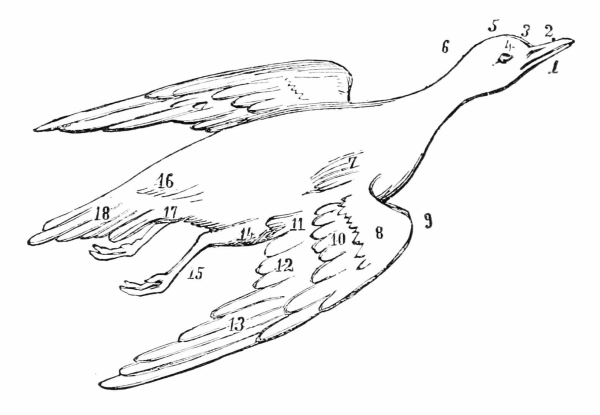
| 1. | Lower mandible. | 11. | Tertials, arising from the
second bone of the wing at the elbow-joint. |
| 2. | Upper mandible. | 12. | Secondaries, from the second bone of the wing. |
| 3. | Forehead. | 13. | Primaries, from the first bone of the wing. |
| 4. | Loral space. | 14. | Tibia, the thigh. |
| 5. | Crown of the head. | 15. | Tarsus, the shank. |
| 6. | Hind part of the head. | 16. | Upper tail coverts. |
| 7. | Scapulars—long feathers
from shoulders over side of back. | 17. | Lower tail coverts. |
| 8. | Smaller wing coverts. | 18. | Tail feathers. |
| 9. | Bend of the wing. | |
| 10. | Larger wing coverts. | |
The length of a bird is measured from the extremity of the bill to the
end of the longest tail feather; the length of the wing is measured from
the bend to the tip of the longest quill.]
Although a cursory account of the various bay-birds, their habits and
peculiarities, has been given in a previous chapter, it seems desirable
to add a more complete, exhaustive, and specific description. This is
attempted in the following pages, and although the ornithological
characteristics are taken from Giraud’s Birds of Long Island, which
seems to have been the resource of all our sporting writers, nothing
else is derived from him; but the facts are stated, either upon personal
knowledge, which is generally the case, or upon reliable information.
As to the abundance or scarcity of any particular species, the
experience of sportsmen will differ according to the accident of flight,
or the locality of their favorite sporting-ground; and in relation to
their shyness or gentleness, much depends upon the time of year and the
condition of the weather. In consequence of the confusion of
nomenclature, it has been deemed advisable to give the scientific
description of the common species, each one being placed under its most
appropriate name, and to collect together as many designations as could
be found to have been applied to them respectively. Nevertheless, many
names will no doubt be omitted, and there will be other birds, and some
quite common varieties, that, among bay-men, have no names whatever.
It is not intended to furnish a description of all the species of
shore-snipe that occasionally are killed, but to supply such information
as will enable the sportsman to distinguish the ordinary varieties; and
such facts as have not been fully stated, which are more especially
applicable to certain members of this great class, are grouped together
under separate heads. Nothing is expected to be added to the
ornithological learning of the world, and only such portions of that
science are given as may be considered desirable for the ready use of
the sportsman in the intelligent pursuit of his pleasures.
Genus Charadrius, Linn.
Generic distinctions.—Bill short, strong, straight, about the length
of the head, which is rather large and prominent in front; eyes large;
body full; neck short and rather thick; wings long; tail rounded and of
moderate length; toes connected at the base; hind toe wanting, or
consisting of a small knob.
Bull-Headed Plover. Beetle-Headed Plover. Black-Bellied Plover.
Charadrius Helveticus, Wils.
This bird is killed along our bays indiscriminately with the other
snipe, although it does not stool as well as the marlin or yellow-legs.
It passes north early in May, when it is often called the black-bellied
plover, and regarded from its plumage as a distinct variety from the
fall bird; it is then quite shy. In August or September it returns,
being more plentiful in the latter month, and is often found in great
numbers especially at Montauk Point; and at that period the young, being
quite fat, are regarded as delicious eating. It is then greyer in
appearance and not so strongly colored as when in full plumage. Before
the main flight arrives, scattering individuals are heard uttering their
peculiar beautiful and shrill cry, and are seen shyly approaching the
stools, or darting round not far off, and yet afraid to draw close to
them. Its head is large and round, giving rise to the name of bull-head,
which is common on the coast of New Jersey, although in New York it is
generally known as black-breast.
“Specific Character.—Bill stout, along the gap one inch and
five-sixteenths; length of tarsi one inch and five-eighths. Adult male
with the bill black, strong, shorter than the head; cheeks, loral space,
throat, fore-neck, breast, with a large portion of the abdomen black;
hind part of the abdomen and flanks white; forehead, with a broad band
passing down the sides of the neck and breast, white; crown, occiput,
and hind-neck greyish white, spotted with dusky; upper parts
blackish-brown, the feathers broadly tipped with white; eye encircled
with white; tail and upper tail-coverts white, barred with black, the
former tipped with white; lower tail-coverts white, the outer feather
spotted with black; primaries and their coverts blackish-brown, the
latter margined with white; primary shafts about two-thirds from the
base, white, tips blackish-brown; part of the inner webs of the outer
primaries white; both webs of the inner primaries partially white;
secondaries white at the base, margined at the same; feet black; toes
connected by a membrane. Female smaller. Young with the upper plumage
greyish-brown, the feathers spotted with white; throat, fore-neck, and
upper part of the breast greyish-white, streaked with dusky; rest of the
lower parts white. Length of adult male eleven inches and three
quarters, wing seven and a half.”—Giraud’s Birds of Long Island.
Frost Bird, Greenback.
Charadrius Pluvialis, Wils.
This bird furnishes great sport at Montauk Point, when the fortunate
sportsman happens to arrive after a fierce north-easter early in
September and during one of those wonderful flights that occasionally
occur. They come readily to the decoys which are placed in the open
upland fields, and were once killed in great numbers on Hempstead plains
before cultivation ejected them. A large number of decoys should be
used, for they are not so easily seen as when set in the water. After
alighting, the golden plover runs with great activity in pursuit of the
insects, mostly grasshoppers, on which it feeds; and when killed it
constitutes a prime delicacy for the table, and brings a high price in
market. It passes to the northward in the latter part of April, and
returns in the early part of September. Its general color on the back is
greenish, and it has a distinct light stripe alongside of the eye. They
often congregate in immense numbers, and I have certainly seen a
thousand in a flock.
“Specific Character.—Bill rather slender; along the gap one inch and
an eighth; tarsi one and nine-sixteenths. Adult with the bill black,
much slighter than C. helveticus; forehead, and a band over the eye,
extending behind the eye, white; upper parts, including the crown,
brownish-black, the feathers marked with spots of golden yellow and dull
white; quills and coverts dark greyish-brown; secondaries paler—the
inner margined with yellowish-white; tail feathers greyish-brown, barred
with paler, the central with dull yellow; shafts of the wing quills
white towards the end, which, with their bases, are dark brown; lower
parts brownish-black, though in general we find them mottled with brown,
dull white, and black; lower tail-coverts white, the lateral marked with
black; feet bluish-grey. Late in autumn, the golden markings on the
upper parts are not so distinct, and the lower parts are greyish-blue.
Length, ten inches and a half, wing seven and one-eighth.”—Giraud.
Piping Plover.
Charadrius Hiaticula, Wils.
The beach-bird, as its name implies, prefers the beaches to the meadows,
and follows each retreating wave of ocean surf in pursuit of its prey,
escaping with amazing agility from the next swell. It is a pretty little
bird, not often associating in flocks, and on hazy days coming well to
the decoys, which should be placed near to the surf, while the sportsman
conceals himself by digging a hollow in the loose sand. Although these
birds are small, they are plump and well flavored, and when flying
rapidly on a level with the flashing breakers, amid the noise and
confusion of old ocean’s roar, are by no means easy to kill. They are
present with us more or less all summer, their diminutive size tending
to protect them from destruction.
“Specific Character.—Bill shorter than the head; at base orange
color, towards the end black; fore-neck and cheeks pure white, bordered
above with black; rest of the head very pale brown. Adult male with the
bill short, orange at the base, anterior to the nostrils black; forehead
white, with a band of black crossing directly above; upper part of the
head, hind neck, back, scapulars, and wing coverts, pale brown; rump
white, the central feathers tinged with brown; tail brown, white at
base, tipped with the same; lateral feathers pure white—the next with a
spot of blackish-brown near the end; upper tail coverts white;
primaries brown; a large portion of the inner webs white; a spot of the
same on the outer webs of the inner quills; secondaries white, with a
large spot of brown towards the ends; lower surface of the wings white,
a black band round the lower part of the neck, broadest on the sides
where it terminates; entire lower plumage white. Female similar, with
the band on the neck brown. Length seven inches, wing four and a
half.”—Giraud.
Charadrius Vociferus, Wils.
A worthless bird, furnishing no sport, and poor eating.
“Specific Character.—A band on the forehead passing back to the eye;
a line over the eye, upper part of the neck all round, and a band on the
lower part of the fore-neck, white; above and below the latter, a broad
black band; rump and upper tail-coverts orange red. Adult with the bill
black; at the base a band of blackish-brown; on the forehead a band of
white passing back to the eye; directly above a band of black; rest of
the head brown, with a band of white behind the eye; throat white; a
broad band of the same color encircling the upper part of the neck;
middle of the neck encircled with black, much broader on the fore-neck;
below which, on the fore-neck, a band of white, followed by a band of
black on the lower neck, the feathers of which are tipped with white, of
which color are the breast, abdomen, under tail-coverts, and sides, the
latter faintly tinged with yellow; tail rather long, rounded; the outer
feathers white, barred with brownish-black, their tips white, with a
single spot of blackish-brown on the outer web; the rest pale
reddish-brown at the base, changing into brownish-black towards the
ends, which are white; some of the inner feathers tipped with
yellowish-brown; the middle feathers are plain brown, with a darker spot
towards the ends, which are slightly tipped with white; upper
tail-coverts and rump reddish-brown, the latter brighter; upper parts
brown, the feathers margined with reddish-brown; primaries dark brown,
with a large portion of the inner web white; a spot of the same color on
the outer webs towards the tips, excepting the first two; their coverts
blackish-brown tipped with white; secondaries white, with a large spot
of brown towards the ends; their tips, with those of the primaries,
white; secondary coverts brown, broadly tipped with white. Length ten
inches, wing seven inches.”—Giraud.
Charadrius Rubidus, Wils.
“Specific Character.—Bill straight, black, along the gap one inch and
one-eighth; length of tarsi one inch; hind toe wanting. Adult with the
bill straight, about as long as the head. Spring plumage, upper parts,
with the throat, fore-neck, and upper part of the breast rufous,
intermixed with dusky and greyish white; deeper red on the back; lower
part of the breast, abdomen, and sides of the body pure white; tarsi and
feet black; claws small, compressed; primaries, outer webs, black; inner
webs light brown; shafts brown at the base, tips black, rest parts
white; secondaries light brown, broadly margined with white. Winter
dress, lower parts white; upper parts greyish-white, intermixed with
black or dusky, darkest on the back. Length seven inches and
three-quarters, wing four and seven-eighths.”—Giraud.
Genus Strepsilas.
Generic Distinctions.—Bill shorter than the head, strong, tapering,
compressed, and blunt; neck rather short; body full; wings long, of
moderate breadth, and pointed; tail round, rather short, and composed of
twelve feathers; tarsus equal to the middle toe, and rather stout; hind
toe small, fore-toes free, with a narrow margin.
Horse-foot Snipe, Turnstone, Beach-Robins.
Strepsilas Interpres.
This is a beautiful bird, and stools pretty well, but is rare and mostly
solitary; its young are at Egg Harbor sometimes termed beach-birds. The
brant-bird is considered good eating. It feeds on the eggs of the
king-crab or horse-foot, which it digs up by jumping in the air and
striking with both its feet at once into the sand, thus scratching a
hole about three inches deep and an inch and a half across.
“Specific Character.—Bill black; feet orange; the head and sides of
the neck streaked and patched with black and white; fore part of the
neck and upper portion of the sides of the breast, black; lower parts,
hind part of the back, and upper tail-coverts white; rump dusky; rest of
the upper parts reddish-brown, mottled with black; primaries dusky; a
band across the wings and the throat white. Young with the head and neck
all round, fore part of the back, and sides of the breast, dusky brown,
streaked and margined with greyish-white; wing-coverts and tertials
broadly margined with dull reddish-brown. It can at all times be
identified by its having the throat, lower parts, hind part of the back,
and the upper tail-coverts white, and the feathers on the rump dusky.
Adult with the bill black, throat white, sides of the head mottled with
black and white; crown streaked with black on white ground; on the hind
neck a patch of white; a patch of black on the sides of the neck, of
which color are the fore-neck and the sides of the breast; lower parts
white; tail blackish-brown, white at the base, of which color are the
lateral feathers, with a spot of black on the inner vanes near the
end—the rest margined with reddish-brown, and tipped with white; upper
tail-coverts white; hind part of the back white; the feathers on the
rump black; fore part of the back mottled with black and reddish-brown;
primaries dark brown, inner webs white; secondaries broadly edged with
white, forming a band on the wings; outer secondary coverts
reddish-brown, inner black; outer scapulars white, with dusky spots;
inner scapulars reddish brown. In winter the colors are duller. Length
nine inches, wing five and three quarters.”—Giraud.
Genus Tringà.
Generic Distinctions.—Bill straight, slender, and tapering,
compressed towards the end, and but little longer than the head; body
rather full; wings very long and pointed; tail rather short and nearly
even; tarsi moderate; hind toe very small, and sometimes wanting; fore
toes slender, of moderate length, and generally divided.
Red-breasted Sandpiper.
Tringà Cinèrea, Wils. Winter.
Tringà Rufa, Wils. Spring.
This delicious and beautiful bird, although far from plentiful,
furnishes excellent sport, coming readily to stool, and flying regularly
and steadily. It mostly affects the marshy islands lying between the
salt water creeks, and derives its name from a fancied resemblance to
the robin, as he is termed among us. It is always gentle, occasionally
abundant, and generally fat and tender; by reason of its steady flight
it is not difficult to kill; and its food, mostly shell-fish, does not
contribute an unpleasant flavor to its flesh. It arrives from the north
about the middle of August, and often lingers for some time on the
meadows. As the season advances its plumage becomes paler, till it
acquires the name of white robin-snipe—although I have often seen them
late in August of the most beautiful and strongly marked coloring, the
breast being a rich brownish red and the back a fine grey.
The robin-snipe is of about the size of the dowitcher, with a shorter
and more pointed bill, and is killed indiscriminately on the stools with
the other bay-birds. Its call consists of two notes, and is sharp and
clear; when well imitated, it will often attract the confiding snipe to
the gunner, exposed in full view, and without decoys. This bird is very
beautiful, and a great favorite.
“Specific Character.—Bill straight, longer than the head; tarsi one
inch and three-sixteenths long; rump and upper tail-coverts white,
barred with dark brown; region of the vent and the lower tail-coverts
white, with dusky markings. In spring the upper parts are ash-grey,
variegated with black and pale yellowish-red; lower parts, including the
throat and fore-neck, brownish-orange. In autumn the upper parts are
ash-grey, margined with dull white; rump and upper tail-coverts barred
with black and white; lower parts white; the sides of the body marked
with dusky; a dull white line over the eye. Adult in spring—bill black;
a broad band of reddish
 THE LIFE CAR.
brown commences at the base of the upper mandible, extends half-way to
the eye, where it changes to reddish-brown; upper part of head and the
hind neck dusky, the feathers margined with greyish white—a few touches
of pale reddish-brown on the latter; throat, fore-neck, breast, and
abdomen reddish-brown; vent white; lower tail coverts white, spotted
with dusky; upper plumage blackish-brown, upper tail-coverts barred with
black and white; tail pale brown, margined with white; primary coverts
black, tipped with white; secondary coverts greyish-brown, margined with
white. Young with the upper parts greyish-brown; the feathers with
central dusky streaks, a narrow line of cinnamon-color towards their
margins, which are dull white; the lower parts ash-grey. Length of
adult, ten inches; wing, six and three-quarters.”—Giraud.
Grey, Grass, or Field Plover.
Bartram’s Sandpiper.
Tringà Bartramia, Wils.
This bird, although scientifically not a plover, is, by its habits,
entitled to an appellation that common consent has bestowed upon it. It
is found upon the uplands, never frequenting the marshes except by
crossing them while migrating, and feeds, not on shell-fish or the
innumerable minute insects that live in sand and salt mud, but on the
grasshoppers and seeds of the open fields. It never takes the slightest
notice of the stools, is comparatively a solitary bird, and although
continually uttering its melodious cry, does not heed a responsive call.
On the eastern extremity of Long Island, and along the coast of New
England, are vast rolling and hilly stretches of land, where there are
no trees and little vegetation, besides a short thin grass, and here the
plovers rest and feed. They migrate to the southward in August, and
appear about the same time scattered from Nantucket to New Jersey. In
spite of their shyness and the difficulty of killing them, they are
pursued relentlessly by man with every device that he finds will outwit
their cunning or deceive their vigilance.
Rhode Island has long been one of their favorite resorts, but has been
overrun with gunners, who follow the vocation either for sport or
pleasure, and there, for many years, the grey plover were killed in
considerable quantities. Many are still found in the same locality, or
further east, as well as at Montauk Point; but at Hempstead Plains,
where they were once found quite numerous, they appear no longer; and
the eastern shore of New Jersey being unsuited to their habits, they
rarely sojourn or even pause upon it. They travel as well by night as by
day; and in the still summer nights their sweet trilling cry may be
heard at short intervals; while during the day they will often be seen
in small bodies, or singly, winging their way rapidly towards the south.
They are wary, fly rapidly, and are difficult to shoot, and, were it not
for one peculiarity, would escape almost scatheless. Alighting only in
the open fields, where the thin grass reveals every enemy and exposes
every approaching object to their view; readily alarmed at the first
symptom of danger, and shunning the slightest familiarity with man, they
are impossible to reach except with laborious and painful creeping that
no sportsman cares to undertake. Not sufficiently gregarious or friendly
in their nature to desire the company of wooden decoys, they cannot be
lured within gunshot; and it is only through their confidence in their
fellow-beasts that their destruction can be accomplished.
A horse, they know, has no evil design, does not live on plover, and may
be permitted to come and go as he pleases; a horse drawing a wagon is to
be pitied, not feared; and, most fortunately, the birds cannot conceive
that a man would be mean enough to hide in that wagon, and drive that
horse in an ingenious manner round and round them, every time narrowing
the circle till he gets within shot. Man, however, is ready for any
subterfuge to gain his plover; and, seated on the tail-board, or a place
behind prepared for the purpose, he steps to the ground the moment the
wagon stops, and as the bird immediately rises, fires—being often
compelled, in spite of his ingenuity, to take a long shot.
Even in this mode no large number of birds is killed, and by creeping or
stalking few indeed are obtained. One inventive genius made an imitation
cow of slats and canvas painted to represent the living animal, and,
mounting it upon his shoulders, was often able to approach without
detection; when near enough, or if the bird became alarmed, he cast off
his false skin and used his fowling-piece. This was certainly an
original and successful mode of modifying an idea derived from the times
of ancient Troy.
This bird is so delicious and so highly prized by the epicure, that no
pains are spared in its capture; it is by many superior judges regarded
as the richest and most delicately flavored of the birds of America;
while its timid and wary disposition renders it the most difficult to
kill. It is, therefore, justly esteemed the richest prize of the
sportsman and the gourmand, and holds as high a rank in the field as in
the market.
It is not, properly speaking, a bay-bird; but as it is frequently shot
from the stand when passing near the decoys, these few remarks
concerning it are inserted. It is essentially an upland bird, although
from the nature of its migration it passes along the coast and
occasionally far out at sea.
“Specific Character.—Bill slender, rather longer than the head; tarsi
one inch and seven-eighths; neck rather long, slender; axillars
distinctly barred with black and greyish-white; upper parts dark brown,
margined with yellowish-brown; fore-neck and fore part of the breast
with arrow-shaped markings; rest of the lower parts yellowish-white.
Adult with the bill slender, yellowish-green, dusky at the tip; upper
part of the head dark brown, with a central yellowish-brown line, the
feathers margined with the same color; hind part and sides of the neck
yellowish-brown, streaked with dusky; fore part of the neck and breast
paler, with pointed streaks of dusky; sides of the body barred with the
same; rest of lower parts yellowish-white; lower wing-coverts white,
barred with brownish-black; upper plumage dark-brown, margined with
yellowish-brown, darker on the hind part of the back; primaries
dark-brown; coverts the same color; inner webs of the primaries barred
with white, more particularly on the first—the shaft of which is white;
the rest brown, all tipped with white; secondaries more broadly tipped
with the same; coverts and scapulars dark-brown, margined with
yellowish-brown, and tipped with white; tail barred with black and
yellowish-brown, tipped with white; middle feathers darker, tipped with
black. Length ten inches and a half, wing six and
five-eighths.”—Giraud.
Winter Snipe.—Black-breast.
Tringà Alpina, Wils.
This bird absolutely has no common name.
“Specific Character.—Bill about one-third longer than the head, bent
towards the end; length of tarsi, one inch. Adult with the bill
black—one-third longer than the head, slightly bent towards the end,
and rather shorter than that of T. Subarquata; upper part of the head,
back, and scapular, chestnut-red, the centre of each feather black,
which color occupies a large portion of the scapulars; wing-coverts and
quills greyish-brown; the bases and tips of the secondaries and parts of
the outer webs of the middle primaries, white; forehead, sides of the
head, and hind neck, pale reddish-grey, streaked with dusky; fore neck
and upper part of breast greyish-white, streaked with dusky; on the
lower part of the breast a large black patch; abdomen white; lower tail
coverts white, marked with dusky; tail light-brownish grey,
streaked—the central feathers darker.
“Winter dress, upper parts brownish-grey; throat, greyish-white; fore
part and sides of neck, sides of the head, and sides of the body, pale
brownish-grey, faintly streaked with darker; rest of the lower parts
white. Length, seven inches and a half; wing, four and an
eighth.”—Giraud.
Peep, Blind Snipe, Frost Snipe, Stilt.
Tringà Himantopus.
This bird also is nameless: it is rare, although I have killed quite a
number of them, and I believe its numbers are increasing; it rarely
consorts in flocks of more than five or six, stools readily, and is
often mistaken for the yellow-legs.
“Specific Character.—Bill about one-third longer than the head,
slightly arched; length of tarsi, one inch and throe-eighths. Adult,
with the upper parts brownish-black, the feathers margined with reddish
white; the edges of the scapulars with semiform markings of the same;
rump and upper tail-coverts white, transversely barred with dusky; tail,
light grey, the feathers white at the base and along the middle; primary
quills and coverts brownish-black—inner tinged with grey; the shaft of
the outer primary, white; secondaries, brownish-grey, margined with
reddish-white, the inner dusky; a broad whitish line over the eye; loral
space dusky; auriculars, pale brownish-red; fore part and sides of neck,
greyish white, tinged with red, and longitudinally streaked with dusky;
the rest of the lower parts, pale reddish, transversely barred with
dusky; the middle of the breast and the abdomen without markings; legs
long and slender, of a yellowish-green color. In autumn, the plumage
duller, of a more greyish appearance, and the reddish markings wanting,
excepting on the sides of the head, and a few touches on the scapular.
Length, nine inches; wing, five.”—Giraud.
American Ring Plover.
Tringà Hiaticula, Wils.
This is a small, but delicate, fat, and pretty bird; it does not stool
well, and accompanies the small snipe.
“Specific Character.—Bill shorter than the head; base, orange color,
towards the point, black; a broad band on the forehead white, margined
below with a narrow black band, above with a broad band of the same
color; rest part of the head wood-brown; lateral toes connected by a
membrane as far as the first joint; inner toes, about half that
distance. Adult male with the bill flesh color at base, anterior to the
nostrils black; a line of black commences at the base of the upper
mandible, passes back to the eye, curving downward on the sides of the
neck; a band on the fore part of the head pure white; fore part of
crown, black; occiput, wood-brown; chin, throat, and fore neck, passing
round on the hind neck, pure white; directly below, on the lower portion
of the neck, a broad band of black; upper plumage, wood-brown;
primaries, blackish-brown; shafts, white—blackish-brown at their tips;
secondaries slightly edged with white on the inner webs; outer webs,
nearest to the shafts, an elongated spot of white; wing-coverts
wood-brown; secondary coverts broadly tipped with white; breast,
abdomen, sides, and lower tail-coverts, pure white; tail brown, lighter
at the base; outer feathers white—the rest broadly tipped with white,
excepting the middle pair, which are slightly tipped with the same.
Female similar, with the upper part of the head and the band on the neck
brown. Length, seven inches and a quarter; wing five.”—Giraud.
Meadow Snipe, Fat Bird, Short Neck, Jack Snipe, Pectoral Sandpiper.
Tringà Pectoralis, Aud.
This is an excellent bird, remaining in the meadows till October, and
becoming fat, rich, and fine flavored, but unfortunately it will not
come to the stools. Although frequently associating in flocks, it can
hardly be said to be truly gregarious, and is as often found with the
different varieties of small snipe as with its own number. It is quite a
difficult bird to kill when on the wing, its flight being rapid and
irregular, and its size small; but when it becomes fat and lazy, after a
long residence in well supplied feeding-grounds, not only is its flight
slower and itself easier to hit, but it is often shot sitting. Its
general color is grey, with white on the abdomen; and its size varies
greatly according to its age and condition, some being of more than
double the size of others. As a natural consequence, considerable
practice is required to distinguish it readily from the ox-eyes by which
it is often surrounded, when the meadow grass hides it, in a measure,
from view. It feeds and dwells altogether in the meadows, finding its
food in the stagnant water collected upon their surface, and is only
plentiful when these are wet. When alarmed, it rises rapidly, and makes
off in a zigzag way, that reminds the sportsman of the flight of English
snipe; and early in the season it is wild and shy. It occasionally
passes over the stools, but never pauses or seems to notice them; and
for this reason, in spite of its epicurean recommendations, it is
generally neglected. In the cool days of September and October, when the
mosquitoes have succumbed in a measure to the frost, its pursuit over
the open meadows is pleasant and exhilarating. It is often killed to the
number of eighty in a day, and is so fat that its body is absolutely
round.
“Specific Character.—Bill straight, base orange-green; length of
tarsi one inch and one-sixteenth; upper parts brownish-black, edged with
reddish-brown; throat white; fore part of neck and upper part of the
breast light brownish-grey, streaked with dusky; rest of lower parts,
including the lower tail-coverts, white. Adult with the bill straight;
top of the head dark-brown, intermixed with black; sides of the head,
neck, and a large portion of the breast, greyish-brown, streaked with
dusky; chin white; a streak of dark brown before the eye, continuing to
the nostril, directly above a faint line of white; back dark-brown;
feathers margined with white; primary quills dark-brown—shaft of the
first white; outer secondaries slightly edged with white; tail-feathers
brown, margined with brownish-white—two middle feathers darker,
longest, and more pointed; lower part of the breast, abdomen, and sides
of the body and under tail-coverts white; feet dull yellow; tibia bare,
about half the length. Female, the general plumage lighter. Length nine
inches and a half, wing five and a quarter.”—Giraud.
Tringà Semipalmata, Wils.
“Specific Character.—Bill rather stout, broad towards the point;
along the gap about one inch; length of tarsi seven-eighths of an inch;
bill and legs black; toes half webbed. Adult with the bill slender,
about the length of the head—dark-green, nearly approaching to black;
head, sides, and hind-part; of neck ash-grey, streaked with dusky; upper
parts blackish-brown, the feathers edged with greyish-white; secondary
coverts tipped with white; primary coverts brownish-black, as are the
feathers on the rump; upper tail-coverts the same; wing-quills dusky,
their shafts white; tail-feathers ash-grey, the inner webs of the middle
pair much darker; over the eye a white line; lower parts white; legs
black. Length six inches and a half, wing four.”—Giraud.
This and the following variety are generally confounded by bay-men; and
being too small to demand much consideration, and never shot unless
huddled together, so that a large number may be bagged, they are called
promiscuously by the odd name ox-eye. They are fat, and almost as good
eating when in prime order as the reed-bird.
Wilson’s Sandpiper.
Tringà Pusilla, Wils.
“Specific Character.—Bill along the gap three-quarters of an inch,
slender; tarsi three-quarters of an inch; legs yellowish-green. Adult
with the bill brownish-black; upper part of the breast grey-brown, mixed
with white; back and upper parts black; the whole plumage above broadly
edged with bright bay and yellow ochre; primaries black—greater coverts
the same, tipped with white; tail rounded, the four exterior feathers on
each side dull white—the rest dark-brown; tertials as long as the
primaries; head above dark-brown, with paler edges; over the eye a
streak of whitish; belly and vent white. Length five inches and a half,
wing three and a half. With many of our birds we observe that
individuals of the same species vary in length, extent, and sometimes
differ slightly in their bills, even with those which have arrived at
maturity.—On consulting ornithological works, we notice that there are
no two writers whose measurement is in all cases alike. With specimens
of the Wilson’s sandpiper, we find in their proportions greater
discrepancy than in many other species—and out of these differences we
are inclined to the opinion that two spurious species have been
created.”—Giraud.
Genus Totanus.
Generic Distinctions.—Bill longer than the head, straight, hard and
slender; neck slender, and both it and body rather long; wings long and
pointed; tail short and rounded; legs long; hind-toe very small, and
the anterior ones connected at the base by webs, the inner being
slightly webbed.
Semipalmated Tatler.
Totanus Semipalmatus, Lath.
Scolopax Semipalmata, Wils.
This is a fine, large, and beautiful bird; the sharply distinct white
and black of its wings contrasting admirably with the reddish-brown
tints of the marlin and sickle-bills with which it often associates; it
stools well, flying steadily, and often returning after the first, and
even second visit; but even when fat, it is tough and ill-flavored. It
congregates in large flocks, and reaches the Middle States on its
southern journey in the latter part of August. Its cry is a fierce wild
shriek, which is rarely, if ever, accurately imitated; but it responds
to the call of the sickle-bill, and when once headed for the stools,
rarely alters its course. In exposed situations it is shy and difficult
of approach, like most of the shore-birds, which, although they come up
so unsuspiciously to the decoys, are wary of the gunner, and rarely
permit him to crawl within range of them.
“Specific Character.—Secondaries and basal part of the primaries
white; toes connected at base by broad membranes. Adult with the head
and neck brown, intermixed with greyish-white; breast and sides of the
body spotted, and waved with brown on white ground; abdomen white;
tail-coverts white, barred with brown; tail greyish-brown, barred with
darker brown—the outer two feathers lighter; rump brown; fore part of
the back and wing-coverts brown, largely spotted with dull white;
primaries blackish-brown, broadly banded with white; secondaries white.
Length fifteen inches and a half, wing eight.”—Giraud.
Big Yellow-Legs—Greater Yellow-Shanks—Tell-tale Tatler.
Totanus Vociferus, Wils.
This is one of the most numerous of the bay-birds, and among the most
highly prized for its sport-conferring properties. It stools well,
although occasionally suspicious, and will often drop like a stone from
the clouds, where it is fond of flying, upon receiving a response to its
strong, clear, and easily imitated cry. It will also frequently come
within shot in the open, when the sportsman is unaided by his decoys.
Its flight is uneven, being often slow when approaching or pausing over
the stools, and then exceedingly rapid and irregular when alarmed; and
if there are no stools to make the Yelper hesitate, it has a bobbing
motion, as if searching for the origin of the call, that makes it
exceedingly difficult to kill. Moreover, it is vigorous, and will carry
off much shot, as in fact is the habit with all the shore-birds, and is
tough and sedgy on the table.
It does not associate in large flocks, but roams about in parties of
three or four.
“Specific Character.—Bill along the ridge two and a quarter inches;
tarsi two and a half; legs yellow. Adult with the bill black, at the
base bluish; upper part of the head, loral space, checks, and neck,
streaked with brownish-black and white; throat white; a white line from
the bill to the eye; a white ring round the eye; breast and abdomen
white, spotted and barred with brownish-black; sides and tail-coverts
the same; lower surface of the primaries light grey—upper
brownish-black, the inner spotted white; wing-coverts and back brown,
spotted with white, and dusky; scapulars the same; tail brown, barred
with white. Winter plumage, the upper parts lighter—larger portion of
the breast and abdomen white; sides of the body barred with dusky.
Length, fourteen inches; wing, seven and a quarter.”—Giraud.
Little Yellow-Legs—Yellow-Shanks Tatler.
Totanus Flavipes, Lath.
Scolopax Flavipes, Wilson.
This bird in appearance is almost identical with the yelper, except that
it is much smaller, not being more than half as large. It has several
calls, consisting of one or more flute-like and shrill notes, which are
rather difficult to imitate. It is probably the most plentiful of all
the bay-snipe, making its summer visit in July, and continuing to arrive
till late in September. It collects in immense flocks, and stools
excellently, but its flight is irregular and rapid; and when frightened,
it darts about in a confusing way that often baffles the sportsman. When
wounded it will swim away, and, if possible, crawl into the grass to
hide.
Although a pleasant bird to shoot, it is unattractive on the table, even
when in best condition, unless killed along the fresh water, where it
attains an agreeable and delicate flavor. Both it and the yelper are
found in considerable numbers on the marshy shores of the western lakes,
where it and the other smaller bay-birds are called, indiscriminately,
plover.
Wonderful stories are told of the number of yellow-legs killed at one
shot, and as it is a small bird, these are probably not exaggerated. By
Wilson the yellow-legs, the yelper, and willet are classed among the
Scolopacidæ or snipe, but the other ornithologists have erected a
separate genus for them.
“Specific Character.—Bill along the ridge one inch and three-eighths;
length of tarsi one inch and seven-eighths; legs yellow. Adult with the
bill black; throat white; upper part of the head, lores, cheeks, hind
part and side parts of the neck, deep brownish-grey, streaked with
greyish-white; eye encircled with white, a band of the same color from
the bill to the eye; fore neck, sides of the body, and upper part of the
breast, greyish-white, streaked with greyish-brown; lower part of the
breast and abdomen white; lower tail-coverts white, the outer feathers
barred with brown; scapulars and fore part of the back brown, the
feathers barred and spotted with black and white; primaries
blackish-brown, the shaft of the outer brownish-white, whiter towards
the tip, the rest dark-brown; secondaries margined with white; hind part
of the back brownish-grey; tail barred with greyish-brown, white at the
tip; legs, feet, and toes, yellow; claws black. Length, ten inches and
three-quarters; wing, six. Young with the legs greenish—and by those
who have not recognised it as the young of the year, I have heard the
propriety of its name questioned.”—Giraud.
Genus Limosa.
Generic Distinctions.—Bill very long, a little recurved from the
middle, rather slender, and with the lower mandible the shorter. Wings
long and very acute; tail short and even; legs long; toes four, and
rather slender, the hind one being small and the middle toe the longest;
anterior toes connected at the base by webs, the outer web being much
the larger.
Great Marbled Godwit.
Limosa Fedoa, Linn.
Scolopax Fedoa, Wils.
This is the gentlest and most abundant of the large birds, approaching
the decoys with great confidence and returning again and again, till
frequently the entire flock is killed. In color it is a reddish-brown,
lighter on the abdomen, and its flight is steady and rather slow.
Although better eating than the willet, and very rich and juicy, its
flesh cannot be called delicate. The ring-tailed marlin or Hudsonian
Godwit, Limosa Hudsonica, Lath. is a finer but much scarcer bird, and
resembles somewhat in color the willet, but has the marlin bill, which
is longer than that of the last-named species.
“Specific Character.—Bill at base yellow, towards the end
blackish-brown; upper parts spotted and barred with yellowish-grey and
brownish-black; lower parts pale reddish-brown; tail darker, barred with
black. Adult male with the bill at the base yellowish-brown, towards the
end black; head and neck greyish-brown, tinged with pale reddish,
streaked with dusky—darker on the upper part of the head and hind neck;
throat whitish, lower parts pale reddish-brown; under tail-coverts
barred with brown; tail reddish-brown, barred with dusky; upper
tail-coverts the same; upper parts barred with brownish-black and pale
reddish-brown, spotted with dusky; inner primaries tipped with
yellowish-white; scapulars and wing-coverts barred with pale
reddish-brown and greyish-white; shaft of the first primary white, dusky
at the tip; inner shafts at the base white, rest part light brown,
excepting the tips, which are dusky. Length, sixteen inches; wing, nine
and a half. Female larger, exceeding the male from three to four
inches.”—Giraud.
Hudsonian Godwit.
Limosa Hudsonica, Lath.
“Specific Character.—Bill blackish-brown, at base of lower mandible
yellow; upper parts light brown, marked with dull brown, and a few small
white spots; neck all around brownish-grey; lower parts white, largely
marked with ferruginous; basal part of tail-feathers and a band crossing
the rump, white. Adult with the bill slender, blackish to wards the tip,
lighter at the base, particularly at the base of the lower mandible; a
line of brownish-white from the bill to the eye; lower eyelid white;
throat white, spotted with rust color; head and neck brownish-grey;
lower parts white, marked with large spots of ferruginous; under
tail-coverts barred with brownish-black, and ferruginous; tail
brownish-black, with a white band at the base; a band over the rump;
tips of primary coverts and bases of quills white; upper tail-coverts
brownish-black—their base white; upper parts greyish-brown, scapulars
marked with darker; feet bluish. Length, fifteen inches and a half;
wing, eight and a half. Young with the lower parts brownish-grey, the
ferruginous markings wanting.”—Giraud.
Genus Scolopax, Linn.
Generic Distinctions.—Bill long, at least twice the length of the
head; straight, tapering, and flattened towards the end; eyes rather
large, placed high in the head, and far back from the bill; neck of
moderate length, and rather thick; body full; wings rather long and
pointed; tail moderate and rounded; legs moderate; toes slender and
rather long, except the hind one; middle toe longest, and connected at
the base with the inner by a slight web, the outer one being free.
Dowitch—Brown Back—Quail-Snipe—Red-Breasted Snipe.
Scolopax Noveboracensis, Wils.
This is a beautiful, excellent, and plentiful bird; it abounds in the
marshes during the entire summer, congregates in vast flocks, and
although uttering a faint call itself, is attracted to the decoys by the
cry of the yellow-legs, or almost any sharp whistle. It is remarkably
gentle, individuals often alighting when their associates are slain, in
spite of the unusual uproar; and it can be more readily approached than
any of the bay-birds. Its flesh, moreover, is quite delicate, and when
fat somewhat similar to that of the English snipe, which it greatly
resembles in appearance. In general color it is brownish, with a light
abdomen, but occasionally the breast is as red as that of a robin in
full plumage. Its flight is steady, although when alarmed it “skivers,”
or darts about rapidly, and as it flies in close ranks, it suffers
proportionally. Although it is rather looked down upon by persons who
wish to make a show of large birds, I am always entirely satisfied with
a good bag of well-conditioned dowitchers.
“Specific Character.—Spring plumage, upper parts brownish-black,
variegated with light brownish-red; lower parts dull orange-red, abdomen
paler, spotted and barred with black; rump white; the tail feathers and
the upper and lower tail-coverts, alternately barred with white and
black. In autumn the upper parts are brownish-grey; the lower parts
greyish-white; the tail feathers and the upper and lower tail-coverts
the same as in spring. Adult with the bill towards the end black,
lighter at the base; top of the head, back of the neck, scapulars,
tertials, and fore part of the back, blackish-brown, variegated with
ferruginous; secondaries and wing-coverts clove-brown, the latter edged
with white, the former tipped with the same; hind part of back white;
the rump marked with roundish spots of blackish-brown; upper
tail-coverts dull white, barred with black; tail feathers crossed with
numerous black bands, their tips white; loral band dusky, the space
between which and the medial band on the fore part of the head,
greyish-white, tinged with ferruginous, and slightly touched with dusky;
sides of the head spotted with dark-brown; lower parts dull orange-red,
the abdomen lighter; the neck and fore part of breast spotted with
dusky; the sides of the body with numerous bars of the same color; legs
and feet dull yellowish-green. Young with the lower parts paler. Winter
dress, the upper parts brownish-grey; neck ash-grey, streaked with
dusky; lower parts greyish-white, with dusky bars on the sides of the
body. Length, ten inches and a half; wing, six.”—Giraud.
Genus Numenius, Briss.
Generic Distinctions.—Bill very long, slender, decurved or arched,
with the upper mandible the longer, and obtuse at the end; head rounded
and compressed above; neck long, body full, wings long, feet rather
long; toes connected at the base; tibia bare a short space above the
knee; legs rather long; tail short and rounded.
Short-billed Curlew. Hudsonian Curlew.
Numenius Hudsonicus, Lath.
This is a graceful and elegant bird, but so shy and so well able to
carry off shot, that it is regarded as the most difficult to kill of all
the bay-birds. It has a long, rolling cry, and although it approaches
the decoys, it rarely alights, or even pauses over them; but, detecting
the deception, it turns off or passes on in its course. For this reason,
the fortunate sportsman who kills a “Jack” is eminently satisfied,
although its flesh is not remarkably fine.
“Specific Character.—Length of bill, three inches and three-quarters;
tarsi, two inches; lower parts white. Adult with the upper part of the
head deep brown, with a central and two lateral lines of whitish; a
brown line from the bill to the eye, and another behind the eye; neck
all round, pale yellowish-grey, longitudinally streaked with brown,
excepting the upper part of the throat, which is greyish-white; upper
parts in general blackish-brown, marked with numerous spots of
brownish-white, there being several along the margins of each feather;
wings and rump somewhat lighter; upper tail-coverts and tail barred with
dark-brown and olivaceous grey; primaries and their coverts
blackish-brown, all with transverse yellowish-grey markings on the inner
web; the shaft of the first quill, white—of the rest, brown; breast and
abdomen greyish-white, the sides tinged with cream color, and barred
with greyish-brown; bill rather more than twice the length of the head,
of a brownish-black color—at the base of the lower mandible, flesh
colored. Length, eighteen inches; wing, nine and a half.”—Giraud.
Long-billed Curlew.
Numenius Longirostris, Wils.
The finest, largest, most graceful, and elegant of all the bay-birds is
the magnificent sickle-bill; associating in large flocks, and with a
spread of wings of little less than three feet, when it approaches the
stand, the sportsman’s heart palpitates with excitement, and the sky
seems to have lost its natural blue and become of a rich brown tint. As
these splendid birds, shrieking their hoarse call, set their wings for
the stool, and crossing one another in their flight, pause in doubt; or,
after alighting individually, rise again, and hesitate whether to remain
or continue their course—the sportsman, cowering in his lair, and
anxious to take advantage of this glorious opportunity, becomes wildly
eager with excitement; and if, after having by a judicious selection
brought several to the ground, he recalls the departing flock which
again presents itself to his aim, his rapture knows no bounds, and with
his reloaded breech-loader, he repeats, perhaps more than once, the
exhilarating performance.
This lordly bird, the largest of the bay-snipe, is often extremely
gentle, and may be lured by the imitation of its cry at an immense
distance, and brought back to the decoys several times, where one or
more of its companions may have fallen; but at other times it is wild
and shy. Individuals differ considerably in size, the largest I ever saw
having a bill eleven inches long, and some weighing nearly double as
much as others; but all are of a beautiful reddish-brown or burnt sienna
tint, with a yellowish shade on the abdomen. Their flight is steady, and
their flesh tough, dark, and oily. Their eye is extremely bright, and
their shape graceful.
“Specific Character.—Bill towards the end decurved; upper part of the
throat, and a band from the bill to the eye, light buff; general
plumage, pale reddish-brown; head and neck streaked with dusky; upper
parts marked with blackish-brown; tail barred with the same; abdomen,
plain reddish-brown; feet, bluish. Length, twenty-six inches; wing,
eleven. The bill of the specimen from which this description is taken
measures eight inches. The bills of individuals of this species vary,
but the length is at all times sufficient to determine the
species.”—Giraud.
Doe-bird.—Esquimaux Curlew.
Numenius Borealis, Lath.
This is an upland bird, quite rare, but large, and rather delicate
eating.
“Specific Character.—Bill, along the gap, about two inches and a
quarter; tarsi, one inch and five-eighths; upper parts, dusky brown,
with pale yellowish-white, marked all over with pale reddish-brown.
Adult with a line of white from the bill to the eye; eyelids, white;
upper part of the head dusky, spotted in front with greyish-white, a
medial band of the same color; throat, white; neck and breast
yellowish-grey, with longitudinal marks of dusky on the former, pointed
spots of the same color on the latter; abdomen, dull yellowish-white;
flanks, barred with brown; lower tail coverts the same as the abdomen;
tail and upper tail coverts barred with pale reddish-brown and dusky,
tipped with yellowish-white; upper parts brownish, the feathers tipped
with pale reddish-brown, the scapulars margined and tipped with lighter;
primaries, dark-brown, margined internally with lighter—the first shaft
white, with the tip dusky—the rest brown. Length, fourteen inches and a
half; wing, eight.”—Giraud.

The eastern end of Long Island, that extremity which seems to stretch
out like the hand of welcome towards the nations of the old world,
beckoning their inhabitants to our hospitable shores, is divided into
two long points like the tines of a fork. The upper point shuts in Long
Island Sound, and protects our inland commerce from the violence of the
“Great Deep;” while the lower prong, which is kissed on the one side by
the blue waters of the Peconic Bay, and on the other is buffeted by the
billows of the great Atlantic, is known as Montauk Point. The heaving
ocean seems here to have solidified itself into a sandy soil, which
rises and swells and rolls, much after the manner of its mighty
prototype, except that a scanty garment of tawny grass clothes the
outlines of the billowy waste. “Cattle on a thousand hills” here roam in
a state of, at least, semi-independence, which they occasionally assert
by charging upon the intruding sportsman in a manner which may be
intended as playful, but which looks somewhat serious. For a dozen miles
or so only a few houses break the monotony of the dreary expanse, and it
is to one of these, distant some nine miles from the extreme point,
that I am about to carry the reader, for here alone can plover-shooting
be enjoyed in its fullest perfection.
There are numerous kinds of plover that make their migratory passages
along our coasts; but the one to which I refer, while to the epicure it
ranks almost, if not absolutely, the first upon the list, and affords,
by the swiftness of its flight and the eccentricity of its habits, a
prize not unworthy of the highest efforts of the sportsman, has been the
victim of many a misnomer, but is correctly known by the appellation
American Golden Plover, Charadrius pluvialis (P.). The Plover-family
is large and of high respectability; but, when “upon his native heath,”
no one of its clans is entitled to wear a loftier crest than that which
we now have under discussion. His near relative, the Bartramian
Sandpiper or Grey Plover, is perhaps more aristocratically delicate in
his figure, and is welcomed as heartily at the table of the epicure. But
he is less social in his habits, and rarely affords any but single
shots. He does not fraternize with wooden counterfeits, and his mellow
whistle, as he rises at an impracticable distance, rarely responds to
even the most seductive efforts of his pursuer. But our Golden friend,
notwithstanding his auriferous title, his superior beauty of plumage,
his swiftness and strength, and the savory reputation which he enjoys
among the knowing-ones, is possessed of gregarious habits, of a
singularly frank and unsuspicious nature, and is generally ready to stop
and have a chat with anything which bears the faintest resemblance to a
bird and a brother. It is well for his admirers that such is his nature;
and although the wide appreciation of his merits certainly causes great
destruction among his ranks, still the vast flocks which, sometimes for
days together, fly past, within sight of the stands, unshot at, seem to
warrant the hope that the hour of the final extinction of his race is
very far distant.
Taking the Long Island railroad to Greenport in the early part of
September, and having encountered and overcome the ordinary delay and
difficulty of obtaining a sailboat to further prosecute our voyage, we
find ourselves at last gliding on the waves of the beautiful bay, past
Shelter and Gardiner’s islands, and approaching the long low line of the
Nepeague beach. With a favorable breeze we may expect to be landed on
the smooth sand in a little cove, about one mile from our destination,
in two hours from our time of departure; but if the wind is adverse and
the fates unpropitious, we may have to follow the path from the shore in
the dark, which will require our best instincts, aided by the guidance
of the distant booming of the surf, and the assistance of our especial
guardian angel.
Once there, however, and we will be repaid for our sufferings; we may
find a table covered with “South-side” delicacies, and bearing in the
centre a huge dish of beautiful, odorous, melting plover, cooked to a
turn, and we will undoubtedly meet kindred spirits and generous
sportsmen who are on the same errand as ourselves. As we dispose of the
former, the latter will pour into our sympathetic ears wonderful
accounts of their sport, and rival one another in recounting the long
shots and the good shots they have made, the numbers of birds they have
killed, and the pounds of bass they have caught.
Under the influences of a delicious supper and moderate “nightcap,” we
seek our couch with fond visions of the great flocks, and hopeful dreams
that we will do as well on the morrow. At earliest dawn we spring from
our bed, and rushing to the primitive little casement have only time to
rejoice in the promise of a fine day, ere we note the welcome cry of our
noble prey hurrying westward over the beach.
To don our shooting costume, to grasp our gun and ammunition, to load
ourselves with the basket containing decoys and incidentals, and to
emerge into the cool air of the September morning, require but a few
minutes; we hasten across the sandy hillocks to our appointed spot,
marked by a hollow scooped out for the concealment of former visitants,
and by the quantity of feathers and cigar-stumps lying loosely around;
and with hands trembling with impatience, we distribute the stools in
what seems to us to be the most artistic and seductive manner,—for the
birds are now beginning to fly just within a tantalizing yet
impracticable range, and we long for action.
How wild, how glorious is the hour and the scene! The heavy boom of the
ocean, which rolls almost at our feet, is relieved by the soft, mellow
notes of the sea-birds which float through the air in varied yet
harmonious cadence, and by the low of distant cattle, just shaking off
their slothful dreams. Hardly have we disposed our body to the requisite
flatness, when a chattering chorus of melody makes our heart leap with
eagerness, and our eyes strain with impatience to discern its source.
Aha, we have them now! that small, erratic cloud to the eastward,
bearing directly before the wind towards our covert, sends a thrill
through our being, which the whole “spacious firmament on high,” even on
the loveliest of nights, has, we honestly confess it, never succeeded in
imparting. On they come, nearer, nearer, nearer. We pucker up our lips
to greet their approach, but the saucy gale renders our rude efforts
futile, and we commit our trust to Providence and our painted
counterfeits. Now they are within easy range, but somewhat scattered;
with a violent effort at self-command, worthy of a higher cause, we
remain motionless, for there are evident indications of a social spirit
in that joyous group. They pause, they swerve, they wheel upon their
tracks, and with motionless wings and a sweet low-murmured greeting,
they approach the fatal stools. How rash the confidence! How foul the
treachery! But, we must also confess, how intense the excitement, as we
pull the right trigger at the critical moment, and then, as the deluded
victims scatter wildly, with an outburst of appeal against man’s
cruelty, give them the left barrel, and add three more to the list of
feathered martyrs. With lightning speed, their thinned ranks vanish
beyond the neighboring sand-hills, and reloading our gun, we hasten to
gather up the slain.
Six with the right and three with the left barrel, are pretty well for a
beginning; but we had better have remained at our post, for while we are
chasing up one of the wounded birds, two more flocks pass within easy
range of our hiding-place. Hurriedly twisting the neck of the fugitive,
we resume our lonely watch, and before the breakfast-hour of eight,
which our umwontedly early exertions have made a somewhat serious epoch,
we have had two more double shots, and increased our score to
twenty-one. Beautiful, “beautiful exceedingly” is the burden of game
which we proudly carry back to our inn, leaving our stools as they
stand.
A hearty breakfast makes us feel like a new man, and, after a fair
discussion of its merits, lighting our pipe, we again wend our way to
the scene of our triumph. The cry is still they come; flock after flock
presents its compliments, and leaves mementoes of its presence; but
towards noon the hot sun disposes the birds to listless inactivity, the
flight diminishes, and finally stops. Returning to the house with a bag
larger by only three birds than that of the morning, we kill the hours
before dinner by a few casts into the breakers, and land a ten-pound
bass.
With sharpened appetite, we welcome the savory dinner, and are quite
contented to rest and let our prey rest till five o’clock, when fifteen
more birds reward our post-prandial exertions, and make up a total for
the day of sixty plover and one bass. We sink to sleep that night with
the proud consciousness that our first day’s plover-shooting has been a
great success; our heart prays silently for a continuance of our good
fortune, and we indulge in sweet thoughts of home, and the pleasure our
return laden with spoils will cause, when our friends greet us and them
at the social board.
The next day is as delightful; the sweet, thrilling music again fills
the air at short intervals; again our trusty breech-loader sends its
charge into the thickest of the “brown,” or cuts down the straggler
looking for “former companions all vanished and gone.” Again we call the
swift-travelling flock from the very zenith, or whistle our lips into a
blister, endeavoring to attract the wary knowing ones that pause to
look, only to flee the faster; and the night finds us with a still
larger bag, but without a bass. So eager have we become, so fearful that
we should lose a shot, and judging by the accumulating clouds in the
east that on the morrow it may storm, that we stay out all day, except
the necessary moments for our meals, and give no thought to the monsters
of the deep.
Nor were we mistaken; the morrow comes, the gathering storm has broken,
and no creature of mortal mould can face its fury—at least no bird,
with any pretensions to common sense or respectability, would imperil
his plumes by an unnecessary exposure to such an ordeal. So with forced
patience, we get through the live-long day as best we can; and on the
following day, hail a sky as cloudless as the most ardent sportsman
could desire. But alas! the flight has gone by, scared away perhaps by
the storm, or retreating before the advancing fall; and when we take our
seat at the breakfast-table, we are obliged to admit that only nine
birds have fallen to our gun.
But the irrepressible and inextinguishable host rises triumphant in this
emergency. He boldly suggests that there must be some sluggards, who
have tamed, spell-bound by the attractions of such a terrestrial, or,
rather ornithological, paradise; and accordingly, he hitches up a
venerable specimen of the genus “Equus,” and we start for an excursion
“over the hills and far away.” Before we have advanced a couple of miles
we have bagged a half dozen solitary specimens of Bartram’s Sandpiper or
Grey Plover, so dear to the sportsman and the gourmand, but have seen no
trace of the object of our pursuit. When, suddenly, as we surmount one
of the swelling eminences which are the prevailing feature of this
district of country, we come upon a sight such as, perhaps, but few
sportsmen have ever beheld. A gentle hollow spreads before us, for
several acres, literally covered with the ranks of the much-desired, the
matchless Golden Plover.
As they stand in serried legions, the white mark on their heads gives a
strange chequered weirdness to the phalanx: and we involuntarily pause,
spell-bound by the novelty of the spectacle. Our host himself, though an
old hand, owns that he has never before gazed on such a sight. There
they stand with heads erect, and bodies motionless, just out of gunshot.
Their number is computed by our companion to be not less than three
thousand, closely packed, and apparently awaiting our onset. What is to
be done? Delay may be fatal, but precipitancy would be equally so: and
our pulses stop beating under the stress of the emergency. Our horse
also stops, obedient to an involuntary pull of the reins. We accept the
omen, and cautiously descend from our vehicle; warily crawling to within
seventy yards, we halt as we see unmistakable evidences of uneasiness
and suspicion among the crowded ranks. They stoop, they run, they rise
with “a sounding roar,” to which the united report of our four barrels
savagely responds. Away, away with headlong speed, scatters and
dissolves that multitudinous host, and we hasten to secure our spoils.
But, seventy yards make a long range for plover-shooting, and we are
somewhat chagrined to find that only six dead and seven wounded birds
remain as proofs of the accuracy of our aim, and the efficiency of our
weapons. Hurriedly we plant our stools, hoping for the return of at
least a considerable portion of the vanished forces; but they have
apparently had enough of our society, and, after two hours spent in
ambush, with only an occasional shot at single stragglers or small
flocks, we wend our way back to the house.
On the morrow we kill a dozen birds over the stools, before breakfast,
among which are two specimens of the beautiful Esquimaux Curlew or Fute,
as he is commonly called, and which seems to be on terms of the closest
intimacy with our Golden friend. We find him to be a heavier bird,
equally inclined to obesity, and, as future experiments satisfy us,
nearly as perfect in delicate richness of flavor.
At nine o’clock Dobbin is again harnessed, and we start for the scene of
yesterday’s exploit. But the sighing wind now sweeps over only a
deserted moor, and we direct our course in a direction to make an
inspection of Great Pond. Here, by good luck and management, we bag five
teal and a black duck, as well as three passing plover. A few large
flocks of the latter are seen, but they are wary and unapproachable; and
after several fruitless efforts, we abandon their pursuit and start for
dinner.
Having rendered full justice to the merits of a bountiful repast, which,
if it is made prominent in this account, was still more prominent in our
hungry thoughts, we stroll to the ocean-side and make a dozen casts for
bass, but our luck seems to be on the turn and we decide to leave on the
morrow for Greenport. About an hour before sunset, a few birds are on
the wing, and we again seek the field of our first success. Here we make
our final effort, and are rewarded with five noble victims, killed
singly at long shots, and we restore our breech-loader to its case. We
have no reason to be dissatisfied with our four-days’ sport, and it is
with a certain reluctance, and a sincere resolve to renew our visit at
an early date, that we pack our valise in anticipation of a start on
the morrow.
Our team is at the door; we bid adieu to some ladies of the household
(of whom while writing these lines we have thought much, though we have,
until now, said nothing), and, mounting by our host’s side, we trot
merrily over the hills, till we reach the deep sandy desert of the
Nepeague beach. “A long pull, and a strong pull” for an hour, brings us
to “terra firma” again, and rattling through the quaint old town of
Easthampton, after a charming drive, we reach Sag Harbor, where a most
absurdly diminutive steamer, of just seven-horse power, awaits to
convey us to Greenport. We part from our host with sincere gratitude for
the genial kindness which he has shown to us during our visit, and step
on the narrow deck of the tiny craft. A voyage of thirteen miles, made
under a full head of steam in just two hours and a quarter, brings us
once more to the beautiful village of Greenport, where the cars are
awaiting us.
We return with a bag full of game, and the following general conclusions
and precepts impressed upon our mind: In plover shooting use No. 6 shot
in the left barrel, for the birds are of wonderful strength and require
to be hit hard, or they will fly an immense distance even if “sick unto
death,” and if crippled, will sneak, and hide, and run, and cause much
loss of time that is precious indeed. Do not fire too soon; as the flock
will generally “double” if allowed sufficient time, and then is the
chance to “rake ’em down.” Be patient, keep cool, aim ahead of the
birds, and keep wide awake.
On almost any day, from the 25th of August to the 10th of September,
there are sport and pleasure to be had among the wild sand-hills of
Montauk; and if there has been a north-easterly storm, with pitchforks
full of rain and caps full of wind, there will be such an abundance of
birds as only experience can conceive of or appreciate. That is an event
that most of us have yet to wait for. Reader, I wish I were sufficiently
unselfish to say honestly—may you enjoy it first.
Since I first went to Montauk, when large and jolly parties of sportsmen
congregated every fall at Lester’s and Stratton’s, some changes have
taken place. The plover have diminished until the chance of sport is
uncertain, although occasional good days are had; and there is a
probability that the railroad will intrude on its “everlasting hills,”
and that fashionable watering places will replace the old-time sporting
hotels. Then bid farewell, a long farewell, to all the shooting.
Success in this delightful sport depends as much upon the proper
accessories, together with experience in minor matters, as in the great
art of properly handling the gun. The best shot, badly equipped, will be
surpassed by an inferior marksman accustomed to the business, and
thoroughly fitted out for it. The shooting is done among high reeds, and
from small, light, and unstable skiffs, which are poled over muddy
shallows with an unsteady motion that puts an end to skill which is not
founded on long practice. The sport lasts only during the few hours of
high water, when the entire day’s bag must be made, and requires, after
the bird has been killed, a sharp eye to retrieve him amid the weeds and
floating grass.
The number bagged, however, is sometimes prodigious; and although we
rarely now hear of hundreds killed “in a tide,” as was formerly not
unusual, the shots are still frequently rapid, and the result
satisfactory. The bird rises heavily, its long legs hanging down behind;
flying slowly, it presents an easy mark to any one upon terra firma,
and if not shot at, will alight after proceeding thirty or forty yards.
It comes on from the north during the early part of September, and
disappears so instantaneously with the first heavy frost, that our
superstitious baymen imagine it retires into the mud. It can, however,
fly strongly, as I have occasionally had unpleasant evidence under
peculiar circumstances, and in wild, windy weather. During low water,
when it can run upon the muddy bottom among the thick stalks, which it
does rapidly, it can hardly be flushed by any but the strongest and
toughest dog, and is not frequently pursued; although many persons enjoy
the hard walking and exposure of this plan, preferring to tramp over the
quaking surface of our broad salt meadows, and flushing the rail from
amid some tuft of reeds, kill him with the aid of their loved
fellow-playmate, a high-strung setter or untiring water spaniel.
As the tide rises, however, and covers the bottom with a few inches of
water, the rail, caught feeding among its favorite wild oats, or on the
grains of the high reeds, and alarmed at the advancing boat, is forced
to take wing and present an easy mark to its destroyer. But if missed,
although marked down to an inch, it rarely rises a second time, having
probably escaped by swimming—a thorough knowledge of which is among its
numerous accomplishments. The rail has a long, thin, and soft body,
which it appears to have the faculty of compressing; as it can glide
amid the thick stems of reeds and grass with wonderful rapidity; and if
wounded, it will dive and swim under water, leaving its bill only
projecting, so as to bid defiance to pursuit.
The first necessity of equipment for this sport is a breech-loading gun,
which not only enables the sportsman to kill double the number of birds,
but will occasionally give him the benefit, by a rapid change in the
charge, of a favorable presentation of a chance flock of ducks. But as
many persons, out of a want of knowledge or of funds, still cling to the
old muzzle-loader, it may be well briefly to mention the articles that
tend to modify its inferiority.
Of course, as the shooting occupies but a few hours, and in good days
the birds are perpetually on the wing, it is essential to load rapidly;
and to do this the sportsman places on a thwart before him a tin box
divided into compartments for powder, shot, caps, and wads, or, as I
prefer, two boxes, one filled with powder and the other with the other
materials. For many reasons there should be a lid over the powder—to
prevent its being ignited by a chance spark or blown away by a strong
wind—and the ordinary flask is frequently used in spite of the
consequent delay. A double scoop, made of tin or brass, and regulated to
the precise load, is placed among the powder and the shot, and a solid
loading stick lies near at hand.
By these means the rapidity of loading is more than doubled; the powder
is dropped into both barrels at once by means of the double scoop, wads
are driven home by a single blow of the rod, both barrels are charged
with shot at once in the same manner, the caps are within easy reach,
and the gun is loaded in less than half the time consumed in the
ordinary process. The shot may be made into cartridges of paper with a
wad at the upper end, and thus a few additional of the precious seconds
saved. Both barrels are discharged before either is reloaded, and the
birds are retrieved immediately.
The sportsman stands erect, without any support to modify the
unsteadiness consequent upon the irregular motion of the boat, and
requires practice, not merely to enable him to take aim, but even to
retain his footing. Where the water is low and the reeds strong, this
difficulty is augmented, as the boat entirely loses its way after every
push, and advances by jerks that utterly confound a novice. Experience,
however, being acquired in loading rapidly and in retaining his balance,
the sportsman’s labors are easy; but the punter requires many different
qualities, and upon his excellence mainly depends the final result.
He must possess judgment to select the best ground, strength to urge on
the boat unflaggingly, and an inordinate development of the bump of
locality to mark the dead birds. The bird once killed and the sportsman
part ended, then the punter displays his ability; and if thoroughly
versed in his craft will push the boat through tall reeds, and matted
weeds, and fallen oat-stalks, and drifted grass, with wonderful accuracy
to the very spot, and peering down amid the roots, will distinguish the
brown feathers almost covered with water and hidden by the vegetable
growth.
In order to retrieve quickly, a wide-meshed scapnet is a great
convenience; but to mark well, a man most be endowed by nature with that
peculiar gift. Among the vast mass of undistinguishable marine plants
that spring from the muddy bottom and rise a few inches or many feet
above the surface, it would seem impossible to determine, within an
approach to accuracy, where some bird, visible only for a moment and cut
down when just topping the reeds, has fallen; and when another bird
rises to meet the same fate, and perhaps a dozen are down before the
first is retrieved, successful marking becomes a miracle. With some
punters on the Delaware, where their names are famous, so wonderful is
the precision that every bird, if killed outright, will be recovered,
and even a poor marksman will make a respectable return; but when the
gentleman shoots badly and the man marks worse, rail-shooting is
unprofitable.
For this sport, thus followed, it will be seen that a punter is
indispensable, and it is made the business of a large class of men along
the salt marshes where the rail most do congregate; and wherever a
punter cannot be obtained, as in the wilder portions of our country,
rail-shooting cannot be had.
From the necessity for rapid firing, the immense advantage of a
breech-loader must be apparent; the tide rarely serves for over two or
three hours, and to kill more than a hundred birds in that time with a
muzzle-loader is a remarkable feat, as it requires almost the entire
time for the mere loading and firing of the gun; but the breech-loader
may be charged in an instant, and enables the sportsman to improve the
lucky chance of coming upon a goodly collection of birds, and make the
most of the scanty time permitted to him.
None of those vexatious mistakes that occasionally happen to the best
sportsmen can befall him; the shot cannot get into the wrong barrel, nor
the cap be forgotten; the powder is not exposed to ashes from a careless
man’s cigar; and there being no hurry, there is more probability of
steady nerves and a true aim.
The charge should be light—three-quarters of an ounce of shot and two
drachms of powder being abundant to kill the soft and gentle rail—and
pellets at least as fine as No. 9 are preferable to coarser sizes. Old
cartridges, that have been split and mended by gumming a piece of paper
over the crack, may be used in the breech-loader, provided the sportsman
desires to indulge in praiseworthy economy, or is deficient in a supply.
The sport is extremely exciting: the boat is forced along with
considerable rustling and breaking of stems and stalks; the bright sun
streams down upon the yellow reeds and lights up the variegated foliage
of the distant shore; the waves of the bay or river, rising apparently
to a level with the eye, sparkle in the gentle breeze that bends the
sedge grass in successive waves; neighboring boats come and go, approach
and recede; the rapid reports are heard in all directions, like
fireworks on the Fourth of July; the sportsman stands erect, and eager
with delirious excitement, near the bow; the punter balances himself,
and wields his long pole dexterously on a small platform at the stern.
Silently a bird, rising close to the boat, wings its way, with pendent
legs and feeble strokes, towards some one of its numerous hiding-places;
instantly the punter plants his pole firmly in the bottom, holding the
skiff stationary, the sportsman brings up his piece, and, with
deliberate aim, sends the charge straight after the doomed rail, which
pitches headlong out of sight. The punter has marked him by that single
wild rice-stalk with the broken top, and heads the boat at once towards
the place; but ere he has advanced a dozen feet, another bird starts and
offers to the expectant sportsman, who has his gun still “at a ready,”
another favorable chance, and, meeting the same fate, falls into that
low bunch of matted wild oats. The breech-loader opens, the charges are
extracted and others inserted, just in time to make sure of two rail
that rise simultaneously, still ere the first has been reached, and
which are both tumbled over and marked down—one, however, wing-tipped,
and never to be seen by mortal eye again.
Thus have I experienced it on the Delaware, at Hackensack, and, in
former days, among the tributaries of Jamaica Bay, and at many other
places where more or less success has attended me. Although never having
enjoyed great luck, never having advanced beyond the first hundred, and
claiming to be no such marksman as several of my friends, I have had
wondrous sport. Of a good day, when the tide is favorable and the game
plenty, the excitement is continuous, and increased by a sense of
competition.
Other sportsmen are on the same ground, stopping probably at the same
hotel and shooting in close proximity—occasionally too close, if they
are thoughtless or careless. Not only will a charge of mustard seed
sometimes rattle against the boat, but is apt, now and then, to pierce
the clothes and penetrate the skin, followed by an irritation of mind
and body; but when the tide has fallen, and the sport is over, a
comparison of the bag made by each sportsman is inevitable, and no
general assertions of round numbers will answer, but the birds must be
produced. It is vain to claim what cannot be exhibited, and more than
useless to talk of the immense quantities that were killed but not
retrieved; such excuses are answered by ridicule, and if the poor shot
would avoid being a butt, he must be modest and submissive.
There is danger too, at times, although an upset in the weeds can result
in nothing worse than a wetting of oneself and one’s ammunition, and the
ruin of the day’s enjoyment; but I was once on the Delaware, opposite
Chester, when a fierce north-wester was blowing, which had driven much
of the water out of the bay and river. The tide, of course, was poor,
having difficulty to rise at all against the gale, which kept on
increasing every moment, and the birds were scarce and difficult to
flush. The work of poling was laborious; the boats stopped after every
push, and the heavy swell from the broad river, rolling in a long
distance among the reeds, added a new motion to their natural
unsteadiness.
Of course the sport was not encouraging, and the accidents were
numerous; several sportsmen fell overboard, one upset his boat, and my
man came so near it—his pole slipping at the moment he was exerting his
utmost strength upon it—that his efforts to recover his balance
reminded me of dancing the hornpipe in a state of frenzy. He kicked up
more capers, and indulged in more contortions on the little platform,
scarcely a foot square, which he occupied, than I supposed possible
without dislocation of a limb; but he managed, however, to regain his
equilibrium, and neither fell overboard nor upset the skiff.
These little incidents, and the shooting, such as it was, kept the
party, which was numerous, interested until the time came for recrossing
the river to our hotel. There was no stopping-place on our present side
of the river, which presented one apparently endless view of waving
reeds; and the alternative was simply to cross the open river, or pass
the night in our boats. The swell had increased into high waves capped
with snowy foam, and threatened destruction to our low-sided, short, and
narrow boats. Many were the consultations between the various punters,
and grave were the doubts expressed of a safe crossing; but as there was
no help for it, the trial had to be made.
Selections were chosen of favorable starting-points, and most of the
party put out at about the same time—the sportsman lying on the bottom
at full length in the stern, and the oarsman timing his strokes to the
violence of the sea. The waves broke over us continually; it was
necessary to bail every few minutes, and several had to put back when
they met with some more than usually heavy wave, and take a fresh start,
after emptying the superfluous water. Of course we were drenched to the
skin, but found a species of consolation in knowing that no one had the
advantage of another. Had any of our boats upset, although we might have
clung to them and drifted back among the reeds, we could have effected a
landing nowhere, and would probably have terminated our career then and
there; had this happened to a certain little skiff that held two men and
very few rail, this account would probably never have been written.
However, fate ordained otherwise, and we reached our destination in
safety.
The best locality for rail-shooting is along the marshy shores of the
Delaware River, above and below Philadelphia; many birds are also killed
on the Hackensack and the Connecticut; they are abundant on the James
River, and doubtless further south, but are not shot there; and they are
found scattered over the fresh as well as the salt marshes throughout
the entire country. I have killed them in the corn-fields of Illinois
while in pursuit of the prairie chicken, and have bagged several and
heard many among the wild rice of the drowned shores of Lake Erie. They
are a migratory bird, and pass to the southward in the early fall rather
in advance of the English snipe, and alight at any damp spots for a
temporary rest wherever the growth of plants promises nutriment.
They are often flushed by the snipe-shooter, together with the larger
fresh-water rail, rallus elegans, and their curious cry resounds along
the reedy marshes where the wild-fowler pursues the early ducks.
Nevertheless, they are difficult to flush and kill where there is no
tide to drive them from their muddy retreats, and where the ground is
too heavy for a dog; and, comparatively speaking, on fresh water, unless
the wind shall have caused a temporary rise, they are safe from injury.
Their voices reply with the guttural “krek-krek-krek” to the noise of
the boat, and tauntingly boast of their abundance and their security.
Moreover, in a new country, where larger game is still plentiful, the
excellences of the tender but diminutive rail are lost sight of by
comparison with his more profitable compeers; and except along the
Atlantic coast, he is known as a game-bird neither to the sportsman nor
the cook.
From the fact that he is rarely seen in the spring, and does not at that
season give his enemies a chance to prevent his reaching his
nesting-places at the far north—but only visits us during a few short
weeks in the fall, and then is not much exposed, except in certain
localities—his race will be preserved in undiminished numbers for many
generations; the light skiffs will carry the eager city sportsman along
the shores of the Delaware, the Hackensack, and the cove on the
Connecticut, and the rapid reports will continue to reverberate over the
reedy marshes.
There are two varieties, the short-billed or sora-rail, rallus
Carolinus; and the long-billed, or Virginia rail, rallus Virginianus,
which are easily distinguished by this peculiarity, and differ, also,
slightly in plumage. The sora-rail are by far the most numerous,
especially along the sea-coast, and are usually referred to as “the
rail,” but both are shot and eaten indiscriminately. Their habits, mode
of flight, and gastronomic qualities, appear to be identical, but I
think the Virginia rail are proportionally more numerous at the West,
having a slight preference, perhaps, for the fresh water. Their food
must be, however, essentially different; for while the sora, on account
of its short bill, must be confined to the seeds of its favorite reed,
zimosa, or the grains of the wild oats, the Virginia rail, with its
longer bill, also draws much of its nourishment from snails and aquatic
insects, and is considered by some less delicate in flavor than the
former variety.
About the fifth of September, before the English snipe are numerous,
although their taunting “scaip” may be occasionally heard on their
broad, open feeding-grounds; ere the ducks have marshalled their legions
in retreat from the chilly blasts of the north, after the bay-birds,
with the exception of the “short-neck,” shall have mainly passed to the
southward, and before the quail are large enough to kill—the sportsman
arms himself with his breech-loader, and driving to Hackensack or taking
steamboat from Philadelphia, embarks in the slight skiff usually called
a “rail-boat,” and practises his hand—possibly out of exercise since
the woodcock days of early July—upon the tame and languid rail.
His cartridges are prepared for the occasion; as he does not intend to
devote more than a day or two to the amusement, he takes with him a
light suit, appropriate to the boat and the weather, gaiter shoes,
flannel pants and shirt, and his waterproof, to meet a temporary shower,
and he lays in sufficient liquid for himself and his man, knowing that
salt air produces thirst, and country inns bad spirits. Thus armed and
equipped, if he is fortunate enough to have high tides, he is almost
sure to enjoy fine sport, and bring home a bag of game that will furnish
forth his table right handsomely to a goodly company, or go far and
spread much satisfaction among his friends who may be the fortunate
recipients. The heats of the summer solstice are over, the birds will
keep several days with care, and the sportsman has not to dread either
the burning sun of August or the freezing blasts of winter.
Many double shots present themselves in rail-shooting; and upon the
manner in which these are turned to account, and the brilliancy with
which a bird that rises while the sportsman is in the act of loading, is
covered with the hastily charged barrel and cut down, depends the
superiority of one marksman over another. In the days of the
muzzle-loader, I have killed many a bird with one barrel while the
ramrod was still in the other, and have shot several with the barrels
resting on my arm, when they had slipped from my hand in bringing the
gun up hurriedly to my shoulder. Every single rise should be secured as
matter-of-course, and most of the double ones, care being taken in the
latter to obey that great rule, of always killing the more difficult
shot first; if you shoot right-handed, as the majority of persons do,
and one bird flies to the right and the other to the left, shoot first
at the former, and you will have less difficulty in bringing back the
gun towards the latter.
Never relax your vigilance, as the birds rise silently, without the
warning whistle of the woodcock or whirr of the quail, at the least
expected moment; and if the punter attempts to direct your attention,
the chances are ten to one that you look in the wrong quarter.
The rail, while being a pleasant bird to shoot, is also a pleasant bird
to eat. There is no variety of our wild game, large or small, that is
more delicious; its flavor is excellent, and its tenderness beyond
comparison; it may not have the rich full flavor of that noblest of them
all, the big-eyed woodcock, nor the savory raciness of the full-breasted
quail, nor the strong game taste of the stylish ruffed grouse, nor the
unequalled richness of the kingly canvas-back—but in tender, melting
delicacy it is hardly surpassed. If cooked in perfection, it drops to
pieces in the mouth, leaving only a delightful residuum of enjoyment. It
should be floated in rosy wine, and washed down with the ruby claret,
and accompanied by fried potatoes, thin and crisp as a new bank note.
It may be preceded by the pièce de resistance, and should be followed
only by salad, which may in fact be eaten with it, if dressed with
sufficient purity.
Kill your rail handsomely in the field, missing not more than one in
twenty, present him properly and with due appreciation on the table, and
eat him with the gratitude that he deserves.
It is only of late years that many rail were killed at the South. The
old-time battue of the negroes at night-time, with paddles and torches,
did not amount to much, but now hundreds are killed daily through the
season in the rivers below Washington, although the weather is usually
so hot that half of them spoil. In those extensive marshes, two hundred
to a gun is a moderate day’s bag. Still the numbers of this excellent
little bird have not sensibly diminished, and good sport is had every
year on the Connecticut and the Delaware.
It is not proposed to give any extended account of wild-fowl shooting as
practised on the waters of Long Island, or in the neighborhood of the
great Northern cities; the unsportsmanlike modes of proceeding which are
there in vogue, and which, while contravening all true ideas of sport,
insult common sense by the ruthless injury they inflict, have been fully
set forth by other writers.
In stationing a battery—that imitation coffin, which should be a
veritable one, if justice had its way, to every man who enters it—and
in lying prone in it through the cold days of winter, the market-man may
find his pecuniary profit, but the gentleman can receive no pleasure;
while the permanent injury inflicted by driving away the ducks from
their feeding-grounds, and making them timorous of stopping at all in
waters from any and all portions of which unseen foes may arise, is ten
times as great as the temporary advantage gained; and as for calling
that sport, which is merely the wearisome endurance of cold and tedium
to obtain game that might be killed more handsomely, and in the long run
more abundantly, by other methods, is an entire misapplication of the
word.
So long as the shooter confines himself to points of land or sedge,
whether he uses decoys or awaits the accidental passage of the birds, he
not only permits himself a change of position and sufficient motion to
keep his blood in circulation, but he allows the frightened flocks that
have already lost several of their number in running the gauntlet, a
secure retreat in the open waters, and undisturbed rest at meal time.
And so long as this is granted them they will tarry, and trust to their
sharp eyes and quick ears to save their lives; but when they cannot feed
in peace, and when they can find no haven of safety in the broad expanse
of water, they will inevitably continue their migration, and seek more
hospitable quarters.
Wild-fowl shooting, as pursued at the West, or even at the South, is
glorious and exhilarating; there the sportsman has exercise, or the
assistance of his faithful and intelligent retriever, and is required to
bring into play the higher powers of his nature. He manages his own
boat, or he stands securely upon the firm ground, and if he has not a
canine companion, chases his crippled birds and retrieves the dead ones
by his own unaided efforts.
At the West, although the vast numbers do not collect that congregate in
the Chesapeake Bay and Currituck Inlet, there is an independence in the
mode of pursuit that has a peculiar charm; and from the facilities
afforded by the nature of the ground, the excellent cover furnished by
the high reeds, and the immense number of single shots, the average
success is as great as in the more open waters of the Southern coast.
The employment of retrievers is not general in our country, which is, by
the character of its marshes and growth of plants, better suited for the
full display of their capacities than any other. There are certain
objections to the use of a dog in wild-fowl shooting, which, although
entirely overbalanced in the writer’s opinion by the corresponding
advantages, are unquestionably serious. The season for duck-shooting is
mainly late and cold, when it is essential to the shooter’s comfort that
his boat should be dry; but the dog, with every retrieved bird, comes
back dripping with wet, and if he does not let it drain into the bottom
of the skiff, where it “swashes” about over clothes and boots, shakes
himself in a way to deluge with a mimic cataract every person and thing
within yards of him.
It is unreasonable to ask of the intelligent and devoted but shivering
creature, that he should remain standing in the freezing water or upon
the damp sedge; and if the master is as little of a brute as his
companion, and has a spare coat, the dog will have it for a bed,
regardless of the consequences.
Nor is this the only difficulty; for unless the animal has instinctive
judgment as well as careful training, he may in open water upset the
frail skiff, by either jumping out of it, or clambering into it
injudiciously. A thoughtful creature maybe taught to make his entry and
exit over the stern, but unfortunately, some of the most enthusiastic
and serviceable dogs have little discretion or forethought; and unless
he is trained to perfect quiet, and broken to entire immobility at the
most exciting moments, he is apt to interfere sadly with the sport.
In spite of these inconveniences, however, the loss of many of his
birds—amounting, amid the dense reeds of the western lakes, to nearly
one-half of the whole number—will satisfy the sportsman that the
retriever, with his devoted and wonderful sagacity, to say nothing of
his delightful companionship, is a most desirable acquisition. Where the
sportsman is forced to pursue his calling solitary and alone, so far as
human associates are concerned, he will find the presence of his
four-footed friend a great satisfaction, and, amid the solitary and
unemployed midday hours, a pleasant resource.
The dog is the natural companion of the sportsman—the partaker of his
pleasures, the coadjutor of his triumphs; and whenever his peculiar
gifts can be used to advantage, it is a gratification to both to call
upon him. The knowledge that he will acquire in time is truly
marvellous. Not only does he possess the power of smell, but his
eyesight and hearing far surpass those of man; he will often discern a
flock long before it is visible to human eyes, and his motions will warn
his master of its approach.
His training can be carried on beyond limit; his knowledge increases
daily, and his devotion is unbounded. Of all the race, the retriever is
probably the most intelligent; as, in fact, intelligence is one of his
necessary qualifications. For this work no breed has the slightest value
unless the individuals possess rare sagacity and almost human judgment.
Some of the most valuable English dogs have been from an accidental
cross; and a pure cur with a heavy coat is often as good as any other.
There is in England a strain of dogs known as retrievers; they are
mostly used in connexion with upland shooting, as English pointers and
setters are not broken to fetch; but the favorite animals for wild-fowl
shooting, which have made their name notorious in connexion with this
specialty, have generally come from parents neither of which possesses
the true retriever blood.
In this country the best breed will have some of the Newfoundland
strain; the animal must be clothed with a dense coat of thick hair to
endure the severe exposure to which he is subjected, and must be endowed
with a natural aptitude and passion for swimming. The usual color is
dark, which, in the writer’s judgment, is a great mistake; and the only
really distinct breed of retrievers is known as that of Baltimore.
In the Southern States the dog, as an assistant in wild-fowl shooting,
has always been in far greater repute than at the North; although the
inland lakes of the latter, the extensive marshes closely grown up with
tall zimosas, matted wild oats, and thick weeds, make his services far
more desirable. At the South alone has any intelligent attention been
given to raising a superior strain of retrievers; and
 SHRIMP FISHING.
whether we seek an animal that by his curious motions will toll ducks up
to the stand, or by his natural intelligence will aid the punt-shooter
in recovering his game, it is at the South alone that we can find any
admitted pedigree.
In the Northern States, however, the “native,” as he is called at the
West—probably from the fact that he is invariably a foreigner—selects
any promising pup, and by means of much flogging and steady work trains
him to a faint knowledge of his duties. A young dog loves to fetch, and
will take pleasure in chasing a ball thrown for him round the room, and
if he is a water-dog, naturally brings from the water a stick cast into
it, so that the routine part is easily impressed upon him; but an animal
with this proficiency alone is scarcely worth keeping.
A good dog must have intuitive quickness of thought and judgment; he
must know enough to lie perfectly motionless when a flock is
approaching; he must understand how to retrieve his birds judiciously,
bringing the cripples first; he must have perseverance, endurance, and
great personal vigor. A duck is cunning, and to outwit its many
artifices and evasions the retriever must have greater shrewdness; it
can skulk, and hide, and swim, and sneak, and he must have the patience
to follow it, and the strength to capture it. Wonderful stories are told
of the many exhibitions of what seems much like human reason, evinced by
some of the celebrated retrievers.
But probably the rarest quality for a dog or man to possess, and the
most necessary to both, if they would excel in field sports, is the
power of self-restraint. To ask an animal, trembling all over with
delirious excitement, to lie down and remain perfectly motionless during
those most trying moments when the ducks are approaching and being
killed, is to demand of him a self-control greater than would be often
found in his master. Yet upon this quality in the dog depends the entire
question of his value or worthlessness; if he makes the slightest
motion, the quick eyes of the birds are sure to discern it; and if he
bounces up at the first discharge, he will certainly destroy his
master’s chance of using his second barrel, and perhaps upset him over
the side of the boat.
It is to avoid the sharp eyes of the ducks that a black color for the
dog has been condemned. Amid the yellow and brown reeds of the marshes,
or upon the reflective surface of the open water, black, from its
capacity for absorbing the rays of light, is visible at an immense
distance. Yellow, brown, or grey are the best shades; and any color is
preferable to black. Red is selected by the Southerners for their
tolling dogs, but this is with the purpose of making them attractive.
Many persons conceive that a dark coat is warmer for an animal than
white, an idea that is carried into practice in the ordinary winter
dress of human beings; but it is refuted not only by the simplest
principles of science, but by the natural covering of the animals that
inhabit the cold climes of the north. The polar bear is clothed in
white, while the southern bear is of a deep black; and many of the
animals and some birds that pass the winter in the arctic regions,
change their dress in winter from dark to grey or pure white.
Undoubtedly with a retriever the first point is to consider his
protection against cold; plunging as he does at short intervals into
water at a low temperature, and exposed when emerging to the still
colder blasts of Æolus, he must be rendered comfortable as far as
possible at the sacrifice of every other consideration. This is attained
by the thickness more than the color of his coat; and the writer has
always fancied, whether correctly or not, that curly hair is warmer than
straight hair.
The matted coat of the Newfoundland dogs—the smaller breed being
preferable by reason of size—is extremely warm, and where its color is
modified by judicious crossing, is all that can be desired; while the
instinctive intelligence, the devotion, faithfulness, docility, and
interest in the sport, of these admirable animals, fit them in an
extraordinary degree for wild-fowl shooting. Coming from the north and
accustomed to playing in the water, they can, without danger, face the
element in its coldest state; and whether it be to chase a stick thrown
into the waves by their youthful human playmates, or to recover ducks
shot by their sporting owner, they take naturally to all aquatic
amusements.
Nevertheless, as has been heretofore remarked, although it is well to
have a slight strain of the Newfoundland, no distinct breed is necessary
to make a good retriever. Our ordinary setters are sometimes
unsurpassable for the purpose; and any tractable dog, if well trained,
will answer in a measure.
How different it is to stand in the narrow skiff among the tall reeds at
early dawn, with the eager and expectant, though humble, associate,
crouched in the bottom upon his especial mat, and there in the
increasing light that paints the east with many changing hues, to single
out the best chances from the passing flocks, and have your skill doubly
enhanced by the intelligent cooperation of your companion; than to lie,
cramped, cold, and suffering, all through the weary hours, stretched at
full length upon your back with eyes staring up to Heaven and straining
to catch a glimpse of the horizon over your beard or forehead; and
occasionally to rise to an equally constrained posture that is neither
sitting nor lying, and do your best to discharge your gun with some
judgment at a passing flock of fowl! Who can hesitate in selecting the
mode in which he will pursue the sport of wild-fowl shooting? Most of
the favorite varieties of ducks, including many that are known among
ornithologists as sea-ducks, fuligulæ, are found in the many scattered
ponds, the shallow marshes, or the extensive inland seas of the great
west; while the swans and geese are shot, the former along the larger
rivers and lakes, and the latter in the corn-fields. It is true that the
enormous flocks that collect in the lagoons and bays of the South are
rarely seen; but the flight of small bodies or single birds is more
continuous, and probably the total number even larger.
It is impossible to particularize localities as pre-eminent for this
sport where so many are good; and the swamps, rivers, lakes, cultivated
fields, and even open prairies of Ohio, Illinois, Indiana, Michigan,
Iowa, Nebraska, Dakota, Colorado, Minnesota, and Wyoming, and the
Western country generally, abound in their seasons with various
descriptions of wild-fowl. An English sportsman, who had spent many
years in the West, gave it as his opinion that the best place for all
varieties of sport in the world was Southern Minnesota.
Although the use of a light skiff is always desirable and adds
enormously to the comfort of the shooter, circumstances will often arise
that will deprive him of its use; and in such case he has no better
resource than to don his long wading boots, and tramp through the
shallow water until he comes to a favorable spot, perhaps the deserted
house of a family of beavers; and there, perched upon its summit and
concealed by the surrounding reeds, to resign himself to the inevitable
inconveniences of his position. When his feet grow cold in spite of
their india-rubber casing, and his muscles weary for want of rest, he
will long for the dry skiff; and when he comes to “back” his load of
game—consisting, if he is successful, of geese, canvas-backs,
red-heads, mallards, blue-bills, widgeons, and perhaps a swan—across
the muddy flats a mile or two to dry land, he will long for it still
more intensely.
For shooting ducks the best weather is dark, or even rainy, as at such
times the birds fly closer to the earth, being unable to follow their
course, and do not perceive the sportsman so readily. But as a natural
consequence, the sportsman’s ammunition becomes damp and his clothes
wet, while the old-fogy owner of the muzzle-loader will unjustly
anathematize Eley’s water-proof caps when his gun misses fire, instead
of blaming his own stupidity. The insides of barrels will foul and the
outsides rust; the loading-stick will become dirty and the sportsman’s
hands and face grimy; and then the happy possessor of the breech-loader,
when he handles his clean cartridges, although one occasionally may
stick, will thank his good fortune and bless Lefaucheaux.
A strong wind forces the birds out of their safe course, up and down the
open “leads,” upon the various points where the fowler, selecting the
most favorable by watching the flight, takes his stand; and, when they
are heading against it, reduces their speed from the lightning rate of
ninety miles an hour to reasonable deliberation; but when they are
travelling with it, renders the art of killing them one of no easy
acquisition.
In shooting wild-fowl, or in fact any rapid flying birds, it is
necessary to aim ahead of them—not that the gun is actually fired ahead
of them, but to allow for the time, hardly perceptible to man, but
noticeable in the changed position of the birds, necessary to discharge
the piece; and the distance allowed must depend not only on the rapidity
of their flight, but on the customary quickness of the marksman. The
great fault of sportsmen is, that they shoot below and behind their
birds; and this is particularly apt to be the case where the game, as
with wild-fowl, appears to move more slowly than it really does.
To the novice in this peculiar sport, the second difficulty to overcome
will be the inability to judge distances. Not only do objects appear
over the water nearer than they really are, but there is no neighboring
object that will aid the judgment in coming to a correct conclusion; and
by changes in the weather birds in the air will seem to be nearer or
further off, and their plumage will be more or less distinctly visible,
according to circumstances. After several days’ experience in dark,
cloudy weather, the greatest proficient will, on the first ensuing day
of bright sunshine, throw away many useless shots at impracticable
distances.
There is no criterion to determine the distance of any bird high above
the horizon, and any recommendation to wait till the eyes can be
seen—the book-maker’s rule—is worse than useless; it is a matter of
experience and judgment.
There is no better time to kill ducks than when they are coming head on,
the commonly promulgated idea that their feathers will turn the heavy
shot being simply absurd; and all the marksman has to do is to cover his
bird, pitch his gun a trifle upwards, and pull the trigger.
In the matter of ammunition, the high numbers of shot and the light
charges of powder of old times have changed by general consent; and for
ducks, one ounce and a quarter of No. 4 or 5, and perhaps No. 3 late in
the season, and of No. 1 or 2 for geese, driven out of the ordinary
field-gun by three and a half drachms of powder, will be found
preferable. I say a field-gun, because, although the heavy duck-gun,
with its enormous charge of six drachms of powder and three ounces of
shot, is undoubtedly more killing when discharged into large flocks, the
waste of ammunition would be immense were it used at the scattering
flight of the western country.
Many kinds of wild-fowl will, like bay-snipe, be attracted by an
imitation of their cry; and, when decoys are used, the mastery of these
calls is necessary to the proficiency of the bayman. But at the West,
where the use of decoys is not customary, and where the nature of the
ground prevents full advantage being obtained from these devices, a
knowledge of the art is not so necessary. Nevertheless, there is
something thrilling in the “honk” of the wild goose; when it is heard,
the sportsman is earnest in his efforts to imitate it, and if
successful—which he often is, for the bird responds readily—is not
only proud of the result, but amply rewarded for his skill.
In shooting from any species of cover, when ducks are approaching, it is
more important not to move than to be well hid; the slightest motion
startles and alarms the birds, that would possibly have approached the
sportsman in full view if he had remained motionless. If they are
suddenly perceived near at hand while the sportsman is standing erect,
let him remain so without stirring a muscle, and not attempt to dodge
down into the blind. The ducks may not notice him—especially if his
dress is of a suitable color—among the reeds, but will inevitably catch
sight of the least movement.
So much for general suggestions and advice, which will be regarded or
disregarded by the gentlemen for whom this work is written, much
according to their previously conceived ideas; and which may or may not
be correct according to the opportunities of judging, and the skill of
turning them to account, of the writer; and now we will record a few
personal experiences, in the hope, if not of further elucidating and
supporting the views herein expressed, of furnishing the reader with
more interesting matter.
Out West—’way out West—a very long distance from our eastern cities in
miles, but, thanks to steam and iron, a very short one in hours, upon an
island lying in a bay that debouches into one of the great chain of
lakes, is situated a large, neat, white-painted and comfortable house,
where a club of sportsmen meet to celebrate the advent and presence of
the wild ducks. The mansion—for it deserves that name from its extent
and many conveniences—peeps out from amid the elms and hickories that
cover the point upon which it stands, almost concealed in summer by
their foliage, but in winter protected, as it were, by their bare, gaunt
limbs. From the piazza that extends along the front a plank pathway
leads to the wharf, which shelves into the water, like the levees on the
Mississippi, and down or up which each sportsman can, unaided, run his
light boat at his own sweet will. Adjoining the wharf is the out-house,
where the boats are stored in tiers, one above another, and are
protected summer and winter from the weather. Not far off stands that
most important building, a commodious ice-house, suggestive of the
luxuries and comforts that a better acquaintance with the ways of the
place will realize.
The island is not large, but wherever it is tillable, a garden, orchard,
and grapery have been planted, and furnish the household with delicious
fruit and vegetables. Quail have been introduced, and, being protected
by the regulations of the establishment, have increased and multiplied;
and wild turkeys occasionally commit upon the vines depredations which
are condignly punished. It is a lovely spot, far from other habitations,
and affords shelter during the fall months to as pleasant a set of
sportsmen as can be found the world over.
The President, with his short figure and grey hair, but sharp, clear
eye, was selected for his superior success as a marksman, and rarely
returns from a day’s excursion without a boat-load of game. The
Vice-President and Secretary are the only other officers, and upon their
fiat it depends whether any outsider shall trespass upon their inland
Paradise. Promiscuous invitations were once extended to the brethren of
the gun and rod, but so many spurious counterfeits presented themselves,
that a stringent rule had to be adopted to exclude all but the genuine
article.
The shooting lasts from the 1st of September till the chill breath of
winter closes the bay and drives the birds to more hospitable
localities. It is pursued in a small, light, flat-bottomed boat,
similar, on a larger pattern, to the rail-boats used on the Delaware.
Each boat is provided with a pair of oars working on pins that fit into
outriggers; and also with a long setting-pole, which has a bent wire,
like a tiny two-pronged pitchfork, on the end, to catch against the
reeds in poling. A place is made to rest the gun on upon one of the
thwarts; an ammunition-box, containing separate compartments for shot of
several sizes, wads, and caps, is stowed away in the bottom, and a heavy
loading-stick, in addition to the ramrod, is carried. Two guns are an
absolute necessity, unless the sportsman has a breech-loader; for many
birds are crippled and require a second shot before they escape into the
thick weeds, where they are hopelessly lost; and when the flight is
rapid, he requires, at least, four barrels, and would be thankful if he
could manage more.
The bay, which stretches in vast extent, is filled with high reeds and
wild rice, and rarely exceeds a few feet in depth except where open
passages mark the deeper channels. It is a matter of no little intricacy
for a stranger to find his way, and after nightfall the oldest habitué
will often become bewildered, as the various bunches of weeds, tufts of
rice, or stretches of pond lilies look alike, and when a southerly wind
is blowing the water falls and leaves all but the deep channels nearly
or quite bare. If a man under such circumstances once loses his course
he may as well make up his mind to pass the night in his boat; though he
work himself almost to death trying to pole over bare spots, he will but
travel in a circle and grow momentarily more bewildered.
I landed at the wharf in the middle of October, of a year ever famous
for the immense numbers of birds that were killed during it, and met
with a hearty greeting from a goodly company collected round the
groaning board of mine host of the white-flowing locks. There was our
worthy President, and our Secretary and Treasurer gracefully combined in
one; there our lucky man and the unlucky man, and there a famous
black-bass fisherman, and there my special friend, and others of lesser
note.
We sat down to tea with roasted canvas-backs at one end of the table,
broiled steaks at the other, and beautiful potatoes flanking each that
had been raised on our own premises and were tumbling to white
particles, as though they were trying to be flour; jolly, round, baked
apples sitting complacently in their own juice, vegetables of all sorts,
grapes from our grapery, and so many other inward comforts that one
hardly knew where to begin and never knew where to leave off. Our comely
hostess, who had prepared these good things, poured out the tea for us,
and put in sly remarks to her favorites; and, altogether, it was truly
pleasant.
After tea and adjournment to the sitting-room, while enjoying the
practical cigar or comfortable pipe, we discussed the varied fortunes of
the day and the probabilities of the morrow; compared views on the
habits of fish, flesh, or fowl, and related experiences of former
expeditions. But eager for the morning sun, we retired early and dreamed
of victory.
As soon as the lazy dawn streaked the east, dressing being done by
candle-light, we hastily disposed of our breakfast and prepared for the
start. Having selected our boats and arranged them on the wharf, we
stowed our guns, ammunition-boxes, over-clothes, a few decoys, and such
other articles as fancy suggested; and then taking two little tin pails,
we put a nice lunch of cold duck, steak, bread, pickles, cake, and fruit
in one, and into the other water with a large lump of ice bobbing around
in the centre; and thus equipped, each man slid his boat down the
inclined wharf, and shipping his oars, pulled for his favorite location.
My friend and myself joined forces, and made our first pause at a little
bunch of wild rice not far from the house, called Fort Ossawatomie.
Decoys are not generally used in this region, as they cannot be seen
from any considerable distance by the birds on account of the reeds; but
my friend had left his at this place over night, and they were still
“bobbing around”—pretending to swim and looking deceitfully
innocent—when we ensconced ourselves among the reeds near by, crowding
down into the bottom of our boats well out of view.
Several flocks were seen hovering over the horizon, or moving along in
the distance, scarcely discernible against the morning clouds; and
although occasionally they bade fair to approach, our hopes were,
destined to disappointment, till a single bird turned and headed
directly towards us. When a bird is approaching head on, it is almost
impossible to tell whether he is not going directly from you; and at
times, except for his growing plainer every moment, we should have
doubted which way this bird was flying. Once he turned, from a change of
fancy or fearing danger, but perceiving some other cause of alarm he
again straightened his course towards us.
We were bent down, peering eagerly through the high reeds, as at last he
came by, within a long gunshot, on the side of my companion. The latter,
rising at the exact moment, wheeled round, brought up his gun, and fired
in an instant. It was just within range, but the bird turned over,
killed dead, and fell with a great splash into the water, sending the
spray six feet into the air. Seizing the pole, I pushed out to him, and
found that he was a blue-bill, one of the best birds of the Western
waters, and at this time in perfection.
We again concealed ourselves; but noticing that the birds shunned the
spot, I determined to leave it, and pushed out alone to one of the
principal landmarks, where the landscape presents so great a
uniformity—a large umbrella-like elm upon the distant shore. I did not
follow the regular channel; and at first the way was a difficult one,
being directly through a fringe of wild rice, where the water was
shallow and the stalks reached high above my head, but beyond, an open
patch of water-lilies stretched for half a mile.
The broad, smooth leaves of this remarkable plant, far larger than those
of the pond-lilies of the Eastern States, lay in numbers upon, or half
buried in, the water; while standing up a few feet above its surface
with their straight stems, and gracefully waving in the wind, were the
cup-like pods that contain the seeds.
When the pods first form the seeds are entirely hidden from view, but as
they increase in size, holes form in the covering, through which they
peep as through a window. The seeds and pod are originally green, but
darken and turn blue, and then brown, as the season advances; and the
holes, which begin by being small, become larger till they open
sufficiently for the seeds to fall out. The seeds or berries are
elliptical in shape and of almost the size of a chestnut; in the green
state they are soft, and can be readily cut with a knife; but when ripe
and black, they are as hard as stone, and will turn the edge of a knife
like agate.
When about half ripe, or bluish in color, they are good to eat, and
after the removal of a little green sprout hidden in the centre, are
sweet, tasting much the same as a chestnut. As they ripen and their
covering recedes, their stems hold them upright; but the first heavy
frost breaks down the stems, and lets the seed fall out into the water,
where they lie till next year.
The working of nature is wonderful, as no one observes more frequently
than the sportsman; all this care is taken to preserve the seeds for
their appointed work. If they were permitted to fall out when green or
even half ripe, the action of the water would soften and destroy them;
extreme hardness is necessary to resist its action for so long a time;
while, on the other hand, if they were retained longer and exposed to
excessive cold, their germinating principle would be annihilated.
Wood-ducks are fond of them in their unripe state, and frequent the
marshes, especially in the early fall, to procure a supply. With a view
to nuts and grapes for dessert, I paused to gather a number of pods, and
was carelessly pushing along, when from out a bunch of weeds, with a
great clatter, sprang a couple of those birds. Dropping the
setting-pole, I threw myself forward to seize the gun; but for this
shooting, infinite practice and great aptitude are required; and
although well accustomed to kill rail from the floating cockleshells on
the Delaware river, and able to take one end of a birch canoe with any
man, I was bunglingly in my own way, and, when at last one barrel was
discharged, a shameful miss was the only result. Anathematizing my
awkwardness, I was dropping the butt to reload, when, roused by the
report, another bird sprang not more than twenty yards off. In an
instant the gun was at my shoulder, and, when the fire streamed forth,
the bird doubled up, riddled with shot, and pitched forward into the
weeds. It was a drake, and, although young, the plumage was resplendent
with the green, brown, and mottle of the most beautiful denizen of our
waters—the elegant wood-duck.
Several more rose, far out of range, before the lilies were passed and
my destination in the open channel reached. Stopping on the brink of the
latter, to watch the flight of the birds, I noticed that they
frequently crossed a reedy island in the middle of the channel, and
consequently proceeded to conceal myself in what among our association
is called the Little Bunker. It was an admirable location; the channel
on each side did not exceed one hundred yards in width, and the weather
having become thick, with an easterly wind blowing and a slight rain
driving, the promise of sport was excellent.
Once fairly hidden, and my work commenced; bird after bird and flock
after flock approached, and although the boat, even while pressed in
among and steadied by the stiff reeds, was far from firm, a goodly
number was soon collected. How much more exhilarating is this noble
sport as it is pursued in the West than upon our Atlantic coast, where,
stretched upon his back in a coffin-like battery, the sportsman has to
lie for hours cooling his heels and exhausting his patience! There he is
not confined to one position; but, after shooting down a bird, has the
excitement of pushing after it, and, if it is only wounded, of following
it, perhaps in a long chase before it is retrieved; and then he must
make all haste to return to the hiding-place, over which the birds are
flying finely in his absence, and thus he keeps up a glow and fire of
activity and exercise.
It is a glorious sight to see a noble flock of ducks approach; to watch
them with trembling alternations of fear and hope as they waver in their
course, as they crowd together or separate, as they swing first one
flank of their array forward, then the other; as they draw nearer and
nearer, breathlessly to wait the proper time, and, with quick eye and
sure aim, select a pair, or perhaps more, with each barrel. It is still
more glorious to see them fall—doubled up if killed dead, turning over
and over if shot in the head, and slanting down if only wounded, driving
up the spray in mimic fountains as they strike; and glorious, too, the
chase after the wounded—with straining muscles to follow his rapid
wake, and, when he dives, catching the first glimpse of his reappearance
to plant the shot from an extra gun in a vital spot. Glorious to survey
the prizes, glorious to think over and relate the successful event, and
glorious to listen to the tales of others.
Sad, however, is it when the flock turns off and pushes far out to the
open water; sadder still when the aim is not true and the bird goes by
uninjured; sad when the chase is unsuccessful and the weeds hide the
prey, or he dives to grasp a root and never reappears; and saddest of
all to fall overboard out of your frail bark—A fate that sooner or
later awaits every one that shoots ducks from little boats.
I had had all these experiences except the last, and almost that—when
pushing through the weeds, my friend appeared, attracted by my rapid
firing, and after comparing our respective counts, ensconced himself in
one of the points opposite me on the channel. By this plan all birds
that came between us gave one or the other a shot, and each could mark
birds approaching the other from behind.
The morning passed rapidly away amid splendid shooting, and noon found
us united in my hiding-place to eat a sociable meal together. During the
middle of the day the birds repose, and the sportsman employs the time
in satisfying the cravings of hunger or even in a nap, interrupted
though he may be in either by an occasional whirr of wings, that, when
it is too late, informs him of lost opportunities.
We talked over matters. As the day had cleared off and become warm, the
prospect of sport for some hours at least was over, and my friend
suggested we should visit the snipe ground. To approve the suggestion,
to push out and to ship our oars, was the work of a moment, and we were
soon at Mud Creek bridge, a pull of about two miles through an open
lead, from which the ducks were continuously springing on our approach.
Having anchored our boats a short distance from shore, to prevent the
wild hogs paying us a visit, we waded to land, and substituting small
shot for the heavy charges in our guns, walked a few yards up the road
and crossed the fence.
I had brought my setter with me, and he had proved himself a model of
quietness in the boat, from the bottom of which he had raised his head
only once all day; when my first duck dropped he rose on his haunches,
and watching where it fell, sniffed at it as I pushed up, and then,
satisfied he had no part in such sport, lay down to sleep.
The moment he touched land his vigor returned; at a motion, he darted
out into the meadow of alternating broad slanks and high field grass
that lay before us, and ere he had traversed fifty yards, as he
approached an open spot, hesitated, drew cautiously, and finally paused
on a firm point. Stepping to him as fast as the impressible nature of
the ground permitted, we flushed three birds, rising as they are apt to
do one after the other, and killed two, one springing wide and escaping
unshot at.
While going to retrieve the dead birds we flushed two more, both of
which were bagged, one a long shot, wing-tipped, and not recovered till
some time afterwards; for, ere we reached him, we had sprung a dozen,
most of which were duly accounted for. The missed birds, after circling
round high in the air, returned to the neighborhood of their original
locality, and pitching down head-foremost, concealed themselves among
the high grass near enough to lure us to their pursuit.
The walking was terribly hard; the clayey mud uncommonly tenacious; the
day was already well advanced, and splendid as was the sport, we
resolved, after having pretty well exhausted ourselves and bagged
twenty-six birds, that we must hasten back to the rice swamp, or we
should lose the evening’s shooting.
We returned to our boats, and stowing the game, pulled with the utmost
vigor down the channel of Mud Creek, and in a short time were again
hidden among the high reeds, awaiting the ducks. This time my friend
selected a spot near a sort of semi-island, that was submerged or not,
according to the state of the water, and near which was a favorite
roosting-place.
The sun was leisurely dropping down the western sky, throwing his
slanting rays across the broad bay, and lighting up the distant
club-house as by a fire. The fringe of land, trees, and bushes, that
shut out the horizon and rose but little above the water level, was
growing dim and hazy of outline. The wind had died away; and stillness,
but for the quacking of the ducks, the splashing of the coots, or
so-called mud-hens, and the occasional report of a gun, reigned supreme.
A lethargy seemed to have fallen upon the birds; a distant flock alone
would at long intervals greet our eyes, and for some time our evening’s
sport bade fair to prove a failure.
However, as the sun was about to sink, the birds began to arrive, at
first one or two at a time, then more rapidly and in larger flocks, till
at last it was one steady stream and whirr of wings. Faster than we
could load, faster than we could shoot, or could have shot had we had
fifty guns, from all quarters and of all kinds they streamed past; now
the sharp whistle of the teal, then the rush of the mallard, sometimes
high over our heads, at others darting close beside us; by ones, by
twos, by dozens, by hundreds, crowded together in masses or stretched in
open lines, in all variety of ways, but in one uninterrupted flight.
Such shooting rarely blesses the fortunate sportsman; we drove down our
charges as best we could, sometimes having one barrel loaded or half
loaded, sometimes the other, oftener neither, when we were interrupted
with such glorious chances; our nerves, eyes, and muscles were on the
strain, and to this day we have only to regret that we did not then
possess a breech-loader.
The air was alive with birds; the rustle of their wings made one
continuous hum; the heavy flocks approached and passed us with a sound
like the gusty breeze of an autumn night rattling through the dying
leaves. When the sun fled and darkness seemed to spring up around us,
they appeared in the most unexpected and bewildering manner; at one time
from out of the glorious brilliancy of the western sky, then from the
deep gloom of the opposite quarter, darting across us or plunging down
into the weeds near by.
Our birds lay where they fell, and when the approaching night bade us
depart, we retrieved sixty-seven—the result of about one hour’s
shooting—doubtless losing numbers that were not noticed, or which,
being wounded, escaped. Had we not been awkward from a year’s idleness,
or had we shot as the professionals of Long Island and each used a
breech-loader, I could hardly say how many we might not have killed. As
it was, the sport was wonderful, and the result sufficient to satisfy
our ambition.
We lost no time in escaping from the weeds into the channel-ways,
whither the open-water ducks—the red-heads and canvas-backs—had
preceded us, and were still directing their flight; and then started for
the few dim trees that we knew surrounded the club-house, rousing in our
course immense flocks of the worthless American coot, Fulica
Americana, the mud-hen of the natives.
The wharf reached, the boats landed, supper over, the birds counted and
registered, the social pipe illumined, and we gathered in a circle round
the fire of our parlor for improving conversation.
“How many birds have we killed this year?” inquired a member.
“The record shows a goodly total of 2,351,” replied the Secretary,
turning to the register; “almost as many already as the entire return of
last season, during which we only killed 2,908.”
“And the better varieties seem this year to be more numerous.”
“In that particular there is surprising uniformity from year to year.
Last season the return is made up as follows: canvas-backs, 246;
red-heads, 122; blue-bills, 395; mallards, 540; dusky-ducks, 108;
wood-ducks, 601; blue-winged teal, 474; green-winged teal, 39; widgeons,
204; pin-tails, 50; gadwalls, 67; spoonbills, 11; ruddy-ducks, 2;
butter-balls, 7; geese, 2; quail, 14; cormorants, 2; turkeys, 3; great
hell-diver, 1; and this year the average is about the same.”
“But I think,” said the President, “the canvas-backs and red-heads are
earlier and better than usual.”
“They are rather earlier in making their appearance abundantly. The
variation is never great, however, and the birds appear in the following
order: the wood-ducks first, being plentiful early in September; the
blue-winged teal begin to surpass them about the 20th of that month, and
soon afterward the mallards arrive; widgeons are abundant by the middle
of October, and canvas-backs and red-heads are the latest.”
“Ah,” burst forth the unlucky man, enthusiastically, “the wood-duck
shooting is my favorite; when they rise from the lilies they are easier
to kill than when flying past at full speed; and you have a punter to
pole the boat and help mark the wounded birds.”
“October has my preference,” responded the President, with glowing eye;
“the large ducks—the mallards, canvas-backs, and red-heads—have then
arrived; the blue-bills and teal are numerous; and, when a single teal
flies past, a man has to know how to handle his gun to keel him over
handsomely.”
“But mallards dodge, when you rise to shoot, at the report of the first
barrel; and red-heads and canvas-backs, if not killed stone dead, dive
and swim off under water, or, catching the weeds in their bills, hold on
after death and never reappear. Have you noticed the large teeth, or
nicks, in the bills, especially of red-heads?”
“Yes. Those long, recurved teeth aid them in tearing up the wild celery,
on which they feed. I have had them serve me the trick you complain of
when they were at the last gasp—so nearly dead, that I have pushed out
and been on the point of picking them up. When not so badly hurt, they
will swim off with their bill only projecting above the surface, and if
there is the least wind this is entirely invisible. The trick is known
to others of the duck family; even the ingenuous wood-duck will have
recourse to the same mean subterfuge occasionally, as one that was but
slightly wounded proved to me to-day.”
“Is it true,” inquired the fisherman, “that other ducks steal from the
canvas-backs the wild celery that they have exhausted themselves in
procuring?”
“The widgeons have the credit of doing so; but I have never seen, and
somewhat doubt it. The canvas-back is too large and strong a duck to be
readily trifled with, and is by no means exhausted by diving to the
depth of a few feet after celery. This celery, as we call it—which has
a long, delicate leaf, resembling broad-grass, and bears the name of
Zostera valisneria among the botanists—grows in water about five feet
deep, and its roots furnish the favorite and most fattening food of the
canvas-backs, red-heads, and, strange to say, mud-hens. The widgeon is
not a large nor powerful duck; can dive no further than to put its head
under water, while its tail stands perpendicularly above the surface;
and, although a terrible torment to the weak and gentle mud-hen, would
think twice before incensing the fierce and powerful canvas-back. Of a
calm day it is amusing to watch the flocks of noisy mud-hens, collected
in front of the club-house, diving for their food, and being robbed of
it by the widgeons. The latter swims rapidly among them, and no sooner
does he espy one coming to the surface, with his bill full of celery,
than he pounces upon and carries it off. He is watchful and voracious,
and quickly devours the food; while the injured mud-hen, with a resigned
look, takes a long breath and dives for another morsel.”
“Do they not combine to drive the robber away?”
“Occasionally; but he minds their blows as little as their scoldings,
and generally swims off with his prize. The canvas-back, however, would
soon teach him better manners.”
“Are the western canvas-backs as delicate and high-flavored as those of
the Chesapeake?”
“Fully so, as my friends in New York, who have been fortunate enough to
share my luck, have often testified. Of course, when they first come
they are thin and poor, but having the same food as is found in the
Chesapeake, and being less disturbed, they soon attain excellent
condition, and are entirely free from the slightest sedgy flavor.”
“That sedgy or fishy taste is confined mainly to birds shot on the salt
water, and is rarely found in any birds killed upon the inland lakes, so
that many—for instance the bay-snipe—that are barely passable when
shot along the coast, are excellent in the interior.”
“And yet the naturalists class the canvas-back among fuligulæ, or sea
ducks.”
“That arises from some scientific peculiarity, and is not universal. He
is certainly a fresh-water duck, and thousands are shot here yearly.”
“I lose a great many crippled birds,” said the unlucky man,
meditatively; “I wonder what becomes of them all?”
“Many die, a few recover, some are frozen in when the bay freezes over;
after the first hard frost large numbers can be picked up, but they are
so poor as only to be fit to send to the New York market. Most sportsmen
lose many ducks that they should recover; considerable practice is
required to mark well, but the search after a bird should be thorough,
and not lightly abandoned. The boat, when pushed into the reeds, must be
so placed that it can be easily shoved off, and the pole kept ready for
instant use. If, however, a mallard is only wounded, and falls into the
weeds, it is useless to go after him.
“On the other hand, if a canvas-back, but slightly touched, falls in
open water, he will be rarely recovered; the one hides in the weeds, the
other dives and swims under water prodigiously. The mallard and
canvas-back are the types of two classes—the former is a marsh duck,
the latter an open-water duck. The mallard lives on the pond-lily seeds,
and affects the shallow, muddy pond-holes; the canvas-back seeks the
broad channels, and devours the roots of plants; the one dodges at the
flash, of the gun or sight of the sportsman, the other moves
majestically onward, regardless of the havoc that the heavy discharges
make in his ranks. Of nearly the same size, of unsurpassable delicacy on
the table, of equal vigor, they differ utterly in their habits.”
“Speaking of types,” said the unlucky man, recalling unpleasant
reminiscences of numerous misses, “you might call blue-bills types of
the fast-flying and dodging ducks. When they come down before a stiff
wind, and are making their best time, lightning is slow by comparison,
and shot does not seem to me to go quite fast enough.”
“They are the scaup or broad-bill of the East, Fuligula Marila, and
are aptly termed the bullet-winged duck. They are undoubtedly the most
difficult duck to kill that flies. I have known a thorough sportsman and
excellent shot on quail, shoot all day at them without killing one. You
must make great allowance for their speed.”
“And, moreover,” added the President, “you must load properly; there
must be powder enough behind the shot to send it clear through the bird;
one pellet driven in that way will kill a bird that would carry off a
dozen lodged beneath the skin or in the flesh.”
“Perhaps so, but I doubt its feasibility,” was the response; “no small
shot was ever, in my opinion, driven through the body of a duck with any
charge of powder at over thirty yards. I use light powder and plenty of
shot.”
This announcement was received with unanimous dissent, and the President
expressed the general feeling when he continued—
“Heavy shot will make a gun recoil painfully; but if the shot is light
the charge of powder may be large without producing unpleasant effects;
the shot will be driven quick and strong, and the bird deprived of life
instantaneously. Perhaps the pellets are not driven through the body,
but the blow is severer and the shock is more stunning. I use one ounce
of shot and three drachms of powder, and would prefer to increase rather
than diminish the powder. It is a mistake to suppose powder does not
burn because black particles fall to the ground if it is fired over snow
or white paper; these, I take it, are flakes of charcoal and not powder,
and some will fall, no matter how light may be the load.”
“For my part,” persisted the unlucky man, “I think the crippling of
birds arises from our inability to judge distances, and from our firing
at birds out of reasonable range. The patent breech was meant to remedy
the necessity for such heavy charges of powder as are used in the
old-fashioned flint-locks. Johnston, the author of an admirable treatise
on shooting, which is now out of print, is my authority, and he says
that an over-charge of powder makes a gun scatter prodigiously without
adding proportionately to the force.”
“That depends upon the character of the bore,” answered the Secretary;
“if it is relieved at the breech, and after narrowing above, made a
perfect cylinder towards the muzzle, the more the powder the better it
will shoot.”
Seeing that an interminable discussion was about to open, branching
off, in all likelihood, into the comparative qualities of powder and
manufactures of guns, the President interposed.
I slipped off and went to bed. Being a comparative stranger at the club
house, for this was the first year of my membership, I had made it a
rule to follow the advice and direction of the older habitues, but I
wanted to get a chance to try some experiments of my own. This would
require a little preparation for which I needed the early hours before
the others should be up.
As I have said, the members were not at the time of which I am writing
in the habit of using decoys. There was a prejudice against them, their
weight in the boat was an admitted disadvantage, which it was claimed
was not compensated by any corresponding benefit. My experience in a
country where birds were not so plenty, assured me that this was a
mistake, but having come to the club house unexpectedly, I had not
brought my decoys with me, and had to rely upon such substitutes as
could be got up on the spur of the moment. It was with the intention of
preparing these that I retired so early.
In those ancient days of Western civilization, it was the habit not only
to put several beds in one room, but often to devote one bed to the
accommodation of two men, but by being content with a very small
apartment, I had succeeded in getting a room all to myself. The bedstead
was nothing more than a cot, none too long and by no means too wide.
There was a feather bed on it, a couch we Eastern people do not always
approve, but which has its compensations of a cold night in a loosely
framed house. When I had once felt the insidious wind creeping down my
back where the clothes left an open place for it, I learned the
superiority of experience to theory. I slept, however, as only the just
and the sportsman sleep, my head dropping into unconsciousness as it
touched the pillow, and never returning to it until the daylight
penetrated the open window with its welcome rays—sleep without a dream,
such as youth and health and tired nature only know.
Next morning I borrowed a saw and a hatchet, all the tools that the
place boasted, and fashioned as best I could some floats. These I
carefully concealed in my boat, and said nothing about them. After
breakfast, when we pushed off, I took my course alone. I went pretty
well up into the marsh, in fact as far as in my ignorance of the
intricacies of the swamp I dared. I chose a point between two creeks,
and going carefully into my blind from behind, so as not to break it
down in front, a precaution which I observed most of the sportsmen
neglected, I concealed myself, and waited the course of events. Mere
waiting never suited my views, but on this occasion there was nothing
else to do. It was some time before I killed a duck, and I was wondering
whether I should have any opportunity to try my floats, when a solitary
mallard came within long range, and I was so fortunate as to bag him.
It was a beginning, I set him on one of the blocks of wood I had roughly
trimmed into shape that morning. I had noticed the day before that the
water was too deep to set up a dead duck in the ordinary way. Neither
had I been able to find weights of half bricks, which are the main
reliance of the Long Island gunner, or stones, which were an unknown
quantity in that muddy country. So the best I could do, was, to thrust
down a long reed with a string tied to it at the proper distance from
the bottom. My decoy was not as natural as I could have made it with
better appliances, but it was the best I could manufacture, and it did
some service. In less than five minutes it was joined by another
mallard, which first came to look, and was then persuaded to stay by the
gentle influence of an ounce and a half of shot.
In a short time all my floats were occupied, and although they bothered
me, and wasted my time by breaking away in consequence of not being
properly arranged, they brought me, I do not doubt, twice as many birds
as I should have got without them. I have much faith in being well
hidden. For black ducks, which are the most wary, it is absolutely
necessary not to disturb a leaf that their sharp eyes will notice. If
the reeds are thick enough of themselves to conceal the shooter, do not
either add to them or break them down. I have seen blinds built up, till
they looked like straw mattresses set on end, of which the birds would
be more shy than of the man himself. I was killing shoal-water ducks,
not of course getting canvas-backs, red-heads, or broad-bills so far
back in the marsh, and it was not desirable to have many stools for the
same reason that it is not right to have too large a blind, they are apt
to awaken suspicion.
One great improvement noticeable after the decoys were set out was, that
the birds came in closer, and gave me better shots. Without them there
is nothing to attract the ducks out of their line of flight, they drive
straight along, perhaps in a direction to bring them to the gunner, more
likely not, but if there are a few decoys, they will at least make a
dash toward the stand. Situated as I was, surrounded almost entirely
with marsh, only a little open water on front and on either side of me,
I felt the want of a dog sadly. My setter, which I had brought from the
East solely for snipe shooting, had shown himself on the day before so
utterly worthless as a retriever, that I had not taken him with me
again. Many of my ducks fell into the reeds, and if they were killed
dead, they were hard to find, and if they had the least life in them,
they would crawl away, and sneak so effectually that if I got them at
all it would be after I had wasted much valuable time. Had my retriever
been with me, I am sure that I should have doubled my bag.
Of all the retrievers which have ever been used in this country, none
equal those which are called the Chesapeake Bay dogs. Their hair is so
thick and matted that they can stand any amount of cold without
suffering, they are capital swimmers, and I have seen them dive for a
wounded duck, and they seem to have an adaptation for this shooting,
developed perhaps by generations of training, which no other dogs
possess. On one occasion I remember taking out a pup for the second time
that he had ever been shot over. He was so eager that I had to tie him
in the blind, and only let him loose after a bird had been shot down.
Yet on that day I saw him recover a wounded duck after following him
half a mile, twice drop a dead one which he had in his mouth, to bring a
live one, and jump on another and hold him with his paws till he could
reach him by putting his head entirely under water. The wonderful
instances of intelligence reported of this breed would be incredible, if
something only a little less astonishing were not known to every man who
has owned one.
On this occasion I did not have my dog, and much was the time and many
the duck I lost in consequence. It seemed as though most of those which
were killed dead, fell into the marsh where I could not find the half of
them, and that the wounded fell into the open water, whence they made
their way to cover, before I could run the boat out and pick them up.
The sun was shining brightly from a cloudless heaven, and although the
air was cold, I was so sheltered by the reeds that I was as warm as I
desired to be. That is one of the points of superiority of inland over
battery shooting; had I been lying in the battery with the same wind, no
amount of sun would have kept me warm.
I had to pick up early, as it would be no joke to be lost in those
monotonous marshes during the night. To get out after dark would have
been impossible, and almost equally impossible for any assistance to
reach me. I was fain to be satisfied with a moderate bag, and lose the
evening’s flight rather than lose myself. When I arrived at the club
house, I found that with the aid of my improvised stools I had made the
second-best bag of the day. Comparative stranger as I was to the
marshes, this result was more than satisfactory. My supper tasted all
the better in consequence, but I did not say anything about the means
which I had taken to bring about the result.
That evening, when we had collected around the social fire and lighted
our still more social pipes, the president referred to the fact that the
night before, after I had gone to my welcome couch, the rest of the
members had been repeating stories and called upon the unlucky man to
fulfill a promise he had made to give some personal experience of trout
fishing.
Unlucky Man.—“But my adventure occurred on Long Island, whither I had
gone to learn trout-fishing. I had a new rod of Conroy’s best and most
expensive pattern, a book full of flies, a basket, a bait-box, a net, a
gaff, and all things appurtenant, and was especially proud of my fishing
suit, which a brother of the angle had kindly selected for me. My boots
came above my knees, and were of yellow Russian leather, with which my
brown pants matched admirably, while a blue vest, a white flannel coat,
red neck-tie and crimson cap, combined all the colors that were least
likely to alarm the fish.
“The other anglers collected at the hotel kindly aided me with their
advice, for which I was truly grateful. They rigged out my leader with
flies, and convincingly proving that the more flies used the more fish
must be taken, fastened on thirteen. Conroy had hardly served me fairly
in selecting my assortment, for they were pronounced by all not to be
half large or bright enough. It was clear that the larger the fly the
easier the fish could see it, and the more surely it would catch; so
they loaned me a number, principally yellow, green, and blue, which was
the more generous of them, as they had but few of the same sort
themselves.
“They impressed upon me to be up early, because trout will not bite
after sunrise—besides, I knew from the proverb that worms were more
easily obtained early; and it was still dark when, having passed a
restless few hours, I awoke and dressed. The house was silent, not a
person to interfere with me, and having set up my rod the night before,
I crept cautiously down stairs. The tip would slash about and knock at
the doors and on the walls as I passed, and gave me great trouble in
turning the corners of the stairs, but I reached the hall door safely
and stepped out upon the piazza.
“I had hardly congratulated myself, when, hearing a suspicious growl,
and recollecting that the tavern-keeper had a cross mastiff, I turned,
and saw him in the dim light making straight for me. Running was never
my forte, but, gentlemen, my speed round that house with that mastiff
after me has rarely been equalled; he kept it up well, however, and if
he could have turned a corner readily, would have caught me. Recovering
my presence of mind in the third round, I darted through the hall door,
and slamming it to behind me, heard my enemy bounce against it, and
after a growl and a sniff or two, turn away in disgust.
“Upon regaining my breath, I ascended to my room, and loading the
revolver which I always carry on dangerous journeys, returned to the
attack, determined on revenge. Strange to say, however, the cowardly
beast, the moment the pistol was presented at him, uttered a low whine
and shrank away. Disgusted with his cowardice, I seized up my rod, which
had been dropped in my first flight, and pursuing him howling piteously
three times round the house, laid it on him soundly.
“It must have been poor stuff, for the tip broke. Conroy mended it
afterwards, without charge, when I told him the circumstances. But I put
in a spare one, and having dug my box full of worms, went to the shed
where my horse was left standing, ready harnessed, from the night
before. There is nothing like attention to these little matters in time;
for, if the hostler had had to harness him, he might have detained me
many precious minutes.
“A half-hour’s drive soon brought me to the pond, and, after hitching
the animal to the fence—for it was necessary to turn into the field
from the main road—I walked down to the bank and jumped into a boat.
Unfortunately, it was chained to a staple and padlocked; the inn-keeper
had forgotten to give me the key. They were all the same but one, lying
on the shore and turned bottom up, that did not seem to be sound. No
time, however, was to be lost; the streaks in the east were beginning to
turn red—an indication that the sun was rising—and the hour for
fishing would soon be over. I launched the boat, such as it was, and
pushed off.
“Casting the fly is difficult, but casting thirteen flies is almost
impossible. The boat was leaky; the fish did not rise, and the water
did. I bailed as well as I could with one hand, and fished with the
other, till at last, almost exhausted, I saw the sun rise. As a
desperate resource, however, the bait-box came into play. I removed the
flies and substituted a hook and worm; but while thus employed, and
unable to bail, the water gained on me rapidly. Hardly had the bait
touched the water before a fine fish seized it. I tried my best to pull
him out, but he would not come—the rod was such a miserable, weak
affair that it bent like a switch. The trout swam about in every
direction, and tried to get under stumps and weeds and to break my line;
but I held him fast and reeled in—for my friends had explained to me
what the reel was for—and was about to lay down my rod and fish him out
with the landing-net, when—the boat sank.”
Chorus—“Could you swim?”
“No; but the water was only up to my arm-pits, and I was about to wade
ashore, when a colored gentleman, who had arrived and been sitting on
the bank for the last few minutes, shouted to me that it was his boat
and I must bring it with me. I answered, savagely, that I would do
nothing of the sort, when he began to abuse me and call me thief, and
say I had stolen his boat, and he would have me arrested. So I thought I
had better comply, and waded along, dragging it after me. The bottom was
muddy, and I slipped once or twice and went all under. It was probably
then that the fish got off; but my colored friend took pity on me, and
pointed out to me the best places to walk.
“I was nearly ashore, and had clambered upon a bog, as the gentleman
advised, and, by his direction, I jumped to a piece of nice-looking
green grass. I have always thought he deceived me in this, for it turned
out to be a quagmire, and I sank at once above my waist in solid, sticky
mud. The matter now became serious; my weight is no trifle, and every
motion sank me deeper and deeper. I implored the colored man to help me
out; to wade in to me, and let me climb on his back; I offered him money
profusely; and—would you believe it?—he laughed, he roared, he
shouted, he rolled over in an agony of mirth. He asked me whether I was
afraid to die—that only cowards were afraid to die. I did not dare to
say no, lest he should take me at my word, and was ashamed to say yes;
but, as I kept on sinking, I had to own up that I was afraid, and then
he only laughed louder than ever.
“My feelings were beyond description—fury does not adequately describe
my rage; but fear so tempered it, that I seemed to change suddenly from
the extreme of heat to the extreme of cold. I would begin by swearing at
him, and end by imploring; I begged, cursed, prayed, and raved. Overcome
by his unrestrained delight, at last I threatened—pouring out upon him
the vilest abuse, and dire menaces of what I would do when I did get
out. The prospect of that, however, rapidly diminished—the nasty, slimy
mud rose by perceptible degrees—and then he made me take back all my
threats and apologize to him. In the agony of my returning terror, he
actually made me beg his pardon.
“When, however, hope was nearly over with me, he slowly, with maddening
deliberation, took a rail from the nearest fence, and, interspersing the
operation with much improving advice, began to pry me out. As I rose
towards the upper world my courage returned, and my revenge was merely
waiting till my body touched terra firma to take ample amends. Even
that satisfaction was destined to disappointment; for when I was so far
out, that with the aid of the rail I could help myself, he dropped it,
and, suspecting my intention, he scuttled off as fast as his black legs
would carry him.
“What an object I presented after effecting my escape—from head to foot
one mass of mud; my handsome clothes, my hands and face, all blacker
than my ebony friend, and stiff and heavy with the noisome
conglomeration. After resting for a few minutes, I gathered up my rod
and started for the wagon, when what should I see in the other end of
the lot but a bull. A single glance showed me what I had to expect; no
bull could stand such an object as I was. I ran and he ran. I made for
the wagon and he after me. Such a picture as I must have presented,
flying from an infuriate bull, may seem funny to you, gentlemen, but was
not to me. We both reached the wagon and both went into it together—I
into the seat, he into the body; the result being that I went flying out
again, on the other side, over the fence. The horse, which at that
moment must have been dreaming, or sleeping the sleep he did not have
the night before, aroused by the crash, cast one look behind and burst
his bonds and fled.
“It was a long walk home; people looked strangely at me on the way, and
some unfeeling ones laughed. My wagon was broken, my horse was ruined,
my clothes were spoiled; and the only consolation I had, was that my
brother anglers at the hotel felt and expressed such intense sympathy
for my sufferings.”
The resigned tones and manner of the speaker were inimitable, and his
story was received with great satisfaction and closed the evening’s
amusements. All parties having resolved upon an early start, retired
early, and enjoyed a rest such as the sportsman only knows.
One of the attachés of our club-house, without whom it would be deprived
of many pleasant features, and who is a remarkable and eccentric
character, is called Henry—a Canadian Frenchman. He possesses the
lightheartedness, the honesty and trustworthiness of that peculiar
class, with the strongest prejudices against mean and underhanded
actions and those who are guilty of them; he is, in his own obstinate
way, devoted to the service of those who enjoy his esteem. Animated with
strong dislikes, he is barely polite to those who have excited his
distrust, while he will do anything for his favorites. He is a good
shot, and thoroughly acquainted with the marsh and the habits of the
birds, but on no terms will he make any suggestions as to the most
promising localities. To the question, no matter how casually or
confidingly uttered:
“Well, Henry, where had I better go, to-day?” He will respond, looking
you calmly in the face, and in a slightly admonitory tone:
“You know I never give advice, sir.”
His greatest favorites can obtain no more satisfactory answer, and in
fact not much information of any kind, from him in relation to the
flight or haunts of the birds. He appears to have discovered that
knowledge worth having is worth working for, and is resolved that every
man shall be his own schoolmaster. He has quite an insight into
character, and appreciates the members of the club and their
peculiarities.
One day a party, including a number who were not members, had been
snipe-shooting, and some of the latter indulged the habit of pushing on
before their neighbor to shoot any bird they may have seen alight, or
had reason to believe was upon his beat. Afterwards Henry remarked, as a
sort of soliloquy, “He was a poor man—did not have much education, and
supposed he did not know; but he did not think it right for one
sportsman to run in ahead of another in order to shoot a bird before
him. Probably he was wrong; but that was the way he felt, and could not
help it.”
It was this curious individual who waked us the next morning at an hour
before daylight, and enjoyed heartily the satisfaction of rousing us up
at that unseemly time. We were no way loth, however, and hastily
swallowing our breakfasts and launching our boats, pushed out under
cover of the darkness for our respective points. As yet the water and
land were scarcely distinguishable, and localities could only be
determined by intuition. Night was still brooding with outstretched
wings on the earth; the sky seemed to be close overhead, and the clouds
could not be distinguished from the open heavens. Slowly, however, the
outlines of the horizon became apparent; then the heavy masses of
lowering cloud that hung in the eastern sky, and left a narrow,
transparent strip of light between themselves and the horizon, came out
in strong relief; the stars faded and turned dim; trees, bushes, and
distant elevations—the minutiæ of the landscape—appeared; long lines
of sedge-grass and reeds sprang up from the water; the eastern sky, and
especially the bright strip beneath the cloud, became lighter; a roseate
tinge spread itself over the meadows, deepening to intensity in the
east, and at last the sun peeped over the horizon.
Occasionally ducks will move at the first break of dawn; but frequently,
as in the present instance, they do not fly till about sunrise; then the
canvas-backs commenced coming in from the open water; the red-heads
accompanied them; and the mallards, aroused from safe beds among the
reeds, flew with loud quackings overhead. Later, the rapid blue-bills
and teal darted past, the pin-tails moved majestically in stately lines,
and the diminutive butter-balls hurried by. The rising sun dissipated
the clouds, and the increasing wind announced a glorious ducking-day.
To enjoy this sport thoroughly, or to make the most of the chances
offered, requires long practice and peculiar skill; but, when this skill
has been acquired, no specialty in sportmanship can be carried to higher
perfection, or confer more intense delight. To observe quickly and note
the direction of flight of the distant flock; to catch sight of the
single bird just topping the reeds; to hide well from the sharp eyes of
the approaching ducks; to keep a steady footing, yielding to the
treacherous motions of the unsteady boat without losing self-command; to
measure the distance accurately from birds passing high in air; to
select the proper moment to fire, and to determine correctly the speed
of the moving object; to do all these things at once, without hesitation
or failure in any particular, requires in a man the highest qualities of
a sportsman. The wonder is that success is so often attained; for there
are many men who will kill almost every bird that comes fairly within
range, and who will tell you before they shoot whether they are sure of
killing or not.
Unfortunately our party, although tolerably proficient, were far from
perfect. Many were the fair shots missed, or only half hit, and more
still were the impossible shots that were wasted. The wind drove the
birds upon the long neck of reeds called Grassy Point, where several of
us had located ourselves, and the river-scows, or small boats,
occasionally passing kept them in motion.
During the morning several flocks of swans were seen, looking, when they
passed in front of a dark cloud, like flying snow-flakes. Although
somewhat resembling the appearance of geese, at a distance, the beat of
their wings and their trumpet-voiced cry are altogether different. They
were very shy, keeping far out of range; but excited our nerves at the
mere thought of what glory would be conferred if they should happen to
come within the proper distance.
One of our party, however, acquired but little credit by a shot which he
made at a flock of geese that passed within twenty yards of him. He was
of Milesian descent, and explained the occurrence afterwards as
follows:
“You see, I was watching them come closer and closer, and making my
calculation to pick out two fine ones. I knew the fellow at the head was
an old gander, and tough; but right behind him came two tender, juicy
youngsters—altogether the fattest and best in the whole flock. Well, it
took me some time to make this selection, and, letting the old one go
by, I was just about preparing to knock over the two others right and
left—and done it I should have, because I intended to, you know. Well,
I put up my gun, and was about taking aim, and was waiting for them to
get just in the right position—for I was as cool as I am this moment;
an old hunter like me is not easily flurried. Well, they were almost
ready, and I was on the point of cutting them down, when somebody
else—bad luck to him—about a hundred yards off fired into the flock.
Of course they flirted in every direction, and darted about so, that I
lost sight of those I selected; and how could you expect me to kill any
others when I had made up my mind to have those? You need not laugh
because I missed with both barrels; I wouldn’t have missed if the birds
had been in their proper places, where I was pointing my gun.”
So it was that we obtained no geese. But the canvas-backs and mallards,
in the early morning, made up for the deficiency; and when, towards
midday, they ceased flying, some of our party resolved to pole for
wood-ducks.
To do this, as has been heretofore intimated, requires more practice
than even shooting from “points”—exacting from the sportsman not merely
readiness in handling the gun, but activity of motion and accuracy of
balance. The gun, at full cock, is laid in its rack across the thwart;
or, as I prefer, from one thwart to another, with the triggers up; the
sportsman, standing erect on the stern, wields his pole with care,
avoiding noise, and never by any chance touching the side of the boat
with it, for nothing alarms the birds so much as rapping on the side of
the boat, although it is not easy to avoid doing so. He faces forward,
raises the pole carefully, and replacing it without a splash or a blow
on the crackling stems or leaves of the lilies, use his body as a
fulcrum as often as he wishes to alter the direction of the boat. He
works his way against the wind as much as possible, and, casting his
eyes in every direction, is always on the alert. Suddenly, with a roar
like distant thunder, a wood-duck, generally the male, starts from the
weeds, and with a curious cry, like that of a wailing infant, makes the
best of his way from the approaching danger; instantly the sportsman
drops the pole, wherever it may be—in mid air or deep in the mud, just
planted or at its full reach—and springing to his gun, raises it with
rapidity but deliberation, and, if the bird has hot already gained a
safe distance, discharges it with the best effect he is able to command.
Frequently, at the report, another bird will start, and offer a fair and
generally successful shot.
To one accustomed to kill quail, this shooting, after the awkwardness
arising from the motion of the boat is overcome, is not difficult; but
the knack of dropping the pole at once is almost unattainable. Most
persons, at first, frantically endeavor to deposit the pole in the boat,
and cannot drop it instantly; others give it an energetic push. The
former allow the birds time to escape, while the latter increase the
unsteadiness of the boat.
The birds usually rise well, attaining the height of twenty feet before
they move directly away, and hence present a good shot. If they are
missed, they may be marked down, pursued, and started again; and as they
are frequently very numerous, and rise at unexpected moments, they keep
the sportsman excited, until, worn out with the excessive and
unaccustomed labor, he has to stop and rest. If the water is low the
poling is hard work, and at the most favorable times will be found
sufficiently exhausting. The birds principally frequent the lily beds,
which stretch out in broad patches where the water is moderately deep;
but they are also found in open spots among the high reeds, and
occasionally among the deer-tongue.
There are several kinds of weeds growing in the shallows of the bay, and
restricted in their extent by its depth. The reeds, which in the fall
resemble a ripe field of grain, have crimson stems, and narrow yellow
leaves, almost inclosing the stems at their base and streaming
gracefully in the wind at the top; they thrive in shallow water, and,
attaining a height of twelve feet, form the hiding-places of the
sportsman. The wild rice had a greenish-yellow stem, with longer joints
and without leaves; it branches at the end into the seed-receptacles,
and is not found in such large patches. The deer-tongue grows in deeper
water, and retains its green hue till the weather intimates that winter
is present. It has a leaf like a dull spear-head, that projects but a
few inches above the surface; and its stout stems, springing up close
together, constitute a serious obstacle to the advancing boat. There are
also scattered patches of weeds, usually called grass because they are
green, but with a round, hollow, tapering stem, or leaf, that has no
resemblance whatever to grass.
Early in the season, when there are few birds flying over the points,
and the young, tender, and gentle wood-ducks crowd the marshes and will
permit an easy approach, it is customary to employ a punter, who poles
the boat while the sportsman sits on the forward thwart, gun in hand,
ready in a moment to cut down the feeble birds. But if any of the
shooting is to be done from the points, the punter will be found in the
way, increasing the unsteadiness of the boat and augmenting the danger,
already sufficiently great. Although by no means proficient, I always
prefer poling myself, and will never permit any guns in the boat but my
own.
On the day more particularly referred to in this chapter, we found the
birds plentiful, although rather wild, and had grand sport, starting the
crying wood-ducks and the quacking mallards from their hiding-places,
and killing a goodly number in spite of their sharp ears and strong
wings.
Of the particular shots, the numerous misses, the various mishaps, it
were vain to tell. A baptism in the shallow bay-water is regarded as a
necessary initiation, and not being dangerous, the ceremony is
frequently repeated. Good shots are rarer than bad ones, even with the
best marksmen, and perhaps the author would have to vindicate truth by
telling some awkward blunders of his own, and thus forfeit the reader’s
respect for ever. It is sufficient for the reader to recall the best
day’s sport at ducks he ever had, to imagine his own shooting
considerably improved, his strength and activity augmented, and his
promptest deliberation surpassed; and he will have a faint idea of our
performance. It is enough to say the birds were there, and we were
there.
Towards night we occupied a series of points above the Gap, as it is
called—an opening between the island where the house is situated and
the land beyond—and waited for the evening flight. The wind had died
away, and as the sun was setting, the mallards came in from the lake to
pass the night. Innumerable flocks, one after another, appeared from
behind the trees, and passing overhead, settled down into the reeds. By
twos, threes, or hundreds in a flock, in straight, even lines of battle,
or bent like the two sides of a triangle, or in long single file, their
wings whistling in the still air, or producing reports like pop-guns as
they flirted or touched one another—immense numbers moved over us.
Having ascertained by several ineffectual shots that they were far out
of range, we watched them with delight and curiosity, wondering whence
they could all come, and whither they were going. There was no abatement
or pause till the increasing darkness shut them out from our sight. Had
we been prepared with Ely’s wire cartridge we could have rained
destruction among them, but as it was we only killed a few chance birds;
and then reassembling our party where the open lead joined the bay, we
returned to the club-house together.
The next day being clear and still, it was devoted to fishing and
exploring. A Kentuckian who was among our numbers, having no fishing in
his own State, and knowing nothing of salmon or striped-bass, and little
of trout, was devoted to black-bass fishing. Persuading the writer to go
in the boat with him, while two friends accompanied us in another, we
crossed the bay, and having fastened large Buel’s spoons to the end of
stout hand-lines, proceeded to troll in the most primitive manner.
The bass were plentiful, and rushing from their lairs in the weeds close
to the shore, darted out after the boat had passed, and devoured our
baits. Although quite large, they gave feeble play, turning over and
over in the water, and rarely jumping with the vigor of fish brought up
in cooler latitudes; in fact, the river and lake bass differ so greatly
as to seem almost to belong to different species. The river fish, which
lie in the discolored water where long weeds grow from a bottom of deep
mud, are yellow in color, have a large head, and a yellow iris to the
eye. The lake fish, which prefer the clearer element near rocky shoals,
have a small head and reddish eye, are dark-sided and vigorous, have a
large forked tail, and are infinitely preferable on the table.
One of our friends in the other boat was a practical joker, and of a
lively turn of mind. He at first amused himself by jerking the line of
his companion who sat nearer the bow, to induce him to think it was a
bite; then he landed all the fish that were taken on either hook; and
finally, having accidentally caught his hook into his companion’s and
drawn it in without the latter’s knowledge, he hung it on the gunwale
and had the fishing to himself. As the portion of the line, or bight as
sailors call it, which still towed overboard kept up the ordinary
strain, his associate was in great wonderment at his bad luck, and did
not discover the reason till the fishing was over.
Having absolutely filled our boats with bass that weighed from two to
four pounds, and having ordered a good dinner at the club-house to
entertain some strangers, we returned, rather disgusted with such tame
sport.
We caught, besides the bass, a few pickerel and a small pike-perch,
lucioperca Americana; and found the most successful bait was a red and
tin spoon, with a white feather on the hook. The natives call the
pickerel a grass-pike, and the pike-perch a pickerel. Those curious
nondescripts—half fish, half reptile—bill or gar-fish, lepidosteus,
relics of antediluvian ages, were seen in the water, but are only taken
in the net.
The weather had been clear, mild, and still; it continued so for several
days, and as storm and wind are necessary to duck-shooting, our sport,
although pleasant, was greatly diminished. Consequently we rose at
reasonable hours, ate comfortable breakfasts, and smoked our pipes
before we left the house. One morning, as I was about departing, the
Kentucky fisherman, who had found the weather admirable for his sport,
offered to bet ten of the largest fish he would catch against the
largest bird I should shoot, that I would not kill a dozen ducks. Of
course I accepted the wager.
It was unpromising weather, still and warm, and there was absolutely no
flight either during the morning or evening; but by chance two
cormorants came close to my stand. Without waiting to distinguish what
they were I fired, killing one dead, and dropping the other some
distance off in the open water. My disgust on picking up the one
nearest, and observing the thick legs, ugly shape, and crooked yellow
bill, was only diminished by the recollection of my bet. I lost, failing
in the end to bring home the dozen birds—although I shot more than that
number, but was unable to recover several that fell in the weeds—and on
my return, using that fact as an excuse, endeavored to beg off. The
Kentuckian was delighted; imagining from my conversation that I had shot
a canvas-back, and anticipating an amusing triumph, he insisted upon the
letter of the law.
Our discussion, as was intended on my part, attracted the attention and
interest of all the members, and my opponent waited with a victorious
air till I should bring him my largest bird. At last, after much
procrastination, it was produced amid such shouts as rarely rang through
the old club-house. In vain did my Kentucky friend attempt to disclaim
his acquisition or propose to waive his rights; “he would have the bird,
and he must take him; it was a remarkably fine one of the kind, and a
good specimen.” At last he burst forth:
“Oh, get out with your cormorant; take him away; do, and I’ll never make
another bet with you as long as I live.”
To this day, in that section of the West, a man who is too exacting
occasionally wins a cormorant.
The time that circumstances permitted me to devote to pleasure was
drawing to a close, and the last morning that was to be appropriated to
the ducks had arrived, when, as I was about loading my boat, Henry stood
before me, and with great earnestness remarked:
“I am going to shoot with you to-day, sir.”
If he had said, “I am going to shoot you,” he could not have spoken with
more firmness and solemnity; or, if he had anticipated the most violent
contradiction, he could not have assumed a more convincing manner. The
proposal, as it suggested an augmented bag for my last day, was,
however, cordially welcome; and, as soon as he was ready, I inquired in
an unconcerned manner:
“Well, which way shall we go?”
The effrontery of the question fairly took him aback, and, pausing in
apparent irresolution as to whether he was not in danger of being caught
at last, he seemed for a moment half inclined to run for it.
Incoherently he commenced his usual response about not giving advice;
paused, and then, in a sadly reproachful tone, remonstrated as follows:
“You know if I were to give advice to gentlemen, and they were to have
bad luck, they would blame me; and how can I know all the time where the
ducks are flying?”
“But, Henry, as we are going together, I must certainly be told where
the place is to be.”
This appeared to surprise him; for, after a moment’s deliberation, he
jumped into his boat, and, seizing his paddle, said, “I am going to
Grassy Point,” and made off as fast as he could.
“Well, Henry, I suppose I shall have to go with you, instead of you with
me; but the difference is not very great.”
He seemed confused, and in doubt whether he had not compromised himself,
and paddled with such speed that I could scarcely keep up with him.
Seated with his face towards the bow of the boat, his guns lying ready
for instant use in front of him, he plied his double paddle—that is to
say, a long paddle with a blade at both ends, which are dipped
alternately—with a vigor that would have distanced, for a short
stretch, the most expert rower. Like the other natives, he preferred
the double paddle to the oars. While using it he could make an accurate
course—an important consideration in the intricate channels; could
watch for a chance shot ahead of him, or chase a wounded duck
advantageously; at a moderate speed, could travel a long journey; and,
for a spurt, could surpass the same boat propelled by oars; and was not
annoyed by catching the blades in the innumerable weeds. So great was
the respect that I acquired for the double paddle, from his manner of
wielding it, that I thereupon resolved to have one and learn to use it,
even if I did suffer somewhat in the attempt.
We proceeded in unbroken silence, and, reaching the point, located
ourselves well upon it, not far apart, and awaited the ducks. Henry was
an excellent shot, and set me an example that I did my best to follow;
but as the birds did not fly well, we left at the expiration of a couple
of hours, and crossed Mud Creek into the main swamp, called Lattimer
Marsh. On the way, happening to pass an old muskrat house, my curiosity
was excited, and I inquired:
“Are there any animals in that house now?”
“I don’t know whether there are any animals, sir; there might be some
sort of animals, but there are not any rats.”
“Where are the rats, then?”
“They all disappear in summer; they leave their houses, and in the fall
build new ones. I can’t tell what becomes of them; but they have queer
ways. They build a big house—a sort of family house, as I call
it—where a number of them dwell; and around it, about fifty rods off,
smaller ones, where each rat appears to feed or go when he wants to be
alone. There are generally two entrances, one above and the other under
water, so that when the bay is frozen over they can get in.”
“How do you catch them?”
“We set spring-traps of iron, but without teeth, so as not to hurt the
skin, near their houses, and where we think they will be apt to step
into them. The time to catch them is from the 1st of March till the 10th
of April.”
“Can anybody trap them?”
“Oh no, sir; that wouldn’t do at all; a person has to own the land, or
have the right to trap. The land isn’t worth much, though—only about a
dollar an acre.”
“The Indian name of muskrat is said to be musksquash?”
“I don’t know how that is; but I have heard people call them so. There
are a good many in the marsh, and we sometimes make three or four
hundred dollars a year from them.”
“But, as the swamp fills up and the land makes, won’t they disappear?”
“No, sir; the swamp isn’t filling up; but the land is sinking, or the
water rising—either one or the other; for the swamp is growing larger.
The trees on the island are being killed by the water—some are dead
already; and every year more high land becomes meadow, and the meadow
turns into swamp.”
“I thought the Western lakes were growing shallow, and receding yearly.”
“Not here, sir. Why, that long spit of reeds beyond Grassy Point was dry
land once, so that you could drive a team clear over to Squaw Island;
there were large trees on it, but they are all dead, and the channel
between it and the island is six feet deep.”
“All the better for us sportsmen. Have you any other valuable animals
besides the rats?”
“A few otter; but not many. No, sir; the ducks are the most valuable
things we have.”
“They will soon be killed off.”
“No, sir; as there is no shooting allowed in the spring they are
becoming more plentiful. They are tamer, too; and some stay here all
summer and breed. It was the spring shooting, when they were poor and
thin, that killed them off or drove them away.”
“How many birds can a good shot average daily the season through?”
“I think I can kill forty a day, but perhaps there are some men who can
shoot better. But now, sir, if you will choose your stand, I will go a
little way below.”
I ensconced myself in a bunch of high weeds surrounded by a pond of open
water, and killed a few mallards. The birds did not fly well, however,
and we moved from place to place in the hope of better luck, and with a
restlessness that showed increasing dissatisfaction on the part of
Henry; so that I was not surprised when, early in the afternoon, he told
me that he must return to the club-house. I remained for some hours
where he left me; but hearing rapid shooting near the Gap, I poled my
way there through a broad field of lilies, known as the Pond Lily
Channel, and there, to my surprise, found Henry.
Whether it was the desire to be alone, for his peculiarity of preferring
to shoot by himself has been mentioned, or whether he was tempted by a
favorable flight of birds, I never knew; when I appeared, he paddled
hastily away as though ashamed, and made no answer to my inquiries as to
what detained him, or how they could manage without him at the house.
Unceremoniously occupying his place, I completed the evening, and the
allotted hours of my stay, with some excellent shooting at flocks of
mallards, widgeons, and blue-bills, that poured through the Gap in
endless flights, till after dark.
Then, for the last time, I rowed through the darkness towards the
well-known point; for the last time sat down at the groaning board which
our kind-hearted landlady had furnished so liberally; played my last
game with the euchre-loving son of Kentucky; smoked a farewell pipe of
Killikinnick in the sociable circle around the air-tight; slept for the
last time in the comfortable bed under the hospitable roof of the
club-house; and next morning, having seen my associates depart, each in
his little boat, and bid them all farewell, I set out, with my birds
packed in ice, for the City of New York. My friends welcomed me and my
birds gladly. Reader, had you been my friend, you would also have
welcomed us both.
It is surprising how well the duck-shooting in the confluents of the
great lakes has held out in spite of time and breech-loaders. Wild
ducks, like tame ones, lay fifteen to twenty eggs, not like the English
snipe, which rarely lays more than four. They go to inaccessible places
to breed, and are so tough, strong, and active, that they can put their
natural enemies almost at defiance. Spring shooting has been forbidden,
and the result is that as many are now killed every fall as were killed
twenty years ago.
The word “sport” has been more abused, ill-treated, and misapplied than
any other in our language; of a high, pure, and noble signification, it
has been debased to unworthy objects; of a restricted and refined
significance, it has been extended to a mass of improper matters; from
its natural elegant appropriateness, it has been degraded to vulgar and
dishonest associations.
The miserable wretch who lives on the most contemptible passion in human
nature, and with practised skill cheats those who would cheat
him—winning by the unfair rules of games, so-called, of chance—or,
with less conscience, converting that chance into a certainty, calls
himself a sporting man. The individual who, having trained a horse up to
the finest condition of activity and endurance, drives or rides him
under lash and spur round a course to win a sum of money, although he
may call himself a sportsman, is really a business man. The daring
backwoodsman of the Far West, who follows the fleet elk or timid deer,
and who attacks the formidable buffalo or grizzly bear, is less a
sportsman than a mighty hunter; the man who shoots with a view of
selling his game is a market-gunner; and he who kills that he may eat is
a pot-hunter.
The sportsman pursues his game for pleasure; he does not aspire to
follow the grander animals of the chase, makes no profit of his success,
giving to his friends more than he retains, shoots invariably upon the
wing, and never takes a mean advantage of bird or man. It is his pride
to kill what he does kill elegantly, scientifically, and mercifully.
Quantity is not his ambition; he never slays more than he can use; he
never inflicts an unnecessary pang or fires an unfair shot.
The man who, happening to find birds plentiful in warm weather, and,
after murdering all that he can, leaves them to spoil, is no more a
sportsman than he who fires into a huddled bevy of quail, or who
considers every bird as representing so much money value, and to be
converted into it as soon as possible.
The sportsman is generous to his associate, not seeking to obtain the
most shots, but giving away the advantage in that particular, and
recovering it if possible by superiority of aim; for although to be a
sportsman a person must naturally be an enthusiast, he should never
forget what he owes to his friend, and above all what he owes to
himself.
Boys and Germans need not imagine that killing robins or blackbirds on
trees, no matter how numerously, is sport. Robins and blackbirds, the
latter especially, if the old song is to be believed, make dainty pies,
but do not constitute an object of pursuit to the sportsman. Diminutive
birds shot sitting are as far beneath sport as gigantic wild animals
shot standing or running are above it. The only objects of the
sportsman’s pursuit are the game birds; not in the confined sense used
in old times by the English, when the very prince of all—the
woodcock—was excluded from the list, but embracing every bird, fit for
the table, that is habitually shot on the wing. Many of these, perhaps
the finest, gamest, and bravest, are shot over dogs, where the wonderful
instinct of the animal aids the intelligence of the human; but whether
followed by the faithful setter, or lured to bobbing decoy; killed from
points where, prone in the reeds, the eager sportsman, insensible to
cold or wet, at the grey of dawn or dusk of night, awaits his prey; or
from the convenient blind which the deluded birds approach without
suspicion, or pursued with horse and wagon on the open plain—these all
are game birds, and he who follows them legitimately is a sportsman.
Wild birds, like the tame ones, are given for man’s use, and the best
use that can be made of them is the one that will confer most health,
nourishment, and happiness on mankind. Fanatics imagine that although
birds may be killed, it must be done only to furnish food; as if there
was nothing beyond eating in this world, and as if contribution to
health were not as essential as supplies to the stomach. The two may and
should be combined; a man who is hungry may kill that he may be
satisfied, the man who is sickly may kill that he may recover—neither
may kill in excess; and a third may kill lest he become sick, provided
nothing is injured that is not used.
Death before the muzzle of a gun, in the hands of an experienced
marksman, when the body of the charge striking the object terminates
life instantly—and even when, in the hands of a bungler, the wounded
bird is not put out of his pain till he is retrieved—is far more
merciful than after capture in a trap, accompanied with agonies of
apprehension and perhaps days of starvation, till the thoughtless boy
shall remember his snare and awkwardly end life. The birds of the air
and beasts of the field are given for man’s use and advantage, whether
domesticated, or wild as they once all were; and if they serve to supply
him with food or healthful exercise, and especially if they do both,
they have answered their purpose. It is certainly no more brutalizing to
shoot them on the wing or in the open field, when they have a reasonable
chance to escape, than to wring their necks in the barn-yard, or knock
them on the head with an axe.
To become a sportsman, the first thing to acquire—provided nature has
kindly furnished the proper groundwork of heart and body, without which
little can be done—is the art of shooting. A few, very few men become,
through fortuitous circumstances of nature and practice, splendid shots;
many shoot well, and some cannot shoot at all. The author of this work
has handled a gun from his twelfth year, and been out with thousands of
sportsmen, but he never yet saw a dead shot—one who can kill every
time.
Crack shots, however, are numerous; and include, according to Frank
Forester, those who, in covert and out of covert, the season through,
will kill three out of five of the birds that rise fairly within range;
but in the opinion of the author, the application should be extended to
any man who can kill two out of five on an average. This calculation,
however, has no reference to fair shots; every bird that rises within
twenty-five yards and is seen, though it be but for an instant, and many
that rise at thirty-five yards, are to be counted.
In our country there is so much covert, that the man who picks his birds
and only fires at open chances, is a potterer, unworthy even of the
common-place name of gunner; he has nothing of the sportsman and little
of the man about him. Afraid to miss, anxious to boast of his skill,
desirous of surpassing his friends, he unites the qualities of braggart
and sneak.
Be liberal in your shots; do not grudge ammunition, nor dread the
disgrace of a miss—the disgrace of eluding the trial is far greater;
and no man who waits for open shots, and acquires a hesitating manner,
will ever effect anything brilliant. If you miss, there are always
plenty of excellent excuses at hand—your foot slipped, the bird dodged,
a tree intervened; or, you hit him hard, cut out his feathers, or even
killed him stone dead, but he did not fall at once. If you doubt the
validity of these excuses, go out with the best shot you know and
observe whether he does not furnish you with ten times the number in a
week.
Now, the author cannot shoot, and never could; but he manages to bring
home as many quail, wood cock, snipe, rail, ruffed grouse, and ducks, on
the average, as any of his friends. He observes that most of them miss
as often as he does, with no better excuses, and some far oftener; but
still he never, to the best of his belief, saw the season during which
he killed—that is, bagged—one-half of the birds he shot at. Some
professionals, of course, shoot at one kind of game wonderfully; the
gunners of Long Island Bay are astoundingly accurate on wild-fowl, but
would not kill one quail in a week; while some men who could scarcely
touch a duck, handle their guns splendidly in the thickest cover.
Professionals, however, usually yield the best chances to their
employers, and may be more skilful than they seem; but among amateurs
the author claims a rank that will at least entitle him to judge of
others.
The majority of persons rarely consider how many birds escape, without
the fault of the marksman; at over thirty yards the best gun, especially
when a little dirty, will leave openings in the charge where a bird may
be hit with only one shot, if at all. Ducks, the larger bay-snipe,
ruffed grouse, and, above all, quail late in the season, will carry off
several shots—flying away apparently unhurt, although in the end they
may fall dead. If the gun was held perfectly straight this would happen
less frequently; but to so hold it is almost impossible, for no living
man could kill, once in a dozen times, a flying bird with a single ball;
and even then the probabilities are, that a yellow-leg snipe shot at
more than thirty-five yards off, would once in five times carry away the
few pellets that may strike him; and at forty yards escape entirely
untouched. If the reader will select the best target his gun can make
with an ounce of No. 8 shot at forty yards, and see how many spaces
there are entirely vacant large enough to contain a snipe, he will be
convinced that the above statement is correct; and at fifty yards, the
chances are three to one against the marksman. Sir Francis Francis, who
is a good authority in England, says, that to kill one bird in two shots
is good shooting; and there the grounds are almost always open, while
the reverse is the case with us.
Do not be discouraged, therefore, if the sun gets in your eyes, your
foot slips, the bird dodges, a few floating feathers are the only result
of your effort, or you make a clean miss; others do the same. Neither
lose your temper nor curse your luck, as by so doing you may excite your
nerves and injure your shooting, and cannot improve it. Be cool, never
shoot without an attempt at aim, if it is only where the bird
disappeared; take your disappointments pleasantly, strive to do your
best, and you will improve.
Many ducks fly at least ninety miles an hour; that is, twenty-six
hundred yards a minute, or forty-four yards a second; if, therefore, a
duck starts at your feet with that velocity, and you require a second to
cover him, he will be out of range; or if he is flying across, and you
dwell one forty-fourth part of a second on your aim, you will miss him.
A quail, late in the season, flies as fast as this, and rises with a
rapidity equal to his flight. He is often found in coverts, dodges and
twists with remarkable skill and judgment, frequently flies off in a
direct line behind the thickest bush, and requires the perfection of
training to bring down with certainty. These are difficulties that
patience alone can overcome; for if shooting were simple, there would be
no art or pleasure in it.
All books on sporting tell you to fire ahead of cross shots, and in this
they are right; but the reason they give is, that time is necessary for
the shot to reach the object—in this they are wrong; shot moves
infinitely faster than the bird, and for practical purposes, reaches its
mark instantaneously. Human nerves and muscles, however, are imperfect,
and it requires an instant, an important one, to discharge the gun after
the aim is taken. The result, therefore, is the same, and you must
endeavor to shoot ahead of the bird; and if he is flying fast, far ahead
of him. If the motion of the object is followed and the gun kept moving
before the discharge, some writers allege no allowance need be made, but
it is so difficult not to pause slightly, that it is better in all cases
to allow some inches.
To follow the motion of a very fast-flying bird, is almost, if not quite
impossible, and the attempt to do so at all, is apt to create a popping
habit. When a broad-bill, driving before a strong north-wester, darts
past, the best plan is to try and fire many feet, even ten or fifteen,
ahead of him; and then you will rarely succeed in discharging your piece
before he is abreast of the muzzle, and frequently will lag behind him.
The aim must be taken on the line of flight, and a little attention will
convince you that the bird is up with the sight ere the trigger is
fairly pulled. A knowledge of this principle, and an ability to practise
it, may be said to be the art of duck-shooting; as in that there are a
vast majority of cross shots, and the birds fly rapidly.
There is an erroneous idea that the eye must be lowered close down to
the breech, in order to have a correct aim; but, while it is apparent if
the neck is not bent at all there can be no aim, a slight inaccuracy
will not only make no difference, but will give an advantage by throwing
the shot high. It will be perceived, on fastening the gun in an
immovable position, that the eye may be moved from near one hammer to
the other, and the aim altered but a few inches, on an object thirty
yards distant—an inaccuracy, considering the spread of shot, which is
utterly unimportant.
So also, although by the attraction of gravitation the charge falls
somewhat, the deflection is too inconsiderable to merit attention.
After watching himself carefully, reading what the best authors have
written, and comparing experiences with his friends, the author has
concluded that experienced sportsmen miss from hesitation in pulling the
trigger, dwelling on the aim, and nervously shrinking from the recoil.
The first fault arises from some temporary or permanent condition of
mind or body, the second from anxiety to make assurance doubly sure, and
the last from habit.
If a man is naturally slow he can never shoot fast-flying birds, but if
his fingers are stiff from cold he can warm them. A resolution to fire
boldly, and not to dread missing, will cure the over-anxiety that
destroys its own intent, but to meet the recoil without giving to it, or
pushing against it, which is the more common mistake, is often extremely
difficult. This unfortunate habit, occurring at the moment of highest
excitement amid the noise and smoke, is rarely noticed by the guilty
party, and some will at first stoutly deny its existence.
To mind the recoil of a gun seems pusillanimous, and few can believe,
till assured by actual experiment, that it equals sixty or seventy
pounds, and will crush the bones of the body if immovably fixed. Let the
reader observe the next time that his gun is unwittingly left at
half-cock, how far he will pull it out of aim, and how he will push
against it, when attempting to discharge it at game. An acquaintance of
the writer, who would scout the idea of being affected by the recoil of
his gun, and indeed would have sworn “it did not kick a bit,” was once
chasing a diver on a placid, sluggish stream, in a dug-out. When the
bird rose close to the boat, the sportsman was standing erect, poising
himself with care in the unsteady craft, but as he pulled the trigger he
instinctively pushed so hard, that, as the cap snapped, he lost his
balance, upset the canoe, and pitched forward head-foremost overboard!
Probably one half of the fair shots that are missed escape on account of
this unfortunate nervousness; and it is a habit that can only be cured
by incessant care and unrelated watchfulness. Anything that affects the
nerves, as smoking or drinking, increases the difficulty, and the sudden
flushing of a bird will cause it. Unhappily it is apt to be most
prevalent when the shooting is good and the sportsman excited, thus
ruining many of his best days. With heavy loads, or what is known as a
kicking gun, the error will be aggravated; and most persons have no idea
of the proper proportions of powder and shot, putting in immense
quantities of the latter and sparing the former.
The true load for a gun not exceeding eight pounds in weight, regardless
of its size or bore, is one ounce and a quarter of shot and three
drachma of the strongest powder, or three and a half drachms of common
powder. The same proportion should be retained if the gun is heavier or
the charge increased. Where more shot is used power is lost and recoil
aggravated; and if the powder is not augmented one ounce of shot will do
better execution than two.
Many persons who have ascertained this fact and practise upon it, will
inform you that they drive their shot through the birds, and
consequently kill them instantly. This is a mistake; small shot are
rarely, if ever, driven through a bird; but where the force is
increased the blow is much harder, and stuns. It is the velocity rather
than the size or number of the shot that tells. A soldier in battle was
struck on the belt-plate by a spent minié bullet not a half inch in
diameter, and he described himself as feeling that he had been torn to
pieces, and that a cannon-ball had gone directly through his body.
The size of the shot is to be proportioned to the size of the
bird—weight, of course, being an element of power and telling on each
individual pellet—but the more the aggregate amount can be reduced the
less the recoil. Six drachms of powder and one ounce of shot, will not
occasion as much recoil as three drachms of powder and an ounce and a
half of shot.
The gun should always be held firmly to the shoulder, and the shoulder
never rested against a solid substance; indeed, the collar-bone may be
broken by simply firing directly upwards. Therefore, never fire in the
air while lying on your back upon the ground, and be careful when
shooting at ducks from a boat not to support yourself upon the latter.
If the reader still doubts the universally disastrous effects of
cringing at the moment of discharge, let him have an assistant to load
the gun out of sight, who without his knowledge shall vary the load, and
occasionally put in none at all. Then let the reader fire at a mark, and
in spite of the efforts which he will naturally make, he will find when
there is no load, and consequently nothing to distract his attention,
that he does shrink, and pull the muzzle somewhat off the object.
This book is not written for beginners; there are plenty of works with
every variety of instruction in them, and the reader is supposed to have
read them, digested their contents, acquired a knowledge of the gun, and
some skill in its use, and to have been frequently in the field, but to
be perfect neither in the use of the gun, nor the practice of the
sportsman’s art. There are, however, a few simple suggestions that may
prove valuable, not only in acquiring the ability to shoot, but in
restoring it where, from want of practice, it has diminished.
The sportsman must be as quick and ready in handling his gun as the
juggler in handling his tools; he must be able to bring it to his
shoulder and point the muzzle at a stationary mark simultaneously, to
aim in every direction with equal facility, and to follow a moving
object accurately. This is merely mechanical, and is acquired, like
every other mechanical art, by dint of practice.
Some writers recommend firing at turnips tossed through the air by an
assistant, and this is well; but an equally advantageous plan is to
throw a soft ball about a room and take aim at it, pulling the trigger
every time, with an unloaded and uncocked gun. The sole, but important,
recommendation of this idea is, that it may be carried out anywhere and
at all seasons, and if the reader will try it daily for a week before
going into the field, he will perceive the effects.
So also, to acquire quickness: if the reader will throw two small
objects—pennies, or the like—into the air, and endeavor to aim at or
hit them both before they reach the ground, he will in a short time
obtain such facility that he will be able to lay down his gun, and after
throwing the pennies, to pick it up and hit them both twice out of three
times.
To shoot at pigeons from a trap, robins from trees, and even swallows on
the wing, although the practice differs greatly from shooting at game,
is useful to a certain extent; but steady and long-continued practice of
this nature is injurious rather than beneficial. It is somewhat
notorious that the celebrated pigeon-shots are generally poor marksmen
in the field, and entirely at a loss in thick covert.
After all, however, the best place to learn the use of the gun, while it
is by all odds the pleasantest, is in the field; where, amid the
thousand beauties of nature, and under the excitement of the presence of
game, the sportsman by slow degrees overcomes the innumerable
difficulties that surround the art of shooting flying.
Closely allied to skill in killing the right object is the ability to
avoid killing the wrong one. A gun is extremely dangerous—how much so
is known only to those who have handled it long; in spite of the best
care it will occasionally go off at unexpected times, and in careless
hands is sure, sooner or later, to do terrible damage. Every possible
precaution must be taken, vigilance must never be relaxed, the muzzle
must under no circumstances point towards the owner or his companions;
if two men are crawling through thick brush, the gun of the first must
point forwards, and of the last, backwards; the caps of muzzle-loaders
should be removed on getting into a wagon, and when the loaded weapon is
left in a house the hammers ought never to be left down on the caps;
but, above all, no man who is not in search of an early grave should
pull a gun towards him by the barrels.
These rules are simple, and the reasons for them apparent; if the hammer
is on the cap, a blow on it, or its catching on a twig, will discharge
the load; if a horse runs away, as horses have an unpleasant habit of
doing, even if the lock is at half-cock, the tumbler may be broken down;
if a gun is capped in a house, every one but an idiot knows it is
loaded; and if it is drawn towards a person—as will be often done by
thoughtless people in taking it from a wagon or lifting it from a boat
or from the ground—it is almost sure to go off.
In the field it should be earned either at whole or half-cock;
authorities differ as to which of these two modes is the safer. If the
hammer is at full cock, a touch on the trigger will set it loose; if it
is at half-cock, in the excitement of cocking it when a bird rises
unexpectedly, it will often slip unintentionally. I prefer the former
method, believing that the sense of danger makes the person more
careful, and that the risk of a twig’s touching the trigger in spite of
the trigger-guard is very slight, while the weapon is ready for instant
use, and only has to be pointed at the object and discharged. Moreover,
I have twice seen a gun that was at half-cock discharged when the
sportsman was in the act of cocking it hastily, and twice when putting
it back to half-cock; but the piece should never for a moment be trusted
out of the sportsman’s hands without his first putting it at half-cock;
nor should he ever cross a fence without the same precaution. In
changing from whole to half-cock, pass the hammer below the first notch,
so as to hear a distinct click when it is drawn back.
Countrymen when about to walk a log over a rapid stream, will usually
carefully put the hammers down on the caps, and placing the butt on the
log, steady themselves by it, thus insuring their destruction if they
should happen to slip; and if they stand on a fence they do the same
thing, and rest the stock on the upper rail. Not only should such
follies be avoided, but the gun should never be leaned against a tree,
as thoughtless people are apt to do when they stop at a spring to drink,
and never placed where it can slip or roll.
When you desire to reload a muzzle-loader, put the hammer of the loaded
barrel at half-cock, and if the right barrel has been discharged, set
down the butt so that the hammers are towards you, and the contrary way
if the left barrel is to be loaded; in this manner you will avoid
bringing your hand over the loaded barrel, and in case the other charge
should go off you would lose the end of your thumb, perhaps, but save
most of your fingers.
From the foregoing rules, which apply mainly to muzzle-loaders, it will
be seen how much safer are breech-loaders; with them the entire charge
can be withdrawn on entering a house or getting into a wagon, and there
is absolutely no danger to fingers or thumb in the process of loading.
And in carrying the weapon on long tramps in the woods, where it is
frequently removed from boat to shoulder, from shoulder to boat, and
from wagon to case, and when it has to be ready at any instant, with the
muzzle-loader the only possible precaution is to leave the nipples
without caps, which are to be carried in the vest pocket, and must be
removed after every vain alarm; while with the breech-loader, the charge
itself is not inserted till needed.
With these few suggestions, which are applicable not merely to the kinds
of sport treated of in this volume, but to every species of shooting, we
leave the young sportsman to his own resources and to the knowledge that
he will acquire in the field, hoping that he may find something in them
that will aid him to kill reasonably often the game he points at, and to
avoid the dreadful misfortune of injuring a friend or companion.
A battery, or sink-boat as it is called in some parts of the country, is
a narrow box with a platform around it, so arranged that the weight of
the shooter will sink it so nearly level with the water that the ducks
will not notice it when it is hidden among the stand of stools that are
always anchored around it. The box is almost square, narrowed a little
on the bottom and at the foot, twenty-two inches across at the head,
eighteen at the foot on the top, and four less on the bottom; the two
end pieces are of one and a half inch oak, the sides of three-quarter
inch white pine. It is fifteen inches deep, except at the head, which
shoals up to six inches, beginning about two feet abaft the end. This is
done in order to enable the sportsman to look over the edge of the box
without getting a cramp in his neck, and besides to reduce the flotation
of the battery as much as possible, which is a most important thing to
effect. The narrowing of the bottom is for the same purpose of
diminishing the buoyancy, for as it has to be sunk to the level of the
water if the weight of the sportsman will not bring it down
sufficiently, iron weights, or what is far preferable, iron decoys, have
to be placed in it or on it, and weights in the box are always in the
way.
Two oak carlings are cut out six feet long, one and a quarter inch
thick, and two and a half wide in the middle, tapering off to one and a
quarter at the ends, with a bow or spring of an inch from the center to
the extremities. Nail these firmly on each end an inch below the top of
the box, and to them fasten the platform, which is made of planed stuff
ten feet long, and to each end of which a batten is nailed as well as a
short additional carling in the middle, projecting from the side of the
box. Fill in the head and foot of the platform with short pieces, so as
to make it compact, and take especial care to have it fit tightly around
the box. As it is made of three-quarter inch stuff, there will be left a
quarter of an inch all around the box to which, when the other work is
done, a narrow piece of lead is nailed that can be raised to keep out
the water in rough weather. Two boards, or what is better, two frames
covered with duck, are hinged together by leather hinges. These are one
foot wide each, and as long as the platform, and are hinged to it on
both sides. A foot-piece made of two boards is hinged to the foot in the
same way. To the head it is customary, on Long Island, to fasten a
fender of the width of the battery and wings, and eighteen or twenty
feet long. It is made of duck nailed to thin wooden slats, is tied on to
the battery when in use, and taken off at other times. In other parts of
the country it is customary to dispense with the fender and substitute a
head wing of three boards hinged on like the foot and side wings. A
single board, fourteen to sixteen inches wide, can be used at the foot
in place of the double foot wing. Sometimes an additional row of lead is
put on about the middle of the platform as an additional breakwater.
The battery is anchored at both ends. From the head of the fender a sort
of bridle, a short rope tied into the two corners, is fastened at the
center or bight to the anchor rope. A small grapnel or light anchor is
used at the head, as it is important that it should not drag, while at
the stern, to a rope led through a hole in the foot board, a stone is
fastened. This is arranged in this way as it is occasionally necessary
to haul it in and throw it out again on a change of wind. The entire
surface of the battery, wings and all, is to be painted a dull blue, as
near the color of the water as possible. The necessary iron decoys, to
bring the whole structure down to a level with the water, are set upon
the platform, and the stand of stools, not less than a hundred and
fifty, and double that number is better, are placed around the battery,
mostly at the foot and towards the left side if the shooter is
right-handed. A bottom board of half-inch stuff, with half-inch cleats
under it, is put in the bottom of the box for the gunner to lie on, and
all is ready for the exercises to begin. A sink-box made on this plan
will stand quite a heavy sea, but care must be exercised in taking it up
that the wind does not get under the fender when it is being hauled
aboard the sailing vessel, that is ordinarily used in this kind of
shooting, for if it does, and it is blowing at all hard, the fender,
box, platform and all will be lifted out of the water and tossed
skyward. Wear dull-colored clothes, never a red shirt, and a cap in
battery shooting. And first and last, remember never to rise to shoot
before the birds are well into the lower portion of the stools. More
birds are lost by getting up too soon to shoot than from any other
cause.