Once upon a time, not so very many years
ago, a family of rabbits lived in the
woods near the top of a mountain.
There were six in the family, counting Flop
Ear, the funny rabbit, and I speak of him first
because this story is going to be mostly about him
and his adventures, or what happened to Flop
Ear.
Besides Flop Ear there was his mother, Mrs.
Bunny, his father, Mr. Bunny, and Lady Munch,
who was the grandmother. The reason the
grandmother had that name was because she
always made her mouth go in such a queer, wobbling
way when she munched, or chewed, the
cabbages or the carrots.
Then there was Pink Nose, a brother to Flop
Ear, and Snuggle, a little rabbit.
Snuggle was called that because she always
wanted to cuddle up, or snuggle close, to her
mother. And you can easily guess why Pink
Nose had his name. Yes, you have guessed it.
His nose was as pink as a baby’s toes.
And the reason Flop Ear had his name was
because one of his ears flopped over to one side,
as if it were going to fall off his head. But of
course it never did. The two ears of most rabbits
stand up straight, when they are not stretched
back along their backs, but when Flop Ear
wanted to put both his ears up straight only one
would go, and the other dropped down in a queer
way.
“Oh, Flop Ear, you are such a funny little
white rabbit,” Lady Munch, his grandmother,
would say.
“Funny? How is that?” the little boy bunny
would ask.
“Why, you look so funny,” the old lady rabbit
would answer. “I always want to laugh when
I see you.”
“Well, is that a bad thing or a good thing?”
Flop Ear would ask.
“Oh, it is a very good thing,” said Lady
Munch. “To make rabbit folk laugh is to make
them happy so they forget their troubles, and
that is always good.”
“What are troubles?” Flop Ear questioned.
“You will find out soon enough without my
telling you,” answered the grandmother bunny.
“Be happy while you can in your home in the
woods, for you may not always be here.”
“Why not?” asked Flop Ear, but just then his
grandmother had to go down into the burrow,
or underground house, to help Mrs. Bunny make
the beds.
Oh, you needn’t laugh! Rabbits have beds
in their underground homes as well as you children
have. Only, of course, the beds are not the
same as yours.
The beds in Flop Ear’s home were just
bunches of soft grass and leaves, piled together,
and sometimes the rabbits used the soft white
cotton from inside the milkweed plant. These
beds had to be stirred up, fluffed and made soft
by the rabbits once in a while, and that is what
Lady Munch and Mrs. Bunny were doing.
“Troubles; eh?” thought Flop Ear. “I wonder
what they can be, and I wonder if I shall
ever go away from these woods? Well, I’ll be
happy while I’m here, anyhow. And now I
guess I’ll go and get Pink Nose and Snuggle and
have some fun.”
Rabbits have fun by themselves, and with
other animals, just as you children do; and rabbits
can think and talk. Of course, they can’t
talk as we do, but they can talk among themselves,
and with other animals, and, very often,
they know what you say to them, just as your
kitten knows enough to come when you call her
to dinner, or as your dog knows enough to carry
your books from school when you put them in
his mouth.
So when, in this story, I say that Flop Ear
said something, or thought something, I mean
he did it in a rabbit way, just as your cat and dog
talk together in their languages. For some cats
and dogs are good friends you know.
There was a dog named Don, who once ran
away. He and Blackie, a lost cat, were really
good friends, as you know if you have read the
books about them.
I spoke about Flop Ear’s living in a burrow,
or underground house. It may seem strange to
hear of a house underground, but there are such
places. Sometimes in gold mines, or coal mines,
men and horses stay underground for a long
time, and if they have a place underground why
can’t rabbits?
Besides, boys like to dig caves, or holes underground,
and play they are living there. It’s lots
of fun. I used to do it. Only, of course, the
caves that boys play in are larger than was Flop
Ear’s home.
If you had walked through the woods, near
the top of the mountain where the Bunny family
lived, I do not think you would have noticed
the rabbits’ home; for all you would have seen
would have been a hole in the ground. But if
you could once get down in this hole (supposing
you were small enough) you would see many
rooms and halls, almost like those in your own
home, only not so nice, of course, and there
would be no furniture in them.
So Flop Ear and his sister and brother lived
in this underground home, which Papa and
Mamma Bunny had dug for themselves with
their feet, just made for digging.
And the reason the house was built underground,
and had only a hole leading down into
it, was so that no dogs or hunters would see it.
For dogs and hunters chase and shoot rabbits to
kill them to eat. And if Mr. Bunny had built
his home on top of the ground, as your house is
built, the hunters and dogs would more easily
see it.
“You can’t be too careful about hunters and
dogs,” said Mr. Bunny one day.
“No indeed you can’t,” added Lady Munch.
“It is dreadful to be shot.”
So Flop Ear and Pink Nose and Snuggle lived
together in the woods and had lots of fun. All
day long they would play down in the underground
house, or outside near the front door. It
was dark in their house, but the rabbits did not
mind that. Rabbits are like cats, and can see
quite well even on a dark night. And what they
cannot see they can smell.
Rabbits, and other wild animals, you know,
have very good noses for smelling. They can
smell danger a good way off, and they can smell
their food, and smell their way about, so they
will not run into things when they are hurrying
along at night.
“Let’s have a game of tag,” said Flop Ear to
Pink Nose, as he saw his brother lying in the sun
on a pile of soft leaves near the front door of the
underground burrow. “Come on, let’s see if you
can tag me.”
Of course I don’t suppose rabbits really call
their game “tag,” as we do, but they have a game
so much like it that I have given it that name in
order that you would understand better. If I
gave you the name in rabbit language it would be
so hard to spell that I might break my typewriting
machine in putting it on paper. So it is
easier to call it tag.
“Oh, I don’t want to play tag,” said Pink Nose.
“I want to sleep.”
“You have slept enough,” laughed Flop Ear.
“Come on, get up and run about. If you sleep
so much you will grow to be a lazy rabbit, Lady
Munch says; and then you can’t run fast when
there is danger.”
“There is no danger around here,” said Pink
Nose, stretching out one leg. “I can’t see any.”
“Mother says there may be danger when you
can’t see it,” put in Snuggle, coming out of the
underground house just then.
“Will you play a game of tag with me?” asked
Flop Ear of his sister.
“Yes, I will,” she answered. “Come on,” and
away she ran.
The two rabbits were soon jumping about on
the soft green moss and cuddling down among
the leaves of the woods. They would chase each
other, and jump over one another, just as you
have often seen dogs and cats play their game
of tag.
All this while Pink Nose was stretched out
lazily in the sun, with his eyes closed. Pretty
soon Flop Ear and Snuggle grew tired of playing
rabbit-tag. Snuggle looked over at her
sleeping brother, and said, with a laugh:
“Let’s play a trick on him, Floppy.” Sometimes
she called her other brother Floppy for
short.
“What trick shall we play?” asked Flop Ear.
“We’ll get a long stick, hide behind a stump
and tickle him,” went on Snuggle. “He won’t
see who it is and he’ll be surprised.”
“All right,” said Flop Ear.
So the two bunnies got a long stick, and, hiding
behind a stump near which Pink Nose was
asleep, they reached over and tickled him.
Pretty soon Pink Nose opened his eyes. He put
up his paw to brush off what he thought was a
fly on his ear. Then he tried to go to sleep again,
but Flop Ear and Snuggle tickled him once
more.
He acted so queerly that Flop Ear could not
help laughing, and his brother heard him from
behind the stump.
“Ah, it is you; is it?” cried Pink Nose. “I’ll
fix you for spoiling my sleep!”
He chased after Flop Ear, only in fun, of
course, and around among the trees the brother
rabbits ran.
“Now Pink Nose is playing tag!” cried Snuggle,
and so he was, whether he wanted to or not.
Then the three rabbits played together, having
lots of fun in their own way, jumping over
each other’s backs as boys play leap-frog. Sometimes
one would hide down in among the leaves,
and the others would look for him. This was
the game of hide-and-go-seek, you see.
At different times Mr. and Mrs. Bunny would
tell their children the things all rabbits must
learn. Just as your folks tell you about cleaning
your teeth, and washing your hands and faces, so
the rabbit children were told how to do things
to keep themselves clean. Of course they did
not clean their teeth, but they washed themselves
with their tongues, as cats do.
“And you must always be careful, when you
go out in the woods, that dogs do not see you and
chase you,” said Lady Munch. “Always be
careful about dogs.”
“And hunters with guns,” added Papa Bunny.
“They are worse than dogs.”
The rabbit children promised to be careful,
and for several days after that Flop Ear looked
all about him when he went off in the woods.
One afternoon he was hopping along, quite a
distance from his underground house, when, all
at once, he heard a loud banging noise.
“Why, can that be thunder?” asked Flop Ear.
“It must be going to storm.” He looked up at
the sky. There was not a cloud in it. The sun
was shining brightly, and Flop Ear knew it never
thundered, or at least very seldom, when the sun
was shining.
“I wonder what that queer noise was?” he
asked.
Then he heard it again:
“Bang!”
“I’m going to run!” thought Flop Ear. “That
may be danger. I’ll go home and tell the folks
I heard a queer noise.”
CHAPTER II FLOP EAR FINDS SOMETHING
Along through the woods ran Flop Ear,
the funny rabbit. Every now and then
he would look over his shoulder, to see if
there was a storm coming up. For sometimes
it thundered away off on the other side of the
mountain, and it would be a good while before
the rain came near the rabbit house. But this
time not a cloud came into the sky, and the loud
banging noise did not sound again.
“If that was thunder, it was a very queer kind,”
Flop Ear said to himself. “I never before heard
any like it.”
Along he hopped, going faster and faster,
until, a little way ahead of him in the woods, he
saw his brother Pink Nose.
“Hello!” cried Pink Nose. “Why are you
running so fast?”
“Because I heard a funny noise,” answered
Flop Ear, “and I want to tell mother and father
about it.”
“I don’t hear any noise,” said Pink Nose.
He sat up on his hind legs and listened, as all
rabbits do.
“No, I can’t hear it now, either,” said Flop
Ear. “But I heard it very plainly a while ago.
Come on, let’s run. It may be danger!”
So Flop Ear and Pink Nose ran along
together, until, in a little while, not far from
their home, they saw Snuggle, who was poking
about among the leaves.
“What are you looking for, Snuggle?” asked
Flop Ear.
“For some sweet roots to eat,” answered the
little sister rabbit. “But why are you two running?”
she asked, in bunny language.
“Flop Ear heard a funny noise,” said Pink
Nose. “He is going to tell papa and mamma
about it, and I am going with him.”
“It may be a danger-noise, such as Grandma
Munch tells about,” added Flop Ear.
“If it’s danger I’m not going to stay here,”
Snuggle cried. “I’ll go with you.”
So the three little rabbits ran along together,
and they soon reached the underground house.
Lady Munch was sitting at the front door, looking
all around. She had just finished making
up the leaf-beds, and she wanted to come out in
the air.
“Why, what is the matter, children?” she
asked, as she saw Flop Ear, Pink Nose and Snuggle
running toward her. “What has happened?”
“Flop Ear heard a queer noise!” cried Snuggle
and Pink Nose together.
“What sort of a noise was it?” asked Lady
Munch, chewing on a bit of carrot.
“It was a loud noise,” answered Flop Ear.
“It went: ‘Bang! Bang!’ two times, just like
that.”
“Oh, my goodness!” cried Lady Munch. “I
know what that noise was! Quick! Down into
the burrow, all of you!”
She fairly pushed the three rabbit children
into the hole in the ground, and then she ran
down herself.
“Oh, I do hope your father and mother are
safe!” said Lady Munch when they were all in
the underground house. “I wish they were
home!”
“Why, was that noise so dangerous?” asked
Pink Nose.
“Was it thunder?” Flop Ear demanded.
“Indeed it was a dangerous noise, and it was
not thunder,” said the grandmother. “It was
a hunter man, shooting a gun. Well I know
that sound. I have been shot at many times.
It’s a good thing you were not shot, Flop
Ear.”
“A hunter man with a gun! Was that what
made the noise?” asked Snuggle, and she cuddled
up close to her nice grandmother.
“That’s what it was,” went on the old lady rabbit.
“There are hunters in our woods; but, so
far, none of them has come near our home. And
I hope they do not.”
“Then I did right to run away from the noise;
did I, Grandmother?” asked Flop Ear.
“You certainly did, little boy. Always run
when you hear that gun-banging noise. I hope
your father and mother will be able to run away
from it. I wish they were home.”
Just then there was a sound at the door of the
underground house, and the rabbits in it were
much afraid, until they saw it was Mrs. Bunny
coming home.
“Oh, I am so glad you are safe!” exclaimed
Lady Munch. “Did you see anything of Mr.
Bunny?”
“Why no, I didn’t,” answered Mrs. Bunny.
“I was out looking for some cabbage, but I could
not find any. But what is the matter, and why
are you all so frightened?”
“Flop Ear heard a gun-shooting noise,”
answered Pink Nose.
“That means there are hunters in the woods,”
added Lady Munch. “Oh, I do hope Mr.
Bunny will get home safely.”
Just then came another sound at the door of
the underground house, and every one was frightened
until it was seen that it was Mr. Bunny himself
coming home. And he came in a hurry,
too.
“Oh, my! Such a time!” panted the father
rabbit, lying down on a pile of soft leaves.
“Such a time!”
“I had a time, too,” Flop Ear said. “I heard
a gun-banging noise in the woods, and I ran
home.”
“I heard it too!” said his father. “That is
why I ran. A hunter man shot his gun at me,
but he did not hit me.”
“Oh, I am so glad of that!” exclaimed Mrs.
Bunny. “If you should be shot and killed I
don’t know what we would do.”
“We must all stay down here underground
until night,” said Lady Munch, who, being an
old rabbit, knew much about keeping out of danger.
“When it is night the hunter will have
gone home, and it will be safe for us to go out.”
So the rabbits stayed down in their underground
house, listening for another sound of the
gun, which Flop Ear, hearing for the first time
in his life, had thought was thunder. But the
hunter did not find the rabbit burrow, and no
more banging sounds were heard. After a
while Mr. Bunny poked his head a little way out
of the hole.
“Is it all right?” Flop Ear asked.
“Yes, it’s all right now,” answered the papa
bunny. “It is getting dark, and we can soon go
out and get something to eat.”
So the rabbits did, and no hunter shot them
that time.
For a week after that, every time Flop Ear,
Snuggle and Pink Nose went out in the woods
they would listen for any sound that might be a
hunter’s gun. Once Flop Ear thought he heard
it, and he ran. But this time it was really thunder,
and soon it rained and he had to hurry home,
getting all wet. But with his thick fur he did
not mind.
“It is hard to tell a hunter’s gun from thunder,”
thought Flop Ear.
Not far from where Flop Ear lived in the
wood was a farm, and on the farm was a pig pen.
Once when there were none of the farm people
about Flop Ear and Pink Nose went close to the
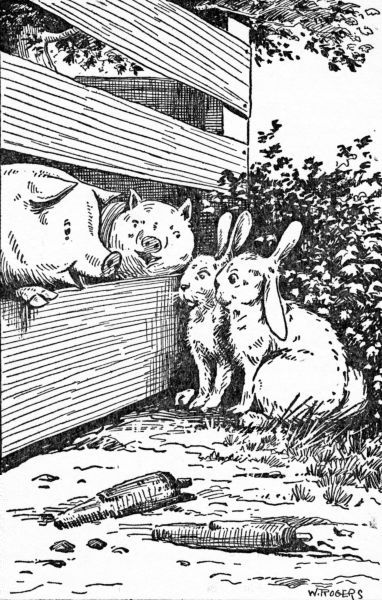
pig pen. They could look in through the cracks
of the board pen and see nine pigs.
Two of the pigs were large and the other seven
were small. And one little pig had a funny,
squinting eye, so that when he looked out at Flop
Ear and Pink Nose they had to laugh.
“What are you laughing at?” asked the little
pig, who could speak the language understood
by all animals. “What is the matter?”
“It is you,” answered Flop Ear. “You have
such a funny squint.”
“Well, Squinty is my name,” said the little pig.
“They name me that because of my eye. Don’t
you like it?”
“Oh, I don’t mind being laughed at,” Squinty
said quickly. “I am used to it. Whenever the
folks come and look down in my pen they laugh
at me too.”
“And my rabbit friends laugh at me,” said
Flop Ear, “so it is all the same.”
“Do you like it in the pen?” asked Pink Nose.
“It seems so open, where every one can look in
on you.”
“Oh, yes, we all like it here,” said Squinty.
“We have lots of fun. We play, and scratch
each others’ backs. Did you ever have your
back scratched, little rabbits?”
“Oh, no, never,” said Flop Ear. “But sometimes
mother rubs my ears, and I like that.”
“I guess it’s all the same,” Squinty said, trying
to turn around to look at the curl in his
tail.
Then the bunnies said good-by to the little
pigs, and ran on. But if you would like to know
more about Squinty you may read of him in a
book like this one, named “Squinty, the Comical
Pig; His Many Adventures.”
“I shouldn’t like to be a pig; should you?”
asked Flop Ear of his brother Pink Nose, as they
hopped along together.
“I don’t believe I should,” answered the other
bunny. “I think it is more fun to be a rabbit.”
Flop Ear lived with his brother, his sister,
his father, mother and Lady Munch in the woods
for some time. The rabbits heard no more gun
sounds and they were hoping that the hunters
had gone away, and would not come back.
Flop Ear and the other two little rabbits had
much fun and many good times. Sometimes
Flop Ear would dig a hole in the ground, which
he could quickly do with his fore paws, and then
he would hide himself in it, covering himself up
with leaves.
Then, when his brother or his sister came
along he would suddenly jump out and cry
“Boo!” at them in rabbit talk, just as sometimes
you hide at the bottom of the stairs, and pretend
to scare your father or big brother as he comes
down.
Often Flop Ear, Snuggle and Pink Nose
would go off through the woods, to find nice
things to eat—sweet roots, wild carrots or berries.
“I do wish I could find some cabbage,” said
Mr. Bunny as he came home one day. “I have
looked all over for some cabbages growing, that
I might bring back some of the sweet, juicy
leaves. But I can not find any.”
“I could not, either, though I looked in many
places,” said his wife.
The next day, when Flop Ear went out by himself,
as he often did, he said:
“I am going to look for a field of cabbages.
If I could find some, and bring it home, how nice
it would be!”
Along and along he hopped, and, all at once,
he sniffed the air, and smelled something nice.
“Ha! That smells like cabbage,” he thought,
for he had once tasted and smelled it. “I
believe I am near a cabbage field!”
He went on a little farther, until he came to a
fence. There was a hole under it, and when
Flop Ear had crawled through that, he was in
a big field where cabbages were growing.
“Oh, isn’t this fine!” said Flop Ear to himself.
“I have found the cabbage! Just what papa and
mamma were looking for! I’ll take some
home!”
CHAPTER III FLOP EAR IS LOST
Under the fence crawled Flop Ear, and,
running up to where a head of cabbage
was growing, the little white rabbit began
nibbling the tender green leaves.
“Oh, how good that tastes!” he said to himself.
“I’ll eat my share here, and carry some
to the folks at home. I can tell them where the
field is, and they can come and get more for
themselves.”
Flop Ear was nibbling away at the cabbage,
which to him was as good as ice cream or lollypops
are to you. And the little rabbit was wondering
how many leaves he could carry home,
when, all at once, he heard a barking sound.
“Bow wow! Bow wow! Bow wow!”
“A dog!” thought Flop Ear, quickly sitting
up on his hind legs. “Oh, the hunter man must
be coming after me with his gun!”
Flop Ear looked all about him, to see which
way to run to get away from the danger, as he
had been taught to do. But before he could
jump back under the fence he saw, coming
toward him, a big, shaggy dog, who was barking.
Flop Ear started to hop away, but he had
no time. The dog was quickly standing right
over him.
“Bite you? I wasn’t going to bite you,” said
the dog. “I was just going to drive you out of
my master’s cabbage patch. Come run along
now, rabbit chap. You can’t stay here.”
“All right. I’ll go right away,” said Flop
Ear, very thankful that the dog had not bitten
him. “I’ll go at once. But I was so hungry for
cabbage, and we haven’t had any in a long while.
I was going to take a few leaves home, carrying
them in my mouth. Papa and mamma have
been looking everywhere for cabbage, but they
didn’t find any.”
Sadly enough Flop Ear started out of the field.
“Hold on a minute,” said the dog, more kindly
this time. “What is your name?”
“I am called Flop Ear, and I guess you can
tell why. It’s because one of my ears flops
over.”
“Yes, I can see that,” said the dog, and he
waved his tail now, which showed that he was
getting friendly. “So your name is Flop Ear;
eh? Well, mine is Don.”
“I am glad to meet you, Don. And I hope
you will not tell your master, the hunter man,
which way I run when I go away. I do not
want him to chase me and shoot me.”
“My master is not a hunter, and does not
shoot rabbits,” said Don. “But wait a minute.
You need not go away without some cabbage.”
“Oh, do you really mean I may take some?”
asked Flop Ear, in delight.
“Why yes, take a few leaves. I guess my master
won’t mind. He tells me to keep watch over
his cabbage field, but I’m sure, if he were here,
he’d let you take a little, so I’ll do the same.
“I’m sorry I barked at you so crossly just now,
but I thought you were one of a lot of rabbits
who had come here to take all the cabbages.”
“Oh, no. I only want a few leaves,” Flop
Ear said.
“That will be all right,” went on Don. “Help
yourself. I don’t believe I ever saw you before;
did I?”
“I don’t know,” answered the rabbit. “I’m
sure I never saw you until just now. And I am
glad your master does not have a gun. I met a
pig named Squinty the other day,” said the rabbit
as he began eating more cabbage leaves.
“Yes, I know him,” said Don. “He is a comical
chap; isn’t he?”
“Indeed he is,” answered Flop Ear. “He
looks at you in such a funny way.”
The dog and the rabbit talked together a little
longer, and then Don said:
“Well, I must go back to the house now. I’ll
see you again some time, perhaps—that is, if I
don’t run away, as I once did.”
“Oh, did you run away?” asked Flop Ear.
“Yes, and many things happened to me.”
“Tell me about them,” begged the funny little
rabbit, who loved stories.
Don told about having gone away, but as this
book is mostly about Flop Ear I’ll just say that
those of you who wish to read about the kind dog
may do so in the volume named “Don, a Runaway
Dog; His Many Adventures.”
When Flop Ear, after listening to Don’s story,
went back home, the little rabbit took with him
some cabbage leaves.
“Oh, where did you get them?” asked his
mother. “I am so glad you found them!”
“I got them in a field,” said Flop Ear. “At
first a dog was going to chase me away, but he did
not, and was kind to me, letting me take some
leaves.”
“That’s nice,” said Lady Munch, as she nibbled
a bit of sweet cabbage leaf. “This will
make a very fine dinner for all of us.”
The Bunnys were very glad to get the cabbage,
and a few days later Mr. and Mrs. Bunny went
to the field, which Flop Ear showed them. Don
was there again, and he was good to the rabbits,
letting them take as much cabbage as they
wanted. And, after all, they did not take very
much, and the man who owned the field never
missed it.
“If you didn’t eat it the worms might get it,”
said Don, kindly, “so take as many heads as you
need.”
It was two or three days after this that Flop
Ear, going through the woods on a short cut to
the cabbage field, saw a black animal walking
along—an animal about as large as himself.
“Oh, I wonder what that is?” he said. “It
looks so black that it may be something dangerous.”
Then the other animal said: “Mew mew!” and
asked:
“Who are you?”
“Why, I am Flop Ear, the funny rabbit,” was
the answer.
“You do look funny,” said the other animal,
waving its tail. Flop Ear’s tail was so short he
could only wiggle it.
“What is your name?” asked Flop Ear.
“My name is Blackie, and I am a lost cat.”
“Lost?” asked Flop Ear.
“Yes, I ran away from home, and now I am
rather sorry. But I am trying to find my way
back again.”
“Oh, I’d never run away from home,” Flop
Ear said. “I like it too much.”
“Well, I liked my home, too,” said Blackie;
“but I wanted to have some adventures, and learn
to become a good fence-jumper, so I went away,
and got lost.”
“Did you have any adventures?” asked Flop
Ear.
“Oh, many of them, and I may have more,”
answered the black cat.
“Tell me about them,” begged Flop Ear, and
Blackie did. I have not room for them here,
but if you will get the book called “Blackie, a
Lost Cat; Her Many Adventures,” you may read
about them for yourself.
“I like you,” said Flop Ear, as Blackie finished
her story. “I thought at first, when you
told me you were a cat, that you might bite me.”
“Oh, no indeed! I wouldn’t bite a rabbit,”
Blackie said.
“That’s what Don, the runaway dog, said,”
returned the bunny.
“What! Do you know him?” asked the black
cat. “Why, he is a friend of mine.”
“I am glad to know that,” cried Flop Ear.
“Don was very good to me. He let me take cabbage.”
“Yes, Don is a good dog, even if he did run
away.”
“I know Squinty, the Comical Pig, too,” went
on Flop Ear. “Do you know him?”
“Well, I may have met him,” Blackie said.
“But I do not now just remember. I have had
so many things happen to me on my travels that
I can not remember them all. You never met
Dido, the dancing bear; did you?”
“Oh, no, never. What! a bear?” cried Flop
Ear. “I’d be afraid!”
“Oh, you needn’t be afraid of him. He is a
good, kind, dancing bear,” said the cat. “He
lives in a cage in the circus, and when some bad
boys chased me I ran under the circus tent and
hid in the straw in Dido’s cage.”
“He must be a nice bear,” Flop Ear said.
“He is,” replied the black cat. “You’ll like
him if you ever meet him.”
“I hope I shall meet him,” Flop Ear said.
The rabbit and the cat talked together a little
longer.
“Where are you going?” finally asked Blackie.
“To get something to eat,” Flop Ear answered.
“First I will go to the cabbage field, and then I
may find some carrots. Did you ever eat carrots?”
“Never!” answered Blackie.
“What do you eat?” Flop Ear inquired.
“Oh, meat and milk, and fish when I can get
them.”
“Well, I hope you get them,” said Flop Ear,
as he hopped on toward the cabbage field. “And
I hope you will soon find your home.”
“I hope so, too,” returned Blackie. Then the
lost cat went off by herself, and in her own book
you may read about her, after you have finished
this one.
Flop Ear was eating some cabbage, when
along came Don.
“Hello!” exclaimed the kind dog.
“Hello!” answered Flop Ear. “I just met a
friend of yours.”
“Who was it?” Don inquired. “Tum Tum
the jolly elephant, or Mappo the merry monkey?”
“Neither one. I don’t know either of them,”
answered Flop Ear. “It was Blackie, a lost
cat.”
“Oh, yes, I know her quite well,” said Don.
“She is a nice cat. I like her.”
“So do I,” said Flop Ear. “Will you have
some cabbage?”
“No, thank you. I never eat it,” Don said.
Two or three days after this something dreadful
happened to Flop Ear.
It happened to the other rabbits, too, and made
them very sad, at least for a time, so I’ll tell you
about it.
This is how it was. They had all been away
together getting some cabbage in the field that
Don watched over, the dog letting them take as
much as they could eat, and now they were on
their way home.
All of a sudden there sounded a loud noise.
“Bang! Bang!” it went twice.
“Oh, my goodness!” cried Papa Bunny. “It’s
a hunter man with a gun! Oh, my! Run everybody!
Run, and hide!”
“And don’t all run together,” added Lady
Munch. “Scatter! Some go one way and some
another. If we all keep together the hunter
man will see us more easily.”
“Bang!” went the gun again, and then a dog—not
Don—barked.
Flop Ear looked over his shoulder. He saw
a man with a smoking gun running toward him.
Flop Ear ducked under a bush to hide, and, oh,
how fast he ran! He wanted to get away. Flop
Ear could see Lady Munch, his papa and his
mamma, his brother and his sister also running
under bushes. The man and dog ran after them.
On and on hopped Flop Ear, as fast as he
could go, until he was too tired to run any farther.
Then he stopped and listened. He could
not hear the dog barking now, nor could he hear
the banging noise of the gun.
Flop Ear came out from under the bush and
looked around. He was in a part of the woods
he had never seen before. It was all strange to
him.
“I guess I had better go back to my home,” he
thought. “The others will be there when I get
there.”
Flop Ear started off, carefully looking on all
sides for danger.
“I guess I got safely away from that hunter
man, with his dog and his gun,” thought Flop
Ear. “I hope the others did too. Oh dear! I
suppose it is right for hunters to chase us, but it
is very hard.”
On and on went Flop Ear.
“Surely I ought to be near my home now,” he
thought. He looked all around, but he could
not see the hole in the ground that was the front
door to his underground house.
“Oh dear!” said Flop Ear. “I wonder if I
am lost.”
He hopped on a little farther. The woods
were still strange to him. He had never been
in that part before.
“Yes, I am lost!” said poor Flop Ear, after a
bit. “I don’t know where my home is. Oh, I
am lost! What shall I do?”
CHAPTER IV FLOP EAR IN THE HAY
The little lost rabbit sat up on his hind
legs and looked all around him. He
was in the middle of a big wood, and
while he liked the trees, the moss and the fallen
leaves, which rustled under his feet, still Flop
Ear liked best his own wood, where he had always
lived. He did not know this wood at all.
“I wonder where Pink Nose and Snuggle
are,” thought Flop Ear. “I wonder if they are
lost, as I am.”
Then, even though he was lost, Flop Ear
could not help feeling hungry, and, as he saw
before him a tree, the bark of which he knew
was good to eat, he nibbled some of it.
“That makes me feel a little better,” he said
to himself. “Now I will try once more to find
my house and my father and mother.”
Again Flop Ear set off through the woods,
looking all about him for a sight of the open
door of his burrow underground. But though
he saw holes where groundhogs, or woodchucks,
lived in fields near the woods, and
though he saw some holes in which snakes
crawled, he did not see his own home, and it
made him lonesome.
Then he happened to remember a way rabbits
have of calling to one another by thumping
their feet on the ground. If you try that
you can signal just as rabbits do, though you
may not be able to make your thumps on the
ground mean anything. If you go out in the
yard some warm Summer day, and put your
ear to the ground, and then some other boy or
girl, some distance off, will pound his heel on
the earth, you can hear it quite plainly.
That is the way rabbits call to one another
when they are too far off to talk, for a rabbit
does not have a very loud voice. And a rabbit
does not need to put his ear to the ground to listen
to the thumps of another rabbit. He can
hear well enough without that.
“That’s what I’ll do,” thought Flop Ear.
“I’ll give a pounding call, and papa or mamma
may be near enough to hear. Oh, I hope they
are, for I want to go home!”
Flop Ear raised himself on his hind feet, and
then he thumped with his front feet two or three
times, making a sound like a little drum. Then
Flop Ear listened. He did not hear any other
thumps in answer to his own.
“Well, I’ll go on a little way and try once
more,” he said to himself. “Maybe they will
hear this time.”
Once more Flop Ear thumped on the ground.
But though he listened very sharply all he could
hear was the wind blowing through the trees,
and the dried leaves rustling as he scampered
through them.
“Oh dear!” thought poor Flop Ear. “I
don’t know what to do. I surely am lost worse
than I ever was before.”
Once, when he was a little baby rabbit, Flop
Ear had wandered a little way off from the burrow.
His mother had been with him, but he
ran on ahead. And, when he looked back, he
could not see his mother, nor the burrow where
he lived.
He had been very much frightened then, and
he had started to cry, being only a baby, and
much afraid of being lost. But then his mother
suddenly came running around a stump, behind
which she had gone to get some nice red wintergreen
berries, and she dried the tears of Flop
Ear on her soft fur, and showed him that the
burrow was only about two jumps away, behind
a big rock.
“I was only lost a little bit that time,” thought
Flop Ear, “but this time I am lost a whole lot.
I wish I had not run so far from home. Why,
I am a regular runaway, like Don, the dog, and
I’m lost, just as Blackie was. I told her I’d
never run away from my home, but I did.
“But I did not mean to,” went on Flop Ear.
“It was the hunter, with his dog and gun, who
drove me away from home. I’d never run away
from it myself. But what shall I do?”
Flop Ear was tired from running so much,
and from thumping on the ground, so when he
found a place where some soft moss grew near a
tree he lay down to rest. And, all the while, he
wondered how he was ever going to get home
again.
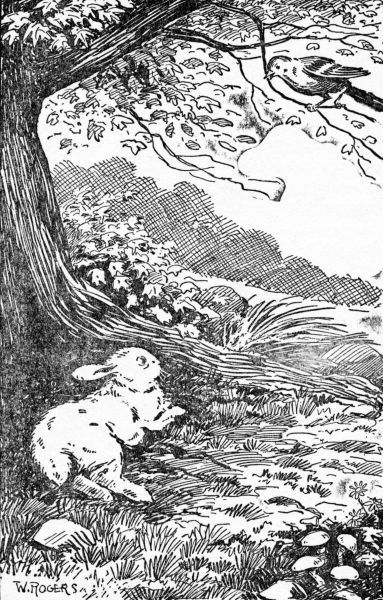
Then, up in the tree over his head Flop Ear
heard a bird singing. And as he could speak
bird language, as well as animal talk, Flop Ear
asked:
“Chirp! Chirp!” answered the little bird.
“No, I am sorry to say I do not know where your
home is. But, if you like, you may come and
live in my house.”
“And where is your house?” asked Flop Ear,
thinking he might stay there over night, as it
was now getting rather dark.
“My home is a nice nest up in this tree,”
chirped the bird. “If you come up, though,
you must be very careful, for I have eggs in my
nest.”
“What are you going to do with them, color
them for Easter?” asked Flop Ear, for, being a
rabbit he knew about Easter eggs, you see.
“What! Color my nice eggs?” cried the
bird. “No indeed! I am going to hatch some
little birdies out of them. Besides, my eggs are
colored already. They are a beautiful blue. If
you come up you can see them.”
“If your eggs are blue, then you must be a
robin-bird,” said Flop Ear.
“I am,” was the answer. “Are you coming
up to stay in my nest? But please be careful
not to break the eggs if you do.”
“No, thank you, I can not come up,” said Flop
Ear. “It is very kind of you to ask me, but I
can not climb a tree. And, besides, I am afraid
I am too large to fit in your nest without breaking
the eggs.”
“Well, perhaps you are,” the bird said. “But
I am sorry you are lost.”
“I’m sorry, too,” said Flop Ear.
“Perhaps I can fly around and look for
your burrow,” the robin-bird said. “Shall I
try?”
“If you please,” Flop Ear answered.
So the bird flew around through the woods,
looking down on the ground trying to see Flop
Ear’s home. But she could not, for the little
rabbit had run very fast to get away from the
hunter, and had traveled farther than he thought
he had.
“No, I can not find your home, I am sorry to
say,” said the bird as she came back to the tree
under which Flop Ear was resting. “I could
not see it anywhere.”
“Never mind, you did the best you could, and
I thank you,” returned the rabbit. “I’ll run
along myself and see if I can find it. If I can’t,
I suppose I shall have to stay out in the woods
all night.”
“I do that myself, up in my nest,” said the
robin. “So if you get lonesome come and sleep
near this tree.”
“I will, thank you,” answered Flop Ear.
Off he went again, and then, all of a sudden,
Flop Ear heard that dreadful banging noise of
the gun again, though it was not very close to
him.
“Oh, there’s that dreadful hunter once more!”
cried the little rabbit. “I must run on again.”
Pretty soon Flop Ear was tired and he had to
stop to rest. He listened but did not hear the
gun again. It was almost dark now, and Flop
Ear remembered what his father had said, that
the hunter men did not stay out to shoot after
dark.
“So I’ll be all right for a while,” said Flop
Ear.
On and on he went, now and then stopping to
nibble at some sweet bark, or pick up a few berries,
and pretty soon Flop Ear came out of the
woods and found himself in a field.
“Ha! Maybe I can find some cabbages or
carrots in here,” he thought.
But as soon as Flop Ear looked at the field he
knew it was neither a cabbage nor a carrot
field. There was short, stubbly grass in the
field. It was what is called a meadow, like the
one where the sheep were, for which Little Boy
Blue had to blow his horn.
In the middle of the field was something that
looked like a big hill, or a small mountain.
“I wonder what that is,” said Flop Ear to
himself. “I guess I’ll hop over and take a look.”
Across the meadow he went and when he came
to the big pile he found it was hay, that had
been cut and stacked up, ready to be hauled into
the barn.
“Ha! Hay!” said Flop Ear. “I can burrow
under that and sleep to-night. It will be
a nice place, and no hunter can find me there.
I can also eat some of the hay.”
Hay is grass, dried, you know, and rabbits
like to nibble a little of it.
So Flop Ear crawled under the stack of hay
and, after eating a little, he felt sleepy. His
eyes closed.
CHAPTER V FLOP EAR AND THE BOY
Flop Ear awoke in the morning feeling
hungry. All he had to do was to reach
out and eat part of his hay-bed in which he
had slept. I think that was rather funny. It
isn’t every one who can get a breakfast as easily
as that.
How would you like to reach out in the morning,
when you wake up, and eat part of the pillow
case, a bit of the sheet and perhaps nibble off
one of the rosettes on the bedquilt? I guess it
would not taste as good as your breakfast orange
and oatmeal; would it? No indeed!
But a rabbit is different. They like hay, and
they can sleep in it as well as eat it. So Flop
Ear had no trouble getting his breakfast. And
he knew that in the woods and fields all around
him grew many other things he could eat.
“So, even though I am lost, I shall not go hungry,”
thought Flop Ear. “But still I don’t want
to be lost. I want to find my home, my father
and my mother, and Snuggle and Pink Nose. I
want to see my grandma, Lady Munch, too.
Oh, how I wish that hunter man had never come
to our woods!”
But there was no use wishing that now. Flop
Ear was far away from home, and he must do
the best he could either to find his way back to
it, or to look for a new home.
“It is Summer now,” thought the little rabbit,
“and it will be all right to sleep out in the fields
or woods without going down into an underground
burrow. But if I do not find my home
before cold weather comes I shall have to dig
a new one for myself. I wonder if I have forgotten
how to dig, or burrow, as father calls it.
I guess I’ll go out and try it now.”
Out from the warm little nest he had made
for himself in the hay came Flop Ear. He
found a soft place in the field and began to dig
in the dirt, pawing it under him in a pile by
scratching with his fore paws, almost as your
dog does it when he feels like digging.
“I haven’t forgotten my digging lessons,” said
Flop Ear. “So I will be all right when Winter
comes. But it is a long way off yet. Now to
try again to find my home.”
He had just left the spot where he had dug
the little hole in the meadow, when, all at once,
he heard a dog barking.
“Ha! I wonder if that is Don or a hunter’s
dog,” thought Flop Ear. He looked quickly
over his shoulder, and he saw a dog running
toward him. It was neither Don nor a hunter’s
dog, but a strange one.
“Get out of this field!” barked the dog.
“Run away or I’ll bite you!” and he spoke very
crossly.
“My! You are not as nice and polite as Don
was when he let me get the cabbage,” thought
Flop Ear as he bounded away. “I’m not hurting
your field. I only dug a little hole in it, and
ate some hay, and there is a whole mountain of
it left.” Flop Ear did not stop to say this to the
barking dog, but spoke as he ran on, for the dog
was coming after him very fast indeed.
“Oh, ho! No, you won’t!” answered Flop
Ear. “You can’t catch me!”
Rabbits can run and hop very fast you know,
but of course Flop Ear was only a little fellow,
not fully grown, and the dog was a big chap.
So the rabbit, looking back, saw that the dog
was getting nearer and nearer.
“I must fool him,” said Flop Ear to himself.
“I must run in the woods where he can not see
me. Then he can only follow me by smelling,
and when I get a chance I’ll cross some water,
and then the dog can’t even smell my steps.”
When dogs can not see rabbits, or other animals
they are chasing, they have to go by smell.
They put their nose to the ground and sniff very
hard, and a dog’s nose is so good for smelling
that he can tell just which way a rabbit went,
that is if it is not too long after the rabbit has
passed by. Rabbits, and other animals when
they step on the ground, leave there a sort of
smell, called a scent, just as if you rubbed onion
on a dish. Though you did not see the onion
rubbed on the dish, if you smelled the dish, even
in the dark, you would know the onion had been
there.
That’s the way it is when a dog chases a rabbit.
He smells the tracks on the ground when
he can not see the bunny running along.
Pretty soon Flop Ear came to the woods. In
among the bushes he jumped, and now he was
hidden from the dog.
“Oh, but I’ll get you anyhow,” barked the
dog. “I’ll smell you out with my sharp nose.”
“No, you won’t,” thought Flop Ear, for he
did not want to talk to the dog now, or the cross
animal might find the little white rabbit.
On and on ran Flop Ear, as fast as he could
go. The dog still came after him, for every
time Flop Ear’s feet touched the ground they
left a smell there which the dog could follow.
But, pretty soon, Flop Ear came to a brook
running through the woods.
“Now here’s where I fool that dog,” thought
the rabbit. So Flop Ear went close to the edge
of the water, jumped in where it was not very
deep, and waded down stream, going as fast as
he could, splashing drops all over. But he did
not mind that, as the day was warm.
Besides it was better to be wet than to have a
dog bite him.
After going down the brook quite a distance
Flop Ear went all the way across it, to the other
side, and then he felt that he need not hurry so.
“The dog can not smell where I am now,” he
said to himself.
And this was true. Barking and growling,
the dog came to the edge of the brook where
Flop Ear had waded into the water, but the rabbit
was out of sight. Then the dog had to stop
for a minute.
“Now which way did that rabbit go?” he
asked himself, for you see the smell of rabbits’
feet, or those of other animals, will not stay on
the water. That was where the dog was puzzled.
“I guess the rabbit jumped across the brook,
and is in the woods on the other side,” said the
dog. “I’ll go over there myself.”
So across the water went the dog, but when he
got on the other side he could neither see Flop
Ear nor smell where he was. For the rabbit
was quite a way down the stream you see. The
dog ran all around, trying to get track of the
rabbit smell, but he could not.
“He got away from me after all!” said the
dog. “I call that a mean trick!”
But for Flop Ear it was a good trick. He did
not want to be bitten, any more than that dog
would like to get a nip. So Flop Ear got himself
out of one danger.
“My! That was a long run!” said Flop Ear,
as he came to a rest on a bed of soft moss. “I
thought that dog would surely get me.” He listened
very hard, but he could not hear the dog
barking now. The dog had gone back to his
home in the farmhouse, near the big pile of hay.
Flop Ear was hungry again now; so, after
resting, he looked about and found some sweet
bark from a tree. He ate as much of this as he
wanted, taking a little sassafras bark as a sort of
dessert—as you take pudding or pie—and then
he hopped on again, still looking for his lost
home.
All that day Flop Ear wandered about in the
woods. Then, as night was coming on, he
looked for a place to sleep. He was wondering
if he had better not go back to the pile of hay,
when, all at once he saw another rabbit just
ahead of him.
“Oh, if that is only one of my folks!” thought
Flop Ear, his heart beating very fast, “how
happy I shall be! Hello there!” he called to
the other bunny.
“Hello!” came back the answer, and then
Flop Ear’s heart was sad, for the voice was not
that of any of his relatives—not Lady Munch’s,
his father’s, mother’s, Pink Nose’s, or Snuggle’s.
“Do you live around here?” asked Flop Ear
of the strange rabbit.
“Yes,” was the answer. “My burrow is right
under the place where you are sitting, and my
front door is near this rock where I am.”
“Oh dear! I wish I were as near my home as
you are to yours,” said Flop Ear.
“What’s the matter?” asked the other rabbit,
whose name was Fluffo.
“Oh, I’m lost!” Flop Ear said. “A hunter
chased me away from my nice home.”
“Then come and stay with me,” suggested
Fluffo. “I have plenty of room, and there are
some nice carrots and cabbages in my burrow.”
“How good that sounds,” Flop Ear said. “I
will come in and stay with you.”
So down into the other bunny’s burrow he
went, and had a good supper, staying there all
night. He had a good breakfast, too, and then
he started off through the woods again.
“Why don’t you stay longer with me?” asked
Fluffo. “I have plenty of room for both of us.”
“Oh, I would like to stay,” Flop Ear said,
“but I feel that I must try to get back to my
own dear home. My father and mother may be
looking for me.”
“Well, go on then,” said Fluffo. “I hope you
will find your burrow soon.”
“Thank you,” returned Flop Ear, “I hope I
do.”
Away he hopped, over the fields and through
the woods, and pretty soon he saw that the woods
were coming to an end again. A large field
was in front of Flop Ear, and in the field was a
farmhouse, with barns and sheds.
“I wonder if I could get anything to eat over
there,” thought Flop Ear, for he had not had
anything since leaving Fluffo’s burrow, early
that morning. “I guess I’ll hop over and see,”
went on the rabbit. “I hope there are no dogs
to chase me.”
Flop Ear hopped across the field toward the
farmhouse. Back of it was a little shed, and the
door of this shed was open. In went Flop Ear,
not knowing quite where he was going. He saw
piles of wood in the shed, for this was the place
where the farmer’s wife kept her wood for making
fires. There were pieces of trees that had
once grown in the forest.
“Well, here is some bark I can gnaw,”
thought Flop Ear, “but it is not as nice and fresh
as that which grows on the trees in the woods.
I guess I’ll—”
And then Flop Ear stopped suddenly, for he
heard some one coming into the woodshed.
“Oh, I hope that isn’t the hunter man!”
thought the rabbit. “I’d better hide.”
In front of him was a basket filled with wood.
There was room down in among the sticks of
wood for Flop Ear to hide. Into the basket he
jumped, and cuddled down out of sight. Then
Flop Ear heard a woman calling:
“Jimmie! Jimmie! Bring me in a basket of
wood, please!”
“I will, Mother,” answered a boy.
Flop Ear could understand some of our kind
of talk, you know, though he could not speak it
himself.
The rabbit heard some one walking around the
shed, and then, all at once, Flop Ear felt himself
being lifted up in the basket of wood, and being
carried along.
“Oh, I wonder what is going to happen to me
now?” thought the rabbit, whose heart was beating
very fast, as he was much frightened.
“Are you bringing the wood, Jimmie?” the
boy’s mother called.
“Yes’m, I’m coming with it.”
There was something else in the basket besides
the wood, had the boy only known it.
Flop Ear felt himself bouncing along, up and
down, as the boy carried him in the wood basket,
and then he felt the basket being set down.
“Take out the wood, Jimmie dear, and put it
in the wood-box behind the stove,” said the
woman, and the boy did so. Stick after stick
he lifted out, and Flop Ear, who was down in
the very bottom, was wondering what would
happen when the basket was empty.
“They’ll see me, surely, then,” said the rabbit.
“I wonder what they will do to me? Oh, I
seem to be getting in more and more trouble all
the while.”
The boy who was lifting the wood out of the
basket suddenly cried:
“Oh, Mother! Look here! A rabbit!”
“A rabbit! Where?”
“In the wood basket!” And before Flop Ear
could hop out of the way the boy had lifted him
up in his arms, holding him closely.
CHAPTER VI FLOP EAR LEARNS TRICKS
Flop Ear, at first, was so frightened at
finding himself in the boy’s arms, that he
did not know what to do. He trembled
and tried to get away, but the boy said:
“Keep still, little rabbit. I won’t hurt you.
I will be kind to you.”
Flop Ear understood a little of this talk, but,
best of all, he understood the kind, stroking hand
of the boy, who rubbed his fur softly. Animals
can tell just by the way you touch them whether
or not you are going to be nice to them.
But still Flop Ear was frightened. To a little
rabbit, a boy is as big as a giant would be to
you or me, and this was the first time, in all his
life, Flop Ear had ever been near a human
being.
If there were giants in the world, I think we
would all be very much frightened if we saw
one for the first time, and did not know whether
he would be cross or kind. But after we had
seen the giant two or three times, and learned that
he would not harm us, we would not be so worried.
It was this way with Flop Ear. It was
the first time he had ever seen a boy close by, and
he was afraid.
“Now don’t try to get away, little bunny,”
said the boy kindly. “I won’t hurt you. See
him, Mother! Isn’t he cute?”
“Where did you get him, Jimmie?”
“Why he was in the wood basket, right under
the wood, and when I lifted out the last sticks
I saw him.”
“In the wood basket! How in the world did
he get there?”
“He must have come in from the fields or
woods and hopped in to hide,” said Jimmie, the
boy. “I am going to keep him for a pet if he
will stay with me. I’ll teach him some tricks.”
“Put him down on the floor and see if he will
stay,” suggested the woman.
“I’m afraid he’ll run. Wait until I shut the
door,” the boy said.
“And I’ll get him a carrot to eat,” returned his
mother. “Maybe he won’t run when he sees
that.”
She put a carrot down on the kitchen floor,
and the boy placed Flop Ear in front of it. The
carrot smelled very good to Flop Ear, for he was
hungry, so he did not run away, though his heart
was still beating fast.
Then the boy saw the little rabbit’s funny,
drooping ear.
“Oh, Mother! See!” cried Jimmie. “What
a funny rabbit! Isn’t he comical? He’s as
comical as Squinty, the pig!”
“Yes, he does look odd,” said the woman. “I
think Flop Ear would be a good name for him.”
And so, you see, without any trouble at all,
Flop Ear got his own right name. It was natural
to call him that.
“I like him better than I do Squinty,” said the
boy. “I was over on Mr. Jones’ farm the other
day, and I saw Squinty in the pen. Mr. Jones
said some children were going to take him for a
pet, but I would rather have Flop Ear, the
funny rabbit.”
“Well, this isn’t so bad,” thought Flop Ear,
as he nibbled the carrot. “If this boy knows my
friend Squinty I guess he will be kind to me.
So some children are going to take Squinty away
for a pet; are they? I hope they will be good to
him, and give him what he likes to eat.”
All this while Flop Ear himself was eating
the carrot, one of his ears standing up, and the
other drooping down, and he looked so funny
that the boy and his mother had to laugh.
“I did not know rabbits would come in our
woodshed,” the boy said. “I wonder what
made this one do so?”
“Perhaps he was hungry,” said Jimmie’s
mother. And that was the reason, as you know,
why Flop Ear had come to the farmhouse and
had gone into the shed.
Flop Ear was not so frightened now. He
looked all about him, and he thought he was in
a very queer place—a farmhouse kitchen.
There was a big black thing there, and in it was
a fire. Flop Ear knew what fire was, for once
the woods near his burrow were blazing, and the
rabbits had to run underground and stay there
to keep away from the hot flames.
“I wonder why people want fires in their
houses!” thought Flop Ear. “We never have
any in our burrow.”
Then he saw Jimmie’s mother put a pan on
the big black thing with fire in it, and soon
white smoke, so it seemed to Flop Ear, rose from
the pan. Jimmie’s mother was cooking dinner
over the fire, made with some of the wood taken
from the basket in which the rabbit had hidden.
“Flop Ear,” said the boy, speaking to the rabbit
just as if it could understand—“Flop Ear,
you are a nice bunny, and I like you. I am
going to keep you for myself, and I will teach
you some tricks in a few days when you are not
so frightened. And I must make a little house
for you to stay in. A box will do, though I suppose
you can gnaw your way out with your teeth
if you don’t like it. But I will get a strong box,
and give you plenty to eat, and maybe you will
not try to get away.”
“I think you are a very nice boy,” thought
Flop Ear to himself. “You seem to be kind to
me, but still I can not promise to stay always
with you. I want to go back to my own home
and folks. But I will stay here a while and eat
carrots.”
Of course the boy could not know Flop Ear
was thinking this. But the boy could see that
the rabbit was not so frightened as he had been
at first.
“I think he likes me,” said the boy to his
mother. “I will teach him to do some tricks,
and maybe I can sell him to a circus.”
“Oh, I wouldn’t sell him,” Jimmie’s mother
said. “Keep him for yourself.”
“All right. Maybe I’ll do that.”
“Let me see—circus. Where have I heard
that word before?” thought Flop Ear. “Oh, I
remember. Blackie, the lost cat, told me she
met Dido, the dancing bear, in a circus. Well,
if Dido is there I wouldn’t mind going to a
circus. But still I shall like it here for a while.”
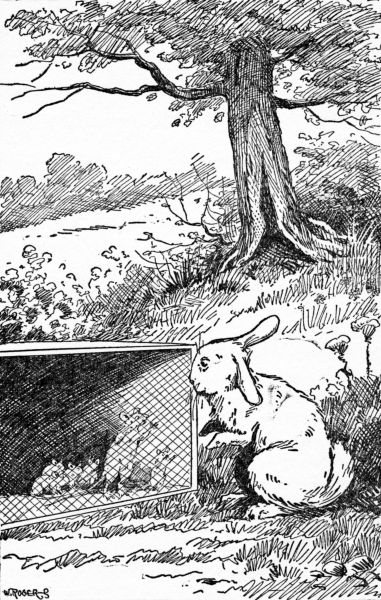
The boy found a strong, heavy box to make
into a little house for Flop Ear. He put it out
in the yard, under a tree where the rabbit would
be in the shade. Flop Ear was given some lettuce
leaves to eat, and he liked them even better
than he did carrots. There was also a pan of
nice water for the rabbit to drink.
“Well, this is nicer than running through the
woods with a dog after you,” thought Flop Ear.
“Still I would like to find my own home again,
and have a good game of tag with Pink Nose
and Snuggle.”
Just as the boy thought, Flop Ear did try to
gnaw his way out of the box. For the boy knew
something about rabbits. They are good gnawers,
almost as good as rats and mice. They have
four front teeth just made for cutting through
wood, and they use them in taking bark off trees
to eat.
So Flop Ear, with his strong front teeth, tried
to gnaw out of the box. If it had not been a
heavy thick one he might have done it, and gotten
away. But the boy saw what his new rabbit
pet was doing, and put some tin inside the box.
Rabbits, rats or mice can not gnaw through even
thin tin. It is too strong for their sharp teeth.
That afternoon, when Flop Ear had taken a
little sleep in his box, on some soft straw which
the boy put in for him, Jimmie said:
“Now I will try to teach Flop Ear some
tricks. Come on out, bunny boy, and let me see
what you can do.”
Of course, Flop Ear did not in the least know
what was going to happen to him. But he knew,
by this time, that the boy was good and kind, and
would not hurt him.
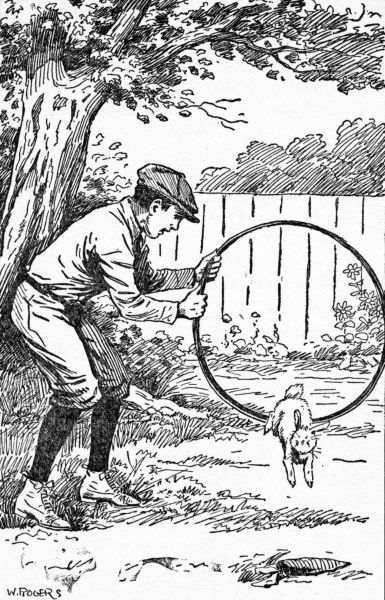
“We will try an easy trick,” Jimmie said. “I
will see if you know how to jump through a barrel
hoop.”
The boy set Flop Ear down on the ground,
outside the box. Of course the rabbit might
have run away, but he thought he would not.
“There is time enough for that later on,” Flop
Ear said to himself. “I will see what he means
by tricks, and jumping through a hoop.”
The boy had with him a round hoop from a
barrel. He held this up in front of the rabbit,
but Flop Ear did not know what to do.
“Jump, Floppy! Jump!” cried the boy.
“Jump through the hoop!”
But Flop Ear did not.
“I know how to make him,” said Jimmie.
Then he took a carrot and put it on the ground.
In front of it he held up the round hoop. Flop
Ear saw the carrot and wanted to get it to eat.
He started around one side of the hoop, but the
boy gently pushed him back.
“You must jump through the hoop if you want
the carrot,” said Jimmie.
“Fine! That’s the way to do it!” cried Jimmie,
much pleased. “You have learned a trick,
Flop Ear.”
“I don’t call that much of a trick,” thought
the rabbit. “But still it may be.”
Three or four times Jimmie made the rabbit
jump through the hoop and each time Flop Ear
was given a bit of carrot. Then he learned to
do it without anything to eat, and after a bit
Flop Ear grew to like to do the trick, for it
seemed to please the boy, who patted the bunny’s
soft fur.
“Now we have one trick, we’ll try another,”
said Jimmie, a few days later. “I wonder if
you can stand up on your hind legs, and hold a
bit of carrot on your nose?”
Well, it was easy enough, of course, for Flop
Ear to stand up on his hind legs. He had done
that in the woods often enough. And it was not
hard for him to hold a bit of carrot on his nose.
But as soon as Jimmie put it there Flop Ear let
the carrot fall to the ground and ate it. He
thought that was what it was for.
“No, no! You must not do it that way,” said
Jimmie. “I want you to stand up on your hind
legs, and hold the carrot on your nose until I tell
you to eat it, and clap my hands. Then you may
take it. Now we’ll try again.”
Once more Flop Ear stood up on his hind legs.
Again the carrot was put on his nose, but he
dropped it off and—no, he did not eat it this
time, for the boy grabbed it away as soon as it
fell to the ground.
“You must not eat it until I tell you to, Flop
Ear,” said Jimmie.
It took quite a while for the rabbit to learn
this trick, but finally he came to understand
what Jimmie wanted. And then, after a bit,
Flop Ear would stand up when the boy told him
to, and when the carrot was put on the rabbit’s
nose he would not let it drop off and eat it until
Jimmie clapped his hands.
“Now you are quite tame, and you know two
tricks,” said the boy. “You are getting to be
quite a circus rabbit. I must teach you another
trick.”
CHAPTER VII FLOP EAR GETS AWAY
For two or three days Jimmie made Flop
Ear do, over and over again, the first two
tricks—those of jumping through the barrel
hoop, and standing up with a piece of carrot
on his nose. The rabbit did not mind doing
them, for he was getting to like the boy, because
he was very kind and good.
“But two tricks are not enough for a rabbit,”
the boy said. “I want you to know some more,
and then I can get up a little animal show, or
circus, with you.” Then the boy said to himself:
“I ought to have more animals. I wonder
if I could get a dog and teach him some
tricks, or a cat.”
“Gracious!” thought Flop Ear. “I hope he
doesn’t get a dog that will bite. If he does I’ll
have to run away if I get the chance.”
Several times Flop Ear had thought of going
away. He might easily have done it, too, for
the boy often let the rabbit come out of the box.
“But then,” said Flop Ear to himself, “if I
ran away I would not get such nice things to eat
as I get here. So I think I’ll stay for a while.
I wonder what other trick that boy will teach
me?”
Flop Ear soon found out. One day Jimmie
came home from school, bringing another boy
with him.
“I’ll show you my tame rabbit,” said Jimmie
to his friend.
“Where did you get him?” the other boy
asked. The boy’s name was Sam.
“I found him in the basket, when I brought
it in filled with wood,” answered Jimmie.
“He’s such a funny rabbit, with his one flop ear.
Here he is in this box.”
Jimmie opened the box. Sam leaned over,
and, before Jimmie could stop him, lifted the
rabbit out of the box, raising him up by taking
hold of his ears.
“Here! Don’t do that!” cried Jimmie.
“Don’t do what?”
“Lift my rabbit that way—by the ears.”
“Why not?”
“Because it hurts them.”
“It does not!” cried Sam, holding Flop Ear
up higher in the air.
“Indeed it does hurt me,” Flop Ear was saying
to himself. But, of course, he could not tell
the boys that, as they did not understand rabbit
talk. But Flop Ear kicked and wiggled his
legs, and showed as plainly as he could that he
did not like being lifted around this way.
“Stop it!” cried Jimmie. “Put him down,
Sam. You’ll pull off his ears, maybe.”
“I will not. You always lift rabbits by their
ears.”
“No you don’t!” cried Jimmie. “My mother
says that lots of folks think it’s right to lift a
rabbit by the ears, but it isn’t, any more than
you’d lift a dog or cat by its ears.”
“You couldn’t lift a cat by her ears,” said Sam.
“They’re not big enough. But some dogs have
ears almost as big as rabbits, only they don’t
stand up straight.”
“Well, never mind about that,” said Jimmie.
“Put my rabbit down, please. Or, if you want
to hold him, do it this way,” and Jimmie took
the rabbit in his arms as a little girl might hold
her kitten. Flop Ear liked to be held that way,
and he liked it still more when Jimmie fed him
a nice tender green leaf of lettuce.
“This is the best way to hold rabbits,” Jimmie
went on.
“Well, I didn’t know it. I’m sorry if I hurt
yours,” said Sam, who was really a good boy.
“Oh, I guess you didn’t hold Flop Ear long
enough to hurt him,” went on Jimmie. “And
now I’ll show you two tricks he can do, and then
we’ll teach him another.”
Flop Ear jumped through the hoop, for the
first trick, and then stood up with the piece of
carrot on his nose, not offering to eat it until
Jimmie clapped his hands.
“What do you think of that?” asked Jimmie
of Sam.
“I think they are fine tricks. What else are
you going to have him do?”
“I’m going to see if I can harness him up and
make him draw a little wagon. I’ve got a small
one that used to belong to my little brother.
He’s too big to play with it now. Besides, he
is away on a visit to my grandmother. So I’m
going to take his wagon, and see if Flop Ear will
pull it.”
This talk was all strange to Flop Ear, but he
soon found out what it meant. Jimmie put his
rabbit back in the box, with some cabbage leaves
to nibble, and then the two boys went away.
They came back in a little while with the small
wagon, and some pieces of string. Jimmie also
had a little leather collar that had once been on
the neck of his pet cat, that had grown too big
to wear it.
“We’ll put the collar on the rabbit,” Jimmie
said, “and fasten the strings to it. Then we’ll
fasten the strings to the wagon and when the
bunny hops along he’ll pull the cart after him,
like a pony.”
“That will be great!” cried Sam.
But it was not as easy as they thought it would
be. In the first place Flop Ear did not like the
collar on his neck. He had never worn one, and
he thought it might hurt him. So when Jimmie
and Sam tried to put it on the rabbit kicked and
wiggled.
But even this did no good. The more the
boys tried to put the collar on Flop Ear’s neck
the more the bunny wiggled.
“We never can do it,” said Sam.
“Oh, yes we can,” returned Jimmie. “I know
a way. I’ll go and get a carrot. You hold it
for him to eat, and while he’s nibbling at it I’ll
slip the collar on his neck.”
“Well, we can try,” said Sam.
Flop Ear did not understand all that the boys
said. But when he saw Sam holding out a carrot
to him, the rabbit knew enough to want to
eat it. And as he stretched out his neck to reach
the carrot Jimmie quickly slipped on the collar
and fastened it.
“There you are, Flop Ear!” he said.
And surely enough, there was the collar on
the rabbit’s neck.
“Well, it isn’t as bad as I thought it was,” said
Flop Ear to himself. “It doesn’t hurt me, but
it feels funny, and sort of tickles. I don’t exactly
like it and I wish I could get it off.”
He shook his head, hoping to shake off the
collar, but it would not come. Then he tried
to push it off with his paw, but he could not do
that, either.
“No, you can’t get it off, Flop Ear,” said Jimmie
with a laugh, as he saw what his pet was trying
to do. “But never mind, I won’t make you
keep it on always, only once in a while when you
pull the wagon.”
“Let’s hitch him up now and see what he does,”
suggested Sam.
“All right,” answered Jimmie.
They fastened the wagon to the collar of Flop
Ear with strings. Then Jimmie said:
“Gid-dap, Flop Ear!”
“That’s not the way to talk to a rabbit,” said
Sam. “That’s horse-talk.”
“Well, I don’t know how to tell a rabbit to go
on in rabbit talk,” said Jimmie, “so I’ll have to
make believe he’s a horse. Gid-dap, Flop
Ear!”
But the rabbit would not move. He lay down
on the ground, for he did not know what Jimmie
wanted him to do.
“That trick isn’t going to work,” said Sam.
“Yes, it is!” cried Jimmie, after thinking a
minute. “I have a new way. You go in front
of Flop Ear and hold the carrot out, but just
so he can’t reach it.”
“What good will that do?” asked Sam.
“You’ll see,” answered Jimmie.
Sam held the carrot in front of Flop Ear, and
a little way from his nose. The rabbit smelled
the carrot, and, as he could not reach it, he
hopped forward.
“Now pull it away from him!” quickly cried
Jimmie. “Hold it in front of him, and every
time he jumps to get it, move it ahead a little.
That will keep him moving, and he’ll pull the
wagon.”
“Oh, sure enough! so he will!” cried Sam in
much excitement.
And that is what Flop Ear did. In trying to
reach the carrot, which Sam kept moving away
from him, Flop Ear had to move himself forward,
and, as he did this, he dragged the little
wagon after him.
“Hurrah!” cried Jimmie. “Now he’s pulling
it.”
Half way across the yard Flop Ear hopped
after the carrot which he was never able to
reach. And with every move he made, the
wagon, which was tied fast to his collar, moved
after him.
“I don’t think this is a nice way to treat me,”
thought Flop Ear. “I want that carrot, but I
can’t get it. Still, I suppose it is a trick and I
must do it.”
“Shall I give him the carrot now?” asked
Sam, when Flop Ear had pulled the wagon all
the way across the yard.
“Yes, give it to him,” said Jimmie.
So Flop Ear got the carrot after all, and it
tasted very good to him.
“Well, maybe this trick isn’t so bad after all,”
the bunny thought.
When he had eaten one carrot Sam held out
another for Flop Ear, and once more the rabbit
dragged the wagon across the yard.
“He’s learning the trick all right,” said Jimmie.
In a few days Flop Ear got so he could draw
the little wagon very easily. And Sam did not
have to keep moving away from in front of him
with a carrot all the while, either. Jimmie
would put a carrot on one side of the yard, and
set Flop Ear and the little wagon at the other
side.
“Now go to get your carrot, Floppy!” the boy
would say. Then away Flop Ear would hop to
get the nice yellow vegetable, and, at the same
time, he would be drawing the wagon.
“Now he can do three tricks,” said Jimmie.
When he was not doing the wagon trick Flop
Ear did not have to wear the collar, and he was
glad of that, as it tickled him, and he did not
like it, though it did not hurt him.
For some time Flop Ear stayed with Jimmie,
learning some new tricks. Often other boys and
girls would come to Jimmie’s yard to look at the
pet rabbit and stroke his soft, white fur. Jimmie
liked this. And because Jimmie told them
about not lifting rabbits by their ears, no one
ever took Floppy up that way.
And then, one day, Flop Ear suddenly felt
that he ought to go away.
“It is nice here, and all that, and I have a good
home,” he said to himself, “but I think I ought
to travel on and see if I can not find my real
underground house, and my own folks. I want
so much to see them. I’m going away.”
And that afternoon, when Flop Ear was taken
out of his box, to run around the yard, he waited
until Jimmie went into the house, and then the
bunny quickly dug a hole under the fence and
got out.
“Once more I am on my travels,” he said.
CHAPTER VIII FLOP EAR MEETS SLICKO
Flop Ear sat up on his hind legs, once he
was outside the fence, and looked about
him. One of his big ears stuck up
straight, and the other sort of leaned over.
Flop Ear put his head on one side, and his nose
trembled, sort of, for he was wiggling it in order
to try if he could smell any danger. Rabbits
can wiggle their noses a little, and elephants can
wiggle theirs a good bit, for their nose is their
long trunk, and you know how Tum Tum could
sling his trunk about.
“Well, I wonder which way I shall go?”
asked Flop Ear of himself. Just then he heard
a bird, up in a tree over his head, laughing.
“What are you laughing at?” asked Flop Ear.
“Do you see anything funny?”
“Yes,” replied the bird, still laughing, “I do.”
“What is it?” asked Flop Ear. “Tell me, and
if I see it I will laugh also.”
“You may laugh if you like,” answered the
bird, “but you can’t see at what I am laughing
unless you get near a pool of water and look
down in that. Then you will see yourself, for
I am laughing at you. You do look funny! I
hope you don’t mind being laughed at.”
“Not a bit!” cried Flop Ear in a happy voice.
“I like my friends to laugh even at me. It
makes them jolly.”
“Then it is all right,” chirped the bird. “If
you do not mind telling me, Flop Ear, where
have you been and where are you going?”
“I do not in the least mind telling you,”
returned the rabbit. “So you know my name,
too, do you?”
“Oh, it is easy to guess your name by looking
at your floppy ear,” said the bird.
“And may I ask what your name is?” asked
Flop Ear politely.
“My name is Cheer-Up,” replied the bird.
“I am called that because I try to make my
friends cheer up and be happy by singing to
them.”
“That’s fine!” cried Flop Ear. “I wish I
could sing.”
“Well, I suppose it is nice,” the bird said,
trilling a few notes.
“And I wish I could fly, like you,” went on
the rabbit. “Then maybe I could find my
home. You see I am lost. A hunter chased me
far away from my burrow and I could not find
it again. I have been living with a boy named
Jimmie, and he taught me some tricks.
“But I grew tired of staying shut up in a box
most of the time, though the boy was very good
to me. So I have just run away, and I am going
to try to find my home, and my father and my
mother, my sister and my brother, and Lady
Munch.”
“Who is Lady Munch?” asked Cheer-Up.
“She is my grandmother, and a dear old lady
rabbit. And I want to see them all so much that
I wish I could fly as you can. I might find them
then.”
“Yes, it is nice to fly,” said Cheer-Up. “But
still, if you can not sing and fly as I do, there are
things which you do that I can not do. I have
no thick warm fur to keep me warm in winter,
though my feathers do very well. And I can
not dig in the ground, as you can, to hide away
from cats who often climb up the tree where
my nest is. So you see you can do some things
also.”
“Yes,” said Flop Ear, “I suppose we animals
can do the things the best intended for us. I
must not find fault. But I must hurry off. I
want to get to my home. I don’t suppose you
know where it is; do you?”
“No, I am sorry to say I do not. But did I
hear you say you were kept in a box by a boy?”
“Yes. His name was Jimmie.”
“Well then, if I were you, and wanted to keep
away from him, I would hurry off as fast as I
could right away!” chirped the bird suddenly.
“Why?” Flop Ear wanted to know.
“Because I can look down on the other side
of the fence under which you just crawled,” said
the bird, “and I can see a boy running over this
way. He first looked in a box under a tree and
then he ran this way.”
“That’s Jimmie,” said Flop Ear. “He came
home from school and let me out of the box.
Then he went into the house and I thought that
would be a good chance for me to get away. So
I ran.”
“Yes, and you had better run some more,”
cried Cheer-Up. “The boy knows you have
gone and he’s after you.”
“Thank you for telling me,” said the rabbit.
“It is a good thing you are up so high in the tree,
so you can look down on the other side of the
fence. Yes, I’ll be getting along. Jimmie was
a good kind boy, and gave me nice things to
eat. Still this is not my home, and I do not like
doing tricks. I’m going. Good-by!”
“Good-by!” chirped Cheer-Up. “I hope I
shall see you again some time. And you had
better hurry, Flop Ear, for that boy is now right
at the fence. He’s after you.”
“Well, I’m sorry, but he won’t get me,” said
the rabbit, as with a jump he hid himself behind
a bush. Then, out of sight of the boy, Flop
Ear ran on.
As for Jimmie, the boy, he had come out of
the house, and, not seeing Flop Ear where he
had left the rabbit, he looked about the yard for
him.
“I wonder if he can have jumped back into
his box,” said the boy. He looked, but Flop
Ear was not there. It was then that the boy
ran over to the fence. The bird, sitting high in
the tree, saw him and told Flop Ear.
“Oh, my nice, tame, trick rabbit has gotten
away!” cried Jimmie. “I see a hole under the
fence. Maybe he got away through that.”
The boy hurried to the fence, near the hole
Flop Ear had made, and jumped over. But by
this time Flop Ear was safely away, as Cheer-Up
could see from his perch. And the boy,
not having as good a nose for smelling rabbit
tracks as a dog, could not tell which way Flop
Ear had gone.
Jimmie looked all around, and in the bushes,
but he could not find Flop Ear. Looking up in
the tree the boy saw the bird.
“Ah, little bird,” he said, “I wish you could
talk, and maybe you could tell me which way my
rabbit went.”
Of course Cheer-Up could not answer the boy
in his own speech, but the bird said to himself:
“I am not going to tell you where Flop Ear
is, for he wants to get away, and find his own
home. You were kind to him, but he just had
to go away.”
Then Cheer-Up flew off, and the boy, after
looking about a little more for his pet rabbit
gave it up, and went back into the yard. At
first Jimmie was quite sad about Flop Ear’s
going away, but a week afterward he was given
a pet dog; and he trained that to do tricks, so
he was happy again.
And now we shall go back to Flop Ear and
see what is happening to the funny little rabbit.
Flop Ear hopped on under the bushes until he
came to an open field. He was so far away from
the house now that he thought it would be safe to
sit up and look around. Across the field he saw
some woods, and he said to himself:
“I’ll go over into those woods. Maybe that
is where my home is, and I may find Pink Nose
and Snuggle there. Oh! how I wish I could see
them again, and have a game of tag.”
Over into the woods hopped Flop Ear. He
was glad to feel again the dried leaves rustling
under his paws. He liked the cool, shady
woods, with their carpet of green moss. This
was much nicer than being shut up in a box part
of the time, even though there were good things
to eat.
“Then you must be a bird if you live in a nest,”
remarked the rabbit.
“Well, yes, in that way, maybe I am,” laughed
Slicko. “But we squirrels only live in nests in
trees in Summer. In the Winter we burrow
under the ground as you rabbits do, Flop Ear.”
“So you also know my name; do you?” asked
Flop Ear.
“Oh, yes. And I am glad to see you. I was
wondering who was down there, gnawing at my
tree.”
“That’s so, I suppose this is your tree, since
you have your nest in it,” said Flop Ear. “I can
easily gnaw some bark off another.”
“Oh, that’s all right,” chattered Slicko cheerfully.
“Gnaw all the bark you like, as long as
you do not take off so much that the tree will
die. Bark, to trees, is like skin to us animals.
If a tree loses too much skin it will die.”
“I won’t take too much,” promised Flop Ear.
“I can only stop a little while. I am lost and
I’m looking for my home.”
“Wait a minute and I’ll come down and talk
to you,” said the squirrel, as she scrambled down
from her nest.
CHAPTER IX FLOP EAR MEETS DIDO
“Well, now we’re nice and comfortable,
let’s talk,” said Slicko, the jumping
squirrel, as she found a soft place
on a bed of moss. Flop Ear picked himself out a
nice place also.
“How did you happen to get lost?” asked
Slicko, and Flop Ear told all about it, just as I
have told you so far in this book.
“And I have just run away from the nice boy
who was teaching me tricks,” finished Flop Ear.
“So you were caught by a boy too; were you?”
asked Slicko. “That same thing happened to
me.”
“It did!” cried Flop Ear, in surprise.
“Yes. Some time ago, that was. A boy came
to these woods to get some nuts, and he caught
me.”
“What did he do with you?” Flop Ear asked.
“He took me home, and put me in a wire cage,
that had a wheel which went around very fast.
I had some good times in it, and I grew to like
the boy very much. One night a bad man came
into the house to take money, but I heard him,
and made such a noise that he ran out. And for
that the boy’s father made him let me go, so I
could come back to my woods.”
“My! That was a great adventure!” cried
Flop Ear.
“Sort of, yes,” said Slicko.
And if you would like to read more about the
things that happened to the squirrel, you may
do so in the book called: “Slicko, the Jumping
Squirrel; Her Many Adventures.”
“I suppose you met many new animals on
your travels?” said Flop Ear.
“Yes, indeed,” answered Slicko. “I met
Squinty, the comical pig, and—”
“You did?” cried Flop Ear. “Why, I know
Squinty! His pen is near the burrow where I
used to live. If you could only show me where
Squinty is I could find my way back to my
home.”
“I wish I could do that for you,” said Slicko,
“but I have forgotten where Squinty’s pen is.
Still, I might try.”
“Please do,” begged Flop Ear.
So the squirrel and the rabbit went off in the
woods together, looking for Squinty’s pen. But
it was farther away than Slicko thought, and,
after searching about for some time, Slicko said:
“I don’t believe I can find it, Flop Ear. I
am sorry.”
“Well, never mind,” returned the rabbit.
“You had better not come too far away from
your nest, or you’ll be lost also. I must do the
best I can by myself.”
“I’d ask you to stay with me,” went on Slicko,
“only I know you can’t climb a tree to get up to
my nest.”
“No, I can’t climb trees,” the rabbit said.
“But I can jump through a hoop, and stand up
on my hind legs and hold a bit of carrot on my
nose. The boy taught me how to do that. I
can also pull a little wagon, by a collar around
my neck.
“But I have no carrot now to put on my nose,
and there is no wagon here to draw, and no
hoop to jump through. Still, I can jump without
one, I suppose.”
“Let me see how well you jump,” said Slicko.
So Flop Ear gave a big jump, and asked:
“Can you jump as far as that, Slicko?”
“Not quite as far. I can best do my jumping
up in the tree, this way,” and, scrambling up
among the branches, the squirrel leaped from
one tree limb to another, landing as lightly as a
feather.
“That’s fine jumping, Slicko!” called Flop
Ear from down on the ground. “I can’t do
that. I’d be afraid up so high.”
“Oh, there is no danger,” the squirrel said.
Then the two friends talked some more, and
just before Slicko went back to her nest and
Flop Ear traveled on again, the rabbit said:
“I hope I shall find my folks and my home
soon, for I am getting quite lonesome. I was
glad to see you, Slicko.”
“And I was glad to see you,” chattered the
squirrel. “Good-by!”
“Good-by!” called Flop Ear.
“My, he certainly is a funny rabbit,” thought
Slicko to herself as she watched him going along
through the woods, with one ear up and the
other ear down. “He makes me laugh and feel
jolly just to look at him. I hope he finds his
home.”
On and on through the woods went Flop Ear.
Now and then he would stop and thump on the
ground with his feet, hoping some of his folks
might be near, and hear him.
But no answering thumps came, and Flop Ear
felt sad and lonely. That night he found a hollow
tree with some dried leaves piled up in it,
and there he slept. It was not cold out, and as
Flop Ear found some sweet roots to eat, and a
nice spring of water out of which to get a drink,
he was not so badly off.
The wood in which Flop Ear slept that night
was near a road which was between two large
cities. In the middle of the night the rabbit
was awakened by hearing a rumbling sound.
“That must be thunder,” he said to himself.
“It isn’t a hunter’s gun, for they don’t shoot at
night. I wonder if a storm is coming up.
Well, if it is, I’ll be safe in my hollow tree. I
guess I’ll take a look outside though.”
The rumbling noise grew louder, but as Flop
Ear looked out he could see no lightning. The
moon was shining brightly, too, so the rabbit
knew it could not be a storm. Then as he looked
toward the road he saw some big wagons being
hauled along by many horses, and from the
wagons came the smell of wild animals.
“Why—why!” exclaimed Flop Ear, wide
awake now. “This must be a circus—a circus
such as Blackie, the cat, told me about. She
said it went from one city to another by night.
I guess I’ll go out and look at it. Nobody will
mind me, and I may see Tum Tum, the jolly elephant
Blackie told of. I have never seen an
elephant.”
Out of his hollow tree hopped Flop Ear.
The rumbling noise was very loud now, for
many of the big circus wagons were passing
along the road. Then some of them stopped, for
the horses were tired.
Flop Ear hopped up close to one wagon in
which he could see a lot of straw. Suddenly
a big, black animal rose up from the straw and
looked out through the bars of the cage. The
white rabbit, sitting beside the road, was plainly
to be seen in the moonlight.
“Hello! Who are you?” asked the black animal
in the circus wagon cage. It was standing
still now.
“You are,” said the other animal. “It makes
me want to laugh when I look at you.”
“Go on, laugh all you like,” urged Flop Ear
politely. “But what is your name? Are you
Tum Tum, the jolly elephant?”
“No, indeed! He is much larger than I.
But how did you hear about Tum Tum?”
“From Blackie, a lost cat, whom I met in the
woods.”
“What! Do you know Blackie?” cried the
other animal in surprise. “And has she found
her home yet?”
“She had not, the time I saw her,” answered
Flop Ear. “But how is it you know Blackie?”
“Why,” was the answer, “I am Dido, the
dancing bear, and it was in my cage that Blackie
hid in the straw, when the bad boys were going
to tie a tin can to her tail.”
“Oh, yes, she told me about that,” returned
Flop Ear. “So you are Dido, eh? Blackie
said you were very good to her. Would you
mind dancing for me?”
“Not at all,” said Dido. “Though, really, I
have not much room in my cage. I do most of
my dancing out in the circus ring. But while
the wagons are waiting for the horses to rest I
can dance a little for you.”
And Dido did. He had learned to dance
when he was first caught in the woods, in the
far-away country where he lived.
“How do you like that?” he asked the rabbit,
as he sat down on the straw in his cage.
“Very nicely done, indeed!” answered Flop
Ear. “I am very glad I met you. I have met
many new friends since I began my adventures.”
“So you have had adventures too, have you?”
asked Dido. “Tell me about them.” And
Flop Ear did so.
“Ha! What is all this talk about?” asked a
growling voice in the next cage. “You have
awakened me. What is it all about?”
“Why, a friend of mine, a white rabbit, is out
in the road, and I am talking to him,” answered
Dido. “At least I call him a friend of mine,
though I never met him before. But he knows
Blackie, a cat whom I know, and as long as he
is a friend of Blackie’s he is a friend of mine.”
“Ha! A white rabbit out in the road, eh?”
went on the growling voice, and Flop Ear saw
some glaring eyes looking at him from the
wagon cage next to that of Dido, the dancing
bear. “I used to eat white rabbits in my country
in the jungle,” growled the voice. “I would
eat you too, if I could get at you,” and a big paw,
with sharp claws on it, was thrust out of the cage.
“Don’t mind him,” said Dido to Flop Ear,
who was getting ready to hop away. “That’s
Stripe, the tiger. He’s rather cross to-night,
but really he wouldn’t hurt any one.”
“Yes, I would!” growled Stripe.
“Oh, no, you wouldn’t. You know you
wouldn’t,” laughed Dido, the dancing bear.
“Go on, Flop Ear, tell me more about yourself.”
So Flop Ear did, and the bear said he hoped
the rabbit would soon find his home.
“I hope so myself,” sighed Flop Ear. “I am
getting quite lonesome without my folks.”
From down the road came the sound of a
horn.
“Ha! That means the circus wagons are going
to start once more,” said Dido. “Good-by,
Flop Ear. I am glad I met you. Give my
love to Blackie, the cat, if you meet her again.”
“I will,” promised the rabbit. “Do you
think, Dido,” he asked, “that I could have a
look at Tum Tum, the jolly elephant. I should
like to tell my brother and sister—if I ever find
them again—that I had seen a real, live circus
elephant.”
“See Tum Tum? Why, certainly!” said
Dido. “The elephants are farther up ahead. If
you run along there you’ll see them. Tum Tum
is the first elephant, and the largest. Tell him
I sent you.”
“I will,” said Flop Ear.
He hopped forward just as the wagons were
beginning to move. Then Flop Ear saw some
of the largest animals he had ever seen in his
life. There were a number of them, and they
were as big as the wagons in which the other
animals were carried.
“These must be the elephants,” thought Flop
Ear. He was so surprised at their bigness that
he stood still in the road. Then, all of a sudden
a voice cried right in his ear:
“Look out there, little white animal!”
And, all at once, the next thing Flop Ear knew
he was being lifted high in the air.
CHAPTER X FLOP EAR HELPS SOME MICE
Flop Ear did not know what was happening
to him. All he knew was that he
was going up, much higher than the time
he had hopped into the wood basket, and had
been lifted up by the boy. And something
seemed to be squeezing him, as though a snake
had him.
The rabbit knew about snakes. There were
some big ones in the wood where he had once
lived, and his father and mother had told him
that a snake could squeeze a rabbit to death.
Once Flop Ear saw a little snake crawling along,
and it put its tongue out and in so fast that the
rabbit could hardly see it.
“I guess a snake has me,” thought Flop Ear.
“Oh, dear! I’m going to ask him to let me go.”
So in the loudest voice he could command,
Flop Ear cried:
“Please, Mr. Snake, let me go, and don’t
squeeze me so.”
“I am not a snake,” was the answer in a deep,
rumbly voice, “and I had to squeeze you just a
little bit to lift you out of the way. You were
just going to be run over by one of the big circus
wagon wheels, and I picked you up in my trunk
and lifted you out of the way. Now you are
safe, and I will set you down again.”
Flop Ear felt himself being gently lowered
to the ground, and he laughed as he said:
“If you lifted me up in your trunk then you
must be an expressman or an elephant.”
“I am an elephant,” was the answer, and the
big animal laughed.
“I am Flop Ear, a funny rabbit,” said our
little white friend. “I am lost, and I just was
talking to Dido, the dancing bear. He sent me
up here to see Tum Tum, the jolly elephant. I
should like to see him. Which of the elephants
is he?”
“I am Tum Tum,” was the laughing answer.
“Oh, I am so glad to meet you,” said the rabbit.
“And I am ever so much obliged to you
for lifting me out of the way of the big wagon
wheel. If it had run over me I guess I would
have been hurt.”
“Hurt! I should say so!” cried Tum Tum.
“You would have been made as flat as a pancake.
But you are all right now, Flop Ear, and
you had better run away, for more circus wagons
are coming and I can not stay to lift you to one
side, much as I should like to. So hop along.”
“I will,” answered Flop Ear. “Thank you
again, and good-by! I am glad I met you.”
“And I that I met you,” said Tum Tum politely.
“Good-by, and I hope you find your
home again.”
So Flop Ear hopped to one side of the road
where he would be safe.
The rabbit looked at the circus wagons moving
along the road in the moonlight. There
were many cages of wild animals, but the big
elephants walked along by themselves, as did
the camels and the horses. Pretty soon along
came the cage of Dido, the dancing bear. Dido
looked out and saw Flop Ear again.
“Well, little white rabbit, did you see Tum
Tum?” asked the bear.
“Yes,” answered Flop Ear, “I did. And he
saved me from being run over by lifting me up
in his trunk.”
“Good!” cried Dido. “Tum Tum is always
helping others. Once my wagon cage was held
fast in the mud, and Tum Tum pushed it out
with his big head. He is very strong.”
“He is indeed,” said Flop Ear. “Good-by,
Dido.”
“Good-by, Flop Ear,” said the bear, and then
his cage passed on.
“Well, that was quite an adventure,” said
Flop Ear to himself, as he hopped back to the
hollow tree where he had been sleeping. “It
is not every rabbit who can see a circus in the
middle of the night. I think I’ll eat some clover
before I go back to bed.”
Flop Ear had to pass through a grassy field
to get back to his hollow tree, and he stopped
to nibble a few sweet heads of clover. Then he
snuggled down in the soft leaves that made his
bed, and was soon asleep again.
The morning sun peeped in on Flop Ear as
he lay in the hollow tree. The white rabbit
opened his eyes, and for a moment he could not
think where he was.
“Oh, now I remember!” he said to himself
as he looked over toward the road along which
the circus had passed. “I remember about last
night, and how Tum Tum saved me. I’ll have
lots to tell Pink Nose and Snuggle if ever I get
back to them. I wonder if I’ll ever find my
home again?”
Flop Ear was hungry when he awoke, and
he began to look for his breakfast. He did not
do as you have to do, wait for a table to be set,
and for something to be cooked. All Flop Ear
had to do was to hop out of bed, down in among
the clover and eat as much as he liked. He
could gnaw bark from a tree, too.
But before he ate he took a nice drink of
water from a little brook in the field, and
washed his face and paws, just as you take a
little bath before you have breakfast.
“Well, I wonder what will happen to me to-day?”
thought Flop Ear, when he had eaten as
much as he needed. “I don’t know whether I
am hopping toward my home, or away from it.
But still I must keep on. And I am not going
near any more houses, for I do not want to be
caught by a boy, and made to do tricks—though
I will say that Jimmie was very good to me.”
Flop Ear saw a stump in the clover field, and
he thought if he could hop up on that he could
look around him and see which was the best way
to go.
“It will raise me up higher, that stump will,”
said Flop Ear. “Not as high as a bird, it is
true, but still higher than if I were on the
ground. I’ll see what I can look at up on the
stump.”
With a big hop up went Flop Ear. Then
he looked all around. On one side was woods,
on the other a field, on another a running brook
and on the last side was a road.
“I’ll see if I can cross the brook,” thought
Flop Ear. “Then if there are any dogs around
here they can’t so well follow me, at least for
a while. Yes, I shall go over on the other side
of the brook.”
The brook was not very deep, and Flop Ear
could easily wade across it. On the other side
he found some sweet roots to eat, and going on
a little farther, he came to a field of cabbages.
“Oh! This is fine!” thought Flop Ear. “I
shall have a good dinner here. I wish the rest
of the folks were with me to enjoy it too. This
is just fine.”
Flop Ear picked out a nice tender cabbage,
and ate some of the leaves. It was as good to
him as candy is to you, and much better for a
rabbit.
“If I had a trunk, like Tum Tum, the elephant,”
said Flop Ear, “I might carry a lot of
this cabbage with me, and when I became
hungry again I could eat it. But I can’t do
that. I can only carry a little; so I’ll just have
to hop on and hope that I’ll find another field
of the green heads, or perhaps a field of carrots.
They would be fine too.”
Once more the funny bunny hopped on, his
one floppy ear hanging down, and the other one
sticking up straight. A little toad in the grass
laughed as the bunny hopped past.
“What are you laughing at?” asked Flop Ear.
“At you,” answered the toad. “You look so
funny. I hope you don’t mind?”
“Not a bit,” said Flop Ear. “Laugh all you
like,” and the toad did, while the rabbit hopped
on.
Flop Ear had not gone very much farther
when he heard a funny little squealing, squeaking
noise.
“Ha! I wonder what that is?” he asked himself.
“I never heard a sound like that before.
I must see what it is.”
Flop Ear hopped on a little farther, and then
he saw, near a big rock in the field, a box, and
the squeaking noise seemed to come from that.
“Ha! A box!” exclaimed Flop Ear. “I’m
not going near that. I was kept in a box once,
and I don’t want that to happen again. I’ll
get away from here.”
Flop Ear was just turning to hop away when
he heard some voices speaking in the box.
“Oh, Mother dear!” a little voice said, “do you
think we shall ever get out of here?”
“I’m afraid not, Switchy,” was the answer.
“We are in this trap, and we can never get out.
I have tried and tried, but the wood is so hard
that I can not gnaw it with my small teeth.”
“Perhaps papa will come and gnaw us out,”
said another little voice.
“I’m afraid he could not get us out, my children.
Oh, dear! Why did I ever lead you into
this trap.”
“Ha! A trap!” exclaimed Flop Ear.
“These are animals, like myself, in trouble. I
must see if I can not help them.”
The white rabbit hopped over close to the
box, and looking in through some wire netting
that was on one side, he asked:
“What is the matter in there?”
“Oh, Mother!” cried a squeaky voice.
“Look, there is a big, white rabbit.”
“Oh, we are in such trouble. We are a family
of field mice, and our home is in a hole in the
ground, not far away. A little while ago I went
for a walk with my children. We came to this
box. Inside was some nice cheese and, thinking
of no harm, we went in and began to eat it.
All at once the trap snapped shut and we could
not get out. We are caught here, and, though
I am a pretty good gnawer, I can not gnaw this
hard wood.”
“Don’t worry,” said Flop Ear. “Perhaps I
can help you.”
“Oh, if you only could,” said Mrs. Mouse.
“My husband did not come walking with us, so
he did not get caught in the trap. But he may
come to look for us, and he will feel very sorry
when he finds us caught.”
“Well, I have strong teeth, and I will soon
gnaw a hole in that box so you can get out.”
“That wood is very hard to gnaw; isn’t
it?” asked the mother mouse as she,
with her little children mice inside
the trap, looked out at Flop Ear. “It was too
hard for my teeth. I don’t see how you can bite
through it.”
“Oh, I do not have much trouble,” replied
the rabbit, speaking in animal language, of
course. “You see I learned to gnaw bark off
trees when I was a little baby rabbit, and now
it is no trouble for me to bite a hole in the wood
of this trap. Of course, I could not gnaw
where there is wire netting, but the wood part
does not bother me.”
“I am glad of that,” returned the mother
mouse, “for I would not like to give you too
much trouble.”
“It is no trouble when I am helping some
one,” said Flop Ear. “Not long ago Tum Tum,
the jolly elephant, helped me by lifting me up
in his trunk so I would not be run over by a
circus wagon. Now I am helping you. Perhaps
some day you may help Tum Tum.”
“Oh, Mother!” exclaimed Switchy. “How
could little things, such as we mice are, help a
big elephant.”
“I do not know, Switchy,” answered the
mother mouse; “but stranger things have happened.”
And I think, perhaps, you children remember
the story of how once a lion was caught in a net,
and how a little mouse gnawed through the ropes
of the net so the lion could get out. And if a
mouse could help a lion, which is a big animal,
a mouse might help an elephant. So you see
Flop Ear was not so very far wrong.
The white rabbit kept on gnawing away at
the outside of the wooden box trap, and he soon
had a hole almost through. The mother mouse
and the little mice heard the gnawing sounds
and they were glad, for they hoped soon to be
free, and to run back to their home and to the
papa.
“It will not need a very large hole to let such
little mice as we are crawl through,” said the
mother, speaking through the wires to Flop Ear.
“So do not tire your jaws and teeth too much by
biting a big hole.”
“I won’t,” returned the white rabbit. “I do
not see why any one would want to catch such
dear little mice as you are.”
“Perhaps the trap was set to catch some big
mice, or some rats,” said the mother field mouse,
“and we just got into it by mistake. Never
again will I go in to get cheese out of a box. I
will eat the things I find in the woods and fields.”
“Yes, that is safest,” agreed Flop Ear. “I
was caught once myself, and kept in a box by a
boy. I did not like it, though I must say the
boy was very kind and good to me. So when I
heard you talking in here about being caught I
thought the best thing I could do would be to set
you loose.”
“And oh! how glad we will be to run about
on the ground once more,” said the mother
mouse. “I was afraid we would never get
out!”
All the while he was talking, Flop Ear was
gnawing away at the side of the trap. Up and
down went his four big front gnawing teeth, two
in the upper jaw and two in the lower. They
were almost like the chisels a carpenter uses when
he is smoothing down a piece of wood. Beavers
are great gnawers, too, and they have four large
front teeth, just as has a rabbit, a rat, or a mouse,
only a beaver’s teeth are orange colored. Why
that is I do not know.
“There!” cried the white rabbit at last. “I
have gnawed a hole for you, Mrs. Mouse. I
think you and your little ones can get out of
that. But be careful you do not get stuck.
Make sure the hole is large enough. If it is not
I will make it bigger.”
“I’ll try it first,” said the mouse mother. “If
it is large enough for me it will be big enough
for my little ones.”
So the mouse mother first poked her head out
of the hole which Flop Ear had gnawed. Then
she found she could get her front paws out, and,
by squeezing a little, she could get all the way
out.
“Come on, children!” she cried. “It’s all
right! Now we can get out of the trap. Oh,
how good it is to be free again! Now we can
go back to our home—back to your father. Oh,
Flop Ear! I do not know how to thank you
enough!”
“Well, I am very glad I could help you out,”
said the white rabbit. “Are you sure you can
find your way to your home now?”
“Oh, yes, it is only a little way from here now,”
said the mouse mother. “We will soon be there.
Will you not come and pay us a little visit? Of
course, you are so large that you would not fit
in our tiny home, but you could sit outside. And
I am sure Mr. Mouse would be glad to meet you,
and thank you for what you have done for us.
Do come.”
“I will,” said Flop Ear. “Thank you.”
“This is the way to our house,” said the mother
mouse. “We shall soon be there.”
She led the way, and the little field mice followed
after, just like Jill tumbling down the hill
after Jack, who went to get a pail of water. And
Flop Ear came last. The rabbit had to hop very
slowly or he would have gone on far ahead of
the little mice.
“Here is our home,” said the mother mouse,
as she pointed with her paw to a little hole in the
ground. “And there is your father, children!
See!”
Another field mouse came running up out of
the hole. His fur was all twisted topsy-turvy—sidewise
and backwards—and his whiskers
were crooked. He seemed very much excited.
“Oh! where have you been?” called the father
mouse as he saw the mother and her children.
“I have looked all over for you. I went all
through the underground house, but I could not
find you. I thought something had happened.”
“Something did happen,” said the mother
mouse. “We were caught in a trap, but this
kind rabbit, Flop Ear, gnawed us out. I asked
him to come home with us, though of course he
can not get inside our little house.”
“I am very glad to see you, Flop Ear,” said
Mr. Mouse. “It was very kind of you to get
my family out of a trap. I could not think what
had happened to them.”
“Oh, it was easy to get them out, once I started
to gnaw,” said the rabbit. “It was a pleasure
to help them. I am lost myself, and far from
my home, so I know how glad other animals must
be to get back to theirs.”
Then the mouse lady showed Flop Ear where,
near her home, some sweet clover grew, and the
rabbit ate that. He also had some nice roots,
the same kind that Mr. and Mrs. Mouse ate for
their dinner. Only, of course, Flop Ear ate a
great deal more than the mice did, as he was so
much larger than they. But there were plenty
of roots for all.
That night the white rabbit slept in a hole
under a big rock. He found some soft leaves,
and some cotton from the inside of the milkweed
plant, with which to make a bed, and Flop Ear
had almost as good a place as if he had been in
his own burrow.
Of course it was not home, and he was lonesome
for his own folks, but he thought perhaps
in a few days he might come to the place where
he had used to live and find Lady Munch and
the others.
“And if I do,” said Flop Ear, “how happy I
shall be!”
The next morning Flop Ear breakfasted with
the mouse family. He could not, of course, go
down into their little house underground, but
they brought their breakfast up, and they all sat
around a flat rock, which was almost like a table,
while they ate.
“Well, good-by,” said Flop Ear, after a bit,
having finished his breakfast, “I think I had
better be going on. I want to find my home.”
“And I hope you do find it,” said Mr. Mouse,
for the white rabbit had told how the hunter
had chased him, and how he had become
lost.
“Well, good-by,” repeated the white rabbit,
“I’ll be getting on now. It will be winter in a
few more weeks I fear, and I do not want to be
lost out in the woods and fields then. I want
to get back to my own home before cold
weather.”
“I should think you would,” said Mrs. Mouse.
“But if you can not find your place come back
to us. You could dig with your feet and make
our house bigger, and then you could live with
us.”
“Thank you, very much,” replied the white
rabbit. “Perhaps I shall come back.”
So he hopped on again, going through the
woods and over the fields, hoping soon to come
to his own burrow. And on his travels Flop
Ear had many adventures. There is not room
enough in this book to tell you all of them, but
I can mention a few.
Once he was crossing a deep brook on a fallen
log, and he slipped off and fell into the water.
Flop Ear was not a very good swimmer, but he
did get out after a while, all wet. He had to lie
down in the sun to dry.
Another time, as he was eating some clover in
a field, a bee came along, and, by mistake, stung
Flop Ear on the nose.
“Ouch!” cried the white rabbit. “Ouch!”
“Oh, excuse me,” said the bee. “I did not
mean to do that.”
“Oh, how it hurts!” cried Flop Ear. “What
shall I do?”
“Go and find some soft mud and put that on
the place where I stung you,” said the bee.
“That will make it better.”
Flop Ear found a place near a spring, where
there was some soft, black mud. He put some
of this on the outside of his nose, and the pain
was soon lessened.
Then Flop Ear hopped on again, looking, as
he went, for the place where he lived. But he
could not find it. Try as he did, he could not
see the underground house. He met other rabbits,
but none whom he knew. Some of them
invited him to stay with them, but Flop Ear said
he would rather find his own house, though he
thanked the kind rabbits.
Then one day, as Flop Ear was hopping
along through the woods, he heard a voice calling
to him from up in a tree.
“I say, white rabbit,” called the voice, “who
are you, and where are you going?”
“I am Flop Ear, and I am looking for my
home,” the bunny answered. “Who are you?”
“I am Mappo, the merry monkey,” was the
answer. “Wait a minute and I will come down
and talk to you.”
And then the queer animal, who had four
hands and a long tail, came scrambling
down the tree.
CHAPTER XII FLOP EAR GETS HOME AGAIN
“What are you doing in these woods?”
asked Mappo of Flop Ear, as soon
as the merry monkey had seated himself
on a soft cushion of green moss at the foot of
the tree.
“I am hopping through them, trying to find
my lost home,” answered Flop Ear. “I live in
woods like these, but not in this part. I am lost.
What are you doing here?”
“Well, I’m staying here for a while,” answered
Mappo. “Years ago, when I was a little fellow,
I used to live in the woods, but not here. In
my country it was very warm. It was what is
called a jungle.”
“Tum Tum, the jolly elephant, lived in a jungle,”
said Flop Ear.
“What! do you know about Tum Tum?” asked
Mappo in surprise.
“Oh, I have met him,” the rabbit replied. “I
was near the circus, where he was, and Dido,
the dancing bear; and Tum Tum saved my life.”
Then Flop Ear told how the elephant lifted
him up in his trunk, and pulled him out from
under the circus wagon wheel.
“But you spoke of Tum Tum as though you
knew him,” said Flop Ear to the merry monkey.
“How did that happen?”
“It was this way,” explained Mappo. “I had
not lived in the jungle very long before I was
caught by some men who want monkeys to go
around with the hand-organ players. I was put
on a ship and brought to this country. There
Tum Tum and I became good friends. He
was also caught in the jungle and brought over
on the ship. Then he went with a circus. I
was there, too, for a while. But I ran away and
met Squinty, the comical pig.”
“Why, I know him, too!” cried Flop Ear.
“You know many of my friends,” the merry
monkey said. “I am glad to hear that. Well,
after a while I was taken in by a nice family,
and I have lived there ever since until yesterday,
when I ran away again.”
“Why?” asked Flop Ear.
“Oh, I wanted to have some adventures. I
grew tired of staying in one place so long, so I
ran away to the woods, which are a little bit
like those of the jungle where I used to climb
from tree to tree. After a while I shall run
back to the nice people with whom I lived, for
I like them very much.”
“I liked the boy from whom I ran away,” said
Flop Ear. “Still we animals were made to roam
through the woods and over the fields. It is no
fun to be shut up in a cage.”
“That’s right,” chattered Mappo, winding his
long tail around his neck, as you might put a
scarf about yours. “Still Tum Tum, the elephant,
and Dido, the dancing bear, do not seem
to mind being in the circus.”
“I guess that’s different,” said Flop Ear.
“Perhaps it is,” agreed Mappo.
Flop Ear told his adventures to the merry
monkey—how the bunny had been driven away
from his burrow home, how he had gone into
the wood basket and had been found by the boy,
and all that followed.
“My! you certainly had quite a time,” said
Mappo. “Now what do you say to this? You
and I will live together in these woods for a
while. I like it here, and so do you. We will
make ourselves a little house of green branches,
and stay in it until I want to run back home
again.”
“But what about my home?” asked Flop Ear.
“I ought to be looking for it. That’s why I ran
away from Jimmie, the boy who taught me to do
tricks.”
Mappo thought for a second or two.
“I’ll tell you what we can do,” he said. “We’ll
stay here a while, and have a good time, and then
I’ll come with you and help you look for your
home. After that I’ll go back to mine.”
“That will be fine!” said Flop Ear. “You are
very kind to me.”
“Oh, I like being kind,” said Mappo. “I
learned it of Tum Tum, the jolly elephant.”
Flop Ear thought Mappo a very funny and
merry monkey. Mappo could do more things
than could Flop Ear, for the monkey really had
four hands, though as he walked on his hind
ones, I suppose they ought to be called feet. And
Mappo’s tail was almost as good as another hand
to him, for the merry monkey could hold himself
up in a tree by it, and could swing to and fro
like the pendulum of a clock.
If you want to read more about the monkey
you may do it in the book called “Mappo, the
Merry Monkey; His Many Adventures.” In
that I have told many things about the jolly four-handed
chap.
“Well, if we are going to live together in the
woods,” said Mappo to Flop Ear, “we had better
start making our house.”
“I will cut down branches of trees with my
sharp gnawing teeth,” said Flop Ear.
“And I will make them into a house,” said the
monkey. “And since you like to live part of
the time down under ground you may dig for
yourself a hole in the middle of the house. We
will call that a cellar.”
So the two animal friends started to work together.
By standing up on his hind legs, Flop
Ear could reach the low branches of some evergreen
trees. These he gnawed off almost as
nicely as if they had been cut with a knife. And,
as fast as the tree branches were cut off, Mappo,
with his paws, which were like hands, stuck them
in the ground, making a sort of green tent.
Then inside that tent Flop Ear dug for himself
a hole under ground, for rabbits like to stay beneath
the top of the earth part of the time.
When the house and the cellar-hole were finished
Mappo said:
“Now we are all right, except that we need
something to eat.”
“That will be no trouble for me,” said Flop
Ear. “I can eat the bark off the trees and sweet
roots, and perhaps there may grow, not far from
here, some cabbages or carrots.”
“I could eat carrots or cabbages,” said Mappo,
“but I would not care for bark from trees. Still
I may find some fruit, though in this country
there are no banana or cocoanut trees, such as
I love, and which grew in my own country. Did
you ever climb a cocoanut tree, and pick the
nuts?” he asked Flop Ear.
“I never did,” replied the white bunny. “A
rabbit would look funny, I think, climbing a
tree.”
“Perhaps so,” agreed Mappo. “But, if you
will excuse my saying so, you are quite a funny
rabbit as it is.”
“So I have been told,” laughed Flop Ear. “I
don’t mind a bit being called that. But suppose
we go to look for something to eat. It will soon
be dark, and though I can see in the night pretty
well, I don’t suppose you can.”
“Not very well,” said Mappo.
So, after they had finished making their little
house, the monkey and the rabbit set off together.
Flop Ear found a field where turnips grew, and
Mappo found an orchard where some pears and
peaches were growing on trees.
“This fruit will be just fine for me,” Mappo
said. “Maybe you would like some of these,
Flop Ear,” and he pointed to the trees which
grew in an orchard, not far from the carrot field.
“Yes, I think I should like them,” the rabbit
answered. “But I can not climb a tree to get
them.”
“Oh, I’m just great at climbing trees,” said the
monkey. “You just watch me!” With that,
merry Mappo sprang over the fence, and before
Flop Ear could count up to ten (supposing that
he knew how), the monkey had picked some
peaches and pears and had scrambled back to the
ground again.
“Here, eat some,” he said to Flop Ear, and the
rabbit did.
“Are they good?” asked Mappo.
“Oh, fine!” cried Flop Ear. Then the bunny
ate some carrots, and, as he had paws in which
he could carry them, Mappo took home to the
leafy house some fruit and some of the yellow
carrots.
“Then we won’t have to come back for more
right away,” he said. “I guess the man who
owns them won’t mind if we take a few.”
It was very nice for Flop Ear and Mappo, living
in the leafy house together. Even when it
rained they did not get very wet, for the rabbit
could go down cellar, and Mappo made the roof
thick with more branches, so the rain drops could
not drip through on him.
Still, every now and then, Flop Ear would
think of his own burrow, where he had been so
happy with his father and mother, and with
Pink Nose and Snuggle, before the hunter drove
him away.
“When are we going to look for my house?”
the rabbit would ask the monkey.
“Oh, pretty soon now,” Mappo would answer.
“I don’t want to go home quite yet. I like it
here in the woods.”
“So do I,” Flop Ear would say. “But still, I
want to go to my own home.”
And one day the two started off to look for
Flop Ear’s home. Every time they came to a
hole in the ground Mappo would ask:
“Is this it, Flop Ear?”
But the rabbit would look, and then he would
say:
“No, I am sorry, but that is not it.”
“Then we must go on some more,” said
Mappo, and on they would go.
One day, just as it was getting a little dark,
toward evening, Flop Ear, who was hopping
along through the woods with Mappo, heard a
thumping noise. It was a noise such as rabbits
make when they call to one another, and Flop
Ear knew at once that some other rabbit was
making signals.
“I’ll go and see who that is thumping,” said
Flop Ear. “Maybe it’s a rabbit who knows
where my home is.”
He ran along a little farther and there, behind
a bush, he saw an old lady rabbit.
“Excuse me,” Flop Ear said to her, “but are
you thumping for any one?”
The old lady rabbit turned around, and who
do you suppose she was? Yes, she was Lady
Munch, Flop Ear’s grandmother!
“Oh, Grandma! Grandma!” he cried. “I’ve
found you at last! Where is my home, and
where are all the others?”
“Oh, Flop Ear! Flop Ear!” cried Lady
Munch. “You have come home at last. Oh,
we thought you were gone forever! Here, Mr.
Bunny! Mrs. Bunny! Snuggle and Pink Nose!
Come here. Flop Ear is back!”
Out of a hole near by, in the ground, came
running the other rabbits. There they were—all
of Flop Ear’s family. They ran up to him,
hugging and kissing him the way rabbits do.
Oh! how glad they were to see him!
“Where have you been, Flop Ear? Where
have you been?” they asked him.
“Oh, everywhere,” he answered. “And I
have had so many adventures! But how is it
you are living in this new home? This is not
where we used to live.”
“We came here after the hunter chased us,”
said the papa rabbit, “and we have been living
here ever since. We looked everywhere for you
but we could not find you.”
“And I was out in front of the new burrow
just now, thumping with my feet, and hoping
some rabbits might hear it, so I could ask them
about you,” said Lady Munch. “And, lo and behold!
along you come yourself, Flop Ear.”
“Yes,” said Flop Ear, “and I’m mighty glad I
did.”
“But who is your friend?” asked Mamma
Bunny, looking at Mappo.
“Oh, he is a merry monkey, who was very kind
to me,” said Flop Ear. “He and I have been
living in the woods and we have had good times
together. His name is Mappo, and he knows
Tum Tum, the jolly elephant, in the circus.”
“What’s a circus?” asked Pink Nose.
“And what’s an elephant?” Snuggle demanded.
“I’ll tell you all about it,” said Flop Ear, and
he did.
All the adventures that had happened to him
since he had run away did Flop Ear tell to his
brother and sister. Papa and Mamma Bunny
listened also, as did Lady Munch.
“But oh! how glad I am to be at home again,”
said Flop Ear. “I hope no more hunters will
come along.”
“We hope so, too,” said his father.
Flop Ear was taken down into the new burrow
and given something to eat. He liked the
new home very much. Mappo, the monkey, was
too large to go down into the underground house,
but he found a place in a tree where he could
stay all night, and the rabbits gave him some supper.
The next morning Mappo said good-by to
Flop Ear, and to the other bunnies.
“I’m going back to the house where I live,”
said Mappo. “I have had enough of running
away.”
“And so have I!” cried Flop Ear. “After this
I am going to stay at home.”
And he did. And though he had more adventures
they were little ones, in the woods around
the new burrow. And Pink Nose and Snuggle
were never tired of hearing Flop Ear tell of all
the wonderful things that had happened to him,
just as I have told you here.
And, now since Flop Ear is safe at home again,
we will say good-by to him.
THE END
GOOD STORIES FOR CHILDREN
(From four to nine years old)
THE KNEETIME ANIMAL STORIES
By RICHARD BARNUM
In all nursery literature animals have
played a conspicuous part; and the reason
is obvious, for nothing entertains a child
more than the antics of an animal. These
stories abound in amusing incidents such
as children adore, and the characters are
so full of life, so appealing to a child’s
imagination, that none will be satisfied until
they have met all of their favorites—Squinty,
Slicko, Mappo, and the rest.
Squinty, the Comical Pig.
Slicko, the Jumping Squirrel.
Mappo, the Merry Monkey.
Tum Tum, the Jolly Elephant.
Don, a Runaway Dog.
Dido, the Dancing Bear.
Blackie, a Lost Cat.
Flop Ear, the Funny Rabbit.
Tinkle, the Trick Pony.
Lightfoot, the Leaping Goat.
Chunky, the Happy Hippo.
Sharp Eyes, the Silver Fox.
Nero, the Circus Lion.
Tamba, the Tame Tiger.
Toto, the Rustling Beaver.
Shaggo, the Mighty Buffalo.
Winkie, the Wily Woodchuck.
Cloth, Large 12mo., Illustrated.
BARSE & HOPKINS Publishers
Newark, N. J. New York, N. Y.
Transcriber’s Notes:
Printer’s, punctuation and spelling inaccuracies were silently
corrected.
Archaic and variable spelling has been preserved.
Variations in hyphenation and compound words have been preserved.