A week previous to the time of this writing, a company of Marines, under
the command of Lieutenant Walter Ranson, were ordered up into the
mountains on a reconnoitering expedition.
For four days and nights, they had searched through every pathway and
crevice in the great mountain region for a sign of Sandino and his rebel
horde, but their efforts were without success.
The post commandant at Managua, acting upon the advice of the Federal
Government military authorities of Nicaragua, sent a message to Ranson
to return to the Marine base.
It was the belief of the American commander and the Nicaraguans that
Sandino had fled over the mountain paths, escaping north to Mexico.
Relieved of his unpleasant task and a chance to escape the hardships and
terrific heat, both for himself and his command, Ranson issued orders to
break camp and start back, down the mountain to Managua, a good three
days’ hike from where they were encamped.
The following morning they arrived at a corral just a few miles from
Ocotal, a small mountain town known to be inhabited by people whose
sympathy fell with the lot of the usurping bandits.
Due to a terrific rising heat wave and a desire to escape the
possibility of having to spend a night in the rebel stronghold, the
lieutenant halted the company and prepared to temporarily billet his men
in the deserted corral.
The place was surrounded by a low, thirty-inch wall of adobe, topped
with palings. An old, iron gate, hanging off its hinges, was just in the
center, behind which stood a nipa shack with a slanting roof of palm
leaves. An overturned oxcart rested just to the right of the shack, half
buried in mud caused by recent, heavy mountain rains.
After the lieutenant and his men had commandeered the corral, making
fires, setting up their pup tents and fixing a place behind the house
for the horses and pack mules, he sent for his top sergeant, and
together they walked to the gateway, surveying the lay of the land.
“Sergeant, we’d be pinned in this place like rats in a trap,” Ranson
speculated, “if Sandino or any of his men should suddenly turn up with a
surprise attack.”
The bulky top kick, the same hard breathing, puffy Marine who, with a
small company some weeks before, were the first to see the arrival of
the flying squadron, looked over the situation with the trained eye of a
seasoned campaigner.
He nodded his head in a grave manner and turned to his superior: “Yes,
sir. We are right at the foot of them mountains, an easy target for an
attack from that angle. Just ahead is the jungle that no white man could
ever pass through alive. To the right is the road into town. If we
retreated in that direction, we’d be bait for snipers on house tops and
the charging greasers at our heels from the mountains.”
“Yes, and if we stay here long enough to be inspected by any of the post
commandant’s aides, we’ll be court-martialed for billeting the men in
such a hole,” the lieutenant added good-naturedly. “No fresh water
within five miles of here and the surroundings are reeking with typhoid
and malaria!”
“Well, if you ask me, sir,” the top kick drawled, “I prefer this hole to
travelin’ with them damn horses, machine guns and mules in this heat!”
The lieutenant lighted a cigarette and nodded his head in affirmation.
“I think you’re right, Cosgrove, in fact, I’m inclined to feel that way
myself. Our water ought to last us another two days and, by that time,
we should pass through some village where we can refill the canteens.
The food is still plentiful and there is enough ammunition to cause
plenty of damage if we have to use it.”
“With your permission, sir, I’m gonna put a machine gun right in front
of this gate, loaded with a fresh magazine just in case,” the sergeant
announced, “and I think we should double the guard, bein’ that we’re so
near Ocotal!”
“Put the machine gun wherever you want to but doubling the guard isn’t
necessary. If you ask me, I think we have been ordered back to Managua
because the show is over!”
“You mean, they—they’ve got Sandino?” Cosgrove asked eagerly.
“No—well, that is, I don’t know about capturing him,” Ranson explained,
“I think he got cold feet and beat it out of the country!”
“Well,” the sergeant admitted, “that won’t make me sore. We’ve been down
here goin’ on three months and we ain’t had sight nor smell of them
blasted greaser bandits, but this hide-and-seek game through mountain
paths, searchin’ for somethin’ what just ain’t—I’m about licked from it
all!”
Ranson smiled and turned toward the shack. “Pick your guard and see that
the men are comfortable. The sun is getting pretty bad. If the horses
and pack mules have been watered, let the boys turn in for a couple of
hours.”
The two men saluted and parted, each going in the opposite direction.
Over in front of the last pup tent in the first line, two Marines were
toying with a pair of dice. One of them, a tall, lanky, sun-tanned
soldier of the sea, turned to the other, a short, stocky,
freckled-faced, sandy-haired man, who, at that particular moment, was
occupied in exterminating a score of crawling, red ants.
“This usta be a man’s army but it ain’t nothin’ now but a lot of hikin’
boy scouts!”
“What ya beefin’ about now?” the little fellow demanded, looking up at
his companion.
“I suppose you still believe there ain’t no Sandino?”
“Believe it, hell, man, I know it!”
“Aw, you make me tired! Don’t you know it cost the government a lotta
dough to keep us down here? What d’ya suppose Congress would vote to
continue this here war if there ain’t no guy like Sandino?”
“Continue what war?” the tall Marine asked in a derisive tone.
“This war we’re fightin’ now!”
“Who’s fightin’ who and when?”
“Well,” the freckled-faced man replied defensively, “we’re ready for a
scrap, ain’t we?”
“Sure we are, but there ain’t nobody to fight with. Don’t you see, we’ve
been climbin’ up and down mountains for three months and we ain’t seen
no sign of any guy that even looks like Sandino!”
The little fellow was becoming impatient over his tent mate’s dogged
belief in the non-existence of the much heralded Nicaraguan bandit
chief.
“Lissen here, lame brain, Congress voted to send us here, didn’t they?”
“Sure, but that was a plot!”
“What d’ya mean, a plot?”
“I can’t explain it,” the lanky Marine began. “You got to know politics
and that’s somethin’ what a guy like you ain’t had no learnin’ about,
see?”
“Who ain’t had no learnin’ in politics?” the other man demanded to know
as his cheeks flushed with unsuppressed anger. “My old man’s uncle
married a dame what was the first cousin of a guy whose mother did the
washin’ for an alderman back in New York!”
“Well, that’s different,” the big fellow admitted. “Now then, do you
know what strategy is?”
“Sure!” replied the sandy-haired man. “He was first baseman with the
Chicago Cubs two years ago!”
“Oh, Lord, how can you make ’em so dumb!” the lanky Marine cried in
disgust. “Now lissen, when you don’t know somethin’, say so and I’ll
tell you! Strategy is, well—er—if you wanted to punch me in the nose an’
you let go right now, that would be suicide, ’cause I’d he prepared and
break your back——”
“Who would?” yelled the little fellow in a hurt fashion.
“Aw, dry up, we’re only makin’ believe. Now, then, that would be silly
for you to hit me when I wuz lookin’. A smart guy would say, ‘Alex, let
me see if I can tie your hands so’s you can’t get loose.’ If I let him,
he’d sock me when I was tied up and couldn’t protect meself. That,
stupid, is strategy!”
The other fellow looked up at the tall man with a grave expression of
doubt overshadowing his speckled face.
“Aw, you’re full of boloney!”
“Who is?”
“You are. You mean to say that when you tie a guy’s hands and sock him
in the nose, that’s strategy?”
“Yeah! Anything you do sneaky like and plan out so’s it’s heads you win,
tails the other bloke loses, that’s what you call strategy!”
“Well, what’s that got to do with sendin’ us down here if there ain’t no
Sandino?”
The big fellow breathed deeply with impatience as he mopped off large
beads of perspiration from his forehead. “Don’t you see? The Democrats
is tryin’ to take over the government so they had their bunch, what is
in Congress, vote to send us way down here so’s the Republicans won’t
have no one to protect them in case of a revolution or somethin’!”
The freckled-faced soldier jumped to his feet and grabbed for his hat.
“Oh, boy! I ain’t hangin’ around you no more!”
“What’s the matter now?”
“Nothin’, only you’re so clean loco, you’ll be wakin’ up some night and
cuttin’ people’s throats, an’ I ain’t stickin’ around till that
happens!”
The little fellow took his belongings and hurried down, past the line of
tents, leaving his friend looking after him in a surprised manner and
yelling for him to come back.
At that moment, countless dark, moving figures appeared just over the
ridge of the mountain that looked down upon the corral.
A sharp, familiar crack, like the report of a rifle was heard and the
little Marine, who had just moved out of his pup tent, fell in a heap,
lying motionless in the center of the path between the rows of tents.
In a flash, every man was out of his tent and on his feet as a second,
then a third report from above was heard and two more Marines fell to
the ground in a heap.
It was Sandino and two hundred of his followers on top of that mountain,
burning with vicious desires to exterminate Uncle Sam’s sea soldiers
below.
They had been informed by some inhabitants of Ocotal of the Marines’
location and the fact that the corral was a perfect target for an attack
from the mountains.
Losing no time, they made their way through the town and over the hill
country, arriving at the mountain top unbeknown to the soldiers lying
peacefully below.
As the Marine bugle blew “To Arms” and the men fell in line in front of
the shank, burning with excitement, the tall, lanky soldier crawled
along the ground to where his friend lay, picking the limp form of the
man up in his arms and carrying him at the risk of his own life to a
place of safety behind the house.
He placed his buddy on a pile of hay, certain that he would be
comfortable until proper aid could be sent, and as he started to leave,
the little fellow opened his eyes and looked up at him. “Don’t let ’em
kid you, big boy,” he said hoarsely. “There is a Sandino an’ that ain’t
no foolin’!”
A look of extreme pain crossed his face as he struggled to breath
freely, then he half rose, only to fall back, lifeless, with eyes open
and glassy, staring up at the heavens above.
For three days Sandino and his men, who outnumbered the Marines more
than two to one, continued their siege upon the corral, causing numerous
casualties within the ranks of the devil dogs but unable to advance
farther than the foot of the mountains.
The leathernecks, under the wily Ranson, fought desperately to ward off
the approach of the bandits with an unfailing courage that was admired
by even their enemies.
On the third day, Lieutenant Ranson crawled along the barricade,
stopping to inform each man to save on ammunition as supplies were
running low.
The sputtering of machine guns ceased and the Marines, with rifles, drew
back their guns to wait until the enemy closed in before again opening
fire.
Near the gate, Ranson met the top sergeant and the two saluted in a
hasty, grim fashion.
“If our man got through Okay,” the officer announced, “we should be
seeing a sign of planes before long.”
“If he got through,” Cosgrove speculated, “he’s done somethin’ more than
a miracle!”
Just then, the sergeant’s face grew tense and white with the muscles of
his jaw contorting in pain as he toppled over, across the feet of the
lieutenant.
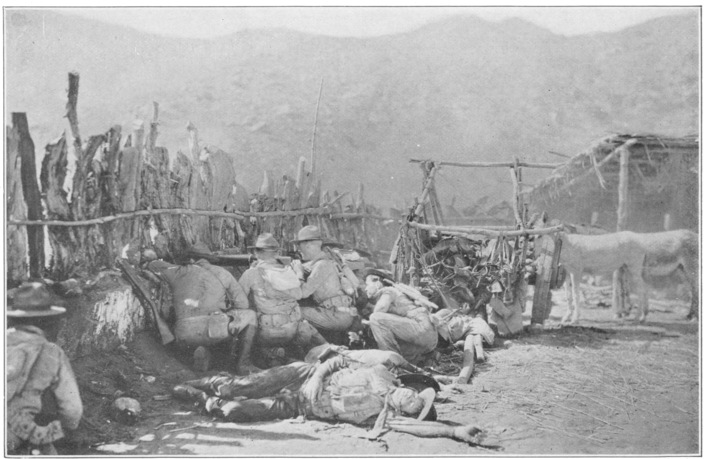
The muscles of his jaw contorted in pain as he toppled over.
The officer picked the man’s head up and rested it on his knee, noting a
trickling stream of red matter just below the temple. Quick to think, he
broke open the first aid package that the stricken man carried on his
belt and removed the tape, hastily bandaging the wound and helping the
sergeant back to his feet.
“They’ve only grazed your head,” he announced. “Now snap into it and pay
’em back, Cosgrove!”
The top kick removed his automatic from the holster, took careful aim
and fired, hitting a rebel who had been crawling toward the barricade on
all fours with a vicious-looking knife locked between his teeth.
The lieutenant slapped the sergeant upon the back approvingly as the
other man smiled.
“That’s the way to pay your debts! Now knock off another one for good
measure!”
A corporal with a solemn face, covered with grime, crawled up between
the two men and addressing the lieutenant, announced: “The brush is full
of greasers, sir, and we’re nearly out of ammunition!”
Hanson turned to Cosgrove with an unconcealed look of deep concern upon
his face. “Pass the word to cease firing until I give the order!”
The sergeant turned about and crawled along the inside of the barricade,
stopping to announce the commander’s edict as he passed on his way.
Over in the rebel lines, Sandino passed the word to his officers to
split the men up, ordering them to crawl under the protection of the
brushes to the rear and sides of the corral, thus completely encircling
the Marines within.
Ranson and the corporal watched this guerrilla movement with intense
interest and as an overanxious Marine next to them lifted his rifle into
position, the officer knocked it from his hand, warning: “Wait until I
give the order!”
Suddenly the bandits opened fire as they moved toward the corral in a
stealthy, circular fashion, causing a fair amount of casualties within
the ranks of the Americans.
The Marines waited without fear for word from their commander, though
some of them were high strung and nervous as they watched their buddies
topple over from the bandit onslaught, helpless to seek revenge upon the
approaching rebels.
As the dark-skinned natives swooped down toward the corral, unmolested,
inflicting great sufferings upon the heads of the Marines, the
lieutenant waited doggedly until they were near enough, then he lifted
his voice and shouted: “Ready! Aim! Fire!”
The soldiers responded with enthusiasm, some throwing hand grenades
while others returned to their rifles and machine guns, spitting deadly
fire in the direction of the enemy.
This was a last, desperate stand for the Marines. Though they suffered a
heavy toll, they went on fighting doggedly, determined that if complete
extermination was to be their lot, they would first cause an equal
amount of suffering within the ranks of the enemy.
Cosgrove crawled over beside the lieutenant and pointed down the line of
men fighting for life and love of country. “Some of the machine guns are
jammed, sir,” he announced, “and more than half of the boys are out of
ammunition already!”
The handwriting of an unfortunate Fate was plainly visible to every man
behind the barricade as the voice of their commander was heard,
shouting: “Fixed bayonets!”
One of the bandits had crawled over the ground to the barricade
unmolested. Beaching the gate, he began to beat upon the barricade with
his machete until he succeeded in making a hole through the old wood.
On the other side of the wall, a Marine, with fixed bayonet, waited
patiently as his lips curled in a grim, death-like smile of revenge.
As soon as the hole in the wall became large enough, the soldier half
rose upon his haunches and with deadly precision, plunged his bayonet
through the abdomen of the bandit.
At that point in the fearful encounter, the Marines and rebels came in
close contact, with the soldiers of the sea desperately warding off
their stronger adversaries with bayonets, fighting bullets and machetes,
exposing their persons to certain death from the fire of Sandino’s
machine gun snipers on the mountain top.
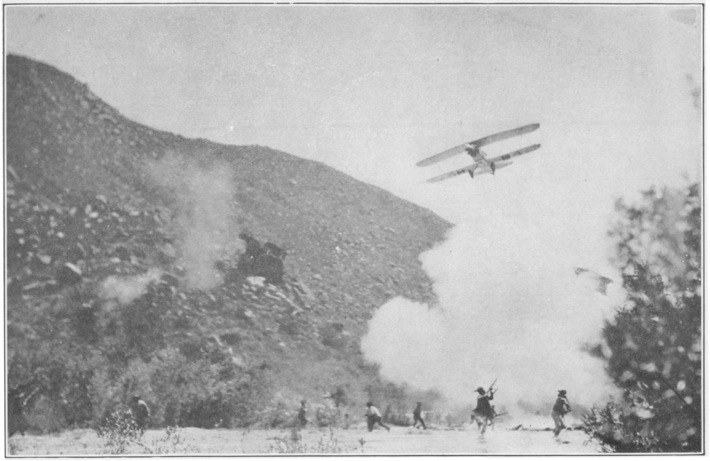
Suddenly the harsh drone of huge motors deafened the ears of the
opposing men of war. A Marine, wounded and parched from thirst, gazed up
and saw the planes of the “Fighting Tenth” swoop over the top of the
mountain. He raised himself on his elbow with extreme difficulty and
called to the soldier nearest him: “Look, look—they’ve come at last!”
The other Marine lifted his eyes, following the direction of his wounded
buddy’s upraised hand. In a moment, every khaki-clad man within the
protection of the corral wall gazed heavenward, each secretly offering a
crude prayer to a Divine and protecting Providence.
Major Harding, in the first ship, studied the lay of the land and, with
an upraised arm, signaled to the other planes to turn the noses of their
ships toward the earth, flying low and prepared to open fire at his
command to do so.
The observers leveled their machine guns, loaded the magazines and took
careful aim as the squadron of ships swooped down over the corral like a
great drove of locusts.
The commander of the flying fleet again raised his arm as a signal to
begin firing, and the muzzles of every water-cooled Browning opened up
and spit deadly fire into the broken ranks of the terror-stricken bandit
troops, causing untold casualties.
From the peak of his mountain lookout, Sandino watched the attack from
the air upon his disorganized army and his men retreating in a
disorderly fashion, scattering in all directions. A grave, panicky
expression darkened his face. He turned about and ran to his horse,
mounting the animal, prepared to ride off to some protective covering as
a wounded officer from his own ranks ran toward him.
The rebel usurper looked back at the man whose face was distorted with
terror and pain. He drew up his horse and, in his native tongue, ordered
the officer to return to the scene of battle.
Unheeding, the fleeing soldier continued to run away from the certain
death below, truly obsessed with an idea that was not unlike the one
borne by his own commander.
Sandino lifted his hand and whipped out a blue-steel automatic pistol,
leveled it and fired, uttering a blasphemous oath at the officer as he
fell forward. In a moment, the ambitious, would-be dictator of Nicaragua
was riding swiftly away to peace and protection from war in the air.
As a final gesture, Major Harding signaled to his followers in the other
planes to drop the bombs, making certain that the extermination of the
retreating bandits would be complete.
The huge messengers of hate were released by the pilots and they went
crashing earthward, distributing immediate death and misery.
Steve pushed the stick forward and dove his plane nearer to earth,
breaking formation from the other ships that were now gaining altitude.
Just ahead, crossing a swamp, was a small band of Sandinisto survivors.
Lefty caught the pilot’s objective in leaving the formation of planes
and with a peculiar cold, subdued calm, opened fire upon the helpless,
retreating rebels, wreaking death and havoc.
One of the retreating bandit officers turned about, picked up a gun left
behind on the ground and leveled the butt of it to his shoulder, taking
careful aim and firing.
Just then, Steve swooped down to a position that was only a few feet
from the ground, leaving himself a perfect target for the final gesture
from the retreating bandit leader.
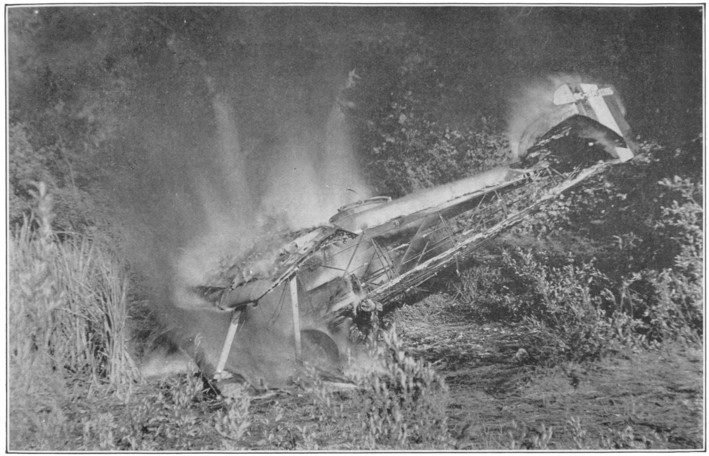
They left themselves perfect targets for the final gesture from the retreating bandits.
The muscles of his face contracted with pain. He let his hand fall from
the stick and his whole body slumped forward in the cockpit.
Lefty whirled the machine gun around and riddled the last of the rebels
with a barrage of bullets, then grabbing the joy stick in the rear
cockpit, fought desperately to level the plane but it was too late.
Suddenly everything went black before him. He heard a terrific crash and
felt himself being lifted from his seat and flying through space. In
another moment, he was oblivious to everything else as his motionless
body lay in the center of a swamp, covered with mud and dirt.
With the corral clear once more of the trespasser, two of the planes
flew low and dropped out food supplies and quantities of ammunition to
the surviving Marines below who waved back in gratitude.
The major signaled to the pilots to regain formation and as the ships
fell into their original position, the anxious eyes of the commander
caught a vacant space in the line-up.
He looked to the pilot of the plane on the other side of him and held up
two fingers questioningly, signifying in the hand signaling parlance of
the air, “Where is the missing plane?”
The skipper of the other ship shrugged his shoulders, indicating his
lack of knowledge of the absent airplane’s whereabouts.
Panama watched the gas gauge that indicated their fuel was running low.
He touched the shoulder of the commander in front of him and pointed to
the gauge. Harding gazed at his watch and, after slight deliberation,
gave the signal to swing the planes toward Managua.
In less than an hour, they were flying over the field of the Marine
base, then circling in formation before landing.
When the ships had taxied into position and the motors again became
silent, Harding jumped from the cockpit as Panama and the other pilots
and observers gathered about him.
“Did anyone see what happened to Graham and Phelps?” he asked with an
uncertain ring of anxiety in his voice.
The men of his command shook their heads in grim ignorance of the
missing Marines’ whereabouts.
“Last I saw of them,” one of the pilots explained, “they were chasing a
gang of greasers down a gulley!”
“Our gas was too low to make a search,” Harding announced, “but
somebody’s got to go back now. Who’ll volunteer?”
No sooner had the major asked for a searching party than every man in
the squadron, except Panama, stepped forward.
As Williams walked off silently toward the line of tents, the commander
selected two pilots and two observers to fly back and search for the
missing airmen and their plane. The others moved away in different
directions, wrapped in an overshadowing gloom that grips the hearts of
all fighting aviators when any of their number are absent without
reason.
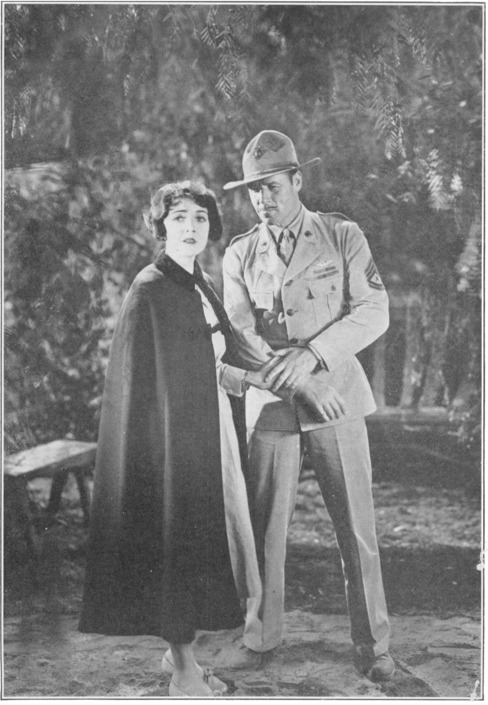
Elinor had been watching the return of the squadron and searching the
group for a sight of Lefty. When she saw the commander call the other
men into a hurried conference that ended by two planes again taking off
and flying back in the direction from which they had just come, her
heart beat faster as a cold, foreboding feeling of uneasiness took
possession of her mind and body.
She ran toward one of the pilots and stopped him as a pathetic look of
anxiety darkened her face.
“Where’s Lefty Phelps?” she asked.
“That’s what we’d all like to know,” the man replied grimly without
looking at the girl, “He and Graham disappeared during the fracas. The
skipper just sent a couple of ships back to search for them.”
She looked up with terror-stricken eyes and caught sight of Panama not
far from where she was standing. Without further adieu, she ran off in
the sergeant’s direction, reaching his side a moment later, completely
out of breath.
“Where’s Lefty, Panama?” she panted, “What’s happened to him?”
The sergeant made no attempt to even look at the frightened girl but
continued on his way, quickening his steps. She ran along at his side,
struggling to keep up with him and trying to regain her breath at the
same time.
“Panama!” she pleaded once more, “what has happened to Lefty?”
“Out in the swamps with the rest of the snakes, I hope,” he speculated
grimly, still avoiding the girl’s anxious eyes.
“Aren’t you going to do something?”
He turned his head and looked at her with a piercing sign of resentment
upon his face, becoming secretly the more indifferent over his former
friend’s fate because of Elinor’s apparent concern for the boy’s
welfare.
“Why should I do anything?” he snapped.
His words gave her new spirit and she stepped before him, blocking his
path as her words bristled with anger. “So that’s the extent of your
friendship, after all he tried to do for you?” she cried. “Panama,
you’re the blindest of the blind! Lefty is the sweetest boy in all the
world—and I love him!”
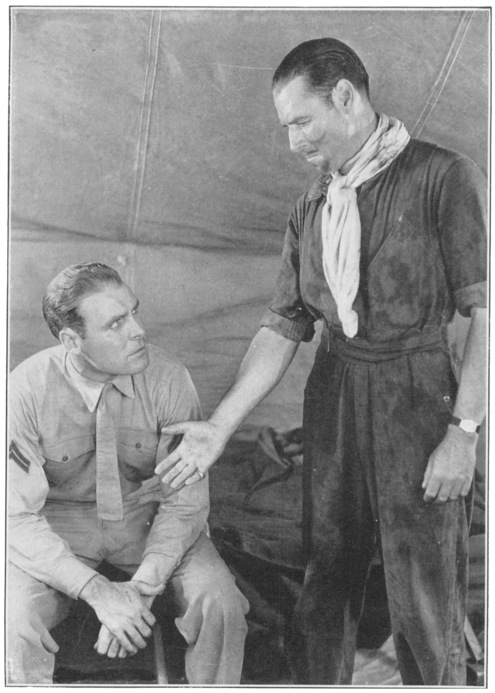
“Elinor!” the man protested in an effort to save himself from further
wounds directed at his heart.
“Yes, I love him, more than all the world and with all my heart,” she
confessed, unmindful of the interruption. “I know that he was meant for
me and I for him the very first moment my eyes fell upon his. I’ve been
living in despair, torturing myself for months now, believing that he
didn’t care for me. Do you know why he shielded himself behind that
indifferent attitude?”
“No, and I ain’t much interested!” Panama barked.
“Well, you should be! He pretended that he didn’t love me because he
thought that I belonged to you, because he was too fair, too decent to
rob another man of something that he valued himself more than life. I’ve
never loved you, I’ve never belonged to you! Lefty had as much right to
try and win my love as you did!”
“Elinor, please—I don’t want to listen!” the love-torn soldier beseeched
vainly.
“You must listen and you will!” she cried with determination. “Oh,
Panama, can’t you see it all now? The whole thing was my fault! I
shouldn’t have let you care when I knew that I could never love you, but
you seemed so fine—so good that I dreaded to hurt you. Upon my honor, I
swear that Lefty, never in his life, has made love to me—I made love to
him!”
Panama’s eyes grew wide and questioning and his face turned a chalk
white at this revelation.
“Elinor—you’re—you’re telling me the truth?”
“I’ve never been more honest in my life,” she insisted. “That boy thinks
the sun rises and sets upon you. He would have rather sacrificed his
very life than cause you one single moment of pain. Now he’s
gone—perhaps dying in the impenetrable swamps of the jungle. Can’t you
do something? Don’t you see what it all means to me?”
Unable to turn back the rising emotions within her, the girl gave vent
to her feelings, suddenly overcome with tears of abject helplessness and
despair.
Panama gazed at her silently for one brief moment, then putting on his
helmet, turned about and walked with brisk determination toward his
plane.