“Stop, Ethel,” said Mary Gray authoritatively,
“stop this moment, you are skipping
notes.”
The child obeyed gladly, for music was by
no means a passion with her, and she especially
disliked practising when Mary’s sharp
eye was upon her.
“I’m obliged to be severe with you, Ethel,
for it never will do to allow you to play carelessly.
You are worse than usual this morning,
because Kittyleen is waiting in the
dining-room. It’s very unfortunate that
Kittyleen has to come here in your practising
hour, and it makes it pretty hard for
me; but what do you think or care about
that? If you ever learn to play decently,
Ethel Gray, ’twill be entirely owing to me,
and your teacher says so. There! run off
now and play with Kittyleen; but, remember,
you’ll have to finish your practising
this afternoon.”
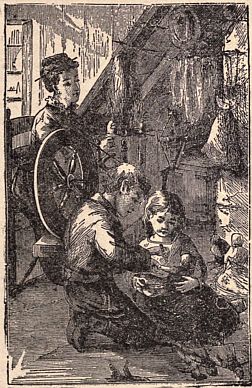
Ethel made her escape, and Mary seated
herself in the bay-window at her sewing with
a deep sigh of responsibility. Her mother
was ill; Julia, the eldest of the family, was
confined to her room with headache, and the
children had been left in Mary’s care this
morning with strict charges to obey her.
“The children” were Philip, a boy of
eight and a half, and Ethel, a little girl
nearly six; but as Phil was now skating on
the pond, and Ethel playing dolls in the
dining-room with her young friend, Kittyleen
Garland, Mary was free to pursue her own
thoughts, and her work was soon lying idly
in her lap, while she looked out of the window
upon the white front yard facing the
river.
There was no one in the room with her
but her grandmother, who sat knitting in
an easy-chair before the glowing coal fire.
Grandma Gray did not seem to grow old.
Father Time had not stolen away a single
one of her precious graces. He had not
dimmed her bright eyes or jarred her gentle
voice; the wrinkles he had brought were
only “ripples,” and the gray hair he had
given her was like a beautiful silver crown.
Grandma looked up from her knitting;
Mary looked up from her sewing. Their
eyes met, and they both smiled.
“A penny for your thoughts, my child.”
“Oh, I was only thinking, grandma, it does
seem as if something might be done to prevent
people from calling me Flaxie Frizzle—I’m
just worn out with it. It did very well
when I was a little child; but now that I’m
twelve years old, I ought to be treated with
more respect. It’s very silly to call people
by anything but their real, true names;
don’t you think so? Oh, here comes the
Countess Leonora!” cried Mary in a different
tone, dropping her work, breaking her
needle, and pricking her finger, all in a second
of time.
“Who? I didn’t understand you, dear.”
“Oh, it’s only Fanny Townsend, grandma.
We have fancy names for each other, we
girls, and Fanny’s name is Countess Leonora,”
cried Mary, quite unaware that there
was anything “silly” in this, or that grandma
was amused by her inconsistent remarks.
The dear old lady smiled benevolently as a
small figure in a brown cloak rushed in,
breathless from running. It was not Fanny
Townsend and Mary Gray, it seemed, who
began to chat together in the bay-window,
but the Countess Leonora, and her friend,
Lady Dandelina Tangle. Lady Dandelina
was telling the Countess that her mother
and sister were ill, and that she was left in
charge of the castle.
“Don’t you miss your brother Preston so
much, Lady Dandelina?”
“Indeed I do, Countess; but young men
are obliged to go to college, you know. And
I can bear it better because my cousin, Fred
Allen, of Hilltop, is with us. He will stay,
I don’t know how long, and go to school. I
only wish it was my sister Milly!”
“So do I, Lady Dandelina. Oh, I saw that
old teacher of ours, Mr. Fling, as I was
coming here. He stood on the hotel-piazza
talking with Miss Pike.”
“Mr. Fling?” said Mary, laughing. She
had dropped her work, for how could she
sew without a needle?
“Yes; and said he, ‘How’s your health,
Miss Fr-an-ce-s?’ as if I’d been sick. I like
him out of school, Dandelina; but in school
he used to be sort of hateful, don’t you
know?”
“Not exactly hateful,” replied Mary, stealing
a glance at grandma. “I call it troublesome.”
“Yes; how he would scold when we got
under the seat to eat apples?”
“Oh, I never ate but one apple, Fan, I’m
sure I never did. I was pretty small then,
too. How queer it is to think of such old
times!”
“Why, Flaxie, ’twas only last winter!”
“Are you sure, Fan? I thought ’twas
ever so long ago.”
“Your reminiscences are very interesting,
my dears,” said grandma, rising. “I wish I
could hear more, but I shall be obliged to go
up stairs now, and leave your pleasant company.”
As the serene old lady passed out at one
door, little Ethel, very much excited, rushed
in at another; but the girls, engrossed in
conversation, did not look up, and she stood
for some time unheeded behind Mary’s chair.
“I want to ask you, Flaxie—” she said.
“Mr. Fling and Miss Pike were talking
about a spelling-school,” said Fanny, emerging
from “old times” at a bound. “She’s
going to have an old-fashioned one out in her
school at Rosewood to-morrow night.”
“I want to ask you, Flaxie—” repeated
Ethel.
“They ‘choose sides.’ Do you know what
that is?”
“No, I’m sure I don’t. I wish Preston
was here, and he’d take me out in the
sleigh. Miss Pike would let our family go,
of course.”
“I want to ask you—” said little Ethel
again.
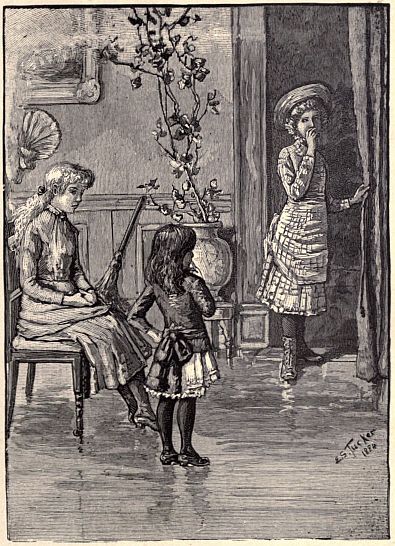
“Why, Ethel, child, I thought you were
in the other room,” said Mary impatiently.
“Don’t you see, I want to hear about the
spelling-school; and it’s so thoughtful and
kind of little girls to give big girls a chance
to speak!”
But next moment, ashamed of her ill-nature,
and remembering her maternal responsibility,
she drew Ethel to her side and
kissed her.
“Wait a minute, Leonora, till we find out
what this means,” said she, surprised to see
her usually quiet little sister in this wild
state. “Tell me all about it, dear.”
Thus encouraged, Ethel broke forth indignantly,
“Kittyleen is very disagreeable!
And besides, she knocked me down!”
Fanny began to laugh. “Oh, what a Kittyleen!”
“Hush, Fan,” said Mary, warningly, drawing
up her mouth like grandma’s silk “work-pocket.”
“It doesn’t seem possible, Ethel.
I never heard of Kittyleen’s behaving
so before. What had you done to vex
her?”
“I—I—knocked her down—first,” confessed
Ethel, in low, faltering tones.
And Fanny laughed again.
“Fanny Townsend, do be quiet. I have
the care of this child to-day. Ethel, where
is Kittyleen?”
“Gone home.”
“Ah. Ethel, Ethel, it will be my duty to
punish you. Fanny, can you be quiet?”
“You punish her? Oh dear, that’s too
funny!”
“Yes, I have full authority to punish her
if I choose,” said Mary, elevating her chin.
She was subject to little attacks of dignity;
but instead of being duly impressed,
Fanny only laughed the more, while shamefaced
little Ethel hid her head and felt that
she was trifled with.
“May I ask what amuses you, Miss Townsend?”
said Mary, with increased dignity.
“Oh don’t, oh dear, what shall I do?
You’re so queer, Flaxie Frizzle!”
“Well, if you go on in this way, I shall be
obliged to take Ethel out of the room.
Have you no judgment at all, Fanny Townsend?”
“Oh dear, oh dear, I shall die laughing!
shall have to go home! If you could see
just how you look, Flaxie Frizzle! Good-by.
I can’t help it,” said Fanny, reeling out of
the door.
Mary drew a long sigh. “Now come to
me, Ethel. This is a dreadful thing, and
you’re a perfectly awful child; but it will
not do to speak to mother about it, when she
has pneumonia, and a blister on the chest.
She said I must take care of you.”
Ethel did not stir. Mary paused and
gazed reproachfully across the room at her,
not knowing in the least what to say next.
She had never before undertaken a case of
discipline, and rather wondered why it
should be required of her now. But she had
been given “full authority over the children,”
and what did that mean if she was
not to punish them when they did wrong?
To be sure Julia’s headache might be over
to-morrow, and Julia could then attend to
Ethel; but Mary was quite sure it would
not do to wait an hour or a minute; the
case must be attended to now. “It is my
duty, and I will not shrink from it. I’ll
try to act exactly as mamma always does,—not
harsh, but sad and gentle,—Ethel, my
child, come here.”
“Don’t want to,” said Ethel, approaching
slowly and sullenly, drawing her little chair
behind her.
“Not that way, dear; mamma never allows
you to go all doubled up, dragging your chair
like a snail with his house on his back.
There, sit down and tell me about it. What
made you so naughty?”
“My head aches. Don’t want to talk.”
“Were you playing dolls?”
“Yes. Pep’mint Drop is jiggly and won’t
sit up.”
“Peppermint Drop is very old and has
rheumatism, Ethel; she was my dolly before
ever you were born.”
“Well, my head aches. Don’t want to
talk.”
“But you must talk. I’m your mother
to-day.”
“You?” Ethel looked up saucily, and
Mary felt half inclined to laugh; but when
one has the care of a young child one must
be firm.
“Ethel, I am your mother to-day. What
were you doing with those dolls?”
“Nothing! Kittyleen pulled off Pep’mint’s
arm.”
“Yes, and then?”
“Then she was cross.”
“No, no. What did you do to her?”
“Tipped her over.”
“Ethel! Ethel!”
“Well, she tipped me over too.”
“This is perfectly dreadful!” exclaimed
Mary, as solemnly as if she had never heard
it before. And then she sat in deep thought.
What would mamma have done in this case?
Did Ethel’s head ache? Possibly. Her
cheeks looked hot. Mamma was tender of
the children when they were ill, and perhaps
would not approve of shutting Ethel in the
closet if she had taken cold.
“Ethel,” said Mary in natural tones, “I’m
going to be very sweet and gentle. You’ve
been extremely to blame, but perhaps Kittyleen
may forgive you if you ask her.”
“H’m! Don’t want her to!”
“What! Don’t want her to forgive you?”
“No, I don’t; Kittyleen was bad herself!”
“But you were bad first, Ethel.”
“H’m! If I ask her to forgive me she’ll
think she was good!”
Mary looked at stubborn Ethel sorrowfully.
Oh, how hard it was to make children repent!
“Perhaps I’d better leave her by herself
to think. Mamma does that sometimes.”
Then aloud: “Ethel, I’m now going into
the kitchen, and I wish you to sit here and
think till I come back.”
“No, you mustn’t; my mamma won’t
allow you to shut me up, Flaxie!”
“But I’m not shutting you up; I only
leave you to think.”
“Don’t know how to think.”
“Yes, you do, Ethel, you think every time
you wink.”
“Well, may I wink at the clock then?”
asked the child, relenting, for it was one of
her delights to sit and watch the minute-hand
steal slowly over the clock’s white face.
“Yes, you may, if you’ll keep saying over
and over, while it ticks, ‘I’ve been a naughty
girl—a naughty girl; mamma’ll be sorry,
mamma’ll be sorry.’”
“Well, I will, but hurry, Flaxie; don’t be
gone long.”
In fifteen minutes Mary returned to find
the child in the same spot; her eyes pinker
than ever with weeping.
“Just the way I used to look when mamma
left me alone,” thought Mary, encouraged.
“Well, Ethel,” with a grown-up folding of
the hands which would have convulsed
Fanny Townsend. “Well, have you been
thinking, dear?”
“Yes, and I’ll tell mamma about it; I
shan’t tell you.”
“Mamma is very sick, my child.”
“Then I’ll tell Ninny.” Ninny was the
children’s pet name for Julia.
“No, Ninny has a headache. I’m your
mamma this afternoon. And I won’t be
cross to you, darling,” added Mary, with
humility, recalling some of her past lectures
to this little sister.
“Well,” said Ethel faintly, with her apron
between her teeth. “I wasn’t very bad to
Kittyleen, but if she wants to forgive me
I’ll let her.”
“O sweetest, you make me so happy!”
“Don’t want to make you happy,” returned
Ethel disdainfully; “don’t care anything
about you! But mamma’s sick. And you—won’t
you write her a letter?”
“Write mamma a letter?”
“No, Kittyleen, write it with vi’let ink,
won’t you, Flaxie?”
The note was very short and written just
as Ethel dictated it:
My Affectionate Friend,—I am very sorry
I knocked you down first. I will forgive you if you
will forgive me.
Ethel Gray.
Ethel meant just this, no more, no less.
She was sorry; still, if she had done wrong
so had Kittyleen; if she needed forgiveness
Kittyleen needed it also.
“Now, put something in the corner,” said
she, looking on anxiously, as Mary directed
the envelope. “You always put something
in the corner of your notes, Flaxie; I’ve
seen you, and seen you.”
“Do I? Oh yes, sometimes I put ‘kindness
of Ethel’ in the corner, but that is
when you carry the note.”
“Put it there now.”
“But are you going to carry the note?”
“No, Dodo will carry it if I give her five
kisses.”
“Then, I’ll write ‘Kindness of Dora.’”
“No, no, I’m the one that’s kind, not
Dodo,” insisted the child.
And “Kindness of Ethel” it had to be in
the corner in large, plain letters.
Dora laughed when she read it, and Mary
smiled indulgently.
Kittyleen did not smile, however, for she
did not know there was any mistake. She
accepted Ethel’s doubtful apology with joy,
and made her nurse Martha write in reply,
“I forgive you.” And in the left-hand
corner of her envelope were the words
“Kindness of Kittyleen,” for she supposed
that was the correct thing, and she never
allowed Ethel to be more fashionable than
herself if she could possibly help it.
Mary felt that on the whole her first case
of discipline had resulted successfully, and
was impatient for to-morrow to come, that
her mother might hear of it and give her
approval.