Flash Evans dribbled the basketball down the
gymnasium floor, gave it a final flip through the
net, and started for the shower room.
“Not leaving, are you?” his friend, Jerry Hayes,
called after him.
“Yes,” Flash answered regretfully, “I’ll be late
getting back to work unless I do. Business before
fun, you know.”
“Wait a minute and I’ll walk along to the Ledger
office with you.”
“All right, but step on it! My ticker says ten of
one.”
For as far back as the two boys could remember
they had been close friends. Both were graduates of
Brandale High School, lived on the same street, and
enjoyed the same sports.
2
During the past nine months Flash had worked as
a photographer on the Brandale Ledger and, of necessity,
his pleasures had been somewhat curtailed. Yet,
he still found time to swim at the “Y,” and on this
Saturday had given up his lunch hour to play basketball.
The two friends quickly dressed. As they left
the “Y” building together, Flash strapped a Speed
Graphic camera over his shoulder.
“You never go anywhere without that thing, do
you?” Jerry remarked.
“Not during working hours. You never know
when a big picture may come your way.”
“Those were dandies you ran in the Ledger a short
time ago,” Jerry recalled. “Cleaned up an arson gang
by getting a picture of the head man, didn’t you?”
“The police did the work,” Flash corrected carelessly,
“but my pictures helped. And on the strength
of them, Editor Riley is giving me a month’s vacation
instead of the usual two weeks. I start tomorrow.”
“Where are you going, Flash?”
“Don’t know yet. I may take in the Indianapolis
auto races.”
The pair had reached a street corner. As they
halted to wait for the traffic light to change, an automobile
rolled leisurely by close to the curb. Flash
stared.
3
“See that fellow at the wheel!” he exclaimed, grabbing
Jerry’s arm.
“Sure. Who is he?”
“Bailey Brooks!”
“And who is he?” Jerry demanded bluntly.
“You haven’t read about Bailey Brooks, the aviator
and parachute jumper?”
“Oh, sure,” Jerry nodded, “the fellow who has been
having so much trouble. I remember now. Government
officials refused him permission to test that new
parachute he invented.”
“And for a good reason. Brooks claims his new
’chute will open up at a very low altitude. But a
month ago when it was given the first test, a jumper
was killed.”
The automobile had been held up by a red light.
Jerry was staring at the driver with deep interest when
a green-painted sound truck bearing the sign, News-Vue
Picture Company, rolled up directly behind the
car.
“Say, that sound truck seems to be following Bailey
Brooks!” Flash exclaimed, excitement creeping into
his voice. “Something must be in the wind!”
“Sure looks that way,” agreed Jerry. “The newsreel
lads must be after pictures.”
4
“Do you know what I think, Jerry? Brooks is
slipping off somewhere on the quiet to make his parachute
jump despite government orders! Gosh, that’s
worth a picture! Whether he succeeds or fails, the
Ledger will want it.”
Already the traffic light had changed from red to
green. The automobile and the sound truck started
to move slowly ahead. Flash knew that if he were to
learn the destination of Bailey Brooks and the newsreel
men, not a moment must be lost.
“Listen,” he said crisply to his friend. “Telephone
the Ledger office for me, will you? Tell Riley I’m
after a hot picture!”
Without waiting for Jerry’s reply, he signaled a
taxi, leaping on the running board as it slowed down.
“Follow that green sound truck!”
The chase led through the business section of Brandale
into open country. There the car and sound
truck chose a road which wound along the ocean.
Some twelve miles from the city, they both drew up at
the base of a high cliff overlooking the beach.
“Wait for me,” Flash instructed the driver.
As he stepped from the cab, he saw that his hunch
had been right. Bailey Brooks was unloading parachute
equipment from his automobile.
“Good afternoon, Mr. Brooks,” he greeted the aviator.
“Are you making a jump from the cliff?”
“You’ve guessed it,” the man grinned. “What paper
do you represent?”
5
“The Ledger. Mind if I take a few pictures?”
“Go ahead,” Bailey Brooks responded cordially.
“The publicity ought to do me some good.”
Flash took a pose of the man beside his car, but
decided to save his remaining films for the actual
jump.
He wandered over toward the green sound truck
which had maneuvered into position near the base of
the cliff. A sound technician and two helpers were
stringing up their microphone. Two cameramen, on
the roof of the truck, were attaching the tripod of
a large turret-front camera to the metal platform.
The younger man turned slightly and Flash recognized
him as a photographer who, until three months
previously, had been employed by the Ledger.
“Joe Wells!”
The cameraman looked around, and climbed quickly
down from his perch.
“Well, if it isn’t Flash Evans!” he exclaimed
heartily. “What are you doing out here?”
“Oh, I saw your wagon roll by, and I figured I
might get a good picture if I trailed you.”
“Same old Flash, always playing hunches,” Joe
chuckled. “But you figured right. Brooks may crack
up instead of cracking silk.”
“I hope not. Still, that cliff doesn’t look very high.”
6
“He’s a fool to try it,” Wells declared in a low tone.
“But if he’s bent on committing suicide just to prove
his ’chute will work, that’s his lookout. Ours is to
take pictures.”
The sound technician had finished setting up his
equipment. Working with quiet efficiency, he stationed
Bailey Brooks in front of the microphone, and
took his own position at the mixing panel.
After the recording had been made, Joe led Flash
over to the truck.
“Meet our sound expert,” he said carelessly.
“George Doyle.”
The technician, a sullen, serious man of twenty-eight,
did not bother to remove the monitor phones
from his ears. He stared at Flash, mumbled a few
words, and turned his back.
To cover up the rudeness, Joe said quickly:
“Why not quit the Ledger, Flash, and come in with
a real outfit? If you’ll consider it I’ll ask News-Vue
to give you a chance.”
“Thanks, Joe, but I like my work at the Ledger.
I start my vacation tomorrow.”
“You’re fitted for newsreel work,” Joe declared
persuasively. “You have steady nerves, good judgment,
and you’re cool in an emergency. I know, because
I’ve worked with you. Better think it over.”
Flash smiled and offered no response.
7
A moment later Bailey Brooks came over to say
that he was ready to make the jump. Leaving George
Doyle and the others below, Flash and Joe began the
steep ascent with the aviator. Burdened as they were
with heavy equipment, they took it slowly, proceeding
in easy stages.
Presently, pausing to rest, Flash glanced downward.
He noticed that a coupe had drawn up in a clump of
bushes not far from the cliff. A man with field glasses
was watching their progress.
“We have an interested watcher,” remarked Flash.
“Wonder who he is?”
Both Joe and Bailey Brooks turned to gaze in the
direction indicated.
“I can’t tell from this distance,” said the parachute
jumper. “It looks like Albert Povy’s automobile.”
“Povy?” inquired Joe Wells in a startled voice.
“Yes, he’s one of the few persons who has been interested
in my new ’chute.”
An odd expression settled over the newsreel man’s
face. He said no more. But, as the climb was resumed,
he dropped some distance behind Brooks to
whisper with Flash.
“If that’s really Povy in the car, he must expect
something to come of this test today! I’m telling you,
his reputation isn’t very good!”
8
Flash had no opportunity to learn more about Povy,
for Bailey Brooks had paused. He waited on the
trail until the two men caught up with him.
At the summit of the cliff the three flung themselves
on a flat rock to rest. Bailey Brooks seemed nervous.
His hand trembled as he lit a cigarette.
“This jump means a lot to me,” he said. “Since my
pal, Benny Fraser, was killed testing out the ’chute,
government authorities have advised me that my design
is unsound. But I know better. I’m willing to
risk my life to prove it.”
“And when you succeed, I imagine the government
will suddenly take an interest,” Flash remarked.
“Sure. They’ve had their experts studying the invention
for months. They claim it has defects which
can’t be overcome.”
Brooks arose, tossed aside his cigarette and began
to strap on his harness.
“If I succeed everything will be swell. If I fail, I
won’t know it. So what’s the difference?”
The man spoke with attempted carelessness. Yet,
he could not hide his real feelings from the two observant
photographers. He was not so confident as he
would have them believe.
9
Joe Wells set up his automatic hand camera near
the edge of the cliff, winding the spring motor and
loading the film. Flash stationed himself at a slightly
different angle, focusing his Speed Graphic.
“All set?” inquired Brooks.
“Any old time,” said Wells, and signaled the News-Vue
men below.
A dizzy, nauseous sensation came over Flash as he
gazed downward. If the ’chute failed to open—and
the odds were against Brooks—would he have the
courage to keep on taking his pictures? He wondered.
“Good luck, Brooks,” said Wells. “Happy landing.”
“I won’t need luck,” the man answered jerkily.
“Not with a ’chute like this baby.”
He stepped to the edge of the cliff. For a long moment
he stood there, gazing out across the sea, savoring
the glint of sunlight upon the tumbling waves.
“Whatever happens,” he said, “keep grinding.”
Then with lips compressed, face tense, he stepped
off into space.
10
CHAPTER II OVER THE CLIFF
At terrific speed the body of the jumper hurtled
toward the earth. The parachute did not open.
Grim-faced, his horrified eyes focused upon the falling
figure, Flash shot his first picture. His heart was
in his throat, but he was able to keep his hand steady.
Swiftly he extracted the holder and made ready to
take a second exposure.
“It’s curtains,” he thought. “The ’chute never can
save Brooks now.”
And then, even as he abandoned hope, the silken
umbrella cracked open.
Perspiration oozed from Flash’s forehead. Joe
Wells laughed aloud, so great was his relief.
The danger, however, was not entirely over. As
Flash took a picture of the great umbrella drifting
downward, he noted that it was falling at a rapid rate
toward the sea. For a time it appeared that Brooks
would strike the water with great force.
11
But the aviator began to pull on the risers, and succeeded
in working away from the shore. He landed in
a plowed field some distance away. The wind billowed
the ’chute, dragging him for a few feet. Brooks
then skilfully pulled on the underside risers and the
big umbrella flattened out.
“He’s safe,” observed Wells, taking a deep breath.
“I hope he makes a fortune. A jump like that is
worth it.”
The two photographers began to pack their cameras
into carrying cases.
“By the way, what did you start to tell me about
Albert Povy?” Flash inquired curiously.
“He was supposed to have been mixed up in shady
espionage business a few months ago. I understand
government operatives have kept a sharp eye on him.”
“And now he seems to be interested in Brooks’ parachute?”
“It looks that way. If Brooks has any sense he’ll
steer clear of the fellow. Suppose we get down there,
Flash.”
Together they began the dangerous descent. By
the time they reached the base of the cliff, Bailey
Brooks had walked back from the field, and was receiving
the congratulations of the News-Vue men.
As Flash and Joe added their praise, a tall, dark
stranger crossed the open space to the sound truck.
12
“A beautiful jump, Mr. Brooks,” he praised. “You
remember me, don’t you? My name is Povy—Albert
Povy.”
“Yes, I remember you very well,” the jumper replied
dryly. “Did I demonstrate what my ’chute
could do?”
“You certainly did,” the man returned heartily.
“It was amazing! I never would have believed it possible,
if I hadn’t witnessed it with my own eyes. You
know, we may be able to do business together, after
all.”
A guarded expression came into Bailey Brooks’ steel
gray eyes.
“I’m open to propositions,” he said.
“Come over to my car,” invited Albert Povy.
“We’ll talk.”
Flash and Joe Wells were closed out of the conversation.
Swiftly the News-Vue men loaded their
equipment aboard the truck and prepared to leave.
“Listen, Flash,” said Joe as he climbed into the
sound truck. “When you’re through at the Ledger
this afternoon, drop around at the News-Vue offices.
I want to talk with you.”
He handed over a card bearing the company address,
and the truck rolled away.
13
Reminded that he had pictures of his own to rush
back to Brandale, Flash stuffed the card into his
pocket, and hurried to the waiting taxi. As he drove
off he saw that Brooks had gone with Albert Povy.
“Wonder if he knows the man’s reputation?” he
thought. “I suppose he must.”
Flash dismissed the matter entirely from his mind.
He never expected to see either of the men again. His
only concern was the possibility of future news stories
or pictures.
The taxicab made a quick trip back to Brandale.
Flash paid the bill and kept a receipt to show Riley as
proof of his expense.
He was hurrying through the news room on his way
to the photographic department when the editor
hailed him.
“Hey, Evans, where have you been all afternoon?”
The editor gave him a quizzical glance.
Flash paused. “Didn’t Jerry Hayes telephone
you?”
“Some kid called in. He said you were after a big
picture.”
“I nailed it, too,” Flash said confidently. “Bailey
Brooks just disregarded orders and tested his parachute
out at Eagle Cliff.”
“Killed?”
“No, the test was a success. So far, the News-Vue
people are the only ones to get pictures. Mine ought
to be dandies.”
14
“Good work!” approved Riley. “We can use them,
and the story, too. Crack ’em through.”
In a few minutes’ time Flash had developed his pictures
and made the prints from wet films. His work
finished, he was loitering in the news room when Riley
motioned for him to come over to the desk.
“You may as well call it a day, Evans,” he said.
“Those were fine pictures you turned in.”
“Thanks, Mr. Riley.”
“You start your vacation tomorrow, I believe?”
“Yes, sir, I do.”
“You’ve earned it,” Riley said with an attempt at
geniality. “Where are you planning to spend your
month off?”
“Home mostly. I may visit some friends in Indianapolis
and take in the auto races.”
Riley pounced upon the information with the avidity
of a bass after live bait.
“We could use some good pictures, Flash. How
about covering the races for the Ledger?”
“Well—my plans aren’t definite. I may not be able
to make it.”
“Buy yourself a ticket to Indianapolis at the Ledger’s
expense,” Riley urged, guessing the reason behind
the young man’s indecision. “Why not hop the special
streamliner which leaves here tomorrow morning?”
15
“I’ll do it!” Flash decided suddenly.
“Good! Take any equipment you may need, and
send your pictures back by plane.”
Flash returned to the photography department for
his camera. After saying good-bye to several friends,
he went downstairs where his pay check awaited him.
He was finished with work an hour earlier than usual.
It would seem strange, he thought, being off duty for
an entire month.
As Flash reached for bus fare, he pulled the card
Joe Wells had given him from his pocket. The address
of the News-Vue Company was only a few blocks
away.
“May as well drop around there and kill a little
time,” he reflected. “But I don’t aim to let Joe talk
me into leaving the Ledger.”
Flash presently found himself standing before a tall
white stone building located not far from the waterfront.
He consulted the room directory in the lobby
and rode the elevator up to the sixth floor.
A receptionist was asking him whom he wished to
see when Joe Wells, hearing a familiar voice, stepped
from one of the offices.
“Hello, there, Flash,” he greeted cordially. “Come
on in.”
He led the photographer into a small room crowded
with desks, waving him to a chair.
16
“I’ll be through in a minute. Then I’ll show you
around. I want to write up this dope sheet first.”
“Take your time, Joe.”
The News-Vue man inserted a sheet of printed paper
in a typewriter, rapidly filling in the blanks.
“I’m getting ready to take off for Indianapolis tomorrow,”
he remarked casually. “George Doyle
started on ahead with the sound wagon about an hour
ago. I follow by train and meet him there.”
“Maybe I’ll see you,” Flash replied. “I’m covering
the races myself. For the Ledger.”
“I never could go back to working on a paper now,”
Joe commented. “Too tame compared with the newsreels.
Flash, why don’t you consider—”
“No!” Flash cut in with a laugh. “I’m not listening
to any arguments.”
Joe shrugged and said no more. He spent the next
half hour showing his friend the newsreel cameras and
explaining their operation.
“We ordinarily use one with a front turret, carrying
three or four lenses,” he instructed. “This particular
camera holds four hundred feet of film in its magazine
and can be hand-cranked or driven with either a 110
volt A.C. motor or a 12 D.C.”
“I suppose power is generated from storage batteries?”
17
“Yes, our trucks are equipped with chargers. Sometimes
we are able to plug into a service line. But why
am I telling you all this? You know as much about it
as I do.”
“Hardly,” Flash corrected. “But I have done a
little studying.”
After a trip through the laboratories where positives
were being made from “master blues,” Joe led his
friend into the projection room.
“We’re in luck,” he said. “They’re showing those
Bailey Brooks pictures.”
In the darkened room several editors, script writers
and a commentator, sat at dimly lighted desks. On
the wall before them a strip of film was being run
through. To Flash the moving figures seemed grotesque,
for blacks and whites were in reverse.
“What’s this?” demanded an editor as he watched
the spectacular leap made by Bailey Brooks. “Just
another parachute jump?”
Information provided by Joe Wells’ caption sheet
was read aloud.
“That’s interesting stuff,” decided the editor.
“Run it full. Cut down that racing shot from Cuba.
Now what do we have on the Japanese earthquake?”
18
For several minutes Flash watched the work of cutting
and assembling the eight different subjects which
would be used in the completed newsreel. He ended
his tour by visiting a studio where the various shots
were synchronized with music and the explanatory
speech of a commentator.
“The releases will be shown in Brandale theatres in
another hour,” Wells declared, escorting his friend to
the elevator. “In this business speed means everything.”
Although he would not have admitted it, Flash was
strangely impressed. Riding home in the bus, he reflected
that Joe might be right about newsreel work
offering more thrills than fell to the lot of an ordinary
photographer. He would like to try it. But for the
present he couldn’t consider leaving the Ledger.
At home a warm supper was waiting. As he shared
the well-cooked meal with his mother and younger
sister, Joan, Flash mentioned his assignment to cover
the Indianapolis races.
“Working on your vacation?” Mrs. Evans inquired
mildly. “Really, Jimmy, you need a rest.”
“Shooting a few pictures won’t be work, Mother.
I’ll enjoy it. And I’ll get a free trip.”
It was true. Flash never had considered professional
picture-taking as drudgery. Save for a month
when persons had sought to undermine his job, he had
thoroughly enjoyed the time spent on the Ledger.
19
Flash, who seldom answered to his real name of
Jimmy, was seventeen, the son of a former newspaper
editor. Since Mr. Evans’ death several years earlier,
the little family of three had been hard pressed to
make ends meet. But Flash’s recent salary increases
had made things much easier. That was one reason
why he could not give up a sure job for the more uncertain
calling of newsreel cameraman.
“I see you have set your heart upon the Indianapolis
trip,” Mrs. Evans remarked, “so you may as
well pack your bag.”
Early the next morning when Flash reached the
railroad terminal he found it buzzing with activity.
He stood in line to buy his ticket, noting that Indianapolis
seemed to be the popular destination. Special
rates had been offered, and only Indiana passengers
were allowed on the streamliner.
Flash swung aboard. Wandering through several
cars, he finally came upon his friend, Joe Wells.
“Hello, there,” the newsreel man greeted him.
“Let’s go back to the club car and grab a seat before
they’re all taken.”
The train began to move. Joe led the way through
the corridors. So quietly did the streamliner run that
they scarcely were aware of its gathering speed.
At the entrance to the club car, Joe halted suddenly
and Flash bumped into him.
“See who is here,” he muttered, indicating a man
who sat reading a magazine.
“Albert Povy!” Flash exclaimed in an undertone.
20
Offering no additional comment, the two photographers
entered the car. They took the only vacant
chairs which chanced to be directly across from the
man who held their attention.
Flash scrutinized the passenger with keen interest.
There was something about Povy which fascinated
and yet repulsed him. The man was tall, well-built,
with a hollow, almost gaunt face. A faint but jagged
scar on his left cheek evidently had resulted from an
old war wound.
Povy glanced up and met Flash’s steady gaze. He
stared hard at the young man for a moment and then
glanced away. If he recognized either of the photographers
he gave no further sign.
Joe nudged Flash. Raising a newspaper to shield
his face, he called attention to a middle-aged man of
military bearing who was writing a letter at the desk.
“Major Creighton Hartgrove,” he whispered. “Retired
from the army. It’s rumored, though, that he’s
doing secret work for the government.”
As Wells spoke, Hartgrove arose and left the club
car. A moment later, Albert Povy put aside his magazine
and followed. Or at least, Flash gained the impression
that the man seemed to be interested in the
Major’s movements.
He ventured such an opinion to Joe, who made light
of his observation.
21
“You’re as imaginative as ever, Flash,” he scoffed.
“I shouldn’t have told you lurid tales about Povy’s
reputation.”
Several times during the day as the streamliner
raced westward, Flash caught glimpses of the two men.
It struck him as significant that usually the pair were
in the same car. More than ever he became convinced
that Major Hartgrove was being watched and was
himself aware of it.
Joe Wells had scant interest in either of the men,
and as the day wore on, slept much of the time. When
a colored steward gave the first call for dinner, he
shook himself awake.
“Let’s amble into the diner before the big rush
starts, Flash.”
They walked forward through two cars, and had
just entered the third where Major Hartgrove sat,
when the train’s air brakes suddenly were applied.
“Now what?” gasped Joe, clutching a seat for support.
The next instant he and Flash both were hurled
violently from their feet. There was a deafening
crash, and the car crumpled like an accordion, burying
them beneath the debris.
22
CHAPTER III A TRAIN WRECK
Flash lay stunned for several minutes, unable to
comprehend that the train actually had been derailed.
Screams of terror and moans of pain mingled
with the shouted orders of the trainmen. The sounds
came to him as if from a long distance away.
Dazedly he sat up, dragging himself from beneath
a pile of twisted steel and splintered wood. Blood
streamed from a gash in his head, but miraculously, he
seemed to have suffered no serious injury.
In the gathering twilight he could see that every
car had left the track. The engine, taking the baggage
car with it, had rolled down a steep embankment.
It lay on its side, belching steam like a wounded
dragon.
Flash pulled himself to his feet and called hoarsely:
“Joe! Joe!”
23
A moan of pain came from beneath a pile of debris
almost at his feet. He saw an arm protruding from
the wreckage. Frantically, he worked at a car seat
which had wedged fast, and finally succeeded in lifting
it off. Joe lay there, his face twisted in agony.
“Go easy,” he muttered. “My leg’s broken. And
my insides are scrambled.”
Flash managed to get a supporting arm under Joe’s
shoulders, but when he raised the man to a half-standing
position, he crumpled back again.
“No use,” the cameraman moaned. “It’s broken.
What a fix! Pictures to the right and left, and me
with a busted leg and no camera! Leave me to die!”
Joe’s spirited complaint slightly reassured Flash.
If his friend could think of pictures, it was unlikely
that he had suffered serious internal injuries. But
there was no question about the leg. It was broken.
Stretching Joe out as comfortably as possible, he
looked about for a board which could be used as a
splint.
“Listen,” said Joe, “you can’t do me any good.
Run to the nearest farmhouse and send out a call for
ambulances and doctors!”
“I don’t like to leave you, Joe.”
“Go on, I say!”
24
Aroused to action, Flash started for the nearest
house, a quarter of a mile away. Crawling beneath a
barbed wire fence, he ran through a plowed field. The
ground was soft from recent rains. He stumbled and
fell flat. Scrambling up, his clothes covered with mud,
he raced on, finally reaching the house.
The kitchen door was opened by a housewife who
screamed when she saw him. In dramatic words,
Flash told what had happened and begged the use of
a telephone.
He called the nearest town of Columbia and was
promised that all available aid would be rushed to the
scene. Then, as an afterthought, he dispatched a
telegram to the Brandale Ledger, providing the first
news of the train disaster.
Followed by the excited housewife, her husband,
and a hired man, Flash ran back to the wreck.
Confusion had increased. Frantic persons moved
in a bewildered way from one place to another, searching
for loved ones. Already a number of inert bodies
had been removed from the wreckage. Only the trainmen
seemed cool and effective in their actions.
A coach had caught fire. Flash hurried there, helping
a brakeman pull two shrieking women from the
debris. By working furiously they were able to make
certain that no one had been left under the wreckage.
Soon the car was a blazing inferno, adding to the terror
of the frightened survivors.
“What caused the wreck?” Flash demanded of the
brakeman.
“Rail out of place,” the man answered grimly.
25
“Done deliberately to derail the train?”
“Can’t say,” the other replied. “Not allowed to
talk.”
The rapidly darkening sky increased the difficulty
of rescue work. Flash toiled on, unaware of fatigue.
As the first truckload of doctors, nurses, and
stretcher bearers arrived from Columbia, he made his
way back to the car which he and Joe had occupied
throughout the journey. The Pullman was overturned
but had not been crushed. Nearly all passengers
riding in it had escaped with only minor injuries.
The car was now deserted. Flash crawled inside.
Locating his former seat he groped about in the dark.
Almost at once his hand encountered Joe Wells’ luggage,
and a moment later he found his own camera.
Eagerly, he examined the lens and tested the mechanism.
“This is luck with a capital L,” he exulted. “It
doesn’t seem to be damaged.”
Continuing the search, he located his equipment
case which provided him with a stock of flash bulbs
and film holders.
26
Without losing another moment, he began making a
photographic record of the disaster. First he shot an
over-all scene, showing the general wreckage. The
derailed engine where two men had lost their lives,
was worth another picture. He took one of the burned
coach, one of the rail which had caused the wreck, and
then turned his attention to human interest shots of
the passengers.
A number of prominent persons had been aboard
the train. Whenever he recognized a passenger he
snapped a picture, but he wasted no film. Every shot
told a story.
Gradually, Flash worked his way forward to where
he had left Joe Wells. Failing to see the newsreel
man he assumed that stretcher bearers had carried
him to a waiting ambulance.
More for his own record than because it had news
possibilities, he shot a picture of the crushed car in
which he had been riding at the time of the wreck. As
the flash went off, he saw a dark figure move back,
away from him.
Reassuringly, he called to the fleeing person.
There was no answer.
Instead, from the railroad right of way, a familiar
voice shouted hoarsely: “That you, Evans?”
“Joe!” he answered.
He found the newsreel man sitting with his back to
a telephone pole where he had dragged himself, there
to await attention from the first available doctor.
“How are you feeling, Joe?” Flash asked him anxiously.
“Okay.”
27
“I’ll see if I can’t get you some blankets. And I’ll
try to bring a doctor.”
“Skip it,” said Joe quietly. “Some of these other
folks need attention a lot worse than I do. I see you
found your camera.”
“Your luggage, too,” Flash told him encouragingly.
“Stow it in a safe place if you can find one,” Joe
advised. “I saw a suspicious-looking fellow going
through one of the cars. Helping himself to what he
could get!”
“I think I must have seen that same man. He
slipped away when I took a picture a moment ago.
The wrecking crew ought to be here soon. They’ll
put a stop to such business.”
“Don’t let me keep you from shooting your pictures,”
said Wells abruptly.
“I’m almost through now.”
As Flash spoke, both men were startled to hear a
moan of pain. The sound came from the wrecked
Pullman close by.
“Some poor fellow pinned under there!” exclaimed
Joe.
Turning his camera and holders over to his friend
for safe keeping, Flash darted to the wreckage. In
the indistinct light he saw a man sitting with head
buried in his hands. The lower portion of his body
seemed to be imprisoned.
28
“Major Hartgrove!” Flash exclaimed, reaching his
side.
The army man stared at the young photographer in
a dazed manner. He kept fumbling in his vest pocket,
mumbling to himself.
“I was struck on the head.... My papers ...
my wallet!”
“I don’t believe anyone struck you, Major,” Flash
corrected. “You were in a wreck.”
“Don’t you think I know that much!” the army
man snapped. “I was struck—struck over the head.”
It occurred to Flash that the Major might have
been struck and robbed by the person he had observed
slipping away into the darkness. But as the man began
to mumble again, he reverted to his original opinion.
The Major had been dazed by the terrific impact
of the wreck and did not know what he was
saying.
Flash tried ineffectively to pull away the heavy
timbers which held the man fast.
“It’s no use,” he gasped at last. “I’ll bring help.”
Leaving the Major, he met two burly trainmen carrying
lighted lanterns. With their aid he finally succeeded
in freeing the army man. As he had feared,
the Major was severely injured. One foot was
crushed and his head had been wounded.
29
A doctor came hurrying up with an emergency kit.
He gave the Major first aid treatment and ordered
stretcher bearers to carry him to a waiting ambulance.
Joe Wells also was given a hasty examination and
transported to the hospital conveyance.
“May I ride along to town?” Flash requested the
driver. “I have some pictures I ought to rush through
to my paper.”
“Jump in,” the man invited. With a quick glance
at the young man, he added: “You don’t look any
too good yourself. Feeling shock?”
Flash sagged into the seat beside the driver.
“I’m feeling something,” he admitted. “I guess I’m
all in.”
Until now excitement had buoyed him, and made
him unaware of either pain or fatigue. He shivered.
His teeth chattered from a sudden chill.
The driver stripped off his own topcoat and made
Flash put it on.
“Better get yourself a bed at the hotel if you can,”
he advised. “You’ll feel plenty in another hour.”
Flash shook his head. With pictures to be sent to
the Brandale Ledger, he couldn’t afford to pamper
himself. He had to keep going until his work was
finished.
“Where is the nearest airport?” he questioned.
“We pass it on our way to Columbia.”
“Then drop me off there,” Flash requested.
30
A few minutes later he said good-bye to Joe Wells,
promising to come to the hospital as soon as he could.
“Don’t fail,” the newsreel man urged, “there’s
something I want you to do for me.”
At the airport Flash arranged to have his undeveloped
film rushed to the Brandale Ledger. From the
shipment he kept back only shots which he was certain
would be of no use to the editor.
This important duty out of the way, he walked into
town. There he dispatched a lengthy message, reporting
to Riley such facts as he had been able to
gather. Not until then did he allow himself to relax.
Already the town was crowded to overflowing with
survivors of the wreck. Hotels, restaurants and the
railroad station were jammed. Every available bed
had been taken. Flash waited in line twenty minutes
for a hot cup of coffee.
Battered and still chilled, he tramped to the hospital.
Inquiring about Joe Wells and Major Hartgrove,
he was relieved to learn that they both were doing as
well as could be expected. After a long delay he was
allowed to talk with the newsreel cameraman.
At sight of Flash, Joe’s face brightened.
“I thought you’d come,” he said. “Do you know
what the doctor just told me? I’ll be laid up for
weeks!”
“That’s a tough break, Joe.”
31
“Yeah. Flash, will you do me a favor?”
“You know I will.”
“Doyle’s expecting me to meet him at Indianapolis
tomorrow morning,” Joe went on jerkily. “He has the
sound wagon and all our equipment.”
“I’ll send him a telegram right away.”
The cameraman shook his head impatiently.
“Listen, Flash,” he said persuasively, “I want you
to take my place. Meet Doyle and protect the News-Vue
people on the race pictures.”
“But I don’t know anything about newsreel work!”
Flash protested.
“Sure you do,” Joe denied. “Doyle can help you a
lot.”
“Riley is expecting me to get pictures for him.”
“You can do that, too. You won’t lose a thing by
helping me out of this hole. It’s a big favor, I know,
but you’re the only person who can swing it for me.
What do you say?”
Flash hesitated briefly. Joe made it all sound very
easy, but he knew it wouldn’t be. Any newsreel pictures
he might take likely would be worthless. The
journey on through the night to Indianapolis meant
sheer torture. But he owed it to his friend to at least
make the attempt.
“I’ll do it, Joe,” he promised. “I’ll do it for you.”
32
CHAPTER IV SUBSTITUTE CAMERAMAN
Pleased by Flash’s promise, Joe Wells quickly
provided him with George Doyle’s Indianapolis
hotel address, and offered such advice as he thought
might prove useful.
“Doyle knows a lot about newsreel work and can
help you,” he declared. “But you readily see the job
is too big for him to handle alone. I’m frank to say
he’s touchy and rather unpleasant at times. Don’t
let that bother you.”
“I’ll be having enough troubles without doing any
worrying about him,” Flash returned grimly.
“Well, good luck,” Joe said, extending his hand. “I
may see you in Indianapolis. I’m getting out of here
as soon as the doctor lets me.”
Flash left the hospital, somewhat bewildered by the
rapid way his plans had been altered. While he had
experimented with amateur newsreel photography
and had studied it many months, he had no faith in
his ability. Nor did he think that George Doyle would
like the new arrangement.
33
Consulting time tables, Flash discovered that he
never could reach Indianapolis by train. The wrecked
streamliner had been the last one which would have
arrived in time for the races. A passenger plane left
the local airport at eleven that evening and by making
his decision quickly he was able to get a ticket.
Morning found him, haggard and worn, standing at
the desk of the Seville Hotel in Indianapolis. Nervously
he glanced at the lobby clock. His plane had
been delayed, held back by strong headwinds. He
feared that George Doyle might have already left for
the race track.
“Did you wish a room, sir?” the clerk inquired, regarding
his unkempt appearance with disapproval.
“We’re filled.”
“Do you have a George Doyle here?”
“Newsreel man?” the clerk asked in an altered
tone. “Yes, I think so.”
He checked a card index and reported that the man
occupied Room 704. Without telephoning to learn if
Doyle were in, Flash went up to the seventh floor.
In response to his knock, the door was flung open.
George Doyle, hat pushed back on his head, faced him
with a frozen gaze.
“Well?” he demanded unpleasantly. “What do
you want?”
34
“I guess you don’t recognize me. We met at Brandale.
Remember the Bailey Brooks ’chute pictures—?”
“Oh, sure,” the man broke in, but his voice still
lacked warmth. “Sorry I can’t stop to talk now. I’m
just starting for the track.”
“Joe Wells sent me,” Flash said significantly.
Immediately the sound technician’s manner
changed.
“Why didn’t you say so?” he asked, motioning for
Flash to come into the bedroom. “How is Joe?
Haven’t heard a word from him since the wreck.
You weren’t on the same train?”
“Yes, I was. Joe’s leg is broken and he’s badly
battered.”
“No chance then of his getting here today?”
“Not a chance.”
“This leaves me in a nice situation,” Doyle complained.
“I can’t handle the job alone. I might know
Wells would pull something like that!”
“I don’t think he broke his leg on purpose,” Flash
returned dryly.
“Maybe not,” Doyle admitted, “but this was our
big opportunity to make a showing. Now I might as
well pack up and start back East!”
“Joe sent me to take his place. I don’t know how
much good I’ll be, but here I am anyhow.”
Doyle had been nervously pacing the floor. He
paused and stared at Flash.
35
“Joe sent you?” he repeated. “Do you know anything
about newsreel work?”
“Not very much,” Flash admitted truthfully. “I’m
a photographer for the Brandale Ledger. I can do
what you tell me.”
“A lot of help you’ll be,” Doyle growled. “I need
a good, experienced man.”
Flash began to lose patience. It seemed to him that
Doyle had no interest in Joe Wells’ misfortune save as
it affected him. His only thought was for himself and
his work.
“If you don’t care to use me, that’s quite all right,”
he said. “I have some pictures of my own to take.”
As he turned abruptly toward the door, Doyle
stopped him.
“Wait a minute! Don’t be so touchy! I didn’t say
I couldn’t use you, did I? If I decide to tackle the job
I’ll need a helper. You may do.”
“Thanks,” said Flash ironically.
He had taken an intense dislike to Doyle. The man
was conceited and disagreeable. But for Joe’s sake
he would see the thing through.
“Had your breakfast yet?” Doyle asked in a more
friendly tone.
“No, but I’m not very hungry. Still feeling the
effects of last night, I guess.”
36
Doyle asked no questions about Flash’s experiences
in the train wreck. It did not occur to him that the
young photographer had undergone extreme physical
discomfort in order to reach Indianapolis.
“Well, get shaved,” he said gruffly. “I’ll need to
explain to you about the equipment. We haven’t
much time.”
Flash borrowed a razor, and did not keep Doyle
waiting long. They left the hotel, going directly to
the garage where the green sound truck had been left.
There the sound technician demonstrated the News-Vue
equipment, and seemed slightly reassured to discover
that Flash knew a good deal about newsreel
cameras.
“Maybe we can get by somehow,” he said gloomily.
“Let’s roll.”
“Just as you say.”
Flash jumped into the sound wagon beside Doyle.
On the seat he noticed a newspaper of the previous
night. In screaming headlines it proclaimed:
STREAMLINER WRECKED. 12 DEAD, 27 INJURED.
As the car shot out of the garage into blinding sunlight,
he was able to read the finer print. His eye
scanned the list of known dead. Seeing a familiar
name, he gave a low exclamation of surprise.
“What’s wrong?” Doyle demanded, regarding him
curiously.
37
“Nothing,” Flash answered. “It just gave me a
shock—this list of the dead.”
“Someone you know?”
“You remember that fellow, Albert Povy?”
“Povy—I can’t seem to place him.”
“The man we both saw at Brandale. He was trying
to buy Bailey Brooks’ parachute after the successful
test.”
“Oh, sure,” nodded Doyle. “He wasn’t killed in
the wreck?”
“His name is listed.”
Doyle guided the sound truck through traffic at a
reckless pace, deliberately stealing the right-of-way
from timid motorists.
“If Povy’s dead, then Bailey Brooks is out of luck,”
he remarked in a matter of fact tone. “Too bad for
him.”
“And for Povy, too,” added Flash dryly. “However,
from what I’ve heard of the man, his death may
not be such a great loss to humanity.”
“Mixed up in some sort of government scandal,
wasn’t he?”
“I never did learn many of the details,” Flash admitted.
“It was a funny thing, though. Joe and I
saw him on the train. He didn’t remember us or, if he
did, he gave no sign. He seemed especially interested
in an army man, Major Hartgrove.”
38
“Interested?”
“Oh, it was only my idea. It struck me he might
have boarded the train with the intention of watching
the Major.”
“Well, if he’s dead he won’t do any more watching,”
Doyle returned carelessly. “We’re getting near
the main gate now. Let me have the passes.”
“What passes?”
“Didn’t Joe give them to you?” Doyle demanded,
lifting his foot from the accelerator.
“He didn’t give me anything.”
The sound technician groaned. “Joe had all our
credentials. You didn’t think they’d let us through
the gate without proper identification?”
Flash had not given the matter a thought. “Won’t
our truck get us by?” he asked.
“It may, but I doubt it. They’re not letting many
sound outfits inside.”
“What will we do?”
“What can we do? If we’re questioned, we’ll have
to put up a loud argument.”
The truck had entered dense traffic. It halted to
await its turn to enter the grounds. Slowly the line
moved up.
Shouting “News-Vue” in a loud voice, Doyle attempted
to drive through the gate. He was promptly
stopped.
39
“Not so fast, young man,” said the gateman. “Let’s
see your passes.”
“Passes?” Doyle inquired innocently.
“You heard me,” retorted the gateman. “And
don’t try any bluff.”
“See here, we don’t need any passes,” Doyle argued.
“We’re newsreel men for the News-Vue Company.”
“Can’t let you through without passes. Those are
my orders.”
“Have a heart,” Doyle growled. “We did have
passes, but we lost ’em. If we don’t get inside and
locate our truck before race time, we’ll lose our jobs!”
“And I’ll lose mine if I disregard orders,” the gateman
countered.
Doyle alternately argued and pleaded, but to no
avail. The gateman remained firm. And at last he
lost all patience.
“Pull out of line,” he ordered sharply. “You’re
holding up these other cars.”
Angrily Doyle swerved the truck, parking it a short
distance away. His eyes smoldered as he turned toward
Flash.
“Joe certainly used his brain when he sent you here
without credentials!” he muttered. “Now how are
we to get those pictures? Any brilliant ideas, Mr.
Evans?”
40
CHAPTER V TROUBLE AT THE GATE
There was no mistaking the sarcasm in George
Doyle’s voice. It was his nature to lash out at
others whenever he was confronted with difficulties.
This realization alone kept Flash from making an
angry retort.
“I have no ideas, brilliant or otherwise,” he responded
quietly. “Still, there ought to be some way
to get the truck inside.”
“How?”
“Isn’t there an official around somewhere who might
listen to our explanation?”
“And while we’re trying to find him the races will be
underway. We may as well admit defeat and go back
to the hotel.”
“Let’s wait,” urged Flash. “How about trying another
entrance?”
Before Doyle could reply, two sound trucks bearing
the name of a rival film company, rolled slowly past
and halted. The technician recognized one of the men
and hailed him jubilantly.
41
“Hello, Benny! Do a fellow a favor, will you?
Tell the gateman we’re okay.”
“What’s the matter?” the other driver asked.
“Can’t you get inside?”
“Lost our passes.”
“Now isn’t that too, too bad!” The rival newsreel
man grinned wickedly as he shifted gears. “Never
saw you before in my life, George. Watch for our pictures
on the screen!”
The two drivers flashed their passes and drove on
through the gate. Doyle glared after them, calling
names under his breath.
Abruptly, Flash leaped to the ground. Without
explaining to Doyle, he walked back to the entrance.
“No arguments,” the gateman forestalled him.
“You can’t get through without a pass, and that’s
final. Maybe you’re telling a straight story, but orders
are orders.”
“Isn’t there someone around here who would have
the authority to pass us into the grounds?” Flash
asked.
The gateman shrugged. Then his gaze fastened
upon a dignified man who was walking toward the
gate.
“Mr. Hartman could do it,” he said. “You might
talk with him.”
42
Flash approached the man, and quickly explained
the difficulty. His straightforward manner impressed
the official. He took a quick glance at the News-Vue
truck and called to the gateman.
“It’s all right. Let them through.”
Doyle had no word of praise as Flash slid into the
seat beside him.
“It’s almost time for the race to start,” he grumbled.
“All the good places will be gone.”
While rival newsreel companies had had first choice
for positions, Flash and Doyle still were able to park
their truck so as to obtain an unobstructed view of
Dead Man’s turn. Hurriedly they arranged their
camera and sound equipment, having everything in
readiness for the drop of the starter’s flag.
With a few minutes still to spare, Flash shot several
pictures with his Graphic. He photographed a number
of well known racers as they warmed up their cars
in preparation for the five hundred mile grind.
Observing the previous year’s winner talking with
a dark, foreign looking man who stood beside car 29,
he snapped the pair together.
As the shutter clicked, the racer’s companion,
turned angrily toward Flash. Then pulling his hat
down low, he hastily retreated.
“Camera shy,” thought Flash. “I’ve seen that fellow
before. But where?”
43
He was staring after the man when Doyle called to
him. Quickly he walked back to the News-Vue sound
wagon. A policeman stood there, talking with the
technician.
“Anything wrong?” Flash asked.
“There will be if you don’t get this truck out of
here!” the policeman replied grimly. “You’re blocking
the view of race officials.”
“What officials?” Doyle demanded belligerently.
“None of your smart talk,” the policeman returned.
“Either show your permit or move out of here!”
“I can’t see that we’re blocking the judges’ view,”
Flash interposed. “And we’re all set to shoot the
start of the race. If we move now we’ll likely miss it.”
“Why be so tough?” added Doyle.
The policeman had shown visible signs of weakening.
But at Doyle’s question, he became grim again.
“Get going!”
Arguments and explanations were useless. Once
more the green News-Vue truck rolled. This time
Flash shared Doyle’s disgust. No other place was
available which would offer them an unobstructed
shot at Dead Man’s turn. It was at this point of the
track where accidents most frequently occurred.
“If we can’t train our lens there we’ll miss all the
good pictures,” Doyle said gloomily. “One site is as
bad as another now.”
44
Looking over the big track, they finally chose a
place at random. Scarcely had they set up their apparatus
behind the railing when the first cars roared
down the stretch.
“Start grinding!” ordered Doyle curtly.
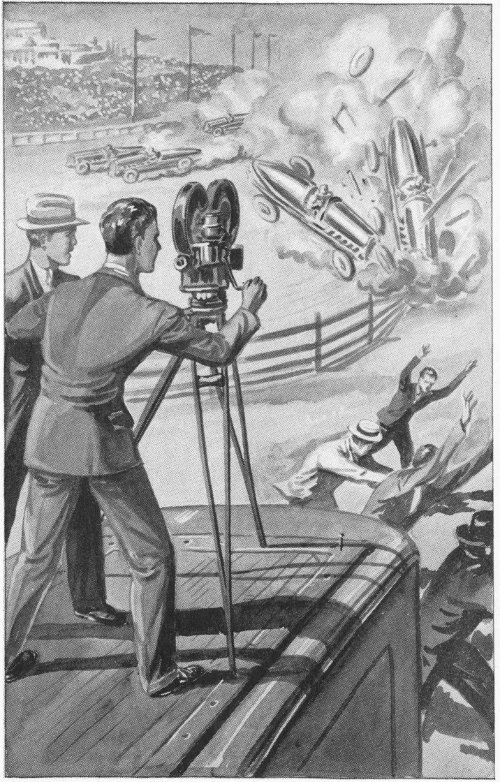
Flash pressed a button which controlled a motor.
The camera began its steady whirr.
Motor wide open, a car whizzed past and skidded
around the turn. Flash kept his camera lens trained
on the racers behind.
And then it happened!
Watching through the viewfinder, he saw a driver
suddenly lose control. A car skidded toward the railing.
Flash’s instinct was to leap aside out of all possible
danger, but he held himself to his post.
The car careened toward him. Racers directly behind
could not swerve aside. There was a terrific
crash as car after car piled on each other and went
rolling. Two overturned on the track, and a third
smashed against the fence. The fourth tore away a
section not six yards from where Flash stood. A
body hurtled through the air.
Horrified, but with nerves steady, Flash swung his
camera to catch it all. He kept grinding until the
crowd closed in about the wrecked car, blocking his
view. A siren screamed.
“Get the ambulance!” Doyle yelled at him.
45
Flash shot the entire “clean up” scene, only delaying
long enough to first obtain a few “still” shots of
the wreckage for the Brandale Ledger. When track
attendants had carried the injured from the field and
had towed away the battered cars, he drew a deep
sigh. He felt as weak as a rag, but at least he hadn’t
wilted at the critical moment.
“Boy, we shot a picture that time!” Doyle exclaimed
with his first show of enthusiasm. “If we had
stayed with the other newsreel men, we’d have missed
it!”
“The cop booted us into a lucky place, all right,”
Flash agreed.
“No chance of our getting another shot like that today,”
Doyle sighed. “We may as well take some
crowd pictures and then try for ordinary fill-in stuff of
cars coming down the stretch.”
They shifted locations twice, finally returning to a
place at the railing not far from their original site.
Both Flash and Doyle felt that they had experienced
their big moment of the day. They anticipated no
additional favor of luck, but it came when a second
crash occurred close to where they had set up their
equipment.
“What a day!” Doyle chuckled. “Now we’ll shoot
the finish of the race and be done!”
46
They managed after considerable difficulty to
squeeze into a hole near the finish line. Flash caught
a picture of the race winner, weary and covered from
head to foot with dust and oil, being congratulated
upon his victory. The man was induced to speak a
few words into the microphone.
“Now we’re through,” Doyle said in satisfaction.
“I certainly didn’t miss any tricks! If the pictures
turn out well, I ought to get a raise.”
They stowed their equipment away and edged the
sound truck into the flow of traffic. Flash waited, expecting
that Doyle would offer some word of praise.
He waited in vain. The technician took the entire
credit for the day’s work to himself.
As they neared the exit gate, they caught sight of
two rival sound trucks.
“Hi, Benny!” Doyle shouted in a loud voice.
“How did you do?”
“Terrible,” was the discouraged response. “We
missed all the crashes.”
“I got everything,” Doyle boasted, “and I mean
everything!”
During the ride back to the hotel, the technician remained
in a high mood. Flash had little to say. He
was tired, and in addition, bored by his companion’s
smug boasting.
47
They stopped at the airport where Doyle previously
had arranged for shipment of the cans of exposed film
to the News-Vue offices. Flash made up a package of
his best “still” shots for the Brandale Ledger. With
that duty accomplished, his work was completed. At
last he was free to enjoy his vacation.
“Well, good-bye,” he said, extending his hand to
Doyle.
“Good-bye?” the man echoed in surprise. “Where
are you going?”
“To find myself a bed,” Flash answered. “Then
tomorrow I may go back to Columbia. I want to see
how Joe is doing.”
“Oh, yes,” Doyle murmured, frowning. “I’ll have
to drive over there myself tomorrow. Want to ride
along?”
Flash hesitated. The matter of car fare was an
item to be considered. Doyle certainly owed him free
transportation if nothing more.
“Thanks,” he accepted. “I’ll be glad to ride along.”
But later, alone in his hotel room, he regretted the
decision. He did not like George Doyle. And the
technician had no use for him. The journey at best
would be an unpleasant one.
48
Flash picked up a newspaper which he had bought
on the street. The headlines were devoted to the auto
races and the two deaths which had occurred. Already
the train wreck story was old, buried on page
two. However, a revised and final list of the known
casualties had been reprinted. Again Albert Povy’s
name appeared.
“I’m sure that fellow was on the train to shadow
Major Hartgrove,” he mused. “But now—well, it
doesn’t matter. The mystery, if any, has been blacked
out by death.”
49
CHAPTER VI MAJOR HARTGROVE’S VISITOR
The long journey to Columbia proved less disagreeable
than Flash had anticipated. For the
most part, George Doyle attended strictly to his driving.
True, he bemoaned the hard life of a newspaper
cameraman, the ingratitude of his superiors. But by
this time Flash had learned to expect a steady stream
of complaint.
Reaching Columbia, they drove at once to the city
hospital. Although the building still was overcrowded
with patients, Joe Wells had been assigned to a private
room.
They found him with his leg in a cast, propped up
by pillows. He tossed aside a newspaper as they entered
and grinned a welcome.
“It’s sure good to see a familiar face in this
morgue,” he chuckled. “Sit down—anywhere except
on the bed.”
“How are you feeling, Joe?” asked Flash.
50
“Not so hot,” he admitted, “but I’m getting out of
here tomorrow if it means climbing down a fire escape.
Tell me, how did you make out at the races?”
Doyle related their success, taking most of the
credit upon himself. Joe listened with a tolerant,
half-amused attitude.
“Where was Flash while all this was going on?” he
inquired dryly.
“Flash?” Doyle was brought up sharply. “Oh, he
was right at my elbow. He helped a lot.”
“I figured he might. You know, big stories and
smash pictures always have a way of breaking around
him. He’s better than a rabbit’s foot any day!”
“We were lucky yesterday,” Flash admitted with a
grin. “Those auto crashes seemed to have been
staged for our special benefit. I only hope the films
turn out well.”
“How did you like the experience?” Joe asked
curiously.
“It was exciting. Still, I can’t say I enjoyed it.
Seeing two men go to their deaths—”
“I know,” Joe interrupted, “it shatters you, at first.
That’s why so few men are any good as newsreel
cameramen. But you have the stuff, Flash. Why
don’t you take my job until I’m able to get around
again?”
The abrupt question startled both Flash and Doyle.
The latter could not hide a frown of displeasure.
51
“How about it, George?” Joe asked the soundman.
“You’d like to have him work with you?”
“Oh, sure,” he replied without warmth. “Only I
imagine district manager, Clewes, has a man hand-picked
for the job.”
“Flash is on the spot. Another man would need to
come here. I can send Clewes a wire.”
“Please don’t bother,” Flash said quietly. “This is
my vacation.”
“It would be good experience for you.”
“I don’t doubt that, Joe. Perhaps, some other
time I’ll try it.”
“Well, thanks anyway for pinch hitting,” the newsreel
man replied gratefully. “That trip yesterday
must have been quite a strain. You’re tough as a
hunk of whang leather, Flash.”
A nurse entered the room to take a temperature
reading. After she had gone, Joe turned to Doyle:
“Do me a favor, will you? Run over to the drug-store
and buy me some tooth paste.”
Doyle left on the errand. As soon as his footsteps
had died away, Joe motioned for Flash to draw his
chair closer.
“Now we can talk,” he said comfortably. “What’s
the real reason you don’t want my job? Doyle?”
“His attitude figures. He doesn’t like me. Working
with him would be unpleasant.”
52
“You’ll get used to his grouching and boasting after
awhile. I did. Why not give it a little whirl—while
you’re on your vacation anyhow? It’s not easy, getting
a chance to break into the newsreel game, and
here it drops right into your lap. If you don’t like it,
you can go back to the Ledger and no harm done.
And another thing, the pay is much better.”
As Flash remained thoughtfully silent, Joe added:
“If your pictures turn out well, Clewes may offer you
the job on his own initiative. Don’t let Doyle’s personality
stand in your way.”
“I’ll think it over. By the way, how is the Major?”
Joe jerked his head toward the wall behind the bed.
“They have him in the next cell,” he revealed in a
low voice. “I’m telling you that old goof nearly
drives me crazy.”
“Not out of his head?”
“You couldn’t prove it by me. He keeps that call
bell ringing like a fire engine! Always wanting this
and that. And visitors! If you ask me, the entire
Intelligence Department of the Army has been here
to see the Major.”
“Then he’s connected with the secret service?”
Flash questioned in astonishment.
Joe raised himself on an elbow.
“I’m sure of it, although I never guessed it before.
He thinks someone on the train deliberately cracked
him over the head after the wreck. He claims the fellow
tried to steal important papers he carried on his person.”
53
“That’s odd, Joe. When I helped him from the
wreckage he kept mumbling something about being
struck. I thought he was out of his head.”
“Maybe he still is, but he talks straight enough.
These walls are like paper. I’ve heard him conferring
with big-wigs of the Army. They’re out to get some
fellow involved in an espionage plot against the government.”
“Who is he, Joe?”
“No names mentioned. I’ve been wondering if it
might not be that man we saw in the club car.”
“Povy?”
Joe nodded. “He’s had the reputation of being
mixed up in that sort of business. Nothing ever was
proven against him though.”
“Povy seemed to be interested in Major Hartgrove
on the train. But he couldn’t have been the one—”
Flash broke off quickly. George Doyle stood in
the doorway.
Returning with the tooth paste, the sound technician
had approached so quietly he had not been
heard. His attitude was that of a person who suspected
he was the object of discussion.
Conversation became general. Within a few minutes
the two visitors took leave of Joe.
54
“I’m holing in over at the hotel,” Flash remarked.
“Before I leave town I’ll drop around and see you
again.”
“I’ll be here, too, until I hear from Clewes,” added
Doyle. “So far I haven’t had any assignment.”
They shook hands with Joe, and quietly closed the
door behind them. As they went down the hall, Flash
could not keep from directing a curious glance toward
Major Hartgrove’s room.
The door stood half open. A man in military uniform
sat with his back to the corridor. Major Hartgrove,
reclining in a wheel chair, also was plainly
visible. As Flash stared at him, the Major returned
the steady gaze.
“Someone you know?” asked Doyle.
“A man I helped at the time of the wreck,” Flash
explained briefly.
As they passed on, the signal light over the Major’s
door winked in rapid succession. Flash smiled, recalling
Joe’s remark about the army man’s demand for
constant service.
The two cameramen reached the elevator and were
entering it when an attractive nurse came quickly
after them.
“One moment please,” she requested in a muted
voice.
55
They both waited. Doyle straightened his tie and
twisted his face into a wasted smile. The pretty
nurse gazed at Flash as she spoke.
“Major Hartgrove wishes to speak with one of
you,” she said. “He doesn’t know the name. However,
he means the young man who aided him in the
wreck.”
“I guess that must be me,” acknowledged Flash.
“My name is Jimmy Evans.”
“Then will you please come with me?”
The nurse turned and walked back down the corridor.
Flash and George Doyle both followed.
“You didn’t tell me you were a hero,” the technician
said jokingly. “Maybe the Major is going to pin a
medal on your chest!”
At the door of Room 67, the nurse paused. She
smiled apologetically at Doyle.
“Do you mind waiting outside?” she requested.
“The Major expressly requested that he wished to
see Mr. Evans alone.”
56
CHAPTER VII A HINT TO THE WISE
As Flash entered the bedroom, a stocky, middle-aged
man in a captain’s uniform, turned to face
him. He regarded the young man with an alert, penetrating
gaze.
Major Hartgrove, his head and leg swathed in
bandages, sat in a wheel chair by the window. He
too appraised the visitor.
“You wished to see me, sir?” Flash inquired.
The Major nodded. “Captain Johns,” he said
gruffly, “this is the young man I was telling you about.
The photographer who pulled me out of the wreck.
Your name—”
“Evans. Jimmy Evans.”
“I am pleased to meet you, sir,” Captain Ernest
Johns spoke cordially and extended his hand. “So
sorry I must be going. Another appointment. You
will excuse me?”
Without waiting for a reply, he departed, carefully
closing the door behind him. Clearly the speedy
leave-taking had been prearranged.
57
“Sit down!” invited the Major abruptly.
His tone was so explosive that Flash jumped. He
dropped into a chair opposite the army man.
“Evans,” said the Major, “I’ve tried to locate you
ever since the night of the wreck. Where have you
been hiding?”
“Indianapolis,” Flash returned, and explained how
he had substituted as a cameraman for Joe Wells.
“So you’re a professional photographer?” inquired
the Major. “Took a few pictures of the train wreck,
didn’t you?”
“Yes, sir.”
“Have they been published?”
“I couldn’t say. I sent some of my films to the
Brandale Ledger. Haven’t had time to hear from my
editor yet.”
The Major took a quick turn across the room in his
wheel chair. He came back to the window again.
“If I remember correctly you shot a picture of
me.”
“Of you?” Flash asked in surprise.
“A flash bulb went off just as I was trying to pull
myself from the wreckage.”
“Oh, yes, I remember,” Flash nodded. “I doubt if
that picture will be much good. I didn’t send it with
the others.”
The Major relaxed in his chair.
58
“You still have it?” he demanded.
“Yes, but I haven’t had time to develop the film
yet.”
“How long will it take?”
“Why, I don’t know,” Flash replied. “I have no
developing outfit with me. I could send it to a local
newspaper—”
“Not to a paper,” Major Hartgrove interrupted.
“To a studio where photographic work is done. I’ll
want no publicity.”
Flash smiled, rather amused by the army man’s
assured way of giving orders.
“As soon as the film is developed, bring it to me,”
the Major resumed. He hesitated, and then added:
“Under no circumstances must that picture be published
until after I have seen it. You understand?”
“I hear,” responded Flash dryly. “I can’t say I
understand. After all, I’m a professional photographer.
If a picture has news value it’s my duty to
publish it unless I have a mighty good reason for
doing otherwise.”
The Major made a rumbling noise in his throat.
“Young man, a hint to the wise is sufficient. There
are certain things I am not in a position to explain.
However, great harm might result if that picture were
printed. I wish to make it clear that if you disregard
my wishes, you may find yourself in trouble with the
government.”
59
“I doubt if the picture would be worth it, Major.
However, I’ll try to cooperate with you.”
“I am glad that you are taking a sensible attitude,”
the army man returned. “I assure you the picture has
no value save to myself and possible enemies. Upon
second thought, you are to bring the film to me undeveloped.”
Again Flash smiled. The Major mistook his silence
for consent.
“Where is the film now?” he questioned.
“In my luggage.”
“Then please bring it to the hospital without delay,”
the army man requested in dismissal.
Flash walked to the door. There he paused.
“Oh, by the way,” he said carelessly, “did you ever
learn who it was that struck you over the head?”
Major Hartgrove made a swift turn in his wheel
chair.
“What was that?” he demanded.
Flash repeated the question.
“You’re mistaken, young man,” the Major snapped.
“No one struck me. What gave you that idea?”
“Merely your own words. When I helped you from
the wreck you muttered that someone had struck you
and taken your wallet.”
“Then I was dazed. I may have been hit by a falling
timber when the car was derailed. Nothing was
stolen from me. An absurd notion!”
60
“Oh, I see,” said Flash. “My mistake, Major.”
Without waiting for a reply he went out the door,
softly closing it behind him.
George Doyle had remained at the elevator.
“Well, did the Major make you a pretty little
speech of gratitude, Flash?” he inquired curiously.
“He made me a speech. Period.”
Doyle pressed a button and the automatic elevator
descended to the lower floor.
“What was it all about?” he probed.
Flash had no intention of confiding in the technician
and so made an evasive answer. Doyle took
the hint, but he lapsed into sullen silence as they
walked back to the parking lot where the sound truck
had been left.
“Where are you going now?” he inquired, watching
Flash gather up his camera and luggage.
“The hotel. I think I’ll stay here a day or so and
rest up before I start back to Brandale.”
“I may hole in myself,” Doyle responded. “I gave
News-Vue this town as my address. I’m stuck here
until Clewes sends me orders. I’ll probably be seeing
you at the hotel.”
“Well, if we shouldn’t meet again, good-bye and
good luck with your pictures.”
“Same to you.”
61
They shook hands with a show of cordiality and
parted company. Flash was glad to be done with the
pretense. He never could like George Doyle and was
relieved to escape from him. Doubtlessly, the technician
felt the same way about him.
At the corner, beyond Doyle’s view, Flash paused.
Opening his handbag, he removed the holders which
held all the exposed films still in his possession.
“Wonder why the Major is so anxious to see that
picture of himself in the wreck?” he mused. “At the
time I snapped it I didn’t think I had anything.
Maybe I was wrong.”
Deeply puzzled, he could not guess why the picture
had any special significance. Yet he shrewdly reasoned
that Major Hartgrove would not bother to obtain
the negative save for a very particular reason.
The army man’s assured way of expecting his orders
to be obeyed without question annoyed Flash.
Obviously, the Major had sought to confuse him by
contradicting his first story that he had been struck
over the head by an assailant.
“I’ll have the film developed and see what all the
shooting is about,” he decided. “Then maybe I’ll
deliver it to the Major, and maybe I won’t.”
Walking along Main street, Flash presently came
to a small photographic studio. Entering he spoke to
the owner, Mr. Dee.
“I have some films here to be developed and
printed. How soon may I have them?”
“Tomorrow.”
62
“This is rush work. I’ll be glad to pay extra but
I need them right away.”
“Make it three hours, then,” replied the photographer.
“I’ll be back for them later,” nodded Flash.
He walked on two blocks to the Columbia Hotel.
The lobby was crowded. In response to his inquiry
for a single room, the clerk shook his head.
“We’ve been filled to overflowing ever since the
train wreck. Folks coming to see their relatives in the
hospital, you know. For a while we were selling cot
space in the halls.”
“No chance then?”
“We did have a double room but it was assigned a
few minutes ago. If you don’t object to sharing it,
I could put you in there. The young man who occupies
it isn’t much over your age, and is very respectable,
sir.”
“How about him complaining?”
“He took it with the understanding he might be
compelled to double up. The room has twin beds.”
“All right, I’ll take it,” decided Flash.
A boy conducted him up two flights of stairs,
through a dingy hallway. He knocked and opened
the door of Room 42. Flash stepped inside.
At the writing desk sat George Doyle. They stared
at each other.
63
“I seem to be your new roommate,” said Flash at
last. “Hope you don’t mind.”
“No, of course not. Come on in.” Doyle spoke
with an attempt at friendliness. “Wait, I’ll take my
junk off the bed.”
He arose and carried an armload of garments into
a near-by closet.
The bellboy opened a window. An unexpected gust
of wind carried a sheet of paper from the writing desk.
Flash stooped to pick it up. A name caught and held
his attention. It was his own.
Without meaning to read what Doyle had written,
he saw the entire paragraph at a glance:
“... rid of that pest, Evans at last. If you put
in your application without delay, you should get
Wells’ job, and hold it permanently.”
64
CHAPTER VIII DISTRUST
Without reading further, Flash replaced the
letter on the desk. Scarcely had he moved
away, when George Doyle stepped from the clothes
closet. He glanced sharply at the young photographer,
but Flash’s face gave no indication that anything
was wrong.
Doyle removed the remaining garments from the
bed. Then, walking quickly to the desk, he picked
up the letter, and thrust it into his pocket.
“Don’t let me interrupt you if you’re busy,” Flash
remarked.
“I was only writing a letter to a pal. I’ll finish it
another time.”
The bellboy pocketed Flash’s tip and left the two
together. A constrained silence settled between them.
Flash began to unpack his shirts and socks.
“Staying long in Columbia?” Doyle inquired after
an awkward moment.
“A day or two, perhaps.”
65
Flash spoke shortly. Doyle glanced at him curiously,
aware that for some reason he was offended.
For the next few minutes the technician made a
special effort to be agreeable. Flash could not respond.
He felt that the man’s sudden friendliness
was only a pose.
“Doyle has no honor,” he thought. “Instead of being
loyal to Joe, he’s scheming to install a friend in
his job. Between them they’ll arrange it so that Joe
never does get his place back again.”
The telephone jingled. Doyle answered, and learning
that a telegram had arrived for him, ordered it
sent up.
“It must be from the News-Vue Company,” he remarked.
“My boss is the only one who knows where
to reach me.”
The telegram was brought to the door. Doyle
ripped open the envelope. With feet propped on the
foot of the bed, he read it and chuckled.
“It’s from Clewes himself.”
“District manager of the News-Vue?” Flash recalled.
“That’s right. The auto race pictures turned out
great. When Clewes wastes money on a congratulatory
telegram you know you’ve hit the bull’s eye!”
66
Flash could not help feeling elated that his first
work as a newsreel cameraman had been successful.
He waited for Doyle to read the telegram aloud or
offer it to him. Instead, the technician stuffed it into
his pocket.
“I’m going to jog downstairs and get something
to eat,” he said genially. “Coming along?”
“No, thanks.”
After Doyle had gone, Flash flung himself on the
bed, relieved to be left alone. He wanted to think.
Although annoying, it didn’t really matter that
Doyle belittled his efforts and withheld praise. What
worried him was the letter he had read by accident.
Should he warn Wells that the technician was trying
to transfer the News-Vue job to a friend? And what
could Joe do about the matter? Nothing. It would
only serve to make him uneasy.
Flash could see only one solution, and that, not to
his liking. Still thinking the matter over, he arose,
washed, and scribbled a hasty letter to his mother.
Deciding not to mail it in the hotel box, he walked
to the post office. As a matter of routine, he asked
if any mail had arrived for him, general delivery.
Thumbing through a thick stack of mail, the post
master proffered a thin envelope bearing the name of
the Brandale Ledger.
As Flash eagerly opened the letter, a crisp new bill
fluttered to the floor. He picked it up and saw that it
represented twenty dollars. The letter was from
City Editor, Riley. Scattered phrases seized his eye:
67
“... Your train wreck pictures scooped the East....
shots of the Indianapolis races best we’ve run in
years.... Congratulations on the excellent work!
Accept this twenty dollars as a bonus, and have a
good time on your vacation.”
Flash pocketed the money and read the letter
twice. At least Riley appreciated his work even if
George Doyle didn’t! He was glad to know that all
his pictures had turned out well. A big load had been
lifted from his mind.
Leaving the post office, Flash glanced at his watch.
Two hours had elapsed since he had left the undeveloped
camera films at Mr. Dee’s photographic
studio. He wandered slowly about for a half hour
longer and then dropped into the establishment.
“Your pictures are ready,” the photographer said,
offering him the packet. “However, I’m afraid you’ll
not be very well pleased. Only two of the prints came
out well.”
“I didn’t expect much from them,” Flash replied.
“I hope you printed them all.”
“Yes, I did.”
Flash paid the bill, and took the prints over to a
window. Running rapidly through them he came to
the picture which Major Hartgrove had requested.
68
There was nothing so very startling about it.
Major Hartgrove appeared as an unrecognizable,
shadowy figure, with his face half turned away from
the camera. But as Flash studied the scene carefully,
he distinguished the faint outline of another form—a
man slipping away into the darkness.
“I wonder if that might not have been the person
who ran when I called to him!” he reflected. “It
might be the same man who struck Major Hartgrove
and tried to rob him.”
By this time Flash no longer doubted that the
army man had been the object of an attack. What
the mysterious assailant had been after he could not
guess, unless the Major had carried valuable military
plans or other documents upon his person. Certainly
no ordinary thief had been responsible for the assault.
“I would think Povy might have had a hand in it,”
he mused, “only Povy was killed in the wreck. So
he’s out.”
To make certain no mistake had been made in the
records, Flash decided to investigate further the following
day. While very unlikely, there was still a
chance that Albert Povy’s name had been listed by
mistake.
“The Major won’t learn much from this picture,”
he thought. “But it’s no good to me. I’ll take it
around tomorrow just to keep him from breaking a
blood vessel.”
69
Rapidly he glanced at the remaining prints. The
pictures taken at the auto races were only moderately
good, and without news value.
With a shrug, he pocketed the envelope and returned
to the hotel where he dined and went to bed
early.
He did not hear Doyle come in, but when he awoke
in the morning, his roommate already was up and
dressed. The technician stood by the window, looking
over the prints which Flash carelessly had left
lying on the dresser.
“These aren’t such hot shots,” he commented, observing
that Flash was awake.
“Just some of my bad ones. I study them to learn
my mistakes.”
“Ambitious, aren’t you?” Doyle’s lip curled in
amusement. “This one of Rascomb is the best of the
lot.”
Flash rolled out of bed.
“Rascomb?” he questioned. “Who’s he?”
Peering over Doyle’s shoulder he saw that the man
was gazing at an auto-racing picture. It was a shot of
one of the drivers talking with a distinguished looking
individual in street clothing.
“That’s Rascomb,” identified Doyle, jabbing at the
figure with his thumb. “You see him at most of the
big sporting events.”
70
“Never even heard of him. But I thought there
was something familiar about his face! Still, I can’t
remember ever having seen him before the day of the
races.”
“Rascomb has plenty of dough,” Doyle remarked
enviously. “Swell car, a plane of his own, even his
own private landing field. He’s a good polo player
and has a hunting and fishing lodge up in the north
woods. The news lads always give him favorable
publicity, and he returns the favor with invitations to
his lodge.”
“Have you ever been there?” Flash inquired curiously.
“No, but the fellows who have gone tell me he’s a
wonderful host. Gives you everything.”
Flash dressed leisurely. As he combed his hair,
he saw through the mirror that Doyle was watching
him with a peculiar, speculative expression.
“Any plans for this morning, Flash?” he inquired
casually.
“None in particular. I thought I would go over
to the hospital. Would you like to come along?”
Doyle shook his head. He seemed relieved by
Flash’s answer.
“No, I’ll be tied up all morning. I want to check
over my sound equipment and get ready to roll when
my new assignment comes through. Tell Joe hello
for me.”
71
Flash ate breakfast and reached the hospital in
time for the ten o’clock visiting hours. The door of
Major Hartgrove’s room stood ajar. But the bed was
empty and attendants were stripping off the linen.
A nurse was passing in the hall. Flash stopped her
and inquired where he would find the Major.
“You are too late,” she replied. “Major Hartgrove
left the hospital early this morning.”
Flash went on to Joe Wells’ room. He had made
up his mind not to tell his friend of George Doyle’s
treachery. However, when Joe again urged him to
take the newsreel job for at least a month, he gave
the matter rather serious consideration.
“The only reason I might do it would be to protect
you, Joe,” he replied. “If I held the post until you
were up and around again, no one could steal it from
you.”
“Oh, that wouldn’t happen,” his friend responded
carelessly. “I have a good stand-in with the News-Vue
people.”
“Even so, you can’t tell what will happen these
days,” hinted Flash.
“Then will you take the job if I can land it for
you?”
“I’ll not promise yet, Joe. Tell you what I’ll do.
I’ll wire Riley and see what he says. I can’t afford
to jeopardize my own place on the Ledger, you know.”
72
The matter was allowed to rest. Leaving the hospital
before the visiting hours were over, Flash dispatched
the telegram, and then returned to the hotel.
As he passed through the lobby he was surprised to
see George Doyle sitting in a near-by chair, his back
turned. He was talking earnestly with an alert-eyed,
gray-haired man of forty.
Instantly it struck Flash that Doyle had wished to
have him away from the hotel at the time of an anticipated
interview. Impulsively, he crossed the
room, intending to test out his theory by speaking to
the technician.
Doyle did not see him approach. As Flash paused
just behind the upholstered chair, he arose and extended
his hand to the man who faced him.
“I’m glad you liked my work,” he said heartily.
“And I’m sorry about Evans. He’s given me to understand
he wouldn’t be interested in any proposition.”
73
CHAPTER IX FLASH ACCEPTS AN OFFER
Flash stepped forward into George Doyle’s view.
The soundman saw him and lapsed into confused
silence.
“Sorry. I couldn’t help hearing,” Flash apologized.
“I don’t mind saying I’m curious about this proposition
which wouldn’t interest me.”
“You’re not Flash Evans?” inquired the stranger
before Doyle could find his voice.
“Yes, sir, I am.”
“Flash, this is our district manager, Mr. Clewes,”
Doyle said unwillingly. “We were just speaking of
your fine work at Indianapolis.”
“Yes,” nodded Mr. Clewes, “as I mentioned in my
telegram, those pictures were the best we’ve had in
months! The sound effects were fairly good, too.”
Flash glanced at Doyle who shifted uncomfortably
from one foot to another.
“Thank you, sir,” he said politely to the district
manager. “I didn’t happen to see your wire.”
74
Mr. Clewes gazed questioningly at the sound technician.
“I repeated the contents to him,” Doyle said defensively.
Ignoring the technician, Mr. Clewes turned to
Flash again.
“Howard Brandiss, who heads our company, was
much impressed by your work. When he saw the
crash films run through he said to me: ‘Fly down to
Columbia and sign that photographer on the dotted
line before some other company gets him.’ But
Doyle here tells me you wouldn’t be interested in any
proposition we might offer.”
“Flash already is employed by the Brandale
Ledger,” Doyle broke in hurriedly. “He’s on his
vacation now. I understood him to say he wouldn’t
consider working for a newsreel concern.”
“I’m afraid your hearing was almost too acute,”
Flash said pleasantly. “Either that or I gave the
wrong impression.”
“Then you are interested?” Mr. Clewes asked
quickly.
“Not in a permanent job. I might consider filling
in a month for Joe Wells. That is, if Mr. Riley has
no objection.”
“And who is Mr. Riley?”
“My editor on the Brandale Ledger.”
75
“I am sure we can arrange everything to his satisfaction,”
said Mr. Clewes. “And I respect you for
being loyal to your employer. If you are unwilling
to leave the Ledger, we should not try to convince you
otherwise. Nevertheless, after a month of newsreel
work, you may decide you prefer it to your newspaper
position.”
“That’s quite possible, sir.”
Dismissing Doyle with a curt nod, Mr. Clewes
drew Flash aside. For a half hour they talked together,
discussing salary and matters of general
routine. The district manager then insisted upon
placing a long distance telephone call to Riley of the
Brandale Ledger.
He stepped from the booth, smiling broadly.
“Everything has been arranged. Mr. Riley says
you may work for us, providing we don’t try to steal
you away from him at the end of the month.”
“I aim to go back to Brandale when my vacation
is over,” Flash insisted. “My home is there.”
Mr. Clewes gazed about the lobby in search of
Doyle. The technician had slumped down in a chair
in front of the fireplace. He came over as the district
manager motioned to him.
“Doyle, meet your new partner. You two will continue
to work together.”
The technician’s face twisted into a strained smile.
76
“Glad Mr. Clewes was able to persuade you when
I couldn’t,” he said to Flash. “We’ll get along fine.”
The district manager glanced at his watch. “I
have fifteen minutes to catch my plane,” he declared
hurriedly.
“How about our next assignment?” asked Doyle.
“I was coming to that. No news of special importance
is breaking in this section of the country right
now. Your instructions are to start East again. Stop
off at Melveredge Field and try to get shots of the
new bombing plane which is being tested there.”
“Try is right,” grumbled Doyle. “That place is
so surrounded by barbed-wire red tape a newsreel
man couldn’t cut his way through in a month. How
about permits?”
“News-Vue will endeavor to make the necessary arrangements.
Even if you can’t obtain pictures of the
bomber, you should be able to get routine maneuvers.
Do the best you can. Further orders will be forwarded
to you at the Clarinda Hotel.”
Mr. Clewes shook hands with both Flash and
Doyle, and hastened to his taxi. In silence, the two
newsreel men went to their room. They began to
pack.
77
“This is a poor assignment,” Doyle complained,
jamming shirts into his bag. “We’ll waste a lot of
time at Melveredge Field, fail to get the pictures, and
then be reprimanded for our pains.”
“Mr. Clewes must think we have a chance or he
wouldn’t send us.”
“Us,” said Doyle with biting sarcasm. “A lot of
good you’re going to do me!”
The words were spoken before he thought. Once
said, he could not retract them. But instantly he was
ashamed of the unwarranted outburst.
“Sorry,” he apologized curtly. “I shouldn’t have
said that. But you made me sore, trying to show me
up in front of Mr. Clewes.”
“In what way?”
“Letting on that I hadn’t shown you his telegram.
And then the way you breezed up and accepted a job
after you made me think you wouldn’t take one.”
“I don’t remember that we ever discussed it,”
Flash returned coldly. “But that’s neither here nor
there. I’ve taken the job. Whether we like it or not,
we’ll be working together. Why not try to get along
without friction?”
“Suits me. All I ask is that you do your work and
don’t expect to use me as a crutch.”
“We understand each other perfectly, Doyle. Now
when do we start?”
“Twenty minutes.”
78
“I’ll meet you at the parking lot. I want to telephone
Joe and tell him I’ve taken the job.”
Flash had another errand in mind, one which he
did not reveal to Doyle. Quickly he made his telephone
call from the lobby of the hotel.
“I’m glad you’ve changed your mind,” Joe told him
gratefully. “Can’t you come over to the hospital before
you leave town?”
“Afraid not. We’re starting in a few minutes.”
Joe Wells hesitated, and then said: “You’ll get
along fine, Flash, if you manage to stay on the good
side of Doyle. He can help you a lot. But I’ll give
you a tip. If he takes a dislike to a fellow, he knows
all the ways of making it plenty tough.”
“Everything will be fine, Joe. I’ll manage. And
your job will be waiting whenever you want it back.”
He hung up, smiling ruefully at his friend’s belated
warning. Already he had incurred George Doyle’s
dislike. But he was not afraid of what the technician
might attempt to do. He would be ready and waiting.
79
CHAPTER X CHECKING FACTS
With fifteen minutes to spare, Flash made a
quick trip to the railroad station. His next
errand was anything but to his liking. Yet he was unwilling
to leave Columbia without verifying a certain
fact.
He found the station agent in his little office behind
the ticket window.
“What may I do for you, sir?” the man questioned.
Introducing himself as a representative of the
Brandale Ledger, Flash added that he was checking
upon the death of a man reported killed in the streamliner
crash.
“Sorry I can’t help you on that,” replied the agent.
“It’s against orders to give out information about the
accident. You’ll have to see some other person.”
Flash was persistent. He explained that any information
obtained would not be published in a newspaper.
“I’m trying to learn about a man named Albert
Povy.”
80
“I guess I can tell you about him,” the agent conceded.
“He was among the victims.”
“The body was shipped from here?”
“It was.”
“To relatives?”
“Couldn’t tell you as to that. The body was
claimed by a man named Rascomb. Herbert Rascomb.”
Flash was startled by the name. He wondered if
it could be the same man George Doyle had been telling
him about. But that scarcely seemed possible.
“And where was the casket sent?” he asked after
a moment. “That is, what city?”
“To a place called Clear Lake.”
Flash thanked the agent for the information and
left the station. He was ten minutes late in reaching
the parking lot. Doyle was waiting in the sound
truck, appearing none too pleased at the delay.
They drove out of town with Doyle at the wheel.
The truck made good speed. For a time neither of
them spoke.
“Oh, by the way,” Doyle said at length, “what sort
of salary did Clewes give you?”
“Somewhat less than Joe was getting,” Flash answered
vaguely. “More than I’ll earn probably.”
“You’ll be getting a double salary while you’re on
vacation, won’t you?” Doyle could not hide his envy.
81
“Yes, but it won’t last long.”
Flash decided to ask a few questions himself. A
little later he introduced the subject of the sportsman,
Rascomb, asking Doyle the man’s first name.
“Herbert. Herb Rascomb.”
“And where is his lodge located? What town is it
near?”
“Couldn’t tell you exactly,” responded Doyle. “I
understand it’s not far from where we’re heading—Melveredge
Field. But why this sudden interest in
Rascomb?”
“Merely curious, that’s all. What sort of reputation
does he have?”
“Reputation? Oh, he steps around in fast company,
if that’s what you mean. He has a lot of foreign
friends.”
“Was he ever mixed up in trouble with the government
or anything of the sort?”
“Rascomb? Say, that fellow is in the blue book.
The only thing he’s interested in is having a good
time. If he did get into trouble he could buy himself
out.”
Again Flash fell silent, for he saw that Doyle had
grown irritated by his questions. It struck him as an
interesting fact that Rascomb had been connected
with Albert Povy, a man of dubious reputation.
82
Actually there was no good reason why the pair
should not have been friends. With a large circle of
acquaintances, Rascomb could have met Povy in his
travels about the country and, learning that the man
was without relatives, might have claimed the body
out of kindness. In any case, it was none of his affair.
He never expected to see Rascomb again.
Throughout the day the sound truck rumbled
steadily eastward, making only brief stops for oil and
gas. Twice Flash offered to relieve Doyle at the
wheel, and both times was turned down.
Toward dusk they pulled into a busy little city of
some fifty thousand population. They had reached
their destination. Melveredge Field was located
close by.
Doyle glanced at his watch.
“Ten after five,” he announced. “Too late to do
anything tonight. We’ll find the Clarinda Hotel and
call it a day.”
Flash nodded. Doyle never bothered to consult
his wishes. He quickly had learned that the easiest
way to get along with the technician was to have no
opinions of his own. So far any differences they might
have had were trivial. But clashes were certain to
come later.
83
Flash had been relieved to learn that News-Vue
paid all traveling expenses. The arrangement, however,
had one distinct drawback. He and Doyle were
expected to share the same room.
“We see too much of each other as it is,” thought
Flash. “Before the end of a month we won’t be on
speaking terms.”
They registered at the Clarinda Hotel and inquired
for mail. There was none. The anticipated orders
from the News-Vue Company had not yet arrived.
The newsreel men both were tired and dirty from
their long journey.
“Me for the tub,” Doyle announced.
Slamming the bathroom door behind him, he started
the water running, and remained soaking for nearly
an hour. Flash became irritated at the long delay.
“Say, have you gone to bed in there?” he called at
last. “You’re not the only dirty pebble on the
beach!”
Doyle did not answer, nor would he hurry. He
took another half hour to dress. Finally be unlocked
the door and sauntered out.
“What’s all the shouting about, Flash?”
“You’ve been in there exactly an hour and a half!”
Flash glanced at the tub. It was rimmed with dirt.
Every bath towel had been used.
84
“Say, you lug—” he began.
An outside door slammed. The culprit had gone.
Ringing for more towels, Flash cleaned the tub
and hastened through his own bath.
“I’ll get even with him tomorrow,” he thought.
“We’ll see how he likes it when the joke is on him.”
It was after seven o’clock when Flash finally left
the hotel in search of a restaurant. He sauntered
along, pausing to read menus printed on the plate
glass windows. Suddenly he felt a hand touch his
shoulder.
Flash whirled around. For a moment he did not
recognize the smiling young man who stood there.
Then he gave a pleased cry:
“Bailey Brooks! What are you doing out this
way?”
“Oh, prowling around,” the parachute jumper replied.
“Had your dinner?”
“Not yet.”
“Then let’s go inside. I’m meeting a man, but he’s
not due to show up for fifteen minutes.”
Flash felt flattered that Bailey Brooks had remembered
him. He was even more pleased when the
parachute jumper praised him for the pictures he had
taken at Brandale.
85
“All the publicity helped,” Brooks declared warmly.
“Since the parachute test proved successful, several
concerns have been after me. I’ve not had a definite
offer yet, but it’s only a matter of time.”
The two young men entered the restaurant and
selected a table not far from the door. Flash hesitated,
and then said:
“Too bad about Povy.”
“Yeah.” The smile faded from Brooks’ face. “He
was interested in my invention. Offered me a good
price for it, too. But probably it’s just as well the
deal didn’t go through.”
“Why do you say that?”
“You know who Povy was, don’t you?”
“I’ve heard rumors.”
“He was mixed up with a spy ring years ago and
probably was doing espionage work at the time of his
death. That was the main reason I held off about
selling him the parachute. I liked Povy personally
but I never trusted him.”
“I wonder what government employed him?”
“I never learned. Povy was very cautious in his
dealings. He revealed nothing about himself. All
he ever told me was that he represented a firm which
would pay well for my invention, providing the tests
were successful.”
A waitress came to take orders and Flash gave his.
Bailey Brooks said that he would wait for a man with
whom he had a dinner appointment.
86
“You say several other persons are after your invention
now?”
“Several is an exaggeration,” Brooks admitted with
a grin. “One private party and the United States
Army.”
“So that’s why you’re here!”
Brooks nodded. “The ’chute is to be given exhaustive
tests out at Melveredge Field. If it comes
through okay, I’ll be sitting pretty.”
“When will the tests be made?”
“All week. There’s an endless amount of red tape.”
“I’m with the News-Vue people now,” Flash explained
abruptly. “Any chance to get some shots of
the tests?”
“Not a glimmer. Melveredge Field is closed tighter
than a drum these days. I doubt if they’ll even allow
you near the place with a newsreel camera.”
Flash mentioned the chain of events which had led
him to spend his vacation working for the News-Vue
Company. The parachute jumper immediately recalled
Joe Wells and expressed regret over his accident.
“While I was in Columbia I inquired about Albert
Povy,” Flash presently remarked. “You know, I
thought there might have been some mistake about
his death.”
“There wasn’t?”
87
“No. His body was shipped to a place called Clear
Lake.”
“That town isn’t so far from here,” Brooks said
thoughtfully. “I’ve heard of it.”
“Povy’s body was claimed by a man named Herbert
Rascomb. A well known sportsman and—”
Bailey Brooks had been toying with a silver knife.
It slid from his hand, making a clatter as it struck the
floor.
“Rascomb?” he asked in a strange voice. “Did you
say Rascomb?”
Flash could see that the information had startled
the parachute jumper. But before he could explain
further or ask a question, the door of the café swung
open.
A dapper man in army uniform strode across the
room directly toward the pair at the table.
“Ah, here is my host now,” murmured Bailey
Brooks.
Flash turned his head. The man who approached
was Captain Ernest Johns.
88
CHAPTER XI HIGH WATER
Bailey Brooks arose to greet the newcomer. As
he turned to introduce Flash, Captain Johns
forestalled him by saying in a curt voice:
“We have met before, I believe!”
“At the Columbia Hospital,” recalled Flash.
The Captain seated himself on the opposite side of
the table, regarding the cameraman with a cold scrutiny
which was not easy to interpret. Assuming that
he was an intruder at a private business conference,
Flash offered an apology and started to leave.
“No, don’t go.” Captain Johns waved him back
into his chair. “Finish your dinner. Why did you
fail to keep your promise to Major Hartgrove?”
Flash now understood the reason behind the officer’s
coolness. Major Hartgrove had reported his
failure to give up the requested pictures.
“I made no promise,” he replied.
“It was understood that you would bring the pictures
to the hospital without delay.”
89
“The Major may have understood it that way,” replied
Flash evenly. “But I work for the News-Vue
Company, not the United States Army.”
Captain Johns’ lips twisted in a faint suggestion of
a smile. Yet his voice had an edge to it as he asked:
“You still have those pictures?”
“I have.”
“What is your reason for withholding them?”
“No reason,” Flash admitted cheerfully. “As a
matter of fact, I went back to the hospital yesterday
after I had them printed. The Major was gone.”
“You went back after you had looked at them yourself?”
“Quite right, sir. I wanted to see what I was giving
away. Just protecting my paper, you know.”
“Yes, I know,” responded Captain Johns dryly.
“You may be interested to learn that Major Hartgrove
has been removed to the army hospital at Melveredge
Field.”
“Doing well I hope.”
“He will be dismissed tomorrow or the day following.
Now about those pictures. Where are they
now?”
“In my room at the hotel.”
“May I see them?”
90
“I’ll be glad to show them to you, Captain,” replied
Flash, grinning. “But I don’t think you’ll find them
of any aid in running down the man who struck the
Major.”
“Let me be the judge of that. Now as I recall, Major
Hartgrove said you were the first person to reach
him after the train wreck.”
“Hardly the first, sir. As I approached the car, I
saw someone slipping away into the dark. It may
have been the man who robbed him.”
“You are mistaken. Major Hartgrove was not
robbed.”
“I understood otherwise.”
“An attempt was made to take Major Hartgrove’s
wallet. The man did not succeed.”
Flash accepted the explanation without comment.
He was rather inclined to believe that the Major had
not been robbed. However, it seemed unreasonable
that the army men would be making such strenuous
efforts to apprehend an ordinary thief. Obviously
Major Hartgrove had carried military papers or something
of far greater value than money.
91
Ignoring Bailey Brooks for the moment, Captain
Johns asked Flash a number of questions about his actions
following the train wreck. Cleverly but without
success he tried to make the cameraman contradict
himself. At last, he seemed satisfied the young man
was telling the truth, and turned his attention once
more to the parachute jumper.
After the meal had ended, Captain Johns volunteered
to go with Flash to his room. The three walked
together to the Clarinda Hotel.
George Doyle looked up in surprise as Flash pushed
open the bedroom door. He rose quickly to his feet.
“You remember Bailey Brooks,” said Flash. “And
this is Captain Ernest Johns.”
Doyle was impressed by the caller. He lost his customary
indifference and put himself out to be agreeable.
But the captain paid him scant attention.
“I have only a few minutes,” he said impatiently.
“May I see the pictures now, please?”
Flash found the envelope in his luggage. Doyle sat
watching him curiously as he sorted through the
prints.
“I have only one which will interest you,” he said
to the captain. “It isn’t much good.”
The army man examined the picture carefully and
returned it to the stack.
“You are right,” he admitted regretfully. “For our
purposes it is valueless.” Methodically, he thumbed
through the other prints. “Now here is an excellent
one!”
92
“A snap I took at the races. Too bad the wreck
picture didn’t come out the same way. Conditions
were against me.”
Bailey Brooks had crossed the room. As Captain
Johns dropped the prints carelessly on the table, he
picked them up and glanced through the stack.
The army officer turned to leave but Doyle stepped
forward, neatly blocking his way.
“Say, Captain,” he began, “Flash and I are with
News-Vue, you know. What are the picture possibilities
out at Melveredge?”
“There are none, Mr. Doyle.”
“Oh, come now, I know it’s hard to get in there
these days, but it can be done with pull. How about
giving us a permit?”
“I regret I am not in a position to grant such a
favor,” the captain returned stiffly. “Good evening.”
Accompanied by Bailey Brooks, he went away. As
soon as the footsteps receded, Doyle turned angrily to
Flash.
“You might have said something instead of standing
there like a clam! Here the Captain is a good
friend of yours. He could have passed us into Melveredge
Field.”
“The Captain isn’t a friend of mine.”
“Then why did you bring him here?”
“You must have observed for yourself, Doyle. To
look at those pictures.”
93
The technician picked up the stack and glanced
through the prints.
“What’s all this about anyway?” he demanded.
“Why would the Captain be interested?”
Flash made an evasive answer which only irritated
Doyle further. Despite the technician’s displeasure,
he had no intention of taking him into his confidence.
“I’m tired,” he said shortly. “Let’s go to bed.”
It was dark in the hotel room when Flash awakened
to hear the telephone ringing. Struggling out of sleep,
he reached to roll up the window shade. A few carts
were creaking by on the street below. The sky was
barely light.
The telephone rang again.
“Answer it, will you?” growled Doyle.
“All right.”
Flash took the receiver from its hook. He was informed
by the hotel operator that long distance was
calling. As he relayed the message to Doyle, the latter
leaped from bed and seized the instrument.
“That must be Clewes!”
Doyle talked for several minutes and then hung up
the receiver.
“Get dressed!” he said curtly. “We’re clearing out
of here. And we haven’t much time.”
“What’s up?”
94
“We move again. Clewes says to let the Melveredge
pictures slide. Arrangements can’t be made with
the authorities.”
“A new assignment?”
“Yeah. Not a bad one either. We’re to cover an
International polo match at Excelsior City. We ought
to be there not later than twelve-thirty.”
Flash looked at his watch and whistled.
“It’s nearly six now. Excelsior City must be at
least three hundred miles from here.”
“Nearer three twenty. It means fast stepping.”
Quickly they dressed and crammed their clothing
into suitcases. There was no time for breakfast. A
clock on the street chimed six-thirty as they pulled out
of the drowsing city.
A fog hung low over the valley. Before the sound
truck had covered many miles a fine, steady rain began
to fall.
Strangely, Doyle offered no complaint about either
the weather or the early morning call to duty. Flash
stole a curious glance at him. The technician’s face
was animated and he whistled a cheerful tune.
“This assignment seems to please you, Doyle.”
“It could be a lot worse.”
“What teams are playing? You haven’t told me
anything about the set-up.”
“An American team against one from India headed
by Rajah Mitra. Know anything about polo?”
95
“I’ve seen a few games.”
“Herbert Rascomb will be playing on the American
team.”
“Rascomb!”
“He’s one of the best players in the country.”
“I never even heard of him until a few days ago.”
“Rascomb doesn’t like publicity. He goes into a
rage if his picture is taken. The boys humor him, and
he returns the favor by showing them a good time at
his lodge.”
“Buys them off?”
“Nothing of the sort. It’s only to show his appreciation.
We could do with a day in the north woods,
eh?”
Flash avoided answering the question. Instead he
inquired:
“Why is Rascomb so against publicity? A pose?”
Doyle shrugged as he steered the sound truck into
a filling station.
“No, he’s just that way. But they tell me Rascomb
is a fine fellow.”
An attendant filled the gasoline tank, checked the
oil and replenished the water in the radiator. As
Doyle paid him, he volunteered road information.
“Aiming to take U.S. 49 out of here?”
“That’s right,” answered Doyle. “How is the road
to Excelsior City?”
96
“The road’s in good condition. But if you want to
be on the safe side you’d better take Highway 23.
We’ve had some hard rains around here. The Coon
River is over its banks, and there’s a bad bridge about
six miles beyond town.”
“Then the road is closed?”
“They were keeping it open an hour ago. A radio
report said it would be closed if the water came any
higher.”
Doyle and Flash studied a map. Highway 23 was
graveled and at least fourteen miles out of their way.
“We’ll keep on 49 and take a chance,” Doyle decided.
The decision satisfied Flash, for it had occurred to
him that possibly they might have an opportunity to
take interesting flood pictures.
Two miles beyond the town limits they began to see
evidence of high water. Ditches on either side of the
road ran with it. In several low places tiny rivers
blocked their way. The water was not deep and they
rode through it without mishap.
They picked up speed on a long stretch of clear
pavement. Ahead they could see the bridge, a long,
wooden affair of ancient design. A flimsy, make-shift
barrier of boards had been raised across the entrance
way.
97
“Closed!” muttered Doyle in disgust. “We’ll never
get to Excelsior City by game time now!”
He slammed on the brakes and brought the truck
to a standstill not far from the bridge. Thrusting his
head out the window, he called to one of the guards:
“How about letting us through? We’re newsreel
cameramen and in a big hurry.”
“The bridge is unsafe,” the man answered. “It’s
apt to go out any time now.”
Flash leaped from the truck and went to look at the
bridge. He saw for himself that much of the underpinning
had washed away. The weight of an automobile,
even higher water, would be almost certain to
shift it from its position.
“Water still rising?” he questioned a guard.
“Coming up fast, brother. Three inches in the last
twenty minutes. Another half hour and this road may
be completely covered.”
Flash ran back to the truck. Doyle had turned it
around and was impatiently waiting.
“Jump in!” he commanded. “We’re going to be
late getting to Excelsior City now that we have to
back-track.”
“Listen, Doyle!” Flash was excited. “While we’re
breaking our necks trying to reach there, we’ll be passing
up better pictures.”
98
“What do you mean, better pictures?”
“The bridge is going out any time.”
“Maybe,” Doyle retorted. “But we’re not waiting
here several hours on a slim chance like that! Our
assignment is to shoot the polo match.”
Flash gazed steadily at the technician.
“Sorry to disagree. We’re staying right here.”
“Say who do you think you are?” Doyle drawled
insolently. “I’m not taking orders from any fresh
kid.”
“I’ve taken plenty of orders from you. But not
any more. I’m washed up! Through!”
“Oh, so you’re through, eh? Well, quit any time
you like!”
“I’m not quitting,” Flash corrected. “Just letting
you know that from now on I’m not your man Friday.
Mr. Clewes gave me to understand I was to use my
own judgment about picture values. Your part is to
record the sound effects.”
Doyle stared at Flash. Spots of bright color tinted
his taut cheeks. With an effort he kept his voice under
control.
“All right, Evans, you’ll take full responsibility for
this!”
“I expect to,” Flash retorted grimly. “Now help
me get my stuff up on the roof! That bridge won’t
last many minutes!”
99
CHAPTER XII BRIDGE OUT!
Flash was prepared for a curt refusal. Surprisingly,
Doyle considered a moment, and then began
to unload equipment. He said nothing, but his
smoldering eyes made it clear he intended to make a
full report to Mr. Clewes.
With camera set up and focused on the bridge,
Flash nervously waited. The only thing which would
justify his high-handed action would be success. If
the bridge failed to go out, Doyle would score heavily
in the final reckoning.
The water rose higher and higher, slapping against
the piling with a powerful surge. Yet the bridge held.
Minutes elapsed and Flash became increasingly uneasy.
Surely, he thought, the structure could not
withstand such punishment for long.
Doyle looked at his watch with a disgusted expression.
“We’ve wasted another half hour—” he began.
100
From far down the road came the roar of a fast
traveling automobile. Flash and Doyle both turned
to stare.
A car raced toward the bridge at seventy miles an
hour. It struck a dip in the road where water flowed,
and the tires sent up a great muddy sheet. With undiminished
speed, the automobile sped on.
At the bridge, guards leaped into action, shouting
and waving their red flags to draw attention to the
barrier.
The driver could not fail to see that the bridge entrance
was blocked. Still the car roared on. Flash
suddenly comprehended the reason. The man was
being pursued by a state highway police car. If he
halted for the bridge, it meant capture!
“There’s our picture, Doyle!” he shouted. “Get
ready!”
The car struck the barrier with a resounding crash.
Boards splintered like so much match wood, but
scarcely slowed down the daring driver. Bridge girders
rattled and planks pounded as the automobile
plunged on.
Nothing happened for a moment. And then a cry
of horror arose from the crowd of spectators.
“It’s going out!”
101
One side of the bridge wrenched free from the piling
and swung around in the swift current. There it held
an instant and then slowly toppled sideways into the
boiling flood. As the car slid with it, the driver
pushed open the door and leaped into the river. His
dark head remained above the surface for a minute,
then disappeared.
Horrified at the disaster, Flash nevertheless pivoted
his camera to photograph the entire scene—the crumbling
of the bridge, the driver’s wild leap, even the arrival
of the state police car which raced to the end of
the road and stopped with a jolting lurch.
Attracted by a startled outcry from the excited
spectators, his gaze was drawn far down river. He
caught a fleeting glimpse of the struggling man before
the unfortunate fellow was pulled under again by the
racing current.
The distance was too great for an effective shot,
but Flash was not thinking of pictures. Leaving his
camera behind, he plunged into a deep ditch at the
roadside. Wading across, muddy water oozing about
his armpits, he ran on through a soggy field to a bend
in the river.
Once more he glimpsed the struggling man who was
fighting gamely for life against overpowering odds.
With no thought for his own safety, Flash kicked
off his shoes and dived into the river. Exerting all of
his strength, he fought to keep from being carried
downstream.
102
He had judged the current accurately, for the man
was brought directly toward him. Reaching out, he
barely grasped him by the coat. There was a brief
struggle and they both disappeared beneath the surface.
After an exhausting effort they regained the surface,
and drifted with the current, using what strength
remained to keep their heads above water. Even
with lungs bursting, Flash managed to hold tightly to
the man. Whenever he could, he gulped in air, but
breath and strength were ebbing.
Suddenly he felt himself dashed against a solid object.
The current had brought a long, heavy plank
downstream. He pulled himself and his companion
onto it, and they clung with head and shoulders well
above water.
For a minute the river carried them swiftly. Then
their ride ended abruptly, as the plank caught against
a half-submerged fallen tree which was festooned with
a motley collection of debris and foam.
There the plank lodged fast. They were able to
secure fairly firm holds on the projecting arms of the
tree, but the current whipped their legs beneath them
and threatened to sweep them on.
Grimly they clung to their precarious refuge. The
man Flash had aided aroused himself after a dazed
moment, and looked about in panic.
“Easy now,” warned Flash.
103
Instead of thanking the cameraman for saving his
life, he began to revile him.
“If you had kept out of this I would have made a
clean get-away! Now the dicks probably are on my
tail!”
The man’s words proved prophetic for the state
police had followed down river and were at a point
opposite where the pair clung.
A rope sailed accurately through the air, settling
across the tree. Reaching to his full length, Flash was
able to grasp it. As he started to knot it about his
companion’s body, the man struck wildly at him.
“They won’t get me!” he shouted hoarsely. “I’ll
drown first!”
His hold loosened, but Flash acted quickly. He
seized the man’s coat collar with his left hand, maintaining
his own grasp on the tree limb. The swift current
whipped his legs from beneath him.
But help was at hand. A state patrolman who was
a strong swimmer, reached the sunken tree. He tied
the rope about the struggling man and signaled for a
fast haul-in to shore. Flash followed with the officer.
“Good work,” a trooper praised him. “You took a
big chance, young man, both with the river and your
pal here. Know who he is?”
Flash shook his head. He was searching for his discarded
shoes.
104
“Andy Clevenger.”
“Not the bank robber?”
“The same. He was recognized at a quarantine
stop, but got away. We’ve chased him twenty miles.”
Flash began wringing water from his ruined suit.
He was plastered with mud from head to foot.
“There’s a reward out for Clevenger’s capture,” the
state policeman went on. “You may get some of the
money. Give me your name and address. I think I
can guarantee you a new suit at least.”
“I can use it. And I’d like permission to take some
pictures before you pack this fellow off to jail.”
“Go right ahead.”
Handcuffed, the prisoner was led back to the patrol
car where Flash shot close-ups and obtained complete
information about his past record.
Doyle, somewhat stunned by the events which had
transpired, had little to say.
“Are you sorry we waited?” Flash asked him.
“These pictures should stack up any day with a polo
match.”
“You’re a fool for luck, just as Joe said,” Doyle
muttered. “I suppose you knew just what would happen?”
“I only hoped for a good bridge picture. But when
Lady Luck showers down I believe in spreading a wide
net.”
105
Flash was shivering from cold. Wrapping himself
in his overcoat, he allowed Doyle to do most of the
loading work.
Back in town once more, he sought a clothing store
and quickly purchased a new suit. While it was
cheaply tailored, he thought it would serve until he
reached Excelsior City.
“You look like a country rube in that outfit,” Doyle
jeered as his companion climbed back into the sound
truck.
“Can’t help it,” Flash replied, undisturbed. “It’s
warm and clean, at least.”
The cameramen followed Highway 23, avoiding the
river. At the first city of any size which boasted an
airport, they paused long enough to ship their cans of
film to the home office. Then they drove on at break-neck
speed for Excelsior City.
Doyle squinted at a clock in a store window as they
went through a town.
“By skipping lunch we still might get there in time
for the last chukker of the game,” he announced.
“It won’t do any harm to try,” Flash agreed. “But
after the pictures we just took, polo will seem pretty
tame.”
“It’s our assignment,” Doyle said sharply. “Don’t
forget that.”
“I’ve not forgotten.”
106
Flash glanced sideways at his companion. He
could not believe that Doyle honestly thought they
had made a mistake in passing up a polo game for the
flood pictures. Obviously, the technician had a special
reason for wishing to reach Excelsior City.
“And that reason,” he reflected, “has nothing to do
with our work. If I’m any good at guessing, he’s bent
on wangling an invitation to Rascomb’s lodge!”
107
CHAPTER XIII A POLO GAME
The News-Vue sound truck pulled into the private
grounds of the Excelsior Polo Club at exactly ten
minutes to three. Through the elm trees George
Doyle caught sight of the field, and gave a chuckle of
pleasure.
“The match is still on!”
The seventh chukker was underway as the truck
drew up at the sidelines. Flash and Doyle worked
swiftly, knowing they had little time.
“How’s the score?” the technician demanded of a
spectator.
“Six to four in favor of the Internationals.”
Flash carefully looked over the field as he focused
his camera. Two riders were outstanding, Rajah
Mitra for the Internationals, and Herbert Rascomb on
the American team. Mitra, a handsome, dark man of
thirty, handled his mount expertly. His clashes with
Rascomb were frequent.
Deliberately, Flash trained the camera lens upon
them. Doyle’s protest was immediate and explosive.
108
“Say, what’s the idea? Do you want to make Rascomb
sore?”
“Since when are we working for him?” Flash countered.
“We’re here to get good pictures. He happens
to be one of the best players on the field.”
The argument might have waxed warmer, but just
then the chukker ended with a spectacular goal made
by Rascomb. He wheeled his horse, a beautiful black
mare, and rode over to the sound wagon.
“Good afternoon, boys,” he said heartily. “Taking
a few pictures?”
“News-Vue,” Doyle replied. “That last shot of
yours was pretty, Mr. Rascomb.”
“Thank you, thank you.” The sportsman doffed
his cork helmet mockingly, and his lips parted in a
smile. “The fact is, Rajah Mitra is too fast for me
today. A marvelous player, that man!”
There was an expansive, friendly quality to Rascomb
which attracted Flash despite himself. For
some reason he had felt distrustful of the man. Now
that he had heard him speak, the feeling was slipping
away.
“A little request, boys,” the sportsman said casually.
“No close-ups of me, please.”
“You don’t like to be photographed?” Flash inquired,
watching the man curiously.
109
Rascomb’s dark eyes appraised the cameraman.
His glance took in the cheap suit, the muddy shoes,
wrinkled tie.
“You’ll have to excuse Evans’ appearance.” Doyle
spoke apologetically. “He fell into a river this morning.”
“A river?” Rascomb asked in amusement.
Flash did not bother to explain or correct Doyle’s
misstatement.
After a lengthy pause the polo player inquired
thoughtfully:
“Haven’t I seen you somewhere before? Your face
seems familiar.”
“Funny. I was thinking the same thing when I
first saw you—that was at the Indianapolis auto
races.”
“Oh, so you saw me there?”
“Yes, I have a picture as a souvenir. Snapped it
while you were talking with one of the drivers in the
pit.”
The pleasant smile receded from Rascomb’s face.
The corners of his lips twitched.
“I dislike being photographed,” he said. “I dislike
it intensely. It makes me especially nervous to know
that a camera is focused upon me during a polo match.
I trust you’ll oblige me by not taking any pictures
except from across the field?”
110
“Oh, sure,” Doyle said instantly before Flash could
answer. “We’ll be glad to do you that little favor.”
“You’ll not lose by it.”
Rascomb wheeled his horse as if to ride away.
Plainly he was irritated. Flash decided to court further
displeasure.
“I’d like to ask a personal question, if you don’t
mind, Mr. Rascomb,” he remarked. “Are you related
to a man named Povy?”
“Povy?” the sportsman demanded sharply.
“Albert Povy. He was listed as killed in the recent
train wreck.”
“Whatever gave you the idea I knew him?”
“I was told that you had claimed the body.”
Rascomb’s expression became inscrutable. His
dark eyes bored into Flash as if probing for what lay
behind the question. He moistened his lips to speak.
At that instant a player motioned to him from across
the field. Rascomb’s relief was obvious.
“Excuse me,” he said, “I’ll talk with you later.”
Jerking his mount’s head, he rode to his post. The
game was resumed.
“What was the idea of deliberately trying to antagonize
Rascomb?” Doyle accused. “Such tactics won’t
get you anywhere!”
“Maybe not a trip to the hunting lodge,” Flash
cheerfully admitted.
111
He had no intention of allowing Rascomb to dictate
what pictures he could or could not take. Oddly, as
the game continued, no occasion arose to photograph
the sportsman at close range.
Rascomb played erratically. His mallet slashed
wickedly but many of his shots were badly placed.
Losing his temper, he began jerking his horse about
and calling it an “evil brute.”
The Internationals, led by the Rajah, piled up two
goals in rapid succession, and won by a wide margin.
Secretly Flash wondered if Rascomb had been upset
by the question about Albert Povy.
The game over, Doyle seemed in no haste to leave
the club grounds.
“I’ll be back in a little while,” he said vaguely, and
wandered down to the stables where Rascomb last had
been seen.
“Take your time.”
Presently Flash saw the pair disappear into the
clubhouse together. He settled himself in the truck
for a long wait.
“Doyle is breaking his neck to make a good impression
on that fellow,” he thought. “Oh, well, it’s none
of my affair.”
He was half tempted to follow Doyle into the clubhouse.
While he had no desire to seek Rascomb’s
favor, he would enjoy driving the sportsman into a
corner with another question about Albert Povy.
112
A half hour elapsed before Doyle returned to the
truck. He was in high spirits.
“Rascomb and I had a long talk together,” he declared
enthusiastically. “I think I’ve swung it!”
“An invitation to Rascomb’s lodge?”
Doyle nodded as he guided the sound truck down
the winding road to the main highway.
“He’s been thinking of getting up a week-end party
out at his place. If he does he’ll telephone us tonight
at the Parker Hotel.”
“Us?”
“Rascomb isn’t a fellow to hold a grudge. You
were short with him but he’s overlooking it.”
“Nice of him,” Flash said dryly.
“He was interested in you,” Doyle admitted.
“Asked a lot of questions.”
“Did he? What sort of questions?”
“Oh, nothing out of the way. Just who you were,
where you came from, and what sort of fellow you
were. If the invitation comes through, we’ll both be
included.”
“It was decent of you to put in a good word for me,”
Flash said. “Nevertheless, I don’t think I’ll be interested.”
“Then you’re a sap! Rascomb would show us a
wonderful time. And it wouldn’t cost us a penny.”
113
“I’m not so sure. I figure there’s a string attached
somewhere.”
“A string? What do you mean?”
“I don’t know myself,” Flash admitted. “I’ll be
frank and say Rascomb has me puzzled.”
Driving back to Excelsior City, the newsreel men
located themselves at the Parker Hotel. Not wishing
to be far from a telephone, Doyle insisted upon dining
in the building. Later he returned to his room. Flash
remained in the lobby reading a newspaper until after
nine o’clock.
Entering the bedroom, he found Doyle gloomily
playing a game of solitaire.
“Your telephone call didn’t come through?” Flash
asked.
“No! Rascomb must have been handing me a line!
It’s enough to make a fellow sick!”
“I’m sorry you didn’t get the invitation, George,”
Flash said sincerely. “Still, I don’t see how you could
have made the trip. We’re supposed to be working
for News-Vue.”
“No new assignment has come through. They
expect to give us a day off now and then.”
114
Flash began to check through his suitcase to see
what clothes he would need to buy. He had written
his mother for additional shirts and underwear, but
it would take days for a package to overtake him.
The suit he had worn in his river plunge must be sent
to the cleaners. Whether or not it ever could be worn
again was problematical.
As he sorted garments, Flash came upon the envelope
which contained photographic prints. He poured
them out on the table, examining them one by one.
Reaching the last print, a peculiar expression
crossed his face. “That’s queer,” he muttered.
He went through the stack a second time, taking
care that two did not stick together. The picture he
sought was not there.
His chair made a grating sound on the bare floor as
he turned to face his roommate.
“Doyle,” he said quietly, “tell me the straight truth.
Did you remove a picture of Herbert Rascomb from
this envelope?”
115
CHAPTER XIV RASCOMB’S INVITATION
George Doyle slammed the deck of cards together,
tossing the box into a suitcase which
lay open on the floor. He regarded Flash with an insolent,
offended gaze.
“Now what would I want with any of your pictures?”
“I thought you might have looked at them while I
was downstairs.”
“You thought!” Doyle mocked. “Why don’t you
come right out and accuse me of being a sneak thief!
Your personal effects are of no interest to me, little
man! Not the slightest.”
“I’m not accusing you,” Flash replied quietly. “I
was merely asking.”
“I don’t like your tone.”
“I didn’t mean to imply anything. But it still
seems queer that the picture isn’t here.”
Doyle lighted a cigarette in his most deliberate
manner and then asked:
“Which one is missing?”
116
“A snap I took of Rascomb at the races. The only
good picture in the lot.”
“You probably lost it yourself.”
“It was in the envelope yesterday when I showed
the pictures to Captain Johns and Bailey Brooks.”
“Then maybe they took it,” Doyle suggested sarcastically.
“Why don’t you get out search warrants?”
Flash allowed the matter to rest, yet he was not altogether
convinced that his roommate knew nothing
about the missing picture.
“Herb Rascomb may have asked him to get it from
me,” he thought. “I made a mistake in talking too
much today at the polo match.”
The telephone rang. Doyle leaped to his feet.
“That must be Rascomb now!” he exclaimed. “We
may get our trip yet!”
“Count me out,” Flash murmured, but the technician
did not hear.
Doyle talked for several minutes on the telephone,
and his eager responses made it evident he was speaking
with Rascomb. Presently, he placed his hand
over the mouthpiece, turning toward Flash.
“Rascomb wants us to come out to his place for the
week-end.”
“Well, your fish is playing with the bait. Better
play him right so he doesn’t get away.”
“Rascomb says to bring you along.”
117
“Thanks. I’m not interested. I’ll stay here at the
hotel.”
Doyle frowned.
“For some reason, Rascomb especially wants you.
And it will be a wonderful opportunity for us to get
some unusual newsreel shots.”
“Of what?” Flash asked, showing faint interest.
“Rascomb has invited Rajah Mitra as one of his
guests. If we can get him togged up in full dress
regalia he ought to be worth fifty feet at least!”
“Maybe,” Flash conceded.
“We might get some good nature pixs while we’re
there,” Doyle went on eagerly. “It’s wild around
Clear Lake. How about it?”
Flash had no time to consider. While he was reluctant
to accept Rascomb’s hospitality, he did have
a curiosity to see him again, if only to ask about Albert
Povy.
“All right, I’ll go,” he decided.
Doyle relayed the message to Rascomb and hung
up the receiver.
“Rascomb and his guests are motoring out to the
lodge tonight,” he explained. “We leave in the morning.
Rascomb says it will be a slow trip over dirt
roads so we ought to get a fairly early start.”
118
Flash nodded and began to prepare for bed. Long
after Doyle had gone to sleep, he lay in the darkened
room, staring at a patch of electric light which shone
through the window. There were a number of things
which puzzled him. Why had Rascomb insisted upon
including him in the invitation? He felt satisfied the
sportsman had not liked him particularly.
Unable to solve the puzzle, Flash finally dropped
off to sleep. He awoke to find Doyle shaking his arm.
“Roll out! Seven o’clock!”
As Flash dressed, Doyle made slighting remarks
about his appearance, suggesting that it might be well
to buy a new suit of clothes before they started for
the lodge.
“Sorry but I can’t buy a new suit before I get
home,” Flash replied, unmoved. “This one will have
to do.”
They breakfasted at a café across from the hotel
and by eight o’clock were ready to start for Clear
Lake, twenty miles away.
As the sound truck rolled out of the city, Flash remarked:
“You sent Clewes a wire didn’t you, telling him we
were after special pictures?”
“Well, no, I didn’t,” Doyle answered carelessly.
“This is Friday. He won’t be around the office until
Monday anyway.”
“Do you think we should pull out without leaving
word?”
119
“Sure. After those flood pixs we turned in, Clewes
will expect to give us a few days off. It’s customary.”
While the arrangement was not pleasing to Flash,
he could do nothing about it, and so settled himself for
an uncomfortable ride.
They followed the pavement for a distance of four
miles, and then turned down a narrow, rutty road.
The truck jounced and bumped, shaking the loose
equipment around.
There was almost no traffic, but whenever they did
pass an automobile, a great cloud of suffocating dust
rolled into their faces.
“This section must have missed the rains,” Flash
remarked. “Even the trees look dry.”
The car rattled on, making poor time. Doyle fumed
at the delay and kept glancing at his watch.
Flash was in no hurry for the trip to end. While
the ride might be uncomfortable, the scenery was interesting.
Hillocks were studded with huge boulders,
and the twisting roadway was hemmed in with pine
trees. Now and then they glimpsed a patch of blue
lake tucked behind the screen of evergreens.
A half hour’s drive brought them to the railroad
town of Clear Lake which consisted of little more than
a post office and a few houses. At the edge of the
village stood a ranger’s station. A man in uniform
held up his hand for the truck to stop.
120
“You’re newsreel men I see,” the ranger observed
pleasantly. “Going in to take pictures of the fire?”
“What fire?” Doyle asked in astonishment.
“A small one has been reported over near Craig
Point. The wind is blowing it this way. Thought I’d
give you a word of warning.”
“We didn’t know anything about it,” Doyle replied.
“We’re on our way to Herbert Rascomb’s
lodge.”
“You’ll be in no danger there. At least, not unless
the wind should shift again.”
“I wonder if we couldn’t get some fire pictures for
News-Vue!” Flash began speculatively. “How far is
Craig Point from Rascomb’s place?”
Before the ranger could answer, Doyle broke in impatiently:
“Listen, we’re not doing any fire pictures this trip!
Mugging the Rajah will be the extent of our labors.”
Now that it had been called to their attention, Flash
and Doyle both imagined they could smell smoke in
the air. They could not see it, nor were they able to
detect any actual signs of fire.
“It seems to me we’re passing up an unusual opportunity,”
Flash remarked, as they rode on.
121
“You’re new at this business,” Doyle replied discouragingly.
“When you first start in everything
looks like a wonderful idea. I helped cover a forest
fire in Minnesota two years ago. It was no fun, I’m
telling you.”
“I shouldn’t think it would be.”
“You burn yourself to a crisp and ruin your clothes.
Then more than likely your shots are no good, or the
editor cuts ’em out in favor of a bathing beauty parade
at Atlantic City! Not for me.”
A short distance beyond the town Flash called
Doyle’s attention to a cleared field. In its center
stood a lone hangar. Through the windows they were
able to see a red and black-painted airplane.
“This must be Rascomb’s private landing field,”
Flash remarked.
“Probably,” Doyle agreed. “We’re close to his
place now.”
A half mile farther on the sound truck reached a
road which branched off to the left. Entrance was
blocked by a wooden gate which bore a carved sign
plainly marked: “Rascomb Lodge. No Admittance.”
Flash unfastened the barrier and Doyle drove
through. The road led them deeper into the forest
and presently emerged in a cleared area. To their
right lay a crescent-shaped lake with motor and row
boats tied up at the dock.
122
Some distance back stood a sprawling structure
made of logs with a great cobblestone chimney.
There were no automobiles parked in the yard. The
boats, tugging gently at their moorings, provided the
only sign of occupation.
“This place looks deserted,” observed Flash.
“Rascomb will be here.”
“But you said he had invited other guests. Rajah
Mitra—”
“They may not have arrived yet.”
Leaving the sound truck at the end of the road,
Flash and Doyle walked to the side door of the lodge.
Their approach had been observed. Before they
could knock, the door opened. Herbert Rascomb,
dressed in dark shirt and slacks, a pipe thrust in the
corner of his mouth, greeted them heartily.
“Good morning, boys. Glad you were able to come.
How do you like our roads out this way?”
Rascomb stepped aside for them to pass before him
into the living room. A fire blazed on the hearth. It
was an inviting scene and their host had a comfortable
way of making them feel welcome. Yet, the absence
of guests puzzled Flash.
“Rajah Mitra isn’t here yet?” he inquired.
Rascomb hesitated, and then said: “I deeply regret
that the Rajah was compelled to change his plans.”
“He isn’t coming?”
123
“Unfortunately, no. The Rajah expected to be my
guest but he was called to New York this morning.
I should have telephoned you. We have no telephone
here at the lodge. It would have meant an early trip
to the ranger station.”
“Then if there are to be no pictures, we may as well
start back to town,” Flash remarked, glancing at
Doyle.
“I couldn’t think of allowing you to hasten away,”
Rascomb interposed smoothly. “You must have
luncheon and remain for the night. I can put you up
quite comfortably. My cook is excellent.”
“That’s mighty nice of you,” Doyle said, giving
Flash a hard look. “We’ll be glad to stay. You sure
have a nice place here.”
“Merely comfortable, not pretentious,” Rascomb
smiled. “Now make yourselves at home. If you care
to fish, my man Fleur will be glad to take you out on
the lake.”
Rascomb’s manner was perfect. He chatted with
Flash and Doyle about their work, and after they had
removed the dust of their trip, left them to entertain
themselves.
The cameramen wandered alone down to the lake.
A breeze ruffled the blue water, slapping waves against
the boats tied up at the dock. It whistled softly in
the pine trees, rubbing the boughs gently together.
About the place there was an atmosphere of quiet and
peace, yet Flash felt uneasy.
124
Turning his head, he glanced back toward the
lodge. Rascomb stood in the doorway. The man was
watching them and smiling—a cold, triumphant smile.
“Doyle,” Flash said in a low tone.
“Yes? What’s on your mind now?”
“This Rajah business is a phony! Rascomb never
did invite him to the lodge. Do me a favor, and let’s
get away from here!”
125
CHAPTER XV THROUGH THE PASS
George Doyle sat down on the edge of the dock,
leaning his back against a post.
“You bore me with those schoolboy ideas of yours,
Flash,” he yawned. “Who cares about Rajah Mitra?
We’re here and we can have a good time if you’ll act
fairly appreciative, instead of being so blamed suspicious.”
“There’s something about our friend Rascomb I
don’t like.”
“Oh, you make me tired!” Doyle said in exasperation.
“Go soak your head in the lake!”
Flash turned angrily and walked down a cindered
path which led into the woods. It was useless to
argue with Doyle. He had been unwise even to mention
his thoughts. Yet it was possible that his misgivings
were without foundation.
Gravel crunched behind him. Whirling around he
faced Herbert Rascomb.
“Hope I didn’t startle you,” his host said pleasantly.
126
They fell into step. Feeling certain that the man
had joined him for a purpose, Flash waited for Rascomb
to introduce the topic of conversation.
For a time his host talked casually of work he was
having done on his place. He pointed out various
kinds of trees, displaying a genuine knowledge and
interest in nature. Finally he remarked:
“Yesterday at the polo game you spoke of an acquaintance
of mine, the late Albert Povy. You knew
the man?”
“Only by reputation. I have been told he was a
spy who plotted against our government.”
“A spy?” Rascomb smiled broadly. “Well, possibly,
but I doubt it. I’ll admit his life had mysterious
aspects. Yet he was an interesting man, most interesting.”
“In some ways you remind me of him,” Flash said
boldly. “You have the same dark eyes and facial contours.
When first I saw you it struck me you might
be related.”
“Indeed? Povy had no relatives in this country.
That was why I claimed his body—from a feeling of
charity. So you think I resemble him, eh?”
“It was only a first impression. Povy’s face had an
ugly scar. Your voice and manner are entirely different
from his.”
“Then you are satisfied I have not adopted a disguise?”
Rascomb asked lightly.
127
“Quite satisfied.”
“No doubt it may strike you as strange that I
should befriend a man of Povy’s type,” Rascomb went
on after a moment. “I never did believe all the stories
about him. And, as I say, he was an interesting fellow
and very entertaining.”
“Where was Povy buried, Mr. Rascomb?”
“In the church yard at Clear Lake. The grave has
no marker as yet. I expect to arrange for one soon.
Perhaps you would like to visit the cemetery?”
“No, I believe not,” Flash declined. “Povy meant
nothing to me.”
“Yet I must say you seem deeply interested in him.”
“Merely curiosity. To be frank, Mr. Rascomb, I
wondered about your connection with the man. It
seemed odd.”
“I’m not surprised at that. I met Povy a year ago
at one of my clubs. Then a few days ago I read about
his death in the newspapers. Learning there was no
one to take charge of the funeral, I assumed the
responsibility.”
“It was a fine thing to do.”
It seemed to Flash that Rascomb was trying a little
too hard to impress him. However, the man’s explanation
was logical. He had no reason to doubt it.
“Strange you thought I resembled Povy,” Rascomb
chuckled. “Not very flattering, I fear.”
128
“I meant no offense,” apologized Flash. “The resemblance,
if any, is slight.”
“And I have no scar,” Rascomb laughed good-naturedly.
“That should place me above suspicion.”
They talked of other subjects. Presently the ringing
of a bell summoned them to luncheon.
Throughout the meal, Rascomb took special pains
to be agreeable to his two guests. Once he arose to
close a window, apologizing for smoke which filtered
into the dining room.
“The fire is moving in fast,” Doyle remarked uneasily.
“Any danger of being caught here with our
sound truck?”
“None whatsoever,” Rascomb replied, undisturbed.
“If there is the slightest danger the rangers will warn
us in ample time.”
“While we’re here I wish we could get some pictures,”
said Flash. “You don’t want to try it,
George?”
“Well, we could, I suppose,” he returned reluctantly.
Mr. Rascomb obligingly drew a rough map, showing
the location of the fire in relation to the lodge.
“There are no roads which would take you near
enough,” he said. “Now you could go by boat across
Elbow Lake. If the fire reaches the beaver dam and
Gersham’s Pass, you should get interesting pictures.”
129
“How soon can we start?” Flash asked eagerly.
“Any time, but I suggest waiting at least an hour.
It will save us a long, tedious trip. Your best chance
for pictures is at Gersham’s Pass.”
Flash and Doyle went at once to their truck to
select the camera and equipment they would take
with them. The technician’s interest in the adventure
had been greatly stimulated by their host’s enthusiasm.
“Rascomb is a real fellow,” he declared.
“I guess I was wrong about him,” Flash acknowledged.
“He’s obliging enough.”
While Doyle returned to the house to talk with
Rascomb, he wandered down to the water’s edge.
A loud, clattering sound, not unlike a battery of
machine guns all firing at once, caused him to turn
his head.
A gray-haired old man in a checkered black and
white shirt was testing an outboard motor which had
been mounted on a barrel. He shut it off as Flash
walked over to him.
“Good afternoon,” the old fellow said pleasantly.
“Been puttin’ this consarned put-putter through its
paces. She runs pretty good when you get ’er goin’
but she’s derned backwards about startin’. Guess it’s
the ignition.”
“You’re Mr. Fleur, aren’t you?”
130
“That’s me.”
“You seem to be able to turn your hand to almost
anything.”
“Got to, around this place,” Fleur said gruffly. “I
look after it for Mr. Rascomb all year ’round. That
means bein’ a cook, a mechanic, a guide, a fisherman
and general handy man.”
“Don’t you get lonesome?”
“I used to, yes, sir. That was when Mr. Rascomb
first bought this place. But the last year he’s spent
more time here so it hasn’t been so bad. I’m not
kickin’. Mr. Rascomb is as fine a boss as I ever had.”
Fleur paused and looked intently out across the
lake, the pupils of his steel-gray eyes contracting in
the bright sunlight.
“See that deer swimmin’ in the water. First time
I’ve ever known ’em to come near the lodge. They’re
being driven by the fire.”
Flash made out a dark form in the water but soon
lost it.
“Is the fire coming this way?” he asked.
“Looks like it to me,” Fleur answered. “Rascomb
says you’re aimin’ to take some pictures over Gersham
Pass way. Better watch yourself—that’s my advice.”
Doyle and Rascomb came briskly down the path to
the dock.
“Are you ready?” asked Flash.
131
“Mr. Rascomb is going along with us,” the technician
said. “He thinks we need a guide.”
“We don’t like to put you to so much trouble,”
Flash responded.
“You never could find the pass without someone to
show you the way,” Rascomb replied. “I’ll enjoy the
trip. Anything with an element of danger always
interests me!”
Selecting a boat, he attached the outboard motor
which Fleur had been testing.
“She ain’t acting none too well, Mr. Rascomb,” the
caretaker warned as he watched the three leave the
dock.
At a steady but slow pace, the boat plied its course
across the lake and then along the shore for three
miles. The air was filled with smoke, and fine cinders
drifted down. In the treetops myriads of birds made
an excited racket as they fled the marching flames.
Coming to the mouth of a small river which emptied
into the lake, Rascomb switched off the motor.
“This will be the best way to go,” he said, indicating
the stream. “It will take us beyond the beaver dam
and the pass.”
When Rascomb switched on the motor again it
would not start. In turn, Flash and Doyle tinkered
with it. The trouble, as Fleur had suggested, was in
the ignition, but they could not locate it.
132
“We’re wasting time,” Rascomb said, getting out
the oars. “If we want to get there we’ll have to row.”
Flash rather admired the manner in which his host
accepted a difficult situation. Clearly, Rascomb was
not one to turn back when confronted with trouble.
He was an out-of-doors man, a person who used his
wits and adapted himself to whatever came.
As the boat made slow progress upstream, Rascomb
seemed to be the only member of the party who enjoyed
the adventure. His eyes flashed and he kept up
a steady stream of animated conversation.
At length he steered the boat to shore, explaining
that it was necessary to portage around a beaver dam
which blocked the river.
While Doyle and Rascomb moved the craft, Flash
took pictures. Rejoining his companions, they rowed
on through a narrow pass lined to the water’s edge
with dry brush and scrub trees.
By this time the low rumble of the fire plainly was
audible. Flaming brands carried on the high wind,
dropped with a hissing sound about the boat.
Rascomb indicated a cliff to the right, a quarter of a
mile beyond the pass.
“You might get a fairly good view of the fire from
that high point.”
133
After a hard climb, the three at last reached the
summit. Gazing to the eastward they saw a great
wall of flame and smoke. A wave of heat rose from
the valley, smashing at their faces.
Setting up his camera, Flash ran through fifty feet
of film and reloaded. So engrossed did he become in
his task that he lost all count of time.
Rascomb touched his arm.
“We should be starting back,” he said. “The wind
is bringing the fire this way. If the brush should
catch behind us from a flying brand, we might easily
be trapped.”
Flash shouldered his camera. At a fast pace they
started down the hillside.
Reaching the boat, Rascomb tried once more to
start the motor and failed. For the first time he displayed
anxiety.
“I’ll feel safer when we are beyond the pass,” he
said, seizing the oars. “But the current should take
us down fairly fast.”
Rascomb rowed tirelessly, refusing to allow Flash
or Doyle to relieve him. He sent the boat forward
in powerful spurts. They swept around a curve of
the river.
A gasp of horror escaped from Doyle who sat in
the bow. Rascomb stopped rowing.
134
Directly ahead lay Gersham’s Pass. And on either
shore, lining the narrow space, rose walls of flame.
There was a moment of stunned silence. Then
Rascomb spoke.
“Well, boys, we’re trapped if we stay here. Only
one thing to do! We must wet our clothing and try
to run through it!”
135
CHAPTER XVI DOYLE’S TREACHERY
Flash and Doyle stared in sheer fascination at
the sight before their eyes. Even as they recognized
the danger, their pulses quickened at the possibility
of a spectacular picture of the flaming pass.
“What a shot that will make!” gasped Doyle.
“Give me the camera, Flash!”
Rascomb had no interest in pictures at such a moment.
Steering the boat to shallow water, he sprang
out, ordering tersely: “Wet your clothing and be
quick about it!”
The newsreel men both obeyed, but Doyle dragged
the camera after him. Moving up shore a few yards
he focused it upon Gersham Pass.
“Come back here! Don’t be a fool!” Rascomb
shouted harshly. “We’ve no time for pictures now.”
Dousing his entire body in the river, he motioned
for Flash to do likewise.
“Now into the boat!” he commanded. “If Doyle
wants to stay here that’s his funeral, not ours!”
136
Flash hesitated. He had no intention of leaving
Doyle behind. But unquestionably, it was no time
for picture taking.
“Get in, I say!”
Rascomb’s hard tone brought Flash up sharply.
In this moment of stress, the man’s voice had changed
completely. Gone was every trace of the cultivated
drawl which had made his speech distinctive.
Flash stared at Rascomb. With wet clothing clinging
to his body, hair plastered against his forehead,
the man looked much thinner. Even more startling,
a tiny pink smear was visible on his left cheek. The
edges of a jagged scar were faintly perceptible.
Flash saw the disfiguring mark and suddenly understood.
Taken completely by surprise he could not hide an
expression of horrified amazement. Nor was he able
to choke off a low cry: “Povy!”
Rascomb’s face became contorted with rage. Seizing
an oar, he swung it with deadly aim.
Flash ducked and jerked up a hand to ward off the
blow. Swiftly as he acted, he was not quick enough to
entirely deflect it. The oar struck him glancingly on
the head.
Momentarily stunned, he staggered sideways,
clutching at the boat for support. His weight pulled
it over, throwing Rascomb into the water.
137
Before Flash could struggle to his feet, brutal hands
were at his throat. He fought weakly to free himself.
Then he was given a powerful shove out into deep
water. The current caught him, pulling him downstream.
Dazed, Flash could not battle against it. He rolled
over on his back.
“Doyle!” he tried to shout.
His words came only as a choked gurgle. He
slipped beneath the surface, fought up again, and
losing interest in the struggle, knew no more.
Flash recovered consciousness to find himself lying
on his side in the soft mud. His feet trailed in the
water. Whether or not he had reached shore by his
own efforts or the current had brought him there, he
did not know.
Pulling himself to his knees, he gazed about.
Downstream, the wall of fire had risen to greater
height. Burning brands dropped like snowflakes,
making a hissing sound as they were extinguished by
the water.
There was no sign of Rascomb, Doyle, or the boat.
Bitter thoughts surged over Flash. So he had been
deserted and left to die! He might expect such
treatment from Albert Povy who had masqueraded as
Rascomb, but Doyle’s actions were unexplainable.
Struggling to his feet, he gazed hopelessly upstream.
138
Fires were starting everywhere and slowly spreading
together. Rascomb had said the only way out was
through Gersham Pass. Should he attempt to reach
the lodge by the woods route, he was almost certain to
find himself soon hemmed in by flames. Either he
must attempt the pass or remain submerged in water
until the fire had burned itself out.
Flash was in no mood to wait. A frenzy possessed
him to get back to the lodge and confront both
Rascomb and Doyle.
As yet, the full meaning of his important discovery
was not entirely clear. But about one point he was
certain. Albert Povy never had lost his life in the
wreck of the streamliner. Instead, the man merely
had found it expedient to disappear.
Rascomb actually was Povy!
Yet, it seemed fantastic. Had the man lived a dual
life for years, planning toward the day when he might
wish to blot out one personality and assume another?
“Povy must be wanted by officials for questioning
as a spy,” Flash reasoned. “Probably that was why
he decided to disappear. I must get back to town and
let the authorities know!”
Raising a hand to his throbbing head, he forced
himself to think only of the problem immediately
confronting him. Unless he acted quickly, he might
never escape to tell his story.
139
Determining to attempt the pass, Flash waded out
into midstream. Allowing the swift current to carry
him off his feet he floated with it, stroking only
enough to keep from being swung toward shore again.
The suffocating, cinder-filled air was a little easier
to breathe close above the water, but the terrific heat
became almost unbearable.
As the shores of the river narrowed, he took a deep
breath and swam below the surface. After a few
moments he was forced to emerge again. Flames
seemed to be everywhere about him.
Gulping in air, Flash dived again. This time he
kept under until his lungs ached. When he came up,
the worst lay behind him.
Aided by the current, he alternately swam and
floated until he reached the river’s outlet. Staggering
from the water, he leaned against a tree and
gazed across the lake.
He knew where the lodge should be, but he could
not see it because of the smoke. The sun had been
entirely blotted out.
Following the shore line, Flash walked as rapidly
as he could. His wet clothing impeded him and chills
began to rack his body. Several times he slipped into
bog up to his knees.
140
The day seemed to grow steadily darker. With a
sense of shock Flash realized that night actually was
coming on. He tried to walk faster but could not.
Each step had become a torment, for he had discarded
his shoes while swimming in the river.
With darkness closing in swiftly, Flash lost all
sense of bearing and clung doggedly to the shore. To
the rear, the sky was red with leaping flames. Ahead,
there was nothing to guide him.
Blindly he staggered on. And then, through the
trees, he caught the gleam of a light shining from a
cabin window. He had reached the lodge!
The clearing opened up ahead of him. Finding
himself on Rascomb’s property, Flash tempered his
approach with caution. Save for the light, there was
no sign of anyone about the place.
Reaching the dock, he counted the boats and bent
to examine them. The one which Doyle and Rascomb
had used was tied to a post with a charred rope.
“They returned safely, all right,” he muttered,
“and they’re figuring they’re well rid of me!”
Flash had taken no time to consider his next move.
But sober reflection now convinced him it would be
folly to confront Doyle and Rascomb in his present
weakened condition. At best, it would be two against
one. His wisest course was to go into town and tell
his story to the authorities.
Walking unsteadily, he made his way to the road
where the News-Vue truck had been parked hours before.
It was gone.
141
As Flash stood leaning against a tree, debating, the
door of the lodge slammed shut. A dark figure moved
down the gravel path toward him.
“That may be Rascomb coming now,” he thought.
Quickly he stepped behind the protecting trunk
of the giant birch, and waited.
142
CHAPTER XVII A KEY TO A MYSTERY
Halfway down the path, the man paused and
lighted a gasoline lantern. In the bright glow
Flash distinguished the caretaker, Fleur.
“Anyone here?” the old man called. He turned his
lantern at different angles, throwing the beam over
the ground.
Flash stepped from behind the tree.
“Good evening, Fleur.”
The caretaker gave a gasp of surprise and nearly
dropped the lantern.
“Well, if it ain’t the young feller!” he exclaimed.
“And us givin’ you up fer dead! I’m mighty glad to
see you back safe and sound, I sure am!”
“Where is Rascomb?” Flash demanded curtly.
“And my very good friend, Doyle?”
“They both came back together hours ago. Mr.
Doyle and Mr. Rascomb was bad upset over the accident.”
“Accident?”
143
“You fallin’ out of the boat the way you did and upsetting
it.”
“Oh, so I upset the boat?”
“Don’t you remember nothin’ about it?” Fleur
asked, raising the lantern so he could see Flash to
better advantage.
“I don’t remember it that way.”
“You’re sure a sight,” Fleur said quickly. “Must
have had a bad time of it. How did you get out
alive?”
“Swam through Gersham Pass and walked around
the lake.”
“And all the time Mr. Rascomb and Mr. Doyle
was worried sick thinkin’ you was drowned! Mr.
Rascomb said you went down just like a rock and
never came to the top even. They kept draggin’,
long as they dast. Then they gave you up and made
a dash through the gap. Barely made it by the skin
o’ their teeth.”
“Where is Rascomb now?”
“Him and your friend started for town ’bout an
hour ago to notify the coroner. They’ll be happy to
see you back safe and sound.”
“Surprised is the right word.”
144
“You will have your little joke,” chuckled the old
man. “I’m tellin’ you it wasn’t no joking matter with
them. They both was bad hit. Mr. Rascomb spoke
out sharp to me for the first time since I come to
work for him.”
Flash scarcely listened. “I must get to Excelsior
City at once!” he said abruptly, cutting Fleur short.
“Is there a car here?”
“Mr. Rascomb’s sedan. I’ll fetch it from the
garage while you wash up. Want me to lay out some
clean clothes and a pair of shoes for you?”
“Never mind. I’ll help myself to what I need.
You bring the car. I’m in a big hurry.”
Carrying the lantern with him, Fleur disappeared
in the direction of the garage.
The door of the lodge had been left half open.
Flash limped to it, but at the threshold he hesitated.
He seemed to sense a presence—sinister and very
close at hand. Yet he heard nothing.
Shaking off the uncomfortable sensation, he entered
the lodge. A light burned in the living room but the
other rooms and the entrance hall were dark.
Flash crossed to the bathroom where he switched
on a light and washed what grime he could from his
hands and face. His hair and eyebrows were singed;
a large knob had appeared on his head.
He had changed his clothes, when he heard a slight
sound in an adjoining room.
“That you, Fleur?” he called.
145
No one answered.
Turning off the light, Flash stepped outside. A
board creaked. He whirled swiftly.
Before he could defend himself, he was struck
directly behind the knees. Thrown off balance, he
crumpled and fell to the floor.
A flashlight beam played upon his face, blinding
him. The muzzle of a revolver pressed into his ribs.
“Stay where you are!”
The voice, low-spoken and cool, belonged to Herbert
Rascomb.
“So it’s you, Povy?”
“There is no such person as Albert Povy,” Flash’s
captor corrected. “It will pay you dividends to keep
that fact in mind. No! Don’t move! I really
shouldn’t enjoy pumping you full of lead.”
“You prefer to assault your victims with oars?”
Rascomb laughed as he snapped on a lamp above
the desk. Keeping Flash covered, he motioned for
him to rise and sit on a straight-back chair against the
wall.
“You forced my hand this afternoon,” he said. “I
acted without due thought or I should have handled
the situation differently.”
“You mean you would have cracked me harder,”
Flash retorted.
146
“Your unexpected return has inconvenienced me,”
Rascomb admitted pleasantly. “Yet, I hope you believe
that I did not desire your death. You are a fellow
with nerve. I admire courage. Unfortunately,
your curiosity in a matter which never need have concerned
you jeopardizes my interests.”
“So you have decided to blot me out?”
“Nothing that drastic, providing you decide to
forget a few of your remarkable observations.”
“Meaning I am never to reveal that you are Povy?”
“We understand each other, Evans. Now I had
planned to retire to a quiet life here at my lodge, but
you have made that impossible. I shall attend to a
few necessary tasks, one deal in particular, and then
disappear. My only demand from you is that you
forget you ever knew either Rascomb or Povy.”
“And if I refuse?”
“I shall find an effective means of dealing with you
if you become annoying. However, your wagging
tongue can do me very little harm. By the time you
are free I shall be a long distance from Excelsior
City.”
Still keeping his revolver trained on Flash, Rascomb
picked up an overcoat and hat from the table.
He had changed into a well tailored business suit, and
had re-touched the telltale scar so that it no longer
was visible.
147
“You will be quite safe and comfortable here,” he
said, backing toward the door. “The fire will miss
the lodge by many miles. As soon as I am well away
I will mail the key to one of the rangers. Good evening.”
He slipped swiftly out the door. A key turned
in the lock.
Making a quick appraisal of his prison, Flash saw
that it was one of the few inside rooms of the lodge,
a small den with no windows. The only exit was
through the door. Its panels were heavy oak and
could not be rammed even with a piece of furniture.
Quiet settled over the lodge. After a short time
Flash heard a car drive out of the yard. There was a
shuffling of shoes through the gravel, then a heavy
step outside the door.
“Fleur!” he shouted, pounding on the panel.
“Take it easy, young feller, take it easy,” the caretaker
called soothingly. “It won’t do you no good to
try to pound your way out o’ there. Mr. Rascomb’s
gone for the doctor.”
“Let me out of here, Fleur!” Flash pleaded. “Rascomb
will get away! You don’t know who he is!
He’s Albert Povy, a spy—”
“You’re plumb out o’ your head just as Mr. Rascomb
said,” Fleur returned sadly. “It must of come
from what you went through during the fire. Just
take it easy.”
148
“Listen, Fleur, I’ll pay you well to let me out of
here!”
“Mr. Rascomb’s orders are to keep you in there
until he gets back with the doctor. I wouldn’t dast
to do different even if I was a mind to.”
Flash argued until he realized he was talking for
his own benefit. Fleur had gone.
Despondently, he sank down into a chair. Never
had he been more discouraged. The key to a mystery
in his hand and he was powerless to use it! Unless
he escaped quickly, Rascomb would vanish and leave
no trace.
Flash sat staring at the oaken panel. Suddenly
he made a significant observation. The door swung
on large ornamental brass hinges which had been fastened
on the inside with tiny screws.
He sprang to his feet.
“Maybe I’ll get out of here yet!” he thought exultantly.
“Maybe I will!”
149
CHAPTER XVIII ESCAPE
Flash searched his pockets for a knife he usually
carried. It was missing, as were many other
articles which had been lost in his flight from the
forest fire.
A desk occupied one corner of the room. Crossing
to it, he began searching for an object which might
be used to pry off the hinges of the outside door.
Save for a few scattered pins, blank paper and
metal clips, the drawers were empty. They all gave
evidence of having been hastily cleaned out.
“Just my luck,” grumbled Flash.
In disgust, Flash slammed one of the drawers shut.
It jammed and did not entirely close. For a moment
he thought the wood had warped. Then he saw that
a piece of cardboard prevented it from returning to
its normal position.
150
Jerking out the drawer completely, he ran his hand
into the opening, and brought to light an old faded
photograph. One glance assured him that it was a
picture of Albert Povy in his younger years. The man
wore the military uniform of a foreign country which
Flash did not recognize.
Across the bottom of the picture had been scrawled
a name and date:
“Albert Povy ... December 22, 1917.”
Flash studied the photograph with deep interest.
Povy’s face was marked with the same jagged scar
which had identified him in later years.
Deciding to keep the picture as evidence, he carefully
folded it and placed it in an inside coat pocket.
“This may prove useful,” he murmured.
To make certain no other article had dropped behind
the drawer, he again ran his hand into the opening.
His fingers encountered a paper booklet of
smooth finish. Pulling it out, he saw that it was a
railroad time table.
Flash would have tossed it aside had not a penciled
circle drawn his attention to the second page. A
train number had been marked, and it was the same
streamliner which Povy had taken from Brandale.
He stuffed the time table into his pocket along with
the photograph. The two discoveries added nothing
to his general knowledge, but if ever he should meet
Rascomb again, the evidence might be of use.
151
Next his search took him to the bathroom, which
connected with the den and which also lacked windows.
Almost at once he was rewarded. In the medicine
cabinet he found two tools, a nail file and a rusty
razor blade.
Diligently, Flash set to work, trying to remove the
screws which held the ornamental door hinges. The
task was a tedious one. Twice he was compelled to
wait as he heard Fleur’s step in a near-by hall.
Success crowned his efforts at last. With the hinges
off, he swung back the door and stepped from his
prison.
Flash stood for a moment, listening. The only
sound came from a dripping faucet in the kitchen.
He moved stealthily to the door. It had been
locked from the outside. The door opening from the
dining room likewise was barred.
Testing a window, he found it both locked and
nailed. In no mood to delay, Flash seized a plate
from the sideboard and hurled it through the pane.
Enlarging the hole, he climbed through, lowering
himself to the ground.
The sound of splintering glass had brought Fleur
running from the dock. He swung his lantern so
that the beam fell upon the cameraman.
“Hey, get back in there! Get back or I’ll fire!”
Flash did not believe that Fleur was armed. To be
on the safe side he dodged behind a tree. Hidden by
the darkness, he kept watch of the moving lantern,
and when he saw his chance, ran for the road.
152
Fleur made no attempt to follow. Actually he was
afraid for his own safety, believing his employer’s
story that the young man had lost his mind.
Flash ran until he was exhausted. After that he
walked at a fast pace. The shoes he had borrowed
from Rascomb’s wardrobe were too large for his feet,
and rubbed up and down at every step. Soon he was
tormented by painful blisters on each heel.
Driven by the knowledge that minutes were precious,
he kept steadily on. The road was deserted of
traffic. Cars neither approached nor passed him.
Turning a bend he came within view of Rascomb’s
private air field. A sudden fear assailed him. Already
he might be too late! In all probability the
man had made a quick get-away by plane.
Crawling under a fence, he hastened to the hangar.
The huge doors were padlocked.
Striking a match, he gazed through a window. To
his great relief, the monoplane was still there.
“Then Rascomb must be at Excelsior City or somewhere
fairly close,” he reasoned. “That final ‘deal’
he mentioned! It is holding him here and may yet
prove his undoing!”
As far as Flash was concerned, Rascomb’s espionage
work still was shrouded in deep mystery. His
knowledge of the man’s past was merely vague rumor.
153
But there were certain definite points from which
he might work. He definitely knew that Rascomb
and Albert Povy were the same man. From his own
observation, Povy had displayed interest in Bailey
Brooks’ new parachute, which might or might not
have significance.
And Povy’s interest in Major Hartgrove was a factor
not to be ignored. Obviously he had boarded the
streamliner with the intention of keeping the army
man under observation. The wreck itself might have
been an accident, but one which possibly had given
Povy the opportunity he sought.
“He tried to steal something from the Major and
seemingly failed,” Flash reasoned. “Then, knowing
that his identity had been learned, he deemed it wise
to disappear. But now he may make a final attempt
to achieve his purpose. The first thing I must do is
get in touch with the Major and warn him!”
The road curved and a cluster of lights could be
seen ahead. Flash quickened his step. He was within
view of Clear Lake at last.
A few minutes later he walked into the general store
at the edge of the village. The only occupant was a
woman who stood behind the counter. She stared
as he moved toward her.
“Where can I hire a car to take me to Excelsior
City?” Flash asked.
154
“Well, now, I don’t know,” she answered with deliberate
speech. “All the men folks is fightin’ the fire.
I’m lookin’ after the store for my husband.”
“Isn’t there someone here who has a car I could
borrow or rent?”
“You look like you been in the fire yourself,
Mister.”
“I have,” Flash replied briefly. “It’s very important
for me to get to town—”
“Claude Geiser might take you,” the woman interrupted.
“He’s too no-account to do an honest lick
of work or help the rangers, but he has a car.”
“Where will I find him?”
“Second house past the post office. He may not
be at home.”
A light shone in the dwelling, and Flash was relieved
to find Claude Geiser there. The young man
displayed no interest in making the long trip to Excelsior
City, but his attitude changed when a ten dollar
bill was waved before his eyes.
“All right, I’ll take you,” he agreed reluctantly.
“How soon you want to start?”
“Now,” said Flash. “And I’ll do the driving.”
The trip to Excelsior City was made in fast time
despite young Geiser’s frequent protests that his new
car was being shaken to pieces. At the hotel Flash
paid what he owed and they parted company.
155
Left alone, the cameraman hesitated. After an instant
of debate he decided to talk with Major Hartgrove
by long distance telephone before taking any
action against Rascomb.
“Accusing a man of being a spy even when I know
it to be true, is ticklish business,” he thought. “I’ll
need someone to back me up.”
Flash entered the hotel. He crossed to the desk
and asked for the key to his room.
“Mr. Evans!” exclaimed the clerk. “We understood—that
is, your friend told us you were lost in
the forest fire!”
“I’m very much alive,” Flash snapped. “When
did you last see Doyle?”
“I haven’t noticed him in the lobby since midnight.”
“Midnight! How late is it?”
“Twenty after one, sir.”
Flash nodded and walked to the elevator. So intent
was he upon his thoughts that he failed to see a
familiar figure slip quietly from a telephone booth on
the opposite side of the lobby.
The man was Herbert Rascomb.
156
CHAPTER XIX A DOUBLE RESIGNATION
George Doyle was in the bedroom, sitting at the
writing desk. As Flash pushed open the door,
he twisted in his chair to face him.
“Flash!”
“Rather surprised to see me, aren’t you, Doyle?”
“Surprised?” Doyle arose unsteadily to his feet.
“It’s a miracle! I—I gave you up for dead. Thought
you had drowned.”
“So sorry to inconvenience you.”
“What are you looking at me like that for, Flash?”
Doyle asked in a shaky voice. “Surely you don’t
think that I—”
“Oh, no!” Flash broke in. “You wouldn’t wish to
harm me! Not you, Doyle!”
“Listen,” the technician pleaded nervously, “I
don’t know what happened. But I can see you have
the wrong slant on things. You think Rascomb and
I deserted you?”
“That’s a mild way to put it.”
157
“We were sure you had drowned,” Doyle repeated.
“When the boat upset you must have gone down like
a ton of bricks. There was no sign of you anywhere.
I wanted to wait but Rascomb was nasty about it. He
said if we didn’t leave right away we never would get
through the pass.”
“And you expect me to believe a tall story like
that?”
“It’s the truth. You don’t think I’d have gone if
I’d had even a faint hope you were still alive?”
“Doyle, you’re a very good actor, but not quite
good enough to convince me. Next you’ll try to tell
me you never saw Rascomb strike me over the head.”
“What?” demanded the technician incredulously.
“Say that again!”
“You heard me. Rascomb stunned me with the
oar after I accused him of being Albert Povy. I fell
into the water and was carried to the opposite shore.
That part you may not know.”
“Flash, you must be out of your mind,” Doyle said
anxiously. “Rascomb wouldn’t strike you. As for
his being Albert Povy, that’s ridiculous! Povy was
killed in the train wreck.”
“Oh, no, he wasn’t,” Flash denied. “He merely
found it convenient to give out that impression. Povy
and Rascomb are the same person, and you must
have known it!”
158
“Sit down and try to calm yourself,” Doyle said
solicitously. “You’ve gone through a terrible ordeal
tonight. You’re pretty confused.”
“So that’s your defense? You accuse me of being
out of my head?”
“Don’t you know what really happened?” Doyle
asked patiently.
“Suppose you tell me. I’m sure you’ve thought up
an interesting little fairy tale!”
“You and Rascomb were in the boat when it suddenly
upset. Rascomb was so busy trying to rescue
the oars and the cans of film he didn’t worry about
you for a minute. When he looked around, you had
disappeared beneath the surface. Then he yelled to
me for help.”
“And you saw the boat upset?”
“Well, no, I didn’t,” Doyle admitted. “I was taking
pictures. The truth is, I had no idea anything
was wrong until Rascomb called to me. Then it was
too late to do anything.”
“And what happened next?” Flash demanded.
“Go on with the yarn.”
“I see you don’t believe me, but it’s the truth. Rascomb
and I righted the boat and shot through the
pass. We reached the lodge and started for here in
the sound truck.”
“Rascomb came with you?”
159
“We started together. At Clear Lake he said he
had forgotten an important matter and must return
to the lodge.”
Since this part of Doyle’s story tallied with what
Fleur had reported about Rascomb’s actions, Flash
was inclined to believe that the pair actually had
started for Excelsior City together, and that later
Rascomb had turned back.
Doyle spoke again in a strangely subdued voice.
“Flash, we’ve never liked each other any too well.
That was my fault, probably. I haven’t made things
pleasant for you. But I don’t want you to think I’d
be a party to any plot against you.”
Flash was impressed with Doyle’s apparent sincerity.
After all, he thought, there was at least a
possibility that Doyle had not seen Rascomb’s attack
upon him. The words had a genuine ring.
“I don’t know what to think,” he said slowly.
Doyle made no further attempt to convince Flash.
Instead, he reached for a sheet of paper on the desk
and dropped it into the waste basket.
“I was sending a wire to the News-Vue people,”
he explained. “I’m glad it won’t be necessary now.”
Flash’s gaze wandered slowly about the room. It
came to rest upon Doyle’s suitcase, neatly strapped,
standing by the door.
“You’re packed to leave?”
Doyle offered him a crumpled telegram.
160
“This came while we were at Rascomb’s lodge.”
“From News-Vue?”
Doyle nodded gloomily.
“We’re ordered to cover a warehouse strike at
Clinton. That’s a hundred miles from here if it’s a
foot. They’re expecting fireworks tomorrow at seven
o’clock when a crew of strike-breakers comes on
duty.”
Flash read the telegram which confirmed Doyle’s
words.
“This comes from not wiring Clewes we were spending
the week-end at Rascomb’s place,” he commented.
“I made a mistake,” Doyle admitted reluctantly.
“And now, well, I’m in a jam.”
“You still can reach Clinton by traveling tonight.”
“Not with the sound wagon. I burned out a bearing
getting back from the lodge. Repairs won’t be
made before tomorrow afternoon.”
“You’re getting one break at least,” said Flash.
“A new cameraman. I’m quitting.”
“Flash, you can’t run out on me at a time like this!”
“I don’t like to quit because of Joe. But I have an
account to square and some work to do. That’s the
low-down on why I’m staying.”
“If there was anything I could say to make you
change your mind—”
161
“There isn’t.”
Doyle hesitated, then sat down at the desk and
scribbled a message to be telegraphed to the News-Vue
home office. Flash had picked up the telephone
to call long distance.
“Send this when you’re through, will you?” Doyle
requested.
He tossed the message to Flash. Entering the
bathroom he started the shower running full blast.
Flash looked at the telegram. It read:
“Please accept resignation of Jimmy Evans and
George Doyle, effective immediately.”
Flash re-read the message. Then, moving to the
bathroom door he called to his roommate. Doyle
could not hear because of the running water.
Giving it up, Flash went back to the telephone. He
placed a call for Major Hartgrove at Melveredge
Field, and waited.
Ten minutes elapsed. The telephone bell jingled.
Eagerly he took down the receiver. The operator
spoke.
“It is impossible to contact your party,” she reported.
“Will you speak with any other person?”
“Get me Captain Ernest Johns.”
Again Flash waited, although a shorter time. Once
more the operator had only failure to report.
162
“Captain Johns and Major Hartgrove no longer are
located at Melveredge Field,” she informed. “I am
sorry.”
Flash hung up the receiver, disappointed by his inability
to contact either of the men. A slight sound
caused him to turn in his chair.
He stared. The outside door stood slightly ajar.
He could not remember having left it that way.
As he watched, fascinated, it slowly was pulled
shut. Someone in the hall had been listening to the
telephone conversation!
163
CHAPTER XX ACCUSATIONS
Flash moved swiftly to the door and jerked it
open. The hall was deserted, but as he listened
he could hear the soft pad of footsteps fading away.
“That door didn’t open by itself,” he muttered.
“Someone was listening. But whoever he was, he’s
gone now.”
Flash re-entered the bedroom. The shower was
still running, but in a few minutes Doyle came out,
wrapped in his flannel robe.
“Did you send that telegram?” he asked.
“No, not yet. Doyle, there’s no reason for you to
resign.”
“I’m fed up,” the technician responded shortly.
“I’ve been thinking. I may keep on for awhile,
after all. My plans aren’t turning out the way I
expected.”
“You mean you want to go on to Clinton? You believe
my story, then?”
“Yes. I don’t honestly think you were a party to
what happened today.”
164
Doyle drew a deep sigh.
“I’m glad to hear you say that, Flash. You’ve
been pretty badly mixed up—”
“Let’s not argue that point,” Flash interrupted.
“My opinion about Rascomb won’t change. I intend
to report him to the police.”
Doyle frowned.
“You’re making a big mistake if you do that, Flash.
Rascomb is an important man with connections
around this city. Even if he had done what you think
he did, it would be hard to prove.”
“Not if you’ll testify with me.”
Doyle shifted his weight uncomfortably.
“I couldn’t be a party to railroading an innocent
man.”
“Innocent!”
“That bump on the head confused you, Flash,”
Doyle said anxiously. “Maybe you ought to see a
doctor.”
“You think I’m out of my head?”
“Only on that one subject. You’ve been suspicious
of Rascomb ever since you met him.”
“And for a mighty good reason. I suppose you’ll
think I’m crazy if I tell you that Rascomb and Fleur
locked me up in the lodge.”
“What?” Doyle demanded incredulously.
165
“After he left you, Rascomb came back. He
boasted that he intended to pull off a final deal and
skip the country. Take a look at this!”
Flash drew the picture of Albert Povy from his
pocket and slapped it on the table before Doyle’s
startled eyes.
“Where did you get this, Flash?”
“In Rascomb’s desk!”
“It doesn’t seem possible,” Doyle muttered.
“There is a marked resemblance I’ll admit, but Rascomb
has no scar.”
“You’re mistaken there. He’s been using clever
make-up to keep it covered. Now will you go with
me to the police station?”
“I still think you’re mixed up somehow,” Doyle
protested. “I hate to get involved in this mess. Rascomb
isn’t the man to take an accusation sitting
down.”
“Then I’ll go to the police alone,” Flash said
shortly. “It won’t take me long to make my report.
As soon as I’m through we’ll start for Clinton.”
“We can’t get out of here until the truck is repaired.”
“Why not hire a car? We could take the hand
camera, get our strike pictures, and come back here
later for the truck.”
“We could do that,” Doyle agreed. “Do you feel
equal to the trip?”
166
Flash shook his head impatiently. “No, but I’ll
keep going somehow.”
He changed his clothes and hastily packed his belongings
in a suitcase. Doyle watched him with a
troubled gaze.
“Flash, you look bad,” he said after a moment.
“Let me call a doctor.”
“We haven’t time. I’m on my way to the police
station now. You might see if you can locate a car
while I’m gone.”
Leaving Doyle in the room, Flash went downstairs
to the nearly deserted lobby. As he reached the revolving
door at the front entrance another man entered
the hotel and they met face to face.
Flash stopped short.
“Captain Johns!” he exclaimed.
The army man peered at the young man an instant
without recognition, and then he remembered him.
“Evans, isn’t it?”
“Yes, I was trying to reach you by long distance
telephone only a few minutes ago,” Flash began eagerly.
The Captain cut him short. “Major Hartgrove and
I arrived here early this morning. Glad to have met
you again, Mr. Evans.”
“One minute,” Flash protested as the man started
to edge away.
167
“I can’t stop now,” Captain Johns apologized.
“Some other time I’ll be glad to grant an interview.”
“I’m not after an interview or pictures. I would
like to give you some information about Albert Povy.”
Captain Johns stopped short. He gazed at Flash
intently.
“Albert Povy no longer interests me,” he said.
“The man is dead.”
“You are wrong, sir. Povy never was killed in the
train wreck. I have proof of it.”
“Impossible! It happens that Major Hartgrove
and I came here this morning to investigate that very
thing. Povy is buried in a cemetery at Clear Lake.
I visited the grave myself.”
“It couldn’t have been Povy’s grave. The man
still lives.”
Captain Johns grasped Flash by the arm.
“Come back into the lobby with me, young man,”
he urged. “If your information should be correct it
will prove of vital importance to us!”
Flash sank into a chair beside the captain. He
offered the picture of Povy and told where he had
obtained it.
“But do you realize what you are saying?” the
Captain demanded in amazement. “You are accusing
Herbert Rascomb of living a dual life!”
168
“Rascomb and Povy are the same person,” Flash
insisted. “For years the man has been living a double
existence. As Rascomb he’s acted the part of a
wealthy, upstanding citizen. As Povy—well, I don’t
know much about his past.”
“Albert Povy was one of the most daring spies the
government ever encountered,” explained Captain
Johns. “He caused us great embarrassment. Recently,
evidence piled up against him. Had his death
not occurred, he would have been arrested within
forty-eight hours.”
“I saw him on the train,” Flash said. “At the time
it appeared to me that he might have been shadowing
Major Hartgrove.”
“Your observation was correct. Povy knew that
the government had taken an interest in a parachute
which is being perfected by a man named Bailey
Brooks. He was under the impression that Major
Hartgrove had possession of certain papers and
specifications referring to it.”
“And when the train was wrecked he tried to rob
the Major?”
“He made such an attempt and failed.”
“Where is the Major now?” Flash asked. “I believe
you said he was here at the hotel.”
“He is waiting for me upstairs.”
“And does he still have the specifications for
Brooks’ invention?”
169
Captain Johns frowned in annoyance. He felt
that he had told the cameraman entirely too much.
“The reason I ask is this,” Flash said. “Rascomb
boasted while he held me prisoner that he intended to
pull off one more deal before he disappeared. He may
have learned that Major Hartgrove is here—”
“Major Hartgrove is well able to look after himself,”
the captain interposed dryly.
Flash arose.
“You don’t believe my story,” he said.
“I am convinced that you believe it,” returned Captain
Johns. “Your accusation against Rascomb is
amazing. However, I promise you a complete investigation
will be made.”
“Unless you work fast, Rascomb may disappear,”
Flash warned impatiently. “I was on my way to
the police when I met you.”
“No, you must not go there! Allow me to handle
this.”
“Yes, sir.”
A page boy crossed the lobby, gazing questioningly
toward the pair.
“Call for Captain Johns! Captain Johns!”
The army man signaled to the boy, and upon learning
that he was wanted on the telephone, excused
himself. When he returned a few minutes later his
face was sober.
170
“I don’t know what to think now,” he said. “That
call was from Charles W. Gordon.”
“Gordon?”
“A prominent and respectable lawyer here in Excelsior
City. He requested me to come without delay
to Room 47 and to bring you with me.”
“Why should Gordon wish to see us?”
“He said he was representing Herbert Rascomb and
had important information to offer.”
“It sounds like a trap!” exclaimed Flash.
“I hardly agree. Gordon is a reputable lawyer.”
“How did he know we were here in the hotel and
together?”
“I was wondering about that,” mused Captain
Johns. “We’ll see him, but if Room 47 is the spider’s
den, let us keep an eye open for entanglements.”
171
CHAPTER XXI RASCOMB’S EXPLANATION
Motioning for Flash to follow, Captain Johns
strode across the empty lobby to the desk.
Curtly he questioned the sleepy-eyed clerk as to the
occupant of Room 47.
“Number 47? It was assigned about a half hour
ago to Herbert Rascomb.”
“I’m going up there to see a man,” informed the
captain. “Now get this straight. If I fail to return
to the lobby within twenty minutes, notify Major
Hartgrove in Room 267. Tell him to join me. Is that
clear?”
“Yes, sir. Twenty minutes.”
Flash and the captain walked up a flight of stairs
to the first floor. The door of Room 47 was opened
by a dignified looking man of forty-five who wore
glasses and was slightly bald.
“Good evening, gentlemen,” he said in a polished
voice. “I should not have invited you here at such
a late hour, but certain misunderstandings must be
cleared up before further harm is done.”
172
Mr. Gordon glanced significantly at Flash as if to
imply that he deliberately and needlessly had created
trouble.
A man sat at the window, his face swathed in
bandages. Flash stopped short as he recognized him.
“Rascomb!”
“Evans, I can’t tell you how glad I am to see you
alive!”
Rascomb arose painfully, and taking a step forward,
extended his hand.
“I met Doyle downstairs a few minutes ago,” he
explained. “He told me of your miraculous escape
from the fire! I can’t make you understand the feeling
which went over me.”
“You are an excellent actor,” Flash retorted, ignoring
the proffered hand. “But I don’t doubt you were
surprised to learn I was in Excelsior City. You
thought you had taken care of me for several days at
least!”
“My dear young man,” Rascomb said soothingly,
“you seem to be laboring under some delusion. Doyle
warned me, but I found it most difficult to believe.”
“Let’s sit down and talk this over in a sensible
way,” interposed Mr. Gordon. “Through Mr. Doyle
we have learned that Evans here has been making
false and libelous accusations against Mr. Rascomb.”
173
“False!” exclaimed Flash angrily. “I can prove
every statement I’ve made!”
“You most certainly will be given the opportunity,”
the lawyer said. “Possibly in court.”
“Now I don’t want to be too hard on you, Evans,”
spoke Rascomb quietly. “You have gone through an
ordeal tonight, enough to break an iron man. Slight
wonder you became confused and thought your
friends were enemies.”
“So I imagined that you struck me over the head
with an oar? And later that you locked me in the
cabin?”
Rascomb gazed despairingly at Captain Johns.
Turning to Flash once more, he said:
“How can I convince you of the truth? Doyle
will support my story. You were thrown into the
water when our boat accidentally upset. You may
have struck your head on a rock or submerged log. I
know you failed to come to the surface. Doyle and I
searched as long as we dared.”
“And did I lock myself in the lodge?”
“No,” admitted Rascomb, smiling faintly. “Fleur
shut you up there.”
“Fleur?” questioned the captain.
174
“My caretaker. Evans raved so much and told
such an outlandish story that Fleur considered him
out of his head. He locked him up and telephoned
me. I immediately ordered his release.”
“Your story is very smooth,” said Flash, “but
there’s one little detail you can’t gloss over. How
about that scar on your cheek?”
“I have no scar.”
“Prove it,” Flash challenged. “Take off those
bandages!”
Mr. Gordon spoke with exasperation.
“We are trying to be patient. You make it most
difficult. In returning to Excelsior City this evening
from his hunting lodge, Mr. Rascomb was in a motor
accident. Hence the bandages.”
“A very convenient accident!”
“I shall be glad to remove the bandages whenever
my doctor grants permission,” said Rascomb with
dignity. “Possibly by tomorrow. However, I assure
you I have no scar, unless I may bear some slight
mark as a result of today’s accident.”
Flash glanced toward Captain Johns who had listened
attentively to the argument. Rascomb’s story
was so flimsy that he did not think the army man
could place the slightest confidence in it.
To his amazement, Johns gave every indication of
being impressed.
There was a moment of silence. Then Rascomb inquired:
175
“Are there any other questions you wish to ask me?
I have nothing to hide.”
“One question,” said Captain Johns. “Why did
you have a picture of Albert Povy in your possession?”
Rascomb’s eyes became wary, but he did not lose
poise.
“I’m afraid I don’t know what you mean, Captain.”
“This picture.”
The army man displayed the photograph which
Flash had given him a few minutes before, but did
not place it in Rascomb’s outstretched hand.
“Oh, that picture,” the sportsman said carelessly.
“I found it among Povy’s personal effects. His luggage
was sent to me after I claimed the body.”
“And why were you so interested in Povy?” pursued
Captain Johns. “I must say that you bear a
remarkable resemblance to him.”
Rascomb drew a deep sigh.
“I had hoped to be spared this confession,” he said.
“Povy was distantly related to me—a second cousin.
You may be sure I never was proud of the kinship.
I knew my cousin had an unsavory reputation, and
his activities never ceased to alarm and embarrass me.
Heartless as it may seem, his death came as a relief to
me.”
176
“You changed your story,” observed Flash. “Yesterday
Povy was a stranger you befriended.”
“I told you that, I admit. However, I considered
your questions somewhat impertinent. And I never
have willingly admitted my relationship to Albert
Povy. He was the one black sheep in an otherwise
honorable and distinguished family.”
The telephone rang. Mr. Gordon arose to answer
it.
“For you, Captain,” he announced.
Captain Johns glanced at his watch and picked up
the receiver.
“What’s that?” he demanded incredulously into
the transmitter. “Impossible!”
Hanging up the receiver, he turned to face the surprised
group.
“Not bad news I hope?” inquired Rascomb.
Captain Johns did not answer. His eyes roved
about the room, glinting with anger as they fastened
upon Flash.
“Evans,” he said sharply, “you have misled me.
We shall consider this investigation closed.”
A triumphant smile crossed Herbert Rascomb’s
face. He offered his hand to Captain Johns who
shook it firmly.
177
“You are a just and reasonable man, Captain. I
was certain I could convince you of the truth. Evans
meant well, but he allowed his imagination to run
away with him.”
“He did that. My apologies, Mr. Rascomb.”
“Don’t be too hard on Evans,” Rascomb replied
with a show of solicitude. “A day in the hospital and
he’ll feel like himself again.”
Flash started to speak and changed his mind. With
the Captain against him he had no chance. Angrily,
he started for the door.
“Wait!” commanded Captain Johns. “I have a
few words to say to you.”
Reluctantly, Flash paused. The captain politely
bade Gordon and Rascomb good evening, and departed.
Once in the hallway his manner immediately altered.
Grasping Flash’s arm, he guided him toward
the elevator.
“Don’t take what I said too seriously, Evans,” he
advised. “There’s something wrong here. While we
were with Rascomb an attack was made on the
Major!”
178
CHAPTER XXII THE MAJOR’S DISAPPEARANCE
Captain Johns pressed his finger steadily on the
elevator signal bell. When the cage did not
immediately ascend, he started up the stairway.
Flash followed him.
“It was the hotel clerk who telephoned me,” he explained.
“Major Hartgrove can’t be located. His
room is empty and there is evidence of a brutal attack!”
“Rascomb—” Flash began only to be cut short.
“How could Rascomb have had anything to do
with it?” Captain Johns demanded with a snort of
impatience. “We were with him for the past twenty
minutes. Young man, you should devote your talents
to picture taking.”
“I’m right about Rascomb,” Flash maintained stubbornly.
“But if you want to drop the matter that’s
your concern. I intend to swear out a warrant for
his arrest on a charge of assault.”
179
“You couldn’t do a more foolish thing,” the captain
snapped. “No, don’t go. I want to have a talk with
you. But first I must learn what has happened upstairs.”
Flash followed his companion down the corridor to
Room 267. The door stood half open, and several
hotel officials, an excited bellboy and a chambermaid,
already were gathered there.
“What has happened?” demanded Captain Johns
gruffly.
“We don’t know,” answered the hotel manager
nervously.
“I followed your instructions, sir,” the clerk explained.
“In exactly twenty minutes after you left
the lobby I telephoned this room. Failing to arouse
Major Hartgrove I sent a boy up here. This is the
way the room was found. Nothing has been touched.”
Flash gazed curiously about. One of the beds had
been used, the other remained neatly made up. A
chair was overturned. Suitcases lay open, their contents
spread about the floor.
“The room has been ransacked,” the captain muttered.
“And I know what they were after.”
“Can you tell if anything is missing?” asked the
manager.
“Major Hartgrove carried important documents
upon his person.”
180
Captain Johns made a silent appraisal of the bedroom.
He examined the contents of the suitcases, the
windows opening upon the fire escape, and then questioned
the bellboy and the chambermaid in turn.
Neither had seen strangers on the floor during the past
two hours, nor had they observed Major Hartgrove
since early in the evening.
As the inquiry continued, Flash became aware of
how fast time was slipping away. He was annoyed
at Captain Johns’ slow but thorough way of conducting
the investigation, and he was disgusted because
the army man refused to believe that Rascomb was
an impostor.
“Rascomb had a finger in the Major’s disappearance,”
he thought grimly. “But no one ever will believe
it. I may as well save my breath.”
Knowing that Doyle would be expecting him, he
decided to await the Captain’s pleasure no longer.
Without bothering to explain that he was leaving, he
went to join the News-Vue technician.
“Where’ve you been, Flash?” Doyle greeted him
impatiently. “I’ve kept the car waiting fifteen minutes.”
“I was having a talk with Rascomb.”
“I saw him myself in the lobby. Flash you’re dead
wrong about—”
“Let’s not say anything more about Rascomb tonight
or later,” Flash broke in wearily. “I’m willing
to forget him.”
181
“Then let’s move,” said Doyle, picking up his suitcase.
“This is a swell hotel! Not even a boy to carry
your luggage!”
“Everyone is in Major Hartgrove’s room.”
“What’s going on there?”
“Oh, nothing of consequence,” Flash remarked, enjoying
the effect of his news. “Major Hartgrove has
been kidnapped—that’s all.”
Doyle stopped short. “Kidnapped!”
“It looks that way. He disappeared from his room,
and the place has been ransacked.”
“This isn’t another of your yarns?”
“Call it that,” Flash shrugged. “I’m tired of trying
to convince anyone of anything.”
“Don’t get sore,” Doyle said placatingly. “Tell me
what happened.”
Relenting, Flash related all which had transpired at
the interview with Gordon and Rascomb, and likewise
told of the summons to Major Hartgrove’s room.
“You’ll scoff,” he ended, “but I think Rascomb
called Johns and me into conference so he would have
an alibi when it was discovered Hartgrove was missing.”
Doyle did not laugh.
“You cling like a leech to your theory that Povy and
Rascomb are the same person.”
182
“I do. If Captain Johns would have Rascomb arrested,
I could prove in two minutes that my story is
straight. Rascomb can’t get rid of his scar. It was a
transparent trick, covering it up with bandages.”
“Well, I don’t know,” Doyle replied doubtfully.
“You’re honest in your opinion, but I still think you
jumped to conclusions. If I were you, I’d forget about
Rascomb.”
“I intend to do exactly that,” Flash agreed. “But
just wait! When it is too late, Captain Johns will discover
that Rascomb has disappeared.”
“No chance of getting pictures tonight, I suppose,”
Doyle commented thoughtfully. “But maybe the
story will have developed by the time we come back
here tomorrow. What documents was the Major
carrying?”
“I don’t know. Captain Johns hasn’t told me very
much. I would guess they might be specifications or
official reports pertaining to Bailey Brooks’ new invention.”
“And who would be interested in anything of that
sort? Kidnapping is a more dangerous sport than it
once was.”
“Another government could use that parachute, especially
in war time. Povy was dickering with Brooks
for its purchase, and not getting very far.”
“Yes, I remember he was interested in the parachute
test,” Doyle admitted slowly.
183
“Povy followed Hartgrove on the train. After the
wreck, someone—and I’m satisfied it was Povy—attacked
the Major and tried to rob him.”
“You didn’t tell me that.”
“No.”
“And you figure Povy was the man?”
“I do. Without question it was Povy. To avoid
arrest, he made it appear he had been killed.”
“But see here, Flash, Brooks’ parachute barely had
been successfully tested at the time of the wreck.
Your reasoning is as full of holes as a sieve.”
“I’m not saying what Povy was after. That’s my
guess.”
“Well, it may have been Povy who attacked the
Major the first time,” Doyle conceded. “But to connect
him with Rascomb! I’ve seen both men. They
don’t look alike, they don’t act alike—”
“Okay,” Flash cut in, “let’s skip it. Now where is
the car?”
“In front of the hotel.”
They passed through the revolving doors and moved
to the curb. Doyle looked up and down the street,
finally signaling a driver in a new black touring car.
“We’re riding to Clinton in style,” he grinned.
“So I see. A chauffeur?”
“I picked this man up cheap. With a driver we’ll
both be able to sleep.”
184
“I can use some,” said Flash.
The car drew up at the curb. Doyle introduced the
chauffeur as Clarence Purcell. He was a sharp-faced
individual of forty with dark eyes and an unpleasant
habit of sniffing his nose at frequent intervals.
“How long will it take to reach Clinton?” Flash
asked him.
“Hard to tell,” the man answered. “There’s a
bridge out East of here. We’ll have to take a detour
which will slow us down.”
“We’ll arrive there by seven o’clock?”
“Oh, sure. Easy! You fellows roll up on the back
seat and leave the driving to me. I’ll get you there.”
The car rode smoothly and Clarence Purcell was a
skilful driver. As soon as they were well out of the
city, Doyle rearranged the cameras to make more foot
room. He stretched out comfortably, pillowing his
head on his overcoat.
“I’m catching forty winks,” he said. “Better do the
same. We’ll have a tough day tomorrow.”
Flash was weary to the point of exhaustion, but for
some reason he could not sleep. His head ached. Disconnected
thoughts kept racing through his mind.
“Maybe I shouldn’t have left Excelsior City without
at least trying to have Rascomb arrested,” he reflected.
“Oh, well, it’s too late now.”
185
Rolling up on the opposite side of the seat, he closed
his eyes. Sleep refused to come.
Arousing a few minutes later, he surprised Clarence
Purcell in the act of peering over his shoulder into the
back of the car. Observing that Flash was awake, he
quickly turned his head again.
The night was dark. Not a star illuminated the sky.
Glancing out the window, Flash could not see beyond
the hedges which lined the road. Nor was he certain
of his directions.
“Where are we anyway?” he asked the driver.
“Fifty-eight miles out of Excelsior City.”
“I must be turned around. It seems to me we’re
traveling the wrong direction.”
“The road twists.”
Flash settled down again and at length dropped off
to sleep. He awakened to find the car no longer moving.
Straightening up, he looked about him. The automobile
was parked beside the highway not far from an
all-night restaurant and filling station.
The driver had disappeared.
Flash rolled down the window, gazing toward the
lighted café. The main grille room was deserted save
for the proprietress, and a man who appeared to be
using a telephone.
186
Flash nudged Doyle to awaken him.
“What’s the matter now?” the technician mumbled
drowsily. “Why have we stopped?”
“That’s what I would like to know,” replied Flash.
“Our driver is inside the café telephoning. He’s acting
peculiar.”
Before Doyle could offer an opinion, the chauffeur
came hurriedly toward the car.
“Why have we stopped?” Flash asked him sharply.
“Oh, you’re awake!” the man exclaimed. “I had
to stop to find out about the roads. We took a wrong
turn.”
“How much time have we wasted?” Doyle demanded.
“Not any if we keep going. I found out about
another road we can take. It’s rough for a few miles
but connects with our highway.”
“Okay, let’s be traveling,” Doyle said, curling up
on the seat again.
“Why were you telephoning?” Flash questioned the
driver.
“I called back to the nearest town for road instructions.
No one in the café could give me accurate information.”
“I notice you didn’t inquire at the filling station.”
“The attendant was busy. I knew you were in a
hurry so I telephoned.”
187
“Never mind,” growled Doyle irritably. “Let’s
get started.”
The car moved on down the road, turning at the
first corner. For the next ten minutes they followed a
narrow, twisting dirt highway which led deep into a
pine woods.
Flash had lost all desire to sleep. The chauffeur’s
explanation did not satisfy him.
As the car bumped on mile after mile over the deserted
road, Doyle too began to show signs of nervousness.
“How much farther?” he asked the driver.
“We’ll soon be where we’re going.”
The words had a ring which Flash did not like.
Turning to Doyle he asked him in an undertone where
he had obtained the driver.
The technician remained silent for a moment. Then
he gave his answer reluctantly.
“You’re not going to like this, Flash, but I may as
well tell you. Rascomb recommended him.”
“Rascomb!”
“Yes, I met him in the hotel lobby and—”
Doyle did not finish for the chauffeur had applied
brakes. Before either he or Flash could act, the man
whirled around, covering them with a revolver.
“Reach!” he ordered harshly. “This is the end of
the line!”
188
CHAPTER XXIII CAPTIVES
“Say, what is this?” Doyle demanded in an angry
voice.
“Put up your hands,” the chauffeur ordered again.
“Don’t try any clever business or I’ll let you have it!
Now get out of the car!”
Silently Flash and Doyle obeyed.
“Walk straight ahead down the road,” their captor
commanded.
“Is this a stick-up?” Doyle asked, standing his
ground.
The revolver prodded his back.
“No, it isn’t a stick-up, brother. Move along before
I get impatient.”
“Where are you taking us?”
“You’ll find out soon enough. Keep lookin’ straight
ahead.”
Doyle glanced sideways at Flash as they marched
down the road, hands held high.
“Don’t think I had any part in this!” he muttered.
“I was double-crossed by that swine, Rascomb!”
189
“You delivered us both into his hands,” Flash
agreed bitterly. “Maybe now you’re willing to believe
what I told you about him.”
“I’ve been a dumb ox, all right.”
“If you had only listened—”
“Hey, no talk!” ordered the man behind them.
“Keep quiet!”
A few yards farther up the road he commanded the
pair to turn into a path on their right. It led through
dense woods to a small log cabin. Blinds covered all
the windows, but a crack of light shining from beneath
one of them, gave evidence of occupancy.
Keeping his revolver trained upon Flash and Doyle,
the chauffeur rapped twice on the door.
Almost at once it was opened by a burly man whose
fleshy face looked hard and cruel in the dim light.
“You took long enough getting here!” he said
gruffly.
“Made it as quick as I could,” the chauffeur answered.
“You can go now. I’ll take over.”
He held a whispered conference with the burly man
who then walked swiftly away through the forest.
Flash and Doyle were forced to enter the cabin.
The room in which they found themselves was dirty,
and provided with the plainest of furniture. Opening
from it was a second room.
“Get in there!” the chauffeur ordered.
190
“Say, listen!” Doyle protested angrily, “Tell us
what this is all about. Why are we being held?”
“Because you’ve learned too much, buddy. You
and your pal.”
“How long are you keeping us here?”
“All depends. If you take it easy and don’t make
no trouble, we may let you out tomorrow.”
“After Herbert Rascomb has skipped the country,”
drawled Flash.
The chauffeur pushed them roughly into the dark
room. Slamming the door, he turned a key in the lock.
Flash and Doyle stood motionless, listening. They
both could hear the wheezing breath of someone who
slept.
“We have company,” Flash muttered.
Tracing the sound, he crossed the room to a cot
which had been set up against a wall. He could not
see the man who lay there. Reaching out, he touched
his hand.
The sleeper instantly awoke. With a startled rasp
in his throat, he swung his feet to the floor and sat up.
“Who is it?” he demanded hoarsely.
Flash thought he recognized the voice.
“Major Hartgrove!”
“And who are you?” the army man countered.
191
Flash and Doyle gave their names and sat down on
the edge of the cot. In whispers they told how they
had been tricked by Rascomb’s chauffeur.
“So Rascomb is behind this?” the Major commented.
“I should have known!”
“How did they get you here, Major?” questioned
Flash.
“Earlier this evening I was attacked by a man who
entered my hotel room by using the fire escape.”
“The man who was guarding the cabin?”
“Yes, he took me by surprise, overpowered me, and
at the point of a pistol made me go down the fire escape
to a waiting car. I was brought here.”
“And were you robbed?”
The Major did not reply immediately. He thought
a moment and then said:
“I may as well tell you now. I doubt if I’ll ever get
out of this alive anyway. Yes, I was robbed.”
“Not money?” Doyle prompted.
“No, I had possession of important government papers.
Correspondence which never should fall into
the hands of an enemy. I had plans and specifications
for a new tank the army is considering.”
“Nothing pertaining to Bailey Brooks’ parachute?”
Flash asked quickly.
192
“Those plans were among my papers,” admitted the
Major. “Captain Johns and I have been working on
them intensively the past few days. The truth is,
Brooks’ parachute hasn’t quite come up to our strict
requirements. Our experts have suggested several
changes which are being tried out.”
“Then the government has decided to purchase the
parachute?”
“It depends upon a final test which is to be held tomorrow.”
“And if it should fail?”
“The test will be successful,” declared the Major
confidently. “Bailey Brooks himself is making the
jump. But it is a grave matter for the plans to fall
into the hands of the enemy.”
Flash fell silent as he thought over what he had
learned. He knew that Rascomb had been intensely
interested in the Bailey Brooks’ invention. Unquestionably,
he had engineered the theft. But it was difficult
to understand why the man delayed his get-away
now that the plans were in his possession.
Arising abruptly, Flash began to explore the prison
room.
“Any chance of getting out of here?”
“None whatsoever,” the Major responded. “There
is no window. If we try to break down the door, we’ll
only stop a bullet.”
“They’ll probably let us out tomorrow,” Doyle said.
“After Rascomb has safely fled the country.”
193
“And then it will be too late!” Flash exclaimed. “If
only we could get out of here tonight! Rascomb
might still be captured.”
The three prisoners were startled to hear a sharp
rap on the door.
“Quiet in there!”
For a long while Flash and his two companions conversed
in whispers. After they had discussed every
angle of the situation, and were agreed that it was
hopeless, they lapsed into moody silence.
Presently Flash aroused himself.
“I have an idea,” he told the others. “It probably
won’t work, but I’ll try it!”
In whispers he revealed what he intended to do.
Then walking over to the door, he pounded to attract
the guard’s attention.
“Lay off of that!” the man ordered.
“Listen, we’re suffocating in here,” Flash protested.
“Now ain’t that too bad?” the chauffeur asked sarcastically.
“And us with the air conditioner busted
down!”
“Open the door.”
“I ain’t that big a fool!”
“At least give us some water to drink.”
“So you want water?”
194
Flash was prepared to have the request turned
down. To his surprise the guard made no answer.
But a minute later he unlocked the door. A beam of
light shot across the floor.
“Stand back, all of you,” he ordered, covering the
three.
Keeping his back to the door, the chauffeur deposited
a bottle of water on the table.
“Help yourselves,” he said.
Flash moved to the table. With pretended eagerness
he reached for the bottle. His hand brushed
carelessly against it.
Over it went, rolling across the table. He made an
elaborate effort to save the contents.
For a fleeting instant the guard’s attention focused
suspiciously upon Flash, and his gaze was diverted
from Doyle and Major Hartgrove.
That instant was sufficient. Acting together, they
leaped upon him, knocking the revolver from his hand.
195
CHAPTER XXIV A DESPERATE CHANCE
The fight was brief but intense. Caught completely
off guard, the chauffeur proved no match
for three desperate opponents. A hard blow on the
jaw sent him reeling backwards. He fell and was
pinned to the floor.
Flash groped about in the dark until he found the
revolver. He jammed its muzzle into the chauffeur’s
ribs.
“Let me have that,” ordered Major Hartgrove, taking
the weapon from him. “See if you can find some
rope!”
Flash ran into the adjoining room, and after a brief
search, located a coil which evidently had been
brought to the cabin by Rascomb’s men.
Doyle and the Major dragged the chauffeur into
the lighted room. Skilfully they trussed him up and
set him in a chair.
“Now you’ll talk,” said Major Hartgrove. “If you
refuse, I know how to change your mind! You’re
working for Rascomb?”
196
“Never heard of him.”
“Albert Povy then,” supplied Flash.
“I don’t know either of them guys,” the chauffeur
insisted.
“Who hired you to waylay Flash and me if it wasn’t
Rascomb?” demanded Doyle. “He recommended
you as a driver.”
The chauffeur glared at his three questioners, refusing
to speak.
“You know what a charge of kidnapping means in
this state,” reminded the Major. “A life sentence.”
An expression of fear came over the chauffeur’s
face. He began to tremble.
“Now if you come clean—tell us everything you
know—you may get off with a lighter sentence,” the
Major went on. “But if Rascomb makes good his escape,
you’ll be the one to take the rap.”
“This is the first job I’ve ever done for him,” the
chauffeur whined. “My orders were to let you all escape
in the morning.”
“What became of the papers stolen from me?” Major
Hartgrove asked.
“Rascomb has them.”
“And where is he now?”
“I don’t know.”
“You’re lying,” accused the Major. “Has he gone
to Melveredge Field?”
197
“Not Rascomb! He’s flying to Mexico tonight.”
“Flying!” exclaimed Flash. “In his own plane?”
“Yeah. At the hotel I heard him telephone a man
by the name of Fleur. He told him to be at the airport
by five o’clock.”
“Rascomb must have meant his own private field,”
Flash said, looking at his watch. “It’s fifteen after
three now. But we still have a chance to stop him.”
“How far are we from Excelsior City?” asked the
Major.
“Forty-seven miles,” the chauffeur informed.
“Let’s get started,” Flash urged tersely. “We
haven’t a minute to lose.”
Major Hartgrove untied the chauffeur’s feet and
they forced the man to walk back to the road where
the car had been left. Flash slid behind the wheel.
As they rode through the night at a furious pace,
Doyle and Major Hartgrove continued to question
their prisoner. They soon satisfied themselves that
he knew almost nothing about Rascomb’s past.
“I only met the guy yesterday,” he insisted. “Rascomb
offered me a chance to pick up some easy money.
He let on he wanted to play a joke on some friends of
his. I was to drive the car. Until tonight I didn’t
have no idea I was getting mixed up in a kidnapping,
and maybe worse.”
“What do you mean—worse?” the Major inquired.
198
“Well, I don’t want to have any hand in letting an
innocent man be killed. That’s why I’m spilling
everything I know. Rascomb planted one of his men
at Melveredge Field. He has it fixed so some poor
guy will get killed tomorrow when they test out a
parachute.”
“Bailey Brooks!”
“Yeah, he’s the one. I heard Rascomb talking
about it.”
“I see!” said the Major explosively. “Rascomb
figured that if Brooks were killed in the test, the parachute
would be discredited, and the army would lose
all interest. Then, with the plans in his possession, he
would quietly transfer them to his own government.
But we’ll stop that test!”
Flash pressed his foot harder on the accelerator.
He was afraid to look at his watch again. The speedometer
warned him that they were not making good
time.
Soon they came to a small town which Flash recognized.
A narrow country road bisected the one they
were following.
He eased on the brake.
“Major, this would be a short-cut to Clear Lake!
How about taking it?”
Major Hartgrove glanced at his prisoner. Flash
read the thought.
199
“This town must have a constable and a jail,” he
said. “We could drop him here and go on.”
“Yes, that will be wiser than trying to take the
longer route,” agreed Major Hartgrove.
They aroused a sleepy official from his bed, and
turned the chauffeur over to him. Explanations were
necessary. The constable was slow to understand.
“We’re losing entirely too much time!” the Major
fumed.
“You stay here and enter a charge against this
man,” Flash proposed. “Doyle and I will go on to
Clear Lake. Unless we move fast, Rascomb is certain
to get away.”
The Major considered briefly and consented.
“I’ll telephone to Excelsior City for a police squad,”
he promised. “By the time you reach Clear Lake
help should be there. I’ll follow as quickly as I can.”
Armed with the Major’s revolver, Flash and Doyle
raced on toward Clear Lake. The road they had
chosen was bedded with loose gravel. Small stones
were thrown against the windshield and fenders as the
car skidded around corners.
Doyle snapped on a light and looked at his watch.
“Twenty after four,” he announced. “We’ll never
make it.”
“We will unless Rascomb takes off ahead of time!”
Flash answered grimly.
200
Dawn was beginning to color the eastern sky.
Trees and houses along the road gradually assumed
definite shape. The air was heavy with smoke from
the forest fire which still raged miles away.
Flash and Doyle drove through Clear Lake at ten
minutes of five. Houses were dark, the streets deserted.
There was no police delegation to meet them.
Doyle nervously fingered the loaded revolver.
“It looks as if we’re on our own,” he said. “Unless
that chauffeur gave us a bum steer.”
They were drawing near the private air field. Flash
snapped off the headlight beams. As the car swung
around a bend of the road, they saw the cleared field
ahead of them, shrouded in the morning mists.
Flash leaned forward. A plane stood near the
hangar, propeller turning, blue flames licking from its
exhaust.
“It’s Rascomb!” he shouted.
“We’re too late,” Doyle groaned. “No chance to
stop him now.”
A gate which gave entrance to the private field had
been left open. Flash whirled the wheel and they
went through, bumping over the uneven ground.
Rascomb sat at the controls of the monoplane, with
Fleur in the cockpit behind him. They both saw the
approaching car.
201
Derisively, Rascomb waved his hand. Speeding
up the engine, he taxied to the end of the cleared
space, then nosed the plane into the wind.
“We’ve lost him,” Doyle exclaimed. “He’s taking
off!”
Flash had noted the direction of the wind and the
path which the plane must travel.
“There’s one way to stop him!” he cried.
As the plane roared down the field, he deliberately
headed the car straight toward it.
“Jump!” he shouted to Doyle. “Save yourself!
We’re going to crash head-on!”
202
CHAPTER XXV FADE-OUT
“Jump!” Flash shouted again as his companion did
not obey.
Doyle braced himself against the floor boards.
“I’m sticking,” he said. “Stop ’em if you can,
Flash!”
The monoplane roared down the field straight toward
the car, rapidly gathering speed for the take-off.
In another instant its wheels would leave the
ground.
Flash pressed the accelerator pedal to the floor.
The car fairly leaped ahead.
Too late Rascomb saw what the cameramen meant
to do. He shouted and swerved the plane. But he
could not act quickly enough to avert a crash. The
car smashed into the plane’s left wing with terrific impact.
Flash was thrown violently against the windshield.
For several minutes he lay in a semi-daze. Then his
mind cleared and he shook himself free from the mass
of twisted steel.
203
Doyle was lying limp on the seat, his chin slumped
on his chest. As Flash touched him, his eyes opened.
“Stop ’em,” he mumbled. “Stop ’em if you can.”
Relieved that Doyle seemed only stunned, Flash
seized the revolver which had fallen to the car seat.
Forcing open the battered door, he climbed from the
wreckage.
One glance disclosed Fleur lying face downward on
the ground. But where was Rascomb?
In bewilderment Flash gazed across the field. He
saw a dark figure running toward the woods which
bordered the road. Rascomb had escaped injury and
was trying to escape.
“Halt!” Flash shouted. “Halt or I’ll fire!”
The man did not pause. He darted into the shelter
of the woods and was lost to view.
Flash started to follow, but his legs wobbled beneath
him. The crash had shaken him more than he
had realized. He never would be able to overtake
Rascomb.
As he considered whether or not to remain and
guard Fleur, who might recover consciousness, he
heard the roar of a speeding automobile. He turned
to gaze toward the road and his heart leaped. A car
loaded with armed men had turned into the field.
Help had arrived!
Major Hartgrove was the first to jump from the car.
204
“Get Rascomb!” Flash gasped. “He escaped into
the woods!”
Leaving one man behind to guard Fleur, Major
Hartgrove and his recruits took up the chase. As
Flash assisted Doyle from the battered car, he could
see their flashlights moving in and out among the tall
pines.
“Did you capture Rascomb?” Doyle muttered,
holding his head in his hands.
“Not yet. But we will. He hasn’t a chance against
six men.”
“Where’s Fleur?”
“Over by the hangar. He’s out cold. How are you
feeling now?”
“Shaken up,” Doyle answered, “but I’ll be all right
as soon as I collect my wits. Too bad we didn’t get
a picture of that crash. It was a beauty!”
The technician’s words reminded Flash of his automatic
newsreel camera which had been carried in the
rear of the automobile. He groaned at the thought.
“What’s the matter, Flash?” Doyle asked in surprise.
“My camera! It’s probably ground to powder!”
“Maybe not. I packed it carefully in the case.”
205
Darting back to the car, Flash began to burrow in
the wreckage. He pulled out the cases of equipment
and eagerly examined them. So far as he could tell
the camera was not damaged, but only thrown out of
adjustment.
“I may as well waste some film just for the fun of
it,” he said to Doyle with a grin.
From somewhere deep in the woods two shots rang
out in rapid succession. The cameramen listened
tensely. There were no other shots, but in a few
minutes Major Hartgrove and his posse came into the
clearing with Rascomb manacled to one of the men.
“They got him!” Doyle exclaimed jubilantly.
Flash trained his camera on the group, and despite
his excitement, managed to hold it steady as the film
ran through.
Rascomb was grim but smiling as he was led to the
waiting automobile. His gaze fastened upon Flash.
“You win,” he said grudgingly. “I didn’t figure
you would have the courage to crash my plane. But
then, you live a charmed life!”
Major Hartgrove turned to Flash and grasped his
hand.
“We saw the crash as we came down the road,” he
explained. “It was a foolhardy thing to do, but magnificent!
If you hadn’t stopped Povy, he would have
escaped to Mexico.”
206
“I threw you off the track for a time, Major,” the
prisoner said pleasantly. “It was this fresh kid who
tossed a monkey wrench into plans I’ve been building
up for years.”
“You made your final mistake when you had Doyle
and me waylaid tonight,” said Flash. “I was tired of
trying to convince anyone you were Povy. If you had
allowed us to go on to Clinton, I probably never would
have bothered you again.”
“That was one of my mistakes,” the man agreed.
“Another was inviting you to my lodge.”
“Why did you do that?”
“I knew you were wondering if I might not be Povy.
I intended to convince you otherwise.”
“You might have succeeded save for one thing.”
“Yes, my scar betrayed me. My make-up was not
as clever as I thought. Even so, I should have escaped,
had you not lived such a charmed life. And
you are very handy at opening locked doors.”
“There’s one thing I would like to know,” said
Flash. “How did you manage to give out the impression
that Albert Povy had been killed in the train
wreck?”
“I don’t mind telling you—not in the least. It was
very simple. While on the train I fell into conversation
with a man who chanced to mention that he had
entered this country recently and had no relatives or
friends living here.”
207
“The man was killed in the wreck?” prompted Major
Hartgrove.
“He was. I merely transferred my own identification
papers to his pockets. Then, later, I claimed the
body and had it buried in the Clear Lake cemetery.”
“You thought that with Albert Povy dead, the government
would drop its case against him,” commented
the Major. “Then as Herbert Rascomb you would be
free to continue your espionage work.”
“Oh, no, Major,” the prisoner corrected. “This
was to have been my last deal. I am not as young as
I once was and excitement palls upon one. I had
planned to retire to Mexico and live a quiet, respectable
existence.”
“You’ll find prison a quiet place,” Major Hartgrove
said dryly.
“Undoubtedly. I trust you’ll visit me sometime so
that we may chat about old times? You really proved
yourself very stupid, Major.”
“Kindly hand over the plans to Bailey Brooks’ invention,”
Major Hartgrove ordered testily. “It will
save a disagreeable search.”
“Anything to oblige.”
Rascomb drew a fat packet of papers from his
pocket and dropped it into the Major’s hand.
208
“One request,” he said. “My man, Fleur, knew
nothing of my real past. Attorney Gordon also is
blameless. I trust you will not try to involve them.
Now gentlemen, is there anything else you wish to
know?”
“You had nothing to do with the train wreck?”
Flash inquired after a moment.
“No, I merely profited by it. For years I have been
building up the respectable character of Rascomb. I
knew that I was being closely watched by the Department
of Justice. So when the chance came for Povy’s
fade-out, I took it.”
Both Rascomb and Fleur were loaded into the car
and driven back to Excelsior City, where the latter
was taken to the prison hospital for emergency treatment.
Flash was greatly relieved to learn that the
caretaker had not been seriously injured in the crash
and would recover.
“Now to round up the remaining members of Rascomb’s
ring,” Major Hartgrove said briskly. “It may
take us weeks, but eventually we’ll get every man who
ever worked with him.”
“What about Bailey Brooks?” Flash questioned
anxiously. “The parachute test has been ordered
stopped?”
“Yes, I telephoned Melveredge Field over an hour
ago and talked with Brooks himself. The test will be
postponed.”
209
His mind relieved, Flash went with George Doyle to
dispatch a telegram to Mr. Clewes of the News-Vue
Company. Afterwards, since it was too late to cover
the strike at Clinton, they engaged a hotel room and
went to bed.
It was late afternoon when Flash awoke to hear
someone pounding on the door. The visitor proved to
be Captain Johns.
“I didn’t mean to wake you up,” he apologized.
“That’s all right,” returned Flash. “We’ve slept
the clock around anyway.”
Captain Johns had come to report that another
member of Rascomb’s ring had been taken into custody.
“Major Hartgrove has identified the man as the one
who entered his hotel room and robbed him,” the captain
revealed. “He was caught when he applied at the
airport for a ticket to New York.”
“Then your case is closed?” Doyle inquired.
“Very nearly so.”
Captain Johns chatted for several minutes, revealing
interesting details about Rascomb’s past life. Taking
a snapshot from his pocket, he gave it to Flash.
It was the missing picture of Rascomb which had been
obtained at the Indianapolis races.
“So it was you who took it from my room!” exclaimed
Flash. “And I blamed Doyle.”
210
“I am the guilty party,” admitted Captain Johns.
“For weeks I had been investigating Rascomb’s record.
However, I did not agree with you that he was
Albert Povy. You proved me wrong, and I am glad
you did. It gives me pleasure to congratulate you.”
After the captain had gone, Flash was not slack in
apologizing to Doyle for having misjudged him.
“It was a natural mistake to make,” the technician
replied. “Forget it.”
Later in the afternoon a telegram arrived from Mr.
Clewes, praising the two cameramen for their recent
pictures. The message ended: “Take a week’s rest.
You have both earned it.”
“We have News-Vue by the tail now,” Doyle
grinned. “And boy, can we use that week off!”
“Working on the Brandale Ledger again will seem
like a picnic after this,” added Flash.
The smile faded from Doyle’s face.
“You’re not thinking of going back?” he asked.
“Why, you’ve made a name for yourself with News-Vue.
They’ll give you anything you want on a silver
platter.”
“I’m only filling in for Joe,” Flash reminded him.
“Sure, I know. But there are other jobs with News-Vue.
Maybe we could keep on working together.”
Flash remained thoughtfully silent.
211
“You don’t like me,” Doyle said after a long moment.
“I can’t blame you, because I deliberately
made it hard. The truth is, I thought you were nothing
but a fresh kid. I wanted the job for a friend of
mine.”
“I know,” smiled Flash.
“I’ve changed my mind about you. But naturally
you wouldn’t feel the same way—”
“I do,” interrupted Flash, extending his hand.
“Shake, pal.”
“Then you’re willing to forget?” Doyle demanded
eagerly. “And keep on with News-Vue?”
“Well, for a few weeks. But I’ve promised to return
to the Ledger.”
“You’ll have a job waiting with News-Vue whenever
you want it,” Doyle predicted. “And you’ll come
back. Once a newsreel cameraman, always one. The
excitement seeps into your blood.”
“Yes, Doyle, you’re right,” Flash said heartily.
“Taking ordinary pictures will seem pretty tame after
this. One of these days I’ll probably be coming back.”
THE END
Transcriber’s Notes
Copyright notice provided as in the original—this e-text is public domain in the country of publication.
Silently corrected palpable typos; left non-standard spellings and dialect unchanged.
In the text versions, delimited italics text in _underscores_ (the HTML version reproduces the font form of the printed book.)