“Sorry, son. There are no jobs open. Afraid we
can’t use these pictures, either.”
Tom Riley, city editor of The Brandale Ledger
shoved the stack of glossy black and white prints
across the desk toward Jimmy Evans who faced him
squarely, a miniature camera protruding from the
pocket of his shabby tweed overcoat.
“Well, thanks anyway.”
Jimmy spoke in a flat, discouraged tone as he gathered
up the photographs and slid them into a cardboard
folder. The editor watched him with a thoughtful
gaze.
“You’ve been coming around here quite often,
Evans.”
2
“Yes, I have. I figure there’s no law against trying.”
“Sold us a few pictures, haven’t you?”
“A few,” Jimmy said with a rueful grin. “But
lately I haven’t done so well. There must be something
radically wrong with my stuff.”
Before the editor could reply, a reporter dashed
up to the desk to make a report on a story assignment.
Jimmy assumed that his presence no longer was
desirable. He turned to leave.
“Wait a minute, Evans,” said Riley. “Sit down.
I’ll be through in a moment. I want to talk to you.”
Jimmy sat down. While the reporter talked to
the editor, his eyes wandered over the long news
room. The clicking of a dozen typewriters, the absorbed
interest of the copy readers as they bent over
their work, even the purposeful scurrying about of
the office boys, filled him with a vague yearning. It
would be great to belong to a place like the Ledger—to
have a job of his own!
Presently Riley finished with the reporter and
turned to Jimmy again.
“About your pictures, son,” he said. “They’re
pretty fair art. What they lack is news punch. The
woods are full of fellows who can take pretty pictures;
but they wouldn’t recognize a good news shot if you
labeled it for them.”
3
“I’m always anxious to pick up ideas,” answered
Jimmy. “Any tips you can give me will be a big
help—that is, if you can spare the time, Mr. Riley.”
Jimmy was a tall, slender lad with a thick shock
of dark, curly hair and frank gray eyes set in a pleasant,
firmly molded face.
The editor smiled at the young man’s persistence
and swept a pile of copy paper to one side.
“Well, this thing they call ‘punch’ is hard to define,”
he began. “Sometimes it’s a picture which
ties up with a big front page story. For instance, a
bank robbery, an explosion, or maybe a shipwreck.
“Then again, it may be human interest stuff. A
policeman holding up city traffic while a cat carries
its kitten across a busy intersection. You see, a free
lance photographer must have ideas, and be on the
spot when important news is breaking.”
“Isn’t there a lot of luck to that—being on hand
when it happens?”
“Yes, but not always,” admitted the editor. “Learn
to use your head as well as your feet. Be ready when
an opportunity comes along.”
“The one I’m looking for is a steady job on a newspaper.”
“We’re not likely to have an opening on the Ledger
for months to come. If a job does turn up, it probably
will go to an experienced newspaper photographer.”
4
“But how can a fellow get experience when no one
will give a beginner any chance?”
With a trace of impatience, the editor replied
gruffly:
“You’ll have to create your own job. No one will
hand it to you on a silver platter. Study news photographs
and try to discover what makes them click.
Learn how to take good pictures under every possible
lighting condition. Then maybe someday you’ll
stumble into one so big we couldn’t afford to turn
it down.”
Riley reached for a sheet of copy paper, a signal
that the interview had ended. But as the young man
started away, a tired droop to his shoulders, he
added:
“I didn’t intend to discourage you, Evans. You’re
young, with plenty of time ahead. Not over eighteen,
are you?”
“Sixteen.”
“You look older. Well, keep at it, and one of
these days you may make the grade.”
Only slightly encouraged by the words, Jimmy
pocketed his samples and left the office. Rather
than face the knowing glance of the elevator man,
he walked down three flights of steps to the street.
5
For months now, since graduating from Brandale
High School, he had tried without success to obtain
a staff position on a newspaper. There was scarcely
a newspaper or syndicate in town where he had not
been flatly rejected at least once a week. Few editors
were as decent about it as Riley of the Ledger.
Jimmy shifted his camera to a more comfortable
position, and wandered aimlessly down a street leading
toward the waterfront. Where would one find
picture material which packed a punch? It was all
very well to talk about being in a place where news
was breaking, but buildings didn’t explode or ships
sink just to oblige an ambitious photographer. His
prospect of ever landing a job on the Ledger seemed
pretty hopeless.
“Hi, Jimmy!” called a familiar voice. “What are
you doing in this part of town?”
Hearing his name, Jimmy turned to see Jerry
Hayes, a boy who lived on his street, lounging in the
doorway of a corner drugstore.
“Hello, Jerry,” he answered briefly. “Just out
job hunting.”
Jerry fell into step with him. “No luck, I’ll bet.”
“It’s the same old story. There’s no place for a
beginner.”
“Why don’t you quit playing around with that
camera of yours and start looking for other kind of
work?”
6
“Well, I don’t know,” Jimmy returned. “I’ve
spent a lot of time learning how to take pictures. My
father was city editor on the Brandale Post—that
was years ago before the paper folded. I sort of
figured I would follow a newspaper career, too.”
“You’ve had a tough time of it since your father
died, Jimmy.”
“It’s been worse for Mother than it has for me.
What I need is a job.”
“The Red Ball Chain Store is looking for a delivery
boy. Why don’t you apply there?”
“Maybe I will. Thanks for the tip.”
They had reached the next corner where the Green
Hut Hamburger Diner stood. Jerry paused.
“Let’s have one, Jimmy,” he proposed. “I’ll treat.”
Jimmy hesitated, then shook his head. Lately he
had accepted entirely too many favors from his
friend.
“Oh, come along,” Jerry urged, pulling him through
the doorway.
Jimmy was hungry, for he had not eaten since
breakfast and it was now late afternoon. Perched
high on a stool at the counter, he watched Gus, the
cook, pound sandwich meat into two flat cakes which
he slapped on the smoking grille.
7
“Plenty of excitement around here today,” the man
volunteered. “The police caught a fellow wanted
for stealing automobiles. They just walked in and
yanked him off a stool. Coffee?”
Jimmy nodded mechanically. “Wish I had been
here,” he said. “That’s the trouble. I’m never
around at the right time.”
As he ate his sandwich, Jimmy stared out the window.
He dreaded going home. Not that his mother
would blame him for failing to find a position. She
encouraged him in his ambition to follow a chosen
field of work, but camera supplies constantly drained
their slender resources. The small amount of
monthly insurance dividends was barely enough to
feed and clothe them, and keep his younger sister,
Joan, in school. He never accepted pocket money
without a sense of shame.
A loud screeching of brakes on the pavement,
caused Jimmy to whirl around. A black sedan, ignoring
a traffic light which had flashed from green to
red, plunged across the intersection at high speed,
to crash into the side of a blue automobile driven by
a woman.
Both boys leaped down from their stools. Jimmy
pulled his miniature camera from his pocket, adjusting
it as he ran out into the street.
8
One of the first persons to reach the scene of the
accident, he snapped a picture of the wreck, and then
took a second photograph just as the driver of the
black sedan stepped to the pavement. Without particularly
taking mental note of the fact, Jimmy saw
that the man was heavy-set with dark hair and bushy
brows. His companion who did not alight appeared
to be a tall, thin fellow with a slightly hooked nose.
The woman driver also left her car. One glance
at the damaged fenders and she began to berate the
two men in an angry voice.
“Just see what you have done! You’ll have to
pay for this! It was entirely your fault because you
went against the light!”
A crowd had gathered. Opinion was divided as to
who had caused the accident, but the majority of
pedestrians favored the woman driver. One man
offered to telephone for the police.
At mention of the word “police,” the slim fellow
spoke in a low tone to his companion, who promptly
leaped into the sedan. They drove rapidly away,
the car turning at the first corner.
“Someone stop them!” cried the woman helplessly.
“I haven’t the license number.”
No other automobile had taken up the pursuit, and
indeed, considering the speed of the first car, pursuit
seemed useless. Jimmy stepped forward.
9
“Excuse me,” he said to the woman. “I just took
two pictures of the smash-up. The license number
ought to show on the negative.”
“Then I could trace the men and have them arrested!”
“Yes,” nodded Jimmy, “and if they refuse to settle,
my pictures will serve as court evidence.”
“Thank you, young man. Thank you,” the woman
said gratefully. “I’ll be glad to pay you well for
your work. How soon may I have the pictures?”
“In an hour. I’ll hurry home and develop them
for you right away.”
The woman, Mrs. Clyde Montross of East Moreland
Drive, gave Jimmy her engraved card. He, in
turn, gave the woman his name and address. Without
waiting for the arrival of the police, he hastened
toward home in company with his friend, Jerry.
“That was a nice break for me,” he declared. “I
should pick up five dollars at least for my pictures.
And if the case comes to court I ought to get a witness
fee, too.”
“How about selling your pictures to the Ledger?”
asked Jerry.
“They wouldn’t be interested. Accident cases are
too common.”
“It’s queer how those fellows drove off when someone
spoke of calling the police.”
10
“Oh, they were afraid of being arrested, all right,”
Jimmy agreed carelessly. “Well, so long, Jerry. See
you later.”
They parted company and Jimmy entered a pleasant,
white-painted cottage. His mother was baking
cookies, while Joan, his twelve-year-old sister, was
perched on the kitchen sink.
“Hello, Jim,” she sang out. “Did you get the
job?”
He shook his head, helping himself to a handful of
warm cookies.
“No, but I have a chance to pick up a little pocket
money by selling some auto-crash pictures. I’m going
to develop them now. Mother, I wish you’d tie
Joan up so she doesn’t come barging into the darkroom
when I’m half finished.”
“I’ll try to keep my eye on her,” Mrs. Evans
promised, smiling. Mrs. Evans was a slender, gray-haired
woman with kindly blue eyes and a pleasant
disposition.
“Oh, go on!” said Joan, tossing her head. “Who
wants to see your silly old pictures, anyway?”
11
Jimmy had taken over a large closet adjoining the
bathroom for his photographic laboratory. In addition
to a ruby and green lamp, developer and hypo
trays, he had equipped it with a film drying machine
and had built shelves to hold his chemicals, printing
papers and general supplies.
He mixed fresh developer. Then, closing himself
in the darkroom, he ran his films through the tray.
The two pictures came up quickly. As he studied
them beneath the red glow he was elated to see that
they both would make good, clear prints. The license
number of the black sedan showed plainly, as did the
face of the heavy-set driver.
Jimmy had taken the films from the fixing solution
and was washing them when Joan rattled the door
knob.
“Oh, Jim! Are you about finished?”
“Listen, little half-pint, if you come in here now—”
“Who wants to come in?” she called in a longsuffering
voice. “But you’d better hurry! A policeman
is downstairs waiting to see you, and he says it’s
important!”
12
CHAPTER II A NEWS BREAK
Jimmy scarcely knew whether or not to take his
sister seriously, but he quickly finished his work
and stepped out of the darkroom. Gazing from the
window at the end of the hall he saw a police cruising
car parked by the curb.
He bounded down the stairway. Two blue-coated
policemen were in the living room talking with his
mother.
The sergeant arose, surveying him with an appraising
glance. “You’re Jim Evans?”
“Yes, sir.”
“We want to talk to you about the auto accident
at the corner of Summit and Clark. The lady who
owned the blue sedan gave us your name as a witness.
Said you took some pictures.”
“That’s right. I just finished developing them.”
“How did they turn out?”
“They’ll make good prints.”
“Do the license plates show?” asked the policeman.
13
“Yes. I snapped the hit-and-run driver, too, and
his companion.”
“Let’s have a look at those films.”
Jimmy led the two policemen upstairs where they
examined the wet films. For several minutes they
studied the negatives in dead silence while the sergeant
compared the car license number with several
he had noted down in a little leather book.
“That black sedan was a stolen car,” he said.
“Probably abandoned by this time.”
“The heavy-set bird looks like Legs Jovitch,” added
the other policeman. “Can’t be sure from this film.
Son, rush these through, will you? We’ll have prints
made at headquarters.”
“I oughtn’t to take them out of the water for a
minute or two yet,” Jimmy protested. “And they
take quite a while to dry—”
“Push ’em through as fast as you can,” the sergeant
interrupted. “I’ll telephone headquarters.”
As Jimmy worked in the darkroom with the second
policeman at his elbow, he thought swiftly. While
he wished to cooperate with the law, he didn’t like to
relinquish the films and a possible opportunity to
profit from them. Vaguely he recalled having read
a newspaper story about Legs Jovitch being a notorious
bank thief who had escaped from New York state
police. Quite by luck he had come into possession of
pictures which might pack a news punch.
14
“I’m glad to let you have these films except for one
thing,” he said to the policeman. “I thought I might
sell them to the Ledger.”
“Tell you what we’ll do. It’s against regulations
but you can ride along to headquarters with us. We’ll
have extra prints made there.”
“Suits me fine.”
“Now what do you remember about those two
men?”
Jimmy provided the best description he could and
was surprised that his mind as well as his camera had
photographed so many details.
“Sounds like Legs, all right,” the policeman nodded.
“The fellow with him may be Al Morgan—he’s
wanted for shooting his way out of a bank down
state.”
The films were partly dry by the time Sergeant
Bedlow tramped back upstairs after making his telephone
call.
“We have orders to proceed to Morewell Avenue
right away,” he reported. “We’ll pick up those films
later on.”
“You can take them now if you’re careful not to
let them touch anything,” Jimmy replied quickly.
“Want me to go along and handle them for you?”
15
“The boy figures on selling his pictures to the
Ledger,” explained the other policeman. “I told
him he could ride along with us and get some extra
prints at headquarters.”
“Sure. Let’s go.”
Jimmy followed the two men from the house, not
forgetting to tuck his miniature camera into his coat
pocket.
“Jump in,” invited Sergeant Bedlow.
Jimmy climbed into the rear seat of the big sedan.
He pinned the damp films to a chromium crossbar so
that they would swing free.
The car left the neighborhood street and toured
down Jackson Street to Florence Boulevard. Suddenly
the sergeant slammed on the brakes, scrutinizing
a black sedan without license plates which was
parked at the curb.
“That looks like the same car!” cried Jimmy. “I
remember the front bumper was partly torn away.”
The cruiser pulled up and the two policemen went
over to look at the sedan. They made a systematic,
unhurried inspection, finally locating the missing
license plates hidden under the back seat.
“This is the car we’re looking for,” said Sergeant
Bedlow. “Stolen two days ago from a party in the
Heights.”
16
While the policemen went on with their methodical
search, Jimmy snapped a picture of them standing
beside the abandoned car. Their inspection completed,
they made out a report and returned to the
cruiser.
The car had not traversed a block when the radio
under the dashboard came to life.
“Cruiser 6.... Calling Cruiser 6.... Proceed to
corner of Dover and Jefferson. Two men reported in
vicinity answering description of Jovitch and Morgan.
Cruiser 6.... Cruiser 24.... Cruiser 12....
Calling....”
Sergeant Bedlow swung the wheel and turned the
car around. They took the corner on screeching tires,
heading for Dover and Jefferson streets, twelve blocks
away.
A thrill of excitement ran down Jimmy’s spine.
He leaned forward, watching the road. With siren
wailing, they zoomed through red lights and passed
all slow moving traffic.
Minutes later they swerved to a stop before a dilapidated
frame building. A police car, a small coupe,
was parked not a dozen yards away and a third, a
big cruiser, careened into the narrow space beside
them.
From inside the dwelling three shots rang out.
There came an answering report.
17
“Keep down!” ordered Sergeant Bedlow sharply.
And then to his companions: “Come on boys! We’ll
run those rats out of there!”
As Jimmy crouched low, the policemen both leaped
from the cruiser, revolvers drawn. But as they moved
swiftly up the walk, the front door of the house swung
open. The two men who had been in the black sedan
were marched outside, escorted by police officers.
The heavy-set one held his right arm which had been
wounded.
Jimmy stared. Then, realizing that he was losing a
grand opportunity, he sprang from the cruiser and
focused his camera. His hand trembled as he opened
the shutter. He had ruined the exposure.
Steadying his nerves, he quickly took a second and
third picture. He finished with one at close range
while the prisoners were being loaded into a police
car, handcuffed to their captors.
“Well, son, you got some real pictures this time,”
grinned Sergeant Bedlow.
“Are the men really Legs and Morgan?”
“If they aren’t, someone has made a bad mistake.
Sure, they’re the ones, all right. Tried to shoot it out
when they were cornered.”
Jimmy asked several questions about the brief gun
battle, and then added:
18
“I want to rush my pictures straight to the Ledger
office. How about those auto crash films? Will you
need them now that you’ve caught the men?”
“No hurry if we do. Take them along. And if
you’re heading for the Ledger we’ll drop you off there
on our way to headquarters. Hop in!”
Jimmy needed no second invitation. He jumped
into the cruiser again, and they sped back to the downtown
section of Brandale. At the Ledger office, he
leaped off, the precious films and camera held tightly
in his hands.
The elevator shot him up to the third floor. Brushing
past the receptionist who sought to halt him,
Jimmy walked straight to Riley’s desk. The editor
looked up, scowling.
“I have them!” said Jimmy. “Pictures with a real
news wallop! Take a look at these films.”
The auto crash negatives had dried during the wild
ride in the police cruiser. He slapped them down on
Riley’s desk.
“What is this?” the editor asked wearily. “Another
auto wreck? Now you ought to know we can’t use
that stuff unless it has an unusual angle.”
“This has. The car was stolen—”
“Brandale has anywhere from six to a dozen taken
each day.”
19
“But this car was driven by Legs Jovitch.”
“What?” demanded Riley.
“The other man is Al Morgan. They crashed into a
car driven by a Mrs. Clyde Montross. After they
abandoned their sedan, the police surrounded them
in a rooming house on Jefferson street. Both were
captured after an exchange of shots. Jovitch was
wounded in the right arm.”
The news did not excite the editor as Jimmy had
confidently expected. Riley looked interested but
skeptical.
“Say, are you trying to pull a fast one on me?” he
demanded. “We’ve had no such report here.”
“That’s because I was the only person on the scene
except the police. A cruiser dropped me off here.
You can check all my facts. And I have pictures of
the capture undeveloped in my camera.”
Riley came to life.
“Higgins!” he bellowed to a reporter. “Get busy
on the phone. Call the police station and find out if
they’ve captured Legs Jovitch! Then get Mrs. Clyde
Montross on the wire. Boy! Run these films into
the photographic department and tell ’em to rush
prints. Let’s have those other films, Evans.”
A reporter, hat pushed back on his head, came
running breathlessly into the office.
20
“Big story, Chief!” he gasped. “Police have captured
Legs Jovitch and Al Morgan! Haven’t been
able to get all the details yet.”
“Here’s someone who can supply them,” barked
Riley, jerking his head in Jimmy’s direction.
The newsroom had been thrown into confusion.
Reporters clicked telephone receivers impatiently as
they sought to speed calls. Miss Breen was sent to the
morgue to locate clippings and photographs dealing
with the unsavory history of the two notorious characters.
Rapid fire orders went to the composing and
photographic departments.
In an incredibly short time the finished prints were
laid on Riley’s desk. He ran through them with a
critical eye, throwing out those which he considered
without merit. The others he marked for page one.
“Evans—” the editor’s voice held a note of respect.
“You’ve rung the bell. We’ll give you twenty dollars
for the lot.”
Jimmy smiled, and shook his head.
“Thirty, then. They’re good pictures. I won’t
quibble.”
Jimmy reached for the prints.
“Say, what do you want?” Riley asked with biting
sarcasm. “The Ledger building?”
“Only a little niche in it. A job.”
21
Riley’s face flushed an angry pink and the veins
stood out on his forehead. Then, unexpectedly, he
relaxed and laughed.
“You have your nerve, Evans! Holding me up
like this.”
“I’m only following your advice,” grinned Jimmy.
“Trying to use my head.”
“You’re using it all right,” muttered Riley.
“Do I get the job?”
“You do. Start tomorrow at eight in the photographic
department under Fred Orris. Twenty-five
dollars per week. You’ve made a spectacular beginning,
Evans, but I’m giving you fair warning. Follow
it up with good steady work if you expect to remain on
the Ledger payroll!”
22
CHAPTER III COVERING THE FIGHT
The late afternoon and night editions of the
Ledger carried Jimmy’s pictures on the front
page, giving prominent space to his eye-witness account
of the Jovitch-Morgan capture. At the Evans
cottage there was high jubilation, and until long after
midnight neighbors dropped in to congratulate him
upon his success.
Yet as Jimmy entered the newspaper office at a
quarter to eight the next morning, he had a feeling
that already both he and his pictures were forgotten.
As he passed through the news room, only a few reporters
turned their heads to regard him with curious
stares.
In the photographic department adjoining the wire-photo
room, a man in a rumpled shirt sat with one leg
thrown carelessly over the edge of a desk. Jimmy
approached him hesitantly.
“Are you Mr. Orris?”
23
“No, I’m Joe Wells, just another flunky around
this joint. Fred will be along any minute. I take it
you’re the flashy kid Riley was raving about yesterday?”
“Raving at, you mean,” grinned Jimmy. “He
didn’t like the way I held him up for a job.”
“Nuts! Riley always bellows, but he never holds it
against a fellow for standing up to him. Now Orris is
different.”
The photographer arose and stretched himself.
“Your name is Evans, isn’t it?”
“Yes, they call me Jimmy mostly.”
“Jimmy is all right, but you need a niftier moniker
than that. Something with a little snap. I have it!
Flash! That fits you like a glove! Flash Evans!
How’s that, kid?”
Jimmy hardly knew what to make of the liberties
so freely taken with his name but he smiled at the
older man as if a favor had been conferred upon him.
And strangely enough, the nickname “Flash” stuck,
so that within a short time he answered to it as readily
as he did to his own.
“You were speaking of Orris,” Wells went on,
discreetly lowering his voice. “When that fellow
reads you the riot act you say ‘yes, sir,’ and click your
heels together like a little gentleman. Not that he
isn’t usually right. Orris is a good photographer himself
and knows what he wants. You can’t pass off
any dud pictures on him.”
24
“I’ve a lot to learn and I’ll need to learn it quick.
I can see that.”
Wells nodded absently. “While you’re waiting for
Orris, I’ll show you around,” he offered. “Over
there is our portrait parlor where we mug the publicity
seekers. We have a pretty fair darkroom.”
He went ahead, snapping on the electric lights,
Jimmy’s eyes kindled as he gazed about. The Ledger
darkroom was one of the best equipped he had ever
seen, with long, chip-proof tanks of seamless, stainless
steel and a foot-controlled treadle light to prevent
any shock from wet hands.
“You’ll be expected to develop and print most of
your own films,” said Wells. “Had much experience?”
“Not with deluxe equipment like this.”
“You’ll soon catch on. This is the electric dryer.
Now I’ll show you the different printing papers we
use and how we mix our chemicals—”
An outside door had slammed. A thin, hollow-cheeked
man came into the photography room.
“There’s Orris now,” volunteered Wells.
He waited until the head photographer had removed
his overcoat, and then took Jimmy over to
meet him.
“Orris, this is Flash Evans.”
25
The older man smiled briefly upon hearing the nickname
and studied Jimmy with concentrated attention.
“Good morning, Evans,” he said coldly. “You
did a fine job yesterday in getting those Jovitch-Morgan
pictures.”
“Thanks.”
“I hope you keep up the good work,” Orris resumed
curtly. “I hardly need tell you that past deeds don’t
count around here. A photographer must deliver the
goods and deliver it every day. Ever handle a Speed
Graphic?”
“Yes, sir.”
“Wells will give you your equipment and tell you
anything you want to know about the routine. You’ll
work the day shift except on special assignment.
When a big story breaks everyone is expected to be on
call. You take orders from the city editor.”
Flash spent a half hour examining his camera
equipment and learning the office routine. He liked
Joe Wells and Blake Dowell, another photographer to
whom he was introduced, but he could not rid himself
of a feeling that Fred Orris had taken a deep dislike
to him.
“Oh, Orris hates everyone, even himself,” Wells
confided in the privacy of the darkroom. “Don’t
worry about him. He’ll treat you right if you turn
out good pictures.”
26
On his first assignment, a convention at the Hotel
Brandale, Flash worked with Joe Wells, and everything
went smoothly. His pictures, while not in any
way spectacular, were clear and properly focused.
Fred Orris merely nodded and offered no comment
when he examined them.
In the afternoon Flash was called to Riley’s desk.
“Get down to the Y.W.C.A.,” the editor ordered.
“They’re giving a water carnival. We want a snappy
picture of some girls.”
Flash caught a street car farther downtown. He
was nervous over the assignment, but he need not
have been. Upon arriving at the Y.W.C.A. building
everything was made easy for him. He merely said,
“I’m Evans, from the Ledger,” and a kindly, white-haired
lady who was the publicity director, took him
in charge.
A dozen swimmers were waiting in the tank room.
Flash had only to pose the girls on the diving board,
set up his tripod and snap three flash-gun pictures.
Hurrying back to the newspaper office, he ran the
films through the darkroom, and when the glossy
prints were ready, offered them to Orris.
“Not bad,” the photographer said, “only you could
have posed the girls better. Where are the names?”
“Names?”
27
“You can’t run a picture without names,” said Orris
with biting emphasis. “If a reporter isn’t sent along
with you, you’re expected to get them.”
His confidence somewhat shattered, Flash hastened
to a telephone. After endless trouble, he obtained the
names and succeeded in properly tagging the girls in
the picture.
“I don’t think I’ll last long on this job,” he confessed
gloomily to Joe Wells.
“Sure, you will, Flash. In a few days you’ll learn
the routine.”
Flash was grateful for the help and friendly advice
which the photographer gave him. During the next
few days his work gradually showed improvement.
He became more confident, and Orris seldom had occasion
to offer criticism.
Then Friday afternoon as he was ready to leave
the office, Riley called him to the desk. Flash’s pulse
hammered. He was almost certain the city editor
meant to tell him he was fired.
“Evans, how about doing some extra work tonight?”
Riley asked. “We’re short of photographers
and I need a good picture of the Gezzy-Brady fight at
the armory.”
“I’ll be glad to go,” said Flash in relief.
28
He telephoned home, then had supper at a café
across from the Ledger office. A full hour before the
fight was scheduled to start, he carried his equipment
to the armory, setting it up close to the arena.
The building began to fill. Other photographers
and reporters from various newspapers began to take
their ringside seats. Among the late arrivals were
Luke Frowein and Clyde Deems, both veteran photographers
for the Globe.
A sports writer from the Ledger slumped into the
empty seat beside Flash.
“Wouldn’t waste many films if I were you,” he said
with a yawn. “Gezzy is expected to take the kid in
three or four rounds.”
By fight time the armory was packed. The buzzing
rumble of the crowd arose from behind a blanket of
murky tobacco smoke. A gray-shirted referee climbed
into the ring to test the ropes.
With tolerant good humour the crowd sat through
the first two preliminary bouts, but when the third
dragged itself out into a clinching match, the customers
began to call impatiently:
“Give us Gezzy! We want Brady!”
29
At last the main bout was brought on and Flash
watched the ring with alert attention. He took only
one picture during the first three rounds because the
experienced Gezzy made the youngster look very bad.
The older fighter feinted him out of position, made
him miss by wide margins, and kept up a steady tattoo
of stinging left jabs which had Brady bewildered.
And then it happened! The writers said the next
day it was only a lucky punch, but Brady connected
with a slashing left hook to the point of Gezzy’s chin.
The older boxer folded at the hips and toppled to the
canvas in a limp heap.
Flash clicked his camera just as the blow landed.
He took another shot as Gezzy made a pathetic attempt
to struggle to his feet at the count of ten. The
fighter fell back and rolled over, his face ashen and
still in the blinding glare of the ring lights. Flash
got a shot of that, too.
Elated at his success, he pushed his way through
the milling crowd to the street. He was jubilant over
the streak of luck which had turned an ordinary assignment
into a big story.
“Riley can’t do any kicking this time,” he thought.
“I ought to have four dandy pictures.”
Back at the newspaper office he closed himself into
the darkroom and placed his films in the developing
tank. He set the timing clock. When it went off he
removed the films. Eagerly he studied the first one
under the ruby light.
For a minute Flash could not believe his own eyes.
The film was dark! Not a single detail was visible.
30
With frantic haste he examined a second film, and
the remaining two. Every one had been over-exposed.
Weakly, he sagged against the wall, nearly overcome
by the disaster which confronted him. Every
film ruined! An icy feeling of dread trembled along
his nerves.
“But how could I have done it?” he muttered.
“Must have figured my lighting wrong.”
After several minutes he opened the door and
stepped out into the blinding light. Joe Wells, who
also had been on a special night assignment, was putting
away his camera. He stared curiously at Flash.
“What’s the matter?” he asked. “You look sick.”
Flash showed him the blank films and explained
what had happened.
“This is a tough break,” said Wells, “though you’re
not the first photographer who has had the same
experience. Know what it means?”
Grim-lipped, Flash nodded.
“Riley will fire me. My work hasn’t impressed him
much anyhow.”
Wells stood looking at the black films, frowning
thoughtfully.
“There’s just one chance,” he said, “a pretty slim
one at that. Do you know Deems of the Globe?”
“Only when I see him.”
“Was he assigned to the fight tonight?”
31
“Yes, I saw him there taking pictures. But I don’t
see—”
Wells did not bother to answer. Grabbing his hat,
he started toward the door.
“You stay here,” he instructed. “Don’t tell anyone
about those films until I get back! Deems is a friend
of mine. If I can locate him in time, I may be able to
save your job.”
32
CHAPTER IV OLD HERM
Flash waited without hope for Joe Wells’ return.
He did not know exactly what the photographer
had in mind, but it was too much to believe that Clyde
Deems, a rival photographer, would make the slightest
effort to help him even if it were possible.
The door swung open. Wells came hurrying in to
slap a photograph mailing envelope on the desk before
Flash’s startled eyes.
“Got it!” he announced triumphantly. “Only one
picture and it’s not of the knock-out. But it may be
enough to save your job.”
Flash snatched up the envelope and examined the
film eagerly. It was a good clear negative taken
during one of the early rounds of the fight.
“Print it up before Riley starts yelping,” Wells
instructed tersely. “He’ll squawk because you missed
the knock-out, but he may not fire you.”
“Joe, how did you do it? I’ll never forget this
favor.”
“Thank Deems, not me, Flash.”
33
“But I thought photographers were supposed to
work entirely on their own.”
“That’s the general idea,” Wells nodded. “Mostly
we do work alone, but now and then we give the other
fellow a helping hand. Not a photog in the business
who hasn’t been in a jam sometime in his life. And
Deems is a good friend of mine.”
“I hope he doesn’t get into trouble on my account.”
“He won’t unless Luke Frowein spills the story.”
“Does Luke know?”
“Yes, he was in the darkroom at the Globe while I
was talking with Deems. I didn’t know it until later.
He ought to be decent enough to keep quiet.”
With Joe looking on, Flash rushed the picture
through and sent it to the news room. He waited for
the summons. It came.
“Is this the best you can do, Evans?” the city
editor demanded. “We send you to get good fight
pictures and you come back with one shot of the
second round! What were you doing—sleeping?”
“I took some others,” Flash admitted lamely.
“They weren’t clear enough to print.”
“If you expect to stay with the Ledger you’ll have
to buckle down and do better.”
The editor glared and, writing a caption for the
picture, tossed it into a wire basket.
34
A wave of relief passed over Flash. He wouldn’t
be discharged, after all. At least, not before the end
of the week. But he had been warned.
The next morning he received a curt reprimand
from Fred Orris, and then the matter was dropped.
Flash did not forget the way Joe had come to his aid.
He made up his mind that if ever he had an opportunity
he would return the favor with good measure.
Whenever he was not occupied with picture assignments,
Flash puttered about the darkroom, trying to
improve his skill in handling films. He spent hours at
the public library, studying books on photography,
and asking countless questions of Joe Wells.
One Sunday afternoon when the Ledger plant was
closed, he went downtown with the intention of using
the newspaper darkroom to develop a roll of his own
films. As he stepped from the bus, he noticed Luke
Frowein leaning indolently against a drugstore wall.
“Well if it isn’t Flash Evans!” the Globe photographer
greeted him mockingly. “Covered any
more fights?”
“No, I haven’t,” Flash answered with attempted
good nature.
He passed quickly on, but the photographer’s remark
both irritated and made him uneasy. He felt
that Luke Frowein was not to be trusted. The man
would like nothing better than to see him lose his job.
35
“He’s probably put out because the Globe missed
the Jovitch-Morgan pictures,” thought Flash. “I’ll
need to be on my guard.”
The Ledger building was deserted, for the night
shift would not come on until four. Finding the front
entrance locked, Flash went around to the rear. The
freight elevator was not running. He climbed three
flights of steps only to find the photography department
locked. And he had neglected to obtain a key.
Disappointed, Flash decided he must do his work at
another time. Then his gaze fell upon a time register
attached to the wall. “Old Herm,” the watchman,
should be along within the hour to sign in upon making
his rounds of the building.
Taking a photography magazine from his pocket,
Flash sat down on the steps to wait. He had finished
the first article when he heard approaching steps.
Turning his head, he saw a bent old man with white
hair coming down one of the back corridors. Old
Herm did not see him.
After a prolonged fumbling at a bunch of keys,
the watchman fitted one of them into the time register
and turned it.
“It’s the age! It’s the age!” he muttered. “They
can’t trust a man to make his rounds, so they make
him leave his callin’ card with one of these devil’s
own machines. Tyranny, I calls it. Nothin’ but
tyranny.”
36
Flash brought the old man out of his reverie by
asking him if he could open the door into the photography
department.
“And who are you?” Old Herm demanded suspiciously.
“What business do you have in the building?”
“I’m Flash Evans, the new photographer. I have
some work to do.”
The old man gazed sharply at the boy.
“You don’t look like a photographer to me. No,
sir!”
He stared at Flash as if trying to bore a hole
through him with his gimlet-like eyes.
“But there’s somethin’ familiar about you,” he said.
“What’s your name again?”
“Evans.”
“Any relation to Curtis Evans who used to work on
the Post in the old days?”
“He was my father.”
“So! I remember him,” the old man’s voice
dropped to a little more than a mumble. “And I—”
He ceased speaking and seemed lost in deep thought.
“Nearly everyone in Brandale knew my father,”
remarked Flash proudly. “How about letting me
into the office?”
“You’re not playin’ a trick on me? You’re really
Evans?”
37
“Of course.”
“Then I kin let you in, I guess.” The watchman
gazed at Flash with an expression which was veiled
and unfathomable.
Rather puzzled, the young photographer followed
him to the door of the department. Old Herm was
slightly crippled in one leg, but his somewhat bent and
deformed body still showed the framework of a once-powerful
man. Flash felt sorry for the simple old
fellow.
The watchman dawdled with his keys and finally
opened the door.
“Don’t leave no lights burnin’,” he cautioned.
“And turn off the water spigots. I’ve mopped up this
place more than once.”
He shuffled off on his rounds, his dragging feet
making an irregular rhythm on the tiled floor.
Left alone, Flash developed the roll of film. He
put the negatives through the fixing bath and, when
they were washed and dry, made his prints. It was a
quarter to four by the time he had finished.
38
The news room had begun to stir into life. Sauntering
through, Flash saw a few reporters at their desks,
but Forrest and Ralston, two night-shift photographers,
had not yet appeared. Dan Dewey, the editor
who would be in charge of the desk, nodded casually
to Flash. He was in the act of shedding his overcoat
when everyone in the room was startled to alertness
by the loud whir of the fire alarm instrument.
“Where’s that?” demanded a reporter, scraping his
chair as he jumped to his feet.
“District ten,” responded Dewey tersely. “Must
be the old apartment houses on Glendale Avenue or
maybe the coal yards! Get down there, Charlie,
right away! Where’s Ralston?”
“Not here yet,” spoke up Flash. “Nor Forrest
either. Shall I go?”
The editor measured him with a glance.
“All right, Evans,” he muttered. “See what you
can do. The fire may not amount to much.”
There was no mistaking the doubt in Dan Dewey’s
voice. Everyone in the office had heard of Flash’s
failure to bring back good pictures from the Gezzy-Brady
fight. Since then he had been given only
routine, unimportant assignments.
From far down the street came the wail of a fire
siren. Spurred to action, Flash rushed back to the
photographic department for his camera and equipment bag.
As he went hurriedly through the news room again,
the alarm instrument sounded once more. Clang!
Clang! Clang! followed by a space and ten quick taps.
“Get going, Evans!” shouted Dewey. “That’s a
three-alarm!”
39
Clutching his camera, Flash bolted out the door.
A three-alarm fire meant a front page story and a
chance at front page pictures! This was his big opportunity
to redeem himself for the Gezzy-Brady mistake.
But he wouldn’t have long to work alone. Forrest
and Ralston soon would be on the job.
As he reached the street he could see smoke rising in
black clouds only a few blocks away. A bright red
fire truck, brasswork gleaming, bell clanging, roared
past.
Flash ran to the corner and signaled a man in a
black coupe.
“Take me to the fire?” he shouted.
“Sure,” the man grinned, opening the door. “Hop
in.”
Flash swung into the car, and they raced off in the
wake of the thundering engine.
40
CHAPTER V THREE ALARM FIRE
By the time the automobile reached Fulton street,
Flash could see shooting flames. The entire
southern sky had taken on a bright crimson glow, and
a high wind, blowing from the direction of the waterfront,
carried acrid fumes and smoke.
“Must be the old apartment house district!” Flash
exclaimed. “The Werner coal yard is near there, too!
If the fire really gets started, half of Brandale might
go!”
The car came to a jerking halt in a traffic jam.
Thanking the driver, Flash leaped out and ran the remaining
two blocks.
A tangle of fire equipment laced the narrow street
in front of the Elston Apartments, a ten-story brick
building which was oozing smoke from beneath the
flat roof. Already three pumpers, two rescue squads,
and two hook-and-ladder trucks were at the scene,
maneuvering into position.
41
Flash could see flames pouring from the basement
and first floor windows. Firemen were leading women
and children through the blinding smoke to the safety
of the street. A few persons, overcome by smoke
were stretched out on the pavement, receiving first-aid
treatment.
A deputy chief, three bugles on his white helmet,
shouted orders to the men aboard a new ladder truck.
“Raise that aerial! Forty!”
The mechanically operated metal ladder shot skyward
in two sections to an upper window of the burning
apartment building where a man could be seen
bent over the sill, half-overcome by smoke. Flash
elbowed his way through the excited crowd of onlookers,
reaching the front rank.
“Hey, keep back, you!” a policeman ordered
sharply.
Flash pulled out his courtesy card.
“Okay,” nodded the officer, allowing him to pass.
“Just keep out of the firemen’s way.”
Flash focused his camera in time to get a shot of a
fireman who had clambered up the ladder through the
black pall of smoke, rescuing the man at the window.
Then he rushed over to where the rescue squad was
hard at work. As he leaped over a length of flat hose
it bulged full of water, writhing and twisting like a
great jungle snake.
42
The heat was searing Flash’s face but he had no
awareness of discomfort. Blazing embers dropped at
his feet. One burned a hole through his coat. Filled
with a wild elation, he snapped picture after picture,
reloading his camera as fast as he could.
Lines of hose had been stretched from every available
hydrant so that great streams of water could be
poured on the fire. Adjoining buildings were blanketed
down in the desperate fight to keep them from
igniting.
Flash approached the deputy chief who stood by
Engine 12, reading a pressure dial.
“Will the coal yards go?” he asked.
“Don’t know yet,” the chief answered shortly. “We
expect to save ’em.”
“Is everyone out of the building?”
The chief nodded and strode away.
Flash dropped back to get a long range shot of the
blazing building, because he saw that Deems of the
Globe was taking a similar picture. It was the first
time he had seen the photographer since the night of
the Gezzy-Brady fight. Edging close he tried to speak
a few words of gratitude for the favor he had received.
Deems cut him short.
“Glad to do it,” he said curtly. “But I can’t give
you any help on this job. It’s every man for himself.”
“Won’t need any help,” grinned Flash. “I’m doing
pretty well.”
43
He hoped that his words would not prove to be an
idle boast. The test must come when he developed
his films. If he had misjudged the amount of light,
he would be faced with a second failure. But Flash
refused to think of such a possibility.
He stood gazing up at the flaming walls, listening
to the loud, sucking draft which roared through the
building. Then his gaze wandered to the adjoining
Marilyn Apartment which had been vacated as a precautionary
measure. Firemen had carried hose into
the dwelling and were shooting a steady stream of
water through the windows, across a narrow areaway.
“I might get some unusual shots from up there,”
thought Flash. “Anyway, it’s worth trying.”
Unchallenged, he entered the smoke-filled building,
and climbed to the fifth floor. Letting himself into
a deserted apartment suite opposite the flaming building,
he set up his tripod, and focused his camera upon
an engine man who was feeding a stream of water
across the areaway.
Flash was so close to the fire that the heat nearly
choked him. Black, rolling smoke hit him in waves,
cutting off the view below, and blinding his eyes for
long minutes at a time.
44
In a near-by window, the engine man motioned to
Flash and shouted something which he did not understand.
But as he watched, the man shut off the flow
to the nozzle and moved to a new location farther
away. A blanket of smoke hid him entirely from
view.
Flash soon shifted his own position to another window
at the corner of the building. As a billow of
smoke cleared away, he stared across to the opposite
window ledge, scarcely believing what he saw.
An elderly man, groggy from heat and smoke, stood
behind the open window, perceptibly weaving back
and forth as if about to fall. With horror, Flash
realized that in some way the fellow had been overlooked
when firemen searched the building. Unless
help reached him, and quickly, he would perish, for
the halls and stairs leading to safety already were a
blazing inferno.
A cloud of smoke rose up from a lower window,
blotting the figure from view. Flash gazed downward.
He could not see the street. He shouted several
times, but his cries went unanswered.
In another minute the areaway cleared again.
While Flash still could not attract attention from the
street, he was relieved to observe that his shouts for
help had aroused the old man from a state of daze.
Staggering against the window sill, he motioned to
the photographer. His lips moved, yet made no
audible sound.
“Stay where you are!” shouted Flash. “Don’t go
away! I’ll bring help!”
45
He was not certain the old man understood or
would obey. But he dared waste no time by repeating
his instructions. At any moment the fellow might be
overcome, or the walls might fall.
Flash ran to the window where he had last seen the
engine man. The hose lay there but the fireman was
gone, evidently called to a more urgent post.
Starting for the street to summon help, Flash
jerked open a door which he thought led into a main
corridor. He found himself in a large closet filled with
half empty buckets of paint. His gaze focused hopefully
upon a tall step ladder used recently by painters.
Instantly Flash’s plan of action changed. With a
life at stake time was precious. He doubted if he
could bring help in time to save the man. But the
ladder might turn the trick.
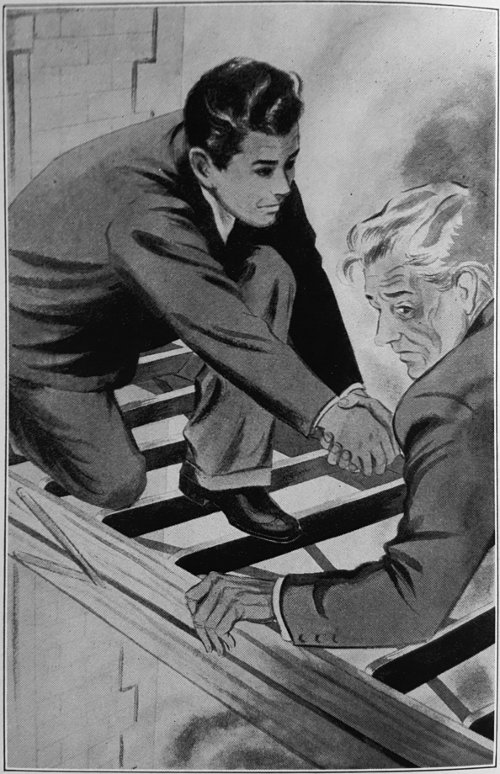
Seizing it, he hurried back to the window. He was
relieved to see the old man standing where he last
had been, silhouetted against a wall of flickering
flame.
Flash pushed the ladder through the open window
and across the narrow areaway to the opposite ledge.
It barely bridged the gap.
“Get out on the ledge!” he shouted encouragingly.
“Crawl over! I’ll steady the ladder!”
46
The old man, his face ghastly in the weird light,
climbed through the window to the stone ledge. There
he cowered, his back to the brick wall, afraid to trust
himself to the ladder.
“Come on! Hurry!” Flash urged impatiently.
“It’s your only chance! The building can’t last much
longer.”
The old fellow stared at him in a stupid, bewildered
way. Even the searing fire in the room behind, could
not drive him to attempt it. Flash realized that he
was only wasting precious time.
Hesitating only an instant, the photographer swung
his legs through the window. Testing the ladder to
make certain it was firmly in place, he crawled nimbly
toward the man on the opposite ledge. Halfway
across he glanced down. Through the rolling clouds
of smoke, he caught a fleeting glimpse of the street
five stories below.
For a moment his courage nearly failed him. He
clung tightly to the ladder, fighting the wave of dizziness
which swept over him. Then, gaining control
of himself, he crawled the remaining distance, and
reached out a hand to the terrified man.
“I’m afraid,” the old fellow whimpered piteously.
“I can’t do it. The ladder might slip. I can’t.”
“Do you want to burn?” Flash demanded. “Come
on, before it’s too late!”
47
He seized the old man by the coat and pulled him
out on the ladder. For a fearful second he thought
that they both might lose their balance and plunge to
the street. But once on the ladder, the old fellow
maintained a measure of self-control. Although he
whimpered with fear, he did not clutch Flash or struggle
against the grasp of his arm.
Inch by inch the young photographer backed toward
his own window and safety. He kept hold of
the old man’s coat, steadying him and lending him
confidence.
“Don’t look down,” Flash commanded. “Keep
your eyes on the window.”
The ladder beneath them creaked and groaned, and
as the old man made a jerky movement, one end
slipped slightly.
“Steady,” warned Flash.
They remained motionless and the ladder settled
back into place.
“Another foot and we’ll be there,” Flash said encouragingly
as they crept on once more.
He reached the ledge. With a sigh of relief he felt
his feet swing over the sill and strike the floor. But
just as he relaxed, the ladder gave a convulsive movement.
As it tilted, unburdening its human cargo,
Flash clung desperately to the old man.
48
The ladder struck the street with a resounding
crash. The old man had started to plunge with it, but
his fall was broken by the powerful grasp of the
photographer’s muscular arms. Flash, too, was half
pulled through the window. He fought with strong
leg and back muscles to maintain his balance.
Terrified by his plight, the old man gave a choked
cry and struggled frantically. His wild contortions
made the task of pulling him to safety all but impossible.
Flash’s heart began to pound from the intensity
of the effort. Yet it never occurred to him to
release his hold on the man’s wrists.
Exerting his utmost strength he pulled the old man
up a few inches, only to feel him slip back a greater
distance. And Flash was slowly being dragged across
the sill by the old man’s weight. Flash could see the
street far below, momentarily clear of smoke. A
shiver wracked his exhausted body. Unless help came
quickly they both would plunge to their deaths!
Smoke swirled in Flash’s face, and the intense heat
from the areaway sapped his little remaining strength.
His heart felt as if it would hammer itself from his
breast. His breath came in panting gasps.
Once more he made a valiant effort to pull the old
man to safety. Again he failed. Inch by inch they
both were slipping downward. His knees were losing
their grip under the sill. In another instant he and
the man he sought to save would plunge to the areaway
below.
49
Even as he abandoned all hope, Flash felt himself
firmly grasped by the legs. Slowly but steadily he
was hauled back through the window.
The strain upon the young photographer’s arms
was terrific, yet he clung desperately to the old man.
Both were drawn through the opening to safety.
Spent by the ordeal, they slumped on the floor.
Flash saw then, that his rescuer was the same fireman
who previously had been in the building.
“Thanks,” he gasped gratefully. “I thought it was
curtains for sure.”
“Would have been in another minute,” grunted the
fireman. “When that ladder crashed to the street I
knew something was wrong up here. Couldn’t see on
account of the smoke.”
The old man had passed out completely. Stooping,
the fireman gathered him up and slung the inert
body over his back.
“Let’s get out of here,” he said.
Flash heard the words as if from a long distance.
He tried to follow the fireman but his feet refused to
move. Every muscle seemed paralyzed. He weaved
sideways, dizzy from the heat.
Then quietly, he crumpled.
50
CHAPTER VI RESCUE
When Flash opened his eyes, a cool breeze
blew over his seared face. He was lying on the
ground across the street from the burning apartment
building. A member of the rescue squad stood over
him.
“You’ll be all right now,” he said.
Flash stirred and sat up. He rubbed the back of
his hand across his burning eyes. For a moment he
could remember nothing. Then, with recollection, a
wave of panic washed over him.
“My camera!”
“It’s safe,” said the rescue squad man. “And your
equipment bag. Both right here. What paper you
from?”
“The Ledger.”
“Too bad you didn’t get a picture of your own
rescue job.”
“Yeah,” grinned Flash. “That would have been a
shot!”
“Nice going, son. You had plenty of nerve.”
51
“How is the old man?” asked Flash.
“Doing all right. We sent him to St. John’s Hospital.”
“And who brought me out of the building?”
“Oh, one of the boys,” the rescue squad man answered
carelessly. “The heat got you.”
“Something hit me like a ton of bricks,” grinned
Flash. “Well, I’m glad just to be alive. How long
have I been out?”
“Only a few minutes.”
Flash scrambled to his feet and stood supported by
the other man.
“Feel okay now?”
“I’m still groggy, but my head is clearing. I must
rush my pictures back to the Ledger office.”
With a few hasty words of thanks, he gathered up
his equipment, and started for the corner where he
could catch a taxi. The apartment building had
fallen, and the fire companies were playing their hose
in full streams upon the adjoining building. It, too,
might eventually go, but the coal yards would be
saved.
As he strode into the Ledger building, the elevator
man stared at him.
“What’s happened to your eyebrows?” he asked.
“Looks like you’ve been in a fire.”
52
Flash squinted at his reflection in the elevator mirror.
Not only his eyebrows but some of his hair as
well had been singed off. His clothes were mussed
and his blistered face was smeared with soot.
“Rush me up to three,” he said crisply.
“Yes, sir.” For the first time since Flash had
started work on the Ledger, the elevator man addressed
him in a tone of deep respect.
The only other passenger in the cage was Old Herm,
the watchman. He, too, regarded the young photographer
with more than average curiosity.
“Where was the fire?” he inquired.
“The Elston Apartment district.”
“Get some good pictures?”
“I think so.” Flash could not hide his triumph.
“Maybe they’ll be good enough to pull me out of the
dog house.”
Old Herm nodded and grinned in a friendly way.
“You’ll make the grade, son. You’ll make it,” he
muttered. “Heard you’ve been havin’ bad luck, but
it can’t keep breakin’ wrong forever.”
Flash slammed through the wooden gate into the
newsroom. A reporter assigned to the fire story already
had filled three long sheets of copy paper, and
so news of the young photographer’s rescue work had
traveled ahead of him.
The night editor actually beamed as Flash went
past the slot.
53
“Guess you were the right man for the job,” he
praised. “Rush your pictures through. Ralston and
Forrest are on the job now, but they won’t get back
for awhile.”
Flash nodded and hastened on to the photography
department. The door of the darkroom was closed.
He rattled the handle.
“Anyone inside?”
Fred Orris answered in a curt voice. A few minutes
later, he opened the door, regarding Flash with a cold
gaze.
“What’s the big rush?”
“I want to develop some pictures of the fire,” Flash
responded briefly.
“What were you doing at the fire?” Orris demanded
in surprise. “Special assignment?”
Flash nodded. “A lucky break for me,” he said.
“Tell you about it later.”
As he closed himself into the darkroom he heard
the older man mutter: “That’s your middle name—Luck!”
The fresh hypo bath which Orris had just finished
mixing was strong and offensive. Flash placed his
films in the tank, set the timer, and then kept the
negatives agitated during the developing process.
The excitement of the past hour had buoyed him up.
But now as he waited, he suddenly felt sapped of all
energy. A fear that his pictures might turn out
worthless, took possession of him.
54
“One more mistake and I’ll be finished,” he thought.
When the alarm went off, he quickly removed the
negatives from the developer. He drew a deep sigh
of relief. Of the seven pictures he had taken, six had
come up clear-cut and definite with white and black
contrasting sharply. One was indistinct, but would
be printable with special treatment.
Flash chuckled. Unless he greatly over-estimated
the pictures, they were the best of his career. Why,
he might even win a by-line for himself! He could
visualize the caption—“Photographs by Jimmy
Evans.” Only a simple line which few newspaper
readers would notice. But to a photographer it
meant everything.
Flash returned the films to the water, and opened
the door of the darkroom. Orris was still outside,
talking with Joe Wells who had wandered into the
department on his way home from a movie.
“Hi, there, Flash,” he called with a friendly smile.
“I hear you’ve covered yourself with glory. How did
they come out?”
“Pretty fair,” returned Flash. “Want to look at
them?”
55
Wells and Orris both followed him back into the
darkroom. They studied the negatives with the critical
gaze of experts, searching for defects and finding
none.
“Swell pictures,” said Wells heartily. “Wish I’d
taken them myself.”
Fred Orris’ only comment was a curt suggestion as
to the number of printing paper which should be used.
“Jealous,” thought Flash. “At least he might have
loosened up enough to give me a compliment.” Aloud
he said, “Oh, by the way, I wonder if I could have a
key to the department? I was locked out today and
had trouble getting Old Herm to let me inside.”
“I’ll see you have one by tomorrow,” Orris promised.
After the older man had moved to another part of
the room, Joe Wells praised Flash again for his fine
work, and demanded all the details of his thrilling experience
at the fire.
“Too bad you didn’t get a shot of yourself hanging
to the old man’s wrists!” he chuckled. “What a picture
that would have made!”
“I wasn’t worrying about pictures at that moment.
I was trying to save my neck! Orris doesn’t seem to
think much of my work.”
Wells shrugged as he turned to leave. “Oh, you
can’t tell what that bird thinks by how he acts. Keep
on the way you’ve started and you ought to get a
raise. See you tomorrow.”
56
Flash took another look at his negatives and then
while they were soaking, went to wash some of the
soot and grime from his face. Fairly presentable
again, he returned to the photographic department.
Orris, who seemed to be writing a letter at his desk
did not glance up.
Entering the darkroom, Flash removed the films
from the tray. In the act of carrying them to the
drying drum he suddenly paused and stared. For an
instant he thought he had taken the wrong negatives
from the tank, that his pictures had been mixed with
those Orris had been making.
Frantically he examined the films. They were his,
but so badly streaked that they never could be used.
Not a single one had been spared. His entire work
was ruined!
57
CHAPTER VII DARKROOM DIFFICULTIES
The extent of the catastrophe nearly overwhelmed
Flash. Jerking open the darkroom
door, he called hoarsely to Fred Orris.
“Now what?” the man demanded impatiently.
“I wish you would look at these negatives.”
The urgency of Flash’s voice brought the older
photographer to his feet. He studied the streaked
films one after another.
“They’re ruined,” he said, with no show of sympathy.
“What did you do to them?”
“Nothing. The films were all right when I went to
the wash room. I left them soaking. I wasn’t gone
ten minutes.”
“What developer and hypo did you use?”
“The same you had mixed.”
“Well, you must have done something unusual,”
Orris snapped. “My pictures came out all right.
Sure you didn’t add any extra chemicals to the
tanks?”
58
Flash shook his head. “I can’t understand it,” he
mumbled. “The pictures were okay when I left them.
Someone must have tampered—”
“See here, Evans,” Orris broke in sharply, “don’t
try to pass the buck. No one around here would have
any interest in ruining your films. In any case, I’ve
been sitting at my desk most of the time.”
“I wasn’t trying to offer an alibi. I can’t understand
it, that’s all.”
“Let me tell you this, Evans. In professional news
photography nothing pays off except knowledge.
Guess work won’t get you far. Darkroom procedure
must be scientifically exact.”
Flash crumpled the damp films and dropped them
into a waste paper basket. With an effort he kept
from making an angry retort. Orris deliberately was
rubbing salt into sore wounds.
“This means my job, I suppose,” he said bitterly.
“Well, you hardly can expect to learn at the paper’s
expense,” Orris shrugged.
The outside door opened and the two photographers,
Ralston and Forrest, their clothing scented
with smoke, strode into the room. Shedding their
cameras and coats, they started to enter the darkroom.
“Better mix new developer and hypo,” Orris said
curtly. “The kid just ruined his entire batch of
films.”
59
Ralston gazed at Flash, and whistled softly.
“Tough,” he said. “Heard you were the first photographer
on the scene, too.”
“Evans has a good pair of legs,” Orris said with
pointed sarcasm.
Flash could endure no more. Jamming on his hat,
he left the department, slipping down the back stairway
so he need not pass through the news room. In
the rear vestibule he met Old Herm who spoke cordially.
“What’s the matter, young feller?” he inquired.
“You look down in the mouth.”
“Pictures ruined,” Flash answered briefly. “Just
when I had a chance to make a good showing for myself,
too.”
“Shoo, you don’t say!” Old Herm exclaimed. “How
did it happen?”
But Flash was in no mood to tell his troubles.
Making a non-committal reply, he passed on to the
street.
Angry thoughts poisoned his mind. There was no
denying that Fred Orris had taken a distinct dislike
to him. The photographer’s smug attitude of satisfaction
over the outcome of the fire pictures, made it
clear that he would be glad to see him out of the office.
60
“I don’t believe it was anything I did which ruined
those films,” Flash reflected. “Either the chemicals
Orris mixed were no good, or someone doctored the
tanks while I was gone! But Orris was in the department
all the while. Could he have been guilty of
such a low trick?”
Flash was ashamed of the thought and dismissed
it as quickly as it entered his mind. No use trying
to alibi his failure. The deed was done. He alone
must accept responsibility for the result. As Orris
had said, he couldn’t expect to learn at the paper’s
expense.
Dreading to go home, Flash wandered into Joe’s
hamburger shop, loitering there until the night edition
of the Ledger reached the street. Then he
bought a copy.
The paper carried three excellent photographs of
the fire with no identifying by-line to tell whether
Ralston or Forrest had taken them. It gave him a
measure of satisfaction to note that from the standpoint
of subject matter they were not as interesting
as those he had snapped and ruined.
61
Also on the front page appeared Flash’s own name,
together with a vivid account of his rescue act. He
learned that the elderly man he had saved was John
Gelette, an ailing tenant who had occupied the same
apartment building for nearly twelve years. The old
fellow, becoming confused at the outbreak of the fire,
had wandered about in a daze, unable to locate an
exit.
Flash stuffed the paper into his pocket and walked
home. A warm supper and words of comfort awaited
him there.
“I’m proud of you, Jimmy,” his mother said tremulously
after she had read the story in the paper and
heard his own account. “It doesn’t matter about losing
the job. You’ll find another.”
Flash shook his head. “Not in Brandale. If you’re
fired from one newspaper, word gets around. No
other sheet will take me.”
“You’ve not actually been discharged yet, Jimmy.”
“Orris the same as told me I’m through. No use
going back tomorrow.”
“Mr. Riley hired you, didn’t he?”
“Yes.”
“Then I would consider myself still on the staff
until Mr. Riley discharged me.”
Flash refused to be cheered. “I was in bad even
before this happened,” he said gloomily. “No use
going after my pay check. I’ll let the cashier mail it.”
62
Next morning when the alarm clock jingled at six-thirty,
Flash aroused only to shut it off and fall back
on his pillow. With no job awaiting him he could
stay in bed as long as he liked. His muscles were
battered and sore from the ordeal of the previous
day. He felt as if he could sleep forever.
For a time, thoughts raced rampant in his tortured
mind. Then he dropped off into troubled slumber
again to be tormented by wild nightmares. He awoke
once more to find himself gasping for breath and
clawing the bed clothes.
His sister, Joan, was pounding on the door.
“Get up, lazy bones!” she called. “It’s ten after
eight.”
Flash groaned and rolled over. “Go away and
leave me alone,” he mumbled drowsily, burying his
head deeper into the pillow.
“You’re wanted on the telephone!” screamed Joan
at the top of her lungs. “It’s the Ledger office!”
Flash leaped from bed. Pulling on his robe, he took
the stairs two at a time, and snatched up the telephone
receiver.
“Hello, Evans?” barked Riley’s voice. “What in
blazes is the matter with you? Why didn’t you show
up this morning?”
Flash was too startled to make a coherent reply.
“I thought—that is, Orris said—”
“You deserve to be fired,” snapped Riley, “but
when you’re through, I’ll tell you so! Now grab a
taxi and get down to Dock 10. Two freighters collided.
We want pictures right away.”
63
“I’ll get there as quickly as I can!” Flash exclaimed.
Bewildered by the unexpected turn of events, he
darted back upstairs and quickly dressed.
“Jimmy, you’re not leaving without a cup of coffee,”
his mother protested as he raced down again.
“Can’t stop for anything,” he answered, pulling on
his overcoat.
Hailing a cab, Flash paused at the Ledger building
only long enough to pick up his camera equipment
and then drove on to Dock 10. Hiring a launch, he
motored out to the two vessels, took his pictures, and
was back at the office in record time.
“Want me to help you develop those?” Fred Orris
inquired, with a faint suggestion of a sneer.
“No, thanks,” Flash replied shortly.
Joe Wells, who was near, followed him into the
darkroom and closed the door.
“Guess you heard what happened to my fire pictures,”
Flash said in a low tone. “I can’t figure out
what went wrong.”
“Neither can I,” answered Wells. “I fished those
films out of the basket and looked at them. Never
ran into anything just like it before. Now you go
ahead and develop these films while I watch.”
64
With the photographer standing at his elbow, Flash
followed exactly the same procedure which he had
used the previous afternoon. The ship pictures came
up quickly with good contrast.
“They’re all right,” said Wells with emphasis.
“Orris can’t kick on those, or Riley, either.”
“My fire pictures were good, too. Something happened
to them while they were in the water.”
“Who was here after you left?”
“Only Orris so far as I know. You don’t think he
would play a dirty trick just to get me fired?”
“I hear Orris has a nephew he’s been trying to get
into the department for over a year,” Wells remarked
thoughtfully. “Still, I’m sure he wouldn’t do it. Orris
may be a crab but he’s not a snake.”
Anxiously, Flash washed his films, watching for
streaks or defects. From a photographic standpoint
they were nearly perfect. With Wells hovering near,
he dried the negatives and made his prints.
“Nothing wrong with your technique as far as I can
see,” said the older photographer. “Those pictures
are good enough to suit anyone.”
The prints were rushed to the news room. Flash
waited to hear from Riley. When no word came he
knew that his work was satisfactory.
Later in the morning he was sent with Wells to take
pictures of a warehouse strike. Again, while not exactly
covering himself with glory, his shots were equal
to those of the more experienced photographer.
65
“I can’t get over the shock of still being on the
payroll,” he confessed to his friend as they lunched
together. “After what happened yesterday I was sure
I would be fired.”
Wells gave him an amused glance. “Then Riley
didn’t tell you?”
“He hasn’t said a word to me all day.”
“Flash, some folks are just naturally born with a
rabbit’s foot,” Wells grinned. “You’re one of ’em.
Know who that old man was you rescued yesterday?”
“I saw in the paper his name was John Gelette.”
“Which means nothing to you?”
“Can’t say it does.”
Wells bit into a doughnut. “To tell you the truth,
I never heard of the old duffer myself until yesterday,”
he admitted. “But it turns out he’s a first
cousin to Cordell Burman. I trust you’ve heard of
him?”
“The owner of the Ledger!”
“Exactly,” responded Wells dryly. “No one needs
to teach you the secret of getting on, my lad. Your
job is safe for awhile. In fact, I shouldn’t be surprised
if you found a raise tucked into your next pay
envelope.”
66
CHAPTER VIII “ HELLO, HERO ”
Joe Wells’ words proved prophetic. When the pay
checks were handed out Saturday night, Flash’s
salary had been increased from twenty-five to thirty
dollars. After the first thrill of surprise, the raise
gave him no lasting pleasure. He knew he hadn’t
actually earned the money.
Then, too, in some manner word circled the office
by means of the “grapevine” system that he had been
singled out for Cordell Burman’s favor. Fred Orris
treated him with increasing austerity, seldom missing
an opportunity to make cutting remarks. The other
photographers, save Wells, remained aloof, no doubt
feeling that they had been slighted. Flash could not
really blame them.
He did his work efficiently, giving Orris and Riley
no chance to criticize. The freighter pictures earned
him a measure of respect, but in the days following he
was given only routine assignments.
One morning he was waiting for the elevator when
two reporters came down the hallway together.
67
“Anything new on the Elston fire, Bill?” asked one.
“Nothing you dare print,” shrugged his companion.
“I was talking with the Fire Chief yesterday. I
gathered that he thought the fire had been set, but I
can’t get anything definite out of him. The arson
squad refuses to discuss the matter.”
Flash digested this bit of information as he rode up
to the third floor. Entering the news room, he became
aware of a tense atmosphere of excitement. Riley
saw him, and motioned him to the desk.
“Evans, I want you to get out to the airport. We
have a special plane coming in at 10:15 with exclusive
pictures of that big airliner crash in the Pennsylvania
mountains. Rush them right back so we can get ’em
on the wire!”
Flash nodded. The morning papers had carried a
front page account of the airliner disaster which had
shocked the nation, taking a toll of eleven prominent
persons. No pictures had appeared, for the accident
had occurred in an isolated region of the mountains.
A correspondent for the Ledger, one of the first men to
reach the scene, had taken camera snaps, sending
them by special chartered plane.
Flash glanced at the downstairs clock as he left the
building. It was only 9:40. He would have ample
time to reach the airport before the plane was due to
arrive.
68
Boarding a bus, he rode to the outskirts of the city.
Alighting at the main entrance to the airport grounds
he noticed Luke Frowein coming through the gate.
“Hello, Hero,” the photographer greeted him flippantly.
“Looking for a fire?”
“I’m only an errand boy this time,” Flash replied.
He would have passed on, but Luke deliberately
halted, blocking the way.
“What’s going on out here?” he asked curiously.
“Picking up pictures, eh?”
“You’ve guessed it.”
“There’s no plane due at this hour.”
“Oh, we have a special coming in at 10:15,” Flash
revealed carelessly.
A shrewd, calculating look came into the Globe
man’s gray eyes.
“Must be something pretty good to merit a special
plane. Not by any chance exclusives on the Pennsylvania
crash?”
“Maybe.” Flash started to move on.
“Wait a minute,” said Luke. “If you’re going into
the station, Mr. Clausson wants to see you.”
“Who is he?”
“President of the Triway Aviation Company. He
was asking me a minute ago if I had seen you lately.
It may be something fairly important. Better catch
him before he leaves.”
69
“I never met Mr. Clausson in my life,” declared
Flash. “Why would he be asking for me?”
“Don’t know,” Luke shrugged. “He may want you
to take some publicity pictures. Better see him at
any rate.”
Flash walked on toward the station. It still lacked
five minutes before the special plane was due to arrive.
He entered the building and spoke to one of
the clerks.
“Has Mr. Clausson been here this morning?”
“Left only a minute ago,” the man answered. Moving
to the window, he pointed out a figure which could
be seen walking slowly toward a hangar at the far
end of the field. “If you hurry you may be able to
catch him.”
“Thanks.”
Flash walked as fast as he could, overtaking the
man at the doorway of the Triway hangars.
“Mr. Clausson?” he inquired.
“That’s my name. What can I do for you.”
“I’m Flash Evans from the Ledger.”
“Well?”
Flash was somewhat taken aback by this strange
response.
“Didn’t you wish to see me, sir?” he inquired.
Mr. Clausson shook his head. “What gave you
that idea?”
70
“I was told by Luke Frowein that you were looking
for me.”
“Luke Frowein?” the airline official repeated.
“Never heard of him.”
Flash’s lips tightened into a grim line. “I guess
I’ve been made the butt of a joke,” he said. “Sorry
to have bothered you.”
Turning, he started back toward the station, angry
thoughts racing through his mind. Luke Frowein
had played a shabby trick upon him! He had been
stupid to trust the fellow.
The loud drone of an airplane motor caused Flash
to glance overhead. A silver-winged monoplane was
gliding down over the telephone wires for a fast landing.
He knew that it must be the specially chartered
Ledger plane.
Flash hurried faster. He lost sight of the plane
as it dropped below the level of the station building.
But upon reaching the runway a minute or two later,
he saw that the ship had taxied up to one of the gasoline
pumps. He ran toward the pilot who had climbed
out of the cockpit.
“Is this the Ledger plane?” questioned Flash
tersely.
“That’s right,” the pilot responded.
“May I have the pictures?”
71
“Pictures? I just gave them to a fellow named
Evans from the Ledger.”
“But I’m Evans!”
The pilot stared. “Then someone has pulled a fast
one! Fellow in a gray suit stepped up as I landed
and said he was Evans from the Ledger. I gave him
the package.”
“Luke Frowein, a Globe man!” Flash explained
grimly. “And I was dumb enough to fall for the
trick!”
Whirling, he ran down the cement, through the
station, to the main gate. There was no sign of Luke
Frowein.
A taxi cruised slowly past. Flash quickly hailed it.
“To the Globe building!” he ordered tersely. “I’ll
give you an extra buck if you step on it!”
The cab roared along the highway at fifty miles an
hour, slowing down only when it reached the city
limits. Flash kept close watch of other automobiles
as they dodged in and out of traffic, but caught no
glimpse of the man he pursued.
Presently the taxi pulled up in front of the Globe
building. Flash leaped out, and paying the extra fare
he had promised, hurried inside. Although the trip
from the airport had been made in record time, he
was afraid he had arrived too late.
72
He pressed his finger on the elevator button and
held it there until the cage descended.
“What’s the big idea?” demanded the elevator man
indignantly. “I can’t hurry no faster.”
“Has Luke Frowein been here in the past fifteen
minutes?”
“No, he ain’t,” the man snapped. “Anyway, he
usually comes in the other door.”
Flash ran around to the rear entrance of the building.
As he turned the corner, a battered press car
wheeled into the loading dock and stopped with a
lurch. Luke Frowein climbed down. With a friendly
wave of his hand at a trucker who was loading papers,
he proceeded toward the rear entrance.
Flash had stepped inside the deserted vestibule
beyond view. He waited.
Whistling a cheerful tune, Luke Frowein entered
the building. He quickly broke off as he observed
the young photographer.
“That was a dirty trick you tried to play on me!”
accused Flash. “Give me my pictures!”
Flash could see a flat, bulky package protruding
from the photographer’s overcoat pocket. He tried
to seize the parcel. Frowein pushed him roughly back
against the wall.
73
“Keep your hands out of my pockets!” he ordered
unpleasantly.
The cage of the freight elevator had started to descend
slowly from the sixth floor. In another minute
Flash knew the elevator man would be there to aid
Frowein. He acted instinctively.
His right arm coiled back, then lashed out in a
swift, sure arc. At the end of that arc, Flash’s
knuckled fist exploded against the photographer’s
chin. Thrown off balance, Frowein reeled, and fell
backwards, sprawling awkwardly on the stairway.
Before he could get up, Flash leaped on him and
jerked the package from his overcoat pocket. One
glance convinced him he had made no mistake. The
package plainly was marked for the Ledger.
“Hey, get off, will you!” Frowein growled. “Can’t
you take a little joke?”
Flash coolly pocketed the package before removing
himself from Frowein’s mid-section.
“Your brand of humor doesn’t appeal to me,” he
retorted. “And I doubt if it would make such a hit
with your editor either!”
“See here,” Frowein protested in quick alarm,
“you’re not going to spill this, are you? It was only
a joke.”
“A joke which would have cost me my job!”
74
“I could make it plenty tough for you,” Frowein
hinted defensively. “Suppose it should get out that
Deems held you up on the Gezzy-Brady fight! But
I’m not that sort of fellow. We’ll strike a bargain.
You keep your lip buttoned and so will I.”
Flash had no intention of carrying the matter
further.
“All right,” he agreed, helping Frowein to his feet.
“We’ll call the whole thing a draw.”
The Globe photographer grinned ruefully as he
rubbed his chin.
“You pack a wicked wallop,” he said grudgingly.
The cage door opened and the elevator man peered
out at the pair.
“What’s going on here?”
“Nothing,” muttered Frowein, rescuing his hat
from the stairway. “I slipped and fell, that’s all.
They ought to keep these vestibules lighted.”
Flash had turned toward the door. He could not
resist one parting shot.
“Well, so long, Frowein,” he tossed cheerfully.
“From now on, no more ‘hello, hero,’ stuff. I’m just
plain Evans to you.”
75
CHAPTER IX A CRY FOR HELP
Flash delivered the airplane crash pictures into
the hands of City Editor Riley, whose only comment
was that it had taken him long enough to make
the trip. In fifteen minutes the prints were on the
wirephoto cylinders, by means of which the photos
were transmitted to other sections of the country.
A short time later the Ledger made the street with a
back page devoted to the exclusive shots.
Not even Joe Wells heard the story of how close
the Ledger had come to being scooped by the Globe.
Flash kept the affair strictly to himself, but he had
learned a bitter lesson. While he knew there were
few persons who would stoop to Luke Frowein’s low
trickery, he never again would entirely trust a rival
photographer.
76
In the days which followed, Flash performed his
duties with quiet efficiency. He photographed fashion
shows, golf tournaments, swimming meets, and
no matter how routine the assignment, accepted it
cheerfully. His unassuming ways gradually won him
friends, both in and out of the office. However, Fred
Orris remained cold and aloof.
Now and then, if Flash worked late at night, Herm
would drop into the photography department for a
friendly chat as he made his rounds. Flash enjoyed
talking with the old fellow, but never succeeded in
drawing him out about himself. One day he questioned
Joe Wells regarding the watchman’s past life.
“Oh, he’s just a queer duck,” the photographer
replied carelessly. “His real name is Herman Ronne.
He’s been watchman at the Ledger for eight or ten
years.”
“Married?”
“They say his wife died about fifteen years ago.
He had a son, quite a promising young fellow, they
tell me. Old Herm saved and scraped to put him
through college.”
“Then I suppose the boy repaid him by going his
own way?”
“No, the boy was grateful enough, but he up and
died. Old Herm never did get over the shock. He’s
been a bit screwy ever since—goes around talking to
himself.”
“I’ve noticed the habit.”
“His work around here hasn’t been any too good
the past year,” Wells added. “But the Ledger probably
will keep him on until he dies.”
77
To Flash, Old Herm never mentioned his son or his
troubles. Instead, he showed a deep interest in the
young photographer’s aspirations and progress on the
paper.
“It does my old bones good to see a cub like you
get on,” he said heartily. “So many boys these days
want the path smoothed out for ’em or they won’t
play. But you grab the bull by the horns and dare
him to gore you. I had that kind of stuff in me, too,
when I was a lad years ago. The bull was stronger
than I was, and here I am, workin’ a watch dog job
at sixty-eight.”
It was rather difficult for Flash to imagine that
Old Herm ever had been a man to wrestle directly
with life, but he felt flattered by the watchman’s
remarks.
“You were saying the other day you remembered
my father,” he reminded the old fellow.
“Oh, yes, yes, I remember him well.”
“You didn’t by chance ever work in the old Post
building?”
Old Herm shook his head as he pulled out his
watch, a huge disc of yellow gold. “Well, got to be
movin’ along. Time to punch another one of them
infernal clocks.”
78
Saturday evening instead of going directly home
after work, Flash took dinner downtown and then
went to the Y.M.C.A. for a swim with his friend, Jerry
Hayes. It was practically the first recreation he had
taken since starting his new job on the Ledger. Every
spare moment had been spent in study and experimentation.
Now he felt he could take a little time off.
“I’m beginning to get on top of my work at last,”
he confided to Jerry. “At first it seemed as if everything
was against me, but the breaks are coming my
way again.”
The two friends spent an hour in the pool, swimming
and diving, and topped it off by taking part in a
rough, exhausting game of water polo. After their
showers, they dropped into Gus’s place for hamburgers
and huge slices of apple pie.
“My treat, this time,” grinned Flash, slapping a
dollar on the counter. “I can afford it now. Wish
they would hand me another raise, though.”
“Can’t you manage to save another John Gelette
or marry the boss’s daughter?” joked Jerry.
“Never will live that rescue down. I want to earn
my next pay raise, if I ever get one!”
While they ate, Flash showed Jerry copies of some
of his better pictures, many of which had been printed
in the Ledger.
“You sure like your work, don’t you?” Jerry asked.
79
“I’d rather be a newspaper photographer than anything
else,” Flash answered. “You work long hours,
risk your life, perhaps, but when an editor says ‘get
that picture,’ it fires your blood! The tougher the
assignment, the better you like it.”
Jerry shrugged as he climbed down from the stool.
“Every man to his taste,” he said. “I think I’ll
stick to being a lawyer or maybe a dentist.”
The big clock on the Fisher building chimed eleven
as the two friends left the hamburger diner. The
evening was warm, and they sauntered slowly down
the street, rather reluctant to return home. But at
length Flash said:
“Guess I ought to hit the hay. The old alarm goes
off regularly at six-thirty these days.”
“It is getting late,” Jerry agreed.
They cut through an alley to a deserted street on
the bus route. As they stood waiting, a muffled cry
reached their startled ears.
“What was that?” Flash demanded, whirling
around. “Sounded like someone yelling for help.”
The street was empty of pedestrians. For a moment
they were unable to localize the strange cry.
Actually it had seemed to come almost from beneath
their feet.
“Must have been in one of the buildings!” exclaimed
Jerry. “Maybe this furniture store!”
80
He and Flash stood directly in front of the Sam
Davis Home Supply Company. Only a few steps
away was an iron ventilating grating anchored in the
sidewalk. They both thought that the cry might have
carried to them from the basement of the building.
Flash and Jerry waited for the call to be repeated.
There was no further sound to disturb the tranquillity
of the street. But suddenly, a door opening into the
alley was flung wide. From the furniture store bolted
a man in a dark suit, hugging something close beneath
his coat.
He started toward Flash and Jerry. Then, observing
them, he wheeled and ran in the opposite
direction.
“Let’s get him!” exclaimed Flash.
They took to the alley in pursuit of the man who
proved to be astonishingly agile and quick-witted.
Vaulting over a wooden fence, he raced through a
yard and disappeared between two buildings.
When Jerry and Flash reached the place an instant
later there was no sound of footsteps or any clue to
tell them which way the fellow had gone. They
searched between the buildings and looked up and
down the streets.
“May as well give it up,” Jerry said in disgust.
“He’s blocks away by this time. Wonder what he was
up to anyhow?”
“Robbery, like as not,” answered Flash. “Let’s
go back and see what we can learn.”
81
The side door of the furniture store building remained
slightly ajar. Flash kicked it farther open
with the toe of his shoe.
“Anyone there?” he called.
There was no answer. Flash stepped inside the
dark vestibule, sniffing the air.
“I smell smoke, Jerry!”
“So do I!”
With one accord they rushed down a flight of
wooden steps to the basement. Flash groped for a
switch and finding it, flooded the room with light.
Dense, black smoke was pouring from an adjoining
doorway. They could hear the faint crackling of
flames.
Rushing into the furnace room, Flash and Jerry
stopped short. A wall of fire met their gaze. And on
the cement floor, writhing and twisting, lay a man,
bound and gagged.
82
CHAPTER X THE MISSING PICTURES
Flash leaped forward. Pulling a knife from his
pocket, he slashed at the ropes which held the
man a prisoner. Jerry jerked off the handkerchief
gag, and pulled him to his feet.
“Thanks!” gasped the man. “Now turn in a fire
alarm quick, before my building goes up in smoke!”
Jerry ran out to the street, while Flash and the
building owner turned on the disconnected sprinkler
system. In addition they used buckets and hooked
up a hose, keeping a steady stream of water playing
on the blaze. By the time Jerry raced back, they had
the fire well under control, while the sprinkler system
would complete their work.
“Guess we won’t need the fire department after
all,” murmured Flash, gazing at the blackened wall.
He turned to the building owner. “What happened
anyway? Who tied you up?”
83
“I’ll tell you!” the man said excitedly. “My name
is Sam Davis. I own this building. Two weeks ago
I was approached by a man who represented himself
as Judd Slater, an agent for the North Brandale Mutual
Insurance Company.”
“Never heard of it,” commented Flash.
“Nor has anyone else! It’s a dummy company, set
up for the sole purpose of forcing building owners to
pay exorbitant sums for protection.”
“A racket?” asked Jerry.
“That’s the way I figured it. And tonight proves
I was right! If I had paid over eight dollars a week,
I was assured my building would be safe from fire
and damage.”
“You refused, I suppose?” inquired Flash.
“I did,” Sam Davis said with emphasis. “But I
figured they would try to get me. So I had this sprinkler
system installed. Then I made a point of keeping
special watch of the building. The last few nights
I’ve been sleeping here.”
“You surprised someone firing the building?” questioned
Flash. “That fellow we saw running away?”
“He surprised me,” Sam Davis answered ruefully.
“I was pretty tired, and nothing had happened for
the past two weeks. I must have been sleeping like a
log not to hear him enter the basement. He had set
the fire before I aroused. Then I let out a yell for
help but he overpowered me before I could do a
thing.”
“Trussed you up and left you to burn?”
84
“Sure,” said Sam Davis. “Figured a dead witness
couldn’t carry any tales to the police!”
“Did you get a good look at the man?”
“It was dark in here. But I know it wasn’t the
same man—Judd Slater—who originally tried to
shake me down.”
“The fellow Jerry and I chased down the alley was
about my height,” Flash contributed thoughtfully.
“He wore a dark suit and a floppy-brimmed hat. Not
much to go on.”
“I’d know the man by his voice if ever I ran into
him again,” declared Sam Davis. “He had an unusual
way of pronouncing his words. Oh, yes, another
thing! He began nearly every sentence with,
‘Listen, you!’”
“You’ll report to the police, of course?”
“Oh, sure!” The building owner shrugged. “But
what good will it do? They’ve known for months
that this sort of business was going on, but they can’t
get evidence which will stand up. The gang is a big
one and the higher-ups are too clever to be caught.”
“Mind if I take a picture or two?” Flash questioned
abruptly.
“A picture? What for?”
“I’m Evans, a photographer for the Ledger,” Flash
explained. “My paper may be able to use the story.”
85
“Go ahead. I’d like nothing better than to see this
so-called North Brandale Insurance Company exposed.
Take as many pictures as you like.”
“You’ll have to hurry,” added Jerry as he heard
the wail of a fire siren from far down the street.
“We’re going to have visitors.”
Flash seldom went anywhere without his miniature
camera and a few extra flash bulbs tucked in his
pocket. He was grateful now for the habit which
made it possible to take advantage of a golden opportunity.
He snapped two pictures of Sam Davis,
one showing him trussed up, and another against a
background of smoking ruins. As he finished, firemen
clomped down the stairway.
“Don’t need you boys,” the building owner called
cheerily. “Fire’s out. Thanks to these young fellows
here.”
Flash and Jerry waited while the firemen inspected
the basement. The odor of gasoline was strong. In
poking about on the floor, one of the men found the
remains of a rubber bladder which had been used to
start the fire.
“I saw how the fellow did it!” Sam Davis revealed
excitedly. “The bladder was filled with gasoline.
Then he started a little fire beneath it. The heat
made the bladder explode, and the flames spread
everywhere. It’s a miracle I wasn’t burned.”
86
Flash took a picture of one of the firemen examining
the device, and then with Jerry, slipped quietly
away. On the street, they paused to consider their
plans.
“You go on home without me,” urged Flash. “I
want to run over to the newspaper office and develop
these films.”
“Does the paper print tonight?” Jerry asked in
surprise.
“The last edition is out. But the Sunday editor
will want the pictures, I’m pretty sure. There’s
dynamite in this arson story, Jerry! If it should develop
that the Elston Apartment fire was set by the
same outfit—”
“No evidence to support that theory, is there?”
“None yet. But it’s been rumored that the Elston
Apartment fire was a planned job.”
“Haven’t seen anything about it in the newspapers.”
“It’s a ticklish story to print. The fire chief won’t
give out any definite information and neither will the
owners of the Elston Apartments. But it looks to me
as if these pictures I’ve just taken may have some
significance. At least, I’ll wave ’em under the editor’s
nose and see what he says!”
“I’ll be watching for them in tomorrow’s paper,”
Jerry promised, moving to the curb to board a bus.
“So long.”
87
Flash walked swiftly to the Ledger building.
Lights were burning on various floors, but nearly all
of the offices were deserted. It lacked twenty minutes
of midnight before the men who worked the “lobster”
trick would come on duty.
In the hallway Flash met Old Herm, who seemed
surprised to see him at such a late hour.
“Want I should let you into the office?” he asked.
Flash shook his head. “No, thanks, Herm. I have
a key now.”
The photography department was deserted. Closing
himself in the darkroom, Flash worked swiftly
and with precision. In five minutes time the films
had been put through the tanks. He washed them
carefully and placed them on the heated ferrotype
machine to dry.
When the prints were finished, he slipped them into
an envelope, wrote a note of explanation to accompany
them, and dropped the packet on the city editor’s
vacant desk.
As Flash went out the front door, he met Fred
Orris and an attractive young woman, obviously his
wife, entering the building. Apparently they had attended
the theatre, for Mrs. Orris still carried a program.
He tipped his hat politely and went on, well
aware that the photographer gave him a curious, unfriendly
stare.
88
“Suppose Orris wonders what I am doing here at
this hour?” he thought. “Oh, well, he’ll find out tomorrow!”
A bus, the last one until two o’clock rumbled down
the street. Flash broke into a run and caught it at the
corner. He reached home shortly after midnight,
raided the refrigerator, and finally went to bed.
At six-thirty he was sleeping soundly when the
alarm buzzed in his ear. Flash started up, and then
as the realization came to him that he need not go to
work on Sunday, he muffled it and fell back on his
pillow.
But he had been thoroughly aroused and could not
sleep again. He lay for a time staring at the ceiling.
From the street he heard the cheerful whistle of a boy
on a bicycle. The Sunday paper thudded against the
front porch.
Jumping out of bed, Flash put on his robe and stole
quietly down the stairway. He shot up the blinds and
unlocked the door.
Eagerly he stripped off the brown wrapper and
glanced at the front page of the Ledger. His fire
pictures were not there.
Flash thumbed rapidly through the paper. There
were pictures in profusion but none he had taken.
89
Finally, on the back page of Section C he found a
brief four-line news item, stating that the Sam Davis
Home Supply Store had been damaged to the extent
of two hundred dollars by fire of an undetermined
origin.
“Undetermined, my eye!” Flash exclaimed, slamming
the paper on the davenport.
Joan appeared at the top of the stairway.
“What’s the matter, Jimmy?” she asked. “Didn’t
they use your pet pictures?”
“No,” he answered briefly, “and they were good
pictures, too, with plenty of punch! Now I’d like to
know what happened this time!”
90
CHAPTER XI DISASTER AT SEA
All day Sunday Flash remained deeply depressed.
He had been almost certain that his pictures
would be used in the Ledger. They had been remarkably
clear prints, showing Sam Davis in action
poses. He didn’t like to think that the pictures had
been withheld because of policy, yet he could reach
no other conclusion.
“Your old sheet must be afraid to buck the rackets,”
commented Jerry Hayes who dropped in during the
afternoon.
“I can’t understand it,” Flash confessed. “The
Ledger has a reputation for being a fighting paper.
And there was nothing libelous in my pictures.”
“Maybe the editor was afraid to make a direct accusation
against the North Brandale Insurance Company
without proof.”
91
“That’s possible,” admitted Flash, “but it still
doesn’t explain why my pictures weren’t used. They
told a story of their own. It wouldn’t have been
necessary to implicate the insurance company. By
the way, did you ever hear of such an outfit, Jerry?”
“Never did.”
“Probably it’s a fake company, just as Sam Davis
believes. Anyway, the name isn’t listed in the telephone
directory. Looks to me as if the Ledger is
missing a chance for a big story.”
“And some good pictures,” added Jerry, grinning.
“Well, cheer up. Maybe they’ll be printed in tomorrow’s
paper.”
Upon his way to work Monday morning, Flash
bought an early edition of the Ledger. A hasty glance
assured him that his pictures had not been used.
Riley was occupied making out an assignment sheet
when Flash passed his desk. He did not glance up.
Flash hesitated, then paused and spoke.
“I see you didn’t use my fire pictures, Mr. Riley.”
“What’s that?” the editor barked.
Flash repeated his words.
“Fire pictures?” Riley demanded. “Didn’t find
anything of the sort on my desk.”
“I left an envelope with a note of explanation.
That was late Saturday night.”
“Better ask Clingston about it,” said Riley carelessly.
“He came on at midnight.”
92
Flash nodded and entered the photography department.
The room was deserted. He debated a
moment, then looked up Clingston’s telephone number
and placed a call.
A sleepy voice answered: “Yeah? Clingston
speaking.”
Flash nearly lost his courage as he realized he had
aroused the man from his bed. But he said tersely:
“This is Evans. I’m checking up on some pictures
of the Sam Davis fire. I left them on the city desk
late Saturday night.”
“Didn’t find them,” the editor answered.
“That’s funny. They were in an envelope.” Flash
described the pictures, repeating what Sam Davis had
told him.
“We could have used those shots,” Clingston said
regretfully. “Too bad they were lost.”
“I don’t see how it could have happened.”
“The janitor may have brushed the envelope into
the waste basket by mistake.”
“Shall I print them up again?”
“No use now,” Clingston returned. “The story is
two days old.”
Flash hung up the receiver just as Fred Orris entered
the office. He thoughtfully watched the head
photographer as he hung his hat on a peg.
“Orris,” he began abruptly.
“Well?”
93
“When you came into the building Saturday night
did you notice an envelope of pictures lying on the
city desk?”
“No, I didn’t,” Orris answered shortly. “What
of it?”
“I left some there—fire pictures. They disappeared
before Clingston came on duty.”
Orris shot Flash a sharp, questioning glance.
“Say, just what are you trying to suggest?”
“Nothing.”
“Well, I trust not,” the head photographer muttered
grimly. “I don’t know anything about your
pictures and care less. My wife and I dropped in
here after the theatre to telephone for a taxi. The
trouble with you Evans, you’re always looking for an
easy way out.”
An angry flush stained Flash’s face. With an effort,
he kept from making a sharp retort. Orris would
like nothing better than to draw him into a fight, and
then request his dismissal.
Getting up abruptly from the telephone table, he
went into the darkroom and closed the door. He distrusted
the head photographer more than ever now.
Orris hadn’t liked him from the day he had started
work on the Ledger. While he had no proof that the
man had destroyed his pictures, a suspicion took root
in his mind. After this he would be more careful than
ever, remaining constantly on the alert for treachery.
94
Thinking there was a possibility that the janitor
knew something of the matter, Flash sought the man.
He likewise questioned a scrub woman who cleaned
the news room at night. As he fully expected, neither
of them could throw any light upon the mystery. All
the waste paper baskets had been emptied, and if
ever the pictures had been consigned there, they were
burned.
Later that morning, Flash was testing his camera,
when Riley stepped into the office, a batch of prints
in his hand.
“Anything wrong?” Fred Orris asked in alarm.
“Nothing in particular,” Riley replied. “I was
wondering why we can’t have these pictures printed
with a duller finish. Give ’em a softer tone.”
“But Mr. Riley, all the other editors want glossy
prints.”
“Is there any reason why I can’t have a duller
finish?”
“Well, yes, there is,” Orris responded in a conciliatory
tone. “You see, the ferrotype machine only dries
the prints one way—with a gloss.”
“Then I guess I’ll have to take them this way.”
Riley shrugged and started to move off.
Flash, who had been listening to the conversation,
stepped forward.
95
“I know how you can have your dull-finish pictures,
Mr. Riley,” he stated.
“Oh, you do?” interposed Orris, an edge to his
voice. “Suppose you tell us!”
“I was trying it out the other day,” explained Flash.
“All you need to do is to place the print between blotting
paper when you put it on the ferrotype machine.”
“And what finish will it make?” Riley inquired with
interest.
“I’ll show you,” Flash offered. “I think I have a
few samples in my portfolio.”
He brought the prints. Riley glanced at them and
beamed.
“This is what I want! Orris, let me have my prints
like these.”
“As you wish,” the head photographer returned
surlily, “but I doubt if they’ll make as good cuts as
the regular glossy prints.”
After Riley had gone, Orris offered no comment.
He experimented in the darkroom, and gave orders
to the other photographers how the new prints were
to be made. While he neither praised nor criticised
Flash, his attitude made it evident that he considered
the young man something of a pest.
However, the new prints made an attractive change
in the Ledger, and Riley was pleased.
96
Three days later, after an uneventful afternoon,
Flash and Joe Wells were lounging in the photography
department, waiting for their trick to end. It was not
quite four o’clock.
“Never saw things so dull since I’ve been on the
Ledger,” Joe Wells yawned. “A few more days like
this, and we’ll be laid off.”
Flash took his friend seriously. “I’ll be the first
one to go,” he said, “because I’m the youngest man.”
“Oh, I don’t know,” Wells replied. “We didn’t
need an extra photographer when Riley hired you.
He took you on because you showed a lot of promise.
Your work has been all right, too.”
“But nothing spectacular.”
“Spectacular pictures don’t drop into a fellow’s lap
every day. You’ll get your big chance one of these
days, Flash.”
The door opening into the news room stood ajar.
From where they were they could hear the teletype
machines pounding out their news from all parts of
the country. Suddenly everyone in the office was
startled to hear a steady jingle of the signal bell, followed
by Riley’s excited shout:
“The Alexander has gone down!”
97
Flash and the other photographers ran into the adjoining
room, crowding about the teletype machine.
The first bulletin was brief, stating little more than
the bare fact that the great passenger liner had sunk
less than fifty miles from New York, following a
violent explosion. Three hundred American passengers,
nearly all of them holiday tourists, had been
taken aboard the steamship Belmonia which was making
for New York. Ten persons were known to be
dead, and thirty were missing.
“There were several Brandale passengers on the
Alexander,” Riley recalled excitedly. “We ran a
story about two weeks ago. Adams, check on that
angle!”
As new bulletins kept coming in, every department
was spurred to action. Long distance telephone calls
were placed to correspondents in New York. But
Riley felt that the story was too important to be
handled in a routine way.
“We want pictures! Lots of ’em!” he muttered.
“I have it! One of the survivors may have been an
amateur photographer—there’s always a few on every
ship! If any pictures were taken, and we can get
’em we’ll score a scoop!”
A radiogram promptly was dispatched to the rescue
ship, Belmonia, with an offer to buy any and all camera
films available from the survivors. In a comparatively
short while a reply was returned. It read:
“Eight rolls undeveloped film available. Offered at
five hundred dollars.”
98
Riley winced at the price but wired back an immediate
acceptance. He then dispatched a photographer
and two reporters by plane to New York to
be on hand when the vessel docked.
Even with arrangements made for the films, Riley
was uneasy.
“Another paper may overbid us,” he fretted.
“Then we’ll be sitting high and dry without our pictures.”
“How about meeting the ship out at sea?” suggested
Joe Wells.
Riley thought a moment and nodded. “Good idea,
if Captain Sorenson will let you aboard. He has a
reputation for being a grouch. Think you can
swing it?”
“Sure, with a good pilot. How about Dave
French?”
“I’ll charter his plane and have it waiting by the
time you reach the airport,” Riley promised. “And
I’ll radio Sorenson to be on the lookout for you. You
may be able to get some good shots of the survivors
yourself.”
“I’ll take plenty of holders,” Wells said, starting
toward the photography room.
“May as well send another man with you,” Riley
added.
99
His gaze wandered from one eager face to another.
Fred Orris moved a step forward as if anticipating
that he would be chosen. Riley’s eye traveled past
him and came to rest upon Flash.
“Evans! You’ll go with Wells. On your way out,
stop at the cashier’s desk for money. Pay whatever
you must to get those films, but don’t come back
without them!”
100
CHAPTER XII A DARING PLAN
Elated at the assignment, Flash rushed after Joe
Wells to get his own camera equipment.
“Glad Riley is sending you instead of Orris,” his
friend commented briefly.
On their way to the street, the two photographers
stopped at the cashier’s office, and were given an envelope
containing nine hundred dollars. Flash carefully
placed it in an inside pocket.
Hailing a taxi, they rode directly to the harbor
where Dave French awaited them with his seaplane
already warmed up for the trip.
“Think you’ll have any trouble contacting the
Belmonia?” Wells asked the pilot.
Dave French smiled and shook his head. “No, I
have her position. But we ought to get started so we
can get back before dark.”
Flash and Joe climbed into the cockpit. Before
the plane could take to the water, a man came out of
a building, and ran toward them, waving his hand.
“Hold it!” he shouted.
101
Dave French throttled down and waited.
“Now what?” muttered Joe Wells.
“Riley of the Ledger just telephoned,” the man
informed. “He says the captain of the Belmonia
refuses to pick up a passenger.”
“Then the trip is off!” Wells exclaimed in disgust.
“I was afraid of this. Sorenson is one of the worst
crabs on the line.”
“Did Riley say we were to come back to the office?”
Flash inquired thoughtfully.
“He didn’t say anything about that. His message
was that the captain wouldn’t pick up a passenger.”
Wells had started to climb from the cockpit, but
Flash pulled him back.
“Wait, Joe! I have an idea!”
“Spill it.”
“Riley didn’t order us not to make the trip. Why
don’t we try anyway?”
“That is a brilliant brain wave,” Wells said scornfully.
“We’d have a trip for nothing, run up a nice
bill, and get fired for our trouble!”
“Maybe not, Joe. We’d be taking a chance all
right, but I have a hunch we can get aboard the Belmonia.”
“How?”
102
“Listen, Joe, sea captains are supposed to have
humanitarian instincts, aren’t they? If Sorenson saw
a fellow swimming in the ocean miles from shore
wouldn’t steam away and let him drown, would he?”
“Sorenson might,” replied Wells. “No ordinary
trick will work with him. But what’s your scheme?”
“It’s simple. Dave flies us out to meet the Belmonia.
When we’re certain we’ve attracted attention,
one of us jumps overboard—”
“Breaking a leg, smashing six ribs, not to mention
a neck—”
“It could be done, couldn’t it?” Flash demanded
of the pilot.
“Yes, I could fly low enough so a person wouldn’t
be slapped very hard,” Dave French answered reluctantly.
“But why not land the plane on the water?”
“With a seaplane handy, Sorenson never would
pick up a fellow. My idea is to jump, then have the
plane fly back to shore.”
“And who is to do the jumping, brother?” inquired
Wells.
“I will. I’m a pretty fair swimmer.”
“Do you realize that if Sorenson doesn’t pick you
up, it would mean curtains?”
“He will,” Flash said confidently. “The only risk
is that he might not see me in the water. But if I
jump it will attract attention.”
“The idea is just crazy enough that it might work,”
Wells said slowly.
103
“I’m sure it will! Let’s try it!”
“See here! You’re overlooking one point—an important
one,” said Wells. “How are you going to
protect your money? You’ll have to keep it dry.”
“I can get you a waterproof container,” the pilot
offered quickly.
“And I can use it to protect the films after I get
them,” added Flash. “Sorenson may be decent
enough to put me off in a boat so I can contact the
plane for the return trip. If he doesn’t, I’ll jump.”
“We’ll have to arrange an exact schedule,” Dave
French declared. “How long will you need aboard
the ship?”
“Give me three quarters of an hour from the time
I first jump,” Flash decided. “That ought to be long
enough.”
“A man can drown in thirty seconds,” murmured
Wells gloomily. “But if you’re willing to try it, I
shouldn’t kick.”
A waterproof container was quickly found. Then
Dave French speeded up the motors, and the big
seaplane scooted along the water. The waves were
fairly heavy. Several times before flying speed was
attained, the ship was thrown a little way into the
air, but each time the pilot minimized the stall by
pushing the stick forward. In a moment the plane
took off smoothly and climbed.
104
Flash transferred his money to the waterproof container
which he pinned securely inside his shirt. He
divested himself of shoes and coat, but decided not to
use the life-belt which the pilot had procured for him.
He was afraid it might check his fall into the sea too
suddenly, thus adding to the shock of impact.
The plane flew steadily eastward, sighting small
sailing boats and larger vessels. Presently, Dave
French throttled down, and pointed to a large steamship
which could be seen some distance away.
“The Belmonia!” he shouted.
Flash’s pulse quickened and a queer feeling came
into the pit of his stomach. His plan had seemed
simple back on land. But now, peering down at the
ruffled surface of the water far below, he realized
what a small speck a swimmer must appear to a lookout
stationed on the Belmonia.
“Better give it up,” admonished Joe Wells, with a
worried frown.
Flash shook his head and, feeling of his money to
be certain it was securely fastened, signaled Dave
French that he was ready.
The plane drove steadily on and circled the Belmonia
twice. Flash and Joe waved, but the only
response they received was from a few of the passengers.
Obviously, the captain of the vessel had no
intention of lowering a boat so they might board.
105
“All right, I’ll jump!” Flash said. “Any time,
Dave.”
The pilot brought the plane lower and motioned
for the photographer to get out on the right wing.
While Joe helped give him support, Flash struggled
from the cockpit. The wind struck him full in the
face and, catching him off guard, nearly toppled him
from his perch before he was ready to make the
plunge. He recovered and clung tightly.
“We’ll wait to see that you’re picked up,” Wells
shouted.
“No!” Flash hurled back.
He was convinced that as long as the seaplane remained
in the vicinity, Captain Sorenson never would
rescue him.
The plane dropped lower and lower until it flew
level not more than fifty feet above the surface of
the sea. Dave waggled the wings slightly, a signal
that it was time to jump.
For an instant, Flash’s courage nearly failed him.
Never in his life had he dived more than thirty feet.
The water looked miles away. But he dared not
think about it or he would be lost.
Taking a deep breath, he jumped. As he shot
down feet foremost, Joe Wells shouted something
after him which sounded suspiciously like: “Get
names!”
106
At the moment, Flash’s one concern was to keep
from losing his balance and being toppled head over
heels in the air. He must strike the water feet first.
If he didn’t, he would suffer a nasty blow, and perhaps
crack a rib or injure his back.
Fighting a desire to look downward, he kept his
head held high. Straight as a bullet he shot downward,
gathering speed. The wind rushed past his
face, taking his breath.
Then the water loomed up and he bent slightly to
take it with as little shock as possible. Even so, he
struck it with a resounding crack and a jar which
shook every muscle.
The force of the fall plunged Flash to a tremendous
depth. He fought his way to the surface, only to
have a wave sweep over his head, burying him again.
Once more he struggled up, gasping for breath.
Taking air in great gulps, he rolled over on his back
and rested.
The seaplane had banked and was heading in the
direction of shore. Three hundred yards away the
Belmonia plowed steadily on her course.
Flash waited a moment and then began to wave
to attract attention. He felt certain the skipper of
the Belmonia must be aware of his plight, yet there
was no indication from the steamship that he had
been seen.
107
Wave upon wave pounded down upon the photographer,
burying him and cutting off his view of the
steamship. Minutes passed, and Flash’s panic grew.
The seaplane no longer was visible as a speck in the
sky so he could not expect rescue from his friends.
What a fool he had been! He had not realized that he
must battle such high waves. Unless the Belmonia
picked him up he could not hope to keep afloat until
Wells and French returned.
“Sorenson must have seen me jump,” he thought
bitterly. “But he has no intention of taking me
aboard. He means to let me drown!”
108
CHAPTER XIII ABOARD THE BELMONIA
As Flash watched with increasing alarm, the Belmonia
kept steadily to her course. Minutes
seemed an eternity. The cold water was biting into
his skin, chilling him through. An icy fear clutched
at his heart.
And then, when he had abandoned all hope, he saw
that a small boat was being lowered from the steamer.
He had been seen and would be picked up!
Minutes later two sailors hauled him over the side
into the bottom of the boat.
“They say there’s one born every minute,” remarked
a ship’s officer grimly. “After watching you
jump from that plane, I believe it!”
“Had to get aboard some way,” grinned Flash,
wriggling into a dry jacket which a sailor offered him.
“Reporter?”
“Photographer for the Brandale Ledger. I aim to
get some films our paper bought from a survivor of
the Alexander.”
“You’re lucky you weren’t drowned!”
109
“Guess I am at that,” Flash admitted cheerfully.
The sailors fell to rowing steadily, and in a short
while the boat came alongside the Belmonia.
Stepping on deck, Flash found himself confronted
by Captain Sorenson, a stern, red-faced, well-built
man of sixty, whose clipped words dropped like chips
of steel. In no uncertain language he gave the bedraggled
young man to understand that he had committed
an inexcusable offense in causing the Belmonia
to be detained. Flash accepted the berating as his
just due, responding, “Yes, sir,” and “You are quite
right, sir,” until with a shrug of impatience, the captain
took himself to the bridge.
The first mate, a man with twinkling blue eyes,
stepped forward and said to Flash in a low tone:
“That fellow over by the railing is the one who has
the films for sale. He has bought up everything on
board. I understand two other papers besides yours
have radioed him offers.”
Flash thanked the officer for the friendly tip and
hastened over to speak with the man who had been
pointed out to him. He quickly introduced himself,
explaining why he had boarded the ship. As he had
feared, the passenger immediately adopted a shrewd
attitude.
“Well, I don’t know about letting you have the
films,” he said.
110
“You made a definite deal with us,” Flash reminded
him.
“Sure, I know, but a man has a right to change his
mind. I’ve already been offered six hundred for the
films. I’d be foolish to let them go for less. These
eight rolls are the only available pictures of the explosion.”
“I’ll match the offer,” said Flash. “Six hundred
dollars.”
“I’m holding out for seven fifty.”
“We can’t pay it,” Flash replied shortly. “We’re
offering to buy your films undeveloped. They may
not be worth a dime to us when they’re printed.
We’ll be lucky if we get two or three good pictures in
the lot.”
“Seven fifty.”
“See here,” said Flash, “I risked my life to get these
films, and I don’t like to go back without them. But
six hundred is our limit. Take it or leave it.”
He was bluffing. Riley told him to pay what he
must for the pictures. But he didn’t like to be held
up. And he thought, too, that he detected signs of
weakening.
“All right, the films are yours for six hundred,” the
passenger agreed suddenly. “That is, if you’re prepared
to pay in cash.”
“I am.”
111
Flash took out the waterproof container, and to
his relief found it perfectly dry. He stripped off
several crisp bills without allowing the man to see the
extent of his bank roll. In turn, he received eight
rolls of camera film which he replaced in the holder.
His most important mission accomplished, he next
turned his attention to the survivors of the Alexander.
Every available cabin, the salons and decks were
crowded with men, women, and children, many
dressed in clothing borrowed from sailors of the Belmonia.
Circulating among the passengers, Flash found
them more than willing to tell of their experiences.
He obtained many dramatic accounts of the explosion,
the sinking of the vessel, and the timely rescue.
While the captain of the Alexander had gone down
with his ship, he talked with other surviving officers
who were able to give him a list of the known dead
and missing.
Flash worked swiftly and was ready to leave the
ship by the time he sighted Dave French’s seaplane.
Already long shadows had fallen over the water.
Within a short while it would be so dark that a swimmer
could not be seen on the surface of the sea. If
he were to be picked up, it must be quickly.
112
Approaching the mate who had seemed more
friendly than the other officers, Flash asked if he
might be put off in a small boat to make contact with
the seaplane.
“Not a chance of it,” the mate told him regretfully.
“You would only waste your breath to ask Captain
Sorenson. I’m afraid you’ll have to stay aboard
until we dock.”
Flash had no intention of losing the advantage he
had gained. He knew that if he could get back to
Brandale ahead of the Belmonia, the Ledger would
scoop every paper in the country with its pictures
and news story. There was only one way. He must
jump overboard and trust that Dave French would
be able to pick him up.
His decision made, Flash sauntered toward the
stern of the vessel. He saw the watchful gaze of the
mate upon him, but if that worthy suspected his
purpose, he gave no sign.
The drone of the seaplane grew louder, drawing
many passengers to the railing. Flash could make
out the pilot and Joe Wells in the cockpit. They
waved and he returned the signal although he was far
from certain they could distinguish him from the
other passengers.
Scrambling to the rail, he poised an instant. Then
he leaped far out, away from the turbulent waters
which boiled about the ship. Making a shallow dive,
he came to the surface a safe distance astern.
113
Rolling over on his back, he saw that the seaplane
had turned and was gliding gracefully down. It settled
easily upon the water, taxiing toward him. Flash
had only to wait to be hauled into the cockpit.
“Did you get the pictures?” Joe Wells demanded
eagerly.
Flash nodded and offered the container. There
was an anxious moment as they examined the films,
but all eight were dry.
The roar of the wind as the seaplane once more
took to the air made conversation impossible.
Wrapped in Joe Wells’ coat, Flash shivered and chattered,
and drew a sigh of relief when at last the harbor
was reached. Not until then did he tell any of the
details of his adventure.
“This day’s deed should win another salary increase
for you, Flash,” Joe said heartily. “But it
won’t do you any good if you come down with pneumonia!”
Flash borrowed a dry outfit, and the two photographers
caught a taxi back to the Ledger building.
As they burst into the newsroom, Riley, who had remained
overtime at his desk, leaped to his feet.
“We got the pictures, Chief,” Wells announced
dramatically. “Or rather, Flash did.”
114
“You both had your nerve disregarding my orders,”
Riley chuckled. “I want to hear all about it. But
first, develop those films, and let’s see what we have.”
Flash and Joe were the target of envious glances,
from the other photographers, as they entered the department.
Shutting themselves up in the darkroom,
they decided to develop the rolls of film one at a time
to avoid any risk of scratching the negatives.
The rolls were of all sizes and length. Anxiously,
Flash and Joe put the first batch through and examined
the negatives under the light. They could
make out a few blurred figures but that was all.
Every picture was so badly out of focus that it could
not be used.
“Better luck on the others—maybe,” said Joe
gloomily.
Another roll turned out to be over-exposed. Not
until they came to the seventh strip did they obtain a
single printable picture. Even so the films would
need to be specially treated, and the subject matter
was scarcely worth the bother.
“Looks as if we’ve bought six hundred dollars
worth of nothing,” Joe muttered.
Without much hope, they developed the last roll.
Almost as soon as it was dipped into the developer
fluid, the set of six pictures began to appear.
“Boy!” Wells breathed. “Maybe we’ll get something
after all!”
115
Carefully, they removed the shining strip from
the tank. For a moment neither of the photographers
spoke. Then Wells laughed aloud, so great was his
relief.
“Beauties!” he exclaimed. “Six of them!”
While his friend finished the pictures, Flash hurried
to the newsroom to report the good fortune to Riley.
The editor bade him tell the entire story of how the
films had been obtained. And a little later, when he
saw the pictures for himself, he declared that six
hundred dollars had not been too much to pay.
“Buy yourself a new suit of clothes at the Ledger’s
expense, Evans,” he said heartily. “And you may
find a little extra tucked in your pay check at the end
of the week.”
“Thank you,” said Flash, flushing with pleasure.
“You’ve earned it this time,” replied Riley, and his
inference was plain. “Just keep up the good work.”
Back in the photographic department, Flash received
the congratulations of the other photographers.
Only Orris seemed to resent the fact that he had been
given a raise.
Later, after the extra was out, and the Ledger had
scored its sensational scoop, Flash was examining a
set of old films, when Joe Wells touched his shoulder.
“Let’s jog down the street and grab something to
eat,” he proposed. “What are you doing anyway?
Admiring your own work?”
116
Flash shook his head.
“Just looking over some of my old films. I keep
speculating as to how I streaked those fire pictures—can’t
figure it out.”
“Why try?” Wells asked with a yawn.
“I don’t want the same accident to happen a second
time. Mr. Riley seems to like my work now, and I’d
like to keep it that way.”
“You’re a true photographer,” Joe grinned. “Instead
of basking in your success, you worry about
your failures! Probably that same mishap will never
occur again.”
“I hope not,” said Flash.
But secretly he wondered.
117
CHAPTER XIV THROUGH THE WINDOW
On his way home from work the following afternoon,
Flash stopped at the Sam Davis Home
Supply Store. The proprietor was busy with a salesman,
but as soon as he could, he invited the photographer
into his private office.
“I’m glad you dropped around,” he declared
heartily. “You and your friend ran away the other
night before I had an opportunity to thank you for
saving both my life and my store.”
“You did have a rather narrow escape,” Flash acknowledged.
“Has anything new happened around
here since then?”
“I haven’t had any more trouble if that’s what
you mean. I figure whoever set the fire assumes the
store is being watched by the police.”
“And is that the case?”
The furniture store owner crumpled an advertising
circular and tossed it into the waste paper basket.
118
“No, I asked for a special guard, but they said
they couldn’t give it to me. The police force is undermanned
and the commissioner lacks the courage to
fight the rackets. Either that, or he’s tied up with
them!”
“I suppose it’s not easy for the police to get evidence,”
remarked Flash. “Most store owners who
are approached probably pay the tribute and keep
quiet.”
“Sure,” agreed Sam Davis. “They reason that the
police can’t really give them any protection. It’s
cheaper to pay a few dollars a week than to have your
store wrecked, as I very well know! Nearly always,
the only fellows caught are the agents for higher-ups.”
“And the store owners are afraid to testify against
them for fear of getting rough treatment later on.”
“That’s it,” Davis nodded grimly. “Why, I know
a half dozen men who have taken out insurance with
this North Brandale Company rather than risk having
their buildings fired.”
“Can you give me a list of the persons?”
“I could,” the store man said reluctantly, “but I
don’t see what good it would do. It might only
cause trouble.”
“I’ll not publish the list,” Flash promised. “You
see, I thought I might try to do a little investigation
work on my own.”
119
“I don’t think you’ll get to first base, young man,”
Sam Davis said discouragingly. “But I’ll give you
the names. Only don’t ever let on that you got them
from me.”
“I won’t,” Flash promised.
The store owner wrote several names and addresses
on a sheet of paper.
“By the way,” he said, “what happened to those
pictures you took of me the night of the fire? I
thought you said they were going to be printed in the
Ledger.”
Flash had anticipated the question.
“Oh, the paper decided not to use them,” he replied
carelessly.
“You see what I mean,” Sam Davis said, nodding
his head. “Anything touching the rackets is dynamite
in this town. The police are afraid to buck
them and so are the newspapers.”
“In the Ledger’s case it was a matter of news value
rather than policy,” explained Flash. “I didn’t get
the pictures into the editor’s hands quickly enough.”
“Oh, I see. Well, I’m just as glad the pictures
didn’t appear. I don’t especially care about being
made the target of another attack.”
Flash took the list of names. When he was outside
the building, he studied the addresses. Many of the
places were close at hand. He decided to make a few
calls during the hour which remained before most
business houses would lock their doors.
120
His first stop was at the Globe Chain Store, but the
manager, a blunt speaking man, flatly denied he ever
had heard or had dealings with any representative
of the North Brandale Insurance Company. Two
additional calls were equally unsuccessful. Although
the store owners disclosed by their manner that the
company was unpleasantly familiar to them, they had
nothing to say.
With time remaining for only one more visit, Flash
dropped in at the offices of the Fenmore Warehouse.
A stenographer was in the act of covering her typewriter
as he entered the reception room.
“Am I too late to see Mr. Fenmore for a moment?”
Flash inquired.
“Mr. Fenmore is still in his office,” the girl replied.
“But it is closing time. I’m not certain he will see
you.”
At that moment, a stout bald-headed man came
out of the inner office, hat in hand. He glanced inquiringly
at Flash.
“You wished to see me?”
“Yes, I did. I’m Jimmy Evans from the Ledger.”
“I’m afraid I can’t see you tonight. I was just
starting home.”
“I’ll come back another time,” Flash said, turning
away.
“What’s it about?” Mr. Fenmore asked curiously.
121
“The North Brandale Insurance Company,” Flash
answered. “I’m trying to check up on the outfit—get
a little evidence against them.”
Mr. Fenmore’s manner instantly changed.
“Come into the office,” he invited abruptly.
The door closed behind Flash. He dropped into
a leather chair in front of Mr. Fenmore’s desk.
“Now what do you wish to know?” the man asked
him. “You say you’re a reporter from the Ledger?”
“A photographer,” Flash corrected. “And this is
strictly an unofficial visit.”
He then went on to explain his interest in the recent
fires which had broken out in the business section of
Brandale, mentioning that he believed many of them
to be the work of an arson ring.
“Your guess is a shrewd one, young man,” Mr.
Fenmore replied grimly. “For the past three months,
an outfit which operates under the name of the North
Brandale Insurance Company has been shaking down
a group of honest business men. Those who refuse to
take out fire insurance at ridiculous rates, wake up to
find their property damaged—fires, explosions, goods
ruined by stench bombs.”
“I take it you’ve been threatened, Mr. Fenmore.”
“I have. But we’ll fight!”
“What can you tell me about the company?”
122
“Almost nothing. They have no offices or address.
The collector who came to see me called himself J. W.
Hawkins, but that means nothing. The ring is a large
one.”
“Can you describe the agent?”
“A little better than average height I would say.
Blue suit. Dark hair. A rather pleasant talking fellow.”
Flash realized that the description was worthless
for it would fit a hundred men he knew. He talked
with Mr. Fenmore a few minutes longer, and then,
aware he was keeping him from his dinner, left the
warehouse.
“I learned nothing new,” he reflected, “but at least
I’ve found a man who won’t be afraid to testify if
ever the police round up the arson gang.”
Flash made no progress with the investigation
during the next few days. Two small downtown fires
occurred, admittedly of questionable origin, but there
was no evidence to attribute them to the work of an
arson ring. Flash tried in his spare moments to
gather facts about the North Brandale Insurance
Company. He could learn nothing. Save for the
fact that a policeman had been assigned to watch the
Fenmore warehouse, there were no new developments.
123
As his work at the office became heavier, Flash
tended to lose interest in the fire case. Twice he was
sent out to take strike pictures which won words of
approval from Riley. His week-end pay check had
been increased by another five dollars and it was evident
he stood in favor.
Entering the office unexpectedly one morning,
Flash overheard Fred Orris talking with another photographer
in the darkroom.
“Evans is riding high these days,” said Orris contemptuously.
“He sure has the big head and has it
bad! One of these times we may see him take a tumble.”
“And would you enjoy it!” thought Flash.
While the remark angered him, he gathered up his
camera equipment and left the office without Orris
knowing he had been there. However, he made up
his mind that in the future he must be more careful
than ever. The head photographer was only waiting
for an opportunity to humiliate him and cause him to
lose his job.
“Orris must have been the one who took my fire
pictures, too,” he told himself.
Not only did Flash fulfill his regular assignments,
but he spent hours of his own time thinking up ideas
for special human interest pictures. He felt encouraged
when one of his shots, a character study of a
sailor, appeared in the rotogravure section of the
Ledger.
124
One afternoon Flash was sent to an office building
to take a picture of an executive who had figured
prominently in the news. As he stood at a window
waiting to see the man, he chanced to glance across
the park. The Tower building, a slender stone structure
and the highest in Brandale, rose twenty-two
stories above the sidewalk.
Many times Flash had photographed the edifice
for his own album, but never before had he viewed
the tower from this particular angle. He was struck
with the thought that he might be able to get a remarkable
night picture from the windows of one of
the buildings on the south side of the square.
“I’ll come back here tonight and try it!” he decided.
“Even if the Ledger can’t use it, I’d like one
for my collection.”
Flash took the required pictures of the executive,
and returned to the newspaper office. At four o’clock
when he went off duty he asked Riley for permission
to use one of the Ledger cameras that evening.
“Go ahead,” the editor replied. “If your picture
turns out well, we may be able to run it.”
Flash took dinner downtown. Afterwards he returned
to the office, helping himself generously to
films, plates, and flash bulbs. As he was going down
the back stairs he met Old Herm.
“Special assignment?” the watchman inquired.
125
“No, just a little job on my own,” Flash responded.
Walking to the park, he studied the lighted tower
from every angle. Finally he decided he could get
the best picture from the Brandale Hotel building.
Entering, he requested permission to use an upstairs
window. It was immediately granted and a
bellboy was sent to unlock a room for him.
Flash selected one on the twelfth floor, but upon
focusing his camera, discovered that the angle was
not just what he wanted. Gazing about for a better
post, he noticed a wide decorative ledge which extended
around the outside of the building.
“I could get a dandy shot from out there,” he
said.
“Better be careful if you try it,” advised the bellboy.
“You’re twelve stories up and a strong wind is
blowing.”
“I’ll keep close to the building.”
Flash lowered himself to the ledge, and had the boy
hand down his camera and bag. Below him, pedestrians
no larger than ants moved briskly along. Autos
with dimmed headlights made a moving pattern between
the street lamps.
After one quick glance, Flash did not look down
again. He felt dizzy for a moment but the sensation
soon passed. With a steady hand, he took two pictures.
126
Thinking he might get an even more interesting
shot from the corner of the building, he then moved
cautiously along the wall. To reach the place which
he had in mind, it would be necessary to pass directly
in front of the hotel restaurant. Windows were
open, and Flash knew that his unexpected appearance
on the ledge might startle any diner who chanced to
see him. But his only concern was for his picture.
As he edged past a window, Flash glanced curiously
inside. While darkness partially shielded him, he
could see every person in the room distinctly. His
gaze focused upon a table where three men sat
engrossed in conversation.
Involuntarily, Flash stopped and stared. He was
certain he did not know the diners, yet the profile of
one of the men seemed strangely familiar. Where
had he seen him before?
As he started to move on again, the man spoke to
his companions. Flash could not have heard the
conversation had he tried, but the tone of voice carried
clearly. The man spoke with a slight hesitation.
“In general build that fellow looks a lot like the
man I chased from Sam Davis’ place!” Flash
thought excitedly. “His manner of talking fits in
with the description, too. Just for the fun of it, I’ll
find out who he is!”
127
CHAPTER XV PUBLICITY PLUS
Flash hastily took his final picture without
attracting the attention of diners inside the restaurant.
He then crept back to the open window and
was helped through.
“Did you get what you were after?” asked the
bellboy.
“I think so,” answered Flash, taking a coin from
his pocket. “Thanks for your trouble.”
The boy locked the bedroom door behind them,
and they went out into the hall.
“I notice the café is on this floor,” remarked Flash
carelessly. “I believe I’ll drop around there for a
bite to eat.”
Without question the bellboy accepted his explanation
and went away. Left alone, camera strap over
his shoulder, Flash drifted down the hall to the doorway
of the restaurant. Unobserved for a moment,
he stood there watching. The three men who had
drawn his attention were still seated at their table near
the window.
128
The head waiter came over to where Flash stood,
“How many in your party, sir?”
“No party,” said Flash, tapping his camera case.
“I’m just looking over the situation.”
“Oh, a photographer,” the waiter murmured. “I
suppose Mr. Hodges sent you to take publicity pictures?”
The question gave Flash a sudden idea.
“May I set up my tripod wherever I like?” he
asked.
“Yes, anywhere. Only try to keep the main aisle
clear. Mr. Hodges will expect you to focus so that
our new decorations will show up to advantage.”
Flash nodded, but actually he had no intention of
wasting film upon the new murals of the Green
Room.
He followed the head waiter into the café, taking
care not to glance toward the three strangers. The
room quieted down as heads turned and all eyes
focused curiously upon him. In his most professional
manner, Flash set up his tripod and trained the lens
of his camera toward the orchestra.
All the while, out of the corner of his eye, he was
estimating the distance to the window table. He saw
that the three men were hurrying through their
dinners, watching him alertly. He would need to act
quickly if he obtained the picture he was after.
129
Suddenly pretending to change his mind, he turned
the camera so that it focused directly upon the three
men.
As the shutter clicked one of the diners ducked his
head. The other two raised napkins in front of their
faces. Before Flash could change holders they arose,
and with angry glances directed at him, dropped a
bill on the table and left.
His interest deepening, Flash packed his camera
and followed. He reached the corridor in time to see
the three men enter the elevator. Taking to the
stairs, he raced down several flights, and there caught
another elevator which was descending.
The three men had crossed the lobby to the main
entrance. Flash stood by the cigar stand until he saw
them enter a taxi. He then ran out and, signaling
the next one in line, leaped aboard.
“Follow that checkered cab ahead,” he instructed.
Sinking back against the seat, Flash recaptured
his breath. While he still was far from certain that
one of the men was the same fellow he had chased
from the Davis Furniture store, he felt convinced
that the three in the cab ahead had a special fear of
being photographed. And they were well versed
in the method of avoiding having their pictures taken.
His snaps would be worthless for purposes of identification.
130
The checkered cab weaved leisurely through downtown
traffic with the occupants apparently unaware
they were being trailed. Presently the car turned into
the park, winding in and out among the curving
streets, and then duplicating its route.
“What do you think?” Flash asked his driver.
“Are they wise to the fact that we’re following?”
“Looks to me as if they’re only killing time,” the
cabman answered. “Plenty of folks do that if they
have an appointment.”
“We’ll trail them for awhile longer,” Flash decided.
“Drop farther back.”
He began to watch the meter anxiously. Figures
ticked up on the dial with an alarming speed. Flash
examined the money in his wallet. He had a little
over seven dollars, but it must last him to the end of
the week.
“Guess you may as well let me out here,” he said at
last. “This sport is getting too expensive for me.”
The cab drew up at the curb, and the one ahead
disappeared among the trees. Flash paid his bill
and started afoot through the park, intending to return
to the Ledger office. Ruefully, he reflected that
a sizeable amount of his money was gone, and he had
learned nothing.
131
“Probably my hunch was a crazy one anyway,” he
thought. “A man isn’t necessarily a crook because he
doesn’t like to have his picture taken.”
As Flash drew near the park entrance, he was
startled to have the same checkered cab roll past him.
For a fleeting instant he thought that he might
become the target of a brutal attack. Then he realized
the three passengers had not seen him. Darkness
and the deep shadow of an arching maple tree protected
him completely.
The checkered cab swung out of the park, turning
left into the busy business street. Immediately it
picked up speed.
“It looks as if they’re really going somewhere now,”
thought Flash. “Probably they were only waiting
for me to give up the chase.”
The temptation to follow once more was too great
to resist. Hurrying to the main thoroughfare, he
glanced up and down for another taxi. He sighted one
drifting by on the opposite side of the street, and
hailed it.
The driver made a quick turn, pulling up beside
him.
“Follow that checkered cab,” Flash ordered, slamming
the door. “Keep well back if it slows down.”
132
The taxi ahead did not slacken speed. On the
contrary, Flash and his driver lost sight of it several
times and were hard pressed to remain in the race.
The trail led through downtown Brandale toward the
waterfront.
Before many minutes the two cabs were twisting
down a narrow street which Flash recognized as the
site of the Fenmore Warehouse. In passing the
darkened building, the taxi ahead slackened speed
somewhat. Whether or not this action was deliberate,
he could not determine.
The car cruised past the building. Three blocks
farther on, it drew up at a street corner. Two of the
men alighted, while the third passenger rode away in
the cab.
Telling his own driver to pull up farther down the
street, Flash climbed out. His funds had been whittled
again, and seemingly to no purpose. He was
disgusted.
The two men had turned and were walking swiftly
down the deserted street, their backs to the photographer.
As he watched, his interest kindled. One of
the men carried a small black case.
“Wonder where that came from?” he mused. “I
know they didn’t have it when they left the café.
They may have picked it up from the hotel check
room.”
133
The two men were heading in the direction of the
Fenmore Warehouse, a significant fact which immediately
registered upon Flash. Could it be that
the third member of the party had driven past the
building for the deliberate purpose of pointing it out
to his companions? He had not forgotten the threats
made against Mr. Fenmore, or the man’s belief that
an attempt would be made to damage his warehouse.
Flash waited until the two men had turned the
corner beyond the warehouse, before following them.
He now believed they were returning to the building.
He was certain of it when the men, after glancing
carefully about, slipped down an alley leading to the
rear of the warehouse.
“They’re up to something!” thought Flash, his
pulse stepping up a pace.
He glanced about for a policeman. None was in
sight. Evidently the man assigned to guard the warehouse
had been withdrawn or else had taken himself
elsewhere.
Stealthily, Flash entered the dark alley, keeping
well out of the glare of a street lamp. Crouching in
the angle of a building, he watched and waited.
The two men walked directly to a rear door of the
warehouse. With no hesitation or delay they unlocked
it with a key and entered.
Flash was puzzled.
134
“Maybe those fellows have a right to be here,” he
thought. “They act that way. And they have a
key.”
He moved closer, watching for lights to be turned
on inside the warehouse. The building remained
dark. Through a dirt-caked basement window, Flash
caught the gleam of a flashlight. Instantly his suspicions
took definite form. The two men had no
business in the warehouse! They were bent upon
mischief!
Turning, Flash darted back to the entrance of the
alley. The street was deserted both of cars and people.
There was no sign of either a police officer or a
watchman.
“If I take time to go for help those fellows may get
away!” he reasoned. “This job is up to me!”
He returned to the rear of the warehouse. Quietly
opening the door, he listened a moment and then
stepped into the dark interior.
135
CHAPTER XVI THE BASEMENT ROOM
From the direction of the basement, Flash could
hear a scraping noise as if a large box were being
dragged across the cement floor. A low murmur of
voices likewise reached him, but he was too far away
to distinguish what was being said.
Daringly, he tiptoed along the dark corridor until
he came to a stairway. He groped his way cautiously
down. A board creaked beneath his weight.
Flash paused, listening anxiously. In the stillness
of the empty warehouse the sound had seemed to his
over-sensitive ears as loud as an explosion. But
when the low murmur of voices continued without
interruption, he breathed freely again.
He reached the bottom of the steps. A dim light
which cast weird shadows on the cement walls, led
him toward the furnace room. Flash could hear the
voices plainly now, and understand most of what was
being said.
“How about the watchman, Al? Any danger he’ll
walk in on us?”
136
The other man laughed carelessly.
“Listen, don’t raise a sweat worrying about that.
H. J. himself is taking care of him.”
“Didn’t know the big boss ever dirtied his gloves
on these jobs.”
“He doesn’t as a rule. For some reason he’s taken
a special interest in seeing that Fenmore gets his without
any slip. If the old warehouse goes up in smoke,
the other boys will take warning and fall into line.”
“Speaking of slips, Al, you certainly muffed that
Davis job.”
“Shut up, will you!” the other growled. “I’m sick
of hearing about that! How was I to know the old
man slept by the furnace?”
Flash had reached the doorway. Peering inside he
saw two men standing with their backs toward him.
From the conversation he knew that the one who had
been called Al was none other than Judd Slater, a
self-termed representative of the North Brandale
Insurance Company—the same man he had chased
some nights previously.
137
One glance disclosed that the warehouse was being
fired. The men had connected up two electric irons
which they placed in a box of excelsior. It was a
simple and effective device. The irons would slowly
heat, giving the pair ample time to make their getaway
without directing suspicion to themselves.
Later, in the early hours of the morning, the fire would
break out.
Unexpectedly, Flash heard footsteps on the stairway.
He held himself rigid, listening. The two men
in the furnace room likewise were aware of the sound.
Neither spoke but their attitude was one of tenseness.
From the stairway came a low whistle. Immediately
the pair relaxed and one of the men responded
with a similar signal.
Flash barely had time to crouch back against a wall
before a third man passed directly in front of him to
stand silhouetted in the doorway. As the flashlight
beam played full upon him for a moment, the young
photographer saw a bulky, expensively dressed man
of middle age who might have been taken for a substantial
business person. The features of his face
could not be discerned, and in a minute he moved beyond
view.
“If it isn’t H. J. himself!” exclaimed one of the men
from the furnace room. “You sure gave us a scare!”
“Yeah, we thought you might be the watchman!”
added the other.
“Andy is well taken care of,” the newcomer said
briefly. “He had a weakness for a bottle. I left him
with two. How are you doing here?”
138
“We’re through.”
“Let’s have a look. We can’t afford any mistakes
this time.”
Flash’s mind worked with lightning-like rapidity.
In another minute or two the men would leave the
warehouse and all trace of them might be lost.
It would be foolhardy, he knew, to try to battle
with three armed assailants. True, he might steal
back upstairs and lock the basement door, but such
tactics would not hold the men long. They easily
could break a basement or upstairs window and make
a get-away before he could bring help. In that event,
there would be no real evidence against them.
Flash was quite sure he never could give the police
a useful description of the men. In the semi-dark
basement room he was unable to obtain a clear view of
their faces. If only he dared set off a flash and take a
picture! Provided with a good photograph of the
acknowledged “higher up,” the police should be able
to trace the man and perhaps break up the entire
arson ring.
“This is my big chance,” he thought tensely. “I
only hope I don’t mess it up!”
Flash knew exactly what he must do. He would
take his flash gun picture and then make a dive for
the stairway.
139
Everything depended upon the speed with which he
worked. Providing he moved fast enough, he still
could lock the men into the building. But should
they escape he would have incriminating evidence.
His picture would be useful both to the police and the
Ledger!
Stealing back to the open doorway, Flash hastily
adjusted his camera and stood ready to set off the
gun.
“Glad I tested the synchronizing mechanism this
afternoon,” he thought.
His heart was pounding. He waited a moment to
be certain that his hand was perfectly steady. The
slightest tremble would ruin the picture.
In another moment he had gained complete control
of his nerves. Steeling himself, he said in a loud,
curt voice:
“Hands up!”
As he had anticipated, the command electrified the
three men. They whirled to face the camera.
Flash pressed the trigger. The shutter clicked and
the flash went off. He had his picture!
A gun roared heavily and a bullet whined past his
head and crunched into the wall.
Hugging his camera close against his body, Flash
ducked and ran. The beam of a flashlight followed
his course and singled him out.
“Get him!” a voice snarled. “And that picture!”
140
Flash dodged out of the circle of light just as another
bullet sang past him.
He glanced back over his shoulder and plunged
squarely against a thick coil of rope lying in his path.
Thrown off balance, he tried frantically to keep from
falling, but could not save himself.
Down he crashed on the cement. Even as he fell,
Flash’s mind kept working. He couldn’t hope to save
himself now, but he might save his picture!
Directly in front and a few feet above him was a
cellar window unprotected by grating. A reflection
from an alley light made it an easy target.
Scrambling to his feet, Flash took aim. With all
his strength he hurled the camera straight at the window.
There was a resounding crash. The camera
smashed the glass and sailed into the alley.
Flash had no chance to get away. A heavy hand
grasped his coat. Whirling, he tackled his assailant
just below the knees, and they went rolling over the
floor in a threshing, writhing tangle of arms and legs.
141
CHAPTER XVII A DOOR OPENS
The butt end of a revolver slammed against
Flash’s skull. Blood trickled down across his
eyelids. His hold on his assailant’s knees loosened.
As if from a great distance he heard a harsh voice
order:
“Come on! Come on! We’ve got to get out of
here!”
And then Flash became aware of another sound—the
opening of an upstairs door, then footsteps
treading on the landing. A powerful flashlight beam
played over the wall.
Flash felt the muzzle of a gun pressing hard into
his ribs.
“Keep quiet!” he was advised in a whisper.
From above came a gruff shout: “Hallo, down
there!”
142
Grasping the revolver muzzle in one hand and the
man’s wrist in the other, Flash gave a violent twist
and shouted for help. The gun boomed again, then
clattered to the cement. The bullet, sharply deflected,
hummed through the shattered window, while
Flash and his attacker groped for the weapon.
Suddenly the basement room was flooded with
light.
“Reach!” commanded a gruff voice from the door.
Flash saw the revolver lying almost at his finger
tips. He grabbed it and, swinging about, jammed it
into the chest of the man who had attacked him, pinning
him to the floor.
From across the room another gun belched flame,
and there was answering fire from the doorway. Then
the two men who were free made a concerted dash
for the stairs. The lights went out.
Flash heard two more shots, a grunt of pain, running
feet on the stairway, and finally the slamming of
an outside door.
In a moment the light came on again. A policeman
staggered into the room. His right wrist was
hanging limp, but with his other hand he flipped a
pair of steel bracelets from his pocket and snapped
them on the wrists of the man Flash guarded.
“The others got away?” the photographer gasped.
“Yeah, but I winged one of them. Who are you,
kid?”
“Evans, a photographer for the Ledger.”
143
“I came near letting you have it when you reached
for that gun,” said the policeman. “Now who is this
hombre?”
Tersely Flash told all that had happened, identifying
the prisoner as Judd Slater, the same man who was
thought to have set the Sam Davis fire.
“We may be able to pick up those other two a little
later,” the policeman commented. “We don’t want
tough shot here to get lonesome. He might miss his
little playmates.”
He jerked the prisoner’s arm roughly and half spun
him around.
“You won’t be so hard after we’ve worked on you
awhile at headquarters. We’ve softened up tougher
cookies than you.”
Flash went into the adjoining room and detached
the electric irons. He then started away, being anxious
to learn if the two escaping men had gained possession
of his camera and exposed film.
“Where are you going, son?” the officer demanded.
Flash explained briefly about the picture he had
taken.
“All right,” nodded the policeman. “We can use
that picture. Go ahead and get it.”
Flash had reached the door when the officer called
after him:
144
“Say, can you call up headquarters for me while I
watch this fellow? My wounded arm is quite stiff.”
“What shall I say?”
“Tell them to send the wagon. Give them a description
of those two men who got away if you can.
And move fast!”
Hurrying to the street, Flash cast a quick glance
about the alley. No one was in sight. He groped
for a minute beneath the shattered window. Failing
to find the camera, he was fearful that the two men
had taken it.
Wasting no more time, he ran across the street to
a cigar store and there telephoned the nearest police
station. Tersely he made his report. The desk
sergeant assured him the wagon would reach the
warehouse within five minutes, while the district
would be bottles up in an attempt to capture the
wounded man and his companion.
Returning to the warehouse, Flash resumed his
search for the missing camera although he had scant
hope of finding it. He struck a match. By its flare
he saw the battered case lying against a wall on the
opposite side of the alley. It surprised him that he
had been able to hurl it so far.
He snatched up the camera. The film holder was
still there, and seemingly in good condition.
“Boy! I hope I’ve got something!” he purred to
himself.
145
Tucking the camera under his arm, he hastened
back to the basement.
“I phoned headquarters,” he told the policeman.
“The wagon will be here in a minute or two.”
“Good! I see you found your camera.”
“It doesn’t look to be very much damaged. And
the plate holder is okay!”
“That’s fine,” said the policeman. “If you snapped
those two missing fellows we ought to run them in
without much trouble. You ride along to headquarters
with me.”
“But I took the picture for my newspaper,” Flash
protested. “After all, I’m working for the Ledger,
not the city.”
“So what?”
“This is a big story. I want to get my film to the
paper right away. It will mean a lot to me, officer.”
“But not half as much as it will to the law, son.
You’ll have to come along.”
Flash was taken back by this development. His
film might be tied up for hours or even days by the
police. Yes, there would be a big story in the Ledger
about the arson plot, but it looked very much as if it
would not be illustrated by any art from Flash Evans’
camera.
Then he thought of a plan.
146
“Listen,” he pleaded, “why not let me take the film
to the Ledger office? I’ll have the picture developed
and printed before they even know I’ve taken one at
headquarters. I’ll run off some extra prints and you
can send a man to pick them up. That way, we both
win.”
The officer grinned good-naturedly.
“Maybe I shouldn’t do it,” he said, “but I will.
You run along and I’ll have a man over there in thirty
minutes.”
No taxi cab was in sight as Flash reached the street.
He ran three blocks and finally hailed one.
“Drop me off at the rear entrance of the Ledger,”
he ordered the driver.
He leaped out as the cab presently stopped. Tossing
a handful of change into the driver’s hand, he ran
into the building. In the doorway he collided full
tilt with Old Herm.
“Hi, young man, where’s the fire?”
“Big story!” Flash returned as he pressed the elevator
button. “I have a corking picture! If only it
turns out—and I think it will! Say, has that fellow
gone to sleep?”
Unwilling to wait for the cage to descend, he took
the stairs two at a time.
Pausing in the news room only long enough to tell
the night editor what he had, Flash went on down the
corridor to the photography department. He knew
147
he had stirred up plenty of excitement behind him.
The arson story was important and ought to be given
a prominent play on page one. If the police should
capture the two missing men, especially the mysterious
‘H. J.’ who seemed to be the brains of the ring,
it would mean the biggest picture break since he had
started work on the Ledger!
“I hope the film is okay,” he thought uneasily. “A
lot depends on it.”
Into Flash’s mind came a dread which he could not
have expressed in words. It was exactly as if he had
received an intuitive warning. He had lost several
big pictures, seemingly through no fault of his own.
Something might happen this time.
“I’ll not take any chances,” he told himself. “Until
my picture is out of the darkroom and actually in
the hands of the editor, I’ll stay with it! There will
be no slip-up.”
The photographic department was dark and deserted.
Flash did not bother to turn on the lights.
Entering the darkroom, he closed the door.
Unwilling to take any chance by using old developer
or hypo, he mixed fresh chemicals before switching on
the green light and removing his precious film from
the holder.
148
Carefully, to avoid the slightest scratch, he lowered
it into the tank and kept the water moving. In an
agony of hope and suspense he watched as a faint
image began to appear on the negative. He had
something, but would it turn out to be only a blur?
“Coming up clear and fast!” he exulted, a moment
later. “It’s going to be a beaut!”
The faces of the three men all had been turned
squarely toward the camera. And the focus was perfect.
Flash watched the film closely, removing it from
the developer at exactly the right instant. He saw it
through the hypo tank, and gave it a longer washing
than usual.
“A perfect negative!” he congratulated himself in
a glow of pride. “Not a streak or a scratch! Won’t
even need to touch it up.”
While the film was drying Flash developed the picture
he had taken in the restaurant. For purposes of
identification it was worthless, but he did not need it
now. His picture taken in the basement of the Fenmore
warehouse should be sufficient to tag the three
men.
As an afterthought, Flash decided to develop the
negatives of the Tower building. They turned out
surprisingly well.
“This seems to be my big night,” he chuckled.
149
Nevertheless, the fine shots, which an hour before
would have thrilled him, now brought only a mild
feeling of pleasure. From an artistic standpoint the
pictures could not be improved, but they lacked news
value. The arson shot was the one which would ring
the bell with Riley and Dan Dewey. And it might
bring about the capture of the wanted men.
Behind Flash a latch clicked ever so softly. Deeply
engrossed in his work, the young photographer failed
to hear the sound. Nor did he notice that the door
had opened a tiny crack, for the photographic department
was as dark as the room in which he stood.
Oblivious of danger, he bent over the tanks, shifting
his film to the water. His head throbbed from the
cut he had received. But until this moment he
scarcely had been aware of any discomfort. Now
that his work was finished, he thought he would bathe
the wound and clean himself up a bit.
Behind him, a board creaked. Every muscle taut,
Flash whirled to see a dark figure looming in the doorway.
“Who is it?” he demanded sharply. “That you,
Wells?”
There was no answer, but the man lunged at him.
Flash threw up his hands to ward off the blow. He
acted an instant too late. A heavy, blunt object
crashed down on his head.
With a low moan of pain he sagged to the floor and
knew no more.
150
CHAPTER XVIII SUSPICION
Flash opened his eyes to the glare of an unshaded
electric light. Someone was sponging his
head with a damp cloth. Struggling to a sitting posture,
he brushed the back of his hand against his
throbbing head.
“My pictures!”
“Take it easy,” cautioned a quiet voice.
The whirling room righted itself before his eyes,
and Flash saw Joe Wells kneeling on the floor beside
him. He was still in the darkroom but the overhead
light had been turned on.
“What hit me?” he mumbled. “It wasn’t you,
Joe?”
“Hardly. I came in here a minute ago and found
you out cold. Looks to me as if you’ve been slugged
with a blackjack!”
Aided by the photographer, Flash struggled unsteadily
to his feet.
“That’s a nasty wound on your forehead,” Wells
said anxiously. “What happened?”
151
“Someone attacked me in the dark,” Flash returned
briefly. “But the cut came from another fight.”
Staggering to the film drier, he took one glance and
groaned.
“I knew it! They’re gone!”
“Pictures you were developing?”
Flash felt actually sick. He sagged into a chair,
staring at the wall.
“Snap out of it, kid,” Joe advised kindly. “Tell
me what it’s all about and maybe I can help you.”
Flash shook his head.
“Thanks, Joe, but no one ever will be able to get
that picture back. The fellow who slugged me must
have come here with the deliberate purpose of stealing
it!”
“What picture are you talking about?”
Flash related in a halting voice everything which
had occurred that evening. The older photographer
listened with growing astonishment.
“You’re both the luckiest and unluckiest chap I ever
met!” he exclaimed. “To think of losing a picture
like that!”
“It wasn’t bad luck,” Flash said shortly.
“What do you call it?”
“Someone has been laying for me ever since I
started work at the Ledger!”
152
“A number of queer things have happened to your
pictures,” Wells replied mildly. “It may have been
accidental—”
“And do you call this an accident tonight?” Flash
demanded.
“No, I’m satisfied you didn’t slug yourself,” Wells
responded, unruffled. “But I fail to see that the theft
of your picture has anything to do with those other
mishaps.”
“I figured something like this might happen, Joe.
I was especially cautious. Mixed fresh chemicals.
Stayed with my pictures every minute. What I didn’t
expect was a personal attack!”
“You think someone who works in the building did
the trick?”
“Yes, I do!”
“Maybe you’re right,” Wells said, “but I doubt it.
How many persons knew you had the picture?”
“Not many. Old Herm. And I spread the news in
the other room.”
“How about those two members of the arson gang
who made their get-away? They knew you had the
picture?”
“Naturally. They nearly did me in for taking it!
If the sound of gunfire hadn’t brought a policeman,
they probably would have finished me.”
153
“All right, those birds knew you had the picture.
And they reasoned that if the police ever saw it, their
capture would be certain. So they waylaid you
here—”
“Hold on,” interrupted Flash, “they didn’t know I
was a newspaper photographer or that I worked at the
Ledger.”
“Couldn’t you have been followed here?”
“Yes,” Flash admitted reluctantly, “but I doubt if
I was. Those fellows knew the police would be on
their trail in a very short while. They were hard
pressed to get away.”
“You didn’t see the man who struck you, I suppose?”
“Only an indistinct outline. Funny thing, for a
minute I thought it was you.”
Wells glanced hard at Flash.
“That doesn’t sound very funny to me,” he said.
“So you think I did it?”
“No, of course not,” Flash denied, smiling. “But
the man did seem about your height. Wonder how
long I was knocked out?”
Joe Wells looked at his watch.
“It’s eleven forty-five now.”
“Then I couldn’t have been unconscious very many
minutes before you reached me. Joe, you didn’t see
anyone around here, did you?”
Wells hesitated and then answered: “Only members
of the regular staff.”
154
Flash rose to his feet and went over to examine the
water tank. He swirled his hand deep into it without
finding a film rack.
“My Tower pictures are gone, too,” he announced.
“Not that I care about them. Whoever the fellow
was, he made a clean sweep of everything. And look
at that!”
Flash pointed to a tiny puddle of water beneath the
tank which obviously had been made when the films
were removed. A line of drops led through the doorway
of the darkroom to the outside hall.
The two photographers followed the trail a few
steps toward the back stairway, and then lost it.
“Let’s ask Old Herm and the elevator man if
they’ve seen anyone leaving the building,” Wells proposed.
“All right,” Flash agreed. “But it won’t do any
good.”
The passenger elevator did not operate after eleven
o’clock. They located the man who handled the
freight cage. He told them he had seen no strangers
in the building during the past hour.
“Who has come down in the last ten minutes?”
Flash inquired.
“No one—that is, not in the elevator. I saw a
photographer take the stairway. He rung for me
and then didn’t wait.”
155
“A photographer!” Flash exclaimed. “Who do
you mean?”
“I don’t know his last name. I’ve heard him called
Fred.”
“Fred Orris!” Flash completed, and his voice was
hard.
“Now don’t jump to conclusions,” Wells broke in
quickly. “I was talking to Orris myself as I came
into the building.”
“You didn’t tell me.”
“No. I know how you feel about him, but you’re
wrong this time.”
Flash turned and entered the elevator. “Third
floor,” he said briefly.
Wells followed him into the cage. “Where’s
Herm?” he asked the elevator man.
“Haven’t seen him,” was the reply. “He’s probably
around somewhere punchin’ bells. I wish I had
a soft job like that.”
“Let’s see if we can find Old Herm,” Wells suggested,
turning to Flash.
“No use. I think I’ll get my hat and go home.”
Wells did not speak until the two had been let off
at the third floor.
156
“I know what you’re thinking, Flash,” he said.
“But you have Orris all wrong. He’s surly, and
there’s no denying he’s been unpleasant to you, but
he’s not the type to hit a man with a blackjack or
steal films!”
“Did I accuse him?” countered Flash.
“No, not in words.”
“Let’s skip it, then. The pictures are gone, and
that’s all that counts. I’ll have some fancy explaining
to do, especially to the police.”
Flash was irritated because his friend deliberately
had withheld information from him. But he felt duly
grateful when Wells went with him to the night editor,
supporting his story as to what had happened in the
darkroom.
The ordeal, while embarrassing, was not as hard a
one as he had anticipated. Although disappointment
over the loss of the picture was keen, Wells’ theory
that Flash had been attacked by a member of the
arson ring, received credence. And he could not be
blamed for having fallen down upon an assignment
since the work had been extra.
It was not so easy to explain to the police officer
who came later for the promised picture. Flash was
given to understand that he had thwarted justice, and
that the policeman who had permitted him to keep
the film very likely would be reprimanded. He was
asked a number of sharp questions. At first, the officer
seemed rather suspicious, and after that, plainly
disgusted.
157
“Your picture would have been of great value to
us,” he told Flash curtly. “Both of the men escaped.”
“How about the man you did capture? Won’t he
talk?”
“He hasn’t yet.”
“There was a building watchman who saw one of
the men—”
“Andy Simpson,” the officer supplied. “We haven’t
been able to locate him yet. What can you tell me
about those two fellows?”
“Not very much,” Flash confessed. “I only gained
a general impression. The film was a dandy, though.
If I had that—”
“Would you be able to identify either of the men
from another picture?” the officer cut in.
“I doubt it,” Flash admitted lamely. “I never was
very good at noticing details.”
He described the men as best he could and then the
policeman said abruptly:
“Let’s have a look at the darkroom where you were
attacked.”
Flash opened the door and switched on the lights.
The policeman glanced about with the unhurried
gaze of one who neglected no details, and photographed
it indelibly in his mind.
“Anyone been in here since you were struck?” he
questioned.
158
“Joe Wells and the night editor. Possibly a few of
the reporters.”
The officer stooped and picked up an object lying
on the floor. It was a door key.
“Yours?” he asked, showing it to Flash.
“Why, no!”
“But you recognize it?”
“Well, it looks like one of the keys from Old Herm’s
ring.”
“Old Herm?”
“The night watchman.”
“Comes in here often, does he?”
“Once in awhile, I suppose.”
“Let’s have a talk with the fellow,” the officer said.
“What can you tell me about him?”
“He’s rather queer, but harmless,” answered Flash.
“It couldn’t have been Old Herm who struck me.”
Even as he spoke, the thought assailed him that
actually he knew almost nothing about the watchman.
“Maybe not,” commented the policeman dryly,
“but in this business you learn not to have any set
ideas about the guilty fellow. Give the evidence a
chance to speak for itself!”
159
CHAPTER XIX A LOST KEY
Flash silently followed the officer down the hallway
to the elevator. The pointed remark about
not having set ideas struck home, making him suddenly
conscious that his attitude had been anything
but unbiased. Hadn’t he been so certain Fred Orris
was responsible for the theft that he refused to consider
any other possibility?
Now that he reflected, he realized that the watchman
had seemed unusually interested in his work. As
he thought back, it came to him that when they had
been together, he usually was the one to do most of
the talking. Old Herm asked many questions and
supplied few answers.
“But it couldn’t have been Herm,” he repeated to
himself. “He’s only a foolish old cod, and he’s always
seemed to like me.”
They presently located the watchman on the fifth
floor. As Old Herm saw the police officer striding toward
him, he started perceptibly.
“Lookin’ for me?” he inquired uneasily.
160
“You are the night watchman here?” asked the
policeman, gazing steadily at him.
“That’s right. Anything the matter?”
“Nothing to be skittish about,” the officer said.
“All we want is to see how good you are at answering
questions.”
“Answerin’ questions!” the old fellow echoed timidly.
“I ain’t done nothin’, sir.”
“You were in the building at eleven-thirty tonight?”
“Oh, yes, sir,” Old Herm replied. “I’m always here
then. It’s my job.”
“What part of the building?”
“On the sixth floor, sir. I punch a clock there
every night at eleven-thirty.”
“And you punched it tonight?”
“Oh, yes, sir. I’ve never missed in five years.”
“Any one see you do it?”
“Maybe so and maybe not so,” Old Herm answered
vaguely. “If anyone saw me, I didn’t see them.”
While the old fellow’s voice and face was innocence
itself, it seemed rather strange to Flash that he did not
ask the officer why he was being questioned. It was
barely possible, he thought, that Old Herm knew the
reason, yet the chances were against his having talked
with anyone about the theft and attack.
161
The officer studied the watchman for a moment.
Then he took the key which had been found in the
darkroom and held it before Old Herm’s eyes.
“Ever see that before?”
“Why, ah, yes, I have,” the watchman stammered.
“Yours isn’t it?”
“Yes,” Old Herm admitted readily, “it’s the key to
the janitor’s supply room in the basement.”
“We didn’t find it in the basement. We picked it
up in the photography department. Have you been in
there tonight?”
“Yes, sir, I was. I drop in there on my rounds when
the door’s open. You see, the photographers are careless
about letting faucets run. It’s no fun mopping
up after ’em.”
“At what hour were you there tonight?”
“Just a bit after 10:30. That’s when I ring the
time clock in the department.”
So far, Old Herm’s account of his whereabouts left
no ground for suspicion. Flash recalled that at ten-thirty
he had not yet reached the Ledger Building.
According to the clock in the window of the advertising
department, it had been eleven-twenty when he
arrived and met the watchman in the lower vestibule.
Evidently the old fellow had gone directly to the
sixth floor to ring the eleven-thirty time bell.
162
“The record will show whether or not he did,”
Flash thought. “If he’s telling the truth, he couldn’t
have been the person who attacked me. With his bad
leg it would have taken him at least five minutes to
get from the sixth floor to the photographic department.
And it was only eleven-forty when Joe Wells
found me lying unconscious.”
“You’ve been around here quite awhile, haven’t
you?” the policeman was asking Old Herm.
“Nigh onto ten years now. And it’s been a mighty
tedious life, a dreary existence—walkin’ to the third
floor, walkin’ to the fifth floor, walkin’ to the basement,
ringin’ the rounds registers, lookin’ for burglars
that ain’t there. No, sir, in all my years I never
scared up an intruder—not one! And me a brave
man able to take care of myself.”
A light of childish bravado shone in Old Herm’s
eyes, and the officer directed a covert wink at Flash.
“Suppose we check on that time register,” he said.
“Yes, sir,” Old Herm mumbled. “Just come with
me.”
He led Flash and the policeman to the sixth floor.
The register, which was located in the front part of
the building, gave conclusive proof that it had been
punched at the hour Old Herm claimed.
163
“You see, it’s just like I told you,” the watchman
declared. “I don’t know what this is all about, but I
been tendin’ strictly to my work all evening. And I
ain’t seen no one in the building except those that
have a right to be here.”
“It probably was an inside job,” the officer commented,
dropping the lost key into the watchman’s
hand.
“Was something stole?” Old Herm asked anxiously.
“A film from the photography department,” responded
the policeman briefly.
“An important one,” added Flash. “I had just
finished developing it when someone slugged me on
the head.”
“Shoo, you don’t say!” Old Herm muttered.
“That’s bad. Nasty lookin’ cut, too. Will it get you
into trouble, losin’ your picture?”
“It won’t do me any good,” Flash returned.
Turning, he followed the police officer down the
hall, leaving the old watchman to stare after them.
When they were beyond earshot, Flash said: “You
were satisfied with his story?”
“Oh sure,” replied the policeman carelessly. “You
were right. He’s only a foolish old fellow. No motive
for the crime.”
“For that matter, what reason would anyone in the
building have for doing such a trick? A personal
grudge against me?”
164
“Might have been. I’m satisfied it was an inside
job and not the work of any of the arson gang.”
After the officer had gone, Flash returned to the
darkroom for his hat. As he passed through the news
room a moment later, the editor stopped him at the
desk.
“Here’s something that may interest you,” he said,
thrusting a sheet of copy paper into Flash’s hand.
“One of our reporters just brought it in. About ten
minutes ago an old man named Andy Simpson was
run over by an automobile and killed.”
“Andy Simpson!” Flash exclaimed. “Not the
watchman at the Fenmore warehouse!”
“Same fellow.”
“Run over deliberately?”
“No. It appears he was dazed or had been drinking
too much. Anyway, according to the story of the
motorist, he ignored the traffic lights and walked
straight into the path of the car.”
“Andy Simpson was the one person who could have
thrown new light on the arson case,” Flash muttered.
“He met ‘H. J.,’ the man who is supposed to be the
brains of the arson gang. Now the police never will
be able to get a description.”
165
He read the brief item through and handed it back
to the editor. Never had he felt more discouraged.
With Andy Simpson dead, his missing picture was of
greater importance than ever. But it was definitely
gone. He never would see it again.
While no word of blame was spoken, Flash saw
several reporters glancing at him with a peculiar expression.
By morning everyone on the Ledger would
have heard the story.
“I’m getting a record for failures,” he thought as
he made his way to the street. “Unless I can figure
out who is at the bottom of tonight’s attack, things
may keep on happening.”
The previous mishaps, while personally humiliating,
had not been so serious. But now, with Andy
Simpson dead, the loss of the picture undoubtedly
meant that the higher-ups in the arson ring never
would be brought to trial.
As the bus rolled along the deserted neighborhood
street, Flash turned over in his mind every possible
person who might have been responsible for the vicious
attack. Aside from members of the arson ring,
Fred Orris and Old Herm seemed the most likely
suspects. The watchman had a perfect alibi, so that
left only the head photographer.
“There’s Luke Frowein of the Globe,” Flash
mused. “He would enjoy seeing me lose my job. But
he couldn’t have known about the warehouse affair.”
166
A light was burning in the Evans cottage as the bus
drew up a short distance away. Flash walked rapidly,
realizing that his mother must be waiting up for him.
Hearing his step on the front porch, she opened the
door.
“You shouldn’t have waited up, Mother,” he protested.
“Jimmy!” she exclaimed in horror. “Your forehead!
You’ve been in an accident!”
“It’s nothing.”
Despite his protests, she hastened to the medicine
cabinet for iodine and adhesive tape. As she bathed
and bandaged the wound, she drew from Flash an account
of what had occurred.
He ended by saying: “This was extra work I was
doing tonight, so I’ll not be fired. But I figure it’s
bound to come before many weeks. Someone is out
to get my job!”
“I almost wish you would lose it,” Mrs. Evans
shuddered. “Since you started work at the Ledger,
I’ve not had an easy moment. I’m so afraid something
dreadful will happen to you. If only you hadn’t
become mixed up in this arson affair!”
“I had a close call tonight,” Flash admitted. “But
the same thing isn’t likely to happen twice. What
makes me sore is that by losing the picture, I’ve fixed
it so the real head of the arson gang never will be
captured.”
167
“It wasn’t your fault.”
“Maybe not, but the result is the same. I muffed
a wonderful opportunity to round up those men, get
a scoop for the Ledger, and at the same time make a
name for myself.”
“Things have been running against you,” his
mother murmured sympathetically, “but it can’t continue
that way indefinitely.”
“It can, unless I do some tall thinking,” he replied
grimly. “Someone in the office has been after my job
from the day I started work there!”
“You’re alluding to that man, Fred Orris?” his
mother asked in a quiet voice.
“I’ve heard he has someone in mind for my job.
But I don’t know whom I suspect. The thing has me
completely baffled.”
“From what you’ve told me of Mr. Orris, it scarcely
seems to me he would be the type of man to resort to
a brutal attack. If I were you, I should be very careful
about accusing anyone.”
“Oh, I know better than to do that,” Flash promised
gravely. “But from now on, I’m trusting no one!
And I may think of some scheme to trap that fellow,
whoever he is!”
168
CHAPTER XX OUT OF THE PAST
Flash awoke the next morning to find himself
clawing the bed clothing and fighting for breath.
He had been dreaming that he was locked in a death
struggle with a masked man who had attacked him
in a dark alley.
“Wow! What a nightmare!” he gasped. “Worse
than the real thing!”
He became aware that someone was rapping on the
bedroom door.
“Wake up, Jimmy!” his mother called. “It’s almost
seven!”
His feet struck the floor. “Be right up,” he answered.
“I didn’t hear the alarm go off.”
Dressing hurriedly, he snatched a cup of coffee, and
raced out the front door just as his bus came into
view. He barely reached it, swinging aboard a moment
before the door slammed shut. Flash dropped
a dime into the coin box and sagged into an empty
seat beside an elderly white-haired gentleman with
a cane.
169
“You catch a bus the same way your father always
did,” chuckled his companion. “He never was a man
to waste any time waiting, either.”
Startled, Flash glanced quickly at the elderly man.
He was certain he had never seen him anywhere before.
“You knew my father?” he inquired in astonishment.
“Jimmy Evans, aren’t you?”
“Yes, I am.”
“Thought so,” the man nodded. “Yes, I knew
your father years ago when we worked together on
the Post. You’re the spittin’ image of him, and you
have the same mannerisms. When you swung on
that bus, I said to myself, ‘that spry young fellow is
Evans’ son.’ My name is Thomas Brown.”
“I’m glad to meet you, sir,” Flash responded
heartily. “I guess you know my father died several
years ago.”
“Yes, I saw a notice in the paper.” The man
nodded sadly. “It hit me hard when I heard about
it. I thought a lot of your father. Working on a
paper yourself?”
“The Ledger. But I don’t know how long I’ll last,”
Flash admitted with a grin. “I’m new there and I’ve
run into a little trouble.”
170
“There’s always plenty of it waiting to pounce on
a man these days,” Mr. Brown said philosophically.
“Well, don’t let it get you down.”
“I don’t aim to run up the white flag yet. I’m in
for the duration of the war.”
“That’s the spirit,” the old man approved. “I remember
once when I thought I was licked. Your father
pulled me out of that jam, and I’ve always been
grateful.”
“Tell me about it, sir,” urged Flash.
“It’s not much of a story. I worked in the cashier’s
office at the Post. From time to time we kept missing
small amounts of money. The blame fell on me and
I was about to be discharged.
“But your father didn’t agree with the other higher-ups
that I was the guilty person. He took it upon
himself to do a little investigating of his own.”
“With the result that you were cleared?” Flash
questioned.
“Yes, it turned out that a new employee, a young
fellow named Ronne, had been taking the money.
He was real clever at it, but not smart enough to fool
your father.”
“Did you say Ronne?” Flash asked in a startled
voice.
“Yes, his name was Dick Ronne. He would be a
middle-aged man by this time. Never did hear what
became of him after he was discharged.”
171
The old man pressed a signal bell, and Flash arose
to let him out of the seat.
“Well, glad to have met you,” Mr. Brown murmured.
“Don’t let that trouble, whatever it is, get the
best of you. Your father would have licked it!”
“Thank you, sir,” smiled Flash. “You’ve given me
something to think about.”
And it was true, although not exactly in the way
that Mr. Brown understood. The conversation had
suggested to the young photographer a most startling
possibility.
Old Herm’s last name was Ronne, and Ronne by
no means was a common name. Flash recalled that
Joe Wells had mentioned something about the watchman
having had a son who was no longer living.
Could it be that Dick Ronne, the person his father
had caused to be discharged years before, was Old
Herm’s son?
“First chance I get I’m going to ask Joe more about
it,” he told himself.
So deeply was Flash absorbed in his thoughts that
the bus went past his stop before he was aware of it.
Jumping off at the next corner he walked hurriedly
back to the Ledger building. He was five minutes late
for work.
172
Fred Orris, hat pushed back on his head, was repairing
the bellows of a camera as Flash entered the
photography department. He made no direct comment
upon the arson story or what had occurred in
the darkroom the previous night. Instead he said
sharply:
“You’re fifteen minutes late, Evans.”
“Five,” corrected Flash. “This clock is fast.”
“Get over to the courthouse and shoot some pictures
of the Fulton murder trial. And bring them
back, too. Remember, we want pictures, not adventure
stories!”
A glint of anger flamed in Flash’s eyes. He went
over to the locked case for his camera and equipment,
deliberately taking his time.
“Orris,” he said coolly, “the elevator man tells me
you were in the building last night between eleven
and eleven-thirty.”
“So what?”
“Maybe you didn’t hear what happened to me in
the darkroom last night.”
“Listen,” Orris flared, “are you trying to intimate
that I had anything to do with it?”
“I’m just checking up. Thought you might have
noticed someone hanging around the halls.”
“Well, I didn’t,” the photographer answered
shortly. “What’s more, I was here on legitimate business.
I came back to leave a memorandum on Dan
Dewey’s desk.”
173
Flash made no answer. He slipped the camera
strap over his shoulder and went out the door. All
morning he was kept busy at the courthouse, shooting
pictures of witnesses, prosecutor, judge, jury and defense
attorneys. He had no time to think of his own
problem, for he was compelled to be constantly alert
lest he miss an opportunity to photograph an unusual
facial expression. The break he awaited came when
the defendant lost control of himself for a moment
and became consumed with rage.
Some of his pictures Flash had sent back to the
Ledger by messenger. He carried the remaining
holders with him, and upon developing them, took the
precaution of locking himself into the darkroom.
His work completed without mishap, he dropped
across the street for a belated lunch. On the stool
next to him sat a Ledger reporter who covered the
police and fire departments.
“Anything new on the arson case?” Flash inquired.
The reporter shook his head.
“That fellow Slater refuses to talk. And if the
police have found any evidence against the so-called
North Brandale Insurance Company they’re not giving
it out. Too bad that picture you took last night
was stolen. They say it might have cleared up the
case.”
Flash nodded gloomily.
174
“It was a dandy picture. And one of the men was
supposed to be the brains of the outfit. ‘H. J.’ they
called him.”
“Police haven’t any idea who broke into the darkroom
and cracked you?”
“No. They thought it must have been an inside
job. They didn’t even take fingerprints because so
many persons had smeared around the place.”
“Too bad,” the reporter remarked again, and devoted
himself to his bowl of chile.
Flash had not forgotten his talk with old Mr.
Brown. At the first opportunity upon his return to
the office he sought Joe Wells and quietly questioned
him about Old Herm.
“I’ve told you all I know,” the photographer insisted.
“Why this sudden interest? You surely don’t
think poor Old Herm sneaked in here last night and
blackjacked you?”
“I haven’t any definite theory,” Flash replied evasively.
“Well, don’t get ideas about Old Herm. He’s simple
minded, but hardly a criminal. Why, the fellow
has a crippled leg—”
“Just the same, he could have done it. He’s strong
as an ox.”
175
“You’re almost as goofy as Old Herm,” Wells
scoffed. “First you think Orris did it, and next you
blame the watchman. Maybe it was Riley!”
“I’m not accusing anyone,” Flash defended himself.
“All I’m doing is trying to check every angle and keep
an open mind.”
“Doesn’t sound very open to me. I’ll grant you
some mighty queer things have been going on here,
though. I’m getting the creeps myself when I close
myself into the darkroom.”
“The next time our mysterious visitor pays a call
he may not be so gentle in his methods,” replied
Flash. “We ought to get him before he gets us!”
“Why not make Colt 45’s standard equipment for
all Ledger photographers,” Wells said jokingly. “We
could have target practice out in the auto lot.”
“You wouldn’t be laughing so hard if you had been
the one to get cracked,” Flash retorted. “Tell me
something. What was the name of Old Herm’s son?”
“Never heard it. Why don’t you ask him?”
“That’s an idea,” said Flash. “Maybe I will.”
Since the watchman did not come on duty until
after the day workers had left the building, it meant
that to talk with the old fellow he must make a special
trip back to the Ledger. Flash decided it might be
well worth his trouble.
176
Accordingly, he remained downtown that evening.
After attending a movie he returned to the nearly deserted
building. Locating Old Herm on the third
floor, Flash pretended to run into him by accident.
“Workin’ late again?” the watchman inquired,
pausing in surprise.
“No, just dropped in for a minute. I see they keep
you busy.”
“I’m at it without a let-up,” the old man sighed.
“Since the darkroom was busted into, the building
superintendent clamped down on me hard—said I
wasn’t payin’ attention to my duties. ‘You jest follow
me around for a night,’ I says to him.”
Herm rambled on for several minutes, but presently
Flash deftly switched the subject. After talking
about the past he casually asked the old fellow the
name of his son.
“It was Richard,” Herm answered and a different
expression came over his wrinkled face. “My boy
died when he was only twenty. Four years older than
you be. They crucified him! They killed him!”
“Whom do you mean?” Flash questioned in a puzzled
voice.
But old Herm did not answer. Tears rolled down
his withered cheeks. Turning his back upon Flash,
he hobbled painfully away.
177
CHAPTER XXI FLASH INVESTIGATES
With mingled feelings of sympathy and misgiving,
Flash watched the old man depart. He
felt sorry for the watchman who obviously still
brooded over the death of his son.
From the conversation he had gleaned one fact of
importance. Old Herm’s son had been named Richard,
which tended to make him believe that the boy
could have been the same one Mr. Brown mentioned.
Then, too, weeks before, the watchman had said that
he had known Flash’s father. It was something to
think about.
Returning home, Flash found his mother locking
up the house for the night.
“Sorry to be so late,” he apologized. “I waited at
the office to talk with Old Herm who doesn’t come
on duty until evening.”
“You seem to have taken a deep liking to that old
watchman,” his mother commented with a smile.
178
“Not exactly a liking,” Flash corrected. “Herm
is an interesting character. By the way, Mother, did
you ever hear Father speak of an employee at the Post
named Ronne?”
“Ronne?” she repeated thoughtfully. “The name
sounds familiar. Oh, yes, I remember, because of the
trouble it caused your father. There was a young
man employed at the Post, who was discharged for
stealing funds.”
“Not Richard or Dick Ronne?”
“I’m not certain, but I believe that was his first
name.”
“Was it Father’s fault he was discharged?”
“He was the one who discovered the theft, I believe.
Another employee had been blamed.”
“Thomas Brown.”
“Why, yes,” Mrs. Evans acknowledged in surprise.
“But how did you know, Jimmy? I don’t recall ever
having mentioned it before.”
Flash explained that he had fallen into conversation
with the old man on the bus. However, he did not
worry his mother by revealing why he was so eager
for additional information.
“Did you ever hear what became of Dick Ronne
after he was discharged from the Post?” he questioned.
“Was he sent to jail?”
179
“No, your father persuaded the owner of the paper
to take a lenient attitude. Later he was glad that he
did for the boy died. It was an unfortunate case.”
“What caused the boy’s death, Mother?”
“I can’t tell you that because I never was particularly
interested. I remember your father went to
see him at the hospital, and for his kindness received
a bitter tongue lashing from the boy’s father.”
“You never saw the man yourself, I suppose?”
“Dick Ronne’s father? No, nor the boy either.
But why are you so interested, Jimmy?”
“Well, I thought Old Herm Ronne might have been
the boy’s father. He had a son by that name who
died, and he knew Dad.”
“Dear me,” murmured Mrs. Evans, frowning.
“And the old fellow works in your building?”
“Don’t worry about it,” Flash said quickly. “He’s
always been very friendly. I rarely ever see him.”
Dismissing the subject, he locked the remaining
doors for his mother, and followed her up the stairway.
“I want to get up early in the morning,” he said
carelessly. “If my alarm doesn’t go off at five be sure
to wake me.”
“Five!” his mother gasped. “My, but you are
ambitious!”
180
Flash did not tell her what he had in mind. He
had decided to try to learn more about Old Herm,
his habits, and where he lived. If his plan came to
nothing, no one need ever know that he had regarded
the watchman with suspicion.
Even before the alarm went off at five o’clock,
Flash was awake. He dressed quietly, and brewing
himself a strong cup of coffee, caught a bus going
downtown.
Timing himself, he drew near the rear entrance of
the Ledger building at exactly six o’clock, the hour
Old Herm went off duty. He stepped into the loading
dock where Jeff, a colored boy, was polishing a car.
“Lookin’ for someone, suh?” the lad asked.
“Has Old Herm come out yet?”
“Ain’t seen him.”
Flash loitered where he could watch the rear door.
Within a few minutes men from the night shift began
to trickle out in twos and threes. Old Herm was one
of the last. The watchman did not glance toward the
loading dock. With a tin lunch pail swinging from
his arm, he started off down the street.
Waiting until the old man was some distance away,
Flash followed. It was the first time in his life that
he had deliberately set himself the task of trailing
an acquaintance, and he felt somewhat ridiculous.
181
Old Herm, unaware that he was being observed,
walked several blocks, and entered a restaurant which
specialized in twenty-five cent plate lunches. Flash
crossed the street and spent nearly half an hour waiting
for the watchman to come out again.
“This was a crazy idea anyhow,” he thought.
“Herm may not go to his home for hours. And I’m
due to show up for work at eight.”
Just at that moment the watchman came out of
the café. Flash turned his back quickly, pretending
to gaze into a store window. The old man did not see
him.
Again Old Herm started off at a leisurely pace,
walking toward the waterfront. Flash correctly
guessed that he was heading for a cheap rooming
house district located in that particular section of
Brandale.
Presently the watchman climbed the steps of a
dingy, brownstone front building, and entered. Flash
carefully noted down the address. Then he walked
back to the main section of the city, had breakfast,
and reached the Ledger in time for work.
Throughout the day, the young photographer was
rather preoccupied. Fortunately, his assignments
were of a routine nature, requiring no special thought
or effort. He was glad when four o’clock came.
Flash went home for dinner, but immediately afterwards
he gathered up a stack of books to return to
the public library. Leaving them there, he then was
free to carry out his plan.
182
Eight o’clock found him at Old Herm’s rooming
place. Without ringing the bell, he entered the front
hall. Scanning the mail boxes he saw that the watchman
occupied suite 15.
Moving noiselessly up the dark stairway, Flash
located the number on the second floor. He listened
a moment and tested the door. It was locked as he
had anticipated. However, he was fully prepared,
having provided himself with a skeleton key.
The lock was of the common type. Flash gained
entrance without difficulty and took the precaution
of re-fastening the door. He switched on a light.
A hasty glance about revealed a dirty, untidy two-room
apartment. Old Herm had not bothered to
make his bed after rolling out of it. Nor had he
washed the pile of dishes in the sink.
Flash moved quickly to the window, lowering a
shade which was half way up. While he knew the
watchman would be at work, he did not care to attract
the attention of any other person in the building.
Turning around once more, his gaze focused upon
a picture of a young man. It stood on the center
table, mounted in an expensive gold frame. Beneath
it, lay a white carnation.
“That must be a picture of Dick Ronne,” thought
Flash. “Poor old Herm!”
183
His conscience gave him a twinge. Perhaps he was
unjust and overly suspicious to entertain distrustful
thoughts. The watchman couldn’t help being queer.
Probably his son’s death had made him that way.
Now that Flash actually had gained entrance to
the bedroom, the possibility that Old Herm had
wielded the blackjack seemed more remote than ever.
“But since I’m here, I may as well look around,”
he decided. “I feel like a crook doing it though!”
Taking care to disturb nothing, he began a systematic
inspection of the room. He pulled out bureau
drawers, looking beneath piles of shirts and underclothing.
There was no sign of a blackjack or any
weapon which possibly could arouse suspicion.
Flash had convinced himself that further search
was useless when his gaze roamed back to the center
table. Several books were lying there. The title of
one of the volumes captured his attention. It was
called “Newspaper Photography.” And beside the
book was a more technical treatment on the subject
of darkroom procedure.
“Now why would Old Herm be interested in photography?”
mused Flash. “I don’t believe he even
owns a camera.”
Opening one of the volumes at random, he found
several marked passages which had to do with the
mixing of chemicals.
184
As Flash read one of the paragraphs, he heard a
heavy step outside the door. The next moment a key
rattled in the lock. Someone was coming to investigate!
Dropping the book, Flash barely had time to reach
up and snap off the light. In panic he glanced about
for a place to hide. There was no time even to cross
the room to a closet. He chose the only available
place—under the bed.
Barely had he rolled beneath it when the outside
door opened. The light was switched on.
Flash could see only the feet and legs of the man
who had entered, but from the uneven step he knew
instantly that it was Herm. Why wasn’t the watchman
on duty at the Ledger as usual? For all he knew,
the old fellow might have been taken ill and had returned
home for the night.
Clearly he, Flash Evans, was in a predicament.
185
CHAPTER XXII A CAMERA TRAP
The old man did not appear to notice that a blind
had been pulled down in the bedroom. Lowering
himself into a comfortable chair, he sighed audibly.
His shoes thudded on the bare floor as he jerked
them off. For a long while there was no other sound.
Daring to peer forth, Flash saw that the watchman
was reading one of the books on photography.
“Wonder why Herm has the evening off?” he
thought. “He certainly doesn’t look or act sick.”
While Flash suffered both mental and physical discomfort
in his cramped quarters under the bed, the
old man continued to read. An hour elapsed. The
photographer was afraid to shift his position lest he
make a noise which would betray his presence.
When it seemed to him that every muscle of his
body had twisted into a knot, Old Herm put aside the
book. He pulled on his shoes again, brewed himself
a cup of coffee, and then donned warmer outer clothing.
186
“Back to the old grind,” Flash heard him mutter.
“Bells, bells, bells! Always a-ringin’ the darn things.”
A moment later, the watchman switched off the
lights, and leaving the apartment, locked the door
behind him.
Flash waited until the footsteps had died away.
Then he rolled out from under the bed, brushing dust
from his suit.
Without bothering to glance again at the photography
books, he unlocked the door with his skeleton
key, stepped out into the deserted hall, and locked the
door after himself. He reached the street in time to
catch a glimpse of the watchman disappearing around
a corner.
Flash believed that Old Herm meant to return to
the Ledger office. To make certain he followed.
Drawing near the newspaper building, the watchman
turned down an alley and emerged at the loading
dock where Jeff, the colored boy was working.
“I’m back now, Jeff,” he said.
“Okay, boss,” the boy responded. “I done just
like you told me.”
Old Herm took a coin from his hand and gave it to
Jeff. With a friendly nod, he went on into the building.
187
Flash waited an interval before approaching the
colored boy. Perching himself on the platform near
the paper chute, he watched Jeff polish a windshield
to a high gloss.
“Lookin’ fer someone?” the boy asked.
“Just killing time,” Flash returned. “How are you
making out these days, Jeff? Get quite a few cars
to polish?”
“Ten steady customers now,” the colored boy said
proudly. “I ain’t doin’ bad.”
“I suppose you pick up a little extra money now
and then, doing odd jobs around the building?”
“Yes, suh!”
“Old Herm?”
“Ah earned fifty cents from Herm dis last week.
De easiest money ah made, too!”
“And what job do you look after for him?” Flash
inquired.
Jeff shook his head and grinned. “Ah ain’t ’llowed
to tell, suh. Old Herm get in trouble if de boss find
out.”
Flash understood the colored boy well enough to
know that he would divulge the information if offered
a small bribe. But he surmised that Jeff then would
reveal to Old Herm who had questioned him. He
decided to allow the matter to rest.
188
“I can guess what Herm has been doing,” he told
himself as he slid down from the platform. “And
if I’m right, his alibi on the night I lost my arson picture
isn’t worth a nickel!”
Debating a moment, Flash entered the Ledger
building. After exploring several floors he finally
located the watchman in the deserted composing
room. Old Herm, who was peering into a supply cupboard,
did not see the photographer until he was
close by.
Startled, he slammed the cupboard door shut and
stood with his back to it, facing Flash.
“Oh, it’s you!” he exclaimed. “You scared the
daylights out o’ me, coming in so quiet-like.”
“I believe a burglar could carry off half the building
and you never would know it, Herm,” Flash said
in a joking tone.
“It ain’t so!” the watchman denied vigorously. “I
make my rounds every hour just as I’m supposed
to do.”
“How come I couldn’t find you around during the
last hour?”
“Were you lookin’ for me?” Old Herm asked innocently.
“Did you go down into the basement?”
“No, I didn’t.”
“That’s probably where I was. What is it you
want?”
“Nothing now,” replied Flash. “It’s too late.
Well, so long, see you tomorrow.”
189
Without a backward glance, he sauntered from the
composing room and made his way to the street. Riding
home in the bus, he thought over what he had
learned. Old Herm was not the honest, genial person
he once had believed him to be. The watchman
neglected his duties, lied about it, and displayed a decided
tendency to pry.
“Wonder what he was doing in that supply cupboard
when I surprised him?” he reflected. “Old
Herm acted as guilty as the dickens!”
Flash still was thinking about the matter when he
went to work the next morning. He rode up the elevator
with Joe Wells and they entered the photography
department together.
“You haven’t solved the darkroom mystery yet?”
the older photographer asked jokingly. “Who
slugged you and why?”
Flash shook his head.
“Not yet, but I have a few clues. You know, I’m
becoming convinced Old Herm might have had something
to do with it.”
Wells laughed. “Any evidence?”
“I’ve learned Herm has been neglecting his duties
here. Now and then he slips off home while he’s supposed
to be at work.”
Wells showed surprise at the information, but he
did not interpret the matter as Flash had expected.
190
“Old Herm will lose his job if you spread the story
around,” he replied.
“And doesn’t he deserve it?”
“Maybe,” Wells shrugged, “but if Herm lost this
job he’d never get another. As far as watching the
building is concerned, he never was any good. But
he’s a fixture at the Ledger. All the boys like him.”
“And for that reason I’m to let him crack me on
the head—”
“You’re cracked now!” Wells interrupted with a
trace of impatience. “Herm is an inefficient, simple
old fellow, but he’s harmless. If you ask me, it’s not
very sporting of you to try to throw the blame upon
him. Better get a new theory.”
A wave of anger swept over Flash, but it was gone
in an instant. In a way, Joe was giving him a warning
it would be well to heed. He had forgotten how
affectionately Old Herm was regarded by many of
the employees of the Ledger. Any hints or direct
accusations against the watchman would only serve
to rally many loyal defenders.
“Some day I’ll learn to keep thoughts to myself,”
he reflected grimly. “What I need is absolute proof!”
Flash knew of no way to gain evidence against the
old man, and he had moments when he even doubted
that the fellow was responsible for the loss of the
arson picture.
191
“But if Herm didn’t do it, then it must be Fred
Orris,” he reasoned. “Both of them had the opportunity.”
And then an idea came to Flash. In thinking over
past events, it dawned upon him that always when he
had encountered difficulties in the darkroom, he had
been working on an important story. Evidently the
person who plotted his undoing bided his time, waiting
until he was in possession of an unusual picture.
“I’ll set up a camera trap in the darkroom!” he
decided. “Then I’ll pass around the word that I have
some remarkable shots! That should prove enticing
bait for my victim!”
His mind made up, Flash only awaited a suitable
opportunity for putting his plan into effect. Knowing
that Fred Orris nearly always dropped into the
office late Tuesday night after the theatre, he chose
that evening to carry out his scheme.
Slipping into the office when it was deserted, Flash
set up his camera in a corner of the darkroom, focusing
it upon the drying machine. Two feet away he
stretched a cord and fastened it to the camera trigger.
The slightest pressure upon the cord would open the
lens and set off the flash bulb.
“Now if only one of the regular photographers
doesn’t barge in here before I’m ready!” Flash told
himself.
192
Taking another camera from the equipment case,
he left the newspaper building. Crossing the street
to the café, he took a table by the window where he
could watch the main entrance of the Ledger. Presently
he saw Fred Orris arrive.
“Now my act begins!” Flash thought. “And if it
doesn’t come off as I plan, I’m going to look plenty
silly.”
He quickly left the café and returned to the Ledger
office. As he swung through the revolving doors of
the front entrance he saw that luck was favoring him.
Fred Orris had paused in the circulation office to chat
for a moment with Old Herm. He would be able to
clip two birds with one stone!
“Where’s the fire, Evans?” Fred Orris demanded
as he rushed past the two men.
“Big story!” Flash tossed over his shoulder, barely
pausing. “Didn’t you hear about the riot?”
“Riot! No! Where?”
“Silverman’s Chain Store warehouse. Employees
have been on a strike there for a week. Tonight the
fireworks started!”
The “fireworks” consisted of a rock having been
thrown through a warehouse window, but Flash allowed
the two men to draw their own conclusions.
Fred Orris gazed after the young photographer
with an expression of mingled envy and irritation.
193
“And I suppose you just happened to be out there,”
he said. “You’re a fool for luck if ever I saw one!”
Flash tapped his holders. “Wait until you see what
I have here,” he boasted. “The best pictures of my
career—I hope! I’m putting ’em through the soup
now.”
He ran on up the stairway.
Had his little act gone over? Flash could not be
sure. If Fred Orris doubted the story he could prove
it false in three minutes. But both he and Old Herm
had seemed impressed.
Unlocking the photography department, Flash
closed the door behind him but did not snap on the
overhead lights. He entered the darkroom and turned
on the green lantern by the developing tank. A
glance satisfied him that the camera trap had not been
disturbed. Everything was in readiness.
Slipping outside again, he carefully closed the door.
Then he tiptoed across the darkened main room.
Hiding himself behind the power cabinets of the
wirephoto machine, he waited.
194
CHAPTER XXIII ACCUSATIONS
The minutes passed slowly. Flash had begun to
think that his scheme had failed when he heard
a step outside the door. Instantly he became alert.
Fred Orris entered the room. He crossed to his
desk and, snapping on a small lamp, rummaged in a
drawer for some object which he had left there. He
sat for several minutes smoking a cigarette. Finally
he switched off the light, and crossed toward the
darkroom.
Flash’s pulse quickened as he saw the man pause.
Orris seemed to debate a moment, then with a shrug,
he turned and walked out of the department.
“Now why did he hesitate?” thought Flash. “Perhaps
he intended to try something and lost his nerve!
It looks as if my scheme wasn’t so clever after all.”
Deciding to carry out the test for a few minutes
longer, he remained in hiding. Scarcely had Orris’
footsteps died away when another sound reached his
ears. Some other person was approaching from the
opposite direction!
195
Softly, an inch at a time, the hall door swung open.
Peering from behind the wirephoto cabinet, Flash
could distinguish only the shadowy outline of a man.
The intruder stood motionless for a moment before
gliding noiselessly toward the door of the darkroom.
There he paused, and with his ear pressed to the panel,
listened.
“Anyone inside?” he asked in a low tone.
Flash started, for he recognized the voice. His
first impulse was to dart from his hiding place and
accost the man, but he forced himself to wait. Proof
he must have.
The man repeated his question. When there was
no reply, he quietly pushed open the door. Flash became
tense with anxiety. Suppose the fellow failed
to walk against the cord? What if the flash bulb did
not go off? Why was it taking so long?
Then suddenly he saw the flare of light and heard
a muttered exclamation of fear. The door of the
darkroom swung open and a man bolted out. But
Flash was ready for him.
“Oh, no, you don’t!” he shouted. “I’ve got you
this time!”
196
He leaped and they crashed to the floor together.
Flash was strong and muscular for his age, but his
opponent had arms of steel. However, he was gaining
the upperhand when the room lights suddenly
went on. Someone grasped him roughly by the collar
and jerked him to his feet. Whirling around, he saw
that the newcomer was Fred Orris, who evidently had
returned upon hearing the commotion.
“Say, what’s the big idea?” the head photographer
demanded. “Beating up an old man!”
Flash glanced down at the whimpering figure on
the floor. Poor old Herm! But he steeled himself
against a feeling of pity. The watchman was deserving
of no sympathy or consideration.
“Herm is the one who stole my arson picture!”
Flash accused. “He’s been trying to make trouble for
me from the day I started work here, adding chemicals
to the hypo tank and doing dirty little tricks to ruin
my work!”
“It’s a lie!” muttered Herm, offering his gnarled
hand for Fred Orris to help him to his feet. “I been
workin’ here over ten years and have a long record of
faithful service. He can’t hang nothin’ on me!”
“What were you doing in the darkroom?” Flash
demanded.
“I went in there to see if you had left the water
runnin’.”
“That excuse is getting rather threadbare, Herm.”
“You’re one of the worst offenders of the lot,” the
watchman accused, glaring at Flash.
“I don’t believe I ever left a tap running in my life.
But we’ll not argue that point. You say you went
in the darkroom to turn off the water?”
“I not only say it! I did!”
197
“And you didn’t tamper with anything? The film
drying machine, for instance?”
“I wasn’t even in that part of the room.”
“That’s exactly what I wanted to know,” said
Flash with grim satisfaction. “We’ll see!”
Old Herm had brushed off his clothes. He now
edged toward the door, but Flash grasped his arm and
pulled him back.
“Oh, no, you don’t, Herm! You’ll stay right here.
I may decide to turn you over to the police!”
“Evans, I consider you’ve gone entirely too far,”
Fred Orris interposed coldly. “You’ve made some
very serious accusations. If you fail to prove
them—”
“Don’t worry, I’ll prove them. I just want to make
certain Old Herm doesn’t do a disappearing act. And
it might be a good idea to frisk him.”
The watchman protested angrily as his pockets
were searched. Triumphantly, Flash brought to light
a blackjack.
“There ain’t no crime in carryin’ that, I hope,”
Old Herm defended himself. “I need a harmless
weapon in case I’m attacked while makin’ my
rounds.”
“A blackjack isn’t exactly a harmless weapon,”
Flash returned, raising his hand to rub the lump on
his head.
198
“What proof do you have that Herm was tampering
with anything in the darkroom?” demanded Fred
Orris.
“Because I deliberately set a camera trap. That
story about the riot was made up.”
“Then you had no pictures?”
“Not a one. I hung some old films on the drying
machine as bait and focused my camera there. The
flash went off, so I ought to have something on my
plate.”
“You can’t blame me,” Old Herm whimpered. “It
was dark in there. I brushed against something and a
flash went off. It was an accident.”
“A camera doesn’t lie,” said Fred Orris quietly.
“Develop your plate, Evans. I’ll keep Herm here
until you’ve finished your work.”
Flash shut himself up in the darkroom. With
trembling hands he removed the plate from its holder
and lowered it into the developer. Everything depended
upon the picture. The sympathy of the entire
office naturally would go toward Old Herm because
of his age and service record. If the shot
revealed nothing, the watchman’s story would be accepted
in preference to his own. He must expect it.
199
Carefully, Flash timed the plate. As he removed it
from the developer one quick glance assured him that
he had his picture! It was slightly blurred but Old
Herm was clearly recognizable. And he had been
snapped in the act of reaching for the film on the
drying machine.
“I have my proof!” Flash thought exultantly.
“Old Herm can’t talk himself out of this!”
He washed the plate and as soon as he dared,
opened the door and carried it out into the adjoining
room.
Old Herm was still there, guarded by Fred Orris.
Other newspapermen had gathered from the near-by
offices, and had evidently been told the entire story.
Flash fancied they gazed at him accusingly, as if to
imply that he was unjust to falsely accuse an old man.
“Get anything?” asked Orris.
Flash offered the wet plate. “Here it is!”
The head photographer studied the evidence a moment
in silence.
“This is proof enough for me,” he said. “Old
Herm! I never would have believed it! But now
that I think back, he came into the office the night
your Elston fire pictures were streaked—”
“Let me see that plate,” the watchman demanded.
Orris turned toward him. With a quick swipe of
his hand, Old Herm brushed the plate to the floor.
It broke into a multitude of tiny pieces.
“Now where is your proof?” the watchman chuckled
in triumph. “You ain’t a goin’ to hang this mess
on me! No, sir! I got an alibi.”
200
CHAPTER XXIV A SHATTERED ALIBI
Fred Orris stooped to pick up the broken pieces
of glass from the floor. Those who stood in a
circle about the watchman were staring at him with
a new expression.
“Herm, I’m afraid breaking the plate won’t get
you out of this,” the head photographer said coolly.
“Your guilt is fairly well established in the minds
of every person in this room.”
“Why did you do it, Herm?” asked Flash.
“I didn’t! It ain’t fair to try to make me lose my
job.”
“You’ll be lucky if you don’t spend your declining
days in jail,” Orris said sharply. “It’s a serious business,
tampering with pictures, not to mention striking
a man with a blackjack.”
“Herm,” spoke Flash persuasively, “I’m not particularly
interested in seeing you turned over to the
police. Maybe if you tell us what you did with my
fire picture we’ll let you go? Did you destroy it?”
201
“I don’t know anything about your picture,” the
watchman insisted sullenly. “I already proved to the
police I wasn’t in this here part of the building at the
time it was stole!”
“You were punching the time clock on the sixth
floor?” recalled Flash.
“That’s right. I wouldn’t have had time to get
down here even if I had been a-mind to do such a
thing!”
“Suppose we see what Jeff has to say about it?”
Old Herm cringed back against the wall, and every
trace of bravado left him.
“Has Jeff been talkin’ to you?” he faltered.
“You’ve been paying him money to ring the different
bells for you,” Flash accused. “It came in very
convenient when you wanted to run down to your
room for an hour off. And it provided you with a
perfect alibi the night my fire picture was stolen.”
“Wait until I lay hands on that boy,” Old Herm
muttered. “The no-good sneak! Carryin’ tales
behind my back!”
“Herm, what did you do with the film?”
“I ain’t a-sayin’ nothing from now on.”
“I’ll call the wagon,” said Fred Orris impatiently.
As the head photographer started for a desk telephone,
the old man collapsed into a chair.
“Don’t call the police,” he pleaded. “I’ll tell you
everything. Sure, I did it, and I ain’t sorry, either!”
202
“Why did you do it, Herm?”
“I’ll tell you,” the old man answered, his eyes
glazed with hatred. “Your father was the cause of
killin’ my boy.”
“Your son Dick was discharged from the Post for
taking funds which did not belong to him,” Flash
corrected. “My father brought the matter to the
attention of the newspaper owners in order to save
an innocent man. But from what I can learn he did
not even send your son to jail.”
“He done worse. Dick couldn’t get a job. He fell
in with bad company. One night he was ridin’ with
some boys who aimed to rob a filling station. There
was some shootin’ and Dick was hit in the right lung.
They took him to the hospital. I hired the best doctors,
but they couldn’t do anything for him. I vowed
then I’d get even with the man who was the cause of
Dick’s death. I never did have my chance until you
came here to work.”
Old Herm buried his head in his arms, rocking back
and forth.
Flash glanced at the silent group of men in the
room. Not a person there but felt sorry for the old
fellow whose grief had so distorted his mind.
“Herm, we’re not going to send you to jail,” he
said after a moment. “But we do want you to tell
us what you did with the fire picture.”
203
“You mean the one I took off the editor’s desk?”
“No, it doesn’t matter about that. I mean the
films you took the night I was struck over the head.”
“Several of them, wasn’t there?” the old man
asked slowly.
“Yes, but the picture we want was taken at the
Fenmore warehouse. If the police had it they might
be able to capture the men who have been setting
fires here in Brandale. Did you destroy the films,
Herm?”
“No, I hid ’em.”
“Where?” Flash and Fred Orris asked the question
together.
“I’ll show you.”
The old man arose and with a curious group following
him, limped to the elevator, and thence to the
composing room. He went directly to the supply
cupboard.
“I might have guessed where the films were hidden,”
Flash murmured.
Instead of opening the case, Old Herm stooped
and ran his hand into the narrow crack behind it.
“Here, let me do that,” offered Flash quickly.
“You might scratch the films.”
With Orris’ help he moved the heavy supply case.
On the floor against the wall lay several negatives.
Flash snatched them up.
204
Two of the Tower pictures had been ruined by
exposure to light too soon after developing. The
warehouse shot was in good condition, with only one
small scratch which could be retouched.
“Say, this may crack the arson case wide open!”
Orris exclaimed, excitement creeping into his voice.
“You call the police while I make up some 8 × 10
glossies! If we move fast we may be able to catch the
last edition!”
Old Herm was forgotten. Amazed at the change
which had come over the head photographer, Flash
rushed for a telephone. Tersely he informed the
desk sergeant at police headquarters that the long
missing picture had been located.
“We’ll have a man right over there,” he was promised.
Flash hastened back to the photography department.
The door of the darkroom was closed, but in
a moment it opened, and Fred Orris stepped out. He
offered a print for the younger photographer to see.
“It’s a perfect picture,” he praised. “Look how
those faces stand out. Ever see those fellows before,
Flash?”
“Only at the time I snapped the picture.”
“This one on the left looks mighty familiar to me,
but I can’t seem to place him.”
205
“That’s the man spoken of by the others as ‘H. J.’
He’s supposed to be the brains of the arson ring.”
“I know I’ve seen his picture before,” Orris repeated.
“But where?”
As he was staring at the print, two men strode into
the department. Flash recognized them as plainclothesmen
from headquarters, Burnett and Kimball.
“Let’s have a look at that picture,” said Burnett.
Orris turned it over to him. The detective studied
the print a moment, obviously startled. He indicated
the man who had stood nearest the camera.
“That’s Harry J. McCormand!” he exclaimed.
“McCormand!” echoed Orris. “I was trying to
think of him. But McCormand is one of Brandale’s
most prominent lawyers!”
“Prominent, yes,” agreed the detective dryly.
“He’s been in some shady business in his time. No
one ever could pin anything on him.”
“You aiming to run this picture in the next edition?”
inquired the other detective.
“That’s up to the night editor, Dewey. He’ll
probably slap it on page one, because it’s hot stuff!”
“If the picture runs, McCormand may have a tip-off
before we can bring him in. We’ll want it held up
until we make our arrest.”
“How long will that take?” Flash interposed.
“Can’t tell. We may be able to round him up
tonight. Again it may take days.”
206
“Better talk with Dewey,” advised Orris.
He and Flash led the two detectives to the desk
of the night editor. When the situation was fully
explained to him, Dan Dewey made his decision instantly.
“We’ll hold out the picture providing you give
our paper an exclusive on the story when it finally
breaks.”
“Fair enough,” agreed Burnett. “We’ll take a few
men and go out to McCormand’s house right away.
Send your photographers along if you like.”
“Evans, you and Orris!” said Dewey. Then he
hesitated, being fully aware of the antagonism which
existed between the two men. He amended: “Or
maybe I can locate Ralston—”
“I’ll take Orris if it’s all the same to you,” spoke
Flash.
Dan Dewey nodded in relief. “Good!” he approved.
“McCormand’s arrest will shock the town.
Bring back some real pictures or I’ll fire you both!”
Orris’ lips curled into a faint suggestion of a smile.
“Come on, Flash,” he said. “Let’s go!”
207
CHAPTER XXV FRONT PAGE STORY
The night was one long to be remembered. In
the police car, Flash and Fred Orris rode to the
McCormand home on Aldingham Drive. There they
learned from a maid that the man they sought was
attending a late business conference at his downtown
office.
Back-tracking, the police car presently drew up
before a white stone building not far from the Brandale
Ledger. Nearly all of the windows were dark,
but lights glowed in one of the offices on the fourth
floor.
The building directory provided information that
McCormand occupied Room 407. From the elevator
man, police learned that the lawyer had entered the
building shortly after nine o’clock and had not been
seen leaving.
Detective Burnett was assigned to post himself
on the fire escape directly opposite Room 407, and
the two photographers chose to accompany him.
Gaining access to it from the third floor, they moved
noiselessly to the window.
208
Inside they could see McCormand at his desk, talking
with two other men. One of them Flash instantly
recognized as the same person who had been involved
in the Fenmore warehouse affair.
A loud knock came on the office door. McCormand
sprang to his feet.
“Who’s there?” he called sharply.
“Open up or we’ll break down the door!” came
the order.
McCormand jerked his head toward the window.
His two companions made a dive for the fire escape,
stepping directly into the arms of the waiting detective.
Flash and Orris took pictures simultaneously.
The detective backed his prisoners into the office
again, keeping them covered with his revolver.
“What is the meaning of this intrusion?” demanded
McCormand wrathfully. “I demand an explanation.”
“You’ll get it,” said Burnett coolly.
Flash unlocked the door and let the other detective
into the room. Then he deftly inserted another
holder in his camera, and cocked the lever of the
shutter. As Detective Kimball told McCormand he
was under arrest, he pulled the slide and shot his next
picture.
209
Protesting angrily, the lawyer and his companions
were hustled downstairs to the waiting police car.
Flash and Orris both obtained action shots of McCormand
trying to free himself from the grasp of
two detectives.
“Not bad,” chuckled Orris as they stood watching
the car drive away.
“We haven’t any time to waste,” said Flash abruptly.
“If we move fast we still have a chance to
make that last edition.”
The words spurred Orris to action. Running
nearly all of the distance to the Ledger building, they
related their story of the capture in a few terse sentences.
“We’ll hold the edition ten minutes,” Dan Dewey
decided. “Get busy!”
Flash and Orris rushed their pictures through in
record time, making prints from wet negatives. Not
until each picture had been captioned and sent to
the photo-engraving department did they allow themselves
a moment to relax.
“What a night!” said Flash, sinking into a chair.
“Wonder what became of Old Herm?”
Orris shrugged in his characteristic way.
“Who cares? He won’t make you any more trouble.
I imagine he’ll never show up at the Ledger
again after what happened. But if he should be
dumb enough to try to keep his job, I’ll drop a hint
in the editor’s ear.”
210
“We’ve probably seen the last of Old Herm,” Flash
agreed. “From now on things should roll a lot
smoother for me.”
There was an awkward pause. Orris avoided looking
directly at Flash as he said:
“I owe you an apology. The truth is, I didn’t like
you very well when you first started work here. I
thought you were a cocky kid who needed to be put
in his place.”
“Guess you weren’t far wrong at that.”
“Yes, I was,” Orris denied. “You had the stuff
even if it took me a long while to recognize it. When
you had so much trouble with your pictures, streaking
and losing them, I figured you were inexperienced.”
“I did slip up on the fight pictures, Fred. The
other mistakes were the result of Old Herm’s work.”
“You have what it takes,” Orris resumed. “After
being out with you tonight I know your pictures aren’t
a matter of accident. You’re a good photographer.”
“Thanks,” returned Flash. Coming from Orris,
the praise was indeed high. He added: “But I still
have plenty to learn.”
He bore the head photographer no grudge. From
now on he would understand him much better. Orris
never would be as friendly or sociable as Joe Wells
and the other photographers, but he knew his work.
One could learn a great deal from him.
211
Flash felt worn out from the night’s work. However,
before starting home, he printed up the one
good Tower picture and dropped it on the editor’s
desk, without caring whether or not it ever was used.
As he picked up his hat to leave the office, Orris asked
in surprise:
“Aren’t you waiting for the paper to come out?
It shouldn’t be more than a minute or two now.”
“No, I’m too tired,” Flash yawned. “I’m going
home and hit the hay.”
“You might get a by-line,” Orris hinted. “And
you know what that means around here?”
“No, what?”
“Usually a raise.”
“I could do with one,” grinned Flash. “Well, I
think I’ll bear the suspense until morning.”
“I’m sticking around for a few minutes longer,”
Orris replied. “See you tomorrow.”
Flash left the building and, after a wait of ten
minutes at the corner, caught his bus home. Wearily
he sagged into the first empty seat. It had been a big
night, but a satisfying one. Due to his work and the
recovery of the warehouse picture, the arson ring
would be entirely cleaned up. He might be called to
testify against McCormand, but the man’s conviction
was practically assured.
212
“And the darkroom mystery is solved, too,” he
chuckled. “From now on I’ll have clear sailing.”
The bus presently stopped at a corner. A well-dressed
man of middle age came into the car, settling
himself in the vacant seat beside the young photographer.
He opened his paper to read.
Turning his head slightly, Flash saw that the man
had a copy of the Ledger, the last edition which news-boys
were just starting to cry. Bold headlines told
of McCormand’s arrest, and a picture had been
spread over four columns.
Flash bent nearer. The picture was the one he
had taken of McCormand and the two other men at
Fenmore’s warehouse. Beneath it was a tiny caption,
“by staff photographer, Jimmy Evans.”
“Well, I see they’ve captured the big-shot behind
the arson ring,” remarked the passenger conversationally.
“Turns out to be H. J. McCormand!”
Flash smiled and nodded.
“Interesting picture, too,” the man went on.
“These newspaper photographers always seem to be
on the wrong spot at the right time. But this picture
takes the prize. I wonder how he ever got it?”
“If you ask me,” said Flash with a sheepish grin,
“the fellow was a fool for luck. He must have been
born with a silver horseshoe around his neck!”
THE END
Transcriber’s Notes
Copyright notice provided as in the original—this e-text is public domain in the country of publication.
Created a cover image based on elements of the other book in this series, and for free and unrestricted use with this eBook.
Silently corrected palpable typos; left non-standard spellings and dialect unchanged.
In the text versions, delimited italics text in _underscores_ (the HTML version reproduces the font form of the printed book.)