It is undoubtedly true, that, as a general
rule, tales which are intended for the use
of young persons, should contain delineations
of character as formed by ordinary
influences, and a picture of circumstances
which are not uncommon. It is desirable,
however, occasionally to represent
the developement of virtues of every-day
use, (and therefore of the highest value,)
by peculiar influences, as well as the extraordinary
beauties of character which
may be made to grow out of the common
experience of life; since there are always
some who are remarkably placed, and,
vialas! very many who appear to suppose
that, in common circumstances, they may
be content with a common character. It
is possible that, in reading books like the
following, not only motherless daughters
may be interested by a narrative which
comes home to their feelings; but that
some who have mothers may be roused to
such reflection, to such comparison of
their own situation and character with
those of others, as may be of no little
benefit to their affections. Such, at least,
is the effect of the comparison in actual
life, of which it is the highest ambition
of this little work to be a faithful transcript.
Near the small town of A——, distant
thirty miles from London, stood a farm-house,
surrounded by a few acres of well-cultivated
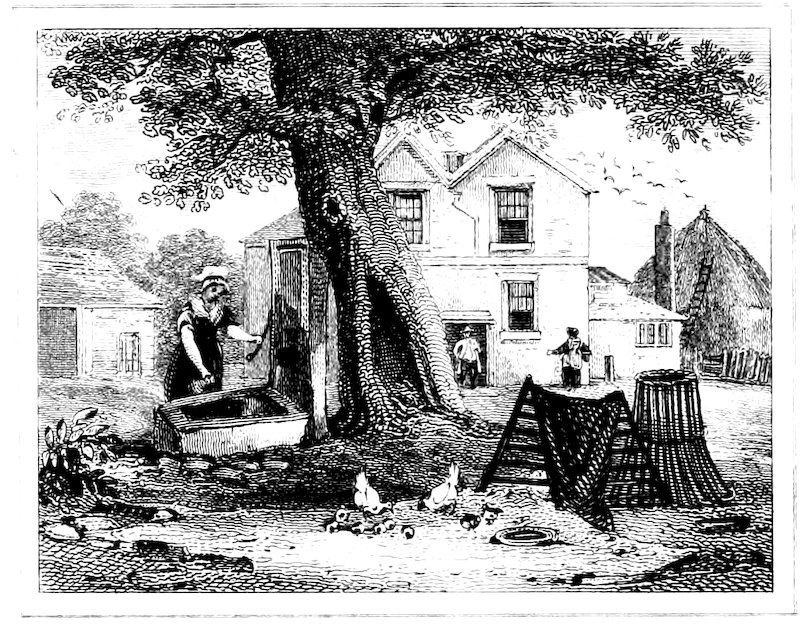
ground. There was a green before the door;
and in the midst of the green stood an old elm,
and under the elm was a pump. There was a
sort of basin under the pump, and there were
gathered together the goslings as soon as hatched,
leaving the large pond in the farm-yard for
the use of the ducks and ducklings, and the
larger birds of their own race. There were hen-coops
placed on the grass, which were furnished
2with an abundant population; and there was a
constant fluttering of wings about the pigeon-house,
where the old ones of the flock would
perch at one of the entrance holes, and glance
up and down and around, perching their heads,
and making their beautiful necks glitter in the
sunshine with twenty different colours. At a
little distance was a rookery, a scene of incessant
activity, as the eyes and ears of all who were
within hearing could testify. The farmer’s children
were generally in the farm-yard, seeing the
cows milked, or playing duck-and-drake on the
pond; and the boys followed the team with their
father, or went into the field with old Robin,
the hedger and ditcher, trying to help him with
their little spades and wheelbarrow; while the
girls fed the chickens, or stole into the dairy behind
their mother.
It sometimes happened, that two little girls,
who were evidently not of Farmer Rickham’s
family, were seen playing with the children on
the green. From their dress alone, no one
would have supposed them to be young ladies;
but their manners and conversation proved them
3to be, in some respects, well educated. All
strangers who saw them looked again, wondering
who could have the care of them, and what sort
of management they had been subjected to.
Their frocks, made sometimes of silk, and sometimes
of calico, as it might happen, were generally
torn, and always dirty; their shoes were
all, from the sky-blue kid to the coarse black
leather, down at the heel, so as to display a
large round hole in the stocking. If Mary had
a silk bonnet, and Anna a straw, the one was
used as a cradle for the kitten, and the other as
a basket to hold strawberries. Of course, all
this inspired a stranger with disgust; but if occasion
led him to speak to either sister, he was
favourably impressed by the modesty of manner,
and simplicity of speech, by which they
were distinguished from many young persons
more fortunate in their external appearance.
They were the only children of Mr. Byerley,
who lived at A——.
One fine May morning they went, as they
often did, to see Nurse Rickham, as they called
the farmer’s wife. While Mary was looking for
4eggs among the nettles, Anna amused herself
with helping nurse to get dinner ready. When
she came up from the potatoe hole with her apron
full of potatoes, (for nurse had insisted on tying
on an apron,) she stood in the middle of the
kitchen for a minute or two, looking closely at
Mrs. Rickham’s gown. Mrs. Rickham turned
round surprise.
“I never saw you in this gown before, nurse,”
said Anna.
“’Tis a very old gown, Miss Anna; I’ve worn
it this many a year.” And nurse coloured, and
looked uncomfortable.
“I have seen it before, I am sure, nurse;
though not on you; and yet I thought it had
been blue. I don’t remember mamma in any
thing green. Was it not mamma’s?”
“My dear, it was. But who could have
thought of your remembering that, so many
years as it was ago? I have always kept it out
of your sister’s sight, because she, being older,
might perhaps remember it; but to-day you
took me by surprise with it on, and I persuaded
myself there was no need to change it.”
5“No need at all, nurse; but I should just
like to see if Mary would know it again.”
When Mary was called in, she did not remember
having ever seen the gown before.
“Well, how odd that is!” said Mrs. Rickham,
“that Miss Anna should remember better
than you do, when she was only three years old
when my mistress died, and you were five.”
“Oh! but I remember many things that
Anna cannot,” said Mary: “I remember my
coming to stay here when papa and mamma went
to London. How long ago is that, nurse?”
“Let me see: my mistress died seven years
ago, and she went to London every year for
three years before she died, and it was the first
visit when you came to me, the year Miss Anna
was born. My dear, you can’t possibly remember
so long ago as ten years, when you could
only just go alone.”
“Oh! but I do,” said Mary; “and it is just
the trying to run about the green by myself that
I remember. You had a wooden step at the
door then; and I used to take fast hold of the
door-post, and put down first one foot and then
6the other; and when I could not reach the
ground, I sat down on the step and slid, so that
I fell softly on my hands and knees.”
“Bless the child!” cried the nurse; “’tis all
true; but what can make you remember it?”
“Ah! that I don’t know; but I can tell you
of some other things. Do you remember whether
I cried the first night you put me to bed?”
“Yes, Miss, you did; for I said to my husband,
that you had got into a bad habit with
your new maid, of crying when you went to bed.
However, it was only for that night, I think.”
“It was because the bed creaked, and frightened
me; and the feel of the coarse sheets was
not like what I had been accustomed to. And
that old elm too, how its rough bark hurt my
little hands when I used to try to get round it.”
“Well, I will never say again that children
can’t remember back to two years old,” said
nurse.
“I think I could not have been older than
that when I cut off the fingers of Miss Oliver’s
gloves,” said Anna. “Do you remember that,
Mary?”
7Mary laughed heartily at the recollection.
“What a little rogue you looked, Anna, peeping
from under the table between the folds of the
cloth; while Miss Oliver was so busy talking to
mamma about the patterns, and unrolling and
drawing on her gloves in an absent fit! And
poor mamma tried to look grave, and could not,
when the fingers’ ends came through.”
“Miss Anna was always the child for fun,”
said nurse.
“There was as much fright as fun in that
joke, however,” said Anna. “When I had
done my cutting, I could not roll up the gloves
again for a long time; and I felt so sure of
being punished, that I heartily wished the finger
tips on again. I shall never forget how glad I
was to see mamma laugh.”
Mrs. Rickham turned away and sighed, and
Mary and Anna looked at one another with sadness
in their faces.
“I know, nurse,” said Mary, “that you do
not like to hear us talk in this way about mamma.
But only consider how very little we remember
of her, and how trifling that little is.
8We only talk about it because we would not
forget even this much.”
“It is all very natural, my dears; but when
I think about her, as I do every day, and when
I see how like her you are, Miss Anna especially,
I can’t help grieving when I think how much
more chance there would be of your growing up
to be like her, if you could remember for yourselves
what she was.”
Here nurse Rickham stood and looked at the
young ladies from head to foot, and began to
smooth down their rough hair with her hand.
They knew well enough what would come next
to be anxious to make their escape; so, to avoid
a lecture on tidiness, one ran to help little Tommy
to pump, and the other to gather some flowers
for papa.
Mary had not finished gathering her flowers
when the farmer came in to dinner; and when
Tommy was called away from the pump to eat
his dumpling, Anna thought it time to set about
the recovery of her bonnet, which hung, out of
reach, from the branches of the elm. When
she had used stick, rake, and pole to no purpose,
9she climbed the tree far enough to be able
to shake the bough on which the bonnet hung,
and from which it presently fell into the pool.
In her haste down to snatch it out of the water
before it should be wet through, she tore her
frock-skirt almost from top to bottom.
“Mary! Mary!” cried she, running to the
garden, with her dripping hat in one hand, and
the terrible rent gathered up in the other, “can
you give me some pins to make my frock tidy
till we get home?”
“Tidy!” said Mary, laughing: “nurse will
think it an odd sort of tidiness; but let us see
what we can do.”
“Please to wipe my bonnet then, while I pin
up this great hole, and then let us go home
directly.”
When they went to bid nurse good bye, she
begged them to wait a few minutes, if they could,
as she wished to walk to the town with them as
soon as her husband should have dined. This
delay gave Anna an opportunity of hanging up
her bonnet and handkerchief to dry in the sun;
so she stuck them on a bush, and amused herself
10with watching the bees till nurse was
ready.
It appeared that her errand was to their father’s
house, and her business with the young
ladies’ maid, whom she blamed for allowing them
to appear as they had come to the farm that
morning. Every body in Mr. Byerley’s house
knew that Nurse Rickham was privileged to say
and do what she pleased when the young ladies
were in question, and that she was as capable
as any body about them of deciding what it was
proper for them to be, and to do, and to wear.
The maid therefore only justified herself by saying,
that the young ladies were more troublesome
about their things than any children she
ever had to wait upon, pleasant and good as they
were in other matters; and that she thought
they were really too old to need to have a servant
to tell them always what to put on; though,
to be sure, it made a great difference their having
no mother to teach them such things. Nobody
knew, she said, how anxious she was to
do what was proper for them; and as a proof,
she would beg Mrs. Rickham’s opinion about
11some purchases she was going to make for
them.
It always grieved Mrs. Rickham that Mr.
Byerley should have resisted the advice of all
his friends in so important a point as the domestic
education of his children. He was known to
have so strong a prejudice against schools, that
no one thought of persuading him to place his
daughters in one. Besides, his health was infirm,
and his spirits variable, so that it would
have been too hard upon him to have relinquished
the society which alone could make his home
cheerful to him. It appeared to all sensible
people, that the best plan would have been to
have invited some respectable elderly lady to
take up her abode with his daughters, and supply,
as far as might be, that guidance which the
best of fathers cannot afford. To this plan, however,
as often as proposed, he refused to listen,
declaring his determination to educate his daughters
himself, independently of all assistance but
that of masters for accomplishments.
For such a task he was well qualified by high
principle and extensive information, and by his
full appreciation of what is valuable and beautiful
12in female character; but he had some eccentricities
which were likely to impair the effects
of his most earnest and judicious endeavours.
He was also much engaged in public life, and
had therefore less command of his time than was
desirable on account of his children, who were
allowed to dispose of their leisure more freely in
his absence than was at all consistent with those
habits of regular industry, which, at their ages,
(ten and twelve,) ought to have been formed and
confirmed. A great deal was accomplished by
means of the close application to which they were
accustomed while pursuing their studies in his
presence; but much valuable time was wasted
by bad management in his absence.
Dinner waited long this day, as was often the
case: Mr. Byerley was engaged in his study with
a gentleman, whom he was assisting to draw up
resolutions for a public meeting. When he entered
the dining-room, he saw his girls sitting
close together, reading out of the same book so
intently, that they did not hear him approach.
Standing behind them, and looking over their
heads, he read aloud,
“‘No fear lest dinner cool.’
13Aye, that was a dinner in Eden—a dinner very
unlike ours, which is probably cold by this time.
Come, come, ’tis very late.”
The girls, who had started and closed the
book hastily at the sound of his voice, ran to
take their places at the table.
Mary remarked that her papa had not been
out, if she might guess by his gown and slippers
being still on, as at breakfast. Anna supposed
that it was because he wore his slippers that he
had startled them, though they had been watching
for him just before.
“Mary,” said Mr. Byerley, “what made
you shut your book in such a hurry when I put
my head in between you?”
“I hardly know,” said Mary; “but I believe
I was not quite sure whether you wished us to
read Paradise Lost yet.”
“You might have known in a moment by
asking.”
“Yes; but Mr. Wilkins was with you, and I
knew you were busy; and the book was lying
open, and we did not mean to read on, only we
could not help it.”
14“It has done you no harm, I dare say, my
dears; and if it had, it would have been my
fault for leaving such a book in your way.
Would you like to see more of it?”
“I like the little I read, papa; but I do not
know how I should like the whole.”
“The whole! I should be sorry to be obliged
to read all that,” said Anna. “I like the Arguments
best. Why are they called the Arguments,
papa?”
“Because, by Argument, is properly meant a
subject of thought. The Argument of a poem is
the subject, the story; and in Paradise Lost,
and most long poems, it is given in prose, like a
table of contents.”
“I like getting at the story at once, instead
of fishing it out from the poetry.”
“If the story is all you care about, you are
very right,” said her father; “but the story is
the last thing people of taste think about in a
fine poem.”
“Then Mary is a person of taste, I suppose;
for she was in a great hurry to get to the grave
part.”
15“If she likes the grave part, she may go to
it again,” said Mr. Byerley. “She would not
like it if she did not understand it; and the more
she understands and relishes it, the more likely
she is to become a woman of taste. But I have
another argument to propose to you both. Bid
you ever hear me speak of Mrs. Fletcher of
Southampton?”
“Yes, papa: you showed us a letter of her’s
once: you remember it, Anna.”
“About her little girl that died? O yes, I
remember that letter, and I want to see it again.”
“You shall, my dear; and you will soon see
Mrs. Fletcher too. She is coming to stay with
us for a few days.”
“Any body with her, papa?”
“Yes, her husband, of course; and perhaps
two of her daughters. They come on Wednesday;
so you must consult Mrs. Rickham how
you are to make room for them all, and I am
sure you will try to make their visit pleasant.”
Mary and Anna were troubled with no fears
on the subject, for they were accustomed to receive
their father’s friends, and had never been
16conscious of any awkwardness in doing so. If
they had now any doubts, it was about the pleasure
they might have in Miss Fletcher’s
society; for they had never had any companions
of their own age, or any playmates except the
farmers children.
When their father called them into his study
to repeat the lessons which had been omitted in
the morning, Anna stretched herself and yawned,
preparatory to collecting her books and exercises.
“What, Anna! yawning at the very idea of
being employed! Better wait till you are tired,
surely.”
“I can stretch again then, papa. I wonder
whether you ever do. I never saw you; but I
suppose you are tired sometimes, like other
people.”
“Very tired, my dear; and never more so
than when you are rattling nonsense, instead of
opening your books. There is a time for all
things.”
It was now Anna’s time for looking grave; and
she read her page of Virgil as steadily as if she
had been ten years older. Nothing was heard in
17the study for the next two hours, but the single
voice of the reader, and the scratching pen of
the writer. When the last school-book was
closed, the girls looked at their father. He
pointed to the book-case, where the large Bible
was placed; and while Mary took it down, Anna
drew a seat to each side of her father’s large
study-chair. They read and talked, and read
again, till the servant came to say that tea had
been ready some time. Anna forgot her intention
of yawning again. They never remembered
having been weary of reading the Bible with
their father; for he made them understand it
clearly, as far as they went: he talked and encouraged
them to talk freely on the thousand
subjects which made religion interesting; and his
voice was never so soft, or his manner so tender,
as at those times.
After tea, Mary, who saw that her father was
troubled with headache, as was often the case,
pointed to the field, where the evening shadows
were lengthening in the golden light of the setting
sun, and asked him if a walk would not do
him good. He was too tired to go out, he said;
18but he should like some music, which generally
refreshed him more than any thing. So he
established himself on the sofa; and Mary, who
played very well, opened her piano, and amused
him till it was quite dark. Before he dismissed
his children for the night, he called Anna to sit
on the low stool beside him.
“Our days fly away fast, Anna; do not
they?”
“Yes, papa; but not so fast as I should like.
I want to be older, that I may have more of my
own way.”
“You unreasonable child! People tell me
I let you run wild already. What more do you
want?”
“I want to take journeys, and to leave off
learning some things that are tiresome, and to
learn others that must be very entertaining; and
I want to send Farmer Rickham’s children to
school, and to build an hospital here, and several
other things. What a will I would make, if I
was a woman!”
“If you had any thing to leave, I suppose
you mean,” said her father, laughing. “But,
19seriously, my dear, don’t you think it as well
that people should be taught to do no harm before
they form grand schemes for doing good;
and that they should learn to do good in a
small way, before they form plans too large for
them to manage?”
“Like Sally Benson and her bird.”
“What was that?”
“She thought she should like to help her
brother’s birds in building their nests; (you
know he has three pairs, in a very large cage;)
so she got them some moss that she thought
better than what he had provided, and she went
a great distance to get it; and she was a long
time searching for a plant that she was told they
would like to eat; and she watched and watched
them, and was very busy trying to make them
build. But O, papa!”
“Well, what happened?”
“Why, she frightened them so with putting
her fingers between the wires, that they would not
make their nests properly; and she had got the
wrong plant after all, and one of them died from
eating it. And what was far worse, she forgot,
20all the time, to feed her own canary; and she
found it dead at the bottom of the cage one
day.”
“Aye, that is the way with young minds till
they get experience; and I am afraid it would
be the way with you, if you had more of your
own will, as you say.”
“Why, papa, what harm do you think I
should do?”
“Consider whether you do none already.
Have you done nothing on this one day that
can be hurtful to anybody? You need not tell
me, if you find you have; but satisfy yourself—that’s
all.”
“I will tell you, however, papa. I ran away
when nurse was going to say something I did
not wish to hear. I saw she looked vexed, and
I am afraid little Kitty saw it too; and perhaps
I have put it into her head to do the same.”
“You must put a better behaviour into her
head as soon as you can, then. Now try and
recollect if you have done any good to-day.”
Anna thought some time, and looked sad when
she owned she could recollect nothing.
21“I am afraid you are hardly fit for building an
hospital yet, Anna,” said Mr. Byerley. “However,
to comfort you, I can assure you that you
have done me some good to-day.”
“You mean, by making you forget your headache.
But that was accident, so it does not suit
what we were talking about; but I will try to
make it better another time, for fear you should
be the first person to go into my hospital, when
I build it.”
Mr. Byerley smiled as he kissed her and sent
her to bed.
CHAPTER II. Preparation.
22
The next morning, Mr. Byerley, who was a
bad sleeper, was wakened very early by the
murmur of voices from the next room, which
was occupied by his daughters. Though the
partition between the chambers was very slight,
he was not usually disturbed by noise; for the
girls were asleep before he retired to rest, and
he arose as early as they in the morning. Now,
however, he heard the never-ceasing sound of
low tones from four o’clock till six; but not
a single word could he distinguish of all that
was said. The girls could not be learning lessons,
for it was Sunday morning; and, as he
heard no tread, he thought they could not have
left their beds. They were evidently stirring,
23however, as soon as he had rung his bell; and
from behind his blind he saw them afterwards in
the garden, not running or gathering flowers, as
usual, but in earnest consultation. They stood
before a certain balcony, looking at it from all
sides, and presently from all distances; for Mary
would have walked backwards into the fishpond,
if her sister had not caught hold of her. Then,
with each a bough, they attempted to disperse
the chickweed which had overspread the pond;
and then they repaired to the arbour where the
honeysuckle trailed on the ground, and a film of
gossamer overspread the entrance. When they
met their father at breakfast, they looked heated
and exhausted. He told them there was no occasion
to toil so hard, as he should give direction
to John, the gardener, to put the garden and
court in good order before the arrival of their
expected guests. Part of their weighty business
was taken off the girls’ hands, but apparently no
great deal; for they were found, more than once
that day, in the little parlour which opened upon
the balcony, as eager in consultation as they
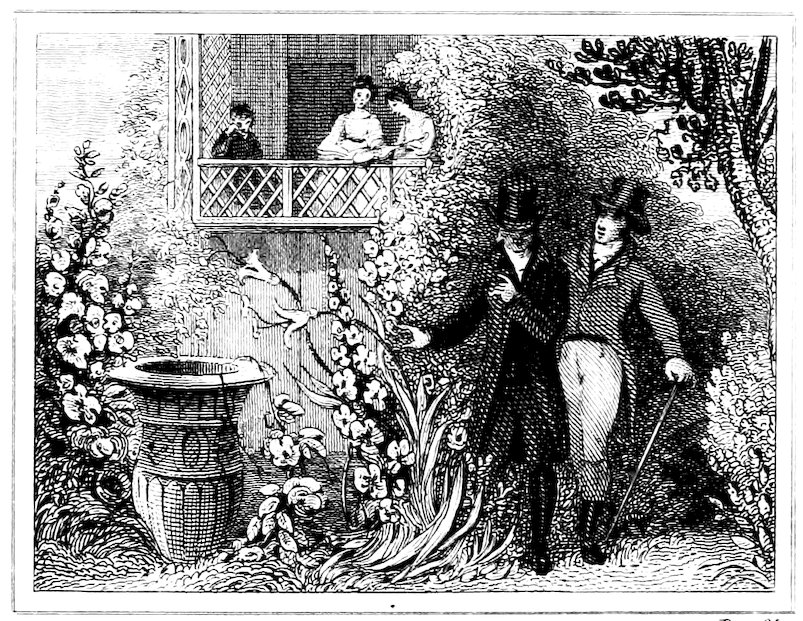
had been before breakfast. This parlour was so
24small that it might almost have been called a
closet; but the balcony was larger than the
room, and communicated so easily with it, by
means of a French window, that the deficiency
of size was a small objection. The parlour would
just contain Mr. Byerley, his daughters, and a
tea-table; and when they had guests with them,
the balcony held the visitors and their host, and
the green parlour the young tea-maker and her
apparatus. It was a favourite place, the view
from it being particularly pretty, and its retirement
complete. The simple ornaments of the
dwelling were all collected there; Mary’s harp-lute,
Anna’s flower stands, and the precious picture
of their mother. The room was so darkened
by the colour of its furniture, by the roof
of the balcony, and the creepers which hung
thickly about it, that the picture conveyed no
very distinct impression to strangers. Mr. Byerley,
however, liked it better in this obscurity than
in a fuller light: the girls had long been too familiar
with its features not to feel as if they had
been equally familiar with the original.
While they were drinking tea in this place
25on the Sunday evening of which I speak, Mr.
Byerley told the girls that he was going, in the
morning, to London, to attend a public meeting,
and that he should not return till the Tuesday
night, or perhaps the Wednesday morning; but
that he would take care to be at home when
their guests arrived. Mary asked what should
be done for their entertainment; for she thought
the house must be very dull to strangers. Her
father thought not, as their friends came to see
and talk with friends, and not to see sights and
be entertained as they might be in the house of
any stranger. Mary knew her father’s dislike of
bustle, and of any interruption of his daily plans
which was not caused by public business; but
she felt quite sure that Mr. and Mrs. Fletcher and
their daughters would enjoy seeing more of the
pretty country near, than could be brought within
the limits of a walk; and she therefore pressed
the point. “You shall have no trouble, papa,
but just to get on your horse and go with us.”
“Where, my dear? I will go to the world’s
end if you show me that it will do any good; but
you know I dislike frolicking.”
26“It will do a great deal of good to make Mrs.
Fletcher admire Audley bridge and the castle;
and you need not call it frolicking, but only a
morning’s ride.”
“A morning’s ride stretched out till near midnight!
Think of the distance, my dear.”
“Suppose it should be past midnight,” said
Anna; “it would still be a morning’s ride.”
“We will be home as early as you please,
papa, if we can but set out early enough; and
we have planned it all so completely——.”
“Well, well; don’t talk to me any more
about it, but settle it all your own way. I have
no time for such nonsense.” So saying, Mr.
Byerley took out of his pocket his list of resolutions
for the public meeting, and began to read
very attentively. He soon seemed sorry, however,
for his hastiness; for he folded up his paper,
drew his girls to him, and put an arm round
each of them as they stood.
“I hope, my dears,” said he, “that your
heads have not been quite full of these little
plans all this day.”
“No, papa, not quite full; not at church-time,
27nor while Tommy Rickham was saying his
lessons; but yet——.”
“Are you quite sure what you were thinking
of when Tommy was reading?” asked Anna.
“Did you make no mistake that you remember?”
“Mistake! What mistake?”
“When he was reading about little Will’s
giving all he had to the old beggar, he stopped
at the word penny, and you told him it was
pony: the little fellow stared, and I dare say he
wondered how little Will could toss his pony
into the old man’s hat.”
“I must have been thinking of the pony you
are to ride; but you should have told me.”
“I set it right with Tommy afterwards; but
I did not want to make Kitty laugh, so I let it
pass at the time.”
“Then, papa,” said Mary, “I am afraid
I can’t answer for not having had any silly
thoughts about this at church.”
“It is always wisest not to answer for any
such thing, Mary; for the wisest and best of us
are troubled with vain thoughts at the most solemn
times, and in the most sacred employments.”
28“The very wisest and best, papa?” said Mary,
looking at her mother’s picture.
“Your mother used to say so,” said Mr.
Byerley, as his eyes followed Mary’s and rested
on the picture. “If ever there was an example
of entire self-command, it was she; and if ever
there was one who fully understood and felt the
blessings of this day, it was she: and yet she
used to make the same complaint that we have
made.”
“I remember,” said Mary, in a low voice,
“that I thought she looked differently on a
Sunday from every other day; and I felt differently.
The feeling comes over me now, of
those bright summer mornings when I used to
be taken up earlier than on weekdays; and the
washing, and the clean frock and pinafore, and
mamma making breakfast, in her neat white
gown. And then, after breakfast, she used to
take me into the garden, and let me gather a
flower for her. I don’t know what makes me
remember crocuses so particularly; but I never
see a gay crocus bed without thinking of one of
those bright old Sunday mornings.”
29“She loved to make you particularly happy
on Sundays, because she thought the feeling of
pleasure might last through life, as it did with
her. Her parents made her love the Sabbath,
and the power of the feeling was once shown very
remarkably——.”
He stopped, but the girls looked at him so
earnestly that he soon went on.
“You know, though you cannot remember,
that you once had a little brother: nurse often
tells you about him, I know, and how he died.
Nothing could be more sudden than the accident,
and, of course, neither your mother nor
any body else could be at all prepared for such
a shock; for a heartier child could not be. It
happened on a Friday afternoon, and all that
night and the next day the struggle which your
mother underwent was fearful. Early on the
Sunday morning, she slept for the first time
since the accident, and I would not have her
wakened when it was broad day. She started
up, at last, with the confused feeling of something
very dreadful having happened; but when
the tide of grief was just flowing in upon her
30again, the church-bells rang out. She was calm
instantly; and that day did more towards restoring
the tone of her mind than any previous
exertion, though she had striven hard for composure.
She walked in the garden with me, and
sat by this very window, sometimes reading, and
sometimes listening to the chimes; but looking
so like herself that I was no longer anxious about
her.”
“She was ill then, nurse says.”
“Yes; her strength had declined very much,
and that was the reason why I was so uneasy
about her. While she was in health, she was
the one to give, not to need, support; and, to the
last, the strength of her mind never failed.”
“Nurse told us once what mamma said the
day before she died, about us, and about every
body who depended on her for any thing.”
“I gave nurse leave to repeat it to you when
she thought you could understand and feel it
properly; and I am glad she has, because Mrs.
Fletcher can tell you much more which you are
now prepared to hear. She will tell you how
your mother and she used to study together;
31perhaps she will show you the bible, marked by
themselves for their own use.”
“I have often wanted to know,” said Mary,
“what parts my mother was most fond of, and
read the oftenest; but I never asked you, because
I thought you would tell me when the
right time came.”
“It is the right time now,” said her father,
kissing them both; “bring the bible from below,
and we will read a portion to which she used
to turn perpetually when she was in any trouble.”
The next morning, the girls were ready dressed
to make breakfast early for their father, that
he might be in time for the coach to London.
But anxious as they were to make him comfortable
on all occasions, they did not understand
the way, and knew nothing about the many little
niceties on which domestic comfort depends.
How should they, when there was nobody but
servants to teach them? They were very quick
of observation, and if their father had allowed
32them to visit his friends, and to see what was
done in other houses, their wish to learn, and
their affection for him, would have enabled them
to improve their domestic notions and habits;
but Mr. Byerley was, as we have said, sadly
prejudiced in some respects; and he would allow
of no intercourse between his daughters and any
of their neighbours. The neighbours thought
it very odd, of course. Mr. Wilkins was wont to
shake his head when he told his wife how poor
Byerley’s children were being spoiled for life by
being so shut up as they were; and Miss Pratt,
their opposite neighbour, was much scandalized
at their method of romping with Nurse Rickham’s
children; and the young Grants, who, to
the number of eight, were boating, riding, and
driving every day and all day long, supposed
that the poor Miss Byerley’s were intended to
be very learned, as they could read Latin, it was
understood, and had been seen, one day when the
blind was open, poring over a globe. It did not,
of course, signify what such neighbours as these
thought of Mr. Byerley’s method of education;
but there were two or three families of a better
33class as to sense and merit, with whom the girls
might have associated with great advantage to
themselves; and the very commonest circumstances
which take place in a tolerably well-regulated
family would have conveyed much instruction
to these motherless children, which could in
no other way be supplied. Mrs. Rickham had
taught them to sew, and that well; but about the
management of the kitchen and larder she knew
little, and next to nothing of the customs of the
parlour. Their father often sighed when he contrasted
the appearance and manners of his children
at table, with what they would have been if
their mother had lived; and sometimes he sent
them to smooth their hair or change their frocks
before he would sit down with them; but it was
beyond his power to establish regular habits of
neatness and method, and he trusted that this
would be done by their own observation and care
when they should, at length, see something of
the world. He found that the servants grew
more and more awkward and remiss from the inability
of the young ladies to direct them steadily
and with propriety, as children as young as themselves
34are able to do when well taught. He was
partly to blame himself, for his habits were, in
some respects, eccentric.
On this morning, he called from his chamber-door
to desire the servant to run and take his
place in the coach. This ought to have been
done on the Saturday; and the maid was obliged
to leave the fire, which had been badly lighted,
and could not be coaxed into a blaze. Mary saw
that the kettle would not boil in time unless she
took the bellows, while the cook dusted the parlour-furniture,
and Anna brought up the bread
and the eggs and the butter from the larder.
When their father came down, he looked displeased
to see them so employed, and wondered
why, with two servants in the house, breakfast
could not be prepared without so much confusion.
After all, the kettle would not quite boil, so the
tea was not fit to be drunk, nor the egg to be
eaten; and there had been so much delay, that
the horn sounded at the end of the street before
Mr. Byerley had half finished breakfast. He
stuffed his papers into his pockets; pulled on the
boots for which he had waited till the last moment,
35and which were only half cleaned after all;
pushed aside the umbrella which Anna offered
him, with “Pshaw, child! where’s the ring? I
can’t carry it unfastened in that manner;” kissed
his daughters hastily, and ran off just in time to
overtake the coach, which had been driven on in
disregard of the maid’s protestations that her
master was coming.
When she came back, she sat down to make a
comfortable cup of tea for herself and the cook,
while the young ladies finished the cool beverage
in the parlour. They were not long in doing so;
for they were eager about the schemes which
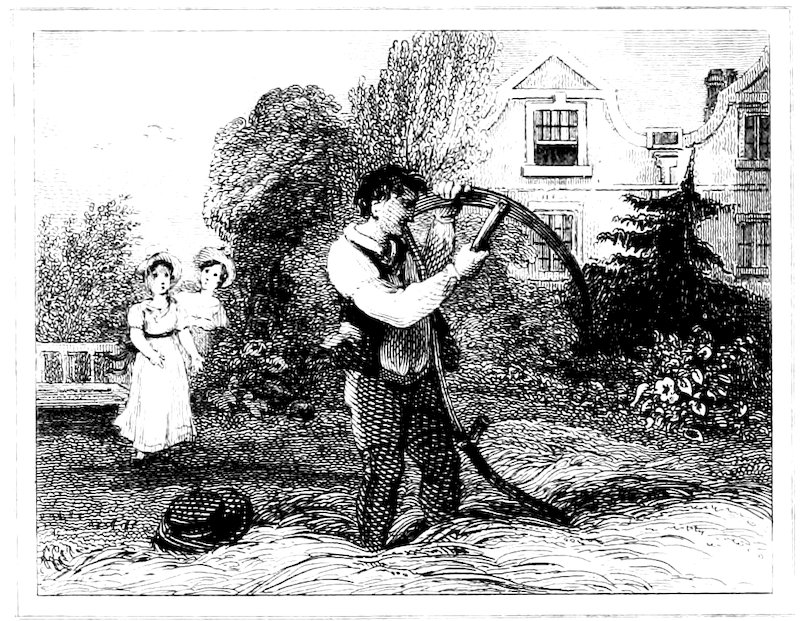
were next to be undertaken. They heard John,
the gardener, whetting his scythe; so they went
first to see how the garden could be beautified.
When they had ranged the walks with John,
shaken their heads over the weedy pond, got
their shoes thoroughly wet in the dewy, new-mown
grass, and then thoroughly soiled on the
flower-beds, they came in again, and mounted to
the lumber-garret, leaving in the housemaid’s
eyes very strong evidence where they had gone.
She followed them with dry shoes, and found
36them trying to bring down, from a high shelf, a
looking-glass which was placed with its face to
the wall.
“Stop, Miss Mary,” cried the maid; “you
will be down, and the glass after you. Let me
reach it, or whatever else you want.”
“We want only the glass, thank you. There,
down it comes, safe. But, O dear, what a tarnished,
battered old frame it has!”
“You can never use that glass, Miss Mary.
It cannot have been used these fifty years.”
“Not quite,” said Mary; “for I remember
nurse’s dandling Anna before it. But I had no
idea it was so shabby. Let us take it down and
dust it, however: it may look better then.”
Just as they reached the head of the stairs,
the maid holding one end, and the girls the
other, the part of the frame which they held
gave way, and it was a wonder the glass was not
broken.
“I had like to have fallen down stairs, glass
and all,” exclaimed the maid. “Here’s an end of
the matter, young ladies; so let us put it where
we found it.”
37No: Mary thought it would answer their purpose
better than ever now; so she pulled off the
rest of the frame, which split with a touch. She
desired the maid to rub up the glass, while she
and Anna went back into the lumber-room to
find some paper, the same as the hangings of the
green parlour. This they found; and when they
had called John in to nail up the glass in the
little room, opposite the balcony, and sufficiently
low to reflect the landscape beyond, and sent
down into the kitchen for some paste, they began
to cut out the trailing pattern of the paper, and
so fixed it on the edge of the glass as to make a
very pretty border, and one more corresponding
with the rest of the furniture than a gilt frame
would have been. Even the maid admired what
she thought, at first, a mere fancy; and the girls
saw their own faces oftener that day than on any
preceding day of their lives. Mary thought that
one ornament more was wanted to make all complete:
she asked Anna if a white cast of some
sort—a vase or a bust—would not look very
well in the corner where the harp-lute rested.
Anna agreed, and inclined for a vase, which they
38might fill with flowers. Mary thought the head
of a poet or a musician would be more suitable.
Who should it be? The only musician
she remembered to have seen on the Italian’s
board was Handel; and Handel was sadly fat
and ugly. She did not know who it could be
but Milton; and that face, beautiful as it was,
was known to every body by this time. It reminded
her, however, that she might perhaps get
some hints about ornamenting their bower from
“Paradise Lost;” for she liked what she had
read of Eve’s preparation of a repast for the
angel. So, while Anna ran to the window to
watch for the Italian with his image-board, who
was sure to pass, Mary settled herself in the
balcony to read about Paradise.
As soon as she was fairly lost to all outward
things, and present only with Adam and Eve,
seeing how
“raised of grassy turf
Their table was, and mossy seats had round,”
she was roused by somebody standing before
39her. It was Mrs. Rickham, who came to ask
something about clean sheets for the best bed.
“Clean sheets!” exclaimed Mary. “Oh,
ask Anna to give Susan the keys, and then you
can find what you want.”
“Very well, Miss. But there wants a new
ewer and basin for the room the young ladies
are to have; and I doubt if there are towels
enough.”
“We will see about that to-morrow, nurse. I
must make this room complete now I am about
it.”
“Perhaps that will do as well to-morrow, Miss
Mary, if indeed it wants any thing more; but
the first thing to be done is to make the sleeping-rooms
comfortable, and to see what condition
your frocks are in, Miss.”
This was too true to be denied; so Mary left
her book in the balcony till her provision for the
comforts of her guests should leave her at leisure
to plan luxuries for them.
There was time, however, for all; and the
manifold luxuries of an excursion in search of
the picturesque were duly cared for. The fowls,
40the cakes, the wine, the sketch-books, the telescope,
were appointed and hunted up; and Anna
put on her habit and went to the farm, to try the
grey pony which the farmer was to lend her.
The pony carried her round the twelve-acre field,
and up the green lane, and down the mill-lane,
with the utmost propriety, and promised to be a
great ornament to the cavalcade.
On Tuesday night the girls sat up for their
father till the last coach had passed through the
town at eleven o’clock. They were a little disappointed
at not seeing him, but had no doubt
of his arrival before noon the next day.
CHAPTER III. Arrivals.
41
“Here comes papa!” cried Anna, as she rose
from the breakfast-table, “and a gentleman with
him! Can it be Mr. Fletcher already?”
“O, no!” said Mary; “how should it be,
without Mrs. Fletcher and their daughters? He
is coming in, however. I do hope it is not a
political person. I had rather hear any thing
than politics from London people.”
Anna agreed that they had quite enough of
politics every day of their lives, without hearing
more from strangers. When their new guest
entered the room, Mr. Byerley introduced him
to his daughters as Signor Casimiro Elvi. He
did not at all answer to Mary and Anna’s notions
of a politician, as they assured one another
42by a glance of congratulation. If he had been
twenty-five years younger, he might have been
taken for a poet; and though he was too old for
that, he might well be supposed a great man of
some kind or other; for he had a profusion of
black hair, curling back from his prominent forehead
in a manner which is uncommon among
Englishmen. His countenance was bright with
intelligence, but mild, and sometimes deeply
melancholy. The girls answered his greetings,
which were those of a foreigner, with much respect;
and while they prepared a fresh breakfast,
wondered what topics of conversation would succeed
the usual hopes and fears about fatigue, and
invitations to eat and drink.
“As we were saying, sir,” observed their father
at length, “if we cannot induce the minister
to regard public opinion when it is so plainly expressed
as in this case, what is to be done but
to petition, and petition again, till the House
forces the matter upon his attention?”
To the great disappointment of the girls, the
Italian gentleman listened, not only with politeness,
but with eager interest, and replied with
43such animated volubility, as to leave no doubt of
his being a politician after all. They could not
make out much of what he said, though they
understood French very well; but his rapid
utterance did not prevent their discovering that
he spoke of the ruin of his own country as owing
to the obstinate disregard which a despotic government
had shown to the interests of the people,
and the establishment at length of a military
government, to the destruction of all freedom
and peace. Anna was soon tired of stretching
her attention to listen to what did not interest
her to hear, and she therefore slipped out of the
room. Mary was obliged to remain, to pour out
the tea; and presently, as soon as there was a
sufficient pause, Signor Elvi addressed her in
French, which it appeared he always spoke,
though he understood English pretty well. Mary
liked all he said; and he gave so entertaining
an account of his late perilous journey across the
continent, that she was quite sorry when her father
refused a fourth cup of tea, and it became
necessary to offer to the Signor the refreshment
of his own apartment.
44She ran to find her sister, and relate all that
she had heard. The story was interspersed with
many remarks on Signor Elvi, and many conjectures
respecting his rank and circumstances,
which excited Anna’s active imagination to an
unusual degree; and by the time Mr. Fletcher’s
carriage drove up to the door, her mind was so
occupied with the adventures of the Italian gentleman,
that she could think of nothing else.
Mary looked anxiously to see if there were
any young faces in the carriage. That the Miss
Fletcher’s were there, there was evidence in the
straw bonnets and pink ribbons which appeared
when the glass was let down; and the young
ladies had no sooner alighted, than Mary and
Anna had decided that they might become very
charming companions, and perhaps friends for
life. Even Mr. Byerley wished that the appearance
of his daughters was equally prepossessing,
both as to countenance and dress.
Mr. Fletcher was as remarkably decided in
manner and abrupt in speech; as his lady was
soft and mild. It seemed as if he was somewhat
out of patience with the tone of sentiment which
45distinguished his wife’s conversation, and had
therefore run into the other extreme. His
daughters, who much resembled their mother,
stood so much in awe of him, that they spoke as
little as possible in his presence, so that he probably
knew much less about what was in their
minds than many comparative strangers; but he
concluded them to be weak and romantic, as he
was pleased to say women in general were; and
by thus concluding, he adopted the most likely
method of rendering them so. The Byerleys, of
course, knew nothing of all this; and as they
were in the habit of opening their minds freely
to their father, they were very slow in making the
discovery that a similar degree of confidence did
not prevail in all families.
Soon after their arrival, Anna was sitting near
Mr. Fletcher and his daughter Selina, who appeared
about her own age. Amidst the many
enquiries which she made of Selina about the
journey and other subjects of discourse, she
looked perpetually to the door, in hopes that
Signor Elvi would enter. When there had been
a short pause, she said: “There is such an interesting
46gentleman here now! I am glad you
will see him, and hear his adventures.”
“Adventures!” said Selina: “oh! what adventures?”
“Oh! so interesting! He had to fly for his
life, and to put on a disguise; and he has been
shipwrecked.”
“Delightful! Did he tell you about it himself?”
“He told my father and sister when I was
out of the room; but I dare say my father will
draw him out again; and we must take care to
be in the way.”
“Certainly; one would not miss such an opportunity
for the world. But what is his name,
and where does he come from?”
“His name is Casimiro Elvi, and he comes
from Italy.”
“From Italy! the very country one would
guess, to be sure.”
“Pray, why?” asked Mr. Fletcher, who had
overheard the whole. “Does nobody put on a
disguise, is nobody shipwrecked, that does not
come from Italy?”
47Selina made no attempt at an answer, which
surprised Anna, who said, she supposed Selina
meant that the refugees, of whose misfortunes
we hear so much, were generally from Italy;
and that she therefore concluded Signor Elvi to
be an Italian.
“Find out what she means if you can,” said
Mr. Fletcher, as he turned his back upon them
both.
“Tell me the rest when we go to take off our
bonnets,” said Selina, in a whisper.
“Let us go now then,” said Anna, “unless
you would like some more cake first.”
Selina refused the cake, and they moved towards
the door; but as Anna put her hand
on the lock, Signor Elvi entered. The girls
delayed a moment to see how gracefully he paid
his respects to the strangers, and then looking
at one another for consent, they returned to
their seats.
“Does Mr. Fletcher understand French?”
enquired Anna, at the end of half an hour, during
which every body had conversed with the
stranger but Mr. Fletcher.
48“Yes,” replied Selina; “but my father
does not like foreigners generally. There is an
Italian gentleman in our neighbourhood, who
brought letters of introduction to my father; but
we can only ask him when papa is out, or when
we have company, because papa never speaks to
him.”
“What can be his reason?” asked Anna.
Selina shook her head, and Anna sat in a
reverie, till she saw the ladies about to leave the
room. She was made very uneasy by what she
had seen and heard. She was sure that there
must be something wrong, to occasion so strange
a want of sympathy among members of the same
family; and she began to be afraid that she
might not like Selina so well as she at first
thought she should. She hoped that their guests
would wish to be left to themselves when they
entered their own apartments, that she might
consult Mary, and learn the result of her observations.
But the Miss Fletchers said, “Don’t
go;” and Mary seemed quite inclined to stay,
having ascertained that Mrs. Fletcher’s maid
was in attendance on her mistress.
49Dressing went on slowly; for there were frequent
and long pauses, during which Selina
stood with the comb suspended, and her sister
Rose with the key unturned in the lock of her
trunk, while they talked of many things. When
they descended to the drawing-room, Anna wondered
whether the same restraint was to be imposed
by Mrs. Fletcher’s presence as by her
husband’s. To her great relief, the girls showed
at once that they had no reserves with their
mother. They made her rest on the sofa, as
she was in delicate health, and somewhat tired
with her journey. The four girls then gathered
round her, and held what Anna thought the
most delightful conversation she had almost ever
enjoyed. She was quite sorry when dinner-time
approached, and the gentlemen dropped in, one
by one, and engaged Mrs. Fletcher’s attention.
When Selina and Anna walked in to dinner
behind the rest of the party, they lamented that
they could not sit together. At the bottom of
the table they exchanged a squeeze of the hand
at parting, and took their places on each side of
Mr. Byerley, preparing to keep up an intercourse
50of glances if any thing interesting should
be said about Italy.
Italy was not once mentioned while the ladies
were at table; but Signor Elvi was not therefore
silent. He talked on almost every subject
which was introduced; sometimes seeking, and
sometimes communicating information. His
observations on the effects which followed the
repeal of the silk duties of England on the trade
of Lyons interested even Mr. Fletcher; and he
also explained, entirely to that gentleman’s satisfaction,
a new method of draining marshes, which
he had seen practised abroad. All this a little
disappointed Anna, who had rather have seen
him sit abstracted, unless patriotism and misfortune
were talked about.
In the course of the evening, Mary found an
opportunity of learning from her father a few
particulars about the stranger. Mr. Byerley
only knew that he had left a wife and large family
in his own country; that he had filled a
very high political station; and that, by his
exertions in that station in the cause of liberty,
he was rendered peculiarly obnoxious to the
51usurping government. Sentence of death for
high treason had been issued against him, and
he had not the remotest prospect of being able
to return to his own land, and to all that was
dear to him there.
The party broke up at an early hour, as the
travellers were somewhat fatigued, and as great
exertions were to be made the next day. The
horses and carriage were to be at the door at
eight o’clock; for much was to be seen at Audley
Bridge, and no day was ever long enough,
as every body knows, to fulfil all the purposes of
such an expedition.
When Rose Fletcher had been asked whether
she preferred riding, or a place in the carriage,
she at once declared that she liked riding above
every thing; but that her habit was at the bottom
of the large trunk, which had gone on to
London. This was not allowed to be a difficulty,
as Mary’s habit was found to fit her sufficiently
well to serve for the occasion. Rose and Anna
were therefore to ride with Mr. Byerley and
either Mr. Fletcher or Signor Elvi, as those
gentlemen should determine between themselves.
52“Well, Mary,” said Anna, as she shut the
door of her chamber.
“Well, Anna,” said her sister, as she put
down the candle on the dressing-table.
“What a pleasant day we have had!” exclaimed
the one.
“How unlike one another people are, to be
sure!” observed the other.
“Mr. Fletcher and the Signor, for instance.
I can’t endure Mr. Fletcher.”
“Why not?” said Mary, surprised: “he
is silent sometimes, certainly; but when he does
talk, he says such very clever things, that they
are worth waiting for. Do you know, I am not
sure but that I like him better than Mrs.
Fletcher.”
“Oh, Mary! impossible! She is such a dear,
kind lady; and he is so cross, I dare not speak
to him.”
“Indeed!” said Mary; “then you must
have heard or seen something that I did not.”
“Nay, Mary; I heard him tell you that he
gave it in charge to you to cure Selina of her
way of speaking.”
53“I do not think he was cross when he said
that. It was rather odd, perhaps, so short as
our acquaintance is; but Selina really does
whine very much; and strangers are more aware
of it, and can put her in mind of it oftener than
those who are accustomed to hear it. Besides,
Mrs. Fletcher has a good deal of it herself, and
Rose too.”
“Well, but he was so prejudiced against the
Signor.”
“Was he? I thought they seemed to like
talking to one another.”
“Aye, afterwards; but you have no idea how
very rudely he spoke at first.” So Anna told
what had happened just after their arrival. Mary
owned that he had been wrong; but would not
agree that there was no merit in his politeness
afterwards, because it must all be ascribed to
the Signor’s irresistible attractions. Yet she
liked Signor Elvi quite as well as Anna did.
Their younger guests were then discussed;
honourable mention being made of a large variety
of fine qualities. In this case, neither sister
exceeded the other; for the praise of both
54was superlative. Beginning with their hair, and
ending with their sentiments, it was found that
they were altogether delightful.
“Upon the whole, Mary, has the day been
what you expected, what you wished for?”
“In some things, much pleasanter; but——and
yet it was hardly likely that, the very first
day, any opportunity should happen for talking
about——what we want Mrs. Fletcher to talk
to us about.”
“Whenever she does, it will be in a way that
we shall like, I know,” said Anna.
“How can you know? Mamma has not been
mentioned to-day, nor any subject of that kind.”
“Not of that kind exactly,” said Anna;
“and yet I am quite sure of it. Selina asked
me if there was a church-yard in Audley Park,
or within sight of it; and she said, that if she
had a fine estate, she would take care to have a
church-yard within sight. I said, I supposed
she meant for the same reason that some grand
prince, I forget who, had a man to put him in
mind every day that he must die. Then she
began telling me about a mausoleum in the
55Duke of D——’s park; but her mother looked
at her, and she stopped just when she had said
that the duchess was buried there. She was
going to mention the duchess’s children, I know,
when Mrs. Fletcher put her in mind that we had
no mother. She is a kind, sweet woman; and
I love her dearly already.”
“It would be very strange if we did not,”
said Mary, “considering whose friend she was
before we were born.”
Mary had now opened her Bible, and they
read together, as they always did at night, when
any thing had prevented their reading with their
father below. It was very late, and Mr. Byerley
had been some time in vain trying to sleep.
The conversation in the next room disturbed
him; and the continued murmur while Mary
read, made him suppose that they were not yet
thinking of sleep. He rose and tapped at their
door. “Who is there? Is it you, papa?” said
Anna, opening the door. When Mr. Byerley
saw the closing book in Mary’s hand, he gave
his blessing to his children, and advised them to
seek repose. Their minds, as they composed
56themselves to rest, were full of thankfulness for
the new pleasures of companionship which the
day had brought them; and Anna began, for
the first time, to be aware of the blessing of
having a father whom she could love without
fearing in any painful degree.
CHAPTER IV. Pleasure or Pain?
57
At the sight of four saddle-horses and a carriage
at Mr. Byerley’s door, the population of
A—— began to assemble for the purpose of
speculation as to what sort of a journey was
about to be undertaken. That part of the population
is meant, which was dressed and on foot
by eight o’clock; for the grooms and the coachman
were very punctual. Here, a workman with
his frail basket of tools on his shoulder stood to
see the provision packed in under the carriage-seat;
there, a boy who had been birds’-nesting
passed so close before the pony’s eyes, that it
reared. Here, a milliner’s apprentice lingered
in hopes of a glimpse of the riders for whom the
side-saddles were destined; and there, an old
58man who was going to sun himself in the church-yard,
stood leaning on his staff, to watch the
departure of the company. Presently the young
ladies were mounted, and patting the necks of
their steeds to sooth them till the signal of departure
should be given. Then was heard the
slam of the carriage-door, the crack of the whip,
and the crash of the wheels on the gravel. The
cavalcade gradually disappeared at the turn of
the road, and the gazers looked at one another,
and betook themselves their several ways.
It was a beautiful morning: no cloud in the
sky, no dust on the road; but all fresh, fragrant,
and green, in the meadows and hedges. The
carriage-party, consisting of Mr. and Mrs.
Fletcher, their daughter Selina, and Mary Byerley,
began to talk all at once, as is the natural
impulse from rapid motion of an agreeable kind;
and the enquiries went round, “Have you room?”
“I am afraid the basket incommodes you:”
“let me put away your shawl, for you will not
want it;” and so on. To which Mr. Fletcher
added, “Have you provided umbrellas, Miss
Mary?”
59“Umbrellas!” said Mary; “when there is
not a cloud in the sky?”
“There was no cloud in the sky at this time
yesterday, and what a deluge of rain we have had
since!”
It appeared that the servants had marked this
fact, for the handles of a very satisfactory number
of umbrellas peeped out when sought for.
“How well your sister rides!” observed Mary,
as Rose Fletcher cantered past the carriage, and
waved her hand in passing.
“Where can Anna be? She cannot have
passed without our seeing her;” said Selina,
standing up to look before and behind. Far,
very far behind, not cantering, nor apparently
dreaming of cantering, was Anna, pacing soberly,
side by side with Signor Elvi, either talking or
listening very earnestly.
“O, look! look!” cried Selina; “they have
forgotten every thing but what they are talking
about. I wonder whether he is telling her about
his poor wife and children.”
“Or about his beautiful estate that he will
never see again,” said Mary.
60“Or about the dear friend he was obliged to
leave in prison,” added Selina.
“Sit down, Selina!” said her father, in a voice
which silenced her.
After a long pause, Mrs. Fletcher began to
talk with Mary about various trifles; but the
conversation was far from amusing till Mr.
Fletcher, after a long yawn, took a book from
his pocket, and began to read very attentively.
Then the two young heads met under one parasol,
and carried on a busy talk, with low voices,
and much care to avoid attracting the notice of
the reader. Room was presently made for Mrs.
Fletcher’s companionship, and then the girls
forgot to wish the gentleman away, except when
a finger was held up to say “hush!”
It was observed, at length, that Mr. Fletcher
had ceased to read. The book was not laid aside,
but closed with a finger between the leaves, while
he looked over the side of the carriage. The
three bonnets emerged from beneath the parasol,
and every body cried, “How beautiful!”
“I was wondering,” said Mr. Fletcher,
61laughing, “whether you would actually pass
by this view without looking about you.”
“You would not have allowed us, surely,
sir,” said Mary.
“Nay; no doubt your fine imaginations were
furnishing you with something much more
beautiful than any thing vulgar eyes can look
upon.”
Mary, young as she was, and modest as became
her youth, was little daunted by Mr.
Fletcher’s rough manner and speech. It was probably
because she was more humble than Selina,
that she was less mortified by any rebuke or sign
of contempt. Selina’s silence was not that of
humility. If not allowed to be sentimental in
speech, she did not change her style of conversation,
but indulged her dreams of the imagination
in silence; while her very silence expressed that
she did not think her father worthy to sympathize
in her pleasures. Mrs. Fletcher never interfered
between them, or attempted to make her
husband and children understand one another
better. She was very timid, rather indolent, and
somewhat inclined to be sentimental, though not
62in the childish way in which she encouraged her
daughters to be so.
“This place is very much altered within a
few years: I should scarcely have known it
again,” said Mr. Fletcher to himself, as they
passed a gentleman’s estate.
“Yes,” said Mary; “even I can remember
the time when there were no corn-fields where
they now stretch almost as far as we can see.”
“This was all common: was it not?” said
Mr. Fletcher. “I think it was a very bleak
common, with nothing but furze growing upon
it, when I saw it last.”
“Yes, sir; and the owner of it had a great
deal of trouble about the alterations he wished
to make. But you see he persevered.”
“What sort of trouble?”
“The poor people were discontented when
their cows were not allowed to graze, and when
they could not cut their turf on the common any
longer.”
“Well; do not you think it was very hard
upon them?”
“I dare say it was, at first; but papa says it
63is much better worth while to grow corn enough
to maintain a great many men, than only grass
enough for a few cows.”
Mr. Fletcher nodded; and Selina observed
that all the rest of the way he enquired of Mary
who lived at every gentleman’s seat they passed.
Sometimes she knew, and sometimes she did not;
but he did not sneer when she had no satisfactory
answer to give. One mansion, which stood on a
lawn a little way back from the road, appeared
in a state of lamentable ruin. It was unroofed,
and the stone pillars and doorways, and naked
window-sills were blackened with smoke. In
answer to Mr. Fletcher’s question, “When was
this burned down?” Mary told all that she knew
of the when and the how; and then turned to
the ladies to relate some circumstances of a different
kind. Notwithstanding Selina’s exclamations
of admiration and pity, and his wife’s
heightened colour, which testified to the deep
interest of the story, Mr. Fletcher also for once
seemed inclined to listen.
“Eh? What was that?” said he, after leaning
forwards, in vain, to hear.
64“I was telling what happened at the fire,”
said Mary. “There was a poor old man in the
house at the time, who had arrived only the day
before to see Colonel Osborne. He had belonged
to his regiment, I believe. He was sleeping
high up stairs, at the back of the house, and
nobody remembered him when the fire was discovered.
Miss Osborne recollected him at last,
and while every body was busy, she wrapt a
blanket round her and flew up the back stairs.
The curtains of the old man’s bed were on fire,
and he was fast asleep when she burst in. She
thought he was suffocated; but as soon as she
dashed some water on his face, he roused himself
enough to let her put the woollen coverlid
over his shoulders, and lead him down the burning
stairs. While she was helping him, the
blanket slipped, and her gown-sleeve caught fire.
She was dreadfully burned; but she scarcely
felt the pain, while the stairs cracked and cracked
again at every step they took, and the flames
rushed and roared all round them. At the foot
of the stairs she met her father, coming in despair
to look for her; but though he saw how she
65was blackened with smoke, he asked no questions
till he had helped her to get the old man beyond
the reach of the burning rafters which fell on the
lawn.”
“Bravo! Like daughter, like father,” cried
Mr. Fletcher. “But what became of her?”
“Her face was so much burned that nobody
could know her for the Miss Osborne that used
to be so much admired; and what is worse, her
left arm is so shrunk up, that she never can use
it again. As for the poor old man, between the
fire, and the fright and the grief, he was quite
worn out, and he died the next week.”
“What a disastrous fire!” exclaimed Mr.
Fletcher. “How the young lady must wish
that she had staid where she was safe!”
“O! no, sir,” said Mary, in a low voice.
“Why, you say she did not save the old man
after all.”
“No; but what a conscience she would have
had all her life long! Do you think all her
beauty and the use of all her limbs would have
made up for that?”
“Well then, she must wish that the fire had
66never happened. Why do you shake your head
now?”
“Because it is worth all she suffered, and
more, to know what she can do on such an occasion.
She need never be afraid again that she
shall not be able to do her duty, or to bear the
consequences.”
“Her father, at least, must be very sorry that
the fire happened.”
“I think not still,” said the persevering Mary.
“If you were to see him with his daughter for
only one half hour, you would find out how he
loves her, and tries to make her feel what has
happened as little as possible; but he can never
be sorry that it has been proved what a daughter
he has. When she begins to repent of what she
did, he may begin to be sorry for the occasion;
but that will never, never be.”
“Well, you shall have it all your own way,
because you are right, I believe,” said Mr.
Fletcher. “But I hope, my dear, your father
will have some pleasanter proof that you have a
strong mind and a willing spirit.”
Mary could not answer, as Mr. Fletcher looked
67kindly at her. He soon opened his book again,
and nobody spoke till the carriage stopped at the
door of the Audley Arms.
The party presently dispersed themselves in
groups about the park. Anna and Selina, of
course, flew to each other, as soon as the one had
alighted from her pony, and the other from the
carriage. Arm in arm, they wandered away under
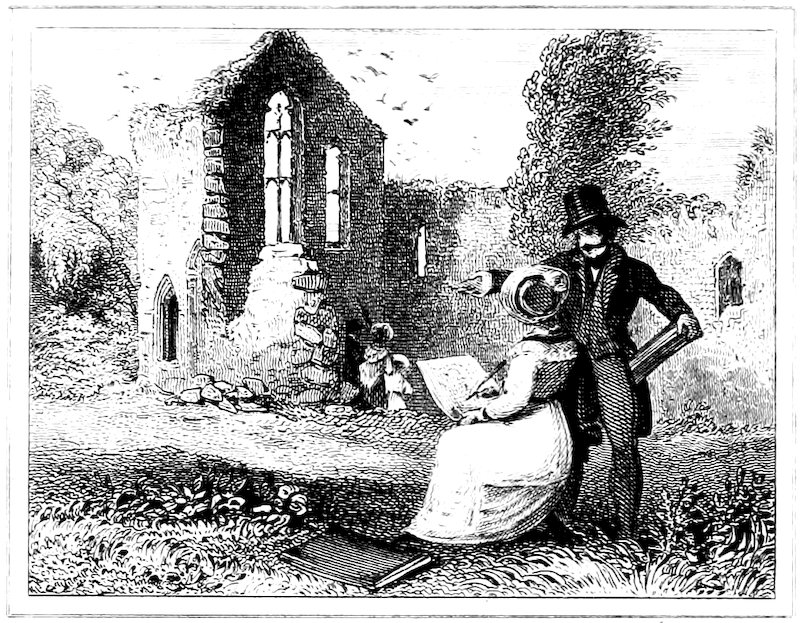
the shade of the avenue. Rose and Mary,
with their sketch-book, explored their way to the
Ruin, to which the people of the inn had directed
them; and they were immediately followed by
Mrs. Fletcher and their Italian friend. Mr. Byerley
also seemed disposed to accompany them;
but Mr. Fletcher persuaded him to go round a
longer way, for the purpose of witnessing the result
of an experiment in tillage, which he knew
to have been made on a piece of land adjoining
the park. At the Ruin they were all to meet at
two o’clock; by which time the servants were to
have spread the dinner at the precise point of
view where prospect-hunters were wont to feast
body and soul at the same time.
The members of the three detachments all enjoyed
68themselves in their several ways; the four
who were together, perhaps the most. Signor
Elvi could draw well, and he superintended
Mary’s sketch, to her great profit and pleasure.
He advised her not to attempt the more extensive
view which, though spread temptingly before
them, could not easily be transferred to paper
with all its flitting lights and shadows, its sloping
lawns and wooded banks, and streams that peeped
out where the sunshine fell brightest. He
rather recommended a particular angle of the
Ruin, whose massy stone-work was finely contrasted
with the light birch which waved near.
He took her pencil, and on the back of a letter
showed her, with a few rapid strokes, what kind
of effect he thought might be produced. When
he had seen her make a successful beginning, he
carried off Rose to a little distance, that she
might attempt the same subject from a different
point of view; to which her only objection was,
that she should be too far off to hear the conversation.
“Oh! that will be too sad,” exclaimed he:
“no lady must feel forlorn to-day. Mrs.
Fletcher and I will sit between you, and tell
you tales to beguile your tasks.”
69Mrs. Fletcher was willing, but observed that
her daughter scarcely understood French well
enough to enjoy a narrative related in it. The
good-natured Signor therefore attempted to make
himself understood in English, which he spoke
better than might have been expected from his
very short practice, but yet so as to render it
very difficult for the hearers to maintain their
gravity long. From the beginning of his tale,
his auditors imagined that it was to be of a melancholy
cast; but as soon as the narrator became
aware that his broken language was an
impediment to the serious impression he meant
to produce, he dexterously placed his personages
in new situations, and gave so strange a turn to
the incidents he had related, that the whole became
comic, and the girls were supplied with a
good reason for the mirth which they could not
have suppressed. Their drawing, meantime,
went on but slowly; for they sat, pencil in hand,
looking towards their companions instead of the
Ruin, and when they began to laugh, all hope
70of steadying their hands again speedily was
over.
“Eh! well,” said he, rising at length, “laugh
as you will, but draw also.” And with all gravity
he began to criticise; but again and again, as
often as they looked towards one another, or
some odd phrase which they had just heard occurred
to them, there was a fresh burst. It
ended in their being too weak, with hunger and
mirth, to do any thing more before dinner, while
their friend’s politeness could not allow him to
leave their sketches unfinished.
In a little while, the whole party being assembled,
except Anna and her friend, and the cloth
being spread temptingly on the turf, every body
sat down to eat. When, however, knives and
forks were laid across, and the empty bottles outnumbered
the full ones, and still the two girls did
not appear, Mrs. Fletcher and Mary grew rather
uneasy. Mr. Byerley went to the brow of the
eminence on which they sat, and looked round in
vain. Signor Elvi rose to go in search of them,
but Mr. Fletcher prevented him, declaring it impossible
that any harm should befall them in the
71park, and that nothing was so probable as that
they should forget the time. On enquiry it appeared
that neither of them had a watch.
“No matter,” said Mr. Fletcher; “which
of them would think of using it if she had? Depend
upon it, they are reclining under a tree or
beside a brook, wondering if ever mortals felt
such friendship for one another before; or perhaps
weeping over the tales Miss Anna heard
from the Signor this morning.”
Signor Elvi looked very grave, but said nothing.
“It is time they were dining, however,” said
Mrs. Fletcher; “and if they have lost their way,
they must be quite exhausted.”
“My dear,” said her husband, “I thought
you had known better than to suppose they can
care about eating when they have something so
much better to do. I think, sir,” turning to Mr.
Byerley, “that it is time we were finding our
way to the bridge, unless the ladies require a
longer rest.”
He rose and sauntered away; and his wife immediately,
by Mr. Byerley’s advice, dispatched
72two of the servants different ways, in search of
the lost companions. Mary sent some biscuits
by each; and having left orders with the remaining
servant to make the young ladies comfortable
when they should arrive, and to direct them
towards the bridge, the rest of the party followed
Mr. Fletcher.
Anna and Selina were soon found, within half
a mile of the place of rendezvous, walking as
leisurely as if the sun had just risen, and they
had had the whole day before them. They were
both sad and disinclined to eat; and in a very
few minutes they followed the party to the bridge.
Very little notice was taken of them there but
by the anxious mother and sister, who having
satisfied themselves that nothing disastrous had
happened, tried to cheer and amuse them; but
they were still silent and sad. They saw, like
every body else, how majestically the river wound
round the bases of the hills, now darkened by
overhanging thickets, now gleaming as a flood
of light fell upon a reach of it, now sweeping by
the terrace of a lordly mansion, and now bending
round the promontory on which was a single
73cottage, with its one willow dipping into the
water. They saw, like every one else, how the
far-distant city rose to shut in the view at the
further limit of the valley; and, like every one
else, they listened to the many sounds which
came from far and near. The chapel-clock in
the park was heard to strike; the creaking waggon,
with the jingling harness of the team came
down the steep slope from the farms; the lapse
of the river under the arches of the bridge gave
out a never-ceasing sound; and the cawing of
the rooks as they sailed round the tree tops
suited well with it. The merry voices of children
came from behind the laurel-hedge which
separated the parsonage from the road. Anna
and her friend saw, heard, and felt the beauty
of all this; but it seemed to them a melancholy
beauty, because their minds were melancholy.
It grated upon their feelings to hear any observations
made on the scene before them; and when
Mr. Fletcher laughed loudly, they left the balustrades
of the bridge, through which they had
been gazing, and went down to find a seat on the
sloping bank, where they might sit with their feet
74touching the brink of the river. Mrs. Fletcher
followed, and as soon as the girls perceived her,
they ran to take each an arm. She soon discovered
what was in their minds, and Anna could
not have desired a more ready listener to the tale
of sorrow which she had heard that morning, and
which had affected her very deeply.
“Did you see, Anna,” said Selina, “how he
turned to listen when the children in the parsonage-garden
shouted at their play?”
“O, yes,” replied Anna; “and he says it
gives him pleasure to see us and talk to us, because
he can think of his own daughters all the
time. What charming girls they must be! and
just our age, Selina!”
“I wish we could make ourselves so like them
that we could comfort him better than we can do
now.”
“We must be very unlike them, I am sure,
Selina; for he says they are very gay and lively.”
“I always thought you had been so, Anna,”
said Mrs. Fletcher. Anna sighed, and replied
that she was merry when she had nothing to
make her sad.
75“But, my love,” said Mrs. Fletcher, “you
must endeavour not to give way so much. You
must take the Signor himself for an example
there. If you had seen him two hours ago, you
would scarcely believe that he had ever felt melancholy
in his life.”
Selina and Anna were both rather dismayed
when they heard of their foreign friend’s genius
for comic narrative. “How could he forget so
soon?” thought they.
Mrs. Fletcher was surprised that he should
have told his domestic tale to one so young as
Anna; but it appeared all very natural when she
explained how it happened. He spoke of the
young ladies of Italy as the subject which he
thought would most interest his companion; this
led to some mention of his own children: and as
there was a full share of curiosity in Anna, and
an interest and sympathy far more engaging
than curiosity, he had gone on to tell one circumstance
after another, till she had heard enough to
fill her whole soul with admiration and pity.
Her feelings were strong, and she had never tried
to restrain them and as this was the first time
76she had ever heard so sad a tale from the actual
sufferer, and that sufferer was peculiarly interesting
and amiable, she was in danger of being
more strongly excited than her health and spirits
would bear. If she had had a judicious friend
at hand to have directed her feelings aright, she
might have derived much benefit from the new
views of human suffering which were now opened
to her; but this was not the case. Mrs. Fletcher
seemed, in the education of her own daughters,
quite unaware that a feeling, innocent or amiable
in itself, may be indulged to an injurious excess.
On the present occasion, she was delighted to
witness in Anna indications of the sensibility she
had loved in her mother; and though she did
not exactly tell her so in words, she made her
understand it by kissing her, and whispering
how she loved to be reminded of her early friend,
whose congeniality of feeling with her own was
perfect. This led to a long conversation, which
at some other time would have been as useful as it
was delightful to Anna, by softening her heart
and exercising her tenderest affections. Just now,
however, when her heart was already melting,
77and her imagination highly excited, this further
stimulus was not only needless, but very hurtful;
and the youthful mind which should have been
this day open to enjoyment, was tormented with
tender sufferings, and weakened by a melancholy
which it had never experienced before. Some
of the natural evil consequences followed immediately.
Mr. Byerley, seeing traces of tears on
his daughter’s cheeks, and thinking them particularly
ill-timed, was provoked to speak hastily
to her. Anna was seldom or never known to be
sullen, but to-day she was sunk below all power
of instant recovery; and her temper gave way at
the first irritation. Mary gave her an affectionate
hint to try to be cheerful; but, for once, she received
a pettish answer. The Signor himself
was not quite in her good graces, for he was disposed
to be agreeable. He sang, and his song
was indeed plaintive as she could wish; but long
before she had recovered it, and while his tones
of deep feeling yet thrilled in her heart, he was
talking with her father as if nothing had happened.
The pleasures of the ramble through the
park, on the return of the party to the inn, were
78lost on her, and the amusing bustle of departure
was also unheeded; but horse-exercise is so exhilarating
as to lighten the deepest depression,
as even Anna found. When they had left behind
the melting sunlights on the woods, and when the
cool evening breeze blew in their faces as they
crossed a heath in the twilight, she willingly
obeyed her father’s signal to hasten on, shook
the bridle, urged on the race, and, for a time,
forgot her sensibilities.
Every body was tired, dull, and sleepy, when
the carriage stopped at Mr. Byerley’s door.
Nobody relished the candle-light: no lady wished
for supper, or refused to retire when the gentlemen
had dispatched their sandwiches. When
Mrs. Fletcher had bade her children good-night
up stairs, it appeared that the young folks were
pairing off, according to a new arrangement.
Mary and Rose, Anna and Selina.
“My loves, it really makes me uneasy,” expostulated
Mrs. Fletcher; “you will talk half
the night, I know, tired to death as you are.”
“No, mamma, we will not indeed.”
“Then what is the use of being together if
79you do not talk? Do be persuaded. I can
trust your sisters to take care of you; but you
two will wear each other out.”
A repeated promise, however, won her consent.
They kept their promise. Having kissed
with melancholy smiles, and promised each other
never to forget this never-to-be-forgotten day,
they lost all remembrance of it, and of every
thing else in sleep.
CHAPTER V. Friendship not always Bliss.
80
There had, as yet, been no time for due honour
to be paid to the favourite green parlour; but
early the next evening, those of the party who
were the most likely to appreciate its peculiarities,
were assembled there. The harp-lute caught the
eye of the Signor as soon as he entered. “Ah,
ah!” cried he, pointing to it with delight, “may
I?” and he took it down, and tuned it. Just
when he was about to begin, his heart seemed to
fail him. He laid it down, with a sigh, saying,
“It is long——” A glance between Anna
and Selina supplied what he would have said.
Mary felt it all, as much as they; but she did
not content herself with a sympathizing sigh.
She took the instrument, and struck up her
81father’s favourite Spanish song of Liberty. As
she hoped, the exile’s current of feeling was
diverted from melancholy objects. “Libertà!
libertà!” he echoed, starting up and waving his
hand, while his eyes sparkled; and as often as
the Signor looked up and smiled, he joined in the
burden, “Libertà! libertà!”
He was delighted with Mary’s singing, which
was very unlike what he had heard from any
other young lady since he had been in England.
She had been well taught; but she had that
natural taste for music—the ear and the soul for
it—without which no teaching is of any avail.
She sang much and often, not because she had
any particular aim at being very accomplished,
but because she loved it; or, as she said, because
she could not help it. She sang to Nurse Rickham’s
children; she sang as she went up and
down stairs; she sang when she was glad, and
when she was sorry; when her papa was at home,
because he liked it; when he was out, because
he could not be disturbed by it. In the woods,
at noon-day, she sang like a bird, that a bird
might answer her; and if she woke in the dark
82night, the feeling of solemn music came over
her, with which she dared not break the silence.
Every thing suggested music to her. Every
piece of poetry which she understood and liked,
formed itself into melody in her mind, without
an effort: when a gleam of sunshine burst out,
she gave voice to it; and long before she had
heard any cathedral service, the chanting of the
Psalms was familiar to her by anticipation.
Anna had as good an ear, and a much richer
voice, but not quite so prevailing a love for the
art: if art it may be called, in such a case as
theirs. She was always able and willing to sing,
but not so continually and spontaneously alive
to music as her sister. She would join in when
her sister began; and whenever they sat at work
in the balcony, their voices would ring clear and
sweet, through the house, by the hour together.
Their father loved to hear them, and the servants
themselves were never tired.
When Signor Elvi had heard several songs
for which he had asked, (scarcely with the hope
that Mary would be able to gratify him,) he
mentioned at last a duet, which she had never
83seen or heard of. It seldom happened that she
could not sing whatever was asked for; for her
father took care that she was supplied with good
music of all kinds, ancient and modern; and
when she had once noticed a melody, it was
never forgotten, or might be revived on the
slightest suggestion. The duet now mentioned,
she knew nothing about; but thought she and
Anna might learn it if the Signor would sing it to
them. He was well pleased to do so, and they
established themselves in the balcony, sitting at
his feet, and learning almost as much from his
countenance as his voice. The thing was accomplished
presently, as much to his amazement
as pleasure; and he sat with his head on his
hand, listening with delight to the music of his
own land. Mrs. Fletcher understood and felt
the pleasure too; and their father, who was
walking in the garden with Mr. Fletcher, stopped
and listened, without remembering to apologize
to his companion for the sudden interruption
of their conversation. No new air was lost
on him, especially when sung by his daughters.
“How sweet, how wild, Mary’s voice is!”
84observed Mrs. Fletcher to her daughters, as they
sat within. “I have not heard such another
since her mother sang to me.”
“Which is the most like Mrs. Byerley?”
asked Rose.
“I scarcely know,” replied her mother: “they
both remind me of her perpetually. Anna has
her mother’s countenance, and I catch occasional
glimpses of the mirth which I used to love.”
“And the sensibility,” said Selina.
“Mary has the sensibility to an equal degree.”
“Oh mamma! no.”
“I discover as great a depth of feeling in
Mary as in Anna, with a stronger judgment.
Yes, Mary is the most like her mother. They
are charming companions for you, my dears, in
most respects, and I am very glad you have
met.”
“In most respects!” repeated Selina: “in
every respect. They are every thing that is dear
and delightful!”
“Take care, my little enthusiast,” said her
mother, laying one hand on Selina’s shoulder,
85and pointing with the other to the balcony:
“look at your friends now, and tell me if
you would like to make exactly such an appearance.”
Selina saw that Mary’s hair, disordered and
out of curl, hung in a very slovenly way about
her face; and that Anna’s silk frock was stained
from top to bottom with something which had
been thrown over it.
“Oh! mamma,” exclaimed Selina, “how
can you expect them to be quite neat and
handy, when they have no mother to teach
them?”
“I do not expect it, my dear; I only point
out to you that they are not quite perfect. If
we could carry them away with us, I think we
might soon correct these bad habits; and they, in
their turn, might improve you in some things of
more importance.”
Rose and her sister besought Mrs. Fletcher
to try to induce Mr. Byerley to part with them
for a while; and as Mr. Fletcher had himself
proposed it, believing that Mary would be a
valuable companion to Rose, it was agreed that
86Mr. Byerley’s consent should be asked without
delay.
While this matter was under consideration,
Mr. Byerley entered and seated himself by Mrs.
Fletcher. The girls presently withdrew.
“Can you guess what we were talking of
when you came?” said Mrs. Fletcher.
“Your countenance tells me,” replied Mr.
Byerley, nodding towards the balcony. “There
is much to be said on that subject, my dear
madam; and I do assure you that the best kindness
you can show us all, is to tell me truly and
exactly what impression my poor motherless
girls have made upon you.”
“I will do so with the greatest pleasure,” replied
Mrs. Fletcher, smiling; “for the impression
is very much like what I know you wish it
to be.” And while she praised, the father listened
with pleased attention.
“I have tried to make them good,” he said,
when there was a pause: “they are affectionate,
and they are simple. There is little in their
conduct to myself which I wish otherwise; and
no sisters were ever more attached to one another
87than they. But there is much which wants
correction; and more evil in prospect, I am
afraid.”
“Their personal habits want correction, I
grant, without dispute,” replied Mrs. Fletcher;
“and I have a plan to propose for that purpose:
but what further evil is in prospect I do not
see.”
“An evil of much greater magnitude than
their sad external habits, which, however, are
grievous enough,” replied their father. “You
know my hatred of all schools, and of the usual
method of female education.”
“Oh! yes,” said Mrs. Fletcher, smiling:
“your prejudices on that subject are completely
identified with yourself.”
“The reason of that hatred, which may have
some prejudice mixed up with it, is, that almost
all the women whom I have known to have
much feeling, have been victims to feeling.
It seems to me, that through some grand error
in education, women become either unfeeling
or sentimental—given either to levity or romance.
88“I cannot agree with you at all,” said Mrs.
Fletcher; “and I am very sure you have been
unfortunate in your experience of female society;
or that one beautiful example of sobriety and
depth of feeling united, has made you imagine
that the method of education adopted in that
particular case, must be the only good one.”
“I have indeed wished that my girls should
be placed, as nearly as possible, in the circumstances
which made their mother what she was;
but I begin to have my fears. Their minds are,
in some respects, too forward for their age; their
imaginations are growing too fast.”
“If you think so of your own children,” said
Mrs. Fletcher, “what must be your opinion of
mine?”
“I judge in no case but that in which I am
most nearly concerned,” replied Mr. Byerley.
“How your daughters act and feel I pretend
not to know; and if I knew, I should not interfere
with criticisms or advice. But, as to my
own girls, I have seen Mary often lately so absorbed
in her book of poetry or in a reverie, that
it is difficult to recall her attention to necessary
89things; and Anna’s red eyes and melancholy
countenance have really distressed me the last
two days.”
“I am sure their feelings are of a most amiable
kind,” said Mrs. Fletcher; “and such as I
would not repress for the world.”
“Amiable, I grant, and natural,” replied the
father; “but I think they come too early, and
that there is too much of them. Nobody values
more than I do the lofty and deep emotion
which prompts to the most vigorous and benevolent
action; but feeling of this kind cannot subsist
in the mind in mature years, if an excessive
sensibility be allowed early and idly to excite
the imagination. If Anna’s compassion for Signor
Elvi’s misfortunes could lead her to active
exertions on behalf of him and his family, let
her pity him as much as she will; but as she
can do nothing, and tries to do nothing, I am
afraid of the consequences of so many sighs and
tears, natural and amiable as they may be in
themselves.”
“I believe Mary feels quite as much,” observed
Mrs. Fletcher, “and to better purpose,
90for she tries to amuse him, instead of awakening
painful feelings.”
“If that was the case always, I should fear
nothing,” replied Mr. Byerley; “but I dread
the effects of the reveries over Paradise Lost,
and——”
“Paradise Lost will do her no harm,” said
Mr. Fletcher, who had joined them unperceived,
and was leaning over the back of the sofa: “no
imagination was ever the worse for being early
nourished on that book. It is the flimsy, lovesick,
sentimental poetry of modern times, which
makes women so weak and tiresome, as those of
them are who pretend to be bookish, or to have
fine feelings.”
“I should not have thought,” said Mr. Byerley,
smiling, “that you would have admitted
poetry under any shape into your daughters’
library.”
“You do not know me then,” replied Mr.
Fletcher. “If you and I were to compare our
notions of a perfect woman, I believe they would
be found pretty much alike. She must have an
intellect capable of grasping high thoughts, and
91a heart expanded by boundless feelings, or religion
cannot have done all it may do for her.
It is because I value the noble faculty of imagination
so highly, that it grieves me to see
it weakened and perverted by early indulgence.”
“As it is in my girls,” said Mr. Byerley,
gravely.
“No,” said Mr. Fletcher, “not in your girls;
at least, not in Mary; and not to an irremediable
degree in Anna: but it is time you were
taking care.”
“If I had Mr. Byerley’s fears, (which I have
not,)” said Mrs. Fletcher, “I should take the
girls into the world; or, at least, let them see
more society here. If they had a greater variety
of realities to think about, they would have
fewer imaginations.”
“I agree with you perfectly, my dear,” said
Mr. Fletcher. And now it was most clearly
proved, in various ways, to Mr. Byerley, that
the best possible plan he could pursue with his
daughters, would be to let them join their friends
in a journey to the Continent, where they were
92going to reside for two or three years. Notwithstanding
so many arguments, however, the
father could not be persuaded of the possibility
of parting with his children; and the most he
could be brought to say was, that he would endeavour
so to arrange his plans, as to join Mr.
Fletcher’s family in the south of France in the
course of a few months. He laughed as he adverted
to the remarks which might very fairly
be made on this new proof of his eccentricity, if
his neighbours should lay hold of the idea that
he went abroad for the moral improvement of
the girls; as if they could not be made wise and
good in their own country.
“The difference of country has nothing to do
with it,” said Mr. Fletcher: “if we were going
to Dublin or Edinburgh instead of Tours, you
would come to us as you intend doing now.
Your object is change of society more than of
place, as far as your daughters are concerned.
As for your own peculiar tastes, you can gratify
them more easily abroad than you could in London,
where such a politician as yourself can
never be left long unmolested. But, Byerley,
93you surely do not regard what any body says
about your domestic plans!”
“Nobody so little,” replied Mr. Byerley,
“as my practice has proved; but I sometimes
amuse myself with the remarks which are made
on my oddity. I hope my girls will never suffer by
the reputation of that sort which I have gained.”
“Not they: it is more likely they should
suffer by our leaving them for the hour together,
as we are doing now, to listen to the Signor’s
pretty, soft sentiments.”
On approaching the balcony, it was found,
however, that though the Signor was holding
forth on a pretty subject, it was by no means
a sentimental one. He was describing the process
of rearing silk-worms in Italy, and of obtaining
and managing their produce. Thence
he proceeded to answer some questions of Rose’s
about the silk manufactory at Lyons, of which
he had talked with her father at dinner on the
day of their arrival. Anna had not listened,
and was not therefore much interested in what
was now said.
The evening sun shone bright and warm into
94the balcony, when Mary gave up her seat there
to Mrs. Fletcher, while she took her place at the
tea-table. Remarks were made on the luxury
of such an assemblage in such a place, on the
beauty of the prospect, the fragrance of the
flowers, and many other causes of enjoyment;
when Mr. Fletcher, ever afraid of sentiment,
cried out: “Pray, Miss Mary, do not let the
tea be the worse for every thing else being so
charming. Not all the prettiness in the world
will make up for the tea being spoiled.” He
appealed to the Signor, who did not appear to
share Anna’s indignation; though he smiled
while he replied, that he liked perfection of comfort
when it could be had; and that, if he were
an Englishman, he did not doubt that it would
be a drawback to his pleasure to be disappointed
in the strength and flavour of his tea.
Selina and her friend thought this was overstrained
politeness, till they perceived that their
foreign friend sipped his excellent coffee with
real relish. They forgot to drink theirs till it
was cold; but as they probably did not notice
the fact, it did not signify.
95Signor Elvi did not appear at the breakfast-table
the next morning; and, on enquiry, it was
found that he had gone out very early, leaving
word that he should not return till night. No
one could imagine whither he had departed: he
knew not one person in the neighbourhood, and
had no connexions of business or pleasure out of
London. Had he gone in one of the coaches?
No: it was not coach time when he went out.
He took no parcel with him; nothing but his
hat and stick, and a book which peeped out of
his pocket, the servant said. She could not tell
in what direction he had turned his steps. No
further information was to be obtained, and the
plans for the day were laid without any reference
to their stranger guest.
The principal plan was for a long afternoon
visit to the farm, to drink new milk, play with
the children, and see all that was to be seen.
Mrs. Fletcher had known Nurse Rickham in
former days: she had now seen her at Mr. Byerley’s
house, but had promised to visit her in her
own homestead, where she might see all the children
gathered together, and make some acquaintance
96with the husband. At a little past four,
accordingly, Kitty stood by the farm-yard gate,
dressed in her best, to open it for the ladies to
enter. Tommy pulled his fore-lock without
ceasing, when they came in sight; and Nurse,
with her starched mob and clean white apron,
advanced smiling and blushing to welcome her
guests. In answer to her respectful enquiries
about Mr. Byerley’s health, Mary told her that
he would follow presently with Mr. Fletcher, to
join them in time for tea. Nurse thought herself
only too much honoured, but had not expected
any but the ladies, as the gentleman from
abroad had passed through and far away so early
in the morning. Had he been at the farm? it
was eagerly asked. Yes: as Robin was leading
out the team, the gentleman who spoke so very
strangely, asked leave to pass through the yard
and the paddock behind, as this seemed the
shortest way to the hills he wished to reach.
Robin could scarcely understand one word of his
enquiries; so he called Nurse Rickham, who,
having been more used to gentlefolks, was able
to afford him more satisfaction. She described
97the paths among the hills to him, and led him
through two fields, so that he could not possibly
mistake his way. All this was very strange.
Anna was sure that he was gone into solitude to
compose a poem:—who knew what might be in
it! Selina having perceived that her mother
looked somewhat grave, formed the horrible conjecture
that he meant to destroy himself, as she
had heard some of his countrymen had done
under the pressure of distress. It was in vain
that she was reminded how cheerful he was the
night before; how he had mentioned his plans
for the next week; and how little reason there
was to suppose that he was now oppressed by
any new or overwhelming grief or difficulty.
Still Selina was persuaded in her own mind that
he would be found weltering in his blood, or
hanging from a tree. What other supposition
was at all probable? How did her mamma, or
Rose, or Mary, account for his absence? Her
mamma left it to be explained by time; Rose
ventured no conjecture; and Mary gently asked
if no instance had ever been known of people
retiring into woods, wildernesses, and fields, for
98the sake of solitude, and the employments which
belong to solitude.
“You do not know all that I could tell you,”
said Selina, sadly and mysteriously, “or you
would not think he could have any such purpose.”
“I should like to hear, if you can tell me,”
said Mary. “Do tell me.”
Selina drew her aside, and whispered: “Signor
Elvi is not a Christian.”
“I know it,” replied Mary: “I heard papa
say so.”
“Then how can you think he can like to be
alone as a religious man would?”
“Because I think he is a religious man.”
Selina looked very much puzzled. Mary
said: “Some other time I will tell you what
papa told me about this, and then you will understand
what I mean.”
“Does your papa think that Signor Elvi is
religious?”
“Yes, he does; but do not fancy that papa is
not a Christian. And I do assure you that you
may make yourself quite easy about Signor Elvi.
99He is too wise and good to throw away his life
as soon as misfortunes happen.”
“I do not blame people for destroying themselves
so much as you do, Mary. They only do
it when they are very miserable. I am more
sorry for them than you are.”
“Not more sorry, I hope,” said Mary. “I
am very sorry for their misery, and I am more
sorry still that they have not strength to bear it.
They are, indeed, more to be pitied than one can
imagine.”
“Not strength!” repeated Selina. “Well,
now, I cannot help admiring their courage. I
think it shows such great courage to leave every
thing that they know, and go they do not know
where—to take the leap in the dark, as somebody
says.”
“Do you not blame people then, for destroying
themselves?” enquired Mary, perplexed in
her turn.
“Oh yes, to be sure. It is very wrong, because——because——”
“Because of what?”
Selina did not seem quite ready with a reason.
100Presently, however, she answered: “Because it
offends God.”
“Certainly,” said Mary: “it offends God to
refuse to bear whatever he appoints. It shows
that we do not trust in him; it shows that we
are very cowardly.”
“Cowardly!” exclaimed Selina: “what! to
do such a bold act as that?”
“Such a rash act,” said Mary: “it is not
the less cowardly, on the whole, for being rash.
I know it must require some sort of vehement
resolution to do the very deed—to cut one’s
throat across, or fire a pistol through one’s
brains.”
“That is what I mean,” interrupted Selina.
“But a man who shows this sort of courage,
only has it because he wants a greater; he only
chooses the shortest way of getting rid of his
troubles, because he cannot bear the longer trial.
I am sure, Selina, you must admire the courage
that can bear on, and bear on, happen what
will.”
“Like the martyrs, and like the prisoners in
the Inquisition. Oh yes!”
101“And like many who never heard of the Inquisition,
but who endure worse things than they
could ever meet with there; troubles and griefs
which last from year to year, and which oppress
their wives or their children, or somebody else
whom they care more about than themselves.”
Selina looked doubtful.
“I do not know any thing so grand,” continued
Mary, “as to see any body—man, woman,
or child, patiently and cheerfully bearing
one affliction after another, without wanting any
one to see or admire; giving up every thing,
most precious, as soon as required to do so, and
growing more and more careful to make other
people happy as they are less so themselves.
How very selfish, how very cowardly, is the
boldest man that ever cut his throat, in comparison
with such a one!”
Selina felt this; but enquired: “Do you
think Signor Elvi could be such a one if he is
not a Christian?”
Mary pondered awhile before she answered:—“I
do not know: I will ask papa what he
thinks. But I am very sure that a person so
102kind-hearted to every body, so fond of his wife
and children, and so very serious, as papa says
he is about religion, could never, in his right
senses, plunge himself into destruction, and
every body that he cared for into misery.”
This last sentence furnished Selina with a new
scheme. If Signor Elvi would not, in his right
senses, hang himself, he might do so if driven
mad by his misfortunes; and who could wonder
if such should prove to be the case? It mattered
not that he had been not only sane but
cheerful the night before, and that Nurse Rickham
was pleased with all that he had said, and
with his manner of saying it, that morning;
Selina was determined to be apprehensive: who
or what, therefore, could prevent her being so?
Mary, on her part, was resolved to ascertain
what Signor Elvi’s principles were with respect
to the duty of bearing the troubles of life with
patience and cheerfulness. If she might judge
from what she had seen, those principles were
good; but she did not know how much allowance
to make for differences of national character,
and for constitutional temperament. She hoped
103to obtain satisfaction for herself, and instruction
for Selina, by telling her father her wishes, and
requesting him to engage his foreign friend in
conversation on such topics as might lead to an
explanation of those of his opinions which she
wished to ascertain.
In the meanwhile, she was glad to see how
Anna had recovered her spirits. At the farm it
was her wont to be gay, and the well-known objects
there brought back the cheerfulness with
which she was accustomed to view them. When
in a merry mood, Anna was almost wild: she
was so now. A spirited game at prison-bars was
going on in the paddock, and Anna and Mr.
Fletcher were the most daring and active of the
players. Nobody excelled Mr. Fletcher at this
kind of sport; and he was glad when an opportunity
offered of engaging his girls in amusements
which they relished far less than was
natural at their age. Rose had now thrown
aside her bonnet, and was as eager to break the
bounds of her prison as little Tommy Rickham
himself; but Selina, who was disappointed to
find that Anna’s sympathies were not as true to
104her own as the needle to the pole, turned away
with a sigh, and sought a shaded alley in the
garden, where she nourished her tender fears in
solitude, and grew more melancholy with every
shout of laughter which reached her from the
paddock. She could not forget Anna as she
had just seen her, panting with heat and fatigue,
her face flushed, her hair blown back, her eyes
almost starting with eagerness as she turned, and
wound about the palings, fled round and round,
crossed and crossed again in the agony of escape,
which left her no breath to cry out as her pursuer
came nearer and nearer, and at last exactly
missed her in his last attempt to catch her as she
leaped over the boundary. How different from
the Anna who wept under the trees in Audley
Park! Selina was afraid that, after all, she had
not found the friend after her own heart, whom
she had congratulated herself on securing.
“My love,” said her mother, when she saw
that her bowl of new milk stood untasted before
her, while the rest of the party were enjoying
the meal they had earned by exercise, “I am
afraid you are not well, Selina.”
105There was visible agitation about the lower
part of the face while she replied, in a low voice,
that she was not ill. Her father, whose back
was towards her, turned suddenly round and
looked her full in the face, while he felt her pulse
with mock gravity, observing that there was no
distemper but on the nerves, which certainly
wanted bracing. In an instant, before she was
aware, he held her hands behind her with one
hand, and with the other dragged her to the
very brink of the pond, as if he would throw her
in. Selina screamed and struggled; every body
else laughed, Anna rather more loudly than was
accordant with her friend’s sympathies. Mr.
Fletcher let his prisoner escape, ran after her,
and when he had given her such a chase as exhausted
her breath, caught her, and whispering
a few words, led her back to her seat at the table
under the tree; he helped her plentifully with
cake, thus giving her an opportunity of attesting
his skill in restoring an appetite.
There was so much amusement afterwards for
the gentlemen in accompanying the farmer
through some of his fields—for Mrs. Fletcher in
106quietly talking over old times with Nurse Rickham—and
for the young people, in seeing the
dairy-woman finish her milking, that it was dusk
before they left behind them the bows and curtseys
of the household at the farm, and quite
dark when they reached home.
In the parlour was Signor Elvi, perfectly safe,
reading very intently, and looking so placid, that
it was evident no such direful thoughts as Selina
had imagined, had disturbed any mind but her
own. Anna retained, for the present, her conjecture
about the poem; but, though all were
full of curiosity respecting his day’s adventures,
no one made any allusion to them, except Mr.
Fletcher, who observed on the universal predilection
of patriots for the wilds of nature, for
hills, heaths, and caves.
“It is universal because it is natural,” said
Signor Elvi. “When men cannot breathe freely
in despotic courts, they love to lay bare their
bosoms to the winds. If they must be dumb
before tyrants, they love to shout their songs of
liberty in the depths of caverns. If they must
smile falsely when the eyes of traitors are upon
107them, they love to drop their tears into the
mountain stream, while none look on but the
faithful and silent stars. Nature is the heaven
of patriots.”
“But, my dear sir, here are no tyrants to
constrain you to silence; and it is to be hoped
we are not traitors. Weep as much as you
please, and I, for one, will promise not to report
your tears.”
“You spoke of patriots,” said the foreigner,
smiling; “could I guess that your thoughts
were of myself?”
CHAPTER VI. Departures.
108
The next day was Sunday. Signor Elvi, whether
a Christian or not, went to church with the
family, apparently as a matter of course. Mary
and Selina stole a glance at one another when
the text of the sermon was given out: “Affliction
worketh patience; and patience experience;
and experience hope.”
How often it happens, that when the attention
has been fixed on any idea or feeling, or train of
ideas and feelings, some circumstance, or a great
variety of circumstances, happens to illustrate
or impress yet more deeply the subject of our
thought! How eminently useful, in this way,
is public worship! for it is scarcely possible that
the subject of discourse should not have peculiarly
109engaged the attention of some one among
the hearers so recently as to secure a preparatory
interest which must give double effect to what is
declared and enforced. This was the case in the
present instance. The excellent sermon which
Mary and Selina now heard, not only enlarged
their views of the subject on which they had
talked the day before, but was so fixed in their
memories that it recurred to them for a longtime
afterwards, whenever suffering, fortitude,
self-destruction, and even Signor Elvi and his
countrymen were talked about.
The party returned from church by the longer
way through the fields, which extended to the
back gate of Mr. Byerley’s garden. Mary had
put her arm within her father’s, as the Signor
walked beside him. These three paced along
slowly, while the rest went forward.
Mr. Byerley hoped that his friend had followed
his own inclinations about attending worship,
and had not accompanied the family merely out
of complaisance and observance of custom.
“Convince yourself, from my freedom of yesterday,”
was the reply. “If I withdrew myself
110freely for my own pleasure, think you not I
would likewise withdraw rather than dishonour
the worship of God by entering his temple with
an unwilling heart?”
“I did not know that you could join in Christian
worship with a willing heart.”
“In some worship which is called Christian, I
join not, because its superstition is greater than
I can bear. Where the priest offers for the
people prayers which they cannot understand,
and makes them worship a dressed doll, and
rings bells, and burns candles in the daylight,
I feel no more that it is my God whom they worship,
and I turn away as from idolatry. Such is
the Christianity of my country. Far better is
the simple homage of the spirit among the
hills.”
“Far better, indeed,” said Mr. Byerley:
“but why should not that simple homage be
Christian? You have till lately seen no worship
but the Catholic worship of your own country,
where it is more grossly superstitious than almost
any where else; but if you love truth, if
you love religion as much as I believe you do,
111you will not be satisfied till you have learned a
little more what Christianity is. You have already
found that Latin prayers, wax lights, and
incense make no part of it; and if you will go
into our meeting-houses, you will find external
observances more simplified still. From the solemn
Easter service of our cathedrals, which you
acknowledge to be impressive, down to the silent
worship of the Friends’ meeting-house, which
you would perhaps find no less so, you might,
by discovering what Christianity is not, become
better informed than you now are what it is.”
“I own, my friend, that this diversity is too
perplexing for me. I meet many Christians;
and they all tell me differently of their faith.
I——.”
“Look to the records of their faith, and judge
for yourself, instead of taking any man’s word.”
“I was about to say, that I look into the
Scriptures and find many things which I cannot
understand or believe; but much, very much,
which is more pure in morals, more lofty in feeling,
more grand in piety to God, and more
winning in love to man, than I can find in any
112other religion, whether in the heart or in books.
Therefore I read very often the words of Christ
with veneration, and therefore I attend the worship
of your churches. I believe that all things
come from God, the consolations of all religions,
and of your best religion among others; and as
long as I make use of it and give thanks for it, it
matters not to me to enquire about those parts
which I cannot believe.”
“You cannot be sure whether you can believe
them or not till you do enquire,” observed Mr.
Byerley, “as you would yourself remark in any
other case; and as I think you will admit hereafter,
when you have learned more of our faith,
as separate from the superstitions with which
you have hitherto seen it united. If you will only
study this subject as fairly as you do any other
which interests you, you will find Christianity
far more precious to you than you can conceive:
more precious than the religion which you now
value above every thing. It is, in fact, the same
religion, enlarged and enriched.”
“Ah! what is man without religion?” exclaimed
his friend. “I believe not myself to
113have suffered more than many others; but what
but religion could have strengthened me to live?
My country, my beautiful Italy, is spoiled and
trampled on by tyrants; and I, her son, who
loved her so much, how should I escape? I have
given in sacrifice all I have; but neither myself
nor her many devoted children have ransomed her
from her slavery. Our struggles to set her free
have doubled her chains; and her oppressors
laugh at her miseries and insult her defenders,
who, torn from her bosom, mourn eternally their
exile.”
“The wrongs of your country, Elvi, afflict
you more than your own. This is patriotism.”
“Give me no unjust praise, my friend: my
own sorrows find fewer words because they lie
deeper. My home, and they who dwell there,
shall see me no more! When I saw my son fall
on the field; when his generous spirit escaped
before he could speak the last words of love to
me; when, again, the sea rolled between me and
my own land, and I had not given my wife one
farewell, I thought that fate had heaped her last
injuries upon me, and I trusted that I could not
114live under so many griefs. But I talk no more
of fate, but rather think of God; and though I
live, and my griefs live also, and make a resting-place
in my heart till death, I am content to remain
till affliction has made me patient, and my
patience has made me hopeful, as your apostle
has wisely said. Now, what but religion could
give me this content and this hope?”
“Nothing, my friend. No other spirit of
peace is always awake and always nigh. But
whence did you derive your religion?”
“When, in my youth, I ceased to be a Catholic,
I did not cease to regard God; but not till
I became helpless and friendless did I know the
full worth of piety. When I looked round and
found no home, I humbly sought my home in
the Presence which is every where; when there
was no one near to mourn with me, or to love
me, it was my true relief to pray; and when I
have hope for my children and for my country,
it rejoices me to commit it to Him who can fulfil
what I can only hope. And above all, when I
hear my countrymen curse the authors of their
sorrows, it comforts me to disarm those curses
115with more kindly prayers. Oh! that they would
learn that revenge is not for man.”
Mary thought that their friend had learned
more from the gospel than he himself was aware
of. So thought their father.
“I have been grieved, though not much surprised,”
said he, “to perceive how your countrymen
long for revenge, and how bitterly they
curse their oppressors.”
“Alas!” replied Elvi, “it makes me mourn
for them and for our cause. They desire to
crush their enemies under their feet, to shed
their blood as a welcome libation to freedom, to
hunt them as blood-hounds follow their prey;
but the noblest hearts feel not thus. The
strongest sight looks furthest, and sees a nobler
issue than this. I ask them where is their
faith, if not in Providence—in liberty. The
chains of tyranny are strong, but the consuming
power of time is yet stronger. Tyranny now
puts forth her force to desolate the lands; but
there is an immortal vigour in liberty which shall
make her the queen of the world, when prisons
shall be razed, and when blood shall cease to be
116poured out like water. This is the faith which I
would give to those who will not receive a better.
Yet some of them will not live, even by this faith.”
Mary anxiously listened for what was to come
next.
“If they have no higher faith than this,” observed
her father, “I do not wonder that they
obey the impulse to cast off life and sorrow together.”
“Nor I, my friends; for the temptation is indeed
strong.”
“You have felt it to be so.”
“Once: one bitter hour—let us not speak of
it. Now I am beyond its reach. I see how
poor is the courage which cannot long endure.
I see how impious is the impatience which will
not wait till the designs of Providence are made
known. I pity those who are thus weak, more
than they pity me for what remains to me; and
for myself—if my lot be to die for my own land,
I am ready: if it be to suffer yet many years
for her, I am willing. These vows I repeat, as
yesterday, on the days which number my years
since my birth.”
117“Was yesterday your birth-day?”
“It was. In my own country, I went among
the mountains—among the Alps, which as a
child I climbed. There I was alone on that
day. Here, no Alps are before me, but I go out
alone to remember, and to meditate, and to hope;
for while my heart beats, I cannot but remember:
while there is a world around me, and a
spirit within me, I must meditate: while there
is a providence to be discerned, and a God to be
hearkened to in all these things, I am apt to
hope, and I cannot but pray.”
“Your faith is now your best blessing, and
will prove your ample reward,” said Mr. Byerley,
“whatever lot may befall your country and
yourself; but tell me, honestly, if those of your
countrymen who are without your faith do not
look on you as almost a Christian?”
“I own they do; but they know as much less
of your gospel than I, as I than you.”
Mary fell into a reverie about what she had
heard; and when she listened again, her father
and his friend were speaking of the political
state of Italy. Having made sure of the facts
118that Signor Elvi, so far from excusing the act of
suicide, held it to be impious, selfish, and cowardly,
she took the first opportunity, after her
arrival at home, of communicating her discovery
to Selina, who was never again heard to admire,
even in the very lowest degrees of comparison,
the resolution shown in the act of self-murder.
This was the last day of the Fletchers’ visit—the
last day of the intercourse which all the girls
enjoyed, and which Anna thought she could
scarcely live without. She had come to an explanation,
and almost an apology, with Selina,
for her mirth the preceding evening. She owned
that it was very provoking, when inclined to be
sad, to see one’s dearest friend particularly
merry; and she thought she should be more
observant of Selina’s mood another time. She
just hinted, however, that some accommodation
from the other party was very possible; and that
it might be desirable to meet half way. If Selina
had looked a little more cheerful, she might have
been more moderate in her laughter. “How
was it possible, dear, to be cheerful, when I supposed
119that Signor Elvi had shot himself?” was,
however, an unanswerable question.
Long was the talk this night, when the friends
should have been fitting themselves, by sleep, for
the fatigues and various emotions of the next day.
When the midnight clock told them that the
last Sabbath they were to be together was gone,
they had too much to say about the way in
which they were to remember each other, to
close their eyes. It was dawn before they slept.
The next morning came the melancholy business
of packing, and the disagreeable sight of
corded trunks in the hall. Though the dinner
was ordered very early, the hours hung heavily;
for no one thought of doing any thing but wandering
round the garden, and sitting in the balcony,
and bidding farewell to every place.
While Rose, Selina, and Anna were standing
idly by the brink of the pond, they saw Mary
running nimbly down the steps, and hastening
towards them, evidently bringing good news.
She had just heard of her father’s promise to
take them abroad to join their friends, as soon
as they should be settled at Tours. Joyful
120news indeed! and well-timed to cheer the parting.
Months must pass away before they would
meet; but that there was any certain prospect
of meeting was delightful. Mary was older than
her companions, and very much wiser in proportion,
so that she could look forward with greater
ease: she was therefore the happiest of the
party; rather happier than her sister could understand.
Anna’s heart smote her when she felt, from
time to time, a fear that she should not find her
sister all she had found her—a fear that they
might be dull together. She loved her father
and sister very much; but she no longer looked
forward to her daily occupations, and to daily intercourse
with the household, with the pleasure
and alacrity which had been habitual to her.
This painful feeling, made up of regret and self-reproach,
was at its height when Mr. Fletcher’s
carriage drove from the door. She was so possessed
with the idea that Mary would not feel
the separation as she did, that she ran away at
once to shed her tears in silence. If she had had
any thought for any one but herself, she would
121have perceived that her sister was also in tears,
and that they did not flow the less amply because
Anna broke from her, refusing to be comforted.
After a while, Anna stole into the room her
friends had occupied, for the purpose of feeding
her grief with the visible signs of their former
presence. Mary was already there, sitting on
the chair on which a bandbox had stood to be
packed, and twirling on her fingers a rejected
piece of string. The sympathy which thus
brought them together cheered them both, and
they resolutely went the round of the apartment,
to gather up every memorial of their departed
guests. In a half-opened drawer, they found a
note for each—notes which afforded abundance
of painful pleasure, and which were immediately
destined, by vow, to be kept for ever.
There is something so truly painful in partings,
that no length of time, no frequency of the
occasion, can reconcile us to them. The sight
of the deserted room strikes gloom upon the
heart, even if its inhabitant intends to return in
a very few days or weeks. We sigh over every
memorial we happen to meet with, even if the absent
122one is to return presently to claim it. The
grief of a really terrible parting is transferred, by
association, to the least important; and every
body feels pretty much alike about them all. It
is not to be wondered at that Mary and Anna,
who were just beginning to taste the pleasures of
friendship with new minds, and who were inexperienced
in the regrets which attend such connexions,
should be really and deeply melancholy
during the first hours of separation; especially
as they had the prospect of undergoing something
of the same kind the next day, when Signor
Elvi was to bid them farewell.
He was now with their father in the study,
transacting the business which brought him to
A——. He appeared no more to them the
whole day, except at tea-time, when he was so
busy talking politics that he had no more leisure
than Mr. Byerley for taking further notice of the
girls than his habitual politeness prompted. The
sisters, feeling somewhat forlorn when again left
together, sat down, face to face, to talk over the
past week; and they comforted one another as
well as they could, till sleep performed the office
of comforter better still.
123The next afternoon, when the Signor had bestowed
on them his last smile, and with foreign
politeness and native feeling kissed their hands
at parting, they went to their father’s study to
get rid of their ennui.
Mr. Byerley was, fortunately, in particularly
good spirits. Much as he esteemed his late
guests, and had on the whole enjoyed their
society, he preferred his own quiet study, and
the liberty to pursue his daily plans. To be
gowned and slippered was quite a luxury; and
to shut the door on all the world but his children,
gave him a satisfaction which he was not unreasonable
enough to expect to see reflected in the
faces of his young companions. It was well that
he was in a bright mood, for all his patience was
needed to-day. Virgil could not be made to
utter poetry, or even sense, this afternoon; and
Fénélon’s French was far less intelligible than
Signor Elvi’s. Anna’s memory furnished her
with one provoking rhyme,
“The rule of three doth puzzle me,”
which was the only product she could obtain
124from her sum. Her father took pity on her
perplexity, and explained once more what he
knew she understood very well. He pointed
with his finger to the place where the answer was
to be written down, when lo! a huge tear-drop
fell on it. Then came another, and another, till
the divisor and the quotient became alike indistinguishable.
“What is all this about?” said her father,
making her sit on his knee. “What makes you
so unhappy this afternoon?”
Anna had so many reasons to give, that she
did not know which to produce first. Before she
could find voice to reply, her father’s attention
was called away by stifled sobs from the other
side of the table.
“You too, Mary! Come here, my dear, and
tell me what has happened to you both.”
Mary came and, as she was wont, told her
father all that she herself knew of what was in her
mind; ending by owning, with a half-smile, that
she should not have shed any tears if Anna had
not; but that now she had once begun, she did
not know when she should be able to leave off.
125Her father, hasty as he was sometimes, was now
full of tenderness, though he did not weakly encourage
their overflow of melancholy. He said
no more about study, but talked to them of the
prospect of meeting their friends again, and of
much which was to be done in the mean time.
He showed that he fully understood the new
pleasure of companionship which they had just
enjoyed, and that he shared their sympathy with
his foreign friend’s misfortunes, and their admiration
of his conduct under them; but he
led them to perceive how wrong it is to allow
inactive sympathy to interfere with active duty.
When the tears had disappeared, and smiles
came forth again, he sent them to put on their
bonnets, that they might have a walk together
once more.
As soon as the fresh air blew on her face,
Mary’s impulse was, as usual, to sing; but crying
is a bad preparation for singing, and she was
obliged to keep her music till her voice, as well
as her spirit, had recovered its tone.
Anna was too much absorbed to observe where
her father was leading her, till they entered a
126narrow, dark alley, and turned up a broken,
winding stair. When they had reached the top,
Mr. Byerley desired them to wait outside a door
at which he knocked, till he should come to
them. When the door was opened from within,
the girls obtained a view, for an instant, of a
wretched apartment inhabited by a sick man,
who was stretched on a low bedstead, without
curtains, and furnished only with a rug. Pain
and want were visible in the face of the sufferer;
and the boy who opened the door likewise appeared
half-famished.
“O, papa!” said Mary, when Mr. Byerley
joined them again in a few minutes, “who are
these poor people?”
“They are foreigners, my dear, in the extreme
of distress.”
Anna’s attention was immediately fixed.
“Foreigners, papa? Where do they come
from?”
“From Italy. The man is an image-maker,
whom you may have seen about the streets with
his board. He maintained himself and his son
by his ingenuity; and even contrived to put the
127boy to school, where he made good progress;
but it is all at an end now. The poor man was
seized with a rheumatic fever some weeks ago,
and when he will be better there is no saying;
for no complaint is more tedious. His money is
all gone; and they have both parted with all
their clothes but what they had on before they
applied to any body for assistance. When I
first saw them, yesterday, they seemed almost
starved.”
“Why did you not tell us, papa? We
might have done a great deal for them by this
time.”
“I wished first to learn all the particulars of
their story, and at the same time to give them
the pleasure of conversing with a countryman;
and therefore I took Elvi to see them last night.
He is satisfied of the truth of their statements,
and will obtain some relief, if possible, from the
fund for the relief of distressed foreigners in
London. He had nothing else to give, I am
sorry to say; but his kindness and his promise
have cheered his poor countryman, and done
him more good, he says, than medicine. You
128see, Anna, we must not bestow all our compassion
on Elvi: he is not the most unfortunate
of emigrants, hard as is the emigrant’s lot.”
Anna shook her head. Her father continued.
“Elvi himself said that such a scene as this
made him ashamed of dwelling on his own sorrows.”
“He does not,” exclaimed Anna: “he thinks
of every body sooner than himself.”
“He does, my dear, to all appearance—to
admiration; but I believe he has very severe
struggles to undergo when no human eye sees,
and none are near to feel with and for him. I
will not say that he reproaches himself for this,
but he is anxious to bear in mind that others
suffer more than himself. ‘I am not sleepless,’
he says, ‘from hunger and pain, like this man.
I can see the sun shine and be consoled. I am
soothed by friendly words and kind deeds, and
my poverty is not real, but only future, since I
have clothes and food; but this man tosses on his
straw bed through the night, and groans in anguish
through the day. He has no bread nor clothes,
129nor is any one near to give. His son too is
wasting before his eyes; and they have nothing
but their faith to make them dare look forward
one single day. I must think of them when I am
sad.’ Elvi is right.”
“Certainly, papa,” said Mary; “but still I
think we cannot judge of a person’s griefs by what
their condition seems to be. Do not you think
some people may feel exile and disappointment
more than other people feel sickness and want?”
“I do, my dear. The degree of suffering
depends more on the state of the person’s mind
than on his outward circumstances: a very refined
and amiable person may suffer more from
the disappointment of his affections and the ruin
of his country, than a very stupid and ignorant
person from actual want. All these evils are
equally real; but there are these differences—that
we can understand and estimate the one
kind better than the other; and we can always
relieve the one, and scarcely ever the other: and
of course, our first concern is with that which we
can measure and relieve.”
“That is, we should think more of this poor
130man, and of what we can do for him, than of
Signor Elvi, this afternoon. So we will.”
“Happily there is no occasion to feel less for
Elvi because we can do more for his poor countryman,”
said her father: “if we are but careful
to do what we can and what we ought, we may
make ourselves sure that our feelings will be
right. We are to take care of our actions, and
to leave our feelings to take care of themselves.”
This doctrine did not quite suit Anna’s taste.
She made no objection to it in theory; but when
she had made sure of the image-man being taken
care of by other people, she lapsed into her reveries
about patriotism and friendship; or rather
about one patriot and one friend.
CHAPTER VII. London.
131
Instead of a few months, it was full two years
before Mr. Byerley and his daughters set out on
their promised journey to the continent. Mr.
Fletcher’s plans had been changed from time to
time, so as to delay the arrival of his family at
Tours; and Mr. Byerley was too fond of his
home to be persuaded to leave it till the last
minute, though every body saw how necessary
some change of plan with respect to his daughters
was becoming. To this he was not himself totally
blind, though he was scarcely sufficiently
aware of the danger in which Anna stood of losing
all energy of character, all vigour of body as well
as of mind, through an unbounded indulgence of
the imagination. Mary was generally thought
132very romantic; but the few, the very few, who
knew her well, never applied the term to her.
No weak, no romantic person was ever capable
of the silent, perpetual self-denial which Mary
practised. No romantic person was ever so entirely
devoted as Mary to the welfare of every
body about her. It is true she did not make
much use of the common rules of common people
for judging of herself, still less of others: perhaps
she overlooked these inferior rules too
much. She thought and she felt on a large
scale; and when she had laid hold of a good
principle, she made it serve small as well as great
occasions, in a way that little minds would have
found it difficult to comprehend. Nobody doubted
that on great occasions Mary would act nobly;
but they supposed her unfit for the purposes of
common life: they supposed her
“too bright and good
For human nature’s daily food.”
They were quite mistaken, as they would soon
have found by living in the same house with her.
133They would have seen how capable she was of
forbearance in trifles, of patience under daily
trials, of the careful performance of irksome duties.
Her mind was matured so far beyond her
years, that a stranger who knew her age and not
her circumstances, would have accused her of an
affectation of womanishness. It was because she
thought and felt like a woman, however, and not
because she wished to be thought one, that her
manner was that of a woman. It was peculiar,
certainly; unlike that of any other girl of her age,
which was a disadvantage in some respects; but
there was nothing in it which a kind-hearted person
would find fault with; it would rather please
him. Knowing, as Mary did, that it was probable
that their seclusion from female society
had left them ignorant of many of the important
proprieties of life, she was particularly watchful
to obtain all the light she could on a subject of
such great practical consequence; and her incessant
observation and anxious desire proved excellent
teachers. The very nicest sense of propriety
grew out of the discipline she imposed on herself,
and was now operating rapidly on the faulty
134external habits of her early years, and from the
desire of doing right—a much better motive
than the desire of being pleasing—Mary was
becoming elegant and lady-like in her dress and
appearance. And how went life with Anna all
this time? Alas! very differently. She was delicate
in health, and weak in spirits: all the instruction,
all the discipline which had so remarkably
improved her sister, seemed to fall short of
its due effect on her. It taught her what was
right, and gave her a tormenting, impotent wish
to do it; but to do it, she seemed to have no
power; and therefore the wish was tormenting.
Her time was ill-employed, she could not tell
how or why; for she was very sorry for it, and
was always ready to own she was wrong, and
profuse in her promises that she would mend;
but no amendment followed. She presented the
singular phenomenon of a strong understanding,
which seemed of no use to any body; of a clear
knowledge of what was right, which did not prevent
her doing wrong; of a lively sympathy for
other people’s feelings, which did not prevent
her irritating and wounding them perpetually;
135of a temper gentle and amiable on the whole,
but liable to sudden and unaccountable disturbance.
It is needless to say that she was not
happy, and that she did much to prevent her
sister being so. Her father had many an anxious
hour on her account, though he still hoped,
that as she was so young, she would conquer the
irresolution which seemed the origin of all her
faults. He did not sufficiently remember that,
owing to the peculiarity of their situation, time
had done more than remained to be done in deciding
the cast of character of his children. He
did not enquire sufficiently into the cause of the
irresolution of will, which, if he had so enquired,
he would not have been so sanguine in the hope
of curing: it proceeded from a premature and
excessive exercise of the imagination. Whether
Anna would, like Mary, prove herself great on
great occasions, nobody could decide; but it was
evident to every body that she was not great on
small occasions. She met with much allowance
on account of her health; but more than one
who made this just allowance, felt convinced
that her delicacy of health was as much the
136effect as the cause of her faulty state of
mind.
Nurse Rickham was perhaps as good a judge
of her case, as many a one whose education and
intercourse with the superior classes of society
might seem to qualify for a more accurate observation
and judgment.
“I am glad, sir,” said she one day to Mr.
Byerley, “that you are going to take the young
ladies out to see the world a little, though I am
sure I shall count the weeks till they come back
again.”
“Thank you, nurse. I hope they will enjoy
themselves; but I shall count the months as
anxiously as you. I am not fond of wandering,
and I am afraid I shall miss the quiet I have
been accustomed to.”
“But you will have the satisfaction, I hope,
sir, of seeing that it does the young ladies good
to travel, Miss Anna especially. I am sorry to
say so, sir; but it makes my heart ache to see
her so different from what she used to be.”
He shook his head, and nurse went on:
“Miss Mary sings about the house like a
137nightingale, for all she is full of care sometimes,
as I know; but Miss Anna, who used to be as
high-spirited as a child need be, is so downcast
now, that no one would think her to be the
same.”
“What strikes you as the reason, nurse?”
“She seems to me to think too much: I don’t
pretend to know how much she studies from
books, and no doubt you look to that, sir; but
she seems to me to be always thinking and thinking;
and ’tis that hurts her health, I do believe,
more than any thing else. When she comes to
our farm, I don’t expect or wish that she should
play with the children as she did when she was
a child herself; but I don’t like to see her stand
for hours together, looking up at the tree tops
as if she was watching the rooks, when it comes
out at last that she never saw one of them, nor
thought about them at all.”
“If any thing came of all this reverie, I should
be less uneasy about it; but while she becomes
more unfit for common life, I do not perceive
that her understanding improves like her sister’s.
It is time something was done, nurse; and I
138hope the experiment has not been delayed too
long.”
A month was to be spent in London, previous
to their leaving England. It was now the gay
season in town: the exhibitions were all open:
and as the girls had lived in almost entire seclusion,
their father wished to embrace the present
opportunity of gratifying that love of the fine
arts with which he had taken pains to inspire
them. They could both draw well, having been
well taught and long-practised; but they had
never seen any picture-gallery, but one. There
was a fine collection at Audley Castle, and there
Mary had gazed and studied till she knew every
picture by heart, and had copied all the best
into her mind, and some few into her portfolio.
She had an earnest desire to see other works of
her favourite masters, and to become acquainted
with the productions of many whom she yet
knew only by name. The time too appeared at
hand, when they should hear such music as their
hearts told them of by anticipation, but as their
ears had never heard. The most ancient edifice
they had ever seen was the market-cross of
139A——, which bore date 1521. No; not the
most ancient, for Mary had once been in a cathedral,
when she was only four or five years old.
She remembered dimly the chill grandeur of the
aisles, and the music of the choir, as it swelled
from the soft breathings of a single voice, to the
pealing harmony which rang again from the
roof. She remembered enough to make her
long intensely, and to communicate to her sister
an equal impatience to see Westminster Abbey.
Mr. Byerley had many political connexions in
London, but they were not persons with whom
he wished to form more than an acquaintance;
and as it was necessary that they should hold
their time at their own disposal, he refused several
invitations to take up an abode at the houses
of friends, and requested Signor Elvi to engage
lodgings in a favourable situation. He was very
happy to receive such a commission, and on the
evening when they were expected, awaited their
arrival in the apartments, which he was resolved
they should not enter without meeting with a
welcome.
A doubt had been started, whether or not the
140girls should take their maid Susan with them.
It seemed probable that in France she would be
an incumbrance more than a help; but their
father dreaded the effects of their inexperience
in the ways of travelling, in the little circumstances
of a journey in which he could not help
them, and on which its comfort and pleasure so
much depended. It was resolved, at last, that
she should accompany them to London, and then
proceed or not, as might appear desirable at the
end of a month. On the appointed morning,
therefore, Susan having looked into her young
mistresses’ drawers, to see that the packing,
which was managed in their own very original
style, was complete, and that nothing needful
was left behind, appeared in her new straw bonnet
and shawl, ready to mount the box when the
carriage drove up to the door. It was hard to
say who looked the most grave and sad—Mr.
Byerley, who was whirled away in opposition to
his inclinations if not to his will; or Nurse
Rickham and the remaining servant, who were
left behind, to comfort one another as they best
might.
141The travelling party reached their lodgings in
town in time for a late dinner;—their pretty,
convenient apartments, looking out upon such a
scene of organized bustle as the girls had formed
no idea of. When they had been welcomed by
Signor Elvi, and had in turn welcomed him
to dinner, when they had followed their civil-spoken
hostess to their apartment, and been
introduced to all its advantages of prospect, air,
quiet, &c. and when they had dismissed fish and
fowl, the question arose, what was to be done
next? Mary replied, by taking down from the
mantel-piece the notes which had awaited them
from Mr. B——, the professor of music, and
Mr. D——, the drawing-master, who appointed
certain days and hours for giving the desired
lessons. Mr. B—— was to come the next morning;
so Mary lost no time in trying whether the
instrument provided by Signor Elvi was in tune.
It satisfied her perfectly, and she was then ready
to accompany the party in a drive round Regent’s
Park. It was not the hour for seeing the
throng of company with which it is crowded at
an earlier period of a fine spring day; but the
142splendour of the buildings afforded quite enough
interest for the first visit. The wonders of the
Colosseum, the Diorama, and the Zoological
Gardens, were reserved for another day; and
before it grew dark, the party were glad to return
to tea and to bed. They set down Signor Elvi
at his lodgings, having agreed upon the time
which should be devoted to their lessons with
him.
At breakfast the next morning, the girls heard
with consternation, that their father was going
out immediately on business, and would be absent
for some hours.
“But, papa, Mr. B—— is coming at eleven
o’clock, to give me my music lesson.”
“Well, my dear, what of that? you do not
think I can assist your music, do you?”
“And Mrs. Boyer, and the Nicholsons, will
most likely call this morning,” said Anna; “and
you know we are quite strangers to them.”
“They will not be strangers when they have
been here five minutes; and if they were, I do
not know what you should be afraid of, or how I
could be of any use to you.”
143So saying, and knowing that his daughters
might reasonably remonstrate further, he pushed
away his cup and saucer, nodded, and left them.
“What are we to do? How very awkward!”
exclaimed Mary. “Let us keep together, Anna:
stay in the room when Mr. B—— comes.”
“Certainly, unless there should be company
in the back drawing-room. Happily, we shall
both draw; so it will not signify so much if papa
should be out when Mr. D—— comes.”
It happened, as usual, that Anna forgot her
promise. The clock struck eleven, and Mr.
B—— made his appearance when Mary was
alone. She was afraid of him at first sight, for
he was so stiffened, so be-collared and be-curled,
as to be unlike any body she had ever seen. She
thought it would be foolish to ring for her sister,
though she had now little hope of seeing her in
the course of the lesson. She therefore explained
that her father had been obliged to go out
early, and volunteered all the necessary information
about her musical studies thus far. She
did not play her best, when called upon, and
was, at first, deterred by her master’s pompous
144manner, from asking many things which she
wished to know. By degrees, however, her
habitual interest in her music overcame her uncomfortable
feelings, and she played her part of
a duet with so much spirit, that Mr. B——’s
formality gradually gave way, and he began to
speak less like an oracle, and to tap his snuffbox
less incessantly. When the lesson was about
half over, Mary heard a rapping at the door, and
the admittance of company into the back drawing-room.
She supposed that Anna had received
them; and when Mr. B—— had made his three
bows in acknowledgment of her single curtsey,
she ran up stairs for her gloves, that she might
join her sister and their guests. To her surprise,
she found Anna sitting at the foot of the
bed, with a book in her hand.
“Why, Anna, don’t you know there is somebody
in the drawing-room?”
“Yes, I am going directly,” said Anna,
rising, and showing that her gown was unfastened;
“I am only going to change my gown, and
I will come directly.”
Mary rang for Susan, and entreating her sister
145to follow with all speed, ran down to apologize
to Mr. and Mrs. Nicholson for her father’s absence
and her own delay. They staid long, but
Anna came not; and the arrival of the drawing-master
sent them away without having seen her.
When again hunted up, she was found preparing
her drawing-board, which ought to have been
ready before.
“This will never do,” thought Mary: “I
must ask papa not to go out again at this time
of day.”
Anna woke up at the sight of her master’s
beautiful portfolio, and appeared to have enjoyed
her lesson so much, that Mary had not the heart
to reproach her for her desertion in the morning.
She forgot it herself when the carriage came to
the door, and their father stepped in after them
to take them to the Abbey.
There they remained for hours. They wandered
silently through the intricacies of the side
chapels, and retired from the crowd of visitors
into the solemn stillness of Henry the Seventh’s
chapel. There was no motion but the waving
of the ancient banners of the knights; no sound
146but the softest melody of the organ; no sunshine
but the one gleam which fell athwart the deep
arch from the high windows. The partial gloom,
the grandeur, the silence, thrilled the very souls
of the strangers, and hushed their voices. After
they had gone the round of the edifice, and spent
a long hour in the Poets’ Corner, they, with one
consent, returned to the chapel, that they might
bear away with them the impression they most
wished to preserve.
“Where next, my dears?” said Mr. Byerley,
as they emerged into the warm sunshine.
“Is not this enough for to-day?” said Mary:
“I am afraid we should enjoy nothing after
it.”
“Oh! let us get away from shops and people,”
said Anna, looking as if she were going to
cry: “I cannot bear them to-day.”
“No work of art will do after what we have
seen,” said their father; “but you shall see
what will refresh instead of disgusting you.”
He gave orders for a drive over Hampstead
Heath; and the freshness and natural beauty
which they found there, softened without impairing
147the impressions which they had previously
received.
They were alone in the evening; and after
tea they sat down quietly to talk. Mary would
have wished to practise, and Anna to read; but
their father looked round him with a sigh, as if
regretting his own study. Mary therefore gave
him a description of her music-lesson and of Mr.
B——, entreating him to be at home the next
time her master should come.
“That is as it may happen, Mary: I will take
you to-morrow where you will learn what I was
about this morning, and then you will not be
sorry that I left you to take care of each
other.”
“I cannot let you suppose that we did that,”
said Anna, blushing: “I left Mary to manage
every thing; but I will be more ready to-morrow.”
“Will you?” said her father: “how often
have you promised this, Anna? and have you
ever kept your promise? You are not aware
how you deceive yourself.”
“You have not told us,” said Mary, after a
148painful pause, “where you are going to take us
to-morrow.”
“You have never heard good public speaking——”
“O yes, papa! we heard you speak at Hertford,
about reform in parliament.”
“You call that good public speaking, do
you?” said Mr. Byerley, laughing: “you will
find your notions a little exalted by what you
will hear to-morrow. The meeting is to be at
Freemasons’ Hall; and B——, and W——,
and P——, will speak; and the subject
is——”
“Not politics, I do hope,” said Anna.
“The subject is political, but it involves
much besides politics, or I should not think of
taking you there, my little hater of politics.
It cannot be said of us, Anna, ‘like father like
child:’ you will feel differently, when you grow
older and wiser.”
“If she does not,” said Mary, laughing, “she
and I shall lay all the blame on you. But I
doubt whether we shall ever think, as you wish
we should, that it is necessary or desirable for a
149woman to care about what seems to be no concern
of hers.”
“I have not adopted the right method, I believe,
to interest you in what interests me so
much,” said Mr. Byerley: “I dare say you are
quite tired of hearing of public meetings, and
petitions, and of reform in parliament, at the
very name of which I observe you sigh. I see
you never look at a newspaper, except to discover
notices of new music or books; but this is
all because you do not know the importance of
the subjects you despise.”
“But,” said Anna, “I thought every body
disliked female politicians. I remember your
looking very much disgusted when you heard
how the Blakeleys bestirred themselves in Mr.
Harmer’s election; how Mrs. Blakeley helped
to canvass for him; and how her daughters dropped
a laurel crown by a red ribbon on his head,
when he was chaired. They stood on a scaffolding,
you know, where every body in the marketplace
could see them; and I remember your
saying, that if your daughters had done it,
you should have wished the scaffolding to fall
150in with them before the member’s chair came
round.”
“True, Anna, I remember saying so; and
my feeling is much the same now, though I
would not express it so extravagantly. I know
few things more disgusting, than to see women
pushing forwards in matters where they have no
business, and inflaming themselves with party
spirit. But all this has nothing to do with
such an interest in the welfare of your country
and your race as I wish to awaken in you.
I think, Mary, you liked the chapter of the
‘Wealth of Nations,’ which you read to me
lately.”
“On Bounties, and Restraints on Importation;
yes, I liked it particularly, and mean to read
more, if I may.”
“Well, that very question of Free Trade is
one of the most important that our politicians
are busy about now.”
“But what have we to do with it?” persisted
Anna.
“As much as any body who cares for the condition
of the labouring classes, to say nothing of
151the state of all the farmers and merchants in the
kingdom. Is it not worth knowing why they
are sometimes prosperous, and sometimes distressed?
Would not you like to be able to
know whether their prospects will probably improve
or grow worse?”
“Is this learned by studying the question of
Free Trade?”
“It cannot be learned by other means, at
any rate.”
“But is it not better to help the poor people
about us, than to learn what is likely to happen
to poor people in general?” asked Anna.
“It certainly would be, if we could not do
both; but I am firmly convinced that benevolent
persons, women as well as men, may do more
good by giving their poorer neighbours right notions
about their own interests, than even by
bestowing money or clothes. Do you remember
the account Mr. Bland gave us of the turn out
at Manchester?”
“Yes; I shall never forget it.”
“Well, however much good was done by the
benevolent persons who gave soup and blankets
152to the starving weavers, Mr. Bland did more
good than all the other people together, by
proving to those who struck for wages that they
were hastening their own ruin. His wife helped
him very much by her influence among the
weavers’ wives; and she could not have done
this if she had known nothing of the politics of
the case. We hear too of the occasional destruction
of machinery in the manufacturing districts;
and this mischief will not cease till the
people are taught that they injure their own interests
by such violence. Why should not ladies
help to teach this as well as other truths? and
how should they teach it, unless they understand
the matter well themselves?”
“Is there any thing about that in the ‘Wealth
of Nations,’ papa?”
“Yes; and you shall read it. There are
other political subjects, on which there is no
occasion to bid you feel an interest.”
Anna looked at Mary in unbelief.
“Nobody is more indignant at slavery than
you are, Anna.”
Anna’s colour rose at the mention of slavery.
153“But that has nothing to do with parliamentary
reform, and those tiresome subjects,
papa.”
“More than you are aware of, my dear; or
than I can explain at present: but however
closely connected with the interests of religion
and humanity, it is still a political subject, as
you will learn to-morrow; for the object of the
meeting I am to take you to, is to petition for
the abolition of colonial slavery. Perhaps, when
there, you may wish that you knew something of
the history and present state of the question,
which would enable you to enter into much
which will now be lost upon you.”
“Will you, can you tell us about it now?”
said both the girls, eagerly.
Mr. Byerley began from the point to which he
knew their study of history had led them, and
gave them a clear account of the struggles, successes,
and reverses, which the great slavery
question had passed through up to the present
day. For the first time, Anna felt an interest
about philanthropists and statesmen, of whose
names she had long been weary, while she knew
154nothing of them beyond their names. She was
unwilling to go to bed when ten o’clock struck.
“Why, I thought bed had been better than
politics, at any time,” said her father.
“It depends upon what the politics are,” said
Anna, laughing: “I should have been asleep
over the corn laws an hour ago.”
“We will try some night,” said her father.
“Let it be in the ‘Wealth of Nations,’ then,”
said Mary.
“Or in a more entertaining book still,” added
her father: “you like books of travels, Anna.”
Anna stared.
“They will give us excellent information on
the corn question; particularly one about a family
of back settlers in America, and another
about the Japan islands.”
Anna was obliged to carry away this riddle
unsolved: she determined to look into Johnson’s
Dictionary for the word politics on the first opportunity.
CHAPTER VIII. Profitable Pleasure.
155
Signor Elvi breakfasted with Mr. Byerley the
next morning, as the girls were to receive their
Italian lesson before they attended the meeting.
They understood the grammar of the language
well, and had read many good Italian authors.
Their purpose in learning of Signor Elvi was to
improve their pronunciation, and to accustom
themselves to converse in his language. He
brought with him a volume of Alfieri, thinking
that nothing could afford a better preparation
for the speeches they were going to hear. There
was no opportunity for Anna to fall into a reverie.
Each of the three took a character of a tragedy,
and the dialogue was kept up briskly, ‘libertà,
libertà,’ being still the theme. When Mr. Byerley
looked up from his newspaper, he was
156amused to see the eagerness of each—his friend
declaiming with all his natural volubility, and
his pupils, scarcely able to keep up with him,
yet catching the spirit of the sentiment, and
charmed with the grandeur of the expression.
They were taken by surprise when the carriage
drove to the door, and they found it was half-past
ten o’clock. While they hastened to put
on their bonnets, their father remarked to his
friend, that they seemed to have enjoyed their
lesson.
“Ah, yes! and I also; for they have a mind
and soul for what they do. It is as great a pleasure
to me to teach such as they, as it is a toil
with some others of my pupils. There will be
no need to take strong coffee before sitting down
with your daughters.”
“Strong coffee!”
“Yes; you will wonder, perhaps, but you
have no idea how great is the drudgery to a
teacher, how trying it is to his nerves, to teach
those who have no mind, or who will not use it;
who are for ever careless about necessary rules,
and whom there is no chance of leading on beyond
157the rules. I have now one pupil, I might
say several, but I will instance one, who writes
exercises, month after month, and makes as
many gross mistakes now as at first; and all my
efforts to make her think and observe are in
vain; and so we shall go on till she thinks herself
too old to be taught, or fancies she has
learned enough because she is grown up, and all
this time she will never read Alfieri.”
“I was afraid you might find such a kind of
pupil in Anna.”
“No; Miss Anna is sometimes absent, but
she is so from the fulness, not from the emptiness
of her mind. Not that I would excuse the
habit, for it is very fatal to improvement at her
age.”
“Show her that you think so; have no mercy
on her if she does not attend to you as she ought.”
“I will try,” said the Signor, laughing, “how
severe I can be, if there should be reason for
complaint.”
The scene of the meeting was one of great
animation. The place was nearly full when our
party arrived, and the assemblage was gayer and
158more various than any the girls had ever seen.
There were parties of fashionably dressed ladies,
seated beside families of friends in their neat
white shawls and drab bonnets. Members of
parliament, country gentlemen, and city merchants,
met on the hustings, and shook hands,
and consulted, and handed papers about, and
looked full of business and cheerfulness. Mr.
Byerley longed to be among them; and his
daughters remarked, as soon as they entered,
how well he seemed to be known there. He introduced
his daughters to the family of one of
his friends, who made room for them on their
bench, and requested Mr. Byerley to leave
them under their care, as they knew he was
wanted on the hustings. The girls found so
much to observe, that they could scarcely keep
up a conversation with their new acquaintances,
and had almost forgotten the object of the meeting
in the bustle of the preparation. They
watched their father’s progress through the crowd,
as he turned to one, made a sign to another, was
heartily welcomed by a third, and was held by
the button by a fourth.
159“Your father will speak, I suppose,” said
Miss R—— to Mary.
“I believe not; at least, I heard nothing of
his having such an intention.”
“Oh! he certainly will. Look! Mr. B——
is putting one of the resolutions into his hand.”
“Is that Mr. B——?” exclaimed Mary, starting
from her seat. “Anna, that is Mr. B——
that papa is talking to.”
“Hush! you must sit down,” said Miss
R——, laughing: “you must come and see us
some day, and we will introduce you to him, if
you wish it.”
“Wish it!” thought Mary: “to hear him
speak once in public and once in private, will
give us enough to think about till we go to
France. I do believe papa will speak,” she
continued aloud: “he is sitting down among
the speakers, to the left of the chair.”
“Certainly,” replied Miss R——: “my father
says, that none of the movers of this meeting
have been more active than Mr. Byerley.”
At length the speakers in posse made room
for the noble chairman, and installed him in the
160usual form; and the business of the day began.
For the first half hour, every thing went on
much as Anna and Mary had been enabled to
anticipate, from their having once attended a
public meeting. The chairman began with common-places,
and the first speakers were not yet
warmed, and had the fear of the audience before
their eyes: they stopped for words now and
then, and said nothing which had not often been
said before; but every good sentiment they
uttered, was well received by the audience, and
a glow of feeling began to spread through the
place, and to prepare the way for the mighty
movers of the heart who were to follow. When
Mr. B—— rose, Mary forgot to observe, as she
had intended, the features and lines of his countenance,
and the peculiarity of the little action
he used: the harshness of his voice even was
soon forgotten, and her whole soul was at the
mercy of his deep and varied thoughts, and his
vivid, passionate, burning words. If slavery had
before appeared to her the most crying abomination
which subsists on the earth, she now felt
astonished that the earth remained with such
161an abomination upon it; she felt at one moment
ashamed, at the next proud of her race, according
as she heard of the crimes of slave-holders, or
of the virtuous efforts of our philanthropists at
home. She felt, for the first time in her life,
the noble excitement of sharing with a multitude
in successive and strong emotions—emotions
which are not appropriate to the public services
of religion, but which are not therefore inconsistent
with their spirit. She was sorry when
Mr. B—— gave place to a speaker of a totally
different stamp; but the soft, persuasive eloquence
of the next friend of the slave who spoke,
soon engrossed her again. She was so intent on
his words, that she gave no heed when her arm
was twice touched by the lady who sat next her;
when, at the third hint, she turned, she was
shocked to see that Anna was sobbing and trembling
violently, and that every body near was
observing her. The place was so full, that it
was nearly impossible for any one to get out;
and besides, she was unwilling, in the extreme,
to break up the party who had kindly taken her
and her sister under their protection. There was
162no overpowering heat, and she knew Anna well
enough to be assured that this was only a paroxysm
which she had herself excited, or which
she might at least have checked. She ventured
therefore on speaking very decidedly to her,
though in a voice which could not be overheard.
She told her that she could not think of disturbing
Mrs. R—— and her family; gave her the
vinaigrette she carried, and advised her to control
her feelings, and fix her attention on the
speaker as soon as she could, while she would sit
so as to screen her from observation as much as
possible. Anna thought all this very bad treatment
of such delicate feelings as hers; but her
indignation helped to restore her, which was the
object most to be desired. Her sobs soon ceased;
and if not ashamed at having been so full of herself,
and so troublesome to others, she at least
was quiet for the rest of the time.
Mr. Byerley spoke, briefly and plainly. He
stated a few facts, and explained his own sentiments
on the resolution he held, and then made
way for those whom he believed more worthy of
the attention of the meeting. There was nothing
163to be ashamed of in the part he took, and little
to be proud of besides the propriety of his feelings,
and the modesty which led him to be satisfied
with being useful behind the scenes, rather
than brilliant on the stage.
Mary had for some time been annoyed by the
disturbance of persons going out—why so soon
she could not conceive—when her own party
rose also. Miss R—— tapped her on the
shoulder, and laughingly asked if she could listen
for a moment. Mary turned.
“Your father will be detained till the meeting
is over; but if you will go out with us, my brother
will see you into your carriage, which must
have been waiting some time. You must be
quite faint with weariness and hunger.”
“No, indeed,” said Mary and Anna; “we
cannot go till it is over, thank you. We shall
not mind sitting here till papa comes.”
“Do you know what o’clock it is? It is just
five.”
“Is it possible! But we do not mind that:
we had rather stay, thank you.”
So with many acknowledgments to Mrs. R——
164for her protection, they persisted in remaining
by themselves. They looked round for Signor
Elvi, but he too was gone. It was not long,
however, before the vote of thanks to the chairman
was passed, and the meeting broke up.
Their father came to give them each an arm,
took them to the carriage, nodding to this side
and that as he went, and hastened them home,
being sure, as he said, that they must be quite
exhausted. No such thing. They found, when
dinner was before them, that they were very
hungry; but they never ceased talking of what
they had heard, and were sanguine as to the
success of a petition which had been prepared
and advocated by such wise heads and warm
hearts.
After dinner, Mary looked at her piano, remembering
that much practice was required in
preparation for her next lesson. It was with
some dismay that she heard from her father that
he had made an engagement for them for the
evening. What a bustling life was theirs just
now! The carriage was to be at the door at
nine. The girls met to dress while their father
165rested on the sofa, and Mary afterwards practised
till it was time to go.
“We shall not stay long,” said Mr. Byerley,
as he led his daughters up the staircase at Mr.
Nicholson’s, where he met a larger company
than he expected: “an hour will be as much as
we shall wish for.”
So thought his daughters, who had not much
inclination to enter a crowd of strangers. They
found it pleasanter, however, than they expected.
Mrs. Nicholson introduced them to some young
ladies who were looking over fine prints, and
who seemed to understand drawing. There was
some good music; and, what was still better,
Signor Elvi was there. He soon made his way
to them, and entertained them, as usual, with
his lively and refined conversation. Anna overheard
him tell Mrs. Nicholson that Mary sang
and played very well, and she hoped that an
opportunity would offer for her sister’s talents
being called out. Anna had as little vanity on
her own account as most girls; but she was very
proud of Mary. This was rather an annoyance
to Mary, who would have been better pleased if
166Anna had taken less pains to tell how well her
sister could play and sing, and more to contribute
to her daily comfort. In due time, Mrs.
Nicholson approached with a request that Mary
would take her seat at the piano. Mary gently
but decidedly declined. “But why? But why?”
exclaimed her sister and her friend. Mary gave
her reasons; viz. that she had not been accustomed
to sing in so large a company, and that
the attempt would give no pleasure to any body.
She would, with pleasure, sing to Mrs. Nicholson
as long as she pleased, in a more private way;
but begged to be excused this night. Mrs.
Nicholson was politely sorry; Anna muttered,
“Provoking!” the Signor whispered “Right,
quite right.”
Their engagements seemed still to multiply
as the number of their acquaintance increased.
Exhibitions in the morning, concerts in the evening,
a day at Richmond and Hampton Court; a
dinner-party here, an evening-party there, were
fixed; and they returned home with their heads
in a whirl.
“Light your candles, my dears; and to rest
167as soon as possible,” said Mr. Byerley, holding
up his watch, whose hands pointed to midnight.
“Nay, papa, just five minutes,” said Mary,
drawing a chair beside him. “I like to call back
old thoughts before we say good-night. If I left
you with my head full of all we have seen and
heard, I could not sleep.”
“Our present way of life will do you no harm
while you preserve this feeling,” replied her
father. “But tell me, are you not surprised at
my making so many engagements for you?”
“Not so much as other people,” said Anna;
“because we know that it is for our good, and
not to gratify your own taste. Mrs. Nicholson
looked quite surprised at your making every
thing so easy about Richmond; but I told her
that it was because we had never seen it.”
“It certainly is not the pleasantest thing in
the world to me to hurry from one engagement
to another, so that I cannot call an hour my own;
nor would it be pleasant to you, for any length
of time. But our stay in London is short; and
I wish to show you, wherever you go, the different
kinds of life that people lead, that you
168may be able, in case of losing my guidance, to
make a wise choice, which you could scarcely do
if you knew of no other method of employing
your days than that to which you have been accustomed,
and which would no longer be suitable
to your altered circumstances. In case of my
death, you would live in rather a gay circle in
London; and my object is to show you how your
best occupations may be reconciled with the gratifications
of taste, while they are wholly incompatible
with mere dissipation.”
“I think,” said Mary, “that the pleasures of
to-day, of the morning especially, may and ought
to give a new spring to our best feelings and
wishes.”
“And yesterday’s too,” added Anna. “I
have felt like a different person since I saw
Westminster Abbey.”
“I hope you will find the same influence
from the natural beauties of Richmond, and the
delights of the Dulwich gallery; ever remembering
that moderation is especially necessary in
pleasures of taste. If you went so often from
one of these places to the other as to leave no
169interval for the serious business of life, there
would soon be an end alike of enjoyment and
improvement. It is because I trust these pleasures
will furnish you with serious occupation,
that I offer them to you. If I thought they
would afford you merely subjects for talk, and
reverie, and drawing, I would carry you away
from them all to-morrow.”
“Thought and feeling—deep study—purified
tastes: these ought to be ministered to by innocent
pleasures,” said Mary, thoughtfully.
“No pleasures can be innocent which do not
thus minister,” observed her father; “and I
trust, my dears, that you will so rouse your faculties,
as to make the most of your present opportunities.”
Here he addressed Anna particularly.
“Observe keenly, and lay yourself
open to the full relish of every beautiful object
which is presented to you; and refer it perpetually
to your best ideas and feelings. So, in some
far distant place or time, in the midst of the sea,
or after the lapse of years, alone among strangers,
or on a sick bed, the bright and beautiful objects
which are now new to you, will come, like familiar
170friends, to cheer you, and help your gratitude
for the blessings which have strewed your
path of life.”
After a pause, Mary asked if it could be supposed
that many persons cultivated their tastes
with such an object as this.
“I trust that many do,” was the reply; “but
we must not suppose that the greater number
who spend their lives in flitting from pleasure to
pleasure, have any genuine taste to cultivate.
The influence of all objects depends mainly upon
the sort of mind which is exposed to it; and there
may be as wide a difference in the innocence of
purpose of two persons who enter the Dulwich
gallery at the same moment, as between the state
of mind of the Christian who enters a church to
worship, and the wretch who goes to scoff. The
one may carry away from this sanctuary of taste,
a mind softened and refreshed; while the other
is burdened with an additional account of time
wasted, and levity encouraged. And now, whether
these thoughts be old or new to you, they
are such as you may carry into private. So good-night, and quiet rest to you.”
171While Anna listened to her father it was ever
her full intention to adopt the principles to the
truth of which she assented; but her power over
her own thoughts was too far gone to be easily regained.
Instead of keenly observing the new objects
which were placed before her, she was commonly
lost in dreams which might just as well
have been dreamed at A——. The advantages
which she knew she could only enjoy for a few
weeks were neglected, through the same pernicious
habit. She sat for hours with her pencil
in her hand, and her drawing-board before her,
without putting in a stroke; and she commonly
spent the hour when Signor Elvi was with them
in pondering his fate, while he himself was enjoying
the facility with which he could impress
her sister’s more healthful mind. She carried
away from every new scene feeble impressions,
old ideas, and useless or morbid feelings; and
when the last day of their stay in London had
arrived, she might have seen, if she had been
disposed to observe, that her father looked at her
with grief in his countenance; and that when
Signor Elvi returned her mournful farewell,
172there was more of compassion than respect in
his words and manner. Dead as she was to external
things, she could not but feel that she was
and must be regarded a useless thing.
Mary had arranged with her father the plan
for their voyage and abode abroad: Mary had
received and dismissed their various masters:
Mary had made their acknowledgments to their
many kind friends who had noticed and assisted
them. As to their musical accomplishments,
every body knew that no comparison could be
drawn; but Mary’s portfolio was that to which
the drawing-master referred Mr. Byerley with
pride and satisfaction; and with her did their
foreign friend converse, in his own language,
upon the subjects nearest his heart. This was
too mortifying to be borne with patience; and in
the midst of all her other business, Mary was
obliged to try to soothe her sister’s pettish temper,
and to conceal its infirmities, if possible,
from her father. To do this entirely was, however,
impossible.
“I know how much you are engaged,” said
he, on the morning when they were to depart;
173“but I have omitted one thing which must be
done, though I cannot do it myself. Which of
you will write a letter of business for me?”
“Oh! the woman of business, to be sure,”
said Anna, waving her hand at Mary. “When
you have a letter of a different sort—to Signor
Elvi for instance—to be written, let me do it;
but I defer to Mary in matters of business.”
“If Mary undertake the task of writing to my
bailiff, she shall have the pleasure of writing to
my friend.”
“She will not thank you for it, sir.”
“She will, and Signor Elvi too. He knows
what precious qualities are necessary to constitute
what you call a woman of business; and
that such qualities make the most faithful and
the tenderest friend.”
Anna looked contemptuous.
“I should be pleased with your humility in
deferring to your sister, if I did not see that you
despise the qualities you disclaim. I hope you
will meet with such experience as shall make you
wiser and more amiable.”
“My dear sir, I am in no wise inclined to
174quarrel with Mary for her superior cleverness.
She is quite welcome to it. I am content with
my lot—
‘The world forgetting, by the world forgot.’
Yes; I have no particular desire to be remembered
by your bailiff or your lawyer, even for
writing about leases as well as if I had been a
very Nerissa—a lawyer’s clerk.”
“If you go on forgetting as you have done
latterly, you will soon be forgotten, to your
heart’s content. You will be forgotten when
Elvi sits by his wife’s side, and tells his children
of his faithful English friends. You will be forgotten
when your father stretches out his hand
from his death-bed to give his last blessing—or
remembered in such a manner that you will pray
to be forgotten.”
“O papa!” cried Mary, imploringly. Anna
burst into tears.
“You would ask for forgiveness, I see,” said
her father, laying his hand on her shoulder.
“Your sister forgives you, as she is in the
175hourly habit of doing; and so do I. Do not be
in too great a hurry to forgive yourself.”
Anna was in despair as he left the room; but
before he returned, she had apparently lost all
remembrance of his rebuke and of its cause.
CHAPTER IX. The Convent.
176
It was Mr. Byerley’s wish to avoid Paris on his
way into Touraine, as it had been agreed with
the Fletchers that they should spend three
months there together, on their return to England.
Mr. Byerley therefore took a passage in
a Rochelle packet, for himself, his daughters,
and their maid, whom they could not resolve to
leave behind. Mr. Byerley had political friends
in every country, and especially many in France,
who were discontented with the government, as
most sensible and upright men at that time were.
They were not engaged in any plots or underhand
doings, but were glad to cultivate a correspondence
with the friends of freedom, and to
learn every thing which such men as Mr. Byerley
177could communicate respecting the best institutions
of a more favoured country. With some of
these friends Mr. Byerley had planned a meeting;
and his dislike of leaving his own country
was softened by the hope of doing something
abroad to forward his favourite objects. His
daughters were aware of this, and would have
dreaded the political discussions which they
knew must take place, if they had not hoped
to find a refuge with Mrs. Fletcher and her
daughters, from company which at home they
could not have escaped. It was not till their
father took out the packet of letters with which
he was charged, while sitting on deck, the day
they sailed, that the girls were aware how numerous
were his connexions abroad.
“If you were sinking, papa, which would you
try hardest to save, me or those letters?” said
Anna, laughing.
“If I could burn the letters first, I would
save you, my dear; but I should not like the
risk of their floating.”
“Then I wish they were at the bottom of the
sea,” said Mary. “I am afraid of them.”
178“There is no occasion, Mary. There is nothing
in them that I should hesitate to show
you; but they are too good to fall into hands
which might do harm to the writers. There is
no treason, privy conspiracy, or rebellion in
them: nothing more than an Englishman may
write and put in the newspaper any day if he
chooses.”
Mary was satisfied.
The voyage was very pleasant to all the party
but Susan, who was the only one who suffered
much from sickness. There were no cabin-passengers
but two or three French merchants, who,
being known to each other, readily took the hint
given by Mr. Byerley’s somewhat unsociable manners,
that he wished for no other intercourse than
that of his daughters. The girls had seen so little
of their father during their late bustling life, that
they enjoyed the present opportunity of being
always together. They had never before been
at sea, and no minds could be better prepared to
feel the delicious pleasures of the first short, favourable
voyage. All day they were on deck,
talking, singing—sometimes reading, but suffering
179no new object to pass unnoticed. Late at
night, they were still leaning over the vessel’s
side, no longer singing, for fear of disturbing
those who were gone to rest, but talking in low
voices of things high and deep, far and near.
When the moon shone, they traced her silvery
path over the billows: when obscured, they looked
with awe on the tossing surface round them,
and felt their solitude on the watery waste. In
a very short time, Anna’s imagination, which
had received a new direction from the new scene
in which she was placed, returned to its accustomed
trains of images, and she saw little and
heard nothing of what passed near her; while
Mary, who (whatever Anna might think) possessed
the same faculty in much greater strength
and perfection, learned and experienced something
new every hour. There was not a passing
cloud in the sky, or a purple shadow on the waters,
not a drifting weed or a sprinkling of foam
which escaped her glance, or failed to awaken
some thought or feeling. She was the first to
mark the rising star, and to understand the intimation
that some far-distant beacon might be
180discerned. Yet she never forgot the pleasure of
others while experiencing her own. When Anna
raised her head and saw how her sister pointed
out to Susan such objects as she could understand,
she owned it was very well for poor Susan
that somebody tried to amuse her, but wondered
how it was possible under such a moon, amidst
such a scene, to let down the tone of feeling so
far as to talk with a servant. The cabin was
surely the place to talk to Susan. She forgot
how
“the sun is fixed,
And the infinite magnificence of heaven
Within the reach of every human eye;
The sleepless Ocean murmurs for all ears.”
Mary remembered this, and was not so presumptuous
as to pretend to an aristocracy of
mind in scenes where the Creator ordained that
there should be none. Their father knew their
different feelings by their different conduct.
“My dear Anna,” said he, “if you want to enjoy
your aristocracy, go down to the cabin. That
is the only place where there is room for it.”
Anna took him at his word; not because she
181assented to what he said, but because, having
been once disturbed, she thought she could resume
her reverie best in her berth. Susan, who
was always glad of something to do, ran to assist
her; and Mary returned to her father’s side.
It will be easily supposed that Anna’s thoughts
were much with her friend Selina, all this time.
Every circumstance of their meeting had been
often planned and anticipated, and had been so
exalted in her imagination, that the reality fell
somewhat short of her expectation. Yet it would
have satisfied any reasonable person. The journey
from Rochelle was prosperous throughout,
and the rich province of Touraine presented
many pleasures and much prospect of future
enjoyment to our travellers. The approach to
the fine city of Tours charmed them, animated
as they were with the expectation of presently
meeting the friends they sought. They bowled
along the wide, straight road, planted like an
avenue, and leading to the eminence on which
stood the city; crowning with its picturesque
buildings the green slopes which descended to
the ample river. The sun was just setting, and
182its golden light gleamed through the arches of
the magnificent bridge, and poured in a flood of
radiance through the stems of the trees. The
pleasure was enhanced, especially to Mr. Byerley,
by the expectation of seeing English faces,
and receiving an English welcome in a foreign
land. As the clatter of their horses’ hoofs resounded
between the rows of high houses, he
believed that, though so far from home, listening
ears were watching their approach, and friendly
hearts were beating with expectation. He was
not mistaken. The moment the carriage stopped
Mr. Fletcher appeared at the door of his house,
and glancing eyes and smiling faces flitted past
the windows. Then followed the greetings which
filled many hearts with perfect pleasure—every
heart but Anna’s; and she could have given no
better reason for the passing cloud that came
over her spirits, than that there was rather too
much joy to be quite consistent with the tenderness
of sympathy.
The evening was passed, as the first evenings
of meeting generally are, in talking of a multitude
of unconnected and unimportant things.
183Subjects of a deeper interest are naturally deferred
till the mind and heart are more tranquil—till
there is time and opportunity for full and
uninterrupted communication. Opportunity was
found, however, for mutual congratulation among
the parents upon the apparent improvement of
their children. Rose and Selina were grown
into fine young women; and Mrs. Fletcher was
amazed at the change of manners and appearance
in her young friends—Mary especially—which
she had believed could be only effected by
their residence abroad.
“Somebody has taken my task out of my
hands,” said she: “I am afraid there is nothing
left for me to do.”
“More than you are prepared for, I am
afraid,” replied Mr. Byerley. “But I will not
turn informer against my children. I will leave
it to your judgment (a better judgment in many
respects than mine) to discover whatever deficiency
or excess there may be.”
“I know what that word ‘excess’ means,” replied
Mrs. Fletcher, smiling: “by and bye we
will resume our old argument upon it.”
184The next day, in the course of communication
between the young people respecting their various
occupations and pursuits, it appeared that
Rose and Selina had frequently visited a convent
in their neighbourhood, and were well acquainted
with the abbess and some of the nuns. Mary
and Anna were equally anxious to see the interior
of a convent, and to converse with persons
who had had a fair experience of a monastic life.
It was settled that they should be gratified that
very day. Mary began to pour out questions
respecting the nuns; but her father, smiling,
forbade Rose Fletcher to answer any of them, as
he wished that Mary should form her own judgment,
unbiassed, of what she should see and
hear; observing that he was aware Mary had
some romantic notions about a monastic life.
Mary hoped her notions were not romantic
now; for as she had grown up, she had learned
more of the nature of religion than she knew
when she longed, in her childhood, to be a nun.
“Had she never, since her childhood, longed
to be a nun?” her father enquired.
Mary blushed, and owned that, notwithstanding
185her knowledge that the duties of Christians
lie in society, and that the purest affections of
the heart—the devotional feelings themselves—must
languish in a life of perfect exclusion, she
had never yet been able to divest a monastic life,
in idea, of peculiar purity and peace. She would
not, even if she were a catholic, and free from
family ties, become a nun; but she still felt a
kind and degree of respect for religious devotees,
which she felt for none besides. Anna and Selina
nodded assent; the rest of the party smiled; but
Mrs. Fletcher said she believed all thoughtful
young people felt like Mary.
“Do you remember Felicia Haggerston?”
enquired Mr. Byerley.
“Oh! yes, papa; I always think of her when
nuns are mentioned: it is a very useful case to
know of.”
“Who is Felicia Haggerston?” enquired Mrs.
Fletcher.
“A young lady of a high catholic family,
whose character was oddly made up of devotion
and family pride. Her mother was left in poor
circumstances, with this one daughter and several
186sons. It became necessary for Felicia to relieve
her mother of the burden of her maintenance.
She might have been happily placed as
a governess; but a fit of devotion came in the
way of her mother’s wishes, and Felicia took the
vows in a convent abroad.”
“Had she never thought of being a nun before
her friends thought of her being a governess?”
“Never; and it appears equally strange that
she should mistake her motive for one of pure
piety, and that her mother should object to her
choice, believing, as she professes to do, in common
with all catholics, that devotees are sure of
heaven.”
“There is always,” said Mrs. Fletcher, “a
hope that, though they do live in the world, they
may reach heaven; and one cannot wonder that
a widowed mother should rest on this hope,
rather than be severed for life from an only
daughter. But what has become of Felicia?”
“I do not know,” said Mary: “I saw Mrs.
Haggerston in London, and she did not look
happy; so that I dared not make any particular
187enquiries. But I am afraid Felicia’s was not
a mind fitted to be quite happy in a convent.”
“What sort of mind is?” said Mr. Fletcher.
“I should think a really humble, benevolent
heart might find much ease and many blessings
in the best kind of convent life; not in those
where the discipline is very severe, and the whole
time must be passed in devotion or idleness; but
where the rich, and the poor, and the young, are
taken care of, and the hands, as well as the
lips, are allowed to praise God and bless mankind.”
“Are you aware that it is more difficult to
be humble and benevolent where the sole business
of life is to be so, than in the world, where
there is a greater variety of objects?”
Mary looked doubtful.
“It is one of the clearest possible proofs,”
continued Mr. Fletcher, “that God designed
man for a social state—that in all very small
communities separated from the world, envy and
pride have ever subsisted, and that utter selfishness
is the consequence of entire seclusion.”
The girls would not readily believe this in its
188full extent: they were aware that the intellect
must be weakened by unsocial habits, and that,
therefore, it was impossible for the best homage
of the heart and mind to ascend from monastic
retreats; but they could scarcely imagine any
scope for pride or envy in a state of such perfect
equality; and as for selfishness, how could it
consist with perpetual self-mortification?
“Of the first case you shall judge from your
own observation by and bye,” said Mr. Fletcher;
“and as for the other, you need only read the
records which remain of some of the most sainted
anchorites to be convinced. But, tell me now,
what is your notion of the life of a nun; what
picture have you in your mind’s eye of one day
of a convent life?”
“The having one’s time and one’s cell to
oneself,” said Anna, “is a pleasant idea. The
sun shining in through a high window, and one’s
own bed and chair, and chafing-dish in winter;
and one’s own table with the book and skull and
crucifix that nobody touches, and the certainty
that nobody will come to interrupt one’s reading
or thinking.”
189“Abundance of selfishness to begin with,”
said Mr. Fletcher, laughing.
“And then to feel such satisfaction with one’s
own lot,” continued Rose, “to look down from
such pure solitude upon the world, and pity
those who are struggling and toiling there; and
to remember that one’s safety is owing to one’s
virtuous resolution.”
“Selfishness again, and more pride,” interrupted
her father. “But, Selina, which is the
greatest charm in your eyes? for you look as if
the very thought of it inspired you.”
“I was thinking of the grandest day of a
whole life—the day of taking the veil. What a
tide of feelings must rush in upon the young
creature’s mind when she sees her family for
the last time, they grieving to part with her,
but admiring her for her piety! And then the
glow of resolution, the noble contempt of the
world, and the delight of setting such an example,
at such an age! The old priests admiring
and blessing her, the music, sometimes wailing
and sometimes triumphant, as if it would celebrate
her funeral and her marriage at the same
190time; and the crowd pressing to catch a glimpse
of such a holy heroine——”
Selina stopped short, struck with the expression
of disgust in Mary’s countenance.
“Mary sees what you are blind to,” said Mr.
Fletcher: “she sees that half of this is enthusiasm,
and the other half vanity. Mary, I had
rather hear what would be most tempting to
you.”
“No part would be tempting,” said Mary,
“unless I could have one dear friend with me;
but if there was one to whom I might speak and
listen about those human sympathies which feed
the life of our minds, I could be happy, I think,
in praying and meditating, and doing all the
good my heart and hands could effect. But I
must also be free from all spiritual domination:
I would never give up my soul in slavery to abbess
or confessor. Unless I might worship as
my spirit prompted, unless I might do good as
the gospel enjoins, and love as human hearts are
made to love, my devotion would be worthless,
and I should be fit neither for heaven nor
earth.”
191“You will make a poor devotee,” observed
Mr. Fletcher, smiling.
“There is no convent on earth that would
admit you,” said her father: “you would not
be pure enough; you do not go far enough beyond
the gospel: you must be content with trying
to be above the world while you are in the
world.”
The happy father silently observed how his
last words called up, as such thoughts never
failed to do, the flush of strong emotion into his
daughter’s cheek. Mary was not unfrequently
inspired with a resolution quite as holy, and much
more rational and modest, than animates a devotee
in taking the veil.
When they were going out, Mr. Fletcher
desired Anna, in case of strong temptation from
what she should see to become a nun, to remember,
that in the new jails in England every inmate
has a cell, a bed, and a high window, all to
himself; and that he is quite sure of his reveries
being uninterrupted. There was no use in Anna’s
looking indignant, the laugh was against her.
At the convent gate, the gentlemen left their
192party, and proceeded to make some visits. Mr.
Fletcher wished to introduce his friend to such of
the inhabitants of Tours as he was acquainted
with, and among others, to a gentleman who
held a high office among the magistracy of the
city.
Mary and Anna could scarcely believe, when
the portress opened the gate, that they were
actually entering a convent. A feeling of awe
crept over them, as if they had set foot in some
sacred enclosure; and this feeling was not lessened
by the first view of the flitting figures
which disappeared before them wherever they
went—figures clothed in a dark and most unbecoming
costume, which did not appear so remarkably
convenient as to make up for its want
of beauty. When the abbess joined them in
her parlour, however, there was nothing particularly
venerable in her appearance: she seemed
very glad to see Mrs. Fletcher, (who was provided
with a plea of business,) and inclined her
head politely when introduced to the strangers.
She asked some questions about their voyage,
and their opinion of France in general, and
193Tours in particular, and astonished them by
laughing very loud and heartily when there was
any opportunity for laughing at all.
“While you are busy with mamma, ma mère,
we will seek Sister Célestine,” said Rose: “come,
Mary, we will leave our two mothers together.”
“Oh! she is a little heretic!” exclaimed the
abbess, laughing, as the girls left the room.
They first entered the refectory, where the
nuns were talking in groups, having just finished
their dinner. One and another ran to meet their
heretical acquaintance, while others stood at a
distance, and stared in a manner which rather
abashed the strangers. Some withdrew, with an
appearance of propriety, and two or three stood
reading at the windows, which looked into the
convent garden; but the greater number were
evidently remarking on the dress and countenances
of the English girls. Sister Célestine
and Sister Priscille after a while led the way up
stairs to their cells. The first cell looked just
like what Anna expected, except that there was
no skull on the table. The book was turned
down open: it was a book of devotion, and in
194Latin, and the page at which Mary looked contained
a marvellous account of the miraculous
deeds of a female saint. Mary, with some hesitation,
enquired of Sister Célestine if she believed
every part of it. She looked rather
shocked at the question, as she replied that, of
course, she believed the whole of it.
“Had she known the book when she was
young?” Anna enquired, thinking that this might
account for her credulity.
“No; it was given to her when she entered
the convent.”
She had previously learned to read Latin,
they supposed.
“Oh dear no! they none of them thought that
necessary. The priest read it over to them first,
so that they knew what it was about, and nothing
more was required than that they should
read it over very frequently, so as not to forget
it.” This cell had now lost its charm for Anna.
In the next, they found some disorder: cuttings
and snippings of gay silk were lying beside
the crucifix on the table. Sister Priscille, laughing
and blushing, swept them away, owning that
195she had, contrary to the rules, carried work into
her cell.
“The truth is,” said she, “that poor little
Caliste, whom I was teaching to dress a doll in
the school-room this morning, was obliged to go
before we had finished the cloak, and I brought
it here, that she might not be disappointed.
But, sisters, I trust to you not to complain of
me to la mère.”
Célestine looked grave, but promised to let
her off this time. Anna could not join Selina’s
laugh.
One lively little nun, Sœur Agathe, was very
impatient for the strangers to be conducted to
some place at the top of the building, which she
seemed to think better worth seeing than any
thing else. “Presently,” said Célestine, repeatedly;
but she would not let them alone for
five minutes together. They looked into several
cells as they passed, in some of which the
nuns were reading intently. Mary would rather
have staid behind in one of these than have proceeded,
if she could have done so without disturbing
their inmates; but when, at last, they
196burst in upon one who was on her knees at
prayers, she recoiled in great distress, and begged
that no more disturbance might be caused
on their account.
“Oh! it does not signify,” said Agathe: “she
will know where to follow us when she has
done.”
Mary resolved to say nothing more till she
should meet with one whose countenance and
manner should promise better things. At length
they reached the last staircase which Agathe was
so anxious for them to climb: it was steep, and
opened out upon some leads on the roof of the
building. Agathe skipped up before them, and
handed out first one and then another, and then
looked eagerly for their admiration.
“What a fine view!” exclaimed Mary, as
her eye wandered over the rich fields and woods,
and the verdant hills of Touraine, which were
spread out before her.
“How you must long——” said Anna—but
she checked herself, as she was going to remind
the recluses what pleasures they lost by beholding
this fair scene only from a distance.
197“Oh no! we long for nothing,” said Agathe,
lightly: “a holy life, you know, and certainty
of heaven, are far better than the sin and misery
of the world. But look on this side: you have
not seen what I brought you to see yet.”
They looked, and saw a multitude of the
chimneys of Tours, but little besides. Perceiving
them at a loss, Agathe pointed between two
piles of building, crying, “Mais voyez donc!
you do not look. There is the great road from
the north; and there is not a carriage which
comes from Paris that we may not see from this
place as the road winds.”
“This exceeds every thing,” thought Mary:
“to talk one moment of a holy life, and the
next to be proud and pleased to see the carriages
come from Paris! I wish we could get
away.”
Her composure was somewhat restored, however,
by a conversation which she contrived to
obtain with one of the more serious nuns whom
she met in her way down. In her she found
neither enthusiasm nor levity: she did not pretend
to despise or to fear the world, or believe
198that she must be perfectly holy and safe, because
she had left it. She was thankful, she
said, for peace and freedom from care; she had
no family ties to bind her to society, and had
felt so forlorn in her youth, from being an orphan,
that she had longed for an asylum above
every thing; she had obtained her desire, and
was satisfied. Mary wished to know how far
the improvement of the intellect was checked,
and how soon the natural feelings were deadened
or perverted by the discipline and influences
of this strange community; but this was tender
ground. She could scarcely make herself understood
without wounding the feelings of the persons
she compassionated. She enquired, however,
whether there was not a great difference of
rank and education among the young persons
admitted. Not so much, she was told, as appeared
to be generally thought.
“Since you took the vows, have the candidates
been, for the most part, companions to
you?”
“Yes. We have two or three who are sadly
vulgar; but the rest have been educated in a
199convent like myself, except poor Sister Thérèse
and Sister Magdalen, whom you might see going
to her cell as you came in.”
“Why poor Thérèse? what became of
her?”
“She died, poor thing, four years after she
came in. I was really relieved when she was
gone, for I am sure she was very wretched.
Some of the sisters said she must have been in
love when she took the vows; but I believe she
was not.”
“What made her wretched then?”
“La mère said that it was the pride and wantonness
of her own heart, that made her hanker
after the world, and would not let her be satisfied
with being the spouse of Christ. I dare say
it might be so; but it always seemed to me that
she made a mistake in coming here at all. She
expected that she should find companions who
would feel holy raptures like her own; and that
was too much to expect. She was never happy
but when she was alone, and of course the sisters
did not like her the better for that. She kept
her place in the chapel till she could stand no
200longer; and yet Father Ambrose was not pleased
with her: he said she was high-minded.”
“That was indeed the truth,” murmured
Mary, who thought of a different kind of highmindedness
than Father Ambrose had any idea
of.
“Perhaps it was; yet she was lowly in her
prayers: I know this, because I nursed her when
she could not leave her cell; prayer was like
meat and drink to her. ‘I have no stay but
Thee,’ was on her lips perpetually in the long
nights when her sickness wasted her.”
“What was her disease?”
“We never could find out. Father Ambrose
told the sisters that it came from the Evil One,
to show that, though a nun, she was not safe.
I hope he did not really think this; but it was
very strange, as he said, that it always loosened
its hold upon her when the holy bell rang. At
the first sound of the matin bell, she would look
so peaceful; and often fell asleep presently,
though she had been tossing through the whole
night.”
“And how long did this last?”
201“Oh! many months: it was four years after
she came in, as I told you, when she died.
But,” after a pause, “let me request you to tell
no one here that I have said so much about poor
Thérèse; for la mère thinks so ill of her, that
she does not like we should mention her name.”
The request was needless: Mary would almost
as soon have thought of taking the vows, after
what she had heard, as of speaking to any one
of the sisterhood about poor Thérèse.
“And did Sister Magdalen, whom you mentioned,
know Thérèse?” she enquired.
“No; and I have sometimes wondered whether
it would have been a good thing for them
if Sister Magdalen had entered a year sooner.
I think she might have saved Thérèse, or perhaps
she might have gone the same way herself.
They were a good deal alike in some things;
but, happily, Magdalen is not so high-minded;
she knows better how to submit.”
“Then she has submitted?”
“Yes: when she first took the vows, she used
to write a great deal in her cell; and la mère
found that it was sometimes poetry. Then she
202used to sing, sometimes in the night, and very
often indeed in the day; but they were not always
hymns that she sang. Now, la mère said
this would never do, and that nobody must bring
the vanities of the world within these walls; so
she took away the ink and paper she had,
and put the oldest of the sisters into the next
cell, to inform her if she heard her sing any
thing but what we all sing.”
“And how did she bear this?” cried Mary,
indignantly.
“She took it very quietly, which was the best
thing she could do; for there was no help for it,
you know. At first, she was rather unsociable,
though never so much so as poor Thérèse; but
she came round by degrees, and now, though
the sisters still joke her about her gravity, she
is very like the rest, and can be as droll as the
merriest of them: there is no occasion to pity
Sister Magdalen now.” And the nun looked
amazed at Mary’s expression of grief.
“You do not mean,” she continued, “that
you pity Magdalen as you pity Thérèse?”
“More, a thousand times more!”
203“Mais cela est inconcevable! when I tell you
that Sister Magdalen is so happy! c’est inconcevable!”
And inconceivable it remained to her, while
she followed Mary’s hasty steps down to the
abbess’s parlour, where her party were waiting
for her. Lively tongues were busy on all sides,
exchanging adieus, and uttering last jokes. La
mère herself rallied Mary on her gravity, observing
that she was almost solemn enough to
be a nun. Mary escaped as soon as she could.
While within the gates, a sense of oppression
weighed upon her, as if she were in a prison:
when she trod the grass on which shadows from
the trees were dancing, and felt the breeze blow
in her face, tears sprang forth, and she thought
with a less tumultuous grief of the fate of poor
Thérèse, and even of Sister Magdalen.
CHAPTER X. Sensibility without Sense.
204
It was evident to all observers, from the day
that Anna and Selina met, that they were not
the friends they had been and had intended again
to be. No complaint was made by either, and
their manner of speaking of and conducting
themselves towards each other was affectionate,
though somewhat melancholy. In their souls,
however, they mourned over the change in each
other: Anna thought Selina grown cold and
worldly; Selina thought Anna mysterious and
very selfish. The fact was, as Mr. Fletcher declared
to his wife, and as she could not deny,
that Anna was too much engrossed with her own
thoughts, and too dead to realities, to perceive
205the improvement which change of circumstances
had really wrought in her friend.
It was not long before Anna experienced
the usual painful consequences of her strange
habits; and the fact that such consequences
overtook her wherever she went, might have
convinced her how preposterous was her prevailing
idea that all the world was in league
against her, because her character was not understood.
At first, the young people paired off as
formerly, Rose and Mary, Selina and Anna;
but this arrangement was soon found undesirable
on many accounts. Though Rose was a very
good, and, in some respects, a very superior girl,
she was not such a one as Mary could like to be
with all day long while Mrs. Fletcher was within
reach, and while there were points of sympathy
between Selina and herself which seemed to
strengthen daily. Neither could Mary see the
use or pleasure of splitting so small a family
party into coteries; she therefore diffused the
blessing of her society (and a great blessing it
was) among all, and was duly prized by all but
her own unaccountable sister. Anna, on the
206contrary, had no idea of enjoyment in any but a
tête-à-tête conversation; and her mode of conducting
a tête-à-tête had become so strange, that
it was no wonder her companion preferred drawing
in her chair among the cheerful circle who
were talking or reading with lightness of heart
and forgetfulness of themselves. Add to this,
that Anna’s habits were now such as to disqualify
her for feeling on an equality in well-bred society—that
she was too late for breakfast, too late
for dinner, too late for tea, never ready to walk
when others were waiting, and unable to attend
when others were reading or speaking to her—and
it cannot be surprising that, though treated
with great kindness, she was left alone in this,
little world, where she had expected to find so
much happiness. Mr. Fletcher was the only
person who lost patience with her. Her father
saved her from disgrace as often as he could;
and Mary was devoted to her, though she received
no thanks. She spent more time in dressing
Anna, in working for Anna, in helping
Anna, in one way or another, than on her own
affairs. It was well they had brought Susan;
207for there was full employment for her also in
taking care of her helpless young lady. As for
Mrs. Fletcher, she watched tenderly over her
health, which was becoming very infirm; but of
what use were all endeavours to cheer her spirits
and revive her health, when she had no mercy
on her own nerves? It frequently happened,
that she came out of a reverie flushed and feverish,
or that her hands were damp and cold, and
her voice broken and almost lost. “What could
she be thinking of?” was a frequent subject of
speculation with her friends; but they could
never discover which of the thousand agitating
scenes of human suffering and delight were
oftenest presented in vivid apparition to the poor
girl’s diseased imagination. She started in such
a terrified way if spoken to, that Mary had insensibly
adopted the practice of breaking every
thing to her, even if the plan were only for an
evening engagement. This was a pity, for the
precaution was useless, as she was startled with
less and less things perpetually.
“Anna,” said her sister one day, when she
found her leaning over her drawing-board, doing
208nothing, “I have something to propose to you—a
little plan which I hope you will not object
to.”
Anna looked troubled and bewildered.
“I do not know what you will think of beginning
to travel again already.”
“To travel!” repeated Anna: “to Italy?”
“Oh no!” replied Mary, “not nearly so far;
only to Paris. Papa has just told me that he
must go to Paris for a week or so, on business.
Now, I think he is not very well, and we know
he dislikes being alone among strangers, and I
think we ought to go with him. I have not
said so to him yet; I thought I would ask you
first.”
“What can he be going to Paris for? What
can be the reason? Oh, Mary!”
“Never mind the reason now,” said Mary,
observing how her sister’s hand trembled; “I
dare say he will tell us the next time he comes
in; but he was going out and in a hurry when
he told me his plan. You will like to go, will
not you?”
“Oh yes! I am ready to go any where, to do
209any thing,” said Anna, looking as intrepid as if
she were trying to be like Jephtha’s daughter.
“I do not know what the Fletchers will think
of our seeing Paris before they do, after all;
but I am sure they will wish us to go and take
care of papa; and there can be no doubt that he
will like to have us.”
Here however Mary was, for once, mistaken:
Mr. Byerley would not hear of any one accompanying
him; and, moreover, communicated not
a syllable respecting the business which called
him away. When Mary was packing his portmanteau,
he came himself to see that his precious
packet of letters was put in safe. Mary
observed, laughing, that she hoped he would
bring her some new music, for the letters took
up so much room, that it would require a large
parcel to fill up their place when they were left
behind. Her father observed that these letters
would afford him abundance of engagements,
and that Mary must not be uneasy if he did not
return at the end of one week, or even two.
“If it should be three,” said Mary, “I think
we must follow, and find you.”
210“Do not think of such a thing, I charge you,”
replied her father, seriously.
“O no! papa. I did not seriously think of
going to Paris by ourselves; much less of watching
any of your proceedings.”
Mr. Byerley’s first letter came as soon as expected,
and told of a pleasant journey: but it
contained nothing besides, except the address to
the hotel where he resided. The second letter
was longer in coming, and it seemed to his
anxious children as if the third would never
arrive.
But for this anxiety, the time of his absence
would have passed quickly and cheerfully. The
tyranny of custom, by which French young
ladies are made mere cyphers in company, was
somewhat relaxed in the case of the English
girls. They attended several evening parties,
where they were not condemned, as they probably
might have been in Paris, to sit beside
Mrs. Fletcher or one another, for a whole evening,
without being spoken to. The Protestant
clergyman, whose church they attended, had
been in England; and his knowledge of our customs,
211as well as his kindness of heart, prompted
him to converse with the young strangers as if
they were rational beings, and to endeavour to
draw out their talents.
At first, Mary could scarcely reconcile what
she saw of this gentleman in company with her
judgment of his pulpit services. She had been
almost disgusted, the first Sunday, with his sermon,
and with the manner in which it was delivered.
She was not sufficiently aware how the
varieties of national taste extend to the modes of
conducting public worship; and the delivery,
which to the usual attendants of M. Mesnil
appeared grave and emphatic, was to her almost
theatrical. Out of the pulpit, nothing of this
was discernible. He was ready, on every fair
occasion, to advert to the subjects most closely
connected with his profession, and which were
evidently nearest his heart; and the growing
intimacy between his family and that of Mr.
Fletcher was founded and cherished by their
sympathy in their religious principles and sentiments.
M. Mesnil had married a very young and
212lively lady of Paris, whose friends were surprised
that one so gay and accomplished should have
lost her heart to a grave clergyman, and been
ready to make up her mind to live in the provinces
for the rest of her days. She proved, however,
to all who cared to know, that though her
choice was made under the influence of love, it
was not made in folly. She proved an excellent
wife, and was an exemplary pastor’s lady. Fond
as she was of her harp, she liked still better the
music of grateful voices; and her smiles wore as
sweet, and her eyes sparkled as brilliantly in the
cottages near Tours, as in the saloons of Paris.
Her tastes were as refined as ever, while more
simple; and their gratification was promoted by
her husband more eagerly than they ever were
by her admirers in the great city. Her flowergarden
was the delight of them both, and was
embellished by their own hands. They sang
together; and each, for the sake of the other,
embraced every opportunity of enjoying the
pleasures of cultivated society, and the delights
of natural beauty. Their children were young—a
noble boy of five years old, and two little girls
213of three and two. They were well-managed,
healthy, happy children—the best of amusements
to the English girls, who were never weary
of the oddity of hearing a foreign language lisped
by infants, and of observing wherein children are
alike all over the world, and wherein natural differences
introduce a variety, even from birth.
The two families were more together than
ever after the arrival of the Byerleys. M.
Mesnil undertook to convince his foreign friends
that they were prejudiced against the pulpit oratory
of France, and that it was not enough to
venerate Fénélon, whom no one could help venerating.
He made them familiar with the most
eminent French divines, and brought them to acknowledge
that there was more common ground
between pious and enlightened Protestants and
Catholics, than they had previously believed.
They walked together very frequently, the children
accompanying them. Little Charles rode
a stately goat, as is not uncommon with children
abroad; and this picturesque steed was harnessed
with an elegance answerable to the appearance
of his young rider. Charles’s mamma, however
214grave she might look while teaching him to read,
looked much more like his eldest sister than his
mother when they played in the fields, or sat
down to rest in the woods.
It seemed strange that Anna should be struck
by one so gay, so totally the opposite of herself, as
Madame Mesnil; but it was evident, from their
first meeting, that she was more awake to what
was said, more attentive to what was done by this
lady, than by any body else; and this circumstance
gave Mary a gleam of hope of her sister’s
restoration to mental health. On her part, Madame
Mesnil, though she admired and approved
Mary to a high degree, attached herself more to
Anna; whether through compassion, or genuine
sympathy, or by dint of imagining qualities
which did not exist, Mary sought not to know,
so delighted was she with the fact. She contrived,
as often as possible, to send Anna alone
to M. Mesnil’s; encouraged her to accept invitations
to dine tête-à-tête with Madame, when her
husband was out; and, in short, to throw them
together as much as possible. The self-complacency
caused in Anna’s mind by these circumstances,
215proved an impulse for a time. It
was but a short-lived impulse; but it inspired
her sister with hope, and herself with a pleasure
long lost.
“Where is Anna?” was the enquiry one day,
when it was time she should be urged to dress for
her visit to Madame Mesnil.
“She is gone,” said Mrs. Fletcher: “dressed
and gone half an hour ago; and the volume of
Boileau with her that I see you are looking for.
She has finished it.”
“And look at her drawing,” said Selina: “it
promises well; does it not?”
“Beautiful!” exclaimed Mary. “O, I wonder
when papa will come back!”
“Make no observations to him, Mary: let
him discover it for himself!”
“Certainly,” replied Mary; “I will anticipate
nothing. But I long to see the hope breaking
in upon him.”
There was no need to explain what the “it”
and the “hope” meant. There was a perfect understanding
in the family, and the great anxiety
of one was the great anxiety of all.
216Mary flew to meet her sister when she came
home, for once, not afraid of startling her by
sudden intelligence. Before she could speak,
however, Anna cried out, “A letter from
papa? O, say yes!”
“Yes,” said Mary, joyfully, drawing her sister’s
arm within her own. “He will be home
to-morrow; so you must tell us to-night every
thing about your visit.”
It was delightful to hear her once again speak
gaily, and without reserve. It was evident that
she had played with the children, and remarked
what passed around her.
No one enquired into the particulars of her
conversation with Madame Mesnil. It had evidently
done her good, and that was enough.
CHAPTER XI. A new Abode.
217
Mr. Byerley returned somewhat fatigued with
his journey, but in high spirits. He said but
little respecting his doings and the persons he
had seen in Paris, but was very communicative
about all that happened on the road. He had
been much entertained by one man in particular,
who had sat beside him all the way from
Paris, and been very anxious to make acquaintance
with the Englishman. He appeared to
have very strange, erroneous notions of England,
its government, and political parties.
“I hope he did not lead you to talk too freely,”
interrupted Mr. Fletcher.
“O, no!” replied Mr. Byerley; “and if I
had talked treason it would hardly have signified.
218You have no idea of the man’s simplicity.”
“Not so good a one as he has of yours,
perhaps. But what are this simple man’s politics?”
“Just what one might expect from such a person.
He is not very well contented with the
state of things in this country, but does not see
how it is to be improved. He seems one of the
grumblers, who set other people to work, but do
nothing themselves.”
“What sort of looking man is he?”
“A very common looking person, with a black
coat and ugly brown wig.”
“Well, Byerley, simple as he may be, you
are quite as much so, depend upon it, to talk
politics in a diligence.”
“Oh! it all depends upon who listens. This
was a good-natured creature as could be. He
was very civil about my accommodation, and
enquired what luggage I had, that he might
have an eye to its being stowed away in the right
place.”
“Is your portmanteau safe?” enquired Mr.
219Fletcher. Mr. Byerley only answered by pointing
to it as it lay in the hall.
“Your civil friend examined it, I dare say.”
“Yes, such people are always curious. I
saw him spelling out my name and feeling the
weight of the trunk; and he remarked the roll
of paper (music for Mary) peeping out of my
coat-pocket. He began fishing to discover what
it was.”
“And did you show it him?”
“No: I thought it was time to check his curiosity,
so I put it out of sight.”
“Well, you had better have had your girls
with you. I will answer for it they would know
better how to conduct themselves in a diligence
than their father. But come, I have made an
appointment for you at Béranger’s. He is to
show us the plan of the new Institute; and it is
time we were gone.”
When the gentlemen returned from the house
of M. Béranger, (the magistrate to whom Mr.
Byerley had before been introduced,) Mr.
Fletcher looked very grave, while his friend
was laughing.
220“Whom do you think we met, just now?”
said he.
“The man in the brown wig?”
“Yes; a perilous looking personage, is he
not, Fletcher?”
“How oddly Béranger behaved to you!” was
Mr. Fletcher’s only reply.
“Yes, he was as stiff and formal as an Englishman;
but I suppose that is his magisterial
air.”
“M. Béranger stiff and formal!” exclaimed
Mrs. Fletcher: “I never saw him so.”
“Nor I till to-day,” replied her husband.
“Did you see where your brown-wigged friend
came from, Byerley?”
“I saw him come out of a house, but I did
not observe the house particularly.”
“He came out of Béranger’s office-door.”
“Indeed!” exclaimed Mr. Byerley, starting:
“and yet he told me that he knew no one in this
place, and should proceed on his journey south
in a few hours.”
While this conversation passed, the girls were
dressing to go out. Mr. and Mrs. Fletcher were
221glad of this, as they did not wish to communicate
to Mary and Anna the vague uneasiness
they began to feel respecting the consequences
of this journey.
Mrs. Fletcher walked out with the young
people. They were tempted to prolong their
ramble till past the hour of dinner; yet when
they came in, the cloth was not laid, no servant
was visible, and no one answered the bell. Mrs.
Fletcher caught a glimpse of her husband in the
garden behind the house. He was pacing backwards
and forwards with hurried steps. She
went to him, trying in vain to prevent Mary
from following her. The truth was soon out.
Mr. Byerley had been arrested during their absence,
and conveyed first to a magistrate and
then to prison, without being able to learn the
nature of the accusation against him.
Mary strengthened herself for a few moments
with the belief that this proceeding originated in
a mistake, which would be presently rectified;
but when Mr. Fletcher made no reply to her expression
of hope, she remembered the packet of
letters, the mystery of the journey to Paris, the
222strange behaviour of the fellow-traveller, and his
egress from the magistrate’s office, and, finally,
the deportment of M. Béranger himself; and no
doubt remained that some political offence was
imputed to her father.
Her first desire was to go to him; and she ran
into the house that she might communicate to
Anna what had happened, and lose no time in
proceeding to the prison with her sister, who, she
could not doubt, would be eager to accompany
her. Anna was, however, in no condition for
such an exertion. Though Rose had communicated
the fact as gently as possible, the feebleminded
girl was frightfully agitated. She had
sunk shivering on the ground, and clung so convulsively
to the sofa, that it was impossible to
raise her.
“Anna,” said her sister calmly, “have you
not always said that on great occasions you could
command yourself? This is a great occasion.”
“O, my father! my father!” cried the trembling
girl; and the voice of her wailing thrilled
every nerve in Mary’s frame.
“Listen, Anna! My father is, no doubt,
223looking for us, expecting us every moment.
Will you not go to him?”
“Go to him!” cried Anna, springing up.
“Let us go instantly, and never leave him. Yet—Oh!
to see him in a dungeon, among the wretches
there, shut up, perhaps, for life—I cannot, no, I
cannot——” and she sank down on the sofa,
utterly exhausted.
Mary looked at her sister, and then at the
door: her feelings were harrowed by what she
saw and heard. She longed to restore her sister,
and yet was impatient to be gone.
“Leave your sister to us,” said Mrs. Fletcher:
“you see she cannot go.”
“But what shall I say to my father, Anna?”
said her sister in a broken voice, as she bent over
her. “Look up, and speak to me, or how shall
I comfort my father?” But still Anna did not
unclose her eyes.
“She will soon be better,” said Mrs. Fletcher,
trying to smile: “leave her to me, and go where
your heart bids you.”
Mr. Fletcher drew Mary’s arm within his, and
hastened with her to the prison, preparing her
224by the way for the probable disappointment she
would meet with in being refused admittance.
Mary declared that she would get in, by some
means or other; and in answer to the objection
that it might be impossible, she declared that, in
such cases, women had been known to conquer
what are often called impossibilities.
As Mr. Fletcher expected, the jailer had received
strict orders to admit no person whatever
to Mr. Byerley’s presence. There was no use in
entreaty, or in any mode of representing the
case. He must obey orders. He did not refuse,
however, to answer questions. The gentleman
seemed in good spirits, he said, except that he
was vexed at not having an apartment to himself.
“Not an apartment to himself! Where was
he then?”
“In the same room with some debtors.”
“Any body else?”
“Yes; two or three felons, for whom there
was not room elsewhere.”
Mary’s heart sickened as she turned away.
“I will go to M. Béranger’s,” said she: “he
will not, he shall not deny me.”
225“This is the way,” said Mr. Fletcher; “you
are turning homewards.”
“Perhaps Anna is able to go now,” replied
Mary. “She shall have her choice, at least; and
she will help me to plead with M. Béranger.”
Anna was better. She lay quietly weeping on
the sofa, and scarcely looked up as her sister
entered.
“I have not seen him: they will not let us
in, without leave, Anna. Will you go with me
to obtain leave from M. Béranger? It will do
you good, if you can exert yourself so far.”
Anna looked bewildered. Mrs. Fletcher, unwisely,
as Mary thought, objected that she was
unequal to the exertion. This observation, however,
had the effect of rousing Anna.
“Why should not I as well as Mary?” demanded
she, starting up. “He is my father as
well as Mary’s. Who shall prevent my discharging
a daughter’s duty to him? It is very
unjust: it is very unkind——.” While thus
exclaiming, Mary tied her bonnet for her: her
own hands trembled too much.
Mr. Fletcher’s stronger voice now prevailed.
226He declared decidedly that Anna’s appearance
would, without doubt, injure her father’s interests.
To a cool and wary magistrate, who did
not understand the vehemence of her feelings,
her agitated appearance would give the idea
that there was reason for apprehension that the
result of an examination was dreaded. “We
believe your father to be innocent,” said he;
“and the calmness of our manner ought to testify
the confidence of our belief. Look at your sister,
Mary, and say if any stranger would believe that
she had any present confidence whatever to repose
upon.”
Anna’s face, flushed with anger and convulsed
with fear, was indeed ill-fitted to enforce any
plea founded on a consciousness of innocence.
She was left behind, exclaiming against the injustice,
but, in reality, relieved at being spared
the necessity of exertion.
M. Béranger, guessing the nature of Mary’s
errand, declined seeing her, on the plea of business;
but Mary, who felt that the part she now
had to take was that of decision, or what would
be called obstinacy by the persons she had to
227deal with, replied that she would wait till M.
Béranger was at liberty. She took her seat in
the office, and remained two long hours; at the
end of which time, the magistrate, having no
hope of getting quit of her, admitted her and
Mr. Fletcher to his presence. Again and again
he answered, that his directions were positive, to
allow no access to persons imprisoned for political
offences. Mary reasoned on the impossibility
of her affording any advantage to her
father’s cause by being with him, or of her opposing
any hindrance to the course of justice:
she only wanted to be let in alone; she would
submit to be searched; she would carry in nothing
but linen; she would not ask to come out again
till her father should be also released. The
magistrate gently represented, that she seemed
to consider the last circumstance as far more
probable than the facts warranted, and that she
did not know what she was engaging for, in offering
to stay in prison as long as her father. Mary
smiled as she observed, that where there was in
reality no offence, there could be no doubt of
the issue, if justice were done, of which she entertained
228no fear; but that, if she knew her father’s
imprisonment to be for life, she should be no
less earnest than now to be with him on the terms
she proposed. When she pleaded her father’s delicate
health, and the ease and careful attendance
to which he was accustomed, the magistrate was
evidently touched and disturbed; and as she
went on, (the more urgently as she began to see
hope of success,) he stopped her with a promise
to consider what could be done, and to send to
her in the morning. No, she replied; she could
not wait; she wished to join her father this night.
M. Béranger’s next resource was to pace the
apartment; and a glance from Mr. Fletcher,
(who wisely forbore to interfere,) told Mary that
her cause was prospering.
It was late, and quite dusk, before the anxious
family learned what had detained the absent
members so long. Anna had consented to go
to bed, and it was hoped she was asleep, that
she might be spared the struggle of parting with
her sister, who only returned for the necessaries
she was to convey to her father. Mrs. Fletcher
made her sit down and eat, while Rose and the
229maid Susan went to put up her parcel for her.
It was necessary that they should enter Anna’s
room with a candle: she started up, and poured
out questions so fast, that Rose was obliged to
tell her the state of the case, and to promise that
her sister should come up to bid her farewell.
“Just one kiss and then leave her,” said Mrs.
Fletcher, as Mary took the candle to go to Anna:
“do not let her agitate you or herself.”
This, however, it was in the power of no one
to prevent. It will scarcely be believed—Anna
herself could scarcely credit it afterwards—that
her last words to her own sister on such an occasion
as this, were words of jealous reproach.
“Do not dwell on any thing unpleasant, my
love,” said Mrs. Fletcher, as she saw, by Mary’s
quivering lips, that something had been said to
wound her: “your sister is not herself to-day;
she will soon be better.”
“How shall I know that she is?”
“M. Béranger will convey a message to you,
I am sure. I will call and ask him; or perhaps
he will allow Anna to come and tell you herself
that she is better.”
230“Madame Mesnil,” said Mary——.
“She shall see Anna to-morrow, my love;
and never fear but that, among us, we shall be
able to comfort her.” And after a mournful
farewell, Mary again set forth, with Mr. Fletcher
and Susan.
M. Béranger’s order procured them immediate
admission to the jailer’s apartment, where Mary’s
bundle having been tossed over by the jailer’s
wife, and found to contain nothing suspicious,
she took leave of her friend and of the weeping
Susan, and followed her conductor to the apartment
which contained her father. Hers was not
the soul to recoil at the sights and sounds which
met her every where in this dismal abode. The
passages were empty and cold, and echoed back
their footsteps. They met one or two turnkeys,
who stared at the unusual sight of a lady, out of
visiting hours, and looked back to see which of
the cells she was about to visit. At length they
stopped, and the jailer gave her the light to hold
while he unbarred and unlocked the door. He
observed that her hand was steady.
“One would think that Mam’selle had been
231used to the inside of a prison,” he observed.
Mary replied, that she had never before entered
one.
“Nor Monsieur?”
“Yes; my father has been accustomed to
visit the prisoner.”
“Ha! what a strange amusement! We do
not allow of such curiosity here.”
Mary was sorry to hear this: she thought it
promised ill for the comfort of the prisoners;
and it was evident that the man had no idea
that any one would voluntarily enter a prison
from any motive but curiosity.
He opened the door cautiously, and made her
enter first. The room, which was very large,
was so dark that she could not see either end of
it; she discerned many moving figures, but not
distinctly enough to recognize her father.
“Mais où est il?” said the jailer, holding the
dim light above his head: “call him yourself,
Mam’selle; I know not these English names.”
Mary pronounced the name, but the low sound
was not heard. There was no need, for her father,
232mistrusting his own eyes, came forward to
see whether or not it were indeed his daughter.
Mary seized his arm, and was, for the present,
happy. The jailer favoured them with the
use of the light for a short time, saying that he
would return for it himself.
Before she would indulge in any conversation,
she examined into the nature of the accommodations
which had been provided for her
father. They were wretched enough. A screen
was placed across one corner of the dreary apartment,
and behind it was placed the mattress on
which he was to sleep. A bench was the only
piece of furniture allowed him besides. The
other corners were partitioned off in a similar
manner for other unhappy inmates of this place;
and during the day, her father told her, many
more were admitted, so that there was no hope
of peace and quiet. Some effort must be made
to obtain a separate apartment; if this could not
be done, Mary must make up her mind to leave
him the next day. Mary smiled, in a firm resolution
to do no such thing: she had, however, a
233strong hope that a separate cell might be obtained.
She observed that her father’s supper stood
untasted: she urged him to eat while she arranged
his bed comfortably; observing that she
had supped before she came. She judged rightly,
that example would be better than entreaty: her
father ate because she had eaten.
By the time she had laid on the sheets she
had brought, and made herself somewhat at home
in what she called their own apartment, the
jailer came for the light; and in return for a
handsome fee, promised Mary the comfort of an
occasional retreat to his wife’s apartment, if her
father should be obliged to remain where he was.
He further favoured them by drawing up a huge
table outside the screen, by which fortification
they felt themselves secure from interruption;
but no intreaties could prevail on him to leave
the light.
Mr. Byerley refused to sleep while Mary
watched beside him, but consented at last to lie
down, though declaring that he was not so weary
as she said he appeared. She sat down beside
234him, and they talked long in whispers, interrupted
only by the slight noises which told
them that there were sleepers within hearing.
At length, Mr. Byerley, overcome by the fatigues
of his journey, and of all that he had since
gone through, fell asleep with his daughter’s
hand clasped within his own. During the succeeding
hours, a world of ideas passed through
Mary’s wakeful mind. Seated as she was, in
solitary watchfulness beside her suffering parent,
amidst strangers, in the very room with criminals,
with whom she was shut up for she knew
not how long, she was easy and happy in comparison
with her sister, who, in her comfortable
apartment, carefully tended by servant and
friends, was restlessly miserable, not only on her
father’s account, but through jealousy of her
sister, and the reproaches of her own conscience.
In a few hours Mr. Byerley awoke; and his
daughter, perceiving that he was really refreshed,
and that he would not sleep again, consented to
repose in her turn. She felt safe in the guardianship
of her parent, and slept till it was broad
daylight.
235This day was spent by the friends of the prisoner
in active exertion to learn the nature of
the accusation against him, and the probable
issue of the affair, and to secure for him such
temporary comfort as might by any means be
obtained. Mr. Byerley employed Mary in drawing
up memorials to be presented in every quarter
where there was any hope of their being of
use. This exertion, and the hope which it excited,
were cheering to them both. At one sentence,
which strongly expressed the prisoner’s
consciousness of innocence, Mary staid her pen,
and looked up in her father’s face.
“Speak, my dear,” said he; “tell me what
you are thinking of: if you have any doubt of
my innocence, say so.”
“I do not, of course, suspect you of any
moral guilt—of any act which you would not
pronounce to be virtuous; but, excuse me, because
I know nothing of the purpose of your
going to Paris;—has nothing been done which
the laws or the government of this country would
declare to be wrong?”
“Nothing, my love, which the laws do not
236sanction; something, perhaps, which the government
may not like, and for which it may choose
to punish me; but nothing for which it can
bring me to trial, or which any lawyer in the
kingdom can declare to be unconstitutional.”
The full explanation into which Mr. Byerley
now entered, satisfied Mary that she might with
a safe conscience speak and write of her father’s
entire innocence, though it left considerable apprehensions
of the consequences of these strange
events. She was glad to divert her thoughts
from the dark future, by busying herself as much
as possible; but her attention was perpetually
recalled to her present situation by the disagreeable
sounds which reached her from the wretched
inmates of their apartment. She was hidden
from their observation by the screen; but their
coarse jests, their oaths, and vehement complaints,
offended her ears perpetually, though
she gave no outward sign to her father of having
heard them. It was not many hours before one
change for the better took place in their situation.
When the turnkey brought their dinner,
he informed them of the magistrate having ordered
237that they should be allowed a separate apartment,
which would be ready for them before
night.
This cell was found to contain a smaller one
within; and Mary had no doubt that the jailer
had had her accommodation in view in conducting
her father hither in preference to other cells.
This symptom of humanity raised her spirits,
and she spread her little mattress with almost as
much satisfaction as if it had been in a better
place. Here she and her father passed a week—a
long week, unvaried by any circumstance but
an occasional message, transmitted through M.
Béranger and the jailer, that all their friends
were well, and were employing their energies on
Mr. Byerley’s behalf. They could comfort
themselves on Anna’s account only by hoping
that she was included among the friends who
were well; for it was impossible to obtain a more
particular report of her.
About noon, on the eighth day of their confinement,
the door was unbarred and thrown
open, and Mr. Fletcher and Anna entered. The
surprise of this meeting was almost too much
238for the prisoners. When they could enquire
what turn their affairs had taken, they heard
joyful news. The worst charges against Mr.
Byerley, those of sedition and conspiracy against
the government, were relinquished through inability
to substantiate them; and it was now
hoped, though with no degree of certainty, that
the accusation would amount to nothing worse
than carrying sealed letters, an act forbidden by
the Post-office laws, and punishable by a short
imprisonment only.
Mary’s heart felt suddenly lightened of the
weight of a calamity; but she could control herself
in joy as well as in grief; and the calm of
her manner and countenance showed whither she
referred her feelings of gratitude and joy.
“Come, come,” said Mr. Fletcher, when the
first burst of intelligence had been received and
discussed, “we must lose no time in making
our arrangements, for our lawyer friend will be
here presently, and I shall take my departure
to-morrow.”
“What arrangements?”
“Anna will remain with her father; and you,
239Mary, must go with me. Make no objection,
my dear: on all accounts it is desirable that the
exchange should be made, and my wife and
daughters are looking anxiously for you.”
Mary was so far from making any objection,
that she was rejoiced at the opportunity thus
afforded to Anna of taking her share of the duty
in which she felt so much pleasure. She withdrew
with Anna into her own little cell, to prepare
for her departure, and to introduce her sister
to the scanty accommodations the place afforded.
Anna shuddered as she looked round,
and seemed more than half inclined to draw
back; but of this her sister took no notice,
though she inwardly compassionated her fears.
“Can you sleep here?” enquired Anna.
“O yes! very well. It is a very good mattress,
and the room quite undisturbed by noise.
There is no access to it, you see, but by my father’s
room. I never slept better, though I had
not such an easy mind as we may all have now.”
“You will come to-morrow, will not you?”
“Certainly, as soon as visitors are admitted.
Our best way will be to take our place here by
240turns, day and day about. This will amuse my
father most, and be best for us.”
Anna made no reply but by another timid
look round.
Mary smiled as she continued: “You will
find that my father has much to relate as well
as you: I will leave it to him to tell you what we
have been doing all this week. I shall think of
you this evening talking so busily and comfortably
together. It will do my father more good
than any thing else could do, to hear all you
have to tell him; for we know scarcely any thing
yet of what our friends have been doing for
us.”
“Oh! what is that?” cried Anna, at the
sound of the unbarring of the outer door.
“I suppose it is the lawyer who was to come.
Yes, it is,” continued Mary, after a peep into
her father’s room; “so we must be gone. Farewell,
till to-morrow morning.”
Anna’s eyes were swimming in tears when her
sister left her. If the smallest choice had been
allowed her, she would have gone home with
Mr. Fletcher. As it was, she said, in her perverse
241heart, that Mary was so wonderfully ready
to depart, that it was clear she did not like the
prison; so she made up her mind to dislike it
too, and to think it hard that she, delicate as
she was, should be left there.
As soon as the lawyer was gone, she joined
her father. He did not wonder at the visible
constraint of her manner; but the greater the
cause for it, the deeper was his compassion for
her. Never, perhaps, even to Mary, had his
words and manner been so tender as now to his
conscious and unhappy daughter. He succeeded,
at length, in raising her spirits; and there
was so much to relate on each side, and now so
great cause for hope, that this evening proved
nearly as cheerful as Mary hoped it might
be.
To her, this day afforded much enjoyment.
The air, sunshine, and verdure were delicious
after a week’s seclusion within stone walls. She
passed the afternoon in the garden with her
friends, listening and relating by turns, and enjoying
the delights of their affection, and of
vivid hopes for her father; these delights being,
242unconsciously to herself, enhanced by the satisfaction
of her own reflections on past duties.
M. and Mde. Mesnil came to see and congratulate
her, and to offer to go and visit her father.
It was settled that the pastor should accompany
her the next day. Madame Mesnil, whose
influence had done more to tranquillize Anna
than any which the Fletchers could exert, declared
her intention of taking her young friend
home to dinner with her to-morrow, that she
might hear what sort of a heroine she had made
in prison.
No one was ever, in truth, less like a heroine.
Anna started at every sound, and appeared in
perpetual terror, even while her hand was clasped
in her father’s. In vain he smiled, and
assured her that no persons were ever more
secure from interruption than they were till supper
time; in vain he urged her then to eat, and
conversed with the turnkey, to prove to her that
the man was civil, and that there was nothing to
fear. She was somewhat relieved when they
were locked in for the night, but more nervous
than ever when she found herself alone in her
243dismal little cell. She crept shivering into bed,
and cried almost the whole night. Of course
she looked, in the morning, little fitted to cheer
a prison; and breakfast passed almost in silence.
As soon as it was removed, her father took her
hand, saying:—
“My child! you are very unhappy.”
At the first word, Anna laid down her head
on his knee and wept bitterly. All attempts to
soothe her being vain, her father continued:—
“Surely all this grief is not for me; there is
now no cause for it, for my safety is certain.
You must have some secret trouble, which you
conceal from me. Why will you not give me
your confidence?”
“You know——you know,” said she, in a
broken voice, “that I am miserable: you know
why I am miserable.”
“I see that you are unhappy; but, unless
there be something that I am ignorant of, I see
no reason why you should not be as happy as
other people if you choose it.”
“No, never; nobody loves me; people pity
me, and look down upon me, and do what they
244can to help me; but they do not love me, and I
cannot live without being loved.”
“Supposing all this to be true, which I think
it is not, how happens it?”
“Ah! that is the misery of it. I know you
think I deserve it; and I do in part; but indeed,
indeed I am not understood.”
“If so, I ask again, how happens it?”
Anna was silent.
“Think and speak honestly,” continued her
father, after a pause: “this is too serious a
matter to be trifled with. If you are indeed
misunderstood by all the world, where does the
fault lie? is all the world to blame, or are
you?”
“I am partly, I own; I have made some
great mistakes about myself, which I can never
repair, and——”
“Stop, my love; I never sanction the belief
that any mistakes are quite beyond reparation.
You have committed errors in your management
of yourself; but, while you live, you have the
power of retracing your steps. Go back to the
point where your errors began, and then you can
245proceed in the safe and right way in which it has
ever been my wish to guide you.”
“I cannot, I cannot,” cried the unhappy girl:
“I am altogether disappointed in myself; every
thing has turned out differently from what I
expected; I thought I should have been——”
She could not command her voice.
“You thought you should have been something
unlike—something far beyond what women
generally are. I saw what your ambition was,
and, as you well remember, warned you from
the first that you mistook the way to gratify it.
While you should have been exercising yourself
in the virtues you wished to attain, you spent
your energies in dreaming about them, and the
consequence is——”
“Oh! do not reproach me with it; I know
too well what it is. I am fit for nothing—equal
to neither great occasions nor small. I am always
in the way of other people when they do
not want me; and when they do, I fail them
utterly. Oh! do not reproach me with all this.”
“Not for the world, my love! What heart
could that father have who would reproach you
246as you reproach yourself? I will allow some
truth in what you have said; but I must add,
that with so clear an apprehension of the evil as
you have shown, and so noble a candour in
acknowledging it, there is strong reason for
hoping that you may get the better of your troubles
entirely.”
“No; I shall never have strength now; you
do not know how often I have resolved and
failed. I will make no more resolutions, and
then I shall not incur the sin of breaking them.”
“Anna, I am now convinced of what I have
long feared. What you have just said is more
painful to me than all that has passed: it proves
to me that you depend on the strength of your
unassisted will—that you have ceased to seek
help where you know you may ever find it. I
see, by your silent shame, that it is so. And
have you really made no further use of your
religion than to feast your imagination, while
you were daily experiencing the weakness of
your own will?”
Anna turned away in agony.
“Tell me, my child, if I do you injustice.
247Give me but one sign that I too have misunderstood
you. If you have indeed continued to
study the Scriptures with intentness of heart, if
you have, to this day, sought relief and strength
in prayer, turn to me, and I will entreat your
pardon for my harshness.”
Anna turned not, and her emotion was fearful:
her father’s was scarcely less.
“It is not too late, be the case what it may:
while the stray sheep lives, it may be brought
back. But is it possible, that while we have
read and prayed together, your heart was far
from your lips? Was your fancy busy even
then, with the applause of the world?”
“Yes; it is that which has ruined me,” said
Anna at length. “For years my chief motive
has been praise, human praise; and now I cannot
act against my inclinations from any other.
And I have lost all power over my thoughts:
they wander away at all times: the attempt to
restrain them made me miserable; and now that
I have given it up, I am more miserable still.”
“No doubt, my child; and the only way to
recover your peace is to resume your efforts—not
248with a vague wish merely, or an unassisted
resolution to govern yourself better. You must
gather motives from a renewed study of your
Bible; you must obtain strength from prayer;
and you must also exercise yourself perpetually
in action. Circumstances occur every hour
which may afford you an opportunity of breaking
in upon your reveries, and doing something
which your inclination would prompt you to leave
undone. There is more efficacy in attempts to
act, in a case like yours, than you have any
idea of.”
Anna knew this, but doubted her own power.
Her father suggested various helps to her own
feeble resolution, of which she might make use;
the chief of which was an increased confidence
in her sister. From this, her father saw with
anguish that she recoiled: there was no use in
arguing against so unnatural a feeling; he could
only pray that it might be changed into a more
kindly and generous emotion, by the discipline
to which he hoped his unhappy child would
henceforth subject herself.
He perceived that, painful as this conversation
249was, it had been a relief to Anna, who had
not for many long months opened her griefs to
any one. Her emotions had, however, so totally
enfeebled her, that her father found it necessary
to assist her to her room, where he laid her on
her bed, and saw her fall asleep almost instantly,
thus proving that the exhaustion of her body
was greater than the disturbance of her mind.
When Mary and M. Mesnil entered the cell,
they found Mr. Byerley leaning over the table,
his face covered with his hands. They made no
very close enquiries respecting the cause of his
grief; but as, at the end of an hour, Anna was
still asleep, Mary proposed that she should not
be disturbed, and that they should both remain
through the day and night. In answer to all
objections about want of accommodation, she declared,
that if there was not room for both to
rest, she would watch, as she had done before.
Any thing, she said, for the sake of their passing
a day together once more.
This arranged, Mary told her father how she
had enjoyed the preceding day and this morning.
“It is a fine morning, I see,” said he, looking
250up to the high grated window which admitted—not
sunshine—but such light as told that there
was sunshine abroad.
“A fine, fragrant, summer morning,” said
Mary, taking from her bosom some field-flowers
which she had gathered in the meadows: “I
have brought you these; I wish I could bring
you the sunshine which painted them.”
As her father looked fondly at her, he thought
within himself, that to him she had ever brought
sunshine.
Anna awoke refreshed, and, to her sister’s
relief, appeared to have no objection to remain
another day and night where she was. They
spent the day in greater comfort and confidence
than had been their wont of late, and at night
slept and watched in turn; Anna managing to
control her fears while her sister was beside her,
though asleep.
To their astonishment, this proved the last day
of Mr. Byerley’s imprisonment. The strenuous
exertions of his friends, the interference of the
English ambassador, and especially, the important
fact that there was no evidence against
251him beyond the suspicions of a spy, availed to
release him from his jail; but not altogether
from injustice. He was ordered to quit Tours
in twenty-four hours, and to embark immediately
from the nearest port, whither he was to be
escorted by two gens d’arme.
CHAPTER XII. Sense with Sensibility.
252
It was not till Mr. Byerley had returned to his
friend’s house, and was placed in the midst of its
quietness and comforts, that he became aware
how his health and spirits had been shaken by
the events of the last fortnight. He felt weary
and feverish, and the excitement of his nerves
was evident to every one near him. Mr. Fletcher
was anxious that his departure should be delayed
till he should be better able to bear the
fatigue of travelling; but Mr. Byerley would
not allow any mention of the subject to be made
to M. Béranger, or to any of the authorities.
He would ask no favour where he knew himself
to be treated with injustice; and besides, he was
impatient to leave a place where he had suffered
253so much. Mary also advocated his departure,
knowing that his health was always benefited by
a voyage. She intended, of course, to accompany
him. The most difficult question was,
what should be done with Anna? There was
no hope of her being of any use, and her presence
was now agitating to her father. Her return
would also preclude all hope of the benefit
to be derived from change of scene and society,
and would put an end at once to Madame Mesnil’s
influence over her. The Fletchers urged
her remaining with them; declaring that the
late events had disgusted them with their present
abode, and that they should soon proceed to
Paris, and in a few months afterwards, to England.
It was determined that, if Anna would
consent, she should be left behind, under the
care of her kind friends, and attended by Susan.
The mere proposal of any plan was now certain
to rouse Anna’s opposition; but, though
she wept over the hardship of being separated
from her father, she was, in reality, glad to be
relieved from the responsibilities of her filial
duty, and to remain, for a time, near Madame
254Mesnil. Saying, therefore, that she would submit
if she could, and really mistaking her selfishness
for resignation, she showed her filial
affection by making her father miserable with
her inexhaustible tears. Mary, mean while,
having established her father on a sofa, was packing
up, and settling all their little affairs, while
Mr. Fletcher procured passports, and his wife
made every provision for the comfort of the
voyage which the shortness of the time allowed.
A letter arrived this day from Signor Elvi,
who had heard with consternation of the arrest
of his friend. His purpose in writing was to
cheer the prisoner with hopes of release and of
a return to his own free and happy country,
whose institutions were praised as they deserved
to be by one who had suffered so cruelly from
the despotism which desolated his own land.
Though Mr. Byerley was no longer a prisoner
when this letter reached him, he was not the less
in need of being cheered; and he was cheered,
except by one passage, which it afflicted him to
read, while he reproached himself for his selfish
regret.
255“I have earnestly desired, my friend, to aid
you; I have mourned that I could not aid you,
by hastening to fling wide your prison doors.
There is but one way in which such exiles as I,
stripped of all we possessed, can aid those who
suffer injustice. It is by struggling for liberty,
wherever a struggle can be maintained. Such
assistance I am hastening to give. I cannot release
the victims of tyranny from their chains, or
recall the spirits of the martyrs to liberty; but I
can defend those principles by whose prevalence
the captivity of the innocent shall, at length,
cease, and the heads of the noble shall be crowned
with honour instead of being rolled in the
dust. I go to defend these principles in another
land, in a distant continent of the globe. Should
you set your foot in safety once more on your
native strand, as I trust you will, I shall not be
there to welcome you, as your friendly hand
once welcomed me. It may be that you will
hear of me no more, though I will not willingly
relinquish the privilege of your correspondence.
If you should hear of my fall, mourn not for me;
for you know that I look for better things beyond
256the grave than rest for the weary, and a release
from the troublings of the wicked: yes—for perfect
love and perfect peace. What would our life
below become without the love of the virtuous,
and the peace which it instils! So deeply am
I conscious of this, that I cannot feel myself
wholly unhappy while I bear with me the remembrance
of your friendship and of the sympathy
of your daughters. Confiding that it will
be mine while I live, it is with mingled pleasure
and regret that I dwell on the hours that I have
spent with you and them; and bid you all a
present—it may be a long—farewell.”
“He will fall, like hundreds of his companions,
obscurely, and perhaps uselessly,” cried
Mr. Byerley. “Oh! what an insatiable Moloch
is war!”
“So,” thought Mary, “pass away the pleasures
of this world. We shall see Elvi no more;
but, thank God! we have known him, and may
recognize him hereafter, when it may be our delight
to sympathize more warmly in his joys than
hitherto in his griefs.”
Towards evening, Mr. Byerley’s indisposition
257appeared to increase, so that it was determined
that he should not pass the night unwatched.
As this was Anna’s last opportunity of ministering
to him, and as Mary had the fatigues of an
anxious journey in prospect, it was agreed that
Mr. Byerley should be given into Anna’s charge.
Mary retired to rest early, and her sister stationed
herself with Susan in a dressing-room
which opened on one side to her father’s apartment,
and on the other to the stairs. About midnight,
her charge appeared, at length, to sleep
quietly; and when one and two o’clock struck,
the watchers still heard, through the open door,
that his breathing was that of deep repose.
Anna was reading, or seeming to read, and her
attendant at work; and neither of them spoke
or made the slightest noise. After a while, it
seemed that Mr. Byerley was stirring; and in a
moment, before Anna could rise from her seat,
he stood in the doorway, looking wildly about
him, and making confused attempts to speak.
Anna fell back in her chair, and her shriek
rang through the house. Susan scarcely knew
which to attend to first, the nurse or the patient;
258but Mary was on the spot instantly to assist.
Mr. Byerley had risen in his sleep, as his children
knew he occasionally did when under nervous
indisposition. Anna’s shriek awoke him effectually,
and shook him much more than his sudden
appearance had disturbed her. Mary reproached
herself with having left him, and sat by his bedside
till Mrs. Fletcher came at six o’clock to insist
on her taking a few hours’ rest before her
departure.
Mr. Fletcher, a more welcome companion than
the two gens d’arme, accompanied the travellers
to Rochelle, and having seen them safe on board,
and out of the surveillance of the government,
carried home better tidings of Mr. Byerley than
were expected. He had appeared to breathe
more freely, and to recover composure, as soon
as they left the city of Tours behind them, and
entered on the vine-covered hills and fertile
plains which surround it; and had uttered an
exclamation of delight at the first view of the
blue expanse which was stretched before them as
they descended to the coast. An English vessel
was on the point of sailing when they arrived;
259and from the first heights which their friend
reached on his return, he could just discern its
white sails disappearing on the far horizon. Mr.
Fletcher, unused as he was to testify emotion of
any kind, could scarcely restrain his indignation
and grief that such a man as his friend should be
thus thrust out of a country where he had committed
no offence, and where none was charged
upon him but that of associating with the
choicest of her citizens. The ladies, however,
merged their political in their private feelings.
“How did Mary look at the last?”
“Look! like what she is—a heroine.”
“Do you use that word in irony or in respect,
papa?” said Rose, being sure of a gratifying
answer, though he was not wont to speak respectfully
of heroines.
“My dear, I speak in irony of would-be heroines—of
women who are heroic when opportunity
is wanting, and who, when opportunity
comes, want heroism. But a real heroine, a
woman who not being above small occasions is
equal to the greatest, is the noblest spectacle
that human life affords.”
260“This from our father!” thought Rose and
Selina, as they looked at each other with delight.
Meanwhile Mary was totally unconscious of
the feelings she inspired, desiring nothing more
than to love and be beloved. This desire she
felt to be amply gratified, this golden evening,
while her father continued to revive under her
cherishing care. He was lying on deck, where
she had persuaded him to repose himself on the
couch she had spread. The melting sunlight
bathed the receding shores of France, and rendered
visible the spires of her towns and villages,
and the verdure of the heights beyond.
The breeze fanned the still feverish brow of
the invalid, and the gentle motion of the vessel
lulled him to a repose more refreshing than
sleep.
“Shall I sing to you, papa?”
For the first time in her life, her father said
“No,” to her offer. She had sung to him last
in prison, and he wished to banish all jail-associations
till he should be stronger. He smiled
while he confessed his reasons. They directed
261Mary’s conversation to widely different subjects.
She told him of her wish to proceed immediately
on their landing, to A——, which she knew he
would prefer to remaining in town; and the
images she called up of home and its quiet pleasures—of
the study, and the farm, and their
evening rambles—were delightful to her home-loving
father, who went abroad unwillingly, and
would gladly have vowed to seclude himself for
the rest of his days, except on the occasion of
public meetings.
“My only regret is for your disappointment,
my love. When I interested myself first in
politics, I made up my mind to all the inconveniences
which might ensue, and therefore ought
not to complain of what has happened. But it
is hard upon you. You have shared all my
fears and fatigues, and have had none of the
pleasures I intended for you. No Paris, no
Switzerland, no brilliant society:—it is a sad
disappointment.”
“No, indeed, papa. I have not gained what
I expected; but I have gained something much
better—something,” she continued, smiling,
262“which it is your boast cannot be had in England.”
“What good thing cannot be found in England,
my dear?”
“I do not know that you will call it a good
thing, though I have found it so; I mean, the experience
of such gross injustice as has been done
to you. I have often wondered how we could endure—how
we could preserve our composure—whether
we could keep our charity entire, and our
peace unbroken under grievous wrong.”
“And what is the answer you have found?”
“Father! I would not exchange the experience
of the last fortnight, with all its suffering,
all its humiliation, for the best advantages of
Paris, and the divinest delights of Switzerland.
Do not think me proud; for, God knows, it
has humbled me not a little to discover how
feeble one may be in action, how cowardly in
suffering, when one means the best; but
yet—what we have felt together and apart will
make us happier as long as we live: will it
not? And could any thing at Paris have done
more?”
263“My child,” said her father, “my only
child!”
Mary saw that tears trickled through his
fingers as his hand covered his eyes. She could
not allow him to suppose that she assented to
the expression which a moment of strong feeling
had wrung from him. Hers was a soul to hope
against hope, and she yet trusted that Anna’s
restoration was probable. She had never flattered
her sister, or striven to deceive herself;
but, clear-sighted as she was to the difficulties
of the case, it was one of which she never despaired.
She now reasoned with her father upon
it, and ended by inspiring him with something
of her own cheerful faith, and thus disposing
him to join the names of his children in his
thanksgivings as well as in his prayers.
When the evening star had risen high, Mary
returned from receiving her father’s nightly
blessing, to watch yet awhile for the influences
which came to the wakeful spirit from the sky
and from the deep. To such as she, these influences
impart fervour without enthusiasm, and
a confidence in which presumption has no part;
264and her steadfast soul looked abroad on the
temporary agitations of human life, as calmly as
her eye surveyed the rise and fall of the billowy
expanse before her. If it be true that “to the
pure all things are pure,” it is equally true that
to the peaceful all things breathe peace.
THE END.
Joseph Rickerby, Printer, Sherbourn Lane.
TRANSCRIBER’S NOTES
Silently corrected obvious typographical errors and variations in spelling.
Retained archaic, non-standard, and uncertain spellings as printed.