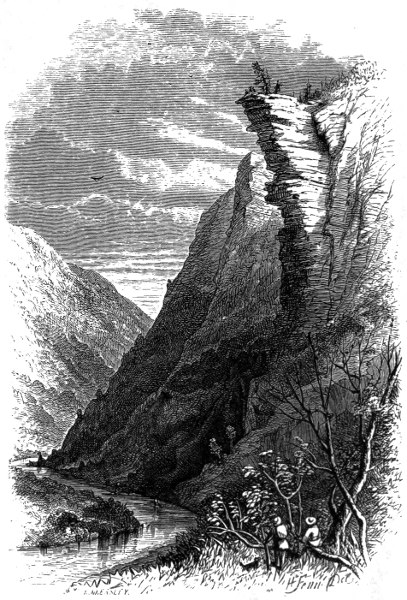
While on this tour I visited the town of
L——, near the centre of Western Virginia,
and made arrangements to remove there in a
few weeks. There are few towns of the size
which I have ever visited where I have met
with a more noble people. There was wealth,
intelligence, and the highest degree of refinement.
This town became the centre of my
operations for three years.
The distance we had to go in moving there
was about one hundred and fifty miles, up
and down mountains most of the way, with
scarce any thing like a road in many places:
a family of five, two of them children, in a
one-horse carriage, with the necessary equipage
for such a journey.
On the afternoon of the third day we began
to ascend the Cheat mountain, which required
nine miles travelling to reach its summit, and
eight miles down the other side to its base,
with only one house all the way, and that on
the top of the mountain, called at that time
“the mountain house of entertainment.” It
was a large rude log-house, without comfort.
By the time we reached the top of it I found
my horse very much fatigued, and the sun
about setting. We concluded we could not descend
the mountain that night with safety, as
there was no moon, and the whole way was
through a dense pine forest.
When we came to this house on the very
top of the mountain, we found a number of
covered wagons that belonged to families
moving westward, and a crowd of people
of all colors about the house. I asked for
lodging. “Yes,” said the landlord, “lodging
plenty!” My family went into the house,
and I went to see my horse taken care of.
On my return I found them without any place
to sit down. After looking through the house,
and finding but two or three apartments, and
such a crowd of people, I asked the landlord
how he would lodge us all. “Oh,” said he,
“you can lie down a few at a time, and soon
as you get asleep I can stand you up against
the wall.”
Though it was in September, and very
warm in the valleys, yet it was cold on the
top of this mountain, and we were all shivering.
I asked the landlord, who by this time
was playing the violin for our entertainment,
to make us a little fire. But there was neither
wood nor supper. The females were
stowed away in one room for the night, and
the rest lay on the floor or sat by turns till
the morning came.
As we had no toilet to make in the morning,
we were on the way down the mountain
at an early hour. The first house we reached
was a log-house, where they kept entertainment.
All was neat and clean. We called
for breakfast; and while it was preparing, we
had our morning devotions, which had been
noticed by the landlady. When we came to
our excellent breakfast, she asked me to christen
her children, of which she had quite a
number. I told her I was not a preacher,
and had no authority to administer ordinances.
She insisted most earnestly that I
must do it; that no one had ever prayed there
before, and she did not see any reason why
any praying man could not christen children;
that they had been living there for years, and
never heard a sermon or seen a preacher as
they knew of; and if I would only do it, they
would not charge me one cent for breakfast.
After preaching them the best sermon I could,
and giving a good supply of little books, we
went on our way. In two more days we
reached L——, our place of destination, in
safety, and in a few hours had a house rented
and were living in it.
For three years I travelled almost constantly;
sometimes in a buggy, but mostly
on horseback, making from six to eight thousand
miles each year, distributing tracts and
books in cabins and mansions, collecting
money, and employing men, till I had the cooperation
of over fifty colporteurs. The many
interesting facts and incidents which occurred
during these years would fill a large volume.
A very few of them I shall attempt to relate.
A Mr. W——, whom we had employed for
some years, a man of much more than ordinary
piety and qualifications for the work,
while visiting in the mountains, came to a
poor cabin occupied by a man, his wife, and
an only son. They were very poor. The
father made his living by grubbing, and took
the boy with him to pick the brush, he being
at this time about sixteen years old. They
carried home their wages on their backs,
mostly in some kind of food. The mother
made what she earned by her spinning-wheel;
and while at that, had taught her
son to read the Testament, though she was
not religious. Mr. W——, after talking and
praying with them, gave this boy a copy of
Baxter’s Call, which was the means of his
conversion. Before he could join the church,
the neighbors aided in getting him a suit of
clothes.
He immediately set about to improve himself
in every possible way. There was no
school near; and if there had been, he had
no means to go. His first efforts in learning
to write were, by copying the letters out of a
book with his finger in the snow. He borrowed
and read all the books he could get,
and attended a little church where there was
preaching once each month.
About two years afterwards I received a
letter by some private way from this same
boy, D. W. S——. On opening it, I made
out its contents with some difficulty. It was
an application to become a colporteur. In
the letter he referred me to the Rev. Mr.
R——, who lived in town. I went to him,
showed him the letter, and asked him if he
knew the writer. He laughed: “Yes, very
well; I received him into the church. D——
is a good boy, but he is without education,
and knows nothing of the world; he has never
been ten miles from home in his life.”
I wrote the young man a kind letter, saying
I hoped he would make a colporteur some
day, and advised him to go to school a while.
The next thing I heard from him was a rap
at my door. When I opened the door, an
awkward-looking youth near six feet high
stood before me, with the same suit of clothes
on him he had got over two years before.
The pants were several inches too short, and
the coat-sleeves as deficient; indeed, the coat
was little more than a big patch on his back.
Said he, “I am the fellow that wrote you a
letter about wanting to colport, and I have
come to see about it.” I invited him into the
house. He was all in a tremor of excitement.
When I opened the parlor door he looked in
with amazement, and in walking to a seat
avoided stepping on the white spots in the
carpet, which was the first one he ever saw.
He was so embarrassed he could scarcely
speak.
After talking a little while about crops, etc.,
he became composed. He then told me his
desires to do good, and all about his conversion,
which was entirely satisfactory. As it
was late in the evening, I invited him to stay
for the night; and by the time we got his
poor old pony of a horse, not worth five dollars,
put away, tea was ready. When he sat
down he looked confused. I had much conversation
with him that evening. At length
I invited him up stairs to bed. On the way
up he held by the railing to avoid treading
on the narrow carpet in the centre.
In the morning he was up whistling psalm
tunes bright and early. As soon as I was
dressed I called him and told him I had reflected
over the matter very carefully, and
had come to the conclusion that his want of
education and knowledge of the world would
not justify me in employing him.
I saw his countenance change in a moment
and the tears start in his eyes. “Oh,” said
he, “I do want you to give me work, for I
do feel that all I want to live for is to work for
Christ.”
I cannot describe my feelings as he uttered
these words. Here was a depth of devotion
beyond any thing I had met. After some
minutes’ silence I said to him, “There is a
region of country on the head-waters of the
Elk river where there never has been any
preaching; if you will go there a month without
any commission, I will see you are paid.”
His countenance was changed in a moment,
and lit up with joy. In less than two hours
I had a pair of colporteur’s saddle-bags filled
with books and tracts, and he was on his
journey to that destitute region, some forty
miles distant. Soon after, some stock raisers
who had been in that region buying cattle,
told me they heard that the Tract Society
had a great man out there; that the people
were wonderfully pleased with him; that he
was giving them books, and teaching them to
read them.
At the end of the month he returned, all
his stock had passed into the hands of the
people, and he gave me a glowing account of
the people’s wants and his success. He said
it would take another month to get over that
region, and he wanted to go back. After
aiding him to dispense with his boy clothes, I
started him with another load of books, cautioning
him to avoid showing off his new suit
as much as possible.
Another month’s work was done with great
success, when he returned almost a new boy
in his whole appearance. He had gained
confidence by being constantly among people
that did not know as much as he did.
I then had him commissioned for P——
county, a very mountainous region, and very
destitute of the means of moral improvement.
In a few months he had visited every family
in the county. In many families the bare
mention of his name will start tears in the
eyes of the people, and the tracts that he distributed
have been sewed together and covered
with deerskin as remembrances of the
man that left them.
Often through the day when he would
come in sight of a cabin, he would alight
from his horse and kneel in the woods and
plead with God for success in his visit.
He next visited the counties of M—— and
R——, two large counties, with remarkable
success. By this time he became a fine-looking
young man, and by his constant application
to reading the books as he rode along,
he had become an intelligent, spiritual Christian.
We then sent him to the large county of
P——, where there was in portions of it a
high degree of intelligence and refinement.
In a few months he was licensed to preach
the gospel. He married a lady of high moral
worth, and settled in the county of H——
over four weak churches. In two and a half
years he received over two hundred persons
into the church on profession of their faith;
then took typhoid fever, with which he soon
died in the triumphs of a living faith.
Since his death I have met with five young
men, who are now ministers of the gospel,
who had been led to Christ by his labors, all
of whom speak of him as an extraordinary
man in point of piety and usefulness.
Here was a boy that in all probability
would have lived and died in ignorance and
sin if he had not been found by a colporteur.
He has often put his hand on my shoulder,
and said with tears in his eyes, “Brother
C——, if it had not been for the Tract Society,
I should have been a poor grubber to-day, on
the way to death and ruin.”
The great secret of his success was his untiring
zeal and industry. He read and studied
on his saddle; the shades of the forest
were his closet in the summer, and the cleft
of some mountain rock in the winter. His
congregations were mostly ignorant families,
and his rostrum a three-legged stool in the
corner. All his talents were put to use in
the Lord’s work, and no doubt he has his
reward. Reader, go thou and do likewise,
and receive a like gracious reward.
On a Saturday evening while on my way
to meet a Sabbath appointment, while descending
a mountain, I met a man on his
way home from mill, and offered him some
tracts. “Oh,” said he, “they are of no use
to me, for I can’t read, and I have no one
about me that can.” I asked him if he had
a family. “Yes, I have a wife and seven
children.” “It is a great sin,” said I, “for
you to raise a family in such ignorance.”
“Oh,” said he, “there is so much harm in
books, they are better without them.” I
handed him two or three tracts, and told him
to get some one to read them to him. One of
them was, Fifty Reasons for Attending Public
Worship. He took them, and when he got
home showed them to his wife. “Oh,” said
she, “we will be ruined now. I’ll bet that is
a warrant that Middleton has got the sheriff
to serve on you, and we will lose our land.”
They spent a sleepless night, and early next
morning they went to the nearest neighbor
and told him they had got into sad trouble
about their land; that Middleton had served
a warrant on them, and here it was.
The tracts were presented to a man who
was a class-leader in the Methodist church,
and was my informer near a year after this
occurrence. He took the first one, “Fifty
Reasons for Attending Public Worship.”
“Well,” said he, “this is a warrant, but not
sent by Middleton, but from the court of heaven.
God has sent you this, as you never go
to church; and now you see how you have
exposed your ignorance by not being able to
read, not knowing the difference between a
sheriff’s writ and a religious tract; and I do
hope you will now attend church, and have
your children taught to read.” “Now,” said
my informer, “this man and his wife are both
members of the church, and they are sending
their children to school as the result of the
influence of those tracts.”
On one occasion I left home by a stage-coach
before daylight on a long journey.
We stopped after ten miles to take other
passengers. As usual, the way-bill was taken
into the stage-office to enter their names. A
man was in the office who had travelled near
one hundred miles to see me at L——. Seeing
my name on the way-bill, he asked if that
was the man that was the tract agent. About
that time I stepped in to warm myself and
distribute tracts, when some one acquainted
with me told him I was the agent. He then
told me how far he had come to see me, and
how near he was to miss me, all the time interlarding
his conversation with oaths, to the
great amazement of all present who knew the
nature of my work. When he was through,
I told him I would tell him the nature of the
work in a few words: that he must get a
good horse and a large pair of saddle-bags,
fill them with books, and ride over these rugged
mountains, and live on hard fare. With
an awful oath he said he could stand all that
with any fellow about the diggins. In addition
to that, said I, you must read the
Bible, and pray at every house. I never
saw a man so utterly confounded, while those
present were convulsed with laughter. I
gave him a few tracts, and talked to him
till he wept like a child. Although I never
heard of the man again, I have hope that the
conversation was not in vain.