Persian Mohammedanism—Mohammed—Founding of Islam—Shiahs
and Sunnis—Laxity distinguished from infidelity—Central
doctrines of Islam—The Divine Unity—The
prophethood—Behāī view of the prophethood—The Bab—The
Behāu’llah—Behāīism—Its prospects—Islam—Predestination—Repentance—Savābs—Eating
with
unbelievers—Charge of pantheism—Effect of Islam on
character.
We have seen that the Yezdis have long been
accustomed to have in their midst professors of
three distinct religions, the Jewish, the Zoroastrian
and the Mohammedan. But as the Jews
are neither numerous nor influential, and the
Zoroastrian Parsis, though more numerous than
the Jews, are nevertheless not more than a tithe
of the population, the religion that chiefly demands
our attention is Mohammedanism, which is the
established faith of Persia. The Mohammedanism
of Persia is not quite the same as that of India
or Turkey, and the Persians call themselves Shiahs
or nonconformists. In Persia there is one creed
of nonconformity which is there accepted as
orthodox, so those professing this creed will for
the future in these pages be called Shiahs without
further qualification.
It must, however, be remembered that the
name Shiah is not properly confined to this one
sect, and also that this sect itself, like other nonconformist
bodies, has always shown a great
tendency to subdivide. In Persia besides Shiahs,
that is the more orthodox Shiahs, there has always
been one other smaller sect of Mohammedans
attracting general attention. At present the
dissenting doctrine most widely taught is that
of the Behāīs, who have laid hold of the popular
imagination, partly because of their great steadfastness
under the most terrible persecutions,
partly because of the somewhat popular nature
of their teaching, but chiefly because Persia is
now being brought into rather closer touch with
Europe, and the people as a whole feel that the
teaching of the Shiah mullas needs to be modified
if Islam is to be preserved. I think one may
go further, and say that there is at present in
Persia a period of enquiry and spiritual awakening,
which gives a special opportunity, not only to
Mohammedan sectaries, but also to Christian
missionaries. Later on further allusion will be
made to these Behāīs, but we must not forget
that our first task is not so much the study of
the complex religious systems of Persia, as the
analysis of those religious influences to which the
Yezdi has been subjected.
The ordinary Yezdi Mussulman is descended
partly from the original Aryan inhabitants of
Persia, and partly from their Arabian conquerors:
but the enormous difference in character that
exists between him and the purely Aryan Parsi
is certainly due less to race and more to religion,
for the jadīds, or converts from Parsiism, often
develop all the Mussulman characteristics in a few
generations, without the slightest admixture of
race. So before attempting to describe the
character of the people, it will be necessary to
pay as much attention to the religious ideas
that have been brought to bear upon them as
we have already paid to the nature of their
country and the seclusion of their town life.
Some aspects of the Yezdi’s religion will be left
to a future chapter, and we must at present
content ourselves with trying to understand the
essential nature of Islam, particularly dwelling
on those points of Mohammed’s teaching and
example which seem to have produced most
impression on the Persian mind. To do this
we must divest ourselves of all pre-judgments
of the prophet’s life and doctrine, and simply
study the facts of history, remembering that the
conception of Islam which is to be found amongst
the Sunnis of India and Turkey cannot be allowed
to pass unchallenged, for the Mohammedan world
is by no means unanimous about it; and also
that the well-known European theory, that there
was a difference in Mohammed’s aims and objects
in Mecca and Medina, and that the Meccan period
rather than the Medinan indicates the essential
idea of Mohammedanism, is one which no educated
Mussulman would for a moment tolerate. As for
the still more favourable views that have been
lately brought forward by European authors, I
can only pass on a story that was told me of an
educated Mussulman in India who had been
shown such a treatise. “This gentleman, Sahib,”
he said, as he handed back the volume,
“appears to know very little about his own
religion, and absolutely nothing about ours.”
I myself went to Persia with the intention
of making the most of the good points of the
religious systems of the country. With regard
to the Parsis I was not disappointed. Like many
other missionaries, I started with the idea that
I should find these people possessed of a great
many radically wrong notions about the nature
and power of God, which were essential to their
religion. I now believe that I was wrong, and
I have never heard my right-hand man, Mihraban,
who is himself a Parsi, and also one of the most
sincere and earnest Christians whom I have ever
met, speak one word against the real groundwork
of Zoroastrianism. In this religion it is not
unteaching but teaching that is required to lead
the people to Christ; but, in Mohammedanism,
in spite of its greater pretensions, almost every
apparent truth crumbles into mere truism or
actual falsity the moment that you try to make
it the basis of anything practical. Also the more
I read of the life of Mohammed, the more convinced
I am that the radical rottenness of the
system is due to his original teaching. Perhaps
this may be a confession of narrowness, but one
cannot be broad all round. Unless we are going
to deny the iniquity and wickedness of modern
Islam, we shall have to believe that somebody
is to blame; and, if it is not Mohammed, I
suppose it must be either the mullas or the
Mussulman laity. I do not know why we should
expend all our breadth on the big people: I myself
have some sympathy with the little ones: and I
firmly believe that the difficulties in the Islam
of to-day are due rather to the essential wrongness
of the system than to its corruption by the masses.
Mohammed was born in Mecca towards the
end of the sixth century. He was a member of
the important family who had charge of the
Ka’aba, which was a heathen temple that the
Meccans had attempted to make a common
meeting-ground for the whole of Arabia, by
including within its limits the idols and symbols
of worship that were respected by the different
tribes. Some of these tribes had adopted Christianity
and Judaism; so pictures even of Jewish
and Christian saints were to be found within the
walls of the Meccan temple.
The Mussulman historians of Mohammed’s life
tell us that there had been in Arabia, for some
years before the prophet came forward, a set of
reformers called Hanīfs, who seem to have been
half political and half religious, but to have been
all of them convinced that some form of religion,
purer than that represented by the Ka’aba, was
needed to unite Arabia against its common foes.
Some of these Hanifs ended by adopting Christianity
or Judaism; others were inclined to the
adoption of a more essentially national form of
monotheism, which should retain the Ka’aba as
its centre. The most notable of the latter party
was Zaid ibn Amr, a man so much admired by
Mohammed that he declared him a prophet, and
in other ways professed his complete acceptation
of his principles and teaching.
Mohammed by his marriage with Khadīja was
certainly introduced into this set of reformers.
Waraka ibn Nawfal was one of the most
prominent Hanifs, and we have indisputable
evidence that he was one of Khadija’s most
intimate friends, both at the time of her marriage,
and also at the time when her husband received
his first revelation. Mohammed himself had been
from childhood of a hysterical disposition, and
was subject to fits, during which he saw visions,
which on recovering consciousness he was able to
recollect; consequently while in this company he
became convinced that he was the expected
prophet who was to bind Arabia together by a
politico-religious system.
In placing himself at the head of the Hanif
movement, Mohammed probably gave more
prominence to the political aspect than had
most of the former and less successful leaders.
This is brought out by Koelle in his life of
Mohammed; and indeed it is obvious that the
man who could allow an unbelieving friend,
even though a close relation, to play the important
part in the building of his church that
Abbās played in the second meeting on the
eminence, was primarily a politician rather than
a religious reformer: for it was Abbas who on
that occasion first proposed the oath that may
almost be called the basis of Islam. A critical
study of Mohammed’s early dealings with the
Arabians brings us to a similar conclusion.
Of the other stories collected by Koelle from
Mussulman sources to prove this point, perhaps
the most forcible is that of the discussion between
the prophet, his uncle, Abu Tālib, under whose
protection he was then living, and Abu Jahl.
Abu Talib called his nephew and said to him,
“Thou seest the nobles of thy people are
assembled here to concede to thee certain
things, and, in return, to receive concessions
from thee.” Mohammed made this reply:
“Well, then, give me a word whereby the
Arabs may be governed and the Persians subjugated.”
Abu Jahl responded to this request
in the name of his fellow-elders by saying: “Thou
shalt have ten words.” But Mohammed setting
him right, and indicating what kind of word in
his opinion could alone answer the purpose, rejoined:
“Say, ‘There is no God except Allah!’
and renounce what you worship besides Him.”
This story Koelle quotes from Ibn Ishāk, the
earliest and most trustworthy biographer.
Certainly the movement from paganism to
monotheism, which took place in Arabia in
those days, was in itself a fine thing; and it
was accompanied by much sincerity and religious
zeal. It is also obvious that Mohammed possessed
a personality peculiarly attractive to the Arabian,
and that this, as well as his enthusiasm on the
subject of his mission, had the effect of attracting
many to the cause.
But not only did Mohammed pay much more
regard to politics than can be possibly excused,
he also accepted the religious and ethical teaching
of the Hanifs only in the most superficial manner;
and, under the cover of verbal conformity, retained
as much as possible of the original pagan ideas in
which he had been reared. The result is that his
followers are still to be found possessed of what
seems at first sight to be correct doctrine upon
fundamentals, and yet are unable to advance by
its assistance along the path of light and progress.
The popular idea, that fanatical intolerance
of all professors of other religions is an essential
and fundamental principle in Mohammedanism,
cannot be maintained. The paganism of Mecca
was distinctly latitudinarian, so Mohammed
accepted in full the sacred books of the Jews
and Christians, as would have seemed natural
to an Arabian of that age, especially to a monotheistic
teacher who was closely connected with
the Ka’aba. This does not mean that he in any
way apprehended the meaning of Judaism and
Christianity. The doctrine of the perpetuity
of the moral law never seems to have entered
into his mind, even in the most elementary form.
He wished to say that he had himself received
a revelation superseding all former ones by the
mandate of God, and he did not wish to make
trouble by pronouncing other religions to be
false, without absolute necessity. His real object
was to unite the Arabs by a reformed religion,
and at first he regarded his mission as a purely
national one. Whatever were his ultimate designs
upon the Jews and Christians in Arabia, he intentionally
conveyed to them the impression that,
if they recognised him as a prophet to others, he
would be content without their accepting him
themselves. Indeed, while he was still at Mecca,
he was even uncertain whether the idolaters who
accepted him might not be allowed to retain some
of their idols as intermediaries between themselves
and Allah. He went so far on one occasion as
to actually effect a reconciliation on this basis;
but as such a concession must have greatly
damaged his influence with those who were
favourably disposed to the Hanif movement, he
afterwards repudiated the transaction, and declared
that he had acted under the influence of the devil.
His work in Mecca was not very successful; and
the opposition he encountered was so strong that
he had at last to begin to make attempts to start
work in some other place, and he was finally
successful in making a fresh beginning in Medina.
Here he was able to take advantage of a family
connection with some of the principal citizens,
and also of a long-standing rivalry between
Medina and Mecca. Although the movement
in Mecca had not been widely successful,
Mohammed had gathered amongst his followers
several really prominent men. Consequently,
the people of Medina, although divided on the
subject of his prophetic mission, were unanimous
as to the advisability of receiving him and his
followers into their town. Settled in Medina,
Mohammed’s fortunes underwent a change. The
chieftancy of the tribe to which his grandmother
had belonged fell vacant, and, as most of the
members of this tribe had become Mussulmans,
Mohammed had no difficulty in himself becoming
their chief. Considering himself restrained by
no preconception or former revelation of the
moral law, he was able, without dropping for
one moment his pretensions to prophethood, to
use every means of fraud and violence which
seemed conducive to his political end. As Koelle
has pointed out, there is no reason to suppose
that his principles in any way changed, but under
the altered conditions and environment the
utterly non-ethical theory of revelation held by
the prophet became more apparent. This is
perhaps most clearly brought out by his utterly
unscrupulous dealing with the Jews, and also
by the story of Zaid and Zainab, in all which
affairs Mohammed professed himself to be acting
under Divine direction, nor is it at all obvious
that he did not actually believe it. Finally,
before his death, he succeeded in establishing his
religion and political system throughout the
whole of Arabia.
Of course it was impossible for a movement
like this to take place without rival prophets
appearing in other parts of the country. Two
of these appeared during Mohammed’s lifetime,
and he thought it best to guard against future
schisms of a similar kind by declaring himself
the last of the prophets. Exactly what he
meant by this is not very clear: if the almost
universal voice of Islam is to be accepted, he did
not mean that he was the last divinely appointed
teacher, for all Mussulmans look forward to the
coming of a Mehdi or Mahdi, who, together with
Jesus, the son of Mary, is to appear in the last
days, and spread the doctrines of Islam throughout
the world. Orthodox Mussulmans, however,
always look upon Mohammed as the last great
sāhibi kitāb, or book-bearer.
The ordinary Sunnis, who are the largest and
best-known Mussulman sect, assert that, as a
matter of fact, since the time of Mohammed, no
divinely-appointed teacher has as yet appeared.
The Khalīfs were in their eyes simply appointed
by the congregation, and the four great writers
of the sunnat, which is to them the only authoritative
commentary upon the doctrines of Islam,
were only learned and saintly men. Now, they
hold, these doctrines can only be learnt from
this book, and from the Qurān itself; for the
mujtahid or high mulla, capable of giving
authoritative decisions on moot points, no longer
exists.
The Shiahs have very different tenets.
Mohammed according to their teaching was the
first of a hierarchic dynasty of thirteen, consisting
of himself and the twelve great Imāms, of whom
the first was Ali, the son-in-law of the prophet,
and who were all as certainly divinely appointed
as Mohammed himself. Mohammed is only the
last great book-bearer, and therefore the founder
of the present era. The last of the Imams was
the Mehdi, who according to the Sunnis has not
yet been born, but according to the Shiahs
appeared long ago. This man did not die, but
disappeared, remaining at first accessible to his
followers through the medium of four successive
Bābs, or gates of knowledge, who were in touch
with him during his concealment. Like the
Imams, the Babs came to an end, for the last
of them refused to appoint a successor. All this
of course is very ancient history.
The Shiahs have their own traditionists, for
they reject the sunnat altogether. Between the
traditions of the Shiahs and the Sunnis there is
not much to choose: there is a certain amount
of historical fact embodied in both, and there is
also a great deal of absolute nonsense. However,
many otherwise orthodox Shiahs either reject the
traditions altogether, or interpret them allegorically.
There is more freedom of interpretation
amongst the Shiahs than amongst the Sunnis:
indeed many Shiahs believe that some of the
most objectionable chapters of the Quran describing
the delights of heaven are entirely parabolic.
Of course with mujtahids (supposed to be able to
pronounce authoritatively on moot points) scattered
all over Persia, the fixity of doctrine that prevails
amongst Mohammedans of Sunni countries would
be impossible.
The tenets of the Shiahs are not derogatory to
the mission of Mohammed, or to the position of
the Quran, but they make the solitary figure of
the prophet stand out much less prominently.
For instance, if a Persian is told that his religion
possesses nothing corresponding to the vicarious
sacrifice of Christ, he will invariably reply by
pointing to the martyrdom of the Imam Husain.
Also the Mehdi, or occult Imam, is not the future,
but the present ruler of Islam; and so he is in
some ways as important a personage as the
original prophet. Not very long ago the Shah
of Persia used to pay rent for his palace to the
Mehdi, the money going to the mujtahids as the
representatives of the Imam: I do not know
whether this practice is still continued, but the
theory on which it was based is certainly not
extinct. Again there is a common saying that
the Imam Ali is present in the heart of the true
believer, but I think it is only regarded by the
ordinary Yezdi as a poetical expression. The
point to be noted is that the saying is always
about Ali, not about Mohammed. Shiahs invoke
the Imams Ali and Husain very much more
frequently than they invoke Mohammed; and
though the inscription over a Persian mosque
should be, “Yā Ali, Yā Muhammad,” that is,
“O Ali! O Mohammed!” the “Yā Muhammad”
is often omitted and the “Yā Ali” left to stand
alone. The excuse is sometimes brought forward
that Mohammed is too great for constant invocation.
Considering the way in which the Shiah
uses the name of God, this must, I think, be
regarded as a mere excuse for a habit due to
wholly different causes.
This extreme attachment to the Imams is
probably due to two things. In the first place,
there can be no doubt that the cause of Ali and
his sons was taken up in Persia as an outlet to
national jealousy, for the Aryan converts were
not sorry when a pretext occurred for differentiating
themselves from the majority of their
Arab conquerors. In the Shiah religion the early
Khalifs, who ruled Islam while the holy Imams
were still alive, are held up to the bitterest
execration, and Omar in particular, who, by the
way, was the conqueror of Persia, takes much
the same place in the Shiah system that Judas
Iscariot does in the Christian.
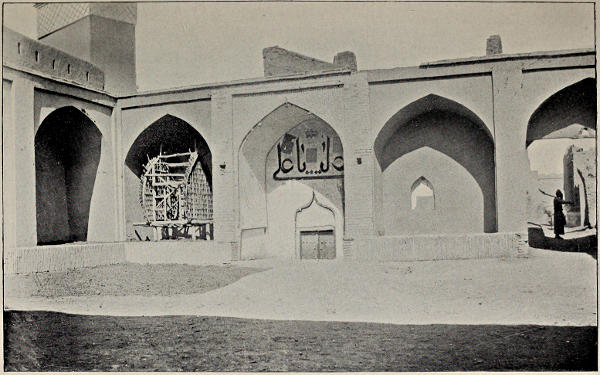
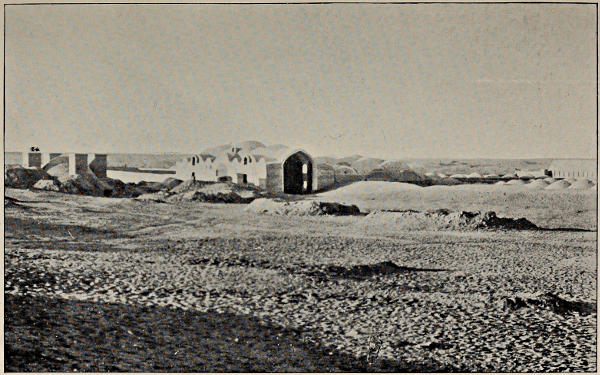
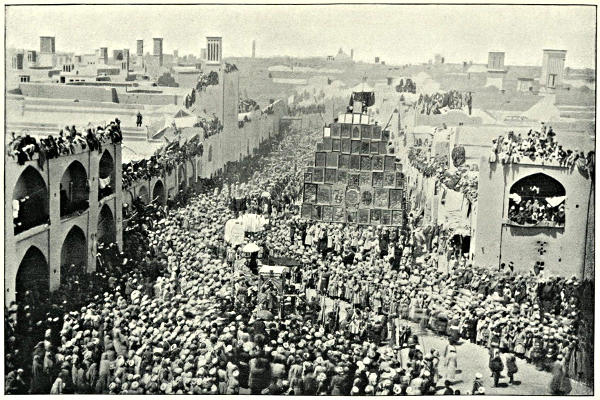
SMALL SQUARE IN YEZD.
To the left is a small Nakhl, and in the centre a mosque door with the inscription “Ya Ali.”
Secondly, the influence of sects of mystics,
professedly Mohammedan but having in their
doctrines a distinctly pantheistic tendency, must
be remembered. Ancient Persia was full of
pantheism, and when it became Mussulman the
inclination towards such teaching still continued,
for the broader views held by the Shiahs as to
freedom of interpretation in reading the Quran
gave a possible status in the country to very
heretical sects. These Persian mystics often
preferred to make the Imams, especially Ali, at
least as prominent in their systems as Mohammed,
whose teaching was more difficult to bend to
their purposes; and although the ordinary Yezdi
is certainly not a pantheist, they have undoubtedly
intensified his enthusiasm for the personalities of
the Imams, and through their poetry they have
familiarised him with religious expressions of a
somewhat unorthodox character. This is in some
ways an advantage to the missionary, but he
must beware that it does not give him a false
view of the progress that he is making.
As to the theory of the divinely appointed
Imamate it might be urged that the retention
of the whole glory of the early sainthood for the
close relations and descendants of the prophet
is an excess of zeal that Mohammed would have
greatly approved. However this may be, the
doctrine is not obviously opposed to Mohammedanism.
The Shiahs are certainly much laxer than the
Sunnis with regard to some of the commandments
of the Qurān. Painting, and the making of figures
is considered by the Sunnis to be a violation of the
law against idolatry. There is, however, a regular
school of Persian painting; and clay models of men,
animals and demons, as well as rag dolls, are given
to the children as toys. The protests made by the
mullas against these things are very faint. They
are rather louder in their denunciations of all forms
of music, which amongst orthodox Mohammedans
is supposed to have no purpose but the exciting of
the passions. As to the drinking of wine and
spirits, the avoidance of the regular Mohammedan
fast in the month of Ramazān, and the omission of
the prescribed prayers, the Shiah mullas take a
view which is at least intelligible. To begin with,
such things do not amount to infidelity unless they
are done wilfully and consistently. A formal
acceptation of the whole of the ordinances is
demanded. There must be no drunkenness in the
streets, no eating in Ramazan when anybody is
near unless a legitimate excuse can be brought
forward, and if prayers have not been said men
must say that they have said them. Further than
this external government does not go; and as a
matter of fact many irreligious Persians secretly
drink themselves drunk in their houses, forget to
say their prayers regularly, and make up what
would, if true, be valid excuses for not keeping the
fast in Ramazan. Such people are well aware
that they are liable to punishment, but they also
know that, unless they prove disloyal to Islam by
accepting some other faith, they are not in any
great danger. It is true that every now and again
the mullas incite the people to join them in
cleansing the land of infidelity, and on such
occasions sectaries like the Babis, and those who
are supposed to sympathise with them, may
greatly suffer, but those who have been merely lax
in their observance of Islam are apt to make up
for their past deficiencies by a peculiar show of zeal.
It may be asked whether the mullas in Persia
are justified in making no more persistent efforts
to enforce Mohammedan law, and whether their
winking at such irregularities is not in itself
disloyalty to the system of Islam. Probably it
would be easy for them to show that they were
justified by the example of Mohammed himself.
If Mohammed enforced a much stricter discipline
in the town where he was himself present—a
matter which I think is open to doubt—it would
be almost impossible to maintain that he caused
such discipline to be enforced among the Arab
tribes. These tribes were generally accepted
through the medium of their chief, who usually
came to Mohammed in person, had a short
interview with him, part of which was devoted to
political subjects, and often went back to his tribe
on the same day. It is true that Mohammed
made a distinction between hypocrites—munāfiqīn,
and true believers, but he generally meant by
hypocrites people who were not really on his side
against others, and here the ordinary Shiah is
unimpeachable.
The fact is that Islam contains much more than
an assortment of commandments. Otherwise it
would never have impressed its adherents in so
distinct and remarkable a manner with special
characteristics. The central idea of the religion is
that we are all under the dominion of an invisible
and absolutely powerful God, Who has created all
things, and has willed and ordained everything
both good and evil that is to be found in the
universe. It is true that there is a Shiah dogma
against the extreme predestinarianism which
characterises the Sunni creed, but I do not believe
that it has in the least affected the fatalistic view
of the ordinary people. In Islam God may be
called good because it is our duty to accept as good
whatever He does, and He may also be called
by other names according to the character of His
known actions towards us; but His own nature is
absolutely different from that of man; consequently
nothing can be known of His moral
character beyond the fact of certain explicit
actions. This God from time to time sends to the
world prophets, whose duty is to teach mankind
the doctrine of His unity, the necessity of worship,
and the necessity of doing what is for the time
being His will. According to the popular opinion
there have been a hundred and forty-four thousand
of these prophets, but of this number only a few
have been authorised to publish a new code of
human duty. Those so authorised are known as
book-bearers, and Adam, Seth, Enoch, Abraham,
Moses, David, Jesus, and Mohammed were all of
this class. The Behāīs add the name of Behāu’llah
after that of Mohammed. These book-bearers are
always marked by the possession of some sort of
supernatural powers appealing to the intellect, and
also, in the case of the latter ones, by the fulfilment
of signs mentioned by the former prophets.
Obedience to them is rewarded by various degrees
of bliss in Heaven, disobedience is punished by
Hell. The prophet must conform to previous
revelations in the assertion of God’s unity,
invisibility and omnipotence, but it is not necessary
that there should be any coherence between the
directions about human action as set forth in
successive dispensations, nor is any difference made
between ceremonial and moral commandments.
This central doctrine of Mohammedanism
concerns God, the prophet, man and creation;
so we come across it under four names, giving
the four possible points of view. First of all
there is the name of tauhīd, or assertion of the
Divine unity. The Mussulman means by this very
much more than the mere assertion that God is
a single Being. He includes in it the doctrine
of the invisibility of God and of His absolutely
separate nature, and it appears to clash with the
Christian conception in two important particulars.
There is an absolute denial of the statement, upon
which most Christians more or less consciously
base their belief in the perpetuity and absolute
nature of the law of human morals, that “in the
image of God created He man.” Consequently
we shall afterwards find that in Islam there is no
belief in the permanency of the moral law, for
nothing is thought by the Mussulman to be
necessarily permanent except things connected
with the nature of God; and as our nature
differs entirely from that of the Creator the
law given for it cannot be necessarily permanent.
There is also in reality a fundamental contradiction
of Christian doctrine in the Mohammedan’s
rendering of the statement that God is a single
Being. This is best explained by a simple illustration.
Supposing a man were to say, “London is
one place,” it is conceivable that he might mean
one of two things. Either he might mean that
the City of London was the only true London,
and that there was no other part of the town in
Middlesex or Surrey that ought to be called by
the same name; or he might mean that the whole
of those places which go by the name of the
County of London are in reality only one place;
and these two statements are not similar statements
with a slight difference, but they are
absolutely contradictory. So the Christian says
there is only one God, by which he means to
assert the unity of the all-good Creator, the all-good
Personality Who was revealed as the Son,
and the all-good Spirit Who is the only source
of good in the heart. As God to the Christian
means the All-good, what he needs is a doctrine
that asserts the essential unity of the All-good
wherever he finds it. The Christian is of course
not a pantheist, but his conception of the one
God has to be sufficiently inclusive to cover
those Three Who, as he knows, certainly possess
the attributes of Deity. The Mussulman on the
other hand does not pretend to know anything
about the attributes of Deity, excepting that
God is one, invisible and omnipotent. Consequently
he frames his definition of the Deity
so as to purposely exclude what the Christian
with his larger knowledge knows to be the manifestation
of the same essence.
To pass on to the Mussulman’s conception of
his religion as it relates to the prophet. The
paighambarī, or the bringing of messages from
the Deity, is in many ways a peculiar idea.
Mohammed himself had very little notion of
his message being an advance on what had been
given before, and of the gradual growth of revelation
he had no conception at all. He was content
to assert that his teaching was the religion of
Abraham, a phrase of which he frequently made
use. It is true that Mussulmans sometimes say
that parts of God’s Word were revealed to former
paighambars, but that the complete commandment
was given to Mohammed, and although
this is very different from the Christian doctrine
of the growth of revelation, it might possibly be
regarded as a substitute for it; but the fact is
that, though it may be traceable to the prophet,
it is quite foreign to the essential system of
Islam. We frequently find such foreign ideas
which have been imported into Islam, occasionally
by Mohammed but more frequently by his
followers, simply to answer some specific objection,
or to maintain the superiority of the system over
all others. Such importations can as a rule be
easily separated from the essential doctrines of
Islam, and in most cases they have not affected
the general character of the religion. This is due
to the religion as first conceived by Mohammed
having been clear in its essential points, and it
is these points rather than the accretions that
have left such a strong mark upon the body of
Mussulmans. The paighambari, more than any
other doctrine or expression of doctrine, brings
out with intense plainness the fundamental distinction
between the Mussulman and the Christian,
that enormous divergence of view regarding the
moral law which lies at the root of almost all
their differences in subordinate theories and
tenets. So when we are discussing the influence
of Mohammedan ideas upon character, it is well to
remember that sects which do not hold this theory
of the paighambari ought to be regarded separately.
There are in Persia sects which are only
nominally Mussulman, and which largely owe
their origin to non-Mohammedan sources. The
Sūfis, for instance, are only half Mohammedan,
and their philosophy is really pantheistic. Sufis
are to be found in Yezd, but there are not very
many serious ones, and the sect has largely lost
its direct influence in the country. But the Babis,
of whom the Behāī branch is rapidly spreading
everywhere throughout the Persian towns, have
been influenced by Sufi ideas to a much greater
extent than have the orthodox Shiahs, who, we
agreed, are not pantheistic. Perhaps some
professing Behāīs are really very near to the
Sufis in ideas, but this is not the case with the
more orthodox, who, though they have modified
the fundamental doctrines of Mohammedanism
in such a way as to remove the gulf between
God and the prophet, have not produced a
theology which is free from the obvious defects
of that of Islam. The Behāī appears to hold
that the superior prophet, that is, the book-bearer,
is in every case an incarnation of the
Deity, but he goes on to say that there is an
absolute distinction between the prophet and his
people; for the book-bearer is God, and the
people are not God; nor are they, so far as I
can understand, capable of receiving the Spirit of
God, either from the prophet or directly from
God Himself. They can only be impressed by
the prophet as wax is impressed by a seal.
Whether this doctrine is really Behāu’llah’s or
not, it was certainly given to me by men who
ought to have known the truth about the Behāī
faith.
The adherents of this sect in Persia are now
exceedingly numerous, and many people believe
that in the end the whole country will become
Behāī; so the question whether the Behāīs are
more reliable than the orthodox Shiahs has
become an important one. Certainly they teach
a cleaner and purer doctrine on points of ethics;
but what Persia needs is not so much a higher
moral teaching, but rather a higher basis for
morality. A religion that puts the commandment
not to steal on the same level as the
direction not to stew your dates but to fry them,
will never produce the high characters that are
to be found in such communities as the Parsi. It
would be irreverent to compare such a faith
with the religion given to us by the Saviour.
During the late Behāī massacre, I had the
opportunity of discussing what was going on
with a Behāī muballigh, that is, an authorised
Behāī teacher and missionary. I have no intention
of unnecessarily dwelling on the ghastly
horrors that were then being perpetrated, but
a few details are unavoidable. The Behāī sectaries
were not at that time being executed
before the mujtahids, but were being torn in
pieces by the crowd. What had excited the
people was not simply religious feeling, but it
was very largely the statement by the clerical
authorities that the goods of the Behāīs were
“lawful,” that is, that any one might plunder
them who cared to do so. The attacks were
often made by men who had lived for a long
while in close companionship with the Behāīs,
knowing them all the time to be members of
the sect, and yet consorting and eating with
them freely. Holes were bored in the heads
of some of these poor wretches with awls, oil
was then poured into the hole and lighted. Other
forms of torture were used about which one
cannot write. Women and children were very
seldom actually killed, but were fearfully ill-treated,
and sometimes left to die of starvation.
It was reported that in one of the villages Babi
children died within full sight of the villagers,
after waiting for days under the trees where
their murdered parents had left them.
The Behāī muballigh with whom I was talking
was certainly well aware, in a general way, of
what was going on; yet I could not get him to
see that these things, done in the name of religion
to his own sect, were in themselves wrong, and
that man’s eyes had been opened, or could be
opened, to their essential wrongness. Of course
he maintained that the action of the Mussulmans
was evil, but his reason was that, in the first
place, those persecuted were spiritually right,
and, in the second place, even had they not been
so, the last book-bearer, the Behāu’llah, had
promulgated a Divine commandment that there
was to be no religious persecution. I then asked
him if such persecution could again become lawful
if another book-bearer appeared and promulgated
a different commandment. He answered that it
was impossible for another book-bearer to appear
for a long period. I then asked him if he would
accept a new book-bearer, who, besides satisfying
the other conditions, exhibited a text in one
of the previously received Scriptures, stating
that one day in God’s sight is as a thousand
years. He replied that, if such a verse could
be shown, and the other conditions were satisfied,
such a man might be accepted to-morrow, even
although he taught a doctrine similar to that
of Mohammed about religious persecution and
other matters of the same sort.
Now there are three points to be noted by
those who expect great things of the Behāī movement.
First of all, the Behāīs accept the whole
of the Jewish and Christian Scriptures, which,
of course, include a verse of the kind above
mentioned. Secondly, they have already had
three book-bearers; the Bab, who was the original
founder of the Babi sects, and who not only
exhibited a Divine book, but also claimed to be
the resurrection of Mohammed in the same way
that Mohammed was the resurrection of Jesus;
Subhi Azal, whom for some years they recognised
as the Bab’s successor; and lastly, Behāu’llah,
whom the Behāīs now hold to be the only major
prophet of the three. Thirdly, the Behāīs, in
attempting to prove that the Bab was a lesser
prophet and a mere forerunner of the Behāu’llah,
and also that Subhi Azal was never a really
great personage, have seriously falsified their
records. The reader who desires further information
on this subject cannot do better than consult
Professor E. G. Browne’s admirable introduction
to his translation of the Tārīkhi Jadīd.
The Bab, who came forward rather less than
a century ago, was a young Shirazi Persian, a
Seyid of the merchant class, whose real name
was Ali Mohammed. The Shaikhi sect were at
that time predicting the appearance of a great
religious leader, and the Bab came forward claiming
to be this prophet. He called himself the
Bab, or Gate of Knowledge, and was at first
supposed by his followers to be the Gate of
Access to the Mehdi; but he seems to have used
these terms in a very broad and allegorical fashion,
and to have held the doctrine of the essential
unity of all book-bearers. He later declared
himself to be the Mehdi, and also to be the Gate
of Access to One Whom God should manifest.
The movement caused a great deal of fighting
in Persia, and though the Babis were acting on
the defensive, there is very little doubt that they
had harboured political designs. The Bab, however,
differs from Mohammed in having been,
so far as we can judge, primarily a religious
reformer, and having done his best to make the
movement as spiritual as possible. His followers
were treated with the most barbarous severity,
and he himself was after a few years put to
death. Before this he appointed Subhi Azal,
one of his followers, to be his successor, and for
a few years this man was received as “He Whom
God should manifest.” Later on, Subhi Azal’s
half-brother, the Behāu’llah, managed to get
himself accepted as head of the sect. Many of
the followers of Subhi Azal were assassinated,
and the sect was re-organised with some important
differences. It now purports to be absolutely
non-political, and the teaching has become more
simple and practical. The Behāīs are anxious
to retain the use of the Quran, so as to preserve
their claim to toleration, although they imagine
that the law of the Quran no longer stands, its
place having been taken by a later revelation.
Partially to avoid inconsistency in this matter,
and partially to keep before the minds of the
Mussulmans the possibility of one really divine
book being replaced by another, they encourage
the reading of all the Scripture considered divine
by Mohammedans, that is, not only the Quran,
but also the whole of the Christian Bible, nor
do they generally call the authenticity of the
extant version in question.
Behāīism is obviously an attempt to adapt
Islam to the exigencies of modern circumstances,
taking advantage of the special tenets of the
Shiahs. The North of Persia is being at present
rapidly overrun by Russia, and even in the South
the Persian feels that he is on the eve of political
changes. The Behāīs consider that they have
a creed which enables them to meet the foreigner
without continual jar and offence. In this they
are right, for they do not veil their women, they
do not consider infidels unclean, and they go
further than does the broadest Shiah in the matter
of respect to other forms of faith. Some orthodox
Shiahs accept the Jewish and Christian Scriptures
as they stand, without pressing the story that
the Jews and Christians altered their books to
suit their own purposes. Almost all Persians are
open to argument on this point, though most will
say that to those possessed of the Quran the
perusal of former Scriptures is unnecessary. But
the Behāīs hold that, unless started by a real
prophet, no religion can possibly survive, and
consequently they allow to even the grossest
forms of idolatry a divine origin, and the possession
of a certain substratum of truth.
In Persia there can never have been that
almost impenetrable wall of dogmatic assertion
and self-assurance which seems to exist in many
Sunni lands, but something of the kind is to be
found throughout Islam. As the self-satisfaction
of the Behāī is almost as strong as that of the
Sunni, and infinitely stronger than that of the
Shiah, it seems a paradox to say that Babiism
has given us in Persia a prepared soil for missionary
work. The fact is that the field prepared is not
amongst the Babis themselves, but amongst the
Shiahs who have been in touch with Babis, and
are nevertheless unconvinced. Consequently it
is a field which cannot be expected to last for
ever, but of which advantage ought to be taken
immediately, for it is very seldom that we find
so exceptional an opportunity given to us for
attacking Mohammedanism on its own ground.
In Yezd the Behāīs have attached to themselves
many of the most enlightened Mussulmans.
The teaching of the sect about behaviour and
practice is not bad, though, in matters connected
with women, there is an inclination to adopt
customs that are rather dangerous considering
the low moral atmosphere. The tendency to
minimise the miraculous element in religion is
not altogether wholesome, and some professing
Babis are inclined to a rather crude rationalism,
the end of which it is difficult to foresee. This
tendency is perhaps fostered by the peculiar
manner of interpreting the sacred books, a method
difficult to describe, as it fluctuates between the
wildest flights of metaphor, and the lowest depths
of puerile literalism, the balance between the
two being decided by a very determined preconception
of what ought to be. To give a
specimen of this, it was seriously urged in a Behāī
pamphlet, reviewed and summarised by the Rev.
W. A. Rice in the Church Missionary Intelligencer,
that Isaiah xxv. 6-9, where God is described as
making “unto all people a feast of fat things, a
feast of wine on the lees, of fat things full of
marrow, of wines on the lees well refined,” refers
to the entertaining of visitors by Behāu’llah during
his banishment at Acre. The “wines on the lees
well refined” are the tea, which Persians generally
pour through a small strainer. The passage also
refers to the fact that God “will swallow up
death in victory,” and will “wipe away all tears
from off all faces; and the rebuke of His people
shall He take away from off all the earth.” To
this part only a spiritual interpretation is given.
I tried before I left Persia to find out the
impression that the sect had made upon other
Europeans, so as not to give a one-sided opinion
about them. Personally, I came to the conclusion
that, in matters even remotely connected with
religion, they were less truthful than the ordinary
Shiah, but that in the ordinary affairs of life
they were a trifle more reliable. Some other
missionaries had a lower opinion of their truthfulness,
and most of those who had had business
dealings with them considered that they were
not more trustworthy than ordinary Mussulmans.
My conclusion is that, though they may succeed
in establishing their creed in Persia, and may
even make the Persians more easy to deal with,
they will not greatly alter the moral character
of the people. They have not done so hitherto,
and an examination of their faith shows that
they cling, in the main, to the Mussulman theory
of the paighambari, or at any rate have not
changed it for a doctrine which gives a man more
cogent reasons for adhering to an approved line
of conduct in times of difficulty.
The name given in Mohammed’s system to
the state of the true believer is Islām, which
means “Resignation to God.” By this the
Mussulman seems to understand that he must
not criticise the prophet, whatever he may do
or teach, and that in the same way he must
accept everything that happens as the will of
God. A waiving of personal responsibility, and
an acceptance of all occurrences as the Divine
intention, is to the Persian an undoubted virtue.
The steadfast pursuit of a purpose which has been
thwarted will often appear to him actually vicious,
although such persistency might be justified in
his eyes by its success, which would prove it to
have been in harmony with God’s will.
The word which expresses the duty of the
believer being Islam, or resignation, the corresponding
word used by the Mussulman to describe
his theory of the course of events is taqdīr, or
predestination. There is, as I have said, in Shiah
dogma an attempt to modify the extreme predestinarian
doctrines of the Sunni. But these
doctrines are so much an integral part of Mohammedanism
that it is impossible for the Mussulman,
Shiah or otherwise, to be anything but a gross
fatalist. This then completes the list of names
under which the essential and fundamental conceptions
of Islam are taught, Tauhid, Paighambari,
Islam, and Taqdir.
There are also in Mohammedanism certain
other doctrines which seem to be part of the
system, but which are not quite so fundamental as
those that have been stated. Some of these are
not quite plain: it is very difficult, for instance, to
understand what was Mohammed’s teaching on the
forgiveness of sins, and there is great confusion of
thought on this point amongst his followers.
Certainly an infidel becoming a Mussulman has his
sins forgiven, though he does not expect to receive
any peculiar strength for the future, but only a
direction as to what God wants him to do and to
avoid. After this the motives of his actions will
be khauf u jizā, that is to say, the fear of Hell and
the expectation of Heaven. He will have to be
punished in Hell for his sins according to their
assessed value, unless he has previously wiped them
out, either by savābs, that is, by works of merit, or
by repentance. Repentance of a real kind is
supposed to have a certain value, though it is hard
to state exactly what that value is. Formal
repentance, which does not in the mind of the
common Persian necessarily involve the giving up
of such fruits of sin as stolen articles, has also a
certain value. But the most efficient way of
atoning for sin is by savabs. Finally no
Mussulman, at any rate among the Shiahs, would
consider it justifiable to hold himself free from the
fear of Hell.
Punishment in Hell according to the
Mussulman idea is not necessarily everlasting, for
most of the Persians believe that, by the intercession
of Mohammed, all his people will finally
get to Heaven. But in Heaven there are many
grades, and the position of the individual will be
determined by the relative weight of his savabs
and sins. Properly, a savab is a work of
supererogation considered as possessing merit; but
the word is often used less exactly for any action
which will be put to the account of a man as a
good deed. I believe that Persian Mohammedans
when using this word almost universally accept
the view that the performance of a certain number
of approved actions makes it less necessary to
adhere to the path of duty. Also, to put it
crudely, the good deed is not regarded as the gift
of God to man, but as the gift of man to God;
and I feel convinced that the word is bound up
with the assumption that Heaven-seeking or the
fear of Hell are the only possible motives for right
behaviour.
The ordinary Yezdi has no doubt that a non-Mussulman
can do a savab, especially if he benefits
a Mussulman; and the belief that such a man if he
was a Jew or a Christian, could get to Heaven,
would not be considered very heretical.[4] Some
Yezdis might allow that idolaters could get to
Heaven by savabs, but this would be considered a
more dangerous doctrine. The fact is that there
was in Mohammed’s essential teaching a very large
amount of latitudinarianism, and this comes out in
the common ideas of Mussulmans who are not
repressed by a system such as that of the Sunnis.
The merit of an action is decided by the
intention of the doer and not by its result. This
is brought out by a native story, framed for the
purpose.
“One day a traveller came to a well, where he
dismounted, fastened his animal to a pin, and
satisfied his thirst. As he returned to his animal
it occurred to him that it would be a savab to
leave the pin behind, for other travellers who
might wish to tether their beasts. The next to
arrive at the well was a man on foot, who, being
very thirsty and in a hurry, fell over the pin.
This man threw the pin down the well, so as to
prevent any one else from having a similar
accident. A learned man in the neighbourhood
was asked which of the two did the savab, the man
who left the pin or the man who threw it away.
He answered, ‘Both, for their intentions were
equally good.’”
That there is truth in this teaching is obvious,
but the story ignores the necessity of taking
thought and pains, so that one’s impulses may not
do more harm than good. This is always ignored
in Persia, and I think I am right in putting it
down to the teaching connected with the use of
the word. Large sums of money are given for the
poor, and yet the alleviation of poverty is very
small; and the same sort of thing happens in other
branches of philanthropy. The gift once given,
the donor loses all interest in its bestowal; funds
are squandered on the most paltry objects, and the
general effect seems to be that money given in this
way becomes money wasted. Charity is also
much vitiated in Persia by unpractical, and in
many cases superstitious ideas. To give alms to a
Seyid is a greater savab than to help an ordinary
beggar, so a large proportion of the philanthropy of
Persia goes to support a begging class, who are in
every way a burden, and in some ways a danger
to society. The Seyids are also more lightly
punished, and consider themselves outside the
reach of the very small amount of justice that
exists. Again, it is more meritorious to give on
a Thursday, as the eve of the Friday holiday, or
on the eve of a feast, than on an ordinary day;
and lastly, the people expect that they will amass
more merit by giving microscopic sums to all
comers than by giving more effective assistance
to a limited number.
As I have said, the doctrine connected with
savabs acknowledges only two motives of
action, the fear of punishment and the expectation
of reward, and it is not allowed that any
other motive can possibly exist. Persian women
are very inquisitive, and one day some of them
were questioning the ladies of the Yezd mission
as to what they ate for breakfast. When it transpired
that the others ate eggs and one did not,
the remark was immediately made, “You see she
is trying to get a higher place in Heaven.” At
another time when my wife was trying to explain
to some women that we do not look to works of
merit to secure salvation, she was met by the
answer, “But the Hakīm Khānum (lady doctor)
does; or why should she have taken all that
trouble about the Seyid’s wife when she was
ill?”
Shiahs often consider that by letting others
do a savab for them they confer a favour greater
than they themselves receive. One might imagine
that this would only apply to benefactors who
agreed with their religious notions; but even if
you can convince a Shiah that you do not believe
in the possibility of winning Heaven by savabs, he
will reply, very logically, that your want of faith
does not prevent the fact being true, and that
it is absurd to expect him to be grateful because
of your unbelief in facts. I remember trying to
make a very badly-behaved youngster, who was
in the school under my charge, see that we had
some reason to expect more gratitude from him,
as we had really taken great trouble with him,
and Christians did not think it necessary to do
such things for the sake of their future welfare.
His answer was that if we did not consider that
savabs were necessary Mussulmans did.
Savabs are not necessarily good actions, but
almost all actions which are directly kind are
included in the term. So although the doctrine
connected with savabs is not in every way a good
thing, it still has a certain value. Of course it is
true that men who are anxious to do big savabs
in order to wipe off the sins of very evil lives
generally choose non-ethical ones. During the
late Babi massacre a soldier found a Yezdi who
was dragging about another man, and trying to
make out whether he was really a Behāī. “You
see,” he said, “I have been a wicked man all my
life, and have never said my prayers or done any
other savabs, so, unless I can do a big savab, I
shall certainly go to Hell. If this man is a Babi,
I mustn’t let him go, for if I kill an infidel of
course I shall go straight to Heaven.” Nevertheless
the ordinary savab is a kind action, and
in the idea of their efficacy we get something
almost corresponding to a moral principle. Sometimes
indeed the Persian’s conception of a work
of merit tends to correct and check the worse
commandments of his code. For instance,
although the killing of a Babi as an infidel
may be considered a savab, the saving of a life,
even if it is the life of the same Babi, may also
be held a meritorious act of a different kind.
That the Persian’s notions as to what constitutes
an act of merit are a saving clause in
his religion I have no doubt at all. I am, however,
not quite certain whether this saving clause
properly belongs to Mohammedanism, for it bears
on the face of it a family likeness to the doctrines
of superior systems, and it will not quite fit into
the system of Islam. The rest of the Shiah ideas
about Heaven, Hell, the efficacy of savabs, and
repentance, seem to be really Mussulman, though
everything is not quite coherent. Perhaps the
fact is that in these points Mohammed was an
opportunist, and taught any doctrine which he
thought would make people obedient to his law.
He was careful not to expect too much, and,
while keeping his followers as long as possible in
a state of uncertainty as to their salvation, he
tried never to shut the door on hope. So it is
questionable whether either the teaching of the
Quran, or the ideas of the Persians on these
subjects, could possibly be presented in a quite
consistent form.
I have tried to enumerate in this chapter just
those doctrines which form the original philosophy
or theology upon which everything in Islam rests,
and to show that not only does the ordinary Shiah
Yezdi accept them in toto, but that, with the one
small exception that has been stated, all his fundamental
beliefs are to be found in this category.
Of course these ideas are a much more serious
part of a religion than is a code of commandments
that is not believed to be permanent.
Indeed it is quite possible that greater laxity in
the observance of such a code may be due to a
juster appreciation of the notions with which it
was promulgated. To say that Persia has not
been greatly influenced by Mohammedanism
because the Persians get drunk in their houses,
is shallow criticism. It is still shallower to
imagine that the fact that some of the Shiah
ordinances are in themselves laxer than the Sunni
makes it plain that Persians are less Mussulman
than Turks and Indians.
For instance, the Shiahs have a custom of
temporary marriages, according to which it is
lawful for a man, besides the four regular wives
allowed by Islam, to have as many inferior wives
as he likes, contracting these marriages for any
length of time he pleases, from a few days upwards.
There is, however, a legal fiction by which these
women are supposed to be lowered to the rank
of slaves, which ought to entirely remove the
Sunni objection; for, unless it can be proved
that the temporary ownership of a slave is impossible,
it is very difficult to understand why
this evasion should not be considered quite
legitimate according to the undoubted principles
of Mohammedanism. That there is a certain
amount of latitudinarianism in Shiah Islam is
indisputable, but so there is in the whole of
Mohammed’s teaching and practice.
As a matter of fact his attitude towards Jews
and Christians, and even towards the idolaters,
was largely opportunist. At one time he made
leagues with the Jews, promising that they
should not be disturbed in their religion; at
other times he picked quarrels with them, and
put every one who would not accept Islam to
the sword. This latitudinarianism has found its
way into the Quran itself, where a verse is to
be found telling Mohammedans that they may
eat the food of “the people of the book,” that
is, of the people holding religions whose origin
he recognised as divine. The strict Shiahs in
Yezd interpret this as meaning dry food. They
make a great distinction between wet and dry;
only a few years ago it was dangerous for an
Armenian Christian to leave his suburb and go
into the bazaars in Isfahan on a wet day. “A
wet dog is worse than a dry dog.” Nevertheless,
there are great differences of opinion on this
point, and most non-clerical Shiahs would take
tea at any European’s house. There was a
Shiah woman who used to freely take tea at
the house of a Christian lady, the lady herself
making it and pouring it out, but she refused
to use the tea-glasses used in the same house
by Babi women. Another Shiah lent a donkey
for a Christian lady, but told her that he could
not use it again if she allowed her Parsi nurse
to ride upon it. And yet it is more easy to
get the Mussulmans to eat food with the Parsis
than with the Jews, whose religion ranks higher
than Zoroastrianism in the popular regard,
though they themselves are specially despised
by the Mohammedans. This curious mixture of
breadth and bigotry is only explicable on the
assumption that the Shiah’s main ideal is exactly
that opportunist position which was taken up
by Mohammed during his lifetime.
Perhaps we ought not to leave this subject
without discussing rather more fully the assertion
which has been made about the Persian Shiahs,
that they have changed the doctrine of the unity
of God for a loose pantheism, and have dethroned
the Quran for the utterance of Sufi poets. That
the Persians as a race have an extreme veneration
for Sufi poetry, which contains expressions of
questionable orthodoxy, cannot well be called
in question; but before discussing the more
serious part of the allegation, it is necessary to
thoroughly understand about whom it is stated;
for there are small Shiah sects, of whom it is
quite true that they are only half Mussulman,
but these are very different from the sect which
is at present predominant in Persia, and which
in Yezd at any rate does not appear to lack
veneration for the Quran. One point, however,
must be granted, and that is, that all Persian
Mussulmans, orthodox or otherwise, are often
led to express acquiescence in a statement which
appears to be in itself correct, however opposed
it may be to the general tenor of their other
beliefs. The fact is that they do not easily see
a contradiction, and this has made it possible for
the Shiah to accept poetry which he would otherwise
have absolutely rejected. I do not myself
know a single Christian doctrine to which I could
not get most Shiahs to agree, if I was careful to
state it in language with which they were familiar,
and not to dwell on its divergence from the
Mussulman idea.
But doctrines so allowed to pass, whether
Christian or Sufi, would have no strength against
the system of Islam, which most Yezdis have
grasped as an integral whole. The general plan
of Mussulman doctrine, constructed as it was for
inhabitants of a desert, is peculiarly comprehensible
to people like the Yezdis, who are accustomed
to isolated objects and ideas, and are slow at
grasping a too elaborately connected argument.
For the system of Islam is not elaborately connected:
that there is a general consistency in it,
is true, but the consistency is like that of a
certain housewife’s accounts, in which a large
number of items were entered under the heading
of “forgets.” The accounts were true and
accurate, but they were not highly instructive.
Similarly in Islam a large variety of commandments
have been labelled, “commandments for
the age of Moses,” or “commandments for the
age of Mohammed,” and the doctrine of the
paighambari is so formulated as to make further
systematisation unnecessary. This being a scheme
of arrangement which a Persian can understand,
it has laid hold of his mind to a peculiar degree.
Phrases and expressions that are opposed to it,
he will often accept, but their influence on his
behaviour is exceedingly small. The thing which
dominates him, and will, unless explicitly resisted
and combated, always continue to dominate him,
is Islam and Islam alone.
Before going on to discuss in another chapter
some other important aspects of the Yezdi’s
religion, it will be well to consider how the
whole Mussulman theory has affected his character.
First of all, it has made him even more disposed
to unconnected and disjunctive views of life than
he would otherwise have been. This becomes
plain when we compare him with his fellow-townsmen
who have been in touch with other
religions. Secondly, we find that he possesses
a very low view of the value of morality, which
in Mohammedanism has no unique place, but is
only one of the ways of attaining salvation.
Another way is through accuracy of religious
observance, and, when a Persian takes to this,
he generally abandons any attempt to live straight.
Residents in the country are well aware of this,
and are justly inclined to distrust a man who is
very particular about his prayers and ceremonial
duties.
I must ask the reader to pardon me if I have
said in this chapter anything which appears disrespectful
to Mohammedanism. In trying to
record facts and to correctly weigh impressions,
one cannot avoid frankly stating what has been
forcibly brought before both mind and eyes, even
though the things stated may not be exactly
what they are expected to be. The fact is that
Islam has ruined Persia; and it is not fair to the
real character of the people to underrate the effect
that this religion has produced on them. As to
Mohammed, I believe that I have stated nothing
about him which is not a matter of common
knowledge. Doubtless the author who starts
with the determination to write an interesting
and sympathetic book, will be able, by selecting
his incidents, to convey a more favourable impression,
just as a criminal lawyer may be able
to find much in favour of even a guilty client;
but the historical critic who starts on the
examination of Mohammed’s history without any
pre-judgment must necessarily find it difficult not
to come to a very unfavourable conclusion. The
Arabian prophet headed a monotheistic movement
which had started without him, and which would
have probably succeeded to a very large extent
whether he had touched it or not, and to this
movement he did a great deal of damage without
making any serious ethical contribution. It may
be readily admitted that Mohammed was an
attractive person, and that he possessed other
great gifts, one of which was unusual eloquence.
He seems to have been an enthusiast who in
his worst moments absolutely believed in himself
and in his mission, and there is no doubt that
he drew into his company, both by persuasion
and violence, men who might have looked askance
at a more spiritual leader. But those who want
to know what Islam does for a people who accept
it had better compare the Yezdi Mussulman with
the Yezdi Parsi. The Parsis have a curious and
interesting religion, the main point of which
seems to be the belief that God has created all
things of the four elements, and that He therefore
expects from all His creatures a reverential
and sympathetic treatment of one another. The
religion is Gospelless, it is coated over with gross
superstitions, and it has the very great defect of
being so elementary in its teaching that there is a
strong tendency amongst its professors to deny
revelation altogether, and to become simply
rationalists. For all this the Zoroastrian Parsi
possesses, as a rule, a strong moral character,
which, when he becomes a Mohammedan, is almost
always lost in a few generations. Unfortunately,
the Behāī movement is just now attracting a large
number of Zoroastrians, and is becoming a serious
danger; for the Behāī, whatever he may say to the
contrary, is really a Mussulman, and his system,
in which opportunism takes the place of the
doctrine of the growth of the moral law, retains
most of the more serious defects of Islam. However,
as the majority of the Yezdi Parsis are not
likely to become Behāīs, it is a matter for
congratulation that any European power that
may have to solve the problem of establishing
good government in Southern Persia will find
ready to hand a considerable community of this
intelligent and interesting people in at least one
of the Persian towns.