DEEP below the foundations of the ‘Valley’-Temple of Queen Hatshepsût in
the Birâbi are rock-hewn tombs, or pit and corridor types, dating from
the XIIth Dynasty on to the Intermediate Period.
This fact was first ascertained in 1910, and in that year twelve tombs
of this necropolis were opened. Their exploration was continued in 1911,
when four more were revealed, and three out of the four were thoroughly
investigated.
All the graves examined during the two seasons had had their original
burials previously pillaged: firstly, at a period not long after their
origin, and certainly before the New Empire; and in certain instances a
second time in the XVIIth or XVIIIth Dynasties, when some were re-used
for odd burials.
These successive plunderings gave access to the white ants, the worst of
all the enemies the explorer has to contend with. Often when a chamber
is first entered its contents seem in comparatively good preservation,
but on the slightest touch or movement they fall into a thousand
fragments, their substance being riddled by these tiny insects.
The positions and plans of these tombs are shown in the Plan and Survey,
Pl. XXX.
Corridor Tomb 24.
This was the first and most spacious among those opened in 1910. It had
no less than eight chambers, a long passage, an open court, and a pit.
It was only from the remains of funereal débris, discovered in the
rubbish of an open depression in the rock (i. e. the court), that it was
recognized that an early and violated tomb was in the course of being
revealed. These fragments were:—
1. The cross-bars of an Angarib (bedstead made of plaited rope on a
wooden frame supported by four legs).
2. The greater part of a wooden model boat of uncommon design.
3. A small piece of wood with beautiful cornelian inlay upon it from a
coffin (?).
4. Broken pieces of cartonnage painted and gilded.
5. A part of the end of a square coffin, inscribed and giving the name
 ‘Ankhu’.
6. Another coffin board, inscribed with coloured hieroglyphs,
reading—
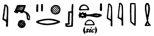 giving the name ‘Khety’.
7. A broken arrow-head of flint with serrated edges.
8. Pieces of leather sandals, pottery, and a portion of the neck of a
jar with
 Men-hetep written upon it.
9. A scribe’s palette with two reed brushes (Pl. XLV. 3).
10. The hind half of an exquisitely made frog in glazed steatite, and
the fore part of a lion in faience.[24]
When cleared enough to be entered the interior of the tomb presented a
scene of utter despoliation. Its chambers were strewn with rubble
mingled with bones, skulls, and tomb furniture, shattered and burnt,
which only too well corroborated those traces of the ravages which had
been found outside. In the central chamber was a burial—a wood dug-out
coffin, anthropoid in form, the lid bound at head and shins with rope.
Several days were spent in carefully searching the remains in this tomb,
and by sifting the sand many times favourable results were obtained.
These results are recorded below—
Near the Entrance. A small wooden statuette and pedestal; upon the
latter are three barely visible lines of hieroglyphs, in which the name
 ‘Ankhu’ may possibly be traced, and if so it
probably identifies the figure with the person mentioned on the coffin
fragment found outside (Pl. XLIV. 1).
‘Ankhu’ may possibly be traced, and if so it
probably identifies the figure with the person mentioned on the coffin
fragment found outside (Pl. XLIV. 1).
Doorway. A nude female figure in cedar wood, very much worn and
originally coloured. She wears a heavy head-dress tied by a fillet on
either side. Such figures were entered among the funerary complement for
the personal use of the deceased (Pl. XLIV. 3).
First part of Passage. Two broken blue faience bowls. One shaped like
a water-lily leaf and decorated with lotus floral designs (Pl. XLIV. 5),
the other of biangular form, with its vertical sides encircled by a band
of very indistinct hieroglyphs, which read
 thus naming the ‘Lady of the house Ab-aau’ (Pl. XLIV. 4). Near these
were three pieces of alabaster making up a complete bowl, a pendant of
deep blue glazed faience, some blue glaze inlay, the fore-part of a
hippopotamus, a bone and shell necklace, and lastly a leather ball.
thus naming the ‘Lady of the house Ab-aau’ (Pl. XLIV. 4). Near these
were three pieces of alabaster making up a complete bowl, a pendant of
deep blue glazed faience, some blue glaze inlay, the fore-part of a
hippopotamus, a bone and shell necklace, and lastly a leather ball.
In South Chamber above the Pit. Parts of a bifold wood jewel box (Pl.
XLV, the lid was found in the passage), and the following beads and
amulets that possibly came out of it:—
- A. Blue glaze faience beads imitating shells.
- B. Haematite beads and scarab.
- C. Cornelian beads.
- D. Two amethyst scarabs.
- E. A hippopotamus head and crouching monkey in cornelian.
- F. Matrix of emerald Ba-bird.
- G. Necklace of amulets in matrix of emerald, amethyst, cornelian, blue paste, and glazed steatite and faience.
North Chamber above the Pit. A small jewel-box, turned upside down and
containing the following ornaments (Pl. XLV. 1 and 2):—
- A. Steatite scarab mounted on silver wire.
- B. Necklace of small round garnet beads.
- C. Garnet and cornelian bracelet.
- D. Greenstone cylinder mounted in gold.
- E. Broken agate cylinder mounted in gold.
- F. Two fragments of nuts of the Balanites aegyptiaca.
- G. Amulets—cornelian eye, emerald hippopotamus head, silver plaque, and gold bead.
- H. A tiny string of gold, silver, cornelian, and turquoise beads of the most minute and exquisite workmanship.
Nearly every basket of earth from the floor of this tomb contained
numbers of deep violet lozenge-shaped ornaments made of glazed pottery.
They are peculiar to the XIIth Dynasty, and seemingly were used for
decorating the wrappings of the mummy, as is well illustrated by a mask
cartonnage found in tomb No. 25, where they are depicted in rows and
forming part of an ornamentation (Pl. XLIV. 2). In some cases actual
mummy-cloth was found adhering to them, and all had some adhesive
substance on their backs.
A complete series of pottery belonging to this tomb is given in Pl.
XLVII, Figs. 1 and 2.
| Fig. 1. | A. Rough red pottery, coloured red, with white band. |
| B.""with white spots. |
| C.""coloured red with white stripes. |
| D.""rim and neck coloured red. |
| E. Fine red pottery, plain. |
F. Grey pottery, with
 written in red upon it.
 |
| G. Pink pottery, plain. |
| H. Grey pottery, ornamented with black, red, and yellow drop pattern. |
| I. Very fine terra-cotta pottery, plain. |
| J. Fine red pottery, coloured red or terra-cotta. |
| K. Soft red pottery, plain. |
| L and N. Fine red pottery, with rims coloured red. |
| M. Fine red pottery, with white surface. |
| Fig. 2 | illustrates two trays divided into compartments and two small vases, made of a very coarse red pottery. |
Botanical specimens found in this tomb are figured in Pl. LXXIX. 2 under
the letters A and H. The latter, a stone fruit, was found in great
quantities, as well as frequently in the other tombs that were opened.
Pit Tomb No. 25.
A pit tomb partially concealed by the paving-blocks of the terrace
colonnade and foundations of the north boundary wall of the temple.
In the upper rubbish filling the pit were bricks from the doorway and
broken pottery, giving evidence of former riflers; and, after a descent
of some three metres or more, the openings of the sepulchral vaults at
either side were exposed. These chambers, half-filled with earth that
had poured in from the shaft, had in them remains of coffins, oblong in
form, broken, and ant-eaten. They were of plain, thick wood, without
decorations, and only the inner shell had, in some cases, bands of
inscription. In the shaft itself, at the bottom, was a single coffin,
dragged out from one of the chambers at the time of the early violation.
At first this grave seemed to be a great disappointment. But when, in
Lord Carnarvon’s presence, the men found in the lower filling of the
shaft an ivory pin and a piece of a box with silver binding[25], our
hopes were raised. Lord Carnarvon at once stopped the workmen until a
time when full surveillance of the clearing could be made. It was a
difficult job, most careful work had to be done with trowel, bellows,
and sometimes a spoon, extricating fragile objects while stones and sand
poured down from the overhanging masonry above in a menacing manner at
every gust of wind.
On the following day operations were begun by clearing the bottom steps
of the shaft and searching the coffin. Under the latter, nine more ivory
pins, fragments of alabaster, cosmetic vases, the broken parts of an
ebony and cedar-wood toilet-box inlaid with ivory, and fragments of an
ornamented ivory gaming-board were discovered, twisted and shattered
into a hundred pieces. The coffin, too far gone for us to hope to
preserve it (ants having eaten the whole of the wood, leaving only the
bitumen coating perforated and like an eggshell), had had bands of
yellow hieroglyphs along its sides and ends; but only here and there
could a few signs be discerned. Still, enough could be made out to trace
the title
 and name
 ‘Great one of the southern tens, Rensenb’ (which was afterwards
corroborated by the inscription on the mirror handle found on the
mummy), and certain of the hieroglyphs were of the ‘mutilated’ type
(i.e.
‘Great one of the southern tens, Rensenb’ (which was afterwards
corroborated by the inscription on the mirror handle found on the
mummy), and certain of the hieroglyphs were of the ‘mutilated’ type
(i.e.
 for
for
 and
and
 for
for
 ) often found
in texts of the late XIIth Dynasty and Intermediate Period.[26]
) often found
in texts of the late XIIth Dynasty and Intermediate Period.[26]
The mummy, lying on its side, was reduced to a black powder through
spontaneous combustion, caused by the damp that had filtered through
from above. It had a cartonnage mask covering the head and shoulders,
with gilt face, the head-dress painted yellow and striated with
grey-green bands which had oval spots in black (illustrating the use of
the violet ornaments found in tomb No. 24). Embedded in the wrappings,
at the small of the back, was a blue faience hippopotamus (Pl. LI. 1).
Round the neck a gold and obsidian necklace and a ‘Shen’ brooch of
gold and cornelian (Pl. LI. 2). On the breast, concealed in the linen
wrappings, was a bronze mirror with ebony handle mounted and inlaid with
gold. The inscription upon it reads
 ‘Great
one of the southern tens, Rensenb, repeating life’ (Pl. LI. 2). How it
came about that these chambers should be ravaged, this burial dragged
into the daylight of the open shaft, and yet unrifled, is a mystery yet
to be solved.
‘Great
one of the southern tens, Rensenb, repeating life’ (Pl. LI. 2). How it
came about that these chambers should be ravaged, this burial dragged
into the daylight of the open shaft, and yet unrifled, is a mystery yet
to be solved.
In the Southern Chamber. At the entrance were the front part and
pieces of the drawer of the toilet-box (Pl. XLVIII. 1), three alabaster
vase lids, an alabaster vase, and a gold bead. Besides these articles
this chamber had planks from wooden canopies and coffins, and the
remains of three mummies (one a child) charred to soot. In the
depression in the floor and lower chamber were found two broken ivory
crocodiles, two splinters of a mystic wand, and the body of a stripped
mummy; under the latter, in the dust, were beads of a necklace.
In the North Chamber. Among the many parts of coffins was one bearing
inscriptions giving the usual prayers, &c., for a certain lady named
 ‘Henut’, born of
 ‘Sent’.
Here were also despoiled mummies, one of them having a wig of
plaited hair (decayed), clasped by a gold fillet, and a necklace. Some
stray beads and a mud sealing bearing a coil pattern were found when
sifting the lower layer of dust covering the floor.
‘Sent’.
Here were also despoiled mummies, one of them having a wig of
plaited hair (decayed), clasped by a gold fillet, and a necklace. Some
stray beads and a mud sealing bearing a coil pattern were found when
sifting the lower layer of dust covering the floor.
The following paragraphs give details of the objects found in this tomb
that are not fully described above, including the pottery found
scattered in its different chambers.
Toilet-box (Pls. XLVIII-XLIX). An oblong box, made of cedar wood,
veneered with ebony and ivory, and measuring 28·5 x 18 x 20 cms.
The front, two sides, end, and lid have in their centres large slabs of
ivory, bordered by two narrow strips of ebony and ivory, with broad
margins of ebony, the whole giving a unique appearance. The front is
made to pull forward, and has attached to it a drawer half the depth and
the whole length of the box (see Fig. 1, Pl. XLVIII). This drawer has
its edges, top and bottom, veneered with thin strips of ivory, glued to
its solid ebony sides and end, and in it a shelf, made of two pieces of
wood, pierced with eight holes to receive vases for cosmetics and other
toilet requisites.[27] The drawer slides in beneath a tray attached to
the inner walls of the box. Access to the tray can only be obtained by
raising the lid of the box; and it has, besides two small partitions in
the corner, a hollow scooped out of the bottom to receive a mirror (see
Fig. 2, Pl. XLVIII).[28]
The lid and front have silver knobs let into bindings of the same metal.
Engraved upon the front ivory slab is a delightful little scene (Pl.
XLIX. 1) of the owner,
 ‘Kemen’,
 ‘true Royal friend’,
 ‘whom he (the king) loves’,
 ‘Chief over the secrets of the Royal mouth’,
 ‘the keeper of the department of the kitchen’, offering to his lord, the
King Amenemhat IV. Around the margin of the top of the lid, gravered and
inlaid with ivory powder is an inscription (Pl. XLIX. 2) bearing the
prenomen and nomen of Amenemhat IV, with a religious formula to ‘Sebek’
‘the keeper of the department of the kitchen’, offering to his lord, the
King Amenemhat IV. Around the margin of the top of the lid, gravered and
inlaid with ivory powder is an inscription (Pl. XLIX. 2) bearing the
prenomen and nomen of Amenemhat IV, with a religious formula to ‘Sebek’
 Lord of Illahun (in the Fayûm) that he may
give a good burial and long service to the ka of Kemen. The legend here
gives also the name of Kemen’s mother
Lord of Illahun (in the Fayûm) that he may
give a good burial and long service to the ka of Kemen. The legend here
gives also the name of Kemen’s mother
 ‘Ana’.
The method adopted in the construction of the box is so peculiar that it
is worth particular notice. Each front, side, end, and lid is made of
six pieces of cedar wood, viz. a centre panel to receive the large slab
of ivory, on either side two thin slips to receive the narrow strips of
ebony and ivory, and lastly a top and bottom rail for the broad ebony
margins. In fact, the cedar-wood body is made of as many pieces as there
are horizontal overlaying leaves of the superior materials, all of
which, with the exception of the front, where dowels are introduced,
were merely stuck together by glue. The corners of the box are mitred,
and the ends of the drawer dovetailed to the body of the front part of
the box.
‘Ana’.
The method adopted in the construction of the box is so peculiar that it
is worth particular notice. Each front, side, end, and lid is made of
six pieces of cedar wood, viz. a centre panel to receive the large slab
of ivory, on either side two thin slips to receive the narrow strips of
ebony and ivory, and lastly a top and bottom rail for the broad ebony
margins. In fact, the cedar-wood body is made of as many pieces as there
are horizontal overlaying leaves of the superior materials, all of
which, with the exception of the front, where dowels are introduced,
were merely stuck together by glue. The corners of the box are mitred,
and the ends of the drawer dovetailed to the body of the front part of
the box.
The four alabaster vases (Pl. LII. 1) belong to the drawer; there were
three fragments of others.
Ivory Gaming-board[29] (Pl. L). Shaped like an axe blade and resting
on four bull’s legs carved in solid ivory. The dimensions are 15 x 10
cms. (maximum measurement), total height 7 cms.
It contains a small drawer of ivory and ebony, which has a bolt of ivory
shot in copper staples for fixing it when closed. Belonging to the game
are ten carved ivory pins or playing pieces—five have dogs’ heads, and
five jackals’ heads; these, no doubt, were kept in the drawer.
Its construction is a flat top made of two ivory slabs, backed by two
wooden panels which are joined together by three transverse wood pegs
passed through the thickness of each panel. The bottom was made of one
piece of wood with cross-bars at either end. The curved ivory sides and
end are backed with blocks of wood that take the same shape as the
board, and leave in the interior an oblong space to allow entry of the
drawer. The ivory bull’s legs are tongued into the wooden side-blocks,
and are held there by means of three ebony rivets. Round the four edges,
top and bottom, as well as the four corners, was an ebony veneer, most
of which was destroyed. Glue was the means of adhesion. The wood used
was sycomore. The upper surface (Pl. L. 1) has engraved upon it a
palm-tree surmounted by the sign ‘Shen’ (see Fig. 14), the latter being
pierced through the ivory and wooden body beneath. On each side of the
palm-stem is a parallel line of ten holes, along the edges of the two
sides a row of fifteen holes, and at the top edge on either side of the
‘Shen’ a row of four holes (and if including the corner hole, five).
Each hole is encircled by a small ring, engraved, and is pierced through
the ivory and wood below, and these holes were intended to receive the
playing pieces. For some reason or other, a large hole was made in the
centre of the palm-tree, but it was afterwards filled in. In the front
edge of the board is a small semicircular notch, made to permit the
thumb to grip the drawer when opening it.

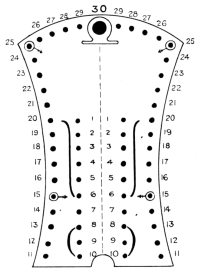 Fig. 14. Key to Gaming-board.
Now a word as to the game itself; how was it played, and how were the
moves denoted? Presuming the ‘Shen’ sign, which forms a large centre
hole at the top, to be the goal, we find on either side twenty-nine
holes, or including the goal, thirty aside. Among these holes, on either
side, two are marked
 nefer, ‘good’; and
four others are linked together by curved lines (see Fig. 14). Assuming
that the holes marked ‘good’ incur a gain, it would appear that the
others, connected by lines, incur a loss. Taking this for granted, and
that the play terminates at the goal ‘Shen’, the game seems then to
commence at the heart of the palm—the only place where five playing
pieces aside could be placed without clashing with the obstacles (i. e.
holes incurring gain or loss). Thus, starting from the first hole under
the palm, and calling it No. 1, the tenth hole, by the indicating lines,
shows a forfeit of two points, and the twentieth hole a forfeit of
fourteen points. The good holes Nos. 15 and 25 have nothing to indicate
what gain was attached to them. If it should be a profit of a certain
number of holes, one would expect to find them marked like the forfeits,
but possibly it was that they entitled (?) the player to the right of a
second move, which could not be marked in such a manner. Now the moves
themselves could easily have been denoted by the chance cast of
knuckle-bones or dice,[30] both being known to the ancient Egyptians at
an early period; and if so we have before us a simple, but exciting,
game of chance, ‘Hounds contra Jackals’, and played somewhat as
follows:—The opponents, taking each a side, place their five men in
holes Nos. 1 to 5,[31] under the palm. The hounds having obtained the
right of first throw, by a toss or some equivalent, start:—
nefer, ‘good’; and
four others are linked together by curved lines (see Fig. 14). Assuming
that the holes marked ‘good’ incur a gain, it would appear that the
others, connected by lines, incur a loss. Taking this for granted, and
that the play terminates at the goal ‘Shen’, the game seems then to
commence at the heart of the palm—the only place where five playing
pieces aside could be placed without clashing with the obstacles (i. e.
holes incurring gain or loss). Thus, starting from the first hole under
the palm, and calling it No. 1, the tenth hole, by the indicating lines,
shows a forfeit of two points, and the twentieth hole a forfeit of
fourteen points. The good holes Nos. 15 and 25 have nothing to indicate
what gain was attached to them. If it should be a profit of a certain
number of holes, one would expect to find them marked like the forfeits,
but possibly it was that they entitled (?) the player to the right of a
second move, which could not be marked in such a manner. Now the moves
themselves could easily have been denoted by the chance cast of
knuckle-bones or dice,[30] both being known to the ancient Egyptians at
an early period; and if so we have before us a simple, but exciting,
game of chance, ‘Hounds contra Jackals’, and played somewhat as
follows:—The opponents, taking each a side, place their five men in
holes Nos. 1 to 5,[31] under the palm. The hounds having obtained the
right of first throw, by a toss or some equivalent, start:—
| HOUNDS. |
JACKALS. |
| 1st H. |
Cast |
3 |
= |
hole |
8 |
1st J. |
Cast |
6 | |
|
= |
hole |
11 |
| ” |
1 |
= |
” |
9 |
” |
5 |
|
= |
” |
16 |
| ” |
5 |
= |
” |
14 |
” |
3 |
|
= |
” |
19 |
| ” |
3 |
= |
” |
17 |
” |
6 |
= 25, wins 2nd throw = 4 |
= |
” |
29 |
| ” |
6 |
= |
” |
23 |
” |
6 |
Returns to 25, wins 2nd throw 4 |
= |
” |
29 |
| ” |
4 |
= |
” |
27 |
” |
6 |
Returns to 25, wins 2nd throw 1 |
= |
” |
26 |
| ” |
3 |
= the goal = |
” |
30 |
” |
3 |
|
= |
” |
29 |
| 1 point to Hds. (winning piece remains in goal). |
Jks. lose their piece. |
| 2nd H. |
Cast |
4 |
= |
hole |
8 |
2nd J. |
Cast |
3 |
= |
hole |
7 |
| ” |
6 |
|
= |
” |
14 |
” |
4 |
= |
” |
11 |
| ” |
5 |
|
= |
” |
19 |
” |
5 |
= |
” |
16 |
| ” |
1 |
= 20, forfeit 14 |
= |
” |
6 |
” |
5 |
= |
” |
21 |
| ” |
4 |
= 10, forfeit 2 |
= |
” |
8 |
” |
6 |
= |
” |
27 |
| ” |
5 |
|
= |
” |
13 |
” |
4 Returns to |
= |
” |
29 |
| ” |
6 |
|
= |
” |
19 |
” |
4 Returns to |
= |
” |
27 |
| ” |
3 |
|
= |
” |
22 |
” |
3 = the goal |
= |
” |
30 |
| Hds. lose their piece.
|
1 point to Jks. (winning piece remains in goal). |
| 4th H. |
Cast |
3 | |
= |
hole |
5 |
4th J. |
Cast |
2 | |
= |
hole |
4 |
| ” |
4 | |
= |
” |
9 |
” |
3 |
|
= |
” |
7 |
| ” |
4 | |
= |
” |
13 |
” |
3 |
= 10, forfeits 2 |
= |
” |
8 |
| ” |
7 |
= 20, forfeits 14 | = |
” |
6 |
” |
4 | |
= |
” |
12 |
| ” |
3 | |
= |
” |
9 |
” |
6 | |
= |
” |
18 |
| ” |
5 | |
= |
” |
14 |
” |
3 | |
= |
” |
21 |
| ” |
2 | |
= |
” |
16 |
” |
2 | |
= |
” |
23 |
| ” |
4 |
= 20, forfeits 14 | = |
” |
6 |
” |
5 | |
= |
” |
28 |
| ” |
6 | |
= |
” |
12 |
” |
1 | |
= |
” |
29 |
| ” |
2 | |
= |
” |
14 |
” |
5 |
Returns to |
= |
” |
26 |
| ” |
5 | |
= |
” |
19 |
” |
4 |
= the goal |
= |
” |
30 |
| Hds. lose their piece. |
3 points to Jks. (winning piece remains in goal). |
| 5th H. |
Cast |
2 | |
= | hole |
3 |
5th J. |
Cast | 5 |
|
= |
hole |
6 |
| ” |
4 | |
= |
” |
7 |
” |
5 | |
= |
” |
11 |
| ” |
5 | |
= |
” |
12 |
” |
4 |
= 15, wins 2nd throw 1 |
= |
” |
16 |
| ” |
2 | |
= |
” |
14 |
” |
6 | |
= |
” |
22 |
| ” |
6 |
= 20, forfeits 14 |
= |
” |
6 |
” |
1 | |
= |
” |
23 |
| ” |
4 |
= 10, forfeits 2 |
= |
” |
8 |
” |
4 | |
= |
” |
27 |
| ” |
6 | |
= |
” |
14 |
” |
6 |
Returns to |
= |
” |
27 |
| ” |
1 |
= 15, wins 2nd throw = 6 |
= |
” |
21 |
|
|
|
|
| |
| ” |
4 |
= 25, wins 2nd throw 5 = the goal |
= |
” |
30 |
” |
4 |
Returns to |
= |
” |
27 |
| 2 points to Hds. |
Jks. lose their man, but have 3 men in the goal,
and thus win by 1 point. |
Necklace. Of long drop-shaped beads made of gold and three kinds of
coloured stones—cornelian, lapis lazuli, and matrix of emerald. They
were strung in the ancient colour order, viz. red, blue, yellow, and
green—cornelian for the red, lapis lazuli for the blue, gold for the
yellow, and matrix of emerald for the green. Some of the beads had tiny
floral tops, which, when combined, formed a lotus column, or perhaps a
flower; but by no means did all of them have this additional piece, as
was proved by some of the beads still attached by their original
threads. Unfortunately this necklace, of exquisite quality, cannot be
restrung, as all the wax cores of the gold beads (the gold being only a
thin outer covering) has amalgamated, and the holes are completely
choked. At present, in their tender state of preservation, to re-bore
them would endanger their being split, as some already are.
Amuletic necklace. This second necklace is of quite a different type,
very small, and of all kinds of beads and amulets. The order[32] seems
to have been alternate groups of barrel garnet beads, divided by minute
gold beads, and between them amulets in gold, cornelian, glazed
steatite, and faience. There are also tiny cornelian and glaze beads
among them. The amulets that occur are the eye, hand, rope-knot,
crouching lions, crocodiles, flies, and other strange forms difficult to
recognize. The position of these amulets, strung on the necklace, can
only be a matter of conjecture.[33]
Shell necklace. Of this only a few pieces were found. They are small
shells and ornamental vase-shaped beads, of lapis lazuli, matrix of
emerald, and turquoise. Between each was a short cylindrical gold
bead.[34]
The obsidian and gold necklace. (Pl. LI. 2) hardly requires
description, the illustration showing all details. The beads are strung
in the exact order in which they were found. The ‘Shen’ brooch (Pl. LI.
2) was not attached to it.
Pottery. The various types are all shown in Pl. LII. 2.
- A. Soft red pottery.
- B. Fine red pottery.
- C. Rough red pottery.
- D. Rough red pottery with rim coloured red.
- E. Fine red pottery with rim coloured red.
- F. Red pottery.
- G. Red pottery, coloured red.
- H. Rough red pottery, spotted white.
- I. Red pottery, coloured red.
Pit Tomb No. 27.
The contents of this tomb (Pl. XXX) were pillaged and almost entirely
destroyed, the ants leaving not a fragment of the wood untouched. Among
the débris of the original burials was an intrusive one of a child.[35]
All that was of importance to record was: (1) A portion of an anthropoid
coffin with Rîshi decoration, like the case found in Tomb 32 (Pl.
LIII. 3), but of much larger dimensions and with the face gilt; down
the front of this coffin was a vertical inscription, of which the
following was visible:

 naming the ‘Scribe of
the Army’, ‘Superintendent of the temple’, Nenen ...(?); (2) an ear from
a silvered mask; (3) three pieces of the upper portion of a stela (the
rest of this stela was found in Tomb No. 31, Pl. LIV); (4) a pot (the
only one found in the tomb) like Fig. J in Tomb No. 24.
naming the ‘Scribe of
the Army’, ‘Superintendent of the temple’, Nenen ...(?); (2) an ear from
a silvered mask; (3) three pieces of the upper portion of a stela (the
rest of this stela was found in Tomb No. 31, Pl. LIV); (4) a pot (the
only one found in the tomb) like Fig. J in Tomb No. 24.
Pit Tomb No. 28.
This grave (Pl. XXX) had even less in it than No. 27; in the shaft was
an intrusive burial of a poorish type. The chambers, which were choked
with rubbish, contained only a pair of copper forceps, a brown stone
bead, and one hydroceramic vase (Pl. LIII. 1).
Pit Tomb No. 29.
This tomb (Pl. XXX) gave access to two other similar graves on either
side of it, Nos. 29 A and B. The three were plundered, and their
chambers filled with sand almost to the ceiling. In the shaft of No. 29
was a burial with ‘dug-out coffin’ yielding a scarab, and in its chamber
were two other burials, illustrated in Pl. LIII. 4. These were typical
examples of the ‘dug-out coffin’. They contained ‘dried’ bodies wrapped
in a simple winding-sheet (Intermediate Period?).
No. 29 A. This could not be thoroughly excavated, as the mouth of its
shaft was under the southern part of the excavations which has not been
cleared, and the sand poured down from above it as fast as it was
removed from below, making it too dangerous to clear.
No. 29 B. was only accessible through a small hole in the south-west
corner of pit No. 29; it gave equal trouble, and could only be excavated
under considerable risk, its pit being partially under the foundations
of the temple wall. It was full of plundered mummies huddled together
under a great weight of sand and stones thrown in by the temple workmen
when building the wall. With them was a wooden head-rest, a canopic jar
lid, and a scribe’s palette, some roughly made chair legs, pieces of
cartonnage (of linen covered with plaster, gilt), and a long flexible
wooden implement, two metres in length, perhaps a weaver’s batten. The
types of pottery found in these chambers are shown in Pl. LIII. 5:—
- A. Rough red pottery, decorated with white paint, with holes in the neck for fastening the cover.
- B. Fine red pottery, coloured red.
- C. Red pottery, rim coloured red.
- D. Soft red pottery.
- E. Red pottery, has small spout, and upper part coloured red.
- F. Pink pottery.
- G. Red pottery, rim coloured red.
Pit Tombs Nos. 31-34.
This group of tombs (Pl. XXX) is under the Lower Court of the
‘Valley’-Temple. The chambers are cut into one another, and thus form a
homogeneous series. They were choked up with sand, with but little of
their plundered contents left. It was hopeless to try to tell to which
of the tombs the few remains belonged, and hence in enumerating them the
chamber in which they were found can alone be given.
Pit Tomb No. 31. A ‘dug-out’ painted coffin burial with roughly
painted shawabti box, and the lower portion of the stela found in Tomb
No. 27 (Pl. LIV). In its chamber were found a few examples of pottery.
Pit Tomb No. 32. First chamber—an interesting type of a female figure
made of painted wood with pottery head.[36] Second chamber—a Rîshi
coffin (Pl. LIII. 3) belonging(?) to the original burial. It was found
lying on its right side in a space on the floor especially cleared for
it, and was bound at head and foot with palm fibre cords, which makes it
appear to have been re-used. Notwithstanding its appearance of perfect
preservation when first discovered, the coffin and even the body inside
were so completely rotten that they fell to pieces at the least touch;
it was in such a condition that it was impossible to preserve it. It
being the most complete mummy case hitherto found in these tombs, a
lengthy description is necessary. The case, anthropoid in shape, was
decorated as if enveloped by the wings of a bird. This Rîshi[37]
decoration is on a light yellow ground, the feathers themselves being of
deep bluish green, picked out here and there with red and white, and
detailed in black. The face was flesh colour, with eyebrows and
side-beard straps green, the eye sockets of copper with aragonite
eyeballs and obsidian pupils. Down the centre of the front of the coffin
was a vertical line of hieroglyphs reading:

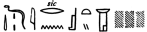
 [blank space]. Below the feet are the two kneeling figures of ‘Isis’
and ‘Nephthys’ facing one another, and between them a vertical legend
reading:
[blank space]. Below the feet are the two kneeling figures of ‘Isis’
and ‘Nephthys’ facing one another, and between them a vertical legend
reading:
 .
.
Pit Tomb No. 33. This had nothing in it, and being under the temple
construction it was too dangerous to attempt a total clearance of its
chamber or chambers.
Pit Tomb No. 34. This had only three intrusive interments, which were
in an almost unrecognizable condition. Examples of the pottery vessels
scattered about in the chambers of this group are given in Pl. LIII. 2.
Their material does not differ from the other examples already described
as coming from this necropolis.
The stela of Auy-res (Pl. LIV) found in Tombs No. 27 and 31 is of
limestone, measuring 59 x 31 cms.; the inscriptions are incised upon the
stone face and coloured dark blue; the figures are in the usual
colouring and have blue collarettes. The horizontal legend begins
with:—
‘(1) May the king give an offering to Osiris Khent-amenti, the Great
God, Lord of Abydos, that he may give (2) oblations of water, incense,
wax, all good and pure things (3) upon which the god lives ... for the
ka of the Keeper of the Bow, Auy-res, justified.’
His family are recorded in the following order:—
| Row 1. | ‘His wife, Atef-s-senb. |
| | His son, the Great One of the Southern Tens, Y-meru. |
| | His son, the Great One of the Southern Tens, Erde-en-ptah. |
| Row 2. | His daughter, the servant of the Ruler, Auŷ-senb. |
| | His son the Am-khet,[38] Dedut-res. |
| | His sister, Auŷ-senb. |
| | His son, the Am-khet,[38] Y-meru. |
| Row 3. | The Keeper of the Bow, Sa-Hathor. |
| | The Lady, Sent-nw-pw. |
| | The Uab-priest of Amen, Sebek-hetep. |
| | The Lady, Sep-en-urdet.’ |
There was no evidence to show to which of these two tombs this stela
belonged.
In the rubbish, and partially under the foundations of the wall of the
Lower Court of the ‘Valley’-Temple, was a coffin[39] that had been
thrown out from one of the XIIth Dynasty tombs. This coffin was of wood,
rectangular and oblong in form, with no inscriptions or decoration; it
contained a body of a female child. Round her neck was a cornelian
necklace still attached by its strings, and on her breast was a bronze
mirror reflector; from the manner this reflector was wrapped in linen it
must have been buried with the deceased without a handle. The girl’s
hair was plaited.
Circular Pit No. 35.
This pit (Pl. XXX) was the last and most puzzling of all opened this
season. It is a rock-hewn shaft, some three metres in diameter at the
mouth and only 63 cms. at the bottom, and thus, like an inverted cone,
descends 22·50 metres[40] into the Tafle stratum. The filling was
absolutely untouched, and from top to bottom consisted of pure black
soil from the arable plain; the upper surface had been hardened by
water. The bottom of the shaft, apparently unfinished, was on one side
slightly deeper than the other. A hollow copper bead-like object of
cylindrical-drop shape found on the top surface, was the only object
discovered here. At four metres below the surface the shaft had been cut
through one of the pit tombs[41] of the cemetery, and the hole in the
side thus caused had been mended with mud bricks. Its whole meaning is
at present inexplicable.[42]
No. 36, Pl. XXX.
A large mud-brick structure of which only part of one side has been
exposed by our excavations. This part lies within the area of the
‘Valley’-Temple (No. 14), and is in line with the Colonnaded Terrace.
The one end (north-east corner) and the stretch of some thirty-five
metres of wall that has been uncovered does not give us enough data to
tell its exact meaning or date. It is built upon the bed-rock, and it
averages four metres in height. The brickwork seems to be earlier than
that of the New Kingdom. The probabilities are that it belongs to the
Intermediate Period or even perhaps the Middle Kingdom. Towards the
southern end of the part cleared by us the foundation of the wall has
been built over the courtyard of Tomb No. 41.
Tomb No. 37.
This tomb, shaped like an inverted T, is the largest one yet opened in
this group; in fact it could be ranked among the larger mausolea of the
Theban Necropolis, and evidently belonged to one of the higher Egyptian
dignitaries (Pls. XXX, LV).
It consists of (1) a long corridor having an eastern frontage with some
eighteen openings, which give access to a rock-cutting of the nature of
an open court. (2) Cut in the back wall of this corridor, and at right
angles to it, are a long central subterranean passage leading to a hall
(C), and two sepulchral chambers. Access to one of these sepulchral
chambers (J) is by means of a staircase, while the other (E) is
approached by a vertical pit (D) of four metres in depth; both are cut
in the floor of the hall (C). The northern end of the corridor was
divided off by a stone and mortar partition, with a small chamber (B)
at the back, which was presumably a portion divided off for a member of
the owner’s family. The blind end of the corridor on the south had
originally been closed by a mud-brick wall, and no doubt thus formed
another private compartment like the third chamber (A), which is
parallel to the central passage.
It appears, therefore, that there were five distinct burial chambers
(and if counting the hall (C) a sixth) which were closed, leaving the
greater part of the corridor and central passage open for any ceremonial
rites that might be made by the living relations in favour of the
deceased.
This great tomb, dating from the Late Middle Kingdom, was found to have
been utilized for the storing of numerous stray burials of epochs
ranging through the Intermediate Period down to the early part of the
XVIIIth Dynasty. Our reasons for assigning this date to the tomb were
the antiquities (Nos. 85, 86, 87) found in the layer of rubbish and
burnt ashes that covered its floors; these were quite distinct from the
coffins and other antiquities forming the cache which rested upon the
rubbish.
It is difficult to imagine how such a large mausoleum, cut in the
shallow and crumbling limestone stratum, with so many openings, could
for long have been protected from plunderers. The smoke-blackened walls
show how its contents were destroyed, and the martins’ nests, together
with the innumerable mason-bee cells that adhered to the walls and
ceiling, show that the tomb had been left open after having been
plundered for a lengthy period, before it was re-used as a storehouse.
When revealed, the main entrance was not closed by bricks or by stones,
as was often the custom, but the sand was merely poured over when the
Ancients last covered it up. The remaining openings had certainly in
some instances been closed by planks from old coffins, but the greater
number were carelessly filled like the entrance. Three of the inner
chambers were carefully closed; in two cases with bricks, and in one
with stones. These closed chambers were as follows:—
Hall (C) had its doorway bricked two-thirds up with crude mud-bricks
and Tafle mortar, and the remaining third of its opening with similar
bricks but with a mud mortar (Pl. LVI), showing that it had been opened
and re-closed a second time. The mortar-bed of mud for this last closing
was found in the central passage (Pls. LV, LVI. 14) just as it was left
by the ancient mason.
Chamber (A) had its doorway completely closed with flat mud-bricks,
and the outer surface smeared over with Tafle stucco (Pl. LVII, above
the coffin to the left), which was stamped in numerous places with a
seal giving the Nebti name
 of Thothmes I
(see Pl. LVIII. 1).
of Thothmes I
(see Pl. LVIII. 1).
Chamber (B) had its entrance blocked by a heap of stones piled before
it and a coffin placed in front (Pl. LIX. 1).
Behind these bricked-up doorways was the greater mass of the burials
that were stored in the tomb.
From whence all these burials came we have no evidence to show us at
present, nor can we tell for certain the reason for their being
concealed in this particular tomb. It is possible that, while clearing
the ground for the great dromos of Dêr el Bahari, and during the
preparation of its ‘Valley’-Temple, stray interments were disturbed, and
that this tomb being so situated that it must necessarily be covered by
the ‘Valley’-Temple, it was used by the pious officials of the Theban
Necropolis as a place of concealment (see position of tomb in relation
to the temple, Pl. XXX).
The seal impressions stamped upon the wall that closed chamber (A), we
have just seen, give the Nebti name of Thothmes I, and thus we have a
date for the time when some of the coffins were re-interred, and
probably the date when the above monument must have been begun.
The scattered manner in which the coffins were placed in the different
chambers and passages of the tomb, and the fact that one of the chambers
(C) had been re-opened and re-closed, tends to show that they were not
placed in the tomb at one time, which is in favour of the theory that
they really were disturbed interments stored there from time to time
during the course of some work.
The latest date found among the objects of the whole cache was Thothmes
III, and that name occurred only on one object—a small scarab (Pl.
LXXII. 53 from burial No. 53, p. 80).
The two chambers in the corridor (A, B) contained eight and four
separate coffins respectively; the hall (C) at the end of the passage
had fourteen; in the pit (D), piled from bottom to top, were eighteen
cases; and in the bottom crypt (E) was another batch of eight
sarcophagi. Thus, counting also those lying about the open corridor and
passage which numbered twelve, we obtain a total of sixty-four coffins.
Besides these there were also twenty-eight other objects pertaining to
funeral equipments.
Among these sixty-four miscellaneous wooden sarcophagi, some containing
as many as four mummies in each, there were seven distinct types, and
with them a great number of children’s coffins.
The types of the coffins of adults were: (1) Decorated rectangular, (2)
plain rectangular, (3) ‘dug-out’, (4) Rîshi, (5) plain anthropoid, (6)
semi-decorated anthropoid, and (7) decorated anthropoid of the New
Kingdom. Each of these groups I have treated below, followed by a
separate detailed description of each burial and object found in the
tomb (see p. 70).
Decorated rectangular coffins, Nos. 7, 35, 59, 63 (for examples see
Pl. LX. 1). The coffins of this class are most probably contemporaneous
with the Hyksos period. They are similar to the coffin in the Cairo
Museum belonging to a certain Abdu, a contemporary of the last of the
Hyksos kings.[43] Coffin No. 59 (p. 81) contained four mummies, two of
which, and a basket containing a scarab, gave conflicting evidence to
the above dating. The scarabs found on these two mummies bear the names
of Thothmes I and II (Pl. LXXII. 59 A, D), and the one in the basket
(Pl. LXXII. 59) according to Newberry is of a similar date. But the
remaining antiquities, i.e. head-rest, biangular bowl, and black vase of
foreign character (Pl. LXVIII. 59) may be of an earlier period, and
perhaps belonged to one of the other two mummies found in this coffin,
and to the original interment. Coffin No. 63 (p. 82), which contained
two mummies, had somewhat similar objects (Pl. LXVIII. 63) to No. 59,
but on one of the mummies, a woman, there were two cowroids (Pl. LXXII.
63 A) which could be referred to the Early XVIIIth Dynasty. No. 7 (p.
70) yielded nothing beyond the actual body, and gives no further help
for or against dating this group to these Dynasties.
Plain rectangular coffins. Of these coffins there are three kinds,
those with gable tops, those with flat tops, and those with open-grid
bottoms (for examples see Pl. LX. 2). The gable-topped coffins, Nos. 53,
62, 64, 65, 69, 71, 77, 83, with lids sometimes nearly semicircular in
section, have always on the lid a longitudinal beam in the centre. These
are probably of the same epoch as the other two kinds, but I am treating
them here separately; they are very similar to some described by M.
Lacau as Sarcophages antérieurs au Nouvel Empire in his catalogue of
that section of the Cairo Museum, more especially to No. 28030, which
has exactly the same central beam and construction of lid. One is thus
led to believe them to be of this period. Groups of objects found in
some of them (for examples see Pl. LXIX. 64, 71, and 83) could be
anterior to the New Kingdom. On the other hand, Nos. 53 and 62 (Pls.
LXIX. 53 and LXXII. 62 A, B) contained antiquities of the Early XVIIIth
Dynasty to as late as the time of Princess Neferu-ra (Hatshepsût’s
daughter) and Thothmes III (see Pl. LXXII. 53). This last evidence is
not absolutely contradictory, for we have examples of rectangular wooden
coffins belonging to the New Kingdom. I am inclined, however, to assume
that they have been re-used in these particular instances. No. 83 of the
batch (p. 86) was covered intentionally with stone chippings and placed
in a niche (Pl. LV. G) especially made for it. This gave us every reason
to suppose it to be a burial made in the tomb when left open after
destruction, and before it was used as a storehouse. The three pots (Pl.
LXXIV. G) belonging to this coffin, and carefully placed behind it, give
us a clue to the date of the stray pottery found mingled with the other
coffins and lying on the floors of the passage and chambers of this
great tomb, namely, the Intermediate Period.
The flat-topped coffins, Nos. 8, 15, 21, 22, 34, 36, 46, 48, 49, 55,
57, 75, 76, 78, 79, and 81 were often found to be made of scrap timber
from other sarcophagi, and on the whole they perhaps incline to be later
than the gable-topped coffins. The latest fixed date found on the
objects in them was that of the Divine Wife, Hatshepsût, which occurred
in that of No. 21, on a silver-mounted scarab ring (Pl. LXXII. 21). A
head-rest found with it is certainly different in character to others
found here, and it has engraved upon its stem the deities Bes and Taurt
(Pl. LXVIII. 21). The head-rest found in coffin No. 57 (Pl. LXVIII. 57)
has a short base, and it strikes one as being of a character between the
earlier long-based types like No. 15 (Pl. LXVIII. 15) and that of No.
21. Burial No. 78 was furnished with the most complete group of objects
(Pl. LXVIII. 78), and might be referred to the Early XVIIIth Dynasty.
The last section of this group, the open-grid bottomed coffins, Nos. 50
and 52, are of smaller size (see Pl. LX. 52). They recall some of the
older coffins of the Early Middle Kingdom found at Aswân that have false
bottoms of lattice work.[44] But these coffins constructed out of wood
from older sarcophagi are seemingly later than the rest, for in one of
them, No. 50, a necklace of beads and amulets (Pl. LXXIII. 50) is
certainly of the beginning of the XVIIIth Dynasty.
‘Dug-out’ coffins. Nos. 37 and 58 (see Pl. LXI. 58) are exceedingly
rough, and cut out of tree trunks. One of them had its lid bound to its
shell with rope. From a scarab (Pl. LXXII. 37) found in coffin 37 these
‘Dug-outs’ seem to belong to the beginning of the Second Theban Empire,
though similar specimens found in some of the tombs recorded above were
of a slightly earlier date.
Rîshi coffins. Nos. 2, 10, 11, 12, 60, 66, and 70 are a type peculiar
to the Theban Necropolis, and only a limited number of these coffins
have been discovered. They are named Rîshi[45] from the design painted
upon them being composed of two large wings of many-coloured feathers
that envelop the mummy form; for examples of those found here, see Pl.
LXII. 1.[46] They belong to the Intermediate Period. With the seven
specimens discovered in this cache there were only a few beads, a
cowroid seal (Pl. LXXII. 11), a bronze mirror, and a wooden head-rest
(Pl. LXX. 70); and, with the exception of the cowroid seal which might
be as late as the Early XVIIIth Dynasty, these objects do not seem later
than the end of the Intermediate Period.
The richest interment of this type, in personal objects, was the one
found by Prof. Petrie,[47] and the antiquities here were all
characteristic of the time between the Middle Kingdom and the New
Empire.
If one compares the facial type of these coffins, more especially the
profiles, of all the examples known, it will be noticed (as Erskine
Nicol pointed out to me) that they have a distinct and uniform
character. And it is not without interest to note that the expression
and peculiarity of face strongly resembles the so-called Hyksos heads
discovered by Prof. Naville at Bubastis.[48]
Plain anthropoid coffins, Nos. 5, 29, 38, and 47 (Pl. LXI. 29). Only
one coffin of this series contained any material that was of use for
dating. This coffin, No. 47 (p. 79), with the mummy of a woman, had a
scarab of the Hyksos Period, a cowroid in glass, and a glazed scaraboid
bead of the Second Theban Empire (see Pl. LXXII. 47). The two latter
objects plainly show that the burial cannot be anterior to the Early
XVIIIth Dynasty.
Semi-decorated anthropoid coffins, Nos. 6 and 68 (Pl. LXI. 6). These
two specimens form a small group of their own. They are of very coarse
workmanship, in design resembling those of the New Kingdom, but in the
face they have a likeness to the Rîshi type. They bear no names or
inscriptions, and the only objects beside the mummies found in them were
a few bead-bangles (Pl. LXXIII. 6), which give but little help towards
their date. One is inclined to believe that they are coffins of the
poorer people of the Early New Empire.
Decorated anthropoid coffins of the New Kingdom, Nos. 23, 24, 73, and
74 (Pls. LXII. 73, LXIII. 74). These coffins are painted white and
embellished with a light and simple decoration. The finest specimen of
the series was No. 23 (p. 74), but unfortunately it was found in very
bad preservation, the rock ceiling of the tomb having fallen upon it.
Coffin No. 24 (p. 74) contained, besides other antiquities, two scarabs
of a much earlier period than the date of the coffin; one was of the
XIIIth Dynasty and bears the name of a ‘Herald’ Ren-senb, the other is
of the Intermediate Period and bears an enigmatical inscription (Pl.
LXXII. 24). In coffin No. 73 (p. 84) was a small pot containing a kind
of pomatum, which shows the use of such small pottery vessels so
frequently found with burials of this cache. Coffin No. 74 (p. 85, Pl.
LXIII) was of particular interest, it having depicted upon its sides, in
place of the usual representations of the gods, scenes of burial
ceremonies; and among the formulae written upon it occurs a variant form
of the sign for Horus.[49]
A fifth coffin, No. 18 (Pl. LXII. 18), of simple blue decoration upon a
white ground, might be placed in the same category, though perhaps it is
of a slightly earlier date than the above four.
Two viscera boxes, Nos. 19 and 20, found at the feet of coffins 23 and
24, probably belong to them. One of the boxes, No. 20 (p. 73, Pl. LXI.
20), bore the name Ta-nezem, which occurred on coffin No. 24. At the
feet of coffins 73 and 74 was another viscera box, No. 72.
Children’s coffins. These numerous small coffins were of exceedingly
rough workmanship, without any decoration, and were of the following
types: (1) Rectangular (Pl. LXI. 61, 80), (2) ‘dug-out’ rectangular (Pl.
LXI. 41), (3) ‘dug-out’ anthropoid (No. 40), and (4) a type peculiar to
itself (Pl. LXI. 42). No doubt their parents were among the many adult
burials found in this cache, but we have nothing to tell us to which
they belong. One of these small coffins, No. 84, had a small necklace
(Pl. LXXIII. 84) like that found in 1910 in the Middle Empire tomb No.
24 (p. 53, Pl. XLV. H). Another, No. 31, contained (resting upon the
shins of a mummy of a small child) a basket with the different kinds of
necklaces represented in Pl. LXXIII under No. 31.[50] On one of these
necklaces a bead, cowroid in shape, bore the prenomen of Thothmes I.
These necklaces did not appear to belong to the child, as a number of
stone chippings were found mingled with them, which would suggest their
having been gathered up from the ground and thrown into the coffin.
The method used in wrapping the mummies was found in general to be
similar in all cases. They had always one shroud of linen laid over
them, and sometimes one underneath, with an occasional one between the
actual bindings of the body. The limbs were separately bound. In some
instances the mummy was tied up with long twisted linen ropes bound
round, spirally, from head to foot, and these, I believe, had been
re-wrapped. Some of the mummies were bitumenized.
In the Rîshi burials the fashion adopted closely resembled the Rîshi
interment discovered by Professor Petrie (Petrie, Qurneh, pp. 7-9).
The scarabs found on the mummies, when worn as a ring, were always
placed on the third finger of the left hand. A few beads sprinkled among
the wrappings of the body was also found to be a not uncommon custom.
Among other objects pertaining to the funeral equipments found in this
cache there were: No. 16, a rush-work basket containing articles of
toilet use, and a scarab of Amenhetep I (Pls. LXIV, LXV. 16); No. 25,
another similar basket containing what appears to be part of a scribe’s
outfit (Pl. LXVI). Here a reed-case and palette illustrates the
hieroglyph
 , but unfortunately the small
bladder for colour, shown in the centre of the sign, is missing in this
case. Nos. 28, 63 A, and 92, musical instruments (Pl. LXXI); No. 28, a
bird trap (Pl. LXIV); Nos. 26, 28, two writing tablets; and Nos. 88, 89,
and 90, three panel stelae (Pls. LXXV to LXXVIII).
, but unfortunately the small
bladder for colour, shown in the centre of the sign, is missing in this
case. Nos. 28, 63 A, and 92, musical instruments (Pl. LXXI); No. 28, a
bird trap (Pl. LXIV); Nos. 26, 28, two writing tablets; and Nos. 88, 89,
and 90, three panel stelae (Pls. LXXV to LXXVIII).
Catalogue of the Antiquities found in Tomb No. 37.[51]
Entrance.
1. A bunch of vine leaves and twigs lying upon the débris of the
tomb.
North Wing.
2. Rîshi coffin. Shell, cut out of a stem of a tree, and left
quite plain and rough. Lid, painted detail and feathering like No.
66, but in this case painted upon a yellow ground only. It bears no
inscriptions, and the face is coloured yellow (Pls. LVII, LXII. 2).
Contents:—A well-preserved mummy of a tall man.
3. A very decayed mummy of a man, wrapped in a mat and bound with
cord.
4. A group of broken pots and some vine leaves.
5. Plain anthropoid coffin. Like No. 29, but has its face painted
yellow.
Contents:—A mummy of an old woman very loosely wrapped.
6. Semi-decorated anthropoid coffin. Lid and shell painted white
with longitudinal and transverse bands in yellow. Face yellow.
Head-dress yellow with blue lines. It bears no inscriptions (Pls.
LIX, LXI. 6).
Contents:—Three mummies covered with a shroud. Two were lying side
by side, the third was reversed with its head towards the feet of
the others. (a) The reversed burial, mummy of a woman re-wrapped;
(b) mummy of a woman; (c) mummy of a man with bead-bangles on
left wrist, the beads were of dark violet glaze (Pl. LXXIII. 6).
7. Decorated rectangular coffin. The general ground colour is
yellow, and the design painted upon it is in red, green, dark blue,
and white. On the ends, the figures of Isis and Nephthys
kneeling upon neb signs are depicted upon a white ground. The
lid was tied on with ropes of Dôm palm-fibre (Pl. LX. 7).
Contents:—Mummy of an old man, reduced to a mere skeleton. Among
the débris from the abdomen of the mummy was a bladder-stone.
8. Plain rectangular flat-topped coffin. Similar to No. 75.
Contents:—Mummy of a man covered with a sheet. Resting against the
coffin was an earthenware pot (Pl. LXXIV. 8).
Central passage.
9. The base of a wooden head-rest (this was similar to those found
in the coffins of this cache).
10. Rîshi coffin. Broken and in bad condition. It was made and
decorated like No. 2.
Contents:—Mummy of a man very roughly wrapped.
11. Rîshi coffin. Shell, plain wood. Lid, the ground colour white
and yellow, and the detail like No. 66. The longitudinal band for
text down the front had no inscription (Pls. LVI, LXII. 11).
Contents:—Mummy of a woman lying flat on its back with the head
turned towards the left. A small child’s mummy was resting on her
feet. Among the débris at the bottom of the coffin were: (1) a few
small beads of greenish blue faience; (2) a cowroid seal of green
glazed steatite (Pl. LXXII. 11); in the hole pierced through the
cowroid seal were remains of thread.
12. Rîshi coffin. Like No. 66 (Pl. LVI. 12).
Contents:—A scantily wrapped mummy of a man.
13. The frame of a wooden stool. This was leaning against the
wall, and it rested upon the mutilated remains of a mummy (Pl. LVI.
13). With the débris of the mummy was (1) the greater portion of a
large necklace of blue faience beads: the remainder of this
necklace was found scattered upon the floor as far as the entrance
of the hall at the end of the central passage (Pl. LXXIII. 13); (2)
the mouth and nose of a mummy mask.
14. A mortar-bed. The mud mortar here (Pl. LVI. 14) appears to
have been mixed for the second closing of the doorway of the hall
(C); the first closing of this doorway was with a Tafle mortar.
15. Plain rectangular flat-topped coffin. Like No. 75, the coffin
shows signs of rough handling, and had been broken to pieces.
Contents:—Mummy of a woman. By the left shoulder was a wooden
head-rest broken into two pieces and the central portion of its
stem missing (Pl. LXVIII. 15); on the third finger of the left hand
was a blue glazed steatite scarab tied with string (Pl. LXXII. 15);
and sprinkled in the linen wrappings were a few small beads of blue
faience.
Hall (C).
16. An oval-shaped rush basket. This basket is finely woven and
measures 50 cms. across its long axis. It shows traces of coloured
strands interwoven into the mesh at intervals to form triangular
markings, but the colour of these markings has deteriorated. The
lid has a flange round its lower edge to fit into a corresponding
rim or flange on the inner side of the mouth of the basket itself
(Pl. LXIV. 16).
Contents:—A pair of bronze forceps for extracting hair (Pl. LXV);
note the curved ends made expressly for that purpose.
A razor very finely wrought of copper, with two separate cutting
edges. One edge or blade is slightly concave for shaving the convex
surfaces of the head, face, and body; the other blade is of convex
shape for shaving the concave parts, such as the arm-pits (Pl.
LXV). The preservation is so good that the knife edges are still
keen, and the prints of the ancient finger-marks are still visible
upon its polished surfaces. It measures 18·5 cms. in length.
A hone of granular white stone for sharpening the razor (Pl. LXV).
A kohl-box made of cedar-wood (?). It is octagonal in shape, and
has an ivory lid and base. The lid turns on a stud-headed wooden
peg, and when closed it was held in place by an ivory bolt shot
into copper staples. On the side of the box, slung in two copper
staples, is the ebony kohl-stick. The total length is 7·9 cms. (Pl.
LXV).
The handle and clasp of a fan made of wood (Pl. LXV).
A pottery bowl (Pl. LXV).
An ebony kohl-stick.
A pair of leather sandals (these were adhering to the bottom of the
basket, and could not be removed).
A large round basket (Pl. LXIV, right-hand side of illustration).
A small round basket (Pl. LXIV, left-hand side of illustration).
The large round basket contained:
A kohl-pot of hard grey stone like aragonite, and a kohl-stick of
ebony (Pl. LXV).
A bronze mirror made of copper, measuring in its maximum length 17
cms. (Pl. LXV): the handle had been coated with a white metal
(silver?) to prevent corrosion.
A scarab made of green jasper and bearing the prenomen and nomen of
Amenhetep I (Pls. LXV, LXXII. 16). It is round-backed and a fine
specimen.
Some decayed locks of hair.
The smaller round basket contained:
A blue glazed steatite scarab of the Hyksos Period (Pls. LXV,
LXXII. 16).
17. A chair and a stool. These were broken and tucked between the
foot of coffin No. 18 and the wall (Pl. LXXI). The chair made of
wood has a low square seat of rush-work mesh plaited upon a frame
and supported by four square legs; the legs are strengthened by
cross-bars. The slanting, curved, compound back is dowelled into
the frame of the seat, and it is stayed by uprights which are
continuous from the back legs; it also had (now missing) a central
strut at the back. These uprights and the central strut were fixed
to the back of the chair by means of ivory pegs. The principal
constructive joints of the main body of the chair are strengthened
by angle-pieces of carved bent wood, and these angle-pieces when
exposed to view are ornamented by being composed of several kinds
of wood. The top rail of the back (missing) appears from some of
the remaining ivory pegs to have been made of ivory. It measures 41
× 52 cms. square, the seat 28 cms. high, and the top rail of the
back must have been something like 75 cms. when perfect. The stool
had a similar seat to the chair, and it also has similar
strengthening bars between the legs. It stands 16 cms. in height,
and measures 38 × 35 cms. square.
18. Decorated anthropoid coffin of the New Kingdom. Ground colour
white; head-dress and bands for hieroglyphs blue. The inscriptions,
written in black, with linear hieroglyphs of the Intermediate
Period style, do not give any name (Pl. LXII. 18).
Contents:—Mummy roughly wrapped. The sex was difficult to
ascertain.
19. Viscera box. Small square box painted white and of inferior
quality. The interior, divided into two compartments by a central
partition, contained matter wrapped in linen like the viscera of a
mummy.
20. Viscera box. Painted white, with the de hetep seten formula
upon the lid giving the name
 Ta-nezem.
Depicted upon the four sides of the box are human-headed canopic
jars, with, written on either side, the usual formulae in vertical
bands (Pl. LXI. 20). The interior, divided into four compartments,
contained similar matter to No. 19 (see coffin No. 24).
Ta-nezem.
Depicted upon the four sides of the box are human-headed canopic
jars, with, written on either side, the usual formulae in vertical
bands (Pl. LXI. 20). The interior, divided into four compartments,
contained similar matter to No. 19 (see coffin No. 24).
21. Plain rectangular flat-topped coffin. Like No. 75 (broken).
Contents:—Mummy of a man covered with a sheet. At the side of the
left shoulder a wooden head-rest (Pl. LXVIII. 21), with, engraved
upon its stem, the deities Bes and Taurt. On the third finger
of the left hand a scarab mounted on a silver ring (Pl. LXXII. 21).
The scarab is round-backed, of green glazed steatite, and has
inscribed upon its base the ‘Divine Wife, Hatshepsût’.
22. Plain rectangular flat-topped coffin. Like No. 75 (broken).
Contents:—Mummy of a woman, decayed and fallen to pieces. In the
débris traces of plaited hair and two red jasper scarabs (Pl.
LXXII. 22).
23. Decorated anthropoid coffin of the New Empire. Ground colour
white. Head-dress, blue striated with yellow lines. Face, yellow,
with the eye-sockets of bronze, eyeballs of aragonite, and pupils
of obsidian. Decoration, round the neck a collarette painted to
represent rows of coloured beads, fringed with drop pendants, and
with hawk-headed clasps. Below, over the breast, the vulture
Nekhebyt and goddess Nut. On either side, at the ankles, the
jackal Anubis is represented resting on his pylon. At the feet
Isis and at the head Nephthys. There are three transverse bands
round the body and one longitudinal band down the front, all of
which contain the usual religious formulae with the owner’s name
 Tahuti. On the sides of the shell, in
the panels formed by the bands of hieroglyphs, are representations
of the different gods facing legends dedicated to them. The lid was
fixed to its shell by stud-headed wooden pegs.
Tahuti. On the sides of the shell, in
the panels formed by the bands of hieroglyphs, are representations
of the different gods facing legends dedicated to them. The lid was
fixed to its shell by stud-headed wooden pegs.
Contents:—Mummy of a man with his hands crossed over the thighs.
On the third finger of the left hand, attached by string, was a
round-backed green glazed steatite scarab (Pl. LXXII. 23).
Beneath the coffin, and lying on the floor of the chamber, was a
walking staff 142 cms. in length. The bark upon the stick was
intact and it resembles that of cherry wood. The end was worn, and
at the handle a natural projecting branch was trimmed so as to form
a crutch.
24. Decorated anthropoid coffin of the New Empire. This coffin
was similar to No. 23, but not so fine. The eyes were only painted,
and the decoration varied by having the goddess Nut alone below
the collar, the absence of the two jackals on the sides of the
ankles, and Nephthys on the head. The legends, between the bands
of formulae, referring to the gods had been added in black ink
after the completion of the coffin. It bore the name
 Aah-hetep, who was called
 Ta-nezem (see viscera box No. 20).
Contents:—Mummy of a woman carefully wrapped, with the right arm
across the breast, and the left arm resting at the side. She was
covered with a sheet which when removed exposed two statuettes
lying on either side of the knees of the mummy (Pl. LXVII. 2), and
upon the shins a round shallow basket (Pl. LXIV. 24) containing a
heart scarab made of unburnt steatite bearing an enigmatical
inscription (Pl. LXXII. 24). On the left hand, tied with string to
the third finger, were two scarabs: one, high-backed and of blue
glazed steatite, bore the name of the ‘Herald Ren-senb’; the other,
high-backed and of blue paste, had a winged kheper surmounted by
Ra engraved upon its base (Pl. LXXII. 24). Underneath the mummy
was a very small basket containing three copper forceps and a
kohl-stick.
The statuette found on the right side may be described as follows:
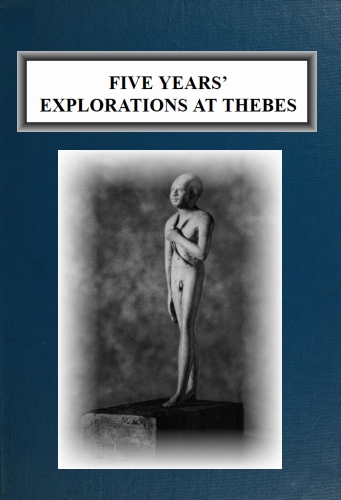
Small portrait figure of a boy named
 Amenemheb, nude, and of electrum; dedicated by his father
Tahuti[52] ‘who makes to live his name’. It measures 13 cms. high,
and stands upon a wooden pedestal which is inscribed. The work is
that of a very good artist, showing great instinctive feeling and
subtle modelling as well as delicacy. Though the actual finish of
the detail is not carried to a very high pitch, this fact does not
lessen its beauty, and a glance at the photographs (Pl. LXVII. 1
and frontispiece) will at once show its charm and high art sense.
In the left hand is a lotus-bud with long and flowing stalk. The
metal was cast and the figure worked upon after it was chilled. The
statuette at first may seem attenuated, but any one who knows the
youth of modern Egypt will at once recognize its truth.
Amenemheb, nude, and of electrum; dedicated by his father
Tahuti[52] ‘who makes to live his name’. It measures 13 cms. high,
and stands upon a wooden pedestal which is inscribed. The work is
that of a very good artist, showing great instinctive feeling and
subtle modelling as well as delicacy. Though the actual finish of
the detail is not carried to a very high pitch, this fact does not
lessen its beauty, and a glance at the photographs (Pl. LXVII. 1
and frontispiece) will at once show its charm and high art sense.
In the left hand is a lotus-bud with long and flowing stalk. The
metal was cast and the figure worked upon after it was chilled. The
statuette at first may seem attenuated, but any one who knows the
youth of modern Egypt will at once recognize its truth.
The statuette found on the left side was in wood, of a boy named
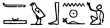 Hu-uben-ef, and it was dedicated by his
father Tahuti ‘who makes to live his name’. This figure stands 31
cms. in height, and is very cleanly cut, the work good, but of a
different and perhaps not so high a standard as the metal figure of
his brother. Nevertheless it is exquisitely rendered and shows a
strong likeness to the other, particularly in the shape of the
head. The pedestal is inscribed with the dedication, and mentions
also a prayer for per-kheru offerings for the ka. Traces of
colour, red, are visible on the nude parts; the hair is coloured
black, the eye-balls are painted white, the pupils, eye-lashes, and
brows black (Pl. LXVII. 2).
Hu-uben-ef, and it was dedicated by his
father Tahuti ‘who makes to live his name’. This figure stands 31
cms. in height, and is very cleanly cut, the work good, but of a
different and perhaps not so high a standard as the metal figure of
his brother. Nevertheless it is exquisitely rendered and shows a
strong likeness to the other, particularly in the shape of the
head. The pedestal is inscribed with the dedication, and mentions
also a prayer for per-kheru offerings for the ka. Traces of
colour, red, are visible on the nude parts; the hair is coloured
black, the eye-balls are painted white, the pupils, eye-lashes, and
brows black (Pl. LXVII. 2).
25. An oval-shaped basket. This basket is similar in make to No.
16 and measures 40 cms. across its long axis. It is of coarser
weaving and shows no signs of decorations (Pl. LXIV. 25). Some
bituminous material had been spilt into it, and many of the objects
it contained adhered to its inner side and were stuck together from
that cause.
Contents (Pl. LXVI):—It seemed to have contained a scribe’s
outfit, which was once probably complete, but many of the objects
found in it were broken and parts of them were missing. These were:
(1) a large reed case made of a section cut from the stalk of a
thick rush. At the top this has a floral ornament made of four
pieces of carved wood which are let into spaces cut in the sides at
the end and bound in position by a strip of linen. The node or
natural joint of the rush has been utilized for the bottom end, and
the top end was stopped by a rag plug. In it were found twenty-six
thin reeds and a few seeds of a plant.
[53] (2) A small reed case
made like the former one described above, but without top ornament.
It enclosed fifteen thin reeds and similar seeds of a plant.[53]
(3) A wooden palette varying only from the common and well-known
types by having three small oblong-shaped holes pierced diagonally
through the side corners for strips of leather (?) for suspension.
(4) A peculiar wooden instrument, mallet-like in shape: its use is
unknown to me. There are on the small end indentations like marks
that could be caused by tightly-bound string. (5) A rectangular
oblong piece of hard wood. Its use is unknown to me; but it appears
to be part of some instrument, as there are two holes in one side
and another at the end. In all three holes there are ends of broken
pegs. (6) A stick some 30 cms. in length. It seems to be the
cross-bar of a pair of scales (note the hole and peg in the centre
and peculiar notched ends). (7) A bag made of woven fibrous string.
(8) A small linen bag; the mouth was drawn together by string in
the same manner as purses of the present day. (9) A roll of
leather, bound with strips of the same material. (10) A roll of
linen (not shown in the Plate). (11) Very small fragments of
papyrus which seem to have been torn from a small roll of papyrus
(not shown in the Plate). (12) A clay figure of a cynocephalous ape
(Thoth). This little creature was wrapped in linen. (13)
Human-headed sphinx, cut out of a sheet of copper. (14) A large
round piece of wax. (15) A tortoise-shell. (16) A miniature clay
cup. A strip of linen was bound round the stem. (17) Model
knuckle-bone in clay. (18) Some pieces of resinous material. (19) A
small wooden peg. (20) A small amuletic figure in green glaze
faience. (21) One large clay disk, four wax disks, and twelve disks
of different sizes made of some black material. They appear to be
weights:
| 1. | Clay | 12·0 grains. |
| 2. | Wax | 4·0 ” |
| 3. | ” | 4·0 ” |
| 4. | ” | —}weight obscured from bitumen |
| 5. | ” | —} adhering to them. |
| 6. | Black material | 3·5 grains. |
| 7. | ”” | 3·5 ” |
| 8. | ”” | 3·5 ” |
| 9. | ”” | 3·0 ” |
| 10. | ”” | —broken. |
| 11. | ”” | 3·0 grains. |
| 12. | Black material | 2·5 grains. |
| 13. | ”” | 2·5 ” |
| 14. | ”” | 2·5 ” |
| 15. | ”” | 2·5 ” |
| 16. | ”” | 2·5 ” |
| 17. | ”” | 2·0 ” |
26. A writing tablet. This tablet, made of wood and covered with
stucco, with surface polished for writing, bore inscriptions on
both sides. It was broken in two halves, measures 48 × 26·5 cms.,
and was found among the stones covering the floor of the chamber
(see Chapter XIII by Dr. Möller).
27. Parts of a model five-stringed musical instrument. Similar to
Nos. 28, 63 A, and 92 (see Pl. LXXI, and for description No. 63 A).
28. A pottery pan containing various objects. (1) A model
four-stringed musical instrument (Pl. LXXI. 28) made of sycomore
wood, ebony, and ivory. (For further description see No. 63 A.) (2)
A bird-trap (Pl. LXIV. 28) made of wood and of the following
construction and mechanism:—Two flat boards cut semicircular and
joined in the middle by a central broad bar of wood which is
slightly longer than the diameter of the circle formed by the two
semicircular boards; these three pieces of wood formed the floor of
the trap. Upon the central bar, it will be noticed that there are
two pairs of pillars, grooved on top, and a hole in the bar on the
right and left side of each pair of pillars (see Pl. LXIV). Strung
over each pair of pillars were (now missing) several strands of
catgut (?), with their ends passed through the holes on either
side, and held at the back by short pieces of stick. By revolving
these pieces of stick at the back the strands of catgut were
twisted and brought to any degree of tension required, and thus by
this method formed two spring-hinges. Fixed in these spring-hinges
was a flexible piece of stick bent to form an arched bow (not shown
in Pl. LXIV), either end of the bow being passed through the
strands of twisted gut at such an angle as to cause the bow to be
pressed on to one half of the circular bottom of the trap (the
position when closed). Attached to the bow and on the opposite half
of the bottom of the trap was a net (see holes for this purpose and
remains of net, Pl. LXIV. 28), sufficiently large to allow the
capture of a bird. To open the trap, the bow would be pulled over
to the side that the net is attached to. On this side, at the edge,
there is a notch (see Pl. LXIV. 28) for a pillar-catch which held
the bow open. This catch was worked by a string through a hole
beside it (see Pl. LXIV. 28), which was passed underneath and
brought up through a hole in the centre of the bottom of the trap
(see Pl. LXIV. 28), where the string was attached to a sensitive
adjustment so placed that the movements of a bird touching it would
detach it and cause the trap to close (i. e. the bow to spring into
its original position on the opposite side). The wooden bow
belonging to the trap was found sometime afterwards among a lot of
stray wood that came from the tomb, and it was exactly as described
above. (3) A mechanical toy bird made of wood (Pl. LXIV, right and
left of trap). (4) Pottery bowl of red pottery full of a brown
powdery substance. (5) A painted clay head of a bull. (6) A small
round basket containing a blue faience kohl-pot. (7) A writing
tablet like No. 26 (see Chapter XIII by Dr. Möller).
29. Plain anthropoid coffin. The outer surface of this coffin is
painted white, with the features of the face roughly delineated in
black (Pl. LXI. 29).
Contents:—Mummy of a girl.
30. Rectangular child’s coffin. Similar to No. 80.
Contents:—Skeleton of a baby.
31. Dug-out rectangular child’s coffin. Similar to No. 41.
Contents:—Mummy of a child. In the wrappings covering the hair
were some bone and cornelian beads like those found in coffin No.
78 given in Pl. LXXII. 78. Resting on the feet of the mummy was a
basket turned over and its contents spilt. The contents were
several necklaces of many kinds of blue faience beads, of which
examples are given in Pl. LXXIII. 31. With them was a small blue
faience kohl-pot of usual type. One of the cowroid beads bore the
prenomen of Thothmes I, while others had hieroglyphic signs on
them, including one which had
 upon its
base.
upon its
base.
32. A bunch of papyrus reeds.
33. A small obsidian unguent vase. This was found resting upon
the chest of coffin No. 23.
34. Plain rectangular flat-topped coffin. Similar to No. 75
(broken).
Contents:—Mummy broken to fragments.
35. Decorated rectangular coffin. Smashed to pieces by the
falling of the rock ceiling of the chamber. There were no traces of
objects.
36. Plain rectangular flat-topped coffin. Similar to No. 75.
Contents:—Among the decayed remains of a mummy was a round-backed
green glazed steatite scarab, bearing a very fine example of spiral
pattern engraved upon its bezel (Pl. LXXII. 36).
37. Rectangular dug-out coffin. Similar to No. 58 (lid missing).
Contents:—Mummy of a woman. In the débris of the mummy, on the
bottom of the coffin, was a round-backed green glazed steatite
scarab (Pl. LXXII. 37).
38. Plain anthropoid coffin. Similar to No. 29.
Contents:—Mummy of a man. Lying on the bottom of the coffin was a
blue faience scaraboid bead (Pl. LXXII. 38).
39. Parts of a frame of a wooden stool. Similar to No. 13.
40. Anthropoid dug-out child’s coffin. Painted white and very
roughly made.
Contents:—Child’s skeleton.
Pit (D).
41. Rectangular dug-out child’s coffin. The shell was cut out of
one block of wood, and for the lid a flat board was used. Wooden
pegs at either end of the lid show that it once had head and foot
pieces (P. LXI. 41).
Contents:—Mummy of a child.
42. Rectangular dug-out child’s coffin. This was of peculiar
type. The block of wood from which it was made was cut in half
diagonally, so that the lid and shell were of equal proportions.
Some auxiliary pieces of wood had been let into the lid to
strengthen it (Pl. LXI. 42).
Contents:—Skeleton of a baby.
43. Rectangular child’s coffin. Similar to No. 80.
Contents:—Skeleton of a very young child. In the shell of the
coffin there were a few miniature blue faience beads.
44. Rectangular child’s coffin. Similar to No. 80. The lid was
tied on with rope.
Contents:—Skeleton of a child.
45. Rectangular child’s coffin. Similar to No. 80.
Contents:—Mummy of a child.
46. Plain rectangular flat-topped coffin. Similar to No. 75.
Contents:—Mummy of a man.
47. Plain anthropoid coffin. Similar to No. 29. The lid was tied
on with rope.
Contents:—Mummy of a woman, in bad condition and much decayed. In
the débris there were some bone bead-bangles (for example see Pl.
LXXIII. 53); a blue glazed steatite scarab of the Hyksos period; a
turquoise blue glass cowroid bead; and a blue faience scaraboid
bead (Pl. LXXII. 47).
48. Plain rectangular flat-topped coffin. Similar to No. 75.
Contents:—Mummy of a man.
49. Plain rectangular flat-topped coffin. Similar to No. 75.
Contents:—Two mummies; one of a man, the other of a woman, lying
head to feet. Among these remains were some bone and cornelian
bead-bangles (for example see Pl. LXXIII. 78).
50. Rectangular open-grid bottomed coffin. Similar to No. 52.
Contents:—Mummy of a half-grown child. The mummy was enveloped in
reeds. Upon it were bone and cornelian bead-bangles (see Pl.
LXXIII. 78); a group of tubular barrel-shaped beads, coated with
chips of glass and disk-shaped faience beads; also an amuletic
necklace (Pl. LXXIII. 50). The beads of this amuletic necklace were
made of cornelian, faience, and blue opaque glass; the amulets were
flies, hawks, and symbolical knots, made of glazed and unglazed
steatite, jasper, and faience, and the central pendant of gold. The
original position of these objects upon the mummy it was impossible
to ascertain.
51. Rectangular dug-out child’s coffin. Similar to No. 41.
Contents:—Mummy of a child. In the coffin, underneath the mummy,
was a wooden throw-stick and a gold earring; the second gold
earring was afterwards found at the bottom of the pit. The
throw-stick, 42 cms. in length, is finely carved out of very hard
wood, and it has a propeller-like twist.
52. Rectangular open-grid bottomed coffin. A plain wood
rectangular coffin, with wooden bars at intervals in place of the
boarded bottom (Pl. LX. 52).
Contents:—Mummy of a woman, bent, as it was too large for the
coffin. On the third finger of the left hand, attached by string,
were two jasper scarabs (Pl. LXXII. 52). One of the scarabs had a
fish and lotus-flower engraved upon its bezel.
53. Plain rectangular gable-topped coffin. Similar to No. 62, but
has no traces of paint.
Contents:—Mummy of a man. Beside the head, and resting on the
bottom of the coffin, were:—(1) a small wood and ivory jewel-box
(fallen to pieces); (2) an alabaster bowl in the shape of a
cartouche; (3) a blue faience bowl; and (4) a pottery vase (Pl.
LXIX. 53). The mummy had rotted away, and among the débris
were:—(1) round-backed blue glazed steatite scarab, mounted in a
gold funda, bearing on its base the name of the royal daughter,
Neferu-ra (daughter of Queen Hatshepsût); (2) round-backed blue
glazed scarab bearing the prenomen of Thothmes III; (3)
round-backed green glazed scarab, mounted in gold funda, bearing a
decorative pattern; (4) cowroid seal of glazed steatite (worn to
brown) bearing a decorative pattern, and mounted in a gold funda;
(5) high-backed scarab of dark green paste bearing a floral
pattern, and mounted upon a copper-wire ring—the wire is threaded
through the scarab and is passed through a small hole on the other
end of the wire, flattened and pierced for the purpose, and it is
held thus by being twisted round the wire a few times (Pl. LXXII.
53). Fallen out of the small jewel-box (mentioned above) there were
three necklaces. One of them was a long string of violet faience
beads (similar to No. 6, Pl. LXXIII); another was made up of plain
bone beads (Pl. LXXIII. 53); and the third consisted of cornelian,
violet faience, and gold beads, with amulets at intervals made of
gold, silver, cornelian, and blue glass (Pl. LXXIII. 53).
54. A grey pottery vase (Pl. LXXIV. D), bearing a hieratic
inscription (see Chapter XIII, by Dr. Möller).
55. Plain rectangular flat-topped coffin. Similar to No. 75.
Contents:—Two adult and one child’s mummy. Like the coffin they
were very much broken. Among the remains were bone and cornelian
beads, and an ivory bracelet (Pl. LXXIII. 55, on the plate
incorrectly 85).
56. Rectangular child’s coffin. Similar to No. 80.
Contents:—Mummy of an infant.
57. Plain rectangular flat-topped coffin. Similar to No. 75.
Contents:—Three adult mummies, which, like the coffin, were
broken. With them was a wooden head-rest (Pl. LXVIII. 57); a
round-backed green glazed steatite scarab (Pl. LXXII. 57); and a
few stray beads of cornelian, faience, and bone.
58. Rectangular dug-out coffin. The lid was tied on with rope
(Pl. LXI. 58).
Contents:—Mummy of a man.
59. Decorated rectangular coffin. The colouring is similar to
that of No. 7, except that instead of the two goddesses at either
end there are geometrical drawings (Pl. LX. 59).
Contents:—Four mummies covered with a large shroud. At the head
end of the coffin, and resting on the mummies, there were: (1) a
black pottery vase; (2) a red pottery biangular bowl; (3) a wooden
head-rest; (4) a basket containing four dôm nuts, and a vase which
had in it a piece of crystal, and a round-backed green glazed
steatite scarab (Pl. LXVIII. 59 and Pl. LXXII. 59).
The four mummies, packed head to feet, were as follows:—
(a) Mummy of a woman with a scarab necklace (Pl. LXXII. 59 A); a
bead necklace (Pl. LXXIII. 59); and some bead-bangles of bone and
cornelian (for examples see No. 78, Pl. LXXIII). One of the scarabs
upon the necklace bears the nomen of Thothmes I.
(b) Mummy of a child.
(c) Mummy of a man wrapped in very coarse linen.
(d) Mummy of an adult (sex difficult to ascertain).
With the mummy there was a walking-staff; in the abdomen were some
dôm nuts, and a group of scarabs (Pl. LXXII. 59 D), which appear,
from the string that some were still threaded upon, to have once
formed a necklace. In the wrappings near the neck of the mummy were
some faience and bone beads. One of the scarabs bore upon its bezel
 Neb-ded-Ra, encircled by a coil pattern
(cp. Scarab, B.M., No. 37730); another had the prenomen of Thothmes
II, above a crouching jackal; and a third one has the Hor-nub
name of Thothmes I.
Neb-ded-Ra, encircled by a coil pattern
(cp. Scarab, B.M., No. 37730); another had the prenomen of Thothmes
II, above a crouching jackal; and a third one has the Hor-nub
name of Thothmes I.
Chamber (E).
60. Rîshi coffin. Similar to No. 11, but of very rough
workmanship.
Contents:—Mummy of a woman scantily wrapped in coarse linen.
61. Rectangular child’s coffin. Similar to No. 80.
Contents:—Mummy of an infant.
62. Plain rectangular gable-topped coffin. The outer surface of
this coffin is covered with a thin paint of pinky hue. The lid is
slanting on either side, has a longitudinal beam in the centre, and
an upright head and foot piece on its ends (Pl. LX. 62).
Contents:—Three mummies: two were of adults lying side by side,
the third of a child placed at their feet. The child’s mummy had
upon its neck an amuletic necklace composed of round and barrel
faience beads of red and green colour with pendant amulets of the
same material, and in the centre a brown stone turtle; on the arms
were bead-bangles composed of bone and faience beads; and lying
near the hands, tied upon a piece of string, were two scarabs and a
cowroid seal (Pl. LXXII. 62 A). One of the adult mummies had round
its neck a cornelian bead necklace (Pl. LXXIII. 62); and upon the
third finger of the left hand a green glazed steatite scarab (Pl.
LXXII. 62 B).
63. Decorated rectangular coffin. The coloration of the detail,
painted upon a strawberry-coloured ground, is similar to No. 7. On
the end panels, the goddesses Isis and Nephthys are standing
with the arms upheld (Pl. LX. 63).
Contents:—Two mummies of a man and a woman, lying side by side,
and covered with a shroud. Beside the head of the woman were two
grey pottery vases, and a larger one in black pottery; a dark blue
faience bowl, and a wooden kohl-pot (Pl. LXVIII. 63). The woman had
within the wrappings of the head a broken ivory comb (Pl. LXVIII.
63); and near the hands, lying loosely, were two cowroid seals (Pl.
LXXII. 63 A). The man had no ornament upon him.
63 A. A four-stringed musical instrument (Pl. LXXI. 63 A). The
neck, back, and belly are made of one piece of sycomore wood.
The belly is hollowed out like a trough, and has its two sides
curved slightly inwards at the middle, thus forming a kind of waist
(this was probably due to the tension of the strained skin that
covered it). Across the belly, longitudinally, is the combined
tail-piece and bridge to which the lower fixed ends of the
strings are attached: the tapering end of this combined
tail-piece and bridge was inserted into a socket at the
juncture where the belly and neck join, and its lower and
broader end was bound to a protuberance, made for the purpose, at
the extreme end of the belly. Near the top end of the neck, and
into the back of it, the four key-pegs for receiving the strings
are inserted. The strings themselves (their lower ends being fixed
to the combined tail-piece and bridge), which were passed
along the side of the neck and twisted round the key-pegs, had
their upper ends brought over the neck and slipped under the
tightened portion of the strings which pressed against the side of
the neck (see Fig. 92, Pl. LXXI). For a sounding-board, skin
was stretched over the whole of the belly, with an aperture left
at the juncture of the belly and neck to allow the combined
tail-piece and bridge to be inserted into its socket. The total
length of the instrument is 1·37 metres. This particular specimen I
believe to have been an actual instrument, while the others, Nos.
27, 28, and 92, were merely small models. With these models there
are slight variations in the construction, but as the main idea is
the same it is unnecessary to describe them.
64. Plain rectangular gable-topped coffin. Similar to No. 62, but
has no traces of colour upon it.
Contents:—Mummy of a man sewn up in a shroud. Near the head a
wooden head-rest; by the side a walking-staff; and under the head,
wrapped in a piece of linen, were (1) a wooden kohl-pot of trefoil
section, (2) a bronze razor and granular stone hone,[54] (3) a cord
belt and loin cloth (Pl. LXIX. 64). On the third finger of the left
hand was a blue glazed steatite scarab, mounted on gold funda: this
was tied with string (Pl. LXXII. 64).
65. Plain rectangular gable-topped coffin. Similar to No. 62, but
with no traces of colour.
Contents:—Two mummies of a man and woman, lying head to feet, and
covered by a shroud. The mummy of the woman had a broken alabaster
bowl (Pl. LXIX. 65) lying at the feet. The mummy of the man
appeared to be re-wrapped, and had nothing on it.
66. Rîshi coffin. Shell—cut out of a tree trunk, and painted
with black, red, and white bands. Lid—the detailed
feather-decoration is painted in red, green, and dark blue on a
white and yellow ground. The face is yellow. The longitudinal band
down the centre has no inscription (Pl. LXII. 66).
Contents:—Mummy of a man.
67. Rectangular child’s coffin. This coffin had been enlarged,
and the lid, which was made of old boards, was tied to pegs at
either end of the shell.
Contents:—Mummy of a child, with knees bent.
Chamber (A).
68. Semi-decorated anthropoid coffin. Similar to No. 6 (Pl.
LVIII. 68).
Contents:—A skeleton of a young man with hardly any traces of
mummification visible.
69. Plain rectangular gable-topped coffin. Similar to No. 62 (Pl.
LVIII. 69).
Contents:—Mummy of a woman much decayed.
70. Rîshi coffin. Similar to No. 66. The longitudinal band down
the front has the de hetep seten formula, but bears no name:
space for the name has been left blank (Pl. LVIII. 70).
Contents:—Mummy of a woman lying flat on her back, with head
turned towards the left. In front of the face, a wooden head-rest;
under the cheek, a large bronze mirror. On the head was a wig of
plaited hair (Pl. LXX. 70).
71. Plain rectangular gable-topped coffin. Similar to No. 62. The
bottom of the coffin was not in place, and was lying on the floor,
only partly under it.
Contents:—Mummy of a woman covered with a mat with long pile. On
her right side, a wooden cylinder covered with leather and
containing six musical reeds. These reeds were (1) 36·5 cms. long,
with four notes; (2) 36·5 cms. long, with three notes; (3) 30·5
cms. long, with two notes; (4) 28 cms. long, with four notes on one
side (three were intentionally blocked up with resinous material),
and on the other side there was a hole or note; (5) 25 cms. long,
with five notes (a crack mended with resinous material); (6) 23·5
cms. long, with five notes. The reeds average 12 mms. in thickness.
Under the woman’s legs was a basket containing two flints, two
lumps of clay, a reed kohl-pot and two wooden kohl-sticks, a piece
of a wooden comb,[55] a splinter of wood, some bone and faience
bead-bangles, and a small plaited lock of hair. In the womb were
traces of an embryonic skeleton (Pl. LXIX. 71).
72. Viscera box. Similar to No. 20, with rounded lid (Pl. LXI.
72). No inscriptions.
Contents like Nos. 19 and 20.
73. Decorated anthropoid coffin of the New Empire. Similar in
fashion to No. 23, but rougher in detail and finish (Pls. LVIII.
and LXII. 73). The lid was fixed in place by wooden pegs, and it
bore the name
 Aahmes.
Contents:—Mummy of a woman covered with a shroud. On the right
side of the head was a broken kohl-pot; and at the top of the head,
rolled in linen, a chignon, a pottery vase containing a kind of
pomade which bore prints of the ancient fingers, and an ebony comb
and bone hair-pin (Pl. LXX. 73). The mummy was sewn up in a sheet,
which, when removed, exposed transverse bindings which continued
down to the bitumenized body. The arms were crossed over the
abdomen. On the head, over the natural hair, a plaited wig much
decayed.
74. Decorated anthropoid coffin of the New Empire. This coffin
(Pl. LVIII. 74) is fully illustrated by Plate LXIII, Figs. 1, 2. It
bears the name of
 Mentu-hetep, and,
among the religious formulae written upon it, gives the variant
Mentu-hetep, and,
among the religious formulae written upon it, gives the variant
 for Horus.
Contents:—Mummy of a man covered with a shroud. Under the shroud,
and resting upon the mummy, was a long (164 cms.) bronze snake
sceptre; and on the third finger of the left hand a round-backed
green glazed steatite scarab (Pl. LXXII. 74) tied with string.
75. Plain rectangular flat-topped coffin. Lid and shell made of
planks of wood, with upright head and foot pieces upon the ends of
lid (Pls. LVIII., LX. 75).
Contents:—Mummy of a woman with plaited hair. Round the waist was
a girdle composed of two twisted strings of bone beads.
76. Plain rectangular flat-topped coffin. Similar to No. 75.
Contents:—Mummy of a woman. Hair plaited; on wrists, bangles of
double strings of bone and cornelian beads; on third finger of left
hand a scarab (Pl. LXXII. 76), and few beads strung on thread; and
tied round the fourth finger of the same hand was a small cornelian
pendant drop.
Chamber (B).
77. Plain rectangular gable-topped coffin (Pl. LIX. 77). Similar
to No. 62.
Contents:—Three mummies covered with a shroud: one was of a man,
and the other two of children. The children’s mummies were
bitumenized and bound in knotted and twisted linen. The mummy of
the man (bearded) had on the third finger of the left hand a scarab
mounted upon a silver ring (Pl. LXXII. 77 C). The scarab, made of
steatite (brown), bore an ornamental Hathor design.
78. Plain rectangular flat-topped coffin (Pl. LIX. 78). Similar
to No. 75.
Contents:—Mummy of a woman covered with a shroud. Under the head a
basket containing a dark brown stone kohl-pot, an alabaster vase,
and a cedar-wood comb. Near the basket were two black pottery
long-necked vases (Pl. LXVIII. 78). Lying on the breast, and under
the wrappings, was a small basket (Pl. LXVIII. 78) containing bone
and cornelian bead-bangles (Pl. LXXIII. 78), and three scarabs and
two cowroids. On the neck an amuletic necklace; and on the third
finger of the left hand two gold-mounted cowroids. The scarabs were
two of glazed steatite mounted in gold fundi, and one of cornelian;
the cowroids were three of glass mounted in gold, and one of
steatite mounted in gold (Pl. LXXII. 78). The amuletic necklace was
composed of lapis-lazuli, gold, cornelian, and garnet beads, strung
more or less haphazard between gold amulets (Pl. LXXIII. 78).
79. Plain rectangular flat-topped coffin (Pl. LIX. 79). Similar
to No. 75 (head and foot pieces missing and lid partly open).
Contents:—Mummy of a young woman, which appeared to have been
re-wrapped. On the neck a necklace (Pl. LXXIII. 79) composed of
gold, lapis-lazuli, and cornelian beads.
80. Rectangular child’s coffin. Square box, oblong in form, made
of wooden planks. The lid had upright head and foot pieces (Pls.
LIX. and LXI. 80).
Contents:—Mummy of an infant.
South Wing.
81. Plain rectangular flat-topped coffin. Similar to No. 75. This
coffin was open, its lid lying by its side, and was empty.
North Wing.
82. Two ivory castanets. The ends shaped like human hands, and
curved. They were lying in the débris of the corridor of the tomb.
Niche (G).
83. Plain rectangular gable-topped coffin. Similar to No. 62, but
of small size and thinly coated with white paint. Upon the top of
the coffin was a decayed mummy of a person of immature age, and
with it were three gold earrings (Pl. LXIX. 83). The contents of
the coffin were two children’s mummies lying one upon the other,
and resting upon the top one was a small round basket (Pl. LXIX.
83) containing: (1) a wristlet of bone and cornelian beads (Pl.
LXXIII. 83); (2) a necklace of bone beads (for example see 53, Pl.
LXXIII.); and (3) a necklace of violet faience beads. Upon the
lower mummy were two small bundles of linen containing fruit of the
nebek-tree, which were bound together with a string of blue
faience beads. This mummy had upon its left wrist(?) a bangle of
bone and faience beads (Pl. LXXIII. 83).
Behind the coffin were three pots (Pl. LXXIV. G) leaning against
the back wall of the niche. The niche (G) seems to have been
specially made for these burials, which were covered up by the
stone chippings made in its excavation. These burials appear to
have been made in the tomb when left open after its destruction,
but before it was used as a storehouse.
Passage (L).
84. Dug-out anthropoid child’s coffin. The shell, cut out of a
tree stem, was very roughly made. The lid was missing.
Contents:—Mummy of an infant decayed, and among the débris were
minute blue faience and gold beads (Pl. LXXIII. 84).
Central Passage.
85. An ivory castanet. Burnt, and with end shaped like a human
hand; it differed from No. 82 by being straight. This was found in
the layer of rubbish that covered the floor of the passage. It
appears to belong to the original interment of the tomb.
Hall (C).
86. A wooden statuette and fragment of a wooden coffin of the
Middle Kingdom. The statuette, broken, is covered with stucco and
painted, and is of exceedingly coarse workmanship. It represents a
woman carrying upon her head a linen basket. The fragment of coffin
bore an inscription reading
 perkheru-offerings for the devoted one Henŷt. These antiquities
were found in the layer of rubbish that covered the floor, and
probably belong to the original interment of the tomb (some parts
of the statuette came from the small chamber F).
perkheru-offerings for the devoted one Henŷt. These antiquities
were found in the layer of rubbish that covered the floor, and
probably belong to the original interment of the tomb (some parts
of the statuette came from the small chamber F).
87. A wooden jewel-box. This is similar to the box found in tomb
No. 24 (Pl. XLVI).
Contents:—A ka-hetep amulet and necklace of blue faience (Pl.
LXXIII. 87); a necklace of white and violet cylindrical faience
beads (Pl. LXXIII. 87); a blue glazed steatite scarab (Pl. LXXII.
87); a blue glazed steatite kohl-pot, made to imitate matrix of
turquoise; a reel of white faience; and a copper fillet for the
hair (see tomb No. 25, p. 55). These objects are all of the Middle
Kingdom period, and were discovered in the layer of rubbish
covering the floor of the chamber. They probably belonged to the
original interment.
Pit (D).
88. Panel stela. Covered with white stucco and painted. It
measures 45 × 27 cms. (see Chapter XIII, by Dr. Möller).
89. Panel stela. Similar to No. 88, and measures 57 × 22 cms.
(see Chapter XIII, by Dr. Möller).
90. Panel stela. Similar to Nos. 88 and 89, but of much thicker
wood, and badly broken (see Chapter XIII, by Dr. Möller).
Chamber (F).
91. Broken shafts of arrows, parts of bows, a wooden mallet, and a
wooden hoe. These antiquities came from the rubbish in chamber
F, at the bottom of pit D.
92. Parts of a four-stringed musical instrument. See No. 63 A,
also Pl. LXXI. 92.
Pottery. Examples of the different kinds of pottery vessels found
in this tomb are figured in Pl. LXXIV.
The letters and figures refer to the lettering on the Plan (Pl. LV). The
four specimens marked GEN. came from the corridor and passage.
In the right corner of the plate are examples of mud-sealings found in
the rubbish that covered the floor.
Pit Tombs Nos. 38 and 39.
Both these are of common pit-tomb type, and were possibly made for the
retainers of the owner of tomb No. 37. They were carefully examined but
found to be plundered. Only a few fragments of pottery vessels similar
to those from tombs No. 24 and 25 were found in the sand filling them
(Pl. XXX).
Tomb No. 41.
A large tomb south of No. 37. This has not yet been excavated or
examined, for it was only discovered a few days before ending the work
of season 1911 (Pl. XXX).