On and on sped the Mermaid. Now that the
travelers felt their journey accomplished they were
anxious to begin the homeward trip. They made
a straight course for the village where they had so
nearly met with disaster, and where the king of
the giants had saved them. They went in a direct
line, and did not travel here and there, as they
had after they left the town. Consequently they
shortened the route by a great distance. Yet it
was long enough, and when they finally came in
sight of the place the dial registered a trip of
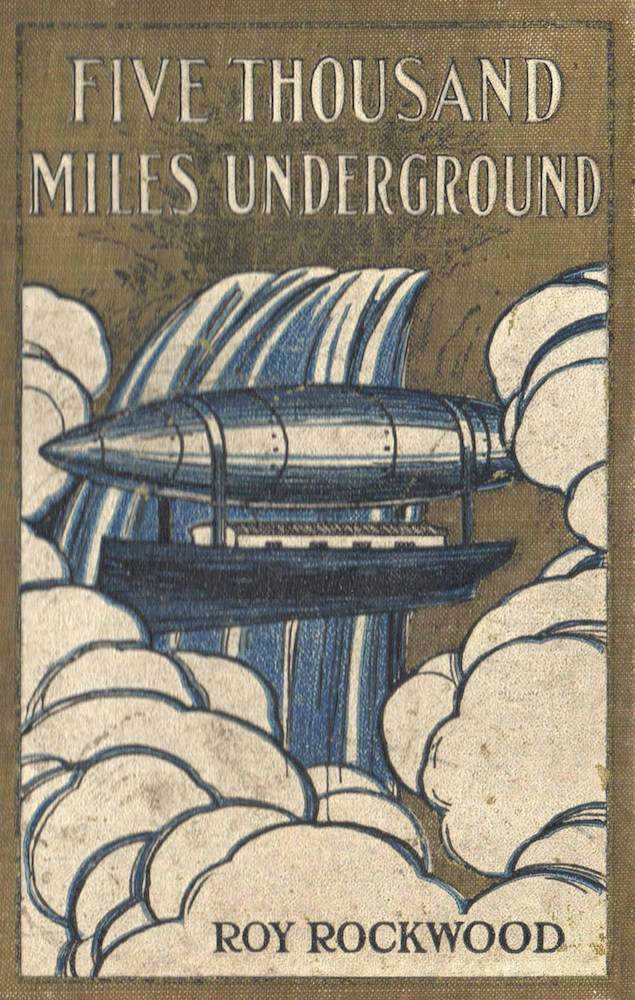
five thousand miles underground.
It was one evening when they landed almost at
the spot whence they had taken flight eventually
to reach the temple of the treasure. Most of the
giants had betaken themselves to their mound
houses, but Hankos was walking in the fields, and,
when he caught sight of the airship hovering
above him he waved his great sword in welcome.
He rushed up to shake hands with the travelers
when they came out of the ship, though to greet
him it was only possible for the adventurers to
grasp one of his immense fingers.
As soon as the greetings were over Hankos
began to speak rapidly to the professor, at the same
time going through many strange motions.
“It is as I feared!” suddenly exclaimed the
scientist.
“What is the matter?” asked Mark.
“The worst has happened!” went on Mr. Henderson.
“The great hole by which we came into
this place has been closed by an earthquake shock!”
“The hole closed?” repeated Jack.
“An earthquake shock!” murmured Mark.
“Then how are we going to get back to earth?”
asked old Andy.
A terrible fear entered the hearts of the travelers.
The closing of the opening by which they
had come to the strange world meant, in all probability
that they would have to spend the rest of
their lives in this underground place.
“What good did it do us to get all those diamonds
and that gold?” asked Mark in a sorrowful
tone.
Hankos began to speak again, using his gestures
which were almost as eloquent as words. The
professor watched and listened intently. Then
there seemed to come a more hopeful look to his
face. He nodded vigorously as Hankos went on
with what seemed to be an explanation.
“It’s worth trying, at all events!” the scientist
exclaimed. “It is our only hope!”
“What is?” asked Jack.
“Friends,” began the professor in solemn tones.
“I must admit our plight is desperate. At the
same time there is a bare chance of our getting
back to our own earth. As you remember, Hankos
went from this place to the upper regions through
the upward spouting column of water.”
“If we had our submarine we might also,” interrupted
Jack. “But the Mermaid isn’t built
to sail in that fashion.”
“Nor would the Porpoise have served us in this
emergency,” said the professor. “It would prove
too heavy. But, nevertheless, I think I have a
plan. Now, Mark, you are about to learn the
secret of the storeroom. The real one, not the
hiding of Hankos in there, which you imagined
to be the cause of my desire to keep something
hidden. When we planned a trip to this underground
world I had a dim idea that we might
meet with trouble. So I planned and made a
cylinder lifeboat.”
“A cylinder lifeboat?” repeated Mark.
“Yes,” replied Mr. Henderson. “I have
it in the storeroom. I did not want any of you
to see it for fear you would have faint hearts.
I thought there might be no necessity of using it.
But, since there is, we must do our best. I will
admit it may be a fearful ordeal, but we will have
to risk something in order to escape.
“I have in the storeroom a large cylinder,
capable of holding us all. It will also contain
food and drink for a month, but we will all have
to go, packed almost like sardines in a box. My
plan is to take the Mermaid to the place where
the column of water shoots up. There we will
get into the cylinder, close it, and trust ourselves
to the terrible force that may bring us back to
the upper world. What do you say? Shall we
attempt it?”
For a few seconds no one spoke. Then Jack
said slowly:
“I don’t see that we can do anything else. I
don’t want to stay here all my life.”
“I wants a chance t’ wear some of them sparklers,”
put in Washington.
“Then we will make the attempt,” the professor
added. “Now all aboard for the place where
the water shoots up!”
Questioning Hankos, the professor learned how
to reach the strange place. It was in the midst of
a desolate country where none of the giants ever
went, so afraid were they of the strange phenomenon.
It was a week’s journey. Sometimes the Mermaid
flew through the air, and again it sailed on
vast lakes or inland seas. On the trip they met
with big waterfalls and terrible geysers that
spouted a mile or more into the air. They traveled
by night as well as day, though it was necessary
to keep a sharp watch.
Sometimes the ship passed through great flocks
of birds that surrounded her and sought to pierce
the aluminum hull with their sharp beaks and talons.
Over the mountains and valleys the ship
sailed until, one evening, there sounded through
the air a strange rumbling sound.
“It is thunder,” said Old Andy.
“It is the water column,” replied the scientist.
“We are at the end of our trip. May the remainder
be as successful!”
The ship was lowered to the surface, as it was
deemed best to approach the column when the
lights were shining. No one slept much that
night, for the roaring and rumbling never ceased.
In the morning the ship was sent forward
slowly. Ever and ever the terrific sound increased,
until it was almost deafening. They had
to call to each other to be heard.
Then, as the Mermaid passed over a mountain,
the adventurers saw, in a valley below them, the
up-shooting water.
It was a vast column, nearly three hundred feet
in thickness, and as solid and white as a shaft of
marble. Up, up, up, it went, until it was lost to
sight, but there were no falling drops, and not
even a spray came from the watery shafts.
“There is a terrible power to it,” the professor
said. “May it prove our salvation!”
The ship was lowered about a hundred feet
away from the waterspout. All around them the
ground was vibrating with the force of the fluid.
“To think that connects with the world above!”
exclaimed Jack.
“It’s a good thing for us that it does,” Mark
answered.
“We must lose no time,” the professor put in.
“If the earthquake destroyed the downward
shaft, it may effect this one in time. We must
escape while we can.”
Then, for the first time, he opened the storeroom
and the big cylinder was disclosed to view.
It was made of aluminum, and shaped like an immense
cigar. The hull was double, and it was
strongly braced. Inside were padded berths for
the occupants, and there was just room enough for
the seven adventurers. Once they had entered
they could not move about, but must stay in their
little compartment.
Compressed air in strong cylinders furnished a
means of breathing, and there were tiny electric
lights operated by a storage battery. There was
also a chamber to be filled with the lifting gas.
The cylinder was so arranged that it would float
on it’s long axis if thrown into the water. A trap
door hermetically sealed gave access to the interior.
A small propellor, worked by compressed air, furnished
motive power.
The food supply consisted of compressed capsules
on which a man could subsist for several days.
There was also some water, but not much, since
that can not be compressed and would, therefore,
take considerable room.
“The only thing for us to do,” said the professor,
“is to get into the cylinder, seal it up, and
trust to Providence. This is what I intended to
use when we were caught in the draught.”
“How can we get into the column of water
after we shut ourselves into the cylinder?” asked
Mark.
“The cylinder fits into a sort of improvised
cannon,” said Mr. Henderson. “It is fired by
electricity and compressed air. We will aim it
at the column, press the button and be projected
into the midst of the water. Then——” He did
not finish the sentence, but the others knew what
he meant.
“When are we to start?” asked Mark.
“As soon as possible,” replied the professor.
“I must arrange the cylinder, compress the air and
lay out the food supply.”
It took the rest of the day to do this, as the
inventor found it would be advisable to attach a
weight to the end of the cylinder, to hold it upright
in the column of water. The weight could
be detached automatically when they were shot
up into the midst of the ocean, where, as Hankos
had told them, the column spurted forth.
Then some food was stored in the tiny ship that
was destined to be their last hope, and some tanks
of water were placed in it.
“I think we are almost ready,” Mr. Henderson
said about noon the next day.
“What about our gold and diamonds?” asked
Jack suddenly. “Can we take them with us in
the cylinder?”
“That’s so!” exclaimed Mr. Henderson. “I
forgot about them. I’m afraid we’ll have to leave
the riches behind. We will not be able to carry
them and the food we need, for it may be a week
or more before we can leave the cylinder. Gold
and diamonds will be a poor substitute for something
to eat.”
“I’m goin’ t’ take mine!” said Washington
with much conviction. “I might as well starve
rich as starve poor!”
“We may be able to take a few diamonds,”
the professor answered. “The gold will be too
heavy. Let each one select the largest of the diamonds
he has and put them in his pockets.”
Then began a sorting of the wealth. It was
strange, as they recalled afterward, throwing away
riches that would have made millionaires envious,
but it had to be done. All the wealth in the world
would not equal a beef capsule when they were
starving, and they realized it. So they only saved
a few pieces of gold as souvenirs, and took the
best of the diamonds. But even then they had a
vast fortune with them.
At last all was in readiness. The cylinder had
been placed in the tube from which it was to be
shot gently forth by compressed air, so that it
would fall into the upward spouting column of
water. The charge of compressed air was put in
and the electric wires arranged.
“Are we all ready?” asked Mr. Henderson.
“I think so,” said Jack, in what sounded like
a whisper, but which was loud, only the noise of
the water muffled it.
“Then we had better enter the cylinder,” spoke
the inventor. “Take a last look at
the Flying Mermaid, boys, for you will never
see again the ship that has borne us many thousand miles.
She served us well, and might again, but for the freak
of nature that has placed us in this position.”
For the first time the adventurers realized that
they must abandon the craft in which they had
reached the new world. So it was with no little
feeling of sadness that they climbed up the ladder
that had been arranged and slid down into the
cylinder. One by one they took their places in
the padded berths arranged for them. It was a
snug fit, for the professor knew if there was too
much room he and the others might be so tossed
about as to be killed.
Mr. Henderson was the last to enter. Standing
at the manhole he took a final look at his pet
creation, the Mermaid. Through the opened windows
the colored lights came, shifting here and
there. Outside the terrible column of water was
roaring as if anxious to devour them.
“Good-bye, Mermaid!” said the professor
softly.
Then he closed down the manhole cover and
tightened the screws that held it in place. He
touched a button that turned on the electric lights
and the interior of the cylinder was illuminated
with a soft glow.
“Are you all ready?” he asked.
“Jest as much as I ever will be,” replied Washington,
who, as the crisis approached, seemed more
light-hearted than any of the others.
“Then here we go!” exclaimed Mr. Henderson.
His fingers touched the button that connected
with the electric machine, which operated the compressed
air.
There sounded a muffled report. Then it
seemed to those in the cylinder that the end of the
world had come. They shot upward and outward,
through the top of the conning tower which
had been removed. The cylinder, launched
straight at the column of water struck it squarely
and, an instant later was caught in the grasp of the
giant force and hurled toward the upper world.
Up and up and up the mass of metal with its human
freight went. Now it was spinning like a top,
again it shot toward the earth’s crust like an arrow
from the archer’s bow.
It was moving with the velocity of a meteor,
yet because of being surrounded with water, and
traveling with the same velocity as the column,
there was no friction. Had there been, the heat
generated would have melted the case in an instant.
For the first few seconds those in the cylinder
were dazed by the sudden rush. Then as it became
greater and greater there came a curious dull feeling,
and, one after another lost consciousness. The
terror of the water column, and the frightful speed,
had made them senseless.
It seemed like a month later, though, of course,
it could have been only a few hours or a day at
most when Jack opened his eyes. He saw his
companions, white and senseless all around him,
and at first thought they were dead. Then he
saw Mark looking at him, and Washington asked:
“Is any one livin’ 'sides me?”
“I am,” replied Jack decidedly.
Then, one after another they regained their
senses. But they were in a strange daze, for they
were being carried along like a shooting star, only,
as they went at the same rate as did the element
carrying them, they did not realize this.
“I think I’m hungry,” said Bill, who had the
best appetite of any of the travelers.
“You’ll find a beef capsule in the little compartment
over your head,” spoke the professor.
Bill was about to reach for it, when they were
all startled by a sudden side motion of the cylinder.
Then came a violent shock, and a sound as of
splashing water. Next the cylinder seemed to be
falling, and, a few minutes later to be shooting
upward. Following this there was another splash
and the cylinder began to bob about like a cork
on a mill pond.
“We have reached the sea! We are afloat on
the ocean!” cried the professor.
Hurriedly he disengaged himself from the
straps that held him to his bunk. He pushed back
the lever that opened the manhole. Into the opening
glowed the glorious sunlight, while to the occupants
came the breath of salt air.
“Hurrah!” cried Jack. “We are safe at
last!”
“Safe at last!” the professor answered, and
then they all gave a cheer.
For their cylinder, which might now be termed
a boat, was floating on the great Atlantic. The
blue sky was overhead and the air of the sea fanned
their cheeks.
They had shot up from the underground earth,
in the column of water, had been tossed high into
the air, had fallen back when the liquid shaft broke
into spray, had descended into the ocean, gone
down a hundred feet or more, and then had shot
up like a cork to bob about the surface.
For a week they were afloat, and then they were
picked up by a passing vessel, rather weak and
very much cramped, but otherwise in good shape.
They said nothing of their adventures, save to explain
that they were experimenting in a new kind
of boat. About a month later, for the ship that
had rescued them was a slow sailer, they were back
on the island whence that wonderful voyage was
begun.
“Well, we solved the mystery of the center of
the earth,” remarked Jack, one evening, when they
were gathered in the old shack where so many wonderful
adventures had been planned.
“Yes, we did,” said Mr. Henderson. “And
no one else is ever likely to go there.”
“Why?”
“Because the only way of getting there was destroyed
by the earthquake, and no one could ever
force his way down through that upward-shooting
column of water.”
“That’s so. Well, we have the diamonds, anyway,”
spoke Mark. “They ought to make us
rich.”
And the jewels did, for the stones proved to be
of great value, even though the adventurers had
saved only a few of the many they found in the
ruined temple.
But there was money enough so that they all
could live in comfort the rest of their lives. As
the professor was getting quite old, and incapable
of making any more wonderful inventions, he
closed up his workshop and settled down to a quiet
life. As for Washington, Andy, and Bill and
Tom, they invested their money received from the
sale of the diamonds in different business ventures,
and each one did well.
“I am going in for a good education,” said
Jack to Mark.
“Just what I am going to do,” answered his
chum. “And after we’ve got that——” He
paused suggestively.
“We’ll go in for inventing airships, or something
like that, eh?”
“Yes. We’ve learned a great deal from Mr.
Henderson, and in the course of time we ought to
be able to turn out something even more wonderful
than the Electric Monarch, the Porpoise, or the
Flying Mermaid.”
“Yes, and when we’ve invented something better——”
“We’ll take another trip.”
“Right you are!”
And then the two chums shook hands warmly; and here we will say good-bye.
JOE, THE HOTEL BOY
Or, Winning Out by Pluck
By HORATIO ALGER, Jr.
Illustrated, 12mo. Cloth, 60 cents
This is one of the last stories penned by that prince of all juvenile writers,
Horatio Alger, Jr., and is one of his best. It describes the adventures of a
youth brought up in the country by an old hermit. When the hermit dies the boy
obtains work at a nearby hotel, and later on drifts to the city and obtains a
position in another hotel. There is a mystery concerning the lad’s identity
and likewise the disappearance of a certain blue box, but in the end all
terminates satisfactorily.
BEN LOGAN’S TRIUMPH
Or, The Boys of Boxwood Academy
By HORATIO ALGER, Jr.
Illustrated, 12mo. Cloth, 60 cents
This story was penned by Mr. Alger some years before his death, but has never
appeared in book form. Ben was a city newsboy, rather rough, but with a heart
of gold. He did a great service for a good-hearted farmer, and the latter took
Ben home with him. The lad had never been in the country before, and his eyes
were opened to a new world. Then the youth was sent to a boarding school,
where he made his way to the front amid many difficulties. Mr. Alger’s charm
as a juvenile writer is so well known it is needless to mention it here, and
this story is in his best vein.
CUPPLES & LEON CO., Publishers, NEW YORK
THE JACK RANGER SERIES
By Clarence Young
Author of the Motor Boys Series
Cloth. 12mo. Illustrated, Price per volume, $1.00, postpaid
JACK RANGER’S SCHOOLDAYS
Or, The Rivals of Washington Hall
You will love Jack Ranger—you simply can’t help it. He is so bright and
cheery, and so real and lifelike. A typical boarding school tale, without a
dull line in it.
JACK RANGER’S SCHOOL VICTORIES
Or, Track, Gridiron and Diamond
In this tale Jack gets back to Washington Hall and goes in for all sorts of
school games. There are numerous contests on the athletic field, and also a
great baseball game and a football game, all dear to a boy’s heart. The
rivalry is bitter at times, and enemies try to put Jack “in a hole” more than
once.
JACK RANGER’S WESTERN TRIP
Or, From Boarding School to Ranch and Range
This volume takes the hero and several of his chums to the great West.
Jack is anxious to clear up the mystery surrounding his father’s
disappearance. At the ranch and on the range adventures of the
strenuous sort befall him.
JACK RANGER’S OCEAN CRUISE
Or, The Wreck of the Polly Ann
Here is a tale of the bounding sea, with many stirring adventures.
How the ship was wrecked, and Jack was cast away, is told in a
style all boys and girls will find exceedingly interesting. There is
plenty of fun as well as excitement.
JACK RANGER’S GUN CLUB
Or, From Schoolroom to Camp and Trail
Jack, with his chums, goes in quest of big game. The boys fall in with
a mysterious body of men, and have a terrific slide down a mountain side.
CUPPLES & LEON CO., Publishers, NEW YORK
THE DOROTHY DALE SERIES
By Margaret Penrose
Cloth, 12mo. Illustrated. Price per volume, 60 cents, postpaid
DOROTHY DALE: A GIRL OF TO-DAY
Dorothy is the daughter of an old Civil War veteran who is running a weekly
newspaper in a small Eastern town. When her father falls sick, and the
newspaper property is in danger of going to pieces, the girl shows what she
can do to support the family.
DOROTHY DALE AT GLENWOOD SCHOOL
More prosperous times have come to the Dale family, and Major Dale resolves to
send Dorothy to a boarding school to complete her education. At Glenwood
School the girl makes a host of friends and has many good times. But some
girls are jealous of Dorothy’s popularity, and they seek to get her into
trouble in more ways than one.
DOROTHY DALE’S GREAT SECRET
A splendid story of one girl’s devotion to another. Dorothy’s chum
ran away to join a theatrical company. What Dorothy did, and how
she kept the secret, makes a tale no girl will care to miss.
DOROTHY DALE AND HER CHUMS
A story of school life, and of strange adventures among the gypsies.
Dorothy befriends a little French girl and also a gypsy waif, in
a manner sure to touch the hearts of all readers.
DOROTHY DALE’S QUEER HOLIDAYS
Relates the details of a mystery that surrounded Tanglewood Park.
There is a great snowstorm, and the young folks become snowbound,
much to their dismay.
CUPPLES & LEON CO., Publishers, NEW YORK
BOYS OF BUSINESS SERIES
By Allen Chapman
Illustrated, 12mo. Cloth, 60 cents per volume
THE YOUNG EXPRESS AGENT
Or, Bart Stirling’s Road to Success
Bart’s father was the express agent in a country town. When an explosion of
fireworks rendered him unfit for work, the boy took it upon himself to run the
express office. The tale gives a good idea of the express business in general.
TWO BOY PUBLISHERS
Or, From Typecase to Editor’s Chair
This tale will appeal strongly to all lads who wish to know how a newspaper is
printed and published. The two boy publishers work their way up, step by
step, from a tiny printing office to the ownership of a town paper.
MAIL ORDER FRANK
Or, A Smart Boy and His Chances
Here we have a story covering an absolutely new field—that of the
mail-order business. How Frank started in a small way and gradually
worked his way tip to a business figure of considerable importance
is told in a fascinating manner.
A BUSINESS BOY
Or, Winning Success
This relates the ups and downs of a young storekeeper. He has some
keen rivals, but “wins out” in more ways than one. All youths who
wish to go into business will want this volume.
CUPPLES & LEON CO., Publishers, NEW YORK
MOTOR BOYS SERIES
(Trade Mark, Reg. U. S. Pat. Of.)
By Clarence Young
Cloth. 12mo. Illustrated. Price per volume. 60 cents, postpaid
THE MOTOR BOYS
Or, Chums Through Thick and Thin
In this volume is related how the three boys got
together and planned to obtain a touring car and
make a trip lasting through the summer.
THE MOTOR BOYS OVERLAND
Or, A Long Trip for Fun and Fortune
With the money won at the great motorcycle race the three boys purchase
their touring car and commence their travels.
THE MOTOR BOYS IN MEXICO
Or, The Secret of the Buried City
From our own country the scene is shifted to Mexico, where the motor
boys journey in quest of a city said to have been buried centuries ago
by an earthquake.
THE MOTOR BOYS ACROSS THE PLAINS
Or, The Hermit of Lost Lake
Unraveling the mystery surrounding an old hermit and a poor boy.
THE MOTOR BOYS AFLOAT
Or, The Stirring Cruise of the Dartaway
In this volume the boys take to a motorboat, and have many adventures.
THE MOTOR BOYS ON THE ATLANTIC
Or, The Mystery of the Lighthouse
How the lads foiled the bad men who wanted to wreck a steamer by
means of false lights is dramatically related.
THE MOTOR BOYS IN STRANGE WATERS
Or, Lost in a Floating Forest
Telling of many adventures in the mysterious Everglades of Florida.
THE MOTOR BOYS ON THE PACIFIC
Or, The Young Derelict Hunters
The derelict was of great value, and the hunt for it proved full of
perils.
THE MOTOR BOYS IN THE CLOUDS
Or, A Trip for Fame and Fortune
The boys fall in with an inventor and invest in a flying machine. After
a number of stirring adventures in the clouds they enter a big race.
CUPPLES & LEON CO., Publishers, NEW YORK
THE BOY HUNTERS SERIES
By Captain Ralph Bonehill
Cloth. 15mo. Illustrated. Price per volume, 60 cents, postpaid
FOUR BOY HUNTERS
Or, The Outing of the Gun Club
A fine, breezy story of the woods and waters, of adventures in search of game,
and of great times around the campfire, told in Captain Bonehill’s best style.
In the book are given full directions for camping out.
GUNS AND SNOWSHOES
Or, The Winter Outing of the Young Hunters
In this volume the young-hunters leave home for a winter outing on the shores
of a small lake. They hunt and trap to their heart’s content, and have
adventures in plenty, all calculated to make boys “sit up and take notice.” A
good healthy book; one with the odor of the pine forests and the glare of the
welcome campfire in every chapter.
YOUNG HUNTERS OF THE LAKE
Or, Out with Rod and Gun
Another tale of woods and waters, with some strong hunting scenes and a good
deal of mystery. The three volumes make a splendid outdoor series.
OUT WITH GUN AND CAMERA
Or, The Boy Hunters in the Mountains
Takes up the new fad of photographing wild animals as well as shooting them.
An escaped circus chimpanzee and an escaped lion add to the interest of the
narrative.
CUPPLES & LEON CO., Publishers, NEW YORK
THE DAREWELL CHUMS SERIES
By Allen Chapman
Cloth. 12mo. Illustrated. 60 cents each, postpaid.
THE DAREWELL CHUMS
Or, The Heroes of the School
A bright, lively story for boys, telling of the doings of four chums, at
school and elsewhere. There is a strong holding plot, and several
characters who are highly amusing. Any youth getting this book will
consider it a prize and tell all his friends about it.
THE DAREWELL CHUMS IN THE CITY
Or, The Disappearance of Ned Wilding
From a country town the scene is changed to a great city. One of
the chums has disappeared in an extraordinary manner, and the others
institute a hunt for him. The youths befriend a city waif, who in turn
makes a revelation which clears up the mystery.
DAREWELL CHUMS IN THE WOODS
Or, Frank Roscoe’s Secret
The boys had planned for a grand outing when
something happened of which none of them
had dreamed. They thought one of their
number had done a great wrong—at least, it
looked so. But they could not really believe the
accusations made, so they set to work to help
Frank all they could. All went camping some
miles from home, and when not hunting and
fishing spent their time in learning the truth of
what had occurred.
THE DAREWELL CHUMS ON A CRUISE
Or, Fenn Masterson’s Odd Discovery
A tale of the Great Lakes. The boys run across some Canadian
smugglers and stumble on the secret of a valuable mine. Some
curious adventures underground are well told.
CUPPLES & LEON CO., Publishers, NEW YORK