NEW YORK WILLIAM S. GOTTSBERGER, PUBLISHER
11 MURRAY STREET
1888
Entered according to Act of Congress, in the year 1888 By WILLIAM S. GOTTSBERGER
in the Office of the Librarian of Congress, at Washington
TRANSLATOR’S PREFACE.
The author’s preface to “Pictures of Hellas” is
so full, that the translator has nothing to add to the
English version except the acknowledgment of valuable
assistance rendered in “the obscure recesses of
Greek literature” by Professor Andrews, Ph.D., of
Madison University.
Mary J. Safford.
PREFACE.
Nearly all the more recent romances and dramas,
whose scene is laid in classic times, depict the period
of the great rupture between Paganism and Christianity.
This is true of “Hypatia,” “Fabiola,” “The
Last Days of Pompeii,” “The Epicureans,” “The Emperor
and The Galilean,” “The Last Athenian,” and
many other works. The cause of this coincidence is
not difficult to understand; for a period containing
such strong contrasts invites æsthetic treatment.
The present tales derive their material from a
different, but no less interesting epoch. They give
pictures of the flowering of Hellas, the distant centuries
whose marvellous culture rested solely on the purely
human elements of character as developed beneath a
mild and radiant sky.
Yet it required a certain degree of persistence to
procure this material. When we examine the Greek
writers to find descriptions of the men of those times
or the special characteristics of the social life of the
period, Greek literature, so rich in accounts of historical
events, becomes strangely laconic, nay almost
silent.
How entirely different is the situation of a person
who desires to sketch a picture of the Frenchmen of
the sixteenth or seventeenth centuries. The whole collection
of memoirs is at his disposal. In these writings
the author discourses familiarly with the reader,
gives him lifelike portraits of the ladies and gentlemen
of the court, and tells him the most minute anecdotes
of the society of that day.
Greek literature has nothing of this kind. The description
of common events and the history of daily existence
are forms of writing of later origin, nothing was
farther from the minds of ancient authors than the idea
that private life could contain anything worth noting.
Herodotus and Thucydides narrated little or nothing of
what the novelists of the present day seek, nay, even
among the orators only scattered details are found, and
strangely enough there are more in the speeches of
Lysias than of Demosthenes.
Among the poets Aristophanes produces a whole
gallery of contemporary characters, but indistinctly and
in vague outlines; they were what would now be
called “originals from the street” who, during the performance
of his comedies, sat among the spectators, and
whom he only needed to mention to evoke the laughter
of the crowd. Something more may be gathered
from Lucian and Apuleius, together with the better
“Milesian” tales, especially from Heliodorus and
Achilles Tatius while, on the contrary, the great Alexandrian
lumber-room, owed to Athenaeus, contains
more gewgaws of learning and curiosa than really
marked characteristics.
In the obscure recesses of Greek literature, where
we are abandoned by all translators, and where—as
everybody knows who has devoted himself to the interpretation
of the classics—only short excursions can be
made, we are sometimes surprised at finding, by pure
accident, useful matter. Dion Chrysostomus (VII)
gives extremely interesting descriptions of life in the
Greek villages and commercial towns. But what is
discovered is always so scattered that only a few notes
can be obtained from numerous volumes.
When I decided to turn what I had read to account,
I was fully aware that a presentation of ancient
life in the form of a romance or novel was one of the
most difficult æsthetic tasks which could be undertaken.
If, nevertheless, I devoted myself to it, I
naturally regarded the work only as an experiment.
In choosing the narrow frame-work of short stories I
set before myself this purpose—to sketch the ordinary
figures of ancient life on a historical background. I
have—resting step by step on the classic writers—endeavored
to present some pictures of ancient times;
but I have no more desired to exalt former ages at the
expense of our own than the contrary. As to the mode
of treatment—I have steadily intended to keep the
representations objective, and to avoid using foreign
words or giving the dialogues a form so ancient
that they would not be easy to read.A The stiff
classic ceremonies, foot-washings, etc., I have almost
entirely omitted, and the archaeological and historical
details have everywhere been subordinated to the contents
of the story, so that they merely serve to give an
antique coloring to the descriptions. Lastly, I have
believed that the Greek characters ought to be completely
banished from the book, and even from the
notes and preface.
A So far as the idiomatic differences of the two languages would
permit, the translator has endeavored to retain the simplicity of style
deemed by the author best suited to his purpose.
After these general remarks I must be permitted to
dwell briefly upon the different tales, partly to point
out the authority for such or such a stroke and partly
to give some few more detailed explanations.
Little is known of the Pelasgian epoch; but it is a
historical fact that a woman was abducted at the fountain
of Callirrhoë. On this incident the first story
“Zeus Hypsistos” is founded, and the climax of Periphas’
death is based upon an ancient idea: a voice of
fate. The belief in Phēmai or Cledones is older than
in that of most oracles, and dates back to the days of
Homer. When Ulysses is wandering about, pondering
over the thought of killing the suitors, he prays to
Zeus for a sign and omen, a voice of fate, which then
sounds in a thunder-clap and, inside of the house, he
hears a slave-girl wishing evil to the suitors. The old
demi-god Cychreus of Salamis is mentioned by Pausanias
(I. 36). It was a universal idea in ancient times
that demi-gods liked to transform themselves into serpents.
In the battle of Salamis a serpent appeared in
the Athenian fleet; the oracle declared that it was the
ancient demi-god Cychreus. In Eleusis Demeter had
a serpent called the Cychrean, for Cychreus, who had
either slain it or himself assumed its form. For the remarkable
ceremonial of purification after a murder
(page 58), see Apollonius’ Argonautica (IV. 702).
The words: “Zeus was, Zeus is, and Zeus will be” are
borrowed from the ancient hymn sung by the Dodonian
priestesses, called Peleiades (doves.)
In “The Sycophant” the notes cited on pages 72–73
would be valueless, if they did not contain the
punishments which, according to Attic law, were
appointed for the transgressions named.
Hetaeriae was the name given to secret societies
or fraternities, where six, seven, or more members
united to work against or break down the increasing
power of the popular government, which was exerting
a more and more unendurable pressure. There were
many kinds of “hetaeriae,” but the most absolute secrecy
was common to all. The members were conspirators,
pledged to assist one another by a solemn oath, sworn
by what was dearest to them in life. The harmless
hetaeriae comprised those who were pursuing no political
object, but merely consisted of office-seekers whose
purpose was to aid one another in the election to office
or before the courts of justice. The hetaeria here described
is of the latter sort; for the delineation of a political
society of this kind would require a far more extensive
apparatus than could be contained within the
brief limits of a tale. Several of the characters in
“The Hetaeria” have actually existed. The comedian
Sthenelus is mentioned by Aristophanes (vesp. 1313) as
well as the orator and tragedian Acestor (vesp. 1220;
aves 31) both are sketched from the more minute details
of the Scoliastae. Phanus is also mentioned by
Aristophanes (equit. 1233) as Cleon’s clerk. Among
the women of the tale there is also an historical
personage, the foreign witch Ninus, who professed to
be a priestess of the Phrygian god Sabazius. She travelled
through Hellas at the time of the Peloponnesian
War and reaped a rich harvest by her divination and
manufacture of love potions; but her end was tragical—she
was summoned before the courts as a poisoner and
condemned to death (A. Schaefer, Demosth. I. 199).
The main outlines of the relations between Hipyllos
and Cleobule are taken from the commencement of
Cnemon’s story in Heliodorus (I. 2) and the description
of Sthenelus’ fall from the boards is almost literally
repeated from Lucian (The Dream, 26). The account
of the naval battle at Rhion is an extract from Thucydides
(II. 86–92).
“Too Happy” is founded upon an ancient idea:
the prayer for a sign and the acceptance of an omen.
Piracy, which plays a prominent part in the narrative,
was practised at an early period in the Ægean Sea and
afterwards attained such dangerous extent that large
and magnificent fleets of pirate cruisers finally threatened
Rome herself with intercepting the importations
of grain from Pontus. It might perhaps be considered
too romantic for a disguised corsair to examine the ship
lying in port before plundering her in the open sea.
Quite different things, however, are reported. The
Phoenician pirates had secret agents who discovered
where a ship with a rich cargo lay and promised the
helmsman “ten-fold freight money,” if he would anchor
in some secluded place, behind a promontory, etc.,
where the vessel could be overpowered. (Philostratus,
vita Apoll. Tyan. III. 24). The conclusion of the
story (the ladder hung outside of the ship so that it
touches the water) is taken from Plutarch (Pompeius,
24).
In “Lycon with the Big Hand” the artist Aristeides
and what is said of his paintings are historical. The
same is true of the traits of character cited about the
tyrant Alexander of Pherae. Under the description of
the earthquake is given an account of what is called in
seismology a tidal wave. A side-piece to this may be
found in Thucydides (III. 89) where—after a remark
about the frequency of earthquakes during the sixth
year of the Peloponnesian War—it is stated: “Among
these earthquakes the one at Orobiæ in Eubœa displayed
a remarkable phenomenon. The sea receded
from the shore; then suddenly returned with a tremendous
wave and flooded part of the coast, so that what
was formerly land became a portion of the sea. Many
people perished.”
In these five stories the scene is laid in Athens, on
the Ægean Sea, and in Thessaly—but, wherever it is, I
have always endeavored to give the characters life and
movement, and make them children of the times and of
the Hellenic soil. I have also sought to delve deeper
into the life of ancient times than usually happens in
novels. Many peculiarities, like the purification after
a murder in the first tale, the Baetylus oracle in
“The Hetaeria,” and the use of the great weapon of
naval warfare, the dolphin, in “Too Happy” have
scarcely been previously described in any form in our
literature. The belief in marvellous stones animated
by spirits was widely diffused in ancient times, as such
stones, under the name of abadir, were known in Phoenicia.
The description of the Baetylus oracle is
founded upon Pliny (17, 9, 51), Photius (p. 1047) and
Pausanias (X. 24). It is evident enough that the
stone-spirit’s answer was given by the ventriloquist’s
art. Though the ancients had several names for ventriloquists,
such as engastrimythae, sternomanteis, etc.,
the art was certainly little known in daily life, it seems
to have been kept secret and used for the answers of
oracles, etc. The soothsayer and ventriloquist Eurycles,
mentioned by Aristophanes, endeavored to make
the people believe that a spirit spoke from his mouth
because he uttered words without moving his lips.
For the dolphin, the weapon used in naval warfare, see
Scholia graeca in Aristoph. (equit 762) and Thucydides
(VII. 41).
In the ancient dialogue I have always endeavored
to give the replies an individual coloring, and it will be
found that Acestor speaks a different language from
Sthenelus, Philopator from Polycles, etc. Phrases like:
“Begone to the vultures,” “show the hollows under
the soles of the feet,” “casting fire into the bosom,”
etc., may easily be recognized as borrowed from the
classic writers. To enter into the subject more minutely
would be carrying the matter too far. Single
characteristic expressions, such as palpale legein, etc.
cannot be reproduced.
In introducing the reader to so distant and alien a
world, it has been a matter of great importance to me
to win his confidence; with this purpose I have sought
by quotations to show the authority for what I have
written. Here and there, to remove any doubt of the
existence of an object in ancient times, I have added
the Greek names. For the rest I have everywhere
striven to follow the old maxim artis est celare artem.
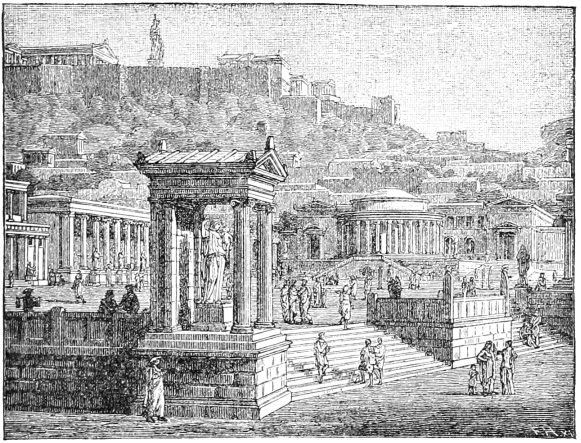
The market of Athens at a later period, about 200 B. C. (In the upper part, in the background, is the Acropolis with the Parthenon, the colossal statue of Athene, and the Propylæa. To the left of the centre is a part of King Attalus’ hall, afterwards the Stoa Poecile, the circular Tholus, and behind, the Bouleuterium. In the foreground is a statue of Eirene, Peace, with the child Plutus in her arms; in the centre of the steps the square orator’s stage with hermae at the corners.)
ZEUS HYPSISTOS. A TALE OF THE PELASGIAN PERIOD. — ZEUS HYPSISTOS. — I. — II. — III. — IV. — V. — VI. — VII. — VIII. — IX. — X. — XI. — XII. — XIII. — XIV. — XV. — XVI.
The region was one of the most noteworthy in
Attica. Manifold in variety were the objects crowded
together within a narrow space. By the side of riven
masses of rock appeared the smooth slopes of a mountain
plateau, and—the centre of the landscape—a
huge crag with a flat top and steep sides towered aloft
like a gigantic stone altar, reared by the earth itself to
receive the homage and reverence of mankind. Two
rivers, a wide and a narrow stream, flowed down its
sides. Height and valley, ravine and mountain peak,
closely adjoined each other, all easy of access and affording
a surprising wealth of beautiful views.
The spot had a lofty destination. Here temples
and pillared halls, hermae and statues were to appear
like the marble embodiment of a dream of beauty in
the youth of the human race; from hence the light of
intellect was to diffuse its rays over the whole inhabited
world.
But in the distant ages of which we are now speaking
Athens had no existence even in name. Yet a
suburb of the city afterwards so renowned was already
in course of construction. On the Pnyx, the Areopagus,
and part of the Museium stood a number of dwellings,
and even at the present day traces may be found on
these heights of eight or nine hundred houses, which
must have lodged three or four thousand persons.
This city, founded by inhabitants of the island of
Salamis, was called Kranaai, and its residents were
known by the name of Cranai, dwellers on the heights.
Nothing could be more simple than these houses.
As may still be seen, they consisted merely of a room
hollowed in the cliff, closed in front and above with
clay and stones,—the latter seem to have rested upon
logs to prevent a sudden fall during the earthquakes so
frequent in this region. Here and there small holes,
into which the ends of the pieces of timber were thrust,
may still be discerned in the cliffs. Many of the dwellings
were arranged in rows, rising like stairs one above
another, all with an open space in front to serve as a
place of meeting for the inhabitants. These terraces
were connected by small steps hewn in the rock; here
and there appeared altars, large storehouses, and tombs,
the latter consisting of one or more subterranean rock
chambers. Great numbers of such sepulchres are still
found scattered over large tracts of the ancient cliff-city.
Other remains of masonry may be seen in the holes
in the earth made to collect rain-water. More than
twenty of these ancient wells can be counted in this
region, for though the Attic country was richly dowered
in many respects, it lacked water, and it was not without
cause that Solon’s law afterwards prohibited any
one from borrowing of a neighbor more than a certain
quantity. The inhabitants of Kranaai had located
their wells so skilfully that even now—after the lapse
of more than thirty centuries—many of them collect
and keep the rain.
Below the cliff-city itself the direction of the streets
may still be discerned, especially in the deep gully
leading down to the Ilissus. Here there are distinct
traces of wheels, between which the stone was roughened
to give the draught-animals a better foothold, and
along the sides of the road ran smooth-hewn gutters
to carry off the rain-water pouring down from
both bluffs.
Many generations had already succeeded each
other in the cliff-city, when a new race settled on the
little plateau between the Hill of the Nymphs and the
Gulf of Barathron. Like their predecessors, the new-comers
originated in Salamis, but they called themselves
Cychreans, from a family descended from Cychreus,
one of the demi-gods of the island.
While on the Pnyx alone was found the altar of
Zeus Hypsistos, the supreme Zeus, around which
gathered the native inhabitants and the Cranai to
worship a common god, the new-comers erected a
sanctuary to the sea-nymph Melite, Hercules’ love,
who was related to the Æacidae, natives of Salamis.
The two neighboring colonies thus each worshipped
its own divinity and lived in peace and friendship, nay
at last some of the Cychreans took wives among the
daughters of the Cranai.
On the other hand the new-comers were by no
means on good terms with the natives; for, as the latter
lived scattered over the country and did not seem to
be very numerous, the Cychreans had forced those they
met to work for them. They had already employed
them to smooth the cliff, to enable them to build there,
and many of the Pelasgians had been seriously injured
by the toilsome labor. Nay, Tydeus, a tall, handsome
youth, brother of one of their chiefs, had suffered a
terrible death, having been stoned because he had defended
himself and refused to work for the foreigners.
The Cychreans endeavored to conceal their crime,
fearing that when the matter reached the Pelasgians’
ears they would make war upon them. There was
very grave cause for alarm; for the Cychreans had
often seen from their cliff Pelasgian scouts hiding behind
the clumps of broom on the plains, evidently
watching for an opportunity to approach their enslaved
countrymen. Young, swift-footed youths, whom it was
lost time to pursue, had invariably been chosen for
this service, so the Cychreans lay in ambush, captured
some of the lads and questioned them narrowly then,
as they pretended to know nothing, forced them to work
like the others.
The morning after the capture of these spies the
Cychreans noticed that, far out on the plain, a pile of
wood had been lighted, on which ferns and green
plants were undoubtedly thrown; for it sent forth a
dense, blackish-brown smoke, which rose to a considerable
height and could be seen far and near. Later in
the day another bale-fire was discovered farther off,
and before noon ten columns of smoke were counted
from the cliff, five on each side, the last of which were
almost lost to sight in the distance. There was something
strangely menacing in these murky clouds which,
calling to and answering each other, rose like a mute
accusation towards the sky.
The whole Cychrean nation, young and old, bond
and free, gathered outside of their houses and stared
at the unknown sign. They suspected that it was a
signal for the Pelasgians to assemble, but when they
spoke of it to the new bondmen the latter said they
had never seen such a smoke, but that the Cychreans
might rely upon it that the Pelasgians would not march
against them until the arrival of a more propitious
day. When the new settlers asked when that would
be, they answered:
“When the moon is large in the sky.”
The Cychreans were obliged to be content with
this, but each man in secret carefully examined his
weapons; no one believed himself safe.
Lyrcus, son of Xanthios, was one of the principal
Cychrean chiefs. He was feared for his strength and,
in those days, fear was synonymous with respect. Lyrcus
had devoted himself to the trade of war; he understood
how to forge and handle weapons and taught
the youths their use. In personal appearance he was
a tall man with curling black locks, a reddish-brown
beard, and a keen, but by no means ugly face. He
usually went clad in a tight-fitting garment made of
wolf-skins, that left his muscular legs and arms bare,
and wore around his waist a leather girdle in which was
thrust a bronze knife a finger long. Many tales about
him were in circulation among the Pelasgians; for
being a warlike man he had often quarrelled with them
and on predatory excursions with some of his comrades
had plundered their lands, carrying off goats, barley,
figs, honey, and whatever else pleased him.
Lyrcus was no longer very young. He had seen
the green leaves unfold and the swallows return some
forty times. Nevertheless, he had always scoffed at
love and considered it foolish trifling. When he was
not forging, his mind was absorbed in the chase and
in practising the use of arms.
Yet, though Lyrcus was so fierce a warrior, Aphrodite
had touched his heart and shown that she, as well
as Artemis, deserved the name of Hekaërge, the far-shooting.
Once, during a short visit to the neighboring
settlement, Lyrcus had seen Byssa, the fairest
maiden in the cliff-city, drawing water from the well in
front of her house, and had instantly been seized with
an ardent passion for her. Grasping her firmly by the
arm, he gazed intently at her and, when the blushing
maiden asked why he held her so roughly, he replied:
“Never to let you go!” Such was the fierce Lyrcus’
wooing.
Byssa’s father, Ariston, the priest of Zeus Hypsistos,
was an aged, gentle-natured man who dared not
refuse the turbulent warrior; yet he only gave his consent
on condition that Byssa should keep the faith of
her ancestors and not offer sacrifices to Melite in the
Cychreans’ sanctuary. Nevertheless, both he and his
wife had tears in their eyes when Lyrcus bore their
only child away and, in taking leave of Byssa, Ariston
laid his hands upon her head, saying:
“Be a good wife to this stranger. But do not
abandon Zeus Hypsistos, that Zeus Hypsistos may not
abandon you.”
Since that day a whole winter had passed, and
Lyrcus seemed to love Byssa more and more tenderly.
There was only one subject on which the husband and
wife held different opinions. When Lyrcus saw the
other women flocking to Melite’s sanctuary he often
wished that Byssa should accompany them. But
Byssa was inflexible. “Remember your promise to
my father,” she said. “Whatever may befall me, I
shall never forget his counsel: ‘Do not abandon Zeus
Hypsistos, that Zeus Hypsistos may not abandon
you.’” And so the matter rested. But when a Phoenician
ship came to the coast—for in those days the
Phoenicians were the only people who dared to sail
across the sea—Lyrcus bought the finest stuffs, ornaments,
and veils. It seemed as though he could not
adorn Byssa enough, she was to be more richly attired
than any of the Cychrean women.
Byssa had already had one suitor before her marriage,
one of the Pelasgian chiefs, a man thirty-eight
years old, named Periphas. He was the owner of a
large herd of goats, often offered sacrifices to Zeus,
smoothed many a quarrel, and had the reputation of
being a good and upright man. Yet there was little
reason that he should be renowned for piety and sanctity,
for he could scarcely control his passions and had
so violent a temper that he had once killed a soothsayer
because the latter, in the presence of the people,
had predicted that he would die a shameful death.
While offering a sacrifice in the cliff-city Periphas
had seen pretty Byssa and instantly asked her of her
father, promising rich bridal gifts. But the priest Ariston
had answered that the maiden was still too young.
After that time Periphas was often met in the
vicinity of the Cranai’s cliff and, when sacrifices were
offered on the ancient altar, always appeared at the
head of the Pelasgians. But from the hour Lyrcus
had carried Byssa home none of the Cranai had seen
him, though it was said that on one of Lyrcus’ pillaging
excursions he had shouted:
“Beware, when the day of retribution comes, I
shall not content myself with carrying off goats.”
Such was the state of affairs at the beginning of our
tale. It almost seemed as if the capture of the spies
was to give occasion for war; one of the youths had
succeeded in escaping and the Cychreans feared that
during his stay among them he might have obtained
news of Tydeus’ death. This Tydeus, who had been
so shamefully stoned, was Periphas’ brother, and the
chief thus had double cause for vengeance—his
brother’s murder and his slighted love.
But spite of the danger, under these circumstances,
of leaving the Cychreans’ cliff Lyrcus had too restless
a nature to remain quietly at home. The very day
that the columns of smoke had struck such terror into
the people he had set out early in the morning, accompanied
by six or eight men, to hunt on the plains or
among the woods that clothed Mt. Parnes.
The day had been one of scorching heat. The sun
had still one-sixth of its course to run, and the air
quivered over the heated cliffs.
The Cychreans had sought refuge outside of their
small, close dwellings to get a breath of the north
wind. On each terrace, men, women, and children
were moving about, the former often clad merely with
the skin of some animal thrown around the hips, the
boys perfectly nude, and the women in looped, sleeveless
garments or sometimes with only a short petticoat
over the loins. Most of these robes were white, and
the others were made of red, yellow, or blue stuffs; at
that time people valued only bright pure colors.
Everywhere merry conversation was heard, and these
hundreds of half-nude figures formed an indescribably
animated picture against the dark background of rock.
Fear of the Pelasgians seemed to have vanished even
before the fires were extinguished, at any rate it did not
prevent the Cychreans from enjoying the present moment.
On one of the lowest terraces, directly opposite to
the Areopagus, stood Lyrcus’ house and beside it the
shed where he forged his weapons. At the door he
had chained a large yellow dog of the Molossian breed,
a sort of bull-dog, and in the shelter of the dwelling an
old female slave was busy at a fire, over which she had
hung a soot-encrusted clay vessel.
A few paces off, towards the edge of the cliff, a
canopy of rushes was stretched between long poles.
Beneath its shadow stood Byssa busied in weaving
loose bits of woollen stuff into a single piece. The
“chain” was placed perpendicularly, so that the weaving
was done standing;—the horizontal loom, which
had been used in Egypt for centuries, was not yet
known in Hellas.
As Byssa stood near the verge of the cliff, with the
blue sky behind her, there was an excellent opportunity
to observe her. She had fastened her dark hair in a
knot through which a bronze pin was thrust, and wore
around her neck a row of blue glass beads. The rest
of her dress consisted merely of a red petticoat, reaching
from her hips to her knees. But her low brow, her
calm black eyes, brilliant complexion, and full bust displayed
the voluptuous beauty peculiar to the South,
and which, even in early youth, suggests the future
mother. In short, she was a true descendant of the
grand Hellenic women, who from the dim mists of distant
ages appear in the bewitching lore of tradition,
fair enough to lure the gods themselves and strong
enough to bear their ardent embrace and become the
mothers of demi-gods and heroes.
It was a pleasure to see how nimbly she used her
hands, and how swiftly the weaving progressed. Each
movement of the young wife’s vigorous, rounded,
slightly-sun-burned body, though lacking in grace, possessed
a peculiar witchery on which no man’s eye
would have rested with impunity.
But all men seemed banished from her presence.
Every one knew that Lyrcus’ jealousy was easily inflamed,
and however great the charm Byssa exercised,
fear of the fierce warrior was more potent still.
Byssa’s thoughts did not seem to be absorbed in her
work. Each moment she glanced up from her weaving.
The Attic plain lay outspread before her in the sunlight.
Here were no waving grain-fields, no luxuriant
vineyards; the layer of soil that covered the rocks was
so thin that the scanty crop of grass could only feed a
few goats. Here and there appeared a few gnarled
olive-trees, whose green-grey foliage glistened with a
silvery lustre, and wherever there was a patch of moisture
the earth was covered with a speckled carpet of
crocus, hyacinth, and narcissus blossoms.
Finding the plain always empty and desolate, the
young wife at last let her hands fall and, sighing deeply,
turned towards the slave.
“How long he stays!” she exclaimed, breaking the
silence.
“Lyrcus is strong and well armed,” replied the slave
as she heaped more wood on the fire. “The Pelasgians
fear him worse than death. He will return unhurt.”
Byssa worked on silently; but she was not at ease
and looked up from her weaving still more frequently
than before.
“Why,” cried the slave suddenly, “there they are.
Look at Bremon.”B The bull-dog had risen on its hind
legs and was leaning forward so that the chain was
stretched tight; snuffing the wind and growling impatiently
it wagged its tail with all its might.
Byssa stepped farther from under the rush canopy
and shaded her eyes with her hands. On the right the
view was closed by Mt. Lycabettus, whose twin peaks
looked almost like one; on the left the gaze rested on
dark Parnes, whose strangely-formed side-spur, Harma,
the chariot, was distinctly visible from the Cychreans’
cliff.
For a long time Byssa saw nothing, then she accidentally
noticed, much nearer than she had expected,
a white spot among some trees.
“There he is! There he is!” she cried joyously,
clapping her hands. “Tratta, rejoice! I see a light
spot out there—his white horse.”
In a mountainous country like Attica even the
plains are uneven, and a rise of the ground concealed
her view of the approaching steed.
At last the light spot appeared again—this time
considerably nearer. Then several moments passed,
during which it seemed to grow larger.
Byssa strained her sight to the utmost, her bosom
heaving with anxious suspense. Suddenly she turned
very pale and throwing herself upon Tratta’s breast,
faltered in a low voice:
“Something terrible has happened. The horse is
alone—riderless.”
Almost at the same instant she released herself from
the slave’s embrace and went to the very verge of the
cliff. From thence, at a long distance behind the
horse, she descried a group of people slowly advancing.
Several men who looked like black specks seemed to
be carrying another, and several more followed.
At this sight Byssa uttered a loud shriek and
clenched both hands in her hair. But Tratta held her
back.
“Be calm, child,” she said with all the authority of
age. “First learn what has happened. You can find
plenty of time to mourn.”
But Byssa did not heed her. The horse had come
very near and was galloping swiftly to its stable at the
foot of the cliff.
Ere Tratta could prevent it, Byssa hurried to the
nearest flight of stairs and darted madly down the
rough-hewn steps, where the slightest stumble would
cause mutilation or death. The slave, not without an
anxious shake of the head, slowly followed.
The horse had scarcely allowed itself to be caught
when Byssa, with tears in her eyes and a peculiar solemnity
of manner, turned to the old servant and
pointed to the animal’s heaving flank.
There was not the slightest wound to be seen; but
a streak of blood a finger broad had flowed down the
steed’s white side and matted its hair together.
“I knew it, Tratta, I knew it!” cried Byssa despairingly.
Then, in a lower tone, she added: “It is his
blood.”
But Tratta answered almost angrily:
“His or some other person’s; what do you know
about it? Help me to get the horse into the shed.”
Byssa, without knowing what she was doing, obeyed
and then looked out over the plain, where she beheld a
sight that made her tremble from head to foot.
Lyrcus was approaching uninjured at the head of
his men.
Byssa uttered a shriek of joy that echoed from cliff
to cliff as, with outstretched arms and fluttering hair,
she flew to meet her husband.
Lyrcus knit his brows.
“What is it? What do you want here?” he asked,
surprised to find her at the base of the cliff.
But Byssa heeded neither words nor look. Throwing
her arms around his neck she clung to him and
covered his wolf-skin robe with tears and kisses.
“Lyrcus, you are alive,” she repeated frantically,
while all the fear and suspense she had endured found
vent in soothing sobs.
“Byssa, speak! What is it?” asked Lyrcus, amazed
at the excitement in which he found his wife.
Byssa took him by the hand, led him to the stable,
and put her finger on the red streak upon the horse’s
side.
“Simpleton!” said Lyrcus laughing. “That is no
human blood.” And he pointed to a huge dead wild-boar,
which two men could scarcely carry on a lance
flung over their shoulders. “After the hunt,” he continued,
“we wanted to put the great heavy beast on
the horse; but it was frightened, bolted, and ran
home.”
Meantime the men had come up. In spite of their
fear of Lyrcus they could not refrain from looking at
pretty Byssa, who was now doubly beautiful in her agitation
and delight. Nay, some were not content with
gazing at her face, but cast side-glances at her bare
feet and ankles, which were sufficiently well-formed to
attract attention, though it was customary for women
to go about with looped garments.
Lyrcus noticed these stolen glances, and frowning
gripped his lance more firmly.
“Why do you wear that red rag?” he said harshly,
pointing to Byssa’s short petticoat. “Haven’t I given
you long robes?”
“The sun is so hot—and I was alone at my weaving,”
stammered the poor young wife with a burning
blush.
As she spoke, confused and abashed, she put her
foot on the lowest step of the rock-stairs and was going
to hurry up the cliff. But Lyrcus seized her and hurling
her behind him so that he concealed her with his
own body, shouted sternly to his companions:
“Forward!”
Then he himself went up after them, watching
rigidly to see that no one looked back, but left Byssa
and the slave to follow as best they could.
On the cliff above there was great joy among the
Cychreans over the splendid game. But when the
animal was flayed and its flesh cut into pieces all, not
merely the hunters themselves but their friends and
relatives, wanted a share of the prize. From words
they came to blows, and Lyrcus needed all his authority
to restrain the infuriated men.
Meantime the sun had set behind the mountains of
Corydallus. The olive-trees on the plain cast no shadows,
the whole of the level ground was veiled in darkness.
Everything was silent and peaceful, ever and
anon a low twittering rose from the thickets.
The Cychreans lingered gossipping together after
the labor of the day. Some of them asked Lyrcus and
his companions whether anything had happened during
the hunt. Lyrcus replied that small parties of Pelasgians
had been seen passing in the distance, but he
seemed to attach no importance to the matter, and
many of the Cychreans were preparing to go to rest—when
a child’s clear voice cried in amazement:
“Look, look! The hills are moving!”
Every eye followed the direction of the child’s
finger.
Far away over some low hills, whose crests stood
forth in clear relief against the evening sky, a strange
rippling motion was going on. It looked as though
some liquid body was flowing down, for one dark rank
succeeded another, as wave follows wave.
There was something in the sight which turned the
blood in the Cychreans’ veins to ice. Nothing was
visible on the plain itself; everything there was
shrouded in the dusk of evening.
All listened in breathless suspense. Then a rushing
sound echoed through the increasing darkness—a
noise like a great body of men in motion, the hum of
many voices, distant shouts, songs, and the clash of
weapons. The din seemed to increase and draw
nearer. Then flames glimmered, as though instantly
covered by dark figures. It was like a living stream,
that grew and widened till it surrounded the whole cliff.
Then a torch was lighted and a small party of ten
or twelve men approached within a bow-shot. Two of
them put long horns of spiral form to their mouths, and
wild echoing notes resounded from cliff to cliff. A
man clad in a white linen robe stepped forward, raising
aloft a laurel staff. Deep silence followed, and his
shrill voice was now heard, saying:
“Cychreans! Ye have greatly wronged us. Ye
have built houses on land that was not yours; ye have
made the men of our nation serve you and, when the
youth Tydeus refused, ye basely murdered him.
“For the surrender of the land and in token of subjection
ye must pay us, the original inhabitants of the
country, an annual tribute of seven hundred spears and
as many swords and shields.”
Here a loud clamor arose among the Cychreans.
They understood that it was the Pelasgians’ intention
to disarm them, and their wrath found vent in fierce
invectives.
“Listen to the dogs!” they shouted. “Ere the
battle has begun, they talk like conquerors. Do the
bragging fools suppose they can blow the cliff over
with their snail horns?”
But the herald did not allow himself to be interrupted.
“Cychreans!” he continued, “the Pelasgians whom
ye have enslaved must be set free and, in compensation
for your crime of murder, we demand that you deliver
up to us Lyrcus, who has provoked war and pillaged
peaceful dwellers in the land. These demands
we will enforce by arms. We no longer come with entreaties,
but with commands.”
Again a terrible din arose, but Lyrcus ordered silence
and springing upon a rock, from which he could
be seen and heard far and near, shouted:
“Pelasgians! The land where we have built was
desolate and uninhabited; it belonged to us as much
as to you. When you demand slaves and wish me to
be delivered over to you, the answer is: Come and take
us. But mark this: it is you, not we, who begin the
war; we only defend ourselves against assault. This
answer is deserved, and approved by our people.”
Loud exulting shouts from the Cychreans hailed
his words.
Lyrcus gazed confidently around him; for, reckless
as he was of his own safety, he was cautious where the
people’s welfare was concerned. At the first sign of
war he had put the cliff in a posture of defence.
At all the wider approaches he had piled heaps of
huge stones to be rolled down on the foe, and where
men could climb up singly he had stationed sentinels.
The rear of the height was inaccessible; here stretched
for more than four hundred ells the Golf of Barathron,
bordered along its almost perpendicular sides by cliffs
from ninety to a hundred yards high. This dark, wild
chasm was afterwards used for a place of execution;
and it was here that malefactors whom the law sentenced
“to be hurled into the abyss” ended their days.
Towards the north, the windward side, the cliff had no
covering of earth and here at its foot, half concealed
among some huge boulders, was the entrance to a cave
which led obliquely upward to some subterranean
tombs, whence a steep passage extended to one of
the lower terraces. In this passage Lyrcus had had
steps hewn in order to secure a secret descent to the
plain, and for farther concealment he had ordered
bushes to be planted outside of the cave.
Though the Cychreans on the whole were in good
spirits, they found themselves in a serious mood as the
decisive hour approached. Lyrcus, at his first leisure
moment, had assured Byssa that the Pelasgians would
be received in such a way that not a single man could
set foot on the open space before the houses. The
young wife silently embraced him; her eyes were full
of tears and she could not speak. She trusted her husband
implicitly, but nevertheless was deeply moved.
“Before the sun goes down,” she thought, “many
an eye will be closed. And what will be Lyrcus’
fate?”
The greater portion of the night passed quietly.
They saw the Pelasgians light fires in a semi-circle
around the cliff and noticed the smell of roasted meat.
Songs and laughter were heard, and with the fires a
thicket of spears seemed to have grown out of the
earth.
On the cliff itself deep silence reigned. Yet a
strange crackling sound echoed upon the night, and
the wind brought a light mist and a smell of burning.
Soon after a red cloud rose into the air and from lip to
lip ran the shout:
“The store-house is on fire!”
Was it some foolhardy Pelasgian or one of the new-made
bondmen who had set it in flames? In any case
the task had been no easy one. The store-house, like
the dwellings, had been hewn out of the cliff and contained
nothing combustible except seeds and the timbers
on which the roof rested. Nevertheless, the
flames spread swiftly, when the fire first reached the
air, and a part of the roof fell. Vast lurid clouds of
smoke whirled aloft and, as usual when seeds are burning,
numberless showers of sparks rose with the smoke
and fell back again to the earth in a fine rain. Suddenly,
just as the fallen timbers burst into a blaze, a
lofty column of fire shot up from the roof. The Hill
of the Nymphs, the Areopagus, and the height known
in later times as the Acropolis were illumined by a
crimson glow, and the whole Pelasgian army broke
into exulting shouts.
Some of the boldest came nearer, and an old bow-legged
simpleton, ridiculously equipped with a gigantic
helmet and an enormous club, strode toward the cliff,
where he made a movement as though he was setting
his foot on the neck of a conquered foe.
At this defiance a young Cychrean seized his bow
and arrow.
“Rhai—bo—ske—lēs! Bow-legs!” he shouted, his
voice echoing far over the plain, “where did you get
your shield?”
The bow-string twanged—and the old man just as
he took flight fell backward to the ground.
The Cychreans clapped their hands and uttered
loud shouts of joy.
At the sight of the old man’s fall—he was probably
a chief—a bloodthirsty yell ran through the ranks of
the Pelasgians. A long word, rendered unintelligible
by the distance, flew from mouth to mouth till it suddenly
rang out clearly and distinctly like a command.
“Sphendonētai! Slingers!”
Forth from the dark throng gathered around the
fires marched a body of men who had nothing but a
sheep-skin around their hips. They formed in two
rows facing the cliff, a score of paces intervening between
the ranks, and the same distance between man
and man.
Among a pastoral race like the Pelasgians the sling
was an indispensable implement. It served to keep the
herds together; for when a goat or any of the cattle
had been hit once or twice by a stone from a sling the
shepherd-dog noticed it and kept a strict watch upon
the animal. By skill in the use of the sling the herdsman
thus saved himself the trouble of running after the
beasts which strayed away from the flocks, and in a
mountainous region like Attica, where one can scarcely
walk a few hundred paces without going up or down,
it is well to spare the legs.
The sling itself was very simple. It consisted
merely of two woollen cords half an ell long and about
as thick as the finger, fastened at each corner of a
piece of leather shaped like a lance-head, with a hole
in the middle to hold the stone firmly. The art of
using the implement consisted in letting one cord drop
at the moment the stone was in the right curve to
reach the mark.
The men with the sheep-skins round their loins collected
stones from the ground and hurled them towards
the cliff, until they ascertained the distance—then they
took them from the pouches they carried suspended by
a leather thong over their shoulders. These stones, of
which each man carried twelve or fourteen, weighed
about eight pounds. Afterwards bullets the size of a
hen’s egg were used and these bullets, marked with the
Hellenic stamp, are still found on the plain of Marathon.
Suddenly a deafening clatter resounded upon the
Cychreans’ cliff from the stones which beat against the
houses and fell back on the hard ground. Soon shrieks
of pain blended with the din and Lyrcus perceived
with alarm that his people were being badly wounded
as, under the hail of stones from above, heads were
bruised or shoulder-joints injured.
The youth who had felled the old chieftain again
seized his bow, but Lyrcus dashed it from his hands.
“Luckless wight!” he said, “our bows do not reach
half so far as their slings. Do you want to show them
it is so?”
After hurriedly stationing sentinels where there was
any shelter, he ordered his men to retreat into the
houses. But even there they were not safe; for when
one or more stones struck a roof whose timbers were
not new, it fell wholly or in part, wounding men,
women, and children. The cliff soon echoed with
wails and shrieks of pain, and the deafening rattle of
the shower of stones was gradually weakening the Cychreans’
courage, the more so because they were unable
to defend themselves.
Then Lyrcus, who had mounted guard himself, saw
a small body of men approaching from the Pelasgian
camp, evidently to reconnoitre. They moved along
the cliff about a bow-shot off for some time, quietly allowing
the stones from the slings to fly over them.
Suddenly one who marched at the head of the band
raised a large conch horn to his lips, sounding three
long, shrill notes, and a great bustle arose among the
Pelasgians.
Five or six hundred men gathered in front of the
camp and hastily formed in ranks. Leaders were
heard firing their zeal and issuing orders. Then they
ran at full speed towards the cliff, where the spies,
holding their shields over their heads, were already trying
to show the advancing soldiers the places most
easy to ascend.
At the moment the dark figures in their goat-skin
garments and hoods set foot on the cliff, the hail of
stones ceased. The Cychreans now came out of
their houses and went to the heaps of stones piled on
the steps. Though the fire of the store-house was beginning
to die away, the lurid flames still afforded sufficient
light to show the Pelasgians their way. When
Lyrcus saw that they had scaled part of the height, he
gave orders to hurl the stones down. The Cychreans
set to work eagerly; rock after rock rolled down,
bounding from one boulder to another. Again loud
shrieks of pain arose, but this time from the Pelasgians,
many of whom missed their footing, plunged downward,
and were mangled by the fall.
Nevertheless, many of them, partly by escaping the
stones and partly by protecting themselves with their
shields, succeeded in approaching the open terrace of
the crag unhurt. Here the Cychreans rushed upon
them, but they defended themselves with the obstinacy
of men who have a steep cliff behind them. For a long
time the battle remained undecided—then the Cychrean
women hastened to the aid of the men. They
flung ashes and sand into the Pelasgians’ eyes, and
some finally used heavy hand-mills for weapons. Nay,
lads of twelve and fourteen followed their mothers’ example
and armed themselves with everything on which
they could lay hands.
When Lyrcus perceived that the battle was raging
violently he turned towards the burning store-house
and, seeing that the fire was nearly out, he laughed
and exclaimed: “I’ll risk it.” Then, collecting the
men who could be spared, he led them by torchlight
through the covered passage to the plain. Here, under
cover of the darkness, he stole with his soldiers behind
the Pelasgians’ camp and, while the latter were gazing
intently towards the cliff to see whether the attack was
successful, the Cychreans uttered a loud war cry and
unexpectedly assailed them in the rear.
Lyrcus, as usual, wore his wolf-skin robe and a
hood of the same fur on which, by way of ornament, he
had left the animal’s ears—an appendage that gave
his head-gear a peculiarly fierce appearance. By the
uncertain light of the fires many of the Pelasgians
recognized him by the hood with the wolf’s ears, and
soon the cry was heard:
“Lyrcus is upon us! Fly from Lyrcus!” Then
began a flight so headlong that many of the soldiers
thus taken by surprise did not even give themselves
time to pull their spears out of the ground.
Just at that moment a chief in a copper helmet,
breast-plate, greaves, and shield, sprang from behind a
rock, threw himself like a madman before the fugitives
and wounded several with his spear.
“Periphas!” shouted Lyrcus, hurling his lance at
him. But the Pelasgian parried it with his shield, and
at the same instant its edge was cleft by the weapon he
stooped behind the rattling pieces. The ash-spear
whizzed over his head, ruffling his hair.
“So near death!” he thought, and an icy chill ran
through bone and marrow.
Lyrcus drew his sword; but a throng of fugitives
pressed between him and Periphas—he saw the latter’s
glittering helmet whirled around and swept away by
the stream of men.
At the name of Lyrcus the alarm spread from
watch-fire to watch-fire. Just at that moment a loud
shriek of terror arose from those who had climbed the
Cychreans’ cliff, for when the glow of the flames from
the burning store-house had died away they were
forced in the darkness over the verge of the bluff.
This shriek hastened the Pelasgians’ flight; they instantly
perceived that they could expect no help from
their comrades.
Lyrcus, fearing that the enemy might discover how
small his band was, soon checked the pursuit, and
when his people on the way home vied with each other
in lauding him as conqueror, he replied:
“It was their mistake that they used fire as a torch
to scale the cliff; for when the flames died down they
were suddenly left in thick darkness with the foe in
front and a steep bluff behind.... I, for my part, put
my trust in the darkness, under whose cover I surprised
the Pelasgians, and the darkness did not deceive me as
their flames deluded them.”
During the first few days after the unsuccessful attack
Periphas, from fear of the Cychreans, concealed
himself in a cave in Mt. Hymettus. It was known
only by the herdsman who brought him his provisions,
and the furniture consisted of some goat-skin coverlids,
a hand-mill, a few clay vessels, and a stone hearth.
One sultry afternoon when the sun shone into the
cavern Periphas was lying almost naked behind a block
of stone at the entrance. Before him stood a youth
with curling black hair and a deer-skin thrown around
his loins. Nomion was the son of a neighboring chieftain,
and had been Tydeus’ friend from boyhood.
Both looked grave, nay troubled; they were talking
about the Cychreans and Tydeus’ murder.
“I believe you are mistaken,” said Nomion. “Lyrcus
had nothing to do with the matter. Tydeus fell in
a broil; his refusal to serve the Cychreans irritated
them and made them furious. Each threw a stone and
wounded him until the hapless youth drew his last
breath. It was like a swarm of bees attacking a mule;
no single bee can be said to kill it, each one merely
gives its little sting—but the animal dies of them.”
Periphas shook his head.
“I know better,” he answered. “Lyrcus hates me
and all my race. Did I not woo Byssa?”
“No, no,” persisted Nomion, who as the son of a
chief used greater freedom of speech in addressing
Periphas than most others would have ventured to do.
“If Lyrcus was the murderer, how could he enter the
places of assembly before the houses and move about
among the other Cychreans? Who will associate with
an assassin? Are not trials in all cases of murder, according
to ancient custom, held under the open sky
that neither accusers nor judges may be beneath the
same roof with the slayer?”
“I know,” muttered Periphas with a sullen glance,
“that a murderer is unclean.”
“Not merely unclean—but under a double ban.
The victim’s and the wrath of the gods. Shall the
murdered soul wander away from light and life without
demanding a bloody vengeance? And the gods—to
whom murder is an abomination—shall they forbear
to practise righteous retribution?”
Periphas, averting his face, remained silent.
“Forgive me!” exclaimed Nomion, “I forgot that
you yourself....”
“The soothsayer,”—said Periphas, lowering his
voice, “yes, he fell before my spear. But he was rightly
served. Did not the fool proclaim aloud, in the presence
of all, what he ought to have confided to me
alone?”
“Yet it was a murder.”
“No, my friend, believe me, it was something very
different from their crime. Don’t you know, Nomion,
that no Pelasgian owns larger herds than I—well! If
I have offended the gods, no one has brought them
more numerous and costly offerings. Besides, I went
directly to Kranaai and caused Ariston to purify me,
according to priestly fashion, from the stain of blood.
As for the dead man’s family—I appeased them long
ago with costly gifts.”
“But—the disposition?” asked Nomion, looking
Periphas straight in the eye.
“The disposition!” replied Periphas, shunning Nomion’s
glance. “Youth, you utter strange words.
When neither gods nor men complain, who asks about
the disposition?”
And Periphas burst into a strange, forced laugh,
that echoed almost uncannily through the cave.
“Be that as it may,” said Nomion. “If the
Cychreans suffer murderers to live among them unpunished,
will not they, too, will not the whole nation be
unclean and exposed to the wrath of the gods?”
“It seems so.”
“Yet the Cychreans remain victors, while we, Tydeus’
avengers, are scattered like chaff before the wind.
What is the cause?”
“Perhaps their gods are stronger than ours.”
“The sea-nymph Melite stronger than Zeus Hypsistos!
You cannot believe that.”
“Perhaps we ought to have waited for a lucky
day.”
“No,” retorted Nomion, “I believe that Lyrcus
conquered because he has done no evil. He is a warlike
fellow and foremost in the fray, so he cannot content
himself with carrying away goats, barley, figs, and
honey. But he has never killed a man except in fair
fight. Had he been present, Tydeus would never have
been stoned.”
“You have a remarkably good opinion of Lyrcus,”
said Periphas. “But why talk about this Cychrean
continually? There are other chiefs in the country....
Well! We’ll see whether the gods will protect him another
time.”
“Periphas! What are you planning?”
“Do you know the pretty bird whose name is
Kitta? It loves its mate so dearly that it cannot live
without it. Let the hen be caught in the nest by some
simple snare, and the cock will fly after her of its own
accord and allow itself to be captured.”
“In the name of the gods! Do I understand you?
Do you mean to steal Byssa?”
“Doesn’t she seem to you worth having? Well,
by Zeus,” continued Periphas, the blood mounting into
his cheeks, “I would rather carry her away than goats,
barley, figs, and honey.”
“Beware, Periphas! Don’t drive Lyrcus to frenzy.
He will then be capable of anything.”
“Not when he is in my power.”
At the foot of the heights of Agrae, a part of Mt.
Hymettus, the channel of the Ilissus widens. The river
here divides into two arms, which enclose a level
island. At the place where the branches meet the
banks form a bluff with two pits; here, trickling between
the layers of stone, excellent drinking water collects
in such abundance as to form a pond. It is the
fountain of Callirhoë (beautiful spring) and is used at
the present day as a pool for washing.
At the time of this story Callirhoë was the place
from which the wives and daughters of the Cychreans,
as well as the Cranai, brought water when the little
wells on the cliffs were exhausted. The fountain of
Clepsydra was considerably nearer; but as the name
(water that steals forth) implies, it was too scanty to
supply two colonies. Therefore the people were obliged
to fetch water from the banks of the Ilissus, more than
two thousand feet off, in a desolate tract of country
called Agrae. The journey was not wholly free from
peril, for the Pelasgians roving over Mt. Hymettus
considered the pool their own and looked askance at
all others who sought to use it. Women had often
been molested there and several times even abducted.
Therefore it had become the custom for the women
and girls to go to the fountain in parties, and to be accompanied
by armed men. But several years had now
elapsed since any one had been molested, and the
guard of men was beginning to be rather careless. Instead
of weapons, many of the younger ones took the
implements of the chase and amused themselves by
snaring hares, great numbers of which were found in
this region.
The trip to the fountain on the whole was a pleasure
excursion. With the faculty for making life easy
and pleasant possessed by all southern nations, the
time was well-chosen. In the first place the party
started in the afternoon; the sun was then behind them
and when they returned it was hidden below Mt.
Corydallus. One of the older men took a syrinx or a
flute; the young fellows jested with the pretty maids
and matrons, they relieved each other in carrying the
water-jars, laughter and song resounded, sometimes
they even danced in long lines on the open ground beside
the pool.
A few days after the conversation between Periphas
and Nomion in the cave on Mt. Hymettus one of these
expeditions was made. After the recent victory there
was two-fold mirth, and the party could be heard for a
long distance amid the rural stillness of the country
bordering the Ilissus. At the first sound of the notes
of the flute and the merry voices something stirred in
the bushes on the crag just below the fountain of Callirhoë.
Two sunburnt hands pushed the branches
aside and a brown visage appeared, of which, however,
little could be seen, as a goat-skin hood was drawn low
over the brow. Periphas—for it was he—saw from
his hiding-place the women approaching between a
double row of men.
“There they are!” he said to Nomion, who lay
concealed behind him. “What do you say to the
plot? First the wife, then the husband. To-morrow
morning, perhaps to-night, Lyrcus will be in our power.
Will you help me?”
“No, by Zeus, no!” replied Nomion firmly. “On
the contrary, I will warn you again. Consider, Periphas!
Don’t throw the last anchor upon treacherous
ground. It ill-beseems the younger man to advise the
older—may Zeus open your eyes while there is yet
time.”
“Begone to the vultures, foolish boy!” cried Periphas
angrily. “You use sword and lance like a man.
But where is your courage?”
“By the gods, it isn’t courage I lack,” replied Nomion,
as he let himself slide down the precipice and
vanished among the hills.
Meantime the party had come nearer. Suddenly
there was a movement in the last rank and the joyous
shout: “A hare! A hare!” Without losing a moment
the youths divided into two bands who, with long
poles in their hands, tried to drive the animal towards
some snares set at the end of the valley. The older
ones convinced themselves that no Pelasgians were in
sight, and then slowly followed to witness the result of
the chase.
Had Lyrcus been present, this would not have
happened; but he had remained at home to forge
some weapons.
The women, who were left to themselves by the
men’s zeal for the chase, went to the pool and set down
their water-jars. The barren, dreary region, where
usually nothing was seen except a few goats and shepherds,
now swarmed with young Cychrean women in
white and variegated robes. Most of them stood talking
together by the pond—some, weary and breathless,
stretched themselves on the mossy bank of the
river; others wiped the dust from their limbs with dry
leaves; many gathered flowers in the shade, others
waded out into the stream to cool their feet in the shallow,
but clear and inviting water.
Periphas, from his hiding-place, saw them all, yet
among the whole party his eye sought only one.
Byssa was sitting near the pool among some young
matrons of her own age. She had removed her sandals,
and while he was watching her, rested her foot on
her knee to examine a scratch she had received from
the stones on the way. A young woman, whose appearance
indicated that she was about to become a
mother, approached with her arms full of flowers and,
smiling, flung them all into Byssa’s lap, whispering
something in her ear as if it were to be kept a secret
from the very stones. Byssa flushed crimson and
snatched up one of the sandals lying by her side to
make a feint of punishing her friend; but, as she raised
her arm, the sandal slipped from her hand and flew far
out in the water.
There was a general outburst of screams and laughter.
Byssa started up, shaking all the flowers from her
lap on the ground, hastily gathered up the folds of her
garments, and waded out into the stream. But the
current had already swept the sandal into somewhat
deeper water, so that, to avoid being wet, she was
obliged to lift her clothes above her knees. She soon
perceived that the task was not so easy. Every time
she stretched out her hand she was baffled. The little
whirlpools in the stream played sportively with their
prize; each moment they bore the sandal under their
light foam, and when it again appeared it was in an
entirely different place from where its owner expected.
A cold wind was blowing and Byssa, like many of
her companions, wore a goat-skin bodice. As she had
become heated by the long walk she allowed it to hang
loosely about her, and every time the pretty Cychrean
bent forward to grasp the sandal, Periphas’ gaze could
take a dangerous liberty.
Of all the materials that can be used for clothing,
nothing displays better than fur the smoothness and
fairness of a woman’s form. At the sight of the beautiful
shoulders and still more exquisite bosom rising
from the rough, blackish-brown skin Periphas’ eyes
dilated, and when Byssa’s movements, ere she succeeded
in seizing the sandal, revealed more and more of her
nude charms, the half-savage Pelasgian’s passionate
heart kindled.
He cast a hurried glance towards the spot where
the men had vanished and, as he neither saw nor heard
anything, he took a large green leaf between his lips to
hide the lower part of his face, drew his hood down to
his eyes, burst suddenly out of the bushes and leaped
from the shore into the stream.
The women, shrieking with terror, instantly sprang
to their feet.
But Periphas paid no heed. Seizing Byssa, who
was paralyzed by surprise, in his arms, he bore her,
spite of her struggles, to the shore. Like all well-developed
women she was no light burden and, notwithstanding
the Pelasgian’s strength, he felt that it would
be impossible for him to carry her up the steep bank
and therefore put her down, though without releasing
his hold on her arm. But Byssa no sooner felt the
solid earth under her feet than her senses returned.
“Help! Help!” she screamed. “Shall we fear
this one man? Are we not strong enough to capture
him?”
And, following words by action, she boldly grasped
the Pelasgian’s belt with her left hand, which was
free.
“Quick! quick!” she added. “Only hold him a
moment—the men will return directly.”
Byssa’s courage produced its effect. The women
hurried towards her from all sides; yet the nearest
gave themselves considerably more time than those
who were farther away.
Periphas perceived that his position was very critical.
Without releasing Byssa’s arm, he drew his
sword.
“Beware!” he shouted fiercely, “I’ll hew down on
the spot the first one who approaches.”
And, as Byssa still did not loosen her grasp from
his belt, he muttered between his teeth.
“Follow me, or by Zeus....” He did not finish
the sentence, but his sinister glance left no doubt of his
meaning.
Byssa trembled, for she thought of the soothsayer
of whose death she had heard.
“You are the stronger!” she said, and allowed herself
to be led up the bank without resistance.
At the top Periphas turned and shouted:
“Women, the first one who shows herself here I’ll
give up to my bondmen.”
But the Pelasgian had nothing more to fear. The
sight of the naked sword had banished the women’s
courage.
He now carried Byssa among some small hills,
where a low, two-wheeled vehicle, drawn by two
horses, was waiting under the charge of a slave. “Get
in!” said Periphas imperiously, then, to render her more
yielding, added: “No harm shall befall you! I only
want you to serve me as a hostage.”
“I will obey,” replied Byssa, “but on condition
that you don’t lay hands on me again.”
She took her place in the front of the chariot, resting
both hands on the top. Periphas grasped the reins,
dismissed the slave by a sign, braced his feet firmly
against the inner foot-board and, standing behind his
enemy’s wife, gave his steeds the rein, swung the whip—and
off they rattled over stock and stone.
Meantime the men had wandered a considerable
distance from the fountain. The youths succeeded in
driving the hare into a snare, whose owner thought he
had exclusive right to it, while those who had driven
it into the trap demanded a share of the prize. When
the older people came up their opinions differed and,
amid the dispute, they did not notice the screams of
the women, especially as they often shrieked in sport
when they splashed water upon each other.
Suddenly a very young girl, scarcely beyond childhood,
came running towards them, beckoning with
agitated gestures while still a long way off. The men
suspected that something unusual must have happened
and hurried to meet the messenger, though without forgetting
the hare. Weeping bitterly, she told them
what had occurred.
Her hearers were filled with alarm.
“Byssa carried off!” exclaimed the oldest. “Woe
betide us! Woe betide us! Curses on the hare, it is
the cause of the whole misfortune.”
The walk home from the fountain was very different
from usual.
In those days it was not well to be the bearer of
evil tidings. Lyrcus’ outbursts of fury were well
known; it was also known how passionately he loved
Byssa, and no one felt the courage to tell him what had
happened. Yet it was necessary that he should hear
it.
The party had almost reached the Cychrean cliff,
and still no plan had been formed. But an unexpected
event ended their indecision.
Lyrcus came to meet the returning band.
He had just finished his task of forging and, after
standing in the heat and smoke, it was doubly pleasant
to breathe the cool sea-breeze. He had never felt
more joyous and light-hearted.
“How silent you are!” he called as he advanced.
“Have the women lost their voices? By Pan, that
would be the greatest of miracles.”
But when he came nearer, seeing their troubled
faces, he himself became grave, and with the speed of
lightning his glance sought Byssa.
The men, one by one, slunk behind the women.
“Where is Byssa?” said Lyrcus.
No one answered.
He now put the same question to a very young
girl, who chanced to be the same one who had rushed
from the fountain to meet the men and brought the ill-omened
message.
Startled by the unexpected query, she turned pale
and vainly tried to answer; her throat seemed
choked.
Lyrcus seized her firmly by the arm.
“Speak, luckless girl, speak!” he said. “What
have you to tell?”
The girl strove to collect her thoughts, and in faltering
words said that a Pelasgian had sprung out of
the thicket and carried Byssa away.
Then, falling at Lyrcus’ feet, she clasped her hands
over the knife he wore in his belt, shrieking:
“Don’t kill me. I did nothing....”
“Where were the men?” asked Lyrcus sternly.
She was silent.
“Where were the men?” Lyrcus repeated, in a tone
which demanded an answer.
The girl clasped his knees imploringly.
“They had gone hunting,” she whispered almost
inaudibly.
Several minutes passed ere Lyrcus opened his lips.
The men wished the earth would swallow them; but
their chief’s thoughts were already far from their negligence.
“Who was the Pelasgian?” he asked with a calmness
which, to those who knew him, boded danger.
No one replied.
At last the young wife who had flung the flowers
into Byssa’s lap stepped forward, drew the kneeling
girl away and, without raising her eyes to Lyrcus, said
with a faint blush:
“No one knew the ravisher. He held in his mouth
a green leaf which concealed his face. But Byssa was
forced to obey him or she would have been killed before
our eyes. He drew his sword.... Directly after we
heard a chariot roll away.”
“A chief then!” said Lyrcus, and without another
word he returned by the same way he had come.
Lyrcus was too good a hunter to have any doubt
what he should do. Going directly home he unfastened
Bremon, led him into the house, and let him
snuff Byssa’s clothes, repeating:
“Where is she? Where is Byssa?”
The dog uttered a low whine, put his muzzle to the
ground and snuffed several times, wagging his tail constantly
as if to show that he knew what was wanted.
Lyrcus buckled his sword around his waist, seized a
spear and shield, flung a cloak over his arm and led
Bremon out.
The dog fairly trembled with impatience, and without
once losing the trail guided Lyrcus, who held his
chain, directly to the fountain of Callirhoë.
Here he followed the bank of the river a short distance
but suddenly, as if at a loss, began to run to and
fro in all directions.
Lyrcus released the animal but, as it constantly ran
down to the bank and snuffed the water, the chief perceived
that Byssa must have waded out into the
stream. So he led Bremon along the shore, hoping to
find the place where she had come out on the land.
Suddenly the dog stopped, snuffed, and began to
wag his tail again. This was the spot where Periphas
had put Byssa down after having carried her to the
bank. Bremon now led Lyrcus away from the brink
among some low hills, but here once more he began to
run to and fro irresolutely—doubtless where Byssa
had entered the chariot.
Meantime night had closed in.
Lyrcus at first thought of getting a torch, but soon
perceived the impossibility of following the trail of the
chariot by torch-light. There was nothing to be done
except to wait for morning.
It was a time of terrible torture.
Byssa in a stranger’s power! At the thought he
was seized with a frenzy of rage that almost stifled him.
But whither should he turn? Who was the ravisher—Periphas?
No, he would not have had courage for
such a deed directly after a defeat. Besides, the abductor
seemed to have gone in the opposite direction
to the road to Periphas’ home.
Lyrcus did not know that the Pelasgian had concealed
himself in a cave in Mt. Hymettus.
While Lyrcus allowed himself to be led by Bremon,
Periphas was continuing his wild career. At the foot
of a distant height of Hymettus he gave the chariot to
a slave and ascended the mountain with Byssa, who
had remained perfectly silent during the whole ride.
At the entrance of the cave Periphas cast a stolen
glance at her. The young wife’s face was clouded and
threatening; not only the expression of her features,
but her bearing and movements showed that she was
filled with burning wrath. She resembled at this
moment an incensed swan, darting along with half-spread
wings, every feather ruffled in rage. Periphas
perceived that he must try to soothe her.
He led her into a room in the cave where a clay
lamp was burning and on a large flat stone stood
dishes containing barley bread, fruit, honey, and milk.
“Do not grieve, fair Byssa,” he said. “A man
must secure himself against such a foe as Lyrcus....”
“By stealing women?” Byssa contemptuously interrupted.
“Is that the custom among the Pelasgians?
Lyrcus carried home neither maids nor matrons.”
“Perhaps so,” replied Periphas calmly. “But the
Pelasgians have made war upon the Cychreans and
were defeated. As one of the chiefs who took up arms,
I have everything to fear. So I sought a hostage, and
where could I find a better one than the woman who
is most dear to Lyrcus?”
“Your tongue is smooth, Periphas! But I do not
trust you.”
“What do you fear, Byssa? Hostages are sacred;
you are as secure as if you were under a father’s roof.”
“And Lyrcus! Will he have no suspicion? Will
he think I have been under a father’s roof?”
“You will tell him so, and he will believe you.
The inside of the cave is yours; no one shall molest
you. You will be compelled to stay here only a few
days, until everything is arranged between the Pelasgians
and Cychreans.”
Byssa gazed sullenly into vacancy.
“Beware, Periphas!” she said. “This will surely
bring misfortune.”
“To you or to me?” asked Periphas.
“That I do not know,” replied Byssa. “But one
thing I do know. It will cause bloodshed.”
Periphas shrugged his shoulders.
“Look,” he said, pointing to a bear-skin couch,
“you can rest here in safety; you must be weary.
May the gods grant you pleasant dreams—in the
morning everything will seem brighter.”
With these words he left her, went to the outer
part of the cavern, passed through the entrance, and
walking several paces away clapped his hands.
There was a rustling sound among the huge piles
of mouldering debris above the cavern. A dark figure
clad in skins, with a huge staff in his hand, stood outlined
against the grey evening sky. It was the herdsman
who supplied the cave with provisions.
“Have you done what I ordered?” asked Periphas.
“Have you put sentinels on both sides and brought
the men?”
“When you sound the horn, Periphas, twenty Pelasgians
will hasten to your aid.”
“Do they know Lyrcus, the Cychrean?”
“Not all of them, but some do.”
“Very well. When he comes, the men must hide
until he is half-way between them. Then let him be
surrounded. I will make the man rich who brings me
Lyrcus alive or dead. Tell the warriors so.”
Periphas then entered the cave and lay down on
the couch of skins flung behind the boulder projecting
at the entrance. It was a still, star-lit evening, yet
spite of the peace and silence without, a strange restlessness
seized upon him. Sometimes he felt a presentiment
of impending misfortune, at others he exulted
in the thought of having Byssa in his power. Thanks
to the green leaf he had held in his mouth when he
carried her away, none of the Cychreans had recognized
him. But so long as Lyrcus knew not where to
turn he would not summon the warriors. He would
pursue his quest alone and fall into the ambush. At
the thought Periphas rubbed his hands and became absorbed
in planning how he should best humiliate his
captive.
The night was far advanced ere the Pelasgian
leader fell asleep. A strange dream visited him. It
seemed as if he were with Byssa—when he felt a hand
on his shoulder. The soothsayer whom he had murdered
stood before him, pale and rigid, with a dark
blood-stain on his white robes. Periphas stretched out
his hand to keep him off, touched his own body, felt
with horror an icy, corpse-like chill, opened his eyes,
and was broad awake.
As he rose he accidentally laid his hand on the
boulder at the entrance. It was dank with the night-dew,
and he again felt a chill.
“It was only the rock,” he muttered, with inexpressible
relief.
The clear dawn brooded over the land like a soft
grey gleam. The mountains were wrapped in clouds
and vapor and the swallows were twittering. Periphas
breathed the fresh morning air and felt strengthened
and inspirited. His first thought was that in the cave,
only a few paces from him, he had the fairest woman
in the Cychrean city, the woman whom he had once
wooed, and who had been given to another.
Doubtless she, like himself, had at last fallen asleep
from weariness. He must go to her, see her.
With a slight shiver, caused by emotion more than
by the chill air of the morning, he bound a goat-skin
around his loins, buckled a belt about his waist, thrust
his knife into it and with bare feet stole noiselessly
into the cave.
At every step Periphas took the darkness increased,
and the lamplight in the inner room was but a feeble
substitute for the dawning day. Yet he instantly distinguished
the light figure which lay extended on the
black skin.
Byssa slept resting on her side, with her face half
averted. Instead of lying on the couch wholly undressed,
with her garments loosely thrown over her,
she had, probably from fear of some nocturnal visitor,
retained her white kirtle and spread the goat-skin bodice
over her breast.
Holding his breath, Periphas stole to the couch
with a throbbing heart.
Byssa’s head rested on her round arm and her long
black hair flowed down in two streams, one behind her
shoulders, the other over her neck, where it was lost in
the swelling outlines of the bust, only the upper portion
of which could be seen above the shaggy edge of the
bodice. The troubled expression of her features had
given place to a sweet repose, which harmonized perfectly
with the unconstrained grace of her recumbent
attitude. Her cheeks were still somewhat paler than
usual, but her half-parted lips were ruddy with the
freshness of youth. In her slumber she had drawn her
limbs under her in a peculiarly feminine way, and from
the sea of white folds formed by her garments appeared
a naked foot as smooth and plump as a child’s.
Periphas bent softly over the sleeper and listened to
her calm, regular breathing. He felt like a thief who
dreads being caught, and thought with terror that she
might open her eyes. But when his glance fell upon
the white foot that peeped from under the garments, he
mentally compared Byssa to the Pelasgian women who,
according to ancient custom, climbed the mountains to
bring the shepherds food, and with their brown skins
and muscular figures closely resembled beasts of burden.
He could not avert his gaze from the bare foot.
It seemed to him a perfect marvel and, even at the
risk of waking Byssa, he could not refrain from touching
it. Slowly and cautiously extending his huge hand,
he took hold of it as gently as if it had been a little
bird.
Byssa started and sat erect on the couch. Half-stupefied
by sleep, she pushed her long hair back from
her eyes with both hands, but scarcely had she recognized
the Pelasgian when with a loud shriek she
thrust him away.
“Wretch!” she exclaimed as she sprang up almost
frantic with terror and fled.
At the entrance of the cave she felt herself seized
and stopped. She turned.
Periphas was a terrible spectacle; his brown cheeks
were deeply flushed and his eyes flashed like a wildcat’s.
“Woman!” he gasped breathlessly, in a voice tremulous
with passion. “You are in my power ... you
shall obey me.”
But Byssa bent backward over his arm to get as
far away from him as possible. At that instant, she
remembered her father’s parting charge: “Do not
abandon Zeus Hypsistos, that Zeus Hypsistos may not
abandon you.”
She called loudly upon the god’s name.
Periphas laughed.
“Zeus is far away,” he said.
Byssa gazed wildly around the cave, expecting to
see Lyrcus appear with spear and shield. But no
living creature was visible far or near—naught save
clouds and mountains.
Again Periphas laughed.
“No one is coming,” he murmured. “If you want
to be saved, help yourself.”
The words darted into Byssa’s brain like a flash of
lightning.
Yes!—it was “a voice of fate,” a sign sent by the
gods, an answer to her appeal placed in Periphas’
mouth, without his suspecting it, by Zeus himself.
A thrill of emotion ran through her frame and with
all the strength that animates a person who believes
himself acting in the name of a god, she snatched the
knife from the Pelasgian’s belt and with the speed of
light drove it up to the hilt in his bare breast.
Periphas staggered back a step. He felt no special
pain, he lost very little blood, yet he perceived that a
change was taking place which could mean nothing
but death.
Turning frightfully pale, he tottered and covered
his eyes with both hands as though to escape a sight
full of awe and horror.
“The soothsayer!” he exclaimed. “I see him ...
in the midst of the darkness.... He is stretching out
his arms to clutch me.”
Then, with failing voice, he murmured:
“That was the prediction ... that vile ... death
by a woman’s hand.”
As he spoke, without an effort to save himself, he
fell prostrate on the ground behind the boulder at the
entrance of the cave, clouds of dust whirling upward
around him.
Byssa, so brave a few moments before, trembled
from head to foot. Her knees could no longer support
her, and she sank down on a rock at the other side of
the entrance.
Her eyes, as if by some magic spell, were fixed
upon the figure behind the boulder. She saw the last
convulsions shake the Pelasgian’s shoulders; she saw
his hand clench in a spasmodic tremor; she saw the
waxen hue of a corpse spread over his body—and
could not avert her gaze.
How long Byssa sat thus she knew not.
She felt neither hope nor fear; she had no distinct
consciousness of what had happened.
A shadow passed before the entrance of the cave;
there was a howl of joy, and Byssa felt herself pushed
against the cliff.
It was Bremon, who in delight at finding her trail
at the foot of the mountain, had snatched his chain
from Lyrcus’ hand and now leaped upon her, overwhelming
her with caresses.
The dog’s affection cheered Byssa’s heart; she
roused herself from her stupor and covered the faithful
animal with tears and kisses.
Again a shadow glided past the opening of the
cavern.
Lyrcus, armed with spear and shield, stood before
her, gazing wildly beyond her into the cave as though
his glance sought someone. Then he looked searchingly
into her eyes, as if he would fain read her inmost
soul.
Byssa rose—her knees no longer trembled. As
though answering the doubt in her husband’s glance,
she pointed to the Pelasgian stretched in the dust and
said:
“I have killed him.”
A shudder ran through Lyrcus’ limbs and he stared,
as though unable to trust his eyes, at the lifeless form
lying in the darkness.
“Byssa!” he cried, stretching out his arms to embrace
his wife.
But she shrank back, shrieking:
“No, no, do not touch me.” Then in a low tone
she added: “Shall I go to Mekone to be purified from
the blood?”
For a moment Lyrcus made no answer, then he
replied:
“No. Go to your father. It was a righteous
murder.”
When, a short time after, they left the cave Lyrcus
lingered behind and, unnoticed by his wife, drew the
murderous weapon from the wound and thrust it into
his own belt.
Scarcely had Bremon followed the pair out, ere in
his joy, he leaped and danced around them, barking
with all his might.
Instantly the whole mountain seemed to be alive.
The loose stones above the cave rattled again and,
urged by some dark foreboding, Periphas’ faithful
herdsman hastily descended. At the same time, from
the nearest chasm on each side, emerged half a score
of armed men, yawning, rubbing their eyes, and
straightening their skin cloaks, as if suddenly roused
from sleep.
The shepherd entered the cave, but instantly came
out again, looking very pale and troubled, as pointing
to the two retreating figures he shouted wrathfully:
“Seize them! They have killed him ... with his
own knife.”
The sleepy Pelasgians opened their eyes and several
recognized the Cychrean leader.
“It’s Lyrcus!” they shouted to the other party.
“Let us surround him,” was the reply.
The men approached from both sides and speedily
formed a circle around the departing pair. At each
step they took the ring grew smaller. Bremon noticed
the danger, showed his teeth, growled, and no longer
wandered away from his master.
“Keep close behind me, wife,” said Lyrcus.
And, to obtain greater freedom of movement, he
took off his upper garment and flung it to her. Then,
crouching slightly behind his shield, he waited until the
difficulty of marching on the uneven surface of the
mountain should make a breach in the Pelasgians’
circle.
“Follow me!” he called to Byssa, and set off at a
run, but to give her time did not go at full speed and,
ere he knew it, he was surrounded.
With the courage given by superior strength Lyrcus
now tried to fight his way through. He felled two
Pelasgians to the earth, and Bremon furiously attacked
two others and made them unfit for combat. But the
poor dog was soon killed, and Lyrcus needed all his
skill in the use of arms to defend himself.
Just at that moment a loud shout was heard close
at hand.
“Hold! In the name of the gods, hold!”
A youth in full armor suddenly forced his way to
Lyrcus and covered him with his own body.
“Pelasgians!” he cried, “so brave a warrior ought
not to die thus ... one against many.”
Lyrcus’ assailants let their weapons fall and looked
around them in surprise. They were already outflanked
by the young chieftain’s men.
Several raised their voices:
“This Cychrean has killed Periphas.”
“I know it,” replied the youth; “I heard the shepherd
call to you. But Periphas fell by his own deeds.
He stole this man’s wife.”
Lyrcus had thrust his spear into the ground and
used his sword when his assailants pressed upon him.
He now drew it out and approached the young leader.
“Who are you, youth?” he asked in surprise; for
he perceived by the new-comers’ arms and dress that
they were Pelasgians.
“My name is Nomion,” the young man answered:
“I am a son of Hyllus, surnamed ‘the old.’ Ten days
ago he gave me the command of our tribe. A few
hours after I assembled the other chiefs to hold a council.
My most ardent desire is to establish peace and
friendship between the Pelasgians and Cychreans.”
Lyrcus shook his head.
“It will be no easy task. There is blood between
us.”
“I can smooth over Periphas’ murder,” said Nomion,
“but Tydeus’ assassination is a harder matter.
How did he perish?”
“He fell in a popular brawl one day when I was
away fishing.”
Nomion nodded with a look of satisfaction.
“I thought that you were absent,” he said.
Then, turning to his men, he shouted in a loud
voice:
“This Cychrean and his wife are free. They can
go where they list.”
The day was far advanced when Lyrcus and his
wife reached Kranaai. Weighed down by the sin of
murder, Byssa could not enter the places of general assembly
and it was only with difficulty and by circuitous
paths that she approached the house of her father, the
priest Ariston.
The outer room was empty—Byssa entered and
silently seated herself beside the hearth. Lyrcus thrust
the bloody knife he had brought from the cave into the
earth at her feet.
Then he turned to go; but ere he did so fixed his
eyes on Byssa with a half-anxious, half-pitying look.
He would gladly have extended his hand to her, uttered
a word of encouragement. But he dared not. A fugitive
murderer, until the rite of purification had been
performed, was like a person plague-stricken.
Lyrcus silently departed. Byssa hid her face in her
hands, tears trickled through her fingers.
As she sat there quietly she heard the business of
the household pursuing its usual course. Her father
was whetting his sacrificial knife, her mother was busying
herself with the hand-mill, and the female slave was
chopping wood outside. Then her mother began to
hum a hymn:
Zeus Ombrius, we pray thee Gentle, fruitful rain to send, Bless, refresh our native country, Bid the torturing drought to end.
How well Byssa knew those notes! Her whole
soul yearned for her parents—and now she must cause
them so great a sorrow.
She dreaded the moment when her father would
enter and see her sitting by the hearth, crime-stained
and unclean. How gladly she would have warned
him, that the surprise and shame might not kill the old
man! But a single word from her lips might bring
misfortune.
So she remained sitting silently, hiding her face
with both hands. Then she heard a rustling, and a peculiar
dry cough told her that her father had entered.
A convulsive shudder ran through her limbs. She
dared not raise her eyes.
Ariston had come to put a vessel used to hold offerings
in its place in a recess in the wall. He was clad
in a grey garment, worn when he was occupied in the
house. As he held the dish up to the light to see if it
was bright his glance rested upon Byssa.
At the sight of his daughter, sitting humbly beside
the hearth, he stared at her as though she were some
terrible vision in a dream or a spectre risen from
Hades. He could not believe what he beheld—then
he perceived the knife thrust into the earth at her
feet.
His face blanched almost as white as his snowy
beard, the vessel fell from his hand, and he stood for a
moment as though turned to stone. Then he pressed
both hands on his breast.
“Horrible!” he faltered. “Byssa ... my gentle
Byssa ... has shed blood!”
Byssa’s mother, Strybele, appeared in the doorway.
Uttering a loud cry, she rushed with outstretched arms
toward her daughter.
Ariston hastily stepped between them.
“Come!” he said, and with resolute authority led
his wife out of the room.
“Ariston,” whispered the poor mother, “utter no
curses, no evil words. Remember, she is your daughter.”
When Ariston returned he was clad in his priestly
robes. A long white garment fell to his feet, and he
wore around his brow a chaplet.
He approached Byssa. In the deep stillness of the
house the mother was heard sobbing and praying
within.
Ariston, raising his voice, said with great solemnity:
“Zeus was, Zeus is, and Zeus will be; oh, supreme
god Zeus! In thy name, Catharsius, cleanser from all
guilt, in thy name Meilichius, all-merciful one, I say
to ... this woman....”
At the last word his voice trembled.
“This is thy command, oh Zeus. Purification
shall be given to him who comes humbly to ask for
purification. No one must ask his name, no one must
inquire the name of him who is slain; for it is seemly
to keep silence in the presence of the unclean. But no
one, neither man nor woman, shall refuse to yield him
the blessing of purification.”
Ariston then brought the animal to be sacrificed, a
tiny sucking-pig. The blood flowed from a wound
in the neck.
At the sight of the red stream he fixed an accusing
glance on his daughter’s head and then raised his eyes
to Heaven, as though seeking refuge from inexpressible
agony.
“Woman,” he murmured, “prepare!”
Byssa stretched out her arms.
Ariston held the animal before her and let the
blood stream down over her hands, repeating in a low
voice:
“Blood expiates blood.”
Then he brought a basin of consecrated water in
which Byssa’s mother, to strengthen its effect, had
placed a brand from the altar before the house.
Invoking Zeus as the god of purification and the
guardian of those who prayed, he washed Byssa’s
hands and arms. When this was accomplished he
burned the cakes and other offerings, first pouring on
them as a libation water mixed with honey—meantime
praying that Zeus would restrain the wrath of the
goddess of vengeance and show himself merciful and
gracious.
Then, taking Byssa’s hand, he drew her up from
the hearth.
“My daughter,” he said, “the blood is expiated
and the uncleanness washed away with consecrated
water. Thou art no longer an outcast, odious to the
gods. Thou canst again enter the places of assemblage
and the temples consecrated to the deities; thou
canst once more mingle among thy companions, amid
bond and free. But this is not all. Now that thou
hast obtained the forgiveness of the gods, thou must be
answerable to men....”
Strybele anxiously entered, approached Ariston,
and seized his arm.
“What will be done to her?” she asked.
“Justice.”
“Will she be punished?”
“Yes, if she has sinned.”
With these words Ariston led his daughter into the
inner room. A cold perspiration stood on his brow,
and the muscles around his lips quivered. He who
had cleansed Byssa from blood did not yet know
whose blood she had shed.
“Speak!” he said, “and conceal nothing from us.”
Strybele silently pressed her daughter’s hand.
Byssa raised her calm black eyes to her father’s
face and answered:
“I have nothing to conceal.”
Then she related the expedition to the fountain, the
abduction, and the stay in the cave on Mt. Hymettus.
But when she spoke of her appeal to Zeus and the
sacred tremor with which, as swiftly as the lightning,
she had obeyed the god’s sign, Ariston’s eyes sparkled
and, bending low with his arms folded on his breast,
he said:
“Zeus deserts no one. But praised be thou, my
daughter, for having heard the god’s voice. In saving
yourself, you slew the Cychreans’ foe. The nation to
which thy husband belongs owes thee thanks and
honor.”
Strybele pressed Byssa to her bosom and mother
and daughter, clasped in each other’s embrace, wept
long together.
At noon Lyrcus came back to Kranaai for his wife.
He found her reconciled to gods and men, gay and
happy in the reverent admiration of her parents.
Ariston was proud of his daughter’s having received a
sign from Zeus, and Strybele tenderly smoothed her
dark hair as though she were still a child.
The meeting between Lyrcus and Byssa was as
touching as if there had been a long separation.
On their return to the Cychrean city they found
the place of assembly filled with an anxious throng.
Several boys, while returning from bird-snaring, had
seen in the distance parties of Pelasgians moving
towards the cliff.
Lyrcus carried Byssa into the house and then, hurrying
to the edge of the bluff, gazed out over the plain.
He had not waited long ere dark groups appeared
from between the low hills. There were more than
one chieftain’s men.
Lyrcus was already in the act of calling his people
to arms, when his eye fell on several Pelasgians marching
in front of the others and among them Nomion.
The young chief held in his left hand an olive branch
and, instead of resting his lance on his shoulder he
carried it under his arm, with its point turned towards
the earth.
At this sign of peace Lyrcus felt great relief, and
the feeling was much strengthened when Nomion and
his companions left their men behind a bow-shot from
the cliff.
Shortly after the young Pelasgian, accompanied by
three or four other leaders, stood before Lyrcus.
When he had heard their errand he sounded the horn
five times as a signal for the assembling of the oldest
and most respected men in the tribe.
After all had met and formed a large semi-circle in
the place of assemblage, Lyrcus stepped forward with
Nomion by his side.
“Cychreans!” he shouted, “listen in silence to
what this stranger has to say.”
Then he asked Nomion to step on a block of stone,
where he could be seen and heard by all.
The young Pelasgian chief had laid aside helmet,
armor, spear, and shield. A gold circlet confined his
waving black hair, and a white cloak with a broad yellow
border fell in graceful folds a little below his
knees. All eyes rested with pleasure on the handsome
youth.
“Cychreans!” he said in a clear, loud voice, “we
Pelasgians have come—if you agree—to conclude
peace and form an alliance with you.”
A murmur of approval greeted the words; for
though the Cychreans had recently conquered, the
horrors of war were too freshly remembered for them
not to prefer peace.
“As you know,” Nomion continued, “we live in
friendship with the Cranai. We now desire that there
shall also be a good understanding between us and you.
One of our chiefs, who was your bitterest foe, is no
more. He was a rich and distinguished man, and his
funeral will be so magnificent that it will be talked
about far and wide. A huge pyre shall be erected for
him and tall urns, filled with oil and honey, shall be
placed at the corners of the bier; sheep and oxen,
dogs and horses shall be slain and burned upon the
pyre. But one thing we will not do—we do not
mean to avenge his death. He is responsible for his
own deeds, and it is a just punishment that he fell by a
woman’s hand. Since he had taken her for a hostage,
she ought to have been sacred to him.”
“Yes, yes, the youth speaks the truth!” murmured
the Elders, and some applauded him.
After Nomion had explained his wishes more definitely
and some of the Elders of the Cychrean nation
had spoken, both parties agreed to conclude peace and
form an alliance for twenty years.
Lyrcus, with an impatient gesture, said:
“Then I can close my forge and break my weapons.”
Nomion smiled.
“You don’t mean that, Lyrcus,” he replied, “for
what man is mad enough to prefer war to peace? Is
not war like a tempest or an earthquake? It turns
everything upside down. In peace the sons bury their
fathers, but in war fathers bury their sons.”
To strengthen the compact a lamb was offered to
Zeus, to the sun, and to the earth—to Zeus and the
sun a white wether for the glittering masculine divinity,
but to the earth a black ewe-lamb as if to a
female deity that acted in secret. During the offerings
prayers were addressed not only to the three gods, but
to the rivers and to the deities of the nether world who
avenge perjury.
Finally there was a foaming mixture prepared from
Cychrean and Pelasgian wine, and during the libation
an invocation was solemnly repeated.
“Oh, Zeus! oh, Sun, oh Earth!... If any one
dares to violate this compact, let his brains and his
children’s brains be poured out on the ground like this
wine.”
Thus they sought to secure peace.
After the sacrifices were finished, several voices
shouted:
“Hail to Lyrcus! The honor is his—he trained
us in the use of arms.”
“Hail to Byssa!” cried another.
“Honor to Byssa, Byssa the strong and brave.
She has received a sign from Zeus.”
“She killed the man who brought war upon us.”
“Hail to Byssa! We want to see Byssa.”
Lyrcus smiled, yet his brows contracted in a frown.
He felt half proud, half jealous.
But the shouts became so loud and persistent that
he was forced to yield and hurried into his house.
When he came out again, leading Byssa by the
hand, every eye was fixed upon the pretty native of
Kranaai.
She wore an ample snow-white over-garment and
on her head a blue Sidonian veil, which encircled her
black hair like a wreath.
Hundreds of voices greeted her with the shout:
“Hail, Byssa! Avenger of thyself and of thy
people.”
Byssa stood motionless, pale with emotion. Lyrcus
made a sign that he wished to speak; but the
people cried: “No, no, let thy wife speak.”
Byssa blushed and lowered her eyes, but she did
not lose her presence of mind.
A death-like silence reigned over the whole place
and, though Byssa did not speak loudly, every word
uttered by her clear, resonant voice reached the farthest
ranks of soldiers.
“Cychreans!” she said, “women, it seems to me,
should be silent among men; for only a man is fit to
answer men. Yet, since you give me liberty to speak,
know that I have only fulfilled a higher command.
So raise your voices with me and say: Praised be the
supreme god, Zeus Hypsistos.”
Then a deafening shout was raised by hundreds of
voices. Even the cliffs repeated:
“Zeus Hypsistos.”
From that day Lyrcus never asked Byssa to accompany
the other women to Melite’s sanctuary. And
when some talked of the miracles performed by the
goddess of the place he smiled like one who knows
better and said:
“Yet Zeus is the mightiest.”
THE SYCOPHANT. SECOND YEAR OF THE 89TH OLYMPIAD (423 B.C.) — THE SYCOPHANT. — I.
Callippides was universally detested in Athens.
Every one knew him to be one of the most dangerous
informers, who lived by extorting money from people
by threatening them with some ruinous impeachment.
When he entered a workshop, a hair-dresser’s, or a
lesche,C any of the places where the citizens met to discuss
the incidents of the day or to drive a bargain, one
after another stole away till he was left alone. If he
bought a fillet from one of the pretty perfume dealers
in the market-place, she put his copper coins aside
that they might not become mixed with the other
money and so bring ill-luck to the day’s receipts;
if he spoke in the street to a female slave who knew
the residents of the city she hurried off, and if he had
merely laid the tips of his fingers on her arm, she
rubbed it with the palm of her hand as though some
poisonous reptile had touched her. If he was seen in
any one’s company more than once, that person was
known to be a timid man who was trying to flatter and
cajole him in order to be safe from him. In other
respects he led so solitary a life that a well-known
jester, the parasite Meidias, said of him that “the only
thing that stood near him was his shadow.”
C A sort of portico, supplied with seats, and free to all.
Yet there was one person in Athens who valued
him. This was Pyrrhander, the Ildmand,D to whom
he was inestimable in tracking the hetaeriae or secret
societies and who, when Callippides was mentioned,
used to say: “He’s the best sleuth-hound in our
pack.”
D Ildmand—the red-haired, seems to have been a nickname for
Cleon, who at this time was treasurer. (Aristophanes, equites v. 901.)
The sycophant was by no means frightful in his external
appearance. On the contrary, he was a stately
man. Of noble lineage, he had belonged in his youth
to the select circle of the “gilded youth” of Athens,
and in the company of the young Eupatridae, Proxenides
and Theagenes, he had squandered his ancestral
property in a few years upon horses and chariots. At
every horse and chariot race he was seen among the
most excited spectators. No one could say how often
he had been thrown from his chariot while swinging
around the race-course, or how frequently a snorting,
foaming team of four horses had been driven over him.
The last time this had happened he had been kicked so
violently on the head by one of the steeds that he
always bore the mark of it. He was so severely injured
that the physician, Pittalus, had already sent a
messenger for the wailing women.
When Callippides regained his health, his passion for
horses and chariots was at an end. His fortune was
expended and, like so many Athenians of rank before
him, he now sold his last Samphora steed and bought
the sandals of a sycophant. With this foot-covering,
which made every step noiseless, he stole around the
market-place like a snake or a scorpion, listened to
backbiters, came behind whispering couples, questioned
slaves and soon became as full of unsavory secrets as
a marsh is full of croaking frogs. These secrets he
used for his own profit and the ruin of others.
In his almost deserted house in the street of the
Potters not far from the Pnyx, the market, and the
Prytaneum he had a strange, dismal room, whose like
was not to be found in Athens, and which he jestingly
called his Opisthodomus, treasure-chamber. The name
was no pious one and showed no deep reverence for
the gods; for the real Opisthodomus, the apartment
where the treasures of the state were kept, was a
sacred place behind the Parthenon and was placed
under the protection of Athene Polias, the defender of
the city. But Callippides only used this title when he
was talking to his faithful old Manes, a slave nearly
seventy years old who, like the house, had been a
legacy to him from his ancestors.
Whoever had expected to find gold and silver in
Callippides’ treasure-chamber would have been greatly
mistaken.
The apartment was almost empty, the only furniture
it contained being an old arm-chair, a sort of
high seat with a foot-stool beside a little table. The
riches of the chamber consisted of the notes which
covered its white walls—all written in a firm, elegant
hand. They were found by the score, were as tersely
composed as possible, and were all accurately marked
with the day, month, and Archon’s year. Over the
door leading to the peristyle were the following inscriptions:
“POLYCLES, SON OF STRATON.Accused of deserting from the
military service. Sentenced
to theLOSS OF THE RIGHTS
OF CITIZENSHIP, THOUGH
WITHOUT FORFEITURE OF
PROPERTY.”
“MANTITHEUS, SON OF CTESIPHON.Accused of secret understanding
with the Spartans.
Ran away. Punished
by the erection of a pillar of
infamyINSCRIBED WITH HIS
NAME.”
These and a number of other notes were written
with charcoal; but directly over the entrance, in the
most conspicuous place in the room, there were a large
collection written with red chalk and embracing the
most severe and terrible punishments. The first and
second of these inscriptions ran as follows:
“STEPHANUS, SON OF EUCTEMON.Accused of treason.
SentencedTO DRINK THE
HEMLOCK.
“NAUSICRATES, SON OF GLAUCUS.Accused of having
tempted his step-mother to
commit adultery.HURLED
INTO THE GULF.”
Yet in his way Callippides seemed to be an honest
man, for, little as it might have been expected, here
and there appeared a sentence whose result had gone
against him, as for instance:
“POLEMARCHUS, SON OF CALLIAS.Accused of
fraud. Sentenced by the Forty to loss of the rights
of citizenship and forfeiture of property. The
decreeDECLARED INVALIDby the dicasts of the
people because founded on the deposition of a false
witness.”
True, this inscription was placed in the darkest
corner, where no one would easily seek it, and what
the record did not relate was that the affair had almost
proved a bad one for Callippides—so bad that Pyrrhander,
the Ildmand, had required all his influence to
save him. But this concealment must be regarded as
an allowable military stratagem.
It is certain that the “treasure-chamber” rarely
failed in its purpose. Here Callippides used to bring
his victims, the unfortunates who were threatened with
a dangerous accusation. Scarcely did they find themselves
here when, on some pretext, he left them alone.
As they read the gloomy records, read them by scores,
at first with surprise, then with anxiety, and finally with
increasing fear, there were few who had confidence in
the justice of their cause. As they stood there alone
with throbbing hearts, quaking with dread lest everything
which in a short time would belong to their Past
should make a fresh inscription on these ill-boding
walls, the written characters gradually began to run
into each other before their eyes; the red letters
seemed to be inscribed with blood, and even firm, brave
men were ready, almost without exception, to come to
terms with Callippides without bargaining as to price, if
he would only promise to let the accusation drop. In
this way the “treasure-chamber” justified its name,
there was not a little money in it.
Strangely enough there was one place in the room
where a whole row of records was erased, leaving only
a dark stain on the white wall. It had happened in
this way.
From the first the old slave, Manes, had not liked
these notes. During the greater part of his life he had
served Philocles, Callippides’ father. The latter had
been one of the most distinguished of the Athenian
citizens and had filled the most important offices; he
had been commander of a trireme, inspector of the city
walls, and member of the Council of Five Hundred.
Messengers from tributary cities never came to Athens
without seeking him, to bring him costly gifts, as one
of her principal citizens.
The room in which he used to receive them was
the prettiest in the house, and richly furnished with
brass tripods, ivory couches, magnificent vases, and
Milesian carpets.
This was the apartment of which the son, Callippides,
made so unworthy a use. Every time a new
inscription was placed on the walls which to Manes
seemed so sacred he felt as though he had received a
stab in his honest old heart. One day, when the number
had again increased, he plucked up courage and,
without asking permission, he was beginning to wash
the walls as if merely intending to clean the room.
But he had scarcely commenced, when Callippides
came behind him.
Their eyes met. The master looked so sharply at
the servant that for the first time in many years the old
man’s pale, wrinkled cheeks flushed.
“Well, well!” said Callippides drily and, without
another word, he seized the largest whip he had left
from the time of his passion for horse-racing and belabored
the luckless Manes’ back until the shrieking
slave clasped his knees and begged for mercy.
“Blockhead!” muttered Callippides, flinging the
scourge into a corner, “don’t you know that these
notes are my livelihood.”
From that day the old man never meddled with the
inscriptions.
Whatever the “treasure-chamber” brought in, Callippides
had not succeeded in making a new fortune.
Men like him, with a restless mind and tireless body,
only give up one passion to devote themselves to
another. He who, when a youth, had cared for
nothing except horses and chariots, now, in his fortieth
year, could not see a pretty hetaera fasten up her dress
to dance without having his heart kindle with the most
ardent love. It was no longer Menippus, the horse-dealer,
but Philostratus, the go-between, with whom he
had business. Just before we made his acquaintance
it was said that, by a written agreement, he had hired
the key of Philostratus’ garden gate for two months
that he might be able to steal in to visit his youngest
daughter, fifteen year old Charixena. This bargain, in
which the father had sold his daughter, was rumored
to have cost Callippides two bright staters.E It was
with the profit of his wiles, with blood-money, that he
paid for the key of the quiet room where Dionysus and
Aphrodite, the deities of joy, were to receive him.
E A stater was about 20 drachmae—at that time a considerable
sum. An archon received for his daily pay only 2 drachmae.
But Aphrodite did not allow herself to be mocked.
Behind Callippides’ house lay a garden which was
in a very neglected condition, so overgrown with
weeds that there was scarcely an avenue or path, and
the statue of Hermes in front of the house had fallen
and rested on one side. An old stone seat under a tall
leafy plane-tree was in better preservation, and here
Callippides used to seek coolness and shade during the
burning heat of noon.
While resting there one day, half drowsily turning
the leaves of a yellow roll of manuscript, he heard a
door in the next house open and saw a young female
slave come out to spread a carpet over a prettily-carved
aiōra (swing) which was hung in the shadiest
place between the pillars of the house. Directly after
a little girl seven or eight years old, dressed in white,
came skipping out and was lifted on to the rug by the
slave. But the swing had scarcely been set in motion
before it began to rock unsteadily and the child, growing
impatient, leaned back in the seat and shouted:
“No, Chloris, not you! Stop, stop! My sister
knows how to do it a great deal better.” Then the
little one began to scream with all her might: “Melitta,
Melitta!”
The sycophant, whose profession required him to
know everything, remembered at the child’s call that
the young girl who bore this name must be a daughter
of General Myronides, who had recently inherited the
next house, and that she was reputed to be amechanōs
kalē, irresistibly pretty. So it was not without eager
expectation that he awaited her coming. Then he
heard a young girl’s voice inside the house, singing:
“Amid the vines, amid the leaves Peer forth the lustrous grapes....”
The singer approached, and Callippides’ heart
throbbed faster.
But he was not taken by surprise when the door
opened. Rumor had told the truth; for she was
beautiful, fairer than any woman he had ever seen—half
child, half maiden, like Polycleitus’ bewitching
basket-bearers.F
F Basket-bearers. This was the name given to a chosen band of
citizens’ daughters who, at the Panathenaic Festival, took part in the
great procession of the whole Athenian population. They carried on
their heads baskets containing offerings. A representation in marble
of these beautiful Attic virgins was the sculptor Polycleitus’ most
famous work.
She laughed so gaily and carelessly at her little
sister’s impatience that her dark eyes sparkled and her
white teeth glittered between her scarlet lips, then as
the child turned, stretching its arms towards her, she
darted to her, embracing and kissing the little one.
“Swing me, Melitta, swing me!” cried the child.
“Chloris can’t do it.”
Melitta fastened the purple fillet tighter around her
black locks, removed the upper garment worn over her
red-bordered dress, and told the slave to carry it into
the house; then, leaning forward, she put the swing in
motion.
So this was Melitta, the irresistibly pretty Melitta.
Callippides’ glance rested as though spell-bound on
the young maiden with the dark eyes, smiling lips, and
slender, girlish figure. As she stood there in her light
robe in the shadow between the pillars of the house,
she was surrounded by such an atmosphere of purity
that it defended her like a shield against evil thoughts.
From the black curls that slipped out beneath the
purple fillet to the gold-broidered sandals everything
about her was full of childlike grace.
“Higher!” cried the little girl joyously, striking her
feet together till the sandal straps clapped.
Melitta bent still lower to give the swing a stronger
push. This loosened the gold clasp that fastened her
dress at the neck, and the dainty dazzling shoulders
appeared a moment.
Callippides knew himself, so he was surprised that
no flush of passion had crimsoned his face. In the
midst of his secret agitation, he recognized this fact as
a sign that he was no longer the same man.
As Melitta soon after stopped the swing and helped
the child out, her glance fell on the next garden where
Callippides, half concealed by some bushes, stood motionless
as a statue in the shade of the plane-tree.
Callippides was a tall, distinguished-looking man.
His dark hair and beard were cut by Sporgilus, the
best barber in Athens, and the blood-red scar made by
the horse’s hoof on the crown of his head was partially
concealed by the hair which, in this place, had grown
somewhat thin. His features were dark and stern, but
in consequence of his arduous exercises in the race-course,
he had retained a bearing which made him ten
years younger. Like all Athenians of noble birth, he
paid great attention to his person and most frequently
wore a snow-white chiton or tunic of the finest Milesian
wool, with a blue over-garment of Persian kaunakē, a
kind of costly rough woollen fabric imported from
Sardis. Down to the light soles which belonged to his
calling of sycophant he was, in short, in everything an
exquisite, a dandy, but in such a way that he did not
make himself ridiculous. His gait showed none of the
affected stiffness with which Athenian coxcombs tried
to attract attention, and he never carried a short staff
under his cloak nor walked with a fragrant Median
apple in his hands when he appeared out of doors.
Women have quick eyes. Melitta, with a single
glance, received an impression of his whole person.
The tall, grave, bearded man seemed to her to resemble
her father—the only free citizen whom in her
monotonous life in the women’s apartments she had
had an opportunity to notice. She let the child go in
first, and turned her head again. Melitta was very
fond of her father. She wanted to see whether she
had been right—whether the man in the next garden
resembled him.
At the young girl’s movement a flood of joy swept
through Callippides’ heart, and he became even happier
when he fancied he read good-will in the look with
which Melitta gazed at him.
The sycophant was not spoiled by good-will.
When Melitta had disappeared he walked towards
the house as if in a dream. At the sun-dial he found
old Manes who, bending over the pin, was in the act
of reading the hour. He looked intently at him but
the slave did not seem to have noticed anything.
Callippides went into the “treasure-chamber” and
took his seat in the arm-chair. He imagined that he
still saw Melitta with the purple fillet around her black
curls, with her dark eyes, smiling lips, and dazzling
shoulders. There was something in the girl’s fresh
youth which moved his inmost soul. He, the voluptuary,
who was ever seeking to devise some new pleasure,
thought that the highest joy he could fancy would
be to hold Melitta’s hand in his.
“By the Graces!” he exclaimed, “she is a living
human flower.”
Suddenly it became evident to him that in a few
moments, a far shorter time than the water-clock required
to run out, he had become an entirely different
person. A shudder ran through his limbs and—as if
afraid to hear his own words, he murmured softly:
“Callippides no longer belongs to himself.”
When he again raised his head and looked at the
walls they seemed to him, for the first time, as they
had appeared to Manes. He did not like the inscriptions,
there was something about them which disturbed
him, so he went into the next room and threw himself
on a couch where he fell into deep thought. He lay
thus a long time; the day declined more and more,
the short twilight merged into the deep shades of evening.
When he roused himself and looked through the
open door the stars were shining over the peristyle.
He called Manes and told him to light the lamp.
As he rose from the couch his glance fell upon his
foot-gear, which, contrary to habit and custom, he had
kept on after having come in from the garden. At the
sight of the thin soles, the token of his trade of sycophant,
he shuddered.
“How cold the wind blows!” he muttered as
though to deceive himself.
Then he called again, thrust out his foot, and said:
“Manes, take off my soles, and”—he spoke hurriedly—“burn
them and all the others of the same
kind I possess.”
The old man stood as if he were petrified. If his
master had been a soldier and had ordered him to
break his sword, he could not have been more dumb
with amazement.
“Don’t you hear?” said Callippides sternly.
Manes knelt before him, but his hands trembled so
that he was unable to open the buckles.
“You are growing old, Manes,” said Callippides
more gently as though he regretted his harshness.
Then he put his foot on the edge of the couch to
unfasten the straps himself; but, ere he had touched
them with his hands, started up and, with two vigorous
kicks, hurled them into the farthest corner of the
chamber, where they fell on the ground with a clapping
noise.
“Did you hear?” he said to Manes, “the dumb
soles spoke. It was their farewell.”
Callippides then drew from his belt a key with three
wards which he gave to Manes, saying:
“Take it to Philostratus to-morrow morning.”
Mares passed from one surprise to another.
“What shall I say to him?” he asked timidly.
“That I have no farther use for it.”
The old man scarcely believed his ears. He
clasped his hands, but dared not speak.
“What would you say, Manes,” asked Callippides,
“if you should see me some day with a helmet on my
head leading a troop of horsemen?”
At these words the aged face brightened and the
old man fixed his eyes with almost a father’s tenderness
upon the master whom, when a child, he had
often played with on his knee.
“The day I see you leader of the band of horsemen,”
he exclaimed, “the day the bridal torches....”
Manes got no farther; at the last word Callippides
started up and covered his mouth with his hand.
“Silence, old fool!” he cried sternly. “You are
talking about things which don’t concern you. Do
you want me to tear your tongue out of your mouth
and fling it to the dogs?”
The slave silently slunk away, trembling from head
to foot.
Contrary to his custom Callippides, during the following
days, remained at home and did not fail to
spend the afternoon hours in the garden. But day
after day slipped by without his having the smallest
glimpse of Melitta. The door of the next house often
opened; but it was only a female slave who came out
to gather flowers, pluck fruits, or bring in from the
garden the stuffs that had been washed. As each day
elapsed, Callippides became more and more depressed.
One night, as he sat half erect on his couch, unable
to sleep, he saw through the open door a narrow ray of
light which fell upon the flags in the courtyard. Surprised,
he rose; the light came from Manes’ room.
Fearing that the old man might be ill, he went to him
at once.
Manes was sitting working on a pair of sandals,
whose straps were not in the best condition. When
Callippides entered, he was evidently startled and confused
and tried to hide something behind his chair.
“What are you doing, Manes?” asked Callippides.
“Putting new straps to a pair of old sandals.”
“Whose are they?”
“Mine.”
“And these?” asked Callippides, taking from behind
the chair a pair of little sandals for a child seven or
eight years old, “are these yours too?”
Manes silently tried to avoid his master’s eye.
Callippides now understood something of which
hitherto he had not thought, and knew to whom he
owed the frugal meals which had been set before him
during the last few days.
Yet he said nothing. Callippides was a man of few
words.
He stood still a moment gazing silently at the old
slave, who scarcely knew whether he might venture to
continue his work or not. Suddenly Callippides laid his
hand upon his shoulder and said with a strange gentleness
in his voice:
“Go to rest. Manes; you have worked enough
to-day.”
The old man seized his master’s hand and kissed it.
At that moment he would have died for him.
The next day Callippides, contrary to his usual
custom, went out into the garden before noon. Some
presentiment told him that this time it would not be in
vain. He had remained there only a few minutes
when, through the half open door of the next house, he
fancied he heard a child’s voice utter Melitta’s name.
Almost at the same moment the young girl came
out, accompanied by an old female slave. Taking
from her hand a graceful jug, she began to water the
rarer flowers which were planted nearest to the house.
Then she searched for buds, removed the withered
blossoms, and tied up the drooping branches; in short,
she busied herself a long time among the flowers, and
at every movement her slender figure displayed some
fresh girlish charm.
To-day she wore on her dark locks a gold clasp
which fastened a blue fillet above her brow, and her
white garment was trimmed with a double border of
the same color. It seemed to Callippides that the
young girl looked a little graver, but even more beautiful
than when he first saw her.
As she came to the clump of bushes nearest to the
next garden she perceived Callippides. The slave, who
was holding a red umbrella over her young mistress’
head, followed the direction of her glance, but had
scarcely caught sight of the sycophant when she
dropped the umbrella and seized the girl’s arm as
though some danger threatened her.
Melitta turned in astonishment, and the slave
hastily uttered a few words which made her mistress
frown. She seemed to contradict her attendant, who
became more and more vehement.
Callippides had sharp ears—he was a sycophant—and
the distance from the two speakers to the spot
where he stood was only thirty or forty paces. First
he caught one of the slave’s words, then more, until at
last he distinctly heard her say:
“As sure as you’re General Myronides’ daughter,
he belongs to the venomous brood whose pathway is
filled with curses, blood, and corpses. You can see
for yourself that he is marked by the wrath of the
gods! Is not his shadow blacker than other men’s?”
As Callippides stood in the green dusk under the
plane-tree, with the white wall of the house behind
him, so dense a shadow really fell upon him that, from
the sunlit spot where the two women stood, it was impossible
to discern the colors in his dress.
Disturbed by the slave’s words, Melitta herself
fancied she saw something spectral and threatening in
the tall, dark man. With a shriek she dropped the
water-jar, gathered the folds of her robe around her,
and rushed into the house. By the terror with which
she closed the door behind her, Callippides understood
that it had shut between them forever.
Quietly as ever, though somewhat paler than usual,
he went back to the house. Sometimes he fancied he
again heard the door banged, and each time he felt as
though his heart would break.
The lonely and desolate condition, the seclusion
from intercourse with others in which he had spent his
later years had often weighed heavily, nay almost unendurably
upon him, yet never had his heart been so
empty, so dead to all hope, as now. “Alas!” he
murmured, “everything might have been different, entirely
different—but it is too late.” He gazed
steadily into vacancy, and his eyes expressed a sombre
resolve.
Soon after he had come in from the garden he sat
down to write, but twice tore up what he had traced
before he was satisfied. Then he made an exact copy
of it.
“Now it only needs the signatures of the witnesses,”
he said to himself, as he put his seal-ring on
his finger.
After standing for some time absorbed in deep
thought, he took from a chest a flask with a wicker
basket-work covering called a lagynos. When he had
assured himself that it was empty, he smelled it and
was in the act of calling Manes when he suddenly
stopped.
“Why wash it?” he said, looking at the flask with
a strange smile. “It can have held nothing worse
than I intend to buy.”
Callippides then left the house, and did not return
until the evening.
Manes had scarcely lighted the double-wicked
lamp, when his master said in a curt, imperious
tone:
“Bring water, efface these inscriptions, and wash
the walls clean.”
The old man would fain have hugged his master,
but he had not forgotten how badly he had fared when
he let fall a word about the hymeneal torches. Yet
never had he obeyed a command with greater joy.
Still, zealously as he worked, it was not quick enough
for Callippides.
With a restlessness very unusual, he wandered to
and fro hurrying the slave every moment.
At last the walls were partially cleaned, but the
water stood in great pools on the flagged floor.
“Let it stay,” said Callippides curtly, “it will soon
sink into the ground.”
Then he added:
“Come here, Manes!” and, after having gazed at
him with a long, earnest glance, he said with the same
strange gentleness as on the evening before.
“You have always been a faithful servant to me.”
Something in both words and tone surprised the
old man.
“Is the master going away?” he asked.
“Yes.”
“For a long time?”
“Perhaps so,” replied Callippides with a faint smile.
Towards dawn Manes had a strange dream. It
seemed to him that a vast shining Shape formed of
mist, with wings on its cap and heels, came floating in
to his master and took him by the hand. Scarcely had
this happened ere his master himself became a misty
form and both soared noiselessly away.
The old man awoke with a shudder. He felt a
chill on his brow as though wings were waving around
him, and did not exactly know whether he was awake
or dreaming.
Seized by a gloomy foreboding, he rose from his
couch. To his terror Callippides’ sleeping-room was
empty. The couch was untouched, the pillow had not
been pressed, and an old over-garment lay carefully
rolled at the foot. It was evident that no one had
slept there during the night.
When he entered the “treasure-chamber,” he felt
greatly relieved at seeing his master sitting in the arm-chair.
His head was resting against the high back
and his eyes were closed. He was apparently sleeping.
The old man approached—a penetrating, disagreeable
odor, proceeding from a goblet on the table
reached him—the smell of hemlock.
He now understood everything.
“Dead!” he murmured, “dead!” he repeated, as
though he could not believe his own words.
Motionless and carefully attired as usual, Callippides
sat in the high-backed chair he had inherited. His
dark hair and beard were redolent of perfume, there
was not a spot to be seen on his light robe, and shining
rings glittered on his fingers. The only thing which
showed he had fought his last battle, was that his right
hand was pressed against his side as if in an attack
of pain, while the left hung loosely over the arm of the
chair. His features were dark and grave, but neither
darker nor graver than usual, and a ray of the dawning
day cast a delusive semblance of life upon his pallid
cheeks.
Directly above him on the white wall were two
lines of an imperfectly washed inscription.
Manes, fixing his eyes on it, read:
... “Sentenced to drink the hemlock.”
At the sight of these words, which stood there like
the inscription on a tomb, marked by the finger of
retribution, tears streamed from the old slave’s eyes.
“Zeus Soter be merciful to him,” he murmured.
“He has sentenced himself!”
Directly after Manes saw a sheet of papyrus lying
on the table. Taking it up with a trembling hand he
read:
“Copy
OF Callippides’ Last Will.
“May all be well! I hereby make the following
disposition of my estate. The little rented dwelling
in the Piræeus shall be sold to the highest bidder and
the money used for my funeral obsequies, which must
be worthy of my birth. The tomb shall be built on
the road to Budoron, opposite to the garden attached
to General Myronides’ country-seat, and the memorial
stone is to be a plain column inscribed with the name
and date of birth and death. Nothing more.
“I free my slave Manes and, as I have no relatives,
I give him for his property my house in the Street of
the Potters, with the garden belonging to it, on condition
that he always takes care of the tomb.
“The papyrus furnished with a seal, of which this
is a copy, is deposited with Philon, son of Sophilus.
The witnesses are: Lycon, son of Hegesias, and
Charicles, son of Theron.”
By the side of the papyrus lay a note in which was
written:
“To Manes:
“Conceal the manner of my death, that
I may go to the grave unmutilated.G Say that you
found me dead in the chair.
“In a box on the table is a ring with an exquisitely-carved
stone, representing Charis bathing her mistress
Aphrodite in the sacred grove at Paphos. Take the
ornament to Melitta, General Myronides’ daughter,
and say to her: ‘My dead master Callippides, your
neighbor, begs you to accept this ring, which belonged
to his mother. You can wear it without fear; from
the day he first saw you he has not been a sycophant.’
“To you, my faithful Manes, I say: Farewell,
and do not grieve. It is better to have poison in the
body than in the soul.”
G It was the custom to punish suicides by cutting off the right
hand.
The old man gave free course to his tears.
As if in a dream he heard the birds twittering in
the garden; the refreshing fragrance of the dewy verdure
entered, filling the room, and through the still
morning air echoed nearer and nearer the rumbling of
chariots. Outside was heard the Acharnians’ usual
cry in the streets:
“Buy charcoal! Buy vinegar!”
The unexpected and the usual, stillness and awakening
traffic, death and life, blended so strangely in
this hour that the old man experienced a feeling he
had never before known.
Without knowing what he was doing he knelt and
kissed his dead master’s hand, then clasping his own
he cried in his simple, honest fashion:
“May the twelve Olympians grant him every blessing!
He was a kind master.”
THE HETAERIA. THE SECOND YEAR OF THE 91ST OLYMPIAD (415 B.C.) — THE HETAERIA. — I. — II. — III. — IV. — V. — VI. — VII. — VIII. — IX. — X. — XI. — XII. — XIII. — XIV. — XV. — XVI. — XVII. — XVIII. — XIX. — XX. — XXI. — XXII. — XXIII. — XXIV.
Hipyllos had not mentioned where he was going.
Old Myrmex, who accompanied him with a blazing
pine-torch, did not rack his brains to discover, but
trudged on with dull indifference, following his young
master step by step. His most distinct feeling was
that he was beginning to be tired. They had already
traversed the greater part of Athens, and at this time—the
year Chabrias was archon—Athens was a large
city.
Shortly after sunset the master and slave had
quitted Hipyllos’ house, just inside the Acharnian Gate,
and passed through the length of Colonus, the most
northern portion of the city. Then they walked by
the “Big Stones” of the Acropolis with their numerous
niches for votive offerings, which may still be seen at
the present day. From the Prytaneium they had followed
the Street of the Tripods, with its temples of the
gods and huge brazen tripods, and had gone from the
Odeium down through the Theatre of Dionysus, over
whose orchestra people were in the habit of making a
short cut, as the huge building, with the exception of a
few festival days, stood empty almost all the year.
Next they had followed the Street of the Temples
along the southern edge of the citadel, where no fewer
than six marble temples gleamed through the twilight
shadows at the foot of the dark cliff.
Hipyllos had made this circuit to consume the time
until the lamps were lighted in the houses. The moment
had now come, more and more points of light
glimmered through the dusk.
From the Street of the Temples master and man
turned into a narrow alley, which wound between the
houses, trees, and garden-walls. There was and is still a
marked difference between the air in this quarter and
the atmosphere of the rest of Athens. South of the
Acropolis a refreshing sea-breeze usually blows over
country and city.
Hipyllos, inhaling the damp air with delight, pursued
his walk. He had a joyous face, and his whole
person illumined by the red torch-glare made a striking
impression. His white upper-garment, adorned with a
blue border, formed a picturesque contrast to his sunburnt
skin and black locks, and every movement of his
well-formed limbs was firm and steadfast, in harmony
with the expression of his face.
Old Myrmex did not care for the sea-breeze. He
was suffering from lumbago and, at the first puff of the
damp air, he took his torch into his left hand and
rubbed his side with the right—an act in which he
was not impeded by his clothing, which consisted of a
dark exomis, the usual garment worn by slaves, and
which, to give freedom of motion, left the right arm,
shoulder, and side bare.
About the middle of the street the way led close by
a side-building, doubtless the women’s apartment of a
stately house that apparently belonged to a wealthy
citizen. From one of the sparsely scattered thyrides, a
kind of air-hole, the light of a lamp streamed into the
darkness. Hipyllos paused. This light must have had
some peculiar charm for him, he could not turn his
eyes from it.
As if in the mood when some secret joy renders
men communicative he suddenly patted the old man
on the shoulder, saying:
“Myrmex, do you know whence that light shines?”
And, without waiting for an answer, he added: “From
the room occupied by Clytie, the fairest of all Athenian
maidens.”
Myrmex stared at Hipyllos with his mouth wide
open in amazement.
“Master, master!” he stammered, “what have you
taken into your head?”
Hipyllos did not hear. But Myrmex feared his
master was in the act of committing some hasty deed,
and he knew that when a citizen was guilty of a crime,
but denied his offence, it was ordained that he should
have one of his slaves tortured. The law was based
on the belief that the slave would testify against his
master and, if he did not, the master’s innocence was
proved.
As this did not seem to be one of the women who
led a dissolute life, but a citizen’s daughter, a closely-guarded
maiden, Myrmex in imagination already felt
himself stretched on the rack, whipped with brushes
and scourges, tortured with thumb-screws, laden with
tile-stones on his stomach, and half-choked by vinegar
in both nostrils. So he repeated in a still louder tone.
“Master, master, what have you taken into your
head?”
Hipyllos picked up a pebble, but just as he was
flinging it against the wall, as though in obedience to a
preconcerted signal, he saw two shadows on the red
curtain inside of the loop-hole.
“Aiboi! a piece of ill-luck!” he muttered, dropping
the pebble, “she isn’t alone.”
Then kissing his hand to the bright ray of light, he
passed on half reluctantly, farther in the direction of
the Cerameicus, the northwestern part of the city.
Myrmex did not think much; but when an idea
once entered his brain he did not let it go easily, and
now asked for the third time:
“Master, master, what have you taken into your
head?”
This time Hipyllos heard him. He cast a glance
at his companion and, seeing his troubled face, understood
the connection of ideas and burst into a loud
laugh.
“Poor Myrmex,” he said, pinching the old man’s
cheeks, “are you afraid of the thumb-screws? Pooh!
You’ll escape! This is no matter of life and death,
and a citizen can be compelled to have a slave tortured
only in an affair of life and death.... Have
you heard,” he continued, mischievously, “the story of
Killikon from Miletus? He betrayed his native place
to the citizens of Priene, and when his friends, during
the preparations, asked what he had in view, constantly
replied: ‘Nothing but good.’ Well then!
when you ask what I have taken into my head I can,
with still better reason, answer: ‘Nothing but good.’
For the maiden belongs to a highly-respected family,
and I intend that she shall become my wife.”
Hipyllos walked on silently for some time, then
suddenly exclaimed:
“Myrmex, you don’t know—no words can tell
how pretty she is.... It’s a little more than a month
since I first saw her. She was returning home from
the temple of Demeter, accompanied by her mother
and several slaves. The wind raised her veil and revealed
a face which, crimsoned with blushes at the
notice she was attracting, was the loveliest I had ever
seen. The young girl was tall and wore a snow-white
robe with a broad violet-blue border; her shining
black hair was drawn high above her neck, and over
her veil a gold clasp ornamented with a large blue
stone glittered on her brow. Her silver-wrought
sandal-straps fitted her small feet so trimly, that even
men usually blind to the secrets of beauty uttered a
murmur of admiration. Whenever the breeze tightened
her garments, making her movements more
visible, her bearing showed a reserve and modesty impossible
to describe in words and, as she passed, I
seemed to feel an atmosphere of freshness mingled
with the faint fragrance of some costly ointment....
Never has any woman so bewitched me! At night I
dreamed of her dazzlingly white neck and soft black
hair—heavenly powers, how pretty she is! But you
don’t understand me, Myrmex; I might as well confide
in the trees and stones by the wayside.... All
the young men she met turned—no one was content
with merely seeing her pass. Here, where the girls
spend their days in the narrow limits of the women’s
apartment, it isn’t three times in a man’s life that he
meets such a maiden on the highway.
“As she and her mother approached the house
where we just saw the light shining, one of the slaves
ran into the Phalerian street to knock at the door, and
I now knew who the young girl was. The mansion
belonged to the architect Xenocles, and the maiden
was doubtless his daughter Clytie, whose beauty I had
often heard praised. At the corner of the wall the
wind blew stronger, so that the women were obliged to
struggle against it. Suddenly the young girl’s veil was
loosened and flew away on the breeze. Uttering a
loud shriek, she stopped and covered her face with her
hands. Rushing on in advance of the rest after the
veil, which was whirling around in the air, I caught it
as it fell and hung on a slender branch. As I approached
the young girl, who had let her hands fall
and stood blushing crimson, with eyes bent on the
ground, she looked so bewitchingly beautiful that, fairly
beside myself, I grasped the hand with which she took
the veil, exclaiming:
“‘Pretty Clytie, raise your eyes to mine; for here,
in your mother’s presence, I swear that you and no one
else shall become my wife.’
“The young girl turned pale and snatched her
hand from my clasp, but she did what I asked. She
raised her large dark eyes and fixed them on mine—it
seemed to me not with dislike.
“The mother, however, was very angry and thrust
me away, saying:
“‘Who are you, Youth, who dares to speak so
boldly to a modest maiden? Clytie—your wife!
May all the gods forbid! Know that her father has
promised her to another....’
“‘By Zeus!’ I interrupted, ‘that other shall yield,
were he the king of Persia himself.’”
Myrmex looked up at his master and laughed in
his beard at his audacity.
“The next morning,” Hipyllos continued, “on the
walls, the bark of the trees, and the stones along the
roadside were the words written by different hands:
‘Clytie is beautiful. No one is lovelier than Clytie.’
“I alone did not write; but, at the hour that
everybody was going to market, I rode my black Samphora
steed through the narrow lane. It was very
rare to hear the sound of hoofs there and, as I had anticipated,
the pretty maid appeared at the peep-hole.
Her room was where I had expected. She hastily
drew back, but I saw by her glance that she had
recognized me. The next day I again rode by. She
did not vanish so quickly; but I didn’t speak to her,
for I did not know whether she was alone. The last
time I rode through the street I passed close by the
house and laid a laurel-blossom in the loop-hole;
when I came back it had been exchanged for a narcissus
flower, which lay where it could be easily taken.
I then sent Manidoros—whom you know: the boldest
and most cunning of my slaves—to Phalerian
street. He speedily ingratiated himself with Doris, the
youngest of Xenocles’ female slaves, and how happy I
was when one afternoon he came home and said:
“‘Everything has happened as you wish. Doris
told me that her young mistress has seemed wholly
unlike herself ever since she saw you. She weeps,
dreams, and murmurs your name. But the man to
whom her father has promised her—he is a great
orator and writer of tragedies—she hates worse than
death. Doris declares you have used some spell, and
that the girl is bewitched.’”
Old Myrmex shook his head.
“May all this give you happiness!” he murmured.
The master and slave continued their way towards
the Cerameicus.
The district through which they were walking was
the most rugged part of Athens, and the eye everywhere
met the proud outlines of steep mountains. A
few hundred paces on the right towered the Acropolis;
a little farther away at the left lay the Museium, and
five hundred paces in front the broad Pnyx and steep
Areopagus rose into the air. Most of these heights
were considerable cliffs and the two nearest, the
Acropolis and the Museium, towered hundreds of ells
above the stony ground where the road lay.
It was a bright, clear evening in the month Boedromion.
The wind was dying away; but every time
a faint breeze swept by it bore a peculiar spicy odor
from the wild thyme that grew on Mt. Hymettus.
The crescent moon was high in the heavens. The
Acropolis, with the temple on its summit, appeared
like a huge, shadowy mass, against which the greyish
flanks of the Museium lay bathed in moonlight, so that
one could count the little white houses.
Suddenly from the distance a loud shriek of pain
echoed through the evening stillness and repose. A
man’s deep voice moaned as if some one were suffering
a torturing death-agony. More than twenty times
the: Oi moi! Oi moi! (Woe is me! Woe is me!)
was repeated. Every syllable, every intonation was
borne through the soft air with peculiar distinctness.
A little later the sound became fainter till at last it
died away in a dull, breathless silence.
Hipyllos started, though he had heard piteous
wails in this place before.
The cries came from a part of the height where
there were no houses. The interior of the cliff was
doubtless inhabited, for about twenty yards above the
place where the road wound light shone through
twenty or thirty small holes in the mass of rock.
These holes, ranged in two rows, may be seen at the
present day, and inside of them lay—and still remain—some
ancient cliff-chambers, whose origin mocks
human speculation, since even that period—nearly
twenty-three centuries ago—possessed no knowledge of
whose hands had formed them or—if they were tombs—whose
bones had mouldered there. At that time
these rooms were used for prisons, and many a criminal
sentenced to death was here—where no escape was
possible—compelled to drain the poisoned cup.
Hearing the wails reminded Hipyllos that “the
eleven” were in the habit of going at sundown to the
prison to loose the chains of the condemned criminal
and inform him that his last hour had come. The
hapless man then took a bath, and was afterwards
compelled to drink a goblet of hemlock juice and pace
up and down the narrow room until his limbs grew
cold under him. Then he was obliged to lie down
on the couch, cover his face, and await death. It was
during this torturing expectation that even the strongest
man uttered lamentations.
Whoever knew this fact could understand the cause
when, as on this evening, shrieks of anguish echoed
from the dark stone chambers.H
H Numerous subterranean rooms are found in the southwestern
quarter of Athens, the ancient cliff-city, which is now almost uninhabited.
A certain part of the eastern base of the Museium contains
three entrances, the central one somewhat dilapidated, that lead to
two rooms 10–11 feet in length and a well-like air-passage connected
with lower corridors. These cliff-chambers now bear the
name of hē fylakē tu Socratus, Socrates’ dungeon, and are marked
as such by oral tradition.
Even Myrmex awoke from his indifference and spit
three times on his breast to avert misfortune.
“Do as I do,” he said to his master, “keep ill-luck
away.”
Hipyllos quickened his pace.
“I fear nothing for myself,” he replied “and I
cannot aid the doomed man.”
His features at this moment wore a serious expression
which showed that, spite of his youth, he had seen
and experienced many things.
Hipyllos’ father, Chaeretades, one of the guardians
of orphan children, was already advanced in life
when he lost his wife, Hipyllos’ mother. After the
short period of mourning, thirty days, he married a
young widow named Cleobule, famed for her beauty,
but about whom nothing good was said in other
respects. Scarcely six months after, rumor asserted
that she was carrying on an intrigue with a young
Carystian who lived in the house.
The report reached Hipyllos’ ears through the
slaves and, stirred to his inmost soul, he taxed Cleobule
with her infamy, but she called all the gods to
witness that she was unjustly suspected, and looked so
pathetic and beautiful in her despairing grief that
Hipyllos did not know what to believe. But, after the
Carystian had left the house, the caresses which, as his
step-mother, she could venture to bestow upon her
husband’s son, grew warmer than was seemly and
when, at the great Panathenaic festival, he returned
from the procession clad in his holiday robe with a
garland on his hair, she ran to meet him, embraced
him, and called him her young Hippolytus, her young
Theseus. He thrust her away so violently that she
fell on the tiled pavement of the peristyle, and from
that hour Cleobule pursued him with the bitterest
hatred. As he stood alone—Chaeretades was completely
in her power—this gradually developed in his
nature a premature degree of firmness and resolution.
Nevertheless, he was obliged to submit to many things.
Cleobule finally alleged that he associated with dissolute
revellers, and persuaded her husband to send him
to the fleet of twenty ships with which Phormion, since
the second year of the war, had guarded the mouth of
the Corinthian Gulf.
Hipyllos found the fleet lying off Antirrhium, opposite
to the Peloponnesian galleys. It seemed strange
to suddenly find himself so near the enemy that he
could hear the Spartan war-songs and see their spears
and swords glitter in the sunlight. Aboard young and
old were confident of victory, for they had recently defeated
a Corinthian fleet twice as large as their own.
The battle was not long delayed.
Early in the morning the Peloponnesians rowed
into the bay opposite Naupactus, a city belonging to
the allies of Athens. Phormion was hurrying after to
defend the place, when the enemy suddenly made a
circuit by which they intercepted and captured his last
nine ships. Hipyllos was on the eighth and, frantic at
falling into the hands of the foe, he shouted to a party
of Messenians from Naupactus whom he saw on shore:
“Messenians! Will you calmly see ships that were
hastening to the aid of your city, captured by the
enemy? Help us save this one galley. When we are
once free, we will speedily rescue the others.”
The men on land consulted together a moment,
then they waded out into the sea and assisted their
allies. But scarcely was the ship freed, when it rowed
to the next, and when two were rescued they easily
succeeded in recapturing the others, so that the Peloponnesians
only kept a single one of the Athenian galleys.
Meantime Phormion had rowed farther on with
the remainder of the fleet, but, perceiving that the Peloponnesians
kept no order, he attacked and routed
them, capturing six ships. The Athenians raised the
sign of victory, jeering at the Peloponnesians for doing
the same.
Hipyllos was universally praised; for he had not
only summoned the Messenians to the rescue, but had
fought bravely and killed a brother of Lycophron, one
of the commanders of the hostile fleet.
On his return to Athens Hipyllos found his father
on a sick-bed. Shame for Cleobule’s misconduct,
which at last could no longer be concealed, affected
the old man like a slow poison.
Hipyllos’ valor in the naval battle at Rhium was
his last joy. The very day that he had listened to the
account of it from one of the officers of the fleet he
breathed his last, holding his son’s hand in his own.
Hipyllos mourned sincerely for his father. Cleobule
was more richly dowered by the dead man’s will than
she had any right to expect, but was compelled to instantly
quit the hearth on which she had brought disgrace.
At the time we make Hipyllos’ acquaintance he
was in independent possession of a fine house, numerous
slaves, and a fortune of more than thirty talents.I
The firmness he had acquired in the conflict with his
wicked step-mother now served him in good stead.
Having early learned to govern himself, he was wiser
than most of the men of his own age and did not
squander his property. When reproached for not
keeping open house for his friends and sending a team
of four horses to the games, he shook his head and answered:
“Why should I waste my inheritance? Some day
Athens will knock at my door, saying: ‘Give me a
ship for the fleet or a chorus for the theatre’—then
will be the time to be open-handed.”
I An Attic talent was equal to about eleven hundred dollars.
Hipyllos and Myrmex had now reached the
closely-built Cerameicus. But even the great market
which, half steeped in moonlight, half veiled in deep
shadow, lay outspread before them with its temples,
arcades, booths, altars, hermae, and statues—even
here there was little movement.
Most of the people had long since returned from
the gymnasia, freedmen and slaves had performed the
duties of the day, and after sunset children were not
permitted to play outside of the doors of the houses.
Yet life was not wholly silent. Laughter and song
echoed from the wine-shops, and the heavy grating of
the stone-saws was heard from many a sculptor’s;
for in those days sculptors had so much to do that
their slaves were often obliged to work in the evening
and part of the night. Ever and anon the hooting of
owls sounded from their countless hidden holes in the
cliffs and, as usual in the autumn, there was heard, like
voices from another world, the wailing notes of invisible
birds of passage calling to each other in the
night as they flew at a dizzy height above the city.
Hipyllos turned into a side street, which led from
the superb street extending from the Dipylum Gate to
a long hill in the Melitan quarter. Here he told
Myrmex to extinguish the torch; then after looking
around him and listening, till he thought himself sure
that no one was following, he directed his steps
towards a solitary house at the foot of the height
which, seen in the moonlight, presented a peculiar
aspect.
It had a hyperoon or upper story which extended
only over part of the building and was reached by a
staircase on the outside. It was an old-fashioned, but
very convenient style of architecture, especially when
this upper story was used for guest rooms. In those
days, when taverns were almost unknown, nearly every
house annually received visits from distant guests who,
on the great festivals, came to Athens to attend the
processions and torch-races, or the performances in the
Theatre of Dionysus. Both stories were so low that a
man, by standing on another’s shoulders, could have
reached the roof with a staff. Nevertheless, the house
had a certain air of distinction from being enthroned
on a huge limestone rock, in whose crumbling sides
ten or twelve steps were hewn.
As Hipyllos and his companion went towards the
dwelling there was a rustling on the outside staircase,
and the figure of a boy with closely-cropped hair suddenly
appeared outlined against the grey evening sky—doubtless
a young slave stationed to keep watch.
At the sight of the approaching forms he began to sing
at the top of his voice, apparently to attract the attention
of the inmates of the house, the beginning of the
old Harmodius chorus:
“Never has Athens possessed such a man, Never did citizen so serve the city....”
Then he suddenly stopped and, in the stillness,
which seemed doubly as profound as before, a dog was
heard barking within the dwelling. Hipyllos went up
to the door of the house and signed to Myrmex to
knock with the copper ring. Scarcely had the heavy
blow fallen, when a frantic deafening barking was
heard, interrupted by a short howl as though the dog
had been silenced by a kick. A heavy step approached
inside and a rough voice asked:
“Who knocks so late?”
Hipyllos thrust Myrmex aside and, while he mentioned
his master’s name, he himself put his lips to the
door and replied in a low tone:
“Zeus Philios and Nike.”
This was evidently a preconcerted watch-word, for
the door instantly opened. The door-keeper, a big,
strong slave, with dark-brown hair and beard, raised
the smoking lamp aloft and, recognizing Hipyllos, said
in a mysterious tone: “Xenocles and Acestor have
come.” Then he led him across a courtyard only five
or six paces wide to a room from which echoed loud
voices and laughter.
Hipyllos raised the curtain hanging over the door
and entered a small, low chamber, lighted by a lamp
with two wicks placed on a high bronze pedestal.
The rest of the furniture consisted of four couches and
a table covered with goblets, wreaths, fillets for the
hair, and alabaster phials of perfume with necks so
narrow that the precious contents could only ooze out
drop by drop.
In this room were three men. Two reclined on
the same couch, half resting against each other, the
third stood before them with folded arms, talking to
the pair. One of the couple on the couch was a
small, white-haired, white-robed man, with a pair of
strangely brilliant eyes, the other was a stately personage
with long black locks and rings on his fingers, clad
in a showy yellow robe. The one who stood before
them was a large, stout bald man, with a weather-beaten
face and a grey beard, very plainly dressed in a grey
chiton, but there was something in his bearing which
attracted attention. He carried his head high, and his
whole outer man bore the impress of unwavering self-confidence
and unbending pride. He was evidently a
man of action, and had more than once held command
when the point in question was life and death. His
manner clearly showed that he was host and the others
were his guests.
When Hipyllos entered he advanced several steps
to meet him, patted him on the shoulder, and said in a
curt, loud tone: “I like a youth who comes at the
right hour—spite of chariot-races, dice, women, and
wine. By Zeus, when I was young—I always came
late.”
Thuphrastos—this was the speaker’s name—had
formerly been a captain of horsemen and was known
by the name of Cōdōn, the barker. From asthma or
habit, he rarely uttered more than five or six words at
a time, and so abruptly that his speech really bore
some resemblance to a dog’s barking.
“Ha! ha! ha!” chimed in the little white-haired
man. “And I was often outside the house till late into
the night. But, though my father was only a poor
miller, he watched his household strictly enough. For
a long time I told our old slave-woman to put a pair
of dusty sandals outside of my door, so that he should
think I was at home. One night, however, he found
the chamber empty, so that trick was over. Ah, I was
a young fellow then—it seems so short a time ago—yet
now I am old.”
Hipyllos greeted the speaker with marked respect.
He was the architect Xenocles, the lovely Clytie’s
father.
“Old!” repeated the man in the yellow robe—the
orator and tragedian Acestor—“old, don’t say
that!” And, glancing at the others, he added “Spite
of his white hair, Xenocles is the most active man
among us. Like the swan, the bird of Phoebus Apollo—he
has no age.”
“Hm,” muttered Thuphrastos tartly, “don’t listen
to him. Orators are cunning flatterers. Old friend,”
he continued, laying his hand on Xenocles’ shoulder,
“we both know better. Age is a sickness of the whole
body. We can—at a hundred paces—distinguish a
Koppa-stallion from an animal destined for sacrifice;
we can, if necessary, chew our barley bread, but—the
girls turn their backs upon us.”
Hipyllos exchanged a cold greeting with the stately
Acestor, Clytie’s acknowledged suitor.
The latter scarcely seemed to notice the young
man; for Hipyllos was not known by many, while
every child recognized the orator Acestor. He well
knew what pleased the multitude, and talked with
equal ease and fluency about campaigns, legal cases,
art, the working of mines, and the cultivation of vineyards.
He was indebted for what he had learned
solely and entirely to his excellent memory—he was
far from rich enough to own a library. Books were extraordinarily
expensive. Three small treatises by Philolaos,
the Pythagorean philosopher, cost 110 minae.J
Whether from lack of will or lack of conviction,
Acestor was in one respect an incapable orator. He
could never control an assembly that was unfavorable
to him. Signs of disapproval from the majority completely
upset him, clouded his brain, and made him
contradict himself. Yet he was able to sway an audience
as he pleased when sure of having his hearers
with him. He seemed created to delude credulous
folk; thousands on thousands had applauded him, and
many thought that, as orator and debater, he surpassed
Antiphon the Rhamnusian, and as a tragedian he deserved
to rank by the side of the great Pratinas. The
more sagacious, on the other hand, held a totally
different opinion; they said that he “puffed himself
up till the city was too small for him,” thought his
voice shrill and his statements untrustworthy and as to
his tragedy they remarked with old Cratinus that he
“ought to be flogged until he learned to write more
briefly.”
His worst opponents went still farther. They
openly called him Carian or Phrygian, nay even gave
him the slave-name of Sacas—all to intimate that
they did not consider him a native Athenian, but a
foreigner who had smuggled himself into the list of
citizens. The punishment for this imposition was very
severe, and consisted of having the hair clipped and
being enslaved. Yet nothing was more common than
for foreigners, nay, even fugitive slaves, to bribe the
recording clerks and be entered in the register of citizens.
A revision of this register had led to the perplexing,
almost incredible discovery, that no fewer than
4,760 persons had insinuated themselves among 14,240
native citizens.
Hipyllos had not yet taken his seat when the slave-boy’s
resonant voice was again heard outside. The
blow of the knocker on the door echoed through the
house, and the dog in the outer hall snuffed but, remembering
the kick, contented itself with growling.
Shortly after a peculiarly firm step echoed across the
peristyle.
“Hush!” exclaimed little Xenocles. “What a
step. If Heracles himself was approaching, it could
not sound different. I’ll wager that is Lamon.”
The door-curtain was drawn aside admitting a
broad-shouldered man of middle height, with muscular
limbs, sunburnt skin, short neck, curling locks, and
thick beard. He wore a purple fillet around his hair and
was clad in a robe of dazzling whiteness. This was
Lamon, famed for his remarkable strength, who in the
88th Olympiad would have won the prize for wrestling,
had he not unintentionally crushed to death his opponent,
a Heracleotian athlete. Lamon was a fuller by
trade. In those days, when the white robe was commonly
worn, the business was a very general and very
profitable occupation, since the fine woollen stuff, every
time it was to be cleansed from stains and soils, had to
be entrusted to the fuller where, among other processes,
it was subjected to a skilful bleaching. Lamon was
therefore regarded, certainly with good reason, as a
very well-to-do citizen.
There was silent admiration, mingled with a touch
of submission, in the greeting of all. At that time
strength was a power to which every one bowed.
Thuphrastos alone showed no special reverence. This
man, who belonged to one of the most distinguished
families in Athens, had early given numerous proofs of
intelligence and courage. One day, during the expedition
against rebellious Megara, he was separated
from the heavily armed troops by a dense fog and very
hard pressed by the foe. At night he ordered each of
his men to collect two beds of leaves, and in the early
dawn he retreated. The Megarians pursued, counted
the heaps of leaves, and believing the Attic horsemen
to be twice as numerous as they really were, did not
dare to attack them, but held a council. Meantime
Pericles came up with his heavily armed troops and
the Megarians were surrounded, which ended the campaign.
But Thuphrastos was conscious of his distinction.
He had a peculiar way of using his eyes, lowering them
slowly as though measuring the person with whom he
was conversing from head to foot. Lamon was thus
inspected, after which he greeted him, with a certain
reserve, it is true, as one great man salutes another, yet
with evident good-will.
Stately Acestor sprang up from his couch, went to
meet the fuller, and pressing his hand, said:
“I greet you, Heracles of our day!” Then, turning
to the others—he usually seemed to speak to as
many persons as possible at once—“With Lamon
among us we can laugh at all informers and slaves of
the city police force. Lamon be praised, he is our
shield, our armor!”
With these words Acestor raised his head and
arched his chest as though, having bowed to another,
he hastened to take the place that was his due.
Lamon who, like most remarkably strong men, was
somewhat grave and taciturn, now opened his mouth
for the first time and, without paying the least heed to
Acestor’s flattery, said:
“It is late. If Sthenelus and Lysiteles would
come, we could begin.”
With these words he reclined on the couch opposite
to Xenocles and beckoned to Hipyllos.
Lamon’s wish appeared to be uttered in a lucky
hour; for it was scarcely spoken when again a stir
arose in the house and, directly after, voices echoed in
the peristyle outside. It was a peculiar exchange of
words, which could scarcely be called a conversation,
since only every other sentence was heard. One of
the speakers, especially, had a voice so low that it was
lost in a faint murmur. The other, on the contrary,
talked in very high, clear tones, emphasizing each syllable
with a distinctness that could only proceed from
long training. It was easy to perceive that his mode
of speech was connected with his profession of addressing
words to a numerous assembly. Yet, though his
voice was so well developed, there was something frivolous,
mocking, almost insolent in the tone, which precluded
the thought that the man might be an orator.
The dialogue outside began with a whining mutter,
which sounded almost as if it came from a disconsolate
dog.
“Why!” replied the loud-voiced speaker, “what is
there strange in that? Where should two ragamuffins
like ourselves meet better than in the Himatiopolis
Agora (Rag-market)?”
Again a mutter was heard, that sounded like a
feeble remonstrance.
“Simpleton!” replied the loud voice, and each of
the sonorous Attic words rang out so distinctly that it
was impossible not to listen. “How can you make
yourself richer than you are? My cloak, my robe,
every thread I have belong to the clothes-dealers, I
own that! But the wine I have here” (the listeners
knew that the speaker patted himself in the stomach)
“belongs to me, it is my own,—my own, do you understand?—even
if it isn’t paid for. So am I not
right in esteeming wine more than clothes?”
The question was answered by a rude laugh, which
could scarcely have proceeded from the low-voiced
man, but was doubtless uttered by the door-keeper as
he followed the guests across the peristyle.
“Good!” cried Xenocles smiling, “there is our
merry brother Sthenelus the actor.”
“And the other,” added Acestor, as if the last
comer was not worth mentioning by name.
The curtain was raised and two persons entered,
each a queer figure in his own way. The loud-tongued
man, Sthenelus the comedian, was a plump fellow about
forty years old, with a red face, a still rosier nose,
small, piercing eyes, and tousled brown hair. His costume
consisted of a shabby grey robe, whose white border
was full of spots. At the first step through the
door he sank low on one side—he was very lame. He
had not been born with this infirmity, but once, on one
of the great festivals, while personating Cecrops with
floating plumes, gold-broidered cloak, and sword with
an ivory hilt by his side, he had carelessly stepped off
the boards and fallen. Half stunned by the accident
he had heard, as though in a dream, the frantic laughter
of the crowd. For where was Cecrops? The hero’s
helmet and mask were lying in the dust, and the comedian’s
red face suddenly appeared, while beneath the
magnificent garments were some shabby rags with a
pair of thin legs, whose lack of proportion to the huge
cothurni would alone have been sufficient to awake the
mirth of the populace. But this fall, amid the laughter
of thousands upon thousands of people, had serious
consequences; from that day Sthenelus was lame.
No one pitied him. Who knew much about a poor
comedian? In whatever character he appeared the
spectators saw only a close linen mask, which covered
the whole head, and a costume that suited the mask.
An Agonistēs might appear in three or four parts,
year after year on the great holidays, might grow old
on the stage, but win admiration and affection—impossible!
It was the lifelike disguise, the mask and
robe which the populace applauded. Who was concealed
beneath no one knew and no one cared to
know.
As Sthenelus’ lameness had rendered him useless as
an actor, he was obliged to fight his way through the
world as he best could. The scanty alms bestowed by
the state upon all cripples was far from being sufficient
for his needs. He first sold his stage paraphernalia,
his masks, daggers, etc., and then wandered through
the small towns in the neighborhood of Athens, making
merriment for the inhabitants. He went, as he himself
said, from tragedy to comedy. Jesting became his
means of livelihood, and to keep up his courage he
drank whenever opportunity offered, and in those days
opportunities were not rare.
“Why! why!” he said as he entered, “you are as
solemn as the Areopagites themselves. By Heracles,
it was far livelier where I’ve been! I come from
Halipedon; the good folks there were amusing themselves
by jumping on leather bottles. Finally a fat
sausage-dealer set his flat feet on one so that it burst
with a loud report—and over he went slap on his
back in the midst of the mire. There wasn’t a dry
thread on him. Ha! ha! ha!”
The other new-comer, Lysiteles, a small, wizened,
hump-backed man, plucked Sthenelus’ robe to warn
him to be less noisy. Then he greeted the assembled
group, but in an awkward, humble way, as though he
knew no one would notice the salutation, after which
he shrank into himself still more, so that nothing was
seen of his face except a big pale forehead covered
with a network of wrinkles.
This man was one of the utterly ruined idlers, of
whom there were so many in Athens. As a youth he
had been attractive, gay, haughty, and extravagant,
but all that was left of the “magnificent” Lysiteles
was a decrepit old man of sixty who, with age, had
red, rheumy eyes. The jester Meidias asserted that
Hermes had changed his eyes to two fountains, which
wept for his lost fortune day and night. On the whole
Lysiteles was accustomed to be made the butt of jests.
Some dissolute young fellows had once dragged him in
to a dinner at the house of Ægidion, a well-known
hetaera from Corinth. After the banquet the question
was asked.
“Can any one tell why Lysiteles is more crooked
and bent than any other Athenian?”
Ægidion who, clad in a robe of semi-transparent
stuff from Amorgos, was reclining on a couch, stretched
out her smooth arm adorned with a gold bracelet and
beckoned to Lysiteles. Fixing her dark eyes on him,
she gave him a light tap on his lean stomach and said:
“It’s hard for an empty sack to stand upright.”
Thuphrastos invited the last arrivals to be seated.
Lysiteles took the couch farthest in the rear, while
Sthenelus stretched himself at full length on one of the
front ones, close beside the master of the house.
Then a tall mixing-vessel was placed on the tiled
floor. It was a vase made of burnt clay, adorned with
a mask of Silenus, surrounded by fruits and flowers.
Into this beautiful vessel the Chian wine was poured,
after being mixed—by the general desire—in the
proportion of one part wine to three of water. Sthenelus
alone demurred. “It’s frog’s wine, not human
beings’ wine!” he said.
Thuphrastos gave each of his guests a wreath, and
set small tables bearing goblets in front of the couches.
To any one familiar with Attic customs there was
something remarkable in these preparations. Not a
single slave was present to wait upon the company.
This exclusion of the servants was scarcely natural;
but it agreed with having a watchword demanded at
the door of the house. This was evidently no ordinary
drinking-bout.
When the goblets were filled Thuphrastos stood
forth among the men with a certain solemnity of
manner. Pouring a little of the mixed wine into a
shallow drinking-cup, he said: “To the good spirit,”
sipped the liquor, and passed the cup to his next
neighbor.
While the wine was going the round of the company,
he gazed around the circle with an earnest look,
then, raising his voice, he said in his singularly abrupt
fashion:
“In a short time—on the eleventh day of the
month—there will be a popular assembly and election
of magistrates. Who can foresee the result? Shall we
come forth rejoicing as victors or grieving and exasperated
by defeat?”
One of the wicks of the lamp flared up. Thuphrastos’
eyes rested on Lysiteles, who sat cowering at
the back of the group. The old captain did not consider
his manner sufficiently attentive.
“Man!” he shouted, as if he wanted to rouse him
from sleep.
Lysiteles started and approached with unsteady
steps, looking still more hump-backed than before.
“The elections are close at hand,” repeated Thuphrastos,
raising his voice as though speaking to a deaf
man. “Many,” he added, laying his hand on Lysiteles’
shoulder, “see in you a man sorely persecuted
by the gods—to whom no one ought to refuse anything.
Others have formerly been your friends and
table companions. You can win votes—many votes,
if you choose.”
“But,” said Acestor, “he is feather-brained; he
might betray us.”
Sthenelus half started from his couch. There
seemed to be a singular comradeship existing between
him and Lysiteles. He himself jeered at him, but he
would not allow any one else to do so.
“Feather-brained?” he repeated, and staring fixedly
at Acestor he rolled the rug spread over the couch into
a bundle and, propping his elbow on it, raised himself a
little. “My friends,” he continued, waving his hand
with the gesture of an orator, “lend me your ears! I
know a man who in former days was handsome,
wealthy, and extravagant. He was called “the Magnificent.”
Now he is only a shadow, and considers
himself a worm. I know another man too. He’s as
showy and stately as one of Pyrilampes’ peacocks, as
hollow and noisy as a drum; but, because many admire
him, he fancies himself a demi-god and behaves as
though he had vanquished the king of Persia himself.
Now, I ask, which of these two is the more feather-brained?”
“By Zeus, the second!” cried little Xenocles, with
more haste than prudence.
All except the grave Lamon burst into a peal of
laughter, because it was Xenocles, Acestor’s friend, who
had made this answer.
An angry sparkle flashed into Acestor’s eyes; his
lips parted. But Thuphrastos anticipated him.
“No quarrelling!” he shouted harshly. “Lysiteles
has sworn faith. He will keep his oath.”
“That he will,” said Sthenelus with a glance at
Acestor. “Doesn’t he know—as we all do—that a
drawn sword is hanging over our heads?”
“Ah!” added Xenocles, “these are evil days.
What changes have happened during the last few
months! First happiness, rejoicing, the intoxication of
battle when the expedition to Sicily was determined.
The younger men flocked to the wrestling-schools and
baths, the older ones to the work-shops and wine-rooms;
the island was described and sketched with
the surrounding sea and the cities facing Libya. All
quoted Alcibiades’ words: ‘Sicily is only the earnest
money—Libya and Karchēdon are the wages of the
battle. When we once possess them, we will conquer
Italy and surround the Peloponnesus. A great future
is before us; Athens is worthy to rule the world!”
“Yes,” said Acestor, “and lo—in the midst of the
rejoicings came evil signs and omens. What did men
whisper in each other’s ears? Socrates’ good spirit
had predicted evil—the soothsayers, and the oracle of
Ammon foretold terrible things—a man mutilated
himself on the altar of the twelve gods—and ravens
had pecked the golden fruits on the bronze palm-tree
at Delphi.”
“In truth,” continued Xenocles, “the omens were
not false. Soon came that fateful morning when all
the hermae in the market-place except those outside
of Leagoras’ house, were found broken and shamefully
disfigured. Many insolent hands must have
united to accomplish so much mischief in a single
night. Who will ever forget the frightful tumult in the
city when the sacrilege was reported? All the morning
the heralds’ voices were heard, first summoning
men to the council and afterwards to the popular assembly.
Just before noon, a reward of ten thousand
drachmae was offered for the first accusation. This
opened the door to all the powers of evil. Citizens,
metic, and slaves vied with each other in making indictments
in the council. What did it avail that Alcibiades
was ordered to sail with the fleet? That didn’t
end the matter....”
“On the contrary,” muttered Thuphrastos, “day
by day there was more and more legal prosecution.
Every time the heralds summoned the people to a
council terror and confusion arose. Peaceful citizens
talking together in the market hastily separated from
each other—every one feared a false accusation and
sought refuge beside his own hearth-stone.”
“And not without reason,” observed Xenocles.
“What has become of those denounced like Diocleides
or the rich metic Teucros?—all gone, either fugitives
or sentenced to death! Remember the two members
of the council, who first sought refuge at the altar of
the gods, and afterwards—when bail had been given
for them—mounted their horses to leave wives, children
and all they possessed—glad to escape with only
their lives! The gods be praised that it has been
more quiet in the city lately.”
“Don’t be too secure,” said Acestor in a warning
tone. “Phanus, Cleon’s clerk and confidential man,
has not forgotten the time when his master was treasurer.
He bore all the hetaeriae ill-will, but he has
been three times worse since Cleon’s death. Now that
he has joined Peisandros, Charicles, and the other open
or secret rulers, he sees in every convivial meeting of
friends a threat against the safety of the state, and has
in his pay a whole pack of informers who, like sleuth-hounds,
understand how to scent an hetaeria, often
without any other clue than a chance word or a vague
hint.”
Lysiteles groaned; all the others were silent.
It was some time before the conversation was resumed.
There seemed to be no special friendship
between these “friends;” each had his own hopes
and wishes.
Thuphrastos’ desire was to be elected state envoy
to one of the tributary cities which threatened revolt.
It was an office that lasted only thirty days, but
during this short time afforded an excellent opportunity
for money-making. The envoy only needed to inspire
the city with the fear of a stern punishment, to induce
it to enter into an agreement in which he placed his
demands as high as possible and required the payment
for each separate item in ready money. This was the
universal method of proceeding and Thuphrastos had
no hesitation in following it. In and for itself the
proud captain of horse set little value on money; but
he was a poor manager and continually in debt. This
was not without peril at a period when an irresponsible
debtor might be sold as a slave, so it was extremely
important for him to be elected, and he anticipated
with anxiety and suspense what the next popular assembly
would bring.
Xenocles did not aspire so high. He wanted to be
superintendent of the public aqueducts. These, which
were supplied from the neighboring mountains, bore no
resemblance to the Roman aqueducts, but consisted of
deep canals with reservoirs from which the water was
distributed to the city. No one was more familiar
with this gigantic work than Xenocles; for in his
youth he had been employed by Meton who had superintended
the excavations and masonry of the whole
of the newest portion.
“Had you not been a member of our hetaeria,”
said Sthenelus, “you should never have had my vote.”
And when Xenocles asked the reason he replied:
“Because, by Zeus, you know the aqueducts far too
well—you’ll be a costly superintendent.”
Lamon cherished wholly different wishes. He
wanted to be gymnasiarchK—a post for which he was
fitted both by his dexterity in physical exercises and
his unusual strength. He was one of those who daily
visited the Lyceium. It was a pleasure and delight to
wander among the crowd in the roofless marble halls
around the open squares, and gaze over the yellowish-white
sand, where hundreds of the handsomest youths,
wrestling nude in the sunlight, displayed their agility
and strength.
Acestor agreed with Thuphrastos, flattered Lamon,
and said what he thought would please Xenocles; but
in his heart he despised them all and considered himself
the chief man in the hetaeria. Nevertheless
he appeared to desire nothing except to become one of
the people’s advocates. Every one who knew his high
opinion of himself wondered that he did not aspire to
some greater goal. Hipyllos had also noticed that
Acestor had been unusually silent at the last meetings
of the hetaeria and concluded that he was cherishing
some secret plan. Thuphrastos also thought his manner
strange, and determined to keep a watchful eye
upon him.
Hipyllos was very differently situated. As, with
his fortune, he belonged to the class of “knights” and
was bound to serve in the mounted troops with the
weapons, horses, and other costly outfit incidental to
this duty, the thought of obtaining the position of a
captain in the police force was natural. By the aid of
Thuphrastos and others he succeeded in being elected,
and had thus attained the end of his desires, but in
doing so had by no means loosened the bond uniting
them to the hetaeria.
Sthenelus would have liked to be public herald, but
he was a cripple and the heralds, these sacred and unblemished
men with the serpent staves, the “friends of
Zeus,” must be persons without any physical defects.
Therefore, like Lysiteles, he was obliged to wait until
one of their more fortunately situated “friends” had
been elected. Many of those chosen to fill public
offices could have clerks, and to Sthenelus and Lysiteles,
from whose houses smoke was never seen to rise,
a clerk’s salary, though small, would have been a real
blessing from the gods.
Thuphrastos talked of the numerous law cases that
would pour in upon him when the time of his embassy
had expired. Oppressed citizens, informers who knew
that he had obtained money, envious fellow solicitors—would
all rush to him.
“So it’s worth while, Friends, to be firm,” he said.
“You, Hipyllos,” he added with a winning smile,
“must contrive to have your uncle appear before the
court.”
This was evidently an allusion to a very aristocratic
and distinguished man. It was a common custom to
bring powerful families into the courts of justice to
make an impression upon the judges. Xenocles who,
from his impoverished youth, had cherished a special
reverence for all prominent personages, raised his head
like a horse pricking its ears.
“Hipyllos’ uncle?” he asked, “who is that?”
“The former archon, Euthydemus.”
“An archon!” repeated Xenocles, gazing at Hipyllos
as though the latter had suddenly grown taller.
Hipyllos thought of pretty Clytie, and did not lose
his opportunity.
“Why yes,” he said carelessly, “our family is said
to descend from the Pallantidae, Theseus’ old antagonists.
It has numbered not a few archons, among
them one whose name you all know—Lacrateides.”
“What!” exclaimed Lamon with unexpected energy,
“the one in whose archonship the severe winter happened.
My grandmother often spoke of it. The roads
were covered with snow, and poor people struggled
for room in the baths so that some fell on the stoves
and were burned.”
Xenocles stared at Hipyllos.
“A descendant of Lacrateides!” he exclaimed,
clasping both his hands. “Excellent young man!
You belong to one of the noblest races in Athens—and
you never mentioned it till now!”
Thuphrastos, to whom this interruption seemed
long, loudly cleared his throat.
“To business!” he said harshly. “What do you
think? Shall we deal with Megas, the dyer?”
“He is a man highly esteemed,” replied Lamon.
“His whole family connection see with his eyes and
speak with his lips. He disposes of numerous votes.”
“Megas!” exclaimed Sthenelus, “The dyer without
a work-shop ... yes, by Zeus, I know him. He’s a
man of strict Spartan manners—always goes plainly
dressed and bare-footed.... But when this pattern
of manly sobriety meets his companions at night there
is—I swear to you—no infamy that is not committed.
To me that Megas is detestable.”
“Well, there is Medon, the brass-founder,” said
Xenocles. “He’s a pleasanter fellow to bargain with.
Do you know him?—A stout, sun-burned man, who
loves wine and is always laughing. His family is even
more numerous than the one of which Megas is head.”
“Why not win them both?” asked Hipyllos.
“There isn’t money enough,” replied Thuphrastos.
“Shall it be Medon?” said Xenocles.
After some discussion, this was generally approved.
“But,” said Hipyllos, more thoughtful than some
of the older men, “if Megas finds out that we go to
Medon—will he not be vexed and perhaps betray
us?”
As a captain in the mounted police Hipyllos was
obliged to have a helmet, breast-plate, shield, lance,
sword, and spurs; besides the armor required for the
forehead, chest, and flanks of the horse. The greater
part of this costly equipment was made by the armorer
Sauros. The latter did not live, like most of those who
followed his trade, in the Scambonidae quarter of the
city, but in the street of the sun-dials, and his forge
was in the alley obliquely opposite to the side-building
of Xenocles’ house. This was a place Hipyllos never
wearied of visiting; merely to know he was near
pretty Clytie was a delight to him.
The day after the meeting at Thuphrastos’ house,
he was to try on the cuirass. He reached Sauros’
shop just at twilight. The smith had gone out, but a
young slave who was filing a metal plate thought he
would soon return. The work-shop was filled with
smoke and unpleasant odors, so Hipyllos preferred to
wait outside.
A luxuriant garden extended to a slope, along
which ran a walk overgrown with vines supported on
cross-bars resting on tall poles. The end of this walk,
where Hipyllos stood, was closed by a dilapidated wall.
A wide view was obtained from this place. At the
left rose the hill of the Museium and farther on the
Acropolis towered into the air. The streets, trees, and
houses between stood forth in dusky outlines amid the
gloom of twilight. Lamps shone here and there. The
sky was slightly overcast, and the foliage exhaled a
strong odor as though it was going to rain. Ever and
anon a sleepy gust of wind stirred the damp air.
Everything expressed peace and rest, and the most
profound silence reigned in this quarter of the city.
Suddenly light footsteps and mysterious whispers
were heard at a little distance.
Hipyllos looked through a gap in the ruined wall,
and saw several women approaching from the other
end of the walk. The first one carried a lantern with
horn sides and seemed to be showing the second the
way. A third figure followed.
The woman with the lantern was dressed in a
strange, outlandish costume. Over her head a blue
cloth wrought with silver stars was drawn in long
folds, two of which hung down on her breast, and on
her hair above the brow, in place of a clasp, glittered a
gold sun. She wore a blue robe, and across her
bosom and shoulder passed a broad white band upon
which were embroidered golden suns, crescents, and
stars.
At this time there lived in Athens a woman of
foreign birth named Ninus, who called herself a priestess
of the Phrygian god Sabazius. She foretold future
events and brewed love-potions, while invoking gods
and demons. Rumor said that she had a large number
of customers, especially women.
Hipyllos did not doubt that this was the person he
saw. She seemed to be about forty years old; her
face was still beautiful, though uncommonly pale, and
as cold and motionless as if hewn from stone.
Her companion was closely-veiled and wrapped in
a long, dark robe drawn over her face like a hood.
Hipyllos could not catch the smallest glimpse of her
features, but so far as he could judge from her figure,
bearing, and gait, she was young, and so, too, seemed
the female slave who followed her.
The new-comers directed their steps towards the
vine-covered alley where Hipyllos was standing. The
priestess of Sabazius set the lantern on a stone table
just inside the ruined wall, and took from a basket a
quantity of strange things. As well as Hipyllos could
see by the dim light, among them were metal bowls,
laurel branches, purple wool, an iron gridiron, some
wax figures, and a wheel.
During these preparations her veiled companion
had often showed signs of impatience.
“Oh, if I had never come!” she exclaimed. “A
daughter outside of her father’s house after dark! If
my mother should miss me—what a disgrace!”
The voice which echoed in clear, musical tones on
the stillness of evening made Hipyllos’ heart throb.
He had never heard Clytie speak, but it seemed to
him that she must speak thus.
“Have no fear, pretty maid,” said Ninus in a singularly
deep voice with a foreign accent. “Let Doris
run back and keep watch. Then you can be called at
once.”
“Yes, dear Doris, run, run!”
The slave lingered, but was obliged to obey.
Hearing the name of Doris strengthened Hipyllos
in the belief that Clytie stood before him, for the slave
through whom he had learned from Manodoros that
her mistress loved him was called Doris.
“Make haste, good Ninus,” said the veiled figure
when she was left alone with the priestess. “I am
trembling with fright.”
“Give me time,” muttered Ninus. “Do you suppose
the gods can be invoked as we draw water or
chop wood? It would be a pity,” she added, pointing
to the numerous articles on the table, “if all this should
have been done in vain. I was obliged to bargain
with and bribe slaves. How else could I get a man’s
shoe or the fringe from his upper garment? But to
bargain and bribe....”
Ninus paused, casting a side-glance at the young
girl, who remained silent. The priestess saw that she
must speak more plainly.
“But to bribe,” she added, “requires money, a
great deal of money.”
“I haven’t any; I’ve never had money.”
This was evidently not the first time the answer
had been given to Ninus. She understood how to
help herself.
“Well, well!” she cried, “if you have no money,
my pretty one, you probably have many rings, clasps,
and such things.”
The veiled figure threw back her cloak; two dazzlingly
white arms appeared a moment and unfastened
a brooch from her forehead. But the light from the
lantern was so faint that Hipyllos rather imagined than
saw the features which to him were the dearest in the
world.
“Take this ornament,” she said; “I have many of
them.... Take this pin and clasp too.”
Ninus bent her head to conceal her delight.
“Generous girl!” she exclaimed, “who would not
gladly serve a maiden fair as Aphrodite and blooming
as Artemis?”
“Offer your thanks to Doris,” said the veiled
figure. “She persuaded me to come. She has told
you all, even that terrible thing—the worst misfortune
which could befall me.”
Hipyllos strained his attention to the utmost.
Ninus herself seemed to become somewhat thoughtful
at hearing the girl’s words.
“Why don’t you speak to your mother?” she said.
“Ah, no, no! Mother will not venture to help me.
She wants only what my father desires.”
Ninus was silent a moment.
“Yet there is no other way,” she said. “You must
either go to your mother or do what Doris advises.”
“Follow Doris’ advice?” cried the veiled figure
impetuously. “No, never, never! What are you
asking? I should die with shame.”
How eagerly Hipyllos listened. Here was something
he did not understand.
“True,” replied Ninus, “it must be torture to a
respectable girl. Yet to him....”
The muffled figure hastily interrupted her.
“Yes,” she said, “I know whom you mean.”
A faint smile flitted over Ninus’ pallid features.
“Aha!” she murmured. “You are afraid I might
utter his name, and that it might be an ill-omen. So
you think of him very often, pretty maid?”
The young girl bent her head with a bewitching air
of embarrassment.
“Then it is true,” Ninus persisted, “you often
think of him?”
“Always,” was the reply.
Hipyllos could have hugged the sorceress for that
one word.
“Girl,” said Ninus suddenly, “is your mind devout
and your body pure?”
“Before coming here I prayed to the gods and
anointed myself.”
Ninus was silent for a time, then going close to the
muffled form she asked in a whisper:
“Have you ever heard of stones animated with
souls, which have fallen from the skies? We call
them baetyli, but among your people they are known
by the name of orites or siderites.”
“I know nothing about them,” replied the young
girl, then seizing the priestess’ hand with an enquiring
gesture she murmured: “Tell me, what do these
baetyli give?”
“Counsel.”
“What! Stones—talk?”
“Hush, hush! In the name of the gods—silence.
It is a great mystery.”
Hipyllos listened attentively. He had already
heard of a strange connection between demons and
stones; he knew that in the temple of Apollo at
Delphi there was a stone that had fallen from the sky,
which was daily anointed with oil. This was the
stone Rhea had let Cronos swallow instead of Zeus.
“As you know, fair maid,” Ninus continued, “I
will gladly serve you.”
“I shall not be ungrateful.”
Ninus shook her head.
“Promises are words written in water,” she murmured.
The young girl, without answering, began to draw
a ring from her finger but Ninus prevented it.
“The ring is worth eight drachmae,” she said.
“Conjuring with the stone will cost ten times as much.
Know that hitherto no Hellene has made a baetylus
speak. Such things can only be learned in Phrygia....
Farewell, maiden; we must part....”
“Don’t leave me!” cried the girl, seizing Ninus’
robe. “Look!” she added drawing from her arm a
glittering gold band, “if this is enough, take it.”
“I am easily satisfied,” said Ninus, snatching the
gold. “Well then, I’ll tell you everything. Before a
baetylus will show its power one must fast thrice seven
days and hold no conversation with men; then the
stone must be washed in spring-water and clad in
swaddling clothes like a little child. Even this is not
enough. A lamp must be lighted in a clean room in
the house, incense offered, and prayers repeated. All
this I have done from the hour Doris first told me.”
Ninus now thrust both hands down into the basket
and, with great care, drew out a smooth oval stone,
wrapped in swaddling clothes like a new-born child.
Holding out the stone, she bowed low.
Hipyllos felt like a person who, at some untimely
hour, had entered a sanctuary and beheld things no
mortal eye ought to see.
“Maiden,” whispered Ninus, “take the baetylus in
your arms and rock it to and fro. But beware of
dropping it; for then it would be angry.”
The veiled figure received the stone with evident
anxiety.
Ninus now lighted some charcoal on the gridiron
by the flame of the lantern, scattered incense upon it,
and let the smoke rise before the baetylus. Then,
taking it from Clytie’s hands, she removed the swaddling
clothes and anointed it with oil.
“Look!” she cried, raising it in the air, “the soul
is coming.”
Hipyllos felt a slight thrill of awe. He fancied he
saw the stone make a slight movement in the priestess’
hands.
Ninus now rocked it more violently and in a
strange tone, that sounded like the monotonous buzzing
of an Egyptian sistrum, chanted the following words:
Orites, lend thine ear, Stone smooth and splendid, Let us the spirit hear Within thy heart hid. Stone that thyself canst stir, From earth arising, Lipless art thou, yet murmur Counsel inspiring.
Again the stone seemed to make a slight movement.
The priestess of Sabazius, bending over it, whispered:
“By the two great mysteries, life and death, I conjure
thee, Orites, raise thy voice and answer. Shall
this maiden apply to her mother or shall she follow the
advice of the slave-girl, Doris?”
A whimpering sound like an infant’s cry was heard.
Ninus bent lower and kissed the stone three times—a
strange, weak voice, which seemed to issue from it
with difficulty, said slowly, syllable by syllable, the two
words:
“O-bey Do-ris!”
Hipyllos had been made no wiser by this scene.
He did not yet know what terrible thing had happened
to Clytie or for what reason she sought advice.
The priestess of Sabazius wiped the perspiration
from her forehead, and in absolute silence washed the
baetylus and put on its swaddling clothes.
“See!” she said as she replaced it in the basket,
“the spirit is departing again.... But know one thing,
girl; you must do what the baetylus advised; the
‘Unknown’ do not give their counsel in vain.”
“I will do it,” replied the muffled figure sighing.
“But—the other thing of which Doris told you?”
Ninus smiled.
“You haven’t seen him for ten days,” she murmured.
“And you think that he has forgotten you?”
“Dear Ninus!” cried the girl, pressing her hand
upon her bosom. “He is my hope, my only hope.
Your spells will not harm him?”
There was such tender anxiety in the question, that
Hipyllos felt an almost unconquerable desire to spring
forward and clasp the young girl in his arms.
“No,” replied Ninus. “These spells will do no
harm. But, since I fulfil your wishes in this, give me
the ring you showed me just now.”
Clytie hastened to comply with the demand.
Ninus then drew out an article wrapped in a cloth.
“This is one of his sandals,” she whispered. Scattering
sulphur on the charcoal she held the sandal in the
smoke, then flung salt into the flame, saying in a slow,
solemn tone:
“Hi-pyl-los, Cly-ti-e!”
The young man felt a shiver run through his limbs
at hearing his name so suddenly.
Ninus glanced around. This was the moment
when the person summoned, drawn by an invincible
power, ought to appear and fall at his loved one’s feet.
The priestess shrugged her shoulders.
“Hm!” she muttered, as though baffled. “Your
fear was not groundless, pretty maid. Take this vessel
I use in pouring libations and wrap the purple wool
around it, put these laurel branches on the flames, hold
the wax near them, and set the dish beneath.”
At the same time Ninus raised aloft a tri-colored
wax image and flung fragrant boughs upon the fire
before it.
“Hear me, most terrible of goddesses, mysterious
Hecate!” she cried, “mercifully aid us and make our
spells more powerful than those of Medea and Circe.
Let his blood burn as these laurel leaves are consumed
in the flame, and his heart bleed and melt with tenderness
for this maiden as this wax melts from the heat.”
Ninus started and listened.
The baying of a dog was heard in the stillness of
the night.
“Hush!” she muttered. “I hear dogs barking.
Hecate is near—in the cross-road yonder, where her
altar stands. Strike these metal basins against each
other—let the sound tell her that we feel her approach.
Oh, Hecate, stern, exalted goddess, I will
pour three libations in thy honor! Thrice accursed be
each new fancy of the man this maiden loves. Let
him instantly desert her rivals, as Theseus deserted the
hapless Ariadne.”
Then, seizing the wheel, she set it in motion.
“Let his footsteps circle around this maiden’s
dwelling, as this wheel turns on its axle. Direct his
steps hither, lofty goddess,” continued Ninus, throwing
a powder upon the charcoal. “Appear, oh Hipyllos,
appear!” she called loudly. A clear yellow flame shot
high into the air and vanished with a faint crackling
sound, like a flash of lightning.
By the glow the young girl had seen Hipyllos’ face
appear and disappear like a vision in a dream—a wall
seemed to open and close over it. Terror and surprise
made her utter a piercing shriek. Ninus fancied herself
watched and blew out the light.
While Hipyllos, dazzled by the blaze, was groping
his way around the corner of the wall he heard the
dry twigs snapping under hurried footsteps. It was
the two women, who were stealing away through the
other end of the long arbor. He wanted to follow
them, but ran into the arms of the armorer’s slave who
was looking for him to say that his master had come.
Almost at the same moment the door of Xenocles’
house closed with a bang, rendering farther pursuit
useless.
He followed the slave into the shop. Sauros deserved
credit for his work; the cuirass fitted admirably.
But Hipyllos did not hear the smith’s long explanations;
his sole desire was to be alone with his
thoughts. So, when the fitting was over, he hastily
took his leave, called his slave, told him to light a
torch and set out on his homeward way. His disappointment
at pretty Clytie’s escape had already
vanished; nay even his anxiety about the trouble
threatening her was forced to yield to the blissful
thought of being beloved by the fairest maiden in
Athens. He knew that now from her own lips—for
it did not occur to him to doubt that the muffled figure
was Clytie herself.
The following day Hipyllos returned from the
race-course shortly after noon and flung himself upon a
couch; but his blood was too keenly stirred for him to
find immediate repose. He still saw and heard only
the chariot-races. A long, long course, marble benches
filled with passionately excited spectators, slanting rows
of chariot sheds, falling barricades, horses dashing forward
four abreast, clouds of dust, clapping of hands,
and shouts of: “Speude, speude!” (haste) and:
“Aristeue!” (keep ahead)—all this had gone to his
head like intoxication. Gradually his excitement died
away into a pleasant lassitude, and at the same time
his thoughts wandered to the conjuration the day
before in Sauros’ garden. Again he heard the priestess
of Sabazius say: “You think of him very often, pretty
maid?” and recalled the bewitching movement with
which the young girl had bent her head and whispered
the one word: “Always!” that had almost made him
betray himself in his delight. He had reached this
point in his love-dream, when the door-keeper entered.
“A young slave-girl wants to speak to you,” he
said. “She has a letter from her mistress.”
Hipyllos started from the couch.
“Bring her in—quick.”
He understood two things—that some misfortune
must really have befallen Clytie, and that what Doris
had advised and the baetylus confirmed was—to write
to him.
A young slave with a bright face entered and, folding
her arms across her breast, bowed before him.
Hipyllos hastily advanced to meet her.
“In the name of the gods, what has happened?”
he asked.
“This letter will tell you,” replied Doris—for it
was she—and handed him two wax-tablets folded together.
Hipyllos broke the ribbon that confined them,
opened the tablets, and read the lines traced upon the
wax. They ran as follows:
“It is necessary, doubly necessary, for me to write,
first for the sake of the matter itself and secondly
because a higher power has counselled me to do so.
But I shall make the message short—for it concerns a
misfortune. Know that my father, urged by that man,
has hastened my marriage, and the wedding will take
place in five days. Woe is me, funeral flambeaux
would be more welcome than those bridal torches.
Yet how is escape possible? Can a daughter contend
against her father? Can a wife oppose her husband?
My mother kisses me and weeps with me, but says she
dares not do that. You, oh Hipyllos, are the only
person with whom I can seek refuge. What you will
do, I know not. But I turn to you as an ill-treated
slave flies to the altar. Your vow that day, in my
mother’s hearing, was no promise written in water. I
read sincerity and truth in your face, and since that
hour I have considered you the master of my life.
You will not yield. In the midst of my grief I have
but one joy—that you cannot see me. My cheeks
are crimson with shame, and my eyes are full of tears.
This letter, the first and last, I still write as a maiden.”
While reading these lines the most varied feelings
assailed Hipyllos; he felt both grieved and charmed.
He again glanced over the letter, and the superscription
awakened a feeling of delight. The young girl,
educated under her mother’s eye, was honesty itself—it
had not once occurred to her to write anonymously.
She did not utter a single unkind word about Acestor,
the source of her trouble; she merely alluded to him
as “that man.” And how touching was her confidence!
She did not know what he would do, yet she
appealed to him as the only person with whom she
could find refuge. And the last warning that there
was only a short time for action she expressed in the
words “I write this still as a maiden.”
There was something so womanly in the letter that
Hipyllos felt his heart swell with pride and happiness.
It seemed as though some part of the lovely girl’s personality
clung to the wax tablets and the delicate lines
traced upon them, and again he vowed to win her,
cost what it might.
Hipyllos glanced from the letter to the slave.
She was a blooming girl, sixteen or seventeen years
old, rather tall than short, with a brown skin and curling
black hair. Her dress was a white linen robe,
confined under the youthful bosom by a girdle striped
with blue and yellow.
Doris smilingly returned the look. She understood
the whole matter.
“Why is the wedding so hurried?” asked Hipyllos.
“Why does it take place in five days?”
“How should I know?” replied Doris. “Some of
the slaves think Acestor needs the dowry.”
Hipyllos took from a low chest a reed, “the black
kind,” and a roll of the papyrus known among dealers
by the name of taneotica.
While Doris, knowing that on her return she would
be obliged to describe every couch, rug, and tripod,
was gazing around the room, Hipyllos sat down at a
small table and wrote as his youth and love dictated:
“I greet you, beautiful Clytie, my light, my soul,
and my life!
“Your letter has been a source of both terror and
delight. But the terror is conquered and the delight
remains. Rely upon me, I shall leave nothing untried.
But should I not save you in the five days, my advice
is this: Feign illness, so that the marriage must be
delayed. I shall thus gain more time. And now farewell,
dearest treasure of my soul! Be of good courage
and calm yourself.”
A drachma was slipped with the letter into Doris’
hand and, blushing for joy, she left Hipyllos with the
best wishes for him and Clytie.
The young man was scarcely alone ere he became
absorbed in thought. “Five days!” he murmured,
“five days!” He could have killed Acestor, but he
perceived that violence was no way to win the fair girl.
To go to Xenocles and tell him everything would certainly
be the simplest method, but would the latter
break his pledged word, especially so short a time
before the wedding? It surely was not probable.
After long irresolution Hipyllos thought of Thuphrastos.
The old soldier was clever in everything he undertook,
experienced in all the relations of life, and renowned
for his wise counsel. Besides, Clytie’s father
had the greatest respect for him. Perhaps he might
help.
The next moment Hipyllos was on his way to
Thuphrastos. It was just the hour between the time
to go to market and the time of visiting the gymnasia.
As the young man expected, he found the old captain
at home. The latter received him kindly and listened
to him attentively but, when Hipyllos mentioned his
real errand, Thuphrastos frowned and gave him a flat
refusal.
“What do you ask?” he said in his rough way.
“I am to go to Xenocles—and dictate to him to
whom he shall marry his daughter? Make myself a
laughing-stock for him and others? No, young man,
you don’t know Thuphrastos.”
Hipyllos bent his head and fixed his eyes upon the
ground. His last hope was destroyed.
There was a moment’s silence, in which the dog
was heard rattling his chain outside.
Thuphrastos straightened his grey robe, rubbed his
bald pate, and absently pulled his beard. Hipyllos
felt ashamed of his request and looked thoroughly disheartened.
At last Thuphrastos laid his hand on his
shoulder and sat down on the couch by his side.
“Don’t lower your eyes like a woman,” he said,
and then added in a kinder tone: “Pluck up your
courage! There are other ways and means.”
“What do you mean?” asked Hipyllos, raising his
head.
“Listen—I’m going to give you a piece of advice.
The old general Stratocles once saw some of his heavy-armed
troopers turn pale when about to meet the foe.
He instantly shouted: ‘If any of you have forgotten
anything in the camp, you can go and get it!’ One
man sneaked timidly out of the ranks, followed by five
or six others. ‘Good!’ cried Stratocles, ‘the cowards
have gone! Now we have only brave men among
us.’ Then he rushed forward, and the enemy fled....
But, young man, you don’t yet fully understand?”
Hipyllos made a gesture of denial.
“Well then,” Thuphrastos continued with a certain
impetuosity, as though he could not utter what he had
to say quickly enough, “I think your rival, Acestor, is
a chatterer and a coward—I mean—that, like those
slaves, he must be brought to show himself in his true
colors. Then Xenocles—without asking anybody’s
advice—will let him go.”
“Splendid! Excellent!” cried Hipyllos, clapping
his hands. “Men don’t praise your clever counsel
without cause. But how is this to be managed?”
“By Zeus, there’s no difficulty about that. Make
yourself small as he makes himself great—feign to be
timid, and let him show himself brave. Then, when
he has puffed himself up well, give him a real fright.
Pretend that the meetings of the hetaeriae are discovered,
that the house is surrounded by bowmen, and
when he is trembling with terror and doesn’t know
where to hide, do as Stratocles did with the cowards—give
him an excuse to slip away, and he’ll speedily
show the hollows under the soles of his feet.”
Hipyllos laughed. The pair talked together some
time longer, and when the young man went away all
anxiety and doubt had forsaken him.
Hipyllos’ letter was a joy and comfort to Clytie,
but it did not soothe her. Five days was so short a
time! Amid tears and caresses she confided in her
mother, and described Hipyllos with such loving eloquence
that Maira (her mother) was won over to her
wishes. Though Clytie had little faith in her intercession,
she went to her and by entreaties and persuasions
induced her to promise to tell her story to Xenocles.
Two of the five days had already passed, so there was
no time to lose.
The next evening, when the husband and wife were
supping together, the husband comfortably extended
on a couch and the wife sitting humbly on its outer
edge, Maira—not without a secret tremor—ventured
to mention the subject; but the hot-tempered little
man scarcely understood what she was talking about,
ere he started up and repulsed her in such a way that
she dared not revert to the matter again. Every hope
of Maira’s assistance was thus cut off, and to speak to
her father herself did not even enter the young girl’s
mind. She could do nothing but fix her last faint
hope on Hipyllos.
Yet, when the day before the wedding arrived
without any prospect of deliverance, Clytie ceased to
weep and fell into a state of dull insensibility, like a
person who is utterly hopeless. “What is the use of
pretending to be ill?” she thought. They will say:
“It is nothing—it will pass off! Can I oppose them
all? Can I keep the bridal procession waiting? No,
even if I complain of sickness, they will lift me into
the chariot and let that man carry me to his house.”
From that moment she felt as though she had no
will in anything.
When evening came, the last evening she was to
spend under her parents’ roof, her mother and a few
female slaves were busied about her in her maiden-bower.
It was a small room with reddish-brown walls,
lighted by a clay lamp which stood on a brass tripod.
Clytie sat on a low chair, with her face turned from the
lamp, and Doris stood behind her in the act of fastening
her hair into a knot. At the back of the room
Maira and a middle-aged slave, who had been Clytie’s
nurse, were busied in examining robes, kerchiefs, girdles,
and over-garments, which they spread out on the
young girl’s bed, a small maple-wood couch, covered
with embroidered pillows and coverlets.
A sorrowful, troubled mood prevailed. Even the
atmosphere of the little room was heavy, as though
saturated with the peculiar damp freshness of women’s
clean garments, mingled with a penetrating odor of
ointments and Median apples, the latter being laid
between the stuffs to perfume them. Now and then
Clytie’s mother and the nurse exchanged a few words,
but as softly as if they were trying not to disturb some
sick person. Clytie resigned herself in perfect silence
to the care of her favorite attendant, and even the
latter’s nimble tongue was still.
Suddenly a girl’s merry voice was heard outside.
According to ancient custom the bride, on her marriage
eve, bathed in water brought from the Fountain
of Enneacrunus.
This water must be brought by a virgin, and a
young neighbor, Coronis, the daughter of a rich
basket-maker, who from childhood had been Clytie’s
friend and looked up to her with admiration, had gone
with her slaves to the fountain to fetch the water.
As she entered, a breath of gayety and life seemed
to come into the silent room. Coronis was a merry
little maid, with a childish face, whose dark eyes, lips,
cheeks, dimples—all laughed. She was dressed entirely
in white, and carried the laurel branch used for
purification. This she instantly put down by the door,
as if to say: “Stay there, you useless, solemn thing.”
She had so much to tell that she scarcely took time
to greet Clytie and her mother. She had met at the
fountain two other bride-maids; they had talked together,
and Coronis therefore knew all about the weddings
which were to take place the next day; she
knew the fathers, mothers, brides, and bridegrooms,
and had a great deal to say about the marriage garments,
bridesmen, and nuptial banquets.
When her story was ended, preparations were made
for a ceremony which the art of those days has represented
upon many a vase.
Doris placed a bath-tub shaped like a mussel-shell
in the middle of the floor, and set the full hydria beside
it. Then, kneeling before her mistress, she loosed her
girdle and unfastened the clasps on her shoulders.
Two slight pulls were sufficient to make the garments
fall around the hips, and from a cloud of white folds
appeared the whole upper portion of the maiden’s slender
form, whose fairness, seen against the brown wall,
became doubly dazzling and seemed created to ensnare
both eyes and hearts.
Now began the familiar talk that always takes
place among women on such occasions.
“How beautiful you are, dear!” exclaimed little
Coronis, pressing a light kiss on her friend’s shoulder.
“What a complexion—what is the finest Syrian stuff
compared with its smoothness!”
“Yes,” said the middle-aged nurse, with as much
self-satisfaction as though she considered Clytie her
own work, “I know that even Leda’s bosom was not
more beautiful, ... no breast-band is needed here.”
Doris glanced with a smile at Coronis and the
nurse.
“What you praise deserves the highest compliments,”
she said, “but it is not what I value most.”
With a look of earnest affection she knelt before Clytie,
took her hand, and kissed it. “What I value most is
my beautiful mistress’ goodness. I have served her
daily ever since she was a little child—and never in
that long time has she uttered a single unkind word.”
“Believe me, my Clytie,” the mother added, not
without a certain pride, though her eyes were full of
tears, “you will be fortunate and happy. What husband
can fail to love you—so good and so beautiful!”
Coronis now took her friend by the hand. As
Clytie rose, the garments slipped lower and remained
lying around her on the floor like a broad white linen
garland. An instant, but only an instant, the young
girl, faintly illumined by the lamp, stood in the white
beauty of her snowy limbs in the dusky room; then,
with a swift movement, she stepped out of the folds of
her robes into the bath-tub.
Coronis, with a mischievous expression, raised the
full hydria.
“Prepare to shiver, Clytie,” she said laughing.
“I’m going to do what is written in Lamprus’ bath-song.”
And holding it so that the water trickled
down over the shining, supple body, she chanted in a
low tone:
“Slowly pour the fountain’s water O’er the white neck of the bride; Brow and bosom let it moisten, Hand, and foot, and back, and side! Soon the fair one will perceive the Cooling freshness of the bath, As her fair limbs’ marble whiteness The pink bloom of roses hath.”
While Doris was wiping her mistress’ back with a
soft woollen cloth, the latter’s eyes followed the quivering
drops of water that chased and mingled with
each other on her white neck before trickling in waving
streams over the smooth skin. Clytie was not
vain of her beauty; but when, as now, she looked
down over the soft slope of her shoulders and the
chaste curves of her bosom she could not help receiving
an impression of something uncommonly pretty.
The water had not only strengthened her body, but
given fresh vigor to her mind. A multitude of
thoughts darted through her brain. Did not Homer
himself tell the story of a bloody war waged for a
fair woman’s sake? So woman’s beauty must be
something precious. And for whom was she destined?
She saw in imagination her bridegroom Acestor—stately
and boastful, but without a trace of Attic refinement,
heavy and dull. She had only cast one hasty,
timid glance at him, but a woman’s glance is like a
flash of lightning, and she had caught him fixing his
eyes on her with an expression she had never seen.
She felt that it was monstrous, a desecration, to be
given to this man, and secretly vowed to shun no
means of escaping so bitter a fate.
This resolve was soon to be tested.
Scarcely had Maira, accompanied by the nurse,
left the room to go with Coronis to the door and make
a final survey of the house, when a noise like a pebble
flung against the wall was heard outside. Faint as the
sound was, Doris started and Clytie, who was in the
act of putting on her tunic, stopped, blushed crimson,
and held her breath to listen.
Doris ran to the peep-hole and drew the red curtain
aside. A voice whispered a few words which
sounded like a question.
Before Doris replied, she turned towards Clytie and
said: “It is his slave Manodoros.... He asks if
you are alone.”
Then she put her head through the hole and answered
in a smothered tone: “Yes, entirely alone.
But what do you want? Speak. My mistress’
mother has just gone out, and will be back directly.”
Again there was a whisper outside.
Doris stretched her arm through the opening as far
as she could. At the same moment her neck and ears
grew crimson, and she stamped her foot impatiently.
“Let go!” she cried, “let go! This is no time for
trifling.” When she again turned, she held in her
hand a letter written on a papyrus-scroll.
“Read it, dear Mistress,” she said as she took the
bath-tub and carried it away. “I’ll keep watch outside.”
Clytie seized the letter with a trembling hand and
broke the seal. The dull expression of her features
had vanished, and her lovely face was radiant with expectation
and hope.
The letter contained the following lines, which
seemed to have been hastily written, for here and there
a word was erased and changed for another.
“Dearest Clytie!
“You are alone against many; I fear you may
let yourself be over-persuaded. You must fly; it is
the only way of escape. The priestess of Sabazius is
willing to receive you. Doris must go, too, or she will
be tortured and confess everything.
“In the name of all the gods, do what I advise,
my beloved. Have you not yourself called me the
lord of your life? You can easily escape through the
garden; keep concealed a few days, and all danger
will be over. I shall know how to soothe your father’s
wrath. Besides, can it be counted against the many
happy years awaiting us?”
If this letter had come earlier, Clytie would never
have decided upon a step so entirely opposed to what
was seemly for an Attic maiden. The idea of quitting
her father’s roof would have appeared to her the most
impossible of all. Yet, now that her aversion to Acestor
had become as intense as her love for Hipyllos, she
thought the letter very bold, but at the same time perceived
that Hipyllos told the truth. The danger was
imminent, and there was no escape save flight if they
were not to be parted forever.
“He is right,” she thought. “I have called him
the lord of my life. Should I then fail to fulfil his first
command? No—I will do what he directs—happen
what may.”
When Doris entered to fetch the empty hydria,
Clytie stood before her with flushed cheeks and a
glance which expressed firm resolution.
“When everything is quiet in the house,” she said,
“I shall fly through the garden. You will go with me.”
Doris stared at her in open-mouthed amazement;
the empty hydria she had taken dropped from her
hand and broke with a rattling noise on the tiled floor.
“May the gods avert the warning!” she murmured,
as she picked up the pieces.
But Clytie did not allow herself to be disturbed.
“When father and mother are asleep,” she continued,
“you must slip into their chamber and get the
key of the garden.”
Doris scarcely believed her ears. She no longer
recognized Clytie. Was this the timid young girl who
had been afraid to meet Ninus and whom she was
obliged to lead step by step? Now it was Clytie who
commanded and Doris who hesitated.
“But, do you think, Mistress...?”
Clytie raised her hand with a gesture that commanded
silence.
At the same moment steps were heard outside.
Clytie’s mother returned and, sending Doris away,
seated herself on the edge of the couch and drew the
young girl down beside her. This was the last evening
the daughter would spend at home. Maira tenderly
stroked Clytie’s hair, clasped her hands in her
own, and talked a long time to her in a whisper.
When they at last parted it was reluctantly, after many
an embrace and caress, and the eyes of both were wet
with tears.
Clytie felt a twinge of remorse, but it did not
change her resolve.
Tearing a strip of papyrus from Hipyllos’ letter, she
wrote the following lines:
“Dear Mother!
“Forgive me, I must fly—I abhor that man.
But do not fear! I shall seek a safe place, where no
harm will befall me. Doris goes with me. In a few
days, when the danger is over, I will come back.
Farewell, dear mother, blessings on you for your love!
I leave my father’s house a virgin, and as a virgin I
shall return.”
When Clytie had fastened the strip of papyrus with
a pin to the pillow, she gathered together the few
articles of clothing she would need for a short absence.
Doris now came stealing in; she had been listening
outside the chamber. Xenocles and his wife were not
yet asleep, but were talking to each other; she had
heard them utter the word “bride-man.”
An hour later Doris again glided through the open
hall of the women’s apartment, called the prostas, to
the chamber occupied by Clytie’s parents. She listened,
but heard nothing; the conversation seemed to
have ceased. The room was one of the few apartments
in a Greek house that could be closed by a
door. Fortunately this door was ajar, but to slip in
Doris was obliged to push it farther open. Scarcely
had she touched it when she was startled by a loud,
distinct creaking. She felt her cheeks grow bloodless,
but she must go in. With the utmost caution she
again took hold of the door, and this time it opened
noiselessly. Silently as a shadow she stole bare-footed
into the room. A sultry, heavy atmosphere greeted
her. She heard the breathing of the sleepers, but
there was no other sound. From the peristyle the
faint light of the night-heavens shone through the open
doorway. Doris saw the bed indistinctly; something
light trailed on the floor beside it—doubtless a
woman’s long robes hanging from a chain. She cautiously
groped her way forward, fearing to knock
against something and make a noise. There was a
strange feeling of insecurity about her, and her feet
seemed as heavy as lead. With dilated eyes she saw,
or fancied that she saw, two human figures stretched
upon the bed. Advancing a few steps nearer she felt
paralyzed with terror and on the point of falling. One
of the figures sat upright in the bed and turned its face
towards her. She could not see the eyes, but was
aware that the person saw her distinctly.
“Is it you, Doris? What do you want?” a voice
said, interrupting the silence.
Doris knew the tones, though amid the darkness
and stillness of the night they seemed to have a ghostly
sound. It was Maira who spoke.
The mother was so engrossed by the thought of her
daughter’s wedding, that she had not been greatly
startled by seeing Doris glide in. The voice merely
sounded a little surprised.
Doris could not answer; it was impossible for her
to utter a single word.
“What do you want so late?” Maira said again,
this time with a touch of impatience.
Doris forced herself to control her voice.
“The key....” she stammered, “I want to get the
key.”
“Why?”
“The night-lamp has gone out, and I want to light
it at the neighbor’s.”
“Simpleton, you can light it from Clytie’s. It is
shining on the pillars outside.”
This was unanswerable—Doris thought her cause
lost. But the very magnitude of the danger forced her
to calm herself. She drew a long breath, and once
more felt in possession of her wits. She would have
the key. And all the resolution and defiance that
exist in a firm determination suddenly filled her soul so
completely that, heedless whether she roused Xenocles
or not, she went straight to her goal.
“But I must have the key,” she replied in a tone
that sounded cold and strange in her own ears, “I
want to pour out the bath-water.”
“Let it stand till morning.”
Doris felt with her hand over the wall near the
head of the bed and found the nail with the three-toothed
key, which she took quietly without any extreme
haste.
“I dare not let the water stand,” she said, “my
mistress ordered me to pour it out.”
Without waiting for a reply, she left the room as
lightly as a feather, and breathless with joy and excitement
ran back to Clytie, before whom she triumphantly
held aloft the key.
Clytie clasped her in her arms and kissed her tenderly,
then, without losing a moment, she gave her the
bundle of clothes, threw a blue-striped kerchief over
her head, and holding her faithful maid-servant’s hand,
glided out of the room.
Clytie’s heart was throbbing with excitement. In
passing on she raised the curtain hanging at the door
of the apartment in which stood the images of the
household gods, and bowing towards the little statues,
wholly invisible in the gloom, murmured in a low
tone:
“Do not be wrathful, protectors of my race! Do
not desert me because I forsake you.”
Then, accompanied by Doris, she walked through
the open hall into a large work-room set apart for
women. The darkness here was so great that nothing
was visible save two narrow grey streaks; these were
the loop-holes in the wall, through which the room
received its light by day. A warm atmosphere, the
heat emanating from human bodies, greeted the fugitives,
and they heard the heavy breathing of numerous
sleepers. Most of the female slaves of the household
spent the night here on couches made of piles of
cushions or felt rugs ranged along the wall. As Doris
moved towards the garden door she ran against something,
probably a tall tripod. She hastily caught at it,
but in the darkness missed her aim and it fell with a
heavy crash, while a copper lamp which had stood
upon it rattled on the stone floor. The slave women
started from their sleep; the shrieks of one terrified
the others till all vied in screaming. Hasty footsteps
crossed the peristyle, and a man’s voice cried angrily:
“What an ado! Why are you yelling so? What
is it?”
“Hush, you simpletons!” said Doris’ well-known
tones, “do you take me for a thief who has lifted the
door off its hinges or dug his way through under the
wall?”
“What are you doing here?” asked the door-keeper
of the women’s apartment; for it was he who
had hurried in.
Meantime Doris had found the lock and put the
key in it.
“Oh, pshaw!” she replied, as though vexed by so
much disturbance, “I’m going to pour out the bath-water.
In the dark I ran against a tripod—it fell,
and so they screamed as if they were possessed by
some evil demon.”
With these words she opened the door, pushed
Clytie out, and followed herself.
The fugitives now found themselves in the garden.
Here the darkness was not too great to permit them to
distinguish without difficulty the paths winding between
the black masses of the shrubs and trees. A damp
wind blew into their faces and the odor of the flowers
was oppressively strong; they heard a rustling among
the leaves, like the sound of dice dropping on a copper
shield, and big drops fell singly.
After the anxiety she had experienced Clytie felt
unspeakable relief. It seemed as if she inhaled liberty
with every breath of the night air, and she thought
with a touch of joyful dread of meeting Hipyllos.
Doris was still absorbed by the remembrance of the
nocturnal disturbance in the house, but consoled herself
by thinking that the door-keeper would explain
everything.
Outside the garden gate stood two dark figures. One
wore his hair cut short—so he was a slave; the other
had long locks, and though both appeared like dim
black outlines Clytie instantly recognized Hipyllos by
the stately way in which his mantle was draped about
him—in itself sufficient to mark the young Eupatride.
Clytie’s heart beat faster, and she suddenly trembled
in every limb as she had done the evening she
stole out to meet the priestess of Sabazius. She had
scarcely stepped outside of the garden, when Hipyllos
hurried towards her.
“I thank you,” he said, “blessings on you for
coming.”
The young girl made no reply; she was far too
much agitated and confused to be able to utter a single
word.
“You saw the necessity,” Hipyllos continued,
“and besides....”
He paused and, smiling, gazed into her face; he
had never seen her look lovelier. The blue-striped
kerchief she had thrown over her head cast a slight
shadow upon her features, which lent them a mysterious
charm.
... “And besides,” he added, “you wrote that
you trusted me.”
Clytie raised her dark eyes to him.
Hipyllos threw his arm around her waist, and
though he felt a slight movement of resistance he led
her in this way the short distance to the hired house
where the priestess of Sabazius lived. It was a dwelling
called a tristegos, a three-storied house which belonged
to Sauros, the armorer, and stood close beside
his workshop.
At the first subdued tap of the knocker, Ninus was
ready and opened the door.
Hipyllos clasped both of Clytie’s hands.
“We must part,” he said. “But, whatever happens,
do not go home until you have received a message
from me. And now farewell, you beautiful one,
you darling, you light of my life!”
He pressed her to his breast, and ere she could
prevent it he had snatched a kiss.
But Clytie tore herself from his embrace, gathered
the folds of her robe around her, and fled as lightly as
a deer up the steps, where her slender figure vanished
in the darkness.
Hipyllos gazed after her.
“By Aphrodite,” he exclaimed, “she is like a butterfly.”
Maira did not sleep much that night. The next
morning she was surprised not to see Doris flitting
about the house, and having found Clytie’s room
empty, she did not doubt that her daughter was in the
garden with her favorite attendant. She went there
and called repeatedly; but, when silence was the only
reply, a presentiment of misfortune darted through her
mind. She hurried back to Clytie’s chamber, searched
it, found the papyrus note on the pillow, and read its
contents with breathless haste.
“Merciful Gods!” she exclaimed, clasping her
hands. “Gone—fled in the night!... Clytie,
Clytie, how could you cause me such sorrow? Make
our house the scorn of envious neighbors—What will
your father say? He will rage and curse you....”
Suddenly a revulsion of feeling came over her.
“Well, let him rage,” she murmured, “let him rage
and call down curses.... To drive my Clytie to
this! How she must have suffered! But, by Hera,
he shall hear the truth.”
She was already on her way to her chamber, when
she paused.
“What am I doing!” she exclaimed. “The first
thing is to conceal Clytie’s flight. No one must suspect
that her room is empty.”
Calling Eunoa, the oldest female slave in the house,
she said to her: “Clytie is ill. Sit down here outside
of her door and let no one enter, not even her nurse.
Do exactly as I tell you.”
Eunoa opened her eyes in astonishment; she had
never heard her mistress speak in so curt and imperious
a tone.
When Maira entered her bed-room, there was a
certain solemnity in her manner that attracted Xenocles’
attention. Stretching himself on the couch, he
beckoned to her.
But, instead of taking her seat on the edge, Maira
remained standing before him, gazing steadily into his
face. Xenocles scarcely believed his eyes. It was the
first time during the twenty years of their married life
that his wife had not instantly done whatever he requested.
“Sit down,” he repeated, again pointing to the
seat.
Maira did not seem to hear.
“I have evil tidings,” she said coldly. “A misfortune
has happened to us during the night.”
“What is it? What is it?” cried the excitable little
man, and pointing to the strip of papyrus she held in
her hand, he asked: “Is this the misfortune?”
“It is from Clytie,” replied Maira, and read the
contents in a tone which seemed to imply that the
matter was no concern of hers.
At the words: “Forgive me, I must fly,” Xenocles
started and, with a stiff movement, as though both his
limbs had suddenly become one, he swung himself up
from his reclining posture and put his feet on the floor
so that he sat erect on the couch. He seemed to have
been struck speechless, and his hands fumbled with his
belt, which he had not yet buckled.
He was thinking of Clytie’s childhood, of her
pretty, gentle face, her innocent caresses. His eyes
filled with tears—he could not believe that she had
gone.
Maira was a good wife and loved her husband tenderly;
but she was not more generous than the majority
of the female sex. Deeply as Xenocles was
moved, it did not occur to her to spare him. All that
she had silently endured for years must be uttered.
“Now we have no daughter,” she said, as a sort of
preamble.
Xenocles was silent, the muscles around his mouth
twitched convulsively.
A pause ensued. At that early hour of the morning
the house was so still that the flies were heard buzzing
in the sunshine on the rush carpet inside the door.
“It would have been better,” Maira continued, “if
you had not always had your head filled with your
plans and measurements for buildings. Whole days
passed without your saying a word to Clytie or me,
and if I spoke to you about anything that disturbed
you, I was so harshly rebuffed that I often dared not
address you. Doris the slave-girl knew ten times as
much about Clytie’s affairs. By Adrasteia, it’s an easy
matter to be a father, if a man considers it enough to
give his daughter home and clothes and food. But, if
you had had any love for your child, had you suspected
what she hoped and longed for, had you known what
she feared more than death—this misfortune would
not have befallen us.”
Xenocles gazed at Maira as though she were a
stranger. He understood that it was maternal affection
which made her so strong, and at the same time
dimly felt that perhaps he had some reason to reproach
himself.
He bent his head.
“What is to be done?” he murmured. “Tell me,
Maira. You have always been a good wife to me.”
At these simple words all Maira’s wrath vanished.
She involuntarily sat down beside her husband and, as
their eyes met, she threw her arms around his neck and
kissed him.
“First,” she whispered, “we must conceal Clytie’s
flight. Then you must—better now than later—go
to Acestor and tell him that Clytie is ill and the wedding
must be postponed. You can say she is delirious
and no one is allowed to see her.”
Xenocles rose.
“It will be a hard task,” he said.
Fortunately Acestor’s house stood in the Melitan
quarter so Xenocles, while on his way to it, had time
to clear his brain.
As he had feared, he found the slaves in the act of
decorating the building with garlands and green
branches.
“Take all this down!” said the impetuous little
man. “The bride is ill. There will be no wedding.”
The door-keeper, who was standing at the half-open
door watching the slaves, heard these words and
hurrying to his master, repeated them while announcing
the visitor.
Xenocles was not a man to stand waiting at an
open door, especially in the house of his future son-in-law.
He followed close behind, but while crossing the
peristyle he started at the sound of a blow, and distinctly
heard the words:
“Take that, bird of misfortune, for your evil tidings.”
Acestor received Xenocles with a sullen face and
frowning brow.
“Is what this blockhead says true?” he asked,
without letting Xenocles have time to speak.
“The gods have given me a bitter cup to drain,”
replied the little man with dignity. “My daughter
has had a sudden attack of illness. She is delirious,
and no one is permitted to see her. The wedding
must be deferred.”
Acestor made no reply, but stared angrily into
vacancy.
“Strange!” he muttered, “A bride who falls ill on
her wedding day—who ever heard of such a thing?
By Zeus, this or something else seems to me a bad
omen. Do not forget that you owe me compensation
and, by the gods, a double one. In the first place the
girl is beautiful enough for many to desire to wed her,
even without a dowry, and secondly I had calculated
on the amount agreed upon as a sum of which I
was sure.”
“I will think of it,” replied Xenocles coldly, and
went away even more displeased with Acestor than
with himself.
On the walk home he recalled the events of the
morning and, as Clytie’s flight, Maira’s reproaches, and
Acestor’s greed passed through his mind, he sighed
heavily and exclaimed:
“The gods know where all this will end.”
Two days after the hetaeria assembled at Lamon’s
home. The house, where for many generations a large
bleaching business had been carried on, stood on the
side of the Museium. All the water used was laboriously
drawn up by slaves or beasts of burden; but on
the other hand the dust of the city did not rise here, so
the cloth could be dried in the open air, and moreover
there was no trouble with road-inspectors on account
of the waste-water. It ran down the hill-side unheeded.
To reach the door, customers from the lower part
of the city were obliged to pass around the longest
wing of the house; this inconvenience had been endured
for many generations. They followed, as it
were, the customs of their forefathers and the idea of
change did not occur to them.
But Lamon had understood how to help himself.
By the side of the bleaching-room was one for
hanging clothes which looked out upon the lower
part of the city and this, for his customers’ convenience,
he had transformed into an open shop, by
first replacing the outer wall by a few pillars and then
having a marble-topped counter built across the stone
floor. On this customers laid their bundles and from
it was delivered the finished work which, furnished
with the owner’s mark, hung on the wall inside. In
the evening the place of the outer wall was supplied
by a curtain, and at night with a grating reaching from
roof to floor.
In this room, next in size to the workshop, the
secret society had assembled. It was late in the evening,
and at each end of the counter lamps were burning
on tall brass tripods. The green curtain between
the pillars was drawn, and closed the apartment like a
wall.
Business discussions had not yet commenced;
Thuphrastos and Hipyllos were talking about armor
and weapons. Xenocles had several times given signs
of impatience, till at last Sthenelus laughed, saying:
“Let the weapons rest! Xenocles has something
to tell and, it seems to me, something important.”
“Yes, by Zeus, I have!” cried the eager little man
and, glancing cautiously around him in every direction,
he whispered: “I fear we are betrayed.”
Acestor started from his couch.
“Betrayed?” he repeated with evident anxiety.
Xenocles looked enquiringly at Sthenelus, who
nodded assent.
“I was talking with Sthenelus this morning at the
market,” the little white-haired man continued. “We
were standing in front of the arcade of Zeus the Liberator
and, when we parted Sthenelus called after me:
‘You know we meet this evening at Lamon’s.’ The
words were spoken by the statue of Zeus the Liberator.
As I turned to go, Sthenelus pointed to the ground.
A little round shadow, like a man’s head, appeared in
the great one cast by the pedestal. Urged by the
same fear, we both hurried behind the statue and saw
a thin man with tangled hair walking rapidly away.
He was scarcely ten paces from us.”
“Who was the man?” asked Acestor breathlessly.
“Cephisodemos.”
“One of the most dangerous informers.”
“It’s all over with us!” murmured Lysiteles rising.
Drops of perspiration stood on Acestor’s brow;
nevertheless he strove to appear calm, and proposed
that the meeting should break up and each person go
to his own home.
Thuphrastos took a different view of the matter.
He wanted to judge for himself, and therefore asked
one question after another. Had the market echoed
with shouts and cries or was the time for buying and
selling over? How far from the statue were the
speakers standing? He put these and several more
questions, then when he had learned what he wished
to know he shrugged his shoulders saying:
“No one can judge with certainty whether the spy
heard anything or not, but an empty fear ought not to
put men to flight. Let us go on as though nothing
had happened.”
There was such perfect calmness in Thuphrastos’
manner that it communicated itself to the others.
Only Acestor and Lysiteles seemed undecided for a
moment; but, when the others remained, they were
ashamed to go and stayed also.
It was easy to see that Acestor had had some great
plan in view. He was clad in all the splendor with
which he appeared in the popular assemblies; his long,
carefully arranged hair was perfumed, he had donned
a dazzlingly white chiton, adorned around the neck and
at the bottom with an embroidered blue border, and
on the fore-finger of his right hand he wore a large seal
ring.
Acestor did not instantly commence what he had
to say. Calmness must first be restored to the minds
of the assembly so, glancing with a smile around the
circle, he began in a tone intended to command attention.
“Is it not true, oh! my friends, that you would be
greatly amazed if I said: ‘You have never seen
Athens.’”
“What do you mean?” exclaimed Xenocles, who
was always too impatient to like riddles.
“You know,” Acestor continued, “that some faces,
to appear beautiful, should be seen from the front,
others from the side. That is the way with cities—some
should be seen from the sea, others from the
land....”
“And whence shall Athens be seen?” asked Xenocles,
to whom this introduction seemed too long.
“By Zeus, from this spot.”
Lamon smiled.
“Why yes,” he said, “Pythocleides from Ceos,
Pericles’ first teacher in the arts of the Muses, came
here in his old age. He was perfectly bewitched by
the view of the city, and used to say afterwards: ‘No
one has seen Athens save he who has beheld it from
Lamon’s house on the Museium.’”
“Well then, show us Athens!” cried Sthenelus.
“By Pan, you have made me very curious though,
having been born in the Street of the Sculptors, I
thought I knew the city.”
Lamon made a sign to Acestor and the two men,
each from his own side, drew the green curtain apart
between the pillars.
The first impression was so overpowering that no
one found words to praise it. Beyond the dark frame
formed by the roof, pillars, and floor of the apartment
the whole space was filled with a subdued light, like a
bluish mist. The moon itself was not visible; it was
obliquely behind the house. The transition from the
lamp-light had been so sudden that at first the group
could see nothing; but scarcely had the tripods with
the lamps been moved farther back ere the outlines of
stately houses and the dark tops of trees began to appear.
In front of the house, towards the brow of the hill,
was a stone balustrade, on which stood vases containing
large-leaved plants. Behind these, far down in the
valley, were seen like a forest the wide-stretching kēpoi
or gardens, amid whose dark poplars and cypresses
shone here and there a curve of the Ilissus, glittering
like molten silver. Not far from the foot of the hill
spread the low Limnae with its labyrinth of buildings,
and the ancient sanctuary of Dionysus, which seemed
buried in the shadows of the night. Farther away red
specks of light gleamed through the dusk; they moved
very slowly, meeting, crossing, and moving away from
each other—they were the torches carried by pedestrians
along the way leading from the citadel to the
market. Beyond this tract the ground rose in three or
four lofty undulations, on whose crests appeared houses
and trees, among the latter single palms, but distant
and small, like delicately carved toys. Between the
largest of these hills the flat top and steep sides of the
Acropolis towered dark and frowning into the air.
Close against the cliff, as if comparing itself with it,
stood the vast Theatre of Dionysus, over whose encircling
wall the eye pierced the dark gulf formed by
the steeply-rising seats. But on the summit, towering
over the low Limnae, glimmered the white marble
temple, with its delicate, shadowy rows of columns,
above which again rose the colossal statue of the
patron goddess of Athens, visible for miles away, as in
motionless grandeur it seemed to both rule and watch.
A strangely sublime impress rested upon this whole
landscape, where the gods had once wandered and
where, so to speak, each spot was sacred. Upon the
height Pallas Athene had planted the olive-tree sacred
to her, and yonder, by the shore of the Ilissus, almost
on the very spot where his altar stood, Boreas had
borne away the Princess Oreithyia. Sometimes a cool
evening breeze, following the course of the stream,
swept through the valley. A distant, confused sound,
the breathing of the half slumbering city, then reached
the ear; but when the wind died away everything was
still, and houses, trees, and mountains, steeped in the
melancholy lustre of the moonbeams, once more rose
before the eyes in majestic silence.
“Magnificent! Marvellous!” exclaimed little Xenocles,
extending his arms towards the city as though
he would fain embrace it.
“Friends,” said Acestor, but paused while his
glance wandered around the room as though in search
of something.
Sthenelus’ eyes twinkled; he knew all Acestor’s
tricks of art.
“Why,” he said, “Acestor wants the bema.L But
if you are willing, Lamon, surely he can speak from the
marble counter.”
Lamon, who was again drawing the green curtain
between the pillars, made a sign of assent.
Sthenelus, spite of his lameness, dragged a bench
up to the counter.
“The bema is ready,” he said, offering Acestor his
hand.
The latter took it, and stepped clumsily upon the
bench and from the bench to the counter. He was
apparently no adept in physical exercises and, when he
visited the gymnasia, doubtless did so only to meet
orators and poets in the arcades.
After having thrown back his head and shut his
eyes to collect his thoughts, he extended both hands.
“Friends,” he said, and his powerful voice filled the
room so that it gave back a resonant echo, “what the
eye-ball is to the eye, Athens is to Hellas. As an orator
and teacher of the art of oratory, I have travelled
through many lands and visited many cities. I don’t
say this to pride myself upon it, but to show that I am
competent to judge. I have seen what great cities are,
and how they are governed. Now I say to you:
Athens is going to her destruction! If I—which perhaps
I am not quite unworthy to do—stood at the
head of public affairs, I should know well what was
needed. Then, like a second Pericles.”
At this comparison Thuphrastos knit his brows;
the blood rushed to his brain and, clenching his hands,
he rose from the couch. Every one was aware that he
had known Pericles and admired him with his whole
soul.
There was perfect silence in the room. All eyes
rested on Thuphrastos, who walked straight to the
counter, seized Acestor by his bare leg, and shook him,
saying:
“Come to your senses, Sacas! You forget how
wide is the gulf between you and a Pericles.”
At the slave name of Sacas Acestor sprung heavily
down on the tiled floor. He was deadly pale, his eyes
sparkled with a fierce, gloomy light, and he raised his
hand to deal a blow.
Thuphrastos did not make the slightest movement
to parry it; folding his arms across his chest, he held
his furious antagonist in check with his cold glance, as
though he had been a vicious dog. For a moment
the two men stood motionless, gazing into each other’s
faces, then they felt a grasp on the arm that seemed
like an iron band.
“No quarrelling!” said Lamon’s deep voice and,
as the simplest way of restoring peace, he seized Acestor
round the loins and lifted him on the counter as
easily as if he had been a child. “Talk on!” he added
curtly, and returned to his seat without looking at him
as though it was a matter of course that he should be
obeyed.
Acestor passed his hand across his brow several
times, and it was long ere he could control his voice.
“If we desire to save Athens,” he at last resumed,
“we must manage to have the friends of the rulers
kept away from the popular assemblies. Then it will
not be difficult to destroy them; for they have many
foes.”
Lamon and Sthenelus uttered a murmur of disapproval.
It was a special agreement that the hetaeria
should labor only for the advantage of fellow members,
and not meddle in affairs of state. After exchanging
glances with Hipyllos, Thuphrastos, to the surprise of
every one, made a gesture as if he were not yet weary
of hearing what Acestor had to say. Still, the latter
felt that his listeners were not in harmony with him;
he paused abruptly, as if his thoughts were eluding
him, and then added, raising his voice louder and
louder as though trying to deafen himself with his own
words:
“Charicles and Aristocrates ought to resign their
offices, Peisandros must be banished and Phanos, who
has made so many citizens wretched by his pursuit of
the hetaeriae, should not only forfeit his position as
clerk, but have erected in some conspicuous place a
pillar of infamy bearing his name.”
Here Acestor suddenly stopped and stared with
dilated eyes at the curtain between the pillars, as
though he had beheld through an opening all the horrors
of Hades. Without adding another word, he
jumped down from the counter and pointed with trembling
hand to the threshold between the columns.
All followed the direction of his eyes.
Under the green curtain was seen on each side a
pair of feet. The sight of these motionless feet aroused
an indescribable excitement among the men. At first
no one believed his eyes; then all rose from their
couches. It was so still that, for the first time in the
course of the evening, the water was heard trickling
in the fulling-room adjoining.
“Dunces of slaves!” muttered Lamon, shaking his
clenched hand towards the interior of the house.
“You have forgotten the garden. They have come
upon us from the hill.”
Hipyllos exchanged a significant glance with Thuphrastos
and, pointing to Acestor, said in a very low
tone:
“It has turned out differently from what we expected.
The jest has become earnest.”
Scarcely had the sudden silence warned those
standing outside that they were discovered, when the
curtain was drawn back.
The clerk Phanos, the persecutor of the hetaeriae,
entered the room, while his companion, a subaltern
officer of the city police, remained standing at the entrance.
“The house is surrounded!” cried the latter in a
loud voice. “No one can escape.”
With these words he pulled the curtain farther aside
and beyond it appeared, like a living wall, the dark
figures of the toxoternae or bowmen, whose helmets,
spears, and shields flashed in the torchlight.
All eyes were fixed on Phanos, a small, stout man,
with a pale, handsome face. A lock of black hair
hung low on his forehead, but the most remarkable
thing about him was his eyes—a pair of clear, light-blue
eyes, sparkling with intelligence, whose gaze was
doubly piercing because he bent his head a little and
looked out from under his eye-brows. It was evident
that those eyes forgot no one, and that each person
on whom they rested might as well have been recorded
in a book. He wore a plain white robe, entirely without
ornament, and had thrown a brown mantle around
him.
At sight of Phanos Acestor made a movement as
though he were about to escape through the peristyle.
“Where are you going?” whispered Thuphrastos.
“You will run directly into the arms of the archers.
No, hide, hide!—Phanos has heard every word.”
“In there!” added Xenocles hastily, pointing to
the door of the bleaching-room. “He hasn’t seen you
yet. Perhaps you will be forgotten.”
Acestor crept behind the counter and stole like a
thief into the bleaching-room, closing the door carefully
behind him.
It was quite time. Half a score of the slaves of
the city police pressed in from the peristyle and
watched every exit, among them the door through
which Acestor had slipped.
While this was happening Phanos had gazed
sternly around him, but at the sight of Thuphrastos
and Xenocles his face brightened. Approaching Lamon,
the owner of the house, he held out his hand.
“Lamon,” he said, in so loud a tone that the officer
and slaves could hear, “it is fortunate for you that
I meet men like Thuphrastos and Xenocles here. I
know them—they are plotting no evil. Your hetaeria
does not seem to be of the sort we so rigidly
pursue. You are office-seekers, not men striving to
usurp the government. I have now seen with my own
eyes.... Yet—did I not hear a chatterer shrieking
among you? He has shouted intolerably long; I’ll
close his lips.”
“If you heard that,” replied Lamon, “you must
have heard our disapproval.”
“Well then,” continued Phanos, “speak frankly.
To what places do you want to be elected?”
Lamon—and then the others—obeyed the command
without hesitation.
“Very well!” Phanos then continued, “promise to
break up the hetaeria, and you shall lose nothing.
The places of which we dispose are not dependent
upon election, but are appointments. But there must
be no more meetings of the hetaeria. If, in spite of
your promise, you secretly assemble, woe betide you!
No punishment will be too severe for us.”
Without bending an inch, or condescending to flattery,
Thuphrastos thanked the clerk for his consideration
and, after having exchanged glances with Lamon
and the others, promised, in the name of himself and
his friends, to disband the hetaeria.
Phanos now turned towards Hipyllos, the youngest
of the group.
“Bring me that shrieker,” he said to him, “the
only one of you who fled.” And, with a smile that
showed he had noticed everything, he pointed to the
door of the bleaching-room and added, “You’ll find
him in there.”
No command could have been more welcome to
Hipyllos. His heart throbbed with joyous anticipation;
he had a presentiment that he was near his aim.
The sentinel at the door made way at a sign from
Phanos, and Hipyllos hurried into the bleaching-room.
A suffocating odor of sulphur, mingled with a horrible
smell of urine and soap, greeted him. A copper
lamp was burning on a tripod placed near the wall, and
he scanned the whole apartment with a single glance.
At the back were five recesses in the wall containing
reservoirs of water, where lay soaking the material to
be stamped by the slaves on the morrow. In the
middle of the workshop stood a large stone table, on
which lay some batlets. On the left, over a pole under
the ceiling, hung a purple robe, in whose lower folded
part was flung an iron teasel. Behind this article of
clothing one could see the drying-room, where Hipyllos
noticed hundreds of garments hanging on long
poles. He was going to creep under them, when he
heard a smothered sound from the opposite direction.
Here, ranged along the wall, stood a number of wicker
baskets, the height of a man, which resembled hen-coops.
Clothes were spread over five or six where, as
the vapor in the room showed, sulphur had been recently
lighted to give them the requisite whiteness.
From one of the centre ones issued a strange stifled
moaning.
“I have him!” murmured Hipyllos smiling, as he
took hold of the handle on top shaped like an owl, the
sacred bird of Athens. When he had removed the
basket, Acestor sat crouching before him with half-closed
eyes, panting and groaning, almost fainting.
The sulphur under the clothes had nearly smothered
him, and Hipyllos found it difficult to lift him upon his
legs.
But how entirely transformed was the stately Acestor!
A couple of small metal jars filled with powdered
sulphur had been placed under the basket, ready for the
next day’s bleaching. In his confusion and terror
Acestor had overturned them and, as he had afterwards
pressed his hands on his head, he had filled his
hair, eye-brows, and beard with sulphur, besides yellow
spots on his nose, forehead, and cheeks. He had no
sooner taken a few long breaths when he began to
sneeze as though his head would burst. He seemed to
be completely stupefied; his limbs tottered under him
and he allowed himself to be led like a child.
Without wasting a word upon him, Hipyllos
brought him before the waiting group.
At sight of this pitiful figure all burst into a shout
of laughter; even the slaves mounting guard laughed
till the spears shook in their hands.
“Why, why,” said Phanos, “is this the hero who
banishes officials and erects pillars of infamy? Who
would believe it? Does he look like a murderer?”
A fresh burst of laughter greeted the words.
“But—dangerous or not,” Phanos continued, “he
has committed a crime and deserves punishment.”
“What has he done?” asked Xenocles.
“He is a spurious citizen. His father’s name cannot
be found in the temple of Apollo Patrous.”
Acestor raised his head and fixed his eyes on
Phanos with a venomous glance.
“You are mistaken,” he said. “It can be found
there.”
“Where?”
“By the side of your father’s name.”
Phanos recoiled a step as though struck by an invisible
shaft; but the next moment the veins in his
temples swelled, and his eyes flashed.
“Wretch!” he exclaimed, his lips quivering with indignation.
“My father’s name is not to be found in
the temple—he was, as every one knows, a freedman.
Nevertheless, my right to citizenship is a legal one, bestowed
for services rendered to the state. Note this,
Gobryas, son of Tisamenos.”
These words fell upon Acestor like a thunder-bolt.
At hearing his name, his real name, which he had believed
concealed from every one, he perceived that all
was discovered.
Throwing himself at Phanos’ feet, he raised his
arms submissively.
“Mercy!” he murmured, “mercy!”
“Do you know the dungeons in the cliff?” asked
Phanos sternly.
Acestor made a sign of assent.
“Well! Sthenelus can tell you what rumor says of
them.”
Merry Sthenelus limped a few steps nearer, cleared
his throat, and answered in a sepulchral voice:
“Rumor says that prisoners walk into them, but
are carried out, feet foremost.”
Acestor kissed the edge of Phanos’ robe.
“Mercy!” he cried. “Mercy! Forgive my evil
speech.”
“Spare him,” said Xenocles.
“Let him run,” added Thuphrastos.
“Well then,” replied Phanos, “you boasted of your
travels, Acestor. You must journey farther still. If
you don’t want to have your hair clipped and become
a slave for having your name spuriously inserted on the
citizens’ list, you must leave Athens before to-morrow
noon.”
Acestor bowed his head under Phanos’ hand in
token of submission.
“Milon!” shouted Phanos.
The officer of the city-watch, who was still mounting
guard inside the curtain, came forward.
“Follow this man,” said Phanos, pointing to Acestor,
“and don’t lose sight of him. When he has
quitted Athens, report to me.”
Milon grasped Acestor’s arm and went away with
him.
Xenocles gazed after them.
“By Zeus!” he exclaimed, “believe me or not as
you choose, but I’ve always had a presentiment that
the eagle might become a crow.”
“And I,” replied Thuphrastos, “have always seen
the crow, never the eagle.”
When, soon after, the house was cleared of the city-watch,
the friends looked at each other a moment in
silence.
“Who has done this?” asked Lamon.
Thuphrastos shrugged his shoulders.
“Is there any way of knowing who has denounced
an hetaeria?” he muttered.
“It was probably Megas,” whispered Lysiteles in
his faint, cracked voice.
“No,” replied Sthenelus positively, “had it been
he, by Zeus, he would have been with them. Megas
would have wanted to enjoy the sight of our faces
when we were surprised. No, it was not he. I think
it was Cephidosemos, who watched Xenocles and myself
from behind the column. As an informer he is afraid
of drawing hatred on his head, so he keeps away.”
Thuphrastos passed his hand thoughtfully over his
beard.
“What offices can Phanos bestow upon us?” he
asked.
“I have heard,” answered Lamon, “that a tax-collector
is to be sent to some of the rebellious cities. He
will have hundreds of soldiers with him. It would not
surprise me, Thuphrastos, if you should be appointed
to that office.”
“Well!” exclaimed the old captain, “I shall rely
on Phanos’ words. He never forgets.”
“We will all trust him!” echoed the group in
chorus.
“But,” continued Thuphrastos, turning to Xenocles,
“however we may fare, there is one person who
will lose....”
“Whom do you mean?”
“By Zeus, your daughter! Was she not betrothed
to Acestor, and was not the wedding to have taken
place this very day?”
Xenocles made a repellent gesture.
“Do not speak of it!” he cried.
“Well then,” replied Thuphrastos, “I’ll give you a
son-in-law and, by the gods, a better one than that
chatterer.”
Xenocles raised his head with a questioning glance.
“The man I shall bring you is not far off,” continued
Thuphrastos. “Here you see Hipyllos! He
loves the maiden. We know of him—what nobody
knew about that shrieker—that he is rich. He showed
his courage at the battle of Antirrhium—he has archons
in his family. What more can you desire?”
“Nothing, by Zeus!” answered Xenocles laughing
and grasping the young man’s hand, “what objection
should I have to a son-in-law who will make me a
family connection of Lacrateides?”
Hipyllos pressed Xenocles’ hand in both his own.
“Father!” he cried warmly, “give me your daughter
Clytie! Neither you nor she shall repent it—that
I swear by all the gods.”
Soon after Hipyllos stole out into the peristyle and
called his slave.
“Myrmex,” he whispered, “hurry down to the
house of Sauros, the armorer. Ask for Ninus, the
priestess of Sabazius, and let her see that the young
lady and her slave return home at once without being
seen. Look, here is money.”
When Hipyllos returned, the last discussion among
the hetaeria took place. It lasted an hour; finally
the members of the society released one another from
their oaths and divided the money which had been
contributed.
As soon as possible Hipyllos slipped away, without
taking leave of any one except Lamon, the owner of
the house.
Hipyllos walked swiftly down the hill. He
wanted to be the first to carry the glad tidings to
Clytie.
About half way he met Myrmex, who was apparently
returning after having performed his errand. As
the way was stony and the moon often concealed
behind clouds the old man had lighted a torch, but
Hipyllos wanted neither him nor his torch—he let the
moon light him as best it could and hurried past him,
exclaiming:
“Follow me, and put out the torch when you enter
the street.”
Then, leaping rather than walking down the hill,
he turned into the dark, shaded Limnae, and soon saw
the familiar ray of light stream out to meet him from
the side-building of Xenocles’ house. Hurrying towards
it, he picked up a pebble from the ground and
flung it against the wall.
The red curtain was drawn aside and in the opening
appeared the object of his longing—Clytie! As
the lamp stood back in the room the rays divided and
left her almost in darkness, but the youthful figure
formed a shadowy outline, which was quite enough to
make a lover’s heart throb. Though Hipyllos was unable
to distinguish her features, the luxuriant hair, the
childish roundness of the cheeks, and the graceful
slope of the shoulders possessed bewitching suggestions
of youthful beauty, and Hipyllos knew that these signs
were no delusions.
Spite of the darkness outside, Clytie recognized him
and exclaimed:
“Eternal Gods! What has happened? Good or
evil fortune? Speak, speak, I implore you.”
Hipyllos listened in delight. Every word uttered
by the young girl’s lips echoed with a silvery cadence
upon the silence of the night.
He pushed a log against the wall with his foot, and
sprang upon it.
“Dear, lovely Clytie,” he whispered, “give me
your hand! What I have to say is surely worth a
clasp of the fingers.”
He now told her in a few words the events of the
evening; but he was apparently not satisfied with a
mere clasp of the hand.
Suddenly the street was illumined by a broad ray of
light and, though Hipyllos’ shadow, gigantic and
strangely distorted, fell on the wall and the loop-hole
it was not difficult for the new-comers to see that he
was in the act of pressing his lips upon a dazzlingly
white arm, which vainly strove to escape the caress.
“Aha!” cried an angry voice, “a pretty sight, by
Heracles....”
Clytie, with a half-stifled shriek, vanished from the
loop-hole and Hipyllos, turning, leaped down from the
log.
Accompanied by a slave bearing a blazing torch
Xenocles, after following a cross-path over the hill, had
just emerged from the shrubbery. Hipyllos had not
thought that the active little man, spite of his age, was
almost as agile in his gait as he himself.
Xenocles seemed furiously enraged, and struck
fiercely at the youth with his clenched fists.
“Begone!” he shouted. “Begone from my sight.
Do you suppose I will give my daughter to a rake who
steals to the maiden’s room in the darkness of night.
Be off from here, I say; Clytie shall never be your
wife.”
At these words Hipyllos turned deadly pale and
his head swam. Now that all obstacles were removed,
now that he believed himself at the goal of his wishes,
this had happened so unexpectedly that it seemed as
though the earth had yawned under his feet.
Throwing himself at Xenocles’ feet, he clasped his
knees and with tears in his eyes exclaimed in the most
imploring accents: “My father, punish me, let me be
scourged by your slaves—I will offer my back to
them myself, but forgive me! Your daughter is dearer
to me than the light of my eyes.”
A singular twitching convulsed Xenocles’ features;
he averted his face, but unable to control himself,
burst into a loud laugh.
“Young man,” he said, when he was once more
capable of speech, “confess that I gave you a terrible
fright. But,” he added, raising his voice, “you both
deserved it—she not less than you. Now I understand
the whole affair—had she not been accompanied
by you, she would never have dared to fly
from her father’s house at night.”
Hipyllos scarcely knew himself how he took leave
of Xenocles. Now that everything had resulted happily
he was fairly intoxicated with joy. Attended by
Myrmex he wandered about, revelling in his delight,
through the moon-lit night. What cared he for the
rough rioters he met, or the muffled thieves who
watched behind the altars on the cross-roads.
Did not everything seem to smile upon him? He
had come into the “Gardens,” the loveliest part of
Athens. In the centre of the ground sloping towards
the river towered a tall plane-tree at whose foot a
fountain rippled; around it stretched thickets of Agnus
castus trees, against whose dark background white
statues were clearly relieved. Of the nine sanctuaries
in this quarter the marble temple of Aphrodite gleamed
through dark, towering cypresses; below it the waves
of the Ilissus, consecrated to the Muses, sparkled in
their deep channel, and from a path along the bank of
the stream gay conversation echoed upon the silence of
the night. Suddenly a youthful voice, which seemed
the embodiment of light-heartedness, began the following
song:
“Wherefore, prithee, need I learn Justice, law, and oratory? Wherefore must I my thoughts turn To things valueless to me? Let me rather gaily seek With my friends for mirth and joy, Teach me tender words to speak And with fair Aphrodite toy.”
Hipyllos softly repeated the last words of the song.
He felt as though, like the gods themselves, he was
walking on the clouds. Just at that moment repeated
groans happened to attract his attention, and turning
he saw that his old slave could scarcely keep up with
him.
“What is the matter, Myrmex?” he asked good-naturedly.
“Don’t you see that I am as happy as a
god—and here you are growing worse than Sisyphus
himself.”
“Don’t be angry,” whined the old man. “It is
growing late. Haven’t we walked far enough to-day?”
“What are you going to do?” asked Myrmex
rather anxiously.
“To-morrow I shall go to the Lyceium to listen to
the wise teachings of Hippias from Elis. He who can
boast of being able to answer any question must surely
be a man of varied knowledge.”
“And what do you want him to teach you?”
“First to make happiness a household goddess.”
“And next?”
“To bind her wings.”
“So that she can always stay with you?”
“Even so, wise Myrmex.”
TOO HAPPY. THIRD YEAR OF THE 98TH OLYMPIAD (386 B.C.) — TOO HAPPY.
One beautiful summer day in the month Metageitnion
a large ship sailed past the eastern point of Crete
and steered with its two shovel-shaped rudders into the
Ægean Sea. A fresh east wind fluttered the purple
flag and made the white sail, strengthened by a network
of cordage, swell above the waves.
The ship was called a Samian, and its deeply-arched
bow showed that it was built to contain a large
cargo. Although nearly a quarter of a stadium long—or
about as large as the largest war-vessel of those
days—she was evidently a peaceful trader; for below
the protecting figure-head—a Doris, daughter of
Oceanus—with which the curve of the prow was
adorned and whose name the ship bore, one would
have vainly looked for the weapons peculiar to a ship’s
armament, the projecting iron-shod embolus or beak.
On the stern was the statue of the goddess Athene, the
familiar “Attic sign,” which showed that the vessel
was an Athenian ship. To strengthen the joining of
the planks the hull, from stem to stem, was surrounded
with numerous belts of thick ropes which, like the hull
itself, were smeared with a mixture of pitch and wax.
Along the vessel’s sides appeared a row of semi-circular
air-holes, and through the openings made for the rudders
ran the hawsers wound about a capstan. Outside,
just below the figure-head, two huge eyes were
painted—probably to indicate that the ship understood
how to find her way over the sea.
At the curve of the prow, the highest part of the
Samian, where the bearded steersman managed the
double helm, stood a little group of travellers talking
gaily with each other. They were Lydian and Phoenician
merchants, availing themselves of the opportunity
to go to Athens, as the merchantman, after
having visited the most important ports in Asia Minor,
would return home fully laden to the Piræeus for
repairs.
The sailors who had gathered in the bow sang
their monotonous songs or fell asleep, stretched in the
shade behind the sail, in the very act of chewing
onions, while some young slaves, busied in making
preparations for an approaching meal, moved to and
fro among them.
At the foot of the mast was a red and white striped
tent, low enough not to interfere with the movements
of the sail. This tent was closed by a curtain, though
not so completely that those within could not keep an
eye upon a little white-robed boy four or five years old,
who was riding up and down on a speckled hobby-horse.
The space for play was very small and he
sometimes ran among a pile of chests and boxes, where
he tripped, stumbled, and almost fell. Whenever this
happened, a woman’s voice inside the pavilion said:
“Callias must stay where mother told him—or
Mormo will come.”
The tent contained two persons, the ship’s owner
and master, a young Attic merchant, who was reclining
on a couch, and his wife, who sat on the edge of the
seat in front of him.
Glaucus—the merchant’s name—was a man of five
and twenty, with a handsome, somewhat pallid face.
He was clad in a reddish-brown robe with a broad
white border and, as the summer day was scorching
hot, he wore no girdle around his waist. In his hand
he held a manuscript, but had let it fall by his side as
though his thoughts were not fixed on the contents.
“No!” he suddenly exclaimed, as he pushed back
his dark locks and flung the scroll on a table, “I cannot
forget that strange man!”
“Who was he?” asked his wife.
“How do I know, Charicleia? He rowed out to
the ship in the bay of Celenderis to sell us some sheep
he had in his boat. You had gone on shore with the
slaves to make some purchases. Scarcely had he
come on board, ere he asked in the most simple-minded
way about everything he saw. He wanted to
know whether Indian ivory or Sardian purple was the
dearer, and whether a house could be built for the
money one of the gold embroidered carpets from
Babylon had cost.”
“How did the man look?” asked Charicleia.
“He resembled Heracles, as he is represented on
the stage by the actors. He was tall, large-limbed,
walked with his back bent, was clumsy and awkward
in his movements, and had tangled hair hanging low
on his forehead.”
“What else did he notice on board?”
“He could not weary of examining everything.
He had never supposed that there were ships so large.
Finally he became so troublesome that I ordered my
sailors to put him back in his boat; but the giant defended
himself and—quicker than speech—two of
my steersmen lay stretched on the deck, one with his
face bleeding from a blow. Frantic with rage, I
gripped his breast, shouting: ‘Quit my ship, Barbarian
or, by Zeus, you will fare ill.’ But lo! something
very like a miracle happened before our eyes.
At the word: ‘Barbarian,’ he drew himself up, flung
back his hair, and suddenly stood before us like a
totally different being. His stupid look had vanished,
his eyes flashed, and his huge figure and dark face
made a terrible impression of untamed strength and
fierceness. ‘We shall meet again, Athenian!’ he said
and, pushing my people aside like bundles of straw, he
swung himself down into the boat and rowed swiftly to
the shore.”
“Glaucus,” said the young wife, turning pale, “I
am afraid of this man.”
“Simpleton!” replied Glaucus smiling, “you ought
rather to rejoice” and, lowering his voice, he added: “I
long for some touch of adversity. We are too fortunate,
we fare like the happy gods. We have nothing
to desire.... Have I not a superabundance of property
and wealth, a spacious, handsome house, large
store-houses in Athens and the Piræeus, numerous
ships at sea, and a beautiful villa at Salamis? And as
to the future, have I not my little Callias to inherit all
I possess?”
Now that he had spoken of his wealth and his
son, he thought of his wife. In ancient times women
were little valued.
Half rising on his couch he let his eyes rest on
Charicleia’s figure. Her thin, light dress, with a pattern
of small green leaves, displayed the delicate neck
and white shoulders, and the mere way in which she
carried her head revealed the young oikodespoina
(mistress of the house) who was born of a noble race
and accustomed to command numerous slaves.
Glaucus clasped her soft, ringed hand.
“And have I not,” he added, “a good and beautiful
wife?”
Charicleia raised her dark eyes to his and replied
by a pressure of the hand that meant: “And haven’t
I the best and handsomest of husbands?”
“Don’t look at me so, my bee,”M said Glaucus smiling.
“My whole soul yearns to you. But you know
what the sailors say: ‘Ships must be kept free from
Aphrodite’s lures, first because they are sacred, and
secondly because it isn’t right to trifle, when there is
only a plank between us and death.’”
M A common term of endearment for women. Of course the allusion
was not to the bee as armed with a sting, but to the producer
of honey, the sweetest thing known at that period.
Charicleia was not listening to him.
“So you think,” she said reflectively, “that we are
too happy. Do you fear the envy of the gods?”
“I do,” Glaucus whispered, as though afraid of
being heard by invisible ears.
“Console yourself, my friend. The happy gods
have no wishes. But I have one so important to me
that the doubt of its fulfilment is a thorn in my heart.”
“And what is this desire?” asked Glaucus in surprise.
“That, when our lives draw near their end, we may
die together. Think, Glaucus, if one of us should suddenly
be left alone. Beneficent Gods! how often I
have prayed ye to avert this misfortune.”
“Beware, Charicleia!” said Glaucus gravely. “Do
not pray for foolish things. Life and death are in the
power of the gods—what do we know about them?
Perhaps you would bitterly repent your wish, if the
heavenly powers should grant it.”
“Oh, no, no!” cried Charicleia. “Let death come
when and as it will, if it only snatches us away together.”
With these words she drew the curtain of the tent
aside. Before them lay the glittering sea, furrowed
with its greenish billows, which seemed to roll sleepily
away in the sunshine. In the distance two of the
Cyclades raised their rocky heights towards the sky,
and far away to the north towered some bluish-black
clouds, so sharply outlined against the clear azure of
the heavens that they resembled jagged mountain peaks.
“If my wish has found favor with Ye, Heavenly
Powers,” cried Charicleia, raising her arms with southern
fervor towards the sky, “oh! give me, in my husband’s
presence, a sign that my prayer will be granted.”
Stepping entirely out of the pavilion she gazed
around her. Glaucus had risen from the couch and,
standing in the shadow, followed the direction of her
glance. Even little Callias had a presentiment that
something was expected. Pausing in his play, he ran
to his mother and took hold of her dress.
Just at that moment a dazzling flash of lightning
darted from the dark sky far away, followed in a few
moments by the roll of distant thunder. Three white
birds, one small and two large ones, flew with rapid
strokes of their long wings over the ship, following
each other at precisely the same distance, as though
bound together by some invisible chain. They mounted
higher and higher as if they wanted to soar into the
sky and soon became mere indistinct specks.
“Look!” exclaimed Charicleia, her face radiant
with joy, “they come from the right and move towards
the left. My prayer will be fulfilled.” And kneeling,
she stretched her arms towards the sky, saying:
“Dechomai ton oiōnon! I accept the omen.”
Again from the distance, as if in confirmation,
echoed a low peal of thunder.
“But,” remarked Glaucus, “there were three birds,
one smaller than the others...?”
“My friend,” said Charicleia, clasping his hands,
“perhaps it is the will of the gods that we must die
while Callias is still a child. In that case I accept the
omen for him also. Let him follow us!”
Whatever impression this scene had made upon
Glaucus, it had not escaped his notice that meantime a
strange tumult had arisen on deck. Eager, anxious
conversation echoed from the stern where the steersman
stood, several young slaves were running to and
fro, nay even the lazy sailors in the bow were beginning
to move. Some of them strolled slowly past the
tent.
“What has happened?” asked Glaucus.
“A small vessel has been sighted in the offing....”
began one.
“Which seems to be following us,” added another.
Glaucus went to the steersman.
“Ever since we passed Rhodus,” said the latter,
“that little ship yonder has been following us, always
steering in the same direction. Twice I have intentionally
tacked, and each time I saw that the vessel
turned with us. So I fear she is a Cilician pirate.”
“Come here, Egyptian!” said Glaucus, beckoning
to the oldest of the sailors, a bald, grey-bearded man of
very singular aspect.
He had been dubbed “Egyptian” because for
many years he had sailed to Busiris, Bubastis, and
other cities on the Nile. No one had ever seen him
wear anything except a garment of braided mats,
through which his lean arms and legs looked like a
little child’s first rude drawings of the human figure.
His skin seemed tanned by the Libyan sun and never
appeared clean, and his mouth was a tightly closed
straight line as if he had no lips. It might be supposed
that few words escaped them.
“What do you think, Egyptian?” said Glaucus,
raising his voice—the man was somewhat deaf.
“The rustling of a fig-leaf,”N replied the Egyptian
curtly, shrugging his shoulders.
“What kind of craft do you think she is?” asked
Glaucus.
“A Myoparian,” was the reply.
Myoparian (nimble as a mouse) was the name
given to small swift-sailing ships belonging to the Cyclades.
In earlier times they had often been used
to plunder trading-vessels, but at this date were employed
only for peaceful purposes and had the best
reputation.
The Egyptian’s statement was therefore eagerly
welcomed.
“The man is right,” said one of the Phoenician
merchants, stroking his braided beard. “How often
small ships are seen following large ones! It is partly
because their captains think the steersmen of large
vessels have more experience and partly because they
hope for a refuge in case of need.”
“But,” objected one of the travelers, “pirates can
just as well pursue us in a Myoparian they have captured
as in any other vessel.”
“May I be permitted to speak, Master,” said a native-born
Athenian slave, turning to Glaucus. He was
a young man with a refined, intelligent face, whose
natural beauty was not even destroyed by hair closely
cut after the slave-fashion.
Glaucus nodded assent.
“I think the steersman is right,” said the youth.
“If that vessel is as fleet as is said, yet holds back,
there is surely some evil intended, which will not appear
until the time seems favorable.”
So the talk went on and the most contradictory
opinions were expressed. The dispute was not yet
over at the approach of sunset.
The western sky was radiant with golden light and
far above the ship a few thin clouds, which formerly
had scarcely been noticed, were clearly relieved against
the deep azure as they assumed a bright crimson hue,
which made them resemble light feathers. Even the
sea shared the sunset splendor and mirrored the fiery
glow, against which the long billows looked like dark,
moving streaks.
The Samian made little headway. The sail flapped
feebly to and fro; there was not wind enough to fill it,
and ere the sun had sunk beneath the sea the last faint
breeze had died away.
The rowers were now obliged to take their seats;
the celeustis began the monotonous chant that marked
the time, yet nimbly as the oars moved, the great ship
advanced slowly.
It was far different with the small vessel, whose distance
seemed gradually to decrease, and there could
soon be no doubt that it was gaining upon the Attic
ship. Ere long those on the latter could see the white
foam washing under the Myoparian’s bow—a sign of
the speed with which she was moving—and soon
after they perceived that she was strongly manned and
had all her oars out. From that time the vessel approached
so swiftly that it seemed to grow every moment.
Suddenly one of the Lydian merchants exclaimed
in a loud voice:
“It’s all over with us! They are pirates, the craft
is Thyamis’ ship from Coracesium. Once before I have
been robbed by him and barely escaped with my life.”
At these words indescribable terror and confusion
arose on board. Some covered their faces to await
death, others uttered loud lamentations and wrung
their hands irresolutely; a few tried to hide in the
ship’s hold, others wanted to have the boats lowered to
escape by flight, and some young slaves, in their fear of
losing a life which scarcely seemed of any special
value, ran to and fro as though out of their senses.
Amid this universal irresolution, the Myoparian
came close behind.
Glaucus comforted his wife with a few soothing
words and told her to stay inside of the tent with little
Callias. He himself went to the stern, collected the
passengers and sailors around him, and said:
“Friends, if we do not repulse that wretch’s attack,
many of us must lose our lives. But we are numerous
enough, if we only resolve to do so, to save ourselves
and the ship. Besides the steersman and myself, there
are on board five foreign merchants and six sailors; so
in all, we have thirteen free men, while of slaves there
are the fourteen oarsmen, four slaves of my own, and
ten who accompanied the foreign merchants. As the
Myoparian has no boats, we can only be attacked on
one side and there only for a distance not exceeding
the length of yonder little vessel. Twenty brave men
would be enough to repel such an assault, and we,—including
freemen and slaves—number more than
forty! You can obtain weapons from the steersman;
for though I have never met pirates until now, I have
always been ready to receive them. If we repulse the
attack, I will free my slaves and give each sailor a
large reward. Show courage and firmness—and the
victory will be ours. Besides, we shall fight from a
higher position as if we were in a fortress.”
“Let them come,” said the steersman coolly, “we’ll
receive them in such a way that hereafter they’ll avoid
attacking an Attic ship.”
The crew, in answer to these words, maintained an
ominous silence and, when the steersman distributed
the weapons, he noticed that many of the men were reluctant
to take them.
One of the rowers, a Cretan with a sly, crafty face,
had alarmed the men on their way to him.
“Don’t be simpletons!” he had said. “Throw the
swords into the sea in time. Those whom the pirates
catch with arms in their hands will be killed at once.”
Meantime, twilight had begun to close in. The
glowing colors in the sky had faded, the black storm-cloud
had risen higher, and the sea stretched sullen
and leaden-hued below.
The Myoparian glided past the ship at some distance.
It was a proud sight to behold the light craft,
with a fringe of snow-white foam before her prow,
cut through the billows, while the glittering oars rose and
fell in regular time. The pirate swept round the Athenian
ship in a wide curve and, as though to display her
superiority, encircled it several times in ever narrowing
rounds, so that the big, clumsy Samian lay as though
besieged by this one little craft.
Suddenly a score of fir-wood torches were lighted
on board the Myoparian and, by the glare of their red,
flaring flames, reflected like quivering streaks of fire
over the sea, the vessel was seen swarming with dark,
threatening figures, among whom, ever and anon, was
noticed the glint of shining arms. There was something
strangely gloomy about this glimmer which made
the Egyptian say:
“Do you see those weapons? They cut the eye
as they wound the flesh.”
On an empty space near the pirate’s stern stood
her captain, a gigantic man, clad with barbaric splendor.
Around his dark hair was bound a broad fillet of
yellow byssus, embroidered with gold; a superb violet-blue
upper-robe hung loosely over his shoulders and
opened over a dazzlingly white chiton, fastened with a
gold belt. On his feet he had short endromides or
half boots of the same magnificent hue as his upper
robe, and in his hand he held a trident of polished
steel that sparkled and flashed in the torch-light.
“Woe betide us! Woe betide us!” repeated the
Lydian merchant, who had first recognized the vessel.
“It is Thyamis, the most terrible of all the Cilician corsairs.”
Glaucus, too, recognized the man in spite of his
changed exterior. Now he understood why the giant
had desired to see everything on board when the
Samian lay at anchor in the bay at Celenderis.
The Myoparian with a few powerful strokes of the
oars approached still nearer, so that it lay side by side
with the Attic ship.
At a sign from his captain, one of the pirates sprang
upon the gunwale and shouted to the crew of the merchantman:
“Luckless men! Why do you seek death? Why
resist a superior force? Yield the ship, then you can
get into your boats and row wherever you choose.”
But Glaucus stepped into the stern of his ship
and answered:
“Wretches! Know that we lack neither men nor
weapons. If you attack, we will defend ourselves and
fight till the victory is ours.”
The corsairs’ reply was only a jeering laugh.
Then there was a great bustle on board the Myoparian.
The mast was raised, hoisting a yard consisting
of two pieces, from which hung a large dark object
bearing a certain resemblance to a dolphin, for it was
distaff-shaped, thickest in the middle and lessening at
both ends. This object was evidently very heavy;
the mast creaked and strained and the yard bent
perceptibly under its weight.
The pirate-ship again approached the merchantman
and lay alongside. A man with an evil, almost
animal face, wearing a red Phrygian cap on his head,
climbed up the yard far enough to be able to look
down on the Samian’s deck.
“Too late to yield now!” he shouted. “Now you
must all die.”
At these words some of the young slaves burst into
loud lamentations; but above every other sound
echoed from the tent a frightened child’s sobbing and
wailing, which would not be silenced, no matter how
tenderly it was hushed.
“What a horrible bawler!” cried the man with the
Phrygian cap. “Just wait! When the dolphin comes,
he’ll stop his mouth.”
Then, swinging himself over among the rigging
that supported the mast, he called to the men below:
“Heave!”
The pirates, with a quick swing, brought the yard
over the great ship. The man in the red cap pulled
with all his might at a rope he held in his hand, and
the missile suspended from the yard—the so-called
“dolphin,” a leaden mass of immense weight, plunged
down upon the tent just as Charicleia came out of it,
holding the crying child by the hand. There was a
terrible, deafening crash, the ship trembled from masthead
to keel as though every seam was separating;
almost at the same moment there was heard—this
time under the deck—a similar crash, accompanied by
a violent jarring and a strange, gurgling, rippling noise
like the bubbling of a spring.
The tent was dragged down and partly covered a
yawning hole in the deck, from which rose splinters
yards long. Charicleia had felt little Callias’ hand
torn from hers by some terrible, resistless power, and
at the same moment, while half buried under the folds
of the tent, a warm, sticky stream had spurted over her
foot. Though she had not seen it, she well knew what
it was.
Pale as a corpse, she staggered back a step and
seemed on the verge of fainting. Then, as if in a
dream, she heard the red-capped corsair burst into a
laugh and call to his comrades:
“You see, it hit! The bawler is silenced. He has
ridden down to Hades on the dolphin.”
At the words and laugh a mist of blood seemed to
dim Charicleia’s eyes; she seized a sword and with the
scream of a wild beast rushed upon the wretch, who
was clinging with one hand to the rigging of the pirate-vessel
and with the other to the Samian. He had no
time to parry the attack, no time to open his lips, ere
the glittering weapon was buried to the hilt in his
breast. He moved his head and neck several times as
if stifling, a stream of blood welled from his mouth, the
red cap fell off, his hands loosed their grip, and he fell
headlong into the dark gulf between the ships.
A fierce cry of rage rose from the pirates; they
placed ladders against the trader’s bow and some of
the boldest sprang on her deck—others followed.
Deeply as Glaucus was moved, he made every
effort to inspire his men with courage, but most of
them threw down their arms and begged the corsairs
to spare their lives.
Thyamis now gave orders to stop the slaughter and
commanded the sailors and foreign merchants to leave
the ship without taking anything except the clothes
they wore. The slaves were compelled to go in
couples on board the pirate craft.
The Samian’s boat was lowered into the water,
and the seamen vied with each other in leaping in,
believing that they would only be safe when far away
from Thyamis and his band. Overcrowded though
this boat was, there was no danger; the sea was calm,
there were men enough to row, and the distance to the
nearest of the Cyclades was not great.
Glaucus and his wife were now led down to the
Myoparian, while Thyamis went on board of the Samian.
He showed his men where the ivory, purple,
and gold-embroidered carpets from Babylon were to be
found, and the costliest part of the cargo was soon
transferred to the pirate craft. The merchantman
filled faster and faster, and already lay considerably
lower.
Thyamis ordered his vessel to be rowed away from
the sinking ship.
The darkness had gradually increased and the
Samian looked like a black, shapeless mass. The
part of the hull still remaining above the water grew
smaller and smaller. Suddenly the stern sank and,
with a strangely unexpected movement, the prow rose
high in the air for a moment, then the great ship sank
with terrible speed. A roaring noise like a whirlpool
echoed over the sea, and a spot of whirling snow-white
foam for a short time marked the spot where the vessel
had gone down.
Glaucus, who had watched the scene, pressed his
wife’s hand.
“The envious wretches!” he exclaimed with suppressed
fury. “It was my best and handsomest ship.”
Charicleia raised her eyes to heaven in mute accusation.
Soon after both were brought before Thyamis, who
sat in all his splendor upon a sort of throne at the
stern. As they approached he rose with a courtesy
that boded ill.
“Do not imagine, Glaucus,” he said “that it is my
intention to detain you and your wife captive to extort
a ransom. We Barbarians, though inferior to you, are
also men of honor. Athenian, depart in peace to your
native city.”
The pirates now brought a ladder and fastened it
outside of the ship, so that the end touched the water;
then they formed two ranks, holding flaring torches to
light the descent to the sea.
“I salute you, Glaucus!” added Thyamis, pointing
to the ladder: “The way is open. You and your wife
are free!”
Glaucus stood as though petrified by this grewsome
jest. But the pirates pressed upon him with their
torches and compelled him and his wife to approach
the ladder. Charicleia was deadly pale, and trembled
so that she could scarcely stand. Glaucus clasped her
hand, whispering:
“Take courage! Your dearest wish will be fulfilled.
Did you not say: ‘Let death come when and
as it will, if it only snatches us away together.’ And
did you not yourself accept the omen?”
The young wife’s eyes filled with tears.
“Forgive me!” she stammered. “I did not know
what I was asking.”
With a look in which love conquered the fear of
death she raised her eyes to her husband’s face and
threw her arms around his neck. Glaucus clasped her
waist and went slowly down the steps of the ladder.
When he had reached the last one he paused and
glanced up at the ship. But at the sight of the pirates’
curious, malicious faces, which did not express even
the faintest touch of compassion, he understood that
all hope was over and, too proud to beg for his life, he
pressed Charicleia closer to his breast and took the
fatal step from the last round of the ladder.
The sea closed over their heads, forming a small,
swiftly revolving whirlpool, and through this narrowing
circle the too happy mortals, united in death as in life,
entered the great unknown country whence no one
returns.
LYCON WITH THE BIG HAND. SECOND YEAR OF THE 103D OLYMPIAD (367 B.C.) — LYCON WITH THE BIG HAND. — I. — II. — III. — IV. — V. — VI. — VII. — VIII. — IX. — X. — XI. — XII. — XIII. — XIV.
Few young men in Athens had so many acquaintances
as Lycon, yet he did not possess a single friend.
He was courteous to all, but intimate with no one, had
a care-free disposition, liked to try his luck at astragalsO
or dice, always knew where the best Chian wine
and the prettiest girls could be found, and was never
unwilling to lend an acquaintance a few drachmae.
So Lycon was universally esteemed, nay people even
overlooked certain eccentricities which were contradictory
to Attic custom. For instance, he never visited
the gymnasium, and when some one spoke to him
about it, he carelessly replied:
“What should I do there? Oratory and subtleties
of speech I don’t understand—and why train my
body? I’m strong enough as I am, and have better
uses for my time.”
As to Lycon’s appearance—he had handsome,
though rather harsh black hair, manly, somewhat stern
features, large heavy eyebrows, a short but thick beard,
a broad-shouldered, strongly-built frame, and unusually
large hands, from which he received the nickname
Lycon ho makrocheir, Lycon with the big hand.
He was entered on the citizens’ list as Lycon, son
of Megacles. But nobody had known this Megacles,
and no one could tell where the house of Lycon’s
parents stood, or had stood. All that was known
about him was that, two years before, he had suddenly
appeared in Athens—as he said, after a long residence
in Bithynia where his father had died. Now and then
it was whispered that he was “a spurious citizen,” and
at one of the examinations to which these lists were occasionally
subjected, he was questioned by the demarchs
or district inspectors. To them Lycon stated
that his father had been a ship’s captain and for many
years had been absent from Athens; he had himself
gone to sea with him, and the rough work on board
had given him large, hard hands. One of the demarchs,
a rich ship-owner, thought he could entrap
Lycon by questioning him about the names of the
various parts of a vessel. But the latter was at no loss
for an answer. This resulted greatly to his advantage;
the ship-owner declared himself satisfied, and Lycon’s
name remained on the list.
Still, there were many strange things about him.
For instance, he knew so little of the poets that, as the
jester Stephanus said, he might easily have been persuaded
that one of Pindar’s odes was written by
Homer. But, if any one laughed at such stupendous
ignorance, Lycon said:
“You are laughing at my pedagogue, not at me.
It is his fault. He was so weak that he submitted to
everything, and we played and quarrelled during the
time we ought to have learned something useful.”
It was one of Lycon’s peculiarities that, though he
never refused an invitation to a drinking-bout, he had
no inclination to attend any of the great festivals to
which strangers flocked from all parts of Hellas, the
islands, and the new colonies, to see the processions,
the performances at the theatre, or the torchlight races.
On such days Lycon either remained at home in his
little house in the Ceriadae suburb, or went away for
a short journey, remaining absent until the strangers
might be supposed to have left Athens. This singular
conduct was not noticed by many, for on holidays
most persons have enough to do to attend to their own
affairs. But the few who did remark it marvelled.
Only one individual knew the cause of Lycon’s eccentricities.
This was the artist Aristeides from Thebes,
a quiet, thoughtful young man, who never said
more than he meant. He enjoyed a high reputation
for his powerful picture of the battle between the Persians
and Macedonians, a painting containing hundreds
of human figures; but his master-piece was the plundering
of a captured city, in which a dying mother
holds her delicate babe away from her breast, that it
may not drink blood instead of milk.
This Aristeides once went on a pleasure excursion
with Lycon—both on horseback, attended by a single
slave—to the beautifully located Deceleia at the foot
of Mt. Parnes. Wearied by the noon-tide heat, they
sought shelter on the way in the wretched log-hut
owned by a poor countryman, who received them kindly,
gave them a bowl of fresh goat’s-milk, and offered
them his rude bed; but it was so dirty that, after exchanging
glances, they begged permission to lie on the
hay stored in the shed opposite. The man led the
way there. Lycon stretched himself comfortably upon
the fragrant hay, yawned, and fell asleep. Aristeides
also slept, but was roused soon after by a movement of
Lycon and, turning over, suddenly felt broad awake.
Lycon’s robe had opened at the throat, baring his
shoulder. On the sunburned skin appeared a large
white scar, consisting of three marks which together
formed a kappa.P
P Kappa, the letter K. This is an abbreviation of the word
Klemma, theft. Slaves were usually branded on the forehead (or on
the ears or hands.) The mark seems to have been stamped on the
shoulder only by special favor, when the offence was trivial.
“A slave!” cried Aristeides, “and branded!”
At first he was almost stupefied; then he moved
away from Lycon’s side and sat down on a log a short
distance off.
“Now I understand everything,” he thought, “his
fear of undressing in the gymnasium—his unknown
origin—his large hands—his ignorance of the poets—and
his absence during the great festivals.... So
he is a fugitive slave, and has been punished for theft.
Before his flight he probably robbed his master and of
no inconsiderable sum. He was entered in the citizens’
list by bribery, and now the thievish, branded
slave lives in Athens as a free citizen, and enjoys himself
on his defrauded master’s money.”
Aristeides rose to go to the city magistrates, but
ere he left the shed he started and listened.
Lycon was laughing in his sleep.
There was something so joyous and light-hearted
in his laughter that Aristeides involuntarily paused.
“Look!” murmured Lycon, stretching out his arm
as though pointing, “now fat Dryas is jumping!—The
leather bottle is bursting—he’ll fall—plump! there
he lies on his stomach in the water.”
And Lycon laughed again.
“No!” said Aristeides, “a man who laughs in his
sleep like a child is not wicked.... Who knows
whether freedom has not made him a different and a
better man? Certainly nothing dishonorable is known
about him, and he is universally respected.... Perhaps
his master has made up his loss long ago. Perhaps
he has himself repaid the stolen money; he has
slaves who work for him. Besides, how does the matter
concern me?”
The artist went nearer to the sleeper and looked at
him.
A pleasant smile was hovering around Lycon’s
mouth. “Take this!” he muttered, and his big hand
made a gesture as if he were giving alms.
Aristeides felt a sudden inspiration.
“Had the gods desired to punish him,” he thought,
“they would have made him betray himself to a foe,
not to a friend.”
Glad to have found such a consolation to his mind,
he carefully drew Lycon’s robe together and fastened
it at the neck. His hand shook a little as he did so.
If Lycon should suddenly open his eyes, what might
he not do in his despair at seeing his secret discovered!
But Lycon slept on. Without rousing him, Aristeides
went around into the shade behind the house,
where the slaves were waiting with the horses. Beckoning
to Lycon’s servant, he said:
“When your master wakes, tell him that a dream I
had in my sleep compels me to return home at once.
Beg him from me to go on as though I were still in his
company.”
With these words he swung himself on the horse
and rode away so fast that his slave could scarcely follow
him.
From that hour Aristeides held aloof from Lycon,
without attracting any special attention from the latter.
But whenever, later, conversation turned upon Lycon’s
eccentricities Aristeides found special gratification in
going as near the truth as possible. He always said:
“There is a sign that explains them.”
Did he make the remark from a vague spite against
Lycon or a child’s delight in playing with fire? He
did not know himself, but he never said more.
Lycon, who suspected no evil, continued his usual
mode of life. One noon he went to the house of a
freedman named Opasion, who usually had gay doings
in his home, as he lived by entertaining young men.
The little peristyle, scarcely ten feet long, was filled
with a noisy, laughing party. Half a score of youths
in mantles of every hue had formed a circle around
two fighting quails.
“I’ll bet fifteen drachmae against you, Opasion,”
shouted one voice.
“So will I,” added a second.
“Hegesias’ quail is braver. See, your bird is
giving way, Opasion—it yields again. Ha! ha! ha!
Now it’s outside of the circle.”
“Conquered, conquered!” shouted the whole party
in chorus, joined by the freedman.
“Your bird lost, Opasion. Down with the money.”
The freedman, a short, stout fellow, with a foxy
face, lifted a rumpled bird in the air and shrieked into
its ear, as though trying to drown the shouts of victory.
At the same time the other bird was borne away in
triumph, and then carefully taken under its owner’s
arm as if it were the most costly treasure.
Lycon walked carelessly on to the so-called banqueting
hall found in every large house, but which
usually offered only a very limited space. He cast
a hurried glance around the room but saw no strange
faces. Seven or eight young men whom he met every
day were just breakfasting, reclining singly or in pairs
upon leather-covered couches, before which stood small
tables bearing numerous spots of grease and the marks
of wet goblets.
At the back of the room a couple of half naked
boys, slaves, were busily washing cups and dishes, and
not far from them on a low chair without a back sat
two young girls from fifteen to twenty years old.
They were whispering eagerly together, and by the
way they fixed their eyes on the young men reclining
upon the couches, it was easy to guess the subject of
the talk. Both were pretty, but their bold glances and
careless laughter showed that they were women of free
lives, accustomed to associate with men.
The older and larger of the two held in her hand a
Phrygian double flute. Her back hair was covered
by a blue kerchief and the locks on her brow were
adorned with a clasp of polished steel. Her whole
costume consisted of a saffron-yellow robe, originally
fine and costly, now somewhat frayed, open at the
left side to the hip and fastened up above the knee.
The younger and prettier, who was evidently a juggler,
as she rested her feet on a box containing short
swords, balls, and small bows and arrows, wore on
her head a red hood to confine her dark curls, and
moreover was wrapped in a faded green mantle, which
she drew closely around her. Whenever, during the
conversation, she moved her hands this loose upper
dress parted, showing that she had a totally different
under-garment and a pair of short, parti-colored
breeches, which surrounded her loins like a wide belt.
The young men paid no attention to the girls.
Their talk turned upon the best way of getting hold of
a father’s money during his life. Opinions seemed to
vary greatly. The more experienced agreed in holding
aloof from the matter themselves and having their
fathers deceived by a cunning slave, while those less
skilled preferred to beg the money from their mothers,
on the threat of going to sea or enlisting in the light-armed
troops.
“The old theme again!” said Lycon smiling, after
having greeted and shaken hands with all present
except Aristeides, who was busily cleansing his hands
after the meal in the dough prepared for the purpose.
“Lycon speaks the truth,” cried a pale-faced young
man with flabby features, afterwards known as the
architect Deinocrates. “We must talk about something
else. This subject doesn’t suit him.”
Lycon, who had neither father nor mother, understood
the concealed sting, but kept silence in order not
to enter deeper into the matter.
The talk ceased for a moment; the god Hermes—as
the saying went in those days—passed through the
room. Then a quick step echoed over the flags of the
peristyle, and a tall young fellow with a light beard
suddenly stood among them. He seemed to have just
arrived from a journey, for dust lay thick amid the
folds of his brown mantle, and he wore a broad-brimmed
felt hat.
“Phorion!” cried seven or eight voices in a breath,
“we greet you, welcome!”
The new-comer flung his cloak and hat to one of
the boys who came hurrying up, pressed Aristeides’
hand, and lay down in the vacant place by his side.
“Where are you from, Phorion?” asked pallid
Deinocrates.
“From Thessaly.”
Lycon, who was reclining alone upon a couch at
the nearest table, forgot his barley cake and raised his
head.
“From what city in Thessaly?”
“Methone in the province of Magnesia, on the
Pagasaean Gulf.”
Aristeides’ eyes happened to rest on Lycon, who
had turned deadly pale and was pressing his hand
upon his breast.
“From which of the citizens did you receive hospitality?
continued Deinocrates.
“From Simonides, dealer in grain.”
Lycon started so that he almost upset the little
table in front of the couch.
“How strange!” exclaimed Deinocrates eagerly.
“Simonides was my father’s host, too, and I have often
heard him praise his cheerful temper and great fondness
for the comic writers. He owns, if I remember
rightly, many of old Magnes, the Icarian’s, comedies in
the manuscripts, as the author himself revised them, and—especially
in “the Harpers” knows the merriest
scenes by heart.... You perceive I am acquainted
with the man without having seen him.”
“Alas! he is no longer the same person!” said
Phorion gravely. “Grief and sickness have prematurely
aged him.... All his misery was brought upon
him by a dishonest slave.”
Again Aristeides looked at Lycon, but this time not
accidentally.
The perspiration stood in big drops on his brow,
his cheeks were flushed, and he passed his great hand
over his face as he was in the habit of doing when
deeply moved.
“Made miserable by a dishonest slave!” exclaimed
Deinocrates, “you must tell us about it.”
“The story is soon told,” replied Phorion. “But
come here, boy. Push the tables aside, brush the
bones and fruit-skins away, and bring wine, wine! I
am dying of thirst.”
When everything was arranged, the slave brought a
silver vessel and poured some wine into it from an
ancient silver cup, the show-piece in Opasion’s house.
Phorion took the vessel. The flute-player rose,
put her instrument to her lips, and began a subdued,
solemn melody.
“Let this beaker,” said the young man, “be offered
to the gods of my native city, with thanks for their
gracious protection on my journey!”
Then he poured out some of the contents of the
cup.
The notes of the flute sounded louder, but not so
loud as to drown the noise of the wine falling on the
smooth stones of the floor. Then the subdued melody
followed. Phorion drank a few sips from the beaker
and passed it to Aristeides, who also took a little, and
so it went the round of the party, always accompanied
by the music of the flute.
Lycon gazed with a strangely vacant glance at the
preparations for the drinking-bout, and it was evidently
a relief to him when Deinocrates asked the new-comer
to continue his story.
“About five years ago,” resumed Phorion, “Simonides
bought a young slave called Zenon.”
Hearing this name so suddenly, Lycon turned
ghastly pale and, half falling back on his couch, made
a groping movement with his hands, as though he had
suddenly been plunged into the blackest darkness.
Aristeides pitied him, and, to force him to control
himself, said:
“Are you ill, Lycon?”
Lycon passed his huge hand over his face; the
muscles around his mouth quivered, and it was a moment
ere he could mutter a few words which sounded
as if he had taken too large a mouthful.
“So,” continued Phorion, “Simonides bought a
young slave named Zenon. He hadn’t given much
for him, because Zenon had robbed his former master,
a physician in the neighboring city of Ormenium; he
had been branded and fled to Poseidon’s altar in
Methone. Nobody would buy him, but when he fell
weeping at Simonides’ feet and promised to conquer
his evil propensities, the latter was touched and bought
him for less than a mina.Q For more than a year his
conduct obtained his master’s approval and won his
favor and confidence. One day Simonides was visited
by a man from Hypata, with whom he had business
relations. Zenon waited on the table and saw the
stranger pay Simonides nearly a talent, partly in ready
money and partly in drafts on well-known moneylenders
in Athens, and noticed that this property was
placed in a box where many bags of daricsR were
already kept. The next morning the chest where the
box had been placed was found broken open. The
box had gone, and with it Zenon. Simonides sent
mounted messengers to this city, but Zenon had already
had the drafts cashed, the more easily because
his master’s seal ring was in the chest.
“Simonides had the great robbery and an exact description
of the thief’s personal appearance proclaimed
in the market by the public heralds; but all his efforts
were useless. Grief and worry over this great loss
broke down his health. He was attacked by paralysis,
his right side was benumbed, his mouth drawn awry,
and for a time he was almost speechless. The once
gay, jovial man is now a mere shadow of his former
self. Though he is too proud to complain, I think the
slaves take advantage of his condition and do what
they choose. There is not the least sign of the order
that formerly existed in the house. In the vestibule
lay fragments of broken wine-jars, fruit-skins, faded
garlands, and the handles of burnt torches. Yet not
even to his best friend, Polycles the wine-dealer, has
he mentioned their negligence. The only complaint
that ever escaped the lips of the sick man, so deserted
by his servants, was the wish: ‘If I only had a son!
I could depend upon him.’”
R Persian gold coin, named for Darius, value a little over $5.
“By Heracles!” cried one of the reckless young
fellows, “he’ll find that wish hard to get—weak as he
is.”
“And why not?” replied Phorion gravely. “Of
what consequence here is the mere tie of blood?
Nothing is needed except a son’s affection. Yes,” he
added warmly, “among those who have known Simonides
in his days of happiness, why should there not be
one person that would take pleasure in coming to the
sick man’s help and making amends for the wrong
others have done him?”
Opasion thrust his foxy face from behind one of the
pillars, and noticing that the conversation had almost
ceased, made a sign to the young girls.
The flute-player began a lively tune; the juggler
threw off her shabby upper-robe and took from the box
she used as a foot-stool nine short swords whose handles
ended in a sharp point. These swords she stuck firmly
into the cracks between the flag-stones, placing them
in two rows, all with their keen two-edged blades in
the air. Then she stepped between them and, after
straightening her short breeches a little, walked on her
hands, to the music of the flute, between the weapons,
then rising turned somersaults over them so swiftly that
the eye could scarcely follow the movements of her
slender, pliant body.
This was the dangerous sword-dance, always greatly
admired.
The young men clapped their hands and shouted
their plaudits.
“What ought not a man to be able to accomplish,”
exclaimed Deinocrates, “when a woman can learn to
leap so boldly between swords?”
Aristeides had not watched this scene; his eyes
were fixed on Lycon. The latter had risen. He was
a little paler than usual and stood gazing into vacancy
with a strange look, as if he saw something far, far
away. Something extraordinary seemed to be occupying
his thoughts, and he repeatedly passed his huge
hand over his face.
Then, apparently by chance, he approached Phorion.
“I’m going to Thessaly in a few days,” he said
in a tone which he endeavored to make as careless as
possible, “and shall probably visit Methone. If you
wish, Phorion I will carry your regards to Simonides.”
“Do so, and if you can, be his guest for a short
time. Perhaps there is reason to report the servants’
conduct to the magistrates. His daughter Myrtale,
according to his own account, is a child of seventeen
who cannot rule slaves. But one thing you must know
in advance—the door-keeper turns all strangers away;
it is not easy to get into the house.”
“I shall get in,” said Lycon.
A few days after Lycon might have been seen
with a large travelling-hat on his head riding along the
road between Halus and Iton in the province of Phthiotis
in Thessaly. He had sold his house in Athens
and all his slaves except one, a slender boy named
Paegnion who, carrying a bundle suspended from a
stick over his shoulders, accompanied him. He himself
had a similar bundle fastened to his horse; in his hand
he held a switch cut from the trunk of a vine and,
when his cloak blew aside, the handle of a short sword
appeared in his belt. Beside Paegnion walked a young
slave from Halus, who was to take the hired horse
back.
It was a pleasant summer morning when Lycon
rode down the stony road over a spur of Mt. Othrys.
Before him on his left hand rose huge limestone
cliffs, their sides overgrown with poplar, plane, and
ash-trees, and their summits covered with thorny tragacanth
bushes. Far below, one smiling valley lay
beside another and through them all the river Amphrysus
wound in glittering curves. The morning mists
still rested on the wide landscape, revealing, ever and
anon, a glimpse of distant cities at the foot of the
mountains and undulating plains, with yellow grain-fields
and luxuriant vineyards, interspersed here and
there with clumps of fig-trees and groves of dwarf and
stone oaks. Far at the right the white marble temples
of a city glimmered against the dark-blue waters of a
bay in the Pagasaean gulf. On the other side of the
valley rose lofty hills, and beyond them—at the farthest
point of view—the two snow-capped peaks of
Pelion towered into the air.
Lycon let his gaze wander over the broad, sun-steeped
landscape, and inhaled with pleasure the pure
mountain air. Freedom had never seemed to him
more alluring. The nearer he approached Methone,
the more anxiously he asked himself whether he, who
for years had lived as a free citizen, must again sink
into a wretched, subservient bondman. He fancied he
already felt on his neck the pressure of the wooden
ring by which sweet-toothed slaves were prevented
from raising their hands to their lips; he imagined he
had fetters on his limbs and the heavy block dragging
after him, and he shuddered at the thought of the
smoking iron and its hissing on the skin.
Who told him he would escape this punishment?
Had he not stolen a second time?
“By Zeus!” he muttered, “I’m afraid I have made
the dog’s throw.”S
But, remembering how he had altered during the
past few years, he suddenly exclaimed: “No, I will
not return as Zenon, but as Lycon.”
He had incautiously uttered the last words aloud
and, starting, looked around him. The strange slave
had paid no heed; but it was important for him to
know whether Paegnion had heard them.
He beckoned to the boy, bent down from his horse,
and took him by the ear.
“Did you hear what I said?” he asked curtly.
“Tell the truth.”
“I believe so,” stammered Paegnion, somewhat
bewildered by this sudden attack.
“Repeat my words.”
“I will not return as Zenon, but as Lycon.”
Lycon drew his short sword and placed its point
against Paegnion’s bare breast. The lad uttered a
loud shriek.
“Did you ever cut yourself with a knife?” asked
Lycon. “Then think what you will feel if I thrust
now. Well then! If you repeat one word of what I
said, I will drive this sword into you, if it were at the
altar of the gods. So guard your mouth.”
Without listening to Paegnion’s assurances, he gave
the horse a light blow with his whip and continued his
way down to the valley.
The next day Lycon was riding up the Street of the
Bakers in Methone, at whose end was seen the sea with
the ships where he had learned the nautical expressions
that had proved so useful to him with the district inspector
at Athens. Though no anxiety was apparent
in his bearing, his heart beat faster than usual. There
was no change in the little city; it seemed as though
he had never been away, he recognized every house,
every wall, every stone. He was obliged to wait a
moment at the laurel-tree and statue of Hermes, outside
of Simonides’ house, ere he could control his
voice sufficiently to say to Paegnion: “Knock!”
Paegnion seized the copper ring on the door and
rapped loudly. The door-keeper was not at his post.
It was a long time before he came and drew the bolt,
and he opened the door no wider than was necessary
to thrust out his hand. Lycon recognized in him an
old slave named Satyrus, who had a sullen face and
lazy bearing.
At sight of the youth in travelling dress, he said
harshly: “What do you want? My master is sick
and receives no one.” With these words he slammed
the door so that the whole house shook. Lycon
signed to Paegnion, who knocked again. “My good
fellow,” he called, “announce me to your master. Tell
him I am Lycon the Athenian, son of Megacles, and
that I bring a greeting and message from Phorion, who
was his guest a short time ago.” The door-keeper went
grumbling away. At last he returned, opened the door,
and said in a milder tone:
“Come in, he’ll speak to you.”
Sending away the boy with the hired horse, Lycon
entered the dwelling. Anxious as he felt, he noticed
that the appearance of the vestibule agreed exactly
with Phorion’s description. There was dirt and disorder
in every corner.
While crossing the peristyle, Lycon addressed a few
words to Paegnion. At the sound of his voice a young
girl who was just gliding into the women’s apartment,
stopped, turned her head, and fixed upon him a look
of wonder and surprise, but ere he had time to notice
her she had vanished through the door. He had only
caught a glimpse of a blue robe and a pair of questioning
dark eyes. Was it Myrtale, whom he had last seen
as a child, and with whom he had often played in the
garden and at Simonides’ country-seat?
Absorbed in these thoughts, Lycon had walked so
rapidly towards the room usually occupied by the
master of the house that old Satyrus, the door-keeper,
found it hard to keep up with him.
“Queer!” he muttered, “though you are a stranger,
one would suppose you knew the house.”
Lycon saw that he had been on the point of betraying
himself, but he was quick-witted.
“Of course I know the house, my good fellow,” he
replied smiling“—from my friend Phorion’s description.”
Simonides was just breakfasting. On seeing how
weak and feeble he had become, Lycon could scarcely
control his emotion, and it cut him to the heart when
he saw the crooked mouth—the mark paralysis had
stamped upon him for life.
“Thief!” he thought; “it is your work!” and he
passed his big hand over his face to hide his tears.
He longed to throw himself at his master’s feet and
clasp his knees.
Simonides did not rise when Lycon entered, but
gave him his hand and greeted him kindly.
“Welcome!” he said. “You are Phorion’s friend,
I hear, and bring a greeting and message from him.
How is his blind father? Does Praxagoras, the physician
from Cos, think he will succeed in restoring his
lost sight?”
Lycon could not answer; he knew nothing about
Phorion’s father.
“How is his wife, who was so ill after the birth of
her last child?”
Lycon knew nothing of Phorion’s wife either. He
felt extremely uncomfortable, tried to turn the conversation
into another channel and, by way of explanation,
added carelessly:
“I know Phorion only in the market, the arcades,
and other places where men daily meet in Athens.
He has never spoken of his family.”
Simonides raised his head and looked intently at
Lycon.
“Ah!” he exclaimed, apparently with some little
disappointment. “I thought that you and Phorion
were intimate friends. There is an old acquaintanceship
between us, dating from the time when his father
and I were both young.”
The conversation now took a different turn, as
Simonides asked for news from Athens. This was a
subject on which Lycon could talk, and the more
freely because relieved from his worst fear. Simonides
evidently had not recognized him. His long hair and
thick beard, especially his heavy eyebrows, which he
had had clipped very frequently to make them large
and bushy, had entirely changed his appearance.
Simonides had offered his guest some refreshments
after his journey. In the long time that elapsed before
they were brought Lycon saw a confirmation of the
bad condition of household affairs. He also noticed
that two goblets stood on the little table; of course
Simonides had had a companion at his meal, doubtless
his daughter, Myrtale, who, according to the universal
Hellenic custom, had left the room when the door-keeper
announced a stranger. She was probably the
young girl of whom he had caught a glimpse in the
peristyle.
After the meal Simonides offered to let a slave
called Conops show Lycon around the city. He
called, but no one came. He rapped repeatedly on
the floor with his cane: but no one seemed to hear—the
veins on Lycon’s forehead swelled and his heavy
eyebrows met in a frown.
“Wretches!” he muttered.
“Be not angry, Simonides,” he added warmly,
clasping his hand in both his own, “be not angry if,
though a stranger, I speak freely of things which do
not concern me. Let me, I beg you, talk in your
name to these sluggards. Imagine that I am your son
and have returned from a long journey. Come! Lean
on my arm, let us go about the house and see what the
slaves are doing.”
Simonides fixed a puzzled glance upon Lycon.
“Stranger,” he said, “you speak singular words.
You have not been half so long under my roof as the
water-clock needs to run out, yet you seem to read the
wishes of my soul. Who are you, young man? Your
voice is strangely familiar, yet no ... you speak the
Attic dialect so purely that Phorion, who was born in
the city, has no better accent.”
With these words he rose slowly, by the help of his
cane, and took Lycon’s arm.
“Another person,” he added, “might perhaps be
angry with you or feel offended. I am neither. It is
seldom, very seldom, that a careless youth has so
much affection for a sick and feeble man. Come, my
son—let me call you so—try whether you can help
me to restore the discipline of the house, but do not
suppose that the victory will be an easy one. Thistles
which have grown all the year are not uprooted by the
first jerk. If you could stay with me for a time—yet
I will not urge you,” he added smiling faintly, “that
you may not say you are drubbed into accepting the
invitation. A resident of Athens will scarcely waste
time on our little city.”
“Do you think so?” said Lycon, smiling. “I will
gladly stay, if you believe that I can serve you.”
Simonides had difficulty in dragging himself onward.
Fortunately the distance was not great; in
ancient times the houses were small, supplied with numerous
corners, it is true, but covering little space.
Supported by Lycon’s arm, Simonides walked through
the short colonnade outside of the men’s rooms; in the
little peristyle of the women’s apartment, where he was
forced to stop a moment to rest, no human being appeared
and the small chambers occupied by the slaves,—half
a score of dungeon-like cells,—all stood empty.
The same state of affairs existed in the women’s work-room.
In the door leading to the garden sat, or rather
lay, one of the youngest slaves of the household, a
light-haired boy seven or eight years old. He had
leaned his head against the door-post and, overcome
by the noonday heat, had fallen asleep.
“Look!” whispered Lycon, pointing to the boy,
“fortune favors us. The sentinel is slumbering at his
post. We shall come upon them unawares.”
Loud, merry talk reached them from the garden.
“Conops has slept on the bench long enough,”
said a harsh voice, not without a shade of envy.
“How he snores!” added another.
“Only a swine-herd can snore like that.”
“Pour some wine into his mouth.”
“Tickle him on the nose with a straw.”
“Put a frog on his neck.”
The last proposal was greeted with shrill laughter.
Lycon pushed the sleeping boy away with his foot
and, in the midst of the slaves’ noisy mirth, the master
of the house and his guest suddenly stood among them.
A strange spectacle was presented to their eyes.
On a roughly-made couch, which had been carried into
the shade, lay the largest and strongest of the slaves,
the swine-herd Conops, almost naked, snoring loudly
with his mouth wide open. Close around him stood
those who had proposed to wake him, and behind this
group some half nude boys, lying flat on the ground,
were playing dice, while a couple of older slaves sitting
at a table were quietly drinking a tankard of wine
which they had forgotten to mix with water. Still
farther away some young men were romping on a
bench beneath some blossoming Agnus-castus trees
with two slave-girls who, at the sight of the new-comers,
started up with a loud shriek and, covering
their faces with their hands, fled around the nearest
corner of the house.
Lycon did not speak a word to the slaves, but as
he turned slowly with Simonides to go back to the
dwelling by the same path, he said as though continuing
an interrupted conversation:
“My advice is this: Sell them all to the mines in
Laurium—they will be cured of laziness there—and
buy new ones, even if you have to pay more for them.”
He had spoken loud enough for the nearest slaves
to hear every word.
Work in the mines of Laurium was considered the
hardest slave-labor in Hellas. What terror and consternation
therefore seized upon the pampered, idle
slaves in Simonides’ house at the prospect so suddenly
opened before them.
A low, but eager murmur instantly arose behind
the retreating figures. Many were talking at the same
time and in an angry tone.
“Do you hear?” said Lycon to Simonides, “the
medicine is beginning to work.”
The old man pressed his hand.
Lycon let himself be shown around the city by the
boy he had found sleeping with his head against the
door-post, and invented errands to many of the citizens
but none of them recognized him.
Meantime his young slave, Paegnion, was sauntering
idly about the house. He was tired, so he welcomed
the event when some one unexpectedly spoke
to him in the peristyle of the women’s apartment.
“What is your name, my lad?” asked a gay,
musical voice from one of the little openings in the
wall facing the peristyle.
Paegnion looked up. All he saw inside the small
opening was a delicate white hand, which had drawn
aside the Coan curtain, some shining braids of brown
hair, a gold fillet, and a pair of mischievous black eyes,
whose sparkle vied with the fillet.
“What is your name, my lad?” the voice repeated.
“Paegnion.”
“A pretty name! Are many boys in Athens called
Paegnion as well as you?”
“Some, but not many.”
“Has your master a pretty name too?”
“He is called Lycon.”
“Has he no other name?”
Paegnion was silent.
“Well then!” said the gay voice in a strangely contemptuous
tone, and the hand moved as though to
close the curtain.
Paegnion feared the conversation was over.
“What do you mean?” he hastened to ask.
“I thought Attic youths were more clever than
others—so clever that their masters could never conceal
anything from them. Now I see that the Athenian
lads are no brighter than our own.”
Paegnion felt a little nettled.
“I could answer you, if I chose,” he muttered
roughly.
“And why don’t you choose, Paegnion?”
“Because I don’t want to be thrust through the
breast with a long knife.”
“Empty threats! And you care for them? A
boy like you isn’t easily killed.... No, say rather
that you know nothing.”
And again the delicate hand moved as if to drop
the curtain.
“But I do know something,” Paegnion hastened to
reply. “He has, as you say, another name.”
“Who told you so?”
“He himself.”
“What did he say?”
“That I won’t tell.”
“Are you so timid, Paegnion? I thought the
Attic boys were braver. Besides, what do you risk by
telling me, a woman? I shall never see your master,
never have a chance to speak to him—what do you
fear?”
Paegnion reflected a moment.
“No!” he cried resolutely, “I dare not! He might
find out.”
“That’s a pity! I thought you would earn some
money. Look!” the young girl continued, holding
out a number of small flat silver coins in a box and
showing them to Paegnion, “here are twelve triobols.”
The lad gazed covetously at the glittering coins.
“Twelve triobols,” he repeated with a crafty smile,
“and I am fifteen years old.”
“You shall have three more. But make haste,
somebody might come. What did your master say?”
Paegnion looked around him.
“On the way here,” he whispered, advancing close
to the wall, “my master rode for a time absorbed in
thought; then he suddenly exclaimed: ‘No, I will
not return as Zenon, but as Lycon.’”
“I knew it!” cried the girl and, forgetting the
money, she clapped her hands so that the obols fell on
the ground and rolled about in every direction.
Paegnion was not slow in picking up his treasure.
“The three triobols,” he then said, “the three triobols
you promised me.”
The girl disappeared from the opening. A moment
after a fold of the curtain was raised and, if
Paegnion had had eyes for it, he might have seen a
beautiful white arm bared to the shoulder, but the lad
was more intent upon obols than arms.
At this moment the back door of the garden
creaked on its rusty hinges, and Paegnion ran with all
his might to the little guest-room at the corner of the
house, which had been assigned to him and his master.
When Lycon—for it was he—was crossing the
small courtyard on the way to the guest-room he saw
that the household slaves, half a score in all, had assembled
there. Some were carrying hay from a large
cart into a barn, others were pouring water over the
rude wheels, consisting of round wooden disks, to
cleanse them from lumps of clay, and others were
standing idle in the shade. But, whether busy or not,
there was an air of malevolence about them and not
one uttered a word. The prospect of forced labor in
the Laurium mines rested like a dark cloud on every
face.
The big swine-herd, Conops, held in his hand a
bunch of dry leaves with which he was wiping the
sweat from the heaving flanks of a mule.
Lycon passed quietly on to the guest-room, where
he called to Conops in a curt, authoritative tone:
“Open the door. You see I am carrying something
under my cloak.”
The huge fellow did not stir.
Lycon beckoned to the little boy and gave him his
bundle.
“Don’t you know,” he then said to Conops, “that
I am your master’s guest, and that you should obey a
guest as you would your master himself?”
“Perhaps that is the custom in Athens,” replied
Conops impudently, looking at the others. “In Methone
slaves do what they choose.”
Lycon’s great hand suddenly fell upon Conops’
cheek. So violent was the blow that the swine-herd
reeled several paces aside, struck his head against the
stable-wall, and scratched one of his ears. Dizzy and
confused as he was, he was servile enough to recognize
in the hand that struck such a blow a superior power,
which it would not do to defy.
“What a cuff!” he muttered, wiping away the
blood which streamed from his ear upon his brown
shoulder then, glancing at the others again, he added
with evident admiration of the blow: “I never had
such a knock before.”
“The door!” said Lycon curtly.
Conops opened it without a word.
Lycon now turned to the slaves and informed them
that the order of the household must and should be
restored. No one would be overburdened with work;
but, if each did his share, there would seem to be less to
be done. Then he represented to the slaves who had
been born in Simonides’ house how shamefully they
had behaved in consulting only their own convenience,
while their master was ill and helpless, needing more
than anything else careful attendance.
He soon succeeded in touching the hearts of the
slaves and, when he perceived it, he added that Simonides
would forgive and forget everything if within
three days they would bring him the household instruments
of punishment which they had thrown away and
broken. If one of the older slaves fulfilled this demand,
Simonides would make him overseer of the
others, but should they persist in their negligence their
master, with an Attic slave-dealer’s assistance, would
sell them to the mines.
Early the next morning, while the dew was still
sparkling on the leaves and in the grass, Simonides’
daughter, Myrtale, a girl of seventeen, came out of the
women’s apartment into the garden. She had thrown
over her head a red scarf with small white stars, from
beneath which fell her thick dark-brown locks. Her
figure, though not tall, was well developed, and its
delicately-rounded outlines were fully displayed by the
red robe she wore. The little Methonian bore no resemblance
to the stately marble caryatides which as
images of the Attic virgins adorned the vestibule of the
Erechtheum; but her whole figure was so instinct with
life and youth that no eye could help lingering on it
with pleasure. Even the swine-herd, Conops, turned
his clumsy head to watch her as she passed and
among the slaves, who half neglected and half admired
her, she was never called anything but hē pais, “the
child.”
Myrtale, however, was a child who had a will of
her own and a very determined one. Having early
lost her mother, she had had no female companionship
except her nurse, who indulged her in everything. She
had been educated in a much freer manner than was
usually the case with Hellenic maidens. She took her
meals with her father, even when his friend Polycles,
the wine-dealer, visited him. When Polycles noticed
that the young girl did not lack intelligence he often
asked her opinion, and this pleased Simonides, who
spoiled his only child and treated her more like a son
and heir than like a daughter.
Nay, when Simonides, during his days of health,
read aloud the plays of Magnes, the Icarian, Myrtale,
at that time a girl of thirteen or fourteen, was usually
present and stimulated by the unbridled laughter of
the two friends, understood much that had been previously
incomprehensible, and caught many an allusion
which the two men did not suspect that she could
comprehend. In this way Myrtale had learned to
know more of the world and life than other young girls
who spent their days in a virgin chamber.T
The slaves’ negligence, the only thing that could
have shadowed her youth, disturbed her far less than it
troubled her father, since she always had her faithful
nurse with her and—thanks to the freedom granted
her—enjoyed her life like a careless child, to whom
the present moment is everything.
When Myrtale came out into the garden early
that morning, she stood still for a time irresolute but,
woman-like, not idle. Seeing how dark and wet the
ground was and what big drops glittered in the grass,
she instantly set to work to fasten up her dress that it
might not be soiled by dampness. Then she tripped
on through maples, ivy, and vines twined around poles
which rested on stout posts, towards the most secluded
part of the garden. When she reached the bee-hives
and heard the buzzing of the insects, she paused a moment,
laughed softly, and said to herself with a mischievous
little smile:
“Now I know what to do—he shall be forced to
confess everything.” Seeing some superb white lilies,
she left her silver-embroidered sandals in the garden-path
and skipped on her little bare feet into the wet
grass. While gathering the flowers she felt as though
ants were crawling on her and, raising her dress a little,
looked over her shoulder at her ankles, carefully examining
each. The pretty girl thought herself alone and
unobserved, and there was something so bewitching in
her whole appearance that it would have been a pity
not to have had a witness.
But there was a witness.
Lycon, who had been unable to sleep all night, because
each passing day brought the decision of his fate
nearer, had gone out into the garden early and seated
himself on a bench in the nearest thicket. From his
green ambush not one of Myrtale’s movements escaped
his notice. Had he been familiar with Homer, he
would have thought that she resembled Danae, Acrisius’
daughter, and deserved the name of Callisphyrus,
the maid with the beautiful calves. But Lycon knew
nothing of Homer, so he contented himself with muttering:
“Is that Myrtale? How pretty she has grown.”
Yet he did not go to meet her. Of course she
would have been frightened by the sight of a strange
man. And what should he talk about? He had
nothing to say to her.
While Myrtale was putting on her silver-wrought
sandals, a black and white goat, with trailing tether,
came running towards her. She glanced at the wet,
rough-coated animal, then at her light dress and, drawing
back, clapped her hands violently to frighten the
creature away. But the goat did not understand. It
merely stopped in its run and approached slowly, holding
its head very high, evidently supposing the movement
of her hands a challenge to play. With the mischievousness
natural to this animal it suddenly made a
couple of short, frolicsome leaps, lowered its head and
sharp horns, and darted towards the young girl.
Without hesitation Myrtale pulled up the nearest
flower-stake and defended herself against the goat.
But the animal, now it was once in fighting mood,
constantly renewed the attack and the young girl
found it more and more difficult to keep the creature at
bay. She was therefore more pleased than alarmed
when the bushes rustled and Lycon sprang out and
seized the goat’s tether.
Myrtale silently put back the flower-stake, and
busied herself in tying up the plant.
For some time neither spoke.
“Are you Myrtale, Simonides’ daughter?” asked
Lycon, as he watched the pretty Methonian with a
pleasure he had never felt before.
Myrtale nodded assent.
“Are you Lycon, the Athenian, my father’s guest?”
she inquired, without raising her eyes to the stranger’s
face.
Lycon had scarcely time to reply, for the goat now
renewed its attack upon him. He laughed:
“Come, my kid. You shall learn that I am not
called Lycon with the big hand for nothing.”
Seizing one of the goat’s horns with one hand, and
its little tail with the other, he lifted the mischievous
animal from the ground so that its four legs hung
loosely down. When he set it on the earth again the
creature was thoroughly cowed. Bleating feebly, it
unresistingly allowed itself to be dragged back to the
grass-plot from which it had escaped.
At the beehives Myrtale managed to have Lycon
pass tolerably near them. While the insects were
buzzing most thickly around him, she suddenly exclaimed:
“A bee, a bee!” and laying her hand on Lycon’s
neck added: “Don’t you feel any pain? It must
have stung you. I saw it creep out from under your
robe.”
Lycon denied feeling any hurt.
“Let me see your shoulder!” continued Myrtale.
“An old woman from Hypata taught me two magic
words with which the stings of wasps and bees can be
instantly cured.”
“It is unnecessary,” replied Lycon curtly.
“Do as I beg you,” urged Myrtale.
“Girl!” cried Lycon impatiently, “you ask foolish
things.... I will not do it.”
Myrtale’s eyes flashed, the color in her cheeks
deepened, and she suddenly stopped.
“Zenon,” she said, raising her voice, “I, the
daughter of your master Simonides, command you to
do it.”
If the earth had opened at Lycon’s feet he could
not have been more surprised and horrified than by
these words.
“Merciful Gods!” he exclaimed, turning pale and
clasping his hands, “how do you know?—Who has
told you?”
“Silence!” said Myrtale sternly. “Neither my
father nor the slaves recognized you, but I knew you
at the first sound of your voice, though you now speak
the Attic dialect. You are Zenon, do not deny it.
Shall I call Conops and the others, and have your
robe torn off? There is a kappa on your shoulder; I
know it.”
“Oh, miserable man that I am!” exclaimed Lycon,
wringing his hands, while his eyes filled with tears.
“I have seen you to my destruction.” And falling at
Myrtale’s feet, he clasped her knees, adding: “How
shall I answer? What am I to say?”
“The truth.”
“Ah, I will conceal nothing, but tell you a secret
which is the key of my soul. Know that I am not, as
you suppose, slave-born. My parents were free and
lived in Carystus at Eubœa. My father was overseer
of the slaves in the marble quarries. During my childhood
he lived comfortably; but afterwards he began to
drink, became involved in debt, and with his wife and
child was sold into slavery. Yet, with my free birth, I
had obtained a different temper from that of a slave.
The scourge humbled far more than it hurt me, and I
could not laugh with the rest when the pain was over.
Day and night I plotted to gain my freedom and, as I
could not purchase it, I resolved to steal it. To be
free I could have robbed the gods themselves. The
first time I failed—I was caught and branded. The
next I was more successful.... There—now you
know my crime.”
And he then told her about his happy life in
Athens, his deep repentance at Phorion’s description of
Simonides’ illness, and his determination to restore the
discipline of the household in order to obtain forgiveness.
Myrtale did not lose a single word, but while
Lycon was kneeling before her she noticed that his
tearful eyes were very handsome, and that a delicate
odor of ointment rose from his hair. The power of
trifles has always been great, especially with women.
This perfume made a strange impression upon her.
For a moment she forgot that Lycon was a slave, and
compared him in her mind with the son of their neighbor
the baker, who after having spent ten days in
Athens went as foppishly clad and moved as stiffly as
the Athenian dandies. She looked at Lycon’s broad
shoulders and sinewy arms—and whatever the cause,
she felt more kindly disposed.
“You are a strange person,” she said, gazing into
Lycon’s eyes. “Who and what are you?... Half
Athenian and half Methonian, half citizen and half
slave, half Lycon and half Zenon. I will do as my
father once did: I will trust you, though perhaps I am
unwise.”
With these words she was hurrying towards the
house, but Lycon seized a fold of her robe.
“Myrtale,” he said, “believe me, a good emotion
induced me to return. Consider how free from care
my life was in Athens, and what I have risked. Do
not make me miserable—do not prematurely reveal
my secret, so that your father will refuse me his forgiveness!
He who has once been free is of no value
as a slave.”
Myrtale noticed the shudder that ran through his
limbs, and felt strangely moved. She read in Lycon’s
eyes the anguish he was suffering and to console him
said:
“Have no fear! Myrtale does not hate Lycon....
I have never forgotten how kind you were to me when
I was a child. I still have the little cart you made for
me.”
“And I,” said Lycon, deeply moved as he seized
her arm and kissed it, “I did not suppose that little
Myrtale would become such a girl—so good and so
beautiful!”
Myrtale smiled.
“Now Lycon is forgetting Zenon!” she replied,
and raising her light dress, ran off towards the house.
But Lycon was by no means cheerful. On the
contrary he was very anxious at knowing his secret
was in a woman’s keeping. “The sooner I speak to
Simonides the better,” he thought.
Two days after, just as Lycon had breakfasted with
the master of the house, Carion, the old slave, entered.
Lycon was going to rise and leave the room, but Simonides
took him by the arm and made him keep his
place on the edge of the couch.
“Master,” said old Carion, “I have come to ask
for myself and the rest of the slaves that you will forgive
and forget. If you only will not sell us to the
mines, we will obey you in everything and, as a token
of our submission, we bring you the household implements
of punishment, all of them, and in good
condition.”
Simonides could scarcely believe his ears, and
turned to his guest in speechless surprise. Lycon
laughed in his sleeve.
At a sign from Carion, two young slaves entered
and laid at their master’s feet large and small whips,
iron collars, fetters, stocks, branding irons, neck-wheels,
and the so-called “tree,” which served as a pillory and
at the same time inflicted the torture of sitting in a
doubled up position. Bringing in all these articles
consumed time enough to enable Simonides to regain
his composure.
Without showing his satisfaction in the presence of
the slaves, he replied that he would grant their petition
and forgive what had happened. No one should suffer
oppression, but if any one did wrong he would be punished.
Carion, the first who had given an example of
obedience, would be made overseer of the others, and
in token that he himself was ready to forget what had
happened, each of them would be received that evening
as if he were entering his master’s house for the
first time. He should be led to the hearth by the
overseer and there receive figs, dried grapes, nuts, and
small pastry cakes, in token that there was an abundance
in the house and he would lack nothing.
Simonides then ordered the slaves to carry the instruments
of punishment to the room intended for
them.
Scarcely was he alone with Lycon ere, with overflowing
affection, he pressed him to his breast.
“By all the gods of friendship!” he exclaimed,
“tell me by what magic you have accomplished this?”
Lycon now mentioned the chastisement he had
given Conops, and the demand he had made of the
slaves in their master’s name under the penalty of labor
in the mines.
Simonides grasped Lycon’s hand and pressed it in
both his own.
“Though a stranger,” he said, “you have fulfilled
my dearest wish and restored order to my household.
May the gods bless you for it! To my dying day I
shall remember this time as a happy hour. But tell
me, my son, is there nothing you desire, nothing I can
do for you?”
Lycon averted his face. Now, in this decisive moment,
which he had anticipated during so many days
and nights, he could not force himself to utter a single
word.
“My son,” persisted Simonides, “there is something
that weighs upon your heart. Do not deny it.
By Zeus, I want to see only happy faces to-day. So,
tell me what it is.”
Lycon sprang from the couch and threw himself at
Simonides’ feet.
“Pardon, Master!” he faltered, “I am not worthy
to be your guest.”
“What fire-brand are you casting into my bosom,”
cried Simonides, half-raising himself on the couch as,
seized by a dark foreboding, he gazed with dilated eyes
at the kneeling figure.
Lycon turned deadly pale. Grasping a fold of Simonides’
robe, he said in a voice almost choked with
emotion:
“Master ... don’t you know me?... I am
your slave Zenon.”
“Wonder-working Gods!” exclaimed Simonides
doubtfully, “what am I compelled to hear!”
“Mercy, Master, mercy!”
Simonides, uttering a fierce cry, kicked Lycon
away with his foot.
“Thief,” he shouted, trembling with rage, “miserable
thief, you have stolen my money and my health,
what do you seek in my house? Have you come here
to rob me a second time?... For two years I have
not suffered your name to be spoken in my hearing....
Begone, begone from my sight, you source of my
misery—you destroyer of the happiness of my life!”
And as Lycon still lingered, Simonides pointed to
the door of the peristyle, shouting imperatively: “Go,
go, I command you!”
Lycon left the room with drooping head, without
casting a glance behind. He no longer had a hope.
At the same moment the curtain at the door of a
side-chamber stirred slightly, and soon after Myrtale
entered and silently seated herself on the edge of the
couch at her father’s feet. She was very pale, and
through the folds of her thin dress the rapid rising and
falling of her bosom showed that she was struggling
for breath. Simonides scarcely seemed to notice her
and, without moving or looking up, she waited patiently
for him to speak.
At last he broke the silence.
“Do you know who Lycon is?” he asked.
“Yes, I know.”
“And you did not tell me?”
“It was his business to confess, not mine.”
“What do you advise, Myrtale?”
“To wait until to-morrow.”
“Why?”
“To let Lycon sentence himself.”
“What do you mean?”
“One of two things will happen—either he will
run away during the night and then his solicitude for
himself will be greater than his repentance, or he will
stay, and then his repentance will be deep enough to
make him prefer to suffer everything rather than not
obtain your forgiveness.”
Simonides drew Myrtale towards him and stroked
her pretty brown hair.
“Polycles is right,” he said, “your name ought to
have been MetisU and not Myrtale.... But will not
Lycon take advantage of the night to steal from me
again?”
Myrtale made no reply, but the lines around her
mouth expressed so much wrath and scorn that Simonides
in surprise looked at her more closely. A glittering
streak ran from her eyes down over her cheeks.
“So you trust him?” he asked.
“I do trust him,” replied Myrtale so earnestly that
her father remained silent a long time.
“Was I too severe?” he said at last.
Myrtale did not answer.
“Remember, child, that the service he has rendered
to me is nothing in comparison to the crime he
committed. If his own sin had not made me ill, I
should never have needed his assistance.”
The next morning, while Lycon was uncertain
whether he ought to go to Simonides or wait for the
latter’s orders, a boy entered and said:
“Simonides asks Lycon to come to him.”
This message showed he was not to be treated as a
slave.
“I will come,” Lycon hastily replied, and when
the lad had gone he fairly leaped into the air in his
delight.
Before he had left the guest-room he remembered
that during his restless sleep he had had a dream. In
his childhood he had often seen a little boy, the son of
poor parents, known by the name of unlucky Knemon,
because he looked so doleful that everybody slapped
and pushed him because he really seemed to invite
cuffs. This boy had appeared to him in the dream.
Lycon tried to push him aside—but at the same moment
the lad was transformed and Eros himself stood
smiling before him, a garland of roses on his hair.
Gazing intently at Lycon he shook his finger at him.
Lycon thought of Myrtale and murmured: “I accept
the omen.”
This dream now returned to his mind.
“Yes,” he exclaimed, “yesterday I was a doleful,
unlucky Lycon; I invited a beating—so Simonides
kicked me.... Would a dog get so many blows if it
did not crouch before its master? Well, I will be
braver to-day.”
With these words he took up the two bundles he
had brought with him from Athens.
“What have you there?” asked Simonides, as he
saw Lycon enter with a package under each arm.
“Not my property, but yours,” replied Lycon.
Simonides understood that the parcels contained
the ready money and articles of value Lycon had
brought with him from Athens.
“Put them there,” he said, pointing to a small
cabinet.
Lycon laid the bundles down.
“Tell me,” Simonides continued, “what did you
think about your position in the city?”
“Nothing—by Zeus!” said Lycon, as though
amused by his own freedom from anxiety. “I had so
much to do in becoming acquainted with people and
things in Athens, that I forgot both past and future
and, when I heard Phorion speak of your illness and
your servants’ laziness and negligence, I was so busy
in selling my house and slaves to hasten to your assistance
that not until during the journey here did I find
an opportunity to think of scourges, fetters, and branding-irons—in
short of all that might await me.”
“Did it not occur to you to run away during the
night?”
“Certainly,” replied Lycon; “but I said to myself:
‘Then it would have been better not to come at
all.’ So I stayed.”
“Were you not afraid of being enslaved again?”
“No,” said Lycon quietly; “you would not do
that. You know that a man who has lived for years
as a free citizen cannot become a bondsman.”
“Well, by Hera!” exclaimed Simonides laughing,
“you are a strange mortal. Yesterday you were all
humility, and to-day you dictate what I am to do.
Yet I like Lycon better to-day than yesterday! Take
one of my slaves with you, look about the city and
return at dinner time; by that time I shall have considered
what will serve you best.”
Accompanied by the gigantic Conops, who had
volunteered his services, Lycon went to the market.
It was a little open square, one side occupied by the
council-hall, a pretty new pillared building, another by
an ancient temple of Poseidon, one of the noteworthy
objects in the city, a third by an arcade used for a
shelter in rainy weather, and the fourth by the houses
of the citizens.
Though it was still early in the day, the place was
crowded. Lycon found entertainment in looking
about him for, although only in miniature, this market-place
was an image of the one in Athens.
Country people, standing in booths made of interwoven
green branches, were selling fresh cheese, eggs,
honey, oil, fruit, and green vegetables; one or two
potters were loudly praising their painted jars; bakers’
wives were half concealed behind huge piles of bread
and cakes, and young flower-girls sat among their
bright-hued, fragrant wares, busily making wreaths.
Freemen, as well as male and female slaves, wandered
among the booths, bargaining here and there, while
youths in light mantles, with embroidered fillets around
their hair, jested with the prettiest saleswomen. But
the most successful person was a neurospastes, the
owner of a puppet-show, who had taken his stand on a
spot generally used for a slave-mart. Unseen himself,
he pulled the hidden strings which set the ugly puppets’
bodies in motion so that, to the delight of the
children and their pedagogues, the figures made the
most ridiculous gestures.
Lycon had stopped a moment to look at the busy
puppets and the laughing children, when a strange,
deafening noise was suddenly heard.
It seemed as though a countless number of chains
were falling with a prolonged, rattling clash into a
measureless depth, yet it was impossible to tell whence
the sound came. It filled the earth and the air, and
withal was so mighty, so startling, that all jest, all
conversation ceased. Even the animals were roused
from their usual repose, and the swallows which had
been darting and twittering about the market-place
and up and down the long Street of the Bakers, suddenly
gathered into flocks and soared screaming into
the air as if trying to escape some danger.
No one remembered having heard anything like it;
no one knew what it was. But, from the people who
came thronging up, it was soon learned that the noise
had been just as loud inside the most closely shut
rooms in the houses as in the open market-place and
just as near and distinct in each remote part of the city,
nay even on the ships in the port. The crews of the
vessels declared that the sound came from the water.
Only one old smith, a man almost a hundred years
of age, seemed to suspect the cause. He shook his
head anxiously, but would not speak freely. “I may
be wrong,” he said, “but take my advice. Keep out
of the houses—that will perhaps save many a life.”
Lycon felt as though some misfortune was impending.
Accompanied by Conops, without knowing where
he was going, he had walked down to the harbor,
where he had not been since his return to the city.
The view here offered to his gaze was so magnificent
and beautiful that it made the same impression as if he
were beholding it for the first time. Ere long he felt
his mind relieved and his former light-heartedness
return.
“What should happen?” he said to himself. “Can
a summer day be clearer or brighter than this?”
The sun rode high in the heavens. Not a cloud
was visible far or near, and not a breath of air was stirring.
About thirty boats and small vessels were lying
at a quay built of large limestone-blocks—the ones
whose masts were seen from the Street of the Bakers.
On the right the gaze rested upon the highest part of
the city, above which rose the distant mountains of
Pherae; at the left the smiling, fertile coast extended
almost as far as the eye could reach, towering upward
into a spur of Pelion. Over the green water of the
bay, that glittered like a mirror, fishing boats and
pleasure craft glided past each other and beyond, like
a broad dark-blue stripe, appeared the Pagasaean Gulf,
which melted into the open sea, flashing like gold in
the sunshine. On the opposite side of the gulf rose
the promontory of Pyrrha, while through the mists of
distance gleamed the coast-cities, and behind them the
ridge of the Othrys mountains, over which led the road
to Locris, Bœotia, and Attica.
Lycon stopped at the first of the little vessels,
whose owner, an old sailor named Dorion, he had formerly
known. The sight of this man vividly brought
to mind what strangely different fates the same years
may bring. While he himself had been in Athens,
seeing and hearing so many new things that his memory
could scarcely retain them, Dorion had daily sailed
to and fro across the same corner of the bay to get and
sell sand. Yet he seemed content, and when Lycon
entered into conversation with him he told him with
joyous satisfaction that his boat was new, that his sons
had built it, and that it was large enough for him to
make longer voyages.
“But,” cried Dorion, suddenly interrupting himself
and springing into the bow, “look, look, how the sea
is falling! Holy Dioscuri! What is happening before
our eyes?... I never saw the water run out so fast.”
“It is the second marvel to-day,” said Lycon.
“What can it mean?”
Even while they were speaking the boat and all the
other small vessels sank lower and lower, so that the
lime-stone quay seemed to tower far above them.
Confused shouts and shrieks echoed from one craft to
another and a moment after the inner bay, except for a
few pools of water, lay as dry as a heath. Where the
glittering surface of the waves had just extended,
nothing was now seen save the greyish sand overgrown
here and there with large and small patches of
sea-weed. The little vessels which a short time before
were flitting about far out on the water, now lay on dry
ground, keeling over upon one side, and their crews
were seen like small black dots standing around them
uncertain what to do.
Conops, who had watched what was occurring with
less indifference and dullness than usual, now made an
apt remark.
“If the bay had been a drinking cup,” he said,
“and there was an invisible mouth reaching from one
shore to the other, the water could not have been
drained quicker—in five, six long swallows.”
“What!” cried Dorion suddenly, “if I see aright,
the water is returning.”
Lycon shaded his eyes with his hand and looked
out towards the bay. The mass of water was moving
across the cove like a rampart nine or ten ells high, the
crest and bottom white with foam, and at a velocity
greater than that of a man running at full speed. He
saw the billow roll under the craft resting on the
ground, raise them aloft, and sweep them onward in its
own mad course.
Followed by Conops, he leaped into Dorion’s boat,
shouting at the top of his voice to the people in the
other vessels:
“Loose the boats from the quay!... or the water
will fill them and drown us all.”
These words ran from mouth to mouth.
Then a thundering roar echoed from the approaching
mass of water, it buried the quay in snowy foam,
raised one boat after another,—not without partially
filling them—and bore them with furious speed up the
Street of the Bakers, which lay straight before the
landing-place.
Lycon, Dorion, and Conops had succeeded, with
the help of oars and poles, in keeping their craft clear
of trees and houses. As if in a dream they heard wild
cries of terror and saw the two buildings nearest the
harbor sink under the force of the water, while some of
the small vessels were stranded on the fallen walls and
pillars.
Soon after another surge came rolling in and, amid
fresh shrieks from drowning men, swept the boats
farther on into the middle of the long street. Lycon
saw with delight that Simonides’ house stood uninjured,
though the water was more than half way over the
door.
Almost at the same moment human figures were
seen on the roofs of the nearest houses, and they heard
the shrieks and wails of women, which reminded
Lycon of the lamentations daily resounding during the
Adonis festival in Athens. But it was easy to perceive
that this was a more serious matter for, with the shrieks
mingled the shouts of numerous men calling, each
from his own side of the street, to the boats for aid.
Lycon’s heart swelled with a humanity as warm as
the greatness of the peril surrounding him. Springing
to the stern he shouted to the men in the nearest
boats:
“Friends! let us thank the gods for our own deliverance
by saving as many of these unfortunates as
possible. Let nine or ten of the boats row about in
the next street. There is enough for us all to do until
evening, though there seems to be only one street
besides this under water.”
“The Athenian is right,” replied a voice from another
vessel. “Let us do what we can for the city.
Have we not all acquaintances and friends here?”
Lycon and Dorion now rowed the boat to Simonides’
house. There was only one person to be seen on
the roof—Paegnion.
“Where are Simonides and his daughter?” asked
Lycon.
“On the roof of the women’s apartment.”
“And where are the slaves?” enquired Conops.
“On the stable.”
Lycon poled the boat between the buildings. Suddenly
it was shaken from stem to stern by a strange,
mysterious shock, which congealed the blood in Lycon’s
veins. This shock was repeated, though the
boat was floating in water three ells deep and had not
run against anything.
At the same moment a cry of horror ran from roof
to roof.
“Seiei, seiei! The earth is shaking, it’s an earthquake.”
Lycon now understood that the day’s prodigies, the
noise and the flood, were connected with what was occurring.
Though neither of the shocks had lasted longer
than the short time required for a man to raise his arms
and let them fall again, the result was terrible; two of
the houses in the street sank crashing into the water
with the hapless people on their roofs. Fortunately
the ruins formed a heap large enough to enable most
of the inmates to keep themselves above the tide until
the boats could come to their assistance.
Lycon perceived that there was no time to lose.
Anxiously as his own heart throbbed, he encouraged
Dorion and Conops. They took off Paegnion, though
not without difficulty and, uniting their strength, urged
the boat towards the women’s apartment.
But between the buildings the dark, muddy water
moved in a powerful stream and, as Dorion unluckily
broke his oar, the boat was swept with irresistible force
past the corner of the women’s apartment out into the
garden. Here it struck against the tops of some bushes
and suddenly struck fast between the trunks of two trees
concealed at the bottom by the water and at the top
by leaves. It required a long time and much exertion
to release it from this position, and the task was not
accomplished until after the water had reached a level
in the flooded streets, so that the current was less swift.
When they at last succeeded in getting back to the
women’s apartment, they found it impossible to save
Simonides and his daughter without the help of a
ladder.
Lycon was beginning to get impatient over these
delays, for the day was waning.
Conops knew that there ought to be a ladder in the
stable, but when the boat reached the place it had disappeared.
After some search it was found where they
least expected to discover it. A rude two-wheeled
harvest cart had caught on a marble monument by the
side of the house, and the pole of this cart had accidentally
run between the rounds of the ladder and held
it fast.
It was not without fresh difficulties that they succeeded
in raising the ladder to the roof of the women’s
apartment; and it was high time, for the stars were
beginning to twinkle in the sky. Lycon found Simonides
and Myrtale in a very exhausted condition; the
clothing of both was drenched with water, and they
had spent the whole afternoon in dread lest the house
should yield to the pressure of the flood and sink beneath
it. The overseer Carion, who had helped Myrtale
carry her father up the stairs, had vainly sought to
obtain dry garments; nothing could be found in the
little rooms under the roof.
Simonides was shaking so violently with a feverish
chill that his teeth chattered; his eyes were closed and
he muttered now and then a few unintelligible words;
but when Lycon carried him down to the boat he
pressed his hand. When Lycon turned to bring Myrtale
she was already standing by her father’s side.
Light and agile as the pretty little creature which
shades itself with its tail,V she had sprung into the boat
unaided.
Fortunately the craft was a large one, for there
were many to save and, much as Lycon hastened the
work of rescuing the slaves and their children from the
stable-roof, by the time all had embarked night had
closed in, so that it was difficult to find the way out
between the buildings.
It was a strange voyage, which none of the occupants
of the boat ever forgot. The Street of the Bakers,
the largest and finest street in the city, usually so full of
life, this evening, for the first time within the memory
of man, neither resounded with loud conversations from
door to door, nor the merry songs of young men echoing
from the wine-shops; silence reigned in harmony
with the ruin that everywhere met the eye. The rippling
and gurgling of the water, as well as the light
strokes of the oars and the murmured words of the
boatmen when two craft met, were the only sounds
that interrupted the gloomy stillness. The houses
were outlined in dark masses against the sky; but
whenever an opening between them was reached
columns of smoke and blazing flames were seen in the
distance, which shed a murky light on the angles of the
houses, the faces in the boats, and the smallest ripple
upon the surface of the water. Ever and anon a
shower of sparks fell hissing into the waves, and sometimes
the cool evening breeze swept a veil of smoke
over the street, bringing with it a suffocating smell of
fire.
At the edge of the flood the people stood in little
groups talking together. From them it was learned
that some of the houses in the higher part of the city
had also fallen. There had been fire on their hearths,
the flames had caught the ruins, and it was these buildings
which were now burning.
At the house of Polycles the wine-dealer, where
Lycon, by Myrtale’s request, took her father, an unusual
bustle prevailed. Lanterns were hung on slender
poles in front of the house, and at a number of
small tables sat part of the citizens, discussing over a
goblet of wine all that had happened on this eventful
day.
At the sight of Lycon, who, with the closely-veiled
Myrtale, was supporting Simonides, an eager murmur
arose; some rose to get a better view; others pointed
to him as though saying: “That’s he!” and from one
table to another the question ran in low tones:
“Is that the Athenian?”
“The one who saved the sailors by unfastening the
boats?”
“And who helped the citizens in the flooded
streets?”
“Who knows him?—Who can tell whether it’s
he?”
The temptation was too strong for Conops; he
forgot to ask whether he might speak.
“I can tell you that!” he replied, not without a
touch of pride; “he’s my master’s guest, and I’ve been
with him all day, first at market and then in the boat—he
and no other is Lycon the Athenian.”
A universal shout of applause rang out; several
women of light repute, who were passing, flung him
kisses, and Polycles, the owner of the house, grasped
his hand, saying:
“If you are the Lycon of whom everybody is talking,
you are a man of honor to whom the city owes
more than a new robe.”
Then, with the most cordial sympathy, Polycles welcomed
the sick Simonides and his daughter, and learning
from the latter’s lips that they had spent the afternoon
in terror lest the house should fall and bury them
in the water, he said:
“I won’t take you to my old stone mansion—there
might be another shock of earthquake—but I
have in my garden a good new wooden barn, where
you can rest in safety and be supplied by my old
housekeeper with everything necessary. The slaves
shall be cared for as well as possible.” And, as he
took Simonides’ arm out of Lycon’s to guide him and
Myrtale to their temporary abode, he called to one of
the boys who were hurrying about waiting on the
guests and ordered him to bring Lycon wine, barley
bread, cheese, and fruit.
While the latter was hurriedly eating the meal
before returning to Dorian’s boat, Polycles came back
from the garden and Lycon hastened to say:
“I see that many of the citizens have assembled
here. Could not some of the younger ones relieve
one another in guarding the burned houses, that no one
in the absence of the master and the darkness of the
night, may get in and take what still remains. A
watch will be kept from the boats upon the houses in
the flooded streets.”
Instead of answering, Polycles turned to the people
seated at the tables and called in a loud voice:
“Citizens, this stranger puts us to shame. He
seems to think more and take wiser care of our city
than we who were born and have spent our lives here.
Do you know what he proposes?”
Polycles had scarcely repeated Lycon’s advice ere
twelve or fourteen young men came forward, ready for
the required service. Soon after they were divided
into three parties, the first of which, supplied with a
sack of Chian wine and accompanied by some slaves,
went to the scene of the fire.
“My house is yours,” said Polycles to Lycon,
“come here when there is nothing more to be saved.
You will need rest and sleep if the night is quiet.”
Before Lycon, followed by Conops, again entered
the boat, he lighted with the help of some of the
citizens a large pile of wood on the edge of the flood,
so that the vessels might be provided with torches
whenever they brought anything they had rescued
ashore. Then an agreement was made between the
captains of the boats about sharing the work. Half a
score of the craft were stationed in each street, five on
a side. The rest were to help wherever assistance was
most needed and, as ladders had been found necessary
in many instances, most of the boats were provided
with them.
When everything was arranged in this way, the
work of rescue progressed more rapidly than Lycon
had expected, and when at last no voice called for aid,
the twenty boats had saved the owners of more than
twenty houses, besides a large number of slaves.
Lycon, attended by Conops, now hurried back to
Polycles’ house. The wine-dealer came to meet him
with a troubled face and told him that Simonides was
dangerously ill. The cold and fright he had endured
had been too severe a trial for him.
As Lycon entered the wooden barn where Simonides
and his daughter were lodged, his first glance sought
the sick man. The latter’s eyes were open, but stared
fixedly into vacancy, and his thin hands fumbled to
and fro over the coverlids with a convulsive twitching.
Lycon wished to approach, but Polycles held him back.
On the opposite side of the couch sat a little man
of grave and dignified bearing, dressed in a white robe.
Lycon instantly saw that this was the physician; for
ever and anon he took the sick man’s hand to judge of
his condition by the pulse, and on a little table close
beside him lay his pouch of medicines and the instruments
used in his profession. At the foot of the bed
stood the overseer, Carion, with clasped hands and
eyes fixed on his suffering master.
The preparations hastily made for the latter’s comfort
showed that the household was a wealthy one.
Milesian carpets were hung in a semi-circle around the
couch to shut out every draught of air, and beneath its
ivory feet Babylonian stuffs had been spread to prevent
any chill from the stone floor.
The twitching of the sick man’s hands gradually
ceased. The physician rose softly and went to Polycles.
“Simonides is better,” he said. “But if you have
anything important to discuss with him, do not delay.
His voice will soon become thick and unintelligible.”
“Do you think his death is near?”
“If it is the will of the gods, he may live a day or
more; but he will never rise from this bed.”
Soon after, the restless movements of the patient’s
hands ceased and they fell feebly on the coverlid.
Raising his head with difficulty he looked around him.
“Where is Myrtale?” was his first question.
“She is preparing a decoction the doctor ordered,”
replied the wine-dealer.
“And Lycon?”
“Here,” said Polycles, beckoning to Lycon to approach
the bed.
“Is it true,” asked Simonides, “that you have
saved the citizens in the flooded streets, besides numerous
slaves?”
“Not my boat only, all the small craft.”
“It’s the same thing,” said Simonides with a faint
smile, “you will now and in the future be regarded as
one of the benefactors of the city, a sort of demi-god—and
as it is not seemly for a demi-god to be a bondsman,
I shall give you your liberty. Polycles, who
knows everything that concerns you, has added the
necessary codicil to my last will, which he and the
physician have signed as witnesses.”
Lycon knelt beside the couch, clasped Simonides’
hand, and covered it with kisses. “I thank you,” he
faltered, overwhelmed by emotion. “You have fulfilled
my dearest wish. I have obtained my freedom—and
this time I did not steal it.”
Soon after the curtain at the door was pushed aside
and Myrtale entered, followed by the old housekeeper.
She held a glass cup in her hands and seemed to have
eyes only for her sick father. The physician poured a
few drops from a little flask into the smoking potion,
and Simonides drank a few mouthfuls. “How it revives
me!” he said, while Myrtale was straightening
the embroidered pillows under his head and shoulders.
“Are those lamps which shine so? It seems as though
I saw the sun in the midst of the night.”
“Do you feel better, old friend?” asked Polycles.
A glimmer of his former mirthful spirit sparkled in
Simonides’ small brown eyes.
“That fellow yonder,” he whispered, pointing to
the physician, “has given me too many drops. He
didn’t make me well, but drunk.”
Then, with an unexpectedly sudden movement, he
seized Myrtale’s arm. His mouth and chin projected
so that he was almost unrecognizable, and a corpse-like
hue overspread his face as swiftly as though an unseen
hand had caused it by gliding lightly over it.
“He is dying! he is dying!” cried Myrtale and,
sobbing passionately, she flung herself upon her father’s
breast.
A large clay jar filled with water, placed outside
the door of Polycles’ dwelling, announced the next
morning, to all who passed, that the mansion was a
house of mourning. While the female slaves were perfuming
and dressing the dead man, Polycles was talking
with Myrtale about Simonides’ last will.
Myrtale had no brother, but was a so-called inheriting
daughter.W As there was no kinsman whom she
could wed and endow with her fortune, Simonides had
bequeathed his whole property, amounting to twenty
talents, to his friend Polycles on condition that he
should marry Myrtale. If Polycles was not willing to
do this, he was to inherit only two talents and then use
his best judgment in choosing a husband for the young
girl who, in such a case, was to keep all the rest of the
fortune as a dowry.
W In Athens, daughters inherited only in default of male heirs.
Much as Myrtale was absorbed in her grief, she
felt the importance of the arrangements which would
decide her fate. So it was a great relief to her when
Polycles said that he was too old to take a young wife
and, moreover, had been warned in a dream against
marrying again. One night in his sleep he had seen
his house decked with garlands as though for a bridal;
but when he was leading the bride home the green
wreath vanished and, in its place above the door, hung
an oil-jar, twined with a blue ribbon, as though for an
offering at a tomb. The interpreter of dreams being
consulted had said that if Polycles married he would
die on his wedding day.
Polycles then asked the young girl to consider him
a second father, and added that he would not act
against her wishes in the choice of a bridegroom.
During the day another shock of earthquake was
felt, and though it did no damage except to open
cracks in the ancient walls of the city, universal terror
was aroused. Some fled to the market-place, and
others, fearing another flood, to the nearest heights.
This dread, however, proved groundless. On the contrary,
the water in the inundated streets began to fall
so rapidly that the boats were obliged to follow it in
haste, and by noon they were again lying at their usual
place, moored to the lime-stone quay, though this quay
no longer rose so far above the surface of the tide and
the whole of the old shore, with its pebbles, sea-weed,
and mussel-shells, remained under the waves.
Simonides’ funeral was conducted as beseemed a
wealthy family. The corpse, crowned with myrtle and
resting on embroidered pillows, was displayed upon a
couch, where it was seen during the day by a throng of
citizens, old and young, rich and poor, some of the
latter clad in grey or black clothes with closely cut
hair, asserting by this mourning garb a distant relationship.
On the day of the funeral obsequies hundreds of
persons assembled outside the house and, before the sun
rose, the funeral procession started amid the mournful
notes of Carian flutes, alternating with a chorus of
men’s voices. This choir was followed by the dead
man’s friends and acquaintances, numbering more than
half the citizens of the place. Then came the bier, an
ivory bed, borne by friends and freedmen, among them
Lycon, to whom many hands pointed and many lips
mentioned as the “preserver of the city, the quick-witted
Athenian.” On the ivory couch lay the dead
man, robed in white and covered with so many wreaths
and blue and red sacrifice ribbons, that the magnificent
purple carpet in which he was wrapped could scarcely
be seen. By the side of the bier walked slaves bearing
oil jars, boxes of ointment, and other articles belonging
to the funeral rites. Then came a few elderly kinswomen,
for Myrtale was too young to follow the corpse.
The train was closed by a few sacrifice attendants in
short parti-colored mantles and light half boots, who
bore on their heads small offering-tables covered with
offerings of the same kind as those the slaves carried
beside the bier.
At the farthest end of Polycles’ garden the funeral
train stopped on a height which afforded a view of the
city, harbor, bay, and country beyond. This had always
been Simonides’ favorite spot, and he had often
expressed a desire to be laid to rest here.
At the foot of the hill was seen the huge funeral
pyre, a heap of logs filled with combustible materials.
After it had been adorned with the jars, vases, and
dishes brought, and the bier lifted upon it, it was
lighted by torches. Amid the sobs and wails of the
spectators, the flames flared high into the air and in an
instant the smoke and red blaze enveloped the bier,
concealing it from every eye. Many an oil jar, many
a box of ointment was now flung upon the fire as a last
token of affection and, when it was once more possible
to see the pyre, the bier had crumbled into a dark,
shapeless mass, from which rose a column of black
smoke.
The majority of the procession returned to Polycles’
house and there, as the dead man’s guests, partook of
a festal banquet. Some few, among them Lycon, remained
until the ashes were collected and the bones
committed to the bosom of the earth.
Three days after the first, and nine days after the
second offering to the dead was brought to the grave.
About a week later a marble column was erected upon
it, crowned with a capital made of colored acanthus
leaves. The thirtieth day after the funeral obsequies
Myrtale twined the memorial column with blue and
red sacrifice ribbons from which hung small oil jars,
after which she poured milk, honey, spring-water, and
mixed wine on the ground as a sacrifice to the rich
man’s shade, taking careful heed to throw each one of
the vessels she had used over her shoulder, so that they
were shattered, for none of the articles which had
served at a funeral ceremonial could be used by the
living.
With this offering the time of mourning ended.
A few days later Polycles and Myrtale visited Simonides’
country-house to look after a vineyard whose
fruit, in Polycles’ opinion, was the best in Thessaly.
When they returned home, accompanied by a male and
female slave, evening was approaching. The sun was
sinking behind some hills, and the atmosphere glowed
with orange and crimson hues. The road they were
following was only marked by a few deep wheel tracks
in the grass; on the right was a clump of gnarled olive
trees, whose foliage as usual reflected the color of the
sky, so that now in the sunset radiance they seemed
covered with a golden veil; on the left a brook flowed
between hedges of flowering laurel. A light mist was
rising from the meadows, and the whole air was filled
with the spicy odor of blossoms. Ever and anon a
faint twitter echoed from the bushes; sometimes a bee,
apparently bewildered and drowsy, buzzed upward
from the grass at their feet, and through the profound
stillness of the country a dog’s bark was heard in the
distance.
There was something in the peacefulness of the
evening which invited familiar conversation. Polycles
took Myrtale’s hand.
“Dear child,” he said. “It is time to think of
your affairs.”
“What do you mean, Polycles?”
“I am wondering whether among the youths of the
city, whom you must have seen on festival days, there
is not one you would like for a husband.”
Myrtale blushed faintly, but shook her head.
“There is Theagenes, the son of Straton, the dyer.
True, he is rather stout for a young man, but he is
clever, talks well, and has a fortune at least as large as
your own.”
Myrtale made no reply; but struck, with the tassel
on the corner of her upper robe, the head of a dandelion
growing by the roadside, so that its white down
flew in every direction.
Polycles understood that the proposed suitor was
excluded from the list.
“There is Eumolpus, son of Socles the rope-maker!”
he continued. “He is slender, well-formed,
and handsome. True, he is on intimate terms with a
hetaira, but after marriage....”
Myrtale made no answer in words; but the tassel
was put in motion with the same result as before.
“There is also,” added Polycles, “young Nicias,
your neighbor’s son. I don’t deny that since his visit
to Athens he has become a dandy; but....”
This was too much for Myrtale; she forgot the
reserve required of a young girl and wrathfully exclaimed:
“The coxcomb!”
“But is there no one?”
Myrtale silently lowered her eyes; then, to change
the conversation, said:
“How is the house in the Street of the Bakers?
Has it been much damaged by the flood and the
earthquake?”
“Only one of the pillars in the peristyle was twisted
awry; but the damage has been repaired and, so far
as your home is concerned, you can have the wedding
there any day.”
As they approached the city Myrtale became more
and more thoughtful. Suddenly she sighed, drew her
hand from her companion’s clasp, and remarked:
“It’s a pity that Lycon is a slave!” Then, as if
fearing she had said too much, she hastened to add:
“Don’t you think so, too?”
Polycles looked keenly at her and, in spite of the
dusk of evening, he noticed that her cheeks were
flushed.
“You are mistaken, child,” he replied. “Lycon is
no slave. Your father freed him on the day of his
death.”
“And I knew nothing about it?”
“You were standing at the hearth, preparing the
decoction the physician had ordered.”
“My dear father!” exclaimed Myrtale, deeply
moved, kissing her fingers as if she had seen the dead
man alive before her.
“But that doesn’t settle everything,” said Polycles
gravely. “In Athens Lycon is a spurious citizen and
subject to the penalty of the law. He would be made
a slave there.”
Myrtale started.
“Do what you can for him,” she said hurriedly,
clasping Polycles’ hand in both her own.
“That is no easy matter,” replied Polycles, who
found a secret satisfaction in being entreated to do
what he himself intended. “It’s no easy matter, I tell
you.”
“You can free him, if you wish. Remember what
he has done for the city. Besides, did he not save my
father’s life and mine?”
“I’ll think of it,” said Polycles.
“No, no, you must promise me!” exclaimed Myrtale.
“Save him from the punishment of the law, and
I will be a daughter to you!” And raising herself on
tiptoe, she flung her arms around Polycles’ neck and
kissed him on the cheek.
Polycles felt the soft pressure of Myrtale’s youthful
figure and, when he had taken leave of her at the door
of the women’s apartment in his house, he stood still,
absorbed in thought.
“By Aphrodite!” he cried, “the girl is bewitching,
and I am not so old....”
But at the same instant he beheld, as he had done
in his dream, the oil-jar suspended by a blue ribbon
over the door of his house. He pressed his hands
upon his eyes and, when he entered his lonely sleeping-room,
he said, sighing:
“Polycles, you are a greater simpleton than I had
supposed.”
The next morning the public criers summoned the
citizens to a popular assembly, and soon after the
streets were filled with young and old, rich and poor,
who, amid hubbub, shrieks, and laughter, flocked
towards the theatre, the place where popular assemblies
were usually held in the smaller cities.
Thessaly, renowned for its beautiful river valley, its
fine horses, and its powerful sorceresses, was at that
time under the sole rule of Alexander of Pherae—a
man who treated his subjects so harshly that he ordered
some to be buried alive and had others dressed
in bear-skins and torn to pieces by dogs. Like all
tyrants, he lived in perpetual fear. He had so little faith
in his own body guard that he had himself watched by
a dog; he spent the night in the upper loft of his
stately palace, that he might be able to draw the ladder
up after him. The family to which he belonged had
raised themselves from Tagoi, chiefs elected by the
people, to sovereigns, and he himself, like his predecessor,
had paved his way to power by murder.
But heavily as Alexander’s yoke rested upon the
city of Pherae, it was comparatively little felt in Methone,
though the latter was scarcely a day’s journey
away. When the little city had sent its quota of men
to the army and paid its taxes, the citizens had full
liberty to attend to their own affairs, while the descendants
of the original inhabitants of the country, as
slaves, penestae, performed all the field work and
drudgery. Whoever did not know better might have
easily believed that Methone was a free state.
On the way to the place of assembly, Polycles followed
the least frequented streets. Suddenly he signed
to the slaves who accompanied him to keep back and,
throwing his arm over Lycon’s shoulder, he said to
him:
“My friend, I have important matters to discuss
with you to-day! You know that Simonides, in his
last will, left me his fortune and his daughter. But, as
I am too old to marry a young wife, I want to ask if
you are willing to take the girl with a dowry of eighteen
talents?”
Lycon stopped, but did not utter a word in reply.
If the rude statue of Poseidon in front of the temple of
the god had suddenly descended from its pedestal and
come towards him, he could not have been more
speechless with bewilderment.
“That this may be done,” Polycles continued smiling,
“I will adopt you as a son and make you my
heir. True, I should have preferred a suitor who was
the girl’s equal in birth, but as she seems to incline to
you, I will submit to her wish.”
Lycon drew a long breath, and passed his huge
hand over his face several times.
“I thank you, Polycles,” he said at last, “I thank
you from my heart! But how is this to be? I am a
freedman, it is true; but you forget....”
“I forget nothing,” answered Polycles. “But one
thing you must know—the citizens must hear the
whole story ... your condition of slave, your sin, and
the punishment whose mark you bear. In a little
place like Methone nothing can be hidden, so it is
better to confess everything yourself rather than have it
discovered by others. Besides, matters relating to inheritance,
marriage, and other kindred affairs are often
discussed in our popular assemblies. Here, where all
the citizens know each other, no distinction is made
between public and private business.”
In front of the theatre the city police were busily
engaged in urging on the groups of gossiping, laughing
citizens by threatening to mark them with ropes covered
with red paint. These ropes left ugly stains on
mantles, and the people therefore tried to avoid them.
But the largest crowd outside of the theatre was
not disturbed by the police. It consisted of slaves
waiting for the close of the assembly to attend their
masters to the market, baths, or gymnasium. These
slaves were no less merry than the citizens. Their attention
was specially directed to the flat roofs of the
nearest houses, where a group of young slave-girls
were busily sunning rugs and cushions, to get an opportunity
to see the throngs of men and be seen by them.
Signs, not always the most seemly, were sometimes exchanged
between the square before the theatre and the
roofs.
At the entrance the recording clerk objected to admitting
Lycon; but Polycles patted him on the shoulder,
saying: “If this man isn’t a citizen of Methone,
he will soon become one. Let him go in.”
The interior of the theatre presented a deep, semi-circular
recess, surrounded by a mound of earth slanting
upward, covered with stone benches, and supported
by a thick encircling wall. About the center of the
place, between the seats rising around, stood the altar,
where, at the moment Polycles and Lycon entered, a
priest in a long white robe, with a garland on his hair,
was in the act of offering the customary sacrifice of
purification. When this short ceremony was over the
chief magistrate took his seat and a struggle, half jest,
half earnest, followed, for all wanted places in the front
row where they could hear best.
The chief magistrate opened the meeting by relating
the misfortunes which had recently overwhelmed
the place. When he spoke of the efficient service rendered
by the boats during the flood, a smith rose in
the crowd and in a deep voice shouted:
“Let us not forget the brave Athenian, Lycon.
But for him many of us would have perished. It is he
who saved us by first unmooring the boats.”
“Yes, yes, the smith is right!” responded many
voices, with an earnestness which showed that the
speakers themselves had been among the number of
those rescued.
The dead and missing had not even one word of
remembrance. Human life was of little value in those
days. On the other hand, the magistrate did not
forget to mention that the lands of the city had suffered
very little damage, almost all of them having
been too high to be reached by the flood. The shocks
of earthquake had caused warm springs, which possibly
possessed healing powers, to bubble up in many
places, and in that case they might become a source of
great wealth to the city and perhaps render it as much
frequented as Aedepsus in Eubœa.
As exaggerated rumors of the injury sustained by
the city had been in circulation, this report was received
with joy, and the assembly was in the best
humor when a tall, thin man, with hollow cheeks and
a long beard, stepped forward saying:
“I am a friend of the simple, frugal customs of our
ancestors.”
“That’s why you go ragged and shoeless,” shouted
a youthful voice from one of the nearest passages between
the seats.
The speaker was a little disconcerted, but recovered
his composure.
“I do not favor the new custom of bestowing on
any one who does the place a trifling service the high-sounding
title of benefactor of the city, and overwhelming
him with rewards and marks of distinction. If we
keep on so there will soon be as many benefactors as
citizens; one after another is not only released from
paying taxes, but granted money to boot, while the
really useful citizens, the instructors of youth and the
people....”
“Who is that speaking?” asked a white-bearded
old man on the front row of seats, holding his hand to
his ear to catch the answer:
“That is the orator, Philopator,” replied the person
addressed, with a scornful emphasis on the word “orator.”
“He’s also called the man with the mustard face,”
added another.
As these explanations were given to a deaf man,
Philopator could not avoid hearing them. Perceiving
that the current of feeling was against him, he continued
more rapidly with visible irresolution.
“The gods forbid that I should envy anybody.
No one can feel a deeper reverence for actual services,
deeds truly great, exploits really noble. But, my
friends, is there anything great in saving a few people
in a boat? That requires neither the sage’s sagacity,
the warrior’s courage, nor the sacrifice of self. It is a
thing any one can do, the ignorant as well as the expert.”
“Then you ought to have done it, Philopator,”
shouted the smith’s deep voice, and as there was something
in Philopator’s appearance that showed he had
never handled an oar, the interruption caused immoderate
laughter.
Philopator wiped the perspiration from his brow.
“I have never boasted of seamanship,” he replied.
The words were received with a fresh outbreak of
mirth.
“You have talked enough!” cried a voice.
“We know what you want to say!” shouted a
second.
“Back to your seat!” added a third.
Then, as the luckless orator still remained standing,
a terrible tumult arose and at the same time deafening
shouts burst like a gust of wind or a sudden tempest
over the assembly.
The wretched Philopator, at whom hundreds of
throats were yelling, became fairly frantic. He turned
deadly pale, tore his hair, and ran to and fro in the
level space as though out of his senses. As his voice
would have been lost amid the shouts, he threw himself
humbly on his knees and extended his arms
towards the benches from which echoed the most furious
cries. At last the storm subsided and the smith’s
deep voice said:
“Go back to your seat, Philopator, that’s the best
thing to do.”
The orator followed the good advice and, trembling
from head to foot, slunk back to his place, where he
cowered making himself as small as possible.
Polycles signed to Lycon to seat himself behind the
bema, where he was concealed from every one; then
he himself stepped forward, apparently as calm as when
moving among the guests in front of his house.
“Fellow citizens,” he said, “I am no professional
orator like Philopator yonder, but perhaps you will
listen to me, since I wish to speak to you of a man
who came to us in an evil time and who, within a few
days, has become dear to the whole city.”
“Speak, speak!” shouted numerous voices.
“Much evil and much good can be told of him. I
will begin with the evil.... You think Lycon is an
Athenian—he is not. You think Lycon is a citizen—he
is not that either. He is a freedman, who a little
more than a month ago was a slave.”
This statement was followed by silence so profound
that no one would have believed himself to be
in the same place and among the same men who a
short time before were yelling at Philopator. Amid
the breathless expectation of the throng, external surroundings
suddenly seemed like a revelation from another
world. The wind was heard sighing through the
tree-tops and the swallows twittering in the air. Many
on the back seats rose and held their hands behind
their ears, that they might not lose a single word.
Polycles did not spare Lycon, but told the people
that his dead friend Simonides a few years before had
bought a young slave named Zenon, who, after being
branded for theft, had fled to Poseidon’s altar. For a
long time Zenon had served his new master well; but
when he saw a man from Hypata pay Simonides a
large sum of money, he ran away with it during the
night.
A movement passed through the assembly, one
man muttered to another. Polycles foresaw a fresh
storm.
“Friends and fellow citizens,” he said in a jesting
tone; “we know each other, so I shall not ask you to
keep quiet. On the contrary, I will beg you to chatter
and yell to your hearts’ content, in order to have it
over the sooner.”
Some of the men laughed; but most were already
too angry to allow themselves to be softened by a jest.
“A branded slave!” cried some.
“And we have been permitted to do him honor!”
“Why did no one tell us?”
“Let us drive this Zenon out of the city!”
“We’ll stone him!”
“Truly a fine benefactor to add to the rest of the
city’s benefactors!” shouted Philopator. But those
who sat nearest seized his robe and forced him back
into his seat. As he made wild gestures with his arms
and assumed the air of a deeply injured man, the smith
turned towards him.
“Philopator!”
He merely uttered the man’s name, but in precisely
the same tone as if he had been a dog. Philopator
made no reply, but shrunk into as small a space in his
corner as possible.
At the sight of this submission, which could only be
explained by a thorough respect for the smith’s brawny
fists, a noisy expression of mirth ran through the assembly.
Polycles continued:
“I will now speak of Lycon’s good qualities,” and
he related how the latter had been respected as a
citizen and popular with all in Athens. “We Methonians,”
he added, “have cause to be proud that an
insignificant slave from this city was found worthy to
associate with the leading men in Athens, so that he
was daily seen arm in arm with the rich Timotheus,
son of Conon.”
Polycles knew his fellow citizens, the Methonians.
If anything could flatter their pride, it would be to
have one of their own number, and a poor slave into
the bargain, win favor and affection in Athens.
“Even if the man did once take what belonged to
others,” observed a friendly philosopher, “there may
be some good in him.”
“Yes, Lycon is really a good man,” replied Polycles,
and now related how the latter, who was living so
prosperously in Athens, had no sooner heard of Simonides’
illness and the slaves’ neglect than he sold everything
he possessed and came to Methone to restore
order in the household and obtain his master’s forgiveness.
“That was a noble act! Yes, by Zeus, a noble
act!” shouted many voices.
Polycles then spoke of the flood and, by a clever
inspiration, described how Philopator, who thought it
was so easy to save a few people in a boat, would have
behaved. At sight of the gigantic billow that rolled
in, threatening to sweep everything away, he would
surely have been no less disconcerted than at the storm
which had recently burst upon him in the assembly.
He would have fled at full speed up the street, but
would have been overtaken by the water and met his
death with the men in the boats. But how had Lycon
behaved? Instead of flying before the flood, he had
jumped into the nearest boat and, instead of thinking
solely of himself, in the midst of the peril had remembered
others and warned the men in the rest of the
boats. “Had it not been for Lycon,” said Polycles,
raising his voice, “not only would thirty men in the
boats have perished, but a number of free citizens, as
well as slaves, would have lost their lives in the flooded
streets. For, on that day of misfortune, Lycon, with
perhaps a score of boats, saved from about twenty
flooded houses eighty citizens, men, women and children,
besides more than two hundred and seventy
slaves. So great is the number of those who owe their
lives to Lycon.”
A deafening tumult of joy arose, a storm of applause,
and it was long ere Polycles could again be
heard.
“I think, therefore,” he added, “that Lycon has
some claim—even if Philopator does not consider it—to
deserve the name of benefactor of the city.”
Just at that moment a voice from one of the back
seats shouted: “Where is Lycon? We want to see
him.”
The cry was instantly taken up by all, and the
whole theatre echoed with the call: “Where is
Lycon?”
“It seems to me,” said Polycles, smiling, “that the
very men who a short time ago wanted to drive Lycon
out of the city and stone him, are now shouting the
loudest.”
These words roused much noisy hilarity. The
worthy Methonians could not help laughing themselves
at the ease with which they passed from one extreme
to the other.
“As I knew you would want to see Lycon,” Polycles
added, “I have, with the chief magistrate’s permission,
brought him with me.” He beckoned to Lycon
and the latter, pale with emotion but apparently calm,
now came forward before the rampart of human faces
formed by the seats towering before him.
At the sight of Lycon’s frank, good-natured face
and powerful form, a new and long continued storm of
applause arose.
“Dear friends and fellow citizens,” Polycles began
again, “I will propose to you to reward this man in a
way that will bring no great expense upon the city
and yet, perhaps, best suit his own wishes. Simonides,
as you know, bequeathed me his fortune with his
daughter. But, as I am too old to take a young wife
and the girl has a fancy for Lycon, I thought of giving
her to him in marriage, by which he will come into
possession of the greater part of her property. But, to
do this, you must make him a citizen; then I will
adopt him as a son and name him my heir, that he
may become a proper suitor. But to prevent any
one in future from taunting Lycon with having been a
branded slave, I propose to you that as a public reward,
you bestow upon him exemption from taxes and
a free maintenance in the Prytaneium.
“Lastly, let there be hung in the temple of Poseidon
a tablet bearing a representation of Lycon’s deed
at the time of the flood and a short account of his life,
in which it should be stated that he had been a
branded slave. Coming generations could then read
there that the city of Methone did her duty even to
the most insignificant person. This, dear fellow citizens,
is my proposal concerning Lycon. If any one
has a better plan to suggest, I will gladly recall it.”
The rope-maker, Socles, rose. He was a small,
stout man, with big, prominent eyes and a wide half
open mouth, which gave him an extremely foolish air.
“I can vote for no reward to this Lycon,” he said.
“Why not?”
“Because, by Zeus, he seems to me one of the most
foolish of men!... If he was living so merrily and
contentedly at Athens as is said, why doesn’t he stay
there? What does he want here of us?”
Lycon laughed and asked:
“Of what city is this man a native?”
“Of Chæroneia.”
“Aha!” exclaimed Lycon laughing, “I thought
the man who reproached me for my return to Methone,
the only good deed I ever performed, must be a—Bœotian!”
Socles did not know what to answer and, seeing
him stand there with his mouth wide open, an image
of Bœotian stupidity, the whole assembly burst into a
roar of laughter, so scornful, noisy, deafening in its
mirth, that it seemed as if every stone in the theatre
was laughing.
Socles stood for a moment as though paralyzed
with bewilderment. Then, wrapping his mantle around
him, he started with crimson face for the nearest entrance,
slipping through the crowd, striding over empty
places in the stone benches, and forcing his way
through the groups in the passages. It was done so
quickly that it looked as if the fat little man was blown
away over the seats by the unbridled laughter of the
throng.
“Why, why, how he jumps!” shouted the smith,
shaking with glee as, fairly convulsed with merriment,
he loudly slapped his thigh.
“Lycon has made Socles a deer!” cried a second
voice.
“He skips like a discus behind the mark!” added
a third.
When silence was partially restored, the chief magistrate
put Polycles’ proposal to vote. All raised their
hands except Philopator. But when the smith, who
still kept an eye on him, cleared his throat loudly and
looked askance at him, Philopator’s hand also rose,
though slowly and reluctantly.
The chief magistrate, a white-haired old man of
venerable aspect, embraced Lycon in the presence of
the whole assembly and said to him in a tone so loud
and distinct that amid the deep silence it was heard in
the most distant seats:
“You are now a citizen of Methone and a guest of
the Prytaneium. May you have happiness and prosperity.”
The next day Polycles sent by a trustworthy messenger
a letter to the ship-owner in Athens who had
been the demarch of Lycon’s district. The wine-dealer
knew him, for the latter had visited Methone
more than once in his ship. Ten days after the answer
came, stating that if Lycon would pay a fine of ten
minae his name would be erased from the list of citizens,
thereby avoiding any legal prosecution.
At this message Lycon drew a deep breath, like a
man who has reached dry land after fighting a long
time for his life among the waves.
“The gods be praised!” he exclaimed. “Now, for
the first time, I can use my liberty as a thing which
belongs to me, and which no man has a right to take
away.”
Myrtale embraced Polycles, and said with her
brightest smile:
“So you, too, are a benefactor! Have you not
saved the city’s deliverer from becoming a slave in a
strange place?”
A few days after Lycon, attended by Conops, made
an excursion to the neighboring city of Ormenium, the
place where he had been a slave before he fled to Poseidon’s
altar in Methone. In Ormenium he visited his
former master, a physician, and remained a long time
with him. On his departure the physician accompanied
him part of the way to Methone and, as
they took leave of each other, he asked Lycon if he
was serious in the request he had made him. When
Lycon answered in the affirmative, the doctor laughed
and shook his head as though it was very extraordinary.
“Take it then,” he said, handing him something
wrapped in cloth, which Lycon carefully concealed
in the folds of his robe.
After having been elected a citizen of Methone,
Lycon had gone to live in the house in the Street of
the Bakers. Much of the furniture had been ruined by
the flood so, with the help of Myrtale’s nurse, he was
obliged to provide the women’s apartment with many
things ere a bride could be received and a new household
established.
One day, early in the morning, the old mansion
was adorned with garlands and the door, especially,
was decked and surrounded with ropes of flowers decorated
with tassels of blossoms. Polycles’ house, the
bride’s present home, was ornamented in the same
way.
Darkness had scarcely closed in, when the roll of
wheels and the hum of many voices were heard outside
of the door of the latter dwelling. Accompanied
by a numerous train, a chariot drawn by white mules
stopped before the door, ready to bear the bride home.
Lycon and his chosen bridesman, Polycles, entered the
house and received from the hand of an elderly female
relative the closely-veiled bride to conduct her to the
chariot, where each took a seat beside the muffled
figure.
The nuptial torches were lighted, and the procession
started. The flames cast their red glare over the
magnificent holiday robes; the flutes sounded, and the
hymeneal hymns echoed far through the stillness of the
evening.
The inhabitants had all gathered outside the doors
of their houses, and within the dusky vestibules appeared
the heads of male and female slaves. All who
were passing stopped and greeted the procession with
the words: “Happiness and prosperity!”
“How peaceful and beautiful it is here,” whispered
Lycon to his bride. “In Athens, on the contrary, on
such an evening there is more noise and bustle than
usual. Every bridal procession is surrounded by beggars,
carrying tame crows in their hands.”
“Crows?” repeated Myrtale in surprise.
“It is really so,” replied Lycon, smiling. “Among
the Athenians the crow is the bird sacred to bridals,
and when a beggar carries one in his hand no one can
forbid him to follow the procession into the house, to
sing the ancient vulgar crow-song and then make himself
at home.”
On reaching home the wedded pair, according to
custom, were overwhelmed with a shower of little
cakes, figs, dried grapes, and small coins—emblematical
of the prosperity to be expected.
The festal hall was lighted by tripods bearing numerous
lamps; on one side stood tables for the men,
on the other for the women. Among the guests were
the old chief magistrate who had presided at the popular
assembly, the citizens who had been on the most
intimate terms with Simonides, and some of the female
relatives of the bride. Young slaves in new garments,
with purple fillets around their hair, placed between
the couches little tables bearing favorite dishes.
When the wedding cakes were eaten it was nearly
midnight. The oldest female relative now led the
young couple across the peristyle to the quiet sleeping
room. All the guests followed, and the nuptial hymn
was sung once more outside of the closed door. But
when the last visitor had gone and the porter closed
the heavy house-door with a noise that echoed through
the peristyle, Lycon clasped Myrtale’s hand, saying:
“That noise is dearer to me than the notes of the
nuptial hymn. Now we are alone; now I have you
forever.”
He drew her towards him and his lips sought hers,
but Myrtale, reared in the seclusion of the virgin-chamber,
had never been alone with any man, and blushing
deeply, averted her face.
Lycon took the clay lamp, shaped like a couch on
which lay a sleeping Eros, and pointing to the little
god, said:
“The love that fills my breast will never slumber
until my hair is white and my back bowed with age.
It would be an evil omen if I let this lamp burn on our
bridal night. Neither now nor in the future shall it
shine for us.”
With these words, he flung it down so that it was
broken in the fall and lay shattered on the tiled floor.
In the intense darkness which had surrounded
them, he drew Myrtale to his breast. His heart
throbbed as it never had before, and the gloom
seemed filled with little dancing flames like those of the
broken lamp. With the perfume from Myrtale’s hair,
he felt as if he were breathing an atmosphere of warm,
ardent youth, and in the silence which Eros commands
his mouth again sought the small, fresh lips.
This time Myrtale did not avert her face.
Time passes swiftly to the happy; ere they realized
it a year had gone by.
One day every door in the house was adorned with
an olive garland—a son had been born to its owner.
Lycon said that the child should be reared. The
father was at liberty to expose or even kill it.
The infant was carried by the midwife around the
blazing household altar. Parents, relatives, and even
slaves gave it a multitude of presents, principally platagai,
children’s rattles.
At the great sacrificial banquet on the tenth day
after the boy’s birth, Lycon, to Myrtale’s delight, named
the child Simonides.
Lycon took pride in enlarging his dead master’s
business, but never commenced any great enterprise
without having consulted the clever and experienced
Polycles. On the day that the latter completed his
sixtieth year, Lycon, to his great joy, gave him the
vineyard which, in his opinion, produced the best wine
in Thessaly.
This present had cost Lycon more than Polycles
ever knew. When he first spoke of it to Myrtale, she
eagerly opposed the plan and made many objections.
“Polycles is rich enough,” she said.
“But not too rich to have this gift please him.”
“It is a man’s duty to bequeath what he possesses
to his children.”
“It is also a man’s duty to show his gratitude to
one who has done him many kindnesses and helped
make him prosperous.”
“So you will give Polycles the vineyard?”
“I shall.”
“Even against my wish?”
“You forget, dear one, that but for Polycles I
should have had nothing.”
The blood rushed into Myrtale’s cheeks and her
eyes flashed.
“And you forget,” she said, “that everything you
possess is mine.”
The words had scarcely escaped her lips ere she
regretted them.
Lycon passed his huge hand over his face, rose,
and left her.
Myrtale stole after him. She saw him cross the
peristyle and enter a little room where part of the furniture
was kept. Through the door, which stood ajar,
she watched him open a box and take out something
wrapped in cloth. But, as she cautiously pushed the
door in order to see better, her shadow fell on Lycon’s
arm and he turned.
“What have you there?” asked Myrtale, slightly
confused at being discovered.
“What is mine—it belongs to no one else.”
Myrtale understood the reproof. Her eyes filled
with tears as she sank at Lycon’s feet and clasped his
knees.
“Forgive me,” she whispered humbly, “forget my
wicked words.”
“Forget them—I cannot. But I will treat you as
if you had never uttered them.”
Myrtale still remained on her knees; Lycon raised
her and she pressed her lips upon his shoulder.
“What have you there?” she timidly repeated.
“A peacemaker. The image of a good spirit.”
“Let me see it.”
“No,” replied Lycon, wrapping the cloth closer.
“If any one else should look at the image it would
lose its power. So promise me that you will never,—either
now or in future—ask to see it.”
Myrtale pointed to an ivory couch which stood in
the little room; Lycon reclined upon it, and she took
her seat on the edge at his side.
“What harm would it do if I, your wife, should see
it?” she whispered coaxingly, putting her arm around
Lycon’s neck.
“I have told you,” replied Lycon. “Do what I
ask.”
But at the same moment she turned pale, as if she
felt a sudden chill.
“Confess!” she cried in a strangely altered tone.
“It is the picture of an Athenian woman.”
Lycon shrank from the fierce expression of her face
and, ere he could prevent it, she had seized the little
article which he had laid on the edge of the couch in
front of her.
She tore off the cloth with her teeth. A clumsy
square bit of iron appeared. She turned and twisted it
in her hands until, on one end, she discovered the
letter K formed of three raised lines.
It was the stamp of the brand Lycon bore on his
shoulder.
Myrtale instantly understood why he kept the
rough bit of iron. To him, as he had said, it was the
image of a good spirit.
By keeping this sign of his humiliation, he not only
crushed all arrogance, but learned to judge mildly,
govern himself, and become a better man. By remembering
that he had been a slave, he made others
forget it.
Myrtale felt a new emotion. Her heart swelled
with affection, and throwing herself into her husband’s
arms, she covered his face with tears and kisses.
“The gods be praised for what has happened!” she
exclaimed. “To-day you have become doubly dear
to me! For the first time I know you wholly.”
* * * * *
Lycon and Myrtale filled the place of children to
the lonely Polycles, and he was never happier than
when they visited him in the quiet evening hours.
The hillock in the garden, which had been Simonides’
favorite spot and where his monument stood, was
the goal of their walks, and when they had offered
their homage to the dead man by adorning his grave
with flowers, they sat down on a bench among a group
of tall plane-trees to gaze over the city and country.
One evening, when the distant, sun-illumined mountains
of Pherae were gleaming more brightly than ever
through the twilight, Lycon exclaimed:
“Simonides was right! Where is there a spot
more beautiful than this?”
Myrtale looked him in the face and suddenly
asked:
“Do you never wish yourself back in Athens?”
Polycles raised his eyebrows. In his opinion this
was evidently a very difficult question. But Lycon
found the answer easy. Clasping Myrtale’s hand, he
said:
“How can you ask? In Athens I was gay; here
I am happy.”
ADVERTISEMENTS — WILLIAM S. GOTTSBERGER’S LIST OF PUBLICATIONS. — TRANSLATIONS. — SPANISH AUTHORS. — ENRIQUE PEREZ ESCRICH. — B. PEREZ GALDÓS. — FRENCH. — Mme. SOPHIE COTTIN. — Mme. AUGUSTUS CRAVEN. — OCTAVE FEUILLET. — LEÏLA-HANOUM — PIERRE-LOTI. — BERNARDIN DE SAINT-PIERRE. — ITALIAN. — ANTON GIULIO BARRILI. — LA MARCHESA COLOMBI. — RUSSIAN. — COUNT LEON TOLSTOÏ. — DUTCH. — CARL VOSMAER. — DANISH. — PETER MARIAGER. — TURKISH. — GERMAN. — FELIX DAHN. — GEORG EBERS. — ERNST ECKSTEIN. — ROBERT HAMERLING. — W. VON HILLERN. — OSSIP SCHUBIN. — ADOLF WILBRANDT. — GEORGE TAYLOR. — WILHELM WALLOTH. — MISCELLANEOUS. — ROSE TERRY COOKE. — LADY CUST. — A. M. GIBSON. — S. REYNOLDS HOLE. — A. RAMOS DIAS deVILLEGAS. — G. H. LEWES. — OTTO KUPHAL, Ph. D. — GEORGE E. RAUM.
The Martyr of Golgotha, from
the Spanish by Adèle Josephine
Godoy, two vols., paper, $1.00,
Cloth, $1.75 per set.
Gloria, from the Spanish by Clara
Bell, two vols. paper, $1.00,
cloth, $1.75 per set.
Leon Roch, from the Spanish by
Clara Bell, two volumes, paper,
$1.00. Cloth, $1.75.
Marianela, from the Spanish by
Clara Bell, one vol. paper, 50 cts.
cloth, 90 cts.
Trafalgar, from the Spanish by
Clara Bell, one vol. paper, 50 cts.
cloth, 90 cts.
The Court of Charles IV.,
from the Spanish by Clara Bell,
one vol., paper, 50 cts., cloth, 90
cts.
Elizabeth, or the Exiles of Siberia,
from the French, one vol.
paper, 25 cts., cloth, 50 cts.
Matilda, Princess of England,
from the French by Jennie W.
Raum, two vols. paper, $1.00,
cloth, $1.75 per set.
Eliane, from the French by Lady
Georgiana Fullerton, one vol.
paper, 50 cents, cloth, 90 cents.
A Romance of a Poor Young
Man, from the French by J. H.
Hagar, one vol. paper, 50 cts.,
cloth, 90 cts.
A Tragedy at Constantinople,
from the French by Gen.
R. E. Colston, one vol. paper,
50 cts.. cloth, 90 cts.
From Lands of Exile, from
the French by Clara Bell, one
vol., paper, 50 cts., cloth, 90 cts.
Paul and Virginia, from the
French by Clara Bell, one vol.,
paper, 25 cts., cloth, 50 cts.
The Devil’s Portrait, from the
Italian by Evelyn Wodehouse,
one vol. paper, 40 cts., cloth,
75 cts.
The Eleventh Commandment,
from the Italian by Clara
Bell, one vol. paper, 50 cts.
cloth, 90 cts.
A Whimsical Wooing, from the
Italian by Clara Bell, one vol.
paper, 25 cts., cloth, 50 cts.
The Wane of an Ideal, from
the Italian by Clara Bell, one
vol. paper, 50 cts., cloth, 90 cts.
War and Peace, translated into
French by a Russian Lady, and
from the French by Clara Bell.
Authorized Edition. Complete
in Three Parts. Paper, $3.00.
Cloth, $5.25. Half calf, $12.00.
Part I, Before Tilsit, 1805–1807,
in two vols, paper, $1.00,
cloth, $1.75.
Part II, The Invasion, 1807–1812,
in two vols, paper, $1.00,
cloth, $1.75.
Part III, Borodino, the
French at Moscow, 1812–1820,
in two vols, paper, $1.00. cloth,
$1.75.
Katia, from the French. Authorized
edition. one volume, paper,
25 cts. cloth, 50 cts.
The Cossacks, a tale of the Caucasus
in 1852 from the Russian
by Eugene Schuyler. one vol.,
paper, 50 cts. cloth, $1.00.
What I Believe, from the Russian
by Constantine Popoff, one
volume 12mo., paper, 60 cents,
cloth, $1.00.
The Amazon, from the Dutch by
E. J. Irving, one vol. paper,
40 cts. cloth, 75 cts.
Pictures of Hellas, five tales of
ancient Greece, from the Danish
by Mary J. Safford. Illustrated,
one vol., 16mo paper, 50
cts., 12mo cloth, $1.00.
The Story of Jewad, a Romance
by ‘Alî ‘Azīz Efendi, the Cretan,
translated from the Turkish by
E. J. W. Gibb, M.R.A.S. Membre
de la Société Asiatique de
Paris. 12mo. paper, 60 cents,
Cloth, $1.00.
Felicitas, from the German by
Mary J. Safford, one vol. paper,
50 cts., cloth, 90 cts.
The Ebers Gallery, a collection
of paintings, illustrating the romances
of Georg Ebers, one
vol. Folio, sheets in neat case,
$22.50., half mor. gilt edges,
$40.00, full mor. $50 00.
An Egyptian Princess, from
the German by Eleanor Grove;
revised edition, two vols. paper,
80 cts., cloth, $1.50.
A Question, from the German by
Mary J. Safford; authorized edition,
one vol. paper, 40 cts. cloth, 75 cts.
A Word, Only a Word, from the
German by Mary J. Safford, one
vol., paper, 50 cts., cloth, 90 cts.
Homo Sum, from the German by
Clara Bell; authorized edition,
one vol. paper, 40 cts., cloth,
75 cts.
Serapis, from the German by Clara
Bell; authorized edition, one vol.
paper, 50 cts., cloth, 90 cts.
The Bride of the Nile, from
the German by Clara Bell;
authorized edition, two vols.,
paper, $1.00, cloth, $1.75.
The Burgomaster’s Wife, from
the German by Mary J. Safford,
one vol. paper, 50, cloth, 75 cts.
The Emperor, from the German,
by Clara Bell; authorized edition,
two vols. paper, 80 cts.,
cloth, $1.50 per set.
The Sisters, from the German by
Clara Bell; authorized edition,
one vol., pa. 40 cts., cl. 75 cts.
Uarda, from the German by Clara
Bell; authorized edition, revised,
corrected, and enlarged from the
latest German edition, two vols.
paper, 80 cts., cloth, $1.50.
Lorenz Alma Tadema, his Life
and Works, from the German by
Mary J. Safford, one vol. paper,
40 cts., cloth, 75 cts.
Richard Lepsius, a biography,
from the German by Zoe Dana
Underhill, one vol. 12mo, paper,
60 cts., cloth, $1.25.
Ebers’ Romances, 14 vols. cloth
in box, $11.00, half calf extra, in
neat case, $28.00.
Ebers’ Romances and Biographies,
16 vols., cloth, in
box, $13.00, half calf, extra, in
neat case, $32.00.
Aphrodite, from the German, by
Mary J. Safford, one vol. paper,
50 cts., cloth, 90 cts.
Prusias, from the German by Clara
Bell, two vols. paper, $1.00,
cloth, $1.75 per set.
Quintus Claudius, from the
German by Clara Bell, two vols.
paper, $1.00, cloth, 1.75 per set.
The Chaldean Magician, from
the German, by Mary J. Safford,
one vol., pa. 25 cts., cl. 50 cts.
The Will, from the German by
Clara Bell, two vols. paper,
$1.00, cloth, $1.75 per set.
Aspasia, from the German by Mary
J. Safford, two vols. paper, $1.00,
cloth, $1.75 per set.
A Graveyard Flower, from the
German by Clara Bell, one vol.
paper, 40 cts., cloth, 75 cts.
Ernestine, from the German by
S. Baring Gould, two vols. paper,
80 cts., cloth, $1.50 per set.
Higher Than The Church,
from the German, by Mary J.
Safford, one vol. paper, 25 cts.
cloth, 50 cts.
The Hour Will Come, from the
German, by Clara Bell, one vol.
paper, 40 cts., cloth, 75 cts.
Our Own Set, from the German
by Clara Bell, one vol. paper,
50 cts., cloth, 90 cts.
Gloria Victis, from the German,
by Mary Maxwell, one vol.,
paper, 50 cts., cloth, 90 cts.
Fridolin’s mystical Marriage,
from the German, by
Clara Bell, one vol. paper, 50cts
cloth, 90 cts.
Antinous, from the German by
Mary J. Safford, one vol. paper,
50 cts., cloth, 90 cts.
Clytia, from the German by Mary
J. Safford, one vol. paper, 50cts.
cloth, 90 cts.
The King’s Treasure House,
from the German by Mary J.
Safford, one vol. paper, 50 cts.,
cloth. 90 cts.
Poems, new and enlarged edition,
one vol., 12mo cloth, $1.50.
The Invalid’s Own Book, a
Collection of Recipes from various
books and various countries.
One vol., paper, 25 cts. Cloth,
60 cts.
A Political Crime, The History
of the Great Fraud, one vol.,
12mo. cloth, price $1.50, Gilt
Top uncut, $1.65.
A Book About Roses. How to
grow and show them! one vol.
paper, 50 cts., cloth, 90 cts.
A Practical method for
Learning Spanish, one vol.
12mo. cloth, price 75 cts.
* * * * *
Henry Irving, a short account
of his public life. Paper, with
frontispiece, 50 cts., cloth, with
four illustrations, $1.25.
Ranthorpe, one vol. paper. 40 cts.
cloth, 75 cts.
A method for the Idiomatic
Study of German.
Part One, Lessons, Exercises,
and Vocabulary, large, 12mo.,
536 pages. Price $2.25.
Part Two, Notes. [In Press.]
A Tour Around the World.
one vol. 12mo., Cloth Gilt Sides,
$1.50.
* * * * *
Locomotives and Locomotive
Building, being a brief
sketch of the growth of the Railroad
system and of the various
Improvements in Locomotive
Building in America, together
with a History of the Origin and
Growth of the Rogers Locomotive
and Machine Works. Paterson,
N. J., from 1831 to 1886.
Illustrated, one volume, octavo,
Cloth, $2.00.
Transcriber’s Notes
The punctuation in this book was unusually inconsistent.
Transcriber has attempted to correct the more obvious errors,
particularly with regard to the omission of quotation marks,
but there were too many to document individually.
Simple spelling errors were corrected.
Ambiguous hyphens at the ends of lines were retained; occurrences
of inconsistent hyphenation have not been changed.