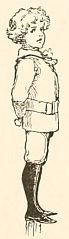
Jack Russell was five years old and ten days over; therefore,
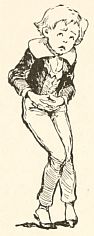
it is plain that he was now a big boy. He had left off kilts,
and his trousers had as many buttons as it is possible for trousers
to have, and his boots had a noble squeak in them. What
would you have more?
This being the case, of course Jack could go down town with
his Mamma when she went shopping, a thing that little boys
cannot do, as a rule.
One day in Christmas week, when all the shops were full of
pretty things, Jack and his Mamma found themselves in the gay
street, with crowds of people hurrying to and fro, all carrying
parcels of every imaginable shape.
The air was crisp and tingling, the sleigh-bells made a merry
din, and everybody looked cheerful and smiling, as if they knew
that Christmas was only five days off.
Almost everybody, for as Jack stopped to look in at a shop
window, he saw some one who did not look cheerful. It was a
poor woman, thinly and miserably clad, and holding a little boy
by the hand.
The boy was little, because he wore petticoats (oh, such poor,
ragged petticoats)! but he was taller than Jack. He was looking
longingly at the toys in the window.
“Oh, mother!” he cried, “see that little horse! Oh, I wish I
had a little horse!”
“My dear,” said the poor woman, sighing, “if I can give you
an apple to eat with your bread on Christmas Day, you must be
thankful, for I can do no more. Poor people can’t have pretty
things like those.”
“Come, Jack!” said Mrs. Russell, drawing him on hastily.
“What are you stopping for, child?”
“Mamma,” asked Jack, trudging along stoutly, but looking
grave and perplexed, “why can’t poor people have nice
things?”
“Why? Oh!” said Mrs. Russell, who had not noticed the
poor woman and her boy, “because they have no money to buy
them. Pretty things cost money, you know.”
Jack thought this over a little in his own way; then, “But,
Mamma,” he said, “why don’t they buy some money at the
money shop?”
Mrs. Russell only laughed at this, and patted Jack’s head and
called him a “little goose,” and then they went into a large
shop and bought a beautiful wax doll for Sissy.
But Jack’s mind was still at work, and while they were waiting
for the flaxen-haired beauty to be wrapped in white tissue
paper and put in a box, he pursued his inquiries.
“Where do you get your money, Mamma dear?”
“Why, your dear Papa gives me my money, Jacky boy.
Didn’t you see him give me all those nice crisp bills this morning?”
“And where does my Papa get his money?”
“Oh, child, how you do ask questions! He gets it at the
bank.”
“Then is the bank the money shop, Mamma?”
Mrs. Russell laughed absent-mindedly, for, in truth, her
thoughts were on other things, and she was only half-listening
to the child, which was a pity. “Yes, dear,” she said, “it is
the only money shop I know of. Now you must not ask me any
more questions, Jack. You distract me!”
But Jack had no more questions to ask.
The next day, as the cashier at the National Bank was busily
adding up an endless column of figures, he was startled by hearing
a voice which apparently came from nowhere.
No face appeared at the little window in the gilded grating,
and yet a sweet, silvery voice was certainly saying, with
great distinctness, “If you please, I should like to buy some
money.”
He looked through the window and saw a small boy, carrying
a bundle almost as big as himself.
“What can I do for you, my little man?” asked the cashier
kindly.
“I should like to buy some money, please,” repeated Jack,
very politely.
“Oh, indeed!” said the cashier, with a twinkle in his eye.
“And how much money would you like, sir?”
“About a fousand dollars, I fink,” said Jack, promptly. (It
does sometimes happen that big boys cannot pronounce “th”
distinctly, but they are none the less big for that.)
“A thousand dollars!” repeated the cashier. “That’s a good
deal of money, young gentleman!”
“I know it,” said Jack. “I wants a good deal. I have
brought some fings to pay for it,” he added, confidentially; and
opening the big bundle with great pride, he displayed to the
astonished official a hobby-horse, a drum (nearly new), a set of
building blocks and a paint-box.
“It’s a very good hobby-horse,” he said, proudly. “It has
real hair, and he will go just as fast as—as you can make him
go.”
Here the cashier turned red in the face, coughed and disappeared.
“Perhaps he is having a fit, like the yellow kitten,”
said Jack to himself, calmly; and he waited with cheerful
patience till he should get his money.
In a few moments the cashier returned, and taking him by
the hand, led him kindly into a back room, where three gentlemen
were sitting.
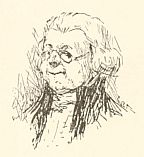
They all had gray hair, and two of them wore gold-bowed
spectacles; but they looked kind, and one of them beckoned
Jack to come to him.
“What is all this, my little lad?” he asked. “Did any one
send you here to get money?”
Jack shook his head stoutly. “No,” he said, “I comed myself;
but I am not little. I stopped being little when I had
trousers.”
“I see!” said the gentleman. “Of course. But what made
you think you could get money here?”
The blue eyes opened wide.
“Mamma said that Papa got his money here; and I asked her
if this was a money shop, and she said it was the only money
shop she knowed of. So I comed.”
“Just so,” said the kind gentleman, stroking the curly head
before him. “And you brought these things to pay for the
money?”
“Yes,” said Jack, cheerfully. “’Cause you buy fings with
money, you see, so I s’pose you buy money with fings.”
“And what did you mean to do with a thousand dollars?”
asked the gentleman. “Buy candy, eh?”
Then Jack looked up into the gentle gray eyes and told his
little story about the poor woman whom he had seen the day
before. “She was so poor,” he said, “her little boy could
not have any Christmas at all, only an apple and some bread,
and I’m sure that isn’t Christmas. And she hadn’t any money,
not any at all. So I fought I would buy her some, and then she
could get everything she wanted.”
By this time the two other gentlemen had their hands in
their pockets; but the first one motioned them to wait, and
taking the little boy on his knee, he told him in a few simple
words what a bank really was, and why one could not buy
money there.
“But you see, dear,” he added, seeing the disappointment in
the child’s face, “you have here in your hands the very things
that poor woman would like to buy for her little boy. Give her
the fine hobby-horse and the drum and the paint-box, too, if you
like, and she can give him the finest Christmas that ever a poor
boy had.”
Jack’s face lighted up again, and a smile flashed through the
tears that stood in his sweet blue eyes. “I never fought of
that!” he cried, joyfully.
“And,” continued the old gentleman, drawing a gold piece
from his pocket and putting it in the little chubby hand, “you
may give that to the poor woman to buy a turkey with.”
“And that,” cried the second old gentleman, putting another
gold piece on top of it, “to buy mince-pies with.”
“And that,” cried the third old gentleman, while a third gold
piece clinked on the other two, “to buy a plum-pudding with.”
“And God bless you, my dear little boy!” said the first gentleman,
“and may you always keep your loving heart, and never
want a piece of money to make Christmas for the poor.”
Little Jack looked from one to the other with radiant eyes.
“You are very good shopkeepers,” he said. “I love you all very
much. I should like to kiss you all, please.”
And none of those three old gentlemen had ever had so sweet
a kiss in his life.