FIVE LITTLE PEPPERS AT SCHOOL — BOOKS BY — MARGARET SIDNEY — THE FAMOUS PEPPER BOOKS — FIVE LITTLE PEPPERS AT SCHOOL — MARGARET SIDNEY — TRADE-MARK
A LITTLE MAID OF CONCORD TOWN Illustrated by Frank T. Merrill
A LITTLE MAID OF BOSTON TOWN Illustrated by Frank T. Merrill
IN ORDER OF PUBLICATION
Twelve Volumes Illustrated
FIVE LITTLE PEPPERS AND HOW THEY GREW
FIVE LITTLE PEPPERS MIDWAY
FIVE LITTLE PEPPERS GROWN UP
PHRONSIE PEPPER
THE STORIES POLLY PEPPER TOLD
THE ADVENTURES OF JOEL PEPPER
FIVE LITTLE PEPPERS ABROAD
FIVE LITTLE PEPPERS AT SCHOOL
FIVE LITTLE PEPPERS AND THEIR FRIENDS
BEN PEPPER
FIVE LITTLE PEPPERS IN THE LITTLE BROWN HOUSE
OUR DAVIE PEPPER
LOTHROP, LEE & SHEPARD CO., BOSTON
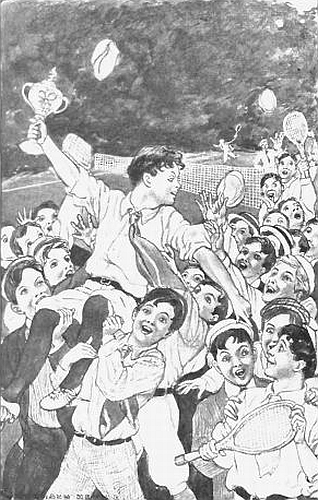
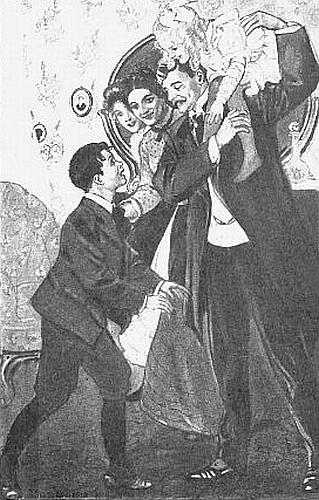
“TAKE RICKIE: HE BEAT, TOO, AS MUCH AS I.”
By
AUTHOR OF “FIVE LITTLE
PEPPERS ABROAD,” “A
LITTLE MAID OF CONCORD
TOWN,” “SALLY, MRS. TUBBS”
Illustrated by
HERMANN HEYER
BOSTON
LOTHROP, LEE & SHEPARD CO.
PEPPER
Registered in U. S. Patent Office.
COPYRIGHT,
1903, BY
LOTHROP
PUBLISHING
COMPANY.
ALL RIGHTS
RESERVED
PUBLISHED
NOV. 1903
Fifty-fourth Thousand.
PREFACE
The story of young people's lives is not
complete without many and broad glimpses
of their school days. It was impossible to
devote the space to this recital of the Five
Little Peppers' school life, in the books that
showed their growing up. The author, therefore,
was obliged unwillingly to omit all the
daily fun and study and growth, that she, loving
them as if they were real children before her
eyes, saw in progress.
So she packed it all away in her mind, ready
to tell to all those young people who also loved
the Peppers, when they clamored for more
stories about them—just what Polly and Joel
and David did in their merry school days. Ben
never got as much schooling as the others, for
he insisted on getting into business life as early
as possible, in order the sooner to begin to pay
Grandpapa King back for all his kindness. But
Jasper and Percy and Van joined the Peppers
at school, and a right merry time they had
of it!
And now the time seems ripe to accede to all
the insistent demands from those who love the
Five Little Peppers, that this record of their
school days should be given. So here it is,
just as they all gave it to
“Come on, Pepper.” One of the boys
rushed down the dormitory hall, giving
a bang on Joel's door as he passed.
“All right,” said Joel a bit crossly, “I'm coming.”
“Last bell,” came back on the wind.
Joel threw his tennis racket on the bed, and
scowled. Just then a flaxen head peeped in,
and two big eyes stared at him.
“Ugh!”—Joel took one look—“off with
you, Jenkins.” Jenkins withdrew at once.
Joel jumped up and slammed the door hard,
whirled around in vexation, sprang over and
thrust the tennis racket under the bed, seized a
dog-eared book, and plunged off, taking the precaution,
despite his hurry, to shut the door fast
behind him.
Jenkins stole out of his room three doors
beyond, and as the hall was almost deserted
about this hour, so many boys being in recitation,
he had nothing to do but tiptoe down to
Joel's room and go softly in.
“Hullo!” A voice behind made him skip.
“Oh, Berry,”—it was a tone of relief,—“it's
you.”
“Um,” said Berry, “what's up now, Jenk?”
He tossed back his head, while a smile of delight
ran all over his face.
“Hush—come here.” Jenk had him now
within Joel's room and the door shut. “We'll
have fun with the beggar now.”
“Who—Dave?”
“Dave? No. Who wants to haul him over?”
cried Jenk in scorn. “You are a flat, Berry, if
you think that.”
“Well, you are a flat, if you think to tackle
Joe,” declared Berry with the air and tone of
one who knows. “Better let him alone, after
what you got last term.”
“Well, I ain't going to let him alone,” declared
Jenk angrily, and flushing all up to his shock of
light hair; “and I gave him quite as good as he
gave me, I'd have you know, Tom Beresford.”
“Hoh, hoh!” Tom gave a howl of derision,
and slapped his knee in pure delight. “Tell that
to the marines, sonny,” he said.
“Hush—old Fox will hear you. Be still,
can't you?”—twitching his jacket—“and stop
your noise.”
“I can't help it; you say such very funny
things,” said Beresford, wiping his eyes.
“Well, anyway, I'm going to pay him up this
term,” declared Jenkins decidedly. He was rushing
around the small room; the corners devoted
to David being neatness itself, which couldn't
truthfully be said of Joel's quarters. “I'm after
his new tennis racket. Where in thunder is it?”
tossing up the motley array of balls, dumb-bells,
and such treasures, that showed on their surface
they belonged to no one but Joel.
“Great Scott!” Tom cried with sudden interest,
and coming out of his amusement. “You
won't find it.”
“Saw him looking at it just now, before he
went to class,” cried Jenkins, plunging around the
room. “Where is the thing?” he fumed.
Berry gave a few swift, bird-like glances around
the room, then darted over to the end of one of
the small beds, leaned down, and picked out from
underneath the article in question.
“Oh! give it to me,” cried Jenk, flying at him,
and possessing himself of the treasure; “it's
mine; I told you of it.”
“Isn't it a beauty!” declared Berry, his eyes
very big and longing.
“Ha, ha—ain't it? Well, Joe won't see this
in one spell.”
Jenkins gave it a swing over his head, then
batted his knee with it.
“What are you going to do, Jenk?” demanded
Berry, presently, when he could get his mind off
from the racket itself.
“Do? Ha, ha! Who says I can't pay the
beggar back?” grinned Jenk, hopping all over
the room, and knocking into things generally.
“Hush—hush,” warned Berry, plunging after
him; “here's old Fox,” which brought both boys
up breathless in the middle of the floor.
“She's gone by”—a long breath of relief;
“and there she goes down the stairs,” finished
Berry.
“Sure?” Not daring to breathe, but clutching
the racket tightly, and with one eye on Berry,
Jenk cried again in a loud whisper, “Sure,
Berry?”
“As if any one could mistake the flap of
those slipper-heels on the stairs!” said Berry
scornfully.
“Well, look out of the window,” suggested
Jenk suddenly. “She'll go across the yard,
maybe.”
So Berry dashed to the window, and gave one
look. “There she sails with a bottle in her
hand, going over to South” (the other dormitory
across the yard). “Most likely Jones has the
colic again. Good! Now that disposes finely of
old Fox,” which brought him back to the subject
in hand, the disposal of Joel's racket.
“Give me that,” he said, hurrying over to
Jenkins.
“No, you don't,” said that individual; “and I
must be lively before old Fox gets back.” With
that, he rushed out of the room.
“If you don't give me that racket, I'll tell on
you,” cried Beresford in a passion, flying after
him.
“Hush!” Jenk turned on him suddenly, and
gripped him fast. “See here,” he cried in a suppressed
tone, and curbing his anger as best he
could, “you don't want Joe to go into that
match, this afternoon, with this racket.” He
shook it with eager, angry fingers.
“No,” said Berry without stopping to think,
“I don't.”
“Well, then, you better keep still, and hold
your tongue,” advised Jenk angrily.
“Well, what are you going to do with it?”
“None of your——” what, he didn't say, for
just then a boy flew out of his room, to tear
down the long hall. He had his back to them,
and there was no time to skip back into Jenkins'
own room, for the two had already passed it.
One wild second, and Jenkins thrust the racket
into the depths of the housemaid's closet close at
hand, under some cleaning-cloths on a shelf.
Then he stuck his hands in his pockets.
“Hullo!” The boy who was rushing along,
suddenly turned, to see him whistling.
“Oh Jenk, is that you? See here, where's
your Cæsar?”
“Don't know—gone up the spout,” said Jenkins
carelessly, and keeping well in front of
Beresford.
“Well, who has one? You haven't, Berry?”
He turned to Tom anxiously.
“Not on your life he hasn't,” Jenk answered
for him.
“Botheration!” ejaculated the boy. “I've
fifty lines to do, else I'm shut in from the
game. And Simmons has run off with my
book.”
“Try Joe Pepper's room; he's in math recitation,”
said Jenk suddenly. “He has one, Toppy.”
“You're a brick.” Toppy flew down the hall,
and bolted into Joel's room.
“Holy Moses, what luck! He'll prowl for an
hour over Joe's duds. Come on.” Jenk had his
head in the cupboard, and his fingers almost on
the racket, when Toppy's voice rang dismally
down the hall: “Joe must have taken it.”
Jenk pulled his fingers out, and had the door
fast, and was quite turned away from the dangerous
locality. “Well, I don't know what you'll
do, Toppy,” he said, controlling his dismay
enough to speak. “Run down and skin through
the fellows' rooms on first floor. Oh, good gracious!”
he groaned, “it's all up with getting it
now,” as a swarm of boys came tumbling over
the stairs.
So he mixed with them, laughing and talking,
and Berry melted off somewhere. And no one
had time to think a syllable of anything but the
great game of tennis to be called at two o'clock,
between the two divisions of Dr. Marks' boys.
Some of the team of the St. Andrew's School, a
well-known set of fellows at this sport and terribly
hard to beat, were going to be visitors. So
there was unusual excitement.
“What's up, Pepper?” A howl that rose above
every other sort of din that was then in progress,
came from Joel's room.
“He's been in here!” Joel plunged out of the
doorway, tossing his black, curly locks, that were
always his bane, his eyes flashing dangerously.
“Say, where's Jenk? He's been in my room,”
he cried, doubling up his small fists.
“What is it?” cried Jenkins, making as if just
coming up the stairs. “What's all the row
about?”
“You've been in my room,” shouted Joel in a
loud, insistent voice, “and taken my——” The
rest was lost in a babel of voices.
“What? What's gone, Joe?” They all
crowded into the small space, and swarmed all
over the room.
“My racket,” yelled Joel wrathfully. “Jenk
has got it; he better give it up. Quick now.”
He pushed up the sleeves of his tennis shirt, and
squared off, glaring at them all, but making the
best of his way over toward Jenk.
That individual, when he saw him coming,
thought it better to get behind some intervening
boys. Everybody huddled against everybody else,
and it was impossible to get at the truth.
“See here now, Mother Fox will be after us
all if you don't hush up,” called one boy. “I
guess she's coming,” which had the desired effect.
All the voices died down except Joel's.
“I don't care,” said Joel wrathfully. “I wish
she would come. Jenk has got my racket. He
saw me with it before I ran to math; and now
it's gone.” All eyes turned to Jenkins.
“Is that so?” A half-dozen hands pushed him
into the centre of the group. “Then you've got
to give him fits, Pepper.”
“I'm going to,” announced Joel, pushing up
his sleeves higher yet, “until he tells where it is.
Come on, Jenk.” He tossed his head like a
young lion, and squared off.
“I haven't your old racket,” declared Jenk, a
white line beginning to come around his mouth.
It wasn't pleasant to see his reckoning quite so
near.
“Then you know where it is,” declared Joel.
“And give it to the beggar,” cried several of
the boys, with whom Jenkins was by no means a
favorite.
“Give it to him worse than you did last term,
Joe,” called some one on the edge of the circle
closing around the two.
“I'm going to,” nodded Joel, every nerve in
his body tingling to begin. “Come on, Jenk, if
you won't tell where you've put my racket.”
“He's afraid,” said the boy who had advised
the more severe pommelling, “old 'fraid-cat!”
Jenkins, his knees knocking together miserably,
but with a wild rage in his heart at these words,
struck out blindly to meet Joel's sturdy little fists,
and to find his Waterloo.
In the midst of the din and confusion that this
encounter produced, steps that could never by
any possibility be mistaken for those of a schoolboy
struck upon their ears.
The circle of spectators flew wide, and before
Joel and Jenkins realized what was coming, a
good two dozen hands were laid on their collars,
and they were dragged apart, and hauled into
separate rooms, the rest of the boys scattering
successfully. Tom Beresford fled with the rest,
and the long hall was cleared.
“Boys!” the voice of the matron, Mrs. Fox,
rang down the deserted, long hall, as she looked
up from the stairway. “Humph! they are quiet
enough now.” She gave a restful sigh, and went
down again. Jones and his colic were just so
much extra on a terribly busy day.
“What did you fellows touch me for?” roared
Joel, lifting a bloody nose. In his own room,
Jenkins was in that state that recognizes any
interruption as a blessing.
“Old Fox would have caught you, if we
hadn't rushed you both,” cried the boys.
Tom Beresford worked his way up to say close
to Joel's ear, “Don't speak, get into your room;
I'll tell you where it is,” then melted off to the
outer circle of boys.
Joel looked up, gave a little nod, then broke
away from the boys, and dashed to Jenkins' door.
“See here,”—he flung the words out,—“you've
got to finish sometime when Mrs. Fox
isn't round.”
Jenkins, who was under the impression that he
had had quite enough, was made to say, “All
right;” something in the boys' faces making it
seem imperative that he should do so.
Quite pleased, Joel withdrew as suddenly as he
had come.
Meanwhile, up the stairs, two at a time, came
Davie, singing at the memory of the special commendation
given by his instructor in the recitation
just over; and secretly David's heart bounded
with a wild hope of taking home a prize in
classics for Mamsie!
“Everything's just beautiful this term!” he
hummed to himself. And then, in a breathing
space he was in his room, and there, well drawn
behind the door, was a boy with big eyes.
“Hush” he warned.
“What's the matter?” asked David in astonishment,
“and where's Joel?”
“Oh, don't speak his name; he's in disgrace.
Oh, it's perfectly awful!” The boy huddled up
in a heap, and tried to shut the door.
“Who?” cried David, not believing his ears.
“Joel—oh dear! it's perfectly awful!”
“Stop saying it's perfectly awful, Bates, and
tell me what's the matter.” Davie felt faintish,
and sat down on the shoe-box.
Bates shut the door with a clap, and then
came to stand over him, letting the whole information
out with a rush.
“He's pitched into Jenk—and they've had a
fight—and they're all blood—and the old Fox
almost got 'em both.” Then he shut his mouth
suddenly, the whole being told.
Davie put both hands to his head. For a
minute everything turned dark around him.
Then he thought of Mamsie. “Oh dear me!”
he said, coming to.
“How I wish he'd had it all out with that
beggar!” exploded Bates longingly.
David didn't say anything, being just then
without words. At this instant Joel rushed in
with his bloody nose, and a torn sleeve where
Jenk in his desperation had gripped it fast.
“Oh Joel!” screamed Davie at sight of him,
and springing from his shoe-box. “Are you
hurt? Oh Joey!”
“Phoo! that's nothing,” said Joel, running over
to the wash-basin, and plunging his head in, to
come up bright and smiling. “See, Dave, I'm
all right,” he announced, his black eyes shining.
“But he's a mean beggar to steal my new racket,”
he concluded angrily.
“To steal your new racket that Grandpapa sent
you!” echoed David. “Oh dear me! who has
taken it? Oh Joel!”
“That beggar Jenkins,” exploded Joel. “But
I'm to know where it is.” Just then the door
opened cautiously, enough to admit a head.
“Don't speak, Pepper, but come.”
Joel flung down the towel, and pranced to the
door.
“No one else,” said the boy to whom the head
belonged.
“Not me?” asked David longingly. “Can't
I come?”
“No—no one but Joe.” Joel rushed over the
sill tumultuously, deserting David and the Bates
boy.
“Don't speak a single word,” said the boy out
in the hall, putting his mouth close to Joel's ear,
“but move lively.”
No need to tell him so. In a minute they
were both before the housemaid's closet.
“Feel under,” whispered the boy, with a sharp
eye down the length of the hall.
Joel's brown hands pawed among the cleaning-cloths
and brushes, bringing up in a trice the
racket, Grandpapa's gift, to flourish it high.
“Take care; keep it down,” said the boy in a
hurried whisper.
“Oh, oh!” cried Joel, hanging to it in a
transport.
“Um,” the boy nodded. “Hush, be still.
Now skip for your room.”
“Beresford,” said Joel, his black eyes shining
as he paused a breathing space before rushing
back to Davie, the new racket gripped fast, “if
I don't pay Jenk for this!”
“Do.” Tom grinned all over his face in great
delight; “you'll be a public benefactor,” and he
softly beat his hands together.
Joel, hugging his recovered tennis racket,
rushed off to the court. Tom Beresford,
staring out of his window, paused while pulling
on his sweater to see him go, a sorry little feeling
at his heart, after all, at Joe's good spirits.
“He'll play like the mischief, and a great deal
better for the row and the fright over that old
racket. Well, I had to tell. 'Twould have been
too mean for anything to have kept still.”
So he smothered a sigh, and got into his togs,
seized his implements of battle, and dashed off
too. Streams of boys were rushing down to the
court, and the yard was black with them. In the
best places were the visitors. Royalty couldn't
have held stronger claims to distinction in the
eyes of Dr. Marks' boys; and many were the
anxious glances sent over at the four St. Andrew's
boys. If the playing shouldn't come up
to the usual high mark!
“Pepper will score high,” one after another
said as he dropped to the ground next to his
chums, in the circle around the court.
“Of course.” Nobody seemed to doubt Joel's
powers along that line. “He always does.” And
cries of “Pepper—Pepper,” were taken up, and
resounded over the yard.
Joel heard it as he dashed along, and he held
his head high, well pleased. But David followed
his every movement with anxiety. “I'm afraid
he was hurt,” he said to himself; “and if he
should lose the game, he'd never get over it.
Oh dear me! if Mamsie could only be here!”
But Mamsie was far away from her boys,
whom she had put at Dr. Marks' school for the
very purpose of achieving self-reliance and obedience
to the training of the little brown house.
So Davie, smothering his longing, got into a front
row with several boys of his set, and bent all his
attention to the game just beginning.
Sharp at two o'clock the four went on to the
court—Joel and Fred Ricketson against Tom
Beresford and Lawrence Greene, otherwise
“Larry.” And amid howls of support from
the “rooters,” the game began.
At first Joel's luck seemed to desert him, and
he played wild, causing much consternation in
the ranks violently rooting for him. David's
head sank, and he leaned his elbows on his
knees, to bury his hot cheeks in his hands.
“Wake up,” cried Paul Sykes, his very particular
friend, hoarsely, giving him a dig in the
ribs. “Don't collapse, Dave.”
“Oh!” groaned David, his head sinking lower
yet, “I can't look; I simply can't. It will kill
Joel.”
“Stiffen up!” cried Paul. “Joe's all right;
he'll come to. Ha!”
A shout, stunning at first, that finally bore
down all before it in the shape of opposing enthusiasm,
swept over the whole yard. Screams of
applause, perfectly deafening, rent the air. And
look! even the visitors from St. Andrew's are
leaping to their feet, and yelling, “Good—good.”
Something quite out of the common, even in a
close tennis match, was taking place. David
shuddered, and crouched down on the ground as
far as he could. Paul gave him an awful whack
on the back.
“You're losing it all,” he cried as he stood on
his tiptoes. “Hi! Hi! Tippety Rippety! Hi!
Hi!”
It was Joel's especial yell; and there he was,
as David scrambled up to see him, head thrown
back, and black eyes shining in the way they always
did when he worked for Mamsie and Polly,
and that dealt despair to all opponents. He had
just made a brilliant stroke, returning one of
Larry's swiftest balls in such a manner that it
just skimmed over the net and passed the boys
before they could recover themselves, and fairly
taking off from their feet the St. Andrew's men
who had been misled by Joel's previous slow
playing in the first set, which Tom and Larry
had won.
“Who is he? Gee Whiz! but that's good
form!” declared Vincent Parry, the St. Andrew's
champion, excitedly.
“Pepper—don't you know Pepper?” cried a
dozen throats, trying to seem unconscious that it
was Parry, the champion, who was asking the
question.
“Oh, is that Pepper?” said the St. Andrew's
boy. While “Pepper—Pepper. Hi! Hi! Tippety
Rippety! Hi! Hi!” rolled out, till there
wasn't any other sound to be heard. And a
regular tussle of boys were getting in the wildest
excitement when it was announced that Pepper
and Ricketson had won the second set, the referees
trying to quiet them so that the game could
proceed.
In the third set, Joel seemed to have it all his
own way, and fairly swept Ricketson along with
him. The excitement was now so intense that
the boys forgot to yell, afraid they would miss
some strokes.
David clenched his hands tightly. The net
and flying balls spun all together inextricably before
his eyes as he strained them to see Joe's
brilliant returns. This was the deciding set, as
the cup was to go to the winners of two sets out
of three.
Joel's last serve was what finished it; the ball
flashing by Tom with such impetus, that even
the St. Andrew's champion said he couldn't ever
have returned it.
Everybody drew a long breath, and then the
crowd rushed and converged to Joel; surrounded
him, fighting for first place, the fortunate ones tossing
him up to their shoulders to race him in triumph
around the yard.
“Take Ricket!” screamed Joel, red in the face.
“Take him!” he roared. “He beat too, as
much as I.” So a second group seized Fred;
and up he went to be trotted after, the crowd
swarming alongside, yelling, tumbling over each
other,—gone perfectly wild; Joe waving the cup,
thrust into his hand, which would be kept by the
winners for a year.
It was the middle of the night. Davie, flushed
with the happiest thoughts, had peacefully settled
to dreams in which Mamsie and Grandpapa, and
Polly and Jasper, and all the dear home people,
were tangled up. And Phronsie seemed to be
waving a big silver cup, and piping out with a
glad little laugh, “Oh, I am so glad!” And now
and then the scene of operations flew off to the
little brown house, that it appeared impossible to
keep quite out of dreamland. Some one gripped
him by the arm.
“Oh, what is it, Joe?” David flew up to a
sitting posture in the middle of his bed.
“It isn't Joe. Get up as quick as you
can.”
David, with a dreadful feeling at his heart,
tumbled out of bed. “Isn't Joe!” he found
time to say, with a glance in the darkness over
toward Joel's bed.
“Hurry up, don't stop to talk.” The voice
was Tom Beresford's. “Get on your clothes.”
Meantime he was scuffing around. “Where in
time are your shoes?” But David already had
those articles, and was pulling them on with hasty
fingers. “Oh, tell me,” he couldn't help crying;
but “Hurry up!” was all he got for his pains.
And at last, after what seemed an age to Tom,
David was piloted out into the hall, with many
adjurations to “go softly,” down the long flight
of stairs. Here he came to a dead stop. “I
can't go another single step, Tom,” he said firmly,
“unless you tell me what you want me for. And
where is Joel?” he gasped.
“Oh, bother! in another minute you'd have
been outside, and then it would be safe to tell
you,” said Tom. “Well, if you will have it,
Dave, Joe's finishing up that business with Jenk,
and you're the only one that can stop it. Now
don't keel over.”
David clung to the door, which Tom had managed
to open softly, and for a minute it looked
as if Beresford would have his hands full without
in the least benefiting Joel. But suddenly
he straightened up. “Oh, tell me where he is,”
he cried, in a manner and voice exactly like Polly
when she had anything that must be done set
before her. And clear ahead of his guide when
Tom whispered, “Down in the pine grove,”
sped Davie on the very wings of the wind.
“Gracious! Joel is nothing to Dave as a
sprinter,” said Tom to himself, as his long legs
got him over the ground in the rear.
The two boys hugged the shadow of the tall
trees and dashed across the lawn to the shrubbery
beyond. Then it was but a breathing space,
and a few good leaps to the depths of the pine
grove. In the midst of this were two figures,
busily engaged in the cheerful occupation of fisticuffing
each other till the stronger might win.
“Joel!” called David hoarsely, his breath
nearly spent as he dashed up.
Joel, at this, wavered, and turned. Seeing
which, his antagonist dealt him a thwack that
made his head spin, and nearly lost him his
footing.
“That was mean, Jenk!” exclaimed Beresford,
dashing up in time to see it. “You took advantage
when Joe was off guard,” he cried hotly.
“No such thing,” roared Jenk, losing his head
at what now seemed an easy victory, “and I'll
settle with you when I get through with Joe, for
being such a mean sneak as to turn tell-tale,
Tom.”
“All right,” said Tom coolly. “Go it, Joe,
and pay him up. You've several scores to settle
now.”
“Joel,” gasped Davie. “Oh Mamsie!” He
could get no further.
Joel's hands, out once more in good fighting
trim, wavered again, and sank helplessly down
to his side.
“Oh dear!” Tom groaned in amazement.
“Hoh—hoh! you see how easy I could whip
him,” laughed Jenkins, raining down blows all
over Joel's figure, who didn't offer to stir.
“See here you!” Tom fairly roared it out,
perfectly regardless of possible detection. “You
beastly coward!” And he jumped in between
Joel and his antagonist. “You may settle with
me now if you like.”
“Stop, Tom.” Joel seized him from behind.
Tom, in a fury, turned to see his face working
dreadfully, while the brown hands gripped him
tightly. “I forgot—Mamsie wouldn't—like—you
mustn't, Tom. If you do, I'll scream for
John,” he declared suddenly.
John, the watchman, being the last person
whom any of Dr. Marks' boys desired to see
when engaged in a midnight prank, Beresford
backed away slowly from Jenkins, who was delighted
once more at the interruption, and fastened
his gaze on Joel. “Well, I never did,
Pepper!” he brought himself to say.
“Tom,” said David brokenly, and getting over
to him to seize his hand, “don't you know our
Mamsie would feel dreadfully to see Joel doing
any such thing? Oh, she would, Tom,” as Beresford
continued to stare without a word.
“Not to such a miserable beggar.” Tom at
last found his tongue, and pointed to Jenk.
“Oh, yes, she would. It's just as bad in Joel,”
said Davie, shaking his head. Joel turned
suddenly, took two or three steps, then flung
himself down flat on his face on the pine
needles.
“Well, get up,” said Tom crossly, running
over to him. “John will maybe get over here,
we've made so much noise. Hurry up, Joe, we
must all get back.”
Joel, thus adjured, especially as David got
down on the ground, to put his arms around the
shaking shoulders, got up slowly. Then they
turned around to look for Jenkins. He was nowhere
to be seen.
“Little coward!” exclaimed Tom between his
teeth. “Well, we'll have to skin it as best we
may back. Here comes John!”
They could see his lantern moving around
among the trees; and dashing off, taking the
precaution to hug the shadow of the trees again,
they soon made the big door to the dormitory.
Tom reached it first, and turned the knob. “It's
locked,” he said. “The mean, beastly coward
has locked us out.”
Joel, in such an emergency, wiped his black
eyes and looked up sharply. David sank
on the upper step.
“Oh, no, Tom,” cried Joel, crowding in between
Beresford and the door, “it can't be. Get
out of the way; let me try.”
“It is—it is, I tell you,” howled Tom in what
was more of a whine, as he kept one eye out for
John and his lantern. “The mean sneak has
got the best of us, Joe.” He set his teeth hard
together, and his face turned white.
Joe dropped the doorknob, and whirled off
the steps.
“Julius Cæsar! where are you going?” began
Tom, as Joel disappeared around the corner of
the dormitory.
“He's gone to see if John is coming, I suppose,”
said Davie weakly.
Tom, preferring to see for himself, skipped off,
and disappeared around the angle. “Oh—oh!”
was what David heard next, making him fly from
his step to follow in haste.
What he saw was so much worse than all his
fears as Tom gripped his arm pointing up over
his head, that he screamed right out, “Oh Joe,
come back, you'll be killed!”
“He can't come back,” said Tom hoarsely.
“He'd much better go on.” Joel, more than
halfway up the lightning conductor, was making
good time shinning along. He turned to say,
“I'm all right, Dave,” as a window above them
was thrown up, and a head in a white nightcap
was thrust out.
“It's all up with him now; there's old Fox,”
groaned Tom, ducking softly back over the grass.
“Come on, Dave.”
But David, with clasped hands and white face,
had no thought of deserting Joel.
The person in the window, having the good
sense to utter no exclamation, waited till Joel
was up far enough for her to grasp his arm.
Then she couldn't help it as she saw his face.
“Joel Pepper!”
“Yes'm,” said Joel, turning his chubby face
toward her. “I knew I could get up here; it's
just as easy as anything.”
Mrs. Fox set her other hand to the task of
helping him into the dimly lighted hall, much to
Joel's disgust, as he would much have preferred
to enter unassisted. Then she turned her cap-frills
full on him, and said in a tone of great displeasure,
“What is the meaning of all this?”
“Why, I had to go out, Mrs. Fox.”
“Why?”
“Oh—I—I—had to.”
She didn't ask him again, for the matron was
a woman of action, and in all her dealings with
boys had certain methods by which she brought
them to time. So she only set her sharp eyes,
that Dr. Marks' pupils always called “gimlets,”
full upon him. “Go to your room,” was all she
said.
“Oh Mrs. Fox,” cried Joel, trying dreadfully
to control himself, and twisting his brown hands
in the effort, “I—I—had to go. Really I did.”
“So you said before. Go to your room.” Then
a second thought struck her. “Was any other
boy with you?” she demanded suddenly.
Joel gave a sharp cry of distress as he started
down the hall, revolving in his mind how he
would steal down and unlock the door as soon
as the matron had taken herself off.
“Here, stop—come back here! Now answer
me—yes or no—was any other boy with you?”
as Joel stood before her again.
Joel's stubby black curls dropped so that she
couldn't see his face. As there was no reply
forthcoming, Mrs. Fox took him by the arm.
“You needn't go to your room, Joel,” she said
sharply. “You may go to Coventry.”
“Oh Mrs. Fox,” Joel burst out, “don't—don't
send me there.”
“A boy who cannot answer me, is fit only for
Coventry,” said Mrs. Fox with great dignity,
despite the nightcap. “Wait here, Joel. I will
get my candle, and light you down.” She stepped
off to a corner of the hall, where she had set the
candlestick on a table, when startled by the
noise outside. “Now we will go.”
It was impossible that all this confusion should
not awake some of the boys in the hall; and by
this time there was much turning on pillows, and
leaning on elbows, and many scuttlings out of
bed to listen at doors opened a crack, so that
nearly every one of the occupants, on that particular
hall soon knew that “old Fox” had Joel
Pepper in her clutches, and that he was being
led off somewhere.
And at last Joel let it out himself. “Oh Mrs.
Fox—dear Mrs. Fox, don't make me go to Coventry,”
he roared. He clutched her wrapper, a
big, flowered affair that she wore on such nocturnal
rambles, and held it fast. “I'll be just as
good,” he implored.
“Coventry is the place for you, Joel Pepper,”
said Mrs. Fox grimly; “so we will start.”
Meanwhile David, holding his breath till he
saw, in the dim light that always streamed out
from the dormitory hall where the gas was left
turned down at night, that Joel was safely drawn
in to shelter, frantically rushed around to the
big door, in the wild hope that somehow admittance
would be gained. “Joe will come by and
by,” he said to himself, sinking down on the steps.
“We're done for,” said Tom's voice off in the
distance.
“Oh Tom, are you there?” cried Davie,
straining his eyes to catch a glimpse.
“Hush!” Tom poked his head out from a
clump of shrubbery. “Don't you dare to breathe.
I tell you, Dave, our only hope is in staying
here till morning.”
“Oh dear me!” exclaimed David in dismay.
“Oh dear me!” echoed Tom in derision. It
was impossible for him to stop talking, he was
so keyed up. “It's paradise, I'm sure, compared
to being in old Fox's grip.”
This brought David back to Joel's plight, and
he sighed dismally, and leant his head on his
hands. How long he sat there he couldn't have
told. The first thing he did know, a big hand
was laid on his shoulder, and a bright glare of
light fell full on his face.
“Oh my soul and body!” cried John, the
watchman, bending over him, “if here ain't one
of th' boys dead asleep on the doorsteps!”
“Little goose, to sit there!” groaned Tom,
huddling back into his bushes. “Now it's all up
with him. Well, I'll save my skin, for I don't
believe those boys will tell on me.”
“Coventry” was a small square room in the
extension, containing a bed, a table, and a chair,
where the boys who were refractory were sent.
It was considered a great disgrace to be its inmate.
They were not locked in; but no boy
once put there was ever known to come out unless
bidden by the authorities. And no one, of
course, could speak to them when they emerged
from it to go to recitations, for their lessons must
be learned in the silence of this room. Then
back from the class-room the culprit must go to
this hated place, to stay as long as his misdemeanor
might seem to deserve.
It was so much worse punishment than a flogging
could possibly be, that all Dr. Marks' boys
heard “Coventry” with a chill that stopped many
a prank in mid-air.
But Joel didn't get into “Coventry” after all,
for at the foot of the stairs, another candle-beam
was advancing; and back of it was the thin,
sharp face of Mr. Harrow, one of the under-teachers.
“Oh Mr. Harrow,” screamed Joel, breaking
away from the matron, to plunge up to him,
“she's going to put me into Coventry. Oh,
don't make me go there; it will kill my Mamsie,
and Polly.”
“Hey?” Mr. Harrow came to a sudden stop,
and whirled the candlestick around to get a
better view of things. “What's this, Mrs. Fox?
And Joel Pepper, of all boys!”
“I know it,” said Mrs. Fox, her candlestick
shaking in an unsteady hand. “Well, you see,
sir, I was going upstairs to see if little Fosdick
had blankets enough; it's turned cold, and you
know he's had a sore throat, and——”
“Well, come to the point, Mrs. Fox,” said the
teacher, bringing her up quickly. Joel clung
desperately to his hand, shaking violently in
every limb.
“Oh, yes, sir—well, and I heard a noise outside,
so I bethought me to look, and there was
this boy climbing up the lightning conductor.”
“Up the lightning conductor?” echoed Mr.
Harrow.
“Yes, sir,”—Mrs. Fox's cap-frills trembled
violently as she nodded,—“Joel Pepper was
climbing up the lightning conductor, sir. And
I thought I should have dropped to see him,
sir.”
The under-teacher turned and surveyed Joel.
“Well, I think, Mrs. Fox,” he said slowly, “if
he's been over that lightning conductor to-night,
we won't put him in Coventry.”
“He wouldn't answer when I asked him if
any other boys were there,” said the matron, a
dull red spot coming on either cheek.
“That's bad—very bad,” said Mr. Harrow.
“Well, I'll take Joel under my care. Do you go
to bed, Mrs. Fox.”
It was all done in a minute. Somehow Mrs.
Fox never quite realized how she was left standing
alone. And as there really wasn't anything
else for her to do, she concluded to take the
under-teacher's advice.
“Now, Joel,”—Mr. Harrow looked down at
his charge,—“you seem to be left for me to
take care of. Well, suppose you come into my
room, and tell me something about this affair.”
Joel, with his heart full of distress about
David and Tom, now that the immediate cause
of alarm over his being put into “Coventry”
was gone, could scarcely conceal his dismay, as
he followed Mr. Harrow to his room. He soon
found himself on a chair; and the under-teacher,
setting his candlestick down, took an opposite
one.
“Do you mind telling me all about this little
affair of yours, Joe?” said Mr. Harrow, leading
off easily. His manner, once away from the
presence of the matron, was as different as possible;
and Joel, who had never met him in just
this way, stared in amazement.
“You see, Joe,” the under-teacher went on,
and he began to play with some pencils on the
table, “it isn't so very long ago, it seems to me,
since I was a boy. And I climbed lightning
conductors too. I really did, Joel.”
Joel's black eyes gathered a bright gleam in
their midst.
“Yes, and at night, too,” said the under-teacher
softly, “though I shouldn't want you to
mention it to the boys. So now, if you wouldn't
mind, Joel, I should really like to hear all about
this business of yours.”
But Joel twisted his hands, only able to say,
“Oh dear! I can't tell, Mr. Harrow.” His distress
was dreadful to see.
“Well,” said the under-teacher slowly, “perhaps
in the morning you'll feel better able to
tell. I won't press it now. You must get to
bed, Joe,” with a keen look at his face.
“Oh Mr. Harrow—would you—would you—”
Joel jumped out of his seat, and over to
the under-teacher's chair.
“Would I what?” asked Mr. Harrow in perplexity,
wishing very much that “Mamsie,”
whom he had seen on her visits to the school,
were there at that identical moment.
“Would you—oh, might I unlock the—the
back door?” gasped Joel, his black eyes very big
with distress.
“Unlock the back door?” repeated Mr. Harrow.
Then he paused a moment. “Certainly;
I'll go with you.” He got out of his
chair.
“Oh, no, sir,” cried Joel tumbling back, “I'll—I'll
do it alone if I may; please, sir.”
“Oh, no, Joel, that can't ever be allowed,”
Mr. Harrow was saying decidedly, when steps
were heard coming down the hall, and there was
John, the watchman, hauling David Pepper along
the dimly lighted hall to the extra gleam of the
under-teacher's room.
“I found this boy asleep on the steps,” announced
John, coming in with his charge.
“Why, David Pepper!” exclaimed Mr. Harrow
in astonishment. Then he turned a cold
glance on Joel, who flew over to Davie's side.
“Joel!” cried David convulsively, and blinking
dreadfully as he came into the light. “Oh,
I'm so glad you're safe—oh, so glad, Joey!”
He hid his face on Joel's arm, and sobbed.
“You may go, John,” said the under-teacher
to that individual, who kept saying, “I found that
boy asleep on the steps,” over and over, unable
to stop himself. “And don't say anything about
this to any one. I will take care of the matter.”
“All right, sir,” said John, glad to be relieved
of all responsibility, and touching his cap. “I
found that boy asleep on the steps,” he added as
he took himself off.
“Now, see here.” Mr. Harrow laid his hand
on David's shoulder, ignoring Joel for the time,
and drew him aside. “The whole of this business
must be laid before me, David. So
begin.”
“Oh Dave!” cried Joel, springing up to him.
“Oh, sir—oh, Mr. Harrow, it was all my fault,
truly it was. David only came after me. Oh
Mr. Harrow, don't make him tell.”
“You go and sit down in that chair, Joel,”
said Mr. Harrow, pointing to it. So Joel went,
and got on it, twisting miserably.
“Now, then, David.”
“You see,” said David, the tears still rolling
down his cheeks, “that—oh dear!—Joel was
gone, and—”
“How did you know Joel was gone?” interrupted
the under-teacher.
“Oh dear!” David caught his breath. “Another
boy told me, sir.”
“Who?”
David hesitated. “Must I tell, sir?” not
trusting himself to look at Joel.
“Certainly.”
“Tom Beresford.”
“Ugh!” Joel sprang from his chair. “He
hadn't anything to do with it, sir. Tom has been
awfully good. He only told Dave.”
“Go back to your chair, Joel,” said Mr. Harrow.
“Now, then, David, go on. So you went
out with Beresford to find Joel, eh?”
“Yes, sir,” said David faintly.
“Any other boy?” asked the under-teacher
quickly.
“No, sir.”
“Well, then, Tom is waiting out there, I suppose,
now.” Mr. Harrow got out of his chair.
“He didn't have anything to do with it, sir,”
cried Joel wildly, and flying out of his chair
again, “truly he didn't.”
“I understand.” Mr. Harrow nodded. “I'm
going to bring him in. Now it isn't necessary to
tell you two boys not to do any talking while I'm
gone.” With that he went over to a corner,
took down a lantern, lighted it, and passed
out.
When he came back, both Joel and David
knew quite well by Tom's face, that the whole
story was out; and Joel, who understood as well
as any one that Floyd Jenkins never by any possibility
could be a favorite with instructors, any
more than with the boys, unless he changed his
whole tactics, groaned again at thought that he
had made matters worse for him.
“Now all three of you scatter to bed,” was all
the under-teacher said as he came in with Tom.
“No talking now; get up as softly as you can.
Good night.”
And the next day, the story which flew all
over the yard, how that Joel Pepper was
“put into Coventry” last night, was overtaken
and set right.
“Huh! there, now you see,” cried Van Whitney,
coming out of his rage. He had cried so
that his eyes were all swollen up, and he was a
sight to behold. Percy, too miserable to say anything,
and wishing he could ever cry when he
felt badly, had slunk out of sight, to bear the
trouble as well as he might. Now he came up
bright and smiling. “Yes, now you see,” he
cried triumphantly.
“Oh, I hope that mean beggar Jenk will be
expelled.” There appeared to be but one voice
about it.
“Well, he won't,” said Van.
“Won't? Why not?” The boys crowded
around him on the playground, all games being
deserted for this new excitement. “Why not,
pray tell?”
“Of course he will,” said one boy decidedly.
“Dr. Marks never'll keep him after this.”
“Yes he will too,” roared Van, glad he could
tell the news first, but awfully disappointed that
it must be that Jenkins was to stay, “for Joel
got Dr. Marks to promise there shouldn't anything
be done to Jenk. So there now!”
“What, not after locking that door! That was
the worst.” The boys, two or three of them,
took up the cry, “'Twas beastly mean.”
“Contemptible! Just like Jenk!” went all
over the playground.
“Well, he isn't to go,” repeated Van with a
sigh; “and Joel says he was as bad, because he
went out at night to fight.”
“Why, he had to; Jenk dared him. And he
couldn't have it out in the dormitory; you know
he couldn't, Whitney,” said one of the boys in
surprise.
“Oh dear! I know,” said Van helplessly.
“Well, Joel says it's no matter that the racket
was stolen out of his room, and—”
“No matter!” ejaculated the boys, a whole
crowd of them swarming around him, “well, if
that isn't monstrous!”
“Oh, Joel's afraid that Dr. Marks will expel
Jenk,” Percy, very uncomfortable to have Joel
blamed, made haste to say. “Don't you see?”
“Well, he ought to be turned out,” declared
one boy decidedly. “Never mind, we'll make it
so hot for that Jenk, he'll want to go.”
“No, you mustn't,” declared Percy, now very
much alarmed. “Oh, no, you mustn't, Hobbs;
because, if you do, Joel won't like it. Oh, he'll
be so angry! He won't like it a bit, I tell you,”
he kept saying.
The idea of Joel's not liking it, seemed to take
all the fun out of the thing; so Hobbs found himself
saying, “Well, all right, I suppose we've got
to put up with the fellow then. But you know
yourself, Whitney, he's a mean cad.”
There seemed to be but one opinion about that.
But the fact remained that Jenkins was still to
be one of them, to be treated as well as they
could manage. And for the next few days, Joel
had awfully hard work to be go-between for all
the crowd, and the boy who had made it hard
for him.
“You'll have to help me out, Tom,” he said
more than once in despair.
“Pretty hard lines,” said Tom. Then the
color flew all over his face. “I suppose I really
ought, for you know, Pepper, I told you I wanted
at first that you should lose your racket.”
“Never mind that now, Tom,” said Joel
brightly, and sticking out his brown hand.
“You've been awfully good ever since.”
“Had to,” grunted Tom, hanging to the hand,
“when I saw how mean the beggar was.”
“And but for you I should never have found
the racket, at least not in time.” Joel shivered,
remembering the close call he had had from
losing the game.
Tom shivered too, but for a different cause.
“If I hadn't told him, I'd always have hated
myself,” he thought.
“Well, Joe, I wouldn't after this give away a
racket. Now you see if you hadn't bestowed
your old one on that ragamuffin in town, you
wouldn't have been in such a scrape.” Tom
tried to turn it off lightly.
“Oh, that made no difference,” Joel made
haste to say, “'cause I could have borrowed another.
But I'd got used to my new one. Besides,
Grandpapa sent it to me to practise with
for this game, and I really couldn't have done
so well without it.”
“Yes, I know—I know,” said Tom remorsefully,
“and that's what Jenk knew, too, the beggar!”
“Well, it's all over now,” said Joel merrily,
“so say no more about it.”
But it wasn't all over with Jenkins; and he resolved
within himself to pay Joel Pepper up sometime,
after the boys had forgotten a little about
this last exploit, if they ever did.
And that afternoon Joel staid in, foregoing all
the charms of a ball game, to write Mamsie a
complete account of the affair, making light of
the other boys' part in it, and praising up Tom
Beresford to the skies. “And oh, Mamsie,”
Joel wrote over and over, “Dave didn't have
anything to do with it—truly he didn't. And
Mr. Harrow is just bully,” he wrote,—then
scratched it out although it mussed the letter up
dreadfully—“he's fine, he is! And oh, I like
Dr. Marks, ever so much, I do”—till Mrs.
Fisher had a tolerably good idea of the whole
thing.
“I'm not sorry, Adoniram,” she said, after Dr.
Fisher had read the letter at least twice, and then
looked over his spectacles at her keenly, “that I
agreed with Mr. King that it was best that the
boys should go away to school.”
“Now any other woman,” exclaimed the little
doctor admiringly, “would have whimpered right
out, and carried on dreadfully at the least sign
of trouble coming to her boy.”
“No, I'm not a bit sorry,” repeated Mrs.
Fisher firmly, “for it's going to be the making
of Joel, to teach him to take care of himself.
And I'd trust him anywhere,” she added proudly.
“So you may; so you may, my dear,” declared
the little doctor gaily. “And I guess, if the truth
were told, that Joel's part in this whole scrape
hasn't been such a very bad one after all.”
Which came to be the general view when Dr.
Marks' letter arrived, and one from the under-instructor
followed, setting things in the right
light. And although old Mr. King was for going
off directly to interview the master, with
several separate and distinct complaints and criticisms,
he was at last persuaded to give up the
trip and let matters work their course under the
proper guidance at the school.
“So, Polly, my child,” he said on the following
day, when the letters were all in, “I believe I'll
trust Dr. Marks, after all, to settle the affair.
He seems a very good sort of a man, on the whole,
and I really suppose he knows what to do with
a lot of boys; though goodness me! how he can,
passes my comprehension. So I am not going.”
“Oh Grandpapa!” exclaimed Polly, the color
flooding her cheek, and she seized his hand in a
glad little way.
“Yes, I really see no necessity for going,”
went on the old gentleman, much as if he were
being urged out of his way to set forth; “so I
shall stay at home. Joel can take care of himself.
I'd trust him anywhere,” he brought up,
using the same words that Mother Fisher had
employed.
“Wouldn't you, Grandpapa!” cried Polly with
sparkling eyes, and clinging to him.
“Yes, Polly, my child,” said Grandpapa emphatically,
“because, no matter into what mischief
Joe may get, he always owns up. Goodness
me! Polly, that boy can't go very far wrong,
with such a mother as you've got.”
Alexia Rhys, running through the wide hall,
came upon the two. “Oh, beg pardon, and may
we girls have Polly?” all in the same breath.
“Get away with you,” laughed old Mr. King,
who had his own reasons for liking Alexia, “that's
the way you always do, trying to get Polly Pepper
away when we are having a good talk.”
“Oh dear!” exclaimed Alexia, doing her best
to curb her impatience, and pinching her hands
together, “we did so want—”
“I can't go now, Alexia,” said Polly, still clinging
to Mr. King's hand.
Grandpapa sent a keen glance over into Alexia's
face. “I think you better go, Polly,” he said.
“You and I will have our talk later.”
“Oh goody!” cried Alexia, hopping up and
down. And “Oh Grandpapa!” reproachfully
from Polly.
“Yes, Polly, it's best for you to go with the
girls now,” said old Mr. King, gently relinquishing
her hands, “so run along with you, child.”
And he went into the library.
“Come right along,” cried Alexia gustily, and
pulling Polly down the hall.
“There now, you see, you've dragged me away
from Grandpapa,” cried Polly in a vexed way.
“Well, he said you were to go,” cried Alexia,
perfectly delighted at the result. “Oh, we're to
have such fun! You can't think, Polly Pepper.”
“Of course he did, when you said the girls
wanted me,” said Polly, half determined, even
then, to run back. “I'd much rather have staid
with him, Alexia.”
“Well, you can't, because he said you were to
come; and besides, here are the girls.” And there
they were on the back porch, six or eight of them
in a group.
“Oh Polly, Polly!” they cried, “are you coming—can
you really go?” swarming around her.
“And do get your hat on,” said Clem Forsythe
“and hurry up.”
“Where are you going?” asked Polly.
“The idea! Alexia Rhys, you are a great one
to send after her,” cried Sally Moore. “Not even
to tell her where we are going, or what we want
her for!”
“Well, I got her here, and that is half of the
battle,” said Alexia, in an injured way; “and
my goodness me! Polly won't hardly speak to
me now; and you may go yourself after her next
time, Sally Moore.”
“There, girls, don't fight,” said Clem sweetly.
“Polly, we are going out to Silvia Horne's. Mrs.
Horne has just telephoned to see if we'll come
out to supper. Come, hurry up; we want to
catch the next car. She says she'll send somebody
home with us.”
“Yes, yes, do hurry,” begged the girls, hopping
up and down on anxious feet.
“I must ask Mamsie,” said Polly. “Oh, how
perfectly splendid!” running off with a glad remembrance
of lessons all ready for the next day.
“Now how nice it is that Mamsie always made
me get them the first thing,” she reflected as she
sped along.
Mamsie said “yes,” for she well knew that
Mrs. Horne was a careful person, and when she
promised anything it was always well done.
“But brush your hair, Polly,” she said, “it looks
very untidy flying all over your head.”
So Polly rushed off to her own room; Alexia,
who didn't dare to trust her out of her sight, at
her heels, to get in the way, and hinder dreadfully
by teasing Polly every minute to “hurry—we'll
lose the train.”
“Where are you going, Polly?” asked Phronsie,
hearing Alexia's voice; and laying down her doll,
she went into the blue and white room that was
Polly's very own. “Oh, may I go too?” as
Polly ran to the closet to get out her second-best
hat.
“Oh dear me!” began Alexia.
“No, Pet,” said Polly, her head in the closet.
“Oh my goodness! where is that hat?”
“Oh dear!” exclaimed Alexia, wringing her
hands, “we'll be late and miss the train. Do
hurry, Polly Pepper.”
“I'll find it, Polly,” said Phronsie, going to the
closet and getting down on her knees, to peer
around.
“Oh, it wouldn't be on the floor, Phronsie,”
began Polly. “Oh dear me! where can it be?”
“Here it is,” cried Alexia, “behind the bed.”
And running off, she picked it up, and swung it
over to Polly.
“Goodness me!” said Polly with a little laugh,
“I remember now, I tossed it on the bed, I
thought. Well, I'm ready now, thank fortune,”
pinning on her hat. “Good-bye, Pet.”
“I am so very glad it is found, Polly,” said
Phronsie, getting up on tiptoe to pull Polly's hat
straight and get another kiss.
“Come on, Polly,” called Alexia, flying over
the stairs. “Yes, yes, girls, she's coming! Oh
dear me, Polly, we'll be late!”
But they weren't—not a bit of it—and had
ten minutes to spare as they came rushing
up to the station platform.
“Oh, look—look, girls.” Polly Pepper pointed
up to the clock, pushing back the damp rings of
hair from her forehead. “Oh dear me—I'm so
hot!”
“And so am I,” panted the other girls, dashing
up. One of them sank down on the upper
step, and fanned herself in angry little puffs
with her hat, which she twitched off for that
purpose.
“Just like you, Alexia,” cried one when she
could get her breath, “you're always scaring us
to death.”
“Well, I'm sure I was scared myself, Clem,”
retorted Alexia, propping herself against the
wall. “Oh dear! I can't breathe; I guess I'm
going to die—whew, whew!”
As Alexia made this statement quite often on
similar occasions, the girls heard it with the air
of an old acquaintance, and straightened their
coats and hats, and pulled themselves into shape
generally.
“Oh my goodness, how you look, Sally! Your
hat is all over your left eye.” Alexia deserted
her wall, and ran over to pull it straight.
“You let me be,” cried Sally crossly, and twitching
away. “If it hadn't been for you, my hat
would have staid where I put it. I'll fix it myself.”
She pulled out the long pin.
“Oh dear me! now the head has come off,”
she mourned.
“Oh my goodness! Your face looks the worst—isn't
it sweet!” cried Alexia coolly, who hadn't
heard this last.
“Don't, Alexia,” cried Polly, “she's lost her
pin.”
“It isn't the pin,” said Sally, holding that out,
“but the head has flown off.” She jumped off
from the step and began to peer anxiously around
in the dirt, all the girls crowding around and
getting dreadfully in the way.
“What pin was it, Sally?” asked Polly, poking
into a tuft of grass beneath the steps, “your
blue one?”
“No; it was my best one—oh dear me!”
Sally looked ready to cry, and turned away so
that the girls couldn't see her face.
“Not the one your aunt gave you, Sally!”
exclaimed Clem.
“Yes—yes.” Sally sniffed outright now. “Oh
dear! I put it in because—because—we were
going to Silvia's—oh dear me!”
She gave up now, and sobbed outright.
“Don't cry, Sally,” begged Polly, deserting her
grass-tuft, to run over to her. “We'll find it.”
Alexia was alternately picking frantically in all
the dust-heaps, and wringing her hands, one eye
on the clock all the while.
“Oh, no, you won't,” whimpered Sally. “It
flew right out of my hand, and it's gone way off—I
know it has—oh dear!” and she sobbed
worse than ever.
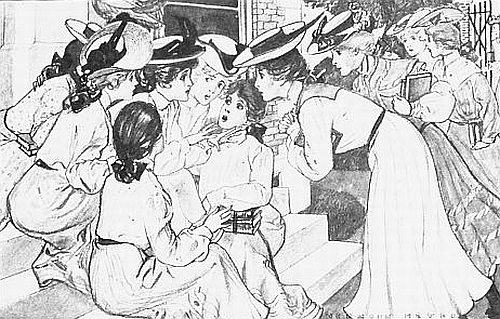
“Perhaps one of those old hens will pick it
up,” suggested Lucy Bennett, pointing across the
way to the station master's garden, where four or
five fowl were busily scratching.
“Oh—oh!” Sally gave a little scream at
that, and threw herself into Polly Pepper's arms.
“My aunt's pin—and she told me—to be careful,
and she won't—won't ever give me anything
else, and now those old hens will eat it.
Oh dear me! what shall I do?”
“How can you, Lucy, say such perfectly dreadful
things?” cried Polly. “Don't cry, Sally.
Girls, do keep on looking for it as hard as you
can. Sally, do stop.”
But Sally was beyond stopping. “She told—told
me only to wear it Sundays, and with my
best—best dress. Oh, do give me your handkerchief,
Polly. I've left mine home.”
So Polly pulled out her clean handkerchief
from her coat pocket, and Sally wiped up her
face, and cried all over it, till it was a damp
little wad; and the girls poked around, and
searched frantically, and Alexia, one eye on the
clock, exclaimed, “Oh, girls, it's time for the
train. Oh misery me! what shall we do?”
“And here it comes!” Lucy Bennett screamed.
“Stick on your hat, Sally, you've the pin part.
Come, hurry up!” cried the others. And they all
huddled around her.
“Oh, I can't go,” began Sally.
“You must,” said Clem; “we've telephoned
back to Mrs. Horne we're coming. Do stick on
your hat, Sally Moore.”
Alexia was spinning around, saying over and
over to herself, “I won't stay back—I won't.”
Then, as the train slowly rounded the long curve
and the passengers emerged from the waiting-room,
she rushed up to the knot of girls. “Go
along, Sally Moore, and I'll stay and hunt for
your old pin,” just as some one twitched Sally's
hat from her fingers and clapped it on her head.
“Oh my goodness me!” Alexia gave a little
scream, and nearly fell backward. “Look—it's
on your own head! Oh, girls, I shall die.” She
pointed tragically up to the hat, then gave a
sudden nip with her long fingers, and brought
out of a knot of ribbon, a gilt, twisted affair with
pink stones. “You had it all the time, Sally
Moore,” and she went into peals of laughter.
“Well, do stop; everybody's looking,” cried the
rest of the girls, as they raced off to the train,
now at a dead stop. Sally, with her hat crammed
on her head at a worse angle than ever, only
realized that she had the ornament safely clutched
in her hand.
“Oh, I can't help it,” exclaimed Alexia gustily,
and hurrying off to get next to Polly. “Oh dear
me!—whee—whee!” as they all plunged into
the train.
When they arrived at Edgewood, there was a
carriage and a wagonette drawn up by the little
station, and out of the first jumped Silvia, and
following her, a tall, thin girl who seemed to have
a good many bracelets and jingling things.
“My cousin, Kathleen Briggs. She just came
to-day,” said Silvia, “while I was at school, and
so mother thought it would be nice to have you
girls out to supper, 'cause they're only going to
stay till to-morrow. Oh, it's so fine that you've
come! Well, come and get in. Polly, you're
going in the carriage with Kathleen and me.
Come on.”
Alexia crowded up close behind.
“I'm going with Polly Pepper, this time,” announced
Sally, pushing in between; “Alexia always
gets her.”
“Well, she's my very dearest friend,” said
Alexia coolly, and working her long figure up
close to Polly, as Silvia led her off, “so of course
I always must go with her.”
“Well, so she is our very dearest friend, too,
Alexia Rhys,” declared Clem, “and we're going
to have her sometimes, ourselves.” And there
they were in a dreadful state, and Silvia's cousin,
the new girl, to see it all!
She jingled her bracelets, and picked at the
long chain dangling from her neck, and stared at
them all.
“Oh my goodness!” exclaimed Polly Pepper
with very red cheeks. “Alexia, don't—don't,”
she begged.
“Well, I don't care,” said Alexia recklessly,
“the girls are always picking at me because I
will keep next to you, Polly, and you're my very
dearest friend, and——”
“But Sally had such a fright about her pin,”
said Polly in a low tone. Alexia was crowded
up close and hugging her arm, so no one else
heard.
“Well, that old pin dropped in the ribbon; she
had it herself all the time, oh dear!” Alexia
nearly went off again at the remembrance.
“She felt badly, all the same,” said Polly
slowly. She didn't even smile, and Alexia could
feel that the arm was slipping away from her.
“Oh dear me!” she began, then she dropped
Polly Pepper's arm. “Sally, you may go next,”
she cried suddenly, and she skipped back into
the bunch of the other girls.
Polly sent her an approving little nod, and she
didn't fail to smile now. Alexia ran over to the
wagonette, and hopped in, not daring to trust
herself to see Sally Moore's satisfaction ahead in
the coveted seat.
The other girls jumping in, the wagonette was
soon filled, and away they spun for the two
miles over to the Hornes' beautiful place. And
before long, their respects having been paid to
Mrs. Horne, the whole bevy was up in Silvia's
pretty pink and white room overlooking the lake.
“I think it's just too lovely for anything here,
Silvia Horne,” exclaimed Sally, whose spirits
were quite recovered now. She had her aunt's
pin all safe, and she had ridden up next to Polly.
“Oh girls, she has a new pincushion and cover.”
“Yes, a whole new set,” said Silvia carelessly,
as the girls rushed over from the bed where they
were laying their things, to see this new acquisition
to the beautiful room.
“Well, if I could have such perfectly exquisite
things,” breathed Alexia as they all oh-ed and
ah-ed over the pink ribbons and dainty lace,
“I'd be the very happiest girl.”
Kathleen Briggs thrust her long figure in among
the bevy. “That toilet set is very pretty,” she
said indifferently and with quite a young-lady
air.
“Very pretty!” repeated Alexia, turning her
pale eyes upon her in astonishment, “well, I
should think it was! It's too perfectly elegant
for anything!”
“Oh dear me!” Kathleen gave a little laugh.
“It's just nothing to the one I have on my toilet
table at home. Besides, I shall bring home some
Oriental lace, and have a new one: I'm going
around the world to-morrow, you know.”
“Oh my goodness!” exclaimed Alexia faintly.
And the other girls fell back, and stared respectfully.
“Yes,” said Kathleen, delighted at the effect
she had produced. “We start to-morrow, and
we don't know how long we shall be gone. Perhaps
two years. Papa says he'll stay if we want
to; but mamma and I may get tired and come
home.” She jingled her bracelets worse than
ever.
“They've come to bid us good-bye, you see,”
said Silvia, to break the uncomfortable silence.
“Oh yes,” said Polly Pepper.
“Well, if you've got your things off, let's go
out of doors,” proposed Silvia suddenly.
“Yes, do let's.” The girls drew a long breath
as they raced off.
“I think that Kathleen Briggs is too perfectly
horrid for anything”—Alexia got up close to
Polly as they flew down the stairs—“with her
going round the world, and her sniffing at Silvia's
toilet set.”
“Hush—hush!” whispered Polly, “she'll hear
you.”
“Well, I don't care; and she's going round the
world to-morrow, so what does it signify?” said
Alexia. “Oh, don't go so fast, Polly. You most
made me tumble on my nose.”
“Well, you mustn't come with me, then, if you
don't keep up,” said Polly, with a merry little
laugh, and hurrying on.
“I'm going to keep up,” cried Alexia, dashing
after, “but you go so fast,” she grumbled.
“We're going to have tea out on the lawn,”
announced Silvia in satisfaction, as the bevy
rushed out on the broad west piazza.
The maids were already busily setting three
little tables, that were growing quite pretty under
their hands.
“There will be four at each table,” said Silvia.
“Polly's going to sit with Kathleen and me, and
one other girl—I don't know which one yet,”
she said slowly.
“Oh, choose me.” Alexia worked her way
along eagerly to the front. “I'm her dearest
friend—Polly's, I mean. So you ought to
choose me.”
“Well, I sha'n't,” declared Silvia. “You
crowded me awfully at Lucy Bennett's party,
and kept close to Polly Pepper all the time.”
“Well, that's because you would keep Polly
yourself. You crowded and pushed horribly
yourself, you know you did.” Her long face was
quite red now.
“Well, I had to,” declared Silvia coolly. “At
any rate, you sha'n't have Polly to-day, for I've
quite decided. Clem, you shall have the other
seat at my table.”
Clem hopped up and down and beat her hands
together in glee. “There, Alexia Rhys!” she
cried in triumph. “Who's got Polly Pepper
now, I'd like to know!”
Alexia, much discomfited, fell back. “Well, I
think that's a great way to give a party,” she
said, “to get up a fight the first thing.”
But Silvia and Kathleen had got Polly Pepper
one on each side, and were now racing down to
the lake. “We're going to have a sail,” called
Silvia over her shoulder, so they all followed,
Alexia among the rest, with no time for anything
else. There was the steam launch waiting for
them.
“Girls—girls!” Mrs. Horne called to them
from the library, “wait a moment. Mr. and
Mrs. Briggs are going too.”
“Oh bother!” began Silvia. Then the color
flew into her face, for Kathleen heard.
“I shall tell my mother what you said,” she
declared.
“Dear me! no, you mustn't,” begged Silvia in
alarm.
“Yes, I shall too.” Kathleen's bracelets
jingled worse than ever as she shook them out.
“Well, I call that real hateful,” broke out
Silvia, a red spot on either cheek, “you know I
didn't mean it.”
“Well, you said it. And if you think it's a
bother to take my mother and father out on
your old launch, I sha'n't stop here and bring
you anything when I come home from around
the world.”
Silvia trembled. She very much wanted something
from around the world. So she put her
arm about Kathleen. “Oh, make up now,” she
said. “They're coming,” as Mr. and Mrs.
Briggs advanced down the path. “Promise you
won't tell,” she begged.
“Yes, do,” said Polly Pepper imploringly.
So Kathleen promised, and everything became
quite serene, just in time for Mr. and Mrs. Briggs
to have the girls presented to them. And then
they all jumped into the steam launch, and the
men sent her into the lake, and everything was
as merry as could be under the circumstances.
“I haven't got to go to school to-morrow,”
announced Silvia when they were well off. “Isn't
that too fine for anything, girls?”
“Dear me! I should say so,” cried Alexia
enviously. “How I wish I could ever stay home!
But aunt is so very dreadful, she makes me go
every single day.”
“Well, I'm going to stay home to bid Kathleen
good-bye, you know,” said Silvia.
“You see we are going around the world,”
announced Mrs. Briggs. She was just like
Kathleen as far as mother and daughter could
be, and she had more jingling things on, besides
a long lace scarf that was catching in everything;
and she carried a white, fluffy parasol in her
hand. “And we've come to bid good-bye to
our relatives before we start. Kathleen, you
shouldn't have come out on the water without
your hat,” for the first time noticing her daughter's
bare head.
“None of the girls have hats on,” said Kathleen,
shaking her long light braids.
“Well, I don't see how their mothers can allow
it,” exclaimed Mrs. Briggs, glancing around
on the group, “but I sha'n't let you, Kathleen.
Dear me! you will ruin your skin. Now you
must come under my parasol.” She moved up
on the seat. “Here, come over here.”
“Oh, I'm not going to,” cried Kathleen with a
grimace. “I can't see anything under that old
thing. Besides, I'm going to stay with the girls.”
“Yes, you must come under my parasol.” A
frown of real anxiety settled on her mother's face.
“You'll thank me by and by for saving your
complexion for you, Kathleen; so come over.”
“No,” said Kathleen, hanging back, and holding
to Silvia's arm.
“There's your veil, you know.” Mr. Briggs
hadn't spoken before, but now he edged up to
his wife. “It's in my pocket.”
“So it is,” cried his wife joyfully, as Mr.
Briggs pulled out a long green tissue veil. “I
am so glad I had you bring it. Now, Kathleen,
tie this all over your head; your father will bring
it over to you. And next time, do obey me, and
wear your hat as I've always told you.”
So Kathleen, not daring to hold back from
this command, but grumbling at every bit of the
process, tied on the veil, and then sat up very
cross and stiff through the rest of the sail.
“I should rather never go around the world,
if I'd got to be tied up like an old green mummy
every step,” Alexia managed to whisper in Polly's
ear as they hopped out of the launch. And she
was very sweet to Kathleen after that, pitying
her dreadfully.
“Oh dear me!” exclaimed Clem. They
were all on the cars—the early train—going
home; the governess, a middle-aged person
who looked after the younger Horne children
and who was going in to her sister's to pass the
night, taking care of the party. “Now I've got
to sit up till all hours when I get home, to get
my lessons.”
Polly Pepper gave a comfortable little wriggle
under her coat. “Isn't it nice Mamsie makes
me get my lessons the first thing, before I play!”
she said to herself for about the fiftieth time.
“So have I,” cried Lucy Bennett, echoing
Clem's words.
“Well, I can't,” cried Alexia with a flounce,
“because my aunt won't let me sit up after nine
o'clock; that is, to study. So I have to get up
early in the morning. Oh dear!” with a grimace
at the thought.
“So do I,” said Amy Garrett. “Dear me!
and I'm just as sleepy in the morning as I can
be.”
Alexia yawned at the very memory of it.
“Well, don't let's talk of it,” she begged.
“Seems as if Miss Salisbury's eyes were all over
me now.”
“I have Miss Anstice to-morrow,” said Amy,
“and it's the day for her black silk gown.”
“Horrors!” exclaimed Alexia; and, “How do
you know she'll wear the black silk gown to-morrow,
Amy?” from the other girls.
“Because she said Professor Mills from the
Institute is to be there to-morrow,” said Amy.
“He gives the art lecture to our class. And you
know the black silk gown will surely go on.”
“There's no help for you, you poor child,”
cried Alexia, exulting that she never would be
gathered into Miss Anstice's class, and that she
just hated art and all that sort of thing, despite
the efforts of Miss Salisbury's younger sister to
get her interested. “Yes, that black silk gown
will surely be there. Look out now, Amy; all
you girls will catch it.”
“Oh, I know it,” said Amy with a sigh. “How
I do wish I never'd got into that class!”
“Well, you know I told you,” said Alexia provokingly;
“you'd much better have taken my
advice and kept out of her clutches.”
“I wish I had,” mourned Amy again.
“How Miss Anstice can be so horrid—she
isn't a bit like Miss Salisbury,” said Alexia. “I
don't see—”
“She isn't horrid,” began Polly.
“Oh Polly!”
“Well, not always,” said Polly.
“Well, she is anyway when she has company,
and gets on that black silk gown; just as stiff and
cross and perky and horrid as can be.”
“She wants you all to show off good,” said
Alexia. “Well, I'm glad enough I'm not in any
of her old classes. I just dote on Miss Salisbury.”
“Oh Alexia, you worry the life out of her almost,”
said Sally.
“Can't help it if I do,” said Alexia sweetly.
“I'm very fond of her. And as for Mademoiselle,
she's a dear. Oh, I love Mademoiselle,
too.”
“Well, she doesn't love you,” cried Clem viciously.
“Dear me! fancy one of the teachers
being fond of Alexia!”
“Oh, you needn't laugh,” said Alexia composedly
as the girls giggled; “every single one of
those teachers would feel dreadfully if I left that
school. They would really, and cry their eyes
out.”
“And tear their hair, I suppose,” said Clem
scornfully.
“Yes, and tear their—why, what in this world
are we stopping for?” cried Alexia in one breath.
So everybody else wondered, as the train gradually
slackened speed and came to a standstill.
Everybody who was going in to town to the theatre
or opera, began to look impatient at once.
“Oh dear!” cried the girls who were going to
sit up to study, “now isn't this just as hateful as
it can be?”
“I don't care,” said Alexia, settling comfortably
back, “because I can't study much anyway,
so I'd just as soon sit on this old train an hour.”
“Oh Alexia!” exclaimed Polly in dismay, with
her heart full at the thought of Mamsie's distress,
and that of dear Grandpapa and Jasper.
Phronsie would be abed anyway by the time the
early train was in, so she couldn't worry. But
all the others—“Oh dear me!” she gasped.
“Don't look so, Polly,” said Alexia, “we'll start
pretty soon, I guess.”
The governess, Miss Baker, came over from
the opposite seat to stand in the aisle. “I think
we'll start soon,” she said. But her eyes looked
worried.
“What is it—oh, Miss Baker, what is the
reason we're stopping?” cried two or three of
the girls.
“I don't know,” said the governess.
A man coming in from outside, where a lot of
gentlemen were pouring out of the cars to investigate,
furnished the information.
“Driving wheel broken,” he said, being sparing
of words.
“Oh, can't we go out to see?” cried Alexia,
hopping out of her seat. “Come on,” and she
was prancing down the aisle.
“No, indeed,” said Miss Baker in displeasure,
“and do you come directly back,” she commanded.
“Oh dear me!” grumbled Alexia to Sally, who
had tumbled out after her, “she's worse than
Miss Anstice—stiff, precise old thing!” She
came slowly back.
“That a young lady under my care,” said Miss
Baker, lifting her black gloves in amazement,
“should so far forget herself as to want to run
out on that track with a lot of men! I am astonished.”
“There's a girl out there,” said Alexia, sinking
into her seat crossly, and peering over Polly
Pepper's head.
“Well, if they've forgotten themselves so far as
to go out there under such circumstances, I shall
not let any young lady in my care do it,” said
Miss Baker emphatically.
So, swallowing their disappointment at not being
allowed to see all that presented itself, the
girls settled back and made themselves as comfortable
as possible. Meantime almost everybody
else poured out of their car. But it seemed
to Polly Pepper as if she never could keep still in
all this world. And she clasped her hands tightly
together and hoped nobody would speak to her
just yet.
“Polly,”—Alexia gave a little push, as she
leaned over,—“isn't it perfectly dreadful to be
mewed up here in this way? Say, Polly, do
talk.”
“Go right away, Alexia.” Polly gave a little
flounce, and sat quite straight.
“Oh dear me!” exclaimed Alexia in astonishment,
and falling back.
“And I wish you would let me alone,” cried
Polly, quite aghast at herself, but unable to stop.
“Oh dear me!” Alexia kept saying quite
faintly, and rolling her eyes.
“Well, I'm glad Polly has made you behave
for once,” said Clem, who never could forgive
Alexia for getting Polly so much to herself.
Alexia stopped saying, “Oh dear me!” and sat
quite still. Just then Polly turned and saw her
face.
“Oh Alexia!” she cried, flying at her, when
an awful bump, and then another much worse,
and then a grinding noise, perfectly terrible,—and
everybody who was left in the car, went
tumbling out of their seats.
“Oh, we're run into!” screamed half a dozen
of the girls. Miss Baker, who had been standing
in the aisle, was down in a heap on the floor.
“Oh, oh!” Polly had her arms around Alexia
and was hugging her tightly. “Are you hurt?”
as they wriggled out of the bunch of girls into
which they had been precipitated, up to their feet.
“N—no,” Alexia, tried to say. Instead, she
wobbled over, and laid her head on Polly's arm.
“Girls—girls—Miss Baker!” called Polly, not
seeing that lady, in the confusion of the other
passengers, staggering along the aisle, her bonnet
knocked over her eyes, and a girl on either hand
to help her along. “Clem—oh, somebody help
me! Alexia is hurt.” But nobody heard in the
general tumult.
“Oh dear! Alexia, do open your eyes,” begged
Polly, quite gone now with distress. “And to
think I was so cross to her!” And she turned
quite white.
“Dear, dear Alexia,” she cried; and because
there was nothing else to do, she leaned over and
dropped a kiss on Alexia's long face, and two
tears dropped down as well.
Alexia opened her eyes. “That's very nice,
Polly,” she said, “do so some more.”
“Aren't you ashamed!” cried Polly, the rosy
color coming back to her cheek. And then, remembering,
she hugged Alexia tightly. “Oh,
I'm so glad you're not hurt, Alexia, so very
glad!” she cried gratefully.
“Ow!” exclaimed Alexia, shrinking back.
“Oh, now you are hurt,” cried Polly. “Oh
Alexia!” And she turned very white again.
“Tell me where it is.” And just then some of
the girls rushed up with the news, corroborated
by the other passengers, that the down express
had run into them,—been signalled, but couldn't
stop in time, etc., etc.,—till Polly thought she
should go wild before the babel could be stopped.
“Don't crowd around so,” she cried hoarsely.
“Alexia is hurt.”
“Alexia?” The noise, as far as Miss Salisbury's
girls were concerned, stopped at once; and
at last the other passengers were made to understand
how it was. And Alexia, quite faint now,
but having sense enough to hang to Polly Pepper's
hand, was laid across an improvised bed
made of two seats, and a doctor who happened
to be on the train, one of the party going in to
the theatre, came up, and looked her over professionally.
“It's my arm,” said Alexia, opening her eyes
again; “it was doubled up someway under me.
Oh dear me! I'm so silly to faint.”
“You're not silly at all,” cried Polly warmly,
and holding her well hand, while her eyes searched
the doctor's face anxiously. “Oh, is it broken?”
they asked, as plainly as possible.
“Not a bit of it,” said the doctor cheerfully,
feeling it all over again to make quite sure, while
Alexia set her teeth together, trying not to show
how very much it hurt. “It's badly strained,—the
ligaments are;—but fortunately no bones
are broken.”
“Oh dear!” groaned Alexia. “Now why can't
it be broken?”
“Oh Alexia!” cried Polly. And now the tears
that had been kept back, were rolling down her
cheeks. “I'm so happy, I can't help it,” she
said.
“And the very idea, Alexia Rhys,” exclaimed
Clem, “to wish your arm had been broken!” and
she gave a little shiver.
“It hurts just as much,” said Alexia, trying to
sit up straight, and making an awful face, “so
it might as well be. And I've never been in a
railroad accident. But a sprained arm isn't anything
to show; any baby can have that—oh
dear me!”
“Well, you better lie still,” counselled Miss
Baker tartly. “Dear me! I little thought when
I took charge of you young ladies that any such
thing would occur.”
“She acts as if she thought we did it on purpose,”
said Alexia, turning her face over to hide
it on Polly's arm again, and wishing her own
needn't ache so dreadfully. “Oh dear! such a
time as we've had, Polly Pepper, with those dreadful
Briggses,—I mean Mrs. Briggs,—and now
to be all banged up, and this cross old thing to
see us home! And now I never'll be able to get
through the term, 'cause I'll have to stay at home
with this old arm, and aunt will scold.” She
was quite out of breath with all her woes.
“Oh, yes, you will,” cried Polly reassuringly,
“I'll run over every day, and study with you,
Alexia. And you'll soon be all well again. Don't
try to talk now, dear,” and she patted the poor
cheeks, and smoothed her hair. All the while
she was trying to keep down the worry over the
home-circle who would be thrown into the greatest
distress, she knew, if news of the accident
should reach their ears.
“Can't somebody telephone them?” she cried;
“Oh, Miss Baker”—the doctor had rushed off
to other possible sufferers—“and tell them no
one is hurt;—I mean seriously?”
“There is,” said the governess, quite calmly;
“a man has been killed.”
“Oh dear!”
“A brakeman,” Miss Baker hastened to add.
“Don't be frightened. None of the passengers.”
“Now I know he was brave, and trying to do
something to save us,” cried Polly, with kindling
eyes.
“Yes,” said a passenger, coming up to their
group, “he was running back with a lantern to
signal the train, and he slipped and fell, and the
express went over him. But it stopped just in
time for us.”
“Oh the poor, poor man!” Polly was quite
gone by this time, and Alexia forgot her pain in
trying to comfort her.
“But suppose he had children,” cried Polly,
“just suppose it, Alexia.”
“I don't want to suppose it,” said Alexia, wriggling.
“Ugh! you do say such uncomfortable
things, Polly Pepper.”
“I know it.” Polly swallowed hard, and held
Alexia's hand tighter than ever. “Well, I won't
talk of it any more.”
The governess, who had moved away a bit,
now came back with vexation plainly written all
over her face. “I must go and see if there isn't
some way to get a message to Grandpapa King,
Alexia,” said Polly. “I'll be back as soon as I
can.” She dropped a kiss on the nearest cheek.
“Don't be gone long,” begged Alexia.
“I will go with you,” said the governess, stepping
off after her.
“Very well,” said Polly, going swiftly down the
aisle, to see below the car steps a crowd of passengers
all in a tumult, and vociferating angrily.
In the midst of them, Polly saw the face of the
doctor who had just fixed Alexia's arm.
“Oh sir,” she began.
He looked up, and caught sight of the brown
eyes. “Is the little girl worse?” And he sprang
over toward her.
Polly, not stopping to think how furious Alexia
would be, who was quite the tallest of their set,
to be designated as a little girl, made haste to
say, “Oh no, sir; but oh, could you tell me how
to let my grandpapa and my mother know we are
safe? Could you, sir?” Poor Polly, who had
held up so bravely, was clasping her hands tightly
together, and the brown eyes were full of tears.
“Well, you see,” began the doctor, hating to
disappoint her, “it's a difficult matter to get in
communication with them at once. We are only
five miles out, but—”
“Five miles?” echoed Polly. “Oh then, some
one can go to the nearest station, and telephone,
can't they, sir?”
“To be sure; and that's been done. But your
family, little girl—how can we reach them?”
“Oh, I can run,” cried Polly happily, “to the
station myself, sir,” and she began to clamber
down the car steps.
“Come back,” commanded the governess, lifting
her hands in horror. “I never heard of
such a thing. The very idea! What would your
grandfather, Mr. King, say to such a thing, Polly
Pepper?”
“Mr. who?” cried the doctor. “Stay, little
girl,” seizing her arm. “Mr. who?” he demanded,
looking up to the governess on the car
steps.
“Mr. Horatio King,” she replied with asperity,
“and you'd better be occupied with something
else, let me tell you, sir, instead of encouraging
his granddaughter to run off on such a wild-goose
errand as this.”
“I certainly shall take pleasure in performing
the wild-goose errand myself,” he said. “Now
Polly, I'll send the message; don't you worry,”
and he sped off down the track.
And then somebody rushed in, saying,
“We've another locomotive; now we're
going!” And everybody else who was outside
hurried into the cars; the new propelling power
was attached to the other end of the train, and
after a deal of switching, there they were at last—off
on the way home!
Polly gave a long breath of relief, and clasped
Alexia's hand closely. “Oh, by this time they
know at home it's all right,” she cried.
The doctor came smilingly down the aisle.
“Well,” he nodded to Polly. “Yes, it's all
right,” he said. “I must really call you Polly
Pepper now, for I know your grandfather, and
Dr. Fisher—well there! indeed I know him.”
“Do you?” cried Polly with blooming cheeks,
well pleased to find a friend at such a time.
“Yes, indeed. I'm fortunate enough to meet
him in hospital work. Now then, how is our
little friend here?” He leaned over, and touched
Alexia's arm lightly.
“Oh, I'm all right,” she said.
“That's good,” in a gratified tone. “Now
keep plucky, and you'll get out of this finely.”
Then he sat down on the arm of the seat, and
told such a funny story that no one supposed it
could be the home station when the train came
to a standstill, and he was helping Alexia out.
“There now—drop Polly's hand, if you
please,” the doctor was saying; “I'll assist you.”
“But I don't want to,” said Alexia, hanging to
it for dear life. “I want Polly.”
“I presume so,” laughed the doctor, “but I
think it's best for me to help you.” Miss Baker
and all the girls crowded up in a bunch. “Easy
there,” he said. “Don't hurry so; there's plenty
of time.” And he got between them and Alexia's
lame arm.
And there, down by the car steps—Polly
could see him as he waited for the stream of
passengers to get out—was Jasper, his eyes
eagerly searching every face, with an impatience
scarcely to be controlled. And back of him were
Dr. Fisher's big glasses, shining as the little doctor
pranced back and forth, unable to keep still.
“There they are—there they are!” Polly exclaimed.
“Oh, if we could hurry and let them
know we're all right!” But they were wedged
in so, there was nothing to do but to take their
turn and let the passengers in front descend.
“Jasper—oh, Papa Fisher!” At last Polly
was out on the platform where she stood on her
tiptoes and waved her hand.
“Are you all right?” asked Jasper eagerly,
craning his neck to see for himself.
“Yes—yes!” cried Polly. And then presently
they had her on either hand! “Oh, help
Alexia,” she cried, turning back.
Dr. Fisher took one look through his big glasses.
“Well, well, Pennell,” he exclaimed, “you here?”
and he skipped over to them.
“I really believe so,” laughed Dr. Pennell.
“Dear me!” Little Dr. Fisher glanced at
Alexia quickly.
“Nothing but sprained,” the other doctor said
quickly. “Still, it needs careful attention.”
And then it came out that Alexia's aunt had
heard a chance word dropped about the accident,
and had run down to Mr. King's in her distress,
so she was there awaiting them; and the fathers
and brothers of the rest of the “Salisbury girls”
took off their charges, much to the relief of the
governess. So presently Jasper had his party all
settled in the carriage, Dr. Pennell saying, “Well,
I resign my responsibility about that arm to you,
Dr. Fisher.” He lifted his hat, and was off.
“Oh, wait!” cried Polly in great distress as
Thomas was just starting off with a dash, “I
must speak to him.”
“Polly—what is it?” cried Jasper. “Wait,
Thomas!” So Thomas pulled up.
“I must—I must,” declared Polly. Her foot
was on the step, and she was soon out.
“I'll go with you,” said Jasper, as she sped
down through the streams of people pouring
along the platform, to thread her way after the
tall figure, Jasper by her side. “Dr. Pennell—oh,
please stop.”
“Hey?” The doctor pulled up in his brisk
walk. “Oh dear me! what is it?”
“Will you please tell me—do you know who
the poor man was who was killed?” she gasped.
“Oh Polly,” cried Jasper, “was there some
one killed?”
“Yes, he was a brakeman, Polly,” said Dr.
Pennell.
“Oh, I know—but where did he live?” cried
Polly, “and had he any children?” all in one
breath.
“A big family, I understand,” said the doctor
gravely.
“Oh dear me!” exclaimed Polly with a sorry
droop to the bright head, and clasping her hands,
“could you, Dr. Pennell, tell me anything more?”
“That's all I know about the poor fellow,”
said the doctor. “The conductor told me that.”
“I'll find out for you to-morrow, Polly,” said
Jasper quickly; “I'll run down to the railroad
office, and get all the news I can.”
“And I'll go with you,” said Polly, “for I
most know Grandpapa will let me. He was so
very good to us all—that poor man was,” she
mourned.
“Yes, Polly, there's no doubt of that,” Dr.
Pennell said abruptly. “You and I maybe
wouldn't be standing here if it were not for him.”
Jasper shivered, and laid hold of Polly's arm.
“Well now, run along and get home,” finished
the doctor cheerily, “and look out for that plucky
little friend of yours, and I'll try and find out,
too, about that brakeman, and we'll talk the
thing over.” So Polly and Jasper raced back
again down over the platform, clambered into the
carriage, and away they went home to Grandpapa
and Mamsie!
And Alexia and her aunt staid all night. And
after the whole story had been gone over and
over, and Grandpapa had held Polly on his knee,
all the time she was not in Mamsie's lap, and
Alexia had had her poor arm taken care of, and
all bandaged up, Dr. Fisher praising her for
being so cool and patient, why then it was nearly
eleven o'clock.
“Dear me! Polly,” cried Mother Fisher in
dismay, looking over at the clock—they were all
in the library, and all visitors had been denied—“the
very idea! you children must get to bed.”
“Yes—or you won't be cool and patient to-morrow,”
said Dr. Fisher decidedly, and patting
Alexia's bandages. “Now run off, little girl, and
we'll see you bright as a button in the morning.”
“I'm not cool and patient,” declared Alexia,
abruptly pulling down, with her well hand, the
little doctor till she could whisper in his ear.
“Oh, aunt does fuss so—you can't think; I'm
a raging wild animal.”
“Well, you haven't been raging to-night,
Alexia,” said the little doctor, bursting out into a
laugh.
“Oh, hush, do,” implored Alexia, who wasn't
in the slightest degree afraid to speak her mind,
least of all to Dr. Fisher, whom she liked immensely;
“they'll all hear us,” she brought up in
terror.
“What is it, Alexia?” cried her aunt from the
sofa, where Dr. Fisher had asked her to be
seated, as it was well across the room. “Oh, is
she worse?” she exclaimed, hurrying over nervously.
“There, now, you see,” cried Alexia tragically,
and sinking back in her chair; “everything's just
as bad as can be now.”
“Not in the least, Miss Rhys,” the little doctor
said in his cheeriest tones, “only Alexia and I
had a little joke all by ourselves.” And as he
waited coolly for the maiden lady to return to
her seat, she soon found herself back there. Then
he went over to Mamsie, and said something in
a low tone.
“Yes, Adoniram.” Mother Fisher nodded
over Polly's brown head. “She ought to have a
good night's sleep.”
“Polly,” said Dr. Fisher, leaning over her,
“it's just this: that aunt of Alexia's—she's a
good enough sort of a woman, I suppose,”
wrinkling his brows in perplexity to find the
right words, “but she certainly does possess the
faculty to rile folks
up remarkably well. She sets my teeth on edge; she does
really, wife.” He brought out this confession honestly, although
he hated professionally to say it. “And Alexia—well,
you know, Polly, she ought to be kept quiet to-night. So your
mother and I—we do, don't we, dear?” taking Mamsie's
hand.
“We certainly do,” said Mrs. Fisher, not waiting for the
whole story to be told, “think it's best for you to have Alexia
with you to-night.”
“Oh, goody!” exclaimed Polly, sitting quite straight in
Mamsie's lap.
“You are not to talk, Polly, you know,” said Dr. Fisher
decidedly.
“Oh, we won't—we won't,” promised Polly faithfully.
“You can have the red room, Polly,” said Mamsie, “because
of the two beds. And now, child, you must both hop
off and get into them as soon as you can, or you'll be sick
to-morrow.”
So Polly ran off to bid Grandpapa good night. And then
as he held her in his arms, he said, “Well, now, Polly, you
and Jasper and I will take that trip down to the railroad
station to-morrow.”
“Oh, Grandpapa!” cried Polly, clasping her hands, while
her cheeks turned rosy red, “I am so very glad. We can go
right after school, can't we?”
“School? Oh, you won't go to school to-morrow,” said old
Mr. King decidedly. “Yes, yes, Mrs. Fisher, in just a minute—Polly
shall go to bed in a minute. No, no, Polly, after such
an excitement, school isn't to be thought of for a day or two.”
“Perhaps she'll be all right in the morning, father,” Jasper
hurried to say, at sight of Polly's face.
“Oh, I shall—I shall.” Polly flashed a bright glance at
him. “Please, Grandpapa, let me go. I haven't been absent
this year.”
“And it's so awfully hard to make up lessons,” said Jasper.
“Make up lessons? Well, you needn't make them up. Bless
me! Such a scholar as you are, Polly, I guess you'll stand well
enough at the end of the year, without any such trouble.
Quite well enough,” he added with decision.
Polly's brown head drooped, despite her efforts to look
bravely up into his face. “Good night, Grandpapa,” she said
sadly, and was turning away.
“Oh bless me!” exclaimed old Mr. King
hastily, “Polly, see here, my child, well—well,
in the morning perhaps—dear me!—we can
tell then whether it's best for you to go to school
or not. Come, kiss me good night, again.”
So Polly ran back and gave him two or three
kisses, and then raced off, Jasper having time to
whisper at the door: “I most know, Polly,
father'll let you go; I really and truly believe
he will.”
“I believe so too,” cried Polly happily.
And sure enough, he did. For the next morning
Polly ran down to breakfast as merry as a
bee, brown eyes dancing, as if accidents were
never to be thought of; and Grandpapa pinched
her rosy cheek, and said: “Well, Polly, you've
won! Off with you to school.” And Polly
tucked her books under her arm, and raced off
with Jasper, who always went to school with her
as far as their paths went, turning off at the
corner where she hurried off to Miss Salisbury's
select school, to go to his own.
“Oh, here comes Polly Pepper!” The girls,
some of them waiting for her at the big iron
gate, raced down to meet her. “Oh Polly—Polly.”
At that a group of girls on the steps
turned, and came flying up, too. “Oh, tell us
all about the awful accident,” they screamed.
“Tell, Polly, do.” They swarmed all over
her.
“Give me the books,” and one girl seized
them. “I'll carry them for you, Polly.”
“And, Polly, not one of the other girls that
went out to Silvia Horne's is here this morning.”
“They may come yet,” said Polly; “it's not
late.”
“Oh, I know; we came early to meet you;
well, Silvia isn't here either.”
“Oh, she can't come, because of her cousin,”
said Polly, “and——”
“Well, I don't care whether she ever comes,”
declared Leslie Fyle. “I can't abide that Silvia
Horne.”
“Nor I,” said another girl, “she's so full of
her airs and graces, and always talking about her
fine place at Edgewood. Oh dear me! I'm sick
of Edgewood!”
A little disagreeable laugh went around.
“Oh, I'll tell you of the accident,” said Polly;
“come, let's sit down on the steps; we've ten
minutes yet.”
“Yes, do, do,” cried the girls. So they huddled
up together on the big stone steps, Polly in the
middle, and she told them the whole story as
fast as she could. Meantime other girls hurrying
to school, saw them from a distance, and
broke into a run to get there in time.
And Polly gave Alexia's love all round, as she
had been commissioned to do.
“We'll go up to your house to see her,” cried
Leslie, “perhaps this afternoon.”
“Oh, no, you mustn't,” said Polly. “I'm
dreadfully sorry, girls, but Papa Fisher says no
one must come yet, till he sends word by me.”
“I thought you said Alexia was all right.”
“And if her arm isn't broken I should think we
might see her,” said a big girl on the edge of the
circle discontentedly. She had private reasons
for wishing the interview as soon as possible, as
she and Alexia had quarrelled the day before,
and now it was quite best to ignore all differences,
and make it up.
“But she's had a great strain, and Papa-Doctor
says it isn't best,” repeated Polly very
distinctly, “so we can't even think of it, Sarah.”
“Polly? is that Polly Pepper?” exclaimed a
voice in the hall.
AND SHE TOLD THEM THE WHOLE STORY AS FAST AS SHE COULD.
“Oh, yes, Miss Anstice,” cried Polly, hopping
up so quickly she nearly overthrew some of the
bunch of girls.
Yes, she had on the black silk gown, and
Polly fancied she could hear it crackle, it was so
stiff, as Miss Anstice advanced primly.
“I hear that there was an accident, Polly
Pepper, last night, which you and some of the
other girls were in. Now, why did you not come
and tell me or sister at once about it?”
“Oh dear me! do forgive me,” cried poor
Polly, now seeing that she had done a very wrong
thing not to have acquainted Miss Salisbury first
with all the particulars. “I do hope you will
forgive me, Miss Anstice,” she begged over
again.
“I find it very difficult to overlook it, Polly,”
said Miss Anstice, who was much disturbed by
the note she held in her hand, just delivered, by
which Professor Mills informed her he should be
unable to deliver his address that morning before
her art class. So she added with asperity, “It
would have been quite the proper thing, and
something that would naturally, I should suppose,
suggest itself to a girl brought up as you
have been, Polly, to come at once to the head of
the school with the information.”
Polly, feeling that all this reflected on Mamsie
and her home training, had yet nothing to do
but to stand pale and quiet on the steps.
“She couldn't help it.” The big girl pushed
her way into the inner circle. “We girls all just
made her stop. My! Miss Anstice, it was just a
mob here when we saw Polly coming.”
“Sarah Miller, you have nothing to say until
I address you.” A little red spot was coming on
either cheek as Miss Anstice turned angrily to
the big girl. “And I shall at once report you to
sister, for improper behavior.”
“Oh dear, dear! Well, I wish 'sister' would
fire old black silk,” exclaimed a girl on the edge
of the circle under her breath. “Look at her
now. Isn't she a terror!” and then the big bell
rang, and they all filed in.
“Now she won't let us have our picnic; she'll
go against it every way she can,” cried a girl who
was out of dangerous earshot. And the terror of
this spread as they all scampered down the hall.
“Oh dear, dear! to think this should have
happened on her black silk day!”
“No, we won't get it now, you may depend,”
cried ever so many. And poor Polly, with all
this added woe, to make her feel responsible for
the horrible beginning of the day, sank into her
seat and leaned her head on her desk.
The picnic, celebrated as an annual holiday,
was given by Miss Salisbury to the girls, if all
had gone well in the school, and no transgressions
of rules, or any misdemeanor, marred the term.
Miss Anstice never had looked with favor on the
institution, and the girls always felt that she
went out of her way to spy possible insubordination
among the scholars. So they strove not to
get out of her good graces, observing special care
when the “black silk days” came around.
On this unlucky day, everything seemed against
them; and as Miss Anstice stalked off to sit upon
the platform by “sister” for the opening exercises,
the girls felt it was all up with them, and
a general gloom fell upon the long schoolroom.
Miss Salisbury's gentle face was turned in surprise
upon them as she scanned the faces. And
then, the general exercises being over, the classes
were called, and she and “sister” were left on
the platform alone.
“Oh, now she's getting the whole thing!”
groaned Leslie, looking back from the hall, to
peer in. “Old black silk is giving it to her.
Oh, I just hate Miss Anstice!”
“Sarah, why couldn't you have kept still?”
cried another girl. “If you hadn't spoken, Miss
Anstice would have gotten over it.”
“Well, I wasn't going to have Polly Pepper
blamed,” said Sarah sturdily. “If you were
willing to, I wasn't going to stand still and hear
it, when it was our fault she told us first.”
“Oh, no, Sarah,” said Polly, “it surely was my
own self that was to blame. I ought to have
run in and told Miss Salisbury first. Well, now,
girls, what shall I do? I've lost that picnic for
you all, for I don't believe she will let us have it
now.”
“No, she won't,” cried Leslie tragically; “of
that you may be sure, Polly Pepper.”
And that afternoon Polly kept back bad
recollections of the gloomy morning at
school as well as she could. She didn't let Alexia
get the least bit of a hint about it, although how
she ever escaped letting her find it out, she never
could quite tell, but rattled on, all the messages
the girls had sent, and every bit of school news
she could think of.
“Were the other girls who went to Silvia's, at
school?” asked Alexia suddenly, and twitching
up her pillow to get higher in bed, for Dr. Fisher
had said she mustn't get up this first day; and a
hard piece of work Mother Fisher had had to
keep the aunt out of the room.
“I wouldn't go in,” Mamsie would say; “Dr.
Fisher doesn't wish her to be disturbed. To-morrow,
Miss Rhys.” And it was all done so
quietly that Alexia's aunt would find herself off
down in the library again and busy with a book,
very much to her own surprise.
“I'll shake 'em up,” Polly cried; and hopping
off from the foot of the bed, she thumped the
pillows, if not with a merry, at least with a vigorous
hand. “There now,” crowding them in
back of Alexia's restless head, “isn't that fine?”
“I should think it was,” exclaimed Alexia with
a sigh of satisfaction, and giving her long figure
a contented stretch; “you do know just the best
things to do, Polly Pepper. Well, tell on. I
suppose Amy Garrett is perfectly delighted to
cut that old art lecture.”
“Oh, Professor Mills didn't come at all,” said
Polly. That brought it all back about Miss
Anstice, and her head drooped suddenly.
“Didn't come? oh dear!” And Alexia fell to
laughing so, that she didn't notice Polly's face at
all. But her aunt popping in, she became sober
at once, and ran her head under the bedclothes.
“Oh, are you worse? is she, Polly?” cried
Miss Rhys all in a flutter. “I heard her cry, I
thought.”
“No, I was laughing,” said Alexia, pulling up
her face red and shining. “Do go right away,
aunt. Dr. Fisher said Polly was to tell me things.”
“Well, if you are not worse,” said her aunt,
slowly turning away.
“No,” said Alexia. “Polly Pepper, do get up
and shut that door,” she cried; “slam it, and
lock it.”
“Oh, no,” said Polly, in dismay at the very
thought, “I couldn't ever do that, Alexia.”
“Well, then I will.” Alexia threw back the
bedclothes with a desperate hand, and thrust one
foot out.
“If you do,” said Polly, not moving from
where she sat on the foot of the bed, “I shall go
out of this room, and not come back to-day.”
“Shall you really?” cried Alexia, fixing her
pale eyes on her.
“Yes, indeed I shall,” said Polly firmly.
“Oh, then I'm not going.” Alexia drew in her
foot, and huddled all the clothes up over her
head. “Polly Pepper,” she said in muffled tones,
“you're a perfectly dreadful creature, and if you'd
gone and sprained your arm in a horrible old
railway accident and were tied in bed, I'd do just
everything you said, I would.”
“Oh, I hope you wouldn't,” said Polly.
“Hope I wouldn't!” screamed Alexia, flinging
all the clothes away again to stare at Polly out
of very wide eyes. “Whatever do you mean,
Polly Pepper?”
“I hope you wouldn't do as I wanted you to,”
said Polly distinctly, “if I wanted something that
was bad.”
“Well, that's a very different thing,” mumbled
Alexia. “Oh dear me!” She gave a grimace at
a twinge of pain in her arm. “This isn't bad;
I only wanted that door shut.”
“Oh now, Alexia, you've hurt your arm!”
cried Polly; “do keep still, else Papa-Doctor
won't let me stay in here.”
“Oh dear, dear! I'll keep still,” promised
Alexia, making up her mind that horses shouldn't
drag any expression of pain from her after that.
“I mean, do sit up straight against your pillows;
you've got 'em all mussed up again,” cried
Polly. So she hopped off from the bed, and
thumped them into shape once more.
“I wish you'd turn 'em over,” said Alexia:
“they're so hot on that side.” So Polly whisked
over the pillows, and patted them straight, and
Alexia sank back against them again.
“Wouldn't you like me to smooth your hair,
Alexia?” asked Polly. “Mamsie does that to
me when I don't feel good.”
“Yes, I should,” said Alexia, “like it very
much indeed, Polly.”
So Polly, feeling quite happy, albeit the remembrance
of the morning still lay deep in her
mind, ran off for the brush and comb. “And
I'm going to braid it all over,” she said with
great satisfaction, “after I've rubbed your head.”
“Well, now tell on,” said Alexia, as Polly
climbed up back of the pillows, and began to
smooth the long light fluffs of hair, trying to do
it just as Mamsie always did for her. “You say
Professor Mills didn't come—oh dear! and think
of that black silk gown wasted on the girls. Well,
I suppose she was cross as two sticks because he
didn't come, wasn't she, Polly? Oh dear me!
well, I'm glad I wasn't there,” she hurried on,
not waiting for a reply; “I'd rather be in with
this old bundle”—she patted her bandages—“Oh
Polly!” She started up so suddenly that the
brush flew out of Polly's lap and spun away
across the floor. “Take care,” said Polly, “oh,
there goes the comb now,” and she skipped
down, recovered the articles, and jumped up to
her post again. “What is it, Alexia?”
“Why, I've just thought—you don't suppose
Miss Salisbury will appoint the day for the picnic,
do you, while my arm is lame?”
The color in Polly's cheeks went out, and she
was glad that she could get well behind the
pillows.
“Oh, no, Alexia,” she made herself say, “we
wouldn't ever in all this world have the picnic
till you were well. How could you think it,
Alexia?”
“I didn't believe you would,” cried Alexia,
much gratified, and huddling down again, without
once seeing Polly's face, “but most of the
girls don't care about me, Polly, and they wouldn't
mind.”
“Oh yes, they do,” said Polly reassuringly,
“they're very fond of you, most of them are.”
“Well,” said Alexia, “I'm not fond of them,
so I don't really expect them to be, Polly. But
I shouldn't like 'em to go off and have that picnic
when I couldn't go. Was anything said about
it, Polly?” she asked abruptly.
“Miss Salisbury or Miss Anstice didn't say
a word,” said Polly, trembling for the next question.
Just then Mother Fisher looked in with a
smile. “Polly, you are wanted,” she said.
“Grandpapa and Jasper are ready to go to the
railroad station. I'm going to stay with Alexia
and finish her hair just as I do for Polly.”
Alexia looked up and smiled. It was next
best to having Polly, to have Mrs. Fisher. So
Polly, happy to have a respite from Alexia's questions
about the picnic, and happier still to be
going to find out something about the poor brakeman's
family, flew off from the bed, set a kiss
on Alexia's hot cheek, and another on Mamsie's,
and raced off.
“I'm coming, Jasper,” she called. She could
see him below in the wide hall.
“All right, don't hurry so, father isn't ready
yet. Dear me! Polly, you can get ready so
quickly for things!” he said admiringly. And,
in the glow of starting, he couldn't see that Polly's
spirits seemed at a low ebb, and he drew a
long breath as he tried to make himself believe
that what he had noticed at luncheon wasn't
really so at all.
And Polly, between Grandpapa and Jasper,
tried to make them have such a good time that
really it seemed no walk at all, and they were
all quite surprised when they found themselves
there.
“We must go up into the superintendent's
room,” said Mr. King. So up the long stairs
they went, the old gentleman grumbling at every
step because there was no elevator, and at all
other matters and things that were, as he declared,
“at loose ends in the whole system.”
At last they stood before the desk.
“Have the goodness,” began old Mr. King to
the official, a short, pompous person who came
up in the absence of the superintendent and now
turned a cold face up to them, “to give me some
information regarding a brakeman who was killed
last night in the accident to the train due here
at 7.45.”
“Don't know anything about him,” said the
official in the crispest accents. He looked as if
he cared less, and was about to slam down the
window, when Mr. King asked, “Does anybody
in this office know?”
“Can't say.” The official pulled out his watch,
compared it with the big clock on the wall, then
turned away.
“Do any of you know who the man was who
was killed last night?” asked the old gentleman,
putting his face quite close to the window, and
speaking in such clear, distinct tones that every
clerk looked up.
Each man searched all the other faces. No,
they didn't know; except one, a little, thin,
weazen-faced person over in the corner, at a high
desk, copying. “I only know that his name was
Jim,” he said in a voice to match his figure.
“Have the goodness to step this way, sir, and
tell me what you do know,” said Mr. King in
such a way that the little man, but with many
glances for the pompous individual, slipped off
from his high stool, to advance to the window
rubbing his hands together deprecatingly. The
other clerks all laid down their pens to see the
interview.
“What was his name—this brakeman's?” demanded
Mr. King.
“I don't know, sir,” said the little, thin clerk.
“Jim—that was all I knew him by. I used to
see him of a morning when I was coming to the
office, and he was waiting to take his train. He
was a steady fellow, Jim was,” he added, anxiously
scanning the handsome face beneath the
white hair.
“I don't doubt that,” said old Mr. King hastily.
“I don't in the least doubt it.”
“And he wasn't given to drink, sir,” the little,
thin clerk cried abruptly, “although some did
say it who shouldn't; for there were many after
Jim's place. He had an easy run. And——”
“Yes, yes; well, now what I want to know,”
said Mr. King interrupting the stream, Polly and
Jasper on either side having a hard time to control
their impatience, “is where this 'Jim,' as you
call him, lived, and what was his last name.”
“That I don't know, sir,” said the little, thin
clerk. “I only know he had a family, for once
in a while when I had a minute to spare he'd
get to talking about 'em, when we met. Jim
was awful fond of 'em; that any one could
see.”
“Yes, well, now what would he say?” asked
the old gentleman, trying to hurry matters along.
The pompous official had his eye on the clock.
It might go hard for the little, thin clerk in his
seedy coat, if he took too much time from office
hours.
“Why, he had one girl who was crazy about
music,” said the little clerk, “and—”
“Oh dear me!” exclaimed Polly. Old Mr.
King heard her sigh at his side, and he cried,
“Well, what else?”
“Why, I've heard Jim say more'n once he'd
live on bread and water if he could only give his
daughter a chance. And there were his three
boys.”
“Three boys,” echoed Mr. King sharply.
“Yes, sir. I saw 'em round the train once or
twice; they were likely chaps, it seemed to me.”
The little, thin clerk, a bachelor with several
unmarried sisters on his hands for support, sighed
deeply.
“Well, now,” cried Mr. King, thinking it quite
time to bring the interview to a close, “I'd
take it quite kindly if you'd find out for me all
you can about this Jim. A member of my family
was on the train last night, who but for this
noble brakeman might—might—bless me!
There is my card.” The old gentleman pulled
out one from his cardcase, then fell to wiping his
face violently.
“What is your name?” asked Jasper, seeing
that his father couldn't speak.
“Hiram Potter,” said the little clerk. The
pompous official drew near, and looked over his
shoulder at the card. “Oh! why—Mr. King!”
he cried, all the pomposity suddenly gone. “I
beg your pardon; what can I do for you, sir?”
“Nothing whatever, sir.” Mr. King waved him
away. “Well, now, Mr. Potter, if you'll be so
very good as to get this information for me as
soon as possible and bring it up to my house, I'll
be very much indebted to you.” With a bow
to him, in which the official was nowise included,
the old gentleman and Polly and Jasper went off
down the stairs again.
“Finkle, you're caught this time; you're in a
hole,” the brother officials sang out when the
card had been displayed around the office. “I
wouldn't want to be in your shoes,” said more
than one.
Finkle tried to brave out the dismay he felt at
having offended the powerful millionaire railroad
director, but he made but a poor show of it.
Meanwhile the little, thin clerk, slipping the
precious card into his seedy coat pocket, clambered
up to his high stool, his mind busy with
plans to unearth all possible information concerning
Jim, the brakeman, as soon as the big
clock up on the wall should let them out of the
office.
“Polly, my dear,” old Mr. King kept saying,
as they went down the stairs, and he held her
hand very closely, “I think this Potter—a very
good sort of a man he seems to be, too—will
find out all we want to know about Jim. I really
do, Polly; so we won't worry about it, child.”
Nevertheless, on top of all the rest that was
worrying her, Polly had a sorry enough time,
to keep her troubles from showing on her face.
And after dinner, when the bell pealed violently,
she gave a great start and turned quite pale.
Jasper saw it. “I don't believe it's any bad
news, Polly,” he hastened to say reassuringly,
and longing to comfort, though he couldn't imagine
the reason.
“Oh, where's Polly?” She heard the girls'
voices out in the hall, and ran out to meet them.
“Oh dear me!” she cried at sight of their faces
that confirmed her worst fears.
“Yes, oh Polly, it's just as I said,” cried
Leslie Fyle, precipitating herself against Polly.
“Now, girls, keep back; I'm going to tell her
first.”
“Well, we are all going to tell too, Les; that's
what we've come for,” cried the others, crowding
up.
“Oh, what is it?” cried Polly, standing quite
still, and feeling as if she never could hold up
her head again now that the picnic was lost
through her.
“I shall tell, myself,” declared Sarah bluntly.
“I'm the one, it seems, that made all the trouble,
so it really belongs to me, I should think, to be
the first speaker.”
Polly folded her hands tightly together, while
the babel went on, feeling that if she didn't hear
the dreaded news soon, she should fly off to
Mamsie.
“Miss Salisbury said—” She could hear little
scraps of chatter.
“I know—oh, do hurry and tell Polly.”
“Oh, and just think, Miss Salisbury——”
“And Miss Anstice—” Then some of them
looked around and into Polly's face. “Oh my
goodness, girls, see Polly Pepper!”
With that they all rushed at her, and nobody
told first, for they all shouted it out together:
“Polly, Miss Salisbury has given us our picnic!”
and “Polly, isn't it too splendid!” and “Polly
Pepper, just think how perfectly elegant! Our
picnic, Polly—only think!” till the circle in
the library popped out their heads into the
hall.
“Jasper,” cried Polly, deserting the bunch of
“Salisbury girls,” to plunge up to him with shining
eyes, “we're to have our picnic; we truly are,
Jasper, and I thought I'd lost it to all the girls.”
And just then Johnson advanced down the
length of the hall. “It's a person to see you,
sir,” he said to old Mr. King,—“says it's quite
important, sir, and that you told him to come.
He's sitting by the door, sir.”
“Oh, it's Mr. Potter, I think,” said the old
gentleman; “show him into the library, Johnson.
Polly, my child. Bless me! I don't see how
you stand it with these girls chattering around
you every minute. Now be off with you,” he
cried gaily to the group. He was much pleased
at the success of his plan to find out about the
brakeman, of which he felt quite sure from the
appearance so promptly of the little clerk. “I
have something quite important for Polly to attend
to now; and I really want her to myself
once in a while.”
“Yes, I must go, girls,” said Polly, turning a
blooming countenance on them; “so good night.
We won't have the picnic, you know, till Alexia
is well,” she added decidedly.
“Oh, that's what Miss Salisbury said,” cried
Leslie, turning back. “You see, I saw her after
school—went back for my history—and I was
to tell you that, Polly; only Sarah spoilt it
all.”
“Never mind,” said Polly brightly, “it's all
right now, since we are really to have our picnic.”
And then she put her hand in old Mr. King's,
quite bubbling over with happiness,—Jasper, just
as jubilant, since Polly was herself again, on the
other side,—to go in and meet the little, thin
clerk, scared at his surroundings, and perched on
the extreme edge of a library chair.
Mr. Potter was very miserable indeed
on the edge of his chair, and twirling
his hat dreadfully; and for the first moment after
the handsome old gentleman spoke to him, he
had nothing to say.
Old Mr. King was asking him for the third
time, “You found out all about poor Jim's
family, eh?”
At last he emerged from his fit of embarrassment
enough to reply, “Yes, sir.”
“Now that is very good,” the old gentleman
cried approvingly, and wiped his face vigorously
after his effort, “very good indeed, Mr. Potter.”
Hiram Potter now followed up his first attempt
to find his voice; and trying to forget the handsome
surroundings that had so abashed him, he
went on now quite glibly.
“You see, sir, there's six of 'em—Jim's
children.”
“Dear me!” ejaculated old Mr. King.
“Yes, sir, there are.” Mr. Potter's hat began
to twirl uneasily again. “And the wife—she
ain't strong, just got up from rheumatic fever.”
“That's bad—very bad,” said Mr. King.
“Those three boys of his are good,” said Mr.
Potter, brightening up a bit in the general gloom;
“and the biggest one says he's going to be a
brakeman just like his father. But the mother
wants 'em all to go to school. You see, that's
what Jim was working for.”
“And the girl who wanted to play on the
piano?” broke in Polly eagerly. Then she
blushed rosy red. “Oh, forgive me, Grandpapa,
for interrupting,” and she hid her face on old
Mr. King's arm.
“I was just going to ask about that girl, myself,”
said Grandpapa promptly. “Tell us about
her, Mr. Potter, if you please.”
Hiram Potter set his hat carefully on the floor
beside his chair. It was his Sunday hat, and
evidently that, with his best clothes which he
had donned in honor of the occasion, were objects
of great care. He scratched his head and
thought deeply. “Well, now, you see, sir,” he
said slowly, “that's almost a hopeless case, and I
wish, as sure as I sit here, that girl hadn't never
thought of piano music. But it's born in her, the
mother said; the girl's grandfather was a musician
in the old home in Germany, and so she can't
help it. Why, she's just so crazy about it,
she'll drum all up and down the kitchen table to
make believe that——”
“Oh Grandpapa!” cried Polly in the greatest
excitement, and hopping up and down by his
side, “that's just as I used to do in the little
brown house,—the very same way, Grandpapa,
you know.”
“Yes, she did, father,” cried Jasper, bobbing
his head scarcely less excited, just as if old Mr.
King hadn't heard the story many times.
Mr. Potter, for want of something to do to express
his amazement, picked up his hat, stroked it,
and set it down again, staring with all his might.
“So you did, Polly; so you did, my child,”
cried Grandpapa, taking her hands in both of
his, and looking down into her shining eyes;
“well, well, to be sure. Now, Jasper, get the
tablet, and write down the address of Jim's
family as quickly as you can, my boy.”
So Jasper ran over to the library table, and
brought back the tablet and pencil hanging to it;
and pretty soon Jim's home was all described
thus: “Mrs. James Corcoran, 5 Willow Court—third
house from Haven Street.”
“It's kinder hard to find,” observed Mr. Potter
slowly, “because Willow Court runs into
Haven Street criss-cross, and this number isn't on
the house; it's got rubbed off; but if you follow
up No. 3, and come up carefully, why, there
you'll be where No. 5 was.”
“Oh dear me!” said Mr. King. “Well, you
may describe the house, for I am going down
there to-morrow, and I certainly do not wish to
waste my time walking about.”
Polly and Jasper looked so very decidedly
“Oh, may we go too?” that the old gentleman
added quickly, “And my young people will accompany
me,” which really left nothing more to
be desired at present.
“Well, it's a yellow house,” said Mr. Potter,
thinking very hard, “that is, it is in spots, where
the paint is on; and it's low, and runs down to
the back, and sets sideways. But I tell you
how you'll know it. She's got—Mrs. Jim Corcoran
has—the greatest lot of flowers in her
window. They're chock full, sir.”
“I shall know it, then,” cried Polly in great
satisfaction.
“I think there's no danger, sir, but what we
will find the place all right.” Old Mr. King
was fumbling in his pocket in great perplexity.
“It never would do,” he decided, pulling his
hand out. “No, I must contrive to send him
something. Well, now—hem—Mr. Potter,”
he said aloud, “and where do you live? Quite
near, I presume?”
“Oh, just the other end of the town, sir,”
said Mr. Potter. “I live on Acorn Street.”
“Acorn Street?” repeated Mr. King, wrinkling
his brows, “and where may that be, pray tell?”
“It's over at the South End, sir; it runs off
from Baker Street and Highland Square.”
“Oh yes, yes,” said the old gentleman, without
much more idea than before.
“I know where it is, father,” said Jasper.
“Dear me! You've had to take a good bit of
time to get all this information, Mr. Potter.”
Mr. Potter looked down busily on the carpet,
trying not to think how tired his feet were, saving
some car-fare for their owner.
“Well, now what number?” The old gentleman
seeming to desire his whole address, that
was soon given too,—“23 Acorn Street, South
End.”
“And I suppose you have a family?” went on
the old gentleman, determined to find out all
there was to it, now he had commenced.
The little clerk began to hem and to haw, behind
his hand. “No, sir, I haven't; that is, yes,
I have considerable—I mean my four sisters,
sir; we all live together.”
“Oh—ah!” replied Mr. King. “Well, now
thank you very much, Mr. Potter; and as your
time is valuable, and should be paid for,”—he
tucked a bill within the nervous hands.
“Oh, I couldn't take it, sir,” cried Hiram
Potter, greatly distressed.
“But it's your due. Why, man, I shouldn't
have asked you to take all this trouble, and spend
so much time after I've found you had so far to
go.” Mr. King was really becoming irate now,
so that the little clerk didn't dare to say more.
“Bless me! Say no more—say no more!”
The little clerk was too much frightened to
think of another word; and finding that the interview
was considered closed, he picked up his
hat, and in some way, he could never remember
how, he soon found himself out of the handsome
house, and skipping off nimbly in the fresh air,
which quite revived him.
“I could offer him only a trifle,” old Mr.
King was saying, “only what might repay him for
his trouble and time to-night. But I shall speak
to Fraser about him to-morrow, Jasper. That
agent of mine is, curiously enough, in want of a
clerk just at this time, and I know this little
man can fit in very well, and it will get him
away from that beastly office. Four sisters—oh
my goodness! Well, Fraser must give him
enough to take care of them.”
“Oh, how fine, father!” exclaimed Jasper with
kindling eyes. “And then the girl that wants
to learn to play on the piano.”
“Oh dear me, yes!” Old Mr. King burst
into a merry laugh. “I must look after that
little girl, or Polly won't speak to me, I am
afraid. Will you, Polly, my child?” He drew
her close to him, and kissed her blooming cheek.
“I am so very glad you are going to look out
for her, Grandpapa,” she cried, “because you
know I did feel so dreadfully when I used to
drum on the table in the little brown house,”
she confessed.
“I know—I know, child.” Grandpapa's face
fell badly, and he held her very close. It always
broke him up to hear the Peppers tell of the hard
times in the little brown house, and Polly hastened
to add brightly, “And then you came, Grandpapa
dear, and you made it all just beautiful—oh
Grandpapa!” and she clung to him, unable
to say more.
“Yes, yes, so I did—so I did,” cried the old
gentleman delightedly, quite happy again, and
stroking the brown hair. “Well, Polly, my girl,
it isn't anything to the good times we are always
going to have. And to-morrow, you and I must
go down to see after poor Jim's family.”
“And Jasper?” cried Polly, poking up her
head from old Mr. King's protecting arm; “he
must go too, Grandpapa.”
“And Jasper? Why, we couldn't do anything
without him, Polly,” said the old gentleman
in such a tone that Jasper threw back his
head very proudly; “of course my boy must go
too.”
And the next day, Pickering Dodge, who
thought he had some sort of a claim on Jasper
for the afternoon, came running up the steps,
two at a time. And he looked so horribly disappointed,
that old Mr. King said, “Why don't
you take him, Jasper, along with us?”
Jasper, who would have much preferred to go
alone with his father and Polly, swallowed his
vexation, and said, “All right;” and when he
saw Pickering's delight, he brightened up, and
was glad it all happened in just that way after
all.
“Now see here,” said old Mr. King suddenly.
They were turning out of Willow Court, after
their visit, and Thomas had a sorry time of it,
managing his horses successfully about the old
tin cans and rubbish, to say nothing of the children
who were congregated in the narrow, ill-smelling
court. “Why don't you boys do something
for those lads in there?” pointing backward
to the little run-down-at-the-heel house
they had just left.
“We boys?” cried Pickering faintly. “Oh
dear me! Mr. King, we can't do anything.”
“'Can't' is a bad word to use,” said the old
gentleman gravely, “and I didn't mean that you
all alone should do the work. But get the other
boys interested. I'm sure you can do that.
Phew! Where are the health authorities, I
should like to know, to let such abominations
exist? Thomas, drive as fast as you can, and
get us out of this hole;” and he buried his aristocratic
old face in his handkerchief.
Pickering looked over at Jasper in great dismay.
“We might have our club take it up,” said
Jasper slowly, with a glance at Polly for help.
“Yes, why don't you, Jasper?” she cried.
“Now that's what I'm going to propose that our
club of Salisbury girls shall do. We're just finishing
up the work for a poor Southern family.”
“You've had a bee, haven't you,” asked Pickering,
“or something of that sort? Although I
don't really suppose you do much work,” he
said nonchalantly, “only laugh and play and
giggle, generally.”
“Indeed we don't, Pickering Dodge,” cried
Polly indignantly, “laugh and play and giggle,
the very idea!”
“And if you say such dreadful things I'll pitch
you out of the carriage,” cried Jasper in pretended
wrath.
“Ow! I'll be good. Take off your nippers,”
cried Pickering, cringing back down into his
corner as far as he could. “Goodness me! Jasper,
you're a perfect old tiger.”
“Take care, and keep your tongue in its place
then,” said Jasper, bursting into a laugh.
“And we work—oh, just dreadfully,” declared
Polly with her most positive air. “We
cut out all the clothes ourselves. We don't want
our mothers to do it; and sew—oh dear me!”
“You ought to see our house on club day
when Polly has the bee,” said Jasper. “I rather
think you'd say there was something going on
for those poor little Southern darkies.”
“Well, I don't see how you can work so for a
lot of disgusting pickaninnies,” said Pickering,
stretching his long figure lazily. “The whole
bunch of them isn't worth one good solid afternoon
of play.”
Polly turned a cold shoulder to him, and began
to talk with Jasper most busily about the
club of boys.
“Yes, and oh, Jasper, let's have one meeting
of all you boys with us girls—the two clubs together,”
she cried at last, waxing quite enthusiastic.
“Yes, let us,” cried Jasper, just as enthusiastic;
“and oh, Polly, I've thought of something.
Let's have a little play—you write it.”
“Oh Jasper, I can't,” cried Polly, wrinkling her
brows.
“Oh, yes, Polly, you can,” cried Jasper; “if it's
one half as good as 'The Three Dragons and
the Princess Clotilde,' it will be just fine.”
“Well,” said Polly, “I'll try; and what then,
Jasper?”
“Why, we'll give it for money—father, may
we, in the drawing-room? And perhaps we'll
make quite a heap to help those boys with. Oh
Polly!” He seized both of her hands and wrung
them tightly. “Oh, may we, father, may we?”
“Eh—what's that? Oh, yes.” The old gentleman
took down his handkerchief. “Dear me!
what a mercy we are where we can breathe!” as
Thomas whirled them dexterously past a small
square. “What are the health authorities about,
to allow such atrocious old holes? Oh, yes, my
boy, I'm sure I'd be delighted to have you help
along those three lads. And it's really work for
boys. Polly's going to start up something for
the girl.”
“How perfectly fine!” exclaimed Jasper and
Polly together, now that the consent was really
gained. Then they fell into such a merry chatter
that Pickering, left out in the cold, began to
wriggle dreadfully. At last he broke out:
“Yes, I think it would be fine too,” trying to
work his head into the conference, where Polly
and Jasper had theirs together buzzing over the
plans.
But nobody paid him the slightest attention;
so he repeated his remark, with no better success.
“I should think you might turn around,” at
last he said in a dudgeon, “and speak to a body
once in a while.”
“Why should we?” cried Jasper over his
shoulder. “You don't think it's worth while to
work for any of those people. No, Polly, we'll
let him severely alone.” Then he fell to talking
again, busier than ever.
“Yes, I do,” cried Pickering in a high, wrathful
key, “think it's worth while too, so there,
Jasper King!”
“Oh, he does, I do believe, Jasper,” cried
Polly, looking at Pickering's face.
“Why, of course I do,” said Pickering.
“And so we must let him into the plans.” So
Polly turned around to draw Pickering in, and
old Mr. King leaned forward in his seat, and the
committee of ways and means got so very busy
that they didn't even know when Thomas turned
in at the big stone gateway, until Polly looked up
and screamed out, “Why, we are home! Why,
we can't be!”
“Well, we are, Polly, my child,” said old Mr.
King, getting out to help her with his courtliest
air. “We've been gone just three hours and a
half, and a very good afternoon's work it is too.
For Jim's children will care twice as much for
what you young folks are going to do for them
as for anything I may do. Yes, Polly, they
will,” as he saw her face. “And I'm sure if I
were in their places, I'd feel just the same way.”
“Now, children,” hummed Phronsie, pausing
in the midst of combing her doll's flaxen
hair, “you must keep still, and be very good;
then I'll get through pretty soon,” and she bowed
to the several members of her numerous family
set up in a row before her, who were awaiting
their turn for the same attention. Then she took
up the little comb which had dropped to her lap,
and set herself busily to her task again.
Alexia looked in at the door of the “baby-house,”
as Phronsie's little room devoted to
her family of dolls, was called. “Oh my goodness
me!” she exclaimed, “don't you ever get
tired of everlastingly dressing those dolls, Phronsie?”
Phronsie gave a sigh, and went patiently on
with her work. “Yes, Alexia, I'm tired sometimes;
but I'm their mother, you see.”
“And to comb their hair!” went on Alexia,
“Oh dear me! I never could do it in all this
world, Phronsie. I should want to run and throw
them all out of the window.”
“Oh Alexia!” exclaimed Phronsie in horror,
“throw them all out of the window! You couldn't
do that, Alexia.” She tightened her grasp on
the doll in her arms.
“Yes, I should want to throw every one of
those dreadful dolls out of the window, Phronsie
Pepper!” declared Alexia recklessly.
“But they are my children,” said Phronsie
very soberly, trying to get all the others waiting
for their hair to be fixed, into her arms too, “and
dear Grandpapa gave them to me, and I love
them, every single one.”
“Well, now, you see, Phronsie,” said Alexia,
getting down on the floor in front of the doll's
bureau, by Phronsie's side, “you could come out
with me on the piazza and walk around a bit if
it were not for these dreadfully tiresome dolls;
and Polly is at school, and you are through with
your lessons in Mr. King's room. Now how nice
that would be, oh dear me!” Alexia gave a restful
stretch to her long figure. “My!” at a twinge
of pain.
“Does your arm hurt you, Alexia?” asked
Phronsie, looking over her dolls up to Alexia's face.
“Um—maybe,” said Alexia, nursing her arm
hanging in the sling; “it's a bad, horrid old
thing, and I'd like to thump it.”
“Oh, don't, Alexia,” begged Phronsie, “that
will make it worse. Please don't, Alexia, do anything
to it.” Then she got up, and went over
with her armful of dolls to the sofa, and laid
them down carefully in a row. “I'll fix your
hair to-morrow, children,” she said; “now I'm
going away for a little bit of a minute,” and
came back. “Let's go down to the piazza,” she
said, holding out her hand.
“You blessed child, you!” exclaimed Alexia,
seizing her with the well hand, “did you suppose
I'd be such a selfish old pig as to drag you off
from those children of yours?”
“You are not a selfish old pig, Alexia, and I
like you very much,” said Phronsie gravely, trying
not to hit the arm in the sling, while Alexia
flew up to her feet and whirled around the room
with her. “And, oh, I'm so afraid you'll make
it sick,” she panted. “Do stop.”
“I just can't, Phronsie,” said Alexia; “I shall
die if I don't do something! Oh, this horrid old
arm!” and she came to a sudden standstill,
Phronsie struggling away to a safe distance.
“Papa Fisher would not like it, Alexia,” she
said in great disapproval, her hair blown about
her face, and her cheeks quite pink.
“Oh dear me!” Alexia, resting the sling in
the other palm, and trying not to scream with
the pain, burst out, “It's so tiresome to be always
thinking that some one won't like things one
does. Phronsie, there's no use in my trying to
be good, because, you see, I never could be. I
just love to do bad things.”
“Oh no, Alexia,” said Phronsie greatly shocked,
“you don't love to do bad things. Please say
you don't;” and before Alexia could say another
word, the tears poured down the round cheeks,
wetting Phronsie's pinafore. And although she
clasped her hands and tried to stop them, it was
no use.
“There now, you see,” cried Alexia, quite gone
in remorse. “Oh, what shall I do? I must go
and get Mrs. Fisher,” and she rushed out of the
room.
Phronsie ran unsteadily after her, to call, “Oh
Alexia!” in such distress that the flying feet
turned, and up she came again.
“What is it, Pet?” she cried. “Oh dear me!
What shall I do? I must tell your mother.”
“I will stop,” said Phronsie, struggling hard
with her tears, “if you only won't tell Mamsie,”
and she wiped her cheeks hard with her pinafore.
“There, see, Alexia,” and tried to smile.
“Well, now, come back.” Alexia seized her
hand, and dragged her up the stairs. “Now I'm
just going to stay up here with you, if you'll let
me, Phronsie, and try not to do bad things. I
do so want to be good like Polly. You can't
think how I want to,” she cried in a gust, as
she threw herself down on the floor again.
“Oh Alexia, you never could be good like
Polly,” said Phronsie, standing quite still in
astonishment.
“Of course not,” said Alexia with a little
laugh, “but I mean—oh, you know what I
mean, Phronsie. I want to be good so that
Polly will say she likes it. Well, come on
now, get your horrible old—I mean, your dolls,
and—”
“I wish very much you wouldn't call them
dolls, Alexia,” said Phronsie, not offering to sit
down; “they are my children, and I don't think
they like to be called anything else.”
“Well, they sha'n't hear it, then,” declared
Alexia decidedly, “so get some of them, and
brush their hair, just as you were doing when I
came in, and I'm going to read aloud to you out
of one of your books, Phronsie.”
“Oh—oh!” Phronsie clapped her hands in
glee. Next to Polly's stories, which of course
she couldn't have now as Polly was at school,
Phronsie dearly loved to be read to. But she
suddenly grew very sober again.
“Are you sure you will like it, Alexia?” she
asked, coming up to peer into Alexia's face.
“Yes, yes, Pet, to be sure I will,” cried Alexia,
seizing her to half smother her with kisses.
“Why, Phronsie, it will make me very happy
indeed.”
“Well, if it will really make you happy, Alexia,”
said Phronsie, smoothing down her pinafore in
great satisfaction, “I will get my children.” And
she ran over to the sofa, and came back with an
armful.
“Now what book?” asked Alexia, forgetting
whether her arm ached or not, and flying to her
feet. “I'm going down to your bookshelf to
get it.”
“Oh Alexia,” cried Phronsie in great excitement,
“will you—could you get 'The Little
Yellow Duck'?”
As this was the book Phronsie invariably chose
when asked what she wanted read, Alexia laughed
and spun off, perfectly astonished to find that the
world was not all as blue as an indigo bag. And
when she came back two steps at a time up the
stairs, Phronsie was smiling away, and humming
softly to herself, while the hair-brushing was
going on.
“She had a blue ribbon on yesterday—Almira
did,” said Phronsie, reflecting. “Now,
wouldn't you put on a pink one to-day, Alexia?”
“I surely should,” decided Alexia—“that
pretty pale pink one that Polly gave you last,
Phronsie.”
“I am so very glad you said that one,” said
Phronsie, running over on happy feet for her
ribbon-basket, “because I do love that ribbon
very much, Alexia.”
“Well, now then,” said Alexia, as Phronsie
began to tie up the pink bow laboriously, “we
must hurry and begin, or we never shall see
what happened to this 'Little Yellow Duck.'”
“Oh, do hurry, Alexia,” begged Phronsie, as
if she hadn't heard the story on an average of
half a dozen times a week. So Alexia propped
herself up against the wall, and began, and presently
it was so still that all any one could hear
was the turning of the leaves and the ticking of
the little French clock on the mantel.
“Well, dear me, how funny!” and Polly rushed
in; then burst into a merry laugh.
“Polly Pepper—you home!” Alexia tossed
“The Little Yellow Duck” half across the room,
flew to her feet again, and spun Polly round and
round with her well hand.
“Yes,” said Polly, “I am, and I've been searching
for you two all over this house.”
“Take me, Polly, do.” Phronsie laid down
Almira carefully on the carpet, and hurried over
to Polly.
“I guess I will. Now then, all together!” and
the three spun off until out of breath.
“Oh dear me!” Polly stopped suddenly. “I
never thought of your arm, Alexia. Oh, do you
suppose we've hurt it?” It was so very dreadful
to think of, that all the color deserted her cheek.
“Nonsense, no!” declared Alexia, “that spin
put new life into me, Polly.”
“Well, I don't know,” said Polly critically;
“at any rate, we mustn't do it any more. And
we must tell Papa-Doctor about it as soon as he
gets home.”
“Oh, what good is it to worry him?” cried
Alexia carelessly. “Well, Polly, tell all the news
about school,” as they hurried downstairs to get
ready for luncheon.
“We must tell Papa-Doctor everything about
it, Alexia,” said Polly in her most decided fashion,
putting her arm carefully around Alexia's
waist; and with Phronsie hanging to the other
hand, down they went, Polly retailing the last bit
of school news fresh that day.
“And, oh, Alexia, Miss Salisbury said we are
not to have the picnic until you get quite well;
she said so in the big schoolroom, before us
all.”
“Yes, she did.” Polly stood on her tiptoes at
the imminent danger of going on her nose, and
pulling the other's down, to get a kiss on the long
sallow cheek. “She said it very distinctly, Alexia,
and all the girls talked about it afterward.”
“Well, she's a dear old thing,” exclaimed
Alexia, with remorseful little pangs at the memory
of certain episodes at the “Salisbury School,”
“and I shall try—oh, Polly, I'll try so hard to
be nice and please her.”
Polly gave her two or three little pats on her
back.
“And don't you think,” cried Polly, flying off
to brush her hair, and calling back through the
open door, “that the boys are going to have
their club meet with ours. Just think of that!”
“Oh Polly!” Alexia came flying in, brush in
hand. “You don't really mean it!”
“I do. Jasper just told me so. Well, hurry,
Alexia, else we'll be late,” warned Polly, brushing
away vigorously. “Yes, Phronsie,”—for
Phronsie had gone off for Jane to put on a clean
apron,—“we're ready now—that is, almost.”
“When—when?” Polly could hear Alexia
frantically asking, as she rushed back into her
room, which was next to Polly's own.
“Oh, just as soon as you are able,” called
Polly. “Now don't ask any more questions,
Alexia,” she begged merrily. “Yes, Mamsie,
we're coming!”
That afternoon, Percy and Joel were rushing
back to school from an errand down to the village,
and hurrying along with an awful feeling
that the half-past-five bell in the big tower on
the playground would strike in a minute.
“Hold on,” called Percy, considerably in the
rear; “how you get over the ground, Joe!”
“And you're such a snail,” observed Joel
pleasantly. Nevertheless he paused.
“What's that?” pricking up his ears.
“I don't hear anything.” Percy came up
panting.
“Of course not, when you're puffing like a
grampus.”
“What's a grampus?” asked Percy irritably.
“I don't know,” said Joel honestly.
“Well, I wouldn't say words I didn't know
what they meant,” said Percy in a patronizing
tone, and trying not to realize that he was very
hot.
“Well, do keep still, will you!” roared Joel.
“There, there it is again.” He stooped down,
and peered within a hedge. “Something's crying
in here.”
“You'll get your eyes scratched out, most
likely, by an old, cross cat,” suggested Percy.
Joel, who cared very little for that or any
warning, was now on his knees. “Oh whickets!”
he exclaimed, dragging out a small yellow dog,
who, instead of struggling, wormed himself all
up against his rescuer, whining pitifully.
“He's hurt,” declared Joel, tossing back his
stubby locks, and patting the dog, who stopped
whining, and licked him all over, as much of his
face and hands as he could reach.
“Oh, that dirty thing—faugh! How can you,
Joel Pepper!” cried Percy in distress.
But Joel didn't even hear him, being occupied
in setting the dog on the ground to try his paces.
“No, he's not hurt, after all, I guess,” he decided,
“but look at his ribs,—he's half starved.”
“I don't want to look at them,” said Percy,
turning his back, “and you ought to let him
alone; that bell will ring in half a second, Joel
Pepper!”
“True enough!” cried Joel. “Come on,
Perky,” this being the school name of the older
Whitney, and he picked up the dog, and shot off.
“What are you going to do with that dog?”
yelled Percy after him. But as well talk to the
wind, as Joel arrived hot and breathless at the
big door long before him.
Luckily for him, none of the boys were about;
and Joel, cramming the dog well under his
jacket, plunged up the stairs, and down the hall
to his room.
“Joe!” roared two or three voices; but he
turned a deaf ear, and got in safely; slammed to
the door, and then drew a long breath.
“Whew! Almost caught that time,” was all
he had the wind to say. “Well, now, it's good
Dave isn't in, 'cause I can tell him slowly, and
get him used to it.” All this time he was drawing
out his dog from its place of refuge, and putting
it first on the bed, then on the floor, to study
it better.
It certainly was as far removed from being
even a good-looking dog as possible. Having
never in its life had the good fortune to hear its
pedigree spoken of, it was simply an ill-favored
cur that looked as if it had exchanged the
back yard of a tenement house for the greater
dangers of the open street. Its yellow neck was
marked where a cruel cord had almost worn into
the flesh, and every one of its ribs stuck out as
Joel had said, till they insisted on being counted
by a strict observer.
Joel threw his arms around the beast. “Oh
dear!” he groaned, “you're starved to death.
What have I got to give you?” He wrinkled his
forehead in great distress. “Oh goody!” He
snatched the dog up, and bore him to the closet,
then pulled down a box from the shelf above.
“Mamsie's cake—how prime!” And not stopping
to cut a piece, he broke off a goodly wedge.
“Now then, get in with you,” and he thrust him
deep into one corner, cramming the cake up to
his nose. “Stay there on my side, and don't
get over on Dave's shoes. Whee!”
The dog, in seizing the cake, had taken Joel's
thumb as well.
“Let go there,” cried Joel; “well, you can't
swallow my thumb,” as the cake disappeared in
one lump; and he gave a sigh for the plums
with which Mamsie always liberally supplied the
school cakes, now disappearing so fast, as much
as for the nip he had received.
The dog turned his black, beady eyes sharply
for more cake. When he saw that it wasn't
coming, he licked Joel's thumb; and in his
cramped quarters on top of a heap of shoes and
various other things not exactly classified, he
tried hard to wag his stump of a tail.
“Whickets! there goes that bell! Now see
here, don't you dare to stir for your life! You've
got to stay in this closet till to-morrow—then
I'll see what to do for you. Lie down, I tell
you.”
There was a small scuffle; and then the dog,
realizing here was a master, curled himself on
top of some tennis shoes, and looked as if he held
his breath.
“All right,” said Joel, with an approving pat.
“Now don't you yip, even if Dave opens this
door.” Then he shut it carefully, and rushed
off down to the long dining-room to the crowd of
boys.
Joel ate his supper as rapidly as possible, lost
to the chatter going on around him. He imagined,
in his feverishness, that he heard faint
“yaps” every now and then; and he almost expected
to see everybody lay down knife and fork.
“What's the matter with you?” He was
aroused by seeing the boy next to him lean forward
to peer into his face. And in a minute he
was conscious that on the other side he was just
as much of an object of attention. He buried
his face in his glass of milk; but when he took it
out, they were staring still the same.
“Ugh! stop your looking at me,” growled Joel.
“What's the matter with you, anyway?” asked
the other boy.
“Get away—nothing,” said Joel crossly, and
bestowing as much of a kick as he dared on the
other boy's shin.
“Ow! There is too.”
“You're awfully funny,” said the first boy,
“you haven't spoken a word since you sat down.”
“Well, I ain't going to talk, if I don't want
to,” declared Joel. “Do stop, Fletcher; everybody's
looking.”
But Fletcher wouldn't stop, and Joel had the
satisfaction of seeing the whole table, with the
under-teacher, Mr. Harrow, at the head, making
him, between their mouthfuls, the centre
of observation. The only alleviation of this
misery was that Percy was at another table, and
with his back to him.
David looked across in a worried way. “Are
you sick, Joe?” he asked.
“No.” Joel laughed, and began to eat busily.
When he saw that, David gave a sigh of relief.
Mr. Harrow was telling something just then
that seemed of more than common interest, and
the boys, hearing Joel laugh once more, turned
off to listen. “Yes,” said the under-teacher, “it
was a dog that was—”
“Ugh!” cried Joel. “Oh, beg pardon,” and
his face grew dreadfully red, as he tried to get
as small as possible on his chair.
“It's a dog I used to own, Joel,” said Mr.
Harrow, smiling at him. “And I taught him
tricks, several quite remarkable ones.”
“Yes, sir,” mumbled Joel, taking a big bite of
his biscuit; and for the next quarter of an hour
he was safe, as the funny stories lasted till back
went the chairs, and the evening meal was over.
To say that Joel's life was an easy one till bedtime,
would be very far from the truth. Strange
to say, David did not go to the closet once. To
be sure, there was a narrow escape that made
Joel's heart leap to his mouth.
“Let's have Mamsie's cake, Joe, to-night,”
said David in an aside to him. The room was
full of boys; it was just before study hour, and
how to tell David of the dog, was racking Joe's
powers of mind.
“Ugh!—no, not to-night, Dave.” He was so
very decided that although David was puzzled at
his manner, he gave it up without a question.
And then came study hour when all the boys
must be down in “Long Hall,” and Joel lingered
behind the others. “I'll be down in a minute.”
He flew over to the closet, broke off another generous
wedge of Mamsie's cake, stifling a second
sigh as he thought of the plums. “You haven't
eaten my half yet,” he said as the dog swallowed
it whole without winking. “Keep still now.”
He slammed to the door again, and was off, his
books under his arm.
And after the two boys went up to bed, David
was too tired and sleepy to talk, and hopped
into his bed so quickly that long before Joel was
undressed he was off to dreamland.
“That's good,—now I haven't got to tell him
till morning.” Joel went over to the other bed
in the corner, and listened to the regular breathing,
then tiptoed softly off to the closet, first
putting out the light. “I know what I'm going
to do.” He got down on all-fours, and put his
hand out softly over the pile of shoes, till he felt
the dog's mangy back. “I'm going to take you
in my bed; you'll smother in here. Now, sir!”
The dog was ready enough to be quiet, only occupied
in licking Joel's hands. So Joel jumped
into his bed, carrying his charge, and huddled
down under the clothes.
After being quite sure that he was really to
remain in this paradise, the dog began to turn
around and around to find exactly the best position
in which to settle down for the night.
This took him so long, interrupted as the process
was with so many lickings of Joel's brown face,
that it looked as if neither would get very much
sleep that night; Joel, not averse to this lengthy
operation, hugging his dog and patting him, to
his complete demoralization just as he was
about to quiet down.
At last even Joel was tired, and his eyes drooped.
“Now go to sleep”—with a final pat—“I'm
going to call you Sinbad.” Joel, having always
been mightily taken with Sinbad the Sailor, felt
that no other name could be quite good enough
for his new treasure. And Sinbad, realizing that
a call to repose had actually been given, curled
up, in as round a ball as he could, under Joel's
chin, and both were soon sound asleep.
It was near the middle of the night. Joel had
been dreaming of his old menagerie and circus he
had once in the little brown house, in which there
were not only trained dogs who could do the most
wonderful things,—strange to say, now they were
all of them yellow, and had stumpy tails,—but
animals and reptiles of the most delightful variety,
never seen in any other show on earth; when a
noise, that at once suggested a boy screaming
“Ow!” struck upon his ear, and brought him
bolt upright in his bed. He pawed wildly around,
but Sinbad was nowhere to be found.
The whole dormitory was in an uproar.
“Ow! help—help!” Mr. Harrow, having
gone out after dinner, had retired late, and
was now sound asleep, so another instructor
scaled the stairs, getting there long before Mrs.
Fox, the matron, could put in an appearance.
In the babel, it was somewhat difficult to locate
the boy who had screamed out. At last, “In
there, Farnham's room,” cried several voices at
once.
“Nightmare, I suppose,” said the instructor to
himself, dashing in.
But it was a real thing he soon saw, as a knot
of boys huddled around the bed, where the terrified
occupant still sat, drawing up his knees to
his chin, and screaming all sorts of things, in
which “wild beast” and “cold nose” was all
that could be distinguished.
JUST THEN SOMETHING SKIMMED OUT FROM THE CORNER.
“Stop this noise!” commanded the instructor,
who had none of Mr. Harrow's pleasant but decided
ways for quelling an incipient riot. So
they bawled on, the boy in bed yelling that he
wouldn't be left alone.
Just then something skimmed out from the
corner; the boys flew to one side, showing a tendency
to find the door. Even the instructor
jumped. Then he bethought himself to light the
gas, which brought out the fact that there certainly
was an animal in the room, as they could
hear it now under the bed.
“Boys, be quiet. Mrs. Fox's cat has got up
here, probably,” said the instructor. But the
boy in the bed protested that it wasn't a cat
that had waked him up by thrusting a cold nose
in his face, and jumping on top of him. And
he huddled worse than ever now that it was
under him; yet afraid to step out on the floor.
Even the instructor did not offer to look under
the bed, when Joel Pepper rushed in, his black
eyes gleaming. “Oh, it's my dog!” he cried.
“It's Joe Pepper's dog!” cried the whole roomful,
nearly tumbling over each other.
“And when did you begin to keep a dog, Joel
Pepper?” hurled the instructor at him, too angry
for anything, that he hadn't impressed the boys
with his courage.
But Joel was occupied in ramming his body
under the bed as far as possible. “Here, Sinbad,”
and he presently emerged with a very red
face, and Sinbad safely in his arms, who seemed
perfectly delighted to get into his old refuge
again. David had now joined the group, as
much aghast as every other spectator.
“Do you hear me, Joel Pepper?” thundered
the instructor again. “When did you get that
dog?” This brought Joel to.
“Oh, I haven't had him long, sir,” he said,
and trembling for Sinbad, as he felt in every
fibre of his being that the beast's fate was sealed,
unless he could win over the irritated teacher.
“He's a poor dog I—I found, sir,” wishing he
could think of the right words, and knowing that
every word he uttered only made matters worse.
“David,” cried the instructor, catching Davie's
eye, down by the door, “do you know anything
about this dog?”
“No, sir,” said David, all in a tremble, and
wishing he could say something to help Joel out.
“Well, now, you wait a minute.” The instructor,
feeling that here was a chance to impress
the boys with his executive ability, looked
about over the table where Farnham's schoolbooks
were thrown. “Got a bit of string? No—oh,
yes. “He pounced on a piece, and came
over to Joel and the dog.
“What are you going to do, sir?” Joel hung
to Sinbad with a tighter grip than ever.
“Never mind; it's not for you to question me,”
said the instructor, with great authority.
But Joel edged away. Visions of being expelled
from Dr. Marks' school swam before his
eyes, and he turned very white.
David plunged through the crowd of boys,
absolutely still with the excitement. “Oh Joel,”
he begged hoarsely, “let Mr. Parr do as he
wants to. Mamsie would say so.”
Joel turned at that. “Don't hurt him,” he
begged. “Don't, please, Mr. Parr.”
“I shall not hurt him,” said Mr. Parr, putting
the cord about the dog's neck, and holding the
other end, after it was knotted fast. “I am
going to tie him in the area till morning. Here
you, sir,” as Sinbad showed lively intentions
toward his captor's legs, with a backward glance
at his late master.
“Oh, if you'll let me keep him in my room, Mr.
Parr,” cried Joel, tumbling over to the instructor,
who was executing a series of remarkable steps
as he dragged Sinbad off, “I'll—I'll be just as
good—just till the morning, sir. Oh, please,
Mr. Parr—I'll study, and get my lessons better,
I truly will,” cried poor Joel, unable to promise
anything more difficult of performance.
“You'll have to study better anyway, Joel
Pepper,” said Mr. Parr grimly, as he and Sinbad
disappeared down the stairway. “Every
boy get back to his room,” was the parting
command.
No need to tell Joel. He dashed through the
ranks, and flung himself into his bed, dragged
up the clothes well over his stubby head, and
cried as if his heart would break.
“Joel—Joel—oh, Joey!” begged David
hoarsely, and running to precipitate himself by
his side. But Joel only burrowed deeper and
sobbed on.
And Davie, trying to keep awake, to give possible
comfort, at last tumbled asleep, when Joel
with a flood of fresh sorrow rolled over as near
to the wall as he could get, and tried to hold in
his sobs.
As soon as he dared the next morning, Joel
hopped over David still asleep, and out of bed;
jumped into his clothes, and ran softly downstairs.
There in the area was Sinbad, who had
evidently concluded to make the best of it, and
accept the situation, for he was curled up in as
small a compass as possible, and was even attempting
a little sleep.
“I won't let him see me,” said Joel to himself,
“but as soon as Dr. Marks is up”—and he
glanced over at the master's house for any sign
of things beginning to move for the day—“and
dressed, why, I'll go and ask him—” what, he
didn't dare to say, for Joel hadn't been able, with
all his thinking, to devise any plan whereby
Sinbad could be saved.
“But perhaps Dr. Marks will know,” he kept
thinking; and after a while the shades were drawn
up at the red brick house across the yard, the
housemaid came out to brush off the steps, and
various other indications showed that the master
was beginning to think of the new day and its
duties.
Joel plunged across the yard. It was awful,
he knew, to intrude at the master's house before
breakfast. But by that time—oh, dreadful!—Sinbad
would probably be beyond the help of
any rescuing hand, for Mr. Parr would, without
a doubt, deliver him to the garbage man to be
hauled off. And Joel, with no thought of consequences
to himself, plunged recklessly on.
“Is Dr. Marks up?” he demanded of the
housemaid, who only stared at him, and went on
with her work of sweeping off the steps. “Is
Dr. Marks up?” cried Joel, his black eyes flashing,
and going halfway up.
“Yes; but what of it?” cried the housemaid
airily, leaning on her broom a minute.
“Oh, I must see him,” cried Joel, bounding
into the hall. It was such a cry of distress that
it penetrated far within the house.
“Oh my! you outrageous boy!” exclaimed the
housemaid, shaking her broom at him. “You
come right out.”
Meantime a voice said, “What is it?” And
there was Dr. Marks in dressing gown and slippers
looking over the railing at the head of the
stairs.
“Oh Dr. Marks, Dr. Marks!” Joel, not giving
himself time to think, dashed over the stairs,
to look up into the face under the iron-gray hair.
The master could scarcely conceal his amazement,
but he made a brave effort at self-control.
“Why, Pepper!” he exclaimed, and there was
a good deal of displeasure in face and manner; so
much so that Joel's knees knocked smartly together,
and everything swam before his eyes.
“Well, what did you want to see me for, Pepper?”
Dr. Marks was inquiring, so Joel blurted
out, “A dog, sir.”
“A dog?” repeated Dr. Marks, and now he
showed his amazement and displeasure as well.
“And is this what you have interrupted me to
say, at this unseasonable hour, Joel Pepper?”
“Oh!” cried Joel, and then he broke right
down, and went flat on the stairs, crying as if his
heart would break. And Mrs. Marks threw on
her pretty blue wrapper in a dreadful tremor, and
rushed out with restoratives; and the housemaid
who shook her broom at Joel, ran on remorseful
feet for a glass of water, and the master's whole
house was in a ferment. But Dr. Marks waved
them all aside. “The boy needs nothing,” he
said. “Come, Joel.” He took his hand, all
grimy and streaked, and looked at his poor,
swollen eyelids and nose, over which the tears
were still falling, and in a minute he had him in
his own private study, with the door shut.
When he emerged a quarter-hour after, Joel was
actually smiling. He had hold of the master's
hand, and clutched in his other fist was a note,
somewhat changed in appearance from its immaculate
condition when delivered by Dr. Marks
to the bearer.
“Yes, sir,” Joel was saying, “I'll do it all just
as you say, sir.” And he ran like lightning
across the yard.
The note put into the instructor's hand, made
him change countenance more than once in the
course of its reading. It simply said, for it was
very short, that the dog was to be delivered to
Joel Pepper, who was to bring it to the master's
house; and although there wasn't a line or even
a word to show any disapproval of his course,
Mr. Parr felt, as he set about obeying it, as if
somehow he had made a little mistake somewhere.
All Joel thought of, however, was to get possession
of Sinbad. And when once he had the
cord in his hand, he untied it with trembling
fingers, Sinbad, in his transport, hampering the
operation dreadfully by bobbing his head about
in his violent efforts to lick Joel's face and hands,
for he had about given up in despair the idea of
ever seeing him again.
“He's glad to go, isn't he, Joel?” observed the
instructor, to break the ice, and make conversation.
But no such effort was necessary, for Joel
looked up brightly. “Isn't he, sir? Now say
good-bye.” At last the string was loose, and
dangling to the hook in the area wall, and Joel
held the dog up, and stuck out his paw.
“Good-bye,” said Mr. Parr, laughing as he
took it, and quite relieved to find that relations
were not strained after all, as Joel, hugging his
dog, sped hastily across the yard again to the
master's house.
Dr. Marks never told how very ugly he found
the dog, but, summoning the man who kept his
garden and lawn in order, he consigned Sinbad
to his care, with another note.
“Now, Joel,” he said, “you know this payment
comes every week out of your allowance for
this dog's keeping, eh? It is clearly understood,
Joel?”
“Oh, yes, sir—yes!” shouted Joel.
“Perhaps we'll be able to find a good home for
him. Well, good-bye, Sinbad,” said the master,
as Sinbad, with the gardener's hand over his eyes,
so that he could not see Joel, was marched off,
Dr. Marks from the veranda charging that the
note be delivered and read before leaving the
dog.
“Oh, I'm going to take him home at vacation,”
announced Joel decidedly.
“Indeed! Well, now, perhaps your grandfather
won't care for him; you must not count
too much upon it, my boy.” All the control in
the world could not keep the master from smiling
now.
“Oh, I guess he will.” Joel was in no wise
disturbed by the doubt.
“Well, run along to breakfast with you, Pepper,”
cried Dr. Marks good-humoredly, “and
the next time you come over to see me, don't
bring any more dogs.”
So Joel, in high good spirits, and thinking how
he would soon run down to the little old cobbler's
where the master had sent the dog, chased
off across the yard once more, and slipped in to
breakfast with a terrible appetite, and a manner
as if nothing especial had happened the preceding
night.
And all the boys rubbed their eyes, particularly
as Joel and Mr. Parr seemed to be on the
best of terms. And once when something was
said about a dog by Mr. Harrow, who hadn't
heard anything of the midnight tumult in the
dormitory, and was for continuing the account of
his trained pet, the other under-teacher and Joel
Pepper indulged in smiles and nods perfectly
mystifying to all the other people at the table,
David included.
David, when he woke up, which was quite
late, to find Joel gone, had been terribly frightened.
But chancing to look out of the window,
he saw him racing across the yard, and watching
closely, he discovered that he had something in
his arms, and that he turned in to the master's
house.
“I can't do anything now,” said Davie to himself
in the greatest distress; yet somehow when
he came to think of it, it seemed to be with a
great deal of hope since Dr. Marks was to be
appealed to. And when breakfast-time came,
and with it Joel so blithe and hungry, David fell
to on his own breakfast with a fine appetite.
All the boys of the club, not one to be reported
absent, presented themselves at Mr.
King's on club night. And all the members of
the “Salisbury School Club” came promptly together,
with one new member, Cathie Harrison,
who, at Polly's suggestion, had been voted in at
the last meeting.
Alexia still had her arm in a sling; and indeed
she was quite willing it should remain so, for
she was in constant terror that her aunt, who
had been persuaded to leave her, would insist on
the return home. So Alexia begged off at every
mention of the subject, as Grandpapa King and
Mother Fisher were very glad to have the visit
lengthened. She was as gay as ever, and to-night
was quite in her element; it had been so
long since she had had a good time.
“Oh, Jasper,” she cried, “can we all get into
your den?”
“I think so,” said Jasper, who had already
settled all that with Polly, counting every member
as coming, in order to make no mistake,
“we're to have the business-meeting in there,
Alexia; and after that, father has invited us in
to the drawing-room.”
“What richness!” exclaimed Alexia, sinking
into one of the library chairs to pull out her
skirts and play with her rings. “Oh, Jasper
King, I shouldn't think you'd ever in all this
world get used to living in this perfectly exquisite
house.”
“Well, I've always lived here, Alexia,” said
Jasper with a laugh, “so I suppose that is the
reason I'm not overwhelmed now. Oh, here
comes Clare. All right, old fellow, glad you've
come. Now I'll call the meeting to order.” For
Clare was the secretary.
And the rest of the boys and girls assembling,
the business-meeting was soon begun in the
“den,” Jasper who was the president of the boys'
club, flourishing his gavel in great style.
“Now we've come together,” announced the
president after the regular business was disposed
of, “to get up a plan by which we can
accomplish something more than merely to have
a good time.”
“Nonsense!” interrupted Clare, “we want a
good time.”
“For shame!” Jasper pounded his gavel to
restore order. “And to begin with, it is as well
to announce at once that all unruly members will
be put out,” with a stern glance at the secretary.
“Oh, dear me!” exclaimed Clare, huddling
down into his big chair.
“Go along, Prex,” said Pickering, coming over
from the other side of the room, “I'll sit on that
old secretary if he makes any more trouble.”
“Get away!” laughed Clare; “that's worse
than being put out.”
“Oh, I'll sit on you first, and then I'll carry
out the pieces afterward. Sail on, Prexy, they
all want the plan.”
“Well”—the president cleared his throat—“hem!
And in order to do good work, why we
had to ask the girls' club to come to this meeting,
and—”
“Not necessarily,” put in Clare.
Pickering pounced for him, but instead of sitting
on him, his long figure doubled up in the
big chair, while the secretary slipped neatly out.
“Ha, ha! did you ever get left?” giggled Clare,
at a safe distance.
“Many a time, my dear child,” said Pickering
coolly, leaning back restfully, “but never in such
a good seat. Thank you, Mr. Secretary. Proceed,
Prexy.”
“Good for you, Pickering,” cried Alexia, while
the laugh went around.
“Order!” cried Jasper, pounding away. “Now
that our troublesome secretary is quieted, I will
proceed to say that as we want the plan to succeed,
we invited the Salisbury Club this evening.”
“Thank you, Mr. President,” the girls clapped
vigorously.
“So now after I tell you of the object, I want
you to express your minds about the various
plans that will be laid before you.” Then Jasper
told the story of Jim, the brakeman; and how
Grandpapa and Polly and he had gone to the
poor home, thanks to the little clerk; and how
the three boys who were waiting for education
and the girl who was crazy to take music-lessons,
to say nothing of the two mites of children toddling
around, made the poor widow almost
frantic as she thought of their support; until
some of the girls were sniffling and hunting for
their handkerchiefs, and the boys considerately
turned away and wouldn't look at them.
“Now you tell the rest, Polly,” cried Jasper,
quite tired out.
“Oh, no, you tell,” said Polly, who dearly
loved to hear Jasper talk.
“Do, Polly,” and he pushed the hair off from
his forehead. So, as she saw he really wanted
her to, Polly began with shining eyes, and glowing
cheeks, to finish the story.
And she told how Grandpapa had ordered provisions
and coal for the poor widow enough for
many months to come; and how—oh, wasn't
that perfectly splendid in dear Grandpapa?—he
had promised that the little girl (Arethusa was
her name) should take music-lessons from one of
the teachers in the city. And Polly clasped her
hands and sighed, quite unable to do more.
“And what do you want us to do?” cried the
secretary forgetting all about losing his seat, to
crowd up to the table. “Say, if that family has
got all that richness, what do you want the club
to do?”
“Oh,” said Polly turning her shining eyes on
him, “there are ever and ever so many things
the boys and that girl will need, and Grandpapa
says that they'll think a great deal more of help,
if some young people take hold of it. And so
I'm sure I should,” she added.
“It strikes me that I should, too,” declared
Pickering, all his laziness gone. And getting his
long figure out of the chair, he cried, “I move,
Mr. President, that we,”—here he waved his
hands in a sweeping gesture,—“the Salisbury
Club and our club, unite in a plan to do something
for that family.”
“I second the motion,” the secretary cried out,
much to everybody's surprise, for Polly was all
ready to do it if no one else offered to. So the
vote was carried unanimously amid the greatest
enthusiasm.
“Now what shall we do?” cried the president,
jumping to his feet. “Let us strike while the
iron is hot. What shall we do to raise money?”
“You said you had plans,” cried one of the
girls.
“Yes—tell on,” cried several boys.
“Well, one is, that we have a play,” began
Jasper.
“Oh—oh!”
Old Mr. King, over his evening paper off in
the library, laid it down, and smiled at the merry
din that reached him even at such a distance.
“And another,” cried the president, doing his
best to make himself heard.
“Oh, we don't want another,” cried Clare, in
which the united clubs joined.
“Don't you want to hear any other plans?”
shouted the president.
“No, no—the play! Put it to vote, do, Jasper—I
mean, Mr. President,” cried Alexia.
So the vote was taken, and everybody said,
“Aye,” and as there wasn't a single “No,” why
the “ayes” had it of course. And after that they
talked so long over the general plan, that old Mr.
King at last had to send a very special invitation
to come out to the dining-room. And there was
Mother Fisher and Mrs. Whitney and the little
doctor and a most splendid collation! And then
off to the big drawing-room to top off with a
dance, with one or two musicians tucked up by
the grand piano, and Grandpapa smiling in great
satisfaction upon them all.
“It can't rain,” cried Polly Pepper, “and it
isn't going to. Don't think it, girls.”
“But it looks just like it,” said Alexia obstinately,
and wrinkling up her brows; “see those
awful, horrid clouds, girls.” She pointed tragically
up to the sky.
“Don't look at them,” advised Polly. “Come
on, girls. I challenge you to a race as far as the
wicket gate.”
Away she dashed, with a bevy at her heels.
Alexia, not to be left behind staring at the sky,
went racing after.
“Wait,” she screamed. The racers, however,
spent no time attending to laggards, but ran on.
Polly dashed ahead, and touched the green
wicket gate. “Oh, Polly got there first!” Almost
immediately came another girl's fingers on
it.
“No—I don't think so,” panted Polly. “Philena
got there just about as soon.”
“No, you were first,” said the girl who plunged
up next; “I saw it distinctly.”
“Well, it was so near that we ought to have
another race to decide it,” declared Polly, with
a little laugh, pushing back the damp rings of
hair from her forehead. “Girls, isn't it lovely
that we have this splendid place where we can
run, and nobody see us?”
“Yes,” said Alexia, throwing herself down on
the grass; which example was immediately followed
by all the other girls. “I just love this
avenue down to the wicket gate, Polly Pepper.”
“So do I,” chimed in the others.
“Oh dear me! I'm just toasted and fried,”
declared Alexia. “I never was so hot in all my
life.”
“You shouldn' have run so, Alexia,” said
Polly reproachfully, patting the arm still in its
sling. “Oh, how could you!”
“Well, did you suppose I was going to see you
all sprinting off and having such fun, and not
try it too? No, indeed; that's asking too much,
Polly.”
Then she threw herself at full length on the
grass, and gazed at her meditatively.
“Well, we mustn't have the second race, Philena,”
said Polly; “because if Alexia runs again,
it surely will hurt her.”
“Ow!” exclaimed Alexia, flouncing up so suddenly
that she nearly overthrew Amy Garrett,
who was sitting next, and who violently protested
against such treatment, “now I won't keep you
back, Polly. Oh dear me! it can't hurt me a
single bit. I'm all ready to take off this horrible
old thing, you know I am, only Dr. Fisher
thought—”
“He thought it would be safer to keep it on
till after the picnic,” Polly was guilty of interrupting.
“You know he said so, Alexia. No,
we won't run again, girls,” Polly brought up
quite decidedly.
“Polly, you shall; I won't run—I really
won't; I'll shut my eyes,” and Alexia squinted up
her pale eyes till her face was drawn up in a
knot. “I'll turn my back, I'll do anything if
you'll only race; please try it again, Polly.”
So Polly, seeing that Alexia really wished it,
dropped a kiss on each of the closed eyes. “Put
your hand over them, and untwist your face
from that funny knot,” she laughed. “Come
on, girls,” and the race began.
Alexia twisted and wriggled, as the pattering
feet and quick breath of the girls when they
neared her resting place, plunged her in dreadful
distress not to look. “Oh dear—um! if I could
just see once; um—um! I know Polly will
win; oh dear! She must.”
But she didn't. It was Cathie Harrison, the
new girl; that is, new to them, as they hadn't
drawn her into their set, but a few weeks. She
was a tall, thin girl, who got over the ground
amazingly, to touch the green wicket gate certainly
three seconds before Polly Pepper came
flying up.
“You did that just splendidly, Cathie,” cried
Polly breathlessly. “Oh dear me, that was a
race!”
“Goodness me!” cried Alexia, her eyes flying
open, “my face never'll get out of that knot in
all this world. My! I feel as if my jaws were
all tied up. Well, Polly, this time you beat for
sure,” she added confidently, as the girls came
running up to throw themselves on the grass
again.
“But I didn't,” said Polly merrily. “Oh
dear! I am so hot.”
“Yes, you did,” declared Alexia stubbornly.
“Why, Alexia Rhys! I didn't beat, any such
a thing,” corrected Polly—“not a single bit of
it.”
“Well, who did, then?” demanded Alexia,
quite angry to have Polly defeated.
“Why, Cathie did,” said Polly, smiling over at
her.
“What, that old—” then Alexia pulled herself
up; but it was too late.
A dull red mounted to Cathie's sallow cheek,
that hadn't changed color during all the two
races. She drew a long breath, then got up
slowly to her feet.
“I'm going to play bean-bags,” announced
Polly briskly. “Come on, girls. See who'll get
to the house first.”
“I'm going home,” said Cathie, hurrying up to
wedge herself into the group, and speaking to
Polly. “Good-bye.”
“No,” said Polly, “we're going to play bean-bags.
Come on, Cathie.” She tried to draw
Cathie's hand within her arm, but the girl pulled
herself away. “I must go home—” and she
started off.
“Cathie—Cathie, wait,” but again Cathie beat
her on a swift run down the avenue.
Alexia stuffed her fingers, regardless of arm in
the sling, or anything, into her mouth, and rolled
over in dreadful distress, face downward on the
grass. The other girls stood in a frightened little
knot, just where they were, without moving, as
Polly came slowly back down the avenue. She
was quite white now. “Oh dear!” groaned Philena,
“look at Polly!”
Alexia heard it, and stuffed her fingers worse
than ever into her mouth to keep herself from
screaming outright, and wriggled dreadfully.
But no one paid any attention to her. She knew
that Polly had joined the girls now; she could
hear them talking, and Polly was saying, in a
sad little voice, “Yes, I'm afraid she won't ever
come with us again.”
“She must, she shall!” howled Alexia, rolling
over, and sitting up straight. “Oh Polly, she
shall!” and she wrung her long hands as well
as she could for the arm in the sling.
“Oh, no, I am afraid not, Alexia,” and her
head drooped; no one would have thought for a
moment that it was Polly Pepper speaking.
And then Amy Garrett said the very worst
thing possible: “And just think of that picnic!”
And after that remark, the whole knot of girls
was plunged into the depths of gloom.
Jasper, running down the avenue with Pickering
Dodge at his heels, found them so, and was
transfixed with astonishment. “Well, I declare!”
He burst into a merry laugh.
“You look like a lot of wax figures,” said
Pickering pleasantly; “just about as interesting.”
Then they saw Polly Pepper's face.
“Oh, what is it?” cried Jasper, starting forward.
Polly tried to speak cheerfully, but the lump
in her throat wouldn't let her say a word.
“If you boys must know,” said Alexia, flouncing
up to her feet, “I've been bad and perfectly
horrid to that Harrison girl; and I've upset everything;
and—and—do go right straight away,
both of you, and not stand there staring. I don't
think it's very polite.”
“Oh Polly,” cried Jasper, gaining her side,
“can't we help?” He was dreadfully distressed.
“Do let us.”
Polly shook her head. “No, Jasper, there isn't
anything you can do,” she said brokenly.
Pickering thrust his hands in his pockets, and
whistled softly. “Girls always get into such
rows,” he observed.
“Well, I guess we don't get into worse ones
than you boys do, nor half as bad,” cried Alexia
crossly, perfectly wild to quarrel with somebody.
“And, besides, this isn't the other girls' fault.
It's all my fight from beginning to end.”
“Then you ought to be perfectly ashamed of
yourself, Alexia,” declared Pickering, not intending
to mince matters in the slightest.
“Well, I am,” said Alexia, “just as ashamed
as I can be. Oh dear me! I wish I could cry.
But I'm too bad to cry. Polly Pepper, I'm going
to run after that horrible Harrison girl. Oh
misery! I wish she never had come to the Salisbury
School.” Alexia made a mad rush down
the avenue.
“Don't, Alexia, you'll hurt your arm,” warned
Polly.
“I don't care—I hope I shall,” cried Alexia
recklessly.
“It's no use to try to stop her,” said Jasper,
“so let us go up to the house, Polly.”
So they started dismally enough, the girls, all
except Polly, going over in sorry fashion how
Cathie Harrison would probably make a fuss
about the little affair—she was doubtless on her
way to Miss Salisbury's now—and then perhaps
there wouldn't be any picnic at all on the morrow.
At this, Philena stopped short. “Girls,
that would be too dreadful,” she gasped, “for
anything!”
“Well, it would be just like her,” said Silvia
Horne, “and I wish we never had taken her into
our set. She's an old moping thing, and can't
bear a word.”
“I wish so too,” declared Amy Garrett positively;
“she doesn't belong with us; and she's
always going to make trouble. And I hope she
won't go to the picnic anyway, if we do have it,
so there.”
“I don't think that is the way to mend the
matter, Amy,” said Jasper gravely.
“Hoh, hoh!” exclaimed Pickering, “how you
girls can go on so, I don't see; talking forever
about one thing, instead of just settling it with a
few fisticuffs. That would be comfortable now.”
The girls, one and all, turned a cold shoulder
to him after this speech.
“Well, we sha'n't get the picnic now, I know,”
said Philena tragically; “and think of all our
nice things ready. Dear me! our cook made me
the sweetest chocolate cakes, because we were
going to start so early in the morning. Now we'll
have them for dinner, and eat them up ourselves.
We might as well.”
“You better not,” advised Pickering. “Take
my advice; you'll get your picnic all right; then
where would you be with your cakes all eaten up?”
“You don't know Miss Salisbury,” said Sally
Moore gloomily; “nothing would make her so
mad as to have us get up a fuss with a new
scholar. She was so pleased when Polly Pepper
invited that Harrison girl to come to our bee for
that poor family down South.”
“And now, just think how we've initiated her
into our club!” said Lucy Bennett, with a sigh.
“Oh my goodness—look!”
She pointed off down the avenue. All the
girls whirled around to stare. There were Alexia
and Cathie, coming toward them arm in arm.
“Jasper”—Polly turned to him with shining
eyes—“see!” Then she broke away from them
all, and rushed to meet the two girls.
“There isn't anybody going to say a word,”
announced Alexia, as the three girls came up to
the group, Polly Pepper in the middle, “because,
as I told you, it was all my fight, anyway. So,
Pickering, you needn't get ready to be disagreeable,”
she flashed over at him saucily.
“I shall say just what I think,” declared Pickering
flatly.
“No doubt,” said Alexia sweetly, “but it
won't make a bit of difference. Well, now,
Polly, what shall we do? Do start us on something.”
“We came, Pick and I,” announced Jasper,
“to ask you girls to have a game of bean-bags.
There's just time before dinner—on the south
lawn, Polly.”
“Oh, good—good!” cried the girls, clapping
their hands. “Come on, Cathie,” said Philena
awkwardly, determined to break the ice at once.
“Yes, Cathie, come on,” said Amy and Silvia,
trying to be very nice.
Cathie just got her mouth ready to say, “No,
I thank you,” primly, thought better of it, and
before she quite realized it herself, there she was,
hurrying by a short cut across the grass to the
south lawn.
“I'm going to stay with Alexia,” said Polly,
when they all reached there, and Jasper flew
over to pull out the bean-bags from their box
under the piazza. “Come on, Alexia, let's you
and I sit in the hammock and watch it.”
“Oh Polly, come and play,” begged Jasper,
pausing with his arms full. “Here, Pick, you
lazy dog. Help with these bags.”
“Can't,” said Polly, shaking her head. So
Alexia and she curled up in one of the hammocks.
“I'm just dying to tell you all about it, Polly
Pepper,” said Alexia, pulling Polly's cheek down
to her own.
“Yes,” said Polly happily, “and I can't wait
to hear it; and besides, you can't play bean-bags,
Alexia, with that arm. Well, do go on,” and
Polly was in quite a twitter for the story to begin.
“You see,” said Alexia, “I knew something
desperate had got to be done, Polly, for she was
crying all over her best silk waist.”
“Oh dear me!” exclaimed Polly, aghast.
“Yes; she had sat down on the kitchen step.”
“The kitchen step,” repeated Polly faintly.
“Yes. I suppose she got beyond caring whether
the cook saw or not, she was feeling so very
badly. Well, there she was, and she didn't
hear me, so I just rushed up, or rather down
upon her, and then I screamed 'Ow!' And she
jumped up, and said, 'Oh, have you hurt your
arm?' And I held on to it hard, and made up
an awful face, oh, as bad as I could, and doubled
up; and the cook came to the door, and said could
she get me anything, and she was going to call
Mrs. Fisher. That would have been terrible.”
Alexia broke off short, and drew a long breath at
her remembrance of the fright this suggestion
had given her. “And Cathie fell right on my
neck with, 'Oh, do forgive me,' and I said 'twas
my fault, and she said, no, she oughtn't to have
got mad, and I said she must hold her tongue.”
“Oh Alexia!” cried Polly reprovingly.
“I had to,” said Alexia serenely, “or we
should have gotten into another fight. And she
said she would, and I just took hold of her arm,
and dragged her down here. And I'm tired to
death,” finished Alexia plaintively.
“Alexia,” exclaimed Polly, cuddling up the
long figure in a way to give perfect satisfaction,
“we must make Cathie Harrison have the best
time that she ever had, at the picnic to-morrow.”
“I suppose so,” said Alexia resignedly. “Well,
but don't let's think of it now, for I've got you,
Polly, and I want to rest.”
The four barges were to leave the “Salisbury
School” at precisely half-past eight
o'clock the next morning. Miss Salisbury was
always very particular about being prompt, so
woe be to any girl who might be late! There
was great scurrying, therefore, to and fro in the
homes of the day scholars. And the girls hurried
off with maids behind carrying their baskets; or,
as the case might be, big family carriages filled
with groups of girls collected among those of a
set; or in little pony carriages. All this made
the thoroughfares adjacent to the “Salisbury
School” extremely busy places indeed.
Mother Fisher sent Polly's basket over to the
school, at an early hour, Polly preferring to walk,
several of the girls having called for her. So they
all, with Jasper, who was going as far as the
corner with them, set out amidst a chatter of
merry nonsense.
“Oh girls, I am so glad we are going to the
Glen!” exclaimed Polly, for about the fiftieth
time.
“So am I,” cried all the others in a chorus.
“Why, you haven't ever been to any other
place for your picnic, have you, Polly?” cried
Jasper, with a laugh.
“No,” said Polly, “we never have. But suppose
Miss Salisbury had decided to try some
other spot this year; oh, just suppose it, Jasper!”
and her rosy color died down on her cheek. “It
would have been just too dreadful for anything.”
“We couldn't have had our picnic in any other
place,” declared Rose Harding; “it wouldn't be
the same unless it was at the Glen.”
“Dear old Glen!” cried Polly impulsively.
“Jasper, it's too bad you boys can't all come to
our picnics.”
“I know it. It would be no end jolly if we
only could,” said Jasper regretfully, to whom it
was a great grief that the picnic couldn't take in
the two schools.
“Yes,” said Polly, with a sigh, “it would, Jasper.
But Miss Salisbury never will in all this
world let the boys' school join.”
“No, I suppose not,” said Jasper, stifling his
longing; “well, you must tell me about it to-night,
the same as always, Polly.”
“Yes, I will, Jasper,” promised Polly. So he
turned the corner, to go to his school. But presently
he heard rapid footsteps back of him. “Oh
Jasper,” cried Polly, flushed and panting, as he
whirled about, “tell Phronsie I won't forget the
little fern-roots. Be sure, Jasper.”
“All right; I will,” said Jasper. “Dear me!
do hurry back, Polly. You'll be late.”
“Oh no, there are oceans of time,” said Polly,
with a little laugh. “I've the tin case in my
picnic basket, Jasper, so they will keep all fresh
and nice.”
“Yes; do hurry back,” begged Jasper. So
Polly, with a merry nod, raced off to the corner
where the girls were drawn up in a knot, impatiently
waiting for her.
Every bit of the fuss and parade in getting the
big company started—for all the scholars went to
the annual picnic—was a special delight to the
girls. The only trouble was that the seats were
not all end ones, while the favorite places up by
the driver were necessarily few in each vehicle.
“Come on, Polly,” screamed Alexia. Everybody
had agreed that she should have one of
these choice positions because of her lame arm,
which Dr. Fisher had said must be carried in
its sling this day. So there she was, calling lustily
for Polly Pepper, and beating the cushion impatiently
with her well hand. “Oh, do hurry up!”
Polly, down on the ground in a swarm of girls,
shook her head. “No,” her lips said softly, so
that no one but Alexia, who was leaning over for
that purpose, could possibly hear, “ask Cathie.”
“Oh bother!” exclaimed Alexia, with a frown.
Then she smothered it up with a “Come, Polly,”
very persuasively.
“Can't,” said Polly; “I'm going back here.”
And she moved down to the end of the barge.
“Then I'm going back too.” Alexia gave a
frantic dive to get down from the barge.
Miss Salisbury saw it; and as she had planned
to give Alexia just that very pleasure of riding
on the front seat, she was naturally somewhat
disturbed. “No, no, my dear,” seeing Alexia's
efforts to get down, “stay where you are.”
“Oh dear me!” Alexia craned her long neck
around the side of the vehicle, to spy Polly's
movements. “I don't want to be mewed up
here,” she cried discontentedly. But Miss Salisbury,
feeling well satisfied with her plan for
making Alexia happy, had moved off. And the
babel and tumult waged so high, over the placing
of the big company, all the girls chattering and
laughing at once, that Alexia, call as she might,
began to despair of attracting Polly's attention,
or Cathie's either for that matter.
“You better set down,” said the driver, an old
man whom Miss Salisbury employed every year
to superintend the business, “and make yourself
comfortable.”
“But I'm not in the least comfortable,” said
Alexia passionately, “and I don't want to be up
here. I want to get down.”
“But you can't,”—the old man seemed to
fairly enjoy her dismay,—“'cause she, you
know,” pointing a short square thumb over his
shoulder in the direction of Miss Salisbury, “told
ye to set still. So ye better set.”
But Alexia craned her neck yet more, and
called insistently, “Polly—oh, Polly!”
Miss Anstice looked up from the bevy of girls
she was settling in another barge. “Alexia Rhys,”
she said severely, “you must be quiet; it is impossible
to get started unless all you girls are
going to be tractable and obedient.”
“Miss Anstice,”—Alexia formed a sudden
bold resolve,—“please come here. I want you
very much,” she said sweetly.
Miss Anstice, pleased to be wanted very much,
or indeed at all, left her work, and went over to
the front barge where Alexia was raging inwardly.
“Miss Anstice, I need Polly Pepper up next
to me,” said Alexia, “oh, so much. She knows
all about my arm, you know; her father fixed it
for me. Will you please have her come up here?
Then if I should feel worse, she could help
me.”
Miss Anstice peered here and there in her nearsighted
fashion. “I don't see Polly Pepper,” she
said.
“There she is; there she is,” cried Alexia,
trembling in every limb, for her plan could not
be said to be a complete success yet, and pointing
eagerly to the end of her barge; “she's the
fourth from the door, Miss Anstice. Oh, how
lovely you are!”
Miss Anstice, quite overcome to be told she
was lovely, and especially by Alexia, who had
previously given her no reason to suppose that
she entertained any such opinion, went with great
satisfaction down the length of the barge, and
standing on her tiptoes, said very importantly,
“Polly Pepper, I want to place you differently.”
So Polly, quite puzzled, but very obedient,
crawled out from her seat, where she was wedged
in between two girls not of her set, who had been
perfectly radiant at their good fortune, and clambering
down the steps, was, almost before she
knew it, installed up on the front row, by Alexia's
side.
“Oh Polly, what richness!” exclaimed that individual
in smothered accents, as Miss Anstice
stepped off in much importance, and hugging
Polly. “I'm so glad my sling is on, for I never'd
gotten you up here without the old thing,” and
she giggled as she told the story.
“Oh Alexia!” exclaimed Polly, quite shocked.
“Well, I may get a relapse in it, you don't
know,” said Alexia coolly, “so you really ought
to be up here. Oh my goodness me! I forgot
this man,” she brought up suddenly. “Do you
suppose he'll tell?” She peered around anxiously
past Polly.
“Ef you'll set still, I won't tell that teacher,”
said the old man with a twinkle in his eye, “but
ef you get to carryin' on, as I should think you
could ef you set out to, I'll up an' give the whole
thing to her.”
“Oh, I'll sit as still as a mouse,” promised
Alexia. “Oh Polly, isn't he a horrible old thing!”
in a stage whisper under cover of the noise going
on around them.
“Hush,” said Polly.
“Well, I'm not going to hush,” cried Alexia
recklessly; “I'm going to have a good time at
the picnic to-day, and do just everything I want
to, so there, Polly Pepper!”
“Very well,” said Polly, “then when we get to
the Glen, I shall go off with the other girls,
Alexia,” which had the desired effect. Alexia
curled up into her corner, and hanging to Polly
Pepper's arm, was just like a mouse for quiet.
And off they went; the old man's whip going
crack—snap! as he led the way with a grand
flourish, as much better than his efforts of former
years, as was possible!
The road led through winding, woodsy paths,
redolent of sweet fern; the girls never tired of
its delights, exclaiming at all the sights and
sounds of country life at all such moments as
were not filled to the brim with the songs that
ran over from their happy hearts. So on and up
they went to the Glen, a precipitous ravine some
fifteen miles out from the city.
When the barges finally drew up with another
grand flourish at the entrance, a smooth grassy
plateau shaded by oaks and drooping elms, they
simply poured out a stream of girls from each
conveyance; the old man and his companion drivers
laughing to see them tumble out. “Pretty
quick work, eh, Bill?” said old man Kimball,
“no screaming for first places now.”
“It's the same beautiful, dear old Glen!” exclaimed
Polly, with kindling eyes and dancing
feet. “Oh Alexia, come on!” and seizing the
well hand, they spun round and round, unable to
keep still, having plenty of company, all the other
girls following suit.
Polly looked at her little watch. “In five minutes
we must stop. It'll be time to get the
flowers.”
“Oh, can we?” cried Alexia. “Misery me!
I'm so tired cooped up in that barge, I feel stiff
as a jointed doll, Polly Pepper.”
“Well, I don't,” said Polly, dancing away for
dear life. “Oh Alexia, when Miss Salisbury
gives the signal to explore, won't it be just fun!”
“I should say,” cried Alexia, unable to find
words that would just express the case.
There was always one routine to be observed
in the annual picnic of the “Salisbury School,”
and no one thought for a moment of deviating
from it. The maids collected the baskets taken
from the wagons, and set them in a cool, shady
place among the rocks just within the Glen. The
girls ran hither and thither to collect flowers and
ferns to drape Miss Salisbury's seat of honor, and
one as near like it as possible for Miss Anstice.
These were big crevices in the rocks, that were as
comfortable as chairs, and having backs to them
in the shape of boulders, they were truly luxurious.
Indeed, Miss Salisbury had declared,
when the seats were discovered by Polly Pepper
at the first picnic after she joined the “Salisbury
School,” that she never sat in one more comfortable;
and she was so pleased when she was led to
it and inducted therein, all flower-trimmed with
little vines trailing off, and arching over her head.
“Why, my dears!” she exclaimed, quite overcome.
“Oh, how pretty! and how did you think
of it?”
“It was Polly Pepper who thought of it,” said
a parlor boarder. And Polly, blushing rosy red,
a new girl as she was, was led up, and Miss Salisbury
set a kiss on her round cheek. Polly never
forgot how happy she was that day.
And afterward, when the girls were busy in
various little groups, Miss Salisbury had beckoned
Polly to her side where she reposed on her
throne; for it was beautiful and stately enough
for one, and quite worthy of royalty itself.
“Polly,” said Miss Salisbury, in quite a low
tone only fitted for Polly's ear, “do you think you
could find a seat, like this beautiful one of mine,
for sister? I should really enjoy it so very much
more if sister had one also and she would prize
the attention very much, Polly, from you
girls.”
So Polly, fired with the laudable desire to find
one exactly like Miss Salisbury's very own, for
“sister,” at last was just so fortunate. So that
was also flower-trimmed, with trailing vines to
finish it off with. And every year, the first thing
the girls did after dancing around a bit to rest
their feet after the long drive, was to set to work
to collect the vines and ferns, and decorate the
two stone seats.
Then with quite a good deal of pomp and ceremony,
the girls escorted the two teachers to their
thrones, unpacked the little bag of books and
magazines, and arranged some cushions and
shawls about them. And then Miss Salisbury
always said with a sweet smile, “Thank you, my
dears.” And Miss Anstice said the same; although,
try as hard as she would, her smile never
could be sweet like Miss Salisbury's. And then
off the girls would go to “exploring,” as they
called rambling in the Glen, the under-teachers
taking them in charge.
And now Polly Pepper ran to her hamper,
which she saw in a pile where the baskets had
been heaped by the maids. “There it is,” pointing
to the tag sticking up; “oh, help me,—not
you, Alexia,” as Alexia ran up as usual, to help
forward any undertaking Polly Pepper might have
in mind. “Dear me! you might almost kill your
arm.”
“This old arm,” cried Alexia,—“I'm sick and
tired of it.”
“Well, you better take care of it,” cried Polly
gaily, “and then it won't be an old arm, but it
will be as good as brand new, Alexia. Oh, one
of the other girls, do come and help me.”
“What do you want, Polly?” cried some of
the girls, racing up to her.
“I want to get out my hamper,” said Polly,
pointing to the tag sticking up “high and dry”
amid a stack of baskets. “My tin botany case
is in it; I must get the ferns I promised to bring
home to Phronsie.”
“You stand away, all of ye.” The old man
Kimball, his horses out of the shafts, and well
taken care of, now drew near, and swept off with
his ample hand the bunch of girls. “Which one
is't? Oh, that ere one with the tag,” answering
his own question. “Well, now, I'll git that for
you jest as easy as rolling off a log. One—two—three—there
she comes!”
And, one, two, three, and here she did come!
And in a trice Polly had the cover up, and out flew
the little green tin botany case; and within it being
an iron spoon and little trowel, off flew Polly on
happy feet to unearth the treasures that were to
beautify Phronsie's little garden; a bunch of girls
following to see the operation.
The magazine fell idly to the lap of Miss
Salisbury. She sat dreamily back, resting her
head against the boulder. “Sister,” she said
softly, “this is a happy custom we have started.
I trust nothing will ever prevent our holding our
annual picnic.”
“Yes,” said Miss Anstice absently. She was
very much interested in a story she had begun,
and she hated to have Miss Salisbury say a word.
Although she had on a stiff, immaculate white
gown (for on such a festival as the annual picnic,
she always dressed in white), still she was not in
the same sweet temper that the principal was enjoying,
and she held her thumb and finger in
the place.
“Yes, the picnic is very good,” she said, feeling
that something was expected of her, “if we
didn't get worms and bugs crawling over the
tablecloth.”
“Oh sister!” exclaimed Miss Salisbury, quite
shocked; “it is no time to think of worms and
bugs, I'm sure, on such a beautiful occasion as
this.”
“Still, they are here,” said Miss Anstice; “there
is one now,” looking down at the hem of her
gown. “Ugh! go right away,” slapping her book
at it. Then her thumb and finger flew out, and
she lost her place, and the bug ran away, and
she added somewhat tartly, “For my own taste,
I should really prefer a festival in the schoolroom.”
When it came to spreading the feast, not one
of the maids was allowed to serve. They could
unpack the hampers, and hand the dishes and
eatables to the girls, and run, and wait, and tend.
But no one but the Salisbury girls must lay the
snowy cloth, dress it up with flowers, with little
knots at the corners, concealing the big stones
that kept the tablecloth from flapping in any
chance wind. And then they all took turns in
setting the feast forth, and arranging all the
goodies. And some one had to make the coffee,
with a little coterie to help her. The crotched
sticks were always there just as they had left
them where they hung the kettle over the stone
oven. And old man Kimball set one of the
younger drivers to make the fire—and a rousing
good one it was—where they roasted their corn
and potatoes. And another one brought up the
water from the spring that bubbled up clear and
cold in the rocky ravine, so when all was ready
it was a feast fit for a king, or rather the queen
and her royal subjects.
And then Miss Salisbury and “sister” were
escorted with all appropriate ceremonies down
from their stone thrones,—and one had the head
and the other the foot of the feast spread on
the grass,—to sit on a stone draped with a shawl,
and to be waited on lovingly by the girls, who
threw themselves down on the ground, surrounding
the snowy cloth. And they sat two or three
rows deep; and those in the front row had to
pass the things, of course, to the back-row girls.
“Oh, you're spilling jelly-cake crumbs all down
my back,” proclaimed Alexia, with a shudder.
“Rose Harding,” looking at the girl just back
of her, “can't you eat over your own lap, pray
tell?”
“Well, give me your seat then,” suggested Rose,
with another good bite from the crumbly piece
in her hand, “if you don't like what the back-row
girls do.”
“No, I'm not going to,” said Alexia, “catch
me! but you needn't eat all over my hair. Ugh!
there goes another,” and she squirmed so she
knocked off the things in her neighbor's as well
as her own lap.
“Oh dear me! Keep your feet to yourself,
Alexia Rhys,” said the neighbor; “there goes
my egg in all the dirt—and I'd just gotten it
shelled.”
“All the easier for the bugs,” observed Alexia
sweetly; “see, they're already appropriating it.
And I guess you'd kick and wriggle if some one
put jelly cake down your back,” returning to her
grievance,—“slippery, slimy jelly cake,” twisting
again at the remembrance.
“Well, you needn't kick the things out of my
lap. I didn't put the jelly cake down your back,”
retorted the neighbor, beginning to shell her second
egg.
Oh dear! was ever anything quite so good in
all this world as that feast at the “Salisbury
picnic!”
“I didn't suppose those baskets could bring
out so much, nor such perfectly delicious things,”
sighed Polly Pepper, in an interval of rest before
attacking one of Philena's chocolate cakes.
“Polly, Polly Pepper,” called a girl opposite,
“give me one of your little lemon tarts. You did
bring 'em this year, didn't you?” anxiously.
“Yes, indeed,” answered Polly; “why, where
are they?” peering up and down the festal, not
“board,” but tablecloth.
“Don't tell me they are gone,” cried the girl,
leaning over to look for herself.
“I'm afraid they are,” said Polly; “oh, I'm
so sorry, Agatha!”
“You should have spoken before, my child,”
said a parlor boarder, who had eaten only three
of Mrs. Fisher's tarts, and adjusting her eyeglasses.
“Why, I've only just gotten through eating
bread and butter,” said Agatha. “I can't eat
cake until that's done.”
“A foolish waste of time,” observed the parlor
boarder; “bread and butter is for every day;
cake and custards and flummery for high holidays,”
she added with quite an air.
“Hush up, do,” cried Alexia, who had small
respect for the parlor boarders and their graces,
“and eat what you like, Penelope. I'm going to
ransack this table for a tart for you, Agatha.”
She sent keen, bird-like glances all up and
down the length of the tablecloth. “Yes, no—yes,
it is.” She pounced upon a lemon tart hiding
under a spray of sweet fern, and handed it
in triumph across. “There you are, Agatha!
now don't say I never did anything for you.”
“Oh, how sweet!” cried Agatha, burying her
teeth in the flaky tart.
“I should think it was sour,” observed Amy
Garrett; “lemons usually are.”
“Don't try to be clever, Amy child,” said
Alexia, “it isn't expected at a picnic.”
“It's never expected where you are,” retorted
Amy sharply.
“Oh dear, dear! that's pretty good,” cried
Alexia, nowise disconcerted, as she loved a joke
just as much at herself as at the expense of any
one else, while the others burst into a merry
laugh.
“There's one good thing about Alexia Rhys,”
the “Salisbury girls” had always said, “she can
take any amount of chaff, and not stick her
finger in her eye and whimper.”
So now she smiled serenely. “Oh dear, dear!
I wish I could eat some more,” she said. “I
haven't tasted your orange jelly, Clem, nor as
much as looked at your French sandwiches, Silvia.
What is the reason one can eat so very
little at a picnic, I wonder?” She drew a long
breath, and regarded them all with a very injured
expression.
“Hear that, girls!” cried Silvia; “isn't that
rich, when Alexia has been eating every blessed
minute just as fast as she could!”
“I suppose that is what we all have been doing,”
observed Alexia placidly.
Miss Salisbury had been a happy observer of
all the fun and nonsense going on around her,
and renewing her youth when she had dearly
loved picnics; but it was not so with Miss Anstice.
At the foot of the festal tablecloth, she
had been viewing from the corners of her eyes the
inroads of various specimens of the insect creation
and several other peripatetic creatures that
seemed to belong to no particular species but to
a new order of beings originated for this very
occasion. She had held herself in bravely, although
eating little, being much too busy in keeping
watch of these intruders, who all seemed
bent on running over her food and her person,
to hide in all conceivable folds of her white
gown. And she was now congratulating herself
on the end of the feast, which about this time
should be somewhere in sight, when a goggle-eyed
bug, at least so it seemed to her distraught
vision, pranced with agile steps directly for her
lap, to disappear at once. And it got on to her
nerves.
“Oh—ow! Take it off.” Miss Anstice let
her plate fly, and skipped to her feet. But looking
out for the goggle-eyed bug, she thought of
little else, and stepped into some more of the
jelly cake—slipped, and precipitated herself into
the middle of the feast.
XIV MISS SALISBURY'S STORY
“Oh Miss Anstice!” cried the “Salisbury
girls,” jumping to their feet.
“Sister!” exclaimed Miss Salisbury, dropping
her plate, and letting all her sweet, peaceful
reflections fly to the four winds.
“I never did regard picnics as pleasant affairs,”
gasped Miss Anstice, as the young hands
raised her, “and now they are—quite—quite
detestable.” She looked at her gown, alas! no
longer immaculate.
“If you could wipe my hands first, young
ladies,” sticking out those members, on which
were plentiful supplies of marmalade and jelly
cake, “I should be much obliged. Never mind
the gown yet,” she added with asperity.
“I'll do that,” cried Alexia, flying at her with
two or three napkins.
“Alexia, keep your seat.” Miss Anstice turned
on her. “It is quite bad enough, without your
heedless fingers at work on it.”
“I NEVER DID REGARD PICNICS AS PLEASANT AFFAIRS,” GASPED MISS ANSTICE.
“I won't touch the old thing,” declared Alexia,
in a towering passion, and forgetting it was not
one of the girls. “And I may be heedless, but I
can be polite,” and she threw down the napkins,
and turned her back on the whole thing.
“Alexia!” cried Polly, turning very pale; and,
rushing up to her, she bore her away under the
trees. “Why, Alexia Rhys, you've talked awfully
to Miss Anstice—just think, the sister of
our Miss Salisbury!”
“Was that old thing a Salisbury?” asked
Alexia, quite unmoved. “I thought it was a
rude creature that didn't know what it was to
have good manners.”
“Alexia, Alexia!” mourned Polly, and for the
first time in Alexia's remembrance wringing her
hands, “to think you should do such a thing!”
Alexia, seeing Polly wring her hands, felt quite
aghast at herself. “Polly, don't do that,” she
begged.
“Oh, I can't help it.” And Polly's tears fell
fast.
Alexia gave her one look, as she stood there
quite still and pale, unable to stop the tears racing
over her cheeks, turned, and fled with long steps
back to the crowd of girls surrounding poor Miss
Anstice, Miss Salisbury herself wiping the linen
gown with an old napkin in her deft fingers.
“I beg your pardon,” cried Alexia gustily,
and plunging up unsteadily. “I was bad to say such
things.”
“You were, indeed,” assented Miss Anstice
tartly. “Sister, that is quite enough; the gown
cannot possibly be made any better with your
incessant rubbing.”
Miss Salisbury gave a sigh, and got up from
her knees, and put down the napkin. Then she
looked at Alexia. “She is very sorry, sister,”
she said gently. “I am sure Alexia regrets exceedingly
her hasty speech.”
“Hasty?” repeated Miss Anstice, with acrimony,
“it was quite impertinent; and I cannot
remember when one of our young ladies has done
such a thing.”
All the blood in Alexia's body seemed to go to
her sallow cheeks when she heard that. That
she should be the first and only Salisbury girl to
be so bad, quite overcame her, and she looked
around for Polly Pepper to help her out. And
Polly, who had followed her up to the group,
begged, “Do, dear Miss Anstice, forgive her.”
And so did all the girls, even those who did not
like Alexia one bit, feeling sorry for her now.
Miss Anstice relented enough to say, “Well, we
will say no more about it; I dare say you did not
intend to be impertinent.” And then they all
sat down again, and everybody tried to be as gay
as possible while the feast went on.
And by the time they sang the “Salisbury
School Songs,”—for they had several very fine
ones, that the different classes had composed,—there
was such a tone of good humor prevailing,
everybody getting so very jolly, that no one looking
on would have supposed for a moment that a
single unpleasant note had been struck. And
Miss Anstice tried not to look at her gown; and
Miss Salisbury had a pretty pink tinge in her
cheeks, and her eyes were blue and serene, without
the tired look that often came into them.
“Now for the story—oh, that is the best of
all!” exclaimed Polly Pepper, when at last, protesting
that they couldn't eat another morsel,
they all got up from the feast, leaving it to the
maids.
“Isn't it!” echoed the girls. “Oh, dear Miss
Salisbury, I am so glad it is time for you to tell
it.” All of which pleased Miss Salisbury very
much indeed, for it was the custom at this annual
festival to wind up the afternoon with a
story by the principal, when all the girls would
gather at her feet to listen to it, as she sat in
state in her stone chair.
“Is it?” she cried, the pink tinge on her cheek
getting deeper. “Well, do you know, I think I
enjoy, as much as my girls, the telling of this
annual story.”
“Oh, you can't enjoy it as much,” said one
impulsive young voice.
Miss Salisbury smiled indulgently at her.
“Well, now, if you are ready, girls, I will begin.”
“Oh, yes, we are—we are,” the bright groups,
scattered on the grass at her feet, declared.
“To-day I thought I would tell you of my
school days when I was as young as you,” began
Miss Salisbury.
“Oh—oh!”
“Miss Salisbury, I just love you for that!”
exclaimed the impulsive girl, and jumping out of
her seat, she ran around the groups to the stone
chair. “I do, Miss Salisbury, for I did so want
to hear all about when you were a schoolgirl.”
“Well, go back to your place, Fanny, and you
shall hear a little of my school life,” said Miss
Salisbury gently.
“No—no; the whole of it,” begged Fanny
earnestly, going slowly back.
“My dear child, I could not possibly tell you
the whole,” said Miss Salisbury, smiling; “it
must be one little picture of my school days.”
“Do sit down, Fanny,” cried one of the other
girls impatiently; “you are hindering it all.”
So Fanny flew back to her place, and Miss Salisbury
without any more interruptions, began:
“You see, girls, you must know to begin with,
that our father—sister's and mine—was a
clergyman in a small country parish; and as
there were a great many mouths to feed, and
young, growing minds to feed as well, besides
ours, why there was a great deal of considering
as to ways and means constantly going on at the
parsonage. Well, as I was the eldest, of course
the question came first, what to do with Amelia.”
“Were you Amelia?” asked Fanny.
“Yes. Well, after talking it over a great deal,—and
I suspect many sleepless nights spent by
my good father and mother,—it was at last decided
that I should be sent to boarding school;
for I forgot to tell you, I had finished at the
academy.”
“Yes; sister was very smart,” broke in Miss
Anstice proudly—“she won't tell you that; so
I must.”
“Oh sister, sister,” protested Miss Salisbury.
“Yes, she excelled all the boys and girls.”
“Did they have boys at that school?” interrupted
Philena, in amazement. “Oh, how very
nice, Miss Salisbury!”
“I should just love to go to school with boys,”
declared ever so many of the girls ecstatically.
“Why don't you take boys at our school, Miss
Salisbury?” asked Silvia longingly.
Miss Anstice looked quite horrified at the very
idea; but Miss Salisbury laughed. “It is not
the custom now, my dear, in private schools. In
my day—you must remember that was a long
time ago—there were academies where girls and
boys attended what would be called a high school
now.”
“Oh!”
“And I went to one in the next town until it
was thought best for me to be sent to boarding
school.”
“And she was very smart; she took all the
prizes at the academy, and the principal said—”
Miss Anstice was herself brought up quickly by
her sister.
“If you interrupt so much, I never shall finish
my story, Anstice,” she said.
“I want the girls to understand this,” said
Miss Anstice with decision. “The principal said
she was the best educated scholar he had ever
seen graduated from Hilltop Academy.”
“Well, now if you have finished,” said Miss
Salisbury, laughing, “I will proceed. So I was
despatched by my father to a town about thirty
miles away, to a boarding school kept by the
widow of a clergyman who had been a college
classmate. Well, I was sorry to leave all my
young brothers and sisters, you may be sure,
while my mother—girls, I haven't even now forgotten
the pang it cost me to kiss my mother
good-bye.”
Miss Salisbury stopped suddenly, and let her
gaze wander off to the waving tree-tops; and Miss
Anstice fell into a revery that kept her face
turned away.
“But it was the only way I could get an education;
and you know I could not be fitted for a
teacher, which was to be my life work, unless I
went; so I stifled all those dreadful feelings which
anticipated my homesickness, and pretty soon I
found myself in the boarding school.”
“How many scholars were there, Miss Salisbury?”
asked Laura Page, who was very exact.
“Fifteen girls,” said Miss Salisbury.
“Oh dear me, what a little bit of a school!”
exclaimed one girl.
“The schools were not as large in those days,”
said Miss Salisbury. “You must keep in mind
the great difference between that time and this,
my dear. Well, and when I was once there, I
had quite enough to do to keep me from being
homesick, I can assure you, through the day;
because, in addition to lessons, there was the
sewing hour.”
“Sewing? Oh my goodness me!” exclaimed
Alexia. “You didn't have to sew at that school,
did you, Miss Salisbury?”
“I surely did,” replied Miss Salisbury, “and
very glad I have been, Alexia, that I learned so
much in that sewing hour. I have seriously
thought, sister and I, of introducing the plan into
our school.”
“Oh, don't, Miss Salisbury,” screamed the
girls. “Ple—ase don't make us sew.” Some
of them jumped to their feet in distress.
“I shall die,” declared Alexia tragically, “if we
have to sew.”
There was such a general gloom settled over
the entire party that Miss Salisbury hastened to
say, “I don't think, girls, we can do it, because
something else equally important would have to
be given up to make the time.” At which the
faces brightened up.
“Well, I was only to stay at this school a year,”
went on Miss Salisbury, “because, you see, it was
as much as my father could do to pay for that
time; so it was necessary to use every moment to
advantage. So I studied pretty hard; and I presume
this is one reason why the incident I am
going to tell you about was of such a nature; for
I was over-tired, though that should be no excuse,”
she added hastily.
“Oh sister,” said Miss Anstice nervously,
“don't tell them that story. I wouldn't.”
“It may help them, to have a leaf out of another
young person's life, Anstice,” said Miss
Salisbury, gravely.
“Well, but—”
“And so, every time when I thought I must
give up and go home, I was so hungry to see my
father and mother, and the little ones—”
“Was Miss Anstice one of the little ones?”
asked Fanny, with a curious look at the crow's-feet
and faded eyes of the younger Miss Salisbury.
“Yes, she was: there were two boys came in
between; then Anstice, then Jane, Harriett,
Lemuel, and the baby.”
“Oh my!” gasped Alexia, tumbling over into
Polly Pepper's lap.
“Eight of us; so you see, it would never do
for the one who was having so much money
spent upon her, to waste a single penny of it.
When I once got to teaching, I was to pay it all
back.”
“And did you—did you?” demanded curious
Fanny.
“Did she?—oh, girls!” It was Miss Anstice
who almost gasped this, making every girl turn
around.
“Never mind,” Miss Salisbury telegraphed
over their heads, to “sister,” which kept her
silent. But she meant to tell sometime.
Polly Pepper, all this time, hadn't moved, but
sat with hands folded in her lap. What if she
had given up and flown home to Mamsie and the
little brown house before Mr. King discovered
her homesickness and brought Phronsie! Supposing
she hadn't gone in the old stagecoach that
day when she first left Badgertown to visit in
Jasper's home! Just supposing it! She turned
quite pale, and held her breath, while Miss Salisbury
proceeded.
“And now comes the incident that occurred
during that boarding-school year, that I have intended
for some time to tell you girls, because it
may perhaps help you in some experience where
you will need the very quality that I lacked on
that occasion.”
“Oh sister!” expostulated Miss Anstice.
“It was a midwinter day, cold and clear and
piercing.” Miss Salisbury shivered a bit, and
drew the shawl put across the back of her stone
seat, closer around her. “Mrs. Ferguson—that
was the name of the principal—had given the
girls a holiday to take them to a neighboring
town; there was to be a concert, I remember,
and some other treats; and the scholars were, as
you would say, 'perfectly wild to go,'” and she
smiled indulgently at her rapt audience. “Well,
I was not going.”
“Oh Miss Salisbury!” exclaimed Amy Garrett
in sorrow, as if the disappointment were not
forty years in the background.
“No. I decided it was not best for me to take
the money, although my father had written me
that I could, when the holiday had been planned
some time before. And besides, I thought I
could do some extra studying ahead while the
girls were away. Understand, I didn't really
think of doing wrong then; although afterward I
did the wrong thing.”
“Sister!” reproved Miss Anstice. She could
not sit still now, but got out of her stone chair,
and paced up and down.
“No; I did not dream that in a little while
after the party had started, I should be so sorely
tempted, and the idea would enter my head to
do the wrong thing. But so it was. I was studying,
I remember, my philosophy lesson for some
days ahead, when suddenly, as plainly as if letters
of light were written down the page, it flashed
upon my mind, 'Why don't I go home to-day? I
can get back to-night, and no one will know it;
at least, not until I am back again, and no harm
done.' And without waiting to think it out, I
clapped to my book, tossed it on the table, and
ran to get my poor little purse out of the bureau
drawer.”
The girls, in their eagerness not to lose a word,
crowded close to Miss Salisbury's knees, forgetting
that she wasn't a girl with them.
“I had quite enough money, I could see, to
take me home and back on the cars, and by the
stage.”
“The stage?” repeated Alexia faintly.
“Yes; you must remember that this time of
which I am telling you was many, many years
back. Besides, in some country places, it is still
the only mode of conveyance used.”
Polly Pepper drew a long breath. Dear old
Badgertown, and Mr. Tisbett's stage. She could
see it now, as it looked when the Five Little Peppers
would run to the windows of the little brown
house to watch it go lumbering by, and to hear
the old stage-driver crack his whip in greeting!
“The housekeeper had a day off, to go to her
daughter's, so that helped my plan along,” Miss
Salisbury was saying. “Well would it have been
for me if the conditions had been less easy.
But I must hasten. I have told you that I did
not pause to think; that was my trouble in those
days: I acted on impulse often, as schoolgirls are
apt perhaps to do, and so I was not ready to
stand this sudden temptation. I tied on my bonnet,
gathered up my little purse tightly in my
hand; and although the day was cold, the sun
was shining brightly, and my heart was so full of
hope and anticipation that I scarcely thought of
what I was doing, as I took a thin little jacket
instead of the warm cloak my mother had made
me for winter wear. I hurried out of the house,
when there was no one to notice me, for the
maids were careless in the housekeeper's absence,
and had slipped off for the moment—at
any rate, they said afterward they never saw me;—so
off I went.
“I caught the eight o'clock train just in time;
which I considered most fortunate. How often
afterward did I wish I had missed it! And reasoning
within myself as the wheels bore me away,
that it was perfectly right to spend the money to
go home, for my father had been quite willing for
me to take the treat with Mrs. Ferguson and the
others, I settled back in my seat, and tried not
to feel strange at travelling alone.”
“Oh dear me!” exclaimed the girls, huddling
up closer to Miss Salisbury's knees. Miss Anstice
paced back and forth; it was too late to
stop the story now, and her nervousness could
only be walked off.
“But I noticed the farther I got from the boarding
school, little doubts would come creeping
into my mind,—first, was it very wise for me
to have set out in this way? then, was it right?
And suddenly in a flash, it struck me that I was
doing a very wrong thing, and that, if my father
and my mother knew it, they would be greatly
distressed. And I would have given worlds, if
I had possessed them, to be back at Mrs. Ferguson's,
studying my philosophy lesson. And I
laid my head on the back of the seat before me,
and cried as hard as I could.”
Amy sniffed into her handkerchief, and two or
three other girls coughed as if they had taken
cold, while no one looked into her neighbor's
face.
“And a wild idea crossed my mind once, of
rushing up to the conductor and telling him of
my trouble, to ask him if I couldn't get off at the
next station and go back; but a minute's reflection
told me that this was foolish. There was
only the late afternoon train to take me to the
school. I had started, and must go on.”
A long sigh went through the group. Miss
Anstice seemed to have it communicated to her,
for she quickened her pace nervously.
“At last, after what seemed an age to me,
though it wasn't really but half an hour since we
started, I made up my mind to bear it as well as
I could; father and mother would forgive me,
I was sure, and would make Mrs. Ferguson
overlook it—when I glanced out of the car window.
Little flakes of snow were falling fast. It
struck dismay to my heart. If it kept on like
this,—and after watching it for some moments,
I had no reason to expect otherwise, for it was
of that fine, dry quality that seems destined to
last,—I should not be able to get back to school
that afternoon. Oh dear me! And now I began
to open my heart to all sorts of fears: the train
might be delayed, the stagecoach slow in getting
through to Cherryfield. By this time I was in a
fine state of nerves, and did not dare to think
further.”
One of the girls stole her hand softly up to
lay it on that of the principal, forgetting that she
had never before dared to do such a thing in
all her life. Miss Salisbury smiled, and closed it
within her own.
There was a smothered chorus of “Oh dears!”
“I sat there, my dears, in a misery that saw
nothing of the beauty of that storm, knew nothing,
heard nothing, except the occasional ejaculations
and remarks of the passengers, such as, 'It's
going to be the worst storm of the year,' and
'It's come to stay.'
“Suddenly, without a bit of warning, there was
a bumping noise, then the train dragged slowly
on, then stopped. All the passengers jumped up,
except myself. I was too miserable to stir, for I
knew now that I was to pay finely for my wrong-doing
in leaving the school without permission.”
“Oh—oh!” the girls gave a little scream.
“'What is it—what is it?' the passengers
one and all cried, and there was great rushing to
the doors, and hopping outside to ascertain the
trouble. I never knew, for I didn't care to
ask. It was enough for me that something had
broken, and the train had stopped; to start again
no one could tell when.”
The sympathy and excitement now were intense.
One girl sniffed out from behind her
handkerchief, “I—I should have—thought you
would—have died—Miss Salisbury.”
“Ah!” said Miss Salisbury, with a sigh, “you
will find, Helen, as you grow older, that the only
thing you can do to repair in any way the mischief
you have done, is to keep yourself well under
control, and endure the penalty without wasting
time on your suffering. So I just made up
my mind now to this; and I sat up straight, determined
not to give way, whatever happened.
“It was very hard when the impatient passengers
would come back into the car to ask each
other, 'How soon do you suppose we will get to
Mayville?' That was where I was to take the
stage.
“'Not till night, if we don't start,' one would
answer, trying to be facetious; but I would torture
myself into believing it. At last the conductor
came through, and he met a storm of inquiries,
all asking the same question, 'How soon will we
get to Mayville?'
“It seemed to me that he was perfectly heartless
in tone and manner, as he pulled out his
watch to consult it. I can never see a big silver
watch to this day, girls, without a shiver.”
The “Salisbury girls” shivered in sympathy,
and tried to creep up closer to her.
“Well, the conductor went on to say, that there
was no telling,—the railroad officials never commit
themselves, you know,—they had telegraphed
back to town for another engine (he
didn't mention that, after that, we should be
sidetracked to allow other trains their right of
way), and as soon as they could, why, they
would move. Then he proceeded to move himself
down the aisle in great dignity. Well, my
dears, you must remember that this all happened
long years ago, when accidents to the trains were
very slowly made good. We didn't get into
Mayville until twelve o'clock. If everything had
gone as it should, we ought to have reached there
three hours before.”
“Oh my goodness me!” exploded Alexia.
“By this time, the snow had piled up fast.
What promised to be a heavy storm had become
a reality, and it was whirling and drifting dreadfully.
You must remember that I had on my
little thin jacket, instead—”
“Oh Miss Salisbury!” screamed several girls,
“I forgot that.”
“Don't tell any more,” sobbed another—“don't,
Miss Salisbury.”
“I want you to hear this story,” said Miss
Salisbury quietly. “Remember, I did it all
myself. And the saddest part of it is what I
made others suffer; not my own distress.”
“Sister, if you only won't proceed!” Miss Anstice
abruptly leaned over the outer fringe of girls.
“I am getting on to the end,” said Miss Salisbury,
with a smile. “Well, girls, I won't prolong
the misery for you. I climbed into that
stage, it seemed to me, more dead than alive.
The old stage-driver, showing as much of his
face as his big fur cap drawn well over his ears
would allow, looked at me compassionately.
“'Sakes alive!' I can hear him now. 'Hain't
your folks no sense to let a young thing come
out in that way?'
“I was so stiff, all I could think of was, that I
had turned into an icicle, and that I was liable
to break at any minute. But I couldn't let that
criticism pass.
“'They—they didn't let me—I've come from
school,' I stammered.
“He looked at me curiously, got up from his
seat, opened a box under it, and twitched out a
big cape, moth-eaten, and well-worn otherwise;
but oh, girls, I never loved anything so much in
all my life as that horrible old article, for it
saved my life.”
A long-drawn breath went around the circle.
“'Here, you just get into this as soon as the
next one,' said the stage-driver gruffly, handing
it over to me where I sat on the middle seat. I
needed no command, but fairly huddled myself
within it, wrapping it around and around me.
And then I knew by the time it took to warm me
up, how very cold I had been.
“And every few minutes of the toilsome journey,
for we had to proceed very slowly, the stage-driver
would look back over his shoulder to say,
'Be you gittin' any warmer now?' And I
would say, 'Yes, thank you, a little.'
“And finally he asked suddenly, 'Do your
folks know you're comin'?' And I answered,
'No,' and I hoped he hadn't heard, and I pulled
the cape up higher around my face, I was so
ashamed. But he had heard, for he whistled;
and oh, girls, that made my head sink lower yet.
Oh my dears, the shame of wrong-doing is so
terrible to bear!
“Well, after a while we got into Cherryfield,
along about half-past three o'clock.”
“Oh dear!” exclaimed the young voices.
“I could just distinguish our church spire
amid the whirling snow; and then a panic seized
me. I must get down at some spot where I
would not be recognized, for oh, I did not want
any one to tell that old stage-driver who I was,
and thus bring discredit upon my father, the
clergyman, for having a daughter who had come
away from school without permission. So I
mumbled out that I was to stop at the Four
Corners: that was a short distance from the
centre of the village, the usual stopping place.
“One of the passengers—for I didn't think it
was necessary to prolong the story to describe
the two women who occupied the back seat—leaned
forward and said, 'I hope, Mr. Cheesewell,
you ain't goin' to let that girl get out, half
froze as she's been, in this snowstorm. You'd
ought to go out o' your beat, and carry her
home.'
“'Oh, no—no,' I cried in terror, unwinding
myself from the big cape and preparing to descend.
“'Stop there!' roared Mr. Cheesewell at me.
'Did ye s'pose I'd desert that child?' he said to
the two women. 'I'd take her home, ef I knew
where in creation 'twas.'
“'She lives at the parsonage—she's th'
minister's daughter,' said one of the women
quietly.
“I sank back in my seat—oh, girls, the bitterness
of that moment!—and as well as I could
for the gathering mist in my eyes, and the blinding
storm without, realized the approach to my
home. But what a home-coming!
“I managed to hand back the big cape, and to
thank Mr. Cheesewell, then stumbled up the
little pathway to the parsonage door, feeling
every step a misery, with all those eyes watching
me; and lifting the latch, I was at home!
“Then I fell flat in the entry, and knew nothing
more till I found myself in my own bed, with
my mother's face above me; and beyond her,
there was father.”
Every girl was sobbing now. No one saw
Miss Anstice, with the tears raining down her
cheeks at the memory that the beautiful prosperity
of all these later years could not blot out.
“Girls, if my life was saved in the first place
by that old cape, it was saved again by one person.”
“Your mother,” gasped Polly Pepper, with
wet, shining eyes.
“No; my mother had gone to a sick parishioner's,
and father was with her. There was no
one but the children at home; the bigger boys
were away. I owe my life really to my sister
Anstice.”
“Don't!” begged Miss Anstice hoarsely, and
trying to shrink away. The circle of girls whirled
around to see her clasping her slender hands
tightly together, while she kept her face turned
aside.
“Oh girls,” cried Miss Salisbury, with sudden
energy, “if you could only understand what that
sister of mine did for me! I never can tell you.
She kept back her own fright, as the small children
were so scared when they found me lying
there in the entry, for they had all been in the
woodshed picking up some kindlings, and didn't
hear me come in. And she thought at first I
was dead, but she worked over me just as she
thought mother would. You see we hadn't any
near neighbors, so she couldn't call any one.
And at last she piled me all over with blankets
just where I lay, for she couldn't lift me, of
course, and tucked me in tightly; and telling the
children not to cry, but to watch me, she ran a
mile, or floundered rather—for the snow was
now so deep—to the doctor's house.”
“Oh, that was fine!” cried Polly Pepper, with
kindling eyes, and turning her flushed face with
pride on Miss Anstice. When Miss Salisbury
saw that, a happy smile spread over her face,
and she beamed on Polly.
“And then, you know the rest; for of course,
when I came to myself, the doctor had patched
me up. And once within my father's arms,
with mother holding my hand—why, I was forgiven.”
Miss Salisbury paused, and glanced off over
the young heads, not trusting herself to speak.
“And how did they know at the school where
you were?” Fanny broke in impulsively.
“Father telegraphed Mrs. Ferguson; and luckily
for me, she and her party were delayed by
the storm in returning to the school, so the message
was handed to her as she left the railroad
station. Otherwise, my absence would have
plunged her in terrible distress.”
“Oh, well, it all came out rightly after all.”
Louisa Frink dropped her handkerchief in her
lap, and gave a little laugh.
“Came out rightly!” repeated Miss Salisbury
sternly, and turning such a glance on Louisa
that she wilted at once. “Yes, if you can forget
that for days the doctor was working to keep me
from brain fever; that it took much of my father's
hard-earned savings to pay him; that it kept me
from school, and lost me the marks I had almost
gained; that, worst of all, it added lines of care
and distress to the faces of my parents; and that
my sister who saved me, barely escaped a long
fit of sickness from her exposure.”
“Don't, sister, don't,” begged Miss Anstice.
“Came out rightly? Girls, nothing can ever
come out rightly, unless the steps leading up to
the end are right.”
“Ma'am,”—Mr. Kimball suddenly appeared
above the fringe of girls surrounding Miss Salisbury,—“there's
a storm brewin'; it looks as if
'twas comin' to stay. I'm all hitched up, 'n' I
give ye my 'pinion that we'd better be movin'.”
With that, everybody hopped up, for Mr.
Kimball's “'pinion” was law in such a case.
The picnic party was hastily packed into the
barges,—Polly carrying the little green botany
case with the ferns for Phronsie's garden carefully
on her lap,—and with many backward
glances for the dear Glen, off they went, as fast
as the horses could swing along.
But drive as they might, Mr. Kimball and
his assistants, they couldn't beat that storm
that was brewing. It came up rather slowly, to
be sure, at first, but very persistently. Evidently
the old stage-driver was right. It was “coming
to stay.”
“Ye see, ma'am, ef we hadn't started when we
did, like enough we couldn't a got home to-night,”
he vouchsafed over his shoulder to Miss Salisbury,
as they rattled on.
“Dear me!” she exclaimed at thought of her
brood. Those young things were having the best
of times. It was “wildly exciting,” as Clem Forsythe
said, to be packed in; those on the end seats
huddling away from the rain as much as possible,
under cover of the curtains buttoned down fast.
And hilarity ran high. They sang songs; never
quite finishing one, but running shrilly off to
others, which were produced on several different
keys maybe, according to the mood of the singers.
And as every girl wanted to sing her favorite song,
there were sometimes various compositions being
produced in different quarters of the big stage,
till no one particular melody could be said to have
the right of way. And Miss Salisbury sat in the
midst of the babel, and smiled as much as her
anxiety would allow, at the merriment. And as
it was in this stage, so the other stages were counterparts.
And the gay tunes and merry laughter
floated back all along the cavalcade, mingling
harmoniously with the rainfall.
Suddenly an awful clap of thunder reverberated
in the sky. The songs ended in squeals of dismay,
and the laughter died away.
“Oh—oh—we're going to have a thunder
storm!” screamed more than one girl, huddling
up closer to her next neighbor, to clutch her
frantically.
“Oh, I'm so afraid of the thunder!” screamed
Amy Garrett.
“You goose, it won't hurt you.” Lucy Bennett,
whom Amy had crouched against, gave her
a little push.
“It will. It will. My uncle was struck once,”
said Amy, rebounding from the push to grasp
Lucy frantically around the neck.
“You nearly choked me to death,” exclaimed
Lucy, untwisting the nervous hands; “don't get
so scared. Your uncle never was struck by the
thunder, and we haven't had any lightning yet;
so I wouldn't yell till we do.”
“Well, there it is now,” cried Amy, covering
her eyes. And there it was now, to be sure, in
a blinding flash; to be followed by deeper rolls
of thunder, drowning the screams of the frightened
girls, and the plunging of the horses that
didn't like it much better.
Mr. Kimball peered out and squinted to the
right and to the left through the blinding storm;
then he turned his horses suddenly off from the
road, into a narrow lane. “Oh, why do you?”
began Miss Salisbury. But this remonstrance
wouldn't have done any good had the old stage-driver
heard it. At the end of the lane, he knew
in a few moments they would all arrive at a big
old fashioned mansion where shelter could not
be refused them under such circumstances. Although,—and
Mr. Kimball shook within himself
at his temerity,—under any other conditions
visitors would not be expected nor welcomed.
For Mr. John Clemcy and his sister, Miss Ophelia,
had never exhibited, since they settled down in
this quiet spot after leaving their English home
many years ago, any apparent desire to make
friends. They were quite sufficient for themselves;
and what with driving about,—which
they did in a big basket phaeton, or behind their
solemn pair of black horses, and the still more
solemn coachman, Isaac, also black,—and in
the care of the large estate and the big brick
mansion, they found ample occupation for their
time and thoughts.
Up to this big red brick mansion now plunged
Mr. Kimball with as much assurance as if he
were not quaking dreadfully. And the other
stages following suit, the sudden and unusual
uproar brought two faces to the windows, and
then to the door.
“May we all git out and go into your barn?”
roared Mr. Kimball, peering at them from beneath
his dripping hat.
There was an awful pause. Mr. Kimball
clutched his old leather reins desperately; and
Miss Salisbury, to whom had come faint rumors
of the chosen isolation of the brother and sister,
felt her heart sink woefully.
Mr. John Clemcy stepped out,—slender, tall,
with white hair and beard, both closely cropped.
He had a pale, aristocratic face, and a pair of
singularly stern eyes, which he now bent upon
the old stage-driver.
“Brother,” remonstrated his sister,—she
looked as much like him as possible in face and
figure,—“do not venture out in this driving
storm.”
“No,” said Mr. Clemcy, “I cannot consent to
your going into my stable. I—”
“'Taint Christian,” blurted out the old stage-driver,
“to leave human bein's out in sech a
pickle.”
“No, I am aware of that,” said Mr. John
Clemcy, without a change of countenance; “and
so I invite you all to come into my house.” He
threw wide the door. “My sister, Miss Clemcy.”
Miss Ophelia stepped forward and received
them as if she had specially prepared for their
visit, and with such an air of distinction that it
completely overwhelmed Miss Salisbury, so that
her own manners, always considered quite perfect
by parents and friends of her pupils, paled
considerably in contrast. It was quite like entering
an old baronial hall, as the courtly, aristocratic
host ushered them in; and the girls, not
easily overawed by any change of circumstance,
who had tumbled out laughingly from the stages
despite Miss Salisbury's nervous endeavors to
quiet them, were now instantly subdued.
“Isn't it solemn!” whispered Alexia, hanging
to Polly Pepper, her pale eyes roving over the
armor, and old family portraits almost completely
covering the walls of the wide hall.
“Hush,” whispered Polly back again.
“But I can't breathe; oh, look at that old
horror in the ruff. Polly—look!” she pinched
the arm she grasped.
Meantime, although there were so many girls,
the big red brick mansion seemed quite able to
contain them hospitably, as Mr. and Miss Clemcy
opened door after door into apartments that appeared
to stretch out into greater space beyond.
When at last the company had been distributed,
Miss Salisbury found her voice. “I am pained
to think of all the trouble we are giving you,
Miss Clemcy.”
“Do not mention it.” Miss Ophelia put up
a slender arm, from which fell off a deep flounce
of rare old lace. The hand that thus came into
view was perfect; and Miss Salisbury, who could
recognize qualities of distinction, fell deeply in
love with the evidences before her.
“Do you suppose she dresses up like that every
day, Silvia?” whispered Lucy Bennett, in an
awe-struck voice.
Silvia, in matters of dress never being willing
to show surprise, preserved her composure.
“That's nothing,” she managed to say indifferently:
“it can't be real, such a lot of it, and
around her neck too.”
Down into the old colonial kitchen, with its
corner fireplace, wide and roomy, and bricked
to the ceiling, Mr. Clemcy led the way. It was
a big room, and not used for its original purpose;
being filled with cabinets, and shelves on which
reposed some of the most beautiful specimens of
china and various relics and curiosities and mementos
of travel, Miss Salisbury thought she
had ever seen. And she had been about the
world a good bit; having utilized many of her
vacations, and once or twice taking a year off
from her school work, for that purpose. And
being singularly receptive to information, she was
the best of listeners, in an intelligent way, as Mr.
Clemcy moved about from object to object explaining
his collection. He seemed perfectly absorbed
in it, and, as the girls began to notice, in
his listener as well.
Lucy Bennett was frightfully romantic, and
jumped to conclusions at once. “Oh, do you
suppose he will marry her?” she cried under
her breath to Silvia, as the two kept together.
“Who? What are you talking about?” demanded
Silvia, who was very matter-of-fact.
“Why, that old man—Mr. Whatever his name
is,” whispered Lucy.
“Mr. Clemcy? do get names into your head,
Lu,” said Silvia crossly, who wanted to look at
things and not be interrupted every minute.
“I can't ever remember names, if I do hear
them,” said Lucy, “so what is the use of my
bothering to hear them, Sil?”
“Well, do keep still,” said Silvia, trying to
twist away her arm, but Lucy clung to it.
“Well, I can't keep still either, for I'm mortally
afraid he is—that old man, whatever you call
him—going to marry her.”
“Who?” demanded Silvia sharply.
“Our Miss Salisbury, and—”
“Lu Bennett!” Silvia sat down in the first
chair she could find. It was very fortunate that
the other groups were so absorbed that nobody
noticed them.
“Oh, you do say such perfectly silly things!”
declared Silvia, smothering the peal of laughter
that nearly escaped her.
“Well, it isn't silly,” cried Lucy in an angry
whisper, “and it's going to happen, I know, and
she'll give up our school to Miss Anstice, and
come and live here. Oh my!” She looked ready
to cry on the spot. “Look at them!”
Now, Silvia had called Lucy Bennett “silly”
hundreds of times, but now as she looked at Mr.
Clemcy and Miss Salisbury, she began to have
an uneasy feeling at her heart. “I won't go
to school to Miss Anstice,” she declared passionately.
Then she began to plan immediately.
“I'll get mother to let me go to boarding
school.”
“And I'll go with you,” exclaimed Lucy radiantly.
All this was in stage whispers, such a
buzz going on around them that no one else
could possibly catch a word. And so in just
about two minutes, they had their immediate
future all planned.
“Well, you better get up out of that chair,”
said Lucy presently, and picking at Silvia's sleeve.
“I guess I'm not hurting the chair,” said Silvia,
squinting sideways at the high, carved back.
“They asked us in here,—at least he did.”
“Well, he didn't ask us to sit down,” said Lucy
triumphantly.
“And if he's going to marry her,” said Silvia,
in a convincing whisper, “I guess I can sit in all
the chairs if I want to.”
“Hush!” warned Lucy, “here comes Miss
Anstice.”
Miss Anstice, with her front breadth all stained
with jelly cake and marmalade, was wandering
around, quite subdued. It was pitiful to see how
she always got into the thickest of the groups to
hide her gown, trying to be sociable with the
girls. But the girls not reciprocating, she was
at last taken in tow by Miss Ophelia, who set
about showing her some rare old china, as a
special attention.
Now, Miss Anstice cared nothing for rare old
china, or indeed, for relics or curiosities of any
sort; but she was very meek on this occasion,
and so she allowed herself to be led about from
shelf to shelf; and though she said nothing, Miss
Ophelia was so enchanted by her own words and
memories, as she described in a fluent and loving
manner their various claims to admiration, that
she thought the younger Miss Salisbury quite a
remarkable person.
“Show her the Lowestoft collection, sister,”
called Mr. John Clemcy, from across the apartment,
and breaking off from his animated discussion
over an old Egyptian vase, in which Miss
Salisbury had carried herself brilliantly.
“I will, Brother John,” assented Miss Clemcy,
with great affability. “Now here,” and she
opened the door to its cabinet, “is what will interest
you greatly, I think.”
Suddenly, a crash as of breaking porcelain
struck upon the ear. Every one in the old room
jumped, save the persons who might be supposed
to be the most interested—Mr. Clemcy and his
sister. Their faces did not change.
Miss Salisbury deserted the Egyptian vase.
“Who,” she demanded, hurrying to the centre
of the apartment, a red spot on either cheek,
“has done this?”
Mr. John Clemcy followed her. “Do not, I
beg,” he said quietly, “notice it.”
“Notice it! after your extreme hospitality—oh!
which one of my scholars can have forgotten
herself enough to touch a thing?”
The groups parted a little, just enough to disclose
a shrinking figure. It was Lily, whose curious
fingers were clasped in distress.
“She is very young,” said Miss Clemcy softly,
as Miss Salisbury detached her from the group,
and passed into another room, crying as if her
heart would break.
Mr. John Clemcy then came up to his sister
and her visitor. “Your sister must not take it so
to heart,” he said.
Miss Anstice was worn out by this time, what
with her gown, and now by this terrible thing
that would bring such discredit upon their school;
and besides, it might take ever so much from their
savings to replace, for Lily was poor, and was
a connection, so they perhaps would have to help
her out. She therefore could find no words at
her command, except, “Oh dear me!” and raised
her poor eyes.
Mr. John Clemcy searched her face intently,
and actually smiled to reassure her. She thought
he was looking at her gown; so she mumbled
faintly, to draw off his attention, “I am afraid
it was very valuable.”
He didn't tell her it was one of the oldest bits
in his collection; but while Miss Clemcy slipped
off, and quietly picked up every piece of the
broken treasure, he turned the conversation, and
talked rapidly and charmingly upon something,—for
the life of her, Miss Anstice never could
tell what.
And he was still talking when Miss Salisbury
brought back Lily by the hand, red-eyed and still
sniffling, to stumble over her pleas for pardon.
And then, the storm having abated, there were
instant preparations for departure set in motion.
And Mr. Kimball and his associates helped them
into their vehicles, Miss Clemcy's beautiful old
lace showing off finely on the great porch as
she bade them good-bye.
“It is real, I guess,” declared Silvia, looking
closely from her seat next to Lucy. “And, oh
dear me, isn't this too horrible, what Lily
Cushing has done?”
Mr. John Clemcy helped the ladies in, Miss
Anstice putting forth all her powers to enable her
to ascend the steep steps without disclosing the
front breadth of her gown. Despite her best endeavors,
she felt quite sure that the keen eyes of
both brother and sister had discovered every
blemish.
Miss Salisbury sank back in her seat, as the
barge rolled off, quite in despair; for she knew
quite well that the broken vase was one of the
gems of the collection.
“Oh, see the lovely rainbow!” The girls'
spirits rose, now that they were once more on
the move. What was one broken vase, after all?
And they began to laugh and talk once more.
“Oh dear!” Polly Pepper glanced back.
“Alexia, this will just about kill our dear Miss
Salisbury!” she exclaimed.
“Well, I'm clear beat,” Mr. Kimball was saying
to himself, as nobody paid attention. “You
might knock me over with a feather! To think
o' that old reecluse that won't know nobody,
him nor his sister, an' is so hifalutin' smart, a-bustin'
out so polite all of a suddint.”
“Polly,” said Jasper, “could you come into
the den?”
“Why, yes, Jasper,” she cried, in surprise at
his face. “Oh, has anything happened?”
“No,” he said, but the gloomy look did not
disappear. “Oh Polly, it's too bad to ask,—were
you going to study?” with a glance at her
armful of books.
“No—that is, I can do them just as well after
dinner.” Polly dropped her books on the hall
chair. “Oh, what is it, Jasper?” running after
him into the den.
“It's just this, Polly, I hate to tell you—”
He paused, and gloom settled worse than ever
over his face.
“Jasper,” said Polly quite firmly, and she laid
her hand on his arm, “I really think you ought
to tell me right away what is on your mind.”
“Do you really, Polly?” Jasper asked eagerly.
“Yes, I do,” said Polly, “unless you had
rather tell Mamsie. Perhaps that would be best,
Jasper.”
“No, I don't really think it would in this case,
Polly. I will tell you.” So he drew up a chair,
and Polly settled into it, and he perched on the
end of the table.
“You see, Polly,” he began, “I hate to tell
you, but if I don't, why of course you can't in
the least understand how to help.”
“No, of course I can't,” said Polly, clasping
her hands together tightly, and trying to wait
patiently for the recital. Oh, what could it be!
“Well, Pickering isn't doing well at school,”
said Jasper, in a burst. It was so much better
to have it out at once.
“Oh dear me!” exclaimed Polly, in sorrow.
“No, he isn't,” said Jasper decidedly; “it
grows worse and worse.”
“Dear me!” said Polly again.
“And now Mr. Faber says there isn't much
hope for him, unless he picks up in the last half.
He called me into his study to tell me that to-day—wants
me to influence him and all that.”
All the hateful story was out at last. Polly
sprang out of her chair.
“You don't mean—you can't mean, that
Pickering will be dropped, Jasper?” she cried as
she faced him.
“Worse than that,” answered Jasper gloomily.
“Worse than dropped!” exclaimed Polly with
wide eyes.
“To be dropped a class wouldn't kill Pick; so
many boys have had that happen, although it is
quite bad enough.”
“I should think so,” breathed Polly.
“But Pick will simply be shot out of the school,”
said Jasper desperately; “there's no use in mincing
matters. Mr. Faber has utterly lost patience;
and the other teachers as well.”
“You don't mean that Pickering Dodge will
be expelled?” cried Polly in a little scream.
“Yes.” Jasper nodded his head, unable to
utter another word. Then he sprang off from
the table-end, and walked up and down the
room, as Polly sank back in her chair.
“You see, it's just this way, Polly,” he cried.
“Pick has had warning after warning—you
know the teachers have a system of sending written
warnings around to the boys when they fall
behind in their work—and he hasn't paid any
attention to them.”
“Won't he pay attention to what the teachers
write to him, Jasper?” asked Polly, leaning forward
in her big chair to watch him anxiously as
he paced back and forth.
“No, calls them rubbish, and tears them up;
and sometimes he won't even read them,” said
Jasper. “Oh, it's awful, Polly.”
“I should say it was,” said Polly slowly.
“Very awful indeed, Jasper.”
“And the last time he had one from Herr
Frincke about his German, Pick brought it into
the room where a lot of us boys were, and read
it out, with no end of fun over it, and it went
into the scrap-basket; and he hasn't tackled his
grammar a bit better since; only the translations
he's up a trifle on.”
“Oh, now I know why you wouldn't go to
ride with me for the last week,” cried Polly,
springing out of her chair to rush up to him,
“you've been helping Pickering,” she declared,
with kindling eyes.
“Never mind,” said Jasper uneasily.
“And it was splendid of you,” cried Polly, the
color flying over her cheeks. “Oh Jasper, I do
believe you can pull him through.”
“No, I can't, Polly.” Jasper stood quite still.
“No one can pull him through, but you, Polly.”
“I!” exclaimed Polly in amazement. “Why,
Jasper King!” and she tumbled back a few steps
to stare at him. “What do you mean?”
“It's just this way.” Jasper threw back his
hair from his hot forehead. “Pick doesn't care
a bit for what I say: it's an old story; goes in at
one ear, and out at the other.”
“Oh, he does care for what you say,” contradicted
Polly stoutly, “ever and ever so much,
Jasper.”
“Well, he's heard it so much; perhaps I've
pounded at him too hard. And then again—”
Jasper paused, turned away a bit, and rushed
back hastily, with vexation written all over his
face. “I must speak it: I can't help him any
more, for somehow Mr. Faber has found it out,
and forbids it; that's one reason of the talk this
morning in his study—says I must influence
him, and all that. That's rubbish; I can't influence
him.” Jasper dashed over to lay his
head on the table on his folded arms.
“Polly, if Pick is expelled, I—” he couldn't
finish it, his voice breaking all up.
Polly ran over to lay a hand on his shaking
shoulders.
“What can I do, Jasper?” she cried brokenly.
“Tell me, and I'll do it, every single thing.”
“You must talk to him,” said Jasper, raising
his head. It filled Polly with dismay to see his
face. “Get him in here; I'll bring him over
and then clear out of the den.”
“Oh Jasper!” exclaimed Polly, quite aghast.
“I couldn't talk to Pickering Dodge. Why, he
wouldn't listen to me.”
“Yes, he would,” declared Jasper eagerly;
“he thinks everything of you, Polly, and if you'll
say the word, it will do more good than anything
else. Do, Polly,” he begged.
“But, Jasper,” began Polly, a little white line
coming around her mouth, “what would he
think to have me talk to him about his lessons?”
“Think?” repeated Jasper, “why, he'd like it,
Polly, and it will be the very thing that will help
him.”
“Oh, I can't!” cried Polly, twisting her fingers.
Then she broke out passionately, “Oh, he
ought to be ashamed of himself not to study; and
there's that nice Mr. Cabot, and his aunt—”
“Aunt!” exclaimed Jasper explosively. “Polly,
I do believe if he hadn't her picking at him all
the time, he would try harder.”
“Well, his uncle is different,” said Polly, her
indignation by no means dying out.
“Yes, but it's his aunt who makes the mischief.
Honestly, Polly, I don't believe I could
stand her,” said Jasper, in a loyal burst.
“No, I don't believe I could either,” confessed
Polly.
“And you see, when a boy has such a home,
no matter what they give him, why, he doesn't
have the ambition that he would if things were
different. Just think, Polly, not to have one's
own father or mother.”
“Oh Jasper!” cried Polly, quite overcome.
“I'll do it, I will.”
“Polly!” Jasper seized her hands, and held
them fast, his dark eyes glowing. “Oh Polly,
that's so awfully good of you!”
“And you better run right over, and get him
now,” said Polly, speaking very fast, “or I may
run away, I shall get so scared.”
“You won't run away, I'll be bound,” cried
Jasper, bursting into a merry laugh, and rushing
off with a light heart. And presently, in less
time than one could imagine, though to Polly it
seemed an age, back he came, Pickering with
him, all alive with curiosity to know what Polly
Pepper wanted of him.
“It's about the play, I suppose,” he began,
lolling into an easy-chair; “Jasper wouldn't tell
me what it's all about; only seized me by the ear,
and told me to come on. Draw up your chair,
Jasper, and—why, hullo! where is the chap?”
swinging his long figure around to stare.
“Pickering,” began Polly; and the den, usually
the pleasantest place in all the house, was now
like a prison, whose walls wouldn't let her breathe,
“I don't know what to say. Oh dear me!”
Poor Polly could get no further, but sat there in
hopeless misery, looking at him.
“Eh—what? Oh, beg pardon,” exclaimed
Pickering, whirling back in his chair, “but things
are so very queer; first Jasper rushes off like a
lunatic—”
“And I am worse,” said Polly, at last finding
her tongue. “I don't wonder you think it's
queer, Pickering, but Jasper does so love you,
and it will just kill him if you don't study.” It
was all out now, and in the most dreadful way.
And feeling that she had quite destroyed all hope,
Polly sat up pale and stiff in her chair.
Pickering threw his long figure out of the easy-chair,
rushed up and down the den with immense
strides, and came back to stand directly in front
of her.
“Do you mean it, Polly?” His long face was
working badly, and his hands were clenched,
but as they were thrust deep within his pockets,
Polly couldn't see them.
“Yes,” said Polly, “I do, Pickering.”
He stalked off again, but was back once more,
Polly wondering how she could possibly bear to
tell Jasper of her failure, for of course Pickering
was very angry; when he said, “Polly, I want to
tell you something.”
“What is it?” Polly looked at him sharply,
and caught her breath.
“I won't drag Jasper down, I tell you, with
me. I'll get through somehow at school. I promise
you that. Here!” He twitched out his right
hand from its pocket, and thrust it out at her.
“Oh Pickering Dodge!” exclaimed Polly in a
transport, and seizing his hand, it was shaken
vigorously.
“There, that's a bargain,” declared Pickering
solemnly. “I'll get through someway. And say,
Polly, it was awfully good of you to speak.”
“It was awfully hard,” said Polly, drawing a
long breath. “Oh, are you sure you are not
vexed, Pickering? Very sure?” And Polly's face
drooped anxiously.
“Vexed?” cried Pickering. “I should rather
say not! Polly, I'm lazy and selfish, and good
for nothing; but I couldn't be vexed, for 'twas
awfully hard for you to do.”
“I guess it was,” said Polly. Then she gave a
little laugh, for it was all bright and jolly again,
and she knew that Pickering would keep his
word.
And that evening, after Jasper and she had a
dance—they were so happy, they couldn't keep
still—in the wide hall, Jasper burst out suddenly
with a fresh idea.
“Polly,” he said, drawing her off to rest on
one of the high, carved chairs, “there's one more
thing.”
“Oh, what is it Jasper?” she cried gaily, with
flushed cheeks. “Oh, wasn't that spin just delicious?”
“Wasn't it?” cried Jasper heartily. “Well,
now, Polly,” flinging himself down on the next
chair, “it's just this. Do you know, I don't
believe we ought to have our play.”
“Not have our play?” Polly peered around
to look closely into his face. “What do you
mean, Jasper?”
“You see, Polly, Pick was to take a prominent
part, and he ought not to, you know; it will
take him from his lessons to rehearse and all
that. And he's so backward there's a whole lot
for him to make up.”
“Well, but Pickering will have to give up his
part, then,” said Polly decidedly, “for we've
simply got to have that play, to get the money to
help that poor brakeman's family.”
Jasper winced. “I know; we must earn it
somehow,” he said.
“We must earn it by the play,” said Polly.
“And besides, Jasper, we voted at the club
meeting to have it. So there, now,” she brought
up triumphantly.
“We could vote to rescind that vote,” said
Jasper.
“Well, we don't want to. Why, Jasper, how
that would look on our two record books!” said
Polly in surprise, for Jasper was so proud of his
club and its records.
“Yes, of course; as our two clubs united that
evening, it must go down in both books,” said
Jasper slowly.
“Yes, of course,” assented Polly happily.
“Well, now, you see, Jasper, that we really can't
give it up, for we've gone too far. Pickering
will have to let some one else take the part of
the chief brigand.” For the little play was almost
all written by Polly's fingers, Jasper filling
out certain parts when implored to give advice:
and brigands, and highway robberies, and buried
treasures, and rescued maidens, and gallant
knights, figured generously, in a style to give
immense satisfaction.
“And the play is so very splendid!” cried
Jasper. “Oh dear me! what ought we to do,
Polly?” He buried his face in his hands a
moment.
“Pickering must give up his part,” said Polly
again.
“But, Polly, you know he has been in all our
plays,” said Jasper. “And he'll feel so badly,
and now he's got all this trouble about his lessons
on his mind,” and Jasper's face fell.
Polly twisted uncomfortably on her chair. “Oh
dear me!” she began, “I suppose we must give it
up.”
“And if we gave it up, not altogether, but
put it off till he catches up on his studies,” suggested
Jasper, “why, he wouldn't be dropped
out.”
“But the poor brakeman's family, Jasper,”
said Polly, puzzled that Jasper should forget the
object of the play.
“Oh, I didn't mean that we should put off
earning the money, Polly,” cried Jasper, quite
horrified at such a thought. “We must do something
else, so that we can sell just as many tickets.”
“But what will it be?” asked Polly, trying not
to feel crushed, and sighing at the disappearance
of the beautiful play, for a time at least.
“Well, we could have recitations, for one
thing,” said Jasper, feeling dreadfully to see
Polly's disappointment, and concealing his own,
for he had set his heart on the play too.
“Oh dear me!” exclaimed Polly, wrinkling up
her face in disdain. “Jasper, do you know, I
am so tired of recitations!”
“So am I,” Jasper bobbed his head in sympathy,
“but we boys have some new ones,
learned for last exhibition, so Pick won't have
to take a moment from his lessons. And then
we can have music, and you will play, Polly.”
“Oh Jasper, I've played so much,” said
Polly, “they're all tired of hearing me.”
“They never would be tired of hearing you,
Polly,” said Jasper simply. “Every one of us
thinks you play beautifully.”
“And tableaux and an operetta take just as
much time to rehearse,” mused Polly, thinking
very hard if there wasn't something to keep
them from the dreaded recitations.
“And I just loathe an operetta or tableaux,”
exclaimed Jasper, with such venom that Polly
burst out laughing.
“Oh Jasper, if you could see your face!” she
cried.
“I shouldn't want to,” he laughed too; “but
of all insipid things, an operetta is the worst;
and tableaux—the way Miss Montague drilled
and drilled and drilled us, and then stuck us up
like sticks not to move for a half-hour or so,
nearly finished me.”
“So it did me,” confessed Polly. “And besides,
it would take a great deal more time to go
through all that drilling than to rehearse the
play.”
“Of course it would,” said Jasper, “so tableaux,
thank fortune, are not to be thought of.
I think it will have to be recitations and music,
Polly.”
“I suppose so,” she said with a sigh. “Oh
Jasper!” then she sprang off from her chair, and
clapped her hands. “I've thought of the very
thing. I believe Mr. Hamilton Dyce would tell
some of his funny stories and help out the program.”
“Capital!” shouted Jasper; and just at this
moment the big front door opened, and the
butler ushered in Miss Mary Taylor and Mr.
Dyce.
Polly and Jasper rushed up to the visitors, for
they were prime favorites with the young people,
and precipitated upon them all their woes. The
end was, that they both promised beautifully to
do whatever was wanted, for Miss Mary Taylor
sang delightfully.
“And Pickering is safe, Polly, for I know now
he'll go through the last half,” cried Jasper as
they ran off to study their lessons for the next
day.
And after that, there was no more trouble
about that program, for as luck would
have it, the very next day a letter came from
Joel, saying that Dr. Marks had given them a
holiday of a week on account of the illness of
two boys in their dormitory, and, “May I bring
home Tom Beresford? He's no-end fine!” and,
“Please, Mamsie, let me fetch Sinbad! Do
telegraph 'Yes.'”
And Mother Fisher, after consultation with
Mr. King, telegraphed “Yes;” and wild was the
rejoicing over the return of Joel and David and
Percy and Van, and Tom; for Mother Fisher was
ready to receive with open arms, and very glad
silently to watch, one of Joel's friends.
“And to think that Sinbad is coming!” cried
Polly, dancing about. “Just think, Phronsie,
Joel's dear dog that Dr. Marks let him take to
the little cobbler to keep for him!” And she
took Phronsie's hand, and they spun around the
hall.
“I shall get him a new pink ribbon,” declared
Phronsie breathlessly, when the spin was over.
“Do,” cried Polly. “Dear me! that was a
good spin, Phronsie!”
“I should think it was,” said Ben. “Goodness
me! Polly, Phronsie and you made such a
breeze!”
“Didn't we, Pet!” cried Polly, with a last
kiss. “Oh Ben and Jasper, to think those boys
will be here for our entertainment!”
“I know Tom is made of the right stuff,”
Mamsie said proudly to Father Fisher, “else my
boy would not choose him.”
“That's a fact, wife,” the little doctor responded
heartily. “Joel is all right; may be a bit heedless,
but he has a good head on his shoulders.”
The five boys bounded into the wide hall that
evening—Joel first; and in his arms, a yellow
dog, by no means handsome, with small, beady
eyes, and a stubby tail that he was violently endeavoring
to wag, under the impression that he
had a good deal of it.
“Mamsie!” shouted Joel, his black eyes glowing,
and precipitating himself into her arms, dog
and all, “See Sinbad! See, Mamsie!”
“It's impossible not to see him,” said Ben.
“Goodness me, Joe, what a dog!” which luckily
Joel did not hear for the babel going on around.
Besides, there was Phronsie trying to put her
arms around the dog, and telling him about the
pink ribbon which she held in her hand.
“Joe,” said Dr. Fisher, who had been here,
there, and everywhere in the group, and coming
up to nip Joel's jacket, “introduce your friend.
You're a pretty one, to bring a boy home,
and—”
“I forgot you, Tom,” shouted Joel, starting
off, still hanging to his dog; “oh, there you are!”
seeing Tom in the midst of the circle, and talking
away to Grandpapa and Polly.
“As if I couldn't introduce Tom!” sniffed
Percy importantly, quite delighted at Joel's social
omissions. “I've done it ages ago.”
“All right,” said Joel, quite relieved. “Oh
Phronsie, Sinbad doesn't want that ribbon on,”
as Phronsie was making violent efforts to get it
around the dog's neck.
“I would let her, Joel,” said Mother Fisher,
“if I were you.”
“But he hates a ribbon,” said Joel in disgust,
“and besides, he'll chew it up, Phronsie.”
“I don't want him to chew it up, Joel,” said
Phronsie slowly, and pausing in her endeavors.
And she looked very sober.
“I'll tell you, Phronsie.” Mrs. Fisher took
the pink satin ribbon that Phronsie had bought
with her own money. “Now, do you want
mother to tie it on?”
“Do, Mamsie,” begged Phronsie, smoothing
her gown in great satisfaction. And presently
there was a nice little bow standing up on the
back of Sinbad's neck; and as there didn't seem
to be any ends to speak of, there was nothing to
distract his attention from the responsibility of
watching all the people.
“Oh, isn't he beautiful!” cried Phronsie in a
transport, and hopping up and down to clap her
hands. “Grandpapa dear, do look; and I've
told Princey all about him, and given him a
ribbon too, so he won't feel badly.”
And after this excitement had died down, Joel
whirled around. “Tom's brought his banjo,” he
announced.
“Oh!” exclaimed Polly.
“And he can sing,” cried Joel, thinking it best
to mention all the accomplishments at once.
“Don't, Joe,” begged Tom, twitching his sleeve.
Polly looked over at Jasper, with sparkling
eyes, and the color flew into her cheeks.
“Splendid!” his eyes signalled back.
“What is it?” cried Joel, giving each a sharp
glance. “Now you two have secrets; and that's
mean, when we've just got home. What is it,
Polly?” He ran to her, shaking her arm.
“You'll see in time,” said Polly, shaking him
off, to dance away.
“I don't want to know in time,” said Joel, “I
want to know now. Mamsie, what is it?”
“I'm sure I haven't the least idea,” said
Mother Fisher, who hadn't heard Joel's announcement.
“And I think you would do better, Joey,
to take care of your guest, and let other things
wait.”
“Oh, Tom doesn't want to be fussed over,”
said Joel carelessly; yet he went back to the tall
boy standing quite still, in the midst of the general
hilarity. “That's just the way Ben and
Polly used to do in the little brown house,” he
grumbled—“always running away, and hiding
their old secrets from me, Tom.”
“Well, we had to, if we ever told each other
anything,” said Ben coolly. “Joel everlastingly
tagged us about, Beresford.”
“Well, I had to, if I ever heard anything,”
burst out Joel, with a laugh. “Come on, Tom,”
and he bore him off together with Sinbad.
“Polly,” Jasper was saying, the two now being
off in a corner, “how fine! Now, perhaps Tom
Beresford will sing.”
“And play,” finished Polly, with kindling face.
“Oh Jasper, was anything ever so gorgeous!”
she cried joyfully, for Polly dearly loved high-sounding
words; “and we'll sell a lot more tickets,
because he's new, and people will want to
hear him.”
“If he will do it,” said Jasper slowly, not wanting
to dampen her anticipation, but dreadfully
afraid that the new boy might not respond.
“Oh, he'll do it, I do believe,” declared Polly
confidently; “he must, Jasper, help about that
poor brakeman's family.”
And he did. Tom Beresford evidently made
up his mind, when he went home with Joel, to do
everything straight through that the family asked
him, for he turned out to be the best visitor they
had entertained, and one and all pronounced
him capital. All but Joel himself, who told him
very flatly the second day that he wasn't half as
nice as at school, for he was now running at
everybody's beck and nod.
“Instead of yours,” said Tom calmly. Then
he roared.
“Hush up,” cried Joel, very uncomfortable,
and getting very red. “Well, you must acknowledge,
Tom, that I want to see something of you,
else why would I have brought you home, pray
tell?”
“Nevertheless, I shall do what your sister
Polly and your mother and Jasper and Mr. King
ask me to do,” said Tom composedly, which
was all Joel got for his fuming. And the most
that he saw of Tom after that was a series of
dissolving views, for even Phronsie began to
monopolize him, being very much taken with his
obliging ways.
At last Joel took to moping, and Ben found
him thus in a corner.
“See here, old fellow, that's a nice way,—to
come home on a holiday, and have such a face.
I don't wonder you want to sneak in here.”
“It's pretty hard,” said Joel, trying not to
sniffle, “to have a fellow you bring home from
school turn his back on you.”
“Well, he couldn't turn his back on you,” said
Ben, wanting very much to laugh, but he restrained
himself, “if you went with him.”
“I can't follow him about,” said Joel, in a
loud tone of disgust. “He's twanging his old
banjo all the time, and Polly's got him to sing,
and he's practising up. I wish 'twas smashed.”
“What?” said Ben, only half comprehending.
“Why, his old banjo. I didn't think he'd
play it all the time,” said Joel, who was secretly
very proud of his friend's accomplishments; and
he displayed a very injured countenance.
“See here, now, Joe,” said Ben, laying a very
decided hand on Joel's jacket, “do you just
drop all this, and come out of your hole. Aren't
you ashamed, Joe! Run along, and find Beresford,
and pitch into whatever he's doing.”
“I can't do anything for that old concert,”
said Joel, who obeyed enough to come “out of
the old hole,” but stood glancing at Ben with
sharp black eyes.
“I don't know about that,” said Ben, “you
can at least help to get the tickets ready.”
“Did Polly say so?” demanded Joel, all in a
glow. “Say, Ben, did she?” advancing on him.
“No, but I do; for Polly asked me to do them;
and you know, Joe, how busy I am all day.”
He didn't say “how tired” also, but Joel knew
how Ben was working at Cabot and Van Meter's,
hoping to get into business life the sooner, to
begin to pay Grandpapa back for all his kindness.
“Ben, if I can help you with those tickets I'll
do it.” Every trace of Joel's grumpiness had
flown to the four winds. “Let me, will you?”
he begged eagerly.
“All right.” Ben had no need to haul him
along, as Joel raced on ahead up to Ben's room
to get the paraphernalia.
“I can't think what's become of Joel,” said
Polly, flying down the long hall in great perplexity,
“we want him dreadfully. Have you
seen him, Phronsie?”
“No,” said Phronsie, “I haven't, Polly,” and
a look of distress came into her face.
“Never mind, Pet,” said Polly, her brow clearing,
“I'll find him soon.”
But Phronsie watched Polly fly off, with a
troubled face. Then she said to herself, “I
ought to find Joey for Polly,” and started on a
tour of investigation to suit herself.
Meanwhile Ben was giving Joel instructions
about the tickets; and Joel presently was so absorbed
he wouldn't have cared if all the Tom
Beresfords in the world had deserted him, as he
bent over his task, quite elated that he was helping
Polly, and becoming one of the assistants to
make the affair a success.
“I guess it's going to be a great thing, Ben,”
he said, looking up a moment from the pink and
yellow pasteboard out of which he was cutting
the tickets.
“You better believe so,” nodded Ben, hugely
delighted to see Joe's good spirits, when the door
opened, and in popped Phronsie's yellow head.
She ran up to Joel. “Oh Joey!” she hummed
delightedly, “I've found you,” and threw herself
into his arms.
Joel turned sharply, knife in hand. It was
all done in an instant. Phronsie exclaimed,
“Oh!” in such a tone that Ben, off in the corner
of the room, whirled around, to see Joel, white as
a sheet, holding Phronsie. “I've killed her,” he
screamed.
Ben sprang to them. The knife lay on the
table, where Joel had thrown it, a little red tinge
along the tip. Ben couldn't help seeing it as he
dashed by, with a groan.
“Give her to me,” he commanded hoarsely.
“No, no—I'll hold her,” persisted Joel,
through white lips, and hanging to Phronsie.
“Give her to me, and run down for Father
Fisher.”
“It doesn't hurt much, Joey,” said Phronsie,
holding up her little arm. A small stream of
blood was flowing down, and she turned away
her head.
Joel took one look, and fled with wild eyes.
“I don't believe it's very bad,” Ben made himself
call after him hoarsely. “Now, Phronsie,
you'll sit in my lap—there; and I'll keep this
old cut together as well as I can. We must hold
your arm up, so, child.” Ben made himself talk
as fast as he could to keep Phronsie's eyes on him.
“I got cut in the little brown house once,
didn't I, Bensie?” said Phronsie, and trying to
creep up further into Ben's lap.
“You must sit straight, child,” said Ben. Oh,
would Father Fisher and Mamsie ever come! for
the blood, despite all his efforts, was running
down the little arm pretty fast.
“Why, Ben?” asked Phronsie, with wide eyes,
and wishing that her arm wouldn't ache so, for
now quite a smart pain had set in. “Why, Bensie?”
and thinking if she could be cuddled, it
wouldn't be quite so bad.
“Why, we must hold your arm up stiff,” said
Ben, just as Mamsie came up to her baby, and
took her in her arms; and then Phronsie didn't
care whether the ache was there or not.
“Joe couldn't help it,” said Ben brokenly.
“I believe that,” Mother Fisher said firmly.
“Oh Ben, the doctor is away.”
Ben started. “I'll go down to the office; perhaps
he's there.”
“No; there's no chance. I've sent for Dr.
Pennell. Your father likes him. Now Phronsie”—Mrs.
Fisher set her white lips together
tightly—“you and I and Ben will see to this
arm of yours. Ben, get one of your big handkerchiefs.”
“It doesn't ache so very much, Mamsie,” said
Phronsie, “only I would like to lay it down.”
“And that is just what we can't do, Phronsie,”
said Mother Fisher decidedly. “All right,” to
Ben, “now tear it into strips.”
Old Mr. King was not in the library when
Joel had rushed down with his dreadful news,
but was in Jasper's den, consulting with him
and Polly about the program for the entertainment,
as Polly and Jasper, much to the old
gentleman's delight, never took a step without
going to him for advice. The consequence was
that these three did not hear of the accident till
a little later, when the two Whitney boys dashed
in with pale faces, “Phronsie's hurt,” was their
announcement, which wouldn't have been given
so abruptly had not each one been so anxious to
get ahead of the other.
Old Mr. King, not comprehending, had turned
sharply in his chair to stare at them.
“Hush, boys,” warned Polly, hoarsely pointing
to him; “is Mamsie with her?” She didn't
dare to speak Phronsie's name.
“Yes,” said Van, eager to communicate all
the news, and hoping Percy would not cut in.
But Percy, after Polly's warning, had stood quite
still, afraid to open his mouth.
Jasper was hunting in one of his drawers for
an old book his father had wished to see. So of
course he hadn't heard a word.
“Here it is, father,” he cried, rushing back and
whirling the leaves—“why, what?” for he saw
Polly's face.
“Oh Jasper—don't,” said Polly brokenly.
“Why do you boys rush in, in this manner?”
demanded old Mr. King testily. “And, Polly,
child, what is the matter?”
“Grandpapa,” cried Polly, rushing over to
him to put her arms around his neck, “Phronsie
is hurt someway. I don't believe it is much,”
she gasped, while Jasper ran to his other side.
“Phronsie hurt!” cried old Mr. King in sharp
distress. “Where is she?”
Then Percy, seeing it was considered time for
communication of news, struck in boldly; and
between the two, all that was known of Joel's
wild exclamations was put before them. All
this was told along the hall and going over the
stairs; for Grandpapa, holding Polly's hand, with
Jasper hurrying fast behind them, was making
good time up to Ben's room.
“And Dr. Fisher can't be found,” shouted
Van, afraid that the whole would not be told.
Polly gave a shiver that all her self-control could
not help.
“But Joel's gone for Dr. Pennell,” screamed
Percy; “Mrs. Fisher sent him.”
“He's very good,” said Jasper comfortingly.
So this is the way they came into Ben's room.
“Oh, here's Grandpapa!” cooed Phronsie, trying
to get down from Mamsie's lap.
“Oh, no, Phronsie,” said Mrs. Fisher, “you
must sit still; it's better for your arm.”
“But Grandpapa looks sick,” said Phronsie.
“Bless me—oh, you poor lamb, you!” Old
Mr. King went unsteadily across the room, and
knelt down by her side.
“Grandpapa,” said Phronsie, stroking his
white face, “see, it's all tied up high.”
“Sit still, Phronsie,” said Mrs. Fisher, keeping
her fingers on the cut. Would the doctor ever
come? Besides Joel, Thomas and several more
messengers were despatched with orders for Dr.
Pennell and to find Dr. Fisher, with the names
of other doctors if these failed. God would send
some one of them soon, she knew.
Phronsie obediently sat quite still, although
she longed to show Grandpapa the white bandages
drawn tightly around her arm. And she
smoothed his hair, while he clasped his hands in
her lap.
“I want Polly,” she said presently.
“Stay where you are, Polly,” said her mother,
who had telegraphed this before with her eyes,
over Phronsie's yellow hair.
Polly, at the sound of Phronsie's voice, had
leaned forward, but now stood quite still, clasping
her hands tightly together.
“Speak to her, Polly,” said Jasper.
But Polly shook her head, unable to utter a
sound.
“Polly, you must,” said Jasper, for Phronsie
was trying to turn in her mother's lap, and saying
in a worried way, “Where's Polly? I want
Polly.”
“Polly is over there,” said Mamsie, “but I do
not think it's best for her to come now. But
she'll speak to you, Phronsie.”
“How funny!” laughed Phronsie. “Polly
can't come, but she'll talk across the room.”
Everything turned black before Polly's eyes;
but she began, “Yes, Pet, I'm here,” very bravely.
“I am so glad you are there, Polly,” said
Phronsie, easily satisfied.
Footsteps rapid and light were heard on the
stairs. Polly and Jasper flew away from the
doorway to let Dr. Pennell, his little case in his
hand, come in.
“Well, well!” he exclaimed cheerily, “so now
it's Phronsie; I'm coming to her this time,” for
he had often dropped in to call or to dine since
the railway accident.
“Yes,” said Phronsie, with a little laugh of
delight, for she very much liked Dr. Pennell.
He always took her on his lap, and told her
stories; and he had a way of tucking certain
little articles in his pockets to have her hunt for
them. So they had gotten on amazingly well.
“Why, where—” Phronsie began in a puzzled
way.
“Is Dr. Fisher?” Dr. Pennell finished it for
her, rapidly going on with his work. “Well, he'll
be here soon, I think. And you know he always
likes me to do things when he isn't on hand. So
I've come.”
“And I like you very much,” said Phronsie,
wriggling her toes in satisfaction.
“I know that; we are famous friends, Phronsie,”
said the doctor, with one of those pleasant
smiles of his that showed his white teeth.
“What's famous?” asked Phronsie, keeping
her grave eyes on his face.
“Oh, fine; it means first-rate. We are fine
friends, aren't we, Phronsie?”
“Yes, we are,” declared Phronsie, bending forward
to see his work the better, and taking her
eyes from his face.
“There, there, you must sit quite straight.
That's a nice child, Phronsie. And see here! I
must take you sometime in my carriage when I
go on my calls. Will you go, Phronsie?” and
Dr. Pennell smiled again.
“Yes, I will.” Phronsie nodded her yellow
head, while she fastened her eyes on his face.
“I used to go with Papa Fisher when I was at
the little brown house, and I liked it; I did.”
“Well, and now you will go with me,” laughed
Dr. Pennell. “Now, Phronsie, I think you are
fixed up quite nicely,” slipping the various articles
he had used, deftly into his little bag, and
snapping it to.
“Not a very bad affair,” he said, whirling
around to old Mr. King, drawn deeply within a
big chair, having already telegraphed the same to
Mother Fisher over Phronsie's head.
“Thank the Lord!” exclaimed the old gentleman.
“Well, now I'm going to send every one out
of the room,” announced Dr. Pennell, authoritatively.
“Hurry now!” he clapped his hands and
laughed.
Old Mr. King sat quite still, fully determined
not to obey. But the doctor, looking over him
fixedly, seemed to expect him to leave; and although
he still had that pleasant smile, he didn't
exactly give the impression that his medical
authority could be tampered with. So the old
gentleman found himself outside the door.
“And now, we must find Joel,” Polly was
saying to Jasper.
Joel had no cause to complain now that Tom
Beresford did not stick to him, for there he
was hanging over him as he crouched into as
small a heap as possible into a corner of Mamsie's
sofa.
And there he had been ever since Joel had
rushed in with Dr. Pennell; when, not daring to
trust himself up in Ben's room, he had dashed
for refuge to Mamsie's old sofa.
Tom had not wasted many words, feeling sure
under similar circumstances he shouldn't like to
be talked to; but he had occasionally patted Joel's
stubby head in a way not to be misunderstood,
and once in a while Joel thrust out a brown hand
which Tom had gripped fast.
“It's all right, old boy, I verily believe,” Tom
cried with sudden energy, “so brace up; what's
the use of your going to pieces, anyway?”
“It's Phronsie,” gasped Joel, and burrowing
deeper into the cushion.
“Well, I know it,” said Tom, gulping down
his sorrow, for he had petted Phronsie a good
deal; so he was feeling the blow quite sharply
himself, “but you won't help matters along any,
I tell you, by collapsing.”
“Go out into the hall, will you, Tom,” begged
Joel, huddling down, unwilling to listen himself,
“and see if you can hear anything.”
So Tom skipping out into the wide upper hall,
thankful for any action, but dreading the errand,
stole to the foot of the stairs, and craned his ear
to catch the faintest sound from above.
There was only a little murmur, for Dr. Pennell
was in the midst of operations, and not enough
to report. Thankful that it was no worse,
Tom skipped back. “All's quiet along the
Potomac.”
“Ugh!” exclaimed Joel, burrowing deeper.
Suddenly he threw himself up straight and regarded
Tom out of flashing eyes. “I've killed
Phronsie,” he cried huskily, “and you know it,
and won't tell me!”
“Joel Pepper!” cried Tom, frightened half out
of his wits, and rushing to him; “lie down again,”
laying a firm hand on his shoulder.
“I won't,” roared Joel wildly, and shaking
him off. “You're keeping something from me,
Tom.”
“You're an idiot,” declared Tom, thinking it
quite time to be high-handed, “a first-class, howling
idiot, Pepper, to act so. If you don't believe
me, when I say I haven't anything to keep
back from you, I'll go straight upstairs. Some
one will tell me.”
“Hurry along,” cried Joel feverishly. But
Tom had gotten no further than the hall, when
Joel howled, “Come back, Tom, I'll try—to—to
bear it.” And Tom flying back, Joel
was buried as far as his face went, in Mamsie's
cushion, sobbing as if his heart would break.
“It will disturb—them,” he said gustily, in
between his sobs.
Tom Beresford let him cry on, and thrust his
hands in his pockets, to stalk up and down the
room. He longed to whistle, to give vent to his
feelings; but concluding that wouldn't be understood,
but be considered heartless, he held himself
in check, and counted the slow minutes, for
this was deadly tiresome, and beginning to get
on his nerves. “I shall screech myself before
long, I'm afraid.”
At last Joel rolled over. “Come here, do,
Tom,” and when Tom got there, glad enough to
be of use, Joel pulled him down beside the sofa,
and gripped him as only Joel could. “Do you
mind, Tom? I want to hang on to something.”
“No, indeed,” said Tom heartily, vastly pleased,
although he was nearly choked. “Now you're
behaving better.” He patted him on the back.
“Hark, Joe! The doctor's laughing!”
They could hear it distinctly now, and as long
as he lived, Joel thought, he never heard a sweeter
sound. He sprang to his feet, upsetting Tom,
who rolled over on his back to the floor.
Just then in rushed Polly and Jasper, surrounding
him, and in a minute, “Oh, is Tom sick?”
“No,” said Tom, picking himself up grimly,
“only Joe's floored me, he was so glad to hear
the doctor laugh.”
“Oh, you poor, poor boy!” Polly was mothering
Joel now, just as Mamsie would have done;
and Tom looking on with all his eyes, as he
thought of his own home, with neither mother
nor sister, didn't hear Jasper at first. So Jasper
pulled his arm.
“See here, Beresford, you and I will go down
to the library, I think.”
“All right,” said Tom, allowing himself to be
led off, though he would much have preferred
remaining.
“Now, Joel,” said Polly, after they had gone,
and the petting had continued for some minutes,
“you must just be a brave boy, and please
Mamsie, and stop crying,” for Joel had been
unable to stop the tears.
“I—I—didn't—see—Phronsie coming,”
wailed Joel afresh.
“Of course you didn't,” said Polly, stroking
his black curls. “Why, Joey Pepper, did you
think for an instant that any one blamed you?”
She leaned over and set some kisses, not disturbing
Joel that some of them fell on his stubby
nose.
“N-no,” said Joel, through the rain of drops
down his cheeks, “but it was Phronsie, Polly.”
It was no use to try to check him yet, for the
boy's heart was almost broken, and so Polly let
him cry on. But she bestowed little reassuring
pats on his shaking shoulders, all the while
saying the most comforting things she could
think of.
“And just think, Joey,” she cried suddenly,
“you were the one who found Dr. Pennell. Oh,
I should think you'd be so glad!”
“I am glad,” said Joel, beginning to feel a
ray of comfort.
“And how quickly you brought him, Joe!”
said Polly, delighted at the effect of her last
remark.
“Did I?” said Joel in a surprised way, and
roused out of his crying; “I thought it was ever
so long, Polly.”
“I don't see how you ever did it, Joel, in all
this world,” declared Polly positively.
Joel didn't say that it was because he was a
sprinter at school, he found himself equal to the
job; nor did he think it of enough importance to
mention how many people he had run into, leaving
a great amount of vexation in his rear as he
sped on.
“He was just going out of his door,” he announced
simply.
“Oh Joey!” gasped Polly. Then she hugged
him rapturously. “But you caught him.”
“Yes, I caught him, and we jumped into his
carriage; and that's all.”
“But it was something to be always proud of,”
cried Polly, in a transport.
Joel, feeling very glad that there was something
to be proud of at all in this evening's
transactions, sat up quite straight at this, and
wiped his eyes.
“Now that's a good boy,” said Polly encouragingly.
“Mamsie will be very glad.” And she
ran over to get a towel, dip it in the water basin,
and bring it back.
“Oh, that feels so good!” said Joel, with a
wintry smile, as she sopped his red eyelids and
poor, swollen nose.
“So it must,” said Polly pitifully, “and I'm
going to bring the basin here, and do it some
more.” Which she did; so that by the time
Phronsie was brought downstairs to sleep in Mrs.
Fisher's room, Joel was quite presentable.
“Here they come!” announced Polly radiantly,
hearing the noise on the stairs, and running back
to set the basin and towel in their places. “Now,
Joey, you can see for yourself that Phronsie is all
right.”
And there she was, perched on Dr. Pennell's
shoulder, to be sure, and Mamsie hurrying in
to her boy, and everything was just as beautiful
as it could be!
“See, Joel, I'm all fixed up nice,” laughed
Phronsie from her perch.
SEE, JOEL, I'M ALL FIXED UP NICE, LAUGHED PHRONSIE
FROM HER PERCH.
Joel's mouth worked dreadfully, but he saw
Mamsie's eyes, so he piped up bravely, “I'm so
glad, Phronsie.” It sounded very funnily, for it
died away in his throat, and he couldn't have
said another word possibly; but Phronsie was
sleepy, and didn't notice. And then the doctor
said they must go out; so with a last glance at
Phronsie, to be sure that she was all right, Joel
went off, Polly holding his hand.
The next evening they were all drawn up before
the library fire; Polly on the big rug with
Joel's head in her lap, his eyes fixed on Phronsie,
who was ensconced in an easy-chair, close to
which Grandpapa was sitting.
“Tell stories, do, Polly,” begged Van.
“Yes, do, Polly,” said little Dick, who had
spent most of the day in trying to get near to
Phronsie, keeping other people very much occupied
in driving him off, as she had to be very
quiet. “Do, Polly,” he begged.
“Oh, Polly's tired,” said Jasper, knowing that
she had been with Phronsie all her spare time,
and looking at the brown eyes which were drooping
a bit in the firelight.
“Oh, no, I will,” said Polly, rousing herself,
and feeling that she ought not to be tired, when
Phronsie was getting well so fast, and everything
was so beautiful. “I'll tell you one. Let me
see, what shall it be about?” and she leant her
head in her hands to think a bit.
“Let her off,” said Jasper; “do, boys. I'll
tell you one instead,” he said.
“No, we don't want yours,” said Van, not
very politely. “We want Polly's.”
“For shame, Van!” said Percy, who dearly
loved to reprove his brother, and never allowed
the occasion to slip when he could do so.
“For shame yourself!” retorted Van, flinging
himself down on the rug. “You're everlastingly
teasing Polly to do things when she's tired to
death. So there, Percy Whitney.”
“Oh, I'll tell the story,” Polly said, hastily
bringing her brown head up, while Phronsie began
to look troubled.
“I'd like to tell a story,” said Tom Beresford
slowly, where he sat just back of the big rug.
All the young folks turned to regard him, and
Van was just going to say, “Oh, we don't want
yours, Tom,” when Polly leaned forward, “Oh,
will you—will you, Tom?” so eagerly that
Van hadn't the heart to object.
“Yes, I will,” promised Tom, nodding at her.
“Well, get down on the rug, then,” said Jasper,
moving up; “the story-teller always has to
have a place of honor here.”
“That so?” cried Tom; “well, here goes,”
and he precipitated himself at once into the
midst of things.
“Ow! get out,” cried Van crossly, and giving
him a push.
“Oh Vanny!” said Polly reprovingly.
“Well, he's so big and long,” grumbled Van,
who didn't fancy anybody coming between him
and Polly.
“I might cut off a piece of my legs,” said
Tom, “to oblige you, I suppose. They are
rather lengthy, and that's a fact,” regarding them
as they stretched out in the firelight. “I'll curl
'em up in a twist like a Turk,” which he did.
“Well, now,” said Jasper, “we are ready. So
fire ahead, Beresford.”
Joel, who all this time had been regarding his
friend curiously, having never heard him tell a
story at Dr. Marks' school, couldn't keep his
eyes from him, but regarded him with a fixed
stare, which Tom was careful to avoid, by looking
steadily into the fire.
“Well, now, I'm not fine at expressing myself,”
he began.
“I should think not,” put in Joel uncomplimentarily.
“Joe, you beggar, hush up!” said Jasper, with
a warning pinch.
“Yes, just sit on that individual, will you,
Jasper?” said Tom, over his shoulder, “or I
never will even begin.”
So, Jasper promising to quench all further disturbance
on Joel's part, the story was taken up.
“I can only tell a plain, unvarnished tale,”
said Tom, “but it's one that ought to be told,
and in this very spot. Perhaps you don't any
of you know, that in Dr. Marks' school it's
awfully hard to be good.”
“Is it any harder than in any other school,
Tom?” asked Mrs. Fisher quietly.
Tom turned, to reply: “I don't know, Mrs.
Fisher, because I haven't been at any other
school. But I can't imagine a place where everything
is made so hard for a boy. To begin with,
there is old Fox.”
“Oh Tom!” exclaimed Phronsie, leaning forward,
whereat old Mr. King laid a warning
hand upon the well arm. “There, there, Phronsie;
sit back, child;” so she obeyed. “But,
Grandpapa, he said there was an old fox at
Joey's school,” she declared, dreadfully excited,
and lifting her face to his.
“Well, and so she is, Phronsie,” declared Tom,
whirling his long body suddenly around, thereby
receiving a dig in the back from Van, who considered
him intruding on his space, “a fox by
name, and a fox by nature; but we'll call her,
for convenience, a person.”
“She's the matron,” said Percy, feeling called
upon to explain.
“Oh!” said Phronsie, drawing a long breath,
“but I thought Tom said she was a fox, Grandpapa.”
“That's her name,” said Tom, nodding at her;
“Jemima Fox—isn't that a sweet name, Phronsie?”
“I don't think it is a very sweet one, Tom,”
said Phronsie, feeling quite badly to be obliged
to say so.
“I agree with you,” said Tom, while the
others all laughed. “Well, Phronsie, she's just
as far from being nice as her name is.”
“But I have something nice to tell you,” said
Tom quickly, “so I'll hurry on, and let the other
personages at Dr. Marks' slide. Well,—but I
want you all to understand, though”—and he
wrinkled up his brows,—“that when a fellow
does real, bang-up, fine things at that school, it
means something. You will, won't you?” He
included them all now in a sweeping glance,
letting his blue eyes rest the longest on Mrs.
Fisher's face; while Phronsie broke in, “What's
bang-up, Grandpapa?”
“You must ask Tom,” replied Grandpapa,
with a little laugh.
“Oh, that's just schoolboy lingo,” Tom made
haste to say, as his face got red.
“What's lingo?” asked Phronsie, more puzzled
than before.
“That's—that's—oh, dear!” Tom's face
rivalled the firelight by this time, for color.
“Phronsie, I wouldn't ask any more questions
now,” said Polly gently. “Boys say so many
things; and it isn't necessary to know now. Let's
listen to the story.”
“I will,” said Phronsie, feeling quite relieved
that it wasn't really incumbent on her to ask for
explanations. So she sat back quietly in her big
chair, while Tom shot Polly a grateful look.
“Well, there are lots of chaps at our school,”
went on Tom—“I suppose there are at all
schools, but at any rate we have them in a big
quantity,—who are mad when they see the
other boys get on.”
“Oh, Tom!” exclaimed Polly.
“Yes, they are—mad clear through,” declared
Tom positively. “And it's principally in athletics.”
Phronsie made a little movement at this
word, but, remembering that she was not to ask
questions, for Polly had said so, she became quiet
again.
“They simply can't bear that a boy gets ahead
of 'em; it just knocks 'em all up.” Tom was
rushing on, with head thrown back and gazing
into the fire.
“Tom,” said Joel, bounding up suddenly to
take his head out of Polly's lap, and to sit quite
straight, “I wouldn't run on like this if I were
you.”
“You hush up, Pepper,” said Tom coolly. “I
haven't said a word about you. I shall say what
I like. I tell you, it does just knock 'em all up.
I know, for I've been that way myself.”
This was getting on such dangerous ground,
that Joel opened his mouth to remonstrate, but
Polly put her hand over it. “I'd let Tom tell his
story just as he wants to,” which had the effect
of smothering Joel's speech for the time being.
“I thought, Jasper, you were going to quench
Joe,” observed Tom, who seemed to have the
power to see out of the back of his head, and
now was conscious of the disturbance. “You
don't seem to be much good.”
“Oh, Polly's doing it this time,” said Jasper;
“I'll take him in tow on the next offence.”
“Yes, I have,” declared Tom, “been that way
myself. I'm going to tell you how, and then I'll
feel better about it.” His ruddy face turned
quite pale now, and his eyes shone.
“Stop him,” howled Joel, all restraint thrown
to the winds, and shaking off Polly's fingers.
Jasper leaned forward. “I'm bound to make
you keep the peace, Joe,” he said, shaking his
arm.
“But he's going to tell about things he ought
not to,” cried Joel, in an agony. “Do stop him,
Jasper.”
Mother Fisher leaned forward, and fastened
her black eyes on Joel's face. “I think Tom
better go on, Joel,” she said. “I want to hear
it.”
That settled the matter; and Joel threw himself
down, his face buried in Polly's lap, while he
stuck his fingers in his ears.
“I'm going to tell you all this story,” Tom
was saying, “because I ought to. You won't
like me very well after it, but it's got to come
out. Well, I might as well mention names now,
since Joe has got to keep still. You can't guess
how he's been tormented by some of those cads,
simply because he's our best tennis player, and
on the football team. They've made things hum
for him!” Tom threw back his head, and
clenched his fist where it lay in his lap. “And
the rest of us boys got mad, especially at one of
them. He was the ringleader, and the biggest
cad and bully of them all.”
No one said a word.
“I hate to mention names; it seems awfully
mean.” Tom's face got fiery red again. “And
yet, as you all know, why, it can't be helped.
Jenkins—well there, a fellow would want to be
excused from speaking to him. And yet”—down
fell Tom's head shamefacedly—“I let
him show me how he was going to play a dastardly
trick on Joe, the very day of the tennis
tournament. I did, that's a fact.”
No one spoke; but Tom could feel what might
have been said had the thoughts all been expressed,
and he burst out desperately, “I let
that cad take Joe's racket.”
A general rustle, as if some speech were coming,
made him forestall it by plunging on, “His beautiful
racket he'd been practising with for this
tournament; and I not only didn't knock the
scoundrel down, but I helped the thing along. I
wouldn't have supposed I could do it. Joe was
to play with Ricketson against Green and me;
and two minutes after it was done, I'd have
given everything to have had it back on Joe's
table. But the boys were pouring up, and it
was hidden.”
Tom could get no further, but hung his head
for the reaction sure to set in against him by all
this household that had welcomed and entertained
him so handsomely.
“Has he got through? has the beggar finished?”
cried Joel lustily.
“Yes,” said Polly, in a low voice, “I think he
has, Joel.”
“Then I want to say”—Joel threw himself
over by Tom, his arms around him—“that he's
the biggest fraud to spring such a trap on me,
and plan to get off that yarn here.”
“I didn't intend to when I came,” said Tom,
thinking it necessary to tell the whole truth.
“I hadn't the courage.”
“Pity you had now!” retorted Joel. “Oh, you
beggar!” He laid his round cheek against Tom's.
“Mamsie, Grandpapa, Polly,” his black eyes
sweeping the circle, “if I were to tell you all
that this chap has done for me,—why, he took
me to the place where Jenk hid the racket.”
“Pshaw! that was nothing,” said Tom curtly.
“Nothing? Well, I got it in time for the tournament.
You saw to that. And when Jenk and
I were having it out in the pine grove that night,
Tom thought he better tell Dave; though I can't
say I thank you for that,” brought up Joel regretfully,
“for I was getting the best of Jenk.”
Old Mr. King had held himself well in check
up to this point. “How did you know, Tom,
my boy, that Joel and er—this—”
“Jenk,” furnished Joel.
“Yes—er—Jenk, were going to settle it that
night?”
“Why, you see, sir,” Tom, in memory of the
excitement and pride over Joel's prowess, so far
recovered himself as to turn to answer, “Joel
couldn't very well finish it there, for the dormitory
got too hot for that sort of thing; although
it would have been rare good sport for all the
fellows to have seen Jenk flat, for he was always
beating other chaps—I mean little ones, not
half his size.”
“Oh dear me!” breathed Polly indignantly.
“Yes; well, Joe promised Jenk he would finish
it some other time; and Jenk dared him, and
taunted him after the tournament. He was wild
with rage because Joel won; and he lost his head,
or he would have let Joe alone.”
“I see,” exclaimed Grandpapa, his eyes shining.
“Well, and so you sat up and watched the
affair.”
“I couldn't go to bed, you know,” said Tom
simply.
“And he would have saved us, Dave and me,
if that Jenk hadn't locked the door on us when
he slipped in.”
“Cad!” exclaimed Tom, between his teeth.
“He ought to have been expelled for that. And
then Joe shinned up the conductor—and you
know the rest.”
Mother Fisher shivered, and leaned over involuntarily
toward her boy.
“Mamsie,” exclaimed Joel, “you don't know
what Tom is to me, in that school. He's just
royal—that's what he is!” with a resounding
slap on his back.
“And I say so too,” declared Mother Fisher,
with shining eyes.
“What?” roared Tom, whirling around so
suddenly that Van this time got out of the way
only by rolling entirely off from the rug. “Mrs.
Fisher—you can't, after I've told you this, although
I'm no-end sorry about the racket. I
didn't want to tell,—fought against it, but I had
to.”
“I stand by what I've said, Tom,” said Mrs.
Fisher, putting out her hand, when Tom immediately
laid his big brown one within it. At this,
Joel howled with delight, which he was unable
to express enough to meet his wishes; so he
plunged off to the middle of the library floor,
and turned a brace of somersaults, coming up
red and shining.
“I feel better now,” he said; “that's the way
I used to do in the little brown house when I
liked things.”
“Ought we to, Mamsie?” asked Polly.
Jasper and she were in Mrs. Fisher's
room, and they both waited for the reply anxiously.
“Yes, Polly, I think you ought,” said Mother
Fisher.
“Oh dear me! Phronsie can't have only a little
bit of it,” said Polly.
“I know it. But think, Polly, the boys have
to go back to school so soon that even if other
people didn't care if it were postponed, they
would lose it. Besides, Tom is to be one of
the chief people on the program. No, no, Polly,
there are others to think of outside of ourselves.
You must have your entertainment just as it
is planned,” Mrs. Fisher brought up very decidedly.
“Well,” sighed Polly, “I am glad that Papa
Fisher says that Phronsie can hear a little part of
it, anyway.”
“Yes,” said her mother cheerfully, “and Helen
Fargo is to sit next to her. Mrs. Fargo is to
take her home early, as she has not been very
well. So you see, Polly, it will all turn out very
good after all.”
“But I did so want Phronsie to be there
through the whole,” mourned Polly.
“So did I,” echoed Jasper. Then he caught
Mother Fisher's eye. “But, Polly, the boys
would lose it then,” he added quickly.
“Oh!” cried Polly, “so they would; I keep
forgetting that. Dear me! why isn't everything
just right, so that they all could hear it?” And
she gave a little flounce.
“Everything is just right, Polly,” said Mrs.
Fisher gravely; “don't let me hear you complain
of things that no one can help.”
“I didn't mean to complain, Mamsie,” said
Polly humbly; and she crept up to her, while
Jasper looked very much distressed.
“Mother knows you didn't,” said Mrs. Fisher,
putting her arm around her, “but it's a bad
habit, Polly, to be impatient when things don't
go rightly. Now run away, both of you,” she
finished brightly, “and work up your program,”
and she set a kiss on Polly's rosy cheek.
“Jasper,” cried Polly, with happiness once
more in her heart as they raced off, “I tell you
what we can do. We must change the program,
and put those things that Phronsie likes, up
first.”
“That's so,” cried Jasper, well pleased. “Now,
what will they be, Polly?”
“Why, Mr. Dyce's story of the dog,” said
Polly, “for one thing; Phronsie thinks that's perfectly
lovely, and always asks him for it when he
tells her stories.”
“All right,” said Jasper. “What next?”
“Why, Tom must sing one of his funny songs.”
“Yes, of course. That will please her ever so
much,” cried Jasper. “Don't you know how she
claps her hands when he's rehearsing, Polly?”
“Yes; oh, I wouldn't have her miss that for
anything, Jasper,” said Polly.
“No, indeed,” cried Jasper heartily. “Well,
Polly, then what ought to come next? Let's
come into the den and fix it up now.”
So they ran into the den; and Jasper got out
the long program all ready to be pinned up beside
the improvised stage, on the evening of the
great event, and spread it on the table, Polly
meanwhile clearing off the books.
“Let's see.” He wrinkled up his brow, running
his finger down the whole length. “Now,
when I make the new program, Mr. Dyce goes
first.”
Polly stood quite still at that. “Oh, Jasper,
we can't do it—no, never in all this world.”
“Why, Polly,”—he turned suddenly—“yes,
we can just as easily. See, Polly.”
“We can't spoil that lovely program that took
you so long to make, for anything,” said Polly,
in a decisive fashion. “Phronsie wouldn't want
it,” she added.
“Phronsie isn't to know anything about it,”
said Jasper, just as decidedly.
“Well, but Jasper, you can't make another;
you haven't the time,” said Polly in great distress,
and wishing she hadn't said anything about the
changes. “I didn't think there would have to
be a new program made.”
“Oh, Polly, I think we'd better have a new
one,” said Jasper, who was very particular about
everything.
“I thought we were going to have changes
announced from the stage,” said Polly. “Oh,
why can't we, Jasper? I'm sure they do that
very often.”
“Well, that's when the changes come at the
last moment,” said Jasper reluctantly.
“Well, I'm sure this is the last moment,” said
Polly. “The entertainment is to-morrow night,
and we've ever so much to do yet. Please, Jasper.”
That “please, Jasper,” won the day.
“All right, Polly,” he said. “Well, now let's
see what ought to come after Tom's song.”
“Well, Phronsie is very anxious to hear Pickering's
piece; I know, because I heard her tell
Mamsie so.”
“Why, she has heard Pick recite that ever so
many times since he learned it for our school exhibition,”
said Jasper.
“And don't you know that's just the very
reason why she wants it again?” said Polly,
with a little laugh.
“Yes, of course,” said Jasper, laughing too.
“Well, she must have it then. So down goes
Pick.” He ran to the table drawer and drew out
a big sheet of paper. “First, Mr. Dyce, then
Tom Beresford, then Pickering Dodge,” writing
fast.
“And then,” said Polly, running up to look
over his shoulder, “Phronsie wants dreadfully to
hear Tom play on his banjo.”
“Oh, Polly,”—Jasper threw back his head to
look at her—“I don't believe there'll be time
for all that; you know the music by Miss Taylor
comes first as an overture. We can't change
that.”
“Why,” exclaimed Polly in dismay, “we must,
Jasper, get Tom's banjo in; and there's Percy's
piece. Phronsie wouldn't miss that for anything.”
“Why, we shall have the whole program in if we
keep on,” said Jasper, looking at her in dismay.
“Oh, Jasper, Papa Fisher says that Phronsie
may stay in twenty minutes. Just think; we
can do a lot in twenty minutes.”
“But somebody is bound to be late, so we
can't begin on time. Nobody ever does, Polly.”
“We must,” said Polly passionately, “begin
on time to-morrow night, Jasper.”
“We'll try,” said Jasper, as cheerfully as he
could manage.
“And there's your piece. Why, Jasper, Phronsie
told me herself that she must hear yours.”
“Well, and so she told me that she'd rather
hear you play your piece,” said Jasper; “but you
and I, Polly, as long as we change the program,
can't come in among the first.”
“No, of course not,” said Polly. “But, oh,
Jasper,” and she gave a sigh, “it's too bad that
you can't recite yours, for it is most beautiful!”
Polly clasped her hands and sighed again.
“Well, that's not to be thought of,” said Jasper.
“Now I tell you how we'll fix it, Polly,”
he said quickly.
“How?” asked Polly gloomily.
“Why, we have twenty minutes that Phronsie
can stay in. Now, let's mark off all those things
that she wants, except yours and mine, even if
they come beyond the time; and then we'll draw
just those that will get into the twenty minutes.”
“Oh, Jasper, what a fine idea!” exclaimed
Polly, all her enthusiasm returning.
“Well, mark off half of 'em, and I'll write the
others,” said Jasper, tearing off strips from his
big sheet of paper. So Polly and he fell to work;
and presently “Pick,” and “Tom” (“that's for
the song,” said Polly), and “Banjo,” and “Mr.
Dyce,” and “Percy,” went down on the little
strips.
“Oh, and I forgot,” said Polly, raising her
head from her last strip, “Phronsie wanted to
hear Clare very much indeed.”
“OH, I DO HOPE I SHALL DRAW THE RIGHT ONE, JASPER.”
“Well, we should have had the whole program
with a vengeance,” said Jasper, bursting into a
laugh. “Well, put him down, Polly.”
So “Clare” went down on another strip, and
then they were all jumbled up in a little Chinese
bowl on the bookcase.
“Now, you draw first, Polly,” said Jasper.
“Oh, no, let us choose for first draw,” said
Polly; “that's the way to be absolutely right.”
So she ran back to the table and tore off two
more strips, one short and the other long, and
fixed them in between her hands.
“You didn't see?” she asked over her shoulder.
“Not a wink,” said Jasper, laughing.
So Polly ran back, and Jasper drew the short
one. “There; you have it, Polly!” he cried
gleefully. “Oh, that's good!”
“Oh, I do hope I shall draw the right one,
Jasper,” she said, standing on tiptoe, her fingers
trembling over the bowl.
“They are all of them good,” said Jasper encouragingly.
So Polly suddenly picked out one;
and together they read, “Tom.”
“Fine!” they shouted.
“Oh, isn't that perfectly splendid?” cried
Polly, “because, you see, Phronsie did so very
much wish to hear Tom sing,” just as if she
hadn't mentioned that fact before. “Now, Jasper.”
“I'm in much the same predicament as you
were,” said Jasper, pausing, his hand over the
bowl. “If I shouldn't choose the right one,
Polly!”
“They are all of them good,” said Polly, laughing
at his face.
“Oh, I know, but it is a fearful responsibility,”
said Jasper, wrinkling his brows worse yet.
“Well, here goes!”
He plunged his fingers in, and out they came
with the strip, “Percy.”
“Now, Jasper, you couldn't possibly have chosen
better,” declared Polly, hopping up and down,
“for Phronsie did so want to hear Percy speak.
And it will please Percy so. Oh, I'm so glad!”
“Well, I'm thankful I haven't to draw again,”
declared Jasper, “for we can't have but three
pieces beside the overture, you know. So it's
your turn now, Polly.”
“Oh dear me!” exclaimed Polly, the color
dying down in her cheek, “if I shouldn't draw
the right one, Jasper King; and it's the last
chance.”
She stood so long with her hand poised over
the Chinese bowl, that Jasper finally laughed out.
“Oh, Polly, aren't your tiptoes tired?”
“Not half so tired as I am,” said Polly grimly.
“Jasper, I'm going to run across the room, and
then run back and draw suddenly without stopping
to think.”
“Do,” cried Jasper.
So Polly ran into the further corner, and came
flying up, to get on her tiptoes, thrust in her fingers,
and bring out the third and last strip.
“The deed is done!” exclaimed Jasper.
“Now, Polly, let's see who it is.”
“Pick!” he shouted.
And “Pickering!” screamed Polly. And they
took hold of hands and spun round and round
the den.
“Oh, dear, we're knocking off your beautiful
program,” cried Polly, pausing in dismay.
“It hasn't hurt it any—our mad whirl hasn't,”
said Jasper, picking up the long program where
it had slipped off the table to the floor. “Polly,
you can't think how I wanted Pick to be chosen.
It will do him so much good.”
“And only think, if I hadn't chosen him out
of that bowl!” cried Polly, in dismay at the
very thought.
“Well, you did, Polly, so it's all right,” said
Jasper. “Now everything is fixed, and it's going
to be the finest affair that ever was,” he added
enthusiastically; “and the best of it is—I can't
help it, Polly—that Mrs. Chatterton isn't to
come back till next week,” he brought up in
great satisfaction.
Mrs. Chatterton had gone to New York for
some weeks, but was to return to finish her visit
at “Cousin Horatio's.”
“And I am so glad too,” confessed Polly, but
feeling as if she oughtn't to say it. “And isn't
everything just beautiful, Jasper!”
“I should think it was!” cried Jasper jubilantly.
“Just as perfect as can be, Polly.”
And the next afternoon, when the last preparations
for the grand entertainment were made, and
everybody was rushing off to dress for dinner, a
carriage drove up the winding driveway. There
were big trunks on the rack, and two people inside.
Joel, racing along the hall with Tom at his
heels, took one look. “Oh, whickets!” he ejaculated,
stopping short, to bring his feet down with
a thud.
“What's the row?” asked Tom, plunging up
to him in amazement.
“That person.” Joel pointed a finger at the
carriage. “I must tell Polly,” and off he
darted.
Tom, not feeling at all sure that he ought to
wait to see “that person,” wheeled about and
followed.
“Polly,” roared Joel, long before he got to her.
“She's come!”
“Has she?” Polly called back, supposing he
meant Alexia. “Well, tell her to come up here,
Joe, in my room.”
Joel took the stairs two at a time, Tom waiting
below, and dashed into the blue and white room
without ceremony.
“Polly, you don't understand,” he blurted out;
“she's come!”
Polly had her head bent over a drawer, picking
out some ribbons. At the sound of Joel's voice
she drew it out and looked at him.
“Why, how funny you look, Joe!” she said.
“What is the matter?”
“I guess you'd look funny,” said Joel glumly,
“if you'd seen Mrs. Chatterton.”
“Not Mrs. Chatterton!” exclaimed Polly aghast;
and jumping up, her face very pale, and upsetting
her box of ribbons, she seized Joel's arm.
“Tell me this very minute, Joel Pepper,” she
commanded, “what do you mean?”
“Mrs. Chatterton has just come. I saw her
coming up the drive. There's Johnson now letting
her in.” Joel had it all out now in a burst,
ready to cry at sight of Polly's face, as the bustle
in the hall below and the thin, high voice proclaimed
the worst.
“Oh, Joel, Joel!” mourned Polly, releasing his
arm to wring her hands. “What shall we do?”
“She's an old harpy,” declared Joel; “mean,
horrid, old thing!”
“Oh, stop, Joel!” cried Polly, quite horrified.
“Well, she is,” said Joel vindictively, “to come
before we'd got back to school.”
“Well, don't say so,” begged Polly, having
hard work to keep back her own words, crowding
for utterance. “Mamsie wouldn't like it, Joey.”
Joel, with this thought on his mind, only grumbled
out something so faintly that really Polly
couldn't hear as she ran out into the hall.
“Oh, Jasper!”
“Polly, did you know? What can we do?”
It was impossible for him to conceal his vexation.
And Polly lost sight of her own discomfiture, in
the attempt to comfort him.
“And father—it will just make him as miserable
as can be,” said Jasper gloomily. “And
he was so happy over the beautiful time we were
going to have this evening.” He was so vexed
he could do nothing but prance up and down the
hall.
“Well, we must make him forget that she is
here,” said Polly, swallowing her own distress at
the change of all the conditions.
“How can we, Polly?” Jasper stopped for a
minute and stared at her.
“I mean,” said Polly, feeling that it was a very
hopeless case after all, “that we mustn't show
that we mind it, her coming back, and must act as
if we forgot it; and then that will keep him happy
perhaps.”
“If you only will, Polly,” cried Jasper, seizing
both of her hands, “it will be the best piece of
work you ever did.”
“Oh, I can't do it alone,” exclaimed Polly, in
consternation. “Never in all this world, Jasper,
unless you help too.”
“Then we'll both try our very best,” said Jasper.
“I'm sure I ought to; 'twould be mean
enough to expect you to go at such a task
alone.”
“Oh, you couldn't be mean, Jasper,” declared
Polly, in horror at the very thought.
“Well, I should be if I left you to tackle this
by yourself,” said Jasper, with a grim little laugh.
“So Polly, there's my hand on it. I'll help you.”
And Polly ran back to pick up her ribbons
and dress for dinner, feeling somehow very happy
after all, that there was something she could do
for dear Grandpapa to help him bear this great
calamity.
Tom Beresford, meanwhile, withdrew from the
great hall when Johnson ushered in the tall,
stately woman and her French maid, and took
shelter in the library. And Mrs. Whitney, coming
over the stairs, saying, “Well, Cousin Eunice,
did you have a pleasant journey?” in the gentle
voice Tom so loved, gave him the first inkling
of the relationship. But he wrinkled his brows
at Joel's exclamation, and his queer way of rushing
off.
“You know journeys always tire me, Marian.
So that your question is quite useless. I will sit
in the library a moment to recover myself. Hortense,
go up and prepare my room,” and she
sailed into the apartment, her heavy silk gown
swishing close to Tom's chair.
“Who is that boy?” she demanded sharply.
Then she put up her lorgnette, and examined
him closely as if of a new and probably dangerous
species.
Tom slipped off from his chair and stiffened
up.
“It's one of Joel's friends,” said Mrs. Whitney,
slipping her hand within the tall boy's arm.
“The boys are at home from school for a week.”
“Joel's friends,” repeated Mrs. Chatterton, paying
scant attention to the rest of the information.
Then she gave a scornful cackle. “Haven't you
gotten over that nonsense yet, Marian?” she
asked.
“No; and I trust I never shall,” replied Mrs.
Whitney with a happy smile. “Now, Cousin
Eunice, as you wish to rest, we will go,” and she
drew Tom off.
“My boy,” she said, releasing him in the hall,
to give a bright glance up at the stormy, astonished
face above her, “I know you and Joel will
get dressed as rapidly as possible for dinner, for
my father will not want to be annoyed by a lack
of promptness to-night.” She did not say, “because
he will have annoyance enough,” but Tom
guessed it all.
“I will, Mrs. Whitney,” he promised heartily.
And, thinking he would go to the ends of the
earth for her, to be smiled on like that, he plunged
off over the stairs.
“I've seen the old cat,” he cried in smothered
wrath to Joel, rushing into his room.
Joel sat disconsolately on the edge of his bed,
kicking off his heavy shoes, to replace with his
evening ones.
“Have you?” said Joel grimly. “Well, isn't
she a—” then he remembered Mamsie, and
snapped his lips to.
“'A,'” exclaimed Tom, in smothered wrath,
as he closed the door. “She isn't 'a' at all, Joe.
She's 'the.'”
“Well, do be still,” cried Joel, putting on his
best shoes nervously, “or you'll have me saying
something. And she's visiting here; and Mamsie
wouldn't like it. Don't, Tom,” he begged.
“I won't,” said Tom, with a monstrous effort,
“but—oh dear me!” Then he rushed into his
own room and banged about, getting his best
clothes out.
“Shut the door,” roared Joel after him, “or
you'll begin to fume, and I can't stand it, Tom;
it will set me off.”
So Tom shut the door; and with all these
precautions going on over the house, all the
family in due time appeared at dinner, prepared
as best they could be to bear the infliction of
Mrs. Chatterton's return.
And after the conclusion of the meal, why,
everybody tried to forget it as much as possible,
and give themselves up to the grand affair of
the evening.
And old Mr. King, who had been consumed
with fear that it would have a disastrous effect
on Polly and Jasper, the chief getters-up of the
entertainment, came out of his fright nicely; for
there they were, as bright and jolly as ever, and
fully equal to any demands upon them. So he
made up his mind that, after all, he could put up
with Cousin Eunice a bit longer, and that the
affair was to be an immense success and the
very finest thing possible.
And everybody else who was present on the
eventful occasion, said so too! And it seemed
as if Mr. King's spacious drawing-room, famous
for its capacity at all such times, couldn't possibly
have admitted another person to this entertainment
for the benefit of the poor brakeman's
family.
And Joel, who wasn't good at recitations, and
who detested all that sort of thing, and Van, for
the same reason, were both in their element as
ticket takers. And the little pink and yellow
squares came in so thick and fast that both boys
had all they could do for a while—which was
saying a good deal—to collect them.
And everybody said that Miss Mary Taylor
had never played such a beautiful overture—and
she was capable of a good deal along that
line—in all her life; and Phronsie, sitting well
to the front, between old Mr. King and Helen
Fargo, forgot that she ever had a hurt arm, and
that it lay bandaged up in her lap.
And little Dick, when he could lose sight of
the fact that he wasn't next to Phronsie instead
of Helen Fargo, snuggled up contentedly against
Mother Fisher, and applauded everything straight
through.
And old Mr. King protested that he was perfectly
satisfied with the whole thing, which was
saying the most that could be expressed for the
quality of the entertainment; and he took particular
pains to applaud Tom Beresford, who
looked very handsome, and acquitted himself
well.
“I must,” said Tom to himself, although quaking
inwardly, “for they've all been so good to
me—and for Joel's sake!” So he sang at his
very best. And he played his banjo merrily, and
he was encored and encored; and Joel was as
proud as could be, which did Tom good to see.
And Percy—well, the tears of joy came into
his mother's eyes, for it wasn't easy for him to
learn pieces, nor in fact to apply himself to study
at all. But no one would have suspected it to
see him now on that stage. And Grandpapa
King was so overjoyed that he called “Bravo—bravo!”
ever so many times, which carried Percy
on triumphantly over the difficult spots where he
had been afraid he should slip.
“If only his father could hear him!” sighed
Mrs. Whitney in the midst of her joy, longing as
she always did for the time when the father could
finish those trips over the sea, for his business
house.
Polly had made Jasper consent, which he did
reluctantly, to give his recitation before she
played; insisting that music was really better
for a finale. And she listened with such delight
to the applause that he received—for ever so
many of the audience said it was the gem of the
whole—that she quite forgot to be nervous about
her own performance; and she played her nocturne
with such a happy heart, thinking over the
lovely evening, and how the money would be,
oh, such a heap to take down on the morrow to
the poor brakeman's home, that Jasper was turning
the last page of her music—and the entertainment
was at an end!
Polly hopped off from the music stool. There
was a great clapping all over the room, and
Grandpapa called out, “Yes, child, play again,”
so there was nothing for Polly to do but to hop
back again and give them another selection. And
then they clapped harder yet; but Polly shook
her brown head, and rushed off the stage.
And then, of course, Grandpapa gave them, as
he always did, a fine party to wind up the evening
with. And the camp chairs were folded up and
carried off, and a company of musicians came
into the alcove in the spacious hall, and all
through the beautiful, large apartments festivity
reigned!
“Look at the old cat,” said Tom in a smothered
aside to Joel, his next neighbor in the “Sir
Roger de Coverley.” “Isn't she a sight!”
“I don't want to,” said Joel, with a grimace,
“and it's awfully mean in you, Tom, to ask
me.”
“I know it,” said Tom penitently, “but I
can't keep my eyes off from her. How your
grandfather can stand it, Pepper, I don't see.”
And a good many other people were asking
themselves the same question, Madam Dyce
among the number, to whom Mrs. Chatterton
was just remarking, “Cousin Horatio is certainly
not the same man.”
“No,” replied Madam Dyce distinctly, “he is
infinitely improved; so approachable now.”
“You mistake me,” Mrs. Chatterton said angrily,
“I mean there is the greatest change come
over him; it's lamentable, and all brought about
by his inexplicable infatuation over those low-born
Pepper children and their designing mother.”
“Mrs. Chatterton,” said Madam Dyce—she
could be quite as stately as Mr. King's cousin,
and as she felt in secure possession of the right
in the case, she was vastly more impressive—“I
am not here to go over this question, nor shall
I discuss it anywhere with you. You know my
mind about it. I only wish I had the Peppers—yes,
every single one of them,” warmed up
the old lady,—“in my house, and that fine
woman, their mother, along with them.”
And on the morrow—oh, what a heap of
money there was for the poor brakeman's
family!—four hundred and twelve dollars. For
a good many people had fairly insisted on paying
twice the amount for their tickets; and a
good many more had paid when they couldn't
take tickets at all, going out of town, or for
some other good reason.
And one old lady, a great friend of the family,
sent for Polly Pepper the week before. And
when Polly appeared before the big lounge,—for
Mrs. Sterling was lifted from her bed to lie
under the sofa-blankets all day,—she said,
“Now, my dear, I want to take some tickets for
that affair of yours. Gibbons, get my check-book.”
So Gibbons, the maid, brought the check-book,
and drew up the little stand with the writing-case
upon it close to the lounge, and Mrs. Sterling
did a bit of writing; and presently she held out a
long green slip of paper.
“Oh!” cried Polly, in huge delight, “I've
never had one for my very own self before.”
There it was, “Polly Pepper,” running clear
across its face. And “Oh!” with wide eyes,
when she saw the amount, “twenty-five dollars!”
“Haven't you so?” said Mrs. Sterling, greatly
pleased to be the first in one of Polly's pleasures.
“Oh!” cried Polly again, “twenty-five dollars!”
And she threw herself down before the
lounge, and dropped a kiss upon the hand that
had made all this happiness for the brakeman's
poor children.
“Well now, Polly, tell me all about it,” said
Mrs. Sterling, with a glow at her heart warm
enough to brighten many a long invalid day.
“Gibbons, get a cricket for Miss Mary.”
“Oh, may I sit here?” begged Polly eagerly, as
Gibbons, placing the little writing-case back into
position, now approached with the cricket; “it's
so cosey on the floor.”
“Why, yes, if you don't wish the cricket,”
said Mrs. Sterling with a little laugh, “and I
remember when I was your age it was my greatest
delight to sit on the floor.”
“It is mine,” said Polly, snuggling up to the
sofa-blankets.
Mrs. Sterling put out her thin hand, and took
Polly's rosy palm. “Now begin, dear,” she said,
with an air of content, and looking down into
the bright face.
So Polly, realizing that here perhaps was need
for help, quite as much as in the poor brakeman's
home, though in a different way, told the
whole story, how the two clubs, the Salisbury
School Club and the boys' club, had joined together
to help Jim Corcoran's children; how they
had had a big meeting at Jasper's house, and
promised each other to take hold faithfully and
work for that object.
“We were going to have a little play,” observed
Polly, a bit sorrowfully, “but it was thought
best not, so it will be recitations and music.”
“Those will be very nice, I am quite sure,
Polly,” said Mrs. Sterling; “how I should love
to hear some of them!” It was her turn to look
sad now.
“Why—” Polly sat up quite straight now,
and her cheeks turned rosy.
“What is it, my child?” asked Mrs. Sterling.
“Would you—I mean, do you want—oh,
Mrs. Sterling, would you like us to come here
some time to recite something to you?”
Mrs. Sterling turned an eager face on her
pillow.
“Are you sure, Polly,” a light coming into her
tired eyes, “that you young people would be
willing to come to entertain a dull, sick, old
woman?”
“Oh, I am sure they would,” cried Polly, “if
you would like it, dear Mrs. Sterling.”
“Like it!” Mrs. Sterling turned her thin face
to the wall for a moment. When she looked
again at Polly, there were tears trickling down
the wasted cheeks. “Polly, you don't know,”
she said brokenly, “how I just long to hear
young voices here in this dreary old house. To
lie here day after day, child—”
“Oh!” cried Polly suddenly, “it must be so
very dreadful, Mrs. Sterling.”
“Well, don't let us speak of that,” said Mrs.
Sterling, breaking off quickly her train of thought,
“for the worst isn't the pain and the weakness,
Polly. It's the loneliness, child.”
“Oh!” said Polly. Then it all rushed over
her how she might have run in before, and taken
the other girls if she had only known. “But we
will come now, dear Mrs. Sterling,” she said
aloud.
“Do,” cried Mrs. Sterling, and a faint color
began to show itself on her thin face, “but not
unless you are quite sure that the young people
will like it, Polly.”
“Yes, I am sure,” said Polly, with a decided
nod of her brown head.
“Then why couldn't you hold some of your
rehearsals here?” proposed Mrs. Sterling.
“Shouldn't we tire you?” asked Polly.
“No, indeed!” declared Mrs. Sterling, with
sudden energy, “I could bear a menagerie up
here, Polly,” and she laughed outright.
Gibbons, at this unwonted sound, popped her
head in from the adjoining room where she was
busy with her sewing, to gaze in astonishment at
her mistress.
“I am not surprised at your face, Gibbons,”
said Mrs. Sterling cheerily, “for you have not
heard me laugh for many a day.”
“No, madam, I haven't,” said Gibbons, “but
I can't help saying I'm rejoiced to hear it now,”
with a glance of approval on Polly Pepper.
“So, Polly, you see there is no danger of your
bringing me any fatigue, and I should be only
too happy to see you at your next rehearsal.”
“We can come, I am almost sure,” said Polly,
“those of us who want to rehearse at all. Some
of us, you see, are quite sure of our pieces: Pickering
Dodge is, for one; he spoke at his last
school exhibition. But I'll tell the others. Oh,
thank you for asking us, Mrs. Sterling.”
“Thank you for giving your time, dear, to a
dull old woman,” said Mrs. Sterling. “Oh,
must you go?” She clung to her hand. “I
suppose you ought, child.”
“Yes,” said Polly, “I really ought to go, Mrs.
Sterling. And you are not dull, one single bit,
and I like you very much,” she added as simply
as Phronsie would have said it.
“Kiss me good-bye, Polly,” said Mrs. Sterling.
So Polly laid her fresh young cheek against the
poor, tired, wasted one; hopped into her jacket,
and was off on happy feet.
And the others said “Yes,” when they saw
Polly's enthusiasm over the plan of holding
a rehearsal at Mrs. Sterling's; and Jasper proposed,
“Why couldn't we repeat the whole thing
after our grand performance, for her sometime?”
and, before any one could quite tell how, a warm
sympathy had been set in motion for the rich,
lonely old lady in the big, gloomy stone mansion
most of them passed daily on their way to school.
Well, the grand affair was over now, and a
greater success than was ever hoped for. Now
came the enjoyment of presenting the money!
“Grandpapa,” said Polly, “we are all here.”
“So I perceive,” looking out on the delegation
in the hall. For of course all the two clubs
couldn't go to the presentation, so committees
were chosen to represent them—Polly, Clem,
Alexia, and Silvia, for the Salisbury Club, and
Jasper, Clare, Pickering, and Richard Burnett
for the boys' club; while old Mr. King on his
own account had invited Joel, Percy and Van,
and, of course, Tom Beresford.
“My! What shall we do with such a lot of
boys?” exclaimed Alexia, as they all met in the
hall.
“You don't have to do anything at all with
us, Alexia,” retorted Joel, who liked her the best
of any of Polly's friends, and always showed it
by sparring with her on every occasion, “only
let us alone.”
“Which I shall proceed to do with the greatest
pleasure,” said Alexia. “Goodness me! Joe,
as if I'd be bothered with you tagging on. You're
much worse than before you went away to
school.”
“Come, you two, stop your quarrelling,” said
Jasper, laughing. “A pretty example you'd
make to those poor Corcoran children.”
“Oh, we sha'n't fight there,” said Alexia
sweetly; “we'll have quite enough to do to see
all that is going on. Oh, Polly, when do you
suppose we can ever start?”
“Father has the bank-book,” announced Jasper;
“I saw him put it in his pocket, Polly.”
Polly gave a little wriggle under her coat.
“Oh, Jasper, isn't it just too splendid for anything!”
she cried.
“I'm going to walk with Polly,” announced
Clem, seizing Polly's arm, “so, Alexia Rhys, I
give you fair warning this time.”
“Indeed, you're not,” declared Alexia stoutly.
“Why, I always walk with Polly Pepper.”
“And that's just the reason why I'm going to
to-day,” said Clem, hanging to Polly's arm for
dear life.
“Well, I'm her dearest friend,” added Alexia,
taking refuge in that well-worn statement, “so
there now, Clem Forsythe.”
“No, you're not,” said Clem obstinately;
“we're all her dearest friends, aren't we, Polly?
Say, Polly, aren't we?”
“Hush!” said Jasper. “Father's coming.”
“Well, I can't help it. I'm tired of hearing
Alexia Rhys everlastingly saying that, and pushing
us all away from Polly.”
“Do hear them go on!” exclaimed Tom Beresford,
off on the edge of the group. “Does she
always have them carrying around like that?”
“Yes,” said Joel, “a great deal worse. Oh,
they're a lot of giggling girls; I hate girls!” he
exploded.
“So do I,” nodded Tom. “Let's keep clear
of the whole lot, and walk by ourselves.”
“Indeed, we will,” declared Joel. “You won't
catch me walking with girls when I can help it.”
“Well, I wonder which of those two will get
your sister, Polly, this time,” said Tom, craning
his long neck to see the contest.
“Oh, Alexia, of course,” said Joel carelessly;
“she always gets her in the end.”
But Joel was wrong. Neither of the girls carried
off Polly. Old Mr. King marched out of
his reading-room. “Come, Polly, my child, you
and I will walk together,” and he waited on her
handsomely out, and down the walk to the car.
Tom and Joel burst into a loud laugh, in which
the others joined, at the crestfallen faces.
“Well, at least you didn't get her, Clem,” said
Alexia airily, coming out of her discomfiture.
“Neither did you,” said Clem happily.
“And you are horrid boys to laugh,” said
Alexia, looking over at the two. “But then, all
boys are horrid.”
“Thank you,” said Tom, with his best bow.
“Alexia Rhys, aren't you perfectly ashamed to
be fighting with that new boy?” cried Clem.
“Come on, Alexia,” said Jasper. “I shall
have to walk with you to keep you in order,”
and the gay procession hurrying after old Mr.
King and Polly, caught up with them turning out
of the big stone gateway.
And then, what a merry walk they had to the
car! and that being nearly full, they had to wait
for the next one, which luckily had only three
passengers; and Mr. King and his party clambered
on, to ride down through the poor
quarters of the town, to the Corcoran house.
“Oh, misery me!” exclaimed Alexia, looking
out at the tumble-down tenements, and garbage
heaps up to the very doors. “Where are we
going?”
“Did you suppose Jim Corcoran lived in a
palace?” asked Pickering lazily.
“Well, I didn't suppose anybody lived like
that,” said Alexia, wrinkling up her nose in
scorn. “Dear me, look at all those children!”
“Interesting, aren't they?” said Pickering, with
a pang for the swarm of ragged, dirty little creatures,
but not showing it in the least on his impassive
face.
“Oh, I don't want to see it,” exclaimed Alexia,
“and I'm not going to either,” turning her back
on it all.
“It goes on just the same,” said Pickering.
“Then I am going to look.” Alexia whirled
around again, and gazed up and down the ugly
thoroughfare, taking it all in.
“Ugh, how can you!” exclaimed Silvia Horne,
in disgust. “I think it's very disagreeable to
even know that such people live.”
“Perhaps 'twould be better to kill 'em off,”
said Tom Beresford bluntly.
“Ugh, you dreadful boy!” cried Clem Forsythe.
“Who's fighting now with the new boy?”
asked Alexia sweetly, tearing off her gaze from
the street.
“Well, who wouldn't?” retorted Clem, “he's
saying such perfectly terrible things.”
Pickering Dodge gave a short laugh. “Beresford,
you're in for it now,” he said.
Tom shrugged his shoulders, and turned his
back on them.
“What did you bring him home for, Joe?”
asked Alexia, leaning over to twitch Joel's arm.
“To plague you, Alexia,” said Joel, with a
twinkle in his black eyes.
“Oh, he doesn't bother me,” said Alexia
serenely. “Clem is having all the trouble now.
Well, we must put up with him, I suppose,” she
said with resignation.
“You don't need to,” said Joel coolly, “you
can let us alone, Alexia.”
“But I don't want to let you alone,” said
Alexia; “that's all boys are good for, if they're
in a party, to keep 'em stirred up. Goodness
me, Mr. King and Polly are getting out!” as the
car stopped, and Grandpapa led the way down
the aisle.
When they arrived at the Corcoran house,
which was achieved by dodging around groups of
untidy women gossiping with their neighbors,
and children playing on the dirty pavements,
with the occasional detour caused by a heap of
old tin cans, and other débris, Mr. King drew a
long breath. “I don't know that I ought to have
brought you young people down here. It didn't
strike me so badly before.”
“But it's no worse for us to see it than for
the people to live here, father,” said Jasper
quickly.
“That's very true—but faugh!” and the old
gentleman had great difficulty to contain himself.
“Well, thank fortune, the Corcoran family are to
move this week.”
“Oh, Grandpapa,” cried Polly, hopping up and
down on the broken pavement, and “Oh, father!”
from Jasper.
“Polly Pepper,” exclaimed Alexia, twitching
her away, “you came near stepping into that old
mess of bones and things.”
Polly didn't even glance at the garbage heap
by the edge of the sidewalk, nor give it a thought.
“Oh, how lovely, Alexia,” she cried, “that they
won't have but a day or two more here!”
“Well, we are going in,” said Alexia, holding
her tightly, “and I'm glad of it, Polly. Oh,
misery me!” as they followed Mr. King into the
poor little house that Jim the brakeman had
called home.
The little widow, thanks to Mr. King and
several others interested in the welfare of the
brakeman's family, had smartened up considerably,
so that neither she nor her dwelling presented
such a dingy, woe-begone aspect as on the
previous visit. And old Mr. King, being very
glad to see this, still further heartened her up
by exclaiming, “Well, Mrs. Corcoran, you've accomplished
wonders.”
“I've tried to,” cried the poor woman, “and
I'm sure 'twas no more than I ought to do, and
you being so kind to me and mine, sir.”
“Well, I've brought some young people to see
you,” said the old gentleman abruptly, who never
could bear to be thanked, and now felt much
worse, as there were several spectators of his
bounty; and he waved his hand toward the
representatives of the two clubs.
They all huddled back, but he made them
come forward. “No, it's your affair to-day; I
only piloted you down here,” laughing at their
discomfiture.
Meanwhile the whole Corcoran brood had all
gathered about the visitors, to rivet their gaze
upon them, and wait patiently for further developments.
“Polly, you tell her,” cried Alexia.
“Yes, Polly, do,” cried the other girls.
“Yes, Polly,” said Pickering, “you can tell it
the best.”
“Oh, I never could,” said Polly in dismay.
“Jasper, you, please.”
“No, no, Polly,” said Van; “she's the best.”
“But Polly doesn't wish to,” said Jasper in a
low voice.
“All right, then, Jappy, go ahead,” said
Percy.
There was a little pause, Mrs. Corcoran filling
it up by saying, “I can't ask you to sit down, for
there ain't chairs enough,” beginning to wipe off
one with her apron. “Here, sir, if you'd please
to sit,” taking it over to Mr. King.
“Thank you,” said the old gentleman, accepting
it with his best air. “Now then, Jasper”—he
had handed a small parcel to him under cover
of the chair-wiping—“go ahead, my boy.”
So Jasper, seeing that there was no help for it,
but that he was really to be the spokesman,
plunged in quite bravely.
“Mrs. Corcoran, some of us girls and boys—we
belong to two clubs, you know,”—waving
his hand over to the representatives—“wanted
to show your boys and girls, that we were grateful
to their father for being so good and kind to
the passengers that night of the accident.”
Here the little widow put the corner of her
apron up to her eye, so Jasper hurried on: “And
we wanted to help them to get an education.
And so we had a little entertainment, and sold
the tickets and here is our gift!” Jasper ended
desperately, thrusting the package out.
“Take it, Arethusa,” was all Mrs. Corcoran
could say; “and may the Lord bless you all!”
Then she put the apron over her head and
sobbed aloud.
“Bless me!” exclaimed old Mr. King, fumbling
for his handkerchief, “don't, my good
woman, I beg of you.”
“And, oh, I do hope you'll learn to play on
the piano,” breathed Polly, as Arethusa took the
package from Jasper, and slid back to lay it in
her mother's hand.
“Oh me! I'm going to cry,” exclaimed Alexia,
backing off toward the door.
“If you do, I'll throw you out,” said Joel
savagely.
“Well, I shall; I feel so sniffly and queer. Oh,
Joel, what shall I do? I shall be disgraced for
life if I cry here.”
“Hang on to me,” said Joel stoutly, thrusting
out his sturdy arm.
So Alexia hung on to it, and managed to get
along very well. And one of the children, the
littlest one next to the baby, created a diversion
by bringing up a mangy cat, and laying it on
Mr. King's knees. This saved the situation as
far as crying went, and brought safely away
those who were perilously near the brink of
tears.
“Oh dear me!” exclaimed Polly, starting forward,
knowing how Grandpapa detested cats.
But Jasper was before her.
“Let me take it, father,” and he dexterously
brought it off.
“Give it to me,” said Polly. “Oh, what is its
name?”
The little thing who seemed to own the cat
toddled over, well pleased, and stuck his finger
in his mouth, which was the extent to which he
could go in conversation. But the other children,
finding the ice now broken, all came up at this
point, to gather around Polly and the cat.
“It's lucky enough that Phronsie isn't here,”
said Jasper in a low voice, “for she would never
want to leave that cat.”
“AND SO WE HAD A LITTLE ENTERTAINMENT, AND SOLD THE TICKETS, AND HERE IS OUR GIFT!”
“Just see Polly Pepper!” exclaimed Alexia,
with a grimace. “Why doesn't she drop that
dirty old cat?”
“Because she ought not to,” howled Joel
sturdily. Then he rushed over to Polly; and although
he had small love for cats in general, this
particular one, being extremely ill-favored and lean,
met with his favor. He stroked her poor back.
Arethusa drew near and gazed into Polly's face;
seeing which, the cat was safely transferred to
Joel, and Polly turned around to the girl.
“Oh, do you want to learn to play on the
piano?” asked Polly breathlessly, under cover of
the noise going on, for all the other members of
the two clubs now took a hand in it. Even
Percy unbent enough to interview one of the
Corcoran boys.
“Yes, I do,” said Arethusa, clasping her small
red hands tightly.
Her eyes widened, and her little thin face,
which wasn't a bit pretty, lightened up now in a
way that Polly thought was perfectly beautiful.
“Well, I did, when I was a little girl like you”—Polly
bent her rosy face very close to Arethusa's—“oh,
dreadfully; and I used to drum on
the table to make believe I could play.”
“So do I,” cried Arethusa, creeping up close to
Polly's neck, “an' th' boys laugh at me. But I
keep doin' it.”
“And now, Arethusa, you are really going to
learn to play on the piano.” Polly thrilled all
over at the announcement, just as she had done
when told that she was to take music lessons.
“Not a really and truly piano?” exclaimed
Arethusa, lost in amazement.
“Yes, a really and truly piano,” declared Polly
positively. “Just think, Arethusa, you can give
music lessons and help to take care of your
mother.”
And just then Grandpapa, who had been talking
to Mrs. Corcoran, was saying, “Well, well,
it's time to be going, young people.” And Joel
put the cat down, that immediately ran between
his legs, tripping him up as he turned, thereby
making everybody laugh; and so the exit was
made merrily.
“Wasn't that fun!” cried Alexia, dancing off
down the broken pavement. “Oh, I forgot, I'm
going to walk home with Polly,” and she flew back.
“You take yourself away,” cried old Mr. King,
with a laugh. “I'm to have Polly to myself on
this expedition.”
“Well, at any rate, Clem, you haven't Polly,”
announced Alexia as before, running up to her.
“Neither have you,” retorted Clem, in the
same way.
“So we will walk together,” said Alexia, coolly
possessing herself of Clem's arm. “Those two
boys can walk with each other; they're just
dying to.”
“How do you know I want to walk with you?”
asked Clem abruptly.
“Oh, but do, you sweet thing you! Come
on!” and Alexia dragged her off at a smart pace.
“Grandpapa,” cried Polly, hopping up and
down by his side, too happy to keep still, while
she clung to his hand just as Phronsie would
have done, “you are going to have the piano
put into the house the very first thing after it is
cleaned and ready—the very first thing?” She
peered around into his face anxiously.
“The very first thing,” declared the old gentleman.
“Take my word for it, Polly Pepper,
there sha'n't another article get in before it.”
“Oh, Grandpapa!” Polly wished she could
go dancing off into the middle of the thoroughfare
for a regular spin.
“Take care, Polly,” laughed old Mr. King,
successfully steering her clear of an ash barrel,
“this isn't the best dancing place imaginable.”
“Oh, I beg your pardon, Grandpapa,” said
Polly, trying to sober down, “I didn't mean to;
but oh, isn't it perfectly beautiful that Arethusa
is going to take music lessons!”
“It is, indeed,” said Grandpapa, with a keen
glance down at her flushed face. “And it really
does seem to be an assured fact, for Miss Brown
is engaged to begin as soon as the family move
into their new home.”
“Oh—oh!” Polly could get no further.
Jasper, ahead with Pickering Dodge, looked
back longingly.
“Oh, I do wish, Grandpapa,” said Polly,
“that Jasper could walk home with us.”
“So do I, Polly,” said the old gentleman;
“but you see he can't, for then I should have
the whole bunch of those chattering creatures
around me,” and he laughed grimly. “You
must tell him all about what we are talking of,
as soon as you get home.”
“Yes, I will,” declared Polly, “the very first
thing. Now, Grandpapa, please go on.”
“Well, I had told Mrs. Corcoran all about the
new house, you know, Polly, before.”
“Yes, I know, Grandpapa,” said Polly, with a
happy little wriggle.
“And so to-day I explained about the bank-book;
told her where the money was deposited,
and showed her how to use it. By the way,
Polly, Jasper made a good speech now, didn't
he?” The old gentleman broke off, and fairly
glowed with pride.
“Oh, didn't he!” cried Polly, in a burst. “I
thought it was too splendid for anything! And
he didn't know in the least that he had to do it.
He thought you were going to give the bank-book,
Grandpapa.”
“I know it,” chuckled Mr. King. “Well now,
Polly, I thought I'd try my boy without warning.
Because, you see, that shows what stuff a person
is made of to respond at such a time, and he's
all right, Jasper is; he came up to the demand
nicely.”
“It was perfectly elegant!” cried Polly, with
glowing cheeks.
“And those two boys—the largest ones—are
to begin in the other public school next week,”
continued the old gentleman.
“Everything begins next week, doesn't it,
Grandpapa?” cried Polly.
“It seems so,” said Mr. King, with a laugh.
“Well, Polly, here we are at our car.”
And having the good luck to find it nearly
empty, the whole party hopped on, and began
the ride back again.
“Now,” said Jasper, when they had reached
home, “for some comfort,” and he drew Polly
off into a quiet corner in the library. “Let's
have the whole, Polly. You said you'd tell me
what you and father were talking of all the way
home.”
“And so I will,” cried Polly, too elated to
begin at the right end. “Well, Jasper, you must
know that Arethusa's piano is actually engaged.”
“It is!” exclaimed Jasper. “Hurrah!”
“Yes,” said Polly, with shining eyes, “and it's
going into the new home the very first thing.
Grandpapa promised me that.”
“Isn't father good!” cried Jasper, a whole
world of affection in his dark eyes.
“Good?” repeated Polly, “he's as good as
good can be, Jasper King!”
“Well, what else?” cried Jasper.
“And the boys—the two biggest ones—are
going into the other public school, the one nearest
their new home, you know.”
“Yes, I see,” said Jasper, “that's fine. That
will bring them in with better boys.”
“Yes, and Grandpapa told Mrs. Corcoran all
about the money we made at the entertainment,
and that he put it in the bank for her this morning.
And he showed her how to use the check-book.”
“Polly,” said Jasper, very much excited, “what
if we girls and boys hadn't done this for those
children! Just think, Polly, only suppose it!”
“I know it,” cried Polly. “Oh, Jasper!”
drawing a long breath. “But then, you see, we
did do it.”
“Yes,” said Jasper, bursting into a laugh, “we
surely did, Polly.”
“Oh, Cathie!” Polly rushed out to meet the
girl that Johnson was just ushering in.
“I am so glad you've come!”
A pleased look swept over the girl's face, but
she didn't say anything.
“Now come right upstairs; never mind the
bag, Johnson will bring that for you.”
“I will take it up, Miss,” said Johnson, securing
it.
“Mamsie is waiting to see you,” cried Polly,
as they ran over the stairs, Cathie trying to still
the excited beating of her heart at the thought
that she was really to visit Polly Pepper for three
whole days! “Oh, Mamsie, here she is!”
“I am glad to see you, Cathie,” said Mrs.
Fisher heartily, taking her cold hand. “Now, you
are to have the room right next to Polly's.”
“Yes, the same one that Alexia always has
when she stays here,” said Polly. “See, Cathie,”
bearing her off down the hall. “Oh, it is so
good to get you here,” she cried happily. “Well,
here we are!”
“You can't think,” began Cathie brokenly;
then she turned away to the window—“it's so
good of you to ask me, Polly Pepper!”
“It's so good of you to come,” said Polly merrily,
and running over to her. “There, Johnson
has brought your bag. Aren't you going to unpack
it, Cathie?—that is, I mean”—with a
little laugh—“after you've got your hat and
jacket off. And then, when your things are all
settled, we can go downstairs, and do whatever
you like. Perhaps we'll go in the greenhouse.”
“Oh, Polly!” exclaimed Cathie, quite forgetting
herself, and turning around.
“And can't I help you unpack?” asked Polly,
longing to do something.
“No,” said Cathie, remembering her plain
clothes and lack of the pretty trifles that girls
delight in; then seeing Polly's face, she thought
better of it. “Yes, you may,” she said suddenly.
So Polly unstrapped the bag, and drew out
the clothes, all packed very neatly. “Why,
Cathie Harrison!” she exclaimed suddenly.
“What?” asked Cathie, hanging up her jacket
in the closet, and putting her head around the
door.
“Oh, what a lovely thing!” Polly held up a
little carved box of Chinese workmanship.
“Isn't it?” cried Cathie, well pleased that she
had anything worthy of notice. “My uncle
brought that from China to my mother when
she was a little girl, and she gave it to me.”
“Well, it's too lovely for anything,” declared
Polly, running to put it on the toilet table. “I
do think Chinese carvings are so pretty!”
“Do you?” cried Cathie, well pleased. “My
mother has some really fine ones, I'll show you
sometime, if you'd like to see them, Polly.”
“Indeed, I should,” said Polly warmly. So
Cathie, delighted that she really had something
that could interest Polly Pepper, hurried through
her preparations; and then the two went downstairs
arm in arm, and out to the greenhouse.
“Polly Pepper!” exclaimed Cathie on the
threshold, “I don't think I should ever envy you
living in that perfectly beautiful house, because
it just scares me to set foot in it.”
“Well, it needn't,” said Polly, with a little
laugh. “You must just forget all about its being
big and splendid.”
“But I can't,” said Cathie, surprised at herself
for being so communicative, “because, you
see, I live in such a little, tucked-up place.”
“Well, so did I,” said Polly, with a bob of
her brown head, “before we came here to Grandpapa's;
but oh, you can't think how beautiful it
was in the little brown house—you can't begin
to think, Cathie Harrison!”
“I know,” said Cathie, who had heard the
story before. “I wish you'd tell it all to me
now, Polly.”
“I couldn't tell it all, if I talked a year, I
guess,” said Polly merrily, “and there is Turner
waiting to speak to me. Come on, Cathie.”
And she ran down the long aisle between the
fragrant blossoms.
But Cathie stopped to look and exclaim so
often to herself that she made slow progress.
“Shall I make her up a bunch, Miss Mary?”
asked old Turner, touching his cap respectfully,
and looking at the visitor.
“Oh, if you please,” cried Polly radiantly;
“and do put some heliotrope in, for Cathie is so
fond of that. And please let her have a bunch
every morning when I have mine, Turner, for
she is to stay three days.”
“It shall be as you wish, Miss Mary,” said
Turner, quite delighted at the order.
“And please let it be very nice, Turner,” said
Polly hastily.
“I will, Miss; don't fear, Miss Mary, I'll have
it as nice as possible,” as Polly ran off to meet
Cathie.
“I should stay here every single minute I was
at home if I lived here, Polly Pepper,” declared
Cathie. “Oh, oh!” sniffing at each discovery of
a new blossom.
“Oh, no, you wouldn't, Cathie,” contradicted
Polly, with a laugh; “not if you had to get your
lessons, and practise on the piano, and go out
riding and driving, and play with the boys.”
“Oh dear me!” cried Cathie, “I don't care very
much for boys, because, you see, Polly, I never
know what in this world to say to them.”
“That's because you never had any brothers,”
said Polly, feeling how very dreadful such a
state must be. “I can't imagine anything without
Ben and Joel and Davie.”
“And now you've such a lot of brothers, with
Jasper and all those Whitney boys; oh, Polly,
don't they scare you to death sometimes?”
Polly burst into such a merry peal of laughter,
that they neither of them heard the rushing feet,
until Cathie glanced up. “Oh dear me! there
they are now!”
“Well, to be sure; we might have known you
were here, Polly,” cried Jasper, dashing up with
Clare. “How do you do, Cathie?” putting out
his hand cordially.
Clare gave her a careless nod, then turned to
Polly. “It's to be fine,” he said.
“What?” asked Polly wonderingly.
“Hold on, old chap.” Jasper gave him a clap
on the back. “Father is going to tell her
himself. Come on, Polly and Cathie, to his
room.”
“Come, Cathie,” cried Polly. “Let's beat
those boys,” she said, when once out of the
greenhouse. “We're going to race,” she cried
over her shoulder.
“Is that so?” said Jasper. “Clare, we must
beat them,” and they dashed in pursuit.
But they couldn't; the two girls flew over the
lawn, and reached the stone steps just a breathing
space before Jasper and Clare plunged up.
“Well done,” cried Jasper, tossing back the
hair from his forehead.
“I didn't know you could run so well,” observed
Clare, with some show of interest in
Cathie.
“Oh, she runs splendidly,” said Polly, with
sparkling eyes. “Let's try a race sometime, Jasper;
we four, down the Long Path, while Cathie's
here.”
“Capital! We will,” assented Jasper, “but
now for father's room.”
There sat old Mr. King by his writing table.
“Well, Polly—how do you do, Cathie? I am
glad to see you,” he said, putting out his hand
kindly.
As well as she could for her terror at being
actually in that stately Mr. King's presence,
Cathie stumbled forward and laid her hand in his.
“Now, Polly,” said the old gentleman, turning
off to pick up a little envelope lying on the table,
“I thought perhaps you would like to take your
young friend to the play to-night, so I have the
tickets for us five,” with a sweep of his hand over
to the two boys.
“Grandpapa!” cried Polly, precipitating herself
into his arms, “oh, how good you are!”
which pleased the old gentleman immensely.
“Isn't that no-end fine!” cried Jasper in delight.
“Father, we can't thank you!”
“Say no more, my boy,” cried the old gentleman.
“I'm thanked enough. And so, Polly,
my girl, you like it,” patting her brown hair.
“Like it!” cried Polly, lifting her glowing
cheeks,—“oh, Grandpapa!”
“Run along with you then, all of you. Clare,
be over in time.”
“Yes, sir,” cried Clare. “Oh, thank you, Mr.
King, ever so much!” as they all scampered off
to get their lessons for the next day; for going to
a play was always a special treat, on condition
that no studies were neglected.
“Oh, Cathie,” cried Polly, before she flew into
the window-seat to curl up with her books, her
favorite place for studying her lessons, “Grandpapa
is taking us to the play because you are
here.”
“And I've never been to a play, Polly,” said
Cathie, perfectly overwhelmed with it all.
“Haven't you? Oh, I'm so glad—I mean,
I'm glad you're going with us, and that Grandpapa
is to take you to the first one. But, oh
me!” and Polly rushed off to attack her books.
“Now, don't let us speak a single word, Cathie
Harrison,” as Cathie picked out a low rocker for
her choice of a seat; and pretty soon, if Miss
Salisbury herself had come into the room, she
would have been perfectly satisfied with the diligent
attention the books were receiving.
But Miss Salisbury was not thinking of her
pupils this afternoon. She was at this moment
closeted with Miss Anstice, and going over a
conversation that they frequently held, these past
days, without much variation in the subject or
treatment.
“If there were anything we could do to repay
him, sister,” said Miss Anstice mournfully, “I'd
do it, and spend my last cent. But what is
there?” Then she paced the floor with her
mincing little steps, now quite nervous and flurried.
“Sister,” said Miss Salisbury, doing her best
to be quite calm, “it isn't a matter of payment;
for whatever we did, we never could hope to replace
that exquisite little vase. Miss Clemcy had
pointed out to me the fact that it was quite the
gem in his collection.”
“I know; I thought my heart would stop when
I heard the crash.” Miss Anstice wrung her
little hands together at the memory. “Oh, that
careless Lily!”
“Sister, pray let us look at this matter—”
“I am looking at it. I see nothing but that
vase, smashed to pieces; and I cannot sleep at
night for fear I'll dream how it looked in those
very little bits.”
“Sister—pray—pray—”
“And if you want me to tell you what I think
should be done, I'm sure I can't say,” added
Miss Anstice helplessly.
“Well, then, I must think,” declared Miss
Salisbury, with sudden energy, “for some repayment
must surely be made to him, although they
utterly refused it when you and I called and
broached the subject to them.”
“It was certainly a most unfortunate day from
beginning to end,” said Miss Anstice, with a suggestion
of tears in her voice, and a shiver at the
remembrance of the front breadth of her gown.
“Sister, I hope and pray that you will never
have another picnic for the school.”
“I cannot abolish that annual custom, Anstice,”
said Miss Salisbury firmly, “for the girls
get so much enjoyment out of it. They are already
talking about the one to come next year.”
“Ugh!” shuddered Miss Anstice.
“And anything that holds an influence over
them, I must sustain. You know that yourself,
sister. And it is most important to give them
some recreations.”
“But picnics!” Miss Anstice held up her little
hands, as if quite unequal to any words.
“And I am very sorry that we were out when
Mr. Clemcy and his sister called yesterday afternoon,
for I am quite sure I could have arranged
matters so that we need not feel under obligations
to them.”
Miss Anstice, having nothing to say, kept her
private reflections mournfully to herself; and it
being the hour for the boarding pupils to go out
to walk, and her duty to accompany them, the
conference broke up.
“Polly,” called Mrs. Chatterton, as Polly ran
past her door, her opera glasses Grandpapa had
given her last Christmas in the little plush bag
dangling from her arm, and a happy light in her
eyes. Cathie had gone downstairs, and it was
getting nearly time to set forth for that enchanted
land—the playhouse!
Polly ran on, scarcely conscious that she was
called. “Did you not hear me?” asked Mrs.
Chatterton angrily, coming to her door.
“Oh, I beg pardon,” said Polly, really glad
ever since that dreadful time when Mrs. Chatterton
was ill, to do anything for her. “For I
never shall forget how naughty I was to her,”
Polly said over to herself now as she turned back.
“You may well beg my pardon,” said Mrs.
Chatterton, “for of all ill-bred girls, you are certainly
the worst. I want you.” Then she disappeared
within her room.
“What is it?” asked Polly, coming in. “I
shall be so glad to help.”
“Help!” repeated Mrs. Chatterton in scorn.
She was standing over by her toilet table. “You
can serve me; come here.”
The hot blood mounted to Polly's brow. Then
she thought, “Oh, what did I say? That I
would do anything for Mrs. Chatterton if she
would only forgive me for those dreadful words
I said to her.” And she went over and stood by
the toilet table.
“Oh, you have concluded to come?” observed
Mrs. Chatterton scornfully. “So much the better
it would be if you could always learn what
your place is in this house. There, you see this
lace?” She shook out her flowing sleeve, glad
to display her still finely moulded arm, that had
been one of her chief claims to distinction, even
if nobody but this little country-bred girl saw it.
Polly looked at the dangling lace, evidently
just torn, with dismay; seeing which, Mrs. Chatterton
broke out sharply, “Get the basket, girl,
over there on the table, and sew it as well as you
can.”
“Polly!” called Jasper over the stairs, “where
are you?”
Polly trembled all over as she hurried across
the room to get the sewing basket. Grandpapa
was not ready, she knew; but she always ran
down a little ahead for the fun of the last moments
waiting with Jasper, when old Mr. King
was going to take them out of an evening. And
in the turmoil in her mind, she didn't observe
that Hortense had misplaced the basket, putting
it on the low bookcase, and was still searching
all over the table as directed, when Mrs. Chatterton's
sharp voice filled her with greater dismay.
“Stupid! if you would put heart into your
search, it would be easy enough to find it.”
“Polly, where are you!” Polly, in her haste
not to displease Mrs. Chatterton by replying to
Jasper before finding the basket, knocked over
one of the small silver-topped bottles with which
the dressing table seemed to be full, and before
she could rescue it, it fell to the floor.
“Go out of this room,” commanded Mrs.
Chatterton, with blazing eyes. “I ought to have
known better than to call upon a heavy-handed,
low-born country girl, to do a delicate service.”
“I didn't mean—” began poor Polly.
“Go out of this room!” Mrs. Chatterton,
now thoroughly out of temper, so far forgot herself
as to stamp her foot; and Polly, feeling
as if she had lost all chance in her future encounters
with Mrs. Chatterton, of atoning for
past short-comings, went sadly out, to meet, just
beside the door, Jasper, with amazement on his
face.
“Oh, Polly, I thought you were never coming.”
Then he saw her face.
“That old—” he said under his breath.
“Polly, don't ever go into her room again. I
wouldn't,” as they hurried off downstairs.
“She won't let me,” said Polly, her head
drooping, and the brightness all gone from her
face. “She won't ever let me go again, I know.”
“Won't let you? Well, I guess you'll not give
her a chance,” cried Jasper hotly. “Polly, I
do really wish that father would tell her to go
away.”
“Oh, Jasper,” cried Polly, in alarm, “don't say
one word to Grandpapa. Promise me you won't,
Jasper.”
“Well, father is tired of her. She wears on
him terribly, Polly,” said Jasper gloomily.
“I know,” said Polly sadly. “And oh, Jasper,
if you say one word, he will really have her go.
And I was so bad to her, you know,” and the
tears came into Polly's brown eyes.
“Well, she must have been perfectly terrible to
you,” said Jasper.
“Polly—Jasper—where are you?” came in
old Mr. King's voice.
“Here, father,” and “Here, Grandpapa,” and
Clare running up the steps, the little party was
soon in the carriage.
“Promise me, Jasper, do,” implored Polly,
when Grandpapa was explaining to Cathie about
the great actor they were to see, and Clare was
listening to hear all about it, too.
“Oh, I won't,” promised Jasper, “if you don't
wish me to.”
“I really wouldn't have you for all the world,”
declared Polly; and now that this fear was off
from her mind, she began to pick up her old,
bright spirits, so that by the time the carriage
stopped at the theatre, Polly was herself again.
Jasper watched her keenly, and drew a long
breath when he saw her talking and laughing
with Grandpapa.
“You are going to sit next to me, Polly,” said
the old gentleman, marshalling his forces when
well within. “And Jasper next. Then, Cathie,
you will have a knight on either side.”
“Oh, I can't sit between two boys,” cried
Cathie, forgetting herself in her terror.
“I won't bite you,” cried Clare saucily.
“I will see that Clare behaves himself,” said
Jasper.
“You'll do nicely, my dear,” said Mr. King
encouragingly to her; then proceeded down the
aisle after the usher. So there was nothing to
do but to obey. And Cathie, who would have
found it a formidable thing to be stranded on
the companionship of one boy, found herself between
two, and Polly Pepper far off, and not the
least able to help.
“Now, then,” said Jasper, taking up the program,
“I suppose father told you pretty much
all that was necessary to know about Irving.
Well—” And then, without waiting for a reply,
Jasper dashed on about the splendid plays in
which he had seen this wonderful actor, and the
particular one they were to enjoy to-night; and
from that he drifted off to the fine points to be
admired in the big playhouse, with its striking
decorations, making Cathie raise her eyes to
take it all in, until Clare leaned over to say:
“I should think you might give Cathie and me
a chance to talk a little, Jasper.”
“Oh, I don't want to talk,” cried Cathie in
terror. “I don't know anything to say.”
“Well, I do,” said Clare, in a dudgeon, “only
Jasper goes on in such a streak to-night.”
“I believe I have been talking you both blue,”
said Jasper, with a laugh.
“You certainly have,” said Clare, laughing
too.
And then Cathie laughed, and Polly Pepper,
looking over, beamed at her, for she had begun
to be worried.
“The best thing in the world,” said old Mr.
King, “was to turn her over to those two boys.
Now, don't give her another thought, Polly; she'll
get on.”
And she did; so well, that before long, she and
Clare were chatting away merrily; and Cathie
felt it was by no means such a very terrible
experience to be sitting between two boys at a
play; and by the time the evening was half over,
she was sure that she liked it very much.
And Polly beamed at her more than ever, and
Jasper felt quite sure that he had never enjoyed
an evening more than the one at present flying
by so fast. And old Mr. King, so handsome and
stately, showed such evident pride in his young
charges, as he smiled and chatted, that more
than one old friend in the audience commented
on it.
“Did you ever see such a change in any one?”
asked a dowager, levelling her keen glances from
her box down upon the merry party.
“Never; it was the one thing needed to make
him quite perfect,” said another one of that set.
“He is approachable now—absolutely fascinating,
so genial and courteous.”
“His manners were perfect before,” said a
third member of the box party, “except they
needed thawing out—a bit too icy.”
“You are too mild. I should say they were
quite frozen. He never seemed to me to have
any heart.”
“Well, it's proved he has,” observed her husband.
“I tell you that little Pepper girl is going
to make a sensation when she comes out,” leaning
over for a better view of the King party, “and
the best of it is that she doesn't know it herself.”
And Clare made up his mind that Cathie Harrison
was an awfully nice girl; and he was real
glad she had moved to town and joined the
Salisbury School. And as he had two cousins
there, they soon waked up a conversation over
them.
“Only I don't know them much,” said Cathie.
“You see I haven't been at the school long, and
besides, the girls didn't have much to say to me
till Polly Pepper said nice things to me, and then
she asked me to go to the bee.”
“That old sewing thing where they make
clothes for the poor little darkeys down South?”
asked Clare.
“Yes; and it's just lovely,” said Cathie, “and
I never supposed I'd be asked. And Polly Pepper
came down to my desk one day, and invited me
to come to the next meeting, and I was so scared,
I couldn't say anything at first; and then Polly
got me into the Salisbury Club.”
“Oh, yes, I know.” Clare nodded, and wished
he could forget how he had asked one of the
other boys on that evening when the two clubs
united, why in the world the Salisbury Club
elected Cathie Harrison into its membership.
“And then Polly Pepper's mother invited me
to visit her—Polly, I mean—and so here I am”—she
forgot she was talking to a dreaded boy,
and turned her happy face toward him—“and
it's just lovely. I never visited a girl before.”
“Never visited a girl before!” repeated Clare,
in astonishment.
“No,” said Cathie. “You see, my father was
a minister, and we lived in the country, and
when I visited anybody, which was only two
or three times in my life, it was to papa's old
aunts.”
“Oh dear me!” exclaimed Clare faintly, quite
gone in pity.
“And so your father moved to town,” he said;
and then he knew that he had made a terrible
mistake.
“Now she won't speak a word—perhaps
burst out crying,” he groaned within himself, as
he saw her face. But Cathie sat quite still.
“My papa died,” she said softly, “and he
told mamma before he went, to take me to town
and have me educated. And one of those old
aunts gave the money. And if it hadn't been
for him, I'd have run home from the Salisbury
School that first week, it was so perfectly
awful.”
Clare sat quite still. Then he burst out,
“Well, now, Cathie, I think it was just splendid
in you to stick on.”
“Do you?” she cried, quite astonished to think
any one would think she was “just splendid” in
anything. “Why, the girls call me a goose over
and over. And sometimes I lose my temper, because
they don't say it in fun, but they really
mean it.”
“Well, they needn't,” said Clare indignantly,
“because I don't think you are a goose at all.”
“Those two are getting on quite well,” said
Jasper to Polly. “I don't think we need to
worry about Cathie any more.”
“And isn't she nice?” asked Polly, in great
delight.
“Yes, I think she is, Polly,” said Jasper, in a
way that gave Polly great satisfaction.
But when this delightful evening was all over,
and the good nights had been said, and Mother
Fisher, as was her wont, had come into Polly's
room to help her take off her things, and to say a
few words to Cathie too, Polly began to remember
the scene in Mrs. Chatterton's room; and a
sorry little feeling crept into her heart.
And when Mamsie had gone out and everything
was quiet, Polly buried her face in her
pillow, and tried not to cry. “I don't believe
she will ever forgive me, or let me help her again.”
“Polly,” called Cathie softly from the next
room, “I did have the most beautiful time!”
“Did you?” cried Polly, choking back her
sobs. “Oh, I am so glad, Cathie!”
“Yes,” said Cathie, “I did, Polly, and I'm
not afraid of boys now; I think they are real
nice.”
“Aren't they!” cried Polly, “and weren't our
seats fine! Grandpapa didn't want a box to-night,
because we could see the play so much
better from the floor. But we ought to go to
sleep, Cathie, for Mamsie wouldn't like us to
talk. Good night.”
“Good night,” said Cathie. “A box!” she said
to herself, as she turned on her pillow, “oh, I
should have died to have sat up in one of those.
It was quite magnificent enough where I was.”
Jasper, rushing down the long hall of the
Pemberton School, books in hand, turned to see
Mr. Faber standing in the doorway of his private
room.
“I want to see you, Jasper.”
Jasper, with an awful feeling at his heart,
obeyed and went in. “It's all up with Pick,” he
groaned, and sat down in the place indicated on
the other side of the big round table, Mr. Faber
in his accustomed seat, the big leather chair.
“You remember the conversation I had with
you, Jasper,” he said slowly; and picking up a
paper knife he began playing with it, occasionally
glancing up over his glasses at the boy.
Jasper nodded, unable to find any voice. Then
he managed to say, “Yes, sir.”
“Well, now, Jasper, it was rather an unusual
thing to do, to set one lad, as it were, to work
upon another in just that way. For I am sure
I haven't forgotten my boyhood, long past as it
is, and I realize that the responsibilities of school
life are heavy enough, without adding to the
burden.”
Mr. Faber, well pleased with this sentiment,
waited to clear his throat. Jasper, in an agony,
as he saw Pickering Dodge expelled, and all the
dreadful consequences, sat quite still.
“At the same time, although I disliked to take
you into confidence, making you an assistant in
the work of reclaiming Pickering Dodge from
his idle, aimless state, in which he exhibited such
a total disregard for his lessons, it appeared after
due consideration to be the only thing left to be
done. You understand this, I trust, Jasper.”
Jasper's reply this time was so low as to be
scarcely audible. But Mr. Faber, taking it for
granted, manipulated the paper knife a few times,
and went on impressively.
“I am very glad you do, Jasper. I felt sure,
knowing you so well, that my reasons would appeal
to you in the right way. You are Pickering's
best friend among my scholars.”
“And he is mine,” exploded Jasper, thinking
wildly that it was perhaps not quite too late to
save Pickering. “I've known him always, sir.”
He was quite to the edge of his chair now, his
dark eyes shining, and his hair tossed back.
“Beg pardon, Mr. Faber, but I can't help it.
Pickering is so fine; he's not like other boys.”
“No, I believe you.” Mr. Faber smiled grimly
and gave the paper knife another whirl. And
much as Jasper liked him, that smile seemed
wholly unnecessary, and to deal death to his
hopes.
“He certainly is unlike any other boy in my
school in regard to his studying,” he said. “His
capacity is not wanting, to be sure; there was
never any lack of that. For that reason I was
always hoping to arouse his ambition.”
“And you can—oh, you can, sir!” cried Jasper
eagerly, although he felt every word he said
to be unwelcome, “if you will only try him a bit
longer. Don't send him off yet, Mr. Faber.”
He got off from his chair, and leaned on the
table heavily.
“Don't send him off?” repeated Mr. Faber,
dropping the paper knife, “what is the boy talking
of! Why, Jasper—I've called you in here
to tell you how much Pickering has improved
and—”
Jasper collapsed on his chair. “And is it
possible that you haven't seen it for yourself,
Jasper?” exclaimed Mr. Faber. “Why, every
teacher is quite delighted. Even Mr. Dinsmore—and
he was in favor of at least suspending Pickering
last half—has expressed his opinion that I
did well to give the boy another trial.”
“I thought—” mumbled Jasper, “I was
afraid.” Then he pulled himself together, and
somehow found himself standing over by Mr.
Faber's chair, unbosoming himself of his fright
and corresponding joy.
“Pull your chair up nearer, Jasper,” said Mr.
Faber, when, the first transport having worked
off, Jasper seemed better fitted for conversation,
“and we will go over this in a more intelligent
fashion. I am really more pleased than I can
express at the improvement in that boy. As I
said before”—Mr. Faber had long ago thrown
aside the paper knife, and now turned toward
Jasper, his whole attention on the matter in
hand—“Pickering has a fine capacity; take
it all in all, perhaps there is none better in
the whole school. It shows to great advantage
now, because he has regained his place so rapidly
in his classes. It is quite astonishing, Jasper.”
And he took off his glasses and polished
them up carefully, repeating several times during
the process, “Yes, very surprising indeed!”
“And he seems to like to study now,” said
Jasper, ready to bring forward all the nice things
that warranted encouragement.
“Does he so?” Mr. Faber set his glasses on
his nose, and beamed at him over them. The
boys at the Pemberton School always protested
that this was the only use they could be put
to on the master's countenance. “Well, now,
Jasper, I really believe I am justified in entertaining
a very strong hope of Pickering's future
career. And I see no reason why he should not
be ready for college with you, and without conditions,
if he will only keep his ambition alive
and active, now it is aroused.”
“May I tell him so?” cried Jasper, almost
beside himself with joy. “Oh, may I, Mr. Faber?”
“Why, that is what I called you in here for,
Jasper,” said the master. “It seemed so very
much better for him to hear it from a boy, for
I remember my own boyhood, though so very
long since; and the effect will, I feel sure, be
much deeper than if Pickering hears it from me.
He is very tired of this study, Jasper,” and Mr.
Faber glanced around at the four walls, and
again came that grim smile. “And even to hear
a word of commendation, it might not be so
pleasing to be called in. So away with you. At
the proper time, I shall speak to him myself.”
Jasper, needing no second bidding, fled precipitately—dashed
in again. “Beg pardon, I'd
forgotten my books.” He seized them from the
table, and made quick time tracking Pickering.
“Where is Pick?” rushing up to a knot of
boys on a corner of the playground, just separating
to go home.
“Don't know; what's up, King?”
“Can't stop,” said Jasper, flying back to the
schoolroom. “I must get Pick.”
“Dodge has gone,” shouted a boy clearing the
steps, who had heard the last words. So Jasper,
turning again, left school and playground far
behind, to run up the steps of the Cabot mansion.
“Pickering here?”
“Yes.” The butler had seen him hurrying
over the stairs to his own room just five minutes
ago. And in less than a minute Jasper was
up in that same place.
There sat Pickering by his table, his long legs
upon its surface, and his hands thrust into his
pockets. His books sprawled just where he
had thrown them, at different angles along the
floor.
“Hullo!” cried Jasper, flying in, to stop aghast
at this.
“Yes, you see, Jasper, I'm played out,” said
Pickering. “It isn't any use for me to study,
and there are the plaguey things,” pulling out
one set of fingers to point to the sprawling books.
“I can't catch up. Every teacher looks at me
squint-eyed as if I were a hopeless case, which
I am!”
“Oh, you big dunce!” Jasper clapped his
books on the table with a bang, making Pickering
draw down his long legs, rushed around to
precipitate himself on the rest of the figure in
the chair, when he pommelled him to his heart's
content.
“If you expect to beat any hope into me, old
boy,” cried Pickering, not caring in the least for
the onslaught, “you'll miss your guess.”
“I'm hoping to beat sense into you,” cried
Jasper, pounding away, “though it looks almost
impossible now,” he declared, laughing. “Pick,
you've won! Mr. Faber says you've come up in
classes splendidly, and—”
Pickering sprang to his feet. “What do you
mean, Jasper?” he cried hoarsely, his face white
as a sheet.
“Just what I say.”
“Say it again.”
So Jasper went all over it once more, adding
the other things about getting into college and
all that, as much as Pickering would hear.
“Honest?” he broke in, his pale face getting
a dull red, and seizing Jasper by the shoulders.
“Did I ever tell you anything that wasn't so,
Pick?”
“No; but I can't believe it, Jap. It's the first
time in my life I've—I've—” And what incessant
blame could not do, praise achieved.
Pickering rushed to the bed, flung himself face
down upon it, and broke into a torrent of sobs.
Jasper, who had never seen Pickering cry, had
wild thoughts of rushing for Mrs. Cabot; the
uncle was not at home. But remembering how
little good this could possibly do, he bent all his
energies to stop this unlooked-for flood.
But he was helpless. Having never given way
in this manner before, Pickering seemed determined
to make a thorough job of it. And it was
not till he was quite exhausted that he rolled
over, wiped his eyes, and looked at Jasper.
“I'm through,” he announced.
“I should think you might well be,” retorted
Jasper; “what with scaring me almost to death,
you've made yourself a fright, Pick, and you've
just upset all your chances to study to-day.”
Pickering flung himself off the bed as summarily
as he had gone on.
“That's likely, isn't it?” he cried mockingly,
and shamefacedly scrabbling up the books from
the floor. “Now, then,” and he was across the
room, pouring out a basinful of water, to thrust
his swollen face within it.
“Whew! I never knew it used a chap up so
to cry,” he spluttered. “Goodness me!” He
withdrew his countenance from the towel to regard
Jasper.
“How you look!” cried Jasper, considering it
better to rail at him.
Whereupon Pickering found his way to the
long mirror. “I never was a beauty,” he said.
“And now you are less,” laughed Jasper.
“But I'm good,” said Pickering solemnly, and
flinging himself down to his books.
“You can't study with such eyes,” cried Jasper,
tugging at the book.
“Clear out!”
“I'm not going. Pick, your eyes aren't much
bigger than pins.”
“But they're sharp—just as pins are. Leave
me alone.” Pickering squirmed all over his
chair, but Jasper had the book.
“Never mind, I'll fly at my history, then,” said
Pickering, possessing himself of another book;
“that's the beauty of it. I'm as backward in
all of my lessons as I am in one. I can strike
in anywhere.”
“You are not backward in any now,” cried
Jasper in glee, and performing an Indian war
dance around the table. “Forward is the word
henceforth,” he brought up dramatically with
another lunge at Pickering.
“Get out. You better go home.”
“I haven't the smallest intention of going,”
replied Jasper, and successfully coming off with
a second book.
“Here's for book number three,” declared
Pickering—but too late. Jasper seized the remaining
two, tossed them back of him, then
squared off.
“Come on for a tussle, old fellow. You're
not fit to study—ruin your eyes. Come on!”
his whole face sparkling.
It was too much. The table was pushed one
side; books and lessons, Mr. Faber and college,
were as things never heard of. And for a good
quarter of an hour, Pickering, whose hours of
exercise had been much scantier of late, was hard
pushed to parry all Jasper's attacks. At the
last, when the little clock on the mantel struck
four, he came out ahead.
“I declare, that was a good one,” he exclaimed
in a glow.
“Particularly so to you,” said Jasper ruefully.
“You gave me a regular bear-hug, you scamp.”
“Had to, to pay you up.”
“And now you may study,” cried Jasper gaily;
and snatching his books, he ran off.
“Oh, Pick,” putting his head in at the door.
“Yes?”
“If the lessons are done, come over this evening,
will you?”
“All right.” The last sound of Jasper's feet
on the stairs reached Pickering, when he suddenly
left his chair and flew into the hall.
“Jap—oh, I say, Jap!” Then he plunged
back into his room to thrust his head out of the
window. “Jap!” he howled, to the consternation
of a fat old gentleman passing beneath, who
on account of his size, finding it somewhat inconvenient
to look up, therefore waddled into
the street, and surveyed the house gravely.
Pickering slammed down the window, leaving
the old gentleman to stare as long as he saw fit.
“I can't go over there to-night, looking like
this.” He pranced up to the mirror again, fuming
every step of the way, and surveyed himself
in dismay. There was some improvement in the
appearance of his countenance, to be sure, but
not by any means enough to please him. His
pale blue eyes were so small, and their surroundings
so swollen, that they reminded him of nothing
so much as those of a small pig he had made
acquaintance with in a visit up in the country.
While his nose, long and usually quite aristocratic-looking,
had resigned all claims to distinction,
and was hopelessly pudgy.
“Jasper knows I can't go in this shape,” he
cried in a fury. “Great Cæsar's ghost! I never
supposed it banged a fellow up so, to cry just
once!” And the next moments were spent in
sopping his face violently with the wet towel,
which did no good, as it had been plentifully
supplied with that treatment before.
At last he flung himself into his chair. “If I
don't go over, Jap will think I haven't my lessons,
so that's all right. And I won't have them
anyway if I don't tackle them pretty quick.
So here goes!” And presently the only sound to
be heard was the ticking of the little clock, varied
by the turning of his pages, or the rattling of the
paper on which he was working out the problems
for to-morrow.
“Oh dear me! Jasper,” Polly exclaimed about
half-past seven, “I don't believe Pickering is
coming.”
“He hasn't his lessons, I suppose,” said Jasper.
“You know I told him to come over as soon as
they were done. Well, Polly, we agreed, you
know, to let him alone as to invitations until the
lessons were out of the way, so I won't go over
after him.”
“I know,” said Polly, “but oh, Jasper, isn't it
just too elegant for anything, to think that Mr.
Faber says it's all right with him?”
“I should think it was,” cried Jasper. “Now
if he only keeps on, Polly.”
“Oh, he must; he will,” declared Polly confidently.
“Well, we can put off toasting marshmallows
until to-morrow night.”
About this time, Pickering, whose lessons were
all done, for he had, as Mr. Faber had said, “a
fine capacity” to learn, was receiving company
just when he thought he was safe from showing
his face.
“Let's stop for Pickering Dodge,” proposed
Alexia, Clare having run in for her to go over
to Polly Pepper's, “to toast marshmallows and
have fun generally.”
“All right; so we can,” cried Clare. So they
turned the corner and went down to the Cabot
mansion, and were let in before the old butler
could be stopped.
Pickering, whose uncle and aunt were out for
the evening, had felt it safe to throw himself
down on the library sofa. When he saw that
John had forgotten what he told him, not to let
anybody in, he sprang up; but not before Alexia,
rushing in, had cried, “Oh, here you are! Come
on with us to Polly Pepper's!” Clare dashed in
after her.
“Ow!” exclaimed Pickering, seizing a sofa
pillow, to jam it against his face.
“What is the matter?” cried Alexia. “Oh,
have you a toothache?”
“Worse than that,” groaned Pickering behind
his pillow.
“Oh, my goodness me!” exclaimed Alexia,
tumbling back. “What can it be?”
“I'll break yours if you don't go,” said Pickering
savagely, and half smothered, as he tried
to keep the pillow well before the two pairs of
eyes.
This was a little difficult, as Clare, seeing hopes
of running around the pillow, set himself in motion
to that end. But as Pickering whirled as
fast as he did, there was no great gain.
“Well, if I ever did!” exclaimed Alexia, quite
aghast.
And the next moment Pickering, keeping a
little opening at one end of the pillow, saw his
chance; darted out of the door, and flinging
the pillow the length of the hall, raced into his
own room and slammed the door, and they
could hear him lock it.
“Well, if I ever did!” exclaimed Alexia again,
and sinking into the first chair, she raised both
hands.
“What's got into the beggar?” cried Clare in
perplexity, and looking out into the hall, as if
some help to the puzzle might be found there.
“Well, I guess you and I, Alexia, might as
well go to Polly Pepper's,” he said finally.
“And if I ever come after that boy again to
tell him of anything nice that's going to happen,
I miss my guess,” declared Alexia, getting herself
out of her chair, in high dudgeon. “Let's
send Jasper after him; he's the only one who
can manage him,” she cried, as they set forth.
“Good idea,” said Clare.
But when Alexia told of their funny reception,
Jasper first stared, then burst out laughing. And
although Alexia teased and teased, she got no
satisfaction.
“It's no use, Alexia,” Jasper said, wiping his
eyes, “you won't get me to tell. So let's set
about having some fun. What shall we do?”
“I don't want to do anything,” pouted Alexia,
“only to know what made Pickering Dodge act
in that funny way.”
“And that's just what you won't know, Alexia,”
replied Jasper composedly. “Well, Polly, you
are going to put off toasting the marshmallows,
aren't you, till to-morrow night, when Pick can
probably come?”
“Oh, I wouldn't wait for him,” Alexia burst
out, quite exasperated, “when he's acted so.
And perhaps he'd come with an old sofa pillow
before his face, if you did.”
“Oh, no, he won't, Alexia,” said Jasper, going
off into another laugh. But although she teased
again, she got no nearer to the facts. And Polly
proposing that they make candy, the chafing
dish was gotten out; and Alexia, who was quite
an adept in the art, went to work, Jasper cracking
the nuts, and Polly and Clare picking out
the meats.
And then all the story of Pickering's splendid
advance in the tough work of making up his
lessons came out, Jasper pausing so long to
dilate with kindling eyes upon it, that very few
nuts fell into the dish. So Polly's fingers were
the only ones to achieve much, as Clare gave so
close attention to the story that he was a very
poor helper.
In the midst of it, Alexia threw down the
chafing-dish spoon, and clapped her hands.
“Oh, I know!” she exclaimed.
“Oh,” cried Polly, looking up from the little
pile of nut-meats, “how you scared me, Alexia!”
“I know—I know!” exclaimed Alexia again,
and nodding to herself wisely.
Jasper threw her a quick glance. It said, “If
you know, don't tell, Alexia.” And she flashed
back, “Did you suppose I would?”
“What do you know?” demanded Clare,
transferring his attention from Jasper to her.
“Tell on, Alexia; what do you know?”
“Oh, my goodness me! this candy never will
be done in time for those meats,” cried Alexia,
picking up the spoon to stir away for dear life.
And Jasper dashed in on what Mr. Faber said
about Pickering's chances for college; a statement
that completely carried Clare off his feet,
so to speak.
“You don't mean that he thinks Pick will get
in without conditions?” gasped Clare, dumfounded.
“Yes, I do.” Jasper nodded brightly. “If Pick
will only study; keep it up, you know, I mean
to the end. He surely said it, Clare.”
It was so much for Clare to think of, that he
didn't have any words at his command.
“Now isn't that perfectly splendid in Pickering!”
cried Alexia, making the spoon fly merrily.
“Oh dear me! I forgot to put in the butter.
Where—oh, here it is,” and she tossed in a
big piece. “To think that—oh dear me, I
forgot! I did put the butter in before. Now
I've spoilt it,” and she threw down the spoon in
despair.
“Fish it out,” cried Polly, hopping up and
seizing the spoon to make little dabs at the ball
of butter now rapidly lessening.
“But it's melted—that is, almost—oh dear
me!” cried Alexia.
“No, it isn't; there, see how big it is.” Polly
landed it deftly on the plate and hopped back to
her nut-meats again.
“And I should think you'd better shake yourself,
Clare,” said Jasper, over at him. “We
shouldn't have any nuts in this candy if it depended
on you.”
“You do tell such astounding stories,” cried
Clare, setting to work at once. And Jasper
making as much noise as he could while cracking
his nuts, Alexia's secret was safe.
But when the candy was set out to cool, and
there was a pause in which the two boys were
occupied by themselves, Alexia pulled Polly off
to a corner.
“Where are they going?” asked Clare, with
one eye after them.
“Oh, they have something to talk over, I presume,”
said Jasper carelessly.
“Nonsense! they've all the time every day.
Let's go over and see.”
“Oh, no,” said Jasper. “Come on, Clare, and
let's see if the candy is cool.” But Clare didn't
want to see if the candy was cool, nor anything
else but to have his own way. So he proceeded
over to the corner by himself.
“Oho! You go right away!” cried Alexia,
poking up her head over Polly's shoulder. “You
dreadful boy! Now, Polly, come.” And she
pulled her off into the library.
“You see you didn't get anything for your
pains,” said Jasper, bursting into a laugh. “You'd
much better have staid here.”
“Well, I don't want to know, anyway,” said
Clare, taking a sudden interest in the candy.
“I believe it is cold, Jasper; let's look.”
“Polly,” Alexia was saying in the library behind
the portières, “I know now; because I
did it once myself: it was when you first promised
you'd be a friend to me, and I went home,
and cried for very joy. And I didn't want to
see anybody that night.”
“Oh, Alexia!” exclaimed Polly, giving her a
hug that satisfied even Alexia.
“No, I didn't; and I remember how I wanted
to hold something up to my face. I never thought
of a sofa pillow, and I couldn't have gotten it if I
had thought, 'cause aunt had it crammed against
her back. Oh, my eyes were a sight, Polly, and
my nose was all over my face.”
“You may go on those errands, Hortense,
but first send Polly Pepper to me,”
commanded Mrs. Chatterton sharply.
The French maid paused in the act of hanging
up a gown. “I will re-quest her, Madame. I
should not like to send Mees Polly Peppaire.”
“Miss Polly Pepper!” Mrs. Chatterton was
guilty of stamping her foot. “Are you mad? I
am speaking of Polly Pepper, this country girl,
who is as poor and low-born here in this house,
as if in her little brown house, wherever that
may be.”
Hortense shrugged her shoulders, and hung up
the gown.
“Has Madame any further commands for me?”
she asked, coming up to her mistress.
“Yes; be sure to get the velvet at Lemaire's,
and take back the silk kimono. I will send to
New York for one.”
“Yes, Madame.”
“That is all—besides the other errands. Now
go.” She dismissed her with a wave of her
shapely hand. “But first, as I bade you, send
Polly Pepper to me.”
Hortense, with another elevation of her shoulders,
said nothing, till she found herself the other
side of the door. Then she shook her fist at it.
“It ees not Miss Polly who will be sent for;
it ees Madame who will be sent out of dees
house, j'ai peur—ha, ha, ha!”
She laughed softly to herself all the way downstairs,
with an insolent little fling to her head,
that boded ill for her mistress's interests.
Meanwhile, Mrs. Chatterton was angrily pacing
up and down the room. “What arrant nonsense
a man can be capable of when he is headstrong
to begin with! To think of the elegant
Horatio King, a model for all men, surrounding
himself with this commonplace family. Faugh!
It is easy enough to see what they are all after.
But I shall prevent it. Meanwhile, the only way
to do it is to break the spirit of this Polly Pepper.
Once do that, and I have the task easy to
my hand.”
She listened intently. “It can't be possible
she would refuse to come. Ha! I thought so.”
Polly came quietly in. No one to see her face
would have supposed that she had thrown aside
the book she had been waiting weeks to read, so
that lessons and music need not suffer. For she
was really glad when Mrs. Chatterton's French
maid asked her respectfully if she would please
be so good as to step up to her mistress's apartments,
“s'il vous plait, Mees Polly.”
“Yes, indeed,” cried Polly, springing off from
the window-seat, and forgetting the enchanted
story-land immediately in the rush of delight.
“Oh, I have another chance to try to please her,”
she thought, skimming over the stairs. But she
was careful to restrain her steps on reaching the
room.
“You may take that paper,” said Mrs. Chatterton,
seating herself in her favorite chair, “and
read to me. You know the things I desire to
hear, or ought to.” She pointed to the society
news, Town Talk, lying on the table.
Polly took it up, glad to be of the least service,
and whirled it over to get the fashion items, feeling
sure that now she was on the right road to
favor.
“Don't rattle it,” cried Mrs. Chatterton, in a
thin, high voice.
“I'll try not to,” said Polly, wishing she could
be deft-handed like Mamsie, and doing her best
to get to the inner page quietly.
“And why don't you read where you are?”
cried Mrs. Chatterton. “Begin on the first page.
I wish to hear that first.”
Polly turned the sheet back again, and obeyed.
But she hadn't read more than a paragraph
when she came to a dead stop.
“Go on,” commanded Mrs. Chatterton, her
eyes sparkling. She had forgotten to play with
her rings, being perfectly absorbed in the delicious
morsels of exceedingly unsavory gossip
she was hearing.
Polly laid the paper in her lap, and her two
hands fell upon it. “Oh, Mrs. Chatterton,” she
cried, the color flying from her cheek, “please
let me read something else to you. Mamsie
wouldn't like me to read this.” The brown eyes
filled with tears, and she leaned forward imploringly.
“Stuff and nonsense!” exclaimed Mrs. Chatterton
passionately. “I command you to read
that, girl. Do you hear me?”
“I cannot,” said Polly, in a low voice. “Mamsie
wouldn't like it.” But it was perfectly distinct,
and fell upon the angry ears clearly; and
storm as she might, Mrs. Chatterton knew that
the little country maiden would never bend to
her will in this case.
“I would have you to know that I understand
much better than your mother possibly can,
what is for your good to read. Besides, she will
never know.”
“Mamsie knows every single thing that we
children do,” cried Polly decidedly, and lifting
her pale face; “and she understands better than
any one else about what we ought to do, for
she is our mother.”
“What arrant nonsense!” exclaimed Mrs.
Chatterton passionately, and unable to control
herself at the prospect of losing Polly for a reader,
which she couldn't endure, as she thoroughly enjoyed
her services in that line. She got out of
her chair, and paced up and down the long apartment
angrily, saying all sorts of most disagreeable
things, that Polly only half heard, so busy
was she debating in her own mind what she
ought to do. Should she run out of the room,
and leave this dreadful old woman that every
one in the house was tired of? Surely she had
tried enough to please her, but she could not do
what Mamsie would never approve of. And just
as Polly had about decided to slip out, she looked
up.
Mrs. Chatterton, having exhausted her passion,
as it seemed to do no good, was returning
to her seat, with such a dreary step and forlorn
expression that she seemed ten years older. She
really looked very feeble, and Polly broke out
impulsively, “Oh, let me read the other part of
the paper, dear Mrs. Chatterton. May I?”
“Read it,” said Mrs. Chatterton ungraciously,
and sat down in her favorite chair.
Polly, scarcely believing her ears, whirled over
the sheet, and determined to read as well as
she possibly could, managed to throw so much
enthusiasm into the fashion hints and social
items, that presently Mrs. Chatterton's eyes were
sparkling again, although she was deprived of
her unsavory morsels.
And before long she was eagerly telling Polly
to read over certain dictates of the Paris correspondent,
who was laying down the law for
feminine dress, and calling again for the last information
of the movements of members of her
social set, till there could be no question of her
enjoyment.
Polly, not knowing or caring how long she had
been thus occupied, so long as Mrs. Chatterton
was happy, was only conscious that Hortense
came back from the errands, which occasioned
only a brief pause.
“Put the parcels down,” said Mrs. Chatterton,
scarcely glancing at her, “I cannot attend to
you now. Go on, Polly.”
So Polly went on, until the fashionable and
social world had been so thoroughly canvassed
that even Mrs. Chatterton was quite convinced
that she could get no more from the paper.
“You may go now,” she said, but with a hungry
glance for the first page. Then she tore her
gaze away, and repeated more coldly than ever,
“You may go.”
Polly ran off, dismayed to find how happy she
was at the release. Her feet, unaccustomed to
sitting still so long, were numb, and little prickles
were running up and down her legs. She hurried
as fast as she could into Mamsie's room, feeling
in need of all the good cheer she could find.
“Mrs. Fisher has gone out,” said Jane, going
along the hall.
“Gone out!” repeated Polly, “Oh, where?
Do you know, Jane?”
“I don't exactly know,” said Jane, “but she
took Miss Phronsie; and I think it's shopping
they went for. Mr. King has taken them in the
carriage.”
“Oh, I know it is,” cried Polly, and a dreadful
feeling surged through her. Why had she
spent all this time with that horrible old woman,
and lost this precious treat!
“They thought you had gone to the Salisbury
School,” said Jane, wishing she could give some
comfort, “for they wanted you awfully to go.”
“And now I've lost it all,” cried Polly at a
white heat—“all this perfectly splendid time
with Grandpapa and Mamsie and Phronsie just
for the sake of a horrible—”
Then she broke short off, and ran back into
Mamsie's room, and flung herself down by the
bed, just as she used to do by the four-poster in
the bedroom of the little brown house.
“Why, Polly, child!” Mother Fisher's voice
was very cheery as she came in, Phronsie hurrying
after.
“I don't see her,” began Phronsie in a puzzled
way, and peering on all sides. “Where is she,
Mamsie?”
Mrs. Fisher went over and laid her hand on
Polly's brown head. “Now, Phronsie, you may
run out, that is a good girl.” She leaned over,
and set a kiss on Phronsie's red lips.
“Is Polly sick?” asked Phronsie, going off to
the door obediently, but looking back with wondering
eyes.
“No, dear, I think not,” said Mrs. Fisher.
“Run along, dear.”
“I am so glad she isn't sick,” said Phronsie, as
she went slowly off. Yet she carried a troubled
face.
“I ought to go and see how Sinbad is,” she
decided, as she went downstairs. This visit was
an everyday performance, to be carefully gone
through with. So she passed out of the big side
doorway, to the veranda.
“There is Michael now,” she cried joyfully,
espying that individual raking up the west lawn.
So skipping off, she flew over to him. This
caught the attention of little Dick from the
nursery window.
“Hurry up there!” he cried crossly to Battles,
who was having a hard time anyway getting him
into a fresh sailor suit.
“Oh, Dicky—Dicky!” called mamma softly
from her room.
“I can't help it, mamma; Battles is slow and
poky,” he fumed.
“Oh, no, dear,” said his mother; “Battles always
gets you ready very swiftly, as well as
nicely.”
Battles, a comfortable person, turned her
round face with a smile toward the door. “And
if you was more like your mamma, Master Dick,
you'd be through with dressing, and make everything
more pleasant to yourself and to every one
else.”
“Well, I'm not in the least like mamma, Battles;
I can't be.”
“No, indeed, you ain't. But you can try,” said
Battles encouragingly.
“Why, Battles Whitney!” exclaimed Dick,
whirling around on her. In astonishment, or
any excitement, Dicky invariably gave her the
whole name that he felt she ought to possess;
“Mrs. Mara Battles” not being at all within
his comprehension. “What an awful story!”
“Dicky—Dicky!” reproved Mrs. Whitney.
“Well, I can't help it, mamma.” Dick now
escaped from Battles' hands altogether, and fled
into the other room, the comfortable person following.
“She said”—plunging up to her chair
in great excitement—“that I could be like
you.”
“I said you could try to be,” corrected Battles,
smoothing down her apron.
“And she knows I can't ever be, in all this
world,” declared Dick, shaking his short curls
in decision, and glancing back to see the effect,
“for you're a woman, and I'm always going to
be a man. Why, see how big I am now!” He
squared off, and strutted up and down the little
boudoir.
“And you'd be bigger if you'd let me fix your
blouse and button it up,” declared Battles, laughing,
and bearing down on him to fasten the band
and tuck in the vest. “And if you were more
like your mother in disposition—that's what I
mean—'twould be a sight comfortabler for you
and every one else. Now, says I, your hair's got
to be brushed.” And she led him back into the
nursery, laughing all the way.
“What makes you shake so when you laugh,
Battles?” asked Dick suddenly, and ignoring all
references to his disposition.
“Can't help it,” said Battles, beginning work
on the curls; “that's because there's so much of
me, I suppose,” and she laughed more than ever.
“There's so very much of you, Battles,” observed
Dick with a critical look all over her rotund
figure. “What makes it?”
“Oh, I don't know,” said Battles. “Stand
still, Dicky, and I'll be through all the sooner.
Some folks is big and round, and some folks is
little and scrawny.”
“What's scrawny?” asked Dick, who always
got as many alleviations by conversation as possible
out of the detested hair-brushing.
“Why, thin and lean.”
“Oh, well, go on, Battles.”
“And I'm one of the big and round ones,”
said Battles, seeing no occasion in that statement
to abate her cheerfulness. So she laughed
again.
“I like you big and round, Battles,” cried little
Dick affectionately, and whirling about so
suddenly as to endanger his eye with the comb
doing good execution. And he essayed to put
his arms around her waist, which he was always
hoping to be able to accomplish.
“That's good,” said Battles, laughing, well
pleased. “But you mustn't jump around so.
There now, in a minute you shall be off.” And
she took up the brush.
“I must,” declared Dick, remembering his
sight of Phronsie running across the lawn; “do
hurry, Battles,” he pleaded, which so won her
heart that she abridged part of the brushing,
and let him scamper off.
Phronsie was kneeling down in front of Sinbad's
kennel.
“Can't you untie him to-day, Michael?” she
asked, a question she had propounded each
morning since the boys went back to school.
“Yes, Miss Phronsie, I think I can; he's
wonted now, and the other dogs are accustomed
to him. Besides, I've locked up Jerry since he
fit him.”
“I know,” said Phronsie sorrowfully; “that
was naughty of Jerry when Sinbad had only
just come.”
Michael scratched his head. He couldn't tell
her what was on his mind, that Sinbad was
scarcely such a dog as any one would buy, and
therefore his presence was not to be relished by
the high-bred animals already at home on the place.
“Well, you know, Miss Phronsie,” he said at
last, “it's kinder difficult like, to expect some
dogs to remember their manners; and Jerry ain't
like all the others in that respect.”
“Please tell him about it,” said Phronsie earnestly,
“how good Prince is to Sinbad, and then
I guess he'll want to be like him.” For Phronsie
had never swerved in her allegiance to Prince
ever since he saved her from the naughty organ
man in the little-brown-house days. And in all
her conversations with the other dogs she invariably
held up Jasper's big black dog, his great
friend and companion since pinafore days, as
their model.
And just then Dicky ran up breathlessly.
“Dick,” announced Phronsie excitedly, “Michael
is going to let Sinbad out to-day.” And
she clasped her hands in delight.
“Jolly!” exclaimed Dick, capering about.
“Now, Master Dick, you must let the dog
alone,” cried Michael. “It's time to try him
with his freedom a bit. He's chafin' at that
chain.” He looked anxiously at Dick. “Stand
off there, both of you,” and he slipped the
chain off.
Sinbad gave a little wiggle with his hind legs,
and stretched his yellow body. It was too good
to be true! But it was, though; he was free, and
he shot out from his kennel, which was down in
the gardener's quarters, and quite removed from
the other dogs, and fairly tore—his ragged little
tail straight out—across the west lawn.
“Oh, he'll run back to Joel at school,” cried
Dick, who had heard Joel say he must be tied
at first when everything was strange; and he
started on a mad run after him.
“You stay still,” roared Michael; “that dog
is only stretchin' his legs. He'll come back.”
But as well tell the north wind to stop blowing.
Dicky's blouse puffed out with the breeze, as his
small legs executed fine speed.
“Oh, Michael!” cried Phronsie in the greatest
distress, “make Dicky come back.”
“Oh, he'll come back,” said Michael reassuringly,
though he quaked inwardly. And so
Dicky did. But it was now a matter of Sinbad
chasing him; for as Michael had said, the dog,
after stretching his legs as the mad rush across
the lawn enabled him to do, now was very much
pleased to return for a little petting at the hands
of those people who had given him every reason
to expect that he should receive it; and supposing,
from Dick's chase after him, that a race was
agreeable, he set forth; his ears, as ragged as his
tail, pricked up in the fullest enjoyment of the
occasion.
But Dick saw nothing in it to enjoy. And exerting
all his strength to keep ahead, which he
couldn't do as well for the reason that he was
screaming fearfully, Sinbad came up with him
easily. Dicky, turning his head in mad terror at
that instant, stumbled and fell. Sinbad, unable
to stop at short notice, or rather no notice at all,
rolled over with him in a heap.
This brought all the stable-boys to the scene,
besides Mrs. Whitney who had seen some of the
affair from her window; and finally, when everything
was beginning to be calmed down, Battles
reached the lawn.
Sinbad was in Phronsie's lap, who sat on the
grass, holding him tightly.
“Oh, Phronsie!” gasped Mrs. Whitney at that.
“Michael, do take him away,” as she fled by to
Dick. One of the stable-boys was brushing off
the grime from his sailor suit.
“The dog is all right, ma'am,” said Michael,
'twas only play; I s'pose Master Joel has
raced with him.”
“'Twas only play,” repeated little Dick, who,
now that he found himself whole, was surprised
the idea hadn't occurred to him before. “Hoh!
I'm not hurt, and I'm going to race with him
again.”
“Not to-day, Dicky,” said Mrs. Whitney, looking
him all over anxiously.
“He's all right, ma'am,” declared Michael;
“they just rolled over together, 'cause, you see,
ma'am, the dog couldn't stop, he was a-goin' so
fast, when the youngster turned right in his face.”
And Dick, to prove his soundness of body and
restoration of mind, ran up to Phronsie, and
flung himself down on the grass by her side.
Sinbad received him as a most pleasant acquaintance,
cocked up his ragged ears, and tried
to wag his poor little scrubby tail, never quite
getting it into his head that it wasn't long and
graceful. And then he set upon the task of licking
Dick's hands all over, and as much of his
face as was possible to compass.
“See that now,” cried Michael triumphantly,
pointing, “that dog mayn't be handsome, but he
hain't got a bad bone in his body, if he does
look like the Evil One hisself.”
This episode absorbing all their attention, nobody
heard or saw Alexia Rhys, running lightly
up over the terrace. “Oh, my! what are you
doing? And where's Polly?” she asked of
Mrs. Whitney.
It being soon told, Alexia, who evidently had
some exciting piece of news for Polly, ran into
the house.
“Polly,” she called. “Oh, Polly Pepper, where
are you?” running over the stairs at the same
time.
But Polly, as we have seen, was not in her
room.
“Now then,” Mother Fisher said at sound of
Alexia's voice, “as we've finished our talk, Polly,
why, you must run down and see her.”
But Polly clung to her mother's neck. “Do
you think I ought to go next Saturday morning
out shopping, Mamsie, after I've been so
naughty?”
“Indeed, you ought,” cried Mrs. Fisher, in
her most decisive fashion. “Dear me! that
would be very dreadful, Polly, after we put it
off for you, when we thought you had gone
down to the Salisbury School. Why, we couldn't
get along without you, Polly.”
So Polly, with a happy feeling at her heart
that she was really needed to make the shopping
trip a success, and best of all for the long talk
with Mamsie, that had set many things right,
ran down to meet Alexia, brimming over with
her important news.
“Where have you been?” demanded Alexia,
just on the point of rushing out of Polly's room
in despair. “I've looked everywhere for you,
even in the shoe-box.” And without waiting for
a reply, she dragged Polly back. “Oh, you
can't possibly guess!” her pale eyes gleaming
with excitement.
“Oh, Polly, the most elegant thing imaginable!”
Alexia dearly loved to spin out her exciting news
as long as possible, driving the girls almost frantic
by such methods.
“Well, if you are not going to tell me, I might
as well go back again, up in Mamsie's room,”
declared Polly, working herself free from the
long arms, and starting for the door.
“Oh, I'll tell, Polly—I'll tell,” cried Alexia,
plunging after. “Miss Salisbury says—I've just
been up to the school after my German grammar—that
Mr. John Clemcy and Miss Ophelia have
invited the whole Salisbury School out there for
next Saturday afternoon. Think of it, after that
smashed vase, Polly Pepper!”
Polly Pepper sat down on the shoe-box, quite
gone in surprise.
It was as Alexia had said: a most surprising
thing, when one took into consideration how
much Mr. John Clemcy had suffered from the
carelessness of a Salisbury pupil on the occasion
of the accidental visit. But evidently one of his
reasons—though by no means the only one—was
his wish to salve the feelings of the gentlewomen,
who were constantly endeavoring to show
him their overwhelming sorrow, and trying to
make all possible reparation for the loss of the
vase.
And he had stated his desire so forcibly on
one of the many visits to the school that seemed
to be necessary after the accident, that Miss
Salisbury was unable to refuse the invitation,
although it nearly threw her, self-contained as
she usually was, into a panic at the very idea.
“But why did you promise, sister?” Miss
Anstice turned on her on the withdrawal of the
gentleman, whose English composure of face and
bearing was now, in its victory, especially trying
to bear. “I am surprised at you. Something
dreadful will surely happen.”
“Don't, Anstice,” begged Miss Salisbury, nervous
to the last degree, since even the support of
“sister” was to be withdrawn. “It was the
least I could do, to please him—after what has
happened.”
“Well, something will surely happen,” mourned
Miss Anstice. “You know how unfortunate it
has been from the very beginning. I've never
been able to look at that gown since, although it
has been washed till every stain is removed.”
“Put it on for this visit, sister,” advised Miss
Salisbury, with a healthy disapproval of superstitions,
“and break the charm.”
“Oh, never!” Miss Anstice raised her slender
hands. “I wouldn't run such a chance as to
wear that gown for all the world. It will be unlucky
enough, you will see, without that, sister.”
But as far as anybody could see, everything
was perfectly harmonious and successful on the
following Saturday afternoon. To begin with,
the weather was perfect; although at extremely
short intervals Miss Anstice kept reminding her
sister that a tremendous shower might be expected
when the expedition was once under way.
The girls, when they received their invitation
Monday morning from Miss Salisbury in the
long schoolroom, were, to state it figuratively,
“taken off their feet” in surprise, with the exception
of those fortunate enough to have caught
snatches of the news always sure to travel fast
when set going by Alexia; and wild was the rejoicing,
when they could forget the broken vase,
at the prospect of another expedition under Miss
Salisbury's guidance.
“If Miss Anstice only weren't going!” sighed
Clem. “She is such a fussy old thing. It spoils
everybody's fun just to look at her.”
“Well, don't look at her,” advised Alexia
calmly; “for my part, I never do, unless I can't
help it.”
“How are you going to help it,” cried Amy
Garrett dismally, “when you are in her classes?
Oh dear! I do wish Miss Salisbury would get rid
of her as a teacher, and let Miss Wilcox take her
place.”
“Miss Wilcox is just gay!” exclaimed Silvia.
“Well, don't let's talk of that old frump any
more. Goodness me! here she comes,” as Miss
Anstice advanced down the long hall, where the
girls were discussing the wonderful invitation
after school.
And as the day was perfect, so the spirits of
the “Salisbury girls” were at their highest. And
Mr. Kimball and his associates drove them over
in the same big barges, the veteran leader not
recovering from the surprise into which he had
been thrown by this afternoon party given to
the Salisbury School by Mr. Clemcy and his
sister.
“Of all things in this world, this is th' cap-sheaf,”
he muttered several times on the way.
“A good ten year or more, those English folks
have been drawin' back in them pretty grounds,
an' offendin' every one; an' now, to get a passel
o' girls to run over an' stomp 'em all down!”
Being unable to solve the puzzle, it afforded
him plenty of occupation to work away at it.
Mr. Clemcy and Miss Ophelia, caring as little
for the opinion of the stage-driver as for the
rest of the world, received the visitors on the
broad stone piazza, whose pillars ran the length
of the house, and up to the roof, affording a wide
gallery above. It was all entwined with English
ivy and creepers taken from the homestead in
Devonshire, and brought away when the death
of the old mother made it impossible for life to
be sustained by Miss Ophelia unless wrenched
up from the roots where clustered so many memories.
So Brother John decided to make that
wrench, and to make it complete. So here they
were.
“I didn't know it was so pretty,” cried Clem,
after the ladies had been welcomed with the
most gracious, old-time hospitality, and the
schoolgirls tumbled out of the barges to throng
up. “It rained so when we were here before,
we couldn't see anything.”
“Pretty?” repeated Alexia, comprehending it
all in swift, bird-like glances. “It's perfectly
beautiful!” She turned, and Mr. Clemcy, who
was regarding her, smiled, and they struck up a
friendship on the spot.
“Miss Salisbury, allow me.” Mr. Clemcy was
leading her off. Miss Anstice, not trusting the
ill-fated white gown, rustled after in the black
silk one, with Miss Ophelia, down the wide hall,
open at the end, with vistas of broad fields beyond,
where the host paused. “Let the young
ladies come,” he said; and the girls trooped after,
to crowd around the elder people.
Amongst the palms and bookcases, with which
the broad hall was lined, was a pedestal, whose
top was half covered with a soft, filmy cloth.
Mr. Clemcy lifted this, and took it off carefully.
There stood the little vase, presenting
as brave an appearance as in its first perfection.
THERE STOOD THE LITTLE VASE, PRESENTING AS BRAVE AN
APPEARANCE AS IN ITS FIRST PERFECTION.
Miss Salisbury uttered no exclamation, but preserved
her composure by a violent effort.
“I flatter myself on my ability to repair my
broken collection,” began Mr. Clemcy, when a
loud exclamation from the girls in front startled
every one. Miss Anstice, on the first shock, had
been unable to find that composure that was
always “sister's” envied possession; so despite
the environment of the black silk gown, she gave
it up, and sank gradually to the ground.
“I told you so,” cried Clem, in a hoarse whisper
to her nearest neighbors; “she always spoils
everybody's fun,” as Miss Anstice, at the host's
suggestion, his sister being rendered incapable
of action at this sudden emergency, was put to
rest in one of the pretty chintz-covered rooms
above, till such time as she could recover herself
enough to join them below.
“I couldn't help it, sister,” she said. “I've
been so worried about that vase. You don't
know, because you are always so calm; and then
to see it standing there—it quite took away my
breath.”
Oh, the delights of the rose-garden! in which
every variety of the old-fashioned rose seemed to
have had a place lovingly assigned to it. Sweetbrier
clambered over the walls of the gardener's
cottage, the stables, and charming summer-houses,
into which the girls ran with delight. For Mr.
Clemcy had said they were to go everywhere and
enjoy everything without restraint.
“He's a dear,” exclaimed Lucy Bennett, “only
I'm mortally afraid of him.”
“Well, I'm not,” proclaimed Alexia.
The idea of Alexia being in any state that
would suggest fear, being so funny, the girls
burst out laughing.
“Well, we sha'n't any of us feel like laughing
much in a little while,” said Clem dolefully.
“What is the matter?” cried a dozen voices.
“Matter enough,” replied Clem. “I've said
so before, and now I know it's coming. Just
look at that.”
She pushed aside the swaying branches of the
sweetbrier, and pointed tragically. “I don't see
anything,” said one or two of the girls.
“There!” “There” meant Mr. Clemcy and
Miss Salisbury passing down the rose-walk, the
broad central path. He was evidently showing
her some treasured variety and descanting on
it; the principal of the Salisbury School from
her wide knowledge of roses, as well as of other
subjects, being able to respond very intelligently.
“Oh, can't you see? You stupid things!”
cried Clem. “He's going to marry our Miss
Salisbury, and then she'll give up our school;
and—and—” She turned away, and threw
herself off in a corner.
A whole chorus of “No—no!” burst upon
this speech.
“Hush!” cried Alexia, quite horrified. “Polly,
do stop them; Miss Salisbury is turning around;
and she's been worried quite enough over that
dreadful Miss Anstice,” which had the effect of
reducing the girls to quiet.
“But it isn't so,” cried the girls in frantic
whispers, “what Clem says.” And those who
were not sure of themselves huddled down on
the summer-house floor. “Say, Alexia, you don't
think so, do you?”
But Alexia would give them no comfort, but
wisely seizing Polly's arm, departed with her.
“I shall say something that I'll be sorry for,”
she declared, “if I stay another moment longer.
For, Polly Pepper, I do really believe that it's
true, what Clem says.”
And the rest of that beautiful afternoon, with
rambles over the wide estate, and tea with berries
and cream on the terraces, was a dream, scarcely
comprehended by the “Salisbury girls,” who
were strangely quiet and well-behaved. For this
Miss Salisbury was thankful.
And presently Miss Anstice, coming down in
the wake of Miss Ophelia, was put carefully into
a comfortable chair on the stone veranda, where
she sat pale and quiet, Miss Clemcy assiduously
devoting herself to her, and drawing up a little
table to her side for her berries and cream and tea.
“Now we will be comfortable together,” said
Miss Ophelia, the maid bringing her special little
pot of tea.
“I am so mortified, my dear Miss Clemcy,”
began Miss Anstice, her little hands nervously
working, “to have given way;” all of which she
had said over and over to her hostess in the
chintz-covered room. “And you are so kind to
overlook it so beautifully.”
“It is impossible to blame one of your delicate
sensibility,” said Miss Ophelia; with her healthy
English composure, quite in her element to have
some one to fuss over, and to make comfortable
in her own way. “Now, then, I trust that tea
is quite right,” handing her a cup.
“Pepper, you're wanted!” Dick Furness
banged into Joel's room, then out again,
adding two words, “Harrow—immediately.”
“All right,” said Joel, whistling on; all his
thoughts upon “Moose Island” and the expedition
there on the morrow. And he ran lightly
down to the second floor, and into the under-teacher's
room.
Mr. Harrow was waiting for him; and pushing
aside some books, for he never seemed to be
quite free from them even for a moment, he motioned
Joel to a seat.
Joel, whose pulses were throbbing with the
liveliest expectations, didn't bother his head with
what otherwise might have struck him as somewhat
queer in the under-teacher's manner. For
the thing in hand was what Joel principally gave
himself to. And as that clearly could be nothing
else than the “Moose Island expedition,” it naturally
followed that Mr. Harrow had to speak
twice before he could gain his attention.
But when it was gained, there was not the
slightest possible chance of misunderstanding
what the under-teacher was saying, for it was
the habit of this instructor to come directly to
the point without unnecessary circumlocution.
But his voice and manner were not without a
touch of sadness on this occasion that softened
the speech itself.
“Joel, my boy,” Mr. Harrow began, “you
know I have often had you down here to urge
on those lessons of yours.”
“Yes, sir,” said Joel, wondering now at the
voice and manner.
“Well, now to-day, I am instructed by the
master to send for you for a different reason.
Can you not guess?”
“No, sir,” said Joel, comfortable in the way
things had been going on, and wholly unable to
imagine the blow about to fall.
“I wish you had guessed it, Joel,” said Mr.
Harrow, moving uneasily in his chair, “for then
you would have made my task easier. Joel,
Dr. Marks says, on account of your falling behind
in your lessons, without reason—understand
this, Joel, without reason—you are not to
go to Moose Island to-morrow.”
Even then Joel did not comprehend. So Mr.
Harrow repeated it distinctly.
“What!” roared Joel. In his excitement he
cleared the space between them, and gained Mr.
Harrow's side. “Not go to Moose Island, Mr.
Harrow?” his black eyes widening, and his face
working fearfully.
“No,” said Mr. Harrow, drawing a long
breath, “you are not to go; so Dr. Marks says.”
“But I must go,” cried Joel, quite gone in
passion.
“'Must' is a singular word to use here, Joel,”
observed Mr. Harrow sternly.
“But I—oh, Mr. Harrow, do see if you can't
help me to go.” Joel squirmed all over, and
even clutched the under-teacher's arm piteously.
“Alas, Joel! it is beyond my power.” Mr.
Harrow shook his head. He didn't think it necessary
to state that he had already used every
argument he could employ to induce Dr. Marks
to change his mind. “Some strong pressure
must be brought to bear upon Pepper, or he
will amount to nothing but an athletic lad. He
must see the value of study,” the master had
responded, and signified that the interview was
ended, and his command was to be carried out.
“Joel,”—Mr. Harrow was speaking—“be a
man, and bear this as you can. You've had your
chances for study, and not taken them. It is a
case of must now. Remember, Dr. Marks is doing
this in love to you. He has got to fit you
out as well as he can in this school, to take that
place in life that your mother wants you to fill.
Don't waste a moment on vain regrets, but buckle
to your studies now.”
It was a long speech for the under-teacher,
and he had a hard time getting through with it.
At its end, Joel, half dazed with his misfortune,
but with a feeling that as a man, Dr. Marks and
Mr. Harrow had treated him, hurried back to
his room, dragged his chair up to the table, and
pushing off the untidy collection of rackets, tennis
balls, boxing gloves, and other implements of
his gymnasium work and his recreation hours,
lent his whole heart with a new impulse to his
task.
Somehow he did not feel like crying, as had
often been the case with previous trials. “He
said, 'Be a man,'” Joel kept repeating over and
over to himself, while the words of his lesson
swam before his eyes. “And so I will; and he
said, Dr. Marks had got to make me as Mamsie
wanted me to be,” repeated Joel to himself,
taking a shorter cut with the idea. “And so I
will be.” And he leaned his elbows on the
table, bent his head over his book, and clutching
his stubby crop by both hands and holding
on tightly, he was soon lost to his misfortune
and the outside world.
“Hullo!” David stood still in amazement at
Joel's unusual attitude over his lesson. Then he
reflected that he was making up extra work, to
be free for the holiday on the morrow. Notwithstanding
the need of quiet, David was so
full of it that he couldn't refrain from saying
jubilantly, “Oh, what a great time we'll have
to-morrow, Joe!” giving him a pound on the
back.
“I'm not going,” said Joel, without raising his
head.
David ran around his chair to look at him
from the further side, then peered under the
bunch of curls Joel was hanging to.
“What's—what's the matter, Joe?” he gasped,
clutching the table.
“Dr. Marks says I'm not to go,” said Joel,
telling the whole at once.
“Dr. Marks said you were not to go!” repeated
David. “Why, Joel, why?” he demanded
in a gasp.
“I haven't studied; I'm way behind. Let me
alone,” cried Joel. “I've got a perfect lot to
make up,” and he clutched harder than ever at
his hair.
“Then I shall not go,” declared David, and
rushing out of the room he was gone before Joel
could fly from his chair; which he did, upsetting
it after him.
“Dave—Dave!” he yelled, running out into
the hall, in the face of a stream of boys coming
up from gymnasium practice.
“What's up, Pepper?” But he went through
their ranks like a shot. Nevertheless David was
nowhere to be seen, as he had taken some short
cut, and was lost in the crowd.
Joel bent his steps to the under-teacher's
room, knocked, and in his excitement thought he
heard, “Come in.” And with small ceremony
he precipitated himself upon Mr. Harrow, who
seemed to be lost in a revery, his back to him,
leaning his elbow on the mantel, and his head
upon his hand.
“Er—oh!” exclaimed Mr. Harrow, startled
out of his usual composure, and turning quickly
to face Joel. “Oh, it's you, Pepper!” which by
no means lifted him out of his depression.
“Dave says he won't go without me. You
must make him,” said Joel, in his intensity forgetting
his manners.
“To Moose Island?” asked Mr. Harrow.
Joel nodded. He couldn't yet bring himself
to speak the name.
“All right; I will, Joe.” Mr. Harrow grasped
the brown hand hanging by Joel's side.
“Really?” said Joel, swallowing hard.
“Really. Run back to your books, and trust
me.”
So Joel dashed back, not minding the alluring
cries from several chums, “Come on—just
time for a game before supper,” and was back
before his table in the same attitude, and hanging
to his hair.
“I can study better so,” he said, and holding
on for dear life.
One or two boys glanced in. “Come out of
this hole,” they cried. “No need to study for
to-morrow. Gee whiz! just think of Moose
Island, Joe.”
No answer.
“Joe!” They ran in and shook his shoulders.
“Moose Island!” they screamed, and the excitement
with which the whole school was charged
was echoing it through the length of the dormitory.
“Go away,” cried Joel at them, “or I'll fire
something at you,” as they swarmed around his
chair.
“Fire your old grammar,” suggested one, trying
to twitch away his book; and another pulled
the chair out from under him.
Joel sprawled a moment on the floor; then
he sprang up, hanging to his book, and faced
them. “I'm not going. Clear out.” And in a
moment the room was as still as if an invasion
had never taken place. In their astonishment
they forgot to utter a word.
And in ten minutes the news was all over the
playground and in all the corridors, “Joe Pepper
isn't going to Moose Island.”
If they had said that the corner stone of the
dormitory was shaky, the amazement would not
have been so great in some quarters; and the
story was not believed until they had it from
Joe himself. Then amazement changed to grief.
Not to have Joe Pepper along, was to do away
with half the fun.
Percy ran up to him in the greatest excitement
just before supper. “What is it, Joe?”
he cried. “The fellows are trying to say that
you're not going to Moose Island.” He was red
with running, and panted dreadfully. “And Van
is giving it to Red Hiller for telling such a whopper.”
“Well, he needn't,” said Joel, “for it's perfectly
true. I'm not going.”
Percy tried to speak; but what with running,
and his astonishment, his tongue flapped up idly
against the roof of his mouth.
“Dr. Marks won't let me,” said Joel, not
mincing matters. “I've got to study; so there's
an end of it.” But when Davie came in, a
woe begone figure, for Mr. Harrow had kept his
promise, then was Joel's hardest time. And he
clenched his brown hands to keep the tears back
then, for David gave way to such a flood in the
bitterness of his grief to go without Joel, that for
a time, Joel was in danger of utterly losing his
own self-control.
“I'm confounded glad.” It was Jenk who
said it to his small following; and hearing it,
Tom Beresford blazed at him. “If you weren't
quite so small, I'd knock you down.”
“Well, I am glad,”—Jenk put a goodly distance
between himself and Tom, notwithstanding
Tom's disgust at the idea of touching him—“for
Pepper is so high and mighty, it's time he
was taken down,” but a chorus of yells made
him beat a retreat.
Dr. Marks paced up and down his study floor,
his head bent, his hands folded behind him.
“It was the only way. No ordinary course
could be taken with Pepper. It had come to
be imperative. It will make a man of him.”
He stepped to the desk and wrote a few words,
slipped them into an envelope, sealed and addressed
it.
“Joanna!” He went to the door and summoned
a maid, the same one who had shaken
her broom at Joel when he rushed in with the
dog. “Take this over to the North Dormitory
as quickly as possible.” It seemed to be especially
necessary that haste be observed; and Dr.
Marks, usually so collected, hurried to the window
to assure himself that his command was
obeyed.
Mrs. Fox took the note as Joanna handed it
in, and sent it up at once, as those were the
orders from the master. It arrived just at the
moment when Joel was at the end of his self-mastery.
He tore it open. “My boy, knowing
you as I do, I feel sure that you will be brave
in bearing this. It will help you to conquer
your dislike for study and make a man of you.
Affectionately yours, H. L. Marks.”
Joel swung the note up over his head, and
there was such a glad ring to his voice that
David was too astonished to cry.
“See there!” Joel proudly shook it at him.
“Read it, Dave.”
So David seized it, and blinked in amazement.
“Dr. Marks has written to me,” said Joel importantly,
just as if David hadn't the note before
him. “And he says, 'Be a man,' just as Mr.
Harrow said, and, 'affectionately yours.' Now,
what do you think of that, Dave Pepper?”
David was so lost in the honor that had come
to Joel, that the grief that he was feeling in the
thought of the expedition to be made to Moose
Island to-morrow without Joel, began to pale.
He smiled and lifted his eyes, lately so wet with
tears. “Mamsie would like that note, Joe.”
Tom Beresford rushed in without the formality
of a knock, and gloomily threw himself on
the bed. “Poor Joe!” was written all over his
long face.
“Oh, you needn't, Tom,” said Joel gaily, and
prancing up and down the room, “pity me, because
I won't have it.”
“It's pity for myself as well,” said Tom lugubriously,
and cramming the pillow-end into
his mouth. “What's a fellow to do without you,
Joe?” suddenly shying the pillow at Joel.
Joe caught it and shied it back, then twitched
the master's note out of David's hand. “Read
it, Tom,” he cried, with sparkling eyes.
“I'd much rather stay back with you, Joe,”
Tom was saying.
“Well, you won't,” retorted Joel. “Dave
tried that on, but it was no good. Read it, I
tell you.” So Tom sat up on the bed, and spread
Dr. Marks' note on his knee.
“Great Cæsar's ghost! It's from the master
himself! And what does he say?” Tom rubbed
his eyes violently, stared, and rushed over the
few sentences pellmell; then returned to take
them slowly to be sure of their meaning.
“Joe Pepper!” He got off from the bed.
“Isn't it great!” cried Joel. “Give me my
note, Tom.”
“I should say so!” cried Tom, bobbing his
head. “I shouldn't in the least mind being kept
back from a few things, to get a note like that.
Think of it, Joe, from Dr. Marks!”
“I know it,” cried Joel, in huge satisfaction.
“Well, now, you must take yourself off, Tom;
I've got to study like a Trojan.” He ran to the
closet, and came back with his arms full of
books.
“All right,” said Tom, shooting out. Then
he shot back, gave Joel a pat—by no means a
light one;—“Success to you, old fellow!” and
was off, this time for good.
And Davie dreamed that night that Joel took
first prize in everything straight through; and
that he himself was sailing, sailing, over an interminable
sea (going to Moose Island probably),
under a ban never to come back to Dr. Marks'
school. And the first thing he knew, Joel was
pounding him and calling lustily, “Get up,
Dave; you know you are to start early.”
And then all was bustle and confusion enough,
as how could it be helped with all those boys
getting off on such an expedition?
And Joel was the brightest of them all, here,
there, and everywhere! You never would have
guessed that he wasn't the leading spirit in the
whole expedition, and its bright particular star!
And he ran down to the big stone gate to see
them off. And the boys wondered; but there
was no chance to pity him, with such a face.
There was only pity for themselves.
And somebody started, “Three cheers for Joe
Pepper!” It wasn't the under-teacher, but he
joined with a right good will; and the whole
crowd took it up, as Joel ran back to tackle
his books, pinching Dr. Marks' letter in his
pocket, to make sure it really was there!
Just about this time, Alexia Rhys was rushing
to school. She was late, for everything had
gone wrong that morning from the very beginning.
And of course Polly Pepper had started
for school, when Alexia called for her; and feeling
as if nothing mattered now, the corner was
reached despairingly, when she heard her name
called.
It was an old lady who was a friend of her
aunt's, and Alexia paused involuntarily, then ran
across the street to see what was wanted.
“Oh, my dear, I suppose I ought not to stop
you, for you are going to school.”
“Oh, it doesn't matter,” said Alexia indifferently;
“I'm late anyway. What is it, Miss
Seymour?”
“I want to congratulate you—I must congratulate
you,” exclaimed old Miss Seymour,
with an excited little cackle. “I really must,
Alexia.”
Alexia ran over in her mind everything for
which she could, by any possibility, be congratulated;
and finding nothing, she said, “What
for?” quite abruptly.
“Oh, my dear! Haven't you heard?” Old
Miss Seymour put her jewelled fingers on the
girl's shoulder. She had gathered up her dressy
morning robe in her hand, and hastened down
her front steps at the first glimpse of Alexia
across the way.
Alexia knew of old the roundabout way pursued
by her aunt's friend in her narrations. Besides,
she cared very little anyway for this bit of
old women's gossip. So she said carelessly, “No,
I'm sure I haven't; and I don't believe it's
much anyway, Miss Seymour.”
“'Much anyway?' oh, my dear!” Old Miss
Seymour held up both hands. “Well, what
would you say if you should be told that your
teacher was going to be married?”
Alexia staggered backward and put up both
hands. “Oh, don't, Miss Seymour,” she cried,
the fears she had been lighting so many weeks
now come true. Then she burst out passionately,
“Oh, it isn't true—it can't be!”
“Well, but it is,” cried Miss Seymour positively.
“I had it not ten minutes since from a
very intimate friend; and as you were the first
Salisbury girl I saw, why, I wanted to congratulate
you, of course, as soon as I could.”
“Salisbury girl!” Alexia groaned as she
thought how they should never have that title
applied to them any more; for of course the
beautiful school was doomed. “And where
shall we all go?” she cried to herself in despair.
“Oh, how could she go and get engaged!”
she exclaimed aloud.
“You haven't asked who the man is,” said
Miss Seymour in surprise.
“Oh, I know—I know,” said Alexia miserably;
“it's Mr. John Clemcy. Oh, if we hadn't
had that old picnic!” she burst out.
“Eh—what?” exclaimed the little old lady
quickly.
“Never mind. It doesn't signify who the man
is. It doesn't signify about anything,” said
Alexia wildly, “as long as Miss Salisbury is
going to get married and give up our school.”
“Oh, I don't suppose the school will be given
up,” said Miss Seymour.
“What? Why, of course it will be. How
can she keep it after she is married?” cried
Alexia impatiently. She longed to say, “you
goose you!”
“Why, I suppose the other one will keep it,
of course; and it will go on just the same as it
did before.”
“Oh dear me! The idea of Miss Anstice
keeping that school!” With all her misery,
Alexia couldn't help bursting into a laugh.
“Miss Anstice?”
“Yes; if you knew her as we girls do, Miss Seymour,
you never'd say she could run that school.”
“I never said she could.”
“Oh, yes, you did,” Alexia was guilty of contradicting.
“You said distinctly that when Miss
Salisbury was married, you supposed Miss Anstice
would keep it on just the same.”
Little old Miss Seymour took three or four
steps down the pavement, then turned and trotted
back, the dressy morning robe still gathered in
her hand.
“Who do you think is engaged to Mr. John
Clemcy?” she asked, looking up at the tall girl.
“Why, our Miss Salisbury,” answered Alexia,
ready to cry, “I suppose. That's what you
said.”
“Oh, no, I didn't,” said the little old lady.
“It's Miss Anstice Salisbury.”
Alexia gave her one look; then took some flying
steps across the street, and away down to
the Salisbury School. She met a stream of
girls in the front hall; and as soon as she saw
their faces, she knew that her news was all old.
And they could tell her something more.
“Miss Wilcox is going to be the assistant
teacher,” cried Amy Garrett.
“And Miss Salisbury announced it; why were
you late, Alexia?” it was a perfect buzz around
her ears. “And then she dismissed school; and
we're all going down to the drawing-room now,
to congratulate Miss Anstice.”
Alexia worked her way to Polly Pepper and
clung to her.
“Oh, Alexia, you've got here!” cried Polly
delightedly. “And only think, we can keep our
Miss Salisbury after all.”
And Mr. John Clemcy, having put off any
inclination to marry till so late in life, was,
now that he had made his choice, in a ferment to
hurry its consummation. And Miss Ophelia,
who was still to keep the house and run the old-fashioned
flower garden to suit herself—thus
losing none of her honors—and being in her
element, as has been stated, with some one “to
fuss over” (her self-contained brother not yielding
her sufficient occupation in that line), begged
that the wedding might take place soon. So
there was really no reason on earth why it should
not be celebrated, and Miss Wilcox be installed
as assistant, and thus all things be in running
order for the new year at the Salisbury School.
“And they say he has heaps of money—Mr.
Clemcy has,” cried Alexia, in the midst of the
excitement of the next few days, when everybody
was trying to adjust themselves to this new condition
of affairs. A lot of the girls were up in
Polly Pepper's room. “And it's an awful old
family back of him in England,” she went on,
“though for my part, I'd rather have something
to do with making my name myself.”
“Oh, Alexia,” cried Clem, “think of all those
perfectly elegant old family portraits!”
“Mouldy old things!” exclaimed Alexia, who
had small reverence for such things. “I should
be ashamed of them, if I were Mr. John Clemcy
and his sister. They don't look as if they knew
anything to begin with; and such arms and
hands, and impossible necks! Oh my! It quite
gives me a turn to look at them.”
“We are quite distinguished—the Salisbury
School is,” said Silvia, with an elegant manner,
and a toss of her head. “My mother says it
will be splendid capital to Miss Salisbury to have
such a connection.”
“And, oh, just think of Miss Anstice's engagement
ring!” exclaimed another girl. “Oh my,
on her little thin finger!”
“It's awful old-fashioned,” cried Silvia, “set
in silver. But then, it's big, and a very pure
stone, my mother says; and quite shows that
the family must have been something, for it is
an heirloom.”
“Oh, do stop about family and heirlooms,”
cried Alexia impatiently; “the main thing is that
our Miss Salisbury isn't going to desert us.”
“Miss Anstice is; oh, goody!” Amy Garrett
hopped up and down and softly beat her hands
while she finished the sentence.
“Hush!” Alexia turned on her suddenly.
“Now, Amy, and the rest of you girls, I think
we ought to stop this nonsense about Miss Anstice;
she's going, and I, maybe, haven't treated
her just rightly.”
“Of course you haven't,” assented Clem coolly.
“You've worried her life nearly out of her.”
“And oh, dear me! I'm sorry now,”—said
Alexia, not minding in the least what Clem was
saying. “I wonder why it is that I'm forever
being sorry about things.”
“Because you're forever having your own
way,” said Clem; “I'll tell you.”
“And so I'm going to be nice to her now,”
said Alexia, with a perfectly composed glance at
Clem. “Let's all be, girls. I mean, behind
her back.”
Polly Pepper ran over across the room to slip
her arm within Alexia's, and give her a little
approving pat.
“It will be so strange not to make fun of her,”
observed Amy Garrett, “but I suppose we can't
now, anyway, that she is to be Mrs. John Clemcy.”
“Mrs. John Clemcy, indeed!” exclaimed Alexia,
standing very tall. “She was just as nice before,
as sister of our Miss Salisbury, I'd have you to
know, girls.”
“Well, now what are we to give her as a wedding
present?” said Polly Pepper. “You know
we, as the committee, ought to talk it over at
once. Let's sit down on the floor in a ring and
begin.”
“Yes,” said Alexia; “now all flop.” And setting
the example, she got down on the floor; and the
girls tumbling after, the ring was soon formed.
“Hush now, do be quiet, Clem, if you can,”
cried Alexia, to pay up old scores.
“I guess I'm not making as much noise as
some other people,” said Clem, with a wry face.
“Well, Polly's going to begin; and as she's
chairman, we've all got to be still as mice.
Hush!”
“I think,” said Polly, “the best way would be,
instead of wasting so much time in talking,
and—”
“Getting into a hubbub,” interpolated Alexia.
“Who's talking now,” cried Clem triumphantly,
“and making a noise?”
“Getting in confusion,” finished Polly, “would
be, for us each to write out the things that Miss
Anstice might like, on a piece of paper, without
showing it to any of the other girls; then pass
them in to me, and I'll read them aloud. And
perhaps we'll choose something out of all the
lists.”
“Oh, Polly, how fine!—just the thing.”
“I'll get the paper.”
“And the pencils.” The ring was in a hubbub;
Alexia, as usual, the first to hop out of her
place.
“Sit down, girls,” said Polly as chairman. So
they all flew back again.
“There, you see now,” said Alexia, huddling
expeditiously into her place next to Polly, “how
no one can stir till the chairman tells us to.”
“Who jumped first of all?” exclaimed Clem,
bursting into a laugh.
“Well, I'm back again, anyhow,” said Alexia
coolly, and folding her hands in her lap.
“I'll appoint Lucy Bennett and Silvia Horne
to get the paper and pencils,” said Polly. “They
are on my desk, girls.”
Alexia smothered the sigh at her failure to be
one of the girls to perform this delightful task;
but the paper being brought, she soon forgot her
disappointment, in having something to do.
“We must all tear it up into strips,” said the
chairman, and, beginning on a sheet, “Lucy,
you can be giving around the pencils.”
And presently the whole committee was racking
its brains over this terribly important question
thrust upon them.
“It must be something that will always reflect
credit on the Salisbury School,” observed Alexia,
leaning her chin on her hand while she played
with her pencil.
“Ugh! do be still.” Lucy, on the other side,
nudged her. “I can't think, if anybody speaks
a word.”
“And fit in well with those old portraits,” said
Clem, with a look at Alexia.
“Well, I hope and pray that we won't give her
anything old. I want it spick, span, new; and
to be absolutely up-to-date.” Alexia took her
chin out of her hand, and sat up decidedly.
“The idea of matching up those mouldy old
portraits!—and that house just bursting with
antiques.”
“Ugh! do hush,” cried the girls.
“And write what you want to, Alexia, on your
own slip, and keep still,” said Silvia, wrinkling
her brows; “you just put something out of my
head; and it was perfectly splendid.”
“But I can't think of a thing that would be
good enough,” grumbled Alexia, “for the Salisbury
School to give. Oh dear me!” and she regarded
enviously the other pencils scribbling
away.
“My list is done.” Amy Garrett pinched hers
into a little three-cornered note, and threw it
into Polly's lap.
“And mine—and mine.” They all came in
fast in a small white shower.
“Oh my goodness!” exclaimed Alexia, much
alarmed that she would be left out altogether.
“Wait, Chairman—I mean, Polly,” and she
began scribbling away for dear life.
“Oh dear me!” The chairman unfolded the
first strip, and began to read. “A piano—why,
girls, Miss Anstice can't play.”
“Well, it would look nice in that great big
drawing-room,” said Clem, letting herself out
with a very red face.
“Oh, my! you wrote a piano!” Alexia went
over backward suddenly to lie flat on the floor
and laugh. “Besides, there is one in that
house.”
“An old thing!” exclaimed Clem in disdain.
“Well, let's see; here's something nice”—Polly
ran along the list—“a handsome chair, a
desk, a cabinet. Those are fine!”
“Clem has gone into the furniture business, I
should think,” said Philena.
“And a cabinet!” exclaimed Amy Garrett,
“when that house is just full of 'em.”
“Oh, I mean a jewel cabinet, or something of
that sort,” explained Clem hastily.
“That's not bad,” announced Silvia, “for I
suppose he'll give her all the rest of those heirlooms;
great strings of pearls probably he's got,
and everything else. Dear me, don't I wish we
girls could see them!” and she lost herself in admiration
over the fabulous Clemcy jewels.
“Well, Chairman—Polly, I mean”—Alexia
flew into position—“what's the next list?”
“This is quite different,” said Polly, unrolling
it; “some handsome lace, a fan, a lorgnette, a
bracelet.”
“It's easy enough to see that's Silvia's,” said
Alexia—“all that finery and furbelows.”
“Well, it's not fair to tell what you think and
guess,” said Silvia, a pink spot coming on either
check.
“'Twouldn't make any difference, my guessing;
we all know it's yours, Silvia,” said Alexia, coolly.
“Well, I think that's a lovely list,” said Amy,
with sparkling eyes, “and I for one would be
willing to vote for any of those things.”
“My mother says we better give her something
to wear,” said Silvia, smoothing down her
gown. “Miss Anstice likes nice things; and that
great big house is running over with everything
to furnish with.”
Polly was reading the third list, so somebody
pulled Alexia's arm and stopped her. “A watch
and chain—that's all there is on this list,” announced
Polly.
“Oh!”—there was a chorus of voices—“that's
it—that's it!” and “Why didn't I think
of that?” until the whole ring was in a tumult
again.
It was no matter what was on the other lists.
The chairman read them over faithfully, but the
items fell upon dull ears. They might make
suitable tributes for other brides; there was but
one mind about the present for this particular
bride going forth from the Salisbury School.
The watch and chain was the only gift to be
thought of.
“And she wears that great big old-fashioned
thing,” declared Silvia; “looks like a turnip—oh,
oh!”
“And I do believe that's always made her so
impressive and scarey whenever she got into that
black silk gown,” said Amy Garrett. “I never
thought of it before; but it was that horrible old
watch and chain.”
“Girls,” said the chairman, “I do really believe
that it would be the very best thing that we
could possibly give her. And now I'm going to
tell who it was who chose it.”
“Do—oh, do!” The whole ring came together
in a bunch, as the girls all crowded around
Polly.
“Alexia!” Then Polly turned and gave a loving
little pat on the long back.
“Don't,” said Alexia, shrinking away from the
shower of congratulations on having made the
best choice, and thought of the very thing that
was likely to unite the whole school on a gift.
“It's nothing. I couldn't help but write it. It
was the only thing I thought of.”
“Well; it was just as clever in you as could
be, so there now!” Clem nodded over at her,
and buried all animosity at once.
“And think how nice it will be, when it's all
engraved inside the case with what we want to
say,” said Polly, with shining eyes.
“And a great big monogram outside,” said
Silvia, with enthusiasm, “and one of those
twisted chains—oh, how fine!” She shook out
her silver bracelets till they jingled all her enthusiasm;
and the entire committee joining,
the vote was taken to propose to the rest of the
“Salisbury girls,” on the morrow, the gift of a
watch and chain to the future Mrs. John Clemcy.
And the watch and chain was unanimously
chosen by the “Salisbury girls” as the gift of all
gifts they wanted to bestow upon their teacher on
her wedding day; and they all insisted that Polly
Pepper should write the inscription; so there
it was, engraved beautifully on the inner side of
the case: “Anstice Salisbury, with the loving regard
of her pupils.” And there was a beautiful
big monogram on the outside; and the long chain
was double and twisted, and so handsome that
Silvia's mother protested she hadn't a word to
say but the very highest praise!
Oh, and the presentation of it came about
quite differently from what was expected, after
all. For the gift was to be sent with a little
note, representing the whole school, and written,
as was quite proper, by Polly Pepper, the chairman
of the committee. But Miss Salisbury, to
whom the precious parcel had been intrusted,
said suddenly, “Why don't you give it to her
yourselves, girls?”
It was, of course, the place of the chairman of
the committee to speak. So Polly said, “Oh,
would she like to have us, Miss Salisbury?”
“Yes, my dears. I know she would. She feels
badly to go and leave you all, you know,” and
there were tears in the blue eyes that always
looked so kindly on them. “And it would be a
very lovely thing for you to do, if you would
like to.”
“We should love to do it,” cried Polly warmly.
“May we go now, dear Miss Salisbury?”
“Yes,” said Miss Salisbury, very much pleased;
“she is in the red parlor.”
So the committee filed into the red parlor.
There sat Miss Anstice, and—oh dear me!—Mr.
John Clemcy!
There was no time to retreat; for Miss Salisbury,
not having heard Mr. Clemcy come in,
was at the rear of the procession of girls. “Here,
my dears—Anstice, the girls particularly want
to see you—oh!” and then she saw Mr. John
Clemcy.
Miss Anstice, who seemed to have dropped all
her nervousness lately, saved the situation by
coming forward and greeting them warmly; and
when Mr. John Clemcy saw how it was, he went
gallantly to the rescue, and was so easy and
genial, and matter-of-course, that the committee
presently felt as if a good part of their lives had
been passed in making presentations, and that
they were quite up to that sort of thing.
And Polly made a neat little speech as she
handed her the packet; and Miss Anstice's eyes
filled with tears of genuine regret at leaving them,
and of delight at the gift.
“Girls, do you know”—could it be Miss
Anstice who was talking with so much feeling in
her voice?—“I used to imagine that you didn't
love me.”
“Oh, that could never be!” cried Mr. Clemcy.
“And I got so worried and cross over it. But
now I know you did, and that I was simply
tired; for I never could teach like sister,”—she
cast her a loving glance—“and I didn't really
love my work. And, do you know, the thing
I've longed for all my life was a watch and
chain like this? Oh girls, I shall love it always!”
She threw the chain around her neck; and laid
the little watch gently against her cheek.
“Oh!” It was Alexia who pressed forward.
“You'll forgive us all, won't you, Miss Anstice,
if we didn't love you enough?”
“When I want to forgive, I'll look at my dear
watch,” said Miss Anstice brightly, and smiling
on them all.
“'Twas that horrible old black silk gown
that made her so,” exclaimed Alexia, as they all
tumbled off down the hall in the greatest excitement.
“You see how sweet she is now, in that
white one.”
“And the red rose in her belt,” said Clem.
“And her diamond ring,” added Silvia.
“And we're different, too,” said Clem. “Maybe
we wouldn't love to teach a lot of girls any
better either, if we had to.”
“Well, and now there's the wedding!” exclaimed
Amy Garrett, clasping her hands, “oh!”
“What richness!” finished Alexia.
And everybody said it was “the very prettiest
affair; and so picturesque!” “And those dear
Salisbury girls—how sweet they looked, to be
sure!” Why, St. John's blossomed out like a
veritable garden, just with that blooming company
of girls; to say nothing of the exquisite
flowers, and ropes of laurel, and palms, and the
broad white satin ribbons to divide the favored
ones from the mere acquaintances.
“And what a lovely thought to get those boys
from the Pemberton School for ushers, with
Jasper King as their leader!”
They all made such a bright, youthful picture,
to be followed by the chosen eight of the “Salisbury
girls,” the very committee who presented
the gift to the bride-elect. There they were in
their simple white gowns and big white hats.
And then came the little assistant teacher of
the Salisbury School, in her pearl gray robe;
singularly enough, not half so much embarrassed
as she had often been in walking down the long
schoolroom before the girls.
And Mr. John Clemcy never thought of such
a thing as embarrassment at all; but stood up in
his straightforward, manly, English composure,
to take his vows that bound him to the little
school-teacher. And Miss Salisbury, fairly resplendent
in her black velvet gown, had down
deep within her heart a childlike satisfaction in
it all. “Dear Anstice was happy,” and somehow
the outlook for the future, with Miss Wilcox for
assistant teacher, was restful for one whose heart
and soul were bound up in her pupils' advancement.
Miss Ophelia Clemcy blossomed out from
her retirement, and became quite voluble, in
the front pew before the wedding procession
arrived.
“You see, it was foreordained to be,” she
announced, as she had before declared several
times to the principal of the Salisbury School.
“The first moment he saw her, Brother John was
fully convinced that here was a creature of the
greatest sensibility, and altogether charming.
And, my dear Miss Salisbury, I am only commonplace
and practical, you know; so it is all as
it should be, and suits me perfectly. And we will
always keep the anniversary of that picnic, that
blessed day, won't we?”
And old Mr. King invited the eight ushers
from the Pemberton School and the committee
from the Salisbury School to a little supper to
top off the wedding festivities. And Grandpapa
sat at the head of the table, with Mother Fisher
at the other end, and Dr. Fisher and Mrs. Whitney
opposite in the centre. And there were wedding
toasts and little speeches; and everybody
got very jolly and festive. And the little doctor
looked down to the table end where he could see
his wife's eyes. “It reminds me very much of
our own wedding day, wife,” his glance said.
And she smiled back in such a way as to fill
him with great content.
“And wasn't that reception in the school parlors
too perfectly beautiful for anything!” cried
Polly Pepper, in a lull, for about the fiftieth
time the remark had been made.
“Yes, and didn't Alexia make an awful blunder
with her paper of rice!” said Clem sweetly.
“I can't help it,” said Alexia, nowise disturbed;
“the old paper burst, and I had to put
it in my handkerchief. You couldn't expect me,
girls, to keep my wits after that.”
“Well, you needn't have spilt it all over Miss
Anstice's bonnet,” said Philena, laughing.
“Mrs. Clemcy's, you mean,” corrected Jasper.
“Oh dear me! I never shall get used to her
new name,” declared Philena.
“And I think I got my rice deposited as well
as some of the rest of you girls,” declared Alexia
airily.
“Mine struck Mr. Clemcy full in the eye,”
said Silvia; “then I ducked behind Polly Pepper.”
“Oh, that was a great way to do!” exclaimed
Jasper.
“Oh, I saw her,” said Polly, with a little
laugh, “and I jumped away; and Mr. Clemcy
saw her, too.”
“Horrors!” cried Silvia. “Did he? Oh, I'm
frightened to death! What did he look like,
Polly?”
“Oh, he laughed,” said Polly.
Just then came a ring at the doorbell, sharp
and sudden.
“What is going to happen?” cried Polly, her
face like a rose. “Everything has been beautiful
to-day; and now I just know something perfectly
lovely is coming to finish off with.”
“A telegram, sir.” Johnson held out a long
yellow envelope to Mr. King.
“It's for Mrs. Fisher,” said the old gentleman.
So the yellow envelope went down the table-length,
the color going out of Polly's cheek; and
she didn't dare to look at Mamsie's eyes.
“Oh—the boys!” gasped Polly. “Jasper, do
you suppose?”—What, she didn't finish; for
Mother Fisher just then cried out, and passed
the yellow sheet to the little doctor. “Read it
aloud,” was all she said. But how her black
eyes shone!
“David took first prize classics. I'm picking
up a bit. Joel Pepper.”
Transcriber's Note: Page 115, last paragraph. Added the word “it”.
“and bring up to my house” “and bring it up to my house”