The Reel, Line and Flies
As in the case of fly-rods and fly-rod
materials, a complete, comparative
study of fishing reels is not here purposed.
It is hoped that the reader will accept
as true the following statements and suggestions
regarding the reel and its selection—and
this applies equally to the other articles of
equipment mentioned in this chapter—without
the necessity of much argument pro and con or
the presentation of many reasons in every instance.
In fact, the general matter of fly
tackle is one which has been very thoroughly
threshed out in other books, and, as regards
dry-fly fishing, differs only in degree, not in essentials.
It is the intent of the present chapter
merely to take up the subject of fly-tackle aside
from the rod to an extent which will enable the
beginner to start right, at any rate, without the
necessity of reference to other volumes or
sources of information.
The single-action click reel has for many years
been recognized by experienced fly-fishermen
as the only reel suited to the purpose. In general,
multiplying reels, whether double or
quadruple, are entirely unsuited to use on the
fly-rod. The rapid retrieve of the multiplier
is of no advantage—rather the opposite—to
the fly-fishermen for trout. Line fouling occurs
constantly over the projecting handle of
the multiplying reel; moreover, as a general
thing, multiplying reels are too heavy for the
purpose and balance the rod poorly. Reels of
the automatic persuasion have not received the
unstinted approbation of anglers.
Granting that the single-action reel is exclusively
the one with which we need here concern
ourselves, it does not follow that there is
little choice in the selection of the reel. On the
contrary, single-action reels are made of rather
numerous materials and certainly in varying
degrees of desirability. For use on the trout
fly-rod a reel of solid metal, capable of holding
thirty or forty yards of double-tapered line,
size E, is apt to be too heavy, although this
may possibly be a personal prejudice of the
writer. Aluminum reels are, of course, light,
but reels of this material are easily damaged
and put out of commission—usually at a very
critical time. The last statement applies also
to reels of hard rubber without metal protection.
Possibly it is more or less a personal matter,
but the writer has always favored in single-action
click reels of the ordinary construction
the reel of hard rubber with metal bands
around the edges of the side plates. These
bands are either of nickeled brass or German
silver, the latter naturally being the more expensive.
The band on the handle side of the
reel projects over the edge so as to form a
protection against line fouling, and the reel
handle revolves within this protecting band.
The reels commonly used in England and
also easily procurable in this country are of the
"revolving-disc" style—a very efficient and
satisfactory form of reel; perhaps, all things
considered, the best. In the revolving disc
reel the handle is attached directly to the side
plate, which itself revolves and is affixed to the
spool or spindle.
The reel selected should be as light as possible,
but strong and capable of holding at
least thirty yards of double-tapered line of
size E. The spool should be narrow; that is,
the space between the side plates contracted, so
that the line may build up quickly when reeling
in. The click, or "check," should not be too
stiff. On the other hand, if it is weak and unreliable,
over-runs and back lashes will occur
constantly.
Regarding the size, it should be noted that
the sizes designated in yards assigned to various
reels by the tackle dealers are based upon
the reel's capacity for holding very small caliber
line. If the reel is to hold without crowding
thirty yards of size E double-tapered line
the side plates must have a diameter of about
two and three-quarters to three inches, depending
upon the make and style of the reel.
The subject of the fly-casting line is worthy
of far more extended treatment than it can
possibly receive here—it is doubtful if there
is any more interesting or vital question to the
fly-fisherman. Generally speaking, with the
right line all things are possible; but an unsuitable
line is capable of defeating the efforts
of the most expert fly-caster. In the selection
of the line there are two principal points to
be considered: The line must be of the right
material, and its weight or caliber must be
suited to the rod upon which it will be used.
Lines for fly-casting are usually known as
"waterproof, enameled silk lines." This description
hardly fits the vacuum-dressed line, of
which I shall speak in a later paragraph, but
the term may be used as generally defining the
very best line for the purpose of the fly-caster
with either wet or floating flies. In order to
cast well the line must possess weight; at the
same time it must be flexible without flimsiness,
and smooth. These requirements are
fully answered by the enameled line, and by
no other.
At the present time it is generally believed
by experienced anglers that the soft-enameled,
vacuum-dressed line of English manufacture is
the superior of all lines for dry fly casting and
fishing. Lines of this character are repeatedly
filled with pure, boiled linseed oil under
the exhausted receiver of an air pump, being
dried out after each filling in an oven heated to
150 degrees Fahrenheit, and subsequently
dressed down by hand. The ordinary "enameled"
line is dressed only superficially. Manifestly
the vacuum-dressed line is the more serviceable;
and the combination of weight, flexibility,
smoothness, and perfect action in casting
found in this line is difficult to surpass.
The vacuum-dressed line is necessarily somewhat
expensive, and the angler who does not
care to invest too heavily in what may possibly
be merely an experimental outfit will find
the ordinary enameled or varnished line, in the
best quality, quite satisfactory and fairly
serviceable.
The length and caliber of the line should be
determined by the character of the fishing—always
bearing in mind the fact that the line
must of necessity be suited to the rod, a matter
wherein the beginner is prone to go wrong and
concerning which he is apt to receive some very
bad advice from the man who angles chiefly
in streams of printer's ink. From the time
when the memory of man runneth not to the
contrary the "gossamer line" of the trout
fly-fisherman has been a favorite topic of the
producer of the "speckled-beauty" style of
literature—the practical fly-fisherman knows
that there is nothing more absolutely futile
than the attempt to cast a line which in effect
is without weight.
Very little thought will convince the reader
that only a line which indeed has weight will
carry well through the air when cast, and that
a very small caliber line simply will not do. I
shall not trouble to enlarge upon the matter.
Concisely, for the average fly-rod of nine to
ten feet the line should be of size F or E, the
latter for the nine and a half or ten-foot rod.
For the rod somewhat above the average in
weight, length or casting power size D may
perhaps be best suited. Unless, however, the
line is thoroughly adapted in weight to the rod
upon which it is used, satisfactory casting will
be quite impossible.
In the matter of suiting the line to the rod,
remember that a line which is too light will
fail to bring out the action of the rod and cannot
successfully be employed. On the other
hand, if the line is too heavy, the overburdened
rod cannot lift it quickly and neatly from the
water; if the angler wishes to make a somewhat
longer cast than usual he may smash his
rod in the endeavor to perform the impossible.
The casting power of a rod is not determined
purely by its weight or length; wherefore, if
the opportunity offers, it is well to fit the line
to the rod by practical experiment.
That a tapered line is most efficient and
satisfactory for dry-fly casting is generally conceded.
By the employment of a line of this
character, the line being gradually fined down
toward the ends, the caster has all the advantage
of a heavy line in casting, while at the
same time the line may be cast delicately and
lightly. Also a tapered line, exactly suited to
the rod upon which it is used, may be cast
farther and more accurately than a level line.
The majority of American fly-casters undoubtedly
fish downstream and use the level line;
when dry fly-fishing, however, it is imperative
that the angler fish or cast upstream and by all
odds the better plan to employ the tapered line.
For ordinary work select a double-tapered
line, both ends graduated, of thirty yards'
length. The length of the taper varies from
fifteen (occasionally less) to eighteen feet. As
to the proper length of taper, that again, other
things being equal, depends somewhat upon the
nature of the fishing for which the line will be
used. If rather short casts are to be a rule, a
short taper will work best for the reason that
more of the "swell" of the line will be in use
and not merely wound upon the reel. A short
taper also works best against the wind for the
same reason.
It should be obvious, although the fact has
not been adequately emphasized by angling
writers, that if the caster can as a rule (owing
to the restricted nature of the stream, which
may be small and with banks thickly wooded)
use only the light tapered end of his line on a
rod really adapted to the size of the swell of
the line, he is working at a great disadvantage.
For average small-stream fly casting it is best
to select a line having a "quick" taper, fifteen
feet or less.
The leaders furnished by the tackle dealers
especially for dry-fly fishing are usually of very
good quality—the best is none too good—with
dropper loops, of course, and from six to nine
feet in length. The angler who elects to tie
his own leaders, a very simple matter and by
far the better plan, should purchase the very
best silk-worm gut for the purpose—round,
hard and clear. It will be necessary to have
gut of different weights or caliber from heavy
to very fine, in order that the leader may be
tapered from about the size of the end of the
reel line to very fine undrawn gut nearest the
fly. Drawn gut was at one time extensively
used by dry-fly fishermen, but it is now generally
recognized that fine undrawn gut is quite
as efficient and the additional strength gained
by its use is a distinct advantage.
The tapered leader certainly aids materially
in fine work over clear, still water and shy
fish. I believe it was Henry P. Wells, the author
of "Fly-Rods and Fly Tackle," a work
familiar to both American and English fly fishermen,
who stated that in his opinion the most
important factor for successful fly fishing was
to make invisible any connection between the
fly and the line, and the use of fine terminal
tackle tends to bring this about. Moreover,
fine caliber gut near the fly assists in floating
it. Better, straighter casting can be done when
a tapered leader is used.
The proper length of leader varies with the
immediate angling conditions. Under no
circumstances, for practical fishing, should the
leader exceed the rod in length—this entirely
in the opinion of the writer, although concurred
in by many other anglers. Under rough
weather conditions a short leader works best.
For long, fine casting a nine-foot leader should
be used. For average dry-fly fishing on the
general run of American trout streams, I believe
a seven-foot leader to be the most practical
and efficient.
As regards the color of leaders, the fact that
any advantage is gained by the use of variously
stained gut (with a view to making the
leader invisible) has never been conclusively
proved—natural or mist-color leaders answer
every purpose.
For attaching eyed-hooks to the leader or
snell there are several different knots; one of
the best of these, and the simplest, is shown in
Fig. 1. The gut must be rendered perfectly
pliable by soaking in water before tying on
the fly. Pass the end of the gut through the
eye of the hook, bend it back and make a slip-knot
or half-hitch around the gut; draw the
slip-knot nearly tight and slide it up to and over
the eye of the hook, and pull tight. This forms
a jam-knot easily upset but impossible to disengage
by a straight pull. After making the
knot, cut off the superfluous end of the gut.
For cutting off gut ends after changing flies at
the stream-side nothing is handier to carry or
use than an ordinary fingernail clip.
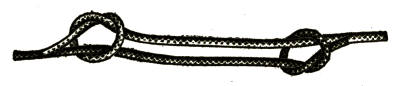
In Fig. 2 is shown the method of knotting
together two strands of gut in tying a leader
or making repairs in one. The two half-hitches
should be pulled perfectly tight and then drawn
together.
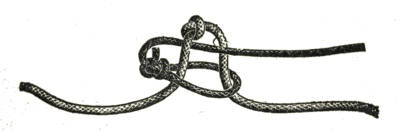
For attaching the leader to the line use the
jam-knot shown in Fig. 3.
If you wish to attach a dropper fly to a dry-fly
leader without loops use the method shown
In Fig. 4, attaching at a point where two strands
are knotted together.
So many intricate details are connected with
the subject of artificial flies, and with dry or
floating flies particularly, that in order to reduce
the discussion of the matter herein to a
not inordinate length many points must of
necessity be merely touched upon.
In later chapters, the efficiency of various
patterns, as well as how and when to use them,
will be discussed; at this point we are concerned
chiefly with the purely material details
of the "floater."
The construction of the dry fly differs considerably
from that of the wet, but as this is a
matter pertaining rather to the art of the fly
dresser the subject need not be considered as
imperatively within the province of the present
discussion. It has previously been noted
that at present the larger part of the dry flies
obtainable in this country are imported from
England. The tendency of the tackle dealers
is to furnish comparatively few of the familiar
American patterns tied dry.
The dry fly is, of course, dressed with the
purpose of causing it to float as well as may be,
and this is effected—although the method of
construction varies to some extent with various
patterns—by dressing the fly with double or
"split" wings tied at right angles to the body
(called "erect" wings) and with the hackling
arranged to stand out well from the shank of
the hook. The body of the fly is dressed very
lightly and in some instances is of cork, straw
or quill.
In the case of some of the latest patterns
horsehair is used for the body material. As a
rule dry flies are dressed upon small hooks,
number twelve and smaller, and the hooks are
of light wire. A list of floating flies which
have been found effective on American trout
streams is given in a later paragraph.
Almost without exception floating flies are
dressed on eyed hooks; that is, without gut
snells whipped to the shank of the hook, following
the time-honored American custom, but
with an eye or ring at the end of the shank by
means of which the fly is attached directly to
the leader. If space permitted the practical
advantages of the eyed hook could very well
be emphasized in detail; at present I can only
urge every fly fisherman to adopt the use of the
eyed fly for either dry or wet fly-fishing. If
for no other reason than that of economy, the
use of the eyed hook justifies itself: the feelings
of the angler, who when looking over and testing
his tackle for the approaching trout season
pulls the snells without difficulty out of an
even two dozen of the old-style trout flies which
have never even been once used, are best left
to the imagination.
Eyed hooks are made in two styles, with
turned-up and turned-down eye; that is, in the
case of the turned-down eye the eye is on the
under side of the hook shank or bent toward
the barb of the hook, the opposite being true
of the other form. Much controversy has
taken place regarding the respective merits of
the two styles of eyed hooks, various authorities
enthusiastically and convincingly championing
either one or the other. It would seem that
each form has its virtues and is quite satisfactory.
Undoubtedly the reader, impartially
experimenting with both styles, will soon discover
which is best—for him. The greater
part of the floating flies which come to this
country are dressed on turned-up eyed hooks.
As to the form of the hook, whether Sproat,
Pennell (turned-down), O'Shaughnessy, Sneck,
and so on, it is a matter in which one cannot exercise
personal choice to any great extent—one
must needs be contented with the flies as he
finds them. Hooks with the Sneck bend are
favored for the smaller patterns; others may
be dressed on any of the above-named hooks.
Unless you are willing, many times, to undergo
great delay in stocking your fly box, you must
sacrifice a personal prejudice toward any particular
form of hook for the sake of obtaining
the pattern you wish in the desired size.
I give below a list of a few floating flies
which I know to be successful under average
angling conditions, and would suggest that in
making your selection of dry flies you obtain
some, at least, of the patterns dressed upon
number ten hooks. The use of the very small
English patterns, tied, as a rule, on number
twelve hooks at the largest, is not at all times
and in all places most advantageous on American
trout streams. The flies named are, as far
as may be, typical; that is, selected with a view
to approximately imitating the general insect
life (consisting largely of water-bred insects)
of any trout stream, so that the angler may as
a general thing find in his list a fairly close
imitation of most of the natural flies, any one
of which may be temporarily abundant on the
water, and upon which there is reason to believe
the fish are feeding.
The list is as follows: Coachman, Cahill,
gold-ribbed hare's ear, Wickham's fancy, brown
sedge, silver sedge, iron blue dun, whirling
blue dun, and olive dun. These should be
dressed upon hooks, numbers twelve and ten.
It is seldom necessary to use smaller than a
number twelve dry-fly, although, of course, occasionally
only the very smallest flies are effective.
To the flies named should be added
the green May female, brown May female,
and spent gnat female, of the new series of
floating flies developed by Mr. F. M. Halford.
Of the above the coachman, Wickham's
fancy, gold-ribbed hare's ear and Cahill are
frankly "fancy" flies, not intended to represent
any particular natural fly. The Wickham's
fancy, coachman and gold-ribbed hare's
ear are wonderfully successful patterns, as a
rule, throughout the entire season, and under
a great variety of angling conditions. The Cahill
is a fly of very delicate coloration and
dressing and is particularly useful over very
low and clear water. The duns, olive, whirling
blue and iron blue are dressed in imitation
of various ephemera in the sub-imago or dun
stage, and when the fish are feeding upon the
natural fly these are apt to prove exceedingly
successful.
The green and brown May fly patterns are
representative of the corresponding Ephemeridæ,
and their usefulness upon streams when
and where the May fly is abundant is sufficiently
obvious. The Caddis flies in the nomenclature
of the dry fly are known as "sedges";
the silver sedge and brown sedge belong to this
class. The spent gnat pattern represents the
female May fly which, having voided her eggs
upon the water, thereafter falls upon the surface
of the stream practically lifeless and with
wings flat and outstretched. The spent gnat,
accordingly, is dressed with horizontal, not
erect, wings.
For carrying eyed-flies various fly-boxes are
furnished by the tackle dealers. The method
of holding the flies is usually by means of a
metal clip, although some boxes have several
small compartments with transparent (celluloid)
covers, and others have cork strips into
which the fly may be fastened. The last sort
is the least satisfactory. As a rule, in the
ordinary form of eyed fly box the metal
clips are set very closely together, and it is
advisable to procure a box capable of holding
at least double the number of flies you intend
to carry, so that they may be inserted without
crushing and be easily distinguished and
removed.
Paraffin oil, or some one of the other similar
waterproofing liquids furnished by the tackle
dealers, is a necessity to the dry-fly caster. A
floating fly, if perfectly dry, will float fairly
well for a number of casts without the use of
paraffin; but it soon becomes drowned and
sodden and very difficult to dry out by merely
false casting. Whatever preparation may be
used (and I have found very little practical difference
in them) it should be carried in a small
bottle having a stopper with brush attached.
Apply the oil to the fly lightly, and remove the
superfluous liquid by pressing the fly between
folds in your handkerchief. It is usually practicable
to prepare a number of flies in this way
before going to the stream, thus obviating the
the necessity of carrying the "oiler."
It would seem unnecessary to consider the
matter of the creel, waders and other general
fly-fishing equipment, as these are familiar to
every fly-fisherman of any experience. However,
for the benefit of the virtual beginner it
may be said that a rather larger basket than
that usually advised to the trout-fisherman
say a creel of twenty-pound size—is preferable
for many reasons. The new style sling, which
suspends the basket from the left shoulder,
should be used.
Waders, of course, are necessary. Whether
wading pants, wading stockings, or ordinary
sporting rubber boots are worn is more or less
a personal matter generally dependent upon the
conditions under which the fishing will be done.
The wading stockings, worn with woolen socks
and hobnailed wading shoes, are as a rule the
most satisfactory equipment. A leader-box in
which extra leaders may be carried between
pads of dampened felt and a landing net are
other requisites.