Lepisosteus osseus (Linnaeus)
Long-nosed Gar
The long-nosed gar was abundant at the lower and middle Neosho
stations and the lower Marais des Cygnes station. Numbers increased
slightly in the period of study, probably because of increased,
continuous flow. The long-nosed gar was not taken at
the upper Neosho station. At lower stations the fish occurred in
many habitats, but most commonly in pools where gar often were
seen with their snouts protruding above the water in midstream.
Gar commonly lie quietly near the surface, both by day and by
night, and are therefore readily collected by means of the shocker.
Twice, at night, gar jumped into the boat after being shocked.
Young-of-the-year were taken at the middle and lower stations
on both the Neosho and Marais des Cygnes rivers, and all were near
shore in quiet water. Many young-of-the-year were seined at the
lower Neosho station on 18 June 1959, near the lower end of a
gravel-bar in a small backwater-area having a depth of one to three
inches, a muddy bottom, and a higher temperature than the mainstream.
Forty-three of these young gar averaged 2.1 inches in total
length (T.L.).
Comparison of sizes of long-nosed gar taken by means of the
shocker and gill nets at the lower and middle Neosho stations revealed
that: the average size at each station remained constant
from 1957 to 1959; the average size was greater at the lower than at
the middle station; and, with the exception of young-of-the-year,
no individual shorter than 13 inches was found at the middle station
and only one shorter than 16 inches was taken at the lower
station (Table 5).
| Location | Date | Number | Average total
length (inches) | Range |
|---|
| Middle Neosho | 1957 | 19 | 22.2 | 14-32 |
| Middle Neosho | 1958 | 57 | 22.2 | 14-40 |
| Middle Neosho | 1959 | 64 | 21.6 | 13-43 |
| Lower Neosho | 1957 | 14 | 29.4 | 9-45 |
| Lower Neosho | 1958 | 7 | 25.3 | 23-28 |
| Lower Neosho | 1959 | 107 | 26.2 | 16-43 |
Because collecting was intensive and several methods were used,
I think that the population of gars was sampled adequately. Wallen
(Fishes of the Verdigris River in Oklahoma, 1958:29 [mimeographed
copy of dissertation, Oklahoma State University]) took
large individuals in the mainstream of the Verdigris River in Oklahoma
and small specimens from the headwaters of some tributaries.
Because I took young-of-the-year at the lower Neosho station,
it is possible that long-nosed gar move upstream when small
and then slowly downstream to the larger parts of rivers as the fish
increase in size. This pattern of size-segregation, according to size
of river, merits further investigation.
Ripe, spent, and immature long-nosed gar (38 males and 10 females)
were taken in three gill nets, set across the channel, 150
to 500 yards below a riffle, at the lower Neosho station on June 16,
17, and 18, 1959. On 23 June, 1959, 12 males and two females were
taken in gill nets set 50, 150, and 400 yards above the same riffle.
Operations with the shocker between 24 June and 10 July, 1959,
yielded 29 males and three females. The fish were taken from
many kinds of habitat in a three-mile section of the river.
Direction of movement as recorded from gill nets shows that of
67 gar taken, 45 had moved downstream and 22 upstream into the
nets. Only ten of the above gar were taken from the nets set above
the riffle; six of the ten were captured as they moved downstream
into the nets.
On one occasion I watched minnows swimming frantically about,
jumping out of the water, and crowding against the shore, presumably
to avoid a long-nosed gar that swam slowly in and out of
view. I have observed similar activity when gar fed in aquaria.
Stomachs of a few gar from the Neosho River were examined and
found to contain minnows and some channel catfish.
Long-nosed gar have a relatively long life span (Breder, 1936).
This longevity and their ability to gulp air probably insure excellent
survival through periods of adverse conditions. The population of
long-nosed gar probably would not be drastically affected even in
the event of a nearly complete failure of one or two successive
hatches. Maturity is attained at approximately 20 inches, total
length.
Collections at the middle Neosho station in 1958 indicate that
the long-nosed gar is more susceptible to capture at night than in
daytime (Table 9, p. 402).
Lepisosteus platostomus Rafinesque
Short-nosed Gar
Only one short-nosed gar was taken in 1957, at the lower station
on the Neosho River. In 1958 this species was taken at the lower
station on the Marais des Cygnes and in 1958 and 1959 at the lower
and middle stations on the Neosho. More common in the Neosho
than the Marais des Cygnes, L. platostomus occurs mainly in large
streams and never was taken in the upper portions of either river.
Although short-nosed gar were about equally abundant at the
middle and lower stations on the Neosho, the average size was
greater at the lower station (Table 6). This kind of segregation
by size is shared with long-nosed gar, and was considered in the
discussion of that species. Short-nosed gar were taken only in quiet
water. Both species were collected most efficiently by means of gill
nets and shocker. While shocking, I saw many gar only momentarily,
as they appeared at the surface, and specific identification
was impossible. The total of all gar seen while shocking indicated
that gar increased in abundance from 1957 to 1959 (see Tables 5
and 6). Judging from the gar that were identified, the increase
was more pronounced in short-nosed gar than in long-nosed gar.
At the lower Neosho station in 1959, two ripe females and one
spent female were taken in gill nets (16, 23 and 17 June, respectively)
and were moving downstream when caught. No males
were taken in the nets. Subsequently, by means of the shocker
(26 June-8 July), two spent and two ripe males were captured
in quiet water of the mainstream that closely resembled areas in
which the gill nets were set. No females were taken by means
of the shocker.
| Location | Date | Number | Average total
length (inches) | Range |
|---|
| Middle Neosho | 1958 | 6 | 14.9 | 13.9-15.5 |
| Middle Neosho | 1959 | 9 | 13.6 | 11.0-16.0 |
| Lower Neosho | 1958 | 3 | 21.0 | 20.3-21.6 |
| Lower Neosho | 1959 | 5 | 21.3 | 18.0-24.5 |
Dorosoma cepedianum (LeSueur)
Gizzard Shad
Gizzard shad declined in abundance from 1957 to 1959. The
largest population occurred at the middle station on the Marais des
Cygnes in 1957. Shad were mainly in quiet water; often, when the
river-level was high, I found them predominately in backwaters
or in the mouths of tributary streams. Examination of nine individuals,
ranging in size from seven inches to 13.5 inches T. L., indicated
that maturity is reached at 10 to 11 inches T. L. Spawning
probably occurred in late June in 1959 ("ripe" female caught on
26 June); young-of-the-year were first recorded in mid-July.
Cycleptus elongatus (LeSueur)
Blue Sucker
The blue sucker was taken rarely in the Neosho River and not at
all in the Marais des Cygnes in my study. Cross (personal communication)
obtained several blue suckers in collections made in
the mainstream of the Neosho River in 1952; both young and adults
occupied swift, deep riffles. The species seemingly declined in
abundance during the drought, and at the conclusion of my study
(1959) had not regained the level of abundance found in 1952.
Ictiobus cyprinella (Valenciennes)
Big-mouthed Buffalo
Big-mouthed buffalo were found in quiet water at all stations,
but were rare. A ripe female, 21.5 inches long, was taken at the
lower station on the Neosho on 16 June, 1959.
Ictiobus niger (Rafinesque)
Black Buffalo
and
Ictiobus bubalus (Rafinesque)
Small-mouthed Buffalo
Black buffalo were not taken at the upper station on the Neosho
and were rare at other stations. Small-mouthed buffalo were taken
at all stations and were common in the lower portions of the two
streams. While the shocker was being used, buffalo were often
seen only momentarily, thereby making specific identification impossible;
both species were frequently taken together, and for this
reason are discussed as a unit. Both species maintained about
the same level of abundance throughout my study.
The two species were taken most often in the deeper, swifter
currents of the mainstream, but were sometimes found in pools,
creek-mouths and backwaters. On several occasions in the summer
of 1959, buffalo were seen in shallow parts of long, rubble riffles,
with the dorsal or caudal fins protruding above the surface. Ernest
Craig, game protector, said buffalo on such riffles formerly provided
much sport for gig-fishermen. He stated that the best catches
were made at night because the fish were less "spooky" then than
in daytime. In my collections made by use of the shocker, buffalo
were taken more frequently at night (Table 9, p. 402).
On 19 June, 1959, I saw many buffalo that seemed to be feeding
as they moved slowly upstream along the bottom of a riffle. The
two species, often side by side, were readily distinguishable underwater.
Small-mouthed buffalo appeared to be paler (slate gray)
and more compressed than the darker black buffalo. To test the
reliability of underwater identifications, I identified all individuals
prior to collection with a gig. Correct identification was made
of all fish collected on 19 June. The smallest individual obtained
in this manner was 18.5 inches T. L. On 26 August, 1959, 16 small-mouthed
buffalo were captured and many more were seen while
the shocker was in use in the same riffle for one hour and ten minutes.
One small-mouthed buffalo was caught while the shocker
was being used in the pool below that riffle for one hour and
fifty minutes. No black buffalo were taken on 26 August.
Spawning by buffalo was not observed but probably occurred
in spring; all mature fish in my earliest collections (mid-June of
each year) were spent. Small-mouthed buffalo reach maturity at
approximately 14 inches T. L.
Carpiodes carpio carpio (Rafinesque)
River Carpsucker
River carpsucker were abundant throughout the study at all
stations. Adults were taken most frequently in quiet water, but
depth and bottom-type varied. The greatest concentrations occurred
in mouths of creeks during times of high water; occasionally,
large numbers were taken in a shallow backwater near the head of
a riffle at the middle Neosho station. River carpsucker feed on
the bottom but seem partly pelagic in habit. They were taken readily
by means of the shocker and gill nets at all depths. The population
of C. carpio in the Neosho River probably was depleted by
drought, although many individuals survived in the larger pools.
When stream-flow was restored, carpsucker probably moved rapidly
upstream but had a scattered distribution in 1957. Trautman
(1957:239) states that in the Scioto River, Ohio, river carpsucker
moved upstream in May and downstream in late August and early
September. Numbers found at the middle and lower Neosho stations
suggest similar movements in the Neosho River in 1957. In
midsummer they were common at the middle station but rare at
the lower station; however, they became abundant at the lower
station in November. The abundance in late fall at the lower
Neosho station might have resulted either from downstream migration
or from continued upstream movement into thinly populated
areas. No indication of seasonal movement was found in 1958 or
1959.
River carpsucker reach maturity at approximately 11 inches T. L.,
and spawning occurs in May or June. A ripe male was taken from
a gravel-bottomed riffle, three
feet deep, at the middle station
on the Neosho station on 10 June
1959.
Fig. 2. Length-frequency of river
carpsucker in the Neosho River, 1958 and 1959.
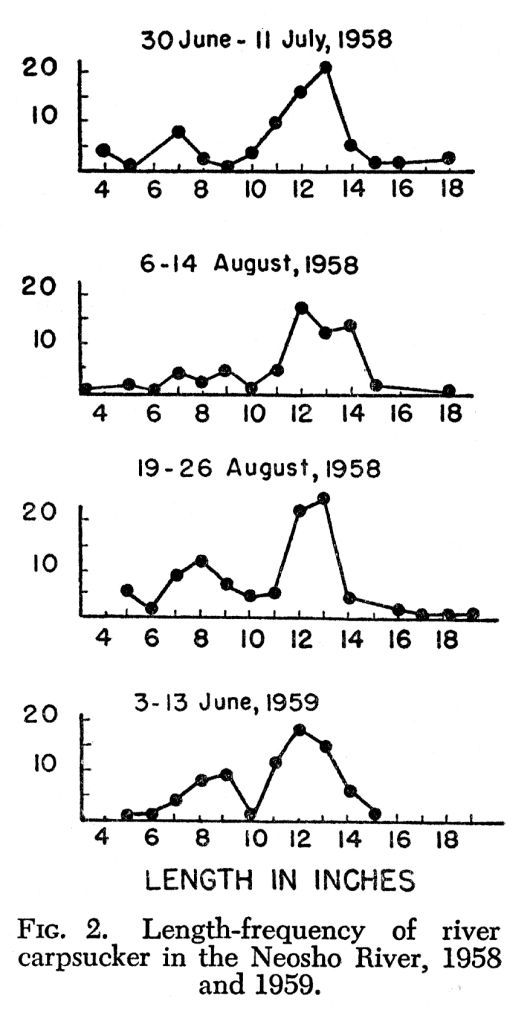
The size-distribution of individuals
taken at the middle Neosho
station is presented in Fig.
2. The collection in early July
of 1958 indicates that one size-group
(probably the 1957 year-class)
had a median length of
approximately seven inches. The
modal length of this group was
nine inches in June, 1959. A
second, predominant size-group
(Fig. 2) seemed to maintain almost
the same median size
throughout all the collection periods,
although specimens taken
in the spring of 1959 were
slightly smaller than those obtained
in 1958. This apparent
stability in size may have been
due to an influx of the faster-growing
individuals from a
smaller size-group, coupled with mortality of most individuals more
than 14 inches in length.
Young-of-the-year were taken at every station. Extensive seining
along a gravel bar at the lower Neosho station indicated that the
young are highly selective for quiet, shallow water with mud bottom.
In these areas, young-of-the-year carpsucker were often
the most abundant fish.
River carpsucker were collected more readily by use of the
shocker after dark than in daylight (Table 9, p. 402).
Carpiodes velifer (Rafinesque)
High-finned Carpsucker
A specimen of Carpiodes velifer taken at the lower station on the
Neosho in 1958 provided the only record of the species in Kansas
since 1924. Many specimens, now in the University of Kansas
Museum of Natural History, were taken from the Neosho River
system by personnel of the State Biological Survey prior to 1912.
The species has declined greatly in abundance in the past 50 years.
Moxostoma aureolum pisolabrum Trautman
Short-headed Redhorse
The short-headed redhorse occurred at all stations. It was
common at the middle and lower stations on the Neosho, rare at
the upper station on the Neosho, abundant at the upper station on
the Marais des Cygnes in 1957, and rare thereafter at all stations
on the Marais des Cygnes. Short-headed redhorse typically occur
in riffles, most commonly at the uppermost end where the water
flows swiftly and is about two feet deep. An unusually large concentration
was seen on 13 June, 1959, in shallow (six inches), fast
water over gravel bottom at the middle station on the Neosho River.
Thirty-nine individuals were marked by clipping fins at the
middle Neosho station in 1959. Four were recovered from one to
48 days later: two at the site of original capture (one 48 days
after marking), one less than one-half mile downstream, and one
about one mile downstream from the original site of capture.
At the middle Neosho station in 1958, this species was taken more
readily by use of the shocker at night than by day (Table 9, p. 402).
Moxostoma erythrurum (Rafinesque)
Golden Redhorse
The golden redhorse was abundant at the upper Neosho station,
rare at the middle Neosho station, and did not occur in collections
at other stations. This species was taken most frequently over
gravel- or rubble-bottoms in small pools below riffles, and was
especially susceptible to collection by means of the shocker.
Twenty-nine golden redhorse of the 1957 year-class, taken at
the upper Neosho station on 9 September 1958, were 6.2 to 8.6
inches in total length (average 7.4 inches); 26 individuals of the
same year-class caught on 21 August 1959 were 9.3 to 13.5 inches in
total length (average 10.9 inches).
Cyprinus carpio Linnaeus
Carp
The carp decreased in abundance from 1957 to 1959 at the upper
and middle Marais des Cygnes station and at the middle and lower
Neosho stations. Carp were more abundant in the Marais des
Cygnes than in the Neosho, although the largest number in any
single collection was found in one pool at the upper Neosho station
in 1958.
Carp were taken most commonly in quiet water near brush or
other cover. At the middle Neosho station, collecting was most
effective between the hours of 6:30 a.m. and 12:30 p.m. and
least effective between 12:30 p.m. and 6:30 p.m. (Table 9, p. 402).
Ripe males were taken as early as 19 April (16.1 inches, 19.4 inches
T. L.) and as late as 30 July (16 inches T. L.) at the middle Neosho
station. Ripe females were taken as early as 19 April at the middle
Neosho station (19.2 inches T. L.) and as late as 7 July at the
lower Neosho station (16 inches T. L.). Young-of-the-year were
taken first at the middle Marais des Cygnes on 8 July 1957. They
were recorded on later dates at the upper Marais des Cygnes and
at the lower and middle Neosho stations.
Notemigonus crysoleucas (Mitchill)
Golden Shiner
The golden shiner was taken rarely at the upper Marais des
Cygnes station in 1958 and 1959 and at the middle Marais des
Cygnes station in 1957 and 1958. At the middle Neosho station
Notemigonus was seined from a pond that is flooded frequently
by the river, but never was taken in the mainstream.
Semotilus atromaculatus (Mitchill)
Creek Chub
The creek chub was taken only at the upper stations on both
rivers. It increased in abundance at the upper Neosho station from
1957 to 1959, and was not taken in the upper Marais des Cygnes
until 1959.
Hybopsis storeriana (Kirtland)
Silver Chub
A single specimen from the lower Marais des Cygnes station
provides the only record of the species from the Marais des Cygnes
system in Kansas, and is the only silver chub that I found in either
river in 1957-1959. The species is taken often in the Kansas and
Arkansas rivers.
Hybopsis x-punctata Hubbs and Crowe
Gravel Chub
The gravel chub, present only at the lower and middle Neosho
stations, occupied moderate currents over clean (free of silt) gravel
bottom. The gravel chub was not taken in 1957, was rare at both
Neosho stations in 1958, became common at the lower Neosho
station in part of 1959, but was never numerous at the middle
Neosho station. Dr. F. B. Cross recorded the species as "rare"
in 1952 at a collection site near my middle Neosho station, but larger
numbers were taken then than in any of my collections at that
station. The population was probably reduced by drought, and
recovery was comparatively slow following restoration of flow.
Young-of-the-year and adults were common in collections from
riffles at the lower Neosho station from 1 July through 8 July, 1959.
I obtained only one specimen in intensive collections in the same
area on 25, 26, and 27 August. Seemingly the species had moved
off shallow riffles into areas not sampled effectively by seining.
Phenacobius mirabilis (Girard)
Sucker-mouthed Minnow
The sucker-mouthed minnow was common at the middle Marais
des Cygnes station but was not taken at the upper and lower stations
until 1959, when it was rare. At the middle and lower Neosho
stations this fish increased in abundance from 1957 to 1959; at the
upper station, sucker-mouthed minnows were not taken until 1959
when collections were made on the White farm. There, the species
was common immediately below a low-head dam, but was not
taken in extensive collections on the Bosch Farm in 1959.
The species was most common immediately below riffles, or in
other areas having clean gravel bottom in the current. On 5 June,
1959, many individuals were taken at night (11:30 p.m.) on a
shallow gravel riffle (four inches in depth) where none had been
found in a collection at 5:00 p.m. on the same date.
Young-of-the-year were taken at the lower Neosho station on 24
June, 1959, and commonly thereafter in the summer.
Notropis rubellus (Agassiz)
Rosy-faced Shiner
In 1958, the rosy-faced shiner was taken rarely at the lower stations
on both streams. This species is common in smaller streams
tributary to the lower portions of the two rivers, and probably
occurs in the mainstream only as "overflow" from tributaries. Possibly,
during drought, rosy-faced shiners found suitable habitat in
the mainstream of Neosho and Marais des Cygnes rivers, but re-occupied
tributary streams as their flow increased with favorable
precipitation, leaving diminishing populations in the mainstream.
Notropis umbratilis (Girard)
Red-finned Shiner
The red-finned shiner, most abundant at the upper Neosho station,
occurred at all stations except the upper Marais des Cygnes.
This fish seems to prefer small streams, not highly turbid, having
clean, hard bottoms. It is a pool-dwelling, pelagic species.
Notropis camurus (Jordan and Meek)
Blunt-faced Shiner
The blunt-faced shiner was taken only in 1957, at the middle
Neosho station, where it was rare. This species, abundant in clear
streams tributary to the Neosho River (field data, State Biological
Survey) may have used the mainstream as a refugium during
drought. The few specimens obtained in 1957 possibly represent a
relict population that remained in the mainstream after flow in
tributaries was restored by increased rainfall.
Notropis lutrensis (Baird and Girard)
Red Shiner
The red shiner, abundant in 1952 (early stage of drought), was
consistently the most abundant fish in my collections in the Marais
des Cygnes and at the lower and middle Neosho stations. However,
the abundance declined from 1957 to 1959 at the two Neosho
stations. At the upper Neosho station the species was fourth in
abundance in 1957, and third in 1958 and 1959 (Table 12).
The red shiner is pelagic in habit and occurs primarily in pools,
though it frequently inhabits adjacent riffles. Collections by seining
along a gravel bar at the lower station showed this fish to be most
abundant in shallow, quiet water over mud bottom, or at the head
of a gravel bar in relatively quiet water. At the lower end of the
gravel bar in water one to four feet deep, with a shallow layer of silt
over gravel bottom and a slight eddy-current, red shiners were
replaced by ghost shiners or river carpsucker young-of-the-year as
the dominant fish.
Fifty-nine dyed individuals were released in an eddy at the lower
end of a gravel bar at the middle Neosho station on 5 June, 1959.
Some of these fish still were present in this area when a collection
was made 30 hours later. No colored fish were taken in collections
from quiet water at the upper end of the gravel bar. A swift riffle
intervening between the latter area and the area of release may
have impeded their movement. Forty-six individuals, released at
the head of the same gravel bar on 10 June, 1959, immediately
swam slowly upstream through quiet water and were soon joined
by other minnows. These fish did not form a well-organized school,
but moved about independently, with individuals or groups variously
dropping out or rejoining the aggregation until all colored
fish disappeared about 50 feet upstream from the point of release.
Evidence of inshore movement at night was obtained on 8 June,
1959, in a shallow backwater, having gravel bottom, at the head
of a gravel bar at the middle Neosho station. A collection made in
the afternoon contained no red shiners, but they were abundant
in the same area after dark.
In Kansas, red shiners breed in May, June, and July. Minckley
(1959:421-422) described behavior that apparently was associated
with spawning. Because of its abundance, the red shiner is one
of the most important forage fishes in Kansas streams, and frequently
is used as a bait minnow.
Notropis volucellus (Cope)
Mimic Shiner
The mimic shiner was taken only rarely at the two lower Neosho
stations. This species, like N. camurus, is normally more common
in clear tributaries than in the Neosho River, and probably frequents
the mainstream only during drought.
Notropis buchanani Meek
Ghost Shiner
Field records of the State Biological Survey indicate that the
ghost shiner was common in the mainstream of the lower Neosho
River during drought. In 1957, the species was abundant at the
lower and middle stations on the Neosho River and at the lower
Marais des Cygnes station.
Collections at all stations show that the species has a definite
preference for eddies—relatively quiet water, but adjacent to the
strong current of the mainstream rather than in backwater remote
from the channel. The bottom-type over which the ghost shiner
was found varied from mud to gravel or rubble.
Notropis stramineus (Cope)
Sand Shiner
The sand shiner was taken rarely in the Neosho and commonly
in the Marais des Cygnes in 1952. In my study the species occurred
at all stations, but not until 1959 at the upper and lower Neosho
stations. Sand shiners were found with equal frequency in pools
and riffles. Spawning takes place in June and July.
Pimephales tenellus tenellus (Girard)
Mountain Minnow
The mountain minnow was common at the lower and middle
Neosho stations throughout the period of study, and increased
in abundance from 1957 to 1959. It was taken only in 1959 at the
upper Neosho station, where it was rare. This species does not
occur in the Marais des Cygnes River. The largest numbers were
found in 1959 at the lower Neosho station, where this fish occurred
most commonly in moderate current over clean gravel bottom.
The mountain minnow, like Hybopsis x-punctata, was common in
late June and early July but few were found in late August, 1959.
The near-absence of this species in collections made in late August is
responsible for the apparent slight decline in abundance from 1957
to 1959, as shown in Table 11. Metcalf (1959) found mountain
minnows most commonly in streams of intermediate size in Chautauqua,
Cowley and Elk counties, Kansas. The predilection of this
species for permanent waters resulted in an increase in abundance
during my study. With continued flow, this species possibly will
decrease in abundance in the lower mainstream of the Neosho
River. I suspect that the species is, or will be (with continued
stream-flow), abundant in tributaries of intermediate size in the
Neosho River Basin.
Pimephales vigilax perspicuus (Girard)
Parrot Minnow
The parrot minnow was not taken in the Marais des Cygnes
River and was absent at the upper Neosho station until 1959.
This species was common at the lower and middle Neosho stations
throughout the period of study and increased in abundance from
1957 to 1959.
At the lower Neosho station, this fish preferred slow eddy-current
over silt bottom, along the downstream portion of a gravel bar.
The parrot minnow was taken less abundantly in the latter part
of the summer, 1959, than in early summer, but the decline was
less than occurred in the mountain minnow.
Pimephales notatus (Rafinesque)
Blunt-nosed Minnow
The blunt-nosed minnow was common, and increased in abundance
in both rivers from 1957 to 1959. The largest numbers were
found at the upper Neosho station in 1959, and a large population
also was present at the lower Neosho station in 1959.
Pools having rubble bottom, bedrock, and small areas of mud
were preferred at the upper Neosho station. At the lower Neosho
station the fish was most common in quiet water at the lower end
of a gravel bar. The parrot minnow also was common in this
general area; nevertheless, these two species were seldom numerous
in the same seine-haul, indicating segregation of the two. The
blunt-nosed minnow was taken frequently in moderate current over
clean gravel bottom, especially in late summer, 1959, when P. notatus
increased in abundance as the mountain minnow decreased.
Pimephales promelas Rafinesque
Fat-headed Minnow
The fat-headed minnow was taken at all stations except at the
lower one on the Marais des Cygnes, and was most abundant at
the upper Neosho station. Intensive seining at the lower Neosho
station indicated that this species preferred quiet water and firm
mud bottom.
In the Neosho River in 1957 to 1959, habitats of the species of
Pimephales seemed to be as follows: Pimephales tenellus (mountain
minnow) occurred primarily in moderately flowing gravel
riffles in the downstream portions of the river. Pimephales vigilax
(parrot minnow) was mostly in the quiet areas having mud bottom
at the downstream end of gravel bars, and less commonly on adjacent
riffles, at the lower station. Pimephales notatus (blunt-nosed
minnow) had a wider range of habitats, occurring in quiet areas
and moderate currents both upstream and downstream. Pimephales
promelas (fat-headed minnow) occurred throughout both rivers
but was most abundant in the quiet water at the uppermost stations.
Campostoma anomalum (Rafinesque)
Stoneroller
The stoneroller was most abundant at the upper Neosho station
and was not taken at the lower Marais des Cygnes station. This
fish increased in abundance from 1957 to 1959, but was never
common at the middle Marais des Cygnes or the middle and lower
Neosho stations.
The stoneroller prefers fast, relatively clear water over rubble
or gravel-bottom.
Ictalurus punctatus (Rafinesque)
Channel Catfish
The abundance of channel catfish was greatly reduced as a result
of the drought of 1952-1956. With the resumption of normal stream-flow
in 1957, the small numbers of adult channel catfish present in
the stream produced unusually large numbers of young. These
young of the 1957 year-class, which reached an average size of
about nine inches by September 1959, will provide an abundant
adult population for several years.
The reduction in number of channel catfish in streams can be
related to the changed environment in the drought. When stream
levels were low in 1953 (Tables 1-4), fish-populations were crowded
into a greatly reduced area. An example of these crowded conditions
was observed by Roy Schoonover, Biologist of the Kansas
Forestry, Fish and Game Commission, in October, 1953, when he
was called to rescue fish near Iola, Kansas. The Neosho River
had ceased to flow and a pool (less than one acre) below the city
overflow dam was pumped dry. Schoonover (personal communication)
estimated that 40,000 fish of all kinds were present in the
pool. About 30,000 of these were channel catfish, two inches to
14 inches long, with a few larger ones. Fish were removed in the
belief that sustained intermittency in the winter of 1953-1954
would result in severe winterkill. These conditions almost certainly
were prevalent throughout the basin.
In addition to winterkill, crowding probably resulted in a reduced
rate of reproduction by channel catfish, and by other species
as well. This kind of density-dependent reduction of fecundity is
known for many species of animals (Lack, 1954, ch. 7). In fish, it
is probably expressed by complete failure of many individuals to
spawn, coupled with scant survival of young produced by the adults
that do spawn. Reproductive failure of channel catfish in farm
ponds, especially in clear ponds, is well known, and is often attributed
to a paucity of suitable nest-sites (Marzolf, 1957:22; Davis,
1959:10).
In the Neosho and Marais des Cygnes rivers, the intermittent
conditions prevalent in the drought resulted in reduced turbidity
in the remaining pools. Many spawning sites normally used by
channel catfish were exposed, and others were rendered unsuitable
because of the increased clarity of the water. In addition, predation
on young channel catfish is increased in clear water (Marzolf;
Davis, loc. cit.), and would of course be especially pronounced in
crowded conditions. The population was thereby reduced to correspond
to the carrying capacity of each pool in the stream bed.
The return of normal flow in 1957 left large areas unoccupied
by fish and the processes described above were reversed. The
expanded habitat favored spawning by nearly the entire adult
population, and conditions for survival of young were excellent.
As a result, a large hatch occurred in the summer of 1957. (Several
hundred small channel catfish were sometimes taken by use of the
shocker a short distance upstream from a 25-foot seine, set in a
riffle). Subsequent survival of the 1957 year-class has been good.
By 1959, few of the catfish spawned in 1957 had grown large enough
to contribute to the sport fishery, but they are expected to do so in
1960 and 1961.
The 1957 year-class was probably the first strong year-class of
channel catfish since 1952. Davis (1959:15) found that channel
catfish in Kansas seldom live longer than seven years. The 1952
year-class reached age seven in 1959. The extreme environmental
conditions to which these fish were subjected in drought caused a
higher mortality than would occur in normal times. The adult
population in the two rivers probably was progressively reduced
throughout the drought, and the reduction will continue until the
strong 1957 year-class replenishes it. For these reasons, fishing
success was poor in 1957-1959.
Juvenile channel catfish were more abundant in the Neosho than
in the Marais des Cygnes in 1958 and 1959, although both streams
supported sizable populations. In the Marais des Cygnes the upper
station had fewer channel catfish than the middle and lower stations.
In the Neosho, populations were equally abundant both upstream
and downstream. The habitat of channel catfish in streams
has been discussed by Bailey and Harrison (1948).
I found adults in various habitats throughout the stream, but
most abundantly in moderately fast water at the lower and middle
Neosho stations. At the upper Neosho station where riffles are
shallow, yearlings and two-year-olds were numerous in many of
the small pools over rubble-gravel bottom. Cover was utilized
where present, but large numbers were taken in pools devoid of
cover. Young-of-the-year were nearly always taken from rubble- or
gravel-riffles having moderate to fast current at both upstream
and downstream stations.
Collections showed that young of 1957 were abundant on riffles
throughout the summer and until 17 November, 1957. Subsequent
collections were not made until 11 May, 1958, at which time 1957-class
fish still were abundant on riffles at the lower Neosho station;
on that date, the larger individuals were in deeper parts of the
riffles than were smaller representatives of the same year-class.
In a later collection (2 June, 1958), numbers present on the
riffles were greatly reduced and the larger individuals were almost
entirely missing. Some of the smaller individuals were still present
in the shallower riffle areas. Table 7 compares sizes of the individuals
obtained on 2 June with sizes collected from deep riffles
at the middle Neosho station on 7 June, 1958. The larger size of
the group present in deep riffles is readily apparent. The yearlings
almost completely disappeared from subsequent collections on
riffles.
A bimodal size-distribution of young-of-the-year was noted also
in 1958 and 1959; but, no segregation of the two sizes occurred
on riffles in summer. Marzolf (1957:25) recorded two peaks in
spawning activity in Missouri ponds. Two spawning periods may
account for the bimodal size distribution of young-of-the-year
observed in my study.
In 1959, young-of-the-year began to appear in the latter part of
June and became abundant by the first part of July. Individuals
as small as one inch T. L. were taken in gravel-bottomed riffles
on 1 July, 1959.
Yearling individuals at the lower and middle Neosho stations
showed a pronounced tendency to move into shallow, moderately
fast water over rubble or gravel bottom at night, where they were
nearly ten times more abundant than in daytime (Table 9). Adults
probably have the same pattern of daily movement as yearlings,
except that at night the adults move to deeper riffles. Bailey and
Harrison (1948:135-136) demonstrated that channel catfish feed
most actively from sundown to midnight.
Channel catfish (especially two-year-olds and adults) were abundant
on a rubble-riffle during the day in some collections at the
lower Neosho station in 1959.
Length
in inches | Nov. 2 1957 | June 2 1958
(shallow riffle) | June 7 1958
(deep riffle) | Sept. 9 1958 | Sept. 11 1959 |
|---|
| 1.5 | | | | 1 |
| 2.0 | 3 |
| 2.5 | 13 | 2 | | 1 | 2 |
| 3.0 | 4 | 11 | | 3 | 4 |
| 3.5 | 3 | 21 | 7 | 1 | 14 |
| 4.0 | | 11 | 12 | | 9 |
| 4.5 | | 4 | 10 | 1 |
| 5.0 | | 2 | 11 | 2 |
| 5.5 | | 1 | 7 | 26 |
| 6.0 | | | | 58 | 2 |
| 6.5 | | | 1 | 32 | 5 |
| 7.0 | | | | 16 | 5 |
| 7.5 | | | 1 | 4 | 5 |
| 8.0 | | | | | 22 |
| 8.5 | | | | | 45 |
| 9.0 | | | | | 81 |
| 9.5 | | | | | 41 |
| 10.0 | | | | | 21 |
| 10.5 | | | | | 8 |
| 11.0 | | | | | 4 |
| 11.5 | | | | | 1 |
| 12.0 | | | | | 3 |
| 12.5 | | | | | 1 |
| 13.0 | | | | | 1 |
Near the end of the spawning season in 1959, I found spawning
catfish at the lower Neosho station. Ripe females were taken between
9 June and 30 June, 1959; and, on 19 June I found a channel
catfish nest with eggs (water temp. 79° F.). The nest-site was a
hole in the base of a clay bank; the floor was clean gravel with a
small mound of gravel at the entrance. The nest-opening, five to
six inches in diameter, widened almost immediately into a chamber
about two and one-half feet long and one foot wide. Normally
the water was about six inches deep in the mainstream as it ran
over a riffle adjacent to the catfish nest. When I put my hand into
the opening the fish bit vigorously, but became quiescent when
I stroked its belly. I then felt the rounded gelatinous mass of eggs
on the bottom of the nest. On June 22 (water temp. 86° F.) the
fish was removed, struggling, from the nest, and returned to the
stream. The next day (23 June 1959, water temp. 84° F.) the eggs
had hatched and the young were in a swarm in the nest. The
adult did not attempt to bite but left as soon as I put my hand into
the hole.
Marzolf (1957:25) reports that young remain in the nest from
seven to eight days after hatching. My seining records show a
marked increase in abundance of small young-of-the-year on the
first of July. Probably the time of hatching of the nest described
above correlated well with hatches of other nests.
One and sometimes two channel catfish were found in other
holes in the stream-bank or bottom. The fish occasionally attacked
my hand vigorously, but at other times remained quiet or left without
attacking. No other channel catfish eggs were found, although
one hole under a rock in the middle of the river had one or two
individuals in it each time it was checked until 11 July, 1959. A
local fisherman informed me of his belief that these holes are occupied
only in the spawning season.
Observations that I made in a pond owned by Dr. E. C. Bryan
of Erie indicated that channel catfish, when disturbed in the early
stages of guarding the eggs, either eat the eggs and abandon the
nest or leave the nest exposed to predation by other animals. In
the later stages of nesting, the fish, if removed, will return to guard
the nest. After the eggs hatch the guarding response probably
diminishes and the fish leaves the nest readily.
At the lower Neosho station, several "artificial" holes were dug
into the clay bank and two pieces of six-inch pipe were forced into
the bank. Nearly all these holes were occupied by catfish for a
short period in June; many of the holes were enlarged, either by
the current or by fish. I suspect that fish enlarged some holes, because
in the spawning season several males were observed that had
large abrasions atop their heads, around their lips, and to a lesser
extent on their sides. These could have been caused by butting
and scraping the sides, roof and floor of a hole. I found it possible
to enlarge the holes by rapidly moving my hand while it was inside
a hole.
The growth-rate of channel catfish in the Neosho was approximately
the same at all stations, and the large 1957 year-class grew
to an average size of about nine inches by mid-September, 1959
(Table 7). Channel catfish mature at a total length of 12 to 15
inches. Thus, most individuals of the 1957 year-class in the Neosho
River probably will mature in their fourth or fifth summer (1960
or 1961 spawning season).
The sizes attained by young-of-the-year in 1957 differed in the
two rivers. Six hundred and thirty-three young taken in the Marais
des Cygnes River attained an average size of 4.7 inches (range
two to six inches) by mid-September. (Age was determined by
length-frequency and verified by examining cross-sections of fin-spines
from the larger individuals). One hundred and fifty young
from the Neosho River averaged 3.0 inches (range 2 to 3.7 inches)
on 2 November. Gross examination of the riffle-insect faunas indicated
a larger standing crop in the Neosho than in the Marais des
Cygnes River. Thus, the slower growth of young channel catfish
in the Neosho seemed not to be correlated with food supply. Bailey
and Harrison (1948:125-130) found that young channel catfish in
the Des Moines River, Iowa, fed almost exclusively on aquatic
insect larvae. My observations indicate that this is true in the
Neosho and Marais des Cygnes rivers also.
Young produced in 1958 in the Neosho River attained an average
total length of three inches by 26 August, and young produced in
1959 attained an average size of 3.5 inches by 11 September. Both
groups probably continued growth until October, and may have
averaged four inches total length at that time.
The 1958 and 1959 year-classes were much less abundant than
were the 1957 young. Therefore, it seems likely that the growth
of the 1957 young in the Neosho River was depressed because of
crowding. The 1959 year-class was larger than the small 1958
year-class, thus conforming to a general expectation that strong
year-classes will be followed by weak year-classes.
Reproduction by channel catfish in 1957 seemed greater in the
Neosho River than in the Marais des Cygnes River (Table 10); this
coincided with a greater change in volume of flow in the Neosho
River than in the Marais des Cygnes River (Tables 1-4). The
1957 year-class seemed more crowded, and grew more slowly, in the
Neosho than in the Marais des Cygnes River.
Ictalurus natalis (LeSueur)
Yellow Bullhead
Yellow bullhead were taken only at the middle station on the
Marais des Cygnes and upper station on the Neosho. The yellow
bullhead is more restricted to streams than is the black bullhead.
Both species decreased in abundance during a period of continuous
flow (1957 to 1959) following drought at the upper Neosho station.
Collections in 1958-'59 indicated an increase in average size.
Of four individuals marked and released at the upper Neosho station
in 1959, one was recaptured about three hours after being released.
It had not moved from the area of release.
Ictalurus melas (Rafinesque)
Black Bullhead
The black bullhead was abundant at the upper stations on each
river, especially in backwaters having mud-bottom. The species
was not taken in the mainstream of the lower and middle Neosho
stations, but was taken at the middle Neosho station in a pond
that is often flooded by the river. Although the fish was common
or abundant in nearly all pools at the upper Neosho station, it was
most abundant in one pool that had a bottom predominately of mud.
At the middle Marais des Cygnes station, 109 individuals were
collected and fin-clipped on 8, 9 and 24 July 1957. Three of the
19 marked on 8 July were recaptured in the same area on 9 July.
The area was poisoned on 13 September, 1957, and 130 black
bullhead were taken, none of which had been marked.
In 1959, 96 black bullhead were taken at the upper Neosho station
(five in Area 1 and 91 at the White Farm). In these collections,
25 were marked (fin-clipped or dyed) and six were recaptured.
Four of the six had not left the area of capture one and two
days after being released. The fifth fish recaptured was one of
five individuals that had been displaced one pool downstream.
When recaptured seven days later, this fish had moved upstream
over two steep riffles (two to three inches deep, 75 feet and 166
feet long) past the site of original capture to the next pool. The
sixth fish, marked at the same time but returned to the original
pool, was recaptured nine days after original capture and had
moved upstream over a long riffle (two to three inches deep, 166
feet long) and a short riffle into the second pool above the original
site of its capture.
Rotenone was applied to a small (.04 acre-feet) backwater ditch
having a soft mud bottom at the upper Marais des Cygnes station
on 25 July, 1957; 1526 black bullhead, one green sunfish and one
white crappie were collected. A sample of 60 bullhead averaged
4.6 inches T.L. (range 3.5 to 6.6 inches) and 540 individuals averaged
.7 ounce each. These fish probably represented the 1956 year-class.
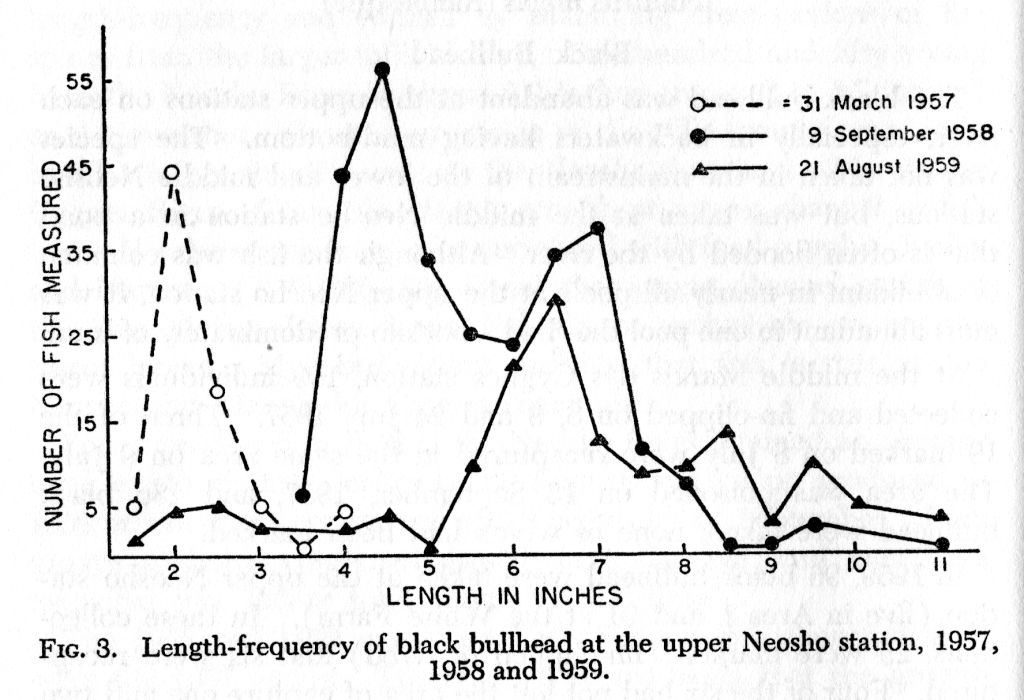
The upper Neosho station had a large population of black bullhead,
strongly dominated by fish less than four inches T. L. (range
1.5 to 3.8 inches), in the spring of 1957. Most were approximately
two inches T. L. and probably represented the 1956 year-class.
Growth, according to length-frequency, following restoration of
stream-flow, shows a regular increase in length of this dominant
1956 year-class (Fig. 3). A scarcity of young, especially in 1958
and 1959, is apparent in Fig. 3. This may be due to the fact that
a strong year-class usually is followed by one or several weak
year-classes. However, it more probably reflects the fact that
black bullhead are characteristically pond fish, and as such are
not so well adapted to reproduction in flowing streams as are many
other species. Metcalf (1959) found this species most abundantly
in the intermittent headwaters of Walnut River and Grouse Creek
in Cowley County, Kansas.
Fig. 3. Length-frequency of black bullhead at the upper Neosho station, 1957,
1958 and 1959.
Pylodictis olivaris (Rafinesque)
Flat-headed Catfish
The flathead is the largest sport-fish occurring in Kansas. Several
weighing more than 40 pounds are caught from streams each year,
and the species reportedly attains sizes in excess of one hundred
pounds. Several aspects of the biology of the flathead in Kansas
have been discussed by Minckley and Deacon (1959).
The abundance of flathead declined slightly from 1957 through
1959, counting fish of all sizes. This trend is attributable to a
large hatch in 1957; the 1957 year-class strongly dominated the
population throughout my study. Natural mortality in that year-class
was compensated by increased average size of the individuals
(to six inches in autumn, 1958, and 11 inches in autumn, 1959).
The numbers of flathead caught at the upper stations on the
Neosho and Marais des Cygnes rivers differed from the general
trend in that the species was rare in 1957 and increased slightly
by 1959. Flathead are most numerous in large streams, and in the
drought they probably were almost extirpated from the headwaters.
After 1957, continuous flow and increased volume of flow
were accompanied by a gradual increase in numbers of flathead
in the upstream parts of the two rivers. The species was most
abundant at the middle and lower Neosho stations, where 10.5
per cent of all fish shocked in 1957 and 1958 were P. olivaris.
The habitat of the flathead varied with size of the individuals.
Young-of-the-year inhabited swift riffles having rubble bottom;
individuals four to 12 inches in total length were distributed
throughout the stream; those more than 12 inches in total length
were most commonly in pools in association with cover (rocks, or
drifts of fallen timber).
Male flathead mature at 15 to 18 inches total length, females at
18 to 20 inches. The spawning season in 1959 probably began
in early June and extended to mid-July. I attempted to find spawning
fish on 19 June and for one month thereafter. On 19 June
nine holes were dug into a 75-yard section of a clay bank adjacent
to a long, shallow, rubble riffle. A flathead was first found in one
of these holes on 22 June, and others were frequently found in
this and one other hole until mid-July. Although channel catfish
were often found in nearby holes, that species was never present
in the two holes used by flatheads. The holes occupied by flathead
(as well as those used by channel catfish) characteristically had
silt-free gravel bottoms and a ridge of clean gravel across the entrance.
A nest containing a flathead and eggs was located on 11 July.
In checking the hole I first put my foot into the entrance, then slowly
advanced my hand into the hole, feeling along the bottom with
my fingers until they entered the open mouth of a large catfish.
I backed off slowly and then felt beneath the fish. The fish was
directly above the egg-mass, seemingly touching the eggs with its
belly. As I touched the front of the egg-mass the fish struck
viciously, taking my entire fist into its mouth. It continued striking
until I removed my hand from the hole after obtaining a small
sample of eggs, which proved to be in an early stage of development
(no vascularization evident).
When the nest was checked again on 13 July the eggs and fish
were gone. As in the case of channel catfish, I suspect that disturbance
of a flathead in the early stages of guarding the nest
results in destruction of the nest either by the guardian fish or by
predation resulting from its absence.
The hole occupied by the above fish was one that I had dug
seven to nine inches in diameter and extending two and one-half to
three feet into the bank. At the time this fish occupied the hole
its depth was approximately the same as originally, but the entrance
had been enlarged to 14 inches in diameter, and the chamber
widened to 32 inches. The holes were checked later in the summer
and all were heavily silted or had been undercut by action of the
current.
The number of flathead of catchable size was not reduced as
severely during my study as was the number of large channel catfish.
Flathead have a longer life-span than channel catfish; therefore,
it is not surprising that, of flathead and channel catfish that
survived the drought, a higher proportion of flathead persisted
throughout the next three years, in which my study was made. In
drought, when fish were concentrated in residual pools, the piscivorous
(fish eating) habit of flatheads may have favored their
survival.
The growth rate of flathead taken from the Neosho River in
1957 and 1958 was reported by Minckley and Deacon (1959:351-352).
Individuals hatched in 1955 and 1956 and collected in 1957
had attained average sizes of 9.5 inches and 4.8 inches, respectively,
by the end of the 1956 growing-season.
Flatheads of the 1956 and 1957 year-classes attained average
sizes of 8.7 and 3.2 inches, respectively, by the end of the 1957
growing season. These data indicate that growth was retarded
in the summer of 1957. Many species, including P. olivaris, had an
exceptionally large hatch in 1957, associated with increased water
levels in that year. Despite the great increase in amount of water,
I suppose that young-of-the-year and yearlings were subjected to
crowding resulting from exceptional hatches. This caused reduction
in growth of young flathead, and probably in several other
species.
Food of flatheads 4.0 inches and shorter was nearly all insect
larvae; that of fish 4.1 to 10 inches was insect larvae, fishes and
crayfish; and that of larger flatheads was mostly fish and crayfish.
The specific kind of food eaten was correlated with abundance
of the food item in the stream (Minckley and Deacon, 1959:350-351).
Noturus flavus Rafinesque
Stonecat
The stonecat was not taken at the upper Marais des Cygnes station,
and was less abundant at the middle Marais des Cygnes station
than at other stations. The abundance of the stonecat was greatest
at the lower Marais des Cygnes station in 1957 and at the upper
Neosho station in 1959. The species increased in abundance from
1957 to 1959 in the Neosho River, where the principal habitat was
riffles over rubble bottom.
Thirty-three stonecats were marked at the upper Neosho station
in 1959. Five of these were recaptured three hours after release,
all near the point of release. One individual was taken from
a riffle, fin-clipped, and released at the foot of the next riffle downstream.
When recaptured four days later, this fish was still in the
area of release. Young-of-the-year were taken on July 1, 1959,
at the lower Neosho station.
Noturus gyrinus (Mitchill)
Tadpole Madtom
Trautman (1957:444-445) describes the habitat of the tadpole
madtom as "low-gradient lowland streams, springs, marshes, oxbows,
pothole lakes, and protected harbors and bays of Lake Erie, where
conditions were relatively stable, the water was usually clear, the
bottom was of soft muck which generally contained varying amounts
of twigs, logs, and leaves, and where there usually was an abundance
of such rooted aquatics as pondweeds and hornwort. The
species seemed to be highly intolerant to much turbidity and rapid
silting,..." The tadpole madtom was obtained only at the
middle Marais des Cygnes station in a small, deep, mud-bottomed
pool in 1957 after water levels, and probably turbidity, had been
low for five years. The occurrence provides the westernmost record
station in Kansas. Cross and Minckley (1958:106) reported the
species from the lower part of the Marais des Cygnes in Kansas.
Noturus nocturnus Jordan and Gilbert
Freckled Madtom
The freckled madtom was taken only at the middle Neosho station
on 19 April, 1958. This species occurs most frequently in
small streams, and individuals living in the mainstream of the Neosho
probably are "strays" from nearby tributaries. This species may
have utilized the mainstream as a refugium in the drought of
1952-'56.
Noturus exilis Nelson
Slender Madtom
The slender madtom was taken only at the middle Marais des
Cygnes station in the fall of 1957. This species prefers permanent
riffles of clear streams (Deacon and Metcalf, 1961:317). My specimen
possibly strayed from a nearby tributary; or, it was a relict
from a population living in the mainstream during drought.
Noturus sp.
Neosho Madtom
A description of this species, which is endemic to Neosho River,
has been prepared but not yet published by Dr. W. Ralph Taylor.
I found the Neosho madtom only at the middle station in 1958 and
1959, and at the lower station in 1959, where the species was common
in shallow water having moderate current over clean gravel
bottom. Specimens were most effectively collected by digging into
the gravel above the seine and allowing the gravel to wash into the
seine. In 1952, Cross (1954:311) found this species in abundance
in riffles at the confluence of the South Fork and Cottonwood River,
and at several other localities in the Neosho mainstream (personal
communication). The Neosho madtom is nearly restricted to gravel
riffles having moderate flow; therefore, it may be drastically reduced
by intermittency of flow. I found none in 1957 and few in 1958. By
1959, the third summer of continuous flow, the Neosho madtom
was again common.
Fundulus notatus (Rafinesque)
Black-striped Topminnow
The black-striped topminnow was rare in the mainstream at the
lower Marais des Cygnes and the middle and lower Neosho stations,
where it was found in quiet water near shore.
Near the middle Neosho station, a large population was present
in an oxbow lake that is frequently flooded by the river.
Labidesthes sicculus (Cope)
Brook Silversides
The brook silversides occurred rarely at the lower Marais des
Cygnes and at the middle and lower Neosho stations.
Micropterus dolomieui Lacépède
Small-mouthed Bass
One individual was taken at the lower Neosho station in 1957.
Micropterus punctulatus punctulatus (Rafinesque)
Spotted Bass
The spotted bass occurs in Kansas only in the southeastern part
of the state—in southern tributaries of the Osage system, in Spring
River drainage, and in relatively clear streams of the Flint Hills.
At my stations on the Neosho River, this fish was more abundant
in 1957 than in 1958 or 1959.
Spotted bass were taken most frequently over rubble bottom or
near boulders in moderate current. Collections made in the evening
or early morning more often contained spotted bass than collections
made at other times of day (Table 9). Data from a few
specimens that were marked, released, and recaptured indicated that
the species is relatively sedentary; therefore, the greater abundance
in the morning and evening collections probably indicates increased
activity during these periods, possibly in connection with feeding.
The spawning season in 1957 may have continued as late as 10
July when a ripe female 11.3 inches T. L. was taken. Young-of-the-year
were taken on 24 June in moderate current over gravel
bottom and in quiet water over mud bottom.
Spotted bass normally form a small part of the game-fish fauna
in the lower Neosho River. The species attains greater abundance
in smaller, clear streams of the Arkansas River Basin in Kansas
(Cross, 1954, and unpublished data of State Biological Survey
of Kansas). During the drought, the lower Neosho probably assumed
many characteristics of a smaller stream in normal times.
Flow was reduced or entirely interrupted and turbidity was lessened.
These conditions resulted in faunal changes in which
spotted bass were more prominent than in years of normal flow.
During this period of reduced flow, some fishermen turned from
catfishing to bass-fishing; I think this constitutes evidence for an increase
in numbers of bass, accompanied by a decrease in numbers
of channel catfish. With the return of continuous flow and a consequent
rise in turbidity, bass declined in abundance in the mainstream.
Micropteras salmoides salmoides (Lacépède)
Large-mouthed Bass
The large-mouth was rare at all stations. It prefers quiet water
near cover; to become abundant, the large-mouth probably requires
clearer water than is afforded by most Kansas streams. This
species, like spotted bass, declined in abundance during the period
of study. Nevertheless, young-of-the-year were taken in 1957 and
1958 (earliest date of capture, 7 June in 1958).
Lepomis cyanellus Rafinesque
Green Sunfish
Green sunfish were taken at all stations, but most abundantly
at the upper Neosho station where the number captured increased
slightly from 1957 to 1959. Young-of-the-year and adults were most
common in shallow backwater. At the upper Neosho station green
sunfish inhabit quiet pools, where recaptures of marked fish indicated
that the species is notably sedentary in habit. Hasler and
Wisby (1958) have shown that green sunfish exhibit a homing
reaction.
This fish provides some sport for fishermen, especially in the
smaller streams, but I found few green sunfish that were larger
than six inches T. L. at any station.
Lepomis megalotis (Rafinesque)
Long-eared Sunfish
Long-eared sunfish were taken at all stations but were notably
more abundant in the Neosho River, where the largest population
occurred at the upper station. In all three years of the study, large
samples were obtained by means of rotenone in the same pool at the
upper Neosho station. There were fewer long-eared sunfish present
each year, and average size increased slightly. Collections in
other pools at this station indicated that long-eared sunfish maintained
a high level of abundance throughout my study.
Long-eared sunfish occurred in pools having bottoms of gravel
or bedrock at the upper Neosho station, or near shore over rubble
or gravel in slow to moderate current at the middle Neosho station.
Lepomis humilis (Girard)
Orange-spotted Sunfish
The orange-spotted sunfish occurred at all stations; it was most
abundant in the Neosho River, especially at the uppermost station.
This fish was taken in a variety of habitats, but was most
common in areas where the current was slack, often over mud or
silt bottom.
Lepomis macrochirus Rafinesque
Bluegill
Bluegill were taken at all stations but were rare. This species
occurred exclusively in pools, usually near cover (brush or trees in
the water). Bluegill are predominately pond-fish in Kansas, and
populations in rivers may consist partly of individuals that escaped
from ponds in time of overflow. I know of no stream in Kansas
that has a population large enough to contribute significantly to
the sport fishery.
Pomoxis nigromaculatus (LeSueur)
Black Crappie
This species was represented by only one specimen, taken at the
lower Neosho station in 1957.
Pomoxis annularis Rafinesque
White Crappie
White crappie were taken at all stations, but were common only
at the upper and middle stations on the Marais des Cygnes and
the upper Neosho station. At the last station, this fish was abundant
in a single large pool that contained much more water during
drought than any other area at this station. There was little dispersal
into several smaller pools, below the large pool, which were
sampled in 1957, 1958 and 1959. White crappie were not taken
in the lower pools until 1959, and then were rare. Most crappie
were taken in quiet water near cover or near shore.
Young-of-the-year were found in 1957, 1958 and 1959, but never
abundantly. At the lower Neosho station in 1959, ripe individuals
were collected on 19 June, a spent female on 24 June, and young-of-the-year
on 1 July. The young were present in quiet, shallow
water over mud bottom at the lower end of a gravel bar. Large
white crappie (10-14 inches T. L.) were common at the middle
and lower Neosho stations in 1957 and in April, 1958. Large fish
were almost entirely absent from later collections. Average size,
maximum size and abundance declined during the period of study.
Percina phoxocephala (Nelson)
Slender-headed Darter
The slender-headed darter was taken at all stations but was
more abundant in the Neosho than in the Marais des Cygnes. The
lower Marais des Cygnes, however, was the only station with a
relatively large population in 1957. Slender-headed darters were
rare in the Neosho River in 1957 and did not become common
until 1959.
The largest population was found at the upper Neosho station
in 1959. This darter occurs most frequently in swift water over
gravel bottom, but was taken in various habitats, including an intermittent
pool at the upper Neosho station on 7 September, 1957.
At the middle and lower Neosho stations, considerably greater
numbers were taken in June, July, and early August than in May or
late August. The abundance in my collections diminished from a
peak in early July, to scarcity in late August.
Young-of-the-year were taken at the lower Neosho station on
1 July, 1959 (and subsequently), in moderately fast water over
gravel. On 21 August, 1958, a ripe female (eggs stripped easily)
was the only slender-headed darter present in a collection from
riffles at the middle Neosho station.
Percina caprodes (Rafinesque)
Logperch
Logperch were not taken in the Marais des Cygnes. They were
rare in the Neosho, where they were taken most frequently at the
upper station in water two to three feet deep, over gravel bottom,
in moderate to slight current. This species was present in intermittent
pools at the upper Neosho station in 1957.
Percina copelandi (Jordan)
Channel Darter
One specimen was taken at the lower Neosho station in 1959.
Because no others ever have been found in the mainstream of the
Neosho River, I suspect that my specimen is a "stray" from one of
the smaller tributaries, where channel darters are locally common.
Etheostoma flabellare Rafinesque
Fan-tailed Darter
The fan-tailed darter is represented in my collections by one
specimen, obtained in the mainstream of the Neosho River at the
lower station in 1957. Records of this species in Kansas are almost
confined to the smallest, clear, permanent streams of the southeastern
part of the state. My specimen may represent a small
population that retreated to the mainstream of the Neosho during
drought.
Etheostoma spectabile (Agassiz)
Orange-throated Darter
Orange-throated darters were common at the upper Marais des
Cygnes and upper Neosho stations in 1959, rare at the middle and
lower Neosho stations, and absent from the middle and lower
Marais des Cygnes stations. The species was found almost exclusively
on upstream riffles over gravel-rubble bottom. The population
in the upper Neosho was decimated by drought, and the fish
did not become common until the summer of 1959, the third year
after resumption of normal stream-flow.
Deacon and Metcalf (1961:320) indicated that long periods of
intermittency result in depletion or elimination of populations of
the orange-throated darter in the Wakarusa River, Kansas. A limited
number of orange-throated darters probably survived in the
few permanent pools in the upper Neosho and provided the brood-stock
necessary to repopulate this section of the stream.
Aplodinotus grunniens Rafinesque
Freshwater Drum
Drum were taken at all stations, but were most abundant at
the middle and lower Neosho stations. A high level of abundance
also was found in 1957 at the middle Marais des Cygnes station.
The abundance of drum declined from 1957 to 1959, but the average
size increased because of a dominant 1957 year-class that was moderately
reduced by natural mortality in 1958-'59. Although the
population was composed largely of young-of-the-year and adults
in 1957, it was dominated by yearling individuals in 1958. By 1959
the number had declined considerably and the population consisted
mostly of juveniles and adults. Fish of the 1957 year-class reached a
length of approximately ten inches by mid-summer of 1959 (Table
8).
Adults were taken in a variety of habitats, but most often in
quiet water. On the other hand, yearlings were extremely abundant
in 1958 near shore in shallow, moderately fast water over
rubble bottom at night. Drum were rare in the same areas in daylight
(Table 9). Young-of-the-year occur in shallow, quiet water,
usually over mud-bottom.
The freshwater drum matures at about 12 inches T. L. Ripe
males were taken as late as 23 June 1959; however, the height of
the spawning season probably is in May.
| Total length in inches | Aug. 19 1957 | Aug. 19-26 1958 | July 27-Aug. 4 1959 |
|---|
| 2 | | 1 |
| 3 | 1 |
| 4 | 4 |
| 5 | | 1 |
| 6 | | 12 |
| 7 | | 21 | 1 |
| 8 | 3 | 14 | 2 |
| 9 | 3 | 3 | 2 |
| 10 | 4 | 6 | 6 |
| 11 | 2 | 4 | 1 |
| 12 | | 2 |
| 13 | | | 2 |
| 14 | | | 1 |
| Species |
Morning 5 hours
of effort expended
6:30 a.m. 12:30 p.m. |
Afternoon 6 hours
of effort expended
12:30 p.m. 6:30 p.m. |
Early night 18 hours
of effort expended
6:30 p.m. 12:30 a.m. |
Late night 8 hours
of effort expended
12:30 a.m. 6:30 a.m. |
|---|
| Long-nosed Gar | 0 | 0.3 (2) | 1.2 (21) | 1.1 (9) |
| Short-nosed Gar | 0.2 (1) | 0 | 0.2 (3) | 0.4 (3) |
| Gizzard Shad | 0.2 (1) | 0.3 (2) | 0.1 (1) | 0.1 (1) |
| Black Buffalo | 0 | 0.2 (1) | 0.1 (1) | 0 |
| Small-mouthed Buffalo | 0.4 (2) | 0.3 (2) | 0.8 (14) | 0.8 (6) |
| River Carpsucker | 3.4 (17) | 3.3 (20) | 5.7 (102) | 4.9 (39) |
| Redhorse | 0 | 0.2 (1) | 0.6 (10) | 0.6 (5) |
| Carp | 1.8 (9) | 0.2 (1) | 0.7 (12) | 0.8 (6) |
| Channel Catfish | 1.6 (8) | 1.0 (6) | 10.2 (183) | 10.5 (84) |
| Flathead | 2.2 (11) | 1.3 (8) | 2.4 (43) | 3.6 (29) |
| Spotted Bass | 0.4 (2) | 0.5 (3) | 0.3 (6) | 0.1 (1) |
| Green Sunfish | 0.2 (1) | 0.2 (1) | 0.2 (3) | 0.1 (1) |
| Long-eared Sunfish | 0 | 0 | 0.1 (2) | 0.4 (3) |
| Orange-spotted Sunfish | 0.2 (1) | 0 | 0 | 0 |
| White Crappie | 0.2 (1) | 0.2 (1) | 0.2 (5) | 0.4 (3) |
| Freshwater Drum | 1.0 (5) | 0.8 (5) | 5.6 (101) | 5.3 (42) |
| Number captured per hour | 13.4 | 9.3 | 29.5 | 33.8 |
| Species | Marais des Cygnes River |
|---|
| Upper | Middle | Lower |
|---|
| 1957 | 1958 | 1959 | 1957 | 1958 | 1959 | 1957 | 1958 |
|---|
| Gar | .7 | 1.3 | 1.2 | .6 | 2.7 | ... | 2.2 | 9.4 |
| Gizzard Shad | .9 | .2 | ... | 9.9 | 2.5 | ... | ... | .5 |
| Buffalo | 2.0 | 3.7 | .6 | .8 | 2.0 | ... | 5.7 | 6.4 |
| River Carpsucker | 4.0 | 4.9 | .6 | 6.5 | 2.2 | 2.0 | 1.8 | 3.9 |
| Shortheaded Redhorse | 3.3 | .9 | .6 | .8 | .2 | ... | ... | ... |
| Carp | 10.6 | 6.4 | 2.4 | 8.6 | 5.0 | 3.5 | 6.0 | 10.4 |
| Black Bullhead | ... | ... | ... | 3.9 | 17.2 | ... | ... | ... |
| Channel Catfish | .5 | .9 | ... | 4.7 | 2.5 | ... | 1.8 | .7 |
| Flathead | .2 | ... | 2.4 | .5 | ... | ... | 1.8 | .5 |
| Largemouth | 1.0 | ... | ... | .3 | .2 | ... | ... | ... |
| White Crappie | 1.7 | 5.1 | .6 | 1.3 | .7 | ... | ... | .2 |
| Freshwater Drum | .9 | 1.6 | .6 | 24.5 | 2.2 | ... | .7 | .2 |
| Hours shocked | 4½ | 4½ | 1⅔ | 4 | 4 | 2 | 2⅚ | 4½ |
|---|
| | Neosho River |
|---|
| Middle | Lower |
|---|
| 1957 | 1958 | 1959 | 1957 | 1958 | 1959 |
|---|
| Gar | 3.2 | 4.2 | 3.8 | 5.3 | 4.9 | 8.4 |
| Gizzard Shad | .5 | .2 | .4 | 1.9 | 1.0 | .4 |
| Buffalo | 2.9 | 1.8 | 1.2 | 6.2 | .9 | 1.5 |
| River Carpsucker | 5.5 | 7.4 | 2.9 | 7.5 | 13.3 | 6.3 |
| Shortheaded Redhorse | 1.9 | .6 | 1.6 | .7 | ... | 1.6 |
| Carp | 2.1 | 2.1 | 1.4 | 3.4 | 1.2 | 1.1 |
| Channel Catfish | 2.6 | 8.8 | .9 | 107.0 | .5 | .7 |
| Flathead | 7.6 | 3.7 | 2.7 | 10.8 | .2 | 1.2 |
| Bass | 1.6 | .4 | .1 | .2 | .2 | .1 |
| White Crappie | ... | .9 | .2 | 1.8 | .7 | .1 |
| Freshwater Drum | 3.9 | 3.3 | .8 | 15.9 | 2.8 | .7 |
| Hours shocked | 5⅔ | 55⅚ | 48½ | 4⅙ | 4 | 16⅚ |
|---|
| Species | Marais des Cygnes stations | Neosho |
|---|
| Upper | Middle | Lower | Lower station |
|---|
| 1957 | 1959 | 1957 | 1959 | 1957 | 1959 | 1957 | 1959 |
|---|
| Golden Shiner | ... | ... | — | ... | ... | ... | ... | ... |
| Creek Chub | ... | — | ... | ... | ... | ... | ... | ... |
| Silver Chub | ... | ... | ... | ... | — | ... | ... | ... |
| Gravel Chub | ... | ... | ... | ... | ... | ... | ... | 3.0
2.3 |
| Sucker-mouthed Minnow | — | 6 | ... | 3
1 | ... | 1 | 2 | 10.0
43.0 |
| Red-finned Shiner | ... | ... | ... | 1 | 2.5
5.0 | 2 | ... | 4.7
2.3 |
| Blunt-faced Shiner | ... | ... | — | ... | ... | ... | ... | ... |
| Red Shiner | 21
6 | 15 | 8
4 | 19
22 | 16.0
69.0 | 15
22 | 27
1119 | 20.0
102.0 |
| Mimic Shiner | ... | ... | ... | ... | ... | ... | — | ... |
| Ghost Shiner | 7.5 | 1 | ... | 1 | 9.5
96.5 | 2 | 17
54 | 11.7
76 |
| Sand Shiner | — | 7 | ... | 8
2 | 1.5 | 3 | ... | 1
.3 |
| Mountain Minnow | ... | ... | ... | ... | ... | ... | 12
25 | 9.3
13.6 |
| Blunt-nosed Minnow | — | 2 | ... | 8 | 1.0
.5 | 1 | 6
4 | 14.0
7.6 |
| Parrot Minnow | ... | ... | ... | ... | ... | ... | 12
6 | 19.0
28.6 |
| Fat-headed Minnow | 10.5
1.5 | 4 | 5
2 | 7
1 | ... | ... | ... | 8.3
3.0 |
| Stoneroller | — | 6 | — | ... | ... | ... | — | 2.3
1.0 |
| Black Bullhead | ... | ... | ... | ... | .5 | ... | ... | ... |
| Channel Catfish | 4.5
1.5 | 2 | 1
1 | 13
7 | 5.0
1.0 | 10
6 | 12
5 | 6.3
41.6 |
| Flathead | — | 1 | — | — | 1.0 | ... | — | .3 |
| Stonecat | ... | ... | — | ... | 6.0
.5 | ... | — | 1.0 |
| Neosho Madtom | ... | ... | ... | ... | ... | ... | ... | 3.3
2.0 |
| Brook Silversides | ... | ... | ... | ... | .5
1.0 | ... | ... | 1.7 |
| Black-striped Topminnow | ... | ... | ... | ... | 1.0
1.0 | 2 | ... | 1.0
.7 |
| Spotted Bass | ... | ... | ... | ... | ... | ... | 2 | 3.7
.3 |
| Largemouth | ... | ... | 1
1 | 3
1 | ... | ... | 1
2 | ... |
| Green Sunfish | 9
7.5 | 8 | 9
3 | 17
3 | 11.0
12.0 | 3
1 | 7
2 | 10.0
3.6 |
| Long-eared Sunfish | ... | ... | ... | ... | .5 | ... | 6 | 4.3
.7 |
| Orange-spotted Sunfish | 4.5
6 | — | 2
4 | 3 | 2.5 | ... | 12
5 | 12.0
5.0 |
| Bluegill | 1.5 | 1 | ... | 6
1 | 3.5 | 1 | 1 | .3
.3 |
| White Crappie | ... | ... | 4
7 | 4 | ... | ... | ... | ... |
| Logperch | ... | ... | ... | ... | ... | ... | 1 | .3
.7 |
| Slender-headed Darter | — | 13 | ... | 2 | 6.5
15.0 | 3
1 | 1 | 8.3
3.0 |
| Orange-throated Darter | — | 7 | ... | ... | ... | ... | 1 | — |
| Seining units | ⅔ | 1 | 1 | 1 | 2 | 1 | 1 | 3 |

 August 11, 1961