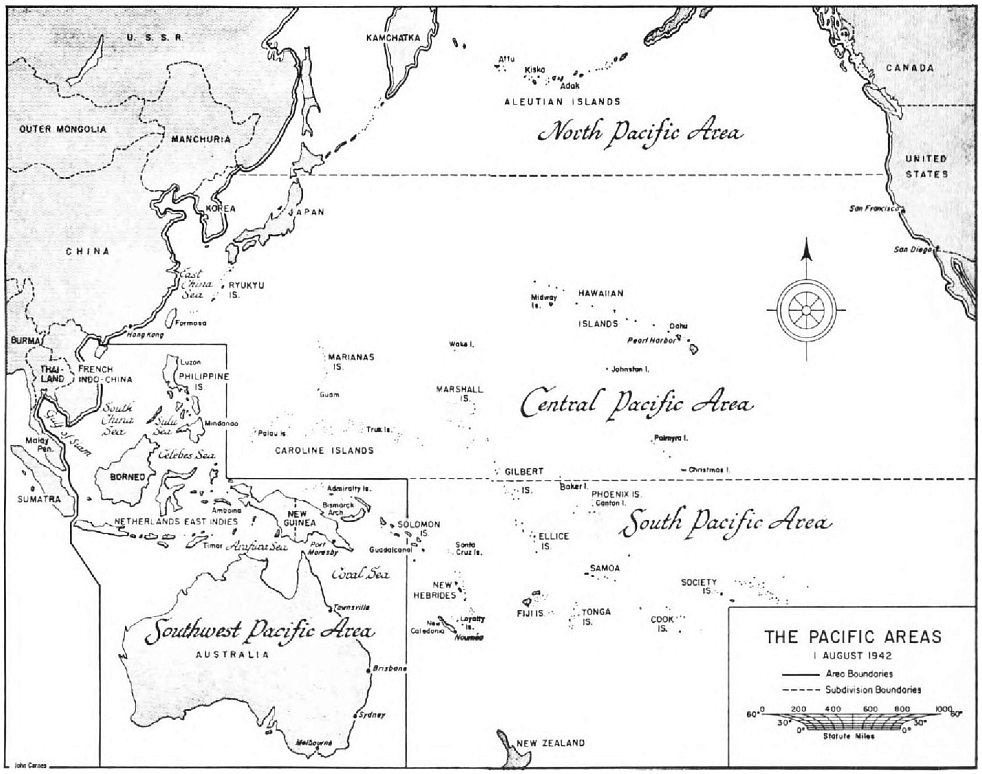
On board the transports approaching
the Solomons, the Marines were
looking for a tough fight. They knew
little about the targets, even less
about their opponents. Those maps
that were available were poor, constructions
based upon outdated
hydrographic charts and information
provided by former island residents.
While maps based on aerial photographs
had been prepared they were
misplaced by the Navy in Auckland,
New Zealand, and never got to the
Marines at Wellington.
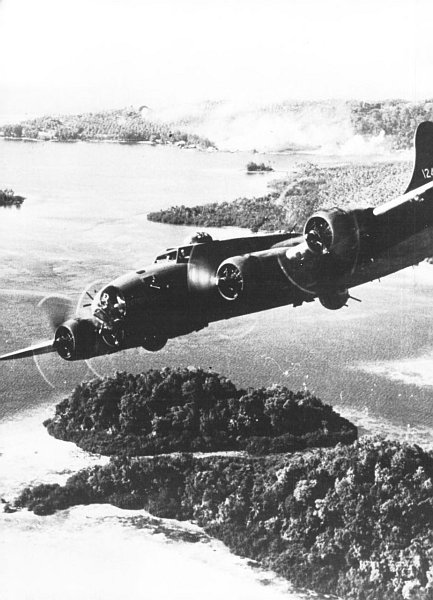
On 17 July, a couple of division
staff officers, Lieutenant Colonel
Merrill B. Twining and Major William
McKean, had been able to join
the crew of a B-17 flying from Port
Moresby on a reconnaissance mission
over Guadalcanal. They reported
what they had seen, and their analysis,
coupled with aerial photographs,
indicated no extensive
defenses along the beaches of
Guadalcanal’s north shore.
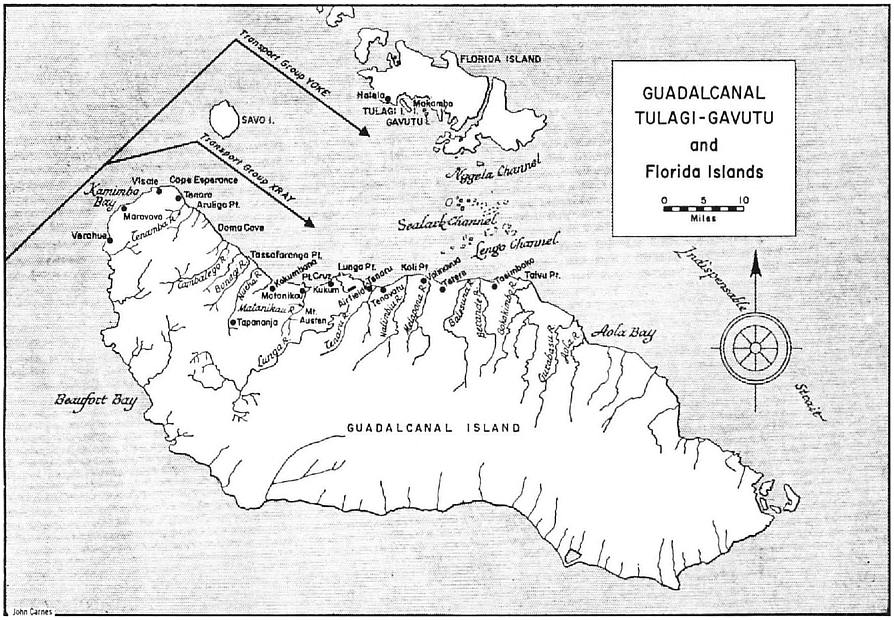
GUADALCANAL
TULAGI-GAVUTU
and
Florida Islands
This news was indeed welcome.
The division intelligence officer (G-2),
Lieutenant Colonel Frank B. Goettge,
had concluded that about 8,400
Japanese occupied Guadalcanal and
Tulagi. Admiral Turner’s staff figured
that the Japanese amounted to 7,125
men. Admiral Ghormley’s intelligence
officer pegged the enemy
strength at 3,100—closest to the
3,457 actual total of Japanese troops;
2,571 of these were stationed on
Guadalcanal and were mostly
laborers working on the airfield.
To oppose the Japanese, the Marines
had an overwhelming superiority
of men. At the time, the tables of
organization for a Marine Corps division
indicated a total of 19,514
officers and enlisted men, including
naval medical and engineer (Seabee)
units. Infantry regiments numbered
3,168 and consisted of a headquarters
company, a weapons company,
and three battalions. Each infantry
battalion (933 Marines) was organized
into a headquarters company
(89), a weapons company (273),
and three rifle companies (183). The
artillery regiment had 2,581 officers
and men organized into three 75mm
pack howitzer battalions and one
105mm howitzer battalion. A light
tank battalion, a special weapons
battalion of antiaircraft and antitank
guns, and a parachute battalion added
combat power. An engineer regiment
(2,452 Marines) with battalions
of engineers, pioneers, and Seabees,
provided a hefty combat and service
element. The total was rounded
out by division headquarters battalion’s
headquarters, signal, and military
police companies and the
division’s service troops—service,
motor transport, amphibian tractor,
and medical battalions. For Watchtower,
the 1st Raider Battalion and
the 3d Defense Battalion had been
added to Vandegrift’s command to
provide more infantrymen and much
needed coast defense and antiaircraft
guns and crews.
Unfortunately, the division’s heaviest
ordnance had been left behind in
New Zealand. Limited ship space and
time meant that the division’s big
guns, a 155mm howitzer battalion,
and all the motor transport battalion’s
two-and-a-half-ton trucks were
not loaded. Colonel Pedro A. del
Valle, commanding the 11th Marines,
was unhappy at the loss of his heavy
howitzers and equally distressed that
essential sound and flash-ranging
equipment necessary for effective
counterbattery fire was left behind.
Also failing to make the cut in the
battle for shipping space, were all
spare clothing, bedding rolls, and
supplies necessary to support the
reinforced division beyond 60 days
of combat. Ten days supply of ammunition
for each of the division’s
weapons remained in New Zealand.
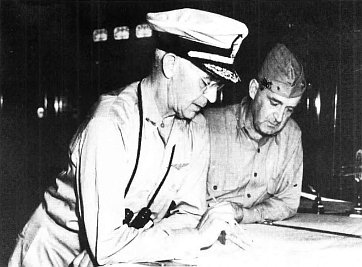
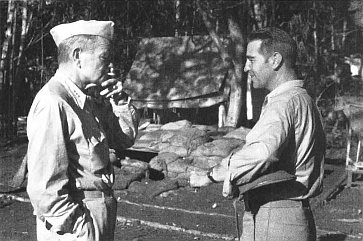
Naval Historical Photographic Collection 880-CF-117-4-63
Enroute to Guadalcanal RAdm Richmond Kelly Turner, commander of the Amphibious
Force, and MajGen Alexander A. Vandegrift, 1st Marine Division commander,
review the Operation Watchtower plan for landings in the Solomon Islands.
In the opinion of the 1st Division’s
historian and a veteran of the landing,
the men on the approaching
transports “thought they’d have a bad
time getting ashore.” They were confident,
certainly, and sure that they
could not be defeated, but most of
the men were entering combat for the
first time. There were combat veteran
officers and noncommissioned
officers (NCOs) throughout the division,
but the majority of the men
were going into their initial battle.
The commanding officer of the 1st
Marines, Colonel Clifton B. Cates,
estimated that 90 percent of his men
had enlisted after Pearl Harbor. The
fabled 1st Marine Division of later
World War II, Korean War, Vietnam
War, and Persian Gulf War fame, the
most highly decorated division in the
U.S. Armed Forces, had not yet established
its reputation.
The convoy of ships, with its outriding
protective screen of carriers,
reached Koro in the Fiji Islands on
26 July. Practice landings did little
more than exercise the transports’
landing craft, since reefs precluded an
actual beach landing. The rendezvous
at Koro did give the senior commanders
a chance to have a
face-to-face meeting. Fletcher,
McCain, Turner, and Vandegrift got
together with Ghormley’s chief of
staff, Rear Admiral Daniel J. Callaghan,
who notified the conferees that
ComSoPac had ordered the 7th Marines
on Samoa to be prepared to embark
on four days notice as a
reinforcement for Watchtower. To
this decidedly good news, Admiral
Fletcher added some bad news. In
view of the threat from enemy land-based
air, he could not “keep the carriers
in the area for more than 48
hours after the landing.” Vandegrift
protested that he needed at least four
days to get the division’s gear ashore,
and Fletcher reluctantly agreed to
keep his carriers at risk another day.
On the 28th the ships sailed from
the Fijis, proceeding as if they were
headed for Australia. At noon on 5
August, the convoy and its escorts
turned north for the Solomons. Undetected
by the Japanese, the assault
force reached its target during the
night of 6–7 August and split into two
landing groups, Transport Division
X-Ray, 15 transports heading for the
north shore of Guadalcanal east of
Lunga Point, and Transport Division
Yoke, eight transports headed for
Tulagi, Gavutu, Tanambogo, and the
nearby Florida Island, which loomed
over the smaller islands.
Vandegrift’s plans for the landings
would put two of his infantry regiments
(Colonel LeRoy P. Hunt’s 5th
Marines and Colonel Cates’ 1st Marines)
ashore on both sides of the
Lunga River prepared to attack inland
to seize the airfield. The 11th
Marines, the 3d Defense Battalion,
and most of the division’s supporting
units would also land near the
Lunga, prepared to exploit the beachhead.
Across the 20 miles of Sealark
Channel, the division’s assistant commander,
Brigadier General William
H. Rupertus, led the assault forces
slated to take Tulagi, Gavutu, and
Tanambogo: the 1st Raider Battalion
(Lieutenant Colonel Merritt A. Edson);
the 2d Battalion, 5th Marines
(Lieutenant Colonel Harold E. Rosecrans);
and the 1st Parachute Battalion
(Major Robert H. Williams).
Company A of the 2d Marines would
reconnoiter the nearby shores of
Florida Island and the rest of Colonel
John A. Arthur’s regiment would
stand by in reserve to land where
needed.
As the ships slipped through the
channels on either side of rugged
Savo Island, which split Sealark near
its western end, heavy clouds and
dense rain blanketed the task force.
Later the moon came out and silhouetted
the islands. On board his
command ship, Vandegrift wrote to
his wife: “Tomorrow morning at
dawn we land in our first major
offensive of the war. Our plans have
been made and God grant that our
judgement has been sound ...
whatever happens you’ll know I did
my best. Let us hope that best will
be good enough.”
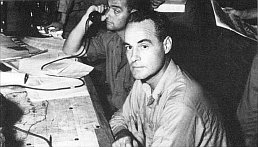
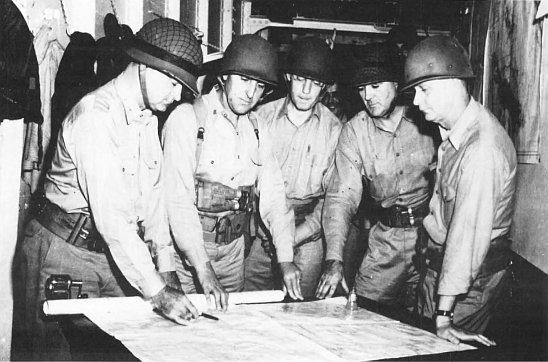
MajGen Alexander A. Vandegrift, CG, 1st Marine Division,
confers with his staff on board the transport USS McCawley (APA-4)
enroute to Guadalcanal. From left: Gen Vandegrift;
LtCol Gerald C. Thomas, operations officer; LtCol Randolph
McC. Pate, logistics officer; LtCol Frank B. Goettge, intelligence
officer; and Col William Capers James, chief of staff.
National Archives Photo 80-G-17065
At 0641 on 7 August, Turner signalled
his ships to “land the landing
force.” Just 28 minutes before, the
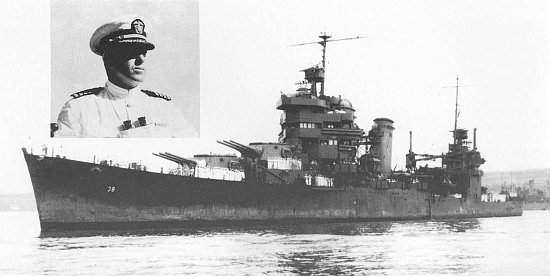
heavy cruiser Quincy (CA 39) had
begun shelling the landing beaches at
Guadalcanal. The sun came up that
fateful Friday at 0650, and the first
landing craft carrying assault troops
of the 5th Marines touched down at
0909 on Red Beach. To the men’s surprise
(and relief), no Japanese appeared
to resist the landing. Hunt
immediately moved his assault
troops off the beach and into the surrounding
jungle, waded the steep-banked
Ilu River, and headed for the
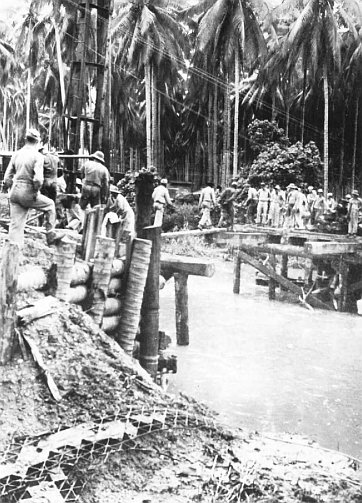
enemy airfield. The following 1st
Marines were able to cross the Ilu on
a bridge the engineers had hastily
thrown up with an amphibian tractor
bracing its middle. The silence
was eerie and the absence of opposition
was worrisome to the riflemen.
The Japanese troops, most of whom
were Korean laborers, had fled to the
west, spooked by a week’s B-17 bombardment,
the pre-assault naval gunfire,
and the sight of the ships
offshore. The situation was not the
same across Sealark. The Marines on
Guadalcanal could hear faint rumbles
of a firefight across the waters.
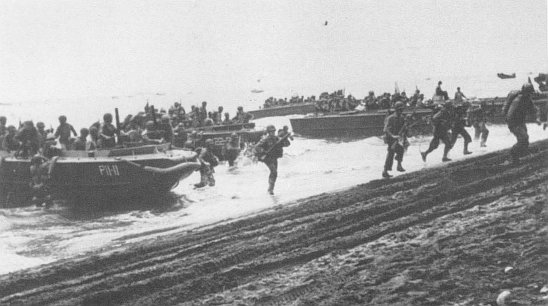
National Archives Photo 80-CF-112-5-3
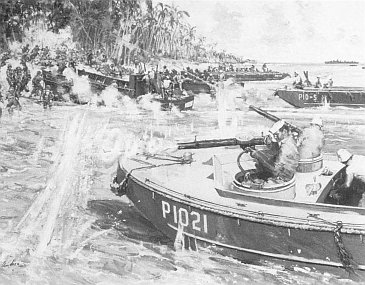
First Division Marines storm ashore across Guadalcanal’s
beaches on D-Day, 7 August 1942, from the attack transport
Barnett (AP-11) and attack cargo ship Fomalhaut (AK-22). The
invaders were surprised at the lack of enemy opposition.
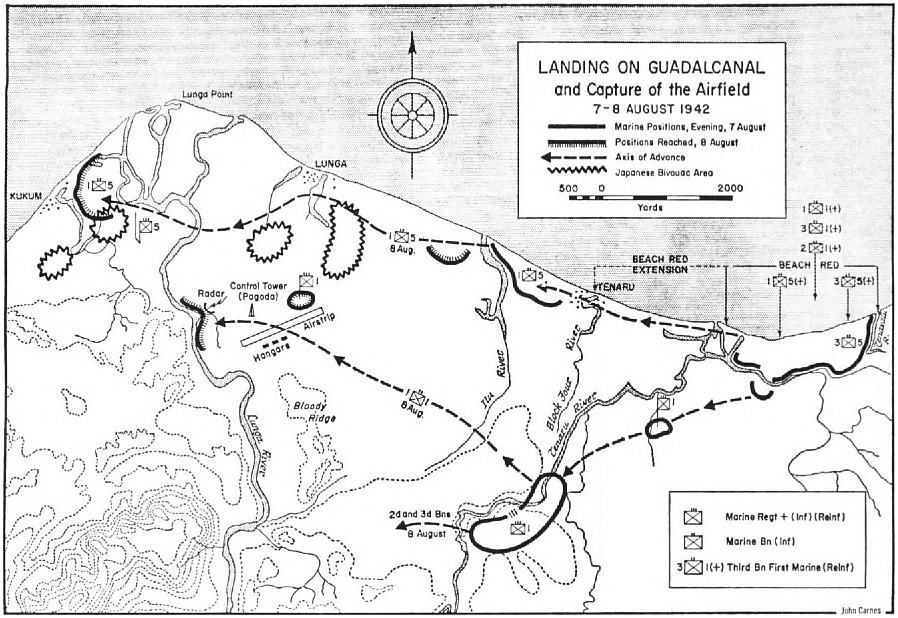
LANDING ON GUADALCANAL
and Capture of the Airfield
7–8 AUGUST 1942
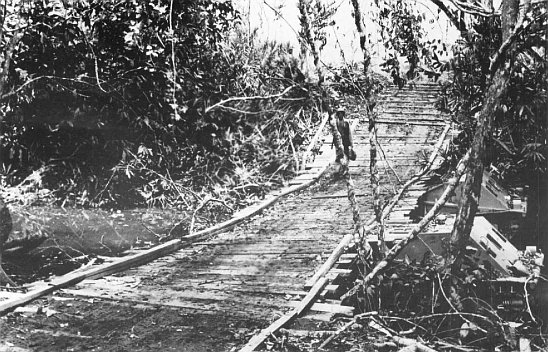
Photo courtesy of Col James A. Donovan, Jr.
When the 5th Marines entered the jungle from the beachhead,
and had to cross the steep banks of the Ilu River, 1st Marine
Division engineers hastily constructed a bridge supported by
amphibian tractors. Though heavily used, the bridge held up.
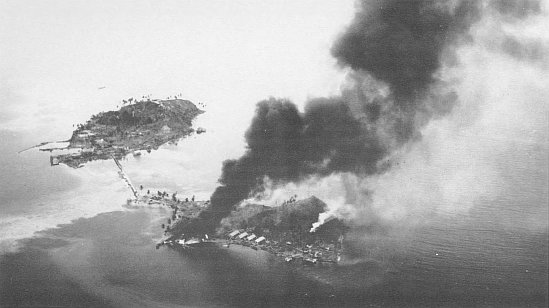
Photographed immediately after a prelanding strike by USS
Enterprise aircraft flown by Navy pilots, Tanambogo and
Gavutu Islands lie smoking and in ruins in the morning sun.
Gavutu is at the left across the causeway from Tanambogo.
National Archives Photo 80-C-11034
The Japanese on Tulagi were special
naval landing force sailors and
they had no intention of giving up
what they held without a vicious, no-surrender
battle. Edson’s men landed
first, following by Rosecrans’ battalion,
hitting Tulagi’s south coast
and moving inland towards the ridge
which ran lengthwise through the island.
The battalions encountered
pockets of resistance in the undergrowth
of the islands thick vegetation
and maneuvered to outflank and
overrun the opposition. The advance
of the Marines was steady but casualties
were frequent. By nightfall, Edson
had reached the former British
residency overlooking Tulagi’s harbor
and dug in for the night across a hill
that overlooked the Japanese final
position, a ravine on the islands
southern tip. The 2d Battalion, 5th
Marines, had driven through to the
northern shore, cleaning its sector of
enemy; Rosecrans moved into position
to back up the raiders. By the
end of its first day ashore, 2d Battalion
had lost 56 men killed and
wounded; 1st Raider Battalion
casualties were 99 Marines.
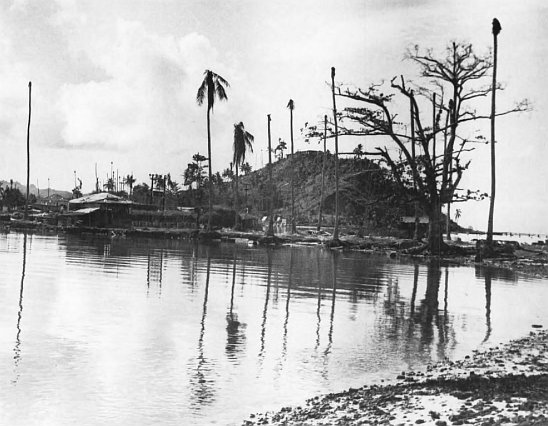
Department of Defense (USMC) Photo 52231
After the battle, almost all palm trees on Gavutu were shorn
of their foliage. Despite naval gunfire and close air support
hitting the enemy emplacements, Japanese opposition from
caves proved to be serious obstacles for attacking Marines.
Throughout the night, the
Japanese swarmed from hillside caves
in four separate attacks, trying to
penetrate the raider lines. They were
unsuccessful and most died in the attempts.
At dawn, the 2d Battalion,
2d Marines, landed to reinforce the
attackers and by the afternoon of 8
August, the mop-up was completed
and the battle for Tulagi was over.
The fight for tiny Gavutu and
Tanambogo, both little more than
small hills rising out of the sea, connected
by a hundred-yard causeway,
was every bit as intense as that on
Tulagi. The area of combat was much
smaller and the opportunities for fire
support from offshore ships and carrier
planes was severely limited once
the Marines had landed. After naval
gunfire from the light cruiser San
Juan (CL 54) and two destroyers, and
a strike by F4F Wildcats flying from
the Wasp, the 1st Parachute Battalion
landed near noon in three waves,
395 men in all, on Gavutu. The
Japanese, secure in cave positions,
opened fire on the second and third
waves, pinning down the first Marines
ashore on the beach. Major
Williams took a bullet in the lungs
and was evacuated; 32 Marines were
killed in the withering enemy fire.
This time, 2d Marines reinforcements
were really needed; the 1st Battalion’s
Company B landed on Gavutu and
attempted to take Tanambogo; the
attackers were driven to ground and
had to pull back to Gavutu.
After a rough night of close-in
fighting with the defenders of both
islands, the 3d Battalion, 2d Marines,
reinforced the men already ashore
and mopped up on each island. The
toll of Marines dead on the three islands
was 144; the wounded numbered
194. The few Japanese who
survived the battles fled to Florida Island,
which had been scouted by the
2d Marines on D-Day and found
clear of the enemy.
The Marines’ landings and the
concentration of shipping in Guadalcanal
waters acted as a magnet to the
Japanese at Rabaul. At Admiral
Ghormley’s headquarters, Tulagi’s radio
was heard on D-Day “frantically
calling for [the] dispatch of surface
forces to the scene” and designating
transports and carriers as targets for
heavy bombing. The messages were
sent in plain language, emphasizing
the plight of the threatened garrison.
And the enemy response was prompt
and characteristic of the months of
naval air and surface attacks to come.
At 1030 on 7 August, an Australian
coastwatcher hidden in the
hills of the islands north of Guadalcanal
signalled that a Japanese air
strike composed of heavy bombers,
light bombers, and fighters was headed
for the island. Fletcher’s pilots,
whose carriers were positioned 100
miles south of Guadalcanal, jumped
the approaching planes 20 miles
northwest of the landing areas before
they could disrupt the operation. But
the Japanese were not daunted by the
setback; other planes and ships were
enroute to the inviting target.
On 8 August, the Marines consolidated
their positions ashore, seizing
the airfield on Guadalcanal and establishing
a beachhead. Supplies
were being unloaded as fast as landing
craft could make the turnaround
from ship to shore, but the shore
party was woefully inadequate to
handle the influx of ammunition, rations,
tents, aviation gas, vehicles—all
gear necessary to sustain the Marines.
The beach itself became a
dumpsite. And almost as soon as the
initial supplies were landed, they had
to be moved to positions nearer Kukum
village and Lunga Point within
the planned perimeter. Fortunately,
the lack of Japanese ground opposition
enabled Vandegrift to shift the
supply beaches west to a new
beachhead.
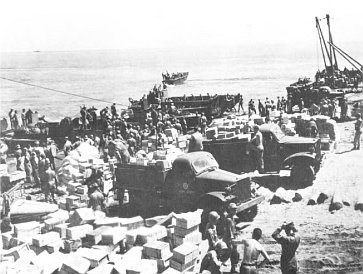
Marine Corps Personal Papers Collection
Immediately after assault troops cleared the beachhead and moved inland, supplies
and equipment, inviting targets for enemy bombers, began to litter the beach.
Japanese bombers did penetrate
the American fighter screen on 8 August.
Dropping their bombs from
20,000 feet or more to escape antiaircraft
fire, the enemy planes were not
very accurate. They concentrated on
the ships in the channel, hitting and
damaging a number of them and
sinking the destroyer Jarvis (DD
393). In their battles to turn back the
attacking planes, the carrier fighter
squadrons lost 21 Wildcats on 7–8
August.
The primary Japanese targets were
the Allied ships. At this time, and for
a thankfully and unbelievably long
time to come, the Japanese commanders
at Rabaul grossly underestimated
the strength of Vandegrift’s
forces. They thought the Marine
landings constituted a reconnaissance
in force, perhaps 2,000 men, on
Guadalcanal. By the evening of 8 August,
Vandegrift had 10,900 troops
ashore on Guadalcanal and another
6,075 on Tulagi. Three infantry regiments
had landed and each had a
supporting 75mm pack howitzer
battalion—the 2d and 3d Battalions,
11th Marines on Guadalcanal, and
the 3d Battalion, 10th Marines on
Tulagi. The 5th Battalion, 11th Marines’
105mm howitzers were in
general support.
That night a cruiser-destroyer
force of the Imperial Japanese Navy
reacted to the American invasion
with a stinging response. Admiral
Turner had positioned three cruiser-destroyer
groups to bar the Tulagi-Guadalcanal
approaches. At the Battle
of Savo, the Japanese demonstrated
their superiority in night fighting
at this stage of the war, shattering
two of Turners covering forces
without loss to themselves. Four
heavy cruisers went to the bottom—three
American, one Australian—and
another lost her bow. As the sun
came up over what soon would be
called “Ironbottom Sound,” Marines
watched grimly as Higgins boats
swarmed out to rescue survivors. Approximately
1,300 sailors died that
night and another 700 suffered
wounds or were badly burned.
Japanese casualties numbered less
than 200 men.
The Japanese suffered damage to
only one ship in the encounter, the
cruiser Chokai. The American cruisers
Vincennes (CA 44), Astoria (CA
34), and Quincy (CA 39) went to the
bottom, as did the Australian Navy’s
HMAS Canberra, so critically
damaged that she had to be sunk by
American torpedoes. Both the cruiser
Chicago (CA 29) and destroyer Talbot
(DD 114) were badly damaged.
Fortunately for the Marines ashore,
the Japanese force—five heavy cruisers,
two light cruisers, and a
destroyer—departed before dawn
without attempting to disrupt the
landing further.
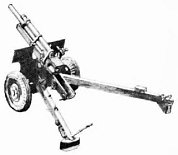
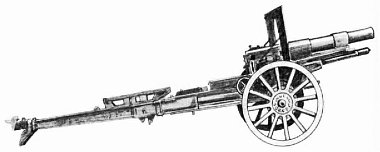
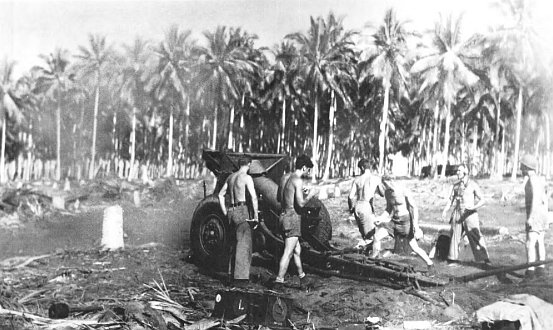
U.S. 105mm Howitzer
When the attack-force leader, Vice
Admiral Gunichi Mikawa, returned
to Rabaul, he expected to receive the
accolades of his superiors. He did get
those, but he also found himself the
subject of criticism. Admiral Isoroku
Yamamoto, the Japanese fleet commander,
chided his subordinate for
failing to attack the transports. Mikawa
could only reply, somewhat lamely,
that he did not know Fletcher’s
aircraft carriers were so far away
from Guadalcanal. Of equal significance
to the Marines on the
beach, the Japanese naval victory
caused celebrating superiors in Tokyo
to allow the event to overshadow the
importance of the amphibious
operation.
The disaster prompted the American
admirals to reconsider Navy support
for operations ashore. Fletcher
feared for the safety of his carriers;
he had already lost about a quarter
of his fighter aircraft. The commander
of the expeditionary force
had lost a carrier at Coral Sea and
another at Midway. He felt he could
not risk the loss of a third, even if
it meant leaving the Marines on their
own. Before the Japanese cruiser attack,
he obtained Admiral Ghormley’s
permission to withdraw from
the area.
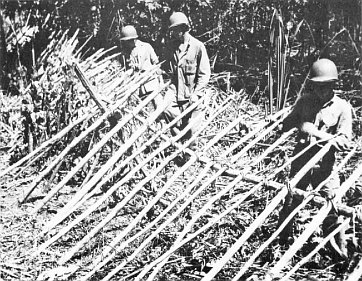
When ships carrying barbed wire and engineering tools needed ashore were forced
to leave the Guadalcanal area because of enemy air and surface threats, Marines
had to prepare such hasty field expedients as this cheval de frise of sharpened stakes.
Department of Defense (USMC) Photo 5157
At a conference on board Turner’s
flagship transport, the McCawley,
on the night of 8 August, the admiral
told General Vandegrift that Fletcher’s
impending withdrawal meant
that he would have to pull out the
amphibious force’s ships. The Battle
of Savo Island reinforced the decision
to get away before enemy aircraft,
unchecked by American interceptors,
struck. On 9 August, the transports
withdrew to Noumea. The unloading
of supplies ended abruptly, and
ships still half-full steamed away. The
forces ashore had 17 days’ rations—after
counting captured Japanese
food—and only four days’ supply of
ammunition for all weapons. Not
only did the ships take away the rest
of the supplies, they also took the
Marines still on board, including the
2d Marines’ headquarters element.
Dropped off at the island of Espiritu
Santo in the New Hebrides, the infantry
Marines and their commander,
Colonel Arthur, were most
unhappy and remained so until they
finally reached Guadalcanal on 29
October.
Ashore in the Marine beachheads,
General Vandegrift ordered rations
reduced to two meals a day. The
reduced food intake would last for
six weeks, and the Marines would
become very familiar with Japanese
canned fish and rice. Most of the Marines
smoked and they were soon disgustedly
smoking Japanese-issue
brands. They found that the separate
paper filters that came with the
cigarettes were necessary to keep the
fast-burning tobacco from scorching
their lips. The retreating ships had
also hauled away empty sand bags
and valuable engineer tools. So the
Marines used Japanese shovels to fill
Japanese rice bags with sand to
strengthen their defensive positions.
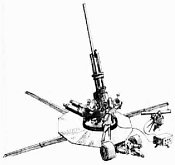
U.S. 90mm Antiaircraft Gun
The Marines dug in along the
beaches between the Tenaru and the
ridges west of Kukum. A Japanese
counter-landing was a distinct possibility.
Inland of the beaches, defensive
gun pits and foxholes lined the
west bank of the Tenaru and
crowned the hills that faced west
toward the Matanikau River and
Point Cruz. South of the airfield
where densely jungled ridges and ravines
abounded, the beachhead
perimeter was guarded by outposts
and these were manned in large part
by combat support troops. The engineer,
pioneer, and amphibious tractor
battalion all had their positions
on the front line. In fact, any Marine
with a rifle, and that was virtually
every Marine, stood night defensive
duty. There was no place within the
perimeter that could be counted safe
from enemy infiltration.
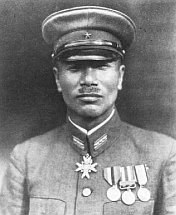
Department of Defense (USMC) Photo 150993
Col Kiyono Ichiki, a battle-seasoned
Japanese Army veteran, led his force in
an impetuous and ill-fated attack on
strong Marine positions in the Battle of
the Tenaru on the night of 20–21 August.
Almost as Turner’s transports
sailed away, the Japanese began a
pattern of harassing air attacks on
the beachhead. Sometimes the raids
came during the day, but the 3d
Defense Battalion’s 90mm antiaircraft
guns forced the bombers to fly too
high for effective bombing. The erratic
pattern of bombs, however,
meant that no place was safe near the
airfield, the preferred target, and no
place could claim it was bomb-free.
The most disturbing aspect of
Japanese air attacks soon became the
nightly harassment by Japanese aircraft
which singly, it seemed, roamed
over the perimeter, dropping bombs
and flares indiscriminately. The
nightly visitors, whose planes’ engines
were soon well known sounds,
won the singular title “Washing
Machine Charlie,” at first, and later,
“Louie the Louse,” when their
presence heralded Japanese shore
bombardment. Technically, “Charlie”
was a twin-engine night bomber
from Rabaul. “Louie” was a cruiser
float plane that signalled to the bombardment
ships. But the harassed
Marines used the names interchangeably.
Even though most of the division’s
heavy engineering equipment had
disappeared with the Navy’s transports,
the resourceful Marines soon
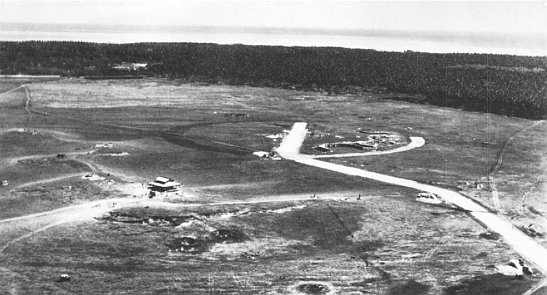
completed the airfield’s runway with
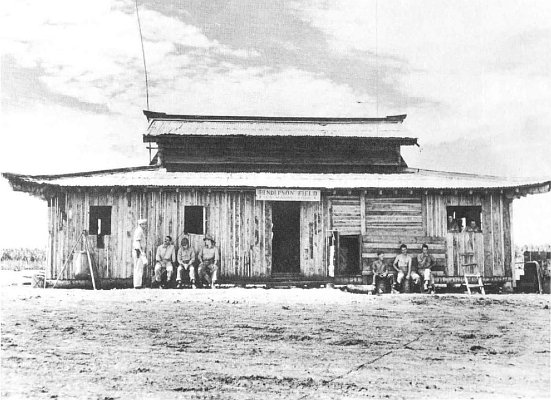
captured Japanese gear. On 12 August
Admiral McCain’s aide piloted
in a PBY-5 Catalina flying boat and
bumped to a halt on what was now
officially Henderson Field, named for
a Marine pilot, Major Lofton R. Henderson,
lost at Midway. The Navy
officer pronounced the airfield fit for
fighter use and took off with a load
of wounded Marines, the first of
2,879 to be evacuated. Henderson
Field was the centerpiece of Vandegrift’s
strategy; he would hold it at
all costs.
Although it was only 2,000 feet
long and lacked a taxiway and adequate
drainage, the tiny airstrip,
often riddled with potholes and rendered
unusable because of frequent,
torrential downpours, was essential
to the success of the landing force.
With it operational, supplies could
be flown in and wounded flown out.
At least in the Marines’ minds, Navy
ships ceased to be the only lifeline for
the defenders.
While Vandegrift’s Marines dug in
east and west of Henderson Field,
Japanese headquarters in Rabaul
planned what it considered an effective
response to the American offensive.
Misled by intelligence estimates
that the Marines numbered perhaps
2,000 men, Japanese staff officers believed
that a modest force quickly
sent could overwhelm the invaders.
On 12 August, CinCPac determined
that a sizable Japanese force
was massing at Truk to steam to the
Solomons and attempt to eject the
Americans. Ominously, the group included
the heavy carriers Shokaku
and Zuikaku and the light carrier
Ryujo. Despite the painful losses at
Savo Island, the only significant increases
to American naval forces in
the Solomons was the assignment of
a new battleship, the South Dakota
(BB 57).
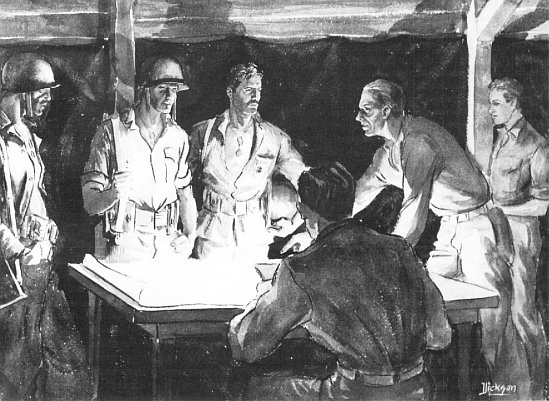
Of his watercolor painting “Instructions to a Patrol,” Capt
Donald L. Dickson said that three men have volunteered to
locate a Japanese bivouac. The one in the center is a clean-cut
corporal with the bearing of a high-school athlete. The man
on the right is “rough and ready.” To the one at left, it’s just
another job; he may do it heroically, but it’s just another job.
Captain Donald L. Dickson, USMCR
Imperial General Headquarters in
Tokyo had ordered Lieutenant
General Haruyoshi Hyakutake’s
Seventeenth Army to attack the Marine
perimeter. For his assault force,
Hyakutake chose the 35th Infantry
Brigade (Reinforced), commanded by
Major General Kiyotake Kawaguchi.
At the time, Kawaguchi’s main force
was in the Palaus. Hyakutake selected
a crack infantry regiment—the
28th—commanded by Colonel Kiyono
Ichiki to land first. Alerted for its
mission while it was at Guam, the
Ichiki Detachment assault echelon,
one battalion of 900 men, was transported
to the Solomons on the only
shipping available, six destroyers. As
a result the troops carried just small
amounts of ordnance and supplies.
A follow-on echelon of 1,200 of
Ichiki’s troops was to join the assault
battalion on Guadalcanal.
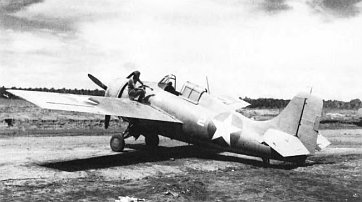
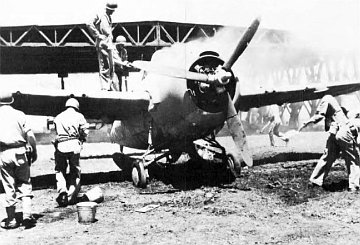
National Archives Photo 80-G-37932
On 20 August, the first Marine Corps aircraft such as this F4F Grumman Wildcat
landed on Henderson Field to begin combat air operations against the Japanese.
While the Japanese landing force
was headed for Guadalcanal, the
Japanese already on the island
provided an unpleasant reminder
that they, too, were full of fight. A
captured enemy naval rating, taken
in the constant patrolling to the west
of the perimeter, indicated that a
Japanese group wanted to surrender
near the village of Kokumbona,
seven miles west of the Matanikau.
This was the area that Lieutenant
Colonel Goettge considered held
most of the enemy troops who had
fled the airfield. On the night of 12
August, a reconnaissance patrol of 25
men led by Goettge himself left the
perimeter by landing craft. The
patrol landed near its objective, was
ambushed, and virtually wiped out.
Only three men managed to swim
and wade back to the Marine lines.
The bodies of the other members of
the patrol were never found. To this
day, the fate of the Goettge patrol
continues to intrigue researchers.
After the loss of Goettge and his
men, vigilance increased on the
perimeter. On the 14th, a fabled
character, the coastwatcher Martin
Clemens, came strolling out of the
jungle into the Marine lines. He had
watched the landing from the hills
south of the airfield and now
brought his bodyguard of native
policemen with him. A retired sergeant
major of the British Solomon
Islands Constabulary, Jacob C. Vouza,
volunteered about this time to
search out Japanese to the east of the
perimeter, where patrol sightings and
contacts had indicated the Japanese
might have effected a landing.
The ominous news of Japanese
sightings to the east and west of the
perimeter were balanced out by the
joyous word that more Marines had
landed. This time the Marines were
aviators. On 20 August, two squadrons
of Marine Aircraft Group
(MAG)-23 were launched from the
escort carrier Long Island (CVE-1) located
200 miles southeast of Guadalcanal.
Captain John L. Smith led 19
Grumman F4F-4 Wildcats of Marine
Fighting Squadron (VMF)-223 onto
Henderson’s narrow runway. Smith’s
fighters were followed by Major
Richard C. Mangrum’s Marine Scout-Bombing
Squadron (VMSB)-232
with 12 Douglas SBD-3 Dauntless
dive bombers.
From this point of the campaign,
the radio identification for Guadalcanal,
Cactus, became increasingly
synonymous with the island. The
Marine planes became the first elements
of what would informally be
known as Cactus Air Force.
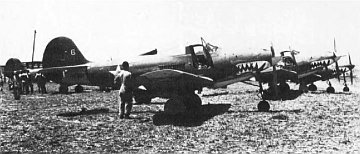
The first Army Air Forces P-400 Bell Air Cobras arrived on Guadalcanal on 22 August,
two days after the first Marine planes, and began operations immediately.
National Archives Photo 208-N-4932
Wasting no time, the Marine pilots
were soon in action against the
Japanese naval aircraft which frequently
attacked Guadalcanal. Smith
shot down his first enemy Zero fighter
on 21 August; three days later
VMF-223’s Wildcats intercepted a
strong Japanese aerial attack force
and downed 16 enemy planes. In this
action, Captain Marion E. Carl, a
veteran of Midway, shot down three
planes. On the 22d, coastwatchers
alerted Cactus to an approaching air
attack and 13 of 16 enemy bombers
were destroyed. At the same time,
Mangrum’s dive bombers damaged
three enemy destroyer-transports attempting
to reach Guadalcanal. On
24 August, the American attacking
aircraft, which now included Navy
scout-bombers from the Saratoga’s
Scouting Squadron (VS) 5, succeeded
in turning back a Japanese reinforcement
convoy of warships and
destroyers.
On 22 August, five Bell P-400 Air
Cobras of the Army’s 67th Fighter
Squadron had landed at Henderson,
followed within the week by nine
more Air Cobras. The Army planes,
which had serious altitude and
climb-rate deficiencies, were destined
to see most action in ground combat
support roles.
The frenzied action in what became
known as the Battle of the
Eastern Solomons was matched
ashore. Japanese destroyers had delivered
the vanguard of the Ichiki force
at Taivu Point, 25 miles east of the
Marine perimeter. A long-range
patrol of Marines from Company A,
1st Battalion, 1st Marines ambushed
a sizable Japanese force near Taivu
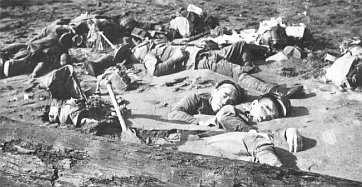
on 19 August. The Japanese dead
were readily identified as Army
troops and the debris of their defeat
included fresh uniforms and a large
amount of communication gear.
Clearly, a new phase of the fighting
had begun. All Japanese encountered
to this point had been naval troops.
Alerted by patrols, the Marines
now dug in along the Ilu River, often
misnamed the Tenaru on Marine
maps, were ready for Colonel Ichiki.
The Japanese commander’s orders
directed him to “quickly recapture
and maintain the airfield at Guadalcanal,”
and his own directive to his
troops emphasized that they would
fight “to the last breath of the last
man.” And they did.
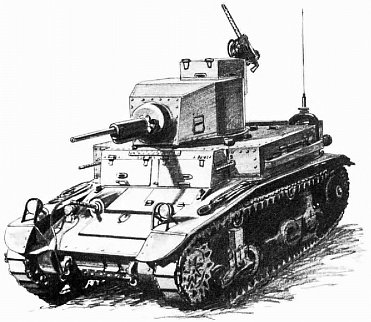
U.S. M-3 Light Tank
Too full of his mission to wait for
the rest of his regiment and sure that
he faced only a few thousand men
overall, Ichiki marched from Taivu
to the Marines’ lines. Before he attacked
on the night of the 20th, a
bloody figure stumbled out of the
jungle with a warning that the
Japanese were coming. It was Sergeant
Major Vouza. Captured by the
Japanese, who found a small American
flag secreted in his loincloth, he
was tortured in a failed attempt to
gain information on the invasion
force. Tied to a tree, bayonetted twice
through the chest, and beaten with
rifle butts, the resolute Vouza chewed
through his bindings to escape. Taken
to Lieutenant Colonel Edwin A. Pollock,
whose 2d Battalion, 1st Marines
held the Ilu mouth’s defenses,
he gasped a warning that an estimated
250–500 Japanese soldiers were
coming behind him. The resolute
Vouza, rushed immediately to an aid
station and then to the division
hospital, miraculously survived his
ordeal and was awarded a Silver Star
for his heroism by General Vandegrift,
and later a Legion of Merit.
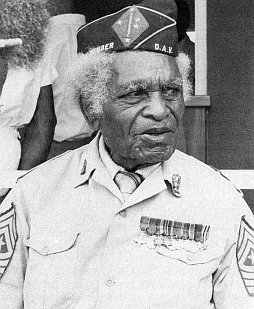
Vandegrift also made Vouza an
honorary sergeant major of U.S.
Marines.
At 0130 on 21 August, Ichiki’s
troops stormed the Marines’ lines in
a screaming, frenzied display of the
“spiritual strength” which they had
been assured would sweep aside their
American enemy. As the Japanese
charged across the sand bar astride
the Ilu’s mouth, Pollock’s Marines cut
them down. After a mortar preparation,
the Japanese tried again to
storm past the sand bar. A section of
37mm guns sprayed the enemy force
with deadly canister. Lieutenant
Colonel Lenard B. Cresswell’s 1st Battalion,
1st Marines moved upstream
on the Ilu at daybreak, waded across
the sluggish, 50-foot-wide stream,
and moved on the flank of the
Japanese. Wildcats from VMF-223
strafed the beleagured enemy force.
Five light tanks blasted the retreating
Japanese. By 1700, as the sun was
setting, the battle ended.
Colonel Ichiki, disgraced in his own
mind by his defeat, burned his
regimental colors and shot himself.
Close to 800 of his men joined him
in death. The few survivors fled eastward
towards Taivu Point. Rear Admiral
Raizo Tanaka, whose
reinforcement force of transports and
destroyers was largely responsible for
the subsequent Japanese troop buildup
on Guadalcanal, recognized that
the unsupported Japanese attack was
sheer folly and reflected that “this
tragedy should have taught us the
hopelessness of bamboo spear tactics.”
Fortunately for the Marines,
Ichiki’s overconfidence was not
unique among Japanese commanders.
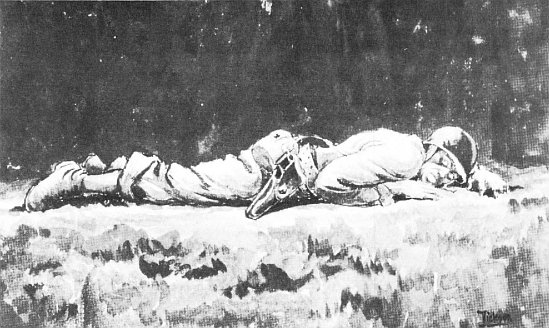
Captain Donald L. Dickson, USMCR
Capt Donald L. Dickson said of his watercolor: “I wanted to
catch on paper the feeling one has as a shell comes whistling
over.... There is a sense of being alone, naked and unprotected.
And time seems endless until the shell strikes somewhere.”
Following the 1st Marines’ tangle
with the Ichiki detachment, General
Vandegrift was inspired to write the
Marine Commandant, Lieutenant
General Thomas Holcomb, and
report: “These youngsters are the
darndest people when they get started
you ever saw.” And all the Marines
on the island, young and old, tyro
and veteran, were becoming accomplished
jungle fighters. They were no
longer “trigger happy” as many had
been in their first days ashore, shooting
at shadows and imagined enemy.
They were waiting for targets,
patrolling with enthusiasm, sure of
themselves. The misnamed Battle of
the Tenaru had cost Colonel Hunt’s
regiment 34 killed in action and 75
wounded. All the division’s Marines
now felt they were bloodied. What
the men on Tulagi, Gavutu, and
Tanambogo and those of the Ilu had
done was prove that the 1st Marine
Division would hold fast to what it
had won.
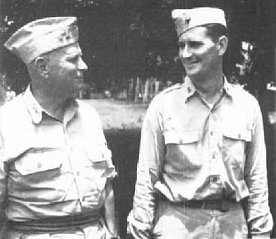
Cactus Air Force commander, MajGen
Roy S. Geiger, poses with Capt Joseph
J. Foss, the leading ace at Guadalcanal
with 26 Japanese aircraft downed. Capt
Foss was later awarded the Medal of
Honor for his heroic exploits in the air.
Department of Defense (USMC) Photo 52622
While the division’s Marines and
sailors had earned a breathing spell
as the Japanese regrouped for
another onslaught, the action in the
air over the Solomons intensified.
Almost every day, Japanese aircraft
arrived around noon to bomb the
perimeter. Marine fighter pilots
found the twin-engine Betty bombers
easy targets; Zero fighters were
another story. Although the Wildcats
were a much sturdier aircraft, the
Japanese Zeros’ superior speed and
better maneuverability gave them a
distinct edge in a dogfight. The
American planes, however, when
warned by the coastwatchers of
Japanese attacks, had time to climb
above the oncoming enemy and
preferably attacked by making firing
runs during high speed dives. Their
tactics made the air space over the
Solomons dangerous for the
Japanese. On 29 August, the carrier
Ryujo launched aircraft for a strike
against the airstrip. Smith’s Wildcats
shot down 16, with a loss of four of
their own. Still, the Japanese continued
to strike at Henderson Field
without letup. Two days after the
Ryujo raid, enemy bombers inflicted
heavy damage on the airfield, setting
aviation fuel ablaze and
incinerating parked aircraft.
VMF-223’s retaliation was a further
bag of 13 attackers.
On 30 August, two more MAG-23
squadrons, VMF-224 and
VMSB-231, flew in to Henderson.
The air reinforcements were more
than welcome. Steady combat attrition,
frequent damage in the air and
on the ground, and scant repair facilities
and parts kept the number of
aircraft available a dwindling
resource.
Plainly, General Vandegrift needed
infantry reinforcements as much
as he did additional aircraft. He
brought the now-combined raider
and parachute battalions, both under
Edson’s command, and the 2d
Battalion, 5th Marines, over to
Guadalcanal from Tulagi. This gave
the division commander a chance to
order out larger reconnaissance
patrols to probe for the Japanese. On
27 August, the 1st Battalion, 5th Marines,
made a shore-to-shore landing
near Kokumbona and marched back
to the beachhead without any measurable
results. If the Japanese were
out there beyond the Matanikau—and
they were—they watched the
Marines and waited for a better opportunity
to attack.