"Oh, Father, please let me go to the
fair! You promised me I could
a week ago. All the boys are going,
and I just can't give it up. Please
let me go!" and Harry was almost in
tears over his disappointment.
"I know all about it, Harry," his father
answered. "I realize how much you have
looked forward to the fair, and I should
like to have you go. There is a great deal
for a boy to learn at a fair, if he will only
keep his eyes open, but you see just how
it is. I am in bed with a sprained ankle,
and your mother cannot leave the baby.
So what are we to do? A boy of ten is too
young to go to such a place without some
one to look after him."
"Yes, Father; but Roy Bradish is going
with two other boys who are twelve or
fourteen years old, and they asked me to
go with them. They could take care of
me as well as not. I'd be good, Father.
Please, please let me go!"
Harry begged so hard that at last his
father yielded, and gave the boy permission
to go with his friends.
"I would rather have you go with an
older person," he said; "but there seems
to be no one who can take you. Be very
careful not to get into mischief. Don't
shout, or run about, or do anything to
attract attention. A quiet boy who takes
care of himself is the boy I like to see."
So, on the day of the fair, a warm sunny
day in late September, Harry started off
with his three friends. He had a dollar
in his pocket for spending-money, and a
box under his arm, which was well filled
with sandwiches and doughnuts. As he
bade good-bye to his father and mother,
he promised over and over to be good,
and to come home before dark.
It was a long walk to the grounds where
the fair was held every year, but the boys
trudged along, talking and laughing, and
having a good time.
At the entrance-gate Harry spent half
of his dollar for a ticket, and it was not
long before the other half was gone, for
there were many things to tempt money
from a boy's pocket. He bought peanuts
and pop-corn and a cane for himself, an
apple-corer for his mother, and a whet-stone
for his father.
The other boys spent their money, too;
and then they wandered around in the
grounds, going into first one building and
then another. There were exhibitions of
vegetables and fruit in one building,—great
piles of squashes and pumpkins;
boxes of onions, turnips, beets, carrots,
and parsnips; ears of yellow corn with
their husks braided together, and corn-stalks
ten or twelve feet tall ranged against
the wall.
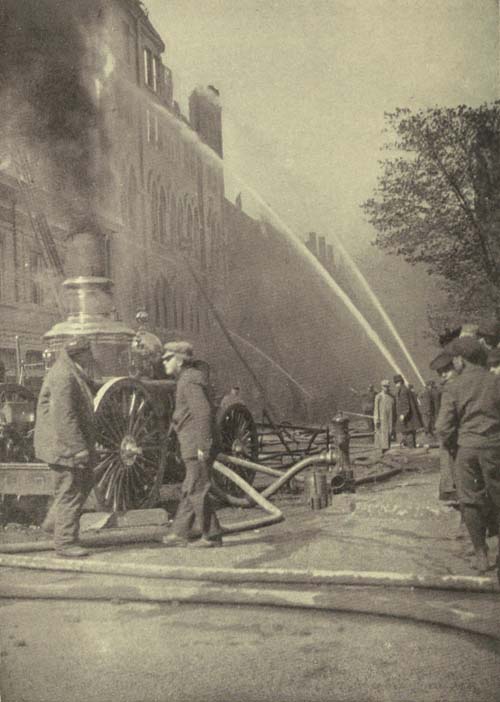
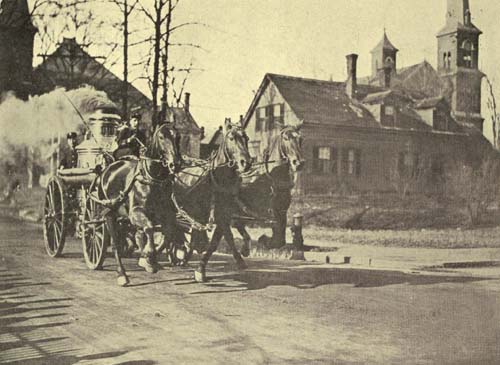
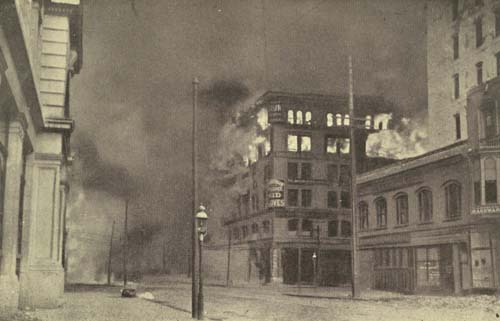
From Stereograph, Copyright, 1905, by Underwood & Underwood, N. Y.
The horses are led away to a place of safety
The fruit was displayed on long tables
in the center of the room,—rosy-cheeked
apples, luscious golden pears, velvety
peaches, and great clusters of purple grapes.
It was enough to make one's mouth water
just to look at them.
But the animal-sheds were even more
interesting. There were handsome horses,—black,
bay, and chestnut. Their coats
shone like satin; and when their keepers
led them out they arched their necks and
pranced about, as if they were trying to
say, "Did you ever see a more beautiful
creature than I am? Just wait a while,
and I will race for you. See all these blue
ribbons! I won them by my beauty and
my speed."
Then there were the cattle, long rows of
them, standing patiently in their narrow
stalls; the pigs, little ones and big ones,
white ones and black ones; and the sheep
with their long coats of warm, soft wool.
After the boys had eaten their lunch
they watched the horse-show for a little
while, and then there was a free circus
which they wanted to see, so it was the
middle of the afternoon before they found
their way to the poultry show.
Such a noise you never heard in all your
life as the one that greeted their ears the
moment they stepped inside the door.
If you want to hear some queer music,
just listen to a poultry band at a county
fair,—roosters crowing, hens cackling,
ducks quacking, pigeons cooing, and turkeys
gobbling.
Harry liked the poultry-show best of all.
He had some hens at home which he had
raised himself, and he stood for a long time
watching a mother hen and her tiny
bantam chickens.
"I wish I hadn't spent all my money,"
he said to himself. "I'd like to buy two
or three of those chickens."
"Cock-a-doodle-doo!" said a loud voice
in a cage behind him.
Harry turned quickly, and there stood a
handsome white rooster, flapping his wings
and crowing lustily.
"Cock-a-doodle-doo!" he said again,
and he walked back and forth in the narrow
cage, strutting proudly, and spreading his
wings as if to say, "What do you think
of me?"
"Cock-a-doodle-doo! I'd like to buy
you, too," said Harry.
"He is a beauty, isn't he, Roy?" he
added, turning to speak to his friend.
But the boys were gone. He walked the
whole length of the building, and they were
nowhere to be seen.
"Perhaps they have gone back to the
sheep-pens," he said to himself, and he ran
across the grounds to look for them.
The judges were awarding prizes for the
finest sheep, and the long low building
was crowded with people, but there was
no sign of Harry's friends.
"Where can they be?" he said, half
aloud. "They may have gone over to
see the cows milked by machinery. I'll
go there next."
Just as he went out of the farther door
of the sheep-shed he met two men coming
in. One of the men was smoking, and as
he entered the shed he threw away the
short end of his cigar. It fell in the dry
grass near a pile of straw.
In a minute West Wind came scurrying
across the field, and it was not long before
he found the lighted cigar.
"What are you doing down there in the
grass?" said West Wind. "Why don't you
burn and have a good smoke by yourself?"
The red tip of the cigar shone brighter
at the words. "So I will," it said, and it
sent up a thin curl of blue smoke.
"Pouf! pouf!" said West Wind. "Can't
you do better than that?"
"Of course I can," and the stub burned
still brighter.
"Now I'll show you a good smoke,"
said West Wind, and he blew some dry
grass over the cigar.
The grass blazed up and set fire to the
straw, and then there was some smoke,—you
may be sure!
West Wind danced over the grass with
glee. He whirled round and round, tossing
fresh straw to the flames, and blowing up
the smoke in soft clouds.
In a little while Harry came back, still
hunting for his friends. A puff of smoke
caught his eye and he ran to see what was
burning. By this time the straw had set
fire to the end of the sheep-shed, and the
flames were eating their way toward the
low roof.
"Fire!" shouted Harry; but the crowd
had gone over to see the milking and there
was no one in sight.
"Some one will come in a minute," he
thought, and he snatched off his coat and
beat back the flames as they ran up the
dry boards.
"Fire!" he shouted again, at the top
of his voice. This time a man who was
feeding the lambs heard him and came out
with a pail of water; and then it did not
take long to put out the fire.
Just as Harry was stamping out the
last flickering flames in the burning straw,
a policeman came running out. "Here,
what are you doing?" he cried.
"Putting out this fire," replied the
little boy.
"I suppose you started it, too," said
the policeman. "I never saw a boy yet
who could keep out of mischief."
Just then the two men came to the door
of the sheep-shed. "What is the matter?"
they asked.
"This boy says he was putting out a
fire, and I think he must have set it," the
policeman told them.
"No, sir," said Harry, "I didn't set the
straw on fire. It was burning when I came
up, and I tried to put it out."
"I was smoking a cigar when I went
into the shed," spoke up one of the men,
"and I threw it away. It must have set
fire to the straw. It was a very careless
thing to do, and if it hadn't been for this
boy we might have had a terrible fire."
Just then Harry thought of his coat.
It was his very best one, and his mother
had told him to be careful of it. He held
it up and looked at it. One sleeve was
scorched, there were two or three holes
in the back, and the whole coat was covered
with straw and dirt.
By this time a crowd had begun to
gather, just as a crowd always gathers
around a policeman, and the story had
to be told all over again.
"He saved my sheep!" said one of the
men.
"And mine, too," added another.
"Let's help him to get a new coat;"
and he took off his hat and began to pass
it around in the crowd.
Just then a newspaper reporter came up
with his camera, and, of course, he wanted
to take Harry's picture. When the newspaper
was published next day, there was
the picture, and the whole story of the
ten-year-old boy whose quick thought
and quick work had saved the sheep-shed
and all the valuable sheep from fire.
What is exhibited at a County Fair?
Why is the fair held in the fall?
What did the boys see at the fair?
What set the grass on fire?
How did Harry put out the fire?
Why is it careless to throw away a lighted cigar?
Lighted cigars thrown carelessly into
dry grass or rubbish have caused many
fires. Burning tobacco shaken from a pipe
is even more dangerous, and a lighted
cigarette is still worse, as some brands of
cigarettes will burn two or three minutes
after they are thrown away. When they
are thrown from upper windows, they
frequently lodge upon awnings, setting
them on fire. Cigarette and cigar stubs
in the streets sometimes set fire to women's
skirts. Occasionally a man burns his own
clothing by putting a lighted pipe in his
pocket, or he sets the bed-clothing on fire
by smoking in bed.