Gordon returns to the Sudan—The Siege of Khartum—I join the
Mahdi at Rahad—Interviews and first Impressions of the Mahdi—The
Oath of Allegiance—Description of the Khalifa—The
Arrival of Hussein Pasha—Criticisms on Gordon's Mission—The
Abandonment of the Sudan proclaimed—Incidents in Various
Parts of the Sudan—The Arrival of Olivier Pain—His Mission,
Illness, and Death—Arrival outside Khartum—I write to Gordon—I
am arrested and thrown into Chains—Incidents during my
Imprisonment—The Surrender of Omdurman—The Delay of the
British Expedition—Khartum is attacked and taken—Gordon's
Head is brought to me—Account of the last Days of Khartum—Massacres
and Atrocities after the Fall—The Retreat of the
British Expedition—The Rigours of my Imprisonment increased—My
Comrade in Captivity, Frank Lupton—We are both released—I
enter the Khalifa's Body-guard—Illness and Death of
the Mahdi—Khalifa Abdullahi succeeds him—The Rules and
Ordinances of the Mahdi.
After the destruction of Hicks Pasha's expedition,
the Mahdi well knew that the whole Sudan was at
his feet; to take possession of it was merely a question
of time. His first step was the despatch of his cousin
Khaled to Darfur, where he knew no resistance was possible.
Through the influence of Karamalla, he was able
to acquire possession of the Bahr el Ghazal, the employés
having merely transferred their allegiance from the
Khedive to the Mahdi. Already Mek Adam of Tagalla
had submitted, and had come to El Obeid with his family.
Mahdism had seized a firm hold of the Eastern Sudan,
and found a ready home amongst the brave Arabs of those
regions; Egyptian troops had been annihilated at Sinkat
and Tamanib; General Baker's disaster at Teb had given
the tribes great confidence; and Mustafa Hadal was besieging
Kassala. In the Gezira, between the Blue and
White Niles, the Mahdi's brother-in-law, Wad el Basir of
the Halawin tribe, had scored successes against the
Government; and such was briefly the condition of the
country when Gordon reached Berber, on 11th February
1884.
The Egyptian Government, in accord with the British
Government, thought that by the despatch of Gordon,
who had special knowledge of the Sudan, the agitation
would be stopped; but neither these Governments, nor
Gordon himself, seemed to realise how serious the situation
really was. Did they imagine for a moment that Gordon,
who had had occasion to show considerable personal
bravery, who had gained a name for charity and benevolence
amongst the lower classes of the Darfur population,
and had suppressed a number of revolts in the Equatorial
Negro lands, was capable of checking the blazing flames
of fanaticism? The Jaalin between Berber and Khartum,
and throughout the Gezira, had become restive and dissatisfied;
and was the personal influence of Gordon going
to pacify them? On the contrary, these same tribes had
every reason to remember with little satisfaction the name
of the Governor-General who had issued the ejection
edict against the Gellabas of the southern districts, during
the Suleiman Zubeir war against the Arabs. In the events
which followed on this drastic measure, and which I
have described elsewhere, many of these people had lost
fathers, brothers, and sons, and had been reduced to
beggary; were they likely to forgive Gordon this?
On the 18th February, he reached Khartum, and received
a warm welcome from the officials and inhabitants.
Those who were in immediate contact with him, and anticipating
for themselves much personal benefit, were convinced
that the Government would never leave a man like Gordon
in the lurch. Almost his first step was to issue a proclamation
appointing the Mahdi Sultan of Kordofan, permitting
the slave-trade, and proposing to enter into relations
with him; in his letter he also asked for the release of the
prisoners, and sent the Mahdi some very fine clothes.
Gordon's letter would have been all very well if he had had
a force at his back with which to march into Kordofan;
but the Mahdi had been told that he had arrived at
Khartum with merely a small body-guard. Naturally he
thought it an extraordinary proceeding for Gordon to
give him what he had already taken by force of arms, and
which it was most improbable any troops at Gordon's
disposal could have wrenched from him; and it was in
this frame of mind that the Mahdi couched his reply advising
Gordon to surrender and save his life.
Meanwhile, the immense crowds which had collected
round El Obeid began to exhaust the water supply; and,
to reduce the pressure, the Mahdi despatched Abu Anga,
with a large force, against Jebel Daïr, where the Nuba
tribes were offering a stubborn resistance to his rule.
In all these matters, Khalifa Abdullahi was the Mahdi's
principal adviser, and, consequently, he was detested by
the immediate relatives of the Prophet, who did all in their
power to frustrate his designs, and intrigue against him.
He was, however, well aware that the Mahdi could not get
on without him; he therefore retaliated by complaining
against these intrigues, and asked the Mahdi to take an
occasion to openly acknowledge his services. This led
to the issue of a proclamation which, to this day, is referred
to whenever any exceptionally severe measure or
important change is contemplated by his successor. It
runs as follows:—
A PROCLAMATION
From Mohammed el Mahdi to all his Followers.
In the name of God, etc., Know ye, O my followers, that the
representative of the righteous [Abu Bakr], and the Emir of the
Mahdi army, referred to in the Prophet's vision, is Es Sayed
Abdullahi Ibn es Sayed Hamadalla. He is of me, and I am of
him. Behave with all reverence to him, as you do to me; submit
to him as you submit to me, and believe in him as you believe
in me; rely on all he says, and never question any of his
proceedings. All that he does is by order of the Prophet, or by
my permission. He is my agent in carrying out the will of the
Prophet. If God and His Prophet desire to do anything, we
must submit to their will; and if any one shows the slightest disinclination,
he is not a believer, and has no faith in God. The
Khalifa Abdullahi is the representative of the righteous. You
are well aware of the love of God and His apostle for the
righteous; therefore, you can readily understand the honourable
position which should be held by His representative. He
is guarded by the "Khudr," and is strengthened by God and
His Prophet. If any one of you speak or think ill of him, you
will suffer destruction, and will lose this world and the world to
come.
Know, therefore, that all his sayings and actions must never
be questioned; for he has been given wisdom and a right judgment
in all things. If he sentence any of you to death, or confiscate
your property, it is for your good; therefore do not
disobey him. The Prophet says that, in next degree to the
Prophet, Abu Bakr was the greatest living man under the sun,
and also the most righteous. The Khalifa Abdullahi is his representative;
and, by order of the Prophet, he is my Khalifa. All
those who believe in God and in me must also believe in him;
and, should any one notice anything apparently wrong in him,
they should attribute it to a mystery which they cannot understand,
and that, therefore, it must be right. Let those who are
present tell those who are absent, so that all may submit to him,
and attribute to him no wrong. Beware of doing any harm to
the friends of God; for God and His Prophet curse those that
behave or think badly of His friends.
The Khalifa Abdullahi is the commander of the faithful, and is
my Khalifa and agent in all religious matters. Therefore, I leave
off as I have begun,—"Believe in him; obey his orders; never
doubt what he says, but give all your confidence to him, and
trust him in all your affairs." And may God be with you all.
Amen.
As the water was daily becoming more scarce, the Mahdi
resolved to move his entire camp to Rahad, about one
day's journey from El Obeid; and, about the middle of
April, the transfer of this immense mass of men, women,
and children to the new position was completed. He had
left his old relative, Sayed Mahmud, at El Obeid with very
strict orders that any persons found remaining in the town,
without his permission, were to be sent to Rahad by force;
and he sent further reinforcements to Jebel Daïr, which was
only a day's march distant, and where the plucky Nubas
were defending themselves most gallantly.
The camp at Rahad soon became a perfect sea of straw
huts, or tokuls, stretching as far as the eye could reach;
and, all day long, the Mahdi occupied himself in his religious
duties, preaching and praying incessantly. Mohammed
Abu Girga, he nominated Emir of the Gezira, and
despatched him, with a considerable following, to the Nile,
with instructions to head the revolt in these districts, and
besiege Khartum.
Such was the state of affairs when, towards sunset, Said
Bey Guma, Dimitri Zigada, and I approached Rahad.
We stopped for the night at some huts on the outskirts;
and it was not long before a considerable number of people
became aware of our arrival, and we received several visits
from those who were anxious to know the situation in
Darfur when we had left. At sunrise, having donned our
new jibbas, we took leave of our hosts, and proceeded
towards the camp where we were expected in two hours
time; my servants, who knew something of tailoring, had
made me a jibba with broad black patches sewn on with
such evenness and regularity that, at a short distance, I
must have looked exactly like a lady in a fancy bathing
costume, whilst Said Bey and Zigada wore party-coloured
patches which gave them the appearance of harlequins. I
now sent on one of my servants to apprise the much-feared
Khalifa of our approach; but, as he delayed returning, we
rode on along the broad road leading to the market-place.
As we approached, we heard the dismal sound of the
ombeÿa, which was the signal that the Khalifa had gone
out on his horse. By chance, I came across a Darfuri
who, when I asked him what the ombeÿa was being sounded
for, replied, "Very probably Khalifa Abdullahi is giving
orders for some one's head to be cut off, and this is a
summons to the people to witness the execution." Had I
been superstitious, I should certainly have taken this as a
bad omen,—an execution the moment I entered the camp!
However, we rode on, and soon came in sight of a large
open place where we saw my servant and another man
hastening towards us. "Stay where you are," cried he,
"and come no further; the Khalifa, with his escort, has
gone out to meet you; he thought you were still outside
the camp." We halted while the other man returned to
let the Khalifa know we had arrived. A few minutes later,
we saw hundreds of horsemen surrounded by numbers of
armed footmen approaching us, and marching to the sound
of the ombeÿa. At the farther end of the open space was
the Khalifa himself; he had halted, and several horsemen,
ranging up to his right and left, stood awaiting his instructions.
He now ordered them to begin their horse exercise,
which consisted of batches of four men abreast, with
poised lances, galloping at full speed towards some point,
then suddenly pulling up, turning round and galloping
back again; this useless sort of drill continued until men
and horses became utterly exhausted. Sometimes I was
the objective of their charge, and, as they galloped up,
they shook their spears close to my face, shouting, "Fi
shan Allah wa Rasulahu" (For God and His Prophet),
and then galloped back again. After repeating this operation
for upwards of half an hour, one of the Khalifa's servants
at length approached me on foot, and told me that
the Khalifa wished me also to gallop towards him. I did
so, shook my lance in his face, shouted, "Fi shan Allah
wa Rasulahu!" and then returned to my place. He now
sent word to me to ride behind him, and in a few minutes
we reached his quarters. He was assisted to dismount by
a special attendant, the remainder keeping at a respectful
distance; and he disappeared behind the fence. In a few
moments, he sent out a message to us to come in; and we
were conducted to a spot fenced off from the rest of the
enclosure, which is designated the rekuba; it was merely
a small, square apartment with straw walls and a thatch
roof. In it were several angarebs and palm-mats; we
were told to seat ourselves on these, and were served with
a mixture of honey and water in a pumpkin gourd, and
some dates. Having partaken of this, we patiently awaited
the appearance of our hospitable host and master. He
soon came in, and we at once rose; seizing my hand, he
pressed me to his heart, saying, "God be praised, we
are at last united! How do you feel after your long and
tiring journey?" "Yes, indeed," I replied, "God be
praised for having granted me to live to see this day!
When I beheld your countenance, my fatigue at once
left me!" I well knew that, to win his favour, I must
flatter him as much as possible; he now gave his hand
to Said Bey and Dimitri to kiss, and asked how they were.
I scrutinised him very carefully; he had a light-brown
complexion, a sympathetic Arab face, on which the marks
of small-pox were still traceable, an aquiline nose, a well-shaped
mouth, slight moustache, and a fringe of hair on
his cheeks, but rather thicker on his chin; he was about
middle height, neither thin nor stout, was wearing a jibba
covered with small square patches of different colours, and
a Mecca takia, or skull cap, round which was bound a
cotton turban; he generally spoke with a smile, and
showed a row of glistening white teeth. Having greeted
us, he told us to be seated; and we at once sat on the
palm-mats on the ground, whilst he sat cross-legged on
an angareb. Once more he inquired after our health, and
expressed his great delight that we had at last reached
the Mahdi. On a sign to one of his servants, a dish of
asida, and another of meat, were laid before us, and, sitting
beside us, he told us to help ourselves; he himself ate
heartily, seeming to thoroughly enjoy his food, and, during
the meal, he asked several questions. "Why," said he,
smiling, "did you not wait for me outside the camp, instead
of entering without permission? You know you are
not supposed to enter a friend's house without his permission."
"Pardon," said I, "my servant kept us waiting
so long, and none of us thought you would take the trouble
to come out and meet us; then, as we reached the entrance
of the camp, we heard the beating of war-drums and the
sound of your ombeÿa, and, when we inquired what that
meant, we were told that you had ridden out to witness
the execution of a criminal; we therefore intended following
the sound of your ombeÿa, when your order reached
us." "Am I then known as a tyrant amongst the people,"
said he, "that the sound of my ombeÿa should always mean
the death of some one?" "No, indeed, sir," said I, "you
are generally known to be strict, but just." "Yes, I am
strict," he replied; "but this must be so, and you will understand
the reasons as you prolong your stay with me."
One of the Khalifa's slaves now entered, and said that
several people were waiting outside, and sought his permission
to greet me. The Khalifa at once asked if I was
not too fatigued after my journey; and when I said no, he
allowed them to come in. The first to enter was Ahmed
Wad Ali (the Kadi el Islam), who was formerly one of my
Government officials, but had deserted from Shakka;
then followed Abderrahman ben Naga, who had come
with the Hicks expedition, in the course of which he had
lost an eye, and had been wounded in several places, but
had been rescued by some of his slaves who were with the
Mahdists; Ahmed Wad Suleiman, the Treasurer of the
Beit el Mal, Sayed Abdel Kader, the Mahdi's uncle, Sayed
Abdel Karim, and several others followed. All of them
kissed the Khalifa's hand with deep reverence, and, after
asking his permission, greeted me. The usual complimentary
speeches passed between us; and, after reciprocal
congratulations that we had lived to see the glorious time
of the Mahdi, they withdrew; Abderrahman alone gave
me a wink with his one eye as he said good-bye, from
which I knew he had something to say to me, so I walked
forward a few steps with him, and, in a low quick tone, he
muttered: "Be very careful; hold your tongue, and trust
no one." I took his warning to heart.
The Khalifa then departed, recommending us to take
some rest, as he would present us to the Mahdi at noon-day
prayers. We now inquired about our servants, and were
told that they had been taken in and given food. Once
alone, and convinced that there were no eavesdroppers
near, we spoke of our excellent reception, and I warned
the others to be most careful about what they said.
Dimitri Zigada was now getting quite pleased with himself,
and began searching about in his pockets for a piece of
tobacco to chew; he produced some from under his jibba,
and at once put it in his mouth. I begged him to be
careful, as such practices were entirely forbidden by the
Mahdi; he replied by saying he intended asking the
Khalifa to allow him to go and live with his compatriots,
of whom there were a considerable number in camp. "I
am only a common merchant," said he, "and have lost all
my money; the Khalifa won't take any further notice of
me; but you will have to keep a sharp lookout yourselves,
for you are former Government officials and military
men, so he will watch you very carefully."
About two o'clock in the afternoon a message reached
us from the Khalifa, to perform our ablutions, and prepare
to go to the Mesjed (place of worship); a few minutes
later he arrived himself, and told us to follow him. He was
on foot, as the mosque, which was close to the Mahdi's hut,
was only about three hundred yards off. On arrival, we
found the place crowded with devotees, ranged in closely
packed lines; and, when the Khalifa entered, they made way
for him with great respect. A sheepskin was spread on the
ground for us, and he directed us to take our places beside
him. The Mahdi's quarters, consisting of several large
straw huts fenced off by a thorn zariba, were situated at
the southwest end of the mosque. A gigantic tree
afforded shade to a number of the worshippers, but those
beyond had no protection from the burning sun. A few
paces from the front line, and to the right, lay a small hut
which was reserved for those with whom the Mahdi
wished to converse in private. The Khalifa now rose and
entered this hut, probably to inform his master of our
arrival; for, in a few moments, he returned, again seated
himself beside me, and almost immediately the Mahdi himself
came out. The Khalifa at once arose, and with him
Said Bey, Dimitri, and I, who were just behind him,
whilst the others quietly remained in their places. The
Mahdi being the Imam, or leader of prayers, his sheepskin
was spread out in front; and he then stepped towards
us. I had advanced slightly, and he greeted me with
"Salam aleikum," which we at once returned by "Aleikum
es salam." He then presented his hand for me to kiss,
which I did several times, and Said Bey and Dimitri
followed my example. Motioning us to be seated, he welcomed
us, and, turning to me, said, "Are you satisfied?"
"Indeed I am," I replied, readily; "on coming so near
to you I am most happy." "God bless you and your
brethren!" (meaning Said Bey and Dimitri) said he;
"when news reached us of your battles against my followers,
I used to pray to God for your conversion. God and
His Prophet have heard my prayers, and as you have
faithfully served your former master for perishable money,
so now you should serve me; for he who serves me, and
hears my words, serves God and His religion, and shall
have happiness in this world and joy in the world to
come." We of course all made professions of fidelity; and
as I had been previously warned to ask him to give me the
"beia," or oath of allegiance, I now besought this honour.
Calling us up beside him, he bade us kneel on the edge of
his sheepskin, and, placing our hands in his, he told us to
repeat after him as follows:—
"Bism Illahi er Rahman er Rahim, bayana Allaha wa
Rasulahu wa bayanaka ala tauhid Illahi, wala nushrek billahi
shayan, wala nasrek, wala nazni, wala nati bi buhtan,
wala nasak fil maruf, bayanaka ala tark ed dunya wal
akhera, wala naferru min el jehad" (In the name of God
the most compassionate and merciful, in the name of the
unity of God, we pay God, His Prophet, and you our
allegiance; (we swear) that we shall not associate anything
else with God, that we shall not steal, nor commit adultery,
nor lead any one into deception, nor disobey you in your
goodness; we swear to renounce this world and (look
only) to the world to come, and that we shall not flee from
the religious war).
This over, we kissed his hand, and were now enrolled
amongst his most devoted adherents; but at the same time
we were liable to suffer their punishments. The muazzen
(prayer caller) now gave the first signal to begin prayers,
and we repeated the usual formulæ after the Mahdi.
When they were over, all those present raised their hands
to Heaven, and besought God to grant victory to the faithful.
The Mahdi now began his sermon. An immense circle
was formed around him, and he spoke of the vanity and
nothingness of this life, urging all to renounce the world,
and to think only of their religious duties, and of the
Jehad; he painted, in most glowing terms, the delights of
Paradise, and the heavenly joys which awaited those who
paid heed to his doctrine. Every now and then he was
interrupted by the shouts of some fanatic in an ecstasy;
and, indeed, I am convinced every one present, except ourselves,
really believed in him. The Khalifa, having something
to do, had left the mosque, but had ordered his
mulazemia (body-guard), who remained, to tell us to stay
with the Mahdi till sunset. I had now a good opportunity
of making a careful survey of Mohammed Ahmed; he was
a tall, broad-shouldered man of light-brown colour, and
powerfully built; he had a large head and sparkling black
eyes; he wore a black beard, and had the usual three slits
on each cheek; his nose and mouth were well shaped, and
he had the habit of always smiling, showing his white
teeth and exposing the V-shaped aperture between the two
front ones which is always considered a sign of good luck
in the Sudan, and is known as "falja." This was one of
the principal causes which made the Mahdi so popular with
the fair sex, by whom he was dubbed "Abu falja" (the
man with the separated teeth). He wore a short quilted
jibba, beautifully washed, and perfumed with sandal-wood,
musk, and attar of roses; this perfume was celebrated
amongst his disciples as Rihet el Mahdi (the odour of the
Mahdi), and was supposed to equal, if not surpass, that of
the dwellers in Paradise.
We remained exactly on the same spot, with our legs
tucked away behind, until the time for evening prayers
came. Meanwhile the Mahdi had frequently gone to and
fro between his house and the mosque; and, prayers over,
I begged leave to depart, as the Khalifa had told me to
return to him at that hour. He gave me permission, and
took the opportunity of saying that I must adhere closely
to the Khalifa, and devote myself entirely to his service.
Of course I promised to obey him to the letter, and Dimitri,
Said Bey, and I, covering the Mahdi's hand with kisses,
quitted the mosque. My legs were so cramped by the
posture in which I had been sitting for hours together that
I could scarcely walk; but, in spite of the pain, I was obliged
to keep as cheerful a face as possible in the Mahdi's presence.
Said Bey was more used to it, and did not seem to
suffer so much; but poor Dimitri limped behind, muttering
Greek in an undertone, which I have no doubt conveyed
the most frightful imprecations,—at any rate I can vouch
that they were not songs of praise of the Mahdi. A mulazem
returned with us to the Khalifa's house, where he was
waiting for us to sit down to supper with him.
He told us that since he had seen us in the morning,
Sheikh Hamed en Nil of the Arakin Arabs, and one of the
principal Sheikhs of the Gezira, had arrived, and that his
relatives had begged him to ride out and meet him; but he
refused, as he preferred spending the evening with us. We
of course thanked him profusely for his good-will and
kindness; and we were loud in the praises of the Mahdi,
which evidently much pleased the Khalifa. He now left
us to attend evening prayers, and, on his return, talked to
us about Darfur; he also mentioned that Hussein Khalifa,
formerly Mudir of Berber, was expected within the next
few days. So it was true Berber had fallen; we had heard
rumours to this effect, on the Darfur frontier, but met no
one whom we could ask confidentially about it. The town
must have fallen through the Jaalin; and now communication
with Egypt must be entirely cut off. This was terribly
bad news. I anxiously looked out for Hussein Khalifa's
arrival; he would be able to give us all the facts.
The Khalifa now left us for the night; and, utterly tired
out, we stretched out our weary limbs on the angarebs,
and gave ourselves up to our own thoughts. There were
of course no lights; but in the dark I heard Dimitri's mouth
at work, and I had no doubt the man was again chewing
tobacco. Once more I spoke seriously to him, and warned
him that he would fare badly if discovered; to which he
sleepily replied, that his little stock of tobacco was now
done, and that the bit in his mouth was positively his very
last piece.
Early the next day, after morning prayers, the Khalifa
again came to see us, and asked how we were getting on.
Soon after Sheikh Hamed en Nil's relatives arrived, and
begged the Khalifa to allow them to present their Sheikh
to him; he was admitted into his presence as a penitent,
his neck in a sheba, his head sprinkled with ashes, and
a sheepskin bound about his loins. On entering, he
knelt down, saying, "El afu ya sidi!" (Pardon, sire!).
Standing up, the Khalifa directed one of his servants to
remove the sheba, and take the ashes off his head, and
then told him to put on his clothes, which were being carried
for him. This done, he asked him to be seated; and the
Sheikh, repeatedly begging pardon, expressed his deep
regret that his visit to the Mahdi had been so long delayed.
The Khalifa pardoned him, and promised to present him
to the Mahdi in the afternoon, when he also would, in all
probability, forgive him. "Master," said Hamed en Nil,
"since you have pardoned me, I am now happy, and at
ease. I consider that your forgiveness is the same as the
Mahdi's; for you are of him, and he is of you," and saying
these words, he kissed the Khalifa's hand (he had cleverly
repeated the words in the proclamation already referred
to).
After partaking of a breakfast of asida and milk, we
separated; the blowing of the ombeÿa, and the beating of
drums, announced that the Khalifa was about to ride;
and horses were at once saddled. Directing my servants
to get two horses ready,—one for myself and the other for
Said Bey,—we mounted and soon caught up the Khalifa,
who had gone on ahead. He was riding for pleasure
round the camp, accompanied by some twenty footmen;
on his right walked an enormous Black of the Dinka tribe,
and on his left, a very tall Arab named Abu Tsheka,
whose duty it was to help the Khalifa in and out of the
saddle. When he came again to the open space, he
directed the horsemen to repeat yesterday's exercises; and,
after watching this for some time, we rode on to the end of
the camp, where he showed me the remains of an immense
zariba and small tumbled-in trench, which he told me
had been one of Hicks's last halting places before his
annihilation, and where he had awaited reinforcements from
Tagalla. The trench had been made for his Krupp guns.
The sight of this awakened very sad memories; to think
of the thousands, who but a short time before had been
camped in this great zariba having been killed almost to a
man, and that this disaster was the cause of my being
where I now was!
On our way back, the Khalifa took me to pay a visit to
his brother Yakub, whose huts were close to his own,
the fences being merely separated by a narrow passage.
Yakub received me very kindly, and appeared as pleased
to see me as Abdullahi had been; he warned me to serve
him faithfully, which I of course promised to do. Yakub
is a somewhat shorter man than the Khalifa, broad-shouldered,
with a round face deeply pitted with small-pox; he
has a small turned-up nose, and slight moustache and beard;
he is distinctly more ugly than handsome, but has the art
of talking in a curiously sympathetic way. He, too, like the
Mahdi and the Khalifa, smiled continually; and what wonder,
when their affairs were progressing so very satisfactorily!
Yakub reads and writes, and knows the Kuran
by heart, whilst Abdullahi is comparatively very ignorant.
He is some years the Khalifa's junior, and is his trusted
and most powerful adviser. Woe to the unfortunate man
who differs in opinion with Yakub, or who is suspected
of intriguing against him, he is infallibly lost!
Partaking of some of the dates he offered me, I took
leave of him and returned to the rekuba, whence, in accordance
with the Khalifa's order, we proceeded to the mosque,
and stayed till sunset, as we did the previous day. Again
the Mahdi preached renunciation, urging his hearers to be
ready for the Jehad, so as to enter into the future joys of
Paradise. Again and again, the faithful devotees, half
intoxicated with fanaticism, shouted his praises; whilst we
poor wretches, enduring agonies in our cramped position,
imprecated in our hearts Mahdi, Khalifa, and his whole
crew of base hypocrites.
The next day, the Khalifa summoned us, and asked if
we wished to return to Darfur. I knew the question had
only been put to us as a test; and we at once answered
with one voice, that we should deeply regret leaving the
Mahdi. I saw that he anticipated this answer, and, smiling,
he commended us for our wise decision. The Khalifa
now, of his own accord, suggested that a longer stay in
the rekuba was probably distasteful to us; he, therefore,
sent Dimitri with a mulazem to the house of his future
Emir, who was a Greek, and he also gave instructions to
Ahmed Wad Suleiman to issue twenty dollars to him.
After he had gone, he turned to Said Bey, saying, "Said
Guma, you are an Egyptian, and every one likes his own
compatriots best; we have with us several Egyptians,
many of proved fidelity. You are brave and I know I can
count on you; you will therefore join the Emir of all the
Egyptians, Hassan Hussein, and he will give you a house,
and see to your requirements. I shall also do what is
necessary on my side." Said Bey was of course much
pleased with the arrangement. Then, turning to me, he
said, "Abdel Kader, you are a stranger here, and have
no one else but me. You know well the Arabs of Southern
Darfur; therefore, in accordance with the Mahdi's
orders, you are to remain with me as a mulazem." "That
is the very wish of my heart," I answered readily; "I call
myself fortunate to be able to serve you, and you can rely
on my obedience and fidelity." "I knew that," said he;
"may God protect you and strengthen your faith; you
will no doubt be of much use to both the Mahdi and
myself."
Soon afterwards, the Emir Hassan Hussein came in;
the Khalifa had summoned him, and now recommended
to his care Said Guma, who promised he would do all he
could for him. He also instructed him to send for Said
Bey's family, which had been left behind at Kobbé; and
the latter, taking a grateful leave of the Khalifa, proceeded,
in company of a mulazem, to Ahmed Wad Suleiman, who
had been authorised to supply him with forty dollars and
a female slave.
Once more I was alone with the Khalifa, and again he
repeated how gratified he was to have me in his service,
and always beside him; at the same time he warned me
not to associate with his near relatives, whose jealous feelings
might lead to an estrangement between us. He also
gave orders for some straw huts to be erected in the
zariba next his own, belonging to Abu Anga, who was now
absent, fighting against the Nubas; meanwhile he said I
was to stay in the rekuba, and without fail attend the
Mahdi's noon-day and evening prayers. Thanking him
profusely for all these favours, I promised to do my utmost
to please him and continue in his good graces.
At supper the same evening, the Khalifa told me with
delight that Hussein Khalifa had arrived, and was to be
presented the next day. Consequently, at noon, the
Khalifa received him with his relatives, in ashes and sheba,
just as he had received Sheikh Hamed en Nil. Knowing
what his feelings were as regards the Mahdists, I realised it
must have been a terrible humiliation for him to come in
this way; but some of his old friends who were now in
high favour with the Mahdi, advised him to do so, and he
had consented. The Khalifa had the sheba and ashes
removed, pardoned him, and then presented me to him,
and asked me to be seated. Being a mulazem of the
Khalifa, I was practically in the position of a sort of servant,
and as such I always stood up behind him, and of
course did my best to carry out my new rôle satisfactorily.
Abdullahi began the conversation by inquiring after the
health of the late Governor of Berber; and, receiving the
usual replies, he then turned to the situation on the river,
and Hussein described the whole country between Berber
and Fashoda as being entirely with the Mahdi, and communication
between Egypt and the Sudan quite interrupted,
whilst Khartum, which was defended by Gordon, was invested
by the Gezira tribes. He naturally coloured the situation
in the way which he knew would be most acceptable
to the Mahdi; and that he was favourably impressing the
Khalifa, was evident from the expressions of satisfaction
which escaped the latter as the narrative proceeded. Abdullahi
promised that at noon-day prayers he would
present Hussein Khalifa to the Mahdi, of whose forgiveness
he might rest assured; in the meantime he was to
rest in the rekuba.
The Khalifa, having something to do, now left us together;
but as there were several of his relatives there
whom I did not know, we could only talk about our
personal concerns, and congratulate each other on our
good fortune in becoming followers of the Mahdi. At
noon, the Khalifa returned, and took dinner with Hussein
Khalifa, I also being invited to partake of the meal. In
the course of conversation, the Khalifa asked, "Did you
happen to see Mohammed Sherif, the former Sheikh of
the Mahdi; you must have passed his house on your way
here? Is he still possessed of that evil spirit which urges
him to fight against the will of God, and to refuse to acknowledge
the Mahdi as his lord and master?"
"I spent a night at his house," replied Hussein Khalifa;
"he has now repented of his infidelity to God, and it is
illness alone that prevents him from coming here. Most
of his former followers have joined those besieging
Khartum."
"It is better for him to serve the Mahdi," said Abdullahi;
"now get ready, and I shall present you to him."
Before prayers began, the Khalifa conducted him, as he
had conducted me a few days before, to the mosque, and
bade him be seated; but I, being a mulazem, now took up
my position in the second line. On the Mahdi approaching,
the Khalifa and his guest stood up; and the latter, on
being presented, craved his pardon for the blindness of
heart which had hitherto prevented him from becoming one
of his faithful adherents. He was pardoned, and, on taking
the oath of allegiance, was enjoined to uphold faithfully the
new doctrine, and attend prayers without fail. The Mahdi,
seeing me in the second line, directed me to come forward
and take up my position beside the Khalifa. "Drink of
the river of my words," said he, "and that will be of inestimable
benefit to you." I excused myself by saying that
as mulazem of the Khalifa I did not think it my place to
stand beside my master, and had therefore joined the
second line. I was now praised for this act of self-abnegation;
the Mahdi added, however, that in future this should
always be my position, "For in the place of worship we
are all alike."
After prayers, the Khalifa disappeared as usual, whilst
Hussein Khalifa and I remained in the mosque till sunset.
My uncomfortable posture brought more curses than prayers
to my lips; but I had to put as good a face as I could
on the matter. That evening, we supped with the Khalifa,
and talked on general subjects, being continually warned
to be honest and sincere. To my great delight, Hussein
Khalifa was directed to spend that night in the rekuba;
but his relatives were allowed to go home. The Khalifa
had left us, and the servants had retired, so we were quite
alone, and took this long-looked-for occasion to greet each
other most heartily, and to mutually bemoan the sad fate
which brought us together to this wretched position.
"Hussein Pasha," said I, "I trust you and yours may rest
assured of my silence. Tell me what is the present condition
of Khartum, and what are the population doing?"
"Alas!" he replied, "it is exactly as I have already
described it to the Khalifa. Gordon's reading at Metemmeh
of the proclamation abandoning the Sudan, upset the
situation entirely, and was indirectly the cause of the fall
of Berber. No doubt, it would have been lost later on;
but this action of Gordon's greatly precipitated it. At
Berber, I stopped him from taking this fatal step; and I
cannot think what induced him to disregard my advice
almost immediately afterwards." We talked so long about
the situation and the various events that Hussein Pasha,
who was old and tired, fell asleep; but this conversation had
banished all sleep from my eyes. So this is to be the end,
I thought, of all Gordon's efforts to settle the country; and
is all the blood and treasure expended in past years to go
for nothing? Now the Government wanted to abandon
this great country which, though hitherto it had not proved
a financial benefit to Egypt, was a land of great prospects,
and could at least produce thousands of splendid Black
recruits with whom to fill the ranks of its army. So the
Government was to leave this country to its own people,
and yet to remain on friendly terms with it; it was to
withdraw the garrisons and war matériel, and to establish
a form of local Government, when a form of such Government
had already sprung into existence by the most violent
of means,—namely, by the wholesale overturning of
every vestige of the authority which it was to replace, and
the massacre or capture of almost every individual representative
of the ousted ruling power.
To carry out this plan, they had sent Gordon in the
hope that his personal influence with the people, and their
regard for him,—which he was inclined to estimate somewhat
highly,—would enable him to succeed in this herculean
task. Gordon, it is true, was popular with some of the
Western and Equatorial tribes, whom he had won over by
his munificence and his benevolent nature. During his stay
in these districts, he had constantly travelled about; and
his noted courage and fearlessness in action had won him
the sympathy of those tribes whose greatest pride it is to
possess such qualities. Yes, there is no doubt he had
been popular with the Western Arabs: but they had now
a Mahdi whom they adored; they had almost forgotten
Gordon. The Sudanese, it must be remembered, are not
Europeans; they are Arabs and Blacks, and are little given
over to sentimental feelings. But, in this particular case
of the reading of the proclamation, the people concerned
were river tribes; and, of all others, the Jaalin were perhaps
the most hostile to Gordon, for they had not forgotten
the eviction of the Gellabas.
The mere fact that Gordon had come to Khartum without
a force at his back, proved to these people that he
depended on his personal influence to carry out his task;
but, to those who understood the situation, it was abundantly
clear that personal influence at this stage was as a
drop in the ocean. Then what could have induced him to
read that fatal notice, proclaiming far and wide that the
Government intended to abandon the Sudan? At Hussein
Pasha's advice, he had not read it at Berber; but at
Metemmeh, he had proclaimed it before all the people.
Had Gordon never been informed of the Mahdi's proclamations,
sent to all the tribes after the fall of El Obeid?
Was he not aware that these proclamations enjoined all the
people to unite in a religious war against the Government
authority, and that those who disobeyed the summons, and
were found giving assistance to the hated Turk, were guilty
of betraying the faith, and as such would not only lose
their money and property, but their wives and children
would become the slaves of the Mahdi and his followers?
Gordon's idea was to obtain the assistance of these tribes,
in order to facilitate the withdrawal of the garrisons; and
he would have come to terms with them to effect this
object: but how could he expect them to help him, when,
in the words of that fatal proclamation, it was decreed
they were to be abandoned to their fate, and what would,
in this eventuality, have been their fate? Could they have
opposed the Mahdi, his forty thousand rifles, and his hosts
of wild fanatics panting for blood and plunder? No,
indeed, these tribes were sensible enough to understand
that assistance given to Gordon to retreat, meant the
annihilation of themselves and the enslavement of their
families; why should they commit this self-sacrifice? How
could Gordon's personal influence avail him for an instant
against the personal interests of every man, woman, and
child in the now abandoned Sudan?
If, for political or other reasons, it was impossible
for the Government to maintain the Sudan, or to re-conquer
it by degrees, it was an equally useless step to have sent
Gordon there to sacrifice him. It did not require a person
of any special military capacity to remove the garrisons
and war matériel by the steamers to Berber, under pretext
of relieving that town, and thus the whole or a considerable
portion of the Sudan garrisons might have been successfully
withdrawn, though it would have been necessary
to do this without delay, and it could not have been feasible
after the fall of Berber; but Berber, it must be remembered,
did not fall till the 19th of May,—three months
after Gordon's arrival in Khartum. However, under any
circumstances, the reading of that fatal proclamation precipitated
matters to an alarming extent; the intention of
the Government was openly declared to the Sudanese, and
they naturally, from that moment, looked to their own
immediate interests, which were now directly opposed to
those of the Government so hopelessly overturned by
their victorious compatriot the Mahdi.
How could Gordon's qualities of personal bravery and
energy, great as they undoubtedly were, arrest the progress
of events after that most grave political error?
Perplexed and worried with such thoughts as these, I
was tossing about on my angareb, whilst Hussein Khalifa
was snoring. There was no small advantage in being a
fatalist; but as yet I was too European to have arrived
at this stage, though gradually I learnt to look at such
matters with more equanimity, and my experiences in the
Sudan have undoubtedly taught me to practise that great
virtue—patience.
The next morning, the Khalifa honoured us with a visit,
and asked me why my eyes were so red; I answered that,
owing to a severe attack of fever, I had passed a sleepless
night, on which he advised me to take care of myself and
not to go into the sun; and he also excused me from attending
the Mahdi's prayers. However, when prayer-time
came, I performed them under the shade of the rekuba,
and in the sight of the servants; as it was my object to
appear to them as devout as possible, well-knowing they
would report my every action to their master. The
following day my huts were ready, and, with the Khalifa's
permission, I entered into occupation. Hussein Khalifa
had already been allowed to live with one of his relatives;
and he made a point of going through all five prayers
daily, in order to secure the good-will of the Mahdi and
Khalifa, hoping in this way to obtain their leave to go
back to his own country. I decided to remain as near
the Khalifa as possible, and to only go occasionally to the
Mahdi when he recommended me to do so.
A few days afterwards, a rumour was spread through
the camp that Abu Girga had been attacked by Gordon,
and had been wounded; his forces, which were then investing
Khartum, were reported to have been repulsed, and
the siege raised. This news filled my heart with delight,
though openly, I was obliged to appear quite unconcerned.
Saleh Wad el Mek now arrived in the camp; he had
been obliged to submit at Fedasi, and had been sent on by
Abu Girga. He received the pardon of the Khalifa and
Mahdi, and confirmed the above news; he also privately
gave me much interesting information about Gordon.
That evening, the Khalifa summoned me to supper with
him; and no sooner had we set to work to tear the huge
piece of meat before us, than he asked, "Have you heard
the news to-day about Hajji Mohammed Abu Girga?"
"No," I replied, hypocritically, "I did not leave your door
the whole day, and have met no one."
"Gordon," continued the Khalifa, "made a sudden
attack on Hajji Mohammed from both the river and the
land, when the Blue Nile was in flood; and he has built
structures on the steamers which stop the bullets of our
faithful Ansar. The unbeliever is a cunning man; but he
will reap God's punishment. Hajji Mohammed's men,
who have suffered, have been obliged to retire before
superior force. Gordon is now rejoicing in his victory;
but he is deceived. God will grant victory only to those
who believe in Him; and, in a few days, God's vengeance
will fall upon him suddenly. Hajji Mohammed is not
man enough to conquer the country; the Mahdi is therefore
sending Abderrahman Wad en Nejumi to besiege
Khartum."
"I hope," said I, "that Hajji Mohammed has not suffered
serious loss?" meaning in my heart exactly the
reverse.
"Battles cannot be fought without loss," said the Khalifa,
with some truth; "but I have not heard the full details
yet." He was anything but affable to-day. Gordon's victory
had thoroughly upset him; and he evidently anticipated
that the effect would be serious. When I returned
to my hut, I sent my servant to ask Saleh Wad el Mek if
he could come and see me secretly; he was only a few
huts off, and arrived some minutes afterwards. I told him
the Khalifa's corroboration of the news; but he had already
heard it from his relatives; and we continued talking over
past and present till a late hour. This victory had raised
my spirits enormously, and I found myself chatting quite
hopefully of the future; but Saleh looked on the success
as only temporary, and his reasons for this view were, I
felt, fully justifiable.
He explained that, very soon after Gordon's arrival at
Khartum, the effect of the fatal proclamation began to be
felt, and his difficulties increased. The Jaalin had begun
to collect, and had chosen as their chief, Haj Ali Wad
Saad, who soon had at his disposal a considerable force;
but, for personal reasons, he was secretly inclined to the
Government, and therefore delayed actually fighting as
long as possible. The Consuls of the various nationalities
at Khartum, seeing the situation getting worse, had applied
to Gordon to send them to Berber; but it was doubtful
if it would have been safe to let them go, and, at
Gordon's suggestion, they decided to remain. The inhabitants
of Khartum had themselves begun to look with mistrust
on Gordon; for they realised, from the proclamation
of which they had heard, that Gordon had only come to
withdraw the garrison, though, later on, they thoroughly
understood that Gordon himself had come to conquer with
them or to die. The Sheikh El Obeid, one of the great
religious Sheikhs of the Sudan, had collected together his
followers at Halfaya to besiege Khartum. Gordon had
sent troops under Hassan Pasha and Said Pasha Hussein,
who had been formerly Governor of Shakka, to drive the
rebels out of their position; and, watching the operations
through a telescope from the top of the Palace, he had
seen his trusted officers endeavouring to make over his
troops to the enemy, whilst they themselves were retreating
to Khartum. He had tried these traitorous officers
by general court-martial, and had had them shot. In
spite of this disaster, he had succeeded in relieving the
Shaigias, who were loyal to Government, and had brought
them, under their commander Sanjak Abdel Hamid Wad
Mohammed, to Khartum.
Saleh Wad el Mek, himself invested by the rebels at
Fedasi, had begged Gordon to relieve him; but it was
impossible to do so, and he had been obliged to surrender
with one thousand four hundred irregulars and cavalry, with
all their arms. In consequence of this success, Hajji
Mohammed Abu Girga had collected all the inhabitants
of the Gezira to besiege Khartum. Whilst these events
were happening in the neighbourhood of that town, the
Mahdi's former teacher, Sheikh Mohammed el Kheir
(formerly Mohammed ed Diker), had come to the river,
and had been appointed by his early pupil Emir of Berber;
he had placed all the tribes in the province under
his orders, and the latter, collecting adherents from his own
tribe, the Jaalin, and reinforced by the Barabra, Bisharia,
and other Arabs, had laid siege to Berber, which had fallen
in a few days.
The province of Dongola had hitherto held out, owing
principally to its crafty Mudir, Mustafa Bey Yawer, who
had twice written to the Mahdi, offering him his submission;
but the latter, fearing to trust one of the hated
Turks, had sent his relative, Sayed Mahmud Ali, to join
the Shaigia Emir Sheikh el Heddai, who had already
headed a disturbance in the province, to take possession.
But Mustafa Bey, secretly learning that he was not acceptable,
had fallen suddenly on Heddai at Debba, and, encouraged
by the presence of a British officer[11] in his
province, had followed up this success by inflicting a
crushing defeat on the Mahdists at Korti, in which both
the Emirs Mahmud and Heddai were killed.
At Sennar, matters were not so satisfactory; it was
closely invested, but had large reserve supplies of corn.
Communication with the outside was, however, completely
stopped, though Nur Bey, the brave commander, had
made a successful sortie which had driven off the rebels
to some distance, and enabled the town to breathe again.
Appeals now reached the Mahdi, from all parts, to come
down to the river; but he was in no particular hurry, for
he knew that the country was securely in his hands, and
that it would require a large Egyptian or foreign army to
re-conquer it from him. Every Friday, he held a review of
his troops, at which he himself was always present. His
force was divided into three portions, each under the command
of a Khalifa, though, in addition, Khalifa Abdullahi
was entitled "Reis el Gesh" (Commander-in-chief of the
Army). His own special division was known as the Raya
ez Zarga, or blue flag, and his brother Yakub represented
him as its commander. The Raya el Khadra, or
green flag, was under the command of the Khalifa Ali
Wad Helu; while the red flag, the Raya el Ashraf (flag
of the nobles), was placed under Khalifa Mohammed
Sherif. Under each principal flag were grouped the flags
of the various Emirs.
When the reviews took place, the Emirs of the Raya ez
Zarga deployed into line with their banners facing east;
those of the green flag were drawn up opposite to them,
facing west; and, connecting these two lines, and facing
north, were the Emirs and flags of the Ashraf. The
numbers of the Mahdi's followers being now enormous,
an immense square was thus formed, open on one side;
and the Mahdi and his staff, advancing to the centre, would
receive the salute, and would then ride along the lines,
welcoming his faithful adherents with the words, "Allah
yebarek fikum!" (May God bless you!)
During these Friday reviews, called Arda or Tarr, extraordinary
occurrences were said to take place. One
would assert that he saw the Prophet riding beside the
Mahdi, and talking with him; others would say they heard
voices from Heaven, shouting blessings on the Ansar, and
promises of victory. They would even affirm that a passing
cloud was formed by angels' wings in order to give
shade and refreshment to the faithful.
About three days after the news had been received of
Abu Girga's defeat, an Italian named Joseph Cuzzi arrived
at Rahad from Khartum; he had been residing in Berber
at the time of its fall, having been left behind by A.
Marquet, the agent of Debourg and Company, to wind up
some of their affairs. Mohammed el Kheir had sent him,
as a prisoner, to Abu Girga, and he had despatched him
with a letter to Gordon; but the latter had refused to see
him, and had sent him back to the enemy's post, on the
east bank of the Blue Nile, opposite Khartum. The
Mahdi now sent Cuzzi back in company with a Greek
named George Calamatino, with letters to Gordon summoning
him to submit. By the hands of this Greek, I
also sent secretly a few lines to Gordon Pasha. The
Greek was permitted to enter the lines; but Cuzzi was
kept at a place some distance off, as, on the first occasion
on which he had come, he was reported by the officers to
have personally summoned them to surrender.
When the fast of Ramadan was over, Abu Anga and his
entire fighting force were recalled from Jebel Daïr; and
the Mahdi then publicly announced that the Prophet had
directed him to proceed to Khartum and lay siege to it.
Every Emir was enjoined to collect his men, and order
them to prepare for the march; whilst any who remained
behind were declared lawful prey, and liable to total confiscation
of all they possessed. However, there was no
hanging back on the part of the people, whose fanaticism
knew no bounds, and who were well aware that treasure
and plunder generally fell to the share of the faithful
followers. The consequence was that the Mahdi's summons
brought about a wholesale immigration of the entire
population, such as had never before been seen in the
Sudan.
We left Rahad on 22nd August, the Mahdist forces
marching by three separate roads: the northern one, via
Khursi, Helba, and Tura el Hadra, was selected by the
camel-owning tribes; the central road, via Tayara, Sherkéla,
Shatt, and Duem, was taken by the Mahdi, Khalifas,
and the majority of the Emirs; whilst the Baggaras and
cattle-owning tribes adopted the southern route, which was
well supplied with water, owing to the frequent rain pools
which served as drinking places for the cattle. I, of course,
in my capacity as mulazem of the Khalifa, followed my
master; but, as a rule, when halted in camp, I used to send
my horses and servants to Saleh Wad el Mek, who had
joined the Mahdi's suite. The Khalifa, however, for some
unknown reason, had a particular aversion to him, and
ordered me in the future to remain with my servants near him,
and charged his cousin, Osman Wad Adam, to look after
me. Nevertheless, every now and then, I used to see
Saleh Wad el Mek, who was kept informed of all that
was happening in the Nile districts.
Just before arriving at Sherkéla, strange rumours were
spread about that an Egyptian who was a Christian had
arrived at El Obeid, and was now on his way to overtake
the Mahdi. Some believed him to be the Emperor of
France; others affirmed that he was closely related to the
Queen of England. However, there was no doubt a
European was coming, and I was naturally most anxious to
know who he could be. That evening, the Khalifa told me
a Frenchman had arrived at El Obeid, and that he had
sent orders for him to be brought to the Mahdi. "Do
you belong to the French race?" said he to me, "or are
there different tribes in your country, as there are here
with us in the Sudan?"—he had not, of course, the
slightest knowledge of Europe and the European nations,
and I enlightened him as far as I thought necessary.
"But what should a Frenchman want with us, that he
should come all that long distance?" asked the Khalifa,
inquiringly; "possibly God has converted him, and has
led him to the right way." "Perhaps," said I, "he is
seeking your and the Mahdi's friendship." The Khalifa
looked at me incredulously, and said curtly, "We shall
see."
At length, we reached Sherkéla; and, scarcely had we
halted, when my master sent for me, and said, "Abdel
Kader, the French traveller has arrived; I have now
ordered him to be brought before me. You had better
wait and listen to what he has to say; I may want you—"
Almost immediately afterwards, Hussein Pasha came in,
and he too had evidently been summoned by the Khalifa.
After waiting some little time longer, a mulazem announced
that the stranger was waiting outside the hut; and he was at
once admitted. He was a tall, young-looking man, about
thirty years of age, I should say, and his face was much
bronzed by the sun; he had a fair beard and moustache,
and wore a jibba and turban. He greeted the Khalifa with
"Salam aleikum;" and the latter, who did not rise from his
angareb, merely motioned him to be seated. "Why have
you come here; and what do you want from us?" were the
Khalifa's first words to him; he replied, in such broken
Arabic that it was difficult to understand, that he was a
Frenchman, and had come from France. "Speak in your
own language with Abdel Kader," interrupted the Khalifa,
"and he will explain to me what you want." The stranger
now turned and looked at me distrustfully, saying, in
English, "Good day, sir." "Do you speak French?"
said I, "my name is Slatin. Stick to business entirely
now, and, later on, we can speak privately." "What are
you talking about together," muttered the Khalifa, in an
annoyed tone, "I wish to know what he wants."
"I only told him my name," said I, "and urged him to
speak openly to you, as both you and the Mahdi are men
to whom God has granted the power to read the thoughts
of others." Hussein Khalifa, who was sitting beside me,
now broke in, "That is true, indeed! May God prolong the
Khalifa's life;" and then, turning to me, he said, "you did
well to call this stranger's attention to the fact." The
Khalifa, appeased and flattered, now said, "Well, try and
find out the truth."
"My name is Olivier Pain," said the stranger, whom I
had now told to talk in French, "and I am a Frenchman.
Since I was quite a boy I was interested in the Sudan, and
sympathised with its people; it is not only I, but all my
compatriots, who feel the same. In Europe there are
nations with whom we are at feud; one of these is the
English nation which has now settled in Egypt, and one of
whose generals, Gordon, is now commanding in Khartum.
I have therefore come to offer you my assistance, and that
of my nation."
"What assistance?" interrupted the Khalifa, to whom I
was translating word for word Olivier Pain's statement.
"I can only offer you advice," said Pain; "but my
nation, which is anxious to gain your friendship, is ready to
help you practically with arms and money, under certain
conditions."
"Are you a Mohammedan?" asked the Khalifa, as if he
had not heard what he had said.
"Yes, certainly," said he; "I have been of this faith
for a long time, and at El Obeid I openly acknowledged
it."
"Well," said the Khalifa, "you and Hussein can stay
here with the Frenchman, whilst I will go and let the
Mahdi know, and I shall then come back to you."
When the Khalifa had gone, I shook hands with Olivier
Pain, and introduced him to Hussein Khalifa; but I confess
to feeling considerably prejudiced against him by his offer
to assist our enemies. However, I urged him to be most
careful, and to say that he had been induced to come here
rather out of love for religion than for political motives.
Even Hussein Pasha, who was evidently very much annoyed,
said in Arabic to me, "Is that what you call politics,—to
offer money and arms to people whose only object is
to kill others, rob them of their property, and enslave their
wives and daughters? Yet if one of us, no matter how poor
he may be, buys a Black slave who is really little better
than an animal, except that he can till the ground, you call
it wicked and cruel, and punish us most severely."
"Malaish!" (Never mind!) said I, "he who lives long
sees much."
We were now occupied with our own thoughts, whilst
waiting for the Khalifa's return; and at length he arrived,
ordered us to make our ablutions and prepare to attend
the Mahdi's prayers. Having done so, the Khalifa leading,
we went to the place of worship, where there was an
immense concourse of people who, having heard of Olivier
Pain's arrival, were indulging in the wildest speculations
about him. After we had taken our places, Pain was
directed to the second row, and the Mahdi now arrived.
He was dressed in his speckless and beautifully perfumed
jibba; his turban was more carefully folded than usual,
and his eyes were well painted with antimony, which gave
them a more fiery expression. He had evidently done his
utmost to appear to the greatest possible advantage. No
doubt he was pleased and flattered that a man should have
come from so far to offer him assistance. He now sat
himself down on his prayer-carpet, and, calling up Olivier
Pain before him, greeted him with a very beaming smile,
but did not shake hands with him, and, using me as
an interpreter, asked him to explain why he had come
here.
Pain reiterated the same story as before, which the
Mahdi told me to repeat in a sufficiently loud voice for
every one to hear; and, when I had finished, he said, in
an equally loud tone, "I have heard your intentions, and
have understood them; but I do not count on human support,
I rely on God and His Prophet. Your nation are unbelievers,
and I shall never ally myself with them. With
God's help, I shall defeat my enemies through my brave
Ansar, and the hosts of angels sent to me by the Prophet."
Shouts of acclamation from thousands upon thousands of
throats greeted this speech; and, when order had been restored,
the Mahdi said to Pain, "You affirm that you love
our faith, and acknowledge that it is the true one; are
you a Mohammedan?"
"Certainly," answered he, repeating the creed, "La
ilaha illallah, Mohammed Rasul Allah," in a loud voice.
The Mahdi after this gave him his hand to kiss, but did
not administer the oath of allegiance.
We now took up our positions in the ranks of the faithful,
and repeated prayers with the Mahdi; and, that over,
the Divine Master gave us one of his usual sermons on
salvation and renunciation. We then departed with the
Khalifa, who directed me to take Olivier Pain to my tent,
and there await further instructions.
Once alone with Pain in my tent, I could talk to him
without fear of interruption. I had the strongest aversion
to his mission; but I pitied the man who, if he thought to
succeed in such an enterprise in this country, was the
victim of so absurd a delusion. I again greeted him
heartily, saying, "Now, my dear Mr. Olivier Pain, we shall
be quite undisturbed for a few minutes; let us speak
frankly. Although I do not agree with your mission, I
assure you, on my word as an officer, I will do all in my
power to secure your personal safety. I have now been
for years an exile from the civilised world; tell me something
about outside affairs."
"I trust you thoroughly," he replied; "I know you well
by name, and have often heard of you, and I thank my
good fortune which has brought me to you. There is
a great deal to tell you; but for the present I will confine
myself to Egypt, which must interest us most."
"Tell me then," said I, "all about the revolt of Ahmed
Arabi Pasha, about the massacres, about the intervention
of the Powers, and about England, which has just occupied
Egypt."
"I," said he, "am working for the 'Indépendence'
with Rochefort, of whom you must have heard. England
and France are politically antagonistic; and we do what
we can to put as many difficulties as possible in England's
way. I have not come here as a representative of my
nation, but as a private individual with, however, the
knowledge and concurrence of my nation. The English
authorities, discovering my intentions, issued a warrant of
arrest against me, and I was sent back from Wadi Halfa;
but on my way down the river at Esna I agreed secretly
with some Alighat Arabs to bring me here by the road
running west of Dongola, through El Kaab, to El Obeid.
To-day the Mahdi has received me most kindly, and I hope
for the best."
"Do you think that your proposal will be accepted?"
said I.
"Should my proposal be refused," he answered, "I
still hope the Mahdi will be induced to enter into friendly
relations with France; for the present that will be quite
sufficient, and, as I have come here of my own free will,
I trust the Mahdi will not make my return impossible."
"That is very questionable," said I; "but have you left
a family at home?"
"Oh, yes," answered Pain, "I have left my wife and
two children in Paris; I often think of them, and hope to
see them soon again. But tell me, sir, frankly, why should
I be detained?"
"My dear sir," I replied, "as far as I know these people,
I do not think you need at present have any fear for your
own safety; but when and how you are going to get away
from them, it is beyond my power to say. What I sincerely
hope is, that your proposals, which may be advantageous
to the enemy,—and I admit these Mahdists are my most
bitter enemies,—will not be accepted, and I also hope
they will allow you to return unmolested to your wife and
children, who must be anxiously awaiting you."
Meanwhile I had told my servants to get us something to
eat; and I had sent for Gustav Klootz, O'Donovan's former
servant, to share our meal with us. We had scarcely
begun, when two of the Khalifa's mulazemin entered, and
told Olivier Pain to follow them. He was much taken
aback at being called off alone, and, in a whisper, commended
himself to me. It also struck me as curious, for
Pain's Arabic was quite unintelligible. I was talking about
this to Mustafa (Klootz), when I also received a summons,
and, on entering the Khalifa's hut, I found him quite alone;
he motioned to me to be seated, and I sat on the ground
beside him.
"Abdel Kader," said he, confidentially, "I look on you
as one of us; tell me what do you think of this Frenchman?"
"I believe he is sincere and means well," said I; "but
he did not know the Mahdi nor you; he did not understand
that you trusted only in God, and sought no support
from other powers, and that this is the cause of your continual
victories, because God is with those who put their
trust in Him!"
"You heard the Mahdi's words," continued the Khalifa,
"when he said to the Frenchman that he wished to have
nothing to do with unbelievers, and that he could defeat
his enemies without their help?"
"Most certainly I did," I replied; "and therefore the
man is useless here, and may as well return to his nation,
and tell them about the victories of the Mahdi and his
commander-in-chief, the Khalifa."
"Perhaps later," said the Khalifa; "for the present, I
have ordered him to stay with Zeki Tummal, who will
take all care of him, and attend to his wants."
"But it will be very difficult for him to make himself
understood in Arabic," I pleaded; "he is by no means a
good Arabic scholar yet."
"He has been able to get here without an interpreter,"
answered the Khalifa; "however, you have my permission
to visit him." He then talked about other things, and
showed me the horses Zogal had sent him from Darfur,
some of which I knew very well. After leaving my master,
I went in search of Pain, whom I found sitting under the
shade of a very battered old tent, his head resting on his
hands, and evidently in deep thought; when he saw me,
he at once rose, saying, "I don't know what to think about
it all. I have been ordered to stay here; my baggage has
been brought, and I am told that a certain Zeki has been
ordered to look after me. Why don't they let me stay
with you?"
"It is the Mahdi's nature; and the Khalifa is even worse
in working his will in contrariety to every human being
under the sun. You are going through a course of what
they call 'putting one to the test in patience, submission,
and faith,'" said I, by way of sympathy; "but you need
have no fear. The Khalifa suspects us both, and is anxious
to keep us apart, so that we should not criticise his actions.
Here comes Zeki Tummal. He was with me in many a
fight; I will strongly commend you to him." I had now
advanced to meet Zeki, who shook hands with me, and
asked how I was. "My friend," said I to him, "this
is a stranger and your guest. I recommend him to your
kind care; be forbearing with him for old acquaintance
sake."
"I shall let him want for nothing as far as it is in my
power to do so," he replied; and then, more slowly, he
said, "but the Khalifa has told me not to let him have
any intercourse with others, and I therefore beg you will
come here only very occasionally."
"These orders do not apply to me," said I; "just this
moment I left our master's hut, and he has given me
special permission to visit your guest. So again I beg
you to treat this poor man with all consideration."
I then returned to Pain and tried to cheer him up, telling
him that the Khalifa had given orders he was not to
be allowed to see other people; but this, I said, was no
disadvantage, for they would probably have used the occasion
to intrigue against him, and so put him in danger.
As regards myself, however, I said I would come to see
him as often as possible.
The next morning, the Khalifa's great war-drum, called
"El Mansura" (the victorious), was beaten; this was the
signal for the march to begin again, and off we started.
We generally marched from early morning till noon only,
and thus our progress was not rapid. When we halted at
midday, I went to look for Pain, and found him sitting
under his tent as before; he appeared in good health, but
complained about the bad food. Zeki, who was present
whilst we were speaking, said that he had twice sent him
some asida, but he would not touch it. I explained that
he was not, of course, accustomed to native food yet, and that
therefore I proposed getting my servant to prepare some
food specially for him; and, returning at once, I ordered
him to make some soup and boil some rice, and take it to
Olivier Pain. That evening the Khalifa asked me if I had
seen him. I told him I had; but that, as he was not accustomed
yet to native food, I had ordered my servant to
prepare something else. I explained that if he were
forced to eat the native food he might get ill; and that
therefore, with his permission, I proposed sending him,
every now and then, something special. The Khalifa assented.
"But," said he, "you eat of our food; it would
therefore be better he should get used to it as soon as
possible. By-the-bye where is Mustafa? I have not seen
him since we left Rahad?"
"He is staying with me, and helps my servants to look
after the horses and camels," said I.
"Then send for him," said the Khalifa. I did so; and
in a few minutes he entered and stood before us. "Where
have you been? I have not seen you for weeks," said the
Khalifa, angrily. "Have you forgotten that I am your
master?"
"With your permission I went to Abdel Kader, whom
I help in his work. You do not care for me now, and have
left me alone," replied Klootz, in an annoyed tone.
"Then I will take good care of you in the future," cried
the Khalifa, still more angrily; and, calling in a mulazem,
he ordered him to take Mustafa to his clerk, Ben Naga,
who should put him in chains. Mustafa, without uttering
a word, followed his guard.
"Mustafa and you," continued the Khalifa, "have servants
enough; and you can quite well do without him. I
took him for myself; but he left me without any cause. I
then ordered that he should serve my brother Yakub; but
he complained and left him too; and now that he is with
you, he thinks he can dispense with us altogether."
"Pardon him," said I, "he is merciful who forgives.
Let him stay with your brother; perhaps he will improve."
"He must remain a few days in chains," he answered,
"so that he may know I am his master; he is not the
same as you, who come every day to my door;" this he
evidently said to quiet me, as he thought I was getting
annoyed. He then ordered supper to be brought in; and
I ate more than usual, so that he should not imagine I was
doing anything contrary to his orders. He talked very
little during the meal, and seemed out of spirits. After
supper he made an attempt to say something kind; but I felt
that his words belied him. We then separated, and, as I
returned to my tent, I thought over the situation. I had
resolved to remain on as good terms as I could with the
Khalifa, until the hour of my deliverance should come;
but his imperious character, want of consideration, and
immense self-conceit made my task a most difficult one.
I had daily before my eyes the examples of several mulazemin
whom he had thrown into chains, flogged, and deprived
of their property (known as "tegrid") on the
slightest provocation. He judged very quickly, being
actuated entirely by his feelings at the moment, and loved
to show that he was master. I will now give an example
of the sort of man I had to deal with.
Abu Anga, the commander of the Black troops (Jehadia),
and his brother, Fadl Maula, who was his assistant, were
both sons of a liberated slave who had borne them to one
of the Khalifa's relatives. Fadl Maula had a great friend
and adviser in Ahmed Wad Yunes of the Shaigia tribe,
and these two presented themselves before the Khalifa one
day, when Fadl Maula asked his master's permission for
Yunes to marry a certain girl, and give him his blessing.
It happened, however, that the Khalifa was in a bad
humour, and wished to show his authority; so he immediately
ordered the girl's father to be brought before him,
and asked him, in the presence of the others, if he wished
to give his daughter in marriage to Yunes; and, on the man
answering in the affirmative, the Khalifa said, "I have
decided, and consider it to the girl's advantage that she
should marry Fadl Maula. Have you any objection?"
Of course the girl's father had to assent, and, without a
moment's hesitation, the Khalifa, turning to his attendants,
ordered them to read the marriage "Fatha," or form of
prayer and blessing on marriage. This was done, and
dates were partaken of. The Khalifa then dismissed all
those present, and Fadl Maula departed one wife to the
good, whilst Yunes was one hope the poorer; but what
the girl said about the new arrangement, I cannot tell.
With a master of this character, one had to be very
careful.
After five days' march, we reached Shatt, where most of
the wells were filled up, and had to be reopened, and several
straw huts erected; for the Mahdi had decided to halt
here for some days. During the march, I frequently
visited Pain, who daily grew more and more disheartened
about the situation. He knew very little Arabic, and was
not permitted to talk to any one but the slaves charged
with looking after him. In a few days, the object of his
mission had vanished from his mind, and he thought now
only of his wife and children. I urged him to look more
hopefully on the future, and not to give way to depressing
thoughts which would only make him more miserable.
The Khalifa seemed to have almost forgotten his existence,
and scarcely ever asked for him.
The day after our arrival at Shatt, the Mahdi's former
Sheikh, Mohammed Sherif, who had been expected for so
long, at length arrived. He also had been forced by his
friends, and by fear, to come to the Mahdi as a penitent;
but the latter received him most honourably, and himself
led him to the tents he had specially pitched for him, and
also presented him with two exceptionally pretty Abyssinian
girls, horses, etc. By this generous treatment, the
Mahdi attracted to himself almost all Mohammed Sherif's
secret adherents.
In the course of time, the Khalifa forgave Mustafa, allowed
him to live with his clerk Ben Naga, and permitted
him to talk to me.
Just at the time we left Sherkéla, news arrived that
Gordon's troops had suffered a severe reverse; and now in
Shatt we received the detailed accounts of the overthrow
of Mohammed Ali Pasha at Om Debban by the Sheikh El
Obeid.
It appeared that when Gordon had defeated the Halfaya
rebels at Buri, he despatched Mohammed Ali with two
thousand men to disperse the Mahdists collected at Om
Debban, the village of the Sheikh El Obeid. Mohammed
Ali's career had been very rapid: at his own request he
had left me in Darfur with the rank of adjutant-major;
Gordon had promoted him to major; and, during the siege,
he had risen to the rank of colonel, and soon afterwards
to that of general. The force which he commanded
against the Sheikh El Obeid was composed mostly of irregulars,
and he was accompanied by crowds of women
and slaves seeking for plunder. When on the march between
El Eilafun and Om Debban, he was attacked suddenly
from all sides, and his force was almost entirely
annihilated; only a few escaped to bring the sad news to
Khartum, where the grief was intense, and to Gordon it
must have indeed been a terrible blow.
This success had encouraged the rebels to press the
siege more closely; and now, reinforced as they were by
Wad en Nejumi and his hosts, Gordon found himself
not strong enough to make a successful attack on the
Mahdists.
From Shatt we now advanced to Duem, where the
Mahdi held an enormous review; and, pointing to the Nile,
he said, "God has created this river; He will give you its
waters to drink, and you shall become the possessors of
all the lands along its banks." This speech was greeted
with shouts of joy by these wild fanatics, who at once believed
that the wonderful land of Egypt was to be their
prey.
From Duem we proceeded to Tura el Hadra, where we
spent the Feast of Great Bairam; Olivier Pain was suffering
from fever, and was growing more and more depressed. "I
have tried many ventures in my life," said he, "without
thinking much beforehand of the consequences; but my
coming here was a fatal mistake. It would have been very
much better for me if the English had succeeded in preventing
me from carrying out my design." I did my best
to comfort him, but he only shook his head.
At the Feast of Bairam, the Mahdi repeated prayers in
an unusually loud voice; and when he read the "Khutba,"
he wept long and bitterly. We unbelievers well knew
that this weeping was hypocrisy, and boded no good; but
it had the desired effect on the fanatical crowds who had
flocked to his banners from the river tribes, and who were
roused by this touching sermon to the highest pitch of
enthusiasm.
After a halt of two days, we again moved on, creeping
forward like a great tortoise, so swelled were we by the
thousands upon thousands who were now joining daily
from every part of the Sudan. Poor Olivier had grown
considerably worse; his fever had turned to typhus. He
begged me to induce the Mahdi to let him have some
money, as he was so pestered by the begging appeals of
his attendants. I went to him, and explained Pain's condition;
and the Mahdi at once sent to the Beit el Mal for
£5, and wished the sick man a speedy recovery. I had
also told the Khalifa of Pain's serious illness, and that the
Mahdi had given him £5; but he blamed me for having
asked for it without his permission, adding, "If he dies
here, he is a happy man. God in His goodness and
omnipotence has converted him from an unbeliever to a
believer."
Early in the morning, at the end of the first week in
October, I was sent for by Pain, and found him so weak
that he could not stand up. For two days he had not
touched the food I had sent him; and, placing his hand in
mine, he said, "My last hour has come; I thank you for
your great kindness and care of me. The last favour I have
to ask of you is this: when you escape from the hands of
these barbarous people, and you happen to go to Paris, tell
my unfortunate wife and children my dying thoughts were
for them." As he said these words, tears rolled down the
poor man's hollow and sunken cheeks. Again I tried to
comfort him, saying that it was too soon to give up hope;
and as the war-drum was beating for the advance, I had to
hurry away and leave him. It was the last time I saw him
alive. I left behind with him one of my servants named
"Atrun" (Natron), and during the march I told the
Khalifa of Pain's condition, urging him to leave the poor
man behind at some village where he might have a few
days' rest; he told me to remind him of it that evening.
The evening came, but no sick man arrived; Atrun came
alone. "Where is Yusef?" (this was Pain's Mohammedan
name), said I, for the boy seemed much agitated. "My
master is dead," he answered; "and that is the reason we
are so late." "Dead!" said I. "Yes, dead and buried,"
replied Atrun.
"Tell me at once what has happened," I asked. "My
master Yusef was so weak," said he, "that he could not
ride; but we had to go on marching. Every now and then
he lost consciousness; then he would come to again and
talk words we could not understand. So we tied an angareb
on to the saddle, and laid him on it; but he was too
weak to hold on, and he fell down suddenly and very
heavily. After this he did not come to again, and he was
soon dead; so we wrapped him up in his farda [cotton
shawl], and buried him, and all his effects were taken to
Zeki by his slaves."
Olivier Pain was undoubtedly very seriously ill; but the
fall was probably the immediate cause of his sudden death.
Poor man! with what a high sounding mission he had
come; and now this was the end of it all! I immediately
went to the Khalifa, and reported his death to him. "He
is a happy man," was his curt remark; he then despatched
a mulazem to warn Zeki to have all his effects carefully
kept, and he sent me to the Mahdi to apprise him of his
end. The latter took it to heart much more than the
Khalifa, said several sympathetic words, and repeated the
prayers for the dead.
After three days, we reached the neighbourhood of
Khartum, and halted at a place about one day's journey from
the city. On our way, we had seen Gordon's steamers in
the distance; they had come up evidently to watch our
movements, and had returned again without firing.
It was evening, and we had just finished pitching camp,
when a mulazem of the Mahdi arrived, and directed me to
follow him; I went at once, and found him sitting with
Abdel Kader Wad Om Mariam, formerly Kadi of Kalakla,
and a man who exercised a great influence on the people
of the White Nile. Hussein Khalifa was also there; and I
formed the fourth of the party.
"I have sent for you," said the Mahdi, "to tell you to
write to Gordon to save himself from certain defeat. Tell
him that I am the true Mahdi, and that he ought to surrender
with his garrison, and thus save himself and his
soul. Tell him also, that if he refuses to obey, we shall
every one of us fight against him. Say that you yourself
will fight against him with your own hands. Say that victory
will be ours, and that you merely tell him this in
order to avoid useless bloodshed."
I remained silent till Hussein Khalifa called on me to
answer. "O Mahdi!" said I, "listen, I beg of you, to my
words. I will be honest and faithful; and I pray you to
forgive me, if what I say is not pleasing to you. If I write
to Gordon that you are the true Mahdi, he will not
believe me; and if I threaten to fight against him with my
own hands, he will not be afraid of that. Now as you
desire, under any circumstances, to avoid shedding blood,
I shall simply summon him to surrender. I shall say that
he is not strong enough to attempt to fight against you who
are ever-victorious, as he has no hope of help from outside;
and, finally, I shall say that I will be the intermediary between
you and him."
"I accept your sincere proposal," said the Mahdi; "go
now and write the letters, and to-morrow they shall be
despatched to Gordon."
I now returned to my quarters. My tent, owing to the
difficulties of transport, had been torn to shreds, and I had
made a present of the rags to some one; I had in place of
it stretched some strips of cloth on sticks, and thus provided
a slight shade for myself during the daytime, whilst
at night I slept in the open. Searching about for a
lantern, I wrote the letters seated on an angareb under
the open sky. First I wrote a few lines to Gordon
in French, explaining that I was writing to him fully in
German because, my French Dictionary having been
burnt by the Mahdists, who thought it was a Prayer Book,
I did not feel capable of expressing myself as I wished in
that language. I said that I hoped I should soon have an
opportunity of joining him; and I prayed God that he
might be successful. I also mentioned that some of the
Shaigias who had recently joined the Mahdi did so to
save their wives and children, and not because they entertained
any feelings of hostility towards Gordon.
I then wrote a long letter to him in German, saying that
I had learnt through George Calamatino that he was annoyed
at my capitulation, and that therefore I took the
liberty of placing the facts of the case before him, begging
him to form his opinion accordingly. I began by recalling
my campaigns against Sultan Harun and Dud Benga,
and explaining how, on the outbreak of the Mahdi revolt,
the few officers left, believing that Arabi Pasha had succeeded
in driving the Europeans out of the country, had
spread reports that my recent defeats lay in the fact that
I was a Christian; how I had stifled the injurious effects
of these intrigues by giving out that I was a Mohammedan;
and how I had, by this means, been subsequently
successful until the annihilation of Hicks' army had cut off
all hope of relief. I told him how my constant fights had
reduced my available force to some seven hundred men;
that my stock of ammunition was well-nigh exhausted; that
both officers and men desired capitulation: and what therefore
could I do—a European and alone—but submit. I
told him how this surrender had been one of the hardest
acts of my life; but that as an Austrian officer I felt that I
had not acted in a dishonourable manner. I then went on
to say that by obedient and submissive behaviour I had
in some measure gained the confidence of the Mahdi and
the Khalifa, and had obtained their permission to write to
him, on the pretext that I was asking him to surrender;
but that, instead, I availed myself of this opportunity to
offer him my services in order to assure him that I was
ready to conquer, or die with him, if God willed, an honourable
death. Should he agree to be an accessory to
my escape to Khartum, I begged him to write me a few
lines in French to that effect; but, in order to carry through
the ruse, I suggested that he should also write me a few
lines in Arabic, asking me to obtain the Mahdi's permission
to come to Omdurman, in order to discuss with him
the conditions of surrender. I went on to tell him that
Saleh Bey and several of the Sheikhs wished to express
their loyalty and devotion to him; but that, under the circumstances,
it was impossible for them to come to him, as,
by so doing, they would necessarily sacrifice their wives
and children.
I now wrote a third letter, in German, to Consul Hansal,
asking him to do his utmost to arrange that I should re-enter
Khartum, as, being thoroughly cognisant of the
Mahdi's plans, intentions, strength, etc., I believed I
could be of great service to General Gordon; but, at the
same time, as rumours had been in circulation in the
Mahdi's camp that, if relief should not soon come, Gordon
intended to surrender the town, and as at that time I was
quite ignorant of Gordon's prospects of relief, I begged
Consul Hansal to inform me of this, as, in the event of the
town being surrendered subsequent to my having entered
Khartum, I should naturally be the Mahdi's lawful victim
on which to vent all his anger at my escape and my efforts
to aid his enemies.
It seemed to me that it was quite reasonable on my
part to seek some such assurance. At the same time,
rumours being current in the camp that the Khartum
garrison were much out of heart and wished to surrender,
I strongly urged Hansal in my letter not to feel discouraged,
pointing out that the Mahdi's forces were not so
numerous as he imagined, and that it only required energy
and perseverance on the part of the Egyptian troops to be
eventually successful, and I urged that they should wait at
least six weeks, or two months, longer before submitting,
so as to give the relief expedition a chance of saving
them.[12]
I also told him there was a rumour in camp that the
small steamer which had been sent to Dongola had been
wrecked at Wadi Gamr; but that I was not at present in a
position to say whether it was true or not.
Early the next morning, the 15th October, I took these
letters to the Mahdi and he told me to send them by one
of my boys to Omdurman. I at once went and fetched
Morgan Fur, a boy of about fifteen years of age, and handed
him the letters in the Mahdi's presence; and the latter
ordered Wad Suleiman to give him a donkey and some
money. Before sending him off, I gave him the most
strict injunctions to speak to no one in Khartum except
to Gordon Pasha and Consul Hansal, and to assure them
that I wished to come to them.
At midday, some horsemen arrived from Berber, confirming
the news of the wreck of the steamer, and of the
murder of Colonel Stewart, and those with him. The men
brought with them all the papers and documents found
on board; and I was ordered by the Khalifa to
examine those written in European languages in Ahmed
Wad Suleiman's office. Amongst them, I found several
private letters from people in Khartum, as well as official
documents and records. The most important of these
was, of course, the military report describing the daily
occurrences in Khartum; it was unsigned, but I had no
doubt it was General Gordon's. A portion only of the
correspondence, etc., was shown to me; and before I had
had time to peruse it fully, I was again summoned before
the Mahdi, who asked me what the contents were. I replied,
that most of them were private letters, and that there was
a military report, which I did not understand. Unfortunately
amongst the captured correspondence were numbers
of Arabic letters and reports, from which the Mahdi
and the Khalifa were able to thoroughly grasp the situation
in Khartum. There was also a half-cyphered Arabic
telegram from General Gordon to His Highness the Khedive,
which Abdel Halim Effendi, formerly head clerk in
Kordofan, was able to decypher. Amongst the consular
reports, I found a notice of the death in Khartum of my
old friend Ernst Marno, who had succumbed to fever.
The Mahdi now discussed, in my presence, what papers
should be sent to Gordon, in order to convince him that
the steamer had been wrecked, and Colonel Stewart and
the others killed, thinking that this would force Gordon to
surrender. I pointed out that the only document likely to
convince Gordon, was his military report, which I suggested
should be returned; and, after a long discussion, it was
decided to send it.
The crowds accompanying the Mahdi were now complaining
greatly of the want of corn and dhurra; the price
of an ardeb had risen to eighteen medjidie dollars, which
were then equivalent to about nine pounds sterling. This
extraordinary rate of exchange had been brought about
by the scarcity of dollars, in consequence of which the
treasurer had ordered the money captured at Berber—some
£70,000 to £80,000 in gold—to be sent to the
Mahdi's camp; and this had been distributed. At times,
a sovereign valued even as little as a dollar and a half.
Though dhurra was so expensive, the prices of sheep and
cattle were unusually low,—a good ox or cow could be
purchased for a dollar and a half or two dollars, and a calf
for half a dollar. This arose from the fact that an immense
number of cattle-owning Arabs had immigrated with the
Mahdi from the west, and had brought their flocks and herds
with them to the river; here the pasturage was quite
insufficient for such quantities of animals. The Mahdi had
therefore preached a sermon to the herdsmen, to the effect
that tending flocks and herds, at the present time, was a
useless occupation, and that all their attention should now
be centred on fighting the religious war; consequently
these ignorant people followed his advice, and sold their
cattle at these absurdly low rates.
The next evening, my boy Morgan returned from his
mission, but brought no reply. When I inquired how this
was, he said, he had reached Omdurman fort, had delivered
his letters, and, after waiting for a short time, the commandant
had told him to return, as there was no answer.
I at once took the boy to the Mahdi, to whom he repeated
what had occurred; and afterwards I went and informed the
Khalifa. That same evening, the Mahdi again summoned
me, and ordered me to write another letter, which he said
Gordon would be sure to answer, when he heard of the
loss of the steamer. I at once expressed myself ready to
carry out his wishes; and he directed that my boy Morgan
should again act as messenger. Once more I betook myself
to my angareb, and, by the flickering light of an old
lantern, scribbled another letter, reporting the loss of the
steamer, the death of Stewart, and repeating much of what
I had said in my first letters, adding that if, in his opinion,
I had done anything contrary to the honour of an officer,
and if that had hindered him from writing to me, I begged
he would give me a chance of defending myself, and thus
give himself an opportunity of coming to a correct
judgment.
Early the next morning, I went again with Morgan to the
Mahdi; the latter ordered Ahmed Wad Suleiman to supply
him with a donkey, and, taking my letter, he went off,
returning the following morning with a reply from Consul
Hansal, written in German, with an Arabic translation; it
ran as follows:—
Dear Friend Slatin Bey,—Your letters have been duly received,
and I request you will come to Tabia Ragheb Bey [Omdurman
fort]. I wish to speak to you about the steps to be taken for our
rescue; you may then return unmolested to your friend.
Yours very truly,
(Signed) Hansal.
This letter puzzled me somewhat; I could not be sure if
it was written with the object merely of deceiving the
Mahdi, in which case the Arabic was amply sufficient for
the purpose; but I thought he might have written more
clearly in German, though perhaps he conceived there
might have been some one else with the Mahdi who understood
that language, and I might have been thereby
endangered. Then, taking the letter literally, he seemed
to hint at joining us himself,—indeed we had already
heard rumours that he, becoming alarmed at the probable
fall of the town, wished to submit with the other Austrian
subjects to the Mahdi; but it was of course quite impossible
to say if he meant this or not. Then again, as regards my
joining Gordon in Khartum, could he really mean that the
latter had refused to listen to my request, or was his
expression that I "may then return unmolested to my
friend" merely meant as a blind to the Mahdi?—I confess
I was utterly perplexed; my suspense, however, was
not of long duration.
I at once took the letter to the Mahdi, and explained to
him that the Arabic text exactly corresponded with the
German original. When he had finished reading it, he
asked me if I wished to go, and I replied that I was ready
to comply with his orders, and that my services were
always at his disposal.
"I am rather afraid," said he, "that if you go to Omdurman
to speak to your Consul, Gordon may arrest or kill
you. Why did he not write to you himself, if he thinks
well of you?"
"I do not know why he is so silent," said I; "perhaps it
is contrary to his orders to enter into communication with
us; however, when I meet Hansal I may be able to
arrange matters. You say you are afraid Gordon might
arrest me; but I am not, and even if he did I am quite sure
you could release me; but as to his killing me, that is
altogether out of the question."
"Well," said the Mahdi, "get yourself ready to go, and
I will let you know."
On my way to the Mahdi's hut, I had heard of Lupton
Bey's arrival from Bahr el Ghazal; and now, on my way
back, I went in search of him, and found him outside the
Khalifa's door waiting to be received. Although it was
against rules to speak to any one before he had received
the Mahdi's pardon, I could not resist greeting him
heartily, and, in a few words, told him about the letters; and
he said he earnestly hoped I might be allowed to go to
Khartum. He told me he had left his servants and the
rest of his people at some hours' distance, and he asked me
to obtain the Khalifa's permission for them to come in.
A few minutes afterwards, he was summoned before the
Khalifa, obtained his pardon, was told that he might go and
bring in his people, and that he would be presented to the
Mahdi on his return.
Meanwhile, I went back to my quarters, and lay on my
angareb impatiently awaiting my orders to be allowed to
go to Omdurman; or had the Mahdi, perhaps, changed his
mind, and decided not to let me go? At length, one of my
boys came and told me that a mulazem of the Khalifa's
wished to see me, and, getting up, he told me to follow him
to Yakub's camp, where his master was waiting for me.
Without a moment's delay, I bound my turban round my
head, put on my hizam (belt), and followed. At Yakub's
camp, we were told that the Khalifa had gone on to Abu
Anga's zariba, where he was waiting for us. I was beginning
to get suspicious; all this wandering about at night
was very unusual. I knew how deceitful these people were,
and I was therefore prepared for any eventuality. Arrived
at Abu Anga's zariba, we were admitted by the sentry. It
was an immense enclosure filled with little shelters made of
strips of cotton fixed on poles, and separated from each
other by small dhurra-stalk fences. We were directed to
one of these shelters, and there, by the dim light of a
lantern, I saw Yakub, Abu Anga, Fadl el Maula, Zeki
Tummal, and Hajji Zubeir seated round in a circle talking
earnestly; behind them stood several armed men; but no
trace was to be seen of the Khalifa who, I had been told,
had sent for me. I was now almost certain in my own mind
that foul play was intended. The mulazem advanced and
spoke to Yakub, and I was then summoned to enter, and to
place myself between Hajji Zubeir and Fadl el Maula,
while opposite to me sat Abu Anga.
"Abdel Kader," began Abu Anga, "you have promised
to be faithful to the Mahdi; and it is your duty to keep
your word; it is also your duty to obey orders, even
should you suffer thereby. Is not this so?"
"Certainly," said I, "and you, Abu Anga, if you give
me any orders from the Mahdi or the Khalifa, you will see
that I know how to obey them."
"I received orders to make you a prisoner; but I do not
know the reason," said he; and, as he spoke, Hajji Zubeir
snatched away my sword, which, as was customary, I had
laid across my knees whilst speaking, and, handing it to
Zeki Tummal, he seized my right arm with both hands.
"I did not come here to fight," said I to Hajji Zubeir;
"why should you seize my arm; but you, Abu Anga, of
course you must do as you are bidden."
What I had often inflicted on others, I was now about to
undergo myself. Abu Anga then stood up, and also Hajji
Zubeir and myself, when the latter let go my arm.
"Go to that tent," said Abu Anga, pointing to a shelter
which, in the dark, I could scarcely see, "and you, Hajji
Zubeir and the rest, go with him."
Accompanied by my gaoler, and some eight others, I
went to the tent, where I was directed to sit on the ground,
and chains were now brought out. Two large iron rings,
bound together by a thick iron bar, were slipped over my
feet, and then hammered close; an iron ring was placed
round my neck, and to this was attached a long iron chain
with the links so arranged that I had the greatest difficulty
in moving my head. I endured all this in perfect silence;
Hajji Zubeir then left, and I was told, by the two soldiers
who were guarding me, to lie down on the palm-mat
close by.
Left to myself, I had now time to collect my thoughts;
and, first of all, I bitterly regretted not having attempted to
escape on my horse to Khartum; but who could tell if
Gordon would have received me? Now, in accordance with
the Mahdi's orders, I was out of harm's way; but what
was to be my fate? Was it to be that of Mohammed
Pasha Said and Ali Bey Sherif? I was not in the habit of
worrying about my personal concerns, and making life
miserable. What had Madibbo told me, "Be obedient and
patient; for he who lives long sees much." I had been
obedient; it was now my turn to practise patience; and as
for a long life, that was entirely in God's hands.
About an hour later, during which, as may be imagined,
I had not slept, I saw several mulazemin approaching,
carrying lanterns, and, as they neared the tent, I made out
Khalifa Abdullahi walking in the middle. I stood up and
waited for him.
"Abdel Kader," said he, when he saw me standing in
front of him, "are you submitting with resignation to your
fate?"
"Since my childhood," I replied quietly, "I have been
accustomed to be obedient; now I must be obedient whether
I like it or no."
"Your friendship with Saleh Wad el Mek," said he,
"and your correspondence with Gordon, have cast suspicion
on you, and we doubt if your heart is still inclined to
us; that is the reason I have ordered you to be forcibly
directed in the right way."
"I made no secret of my friendship with Saleh Wad el
Mek," said I; "he is a friend of mine, and I believe he is
loyal to you. As regards my correspondence with Gordon,
the Mahdi ordered me to write the letters."
"Did he also order you to write what you did?" interrupted
the Khalifa. "I think I wrote what the Mahdi
required," I replied; "and no one knows the contents
except myself and the person who received the letters.
All I require, sire, is justice; and I beg that you will pay
no heed to lying intriguers."
I was again alone, and tried to sleep, but was too excited.
All sorts of strange thoughts and ideas coursed through
my brain; the iron round my feet and neck too pained
me considerably, and I could get no rest. I scarcely got a
wink of sleep that night; and, at sunrise, Abu Anga came,
followed by servants carrying some dishes of food. Seating
himself beside me on the palm-mat, the food was
placed before us; it was quite a feast, composed of meal,
chickens, rice and milk, honey, roast meat and asida. But
when I told him I had absolutely no appetite, he said, "I
think, Abdel Kader, you are afraid; and that is why you
do not eat."
"No," I replied, "it is not fear, but want of appetite.
However, to please you, I will try and eat something;" and
I managed to swallow a few mouthfuls, whilst Abu Anga
did all he could to show that I was his honoured guest.
"The Khalifa," said he, "was rather disappointed yesterday,
when he saw you were not humbled; and remarked
you were strong-headed, and that, he supposed, was the
reason you were not afraid."
"How could I throw myself at his feet," said I, "and
crave his pardon for a crime I never committed? I am
in his hands, and he can do as he likes with me."
"To-morrow, we shall advance," said Abu Anga, "and
draw nearer to Khartum; we shall press the siege more
closely, and then make a sudden attack. I shall ask the
Khalifa to let you stay with me; that will be less hard for
you than going to the common prison."
I thanked him for his kindness, and he then left.
All that day, I was quite alone, but went through my
prayers most carefully in the sight of the bystanders,
holding in my hand the rosary which all good Mohammedans
carry; but in reality I was repeating over and over
again the Lord's prayer. In the far distance, near Abu
Anga's tent, I caught sight of my servants and horses and
the little baggage I had. One of my boys also came and
told me he had been ordered to attach himself to Abu
Anga.
Early the next morning, the great war-drum sounded
the advance; tents were struck, baggage packed and
loaded on camels, and the whole camp was in movement.
The weight of iron on my feet prevented me from walking,
so they brought me a donkey; the long neck-chain—the
number of figure-of-eight links of which I had amused
myself in counting, and which amounted to eighty-three,
each about a span long—I wrapped round and round my
body, and in this iron casing I was lifted on to the donkey,
and held in position by a man on each side, otherwise my
weight would have made me overbalance and fall. On
the march, several of my old friends passed, but dared do
nothing but pity me in silence. We halted on some rising
ground in the afternoon, and from here I could see the
palm-trees in Khartum; how I longed, as one of its
garrison, to join in its defence!
The order was now given to make a temporary camp
in this position, under Khalifa Abdullahi, whilst the principal
Emirs went forward to select the site for a permanent
camp. By this time, the pangs of hunger had seized
me, and I longed for some of the food which Abu Anga
had offered me yesterday; but the latter was now with the
Khalifa, and had evidently forgotten all about us. However,
the wife of one of my guards found him out, and
brought him some stale dhurra-bread, which he shared
with me. Next morning, we were again ordered to advance,
and halted about an hour further on, at the spot selected
for the main camp. As Abu Anga had promised, it was
now arranged that I should definitely remain under his
charge; a tattered old tent was pitched for me, and around
it, close to the tent ropes, a thorn zariba was made. I
was put in here, and the entrance, which was guarded by
soldiers, was blocked by a large thorn-bush.
The Mahdi now ordered the siege to be vigorously
pressed; that evening several Emirs were sent over to the
east bank of the White Nile to reinforce Wad en Nejumi
and Abu Girga; and all the local people were summoned
to join in the investment. Abu Anga and Fadl el Maula
were told off to besiege Omdurman fort, which was situated
about five hundred yards from the river, on the west bank,
and was defended by Faragalla Pasha,—a Sudanese officer
who, in the space of one year, had been promoted from
the rank of captain to that of general officer, by Gordon.
Abu Anga succeeded in establishing himself between the
fort and the river; and, by digging deep trenches, he
obtained sufficient shelter to hold this advanced position
in spite of the heavy fire from both the fort and the
steamers; one of the latter he succeeded in sinking by
shells fired from a gun he had placed in position; but the
crew managed to escape to Khartum.[13]
During the siege, I was quite neglected; my guards were
changed every day, and my welfare entirely depended on
their treatment of me. If they happened to be slaves who
had been captured, I was most carefully watched, and permitted
to have no intercourse with any one; but if they
happened to be old soldiers who knew me, I was not so
closely restrained, and they often did me little services,
though they prevented me from speaking to any one.
My food was of the very worst description; and, Abu
Anga being always occupied in the siege, I was left to
the tender mercies of his wives, to whom he had given
orders to feed me.
On one occasion, one of my former soldiers happened to
be on guard over me, and I sent him with a message to Abu
Anga's chief wife, complaining that I had been kept without
food for two days; and I got back the answer, "Well,
does Abdel Kader think we are going to fatten him up here,
whilst his uncle, Gordon Pasha, does nothing but fire shells
all day at our master, whose life is always in danger through
his fault? If he had made his uncle submit, he would not
now be in chains." From her own standpoint, the woman's
views were perfectly justifiable.
Occasionally, some of the Greeks were allowed to come
and see me, and they used to tell me the news.
On the day we arrived here, poor Lupton Bey was also
thrown into chains, as he was suspected of attempting to
join Gordon; besides, when his effects were searched, a
document was found, signed by all the officers of his regular
troops, stating that he had been forced to surrender
his province. His wife and little daughter of five years
old were sent to live at the Beit el Mal. The former had
been brought up as a Black servant girl in the house
of Rosset, formerly German Consul at Khartum, and,
on his being appointed Governor of Darfur, she had accompanied
him there; on his death at El Fasher, she went with
Lupton to Equatoria and Bahr el Ghazal. By the Khalifa's
orders, all Lupton's property was confiscated; but he
allowed his wife and child the services of a Black female
slave to help them in their daily work.
One
day, George Calamatino brought me the news that
the English army, under Lord Wolseley, was advancing
slowly, and had reached Dongola; but they had delayed too
long in Upper Egypt, and now that Khartum was in the
greatest danger, their advanced guard was no further south
than Dongola: under these circumstances, when could their
main body arrive?
Some time after the proclamation of the abandonment of
the Sudan had been made known, Gordon had given the
Khartum people to understand that an English army was
coming up to relieve them; and he had thus inspired the
garrison and inhabitants with hope and courage. They had
been, so to speak, given a new lease of life, and all eyes were
anxiously turned to the north, from whence the expected
help was to come. Would it come in time?—that was the
question.
These days passed in my tattered tent were full of hopes
and fears. It was not that I was concerned about my own
safety, but I could not help anticipating coming events
with the greatest anxiety; how would it all end, and what
was to be my future?
Poor Lupton, in company with some Dervishes, was
forced to work a gun which had been placed in position
opposite Tuti Island. He had been promised that, in
recompense for this work, the condition of his wife and
child would be improved, and they would be given better
means of subsistence.
Abdalla Wad Ibrahim also came to me, and said it was
the Mahdi's earnest wish that I should take charge of a gun;
and, if I worked it faithfully, he would give me my liberty. I
replied that I was too ill and weak to work laden with these
chains; and, besides, I had no idea how guns were worked;
and that therefore it was impossible for me to buy my liberty
at this price.
"Perhaps," said Wad Ibrahim, "you are unwilling to fire
on Gordon, who is said to be your uncle, and that is your
reason for making these excuses?"
"I have neither uncle nor any other relatives in Khartum,"
said I; "and my shells alone would certainly not
force Khartum to surrender; however, my present state of
health will not admit of my undertaking this work."
Abdalla rose and left me; and, a few hours later, some of
the Khalifa's mulazemin came and forged on to my ankles
another set of iron rings and a bar,—to humble me I suppose;
but as the weight I already bore prevented me from
standing upright, and I was obliged to remain lying down
day and night, an iron more or less did not make much
difference.
The next few days passed without anything noteworthy
occurring. Occasionally I heard the crack of the rifles
and the booming of the guns of besieger and besieged; but
the Greeks were not allowed to come and see me now, and
I was in complete ignorance of what was going on.
One night about four hours after sunset, when blessed
sleep, which makes one forget all one's troubles, was gradually
stealing over me, I was suddenly roused by the sentry,
and ordered to get up at once; as I did so, I saw one of the
Khalifa's mulazemin, who announced that his master was
just coming; and, as he spoke, I saw men approaching
carrying lanterns. What could the Khalifa want of me
at such an hour? I asked myself in great perplexity.
"Abdel Kader," said he, in a kindly tone, as he approached,
"sit down;" and, his servants having stretched out his
sheepskin, he sat on it beside me. "I have here," he
continued, "a piece of paper; and I want you to tell me
what is written on it, and so prove to me your fidelity."
"Certainly, if I can do so," said I, taking the paper. It
was about half the size of a cigarette paper, and there was
plain writing in black ink on both sides of it. I at once
recognised Gordon's handwriting and signature; I held
the paper close to the lantern, and saw the following
words written in French:—
I have about 10,000 men; can hold Khartum at the outside
till the end of January. Elias Pasha wrote to me; he was forced
to do so. He is old and incapable; I forgive him. Try Hajji
Mohammed Abu Girga, or sing another song. Gordon.
There was nothing to show for whom it was intended.
I was certain there was no one in the camp who knew
French, and that was the reason the Khalifa had come to
me.
"Now, then," said the Khalifa, impatiently, "have you
made out what it means?"
"The note is from Gordon," said I, "and it is written with
his own hand, in French cypher language, which I cannot
understand."
"What do you say?" said the Khalifa, now evidently
much agitated; "explain yourself better."
"There are some words written here the sense of which
I cannot make out," said I; "every word has its own
special meaning, and can only be understood by those
accustomed to the use of cyphers; if you ask any of the
old officials, they will confirm what I say."
"I was told that the names of Elias Pasha and Hajji
Mohammed Abu Girga are mentioned; is this so?" roared
the Khalifa, now thoroughly angry.
"The man who said that told you the truth, and I also
can read their names; but it is impossible for me to understand
the reference. Perhaps the man who told you
their names were there can make out the rest of the letter,"
said I, somewhat ironically; "besides I can also make out
10,000 in figures; but whether it means soldiers, or something
else, it is quite impossible for me to say."
He now seized the paper from my hand, and stood up.
"Pardon me," said I, "I would with pleasure have
proved my fidelity to you, and have thus regained your
gracious favour; but it is out of my power. I think your
clerks understand about cyphers better than I do."
"Even if I do not know what this paper contains," said
the Khalifa, "still Gordon shall fall, and Khartum will be
ours;" and then he departed, leaving me alone with my
guards.
Gordon had said in his little note that he could hold
Khartum at the outside till the end of January; we were
now nearly at the end of December. Could the rescuing
army possibly arrive in time? But why should I worry
myself with such thoughts? Here am I in chains, and
utterly useless to any one, and nothing I can do can
change the course of things.
The next morning, I had a visit from a Greek, now
called Abdullahi, who had been appointed Emir of the
Muslimania (Christians who had become Moslems.) Without
letting him know that the Khalifa had come to me
the previous night, I asked him what was the news, and
whether anything was known of the English expedition.
He told me that the advanced guard had reached
Debbeh, and was about to advance to Metemmeh; that
the Mahdi knew all about this, and had ordered all the
Barabra and Jaalin to collect at Metemmeh under Mohammed
el Kheir, and await the enemy. He told me that
the siege was drawn more closely round Khartum, and
that, the previous day, the garrison had attempted to
make a sortie, but had been forced back; that Sanjak
Mohammed Kafr Jod, the brother of the imprisoned Saleh
Wad el Mek, had been killed, that his head had been cut
off and sent to the Khalifa, who had ordered it to be
thrown at the feet of Saleh, who was gazing at the ground.
Recognising instantly his brother's head, but without the
slightest change of countenance, Saleh said, "Di gizahu,
di kismathu" (This is his punishment, this is his fate);
then, turning to the saier (commander of the prison), he
said to him, "Did you mean by this to startle me, or inspire
me with fear?" What nerves and self-control the
man must have had!
The next day, one of my guards told me that Mohammed
Khaled had sent reinforcements of men and some ammunition
from Darfur to the Mahdi; also that some of the Emirs
of Khalifa Ali Wad Helu's flag had received orders to leave
for Metemmeh, under the command of his brother, Musa
Wad Helu. No doubt there was something in the wind.
It was now the beginning of January, and Gordon had
said he could hold out till the end of the month; so the
decisive moment was drawing closer and closer.
During the next few days, there was very heavy firing
between the Dervishes and Omdurman fort. Faragalla
Pasha was doing his utmost; and, in spite of the small
number of his men, he attempted a sortie, but was driven
back. The supplies in the fort were finished, and negotiations
were now going on for its surrender. Faragalla
had signalled to Gordon for instructions; but the latter,
being unable to support him, had told him to capitulate.
The entire garrison received the Mahdi's pardon. The
men had nothing but the clothes in which they stood, and
their wives and children were all in Khartum. As they
marched out, the Mahdists marched in, but were almost
immediately driven out again by the artillery fire from
Khartum; in the fort itself there were two breech-loading
guns, but their range did not extend as far as the town.
The surrender took place on 15th January, 1885.
Although Omdurman had now fallen, the Mahdi did
not send any reinforcements to the besiegers south and
east of Khartum; he well knew that the number of his
followers collected there was quite sufficient for the purpose.
Both he and the garrison of Khartum now looked,
with the most intense anxiety, towards the north from
whence the final decision must be awaited.
Gordon Pasha had sent five steamers to Metemmeh
some time ago, under Khashm el Mus and Abdel Hamid
Wad Mohammed, in order to await the arrival of the English,
and bring some of them, with the necessary supplies,
to Khartum as soon as possible. No doubt he was expecting
their arrival with the greatest anxiety. He had
staked everything on this; and no one knew what had
become of them.
At the beginning of the month, Gordon had allowed several
of the families to leave Khartum. Up to that time, he
could not bear to forcibly drive them out of the town;
and, in consequence, he had been obliged to make a daily
distribution of hundreds of okes of biscuit and dhurra
amongst these destitute people; and for that he had, no
doubt, God's reward, but he thereby ruined himself and
his valuable men. Every one was crying out for bread,
and the stores were almost empty! He now did all he
could to induce the people to leave the town. Had he only
done so two or three months earlier, there would have
been ample supplies to last the troops a long time; but
Gordon, thinking that help was coming so soon to him, to
the troops, and to the inhabitants, did not provide for
possible detentions. Did he think that it was out of the
question for an English expedition to be delayed?
Six days after the fall of Omdurman, loud weeping and
wailing filled our camp; since I had left Darfur I had not
heard anything like it. The Mahdi's doctrine forbade the
display of sorrow and grief for those who died, or were
killed, because they had entered into the joys of Paradise.
Something very unusual must therefore have happened to
make the people dare to transgress the Mahdi's regulations.
My guards, who were old soldiers, were so curious
to know the cause that they left me to make inquiries,
and, in a few minutes, brought back the startling news,
that the English advanced guard had met the combined
force of Barabra, Jaalin, Degheim, and Kenana, under
Musa Wad Helu at Abu Teleh (Abu Klea), and had utterly
defeated them; thousands had fallen, and the few who
had survived had returned, many of them wounded. The
Degheim and Kenana had been almost annihilated; Musa
Wad Helu, and most of the Emirs, had fallen.
What news!—my heart was literally thumping with joyous
excitement. After all these long years, a crowning
victory at last! The Mahdi and Khalifa at once gave
orders that all this noise should cease; but for hours the
weeping and wailing of the women continued. Instructions
were now given to Nur Angara to start off with
troops towards Metemmeh; but what good would this do,
even if he had had the will, which he had not, what could
he do with a few troops when thousands and thousands
of wild fanatics had failed? Within the next two or three
days, came the news of other defeats at Abu Kru and
Kubba (Gubat), and of the erection of a fort on the Nile
close to Metemmeh. The Mahdi and his principal Emirs
now held a consultation. All the wonderful victories they
had gained up to the present were at stake; for those
besieging Khartum were terrified and had retired. It was
now the question of a few days only, and the Mahdi was
done. They must risk everything. Consequently, orders
were sent out to the besiegers to collect and make all
preparations. Why did the long expected steamers with
the English troops not come? Did their commanders not
know Khartum, and the lives of all in it, were hanging by a
thread? In vain did I, and thousands of others, wait for
the shrill whistle of the steamer, and for the booming of
the guns announcing that the English had arrived, and
were passing the entrenchments made by the Dervishes to
oppose them. Yes, in vain! The delay was inexplicable;
what could it mean? Had new difficulties arisen?
It was now Sunday, the 25th of January,—a day I shall
never forget as long as I live. That evening, when it was
dark, the Mahdi and his Khalifas crossed over in a boat to
where their warriors were all collected ready for the fight.
It was known during the day that Khartum would be attacked
the next morning; and the Mahdi had now gone to
brace up his followers for the fray by preaching to them
the glories of Jehad, and urging them to fight till death.
Pray Heaven Gordon may have got the news, and made
his preparations to resist in time!
On this occasion, the Mahdi and his Khalifas had most
strictly enjoined their followers to restrain their feelings,
and receive the last injunctions in silence, instead of with
the usual shouts and acclamations, which might awaken
the suspicions of the exhausted and hungry garrison.
His solemn harangue over, the Mahdi recrossed, and returned
to the camp at dawn, leaving with the storming
party only Khalifa Sherif, who had begged to be allowed
to join in the holy battle.
That night was for me the most excitingly anxious one
in my life. If only the attack were repulsed, Khartum
would be saved; otherwise, all would be lost. Utterly exhausted,
I was just dropping off to sleep at early dawn,
when I was startled by the deafening discharge of thousands
of rifles and guns; this lasted for a few minutes,
then only occasional rifle-shots were heard, and now all was
quiet again. It was scarcely light, and I could barely distinguish
objects. Could this possibly be the great attack
on Khartum? A wild discharge of fire-arms and cannon,
and in a few minutes complete stillness?
The sun was now rising red over the horizon; what
would this day bring forth? Excited and agitated, I
awaited the result with intense impatience. Soon shouts
of rejoicing and victory were heard in the distance; and
my guards ran off to find out the news. In a few minutes,
they were back again, excitedly relating how Khartum had
been taken by storm, and was now in the hands of the
Mahdists. Was it possible the news was false? I crawled
out of my tent, and scanned the camp; a great crowd had
collected before the quarters of the Mahdi and Khalifa,
which were not far off; then there was a movement in the
direction of my tent; and I could see plainly they were
coming towards me. In front, marched three Black soldiers;
one named Shatta, formerly belonging to Ahmed
Bey Dafalla's slave body-guard, carried in his hands a
bloody cloth in which something was wrapped up, and
behind him followed a crowd of people weeping. The
slaves had now approached my tent, and stood before
me with insulting gestures; Shatta undid the cloth and
showed me the head of General Gordon!
The blood rushed to my head, and my heart seemed to
stop beating; but, with a tremendous effort of self-control,
I gazed silently at this ghastly spectacle. His blue eyes
were half-opened; the mouth was perfectly natural; the hair
of his head, and his short whiskers, were almost quite white.
"Is not this the head of your uncle the unbeliever?"
said Shatta, holding the head up before me.
"What of it?" said I, quietly. "A brave soldier who
fell at his post; happy is he to have fallen; his sufferings
are over."
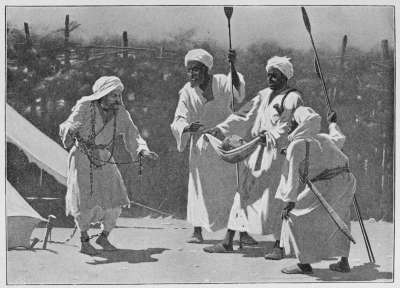
Bringing Gordon's Head to Slatin.
"Ha, ha!" said Shatta, "so you still praise the unbeliever;
but you will soon see the result;" and, leaving me,
he went off to the Mahdi, bearing his terrible token of
victory; behind him followed the crowd, still weeping.
I re-entered my tent. I was now utterly broken-hearted:
Khartum fallen, and Gordon dead! And this was
the end of the brave soldier who had fallen at his post,—the
end of a man whose courage and utter disregard of fear were
remarkable, and whose personal characteristics had given
him a celebrity in the world which was quite exceptional.
Of what use was the English army now? How fatal
had been the delay at Metemmeh! The English advanced
guard had reached Gubat on the Nile, on the 20th of
January, at 10 A. M.; on the 21st, Gordon's four steamers
had arrived. Then why did they not send some Englishmen
on board, no matter how few, and despatch them instantly
to Khartum? If they could only have been seen
in the town, the garrison would have taken fresh hope, and
would have fought tooth and nail against the enemy; whilst
the inhabitants, who had lost all confidence in Gordon's
promises, would have joined most heartily in resisting the
Dervish attack, knowing that the relief expedition was
now certain to reach them. Gordon, of course, had done
his utmost to hold the town: he had announced that an
English army was coming; he had made a paper currency;
had distributed decorations and honours almost daily, in
order to keep up the hearts of the garrison; and, as the
position had become more desperate, he had made almost
superhuman efforts to induce the troops to hold out; but
despair had taken possession of them. What was the use
of all these decorations now; what good were all their
ranks and honours? And as for the paper money, perhaps
there were one or two still hopeful people who would buy
a pound note for a couple of piastres,[14] on the chance that,
by some stroke of luck, the Government might yet be
victorious; but gradually even these slender hopes disappeared.
Gordon's promises were no longer credited; if
but one steamer with a few English officers had reached
the town, to bring the news that they had won a victory,
and had reached the Nile, the troops and inhabitants
would have doubted no longer, and they would have been
convinced that Gordon's words were true. An English
officer would at once have noticed that part of the lines
which had been damaged by the overflow of the White
Nile, and could have ordered its repair. But what could
Gordon do single-handed, and without the assistance of any
European officers; it was impossible for him to look to
everything, nor had he the means of seeing that his orders
were carried out to his satisfaction. How was it possible
for a commander who could not give his troops food, to
expect these starving men to carry out with precision and
energy the instructions he issued?
On the unfortunate night of the 25th of January,
Gordon was told that the Mahdists had decided to make an
attack; and he had issued his orders accordingly. Perhaps
he himself doubted if they would attack so early in the
morning. At the time the Mahdi was crossing the river,
Gordon, to stimulate his followers, had made a display of
fireworks in the town; various coloured rockets were fired,
and the band played, with the object of reviving the flagging
spirits of the famished garrison. The display was
over, the music had ceased, and Khartum was asleep,
whilst the enemy crept cautiously and silently forward to
the attack. They knew all the weak and strong points of
the lines of defence; they knew also that the regulars
were stationed at the strong points, and that the broken-down
parapet and tumbled-in ditch near the White Nile
were weakly defended by the feeble inhabitants. This
particular part of the lines was sadly out of repair; it had
never been actually completed, and, when damaged by the
water, no steps had been taken to re-make it. Every day the
Nile became lower, and every day exposed a broader strip
of undefended wet mud, which the hungry and hopeless
people merely made a show of defending. It was opposite
to this open space that, at early dawn, the bulk of the attacking
force had collected, whilst the other portion of the
Mahdist army faced the main position. At a given signal,
the attack began. Those holding the White Nile flank,
after firing a few shots, fled precipitately; and, while the
troops were occupied in repelling the storming parties in
their immediate front, thousands and thousands of wild
Arabs, dashing through the mud and water which was
only up to their knees, poured into the town, and, to their
dismay, the defenders on the lines found themselves attacked
from the rear. Very slight resistance was made,
and most of the troops laid down their arms. Numbers of
the Egyptians were massacred; but, of the Blacks, few were
killed, whilst the enemy's losses within the lines did not
exceed eighty to one hundred men. Soon afterwards, the
gates were opened by the Dervishes, and the troops were
permitted to march out to the Mahdist camp.
Once the line of the White Nile was crossed, the great
mass of the enemy rushed towards the town. "Lil Saraya!
lil Kenisa!" (To the Palace! to the Church!) was the cry;
for it was here they expected to find the treasure and
Gordon, who had so long defended the city against them,
and had up to that day defied all their efforts. Amongst
the leaders in the attack on the Palace were the followers
of Makin Wad en Nur, who was afterwards killed at the
battle of Toski, and belonged to the Arakin tribe; Makin's
brother Abdalla Wad en Nur, their beloved leader, had
been killed during the siege, and they were now seeking to
avenge his death. Many of Abu Girga's men were also
forward in the rush to the Palace; they wanted to wipe out
the defeat they had suffered when Gordon had driven
them out of Burri. The Palace servants who lived in the
basement were instantly massacred; and Gordon himself,
standing on the top of the steps leading to the divan,
awaited the approach of the Arabs. Taking no notice of
his question, "Where is your master the Mahdi?" the
first man up the steps plunged his huge spear into his
body; he fell forward on his face, without uttering a word.
His murderers dragged him down the steps to the Palace
entrance; and here his head was cut off, and at once sent
over to the Mahdi at Omdurman, whilst his body was left
to the mercy of those wild fanatics. Thousands of these
inhuman creatures pressed forward merely to stain their
swords and spears with his blood; and soon all that remained
was a heap of mangled flesh. For a long time,
stains of blood marked the spot where this atrocity took
place; and the steps, from top to bottom, for weeks bore
the same sad traces, until they were at last washed off when
the Khalifa decided to make the Palace an abode for his
former and his future wives.
When Gordon's head was brought to the Mahdi, he
remarked he would have been better pleased had they
taken him alive; for it was his intention to convert him,
and then hand him over to the English Government in
exchange for Ahmed Arabi Pasha, as he had hoped that
the latter would have been of assistance to him in helping
him to conquer Egypt. My own opinion, however, is that
this regret on the part of the Mahdi was merely assumed;
for had he expressed any wish that Gordon's life should be
spared, no one would have dared to disobey his orders.
Gordon had done his utmost to save the lives of the
Europeans who were with him. Colonel Stewart, with
some of the Consuls and many of the Europeans, he had
allowed to go to Dongola; but unfortunately the incapable
and disaffected crew of their steamer, the "Abbas," had run
her on to a rock in the cataracts, and had thus given up
him and his companions to the treacherous death which
had been prepared for them. On the pretext that the
Greeks were good men on boats, Gordon had offered them
a steamer, on which it was arranged they should make a
visit of inspection on the White Nile, thus intending to
give them an opportunity to escape south to join Emin
Pasha; but they had refused to accept. Being much concerned
as to their safety, Gordon now made another proposal:
he ordered all roads leading towards the Blue Nile
to be placed out of bounds after ten o'clock at night; and
he charged the Greeks with watching them, so that they
might have a chance of escaping to a steamer moored
close by, in which it was arranged they should escape; but,
owing to a disagreement between themselves as to the
details of the plan, it fell through. I have little doubt in
my own mind that these Greeks did not really wish to
leave the town. In their own homes and in Egypt most of
them had been very poor, and had held merely subordinate
positions; but here in the Sudan many had made their fortunes,
and were therefore by no means anxious to quit a
country from which they had reaped so great advantages.
Gordon seemed anxious about the safety of every one
but himself. Why did he neglect to make a redoubt, or
keep within the fortifications, the central point of which
might well have been the Palace? From a military point
of view I think this is a fair criticism; but probably Gordon
did not do so, lest he should be suspected of being concerned
for his own safety; and it was probably a similar idea
which influenced him in his decision not to have a strong
guard at the Palace. He might well have employed a
company of soldiers for this purpose; and who would have
thought of questioning the advantage of protecting himself?
With a guard of this strength, he could easily have
reached the steamer "Ismaïlia," which was lying close to
the Palace, scarcely three hundred yards from the gate.
Fagarli, the captain, saw the enemy rushing to the Palace.
In vain he waited for Gordon; and it was only when the
latter was killed, and he saw the Dervishes making for his
boat, that he steamed off into mid-stream, and moved backwards
and forwards along the front of the town until he
received a message from the Mahdi offering him pardon.
As his wife and family and some of his crew were in the
city, he accepted the offer and landed; but how sadly had
he been deluded. Rushing to his home, he found his son—a
boy of ten years old—lying dead on the doorstep,
whilst his wife, in her agony, had thrown herself on her
child's body, and lay pierced with several lances.
The cruelties and atrocities perpetrated in the terrible
massacre which followed Gordon's death are beyond
description. Male and female slaves, and young, good-looking
women of the free tribes, alone were spared; and if
some others succeeded in escaping, they had only to thank
a lucky chance which saved them from the merciless
bloodshed of that awful day. Not a few resolved to put
an end to their own lives; amongst these was Mohammed
Pasha Hussein, the head of the Finance, who, standing
beside the dead bodies of his only daughter and her
husband, was urged by some friends to fly with them, and
let them save him; but he refused. They tried to take him
by force; but, in a loud voice, he heaped curses on the
Mahdi and his followers, and some fanatics passing by soon
despatched him. Several people were killed by their
former servants and slaves, who, having previously joined
the enemy, now acted as guides to the wild hordes thirsting
for blood, plunder, and rapine.
Fathalla Gehami, a wealthy Syrian (whose wife was the
daughter of the wholesale French dealer Contarini, and to
whom, on her father's death some years ago, I had given a
lodging with her little child in my house), had buried all
his money in a corner of his house, with the assistance of
his servant, a Dongola boy whom he had brought up from
quite a child. None but he, his wife Lisa, and his boy
knew the secret hiding-place; and when the situation
became so serious in the town, he called up the lad and, in
his wife's presence, said to him, "Mohammed, I have taken
care of you since you were quite a child, and I trust you;
you know where the money is hidden. Our condition is
gradually growing worse. You have relatives with the
Mahdi; you can go to them, and if the Government is
victorious you can return to me without fear of punishment.
But should the Mahdi conquer, then you can repay
me for my kindness to you." Obedient to his master's
wishes, the boy left the town, and, on the morning of the
attack, he, with some of his relatives, rushed to his
employer's house. "Open, open!" he shouted at the top of
his voice; "I am your child, your servant Mohammed."
Fathalla Gehami joyfully opened the great iron gate which
had been so strengthened and barred that it defied entry;
and in an instant his faithless servant had plunged his spear
into his body. Dashing with his friends over his master's
prostrate form, he made for the hiding-place of the money,
and instantly seized it; on his way out of the house, he
rushed at Fathalla's wife, who had seen the whole proceedings
of this ungrateful young bloodhound, and would have
killed her too, but she threw herself on the body of her
husband, who was in his death-agony; and Mohammed's
friends with difficulty drew him off before he had time to
plunge his knife into the poor woman who had been his
kind protectress for so many years.
The Greek Consul Leontides was called out of his
house by a crowd of fanatics who had been worked up
into a state of excitement by a man who owed him money;
and, on his appearance, he was instantly killed. Consul
Hansal was murdered by one of his own kavasses, who
afterwards tied his hands together, dragged the body out
of the house, poured spirits over it, heaped on it all the
tobacco he could find, set it on fire, and, when it was
reduced to cinders, threw the remains into the river.
Butros Bulos, a clerk in the finance office, was perhaps the
only man who came well out of that awful day. He lived
in a detached house, and had collected round him his
relatives; for some time they defended themselves most
successfully against all comers, and killed a number of
them. When summoned at last to surrender, he said he
would only do so if he were promised the Mahdi's pardon,
and a guarantee that he should not be separated from his
family; as it was impossible to turn him out without
bringing up guns to bombard the house, Khalifa Sherif
gave him the pardon he required, which, curiously enough,
was subsequently ratified by the Mahdi.
The Shaigia post on Tuti Island surrendered after
Khartum had fallen; and the garrison were brought across
to Omdurman in boats.
One could fill a volume with the details of the terrible
atrocities committed on that memorable day; yet I doubt
if the fate of the survivors was very much better. When
all the houses were occupied, the search for treasure began,
and no excuse or denial was accepted; whoever was suspected
of having concealed money (and the majority of
the inhabitants had done so) was tortured until the secret
was disclosed, or until he succeeded in convincing his tormentors
that he had nothing. There was no sparing of
the lash; the unfortunate people were flogged until their
flesh hung down in shreds from their bodies. Another
torture was to tie men up by their thumbs to a beam, and
leave them dangling in the air till they became unconscious;
or two small pliant slips of bamboo were tied
horizontally to their temples, and the two ends, before and
behind, being joined together and twisted as tightly as
possible, were struck with vibrating sticks which produced
agony inexpressible. Even women of an advanced age
were tormented in this way; and the most sensitive
parts of their bodies were subjected to a species of torture
which it is impossible for me to describe here. Suffice it
to say that the most appalling methods were resorted to
in order to discover hidden treasure. Young women and
girls only were exempted from these abominable tortures,
for no other reason than that such atrocities might interfere
in some manner with the object for which they
had been reserved. All such were put aside for the harem
of the Mahdi, who, on the actual day of the conquest,
made his selections, and turned over the rejected ones to
his Khalifas and principal Emirs. This picking and
choosing continued for weeks together, until the households
of these libidinous and inhuman scoundrels were
stocked to overflowing with all the unfortunate youth and
beauty of the fallen city.
The next day, a general amnesty was given to all, with
the exception of the Shaigia, who were still considered
outlaws; but, in spite of this, murders and atrocities continued
for many days subsequent to the fall of Khartum.
The Emir Abu Girga made every effort to discover the
hiding-place of the sons of Saleh Wad el Mek; but for
three days he was unsuccessful. They were at last found,
brought before him, and instantly beheaded. It behoved
also all Egyptians to look to themselves during these days
of massacre; for, if met alone by these fanatics, they were
mercilessly slaughtered. A merchant was making inquiries
one day about the bazaar prices in Omdurman, and asked
what were at present the cheapest articles and the greatest
drug in the market; the man questioned, being evidently
a wag, answered: "The yellow-skinned Egyptian, the
Shaigia, and the dog," which, being considered an impure
animal, was always killed when found. This saying
obtained great notoriety amongst the Dervishes, and gives
a very fair idea of the estimation in which they held the
former ruling class.
The plunder taken in Khartum was carried off to the
Beit el Mal; but of course large quantities were made away
with. The principal houses were distributed amongst the
Emirs; and, on the day after the town fell, the Mahdi and
Khalifa Abdullahi crossed over from Omdurman in the
steamer "Ismaïlia" to view the scene of their bloody
victory and massacre; without a sign of pity or regret,
they occupied the houses selected for them, and, addressing
their followers, described the disaster which had overtaken
Khartum as the just judgment of Heaven on the
godless inhabitants of the city, who had repeatedly rejected
the Mahdi's summons to them to surrender and become
his faithful followers in the true religion.
The first few days were spent in the wildest debauchery
and excesses; and it was not until the Mahdi and his
followers had to some extent satiated their vicious passions,
that they turned their attention to the dangers which
threatened them from without. To oppose the English
expedition, the renowned Emir Abderrahman Wad Nejumi
was ordered to collect a large force and proceed forthwith
to Metemmeh, to drive out the infidels, who were known to
have reached the Nile near this town.
On Wednesday morning, two days after Khartum had
fallen, at about eleven o'clock, the thunder of guns and
the sharp crack of rifles were heard in the direction of the
north end of Tuti Island; and soon two steamers came in
view,—these were the "Telahawia" and "Bordein," carrying
Sir Charles Wilson and some English officers and men
who had come up to assist General Gordon. Sanjak
Kashm el Mus and Abdel Hamid Mohammed, whom
Gordon had despatched in command of the Shaigias,
were also on board; they had already heard of Gordon's
death, and of the cruel fate which had overtaken the town
and its inhabitants. Although those on the steamer had
little doubt of the accuracy of the sad news, they wished
to see with their own eyes, and reached a point midway
between Tuti Island and the left bank of the White Nile;
here they were heavily fired on by the Dervishes from an
entrenched position, situated northeast of Omdurman
Fort, and having seen Khartum in the distance, and been
convinced, they turned about and steamed away.
I subsequently heard from some of the crew of these
steamers, that both they and the Englishmen on board
were deeply affected by the fall of the city; they now
knew that the entire Sudan was in the Mahdi's hands.
It was the talk on board, they said, that the English expedition
had only come up to save Gordon; and, now that he
was killed, the object of the expedition had failed, and
they naturally concluded that it would retire to Dongola,
and that they would be called upon to accompany it.
Consequently the chief pilot of the "Telahawia" and the
captain Abdel Hamid agreed together to run the steamer
on to a rock, and then escape during the night. This plan
was successfully carried out; and the steamer stuck so hard
and fast that the cargo had to be at once transferred to the
"Bordein." During the confusion, these two conspirators
escaped; and, through the intermediary of their friends,
they succeeded in securing the Mahdi's pardon, and returned
subsequently to Khartum. Here they were well received
and publicly commended by the Mahdi for having inflicted
loss on their enemies, the British; Abdel Hamid, in spite
of being a hated Shaigia, and a relative of Saleh Wad el
Mek, was presented by the Mahdi with his own jibba, as a
mark of honour, and, moreover, several of his female relatives
who, after the sack of the town, had been distributed
amongst the Emirs, were given back to him.
Meanwhile, the "Bordein," on its return journey towards
Metemmeh, struck on a sand-bank, and, being heavily laden,
could not be floated off. Sir Charles Wilson's position
was now very critical; with his small force he could not
have attempted to land on the west bank and attack the
enemy, which was entrenched at Wad Habeshi, between him
and the British camp at Gubat. It is true that the courage
of this body of Dervishes had been considerably shaken by
the defeat at Abu Klea; but the fall of Khartum, and the
knowledge that Wad en Nejumi with a large force was
advancing north to their support, now transformed them
into a formidable enemy. A third steamer, the "Safia,"
was still at Gubat. Sir Charles Wilson therefore sent an
officer down stream in a small boat to ask for help; the
appeal was promptly responded to, the "Safia" starting,
without delay, to the relief of the "Bordein." The enemy
hearing of this, at once threw up entrenchments to oppose
its progress, and, on its approach, poured on the unfortunate
steamer a perfect hail of rifle and cannon shot;
but those on board, determined to relieve their comrades
in distress, fought most bravely until a shot, penetrating
the boiler, disabled the steamer and placed it in the greatest
danger. Undismayed, however, the commander set to
work, under a heavy fire, to repair the damage; the work
was continued during the night, and early the next morning
the "Safia" was able to continue her running fight
with the Dervishes, eventually succeeding in silencing the
guns, and killing the principal Emir, Ahmed Wad Faid, and
a considerable number of subordinate Emirs and men. The
passage was forced; and Sir Charles Wilson and his men
relieved.
This daring exploit, which resulted in the rescue of the
little band of Englishmen who had ventured to Khartum,
also had a very important, though indirect, effect on the
subsequent fate of the small British column near Metemmeh.
The advance of Nejumi, which, under any circumstances,
was not rapid, owing to the difficulty of collecting the men,
was still further delayed by the news of the death of
Ahmed Wad Faid, and the defeat of the strong body of
Dervishes at Wad Habeshi by one steamer. I was informed
that on hearing of the success of the "Safia"
(whose able commander I learnt on my return to Egypt
was Lord Charles Beresford), Nejumi addressed his men, and
pointed out to them, that if the English advanced with
the intention of taking the Sudan, they must of course
oppose them; but if, on the other hand, they retired towards
Dongola, then he and his men would be able to occupy
the country they had abandoned without the risk of further
fighting. And it was this latter course which he eventually
took. Delaying his advance, he reached Metemmeh
only after the British had retired from Gubat; and, although
he pursued them as far as Abu Klea, he hesitated somewhat
to attack unless quite assured of success.
It was only when the Mahdi learnt of the final retirement
of the British advanced guard that he was convinced
the Sudan had at last been completely won; and now his
delight knew no bounds. He announced the news in the
mosque and drew a striking picture of the flight of the
unbelievers, embellishing it further by a revelation from
the Prophet to the effect that their water-skins had all been
pierced, through Divine intervention, and that all those who
had taken part in the expedition had died of thirst.
On the fifth day after the fall of Khartum, a small band
of soldiers suddenly appeared in my tattered tent; and,
placing me, still shackled and bound, on a donkey, they
carried me off to the general prison, where they hammered
on to my ankles a third and exceptionally heavy iron bar
and rings (nicknamed the Hajji Fatma); it weighed about
eighteen pounds, and was only put on those who were considered
exceptionally obstinate or dangerous prisoners. I
was quite ignorant of the reasons which caused me to fall
still lower in the Khalifa's disfavour; but I found out later
that Gordon, when he had ascertained from my letters to
him that the Mahdist force advancing on Khartum was not
a strong one, that many of the Mahdi's adherents were discontented,
and that there was considerable scarcity of
ammunition, had written to this effect to several of the
principal officers on the lines; one of his letters containing
this information was discovered in the loot handed over
to Ahmed Wad Suleiman in the Beit el Mal, by whom it
had been passed to the Mahdi and Khalifa. Thus were
their suspicions regarding my behaviour confirmed, and my
schemes to escape and join Gordon laid bare.
I was deposited in one corner of the immense zariba,
where I was ordered to stay, and to hold no converse with
any one without permission, on pain of instant flogging.
At sunset, I, a number of slaves who were under sentence
for having murdered their masters, and other gentlemen
of this description were bound together by a long chain
passing round our feet and fastened to the trunk of a tree;
and at sunrise the next morning, we were unfastened, and
I was sent back to my corner again. I could just see
Lupton, in the distance, in another corner of the enclosure.
He had been in here for some time, and had become used
to it; he had permission to speak to others, but was under
strict orders of the saier, or gaoler, not, on any account, to
speak to me. On the day that I had been brought to
the prison, Saleh Wad el Mek had been discharged; his
brother, sons, and almost all his relatives had been killed,
and he was now allowed to go and search for the survivors.
As regards food, I now fared considerably worse; I had,
in this respect, fallen out of the frying pan into the fire.
I used to complain of being occasionally hungry; but now
I received only uncooked dhurra, getting the same share
as the slaves, and a very small share it was. Fortunately,
the wife of one of my warders, a Darfur woman, took pity
upon me, and used to take the corn away, boil it, and
bring it back to me; but she was not allowed to bring
me any other food, as her husband feared the principal
gaoler might find out, and he, in his turn, was afraid of
incurring the Khalifa's displeasure. I lay on the bare
ground, with a stone for my pillow, the hardness of which
gave me a continual headache; but, one day whilst we
were being driven to the river—one hundred and fifty yards
distant—to wash, I picked up the lining of a donkey saddle,
which the owner had evidently thrown away as old and
useless; and, hiding it under my arm, I bore it off in
triumph, and that night I slept like a king on his pillow
of down.
Gradually, my position improved somewhat. The principal
gaoler, who was not really disinclined towards me,
allowed me to converse occasionally with the other prisoners,
and removed my lightest foot-irons; but the Hajji
Fatma and her sister still remained, and I cannot say this
pair of worthies conduced much to my personal comfort
during those long and weary months of imprisonment.
One day, a Black woman came in with her child—a nice
little girl—to visit her poor husband and the child's father,
Lupton. The poor little thing wept bitterly, for, young
as she was, she was old enough to understand the miserable
plight of her father, who, before they left, sent them
to say a few words to me. The poor woman looked at
me for a few moments, and then, taking my hand, wept
aloud. I remembered I had often seen her before; and,
between her sobs, she reminded me that she had come to
Khartum as a young girl, and had been brought up in
Frederick Rosset's house, where, during my first journey
to the Sudan, I had stayed for some weeks. Poor Zenoba!
she reminded me of many little incidents which had happened
in the old days; and, as she related them, she often
broke down, comparing her former happiness with her
present misery. I tried to console her, urging her to
keep up hope, and that perhaps everything would end
well. "Besides," I said, "it was never intended that
human beings should always live well and comfortably."
Little Fatma, whom we called Fanny, flung herself into
my arms, calling me, ammi (my uncle); and it seemed
as if her heart told her instinctively that, amongst all this
crowd, I was next to her father in her affections. I then
begged the poor woman to leave me, as I feared taking
advantage of the gaoler's patience.
At this time, there was some difficulty in supplying food
to the Black soldiers under Abu Anga, whose number had
been further increased by the Khartum garrison. As
there was no immediate fear of any movement on the part
of the Government towards Khartum, it was decided to
despatch Abu Anga to Southern Kordofan on a punitive
expedition against the Nubas, and to procure slaves and
send them to Omdurman. Shortly after the fall of Khartum,
the Mahdi had moved his camp north; and the fort
known as Tabia Ragheb Bey, and the ground in the vicinity,
had been told off for Abu Anga's camp. When he was
ordered off, and his place taken by his brother, Fadl el
Maula, all my servants, male and female, left with him;
and, although the latter were not permitted to visit me, I
felt that, with Abu Anga's departure, yet another link was
severed.
I now received news of the other servants I had left
behind at El Fasher. On my arrival at Rahad, I had told
the Khalifa I had left behind two horses, which were almost
the best in Darfur, and which I hinted he might have if he
wished; but, it being summer, and as they would probably
have suffered from the long and hot journey, I had not
brought them with me. Subsequently, I had requested
him to give orders that not only the horses, but also my
male and female servants who had been left behind, should
also be sent on. He consequently had written to Mohammed
Khaled to this effect; but, on the day on which
I had been made a prisoner, he had written to Sayed
Mahmud of El Obeid to seize my people as soon as they
came from Darfur, but to send on the two horses. The
latter had now arrived in Omdurman; and the soldier who
had been in charge came to tell me that the Khalifa was
much pleased with them, having taken one for himself
and given the other to his brother Yakub.
A few days later, there was considerable commotion
amongst the warders; and the saier told me privately that
the Khalifa was coming to visit the prison. I asked him
to advise me how I should behave; and he recommended
me to answer all questions promptly, on no account to
make any complaints, and to remain submissively in my
corner. About midday, the Khalifa arrived, accompanied
by his brothers and mulazemin, and began to walk round
and view these victims of his justice. It seemed that the
saier had given the same advice to all the prisoners that
he had given to me, for they all behaved quietly; some
were ordered to have their chains removed, and to be discharged.
At length, the Khalifa approached my corner,
and, with a friendly nod, said, "Abdel Kader, enta tayeb?"
(Abdel Kader, are you well?). To which I replied, "Ana
tayeb, Sidi" (I am well, sire); and with that he moved
on. Yunes Wad Dekeim, the present Emir of Dongola,
and a near relative of the Khalifa, pressed my hand, and
whispered, "Keep up your spirits; don't be downhearted;
everything will come right."
From that day my condition distinctly improved. Zenoba,
the mother of Fanny, was allowed every now and then to
send me a little food. I was also allowed to spend the day
with a former head-Sheikh of the Hawara Arabs, who was
suspected of having been friendly with the Turks, and had
been thrown into chains; as our hatred for the Mahdists
was mutual, we spent most of our time in talking about them,
and criticising their rules and ordinances. Sheikh Mohammed
Wad et Taka, for such was his name, was fed by his
elderly wife, who, for his sake, had remained in Omdurman,
and used to bring us meals. She may have had some good
qualities, but she was a veritable Xantippe who by her sharp
tongue made bitter every mouthful her husband swallowed.
Carrying a large dish of baked dhurra-bread and some
mulakh (a sort of sauce made with milk and other ingredients),
she would place it before us, and then, sitting on the
ground beside us, she would begin the battle. "Yes,
indeed," she would say, "old women are quite good enough
to cook, and do all the hard work; but when men have their
freedom, they can do as they like; and then they always turn
their eyes to the young and pretty girls." The Sheikh had
the fortune, or rather the temporary misfortune, of having
two young wives as well as this old one; but they stayed in
the country with the herds; and this fact greatly annoyed
the old lady, who exercised her ingenuity in making these
sallies against her good man, who, famished by hunger,
silently consumed the food she had prepared for him. She
frequently related some piquant family details in which her
husband's conduct in relation to herself, as compared with
his more youthful helpmeets, was invariably open to severe
criticism. I used to greatly enjoy these skirmishes, and
generally took upon myself the task of mediator, telling her
that when she was away, her husband had nothing but good
words for her. This used to appease her; and she would
affirm that she was doing her utmost to alleviate our condition.
I thoroughly appreciated how valuable she was to
me, and how her homely meals lessened my long hours of
enforced fasting. All my efforts were therefore directed to
pacifying her husband, who, goaded by her sharp tongue,
would heap curses on her devoted head. His nature was
very changeable: when he was hungry, and saw his old wife
coming along carrying his food, no words of praise were
sufficient for her; but once satisfied, and stung to the quick
by her sarcasm, he would heap insults on her, and some
such expressions as, "You who neither fear God nor man,
leave me, and let me starve. Some women, as they grow
old, instead of becoming more intelligent, gradually get
silly; this is the case with you, I think you are possessed of
the devil. Get away, and never come near me again; I never
want to see you more." Then off she would go; but the
next day, when he was famished, he would long to have his
old wife back again. Not the least alarmed, she would
almost invariably return with her dish full of food; he
would be pacified, eat a hearty meal, and then the insults
would begin again.
Thus the days slowly passed away. Small-pox had
broken out in Omdurman, and every day the disease
swept off hundreds,—indeed, whole families disappeared;
and I believe that the loss from this disease was greater
than that suffered in many battles. Curiously enough,
almost all the nomad Arabs were attacked; and several
of our own warders went down, and not a few of them died.
We prisoners, however, entirely escaped; and, during the
whole period of my imprisonment, I do not recollect having
seen one of us unfortunates attacked, though most of
us were much alarmed. Perhaps God in His mercy thought
our punishment already more than we could bear, and
spared us a further visitation.
I had now many opportunities of talking to Lupton, who
daily grew more and more impatient; indeed, so furious
was he at times, that I used to get alarmed, for he would
complain most bitterly, and in a loud tone, of our miserable
treatment. I did all in my power to pacify him; but the
wretched life we were living had affected him to such a
degree that I seriously feared for his health. Through
constantly speaking to him, I succeeded to some extent
in quieting him; but, although scarcely thirty years of
age, the hair of his head and beard had, during our
imprisonment, grown almost white. Nature, however, had
treated me more kindly. I submitted to my fate with a
better grace; and the thoroughly practical lesson I had
received from my old friend Madibbo, entirely suited my
character. I was still young; and, except for occasional
slight ailments, I was endowed with a strong and healthy
constitution. My fate was a cruel one it is true; but I felt
I could gather from it many a useful experience. I kept
on hoping against hope, that, sooner or later, I should
return to the civilised world, though, when I thought over
my chances of escape, the time seemed very far away.
In order to occupy the prisoners, the saier employed
them in building a square house for their own habitation;
they were therefore ordered to fetch stones which
were found near the river; and Lupton and I were the
only prisoners who were permitted to pass the day without
work. Every now and then, however, we used to accompany
them to the place where they got the stones; but
my heavy ankle-irons, and my long neck-chain, impeded
my progress so much when walking, that I preferred to
act as the architect of the building, which now rapidly
advanced towards completion. The walls were very thick,
and about thirty feet square, and, in the centre, a pillar
was erected which served as a support to the crossbeams.
This house was intended for the incarceration of the
most dangerous prisoners; and the wood required for the
roofing was brought from the now ruined houses of
Khartum.
It was about this time that an old friend of mine named
Esh Sheikh, a relative of Ismail Wad Shaggar el Kheiri,
and who was in the Mahdi's favour, informed me confidentially
that both the Mahdi and the Khalifa were friendly-minded
towards myself and Lupton, and that in a few days
we should probably be liberated. He added that should
the Khalifa speak to me, I should not humble myself very
much, but merely be careful not to oppose anything he
said; then, recommending me to God, he went away. I
instantly went off to share this good news with Lupton,
who at that time happened to be in one of his most dangerous
moods; but I begged him to believe that it was
true, and to do nothing which might compromise matters.
A few days later, it was rumoured that the Khalifa was
coming. I had carefully prepared my speech, and Lupton
had done the same; but it was more than likely he would
speak to me first. At length the critical moment came:
the Khalifa, entering the prisoners' yard, instead of, as was
his usual custom, sending for the prisoners one by one,
ordered an angareb to be brought and placed in the shade;
he then directed all the prisoners to be led out, and to sit
down before him in a semi-circle. He spoke to several,
set a few free who had been imprisoned by his own personal
orders, and promised others, who complained against
the sentences pronounced by the Kadi, to inquire into
their cases; of Lupton and myself, however, he appeared
to have taken no notice. Lupton glanced at me, and
shook his head; but I put my finger to my lips to warn
him against doing anything foolish. "Have I anything
else to do?" asked the Khalifa of the saier who was
standing behind his angareb. "Sire! I am at your
service," replied the head gaoler; and the Khalifa sat down
again. He now turned his eyes on me, and repeated the
same words he had used on the previous occasion.
"Abdel Kader," said he, "are you well?" "Sire," said I,
"if you will allow me to speak, I shall tell you of my condition."
He was then sitting at his ease, and he gave me
the required permission.
"Master," I began, "I belong to a foreign tribe; I came
to you seeking protection, and you gave it to me. It is
natural for man to err, and to sin against God and against
each other. I have sinned; but I now repent, and regret all
my misdeeds. I repent before God and His Prophet.
Behold me in irons before you! See! I am naked and
hungry; and I lie here patiently on the bare ground waiting
for the time to come when I may receive pardon.
Master, should you think it well to let me continue in
this sad plight, then I pray God for strength to enable
me to bear His will; but now I beg of you to give me my
freedom."
I had studied this speech very carefully, and had
delivered it as effectively as I could; and I saw that it had
made a favourable impression on the Khalifa. Turning
then to Lupton, he said, "And you, Abdullahi?" "I can
add nothing to what Abdel Kader has said," replied
Lupton. "Pardon me, and grant me liberty."
The Khalifa now turned to me, and said, "Well, from
the day you came from Darfur, I have done everything
I possibly could for you; but your heart has been far
from us: you wanted to join Gordon the infidel, and fight
against us. As you are a foreigner, I spared your life;
otherwise you would not be alive now. However, if your
repentance is real and true, I will pardon both you and
Abdullahi. Saier, take off their irons."
We were then removed by the warders, who, after long
and hard work, and by making use of ropes, at last
succeeded in opening my foot-irons. We were then again
brought before the Khalifa, who was patiently sitting on his
angareb waiting for us. He ordered the saier to bring the
Kuran, which he laid on a furwa (sheepskin), and called on
us to swear eternal allegiance to him. Placing our hands
on the Kuran, we swore to serve him honestly in the future.
He then rose and directed us to follow him; and we, almost
beside ourselves with delight at our release after this long
imprisonment, joyfully followed in his footsteps.
My friend the Sheikh of the Hawara was also liberated
at the same time. The Khalifa, having been assisted on to
his donkey by his servants, ordered us to walk by his side;
but we could scarcely keep up with him, for our eight
months' imprisonment in chains had so cramped our legs
and feet that we found we had lost the habit of stepping
out. When we reached his house, he directed us to wait
in a rekuba in one of the outside enclosures, and left us.
He returned again a few minutes later, and, seating himself
beside us, warned us most seriously to adhere to all his
orders. He then went on to say that he had received
letters from the Commander of the Army in Egypt, stating
that he had seized and imprisoned all the Mahdi's relatives
in Dongola, and that he demanded in exchange all the
captives who had formerly been Christians. "We have
decided to reply," said he, "that you are now all Mohammedans,
that you are one with us, and that you are not
willing to be exchanged for people who, though the
relatives of the Mahdi, are far from us in thought and
deed; and that they can do as they like with their
captives; or," added he, "perhaps you would like to go
back to the Christians?" With these words he ended his
speech.
Lupton and I assured him that we should never leave
him of our own free-will; that all the pleasures of the
world would never tear us from his side; and that it was
only by being constantly in his presence that we learnt to
act in such a way as would lead to our salvation. Thoroughly
taken in by our mendacity, he promised to present
us to the Mahdi, who had arranged to come to the
Khalifa's house that afternoon, and then he left us.
The rekuba being in one of the outer enclosures, into
which people were admitted, several friends who had heard
of our release came to congratulate us, amongst them
Dimitri Zigada, but this time without his usual quid of
tobacco. My friend Esh Sheikh also came; and when I
told him that we were to be presented to the Mahdi, he
again gave me the benefit of his good advice, and instructed
me how to behave when the momentous occasion
arrived. It was almost evening when the Khalifa came;
and, directing us to follow him, he led us to an inner enclosure,
where we saw the Mahdi sitting on an angareb.
He had become so stout that I scarcely knew him. Kneeling
down, we repeatedly kissed the hand he held out to us.
He now assured us that his only wish was for our good,
that when men are placed in chains, it exercises a lasting
and beneficial influence on them; by this he meant to say
that when a man is timid, this punishment makes him avoid
committing offences in the future. He then turned the
conversation to his relatives who had been captured by
the British, and about the exchange they had proposed,
but which he had refused, adding, with a hypocritical smile,
"I love you better than my own brethren; and therefore I
refused to exchange." In reply, I assured him of our
love and sincerity to him, saying, "Sire, the man who does
not love you more than himself, how can his love proceed
truly from his heart." (This was a paraphrase of the
Prophet's own words which my friend the Sheikh had suggested
I should repeat.) "Say that again," said the Mahdi;
and, turning to the Khalifa, he said, "Listen." When I
repeated the words, he took my hand in his and said,
"You have spoken the truth; love me more than yourself."
Summoning Lupton as well, he took his hand, and
made us repeat the oath of allegiance, saying, that as we
had proved unfaithful to our first oath, it must be renewed.
This over, the Khalifa signed to us to retire; and, again
kissing the Mahdi's hand, we thanked him for his beneficence,
and returned to our rekuba to await his further
instructions.
It was some time before the Khalifa returned; and when
he did, he permitted Lupton, without further ado, to join
his family, who were still located in a tent in the Beit el
Mal, and, sending with him a mulazem to show the way,
assured him that he would take every care of him. I was
now alone with the Khalifa. "And you," said he, "where
do you wish to go; have you any one to take care of you?"
And I felt him gazing at me, whilst I cast my eyes to the
ground, knowing that was what he wished me to do.
"Besides God and yourself," I replied, "I have no one,
sire; deal with me as you think best for my future."
"I had hoped and expected this answer from you," said
the Khalifa; "from this day you may consider yourself a
member of my household. I shall care for you, and shall
never allow you to want for anything; and you will have
the benefit of being brought up under my eye, on condition
that, from this day forth, you absolutely sever your
connection with all your former friends and acquaintances,
and associate only with my relatives and servants; you
must, moreover, obey implicitly every order you receive
from me. During the day, your duty will be to stay with
the mulazemin employed on my personal service at the
door of my house; and at night, when I retire, you will be
permitted to go to the house which I shall assign to you.
When I go out, you must always accompany me: if I ride,
you must walk beside me, until the time comes when,
should I see fit, I will provide you with an animal to ride.
Do you agree to these conditions, and do you promise to
put them into full effect?"
"Master," I replied, "I agree with pleasure to your
conditions. In me, you will find a willing and obedient
servant; and I hope I may have strength to enter upon my
new duties."
"God will strengthen you," he replied, "and bring you
to all good." He then rose, and added, "Sleep here to-night;
may God protect you till I see you again to-morrow."
I was now quite alone. So I had gone from one prison
to another! I fully grasped the Khalifa's intentions: he
had no real wish for my services, for he had not the
slightest confidence in me; nor did he wish to utilise me
against the Government and against the civilised world.
He merely wanted to keep me always under control; probably
it flattered his vanity to know he could point to me,
his slave, once a high official of the Government, who had
commanded his own tribe, which was now the foundation
on which his power rested, and show them and the other
western tribes that I was now his humble servant. Nevertheless,
said I to myself, I shall take good care not to displease
him, or give him a chance of putting his evil
purposes into effect. I thoroughly understood my master;
his smiles and friendly looks were not worth a jot, indeed
one day he had told me as much himself. "Abdel
Kader," he had said to me in the course of conversation,
"a man who wants to command must neither betray his
purpose by gesture, nor by his countenance; otherwise his
enemies or his subjects will discover some means of frustrating
his designs."
The next morning, he came to me, and, summoning his
brother Yakub, he directed him to show me some spot in
the neighbourhood where I might build my huts, adding
that it must be as near his house as possible. As, however,
most of the vacant spots in the vicinity had been already
occupied by the Khalifa's relatives, a piece of ground,
about six hundred yards from the Khalifa's house, and not
far from Yakub's residence, was given to me.
The Khalifa now summoned his secretary, and showed
me a document addressed to the commander of the English
army, to the effect, that all the European prisoners
had, of their own free-will, become Mohammedans, and
that they had no wish to return to their countries. This
document he desired me to sign.
All my servants, horses, and baggage had been taken
off by Abu Anga, with the exception of an old lame
Nubawi who, when he heard of my release, came to see
me from Fadl el Maula's house. I at once informed the
Khalifa, and obtained permission to take this man back
into my service. I also spoke to him about Abu Anga
and my servants; and he asked if the effects were going to
be returned to me,—a strange question indeed! When
one's possessions have been seized by violence and carried
off, are they likely to be given back? I replied much in
the same style, that I was sure, that as now I belonged to
his household, I could well do without these little trifles,
and that I thought it quite unnecessary for him to write to
his field-marshal about so trivial a matter. What was I
to do with horses, when I was not allowed to ride them?
Had not my education with the Khalifa begun by being
forced to walk barefoot!
All the same, I was really very anxious to have my old
servants back again, though I did not actually require
their services very much; but I knew, that had I attempted
to claim them, I should only have aroused the
Khalifa's opposition. The latter was, therefore, greatly
pleased with my reply, and began chatting to me about
Abu Anga. He then asked me, abruptly, "Are you not
a Mohammedan; where then did you leave your wives?"
This was, indeed, an ugly question. "Master," said I, "I
have only one, and I left her in Darfur; and I am told
that she was arrested with all my other servants by Said
Mahmud, and is now in the Beit el Mal at El Obeid."
"Is your wife of your own race?" asked the Khalifa,
inquiringly. "No," I replied, "she is a Darfurian; and her
parents and relatives were killed in the battle with Sultan
Harun. She and several others had been captured by my
men; and I gave most of them to my servants and soldiers
to marry. This orphan alone was left; and she is now my
wife."
"Have you any children?" asked he; and, when I replied
in the negative, he said, "A man without offspring is
like a thorn-tree without fruit; as you now belong to my
household, I shall give you some wives, so that you may
live happily."
I thanked him for his kindness, but begged that he
would postpone his present until I had at least erected
my huts; because, I remarked, this exceptional mark of
his favour must not be exposed to the public gaze. To
recompense me for my property which had been taken
by Abu Anga, the Khalifa instructed Fadl el Maula to
hand over the effects of the unfortunate Olivier Pain,
which were at once sent to me. They consisted of an
old jibba, a well-worn Arab cloak, and a Kuran printed
in the French language. Fadl el Maula had sent word
to me that, during the time which had elapsed, his other
effects had been lost. At the same time, the Khalifa
directed that the money which had been taken from me
when I was imprisoned, and had been deposited in the
Beit el Mal, should be returned to me. It amounted to
£40, a few sequins, and a few gold nose-rings which I had
collected as curios; all these were handed back to me by
Ahmed Wad Suleiman.
I was now able to set to work to build my huts; but
whilst they were being put up I lived in the Khalifa's
house. I entrusted my old servant Saadalla, the Nubawi,
who was the most competent of all my attendants, with
the construction of my residence, which was to consist for
the present of three huts and a fence. I myself, from
early morning till late at night, was always in attendance
at the door of my master. Whenever he went for a short
walk or a long ride, I was always obliged to accompany
him, barefooted. During the first few days, as my feet
got cut and bruised, he allowed me to have some light
Arabic sandals made, which, though they gave me some
protection against the stones, were so hard and rough that
they rubbed off all the skin. Occasionally, the Khalifa
used to call me in to eat with him, and frequently sent
for what was over of his own food to be consumed by the
principal mulazemin, of whom I was now reckoned as one.
When he retired at night, I was at liberty to return to my
huts; and there, stretching my weary limbs on an angareb,
I slept till early dawn, when I was again obliged to await
the Khalifa at his door, and accompany him to morning
prayers.
Meanwhile, the Khalifa had been informed that my huts
were erected, and, returning home late one night, my old
servant Saadalla informed me that a female slave, closely
muffled up, had been brought to my house, and was now
installed within. Directing Saadalla to light a lantern and
show the way, I followed, and found the poor thing huddled
up on a palm-mat. When I spoke to her about her
past life, she answered, in a deep voice which did not presage
well for the future, that she was a Nubawi, and had
formerly belonged to an Arab tribe in Southern Kordofan,
but had been captured, and sent to the Beit el Mal, from
whence she had just been despatched to me by Ahmed
Wad Suleiman. Whilst speaking, she removed her scented
white drapery from her head, as slaves always do when
talking to their masters, and exposed her bare shoulders
and part of her bosom. I signed to Saadalla to bring the
light nearer; and then I had to summon all my presence
of mind so as not to be terrified and fall off my angareb.
Out of her ugly black face, peered two little eyes; a great
flat nose, below which were two enormous blubber-shaped
lips which, when she laughed, were in danger of coming
in contact with her ears, completed one of the most unpleasant
physiognomies I had ever beheld. Her head was
joined to her enormously fat body by a bull-dog-like neck;
and this creature had the audacity to call herself Maryam
(Mary). I at once directed Saadalla to remove his compatriot
to another hut, and give her an angareb.
So this was the Khalifa's first gift to me: he had not
given me a horse, a donkey, or even a little money, which
would have been of some use to me, but had presented me
with a female slave, for whom, even had she been fair, he
knew well I should not have cared, as, let alone her disagreeable
presence, her food and dress were items of
expense which I by no means relished. When he saw me
the next day, after morning prayers, he asked me if Ahmed
Wad Suleiman had satisfactorily carried out his wishes. I
replied, "Yes; your order was most promptly carried
out," and then gave him an exact description of my new
acquisition. The Khalifa was furious with Ahmed Wad
Suleiman, who, he asserted, not only did not comply with
his order, but had made him unfaithful to the Mahdi's
ordinances. My candour in describing exactly the class
of slave given me, re-acted somewhat unpleasantly on my
head; for, the following evening, a young and somewhat less
ugly girl, selected by the Khalifa himself, was sent to me,
and her also I handed over to the tender mercies of the
faithful Saadalla.
The Mahdi, his Khalifas, and their relatives, having now
no longer any fear from external enemies, began to build
houses suitable to their new positions and requirements.
The numbers of young women and girls who had been
seized and distributed on the fall of Khartum were now
hurried off into the seclusion of these new residences; and
their masters, no longer disturbed by the jealous and
envious looks of their friends, were able to enjoy their
pleasures undisturbed.
Naturally, the Mahdi, the Khalifas, and, more especially,
the relatives of the former were most anxious that it
should not be known that the greater part of the loot taken
in Khartum was in their own hands; it was a striking
contradiction of the doctrine of the Divine master, who
forever preached renunciation and abandonment of the
pleasures of life. They set to work to enlarge their
habitations and enclosures, anticipating that they would
fill them still further with the rich spoil which was expected
from the provinces that still remained to be conquered.
But the Mahdi fell suddenly ill; for a few days he did
not appear at the mosque for prayers. No particular attention,
however, was paid to his absence at first, for he had
asserted, over and over again, that the Prophet had revealed
to him that he should conquer Mecca, Medina, and Jerusalem,
and, after a long and glorious life, should expire at
Kufa. But the Mahdi was attacked by no ordinary indisposition:
the fatal typhus fever had fallen upon him; and,
six days after he had sickened, his relatives in attendance
began to despair of saving his life. My master, the
Khalifa, was, of course, watching with the most intense
interest the outcome of the disease, and did not leave the
Mahdi's bedside day or night, whilst I and the other members
of the body-guard aimlessly waited for our master at
his door. On the evening of the sixth day, the multitudes
collected before the Mahdi's house, and in the mosque,
were commanded to join together in prayer for the recovery
of the Divine patient, who was now in the greatest danger;
and this was the first occasion on which the malignant
disease from which the Mahdi was suffering was announced
to the public. On the morning of the seventh day, he was
reported to be worse; and there was now little doubt that
he was dying. In the early stages, he had been treated by
his wives and by Sudanese quacks with the usual domestic
remedies; and it was only at the last moment that Hassan
Zeki, one of the detested Egyptians, formerly medical
officer of the Khartum hospital, who, by a lucky chance,
had been saved on the day of the attack, was called in.
Asked to prescribe, he affirmed that the complaint had now
reached such a stage that it was not advisable to use any
medicines, and that the only hope lay in the resistance of
his powerful constitution, which, with God's help, might
drive out this terribly malignant disease. Hassan Zeki,
indisposed as he was to render any assistance, was perfectly
well aware that the Mahdi was now beyond the reach of
medicines; he also knew that if he had prescribed, and
the Mahdi had subsequently died, he would undoubtedly
have been credited with the cause of his death, and his
life would have been in the greatest danger. From all
these considerations, he therefore wisely refrained from
interference.
The disease had now reached its crisis. By the Mahdi's
angareb stood the three Khalifas, his near relations, Ahmed
Wad Suleiman, Mohammed Wad Beshir (one of the principal
employés of the Beit el Mal in charge of the Mahdi's
household), Osman Wad Ahmed, Said el Mekki (formerly
one of the most renowned religious Sheikhs of Kordofan),
and a few of his principal and most faithful adherents, to
whom special permission had been granted to enter the
sick-room. From time to time, he lost consciousness;
and, feeling that his end was drawing near, he said, in a low
voice, to those around him, "Khalifa Abdullahi Khalifat es
Sadik has been appointed by the Prophet as my successor.
He is of me and I am of him; as you have obeyed me and
have carried out my orders, so should you deal with him.
May God have mercy upon me!" Then gathering up all
his strength, with one final effort, he repeated a few times
the Mohammedan creed (La Illaha illallah, Mohammed
Rasul Allah), crossed his hands over his chest, stretched
out his limbs, and passed away.
Around the body, which was not yet cold, the late
Mahdi's adherents swore fidelity to Khalifa Abdullahi, Said
el Mekki being the first to take the Khalifa's hand, own his
allegiance, and praise his name. His example was immediately
followed by the two Khalifas and the remainder of
those assembled. It was impossible to keep the Mahdi's
death secret; and the crowds waiting outside were informed
about it: but, at the same time, strict injunctions were
given that no weeping and lamentation should be made;
and it was further announced that the Khalifa (successor)
of the Mahdi should demand the oath of allegiance from
the entire populace. The Mahdi's principal wife, named
Sittina Aisha Um el Muminin (Our Lady Aisha, Mother
of the Believers), who lay huddled up and closely veiled in
a corner, and who had been a witness of the death of her
master and husband, now arose and proceeded to the
Mahdi's house, bearing to the other wives the sad news
of his death. Her office was to comfort them, and prevent
them from making loud lamentation. Most of these
good women rejoiced secretly in their hearts at the death
of their husband and master, who had brought such terrible
distress upon the land, and whom, even before he
had fully enjoyed the fruits of his success, Almighty God
had summoned to appear before the Supreme Seat of
Judgment.
In spite of the strict and oft-repeated injunctions against
loud lamentation, weeping and wailing arose from almost
every house on the death of the Mahdi el Muntazer, who,
it was reported, had voluntarily departed from his earthly
abode to God, his master whom he longed to see.
Some of those now present began to wash the body, and
then wrap it in several linen cloths; whilst others dug the
grave in the room in which he had died, and which, after
two hour's hard work, was finished. The three Khalifas,
together with Ahmed Wad Suleiman and Wad Beshir, now
placed the body in the grave, built it over with bricks, and
then filled it up with earth, on which they poured water.
This over, lifting up their hands, they recited the prayers
for the dead; then, leaving the room, they proceeded to
pacify the impatient crowd awaiting the news without.
We mulazemin were the first to be summoned before
the new ruler, who, henceforth, was called Khalifat el
Mahdi (successor of the Mahdi); and he gave us the
oath of allegiance, directing us at the same time to move
the Mahdi's pulpit to the entrance door of the mosque,
and to inform the populace that he was about to appear
before them. Informed that this had been completed,
he left his late master's grave, and, for the first
time, ascended the pulpit as ruler. He was in a state of
intense excitement. Great tears rolled down his cheeks
as, with a trembling voice, he began to address the multitude.
"Friends of the Mahdi," he shouted, "God's will
cannot be changed. The Mahdi has left us, and has
entered into heaven, where everlasting joys await him.
It is for us to obey his precepts, and to support one another,
just as the stones and walls of a house go to make
a building. The good things of this life are not lasting.
Seize, therefore, with both hands the good fortune which
is yours, of having been the friends and adherents of the
Mahdi, and never deviate in the slightest degree from the
path which he has shown you. You are the friends of
the Mahdi, and I am his Khalifa. Swear that you will be
faithful to me."
This short address over, all those present now repeated
the well-known oath of allegiance; but the Khalifa altered
the first sentence of it as follows: "Bayana Allah wa
Rasulahu wa Mahdina wa bayanaka ala tauhidillahi, etc."
As only a certain number could take the oath of allegiance
at one time, those who had finished made way for
others; and the crowd was so enormous that many were
in danger of being trodden to death. The ceremony went
on till nightfall. The Khalifa had now long since ceased
weeping, and was rejoiced to see the crowds who thronged
to him to swear him eternal allegiance. From continual
talking, he had become quite exhausted; and, descending
from the pulpit, he took a draught of water to moisten his
parched throat. But the thought that he was now the
assured ruler of the enormous masses before him seemed
to keep him up; and it was only when darkness actually
supervened that some of his principal men urged him to
desist, and leave the pulpit. Before doing so, however, he
summoned all the Emirs of the Black Flag, and called upon
them to take a special oath of allegiance, admonishing
them to adhere faithfully to him and to his brother Yakub,
and calling their attention to the fact that, being strangers
and foreigners, they should endeavour to live in harmony
with each other as long as they were in the valley of the
Nile, for they would require union in order to successfully
oppose the intrigues of the local inhabitants; and
once again he impressed upon them the all-important
necessity of adhering most strictly to the doctrines of
the Mahdi. By this time it was past midnight; but it
was out of the question to think of going home. Utterly
exhausted, I lay on the ground and heard the passers-by
loud in their praises of the late Mahdi, and assuring each
other of their firm resolve to support his successor in
carrying out their late master's precepts.
Now what had the Mahdi done, and wherein lay his
power to revive a religion which had become so debased?
What was the nature of his teachings? He had preached
renunciation; he had inveighed against earthly vanities
and pleasures; he had broken down both social and
official ranks; he had made rich and poor alike; he
had selected as clothing a jibba, which became the universal
dress of his adherents. As a regenerator of religion,
he had united the four distinct Moslem sects:
the Malaki, the Shafai, the Hanafi, and the Hambali,
which differ from each other only in minor details,—such
as the method of performing ablution, the method
of standing or kneeling down in prayers, the manner of
conducting marriage ceremonies; and, by astutely making
certain much needed reforms, he had succeeded in
combining these four great divisions. He had made a
collection of certain specially selected verses from the
Kuran, which he called the Rateb, and which he enjoined
should be recited by the entire congregation after
morning and afternoon prayers,—a ceremony which lasted
at least forty minutes. He had facilitated the method of
performing prayer ablutions, and had strictly forbidden
the drinking bouts which were an invariable accompaniment
of marriage ceremonies in the Sudan; he had reduced
the amount of the "Mahr" (the present usually
given by the bridegroom to the bride) to ten dollars and
two dresses for unmarried girls, and to five dollars and
two dresses for widows. Whoever sought for more or
gave more was considered to have performed an act of
disobedience, and was punished by deprivation of all property.
A simple meal of dates and milk took the place of
the costly marriage feast. By these innovations, the Mahdi
had sought to facilitate the ceremony of matrimony, and
had strictly enjoined on parents and guardians to see that
their daughters and wards were married early.
At the same time, he had forbidden dancing and playing,
which he classified as "earthly pleasures;" and those
found disobeying this order were punished by flogging
and confiscation of all property. The use of bad language
was punished with eighty lashes for every insulting word
used, and seven days' imprisonment. The use of intoxicating
drinks, such as marissa or date wine, and smoking
were most strictly prohibited. Offences of this description
were punishable by flogging, eight days' imprisonment,
and confiscation of goods. A thief suffered the severance
of his right hand; and should he be convicted of a second
offence, he lost his left foot also. As it was the general
custom amongst the male population of the Sudan, and
especially amongst the nomad Arabs, to let their hair
grow, the Mahdi had directed that henceforth all heads
should be shaved. Wailing for the dead and feasts for
the dead were punishable by deprivation of property.
In order, however, that the strength of his army should
not be decreased and endangered by desertion, owing to
the severe mode of life he had prescribed, and fearful that
his doctrines which were considered unorthodox should
be made known in the various foreign countries by which
he was surrounded, he practically made a cordon round
the countries he had already conquered, and absolutely prohibited
passage of persons through these districts for the purpose
of performing a pilgrimage to Mecca. Should any one
cast the slightest doubt on the Divine nature of his mission,
or should there be the slightest hesitation to comply with
his orders, on the evidence of two witnesses, the delinquent
was invariably punished by the loss of the right hand and
left foot. On some occasions, witnesses were dispensed
with,—a revelation from the Prophet was even more
efficacious in proving the guilt of the offender.
As, however, most of these dispositions and ordinances
were entirely at variance with the Moslem law, he therefore
issued most strict injunctions that the study of theology
and all public commentaries thereon should cease,
and ordered, moreover, that any books or manuscripts
dealing with these subjects should be instantly burnt or
thrown into the river.
Such were the teachings of the expected Mahdi; and
he had left no stone unturned to carry into the fullest
effect the ordinances he had made. Openly, he showed
himself a most strict observer of his own teachings; but,
within their houses, he, his Khalifas, and their relatives
entered into the wildest excesses, drunkenness, riotous
living, and debauchery of every sort, and they satisfied
to their fullest extent the vicious passions which are so
prevalent amongst the Sudanese.


