By FLORENCE AYSCOUGH
There has probably never been a people in whose life
poetry has played such a large part as it has done, and
does, among the Chinese. The unbroken continuity of their
history, throughout the whole of which records have been
carefully kept, has resulted in the accumulation of a vast
amount of material; and this material, literary as well as
historical, remains available to-day for any one who wishes
to study that branch of art which is the most faithful index
to the thoughts and feelings of the "black-haired race,"
and which, besides, constitutes one of the finest literatures
produced by any race the world has known.
To the confusion of the foreigner, however, Chinese poetry
is so made up of suggestion and allusion that, without
a knowledge of the backgrounds (I use the plural advisedly)
from which it sprang, much of its meaning and not a little
of its beauty is necessarily lost. Mr. Arthur Waley, in the
preface to his "A Hundred and Seventy Chinese Poems,"
says: "Classical allusion, always the vice of Chinese poetry,
finally destroyed it altogether." Granting the unhappy
truth of this statement, the poetry of China is nevertheless
so human and appealing as to speak with great force even
to us who live under such totally different conditions; it
seems worth while, therefore, to acquire a minimum of
knowledge in regard to it and so increase the enjoyment to
be derived from it. In the present collection, I have purposely
included only those poems in which this national
vice is less in evidence; and this was not a difficult task.
There is such an enormous body of Chinese poetry that the
difficulty has been, not what to take, but what to leave out.
I have been guided somewhat by existing translations, not
wishing to duplicate what has already been adequately
done, when so much still remains untouched. Not that all
these poems appear in English for the first time, but many
of them do; and, except for Mr. Waley's admirable work,
English renderings have usually failed to convey the flavour
of the originals.
Chinese scholars rank their principal poets in the following
order: Tu Fu, Li T'ai-po, and Po Chü-i. Realizing that,
naturally, in any literature, it is the great poets which
another nation wishes to read, I have purposely kept
chiefly to them, and among them to Li T'ai-po, since his
poems are of a universal lyricism. Also, Mr. Waley has
devoted his energies largely to Po Chü-i. Tu Fu is very
difficult to translate, and probably for that reason his work
is seldom given in English collections of Chinese poems.
Some of his simpler poems are included here, however. A
small section of the book is devoted to what the Chinese
call "written-on-the-wall-pictures." I shall come back to
these later.
The great stumbling-block which confronts the translator
at the outset is that the words he would naturally use
often bring before the mind of the Occidental reader an
entirely different scene to that actually described by the
Oriental poet. The topography, the architecture, the
fauna and flora, to say nothing of the social customs, are
all alien to such a reader's own surroundings and cannot
easily be visualized by him. Let me illustrate with a modern
poem, for it is a curious fact that there has lately
sprung up in America and England a type of poetry which
is so closely allied to the Chinese in method and intention
as to be very striking. This is the more remarkable since,
at the time of its first appearance, there were practically no
translations of Chinese poems which gave, except in a remote
degree, the feeling of the originals. So exact, in fact,
is this attitude toward the art of poetry among the particular
group of poets to whom I have reference and the
Chinese masters, that I have an almost perfect illustration
of the complications of rendering which a translator runs
up against by imagining this little poem of Miss Lowell's
being suddenly presented to a Chinese scholar in his grass
hut among the Seven Peaks:
NOSTALGIA
By Amy Lowell
"Through pleasures and palaces"—
Through hotels, and Pullman cars, and steamships ...
Pink and white camellias
floating in a crystal bowl,
The sharp smell of firewood,
The scrape and rustle of a dog stretching himself
on a hardwood floor,
And your voice, reading—reading—
to the slow ticking of an old brass clock ...
"Tickets, please!"
And I watch the man in front of me
Fumbling in fourteen pockets,
While the conductor balances his ticket-punch
Between his fingers.
As we read this poem, instantly pictures of American
travel start before our eyes: rushing trains with plush-covered
seats, negro porters in dust-grey suits, weary
ticket-collectors; or marble-floored hotel entrances, clanging
elevator doors, and hurrying bell-boys, also the vivid
suggestion of a beautiful American house. But our scholar
would see none of this. To him, a journey is undertaken,
according to the part of the country in which he must
travel, either in a boat, the types of which are infinitely
varied, from the large, slow-going travelling barge capable
of carrying many passengers, to the swifter, smaller craft
which hold only two or three people; in one of the several
kinds of carriages; in a wheelbarrow, a sedan chair, a mule
litter, or on the back of an animal—horse, mule, or donkey,
as the case may be. Again, there is no English-speaking
person to whom "Home, Sweet Home" is not familiar; in
a mental flash, we conclude the stanza suggested by the
first line, and know, even without the title, that the subject
of the poem is homesickness. Our scholar, naturally,
knows nothing of the kind; the reference is no reference to
him. He is completely at sea, with no clue as to the emotion
the poem is intended to convey, and no understanding
of the conditions it portrays. Poem after poem in Chinese
is as full of the intimate detail of daily life, as dependent
upon common literary experience, as this. There is an old
Chinese song called "The Snapped Willow." It, too, refers
to homesickness and allusions to it are very frequent, but
how can an Occidental guess at their meaning unless he has
been told? In this Introduction, therefore, I have endeavoured
to give as much of the background of this Chinese
poetry as seems to me important, and, since introductions
are made to be skipped, it need detain no one to whom the
facts are already known.
The vast country of China, extending from the plains of
Mongolia on the North to the Gulf of Tonquin on the
South, a distance of somewhat over eighteen hundred
miles, and from the mountains of Tibet on the West to the
Yellow Sea on the East, another stretch of about thirteen
hundred miles, comprises within its "Eighteen Provinces"
practically every climate and condition under which human
beings can exist with comfort. A glance at the map will
show the approximate positions of the ancient States which
form the poetic background of China, and it will be noticed
that, with the exception of Yüeh, they all abut either on
the Huang Ho, better known as the Yellow River, or on the
Yangtze Kiang. These two great rivers form the main
arteries of China, and to them is largely due the character
of the people and the type of their mythology.
The Yellow River, which in the old mythology was said
to have its source in the Milky Way (in the native idiom,
"Cloudy" or "Silver River"), really rises in the K'un Lun
Mountains of Central Asia; from thence its course lies
through the country supposed to have been the cradle of
the Chinese race. It is constantly referred to in poetry, as
is also its one considerable tributary, the Wei River, or
"Wei Water," its literal name. The Yellow River is not
navigable for important craft, and running as it does
through sandy loess constantly changes its course with the
most disastrous consequences.
The Yangtze Kiang, "Son of the Sea," often referred to
as the "Great River," is very different in character. Its
source lies among the mountains of the Tibetan border,
where it is known as the "River of Golden Sand." After
flowing due South for several hundred miles, it turns
abruptly to the North and East, and, forcing its way
through the immense wall of mountain which confronts it,
"rushes with incredible speed" to the far-off Eastern Sea,
forming in its course the Yangtze Gorges, of which the
most famous are the San Hsia, or "Three Chasms." To
these, the poets never tire of alluding, for, to quote Li T'ai-po,
the cliffs rise to such a height that they seem to "press
Green Heaven." The water is low during the Winter
months, leaving many treacherous rocks and shoals uncovered,
but rises to a seething flood during the Summer,
when the Tibetan snows are melting. The river is then
doubly dangerous, as even great pinnacles of rock are concealed
by the whirling rapids. Near this point, the Serpent
River, so-called from its tortuous configuration, winds its
way through deep ravines and joins the main stream. As
may be imagined, navigation on these stretches of the
river is extremely perilous, and an ascent of the Upper
Yangtze takes several months to perform since the boats
must be hauled over the numerous rapids by men, called
professionally "trackers," whose work is so strenuous that
they are bent nearly double as they crawl along the tow-paths
made against the cliffs. In spite of the precipitous
nature of the banks, many towns and villages are built
upon them and rise tier on tier up the mountain sides.
Having run about two-thirds of its course and reached the
modern city of Hankow, the Great River changes its mood
and continues on its way, immense and placid, forming the
chief means of communication between the sea and Central
China. The remarkably fertile country on either side is
intersected by water-ways, natural and artificial, used
instead of roads, which latter do not exist in the Yangtze
Valley, their place being taken by paths, some of which are
paved with stone and wide enough to accommodate two
or three people abreast.
As travel has always been very popular, every conceivable
form of water-borne craft has sprung up, and these the
poets constantly used as they went from the capital to take
up their official posts, or from the house of one patron to
another, the ancient custom being for the rich to entertain
and support men of letters with whom they "drank wine
and recited verses," the pastime most dear to their hearts.
The innumerable poems of farewell found among the works
of all Chinese poets were usually written as parting gifts
from the authors to their hosts.
As it nears the sea, the river makes a great sweep round
Nanking and flows through what was once the State of Wu,
now Kiangsu. This and the neighbouring States of Yüeh
and Ch'u (the modern Chêkiang and parts of Hunan,
Kweichow, and Kiangsi) is the country painted in such
lovely, peaceful pictures by Li T'ai-po and his brother poets.
The climate being mild, the willows which grow on the
banks of the rivers and canals are seldom bare and begin to
show the faint colour of Spring by the middle of January;
and, before many days, the soft bud-sheaths, called by the
Chinese "willow-snow," lie thick on the surface of the
water. Plum-trees flower even while the rare snow-falls
turn the ground white, and soon after the New Year, the
moment when, according to the Chinese calendar, Spring
"opens," the fields are pink with peach-bloom, and gold
with rape-blossom, while the air is sweetly scented by the
flowers of the beans sown the Autumn before. Walls and
fences are unknown, only low ridges divide the various
properties, and the little houses of the farmers are built
closely together in groups, as a rule to the South of a bamboo
copse which acts as a screen against the Northeast
winds prevailing during the Winter; the aspect of the rich
plain, which produces three crops a year, is therefore that
of an immense garden, and the low, grey houses, with their
heavy roofs, melt into the picture as do the blue-coated
people who live in them. Life is very intimate and communistic,
and the affairs of every one in the village are
known to every one else. The silk industry being most
important, mulberry-trees are grown in great numbers to
provide the silk-worms with the leaves upon which they
subsist, and are kept closely pollarded in order that they
may produce as much foliage as possible.
This smiling country on the river-banks, and to the
South, provides a striking contrast to those provinces lying
farther North and West. Shantung, the birthplace of
Confucius, is arid and filled with rocky, barren hills, and
the provinces of Chili, Shansi, Shensi, and Kansu, which
extend Westward, skirting the Great Wall, are also sandy
and often parched for lack of water, while Szechwan, lying
on the Tibetan border, although rich and well irrigated, is
barred from the rest of China by tremendous mountain
ranges difficult to pass. One range, called the "Mountains
of the Two-Edged Sword," was, and is, especially famous.
It formed an almost impassable barrier, and the great Chu
Ko-liang, therefore, ordered that a roadway, of the kind
generally known in China as chan tao (a road made of
logs laid on piers driven into the face of a cliff and kept
secure by mortar) be built, so that travellers from Shensi
might be able to cross into Szechwan. This road is described
by Li T'ai-po in a very beautiful poem, "The Terraced
Road of the Two-Edged Sword Mountains."
These varied scenes among which the poets lived differed
again from those which flashed before their mental eyes
when their thoughts followed the soldiers to the far Northwest,
to the country where the Hsiung Nu and other Mongol
tribes lived, those Barbarians, as the Chinese called
them, who perpetually menaced China with invasion, who,
in the picturesque phraseology of the time, desired that
their horses should "drink of the streams of the South."
These Mongol hordes harassed the Chinese State from its
earliest days; it was as a defence against them that the "First
Emperor" erected the Great Wall, with a length of "ten
thousand li" as Chinese hyperbole unblushingly states—its
real length is fifteen hundred miles. This defence could,
however, merely mitigate, not avert, the evil; only constant
effort, constant fighting, could prevent the Mongol hordes
from overrunning the country.
Beyond the Jade Pass in Kansu, through which the
soldiers marched, lay the desert and the steppes stretching
to the very "Edge of Heaven," and on this "edge" stood
the "Heaven-high Hills"; while, on the way, surrounded
by miles of sand, lay the Ch'ing Hai Lake (Green, or Inland,
Sea), a dreary region at best, and peopled by the ghosts of
countless soldiers who had fallen in battle on the "Yellow
Sand Fields."
In addition to these backgrounds of reality, that of the
Fertile Empire and that of the Barren Waste, there was
another—that of the "Western Paradise" inhabited by
the Hsi Wang Mu (Western Empress Mother) and those
countless beings who, after a life in this world, had attained
Immortality and dwelt among the Hsien, supernatural
creatures living in this region of perfect happiness
supposed to lie among the K'un Lun Mountains in Central
Asia. From the spontaneous manner in which they constantly
refer to it, and from the vividness of the pictures
suggested by their references to it, one can almost question
whether this Fairy World, the World of Imagination, with
its inhabitants, were not as real to the writers of the early
days as was the World of Actuality. Thus the topography
of Chinese poetry may be said to fall into three main divisions,
and allusions are made to
- 1. The beautiful scenes in the Eighteen Provinces.
- 2. The desolate region beyond the Jade Pass.
- 3. The glorious "Western Paradise."
Ideals determine government, and government determines
social life, and social life, with all that the term connotes,
is the essence of every literature.
The theory upon which the Chinese State was established
is exceedingly interesting, and although the ideal was
seldom reached, the system proved enduring and brought
happiness to the people who lived under it.
The Emperor was regarded as the Son of the Celestial
Ruler, as Father of his people, and was supposed to direct
his Empire as a father should direct his children, never by
the strong arm of force, but by loving precept and example.
In theory, he held office only so long as peace and prosperity
lasted, this beneficent state of things being considered
a proof that the ruler's actions were in accordance
with the decree of Heaven. Rebellion and disorder were an
equal proof that the Son of Heaven had failed in his great
mission; and, if wide-spread discontent continued, it was
his duty to abdicate. The "divine right of kings" has
never existed in China; its place has been taken by the
people's right to rebellion.
This system created a very real democracy, which so
struck the Dutchman, Van Braam, when he conducted a
commercial embassy to the Court of Ch'ien Lung in 1794,
that he dedicated his account of the embassy to "His Excellency
George Washington, President of the United
States," in the following remarkable manner:
Sir,
Travels among the most ancient people which now inhabits
this globe, and which owes its long existence to the system which
makes its chief the Father of the National Family, cannot appear
under better auspices than those of the Great Man who was
elected, by the universal suffrage of a new nation, to preside at
the conquest of liberty, and in the establishment of a government
in which everything bespeaks the love of the First Magistrate for
the people. Permit me thus to address the homage of my veneration
to the virtues, which in your Excellency, afford so striking a
resemblance between Asia, and America. I cannot shew myself
more worthy of the title of Citizen of the United States, which is
become my adopted country, than by paying a just tribute to the
Chief, whose principles and sentiments, are calculated to procure
them a duration equal to that of the Chinese Empire.
The semi-divine person of the Emperor was also regarded
as the "Sun" of the Empire, whose light should
shine on high and low alike. His intelligence was compared
to the penetrating rays of the sun, while that of the Empress
found its counterpart in the soft, suffusing brilliance
of the moon. In reading Chinese poetry, it is important to
keep these similes in mind, as the poets constantly employ
them; evil counsellors, for instance, are often referred to as
"clouds which obscure the sun."
The Son of Heaven was assisted in the government of the
country by a large body of officials, drawn from all classes
of the people. How these officials were chosen, and what
were their functions, will be stated presently. At the moment,
we must take a cursory glance at Chinese history,
since it is an ever-present subject of allusion in poetry.
Two favourite, and probably mythical, heroes, the Emperors
Yao and Shun, who are supposed to have lived in the
semi-legendary period two or three thousand years before
the birth of Christ, have been held up ever since as shining
examples of perfection. Shun chose as his successor a man
who had shown such great engineering talent in draining
the country, always in danger of floods from the swollen
rivers, that the Chinese still say: "Without Yü, we should
all have been fishes." Yü founded the first hereditary
dynasty, called the Hsia Dynasty, and, since then, every
time the family of the Emperor has changed, a new dynasty
has been inaugurated, the name being chosen by its first
Emperor. With Yü's accession to the throne in 2205 B.C.,
authentic Chinese history begins.
Several centuries later, when Yü's descendants had
deteriorated and become effete, a virtuous noble named
T'ang organized the first of those rebellions against bad
government so characteristic of Chinese history. He was
successful, and in his "Announcement to the Ten Thousand
Districts," set forth what we should call his platform
in these words: "The way of Heaven is to bless the good
and punish the wicked. It sent down calamities upon the
house of Hsia to make manifest its crimes. Therefore I,
the little child, charged with the decree of Heaven and
its bright terrors, did not dare forgive the criminal....
It is given to me, the one man, to ensure harmony and
tranquillity to your State and families; and now I know
not whether I may not offend the Powers above and below.
I am fearful and trembling lest I should fall into a deep
abyss." The doctrine that Heaven sends calamity as a
punishment for man's sin is referred to again and again in
the ancient "Book of History" and "Book of Odes." It
is a belief common to all primitive peoples, but in China
it persisted until the present republic demolished the last
of the long line of dynastic empires.
T'ang made a great and wise ruler. The Dynasty of
Shang, which he founded, lasted until 1122 B.C., and was
succeeded by that of Chou, the longest in the annals of
Chinese history—so long, indeed, that historians divide
it into three distinct periods. The first of these, "The
Rise," ran from 1122 B.C. to 770 B.C.; the second, "The Age
of Feudalism," endured until 500 B.C.; the third, "The
Age of the Seven States," until 255 B.C. Starting under
wise rulers, it gradually sank through others less competent
until by 770 B.C. it was little more than a name. During
the "Age of Feudalism," the numerous States were constantly
at war, but eventually the strongest of them united
in a group called the "Seven Masculine Powers" under the
shadowy suzerainty of Chou. Although, from the political
point of view, this period was full of unrest and gloom,
from the intellectual it was exceedingly brilliant and is
known as the "Age of Philosophers." The most famous
names among the many teachers of the time are those of
Lao Tzŭ, the founder of Taoism, and Confucius. To these
men, China owes the two great schools of thought upon
which her social system rests.
The "Age of the Seven States" (Masculine Powers)
ended when Ch'in, one of their number, overcame and
absorbed the rest. Its prince adopted the title of Shih
Huang Ti, or "First Supreme Ruler," thus placing himself
on an equality with Heaven. Is it to be wondered at that
the scholars demurred? The literary class were in perpetual
opposition to the Emperor, who finally lost patience with
them altogether and decreed that all books relating to the
past should be burnt, and that history should begin with
him. This edict was executed with great severity, and
many hundreds of the literati were buried alive. It is
scarcely surprising, therefore, that the name of Shih Huang
Ti is execrated, even to-day, by a nation whose love for the
written word amounts to veneration.
Although he held learning of small account, this "First
Emperor," to give him his bombastic title, was an enthusiastic
promoter of public works, the most important of these
being the Great Wall, which has served as an age-long
bulwark against the nomadic tribes of Mongolia and Central
Asia. These tribes were a terror to China for centuries.
They were always raiding the border country, and threatening
a descent on the fertile fields beyond the mountains.
The history of China is one long struggle to keep from being
overrun by these tribes. There is an exact analogy to this
state of affairs in the case of Roman Britain, and the perpetual
vigilance it was obliged to exercise to keep out the
Picts.
Shih Huang Ti based his power on fear, and it is a curious
commentary upon the fact that the Ch'in Dynasty came to
an end in 206 B.C., shortly after his death, and only a scant
half-century after he had founded it.
A few years of struggle, during which no Son of Heaven
occupied the Dragon Throne, succeeded the fall of the
Ch'in Dynasty; then a certain Liu Pang, an inconsiderable
town officer, proved strong enough to seize what was no
one's possession and made himself Emperor, thereby founding
the Han Dynasty.
The Han is one of the most famous dynasties in Chinese
history. An extraordinary revival of learning took place
under the successive Emperors of Han. Tho greatest of
them, Wu Ti (140-87 B.C.), is frequently mentioned by the
poets. Learning always follows trade, as has often been
demonstrated. During the Han Dynasty, which lasted until
A.D. 221, intercourse with all the countries of the Near
East became more general than ever before, and innumerable
caravans wended their slow way across the trade
routes of Central Asia. Expeditions against the harassing
barbarians were undertaken, and for a time their power
was scotched. It was under the Han that Buddhism was
introduced from India, but deeply as this has influenced
the life and thought of the Middle Kingdom, I am inclined
to think that the importance of this influence has been
exaggerated.
This period, and those immediately preceding it, form
the poetic background of China. The ancient States, constantly
referred to in the poems, do not correspond to the
modern provinces. In order, therefore, to make their geographical
positions clear, a map has been appended to this
volume in which the modern names of the provinces and
cities are printed in black ink and the ancient names in red.
As these States did not all exist at the same moment, it is
impossible to define their exact boundaries, but how
strongly they were impressed upon the popular mind can
be seen by the fact that, although they were merged into
the Chinese Empire during the reign of Shih Huang Ti,
literature continued to speak of them by their old names
and, even to-day, writers often refer to them as though they
were still separate entities. There were many States, but
only those are given in the map which are alluded to in the
poems published in this book. The names of a few of the
old cities are also given, such as Chin Ling, the "Golden
Mound" or "Sepulchre," and Ch'ang An, "Eternal
Peace," for so many centuries the capital. Its present name
is Hsi An-fu, and it was here that the Manchu Court took
refuge during the Boxer madness of 1900.
Little more of Chinese history need be told. Following
the Han, several dynasties held sway; there were divisions
between the North and South and much shifting of power.
At length, in A.D. 618, Li Shih-min established the T'ang
Dynasty by placing his father on the throne, and the T'ang
brought law and order to the suffering country.
This period is often called the Golden Age of Chinese
Learning. The literary examinations introduced under the
Han were perfected, poets and painters were encouraged,
and strangers flocked to the Court at Ch'ang An. The reign
of Ming Huang (A.D. 712-756), the "Brilliant Emperor,"
was the culmination of this remarkable era. China's three
greatest poets, Li T'ai-po, Tu Fu, and Po Chü-i, all lived
during his long reign of forty-five years. Auspiciously as
this reign had begun, however, it ended sadly. The Emperor,
more amiable than perspicacious, fell into the toils
of his favourite concubine, the lovely Yang Kuei-fei, to
whom he was slavishly devoted. The account of their love
story—a theme celebrated by poets, painters, and playwrights—will
be found in the note to "Songs to the
Peonies." A rebellion which broke out was crushed, but
the soldiers refused to defend the cause of the Emperor
until he had issued an order for the execution of Yang
Kuei-fei, whom they believed to be responsible for the
trouble. Broken-hearted, the Emperor complied, but from
this date the glory of the dynasty was dimmed. Throughout
its waning years, the shadow of the dreaded Tartars
grew blacker and blacker, and finally, in A.D. 907, the T'ang
Dynasty fell.
Later history need not concern us here, since most of the
poems in this book were written during the T'ang period.
Though these poems deal largely with what I have called
the historical background, they deal still more largely with
the social background and it is, above all, this social background
which must be understood.
If the Emperor were the "Son of Heaven," he administered
his Empire with the help of very human persons, the
various officials, and these officials owed their positions,
great and small, partly to the Emperor's attitude, it is true,
but in far greater degree to their prowess in the literary
examinations. An official of the first rank might owe his
preferment to the Emperor's beneficence; but to reach an
altitude where this beneficence could operate, he had to
climb through all the lower grades, and this could only be
done by successfully passing all the examinations, one after
the other. The curious thing is that these examinations
were purely literary. They consisted not only in knowing
thoroughly the classics of the past, but in being able to
recite long passages from them by heart, and with this was
included the ability to write one's self, not merely in prose,
but in poetry. Every one in office had to be, perforce, a
poet. No one could hope to be the mayor of a town or the
governor of a province unless he had attained a high proficiency
in the art of poetry. This is brought strikingly
home to us by the fact that one of the chief pastimes of
educated men was to meet together for the purpose of
playing various games all of which turned on the writing
of verse.
The examinations which brought about this strange state
of things were four. The first, which conferred the degree of
Hsiu Ts'ai, "Flowering Talent," could be competed for
only by those who had already passed two minor examinations,
one in their district, and one in the department in
which this district was situated. The Hsiu Ts'ai examinations
were held twice every three years in the provincial
capitals. There were various grades of the "Flowering
Talent" degree, which is often translated as Bachelor of
Arts, some of which could be bestowed through favour or
acquired by purchase. The holders of it were entitled to
wear a dress of blue silk, and in Chinese novels the hero is
often spoken of as wearing this colour, by which readers are
to understand that he is a clever young man already on the
way to preferment.
The second degree, that of Ch'ü Jên, "Promoted Man,"
was obtained by passing the examinations which took place
every third year in all the provincial capitals simultaneously.
This degree enabled its recipients to hold office, but
positions were not always to hand, and frequently "Promoted
Men" had to wait long before being appointed to a
post; also, the offices open to them were of the lesser grades,
those who aspired to a higher rank had a farther road to
travel. The dress which went with this degree was also of
silk, but of a darker shade than that worn by "bachelors."
The third examination for the Chin Shih, or "Entered
Scholar," degree was also held triennially, but at the national
capital, and only those among the Ch'ü Jên who had
not already taken office were eligible. The men so fortunate
as to pass were allowed to place a tablet over the doors
of their houses, and their particular dress was of violet silk.
The fourth, which really conferred an office rather than
a degree, was bestowed on men who competed in a special
examination held once in three years in the Emperor's
Palace. Those who were successful in this last examination
became automatically Han Lin, or members of the Imperial
Academy, which, in the picturesque phraseology of
China, was called the "Forest of Pencils." A member of
the Academy held his position, a salaried one, for life, and
the highest officials of the Empire were chosen from these
Academicians.
This elaboration of degrees was only arrived at gradually.
During the T'ang Dynasty, all the examinations were held
at Ch'ang An. These four degrees of learning have often
been translated as Bachelor of Arts, Master of Arts, Doctor
of Literature, and Academician. The analogy is so far from
close, however, that most modern sinologues prefer to
render them indiscriminately, according to context, as
student, scholar, and official.
By means of this remarkable system, which threw open
the road to advancement to every man in the country capable
of availing himself of it, new blood was continually
brought to the top, as all who passed the various degrees
became officials, expectant or in being, and of higher or
lower grade according to the Chinese measure of ability.
Military degrees corresponding to the civil were given; but,
as these called for merely physical display, they were not
highly esteemed.
Since only a few of the candidates for office passed the
examinations successfully, a small army of highly educated
men was dispersed throughout the country every three
years. In the towns and villages they were regarded with
the reverence universally paid to learning by the Chinese,
and many became teachers to the rising generation in whom
they cultivated a great respect for literature in general and
poetry in particular.
The holders of degrees, on the other hand, entered at once
upon a career as administrators. Prevented by an inexorable
law—a law designed to make nepotism impossible—from
holding office in their own province, they were constantly
shifted from one part of the country to another, and
this is a chief reason for the many poems of farewell that
were written. The great desire of all officials was to remain
at, or near, the Court, where the most brilliant brains of
the Empire were assembled. As may be easily imagined,
the intrigues and machinations employed to attain this end
were many, with the result that deserving men often found
themselves banished to posts on the desolate outskirts of
the country where, far from congenial intercourse, they
suffered a mental exile of the most complete description.
Innumerable poems dealing with this sad state are found in
all Chinese anthologies.
There were nine ranks of nobility. The higher officials
took the rank of their various and succeeding offices, others
were ennobled for signal services performed. These titles
were not hereditary in the ordinary sense, but backwards,
if I can so express it. The dead ancestors of a nobleman
were accorded his rank, whatever had been theirs in life,
but his sons and their descendants had only such titles as
they themselves might earn.
The desire to bask in the rays of the Imperial Sun was
shared by ambitious fathers who longed to have their
daughters appear before the Emperor, and possibly make
the fortune of the family by captivating the Imperial glance.
This led to the most beautiful and talented young girls
being sent to the Palace, where they often lived and died
without ever being summoned before the Son of Heaven.
Although numberless tragic poems have been written by
these unfortunate ladies, many charming romances did
actually take place, made possible by the custom of periodically
dispersing the superfluous Palace women and marrying
them to suitable husbands.
In striking contrast to the unfortunates who dragged out
a purposeless life of idleness, was the lot of the beauty who
had the good fortune to capture the Imperial fancy, and
who, through her influence over the Dragon Throne, virtually
ruled the Middle Kingdom. No extravagancies were
too great for these exquisite creatures, and many dynasties
have fallen through popular revolt against the excesses of
Imperial concubines.
It would be quite erroneous to suppose, however, that
the Emperor's life was entirely given up to pleasure and
gaiety, or that it was chiefly passed in the beautiful seclusion
of the Imperial gardens. The poems, it is true, generally
allude to these moments, but the cares of state were
many, and every day, at sunrise, officials assembled in the
Audience Hall to make their reports to the Emperor.
Moreover, Court ceremonials were extremely solemn occasions,
carried out with the utmost dignity.
As life at Court centred about the persons of the Emperor
and Empress, so life in the homes of the people centred
about the elders of the family. The men of wealthy
families were usually of official rank, and led a life in touch
with the outer world, a life of social intercourse with other
men in which friendship played an all-engrossing part.
This characteristic of Chinese life is one of the most striking
features of the poetic background. Love poems from men
to women are so rare as to be almost non-existent
(striking exceptions do occur, however, several of which
are translated here), but poems of grief written at parting
from "the man one loves" are innumerable, and to sit
with one's friends, drinking wine and reciting verses, making
music or playing chess, were favourite amusements
throughout the T'ang period.
Wine-drinking was general, no pleasure gathering being
complete without it. The wine of China was usually made
from fermented grains, but wines from grapes, plums, pears,
and other fruits were also manufactured. It was carefully
heated and served in tall flagons somewhat resembling our
coffee-pots, and was drunk out of tiny little cups no bigger
than liqueur glasses. These cups, which were never of
glass, were made of various metals, of lacquered or carved
wood, of semi-precious stones such as jade, or agate, or
carnelian; porcelain, the usual material for wine-cups to-day,
not having yet been invented. Custom demanded
that each thimbleful be tossed off at a gulp, and many were
consumed before a feeling of exhilaration could be experienced.
That there was a good deal of real drunkenness, we
cannot doubt, but not to the extent that is generally supposed.
From the character of the men and the lives they
led, it is fairly clear that most of the drinking kept within
reasonable bounds. Unfortunately, in translation, the
quantity imbibed at these wine-parties becomes greatly
exaggerated. That wine was drunk, not merely for its
taste, but as a heightener of sensation, is evident; but the
"three hundred cups" so often mentioned bear no such
significance as might at first appear when the size of the
cups is taken into account. Undoubtedly, also, we must
regard this exact number as a genial hyperbole.
If husbands and sons could enjoy the excitement of
travel, the spur of famous scenery, the gaieties of Court,
and the pleasures of social intercourse, wives and daughters
were obliged to find their occupations within the Kuei or
"Women's Apartments," which included the gardens set
apart for their use. The ruling spirit of the Kuei was the
mother-in-law; and the wife of the master of the house,
although she was the mother of his sons and the director
of the daughters-in-law, did not reach the fulness of her
power until her husband's mother had died.
The chief duty of a young wife was attendance upon her
mother-in-law. With the first grey streak of daylight, she
rose from her immense lacquer bed, so large as to be almost
an anteroom, and, having dressed, took the old lady her
tea. She then returned to her own apartment to breakfast
with her husband and await the summons to attend her
mother-in-law's toilet, a most solemn function, and the
breakfast which followed. These duties accomplished, she
was free to occupy herself as she pleased. Calligraphy,
painting, writing poems and essays, were popular pursuits,
and many hours were spent at the embroidery frame or in
making music.
Chinese poetry is full of references to the toilet, to the
intricate hair-dressing, the "moth-antennæ eyebrows," the
painting of faces, and all this was done in front of a mirror
standing on a little rack placed on the toilet-table. A lady,
writing to her absent husband, mourns that she has no
heart to "make the cloud head-dress," or writes, "looking
down upon my mirror in order to apply the powder and
paint, I desire to keep back the tears. I fear that the people
in the house will know my grief. I am ashamed."
In spite of the fact that they had never laid eyes on the
men they were to marry before the wedding-day, these
young women seem to have depended upon the companionship
of their husbands to a most touching extent. The
occupations of the day were carried on in the Kuei; but,
when evening came, the husband and wife often read and
studied the classics together. A line from a well-known
poem says, "The red sleeve replenishes the incense, at
night, studying books," and the picture it calls up is that
of a young man and woman in the typical surroundings of
a Chinese home of the educated class. Red was the colour
worn by very young women, whether married or not; as the
years advanced, this was changed for soft blues and mauves,
and later still for blacks, greys, or dull greens. A line such
as "tears soak my dress of coarse, red silk" instantly suggests
a young woman in deep grief.
The children studied every day with teachers; the sons
and daughters of old servants who had, according to custom,
taken the family surname, receiving the same advantages
as those of the master. These last were, in all respects,
brought up as children of the house, the only distinction
being that whereas the master's own children sat "above"
the table, facing South, the children of the servants sat
"below," facing North. A more forcible reminder of their
real status appeared later in life, since they were debarred
from competing in the official examinations unless they
left the household in which they had grown up and
relinquished the family surname taken by their fathers.
A curious habit among families, which extended even to
groups of friends, was the designation by numbers according
to age, a man being familiarly known as Yung Seven
or T'sui Fifteen. It will be noticed that such designations
often occur in the poems.
Only four classes of persons were recognized as being of
importance to society and these were rated in the following
order: scholars, agriculturalists, labourers, and traders—officials,
of course, coming under the generic name of
scholars. Soldiers, actors, barbers, etc., were considered a
lower order of beings entirely and, as such, properly despised.
China, essentially an agricultural country, was economically
self-sufficient, producing everything needed by her
population. The agriculturalist was, therefore, the very
backbone of the state.
In rendering Chinese poetry, the translator must constantly
keep in mind the fact that the architectural background
differs from that of every other country, and that
our language does not possess terms which adequately
describe it.
Apart from the humble cottages of the very poor, all
dwelling-houses, or chia, are constructed on the same
general plan. They consist of a series of one-story buildings
divided by courtyards, which, in the houses of the
well-to-do, are connected by covered passages running
along the sides of each court. A house is cut up into chien,
or divisions, the number, within limits, being determined
by the wealth and position of the owners. The homes
of the people, both rich and poor, are arranged in three
or five chien; official residences are of seven chien; Imperial
palaces of nine. Each of these chien consists of several
buildings, the number of which vary considerably, more
buildings being added as the family grows by the marriage
of the sons who, with their wives and children, are supposed
to live in patriarchal fashion in their father's house.
If officials sometimes carried their families with them to
the towns where they were stationed, there were other
posts so distant or so desolate as to make it practically
impossible to take women to them. In these cases, the
families remained behind under the paternal roof.
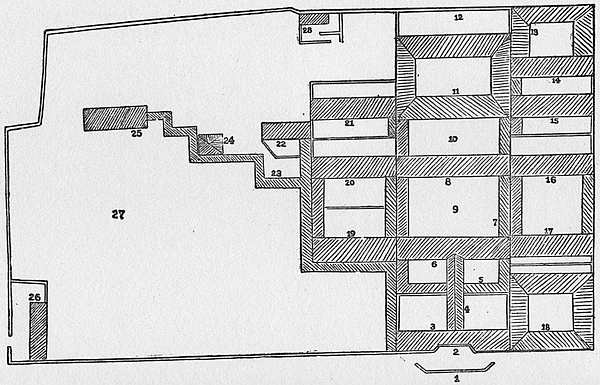
How a house was arranged can be seen in the plan at the
end of this book. Doors lead to the garden from the study,
the guest-room, and the Women's Apartments. These are
made in an endless diversity of shapes and add greatly to
the picturesqueness of house and grounds. Those through
which a number of people are to pass to and fro are often
large circles, while smaller and more intimate doors are cut
to the outlines of fans, leaves, or flower vases. In addition
to the doors, blank spaces of wall are often broken by
openings at the height of a window, such openings being
most fantastic and filled with intricately designed latticework.
I have already spoken of the Kuei or Women's Apartments.
In poetry, this part of the chia is alluded to in a
highly figurative manner. The windows are "gold" or
"jade" windows; the door by which it is approached is the
Lan Kuei, or "Orchid Door." Indeed, the sweet-scented
little epidendrum called by the Chinese, lan, is continually
used to suggest the Kuei and its inmates.
Besides the house proper, there are numerous structures
erected in gardens, for the Chinese spend much of their
time in their gardens. No nation is more passionately fond
of nature, whether in its grander aspects, or in the charming
arrangements of potted flowers which take the place of
our borders in their pleasure grounds. Among these outdoor
buildings none is more difficult to describe than the
lou, since we have nothing which exactly corresponds to it.
Lous appear again and again in Chinese poetry, but just
what to call them in English is a puzzle. They are neither
summer-houses, nor pavilions, nor cupolas, but a little of
all three. Always of more than one story, they are employed
for differing purposes; for instance, the fo lou on the
plan is an upper chamber where Buddhist images are kept.
The lou generally referred to in poetry, however, is really a
"pleasure-house-in-the-air," used as the Italians use their
belvederes. Here the inmates of the house sit and look
down upon the garden or over the surrounding country, or
watch "the sun disappear in the long grass at the edge of
the horizon" or "the moon rise like a golden hook."
Another erection foreign to Western architecture is the
t'ai, or terrace. In early days, there were many kinds of
t'ai, ranging from the small, square, uncovered stage still
seen in private gardens and called yüeh t'ai, "moon terrace,"
to immense structures like high, long, open platforms,
built by Emperors and officials for various reasons.
Many of these last were famous; I have given the histories
of several of them in the notes illustrating the poems, at
the end of the book.
It will be observed that I have said practically nothing
about religion. The reason is partly that the three principal
religions practised by the Chinese are either so well known,
as Buddhism, for example, or so difficult to describe, as
Taoism and the ancient religion of China now merged in
the teachings of Confucius; partly that none of them could
be profitably compressed into the scope of this introduction;
but chiefly because the subject of religion, in the poems
here translated, is generally referred to in its superstitious
aspects alone. The superstitions which have grown up
about Taoism particularly are innumerable. I have dealt
with a number of these in the notes to the poems in which
they appear. Certain supernatural personages, without a
knowledge of whom much of the poetry would be unintelligible,
I have set down in the following list:
Hsien.
Immortals who live in the Taoist Paradises.
Human beings may attain "Hsien-ship,"
or Immortality, by living a life of
contemplation in the hills. In translating
the term, we have used the word
"Immortals."
Shên.
Beneficent beings who inhabit the higher
regions. They are kept extremely busy
attending to their duties as tutelary
deities of the roads, hills, rivers, etc.,
and it is also their function to intervene
and rescue deserving people from the
attacks of their enemies.
Kuei.
A proportion of the souls of the departed
who inhabit the "World of
Shades," a region resembling this world,
which is the "World of Light," in every
particular, with the important exception
that it has no sunshine. Kindly kuei are
known, but the influence generally suggested
is an evil one. They may only
return to the World of Light between
sunset and sunrise, except upon the fifth
day of the Fifth Month (June), when
they are free to come during the time
known as the "hour of the horse," from
eleven A.M. to one P.M.
Yao Kuai.
A class of fierce demons who live in the
wild regions of the Southwest and delight
in eating the flesh of human beings.
There are also supernatural creatures whose names carry
a symbolical meaning. A few of them are:
Ch'i Lin.
A composite animal, somewhat resembling
the fabulous unicorn, whose arrival
is a good omen. He appears when sages
are born.
Dragon.
A symbol of the forces of Heaven, also
the emblem of Imperial power. Continually
referred to in poetry as the steed
which transports a philosopher who has
attained Immortality to his home in the
Western Paradise.
Fêng Huang.
A glorious bird, symbol of the Empress,
therefore often associated with the
dragon. The conception of this bird is
probably based on the Argus pheasant.
It is described as possessing every grace
and beauty. A Chinese author, quoted
by F. W. Williams in "The Middle
Kingdom," writes: "It resembles a wild
swan before and a unicorn behind; it has
the throat of a swallow, the bill of a cock,
the neck of a snake, the tail of a fish, the
forehead of a crane, the crown of a
mandarin drake, the stripes of a dragon,
and the vaulted back of a tortoise. The
feathers have five colours which are
named after the five cardinal virtues,
and it is five cubits in height; the tail is
graduated like the pipes of a gourd-organ,
and its song resembles the music
of the instrument, having five modulations."
Properly speaking, the female
is Fêng, the male Huang, but the two
words are usually given in combination
to denote the species. Some one, probably
in desperation, once translated the
combined words as "phœnix," and this
term has been employed ever since. It
conveys, however, an entirely wrong
impression of the creature. To Western
readers, the word "phœnix" suggests a
bird which, being consumed by fire,
rises in a new birth from its own ashes.
The Fêng Huang has no such power, it
is no symbol of hope or resurrection,
but suggests friendship and affection
of all sorts. Miss Lowell and I have
translated the name as "crested love-pheasant,"
which seems to us to convey
a better idea of the beautiful Fêng
Huang, the bird which brings happiness.
Luan.
A supernatural bird sometimes confused
with the above. It is a sacred
creature, connected with fire, and a
symbol of love and passion, of the relation
between men and women.
Chien.
The "paired-wings bird," described in
Chinese books as having but one wing
and one eye, for which reason two must
unite for either of them to fly. It is often
referred to as suggesting undying affection.
Real birds and animals also have symbolical attributes.
I give only three:
Crane.
Represents longevity, and is employed,
as is the dragon, to transport those who
have attained to Immortality to the
Heavens.
Yuan Yang.
The exquisite little mandarin ducks, an
unvarying symbol of conjugal fidelity.
Li T'ai-po often alludes to them and
declares that, rather than be separated,
they would "prefer to die ten thousand
deaths, and have their gauze-like wings
torn to fragments."
Wild Geese.
Symbols of direct purpose, their flight
being always in a straight line. As they
follow the sun's course, allusions to
their departure suggest Spring, to their
arrival, Autumn.
A complete list of the trees and plants endowed with
symbolical meanings would be almost endless. Those most
commonly employed in poetry in a suggestive sense are:
Ch'ang P'u.
A plant growing in the Taoist Paradise
and much admired by the Immortals,
who are the only beings able to see its
purple blossoms. On earth, it is known
as the sweet flag, and has the peculiarity
of never blossoming. It is hung on the
lintels of doors on the fifth day of the
Fifth Month to ward off the evil influences
which may be brought by the kuei
on their return to this world during the
"hour of the horse."
Peony.
Riches and prosperity.
Lotus.
Purity. Although it rises from the mud,
it is bright and spotless.
Plum-blossom.
Literally "the first," it being the first
of the "hundred flowers" to open. It
suggests the beginnings of things, and is
also one of the "three friends" who do
not fear the Winter cold, the other two
being the pine and the bamboo.
Lan.
A small epidendrum, translated in this
book as "spear-orchid." It is a symbol
for noble men and beautiful, refined
women. Confucius compared the Chün
Tzŭ, Princely or Superior Man, to this
little orchid with its delightful scent.
In poetry, it is also used in reference to
the Women's Apartments and everything
connected with them, suggesting,
as it does, the extreme of refinement.
Chrysanthemum.
Fidelity and constancy. In spite of frost,
its flowers continue to bloom.
Ling Chih.
Longevity. This fungus, which grows
at the roots of trees, is very durable
when dried.
Pine.
Longevity, immutability, steadfastness.
Bamboo.
This plant has as many virtues as it has
uses, the principal ones are modesty,
protection from defilement, unchangeableness.
Wu-t'ung.
A tree whose botanical name is sterculia
platanifolia. Its only English name
seems to be "umbrella-tree," which has
proved so unattractive in its context in
the poems that we have left it untranslated.
It is a symbol for integrity, high
principles, great sensibility. When "Autumn
stands," on August seventh,
although it is still to all intents and
purposes Summer, the wu-t'ung tree
drops one leaf. Its wood, which is white,
easy to cut, and very light, is the only
kind suitable for making that intimate
instrument which quickly betrays the
least emotion of the person playing upon
it—the ch'in, or table-lute.
Willow.
A prostitute, or any very frivolous person.
Concubines writing to their lords
often refer to themselves under this
figure, in the same spirit of self-depreciation
which prompts them to employ the
euphemism, "Unworthy One," instead
of the personal pronoun. Because of its
lightness and pliability, it conveys also
the idea of extreme vitality.
Peach-blossom.
Beautiful women and ill-success in life.
The first suggestion, on account of the
exquisite colour of the flower; the second,
because of its perishability.
Peach-tree.
Longevity. This fruit is supposed to
ripen once every three thousand years
on the trees of Paradise, and those who
eat of this celestial species never die.
Mulberry.
Utility. Also suggests a peaceful hamlet.
Its wood is used in the making of bows
and the kind of temple-drums called
mo yü—wooden fish. Its leaves feed
the silk-worms.
Plantain.
Sadness and grief. It is symbolical of a
heart which is not "flat" or "level," as
the Chinese say, not open or care-free,
but of one which is "tightly rolled."
The sound of rain on its leaves is very
mournful, therefore an allusion to the
plantain always means sorrow. Planted
outside windows already glazed with
silk, its heavy green leaves soften the
glaring light of Summer, and it is often
used for this purpose.
Nothing has been more of a stumbling-block to translators
than the fact that the Chinese year—which is
strictly lunar, with an intercalary month added at certain
intervals—begins a month later than ours; or, to be more
exact, it is calculated from the first new moon after the sun
enters Aquarius, which brings the New Year at varying
times from the end of January to the middle of February.
For translation purposes, however, it is safe to count the
Chinese months as always one later by our calendar than
the number given would seem to imply. By this calculation
the "First Month" is February, and so on throughout the
year.
The day is divided into twelve periods of two hours each
beginning at eleven P.M. and each of these periods is called
by the name of an animal—horse, deer, snake, bat, etc.
As these names are not duplicated, the use of them tells at
once whether the hour is day or night. Ancient China's
method of telling time was by means of slow and evenly
burning sticks made of a composition of clay and sawdust,
or by the clepsydra, or water-clock. Water-clocks are
mentioned several times in these poems.
So much for what I have called the backgrounds of
Chinese poetry. I must now speak of that poetry itself,
and of Miss Lowell's and my method of translating it.
Chinese prosody is a very difficult thing for an Occidental
to understand. Chinese is a monosyllabic language, and
this reduces the word-sounds so considerably that speech
would be almost impossible were it not for the invention of
tones by which the same sound can be made to do the duty
of four in the Mandarin dialect, five in the Nankingese,
eight in the Cantonese, etc., a different tone inflection
totally changing the meaning of a word. Only two chief
tones are used in poetry, the "level" and the "oblique,"
but the oblique tone is subdivided into three, which makes
four different inflections possible to every sound. Of course,
like English and other languages, the same word may have
several meanings, and in Chinese these meanings are bewilderingly
many; the only possible way of determining
which one is correct is by its context. These tones constitute,
at the outset, the principal difference which divides
the technique of Chinese poetry from our own. Another is
to be found in the fact that nothing approaching our metrical
foot is possible in a tongue which knows only single syllables.
Rhyme does exist, but there are only a little over a
hundred rhymes, as tone inflection does not change a word
in that particular. Such a paucity of rhyme would seriously
affect the richness of any poetry, if again the Chinese had
not overcome this lingual defect by the employment of a
juxtaposing pattern made up of their four poetic tones. And
these tones come to the rescue once more when we consider
the question of rhythm. Monosyllables in themselves
always produce a staccato effect, which tends to make all
rhythm composed of them monotonous, if, indeed, it does
not destroy it altogether. The tones cause what I may call
a psychological change in the time-length of these monosyllables,
which change not only makes true rhythm possible,
but allows marked varieties of the basic beat.
One of the chief differences between poetry and prose is
that poetry must have a more evident pattern. The pattern
of Chinese poetry is formed out of three elements: line,
rhyme, and tone.
The Chinese attitude toward line is almost identical with
that of the French. French prosody counts every syllable
as a foot, and a line is made up of so many counted feet. If
any of my readers has ever read French alexandrines
aloud to a Frenchman, read them as we should read English
poetry, seeking to bring out the musical stress, he will
remember the look of sad surprise which crept over his
hearer's face. Not so was this verse constructed; not so is
it to be read. The number of syllables to a line is counted,
that is the secret of French classic poetry; the number of
syllables is counted in Chinese. But—and we come to a
divergence—this method of counting does, in French
practice, often do away with the rhythm so delightful to
an English ear; in Chinese, no such violence occurs, as
each syllable is a word and no collection of such words can
fall into a metric pulse as French words can, and, in their
Chansons, are permitted to do.
The Chinese line pattern is, then, one of counted words,
and these counted words are never less than three, nor more
than seven, in regular verse; irregular is a different matter,
as I shall explain shortly. Five and seven word lines are
cut by a cæsura, which comes after the second word in a
five-word line, and after the fourth in a seven-word line.
Rhyme is used exactly as we use it, at the ends of lines.
Internal rhyming is common, however, in a type of poem
called a "fu," which I shall deal with when I come to the
particular kinds of verse.
Tone is everywhere, obviously, and is employed, not
arbitrarily, but woven into a pattern of its own which
again is in a more or less loose relation to rhyme. By itself,
the tone-pattern alternates in a peculiar manner in each
line, the last line of a stanza conforming to the order of
tones in the first, the intervening lines varying methodically.
I have before me a poem in which the tone-pattern
is alike in lines one, four, and eight, of an eight-line stanza,
as are lines two and six, and lines three and seven, while
line five is the exact opposite of lines two and six. In the
second stanza of the same poem, the pattern is kept, but
adversely; the tones do not follow the same order, but
conform in similarity of grouping. I use this example
merely to show what is meant by tone-pattern. It will
serve to illustrate how much diversity and richness this
tone-chiming is capable of bringing to Chinese poetry.
Words which rhyme must be in the same tone in regular
verse, and unrhymed lines must end on an oblique tone if
the rhyme-tone is level, and vice versa. The level tone is
preferred for rhyme.
In the early Chinese poetry, called Ku-shih (Old Poems),
the tones were practically disregarded. But in the Lü-shih
(Regulated Poems) the rules regarding them are very strict.
The lü-shih are supposed to date from the beginning of the
T'ang Dynasty. A lü-shih poem proper should be of eight
lines, though this is often extended to sixteen, but it
must be in either the five-word line, or the seven-word line,
metre. The poets of the T'ang Dynasty, however, were by
no means the slaves of lü-shih; they went their own way,
as good poets always do, conforming when it pleased them
and disregarding when they chose. It depended on the
character of the poet. Tu Fu was renowned for his careful
versification; Li T'ai-po, on the other hand, not infrequently
rebelled and made his own rules. In his "Drinking
Song," which is in seven-word lines, he suddenly dashes in
two three-word lines, a proceeding which must have been
greatly upsetting to the purists. It is amusing to note that
his "Taking Leave of Tu Fu" is in the strictest possible
form, which is at once a tribute and a poking of fun at his
great friend and contemporary.
Regular poems of more than sixteen lines are called p'ai
lu, and these may run to any length; Tu Fu carried them to
forty, eighty, and even to two hundred lines. Another
form, always translated as "short-stop," cuts the eight-line
poem in two. In theory, the short-stop holds the same
relation to the eight-line poem that the Japanese hokku
does to the tanka, although of course it preceded the hokku
by many centuries. It is supposed to suggest rather than
to state, being considered as an eight-line poem with its
end in the air. In suggestion, however, the later Japanese
form far outdoes it.
So called "irregular verse" follows the writer's inclination
within the natural limits of all Chinese prosody.
A tzŭ may be taken to mean a lyric, if we use that term,
not in its dictionary sense, but as all modern poets employ
it. It may vary its line length, but must keep the same
variation in all the stanzas.
Perhaps the most interesting form to modern students is
the fu, in which the construction is almost identical with
that of "polyphonic prose." The lines are so irregular in
length that the poem might be mistaken for prose, had we
not a corresponding form to guide us. The rhymes appear
when and where they will, in the middle of the lines or at
the end, and sometimes there are two or more together. I
have been told that Persia has, or had, an analogous form,
and if so modern an invention as "polyphonic prose" derives,
however unconsciously, from two such ancient countries
as China and Persia, the fact is, at least, interesting.
The earliest examples of Chinese poetry which have
come down to us are a collection of rhymed ballads in
various metres, of which the most usual is four words to a
line. They are simple, straightforward pieces, often of a
strange poignance, and always reflecting the quiet, peaceful
habits of a people engaged in agriculture. The oldest
were probably composed about 2000 B.C. and the others at
varying times from then until the Sixth Century B.C., when
Confucius gathered them into the volume known as the
"Book of Odes." Two of these odes are translated in this
book. The next epoch in the advance of poetry-making
was introduced by Ch'ü Yüan (312-295 B.C.), a famous
statesman and poet, who wrote an excitable, irregular style
in which the primitive technical rules were disregarded,
their place being taken by exigencies of emotion and idea.
We are wont to regard a poetical technique determined by
feeling alone as a very modern innovation, and it is interesting
to note that the method is, on the contrary, as old
as the hills. These rhapsodical allegories culminated in a
poem entitled "Li Sao," or "Falling into Trouble," which
is one of the most famous of ancient Chinese poems. A further
development took place under the Western Han (206
B.C.-A.D. 25), when Su Wu invented the five-character
poem, ku fêng; these poems were in Old Style, but had five
words to a line. It is during this same period that poems
with seven words to a line appeared. Legend has it that
they were first composed by the Emperor Wu of Han, and
that he hit upon the form on an occasion when he and his
Ministers were drinking wine and capping verses at a feast
on the White Beam Terrace. Finally, under the Empress
Wu Hou, early in the T'ang Dynasty, the lü-shih, or
"poems according to law," became the standard. It will
be seen that the lü-shih found the five and seven word
lines already in being and had merely to standardize them.
The important gift which the lü-shih brought to Chinese
prosody was its insistence on tone.
The great period of Chinese poetry was during the
T'ang Dynasty. Then lived the three famous poets, Li
T'ai-po, Tu Fu, and Po Chü-i. Space forbids me to give the
biographies of all the poets whose work is included in this
volume, but as Li T'ai-po and Tu Fu, between them, take
up more than half the book, a short account of the principal
events of their lives seems necessary. I shall take them
in the order of the number of their poems printed in this
collection, which also, as a matter of fact, happens to be
chronological.
I have already stated in the first part of this Introduction
the reasons which determined me to give so large a space
to Li T'ai-po. English writers on Chinese literature are
fond of announcing that Li T'ai-po is China's greatest poet;
the Chinese themselves, however, award this place to Tu
Fu. We may put it that Li T'ai-po was the people's poet,
and Tu Fu the poet of scholars. As Po Chü-i is represented
here by only one poem, no account of his life has been
given. A short biography of him may be found in Mr.
Waley's "A Hundred and Seventy Chinese Poems."
It is permitted to very few to live in the hearts of their
countrymen as Li T'ai-po has lived in the hearts of the
Chinese. To-day, twelve hundred and twenty years after
his birth, his memory and his fame are fresh, his poems are
universally recited, his personality is familiar on the stage:
in fact, to use the words of a Chinese scholar, "It may be
said that there is no one in the People's Country who does
not know the name of Li T'ai-po." Many legends are told of
his birth, his life, his death, and he is now numbered among
the Hsien (Immortals) who inhabit the Western Paradise.
Li T'ai-po was born A.D. 701, of well-to-do parents named
Li, who lived in the Village of the Green Lotus in Szechwan.
He is reported to have been far more brilliant than ordinary
children. When he was only five years old, he read books
that other boys read at ten; at ten, he could recite the
"Classics" aloud and had read the "Book of the Hundred
Sages." Doubtless this precocity was due to the fact that
his birth was presided over by the "Metal Star," which we
know as Venus. His mother dreamt that she had conceived
him under the influence of this luminary, and called him
T'ai-po, "Great Whiteness," a popular name for the planet.
In spite of his learning, he was no Shu Tai Tzŭ (Book
Idiot) as the Chinese say, but, on the contrary, grew up a
strong young fellow, impetuous to a fault, with a lively,
enthusiastic nature. He was extremely fond of sword-play,
and constantly made use of his skill in it to right the wrongs
of his friends. However worthy his causes may have been,
this propensity got him into a serious scrape. In the excitement
of one of these encounters, he killed several people,
and was forthwith obliged to fly from his native village.
The situation was an awkward one, but the young man
disguised himself as a servant and entered the employ of a
minor official. This gentleman was possessed of literary
ambitions and a somewhat halting talent; still we can
hardly wonder that he was not pleased when his servant
ended a poem in which he was hopelessly floundering
with lines far better than he could make. After this, and
one or two similar experiences, Li T'ai-po found it advisable
to relinquish his job and depart from his master's
house.
His next step was to join a scholar who disguised his real
name under the pseudonym of "Stern Son of the East."
The couple travelled together to the beautiful Min Mountains,
where they lived in retirement for five years as
teacher and pupil. This period, passed in reading, writing,
discussing literature, and soaking in the really marvellous
scenery, greatly influenced the poet's future life, and
imbued him with that passionate love for nature so apparent
in his work.
At the age of twenty-five, he separated from his teacher
and left the mountains, going home to his native village
for a time. But the love of travel was inherent in him,
nowhere could hold him for long, and he soon started off on
a sight-seeing trip to all those places in the Empire famous
for their beauty. This time he travelled as the position of
his parents warranted, and even a little beyond it. He had
a retinue of servants, and spent money lavishly. This
open-handedness is one of the fine traits of his character.
Needy scholars and men of talent never appealed to him in
vain; during a year at Yangchow, he is reported to have
spent three hundred thousand ounces of silver in charity.
From Yangchow he journeyed to the province of Hupeh
("North of the Lake") where, in the district of the
"Dreary Clouds," he stayed at the house of a family named
Hsü, which visit resulted in his marriage with one of the
daughters. Li T'ai-po lived in Hupeh for some years—he
himself says three—then his hunger for travel reasserted
itself and he was off again. After some years of wandering,
while visiting a magistrate in Shantung, an incident occurred
which had far-reaching consequences. A prisoner
was about to be flogged. Li T'ai-po, who was passing,
glanced at the man, and, happening to be possessed of a
shrewd insight into character, realized at once that here
was an unusual person. He secured the man's release, and
twenty-five years later this action bore fruit as the sequel
will show. The freed prisoner was Kuo Tzŭ-i, who became
one of China's most powerful generals and the saviour of
the T'ang Dynasty.
It will be noticed that nothing has been said of the poet
taking any examinations, and for the excellent reason that
he never thought it worth while to present himself as a
candidate. The simple fact appears to be that geniuses
often do not seem to find necessary what other men consider
of supreme importance. Presumably, also, he had no
particular desire for an official life. The gifts of Heaven go by
favour and the gifts of man are strangely apt to do the same
thing, in spite of the excellent rules devised to order them.
Li T'ai-po's career owed nothing to either the lack of official
degrees or official interest. What he achieved, he owed
to himself; what he failed in came from the same source.
About this time, the poet and a few congenial friends
formed the coterie of "The Six Idlers of the Bamboo
Brook." They retired to the Ch'u Lai Mountain and spent
their time in drinking, reciting poems, writing beautiful
characters, and playing on the table-lute. It must be admitted
that Li T'ai-po was an inveterate and inordinate
drinker, and far more often than was wise in the state called
by his countrymen "great drunk." To this propensity he
was indebted for all his ill fortune, as it was to his poetic
genius that he owed all his good.
So the years passed until, when he was forty-two, he
met the Taoist priest, Wu Yün. They immediately became
intimate, and on Wu Yün's being called to the capital, Li
T'ai-po accompanied him. Wu Yün took occasion to tell
the Emperor of his friend's extraordinary talent. The Emperor
was interested, the poet was sent for, and, introduced
by Ho Chih-chang, was received by the Son of
Heaven in the Golden Bells Hall.
The native accounts of this meeting state that "in his
discourses upon the affairs of the Empire, the words rushed
from his mouth like a mountain torrent." Ming Huang,
who was enchanted, ordered food to be brought and helped
the poet himself.
So Li T'ai-po became attached to the Court and was
made an honorary member of the "Forest of Pencils."
He was practically the Emperor's secretary and wrote the
Emperor's edicts, but this was by the way—his real duty
was simply to write what he chose and when, and recite
these poems at any moment that it pleased the Emperor
to call upon him to do so.
Li T'ai-po, with his love of wine and good-fellowship,
was well suited for the life of the gay and dissipated Court
of Ming Huang, then completely under the influence of
the beautiful concubine, Yang Kuei-fei. Conspicuous
among the Emperor's entourage was Ho Chih-chang, a
famous statesman, poet, and calligraphist, who, on reading
Li T'ai-po's poetry, is said to have sighed deeply and exclaimed:
"This is not the work of a human being, but of a
Tsê Hsien (Banished Immortal)." To understand fully
the significance of this epithet, it must be realized that
mortals who have already attained Immortality, but who
have committed some fault, may be banished from Paradise
to expiate their sin on earth.
For about two years, Li T'ai-po led the life of supreme
favourite in the most brilliant Court in the world. The
fact that when sent for to compose or recite verses he was
not unapt to be drunk was of no particular importance
since, after being summarily revived with a dash of cold
water, he could always write or chant with his accustomed
verve and dexterity. His influence over the Emperor became
so great that it roused the jealousy, and eventually
the hatred, of Kao Li-shih, the Chief Eunuch, who, until
then, had virtually ruled his Imperial master. On one
occasion, when Li T'ai-po was more than usually incapacitated,
the Emperor ordered Kao to take off the poet's
shoes. This was too much, and from that moment the
eunuch's malignity became an active intriguing to bring
about his rival's downfall. He found the opportunity he
needed in the vanity of Yang Kuei-fei. Persuading this
lady that Li T'ai-po's "Songs to the Peonies" contained a
veiled insult directed at her, he enlisted her anger against
the poet and so gained an important ally to his cause. On
three separate occasions when Ming Huang wished to confer
official rank upon the poet, Yang Kuei-fei interfered and
persuaded the Emperor to forego his intention. Li T'ai-po
was of too independent a character, and too little of a
courtier, to lift a finger to placate his enemies. But the
situation became so acute that at last he begged leave to
retire from the Court altogether. His request granted, he
immediately formed a new group of seven congenial souls
and with them departed once more to the mountains. This
new association called itself "The Eight Immortals of the
Wine-cup."
Although Li T'ai-po had asked for his own dismissal, he
had really been forced to ask it, and his banishment from
the "Imperial Sun," with all that "Sun" implied, was a
blow from which he never recovered. His later poems are
full of more or less veiled allusions to his unhappy state.
The next ten years were spent in his favourite occupation
of travelling, especially in the provinces of Szechwan,
Hunan, and Hupeh.
Meanwhile, political conditions were growing steadily
worse. Popular discontent at the excesses of Yang Kuei-fei
and her satellite An Lu-shan were increasing, and
finally, in A.D. 755, rebellion broke out. I have dealt with
this rebellion earlier in this Introduction, and a more detailed
account is given in the Notes; I shall, therefore, do
no more than mention it here. Sometime during the preceding
unrest, Li T'ai-po, weary of moving from place to
place, had taken the position of adviser to Li Ling, Prince
of Yung. In the wide-spread disorder caused by the rebellion,
Li Ling conceived the bold idea of establishing himself
South of the Yangtze as Emperor on his own account.
Pursuing his purpose, he started at the head of his troops
for Nanking. Li T'ai-po strongly disapproved of the
Prince's course, a disapproval which affected that headstrong
person not at all, and the poet was forced to accompany
his master on the march to Nanking.
At Nanking, the Prince's army was defeated by the
Imperial troops, and immediately after the disaster Li
T'ai-po fled, but was caught, imprisoned, and condemned
to death. Now came the sequel to the incident which had
taken place long before at Shantung. The Commander of
the Imperial forces was no other than Kuo Tzŭ-i, the
former prisoner whose life Li T'ai-po had saved. On learning
the sentence passed upon the poet, Kuo Tzŭ-i intervened
and threatened to resign his command unless his
benefactor were spared. Accordingly Li T'ai-po's sentence
was changed to exile and he was released, charged to depart
immediately for some great distance where he could do no
harm. He set out for Yeh Lang, a desolate spot beyond
the "Five Streams," in Kueichow. This was the country
of the yao kuai, the man-eating demons; and whether he
believed in them or not, the thought of existence in such a
gloomy solitude must have filled him with desperation.
He had not gone far, luckily, when a general amnesty
was declared, and he was permitted to return and live with
his friend and disciple, Lu Yang-ping, in the Lu Mountains
near Kiukiang, a place which he dearly loved. Here, in
A.D. 762, at the age of sixty-one, he died, bequeathing all
his manuscripts to Lu Yang-ping.
The tale of his drowning, repeated by Giles and others,
is pure legend, as an authoritative statement of Lu Yang-ping
proves. The manuscripts left to his care, and all
others he could collect from friends, Lu Yang-ping published
in an edition of ten volumes. This edition appeared
in the year of the poet's death, and contained the following
preface by Lu Yang-ping:
Since the three dynasties of antiquity,
Since the style of the 'Kuo Fêng' and the 'Li Sao,'
During these thousand years and more, of those who walked the "lonely path,"
There has been only you, you are the Solitary Man, you are without rival.
Li T'ai-po's poetry is full of dash and surprise. At his
best, there is an extraordinary exhilaration in his work; at
his worst, he is merely repetitive. Chinese critics have
complained that his subjects are all too apt to be trivial,
and that his range is narrow. This is quite true; poems of
farewell, deserted ladies sighing for their absent lords,
officials consumed by homesickness, pæans of praise for
wine—in the aggregate there are too many of these. But
how fine they often are! "The Lonely Wife," "Poignant
Grief During a Sunny Spring," "After being Separated for
a Long Time," such poems are the truth of emotion. Take
again his inimitable humour in the two "Drinking Alone
in the Moonlight" poems, or "Statement of Resolutions
after being Drunk on a Spring Day." Then there are the
poems of hyperbolical description such as "The Perils of
the Shu Road," "The Northern Flight," and "The Terraced
Road of the Two-Edged Sword Mountains." Mountains
seem to be in his very blood. Of the sea, on the
other hand, he has no such intimate knowledge; he sees it
afar, from some height, but always as a thing apart, a
distant view. The sea he gazes at; the mountains he
treads under foot, their creepers scratch his face, the jutting
rocks beside the path bruise his hands. He knows the
straight-up, cutting-into-the-sky look of mountain peaks
just above him, and feels, almost bodily, the sheer drop
into the angry river tearing its way through a narrow gully
below, a river he can see only by leaning dangerously far
over the cliff upon which he is standing. There is a curious
sense of perpendicularity about these mountain rhapsodies.
The vision is strained up for miles, and shot suddenly down
for hundreds of feet. The tactile effect of them is astounding;
they are not to be read, but experienced. And yet I
am loth to say that Li T'ai-po is at his greatest in description,
with poems so full of human passion and longing as
"The Lonely Wife," and "Poignant Grief During a Sunny
Spring," before me. There is no doubt at all that in Li
T'ai-po we have one of the world's greatest lyrists.
Great though he was, it cannot be denied that he had
serious weaknesses. One was his tendency to write when
the mood was not there, and at these moments he was not
ashamed to repeat a fancy conceived before on some other
occasion. Much of his style he crystallized into a convention,
and brought it out unblushingly whenever he was at
a loss for something to say. Sustained effort evidently
wearied him. He will begin a poem with the utmost spirit,
but his energy is apt to flag and lead to a close so weak as
to annoy the reader. His short poems are always admirably
built, the endings complete and unexpected; the architectonics
of his long poems leave much to be desired. He seems
to be ridden by his own emotion, but without the power to
draw it up and up to a climax; it bursts upon us in the first
line, sustains itself at the same level for a series of lines, and
then seems to faint exhausted, reducing the poet to the
necessity of stopping as quickly as he can and with as little
jar as possible. Illustrations of this tendency to a weak
ending can be seen in "The Lonely Wife," "The Perils of
the Shu Road," and "The Terraced Road of the Two-Edged
Sword Mountains," but that he could keep his
inspiration to the end on occasion, "The Northern Flight"
proves.
Finally, there are his poems of battle: "Songs of the
Marches," "Battle to the South of the City," and "Fighting
to the South of the City." Nothing can be said of these
except that they are superb. If there is a hint of let-down
in the concluding lines of "Fighting to the South of the
City," it is due to the frantic Chinese desire to quote from
older authors, and this is an excellent example of the chief
vice of Chinese poetry, since these two lines are taken from
the "Tao Tê Ching," the sacred book of Taoism; the others,
even the long "Songs of the Marches," are admirably
sustained.
In Mr. Waley's excellent monograph on Li T'ai-po, appears
the following paragraph: "Wang An-shih (A.D. 1021-1086),
the great reformer of the Eleventh Century, observes:
'Li Po's style is swift, yet never careless; lively, yet
never informal. But his intellectual outlook was low and
sordid. In nine poems out of ten he deals with nothing but
wine and women.'" A somewhat splenetic criticism truly,
but great reformers have seldom either the acumen or the
sympathy necessary for the judgment of poetry. Women
and wine there are in abundance, but how treated? In no
mean or sordid manner certainly. Li T'ai-po was not a
didactic poet, and we of the Twentieth Century may well
thank fortune for that. Peradventure the Twenty-first
will dote again upon the didactic, but we must follow our
particular inclination which is, it must be admitted, quite
counter to anything of the sort. No low or mean attitude
indeed, but a rather restricted one we may, if we please,
charge against Li T'ai-po. He was a sensuous realist, representing
the world as he saw it, with beauty as his guiding
star. Conditions to him were static; he wasted none of his
force in speculating on what they should be. A scene or an
emotion was, and it was his business to reproduce it, not to
analyze how it had come about or what would best make
its recurrence impossible. Here he is at sharp variance with
Tu Fu, who probes to the roots of events even when he
appears to be merely describing them. One has but to
compare the "Songs of the Marches" and "Battle to the
South of the City" with "The Recruiting Officers" and
"Crossing the Frontier" to see the difference.
Tu Fu was born in Tu Ling, in the province of Shensi,
in A.D. 713. His family was extremely poor, but his talent
was so marked that at seven years old he had begun to
write poetry; at nine, he could write large characters; and
at fifteen, his essays and poems were the admiration of
his small circle. When he was twenty-four, he went up to
Ch'ang An, the capital, for his first examination—it will be
remembered that, in the T'ang period, all the examinations
took place at Ch'ang An. Tu Fu was perfectly qualified to
pass, as every one was very well aware, but the opinions
he expressed in his examination papers were so radical that
the degree was withheld. There was nothing to be done,
and Tu Fu took to wandering about the country, observing
and writing, but with little hope of anything save poverty
to come. On one of his journeys, he met Li T'ai-po on the
"Lute Terrace" in Ching Hsien. The two poets, who sincerely
admired each other, became the closest friends.
Several poems in this collection are addressed by one to the
other.
When Tu Fu was thirty-six, it happened that the Emperor
sent out invitations to all the scholars in the Empire
to come to the capital and compete in an examination. Tu
Fu was, of course, known to the Emperor as a man who
would have been promoted but for the opinions aired in his
papers. Of his learning, there could be no shadow of doubt.
So Tu Fu went to Ch'ang An and waited there as an "expectant
official." He waited for four years, when it occurred
to him to offer three fu to the Emperor. The event
justified his temerity, and the poet was given a post as one
of the officials in the Chih Hsien library. This post he held
for four years, when he was appointed to a slightly better
one at Fêng-hsien. But, a year later, the An Lu-shan rebellion
broke out, which put a summary end to Tu Fu's position,
whereupon he left Fêng-hsien and went to live with a
relative at the Village of White Waters. He was still living
there when the Emperor Ming Huang abdicated in favour
of his son, Su Tsung. If the old Emperor had given him an
office, perhaps the new one would; at any rate it was worth
an attempt, for Tu Fu was in dire poverty. Having no
money to hire any kind of conveyance, he started to walk
to his destination, but fell in with brigands who captured
him. He stayed with these brigands for over a year, but
finally escaped, and at length reached Fêng Chiang, where
the Emperor was in residence.
His appearance on his arrival was miserable in the extreme.
Haggard and thin, his shoulders sticking out of his
coat, his rags literally tied together, he was indeed a spectacle
to inspire pity, and the Emperor at once appointed
him to the post of Censor. But this did not last long. He
had the imprudence to remonstrate with the Emperor
anent the sentence of banishment passed upon the general
Tan Kuan. Considering that this clever and extremely
learned soldier had so far relaxed the discipline of his army
during one of the Northern campaigns that, one night,
when his troops were all peacefully sleeping in their chariots,
the camp was surrounded and burnt and his forces utterly
routed, the punishment seems deserved. But Tu Fu
thought otherwise, and so unwisely urged his opinion that
the Emperor lost patience and ordered an investigation
of Tu Fu's conduct. His friends, however, rallied to his
defence and the investigation was quashed, but he was
deprived of the censorship and sent to a minor position in
Shensi. This he chose to regard as a punishment, as indeed
it was. He proceeded to Shensi, but, on arriving there,
dramatically refused to assume his office; having performed
which act of bravado, he joined his family in Kansu. He
found them in the greatest distress from famine, and although
he did his best to keep them alive by going to the
hills and gathering fire-wood to sell, and by digging up roots
and various growing things for them to eat, several of his
children died of starvation.
Another six months of minor officialdom in Hua
Chou, and he retired to Ch'êngtu in Szechwan, where
he lived in a grass-roofed house, engaged in study and
the endeavour to make the two ends of nothing meet.
At length, a friend of his arrived in Szechwan as Governor-General,
and this friend appointed him a State Counsellor.
But the grass-house was more to his taste than
state councils, and after a year and a half he returned to
it, and the multifarious wanderings which always punctuated
his life.
Five years later, when he was fifty-five, he set off on one
of his journeys, but was caught by floods and obliged to
take refuge in a ruined temple at Hu Kuang, where he
nearly starved before help could reach him. After ten days,
he was rescued through the efforts of the local magistrate,
but eating again after so long a fast was fatal and he died
within an hour.
Innumerable essays have been written comparing the
styles of Li T'ai-po and Tu Fu. Yüan Chên, a poet of the
T'ang period, says that Tu Fu's poems have perfect balance;
that, if he wrote a thousand lines, the last would have
as much vigour as the first and that no one can equal him
in this, his poems make a "perfect circle." He goes on:
"In my opinion, the great living wave of poetry and song
in which Li T'ai-po excelled is surpassed in Tu Fu's work,
he is shoulder higher than Li Po." Again: "The poems of
Li T'ai-po are like Spring flowers, those of Tu Fu are like
the pine-trees, they are eternal and fear neither snow nor
cold."
Shên Ming-chên says: "Li Po is like the Spring grass,
like Autumn waves, not a person but must love him. Tu
Fu is like a great hill, a high peak, a long river, the broad
sea, like fine grass and bright-coloured flowers, like a pine
or an ancient fir, like moving wind and gentle waves, like
heavy hoar-frost, like burning heat—not a quality is
missing."
Hu Yu-ling uses a metaphor referring to casting dice and
says that Li T'ai-po would owe Tu Fu "an ivory"; and
Han Yü, speaking of both Li T'ai-po and Tu Fu, declares
that "the flaming light of their essays would rise ten thousand
feet."
Poetic as these criticisms are, it is their penetration which
is so astonishing; but I think the most striking comparison
made of Tu Fu's work is that by Tao Kai-yu: "Tu Fu's
poems are like pictures, like the branches of trees reflected
in water—the branches of still trees. Like a large group
of houses seen through clouds or mist, they appear and
disappear."
Sometime ago, in a review of a volume of translations of
Chinese poetry in the London "Times," I came across this
remarkable statement: "The Chinese poet starts talking
in the most ordinary language and voices the most ordinary
things, and his poetry seems to happen suddenly out of the
commonplace as if it were some beautiful action happening
in the routine of actual life."
The critic could have had no knowledge of the Chinese
language, as nothing can be farther from the truth than his
observation. It is largely a fact that the Oriental poet
finds his themes in the ordinary affairs of everyday life,
but he describes them in a very special, carefully chosen,
medium. The simplest child's primer is written in a language
never used in speaking, while the most highly educated
scholar would never dream of employing the same
phrases in conversation which he would make use of were
he writing an essay, a poem, or a state document. Each
language—the spoken, the poetic, the literary, the documentary—has
its own construction, its own class of characters,
and its own symbolism. A translator must therefore
make a special study of whichever he wishes to
render.
Although several great sinologues have written on the
subject of Chinese poetry, none, so far as I am aware, has
devoted his exclusive attention to the poetic style, nor has
any translator availed himself of the assistance, so essential
to success, of a poet—that is, one trained in the art of seizing
the poetic values in fine shades of meaning. Without
this power, which amounts to an instinct, no one can hope
to reproduce any poetry in another tongue, and how much
truer this is of Chinese poetry can only be realized by those
who have some knowledge of the language. Such poets, on
the other hand, as have been moved to make beautiful renditions
of Chinese originals have been hampered by inadequate
translations. It is impossible to expect that even a
scholar thoroughly versed in the philological aspects of
Chinese literature can, at the same time, be endowed with
enough of the poetic flair to convey, uninjured, the thoughts
of one poet to another. A second personality obtrudes between
poet and poet, and the contact, which must be established
between the two minds if any adequate translation
is to result, is broken. How Miss Lowell and I have
endeavoured to obviate this rupture of the poetic current,
I shall explain presently. But, to understand it, another
factor in the case must first be understood.
It cannot be too firmly insisted upon that the Chinese
character itself plays a considerable part in Chinese poetic
composition. Calligraphy and poetry are mixed up together
in the Chinese mind. How close this intermingling
may be, will appear when we come to speak of the "Written
Pictures," but even without following the interdependence
of these arts to the point where they merge into one,
it must not be forgotten that Chinese is an ideographic,
or picture, language. These marvellous collections of brushstrokes
which we call Chinese characters are really separate
pictographic representations of complete thoughts. Complex
characters are not spontaneously composed, but are
built up of simple characters, each having its own peculiar
meaning and usage; these, when used in combination, each
play their part in modifying either the sense or the sound of
the complex. Now it must not be thought that these
separate entities make an over-loud noise in the harmony
of the whole character. They are each subdued to the total
result, the final meaning, but they do produce a qualifying
effect upon the word itself. Since Chinese characters are
complete ideas, it is convenient to be able to express the
various degrees of these ideas by special characters which
shall have those exact meanings; it is, therefore, clear that
to grasp a poet's full intention in a poem there must be a
knowledge of the analysis of characters.
This might seem bizarre, were it not for a striking proof
to the contrary. It is a fact that many of the Chinese
characters have become greatly altered during the centuries
since they were invented. So long ago as A.D. 200, a scholar
named Hsü Shih, realizing that this alteration was taking
place, wrote the dictionary known as "Shuo Wên Chieh
Tzŭ," or "Speech and Writing: Characters Untied," containing
about ten thousand characters in their primitive
and final forms. This work is on the desk of every scholar
in the Far East and is studied with the greatest reverence.
Many editions have appeared since it was written, and by
its aid one can trace the genealogy of characters in the most
complete manner. Other volumes of the same kind have
followed in its wake, showing the importance of the subject
in Chinese estimation. While translators are apt to ignore
this matter of character genealogy, it is ever present to
the mind of the Chinese poet or scholar who is familiar
with the original forms; indeed, he may be said to find his
overtones in the actual composition of the character he is
using.
All words have their connotations, but this is connotation
and more; it is a pictorial representation of something
implied, and, lacking which, an effect would be lost. It
may be objected that poems were heard as well as read,
and that, when heard, the composition of the character
must be lost. But I think this is to misunderstand the situation.
Recollect, for a moment, the literary examinations,
and consider that educated men had these characters
literally ground into them. Merely to pronounce a
word must be, in such a case, to see it and realize, half-unconsciously
perhaps, its various parts. Even if half-unconscious,
the nuances of meaning conveyed by them must
have hung about the spoken word and given it a distinct
flavour which, without them, would be absent.
Now what is a translator to do? Shall he render the word
in the flat, dictionary sense, or shall he permit himself to
add to it what it conveys to an educated Chinese? Clearly
neither the one nor the other in all cases; but one or the
other, which the context must determine. In description,
for instance, where it is evident that the Chinese poet used
every means at his command to achieve a vivid representation,
I believe the original poem is more nearly reproduced
by availing one's self of a minimum of these "split-ups";
where, on the other hand, the original carefully confines
itself to simple and direct expression, the word as it is,
without overtones, must certainly be preferred. The
"split-ups" in these translations are few, but could our
readers compare the original Chinese with Miss Lowell's
rendition of it, in these instances, I think they would feel
with me that in no other way could the translation have
been made really "literal," could the poem be "brought
over" in its entirety. If a translation of a poem is not
poetry in its new tongue, the original has been shorn of its
chief reason for being. Something is always lost in a translation,
but that something had better be the trappings
than the essence.
I must, however, make it quite clear how seldom these
"split-ups" occur in the principal parts of the book; in the
"Written Pictures," where the poems were not, most of
them, classics, we felt justified in making a fuller use of
these analytical suggestions; but I believe I am correct in
saying that no translations from the Chinese that I have
read are so near to the originals as these. Bear in mind,
then, that there are not, I suppose, more than a baker's
dozen of these "split-ups" throughout the book, and the
way they were managed can be seen by this literal translation
of a line in "The Terraced Road of the Two-Edged
Sword Mountains." The Chinese words are on the left,
the English words on the right, the analyses of the characters
enclosed in brackets:
| Shang | Above |
| Tsê | Then |
| Sung | Pines |
| Fêng | Wind |
| Hsiao | Whistling wind (Grass—meaning the sound of
wind through grass, to whistle; and in awe of,
or to venerate.) |
| Sê | Gusts of wind (Wind; and to stand.) |
| Sê | A psaltery (Two strings of jade-stones which
are sonorous.) |
| Yü | Wind in a gale (Wind; and to speak.) |
Miss Lowell's rendering of the line was:
"On their heights, the wind whistles awesomely in the pines; it
booms in great, long gusts; it clashes like the strings of a
jade-stone psaltery; it shouts on the clearness of a gale."
Can any one doubt that this was just the effect that the
Chinese poet wished to achieve, and did achieve by means
of the overtones given in his characters?
Another, simpler, example is in a case where the Chinese
poet speaks of a rising sun. There are many characters
which denote sunrise, and each has some shade of difference
from every other. In one, the analysis is the sunrise light
seen from a boat through mist; in another, it is the sun just
above the horizon; still another is made up of a period of
time and a mortar, meaning that it is dawn, when people
begin to work. But the poet chose none of these; instead,
he chose a character which analyzes into the sun at the
height of a helmeted man, and so Miss Lowell speaks of
the sun as "head-high," and we have the very picture the
poet wanted us to see.
Miss Lowell has told in the Preface the manner in which
we worked. The papers sent to Miss Lowell were in exactly
the form of the above, and with them I also sent a
paraphrase, and notes such as those at the end of this book.
Far from making the slightest attempt at literary form in
these paraphrases, I deliberately made them as bald as
possible, and strove to keep my personality from intruding
between Miss Lowell and the Chinese poet with whose
mood she must be in perfect sympathy. Her remarkable
gift for entering into the feeling of the poet she is translating
was first shown in "Six French Poets," but there she
approached her authors at first hand. It was my object to
enable her to approach these Chinese authors as nearly at
first hand as I could. That my method has been justified
by the event, the book shows; not merely are these translations
extraordinarily exact, they are poetry, and would be
so though no Chinese poet had conceived them fourteen
hundred years ago. It is as if I had handed her the warp
and the woof, the silver threads and the gold, and from
these she has woven a brocade as nearly alike in pattern to
that designed by the Chinese poet as the differences in the
looms permit. I believe that this is the first time that English
translations of Chinese poetry have been made by a
student of Chinese and a poet working together. Our experience
of the partnership has taught us both much; if we
are pioneers in such a collaboration, we only hope that
others will follow our lead.
The second section of the book, "Written Pictures,"
consists of illustrations, or half illustrations, of an art which
the Chinese consider the most perfect medium in which a
man can express himself. These Tzŭ Hua, "Hanging-on-the-Wall
Poems," are less known and understood than any
other form of Oriental art. A beautiful thought perpetuated
in beautiful handwriting and hung upon the wall to
suggest a mental picture—that is what it amounts to.
In China, the arts of poetry and calligraphy are united
in the ideographs which form the written language. There
are several different styles in which these ideographs, or
characters, may be written. The earliest are pictograms
known as the "ancient pictorial script," they were superseded
in the Eighth Century B.C. by the "great seal" characters
and later by the "lesser seal." These, which had
been executed with the "knife pen," were practically given
up when the invention of the writing-brush, which is usually
translated as "pencil," revolutionized calligraphy
(circa 215 B.C.). Their place was taken by a type of character
known as "li" or "official script," a simplified form of
the "seal," and this, being an improvement upon all
previous styles, soon became popular. It created almost a
new character in which the pictorial element had largely
disappeared, and, with certain modifications, holds good
to-day. The "model hand," the "running hand," and the
famous "grass hand," so popular with poets and painters,
are merely adaptations of the li; all three of these,
together with the li itself, are used in the composition of
written pictures.
The written pictures here translated were formerly in
the possession of a Chinese gentleman of keenly æsthetic
taste, and are excellent examples of the art. A photograph
of one of the originals will be found opposite the translation
made from it on page 170. The names which follow the
poems are not those of the authors, but of the calligraphists.
In the case of two poems, the authors' names are also given.
These written pictures had no titles, those given here were
added simply for convenience; but the titles to the poems
in the body of the book are those of the poets themselves,
except in one or two instances where the Chinese title
conveyed so little to an Occidental mind that its meaning
had to be paraphrased.
The Notes at the end of the book are intended for the
general reader. For which reason, I have purposely excluded
the type of note which consists in cataloguing
literary cross-allusions. To know that certain lines in a
poem are quoted from some earlier author, is one of a class
of facts which deeply interest scholars, but are of no importance
whatever to the rest of the world.
A word as to the title of this book: There lived at Ch'êng-tu,
the capital of Szechwan, early in the Ninth Century, a
courtesan named Hsieh T'ao, who was famous for her wit
and verse-writing. Hsieh T'ao made a paper of ten colours,
which she dipped in a stream, and on it wrote her poems.
Now, some years before, a woman had taken the stole of a
Buddhist priest to this stream in order to wash it. No
sooner had the stole touched the water than the stream
became filled with flowers. In an old Chinese book, "The
Treasury of Pleasant Records," it is told that, later in life,
Hsieh T'ao gave up the "fir-flower tablets" and made
paper of a smaller size. Presumably this fir-flower paper
was the paper of ten colours. The mountain stream which
ran near Hsieh T'ao's house is called the "Hundred
Flower Stream."
I cannot close this Introduction without expressing my
gratitude to my teacher, Mr. Nung Chu. It is his unflagging
interest and never-failing patience that have kept me
spurred on to my task. Speaking no word of English, Mr.
Nung must often have found my explanations of what
would, and what would not, be comprehensible to Occidental
readers very difficult to understand, and my only
regret is that he cannot read the book now that it is done.