The message that had taken Sam away
from practice had been brought to
him by one of the younger boys and,
scrawled hurriedly on the back of an envelope,
was as follows: “Sam: I’m at the gate in
the buggy and must see you, but can’t leave
the nag. Run up for a minute, like a good chap,
Chester. P. S.—Important!”
There were one or two things about which
Chester Harris might want to talk, Sam reflected,
but, since that matter was uppermost
to his mind at the moment, he believed that
Chester had something to confide regarding the
Towners’ plans for the game. So he tossed the
ball to Hal Morris and, without stopping to
change at the gymnasium, sought Chester at
the gate. Chester, whose father was the owner
of one of the larger mills in Charlemont and
very well off, was fond of driving and riding,
and, since his father’s stable was well filled with
horses, was able to gratify his taste whenever
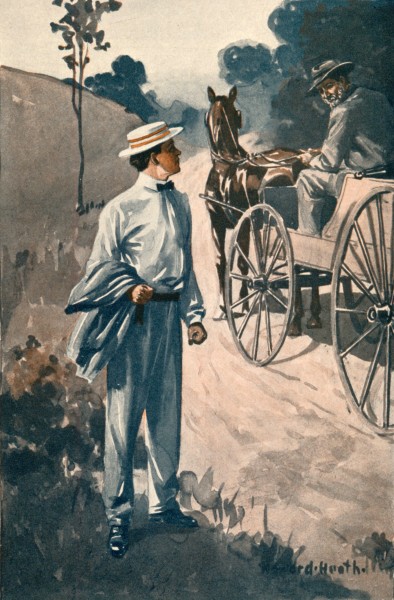
he wished. Today he was seated in a natty
runabout behind a handsome and very restive
bay mare.
“Hello, Sammy,” was Chester’s greeting.
“I’m glad you came because I’ve got something
to tell you; something you’ll want to hear, too.
Whoa, Judy! Stand still, can’t you. This
mare’s the fidgetiest thing I ever saw. She
doesn’t want to stand still a moment, but she
can certainly travel all right!” Chester looked
about him cautiously, but there was no one
nearer than the steps of South Dormitory.
“It’s about the game this afternoon, Sammy,”
he went on, lowering his voice. “Of course,
I’m a Towner, but there are some things——”
The horse began to show her impatience
again at that moment and Chester gave her his
attention.
“Whoa, you idiot! Say, Sammy, get in here
and we’ll drive around a bit. I can’t talk with
Judy dancing a two-step all the time.”
“I’ve got my togs on,” Sam objected, yet
looking longingly at the seat of the runabout.
“Never mind; who cares? Whoa, you pesky
brute! Climb in, Sammy. That’s the ticket.
Now go if you want to!”
And Judy went. And for the subsequent
minute or two Chester had his hands full in
managing the horse. When she had settled
down into a long swinging trot that simply ate
up the Charlemont road Chester returned to his
subject.
“As I was saying, I’m a Towner, of course,
and I want to stick with the other fellows, but
there are some things that aren’t fair. I don’t
believe in going too far to win a ball game,
Sammy.”
“That’s right,” commented Sam approvingly,
trying to suppress any note of eagerness
in his voice.
“So,” continued Chester, “when I heard
about it I made up my mind to sneak up here
and see you and let you know what the fellows
are up to. It sounds sort of—of traitorish,
though, doesn’t it?”
Chester viewed Sam anxiously.
“Well, I don’t know,” Sam replied judicially.
“Of course, it’s possible to go too far, as you
just said, Chesty, and in that case I guess
you’ve got a right to refuse to go in with the
others.”
“Yes, I know. But have I any right to give
them away, Sammy? That’s what’s troubling
me.”
Sam, who had the right-minded boy’s dislike
of anything savoring of treachery, rather
wished that Chester hadn’t put that question to
him. Of course, if Chester was silly enough or
weak enough to tell tales he wasn’t such a fool
as to refuse to listen, but, on the other hand,
he didn’t care to endorse any such doings. He
tried to beg the question.
“I guess that’s for you to decide, Chesty,”
he responded finally. “After all, it’s only a
ball game and it doesn’t much matter who wins
it. But I guess we’re certain enough of getting
it, old man.”
“Not if the Towners succeed at what they’re
up to,” replied Chester mysteriously.
“I don’t see what they could do that would
affect the real game much,” said Sam. “Of
course, they can rattle us and all that sort of
thing, but we’ve been up against that before
and beaten you.”
“Yes, but this is—is something different,”
replied Chester darkly. “And I think it’s sort
of a mean trick to play.”
Sam’s curiosity got the better of his scruples
then.
“Well, I don’t see that you’re telling me very
much,” he said. “All you are doing is taking
me straight toward town at about a mile a
minute; and me in my dirty old baseball togs.
Turn the horse around, Chesty.”
Chester looked doubtfully at the road, which
was fairly narrow here, and shook his head
slowly.
“I don’t believe I’d better try that,” he answered.
“She’s awfully hard to turn when
she’s headed toward home and this road’s
pretty narrow, Sammy. If we were in the cut-under
it wouldn’t be so hard. I tell you what
we’ll do. We’ll go on to the stable and hitch
up one of the other horses. I don’t believe I
ought to drive Judy much more today. She’s
pretty soft; hasn’t been used much since we
got her.”
“I’ll be late for dinner,” Sam objected.
“What time is it, anyway?” He looked at his
watch and found that it was only a few minutes
past twelve. “Well, all right, but hurry it up
a bit. I’ve got to change before dinner, you
know.”
“It won’t take more than five minutes to
change nags,” replied Chester carelessly.
“Here’s the trolley road,” he added, as they
turned the corner, “and I hope we don’t meet a
car because Judy hates them like poison.”
“What do you drive such a fool horse for?”
asked Sam uneasily as he peered forward up
the tree-lined avenue. “Think I want to have
my neck broken?”
“You won’t,” laughed Chester. “There isn’t
a car in sight and we’re only two blocks from
home. Easy, girl, easy! She wants her dinner,
I guess.”
“And I want mine,” said Sam decisively.
“Oh, you’ll get it right on time,” responded
Chester lightly. “Whoa, Judy! Steady, girl,
steady! That’s only a piece of paper and it
won’t hurt you. Here we are.”
The Harris residence was a big square
wooden house set in its own grounds in the
residence district of Charlemont. There was a
big lawn and a good deal of shrubbery and
many ornamental trees around the house. The
stable, which had been recently built, looked
almost as large as the residence. Judy sped
up the smooth gravel drive and whinnied
loudly and impatiently when Chester pulled
her down at the carriage room door.
“All right, Perkins?” called Chester.
A neatly dressed stable man appeared, apparently
doing his best to hide a broad grin
behind one of his large hands.
“All clear, sir,” he said.
Chester drove on into the carriage house.
“Put one of the other horses in, Perkins, will
you? I’m going to take Mr. Phillips back to
school.”
“Yes, sir. Which one, sir? The Governor
hasn’t been out today.”
“He will do then. Better get out and stretch
your legs, Sammy. And, by the way, you
haven’t seen the room I’ve fixed up upstairs,
have you?”
“What sort of a room?” asked Sam.
“Come up and see.” Chester led the way to
a door and politely held it open for Sam to
pass through. The door revealed a flight of
stairs and Sam climbed them, Chester at his
heels. The upper floor of the stable was given
over at one end to piles of hay in bales and to
bins for feed and at the other was partitioned
off into rooms for the stablemen and coachmen.
There were six of these rooms, opening from
an entry that ran through the centre of the
building.
“Which way?” asked Sam.
“First door to your left,” replied Chester.
“Go ahead in; it’s unlocked, I guess.”
Sam opened the door and entered. The room
was a small bedroom, and, seated on the bed
and on the two chairs which the place contained,
were four boys: Morton Prince, Joe
Williams, Milton Wales and Gus Turnbull.
For an instant Sam gazed in surprise. Then
realization came to him and he turned and
made a dive for the door. But it was closed
and Chester stood grinning with his back to it.
“Welcome, Sammy,” said Prince.
“Enjoy your drive?” asked Gus Turnbull.
Sam shrugged his shoulders.
“What are you fellows up to?” he asked indifferently.
“I suppose it’s some silly joke.
I’m going home.”
He tried to push Chester aside.
“That’s no use, Sammy,” said Chester.
“I’ve locked it.”
Sam scowled. “You think you’re going to
keep me here?” he demanded truculently.
“Until the game’s over, Sammy,” said
Prince. “We hate to do it, but we have to.
You know yourself it isn’t fair to make us hit
your pitching, Sammy. With you out of the
game the thing is sort of evened up. We stand
some slight chance of winning. You’ll be nice
and comfortable here. Dinner’s almost ready,
and after the game’s over Chesty will take you
back in the runabout. Of course, you’re a little
bit peeved now, but you’ll get over that.
There’s some magazines on the table there and
you ought to spend a very comfy afternoon.”
Sam listened, but his eyes were busy with his
surroundings. The room was some twelve feet
by ten in size and lighted by one window, which
looked from the back of the stable into the yard
of a house in the next street. But escape
through the window was evidently out of the
question, for the boys had removed a netting
of heavy wire from a ground-floor casement and
secured it outside the window here. Over the
door was a narrow transom, but Sam reflected
ruefully that it was scarcely large enough to
emit a thin boy, to say nothing of one of his
somewhat generous build. They had him hard
and fast. Realizing this, Sam addressed himself
collectively to his captors. What he said
wouldn’t look very well in print; besides, it
would take too much space to render his remarks
in full, while to abbreviate them would
give but a very faint idea of Sam’s eloquence.
The others listened patiently, viewing him more
in sorrow than in anger. When he was finally
out of breath Gus Turnbull said:
“I don’t blame you, Sammy. That’s the way
I’d feel about it. But you’ll just have to make
the best of it, old man. Might as well laugh
as cry, you know. Guess we’d better be going,
fellows.”
“Yep,” answered Wales. “Sorry, Sammy,
but it’s the fortunes of war, you know.”
“Perkins will serve your dinner in a few
minutes,” said Chester. “Is there anything
you’d like especially, Sammy? We want you
to be as happy as—er—as circumstances will
permit.”
“Sure thing,” agreed Williams with a grin.
Sam made no reply. He went over to the
bed, which held a mattress but nothing more,
and took the seat vacated by Williams, thrusting
his hands into the pockets of his ball pants
and gloomily surveyed his shoes. He wondered
whether it would be worth while to try
and rush the door when they opened it to go
out. Four against one, however, was hopeless
odds, and he decided that it would be a useless
attempt.
“I wouldn’t try the window,” said Chester,
“because, even if you managed to get through
the wire, you’d have a twenty foot drop. You
can make all the noise you like, Sammy; the
horses won’t mind and Perkins is being paid to
look after you. By the way, what I started to
tell you was that the Towners had decided to
kidnap you, Sammy. It may be wrong to give
them away, but there are some things I just
can’t stand for!”
Chester went out grinning and the rest followed.
The key turned in the lock and Sam
heard them go shuffling downstairs, talking in
low voices and laughing softly. He ground his
teeth and clinched his hands. In a moment the
footsteps died away, the door at the bottom of
the stairs closed and the place was silent. Sam
looked at his watch. It was one. There was
almost an hour before the game would begin,
he told himself, and in that hour he meant to
get out of there.
But when he had made the rounds of his
prison, tried the door, peered out of the window
and measured the transom again he wasn’t
so certain about it. The partitions were of
inch boards, but without something more than
his pocket knife he didn’t believe he could cut his
way through them. Besides, even if he succeeded,
there was Perkins to reckon with, and
Perkins was a hefty, muscular-looking chap of
something slightly less than six feet! He went
back dejectedly to the bed. A minute or two
later sounds reached him and the key turned
in the door. Sam edged toward it, prepared to
spring through if he had the chance. But it
opened very cautiously and Perkins put only
his head in.
“I’ve got your dinner, sir, out here. Keep
over by the window and I’ll pass it in.”
“Your name’s Perkins, isn’t it?” asked
Sam with an amiable smile. The man smiled
back and nodded, pushing the door open and
setting a well-loaded tray on the chair just
inside.
“Perkins it is, sir. If there’s anything
you’re wantin’ just holler; I’ll hear you, sir.”
“Perkins, I want to get out of here,” Sam
replied ingratiatingly. Perkins wagged his
head.
“Sure, I know,” he answered. “Mr. Chester
told me you’d be wanting to go, but you
was to be kept here until he got back.”
“You know you have no right to detain me,”
suggested Sam, trying to speak sternly. Perkins
nodded again, but quite untroubledly.
“Orders is orders, though, sir.”
Sam ran a hand in a trousers pocket, pondering
bribery. But there was not so much as a
Lincoln penny in his ball togs. He determined
to try intimidation.
“Perkins,” he said gravely and kindly, “I
wouldn’t want to make any trouble for you,
because, as you say, you’re just obeying orders.
But in holding me here against my wishes
you’re—er—making yourself liable to prosecution
for kidnapping.” Sam paused impressively.
Perkins, who had drawn the door close
all save a space broad enough to accommodate
his thin face, listened respectfully and nodded.
“Yes, sir, you may be right, sir. But, begging
your pardon, sir, there’s ice cream on that
tray and I’m thinking it’ll be melted pretty
quick, sir.”
“Never mind about the ice cream,” replied
Sam irascibly. “What I want to know is if
you’re going to keep me prisoner here against
my wishes and—er—the law?”
Perkins scratched his head reflectively.
“Orders is orders,” he said finally.
“But, of course, you knew that Chester was
only joking,” said Sam, essaying a chuckle of
amusement. Perkins smiled responsively.
“Sure, I knew,” he answered.
“Yes, that was just his joke,” said Sam
heartily, arising and moving casually toward
the door. “He’s fond of a joke, Perkins.”
“He is, sir,” responded Perkins, drawing the
door a little further shut.
“Why, some of the jokes he gets off at school
are too funny for anything,” continued Sam.
“I can believe that, sir.” The door was now
closed all but a scant two inches.
“Yes, I’d tell you about some of them, but
I’ve got to be going now. We have a ball game
on this afternoon, Perkins, and I’m going to
pitch for our team. It wouldn’t do for me to
be late, you see.”
Sam was at the door now. He laid his hand
on the knob, but at the same instant the door
closed and latched and the key turned outside.
Sam lost his temper.
“Perkins!” he cried.
“Yes, sir?”
“If you don’t open this door at once I’ll kick
a hole through it! And what’s more the minute
I get out I’ll go to the police and have you
arrested!” To emphasize his threats Sam delivered
a kick that cracked a panel.
“I wouldn’t do that, sir,” said Perkins soothingly
from beyond. “Begging your pardon,
sir, if I was you I’d eat my dinner before it
gets cold entirely.”
“Open the door!” cried Sam sternly.
There was no answer. On the stairs Perkins’s
boots sounded retreat. Sam stormed
and kicked at the door, but, although it was an
easy enough matter to crack the panels, the lock
held firmly. Besides, baseball shoes aren’t stiff
enough at the toes to make good battering-rams.
Sam retreated to the bed again, his foot
tingling. Presently philosophy prompted him
to investigate what lay under the big napkin
on the tray. After all, he was hungry, and
whether he was to make his escape or remain a
prisoner he might as well eat meanwhile. It
was evident that Chester had intended that he
should not suffer for want of food, for on the
big tray were soup and fish and roast lamb and
three vegetables, milk, bread and butter, rhubarb
pie, ice cream and cake. Sam’s face
cleared.
“Gee,” he muttered, “this beats school
feed!”
He bore the tray across to the bed and placed
it on the mattress. Then he pulled a chair in
front of it and began to eat. He did full justice
to that repast. The viands weren’t very
hot, and the ice cream had melted somewhat,
but Sam wasn’t fussy and everything tasted
awfully good to him. If, he reflected, his absence
from the pitcher’s box wasn’t endangering
the success of the team, he would be quite
content. Twenty minutes later the dinner was
only a pleasant memory, and Sam, his hunger
amply satisfied, looked longingly at the bed and
for a moment the stern voice of duty grew very
dim. But to his credit he heroically resisted
the allurement of the mattress and once more
put his mind on the problem of escape.
The door was out of the question, and so was
the transom. To cut his way through a wall
was impracticable, since by the time he had
made a hole large enough to crawl out by
the game would be over. Remained, then, only
the window. He examined that carefully. The
lower sash was raised and Sam put out a hand
and tentatively tried the wire screen. It didn’t
seem very firm, and, putting all his strength
against a lower corner, he pushed. It gave.
Hopefully he looked around for something with
which to batter it. Fortunately the bed, an
inexpensive wooden one, had slats, and in a
trice Sam was working with one against the
edge of the screen. Out came a staple. Sam
put the end of the slat between screen and
clapboard and pried. It was easy now. In
ten minutes he had the lower part of the wire
netting bent out and upward and he was viewing
the situation despondently with his head
and shoulders out of the window. Below him,
almost twenty feet distant, was the ground. To
complicate matters, a picket fence ran along
behind the stable at a distance of about eighteen
inches. If he could be certain of landing
on the farther side of the fence, in the next
yard, the drop might be feasible, but to land on
the pickets didn’t appeal to Sam. If he had a
rope, he reflected, escape would be simple. But
there was nothing of the sort at hand, and
there wasn’t even a sheet or blanket on the bed.
He might rip the cover off the mattress, cut it
in strips and tie the strips together, he reflected,
and so lower himself to the ground.
But that would take a long time and it was
already twenty minutes to two.
He sat down on the bed again and strove to
think of some better scheme. He wondered
why Perkins had not heard him knocking off
the screen and concluded that the stableman
was in the front of the building. Or perhaps
he was at his dinner! If he could only get out
of the room now it was likely he could escape
from the stable without being detected. There,
however, was the rub. There was no way to
get out of the room save by the window, and
by the time he had made his rope of the mattress
ticking Perkins would be back. He viewed
the door darkly. If only it opened outward
instead of into the room he might batter it
down with the bed slat!
He went to the window again and looked out.
To climb down was impossible, since there was
nothing to put hand or foot on. By chance he
looked along the wall to the left. Not three
feet away was another window! If he could
reach that, gain the next room and so get out
into the hall, he was sure he could win to freedom!
He leaned as far out as he dared, and,
to his joy, saw that the next window was open
at the bottom. In a minute he had laid his
plans. Squirming back into the room, he seized
his slat and began a new attack on the screen.
It was necessary to work through the upper
part of the window and from a chair, and he
tried to make as little noise as possible. The
screen proved more stubborn than before, and
Sam’s efforts to be quiet made it slow work.
But in the end only one staple remained. He
had only to get that out, seize the screen before
it fell, and lift it into the room. He paused
to get his breath, and in that moment he heard
the sound of footsteps on the stairs!
He pushed the window sashes back as they
had been, slipped the slat under the bed, removed
the chair from in front of the window,
put the tray on it, and threw himself on the
bed just as a knock came at the door. He made
no answer until Perkins spoke.
“I’m after the tray, sir.”
“Eh? What?” asked Sam sleepily. “Oh,
that you, Perkins? What’s wanted?”
“I’m after the tray, sir.” The key turned
and Perkins opened the door cautiously.
“Oh, all right. Come in and get it.”
“I’d rather you’d hand it to me,” replied
Perkins dubiously, realizing that if he crossed
the room for the tray Sam could easily slip out
of the door.
Sam considered. He didn’t want the stableman
to notice the screen, now hanging bent
and awry at the window, and so the only thing
to do was to get him out as soon as possible.
Sam arose, grumbling.
“You might at least let a fellow sleep, Perkins.”
“Sorry, sir.”
“Here’s your tray.” Sam picked it up and
carried it to the door.
“Just set it down, if you please, sir, on the
chair. Thank you, sir. I hope you enjoyed
your dinner.”
“So, so,” replied Sam with a yawn, retreating
again to the bed. “What time is it, Perkins?”
“About two, sir.”
“Is that all? Guess I’ll go to sleep again.”
Sam pillowed his head in his arms. Perkins
took up the tray, cast a glance about the room
without detecting the condition of the screen,
closed and locked the door and stamped off
downstairs. Sam arose with a chuckle and
shook his fist in Perkins’s direction.
“I’ll fool you yet, you old dunderhead!” he
murmured.
Discretion prompted him to wait a while before
beginning operations again. When some
ten minutes had passed, and there were no
sounds indicating a return on the part of the
stableman, Sam went back to his labors. The
final staple was wrenched out and Sam pulled
the mutilated wire screen into the room and
hid it under the bed. Then he pulled his cap
down firmly and clambered over the window
sashes. Standing on the ledge outside and holding
on to the casement, it was easy enough to
reach across and lower the sashes of the next
window. Then, a trifle uneasy at the thought
of that picket fence beneath, he stepped across
to the next ledge, and from there, after some
effort, squirmed over the sashes into the adjoining
room.
This room was similar in size to the one he
had escaped from, and, like it, was untenanted.
Best of all, however, the door was wide open
and the entry lay before him! That was a
relief, for all along Sam had been haunted by
the fear that when he gained this room he
would find himself only out of the frying pan
into the fire. For, with this door locked on
the outside, too, he would have been no better
off than before. He tiptoed across the floor,
which squeaked alarmingly, and listened at the
doorway. All was silent. He looked out. The
dim entry was empty. Some ten feet distant
was the stairway and freedom!
Retreating to a chair, he removed his shoes,
for the cleats made too much noise when he
walked. He tied them together with the laces
and again tiptoed to the door. There was no
sound to be heard, save an occasional stamp from
one of the horses in the farther end of the
stable. He advanced along the entry cautiously
and as he passed the door of the room from
which he had made his escape, the key met his
eyes. With a malicious grin he extracted it and
dropped it into his pocket, leaving a locked door
to puzzle Mr. Perkins should that worthy seek
admittance. The stairway was dark, and the
door at the foot of it was tightly closed. That
presented difficulties. Supposing, when he had
opened the door, he found himself confronted
by the stableman! If only it were possible to
determine Perkins’s whereabouts!
Presently he began the descent of the stairs,
trying each step with his foot before trusting
his entire weight to it. Even then one or two
of them creaked ominously and caused Sam to
stop and listen. At the bottom he crouched
against the door with his ear close to the keyhole,
which, as it held a key, could not be seen
through. He could hear nothing. At length he
made up his mind to risk it, and very softly he
turned the knob. Luckily the latch worked easily
and without noise. Then he pushed the door
open the merest crack and peered through. Before
him was the carriage room with several
vehicles lined along the further end. No one,
however, was in sight. He opened the door a
little more, increasing his field of vision. Gradually
the wide doorway came into sight, and a
flood of sunlight from outside. Sam ventured
his head around the edge of the door, only to
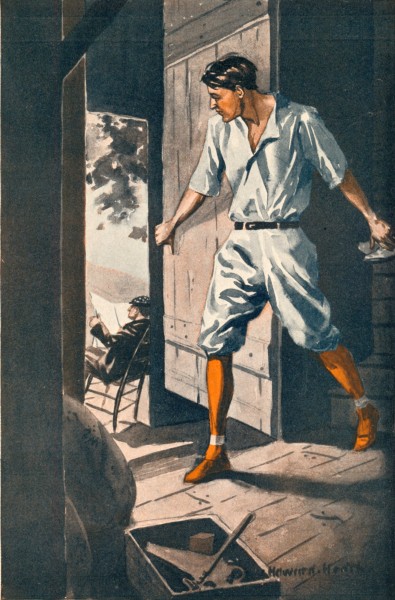
pull it quickly back again. For, sitting at the
left of the carriage room door, tilted against
the casing in the sunlight and reading a newspaper,
was Perkins!