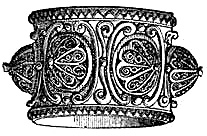
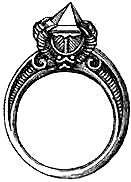
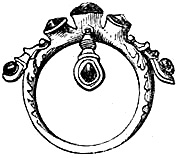
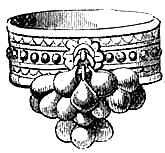
RINGS IN CONNECTION WITH ECCLESIASTICAL USAGES.
The ring has, for many ages, formed a part of ecclesiastical insignia. It
appears to have had a twofold purpose and signification, the one as a mark
of dignity and authority, the other symbolic of the mystical union between
the priesthood and the Church.
To commence with the head of the Romish hierarchy: that distinguished
authority on antiquarian topics, Mr. Octavius Morgan, M.A., F.R.S.,
F.S.A., &c., has contributed to the ‘Archæologia’ (vol. xl. p. 392) a very
interesting account of ‘Episcopal and other Rings of Investiture;’ and,
since the publication of that paper, has kindly informed me that Mr.
Waterton states, from his own knowledge, that the ‘Fisherman’s Ring’ is
the Pope’s ring of investiture, and is placed on his finger immediately
after his election, before it is engraved. But if, as it sometimes
happens, the Pope-elect is not a bishop, he is consecrated prior to his
coronation as Supreme Pontiff, and receives the ring with the usual
formula, except that the consecrating cardinal kisses his hand after
investing him with the ring. ‘There is a ring which the Pontiff wears on
state occasions—the stone of which is an exquisitely fine cameo, cut in
bloodstone, of the head of Our Saviour—which is known to be more than
three hundred years old, and is, probably, a fine cinque-cento gem. This
descends from one Pope to another.
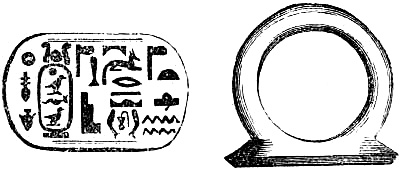
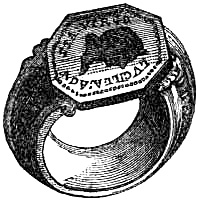
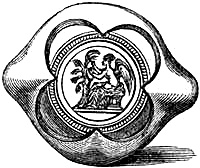
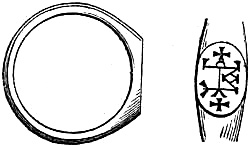
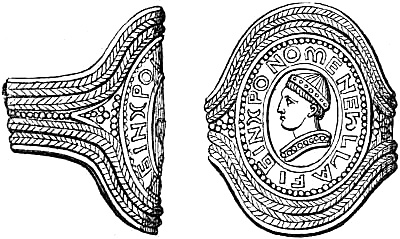
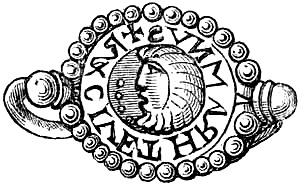
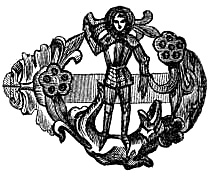
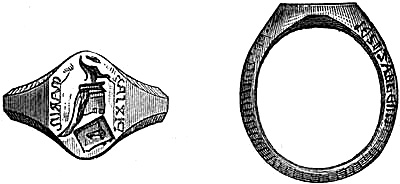
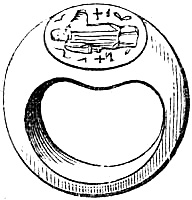
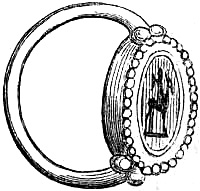
‘What is called the Annulus Piscatoris, or the “Fisherman’s Ring,” is
the Pope’s lesser seal, or signet, used for documents of minor
consequence, and the impression is usually made on red wax or stamped on
the paper; the Bulla being what may be termed the great seal, employed for
giving validity to instruments of greater importance, and the impression
of it is always on lead. The origin of the Fisherman’s Ring is obscure,
but it derives its name from a representation of St. Peter in a
fisherman’s boat of ancient form, which is engraved on it, and not from
any tradition that it ever belonged to St. Peter, as, from its English
name, is not uncommonly supposed. The Germans call it Der Fischer-ring,
which is “the Fisherman Ring,” whereas we, probably in our translation of
Annulus Piscatoris, have termed it the “Fisherman’s Ring,” seeming to
imply thereby that it had once belonged to “the Fisherman.” The figure of
St. Peter forms the centre.’
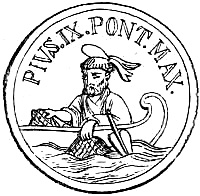
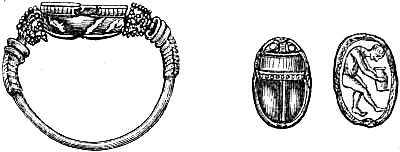
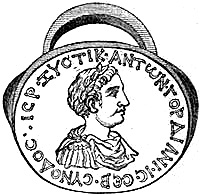
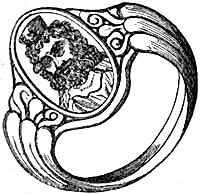
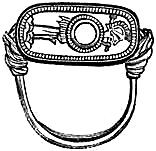
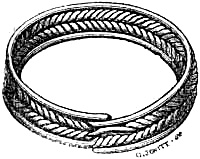
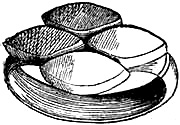
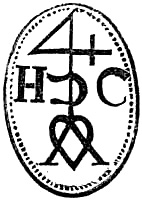
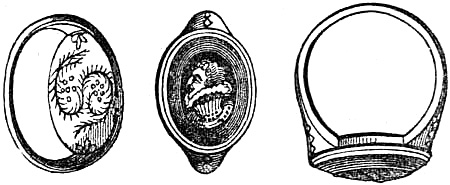
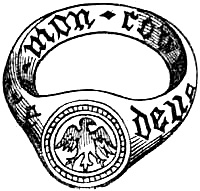
The Fisherman’s Ring.
After the reign of Pope Calixtus the Third, the Ring of the Fisherman was
no longer used as the private seal of the Popes, but was always attached
to briefs.
On the death of Innocent the Tenth the name was cut out of the ring or
erased. At the decease of Pius the Sixth the usual ceremonies were not
observed, and the ring was not broken, as was the practice at the
elevation of each pontiff. Aimon, in his ‘Tableau de la Cour de Rome,’
says that after the Pope’s death ‘le Cardinal Camerlingue vient en habit
violet, accompagné des clercs de la chambre en habits noirs, reconnoître
le corps du Pape. Il l’appelle trois fois par son nom de baptême, et comme
il ne lui donne ni réponse, ni signe de vie, il fait dresser un acte sur
sa mort par les Protonotaires Apostoliques. Il prend du Maître de la
Chambre Apostolique, l’anneau du Pêcheur, qui est le sceau du Pape,
d’or massif, et du prix de cent écus. Il le fait mettre en pièces et
donne ces pièces aux Maîtres des Cérémonies à qui elles appartiennent. Le
Dataire et les Sécrétaires qui ont les autres sceaux du Pape défunt, sont
obligés de les porter au Cardinal Camerlingue, qui les fait rompre en
présence de l’Auditeur de la Chambre du Trésorier, et des Clercs
Apostoliques, et il n’est permis à aucun autre des Cardinaux d’assister à
cette fonction.’
When it was decided by the French in 1798 that the Pope was to be removed
to France, on February 18 in that year the Republican Haller, son of the
celebrated Swiss physician of that name, chose the moment when the Pontiff
was at dinner in the Vatican to announce to him the resolution of the
French Republic. He entered the apartment rudely, and, advancing to the
Pope, announced the object of his visit, and demanded the instant
surrender of the Papal treasures.
‘We have already given up all we possessed,’ replied the Pope calmly.
‘Not all,’ returned Haller, ‘you still wear two very rich rings; let me
have them.’
The Pope drew one from his finger: ‘I can give you,’ he said, ‘this one,
for it is indeed my own; take it: but the other is the Ring of the
Fisherman, and must descend to my successor.’
‘It will pass first to me, holy father,’ exclaimed Haller, ‘and if you do
not surrender it quietly it will be taken from you by force.’
To escape further insult the Fisherman’s Ring was given up, but as it was
found to be intrinsically of no value it was soon afterwards restored to
the Pontiff.
The ring of Pius the Ninth is of plain gold, weighing one and a half
ounces, and it was made from the gold which composed the Ring of the
Fisherman of Pope Gregory the Sixteenth.[49]
The Fisherman’s Ring is always in the custody of the Grand Papal
Chamberlain. It is taken to the Conclave, or Council of the Cardinals,
with the space left blank for the name; and as soon as a successful
scrutiny of votes for a new Pope has taken place, the newly-elected
Pontiff is declared, and conducted to the throne of St. Peter, where,
before the cardinals have rendered homage to their chief, the Grand
Chamberlain approaches, and, placing the Papal ring on the finger of the
new Pope, asks him what name he will take. On the reply of the Pontiff,
the ring is given to the first Master of the Ceremonies to have the name
engraved on it that has been assumed. The announcement of the pontifical
election is then made to the people from the balcony of the Papal palace.
Kissing the Pope’s ring as an act of reverent homage is a custom which has
descended to our own times. One of the important ceremonies at the opening
of the great Œcumenical Council at Rome (December 8, 1869) was that
every single primate, patriarch, bishop, and mitred abbot, who were
present on this solemn occasion at St. Peter’s, and who were to take part
in the Council, paused before Pius the Ninth, and, in an attitude of
profound reverence, kissed his ring. As high dignitaries they were
exempted from kissing the Pope’s toe, a condescension reserved for the
laity and lower clergy.
In Bishop Bale’s ‘Image of Both Churches’ occurs a curious passage on the
subject of episcopal rings: ‘Neyther regarde they to knele any more doune,
and to kisse their pontifical ryngs, which are of the same metall’ (i.e.
fine gold).
It would seem that the Popes were formerly buried in their pontifical
habits and ornaments. In the ‘Journal’ of Burcard, Master of the
Ceremonies in the Pope’s chapel from Sixtus the Fourth to Julius the
Second, he mentions as having, by virtue of his office, thus clothed the
body of Sixtus the Fourth, and amongst other things a sapphire ring of the
value of three hundred ducats was placed on his finger, and so little
trust was placed in the honesty of those who came to see the body that
guards were placed to prevent the ring and other ornaments from being
stolen.[50]
In 1482 Cardinal d’Estouteville, Archbishop of Rouen, was buried with
great magnificence at Rome, where he died. The body of the prelate was
arrayed in the richest robes of cloth of gold, and his fingers were
covered with rings of the greatest rarity and beauty. The brilliancy of
the jewels (observes Dom Pommeraye in his ‘Lives of the Archbishops of
Rouen’) excited the cupidity of the canons of St. Mary Major at Rome,
where he was interred, insomuch that they threw themselves on the body,
and struggled with each other to get at the rings. The monks of St.
Augustine, who also attended on this occasion, pretended to be highly
scandalized at this profanation—‘peut-être,’ however, ‘pour avoir part au
butin’—and attempted on their part to seize the rings. In this unclerical
skirmish the body of the archbishop was entirely stripped of its gorgeous
trappings, and left naked, a piteous spectacle.
Matthew Paris informs us that archbishops, bishops, and abbots, with other
principals of the clergy, were buried in their pontificalibus; thus ‘they
prepared the body of Hubert, Archbishop of Canterbury, for the burial,
closing him in his robes, with his face uncovered, and a mitre put on his
head, with gloves upon his hands, a ring on his finger, and all the
other ornaments belonging to his office.’
In describing the finger-ring found in the grave of the Venerable Bede,
the writer of a brief account of Durham Cathedral adds: ‘No priest during
the reign of Catholicity was buried or enshrined without his ring.’ The
practice may have prevailed generally, as many instances of rings
recovered from the graves of ecclesiastics show, but it was more
particularly the usage of prelates. Martene (‘De Antiquis Ecclesiæ
Ritibus’) remarks: ‘Episcopus debet habere annulum, quia sponsus est.
Cæteri sacerdotes non, quia sponsi non sunt, sed amici sponsi, vel
vicarii.’
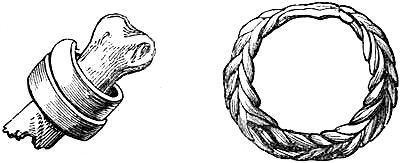
The bones of St. Dunstan were discovered in the time of William, fortieth
abbot of Glastonbury: a ring was on the finger-bone of this saint.
William, the twenty-second abbot of St. Alban’s Abbey, who died in 1235,
was buried in pontifical habits ‘with a ring on his finger.’
Richard de Gerbery, forty-fifth Bishop of Amiens, in the thirteenth
century, died in 1210, and was buried in the cathedral, in pontificalibus,
with mitre, ring, and ivory cross.
When the body of St. John of Beverley (died 721) was translated into a new
shrine, about the year 1037, a ring, among other articles, was found in
his coffin. We have a much earlier instance cited by Aringhi, that the
ring of St Caius (283-296) was found in his tomb: ‘intra sepulchrum tria
Diocletiani Imperatoris numismata, sub quo coronatus fuerat, et
Sanctissimi Pontificis annulus adinventatus est.’
A gold ring was found in the tomb of St. Birinus, Bishop of Dorchester,
who died in 640.
Mr. E. Waterton mentions a remarkable ring, set with fine opal, preserved
at Mayence Cathedral, where it was found with an enamelled crosier in the
tomb, as was supposed, of Archbishop Sigfroi III. (1249).
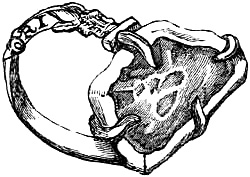
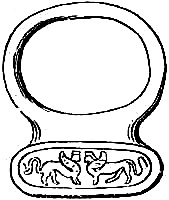
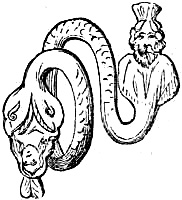
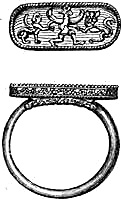
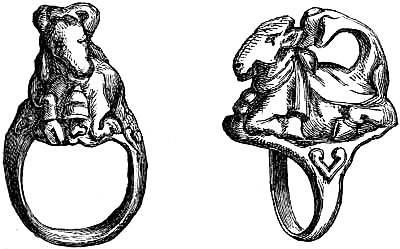
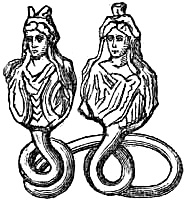
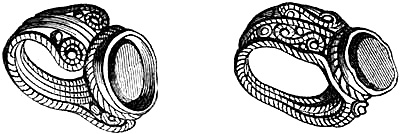
Ring of Thierry, Bishop of Verdun.
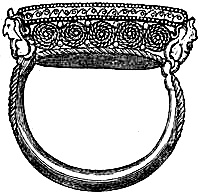
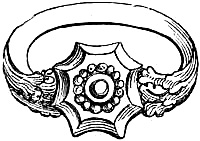
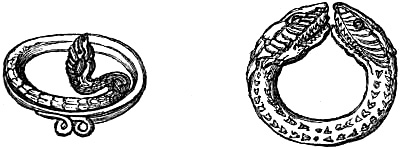
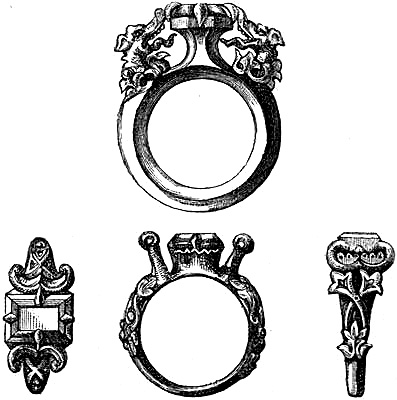
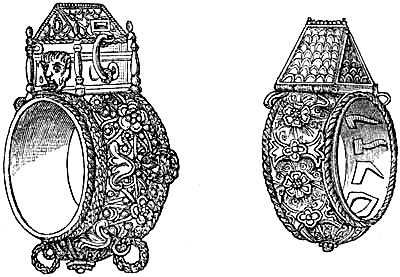
In the Londesborough Collection is the ring of Thierry, Bishop of Verdun
(who died in 1165), found in his tomb in 1829. It is of gold, with a
sapphire, an irregular oval with five capsular marks on the face; the
shank, two winged dragons, between the heads of which is the inscription
AVE MARIA GRATIA. This ring was procured in exchange from the collection
of M. Failly, Inspector of Customs, at Lyons in 1848.
Mr. Octavius Morgan remarks: ‘It is difficult to reconcile the practice of
returning the ring to the Emperor’ (to which I have in this chapter
alluded) ‘with that of interring the bishop with his ring on his finger;
but it is probable that, when in the twelfth century the Emperor ceded to
the Popes the right of investiture by the ring the sending back the ring
was dispensed with; and, being the property of the Church, and not of the
Emperor, the bishop was allowed to be interred with his ring as an emblem
of his dignity.’
The Rev. C. W. King remarks that the custom of burying ecclesiastics with
all their official insignia appears to have lasted far down into the
Middle Ages; for, amongst the amusing adventures of Andreuccio da Perugia,
related by Boccaccio, he, when reduced to despair, joins some thieves in
plundering the tomb of the Archbishop of Naples, interred the previous day
in all his precious vestments, and with a ring on his finger valued at
five hundred scudi. Two parties of plunderers, headed by a priest of the
cathedral, visit the tomb in succession, and almost at the same time; to
which circumstance Andreuccio owes his escape from a horrible death, and
returns home in possession of the ring, which more than makes up for all
his losses.
The Rev. C. W. King considers it probable that this common practice of
plundering the tombs, gave origin to the huge rings of gilt metal, which
bear the titles, or coats of arms, of some pope or bishop.
On the subject of pontifical rings of an ordinary character, I may observe
that they are found in several collections, usually of brass or copper
gilt.
Benvenuto Cellini, in his ‘Memoirs,’ mentions a magnificent diamond as
having been presented to Pope Paul the Third by the Emperor Charles the
Fifth on his entry into Rome (1536), for which he was desired to make a
ring, and succeeded in giving the diamond a tint which surpassed anything
yet done.
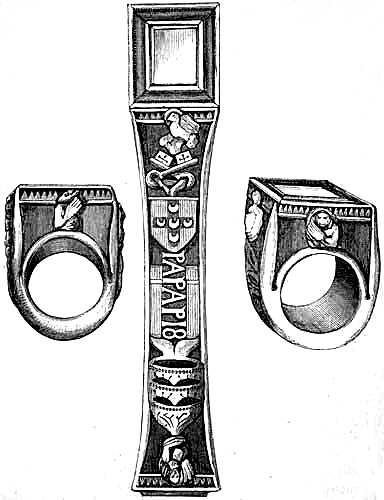
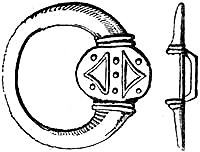
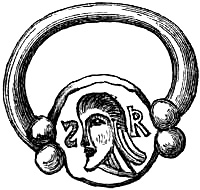
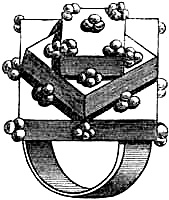
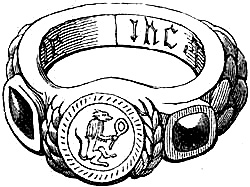
Ring of Pope Pius II.
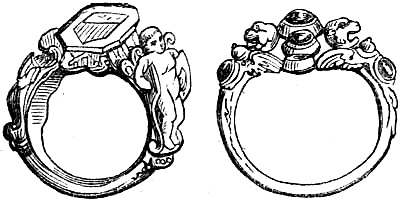
In the collection of Thomas Windus, Esq., F.S.A., is a ring bearing the
arms of Pope Pius II. of the family of Piccolomini, the Papal tiara, and
inscription, ‘Papa Pio.’ The ring is of brass, thickly gilt; the stone
topaz: on the sides are the four beasts of the ‘Revelation.’
In the Braybrooke Collection is the ring of Pope Boniface, from whose tomb
it was taken during the popular insurrection at Rome, 1849. It is large
and of gilt bronze, set with a large amethyst, cut into facets. It is of
the usual type of Papal rings, and massive; on one side of the broad shank
is engraved the triple crown, with bands for tying it, extending until
they are met by the cords attached to the keys, which appear on the other
side. The sides of the box-setting are square for an inch below the stone,
and on them are the emblems of the four Evangelists in high relief: all
these are winged.
In the Waterton Collection at the South Kensington Museum are some
remarkably fine specimens of bronze-gilt Papal rings of the fifteenth
century, very massive and in excellent condition. Most of these have the
symbols of the four Evangelists, the triple crown, and crossed keys.
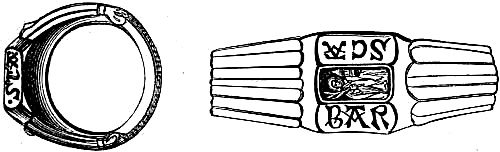
At a meeting of the Society of Antiquaries in November, 1858, Octavius
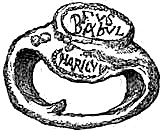
Morgan, Esq., F.R.S., F.S.A., exhibited a Papal ring of great interest,
massive, and of copper-gilt, set with blue glass. At the angles were the
symbols of the four Evangelists in relief; on the hoop was inscribed
PAVLVS PP SECNDVS (Paulus Papa Secundus). At the sides were two shields;
one of them bearing three fleurs-de-lys, and ensigned with an open crown,
probably the arms of France; the other charged with a lion debruised by a
bend, being the arms of the family of Barbo of Venice, to which Paul II.
belonged. In the upper part of this shield was a small Papal tiara, which
might have been placed there for want of room above, or might have been
adopted by the Pope’s relation, Marco Barbo, made by him a cardinal in
1464, and who died 1490.
Mr. Morgan had received this interesting addition to his collection from
Venice.
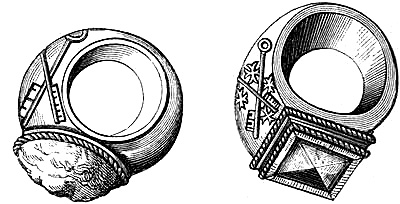
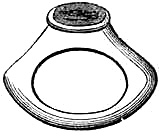
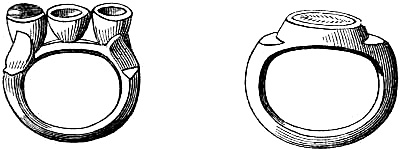
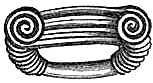
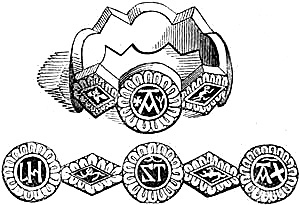
Papal Rings (Gorlæus).
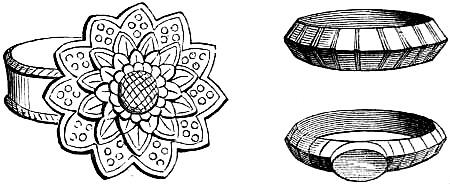
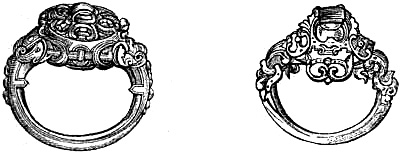
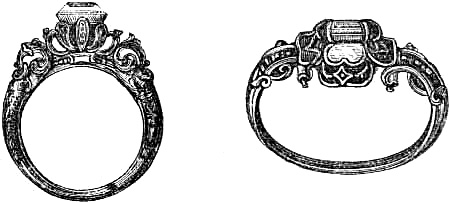
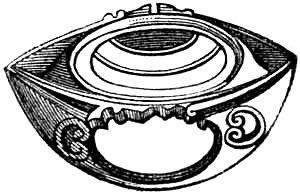
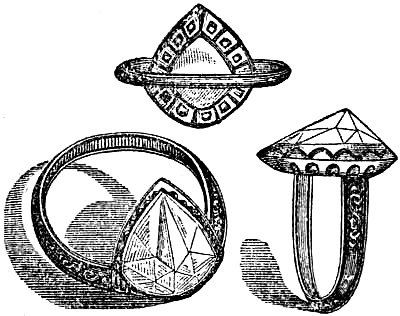
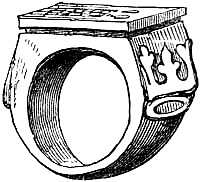
In the Londesborough Collection is a fine specimen of a Papal ring. The
crossed keys surmount a coat of arms on one side of the ring; the keys
alone appear on the opposite side; foliated ornament fills the space
above the circlet on either side. This ring is set with a large crystal.
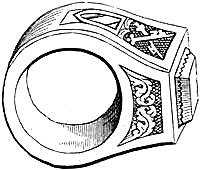
Papal Ring.
At the suppression of the monasteries there were found in Worcester
Cathedral ‘four pontifical rings of gold, with precious stones’ At the
same period, amongst the plate and jewels in Winchester Cathedral was a
‘pontyfycall ryng of silvare and gilt, with counterfeitt stones.’ At St.
Augustine’s Church at Canterbury were three pontifical rings with precious
stones, and one of silver gilt; at St. Swithin’s Church at Winchester,
four pontifical rings with precious stones.
The earliest document with a certain date in which mention is made of a
bishop’s ring is that usually cited in the 28th canon of the Council of
Toledo, held in 633. The ring was of gold and jewelled, but at this
Council it was ordained that the ring of a prelate reinstated in his
diocese, after an unjust deposition, should be delivered to him, which was
merely confirming a ceremony already ancient in the confirmation of
bishops, which may be traced to the fourth century.
In the consecration of bishops in the Anglo-Saxon Church, the hands and
head were anointed with oil, the crosier delivered into his hands, and the
ring placed on his finger; each ceremony being accompanied with a prayer.
‘There is, however,’ remarks Mr. Octavius Morgan (‘Archæologia,’ vol.
xxxvi. part ii. p. 373), ‘another authority, at least contemporary with
the Toledo Council, if not of earlier date. St. Isidor, Bishop of Seville,
who died A.D. 636, in his work ‘De Ecclesiasticis Officines’ (lib. ii.
cap. 5), when writing on the episcopal dignity, informs us that the staff
and ring were given to the bishop on his consecration, and mentions the
twofold purpose and signification of the ring, but does not tell us from
what source these insignia were derived.’[51]
That the episcopal ring, from the earliest times, was considered a symbol
of sacerdotal authority, we have many instances. In the ‘Continuation of
the History of Simeon of Durham’ we are told that Bishop Ralph (1099)
having been inveigled into a boat and his life in danger, he drew the ring
which he wore from off his finger, and his notary took his seal, and they
cast them into the river, being apprehensive that, as these were well
known everywhere throughout England, the enemy would prepare deceitful
writs by their means.
The same bishop, a month before his decease in 1128, directed that he
should be carried into the church, opposite the altar, there to make
confession of his sins. Placing a ring upon the altar he thereby restored
to the church everything of which he had deprived it, and this restitution
he confirmed by charter and seal, which are still preserved in the
treasury of the Dean and Chapter of Durham. To the charter was also
attached the episcopal gold ring (which is no longer there). The charter
states that ‘he has surrendered to the Lord St. Cuthbert and his monks
whatsoever he had taken from them after he came to the bishopric,’ &c.,
‘restoring them by (placing) a ring upon the altar,’ &c.
Thomas à Becket, when at Rome in 1166, during his quarrel with Henry II.,
solemnly resigned, in the presence of the Papal Court, his episcopal ring
into the hands of Pope Alexander, whom he exhorted to name a fitting
successor.
In the History of the Archbishops of Canterbury, by Gervase, we read that
in 1179, Godfrey, Bishop-elect of St. Asaph’s, resigned his bishopric by
surrendering his ring.
An ancient custom in the Archbishopric of Rouen was that the body of the
deceased prelate, before being interred in the cathedral, was carried to
the church of St. Ouen (at Rouen), where it remained exposed a whole day.
The dean of the cathedral, in committing the body to the charge of the
Abbot of St. Ouen, said ‘Ecce,’ to which the latter replied ‘Est hic.’
Then the dean gave the Archbishop’s ring to the abbot, at the same time
placing his hand in the coffin of the defunct, and saying: ‘You gave it to
him living; behold he is dead,’ alluding to the custom of the Archbishops
of Rouen being consecrated in the church of St. Ouen.
Mr. Waterton remarks ‘that in 511, the Council of Orleans makes mention of
the rescript of Clodovicus, wherein he promises to leave certain captives
at the disposition of the Gallican bishops, “si vestras epistolas de
annulo vestro signatas sic ad nos dirigatis.”’ The same eminent
antiquarian states that ‘prior to the eleventh century, many, if not all,
of the episcopal rings were signets; for before that time large official
seals were not in general use. Each bishop seems to have chosen the
subject to be engraved on his ring, at pleasure. St. Augustine, in one of
his letters, mentions that he sealed it with his ring, “qui exprimit
faciem hominis attendentis in latus.” In writing to Apollinaris, Bishop of
Valence, Clodovicus begs him to send the seal, or signet (signatorum),
which he had promised, made in such a way “ut annulo ferreo et admodum
tenui, velut concurrentibus in se delphinulis concludendo, sigili duplicis
forma geminis cardinalis inseratur.” And, referring to the subject to be
engraved on the bezel, he adds, “si quæras quid insculpendum sigillo,
signo monogrammatis mei per gyram scripti nominis legatur indicio.”’
In the early days of Christianity bishops sealed with their rings the
profession of faith which the neophytes made in writing. They also sealed
their pastoral letters. Ebregislaus, Bishop of Meaux, in 660, wore on his
ring an intaglio, representing St. Paul, the first hermit, on his knees
before the crucifix, and above his head, a crow, by which he was
miraculously fed.
In conformity with a decree of St. Sergius I. (687-701), the bishops of
France and Spain used to seal up the baptismal fonts with their rings from
the beginning of Lent to Holy Saturday.
From ancient documents it would appear that bishops sometimes called their
rings ‘annuli ecclesiæ.’ David, Bishop of Benevento, in the time of
Charlemagne, issued a mandate, ending as follows: ‘annulo sanctæ nostræ
ecclesiæ firmavivus roborandum.’ In 862, Rathbodus, Bishop of Treves,
writes thus: ‘Hanc epistolam Græcis litteris, hinc, inde, munire
decrevimus, et annulo ecclesiæ nostræ bullare censuimus.’ In 985 Pope John
XVI. sealed with his ring the confirmation of the decree made by the
Council of Mayence, in favour of the monks of Corvey, in Saxony.
These quotations are sufficient to prove that until the 11th century the
bishops used their rings as signets; but we must not infer that every
episcopal ring was a signet. It is probable that each bishop had a large
jewelled ring to use when pontificating.
Of the importance attached to the possession of the episcopal ring we are
told that Gundulf, the good Bishop of Rochester, in his last days
distributed all his goods to the poor, even to his shoes, and bequeathed
his rich vestments to the cathedral. There was only one ornament with
which he could not part, that was the episcopal ring, and he confided this
to the care of his attendants, intending, probably, that it should be
delivered to his successor. Ralph, who had lately been elected Abbot of
Battle, had formerly been Prior of Rochester, and had been deservedly
popular. The monks were anxious that he should be the successor of
Gundulf, and were prepared to elect him, if they could obtain the consent
of the archbishop. If to the Abbot of Battle Gundulf bequeathed or
resigned the episcopal ring, it might be produced as an indication of
Gundulf’s wish that Ralph, of Battle Abbey, should succeed him. A
suggestion to this effect was made to the old bishop, who said curtly: ‘He
is a monk, what has he to do with an episcopal ring?’ He was, probably,
offended at the ambition of the ex-prior of Rochester, who ought to have
been contented with his newly-acquired dignity at Battle Abbey. Soon
after this, another Ralph made his appearance at the priory, Ralph of
Seez, who afterwards became Archbishop of Canterbury. Having been ejected
from his monastery by violence, he came to England, and was received
everywhere with hearty regard, on account of his virtues and
accomplishments. Hearing of Gundulf’s illness, he hastened to Rochester,
to console his old friend on the bed of sickness. Ralph was obliged to
leave Rochester after a short visit, but on quitting his friend he was
recalled, and Gundulf, demanding of his attendant the episcopal ring,
placed it as a parting gift in the hand of Ralph of Seez, who suggested it
might be better disposed of to one of Gundulf’s episcopal friends, since
it did not pertain to an abbot to wear a ring. He reminded the bishop
that, though not living a monk, still a monk he was. ‘Take it,
nevertheless,’ said the bishop, ‘you may want it some day.’
The possession of this ring reconciled the monks to the appointment of
Ralph of Seez as successor of Gundulf to the bishopric of Rochester, as
they regarded the donation in the light of a prophecy.
‘Before,’ says Mr. Waterton, ‘receiving the pastoral staff and mitre, the
bishop-elect is invested by the consecrating bishop with the pontifical
ring. The formula seems to have varied at different times, the most
ancient one, contained in the Sacramental of St. Gregory, 590, is this:
“Accipe annulum discretionis et honoris, fidei signum, et quæ signanda
sunt signes, et quæ aperienda sunt prodas, quæ liganda sunt liges, quæ
solvenda sunt solvas, atque credentibus per fidem baptismatis, lapsis
autem sed pœnitentibus per mysterium reconciliationis januas regni
cœlestis aperias; cunctis vero de thesauro dominico ad æternam salutem
hominibus, consolatus gratiâ Domini nostri Jesu Christi.”
‘Another form, of a later date, has the above, with the following
addition:—“Memor sponsionis et desponsationis ecclesiasticæ et
dilectionis Domini Dei tui, in die quâ assecutus es hunc honorem, cave ne
obliviscaris illius.”
‘The ancient Ordo Romanus contains a formula couched in more elegant
words: “Accipe annulum pontificalis honoris, ut sis fidei integritate ante
omnia munitus, misericordiæ operibus insistens, infirmis compatiens,
benevolentibus congaudens, aliena damna propria deputans, de alienis
gaudiis tanquam de propriis exultans.”
‘The formula,’ continues Mr. E. Waterton, ‘seems to have varied at
different times; that contained in the pontifical of Ecgberht, Archbishop
of York, is as follows: “Accipe annulum pontificalis honoris ut sis fidei
integritate munitus.” The Anglo-Saxon pontifical at Rouen, and that of St.
Dunstan at Paris, both give the following: “Accipe ergo annulum
discretionis et honoris, fidei signum, et quæ signanda sunt signes, et quæ
aperienda sunt prodas.”’
In the eleventh and twelfth centuries the ring, as a part of
ecclesiastical investiture, was a fruitful subject of discord between the
Emperors and the Popes, until 1123, the Emperor Henry the Fifth, alarmed
by the threats of the Pontiff, ceded the right to Calixtus II., from which
time the rings were sent to the bishops-elect from the Pope—a practice
continued in the Roman Catholic hierarchy to the present time. In
preceding ages, however, monarchs were not so yielding. In the romance of
‘King Athelstan,’ the sovereign says to an offending archbishop:—
Lay down thy cross and thy staff,
The myter and the ryng that I to thee gaff,
Out of my land thou flee.
Cardinals on their creation receive a ring in which is usually a
sapphire. Wolsey was raised to this dignity in 1515, the Pope having
forwarded with the hat (an unusual thing to be sent out of Rome) a ring of
more than ordinary value.
Cardinals wear their rings at all times, but on Good Friday they lay them
aside, as a sign of the mourning in which the Church is placed for her
Spouse. At the recent installation of cardinals (September 1875) the
venerable Pontiff presented each dignitary with a gold ring set with a
sapphire.
In 1191 the fashion of the episcopal ring was definitively settled by
Innocent III., who ordained that it should be of gold, solid, and set with
a precious stone, on which nothing was to be cut; previous to this,
bishops’ rings were not restricted to any special material or design. ‘In
the thirteenth century,’ remarks Mr. E. Waterton, ‘many of the episcopal
rings were of very rude fashion, frequently in almost literal conformity
with the rescript of Innocent III., without regard to shape or elegance.
The stone was set just as it was found, merely having the surface
polished, and the shape of the bezel was adapted to the gem. There are
proofs that cameos were worn in episcopal rings. In the list of rings and
precious stones collected by Henry III. for the shrine of St. Edward, in
Westminster Abbey, there is enumerated: “j chamah in uno annulo
pontificali.” We know that during the Middle Ages the glyptic art had
declined very much, and that from their fancied assimilation antique gems
were occasionally used for devout subjects. Thus the monks of Durham
converted an antique intaglio of Jupiter Tonans into the ‘caput Sancti
Oswaldi.’
During the latter part of the thirteenth century the large episcopal rings
were enriched by the addition of previous stones, which were set around
the principal one. Thus, in the ‘Wardrobe Book’ there is the following
entry: ‘Annulus auri cum quatuor rubettis magnis qui fuit Fratris J. de
Peccham, nuper Cantuariensis Archiepiscopi. He died in 1292.’
Episcopal rings were usually set with sapphires, probably from a popular
belief that this precious stone had the power of cooling love; owing,
perhaps, to the coldness of its touch, due to its density. The Rev. C. W.
King, however, gives as a reason for the choice of the sapphire that,
besides its supposed sympathy with the heavens, mentioned by Solinus, and
its connexion with the god of day, Apollo, the violet colour agrees with
the vestments appropriated to the priestly office.
An episcopal ring, with gold and a sapphire, said to have belonged to St.
Loup, is in the treasury of the Cathedral of Sens, and is, probably, of
the Carlovingian period.
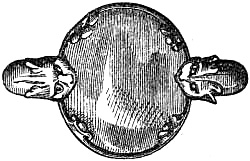
Episcopal ring.
‘Mention occurs,’ remarks Mr. E. Waterton, ‘of episcopal rings being set
with the balass-ruby, the emerald, the topaz, the turquoise, the
chalcedony, and, as accessories, pearls and garnets. Sometimes these gems
were of great value.’ The Rev. C. W. King thinks it probable that when
mediæval rings occur, set with a ruby instead of a sapphire, they belong
to bishops who were at the same time cardinals. At the disgraceful seizure
of Archbishop Cranmer’s effects, in 1553, we find mentioned, among the
articles of considerable value taken from his house at Battersea: ‘six or
seven rings of fine gold, with stones in them, whereof were three fine
blue sapphires of the best; an emerald, very fine; a good turquoise and a
diamond.’
At the degradation of a bishop in former times, the reasons were given in
a solemn assembly, and judgment pronounced, the mitre was removed from his
head, and the pontifical ring drawn off his finger, as having outraged the
Church.
With regard to the finger on which the episcopal ring is worn, a
correspondent of ‘Notes and Queries’ (vol. v., first series, p. 114),
remarks that ‘all who wear rings, ex officio, wear them on the third
finger of the right hand. Cardinals, bishops, abbots, doctors, &c., do
this for the reason that it is the first vacant finger. The thumb and the
first two fingers have always been reserved as symbols of the Three
Persons of the Holy Trinity. When a bishop gives his blessing he blesses
with the thumb and two first fingers. Our brasses, with sepulchral slabs,
bear witness to this fact.’
A French writer observes that formerly the episcopal ring was worn on the
fore-finger, but as, for the celebration of the holy mysteries, bishops
were obliged to place it on the fourth finger, the custom prevailed of
carrying it thus.
Mr. E. Waterton gives his explanation thus, and there could be no better
authority: ‘It appears that bishops formerly wore their rings on the index
of their right hand, being the middle one of the three fingers which they
extend when they are giving their blessing, but when celebrating mass they
passed the ring on to the annular. They wore it on the index as the
fore-finger was indicative of silence, that they ought to communicate the
divine mysteries only to the worthy. Gregory IV., in 827, ordered that the
episcopal ring should not be worn on the left, but on the right hand, as
it was more distinguished (nobile) and was the hand with which the
blessing was imparted.’[52]
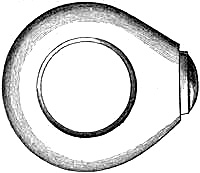
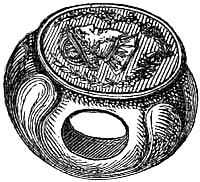
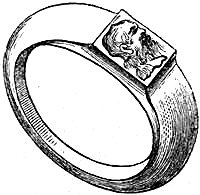
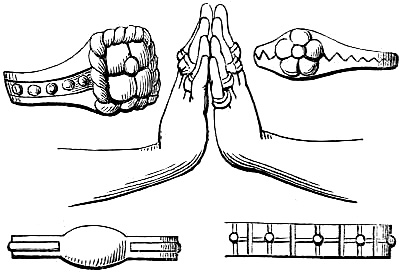
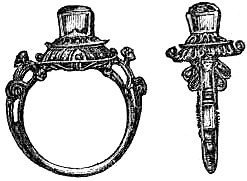
Episcopal Thumb-ring.
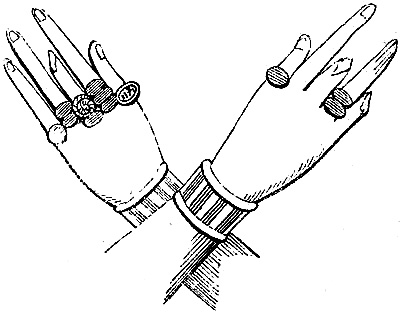
The episcopal ring is now always worn on the annular finger of the right
hand, and bishops never wear more than one. In the pictures of the early
Italian masters, however, and on sepulchral effigies, bishops are
represented with many rings, some of which are not unfrequently on the
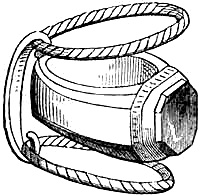
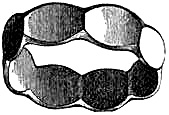
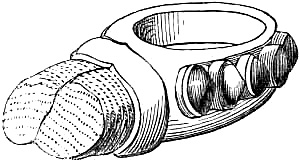
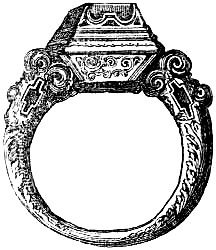
second joint of the fingers. A thumb-ring is often seen; one is
represented (p. 219) belonging to a late Dean of St. Patrick’s, the sketch
of which was made by the late Mr. Fairholt, when it was in the possession
of Mr. Huxtable, F.S.A., in 1847. It is of bronze, thickly gilt, and set
with a crystal. In Raffaelle’s portrait of Julius II. the Pope is
represented as wearing six rings. Certain it is, as late as the year 1516,
the Popes occasionally wore two or more rings.
As the large pontifical ring was of a size sufficient to enable the bishop
to pass it over the silk glove which he wears when pontificating, a
smaller, or guard ring, was used to keep it on the finger.
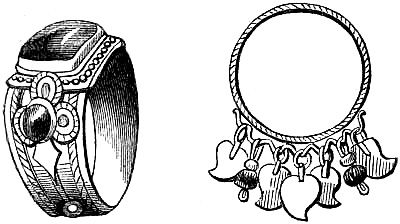
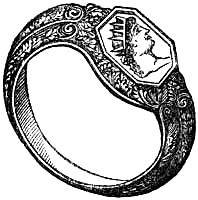
In the Waterton Collection is a very pale gold episcopal ring, with oblong
hexagonal bezel, set with a pale cabochon sapphire, and the hoop divided
into square compartments chased with rosettes, and finished on the
shoulders with monsters’ heads. French, of the early part of the fifteenth
century.
In the Anglo-Saxon annals, an archbishop bequeaths a ring in his will, and
a king sends a golden ring, enriched with a precious stone, as a present
to a bishop. So great was the extravagance among the clergy for these
ornaments that Elfric, in his ‘canons,’ found it necessary to exhort the
ecclesiastics ‘not to be proud with their rings.’ In the mediæval romances
we are told that at the marriage of Sir Degrevant, there came
Erchebyschopbz with ryng
Mo than fiftene.
In the effigy of Bishop Oldham (died 1519), in Exeter Cathedral, the
uplifted hands of the recumbent figure, which are pressed together, are
adorned with no less than seven large rings on the fingers, three being on
the right, and four on the left hand. In addition to these, a single
signet-ring of extraordinary size is represented as worn over both the
thumbs.
But the number of these rings is exceeded by far in the case of the arm of
St. Blaize, exhibited in the Cathedral of Brunswick, on the fingers of
which are no less than fourteen rings. This relic was brought from
Palestine by Henry the Lion in the eleventh century, and is encased in
silver.
In a miniature in the ‘Heures d’Anne de Bretagne’ (1500), representing St.
Nicholas and the miracle of the three children, the bishop is represented
with one hand extended in the act of blessing, with a large ring over two
fingers. A ring is on one of the fingers of the other hand. In paintings
of the early bishops of the Church they are figured with gloves having the
ruby on the back of the hand, and the official ring on the fore-finger of
the right hand sometimes, but not always, introduced.
Dart, in his ‘History of Canterbury,’ gives an inventory of the Ornamenta
Ecclesiastica taken in 1315. One of the annuli pontificales was of
elaborate character, and is thus described: ‘Annulus quadratus magnus cum
smaragdine oblongo, et quatuor pramis, et quatuor garnettis.’ The others
had sapphires surrounded by smaller gems. One of these rings was set ‘cum
sapphiro nigro in quatuor cramponibus ex omne parte discoperto.’
In the ‘Archæological Journal’ (vol. ii., 1854) is an interesting account
by the late Mr. Albert Way, of the ecclesiastical mortuary or
corse-present: ‘Whether this was originally a composition for offerings
omitted, or in the nature of a payment for sepulture, frequently
consisted, amongst other things of a ring. Thus in the archdeaconry of
Chester, on the death of every priest, his best signet, or ring, with
various other objects belonging to the bishop as being the archdeacon.’
The King, in like manner, on the death of every archbishop and bishop, was
entitled to a gold ring with other things. On the death of some abbots the
King claimed the like. These rights existed in the reign of Edward I. and
probably earlier. In the province of Canterbury the second-best ring of
the bishop accompanied the seals, which, there is reason to think, were
given up to their metropolitans. In 1310, on the death of Robert Orford,
Bishop of Ely, his pontifical ring not having been delivered up in due
course, a mandate was issued by Archbishop Winchelsey, directed to Richard
de Oteringham, then administering the spiritualities of the vacant see, to
obtain possession of the ring, which appeared to have been kept back by
two of the monks of Ely. The mandate recites all the circumstances which
had occurred, describing the ring as ‘annulum qui pontificalis vulgariter
appellatur, qui de jure et consuetudine nostre ecclesie Cantuariensis ad
nos dignoscitur pertinere.’ It was alleged by the monks of Ely that the
deceased prelate had made a gift of this ring in his lifetime to the Prior
and Convent, but that, having no other pontifical ring, he had retained it
for his own use until his death. The Prior and Convent then had possession
of the ring, which they forthwith caused to be affixed to the shrine of
St. Ealburga. The two monks incurred the penalty of excommunication; the
Archbishop forthwith cited the Prior and Convent to appear before him, and
there can be little doubt that the ring was ultimately delivered up. The
details of this curious transaction are related in Archbishop
Winchelsey’s Register, and may be seen in Wilkins’s ‘Concilia,’ vol. ii.
p. 403.
In regard to two of the sees in Wales, St. Asaph and Bangor, the claim
extended to the palfry with bridle and saddle, the capa pluvialis, or
riding-cloak, and the hat used by the deceased prelate. The seals and best
ring were likewise demanded, as in the case of the other bishops of the
Principality, and of the province of Canterbury in general. On the decease
of Anian, Bishop of Bangor, in 1327, the metropolitan see being at that
time vacant, the Prior of Christ Church claimed the ring, seals, and other
effects, which had not been rendered up to him in due course. The
following entry appears on this occasion: ‘De annulo et sigilis Episcopi
Bangorensis restituendis.—Magister Kenewricus Canonicus Assavensis,
officialis noster sede Bangorensi vacante, habet literam de annulo secundo
meliori et omnibus sigillis bone memorie domini Aniani Episcopi
Bangorensis, ac etiam de aliis bonis nobis et ecclesie nostre Cantuarien
de jure et consuetudine antiqua et approbata debitis post mortem
cujuslibet Episcopi Bangorensis, que de Magistro Madoco Archidiacono
Angles’ executore testimenti dicti domini Aniani recepit, nobis absque
more majoris dispendio apud Cantuariam transmittendis necnon de omnibus
aliis bonis que ad manus suas sede Bangorensi vacante vel plena
devenerunt; et ad certificandum nos infra xx dies post recepcionem
presentium quod super premissis duxerit faciendis. Dated at Canterbury,
July 15, 1328.’
These instructions from the Prior to his official seem to have produced no
effect. A letter is found subsequently in the same register (K. 12, f.
158, vo), addressed from Mayfield by Simon Mepham, Archbishop of
Canterbury, to Henry Gower, Bishop of St. David’s, stating the demand of
the Prior had not been satisfied, and requiring him to obtain restitution
of the seals and ring which had belonged to the deceased prelate. The
matter appears accordingly to have been adjusted without delay, since a
formal acquittance is found in the same volume, dated at Canterbury,
February 3, 1328.
A similar occurrence is recorded in the register on the decease of David
Martyn, Bishop of St. David’s, March 9, 1328. His executors had delivered
the seals and ring to Master Edmund de Mepham, who had departed this life;
and a letter is found from Henry de Eastry, Prior of Christ Church, to
Robert Leveye, Edmund’s executor, requesting him to render up these
objects to which the Prior was entitled.
The Wardrobe Books and other records would doubtless show that the rights
of the Crown were constantly enforced on the decease of archbishops and
bishops with no less jealous vigilance than those of the Church of
Canterbury. In the Wardrobe Book of 28th Edward I., for instance, amongst
various articles mention is made of the gold ring of William de Hothum,
Archbishop of Dublin, who died in 1298, set with a sapphire, as also of
many silver ciphi and gold rings set with various gems, delivered to the
King on the decease of several other prelates at that period. In the same
record are to be found the gold rings of the abbots of Glastonbury, St.
Alban’s, and Abingdon, lately deceased, in custody of the King’s wardrobe.
It is deserving of remark that at an earlier period no claim, as regarded
the pontifical ring, appears to have been acknowledged by the Bishops of
Rochester.
Mr. Edmund Waterton, in the ‘Archæological Journal’ (vol. xx. pp. 235 et
seq.), gives a list of a few of the authentic episcopal rings now in
existence in England.
The ring of Seffrid, Bishop of Winchester, who died in 1151. This is most
curious, for it is set with a gnostic gem, representing the figure with
the head of a cock. It is a strange subject for the ring of a bishop.
A massive gold ring set with a sapphire, found in a tomb on the thumb of
the skeleton of a bishop, supposed to be Hilary, Bishop of Chichester, who
died in 1169, together with a silver chalice, and paten, and a pastoral
staff.
A gold ring with an octagonal sapphire, set à griffes, and with four
small emeralds in the corners. This was found in a stone coffin on which
was inscribed EPISCOPUS, and which also contained some remains of
vestments, and a pastoral staff.
These three rings belong to the Dean and Chapter of Chichester.
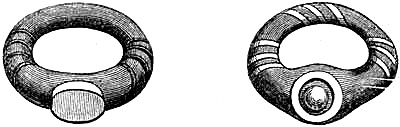
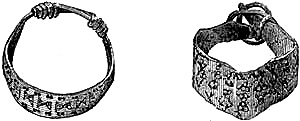
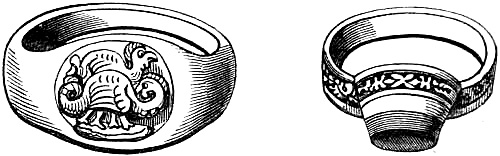
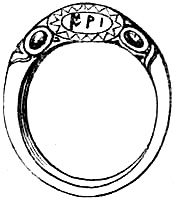
Gold ring set with a ruby, and found in York Minster in the tomb of
Archbishop Sewall, who died 1258.
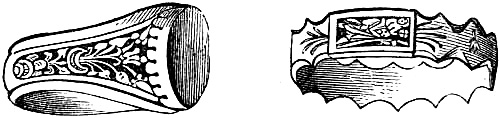
A gold ring, also set with a ruby, found in the tomb of Archbishop
Greenfield, who died 1315.
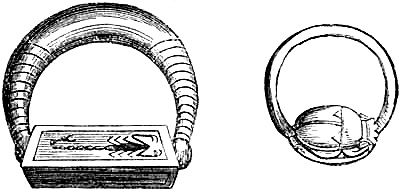
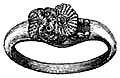
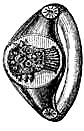
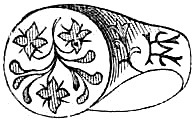
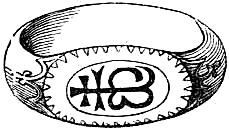
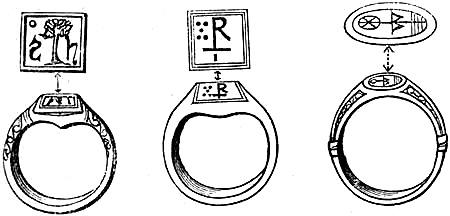
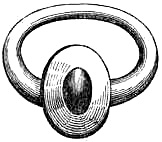 |
|
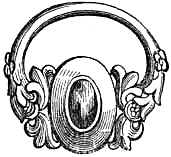 |
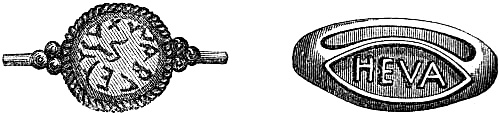
Ring of
Archbishop Sewall. |
|
Ring of
Archbishop Greenfield. |
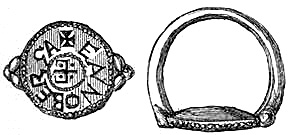
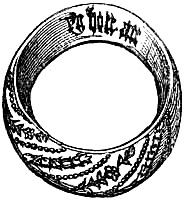
A gold ring, the stone of which has fallen out and which bears on the
inside the chançon ‘×honnor×et×joye×,’ found in the tomb of Archbishop
Bowett, who died in 1423.
The three last rings are preserved in York Minster.
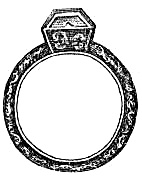
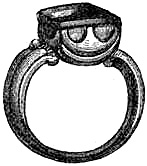
A large gold ring set with an irregular oval sapphire secured by four
grips in the form of fleurs-de-lys. The stone is pierced longitudinally.
This was found in Winchester Cathedral, and may be assigned to the
thirteenth century.
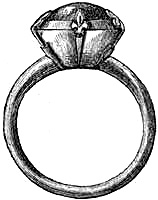
Episcopal ring
(thirteenth century).
The ring of William of Wykeham, Bishop of Winchester, died 1404. A massive
plain gold ring, set with a sapphire. By his will he bequeathed to his
successor in the Bishopric of Winchester, his best book, De Officio
Pontificali, his best missal, and his larger gold pontifical ring, set
with a sapphire, and surrounded with four balass-rubies.
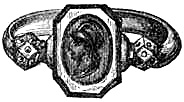
A gold ring found in the tomb of Bishop Gardiner, in Winchester Cathedral
(died 1555). It is set with an oval plasma intaglio of the head of
Minerva; on the shoulders of the hoop are two square facetted ornaments,
each set with five small rubies en cabochon.
These rings belong to the Dean and Chapter of Winchester Cathedral.
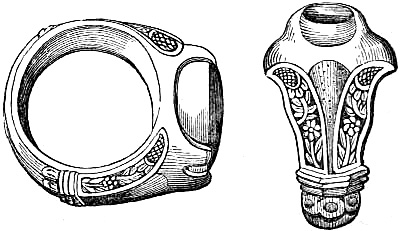
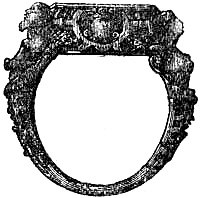
Ring of Bishop Stanbery.
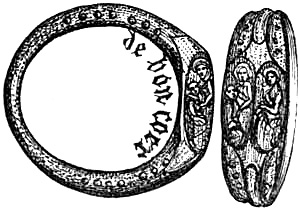
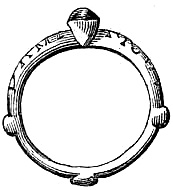
A massive gold ring set with a sapphire. The shoulders are ornamented with
flowers, and inside is the chançon ‘en : bon : an.’ Found in the tomb
of John Stanbery, Bishop of Hereford, 1452.
A gold ring set with an uncut ruby, and which has on either shoulder a Tau
cross, filled in with green enamel, and a bell appended. Within is the
inscription enamelled ‘Ave Maria.’ Found in the tomb of Richard Mayhew, or
Mayo, Bishop of Hereford, 1504.
These rings were found in Hereford Cathedral. They are figured in the
‘Archæologia’ (vol. xxxi. p. 249).
A massive gold ring set with a sapphire, en cabochon. This was found on
one of the fingers of St. Cuthbert, when his coffin was opened by the
visitors in 1537. It came into the possession of Thomas Watson, the
Catholic Dean appointed on the dismissal of Robert Horne, the Protestant
Dean, in 1553. Dean Watson gave the ring to Sir Thomas Hare, who gave it
to Antony Brown, created Viscount Montague, by Queen Mary, in 1554. He
gave it to Dr. Richard Smith, Bishop of Calcedon, in partibus, and Vicar
Apostolic of the Northern District, whom he had for a long time sheltered
from the persecution. Bishop Smith gave the ring to the monastery of the
English Canonesses of St. Augustine at Paris; and it is now preserved at
St. Cuthbert’s College, Ushaw, near Durham. The ring is evidently not one
worn by the sainted bishop during his lifetime. It does not appear to have
been of an earlier date than the fourteenth century; and a gold ring, set
with a sapphire, and almost its counterpart, which was found at Flodden,
is now in the British Museum. Probably the ring had belonged to one of the
bishops of Durham, and had been offered to the shrine of St. Cuthbert, and
placed on a finger of the corpse on some occasion when the shrine was
opened. The authentication of the ring simply states the fact that it was
found on the hand of St. Cuthbert in 1537.
The ring of Arnulphus, consecrated Bishop of Metz in 614, is stated to be
preserved in the treasury of the cathedral of that city. It is believed to
be of an earlier date than the fourth century, and it is set with an
opaque milk-white cornelian, engraved with the sacred symbol of the fish.
In addition to these examples are two other French episcopal rings. One is
that of Gerard, Bishop of Limoges, who died in 1022. Didron thus describes
it: ‘Cet anneau est en or massif; il pese 14 gram. 193 m.; aucune
pierrerie ne le decore. La tête de l’anneau, ou chaton, est formée de
quatre fleurs trilobées opposées par la base sur lesquelles courent de
légers filets d’email bleu.’
In August 1763 the remains of Thomas de Bitton, Bishop of Exeter from 1293
to 1307 were discovered in the cathedral of that city. The skeleton was
nearly entire, and among the dust in the coffin a gold ring was found and
a large sapphire set in it. This ring and a chalice recovered at the same
time are preserved within a case in the chapter-house of the cathedral.
The following extracts from the Wardrobe Book of 28th Edward I. (A.D.
1299-1360), relating to episcopal rings, are of interest:—
‘Jocalia remanencia in fine anni 27.
‘Annulus auri cum sapphiro qui fuit fratris Willelmi quondam Dublin’
archiepiscopi defuncti.
‘Jocalia remanencia in fine anni 27 de jocalibus Regi datis, et post
decessum prælatorum Regis restitutis anno 25.
‘Annulus auri cum sapphiro crescenti qui fuit N. quondam Sarum episcopi
defuncti.
‘Annulus, auri cum rubetto perforato qui fuit Roberti Coventr’ et
Lichfield’ episcopi defuncti.
‘Jocalia remanencia in fine anni 27 de jocalibus Regi datis et post
decessum prælatorum Regis restitutis. Annulus auri cum sapphiro qui fuit
J. Ebor’ archiepiscopi defuncti anno 24.
‘Jocalia remanencia in fine anni, 27 de jocalibus receptis de venerabili
Patre Will’ Bathon’ et Wellen’ episcopo.
‘Tres annuli auri cum rubettis.
‘Unus annulus auri cum ameraudâ.
‘Unus annulus auri cum topacio (chrysolite).
‘Unus annulus auri cum pereditis (topaz).’
The Jocalia Sancti Thomæ, which is given by Dart in his history of
Canterbury Cathedral, are as follows:—
‘Annulus pontificalis magnus cum rubino rotundo in medio:
‘Item. Annulus magnus cum sapphiro nigro qui vocatur lup.
‘Item. Annulus cum parvo sapphiro nigro qui vocatur lup.
‘Item. Annulus cum sapphiro quadrato aquoso.
‘Item. Annulus cum lapide oblongo qui vocatur turkoyse.
‘Item. Annulus unus cum viridi cornelino sculpto rotundo.
‘Item. Annulus parvus cum smaragdine triangulato.
‘Item. Annulus unus cum chalcedonio oblongo.’
The term lup may signify en cabochon, uncut.
In 1867 Mr. Binns exhibited a gold episcopal ring, at a meeting of the
Society of Antiquaries, which he obtained at the shop of a jeweller at
Worcester, and supposed to be the ring of Walter de Cantilupe, who
presided over the see of Worcester from 1236 to 1266. In the
‘Archæologia’ (vol. xx. p. 556) is figured an amethyst ring, which was
discovered at Evesham Abbey, on the finger of the skeleton of Henry of
Worcester, abbot of that house, 1256-1263.
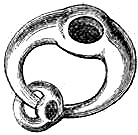
In the possession of the Dean and Chapter of Wells is a fine massive
episcopal ring of gold, the date supposed to be the commencement of the
twelfth century. It has a solid projecting bezel, set with an
irregularly-shaped ruby, polished on the surface and pierced
longitudinally—an oriental stone which has been used as a pendant.
At the Loan Exhibition of Ancient and Modern Jewellery at the South
Kensington Museum, in 1872, Mr. R. H. Soden Smith contributed, amongst his
fine collection of 140 finger-rings, a series of seven gold episcopal
rings of the pointed or stirrup-shaped type; these are mostly set with
sapphires, rudely shaped and polished. Date from the 13th and 14th
centuries.
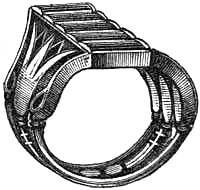
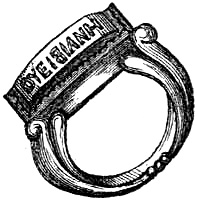
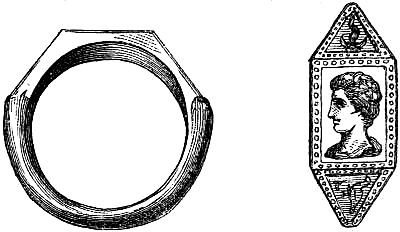
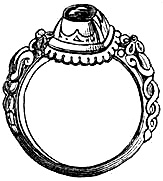
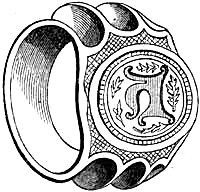
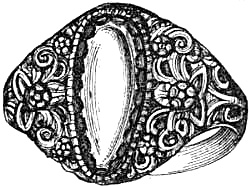
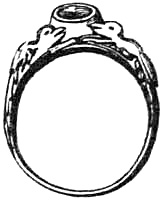
This engraving represents a gold episcopal ring, in the Londesborough
Collection, with sapphire. French work of the thirteenth century.
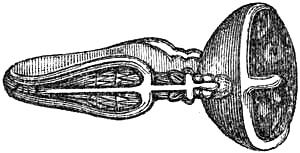
French Episcopal ring.
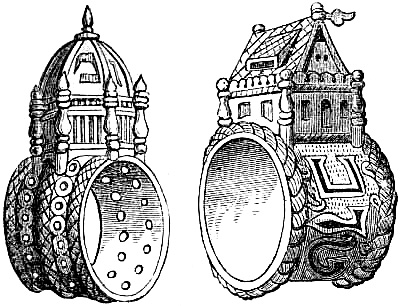
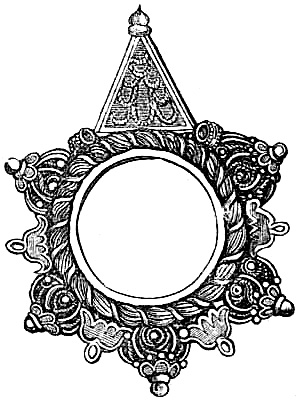
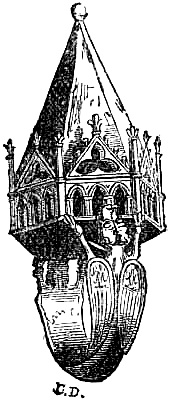
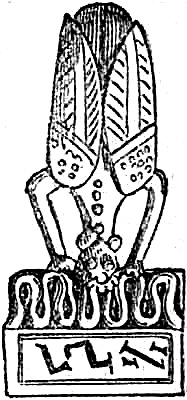
In the Royal Irish Academy is a large episcopal ring, but, of
comparatively modern date. It is the largest ring in the collection, and
had originally held a very fine amethyst, which was removed by Dean
Dawson, when the ring was in his possession, and a piece of glass inserted
in its stead.
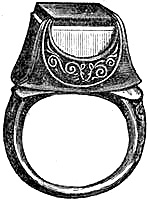
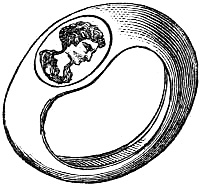
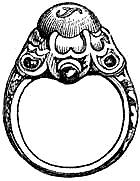
Episcopal ring.
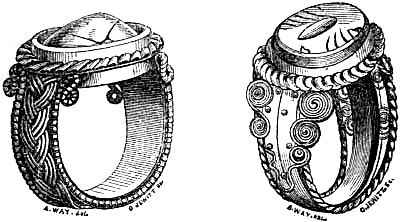
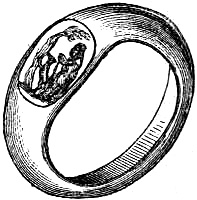
In the Waterton Collection is one of the finest of mediæval gold episcopal
rings, obtained at Milan. It has been reset with an amethyst, the
original stone, stated to have been a valuable sapphire, having been
removed. No date is assigned to it.
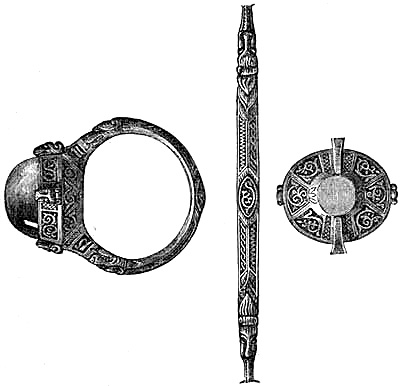
Episcopal ring.
Abbots were invested with the ring. Lawrence, seventeenth Abbot of
Westminster, is said to have been the first of that dignity who obtained
from the Pope (Alexander III.) the privilege of using the mitre, ring, and
gloves. He died in 1167, and was represented on his monument with a mitre,
ring, and staff. In 1048, Wulgate, twelfth Abbot of Croyland, received the
crosier and ring from the king. The consecration of an abbot was
similar, in most respects, to the episcopal ceremony. The abbot received
from the bishop, or whoever was appointed to officiate, the insignia of
his ecclesiastical dignity.
The privilege of the mitre, pontifical ring, &c., was conceded to the
abbots of St. Denis, in France, about the year 1177 by Alexander III.
Jocelyn of Brakelond, in his ‘Chronicles of St. Edmundsbury’ (twelfth
century), informs us that Sampson was inaugurated abbot of that monastery
in 1182, by the Bishop of Winchester, who placed the mitre on his head,
and the ring on his finger, saying: ‘This is the dignity of the abbots of
St. Edmund; my experience early taught me this.’
In the reception of novices into the Roman Catholic sisterhood, one of the
ceremonies performed was the presentation of a ring blessed by the bishop,
usually of gold with a sapphire. After the benediction of the veil, the
ring, and the crown, the novices receive the first as a mark of renouncing
the world; the ring, by which they are married to the Son of God, and the
crown, as a type of that prepared for them in heaven. The origin of this
custom of espousals to Christ dates from a very remote period. ‘We meet,’
remarks Lingard, in his ‘History and Antiquities of the Anglo-Saxon
Church,’ ‘for more than a thousand years after the first preaching of
Christianity, with females who, to speak the language of our ancestors,
had wedded themselves to God.’
On one of four rings of St. Eloy (6th century), preserved before the
Revolution of 1793 in the treasury of the church at Noyon, in France, was
inscribed:—
Annulus Eligii fuit aureus iste beati,
Quo Christo sanctam desponsavit Godebertam.
(This gold ring of the ever-blessed St. Eloy was that with which he
married St. Godiberte to Christ.)
John Alcock, Bishop of Ely (1486), gives ‘an exhortacyon made to relygyous
systers in the tyme of theyr consecracyon by him: “I aske the banes betwyx
the hyghe and moost myghty Prynce, Kyng of all kynges, Sone of Almyghty
God, and the Virgyn Mary, in humanyte Cryste Jesu of Nazareth, of the one
partye, and A. B. of the thother partye, that yf ony or woman can shewe
any lawfull impedymente other by any precontracte made on corrupcyon of
body or soule of the sayd A. B. that she ought not to be maryed this daye
unto the sayd mighty Prynce Jesu, that they wolde accordynge unto the lawe
shewe it.”’
There is no doubt that these ‘espousals to Christ’ were in connection with
the spiritual marriage of the bishop with the Church implied by the
sanctity of the episcopal ring. ‘The mystical signification,’ observes Mr.
E. Waterton, ‘attached to this ring has been set forth by various
ecclesiastical writers. “Datur et annulus episcopo,” observes St. Isidore,
of Seville, in the 16th century, “propter signum pontificalis honoris, vel
signaculum secretorum.” In 1191 Innocent III. wrote that “annulus episcopi
perfectionem donorum Spiritus Sancti in Christo significat.” Durandus, who
lived in the 13th century, enlarges upon the subject in his “Rationale.”
“The ring,” he says, “is the badge of fidelity with which Christ betrothed
the Church, his holy Bride, so that she can say: ‘My Lord betrothed me
with his ring.’ Her guardians are the bishops, who wear the ring for a
mark and a testimony of it; of whom the Bride speaks in the Canticles:
‘The watchmen who kept the city found me.’ The father gave a ring to the
prodigal son, according to the text, ‘put a ring on his finger.’ A
bishop’s ring, therefore, signifies integritatum fidei; that is to say,
he should love as himself the Church of God committed to him as his
Bride, and that he should keep it sober and chaste for the heavenly
Bridegroom, according to the words, ‘I have espoused you to one Husband,
that I my present you as a chaste virgin to Christ,’ and that he should
remember he is not the lord, but the shepherd.”’
It was the custom in former ages for the high dignitaries of the Church,
at the time of their elevation to episcopal rank, to celebrate such event
with pompous ceremonies. We find recorded, among others, the marriage of
prelates, especially in Italy. In 1519, Antonio Pucci was elected Bishop
of Pistoja, and made his solemn entrée with a brilliant cortége. On
reaching a nunnery called San Pier Maggiore, ‘he descended from his
horse,’ says Michel-Ange Salvi, ‘and entered the church, which was richly
decorated. After praying, he went towards the wall which separated the
church from the convent, where an opening had been made, and, in an
apartment there, wedded the abbess, placing on her finger a sumptuous
ring. After this he went to the cathedral, and with various ceremonies was
inducted into his bishopric.’
At Florence, when an archbishop was elected, he proceeded to a convent
dedicated to St. Peter, and was married to the abbess. A platform was
erected, surmounted by a rich baldequin, near the high altar; a golden
ring was brought to the prelate, which he placed on the finger of the
abbess, whose hand was sustained by the oldest priest of the parish. The
archbishop slept one night at the convent, and the next day was enthroned,
with great ceremony, in the cathedral.
The same usages were practised at the installation of the archbishops of
Milan, the Bishops of Bergamo, Modena, &c.
Aimon, in his ‘Tableau de la Cour de Rome,’ describing the ceremonies
attending the consecration of cardinals, says: ‘Le Pape leur fait alors
une exhortation, et leur assigne des titres; leur met au doigt annulaire
de la main droite, un anneau d’or, dans lequel est enchassé un saphir, qui
coûte à chaque Eminence cinq cents ducats. Cet anneau est donné au nouveau
Cardinal pour lui apprendre qu’il a l’Èglise pour épouse, et qu’il ne le
doit jamais abandonner.’
During the ceremony of consecrating the Bishop of Limoges at Nôtre Dame in
Paris (1628), in presence of the Queen and the Duke of Orleans, the former
sent the Bishop a rich diamond ring, which she took from her finger, in
token of the spiritual marriage which he was contracting with the Church.
M. Thiers, in his ‘Traité des Superstitions,’ gives a curious instance of
these espousals to Christ: a Carmelite, in his assumed quality of
‘Secretary of Jesus,’ had persuaded some of his devotees to sign contracts
of marriage with the Saviour. A translation of one of these I now give:
‘I, Jesus, son of the living God, the husband of my faithful, take my
daughter, Madelaine Gasselin, for my wife; and promise her fidelity, and
not to abandon her, and to give her, for advantage and possession, my
grace in this life, promising her my glory in the other, and a portion of
the inheritance of my Father. In faith of which I have signed the
irrevocable contract by the hand of my secretary. Done in the presence of
the Father Eternal, of my love, of my very worthy mother Mary, of my
father St. Joseph, and of all my celestial court, in the year of grace
1650, day of my father St. Joseph.
‘Jesus, the husband of faithful souls.
‘Mary, mother of God. Joseph, husband of Mary. The guardian angel
Madelaine, the dear lover of Jesus.
‘This contract has been ratified by the Holy Trinity, the day of the
glorious St. Joseph, in the same year.
‘Brother Arnoux, of St. John the Baptist, Carmelite. Déchaussé, unworthy
secretary of Jesus.’
‘I, Madelaine Gasselin, unworthy servant of Jesus, take my amiable Jesus
for my husband, and promise him fidelity, and that I never have any other
but Him, and I give Him, as a proof of my truth, my heart, and all that I
shall ever be, through life unto death doing all that is required of me,
and to serve Him with all my heart throughout eternity. In faith of which
I have signed with my own hand the irrevocable contract, in the presence
of the ever-adorable Trinity, of the holy Virgin, Mary, mother of God, my
glorious father St. Joseph, my guardian angel, and all the celestial
court, the year of grace 1650, day of my glorious father St. Joseph.
‘Jesus, lover of hearts.
‘Mary, mother of God. Joseph, husband of Mary. The guardian angel
Madelaine, the dearly-beloved of Jesus.
‘This contract has been ratified by the ever-adorable Trinity the same day
of the glorious St. Joseph, in the same year.
‘Brother Arnoux, of St. John the Baptist.’
A curious legend of a ring of espousals received from our Saviour by a
pious maiden, is recorded by Nider, in his treatise ‘In Formicario,’ and
is referred to by Kirchmann (‘De Annulis’). He writes in praise of
celibacy, and describes a certain maiden who, rejecting all earthly loves,
is filled with sincere affection for Christ only. After praying for some
token of Divine acceptance: ‘orti locello quo nunc oculis corporeis visum
dirigo. Et ecce in eodem momento et locello vidit tres or duos circiter
violarum amenos flosculos.... Violas manu collegit propria et conservavit
solliciter, ut exinde amor et spes artius ad suum sponsum grate
succrescerent.’
After enforcing the miraculous character of the event by reminding his
readers that it was not the season of flowers, but somewhere about the
feast of St. Martin, he continues:—‘In sequenti anno iterum in orto suo
laboraret quodam die, et ibidem in locum certum intuitum dirigeret,
optando ex imo cordis desiderio quatenus ibi reperiret in signum
Christifere desponsationis annulum aliquem, si divinæ voluntatis id esset:
et en altera vice non sprevit Deus preces humilis virginis sed reperit
materialem quemdam annulum quem vidi postmodum. Erat autem coloris albi,
de minera qua nescio, argento mundo videbatur similior. Et in clausura ubi
jungebatur in circulum due manus artificiose insculpte extiterunt.... Hunc
annulum virgo gratissime servavit in posterum, et altissimo suo sponso
deinceps ut antea in labore manuum suarum vivere studuit.’ Vide J.
Nider, In Formicario, Cologne, 1473 (?) [‘Notes and Queries’].
This mystical union by the ring was exemplified in a singular manner in
the instance of Edmund Rich, who was consecrated Archbishop of Canterbury
in 1234. When a young man he made a vow of celibacy, and, that he might be
able to keep it, he wedded himself to the mother of our Lord. He had two
rings made with ‘Ave Maria’ engraved on each. One he placed on the finger
of an image of the Virgin, which stood in a church at Oxford, and the
other he wore on his own finger, considering himself espoused in this
manner to the Virgin. He cherished the remembrance of this transaction to
his death, and at his funeral the ring was observed on his finger.[53]
In the legends of the saints there are frequent allusions to the espousals
with Christ, in which the ring is prominently mentioned; thus of St.
Catherine of Alexandria, it is said that, as she slept upon her bed, ‘the
blessed Virgin appeared to her again, accompanied by her divine Son, and
with them a noble company of saints and angels. And Mary again presented
Catherine to the Lord of Glory, saying, “Lo, she hath been baptized, and I
myself have been her godmother!” Then the Lord smiled upon her, and held
out his hand, and plighted his troth to her, putting a ring upon her
finger. When Catherine awoke, remembering her dream, she looked, and saw
the ring upon her finger; and, henceforth regarding herself as the
betrothed of Christ, she despised the world, and all the pomp of earthly
sovereignty, thinking only of the day which should reunite her with her
celestial and espoused Lord.’
In a painting by Ghirlandago, St. Catherine is represented with a ring
conspicuous on her finger, in allusion to her mystical espousals.
Mrs. Jameson, in her ‘Sacred and Legendary Art,’ mentions an engraving of
the marriage of St. Catherine by one of the earliest artists of the
genuine German school, the anonymous engraver known only as ‘Le Graveur de
1466,’ ‘the scene is Paradise; and the Virgin-Mother, seated on a flowery
throne, is in the act of twining a wreath, for which St. Dorothea presents
the roses; in front of the Virgin kneels St. Catherine, and beside her
stands the Infant Christ (here a child about five or six years old), and
presents the ring,’ &c.
In Titian’s ‘Marriage of St. Catherine,’ ‘the Infant Christ is seated on a
kind of pedestal, and sustained by the arms of the Virgin. St. Catherine
kneels before him, and St. Anna, the mother of the Virgin, gives St.
Catherine away, presenting her hand to receive the ring; St. Joseph is
standing on the other side; two angels behind the saint, look on with an
expression of celestial sympathy.’
St. Agnes, in the old legend, when tempted to marry the son of Sempronius,
the prefect of Rome, by rich presents, rejects them with scorn, ‘being
already betrothed to a lover who is greater and fairer than any earthly
suitor.’
In Hone’s ‘Everyday Book’ (vol. i. p. 141) there is a curious story
connected with St. Agnes, ‘who,’ says Butler, ‘has always been looked upon
as a special patroness of purity, with the immaculate mother of God.’ It
seems that a priest who officiated in a church dedicated to that saint was
very desirous of being married. He prayed the Pope’s licence, who gave it
him, together with an emerald ring, and commanded him to pay his addresses
to the image of St. Agnes in his own church. The priest did so, and the
image put forth her finger and he put the ring thereon; whereupon the
image drew her finger again, and kept the ring fast, and the priest was
contented to remain a bachelor, ‘and yet, as it is sayd, the rynge is on
the fynger of the ymage.’
Mrs. Jameson remarks, on a painting representing in one compartment of the
picture the Espousal of St. Francis of Assisi with the Lady Poverty, that
she is attended by Hope and Charity as bridesmaids, being thus substituted
for Faith. St. Francis places the ring upon her finger, while our Saviour,
standing between them, at once gives away the bride and bestows the
nuptial benediction.
St. Herman of Cologne, in the thirteenth century, is said to have had an
ecstatic dream, in which the Virgin descended from heaven, and, putting a
ring on his finger, declared him her espoused. Hence he received from the
brotherhood with which he was connected the name of Joseph. He died in
1236.
In Hone’s ‘Everyday Book’ it is remarked that the meeting of St. Anne and
St. Joachim at the Golden Gate was a popular theme. The nuns of St. Anne,
at Rome, showed a rude silver ring as the wedding one of the two saints.
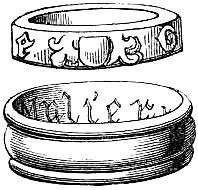
In the Braybrooke Collection is a thick, gold, nun’s ring, with a conical
surface to the band of the hoop, and an inscription of the fourteenth
century, in Longobardic characters, ‘× O (for avec) cest (for cet)
anel seu (for je suis) espose de Jheusu Crist.’ In the Waterton
Collection at the South Kensington Museum is also a nun’s ring of the same
date, inscribed ‘God with Maria.’
In former times complaints were made in the ‘Constitutions’ of nuns
wearing several rings. In the ‘Ancren Riwle, or Regulæ Inclusarum’ (Camden
Society) nuns are forbidden to have brooch or ring, or studded girdle:—
Ring ne broche nabbe ye; ne gurdel i-membred.
‘Espousals to God’ were not confined to the religious portion of the
community.
Eleanora, third daughter of John, King of England, on the death of her
husband, the Earl of Pembroke, in 1231, in the first transports of her
grief, made in public a solemn vow, in presence of Edmund, Archbishop of
Canterbury, that she would never again become a wife, but remain a true
spouse of Christ, and received the ring in confirmation, which vows she,
however, subsequently broke, to the indignation of a strong party of the
laity and clergy of England, by her marriage with Simon de Montfort, Earl
of Leicester. At the head of the clergy was one William de Avendon, a
Dominican friar, who quoted a tractate on vows, by one ‘Master Peter,’
from which it appears that a sacred plight-ring was considered almost as
impassable a barrier as the veil itself, against the marriage of the
wearer.
Mary, sixth daughter of Edward I., took the veil at Amesbury, thirteen
young ladies being selected as her companions. The spousal rings placed on
their fingers were of gold, adorned with a sapphire, and were provided at
the expense of the King.
In a very interesting paper by Mr. Harrod, F.S.A., in the ‘Archæologia’
(vol. xl. part 2) we have particulars of the custom, which prevailed in
the Middle Ages, of widows taking a vow of chastity, and receiving a
particular robe and ring. Sir Harris Nicolas printed in the ‘Testamenta
Vetusta’ an abstract of the will of Lady Alice West, of Hinton Marcel,
widow of Sir Thomas West, dated in 1395, and proved in the Prerogative
Court of Canterbury. There is a bequest to her son Thomas, amongst other
things of ‘a ring with which I was yspoused to God.’
Sir Harris rightly says that this could not have been her marriage-ring,
and it was certain she had not entered a convent. This is still more
clearly made out by a reference to the transcript of the will in the
registers of the Prerogative Court.
Gough, in his ‘Sepulchral Monuments,’ quotes a story, from Matthew Paris,
of one Cecily Sandford, a lady of condition, who, on her deathbed, having
passed through the usual forms with her confessor, and he ordering her
attendants to take off a gold ring he observed on her finger, although
just expiring, recovered herself enough to tell them she would never part
with it, as she intended carrying it to heaven with her into the presence
of her celestial spouse, in testimony of her constant observance of her
vow, and to receive the promised reward. She had, it appears, made a vow
of perpetual widowhood, and with her wedding-ring assumed the russet
habit, the usual sign of such a resolution.
‘In the “Colchester Chronicle,” portions of which are printed in
Cromwell’s “History of Colchester,” one entry appears to confirm the
conjecture that the whole was composed in the fourteenth or fifteenth
century, “Anno Dn̄i ccciij. Helena mortuo Constancio perpetuam vovit
viduitatem.”
‘By the testament of Katharine Rippelingham, dated February 8, 1473, who
calls herself “advowes,” she desires to be buried in the church of
Baynardes Castell of London, where she was a parishioner; and by her will,
in which she gives herself the title of “widow advowes,” she shows herself
in the full exercise of her rights of property, devising estates, carrying
out awards, and adjusting family differences, and in an undated codicil
she bequeaths to her daughter’s daughter, Alice Saint John, “her gold
ring with a diamante sette therein, wherewith she was ‘sacred.’”’
‘Sir Gilbert Denys, Knight of Syston, 1422: “If Margaret my wife will
after my death vow a vow of chastity, I give her all my moveable goods,
she paying my debts and providing for my children; and, if she will not
vow a vow of chastity, I desire that my goods may be distributed, or
divided into three equal parts, &c.”
‘John Brakenbury, in 1487, leaves his mother certain real estate, “with
that condicion that she never mary, the which she promised afore the
parson and the parish of Thymmylbe, and if she kepe not that promise, I
will she be content with that which was my fader’s will, which she had
every peny.”
‘William Herbert, knight, Lord Pembroke, in his will dated July 27, 1469,
thus appeals to his wife: “And, wife, that you remember your promise to
take the order of widowhood, so ye may be the better maistres of your
owen, to perform my will, and to help my children, as I love and trust
you.”
‘William Edlington, esquire, of Castle Carlton, on June 11, 1466, states
in his will: “I make Christian, my wife, my executor on this condicion,
that she take the mantle and the ring soon after my decease; and, if
case be that she will not take the mantle and the ring, I will that
William, my son (and other persons therein named) be my executors, and she
to have a third part of all my goods moveable.”
‘Lady Joan Danvers in 1453, gives the ring of her profession of widowhood
to the image of the crucifix, near the north door of St. Paul’s.
‘Lady Margaret Davy, widow, in 1489, leaves her profession-ring to “Our
Lady of Walsingham.”’
Gough prints the Act of Court from the Ely Registers, on the taking the
vow by Isabella, Countess of Suffolk, in 1382. This took place at the
priory of Campsey, in the presence of the Earl of Warwick, the Lords
Willoughby, Scales, and others. The vow was as follows: ‘Jeo Isabella,
jadys la femme William de Ufford, Count de Suffolk, vowe à Dieu, &c., en
presence de tres reverentz piers en Dieu evesques de Ely et de Norwiz, qe
jeo doi estre chaste d’ors en avant ma vie durante.’ And the Bishop of
Ely, with authority of the Bishop of Norwich (in whose diocese Campsey
was) received and admitted the same, ‘et mantellum sive clamidem ac
annulum dicte voventis solempniter benedixit et imposuit super eam.’
Catherine, sixth daughter of Henry the Fourth, married to William
Courtenay, Earl of Devon, on the death of her husband, took the vow of
perpetual widowhood in 1511.
Dugdale, in his ‘History of Warwickshire’ and in his ‘Baronage,’ prints a
licence from John, Bishop of Lichfield, to one N. N. to administer the vow
of chastity to Margery, wife of Richard Middlemore, who died 15th of Henry
the Seventh, which contains this passage: ‘In signum hujusmodi continentiæ
et castitatis promisso perpetuo servando eandem Margeriam velandam seu
peplandam habitumque viduitatis hujusmodi viduis, ut præfertur, ad
castitatis professionem dari et uti consuetum cum unico annulo
assignandum.’
Legacies and gifts of rings for religious purposes were frequent in former
times; thus, amongst other rich gifts to the Cathedral of Canterbury,
Archbishop Hubert, in 1205, presented four gold rings adorned with
precious stones. Henry the Third, while on a visit to St. Alban’s Abbey,
made some costly presents, including bracelets and rings, and five years
afterwards gave similar gifts at another visit to the same abbey.
The same monarch, among other gifts to Salisbury Cathedral, ‘offered one
gold ring with a precious stone called a ruby.’ After hearing mass he told
the dean that he would have the stone and the gold applied to adorn a
sumptuous gold ‘text’ (a Bible for the use of the altar) enriched with
precious stones given by Hubert de Burgh.
Dugdale mentions in a list of jewels formerly in the treasury of York
Cathedral ‘a small mitre, set with stones, for the bishop of the boys, or,
as he was anciently called, the barne bishop; also a pastoral staff and
ring for the same.’
The Bishop of Ardfert, in Ireland, gave to St. Alban’s ‘three noble rings;
one set with an oriental sapphire, the second with a sapphire that
possessed some medicinal quality, and was formed like a shield, and the
other with a sapphire of less size.’
Henry de Blois presented to the same abbey a large ring set with jewels;
the middle one was a sapphire of a faint colour, and in the circuit four
pearls and four garnets.
John of St. Alban’s, a knight, left as a legacy to the monks of the abbey
‘a number of rings containing many precious stones.’
At the death of Walter, Abbot of Peterborough, among his effects,
containing many rich articles, were no less than thirty gold rings, the
offerings of the faithful.
Thomas Chillenden, fortieth Abbot of Canterbury, gave several pontifical
rings to the abbey.
Thomas de la Chesnaye (died 1517) left, for the shrine of the Virgin at
Rouen Cathedral, a ring garnished with a costly precious stone. Eustace
Grossier, canon of the same cathedral, bequeathed, in 1534, his
signet-ring to the shrine of St. Romain. Two years afterwards Jean de
Lieur, another canon, left four rings to the shrine of the Virgin, ‘où il
y a en une, une petite esmaraude; en laultre une petite turquoise, en
laultre ung petit saphir, et en laultre ung petit rubi.’ In 1544 Etienne
Burnel leaves to Our Lady a gold ring with a ruby enchased, and a pendant
pearl; and to the shrine of St. Romain a gold ring with a diamond.
Charles the Third (? Naples) took from his finger a ring of great value to
adorn the golden canopy, enriched with precious stones, for the Host, in
the church of the Holy Sepulchre at Jerusalem.
Lady Morgan, in her ‘Italy,’ mentions the miraculous statue of the Virgin
and Child at Loretto: ‘The Bambino holds up his hand as if to sport a
superb diamond ring on his finger, presented to him by Cardinal Antonelli:
it is a single diamond and weighs thirty grains.’
In the ‘Annals of Ireland’ we read that in 1421 Richard O’Hedian,
Archbishop of Cashel, was accused, among other crimes, of taking a ring
away from the image of St. Patrick (which the Earl of Desmond had offered)
and giving it to his mistress.
Louis VII., of France, laid the first stone of the porch and two towers of
the abbey church of St. Denis, in 1140. When the officiating minister
pronounced the words ‘lapides pretiosi omnes muri tui et turres,
Jerusalem, gemmis ædificabunter,’ the King took a costly ring from his
finger, and threw it into the foundations. Several of the other persons
present followed the example.
Saint Honoré, eighth Bishop of Amiens, in the sixteenth century, left his
pastoral ring to the treasury of the cathedral, but it was sold by one of
his successors, Bishop Gervain. It was afterwards repurchased and replaced
in the treasury by Bishop Godefroy.
We read in the account of the spoliation of the shrine of St. Thomas à
Becket, at Canterbury (temp. Henry VIII.), of a stone ‘with an Angell of
gold poynting thereunto, offered there by a King of France’ (which King
Henry put) ‘into a ring, and wore it on his thumb.’ The shrine blazed with
gold and jewels; the wooden sides were plated with gold, and damasked with
gold wire: cramped together on this gold ground were innumerable jewels,
pearls, sapphires, balasses, diamonds, rubies, and emeralds, and also ‘in
the midst of the gold, rings, or cameos of sculptured agates, cornelians,
and onyx stones.’
The stone that the rapacious Henry took was said to be as large as a hen’s
egg, or a thumb-nail, and was commonly called the ‘Regale of France’
offered to the shrine by Louis VII. of France, when on a pilgrimage
there.[54]
At the meeting of the Archæological Institute at Norwich in 1847 Sir
Thomas Beevor exhibited a silver ring, with a zigzag tooling and the word
‘✠Dancas✠’ signifying a token of thanks, or
acknowledgment of services received, or, possibly, an ex voto, in
accordance with the common usage of suspending such ornaments near the
shrines of saints, as appears in the inventories of St. Cuthbert’s shrine,
&c.
Adam Sodbury, fifty-third Abbot of Glastonbury, gave to the abbey, among
other precious gifts, ‘a gold ring with a stone called Peritot, which was
on the finger of St. Thomas the Martyr, when he fell by the swords of
wicked men.’
Among what may be called ‘religious’ rings, I would notice those which are
termed ‘decade,’ ‘reliquary,’ ‘pilgrims,’ &c., some of which are highly
interesting, and serve to show how, in past ages, the zeal of our
forefathers was animated by these rings, or, as some would call them,
these aids to superstition. In olden wills they are frequently mentioned
as heir-looms of great value.
What are termed DECADE-rings, having ten projections at intervals all
round the hoop, were common in former times, and were used as beads for
repeating Aves. In the Braybrooke Collection a ring is mentioned with
eleven knobs, the last being larger than the others, indicating ten Aves
and one Paternoster. Each of the knobs is separated by three small
beaded dots across the hoop from its neighbour, probably symbolic of the
Trinity. At a meeting of the Archæological Institute at Norwich, in 1847,
a curious ring was exhibited dating from the reign of Henry VI., found at
St. Faith’s, near Norwich. It is engrailed, presenting ten cusps, and may
be placed in the class of decade-rings. On the facet is engraved the
figure of St. Mary Magdalen (or St. Barbara?), and on the outer circle ‘de
bon cver’ (‘de bon cœur’).
Another ring of the same date is of a more delicate workmanship, and bears
on the facet, St. Christopher, the hoop engrailed like the last, and has
the legend ‘en. bo. n. ane’ (‘en bon an’).
At the same exhibition of antiquities among the rings of latten or
base-metal was shown one engraved with the figure of a female saint,
probably St. Catherine; the hoop formed with eleven bosses, date about
1450. A similar brass ring bearing the same figure, found near British and
Roman weapons in the bed of the Thames, at Kingston, engraved in Jesse’s
‘Gleanings in Natural History,’ is here represented. This ring has eleven
bosses, and, although found in the immediate vicinity of vestiges of an
earlier date, may be regarded as of mediæval date, having been
accidentally thrown together in the alluvial deposit.
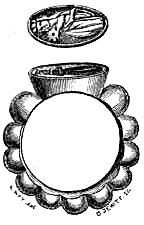 |
|
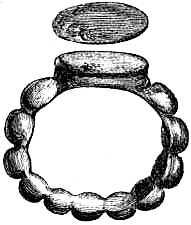 |
Latten ring, with
figure of St. Catherine (?). |
|
Thumb-ring. |
Two decade-rings of the fifteenth century were also exhibited at the
Norwich meeting, bearing the monogram I.H.S. one found in Norwich Castle,
and the other at Heigham.
A gold ring with ten knobs, was found in 1846, at Denbigh, in pulling down
an old house. Its weight is a quarter of an ounce. A similar ring of base
metal, discovered in a tomb in York Minster, is preserved in the treasury
of that church; and another example, in silver, of precisely similar form,
was found in Whitby Abbey, Yorkshire.
Mr. Edward Hoare, of Cork, writing to the editor of the ‘Archæological
Journal,’ observes that, as far as he has been able to obtain information
about decade-rings, they were worn by some classes of religious during the
hours of repose, so that on awaking during the night they might repeat a
certain number of prayers, marking them by the beads or knobs of the
rings. If worn on any finger except the thumb, at other periods of time
than those of repose, it must have been as a sort of penance, and perhaps
these rings were sometimes so used. The addition of a twelfth boss marked
the repetition of a creed.
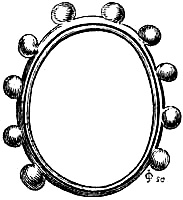
Silver Decade-ring.
(In the possession of E. Hoare, Esq.)
The following illustration is from the ‘Gentleman’s Magazine’ (1792), of a
ring found near Croydon, concerning which a correspondent of that work
wrote that he remembered a similar ring in the possession of a man
advanced in years, who had passed his youth at sea. ‘The ring,’ he said,
‘was a dicket (a corruption of “Decade”), to be placed, successively, on
each of the fingers, and turned with the thumb; the cross and larger boss
for the Paternoster; the ten smaller ones for Ave Maria, and that he
used to say his prayers with it on board ship without being noticed by the
sailors, in the hurry and confusion of a man of war.’
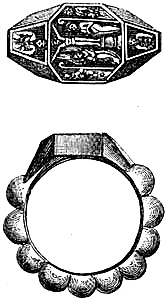
Decade-ring, found near Croydon.
In the rich collection of E. Hoare, Esq., is a curious decade signet-ring,
of which the following is a representation from the ‘Archæological
Journal’ (vol. ii. p. 198). It was discovered near Cork in 1844, and is
thus described: ‘The hoop is composed of nine knobs or bosses, which may
have served instead of beads in numbering prayers, whilst the central
portion which forms the signet supplied the place of the gaùde.’ Some
persons (as Mr. Hoare remarked) have considered this ring as very ancient;
Mr. Lindsay supposed it to have been of earlier date than the ninth
century, regarding the device as representing an arm, issuing from the
clouds, holding a cross with a crown, or an ecclesiastical cap, beneath
it. Sir William Betham expressed the following opinion respecting this
relic: ‘There can be little doubt but your ring is a decade ring, as there
are ten knobs or balls about it. The globe surmounted by a cross is a
Christian emblem of sovereignty; the ring and cross, of a bishop; the cap
looks like a crown, and, only that the ring is too old, it might be
considered the ciulid or barred crown of a sovereign prince. It certainly
is of considerable antiquity, and Mr. Lindsay is not far out in his
estimation.’
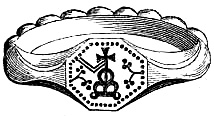 |
|
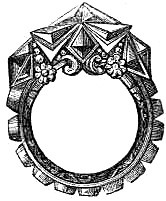 |
| Decade signet-ring. |
|
Decade-ring. |
In the Londesborough Collection is a ‘religious’ ring, apparently a work
of the fourteenth century. It has a heart in the centre, from which
springs a double flower. On the upper edge of the ring are five
protuberances in each side: they were used to mark a certain number of
prayers said by the wearer, who turned his ring as he said them, and so
completed the series in the darkness of the night.
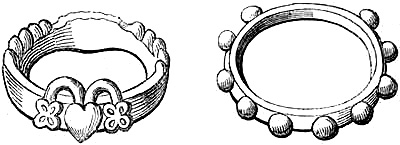
Decade rings.
It has been stated by French antiquaries that metal rings formed with ten
bosses, and one of as early date as the reign of St. Louis, have been
found in France. It was at that period that the use of the chapelet in
honour of the Blessed Virgin is supposed to have been devised by Peter the
Hermit.
A decade silver ring found at Exton, in Rutlandshire, in the possession of
Mrs. Baker, of Stamford, has also a central projection engraved with a
cross.
In Mr. Hoare’s collection is a silver decade-ring found in 1848 in Surrey.
The hoop has ten projections resembling the cogs of a wheel, and on the
circular facet is the monogram I.H.S. surmounted by a cross, with a heart
pierced by three nails.
In the Londesborough Collection is a ring of Delhi workmanship which has
been referred to as a decade. The face is convex, circular, and of
turquoise, engraved and inlaid with Oriental characters in gold,
surrounded by ten cup-shaped bosses of rubies. The sides of the bosses are
enamelled green, and the backs red and white like leaflets. The back of
the face is richly enamelled with flowers having red blossoms and green
leaves, among which, upon the shank, are intermingled some pale-blue
blossoms, and within the centre, where the shank is attached to the back
of the face, are small golden stars upon an enamelled ground, and on each
side leaves of green enamel. The inscription reads ‘Jan (John) Kaptani.’

Ring of Delhi work.
Mr. Edmund Waterton, at a meeting of the Archæological Institute
(December, 1862), gave the following notice of some rings of a peculiar
class, of which he sent several specimens for inspection: ‘On a former
occasion I exhibited, at one of the meetings, some of the so-called—and
wrongly—rosary-rings, one of which had seven, the other eleven, and the
third, thirteen knobs or bosses. I stated my opinion that we ought to
consider these examples as belonging to a form of ring prevalent about the
fourteenth and fifteenth centuries, and described in wills and inventories
as rings with “knoppes or bulionys.” I had never met with a proper rosary,
or, more properly, decade, ring of a date anterior to the sixteenth
century. But a remarkable specimen has lately been added to my collection
which I send for exhibition. It is of ivory; there are ten knobs or bosses
for the Aves, and an eleventh of larger size and different form, for the
Pater. There are holes around the hoop, probably merely for ornament. I
am inclined to ascribe it to the fourteenth century, and think it not
unlikely it is of Irish origin. I am induced to form this opinion from the
peculiar fashion of the eleventh boss, which presents a type found in
rings discovered only in Ireland. This ring was found many years ago in an
old tomb in Merston churchyard, in Holderness. I also send another
decade-ring, of silver, and of a later date and type. This ring was
formerly in the possession of the Reverend Mother Anne More, Lady Abbess
of the English Augustinian Nuns at Bruges, and sister of Father More, of
the Society of Jesus, the last male descendant of Sir Thomas More. He gave
the More relics to Stonyhurst College.’
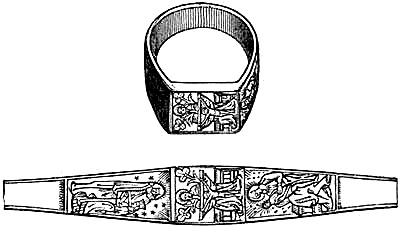
Trinity ring.
Among other examples of ‘religious’ rings, I may mention a beautiful one
of gold, of fifteenth-century work, found at Orford Castle in Suffolk, and
the property of the Rev. S. Blois Turner. On the facet is engraved a
representation of the Trinity, the Supreme Being supporting a crucifix; on
the flanges are St. Anne instructing the Virgin Mary, and the Mater
Dolorosa. These designs were probably enamelled.
A representation is here given of a gold triple ring, brought from Rome,
and, possibly, emblematic of the Trinity. It is an Early Christian ring,
dating, probably, from the end of the third or beginning of the fourth
century.
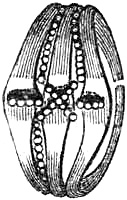
Religious rings.
At the meeting of the Archæological Institute in March 1850 an exquisite
gold ‘religious’ ring of the fifteenth century was exhibited, found
within the precincts of Lewes Priory. It is delicately chased with the
following subjects: on the facet, the Virgin and child; on one side, the
Emperor Domitian; on the other, St. Pancras; on the flanges are
represented the Holy Trinity, and St. John with the Holy Lamb. The work
was originally enriched with transparent enamel.
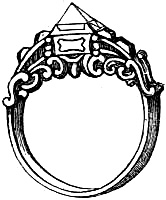
Religious ring.
In the Londesborough Collection is a gold ‘religious’ ring, enamelled with
a diamond in the centre, and six rubies, arranged like a sacred cross,
around it. The scrolls are enriched with white, blue, and green enamel.
At Barnard Castle, in 1811, a gold ring was found of eight globules, in
weight equal to three guineas and a half. On the second is S; on the
fourth, US; on the sixth, JH; on the eighth, S, the abbreviation of
Sanctus Jesus; on the first, is the Saviour on the cross in the arms of
God; on the third, the Saviour triumphing over death; on the fifth, the
Saviour scourged; on the seventh, Judas, the traitor.
The accompanying illustration represents a ‘religious’ ring, found in the
eighteenth century near Loughborough, and described in the ‘Gentleman’s
Magazine’ for 1802. The figures are those of the Virgin Mary, Child, and
St. Michael.
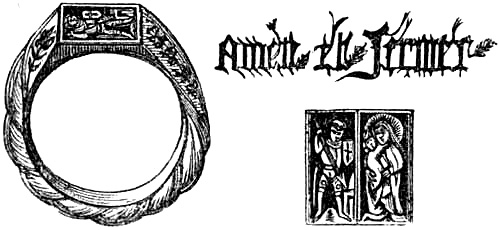
Religious ring.
A ring of a curious form is described in the ‘Gentleman’s Magazine’ for
1811, as having been found in the parish of Stonham-Aspal, Suffolk. The
gold seemed pure, but the workmanship was rude, and the gem which it
enclosed was supposed to be a virgin sapphire.
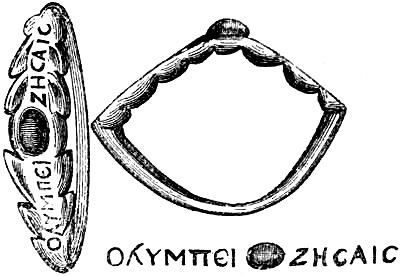
Religious ring.
The following represents a large and curious ring found about 1750 at the
hermitage on the River Itchen, at Southampton, which is noticed in Sir
Henry Englefield’s ‘Walk Round Southampton,’ and is mentioned in the
‘Gentleman’s Magazine’ for 1802. The bezel is little broader than the
hoop.
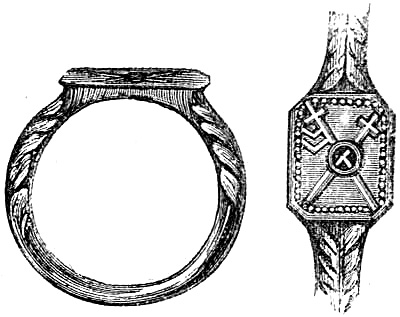
Religious ring.
In the collection of Mr. Octavius Morgan, F.R.S., F.S.A., is a Jewish ring
enamelled with figures in relief, representing the Creation, the
Temptation, and the Fall of Adam and Eve; date, sixteenth century.
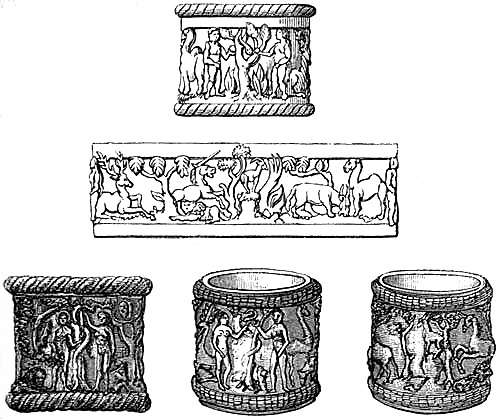
‘Paradise’ rings.
In the cathedral library at Chichester is an ancient gem having the
Gnostic equivalent of the blessed name Jehovah. This was used by Seffrid,
Bishop of Chichester (died 1159), as his episcopal signet.
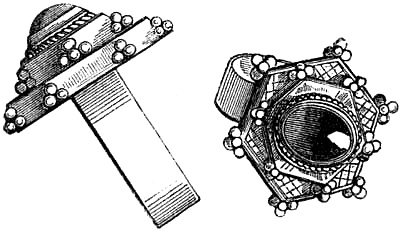
Reliquary ring.
In the Gérente Collection is a reliquary ring of silver-gilt elaborately
ornamented.
The Bessborough Collection has a ring with a frog or toad cut in a
magnificent almandine, of Roman work—a favourite device in the later
Imperial times, the animal typifying a new birth by its total changes of
form and habits, and hence adopted into the list of Christian symbols.
The Rev. C. W. King notices in his ‘Antique Gems,’ among some ‘highly
curious and undoubted Christian subjects engraved on gems, one of the most
interesting—a red jasper set in an elegant antique gold ring, the shank
formed of a corded pattern, in wire, of a novel and beautiful design. The
stone bears, in neatly-formed letters: ΙΗCΟΥC-ΦΕΟΥ-ΥΙΟC-ΤΗΡΕ,
“Jesus, Son of God, keep us.” Another, of equal interest and of the
earliest period of our religion, a fish cut on a fine emerald (quarter of
an inch square), is set in an exquisitely-moulded six-sided ring, with
fluted and knotted shank, imitating a bent reed, very similar to a bronze
one figured in Caylus.’
The first of the annexed illustrations represents an early Christian ring
with the symbol of an anchor.
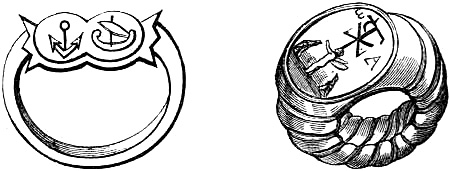
Early Christian rings.
The other engraving is from Gorlæus, of an early Christian ring with the
sacred emblems, found in the Catacombs at Rome.
The following illustration represents a key-ring, with sacred monogram.
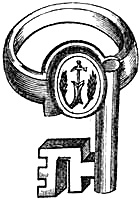
Early Christian.
In the Waterton ‘Dactyliotheca’ is an early Christian ring having ‘the
Holy Church represented by a pillar, on which are figured twelve dots,
which denote the twelve apostles. Three steps, thrice repeated, lead to
the pillar, symbolising the lavacrum regenerationis, which was formerly
received by three immersions, and three interrogations, and three replies
given by those who were being baptised.’
In the treasuries of various continental churches are ‘religious’ rings,
to which a high value is attached. In the church of St. Ursula, at
Cologne, is one called the ring of that saint, and is, certainly, of very
early date.
Mr. J. W. Singer informs me that he has seen in the treasury of the
cathedral of Liége, a large shrine, far above the size of life, in
silver-gilt, the bust of St. Lambert, the patron of the cathedral. One
hand has a crosier, and the other holds a book. On the right hand are six
rings, and on the left are three, of the seventeenth and eighteenth
century style; the shrine being late fifteenth or early sixteenth century.
The rings are on very different parts of the fingers, some being on the
first joint.
These rings may have been votive offerings; one is a ruby ring having a
stone weighing ten carats.
In a catalogue (kindly lent to me by Mr. Singer), ‘Des Bijoux de la Très
Sainte Vierge del Pilar de Saragosse’ of offerings by the pious to the
sacred treasury for many centuries, and which were sold in 1870 to defray
the expenses of repairs and embellishments to the Holy Chapel, numerous
costly rings are included among other precious objects.
With a few instances of ‘religious’ rings, including pilgrims’ rings, &c.,
now in the possession of several eminent collectors, and exhibited at
various meetings of the Archæological Society, I must conclude the present
chapter.
In the curious catalogue of Dr. Bargrave’s Museum (Camden Society) is
mentioned ‘a small gold Salerno ring, written on the outside—not like a
posey, in the inside, but on the out—Bene scripsisti de Me, Thoma. The
story of it is, that Thomas Aquinas, being at Salerno, and in earnest in a
church before a certain image there of the Blessed Virgin Mary, his
devotion carried him so far as to ask her whether she liked all that he
had writ of her, as being free from original sin, the Queen of Heaven,
&c., and entreated her to give him some token of her acceptance of his
endeavours in the writing of so much in her behalf; upon which the image
opened its lipps and said, Bene scripsisti de Me, Thoma.
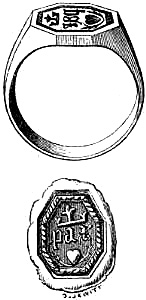
Religious seal-ring.
‘Salerno layeth a little beyond Naples on the Mediterranean Sea; and the
goldsmiths of that place, for their profit, make thousands of these rings,
and then have them touch that image which spake. And no merchant or
stranger that cometh thither but buyeth of these rings for presents and
tokens.’
A seal-ring, considered to belong to the fifteenth century, was discovered
at Cuddesden in 1814, by some workmen, in front of the gate of the
episcopal palace. It is of brass; the impress is an oblong octagon; the
device is the word pax, with a crown above, and a heart and
palm-branches below.
In the collection of the Hon. Richard Neville is a ring of silver-gilt
(time, Henry VII.), with bevelled facets, engraved with figures of saints,
found at the Borough Field, Chesterford; also a latten ring found in the
Thames (1846), the impress being the Virgin and Child; and the ring of
latten—ihc—discovered in repairing Weston Church, Suffolk; within is
inscribed, in deo salus.
A gold ring in the possession of Mrs. Baker, of Stamford, stated to have
been found in the tomb of an ecclesiastic, in a stone coffin, near
Winchester, bears a representation of St. Christopher.
A ring found at Loughborough, in 1802, represents the Virgin and St.
Michael, with motto.
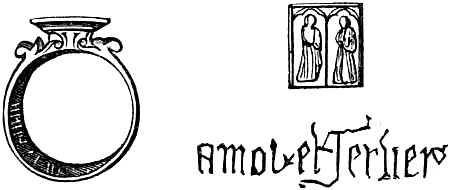
Religious ring.
A silver ring found at Carlisle, in 1788, bears an inscription below,
which has been suggested for ‘Mary, Jesus.’ The bezel of this ring is a
rude representation of joined hands, surmounted by a crown, and a portion
of the hoop is decorated with lozenge-shaped spaces, filled with a row of
quatrefoils. A correspondent to the ‘Gentleman’s Magazine’ for 1788, in
allusion to this ring, mentions that the hands joined together exactly
resemble one found at Shaf Abbey, with the motto ‘iheu.’ Or, he suggests,
‘it may be a wedding-ring, and to be read, Marith (marrieth) us.’
A similar ring, with the hands joined, and inscribed Jesus Nazarenus, is
represented in the ‘Gentleman’s Magazine’ (vol. liv. p. 734, and vol. lv.
p. 333).

Inscription on a supposed religious ring, found at Carlisle.
The annexed engraving represents a ring found, about 1790, in Stretly
Park, near Nottingham. The figure is that of St. Edith, and the ring
probably belonged to the abbess of some religious house in the
neighbourhood.
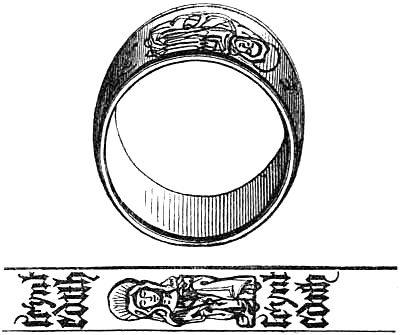
Religious ring.
The following illustration represents a ring discovered, in 1812, while
harrowing near Froxfield, Hants; weight 4 dwt. 7 grs. It is supposed to
have been worn by a warrior in the Crusades. The bezel part exhibits on
the dexter side a knight with a shield, charged with a cross, thrusting a
lance down the throat of a dragon—probably meant for St. George. The
figure on the corresponding side varies in having a cross on the right
side of his mantle, and appears to be in a boat, or wading through water;
and it may be conjectured to be intended for St. Christopher.
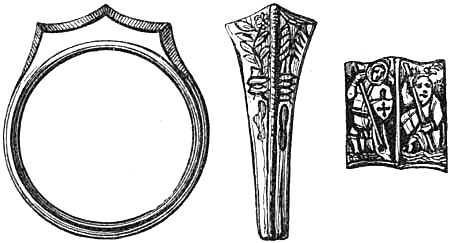
Religious ring.
Representation of a ring with a crowned I over a pillar, supposed to be
the initial of our Saviour’s name as King of the Jews:
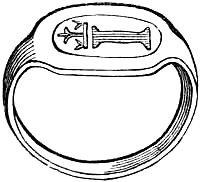
Religious ring.
Mr. Davis, of Hempton, Oxfordshire, possesses a brass ring found there, in
the form of a strap and buckle, or of a garter, so contrived as to admit
of being contracted or enlarged, to suit the wearer’s finger; the end of
the strap being formed with little knobs, upon which the buckle catches,
and keeps the ring adjusted to the proper size. The hoop is inscribed in
relief, MATER DEI MEMENTO.
In the Waterton Collection is an ecclesiastical ring, silver-gilt, with
circular bezel set with a cabochon crystal, the shoulders ornamented with
cherubs’ heads in full relief, supported by brackets; on the reverse of
the bezel is engraved the figure of Christ on the Cross; sixteenth
century; diameter two and a half inches.
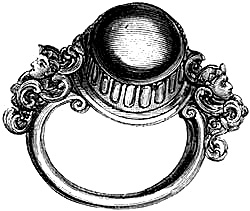
Ecclesiastical ring.
A singular silver ring, of which a representation is given in the
‘Archæological Journal’ (vol. iii. p. 78) was exhibited at a meeting of
the Institute in 1846 by Mr. Talbot. The interlaced plated work resembles
some ornaments of the Saxon period, but is remarkable for having the
impress of two feet, which may, probably, be regarded as one of the
emblems of the Passion, or as a memorial of the pilgrimage to the Mount of
Olives, where the print of the feet of the Saviour which miraculously
marked the scene of His Ascension, was visited by the pilgrims with the
greatest veneration.

Pilgrim ring.
In the collection of Mr. Octavius Morgan, F.R.S., F.S.A., is a gold ring,
probably one of those obtained at Jerusalem, as tokens of pilgrimage to
the Holy City. On the head, which is circular, is engraved the Jerusalem
Cross, and around the hoop the first words of Numbers vi. 24: ‘The Lord
bless thee and keep thee,’ in Hebrew characters.
At a meeting of the Archæological Institute (Feb. 1855), Mr. Gough Nichols
exhibited impressions from two signet-rings, also bearing as a device the
‘Jerusalem Cross,’ or cross potent between four crosslets, the insignia of
the Kingdom of Jerusalem, worn likewise on the mantles of the Knights of
the Holy Sepulchre. This device is regarded as emblematic of the five
wounds of our Lord. On one of these rings, of gold, purchased at Brighton,
the cross appears between two olive-branches, with the word ‘Jerusalem’ in
Hebrew characters beneath; on the other the branches alone are introduced.
The ring last mentioned, which is of silver, is in the possession of Mr.
Thompson, of Leicester. These are supposed to be memorial rings brought as
tokens of pilgrimage to the Holy City.
A gold ring of most beautiful workmanship was exhibited at the Lincoln
meeting of the Archæological Institute, by the Rev. S. Blois Turner,
bearing the device of the bear and bâton ragulé, with the motto
inscribed above, ‘Soulement une’ (only one). Around the hoop are the
words, ‘be goddis fayre foot’. This very singular legend has been supposed
to have reference to the miraculous impress of the Saviour’s feet on the
Mount of Olives, which was regarded by pilgrims with extreme reverence,
and, like the five wounds, was probably used as a symbol of talismanic
virtue. This ring, formerly in the possession of George IV., now belongs
to General Johnson. Weight 230 grains.
In the Braybrooke Collection is a brass ring strongly gilt, with a long,
oval, flat signet, engraved with Hebrew characters, ‘Pray for the peace
of Jerusalem,’ from Psalm cxxii., supposed to be one of the rings given to
tourists to the holy city, as a certificate of their visit, and called in
the East ‘hadji’ or pilgrims’ rings.
In the same collection is a slight silver ring, with narrow and flat band
to hoop, surmounted by a circular signet; on the hoop is this inscription,
in relief, between lines raised along each edge, headed and ended by small
flowers, ‘M S D MONSERRATA.’ On the signet, also in relief, appears a
double-handled stone-mason’s saw (serra), the Latin for which furnished
the key to this monkish riddle; it reads thus, ‘Mater Sancta de
Monserrata,’ or Holy Mother of Monserrat, in Spain, where there was a
chapel dedicated to the Virgin, and this is, probably, the ring of a
pilgrim to that shrine.
At the meeting of the Archæological Institute at Norwich in 1847 some
curious examples of religious rings (of silver) were exhibited, connected,
most probably, with charms and superstitions. A ring dating about the
period of Henry VI. is engraved with the figure of a female saint, and the
symbols of the five wounds. Another, of the same age, found at Fransham,
has the hoop swaged or twisted; on the angular facets had been engraved
figures of saints. The engraving on another ring was ‘+Maria+Anna+Ih’us.’
Amongst the rich collection of rings lent by Mr. R. H. Soden Smith to the
Loan Exhibition of Ancient and Modern Jewellery at the South Kensington
Museum in 1872, were six rings, gold and silver, of the iconographic type,
having for the most part figures of saints engraved on the bezel, one
inscribed within, in Gothic letters, ‘yspartir+canc+dec+’ (partir sans
désir).
In the ‘Journal of the Royal Institution of Cornwall’ (Sept. 1875) is a
note on an ancient signet-ring found at Penryn by Mr. W. H. Tregelles:
‘This ring was found a few years since in a field near Budock church, by a
watchmaker of the neighbourhood, of whom I bought it for Mr. Octavius
Morgan, F.S.A., late M.P. for Monmouthshire. It has been the subject of
much interesting discussion, the result of which, with a description of
the ring, and three impressions in hard wax, I have deposited in the
Museum of the Royal Institution of Cornwall, at Truro.
‘It is an oriental ring of silver, set with an oblong sard, engraved; it
appears at one time to have been gilt, and the loop and back of the bezel
were ornamented with a small pattern in niello, now almost obliterated by
long wear.
‘In the middle of the device is a cartouche, or escutcheon, terminating at
the top in a Greek cross potent. In the lower part of the escutcheon is
engraved a paschal lamb, and in the upper part are some oriental
characters, which have not been deciphered with certainty. On either side
of the escutcheon is some ornamental scroll-work, having in the middle the
Jerusalem cross potent.
‘It was submitted to Mr. Albert Way and Mr. C. W. King; and the latter
gentleman, who took much pains to make out the inscription, considered
that the characters were Servian, and that they represent the name of some
ecclesiastic of the Greek Church to whom it once belonged.
‘It was evidently an ecclesiastical ring, and M. Castellane stated that he
has seen several Armenian priests at Rome wearing similar rings. It may,
perhaps, date from the early part of the last century.
‘The most probable conjecture as to the reason of such an object being
found in Cornwall is that it may have been brought over by some traveller,
and, having been lost by him or the person to whom he gave it, was
mislaid among rubbish, and carted out with manure.’
In the first chapter of this work I have alluded to rings of the early
Christians, a subject of great interest, to which I again refer in these
notices of ‘religious’ rings, with additional illustrations from the
‘Archæological Journal.’
The following cut represents a portion of a ring of dark-green jasper,
from Rome, dating, probably, from the second or third century. On the oval
bezel a symbol is engraved in intaglio, viz. a boat, on which is a cock,
carrying a branch of palm.
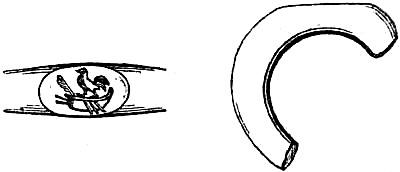
A bronze ring, probably Christian, of the third or fourth century, of an
oval octagonal form, set with red jasper, engraved in intaglio with the
subject of a shepherd. From Rome.
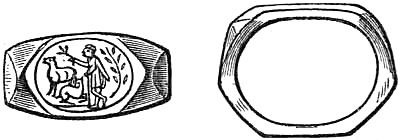
The ring here represented is of bronze, engraved with a ship, the emblem
of the Church, between the letters chi and rho. This ring was obtained
at Rome.
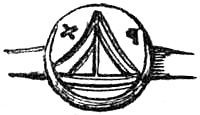
The accompanying illustrations are of small gold rings, in workmanship
and form dating from the third or fourth century.
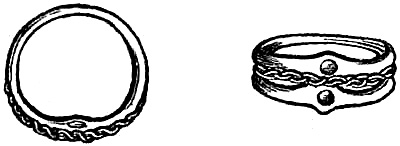
Annexed (probable date about 440) is a signet-ring, the subject incised
upon the gold apparently a matrimonial or love-ring.
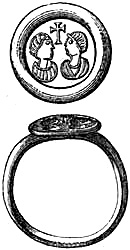
To the same period may be ascribed a bronze ring, of coarse workmanship,
taken from the Roman catacombs. A circular hoop is surmounted by a flat
circular bezel, on which is engraved an ear of corn between two fishes,
emblem of the bread of life, and those who live in faith of it.
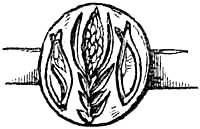
Another bronze ring is engraved with the sacred symbol, the united chi
and rho between the alpha and omega above, and two sheep below.
Probable date, the middle of the fourth century. Found at Rome.
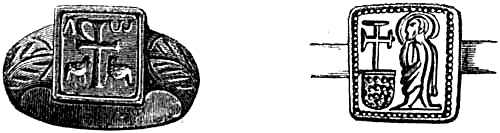
To the same class of rings belongs the last of the above engravings. It is
of bronze, having a simple convex hoop; the device, a draped male figure
with nimbus, and standing before a cross appearing to spring from a bunch
of grapes. It was brought from Athens, and is probably Byzantine, of the
sixth or seventh century.
The following engraving represents a ring of duplex form, of solid gold,
weighing 5½ dwts. It has engraved
D
FILINAN
A
and
Vivas
in Deo*.
The ring probably dates from the latter part of the third, or beginning of
the fourth, century. It was discovered in the neighbourhood of Masignano,
a small township of Fermo.
Early Christian rings of silver are unusual; that now represented is of
duplex form. On one oval is engraved the name FAVSTVS, and on the other is
a palm-branch. The date is, probably, of the latter half of the fourth
century.
A bronze ring, intended for a signet. On the bezel is a monogram deeply
cut in reverse, which has been rendered by Rossi, Deus dona vivas in
Deo. From Rome, and of the fourth century.
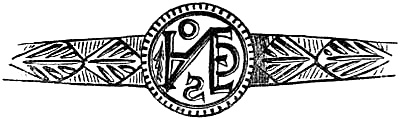
A bronze ring with circular hoop, the bezel engraved with the sacred
monogram. This ring is said to have been found in the neighbourhood of the
house of Pudens.
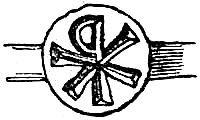
A bronze ring of coarse workmanship and angular form. The device, two
doves and a fish.
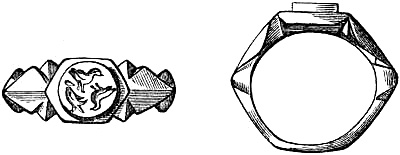
The shoulders of the following bronze ring are engraved as palm branches.
The bezel is raised by four steps or tables, and engraved with a monogram.
From Rome.
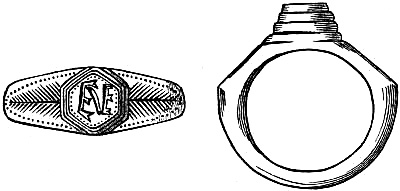
A bronze ring with high, projecting bezel. On the square face the subject
of Abraham’s sacrifice is deeply engraved. The execution may be
attributed, perhaps, to the latter end of the third century, but, more
probably, to the fourth. Brought from Viterbo.
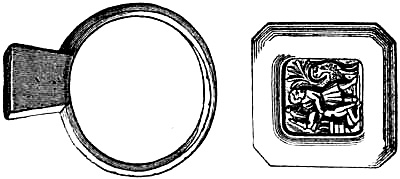
Bronze ring, formed as a circle of half-round metal, engraved with a
double-fluked anchor, crossed by one of a single fluke, and surrounded by
a pearl border. From the catacombs at Rome.
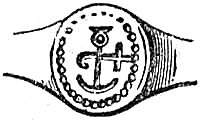
Bronze ring, with plain rounded hoop. Device, a draped female standing
between two birds. On either side is the Christian monogram. Found, it is
believed, in the catacombs of St. Calixtus; date, fourth century of our
era.
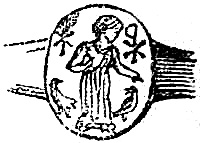
An iron ring of octagonal form, the bezel engraved with two human figures
and the sacred monogram. A human figure is represented on each face of the
octagon. This is a remarkable ring of its class.
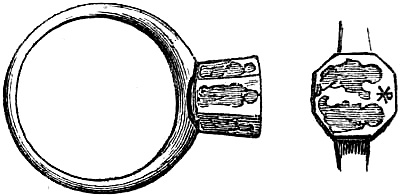
Bronze ring, with bezel shaped as the sole of a shoe, and incised with the
legend IN DEO, in the collection of C. D. E. Fortnum, Esq., F.S.A.:
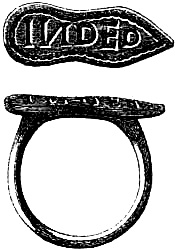
In Montfaucon’s ‘L’Antiquité Expliquée’ are several illustrations of Roman
rings with the bezels representing a human foot. One seems to have been a
Christian seal, the inscription on which, DEDONAO, is there, perhaps, put
for DEI DONA. Montfaucon mentions one in his own cabinet, inscribed,
between two crosses, DEI DONA.
A bronze stamp, formed as the sole of a shoe, is preserved in the
Christian Museum of the Vatican. Inscription reversed, SPES IN DEO.

A child’s ring of gold. A simple hoop, flattened out on the bezel, which
is engraved with the palm-branch. This ring was found in a child’s tomb in
the neighbourhood of Rome.

Bronze ring, the bezel engraved with the sacred monogram, round which is
placed the inscription, COSME VIVAS. This was discovered in one of the
catacombs on the Via Appia.
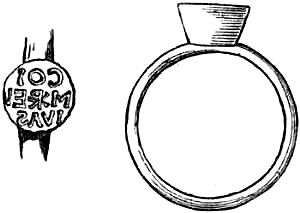
A small iron ring, on which is engraved the lion of St. Mark, dating,
probably, from the sixth century. Found in a Coptic grave near the temple
of ‘Medinet Aboo,’ at Thebes.

Mr. Hodder M. Westropp, in his ‘Handbook of Archæology,’ remarks that
Christian inscriptions ‘are all funeral, and are, for the most part, found
in the Catacombs, or subterranean cemeteries of the early Christians in
Rome. They are characterised by symbols and formulæ, peculiar to the
Christian creed; the idea of another life—a life beyond the
grave—usually prevails in them. The symbols found in connection with the
funeral inscriptions are of three kinds; the larger proportion of these
refer to the profession of Christianity, its doctrines and its graces. A
second class, of a partly secular description, only indicate the trades of
the deceased, and the remainder represent proper names; thus a lion must
be named as a proper name, Leo; Onager, an ass; a dragon,
Dracontius. Of the first kind the most usually met with is the monogram
of Christ. The other symbols generally in use are the ship, the emblem of
the church; the fish, the emblem of Christ; the palm, the symbol of
martyrdom; the anchor, representing hope in immortality; the dove, peace;
the stag, reminding the faithful of the pious aspiration of the Psalmist;
the horse was the emblem of strength in the faith; the hunted hare, of
persecution; the peacock and the phœnix stood for signs of the
resurrection; Christ, as the good pastor, and the Α-Ω of
the Apocalypse, was also introduced in the epitaphs. Even personages of
the pagan mythology were introduced, which the Christians employed in a
concealed sense, as Orpheus, enchanting the wild beasts with the music of
his lyre was the secret symbol of Christ, as the civilizer of men, leading
all nations to the faith. Ulysses, fastened to the mast of his ship, was
supposed to present some faint resemblance to the Crucifixion.’