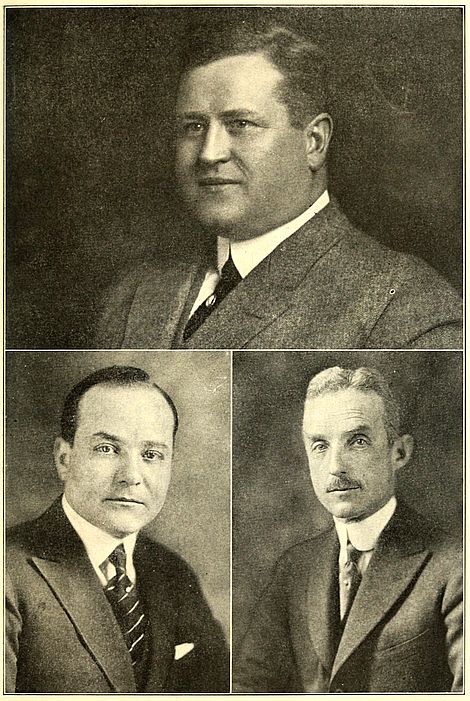
Franz Von Rintelen was the German
tiger who missed his spring. He was the
most powerful, the most dangerous, agent of the
Kaiser in the United States: and to-day he nurses
his hatred of us behind prison bars. But he
did not retire to confinement until after our
Government completed an extremely difficult
and tedious investigation that was made necessary
by his care in concealing the insidious
work of propaganda and destruction in which
he had engaged.
Rintelen was a tiger in the implacable hatred
he bore this country and in the ferocity with
which he carried that hatred into action. Sent
to America in 1915 to hinder the shipment of
munitions to the Allies, he sought first to poison
the press, then to corrupt labour, and, not content
with these things, he finally tried to hire
thugs to burn, to dynamite, and to assassinate,
where other persuasions failed; and he did succeed
in setting fire to thirty-six ships at sea,
causing millions of dollars of loss, and imperiling
hundreds of human lives.
Rintelen had, however, the other side of the
tiger’s character—its graces. When the —— made
port at New York on April 3, 1915, it
bore as passenger one Émil Gasché, a Swiss.
The moment Gasché passed the customs officers
Gasché ceased to exist, and in his place appeared
handsome young Von Rintelen, unexpectedly
arrived in America for his fourth visit and renewing
pleasant acquaintanceships in society and
in Wall Street. He was “the same old chap,”
to quote his own description of himself in one
of his letters—rich, of a family long accustomed
to riches; well-bred, of a family long proud of
its aristocratic connection with the Imperial
Court at Berlin (his father had long been the
equivalent of our Secretary of the Treasury);
young, the youngest of the chief bankers of
Germany; handsome, with the good looks that
come of regular features and of a slender frame
hardened by athletics and made distinguished
by the bearing of an officer; a sportsman, who
raced his yacht in the Emperor’s regattas at Kiel—an
affable, cultivated, witty, accomplished
man of the world. No wonder he had been
popular on his former visits. On one of them
he had opened in New York a branch of the
Deutsche Bank, one of the greatest of the government-controlled
banks of Germany, and on
another he had widened these financial relationships
with Wall Street. He had travelled the
country over and knew people everywhere; and
he knew about hundreds more, even to their
private affairs in money and politics and those
intimate weaknesses that pass into the gossip of
the smoking-room. He spoke the language with
only the slightest accent but in its purest form,
and was adept in our peculiar kind of humour—altogether,
a fine and likable fellow, who liked us.
Until the war. And until the Germans, stung
by the lost illusions of a quick and glorious victory,
facing the gray outlook of a long and bitter
struggle, looking about for some one to blame for
their plight, and wearied of “strafing” England,
found a new narcotic in a hatred of America.
America, that made the cartridges and
shells that patched up the unpreparedness of
France and Britain and Russia, which Germany
had calculated as one of the factors in the equation
of victory. America, that—as their rising
rage made their voices shriller—“is murdering
our sons and brothers on every battlefield from
Switzerland to the sea for the sake of blood-bought
gold.”
This cry became an article of fanatical faith
to the German people. It became likewise
a very practical problem to the hard-headed
leaders in Berlin. If they could cut off this
supply of munitions, the Allies could be beaten.
There was no hope of cutting it off at sea—the
British Navy would attend to that. It must
be stopped at its source: stopped in America,
by a made-to-order public opinion, or by corruption,
or by violence—but stopped.
“Whom shall we send to America?” was
their problem. Rintelen was chosen. He could
be trusted—he was a director of the Deutsche
Bank, he knew America. He was given credit
at the Hamburg-American Line office in New
York for $547,000, authority for as many millions
more as he wanted, independent powers as
great as the German Ambassador’s at Washington,
the instructions of the German Government,
and the blessing of the Fatherland.
An American traitor in Berlin gave Rintelen
his cue for operations in America. This man’s
name is known, and will one day be written
alongside Benedict Arnold’s, but to disclose
it now would interfere with more practical
efforts for his mortal punishment. Part of
that punishment he is already enduring—he is
still in Germany. This traitor told Rintelen
that the most useful man in America for his
purpose was David Lamar, of New York.
Rintelen fixed that name in his memory, and
left Berlin.
His first barrier was the old, old barrier to
German conquest, the British blockade. Rintelen
ran that under cover of the Swiss passport,
under the name of Gasché.
Arrived in New York on April 3d, Rintelen
lost no time in getting acquainted with Lamar.
He disclosed to him his mission to this country
and the money he had to execute it. The
Tiger of Berlin met the Wolf of Wall Street.
And how the Wolf’s eyes must have glistened,
for he was at the leanest of the hungry days
which regularly followed seasons of opulence
in the ups and downs which varied the career
of this extraordinary man. For Lamar was,
and is, an extraordinary man. Endowed by
nature with a fascinating personality and with
a brilliant mind, which he had enriched by study,
a man capable of great things, he was possessed
by that strange perversity which often afflicts
men of exceptional cleverness—he would rather
make one dollar by adroit crookedness than a
million by unexciting honesty. Perhaps his
origin affected his character—he declined, on
the witness stand, to give his true name and
parentage on the ground that to do so would
bring disgrace upon persons still living. He
entered Wall Street as a young man from
nowhere, and at first gave promise of a brilliant
and honourable career. He early made his mark
in finance. He was employed by J. P. Morgan
& Company and other great banking concerns,
and in those days of his legitimate activities
amassed a large fortune. But this was dissipated
in gambling on the stock market, and
then Lamar gravitated to the gutter. For
years it was a by-word on the Street that if
you wanted a clever man to do a crooked job,
David Lamar was the man you were looking
for. He had the brains to do it right, he had the
presence to “get away with it,” and he would
do anything for money.
These traits had got him into trouble shortly
before Rintelen met him. When the Pujo Committee
of Congress was investigating the “money
trust” several years ago, some crooked brokers
in Wall Street wanted some inside information
that was going to affect the price of certain
stocks in which they were interested. They
could not get this information by legitimate
means, and so they adopted Lamarian means.
Lamar knew that a member of Congress was
entitled to ask for this information. Mr. Mitchell
Palmer was a Member of Congress. Lamar
had one of his devious inspirations. He called
up a banker’s office, got the man there who
knew what Lamar wanted to know, declared
that he was Mr. Palmer, and demanded the
information—and got it. Lamar repeated the
exploit several times. But once too often. He
was detected, arrested and tried, convicted,
and on December 3, 1914, was sentenced to
two years’ imprisonment for the crime of impersonating
an officer of the Government. He
appealed the case on the ground that a Representative
in Congress was not “an officer of
the Government.” When Rintelen met him
the following April, Lamar was out on bail
pending the decision on this appeal.
Lamar was then in desperate straits. Bad
luck had followed him in the Street for two
years, and had crowned his misfortunes with
this expensive trial and threatened imprisonment.
He owed money everywhere for personal
expenses; the merchants with whom he traded
had stopped his credit; he had descended to
borrowing from his friends in sums as small as
two dollars at a time. Then he met Rintelen,
who was on fire with a passion that blinded him
to consequences and who flourished before the
eyes of the famished Wolf a half million dollars
of real money. Here was manna fallen from
heaven.
“Could Lamar help Rintelen!” With his
most convincing eloquence, Lamar assured him
that he could. Never had Rintelen been better
advised, so Lamar declared to him, than when
his friend in Berlin had given him his name.
For he had friends in Washington, he whispered,
men powerful in the Government. And friends
among the labouring people, the men whose
hands made those munitions Rintelen had come
to stop, and whose hands might be paralyzed
by the clever use of brains and money. Lamar
would supply the brains: Rintelen would supply
the money. The Wolf saw good hunting
ahead.
Lamar laid before Rintelen a scheme. They
would capitalize the American passion for peace:
they would capitalize in particular the labouring
man’s aversion to war. A section of opinion
among labouring men held that wars were
instigated by capitalists for gain, and were fought
by labouring men who gave their lives to make
good the selfish ambitions of the rich. And one
of the American people’s deepest convictions
was that war was an odious moral crime; and
that universal peace was attainable by the pursuit
of moral ideals.
Lamar declared, then, that by working
through his friends in labour, he could organize
the workers of America so that they would refuse
to work on the implements of destruction
of “capitalistic” war. And that, by working
through his friends in the Government, he
could create a national sentiment that would
force Congress to place an embargo on munitions.
But these things would cost money.
Lamar never forgot money.
Now we see a sudden transformation in Lamar’s
circumstances. The frayed debtor appeared
in his old haunts garbed in the most fastidious
selections of the tailor; the accumulated
debts of years were paid; the subway and the
street car gave way to automobiles—and Lamar
was particular that the garage should supply
only the fine car that was father to the Liberty
motor. He moved his family from a cheap
apartment in New York to a fine house at Pittsfield,
Mass. His own quarters were the hotels
Astor and Belmont in New York, the Willard in
Washington, the La Salle in Chicago, the Claypool
in Indianapolis. Things were looking up.
Lamar carried other men with him on his
rising tide of fortune. Frank Buchanan, labour
Representative in Congress from the Seventh
District of Illinois (North Chicago), likewise
became a traveller and the patron of exclusive
hotels. Henry B. Martin, who eked out a
precarious living in the lobbies of Congress,
after a dubious career as an officer of the Knights
of Labour in the ’nineties, framed his wizened
figure in a new and luxurious setting. H.
Robert Fowler, the splendid high light of whose
gray life as a half-lawyer, half-farmer, in a
country town in Illinois, was expiring in the last
days of a term in Congress, was suddenly revived,
before his final extinguishment, by the
light glittering from anonymous gold. Herman
J. Schulteis, whose talents, insufficient for success
in the law, had been more profitably employed
in the defunct Anti-Trust League (of
which more later), rose rapidly in the monetary
scale.
These men were the instruments Lamar used
in his scheme to stop the munitions industry and
to get Rintelen’s money. That scheme was to
build up a great political organization of labouring
men and farmers. This organization would
oppose the making and shipment of munitions;
it would exert pressure to compel workers to
abandon the factories, and it would exert pressure
to compel Congress to declare an embargo
on the shipment of arms. This organization was
labelled “Labour’s National Peace Council.”
Lamar, fortified with Rintelen’s money,
launched his scheme in Washington. This scheme
was an inspiration of genius. Able lawyers
have declared that no cleverer conspiracy has
ever come to their attention. Its beauty was
its simplicity. Rintelen dealt with no one but
Lamar—the other leaders never saw him, and
most of them never heard of him until after the
scheme was exposed by the Government. In
his turn, Lamar operated entirely through
Martin. To Martin he gave his instructions to
see labour leaders, to organize the fake Peace
Council, to hold its camouflage “convention,”
to flood the country with lecturers and printed
matter urging an embargo on munitions. And
through Martin he paid the bills.
Lamar and Martin were old associates.
They had worked together in the Anti-Trust
League, another of the creations of Lamar’s
restless mind. The Anti-Trust League originated
in the feverish ’nineties, when the country
had its fears that the growth of great corporations
spelled the control of the Government by
monopolies. The League had its days of prominence
when it was financed by big interests
that used it to fight other big interests to get the
things they both wanted. But in 1915 the
League was a skeleton, consisting of Lamar,
Martin, Schulteis, and a few others, held together
by the bond of small salaries drawn
from some source that preferred to remain unknown.
When Martin undertook to organize Labour’s
National Peace Council, under the direction
of Lamar, the first man he approached was
Frank Buchanan. Buchanan was labour’s leading
champion on the floor of Congress. He
had been president of the international union
of the structural iron workers, and he had earned
the confidence of organized labour, and the
friendship of Samuel Gompers, the patriarch of
organized labour.
Lamar, Buchanan, and Martin, assisted by
Fowler and Schulteis, engineered a mass meeting
of workingmen in Chicago in June, 1915, at
which resolutions were adopted calling for a
convention of labourers and farmers at Washington
to protest against the traffic in munitions.
The same men, with this “mandate” behind
them, met in Washington on June 22d, and organized
Labour’s National Peace Council. They
prepared printed appeals, in the high language
of humanitarianism, addressed to the labour
unions and the granges, and mailed them by the
ton to all parts of the country. They offered
to pay all travelling expenses and for lost time
to delegates which these bodies should send to a
convention to be held in Washington on July
31st and August 1st.
As a preliminary to this convention, Martin
paid labour leaders and other speakers to go
into all sections of the United States and address
labour unions and granges. Probably
all these speakers acted in good faith. They
were pacifists, and when they got an opportunity
to preach their doctrine, they accepted
it. The opportunity seemed legitimate enough—the
name of Frank Buchanan as a sponsor
of the movement was sufficient. Their audiences,
too, were sincere. Workmen and farmers
had before their eyes the contrast of their
own peaceful land with a Europe drenched in
blood. The blessings of peace were never more
apparent. They sent delegates gladly to a
meeting that seemed designed to perpetuate
those blessings.
But Samuel Gompers opposed the convention
of Labour’s National Peace Council. He,
too, was a pacifist—had for years taken a leading
part in the movement for international peace.
But Gompers was a thoughtful man as well.
And experienced. And wise. He told Buchanan
some things Buchanan should have told
himself. Buchanan came from Chicago to Atlantic
City to meet Mr. Gompers and upbraid
him for his opposition to the Council. Mr. Gompers
gave him some fatherly advice. In effect,
he said:
“Frank, you have earned a good name in
labour. We are proud of you, and we trust
you. You are at life’s meridian, with years of
useful service ahead. But listen to an old man,
who sees the shadows growing very long, and
who has watched many movements come and
go. You are in wrong. This scheme is bad.
There is too much easy money being passed
around in it. Labour hasn’t got money to spend
like this. Somebody who has not labour’s interests
at heart is putting up that money.
“And take the Council’s aims themselves.
Suppose you succeed in stopping the manufacture
of munitions—what will happen to
labour? Two years ago, our boys were walking
the streets, begging for a job. To-day, every
man of them has work, and wages are going up.
War work has done that. Do you want to stop
the opportunity of labour to make a living?”
But Gompers’s eloquence left Buchanan cold.
In the face of his pleadings and advice, Buchanan
accepted $2,700 from Martin in the
following six weeks. He saved his face at the
last minute by resigning the presidency of
Labour’s National Peace Council the day before
the convention met.
The convention met in Washington on July
31st, at the New Willard Hotel. Its members
were impressed, as it was intended that they
and the country in general should be impressed,
by the sonorous voice and important presence
of Hannis Taylor, former American Minister
to Spain and author of text books on constitutional
and international law, such as “The
Origin and Growth of the English Constitution”
and “International Public Law.” He made an
opening address in which, from his heights of
knowledge, he solemnly declared that munitions
shipments were in violation of international
law. His address was largely devoted to assurances
to his hearers that he was an authority
on such matters and that they could take his
opinion as disposing of the legal aspect of this
question. Mr. Taylor was there to lend distinction
to the gathering, and he left no doubts
in their minds that he thought he was doing it.
But when the delegates got down to business,
there was trouble. The farmer delegates became
suspicious—they had vague fears of the source
of the money that was paying the bills; they
did not like the company they found themselves
in. They first declined to bind their constituents
to the resolutions that were offered: then
they left the convention.
On the second day, the labour delegates
became equally restless. Buchanan had withdrawn.
The delegates who used the opportunity
of being in Washington to call on
Mr. Gompers came away from his office with
heavy hearts. Returning to the Willard, they
saw the machinery being manipulated by the
discredited Martin and Schulteis. “What have
these fellows got to do with us?” they asked
one another. And then they asked “these
fellows” quite bluntly, “Who’s putting up the
money for this show?” Martin, backed to the
wall of the Willard bar by their insistent demand
for an answer, replied with an evasive, “What
difference does it make?” And when they
shouted that it made a profane lot of difference,
he answered defiantly that it was all right
“even if it’s German money.”
That finished the labour delegates. They, too,
went home.
But the ringleaders had put out a resounding
resolution calling for an embargo on munitions.
And though the convention had fizzed
out, it had done an enormous lot of harm.
Thousands of labouring men and farmers had
been indoctrinated with a specious pacifism
that was reflected later in the attempts to evade
the Conscription Act when we entered the war.
The Government to-day is contending with
the moral antagonisms aroused in certain sections
of the country by the orators and writers of
Labour’s National Peace Council.
In this moral infection, the work of Hannis
Taylor played an important part. He wrote
legal opinions for the Council, declaring that
the traffic in munitions was unconstitutional.
He received $700 for this work. These opinions
were printed and distributed broadcast, and
did much harm. More recently, Taylor was
counsel for Robert Cox, the Missouri draft
registrant who sued to restrain General Leonard
Wood from sending him with his regiment to
France. On his behalf, Hannis Taylor contended
that the Conscription Act was unconstitutional,
asserting that the only power of
Congress to call out troops was under the
militia clause of the Constitution which reads:
“To execute the laws of the Union, suppress
insurrections and repel invasions.” This meant,
so Taylor contended, that no citizen could be
sent, against his will, outside the United States
to fight its battles.
This absurd doctrine, which would force us
to fight this war on our own soil instead of
allowing us to defend ourselves in Europe against
German aggression, was promptly punctured
by the Supreme Court of the United States.
In his brief before that Court Hannis Taylor
used language so violent that the counsel
for the Government asked that it be expunged
from the record. Taylor in his brief accused
the President of being a “dictator,” of seizing
powers “in open defiance of the judgments”
of the Supreme Court, and of demanding “such
an aggregation of powers as no monarch ever
wielded in any constitutional government that
ever existed.”
The decision of the Supreme Court, affirming
the Government’s right to draft its citizens
for service overseas, was delivered by Chief
Justice White. That stern old veteran of the
Lost Cause in our Civil War, speaking with the
aloofness and dignity of that august Court, in
measured terms expressed an opinion of Mr.
Hannis Taylor that is worth repeating. He
said:
... we must notice a suggestion made by the
Government that because of impertinent and scandalous
passages contained in the brief of the appellant the brief
should be stricken from the files. Considering the passages
referred to and making every allowance for intensity
of zeal and an extreme of earnestness on the part of
counsel, we are nevertheless constrained to the conclusion
that the passages justify the terms of censure by which
they are characterized in the suggestion made by the
Government. But despite this conclusion which we regretfully
reach, we see no useful purpose to be subserved
by granting the motion to strike. On the contrary, we
think the passages on their face are so obviously intemperate
and so patently unwarranted that if as a result
of permitting the passages to remain on the files they
should come under future observation, they would but
serve to indicate to what intemperance of statement an
absence of self-restraint or forgetfulness of decorum will
lead and therefore admonish of the duty to be sedulous
to obey and respect the limitations which an adhesion to
them must exact.
In all the operations of Labour’s National
Peace Council, including its convention, Lamar
kept in the background, as he knew labour had
no reason to own him or to love him. Buchanan
and the rest supplied the proper colour of propriety.
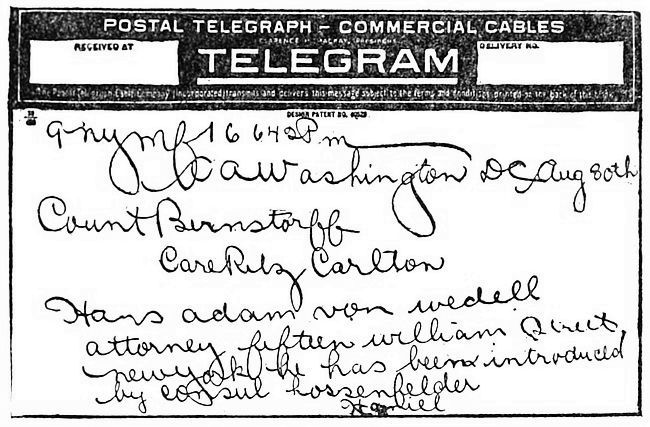
From his retreat in the Willard Hotel
in Washington, Lamar was sending ecstatic
telegrams, reporting progress, signing the name
of David H. Lewis, and receiving in reply
approving messages from Rintelen, who used
Jones, Miller, and Muller as aliases. The convention
seemed a great success. And its preparation
and operation had got the German’s
money. Of the $547,000 that Rintelen brought,
Lamar got more than $300,000. It looked so
good to Rintelen that he was ready to get more—from
Germany or from his limitless sources of
credit here.
But all was not well with Rintelen. He had
other lines out besides Lamar’s, and he caught
some disquieting fish—some of which he did
not identify until later. First, he was playing
the social game not wisely but too well. He
gave dinner parties; was a guest at others.
He should have been more politic than he was.
The Lusitania was sunk on May 7th. Instead of
adopting the manner of a man deep enough in
intrigue to know that he should speak of this
crime as a lamentable blunder of his country’s,
he justified it. His words gave the gravest
offense to his guests. He went further, and
threw out hinted threats of other perils that
would confront ships carrying munitions—hints
that he himself had had a hand in the mysterious
fires on ships that were almost a daily occurrence.
Some dinner guests in New York took him
seriously and reported him to the Government,
which had been suspicious of him almost from
the day of his arrival in this country.
Also, Rintelen undertook to get newspaper
publicity favourable to an embargo on the shipment
of munitions. He got himself introduced
to “Jack” Hammond, an old newspaper man
in New York, and closed with him a contract
for syndicate articles in a chain of papers across
the country. He met Hammond as one Fred
Hansen, a ship captain. (Hammond later testified
that Rintelen told him that he “killed”
Hansen the day after the Lusitania was sunk.)
After sizing Hammond up as worthy of trust, he
re-introduced himself as E. V. Gibbons, a purchasing
agent, with offices in the building occupied in
part by the Transatlantic Trust Company. And
at length he confided to Hammond his real importance
in the scheme of things German.
Early in this relationship Hammond became
sure that this man was planning to violate
the laws of the United States, and he reported
the matter to the Department of Justice. The
Department, already suspicious, asked Hammond
to keep up his connection with Rintelen,
and through this means it learned a
great deal about him. Not enough to cause
his arrest—Rintelen never confided that much
in any American but Lamar, who had his own
reasons for silence.
Out of Rintelen’s multifarious activities arose
many of the mysterious fires and explosions
in munitions plants, the burning of ships at sea,
the attempts on the Welland Canal in Canada,
strikes in war industries, and the like. The
discovery of Dr. Walter A. Scheele’s part in the
incendiary bombs matter, and his connection
with Rintelen, began to make the ground fairly
warm under Rintelen’s feet. And the Government
was taking an uncomfortable interest in
Labour’s National Peace Council. Rintelen became
uneasy.
His fears were now fed from a new quarter.
Andrew D. Meloy became a confidant of his,
and Meloy had his own axe to grind. Rintelen
had taken an interest in the German
activities in Mexico, and almost from the day
of his arrival had been intimate in this work
with Federico Stallforth, a German banker of
Mexico City who joined Rintelen in New York.
Stallforth had offices with Meloy at 55 Liberty
Street, and when the Transatlantic Trust Company
became embarrassed by Rintelen’s presence,
Stallforth persuaded Meloy to rent Rintelen
desk room. Their acquaintance started
there, about July 1st.
Meloy was a well-known engineer and promoter.
He had exploited concessions in Mexico—railroad
rights of way and gold mines—and
in his home state of New Jersey had floated
some real-estate “developments.” Meloy saw
in Rintelen exactly what Lamar had seen—a
lot of real money and an eagerness too great
for caution. He began to belittle Lamar’s
scheme. Labour’s National Peace Council would
never do. It looked good on paper, but it
would never stop the shipment of munitions.
He even hinted that Lamar had been “playing”
Rintelen. Now, if Rintelen wanted a real
scheme, certain to succeed, he knew the very
thing. Direct action—stop the bluffing and
the dangerous intrigues. Buy the whole munitions
output of the country. Bid high enough
to get it, pay for it outright, and store it. That
would cost money, lots of it: but what was
money in comparison with the certainty of
German victory which this plan would insure?
Rintelen was dazzled. Here was the authentic
voice of American big business speaking.
A magnificent scheme. He would take it to
Germany, take Meloy with him, and get his
Government to O. K. it.
But how get back to Germany? He had grave
doubts about the Gasché passport being good
again. He put the question to Meloy, and
Meloy advised against it. There was a better
way: get a new passport under a new name. So
for a few days Rintelen became “Edward V.
Gates, wine merchant, of Millersburg, Pa.”
In this guise Meloy introduced him to one of
his own real-estate salesmen, and Rintelen took
this man to dinner once or twice to work up the
illusion. Then, one day, he asked the salesman
to go with him to the passport bureau in New
York and be his witness to an application for a
passport. The salesman went, and in good
faith swore that Rintelen was Edward V. Gates.
His faith was not so good when he swore he
had known him for three years. The application
was transmitted telegraphically to Washington.
Much to Rintelen’s astonishment and
alarm, it was denied.
Meanwhile, Meloy had been working on a
devious scheme to protect himself in his mission
to Berlin. He must be cloaked in eminent
respectability on this errand, for it would
be an unpopular one with the British if they
knew its real purpose, and he must hide that.
First of all, he would take his wife, who did not
know what his mission was. She had taken an
active interest before the war in the peace movements
centring at The Hague, and nothing was
more natural than that she should wish now,
during the war, to renew her friendships in Holland
with an eye to furthering a cause now more
than ever vital to the world.
But Meloy was not content with only one
companion. He must have others who would
expand the picture of innocence abroad. One
of his neighbours in the suburb on the Jersey
Coast where he made his country home was a
wealthy woman known widely in America for
her interest both in the peace and suffrage
movements. Meloy telephoned to her and
asked her to see him at his home. This lady
drove over one summer evening in her motor
car, accompanied by two women friends. The
friends sat in the open car while she sat on the
porch talking to Meloy. Meloy is very deaf;
the lady had to talk loudly to make him hear.
Meloy differed from most deaf people, who
usually speak in a lower tone than those who
hear well—he went rather to the other extreme,
and spoke louder than most folks do. The
women in the car heard the conversation, and
they heard it a second time when their friend
repeated it to them on the way home. And the
Government heard it also, from the lips of all
three.
The burden of the conversation was this:
Meloy was taking his wife to Europe for a vacation;
they were going to Holland, where so many
forward-looking movements for the good of
mankind made their international headquarters;
he would be drawn aside a great deal by business
affairs and Mrs. Meloy would be lonesome;
he was anxious to provide companionship
for her, if the lady would accompany them, he
would pay all her expenses, he would assure her
that her journey would be made de luxe, he
would (he put it more delicately) even add a
money consideration, he would see that the
journey included a visit to war-bound Germany,
now so difficult of access, that in Germany she
should have entrée to social circles so exclusive
that they were inaccessible even to the American
Ambassador, and that, to crown all, she should
be presented to the Kaiser.
The lady said she would think it over. It
was an attractive invitation, but she did not
just like it—perhaps it was too attractive. She
talked it over with her friends: they advised
against it. She telephoned Meloy next day and
declined.
Meloy repeated the invitation to several
women. All declined. Then, as the Noordam
was to sail on August 3d, and he had no more
time, he decided to take his secretary, a Miss
Brophy.
Rintelen was now thoroughly alarmed. The
Government’s refusal to grant his fraudulent
application for a passport indicated that it
knew about him. The Government was getting
“warm” in its investigation of the incendiary
bombs. The Government was taking an
unpleasant interest in Labour’s National Peace
Council. Rintelen felt irresistibly the pangs of
Heimweh, the longing for home. He must go, at
any risk. He would chance it as Gasché again.
So he sailed on the Noordam, with Meloy
and party. He bore with him Lamar’s urgent
appeals for more funds for Labour’s National
Peace Council, now at the high tide of its
success. And he was in the hands of Meloy,
who was at the first of his own rainbow of hope
of millions with which to buy America’s munition
output—on commission.
At Falmouth the Noordam was detained for
fourteen hours. The British took a great
interest in the Gasché-Meloy party. Gasché’s
baggage revealed nothing suspicious, but Gasché
was removed to a long residence in an internment
camp near London. Meloy was detained
for several days. Mrs. Meloy soon appeared
to be beyond suspicion. Miss Brophy declared
that her baggage contained only personal
effects. But at the bottom of her last trunk
was found a wallet containing Gasché’s papers.
These were seized, and Miss Brophy and Mrs.
Meloy were allowed to proceed to Holland,
where they were later rejoined by Meloy.
The Gasché papers were most interesting.
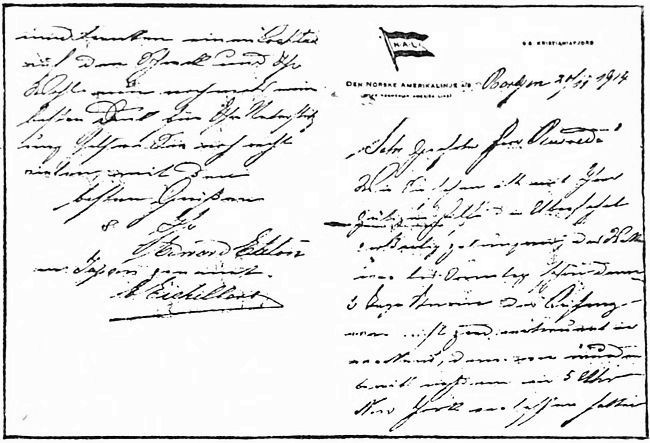
They contained some of Rintelen’s letters showing
his intimacy with well-known New Yorkers,
and letters in which he referred to his “official
mission” to the United States that were very
important, for they proved what Rintelen
steadfastly denied, namely, that he was in this
country by orders of the German Government.
In one of them to a man in Germany, whom
he addressed as “Most Honourable Counsellor,”
he wrote: “Your letter of the 25th March
[1915] was sent after me when I was on an
official journey, and I request you to excuse
the delaying in replying.” And another letter,
from the National Bank Für Deutschland,
dated Berlin, 25th May, 1915, and addressed
“To the Landed Proprietor, Von Preskow,”
contained this sentence: “Director Rintelen,
who looked after Major Von Katte’s account,
entered the navy on the outbreak of hostilities,
and as he is at present on an official journey is
not available at the moment.”
With Rintelen’s internment ended Lamar’s
golden fortune and Meloy’s golden vision and
Rintelen’s dream of destruction. And now
began one of the most difficult and one of the
longest tasks of the Department of Justice.
For, out of the fragments of evidence at its
command, and out of the seemingly innocent
public acts of Labour’s National Peace Council,
and out of the obscure and isolated outrages
to ships and factories in the United States,
the Department of Justice had to construct a
pattern that should prove, by tangible legal
evidence, the guilt of Rintelen and Lamar in
a plot to violate the laws of the United States.
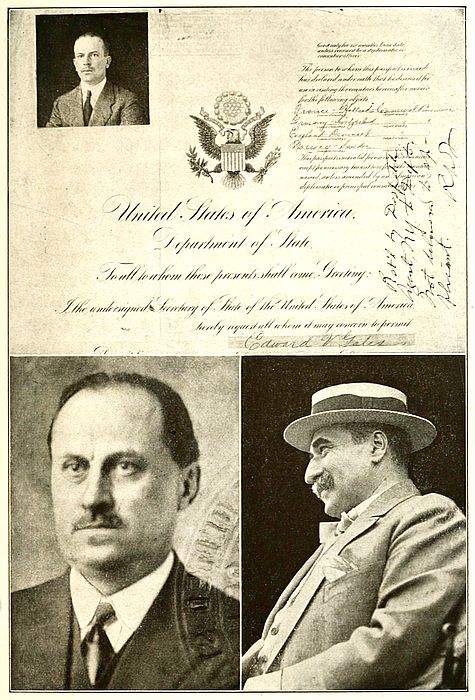
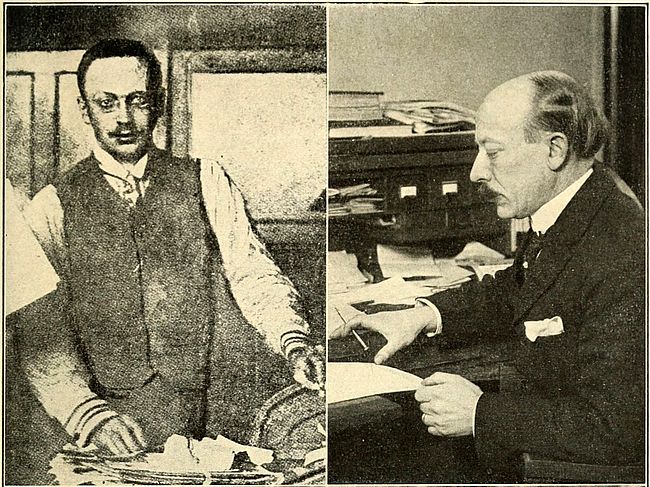
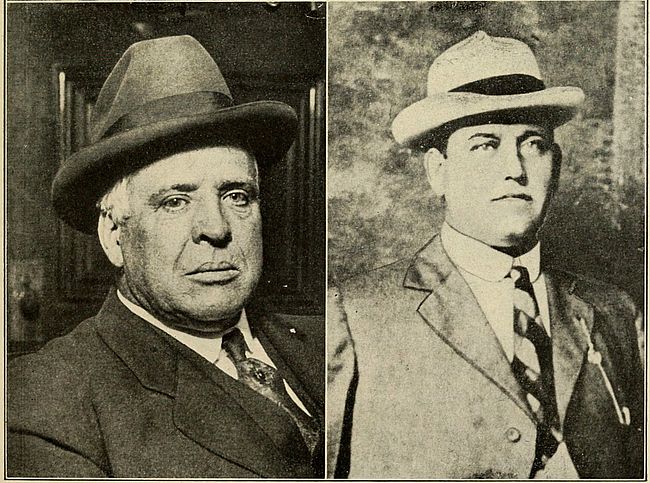
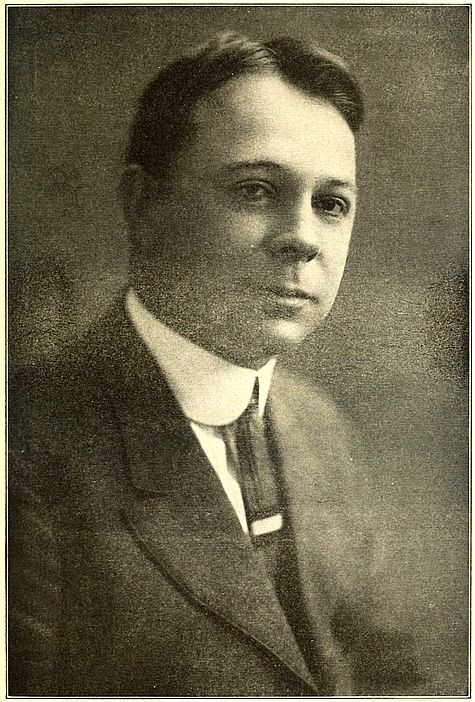
RINTELEN AND HIS CONFEDERATES
Above, Rintelen’s photograph on a false passport with which he tried to escape
from the United States; left, Andrew D. Meloy; right, David Lamar, “the
Wolf of Wall Street”
This long investigation was a fascinating
study in human nature. If only Lamar had
been a little different in his manners, he might
have escaped the clutches of the law. If Rintelen
had been as wise as he was clever, he
might still be in an internment camp instead
of a prison.
Lamar, it may be recalled, had a weakness
for automobiles. He hired them on all occasions.
They were especially useful to him for conferences
with Rintelen. They did not wish to
be seen together, so Lamar would drive to an
unfrequented spot in Central Park. Rintelen
would drive up in another car and get into
Lamar’s, and then they would go for a long ride
while they discussed their plans. Sometimes
they would go for hours on the North Shore
of Long Island; sometimes for long excursions
in the Pelham region of Westchester County,
stopping perhaps at a wayside inn and taking
a room for greater privacy in their conferences.
An agent of the Department of Justice spent
six weeks making the rounds of the garages
in New York. He carried Lamar’s picture in
his pocket. He showed it to every chauffeur
in every garage. And every chauffeur who had
driven a car for Lamar during that summer of
1915 recognized the picture, and every one of
them applied the same epithet to its original
that Trampas applied to the Virginian in Owen
Wister’s book when the Virginian, in response,
drew his gun and demanded that “when you
call me that, smile!” For Lamar, who was the
suave, the gracious, the ultra-polite and charming
man to people whom he wished to cajole,
was overbearing, fault-finding, and peremptory
toward those who served him. His movements
in the hotels about the country were several
times traced by a rough description completed
by a remark about his manner toward servants.
No waiter or bell-boy ever forgot him. He was
forever “kicking about the service.”
This vivid impression that he made on the
chauffeurs contributed greatly to his undoing.
They remembered him perfectly, and recalled
his companions. They recognized Rintelen’s
photograph. And several of them had overheard
parts of the conversations that were
useful to the Government. Through these
men, Lamar’s connection with Rintelen in a
conspiracy to violate the Sherman Act by
restraining our foreign trade in munitions was
established.
One’s laundry, too, may be a dangerous
thing. Lamar denied that he had stopped
at hotels in Chicago and Indianapolis and
elsewhere at the same time that Martin and
others were there. But handwriting experts
proved that the names “David Lenaur,” “David
Lewis,” and the like, on hotel registers on those
days were in Lamar’s handwriting. And the
conclusive proof of their evidence was that the
laundry lists of the hotels on those days showed
that the laundry mark on the linen of “Lenaur”
and of “Lewis” was the laundry mark of Lamar.
Charge accounts at stores may also prove
troublesome. It became necessary to find out
where Lamar banked his money. That was discovered
through Lamar’s stomach trouble. He
was a patron of a druggist in New York who had
his pet prescription for his pet ailment. Lamar
sometimes wrote, and sometimes telegraphed,
for another bottle of this medicine. A telegram
of this kind sent the Government agent to the
druggist. Did Lamar ever pay by check?
On what banks? The answers led to those
banks and thence to others and thence to
Lamar’s brokers, from one of whom alone evidence
was obtained that the whilom bankrupt
had lost, in one series of speculations that summer,
$38,000 in cash. Whose cash? The Government
was able to prove that Lamar had got
thousands of dollars from Rintelen, because
they produced the men who saw Rintelen pay
it, and Lamar was not able to prove that he
had got any such sums from anybody else,
so the jury took the Government’s theory as
fact that Lamar was Rintelen’s man.
The story of this proof is worth telling. On
the witness stand at the trial, George Plockman,
the treasurer of the Transatlantic Trust Company
(the Austrian bank in New York with
which Rintelen kept his funds) described the
arrangement Rintelen had made to conceal
the passage of money for illegal acts. He had
instructed the Transatlantic Trust Company,
when it received checks drawn by him in a
certain form, to cash them without questioning
the identity of the bearer and without requiring
him to endorse them.
One check of this kind was presented at the
bank one day, and the paying teller brought it
to Plockman to ask if he should pay it.
“Who presented it?” asked Plockman.
“That dark man over there,” replied the
paying teller.
“I thought,” said Plockman on the witness
stand, “that this man was a Mexican, but while I
was looking at him our vice-president came up
and when he understood the situation and saw
the man he said: ‘Mein Gott! Dot is de Volf of
Vall Street! I hope Rintelen has not got into
his clutches!’”
One other incident of the trial should be told.
Testimony was brought in that showed how
the money for the Peace Council was spent.
One item was for funds to pay the expenses of a
German preacher from St. Louis to attend the
convention at Washington and open the proceedings
with prayer. Lamar had never heard
of this until he heard it in the courtroom. It
was too much for him. When this evidence
came out, of the lengths to which his own pupils
had out-distanced even their teacher in the art
of political camouflage, he burst into roars of
uncontrollable laughter which literally stopped
all proceedings in court, the tears rolling down
his cheeks as he struggled to subdue his mirth.
Out of all the investigations of the Government
arose a card index of every man that Rintelen
and Lamar had seen during the four months
from April 3 to August 3, 1915, of every hotel
they had visited, of practically every telephone
call they had made and every telegram sent or
received, of nearly every dollar they had had and
spent. Thousands upon thousands of these cards
were made and filed. They convicted both men.
The Government indicted Rintelen, Lamar,
Buchanan, Fowler, Martin, Schulteis, and a
man named Monnett, for conspiracy to violate
the Sherman Act in the operations of Labour’s
National Peace Council to restrain our foreign
trade. Rintelen, Lamar, and Martin were convicted.
The rest got the benefit of a very slim
doubt, except Frank B. Monnett, the farmer
attorney-general of Ohio, whose reputation in
the early suit of Ohio to oust the Standard
Oil Company from the state had been used as
“stage setting” by Martin. He was freed by
the Court before the jury was sent out to deliberate.
The convicted men got the limit of
the law—one year in jail. Rintelen was likewise
indicted for perjury in his application for
a passport as Edward V. Gates, and again for
another crime against our laws. He was convicted
on both charges, and sentenced to several
months’ imprisonment on each.
No one realized better than the judges who
sentenced him how inadequate these punishments
to expiate his crimes. But the laws
under which Rintelen was convicted—and they
were the only laws under which his acts (all
committed before our entry into the war) could
be questioned—were enacted in times of peace,
when no one dreamed of the world conflict or
could have imagined how it would affect us
when it came.
Rintelen has completed serving time on the
first of his three sentences, and has the other
two still to serve. The Tiger of Berlin is
securely caged, and not likely soon to be again
at large.