"Now then, we are ambassadors for
Christ."—2 Cor. v. 20.
REV. RUFUS SPUR POPE, pastor of the First Universalist Society in Hyannis,
Mass., died in that place June 5, 1882. He was born in Stoughton,
Mass., April 2, 1809. His father removed from Stoughton to Dorchester,
and thence to Marlboro, where the son spent his youthful days in
agricultural pursuits. He received his education in the common schools
and in the Marlboro Academy. While young he was drawn toward the
ministry, and his love for it continued to the end. He spent some time
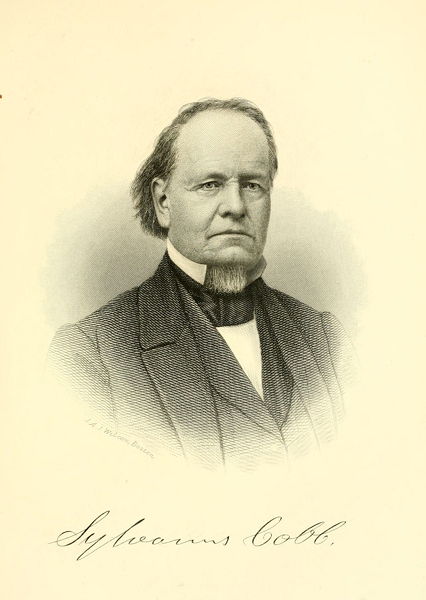
in theological studies with the late Rev. Sylvanus Cobb, D. D., in
Malden; and in 1833 preached his first sermon, in South Dedham.
Besides his settlement in this place, he had pastorates in Milford,
Sterling, and Hardwick, covering a period of ten years. In 1843 the
society in Hyannis invited him to be their pastor. Accepting the call,
he labored in this place faithfully thirty years. After closing his
work here, he ministered to the church in Orleans three years, and
briefly supplied some other parishes. His health has been gradually
failing for some years.
Mr. Pope was a public man in more than one sense. He served Barnstable
for years very faithfully and acceptably
as one of its school committee, and was for two years representative
from the town in the State Legislature. He filled for some time the
office of Register of Probate for Barnstable County, and was for
several years postmaster of Hyannis. He was an active and much
respected member of the Masonic fraternity.
Rev. William M. De Long
was born in Pittsfield, Otsego County, N. Y.,
Sept. 2, 1815, and died in Binghampton, N. Y., Oct. 30, 1877, aged
sixty-two years. He was the youngest of a family of five brothers and
nine sisters. When he was nine years old the family moved to Hastings,
Oswego County. His mother became entirely blind by an inflammation in
her eyes, and by reason of afflictions, of hard times and many
children to provide for, the family was reduced to abject poverty. The
father died soon after removing to Hastings, and the family was broken
and scattered. The mother moved to Clark's Mills, near Utica, where
she died in 1830, when William was fifteen years old. He lived a year
in Sanquoit, with a friend of the family, and while there heard Rev.
W. Bullard and Rev. Dolphus Skinner preach a few Universalist sermons,
in which young De Long became deeply interested, as well as in reading
the "Magazine and Advocate," and for this reason was dismissed from
the machine-shop at Unadilla Forks by its proprietor, a Mr. Abel
Stillman, who, however, reconsidered his unreasonable conduct, and
reinstated Mr. De Long, who worked there long enough to acquire the
money to pay for a year's tuition at Hartwick Seminary. He afterwards
attended the New Berlin Academy. His faith in Universalism grew with
his increased facilities for study, and in August, 1835, he preached
his
first sermon. He was ordained July 20, 1837, and preached under
different engagements at Lebanon, Oran, and Binghampton, in New York.
In 1841 he joined Rev. George Rogers in a missionary tour through Ohio
and Indiana. For many years he itinerated over a large circuit in New
York and Pennsylvania. He was twice married, first to Miss Mary Ann
Ashcroft, who died in 1870, and in 1871 to Miss Mary Jane Swart, an
acceptable preacher of the Universalist faith, who survives him. There
is a good account of her in "Our Woman Workers," by Mrs. Hanson.
In 1873 Mr. De Long began to suffer from a paralytic affection, from
which he could get no relief. These sentences, written and signed by
him a short time before he had lost the power of guiding his pen, show
the strength of his faith: "I know that God is, that my Redeemer
liveth, and that we have a house not made with hands, eternal in the
heavens. This is the source of my consolation."
Rev. W. B. Linnell
was born in Birmingham, England, in 1804, and died
in Indianapolis, Ind., Sept. 6, 1868. His first settlement in the
ministry was in Springboro, Ohio, in 1844, where he continued for
seven years. He afterwards had a settlement in Fairfield, Ind.; Mt.
Pleasant, Ia.; and Oquawka, in which last place he remained until the
breaking out of the war. He then enlisted in the service of his
adopted country as chaplain of the 10th Illinois regiment. Health
failed him, and he returned to his home, after enduring the hardships
of camp life for nearly a year. After recovering his health, he took
charge of the church in Vevay, Ind. He was one of the pioneers
of Universalism in the West, and did good service as a Christian
minister. Having much of the missionary spirit, his appointments were
always numerous, and they were made many weeks ahead. As a preacher,
though not particularly brilliant, he was always efficient. He
inherited the traditional shrewdness and humor of the Yorkshire
people, who were his ancestors, in such a degree as to make him a
marked character among his brother ministers. He was kind and
tender-hearted to a fault, yet his will was unbending, and when his
mind was once made up it was difficult to change him.
Rev. Joshua Britton
came from Westmoreland, N. H., where he was born
Aug. 14, 1803. His early life was spent upon a farm, where he had but
limited opportunities for attending school. But he diligently improved
those that offered, and at the age of eighteen began a successful
career as a teacher, which extended over ten years, pursuing his
studies at the same time, and still adding to his stores of knowledge.
He had from youth a serious and devout mind, and was always a regular
attendant on public worship. He was inclined to the faith of the
Presbyterian Church until about the age of twenty-three, when he had
opportunities for hearing the doctrines of Universalism advocated and
defended by the late Rev. Dolphus Skinner, and others. He became
deeply interested, and his intelligent mind eagerly drank in the new
views presented. His faith grew stronger with the lapse of time, and
he finally resolved to enter the ministry. He preached his first
sermon in 1831, and was ordained at Burlington Flats, N. Y., June 6,
1832. He was settled over parishes in
the State of New York till 1839, when he was in Chesterfield, N. H.,
for a year. He spent the next ten years in Dudley and North Chatham,
Mass.; then three years in Stoddard and Richmond, N. H. He removed to
Vermont in 1853, and preached in Brattleboro, West Concord, Lyndon,
and Bradford for the next fifteen years, when he went to Fort
Atkinson, Wis., which was his home for the remainder of his life. He
was a faithful and excellent pastor; he had a mild and loving heart,
and won many friends. If not one of the greatest ministers
intellectually, he was one of the best spiritually, and his life was a
pure and useful one. He died at Fort Atkinson, Wis., Oct. 30, 1878.
An instance illustrative of the orderly habits of the man was, years
ago, related to the writer. The books in his library were always
exactly in their places, and the backs of them in a straight line. At
one time an exchange minister, who had the free use of the library
during a Sunday's tarrying, had failed to replace the volumes he had
taken down according to the rules of the proprietor. When Mr. Britton
entered the study on his return home, while his brother was yet there,
the first kindly salutations were scarcely over when the projecting
volumes were all noted and quickly adjusted by their owner. A singular
and timely suggestion.
Rev. George Messenger
was originally from Berkshire, Mass., removing
from thence to the State of New York, and afterwards, in 1838, to
Springfield, Ohio, where he ever after lived, a widely known and
highly respected citizen. He was licensed as a preacher at Madison,
N. Y., in 1824, and ordained, at Eatonsbush, N. Y., Oct. 12, 1826. He
was an itinerant preacher,
and much interested in the prosperity of the church where he resided.
As one of the trustees of Buchtel College, he gave much of his time
and attention to the supervision of the erection of the college
building. For the last few months of his life he was very hard at work
at Akron, and while thus engaged contracted a sickness which
terminated in death. "It may be said of him," wrote the editor of "The
Star in the West," "that he died a martyr to the work which had
enlisted his sympathies, namely, establishing Buchtel College on a
permanent basis. He subscribed largely and liberally to the fund for
its erection, and was an unceasing worker in its behalf. His widow,
since his death, has been a substantial helper to the institution. She
endowed the chair of Mental and Moral Philosophy, in memory of her
husband, to the amount of $25,000; and has also contributed largely to
the expenses of the institution, and given again and again for various
special purposes."[49]
Rev. John Temple Goodrich,
of Middlefield, Otsego County, N. Y., born
in 1815, studied theology with Rev. Stephen R. Smith. In 1836, when
less than twenty-one years of age, he was settled as a preacher in
Oxford, Chenango County, N. Y., where he remained about twelve years.
In 1850 he was called to the pastorate of the Universalist Church at
Canton, N. Y., where he remained for five years, doing good work there
and in neighboring places. An affection of his throat induced him to
accept a call to Reading, Pa., where he labored two years, and where
his influence was strong and extended as it had been elsewhere.
After this he was persuaded to return to Canton, and take the agency
of the new Theological School and College projected at that place, and
served in that capacity for five years, successfully, preaching in the
mean time in Canton and elsewhere. It was largely through his efforts
that the New York Legislature appropriated $25,000 to the Canton
schools. Released from this work, he became pastor of the Eighth
Street Church, Philadelphia, where he remained four years, when he
left them out of debt and himself out of health. After an interval
spent in travelling, he went to Wilmington, Del., and supplied that
missionary station for about two years.
While he lived in Canton, he held an oral discussion with Rev. Mr.
Wheeler, Baptist, which continued several evenings, and was a marked
success on the part of Mr. Goodrich. In Wilmington he held a written
controversy with Rev. Mr. Hoffman, a Presbyterian minister, a success
also. Years before this, he had held a written and oral discussion
with Rev. Mr. Dyer, a Presbyterian, of Preston, N. Y., which gave the
cause of Universalism an impetus in that place. Mr. Goodrich was not
combative, and would not seek a controversy, nor would he shrink from
one if duty called him to engage in it. He was devotedly attached to
his family, and was anxious to close up his secular concerns, and
settle down over some parish where the labor required was such as his
health would enable him to perform. With this intent he left home on
the 25th of September, 1871; went to Fulton, then to Watertown, to
Rochester, and to Chicago, where he was seen by acquaintances, and
where his name was entered on the register of the Metropolitan Hotel,
for room No. 36, on the 5th of
October, and where it afterwards remained, with bill unsettled. He,
with many others, perished in the dreadful conflagration at that time.
Rev. Franklin Charles Flint
was born in Nelson, N. H., June 16, 1836,
and died in Shrewsbury, Mass., March 23, 1876. In 1840 his family
moved to Hancock, N. H., and in 1842 to Shrewsbury, Mass., where he
worked on his father's farm and attended a district school. At an
early age he was quite studious, and desired a classical education. He
went through his preparatory course at Thetford (Vt.) Academy, and in
1857 entered Amherst College. But, after spending two years there, he
left, entered at Tufts, and graduated in 1861, the third in a class of
twelve, with a philosophical oration. He was enabled to work his way
through college by gaining, in a competitive examination, one of the
scholarships granted by the State of Massachusetts to Tufts College,
and by what he could earn in teaching school during his vacations.
Upon graduating, he took charge of the high school in Westboro, Mass.,
and in the mean time turned his attention to theology. He preached his
first sermon at Groton (now Ayer Junction). In 1863 he preached in
Dana and vicinity, teaching meanwhile a select school. In 1864-5 he
taught a select school at Hyannis, Mass., and afterwards was assistant
in the academy at Dudley. In 1865 he removed to Chatham, on Cape Cod,
where he was ordained, July 31, 1866. In 1867 he became pastor of the
Universalist Society in Southbridge, Mass., where he proved himself a
faithful minister, a useful member of the school committee, an
efficient worker in the temperance cause, and by his active interest
and co-operation in
every good work, and by his frank and genial manners, won the respect
and good will of the people in and out of his parish. In 1874 he took
charge of the Willow Park Seminary, at Westboro, Mass., but resigned
after one year. He preached for short periods at Oxford and Rockport.
In 1874 he prepared for the press a memoir of the late Rev. W. W.
Wilson, one of his predecessors in the pastorate at Southbridge. In
1875 he took charge of the Universalist Society in Attleboro, Mass.,
but failing health compelled him to resign the position in March,
1876. His people voted him leave of absence, hoping he might recover,
and he went to his father's in Shrewsbury, but he rapidly grew worse,
until death came to his relief. His record is with that of "the
faithful in Christ Jesus."
Rev. Hope Bain was
a Scotchman by birth, from Aberdeen. His father,
once an officer in the British navy, removed with his family to
Maryland, and died in Baltimore in 1812. The son served during the war
of 1812, young as he was (fifteen), as a member of a Baltimore company
of volunteers attached to the 5th regiment, and was in the battles of
Bladensburg and West Point. He was at first a Presbyterian, and member
of that church for many years. In 1830 he was appointed an agent to
labor in West Tennessee, and in the valley of the Mississippi, for the
American Sunday-School Union. He became a Universalist in 1847, and
was ordained a preacher at Norfolk, Va., in 1848. He was for fifteen
years a teacher in Virginia. He moved to North Carolina, in December,
1851, and preached, before the war of the Rebellion, in twenty-six
counties, and, after the war, in six other counties. His
last sermon was in Goldsboro, in 1875. Anticipating his approaching
departure, he said that at the age of eighty-one he could not expect
to remain here much longer, nor did he desire to. He was nearing a
home where he should be united to loved ones gone before. He was
widely known in North Carolina. He was a Union man in the strictest
sense, thoroughly loyal to the government during the late war, which
alienated from him many of his former associates and hearers, but he
never wavered in devotion to his country, and to the cause of the
Christian Gospel. Although without pecuniary resources, he continued
to preach wherever there was an opening, and with little or no
remuneration labored faithfully and steadfastly in the ministry as
long as health and strength lasted. His faith uplifted and sustained
him as he passed from these earthly scenes.
Rev. Woodbury M. Fernald
was for several years a prominent preacher
with the Universalists. He was born in Portsmouth, N. H., March 21,
1813, and died in Boston, Mass., Dec. 10, 1873. He was ordained at
Portsmouth, N. H., in 1836. In 1838 he was pastor at Cabotville (now
Chicopee), Mass. In 1840 and 1841 he was located at Newburyport, and
while there published a volume entitled "Universalism against
Partialism," an able statement of the contrast set forth. He was next
in Stoneham as pastor for three years. In 1854 he removed to Boston,
and becoming interested in the works of Swedenborg and the writings of
Andrew Jackson Davis, he was after a while ordained as a Swedenborgian
minister. He was so fascinated by the New Church doctrines as to
become alienated from his former associates and lost to their
ministry. He published,
in 1854, a "Compendium of the Theological and Spiritual Writings of
Swedenborg," and in 1859, "God in His Providence," in which he
implicitly renounced the notion of "the eternity of Hell," and put
forth a Universalist view of human destiny, turning Swedenborg's
principles against the Seer's own conclusions, and making those
principles the ground of an assurance of Universal Restoration. He
published afterwards other works, evincing much ability. His sincerity
was never doubted.
Rev. Caleb Perin Mallory
was a minister of the Universalist faith in Canada during most of his
life. He died at Huntingville, P. Q., July 13, 1882, aged
seventy-one.
He was born in Eaton, C. E. His early training was under the influence
of the theology after the kind taught by Calvin and Arminius. Being of
a thoughtful and studious disposition, however, he came to see in the
teachings of the New Testament strong and unmistakable evidences of
the Gospel of Universalism. When about thirty years old he appeared
before the public as an advocate of it. Rev. L. H. Tabor, who
officiated at the funeral, gave the following account:—
"As nearly as I can learn, he preached some three years in various
places to good acceptance, and was ordained at Glover, Vt., Sept.
19, 1843, and in just one year from the time of ordination (Sept.
19, 1844), was installed at the request of several brethren residing
in as many of the eastern townships over which he was installed. For
several years he preached regularly at Huntingville and other places
in the vicinity, and for over forty years had attended funerals and
weddings, baptizing children and adults as the disciples of Jesus,
the Saviour of the world. He was a Christian reformer,
ready for every good word and work. No one man could have been taken
from that community whose departure will be felt more. And when we
saw the multitude that gathered at his burial, with weeping eyes, we
were led to say,'Behold, how they loved him.' It was said, by good
judges, that there were a thousand people at his funeral, some
coming the distance of fifty miles.
"Brother Mallory was a man of great energy of character, often
travelling and preaching under such adverse circumstances as would
have discouraged others of less inherent power. His compensation for
services has been comparatively small, but, sustained by the
ministry of the reconciliation, he fainted not, occupying till the
Master came."
In the yearly Universalist "Register," the names of nearly thirty
women are given as ministers,—evangelists or with pastorates,—in the
Universalist Church.[50]
Among the number of those who have served in
this capacity, the record is made of the death of the following:—
Mrs. Elvira J. Powers. She came into the ministry from the Canton
Theological School as a licentiate of the New York Convention. At the
end of six months she was compelled to give up her work on account of
ill-health, and was not able afterwards to resume it. During the war
of the Rebellion, in the office of nurse, she rendered good service,
and wrote an interesting book of her experiences, entitled "Hospital
Pencillings." A friend and former pastor speaks of her personal worth
in very strong terms. "In fidelity to her conviction of duty, in her
industry, zeal, and integrity, in her constant sacrifice of the
superficial and temporal for the profound and eternal, her life was a
great success." She died in Worcester, Mass., Sept. 21, 1871.
Rev. Fanny Upham Roberts,
daughter of Frederic and Hannah R. Cogswell,
both of whom were preachers in the "Christian Connection," was born in
South Berwick, Me., in June, 1834. She joined the Congregational
Church in Northwood, N. H., and was for some time a superintendent of
a Baptist Sunday-school. She had, however, from a child been
acquainted with the Universalist faith. In 1870 she began to give
lectures in public on lyceum topics, and not long afterwards commenced
preaching in Kensington, N. H., and Wells, Me. In the spring of 1871
she removed to Kittery, Me. (where she had been ordained), and
preached there until April, 1875, when from loss of voice she resigned
her post, and went to Minnesota, hoping to regain her health. But the
change of climate failed to arrest her disease, and she steadily
declined until death came to her relief. She died in Winona, Minn.,
Aug. 26, 1875. Her friends testify to her vigor of mind, her goodness
of heart, and the graceful modesty and sweet womanly dignity that ever
shone out in her life. An intelligent member of the Universalist
congregation of Portsmouth, N. H., once informed the writer that in
listening to her
discourses, as he did occasionally, he was forcibly reminded of the
logical clearness and strength of the elder Ballou.
Rev. Prudy Le Clerc Haskell
was born in Louisville, Ky., Feb. 6, 1844,
and died in Oxford, O., Dec. 27, 1878. In her youthful days she was
thoughtful, intelligent, and studious. Her parents were Universalists
in sentiment, and her mind was impressed by the influences of their
religious faith. An only brother, who had intended to enter the
Universalist ministry, died in a Southern prison during the war, and
she felt herself called to take the place which he would have filled.
She was ordained at Madison, Ind., Oct. 14, 1869, where she preached
two years, and succeeded in gathering the scattered remnants of a
former congregation into a living form. She then went to Mt. Pleasant,
Iowa, and labored there successfully for two years, greatly endearing
herself to the people; but the climate proving unfavorable to her, she
was obliged to leave and return to the home of her parents in Aurora,
Ind. She was afterwards settled at Mt. Carmel, Ind., at Jeffersonville
and Newtown, O., and at Covington, Ky. She was an attractive and
interesting preacher, and very popular as a pastor. While residing in
Covington, she was united in marriage to Mr. Cassius L. Haskell, who
afterwards entered the ministry. She had been married but a single
year when her earthly life ended. The remembrance of an evening with
her at a meeting in Mt. Carmel, O., is very vivid in the mind of the
writer. She had been deeply interested in a new church organization
there, and had induced a good number of young believers to become
members. Her welcome and counsel to them were pervaded with the
Christian spirit.
It has been thought advisable to append to this record of the departed
the names of a few of the living ministers, now advanced in years, who
have earned an honorable reputation by their works during the time
included in the survey here taken. It would have been agreeable to the
writer if the number of such could have been increased, but this was
forbidden by the limits prescribed to this volume. Besides, as already
stated, it will be understood that this historical sketching is by no
means exhausted; that there is another and a larger roll of those
passed on, who have done faithful service in the redeeming army, as
there is a noble company of the living who are yet adding their good
work to the history of the church, and whose names and deeds may in
some future day be truthfully and gratefully given to an appreciative
public. For this brief review we are able to take of the faithful dead
and living, let us be thankful.
One of the most aged living ministers of the Universalist Church is
Rev. Clement Fall Le Fevre, D. D., of Milwaukee, Wis. He was born in
Berkhamstead, County of Hertfordshire, England, Nov. 12, 1797. He was
christened in the parish church, as was the poet Cowper, who was a
native of the same county. The father of Mr. Le Fevre was a clergyman
and graduate of Oxford University, and was acquainted with the
distinguished poet, and always held his works in high estimation. In
1814 Mr. Le Fevre had a commission in the British navy as second
lieutenant of the Royal Marines, and was appointed to a frigate and
sailed for Halifax. His war
record was a short one, however, for with the peace of 1815 he was put
on half-pay. He was never in any engagement with the enemy, and, as he
writes, "my sword was never stained with American blood, and theirs
was never stained with mine, and that I consider the better." Having
no particular employment, he was for some time adrift as to a
life-calling, but subsequently inclined to his father's profession,
and in nautical phrase "bore up for a parson." His father was
educating some young men for the Universities, and the son joined in
their classes. Having by this means obtained some knowledge of Latin
and Greek, he received ordination, and was adopted by the Society for
the Propagation of the Gospel in Foreign Parts. This was in the year
1821. His appointment was to a church in Canada, in the diocese of
Quebec, where he remained until the close of the year 1829, when,
rejecting the doctrine of the Trinity and endless punishment for the
sins of this life, he withdrew from the ministry and communion of the
Church of England.
He next removed to New York, and made his home at Hempstead, L. I.,
the native place of his wife; and here and at several places on the
island and in the city of New York he frequently preached. In 1830 he
received fellowship of the Universalists, at the New York and
Philadelphia Association, met at New Brunswick, N. J. He was next
pastor four years in Troy, N. Y., six in New York city, four in
Hudson, and six in Milwaukee, Wis. In the last-named place he
purchased a farm and settled down for the enjoyment of a permanent
home. Although having no special pastorate, he has been doing much
missionary work, has constantly attended the meetings of the church,
and often written
for its publications. His health at this present writing is quite firm
for one of his years, a slight failure of eyesight and a partial
paralysis of the right hand being his principal infirmity.
Mr. Le Fevre enjoys a deservedly high reputation. His pulpit talents
have always been appreciated by his congregations. His discourses have
indicated a keen and well-balanced mind, logical force, and ripe
scholarship. In social life he has always exerted a salutary
influence; his wit and humor being admirable accompaniments of his
gentlemanly dignity and sympathetic spirit. He has proved a valuable
acquisition to the church whose pleasure it is to make this truthful
record of him.
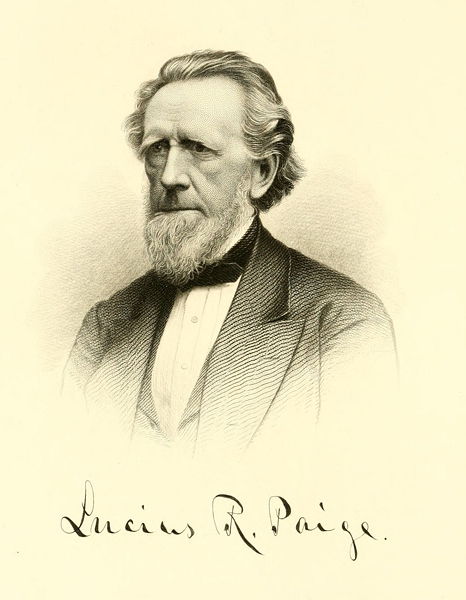
Rev. Lucius Robinson Paige, D. D., is, with two exceptions,[51]
the oldest living minister in the Universalist Church. He was born in
Hardwick, Mass., March 8, 1802, and was educated in the public schools
of his native village. On reaching his majority he began his work as a
preacher, and did some effective missionary work as a layman. In 1825
he was ordained, and was settled at Springfield, Mass., where he
remained four years. During this time, his faith being assailed by two
ministers of the Methodist church, Rev. Timothy Merritt and Rev.
Wilbur Fisk, Mr. Paige entered into a controversy with them, and
proved himself an able advocate and defender of the Christian Gospel.
The debate still exists in pamphlet form, and is one of the most pithy
and searching that can be found. The spirit and behavior of the
bigoted opponents of Universalism
are strikingly illustrated, as well as the readiness and efficiency of
the assailed one to meet and to deal with them. Mr. Paige was next
minister in Rockport, and removed from there to Cambridgeport, where
he was installed pastor of the First Universalist Society July 8,
1832. He held this position until 1839, after which he took no
pastorate, but continued to preach frequently for more than twenty
years afterwards, and has been active in the ministry until within a
few years.
In 1833 he published his "Selections from Eminent Commentators," a
work showing most conclusively the admission on the part of orthodox
writers of the very ground taken by Universalists in their explanation
of many passages of Scripture supposed to stand in opposition to
Universalism. It was a strong call upon all candid inquirers after
Christian truth, and has made its impress in the progress of Christian
thought since it was issued. In 1838 he published "Questions on Select
Portions of the Gospels," designed for Sunday schools and Bible
classes. His greatest work, however, is his Commentary on the New
Testament, the first volume of which was published in 1844, and the
last in 1870. The work is the result of sound judgment, careful
research and close thought, and is a monument of the steady and
untiring industry of the writer. It has been highly acceptable to
those on whose behalf it was prepared. While engaged upon it, he also
contributed to the denominational papers, and gathered materials for
the history of Cambridge, which was published in 1877.
He has also been actively engaged in secular pursuits. He was town
clerk from March, 1839, to January, 1840, and from March, 1843, to
May, 1846, and city clerk
from May, 1846, to October, 1855, and representative in the General
Court in 1878 and 1879. He was treasurer of the Cambridgeport Savings
Bank from April, 1855, to April, 1871, and has been cashier and
president of the Cambridge Bank. He received the degree of A. M. from
Harvard in 1850, and D. D. from Tufts in 1861. Although he has retired
from business, during the past few years Dr. Paige has given much
attention to the preparation of a history of his native town,
Hardwick, and after many years of hard work the task is completed and
the manuscript is now ready for the printer. He is a member of the
Massachusetts Historical Society, and one of the oldest on the roll;
also of the American Antiquarian and Phi Beta Kappa societies.
As a Mason he has stood high. He joined the Order in Little Falls,
N. Y., in 1824, became Worshipful Master of the Hardwick Lodge in
1826, having previously been exalted to the Royal Arch degree at
Greenwich, and having joined the Knights Templars in 1824. He is now
the oldest Past Commander of the Knights Templars within the
jurisdiction of Massachusetts and Rhode Island. He became Steward of
the Most Worshipful Grand Lodge of Massachusetts in 1848, and deacon
in 1850. The year following he was elected right worshipful deputy
grand master. Upon retiring from that position, he became a permanent
member, and is now the oldest surviving permanent member of the Grand
Lodge. In 1861 he received the thirty-third degree Scottish, and was
at once admitted a member of the Supreme Council. Here he served as
Secretary two years, and Minister of State three years. He is now, as
he has been for nineteen years past, resident representative of the
Supreme Council of Belgium.
One of the most noticeable events in the life of Dr. Paige was that of
the celebration of his eightieth birthday, in the vestry of the
Universalist Church in Cambridgeport, on the evening of March 8, 1882.
A large company was assembled, and after a feast at the tables, very
impressive exercises followed. Rev. O. A. Safford, pastor of the
Universalist Church, presided, and introduced Dr. Paige to the
company, who heard from him a very appropriate and affecting address.
The assembly was then addressed by Mayor Fox of Cambridge, Rev. Dr.
McKenzie of the Congregational church, Rev. Drs. Sawyer, Adams, Miner,
and Capen, Rev. C. A. Skinner, J. A. Jacobs, Esq., the city clerk, and
Capt. J. W. Cotton. A letter, expressive of his sincere and hearty
respect for Dr. Paige, was read from Professor Longfellow. A handsome
illustrated copy of Longfellow's Poems was presented to the doctor,
bearing this inscription: "Presented by a few old friends, with their
congratulations and best wishes on the 80th anniversary of his
birthday."
J. H. Daniels Pr. Boston.
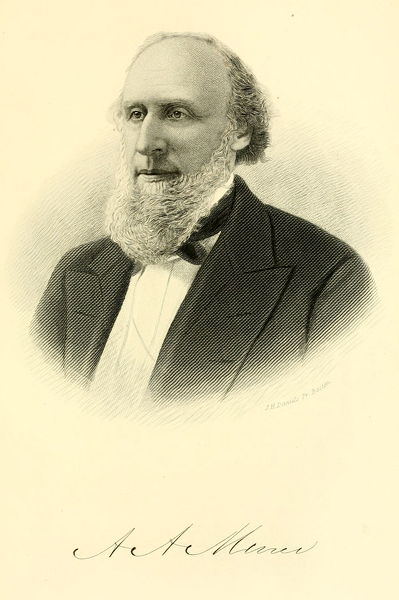
A. A. Miner.
On Monday, May 1, 1882, the Columbus Avenue Universalist Church
celebrated the thirty-fourth anniversary of the pastorate of Rev.
Alonzo Ames Miner, D. D., LL. D., who entered upon his duties
as a colleague of the late Rev. Hosea Ballou, pastor of the Second
Universalist Society in Boston, in place of Rev. Dr. E. H. Chapin,
called to New York. Mr. Miner was born in Lempster, N. H., Aug 17,
1814. His ancestors on both sides were distinguished by good sense and
firm physical constitutions. His remote American forefather, Thomas
Miner, landed at Boston in the same year with the elder Winthrop (1630),
and removed to Connecticut with the company of the younger Winthrop
about 1646. His grandfather, Charles Miner, served in the
Revolutionary War, and removed to New Hampshire soon after its close.
Thomas Miner, his ancestor, was a descendant of Henry Bulman of the
Mendip Hills, Somersetshire, England, who furnished Edward III., when
on his way to embark for the wars of France, with an escort of one
hundred men, selected from his servants and from the men employed in
his mines. For this service the king honored him with a coat of arms,
and changed his name to Miner.
Dr. Miner was so feeble in his youth that it seemed doubtful whether
he would grow up into mature life. But good care and judicious
training wrought a change for the better, which was doubtless aided by
a vigorous will. His education was gained at village schools and
academies in New Hampshire and Vermont. He began teaching between
terms when he was sixteen years of age, and in 1835 took entire charge
of the Scientific and Military Academy at Unity, N. H. His first
discourse in the pulpit was delivered in February, 1838. In 1839 he
received ordination, and was settled in Methuen, Mass. In 1842 he
removed to Lowell, where he became an efficient yoke-fellow with the
pastor of the First Universalist Church, and where they made good
proof of their ministry in the pulpit and through the press. Dr. Miner
remained in Lowell as pastor of the Second Society until the removal
of Rev. E. H. Chapin from Boston to New York, when he was called to
take his place as colleague with Rev. Hosea Ballou at the Universalist
Church in School St. On the death of Mr. Ballou, he became pastor of
the church, which office he
still retains. His health failing him partially in 1851, he visited
Europe, and on his return found that his church edifice had been
remodelled during his absence, at a cost of $20,000. Subsequently, in
1872 the building in School Street was put to secular uses, and the
edifice now occupied on Columbus Avenue was erected at a cost of
$150,000. During his long pastorate, two colleagues have been settled
with him, Rev. Roland Connor, for a short time, and Rev. Henry I.
Cushman, now pastor of the First Universalist Church in Providence,
R. I.
In 1862, after the decease of Rev. Dr. Ballou, President of Tufts
College, Dr. Miner was chosen to this office, and took upon himself
its duties in connection with his work as pastor in Boston. His energy
seemed adequate to this double task for a time, until it became
evident to him and his friends that the interests of both college and
parish required his main attention to be given to but one of them. He
chose the parish, to the great satisfaction of its members, and Rev.
E. H. Capen, one of the alumni of the college, was elected its
president.
Through his past life-course Dr. Miner has been one of the most
indefatigable of toilers. As a Christian minister and reformer he is
widely known. His pulpit talents are of the highest order. His clear,
strong, and readily modulated voice, his sharp logic, often "on fire,"
his good scholarship, his aptness not only in making his points, but
in the elucidation of them; his thorough acquaintance with the
evidences of his faith, and especially with the scriptural proofs of
it; his directness in striking at the wrong, as he perceives it, with
most telling blows, and his uncompromising adherence to what he
considers the right, are sure to gain him a respectful and serious
hearing wherever he comes before the public. His many published
discourses evince his power as a theologian, and his little volume,
"The Old Forts Taken," embodies a searching review of some of the
over-confident statements of Rev. Joseph Cook on the religious signs
of the times. It would have been well for Christian truth, and for
some of the churches professing it, whose representatives so readily
applauded many of the stirring and sensational words of Mr. Cook at
the moment of their utterance in Boston, could they have listened also
to a close and rigid questioning of them by Dr. Miner. The
Universalist Church generally, we think, would be quite willing to
abide by the presentation of its faith and the claims of it, by him.
At a conversation circle, embracing members of the "Radical Club,"
held in Boston within a few years, where all shades of religious
opinion were represented, the question "Is Christianity a Finality?"
or, in substance, can any religion superior to it be given to man? was
proposed for consideration. After various discussions on the subject
from the purest orthodoxy to the most radical "liberalism," Dr. Miner,
who had come in while the subject was under discussion, was invited by
the chairman to speak. His statements were very readily made, viz.
that the Christianity of the New Testament included the best religion
conceivable by man, meeting his deepest spiritual wants, answering his
highest aspirations after the purest life here, and his most anxious
hopes respecting the future of himself and the race. All this is
presented, and its complete fulfilment with all souls assured through
Christ, the promise of whose mission is, that ultimately "God shall be
all in all." If Christianity is true, therefore, it will have no
successor. The discussion was at an end.
As a Christian reformer Dr. Miner has gained a deserved prominence. He
has been outspoken on the subject of Capital Punishment, advocating
its abolishment, and in the Anti-slavery war proved himself one of the
veterans. It is in the Temperance reform, however, that he has taken a
strong and marked interest. As an advocate of Prohibition he is one of
the leaders in the land. The pamphlet on Prohibition, published in
1867, containing his arguments on the subject before the Massachusetts
Legislative Committee in the Representatives' Hall, is one of the most
readable documents of the times.[52]
His ready answers to the
questions proposed to him, and his telling questions pressed upon the
advocates of liquor license laws, on that occasion, evinced a mastery
of the situation not often realized. In temperance conventions and
conferences he has often some searching criticisms on the city
officials in their evasions of the laws respecting the liquor traffic;
and on every available occasion when called to speak on the moral
needs of the State and the moral responsibility of the people, he is
quite sure to give a few ringing notes emphasizing the temperance
reform. Dr. Miner has been for ten years past President of the
Massachusetts Temperance Alliance.
As an educator Dr. Miner has done good work. He began it early, and
has never lost interest in it. As president of the college, a member
of the State Board of Education, and Chairman of the Board of Visitors
of the Normal Art School, he has been true to it constantly.
His business talent is well known. He is a safe and far-seeing
financier, to whom the interests of the busy
movers "on 'change" are somewhat familiar. In all financial plans and
operations demanding his action he is especially and effectively at
home. He is President of the Universalist Publishing House, and is
still one of the trustees of Tufts College. The degree of D. D. was
conferred upon him by Harvard College, and that of LL. D. by Tufts
soon after his resignation of the presidency of that institution. He
was one of the "Hundred Boston Orators;" having been called to deliver
the oration before the authorities and citizens of Boston, July 4, 1855.
The positiveness and persistence of Dr. Miner have sometimes had the
effect to alienate rather than conciliate those who might conscientiously
differ from him in their convictions of right and duty. It is to be
lamented, however, that where we find one possessing his degree of
positiveness in what he believes to be right, we are more or less
"troubled on every side" by those who are only half-men because of the
low policies and expediencies by which they are governed. His
confidence in the right seems instinctive; as he says, "A mountain can
be tunnelled; a principle never." A Boston secular journal just now
speaks of him:—
"His honesty nobody has ever questioned. If he hit hard, he hit
where he believed hard hitting was warranted and indispensable. It
is fortunate for the world, perhaps, that he took a liberal side in
theology. Had he been a Calvinist, he would have been as
uncompromising as any one of those Puritan inflexibles who drove
Baptists into Rhode Island and Quakers into eternity; had he
embraced Catholicism, heretics would have fared the worse for it,
and he could hardly have found his fitting place anywhere short of
the college of cardinals, with its possibilities toward the chair of
St. Peter. By
the same qualities that make him a terror to his enemies, he binds
his followers to him with hooks of steel."[53]
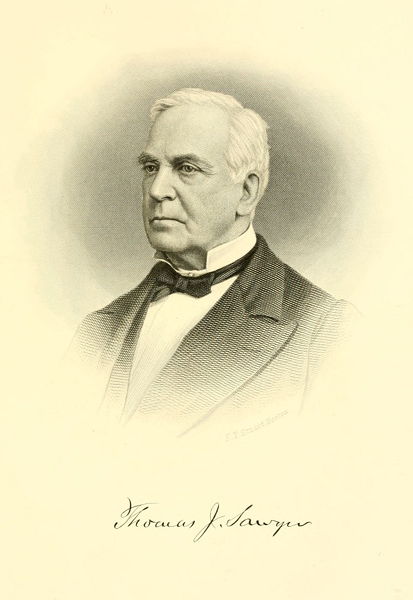
F. T. Stuart Boston.
Thomas J. Sawyer.
Rev. Thomas Jefferson Sawyer, D. D.,
was born in Reading, Windsor Co.,
Vt., Jan. 9, 1804. His father was one of the earliest settlers of the
town, having removed with his father's family from Pomfret, Conn. The
son enjoyed very good advantages for acquiring a common-school
education, and at the age of eighteen had gained such a mastery of the
branches then taught in such schools as to become a teacher, in which
capacity he served three or four months every year until he entered
his profession. He entered Middlebury College in the autumn of 1825,
having completed his preparation after he was twenty-one, and
graduated in 1829. As there were no theological schools to aid him, he
went to study with Rev. William S. Balch, then at Winchester, N. H.,
who was soon called to Albany. Mr. S. remained in Winchester through
the winter, preaching occasionally, reading the Iliad of Homer, and
studying such theological works as he had opportunity to find.
In April, 1830, he went to New York, and took charge of a small
society there in Grand Street. The chapel in which he preached had
been built and was for several years occupied as an Episcopal church.
It was afterwards purchased by the Universalists.
In 1832 Mr. Sawyer entered upon his ministry with his people in a new
place, a church on Orchard Street. The church was built three or four
years before by a small society of the Reformed Dutch Church, from
which the property fell into the hands of two enterprising builders
who had been the contractors for it
when it was erected. It was rented to Mr. Sawyer for two years. He was
then a young minister of scarcely two years' standing in New York, and
had entered the ministry only two years and a half before. He had been
married six months and had no cash investment. Four members of his
congregation became his security for the payment of the rent, and he
in turn pledged for their security the whole income of the
church,—pew-rents, collections, and all. Under the circumstances he
was assuming quite a responsibility. The income of the society had
been small, and its receipts now were not equal to the rents alone.
Besides, Universalism in New York had suffered greatly through the
defection of Abner Kneeland, and the consequences of his lamentable
course were still fresh in the memory of all. Divisions and
heart-burnings still existed, and the prospect was not greatly
encouraging to the new adventurers. Yet it was seen that, if success
was to be realized, a new movement, as independent as possible of the
old issues, must be made. Hence this piece of wise policy in securing
a new location, and beginning church-life under new auspices. It was a
bold step, but a good Providence had directed it. Mr. Sawyer writes of
it:—
"I well remember the joy we all experienced when we entered the
Orchard Street Church. The transition from the little Grand Street
chapel which we had previously occupied was striking enough. The
church was large, very large, to my unpractised eyes. True, it had
no side galleries, as it had afterwards, and was in every respect
inferior to what it became, but I doubt if Solomon, when he first
entered his majestic temple, felt more deeply impressed with its
greatness or its awful sanctity than I did on the day when we first
occupied
this church. It seemed to me a goodly place, where, as I hoped,
Universalism was to be revived and restored in that great city."
There were prophecies of failure on the part of some friends, but the
persistence and faithfulness of the young pastor (encouraged by his
companion, whose whole heart was in her husband's work) and his brave
adherents, by God's blessing, wrought success.
In 1832 the city of New York was visited fearfully with the cholera.
It was suggested by some that the church should be closed during the
epidemic, and the members of the congregation were one day desired to
remain after service to express their opinions on the subject. Many
were about to leave the city, and thought the church might be closed
for two or three months and the pastor dismissed to the country. At
last Captain Packard, a somewhat eccentric but warm-hearted and worthy
man, rose and said that he should remain in the city, and if ever he
needed the support and consolations of religion, it was during such
seasons as they had already entered. If the pastor felt alarmed and
desired to leave, he of course would not complain, yet he should
greatly desire to come up to the house of his heavenly Father to
listen to his word and worship at his altar. This settled the
question, and the Orchard Street Church was open regularly, morning
and afternoon, through the whole of that gloomy and trying season. And
in this case, as always, the path of duty proved in the end the path
of greatest advantage. Many—perhaps a large part—of the churches in
the city were closed, and the pastors gone. The minds of the people
were seriously impressed, and the Gospel of infinite grace proved
itself well fitted for such an emergency. The Universalist church was
uniformly well attended, and great good was accomplished by its
ministrations. The society continued to increase. Old friends, whom
circumstances had alienated or caused to stand aloof from the
movement, returned one after another and forgot their former
difficulties and discontent. The best of feeling existed among the
members and greatly encouraged all hearts.
Though the Reformed Dutch Church gave up their new house on Orchard
Street, yet no sooner had it come into the possession of Universalists
than the members of that communion began to express a most lively
concern for the interests of religion. Dr. Sawyer writes:—
"The 'Christian Intelligencer,' their religious journal, soon began
to pay some attention to Universalism; and Dr. Brownlee, one of the
boldest, if not one of their ablest, men and ministers, commenced a
course of lectures against the doctrine. The lectures were repeated
in the Dutch churches in the city, and briefly reported in the
'Intelligencer.' An attempt was made to get them repeated in the
Orchard Street Church, but failed. The Doctor was quite too busy to
permit it. His lectures were regarded by his friends as exceedingly
able and altogether irrefutable. He possessed a great deal of
assurance, and made assertions with vast boldness and emphasis. As a
reasoner he was but a third or fourth rate man. The ad captandum was
his forte, and among those who knew nothing of Universalism, and
undoubtingly believed in endless misery, his reasons were
satisfactory if not convincing."
The lectures were closely examined by Mr. Sawyer before large
congregations. It was a grand opportunity, and he improved it. This
review was afterwards given to the public through the press. The
attack intended
to check the spread of Universalism served to increase and strengthen
it. During Mr. Sawyer's subsequent pastorate of thirteen and a half
years, other controversies followed. With Rev. Mr. Slocum, a
Presbyterian clergyman, he held a discussion that occupied fourteen
evenings, and added twenty families to the Universalist congregation.
He answered Rev. Mr. Remington, a Methodist clergyman, and reviewed
Rev. Dr. Parker's lectures on Universalism. These lectures of Mr.
Parker had been preached and published in Rochester some years before,
and were, without essential alteration, repeated in several churches
in New York. Mr. Sawyer happened to possess the Rochester copy of the
production, and very much to the astonishment of many he replied to
the learned Doctor's lecture on the very evening after he had
delivered it in the immediate neighborhood in the morning. Another
debate was also held by Mr. Sawyer with Rev. Mr. Hatfield, the
substance of which was published in a small volume entitled
"Universalism as it is." It was a rule with this sentinel on the
Universalist watch-tower in that city never to allow any antagonist of
"the faith," whose position and character deserved attention, to pass
unnoticed or unanswered.
The Orchard Street Church was emphatically a success. After Mr. Sawyer
left it in 1845, it enjoyed the effective pastorates of Rev. Otis A.
Skinner, since deceased, and Cyrus H. Fay (still useful and honored
among our older ministers), and others. It has probably done more for
the diffusion of Universalism than any other single society in the
State. All the societies in its immediate neighborhood, Bleecker
Street, Murray Street, Fourth Street, Brooklyn, and Williamsburg, were
first formed by members of Orchard Street, and may be regarded as
offshoots from that parent stock. It labored not merely for itself,
its own ease or aggrandizement, but for the good of the cause, a
veritable missionary institution.
In the autumn of 1845 Mr. Sawyer removed with his family to Clinton,
Oneida Co., N. Y., and took charge of the Clinton Liberal Institute.
He succeeded in converting it into a Universalist school, and opened
in connection with it a primitive theological school from which he
sent out about twenty-five students, more than twenty of whom are
still in the ministry well and successfully employed. At the close of
1852 he returned to New York, and, having preached for what was
formerly called the Dry Dock Society a year, he returned to his old
parish and continued with it until the spring of 1861, when, on the
breaking out of the Rebellion, and the volunteering of his oldest son
on his farm at Clinton, and on account of parish affairs in that
distracted time, he resigned and went to Clinton, where he remained,
preaching for the parish there until January, 1863, when he again
returned to New York, and took the editorial charge of the "Christian
Ambassador." This paper was founded by Philo Price in 1831, under the
name of "The Christian Messenger," of which Mr. Sawyer was the
theological editor for several years. It passed under several names,
and is now published at Boston as the "Christian Leader," united with
the Universalist weekly formerly issued in this city.
In the autumn of 1865 he removed his family from Clinton to Star
Landing, N. J., and took possession of a farm he had just purchased
there. Here he remained, managing the farm and preaching occasionally,
until the autumn of 1869, when he came to College Hill, Mass., and
assumed the duties of Professor of Systematic
Theology in the Divinity School, to which he had some time before been
elected. He was one of the original trustees of Tufts College, having
called the educational convention held in New York in 1847, which
resulted in the establishment of the college. He was also chiefly
instrumental in calling the first meeting in New York city to consider
the necessity of establishing a theological school, which resulted in
the founding of the Canton Theological School and the St. Lawrence
University, of which he was also one of the original trustees, and for
several years President of the Board. He received the honorary degree
of S. T. D. at Cambridge, in 1850.
Among the published works of Dr. Sawyer are his Letters to Dr. W. C.
Brownlee and to Rev. Stephen Remington in review of their Lectures
against Universalism; the Occasional Sermon delivered before the
United States Convention of Universalists in New York, September,
1841; "Endless Punishment, its Origin and Grounds Examined, with other
discourses," 1845; Review of Rev. E. F. Hatfield's "Universalism as it
is," 1841; Two Discussions with Rev. Isaac Wescott on Universal
Salvation; "Who is Our God? The Son or the Father?" a Review of Rev.
Henry Ward Beecher, 1859; a preface to the Philadelphia edition of
Petitpierre on "Divine Goodness," in 1843; "Endless Punishment in the
Very Words of Its Advocates," Boston, 1879; an article in the North
American Review, one of a series on the subject of Endless Punishment,
in the March and April numbers of 1878. Besides the Occasional Sermon
already noted, he has preached two others before the United States
Convention, one in Middletown, Conn., and the other at Rochester,
N. Y., in 1876. From the beginning Dr. Sawyer has taken a deep
interest in the
literature of Universalism. He has written much for the "Quarterly"
and for the other church periodicals. He was instrumental in
originating the Universalist Historical Society, which has now a very
valuable library at Tufts College.
Dr. Sawyer has been an incessant and faithful toiler; and in all his
work, whether as preacher or teacher, has sought the promotion of the
Gospel of Universal Grace. His adherence to the work and advancement
of the Universalist Church has been steady and unfaltering, and his
defence of the Christian Revelation as an authoritative dispensation
from Heaven through Jesus Christ, clear and unequivocal, in admirable
contrast with the flippant rationalism and scepticism which have in
too many instances found expression under the names of "Liberal
Christianity" and "Free Religion."
There is a church edifice in New York city in 127th Street, near
Lexington Avenue, which represents the Second Universalist Society of
New York, organized in 1828. It was completed two years ago, and is
called the "Sawyer Memorial Church."
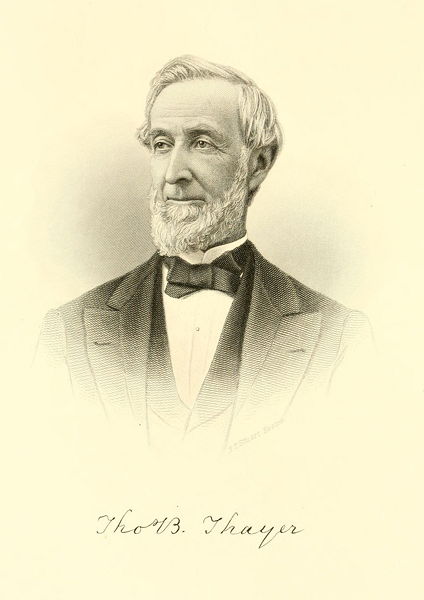
F. T. Stuart Boston.
Thos B. Thayer.
Among the older living ministers who have made themselves specially
and constantly useful in the Universalist Church during the last
half-century, no one is deserving of more grateful notice than Rev.
Thomas Baldwin Thayer, D. D. He was born in Boston, Sept. 10, 1812.
Having received the usual rudimentary training and experience of
boyhood, he successively passed through the grammar schools of his
native city, and at an early period in youth he entered the Latin
school under the direction of Mr. B. A. Gould. The young student had
testimonials that his diligence was
observed with marked approval. He entered college at Cambridge, where
by permission he was to pursue his studies for the first year, without
college rooms, under the tutorship of Mr. F. P. Leverett, the
distinguished author of the Latin lexicon. For certain reasons he was
induced at the end of his first year to abandon a collegiate course,
and from the duties of a college student he very soon entered the
Hawes Grammar-school in the capacity of an assistant. Soon after this,
Mr. Leverett, resigning his position as principal of the Latin School
in Boston, opened a private institution, mainly with a view to prepare
students for college, and invited his former pupil to become his
assistant, which invitation Mr. Thayer accepted. It was while
connected with this school that his purpose to devote himself to the
work of the ministry was formed.
His first engagement to preach was with the Universalist Society in
South Dedham (now Norwood), where he supplied the pulpit for several
months. This made his work quite arduous. His duties in his school and
those in the growing parish kept him constantly and closely employed.
In June, 1832, Mr. Thayer received Letters of Fellowship from the
Boston Association, and was ordained by the same body in the following
December. In April, 1833, he accepted an invitation from the First
Universalist Society in Lowell, and entered upon a pastorate there,
which he kept for twelve years. While in this city, as another has
written:—
"Encouraged by the large congregations which regularly attended on
his preaching, he was moved to consider whether it were not possible
to meet the inquiring spirit of the people by a course of sermons
under circumstances which would give opportunity to present the
leading doctrines of Universalism
to a larger number of persons than could be accommodated in a
church. This thought was communicated to some of the leading members
of the society, and after due consultation, followed by prompt
action, it led to the experiment of a series of sermons in the
capacious City Hall. The immense room was filled with attentive
hearers throughout the entire course. He then proposed that, in
conjunction with his own labors in the church, regular preaching
should be held four or five Sundays in the City Hall, and that a
subscription of fifty cents from each person friendly to the project
should defray the expenses incident thereto. Rev. J. G. Adams was
engaged to supply the specified time. The result was that to this
day the meetings have never been discontinued. The germ was
originated, which, under the ministry of Rev. Zenas Thompson,
developed into the Second Society, now worshipping in the beautiful
edifice on Lowell Street."[54]
From Lowell Mr. Thayer removed to Brooklyn, N. Y., in 1845. His six
years in this city were years of great usefulness to his church and
beyond its limits. He connected himself with the Odd Fellows, and
became editor of the "Golden Rule," a paper published in the interest
of the fraternity. In 1847 he gave a series of lectures on "Social
Progress," which were reported in part for the N. Y. "Tribune," as
also a series of lectures on the "Dangers of City Life," especially in
reference to young men. He was active in advocating social reform, the
efforts for juvenile vagrants, and for the moral elevation of the poor.
Dr. Thayer has remarkable qualifications for a Christian minister,
teacher, pastor, and writer. His sermons are always alive with
thought, easily and earnestly delivered, doctrinally strong and clear,
practically pointed,
and plain; a mixture often of forcible preaching (not reading)
from manuscript, and freest extemporaneous outpouring, sweet and fresh
with the heavenly fragrance of the Gospel. In his Scripture readings
at the opening of the church service, he is usually very acceptable to
the hearers, interspersing the reading with explanatory words and
brief practical inferences.
Dr. Thayer is well known as an author. In the early days of his
ministry he published a volume entitled "Christianity against
Infidelity," an able and a timely offering to the public,—a strong
and candid appeal to the reader in behalf of the Christian Gospel from
the Universalist standpoint. The work was some years afterwards
enlarged, embracing the objections to historical Christianity by
Strauss and Renan, and replies to them. A republication of this work
would be timely now, in this season of theological thought, of
religious drifting and doubt, of indifference and scepticism. His
"Theology of Universalism" is a work of great merit, as also his
admirable volume "Over the River." They deserve a place in the library
of every minister, and should find a home in every Universalist family.
His most valuable work, however, has been done as editor of the
"Universalist Quarterly." His qualifications for this service are
striking. In addition to the able discussions in the publications from
the pens of other authors, the department containing the editor's
outlook into the religious world, his notes and comments on the times,
and his discriminating notices of new publications, is of itself a
rich and welcome entertainment to all who are familiar with the pages
of the Quarterly, a review reflecting great honor upon the
Universalist Church, and which the Universalist fraternity cannot
afford to lose or neglect.
After closing his ministry in Brooklyn, Dr. Thayer had a second
pastorate in Lowell with his old society, during which a severe
calamity came to him. He was thrown from a carriage by a frightened
horse, and so badly injured that for some time his survival seemed
very doubtful. His many friends were deeply anxious, and the strain
upon his physical system was intense. But through all this terrible
sorrow his faith and hope sustained and inspired him, and the lessons
of his sickness and Christian endurance were to many souls more
impressive than any they had ever received from his pulpit
ministrations. It was a cheering event to hosts of friends that he was
gradually restored to the calling he so much loved, though with the
effects of the accident upon him which must go with him through life.
He afterwards removed to Boston, and was for a few years the
much-esteemed pastor of the Shawmut Universalist Church in this city.
Since his resignation there he has frequently supplied pulpits in the
vicinity of Boston, always to great acceptance. At the present time he
is engaged principally in his work with the pen.
Notwithstanding the unquestionable qualifications of Dr. Thayer as a
public speaker, he is usually inclined to distrust himself, but no one
of our ministers, when called upon to present any question of
importance at the public assemblings of the church, is more acceptable
than he. His lively musical notes of Christian truth and earnestness
are sure to awaken a response in the souls of the listeners.
Rev. William Stevens
Balch, of Elgin, Ill., is one of the oldest of the Universalist
ministers now in active
service. He was born in Andover, Vt., April 13, 1806. He received
fellowship as a minister, of the General Convention at Saratoga,
N. Y., in September, 1827, and ordination in Claremont, N. H., in
June, 1828. His first location was in Windham County, Vt., boarding in
Dummerston, preaching in neighboring towns one Sunday in each month,
travelling on foot to the several stations, and receiving the payment
of five dollars per Sunday. He remained there preaching in nearly
every town in that region, until invited to his first settlement in
Albany, N. Y., January, 1831. Being after a time worn down with
over-exertion, he felt obliged to leave, and was settled next in
Watertown, Mass., to which place he had been invited before going to
Albany. His health soon improved, and he found himself in the receipt
of a salary of $450. But again his health failed, and he was induced
to remove to Claremont, N. H., in April, 1832. He preached there half
the time, and supplied in Hartland and Springfield, Vt., and Newport,
N. H., until a new church in Claremont was finished. Here he was very
actively employed, not only as a pastor, but in doing missionary work
in every direction.
In September, 1835, at the General Convention held in Hartford, Conn.,
he was recommended by Rev. Dolphus Skinner to a committee of the
society in Providence, R. I., which was there to find a preacher "not
committed to Restorationism or Ultra-Universalism," in reference to
which isms the parish was quite divided. Mr. Balch consented to
supply three Sundays, not as a candidate, for he desired to live in
the country. He was, however, invited and urged to settle there, which
he did, after some hesitancy, in March, 1836. His ministry proved a
successful one. In two years the large
church was crowded, and a second society was formed in the city. In
1842 he was invited to go as a candidate to the church in Bleecker
St., N. Y. He declined, but soon after received a call to become the
pastor there. Having become interested in what was known as the "Dorr"
movement, and freely expressing his wish to have a "Republican form of
government" by a Constitution, and seeing a political storm brewing,
he accepted the call from New York, and settled there in November,
1842.
In 1848 he visited Europe, intending to go to Palestine. The troubles
of that year made it difficult to go further than Rome. In 1852 he was
asked by two men, not of his church, with whom a third joined, to go
abroad if he wished, with full permission and means to journey as far
and stay as long as he pleased. He was wise enough to accept the
generous offer, and travelled extensively in Europe, extending his
journey to Palestine, across the Desert, and through Egypt to Nubia.
After seventeen years' hard work in preaching, lecturing, and writing
on religious and moral reform topics, he became quite worn down, and
resolved to take life a little more leisurely for his body's sake, an
exceedingly difficult course for him. He went to Ludlow, Vt., in 1859,
preaching there half the time, and supplying other places, lecturing,
and really working as hard as when in New York city. He then had
another removal, to Galesburg, Ill., where he preached five years, and
again resolved to retire, and removed to Hinsdale in 1870. But he
still preached. In 1871 he was urged to come to Elgin, Ill., where the
minister's work was still before him. In 1877 he entered the plea of
old age and resigned, purposing a visit to California. Meantime he
was invited to preach a Sunday in Dubuque, Iowa. The result was
another pastorate. He refused to "settle," but consented to supply a
few Sundays until the society could obtain a pastor. He continued
three years and three months, not removing his family, but
staying there. His ministry gave great encouragement to the
church in Dubuque.
In 1880 Mr. Balch visited California; in 1882 the City of Mexico; and
last winter Florida. At the present time his health is quite firm. As
he writes of himself, "I am comfortably situated, use no glasses
except in dim light; and am fairly content in contemplating the past,
still busy with the present, and hopeful of a happy and immortal
future."
When in Providence, R. I., Mr. Balch gave a course of "Lectures on
Language," which were published in 1838. He also wrote a "Grammar of
the English Language, explained according to the Principles of Truth
and Common Sense," published by B. B. Mussey, Boston, and passing
through four editions. In 1849 his volume "Ireland as I saw it" was
issued, and in 1881 "A Peculiar People," the first edition of which
sold in eight weeks. He is the author of a "Sunday-School Manual,"
published in 1837.
The business capacity of Mr. Balch was evinced in his raising funds
for the Theological School at Canton, N. Y., taking charge of the
location, plan, and rearing of the buildings, and selection of a
principal. He afterwards completed the raising of a large fund for the
institution, obtaining also $10,000 for the library, and securing the
valuable libraries of Dr. Credner, and Rev. S. C. Loveland. He devoted
much time to the business of making the "Christian Ambassador" of New York a
denominational paper, and placing it on a sound financial basis. His
work in these particulars was well and faithfully done.
Mr. Balch has always been a very ready and popular speaker with the
masses. The graces of oratory he has not sought, but his talking power
seems inexhaustible. Although in favor of fraternal organization for
the good of the cause, yet his ideas in reference to creeds and to
centralized authority are not accordant with those of many others of
his brethren, who hold in high estimation the work he has done in the
spirit and in the truth of the Gospel.
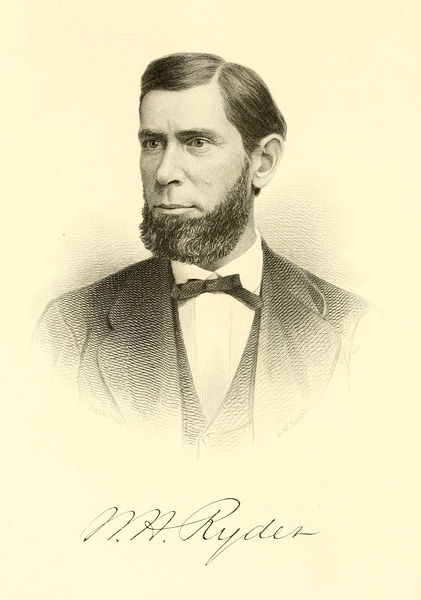
Black. Phot. H. W. Smith.
W. H. Ryder.
Among the long and successful pastorates in the great city of the
West,—Chicago,—we may note that of Rev.
William Henry Ryder. He is
a New England man, having been born in Provincetown, Mass. (the son of
Capt. Godfrey Ryder), July 18, 1822. During the early life of the son
it was supposed that he would become one of the fraternity of seamen,
as his worthy father had been. But this seems not to have been the
Providential intent. The parent did his part in sending the lad to sea
in a vessel bearing his own name, "William Henry," but the experience
of a shipwreck cured the young sailor of what nautical tastes he might
have possessed, and turned his attention in another direction. He
became anxious for the life of a student, and in his eighteenth year
entered Pembroke, N. H., Academy. He was a diligent and progressive
scholar, and while at this institution decided as to the profession
upon which he afterwards entered. At the age of nineteen he preached
his first sermon in Manchester, N. H., and during the year following
he preached frequently in Concord, in the same State.
Leaving the school in Pembroke, he entered Clinton Liberal Institute
(Clinton, N. Y.), then in care of a learned and efficient teacher, Dr.
Clowes. He preached frequently during his stay there. In the autumn of
1843, soon after he was twenty-one, he was invited to take charge of
the Universalist Society in Concord, N. H., to which place he removed,
and in November of that year was united in marriage with Miss Caroline
Frances Adams, who has proved a worthy and faithful helper to him in
all the experiences connected with his profession. His ordination took
place in December, 1843. His ministry here was successful. The society
had been formed under the ministry of Rev. J. G. Adams while doing
missionary work in New Hampshire, in 1834. Faithful men and women had
kept it alive through changes and vicissitudes until it realized a new
prosperity under Mr. Ryder, which has continued to the present time.
After two and a half years of successful labor here, he accepted a
call to the neighboring city of Nashua, a larger and more promising
field, which he occupied to good effect. While giving great
satisfaction to his people, he became deeply impressed with the
conviction that his ability to serve the church in the capacity of a
Christian teacher according to his own ideal would be made greater by
a more thorough course of study than he had yet been able to take, or
than he could take with the cares of a pastor upon him. He therefore
determined to spend a year and a half abroad in study and observation.
Resigning his charge in Nashua, he sailed from New York to England.
Landing at Kinsale, Ireland, and exploring the lake region of
Killarney, he passed on to Dublin, and crossed the channel into
England,
where he tarried awhile, visiting places of historic interest, and
making the acquaintance of several persons who were specially
interested in his own faith and profession. While in London and
vicinity, he was cordially greeted by the Unitarian ministers there,
and preached in two of their churches. He soon crossed to the
Continent and came to Berlin, where he applied himself diligently in a
course of study under German instructors for seven months. He next
extended his travels to Palestine, visiting Jerusalem and many other
noted places there. He also visited Athens, Constantinople, Cairo, the
Pyramids, Malta, Naples, Rome, Florence, Geneva, and Paris, from which
last-named place he went again to Berlin. He was absent a year and a
half.
Soon after his return to his native land he was called to the
pastorate in Roxbury, Mass. Here he had a successful ministry of ten
years, not only fully sustaining the high reputation which the church
had long enjoyed, but giving it new inspiration and vigor by the high
and truly evangelical tone of his ministry. In 1860 he was called to
that great city of the West, Chicago, then twenty-seven years old, and
containing 150,000 people. He took charge of St. Paul's Church at a
time when just such a helper and director as he proved to be was
needed. His discriminating mind and firm will and patience and
steadiness of action, worked effectively in building up the cause of
Universalism in his own church, and giving it an honorable reputation
in that great and growing city. And out of the city and through the
State and the whole West the influence of his teaching and work as a
representative of the Universalist Church has been justly
acknowledged. He has done work for
the Christian cause that deserves to be kept in perpetual remembrance.
In the pulpit, as a pastor, as an earnest worker in all matters
affecting education, reform, and the public weal, he has been found
constant and faithful.
In 1860 Harvard conferred upon him the degree of A. M., and in 1863
Lombard University the degree of Doctor of Divinity. In 1868 he made a
second visit to Europe, and brought home many treasures of art which
were subsequently destroyed by fire in the two great conflagrations
with which Chicago was visited. The fire that destroyed St. Paul's and
his own beautiful residence on an adjoining lot imposed great
responsibilities upon him, which he assumed and discharged with
admirable skill. He visited New England and returned with $40,000 with
which to repair the shattered fortunes of St. Paul's Church; and such
has been his administrative skill, that, notwithstanding the heavy
financial reverses to which the parish was subsequently subjected,
their grand church, worth $200,000, is now without an incumbrance. Dr.
Ryder himself suffered great loss by the fires, but it is pleasant to
record what one who knows says of him, that he is still "in possession
of 'enough and to spare.'"
Dr. Ryder's life has been crowded with duties. As a preacher and
pastor and man of business he has made his mark on public opinion and
human life during the forty years just closing. He has thoroughly
identified himself with the faith and work of the Universalist Church.
As an expositor of its faith he has always been clear and positive,
and as an advocate of its work unmistakably emphatic. Organized church
work, State work, national work, mission work—home and foreign, he has
continually urged. The zealous and faithful women-workers of the
church have always found in him a warm, hearty, and outspoken advocate
on all occasions when and where his word of good cheer has been asked.
As a preacher, another has thus truthfully spoken of him:—
"He has rare power. A model pulpit voice, deep, sonorous; a manner
of wonderful impressiveness; a personality behind his words that
makes every word tell; and long years of sagacious work without
mistakes re-enforcing what he says, so that it is safe to say that
no man's word in any Chicago pulpit, on any question before the
people, goes as far as his in impressing the public mind."[55]
Dr. Ryder has what another has termed "an impressive presence," not in
bodily size, but in a pleasant dignity which is attractive rather than
imposing. An indication of cool self-confidence is in every word and
action. He is thoroughly in earnest as a public speaker, and as
thoroughly sincere and fearless in maintaining what he believes to be
the right of the subject under consideration. A capital instance of
this quality in him was given in the discussion of a topic that came
up at the United States Convention during its session in Lynn in 1875.
He had been invited to speak of "The Needs and Methods of Spiritual
Awakening," and used great plainness and force of speech in reference
to what he deemed some of the spiritual failures of professed
Universalists which needed amendment. His matter was well considered,
and his words were stirring and strong. An attempt was made to pass a
vote of censure. He had discharged a duty laid upon him, and deserved
the thanks of his hearers, even though they had not assented
to a word he uttered, if they were convinced—as doubtless all
were—that he honestly believed what he said and discharged a
conscientious duty. His defence and vindication of himself were
admirable. The attempt to censure so significantly failed that the
author of the resolution very readily withdrew it. A chronicler of the
occasion wrote that it was worth a long journey to listen to that
"outpouring."
During the war Dr. Ryder was a strong helper of the Union cause,
active, eloquent, and untiring in his support of the government in
manifold ways.
In addition to his other agreeable personal characteristics, Dr. Ryder
is well known to those most intimate with him as a genial, courteous,
and warm-hearted friend and companion. All his pastorates bear
testimony to the love which the children and youth bore him, because
of the interest in their welfare which he so constantly manifested.
In April, 1882, Dr. Ryder resigned his position as pastor in Chicago,
and has since, with his companion, made a voyage to Europe. It is not
his intention to take upon him the duties of another pastorate, but he
will doubtless be always in readiness to aid as he may the interests
of the church to whose prosperity his life thus far has been so
constantly devoted.
In concluding the accounts of ministers here given, it seems
appropriate to add a brief reference to an event of recent occurrence,
to which the attention of the Universalist public had been specially
called. We refer to the meetings held under the direction of the "Cheshire
Association," on Friday, Saturday, and Sunday, the 18th, 19th, and
20th of August, 1882, in Richmond, N. H., the birthplace of Rev. Hosea
Ballou, and in honor of this distinguished and venerated man. During
these days, discourses were preached by Rev. Quincy Whitney, Rev.
S. S. Fletcher, Rev. Dr. S. H. McCollester, Rev. Dr. A. A. Miner, and
Rev. Dr. G. H. Emerson. Multitudes were in attendance, and the
occasion was deeply impressive, and is significantly historical.
Appended to a special account of the great gathering, Dr. Emerson,
editor of the "Christian Leader," presents the following description
of the birthplace of Mr. Ballou. We are glad to give it a place in
this volume:—
"Stratford-upon-Avon has its one interest for the great world in the
happy fortune of giving to every age the Bard who, in the faculty
for putting an almost inspired wisdom into verse that is not simply
matchless, but at a vast altitude above that of every other poet who
has spoken the Saxon tongue,—William Shakespeare. The little town
of Ayr would be nothing but a Scottish post-village but for the
circumstance that Robert Burns first breathed within its borders.
But first Stratford and then Ayr, for the English-speaking world,
rise to an importance simply unique, above every hamlet upon the
British Isles, London and Edinburgh hardly excepted.
"Those who with us fully believe that the future is to honor Hosea
Ballou with a niche in the temple of fame, as the peer of the elder
Edwards, and as hardly the second of Franklin, who find in the
'Treatise on the Atonement' the quarry where Bushnell has polished a
few boulders, will further agree with us that the gazetteer of the
coming century will put into conspicuous type, and honor with some
detail of description, the New Hampshire farming town where Hosea
Ballou was born. The compiler of Lippincott's did not know its claim
to distinction, when he summarily disposed of Richmond,
N. H., as 'a post-township in Cheshire Co., 53 miles S. W. of
Concord.'
"In a recent attendance upon the grove meeting, not the least among
the inducements to make the journey was the opportunity to see the
homestead where Hosea Ballou first took the breath of life, and to
explore some of the vales and hills his boy feet must have trod more
than a century ago.... As we enter this little village, a church at
our right, half a century old, is the Universalist church,—the
members of which have nearly all left, to be good parishioners at
Winchester, Keene, and other more thriving and distant neighborhoods.
"A little farther on, at our left, is a 'meeting-house,'—it is true
to that classic cognomen. It is black with age. It seems hardly
strong enough to keep timber, board, and shingle together. It cannot
be less than a century and a half old. The very sight of it takes us
back to a former and very primitive age. The glass is held to the
sash by bits of tin,—the putty got tired long ago and 'let go.' We
cannot enter, but we can look through the windows. On the north side
is the great, square pine pulpit, possibly one that never knew the
smell of paint. The square pews have high seats from which only
tolerably long limbs can touch the knotty floor. There is no grace
of form, no cunning device of architect, nothing to woo a trained
fancy. In and of itself, it is a hulk that only cumbers the ground.
"Why, then, did we look often, long, and spell-bound upon this
wretched old rookery, and see therein a fascination not to be noted
in the Capitol at Albany or the mammoth and costly post-offices of
New York and Boston? The answer is in the history. More than a
century ago, Rev. Maturin Ballou preached regularly from that pine
pulpit. Among the regular auditors, possibly the most thoughtful of
them all, his little legs dangling from the rough benches, sat his
little son—Hosea.
"On the morning of Sunday, our friend and host, Mr. L. Martin, says
to his pastor of many years, the Rev. E. Davis: 'Take my horse and
carriage, and show these people where Hosea Ballou was born.' 'These
people' include Dr. Miner, Rev. Mr. Stone, of Canton, Rev. Q.
Whitney, and the editor of the 'Christian Leader.' Mr. Davis knows
the way, but in Mr. Bowen, who owns the farm contiguous to the once
Ballou territory, he finds and calls a pilot and village
antiquarian. Perhaps a mile east of the Keene and Richmond road, a
mile and a half from the Universalist church on the hill, right at
the foot of 'Grassy Hill,' we find a strictly modern house, and a
very old barn, and a much older corn-house,—less now by a good
sample than it was before we saw it. It is a one-story house, with
modern windows, and three small chimneys. Mr. Bowen explains: 'That
house contains the frame within which Hosea Ballou was born, and the
form of the interior is substantially the same.' He was confident
that the three chimneys were the same in material as the one big
chimney of the old structure. Of the corn-house near by, Mr. Bowen
says: 'That is just the same, only it is older and is now going to
decay.' Knoll, stream, valley, plain, and high hill to the east,—in
the woods of which run the fence or wall that bounded the Ballou
farm: upon these time can have wrought but little change. We saw
them upon that Sunday morning as Hosea Ballou saw them,—as child,
as boy, as youth, as man. From that quiet spot, so rural, so out of
the way, so completely in the backwoods, almost hidden by precipice
and hill, came the acorn, the oak whereof is now strong and
vigorous,—we trust with healing in its leaves. The little boy
entering that corn-barn to get fodder for his father's horse, cows,
and oxen,—is that the same whose stalwart form first rose before us
in the School Street pulpit forty years ago; whose eloquent tongue
set the blood thrilling in our youthful veins; whose majestic
bearing seemed to us—what it was—that of an Apostle?
"It has been our good fortune to look upon the Forum where Cicero
declaimed in orations that yet thrill; to traverse the Colosseum
where Trajan had a private box; to walk the streets of Pompeii whose
pavements were trodden by resident Greeks and strangers centuries
before the advent of Jesus.
"But there is an ample niche in our memory left. We place therein,
to recall reverently, gratefully, and with weird association, our
visit, on the morning of August 20, 1882, to the birthplace of Hosea
Ballou, Richmond, N. H., 'twelve miles from Keene, due south.' The
town of hill, vale, and forest is largely deserted by man. Farms
that once waved with corn are now covered with forests of pine. The
locomotive has never been seen—hardly heard—within its borders.
But its history is precious. For what it was, for what it
bequeathed, it shall live in history and in song."