Some Great Days on the Avenue—Pictures and Pageants—When a Prince Came
Visiting—A Regiment Departs—Honour to the Captains—Funeral
Processions—Receptions—Dinners—The Orient and the Avenue—When
Admiral Dewey Came Home—Greeting a Marshal of France—The Roar of the
City and the Guns of the Marne.
In the stirring times in which we are living, it seems as if every day
is a great day on the Avenue. Take a single example: The morning broke
dark and threatening. Heavy clouds presaged showers. But after an hour
or two they passed from the heavens, and warmth and golden sunshine
came. In the course of various activities the writer made his way to
points between the Battery and Fifty-ninth Street, and the means of
travel employed included three journeys on top of Fifth Avenue buses. If
one of the early settlers could only have seen the proud and amazing
thoroughfare!
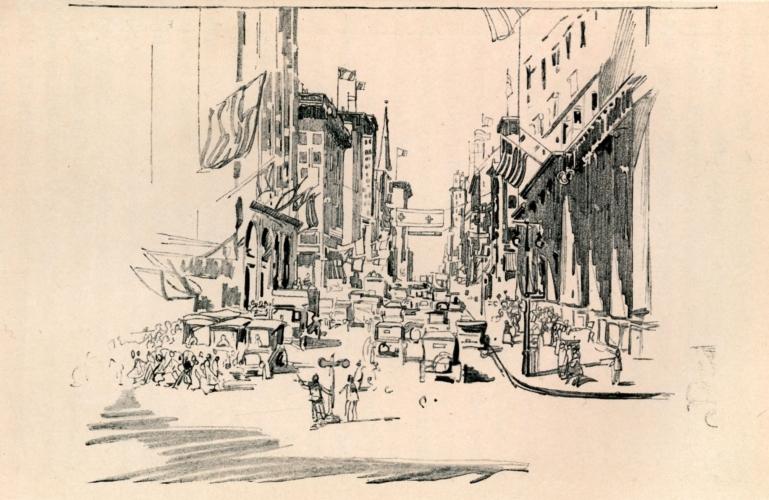
The air vibrant with excitement. Flags everywhere. Tens of thousands of
the Stars and Stripes. Thousands of Union Jacks and Tricolours of
France. Hundreds of pavilions of Italy and Belgium. Every few yards
gaily decorated booths from which smiling women or lusty-lunged men
harangued the passers-by to "come across or the Kaiser will."
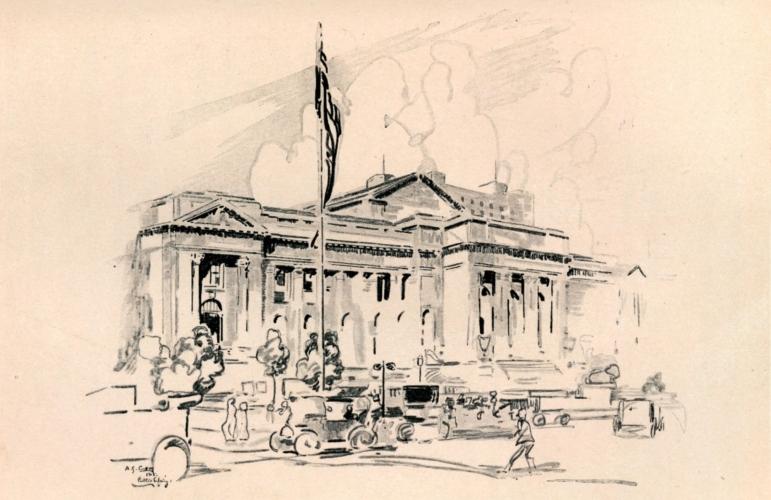
On a platform erected on the steps in front of the Public Library a
slight figure in kilts addressing a swaying, surging crowd. As the bus,
held up for a minute by the cross-town traffic, stopped, we could hear
the pleasing burr of Harry Lauder. Two hours later; a mile and a half
farther downtown. The sound of a band in the distance. The horses of the
mounted policemen forcing back the curious thousands to the curb. A
regiment of regulars, two regiments of militia, and then, swinging along
lightly in loose step, a handful of men in soiled blue, Chasseurs à pied
of France, who, at Verdun, in the Vosges Mountains, and on the Picardy
front, had lived splendidly up to the traditions of the men with the
hairy knapsacks and the hearts of steel whose tramp had shaken the
continent of Europe one hundred years before.
It was just a day similar to other days that had gone before and to days
that were to follow. To feel the thrill of what were held to have been
the great days of the past we must put ourselves in the mood of old New
York, or at the very least think of the world as it was wagging along a
brief four years ago.
"The national banquet-hall where heroes and statesmen have been fêted,
or the parade-ground toward which a nation has turned to witness great
demonstrations in celebration of national events of a civic or military
or mournful nature. Along it have gone to the music of dirges and the
sound of mournful drums the funeral cortèges of many of the country's
leading statesmen and greatest men, and here, too, have occurred riots
and disastrous fires which have startled the city and shocked the
nation." So runs the introduction to a little pamphlet issued some years
ago by the Fifth Avenue Bank. One of the earliest and most notable
visits, the brochure goes on to tell us, was that of the then Prince of
Wales, later Edward VII., in the autumn of 1860. He was then nineteen
years old. The city turned out to greet him. On Thursday, October 11th,
the revenue cutter, "Harriet Lane," brought the Prince to New York from
South Amboy. Then, a day of blaring bands, of blended flags, of great
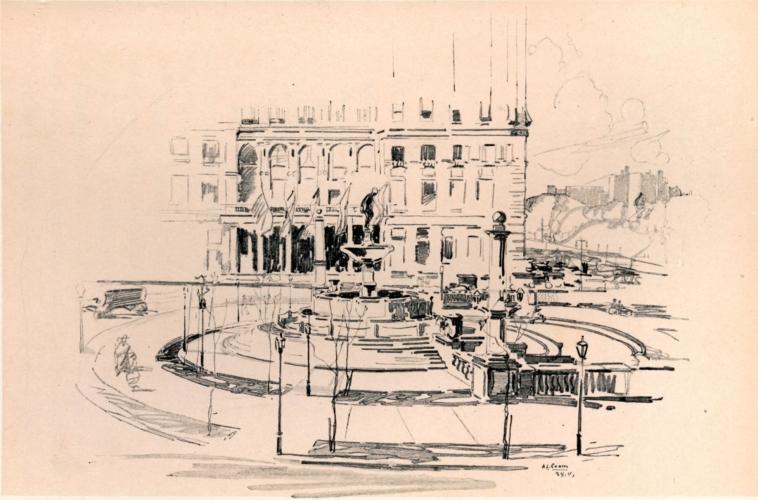
transparencies, that eventually led to the Fifth Avenue Hotel. He was
still very young, still very much of a boy, very much bored with all the
tumult and ceremony. Once out of sight of the crowd he threw dignity to
the winds and played leap-frog in the corridor with his retinue. But
once again, from his bed, to which he had gone with a bad headache, he
was called at midnight to acknowledge the salutes of the Caledonia
Club. That organization, made up mostly of members of the Scotch
Regiment commanded by Colonel McLeay, headed by Dodsworth's Band,
marched up Broadway to the hotel. In the Prince's honour a serenade was
given, the band blared out with "God Save the Queen!", "Hail Columbia!"
and other national airs, and once more the sleepy and sorely tried royal
visitor was obliged to appear to bow his thanks.
The next day, Friday, was given over to visiting such public buildings
as the Astor Library, Cooper Union, the Free Academy, and in riding
through Central Park.
A ball, famous in city annals, was given at the Academy of Music. Among
those who attended that ball and left a record of it was the late Ward
McAllister. "Our best people, the smart set, the slow set, all sets,
took a hand in it, and the endeavor was to make it so brilliant and
beautiful that it would always be remembered by those present as one of
the events of their lives."
The ball was opened by a quadrille d'honneur. Governor and Mrs. Morgan,
the historian Bancroft and Mrs. Bancroft, Colonel and Mrs. Abraham Van
Buren, with others were to dance in it. The rush was so great that the
floor gave way, and in tumbled the whole centre of the stage.
Carpenters set feverishly to work to floor over the chasm.
"I well remember," said McAllister, "the enormous form of old Isaac
Brown, sexton of Grace Church, rushing around and encouraging the
workmen."
In the course of the evening the Prince danced with Miss Fish, Miss
Mason, Miss Fannie Butler, and others, and was conceded to have danced
well. The supper was served at a horseshoe table. At one end of the room
was a raised dais, where the royal party supped. At each stage door a
prominent citizen stood guard; the moment the supper room was full, no
one else was admitted. "I remember," confesses Mr. McAllister, "on my
attempting to get in through one of these doors, stealthily, the
vigilant eye of John Jacob Astor met mine. He bid me wait my turn."
Despite the assiduity with which McAllister danced after the figure of
the Prince, he was not among those presented. That honour he sought the
next day, on the trip to West Point:
"As General Scott was presenting Colonel Delafield's guests to the
Prince I approached the General, asking him to present me to his Royal
Highness. A giant, as he was in height, he bent down his head to me, and
asked sharply, 'What name, sir?' I gave him my name, but at the sound of
'Mc,' not thinking it distinguished enough, he quietly said, 'Pass on,
sir,' and I subsequently was presented by the Duke of Newcastle."
Forty-three years after that clamorous greeting of New York to the young
Prince of Wales the present writer was to witness in Paris the visit of
Edward VII. for the purpose of cementing the Entente Cordiale. The tired
face told the story of the hardest-worked public servant in the world.
In 1860, on Fifth Avenue, he had already begun to pay the price of the
royal privilege of his exalted birth to bear the arduous burden of royal
responsibility.
There are extant many old wood-cuts showing the Prince at the Academy of
Music ball. But the following morning, that brought repose to so many,
brought none to him. There were visits to be paid to Brady's
photographic studios at the corner of Tenth Street and Broadway, to
Barnum's Museum, to General Scott at his Twelfth Street residence, and
the Broadway store of Ball, Black & Company.
That night a great torchlight parade in honour of the Prince was given
by the New York firemen. The Prince, with his suite and a number of city
officials, stood on the hotel balcony, while five thousand men in
uniform, with apparatus and many bands, marched by. Fireworks were set
off, the brilliant beams of the calcium light—then a novelty—were
thrown upon the standing, boyish figure of the Prince, thousands of
flaring torches danced and waved against the darkness of the opposite
square.
The next day, Sunday, October 14th, brought some rest. In the morning
there were services at Trinity, where Dr. Vinton preached; then a quiet
afternoon at the hotel. With Monday came the Prince's departure. At
half-past nine he left the Fifth Avenue Hotel, and in company with the
Duke of Newcastle, the Earl of St. Albans, and Mayor Wood, was driven
down to the harbour where the "Harriet Lane" was waiting to take him to
West Point and Albany.
The next reception that the chronicler of Fifth Avenue events has seen
fit to record was that given to General Grant after the close of the
Civil War. At the Fifth Avenue Hotel a number of the city's leading
business men met and planned the public greeting, and one hundred and
fifty men subscribed one hundred dollars apiece. The reception to the
returning soldier, which took place at the Fifth Avenue Hotel November
20, 1865, was hardly one of which the city or the street had reason to
be proud.
Loose management led to disorder and dissatisfaction. Twenty-five
hundred jostling, pushing persons crowded the halls, corridors, and
reception rooms. The General stood in one of the hotel parlours
surrounded by the committee, with Mrs. Grant and other ladies to his
right, and on his left Generals Wool, Cook, and Hooker, John Van Buren,
Ethan Allen, and others.
Little judgment seems to have been used in issuing the invitations. The
throng was indiscriminate. Farce comedy was in the air. Religious
fanatics, passing before the hero, offered up prayers for the salvation
of his soul. Precocious children were thrust forward to his attention.
Preposterous questions were propounded by preposterous people. To add to
the confusion the names of those persons who fought their way through
the throng to be presented to the General were announced to him by a
little man who got most of them wrong.
In a postscript to his "American Notes," written many years later,
Charles Dickens told of the vast changes he found on the occasion of his
second visit to the United States—"changes moral, changes physical,
changes in the amount of land subdued and peopled, changes in the rise
of vast new cities, changes in the growth of older cities almost out of
recognition, changes in the graces and amenities of life." Making all
allowances for that greater charity, tolerance, and kindliness of
judgment which comes with the riper years—nobody ever could have
remained as Britishly bumptious, or as bumptiously British as Dickens
was in his younger days when he first came to pay us a visit—taking
also into consideration the fact that a certain explanatory softening of
earlier criticisms was politic, that the novelist found a city far more
to his taste in 1868 than he had found in 1842 is not for a moment to be
questioned. Also, at the time he came to New York from Boston, he was
naturally in a rather placid and contented mood. For in letters home,
even while complaining of the trying changes of the wintry climate, he
had told how he was making a clear profit of thirteen hundred English
pounds a week, even allowing seven dollars to the pound. When he
returned to New York in April, after an extended tour throughout the
country, he had still better cause to be pleased with the young
Republic. Says Forster in his "Life":
"In New York, where there were five farewell nights, $3,298
were the receipts of the last, on the 20th. of April; those of
the last at Boston, on the eighth, having been $3,456. But, on
earlier nights in the same cities respectively, these sums
also had been reached; and indeed, making allowance for an
exceptional night here and there, the receipts varied so
wonderfully little, that a mention of the highest average
returns from other places will give no exaggerated impression
of the ordinary receipts throughout. Excluding fractions of
dollars, the lowest were New Bedford ($1,640), Rochester
($1,906), Springfield ($1,970), and Providence ($2,140).
Albany and Worcester averaged something less than $2,400;
while Hartford, Buffalo, Baltimore, Syracuse, New Haven, and
Portland rose to $2,600. Washington's last night was $2,610,
no night there having less than $2,500. Philadelphia exceeded
Washington by $300, and Brooklyn went ahead of Philadelphia by
$200. The amount taken at the four Brooklyn readings was
$11,128."
And only a few years ago there were Americans deploring loudly the
shabby financial treatment we gave Dickens, and figuratively and
literally passing round the hat!
Fifth Avenue's greeting to Charles Dickens, on the occasion of his
second visit, was in the form of the dinner that was tendered to him at
Delmonico's, on the evening of April 18, 1868. The hosts were two
hundred men of the New York press. Covers were laid for a hundred and
eighty-seven guests.
Five o'clock was the time appointed—we were a rugged, early-dining race
in those days—but the guest had a slight stroke of illness and did not
appear until after six. Then it was a limping old man, aged just
sixty-six, who, by the aid of a cane, climbed laboriously up the great
staircase. He was led to his seat at the table by Horace Greeley, and
seated between Mr. Greeley and Henry J. Raymond. The editor of the
"Tribune," acting as master of ceremonies, began the speech-making by
referring to his first discovery, many years before, of a story by the
then unknown "Boz."
In concluding his reply to the toast, Mr. Dickens promised: "manfully,
promptly, and plainly in my own person, to bear for the behalf of my own
countrymen such testimony of the gigantic changes in this country as I
have hinted at here tonight. Also to record that wherever I have been,
in the smallest place equally with the largest, I have been received
with unsurpassed politeness, delicacy, sweet-temper, and
consideration.... This testimony, so long as I live, and so long as my
descendants have any legal right in my books, I shall cause to be
republished, as an appendix to every copy of those two books of mine in
which I have referred to America. And this I will do and cause to be
done, not in mere love and thankfulness, but because I regard it as an
act of plain justice and honour."
The amende honorable was not less welcome for being long due and the
distinguished visitor sat down to loud applause and the strains of "God
Save the Queen." Mr. Raymond responded to the toast "The New York
Press," and was followed by George William Curtis, William Henry
Hurlbert, Charles Eliot Norton, Joseph R. Hawley, Murat Halstead, Edwin
de Leon, and E. L. Youmans.
Three and a half years after the dinner to Dickens Fifth Avenue greeted
in a similar way a distinguished Russian guest. That was the Grand Duke
Alexis Alexandrovitch, who was entertained by the New York Yacht Club at
Delmonico's December 2, 1871. James Gordon Bennett, the younger, was
then Commodore of the club, and received the Grand Duke in the
restaurant's parlours at seven o'clock. The guests included the Grand
Duke and his suite, the Russian Minister, General Gorloff, Admiral
Poisset, Admiral Rowan, members of the Russian legation, Russian
officers, and members of the yacht club. Against the walls of the
banquet hall the Stars and Stripes blended with the blue St. Andrew's
Cross. The guests were in naval uniform. The "Queen's Cup," which had
been won by the "America" in 1851, had the place of honour among the
club trophies. To the toast to the Czar, General Gorloff responded. The
club Commodore answered to that to President Grant. After the Grand Duke
had been informed that he had been elected to honorary membership, he
responded with a brief sailor-like speech.
On December 22, 1877, President Hayes was the guest of honour of the New
England Society at Delmonico's. Among those there besides the President
were Secretary of State William M. Evarts, Presidents Eliot of Harvard
and Porter of Yale, General Horace Porter, ex-Governor Morgan, and
Governor Horace Fairbanks of Vermont. Mr. Evarts answered the toast "The
Day We Celebrate." The presidents of Yale and Harvard, speaking in
behalf of their institutions, indulged in good-natured contrasts and
comparisons. In the old days, according to President Porter, when they
found a man in Boston a little too bad to live with, they sent him to
Rhode Island, and when they found him a little too good to live with,
they sent him to Connecticut, where, among other things, he founded Yale
College; while people of average respectability and goodness were
allowed to remain in Massachusetts Bay, where, looking into each others'
faces constantly, they contracted a habit of always praising each other
with special emphasis—a habit which they have not altogether outgrown.
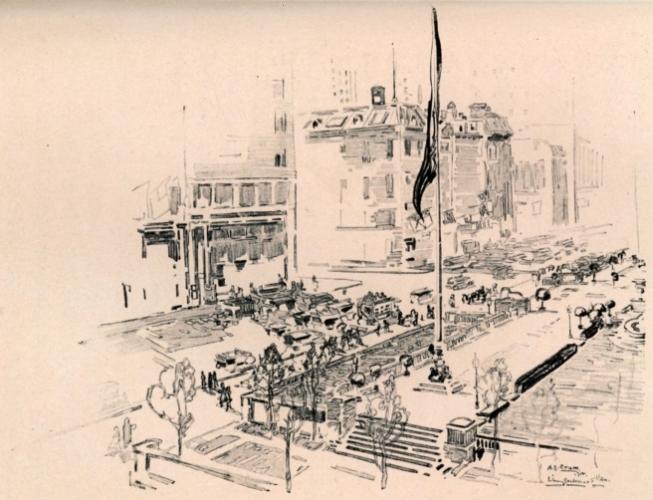
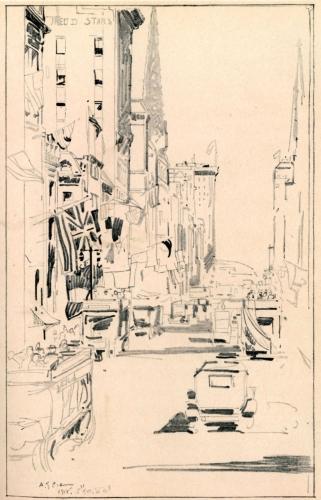 IN THE BRIGHT SUNLIGHT THE AVENUE GLITTERS WITH THE
PAVILLIONS OF PATRIOTISM. OLD GLORY MAY BE COUNTED BY THE TENS OF
THOUSANDS; ENGLAND'S UNION JACK, AND THE TRICOLOR OF FRANCE BY THE
THOUSANDS. TO FORESTALL THE KAISER THE AVENUE IS "COMING ACROSS"
IN THE BRIGHT SUNLIGHT THE AVENUE GLITTERS WITH THE
PAVILLIONS OF PATRIOTISM. OLD GLORY MAY BE COUNTED BY THE TENS OF
THOUSANDS; ENGLAND'S UNION JACK, AND THE TRICOLOR OF FRANCE BY THE
THOUSANDS. TO FORESTALL THE KAISER THE AVENUE IS "COMING ACROSS"
The Union League gave a reception to General Grant on October 23, 1880,
in the theatre of the club-house. Among those present were Joseph H.
Choate, General Chester A. Arthur, Chauncey M. Depew, General Adam
Badeau, Colonel Fred Grant, Peter Cooper, Henry Ward Beecher, General
Horace Porter, and Rev. Dr. Newman. Another reception to General Grant
was given at the Hotel Brunswick May 5, 1883, by the Saturday Night
Club. Certain remarks by the former President and by Roscoe Conkling on
the subject of Mexico were considered of much significance at the
time. Both spoke strongly in favour of the formation of a
Mexican-American alliance. Mr. Conkling suggested General Grant as the
logical leader of a great movement to aid the sister republic in
developing its resources.
Nearly two thousand guests were present at the reception given by the
Union League Club to President Arthur on January 23, 1884. With the
Chief Executive, who arrived about nine o'clock, were Secretaries Teller
and Folger, of his Cabinet. After shaking hands with the reception
committee the President was escorted upstairs by William M. Evarts.
About the President were the Cabinet officers, Mr. and Mrs. Evarts,
Jesse Seligman, and Salem H. Wales, and Attorney General and Mrs.
Brewster. In the distinguished gathering were Mayor Edson, Dr. Lyman
Abbott, General and Mrs. George B. McClellan, Whitelaw Reid, Henry Ward
Beecher, Parke Godwin, Elihu Root, Cyrus W. Field, Mr. and Mrs. John
Bigelow, and Lionel Sackville-West, the British Minister.
At the supper, which was served at midnight, one of the features was the
striking pieces of confectionery. In gleaming white sugar was a model of
the Capitol, and a tall monument supported statuettes of the President
and his Cabinet. Also there was a twenty-four-foot model of the
Brooklyn Bridge with the President and troops crossing it.
At the banquet to Lieutenant Greely of Arctic fame, at the Lotos Club,
on January 16, 1886, Vice-President General Horace Porter was in the
chair, in the absence of President Whitelaw Reid. Besides Lieutenant
Greely, Chief Engineer Melville, and Commander Schley, who headed the
expedition to relieve Greely, were guests of the club, and among others
at the table were Chief Justice Daly, Colonel C. McK. Leoser, Robert
Kirby, Patrick Sarsfield Gilmore, Dr. Pardee, Frank Robinson, Herman
Oelrichs, C. H. Webb, Colonel Thomas W. Knot, George Masset, J.
O'Sullivan, Douglas Taylor, James Bates, and Chandos Fulton. In his
speech the guest of the evening told the story of his expedition to the
Far North and explained the reason for every action. Arctic exploration,
he declared, could not be futile when eleven nations were offering the
lives of their men in the cause of science. He told the story of the
splendid spirit of his own men during the dreary months at Cape Sabine
and lauded American courage and achievement in all the corners of the
earth. There were speeches by Judge Daly and Commander Schley, and then
two fun-makers were introduced in the persons of Thorne and Billington,
Poo-bah and Ko-Ko, from the Gilbert and Sullivan opera, "The
Mikado," that was then playing in New York.
Late in November of the same year the Lotos Club honoured another
explorer, Henry M. Stanley, who had just returned to New York after many
years' absence, completing Livingstone's work in Central Africa. Stanley
sat between Mr. Reid, the Club's president, and Chauncey M. Depew.
Others at the guest's table were Lieutenant Greely, General Porter,
General Winslow, Colonel Knox, Major Pond, General Townsend, Lieutenant
Hickey, Commissioner Andrews, G. F. Rowe, Bruce Crane, Henry Gillig, and
Daniel E. Bandmann. The speakers, besides Mr. Stanley, were Lieutenant
Greely, Mr. Depew, and Horace Porter.
At Delmonico's, December 20, 1889, a dinner was given by the
Spanish-American Commercial Union to the visiting delegates to the
Pan-American Congress. William M. Ivins, as the principal speaker,
touched upon South American relations and international arbitration as a
prevention of war. Among those present were Mayor Hugh J. Grant, Elihu
Root, Andrew Carnegie, Chauncey M. Depew, and Horace White. On the walls
were portraits of Washington and General Bolivar, and intertwined with
the Stars and Stripes, the vividly coloured banners of the South
American nations. At the right of the chairman, William H. T. Hughes,
sat Señor F. C .C. Zegarra of Peru, and at the left Mayor Grant. The
address of welcome was delivered first in English and then in Spanish by
Mr. Hughes, who possessed a perfect command of both languages. Señor
Zegarra responded. The toast "Our Next Neighbour" was answered by Señor
Matias Romero of Mexico. Other toasts and speakers were: "International
American Commerce," William M. Ivins; "International Justice," Elihu
Root; "Our Homes," Rev. Dr. John R. Paxton; "America—All Republican,"
John B. Henderson, and random addresses from the gallery by Mr. Depew
and Judge José Alfonso of Chile.
The next Fifth Avenue reception of importance was that given by the
Union League Club to General W. T. Sherman on April 17, 1890. It was a
belated celebration of the old soldier's seventieth birthday which had
taken place on February 8. In the centre of the decorations of the usual
patriotic colours and design was the Daniel Huntington portrait of the
General in uniform. Regulars of the 5th U. S. Artillery lined the
stairway leading from the lobby to the reception hall. The General,
reaching the club-house at eight-thirty, was met by James Otis, J.
Seaver Page, and General S. Van Vliet, and, between the lines of
soldiers at present arms, conducted to a place beneath his own
portrait. There, surrounded by President Depew of the Club, Secretary of
the Interior John W. Noble, and General Van Vliet, he greeted the six or
seven hundred invited guests. The gathering included representatives of
the army, the navy, the bench, the clergy, as well as business,
professional, and political life. The Vice-President of the United
States, Levi P. Morton, was there, and Secretary Noble, Senators W. M.
Evarts and Nelson W. Aldrich, Generals Schofield, Howard, Porter, and
Breckenridge, and foreign diplomats from Russia, Chile, Brazil, and
Peru. Of the march to the sea Chauncey M. Depew said: "It was a feat
which captured the imagination of the country and of the world, because
it was both the poetry of war and the supreme fact of the triumph over
the rebellion."
Another great day on the Avenue was August 28, 1896, which witnessed the
arrival of the famous Chinese statesman, Li Hung Chang. He came as a
special envoy of the Chinese Emperor and stayed at the Waldorf, then a
comparatively new hotel. President Cleveland sent General Thomas H.
Ruger to welcome the visitor. In his cabin on the "St. Louis" in the Bay
Li Hung Chang received the welcoming delegation. The author of "Fifth
Avenue Events" thus describes the great Chinaman on that occasion: "His
appearance was most striking. Over six feet tall, with a slight stoop,
he wore the bright yellow jacket denoting his high rank, a viceroy's cap
with a four-eyed peacock feather attached to it by amber fastenings, and
a beautifully coloured skirt of rich material. His finger-nails were
polished till they shone, a huge diamond flashed on his right hand, and
he peered out benignantly over the tops of a pair of gold-bowed
spectacles. Dignified in bearing, he looked every inch the statesman and
scholar. His gracious manner won him friends during his stay in New
York, and his indefatigable propensity for asking questions—some of
them rather embarrassing to those questioned, as when he politely
inquired the ages of the ladies whom he met and the salaries of the
officials who entertained him—aroused much merriment."
In the way of a distinguished visitor Li Hung Chang was a novelty. New
York gave him a rousing reception. The Avenue was lined by cheering
throngs as the Ambassador and his suite were driven to the hotel. The
carriages were flanked by U. S. Cavalry. Over the gaily decorated
Waldorf the golden imperial banner of the Celestial Kingdom with the
great blue Dragon snapping at a crimson ball fluttered in the breeze.
But Li Hung Chang did not pay the hostelry the compliment of relying on
its cuisine, preferring the services of his own Chinese cooks. The day
after his arrival the Ambassador was received by President Cleveland at
the home of ex-Secretary of the Navy William C. Whitney, Fifth Avenue
and Fifty-seventh Street. Surrounding the President were the Secretaries
of State, War, the Treasury, the Attorney-General, and other officials.
The visiting statesman was presented to Mr. Cleveland by Richard Olney,
Secretary of State, and to the Chief Executive turned over his
credentials from the Chinese Emperor.
The banquet that evening, given by former American diplomats to the
Celestial Empire, began at six o'clock, as Li wished to set for the
Western world the example of early retiring. In his attentions to the
splendid repast before him he was most abstemious, but he finished by
smoking a cigar. John E. Ward, a former Minister to China, began the
speech-making by a toast to the Emperor, the President of the United
States, and Li Hung Chang. George F. Seward, another former Minister to
China, lauded the Ambassador's long and distinguished services to his
country and to the world at large. After a brief response through his
interpreter, Li left the banquet hall at eight-thirty, and went to his
night's rest. His hosts, however, were not to be balked of their
evening's entertainment, and the oratorical feast was continued till
midnight.
About General Grant's tomb, when Li visited it, a crowd of more than
twenty thousand persons was gathered. From his carriage Li stepped into
his chair of state, and was borne to the tomb by four policemen. At the
stairway he left the chair and made his way slowly and laboriously on
foot into the vault. To those about him Li said that this visit to the
hero's tomb was one of the chief things he had in mind in planning his
journey to America, and that he had thought of it continually during the
trip. General Horace Porter recalled that Li's contribution of five
hundred dollars, one of the first received, was something that had never
been forgotten by the American people. Other events of the Prime
Minister's stay in New York were his reception of a delegation of
American missionary societies, his visits to Chinatown, and to Brooklyn,
and the dinner given to him at Delmonico's the evening of September 2nd.
Earlier events of the Avenue fade into comparative unimportance when we
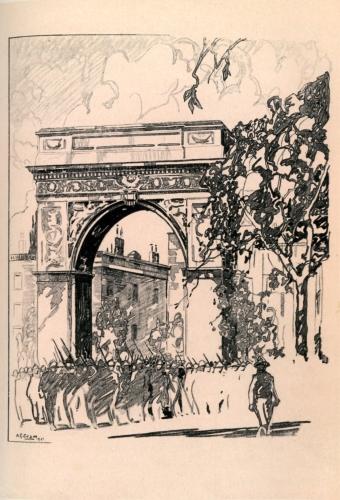
come to September 30, 1899. For Admiral George Dewey had come home, and
Fifth Avenue had the chance to acclaim the victor of Manila Bay. Down
the broad street, from Fifty-ninth Street, under the Arch at Madison
Square, and on to Washington Square, the procession in the hero's honour
passed. This was the order of march:
Major-General Roe and Staff.
Sousa's Band.
Sailors of the Admiral's Flagship, the "Olympia."
Admiral Dewey, seated beside Mayor Van Wyck
of New York in a carriage, at the head of a
line of carriages containing Governor Roosevelt,
Rear Admirals Schley and Sampson,
General Miles, and others.
West Point Cadets.
United States Regulars.
New York National Guard and Naval Militia.
National Guard of other States.
Union and Confederate Veterans.
Veterans of the Spanish War.
When the head of the procession reached Thirty-fourth Street, the
sailors from the Admiral's flagship halted and drew up along the side of
the Avenue. The Admiral left his carriage and entered the reviewing
stand at Madison Square. Admiral Sampson was on his right. Admiral
Schley on his left. Surrounding them were officers of both branches of
the service. For four hours Admiral Dewey stood there, acknowledging the
salutes and saluting the flag. The following day, October 1st, saw the
great naval parade through the waters of the Hudson River.
A decade passed, and then came the Hudson-Fulton celebration of
September 25—October 9, 1909. Of chief importance to the Avenue was the
civic procession of September 28th, when the floats, depicting a great
number of historical events, moved down the Avenue to Washington Square.
On the east side of the thoroughfare, from Fortieth to Forty-second
Street, opposite the Public Library, there had been erected a Court of
Honour. Against the stately pillars of the Court, the procession moved
swiftly by. Every nation that went into the "melting pot" was
represented, with the harped green flag of Ireland at the head of the
long column. Following the Ancient Order of Hibernians and other Irish
societies came the Italian organizations, then Poles, English, Dutch,
French, Scotch, Bohemian, Hungarian, and Syrian.
It was the nation's history of four hundred years that passed in effigy
on the floats. Pocahontas again interceded with her father Powhatan for
the life of Captain John Smith. Balboa caught sight of the waters of the
Pacific. The tea was dumped into Boston Harbour. The Minute Men stood
fast on the Common. Mad Anthony Wayne stormed Stony Point. Molly Stark's
husband said, "There are the red-coats. We must beat them today, or
Molly Stark's a widow!" Cornwallis surrendered his sword at Yorktown.
Somebody in the Mexican War said, "Give them a little more grape,
General Bragg!" and Dewey said: "You may fire when you're ready,
Gridley!"
In some of these events of the later years the writer had a personal
share. From a seventh-story window at Twenty-first Street he looked
down on the procession in honour of Admiral Dewey. From a vantage point
at Thirty-fifth Street he witnessed the passing of floats in the
Hudson-Fulton celebration. But there was one day on the Avenue, perhaps
the greatest and most inspiring of them all, in which he did not share.
That was the day that saw the visit of the Allied Commissions, the day
of the coming of a Marshal of France. About the time that the guns on
the warships and land batteries at Hampton Roads were thundering out
their message of welcome to the distinguished guests, the writer in
company with six other Americans who had been with the Commission for
Relief in Belgium was entering French territory, after a
never-to-be-forgotten journey through Germany. How such of us who
claimed New York as our own thrilled as we pictured three thousand miles
away the city's greeting to the grave, silent man whose cool genius had
hurled back the Teuton hordes at the very gates of Paris! How we built
up on the limited descriptions that had been cabled across the Atlantic!
We saw the sweep of the procession up the Avenue, the thousands upon
thousands of flags, the densely packed throngs lining the sidewalks, the
eager faces in the windows of the tall buildings, and in the motor-car,
for which all eyes were searching, the smiling, saluting Marshal.
"About now," said one of us, "he should be passing Madison Square."
"I can see the people on the sidewalks and crowding the windows and the
housetops," said another.
"And I," said a third, "can hear the roar that goes up from the Avenue
when the people catch sight of him."
"When he hears that roar," said a fourth, "he will recall the guns of
the Marne as gentle zephyrs."
To that last statement and sentiment we all proudly agreed. For despite
the three thousand miles of intervening ocean it was our New York and
our Fifth Avenue.
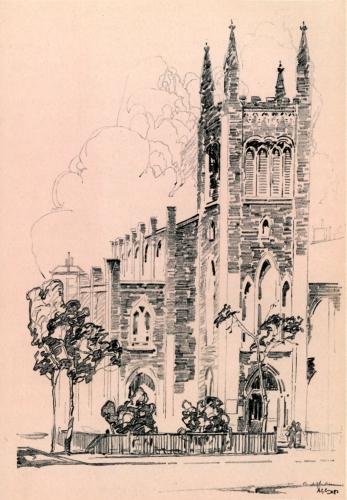
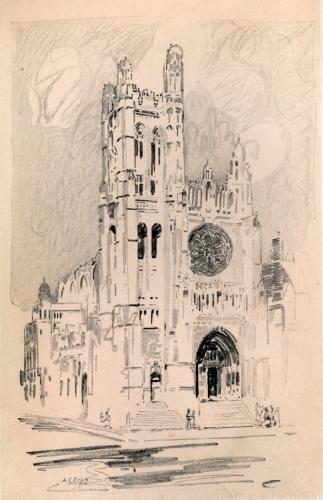 MASSIVE AND SPLENDIDLY GOTHIC IS ST. THOMAS'S. THE
CHURCH DATES FROM 1825. IN 1867 THE PRESENT SITE WAS SECURED, AND THE
BROWN-STONE EDIFICE OF THE EARLY SEVENTIES WAS FOR NEARLY TWO
GENERATIONS THE ULTRA-FASHIONABLE EPISCOPAL CHURCH OF THE CITY
MASSIVE AND SPLENDIDLY GOTHIC IS ST. THOMAS'S. THE
CHURCH DATES FROM 1825. IN 1867 THE PRESENT SITE WAS SECURED, AND THE
BROWN-STONE EDIFICE OF THE EARLY SEVENTIES WAS FOR NEARLY TWO
GENERATIONS THE ULTRA-FASHIONABLE EPISCOPAL CHURCH OF THE CITY