New Year’s Day saw the Regiment at Moascar Camp, Ismailia, and it was
there that the Fife and Forfar Yeomanry were interred “for the
duration,” giving birth at the same time to a sturdy son—the 14th
(Fife and Forfar Yeomanry) Battalion, Royal Highlanders. We were all
very sorry to see the demise of the Yeomanry and to close, though only
temporarily, the records of a Regiment which had had an honourable
career, and of which we were all so proud. At the same time we
realised that, in our capacity as dismounted yeomanry, we were not
pulling our weight either as yeomanry or infantry, and no other
regiment certainly appealed to us as much as our own Territorial
Infantry Regiment, and we were proud to link our record to the long
and glorious record of the Black Watch.
We spent five weeks altogether at Moascar, working hard at the
elementary forms of infantry drill and tactics, and on 8th January we
marched to our new camp El Ferdan, some ten miles along the Canal.
Here we continued our training, but of a more advanced kind, brigade
schemes, tactical tours and route marches, “jerks,” bathing, and
football kept us busy and fit.
One day some of us went to see the Canal defences, dug the previous
year, about four miles east of the Canal. The sand was so soft, no
amount of ordinary sandbagging or revetting would make it stand up,
and all the trenches were made by sinking complete wooden frames into
a wide scooped out trench, and then shovelling the sand back on either
side of the frame. The original digging had to be about 20 feet wide
to allow them to sink the frames sufficiently deep in the sand. It
must have been a colossal work, and this was only a small portion of
the scheme, which included laying on water to the more important
defences, and laying out lines of light railways and roads from the
Canal eastwards, at intervals of seven and eight miles, the railheads
being linked by a lateral road.
On 4th March we left El Ferdan and marched to Kantara, the base of all
operations up the Sinai Railway, and there entrained for El Arish to
join the 74th (Yeomanry) Division. The journey of about ninety miles,
over the very recently laid railway, was timed to take some eight or
nine hours, and was uneventful and, though we travelled in open
trucks, was not too unpleasantly hot. The frequent short gradients
led to the most awful bumps and tearings at the couplings, but they
stood the strain all right.
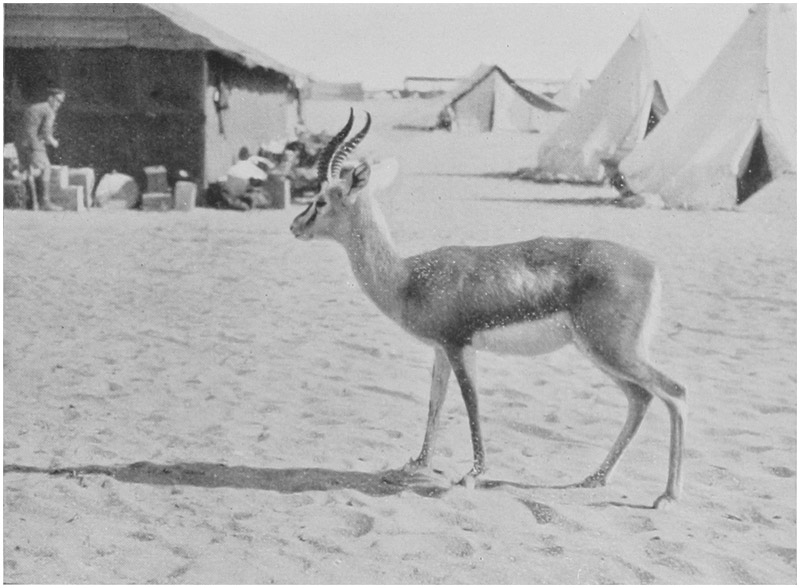
THE BATTALION MASCOT.ToList
To face page 42
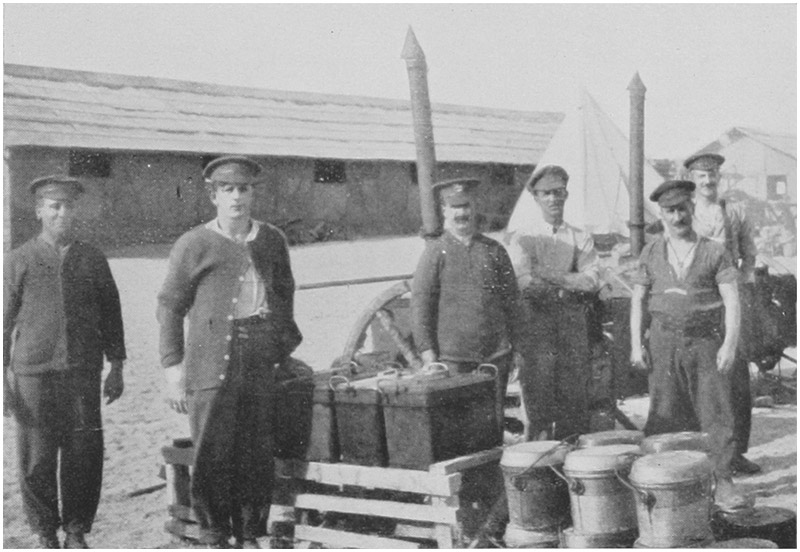
BATTALION COOKHOUSE, EL FERDAN.ToList
To face page 42
It was a very interesting journey to us, who knew only the Western
Desert, to note the difference between it and Sinai. To our eyes Sinai
did not appear to be a desert at all, as there were scrubby bushes of
sorts growing in nearly every hollow, various kinds of camel grass,
and even a few flowers—such as poppies and one or two species of
lilies. After the waste of misshaped lumps of limestone and volcanic
looking boulders, which were the only decoration of the Western
Desert, this sort of landscape seemed positively verdant.
At El Arish we were camped some three miles from the station, and a
very long three miles it seemed, as a large part of the way was over
the softest of sand and most exhausting marching, especially with a
heavy pack. Here we had our first sight of hostile aeroplanes, some of
which came over nearly every day; it was a very pretty sight to see
them in the brilliant blue at about 12,000 feet, with the white puffs
of shrapnel bursting now on one side of them now on the other (but
seldom very close). We were at once set to dig ourselves funkholes,
which we were supposed to occupy on the alarm being given, but they
never once bombed us, or seemed to take any notice of us. They made
one or two bold individual attacks on the railway, between Kantara and
El Arish, but for the most part they appeared to be out purely for
reconnaissance.
At El Ferdan we had got our first infantry reinforcements—11 new
officers—and now we received a welcome addition in the shape of 1
officer and 373 other ranks, which necessitated the reorganisation of
the battalion. We also had to acclimatise the new draft who felt the
heat and heavy going very exhausting, and, to begin with, had to go
easy.
Our camp was pleasantly situated on a sandy plain, within half a mile
of the sea, and dotted with scattered fig trees just beginning to show
a few leaves. The climate was perfect, but the water arrangements were
most difficult. We began to realise that it does not pay to be the
last comer when there is a shortage of anything. We were paid off with
the minimum number of fanatis (copper vessels for carrying water on
camel pack), and, instead of getting allotted to us the wells nearest
our camp, we had just to take whatever wells were left. These proved
to be on the other side of El Arish village, in amongst the steepest
sandhills, and it was a very tough tramp for the fatigue party, which
had to accompany the water camels and do the pumping. Our stay here
was just inside a fortnight, before the end of which we had got our
new drafts allotted to their various companies; and a very good lot
they were, though we feared they would have great difficulty in
standing the heat if we were called upon to do long marches.
On 22nd March we started on our way to our first halting place El
Burj. It was about nine miles, and we marched in the evenings, which
was undoubtedly very wise. The going was not bad, there being a
wire-netting track laid over all the softest parts: it is wonderful
how satisfactory this is to march on, and many a time did we bless the
man who invented it. The only sufferers were the mule leaders. They,
naturally, could not lead their mules on the netting, and it was extra
hard work for them, as they had to walk in the heavy sand and maintain
the pace set by the troops who were on the good going. El Burj proved
to be a most desolate spot, but it was at all events near wells; and
we were so glad to hear that we were not to march straight on next
day, that we didn’t grumble much about the scenery.
The Higher Command were a little nervous that the Turks might slip
away again as they had already done at El Arish; but the next few days
were to show that this information was not correct, and that the Turk
had no intention of leaving the Gaza-Beersheba line so long as he
could hold on to it.
We stopped there four days, and marching once more in the evening, we
did a comparatively short step to Sheikh Zowaid, camping about a mile
short of the station. It was pitch dark when we arrived and we had no
idea what our camp was like, and it was a great surprise to find in
the morning that we were on the edge of a shallow salt lake. The
sunrise on this sheet of water, fringed on the far side with a line of
scattered palm trees, was really most exquisite. It was, however, the
only good thing about the place. Water for breakfast was late in
arriving, and we were told that the half-day’s supply, which then
arrived, had to fill the dixies for lunch, and also the water-bottles
for the next march. There was not nearly enough for this, with the
result that we had to start in the blazing sun about 1 P.M.
with hardly anything in the bottles. The reason for this was, that the
camels had to go on ahead to our next stop—Rafa—about thirteen miles
distant, where it was hoped to have water drawn and ready for us on
our arrival.
This afternoon march was a gruelling experience. It was the hottest
part of the day; we had practically nothing in our water-bottles, and,
to add to our trials, the wire-netting road was not laid beyond Sheikh
Zowaid, as the ground had appeared quite firm to the divisions who had
preceded us. Since they had passed, however, the route had been cut up
by guns and transport, until it was just as soft as the softest sand,
and twice as dusty. Finally, when we did get to Rafa about 7
P.M., there was no water waiting for us, and we found we had
to take up an outpost line from the railway to the sea, a distance of
about three miles, through the worst sandhills we had encountered. It
was hopeless to move before the arrival of some water, and it was
about 10 P.M. before we started to take up the line, and it
was well after midnight before the left company had got the line
extended right through to the shore. These sandhills were made of such
fine sand that it was continuously blowing and drifting; any rifle
pits dug out, say, a couple of feet, in the evening, would be
completely obliterated in the morning.
Sending out supplies, as soon as it was light, to this distant
company, was a most difficult job. To begin with, we found that
camels, loaded with water fanatis, could not negotiate the steep faces
of sand, so we had to do our best with the Lewis gun mules, carrying
the fanatis only half full. Then there was a thick mist—the same mist
which hampered the attack on Gaza—and we had no accurate knowledge of
where the company was, nor was it possible to follow the tracks of the
previous night, as they were all obliterated by the drifting sand.
Luckily, some active members of the company had found the morning too
cold for sitting still, and had taken a morning walk back from the
line, so we came upon their fresh tracks, which led us to the rest of
the company.
That night we had an alarm that the Turkish cavalry was out and had
slipped round our right flank, and was likely to have a dash at our
lines of communication either at Rafa or elsewhere, so we spent the
night digging trenches which, during the next day or two, we improved
into a sort of continuous line covering the water and railway station.
During these few days the first attack was made on Gaza, but without
success. We heard a good many tales of hardship from lack of water,
and saw some prisoners come through, but there was no great
excitement.
From Rafa—which is on the Palestine Boundary—we moved on 30th March
to Khan Yunis, said to be the home of Delilah. The march was once more
in the evening, and was very comfortable, except for the last mile or
two when we got in between the high hedges of prickly pear, and had to
march through about a foot of dust in the most stifling atmosphere.
When we arrived we found that we were once more on the fringes of
civilisation: we could buy oranges in unlimited numbers, and also
fresh eggs—not the Egyptian variety, about the size of a pigeon’s
egg, but real pukka hen’s eggs. Water also was less scarce than it had
been, and we were well content with our lot. We were in Brigade
Reserve, which sounded very comfortable, but which was not so “cushy”
as it sounded. It meant that we had to do all the unloading of
supplies and ammunition at the supply depot and at the station, and
also find the very large guards which were absolutely necessary, as
the native was a diligent and skilful thief. The units in the outpost
line really had much less to do, though, of course, they had their
turns of night duty which we escaped.
Here we were joined by another brigade of our new division, and felt
that at last we were about to become like other people—organised in a
proper division.
This week, with its eggs and oranges, passed like a flash, and we once
more moved on; this time quite a short way beyond Railhead at
Deir-el-Belah, where we camped quite close to our compatriots the 52nd
Division. After one night and a good bathe we took over, on 7th April,
from the 54th Division a sector of trenches near Sheikh Nebhan,
overlooking the hollow through which meandered the Wadi Ghuzzeh. This
wadi—like all others in this part—is quite dry except during the
storms of winter, but water could usually be got by sinking wells in
the bed of the wadi at about ten or twelve feet down. Our cavalry by
day and infantry by night held a line out beyond the wadi, covering
the work of those who were sinking wells, making ramps for guns and
transport crossings, and laying the water-pipe line. This line was to
be carried to the cisterns of Um Gerrar, where it would come in very
useful during the further operations for which we were preparing. It
is rather wonderful to think that this water was carried with us by
pipe line all the way from the Canal, and was actually Nile water
brought to Kantara by the Sweetwater Canal.
The banks of the Wadi Ghuzzeh were almost everywhere precipitous, and
anything from ten to twenty feet high. All these had to be ramped, and
during the period of preparation some thirty such crossings were made
between Tel-el-Jemmi and the sea, and each unit was allotted its
crossing for the coming advance. During these days of preparation our
Battalion dug a strong line of trenches dominating the crossings of
the Wadi Ghuzzeh, and most of the officers got the chance of a
reconnaissance to a distance of about three miles beyond the wadi.
The country beyond was very much cut up with smaller wadis, which at
this time of year were a mass of wild flowers which grew most
luxuriantly, and would have been welcome in most herbaceous borders;
the anchusas—to name one—were several feet high, and covered with
brilliant blue blooms, but the brightest effect was that of fields of
mauve daisies. These grew as thick as poppies in Norfolk, and were
almost as bright. One had plenty of time to look about at all the
flowers, as there was practically no sign of a Turk, though, if one
went too near up to the top of the watershed, an odd sniper would let
off at one.
As the day for the advance drew near, all the troops told off for
battle surplus were sent back to Railhead and formed into a divisional
camp. Each battalion had to leave behind the following:—Either C.O.
or 2nd in Command, two of the four Company Commanders and two of the
four Company Sergeant-Majors, and a proportion of instructors in P.T.,
Lewis gun, musketry, gas, bombing, and signalling—in all, for a
battalion at full strength, 120 of all ranks, including all officers
above the number of 20.
This was the dustiest and dirtiest week of the whole year, the only
interest being the scraps of gossip which kept coming in, and from
which we pieced together the disastrous tale of the second battle of
Gaza. One could also ride up to the top of Raspberry Hill or Im Seirat
and see something for oneself, but usually any movement of troops was
invisible owing to clouds of dust.
The fact that our main outpost line was, after this battle, advanced
about live or six miles, was used to represent this battle as a
British victory, but, as a matter of fact, it was a victory which
failed to gain any main Turkish position. The positions which we held
at the end of the battle, to which we had retired after being stopped
at Ali-el-Muntar and Gaza itself, had been reached in the first
instance with very few casualties, and it was on the glacis between
these positions and the Turk that we suffered our main losses. This
glacis was destitute of any cover, and was dominated by the heights of
Ali-el-Muntar and the cactus hedges surrounding Gaza, and after many
gallant efforts this had to be abandoned to form a No-Man’s-Land of a
mile or a mile and a half between ourselves and the Turk. On our left
in the sandhills the progress was slower and steadier, and the line
finished up a good deal nearer the Turk than on the right; but here
again the cactus hedges lined with machine guns proved too much for
us. Our Division was not used in this battle, being in reserve, which
was lucky for us, as those who were in the front line of the attack
all got a pretty severe knock.
On 19th April the Battalion left the outpost line on Sheikh Nebhan and
marched towards Gaza, resting during the middle of the day on a ridge
west of El Burjaliye, and moving in the afternoon on to Mansura Ridge
in support. On the evening of 22nd April the Battalion moved forward
to construct and occupy trenches at El Mendur, which was on the right,
or refused, flank of the line, and there the details again joined us.
There we had a good defensive position, but the trenches still had to
be dug and, as luck would have it, this digging, which ought to have
been nothing to our men fit as they were, in ordinary weather, was
turned into a very high trial indeed by a khamsin. This red-hot and
parching wind, blowing off the desert, makes thirst a positive torture
when water is limited, and it was very limited at that time. We were
getting rather less than half a gallon per man for all purposes, which
is perhaps just about the quantity used by the ordinary man for
cooking and drinking in the cold weather at home; but in a khamsin
when you are doing five or six hours’ hard manual labour per diem, a
gallon is easily consumed. Luckily these heat waves only last about
three days, but it left us pretty limp.
After a fortnight here a start was made with thinning out the line, in
order to let some of those who had been engaged in the Gaza battle get
a spell in reserve. We moved a step to our left, taking over with our
Battalion the sector previously held by a brigade. Our portion of the
line was taken over by the 12th (Ayr and Lanark Yeomanry) Battalion
R.S.F., and we took over the line on the left previously held by the
5th and 7th Essex Regiments. Battalion H.Q. had a very comfortable
pitch at the top of the Wadi Reuben, near a junction of many tracks
which had been named Charing Cross.
Our week here meant another spell of steady work, as we had to convert
what had previously been a continuous line into a series of strong
posts, the intervals between which were covered by machine guns. This
was known as the Dumb-bell Hill Sector of the Sheikh Abbas Line, being
named from a hill whose contours on the map were a very fair imitation
of a dumb-bell. Here we were still facing to a flank, but our left
came up to the corner where the proper front began, which meant that
we lay enfiladed from the main front, and they used to throw over a
good deal of stuff if ever they spotted any movement.
At the beginning of May we did another move, this time on to the real
front in the Sheikh Abbas Sector. This was quite a pleasant place, as
we lived on the reverse slope of a fairly steep bank, pretty well
defiladed from all the Turk guns, and the trenches, though only in
most places a single line with quite insufficient communication
trenches, had a long view and a good field of fire. The wire was
continuous though not very thick, and it was quite safe to leave the
trenches during the day in charge of a few observation posts. Add to
this the fact that all, except the posts, could walk about during the
day in the open quite covered from view by the steep slope mentioned
above, consequently it was trench warfare under the most pleasant
possible conditions. All the same it was a trying life owing to the
difficulty of getting a normal amount of sleep. We had to “stand to”
from about 3 A.M. till dawn, and then work till breakfast,
and on to about 9.30 A.M. By that time it was too hot to do
any more, and the rest of the day had to be spent in idleness. Few of
us could sleep during the day because of the heat, and the temperature
seldom began to get much cooler before 8.30 P.M., and
sometimes later. There was nothing doing in the way of warfare beyond
continuous patrols at night, sometimes small, sometimes up to twenty
or more. The only occasion during our first stay did anything in the
nature of a skirmish take place, and that was brought on by one of our
patrols having a narrow escape of being cut off at dawn near a place
called Two Tree Farm. One of the platoons in the line saw what was
happening and went out to support them, and managed to get them in all
right. A very small affair, but quite exciting for the onlookers, when
there is nothing more important doing. In this part there was about a
mile of No-Man’s-Land, and the Turk was very completely wired in and
was seldom to be found outside his wire. Most of our patrols in
consequence came in without having seen a Turk at all, but it was not
a comfortable job, as machine guns were firing bursts all night.
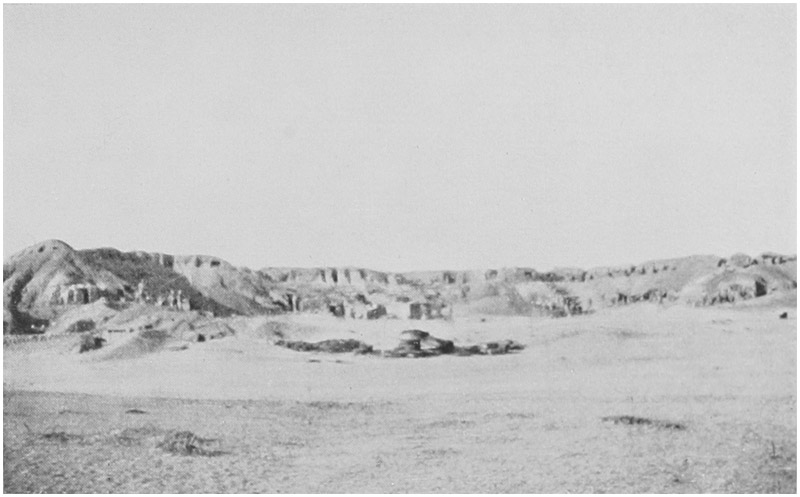
DUG-OUTS IN THE FRONT LINE. SHEIKH ABBAS.ToList
To face page 54
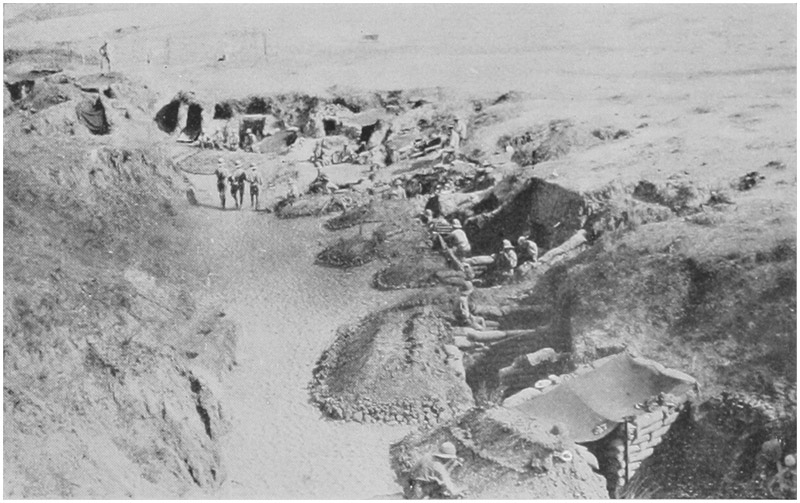
A RESERVE WADI, SHEIKH ABBAS.ToList
To face page 54
We had a fortnight in the line, and on 25th May came out to Brigade
Reserve which was only a move of a couple of hundred yards and not
half so comfortable; but it gave some of us the opportunity of riding
over towards the sea and having a look at our own and the Turkish
lines on the sandhills.
While we were here we marched to Deir-el-Belah to be disinfected, and
later relieved, first, the 16th (Royal 1st Devon Yeomanry) Devonshire
Regiment, and then the Ayr and Lanarks, to allow them to do the same.
On 13th June we took over the centre sector, the Abbas Apex Sector, of
the Brigade line from the Devons, and remained in the line till 9th
July when we handed over to the 4th Royal Scots, 52nd Division. Every
night we sent out a patrol of 1 N.C.O. and 10 men, either as a
standing patrol on Essex Hill or to patrol the wire in front of our
area, and an officer’s patrol consisting of an officer and 20 men to
cover the ground between Two Tree Farm and Old British Trenches. These
patrols were nearly always fired on, but we were in luck’s way as
regards casualties.
We then marched back some four miles to the Dorset House area, where
we at once got started on intensive training for open warfare, varied
with some very hurried musketry in the Wadi Ghuzzeh. Whilst here we
had a very thorough inspection by Lieut.-General Sir P.W. Chetwode,
K.C.M.G., C.B., D.S.O., Commanding Eastern Force, and in the way of
amusements managed to get one or two games of polo with a neighbouring
brigade. The plain on which we played was in full view of some of the
Turkish positions at Gaza, and on one or two occasions play was
stopped by shells. Also, in rotation by battalions, we made bathing
expeditions to the sea at Regent’s Park. It was seven miles each way,
but was well worth the trouble as it was months since most of us had
been in the sea.
At the beginning of August we again changed our camp, and while on the
move put in a couple of days’ field firing. For once in a way the
ground lent itself to the purpose, and we had most interesting days;
but it was pretty warm work, not being confined to morning and
evening. Our new camp was right in the sandhills, near the aerodrome
at Deir-el-Belah, where we did intensive divisional training. This was
to have lasted three weeks, and was a very strenuous business. A full
divisional day meant leaving camp any time after 2 A.M. and
not getting back again until after midday; it was usually interesting
for the senior ranks, but intensely boring for everyone else. Luckily
we were able to fit in bathing, concerts, and sports, which kept
everyone cheery.
After a fortnight of this we found we were at last told off for a
useful job of work—digging a new line of trenches in the sandhills
facing Gaza, between Fusilier Ridge and Jones’ Post, in front of those
on Samson’s and Fusilier’s Ridges, at that time held by the 54th
Division. We moved over the Wadi Ghuzzeh to Regent’s Park, where we
camped right on the shore about an hour and a half’s march from the
scene of our labours. After the second night it was decided that this
was too remote, and we moved up nearer our work. Here we stayed for a
week, with half of each battalion digging each night. It was a
tiresome job, as the sand was so soft that a very wide ditch had to be
dug and then faced with sandbags. The men were very quick about
getting down, and after the first night they were practically working
in safety for the remaining four or five days necessary to complete
the sandbag revetting. All bags used had to be double, as single ones
would not keep the sand in.
Our first night was a pretty jumpy business. We were somewhere about
500 yards from the Turk lines, and there was a bright moon, with the
result that he spotted something and gave us quite a bombardment. For
some time there was considerable doubt whether the work should be
attempted at all, but thanks largely to Lieut.-Colonel J. Gilmour, who
subsequently got a D.S.O. for his work that night, a good start was
made at the cost of a few casualties. The rest of the week passed
quietly, but we were quite glad at the end of it to be relieved by a
battalion of the Norfolk Regiment of another brigade, as the march
both ways, plus digging, was very hard work.
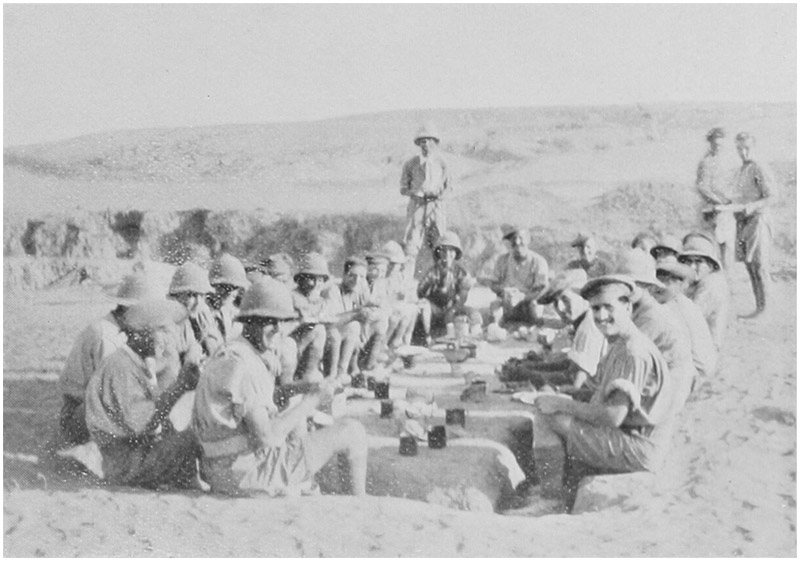
A PLATOON MESS, WADI ASHER.ToList
To face page 58
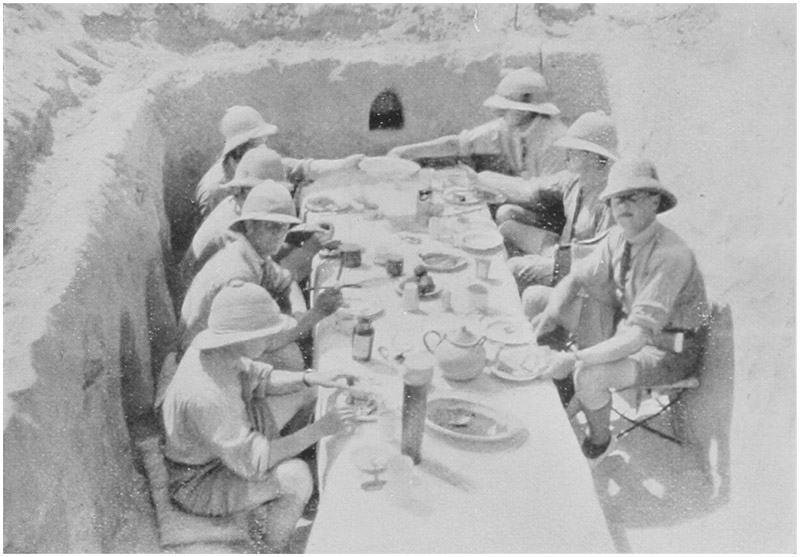
“C” COMPANY OFFICERS’ MESS, WADI ASHER.ToList
To face page 58
We did not return to the camp we had left, but to the Wadi Selke, a
mile or two inland from Deir-el-Belah. The distance from the sea made
bathing a bit of a toil, but otherwise it was a good camp, especially
for the officers, whose bivouacs were in a fig grove which bore a very
heavy crop of excellent figs. We stayed here about seven weeks, the
longest spell we had in any one place, and made it into a good camp.
There was a fair football ground on which we got through an
inter-platoon American tournament, which kept everybody amused. There
used to be a great turn-out when the officers’ team was due to
play—they occasionally won their matches. We also had a good 200
yards’ range with sixteen targets, and carried out innumerable
experiments to decide upon the best methods of attack. We had
exhibitions of wire-cutting and smoke screens, bangalore torpedoes,
and many days of practising co-operation with aeroplanes. Very
frequent night marches by compass, combined with digging in, and
followed by an attack or advance at dawn. In fact, we were put through
a very practical training for the task which we were later to
undertake.
In order to minimise the chance of anything going wrong with the plans
for the concentration and attack on Beersheba, many officers were
given the chance of making a reconnaissance as near as possible to the
Turkish positions. This was done from Gamli, a place on the Wadi
Ghuzzeh about fifteen miles inland and about eleven from us. We rode
over there the night before, and in the early morning the cavalry
moved out and pushed their line within a mile or two of the Beersheba
defences. Covered by this, parties of officers rode out and
familiarised themselves with the sector in which their unit was to
operate, and they were thus able to hand in reports upon which Brigade
Staffs could allot concentration areas and routes.
At the moment of kicking off we were as well trained as we were ever
likely to be, and, what is more important, were very fit and full of
the offensive spirit. The concentration started on 25th October, when
we marched some six miles to Abu Sitta. Our transport establishment
had been very carefully thought out, and, though both animals and
vehicles were undoubtedly overloaded at the start, this soon rectified
itself, as consumable stores could not be replaced. We had one camel
per battalion for officers’ mess, and he started out very fully laden.
He was a good deal less heavily loaded towards the end of the
operations. Next day we marched on beyond the Wadi at Gamli—a very
dusty and tiresome march—and were to have remained there throughout
the next day. Word came in, however, that the Turk was attacking our
outpost line at El Buggar, some ten miles out, and the Battalion had
to move off at a moment’s notice about noon. The march through the
heat of the afternoon was most trying, and on arrival it was found the
enemy were occupying part of the line we were to take up. They
withdrew, however, in the evening, and we constructed a series of
strong posts from the Beersheba road to south of El Buggar.
During these days of concentration the plain lying between Shellal and
Beersheba had been the scene of great activities. Karm had been
selected as the position for a forward supply dump, and both light and
broad gauge railways were being pushed out towards it at top speed.
The first blow of the campaign was to be launched at the defences of
Beersheba, which were facing west and extended both north and south of
the Wadi Saba. They occupied a commanding position and were
continuously wired. The main attack was to be pushed home south of the
Wadi Saba by the 74th and 60th Divisions, and at the same time the
enemy’s extreme left flank was to be turned by the cavalry, who were
to make a wide detour through very difficult and waterless country and
attack Beersheba from the east, and, if possible, cut off the retreat
of the garrison of the Beersheba area. Covering all these preparations
an outpost line was established some miles east of Karm and El Buggar,
held on the left by the 53rd Division, then the 74th Division, then
the Imperial Camel Corps, and, south of the Wadi Saba, where it was
much more lightly held, a mere line of cavalry observation posts.
These cavalry posts were covering, and slightly in advance of, the
positions selected for battle headquarters for the 74th and 60th
Divisions.
The preliminary arrangements for the troop movements went like
clockwork, as did also the approach marches to the positions of
deployment, and at the appointed time on 30th October, the Divisional
H.Q. moved up the five or six miles to the battle stations selected.
There was no sign of crowding or confusion—the only indication that
there was anything unusual on, was the dust which could be seen here
and there. The moves of the infantry began just as it was getting
dusk, and long before dawn both the 60th and 74th Divisions had their
two brigades on the line of deployment, which stretched southwards
some three or four miles from the Wadi Saba.
As soon as it was daylight a bombardment of the Turkish advanced
position on Hill 1070 was started, smothering the entire landscape in
clouds of dust. This first attack, which was carried through by one of
the brigades of the 60th Division, was ordered at 8.30 A.M.
Hill 1070 was carried at 8.45, and during the next hour all the
remaining advanced positions fell, and it was even reported that the
enemy was here and there evacuating portions of his main line. There
was now another interval for bombardment, whilst the gunners were
wire-cutting for the attack on the main positions. During this period
of waiting, which was longer than had been expected, our infantry
suffered a good deal from shelling, much of which was in enfilade from
positions north of the Wadi, and it was with relief that they received
the order about 12.15 to proceed with the main attack. In about forty
minutes all the trenches opposite the 60th Division were captured, and
the 74th completed their task only about twenty minutes later, one
brigade having had some difficulty owing to incomplete wire-cutting.
The 60th had, by 2 P.M., advanced some way beyond the
captured trenches towards Beersheba, and the 74th crossed the Wadi
Saba and cleared the trenches northward to the barrier on the
Fara-Beersheba road.
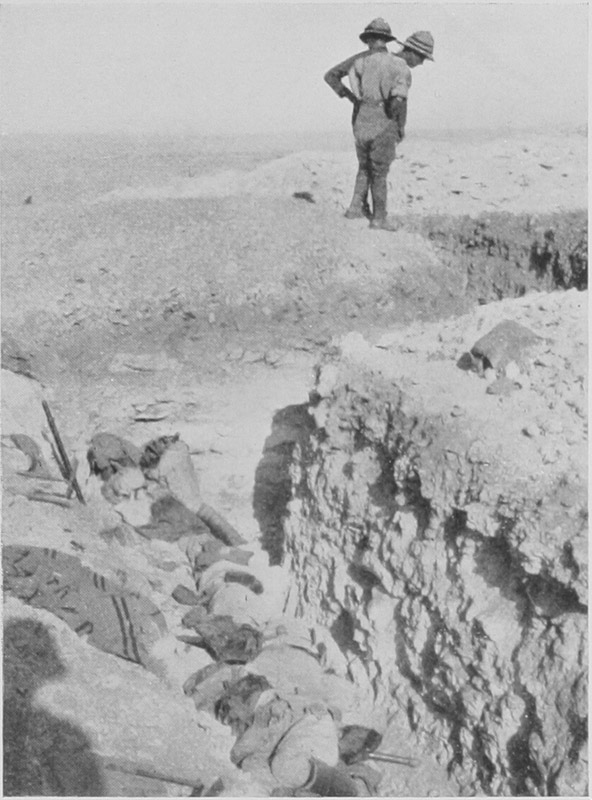
TURKISH TRENCH WITH DEAD TURKS. HILL 1070, NEAR BEERSHEBA.ToList
To face page 62
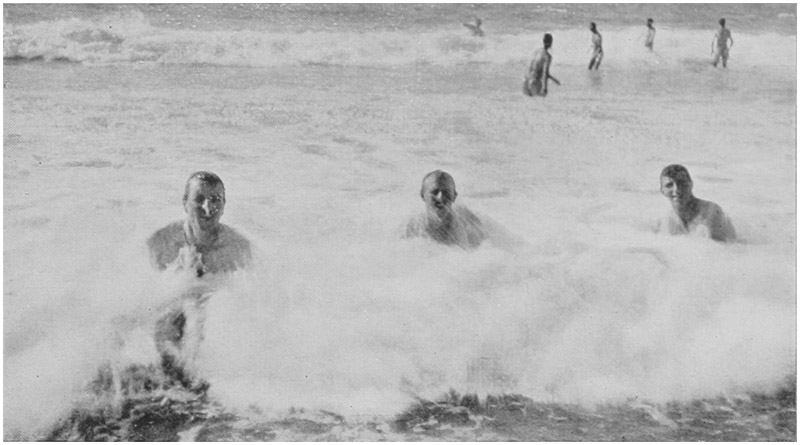
BATHING, REGENT’S PARK.ToList
To face page 62
Meantime the cavalry had found their detour even lengthier than had
been expected, with the result that they were some hours later than
they should have been, and were held up for most of the day by
trenches at Tel-el-Saba, a mile or more east of Beersheba proper.
These were, however, rushed towards evening, and Beersheba was
occupied that night. Very few of the troops allotted for the defence
of Beersheba escaped, the whole operation being completely successful.
The Engineers at first reported that the water supply and wells were
intact; but this proved to be far from the fact, and within
forty-eight hours the shortage of water was being severely felt.
After this smashing success in the first stage of operations all our
tails were well up, and everyone was keen to know what was to be the
next move.
The next day found the 60th concentrated at Beersheba; the 74th just
north of the barrier on the Fara-Beersheba road, while an advance
northward had been begun by the 53rd and, in the evening, by a party
of the 74th. One brigade group for the former advanced in a northerly
direction west of Ain Kohleh, and the remainder in a north-westerly
direction on Kuweilfeh. The left advance was successful, and a line
was established on the desired objective, a ridge running east and
west some five or six miles north of Beersheba. The other advance was
not so fortunate; something went wrong with the supplies both of water
and ammunition, and strong opposition was encountered. Also, it was
impossible country to campaign in; practically roadless, and very much
broken up with wadis and rocky precipices, which made it most
difficult to maintain communications, even though a mounted brigade
was thrown in to help.
The situation up here was much the same next day. No great progress
had been made, nor were good communications established, but they had
managed to get through both water and ammunition. Other divisions
were, however, kept on the move. The 74th were moved up to take over
some line from the left of the 53rd, the 60th were concentrated some
three miles N.W. of Beersheba, and one brigade of the 10th was moved
to Irgeig. This was an anxious day, as the 53rd seemed to be quite
held up at Kuweilfeh and not too well provided with supplies, and
there was considerable doubt, in view of the general scarcity of
water, whether it would be possible to carry on the campaign, which
involved rolling up the Sheria and Kuwauka defences from the east.
Our Intelligence Department had for the moment “lost” a Turkish
division, which complicated the situation very much as, if it were
suddenly to appear on the right flank of our attack on Sheria, a most
serious situation would be created. However, on the afternoon of the
5th, word was received from the 53rd Division that they had captured
prisoners from numerous different battalions, some of which were known
to belong to the missing division. This settled the question, as it
was quite clear that the 53rd were keeping them too busy at Kuweilfeh
for them to be able to send any serious force to Sheria. The “lost”
division it seems was one which had been sent to reinforce the forces
defending Beersheba, but by the time it got to Sheria the Beersheba
defences were taken, and it was obviously no use going there. It was
accordingly then sent to Kuweilfeh in anticipation of an attempt by
us to turn their extreme left flank.
On the afternoon of the 5th orders were rapidly issued for the attack
next day on the Sheria defences and the Kuwauka system.
As most of the troops destined for the Sheria attack were at this time
in the outpost line, this meant a concentration and deployment by
night in an unknown country where map reading was very difficult
indeed, and it was most creditable that it should have been, as it
was, successfully carried out. There were certain minor mistakes, but
in the main the attack came off as planned, and by midday all the line
of the Sheria defences were in our hands.
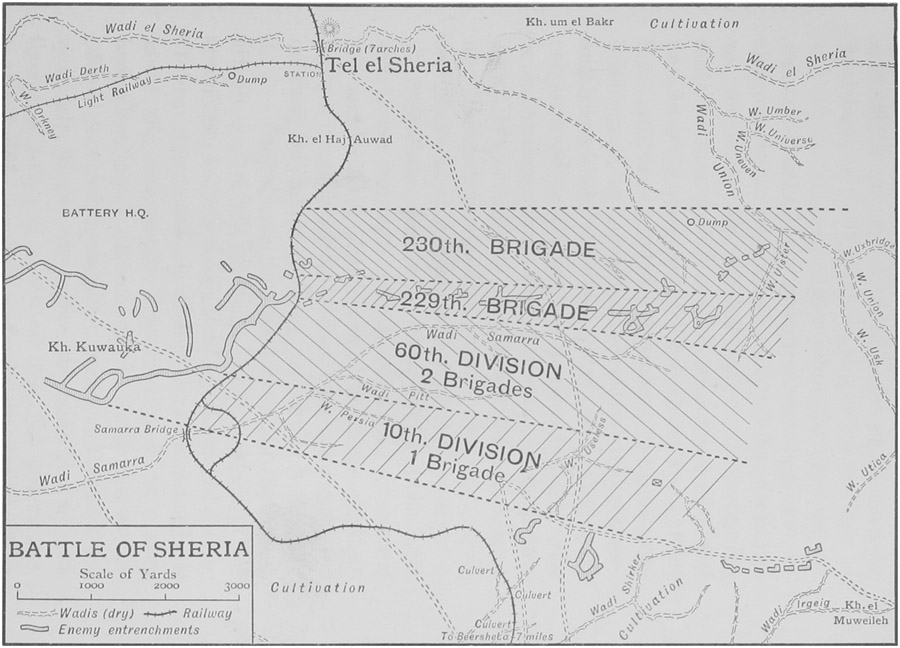
The spearhead of the attack was the 229th Brigade, with ourselves and
the Somersets in the front line, and it was a brilliant affair from
start to finish. The brigades on our right and left, the 230th Brigade
and a brigade of the 60th Division, were echelonned in rear of us, and
the prompt success of our attack greatly assisted the advance of the
60th and 10th Divisions on the Kuwauka system. Our Lewis guns
especially gave great assistance, and were successful in preventing
the Turks from removing several of their guns, placed in rear of the
Kuwauka system. This was acknowledged by the 60th Division who, in the
true sporting spirit, let our Division know that they did not claim
those guns as captured by them, though it was by their men that the
guns were actually collected.
The guns of the 60th and 10th Divisions served them well and cut the
wire most thoroughly and, without any undue number of casualties, the
positions were finally taken about 2.30 P.M. The 10th then
took over the line from the 60th, who advanced to the attack on the
wells and railway station at Tel-el-Sheria. Unfortunately it was by
this time getting dark, and direction was to some extent lost. The
Turk put up a good fight here, and it was not until the morning that
the wells and station were in our hands. We could see their dumps
blazing all night far to the north, and it was clear that they had
made up their minds to a general retreat.
These first six days in November had been strenuous days for the
Battalion. On 30th October the Corps Cavalry and I.C.C. had passed
through our lines, and we moved up to a position in Dundee Wadi. The
231st Brigade then passed through and took over from us, attacking
along with 230th Brigade working in conjunction with the 60th and
Cavalry Divisions. On 2nd November we took over the outpost line from
the 2/10th Middlesex Regiment (53rd Division), and on 4th November we
again advanced our line, meeting with no opposition except sniping and
intermittent shell fire. At 7 P.M. on the evening of 5th
November we received orders for the attack on the enemy’s position,
were relieved at 9 P.M. by a battalion of the 230th Brigade,
and at 11 P.M. moved off to the point of deployment.
At 3.30 on the morning of 6th November we deployed for the attack, the
230th Brigade being on our right, and the Somersets on our left. The
advance began at five and we were badly enfiladed from the right where
the attacking troops were being held up, and whence we continued to be
enfiladed until we detached a couple of platoons, who carried the
enemy’s positions there by 6.15. By 5.55 we had taken our first
objective and captured four guns, all limbered up and trying to get
away. We promptly attacked the ridge beyond, and having captured it
proceeded to consolidate. At midday we again advanced under pretty
heavy fire, but the Lewis gunners were very well handled, and
succeeded in knocking out the crew and teams of two field guns beyond
the railway, and we carried on to the position just east of the
railway.
Our casualties at the Battle of Sheria were Major G.E.B. Osborne,
Lieutenants J.D. Kinniburgh and E.A. Thompson, and 47 other ranks
killed, and 5 officers and 182 other ranks wounded, of whom 13
subsequently died in hospital. Among the wounded was Lieut.-Colonel J.
Gilmour, who was hit at the very end of the day, and to whom was due
no small part of the credit for the victory. His brilliant
leadership and dash at Sheria earned him a well-won bar to his D.S.O.,
and the admiration of the whole Brigade. The elan and dash of the
Battalion, under his inspiring leadership, throughout the operations
gained the highest praise from all quarters. Between 5 A.M.
and midday the Battalion along with the Somersets had advanced some
10,000 yards, in the course of which they had captured several
successive all-round positions held by considerable garrisons, and
well provided with machine guns. In addition to 99 prisoners we had
captured six field guns with limbers, three machine guns, and a large
quantity of S.A.A. Our dead were buried in the cactus garden.
Emery Walker Ltd. sc
To face page 68ToList
Major J. Younger who had been acting as liaison-officer between the
60th and 74th Divisions was sent for to take over command of the
Battalion, which was in the highest of spirits in spite of all it had
come through, full of beans, very proud of themselves and the Colonel,
and more than ready for another scrap.
We were all thoroughly glad to have had such a good introduction to
infantry work; not only had it been a success, but it had also been
well planned. The staff work had been excellent and, above all, it had
been open warfare for which we thought, rightly or wrongly, that our
mounted training had prepared us.
We had now got some news of the doings of the other corps on the
coast. We knew that they had succeeded in taking Gaza and were
advancing north, and we saw the cavalry divisions galloping through us
brigade after brigade to take up the pursuit. The Turk was in a most
awkward position, but proved himself a first-class rear-guard fighter.
On the night of the 7th he had only the narrow neck between the
cavalry and the XXI. Corps, who were advancing up the coast, and this
neck was not more than five or six miles wide; but in spite of all
difficulties he managed to get most of his infantry and some of his
guns away. We ourselves expected to start our advance north following
on the cavalry, but it turned out that the transport was not able to
maintain two corps so far in advance of Railhead. The XXI. Corps,
being already on its way north, was given the task of clearing the
Plain of Philistia, and following up the Turkish retreat with the
assistance of a considerable portion of our (XX. Corps) transport. As
we were not to go on, the authorities were in no hurry to move us, and
we spent a couple of days clearing up the battlefield before returning
in a couple of the dustiest and most unpleasant marches to the
neighbourhood of Karm.
Our actual destination was Goz-el-Gelieb; but when we got near the
spot it was so thick with dust that we could only see about 50 yards,
and as the plain was quite featureless and all alike, we just
bivouacked for the night, and hoped we should find in the morning that
we were somewhere near the right spot.
First thing after daylight, while the dew was still able to keep down
the dust, we got our bearings and moved about three-quarters of a mile
to the correct map reference. Here we were joined during the day by
our “B” team or battle surplus, whom we had last seen a fortnight
before, and a draft of 2 officers and 126 other ranks out from home.
On 15th November Major-General E.S. Girdwood, commanding 74th
Division, at a Brigade Parade presented Military Medals, awarded for
gallantry at the Battle of Sheria, when 9 men from the Battalion
received the honour.
After a few days in the dust of this plain, we moved back in two
marches to our old area near the coast. This time we were just south
of the Wadi Ghuzzeh, on a hill which was beautifully green and fresh.
All the lower ground round it had been used for camps for the best
part of a year, but this hill had been so prominent and so fully under
observation from Ali-el-Muntar, that it could not be occupied so long
as the Turks held Gaza. Here we had a great presentation of medals by
the Corps Commander (Lieut.-General Sir Philip W. Chetwode, commanding
XX. Corps). Our share for Sheria was 1 D.S.O., 4 M.C., 5 D.C.M., and
1 more M.M. making 10 M.M. in all, which we all agreed was a quite
satisfactory allowance. Evidently the authorities at home thought so,
if one may judge from the fact that there was practically nothing
obtainable for the next six months.
We were told by the authorities that we were certain to remain some
time in the Gaza area, where we were fully occupied in salvage work,
for the simple reason that the Q Branch could not feed us if we moved
beyond Railhead. Some new factor must, however, have arisen, as we had
only stayed some five days, and most of the Battalion was out some
four or five miles away on salvage work, when suddenly orders arrived
that we were to march that afternoon.—Starting point, the crossing of
the Wadi Guzzeh, 4.30 P.M.
Before describing our march it would be as well to give some idea of
the position of the XXI. Corps, which had been, with the assistance of
the cavalry, pushing the Turkish forces back on to Jerusalem and
Jaffa. This pursuit, which met with a pretty stout resistance
throughout, had been going on for nearly a fortnight, and the Plain of
Philistia was cleared of the Turk, whose main forces had retired on
our left a little beyond Jaffa, and on our right into the precipitous
Judæan Highlands defending Jerusalem. Our Railhead had only reached
Deir Sineid, a few miles north of Gaza, and about thirty-five miles
south of the battle front. The Turkish railway, which went as far as
Junction Station, and from which much had been hoped, proved almost
useless owing to shortage of rolling stock, and consequently supply
depended almost entirely on motor lorry and camel from Railhead, or
from the Wadi Sukharieh, where some supplies were being landed in surf
boats. The question of supply had been most difficult, and water
supply hardly less so, even for the one corps, and it looked as if we
might come in for some scarcity when we got up nearer the front. In
the pursuit of the portion of the Turkish Army, which was retiring on
Jerusalem, our cavalry had penetrated some way into the hills, and
were endeavouring to hold on until the infantry could get up to
relieve them. The process of relief was going on during the few days
we were marching up.
Now to return to our part in the affair. Our first march was a short
one of some seven or eight miles to a bivouac a mile beyond
Ali-el-Muntar, the prominent height dominating Gaza at which we had
been looking the whole summer. We stayed here for a day, partly to
wait for the arrival of greatcoats, which would be so necessary in the
Judæan Highlands, and to get rid of our helmets, and partly to give
the supply people a chance. Most of us spent an hour or two examining
Ali-el-Muntar and its defences. It looked very much less knocked about
than one would have expected after the severe bombardments to which it
had been subjected, and we came to the conclusion that there had never
been very many troops actually holding it. The infantry had evidently
been in trenches well away from the hill, which appeared to have been
used entirely for observation purposes. It must have been a pretty
uncomfortable corner for an F.O.O., as the top used to appear to be
blown off about three times a day. Concealment of trenches had been
made very easy by the presence of numerous cactus hedges, and it is
doubtful whether our guns, except in the actual assault, had ever had
a really satisfactory target.
After this day of rest, 24th November, we marched just over twelve
miles to Mejdal. The weather was not too hot, and there was quite a
good beaten mud road, and we should have found it a fairly easy march
if it had not been for foot troubles. We had been more than six months
without having ever marched on a road—it had usually been soft
sand—and the sudden change to the flat hard surface of the baked mud
fired the men’s feet at once. When we arrived in camp at Mejdal we had
a foot parade, and found that there were over a hundred cases of
blisters and dressings for the medical officer and his satellites.
This Mejdal was quite a considerable village, and as we marched in we
met the most dignified specimens of native we had yet seen. Mounted on
donkeys and wearing the flowing robes of the Old Testament, they
really did remind one of the patriarchs in our stained glass windows.
All the brilliant colours—purple, crimson, and orange—were
represented, and many of them had the regulation beard. There were
also numbers of the usual class selling oranges and, oddly enough,
also cigarettes.
Next morning we were again on the road and not feeling too cheery
about it, as we were told we were to do a 19-mile march—rather a
formidable proposition when every second man already had sore feet—as
it was the intention of the authorities to get us up to Jaffa in two
strenuous marches. However, during the course of the day the plan of
campaign was changed, and we were told that we should probably have to
go to the Judæan Hills instead of to the Ramleh-Jaffa Sector near the
sea. This was not the best of news, as there was no doubt which was
the more salubrious spot; but it had this compensation that it knocked
six miles off our day’s march, our camp being pitched near the Wadi
Sukharieh mentioned above, which was a convenient starting-point for
the next day whether we were ordered to Ramleh or to Junction Station.
We found, to our surprise, that the feet were no worse than the
previous night; some few were getting pretty bad, but most of them
looked as if they were on the mend.
The next day we were finally labelled Judæa, and did a most trying
march—only about eleven miles, but a frightfully hot day—at first
through various pleasant looking farm colonies, and later through a
most desolate piece of country to Junction Station. On this trek we
were lucky enough to come under the eye of the Commander-in-Chief, who
at once noticed what we all very well knew—that we were carrying a
much greater load than could reasonably be expected in such a climate.
We had to do it, as the necessary camels had simply not been
available. However, the Commander-in-Chief quickly remedied this, and
from here onwards we had camels provided to carry our greatcoats,
leaving us pack and blanket only.
At Junction Station we had our first taste of water trouble. As we
were making our way from west to east, we were changing places with a
division of the XXI. Corps. This division had spent the previous night
at Junction Station and had drunk the wells dry, so that no water was
obtainable on our arrival. We were told we should get it by 9
P.M., and then a later hour was mentioned; but the net result
was that we got just enough to make our breakfast tea, but not enough
to fill the water-bottles, so we started on our next stage in the
very worst of tempers to find that we had hardly got out of camp
before we were involved in a regular block at the railway crossing
which, needless to say, was frightfully dusty. This delay proved,
however, to be a blessing in disguise, as it enabled our water camels
to catch us up with a small ration of water for lunch. If we had not
got this water we should probably not have got more than 75 per cent.
of the Brigade to the end of the day’s journey. We got into camp on a
rocky slope near Latron about dusk, and almost at once were warned to
be ready to start again at 9 P.M. to march another ten miles
and take over part of the line in the hills. This was soon altered to
starting at 3 A.M. owing to better news from the front, and
again to 8 A.M. the next morning as the situation calmed
down.
It was now becoming really interesting, as we expected to be in the
line within twenty-four hours, and all sorts of rumours were current.
Generally it was understood that we had penetrated successfully into
the hills until we were brought to a halt by the difficulties of
supply, and that now the Turk was beginning to recover from the
effects of his long retreat and was launching counter-attacks, which
had in some cases been fairly successful, and that he had given the
XXI. Corps a couple of heavy knocks to the north-west of Jerusalem. It
was expected that the XXI. Corps would be pulled out to the
comparative comfort of the Coastal Sector, while we—the XX.
Corps—were to have the honour of attacking, and we hoped, capturing
Jerusalem.
We had now been marching for six days and most of us found our feet
improving and getting accustomed to the roads, though we had lost some
twenty-five good men, who had kept going like good ’uns with really
sore feet until they had to be sent to hospital by the M.O. That is
one great joy about the British Tommy, if things are really “business”
he will stick almost anything. Men who had protested before and during
every route march in training that they could not carry a pack more
than a few miles, and who literally had to be hunted home, did all
these marches up to the front without faltering, though they were
incomparably harder and though a heavier load was being carried.
Our next march was a short one of six miles into the foothills to Beit
Sirra, a spot quite close to Likia, in a piece of country we were to
know very thoroughly before we were done. Here we spent an uneasy
night “in readiness to move”; but it was not till next morning that we
really took to the hills, marching up a most precipitous Roman road to
a spot which can only be described as Q 20, central. It was close to
the Roman road and about half-way between Likia and Kubeibe, and lay
on the covered side of the ridge south of that on which our line was
at that time established.
Next day we got orders to take over a bit of the line, and towards
evening we climbed down into the Wadi Selman, and up the other side to
relieve another brigade of our Division. This turned out to be a
pretty jumpy business, as there had been some heavy fighting on our
right during the afternoon, and the people we relieved told us that,
to our right, all the ridge north of the Wadi Selman was in the hands
of the Turks, and that they might be expected to advance at any time
against our right flank, and that they themselves, though they had not
got it definitely, understood that our line was to be withdrawn behind
the Wadi Selman.
The sector which we were supposed to take over extended from Hill
1750—where, presumably, even if we ever had had touch with our own
troops, our flank would now be right in the air—to the Wadi Zait. A
deep and precipitous wadi—the Shebab—ran from the Turkish positions
through the centre of our sector down to our Battalion H.Q. in the
Wadi Selman. We had no news of any change in the situation on our
left, so assumed it must be all right, and one company was sent up the
hill to occupy the portion of the line to the left (or west) of the
Wadi Shebab, getting touch with the 52nd Division on their extreme
left. This lot were lucky enough to find an enamelled wire already
laid from Battalion H.Q. to their Company H.Q. and, though it was
broken in one or two places by mules during the relief, they soon got
it patched up and in communication with Battalion H.Q. A company and a
half was sent to the right of the Wadi Shebab to move in fighting
order towards Hill 1750, making good the ridge as they proceeded.
There was no chance of getting wire out here, nor had we enough lamps
to establish a transmitting station, which was necessary; but by using
our own Orilux torches we managed to get through one or two brief
reports of progress, and at last, about 2 A.M., a message
came through that they thought they were on the hill and had
encountered no opposition.
In the morning as soon as it was light, Lieut.-Colonel Younger started
out to see the right flank, and soon decided that they were not on
Hill 1750, which he made out to be twin knolls some half a mile
further on, and just about the same height as the hill we were
occupying. On one of these peaks we thought we saw a few Turks, and
about midday D Company (Captain H.S. Sharp) made a detour down
half-way to the Wadi Selman in our rear, and then advanced straight up
the cliff at these two peaks. They got to the top unopposed, but the
moment they showed over the skyline they were met with a hail of
machine-gun bullets and shrapnel, the position being completely
dominated by the Turks at medium range. How it was no one could
understand, but the attackers only had one casualty on the top, and he
was very gallantly brought back by the officer in charge of the
company. We stuck to one twin peak but evacuated the other, and it was
now clear that 1750 was still farther on, and that the Turk was
occupying it, so that, in order to have a dash at it, the first thing
to do was to extend our line farther to the right and get in touch
with some of our own troops. Distances and contours were almost
impossible to appreciate from the map, and it was not realised what a
great extent of line we were being asked to hold with a battalion, and
really, faulty map reading was excusable, considering the maps we had
to work with.
To begin with, the map was two miles to the inch, and was not
contoured—merely hachured—which is no earthly use where the peaks
are crowded up within a few hundred yards of each other, so that three
peaks in line appear on the map as one ridge, though there may be dips
of 500 feet between them, and looking at it the other way, it is very
hard to believe that a place which it takes you one and a half hours
to reach walking is less than a mile on the map. We were all deceived,
but by good luck on this occasion no harm was done.
Brigade at once sent up three companies and some machine-gunners to
support us, so we were all right in the line; but they proved to be
too many for the signal communications, which all had to come through
Battalion H.Q., and the signallers were worked to death. All these odd
companies and the machine-gunners had to arrange for their own supply
of ammunition, water, and rations with their own units, as they were
the only people who could supply the necessary pack animals to bring
the stuff as far as Battalion H.Q. From here the stores had to be
carried by hand by fatigue parties, and these parties had to be
advised by signals whenever their stores arrived. This meant
continuous work for the signallers, who had to keep their stations
going with insufficient reliefs, a thing that can only be done for a
very limited time.
We had hardly got this extended disposition complete when orders were
received to relieve two companies of the Devons, as their battalion
was down to carry out an attack that night. Of course as luck would
have it, the companies were right up on the top of the hill, and the
only people available to relieve them were the companies which had
just come down after having done a couple of days up there. However,
there was nothing else for it, and they just had to go back, with the
promise that they would be relieved as soon as Brigade sent the troops
to replace them. During the afternoon the senior officers from the
attacking battalion came down to reconnoitre, but it was about 4
P.M. by the time they got down, and consequently they had
only time to see their objective from one point of view which, as it
happened, was a fatal misfortune, as it left them with quite a false
impression of what their position would be when once they got their
objective. There was some discussion as to whether it should be a raid
or a consolidation. All those on the spot favoured a raid, but judging
from the map it appeared a desirable position to consolidate, and this
was finally ordered.
Almost every division made one such mistake when first operating in
this mountainous country, and this was to prove to be ours. The
objective was the hill and village of Beit-ur-el-Foka—the Upper
Bethhoron of the Bible, where the sun stood still for Joshua—which
seemed to occupy a commanding position on the old Roman road between
Beit-ur-el-Tahta and El Jib, and was marked clearly on the map. It was
also supposed to contain water, and to be desirable for that reason.
The attack was carried out by an advance up the Wadi Zait to a
position of deployment at the foot of Foka Hill itself, whence the
summit was successfully rushed. There were few casualties and a good
haul of prisoners—somewhere about 150. But it was to prove impossible
to remain there. The position itself was not sufficiently roomy for a
battalion, and no digging was possible owing to the rocky ground. It
was also too exposed from no less than three sides.
Opposite, across the Wadi Imaish, which ran east and west, roughly
N.N.E. from Foka, was the dominating ridge of Zeitun, some hundreds of
feet higher than Foka and under 1800 yards away; to the N.N.W.,
perhaps 2000 yards off, was the crest of Khirbet Kereina, fully as
high as Foka; and, as if these two dominating positions in front,
giving first-class artillery observation, were not enough, there was
also a hill, subsequently known as Hill A, which was just about the
same height as Foka, was held by some Turks with one or two machine
guns, and fired slap into their right rear from the south-east. This
last was only some 500 or 600 yards away, but was divided from Foka by
a deep ravine, and it was found impossible to send a detachment to
storm it. It was this hill in rear that sealed the doom of the
business. They might have managed to stick it out in spite of the
rifle and artillery fire in front until the Turks got tired of it, but
the fire from the rear limited all movement and all getting up of
bombs and ammunition. Under cover of rifle fire and shrapnel the Turks
stormed up again and again, climbing up the steep face of the Wadi
Imaish where our guns could not have touched them, even if they had
had—which they hadn’t—any decent arrangements for observation. Once
up within bombing distance, the Turk had the great advantage of a
large supply of bombs, whereas we had not had time to get up more than
a few which were soon exhausted. Even ammunition was not too
plentiful, as everything had to be carried up the very steep Wadi
Zait, the top portion of which was commanded from Hill A. The best way
for evacuating wounded proved to be down the Roman road to
Beit-ur-el-Tahta, where they were handed over to the 10th Division who
were now on our left.
To make a long story short, the O.C. Battalion had to make up his mind
to quit, and he had a hard job, even with some assistance from the
10th Division on Tahta Ridge, to bring away his wounded who were very
numerous. About 3 P.M. the last of them came out, having had
a terrible day, only four or five officers remaining unwounded. They
stuck to it well, but it was an untenable position. The Turk contented
himself with driving them off the Foka Heights, and did not attempt to
advance farther—if he had, it might have proved just as bad for him
as Foka had been for us.
On 4th December we were relieved by the 6th Munster Regiment and went
back to our old camp at Q 20 central, where our transport had remained
all the time. Here we rested for a couple of days. We found that our
Division had been pulled out, in order to take part in the sweeping
movement by which it was hoped to capture Jerusalem. On the third day
after our relief we moved out, in floods of rain, along the so-called
road to Kubeibe, where, along with the battalion which had been in
Foka and half the machine-gun company, we were to form the Divisional
Reserve for the first phase of the operations. It was an awful night,
and the track was so steep and slippery that the camels could not get
on, and there was broken-down transport every few hundred yards along
the track which was charitably described on the map as a road. The
site of our bivouac was partly rocky ledges and partly slippery mud,
and we spent a most uncomfortable night. The attacking troops of the
Division moved to their positions of deployment the same night, and in
the early morning successfully took the Beit Iksa trenches, which were
the first objective. The next stage—the capture of the El Burj Ridge
and Neby Samwil—was not so rapid, but all were in our hands on the
following day (8th December) and, on our right, the 60th Division had
made equally good progress in face of determined opposition south of
the Jaffa-Jerusalem road.
On 8th December 3 officers and 100 other ranks went off road-making.
One officer and 30 other ranks formed a military cordon round
Kubeibeh, and 1 officer and 50 men proceeded to Enab to represent
Scotland in the Guard of Honour which it was hoped would be required
for the entry into Jerusalem. Thirty more for A.S.C. fatigues at
Kuryet-el-Enab, and another lot to fetch from Latron a lot of donkeys,
which were to be added to our transport establishment. The result was
that, when about 5 P.M. we were ordered to rejoin the Brigade
in the neighbourhood of Beit Iksa, we could only muster about 200 of
all ranks. The Senior Company Commander was accordingly left behind to
collect what he could and follow on, and we started off with the rest
of the Divisional Reserve to do the six or seven miles in the dark in
single file. We could not use the road—so-called—from Kubeibe to
Beit Iksa, as we could not discover whether the village was wholly in
our hands, so we wandered on in pitch darkness with no path of any
kind to show us the best way along the most precipitous slopes, and
the most dangerous wadis. The camels were entirely unable to follow,
and even the mules were in difficulties, several of them falling over
ledges and down terraces. It was 1 A.M. (we started about 5
P.M.) before we reached the locality in which we had expected
to find the Brigade, but we could find no trace of them, and there was
nothing to be done but send out a few scouts to look for them, and lie
down and sleep until daylight.
The situation was not improved by the fact that all ration convoys
had broken down the day before owing to the slippery tracks, and we
had only the unexpired portion (i.e., breakfast) instead of two
days’ ration plus the unexpired portion as we should have had, and as
the authorities no doubt thought we had. We had also no confidence
that those who were responsible for bringing up the overdue rations
had any idea where to look for us even if the weather improved
sufficiently to allow them to make use of the tracks. We understood
that we were in for a four days’ push, and it looked like being a real
hungry one. This proved to be the case, as no rations reached us until
the end of the operations; but luckily they lasted only two days
instead of four.
Next morning, the 9th, just before dawn, someone came rattling down
the steep slope above us, and to our joy we found it was the
Brigade-Major coming to look for us, and that Brigade H.Q. was just
above us—“just above” being 600 feet up one of the steepest slopes
one could climb. However, we got up all right about 7 A.M.
and managed to get a bit of our precious food disposed of before we
received orders to move.
Our part in the assault of Jerusalem was to march with all speed to
take up a position on Tel-el-Ful, a hill some 2500 feet high, a mile
or so north of the town, so as to cut off the Turks from retreating up
the Nablus road. We were, as Divisional Reserve, carrying full
packs—not light fighting order—and it was an awful piece of country
to cross without even a track. We had first to climb down some 600
feet into the Beit Iksa Wadi; then up the precipitous face of El Burj
about 1000 feet from the bottom to the top; then a couple of
comparatively easy miles down into the Wadi Hannina, and up the other
side some 1200 feet to Tel-el-Ful. Our Battalion did not have to go
very far beyond the Wadi Hannina, but we certainly thought it quite
far enough. This was to be one of our worst nights, as it rained hard
and blew a gale, and we were on the exposed side of the hill; also, no
rations had arrived or were likely to arrive, nor was there any sign
of them when we started off on a further advance north the next
morning. However, we knew that Jerusalem had fallen, which cheered us
up and made us hopeful that the operations would last less than the
promised four days.
Our advance north was an attempt to get us into line with our own
people on Neby Samwil, which was easily the most commanding feature of
this part of the country. The battalion on our right had to attack up
the exposed ridge along which ran the Nablus road, while we were lucky
enough to have the frontage just east of the Wadi Hannina, where our
objective, the steep and massive feature of Bab-el-Muallek covered us
from artillery observation. The Turk soon spotted the movement and
during our advance treated us to heavy shelling, which took a
considerable toll from the exposed right battalion, whereas they were
firing at us without observation, and did us no damage, though the
machine-gunners, who advanced along with us, lost both men and mules.
The actual crest of Bab-el-Muallek was most uncomfortable, as shells
were bursting all along it; but though they searched the back of the
hill most thoroughly, it was so steep that we were pretty safe so long
as we lay snug. About 4 P.M. a couple of mules arrived with
some rations. It did not go far, but was enough to give everyone a
bite, and we were told that the rest would soon arrive.
Just on the top of this, we were told that the 60th Division was
holding the line Tel-el-Ful-Beit Hannina, and that we might, as soon
as we were ready, retire through them into support in the Wadi
Hannina. Not much time was lost in getting under way—we did not even
wait for the Lewis gun mules, which were away being watered, but
man-handled the guns and heavy valises. These proved really too heavy,
and the men responsible for them were very much exhausted by the time
we got into bivouac, though the distance cannot have been more than
two or three miles. Here we found a regular haven of rest.
Comparatively smooth, lying in an olive grove, and all the missing
rations waiting for us. We ate about one whole day’s rations in one
enormous feed, and then went to sleep. We all needed it pretty badly,
and even at dawn the whole camp was still sound asleep in spite of the
fact that they had no covering but their greatcoats, and there was
half an inch of ice on the water-buckets.
This proved to be the end of the Jerusalem push, and next day, 11th
December, in glorious weather we marched back to a bivouac near Beit
Iksa on the slopes of the wadi leading down from Neby Samwil to
Kulonieh. Here we received our donkeys—forty per battalion—but they
were in miserable condition and felt the cold terribly, most of them
having come from the semi-tropical Nile Valley. They had also had a
tough journey up, having had to carry loads most of the way from
Railhead, when what they required was rest and food. Here we were
within four miles of Jerusalem, and all ranks had the chance of seeing
the city.
During the next week or so we managed to supplement our rations with
dried figs, and the most excellent native brown bread; but the supply
of the latter soon stopped, as we were forbidden to buy it, as it
would just mean that the B.E.F. would have to supply bread to the
population later on if we were allowed to consume their stocks of
flour. H.Q. actually managed to secure a turkey, which was picketed
out near the Quartermaster’s stores to wait for Christmas. The
programme here was “Road Improvement,” but all the same we had a slack
time for ten days or so, when we were told what was to be the next
stunt. We were to assist in a big turning movement in which we were to
go along the Zeitun Ridge, the object being the gaining of some elbow
room to the north of Jerusalem. The 60th Division were to make an
advance up the Nablus road, with which was to be combined a sweep by
the 10th Division, with our Brigade attached, on to Bireh and Ram
Allah from the west. The country favoured such a movement, as the main
ridges ran east and west. We were to be at the same time the point of
the echelon (the brigades being more or less echelonned from the
right) and the inside of the wheel.
Our course lay along the Zeitun Ridge to Beitania, and on our left,
and slightly in rear of us, brigades of the 10th Division were to
sweep clear the Kereina Ridge south of the deep Wadi Ain Arik, and the
Deir Ibzia-Ain Arik-Kefr Skeyan Ridges again farther to the north.
This meant that we had to get back to our old home in the Wadi Zait,
at the point where it joins the Wadi Selman, advance by night to the
Wadi Imaish, which lay between Foka and Zeitun, and deploy there for
the main attack. This was some twelve miles from Beit Iksa, and the
preliminary reconnaissance was a hard day’s work. We found that the
10th Division had, since we were there, secured Foka and Hill A, from
which we got an excellent view of our objective—Zeitun—but we failed
to find or hear of any path down to the Wadi Imaish. As nearly all the
hills here about are steeply terraced, that meant we could take no
mules with us to our position of deployment, as it would have been
hopeless to have them clattering about on the rocks in the dark, and
would have been certain to give the show away. We had expected to be
able to do this assembly and approach in our own time, but through our
secret service a copy was obtained of a Turkish order for an attack
down the Nablus-Jerusalem road by two fresh divisions, timed for 6
A.M. on 27th December. This was only secured, however, three
days in advance, and it was not till 3 P.M. on Christmas Eve
that we got orders to move at once to our position of readiness in the
Wadi Zait.
We hurriedly packed up, H.Q. cursing their luck at not being able to
enjoy their turkey in peace, and got off about 6 P.M. Just
after we started it began to rain heavily, and by 8 P.M.,
when the camel convoy tried to climb the hill out of the wadi, it was
so slippery that they had to give it up. The quartermaster’s hopes
were then pinned on the donkeys, who were being tried for the first
time, but the mud and cold proved too much for them. They managed to
get most of them as far as Kubeibe—about half way—but they were
quite incapable of going any farther. It was an awful night; such
squalls and rain that the best mackintosh, much less greatcoat, was
quite useless, and as our course lay along the Roman road we never
left the exposed top of the ridge. It was not so bad while we were
moving, but with a brigade in single file and a good many obstructions
on the track, the rear of the column sometimes had to halt for half an
hour while those in front negotiated some specially rough or slippery
place.
Up till midnight there were fair intervals, and we kept on getting wet
and then drying again; but midnight found us quite near our old camp
at Q 20 central, fully exposed to a gale and torrents of rain.
The battalion in front of us had to descend the steep and slippery
side of the Wadi Selman, which was just like a mud slide, and we had
to stand at the top for more than half an hour. The length of the
descent was only about 500 yards, and in the daylight and when it was
dry fatigue parties and even camels used to get down in about ten
minutes, but now, what with the rain and the passage of the unit in
front of us, it had become indescribably slippery. Men were falling
down every few yards, and the mules were not much better. It took two
hours for the Battalion to cover this 500 yards.
Wishing each other a very happy Christmas, we started on the last
stage of our journey along the bottom of the wadi, which was almost a
river, to our pitch in the Wadi Zait. We sat there till dawn—sleep
was out of the question—and then started everyone on physical drill
to get up some circulation. By this time we knew that the camels and
donkeys were both—in the language of the country—“mafisch” (which is
the same as “nahpoo”), and also that the wheeled transport, which
could not come across country as we had done, was not due till the
afternoon. Even then it was unlikely that they would bring any food,
as their proper load was Lewis gun stuff and ammunition. One can
realise what disaster had overtaken even the best arrangements, when
even Brigade H.Q., with a whole staff captain to look after them,
hadn’t so much as a crust for breakfast. The Brigadier, however, was
as cheery as ever, and almost as soon as it was light he was up in our
lines cracking jokes with everyone he met, and asking “are we
downhearted,” to which he got the usual roar as answer. It really
never stopped raining all day, and never again it is to be hoped will
any of us spend another Christmas like it. By superhuman efforts some
few ration donkeys were persuaded along by their drivers, and arrived
that night, but what they carried was only a small part of a ration.
Our hopes were fixed on the wheeled transport, which had brought their
loads of guns and ammunition, and had gone back to Kubeibe, to which
half-way house our camel loads were being brought by the wheeled
transport of the rest of the Division, who were not taking such a
leading part in the coming stunt.
Next day, the 26th, was spent in reconnaissance by company officers
who had not already done one, and in pow-wows at Brigade, at which
were decided the final details and also the scheme under which the “B”
teams were to undertake the carrying forward of ammunition and bombs
in rear of the advance. Each battalion left behind some half dozen
officers and about 50 men, so there was quite a fair number available
for the work. Our spirits rose rapidly that day, partly owing to the
prospect of something doing, partly because of a marked improvement in
the weather, but chiefly on account of the arrival of rations in
satisfying quantities, which allowed of a huge feed before we had to
start at about 10.30 P.M. There was a nice moon, and our
march in single file up the Wadi Zait to Foka was quite uneventful,
and we got a pleasant surprise when we topped the crest and found
that, by pure luck, we had struck a small footpath—the only one for
miles, we afterwards discovered—which made the descent beautifully
easy and comparatively silent. With some diffidence we made for what
we thought was our map reference, and found to our joy, that we were
exactly right. Our “perch,” as really it should be called, was on
numerous ledges on the face of a very steep cliff, and it was a
lengthy business getting the Battalion arranged with its different
companies respectively in their right places; but by 4 A.M.
we were all snug like gannets on the Bass Rock, and quite easy in our
minds, except for the uncertainty as to whether dawn would discover
the place to be under Turkish machine-gun fire. This was pretty
important, as we were not to attack until 8 A.M., so there
was time for a very uncomfortable two or three hours before we could
start. However, dawn broke, and all was quiet, and we were able to
have our breakfast undisturbed just about the time the Turks must have
been attacking down the Nablus-Jerusalem road.
The first attack was to be led by the Ayr and Lanarks on the right,
who were to scale the salient spur running up to their objective—Kh.
Mahmeh, and by the Somersets on the left, who were to advance up the
spur which led in a N.E. direction to Sh. Abu-el-Zeitun, which was
their objective. We, in close support, and the Devons in reserve, were
to follow the left battalion. This plan was adopted to avoid having to
advance up the re-entrant which was too dangerous.
At 8 A.M. the advance started. Our position was in close
support, and the chief difficulty was to prevent the leading lines
from going too fast, and getting mixed up with the battalion in front.
By 9 A.M. the ridge was taken with a nice little bunch of
prisoners, and very few casualties to us. The face, up which we had
advanced, was so steep that the defenders could not get a really good
shot at us, except in certain places; but the Somersets and ourselves
had to slide to the east side of the spur, as we were being heavily
fired at by machine guns from the direction of Kh. Kereina.
Our programme now was to turn east and sweep along the Zeitun Ridge,
but this depended, to some extent, on how the 10th Division were
getting on to our left. We were intended to be in advance of them, but
not more than a mile or so or we should get it too badly from the
flank. They had not expected us to get Zeitun much before 11
A.M., so we were ahead of time, and the brigade on our left
must have been a bit late, as it was some time before they were
visible at all, and then they were some three miles behind. We sat all
day on the safer side of the crest, watching a stubbornly contested
battle being fought on Hill 2450, which was taken and lost more than
once, and in getting shelled continually by field guns. They did not
hit many, but, as bad luck would have it, they got our adjutant,
Captain W.D. Brown, as game a fellow as ever walked, and he was
carried off evidently very badly hit, and died that night in the
dressing-station. We were not at the time in touch with Brigade, but
the brigade-major was over on the ridge with us, so we had to get out
orders for the further advance.
It was our Battalion’s turn to lead, and we went for the main
objective, the Hill of Shafa, at the extreme end of the ridge about
one and a half miles away. The Ayrs and Lanarks were sent to seize a
hill on our right, another to maintain touch with the 10th Division on
our left (we were responsible as far as the W. Sunt), and the fourth
in support of us. We started the advance just after dark, and all went
well until we had almost reached the objective. One could see the
other battalion in the moonlight on the crest of the lesser hill to
our right, and we were ourselves about half way up Shafa, when we
suddenly bumped right into the Turk. Both sides were rather taken by
surprise, and our men at all events were thoroughly excited and firing
wildly in the dark without much chance of hitting anything. There was
a natural rock face about 8 feet deep right across the face of the
hill, and only about two spots where it could be climbed, and this
held us up for some time. The Turk began to try to work round the
flanks and the situation was looking rather unpleasant, especially as
we were wasting, at a great rate, ammunition which might be badly
wanted next day, the Lewis guns expending thousands.
However, shortly before midnight, the excitement calmed down a bit,
and we managed to get up the rock face on to a sort of false crest,
and scouts, sent out to the front, reported that the Turk had cleared
right off the whole hill. Two platoons advanced and occupied the
farther crest and then we settled down to get what rest we could
though it was too cold to sleep, and a good many spent most of the
night walking up and down to keep warm. We found next day that our
ammunition had not been entirely wasted, as there were a lot of dead
Turks and quantities of rifles and machine-gun equipment left behind
when they retreated. Our casualties that night were 2 officers and 7
other ranks killed, and 22 other ranks wounded, 3 of whom died of
wounds.
In the morning we expected orders to advance, but as soon as we could
use our glasses we found that we were far ahead of our neighbours, and
were, in fact, enfiladed from the Turkish positions on our left.
Fortunately we could get into cover by going about 100 yards round the
hill, but rations and supplies had to come across about 80 yards of
open, under machine-gun fire, and it was a marvel that no one was hit.
It was impossible to get out in front to see our next objective, as
the Turks had us well marked and machine guns opened on anyone who
exposed himself. We had the Brigade-Major with us, but were again out
of touch with Brigade, and Lieut.-Colonel Younger was again tackling
the dispositions for the next advance, when the Brigadier himself rode
up, very nearly getting sniped as he trotted in. After telling us
exactly what he thought of us for having chosen such an exposed place
for our headquarters, he got out his orders for the assault of
Beitania. There was really no choice as to who should go first this
time, as there was no time to reshuffle units, and they just had to go
over in the order in which they were at the time disposed.
This made us right leading battalion—objective Beitania—with the
Ayrs and Lanarks in close support. The left leading battalion—the
Somersets—were to make for Hill 500 about three-quarters of a mile
north of Beitania. The Devons were to advance in close support of the
Somersets, and we were given the K.S.L.I. from the 231st Brigade to
remain in reserve on Shafa, where Brigade H.Q. also remained. The left
battalion also had El Muntar as a further objective, so that the
Brigade, when finished, would be on a line running north and south to
the Wadi Kelt. We knew we should get a warm reception going over the
crest, as there were quite a number of machine guns in the village
and they were all laid on the crest. They also put over a lot of
shells while we were preparing to start but did not do much damage.
We got off the mark at 2 P.M. in four waves, and went at
record speed to the bottom of the ravine. One could hardly have
believed that men carrying Lewis guns could have covered the ground so
fast. In this case it was our salvation, as we not only got over
before the whole of the machine guns had got properly going, but most
of the shelling also fell behind us. Once in the bottom we were quite
safe from the machine guns, and nearly so from the artillery. As it
was we reorganised for the attack in our own time and were very soon
at the edge of the village after a precipitous climb. Here we were
held up for a short time by fire from a spur to our right. The leading
Company Commander, Captain P. Campbell, A. & L.Y., of the supporting
battalion, agreed to take his own and another company to clear this
spur. This movement was rapidly and brilliantly carried out with the
desired result, and in a very short time we were in the village and
through the far side, holding the ridge to left and right, and in
touch with our left battalion. It was not until the following morning
that we began to count the spoils, which ran to about 150 prisoners,
including a battalion commander and nine machine guns. We buried
about 80 Turks, and there were a good many in odd places that we
didn’t find at the time. That night we took up an outpost line east of
the village, and in the morning saw the 230th Brigade march across our
front into Bireh without firing a shot. So well, too, had the supply
of ammunition worked, that at the close of operations we had 50,000
rounds in Beitania. We spent two days there clearing up the
battlefield and reorganising the companies. On the second night we
were told that we were to be taken out into reserve for a long and
well-earned rest.
From St James’s Park to Beitania the Battalion had been continuously
engaged in very strenuous operations, marching, fighting, or
road-making over the roughest of country, without roads or landmarks,
up precipitous hills, through boulder-strewn wadis, against an
obstinate and determined foe, never sure of the next meal, tired
almost beyond endurance and many almost bootless, in the worst of
weather, cold and wet, and only slightly less miserable than the
camels. And the result? The capture of Jerusalem and turning of the
Turkish left flank; a loss of prestige and a military disaster from
which they never recovered. We had taken part in most difficult and
arduous fighting in most difficult and arduous country; difficult
because of the badness of the maps, which made it almost impossible to
locate one’s position or maintain touch, and arduous as only those
who know that rocky precipitous country can realise. For artillery it
was practically impossible, and though they did wonders in bringing
guns up over the roughest of roadless hills, the assistance they could
render the infantry was very slight. Nor are the transport or camel
leaders likely to forget that trek, and it was greatly to Mr
Drysdale’s credit that he managed to get them all safely to Kubeibeh
early on the morning of the 8th December. The heavy rains made the
Roman road almost impossible, and troops “resting” (so-called) were
turned on to road-making. The difficulty of command may be illustrated
by the fact that in marching to Beit Iksa the whole Battalion was
strung out in single file along a sheep track.
It was very largely owing to this threat on his line of retirement
that caused the evacuation of Jerusalem which was entered by our
troops on 9th December. On the 8th 1 officer and 50 other ranks had
gone to Enab to furnish guards for Jerusalem, and to this Battalion
fell the honour of supplying the first Christian guards over the holy
places in Jerusalem after a Moslem occupation of seven centuries.
Beitania, which brought the operations to a close, was quite a
brilliant piece of work. Our casualties were 1 officer and 8 other
ranks killed, and 4 officers and 40 other ranks wounded, of whom 2
subsequently died of wounds; but, as we found afterwards that Zeitun
and Beitania had both been held by picked fresh troops, whose morale
had not been tried by the continuous fighting of the November retreat,
that number could not be called excessive.
To single out individuals when everyone did so well is an invidious
task, but one cannot close an account of these operations without
mentioning the really splendid work of Lieut.-Colonel Younger, Captain
H.S. Sharp, and Captain W.D. Brown, also of Lieutenant R.A. Andrew,
whose energy and determination in bringing up rations and ammunition
over the most Godforsaken country, cannot be too highly praised.
The news of the previous night proved to be correct, and the Battalion
moved off from Beitania about 9 A.M. on New Year’s Day down
the Wadi Sunt. The Wadi Sunt was by far the most attractive wadi we
had yet struck, being steep sided, and on the south side especially
clothed not only with the usual olive tree, but also with many sorts
of creepers and wild flowers which we had not seen before. The whole
side rose in terraces, and from almost every terrace, overhanging on
to the one below, was a very pretty dark leaved creeper, which was at
the time in full bloom with clusters of creamy coloured flowers which
looked as if they were made of wax, and the ledges were carpeted with
various wild flowers, mostly cyclamen and anemone. A mile or two took
us to the junction of the Wadis Sunt and Imaish, where we were within
a few hundred yards of the ledges where we had perched before taking
Zeitun Ridge, and there it began to rain in torrents. We continued
down the Sunt until we came to a rough path, made more or less
possible for traffic by the 10th Division, which led up to
Beit-ur-el-Tahta, in the neighbourhood of which the Brigade was to
bivouac. Next day we proceeded via the Wadi Melab to Beit Sira, and so
to our rest camp at Yalo.
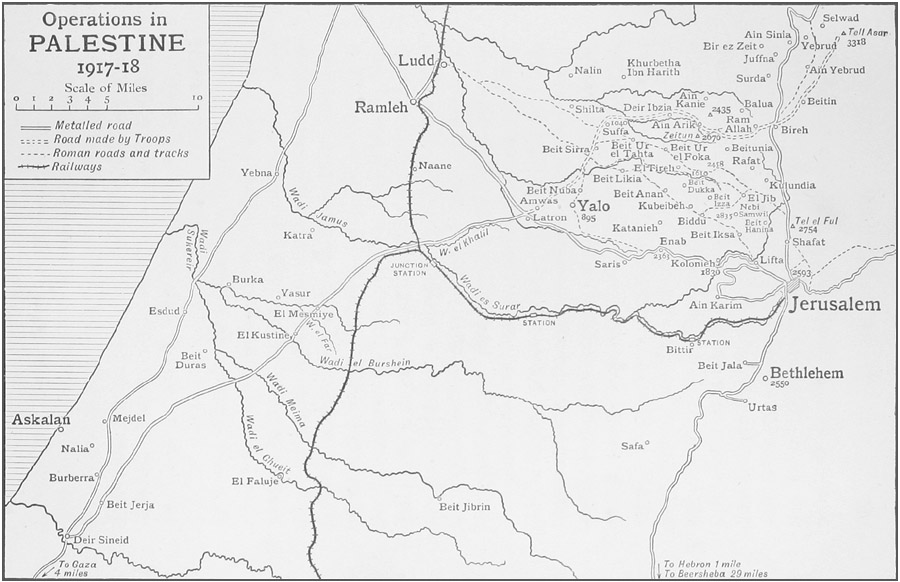
Emery Walker Ltd. sc
To face page 106ToList