Methods of destroying field mice or holding them in check by trapping
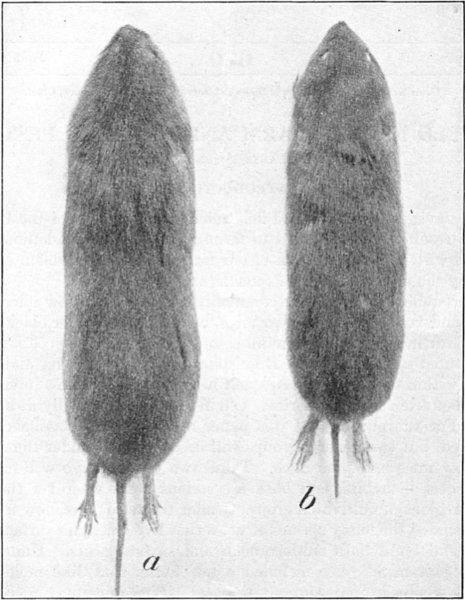
and poisoning are equally applicable to meadow mice and pine mice.
If mice are present in small numbers, as is often the case in lawns,
gardens, or seed beds, they may readily be caught in strong mouse traps
of the guillotine type (figs. 5 and 6). These should be baited with
oatmeal or other grain, or may be set in the mouse runs without bait.
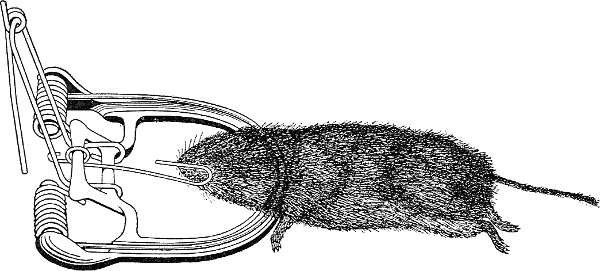
Fig. 5.—Field mouse caught in baited
guillotine trap.
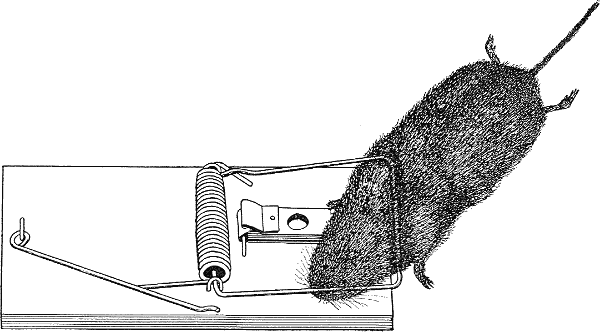
Fig. 6.—Field mouse caught in unbaited
guillotine trap.
Trapping has special advantages for small areas where a limited number
of mice are present, but it is also adapted to large areas whenever
it is undesirable to lay out poison. It is then necessary to use many
traps and continue their use for several weeks. If mice are moderately
abundant, from 12 to 20 traps per acre maybe used to advantage. These
should soon make decided inroads on the numbers of mice in an orchard
if not practically to exterminate them. For pine mice the tunnels
should be excavated sufficiently to admit the trap on a level with the
bottom. A light garden trowel may be used for the necessary digging.
On large areas where mice are abundant, poisoning is the quickest means
of destroying them, and even on small areas it has decided advantages
over trapping.
The following formula is recommended:
Dry grain formula.—Mix thoroughly 1 ounce powdered strychnine
(alkaloid), 1 ounce powdered bicarbonate of soda, and 1⁄8 ounce (or
less) of saccharine. Put the mixture in a tin pepper box and sift it
gradually over 50 pounds of crushed wheat or 40 pounds of crushed oats
in a metal tub, mixing the grain constantly so that the poison will be
evenly distributed.
Dry mixing, as above described, has the advantage that the grain may
be kept any length of time without fermentation. If it is desired to
moisten the grain to facilitate thorough mixing, it would be well to
use a thin starch paste (as described below, but without strychnine)
before applying the poison. The starch soon hardens and fermentation is
not likely to follow.
If crushed oats or wheat can not be obtained, whole oats may be used,
but they should be of good quality. As mice hull the oats before eating
them, it is desirable to have the poison penetrate the kernels. A very
thin starch paste is recommended as a medium for applying poison to the
grain. Prepare as follows:
Wet grain formula.—Dissolve 1 ounce of strychnia sulphate in 2
quarts of boiling water. Dissolve 2 tablespoonfuls of laundry starch
in ½ pint of cold water. Add the starch to the strychnine solution
and boil for a few minutes until the starch is clear. A little
saccharine may be added if desired, but it is not essential. Pour the
hot starch over 1 bushel of oats in a metal tub and stir thoroughly.
Let the grain stand overnight to absorb the poison.
The poisoned grain prepared by either of the above formulas is to be
distributed over the infested area, not more than a teaspoonful at a
place, care being taken to put it in mouse runs and at the entrances
of burrows. To avoid destroying birds it should whenever possible be
placed under such shelters as piles of weeds, straw, brush, or other
litter, or under boards. Small drain tiles, 1½ inches in diameter,
have sometimes been used to advantage to hold poisoned grain, but
old tin cans with the edges bent nearly together will serve the same
purpose.
Chopped alfalfa hay poisoned with strychnine was successfully used
to destroy meadow mice in Nevada during the serious outbreak of the
animals in 1907-8. One ounce of strychnia sulphate dissolved in 2
gallons of hot water was found sufficient to poison 30 pounds of
chopped alfalfa previously moistened with water. This bait, distributed
in small quantities at a place, was very effective against the mice,
and birds were not endangered in its distribution.
For poisoning mice in small areas, as lawns, gardens, seed beds,
vegetable pits, and the like, a convenient bait is ordinary rolled
oats. This may be prepared as follows: Dissolve 1⁄16 ounce of
strychnine in 1 pint of boiling water and pour it over as much oatmeal
(about 2 pounds) as it will wet. Mix until all the grain is moistened.
Put it out, a teaspoonful at a place, under shelter of weed and brush
piles or wide boards.
The above poisons are adapted to killing pine mice, but sweet potatoes
cut into small pieces have proved even more effective. They keep well
in contact with soil except when there is danger of freezing, and are
readily eaten by the mice. The baits should be prepared as follows:
Potato formula.—Cut sweet potatoes into pieces about as large as
good-sized grapes. Place them in a metal pan or tub and wet them with
water. Drain off the water and with a tin pepper box slowly sift over
them powdered strychnine (alkaloid preferred), stirring constantly so
that the poison is evenly distributed. An ounce of strychnine should
poison a bushel of the cut bait.
The bait, whether of grain or pieces of potato, may be dropped into
the pine-mouse tunnels through the natural openings or through holes
made with a piece of broom handle or other stick. Bird life will not be
endangered by these baits.
Thorough cultivation of fields and the elimination of fence rows
between them is the most effective protection against field mice.
Cultivation destroys weeds and all the annual growths that serve as
shelter for the animals. This applies equally well to orchards and
nurseries. Clean tillage and the removal from adjoining areas of the
weeds and grass that provide hiding places for mice will always secure
immunity to trees from attacks of the animals.
Field mice are the prey of many species of mammals, birds, and
reptiles. Unfortunately, the relation that exists between the
numbers of rodents and the numbers of their enemies is not generally
appreciated; otherwise the public would exercise more discrimination
in its warfare against carnivorous animals. It is the persistent
destruction of these, the beneficial and harmful alike, that has
brought about the present condition of growing scarcity of predacious
mammals and birds and corresponding increase of rodent pests of the
farm, especially rats and mice. The relation between effect and cause
is obvious.
Among the mammalian enemies of meadow and pine mice are coyotes,
wildcats, foxes, badgers, raccoons, opossums, skunks, weasels, shrews,
and the domestic cat and dog. Among birds, their enemies include nearly
all the hawks and owls, storks, ibises, herons, cranes, gulls, shrikes,
cuckoos, and crows. Among their reptilian foes are black snakes and
bull snakes. Not all these destroyers of mice are more beneficial than
harmful, but the majority are, and warfare against them should be
limited to the minority that are more noxious than useful.
Owls as destroyers of mice are deserving of special mention. Not one of
our American owls, unless it be the great horned owl, is to be classed
as noxious. Especially beneficial are the short-eared, long-eared,
screech, and barn owls. All these prey largely upon field mice, and
seldom harm birds. Unfortunately, the short-eared and barn owls, which
are the more useful species, are not plentiful in the sections most
seriously infested by field mice.
The short-eared owl, while widely distributed, is not abundant, except
locally, within the United States, but wherever field mice become
excessively numerous these owls usually assemble in considerable
numbers to prey upon them. Examinations of stomachs of these owls show
that fully three-fourths of their food consists of short-tailed field
mice.
The barn owl is rather common in the southern half of the United States
and breeds as far north as the forty-first parallel of latitude. That
mice form the chief diet of this bird has been demonstrated by Dr. A.
K. Fisher, of the Biological Survey, through examination of stomachs
of many barn owls and also of large numbers of pellets (castings from
their stomachs) found under their roosts. In 1,247 barn-owl pellets
collected in the towers of the Smithsonian Building in Washington,
D. C., he found 1,991 skulls of short-tailed field mice, 656 of the
house mouse, 210 of the common rat, and 147 of other small rodents and
shrews. Very few remains of birds were found. Figure 7 illustrates the
contents of some of these pellets.
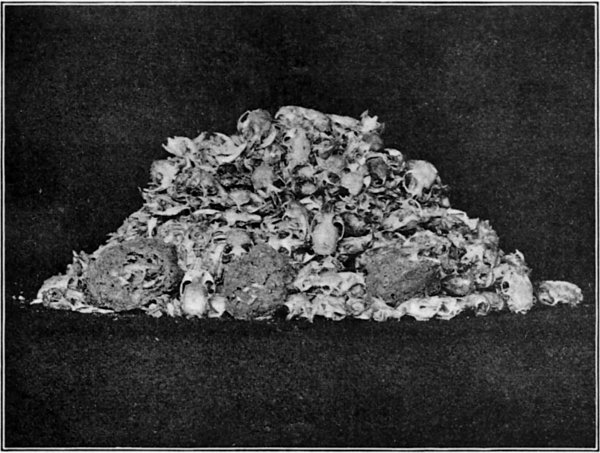
Fig. 7.—Field-mouse skulls taken from pellets
found under owl roost in Smithsonian tower, Washington, D. C.
In 360 pellets of the long-eared owl Dr. Fisher found skulls of 374
small mammals, of which 349 were meadow mice. Stomach examinations give
similar testimony to the usefulness of this bird.
The common screech owl, in addition to feeding mainly upon mice,
destroys also a good many English sparrows. Its habit of staying in
orchards and close to farm buildings makes it especially useful to the
farmer in keeping his premises free from both house and field mice.
WASHINGTON: GOVERNMENT PRINTING OFFICE: 1915
Transcriber's Note:
Every effort has been made to replicate this text as faithfully as
possible.