|
PAGE |
| A. |
Parts of the flower nearly always in threes; leaves almost always parallel-veined. |
|
|
a. |
Ovary superior. |
|
|
b. |
Leaves often arrow-shaped; pistils many, in a head. Alismaceae |
2 |
|
b. |
Leaves not arrow-shaped; pistil one. Liliaceae |
4 |
|
a. |
Ovary inferior. |
|
|
b. |
Flowers regular; stamens three. Iridaceae |
66 |
|
b. |
Flowers irregular; stamens one or two. Orchidaceae |
72 |
| A. |
Parts of the flower mostly in fours or fives; leaves mostly netted-veined. |
|
|
B. |
Corolla absent; calyx mostly present, sometimes showy. |
|
|
a. |
Ovary superior. |
|
|
b. |
Pistils several to many, distinct. Ranunculaceae |
126 |
|
b. |
Pistil one, one to several-celled. |
|
|
c. |
Flowers in long spikes with a white involucre at base. Saururaceae |
80 |
|
c. |
Flowers not in long spikes. |
|
|
d. |
Stipules if present sheathing the stem; sepals three to six. Polygonaceae |
86 |
|
d. |
Stipules absent; sepals mostly five. Chenopodiaceae |
96 |
|
a. |
Ovary inferior or appearing so by the closely fitting calyx. |
|
|
b. |
Ovary six-celled; stamens six to twelve. Aristolochiaceae |
84 |
|
b. |
Ovary one-celled; stamens three to five. |
|
|
c. |
Leaves opposite; flowers often showy. Nyctaginaceae |
100 |
|
c. |
Leaves alternate; flowers not showy. Santalaceae |
82 |
|
B. |
Both corolla and calyx present. |
|
|
C. |
Corolla of separate petals. |
|
|
D. |
Ovary superior. |
|
|
a. |
Stamens more than ten in number. |
|
|
b. |
Pistils several to many, separate or united below. |
|
|
c. |
Pistils separate and distinct. |
|
|
d. |
Pistils enclosed in a hollow receptacle. |
|
|
e. |
Leaves opposite; petals numerous. Calycanthaceae |
158 |
|
e. |
Leaves alternate; petals mostly five. Rosaceae |
218 |
|
d. |
Pistils not enclosed in a receptacle. |
|
|
e. |
Stamens attached to the calyx. Rosaceae |
218 |
|
e. |
Stamens not attached to the calyx. Ranunculaceae |
126
|
|
c. |
Pistils united below into a lobed or beaked ovary. |
|
|
d. |
Water plants with floating leaves. Nymphaceae |
156 |
|
d. |
Terrestrial or land plants. |
|
|
e. |
Pistils forming a ring; filaments united. Malvaceae |
284 |
|
e. |
Pistils not forming a ring. |
|
|
f. |
Pistils inserted on a convex receptacle; stamens attached to the calyx. Rosaceae |
218 |
|
f. |
Receptacle not convex; stamens not attached to the calyx. Papaveraceae |
160 |
|
b. |
Pistil one, the styles and stigmas often several. |
|
|
c. |
Ovary one-celled. |
|
|
d. |
Style and stigma one. |
|
|
e. |
Fruit a drupe (stone-fruit.) Drupaceae |
216 |
|
e. |
Fruit an akene tipped with a tail. Rosaceae |
218 |
|
d. |
Styles or stigmas more than one. |
|
|
e. |
Sepals falling as the flowers expand. |
|
|
f. |
Sepals two or three; fruit a capsule. Papaveraceae |
160 |
|
f. |
Sepals four or six; fruit a berry. Ranunculaceae |
126 |
|
e. |
Sepals persistent; low shrubs. Cistaceae |
304 |
|
c. |
Ovary more than one-celled. |
|
|
d. |
Water plants with floating leaves. Nymphaceae |
156 |
|
d. |
Plants not growing in water. |
|
|
e. |
Leaves with smooth margins and with transparent dots. Hypericaceae |
292 |
|
e. |
Leaves neither smooth-edged, nor with transparent dots. Malvaceae |
284 |
|
a. |
Stamens ten or fewer in number. |
|
|
b. |
Stamens of the same number as the petals and opposite them. |
|
|
c. |
Ovary more than one-celled; calyx four- to five-cleft. Rhamnaceae |
282 |
|
c. |
Ovary one-celled. |
|
|
d. |
Anthers opening by uplifted valves. Berberidaceae |
152 |
|
d. |
Anthers opening by longitudinal slits. Portulacaceae |
120 |
|
b. |
Stamens not of the same number as the petals, or if of the same number, alternate with them. |
|
|
c. |
Ovaries two or more, separate or partly united. |
|
|
d. |
Stamens united with each other and with the large thick stigma. Asclepiadaceae |
374 |
|
d. |
Stamens free from each other and from the pistils. |
|
|
e. |
Stamens inserted on the receptacle. |
|
|
f. |
Leaves and stems fleshy. Crassulaceae |
192 |
|
f. |
Leaves and stems not noticeably fleshy. |
|
|
g. |
Lobes of ovary two to five, with a common style. |
|
|
h. |
Ovary two- to three-lobed. Limnanthaceae |
278 |
|
h. |
Ovary five-lobed. Geraniaceae |
274 |
|
g. |
Ovaries with separate styles. Ranunculaceae |
126 |
|
e. |
Stamens inserted on the calyx. |
|
|
f. |
Stamens twice as many as the pistils. Crassulaceae |
192 |
|
f. |
Stamens not twice as many as the pistils. |
|
|
g. |
Stipules present. Rosaceae |
218 |
|
g. |
g. Stipules absent. Saxifragaceae |
196 |
|
c. |
Ovary one, the styles and stigmas one to several. |
|
|
d. |
Ovary with one cell and one placenta. |
|
|
e. |
Corolla forming standard, wings and keel; filaments mostly united. Fabaceae |
242 |
|
e. |
Corolla not of standard, wings and keel; filaments mostly not united. |
|
|
f. |
Stamens ten or five; fruit smooth, slender. Cassiaceae |
264 |
|
f. |
Stamens three or four; fruit spiny, globose. Krameriaceae |
268 |
|
d. |
Ovary with one or more cells and styles, and two or more placentae and stigmas. |
|
|
e. |
Ovary one-celled. |
|
|
f. |
Corolla irregular; petals and sepals five. Violaceae |
296 |
|
f. |
Corolla regular or nearly so. |
|
|
g. |
Ovules attached at the center or bottom of the ovary. Caryophyllaceae |
112 |
|
g. |
Ovules attached on two placentae. |
|
|
h. |
Stamens equal; pod on a stalk. Capparidaceae |
186 |
|
h. |
Stamens unequal; pod without a stalk. Cruciferae |
174 |
|
e. |
Ovary more than one-celled. |
|
|
f. |
Ovary three-celled; trees with palmate leaves. Hippocastanaceae |
280 |
|
f. |
Ovary more than three-celled. |
|
|
g. |
Cells of ovary as many as the sepals. |
|
|
h. |
Anthers opening by terminal pores; dwarf evergreen shrubby plants. Pyrolaceae |
354 |
|
h. |
Anthers opening by longitudinal slits. |
|
|
i. |
Ovules and seeds one or two in each cell. |
|
|
i. |
Herbs with lobed or cut leaves. Geraniaceae |
274 |
|
i. |
Evergreen shrubs with varnished leaves. Zygophyllaceae |
268 |
|
i. |
Ovules and seeds several in each cell; leaflets three. Oxalidaceae |
272 |
|
g. |
Cells of ovary twice as many as the sepals. Linaceae |
270 |
|
D. |
Ovary inferior or more or less so. |
|
|
a. |
Stamens more than ten in number. |
|
|
b. |
Plant spiny; leaves absent or soon deciduous. Cactaceae |
304 |
|
b. |
Plant not spiny; leaves persisting for the season. |
|
|
c. |
Leaves three-sided, fleshy. Aizoaceae |
108 |
|
c. |
Leaves neither three-sided nor fleshy. |
|
|
d. |
Herbs; leaves rough-hairy. Loasaceae |
300 |
|
d. |
Shrubs or trees. |
|
|
e. |
Leaves opposite; stipules none. Hydrangeaceae |
206 |
|
e. |
Leaves alternate; stipules present. Pomaceae |
214 |
|
a. |
Stamens ten or fewer in number. |
|
|
b. |
Ovules and seeds more than one in each cell. |
|
|
c. |
Ovary one-celled; fruit a berry. Grossulariaceae |
210 |
|
c. |
Ovary with two or more cells. |
|
|
d. |
Stamens four or eight. |
|
|
e. |
Shrubs; filaments two-forked at the apex. Hydrangeaceae |
206 |
|
e. |
Herbs; filaments not two-forked at the apex. Onagraceae |
312 |
|
d. |
Stamens five or ten; styles two or three. Saxifragaceae |
196 |
|
b. |
Ovules and seeds only one in each cell. |
|
|
c. |
Stamens mostly ten; ovary partly inferior. Hydrangeaceae |
206 |
|
c. |
Stamens less than ten; ovary wholly inferior. |
|
|
d. |
Stamens five; fruit dry. Umbelliferae |
332 |
|
d. |
Stamens four; fruit fleshy. Cornaceae |
338 |
|
C. |
Corolla with petals more or less united. |
|
|
E. |
Ovary superior. |
|
|
a. |
Stamens more than five in number. |
|
|
b. |
Ovary one-celled. |
|
|
c. |
Placenta one. |
|
|
d. |
Corolla very irregular; stamens not protruding from the corolla. Fabaceae |
242 |
|
d. |
Corolla nearly regular; stamens Mimosaceae |
266 |
|
c. |
Placentae two; corolla irregular. Fumariaceae |
168 |
|
b. |
Ovary two to several-celled. |
|
|
c. |
Ovary two-celled; corolla irregular. Polygalaceae |
278 |
|
c. |
Ovary three or more-celled; corolla regular or nearly so. |
|
|
d. |
Stamens not attached to the corolla. |
|
|
e. |
Style one; leaves simple. Ericaceae |
340 |
|
e. |
Styles more than one. |
|
|
f. |
Styles three; erect spiny shrub. Fouquieriaceae |
294 |
|
f. |
Styles five; low herbs. Oxalidaceae |
272 |
|
d. |
Stamens attached to the corolla, plants without green foliage. Monotropaceae |
356 |
|
a. |
Stamens five or fewer in number. |
|
|
b. |
Corolla regular. |
|
|
c. |
Stamens free from the corolla. Ericaceae |
340 |
|
c. |
Stamens attached to the corolla. |
|
|
d. |
Pistil one. |
|
|
e. |
Stamens of the same number as the corolla lobes and opposite them. Primulaceae |
362 |
|
e. |
Stamens alternate with the corolla lobes or fewer. |
|
|
f. |
Ovary one- or two-celled. |
|
|
g. |
Styles two or occasionally one. |
|
|
h. |
Capsule usually many-seeded; sepals united. Hydrophyllaceae |
402 |
|
h. |
Capsule few-seeded; sepals separate. Convolvulaceae |
380 |
|
g. |
Styles one or none. |
|
|
h. |
leaves opposite. |
|
|
i. |
Trees with pinnate leaves. Oleaceae |
366 |
|
i. |
Herbs with simple smooth-edged leaves. Gentianaceae |
368 |
|
h. |
Leaves alternate. |
|
|
i. |
Ovary one-celled; leaves with three leaflets. Menyanthaceae |
380 |
|
i. |
Ovary two-celled; leaves various. Solanaceae |
458 |
|
f. |
Ovary three- or four-celled. |
|
|
g. |
Style one; ovary three-celled. Polemoniaceae |
384 |
|
g. |
Styles two; ovary four-celled. Boraginaceae |
422 |
|
d. |
Pistils two. |
|
|
e. |
Stamens and stigmas united; flowers with hood-like appendages. Asclepiadaceae |
374 |
|
e. |
Stamens and stigmas not united; flowers without hood-like appendages. Apocynaceae |
378
|
|
b. |
Corolla more or less irregular. |
|
|
c. |
Fruit a many-seeded capsule. |
|
|
d. |
Ovary two-celled. Scrophulariaceae |
466 |
|
d. |
Ovary one-celled; plants without green foliage. Orobanchaceae |
504 |
|
c. |
Fruit of two or four seed-like nutlets. |
|
|
d. |
Ovary four-lobed; plants mostly aromatic. Labiatae |
434 |
|
d. |
Ovary not lobed; plants rarely aromatic. Verbenaceae |
434 |
|
E. |
Ovary inferior. |
|
|
a. |
Stamens eight or ten; evergreen shrubs. Ericaceae |
340 |
|
a. |
Stamens five or fewer in number. |
|
|
b. |
Plants tendril-bearing. Cucurbitaceae |
518 |
|
b. |
Plants not tendril-bearing. |
|
|
c. |
Stamens free, not united. |
|
|
d. |
Leaves alternate; stamens free from the corolla. Campanulaceae |
520 |
|
d. |
Leaves opposite or whorled; stamens inserted on the corolla. |
|
|
e. |
Stamens one to three. Valerianaceae |
508 |
|
e. |
Stamens four to five. |
|
|
f. |
Leaves opposite, never in whorls nor with stipules. Caprifoliaceae |
512 |
|
f. |
Leaves opposite and with stipules, or in whorls and without stipules. Rubiaceae |
506 |
|
c. |
Stamens united by their anthers. |
|
|
d. |
Corollas all strap-shaped and perfect; juice milky. Cichoriaceae |
570 |
|
d. |
Marginal corollas strap-shaped, never perfect; disk corollas perfect; juice not milky. Compositae |
522 |
FIELD BOOK
OF
WESTERN WILD FLOWERS
A rather small family, widely distributed, growing in
fresh-water swamps and streams. The leaves are all
from the root, with long sheathing leaf-stalks, and the
flowers are regular and perfect, or with only pistils or only
stamens; the sepals three; the petals three; the stamens six
or more; the ovaries numerous, superior, developing into
dry, one-seeded nutlets.
There are a good many kinds of Sagittaria, with fibrous
roots and milky juice; the leaves are usually arrow-shaped;
the lower flowers usually pistillate and the upper ones
usually staminate; the stamens are numerous and the
numerous ovaries are closely crowded and form roundish
heads. The name is from the Latin for "arrow," referring
to the shape of the leaves.
Arrowhead
Sagittària latifòlia
White
Summer
North America
An attractive and very decorative
plant, with stout, smooth, hollow flower-stems,
from eight inches to four feet tall,
with very handsome, smooth, olive-green
leaves and papery bracts. The flowers
are about an inch across, with delicately
crumpled, white petals and yellow anthers, forming a
bright golden center, and the plants look very pretty
standing along the edges of ponds. The leaves are exceedingly
variable both in size and shape. This is found
throughout North America. The tubers are edible and
hence the plant is often called Tule Potato, and they are
much eaten by the Chinese in California. The Indian
name is Wapato.
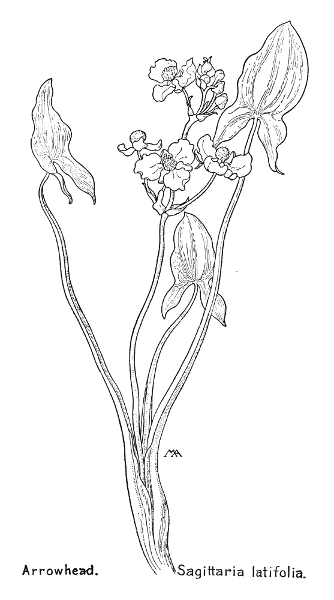
Arrowhead—Sagittaria latifolia.
A wonderfully beautiful family, large and widely distributed,
mostly perennial herbs, growing from bulbs or
root-stocks, with perfect, regular, symmetrical flowers and
toothless leaves. The flower-cup almost always has six
divisions, the outer often called sepals and the inner petals.
The six stamens are opposite the divisions and sometimes
three of them are without anthers. The styles or stigmas
are three and the ovary is superior, developing into a
three-celled capsule or berry, containing few or many seeds.
There are several kinds of Anthericum, rather small, lily-like
plants, with grasslike leaves, springing from the base
and surrounded by the fibrous remnants of older leaves.
The slender stems are leafless, or have one, very small, dry
leaf; the roots thick and fleshy-fibrous; the flowers yellow,
on pedicels jointed near the middle; the style long and
slender; the pod oblong, containing several flattened,
angular seeds in each cell. They are common in rocky soil,
at altitudes of six thousand to nine thousand feet, from
western Texas to Arizona.
Amber Lily
Anthéricum
Tórreyi
Yellow
Summer
Arizona
A beautiful little plant, with delicate
flowers, unusual and pretty in coloring. It
grows from eight to fifteen inches tall and
has a slender, pale-green stem, springing
from a clump of graceful, pale bluish-green,
grasslike leaves. The flowers are about
three quarters of an inch long, pale orange or corn-color,
with a narrow stripe on each division; the pistil green, with
an orange stigma; the anthers yellow. The flowers fade
almost as soon as they bloom. This grows in open woods.
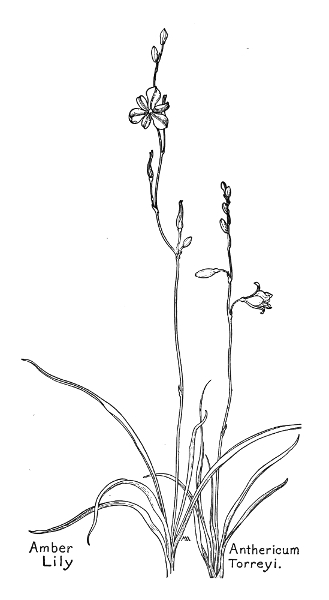
Amber Lily—Anthericum Torreyi.
There are several kinds of Zygadene, natives of North
America and Siberia. They mostly have coated bulbs,
resembling onions, and white or greenish flowers, in clusters,
the leaves long, smooth, folded lengthwise and springing
mostly from the root. The flowers are perfect or polygamous,
the six divisions alike, with one or two, greenish,
glandular spots at the base of each; the styles three, distinct;
the fruit a three-lobed capsule, with several or many
seeds in each compartment. The name is from the Greek
for "yoke" and "gland," because some kinds have a couple
of glands on each division of the flower.
Poison Sego
Zygadènus
paniculàtus
Cream-white
Spring, summer
Utah, Nev., Idaho
A handsome, rather stout plant, about
a foot tall, with bright light-green, smooth,
graceful leaves sheathing the stem, which
has a papery bract around its base. The
flowers are in clusters varying in shape,
sometimes growing in a long, loose raceme
and sometimes in a closer, pointed cluster. The divisions
of the rather small, cream-white flowers have short claws,
with a yellow gland and a stamen at the base of each. The
stamens are conspicuous, with swinging, yellow, shield-shaped
anthers, and are at first longer than the three styles,
which gradually lengthen and, together with the stamens,
give a delicate, feathery appearance to the whole flower
cluster. This grows on dry hillsides and in meadows. The
bulb is very poisonous.
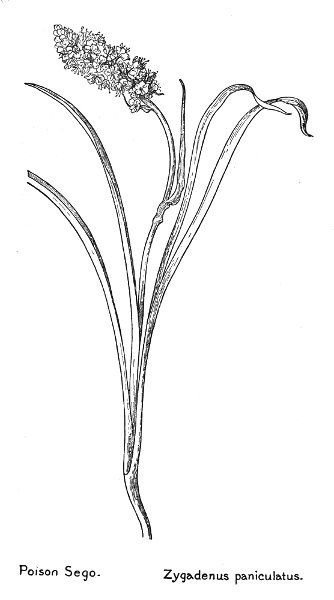
Poison Sego—Zygadenus paniculatus.
Zygadene
Zygadènus
élegans
White
Summer
U. S.
A handsome graceful plant, with one
or more stiff stems, from six inches to
three feet tall, springing from a large
clump of rather stiff, bluish-green leaves,
covered with a pale "bloom," and bearing
fine clusters of cream-white flowers, less
than an inch across, their divisions united below and
adhering to the base of the ovary and each with a sticky,
bright-green, heart-shaped gland. This grows in moist
places in the mountains, across the continent.
Star Zygadene
Zygadènus
Fremóntii
White
Spring, summer
California
Much like the last, but the foliage with
less "bloom" and the flowers handsomer
and rather larger. Their divisions are
free from the ovary, only the inner divisions
have claws, and the glands are
greenish-yellow and toothed. This grows
among bushes, on hillsides and sea-cliffs along the coast.
Death Camass
Zygadènus
venenòsus
White
Spring
Wash., Oreg., Cal.
Not nearly so handsome as the two
last, but a pretty plant, from one to two
feet tall, with dull-green leaves, folded
lengthwise, with rough edges. The cream-colored
flowers are less than half an inch
across, striped with green on the outside,
their divisions free from the ovary and all with claws,
with roundish, greenish-yellow glands, not toothed, and
with long stamens. This grows in meadows and the bulb
is very poisonous except to hogs, so it is often called Hog's
Potato.
There are several kinds of Veratrum, natives of the
north temperate zone; tall, perennial herbs, with thick,
short, poisonous rootstocks; stems tall and leafy, more or
less hairy; leaves broad, plaited, with conspicuous veins;
flowers more or less downy, polygamous, whitish or greenish,
in a cluster, their six, separate divisions colored alike,
adhering to the base of the ovary, without glands, or nearly
so, and without claws; stamens opposite the divisions,
with heart-shaped anthers; styles three; capsule three-lobed,
with several flat, broadly-winged seeds in each compartment.
Veratrum is the ancient name for Hellebore.
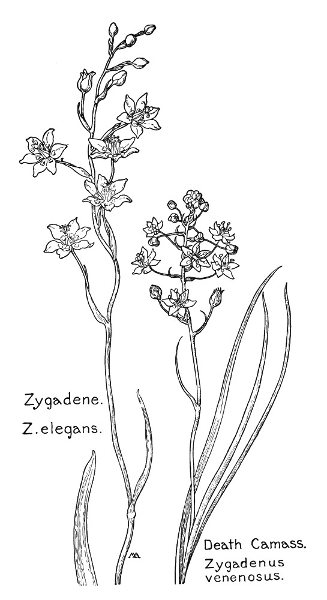
Zygadene—Z. elegans.
Death Camass—Zygadenus venenosus.
False Hellebore
Veràtrum
Califórnicum
Greenish-white
Spring
West
The leaves of this plant are its conspicuous
feature. A few near the top are
long and narrow, but most of them are
boat-shaped, with heavy ribs, and from
six to twelve inches long. They are bright
yellowish-green and, although somewhat
coarse, the general effect is distinctly handsome, as we
see masses of them growing luxuriantly in rich, moist
meadows and marshes in the mountains. When they
first come up in the spring, the shoots are packed into
green rosettes, in which the leaves are intricately folded,
but they soon grow to a height of three to six feet. The
flowers are beautiful, in fine contrast to the coarse foliage.
They measure about half an inch across and are cream-white,
streaked with green, and form a fine cluster about
a foot long. The flowers are far prettier and the plants
handsomer than their eastern relations and they flourish
at an altitude of six to nine thousand feet. The plants
are supposed to be poisonous to cattle, but in a recent
bulletin of the Agricultural Experiment Station of the
State of Washington, it is reported as being a popular
food with horses and sheep, particularly the latter, which
eat it greedily and without ill effects.
There are several kinds of Hastingsia, perennials, with
bulbs or rootstocks; the stamens on the base of the perianth,
with swinging anthers; the ovary with a very short
stalk and short style.
Reed-lily
Hastíngsia álba
(Schoenolirion)
White
Summer
Oreg., Cal., Nev.
An attractive marsh plant, with a
smooth, stiff, bluish stem, over three feet
tall, springing from a cluster of long,
narrow, sword-like leaves. The slightly
sweet-scented flowers are white, about
half an inch across, forming a long, graceful,
fuzzy wand of bloom, which has a pretty silvery
effect and looks interesting at a distance, but is not
very striking close by, as the flowers are too colorless.
The seeds are black and shiny.
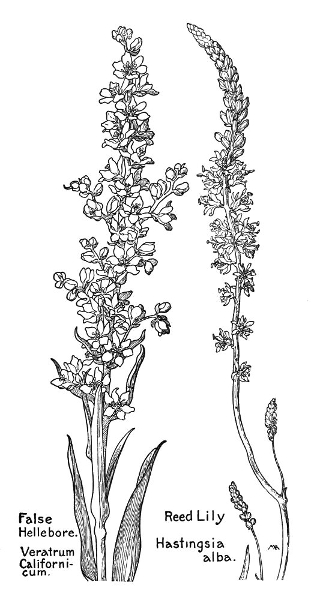
False Hellebore—Veratrum Californicum.
Reed Lily—Hastingsia alba.
Amole
Soap Plant
Chlorógalum
pomeridiànum
Silvery-white
Summer
California
There are several kinds of Chlorogalum.
This odd plant springs from a big bulb,
which is covered with coarse brown fiber
and often shows above the ground. The
leaves are sometimes over two feet long,
with rippled margins, look like very coarse
grass, and usually spread out flat on the
ground. The plants are conspicuous and look interesting
and we wonder what sort of flower is to come from them.
Then some day in late summer we find that a rather ugly,
branching stalk, four or five feet tall, has shot up from the
center of the tuft of leaves. The branches are covered
with bluish-green buds, and we watch with interest for
the bloom, but we may easily miss it, for the flowers are
very short-lived and come out only for a little while in the
afternoons. In the lowlands the flowers are rather scattered
and straggling, but in Yosemite they are lovely,
close by. Each flower is an inch or more across and looks
like an airy little lily, with six spreading divisions, white,
delicately veined with dull-blue, and they are clustered
along the branches, towards the top of the stalk, and
bloom in successive bunches, beginning at the bottom.
When they commence to bloom, the tips of the petals
remain caught together until the last minute, when
suddenly they let go and spring apart and all at once the
dull stalk, like Aaron's rod, is adorned with several delicate
clusters of feathery silver flowers. The thread-like
style is slightly three-cleft at the tip and the capsule has
one or two blackish seeds in each cell. The bulbs form
a lather in water and are used as a substitute for soap by
the Indians and Spanish-Californians, and as food by the
Pomo Indians, who cook them in great pits in the ground.
Pomeridianum means "in the afternoon."

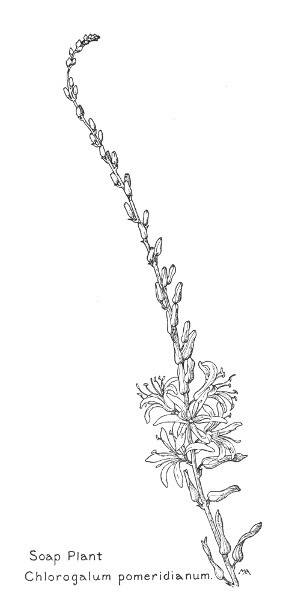
Soap Plant—Chlorogalum pomeridianum.
Wild Onions are easily recognized by their characteristic
taste and odor. They mostly have coated bulbs; their
leaves are long and narrow, from the base; the flower-stalk
bears a roundish, bracted cluster of rather small, white,
pink, or magenta flowers, on slender pedicels, their six
divisions nearly alike and each with a stamen attached to
its base. The bracts enclose the buds, before blooming, in
a case and the capsule contains six, black, wrinkled seeds.
There are numerous kinds, very widely distributed, not
easily distinguished, some resembling Brodiaea, but the
latter never smell of onion. Allium is the Latin for
"garlic."
Pink Wild Onion
Állium acuminàtum
Pink
Spring, summer
Northwest
From four to ten inches high, with a few
leaves. Before blooming, the flower cluster
is enveloped in two papery bracts,
forming a beautiful pink and white, iridescent
case, the shape of a turnip, at the tip
of the stalk. Later these bracts split apart
and disclose a cluster of pretty flowers, usually very deep
pink in color, the divisions each with a darker line on the
outside, the anthers pale-yellow. This is very gay and
attractive, often growing in patches on dry hillsides and
fields. The flowers last a long time in water, gradually becoming
paler in color and papery in texture. The bulb is
marked with veins.
Wild Onion
Állium biscéptrum
Pink, white
Spring
Utah, Nev., Cal.
Six to ten inches tall, with two slightly
thickish leaves, and usually two slender
flower stalks, each bearing a graceful cluster
of starry, white, pink or pinkish-purple
flowers, each petal delicately striped with
pinkish-brown, the anthers pink, the ovary green, with
three, tiny, double crests. These flowers are exceedingly
delicate and pretty, growing among rocks in shady canyons.
The bulb is usually red-coated.
The flower cluster of Allium serràtum is much more compact
than the last and the pink flowers change to deep
purplish-pink as they fade, making a pretty, round, papery
head, about an inch and a half across. Common on low
hills in California.
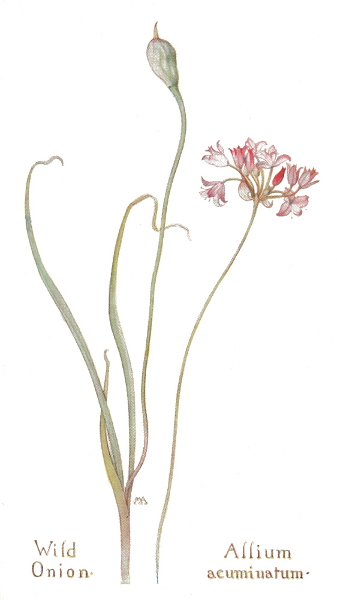
Wild Onion—Allium acuminatum.
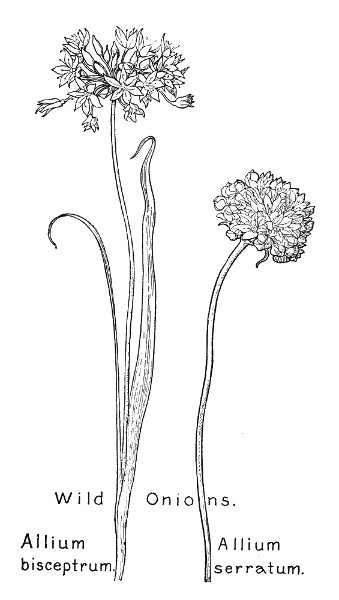
Wild Onions.
Allium bisceptrum.
Allium serratum.
There are many kinds of Brodiaea, among the prettiest
western flowers. They have a small, solid bulb, coated
with brownish fibers. The stem bears a bracted, roundish
head of flowers at the top, the pedicels varying in length.
Their leaves, all from the root, are grasslike and soon wither
and the flowers dry up, become papery, and remain on the
stalk, sometimes keeping form and color for some time.
The stamens are in two sets and are attached to the flower-tube,
their filaments often winged. Sometimes three of the
stamens are without anthers and their filaments are broadened,
so that they look like small petals alternating with
the ordinary stamens.
Grass Nuts.
Blue Dicks.
Covena.
Brodiaèa capitàta
Blue, violet
Spring
California
All through the spring these lovely
flowers grow abundantly all over the hills
and fields of California. The slender stalks
vary from a few inches to two feet tall.
The flowers are usually purplish-blue, but
vary from deep-violet to white and are
rather translucent in texture. They measure over half an
inch across and grow in a cluster of seven or eight flowers,
with several membranous, purplish bracts at the base.
There are six anthers. The three inner stamens are winged
and form a crown in the throat of the flower-tube. These
Brodiaeas last a long time in water and are great favorites
everywhere. The little bulbs are edible and give the name
of Grass Nuts. There are several other names, such as
Cluster Lily and Hog-onion. The name Wild Hyacinth is
poor, as it does not resemble a hyacinth in character. B.
capitàta var. pauciflòra of Arizona is similar, except that
the bracts are white. Covena is the Arizona
name.
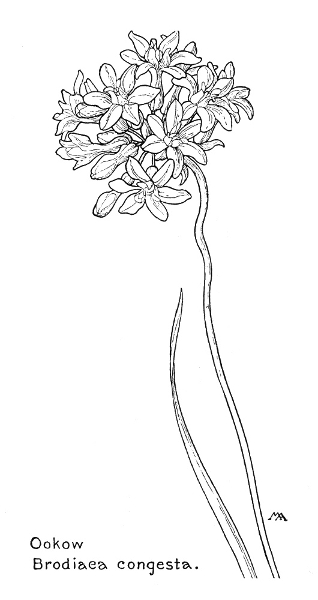
Ookow
Brodiaèa congésta
Blue, violet
Spring, summer
Wash., Oreg.,
Cal.
Much like the last, except that only
three of the stamens have anthers and the
stem is sometimes as much as five feet tall.
This grows on open hills in the Coast
Ranges.
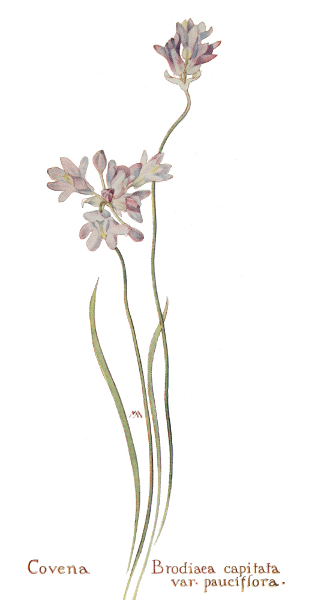
Covena—Brodiaea capitata var. pauciflora.
Harvest Brodiaea
Brodiaèa grandiflòra
(Hookera
coronaria)
Blue
Summer
Cal., Oreg., Wash.
In early June, at the time of the hay
harvest, these handsome flowers, which
look like clusters of little blue lilies, begin
to appear among the dried grass of the hillsides
and in open places in the woods.
They vary in height from a few inches to
over a foot and the number of flowers in a
cluster also varies very much. Sometimes there are as
many as ten of the beautiful blossoms, an inch or more long,
with pedicels unequal in length and from one to four inches
long, in a large cluster at the top of the stalk, with several,
whitish, papery bracts at the base of the cluster. The
color of the flowers is usually a deep bright blue shading to
violet and the six divisions grow paler toward the base and
have a brown stripe on the outside; the buds are greenish,
striped with brown. The stamens are translucent white,
three ordinary stamens, with long erect anthers, alternating
with three without anthers, the latter tongue-shaped and
petal-like. The leaves, which are thickish and about the
same length as the stalk, have withered away before the
flowers bloom. This plant very much resembles Ithuriel's
Spear, Triteleia laxa, but three of the stamens are without
anthers and the ovary is not on a long stalk. It is the
commonest kind around San Francisco. B. minor is much
the same, but a smaller plant with fewer and smaller flowers.
The three outer divisions are narrow, with pointed tips,
and the inner blunt and broad, and the sterile stamens are
notched and longer than the fertile ones. This grows on
dry hills and plains in middle and southern California.
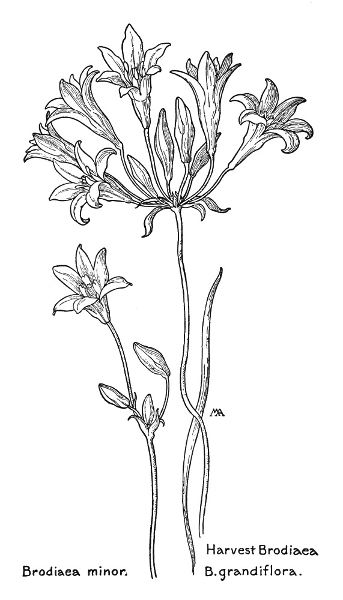
Brodiaea minor.
Harvest Brodiaea—B. grandiflora.
Twining Brodiaea
Brodiaèa volùbilis.
(Stropholirion
Californicum)
Pink
Summer
California
This is a strange, rather grotesque-looking
plant, with its slightly roughish, leafless,
reddish stem contorted into curious curves,
occasionally quite short but usually enormously
long, sometimes as much as eight
feet, and twining awkwardly in a snake-like
way around and over the bushes in its
neighborhood. There are sometimes a few long narrow
leaves lying on the ground, but when the flower blooms
they usually seem to have withered away. The flower-cluster
is quite compact, sometimes six inches across, comprising
from eighteen to twenty flowers, with several, large,
pink, papery bracts. The flowers are rather pretty, dull
pink outside but paler inside, the buds are deeper and more
purplish pink, both of dry papery texture. The flowers are
over half an inch across, their tubes and buds are six-angled,
and they have three stamens with anthers and wings, alternating
with three, notched, petal-like stamens, without
anthers. In the spring the stem grows rapidly for several
weeks and then the flower cluster begins to come out at the
tip. If the stem is broken off the flower comes out just the
same and the stem keeps on growing, even if it is brought
into the house. These curious plants are found in the foothills
of the Coast Ranges and the Sierra Nevada Mountains
and may be seen in open sunny places along the stage route
from Yosemite to Wawona. In the woods near Wawona
I saw it twining around a very tall white larkspur and the
combination was exceedingly pretty. The capsule is egg-shaped
and pointed, the seeds black and angled.
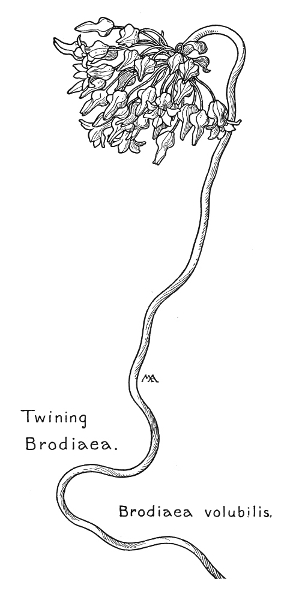
Twining Brodiaea—Brodiaea volubilis.
There are four kinds of Bloomeria, all Californian, resembling
Brodiaea, but the stamens unlike. They have
a fibrous-coated, solid bulb, long narrow leaves, and a
bracted cluster of many flowers, at the top of a tall flower-stalk.
The flowers are yellow, with six, nearly equal,
spreading divisions, the six stamens on the base of the divisions,
with slender filaments, which with a microscope are
seen to have a short, two-toothed, hairy appendage at
base. These are united and form a little cup surrounding
the base of the stamens. The style is club-shaped, with a
three-lobed stigma. The roundish capsule, beaked with the
style, contains several, angular, wrinkled seeds in each cell.
Golden Stars
Bloomèria aùrea
Yellow
Spring, summer
California
In late spring the meadows around Pasadena
and other places in the Coast Range
are bright with pretty clusters of Golden
Stars. The plant is from six to eighteen
inches tall, springing from a small bulb,
covered with brown fibers, with a long, narrow, grasslike
leaf, and a large flower-cluster, sometimes comprising as
many as fifty blossoms, at the top of the stalk. The
flowers, about an inch across, with pedicels from one and a
half to two inches long, are orange-yellow, the spreading
divisions each striped with two dark lines, and the anthers
are bright green. This looks very much like Golden
Brodiaea, but the latter has no cup at the base of the
stamens. It grows in the southern part of California
and is abundant wherever it is found. B. Clevelandi is
much the same, but the flowers are striped with green and
the numerous buds are green, so that it is less golden and
the general effect is not so good. It has numerous narrow
leaves.
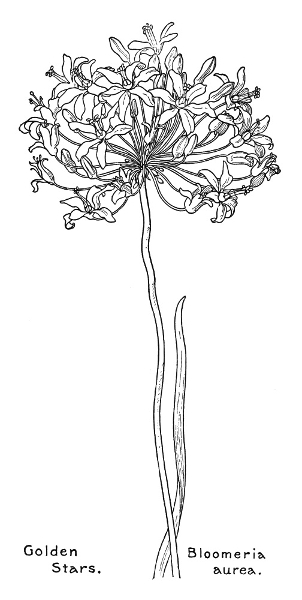
Golden Stars—Bloomeria aurea.
Triteleias resemble Brodiaeas, but they have six, swinging
anthers and the ovary has a stalk.
Indian Hyacinth
Triteleìa grandiflòra (Brodiaea Douglasii)
Blue
Spring, summer
Northwest and Utah
Though the general appearance of the
plant is very different, the individual
flowers of this beautiful plant very much
resemble the bells of a Hyacinth, for they
have the same waxy, semi-translucent
texture. The bluish-green leaves, folded
lengthwise and withering before the
flower, are sometimes a foot long and
the flower-stalk often reaches a height of two feet and bends
beneath the weight of its lovely crown of blossoms. The
cluster has four papery bracts at the base and is from three
to four inches across, comprising about a dozen flowers,
each nearly an inch long. They are pale-violet, with a
bright-blue mid-vein on each division, the general effect
being blue, with a white pistil and six stamens in two rows,
all with blue anthers and the outer ones with broad, white
filaments. It is wonderful to find these lovely and exotic-looking
flowers, delicately scented, gleaming in the shadow
of a dusky oak thicket or a deep canyon. They last a long
time in water, becoming papery as they wither.
White Brodiaea
Triteleìa hyacinthìna
(Brodiaea lactea)
White
Spring
Cal., Oreg.,
Wash.
From one to two feet high, with very
pretty flowers, about half an inch long,
delicately striped with green on the outside,
with six equal stamens, their filaments
broad, triangular and slightly united at
base, with yellow or purple anthers, and a
green pistil. The leaf is grasslike, but
thickish, and as long as the flower-stalk.
These flowers are quite common and last a long time in
water.
Ithuriel's Spear
Triteleìa láxa (Brodiaea)
Blue, purple
Spring
Cal., Oreg.
Very much like Harvest Brodiaea but
rather taller, with more flowers in the
cluster, and less waxy in texture, varying
in color from blue to violet and occasionally
white. This is common on hillsides
and in adobe fields. The rather fanciful
name was suggested by the spear carried by Milton's angel
Ithuriel.
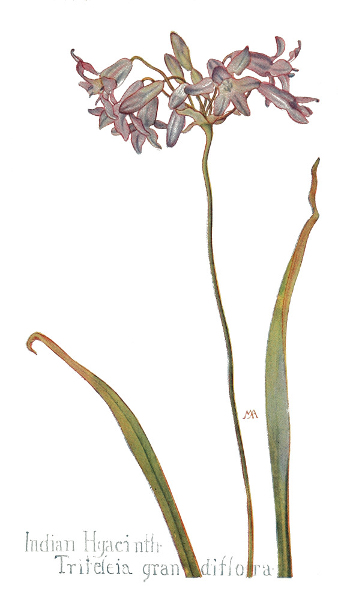
Indian Hyacinth—Triteleia grandiflora.
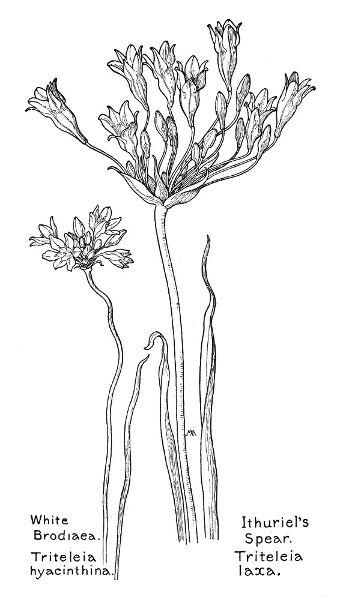
White Brodiaea—Triteleia hyacinthina.
Ithuriel's Spear—Triteleia laxa.
There are one or two kinds of Brevoortia.
Fire-cracker
Flower
Brevoòrtia Ida-Màia (Brodiaea coccinea)
Red and green
Spring
Cal., Oreg.
A handsome plant, most extraordinary
both in form and color. The stem is from
one to three feet tall, with a few grasslike
leaves, and bears a large cluster of
six to thirteen flowers, one or two inches
long, hanging on slender, reddish pedicels.
They have bright-crimson tubes and
apple-green lobes, sometimes turned back,
showing the tips of the three pale-yellow
anthers. There are also three stamens without anthers
and broadened so that they look like three white or yellowish
petals. The buds are also crimson, tipped with
green, and the whole color scheme is wonderfully brilliant
and striking. This grows in mountain canyons and on
wooded hillsides, blooming in late spring.
There are several kinds of Muilla, much like Brodiaea
and very much like Allium, but with no onion taste or
smell.
Muilla
Muílla marítima
White
Spring
Cal., Nev.
A slender little plant, sometimes rather
pretty, from three to nine inches tall, with
sweet-scented flowers, about three-eighths
of an inch or less across, white or greenish,
striped with green outside, with six, bluish,
swinging anthers. This grows in alkaline fields, on sea
cliffs and mesas.
There are a good many kinds of Erythronium, all but
one from North America, and, East and West, they are
among our prettiest flowers. They have deep, membranous-coated,
solid bulbs; a pair of netted-veined, unequal
leaves, sometimes mottled with brown; flowers without
bracts, large, nodding and bell-shaped, with usually six
divisions, all colored alike, the tips turning back, each
with a nectar-groove, and each with two or four little
scales at base, or only the three inner divisions with scales;
stamens on the receptacle, anthers not swinging; style
more or less three-lobed; capsule more or less oblong and
three-angled. The younger plants are often flowerless,
with only one broad leaf, with a long leaf-stalk. The name
is from a Greek word meaning "red," though these flowers
are mostly yellow. The common name, Dog-tooth Violet,
is old, and suggested by the little, white, toothlike offshoot
often found on the bulb, but of course they are not
in the least like Violets. In California they are often
called Chamise Lily, and sometimes Adam and Eve,
because the plant often bears a large and a small flower
at the same time. Mr. Burroughs would like to call it
Fawn Lily, on account of the mottled leaves of some kinds,
which slightly suggest the ears of a fawn. Adder's-tongue,
probably suggested by the long forked pistil, is also an
old and usual name.
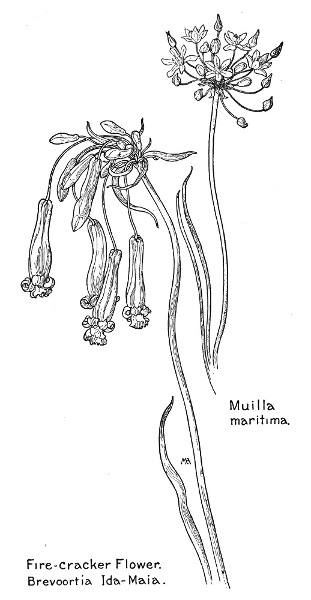
Muilla maritima.
Fire-cracker Flower—Brevoortia Ida-Maia.
Avalanche Lily
Dog-tooth Violet
Erythrònium
montànum
White
Summer
Northwest
An exquisite kind, peculiarly graceful
in form, with from one to nine, pure-white
flowers, nearly three inches across,
each petal prettily ornamented at the
base with some orange-colored markings,
arranged in a symmetrical scalloped
pattern. The anthers are orange-yellow,
the pistil white, the buds are pinkish and the leaves are
very bright green and not mottled. This is very common
around Mt. Rainier.
Glacier Lily
Dog-tooth Violet
Erythrònium
parviflòrum
Yellow
Summer
Northwest
A lovely flower, much like E. grandiflorum,
but the anthers are white or pale
yellow. Around Mt. Rainier these beautiful
plants often grow in large patches
at the edge of the snow, alongside of the
Avalanche Lily, E. montanum, but the
two kinds do not seem to mingle.
Easter Bells
Dog-tooth Violet
Erythrònium
grandiflòrum
Yellow
Spring, summer
Northwest and Utah
One of the loveliest of a charming group,
growing in rich northern woods. The
delicately-scented flowers, from one to six
on a stalk, are about two inches across,
clear yellow shading to white at the base,
with purplish-red anthers, turning brown.
A patch of these flowers bordering the
edge of a glacier, as if planted in a garden-bed,
is a sight never to be forgotten. Pushing their bright
leaves right through the snow they gayly swing their golden
censers in the face of winter and seem the very incarnation
of spring. There are several similar kinds. In the
Utah canyons these flowers in early spring are a wonderful
sight, covering the wooded slopes with sheets of gold,
and they seem to me to be the largest and handsomest of
their clan, growing at an altitude of six thousand to eleven
thousand five hundred feet, and blooming from March
to July according to height. Easter Bells is a Utah name.
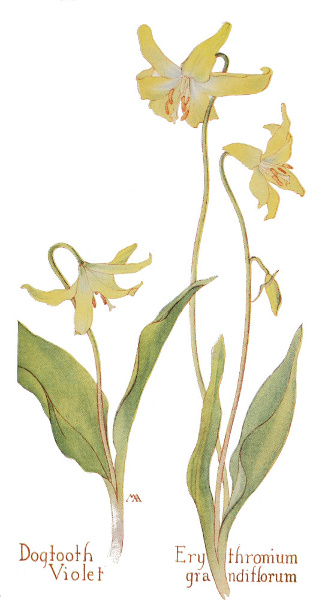
Dogtooth Violet—Erythronium grandiflorum.
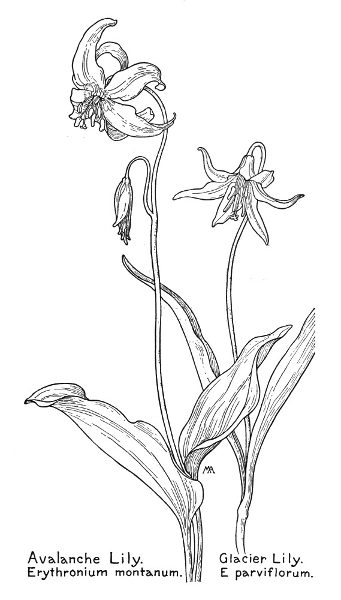
Avalanche Lily—Erythronium montanum.
Glacier Lily—E. parviflorum.
Desert Lily
Hesperocállis
undulàta
White
Spring
Cal., Ariz.
This is the only one of its kind, a wonderfully
beautiful desert plant, much like
an Easter Lily. The stout, pale, bluish
stem, from six inches to two feet tall, has
a delicate "bloom" and springs from a
graceful cluster of narrow leaves, which
are a foot and a half long, spreading widely, but not lying
quite flat on the ground. They are pale bluish-green,
with a narrow, crinkled, white border and folded lengthwise.
The buds are bluish and the lovely flowers are
about three inches long and pure-white, delicately striped
with pale-green and blue on the outside, with yellow anthers
and a white stigma, and with a papery bract at the
base of each pedicel. The flowers are slightly fragrant
and become papery and curiously transparent as they
wither. In dry seasons these plants do not bloom at all,
but the slightest moisture will cause them to send up a
stout stem and crown it with exquisite blossoms, which
look extraordinarily out of place on the arid desert sand
around Yuma and Ft. Mohave. The bulb is eaten by
the Indians.
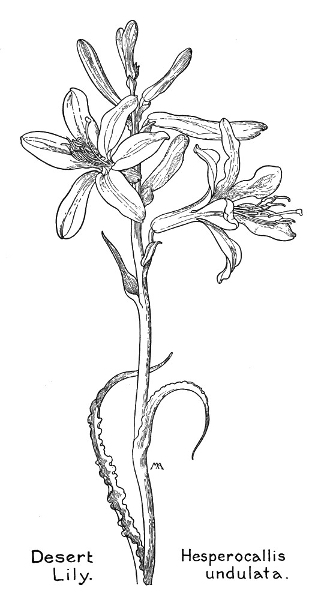
Desert Lily—Hesperocallis undulata.
Lilies, the "lords of gardens," are perhaps the most
beautiful and popular flowers everywhere and there are
some wonderful ones in the West. They have tall, smooth,
leafy stems, springing from scaly bulbs; large showy flowers,
solitary or in terminal clusters; smooth, netted-veined
leaves, often in whorls, and leaflike bracts. The flower-cup
is funnel-formed, or bell-shaped, and has six, equal,
spreading divisions, with a honey-bearing groove at the
base of each; the stamens, with long anthers, swinging from
the tips of long filaments; a long pistil, with a three-lobed
stigma and the capsule oblong, with two rows of flat seeds
in each of its cells. There are no true Lilies in Utah.
Small Tiger Lily
Lílium párvum
Orange-red
Summer
Cal., Oreg.
These tall plants carry a brilliant crown
of small lilies, glowing like jewels in the
dark moist woods they love. The stem is
from one and a half to six feet high, covered
with a slight down that rubs off, and
springs from a small bulb with short, thick scales. The
long, pointed, rich-green leaves are in whorls of five or six
below, more scattered towards the top of the stalk. The
flowers are rather more than an inch long, yellow at the
base of the petals, shading through orange to vermilion at
the tips and dotted with crimson in the throat. Usually
there are six or seven in a cluster, but they have been found
with many more in favorable situations and single plants
in Yosemite have been seen with as many as thirty blossoms.
The capsule is roundish and less than an inch long.
These little Lilies are among the most attractive of their
kind and grow somewhat freely in the high Sierras to an
altitude of seven thousand feet and as far north as Oregon.
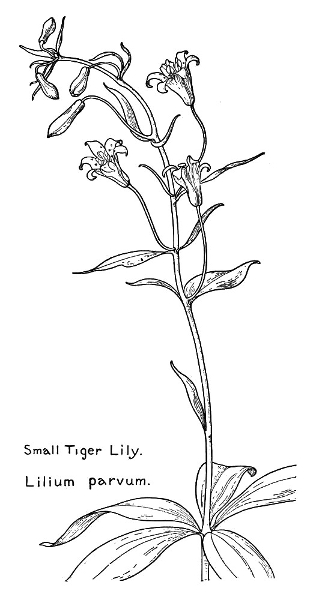
Small Tiger Lily—Lilium parvum.
Washington Lily
Shasta Lily
Lílium Washingtoniànum
White
Summer
Cal., Oreg.
In the Sierras, at an altitude of from
three to over seven thousand feet, and as
far north as the Columbia River, we may
be fortunate enough to find this glorious
Lily, growing in the forest in moderate
shade and protected by the chaparral. It is
not rare but nowhere very abundant. I
shall never forget finding a group of three or four, growing
near a huge fallen tree, in the woods at Wawona near Yosemite,
where it is very fine. Their raiment is even more
"white and glistering" than the cultivated Easter Lilies.
The smooth, stout, purplish stem is from two to five feet
high, adorned all the way up with successive whorls of
handsome dark-green leaves, three or four inches long, thin
in texture, with rippling margins, and shining as if they
had been varnished. There are from two to twenty blossoms
of shining white, each one from three to four inches
long and as much across. The petals are cleft to the base,
spreading wide apart when the flower is fully open, sometimes
finely dotted with purple, and becoming purplish in
fading. The anthers are yellow and the pistil green, and the
bulb is large, with thin scales. The scent is delicious,
having a whiff of spicy carnation added to the usual lily
fragrance. This is never found in the Coast Range and is
the only pure white American Lily. Shasta Lily is a variety
with a small bulb. L. Párryi, the Lemon Lily, of southern
California and Arizona, is similar in the form of its flowers,
which are large and clear yellow, dotted lightly with deeper
yellow. It grows in shady, moist spots in cool canyons
and is very beautiful.
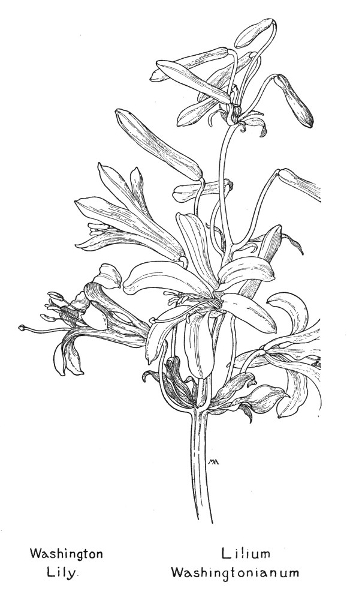
Washington Lily—Lilium Washingtonianum.
Leopard Lily
Lílium
pardalìnum
Orange
Summer
Wash., Oreg., Cal.
A magnificent plant, from three to six
feet tall, with bright-green leaves, thin in
texture, smooth but not shiny, and mostly
in whorls. The stem is crowned by a
splendid cluster of flowers, usually about
half a dozen together, but sometimes as
many as thirty on one stalk. They measure three or
four inches across and are pale-orange outside and deep-orange
inside, spotted with maroon, often blotched with
orange-yellow in the throat and tipped with scarlet. The
anthers are purplish, changing to reddish-brown, and the
pistil is bright-green. These plants often grow in large
companies, in moist spots in the mountains, and are unrivaled
in decorative beauty and brilliancy of coloring.
Tiger Lily
Lílium
Columbiànum
Orange
Summer
Wash., Oreg.
A good deal like the last, but not so
large. The petals are more turned back
and they are orange-color all over, dotted
with dark-red, and the anthers are pale
orange-color, ripening to golden-brown.
This is common in the Hood River Valley.
Ruby Lily
Chaparral Lily
Lílium rubéscens
White, pink
Summer
Cal., Oreg.
A glorious plant, from two to five
feet tall, with leaves mostly in whorls,
with rippled edges. The stem bears a
magnificent cluster of blossoms, most
wonderful in coloring, for the buds and
young flowers are white, dotted with
purple inside, with yellow anthers and a pale-green pistil,
but they gradually change to pink, and deepen to ruby-purple
as they fade, and the anthers and pistil also darken
in color. The effect of the whole cluster is therefore white
at the top, shading through pink to almost crimson below.
The flowers are even more deliciously fragrant than the
Washington Lily, which they resemble, except that they
are not quite so large as the latter and stand more erect
and the petals are not so spreading. This usually grows
among chaparral in the Coast Ranges.
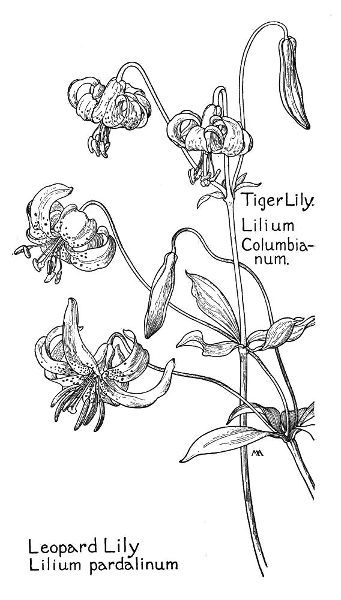
Tiger Lily—Lilium Columbianum.
Leopard Lily—Lilium pardalinum.
There are many kinds of Fritillaria, natives of the north
temperate zone. In the East there are only cultivated ones,
such as the familiar Crown Imperial, but we have a number
growing wild in the West. They have bulbs with round,
thick scales, developing into bulblets and sometimes resembling
grains of rice. The flowers are bell-shaped, and nodding,
with separate and nearly equal divisions, each with a
nectar-spot at its base. They resemble Lilies, but the style
is three-cleft, the honey-gland is a shallow pit and the flowers
are smaller. The capsule is roundish and six-angled,
containing numerous flat seeds. It is conspicuous and
perhaps suggested the Latin name, meaning "dice-box."
Bronze Bells
Brown Fritillary
Fritillària
atropurpùrea
Brown
Spring, summer
West
This plant is beautiful and decorative, and
yet there is something weird about it. The
flowers, an inch or more across, grow four or
five in a cluster, on a smooth stalk about a
foot tall, the long, narrow leaves scattered
or in whorls. The bells, nodding on slender
flower-stalks, are very unusual in coloring.
They are greenish-yellow, streaked and spotted with
maroon, and the long curling tips of the three-pronged pistil
project like the forked tongue of an adder, so that somehow
we feel that, in a previous existence, beautiful as it is now, it
may have been a toad or some reptile. When we found this
flower growing in the Grand Canyon, halfway down Bright
Angel trail, it seemed entirely suitable to the mysterious
spirit of the place. The general effect is bronze-color and
the attractive name of Bronze Bells, or Mission Bells, is
very appropriate. It has a small bulb of numerous, roundish
scales. The pistils are often rudimentary.
Yellow Fritillary
Fritillària pùdica
Yellow
Spring
West, except Ariz.
A pretty little flower, a favorite with
children, growing on grassy plains, with a
smooth stem about six inches tall, and
smooth, somewhat thickish, alternate or
whorled leaves. The nodding flowers,
about an inch long, are usually single, but sometimes as
many as six on a stalk, various shades of yellow and
orange, tinged with crimson and fading to dull-red. The
smooth bulb is pure white, and made up of a number of
rounded, thickish scales not resembling grains of rice,
so the name Rice Root is not appropriate and the local
Utah names, Crocus, Snowdrop, and Buttercup are absurd.
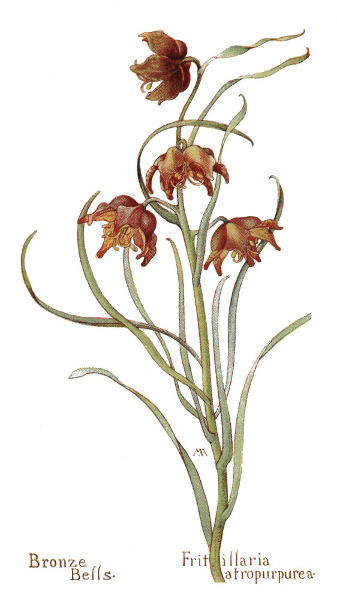
Bronze Bells—Fritillaria atropurpurea.
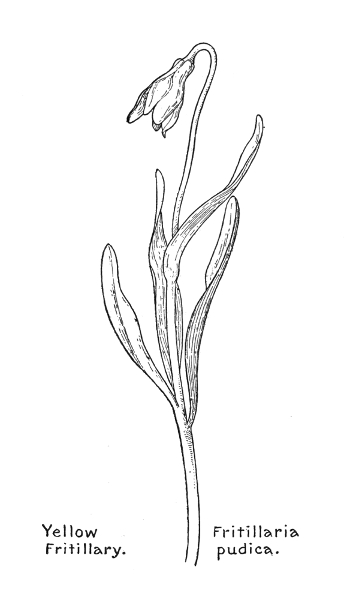
Yellow Fritillary—Fritillaria pudica.
There are several kinds of Yucca, natives of North and
Central America; large plants, with dagger-like leaves,
usually with long, thread-like fibers along the margins;
flowers with bracts, nodding in a terminal cluster, somewhat
bell-shaped, with six, thickish, white divisions; stamens
short, with thickened filaments and small anthers; ovary
with three united stigmas; capsule containing many, flat,
black seeds. The flowers are pollinated by a little white
moth, which lays its eggs in the ovary, but previously
gathers pollen from many flowers and pushes it against
the stigma after the eggs have been laid.
Our Lord's Candle
Spanish Bayonet
Yúcca Whípplei
White
Spring, summer
Cal., Ariz.
A noble plant, with no trunk, but sending
up a magnificent shaft of flowers,
from five to fifteen feet tall, springing
from a huge, symmetrical bunch of dagger-like,
bluish-green leaves. The cluster is
composed of hundreds of waxy, cream-colored
blossoms, sometimes tinged with purple, two
inches across, crowded so closely together along the upper
part of the stalk that the effect is a great, solid mass of
bloom, three feet long. The white filaments are swollen,
tipped with pale-yellow anthers; the pistil cream-color,
with green stigmas. The large, white bracts are stiff and
coarse, something like parchment, folded back so that the
pinkish stalk is ornamented with a series of white triangles,
symmetrically arranged. A hillside covered with hundreds
of these magnificent spires of bloom, towering above
the chaparral, is a wonderful sight. After they have
blossomed, the tall, white stalks remain standing for
some time, so that the hills look as if they had been
planted with numbers of white wands.
The genus Cleistoyucca resembles Yucca, but the divisions
of the flower are very thick and there is no style.
Joshua Tree
Tree Yucca
Cleistoyúcca
arboréscens
(Yucca)
Greenish-white
Spring, summer
Cal., Ariz., Utah
A tree, grotesque and forbidding in
aspect, but with a weird sort of beauty,
looming black against the pale desert
landscape, with a great, thick, rough trunk,
fifteen to thirty feet high, and a few thick,
contorted branches, stretching out like
a giant's arms and pointing ominously
across the sandy waste. The branches
are thatched with the shaggy husks of dead leaves and
from their tips they thrust out a great bunch of dagger-like
leaves and a big, ponderous cluster of pallid, greenish
flowers or heavy, yellowish fruits. The coarse flowers
are about two inches across, with a clammy smell like
toadstools, and the bracts are dead white. This grows
in the Mohave Desert and is at its best around Hesperia,
where one may see the most fantastic forest that it is
possible to imagine. Elsewhere it is smaller and more like
other Yuccas in shape. It was called Joshua Tree by the
early settlers, it is said because they fancied that its
branches pointed towards the Promised Land. The fruits
are relished by the Indians, who utilize the fibers from the
leaves for weaving baskets, ropes, hats, horse-blankets,
etc., and make a pulp from the stems, used for soap.
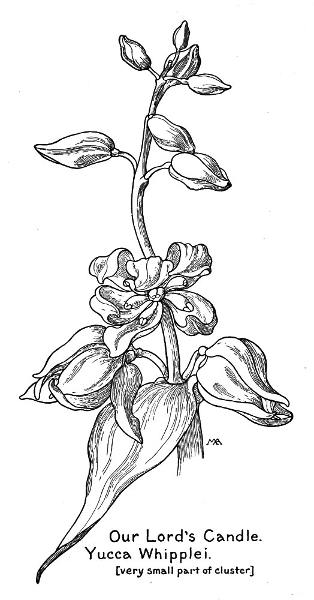
Our Lord's Candle—Yucca Whipplei.
[very small part of cluster]
There are several kinds of Trillium, of North America
and Asia; with tuberous root-stocks; three, netted-veined
leaves, in a whorl at the top of the stem; a single flower
with three, green sepals, three petals, six, short stamens,
and three styles; capsule berry-like and reddish, containing
many seeds. The Latin name means "triple."
Wake-robin
Birthroot
Tríllium ovàtum
White
Spring, summer
Northwest
A charming plant, about a foot tall,
with a single beautiful blossom, set off to
perfection by its large, rich green leaves.
The flower is two or three inches across,
with lovely white petals, which gradually
change to deep pink. It is a pleasure to
find a company of these attractive plants in the heart of
the forest, where their pure blossoms gleam in the cool
shade along some mountain brook. They resemble the
eastern Large-flowered Trillium and grow in the Coast
Ranges.
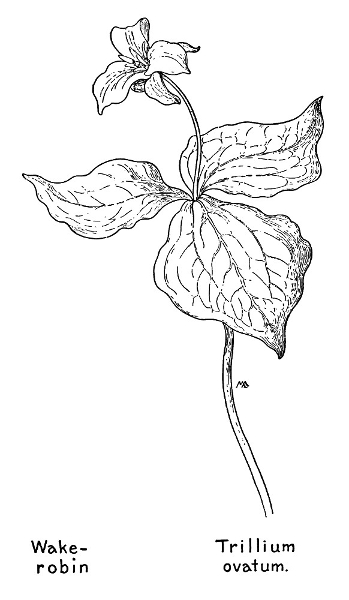
Wake-robin—Trillium ovatum.
There are three kinds of Xerophyllum.
Squaw-grass
Bear Grass
Xerophýllum
tènax
White
Summer
Northwest
This is a magnificent plant, from two
to six feet high, with a very stout, leafy
stem, springing from a very large tuft of
wiry, grass-like leaves, which spread out
gracefully like a fountain. They are
from one to two and a half feet long, dark-green
on the upper side and pale-gray on
the under, with rough edges. The imposing flower cluster
is borne at the top of the stalk and is about a foot
long, broad at the base and tapering to a blunt point,
and composed of hundreds of fragrant, cream-white
flowers, each about half an inch across, with slender,
white pedicels, and so closely crowded together that the
effect is very solid, yet made feathery by the long stamens.
It is a fine sight to come across a company of these noble
plants in a mountain meadow, rearing their great shafts of
bloom far above their neighbors. They are very handsome
around Mt. Rainier. They are said to blossom only once
in five or seven years and then to die. The leaves are
used by Indians in making their finest baskets. Unfortunately
the size of this book does not admit of an illustration.
There are two kinds of Maianthemum, an eastern one
and the following, which also grows in Europe and Asia.
Wild Lily-of-the-valley
Maiánthemum
bifòlium
White
Spring, summer
Wash., Oreg., Cal.
This is a very attractive, woodland
plant, from four to fourteen inches tall,
with handsome, glossy, rich green leaves,
and a rather stout stem, bearing a pretty
cluster, two or three inches long, of many,
small, waxy-white flowers, with four divisions.
They have four stamens, with
thread-like filaments and small, yellowish anthers, the
stigma has two lobes and the berry is red. This grows
in rich soil in the mountains and is much handsomer than
its eastern relation and strongly sweet-scented. The
Latin name means "blooming in May."
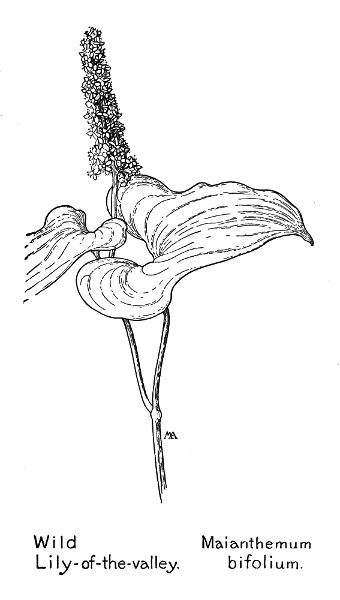
Wild Lily-of-the-valley—Maianthemum bifolium.
There are several kinds of Streptopus, much like Disporum,
but the pedicels of the flowers are twisted or bent.
White Twisted
Stalk
Stréptopus
amplexifòlius
Whitish
Spring, summer
U. S. except
Southwest
This is a fine plant, two or three feet
tall, with a smooth, branching, bending
stem and handsome leaves, thin in texture,
with strongly marked veins and pale with
whitish "bloom" on the under side. The
greenish-white flowers are about half an
inch long and hang on very slender,
crooked pedicels, from under the leaves,
and the oval berries are red and contain many seeds.
This grows in moist soil, in cold mountain woods, up to
an altitude of ten thousand feet and across the continent.
The Greek name means "twisted stalk."
Pink Twisted
Stalk
Stréptopus ròseus
Pink
Spring, summer
U. S. except
Southwest
A smaller plant, from one to two and a
half feet tall, with a slightly hairy stem,
ornamented with pretty leaves, green on
both sides and hairy along the edges, and
hung with pretty, little, dull purplish-pink
flowers, more or less streaked with
deeper color and less than half an inch
long. This grows in the same sort of places as the last
and is also found across the continent.
There are two kinds of Stenanthella; smooth herbs,
with bulbs and small nodding flowers, in bracted clusters,
the divisions of the perianth separate, without glands or
distinct claws; the short stamens inserted at the base of
the divisions; the styles three; the capsule with three beaks
and containing oblong, winged seeds.
Stenanthella
Stenanthélla
occidentàlis
Brownish
Spring, summer
Northwest
This is a graceful plant, from ten to
twenty inches tall, with long, rather
narrow leaves and a slender stem, terminating
in a long spray of about ten,
rather pretty, little brownish-green or
purplish flowers, each less than half an
inch long. This grows in shady places.
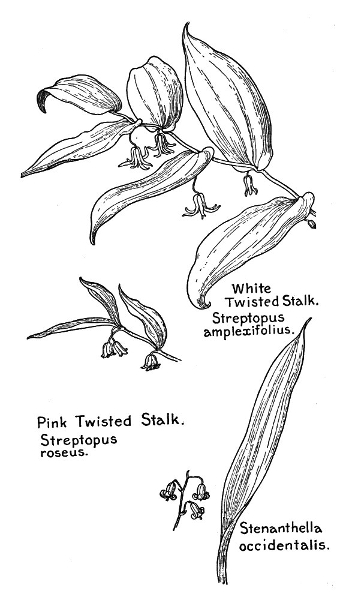
White Twisted Stalk—Streptopus amplexifolius.
Pink Twisted Stalk—Streptopus roseus.
Stenanthella occidentalis.
There are several kinds of Camassia, one eastern; herbs
with onion-like bulbs, long, narrow leaves and thin, dry
bracts. The flowers are blue of various shades, with six,
separate, somewhat spreading divisions, each with a
stamen on its base, the anthers swinging, the style threadlike,
with a three-cleft tip; the capsule three-lobed, with
several seeds in each compartment. Varieties of Camassia
have long been cultivated in European gardens. The
name is derived from Quamash, the Indian name for these
plants.
Camass,
Quamash
Camássia
quámash
Blue
Summer
Northwest
and Utah
Looking across the vivid green of wet
meadows and marshes, the deep blue
patches of this flower are often conspicuous
and beautiful. They grow from one
to over two feet high, taller than the grasslike
leaves, forming a loose cluster, with
papery bracts. The flowers are from an
inch and a half to over two inches across, the six divisions
spreading out into a star. The buds are tinged with turquoise-blue
and striped with purple, giving a fine iridescent
effect, and the flowers, which fade very quickly, are often
exceedingly handsome, varying in color from dark-blue
to white, but usually deep, bright purplish-blue, with a
green ovary, a long purple style and yellow anthers, with
purple filaments. They are larger and handsomer in
northern California than in Yosemite. Grizzly bears are
fond of the bulbs and the Indians of the Northwest prized
them as a delicacy, indeed the Nez Percé war in Idaho
was caused by encroachments on a territory where they
were abundant. They were cooked elaborately in pits,
care being taken to avoid the poisonous bulbs of the Death
Camass, which resemble them. The Indians also boil
the bulbs in water and make good molasses from them,
which they use on festive occasions. This is sometimes
called Wild Hyacinth, but the name is poor, as it does not
resemble a hyacinth in character.
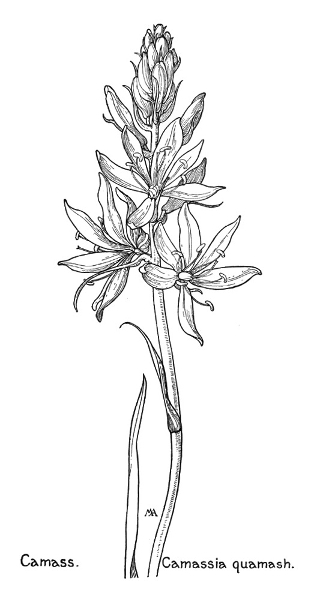
There are six kinds of Clintonia, of North America and
Asia; with creeping rootstocks and a few, broad root-leaves;
flowers without bracts, their divisions separate,
equal or nearly so, each with a stamen at its base; style
with two or three, inconspicuous lobes; fruit a berry.
These plants were named in honor of De Witt Clinton,
Governor of New York, a naturalist, interested in botany,
so Thoreau need not have been so annoyed at their having
been given this name.
Red Clintonia
Clintònia
Andrewsiàna
Red, pink
Spring, summer
Oreg., Cal.
A magnificent plant, one or two feet
high, with five or six, exceedingly handsome,
glossy, rich green leaves, very
conspicuous and sometimes a foot long,
and a tall, slightly downy flower-stalk,
usually with a few flowers scattered along
it, and crowned with a large, roundish cluster of beautiful
flowers. They are about three-quarters of an inch long,
very rich in color, a deep shade of warm reddish-pink, or
crimson, not common in flowers. The form of the cluster
varies a good deal; sometimes the flowers are not mostly
at the top, but clustered quite thickly along all the upper
part of the stalk. The large, deep-blue berries are very
handsome and, altogether, this is one of our most conspicuous
and attractive woodland plants, especially when
growing in the deep shade of redwood forests.
Queen-cup White Clintonia
Clintònia
uniflòra
White
Spring
Northwest
In rich moist soil, in shady woods, we
find this lovely flower, with a white chalice
and heart of pale gold, surrounded by
two or three, beautiful, large, glossy
leaves, resembling those of Lily-of-the-valley,
and fairly carpeting the ground in
favorable situations. The slender flower-stalk
is hairy, six to ten inches tall, and usually bears a
single flower, an inch or more across, with pure-white
petals that soon drop off. The fruit is a handsome blue
berry.
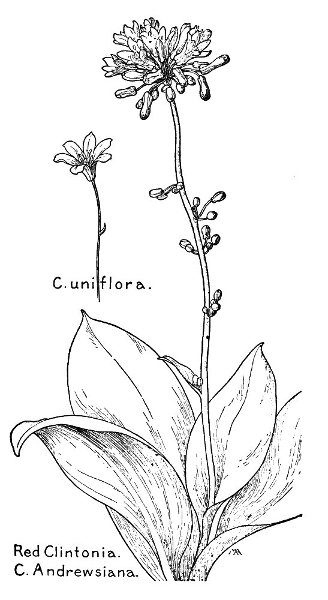
C. uniflora.
Red Clintonia—C. Andrewsiana.
There are a good many kinds of Vagnera, natives of
America and Asia, with a single stem, scaly below and
leafy above; the leaves alternate, with short leaf-stalks or
none; the flowers small, the divisions equal and spreading,
white or greenish, in a cluster; the berry round, usually
with one or two seeds.
False Solomon's
Seal.
Wild Spikenard
Vágnera amplexicàulis
(Smilacina)
White
Spring
West
It is a pity that all flowers cannot have
really individual names. "False" is
especially unattractive and "Solomon's
Seal" is confusing, as the flowers are not
alike, but this is the old name used all over
the world, so it will have to stand, though
unworthy of this pleasing plant. It is
from one to three feet high, with large,
light-green leaves, usually slightly downy
on the under side. The flower-cluster is sweet-scented and
composed of numerous, very small, cream-white flowers,
the conspicuous parts of which are the stamens, white and
larger than the petals, giving a feathery appearance to the
whole cluster. The fruit is a light-red berry, very finely
sprinkled with dark-red dots. This fine tall plant is very
decorative and is common in rich moist woods. The name
was given in honor of Wagner.
Star-flowered
Solomon's Seal
Vágnera
sessilifòlia
(Smilacina)
White
Spring
West
A gracefully bending plant, from one to
two feet high, springing from a slender
root-stock. The bright light-green leaves,
without leaf-stalks and clasping at base,
have a slight "bloom" like some lily
leaves and are handsome and conspicuous,
but not at all coarse, and are usually very
smooth, but sometimes minutely downy.
The small, delicate, cream-white flowers, on a very slender,
angled flower-stalk, grow in a loose cluster and the berries
are reddish-purple or nearly black. This charming plant
sometimes forms large patches in moist, rich soil in shady
places and its pretty foliage is often very noticeable beside
the railroad tracks in Utah.
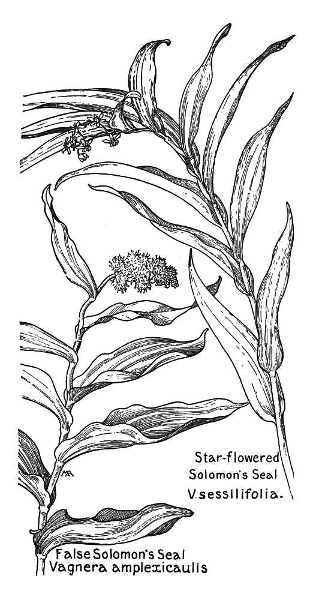
Star-flowered Solomon's Seal—V. sessilifolia.
False Solomon's Seal—Vagnera amplexicaulis.
Fairy Bells are graceful plants, growing in rich, moist,
mountain woods, with smoothish, or slightly hairy, branching
stems, leafy above and with scaly bracts below, springing
from slender root-stocks; leaves netted-veined, alternate,
without leaf-stalks, smooth and thin in texture and often
clasping the stem; rather small, bell-shaped flowers, hanging
from under the leaves, with six stamens and a slender
style, with one or three stigmas; the fruit a yellow or red
berry. Disporum is from the Greek meaning "double-seed,"
as in some kinds there are two seeds in each cell of
the ovary.
Fairy Bells
Drops of Gold
Dísporum trachycàrpum
(Prosartes)
Yellowish-white
Spring, summer
West
A very attractive mountain plant,
growing near streams. It is from nine to
twenty-four inches tall, with an angled
stem, pale green above and reddish below.
The delicate flowers, about half an inch
long, with a three-lobed green stigma and
yellow anthers, grow singly or in clusters of
two or three, nodding shyly under the pretty
leaves, which are dull above and very shiny on the under
side, with oddly crumpled edges and set obliquely on the
stem. The berry when unripe is orange color and suggested
the name Drops of Gold, but becomes bright red
when it matures in June. D. Hookeri is similar, but the
style is not three-lobed and the leaves are slightly rough
to the touch and are not so thin or crumpled. They
spread out so flat that they make a green roof over the
flowers, completely screening them from the passer-by.
This grows in shady woods, but not near streams.
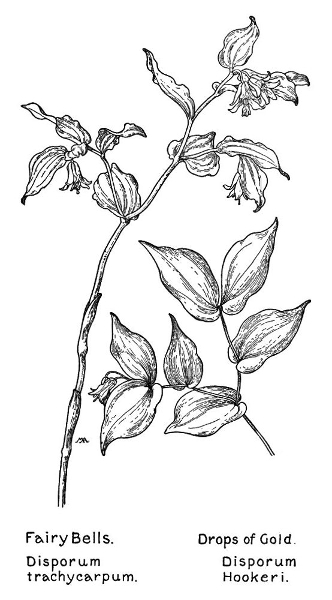
Fairy Bells—Disporum trachycarpum.
Drops of Gold—Disporum Hookeri.
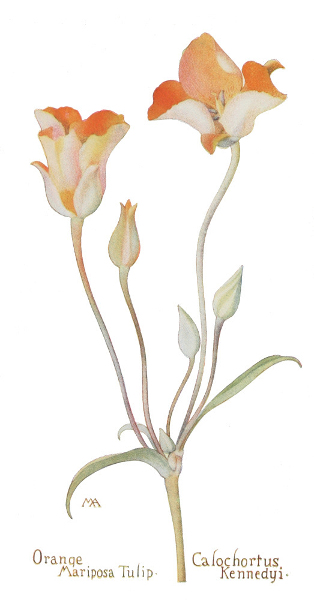
Perhaps the most characteristic western flowers are the
members of the genus Calochortus. They grow freely all
through the West, as far north as British America, and
down into Mexico, but they never get east of Nebraska, so
these gay and graceful flowers may be considered the peculiar
property of the West. Calochortus means "beautiful
grass" and the leaves are usually grasslike, the stems
slender and the flowers bright in color, decorative and interesting
in form. They have three sepals, often greenish,
and three large, colored petals, with a honey-gland, usually
covered with hairs, at the base of each. They are allied to
true Tulips, so the popular name is suitable, and they fall
into three groups: Globe Tulips, with nodding, globular
flowers, and nodding capsules; Star Tulips, with erect, star-like
flowers and nodding capsules; and Mariposa Tulips,
with large, somewhat cup-shaped flowers and erect capsules.
Mariposa means "butterfly" in Spanish and is
appropriate, for the brilliant hairy spots on the petals are
wonderfully like the markings of a butterfly's wing and the
airy blossoms seem to have but just alighted on the tips of
their slender stalks. They usually grow on dry open hillsides
and their leaves have often withered away before the
flowers bloom. The various forms run into each other, so
that it is impossible to determine all the different species.
They have solid bulbs, some of which are edible, considered
a delicacy by the Indians and called Noonas.
Golden Lily Bell
Yellow Globe Tulip
Calochórtus
amàbilis
Yellow
Spring
California
A charming plant, with pale bluish-green
foliage, with a beautiful "bloom,"
which sets off the clear-yellow blossoms to
perfection. There are from two to twenty
flowers on each stem and the petals are
smooth, except for a neat, stiff fringe of
hairs along the margins and the matted
hairs on the glands, which are often reddish.
These lovely flowers, common in northern California,
are peculiarly fresh in color and when growing among the
grass in the shade of oak trees they have the springlike
charm of Daffodils in English woods.
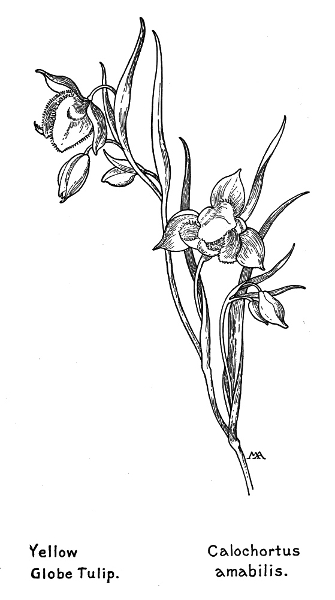
Yellow Globe Tulip—Calochortus amabilis.
Satin-bell.
White Globe Tulip
Calochórtus álbus
White
Spring
California
Beautiful and popular flowers, with a
great deal of individuality and quite
Japanese in the decorative arrangement of
the graceful stems and glossy, rich green
foliage. The narrow root-leaf is over a
foot long and spreads on the ground and
other smaller leaves are disposed along the bending stem,
which is from one to two feet tall and hung with pretty
light-green buds and beautiful drooping blossoms, over an
inch long, pearly white, sometimes tinged with lilac, with a
satiny sheen and delicate yet crisp in texture. The papery
sepals are greenish-white and the petals are sometimes
tinged with purple at the base and are prettily fringed with
hairs along the edges and often cross their tips in a very
engaging way. They are covered inside with long, silky,
white or yellow hairs and the glands are crescent-shaped,
with close, short, sticky, white or yellow hairs, and form
pale-green humps on the outside of the petals; the anthers
are cream-color and the pistil whitish. The capsule is one
or two inches long, with a short beak and brown seeds.
These plants grow on shady banks in the Coast Ranges and
have several pretty common names, such as Lantern of the
Fairies and Alabaster Tulip, as well as the misleading
name Hairbell, which causes this flower to be confused with
the Harebell or Campanula.
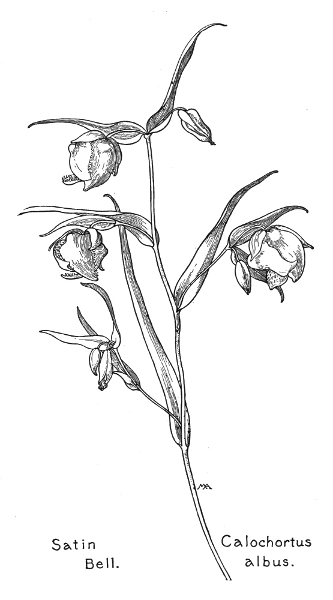
Satin Bell—Calochortus albus.
White Star Tulip
Calochórtus nùdus
White
Summer
California
This is a delicate and charming little
flower, growing best in meadowy places in
the woods of the Sierra Nevada Mountains
at moderate altitudes, sometimes to a
height of over seven thousand feet. The
single, ribbonlike leaf is much taller than the flower-stalk,
which is only a few inches high and bears several pretty
flowers, measuring over an inch across, with pale-green
sepals and three pure-white or pale-lilac, fan-shaped petals,
with a little notch in the edge, almost without hairs and
marked with a lilac crescent at the base; the honey-gland
is divided crosswise by a toothed scale and the anthers
are light blue. The nodding capsule is pointed at both
ends.
White Pussy's
Ears
Calochórtus
Maweànus
White, gray
Spring
Cal., Oreg.
A charming little plant, with lovely
little flowers, about an inch across, with
white or pale-lilac sepals and white petals,
hairy all over inside, often lilac at the base,
the crescent-shaped gland covered with
violet hairs and the anthers and pistil lilac.
Usually the general effect is of a most
delicate shade of gray and the little blossoms do not droop,
but look straight up at one from among the grass. This is
common in northern California.
Yellow Pussy's
Ears.
Yellow Star Tulip.
Calochórtus
Bénthami
Yellow
Spring
California
Much like the last in character, from
three to seven inches tall, with bluish-green,
stiffish leaves and a few quaintly
pretty flowers. They are about an inch
across, clear light-yellow, with smooth
sepals and the petals thickly covered with
yellow hairs and sometimes brown at the
base. This is common in the Sierra foothills.
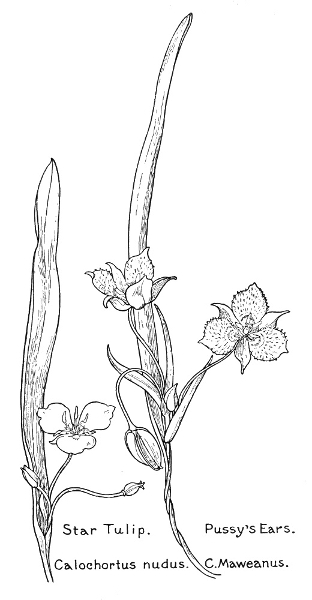
Star Tulip—Calochortus nudus.
Pussy's Ears—C. Maweanus.
Butterfly Tulip
Mariposa Tulip
Calochórtus lùteus
var. oculàtus
Many colors
Spring, summer
California
The commonest kind in northern California,
found in both the Sierra Nevada
and Coast Mountains, and one of the most
beautiful of all the Mariposas. The broad
petals, each about an inch and a half long,
are usually white, lilac, or yellowish, with
an "eye" like that on a peacock's feather,
giving the name oculatus. Occasionally they are deep rose-color,
as in the colored picture, though this is not typical,
and have a vivid blotch of shaded maroon and crimson and
an orange spot on each petal, with some maroon-colored
hairs at the base. The sepals are striped with pink and
maroon and twist into spirals as they fade; the pistil and
the blunt anthers are mauve; the honey-gland narrowly
crescent-shaped; the leaves pale-green and the delicate
stem over a foot tall. This Mariposa is extremely variable
and seems sometimes to merge into C. venústus, a similar
kind, and gorgeous varieties of both may be seen along the
Yosemite road on the down grade to Wawona. There are
many similar Mariposas, but the casual flower-lover who
finds any of these beautiful flowers will probably be satisfied
to know that they are Butterfly Tulips, without going
into the technical peculiarities which differentiate them.
Yellow Mariposa
Tulip
Calochórtus lùteus
var. citrìnus
Yellow
Spring
California
A fine robust plant, about a foot tall,
with a stout stem, light, bright green leaves,
and exceedingly handsome flowers, over
two inches across. The sepals are yellowish,
with a black spot and streaks of brown,
and the petals are deep lemon-yellow,
each with a rich maroon spot near the
center and a hairy, brown, crescent-shaped gland below,
often flecked with maroon at the margins and base, with
cream-colored anthers and a yellowish pistil. This is very
much like a Tulip in character and looks very gay and
cheerful growing in green fields. The typical C. luteus is
similar, but smaller and duller in color.
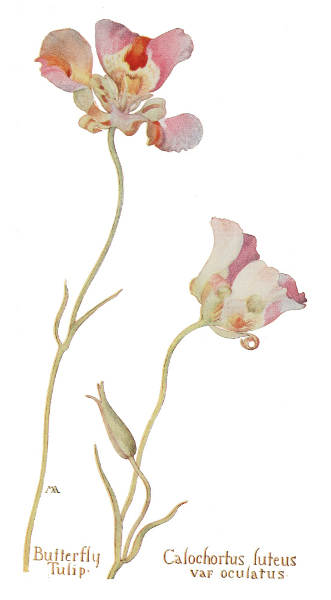
Butterfly Tulip—Calochortus luteus. var. oculatus.
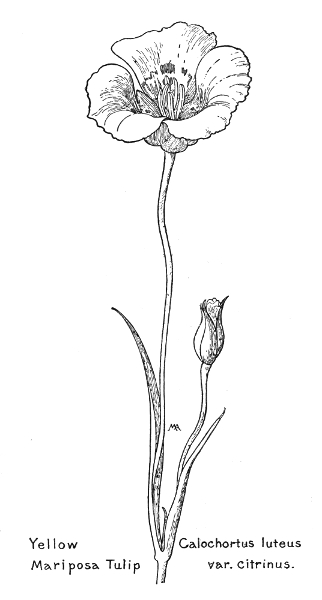
Yellow Mariposa Tulip—Calochortus luteus var. citrinus.
Orange Mariposa
Tulip
Calochórtus
Kénnedyi
Orange-red
Spring
Cal., Ariz.
A wonderful flower, exceedingly brilliant
and unusual in color, not quite like anything
else in nature. The stout, firm stem
is from two inches to over a foot tall and
the leaves are dark-green, with a delicate
bluish "bloom." The flowers are about
two inches across, with pale-green sepals,
bordered with pale-pink and orange inside, and beautiful
petals, thick in texture and easily bruised, delicate peach-color
outside and bright orange-vermilion within, each
petal ornamented with a purplish gland, covered with
matted hairs and crossed with a band of long vermilion
hairs. When the stems are very short the flaming flowers
look like Crocuses, sprouting out of the barren desert soil,
but when they are tall they have the gorgeous effect of
Tulips. These plants grow in the Mohave Desert, but are
rather rare in California. They are very abundant in the
foothills and on the mountain slopes of Arizona, giving a
beautiful orange-red color to the landscape for miles in
spring, there being literally thousands in a small area.
Sego Lily
Mariposa Tulip
Calochórtus
Nuttállii
White, pale lilac
Early summer
Ariz., Cal., Utah
These pretty flowers are about two
inches across, their white petals tinged
with yellowish-green or lilac, and often
delicately fluted at the edges, often with
hairy spots inside the petals at their base,
the whole flower very variable in coloring.
These Mariposas grow all through the
Southwest. In the Grand Canyon they begin to come out
early in May, among the dry grasses halfway down the
Bright Angel trail, and are a lovely shade of clear lilac. The
slender stem, about a foot tall, often bears a small bulb near
the base. It is called Sego Lily (pronounced Sègo) in Utah
and is the "State flower." Its bulbs formed a substantial
part of the food of the early Mormon pioneers when they
crossed the desert and the flower is therefore held in great
esteem in Utah.
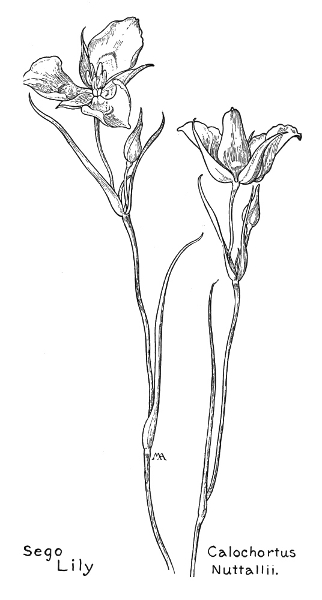
Sego Lily—Calochortus Nuttallii.
A large family, widely distributed and found throughout
our continent. Perennial herbs, with bracts; the leaves
long, narrow, toothless, and sheathing; the flowers showy,
perfect and regular, twisted in the bud, not falling off in
withering, of three and six parts; the three stamens on the
base of the sepals, their anthers turning outward; the
single style with three branches; the ovary inferior, becoming
a three-celled, usually three-angled, many-seeded
capsule. This family is noticeably distinguished from the
Lily family by the inferior ovary, and from the Amaryllis
family by the three stamens.
There are many kinds of Iris. To the casual observer
the flowers appear to have nine petals of different sizes,
but in reality there are three sepals, three petals, and three
petal-like branches of the style. The three outer divisions,
or sepals, are large and spread or turn down; the three
inner divisions, or petals, are usually narrower and are
erect; the style branches arch over and under each is a
stamen. The sepals and petals have claws, which are
united below and form a tube; the capsule is large and
contains many, flat, black seeds, in one or two rows in
each cell; the large rootstock is usually fleshy. Iris is
from the Greek for "rainbow," in allusion to the variegated
tints, and Flower-de-luce from the French "fleur-de-lis," or
"lily-flower." Many odd and beautiful kinds are cultivated
from the Old World. Orris-root is made from the
roots of a Florentine species.
Western Blue
Flag
Ìris Missouriénsis
Violet, blue
Spring, summer
West, except
Wash, and Oreg.
A very handsome and decorative plant,
growing in large clumps, in damp situations,
from stout, creeping rootstocks.
The stiff, sword-shaped leaves, mostly
shorter than the stems, are smooth and
light bluish-green and the stout stems,
from one to two feet high, bear usually
two, pale-violet flowers, about three inches long, emerging
from thin, papery bracts. The sepals are white, or pale
blue, delicately veined with violet, with a yellow-veined
rib down the middle, the petals are pale blue or pale violet,
veined with purple, and the buds are yellowish, veined
with brown. This grows in profusion in the Yosemite
meadows, at the foot of El Capitan, and is delicately
beautiful, but would be more effective if the coloring were
a little stronger.
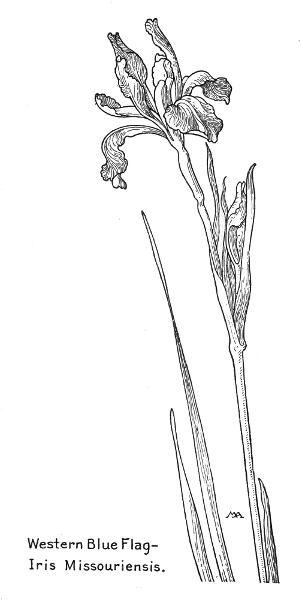
Western Blue Flag—Iris Missouriensis.
Douglas Iris
Ìris Douglasiàna
Purple, lilac,
cream
Spring, summer
Cal., Oreg.
A beautiful kind, very common in the
Coast Ranges. It grows in patches, or
singly, and has rather dark green leaves,
longer than the flower-stalks, and lovely
flowers, which vary exceedingly in color.
Near the coast they are usually bluish-purple,
but in mountain woods they run from violet and mauve
to pink, yellow, and white. They are often striped with
white and yellow, delicately veined with purple, and measure
three or four inches across. In the redwood forests, in northern
California, they are peculiarly large and beautiful, their
delicate tints of cream and straw-color, tinged with mauve
and marked with reddish-purple, and wonderfully set off by
their dark forest background. This kind often blooms
throughout the rainy season, but chiefly in early spring.
Hartweg's Iris
Ìris Hartwégi
Yellow and violet
Summer
California
This odd and pretty little Iris grows in
half-dry, open forests, in the Sierra Nevada
Mountains. The many flower-stems,
from six to twelve inches tall, are overtopped
by some of the long, narrow leaves
and the flowers are from one and a half to two inches long,
either yellow, veined with violet, or pale-violet, veined
with purple. The two color forms often grow together
and attract much attention from tourists. They look
very pretty, springing from a carpet of fallen pine-needles,
in the forests along the Wawona road near Yosemite.
Ground Iris
Ìris macrosìphon
Blue, purple
Spring, winter
California
A beautiful kind, forming low clumps
of many, very narrow leaves, from five to
twenty inches long and much taller than
the flower-stalks. The handsome flowers
are over three inches across, bright purplish-blue,
the sepals veined with darker color and marked
with a white stripe. This is common on grassy hills near
the coast and farther inland becomes taller and paler in
color. The flowers are slightly sweet-scented and begin
to bloom in January. The Hupa Indians used the leaves
for making twine and rope for their nets and snares.
There are many other beautiful western Irises.
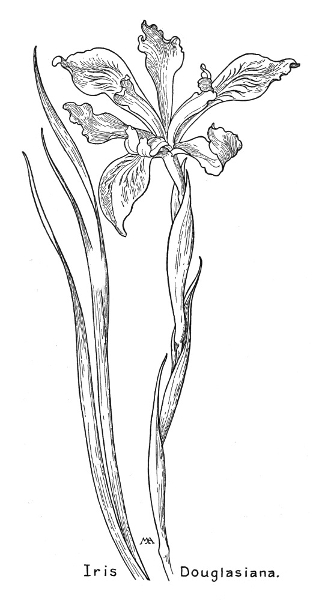
There are numerous kinds of Sisyrinchium, attractive
little plants, all American, many from South America;
with fibrous roots; grasslike leaves; slender, flat stems,
sometimes branching; papery and green bracts and pretty
flowers, that soon wither, on very slender pedicels, the six
spreading divisions all alike; the filaments of the stamens
united; the style branches slender, the capsule roundish,
containing round seeds.
Blue-Eyed Grass
Sisyrínchium
béllum
Blue
Summer
Cal., Oreg.
The deep blue stars of this pretty plant
are a beautiful feature of the fields near
Santa Barbara, and in other parts of
California, in summer; in fact they are so
plentiful in some places that they are a
menace to the farmers. They grow in
clumps, about a foot tall, among the grass. The stems
are somewhat branching, the leaves are shorter than the
stem, and the bracts are about an inch long, green and
sheathing. There are about seven flowers on each stem, in
a loose cluster, each about an inch across and handsomer
than their relations in the East. They vary in tint from
bright blue to purple, with a yellow "eye," and their divisions
are prettily notched at the tips, with a little prong.
The anthers are arrow-shaped, the style short, with three
very small stigmas, and the small, oddly-shaped, little
capsule is dark-brown when ripe, and perhaps suggested
one of the common names, Nigger-babies. It is called
Azulea and Villela by Spanish-Californians.
Golden-Eyed
Grass
Sisyrínchium
Califórnicum
Yellow
Spring, summer
Cal., Oreg.
This is very much like Blue-eyed Grass,
but the flowers are bright yellow, the
stems are about a foot tall, broadly winged
and not branching, and the leaves are
somewhat broader. The pretty flowers
are nearly an inch across and there are
from three to seven in a cluster. The
filaments are united at the base only, the style is cleft to
below the middle, and the small capsule is rather oblong.
This grows in swampy places near the ocean. S. Arizònicum
has yellow flowers and branching stems and grows in
Arizona. S. Élmeri also has yellow flowers, with purple
lines, and is found in wet places in the Sierras. When
pressed and dried the yellow-flowered Sisyrinchiums stain
the paper reddish-purple.
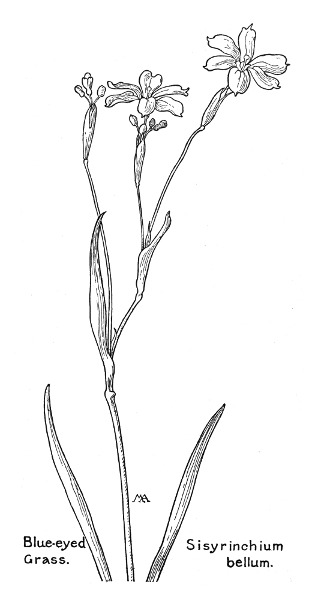
Blue-eyed Grass—Sisyrinchium bellum.
A very large family, most abundant in the tropics;
curious plants, with oddly beautiful flowers. Perhaps
because they are also rather rare they seem to have a
peculiar fascination for the public; in fact almost any
strangely-shaped flower is apt to be dubbed an orchid by
the passer-by. They are perennial herbs, with various
kinds of roots, some of them parasitic, usually with alternate,
toothless leaves, the lower ones sheathing the stem.
In some kinds the leaves have dwindled to scales. The
flowers are perfect, irregular, with six divisions; the three
sepals are alike and colored like petals; two of the three
petals are alike, but the central one differs in size and shape
and is called the lip. This is conspicuously colored, often
spurred, and contains nectar for the attraction of "long-tongued"
insects, on which these plants depend mostly for
cross-pollination. The mechanism for this purpose is
curious and interesting. The stigma is usually a broad
sticky surface and its style is united with the filaments and
forms, in front of the lip, a column which is usually capped
by a single two-celled anther, containing two clusters of
pollen, one in each cell. Each cluster consists of a few
waxy grains, held together by cobweb-like threads, which
run together and terminate in a sticky disk. These disks
adhere to the insects, which push in to get the nectar, and
are transported to the gummy stigma of another flower.
The inferior ovary develops into a three-valved capsule,
containing numerous minute seeds. Orchis is the ancient
Greek name.
There is only one kind of Cephalanthera in North America;
with creeping rootstocks; flowers in terminal spikes, with
bracts; sepals and petals nearly equal; petals somewhat
united and hooded; lip more or less pouched.
Phantom Orchis
Cephalanthèra
Austínae
White
Summer
Northwest
In dense mountain forests these strange
plants shimmer like pallid ghosts among
the dark trees. They are pure translucent
white throughout, stem and all, and the
leaves have shrunk to white sheaths, an
inch or two long. The stems are one to
two feet tall and bear spikes of numerous flowers, each over
half an inch long, with the lip shorter than the sepals and
petals, which are alike. They are beautiful and yet not
quite pleasing, for we feel instinctively that there is something
unnatural about them and, indeed, the strange
absence of any green coloring matter in their make-up
indicates that they are incapable of making their own
food from the elements and draw their nourishment from
decaying vegetation, or are parasitic on other plants.
They range northward from Yosemite but are nowhere
very abundant. I found several growing near the trail
from Little Yosemite Valley to Cloud's Rest and a good
many in the woods near the foot of Mt. Shasta, where they
seem to be quite common.
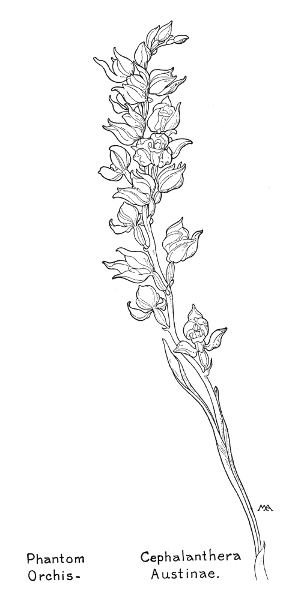
Phantom Orchis—Cephalanthera Austinae.
There are several kinds of Serapias, widely distributed;
tall, stout herbs, with creeping rootstocks and leafy stems;
the leaves plaited lengthwise and clasping at base; the
flowers with leafy bracts, in terminal racemes. The
flowers have no spur; the sepals and petals are separate
and nearly equal; the lip broad, free, concave below,
constricted near the middle.
Stream Orchis
Chatter-box
Seràpias gigantèa
(Epipactis)
Reddish and
greenish-yellow
Summer
West, etc.
A handsome plant, decorative and
curious in form and unusual in coloring.
It is from one to four feet tall, with a stout,
leafy stem bearing three to ten flowers and
smoothish leaves, with prominent veins.
The sepals are reddish or greenish-yellow
and the petals pinkish, veined with
maroon. The lip is pouched at the base,
with a winged margin and a pendulous tip, which swings
freely as if on a hinge, so that it quivers when the plant is
shaken. Although the flowers are very handsome this
curious tremulous motion, which makes them seem almost
alive, gives them a quaint likeness to an old woman in a
sunbonnet, with a hooked nose and chattering jaw. They
have a slight scent and the plant is quite common along
streams and in wet places, in the West and in Colorado and
Texas. Some botanists think it is identical with a variety
which grows in the Himalaya Mountains. It was named
for the Egyptian deity, Serapis.
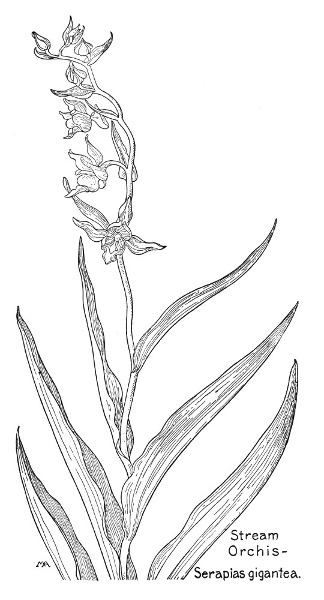
Stream Orchis—Serapias gigantea.
There are several kinds of Corallorrhiza, widely distributed
in the north temperate zone and growing in dense
woods; pinkish or straw-colored plants, more or less
parasitic, with large roots resembling branches of coral;
the leaves all reduced to sheathing, papery scales; the
flowers in terminal racemes, without bracts, on short
pedicels, which turn down in fruit, mostly with a short
spur, the sepals and petals about equal, the upper ones
curving in.
Coral-root
Corallorrhìza
multiflòra
Reddish-yellow
Summer
Wash., Oreg.,
Cal., Utah
The curious knobby rootstock, shaped
like a bit of coral, gives the name to this
strange and rather unwholesome looking
plant. From living on decayed vegetation
it has lost its green leaves, and has only a
few papery sheaths in their place, and the
thick, translucent stem is pale and smooth,
from one to two feet tall, pink at the base, shading to
golden-brown towards the top. The flowers, less than
half an inch across, are usually yellow, with reddish-brown
tips, and the white, three-lobed lip is spotted with purple.
The buds are yellow and brown and the whole color effect
is very pretty, as if the plant were trying to match the
russet tints of the floor of the forest. The flowers vary
from several to many and grow in a long cluster, hanging
down when their seeds begin to ripen. This is widely
distributed, growing also in the East, but nowhere common.
Coral-root
Corallorrhìza
Bigelòwii
Reddish-yellow
Summer
Wash., Oreg.,
Cal., Utah
This is a similar plant, but handsomer,
with much larger flowers, duller in coloring
and striped not spotted. Instead of a
spur the base of the sepals is swollen over
the ovary, which develops gradually into
an oblong fruit to which the flower still
clings, so that the older flowers, on the
lower part of the stalk, give an odd effect of having long,
swollen necks. The seeds are small and numerous.
There are other kinds, similar in general effect.
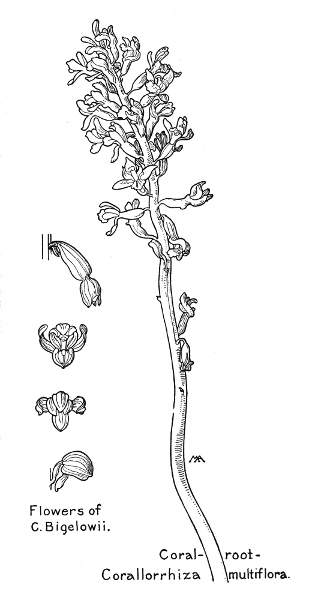
Flowers of C. Bigelowii.
Coral-root—Corallorrhiza multiflora.
There are numerous kinds of Limnorchis; the lower
leaves clasping or sheathing the stem; the flowers mostly in
spikes or racemes; sepals nearly equal, petals mostly
smaller than the sepals; lip spreading or drooping, not
toothed or lobed, with a spur. The Latin name means
"marsh-dweller."
Sierra Rein Orchis
Limnórchis
leucostàchys
(Habenaria)
White
Summer
Cal., Oreg., Wash.
Often in some favorable corner of a
marsh, near the woods, we may see a
dozen of these lovely plants, their robust
leafy stalks sometimes as much as four
feet tall, rearing their delicate spires of
bloom above the lush grass. The long
narrow leaves are bright-green and
smooth and the numerous, small, delicate blossoms,
sprinkled thickly along the stem, are pure white, each with
a very long spur like a little tail, each with a green bract
at the base of its little pedicel, and deliciously fragrant.
There are several similar kinds, mostly with green flowers;
this is the handsomest and least rare.
There are many kinds of Cypripedium, with large, broad
leaves and one or several, large, drooping flowers, with two
fertile anthers, with short filaments, one on each side of
the column below the stigma, and a conspicuous, petal-like,
sterile anther, arching over the stigma. They are
easily known by the curious lip, which is a large inflated
sac, suggesting both the common names, Lady's Slipper
and Indian Moccasin, and the Greek, meaning "foot of
Venus."
Mountain Lady's
Slipper
Cypripèdium
montànum
Brown and white
Summer
Northwest
Beautiful and decorative, with a stout,
hairy stem, one to two feet tall and a few
handsome flowers, rich and harmonious
though not brilliant in coloring, with a
lip about an inch long, dull-white, veined
with purple, and brownish or purplish
sepals and petals, very long, narrow, and
twisted. This grows in mountain woods and is found
around Yosemite. There is a picture in Miss Parsons's
Wild Flowers of California. C. Califórnicum is similar, but
with more flowers, the sepals and petals greenish-yellow,
the lip pinkish. C. parviflòrum has a yellow lip and
purplish sepals and grows in northern woods, across the
continent. None of these plants is common.
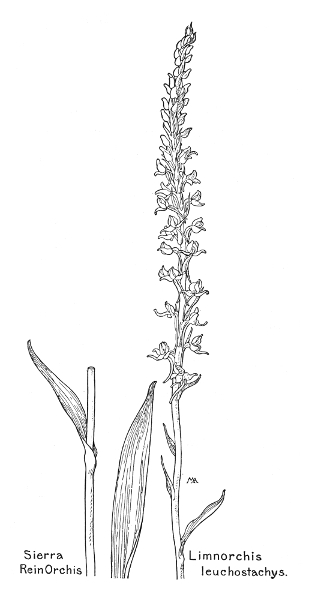
Sierra Rein Orchis—Limnorchis leucostachys.
A small family; ours are perennial astringent herbs, with
alternate, toothless leaves, with leaf-stalks; flowers perfect,
with bracts, in a dense, terminal spike, without calyx or
corolla; stamens generally three or six; ovary with one to
five stigmas; fruit a capsule or berry.
There are two kinds of Anemopsis.
Yerba Mansa
Anemópsis
Califórnica
White
Spring
Cal., Ariz.
This plant bears several, large, cream-white
flowers, which at the first glance
appear to have from five to eight petals
and a long, projecting knob in the center,
but what appears to be a corolla is in
reality an involucre, about an inch and a
half across, and surrounding the base of a long, conical
spike of numerous, small, greenish flowers. These are
half-sunk in the fleshy substance of the spike and have no
sepals or petals, but each has a small, white bract at its
base, so that the spike appears to be covered with scales
symmetrically arranged. The flower has from six to eight
stamens on the base of the ovary and from three to four
stigmas. The ovaries, which are superior, form small pods,
opening at the top when ripe, so that in the end the spike
is neatly pitted with holes. The rather thick, hollow,
reddish stems are from six inches to two feet tall, covered
with hair, and the smooth, light-green leaves, from two to
ten inches long, are mostly from the root, with leaf-stalks
which broaden at the base and partly sheathe the
stem. The creeping rootstocks are peppery and acrid,
used medicinally, and considered exceedingly valuable by
Spanish-Californians. These pretty, odd-looking plants
grow in alkaline or salty swamps in the south. The name
is from the Greek meaning "anemone" and "appearance,"
but the flowers do not look very much like Anemones.
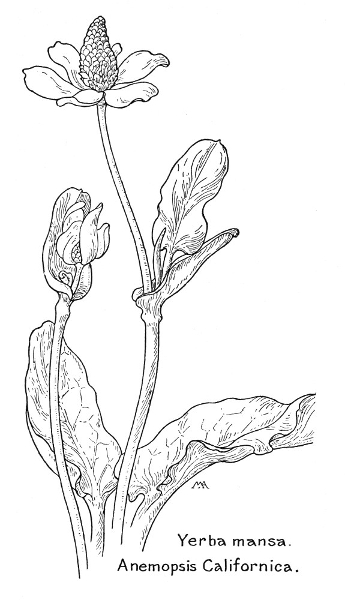
Yerba mansa—Anemopsis Californica.
This is a very small family in this country, for they
prefer the tropics, and in those regions some are trees.
Ours are usually parasitic on the roots of their neighbors.
They have toothless, mostly alternate leaves, mostly
without leaf-stalks or stipules, and small flowers, with a
four- or five-lobed calyx and no corolla. The four or five
stamens are opposite the calyx lobes, at the edge of a
fleshy disk, and the ovary is one-celled and inferior, with
one style, developing into a one-seeded fruit.
There are four kinds of Comandra, one of them European;
smooth, perennial herbs, with alternate leaves, and flowers
in clusters, without bracts. The calyx is more or less
bell-shaped, usually with five lobes, its tube lined with a
disk, the stamens inserted at base of the lobes and the
anthers attached to the lobes by tufts of hairs.
Pale Comandra
Comándra pállida
Flesh-color,
greenish, purplish
Spring, summer
Northwest, Nev.,
Utah, Ariz.
This is a rather pretty plant, growing
from a few inches to about a foot tall,
branching and rather woody below, with
pale-green, smooth, slightly thickish,
rather stiff leaves, which are reduced to
pinkish scales on the lower stem. The
flowers are small, usually flesh-color,
thickish in texture, with slender pedicels, and form terminal,
rather flat-topped clusters. The fruit, which is
about the size of a small pea, is crowned by the remains of
the calyx, like a rose-hip. This is common on dry plains
and hillsides and is noticeable because of its pale and
somewhat peculiar coloring.
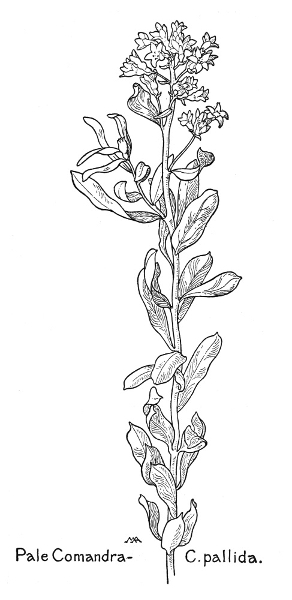
Pale Comandra—C. pallida.
A rather small family, chiefly of warm countries, but
widely distributed; herbs or shrubs; the leaves alternate or
from the root, with leaf-stalks, more or less heart-shaped,
without stipules; the flowers perfect, mostly large, symmetrical
or irregular in form, with or without a corolla; the
calyx with three or six lobes, or irregular; the stamens six
to many, inserted on the pistil; the ovary wholly or partly
inferior; the fruit a mostly six-celled capsule, containing
many seeds.
There are several kinds of Asarum.
Wild Ginger
Ásarum Hartwégi
Brown
Spring
Cal., Oreg.
The handsome leaves of this perennial
are its conspicuous feature. They have
long, hairy leaf-stalks and are heart-shaped
and toothless, from three to five
inches broad, dark rich green, prettily
veined and often also beautifully mottled with white,
smooth on the upper surface and hairy on the under. We
notice them immediately in the damp, dark woods they
live in, but unless we look carefully we miss the single,
large, strange, purplish-brown flower, the color of dead
leaves, which nestles close to the ground as if trying to
hide itself. This has twelve stamens, with stout filaments,
and six styles, united at the base. There are no petals,
but the hairy calyx has three lobes, which are sometimes
an inch and a half long, and have long points like tails.
The seed-vessel is roundish, crowned by the withered
calyx and stamens. The rootstock cannot be used as a
substitute for ginger, but smells and tastes very aromatic
and pungent. This resembles the Wild Ginger of the
East, but is handsomer.
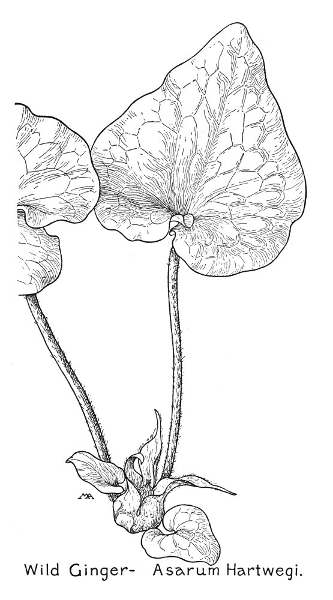
Wild Ginger—Asarum Hartwegi.
A large family, widely distributed, mostly herbs or low
shrubs, with toothless leaves, often with stipules sheathing
the swollen joints of the stem. The small flowers have no
petals, the calyx usually resembles a corolla and has from
three to six divisions. There are from four to nine stamens
and a superior, mostly triangular, ovary, with two or three
styles or stigmas, becoming a dry, one-seeded fruit, generally
brown or black. The kind from which flour is made is
cultivated from northern Asia, and the name Buckwheat,
from the German, means "beech-wheat," because the
grain resembles minute beech-nuts. There are several
common "weeds" belonging to this family, such as Dock,
Sorrel, and Smartweed.
Chorizanthes are low herbs, with branching stems,
without stipules, the leaves forming a rosette at the base
and withering early. The small flowers have six sepals
and are clustered in small heads, usually one flower in each
papery involucre, which has from two to six teeth, with
bristles at the tips; stamens usually nine, on the base of the
perianth; styles three, with round-top stigmas.
Turkish Rugging
Chorizánthe
fimbriàta
Pink
Spring
California
An odd, dry-looking plant, making
pretty patches of purplish color on dry
mesas. The stiff, roughish, purplish stem
is a few inches tall, springing from a few
dull-green or reddish root-leaves, branching
abruptly and widely towards the top
and bearing many small flowers. The involucres are
deep-red or purple, with very prickly teeth, the sepals
bright-pink, prettily fringed with white and striped with
deeper color, and the filaments are long and threadlike,
with purple anthers. The flowers are exceedingly pretty
when closely examined, though too small to be very effective,
but the plant as a whole is conspicuous both in color
and form. C. staticoìdes is similar, but the sepals are not
fringed.
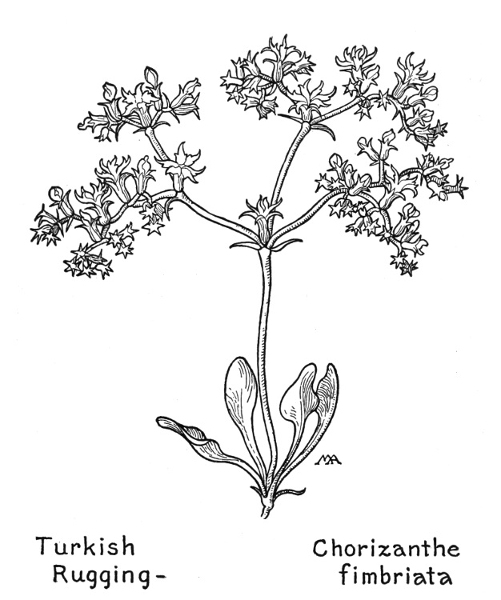
Turkish Rugging—Chorizanthe fimbriata.
There are many kinds of Rumex, or Dock, coarse herbs,
with leafy, branching, grooved stems, sheathed with conspicuous,
papery stipules, strong tap-roots and acid or
bitter juice. The large leaves are alternate, with smooth
or wavy edges; the flowers small, greenish or reddish, on
jointed pedicels, in branching clusters; the stamens six;
the styles three, the stigmas shield-shaped, with a tuft of
hairs at the tip. The six divisions of the flower are in two
sets, the three outer small and green, the inner ones larger,
colored and becoming veiny and larger in fruit, forming
valves or wings, (often with a grain on the back of one or
all of them,) which closely cover the three-sided fruit.
These wings make the fruits of Docks more conspicuous
than the flower. The Latin name comes from a word
meaning "to suck," because the Romans sucked the leaves
to allay thirst.
Sand Dock
Rùmex venòsus
Greenish
Spring, summer
West
In favorable situations this is a very
handsome member of a rather plain genus,
about a foot tall, with a smooth, stout
reddish stem and smooth, pale, blue-green
leaves, that feel like thin rubber, with a
prominent mid-vein front and back. The small inconspicuous
flowers develop into clusters of showy valves or
wings, wonderfully odd and beautiful in coloring, resembling
Begonia flowers. At first these wings are pale green,
but they gradually brighten until they are all shades of
salmon, rose-color, and red, fading to brown, and forming
lovely combinations of vivid color, particularly against the
arid background of the sand hills they frequent, and they
last a long time in water and are exceedingly decorative.
If these wings, which are nearly an inch across, are pulled
apart, a three-sided akene, like a little nut, will be found
inside them.
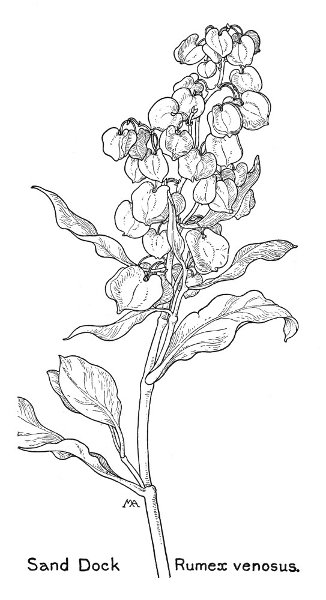
There are many kinds of Eriogonum, herbs or shrubs,
natives of America, mostly western, growing in dry places,
very numerous and difficult to distinguish. The leaves,
without sheaths or stipules, are often covered with white
down and usually grow in a spreading cluster at the base of
the stem. The numerous small flowers, on very slender
little pedicels, have six sepals, thin in texture and usually
colored, and form clusters of various shapes, which emerge
from more or less bell-shaped or top-shaped involucres,
with six teeth. There are nine stamens, with threadlike
filaments, often hairy, and a three-parted style with round-top
stigmas. The name is from the Greek meaning
"wooly knees," in allusion to the wooly joints of the stem.
Bottle-plant
Eriógonum
inflàtum
Yellow
Spring
Southwest
This is a most extraordinary looking
plant, with queer inflated, hollow stalks,
about two feet high, swelling larger towards
the top, and the branches, which
are also swollen, sticking out awkwardly
in all directions and bearing a few minute,
yellow flowers. The stalks, which are pale bluish-green,
suggest some strange sort of reed, but the dark-green
leaves, growing in a rosette at the base, are something like
the leaves of cultivated violets and seem entirely out of
keeping with the rest of the plant. This grows on the
plateau in the Grand Canyon and in similar places.
Swollen-stalk
Eriógonum elàtum
White, pink
Summer
Northwest
This is about a foot and a half tall and
the stem is swollen, but not so much so as
the last, and the flowers are more conspicuous,
forming rather flat-topped clusters,
about three-quarters of an inch
across. The tiny flowers are cream-white or pinkish, the
buds are deep-pink, and the stamens are long, with tiny,
pinkish anthers. The leaves are dull-green on the upper
side and pale with close down on the under and grow in a
cluster at the base.
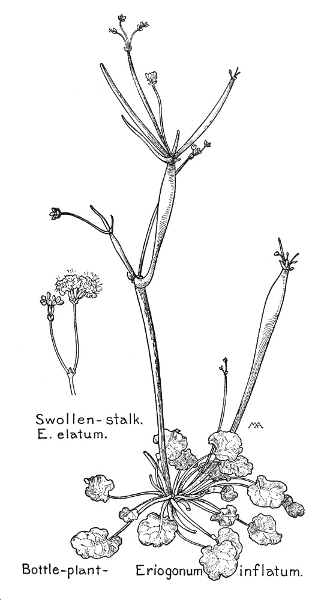
Swollen-stalk—E. elatum.
Bottle-plant—Eriogonum inflatum.
Butter Balls,
Snow Balls
Eriógonum
orthocàulon
Yellow, white
Spring, summer
Northwest
These are attractive plants, with pretty
odd little balls of flowers, and are very
conspicuous on dry, rocky mesas. They
have a number of slender, pale, downy
stems, about ten inches tall, springing
from a close clump of small, dull-green
leaves, pale with down on both sides and
the smaller ones almost white, and bearing at the tip a
dense flower-cluster, about an inch and a half across, which
is very fuzzy and pretty. The little flowers have cream-color,
downy involucres, the outer sepals are broader than
the inner, and the pedicels, stamens, and pistil are all the
same color as the sepals, either very bright sulphur-yellow
or cream-white, but not mixed on the same plant, and
sometimes tinged with red. These flowers are very popular
with children in Idaho and they make necklaces of the
fuzzy balls, something like "daisy chains."
Eriógonum
compósitum
White, yellow
Summer
Northwest
This is a big handsome plant, with a
thick, smooth stem, one or two feet tall
and woody at base, and with thickish
leaves, slightly downy, dark green in color
on the upper side and white with close
down on the under. The flowers form feathery, cream-white
or yellow clusters, often more than six inches across,
with red buds, and are beautiful and conspicuous on bare
mountainsides, smelling of honey.
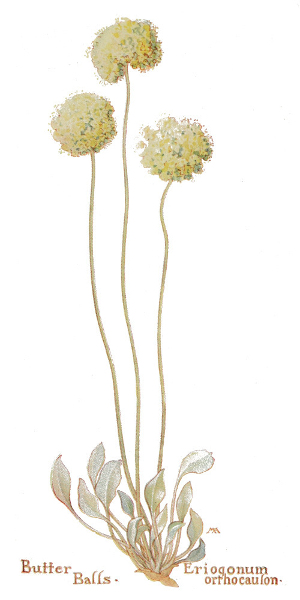
Butter Balls—Eriogonum orthocaulon.
Buckwheat Bush,
Flat-top
Eriógonum
fasciculàtum
White
Spring, summer
Southwest
In favorable situations this is an attractive
shrub, from two to four feet high,
with shreddy, reddish bark and long,
straight branches, standing stiffly up and
crowded with small, thickish, stiffish
leaves, dark olive-green on the upper side
and pale with down on the under, with
rolled-back margins. The flowers are about three-eighths
of an inch across, dull-white or pinkish, with pink buds,
forming large, feathery, flat-topped clusters, on long, stiff,
bare, reddish flower-stalks, standing up stiffly all over the
bush. This is a very valuable bee-plant and grows on
mesas and mountain slopes.
Sulphur Flower
Eriógonum Bàkeri
Yellow
Summer
Ariz., Utah, New
Mex., Col., Wyo.
This plant is quite pretty and conspicuous,
as the flowers are bright in color and
a peculiar shade of sulphur yellow. The
stem is downy and often reddish, about a
foot tall, with two or three branches at
the top, each bearing a cluster of numerous small sweet-scented
flowers with pretty stamens. The gray-green
leaves grow mostly in a rosette on the ground and are
covered with close white down on the under side. Their
soft tints tone in well with the bright color of the flowers
and the pale sandy soil in which they grow. E. flàvum is
similar and widely distributed. E. incànum is the same
color but much smaller, often tinged with red, the gray
leaves forming a dense velvety mat, and it grows at high
altitudes, in sandy spots on rocks, and is found around the
Yosemite Valley. The alpine form is very small. There
are several other kinds of Sulphur Flower.
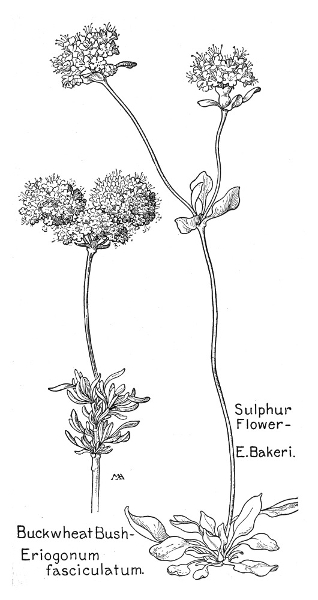
Sulphur Flower—E. Bakeri.
Buckwheat Bush—Eriogonum fasciculatum.
Wild Buckwheat
Eriógonum
racemòsum
Pink, white
Summer
Ariz., Utah
A pretty desert variety of Wild Buckwheat.
The pale downy stem is from
one to two feet tall, rather stout, with two
or three erect branches at the top, and the
leaves are all from the base, gray-green in
color and covered with close white down
on the under side. The small white and pink flowers are
clustered along the branches in small heads, with reddish
involucres, forming a spike about three inches long. The
whole effect of the plant is curiously pale, but quite pretty.
It grows plentifully on the rim of the Grand Canyon.
There are many kinds of Polygonum, East and West,
many of them insignificant, some aquatic, some woody at
base, with alternate leaves, and sheathing stipules; the
sepals four or five; the stamens five to nine; the style with
two or three branches and round-top stigmas. The name
is from the Greek, meaning "many knees," in allusion to
the swollen joints of some kinds.
Knot-weed
Alpine Smartweed
Polýgonum
bistortoìdes
White
Summer
West
This is about two feet tall, very pretty
and rather conspicuous, and the general
effect of the smooth stem and sheathing,
green leaves is somewhat grasslike. The
flowers, which are small and cream-white,
with pretty stamens and pinkish bracts,
grow in close, roundish, pointed heads, an
inch or two long, at the tips of the stalks. The buds are
pink and the heads in which the flowers have not yet come
out look as if they were made of pink beads. This is an
attractive plant, growing among the tall grasses in mountain
meadows, and smells deliciously of honey.
A large family, widely distributed, growing usually in
salty or alkaline soil; herbs or shrubs, generally succulent
and salty or bitter, often covered with white scurf or meal,
without stipules; leaves thick, usually alternate, sometimes
none; flowers perfect or imperfect, small, greenish, without
petals; calyx with two to five sepals, rarely with only one,
pistillate flowers sometimes with no calyx; stamens as
many as the sepals, or fewer, and opposite them; ovary
mostly superior with one to three styles or stigmas; fruit
small, dry, with one seed, sometimes with a bladder-like
covering. Spinach and Beets belong to this family; many
are "weeds," such as Lamb's Quarters.
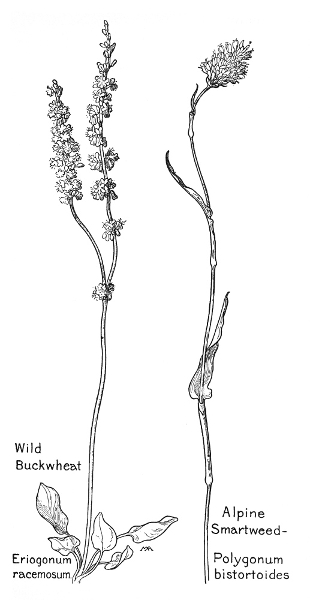
Wild Buckwheat—Eriogonum racemosum.
Alpine Smartweed—Polygonum bistortoides.
There are two kinds of Grayia, named after Asa Gray;
low shrubs; the stamens and pistils in separate flowers, on
the same or on different plants.
Hop Sage
Gràyia spinòsa
(G. polygaloides)
Greenish, with
red bracts
Spring
Calif., Nev.,
Utah, Ariz.
An odd and beautiful desert shrub,
about three feet high, very dense in form,
with interlacing, angular, gray branches,
spiny and crowded with small, alternate,
toothless leaves, pale-green and thickish,
but not stiff. The flowers are small and
inconspicuous, but the pistillate ones are
enveloped in conspicuous bracts, which
enlarge and become papery in fruit, something like those
of Docks, and often change from yellowish-green to all
sorts of beautiful, bright, warm tints of pink, or to magenta,
and the branches become loaded with beautifully shaded
bunches of these curious seed-vessels, giving a strange,
crowded look to the shrub, which in favorable situations,
such as the Mohave Desert, makes splendid masses of
color, especially when contrasted with the pale gray of
Sage-brush.
There is only one kind of Cycloloma; leaves alternate,
smooth or downy, irregularly toothed; flowers perfect or
pistillate, with five sepals, five stamens, and two or three
styles; fruit winged horizontally.
Tumbleweed
Cyclolòma
atriplicifòlium
Purple or green
Summer
West of Mississippi
River
Very curious round plants, six to
twenty inches high, usually purple all
over, sometimes green and rarely white,
giving a brilliant effect in the fall to the
sandy wastes they inhabit. They are a
mass of interlacing branches, with hardly
any leaves, except at the base, and very
small flowers. When their seeds are ripe, and they are
dry and brittle, the wind easily uproots them and starts
them careening across the plain, their seeds flying out by
the way. They turn over and over and leap along, as if
they were alive, bringing up at last against a wire fence, or
some such obstacle, where perhaps a traveler sees them
from the train and wonders at the extraordinary-looking,
dry, round bunches. There are other Tumble-weeds,
such as Tumbling Mustard, Sisymbrium allissimum, and
Amaránthus álbus, not of this family.
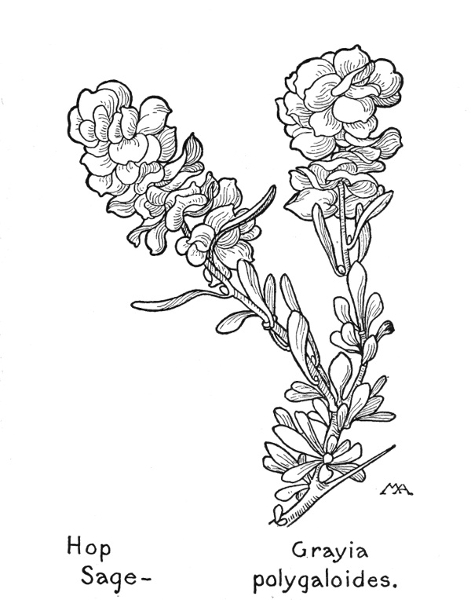
Hop Sage—Grayia polygaloides.
A rather large family, widely distributed, most abundant
in America. Ours are herbs, often succulent, with
no stipules; stems often fragile, swollen at the joints;
leaves opposite, usually toothless, often unequal; flowers
perfect, with no petals, but the calyx colored like a corolla,
with four or five lobes or teeth, and more or less funnel-shaped;
one or several flowers in a cluster with an involucre;
stamens three to five, with slender filaments;
style one, with a round-top stigma; the green base of the
calyx drawn down around the ovary, making it appear
inferior, and hardening into a nutlike fruit; seeds sometimes
winged.
Quamoclidions have the odd habit of opening in the
afternoon, hence the common name, Four-o'clock. The
flowers usually have five stamens, and are grouped several
together in a cluster, which emerges from an involucre
so much resembling a calyx that it is often mistaken for one.
The effect is of the flowers having clubbed together and
made one calyx do for the lot. The fruit is hard, smooth,
and roundish.
Four-o'clock
Quamoclídion
multiflòrum.
(Mirabilis)
Pink, purple
Spring
Southwest and
Col.
The leaves of this low, stout, and spreading
perennial are an inch or two long, light
bluish-green, somewhat heart-shaped,
rather rough and coarse, and the stems
are often hairy and sticky. The foliage
contrasts strikingly in color with the
gaudy pink or magenta flowers, an inch
across and slightly sweet-scented, the shape of Morning-glories
and resembling them, as they have the same stripes
of deeper color. The long stamens droop to one side, the
pistil is long and purple and the bell-shaped involucre
contains about six flowers. These plants are conspicuous
and quite handsome. They grow on the plateau in the
Grand Canyon.
There are several kinds of Hesperonia, much like Quamoclidion,
but the bell-shaped involucre contains only one
flower, which is also bell-shaped, usually with five separate
stamens. The fruit is roundish, not angled or ribbed,
usually smooth.
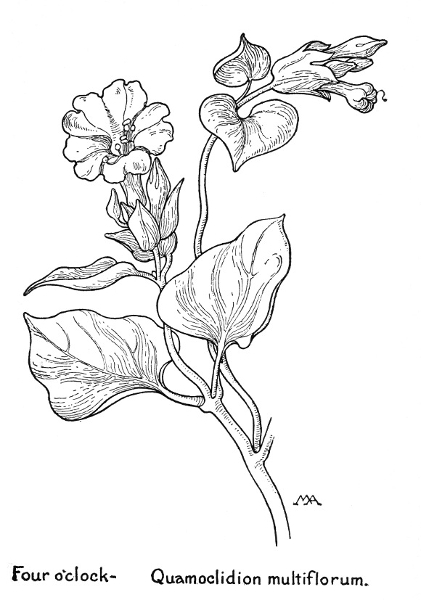
Four o'clock—Quamoclidion multiflorum.
California Four-o'clock
Hesperònia
Califórnica
(Mirabilis)
Magenta, pink
Spring, summer
California
This is very common in southern
California and forms quite large, low
clumps of rather yellowish green, sticky
and hairy foliage, sprinkled with numbers
of bright little flowers, opening in the
afternoon. The base is woody and the
weak, hairy stems are supported on bushes,
as if climbing over them. The leaves
are rather thick, about an inch long, and the flowers are
open bell-shaped, about three-quarters of an inch across,
usually magenta, but often pink of various shades, sometimes
quite pale in tint with long stamens drooping to one
side, and the involucre is often purplish and very hairy and
sticky. The effect at a distance is gay and attractive,
though the plant is not quite so pretty close by.
Hesperònia
glutinòsa var.
grácilis
White, pinkish
Spring
Arizona
This has a straggling, hairy, sticky
stem, over a foot long, and thickish, dull-green
leaves, hairy and sticky. The
flowers are about half an inch long, white
or tinged with pink, and are rather delicate
and pretty, though the plant is not especially
attractive. It blooms at night, the flowers
gradually closing with the morning sun. This variety is
common in the southern part of the state, in mountain
canyons, and Hesperonia glutinosa is common in the
north.
There are several kinds of Abronia, all American, with
branching, usually sticky-hairy stems, thick, toothless
leaves, with leaf-stalks, in pairs and one of each pair
somewhat larger than the other. The flowers are more
or less salver-form, with five lobes, a threadlike style, and
from three to five, unequal stamens, on the tube of the
perianth and not protruding from it. They are numerous
and in clusters, with involucres, on long flower-stalks,
from the angles of the leaves. The fruit is winged. The
name is from the Greek meaning graceful, but most of these
plants are rather awkward in their manner of growth.
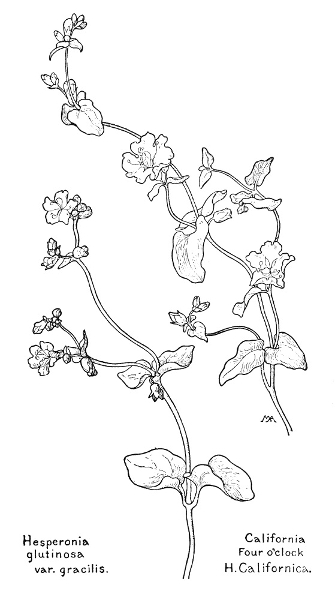
Hesperonia glutinosa var. gracilis.
California Four o'clock—H. Californica.
Sand Puffs
Abrònia sálsa
White
Spring, summer,
Autumn
Utah
This plant is, as a whole, so delicately
tinted and so decorative in form, that it is
most attractive, particularly against the
sandy soil where it grows, deserving the
Greek name more than some of its slightly
awkward sisters. It is about fourteen
inches tall, with a stoutish, rather straggling, prostrate
stem, which is pale, pinkish, sticky and fuzzy. The leaves
have long leaf-stalks and are pale bluish-green, leathery
and smooth, but fuzzy on the mid-vein of the under side,
and the flowers are numerous, rather small, in handsome
roundish clusters, which are about two inches across, with
a papery, pinkish or yellowish involucre, of about five,
separate, rounded bracts. The calyx is corolla-like and
salver-form, with a long, yellowish or greenish tube and
five lobes, prettily crinkled at the edges. The seed-vessel
is very curious, resembling a round, yellowish
sponge, with hooks sticking out of it, and the flowers are
deliciously sweet-scented. This is sometimes called Snowball.
Pink Sand-Verbena
Abrònia villòsa
Pinkish-lilac
Summer
Ariz., Cal., Utah
The coloring of this plant, one of the
prettiest of its kind, is striking and unusual,
and makes it very conspicuous,
growing in the sand near the sea or in the
desert. The thickish leaves are light
bluish-green and the thick stem, which
straggles rather awkwardly over the ground, is a peculiar
shade of pink and sticky and hairy, as are also the involucres.
The small delicate flowers are an odd tint of
pinkish-lilac, light but vivid, in striking contrast to the
coloring of stems and foliage, and form very pretty clusters,
with an involucre of five to fifteen papery bracts. They
are very fragrant and look much like garden Verbenas, so
the name is not so unhappy as some. A. umbellàta has
slender stems and almost smooth leaves, sometimes with
wavy margins, about an inch long, narrowed at base to a
slender leaf-stalk, and deep-pink flowers. It is common all
along the California coast and blooms in the summer and
autumn. A. marítima is found from Santa Barbara to
San Diego and is a very stout, coarse, sticky plant, with
small, deep-magenta flowers.
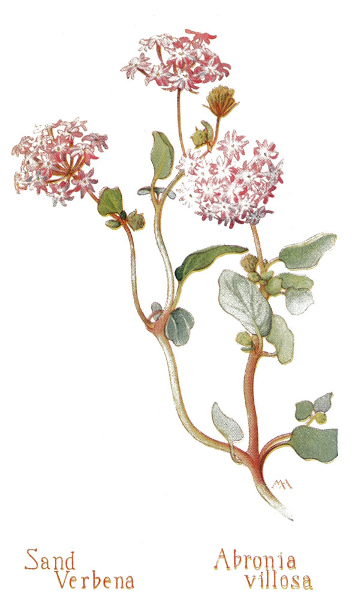
Sand Verbena—Abronia villosa.
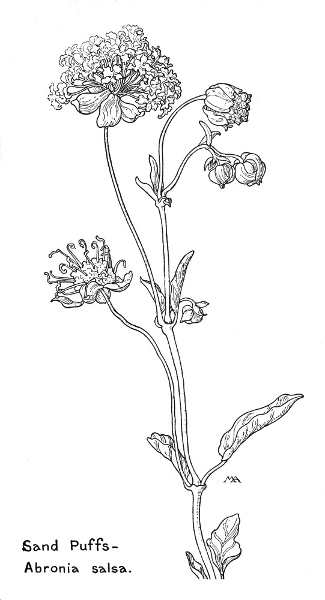
Sand Puffs—Abronia salsa.
Yellow Sand-Verbena
Abrònia latifòlia
Yellow
Spring, summer,
autumn
Wash., Oreg.,
Cal.
Pretty at a distance, but rather coarse
close by, a straggling plant, with long,
thick, rubbery stems, lying on the ground,
thickish leaves, and small yellow flowers,
slightly fragrant and forming pretty
clusters about an inch and a half across,
with five bracts. This is common along
the seashore, blooming more or less all through the year.
It has a long, thick root, which is eaten by the Indians.
There are a good many kinds of Allionia, one Asiatic,
the rest American. The bell-shaped flowers have unequal
stamens, usually three, on the receptacle. The peculiar,
five-lobed involucre, which becomes large and papery
after flowering, contains from three to five flowers. The
fruit is ribbed and often hairy. The shape of the involucre
probably suggested the common name Umbrella-wort.
Narrow-leaved
Umbrella-wort
Alliònia lineàris
Purple, pink,
white
Summer
Utah, Ariz., etc.
A pretty plant, one to four feet tall,
with a slender stem and long, narrow,
bluish-green leaves, with somewhat wavy
margins, and almost no leaf-stalks. The
flowers are fragile and pretty, of various
shades of pink, the shape of small Morning-glories,
half an inch across, the stamens
and style protruding. There are from three to five in a
cluster, in a purple and green involucre. This involucre
is curious, for before the flowers come out it is closed
around a bunch of buds, looking as if it were itself a pretty
five-angled bud, and one would not suspect that there were
other little buds inside it. When the flowers bloom and
drop, which they do very soon, this involucre unfolds and
expands until it becomes an exceedingly thin, papery,
five-lobed disk, three-quarters of an inch across, veined
with purple, very pretty and delicate, looking like an odd
little flower without a heart. The smooth stem forks
towards the top and the branches, which are slightly hairy,
bear numerous clusters of involucres with flowers inside
them. This grows in dry soil, is widely distributed and
found as far east as Illinois.
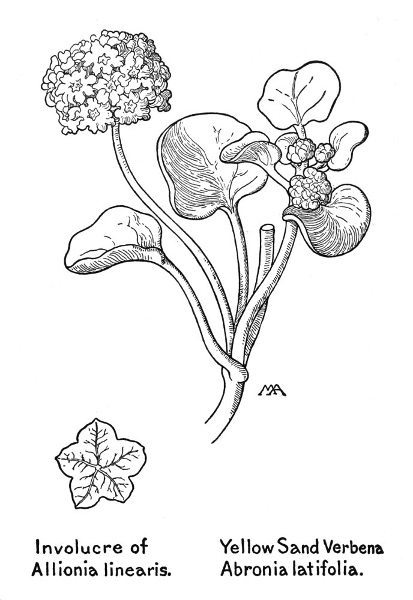
Involucre of Allionia linearis.
Yellow Sand Verbena—Abronia latifolia.
Not a very large family, mostly natives of warm regions.
Ours are branching herbs, lying mostly on the ground;
leaves mostly opposite or in whorls; flowers perfect; sepals
four or five; petals numerous, small or none; stamens few
or many, usually on the calyx; ovary sometimes superior;
fruit a capsule. In this country most of this family are
dull little plants, with inconspicuous flowers.
There are many kinds of Mesembryanthemum, mostly
African; ours are smooth, very succulent perennials;
without stipules; leaves opposite; calyx-lobes unequal and
leaf-like; petals long, narrow and very numerous, inserted
with the innumerable stamens on the calyx-tube; ovary
with ten or twelve styles, becoming a sort of berry, containing
many minute seeds, and opening at the top in
rainy weather. The terribly long name is from the Greek,
meaning "noonday flower."
Ice-plant
Mesembryánthemum
crystállinum
White, pinkish
Spring
California
One of the queerest looking plants that
it is possible to imagine, the stout stems
and large flat leaves thickly encrusted
with millions of small translucent beads,
resembling glass or ice and giving a
glistening effect to the whole plant. They
cluster especially thickly along the wavy margins and under
sides of the leaves, and on the calyxes, and feel quite hard
to the touch, but when they are crushed underfoot they
exude a watery juice, which is said to be alkaline and
injurious to shoe-leather. The stems and leaves are light
bright-green, the tips and margins tinged with bright
pinkish-red, especially on dry mesas, where this plant
sometimes covers the ground for long distances with flat
rosettes, forming a thick, red carpet, beautiful in color.
In shadier, damper places, such as the crevices in the sea-cliffs
at La Jolla, it becomes quite a large, tall plant,
scarcely tinged with red and very glistening. The flowers
are about an inch across, with a greenish center, surrounded
by numerous, small, yellowish anthers and a single row of
many, white or flesh-colored petals, suggesting the tentacles
of a sea-anemone. In fact the whole plant is curiously
suggestive of some low form of animal life. It is very
troublesome to farmers in the south near the sea, and also
flourishes in the Mohave Desert, in France and the Canary
Islands.
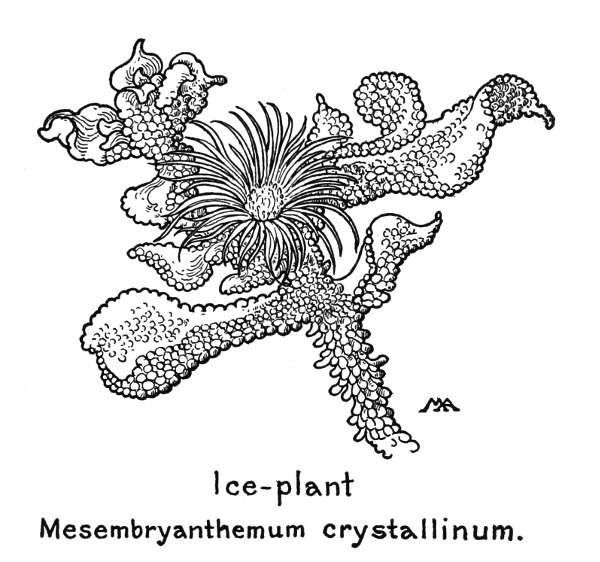
Ice-plant—Mesembryanthemum crystallinum.
Sea Fig,
Fig-marigold
Mesembryánthemum
aequilateràle
Pink
Spring
California
A very strange and conspicuous plant,
often clothing sandy slopes with a curious
mantel of trailing, fleshy stems and
foliage thickly sprinkled with thousands
of gaudy flowers. The stems are stout
and flattish, several feet long; the leaves
three-sided, with flat faces, tipped with a
small reddish point; the calyx-lobes three-sided like the
leaves. The stems, leaves, and the calyx-lobes are all pale
bluish-green with a "bloom" and exceedingly succulent,
the watery juice running out in large drops when the plant
is broken. The twigs seem to be fitted into a sort of
socket, from which they come out very easily, so that the
plant comes apart almost at a touch. The fragrant
flowers are two or three inches across, bright but crude
in color, the numerous, purplish-pink petals resembling
the rays of a composite and encircling a fuzzy ring of
innumerable stamens, with white, threadlike filaments
and small, straw-colored anthers, around a dark-green
center, composed of the top of the calyx and the six to ten
styles of the ovary. This accommodating plant is very
useful and ornamental in hot, sandy places, where not
much else will grow, and may be seen hanging its long stems
over the sea-cliffs all along the coast, from Patagonia to
Marin County in California. It also grows in Africa and
is extensively cultivated. The fruit is edible, with pulp
and tiny seeds something like a fig.
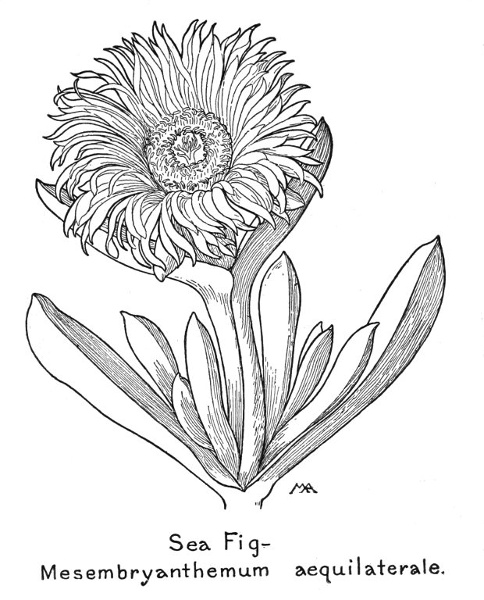
Sea Fig—Mesembryanthemum aequilaterale.
A large family, widely distributed, most abundant in
the northern hemisphere, including both the handsome
Pinks and the insignificant Chickweeds. They are herbs,
with regular, mostly perfect flowers, with four or five sepals;
usually with four or five petals, sometimes with none;
stamens as many, or twice as many, as the petals; ovary
superior, one-celled; styles two to five in number; fruit a
capsule, containing several or many, kidney-shaped seeds,
opening by valves, or by teeth, at the top; leaves opposite,
toothless; stems usually swollen at the joints. The name
Pink comes from the petals of some kinds being cut into
points, or "pinked."
There are numerous kinds of Arenaria, widely distributed,
difficult to distinguish, with small, white flowers
with five petals, usually not notched, ten stamens and
usually three styles; leaves usually long and narrow, often
stiff and growing in tufts; capsule roundish, splitting into
usually three valves, each with two parts. These plants
often grow in dry, sandy places, some at very high altitudes,
some by the sea, hence the Latin name meaning "sandy,"
and the common one, Sandwort.
Fendler's Sandwort
Arenària Féndleri
White
Summer
Utah, Ariz., etc.
This has pretty little white flowers,
about half an inch across, and is variable.
Sometimes the stem is roughish, only
three or four inches tall, springing from a
tuft of small leaves, stiff and almost
prickly. Sometimes the stem is smooth,
six or eight inches tall, and the leaves resemble rather fine,
stiff grass. This grows on dry hills and mountains, up to
thirteen thousand feet, from Nebraska and Wyoming to
Utah, Arizona, and New Mexico.
There are many kinds of Silene, widely distributed,
more or less sticky plants, hence the common name,
Catchfly; flowers mostly rather large; calyx inflated or
tubular, with five teeth; petals five, with long claws, which
often have scales at the top, forming a "crown"; stamens
ten; styles usually three; capsule opening by three or six
teeth at the tip; seeds numerous.
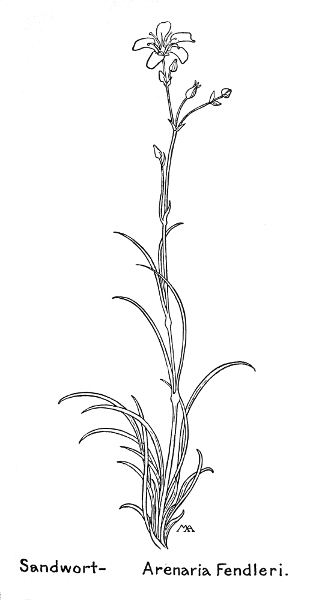
Sandwort—Arenaria Fendleri.
Moss Campion.
Cushion Pink
Silène acàulis
Purple
Summer
Alpine regions
An attractive little dwarf, living only
in the high mountains. It has a long tap-root
and many spreading stems, crowded
with tiny, stiff, pointed, dark-green leaves,
forming close tufts, from six to twenty
inches across, resembling cushions of
harsh moss and spangled all over with pretty little flowers.
They are less than half an inch across with a bell-shaped
calyx and five bright pinkish-purple petals, occasionally
white, with a "crown" of small scales. We find this brave
little plant crouching on bleak mountain tops, blossoming
gayly at the edge of the snows that never melt, in arctic
alpine regions across the world, up to a height of thirteen
thousand feet. It is variable. There is a picture in Mrs.
Henshaw's Mountain Wild Flowers of Canada.
Windmill Pink
Silène Ánglica
(S. Gallica)
White
Spring
Northwest, etc.
A rather inconspicuous "weed" from
Europe, common in fields and along roadsides,
with a slender, hairy stem, about a
foot tall, and hairy leaves. The small
flowers grow in a one-sided cluster and
have a purplish calyx, sticky and hairy,
and white or pinkish petals, with a small "crown," each
petal twisted to one side like the sails of a windmill. This
is widely distributed in nearly all warm temperate regions.
Indian Pink
Silène Califórnica
Red
Summer
Northwest
From six inches to over a foot tall, with
a thick, perennial tap-root, one to two
feet long, and branching, half-erect stems,
both leaves and stems covered with fine
down, the dull-green foliage contrasting
well in color with the vivid vermilion of the gorgeous
flowers. They are more than an inch across, the petals
usually slashed into two broad lobes, flanked by two
narrower, shorter points at the sides, the "crown" conspicuous.
The flowers are even more brilliant in color
than S. laciniata and are startlingly beautiful, glowing
like coals of fire on the brown forest floor, in the open
mountain woods they usually frequent. It is widely
distributed in the Coast Ranges and Sierra Nevada
Mountains, but nowhere very common. S. Hookeri has
beautiful large pink flowers, often more than two inches
across, sometimes white, and grows on shady hillsides in
the Northwest, except in Idaho.
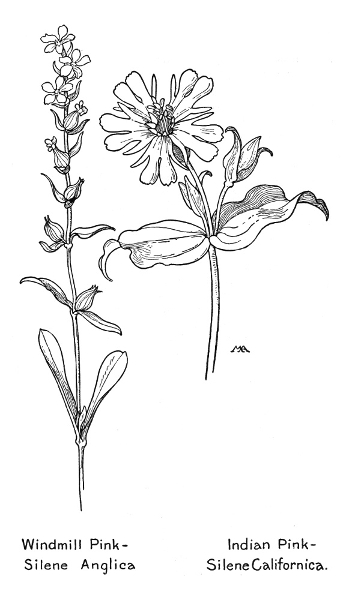
Windmill Pink—Silene Anglica.
Indian Pink—Silene Californica.
Indian Pink
Silène laciniàta
Red
Summer
California
This has handsome conspicuous flowers,
clear vermilion or pinkish-scarlet in
color, about an inch and a half across, with
the five petals prettily slashed at the ends
into four long divisions. Each petal has
two little crests, which form a pretty "crown" in the throat
of the corolla. The roughish, slender stems, from one to
over two feet high, have several branches, the flowers
growing two or three at the ends. The leaves are long,
narrow, and rather rough and the whole plant is hairy and
sticky. This is common around Pasadena and other
places in southern California and is beautiful on Point
Loma, where the brilliant flowers gleam among the underbrush
like bits of flame. S. laciniàta var. Gréggii is common
in Arizona and New Mexico.
Silène Lyalli
White
Summer
Northwest
Rather pretty, with a slender stem
about a foot tall, smooth, bluish-green
leaves, and flowers about three-quarters of
an inch across; the calyx much inflated,
yellowish-white and papery, with brownish
veins, and the petals cream-color, with two lobes and a
"crown."
There are a few kinds of Vaccaria, of Europe and Asia,
smooth annuals, with clasping leaves and red or pink
flowers in terminal clusters; calyx five-angled and inflated
in fruit, five-toothed, without bracts; petals longer than the
calyx, without appendages; stamens ten; styles two.
Both the Latin and common names allude to the value of
some kinds for fodder.
Cow-herb
Vaccària vaccària
(Saponaria)
Pink
Summer
Across the continent
Quite pretty, with a leafy, branching
stem, from one to three feet tall, bluish-green
leaves, and flowers less than an inch
long, with a ribbed, yellowish-green
calyx, with reddish teeth, and the petals
a very pretty and unusual shade of deep,
warm reddish-pink, veined with deeper
color. This is a European "weed," common in waste
places and cultivated fields.
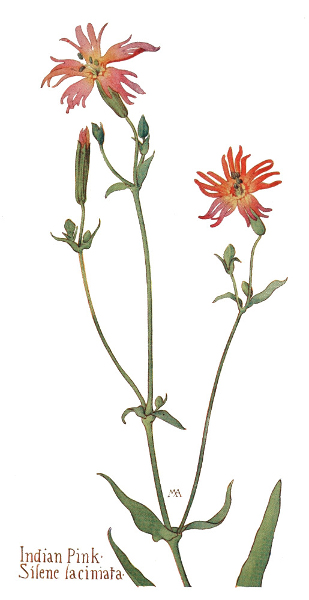
Indian Pink—Silene laciniata.
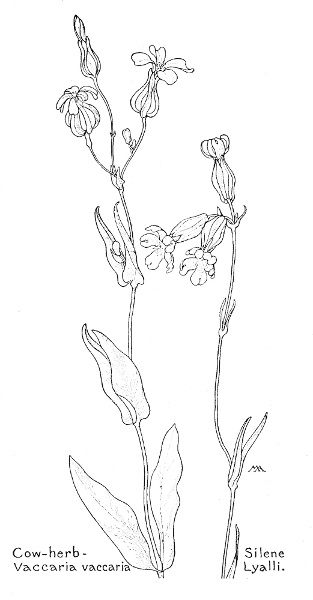
Cow-herb—Vaccaria vaccaria.
Silene Lyalli.
There are many kinds of Alsine, widely distributed, low
herbs, liking moist ground and shady places, with small,
starry white flowers; with four or five sepals; four or five
petals, deeply two-lobed or none; three to ten stamens and
three to five styles; capsule roundish or oblong, rather
shorter than that of Cerastium, splitting to below the
middle, with twice as many valves as there are styles and
many seeds. Many of these plants are weeds. They are
often called Stitchwort. The Greek name means "grove,"
the home of some kinds.
Tall Chickweed
Alsìne lóngipes.
(Stellaria)
White
Summer
Northwest, Nev.,
Utah, etc.
An attractive little plant, with smooth
stems, from six to fifteen inches tall, and
pretty little flowers, less than half an inch
across, growing singly, or in loose clusters,
with white petals which are deeply two-lobed,
so that they appear to be ten. The
capsule is almost black when ripe. This
is common in moist and grassy places in Yosemite and
when growing in the shade is taller and more slender than
in the open. It reaches an altitude of ten thousand feet
and is found in the East and in Asia.
There are many kinds of Cerastium, abundant in the
temperate zone, resembling Alsine, but usually downy and
therefore called Mouse-ear Chickweeds. The flowers are
white, usually with five sepals, five petals notched at the
tips or with two lobes, ten or five stamens and five stigmas.
The cylindrical capsule, often curved, splits at the top
into ten teeth.
Field Chickweed
Cerástium arvénse
White
Spring, summer
U. S.
On the ledges moistened by the mist and
spray that blow from the Yosemite waterfalls,
among the glistening, wet grasses,
these pretty little white flowers are quite
conspicuous. They smell pleasantly of
honey, measure about half an inch across, and have more
or less downy stems, from five to ten inches tall. This is
the prettiest Cerastium, though not so "mousy" as some,
and grows in dry as well as moist situations.
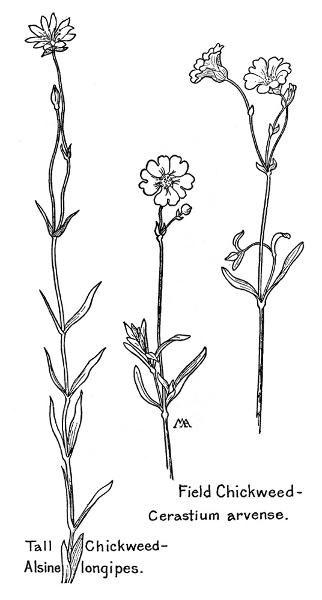
Field Chickweed—Cerastium arvense.
Tall Chickweed—Alsine longipes.
A rather small family, mostly American; herbs, usually
with thick, succulent leaves and stems, with flowers opening
only in sunlight. They usually have only two sepals,
but the petals number from two to five or more; the stamens
are sometimes numerous, but when they are of the
same number as the petals they are opposite them; the
one-celled ovary is superior, becoming a many-seeded
capsule. Pusley, or Purslane, is one of the commonest
garden weeds; everybody knows how difficult it is to keep
the spreading rosettes out of gravel walks, and we are all
familiar with the gaudy, ephemeral flowers of the cultivated
Portulaca. The Purslane-tree, or Spek-boom, of
South Africa is often the principal food of elephants and
its foliage gives the characteristic coloring to the landscape.
There are several kinds of Montia, closely related to
Claytonia, mostly natives of North America, rather
succulent plants, very smooth and often with a "bloom."
The flowers are white or pinkish, with two sepals; the five
petals, equal or somewhat unequal, separate or more or
less united at base; the stamens five or three; the style
branches three; the capsule with three valves and one to
three, shiny, black seeds, which when ripe are shot out of
the capsule by the elastic closing of the valves.
Miner's Lettuce
Móntia parviflòra
White
Spring, summer
West, except Ariz.
The Indians gather these pretty succulent
little plants for salad and indeed the
tender, bright-green leaves look as if they
would taste very nice. They grow in a
loose bunch, with several stems, a few
inches to a foot high. The root-leaves have long leaf-stalks
and vary very much in size and shape, the earliest
being long and narrow, like little green tongues, but the
later ones oval, round and kidney-shaped, and they vary
also in tint, in dry places being sometimes a dull yellowish-pink.
The stem-leaves are quite odd, for a single pair
have united around the stem and become a circular or
somewhat two-lobed disk, one or two inches broad, the
stalk piercing right through its center. This leaf forms a
pretty, shallow saucer, with a small, loose cluster of tiny
flowers, on slender flower-stalks, springing from the middle.
This is common everywhere in orchards or vineyards, and
in shady places in the foothills and canyons, and has long
been cultivated in England for salad. It is also called
Indian Lettuce and Squaw Cabbage. M. perfoliàta is
similar.
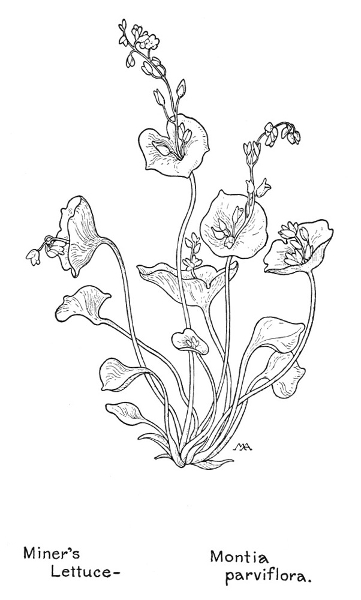
Miner's Lettuce—Montia parviflora.
Spring Beauty
Móntia parvifòlia
White and pink
Spring
Northwest
This charming little flower resembles
the Spring Beauty of the East, Claytonia
Virginica, and blooms in late spring,
among the ferns and wet grasses near the
Yosemite waterfalls and in similar places.
The white flowers, about three-quarters of an inch across,
are often tinged with pink and the five stamens are violet.
The tender stems, about eight inches tall, are weak and
almost trailing and the pale-green leaves are smooth, the
lower ones slightly thick and succulent, with little bulblets
in the axils, which drop off in drying; the capsule mostly
has only one seed.
There are several kinds of Claytonia, resembling Montia.
Spring Beauty
Claytònia
lanceolàta
Pink and white
Spring
Northwest, Cal.,
Nev., and Utah
A pretty little plant, three or four inches
high, with a juicy, reddish stem and
thickish, bluish-green, juicy leaves, the
root-leaf narrow, the two stem-leaves
broader. The flowers, over half an inch
across, are white, tinged and delicately
veined with pink, with a little yellow at
the base of the petals; the pistil and stamens pink; the two
sepals yellowish-green. This grows on moist mountain
slopes, up to an altitude of nine thousand feet, sometimes
at the edge of the snow, is pretty and delicate and
also resembles the eastern Spring Beauty.
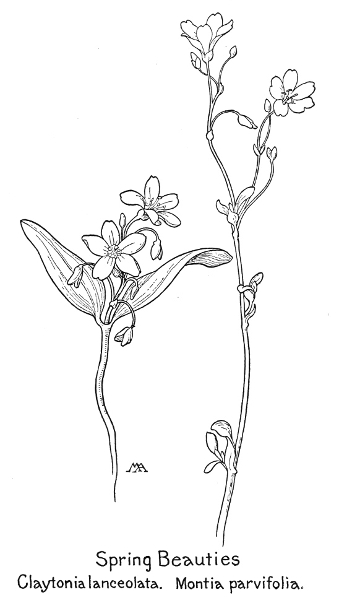
Spring Beauties
Claytonia lanceolata.
Montia parvifolia.
There are only one or two kinds of Spraguea, natives of
North America; low herbs, not very succulent, with fleshy
roots; the leaves alternate, or from the root; the small
flowers in coiled clusters; the two sepals and the four petals
all papery; the stamens one, two, or three in number; the
style long, with two stigmas; the capsule roundish, with
two valves, containing few or many, shining, black seeds.
Pussy-paws
Spràguea
umbellàta
(Calyptridium)
Pink
Summer, autumn
Northwest
Sandy spots in the mountains are often
brightened by lovely patches of the soft
pink blooms of this attractive and odd-looking
little plant. Near Wawona, on
the Glacier Point trail, I saw at least half
an acre of sand carpeted with beautiful
rose-color. In moderate altitudes the
plants are about ten inches tall, but they get dwarfish as
they climb and on the mountain-tops they are only an
inch or so high, with close mats of small leaves. They
have strong tap-roots and the leaves are dull gray-green,
rather thick and stiff but hardly succulent, and grow
mostly in rosettes at the base, those on the stem having
shrunk to mere bracts, with several, smooth, reddish
stalks springing from among them. Each stem bears a
close, roundish head, two or three inches across, consisting
of many tightly-coiled tufts of shaded pink, each composed
of innumerable, small, pink flowers, the papery, pink and
white sepals and bracts being the most conspicuous part.
They overlap each other and have daintily ruffled edges.
The three stamens are long and protruding and the style
long and threadlike. The flower-clusters are like soft
pink cushions, so the pretty little name of Pussy-paws is
appropriate, both to form and coloring. Chipmunks are
very fond of the small, black seeds.
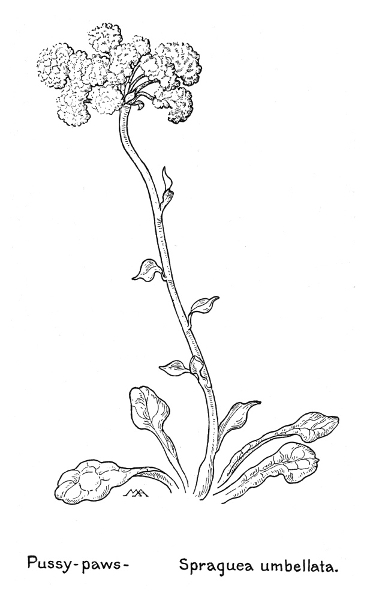
Pussy-paws—Spraguea umbellata.
The members of this large and handsome family vary so
much in appearance that it is difficult for the amateur to
realize that they are nearly related. In fact they have no
very distinctive characteristics. They are all herbs,
except Clematis, which is shrubby, and all have bitter
juice, which is never milky or colored, numerous stamens
and usually several pistils, which are superior and one-celled,
bearing a single style, and all the parts of the flower
are separate from each other and inserted on the receptacle.
The flowers are often of eccentric forms, with spurs or
hoods; sometimes they dispense with petals altogether
and instead have colored sepals which resemble petals.
The leaves are of all sorts and shapes, usually more or less
lobed and cut, but have no stipules and often their bases
clasp the stem. The fruit is an akene, pod, or berry.
Many of our most beautiful and popular garden flowers
are included in this family, which is large and distributed
throughout the world, but not abundant in the tropics.
There are numerous kinds of Ranunculus, mostly
perennials, with fibrous roots, growing in temperate and
cold regions. Ours have yellow or white flowers, with
three to five sepals and from three to fifteen petals, each
of the petals with a nectar-gland at its base; the numerous
pistils developing into a roundish or oblong head of akenes.
The leaves are variously cut and lobed, the stem leaves
alternate. Some sorts grow in the water and some have
creeping stems. Some kinds of Ranunculus are liable to
be confused with some sorts of Cinquefoils, but the calyx of a
Buttercup has no bractlets, as has that of a Cinquefoil. The
Latin name means "little frog," as these plants like marshes.
Common Western
Buttercup
Ranúnculus
Califórnicus
Yellow
Winter, spring
Wash., Oreg.,
Cal.
The commonest kind are attractive,
often coloring the fields for miles with
bright gold, but the flowers are not so
pretty as some common eastern kinds.
The stems are branching and more or less
hairy, nine inches to a foot and a half tall,
with dark-green leaves, smooth, hairy or
velvety, and velvety, hairy buds. The
flowers are about an inch across, with from nine to sixteen,
bright-yellow, shiny petals and pale-green sepals, turned
closely back. The akenes have hooked beaks. This runs
into many scarcely distinguishable varieties.
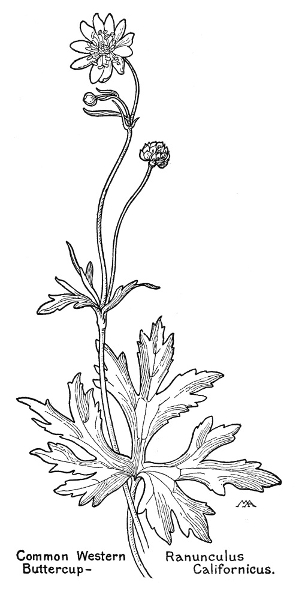
Common Western Buttercup—Ranunculus Californicus.
Few flowers are more beautiful and interesting in color
and construction than Larkspurs. We are all familiar
with their tall spires of oddly-shaped blossoms, growing in
gardens, and we find them even more charming in their
natural surroundings, glowing like sapphires on desert
sands, or adorning mountain woods with patches of vivid
color. There are many kinds; ours are perennials, with
palmately-divided leaves and usually blue or white flowers,
very irregular in form, with five sepals, resembling petals,
the upper one prolonged into a spur at the back, and
usually four petals, two of which are small and inside the
calyx-spur, the larger two partly covering the pistils and
the numerous stamens. The pistils, from one to five, become
many-seeded pods. Some Larkspurs are poisonous
to cattle. The Latin name is from a fancied resemblance
of the flower to the dolphin of decorative art. Spanish
Californians call it Espuela del caballero, Cavalier's spur.
Blue Larkspur
Delphínium
scapòsum
Blue
Summer
Ariz., New Mex.
Though sometimes rather small, this is
extremely pretty. In the Grand Canyon,
on the plateau, it is about a foot tall, with
rather leathery, brownish-green leaves,
mostly from the root, and from five to
twelve flowers in a cluster. They measure
nearly an inch across and are brilliant and iridescent in
coloring, as except for two small whitish petals, they are the
deepest, brightest blue, exquisitely tinted with violet, with
brown anthers. At Tucson, among the rocks above the
Desert Laboratory, it grows to over a foot in height, with a
cluster over six inches long and light dull-green leaves,
slightly stiff and thick, with long leaf-stalks, the lobes
tipped with a bristle, forming a handsome clump. This
grows on dry plains and rocky hillsides, up to seven thousand
feet. The picture is from a Grand Canyon plant.
Larkspur
Delphínium
Hánseni
White, pinkish
Summer
California
If the flowers were a little less pale in
color this would be a gorgeous plant, for
it sometimes grows nearly four feet high.
The branching stem springs from a
cluster of thick, tapering roots, each
branch terminating in a long, crowded
cluster of twenty or thirty flowers, opalescent in tint,
either white, with a bluish or greenish spot on the tip of
each sepal, or very pale pink, with a purplish or bluish
spot. The dull, yellowish-green leaves are rather thickish
and downy, the pods erect. This grows in dryish places,
at moderate altitudes, and freely around Yosemite.
Foothills Larkspur—Delphinium scaposum.
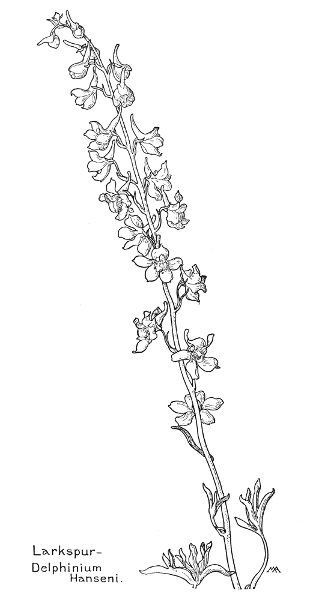
Larkspur—Delphinium Hanseni.
Blue Larkspur
Delphínium bícolor
Blue
Spring, summer
Northwest and
Utah
A splendid flower when at its best,
from six inches to a foot and a half tall,
with a smooth stem, reddish below, and
smooth, bright-green leaves, pale on the
under side, round in general outline, the
lower ones with long, reddish leaf-stalks
sheathing the stem, the roots thick but not tuberous.
The beautiful flowers are sometimes an inch and a half
across, on long, rather spreading pedicels, few or many, in
a long loose cluster, the buds slightly downy. The general
effect of the flowers is deep bright-blue, but when we
examine them more closely we find that the slightly
woolly spurs are purplish, the blue sepals have on the back
protuberances, which are pinkish on the front and greenish
on the back, the two, small, upper petals are white,
delicately striped with purple, and the lower ones, which
are fuzzy with tufts of white down and two-cleft, are deep
pinkish-purple; sometimes the whole flower is much paler
in color. The anthers are large and green at first, becoming
small and yellow, their threadlike filaments curling.
This grows on dry hills. D. Párryi, of California, is about
two feet tall, similar in coloring, but even handsomer, with
a cluster nearly a foot long, closely crowded with beautiful
flowers, each an inch and a half across. The lower leaves
are slashed nearly to the center, into seven divisions, each
with three, long, narrow lobes.
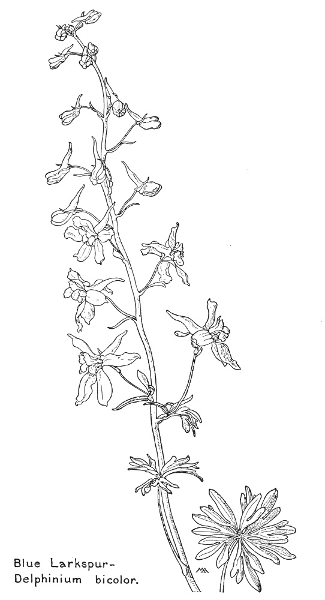
Blue Larkspur—Delphinium bicolor.
Sacramento
Larkspur
Delphínium
variegàtum
Purple
Spring, summer
California
Very handsome, over a foot tall, the
upper stem downy, the lower more or less
hairy and the leaves more or less velvety.
The flowers are an inch or more long and
rather few, with long pedicels, forming a
loose cluster. They are downy on the
outside, all bright-purple, except the two
upper petals, which are white tipped with purple, the
lower petals edged and tipped with hairs, the spur stoutish
and wrinkled. These flowers, though described as blue,
seem to me to have more true purple than most Larkspurs.
They probably vary a good deal in color. This grows in
the Coast Ranges and the Sacramento Valley. There are
many similar blue Larkspurs.
Scarlet Larkspur,
Christmas-horns
Delphínium
nudicaùle
Red
Spring
Wash., Oreg., Cal.
Scarlet seems an odd color for a Larkspur,
but there are two red ones in the
West. This is an exceedingly airy,
graceful plant and suggests a Columbine
more than a Larkspur. The stem is
slender and branching, from one to over
two feet tall, with a "bloom"; the leaves
thickish, smooth, dark rich green on the upper side and
pale on the under. The flowers are far apart, from two to
twelve, on long pedicels, forming a very loose, open cluster.
Each flower is about an inch long; the sepals scarlet
shading to yellow, the spur tipped with deeper red, the
petals yellow tipped with crimson, not woolly, the two
upper notched and much larger than the two lower ones,
which are small and slashed into two points, the edges of
both sepals and petals more or less hairy; the buds pale
yellowish-green, tinged with pink and red. These charming
flowers have an elfin look all their own, as they swing
their little pointed red caps in the light shade of cool
canyons along the mountain streams they love. In
southern California we find D. cardinàle, a handsomer
plant, sometimes six feet tall, its flowers larger and deeper
red and forming a larger, closer cluster.
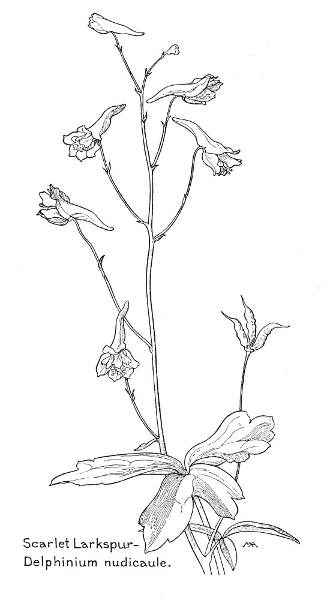
Scarlet Larkspur—Delphinium nudicaule.
The picturesque Columbine gets its melodious name
from the Latin for "dove," because the spurs suggest a
circle of pretty little pigeons, and this common name is
less far-fetched than the Latin one, Aquilegia, which comes
from a fancied resemblance of the spurs to an eagle's claws.
These plants are well known and easily recognized by the
peculiar shape of the flowers. Everything about them is
decorative and beautiful, the foliage is pretty and the
flowers large, brightly colored, and conspicuous. They
are all perennials, with branching stems and compound
leaves; the flowers usually nodding, with five sepals all
alike and resembling petals, and five petals, also all alike,
with conspicuous, hollow spurs. The stamens, the inner
ones without anthers, are numerous and the five pistils
develop into a head of five, erect, many-seeded pods.
There is honey in the spurs, which can be reached only
by "long-tongued" insects or humming birds, which thus
assist in cross-pollination, and bees obviate the difficulty
of having short tongues by ingeniously cutting holes in
the spurs. There are a good many beautiful kinds, both
East and West.
Scarlet Columbine
Aquilègia truncàta
Red and yellow
Spring
Wash., Oreg., Cal.
This charming plant grows from one to
over three feet high, is branching and
smooth, and has pretty light-green leaves
and nodding flowers, which are over an
inch and a half across. The outside of
the corolla is pale-scarlet, veined and tipped with yellow,
the inside is yellow and the spurs are erect and three
quarters of an inch long. The flower resembles the Scarlet
Columbine of the East, but the plant is taller, with fewer
flowers. It is common in moist, rich woods in Yosemite
and the Coast Ranges, from the foothills well up to the
alpine zone.
White Columbine
Aquilègia
leptocèra
White
Summer
Northwest and
Utah
An exceedingly beautiful flower, a
white sister of the large Blue Columbine,
which is the "State flower" of Colorado,
and sometimes sufficiently tinged with
blue to show the relationship. It is a
rather slender plant, usually with several
stems, from one to two feet tall, the
foliage rather bluish-green, the flowers large and usually
pure-white, and is found in the mountains.
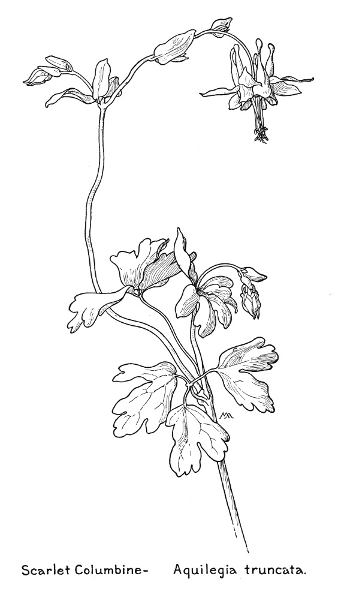
Scarlet Columbine—Aquilegia truncata.
Monkshoods have almost as much charm as their cousins
Columbine and Larkspur, with a quaintness and individuality
all their own. There are a good many kinds;
mountain plants, growing in temperate regions, with
rather weak stems and leaves much like those of Larkspur.
The blue and white blossoms have a "hood," which gives
these plants their very appropriate name. This is formed
by the upper and larger one of the five, petal-like sepals
arching over and forming a hood, or helmet, under which
the two small petals, with spurs and claws, are hidden;
sometimes there are three or more petals below, which are
minute and resemble stamens. The real stamens are
numerous and ripen before the pistils, thus ensuring cross-pollination,
and the fruit consists of a head, of from three to
five, many-seeded pods. The thick or turnip-shaped root
is used medicinally and is virulently poisonous, so these
plants are sometimes called Wolfsbane. Aconite is the
ancient Greek name and other common names are Blue-weed
and Friar's-cap.
Monkshood
Aconìtum
Columbiànum
Blue and white
Summer
West
This handsome perennial, from two to
six feet tall, grows near streams, in mountain
meadows or open woods. The
flowers measure from half an inch to over
an inch long and are mostly bright-blue
and white, tinged with violet, but shade
from almost white to deep-blue, veined with purple.
They are paler inside and grow on slender pedicels, in a
long loose cluster, on a somewhat bending stem. The
two, small, hammer-shaped petals are nearly concealed
under the hood. The leaves are alternate, the lower ones
with long leaf-stalks, and deeply cleft into three or five,
toothed or lobed, divisions. This reaches an altitude of
twelve thousand feet.
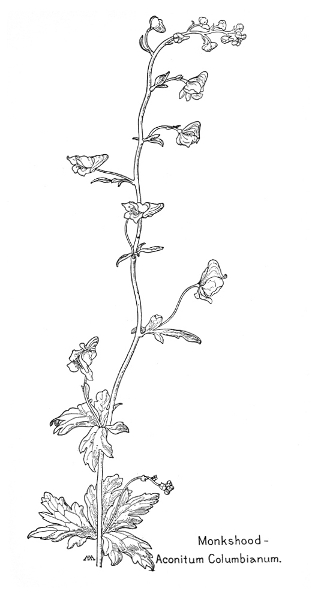
Monkshood—Aconitum Columbianum.
Wild Peony
Paeònia Bròwnii
Dark-red
Winter, spring
Wash., Oreg., Cal.
There are two kinds of Peony. This is a
robust and very decorative perennial, rich
and unusual in coloring, the fine foliage setting
off the dark flowers to perfection. The
roots are woody, the stems smooth, from
eight inches to a foot and a half tall, and the leaves are
smooth, rich green, but not shiny. The nodding flowers
are an inch and a half across, with five or six greenish-purple
sepals, five or six petals, rich deep-red, tinged and
streaked with yellow and maroon; dull-yellow stamens and
green pistils. The whole flower is quite thick and leathery
in texture and rather coarse, sometimes so dark that it is
almost black. The flowers are often fragrant, but the
plant has a disagreeable smell, something like Skunk-cabbage,
when crushed. The large seed-pods, usually five,
are thick, leathery and smooth, with several seeds and are
a very conspicuous feature, the stems drooping as they
ripen and the pods resting on the ground in big bunches.
The whole plant is rather succulent and the foliage and
stems are more or less tinged with red and have a "bloom,"
especially on the sepals. This grows in all sorts of places,
in the hot plains of the south and at the edge of the snow, in
northern, mountain canyons. In the south it blooms in
January and is sometimes called Christmas-rose. The
root is used medicinally by the Spanish-Californians and
by the Indians, "to give their horses long wind." These
plants were named in honor of Paion, the physician of the
gods.
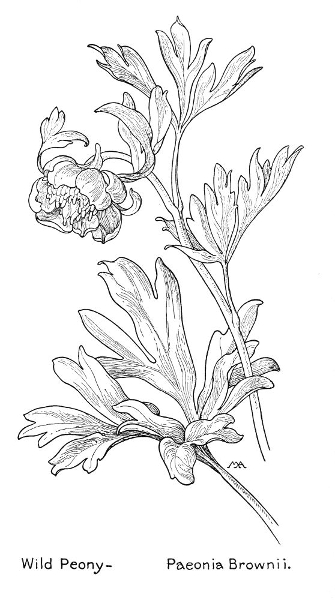
Wild Peony—Paeonia Brownii.
There are only a few kinds of Actaea, tall perennials,
with large, alternate, thrice-compound leaves and small,
white flowers, in short, terminal clusters. The sepals
number about four and resemble petals; the petals are
from four to ten, or sometimes none, with claws; the
stamens are numerous, with conspicuous white filaments;
the one pistil has a broad, somewhat two-lobed, stigma, and
the fruit is a large, showy, red or white, somewhat poisonous
berry, containing many, smooth, flat seeds.
Baneberry
Actaèa argùta
White
Spring, summer
West, except Ariz.
This is a fine plant, from one to two
feet tall, with a stoutish, smooth, branching
stem and handsome leaves, prettily
cut, with pointed teeth, thin and soft in
texture, with conspicuous veins. The
sepals and petals of the small cream-white flowers are less
conspicuous than the numerous white stamens, which give
a very feathery appearance to the flower-cluster, which is
one or two inches long and speckled with the dark tips of
the pistils. The sepals and petals drop off early and the
stamens lengthen, so that the cluster becomes very airy
and delicate. The general effect of the plant, which grows
near shady mountain streams, is striking and graceful.
It grows also in the East and is sometimes slightly sweet-scented,
but often has an unpleasant smell. The handsome,
poisonous berries are oval or round, red or white,
with a polished surface, and contain many seeds. This
reaches an altitude of ten thousand feet. A very similar
kind, A. viridiflòra, grows in the mountains of Arizona.
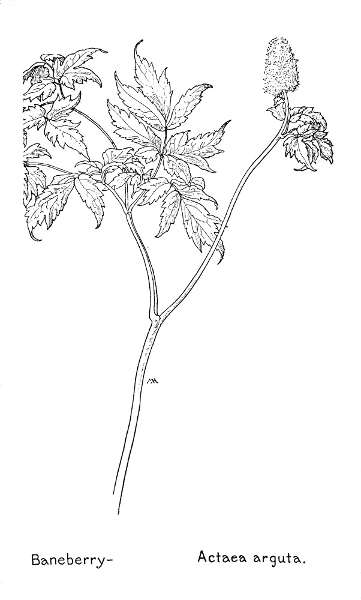
Globe-flower
Tróllius láxus
White
Spring
U. S.
This is our only kind of Trollius. It is
an exceedingly beautiful flower, particularly
when found growing in the snow, or
near the edge of a field of melting ice, in
high mountains and along the margins of
glaciers. The handsome, toothed leaves are palmately-lobed
or divided, the lower ones with long leaf-stalks, rich
green and glossy and setting off the flowers, which grow
singly at the tips of smooth, rather weak stems, from one to
two feet tall, and measure about an inch and a half across.
The sepals, from five to seven in number, are large, cream-white,
slightly greenish outside, and are the conspicuous
part of the flower, for the petals are very small and yellow,
so that they resemble stamens. From fifteen to twenty-five
of these little petals, in a row, surround the numerous,
real stamens and form a beautiful golden center. The
fruit is a head, measuring an inch across, composed of
eight to fifteen small pods, with beaks, containing many,
smooth, oblong seeds. This plant looks very much like
an Anemone but it has these small yellow petals and
Anemones have none, and the center is larger and brighter
yellow and the foliage coarser.
There are three kinds of Trautvetteria, two American
and one Asiatic.
False Bugbane
Trautvettèria
grándis
White
Summer
West
A handsome plant, with a smooth, pale-green
stem, from two to three feet tall, and
fine large leaves, prettily cut, smooth and
rather bright green, the lower ones sometimes
eight inches across. The white
flower clusters are large, very pretty, airy
and feathery, consisting of numerous small flowers, with
small petal-like sepals, usually four, and no petals, the
numerous stamens, with white filaments, being the conspicuous
part and forming a little pompon. The akenes
are numerous, inflated and four-angled, and form a head.
It is a pity that this attractive plant has such a horrid
name. It grows in moist woods at Mt. Rainier and in
similar places.
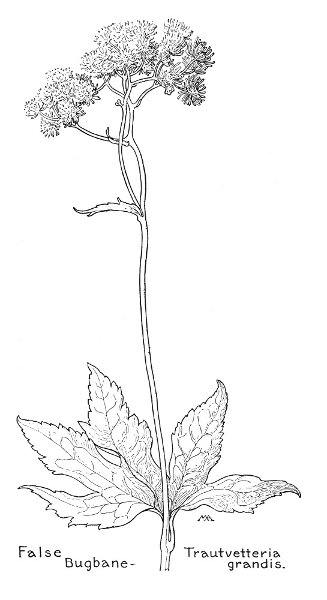
False Bugbane—Trautvetteria grandis.
Anemones grow in temperate and cold regions everywhere.
They have no petals, but their sepals, numbering
from four to twenty, resemble petals. The stem-leaves
are in whorls, forming a kind of involucre below the flower.
There are many kinds; some have nearly smooth, pointed
akenes, some densely woolly ones, and in some the akenes
have feathery tails. The name, pronounced anemòne in
Latin and in English anémone, is appropriate to the fragile
kinds, such as the eastern Wood Anemone, for it means
"flower shaken by the wind."
Canyon Anemone
Anemòne
sphenophýlla
White
Spring
Arizona
An attractive plant, eight inches to a
foot tall, with pretty flowers and foliage.
The flowers are white, tinged with pink,
less than an inch across, often downy outside,
and the head of fruit is oblong, sleek,
and silky downy. This grows on dry,
rocky slopes in the Grand Canyon, above the plateau.
Around Tucson the flowers are less pretty, but the foliage
handsomer.
Three-leaved
Anemone
Anemòne deltoìdea
White
Summer
Wash., Oreg., Col.
Delicate, pale flowers, conspicuous in
dark mountain woods, with slightly downy,
purplish stems, from eight to ten inches
tall, and pretty leaves, thin in texture,
the involucre-leaves without leaf-stalks,
rather light-green, dull on the upper side,
paler and shiny on the under. The pretty flowers are an
inch and a half to over two inches across, with five, pure-white
sepals, usually two of them larger and longer than
the others, and a light bright-yellow center. This is
abundant at Mt. Rainier. A. quinquefòlia var. Gràyi, of
the Coast Ranges, is similar, the flower often tinged with
blue, the involucre-leaves with leaf-stalks.
Northern
Anemone
Anemòne
parviflòra
White
Summer
Northwest
A pretty little plant, with a rather hairy,
reddish stem, from four to twelve inches
tall, glossy, dark-green leaves, paler and
downy on the under side, and flowers about
half an inch across, cream-white, tinged
with purple or blue on the outside; the
akenes very woolly. This reaches an
altitude of ten thousand five hundred feet, growing in
the East and in Asia and is the smallest of the mountain
Anemones.
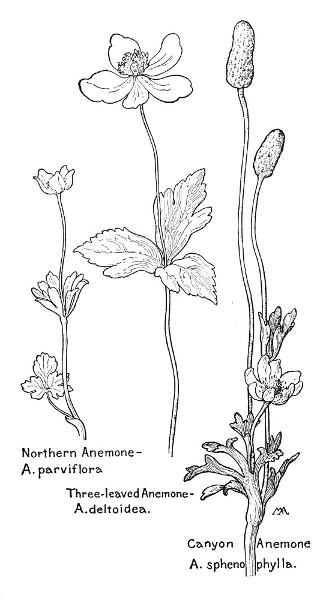
Northern Anemone—A. parviflora.
Three-leaved Anemone—A. deltoidea.
Canyon Anemone—A. sphenophylla.
Western
Anemone
Anemòne
occidentàlis
White
Spring
Northwest
These beautiful mountain flowers bloom
in early spring, sometimes poking their
pretty faces right through a hole melted in
a snow-bank, and the brave little things
are quite thickly covered with silky wool
all over, as if to keep themselves warm.
The flowers, which often bloom before the
leaves expand, are about two inches across, with five to
eight, cream-white sepals, tinged with blue and hairy on
the outside, and are much less delicate looking than most
Anemones. The stout stems are very woolly, from six to
eighteen inches tall, and the leaves are beautiful, cut into
numerous, very fine divisions, exceedingly feathery and
pretty. The akenes have long, feathery tails and form
very large, silky, fluffy heads, which are very handsome
and conspicuous.
There are a good many kinds of Caltha, succulent
marsh plants, of temperate and arctic regions; the leaves
undivided, mostly from the base and more or less heart-shaped;
the flowers with large, petal-like sepals and no
petals. This is the Latin name of the Marigold.
White Marsh
Marigold
Cáltha leptosépala
White
Summer
Northwest
A pretty little mountain, marsh plant
with a smooth, stout, purplish stem from
four to eight inches tall, and smooth, light-green
leaves, often veined with purple on
the under side. The flowers are an inch
and a quarter across, with eight or ten,
cream-white sepals, tinged with blue on the outside, and
pretty golden centers of numerous stamens. This blooms
at the edge of the retreating snow and reaches an altitude
of twelve thousand feet. C. palústris, the Yellow Marsh
Marigold, found in the Northwest and common in the
East, has beautiful yellow flowers, resembling large Buttercups.
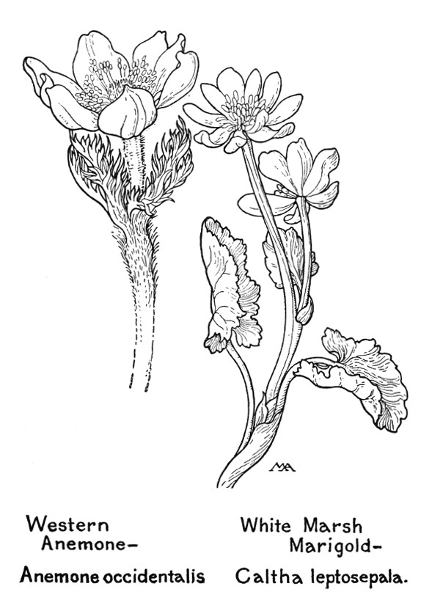
Western Anemone—Anemone occidentalis.
White Marsh Marigold—Caltha leptosepala.
There are many varieties of Clematis, or Virgin's Bower,
familiar to us all, both East and West, and general favorites,
widely distributed and flourishing in temperate regions;
perennials, woody below, which is unusual in this family.
Usually they are beautiful trailing vines, which climb over
bushes and rocks, holding on by their twisting, curling
leaf-stalks. The flowers have no petals, or only very
small ones, but their sepals, usually four, resemble petals;
the stamens are numerous. The numerous pistils form a
round bunch of akenes, their styles developing into long
feathery tails, and these gray, plumy heads are very
conspicuous and ornamental, when the flowers are gone.
The leaves are opposite, which is unusual in this family,
with slender leaf-stalks, and are usually compound. Some
plants have only staminate flowers and some only pistillate
ones, and the appearance is quite different, the flowers with
stamens being handsomer.
Virgin's Bower,
Pipe-stem
Clématis
lasiántha
White, pale-yellow
Spring
California
Near the summit of Mt. Lowe, and in
similar places, we find this beautiful vine
clambering over the rocks. The flowers
measure an inch and a quarter to over two
inches across and they vary in tint from
almost pure white to a lovely soft shade of
pale-yellow, the handsome clusters forming
a beautiful contrast to the dark-green
foliage. The stamens and pistils are on different plants.
The flowers, leaves, and stems are all more or less velvety
and the akenes have tails an inch long, forming a head,
about two inches across. The flowers are often so numerous
as to make conspicuous masses of pale color on canyon
sides, in the Coast Range and Sierra Nevada Mountains.
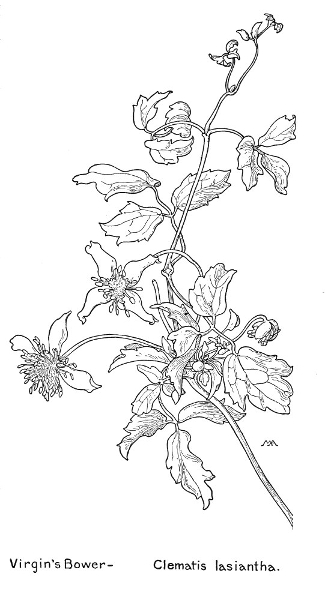
Virgin's Bower—Clematis lasiantha.
There are a few kinds of Atragene, resembling Clematis.
Purple Clematis
Atrágene occidentàlis
(Clematis)
Violet, blue
Summer
West
This is peculiarly attractive, as the
flowers are large and beautiful and the
foliage very pretty. The leaves are
divided into three, pointed leaflets, which
are thin in texture, light bright-green and
prettily cut or lobed, and the trailing or
climbing stems are almost smooth, slender and purplish
above and woody below. The flowers, which are not in
clusters, measure from two to three inches across, with
four, sometimes five, violet or blue sepals, spreading widely
as the flower grows older, and the outer stamens are broad
and resemble small petals. The flowers are followed by
handsome feathery heads, which are large and silky. This
pretty vine is found in the Grand Canyon, not far below the
Rim, and in many mountain places. The foliage varies
somewhat in different climates.
There are many kinds of Thalictrum, not easily distinguished,
widely distributed, a few in the Andes, India,
and Africa; perennials, with tall stems, from a short rootstock,
and handsome, compound leaves; the flowers perfect
or imperfect, many, small, in clusters, with four to seven
sepals and no petals; the akenes tipped with the long styles
and forming a head. Some of these plants have a disagreeable
smell. They grow in moist places, both East and West.
Meadow Rue
Thalíctrum
Féndleri
Greenish-white
Summer
West
Though its flowers are small and colorless,
this plant is conspicuous for delicacy
and grace. The leaves of tender green
suggest the fronds of Maidenhair Fern
and are almost as beautiful, while the
flowers are odd and pretty. A shower of
numerous, pale-yellow stamens, with purplish, threadlike
filaments, falls from the center of four, greenish-white
sepals and forms a charming little tassel. These tassels
hang on the ends of very slender pedicels, in loose clusters.
The smooth stems are from one to three feet tall and the
smooth leaves are thin in texture, thrice-compound, with
many, rounded leaflets, the lower leaves with long leaf-stalks.
This Meadow Rue has its pistils and stamens on
different plants, the flowers with tassels of stamens being
prettier and more conspicuous than the small, green, pistillate
ones. The variety Wrìghtii is common in Arizona.
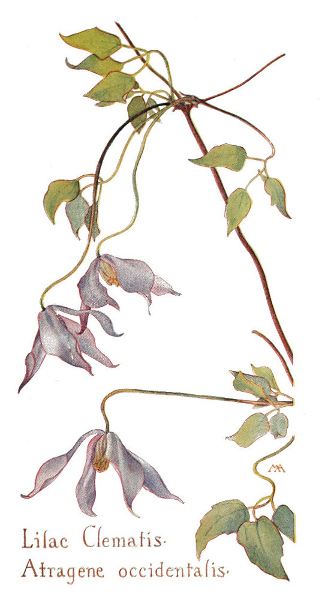
Lilac Clematis—Atragene occidentalis.
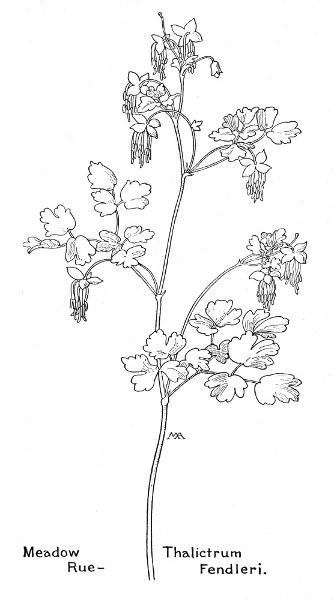
Meadow Rue—Thalictrum Fendleri.
Not a large family, widely distributed; shrubs or herbs;
leaves alternate or from the root; flowers perfect; sepals
and petals few, many, or none, generally in several overlapping
rows; stamens on the receptacle, usually as many
as the petals and opposite them; pistil one, with a short
style, or none; fruit a berry or capsule.
There are several kinds of Vancouveria, perennial herbs
with slender, creeping rootstocks; named after Vancouver
the explorer.
Inside-out Flower,
Barrenwort
Vancouvèria
parviflòra
White, lilac
Spring
Wash., Oreg., Cal.
A charming woodland plant, its airy
flower cluster, which has much the effect
of an Alum-root, in beautiful contrast to
the crisp, evergreen foliage. The large
leaves are all from the root, with wiry,
purplish leaf-stalks and beautifully-shaped
leaflets, each an inch or more broad, pale
on the under side, the older leaves dark, rich green, leathery
and very glossy and the younger ones bright apple-green
and thinner in texture. They form a handsome cluster,
varying a good deal in size, and the general effect suggests
some very crisp and sturdy sort of Maidenhair Fern.
The stem is from one to two feet tall, wiry, purplish, and
hairy, and bears a very loose cluster of tiny, drooping,
white or lilac-tinged flowers. The six, white sepals
resemble petals; the six, white petals are smaller than the
sepals, lined with yellow, and there are six to nine bracts,
resembling sepals, and six stamens. The minute buds are
purplish and the little flowers are exceedingly pretty and
odd, when we examine them closely, for the sepals turn
back so abruptly from the tiny petals, and from the projecting
cluster of stamens, that the name Inside-out Flower
is appropriate. The fruit is a kind of capsule with many
seeds. This grows in shady woods, especially among
redwoods, up to seven thousand feet. V. hexándra has
thinner leaflets, not evergreen, and the leaflets of V. chrysántha
have white margins.
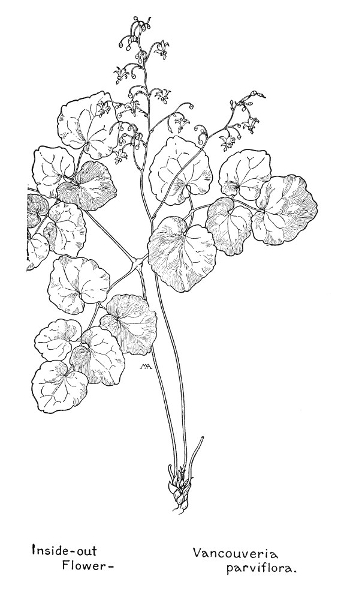
Inside-out Flower—Vancouveria parviflora.
There are many kinds of Barberry, widely distributed;
shrubs, with yellow wood; the leaves often spiny and the
flowers yellow; the sepals six to nine, with bracts and
resembling petals; the petals six, in two overlapping rows,
each with two glands at the base; the stamens six, with
anthers that open by little valves like trap-doors, hinged
at the top, sensitive and, when they are touched, closing
around the shield-shaped stigma; the fruit a berry, with
one or few seeds.
Oregon Grape,
Trailing Barberry
Bérberis rèpens
Yellow
Spring
Cal., Ariz., Utah,
Nev.
This does not look much like the common
cultivated kinds of Barberry, for it
grows close to the ground in a straggling
bunch. In favorable situations it is a
handsome and conspicuous plant. The
leaves, with from three to seven leaflets,
are stiff, prickly, and evergreen like Holly,
and the yellow flowers are in clusters at the ends of the
stems, with opposite bracts. The six sepals, petals, and
stamens are all opposite, that is, with a petal in front of
each sepal and a stamen in front of each petal. In Arizona
the flowers are rather small and the clusters short, but
in Utah they are far handsomer, rich golden-yellow and
sweet-scented, forming clusters two inches long. The
fruit is a handsome blue berry with a "bloom," the color
of wild grapes, contrasting well with the foliage when it
turns red in the autumn, and delicious jelly is made from
them. B. aquifòlium, of Oregon and Washington, is similar,
with much more beautiful, very shining leaves. B.
Féndleri, of the Southwest, is from three to six feet high,
the branches smooth and shiny as if varnished, the leaves
with smooth edges or spiny teeth, and the flowers in numerous
drooping clusters. The calyx has conspicuous,
red bracts and the berry is red.
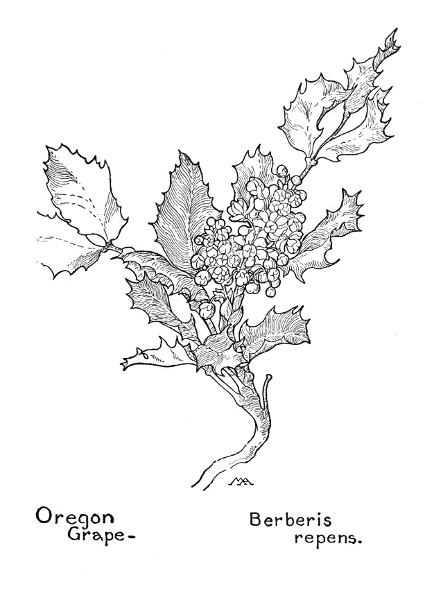
Oregon Grape—Berberis repens.
Sweet-after-Death
Áchlys triphýlla
White
Summer
Wash., Oreg., Cal.
The only kind, an attractive perennial,
popular on account of its sweet-smelling
foliage, which, however, is not fragrant
until the leaves are dried. It has a very
slender rootstock and only one large leaf,
with a very long, slender leaf-stalk and
three, oddly-shaped leaflets, from two to six inches across,
bright-green, smooth and thin in texture, but not glossy.
The single, very slender flower-stalk, from one to two feet
tall, bears a crowded spike of many, tiny, scentless, white
flowers, without either calyx or corolla, but consisting of
a cluster of stamens, with long, threadlike filaments, the
outer ones broader, and a pistil with a broad stigma and
no style. The effect of the cluster is feathery and pretty
and the broad leaf is very conspicuous, on account of its
size and shape. The crescent-shaped fruit contains one
seed, is at first fleshy, but becomes dry and leathery. This
grows in the woods in the Coast Ranges, from near sea-level
up to seven thousand feet. It is also called Vanilla
Leaf and Deer-foot.
A small family, widely distributed in fresh-water lakes
and streams; aquatic, perennial herbs, with thick, horizontal
rootstocks, or with tubers, large, floating, or erect
leaves, and large, solitary flowers, with long flower-stalks;
sepals three to twelve; petals three to many; stamens six
to numerous; ovary superior, stigmas distinct or united
into a disk. We have no white Water Lilies in the West.
Indian Pond Lily,
Spatter-dock
Nymphaèa polysépala
(Nuphar)
Yellow
Summer
Cal., Oreg., Wash.,
Col., Wyo.
Like the eastern Spatter-dock, this is a
coarse, but rather handsome and decorative
plant. The leathery leaves are
shaped like a rounded heart and sometimes
a foot long. The cup-shaped calyx, two
to four inches across, is the conspicuous
part of the flower, consisting of seven to
twelve, thickish sepals, yellow and petal-like,
the outer greenish. There are twelve to eighteen
petals, half an inch long, resembling stamens. The real
stamens have dark-red anthers, but yellow pollen, and
both petals and stamens are densely crowded around the
ovary. The round fruit has a narrow neck, concave top,
and many seeds. In quiet mountain ponds we find these
yellow flowers, on stout stems standing up out of the water,
the lily-pads floating idly on its surface. Indians grind
the seeds into meal for porridge, or else roast them and
eat them like popcorn.
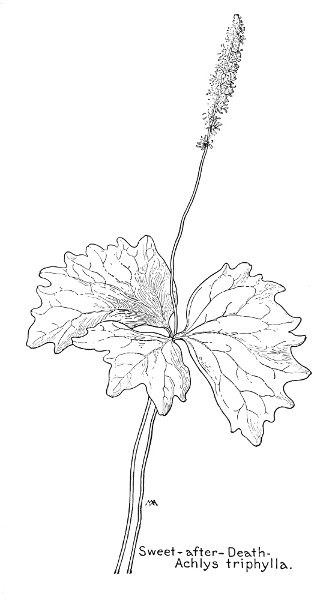
Sweet-after-Death—Achlys triphylla.
A very small family, of only two genera, one North
American, one Japanese; aromatic shrubs, with opposite,
toothless leaves, with short leaf-stalks, without stipules;
flowers large, solitary, at the ends of leafy branches; sepals,
petals, and stamens, indefinite in number, in many, overlapping
series, passing one into the other, so that one
cannot tell which is which, and all borne on the receptacle,
which is hollow, resembling a rose-hip, almost enclosing
the numerous pistils; stamens short, the inner ones without
anthers; receptacle becoming a large, leathery, oblong or
pear-shaped fruit, containing few or many, smooth, shining
akenes.
There are three kinds of Calycanthus in this country,
two of them eastern; flowers purple or red, stamens inserted
in several rows.
Strawberry Shrub
Calycánthus
occidentàlis
Red
Summer
California
This resembles the familiar shrub of
old-fashioned gardens and the flowers
have the same pleasant and elusive aroma,
something like strawberries, much more
spicy when crushed. The shrub is four
to ten feet high, with rather coarse, harsh
foliage and large, handsome flowers, two or three inches
across, warm maroon in color, shading to brown and
purple, with yellow stamens. This is handsome and
conspicuous, because of the uncommon and rich coloring
of its flowers, and grows along watercourses in the canyons
of the foothills and is most common in northern California.
It has many other names, such as Sweet Shrub, Carolina
Allspice, Wineflowers, etc.
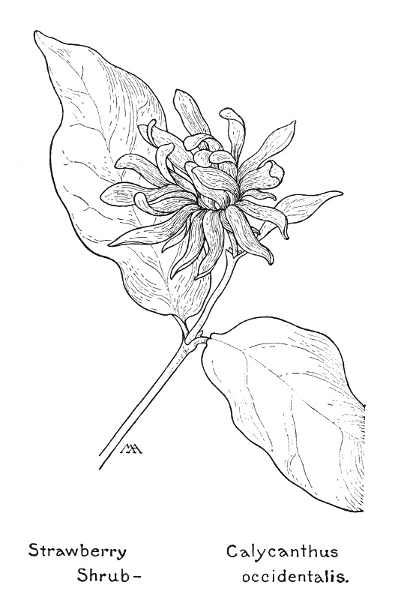
Strawberry Shrub—Calycanthus occidentalis.
A rather large family, widely distributed, most abundant
in the north temperate zone; herbs, rarely shrubs,
with milky, mostly yellow juice and narcotic or acrid
properties; the leaves mostly alternate, without stipules;
the parts of the flower usually all separate and distinct,
borne on a top-shaped receptacle. There are usually two
sepals, which fall off when the blossom opens, and usually
four petals, overlapping and crumpled in the bud; the
stamens are usually numerous and conspicuous, with
thread-like filaments; the superior ovary becomes a many-seeded
capsule.
There are only two kinds of Romneya, much alike,
smooth, stout, perennial herbs, several feet high, with
colorless sap, the leaves alternate and more or less divided;
three sepals, each with a broad wing on the back; six, large,
white petals; many stamens; the ovary covered with
bristles. These plants are nowhere common, but are
found from Santa Barbara south, and in lower California
sometimes grow in great profusion. They are extensively
cultivated and much admired abroad.
Matilija Poppy,
Giant Poppy
Romnèya
trichocàlyx
White
Summer
California
This is often considered the handsomest
flower in the West and it would be hard
to find anything more beautiful and
striking than its magnificent blossoms.
The plant has somewhat the effect of a
Peony-bush, sometimes, in cultivation, as
much as five feet high, with many smooth
stems and handsome, smooth, light-green foliage, the
leaves cut and lobed, those near the top with a few prickles.
The splendid flowers are enormous, from five to nine
inches across, with diaphanous, white petals, crinkled like
crêpe tissue-paper, and bright golden centers, composed of
hundreds of yellow stamens surrounding a greenish-white
pistil. The blossoms remain open for several days. The
hard, round buds are covered with short, brown hairs.
This is the true Matilija Poppy, (pronounced Matíliha,)
as it is the kind that grows in the canyon of that name,
but the tremendous floods of 1914 drowned most of these
beautiful plants in that locality. R. Còulteri is similar,
but the buds are smooth and the stems more robust.
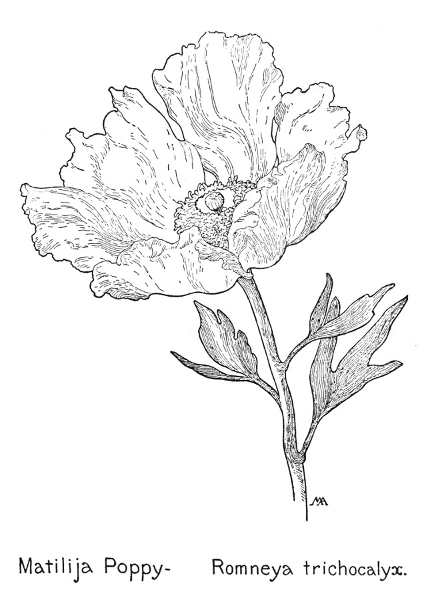
Matilija Poppy—Romneya trichocalyx.
There are several kinds of Argemone, natives of the
warmer parts of America, with bitter, yellow juice, spiny-toothed
leaves and large, conspicuous flowers, the buds
erect; sepals two or three, with odd little horns; petals
twice as many as the sepals; stamens numerous; style very
short, with a radiate stigma; capsule prickly, oblong,
opening at the top, containing numerous seeds.
Thistle Poppy,
Milk Thistle
Argemòne híspida
White
Summer
Southwest
The prickly, bluish-green foliage of this
decorative and handsome plant is thistle-like
both in form and color. The leafy,
branching stems, two or three feet high,
are covered with dense, white or yellowish
prickles and bear several lovely flowers,
over three inches across, with delicately crumpled, white
petals and beautiful golden centers, composed of numerous
yellow stamens, both stem and leaves having a bluish
"bloom." The three prickly green sepals each have a
spine-like beak and form a queer-looking, three-horned
bud; the pistil has a purplish, cap-shaped stigma, with six
lobes, and the prickly ovary becomes a very prickly capsule.
This grows in dry places and looks very beautiful
and striking when we find its fragile flowers waving in the
wind against a background of hot desert sand. It varies
a good deal in prickliness and in the form both of plant and
flower. When there is only one large flower in bloom,
surrounded by a circle of prickly buds, it suggests a fairy
princess, guarded by a retinue of fierce warriors. The
flowers are often quite broad and flat, and then are sometimes
given the prosaic name of Fried-eggs.
There are many kinds of Papaver; with milky juice,
leaves lobed or cut, nodding flower buds, showy regular
flowers, with two or three sepals and four to six petals.
The stigmas are united to form a disk with rays and the
fruit is a round or oblong capsule, opening near the top.
Both the Latin and common name, Poppy, are ancient.
Opium is made from P. somníferum of the Mediterranean.
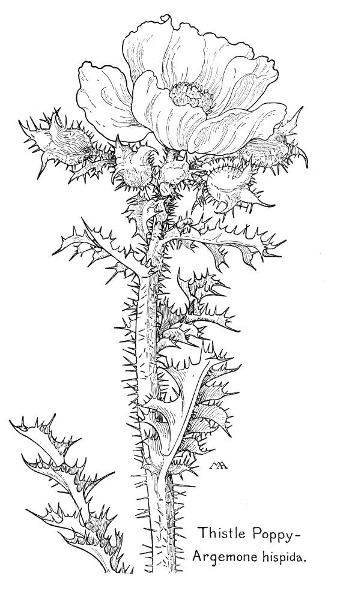
Thistle Poppy—Argemone hispida.
Wind Poppy
Papàver
heterophýllum
Red
Spring
California
A slender, graceful plant, one or two
feet tall, with smooth, branching, purplish
stems, smooth leaves, variously cut and
lobed, and charming flowers, gay yet
delicate. They are about an inch and a
half across, usually with four, scarlet
petals, each with a spot of maroon at the base, and a
bright-green pistil and maroon filaments with pale-yellow
anthers. The buds and seed-pods are smooth. This
varies a good deal, smells strong of opium when picked,
and its flowers glow like jewels among the underbrush on
open hillsides, but fall to pieces when gathered.
There are a good many kinds of Eschscholtzia, with
bitter, watery juice; leaves alternate, cut into many fine
divisions; buds erect; flowers yellow; receptacle cuplike,
often with a rim; the two sepals united to form a pointed
cap, which is pushed off by the four petals as they expand;
stamens numerous, with short filaments and long anthers;
style very short, usually with four stigmas; pod long,
narrow and ribbed, containing many seeds. These plants
were collected at San Francisco in 1816 by von Chamisso,
a German poet and naturalist, and named in honor of his
friend Eschscholtz, a botanist.
California Poppy
Eschschóltzia
Califórnica
Yellow
Spring
Cal., Oreg.
Probably the most celebrated western
flower and deservedly popular. It varies
a great deal in general form and coloring,
but is usually a fine plant, over a foot tall,
with stems and leaves a beautiful shade
of light bluish-green, and the flowers
two or three inches across, usually bright-yellow, shading
to orange at the base, but sometimes almost cream-color.
They open in sunlight and when blooming in quantities
are a beautiful sight, covering the hillsides with a cloth of
gold. In southern Arizona a similar kind often borders
the dry beds of streams with bright color, with much the
same value in the landscape as the Marsh Marigolds along
New England streams. It is the State flower of California
and has many poetic Spanish names, such as Torosa,
Amapola, and Dormidera, besides Copa de Oro, meaning
"Cup of gold."
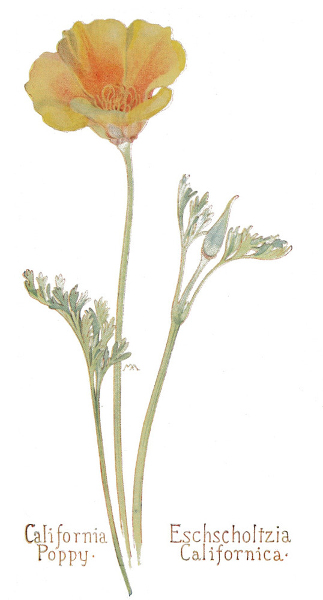
California Poppy—Eschscholtzia Californica.
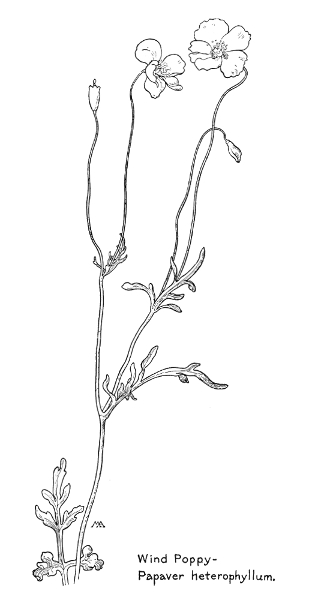
Wind Poppy—Papaver heterophyllum.
There are several kinds of Dendromecon, smooth shrubs,
with alternate, toothless, leathery leaves and yellow flowers,
with two sepals and four petals; stamens numerous, with
short filaments; ovary with a short style and two, oblong
stigmas. The name is from the Greek for "tree" and
"poppy."
Tree Poppy
Dendromécon
rígida
Yellow
All seasons
California
This is not a true Poppy, but the flowers
are sufficiently like to be quite surprising
when we find them growing on what
appears to be a small willow tree! It is a
handsome and decorative shrub, both in
form and color, two to eight feet high,
with pale woody stems, the main stem with shreddy bark,
and light bluish-green foliage, the leaves something like
those of willow, but quite stiff and leathery, with a little
pointed tip, the short leaf-stalks twisted so as to bring the
leaf into a vertical position. Sprinkled all over the bush
are numbers of beautiful, clear golden-yellow flowers,
one to three inches across, with orange-colored anthers
and a pale-yellow pistil. This grows on dry, sunny hillsides,
at middle altitudes, and is common in southern
California, but is particularly fine near Santa Barbara.
The flowers have a slight smell like cucumber and may be
found in bloom at all seasons of the year. The ribbed
seed-pod is long and narrow.
There is only one kind of Platystemon, with stem leaves
opposite or in whorls; sepals three, soon falling; petals six;
stamens many, with broad, flat filaments. The numerous
pistils are at first partly united, forming a compound ovary;
when ripe they separate into knotted pods, which break
apart between the seeds. The name means "broad
stamens."
Cream-cups
Platystèmon
Califórnicus
Cream-color
Spring
Cal., Oreg., Ariz.
Pretty graceful plants, their creamy
blossoms often whitening the spring
meadows. The slender hairy stems are
about a foot tall, the leaves and the
nodding buds light-green and hairy, and
the pretty flowers, about an inch across,
are delicate cream-color, the petals often stained with
bright-yellow, either at the tip or base, or both, with
pretty creamy centers. This is common in the foothills,
plains, and valleys.
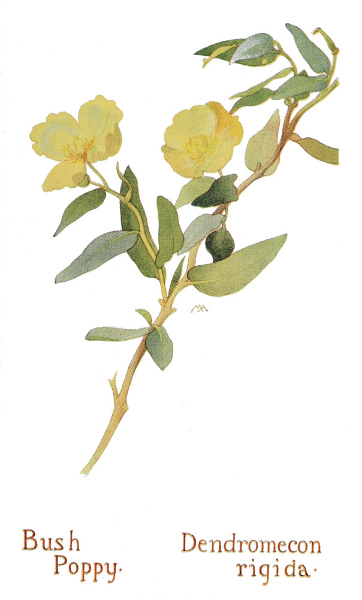
Bush Poppy—Dendromecon rigida.
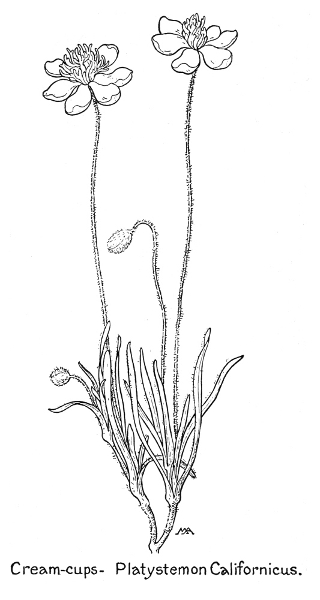
Cream-cups—Platystemon Californicus.
A small family, widely distributed; very smooth, tender,
perennial herbs, with watery juice; alternate, compound
leaves, finely cut, lobed and fringed into many divisions,
and irregular, perfect flowers, of peculiar shape, with two,
scale-like sepals, and four petals, the inner pair narrower
than the outer and united by their tips over the stamens
and style. The six stamens are in two, equal sets, the
filaments of each set somewhat united, the middle anther
of each set with two cells, the others with only one. The
superior ovary develops into a long, dry, one-celled capsule,
containing shiny, black seeds. This family has been
united to the Poppies by Bentham and Hooker, because
the plan of the flowers is similar, though their appearance
is unlike.
There are several kinds of Bicuculla, natives of North
America and Asia; perennials, with beautiful foliage and
decorative flowers, of the curious and intricate shape we
are familiar with in old-fashioned gardens. The pedicels
have two bracts; the corolla is heart-shaped at base; the
outer pair of petals are oblong and concave, with spreading
tips and spurred or pouched at base, the inner pair are
narrow and clawed, with crests or wings on the back; the
style is slender, with a two-lobed stigma, each lobe with
two crests. The creeping rootstock is surrounded by a
bulb-like cluster of fleshy grains. These plants are often
called Dutchman's Breeches, from the shape of the flower,
which, of course, also gives the pretty name Bleeding Heart.
Bicuculla is from the Latin, meaning "double-hooded."
Bleeding Heart
Bicucúlla formòsa
(Dicentra)
Pink
Summer
Cal., Oreg., Wash.
This is a very beautiful and interesting
plant, about two feet tall, with delicate
pale-green leaves, beautifully cut and
lobed, all from the root, with very long
leaf-stalks, and a few, graceful sprays of
purplish-pink flowers, each about three-quarters
of an inch long. This has a fleshy, spreading
rootstock and grows in shady spots, in rich, moist woods,
at moderate altitudes, but is not very common. It is
found in the Yosemite Valley. B. uniflòra is a diminutive
alpine plant, from one to three inches high, usually with
only one white or flesh-colored flower, about half an inch
long, which is often hidden among dead leaves. This
grows in rich soil on mountain sides in the Wasatch and
Teton Mountains and in the Sierra Nevada, and is found
in the Yosemite Valley and on Mt. Lyall, at a height of
ten thousand five hundred feet. This is called Squirrel
Corn and Steer's Head.
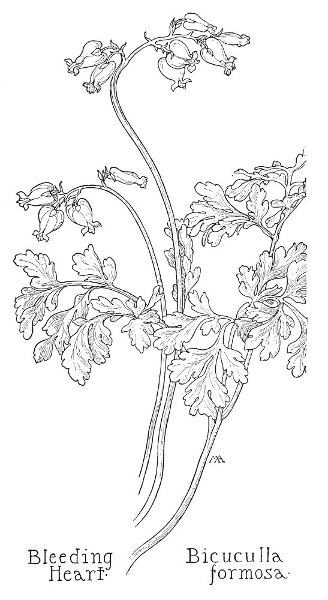
Bleeding Heart—Bicuculla formosa.
Golden Eardrops
Bicucúlla
chrysántha
(Dicentra)
Yellow
Summer
California
The general appearance of this handsome
plant is striking and Japanese in
effect, and the coloring of the feathery,
pale-green foliage and the golden-yellow
flowers is exceedingly odd and beautiful.
The large, finely-cut leaves are sometimes
a foot long, and resemble delicate ferns,
and the smooth, stout, rather coarse flower-stems bear a
few pretty flowers, which are a soft shade of yellow, about
three-quarters of an inch long, the usual Bleeding Heart
shape, but not drooping, and with a strong narcotic odor,
much like that of poppies. This is sometimes as much as
four feet high and grows in sunny places on dry ridges in
the Coast Ranges, but is nowhere common.
There are many kinds of Capnoides, natives of the
north temperate zone and Africa. They have oddly-shaped
flowers, something like Bleeding Heart, but with
only one spur, at the back on the upper side, instead of two.
The name is from the Greek, meaning "smokelike," in
allusion to the odor of some kinds.
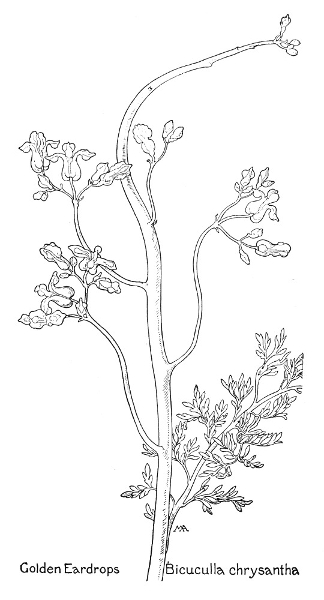
Golden Eardrops—Bicuculla chrysantha.
Golden Corydal
Capnoìdes aùreum
(Corydalis)
Yellow
Spring
West
This has hollow, branching and spreading
stems, from six to fourteen inches tall,
with very pretty, delicate, pale-green
foliage and bright-yellow flowers, each
about half an inch long, on slender pedicels,
in a loose cluster. The spurs give
them a quaint and pert effect. The style stays on the tip
of the long curved capsule, which looks like a bean-pod,
drooping or sticking out at an awkward angle from the
stem. This is especially fine in some of the mountain
valleys in Utah, making beautiful clumps of foliage; it is
widely distributed and is also found in the East. In the
West it is sometimes called Dutchman's Breeches and
confused with that plant, but rather absurdly so, for the
Dutchman could have only one leg!
Pink Corydalis
Capnoìdes
Scoúleri
(Corydalis)
Pink
Summer
Wash., Oreg.
A very beautiful and decorative plant,
two or three feet tall, with large, exceedingly
graceful leaves, vivid yet delicate
in color and thin in texture, beautifully
cut and lobed. The flowers are about an
inch long, pale-pink shaded with deeper
color, each with a long, cylindrical spur,
and form pretty clusters, which show up very effectively
against the tender green of the large clumps of delicate
foliage, which are conspicuously beautiful. This grows
in rich soil, in mountain woods, and is charming in the
forests in Mt. Rainier National Park.
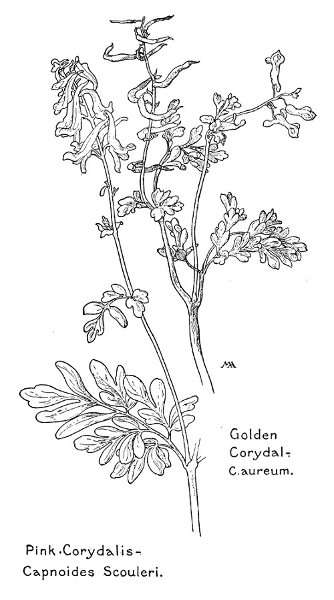
Pink Corydalis—Capnoides Scouleri.
Golden Corydal—C. aureum.
A large family, widely distributed. Both the English
and Latin names are appropriate, for the watery juice of
these plants is pungent, like mustard, and the flowers
spread out their four petals in the form of a cross. They
are herbs, the leaves alternate or from the root, usually
with no leaf-stalks. The flowers have four petals, with
claws; four sepals, the two outer ones narrow, apt to drop
off; six stamens, two of them short. The ovary is superior,
usually with a single style and stigma, and usually develops
into a pod, divided in two by a transparent partition,
which remains after the pod has opened from below;
in some kinds the pod remains closed. The flowers
generally grow in clusters and though they are often small
they produce honey and so are frequented by bees and
flies. The family is easily recognized by the four petals
and in most species by two stamens being shorter than the
others, but the flowers are so much alike that the various
kinds have to be determined by examining the fruit.
Radish and Horse-radish, Mustard and Water-cress all
belong to this family, as well as many familiar garden
flowers, such as Sweet Alyssum, Candytuft, Rockets, and
Stocks, and many are common weeds, such as Peppergrass
and Shepherd's Purse.
There are several kinds of Dentaria, smooth perennials,
with rather large white or pink flowers and tuberous rootstocks.
Milk Maids,
Pepper-root
Dentària
Califórnica
White, pink
Spring
Cal., Oreg.
A charming plant, with a purplish stem,
from six inches to two feet tall, and pretty
leaves, varying in shape, those from the
root being roundish in outline, or with
three leaflets, but the stem-leaves with
three or five leaflets. The flowers are
about three-quarters of an inch across,
with pure-white or pale-pink petals. This is one of the
loveliest of the early spring flowers in the Coast Ranges
and usually found in damp spots, both in woods and open
places, often whitening the meadows with its blossoms.
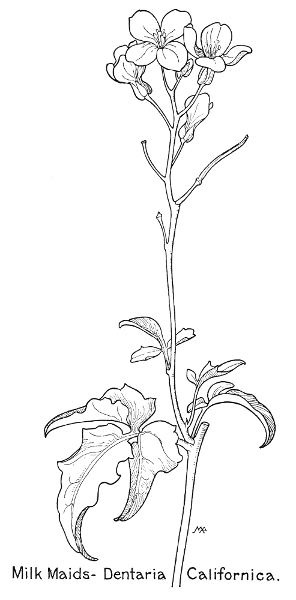
Milk Maids—Dentaria Californica.
There are a good many kinds of Thelypodium, natives
of North America, all western or southwestern; mostly
smooth plants, the leaves usually with leaf-stalks, the
flowers in clusters; stamens long, conspicuous, with very
narrow, arrow-shaped anthers; pods long, cylindrical or
four-sided, often twisted, sometimes on a slender stalk;
seeds oblong, flattish, in one row in each cell.
Thelypòdium
torulòsum
Lilac
Spring, summer
West, etc.
This has small flowers, but often grows
in such quantities on the flats near Salt
Lake that it tints the fields with purple.
The purplish stem is from twelve to fifteen
inches tall and the leaves are light bluish-green
and very smooth, the root-leaves with long leaf-stalks,
and the stem-leaves arrow-shaped and clasping at
base. The flowers are about half an inch across, with a
purplish-tinged calyx and pale pinkish-lilac petals, and form
flat-topped clusters. The pods are spreading and rather
knobby. This usually grows on dry hills, reaching an altitude
of over nine thousand feet, as far east as Wyoming.
There are many kinds of Arabis, widely distributed,
with small, white or purplish flowers.
Fendler's Arabis
Árabis Féndleri
Magenta
Spring
Arizona
This is a rather pretty plant, a foot or
more tall, with more or less hairy stems
and leaves and pretty clusters of magenta
flowers, each about a quarter of an inch
across. It grows on the rim of the Grand
Canyon.
There are many kinds of Erysimum, most abundant in
Europe and Asia. They are usually biennial or perennial,
more or less downy; mostly with yellow flowers; the pods
long, narrow and squarish or flattish, rarely round, with
numerous seeds, in one row. In Europe these plants often
grow in the crannies of old walls, hence the common name.
Western Wallflower
Erýsimum
ásperum
Orange, lemon-yellow
Spring, summer
West, etc.
The vivid glowing orange of these
handsome flowers is exceedingly effective
among the dark tree-trunks of the mountain
forests where they often grow. They
are widely distributed as far east as Ohio.
The stout, purplish stems are from one to
two feet tall and the long, narrow leaves,
often toothed, are apt to be purplish on
the under side, and both stem and leaves are rather rough.
The fragrant flowers, each about three-quarters of an inch
across, form a handsome cluster, about three inches across.
The calyx is yellow, the pistil green, and the anthers brown.
The conspicuous, four-sided pods are spreading or erect,
from one to five inches long, with a stout beak. In the
high mountains the orange-color gives way to the variety
perénne, with lemon-colored flowers, perhaps commoner
than the orange, not so tall, and wonderfully handsome in
the Wasatch Mountains, around Mt. Rainier and similar
places, and widely distributed. The Cream-colored Wallflower,
E. capitàtum, blooms early, growing near the coast;
the flowers large, handsome, but not sweet-scented.
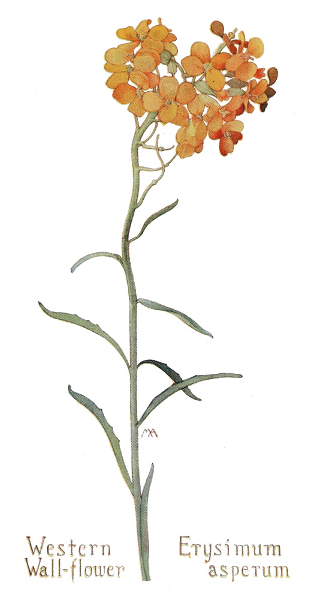
Western Wall-flower—Erysimum asperum.
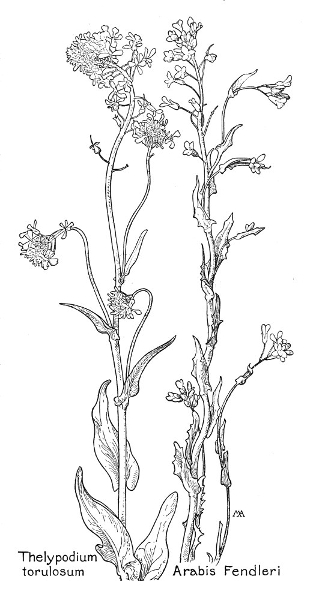
Thelypodium torulosum.
Arabis Fendleri.
There are a good many kinds of Thlaspi, of temperate
and arctic regions: smooth low plants, mostly mountain;
root-leaves forming a rosette; stem-leaves more or less
arrow-shaped and clasping; flowers rather small, white or
purplish; sepals blunt; style slender, sometimes none, with
a small stigma; pod flat, roundish, wedge-shaped, or heart-shaped,
with crests or wings.
Wild Candytuft,
Pennycress
Thláspi glaùcum
White
Spring, summer,
autumn
Northwest and
Utah
A rather pretty little plant, with several
flower-stalks, springing from rosettes of
leaves, dull-green, somewhat purplish
and thickish, smooth and obscurely
toothed, all more or less covered with a
"bloom"; the flowers small, slightly
fragrant, forming clusters less than an inch
across, the white petals longer than the
thin, greenish sepals. This grows on moist, mountain
slopes. T. alpéstre, of the Northwest, is similar, but without
"bloom."
There are only a few kinds of Dithyrea, grayish, hairy
plants, resembling Biscutella of the Mediterranean, with
yellowish or whitish flowers.
Dithýrea Wislizéni
White
Summer
Ariz., New Mex.,
Tex., Okla., Ark.
A little desert plant, from six to twelve
inches tall, with branching stems; pale,
yellowish-green, downy leaves, about an
inch long, with wavy or toothed margins;
small white flowers and funny little seed-pods,
sticking out at right-angles from the stem. This
grows at an altitude of three to four thousand feet and is
found in the Petrified Forest.
There are many kinds of Streptanthus, difficult to distinguish,
smooth plants, often with a "bloom"; stems
branching; leaves often clasping at base, the lower ones
usually more toothed or lobed than the upper. The
flowers are very peculiar in shape, not like most Mustards,
but suggesting the shape of a Bleeding Heart flower; the
sepals usually colored like the petals, two or all of them
bulging at base, so that the calyx is broad below and contracted
above; the corolla regular or irregular, the petals
purple or white, with claws and narrow, wavy or crisp
borders; the stamens four long and two short, or in three
unequal pairs, the longest pair often united below; the
pods long, narrow, flattish or cylindrical, on a broad
receptacle; the seeds flat and more or less winged. These
plants are called Jewel-flower, but the name does not seem
particularly appropriate.
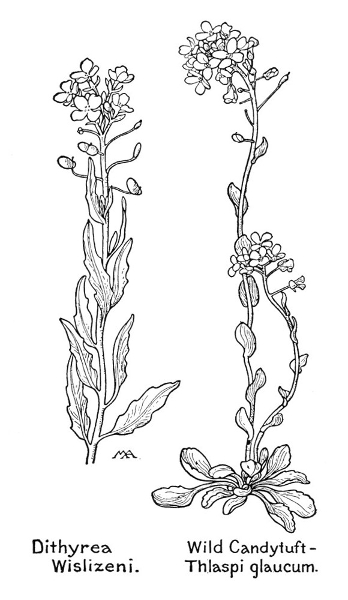
Dithyrea Wislizeni.
Wild Candytuft—Thlaspi glaucum.
Shield-leaf
Streptánthus
tortuòsus
Yellowish,
purplish
Summer
California
Nothing about this odd-looking plant is
pretty and it almost seems as if it were
trying to make up by eccentricity for its
lack of beauty. It is common in dry,
sandy places in the mountains and our
attention is first attracted to the tall,
branching stalks, because they are strung
with such queer-looking leaves. In summer the upper ones
are bright-yellow or dull-purple and they clasp the stem
and curve over, so that they look like small brass shields,
pierced by the stem. There are three or four of these
curving leaves, very smooth and shiny, and several more
below, which are flatter and dark-green, and the stem, from
six inches to three feet high, is oddly twisted and leans to
one side. The small flowers are yellowish or mauve, veined
with purple, less than half an inch long and peculiar in
shape. The contrast in color between the flowers and
leaves is very odd and very ugly, but as if this were not
enough, later in the season the curious thing hangs itself
with ridiculously long, slender pods, like great hooks, and
looks queerer and more disheveled than ever.
Arizona
Streptanthus
Streptánthus
Arizònicus
White
Spring
Arizona
Prettier and not so queer-looking as the
last. The leaves are arrow-shaped, clasping
at base, rather leathery, bluish-green,
with a "bloom" and tinged with purple
on the backs, the lower ones toothed, and
the pods are about two inches long, flat
and tinged with purple. The flowers are
half an inch long, pearly-white, the petals yellowish,
veined with purple, and are quite pretty. This grows in
dry places.
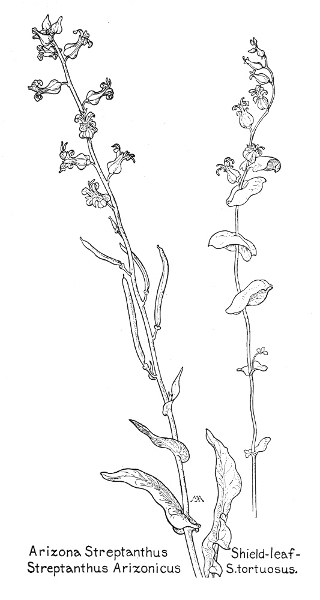
Arizona Streptanthus—Streptanthus Arizonicus.
Shield-leaf—S. tortuosus.
There are only a few kinds of Stanleya, all western;
tall, stout, smooth perennials, or biennials, with a "bloom";
flowers large, mostly yellow, without bracts, in long, terminal,
clusters; sepals long, narrow; petals long, narrow,
with long claws; stamens six, very nearly equal; ovary on a
short stalk, with a short style or none; pods long, narrow
and flattish, with long stalks; seeds numerous. Named for
Lord Edward Stanley, President of the Linnaean Society.
Golden Prince's
Plume
Stánleya
pinnatífida
Yellow
Spring
Southwest and
New Mex.
The pretty common name of this tall,
handsome plant was given by Helen Hunt
Jackson and the long, feathery wand of
numerous blossoms is beautiful and suggests
a plume. On the other hand, the
straggling flowers have such long, narrow,
curling petals, the threadlike filaments
look so much like curling antennae and the
long, thin pods stick out so awkwardly, like insects' legs,
from among the flowers on the lower part of the stalk, that
we find the general effect is rather weird and spidery. In
fact the plant I drew had a large yellow spider, precisely
the color of the flowers, half-concealed among them. The
stem is from two to five feet high; the leaves are smooth,
pale bluish-green, the lower ones with leaflets and a leaf-stalk,
and the flowers are bright-yellow, or cream-color,
about an inch across. This grows usually in dampish
spots, in arid regions. The picture is of one I found in
Indian Garden Canyon, a branch of the Grand Canyon.
Dryopétalon
runcinàtum
White
Spring
Arizona
The only kind, a fine plant, well worth
cultivation; smooth and branching, about
two feet tall, with handsome, bluish-green
leaves, with a "bloom," the root-leaves
with long, purplish leaf-stalks and sometimes
nine inches long; the flowers half an inch across, with
a lilac-tinged calyx and white petals, prettily toothed,
forming a pretty, rather flat-topped cluster. The pods are
very slender, nearly straight, one or two inches long. This
grows among rocks, in protected situations, and is not
common. Only a few, separate flowers are given in the
picture, as the plant I found, near the Desert Laboratory
at Tucson, was almost out of bloom.
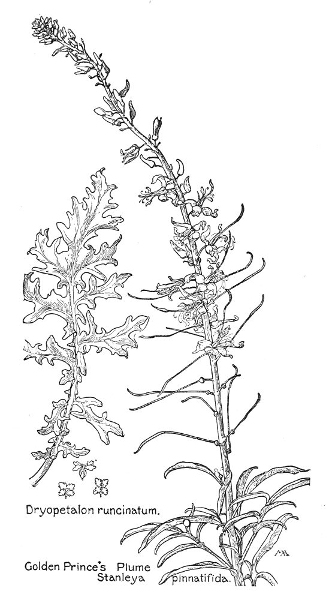
Dryopetalon runcinatum.
Golden Prince's Plume—Stanleya pinnatifida.
There are a good many kinds of Lesquerella, all American;
low plants, more or less hairy or scurfy; flowers mostly
yellow, in clusters; petals without claws; pods roundish,
more or less inflated, and giving the common name, Bladder-pod,
also used for Isomeris arborea.
White Bladder-pod
Lesquerélla purpùrea
White, pink
Spring Arizona
Pretty little plants, often growing in
quantities among rocks in mountain
canyons. The slender stems are from a
few inches to over a foot tall, springing
from a cluster of root-leaves, varying a
good deal in shape, dull-green and harsh
to the touch. The flowers are half an
inch or more across, with white petals, often tinged with
pink, with a little yellow in the throat, and form a pretty,
rather flat-topped cluster.
Yellow Bladder-pod
Lesquerélla
Arizònica
Yellow
Summer
Arizona
In desert places, such as the terrible
sandy wastes of the Petrified Forest,
where it seems a miracle that anything
should grow, we find the close, pale, gray-green
tufts of this little plant, crowned
with racemes of small bright-yellow flowers.
The small, thickish leaves are long, narrow
and white with close down, the stems, about three inches
high, branch at the root and the little pods are tipped with
a style of about their own length. L. Gordóni, of Arizona,
also has clusters of little yellow flowers, often covering
sandy hillsides with bright color; the leaves slightly stiff
and rough, the pods much inflated. It resembles L.
purpurea in general form and size.
There are many kinds of Brassica, coarse "weeds" in
this country. This is the ancient Latin name for Cabbage,
which belongs to this genus, as well as Cauliflower, Turnip,
and Brussels Sprouts.
Black Mustard
Brássica nìgra
Yellow
Summer
U. S.
A European "weed," common everywhere.
In California it grows to an
enormous height, sometimes twelve feet,
and when in bloom is a beautiful feature
of the landscape, covering the fields with a
shimmering sheet of pale gold. The leaves are dark-green,
smooth or with a few hairs, all with leaf-stalks, the
lower leaves large and jagged, cut into leaflets, the upper
leaves mostly toothless. The fragrant flowers form long
clusters, each flower about three-quarters of an inch across;
the small, cylindrical pods stand erect, close to the branching
stem. A valuable, antiseptic oil is made from the
black, pungent seeds, exported from California by the ton.
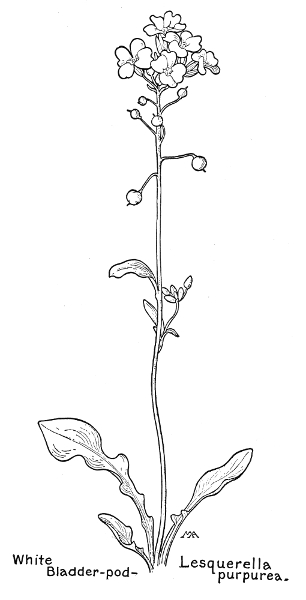
White Bladder-pod—Lesquerella purpurea.
The flowers of this family are much like the Mustards,
but the stamens are all of equal length and are often more
than six; the leaves are alternate and consist of three or
several leaflets, with stalks, and the plant usually tastes
bitter and disagreeable instead of pungent. There is no
partition in the pods, which are on long, threadlike stalks;
the ovary is superior and the seeds are kidney-shaped.
Many flowers have only a rudimentary pistil and never
produce fruit. The Caper, of which we eat the pickled
flower-buds for a relish, is a shrub which grows in the
Levant. The family is quite large and flourishes in warm
regions.
There are several kinds of Cleomella, resembling Cleome,
except that the pods are different.
Cleomella
Cleomélla lóngipes
Yellow
Spring
Nev., Cal., Oreg.
This is a handsome, rather odd-looking
plant, with a stout, smooth, yellowish
or purplish stem, sometimes branching
and over a foot tall. The leaves are
bright light-green, smooth, toothless and
slightly thickish, and the three leaflets are sometimes each
tipped with a hair, and have a tuft of small hairs at the
base of the leaf-stalk, in place of a stipule. The flowers
are about half an inch across, and are a beautiful warm
shade of golden-yellow, the long stamens being of the same
color and giving a very pretty feathery appearance to the
large cluster. The pods are queer-looking little things and
stick straight out from the stem. This has a slightly unpleasant
smell, but looks very gay and pretty in the fields
and along the edges of the mesas around Reno.
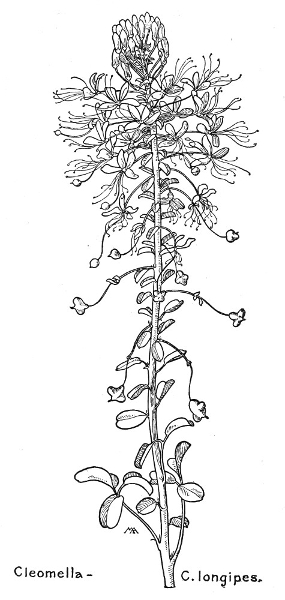
There are many kinds of Cleome; ours are branching
herbs, with palmately-divided leaves; the flowers with four
sepals, four petals, and six stamens. The ovary has a
stalk with a gland at its base and becomes a long pod, with
a long stalk and many seeds.
Bee-plant
Cleòme serrulàta
Pinkish-lilac,
white
Summer
Southwest, etc.
In Arizona this exceedingly handsome
plant often covers the dry beds of rivers
with acres of beautiful color. The
smooth, branching stem is sometimes as
much as eight feet high. The upper
leaves are long and narrow and the lower
are larger and usually have three leaflets, but all are bluish-green
and peculiarly soft and smooth to the touch. The
buds are purple and the delicate flowers, with threadlike
flower-stalks, grow in a handsome, feathery cluster, sometimes
a foot long, with numerous bracts. They have four,
pinkish-lilac or white petals and six exceedingly long,
threadlike stamens with minute, curling, green anthers.
The lilac pistil is also very long and before the flower drops
off begins to develop into a small, flat, green pod. These
gradually lengthen, until the stem is ornamented with
many hooklike pods, with slender stalks, hanging all along
it. Many of the flowers do not produce fruit. The
foliage when it is crushed gives off a rank, unpleasant smell,
which is responsible for the local name of Skunk-weed.
This is widely distributed and is found in the central and
northern part of the United States, as well as in the Southwest.
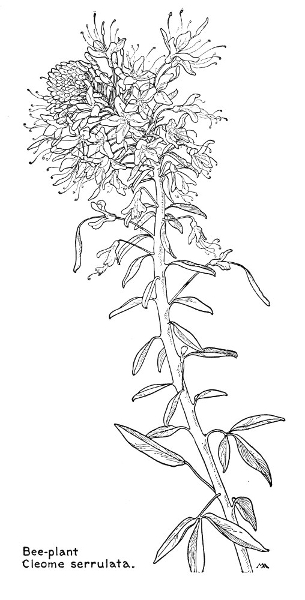
Bee-plant—Cleome serrulata.
Yellow Cleome
Cleòme platycàrpa
Yellow
Spring
Nevada
An odd-looking plant, with very pretty,
feathery flower-clusters. The hairy stem
is over a foot tall and the leaves are bright
yellowish-green and mostly smooth on the
upper side, with hairy margins and hairy
on the under side. The flowers are a warm shade of
bright golden-yellow and form a handsome, rather flat-topped
cluster, with long stamens, and the oblong pods are
an inch long or less, flat and much broader than those of
the last. The flowers are slightly sweet-scented and the
whole plant exudes a faint unpleasant odor. This is
conspicuous on the dreary mesas around Reno, often
growing with Cleomella longipes, which it very much
resembles in general appearance, except for the pods,
which are quite different.
There is only one kind of Isomeris.
Bladderpod
Isómeris arbòrea
Yellow
Spring
California
This is a shrub about three feet high,
which is attractive except for its unpleasant
smell. The leaves are smooth,
toothless, stiffish and thickish, and bluish-green,
with a small bristle at the tip, and
mostly with three leaflets. The pretty flowers are nearly
an inch across and warm yellow in color, not very bright
but pretty in tone, with six very long, yellow stamens, and
form a short, oblong cluster. The ovary has such a long
stalk, even in the flower, that it gives an odd appearance
and it develops into a very curious and conspicuous,
drooping pod, an inch and a half long, much inflated and
resembling a very fat pea-pod, on a long stalk, with two
rows of seeds like little peas inside it, which taste very
bitter. This is quite common on southern mesas. The
name Bladderpod is also used for Lesquerella, which belongs
to the Mustard Family.
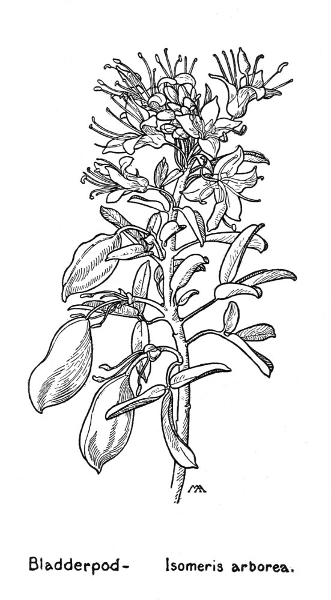
Bladderpod—Isomeris arborea.
A rather large family, widely distributed; odd-looking,
mostly very succulent herbs, with smooth, fleshy leaves
and stems, without stipules; flowers in clusters; sepals,
petals, pistils, and stamens, all of the same number, usually
four or five, sometimes the stamens twice as many; ovary
superior; receptacle with honey-bearing scales, one behind
each pistil; pistils separate, developing into small dry pods,
containing few or many, minute seeds. Some of these
plants look like tiny cabbages and we are all familiar with
their tight little rosettes in the formal garden-beds of hotels
and railway stations, where they are so stiff and unattractive
that we hardly recognize them when we find
them looking exceedingly pretty in their natural homes.
The Latin name means "thick."
There are many kinds of Sedum, no one kind very
widely distributed; fleshy herbs; leaves usually alternate;
flowers star-like, often in one-sided clusters; stamens and
pistils sometimes in different flowers on different plants;
sepals and petals four or five; stamens eight or ten, on the
calyx, the alternate ones usually attached to the petals;
styles usually short. The Latin name means "to sit,"
because these plants squat on the ground, and Stonecrop
is from their fondness for rocks.
Douglas Stonecrop
Sèdum Douglásii
Yellow
Spring, summer
Northwest
This makes beautiful golden patches,
on dry slopes or more or less open hilltops,
usually among limestone rocks. The
reddish stems are from six to ten inches
tall, the leaves are rather long and narrow,
thick but flat, forming pretty pale-green
rosettes, more or less tinged with pink and yellow, and the
pretty starry flowers are three-quarters of an inch across,
bright-yellow, with greenish centers, the stamens giving a
feathery appearance.
Yosemite Stonecrop
Sèdum
Yosemiténse
Yellow
Summer
California
On moss-covered rocks, moistened by
the glistening spray blowing from the
Yosemite waterfalls, we find these beautiful
plants, covering the stones with
a brilliant, many-colored carpet. The
flowers are stars of brightest gold, about
half an inch across and delicately scented,
and form flat-topped clusters, three or four inches across.
The upper part of the stalk, which is about six inches tall,
and the upper leaves are delicate bluish-green, but both
stem and leaves shade to vivid scarlet at the base. Spreading
out on the ground from the base of the stem in all
directions are numerous little runners, each bearing at the
end a small rosette of thick, blue-green leaves, forming a
beautiful contrast to the vivid color of flowers and stems.
The leaves and runners are very brittle and break off at a
touch.
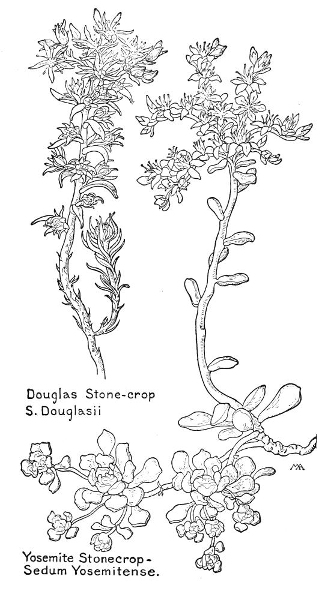
Douglas Stone-crop—S. Douglasii.
Yosemite Stonecrop—Sedum Yosemitense.
There are several kinds of Dudleya; perennials, very
thick and fleshy; root-leaves in a conspicuous rosette,
stem-leaves mostly bract-like, usually with a broad,
clasping base; flowers mostly yellow or reddish; calyx
conspicuous, with five lobes; petals united at base; stamens
ten. Most of these plants grow in the South, often on
rocks, in such shallow soil, that they would die in dry
weather, except that the juicy leaves retain their moisture
for a long time and nourish the plant. They resemble
Sedum in appearance, but as the petals are more or less
united the flowers are not starlike. The Indians make
poultices out of the leaves.
Hen-and-Chickens
Dúdleya Nevadénsis
(Cotyledon)
Orange-red
Summer
California
The succulent, reddish flower-stalks of
this handsome plant bear large, loose,
rather flat-topped clusters of orange-red
flowers, on coiling branches, and are about
a foot tall, with scaly bracts, springing
from a large handsome rosette on the
ground of very thick, pale-green leaves,
often tinged with pink. Other smaller
rosettes form a circle around it, hence its nice little common
name. D. pulverulénta (Echeveria) is beautiful but weird-looking.
It has red flowers, and the rosette, resembling
a small Century-plant, is covered all over with a white
powder which, among ordinary herbage, gives an exceedingly
striking and ghostlike effect. This plant is sometimes
a foot and a half across, with as many as eight, tall
stalks, and is found from San Diego to Santa Barbara.
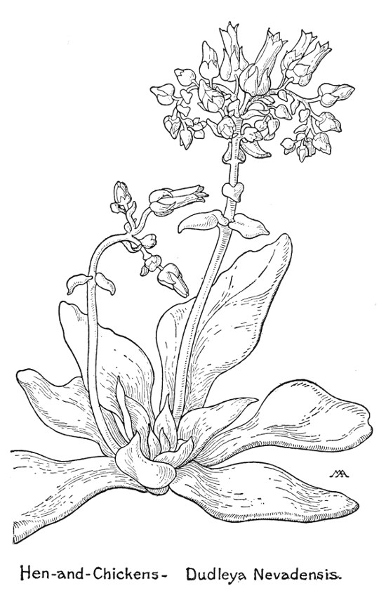
Hen-and-Chickens—Dudleya Nevadensis.
A large family, almost all herbs, living usually in temperate
regions. They have no very peculiar characteristics
and resemble the Rose Family, but sometimes their leaves
are opposite, usually they have no stipules and have fewer
stamens than Roses, not more than twice as many as the
sepals, and usually the pistils, from two to five in number,
with distinct styles, are united to form a compound ovary,
which is superior or partly inferior; sepals usually five;
petals four, five, or rarely none, alternate with the sepals;
petals and stamens borne on the calyx; fruit a dry pod or
berry, containing numerous seeds. The Latin name means
"rock breaker," as many grow among rocks.
There are several kinds of Parnassia, of north temperate
and arctic regions; smooth perennials; leaves toothless,
almost all from the root; flowers single; sepals five; petals
five, each with a cluster of sterile filaments, tipped with
glands, at the base; fertile stamens five, alternate with the
petals; ovary superior, or partly inferior, with a very short
style, or none, usually with four stigmas; fruit a capsule,
containing numerous winged seeds. These plants were
called Grass of Parnassus by Dioscorides, but are not grasslike.
They resemble the other members of this family so
little that they have been made into a separate family by
some botanists.
Grass of
Parnassus
Parnássia
fimbriàta
White
Summer
Northwest
A charming plant, with several slender
stems, about a foot tall, springing from a
large cluster of handsome, very smooth,
glossy leaves. The flowers are about an
inch across and have cream-white petals,
delicately veined with green and prettily
fringed towards the base, and pale yellow
anthers. At the base of each petal there is a queer little
stiff cluster of sterile filaments, like a tiny green hand.
This grows on banks of streams and in moist places,
reaching an altitude of eleven thousand feet. P. Californica
is similar, but the petals not fringed.
There are several kinds of Leptasea, perennials, with
alternate, thick or stiffish leaves; flowers white or yellow,
single or in terminal clusters; sepals five; petals five, with
claws or claw-like bases; stamens ten; ovary mostly superior.
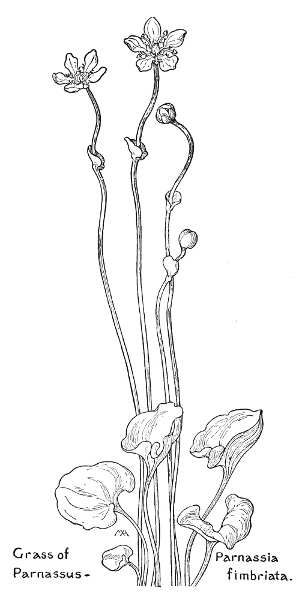
Grass of Parnassus—Parnassia fimbriata.
Dotted Saxifrage
Leptàsea austromontàna.
(Saxifraga
bronchialis)
White
Summer
Northwest
Pretty little plants, about six inches tall,
forming matted clumps of stiff, rather
dark green foliage, the twigs crowded with
leathery, toothless leaves, bristly along
the edges and tipped with a little stiff
point. The pretty flowers are about half
an inch across, their white petals dotted
with dark red or purple towards the tips,
sometimes dotted with yellow near the center, with yellow
anthers and a pale green ovary, partly inferior. These
little plants sometimes cover rocky slopes for long distances
with their leafy mats and are common in the mountains
at moderate altitudes.
There are several kinds of Muscaria, perennial, matted
herbs; leaves alternate, usually three-lobed, mostly from
the root; flowers white, single, or a few in terminal clusters;
sepals five; petals five, without claws; stamens ten; ovary
about one-half inferior.
Tufted Saxifrage
Muscària
caespitòsa
(Saxifraga)
White
Summer
Northwest, etc.
Pretty little plants, from two to six
inches tall, with small leaves, with from
three to five lobes or teeth, forming matted
patches of pretty foliage, from which
spring many slender, slightly hairy flower-stems,
with a few bracts or leaves, and
bearing one or more pretty flowers, less
than half an inch across, with white petals, yellow anthers,
and a greenish-yellow ovary. This grows in rocky crevices
in the mountains, across the continent, also in arctic and
alpine Europe and Siberia.
There are a good many kinds of Lithophragma, perennials,
bearing bulblets on their slender rootstocks and
sometimes also on the stems; leaves more or less divided,
mostly from the root; stipules small; flowers few, in a
loose, terminal cluster; sepals five; petals five, white or
pink, with claws; stamens ten, short; ovary superior or
partly inferior, with three short styles.
Woodland Star
Lithophrágma
heterophýlla
White
Spring, summer
California
A little woodland plant, delicate and
pretty, with a slender, hairy stem, from
nine inches to two feet tall, springing
from a pretty cluster of hairy leaves,
variable in shape, but usually with three
or five lobes. The starry flowers are
three-quarters of an inch across, with white petals, prettily
slashed. This is sometimes called Star of Bethlehem, but
that name belongs to an Ornithogalum, grown in gardens.
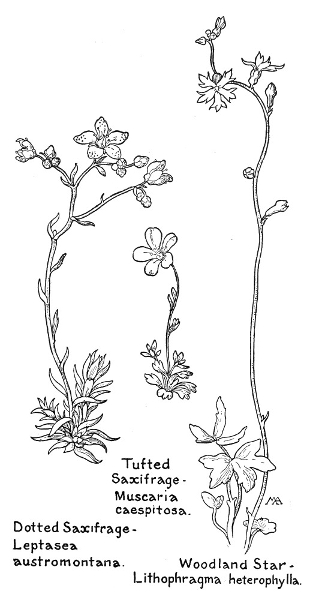
Dotted Saxifrage—Leptasea austromontana.
Tufted Saxifrage—Muscaria caespitosa.
Woodland Star—Lithophragma heterophylla.
Youth-on-age
Leptáxis
Menzièsii.
(Tolmiea)
Purplish
Summer
Wash., Oreg., Cal.
The only kind, a perennial, over a foot
tall, with a hairy stem bearing a graceful
wand of small flowers, springing from a
cluster of root-leaves, bright green and
thin in texture, but roughish and sparsely
hairy. The flowers are about a third of
an inch long, the calyx, which is the conspicuous
part, dark-purple or pinkish-red and slightly
irregular, with three large and two small sepals, and the
petals of the same color, but so narrow that they look like
long curling filaments. The three stamens are opposite the
three upper sepals, the ovary is superior and the capsule
has two long beaks. Young plants often spring from the
base of the leaf, where it joins the leaf-stalk, and this habit
gives the common name. This grows in mountain woods
and is attractive, for though the flowers are dull in color
they are unusual in form and the leaves are pretty.
There are a good many kinds of Heuchera, North
American, difficult to distinguish; perennials, with stout
rootstocks; leaves mostly from the root; flowers small, in
clusters; calyx-tube bell-shaped, with five lobes; petals
small, sometimes lacking, on the throat of the calyx, with
claws; stamens five, inserted with the petals; ovary partly
inferior, with two slender styles, becoming two beaks on the
capsule.
Alumroot
Heuchèra
micrántha
Pink and white
Summer
Cal., Oreg., Wash.
These feathery sprays are so airy and
delicate that they might almost be made
of mingled mist and moonshine, blown
from the waterfalls they love to haunt, but
are not so fragile as they look, for the
clusters of tiny pink and white flowers
last a long time in water. The stem is very slender, rather
hairy, from one to three feet tall, springing from a cluster
of roundish leaves, prettily lobed and scalloped, bright
green, with some white hairs on the backs and on the long
leaf-stems, often with red veins. The handsome leaves
and lovely feathery spires are conspicuous, decorative and
quite common, among mossy rocks in dark, rich mountain
woods, up to six thousand feet.
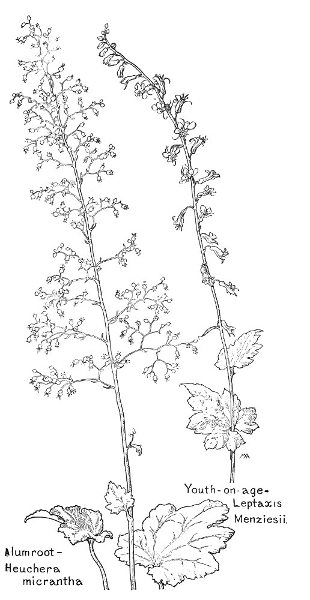
Alumroot—Heuchera micrantha.
Youth-on-age—Leptaxis Menziesii.
Alumroot
Heuchèra
rubéscens
Pink and white
Summer
Southwest, Utah,
Nev.
This is not so tall and the leaves, with
blunt teeth and sometimes slightly lobed,
are smaller. In Utah they are dark green
and shining on the upper side, smooth or
slightly downy, with a bristle at the tip
of each lobe, often reddish on the under
side, and in Yosemite quite rough, with
hairs on the edges and veins. The flowers are about a
quarter of an inch across, the calyx deep-pink, with blunt,
green teeth, the petals long, narrow and white, the general
effect of the flower being pink. The clusters are not
nearly so airy as those of H. micrantha and in the high
Sierras the stems are shorter and the clusters still more
compact. This was first found on one of the islands in
Great Salt Lake. There are other similar kinds, some
with greenish flowers.
There are several kinds of Micranthes, perennials,
sometimes with bulblets at the base of the stem; leaves
thickish, from the root; flowers white, in terminal clusters;
petals five, mostly without claws; stamens ten; ovary
slightly inferior.
Tall Swamp
Saxifrage
Micránthes
Oregàna
(Saxifraga)
White
Summer
Northwest
This is conspicuous on account of its
height, with a stout, stiff, leafless, hairy
flower-stalk, three feet or more tall,
springing from a loose rosette of smooth,
thickish, bright-green leaves, not standing
up stiffly but spreading, sometimes
nearly a foot long, paler on the under side
and obscurely toothed at the ends, with
some minute hairs along the lower margins. The flowers
are small, with cream-white petals, orange-red anthers and
a green ovary, and form a long branching cluster towards
the top of the stalk. This grows in swamps in the mountains.
Saxifrage
Micránthes
rhomboídea
(Saxifraga)
White
Spring, summer
Southwest, Idaho,
Utah, Col.
A little alpine plant, growing in moist
soil, or on mossy rocks. The sticky-hairy
flower-stem is from two to twelve inches
tall, springing from a cluster of dull-green
root-leaves, toothless, or toothed
towards the ends, slightly thickish and
very slightly downy and the flowers are
small, and form a compact cluster.
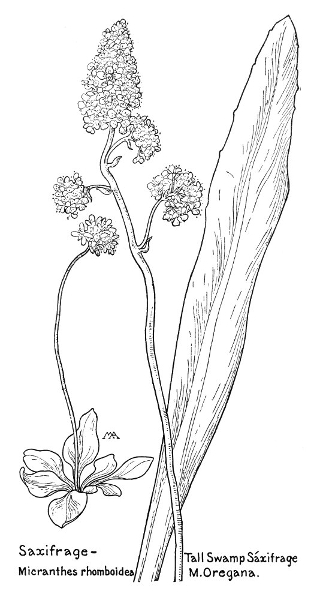
Saxifrage—Micranthes rhomboidea.
Tall Swamp Sáxifrage—M. Oregana.
Modesty
Whípplea modésta
White
Spring
Wash., Oreg., Cal.
The only kind, a pretty little under-shrub,
with many woody stems, spreading
and trailing on the ground, the branches
clothed with more or less hairy leaves,
with three veins, and bearing clusters of
very small flowers, with a pleasant honey-like fragrance.
They usually have ten stamens, the ovary is partially
inferior, with from three to five styles; sepals whitish;
petals white, becoming greenish. The low masses of green
foliage, spotted with white flower clusters, are a pretty
feature of the Coast Range forests and thickets, especially
among redwoods.
There are several kinds of Mitella, perennials, of North
America and Asia.
Bishop's Cap,
Mitrewort
Mitélla ovális
White
Summer Northwest and Utah
An inconspicuous little plant, of mountain
woods, with pretty leaves and tiny
flowers. The slender, hairy, leafless stem,
about ten inches tall, springs from a
cluster of root-leaves, smooth on the
upper side, except for a few bristly hairs,
with bristly hairs on the under veins and
on the long, slender leaf-stalks. The flowers grow in a
graceful, one-sided spray and have a five-lobed, green
calyx, five minute petals, five stamens with short filaments,
and a roundish ovary, almost wholly inferior. The petals
have pretty little bits of feathery fringe between them,
which make the little flowers look like tiny snow crystals
in shape, when we examine them closely.
There are several kinds of Spatularia, perennials,
sometimes with bulblets; leaves from the root, mostly
toothed; flowers white, in open clusters; sepals five; petals
all clawed, the three upper differing from the two lower;
ovary chiefly superior.
Spatulària
Brunoniàna
(Saxifraga
Nutkana)
(Saxifraga
Bongardi)
White
Summer
Northwest
A beautiful plant, with such slender
stems and branches that, at a distance,
the little white flowers look like specks of
foam. The hairy, reddish stems, from a
few inches to over a foot tall and very
branching, spring from clusters of thickish,
stiffish, hairy root-leaves and bear dozens
of flowers, about three-eighths of an inch
across, with white petals, spotted with
yellow or red at the base and slightly irregular, the three
upper petals being narrower than the two lower. The
anthers are orange; ovary white or pinkish; calyxes and
buds purplish-red. This grows among rocks in mountains.
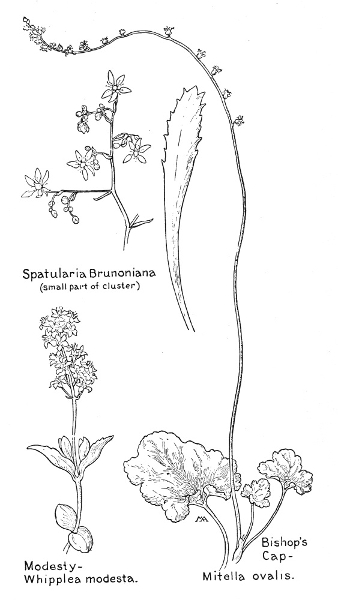
Spatularia Brunoniana (small part of cluster).
Modesty—Whipplea modesta.
Bishop's Cap—Mitella ovalis.
Shrubs or trees, with opposite leaves and no stipules.
The flowers are in clusters and usually perfect, but sometimes
those at the margins of the clusters are without pistils
or stamens and larger than those in the middle; the calyx
usually with four to ten sepals, and in sterile flowers often
conspicuously enlarged; the petals four to ten; the stamens
eight to many; the ovary wholly or partly inferior; the
styles separate or united, sometimes lacking; the fruit a
capsule. Many very ornamental garden shrubs, such as
Deutzia and Hydrangea, are included in this family.
There are several kinds of Fendlera, natives of North
America; shrubs, with white or pink flowers, with four
sepals and four petals, the latter with claws. The eight
stamens have two-forked filaments and the ovary is partly
inferior, with four styles.
Féndlera rupícola
White, pink
Spring
Ariz., Utah, Nev.
Among the many beautiful plants to be
found in the Grand Canyon one of the
most conspicuous is the Fendlera. It is a
tall, handsome shrub, growing along the
upper part of Bright Angel trail, and in May it is covered
with charming white blossoms. These flowers measure
an inch across, and have cream-white or pale pink petals,
narrowing to a claw at the base, and purplish sepals, and
they grow in clusters of three or four, mixed with pink
buds, on the ends of short branches. The small oblong
leaves have three nerves and the wood is tough and gray,
with deeply furrowed bark. Though their scent is rather
unpleasant, the flowers are lovely and look just like some
novel variety of fruit-blossom, but this resemblance is
deceptive for they produce nothing but dry pods.
There are a good many kinds of Philadelphus, natives
of North America, Asia, and Europe; shrubs, with large,
white or cream-colored flowers; the calyx top-shaped, with
four or five lobes; the petals four or five; the stamens
twenty to forty, inserted on a disk; the ovary inferior, with
three to five styles; the capsule top-shaped, containing
many oblong seeds. These plants were named in honor
of King Ptolemy Philadelphus. They are often called
Mock-Orange, because the flowers often resemble orange-blossoms.
The commonest name, Syringa, is confusing,
because that is the generic name of the Lilac.
Syringa
Philadélphus
Califórnicus
White
Summer
Cal., Oreg., Wash.
In June and July, in the high Sierras,
up to an altitude of four thousand feet,
this lovely shrub forms fragrant thickets
of bloom. It looks very much like the
familiar garden Syringa and the smell is
just as delicious. The bush is from four
to twelve feet high, with smooth, pale, woody stems, dark-green
leaves, sometimes slightly toothed, very smooth and
shiny, and pretty flowers, in clusters at the ends of the
branches. They are each about an inch across, with four
or five, cream-white petals, rolled in the bud, and a golden
center, composed of numerous, bright-yellow stamens.
Small Syringa
Philadélphus
microphýllus
White
Summer
Ariz., Cal.,
New Mex.
A small shrub, not nearly so handsome
as the last, from two to three feet high,
with slender, pale-gray, woody stems,
branching very abruptly. The small
leaves are smooth and very bright green
on the upper side, but the under side is
very pale and covered with close white
down. The flowers are much smaller than the garden
Syringa, with white petals and numerous yellow stamens,
the calyx reddish outside and downy within, and have a
delicious smell, like lemon-blossoms. This pretty little
shrub may be found growing in small shady canyons, in
northern Arizona and elsewhere in the Southwest.
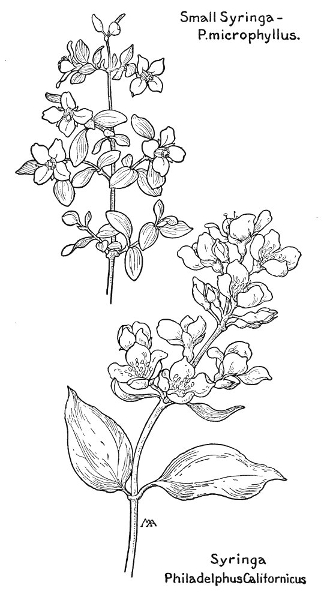
Small Syringa—P. microphyllus.
Syringa Philadelphus Californicus.
A small family, shrubs, with alternate, palmately-lobed
leaves, often sticky or resinous; the flowers almost always
in clusters; the pedicels with a bract at the base and
usually with two bractlets halfway up; petals five, or
rarely four, usually smaller than the calyx-lobes; stamens
of the same number as the petals and alternate with them;
ovary inferior, with two styles, more or less united; fruit
a berry, crowned with the withered remains of the flower.
There are several kinds of Grossularia, or Gooseberry;
shrubs, sometimes with trailing branches, almost always
spiny; flowers with bracts; ovary often spiny.
Wild Gooseberry
Grossulària
Roèzli (Ribes)
Maroon and white
Spring
California
This is a stout shrub, one to four feet
high, with thick, short, rigid little branches,
the knobby joints more or less spiny.
The roundish leaves, less than an inch
across, are lobed and scalloped, rather
dull green and slightly downy, and the
flowers are about half an inch long, with maroon-colored
sepals and white petals, the base of the calyx-tube downy.
The purple berry is half an inch in diameter and covered
with stout prickles. This Gooseberry is common at
moderate altitudes. The drooping, red and white flowers
resemble tiny Fuchsias, both in color and form. G.
Menzièsii, the Canyon Gooseberry, also has pretty fuchsia-like
flowers and grows in the Coast Ranges of California
and Oregon, blooming in the winter.
Fuchsia-flowered
Gooseberry
Grossulària
speciòsa
Red
Spring
California
In spite of its name, the flowers of this
handsome shrub do not look as much like
Fuchsias as the two last. The stems are
armed with long thorns and the leaves
are thick, dark green, and glossy. The
flowers have four sepals, four petals, and
four stamens and are about an inch long
and beautiful bright-red in color. The berry is dry and
very prickly. This is common in the southern part of
California.
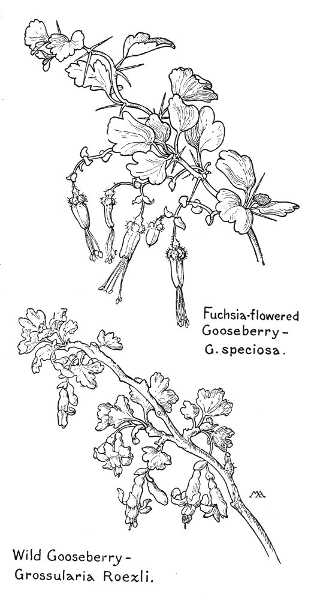
Fuchsia-flowered Gooseberry—G. speciosa.
Wild Gooseberry—Grossularia Roezli.
There are many kinds of Ribes, or Currant, of temperate
regions; shrubs, almost always smooth; flowers sometimes
blooming before the leaves, with five petals, smaller than
the five calyx-lobes, which are often colored; stamens five;
ovary inferior, fruit a smooth, many-seeded berry. In
general the low shrubs, with their pretty foliage, may be
recognized by their resemblance to cultivated kinds.
Ribes is the ancient Arabic name.
Black Currant
Rìbes Hudsoniànum
White
Spring, summer
Utah, Wash.,
Idaho, etc.
Except that its foliage has a strong disagreeable
smell, this is an attractive shrub,
three to six feet high, with pale gray,
woody stems, without thorns, and smooth,
bright green leaves, five-lobed and thin in
texture, paler on the under side, with
resinous dots and broad, papery stipules,
in clusters, with reddish bracts at the base. The flowers
form close, erect clusters, less than two inches long, springing
from the same bud as the leaves; the calyx, which is
the conspicuous part, cream-white, greenish in the center;
the petals very small and white. The berry is smooth or
hairy, round and black, without "bloom," and possibly
edible, but so bad-smelling as to be avoided. This grows
beside mountain streams and is found as far north as
British Columbia.
Sierra Currant
Rìbes Nevadénse
Pink
Summer
Cal., Oreg., Wash.,
Nev.
A thrifty, mountain bush, from three to
six feet high, the upper stems pale gray
and the lower ones reddish; the leaves
thin and smooth, prettily scalloped and
lobed, often with a few white hairs at the
base of the leaf-stalks. The flowers are
fragrant and pink, over half an inch long, and form a close
cluster, of eight or more. The berry is black, with a white
"bloom," and tastes sweet and insipid. This reaches an
altitude of eight thousand feet. Rìbes glutinòsum is
called Incense-shrub, because of its strong fragrance. It is
a large handsome shrub, sometimes fifteen feet high, with
beautiful drooping clusters of gay pink flowers. The
leaves are sticky when they first come out and the berry
is blue, with a dense "bloom," bristly, dry and bitter, or
insipid. This blooms in winter or early spring and is
common in canyons near the coast.
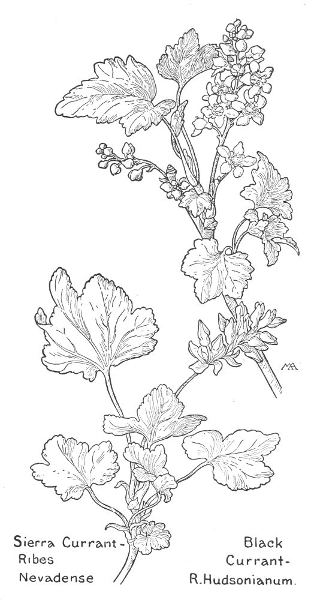
Sierra Currant—Ribes Nevadense.
Black Currant—R. Hudsonianum.
Golden, Missouri
or Buffalo Currant
Rìbes àureum
Yellow
Spring, summer
West, etc.
A very handsome bush, from five to
twelve feet high, with pretty foliage and
smooth, pinkish-gray, woody stems. The
bright green leaves, with three or five
lobes, are thin in texture, with a few hairs
on the leaf-stalks, fresh and glossy-looking,
and setting off the bright clusters of clear yellow flowers,
of which the calyx, half an inch across, with a long greenish-yellow
tube, is the conspicuous part. The small petals are
sometimes yellow, but often bright red and the fruit is
smooth, yellow, red, or black, and edible. This is deliciously
fragrant and spicy, very handsome and attractive,
growing beside brooks and in moist canyons, where sometimes,
in masses, it has at a distance the effect of Forsythia,
but purer in color. It grows as far east as Missouri and
is often cultivated.
A rather large family, widely distributed, including
many attractive trees and shrubs, such as Mountain Ash
and Hawthorn, as well as Pears and Apples, with pretty
blossoms and conspicuous, often edible fruits; leaves alternate;
stipules small; flowers regular, perfect, single or in
clusters; calyx usually five-toothed or five-lobed; petals
mostly five, usually with claws; stamens numerous, or
rarely few, separate, with small anthers; ovary inferior and
compound; styles one to five. The calyx-tube gradually
thickens and becomes a "pome," or apple-like fruit, in
which the core is the ovary.
There are several kinds of Amelanchier, of the north
temperate zone; shrubs or trees, with thornless branches
and white flowers, usually in clusters; calyx-tube bell-shaped,
with five narrow sepals; petals five; stamens
numerous, on the throat of the calyx; styles two to five in
number, united and hairy at base; ovary wholly or partly
inferior; fruit small and berry-like. The name is from the
French for the Medlar. These shrubs are called Shadbush
in the East, because they bloom just when the shad
are beginning to run in the rivers.
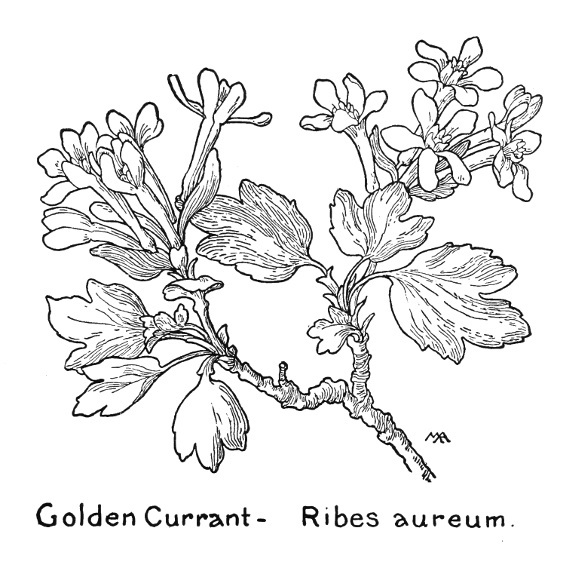
Golden Currant—Ribes aureum.
Service-berry,
June-berry
Amelánchier
alnifòlia
White
Spring, summer
West, etc.
A pretty shrub with woody, branching
stems, reddish twigs and smooth, bright
green leaves, sometimes downy on the
under side, toothed only at the ends. The
flowers, less than an inch across, have long,
narrow, straggling petals, and are so
mixed with leaves, and crowded so irregularly
on the branches, that the effect is rather ragged. The
roundish, pulpy, black fruit is liked by the Indians, but
though sweet is insipid. When thickets of this shrub are
in bloom on mountainsides the effect is very pretty, especially
in Utah, where the shrubs are more compact and
the flowers less straggling than in Yosemite, giving at a
distance much the effect of Hawthorn. It grows as far
east as Nebraska and in British Columbia.
A rather small family, widely distributed, trees or shrubs,
the bark exuding gum, the foliage, bark, and seeds bitter,
containing prussic acid; leaves alternate, toothed, with
leaf-stalks; stipules small; flowers mostly perfect, regular,
single or in clusters; calyx five-lobed, dropping off after
flowering; petals five, inserted on the calyx; stamens
numerous, inserted with the petals; pistil one in our genera;
ovary superior, developing into a stone-fruit.
There are many kinds of Prunus, including Cherry as
well as Plum, with white or pink flowers and usually edible
fruits. Prunus is the ancient Latin name for plum.
Holly-leaved Cherry,
Islay
Prùnus ilicifòlia
White
Summer
California
Mountain slopes near Santa Barbara
are beautiful in June with the creamy
flowers of this very ornamental evergreen
shrub, from five to twenty-five feet high,
with shiny, leathery, dark green leaves,
with prickly edges, looking much like
Holly. The small flowers form close but feathery clusters,
from one to three inches long, and smell pleasantly of
honey. The sweetish fruit, not particularly good to eat,
is a dark red cherry, about half an inch in diameter. In
dry places these shrubs are small, but in favorable situations,
such as the old mission gardens, where they have
been growing for perhaps a hundred years, they develop
into small trees.
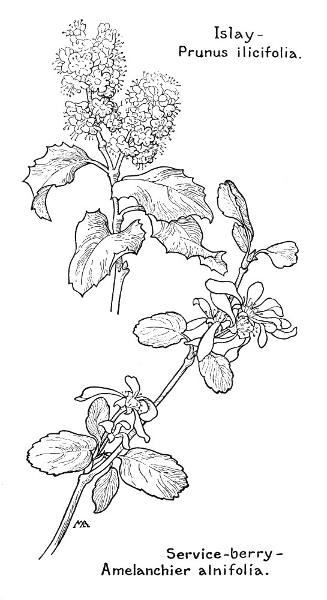
Islay—Prunus ilicifolia.
Service-berry—Amelanchier alnifolia.
A large and important family, widely distributed and
including some of our loveliest flowers and most delicious
fruits; herbs, shrubs, or trees; generally with stipules and
usually with alternate leaves; the flowers rich in pollen
and honey and usually perfect. The calyx usually five-lobed,
often with bracts, with a disk adhering to its base;
the petals of the same number as the calyx-lobes, separate
or none; the stamens usually numerous, separate, with
small anthers; the ovary superior, or partly inferior; the
pistils few or many, separate or adhering to the calyx,
sometimes, as in the true Rose, enclosed and concealed in a
hollow receptacle; the fruit of various kinds and shapes.
There are several kinds of Opulaster, branching shrubs,
with clusters of white flowers and grayish or reddish,
shreddy bark.
Ninebark
Opuláster
malvàceus
(Physocarpus)
White
Summer
Northwest, Utah,
Ariz.
This is a handsome bush, from three to
six feet high, with pretty, almost smooth,
bright green leaves, with large stipules.
The flowers are sweet-smelling, about half
an inch across, with cream-white petals,
and form very beautiful and conspicuous
rounded clusters, about three inches across,
the long stamens giving a very feathery
appearance. At a distance this shrub has the effect of
Hawthorn in the landscape. It grows on mountainsides in
rich soil.
Apache Plume
Fallùgia paradóxa
White
Spring
Ariz., New Mex.
There are two kinds of Fallugia. This
is usually a low undershrub, but in the
Grand Canyon, on the plateau, it is a fine
bush, four or five feet high, with pale
woody, branching stems; the small, somewhat
downy, evergreen leaves, resembling those of the Cliff
Rose, but the flowers larger. They are white, two inches
across, like a Wild Rose in shape, with beautiful golden centers,
and grow on long, slender, downy flower-stalks, at the
ends of the branches. Individually, they are handsomer
than the flowers of the Cliff Rose, but not nearly so effective,
as the bloom is much more scattered. The calyx-tube is
downy inside and the five sepals alternate with five, small,
long, narrow bractlets. The hairy pistils are on a small
conical receptacle, surrounded by a triple row of very
numerous stamens on the margin of the calyx-tube.
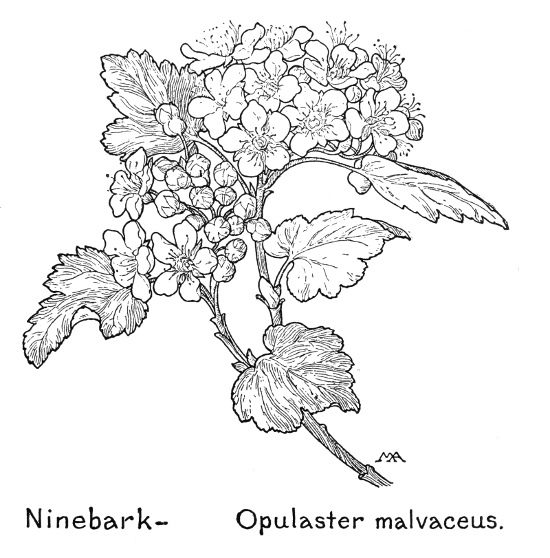
Ninebark—Opulaster malvaceus.
Wild Roses are widely distributed in the northern
hemisphere and are too familiar to need much description.
There are numerous kinds; some are climbing, all are
prickly and thorny, with handsome, often fragrant,
flowers and compound leaves, with toothed edges. The
numerous yellow stamens are on the thick margin of a
silky disk, which nearly closes the mouth of the calyx.
The numerous pistils develop into akenes, or small, dry,
one-seeded fruits. These look like seeds and we find them
inside the calyx-tube, which in ripening enlarges and
becomes round or urn-shaped. These swollen calyx-tubes
are the "hips," which turn scarlet and add so much
to the beauty of the rose-bush when the flowers are gone.
Rosa is the ancient Latin name.
Fendler's Rose
Ròsa Féndleri
Pink
Spring, summer
Idaho, Utah, Ariz.
This is a very handsome thrifty bush,
about four feet high, with smooth, or
slightly downy, bright green leaves, and
thorny stems, with slightly curved thorns.
The flowers are more or less fragrant and
about two inches across, with bright pink petals, which
gradually become paler as they fade, and pretty crimson-tipped
buds. This has smooth "hips" and is a beautiful
and conspicuous kind, growing in valleys and along streams,
up to an altitude of nine thousand feet. It is widely
distributed and variable, probably including several forms.
California Wild
Rose
Ròsa Califórnica
Pink
Spring, summer,
autumn
Cal., Oreg.
A large bush, three to six feet high, with
erect, branching stems, armed with a few,
stout thorns, which turn back. The
leaves are more or less downy, especially
on the under side, with from three to seven
leaflets, and the flowers usually form a
cluster of few or many and are each from
one to nearly two inches across, with pale pink petals.
They are lovely flowers, with a delicious fragrance, and are
common at low and moderate altitudes in California,
usually growing near streams.
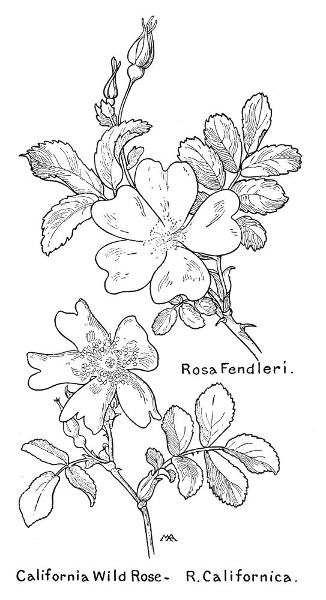
Rosa Fendleri.
California Wild Rose—R. Californíca.
Redwood Rose
Ròsa gymnocàrpa
Pink
Spring, summer
Northwest
A charming kind, delicate both in
foliage and flower, usually growing in
shady, mountain woods. The slender
bush is from one to three feet high, with
dark brown stems, armed with some
straight, slender thorns, and light green leaves, usually
with quite a number of neat little leaflets, smooth and thin
in texture. The flowers are an inch or less across, usually
single, with light yellow centers and bright pink petals,
very clean and fresh in tone, usually deeper towards the
margins. The sepals are not leafy at the tips, the flower-stalks,
and sometimes the leaf-stalks also, are covered with
small, dark, sticky hairs and the buds are tipped with
carmine. Neither leaves nor flowers are fragrant.
Mountain Misery
Chamaebàtia
foliolòsa
White
Summer
California
This is the only kind. In open places,
in the Sierra forests, the ground is often
carpeted for acres with the feathery
foliage of this charming shrub, sprinkled
all over with pretty white flowers. Mountain
Misery does not at first seem an
appropriate name for so attractive a plant, but when we
walk through the low, green thickets we find not only that
the tangled branches catch our feet but that the whole
plant is covered with a strong-smelling, resinous substance,
which comes off on our clothes in a most disagreeable
manner. On a warm day the forest is filled with the peculiar,
medicinal fragrance and when, later in the season, we
unpack our camping outfit we are apt to be puzzled by the
smell of "Pond's Extract" which our clothes exhale.
The shrub is usually less than two feet high, with downy,
evergreen foliage, the numerous small leaflets so minutely
subdivided and scalloped that they have the appearance
of soft ferns. The flowers resemble large strawberry-blossoms,
and have a top-shaped, five-lobed calyx, many
yellow stamens and one pistil, becoming a large, leathery
akene. The smell and foliage attract attention and the
shrub has many names, such as Bear-mat and Kittikit,
or Kit-kit-dizze, so-called by the Indians. Bears do not
eat it, so the name Bear-clover is poor, and Tarweed
belongs to another plant. It is used medicinally.
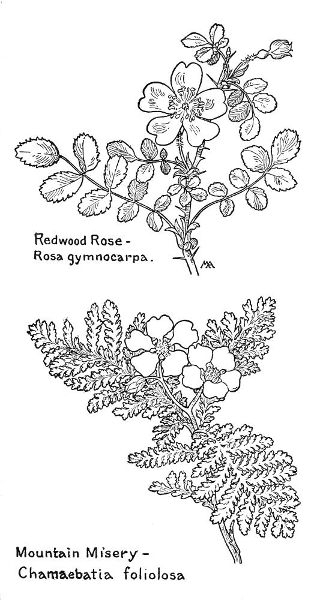
Redwood Rose—Rosa gymnocarpa.
Mountain Misery—Chamaebatia foliolosa.
This is the only kind of Stellariopsis; perennial herbs;
the leaves with many, minute, crowded, overlapping
leaflets; the flowers white, in open clusters; bractlets,
sepals, and petals five; stamens fifteen; pistil one, surrounded
by bristles.
Pussy-tails
Stellariópsis
santolinoìdes
(Ivesia)
White
Summer
California
The leaves of this odd little plant look
like catkins, or the sleek, gray tails of
some little animal. They are cylindrical
in form, three or four inches long, composed
of many minute leaflets, crowded
closely around a long, central stem.
These little leaflets, hardly more than
green scales, are smothered with soft, white down, which
gives the whole "tail" a silky, silvery-gray appearance.
From the midst of a bunch of these curious leaves, which
are mostly from the root, spring several very slender stems,
widely branching above, from six to twelve inches tall,
and at the ends of the branches are airy clusters of pretty
little flowers, like tiny strawberry-blossoms. These little
plants grow in sandy soil, at high altitudes, and are plentiful
on the gravelly "domes" around Yosemite.
There are a good many kinds of Horkelia; perennial
herbs, with compound leaves, usually with many leaflets,
and flowers in clusters; calyx cup-shaped, or saucer-shaped,
with five teeth and five bractlets; stamens ten; pistils two
or many, with long slender styles, and borne on a receptacle
like that of Potentilla, which these plants resemble, though
the flowers are usually smaller, in closer clusters.
Horkèlia fúsca
White
Summer
Cal., Oreg., Nev.
A rather attractive plant, for the foliage
is pretty, though the flowers are not very
conspicuous. The rather stout, roughish
stem, often purplish, is from one to two
feet tall and the leaves are rather dark green, slightly
sticky and sometimes downy. The flowers are about half
an inch across, with white petals, tinged with pink, and
are well set off by the dark reddish or purplish calyxes and
buds, but the petals are too far apart, and there are not
enough flowers out at one time, for the effect to be good.
This varies a good deal in hairiness and there are several
varieties. It is common in Yosemite.
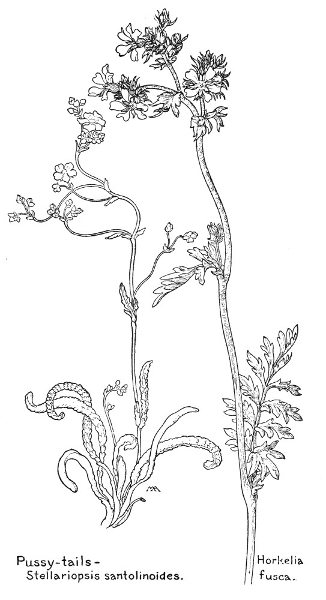
Pussy-tails—Stellariopsis santolinoides.
Horkelia fusca.
There are several kinds of Cowania.
Cliff Rose
Cowània
Stansburiàna
Yellow
Spring, summer
Southwest
Altitude and soil make a great difference
in the beauty of this shrub. On the
rocky rim of the Grand Canyon it is from
four to eight feet high, picturesquely
gnarled and twisted, but stunted looking,
the gray bark hanging off the crooked
branches and thick, distorted trunk in untidy shreds, the
flowers pale, scanty, and but faintly scented. Halfway
down Bright Angel trail it is a glorious thing, full of color
and fragrance, about twelve feet high, luxuriant and
healthy-looking. The small, leathery, evergreen leaves,
crowded in bunches along the branches, are glossy and rich
in color, setting off the light yellow flowers, with golden
centers, which form long wands of bloom. The upper
branches are clustered closely their whole length with
blossoms, and when the wind sways the flowering branches
to and fro they exhale an exquisite fragrance like orange
flowers. The bloom is at its best in the Canyon in May,
but there are still some lingering flowers in August. The
calyx is top-shaped, with the petals and the two rows of
numerous stamens on the throat of the tube. The pistils,
from five to twelve, are densely woolly. The akenes have
pale, silky-hairy tails, two inches or more in length, suggesting
gone-to-seed Clematis. For some occult reason
this shrub is called Quinine Bush at the Grand Canyon.
There are two kinds of Aruncus, resembling Spiraea;
with small white flowers, the stamens and pistils in separate
flowers on different plants. Aruncus is a word used by
Pliny to designate a goat's beard.
Goat's Beard
Arúncus sylvéster
(Spiraea aruncus)
White
Summer
Northwest, etc.
A pretty plant, from three to seven feet
high, with somewhat branching stems and
smooth leaves, thin in texture. The
minute, cream-white flowers are crowded
closely along the many sprays which make
up the very loose cluster, which is about a
foot long, the effect of the whole being exceedingly airy
and graceful and in fine contrast to the handsome foliage.
This grows in mountain woods, across the continent and
in Europe and Asia.
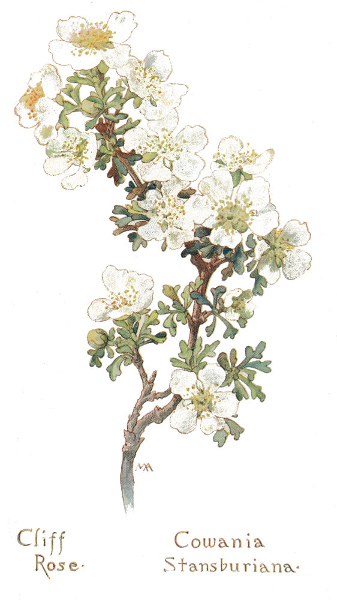
Cliff Rose—Cowania Stansburiana.
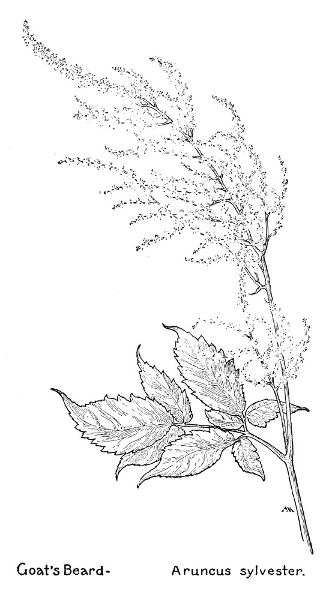
Goat's Beard—Aruncus sylvester.
There are only a few kinds of Adenostoma, evergreen
shrubs, with small, narrow, resinous leaves and clusters of
small, white flowers.
Chamise,
Greasewood
Adenóstoma
fasciculàtum
White
Spring
California
This is a very attractive shrub, from
two to ten feet high, with long, slender
branches, clothed with close bunches of
leaves and bearing large clusters of tiny
flowers, something like Spiraea. They
have a feathery, creamy appearance, owing
to the pale yellow stamens, and the olive-green
foliage sets them off to perfection, the effect of the whole
being very graceful, as the slender, flower-tipped branches
sway to and fro in the wind. This is the most abundant
and characteristic shrub of the higher Coast Ranges and
Sierra Nevada Mountains and sometimes covers miles of
mountain slopes, looking a good deal like heather when it
is not in bloom. When the chaparral is composed entirely
of this shrub it is called chamisal. A. sparsifòlium of
southern California, has scattered leaves and larger flowers.
It is very fragrant and used medicinally by Spanish Californians
and Indians, who call it Yerba del Pasmo, or
"convulsion herb."
There are many kinds of Spiraea, natives of the north
temperate zone; shrubs, without stipules and with clusters
of white or pink flowers.
Flat-top Meadowsweet
Spiraèa corymbòsa
White
Spring, summer
Northwest, etc.
This is an attractive plant, from one
to three feet tall, with slender, reddish-brown
stems, with but few branches, and
smooth, bright green leaves, paler on the
under side. The small flowers are cream-white,
with pinkish buds, and form very
pretty, feathery, flat-topped clusters, about three inches
across. This is found on banks and rocky places, in the
mountains, and grows also in the East.
Pyramid Bush
Spiraèa
pyramidàta
(S. betulaefolia in part)
Pink, white
Spring, summer
Northwest
An attractive plant, but not so pretty
as the last. It is about the same height,
but more branching, with dark bluish-green
leaves, somewhat pale on the under
side. The flowers are white or pale pink,
with deep pink buds, and form long
clusters, not so feathery as the last, because
the stamens are not so long. This grows in the mountains.
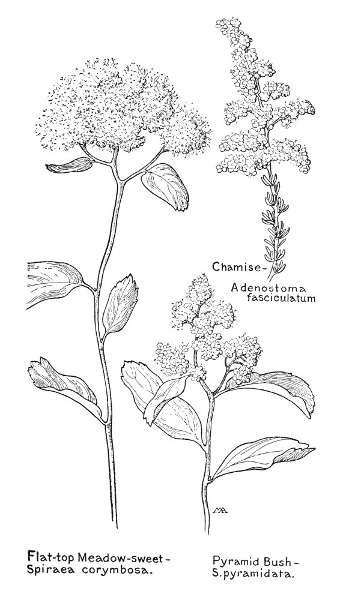
Chamise—Adenostoma fasciculatum.
Flat-top Meadow-sweet—Spiraea corymbosa.
Pyramid Bush—S. pyramidata.
Hardhack,
Steeple-bush
Spiraèa Doúglasii
Pink
Spring, summer
Wash., Oreg., Cal.
A handsome shrub, from three to five
feet high, with rather coarse leaves,
smooth, but with a dull surface, and pale
with close down on the under side, and
bearing many beautiful, compact spires of
small, pink flowers, warm in tone and
deeper in color towards the center, with numerous, long,
pink stamens, which give a very feathery appearance.
The flowers are slightly sweet-smelling and bloom first at
the top of the cluster, so that the effect of the whole spire,
which is six or eight inches long, is light pink and fuzzy at
the top, deepening below to the raspberry-pink of the buds.
This grows along the edges of meadows and near brooks.
There are two kinds of Chamaebatiaria, both western;
low shrubs; the flowers with five sepals, five petals, and
about sixty stamens; the pistils five, more or less united.
Fern-bush
Chamaebatiària
millefòlium
(Spiraea)
White
Summer
Arizona
A pretty and unusual-looking shrub,
about three feet high, with reddish stems
and shreddy bark, the downy leaves, pale
yellowish-green in color, arranged at
intervals along the branches in soft
feathery bunches. The flowers are like
small strawberry blossoms, slightly fragrant,
and form pretty clusters. This grows on rocks, along
the rim of the Grand Canyon, clinging to the edge and
overhanging the depths.
There is only one kind of Coleogyne.
Coleógyne
ramosíssima
Yellow
Spring
Southwest
The plateau in the Grand Canyon is
covered for miles with this low shrub,
which gives the landscape its characteristic
pale desert coloring. The flowers, over
half an inch across, with one or two pairs
of three-lobed bracts at base, grow singly at the tips of the
twigs and, unlike most of this family, have no petals and
only four, spreading sepals, bright yellow inside, two of
them pointed and the alternate two more round in shape.
The ovary is enclosed in a yellow, hollow, urn-shaped
receptacle, surrounded by numerous stamens inserted on
its base, the yellow anthers with threadlike filaments.
The very small, narrow, toothless leaves are evergreen,
leathery and stiff, opposite, grayish in color and imperceptibly
downy, clustered in small separate bunches along
the rigid twigs, which are set almost at right angles to the
reddish-gray branches and rather swollen at the joints.
The whole shrub is from two feet to four feet high, stiff,
almost thorny, and rather forbidding in appearance, but
the odd little flowers are pretty.
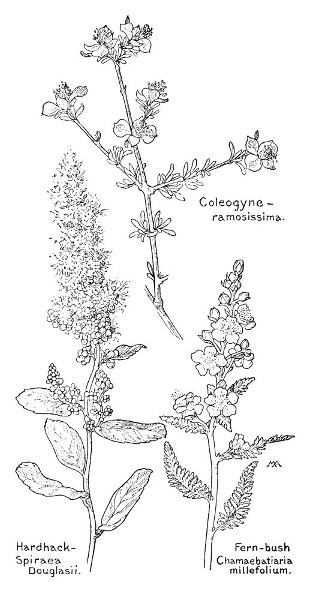
Coleogyne—ramosissima.
Hardhack—Spiraea Douglasii.
Fern-bush—Chamaebatiaria millefolium.
There are several kinds of Argentina, differing from
Potentilla in the leaflets and the style.
Silver-weed
Argentìna
Anserìna
(Potentilla)
Yellow
Spring, summer,
autumn
North America,
etc.
This forms large straggling clumps of
many, pale, downy stems, lying on the
ground and rooting at the joints, like
strawberry runners, with handsome foliage
and pretty flowers. The leaves are rich
green on the upper side and covered with
silky white down on the under, giving a
silvery appearance, and the flowers are
an inch or more across, bright yellow,
with centers of the same shade, and have long flower-stalks,
sometimes as much as a foot tall. This is common
and conspicuous in wet meadows and also grows in Europe
and Asia.
There are only a few kinds of Dryas, shrubby plants,
living in cold and arctic regions. The Latin name means
"wood-nymph."
Alpine Avens
Drýas octopétala
White
Summer
Northwest, etc.
This is a charming little plant, from
two to five inches tall, forming low, matted
clumps of many branching stems, lying
on the ground and woody at the base, and
many stiffish leaves, with prominent veins,
dark green and smooth on the upper side and white with
close down on the under, their dark tones setting off the
pure-white flowers, which have downy flower-stalks and
are about an inch across, with about eight petals, a golden
center and the calyx covered with sticky hairs. The seed-vessels
are large and feathery. This grows in alpine places,
across the continent, reaching an altitude of fourteen
thousand feet, and in Europe and Asia.
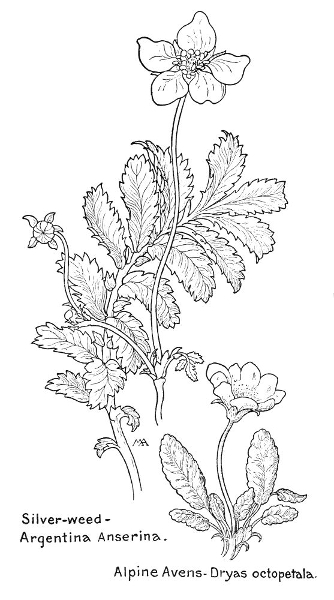
Silver-weed—Argentina Anserina.
Alpine Avens—Dryas octopetala.
There are many kinds of Cinquefoils, mostly natives
of the north temperate zone, usually herbs, with compound
leaves and yellow, white or purple flowers, always with
pedicels; the flat or cup-shaped calyx, with five, main
teeth, alternating with five, tooth-like bractlets; petals
five, broad, often notched; stamens numerous, with threadlike
filaments and small anthers, near the base of the calyx-cup;
pistils numerous, on the conical, hairy receptacle,
which does not become fleshy or juicy, each pistil maturing
into a dry, seed-like akene. Potentilla means "powerful,"
as some sorts are medicinal. They often resemble Buttercups,
but never have shiny petals, and Buttercups do not
have bractlets between the calyx-lobes.
Arctic Cinquefoil
Potentílla
emarginàta
Yellow
Summer
Northwest
A dear little plant, forming low tufts,
two or three inches high, with thin, brownish
stipules, bright green leaves, more or
less hairy, and bright yellow flowers,
deeper in color towards the center and
about half an inch across. This grows in
high northern mountains across the continent and in Siberia.
Silky Cinquefoil
Potentílla
pectinisécta
Yellow
Spring, summer
Utah, Ariz., Wyo.
The foliage of this plant is a lovely
shade of silvery gray, which suits the
yellow flowers. It has several stoutish,
reddish, stems, a foot to a foot and a half
tall, springing from clumps of leaves, with
long leaf-stalks and five to seven leaflets.
The bright-yellow flowers are each three-quarters of an
inch across and the whole plant is conspicuously covered
with long, thick, white, silky down, particularly on the
under side of the leaves.
Shrubby Cinquefoil
Dasíphora
fruticòsa
(Potentilla)
Yellow
Spring, summer
West, etc.
This is the only kind of Dasiphora, a
pretty shrub, very branching and leafy,
one to four feet high, dotted all over with
charming flowers. The bark is shreddy
and the gray-green leaves are covered
with silky down, with rolled back margins,
and paler on the under side. The flowers,
single or in clusters, are over an inch across,
with clear yellow petals and deeper yellow anthers. This
is common in the mountains, across the continent, up to an
altitude of ten thousand feet, and is a troublesome weed in
northern New England. It is also found in Europe and Asia.
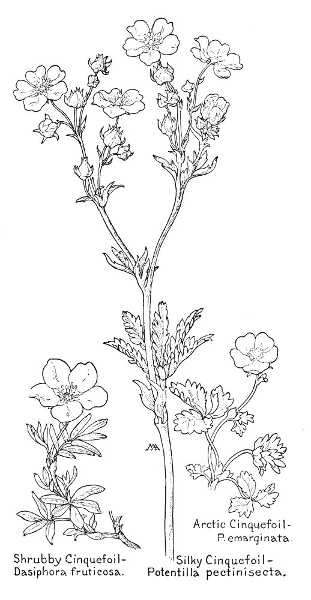
Arctic Cinquefoil—P. emarginata.
Shrubby Cinquefoil—Dasiphora fruticosa.
Silky Cinquefoil—Potentilla pectinisecta.
There are several kinds of Sericotheca, much like
Spiraea, except the fruits.
Ocean Spray
Sericothèca discolor
(Spiraea)
(Holodiscus)
White
Summer
Northwest and
Southwest
A handsome conspicuous shrub, from
three to eight feet high, without stipules,
with roughish, dull-green leaves, toothed
or lobed, but not with leaflets, and pale
and woolly on the under side. The tiny
flowers form beautiful, plumy, branching
clusters, eight inches or more in length
and almost as much across, cream-white
and fuzzy, drooping and turning brownish as the flowers
fade. This is common in the mountains.
There are numerous kinds of Rubus, in temperate
regions, with white, pink, or purple flowers, and red, black,
or yellowish "berries." The fruit is not really a berry,
but a collection of many, tiny, round stone-fruits, crowded
on a pulpy, conical receptacle. That of the Raspberry
has a "bloom," and falls off the receptacle when ripe, but
the Blackberry has shining, black fruit, which clings to
the receptacle. Rubus, meaning "red," is the ancient
Latin name for the bramble. Raspberries were cultivated
by the Romans in the fourth century.
Salmon-berry
Rùbus
spectàbilis
Red
Summer
Northwest
A handsome bush, not at all trailing,
from three to nine feet high, with dark-brown,
prickly stems, fine foliage and
flowers, and conspicuously beautiful fruit.
The leaves are nearly smooth, with three
leaflets, and the flowers, about two inches
across, are a brilliant shade of deep pink, not purplish in
tone, with yellow centers, and grow singly, or two or three
together. The fruit is a firm, smooth raspberry, over an
inch long, bright orange-color, more or less tinted with red,
with a rather pleasant but insipid taste and not very sweet.
This grows in woods. It is rather confusing that this
should be called Salmon-berry in the West, for in the
East that is the common name of Rubus parviflorus.
Common Blackberry
Rùbus vitifòlius
White
Spring, summer
California, etc.
An evergreen bush, a few feet high and
more or less erect; or the prickly stems
trailing on the ground, or climbing over
other shrubs, and sometimes eighteen feet
long. The leaves are downy, or almost
smooth, usually rather coarse in texture,
and all but a few of the upper ones have from three to
seven leaflets. The flowers are about an inch across and
the petals vary a good deal, being sometimes broad and
sometimes rather long and narrow. This is common from
southern California to British Columbia.
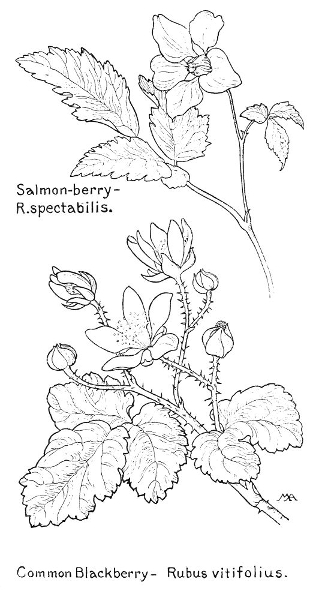
Salmon-berry—R. spectabilis.
Common Blackberry—Rubus vitifolius.
Thimble-berry
Rùbus parviflòrus
White
Spring, summer
West, etc.
In shady mountain woods we find this
attractive plant, which is called Salmon-berry
farther east. It also resembles the
eastern Thimble-berry, but its flowers are
prettier, for they are white instead of
purplish-pink. It has several branching stems, from two
to six feet high, the lower ones woody, with shreddy bark
and the upper stems pale green, slightly rough and hairy,
but with no thorns. The large maple-like leaves are thin
in texture, but almost velvety, with hairs on the veins of
the under side and on the leaf-stalks, and are bright green,
with three or four, toothed lobes. The flowers are occasionally
pinkish and measure about two inches across, and
grow, a few together, at the ends of long flower-stalks.
The petals are slightly crumpled and there are usually
five of them, but both sepals and petals vary a good deal
in number; the green sepals are velvety, pale inside and
tipped with tails, and the pale yellow center is composed
of a roundish disk, covered with pistils and surrounded by
a fringe of numerous yellow stamens. The fruit is a
flattish, red raspberry, disappointing to the taste, for it is
mostly seeds. This is found as far east as Michigan.
Creeping
Raspberry
Rùbus pedàtus
White
Summer
Northwest
A charming little vine, without prickles,
the stems from one to three feet long and
rooting at the joints, trailing over rocks
and moss and creeping along the ground,
ornamented with pretty leaves, with from
three to five leaflets, and sprinkled with
white flowers, half an inch or more across, and often also
with juicy, red raspberries. This grows in rich soil, in
mountain woods.
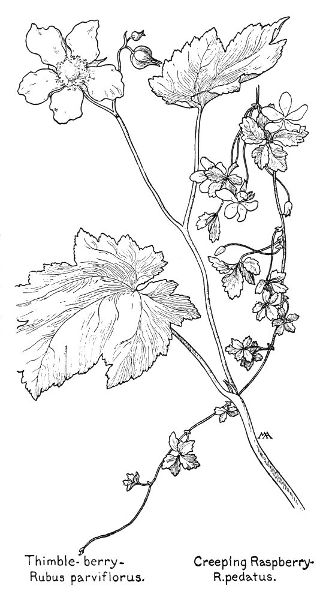
Thimble-berry—Rubus parviflorus.
Creeping Raspberry—R. pedatus.
There are a good many kinds of Strawberry, natives of
the north temperate zone and the Andes. They are
perennials, with running stems, rooting at the joints; the
flowers white, or rarely pink, with slender, often drooping
pedicels, forming loose clusters; the flower-stalks springing
from tufts of root-leaves, which have three, toothed leaflets
and a pair of sheathing stipules at the base of the long leaf-stalk;
the sepals five, alternating with sepal-like bractlets;
the petals five, with short claws and not notched; the
stamens numerous, with slender filaments; the receptacle
roundish or cone-shaped, becoming enlarged, red and
juicy, in fruit, bearing minute, dry akenes, scattered over
its surface, or set in pits. Fragum is the Latin name for
strawberry, meaning "fragrant."
Wood Strawberry
Fragària bracteàta
White
Spring, summer
West
A slender little plant, growing in light
shade, in rich soil, along streams, in rocky
woods and producing runners very freely.
The stipules are papery and reddish, the
thin, dull-green leaves are slightly silky on
the upper side, when young, and the leaflets are sharply
and coarsely toothed, somewhat wedge-shaped, broad at
the tips, the two side ones uneven at base. There is
usually a little bract, halfway up, on both the flower-stalk
and the leaf-stalk. The flowers are nearly an inch across,
with fuzzy, bright yellow centers, and the fruit is light red,
with a good flavor, somewhat cone-shaped, the akenes
scattered over its smooth, shining, even surface and but
slightly attached to it.
Sand Strawberry
Fragària
Chiloénsis
White
Spring, summer
Wash., Oreg., Cal.
A charming plant, a few inches tall,
with thick, glossy, dark green leaves,
paler and hairy on the under side, and
pure-white flowers, with bright yellow
centers. They are about an inch across
and are well set off by the masses of dark
foliage. This has large, delicious berries and grows
abundantly on beaches and sand dunes near the sea, from
San Francisco to Alaska. It is often cultivated.
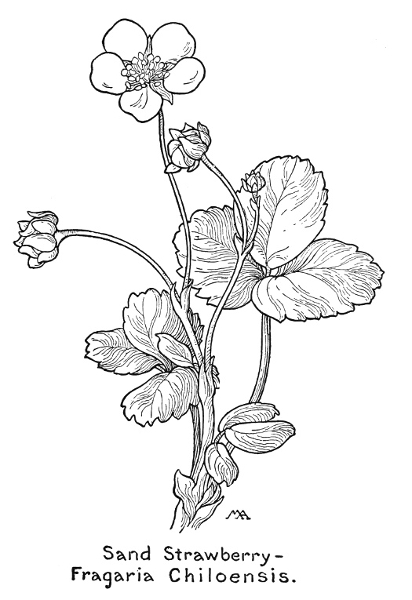
Sand Strawberry—Fragaria Chiloensis.
A very large family, including many important plants,
such as Clover, Alfalfa, Peas, and Beans; herbs, shrubs,
vines, and trees, distinguished principally by the flower and
fruit, resembling the butterfly-like corolla and simple pod
of the common Pea; leaves alternate, usually compound,
with leaflets and stipules; calyx five-toothed or five-cleft;
petals five. The upper petal, or "standard," large, covering
the others in the bud, the two at the sides standing out
like "wings," the two lower ones united by their edges
to form a "keel," enclosing the stamens, usually ten, and
the single pistil with a curved style; the ovary superior.
There are numerous kinds of Anisolotus, widely distributed,
common, difficult to distinguish; mostly herbs,
some slightly shrubby; leaves with two or many, toothless
leaflets; calyx-teeth nearly equal; petals with claws, free
from the stamens, wings adhering to the keel, incurved,
blunt or beaked; stamens joined by their filaments, in two
sets of one and nine, anthers all alike; style incurved;
pods two-valved, often compressed between the seeds,
never inflated. These plants have several common names,
such as Bird-foot, Trefoil, Cat's-clover, etc., and are called
Crowtoes by Milton.
Pretty Bird-foot
Anisolòtus
formosíssimus
(Lotus)
(Hosackia)
Pink and yellow
Spring
Wash., Oreg., Cal.
A gay and charming kind, with smooth
stems, spreading on the ground, light
green leaves, with five or more leaflets,
and flowers about half an inch long, with a
golden-yellow standard, pink or magenta
wings and wine-colored keel, forming a
flattish cluster, the contrasting colors
giving a vivid effect. This grows in damp
places along the sea-coast.
Bird-foot
Anisolòtus argyraèus (Lotus)
(Hosackia)
Yellow
Spring
California
A shrubby, branching plant, a foot and
a half high, forming a pretty clump, two
or three feet across, with downy, gray-green
stems and foliage, sprinkled with
clover-like heads of yellow flowers. The
leaflets are slightly thickish, covered with
silky down, the twigs and young leaves
silvery-white. The small flowers are a soft shade of warm-yellow,
and the buds form neat, fuzzy, silvery balls. This
grows on dry hillsides in the Catalina Islands.
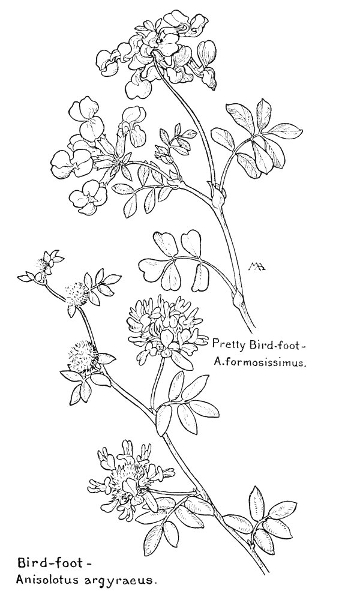
Pretty Bird-foot—A. formosissimus.
Bird-foot—Anisolotus argyraeus.
Anisolòtus strigòsus
(Lotus)
(Hosackia)
Yellow
Spring, summer,
autumn
California
This is only a few inches high, with
slender, slightly downy stems, branching
and spreading, and bright green leaves,
with seven or more, small, narrow leaflets,
slightly thickish, with some minute, bristly
hairs. The few flowers are about a
quarter of an inch long, mostly single,
bright yellow, tinged with red, fading to orange, and have
a sort of miniature prettiness. This grows in the south.
Bird-foot
Anisolòtus decúmbens
(Lotus)
(Hosackia)
Yellow
Summer
Northwest
An attractive little perennial, forming
low clumps, harmonious in coloring, of
pale gray-green, downy foliage, sprinkled
with small clusters of charming little
flowers, each less than half an inch long,
various shades of yellow, and arranged in a
circle. The pods are hairy and it grows on
sunny, sandy slopes.
Deer-weed
Anisolòtus glàber
(Lotus)
(Hosackia)
Yellow and orange
All seasons
California
Though the flowers are small and the
foliage scanty, the shaded effect of mingled
yellow and orange of these plants is rather
pretty, as we see them by the wayside.
The many, long, smooth, reed-like stems
grow from two to five feet high, branching
from the root, somewhat woody below,
loosely spreading, or sometimes half lying on the ground.
The leaves are almost smooth, very small and far apart,
with from three to six, oblong leaflets, and the flowers,
from a quarter to half an inch long, are clustered in close
little bunches along the stem, forming long wands, tipped
with green buds, and shading downward through the bright
yellow of the larger buds to the orange of the open flowers
and the dull red of the faded ones. The pod is incurved,
tipped with the long style. This is common and widely
distributed, a perennial, but said to live only two or three
years. In the south it often makes symmetrical little
bushes, pleasing in appearance. It is a valuable bee-plant.
A. Wrìghtii of Arizona, Utah, New Mexico, and
Colorado, is quite leafy, with erect stems and branches,
bushy and woody at base, the small leaflets from three to
five in number. The flowers, without pedicles, are much
like the last, but over half an inch long, yellow becoming
reddish, with a blunt keel, and scattered all over the plant.
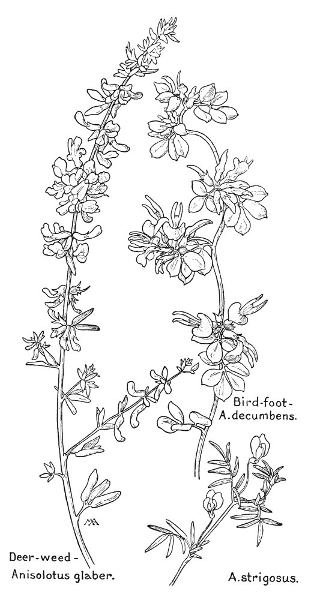
Bird-foot—A. decumbens.
Deer-weed—Anisolotus glaber.
A. strigosus.
There are several kinds of Thermopsis, of North America
and Asia; stout, perennial herbs, with woody rootstocks;
leaflets three; stipules conspicuous, leaf-like; flowers large,
yellow, with short, bracted flower-stalks; calyx bell-shaped,
five-cleft; standard broad, in the western species, shorter
than the oblong wings, keel nearly straight, blunt, the
same length as the wings; stamens ten, separate, curving
in; style slightly curving in, stigma small; pod flat, long or
oblong, straight or curved, with a very short stalk and
several seeds. Thermopsis, sometimes called False Lupine,
is distinguished from Lupinus by its stamens, which are
separate, instead of united into a sheath. The Greek
name means "lupine-like."
Golden Pea
Buck-bean
Thermópsis
montànà
Yellow
Spring, summer
Northwest, Utah,
Ariz.
A very handsome, thrifty-looking plant,
about two feet high, the smooth, bright
green foliage contrasting finely with the
clusters of clear yellow flowers, each about
three-quarters of an inch long. The erect,
straight pods, two or three inches long,
are silky and also the calyxes and buds.
This thrives in the mountains, up to an
altitude of nine thousand feet, in somewhat moist spots,
and its fresh coloring is most attractive. The foliage seems
to me to be especially handsome in northern Arizona, but
these plants are also beautiful in the Utah canyons. The
flowers are scentless and last a long time in water. T.
Califórnica has silvery, silky foliage and is common in
California, in damp ground in the hills.
There are many kinds of Parosela, of western North
America, Mexico, and the Andes, no one sort common;
generally shrubs; leaves almost always compound; leaflets
odd in number, small, toothless, with minute stipules,
often with glandular dots; flowers small, in terminal clusters;
calyx with nearly equal, long, occasionally feathery
teeth; corolla with wings and keel longer than the standard,
their claws adhering to the lower part of the stamen-tube,
but the claw of the small, heart-shaped standard free;
stamens nine or ten, filaments united, anthers alike; ovary
with a short stalk, or none, style awl-shaped; pod small,
membranous, included in the calyx, usually with one seed.
P. spinòsa, the Smoke Tree, or Ghost Tree, of western
Arizona, is almost leafless, with grayish or whitish branches.
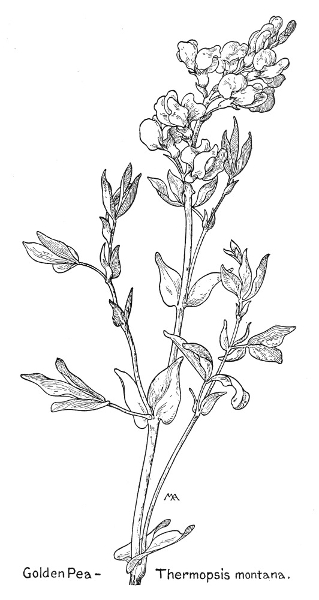
Golden Pea—Thermopsis montana.
Parosèla Califórnica
(Dalea)
Blue
Spring
California
This little spiny desert shrub grows two
or three feet high and is conspicuous on account
of the odd contrast in color between
its foliage and flowers. The woody stems
and branches are very pale in color and the
very small leaflets, so narrow and stiff that they look like
evergreen needles, are covered with pale down and have
glandular dots. All over this colorless foliage are sprinkled
small spikes of indigo-blue flowers, so dark in color that the
effect, against a background of desert sand, is of pale gray,
speckled with black. It has a pleasant smell like balsam.
Parosèla Émoryi
(Dalea)
Magenta
Spring, summer
Southwest
A low, desert shrub, with slender,
abruptly branching stems and small, soft,
thickish leaves, usually with three leaflets,
obscurely toothed, the stems and leaves
all thickly covered with white down. The
flower-clusters are about three-quarters of an inch across,
like a small clover-head, the woolly calyxes giving a
yellowish-gray effect to the whole cluster, which is ornamented
with a circle of tiny purple flowers. The effect of
these specks of dark color on the pale bush is odd; the
plant smells like balsam and grows in sandy soil.
Chaparral Pea
Xylothérmia
montàna
(Pickeringia)
Crimson
Spring, summer
California
This is the only kind, an evergreen
shrub, flourishing on dry hills in the Coast
Ranges, with tough, crooked branches
and stout spines, forming chaparral so
dense that it is impossible to penetrate.
It grows from three to eight feet high, the
gnarled, knotty, black branches terminating
in long spines, which are often clothed with small
leaves nearly to the end, the leaves with one to three,
small leaflets and without stipules. The bush is often
covered with quantities of pretty, bright, deep purplish-pink
flowers, three-quarters of an inch long, forming a
fine mass of color. The calyx has four, short, broad teeth;
the petals are equal, the standard roundish, with the sides
turned back and a paler spot at base, the wings oblong, the
keel straight; the filaments of the ten stamens not united;
the pod is two inches long, flat, straight, sickle-shaped when
young. This very rarely produces fruit. Stevenson was
probably describing this shrub when he wrote, "Even the
low thorny chaparral was thick with pea-like blossoms."
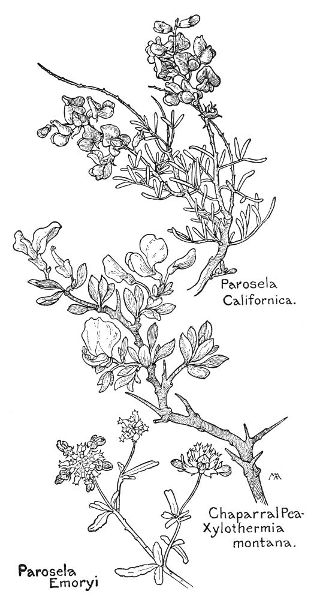
Parosela Californica.
Chaparral Pea—Xylothermia montana.
Parosela Emoryi.
There are so many western kinds of Lupinus that it is
hopeless for the amateur to distinguish them; herbs,
sometimes shrubs; leaves palmately-compound, stipules
adhering to the base of the leaf-stalk, leaflets, more than
three in number, usually closing at mid-day; flowers showy,
in terminal racemes; calyx deeply toothed, two-lipped;
standard broad, the edges rolling back, wings lightly adhering
above, enclosing the incurved, pointed keel, sometimes
beaked; style incurved, stigma bearded; stamens
united by their filaments, alternate anthers shorter; pod
two-valved, leathery, flat, oblong; seeds two to twelve.
Lupines always have palmately-divided leaves, and are
never trailing, twining, or tendril-bearing and thus may be
superficially distinguished from Vetches and Peas, and
from Thermopsis, by the united stamens.
River Lupine
Lupìnus
rivulàris
Blue and white
and purple
Summer
Northwest
A stately perennial, about three feet
high, with stout, branching reddish,
slightly downy stems, bearing several tall
spires of flowers. The handsome leaves
are bright green, smooth on the upper
side, slightly downy, but not silvery, on
the under, with from seven to thirteen
leaflets, and the flower-cluster is very erect and compact,
eight or ten inches long, beautifully shaded in color, from
the pale, silky buds at the tip, to the blue and purple of
the open flowers, which are about five-eighths of an inch
long, with a lilac standard, tipped with purple. The upper
flowers have white wings, veined with blue, and a green
calyx, with reddish teeth, and the lower flowers have bright
blue wings, veined with purple, and a reddish-purple calyx.
This grows in wet places.
Tree Lupine
Lupìnus arbòreus
Yellow
Spring
California
A conspicuous shrub, four to eight feet
high, with a thick trunk, gnarled and
twisted below, with purplish, downy
branches, silvery twigs and dull bluish-green
leaves, downy on the under side,
with about nine leaflets. The fine flower clusters are
sometimes a foot long, composed of beautiful canary-yellow
flowers, deliciously sweet-scented. This is easily
recognized by its size and fragrance and is common in
sandy soil near the sea, where it has been found very useful,
as its very long roots keep the sand dunes from shifting.
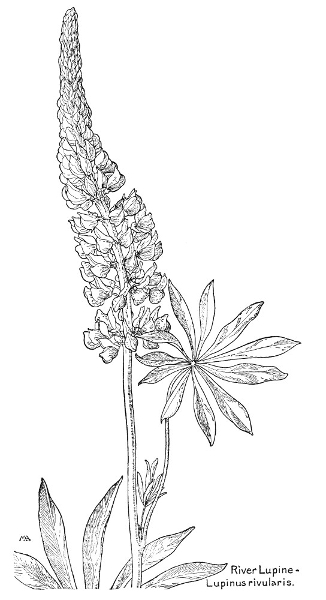
River Lupine—Lupinus rivularis.
Parti-colored
Lupine
Lupìnus Stìversii
Pink and yellow
Summer
California
One of the prettiest and most conspicuous
kinds, for its coloring is unusual, with
branching, downy, leafy stems, about a foot
high, thickish leaflets, pale bluish-green in
color and rather hairy, and fragrant flowers,
over half an inch long, with rose-colored
wings and a yellow standard, changing to orange in fading.
The combination of pink, orange, and yellow is very
striking. This grows in warm, dry spots in Yosemite, and
other places in the Sierras and Coast Ranges. L. citrìnus,
of similar situations, has all yellow flowers.
Quaker Bonnets
Lupìnus laxiflòrus
Blue
Spring, summer
West
A handsome perennial, forming fine
clumps on dry, gravelly hillsides, with
several, slender, rather downy stems, from
one to two feet tall, the leaflets six to nine
in number, rather bluish-green, downy on
the upper side, paler and silkier on the under. The
younger leaves and calyxes are silvery with down, the
flower buds form long, pretty, silvery clusters, resembling
ears of wheat in form, and the flowers are in handsome
loose racemes, from five to six inches long, of various shades
of blue, mostly bright and somewhat purplish, the standard
with a little white at its base and the keel purplish. The
pod is covered with silky hairs and contains from three to
five seeds. This is very common in Utah, handsome and
conspicuous, and when growing in quantities, among
Balsam-roots, Forget-me-nots, and Wild Geraniums,
makes a combination unequaled in any flower-garden.
Milk-white
Lupine
Lupìnus lactèus
White
Spring
California
A handsome plant, with a very stout,
branching stem and soft, bluish-green
leaves, with silky hairs on the edges and
under sides, forming a fine clump of
foliage, from which the flower-stalks stand
up very stiff and straight. The cluster
is most symmetrical in form and the flowers, which are
nearly three-quarters of an inch long, are a beautiful,
pearly white, tinged with yellow at the base of the standard
and with creamy buds. The lower lobe of the calyx
is large and very dark green, the stems have a pale, satiny
surface, sprinkled with hairs and the leaflets are ten or
eleven in number. This grows in the grass along the
roadsides and is common around San Bernardino.
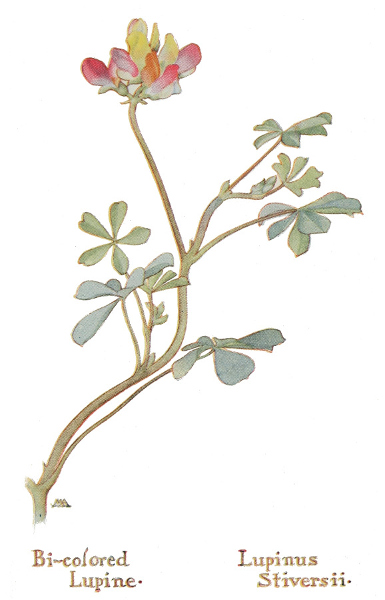
Bi-colored Lupine—Lupinus Stiversii.
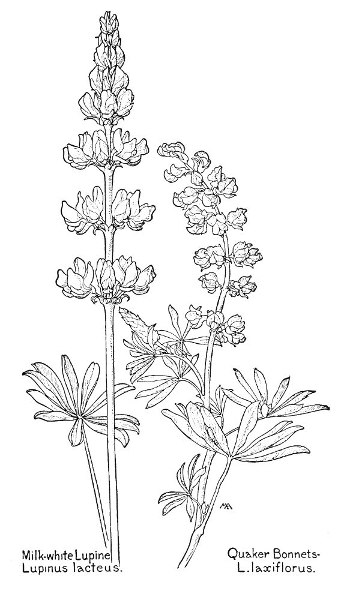
Milk-white Lupine—Lupinus lacteus.
Quaker Bonnets—L. laxiflorus.
There are numerous kinds of Lathyrus, widely distributed
and difficult to distinguish. In technical character
and habit they very much resemble Vetches, but
sometimes have no tendrils and the flowers are larger, the
leaflets are broader, and the style is flattened and hairy,
not only at the tip, but also along the upper side. The
leaflets are equal in number, the leaf-stalk usually terminating
in a branching tendril; the flowers are in clusters;
the calyx with five teeth, the upper commonly shorter;
the style flattened and usually twisted; the pod flat or
cylindrical, with no partitions between the seeds. Lathyrus
is the old Greek name of the Pea.
Narrow-leaved
Sweet Pea
Láthyrus
graminifòlius
Pink and violet
Spring
Arizona
This has flowers resembling the cultivated
Sweet Pea, but the whole effect is
more airy and graceful. It is a loosely-trailing
vine, with slender, angled stems,
long, narrow leaflets, eight in number, and
three-cleft tendrils. The flowers are
about three-quarters of an inch long,
brightly yet delicately tinted with shaded pink and violet,
and are so lightly poised on the long slender stalks that
they look like a row of butterflies about to take flight.
This grows on the plateau in the Grand Canyon and all
through Arizona in the mountains.
Utah Sweet Pea
Láthyrus
Utahénsis
Lilac
Spring, summer
Utah, Col.
A smooth, trailing perennial, very
graceful, with beautifully tinted flowers
and bright green foliage. The stipules
are large, broad and leafy, and the leaflets
are usually ten in number, veined and
thin in texture, one or two inches long,
with tendrils. The flowers are nearly an inch long, from
four to eight in a cluster, on a long flower-stalk; the
standard pinkish-lilac, delicately veined with purple, the
wings pale lilac and the keel cream-color. The flowers,
as they fade, although keeping their form, gradually change
in color to all shades of blue, turquoise, and sea-green,
finally becoming buff, so that the effect of the whole
cluster is iridescent and very lovely. This grows on
mountain slopes, often in oak-thickets, clambering over
the bushes to a height of several feet and clinging to everything
with its tendrils.
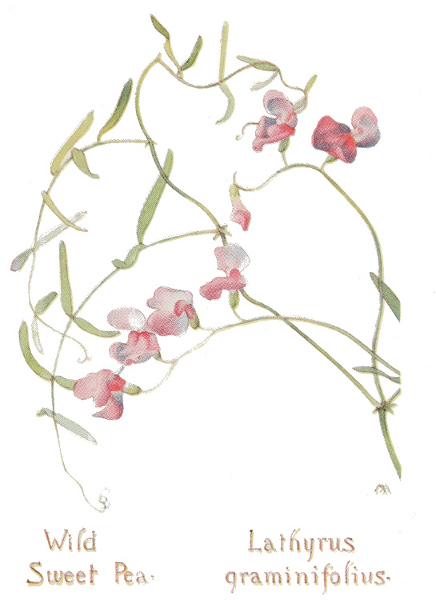
Wild Sweet Pea—Lathyrus graminifolius.
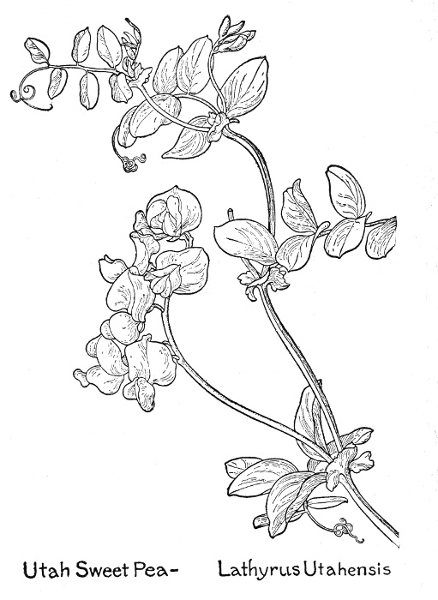
Utah Sweet Pea—Lathyrus Utahensis.
Pride of
California
Láthyrus
spléndens
Crimson
Spring
California
This has such glorious flowers, so superb
in color and form, that it is by far the
handsomest of its kind and not to be
mistaken for any other. The stout,
smooth, stems are dark green, the stipules
small, and the leaves are smooth, slightly
thickish and stiffish, rather dark bluish-green,
with about ten leaflets. The flowers are over two
inches long, from the tip of the standard to the end of the
keel, and form a massive cluster of eight or ten blossoms,
hanging on drooping pedicels and shading in color from
the pale-salmon of the buds to the brilliant rose, carmine,
and wine-color of the open flowers, the older flowers being
very dark and rich. Only a small part of the flower-cluster
is given in the picture. These plants, which are
found around San Diego and farther south, clamber over
the neighboring bushes to a height of several feet and
adorn them with wonderful color, giving an effect of
tropical splendor.
There are innumerable kinds of Astragalus; most
abundant in Asia, usually perennial herbs, sometimes
woody; leaves usually with numerous leaflets, flowers
narrow, in spikes, with long flower-stalks; calyx tube-shaped,
with nearly equal teeth; petals usually narrow,
with slender claws, standard erect and somewhat oblong,
wings oblong, keel with blunt tip, about the same length
as the wings; stamens ten, in two sets of nine and one; pods
numerous, more or less two-celled, often inflated, so the
wind can distribute the small seeds, therefore these plants
are often called Rattleweed. Another name is Milk
Vetch and many kinds are called Loco-weed, from the
word "loco," or crazy, because they are poisonous to horses
and cattle. I was told by a cow-boy in Arizona that
"horses eat this because it tastes sweet, but it gives them
water on the brain and they die, unless the skull is split
with an axe and the water is let out!"
Astrágalus
Menzièsii
White
Spring, summer
California
A decorative plant, its pale flowers
contrasting well with the dark foliage,
with stout, branching stems, from two to
three feet tall, hairy above, and many
leaflets, dark-green on the upper side,
hairy and paler on the under. The flowers are half an
inch or more long, with a pale, yellowish-green, downy
calyx and cream-white corolla, and form a fine cluster,
from four to ten inches long. The egg-shaped pods are
much inflated and almost papery, an inch or more long.
This grows on sea-cliffs and in sandy soil near the coast.
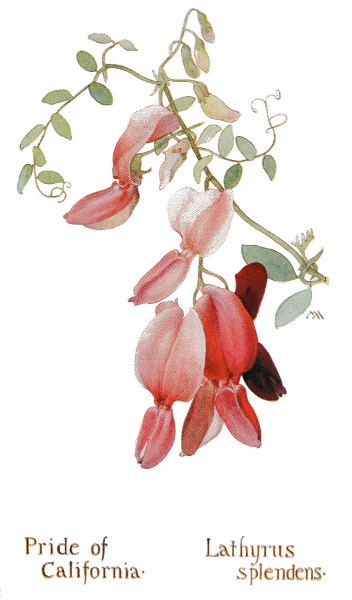
Pride of California—Lathyrus splendens.
Pink Lady-fingers,
Sheep-pod
Astrágalus
Utahénsis
Pink
Spring, summer,
autumn
Utah, Nev.
A pretty plant, unusual in coloring,
the short stems spreading on the ground
and springing from a short, perennial
root; the foliage all very pale bluish-gray,
covered with silvery down, the thickish
leaflets from eleven to seventeen in number,
the younger leaves and flower buds
almost white. The flowers are about an
inch long, in loose clusters, with flower-stalks
from three to four inches long; the calyx long,
pinkish-gray and downy, the standard pale pink, the wings
deeper purplish-pink, the keel yellowish-pink. The pod
is short, leathery, woolly, and stemless. This grows in dry,
gravelly soil and in favorable situations makes low, circular
clumps of foliage, suggesting the old-fashioned crochet
lamp-mats that we used to see in New England farmhouses,
for the pale leaves are symmetrically arranged in
neat clusters and ornamented at intervals with pink flowers.
Unlike, however, the worsted ornament, its coloring is
delicately harmonious and beautiful.
Astrágalus
nothóxys
Purple
Spring
Arizona
A very slender plant, with trailing
stems, one or two feet long, the leaflets
odd in number and downy on the under
side. The flowers are about half an inch
long, with a whitish, downy calyx and
a bright purple corolla, shading to white at the base. This
grows in mountain canyons and looks a good deal like a
Vetch, except that it has no tendrils.
Rattle-weed,
Loco-weed
Astrágalus
pomonénsis
White
Spring
California
This is a straggling plant, a foot and a
half tall, smooth all over, with stout stems
and many bluish-green leaflets. The
flowers are over half an inch long, with a
very pale calyx and yellowish-white
corolla, forming a rather pretty cluster,
about three inches long. The pods are
each over an inch long and much inflated, forming a large
bunch, odd and very conspicuous in appearance.
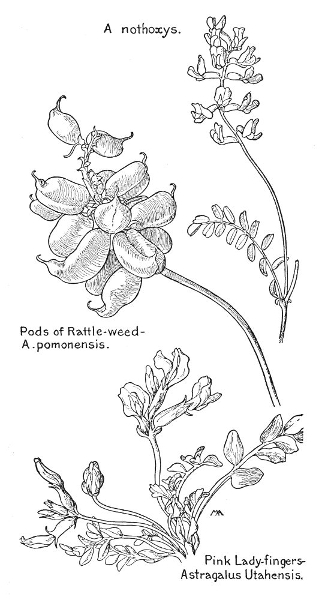
A. nothoxys.
Pods of Rattle-weed—A. pomonensis.
Pink Lady-fingers—Astragalus Utahensis.
Loco-weed
Astrágalus
MacDoùgali
White, lilac
Spring
Arizona
An attractive plant, about a foot high,
with straggling, reddish stems and delicate
foliage. The flowers are over half an
inch long, with a hairy calyx and pale
lilac and white corolla, and form pretty
clusters about two inches long.
There are many kinds of Hedysarum, some from Africa
and only a few in this country; perennial herbs, sometimes
shrubby; the leaflets toothless, odd in number; the flowers
in handsome racemes, with bracts, on stalks from the angles
of the stem; the calyx with five, nearly equal teeth; the
standard rather large, round, or inverted heart-shaped,
narrow at base, the wings oblong, shorter than the standard;
the keel blunt, nearly straight, longer than the wings;
the stamens in two sets of nine and one, not adhering to
the corolla; the pod long, flat, and oddly jointed into
several, strongly-veined, one-seeded, roundish divisions,
which separate when ripe. The name is from the Greek,
meaning "sweet-broom."
Hedýsarum
pabulàre
Pink
Spring, summer
Utah
A very handsome and decorative plant,
with large brilliant flower-clusters, contrasting
well with the foliage and making
spots of vivid color on dry plains and
hillsides. It has many stems, springing
from a rootstock, which are from eight to fifteen inches
long, yellowish-green, ridged, and covered with inconspicuous
down, the leaflets are light bluish-green, thickish,
nine to seventeen in number, and the bracts are thin and
dry. The flowers are about three-quarters of an inch
long, with a pinkish-green and downy calyx, and the
corolla all bright deep pink, fading to blue, with a veined
standard. The pod has from three to five divisions. This
flourishes at rather high altitudes, up to seven thousand
feet, and is conspicuously beautiful near the entrance to
Ogden Canyon in Utah.
There are a great many kinds of Trifolium, or Clover,
difficult to distinguish; low herbs; leaves usually with three
leaflets, usually toothed; stipules adhering to the leaf-stalks;
flowers in heads or spikes; stamens usually in two
sets of nine and one; pods small, mostly enclosed in the
calyx, usually with one to six seeds.
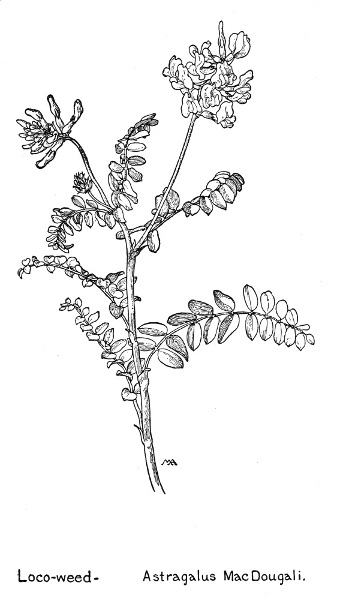
Loco-weed—Astragalus MacDougali.
Clover
Trifòlium
tridentàtum
Purple
Spring, summer
Cal., Oreg., Wash.
This is very common from the coast to
the Sierra foothills, but there are many
named varieties. It is smooth all over
and grows from eight inches to two feet
high, with spreading stems and narrow
leaflets, which are toothless, or have teeth
and bristles on the edges. The pinkish-purple flowers
form a broad head, over an inch across, with an involucre.
Sour Clover
Trifòlium fucàtum
Cream-color
Spring, summer
Wash., Oreg., Cal.
This has queer-looking flowers and is
conspicuous on that account. The
branching stems are a foot or more tall,
the stipules are large, with papery margins,
and the leaves are bright green, with a
paler spot near the middle of each of the leaflets, which are
toothed, or sometimes only bristly on the edges, and the
flowers form a head about an inch and a quarter across,
with a broad involucre. The calyx is very small and the
corolla is cream-color, becoming much inflated and changing
to deep pink as the flower withers. The effect of the
cluster is curiously puffy and odd in color. This grows
rankly in low alkaline and brackish places.
There are many kinds of Psoralea, widely distributed;
ours are perennial herbs, without tendrils, the leaves with
three or five leaflets, with glandular dots on them and
usually bad-smelling. The flowers are white or purplish,
and the pod is short, with only one seed.
Native California
Tea
Psoràlea physòdes
White
Spring, summer
Cal., Oreg., Wash.
This is a rather pleasing plant, for the
foliage is pretty, though the flowers are
too dull in color to be effective. It is
almost smooth all over, a foot or more tall,
with several spreading stems and rich
green leaves, thin in texture and giving
out a rather pleasant aromatic smell when crushed. The
flowers are less than half an inch long, with a somewhat
hairy calyx, covered with dots and becoming inflated in
fruit, and a yellowish-white corolla, more or less tinged with
purple. This is common in the woods of the Coast
Ranges. The foliage was used as tea by the early settlers.
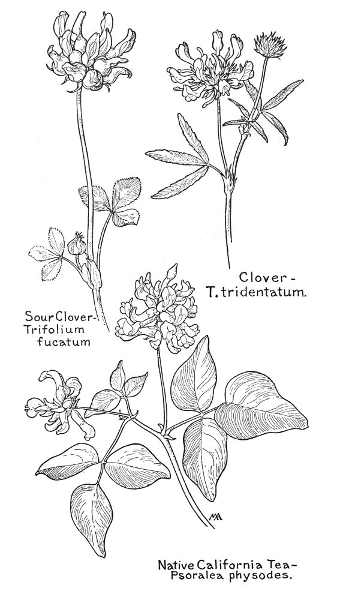
Sour Clover—Trifolium fucatum.
Clover—T. tridentatum.
Native California Tea—Psoralea physodes.
There are many kinds of Cytisus, natives of Europe,
Asia, and Africa, named for Cythrus, one of the Cyclades,
where the first species was found.
Scotch Broom
Cýtisus
scopàrius
Yellow
Spring, summer
West, etc.,
except Ariz.
A handsome branching shrub, about
five feet high, with almost smooth or
quite hairy leaves, with three, toothless
leaflets, and fine clusters of flowers, each
an inch or more long, with a yellow two-lipped
calyx and a golden-yellow corolla,
deeper in color at the base of the standard
and at the tips of the wings; the stamens ten, in one set; the
style curved in. The pod is flat, smooth on the sides, but
hairy along the edges, one or two inches long and curling
when ripe. This is said to have been brought to California
by Cornish miners.
A large family, most of them tropical; trees, shrubs, and
herbs, with flowers more or less irregular in form, but not
like the flowers of the true Pea, though sometimes resembling
them; calyx usually with five sepals; corolla with
five petals, overlapping in the bud, the petal which corresponds
to the standard folded within the two side petals,
instead of covering them, as in the Pea flower; stamens,
ten, or fewer, in number, usually not united; ovar superior;
fruit a pod, mostly splitting into two halves, containing
one to many seeds. To this family belong the handsome
Red-bud, or Judas Tree, of our woodlands, both East and
West; the spiny Honey-locust; the Kentucky Coffee-tree,
with its fine foliage, of the central and eastern states; the
interesting Palo Verde, with greatly reduced leaves, of the
Southwest, and the fine Bird-of-paradise flowers, of
the tropics and Mexico, one or two of which are just beginning
to grow wild in southern Arizona and California.
There are many kinds of Cassia, abundant in tropical
America; herbs, shrubs, or trees; leaflets even in number;
flowers usually yellow; calyx-teeth nearly equal; corolla
almost regular, with five, nearly equal, spreading petals,
with claws; stamens usually ten, sometimes five, often
unequal, some of the anthers often imperfect, or lacking;
pod flat or cylindrical, often curved, sometimes with
partitions between the numerous seeds.
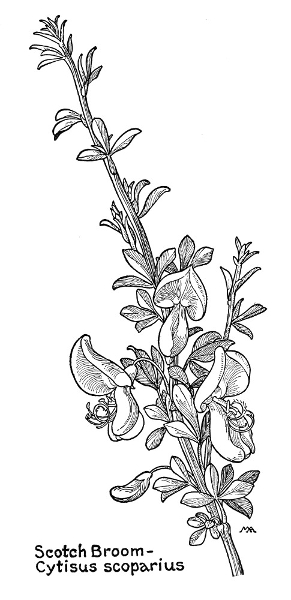
Scotch Broom—Cytisus scoparius.
Desert Senna,
Golden Cassia
Cássia armàta
Yellow
Spring
Southwest
The peculiar orange-yellow of these
handsome flowers at once attracts our
attention, for their tint is quite different
from the greenish-yellow, which is so
much more common. They grow in the
desert, forming big clumps, two feet high
and two or three feet across, but have almost no foliage.
The numerous, smooth stems are very pale in color, often
bluish or gray, with a few dark-green leaves, with six,
very small, stiff leaflets, and bearing clusters of numerous,
sweet-smelling flowers, almost regular and about three-quarters
of an inch across, with a downy calyx and the
small, flat pod also downy.
A large family, most of them tropical; herbs, shrubs, or
trees; leaves alternate, generally compound, usually with
two or three leaflets; flowers small, regular and perfect, in
clusters; calyx with three to six lobes or teeth; petals of
the same number, separate, or more or less united, neither
sepals nor petals overlapping in the bud; stamens as many
as the petals, or twice as many, or numerous, separate or
united; ovary superior; fruit a pod.
There are several kinds of Calliandra, low shrubs or herbs.
Fairy Dusters
Calliándra
eriophýlla
Pink
Spring
Arizona
An odd little shrub, pretty and very Japanese
in character, about a foot tall, with
a few, pale-gray, spreading branches and
very scanty foliage. The small leaves are
cut into many tiny leaflets and look like
those of a Mimosa, the buds are deep
pink and the flowers are in clusters towards the ends of
the branches and slightly sweet-scented. They are very
queer-looking, but exceedingly pretty, for the purplish
calyx and corolla are so small that the flower appears to be
merely a tuft of many stamens, about an inch long, with
threadlike filaments, white at base and shading to bright
pink at the tips. The pistil is also long and pink, so the
whole effect is a bunch of pink fuzz, airy in form and delicately
shaded in color. These little shrubs sometimes
bloom when they are only a few inches high, looking very
quaint, like dwarf plants in a toy garden, and are among
the earliest spring flowers.
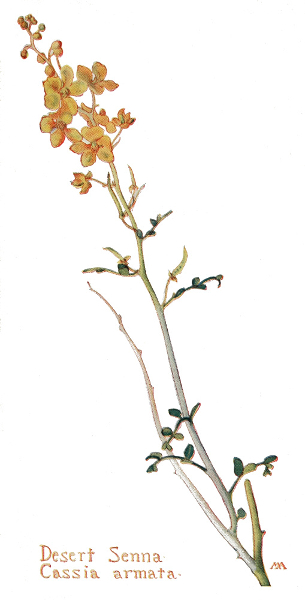
Desert Senna—Cassia armata.
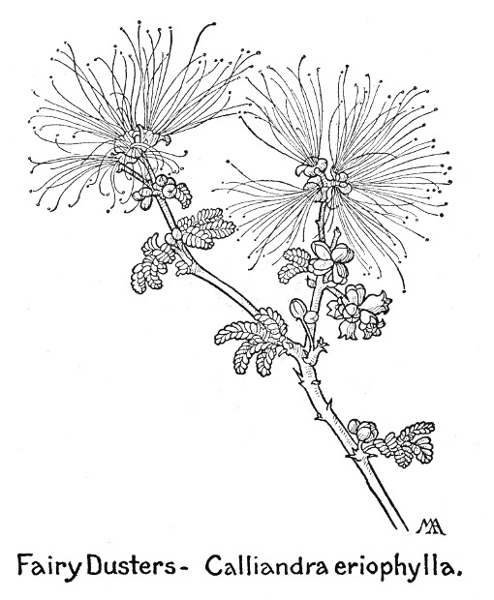
Fairy Dusters—Calliandra eriophylla.
A small family, distributed from the southern United
States to Chili; hairy herbs or low shrubs, without stipules;
leaves alternate; two bracts on the flower-stalk; flowers
purplish, irregular, perfect; sepals four or five, usually
large, the outer one commonly wider than the others;
petals usually five, smaller than the sepals, the three upper
ones with long claws, often united by their claws, sometimes
the middle one of the three lacking, the two lower
ones reduced to mere fleshy glands and not resembling
petals; stamens three or four, united at least at base;
ovary superior, with a slender style; fruit spiny, seed one.
Crimson-beak
Kramèria Gràyi
Purplish-pink
Spring
Arizona
A desert shrub, with a pleasant smell
like balsam, two to four feet high, with
gray, woody stems, abruptly branching,
armed with long, brown and gray thorns,
and clothed with very small, silvery-gray
leaves, downy and thickish. The flowers are curious in
shape and color, with five, large, purplish-pink sepals and
five, small petals, the two lower ones minute and reduced
to glands. The pistil is dark red, the three stamens have
green filaments and red anthers, the ovary is downy and
prickly, and the downy buds are pale pink.
Not a large family, widely distributed in warm and
tropical regions; ours are herbs or shrubs, with opposite or
alternate, compound leaves, with stipules and toothless
leaflets; flowers complete, usually with five sepals and five
petals, and usually twice the number of stamens, with
swinging anthers, alternate stamens sometimes longer,
filaments often with a small scale near the middle; ovary
superior, usually surrounded at the base by a disk; style
one, with a five- to ten-lobed stigma; fruit dry.
There are several kinds of Covillea.
Creosote-bush,
Hediondilla
Covíllea glutinòsa
(Larrea Mexicana)
Yellow
All seasons
Southwest
A graceful, evergreen shrub, common in
arid regions and a characteristic feature
of the desert landscape, filling the air
with its very strong, peculiar odor. It is
from three to ten feet high, with many
little branches, with blackish knots at the
joints, clothed with sticky, dull yellowish-green
foliage, the thickish, resinous leaflets very small, in
pairs, with almost no leaf-stalk, and uneven at base. The
pretty flowers are nearly an inch across, with bright yellow
petals, with claws, and silky, greenish-yellow sepals which
soon drop off. The filaments are broadened below into
wings and have a scale on the inner side. The ovary is
covered with pale, silky hairs, so that the older flowers
have a silky tuft in the center, and becomes a round,
densely hairy fruit, with a short stalk, tipped with the
slender style. These little white, silky balls of down are
very conspicuous and, as they are mingled with yellow
flowers, the bush has an odd and pretty effect of being
spotted all over with yellow and white.
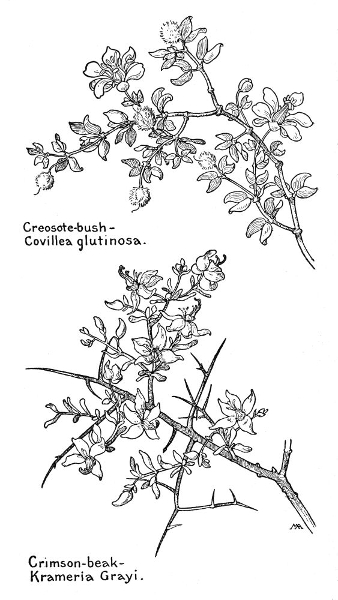
Creosote-bush—Covillea glutinosa.
Crimson-beak—Krameria Grayi.
A small family, widely distributed in temperate and
tropical regions. Ours are smooth herbs, with loosely
clustered, complete flowers, having five sepals; five petals,
alternating with the sepals; five stamens, alternating with
the petals, with swinging anthers and filaments united at
the base; ovary superior; fruit a capsule, containing eight
or ten, oily seeds.
There are many kinds of Flax, sometimes shrubby at
base; with tough fibers in the bark; leaves without stipules,
sometimes with glands at base in place of real stipules;
flowers mostly blue or yellow. There are numerous, small-flowered,
annual kinds, difficult to distinguish and usually
somewhat local. L. usitatíssimum, an annual, with deep
blue flowers, is the variety which, from time immemorial,
has furnished the world with linen from its fiber and oil
from its seeds. Linum is the ancient Latin name.
Blue Flax
Lìnum Lewísii
Blue
Spring, summer
West, etc.
An attractive plant, from one to two
feet tall, with several, erect stems, springing
from a woody, perennial root, with
numerous, small, narrow, bluish-green
leaves and loose clusters of pretty flowers,
each about an inch across. The petals, delicately veined
with blue, vary in tint from sky-blue to almost white,
with a little yellow at the base. This is common and
widely distributed, from Manitoba to Texas and westward,
but the fiber is not strong enough to be used commercially.
Not a large family, mostly tropical. Ours are low herbs,
with sour juice, often with rootstocks or scaly bulbs;
leaves with three or several leaflets; flowers perfect; sepals
five, often unequal; petals five, stamens ten to fifteen;
ovary superior, five-celled, the five styles usually separate;
fruit a capsule, containing several or many seeds. By
some botanists this is merged in the Geranium Family.
There are many kinds of Oxalis. The Greek name
means "sour," in allusion to the sour taste of these plants,
which contain oxalic acid. The leaves are alternate, at
nightfall the leaflets droop and fold together; the stamens
are ten, five long and five short, all with anthers, with
filaments broadened and united at base.
Yellow Wood-sorrel
Óxalis
corniculàta
Yellow
Spring, summer,
autumn
Southwest
A pretty little plant, a few inches tall,
more or less downy all over, with very
slender, reddish, branching stems and
light green leaves, about an inch across
and thin in texture. The flowers are
over half an inch across, with clear yellow
petals, often tinged with pale red on the
outside, yellow anthers and a green pistil.
The capsules are long and downy.
Redwood Sorrel
Óxalis Oregàna
White, pink
Spring
Cal., Oreg., Wash.
One of the most attractive of our woodland
plants. The succulent, hairy, reddish
flower-stalks, about six inches tall,
with two small bracts near the top, spring
from a clump of root-leaves. The larger
leaves are three inches across, with long leaf-stalks, pale
and hairy on the under side, rich green on the upper, each
leaflet marked with an irregular blotch of pale green. The
younger leaves are lighter green than the older ones and in
the bud are neatly folded together, the middle leaflet inside
the other two. The leaflets fold back, when it is either too
hot or too cold to suit the plant. The delicate flowers are
about an inch and a half across, white, pale pink, or rose-color,
often veined with deeper color and with a spot of
yellow at the base of each petal, and well set off by the
foliage, which makes patches of rich and variegated green
in dense forest shade.
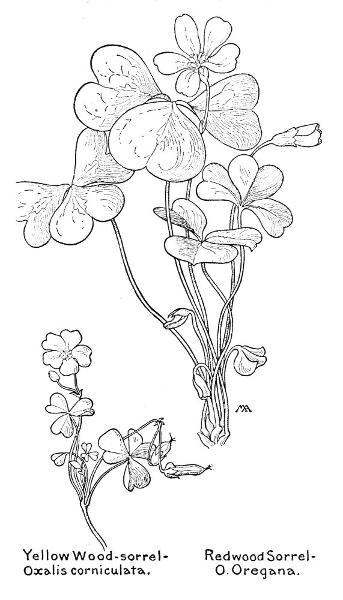
Yellow Wood-sorrel—Oxalis corniculata.
Redwood Sorrel—O. Oregana.
Not a large family, herbs, of temperate regions; leaves
lobed or compound, usually with stipules; flowers perfect;
sepals and petals usually five and stamens five or ten;
ovary superior; fruit a capsule.
There are many kinds of Geranium; stems with swollen
joints; stipules papery; five glands on the receptacle,
alternating with the petals; stamens ten, five long and
five short, filaments united at base; ovary with a beak
formed by the five-cleft style, and becoming a capsule,
which splits open elastically, the style-divisions becoming
tails on the seeds. The Greek name means "crane," in
allusion to the long beak of the capsule, and these plants
are often called Crane's-bill. Cultivated Geraniums are
Pelargoniums, from South Africa.
Wild Geranium
Gerànium incìsum
Pink
Spring, summer
West
In the Sierra woods, and along Yosemite
roadsides, in summer we see the purplish-pink
blossoms and nodding buds of this
attractive plant, resembling the Wild
Geranium of the East, growing from thick,
perennial roots, with hairy, branching stems, from one to
two feet high. The hairy leaves, with three or five,
toothed lobes, are fragrant like cultivated geraniums; the
flowers, over an inch across, are hairy inside, the petals
veined with magenta. They are occasionally white and
the plants vary in size and hairiness. G. furcàtum, of the
Grand Canyon, has magenta petals, which turn back more.
Wild Geranium
Gerànium
Fremóntii
Pink
Spring, summer
Southwest, and
Utah, Ida., Col.,
New Mex.
This has similar flowers, but is a finer
plant, forming large, thrifty-looking
clumps, one or two feet across, of slightly
thickish leaves, dark green on the upper
side and paler, with prominent veins, on
the under, the root-leaves with about
seven, main divisions, the stem-leaves
three- to five-cleft, each clump of leaves
with several tall, slightly downy flower-stalks springing
from it. The calyxes and buds are downy and the flowers
bright pink or rose-purple, delicately veined. This grows
in somewhat moist ground, at the edges of fields and
woody roadsides and on mountain slopes, and is perhaps
the handsomest of its clan.
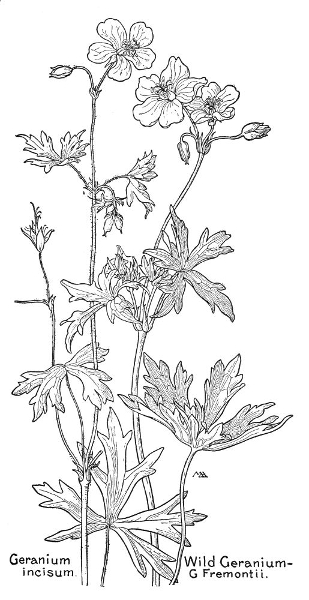
Geranium incisum.
Wild Geranium—Fremontii.
Long-stalked
Crane's-bill
Gerànium
columbìnum
Purple
Spring, summer
California, etc.
A slender plant, about a foot tall, with
pinkish, hairy stems and pretty leaves,
thin in texture, with a dull surface; the
seed-vessels erect, with bristly beaks.
The flowers grow in pairs and are less
than half an inch across, with hairy calyxes
and notched, purple or magenta
petals. This is naturalized from Europe, and common in
the East and grows along roadsides, at the edges of fields
and woods.
There are many kinds of Erodium, three native in the
Southwest and several more introduced, weeds in the Old
World and important forage plants in the West; leaves
often unequal, with one stipule on one side and two on the
other. They resemble Geranium, flower and fruit being
nearly the same, but only five of the stamens have anthers,
the alternate ones being scale-like, without anthers; styles
hairy inside. The Greek name means "heron," in allusion
to the long beak of the capsule.
Red-stem
Filaree
Eròdium
cicutàrium
Pink
All seasons
West, etc.
Though not native, this is the commonest
kind, in the interior and semi-arid
regions, and most valued for forage.
When young it forms rosettes close to the
ground, but grows taller and more straggling.
The stems are often reddish; the
leaves somewhat hairy; the flowers small,
in clusters of four to eight, with four bracts at the base; the
petals purplish-pink, with darker veins, and hairy at the
base, the two upper petals slightly smaller; the sepals tipped
with one or two bristles. The ovary is beaked by the
united styles, the beak, when the seeds ripen, separating
into five, long tails, which twist spirally when dry and
untwist when moistened. This is common west of the
Rockies, blooming more or less all the year round, varying
in size in different soils. Filaree is a corruption of the
Spanish Alfilerilla, from "alfiler," a "pin." Other names
are Pinkets, Pinclover, Storksbill, and Clocks, so-called
by children because they amuse themselves by watching
the tails twist about like the hands of a clock. White-stem
Filaree, E. moschàtum, common in rich soil, has larger,
coarser leaves and a faint scent.
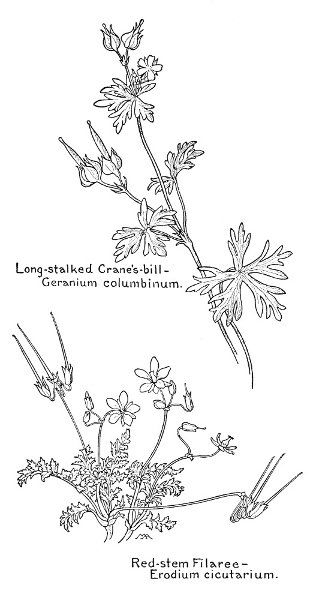
Long-stalked Crane's-bill—Geranium columbinum.
Red-stem Filaree—Erodium cicutarium.
Not a very large family, widely distributed; ours are
herbs, sometimes shrubby, with no stipules; flowers perfect,
irregular, resembling those of the Pea Family, but not like
them in structure; sepals five, the two at the sides large
and colored, like "wings," the upper sepal forming a
"keel"; petals three, more or less united into a tube;
stamens usually eight and united; ovary superior, two-celled,
with a broad, curved stigma.
There are many kinds of Polygala.
California
Milkwort
Polýgala
Califórnica
Pink
Spring, summer
Cal., Oreg.
A rather attractive little plant, three to
eight inches tall, with smooth leaves and
many slender, smooth, woody, stems,
springing from slender rootstocks. The
purplish-pink flowers become deeper in
color as they fade and are quaint in form,
over half an inch long, with pink "wings"
and yellowish "keel," the petals downy inside and the
middle one curving over to form a hood, in which the
stamens and style are concealed. This plant has the odd
habit of bearing another sort of flower near the root,
maturing most of the seed, but without petals, and grows
on dry, shady hillsides in the Coast Ranges.
A very small family, all North American, included in
the Geranium Family by some botanists; smooth herbs, of
wet places, with bitter juice; leaves alternate, lobed and
cut, without stipules; flowers perfect; sepals and petals
two to five; stamens twice as many as the petals; ovary
superior, the five lobes becoming five nutlets; style one.
There are several kinds of Floerkea; sepals and petals
three to five; five, small glands on the receptacle, alternating
with the sepals; style two- to five-cleft.
Meadow Foam
Floérkea Douglásii
(Limnanthes)
White, yellow
Spring
Cal., Oreg.
A charming plant, often covering the
meadows with drifts of creamy bloom.
The stems are smooth, succulent, brittle
and branching, from six to twelve inches
tall; the delicate flowers over an inch across,
the petals hairy at base, sometimes pinkish,
but usually white and yellow.
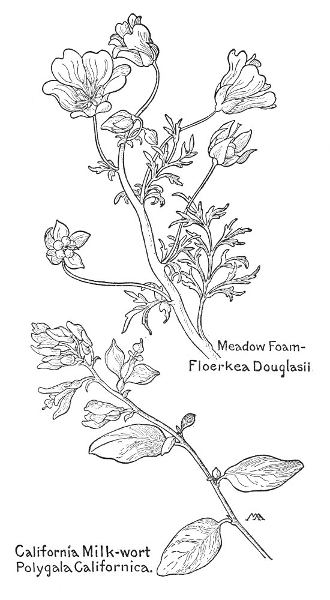
Meadow Foam—Floerkea Douglasii.
California Milk-wort—Polygala Californica.
A small family, widely distributed; trees or shrubs, with
opposite, compound leaves, no stipules and terminal
clusters of irregular flowers, some perfect and some with
only pistils or only stamens; the calyx tubular or bell-shaped,
with five, unequal lobes or teeth; the petals four
or five, unequal, with claws; the stamens five to eight, with
long filaments; the ovary superior, with no stalk, three-celled,
with a slender style; the capsule leathery, roundish
or slightly three-lobed, smooth or spiny, with one to three,
large, polished seeds.
There are a good many kinds of Aesculus, or Horse
Chestnut, natives of America and Asia; the leaves palmately
compound, with toothed leaflets; the flowers of
two sorts, the fertile ones few in number, near the top of
the cluster, with long, thick styles, and the sterile flowers
with short styles.
California
Buckeye
Aésculus
Califórnica
White
Spring, summer
California
One of our handsomest western shrubs,
usually from ten to fifteen feet tall, with
gray bark, and dark bluish-green foliage,
the leaflets from five to seven in number,
glossy on the upper side, pale and dull on
the under, and firm in texture. The
flowers have a rather heavy scent and are
about an inch across, with four or five, slightly irregular,
white petals, which become pink in fading, a pinkish ovary
and long stamens with curling, white filaments, unequal in
length, with buff anthers. They are crowded in a magnificent,
pyramidal cluster, about a foot long, which has a
pinkish-red, downy stem, and the buds are also downy
and pinkish, so that the color effect is warm-pink above,
merging into cream-white below, the whole made feathery
by the long stamens. The shrub has a rounded top of rich
green foliage, symmetrically ornamented with spires of
bloom, standing up quite stiffly all over it. The large,
leathery pod contains a big, golden-brown nut, supposed
to be poisonous to cattle. The leaves fall off very early in
the season, leaving the pods hanging on the bare branches.
This is at its best in the mountain valleys of middle California,
sometimes becoming a good-sized tree.
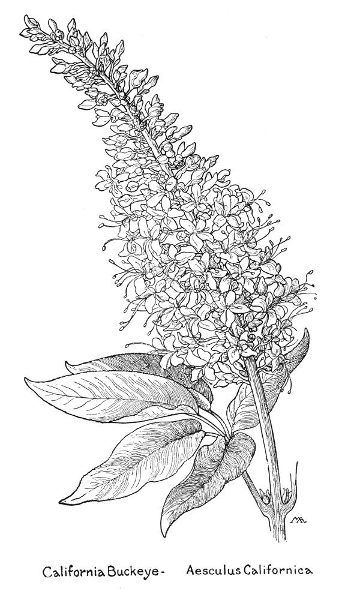
California Buckeye—Aesculus Californica.
A large family; shrubs, or small trees, of temperate and
warm regions, some with bitter, astringent properties,
often thorny; leaves mostly alternate; stipules minute;
flowers often in showy clusters, small, regular; calyx-lobes
and stamens four or five; petals usually four or five, sometimes
lacking, with claws. The short calyx-tube is lined
with a fleshy disk and on this are borne the petals and the
stamens, alternate with the sepals and opposite the petals,
with swinging anthers. In some cases, some of the flowers
have only pistils or only stamens. The ovary superior or
partly inferior; the fruit a berry or capsule.
There are many kinds of Ceanothus, largely western;
flowers small, blue or white, in clusters; calyx bell-shaped,
five-lobed, with a colored, petal-like border; petals five,
the tips arching to form a tiny hood, with long claws;
stamens five, long, protruding, with threadlike filaments;
ovary partly inferior; style three-cleft; capsule splitting
open elastically so as to scatter the three, hard nutlets.
The flowers make a soapy lather when rubbed in water,
hence the name Soap-bush, and the kinds with rigid
branches are called Buckbrush. Red-root is another name.
Mountain Lilac is the commonest name, but misleading.
Lilacs belong to another family.
Squaw Carpets,
Mahala Mats
Ceanòthus
prostràtus
Blue
Spring, summer
Cal., Oreg.
This decorative shrub is common in the
Sierras and carpets the forest floor with a
rich green, leafy mat, sprinkled with
small, feathery clusters of blue flowers.
The trailing stems are clothed with
leathery leaves, opposite and very glossy,
and the little flowers are deep purplish-blue,
with yellow stamens, and slightly scented. These
plants are equally attractive late in the season when the
flowers are replaced by scarlet seed-vessels, with three horns.
Snow Brush,
Mountain Lilac
Ceanòthus
velùtinus
White
West, except
Ariz.
A fine shrub, two to twelve feet high,
with stout trunk and branches, easily
recognized by its leaves, which are rich
green, thick and resinous, shiny as if
varnished on the upper side and sometimes
rich chocolate-brown in color, but
pale on the under side, with three, conspicuous
nerves. The small, sweet-scented flowers are
crowded in compact, creamy clusters, sometimes four or
five inches long, very handsome, but not so delicate as
Deer-brush. This is common on hillsides and in the
mountains, up to seven thousand feet.
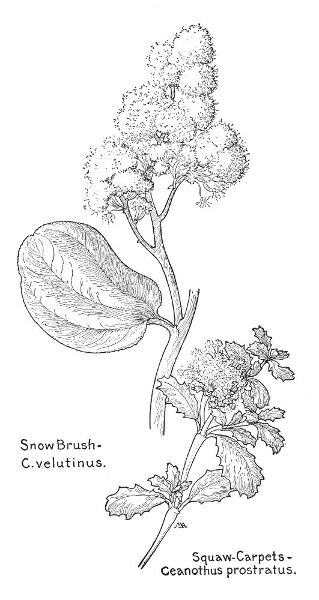
Snow Brush—C. velutinus.
Squaw-Carpets—Ceanothus prostratus.
Deer-brush,
Mountain Lilac
Ceanòthus
integérrimus
White, blue
Summer
Cal., Oreg.,
Wash., Ariz.
A graceful shrub, or small tree, six to
fifteen feet tall, the slender trunk and
branches covered with dull yellowish-green
bark and the bright green foliage
setting off the feathery flower clusters,
two to six inches long, scattered lightly
over the bush and composed of innumerable,
tiny, sweet-scented blossoms. The
leaves are alternate, half an inch to three inches long,
toothless, thin in texture, very slightly downy or smooth,
with three veins, and the flowers cream-white, occasionally
blue or pink, with conspicuous stamens, which give the
plume-like sprays a delicate foamy effect against the dark
forest background. This shrub is a beautiful sight when
in flower and sometimes covers the mountainsides with
drifts of snowy bloom, filling the air with delicate perfume.
It is quite variable and sometimes has dark shiny leaves
and small compact clusters of flowers. It is often called
White Tea-tree, because the bark is used medicinally.
Blue Mountain
Lilac
Ceanòthus
parvifòlius
Blue
Summer
California
An attractive mountain shrub, growing
in Yosemite, and elsewhere in the Sierra
Nevada Mountains at similar altitudes,
low and spreading, about three feet high,
with smooth, pale green branches and
small, smooth, toothless leaves, dark
green and shining on the upper side, pale
on the under. The oblong clusters of minute blue flowers
are slightly sweet-scented and about two inches long.
A large family, widely distributed; mostly herbs, with
mucilaginous juice and tough, fibrous bark; leaves alternate,
mostly palmately-veined and lobed, with stipules;
flowers regular, perfect, or the stamens and pistils on
different plants; sepals five, often with an outer row of
bracts below, resembling another calyx; petals five, their
bases or claws united with each other and with the base of
the stamen-tube; stamens numerous, united by their
filaments into a column, forming a tube enclosing the
pistils; fruit a capsule, breaking when ripe into several one-seeded
parts, or splitting down the back of the valves,
allowing the seeds to escape. The little fruits are commonly
called "cheeses." True Mallows are introduced
"weeds" in this country.
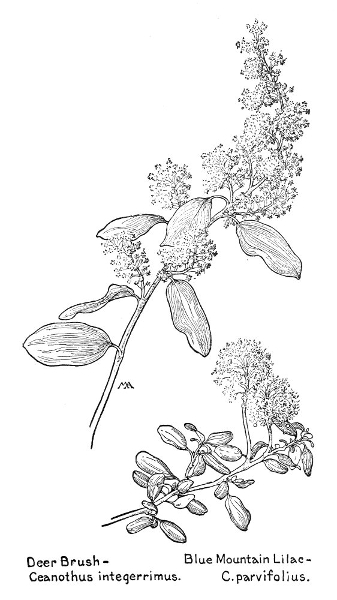
Deer Brush—Ceanothus integerrimus.
Blue Mountain Lilac—C. parvifolius.
Arizona Wild
Cotton
Thurbéria
thespesioìdes
(Ingenhouzia
triloba)
White
Summer
Arizona
The only kind, a fine shrub, from four to
eight feet high, with smooth leaves, most
of them with three lobes, and handsome
cream-white flowers, tinged with pink on
the outside and measuring two inches
across. This grows in the mountains of
southern Arizona and is beautiful under
cultivation, often growing to a height of
six or eight feet in a season.
There are a number of kinds of Sidalcea, difficult to
distinguish; perennials; leaves round in general outline,
variously cut and lobed; flowers showy, in terminal clusters;
calyx with no outer bracts, or with only one; stamen-column
double; stigmas threadlike, distinguishing them
from Malvastrum and Sidalcea.
Rose Mallow
Sidálcea
Califórnica
Pink
Spring
California
This has velvety leaves, those from the
root much less deeply lobed than the
others, and a slender, slightly hairy stalk,
one to two feet tall, leaning to one side
and bearing a loose raceme of rose-pink
flowers, with petals about an inch long.
Only one or two flowers are open at a time, but they are
very pretty and conspicuous in open woods and along the
edges of fields, around Santa Barbara, in May.
Oregon Mallow
Sidálcea Oregàna
Pink
Summer, autumn
Northwest
A pretty plant, with one or more smooth,
pale, branching stems, about two feet
tall, and dark green leaves, with conspicuous
veins. The buds are downy and
the flowers are about three-quarters of an
inch across, with pale pink petals, prettily veined, shading
to white at the center. The anthers are white and the
pistil, when the stigmas have expanded, is prettily tipped
with a tiny crimson brush.
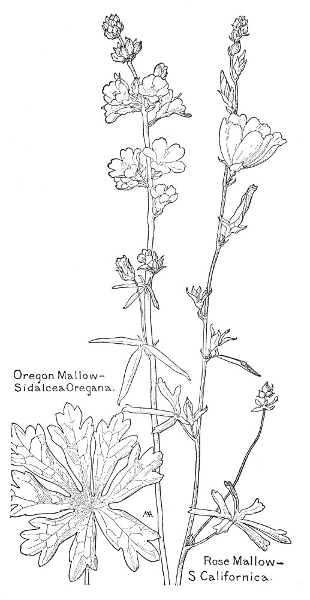
Oregon Mallow—Sidalcea Oregana.
Rose Mallow—S. Californica.
Checker-bloom
Sidálcea
malvaeflòra
Pink
Spring
California
A pretty perennial, with several leaning,
hairy stems, one or two feet tall, and dark
green leaves. Some plants have perfect
flowers, an inch or more across, often very
pale pink, and others have only rudimentary
stamens and smaller flowers, usually
deep pink in color, but the plant is very variable. This is
common near the coast. It is sometimes called Wild
Hollyhock.
Mallow
Sidálcea Neo-Mexicàna
Pink
Summer
Ariz., Utah,
New Mex.,
Col., Wyo.
This is from one to three feet tall, with
smooth, rather dark green leaves and very
pretty, pale purplish-pink flowers with
pale-yellow anthers and pinkish pistil.
This grows in the mountains.
There are many kinds of Malvastrum,
natives of America and Africa; perennial
herbs or shrubs; the calyx often with three outer bracts;
the stamen-column bearing anthers at the top; the stigmas
with round heads. The name is from the Greek,
meaning "star-mallow."
Spotted Mallow
Malvástrum
rotundifòlium
Pink
Spring
Southwest
A very pretty desert plant, from six to
eight inches tall, the coloring of the flowers,
stems, and leaves vivid and oddly contrasting,
for the stems are bright red and
hairy, and the leaves stiff, hairy, and
bronze-green in color, while the lovely
globe-shaped flowers, which are over an inch across, are
delicately shaded from lilac to rose outside and paler inside,
with conspicuous round blotches of orange-vermilion at
the base of each petal within. The calyx and buds are
very hairy, the petals each have a twist to one side, and
the mauve stamens form a pretty cluster in the center.
These flowers last a long time in water, closing at night and
opening again in the morning.
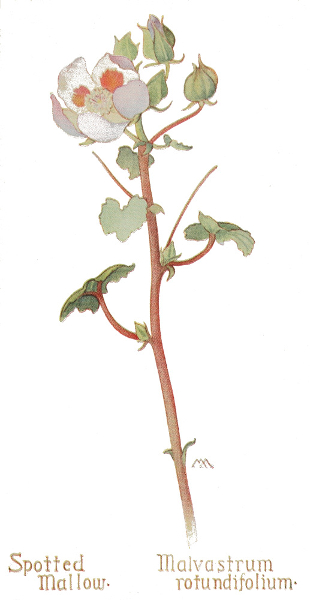
Spotted Mallow—Malvastrum rotundifolium.
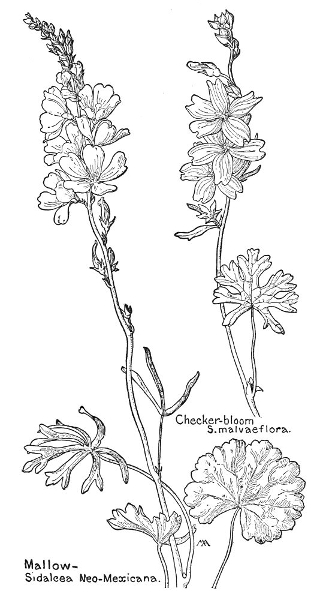
Checker-bloom—S. malvaeflora.
Mallow—Sidalcea Neo-Mexicana.
False Mallow
Malvástrum
Thúrberi
Pink
Spring, summer
California
A handsome shrub, from five to ten
feet high, woody below, with long, slender,
wandlike branches and thick, very downy,
light bluish-green leaves. The pretty lilac-pink
flowers are from one to nearly two
inches across and pleasantly scented, and
the foliage is soft and pretty in appearance, though rather
harsh to the touch, its pale tones blending harmoniously
with the delicate blossoms. This is common in southern
California.
There are several kinds of Lavatera, mostly from the Old
World.
Tree Mallow
Lavàtera
assurgentiflòra
Pink
Spring
California
This was planted in the mission gardens
by the Fathers and is now common around
San Francisco. It is a branching shrub,
from six to fifteen feet high, with a twisted,
gray trunk and large handsome leaves,
light green and very soft and smooth to
the touch, paler and downier on the under side. The
flowers are handsome and conspicuous, two or three inches
across, with bright pink petals, warm and rich in tone,
beautifully striped with maroon and shading to yellowish-white
towards the center, with a purple pistil and grayish
anthers. The flowers and seed-vessels hang on curved
pedicels, like pipe-stems, giving a rather odd effect. The
leaves and twigs are very mucilaginous.
There are many kinds of Sphaeralcea, much like Malvastrum,
except that they have two or three ovules, instead
of one, in each cavity of the ovary. The name is from the
Greek, meaning "globe-mallow," in allusion to the usually
roundish fruit.
Scarlet Mallow
Sphaerálcea
pedàta
Red
Spring
Southwest
These graceful wands of brilliant bloom
are very common in spring in Arizona.
The flowers are over an inch across, vivid
yet delicate in color, shading from luminous
scarlet to clear pale-orange. The
buds are tipped with deeper red and the
foliage is rather pale green, somewhat hairy and downy.
The stems are from one to two feet tall and bend slightly
to one side, swaying to and fro in the wind and displaying
their flaming blossoms to great advantage.
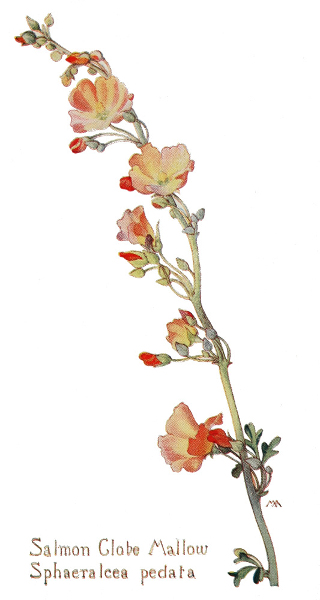
Salmon Globe Mallow—Sphaeralcea pedata.
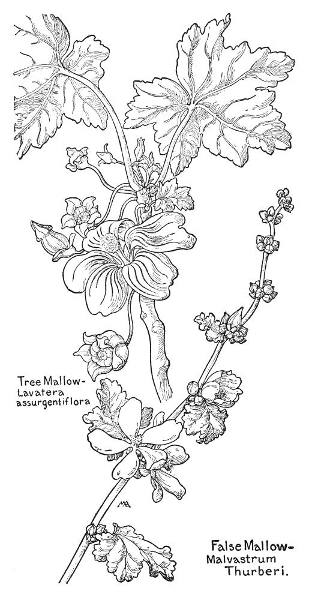
Tree Mallow—Lavatera assurgentiflora.
False Mallow—Malvastrum Thurberi.
Not a large family, mostly natives of temperate and
warm regions. Ours are herbs, sometimes shrubby, without
stipules, with opposite, toothless leaves, with clear or
black dots; the flowers regular and complete, all the parts
borne on the receptacle; the sepals and petals usually five;
the stamens usually numerous, sometimes grouped in three
to five clusters; the ovary superior; the fruit a capsule.
There are many kinds of Hypericum, widely distributed;
the leaves without leaf-stalks, the flowers yellow, with three
to six styles. This is the ancient Greek name. These
plants bloom in June, about St. John's Day, and so tradition
gives them magic properties, appropriate to the Eve
of that day, when fairies and witches are abroad, and they
are commonly called St. John's-wort.
St. John's-wort
Hypéricum
concínnum
Yellow
Summer
California
This has very pretty flowers and grows
from three to eighteen inches tall, with
smooth stems, branching and woody at
base, and smooth, rather bluish-green
leaves, usually folded, not clasping at base,
usually with only a few dots. The flowers
are an inch or more across, with bright golden petals, with
some black dots, and numerous stamens in three bunches,
forming large, fuzzy, golden centers. This grows on dry
hills and is supposed to be poisonous to sheep.
St. John's-wort
Hypéricum formòsum
var.
Scoúleri
Yellow
Summer
West
A pretty plant, from six inches to three
feet tall, with a stiff stem, often branching
towards the top, and rather dull green
leaves, blunt, oblong and clasping at base,
about an inch long, thin in texture, with
black dots on the margins. The flowers
are from half an inch to an inch across,
with bright yellow petals, dotted with black, and are very
pretty, but not so handsome as the last. This grows in moist
places, chiefly in the mountains, and is common in Yosemite.
Creeping St.
John's-wort
Hypéricum
anagalloìdes
Orange
Summer
Northwest
An attractive little plant, only a few
inches tall, with many weak, slender,
branching stems, spreading on the ground
and rooting at the joints, and small,
smooth, light yellowish-green leaves, often
tinged with red. It grows in wet places
and forms close mats of foliage, sprinkled with light-orange
or salmon-colored flowers, a quarter of an inch
or more across, with fifteen to twenty, yellow stamens.
The effect is something like Anagallis, Scarlet Pimpernel,
hence the name. This is common in Yosemite and similar
places, up to nine thousand feet.
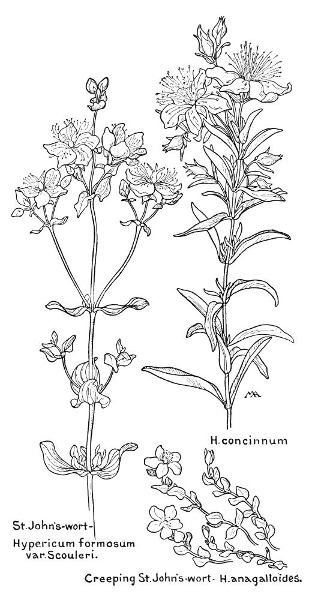
H. concinnum.
St. John's-wort—Hypericum formosum var. Scouleri.
Creeping St. John's-wort—H. anagalloides.
A very small family, with one genus and only a few
species; natives of the Southwest and Mexico; the flowers
are brilliant red, in terminal clusters; the sepals five, not
united; the petals five, united into a tube, the lobes somewhat
spreading; the stamens ten to fifteen, protruding,
inserted under the pistil; the ovary imperfectly three-celled;
the styles three, long, somewhat united; the seeds
three to six, oblong, flattened, surrounded by a membranous
wing or long, white hairs. These plants are very
puzzling, but interesting, and as they are not nearly related
they have at various times been classified with other
families.
Flaming Sword,
Ocotillo, Candle
Flower
Fouquièra
spléndens
Red
Spring
Ariz., Cal., New
Mex.
A magnificent desert shrub, when in
full bloom, but strangely forbidding in
aspect in spite of its beauty. Its many
stiff stems, from six to twenty feet tall,
entirely without branches, stand up stiffly
from the root, like a bunch of wands, and
are armed their whole length with terrible
thorns, which in the spring are masked
with beautiful foliage, like little apple
leaves. From the tip of each wand springs a glorious
cluster, from six to ten inches long, composed of hundreds
of scarlet flowers, each about an inch long, and crowded
closely together, suggesting a flame and waving to and
fro in the wind with a startling effect against the pale
desert sand. When the flowers and leaves are gone, the
clumps of dry, thorny sticks look quite dead and it is hard
to believe that they were so splendid early in the season.
They make an impenetrable fence and are much used by
the Indians for hedges.
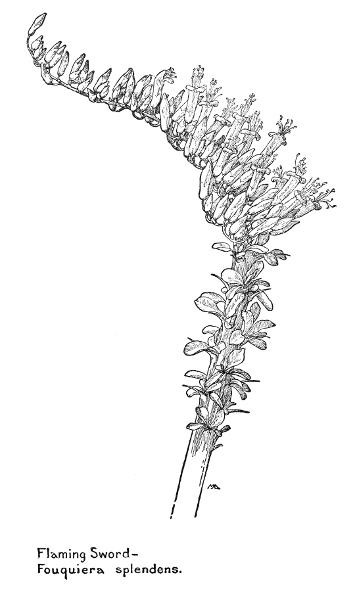
Flaming Sword—Fouquiera splendens.
A rather large family, widely distributed, but we have
only three genera, the principal one being Viola, which is
the ancient Latin name, used by Virgil.
There are many kinds of Viola, widely distributed,
blooming in spring, but often flowering again in the
autumn; low, perennial herbs, with stipules; leaves alternate,
or from the root; flowers complete, irregular, nodding,
nectar-yielding, usually single; sepals five, with small ear-shaped
projections at the base; petals five, slightly bearded
within, so as to afford a foothold for bees, the lowest petal
larger and with a spur at the back; stamens five, short,
with broadened filaments and anthers opening inward, so
as to cover the pistil all but the end of the style, the two
lower anthers with spurs at the base, which project into the
spur of the petal; ovary superior and one-celled; style club-shaped,
with a one-sided stigma. The flowers are often
of two kinds, the earlier ones with long flower-stalks, with
petals and showy, but not producing seed; the later ones
with short stalks, with small or no petals, but fertile, often
cleistogamous, that is, fertilized in the bud. The capsule
splits open and as the three valves dry they fold firmly
together lengthwise and force out the seeds.
Pine Violet
Vìola lobàta
Yellow
Spring, summer
Cal., Oreg.
A pretty plant, growing in the woods,
with leafy stems, from four to fourteen
inches high, with leafy stipules and smooth,
rather light green leaves, deeply lobed,
so that they look unlike most Violet
leaves. The flowers are more or less clustered, an inch
or more across, with bright yellow petals, veined with
purple inside, tinged with purplish-brown outside, the
two side petals with a little hairy patch at the base inside.
Western Heartsease
Vìola ocellàta
White and yellow
Spring, summer
Cal., Oreg.
A shy little woodland plant, from five
to twelve inches tall, with creeping rootstocks
and small, dry stipules. The
flowers are an inch or less across, the two
upper petals white, tinged with reddish-purple
on the outside, and the other petals
white or yellow, with a splash of purple on each of the two
side petals and the lower one veined with purple. This
grows in shady woods.
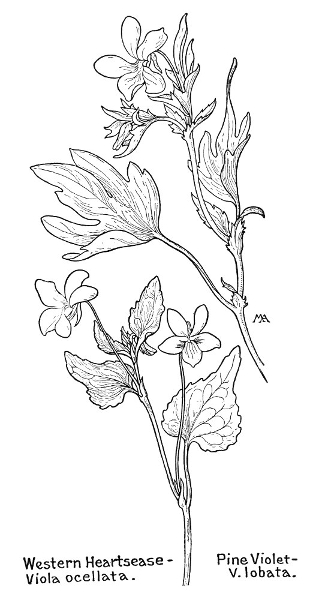
Western Heartsease—Viola ocellata.
Pine Violet—V. lobata.
Yellow Mountain
Violet
Vìola venòsa
Yellow
Spring
Northwest and
Utah
An attractive kind, usually about three
inches tall, with almost smooth leaves,
often with purplish veins, with blunt tips
and margins obscurely or coarsely toothed,
or almost toothless, and with long leafstalks.
The flowers are usually less than
half an inch long, with clear yellow petals,
more or less tinged with purple on the outside, the lower
petal usually with several, purplish-black veins, the two
side petals with one or two veins. This has no scent, the
capsule is roundish and hairy, and the cleistogamous
flowers are abundant. It grows on dry mountainsides
and is very variable both as to flower and foliage and much
smaller at great altitudes, the whole plant being not more
than an inch high. The drawing is of a Utah plant.
Canada Violet
Vìola Canadénsis
Pale-violet, white
Spring, summer
West, etc., except
Cal.
This is quite tall, the slender, rather
weak stems being sometimes over a foot
high, with smooth leaves, often with some
hairs on the veins of the under side. The
flowers, over half an inch across, with a
short petal-spur, are almost white, delicately
veined with purple, yellow in the throat and tinged
with violet or purple on the outside. Occasionally they
are pure-white all over and sometimes sweet-scented. The
capsule is oval and smooth. This is common in eastern
mountain woods, and to eastern eyes looked far from
home when we found it in Walnut Canyon in Arizona.
Pale Mountain
Violet
Vìola adúnca var.
glàbra
Pale-blue
Spring, summer
Utah
This is small and low, about three inches
high, with leafy stems, forming a clump
of small, smooth, more or less toothed
leaves, with blunt tips, dark green on the
upper side and paler on the under, with
two, quite large, fringed bracts at the
bases of the leaf-stalks, and two, small,
fringed bracts on the flower-stems, half an inch below the
flower. The flowers are scentless, measure less than half
an inch across, and are pale-blue or almost white, with veins
of dark blue on the lower petal and tufts of white, fuzzy
hairs inside, at the base of the side petals, the spur purplish.
This grows in mountain canyons, at a height of five thousand
to nine thousand feet, and is very small at great
altitudes.
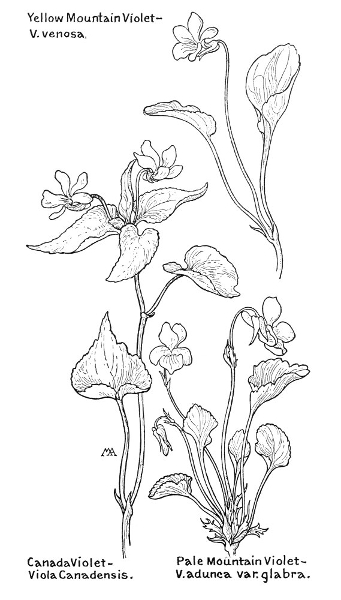
Yellow Mountain Violet—V. venosa.
Canada Violet—Viola Canadensis.
Pale Mountain Violet—V. adunca var. glabra.
Blue violet
Vìola adúnca var.
lóngipes
Blue, purple
Spring
Cal., Oreg.
A pretty plant, two to four inches high,
with slightly hairy leaves and flowers
nearly an inch long, with bright purplish-blue
or violet petals, more or less veined
with purple, the side petals hairy at base
inside. This grows near the coast.
Johnny Jump-up,
Yellow Pansy
Vìola
pedunculàta
Yellow
Spring
California
Charming flowers, often growing in
quantities on open hillsides. The leafy
stems are from two to six inches high, the
leaves rather dark green and the scentless
flowers, about an inch across, have bright
golden petals, with some purple lines at
the base of the three lower ones, the spur
and upper petals tinged with brownish-purple on the outside,
the two side petals hairy at base inside, and the stigma
hairy. The Spanish-Californian name is Gallito. There
is no technical difference between Pansies and Violets.
Not a very large family, all but one natives of America;
herbs, armed with hooked, stinging or sticky hairs; without
stipules; the flowers perfect, with five sepals and five
to ten petals; the stamens numerous, with threadlike
filaments, the outer ones sometimes petal-like, inserted
with the petals on the throat of the calyx and usually
arranged in clusters opposite the petals; the ovary inferior,
with a threadlike style; the capsule crowned with the calyx-lobes.
There are many kinds of Mentzelia, all western, often
with white shining stems and alternate leaves; the calyx
cylindrical or top-shaped, with five lobes; the petals five
or ten; the styles three, somewhat united. The barbed
hairs which clothe the stems and leaves make the plant
stick to whatever it touches, probably helping to distribute
the seeds, hence the common name Stick-leaf.
Blazing Star
Mentzèlia
laevicàulis
Yellow
Summer, autumn
West, except
Wash. and Ariz.
A stout, branching biennial, two to
over three feet tall, with shining white
stems, almost smooth, long, rather narrow,
wavy-toothed leaves and enormous
flowers, in clusters of two or three at the
ends of the branches and opening only in
bright sunlight. They are from three to
five inches across, with five, broad, light yellow petals and
quantities of very long stamens, making a beautiful center.
Five of the stamens have broadened filaments, resembling
narrow petals, the style is three-cleft, and the capsule is
oblong, containing many flat, winged seeds. These plants
usually grow in dry stream-beds and are not rare, but
through various accidents I have never been able to secure
a drawing of either this or the next.
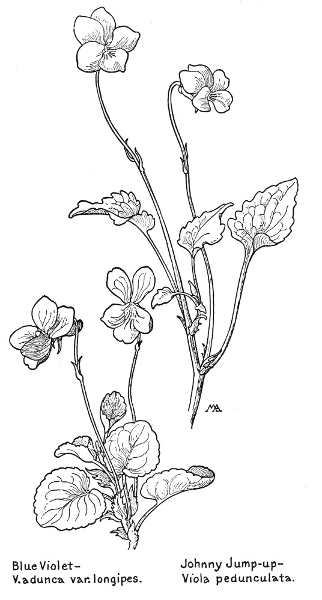
Blue Violet—V. adunca var. longipes.
Johnny Jump-up—Viola pedunculata.
Evening Star
Mentzèlia
Líndleyi
Yellow
Summer
California
A more slender plant than the last, with
magnificent flowers, two and a half inches
across, which open in the evening and
remain open during the following morning.
They have five, broad petals, with pointed
tips, bright golden-yellow, colored with
vermilion at the base, and handsome yellow centers.
The filaments are very slender, some of the outer ones
slightly broadened at base, and the style is not cleft. This
grows in the mountains. There is a drawing of it in Miss
Parsons's Wild Flowers of California. It is called Buena
Mujer, or Good Woman, by the Spanish Californians,
because the leaves stick so tightly to one.
Mentzèlia
multiflòra
Yellow
Spring
Southwest, Utah,
etc.
An odd-looking plant, with very pale,
straggling stems and thickish leaves, a
pretty shade of pale green, all exceedingly
disagreeable to touch. The buds are
tipped with salmon-color and the flowers
are an inch and a half to two inches across,
with a long green calyx-tube with buff lobes, ten petals,
bright yellow inside and pale buff outside, and pretty,
fuzzy, yellow centers. They open in the evening, about
five o'clock, and the plant would be pretty, in spite of its
harsh foliage, if more of the flowers were out at one time.
This is common along roadsides in the Southwest and in
New Mexico and Colorado.
Mentzèlia
gracilénta
Yellow
Spring
Southwest
This has several pale greenish or pinkish
stems, from a few inches to a foot and a
half tall, which look smooth but are very
harsh to the touch, springing from a cluster
of stiff, harsh, dull-green leaves, variously
lobed or toothed. The flowers are nearly an inch across,
with glossy, bright yellow petals and beautiful, fuzzy,
yellow centers, and are very delicate and pretty.
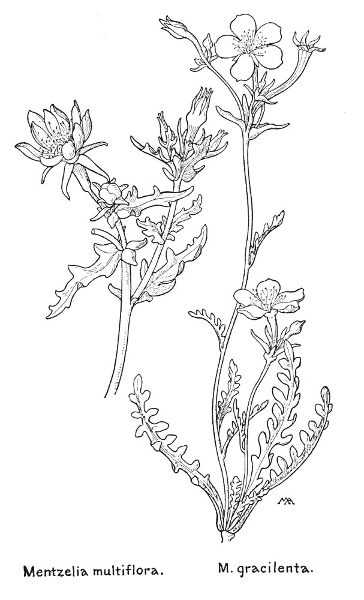
Mentzelia multiflora.
M. gracilenta.
A rather large family, mostly of the Mediterranean
region; herbs or low shrubs; flowers regular, perfect, all the
parts borne on the receptacle; sepals five, the two outer
ones smaller and bract-like, or lacking; petals three to five;
stamens many; ovary superior, one-celled, with a single
style, or none; fruit a capsule, with several or many seeds.
There are many kinds of Helianthemum, widely distributed,
perennials; leaves alternate, undivided, toothless;
flowers yellow and, in most North American species, of
two sorts; the earlier ones with large, yellow petals, very
numerous stamens and a many-seeded pod; the later ones,
small, clustered, with small petals or none, three to ten
stamens, and small, few-seeded pods.
Rock-rose
Heliánthemum
scopàrium
Yellow
Spring
California
A pretty plant, with many, slender
stems and narrow, yellowish-green leaves,
forming clumps from one to two feet high.
The flowers are half an inch to three-quarters
of an inch across, the buds and
calyxes reddish and the petals clear yellow,
the pistil greenish, with a three-lobed stigma. In favorable
situations, such as Point Loma, this makes attractive
little bushes, neat yet feathery, suggesting large clumps of
grass, sprinkled thickly with flowers.
A large family, nearly all natives of America and of dry
or desert places, with strange characteristics, which make
them easily recognized as a whole, but many of the individuals
have not yet been studied or described; fleshy
plants, with thick stems, often flattened, ridged or covered
with knobs, mostly without leaves, usually with spines,
which generally protrude from cushions of small bristles;
the flowers perfect, regular, showy, and mostly single;
sepals, petals, and stamens all numerous; ovary inferior,
with a long style and several stigmas; fruit usually a pulpy
berry, containing many seeds.
There are many kinds of Echinocactus, round or oval
plants, mostly ribbed, with bunches of spines of several
kinds, arranged in straight or spiral rows; the fruits scaly,
though spineless.
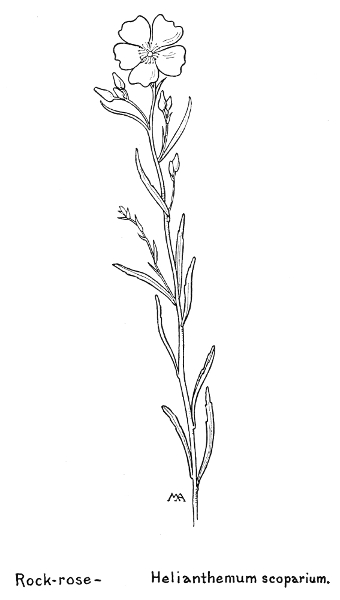
Rock-rose—Helianthemum scoparium.
Barrel Cactus,
Bisnaga
Echinocáctus
Wislizèni
Yellow, reddish
Summer
Southwest
A common and useful kind, the shape
and often the size of a barrel, covered with
spines. The Indians cut off the top of the
plant and pound the pulp with a stick
into a soft mass, which they squeeze with
their hands, extracting a large amount of
watery juice, which is wholesome and not
unpalatable and has often saved lives in the desert. Indians
use the spines for fish-hooks, hence a common name, Fishhook
Cactus, and the celebrated cactus candy is made
from it. The flowers are large.
There are many kinds of Echinocereus, oblong or cylindrical,
spiny plants, generally a few inches tall, usually
growing in clumps; stems ridged, or with spiny ribs; fruits
spiny.
Hedgehog Cactus
Echinocèreus
Polyacánthus
Red
Spring
Ariz., New Mex.
Tex.
This forms a clump of several stems,
each about the shape and size of a cucumber,
and armed with bunches of long, stiff
spines. The flowers are two or three
inches long, with deep red petals, dull
pink anthers, and a bright green pistil.
This grows in the Grand Canyon.
There are many kinds of Opuntia, with jointed stems,
cylindrical or flattened, armed with bristles, usually with
spines. The fruits and fleshy joints are good for fodder, if
the spines are removed, and hence there has been much
inquiry into the economic value of these plants. It has
been found that the spiny species are the most valuable
for fodder, under extremely arid conditions, as the spines
can be burned off, while the unarmed forms are subject to
the attacks of so many animals that a crop cannot be
secured without the protection of fences. The spines are
removed either by singeing the growing plant with a torch,
or the upper parts are cut off and thrown into a fire,
or sometimes the plants are made into fodder by being
chopped up, spines and all, in a machine. The Prickly
Pears in Sicily and the Orient came from America.
Opúntia
acanthocàrpa
Yellow
Spring
Southwest
From three to six feet tall, resembling
Cholla, with long, cylindrical joints and
whitish spines. The pretty flowers are
about two inches long, with orange-yellow
petals and an ivory-white pistil. The
fruits are spiny and become dry when ripe. This grows in
the desert around Needles.
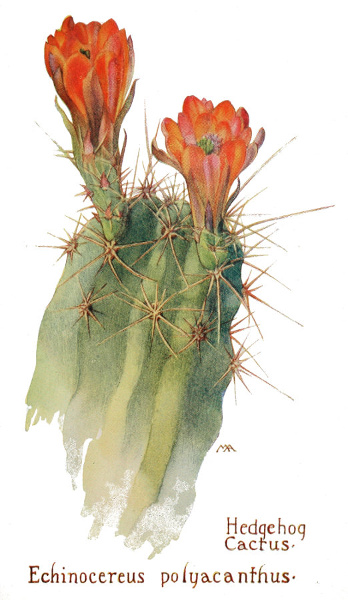
Hedgehog Cactus—Echinocereus polyacanthus.
Cholla
Opúntia fúlgida
Red
Spring, summer
Arizona
A horrible shrub, or dwarf tree, four to
six feet high, with a thick trunk and
several, spreading, contorted branches,
with cylindrical joints, twisting in awkward
ways. The trunk and larger limbs
are brownish-gray, starred with dead, dry spines, but the
twigs are pale bluish-green, covered thickly with stars of
pale-yellowish spines, each an inch or so long, with a
barbed tip. From the numerous magenta flowers strange,
yellowish, cup-shaped fruits develop, seeming to spring one
out of the other in a haphazard way, hanging in long chains,
awkward but rather ornamental, and remaining on the
plants for several years without change, except that they
grow slightly larger. The distant effect of this plant is
a pale, fuzzy mass, attractive in color, giving no hint of its
treacherous character—more like a wild beast than a plant!
The joints suggest a very ferocious chestnut-burr and
break off at a touch, thrusting their spines deeply into the
flesh of the unwary passer-by, so that the Indian story, that
this plant flings its darts at wayfarers from a distance,
might almost as well be true, and the barbs making the
extraction difficult and painful. The ground under the
plants is strewn with fallen joints, which take root and
propagate themselves. Small animals pile these around
their holes for defense, several kinds of birds build in the
thorny branches and are safe from enemies, and the fruits,
being spineless and succulent, are valuable for fodder, so
the Cholla is not entirely malevolent. The name is
pronounced Choya. There are many similar kinds, some
with very handsome rose-like flowers, others with bright
scarlet fruits. They are curious and interesting inhabitants
of the desert.
Prickly Pear
Opúntia basilàris
Pink
Spring
Arizona
Low plants, with no main stem, with
spreading, flattened branches, the joints
of which are flat disks, resembling fleshy,
bluish-green leaves. These disks are
half an inch to an inch thick and six inches
long, more or less heart-shaped, sprouting one out of the
other, at unexpected angles. The beautiful flower is about
three inches across, like a tissue-paper rose, pale or very
deep pink, with a whitish pistil, yellow anthers, and
crimson filaments. The joints have a strong fishy smell,
when cut, and are dotted with tufts of small, brown bristles,
exceedingly unpleasant to get in one's fingers. This is
rare and grows at the Grand Canyon. Prickly pears usually
have yellow flowers and long spines.
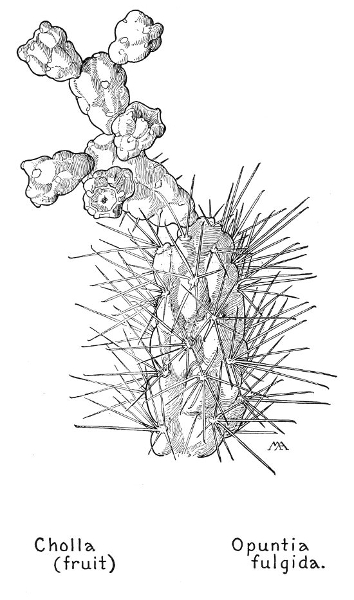
Cholla (fruit).
Opuntia fulgida.
Common Prickly
Pear
Opúntia
Yellow
Spring, summer
Southwest
There are fifty or more common kinds
of Prickly Pear, many of them as yet undescribed
and little known. They have
flattened joints and yellow flowers, like
the one illustrated, which is typical, often
measuring three or four inches across, the
petals variously tinted outside with salmon, rose, and
brown.
There are many kinds of Cactus, round, cylindrical, or
oval plants, covered with knobs, bearing clusters of spines,
those of some species having hooked tips. They may be
known by their smooth fruits, without scales or spines.
Pincushion Cactus
Cáctus Gràhami
(Mamillaria)
Pink
Spring
Arizona
A quaint little plant, often no bigger
than a billiard ball, with long, blackish,
hooklike spines, projecting from stars of
smaller spines. The flowers are pink and
the berries are smooth, fleshy fingers of
brightest scarlet, edible, pretty and odd.
Sometimes we see one of these prickly little balls peeping
from under a rock and again we find them growing in a
colony, looking much like a pile of sea-urchins. This
grows in the Grand Canyon, and there are similar kinds in
southern California.
There are many kinds of Cereus, with cylindrical or oval
stems, from a few inches to forty feet tall, not jointed, with
ribs or rows of knobs, running lengthwise, and clusters of
spines.
Column Cactus,
Sahuaro
Cèreus gigantèus
White
Spring, summer
Arizona
These tree-like plants are wonderfully
dignified and solemn in aspect, with none
of the grotesque or ferocious effect so common
among their relations. They grow in
numbers on the mountain slopes around
Tucson and are easily recognized by their
size and very upright form, rearing their thick, cylindrical
branches straight up in the air, to a height of thirty or
forty feet. They are smooth and light green, armed with
rows of spines in stars along the ridges, and ornamented
during May and June with handsome, large, whitish, wax-like
flowers, very perfect in form, opening in the daytime,
blooming most abundantly on the sunny side of the plant
and remaining open but a short time. Woodpeckers
often make holes for nests in the branches, which are used
afterwards by a little native owl, the smallest kind in the
world, and by honey-bees, and these holes often lead to
decay and to the ultimate death of the tree. The fruits,
with crimson flesh and black seeds, are valued by the
Papago Indians for food, and mature in enormous quantities
in midsummer, but birds eat up many of the seeds
and of the millions reaching the ground only a very few
germinate and develop into odd, little round plants, a few
inches high, often eaten by some animal before they become
sufficiently prickly for protection.
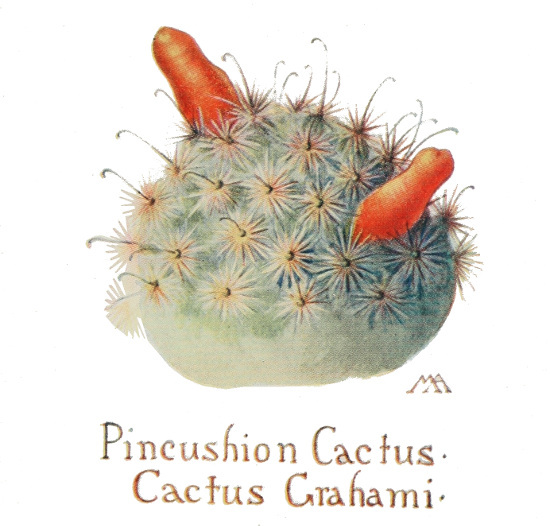
Pincushion Cactus—Cactus Grahami.
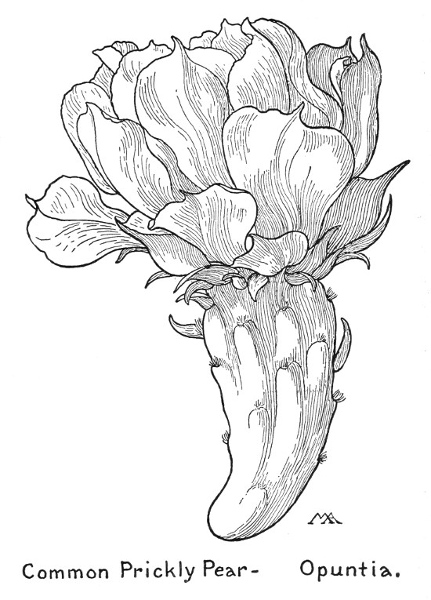
Common Prickly Pear—Opuntia.
A large family, widely distributed, most abundant in
America; herbs, with no stipules; flowers usually perfect,
their parts usually in fours; calyx-tube attached to the
usually four-celled, inferior ovary and usually prolonged
beyond it; stamens four or eight, inserted with the petals,
on the throat of the calyx-tube, or on a disk; style single
with a four-lobed or round-headed stigma; fruit usually a
four-celled capsule, containing small seeds or a nut. The
flowers are generally showy and many are cultivated.
Eulòbus
Califórnicus
Yellow
Spring
Southwest
This is the only kind of Eulobus. It
would be a pretty plant, if more flowers
were out at one time and if they did not
close so soon. The smooth, hollow, loosely-branching
stem is from one to three feet
tall, with a "bloom," the leaves are smooth, rather light
dull-green, and the buds are erect. The flowers are about
three-quarters of an inch across, with a very short calyx-tube,
light-yellow petals, fading to reddish-pink, eight
stamens, four of them smaller and shorter, and the light-green
stigma with a round top. The slender pods are
three inches long, smooth, cylindrical, and turning stiffly
down, with many seeds. This grows in mountain canyons.
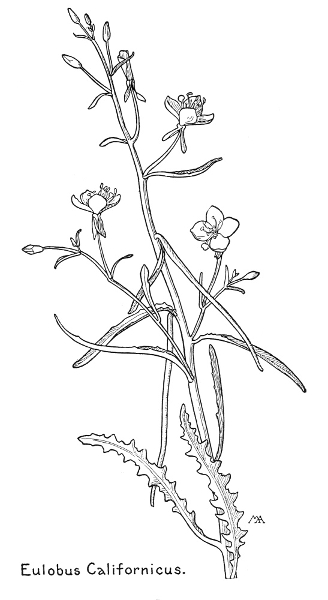
There are a few kinds of Chamaenerion; perennials,
often woody at base; leaves alternate; flowers in clusters,
perfect, slightly irregular, white or purplish; petals four;
stamens eight; style threadlike, with a four-cleft stigma;
capsule long, four-sided, containing numerous seeds,
tipped with a tuft of hairs. The calyx-tube is not prolonged
beyond the ovary, which chiefly distinguishes this
genus from Epilobium.
Fire-weed, Great
Willow-herb
Chamaenèrion
angustifòlium
(Epilobium)
Purple, pink
Summer
Across the
continent
A striking and decorative perennial,
from two to six feet tall, with alternate
leaves, pale on the under side, the veins
making a scalloped border near the margin,
the upper leaves and stems sometimes
slightly downy, and the drooping buds
deep reddish-pink or purple. The
flowers form a fine cluster, with small
bracts, each flower an inch or more across,
the sepals often pink or purple and the petals bright
purplish-pink; the stamens drooping, with purplish anthers;
the style hairy at base, the capsule two or three
inches long. This is very common, both East and West,
reaching an altitude of ten thousand feet, and often growing
in such quantities in the mountains as to cover large tracts
with bright color. The seeds are furnished with tufts of
white, silky hairs, making the plant very conspicuous when
gone to seed, covering it with untidy bunches of pale down
and giving a strange shaggy effect. It often flourishes in
places that have been burned over, hence the name Fire-weed,
and Willow-herb is from the leaves and the silky
down on the seeds, suggestive of willows.
Water Willow-herb
Chamaenèrion
latifòlium
(Epilobium)
Magenta
Summer
Northwest
This grows in wet places; the flowers
are larger and handsomer than the last,
but it is not so tall. The stems are stout,
reddish, and branching, from six to eighteen
inches high, both stem and leaves
with a "bloom," and the leaves are
thickish, bluish-green on the upper side
and paler yellowish-green on the under,
sometimes toothed, with no veined border. The buds are
deep-red and the flowers form a handsomer cluster,
shorter than the last, with leafy bracts, each flower from
one to over two inches across, with reddish-pink sepals,
deep-red outside, and magenta petals veined with deeper
color, sometimes notched, one petal longer than the
others; the anthers purplish; the pistil drooping and purplish,
with a smooth style. This plant is also covered with
tufts of white down when gone to seed. The contrasting
purples and reds of the flowers give a very vivid effect,
set off by the bluish-green foliage, especially when growing
among the gray rocks of moraines, watered by icy glacier
streams. It reaches an altitude of ten thousand feet,
growing in the East and in Europe and Asia.
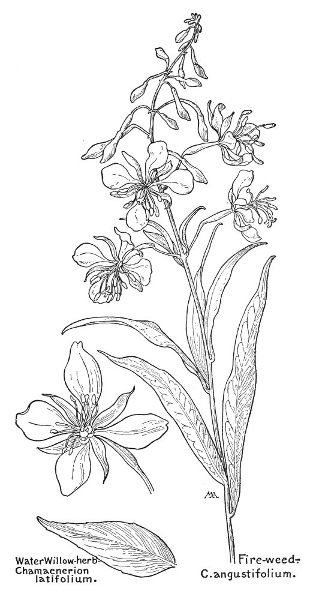
Water Willow-herb—Chamaenerion latifolium.
Fire-weed—C. angustifolium.
There are many kinds of Epilobium, differing from
Chamaenerion chiefly in the calyx-tube, which is prolonged
beyond the ovary.
Willow Herb
Epilòbium
Franciscànum
Pink
Spring
Northwest
A perennial, not especially pretty, with
a stout, reddish stem, from one to three
feet tall, slightly downy above, and dull
green leaves, mostly smooth and the
lower ones opposite. The flowers are
less than half an inch across, with bright
or pale, purplish-pink petals, deeply notched and not
spreading. This grows in wet spots around San Francisco.
There are several kinds of Gayophytum; differing from
Epilobium in the capsule and seeds, and easily distinguished
from them by the hairy buds; leaves alternate,
long, narrow, and toothless; flowers small; petals four,
white or pink, with very short claws; stamens, with
swinging anthers, eight, four shorter and usually sterile;
capsule club-shaped. The species are difficult to distinguish,
because of the smallness of the flowers.
Gayophýtum
eriospérmum
White
Summer
Cal., Oreg.
A delicate little plant, with smooth,
purplish stems, exceedingly slender
branches, dull green leaves, and pretty
little flowers, an eighth of an inch to half
an inch across, white, with a little yellow
in the center, fading to pink. This grows in sandy soil, at
rather high altitudes, in Yosemite.
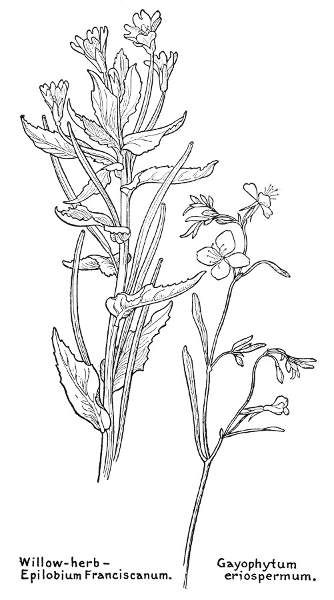
Willow-herb—Epilobium Franciscanum.
Gayophytum eriospermum.
There are numerous kinds of Godetia, variable and
difficult to distinguish, not yet fully understood by botanists,
all western and mostly Californian, with narrow,
alternate leaves and handsome flowers, which close at
night. They have four petals and resemble Onagra, but
the flowers are never yellow and the anthers are not
swinging, but fixed to the tips of the filaments by their
bases; also resembling Clarkia, but the petals are without
claws. The calyx is often colored, tube more or less
funnel-form, lobes turned back, or more or less united and
turned to one side; stamens eight, unequal, the shorter
ones opposite the petals; style threadlike; stigma with four,
short lobes; capsule four-sided, or cylindrical, mostly ribbed,
rather leathery, splitting open, with four valves, containing
many seeds. These plants bloom in late spring, hence the
pretty name, Farewell-to-Spring.
Farewell-to-Spring
Godètia defléxa
Pink
Summer
California
A branching plant, woody at base, two
feet high, with smooth stems; smooth,
toothed leaves; nodding buds and large
handsome flowers. The petals are pale-pink,
about an inch long, the pistil pink,
and at a distance the effect of the flower
is much like a Mallow. As is usual with Godetias, the
sepals are stuck together and stand out at one side, giving
the flower a quaint effect of having thrown back a little
hood in order to look about. This grows in light shade.
Farewell-to-Spring
Godètia
quadrivúlnera
Pink, lilac
Spring, summer
Northwest
This is common in the foothills of the
Sierras and Coast Ranges and has a
slender stem, about a foot tall, with more
or less downy leaves, sometimes slightly
toothed, and a few very pretty flowers,
about an inch and a half across, with
bright lilac-pink petals, usually splashed
with carmine. This red spot gives a vivid effect and the
delicate flowers look exceedingly gay and charming, as they
sway in the wind among tall grasses on open hillsides.
Godètia Góddardii
var. capitàta
Pink
Spring, summer
California
From one to two feet tall, with a rather
stout, more or less branching stem and
soft, rather downy, dull green leaves. The
flowers are about an inch across, with purplish-pink
petals, often stained with crimson
at the tips. This is found on dry hills in the Coast Ranges.
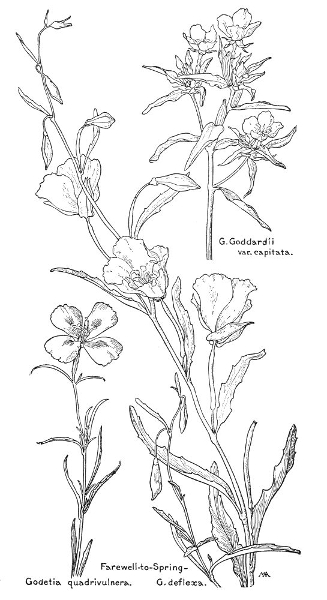
Farewell-to-Spring—G. deflexa.
G. Goddardii var. capitata.
Godetia quadrivulnera.
Godètia vimínea
Purplish-pink
Summer
Northwest
A handsome plant, with nearly smooth,
slender, reddish stems, a few inches to two
feet tall, and smooth, pale-green, toothless,
narrow leaves, mostly without leaf-stalks.
The buds are erect and the flowers form a
long, loose cluster, with bright purplish-pink petals, half
an inch to over an inch long, with a large, magenta blotch
near the center, or at the tip, and yellowish at base; the
stamens and pistil all purple; the calyx-lobes not caught
together, but turned primly back. This forms fine patches
of bright color in rather meadowy places in Yosemite and
elsewhere in the Sierra Nevada foothills. G. Dudleyàna
is pretty and slender, with drooping buds and light lilac-pink
flowers, the petals paler at base, with darker dots,
the calyx-lobes caught together and turned to one side, and
also makes beautiful patches of color on sunny slopes
around Yosemite.
There are several kinds of Clarkia, resembling Godetia,
but the petals have claws. The stems are brittle; the
leaves mostly alternate, with short, slender leaf-stalks; the
buds nodding; the flowers in terminal clusters, with four
petals, never yellow, and four sepals, turned back; the
stamens eight, those opposite the petals often rudimentary;
the stigma four-lobed; the capsule long, leathery, erect,
more or less four-angled, with many seeds. Named in
honor of Captain Clarke, of the Lewis and Clarke expedition,
the first to cross the Rocky Mountains to the Pacific,
in 1806.
Clarkia
Clàrkia élegans
Pink
Spring, summer
California
A conspicuous plant, on account of the
oddly contrasting colors of the flowers,
and very variable both in size and smoothness.
It grows from six inches to six feet
high; the stems more or less branching;
the leaves sometimes toothed and often reddish; the buds
and calyxes often woolly. The flowers are very gay; the
sepals being dark red or purple, the petals, with long,
slender claws, bright pink and the anthers scarlet! The
stamens, four long and four short, have a hairy, reddish
scale at the base of each filament, the anthers of the shorter
stamens often white, and the capsule is usually curved,
with no stalk, nearly an inch long, often hairy. When the
foliage is red, as it often is, the various combinations of red
in the flowers and leaves are quite startling. This is common
in the foothills of the Sierra Nevada and Coast
Ranges and is often rather shabby looking, but in favorable
situations is very handsome.
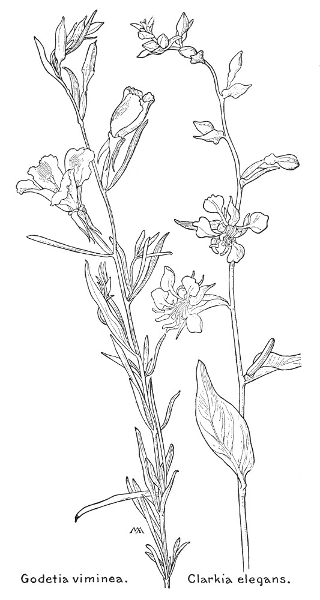
Godetia viminea.
Clarkia elegans.
Clarkia
Clàrkia
rhomboídea
Purple
Spring, summer
Northwest, Nev.,
Utah
Pretty and delicate and not nearly so
conspicuous as the last, with a slender,
smooth, branching stem, one to three feet
tall, with smooth leaves, mostly alternate,
nodding buds, and a few pretty flowers,
about three-quarters of an inch across.
The sepals are reddish-yellow; the petals
pinkish-purple, often dotted with purple at base, with a
short, broad, toothed claw; the stigma magenta; the filaments
purple, with a whitish, hairy scale at the base of
each; the anthers grayish, all perfect; the capsule four-angled,
slightly curved, about an inch long. This grows
in the foothills of the Sierra Nevada and Coast Ranges and
is widely distributed in Yosemite, but nowhere very
abundant.
Pink Fairies
Clàrkia pulchélla
Pink
Summer
Northwest
Odd and exceedingly charming flowers,
with very slender, very slightly downy,
purplish, branching stems, from six inches
to a foot tall, and smooth leaves. The
flowers are fantastic in form, the airiest
and most fairy-like blossoms that can well be imagined,
over two inches across, their delicate petals with long,
toothed claws and three lobes, bright rose-pink, shading
to a deeper tint at the base, the calyx slightly downy and
reddish. Four of the stamens are perfect and four are
rudimentary; the anthers are reddish; the pistil white; the
capsule an inch long, eight-angled, with a spreading stalk.
It is a pretty sight to see these gay flowers dancing in the
wind on open mountain slopes. C. concínna (Eucharidium),
of the Coast Ranges, is similar, equally beautiful
and even more brilliant in coloring; the flowers sometimes
in such quantities as to make patches of bright pink color,
very effective when growing among yellow Sedums,
Scarlet Larkspurs, and scarlet Indian Pinks, in shady
mountain canyons.
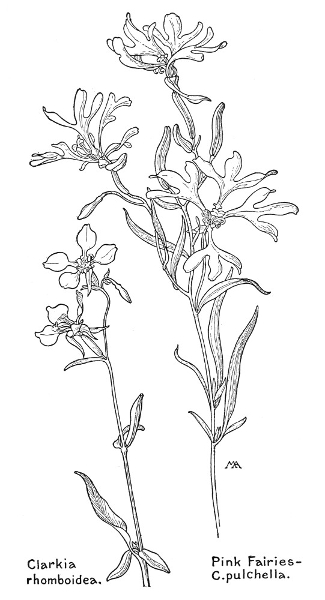
Clarkia rhomboidea.
Pink Fairies—C. pulchella.
There are several kinds of Sphaerostigma; leaves alternate;
flowers yellow, white or pink, turning green or
reddish; stamens eight, with oblong, swinging anthers;
style threadlike, with a round-top stigma; capsule four-celled,
usually long and narrow, four-angled, often twisted,
with no stalk.
Evening Primrose
Sphaerostígma
bistórta
(Oenothera)
Yellow
Spring
California
A common kind, very variable in its
manner of growth, being tall and erect in
moist, shady places and spreading flat on
the ground in dry, sunny spots. The
leaves are dull green, more or less downy
and more or less toothed, and the flowers
are three-quarters of an inch across, clear
yellow, usually with a speck, or blotch, of reddish-brown
at the base of each petal; the stamens and pistil also
yellow; the pods reddish and very much twisted. Gravelly
washes are often thickly sprinkled with
these gay and charming flowers.
Sphaerostígma
Veitchiànum
(Oenothera)
Yellow
Spring
California
Much like the last, but the flowers are
only a little over a quarter of an inch
across. The pods are dark red and shiny,
with a few hairs.
Beach Primrose
Sphaerostígma
viridéscens
(Oenothera
cheiranthifolia var.
suffruticosa)
Yellow
All seasons
California
A beautiful seashore plant, forming
large, low clumps of reclining stems and
pale gray, downy foliage, the twigs
and younger leaves silvery-white. The
flowers are about an inch and a quarter
across, clear yellow, often with two, dark
red dots at the base of each petal; the
stamens and pistil also yellow of the same
shade; the pods pinkish, downy, and much
twisted. The flat masses of pale foliage, strewn with
golden disks, are exceedingly effective, growing in drifting
sand hills along the coast, from San Francisco south.
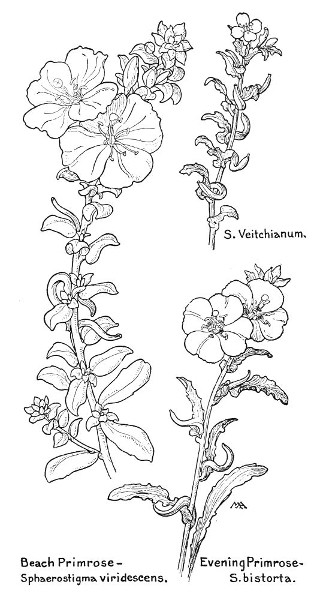
S. Veitchianum.
Beach Primrose—Sphaerostigma viridescens.
Evening Primrose—S. bistorta.
Sphaerostígma
tortuòsa.
(Oenothera)
White
Spring
Nevada
A queer little, stunted-looking, desert
plant, with almost no stem, but with
several branches, spreading flat on the
ground, stiff, smooth and purplish, with
crowded clusters of flowers, leaves, and
pods, mostly at the ends, the whole
forming flat clumps, from six to ten inches across. The
leaves are smooth, slightly thickish, pale bluish-green and
toothless; the buds are erect, and the flowers are over a
quarter of an inch across, white, with yellow anthers and a
green stigma. The pods are very much twisted and form
odd little snarly bunches.
There are only a few kinds of Chylisma; the flowers in
terminal clusters; the calyx with a more or less funnel-form
tube and four lobes; the petals four, not notched;
the stamens eight, unequal; the stigma with a round top,
the capsule long, membranous, with a stalk.
Chylisma
Chylísma
scapoìdea var.
clavaefórmis
(Oenothera)
White
Spring
Ariz., Utah
A charming desert plant, from a few
inches to a foot tall, with one or more,
pinkish, smooth, rather leafy stems,
springing from a pretty clump of smooth,
bluish-green leaves. The delicate flowers
are about three-quarters of an inch across
and form a graceful cluster of several or
many blossoms. The petals are white or
yellow, often tinted with pink, with some specks of
maroon at the base, and the sepals are pinkish-yellow; the
stamens pale yellow; the stigma green; the pods erect.
There are several kinds of Pachylophus; perennials,
stemless or nearly so; leaves from the root; calyx downy,
with a long tube; petals white or pink; stamens eight, with
threadlike filaments, the alternate ones longer; style
threadlike; stigma four-cleft; capsule woody.
White Evening
Primrose
Pachýlophus
marginàtus
(Oenothera)
White
Summer
Ariz., Utah, Nev.,
Col.
This has a few large flowers, three inches
or more across, with pure-white diaphanous
petals, fading to pink, and pink calyx-lobes.
The buds are erect, hairy and pink,
and the flowers spring from a cluster of long,
downy root-leaves, narrowing to slender
leaf-stalks, with hairs on the veins and on
the toothed and jagged margins, and have
almost no flower-stalk, but the hairy calyx-tube
is so long, sometimes as much as seven inches, that it
looks like a stalk. The root is thick and woody and the capsule
is egg-shaped and ribbed, with no stem. There is a patch
of these wonderful flowers in the Grand Canyon on Bright
Angel trail, halfway between the rim and the plateau,
where in a shaded spot beside a great rock the pure
blossoms seem to shed a moonlight radiance. They are
equally beautiful on the dry plains of Utah, where they
grow in quantities.
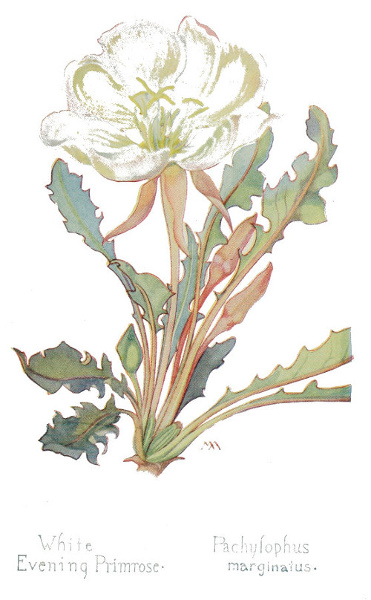
White Evening Primrose—Pachylophus marginatus.
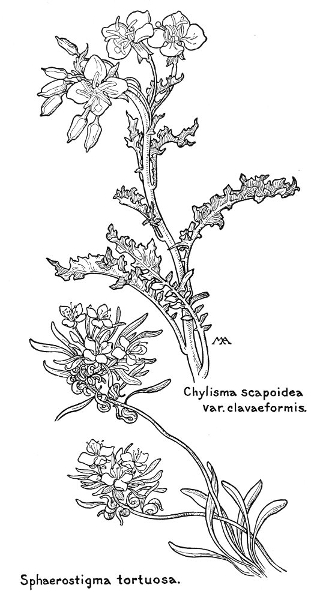
Chylisma scapoidea var. clavaeformis.
Sphaerostigma tortuosa.
There are several kinds of Anogra, resembling Onagra,
but with white or pink flowers and the seeds differently
arranged; the stems often clothed with papery bark; the
buds drooping. The name is an anagram of Onagra.
Prairie Evening
Primrose
Anogra albicàulis.
(Oenothera)
White
Spring, summer
Southwest, etc.
A conspicuous kind, often growing in
large patches, with whitish, downy,
branching stems, from a few inches to a
foot tall, often with shreddy bark, and
downy, pale bluish-green leaves, more or
less toothed. The drooping, downy buds
are tinted with reddish-pink and the
lovely flowers are from one and a half to three inches across,
with pure white petals, tinted with yellow at base, changing
to pink after pollination and fading to crimson. The
stamens have cobwebby threads, white filaments, and
yellow anthers, the pistil is green and the curved capsule is
downy or hairy. The whole color scheme, of pale sea-green
foliage, reddish buds, and white, rose-color, and
crimson flowers, is delicate, harmonious, and effective.
This grows in sandy places, and on the prairies from Dakota
to Mexico.
Cut-leaved
Evening Primrose
Anogra coronopifòlia
(Oenothera)
White
Summer, autumn
Ariz., Utah, etc.
A pretty plant, with an erect, leafy
stem, six inches to two feet tall, springing
from running rootstocks, and pale green,
more or less downy, leaves, finely cut into
numerous, small, narrow lobes, so that
they look like rather dry little ferns. The
delicate flowers are the usual Evening
Primrose shape, about an inch across, in the axils of the
leaves, with pure white petals, greenish at the base and
turning pink in fading, and a calyx-tube two inches long,
with turned-back, pinkish-green lobes. The anthers are
brown, the pistil green, the throat of the corolla is closed
by a fringe of white hairs, the buds are drooping and the
capsule is oblong and hairy. This is common on prairies
and plains, from Nebraska to Utah, and south to New
Mexico, reaching an altitude of nine thousand feet.
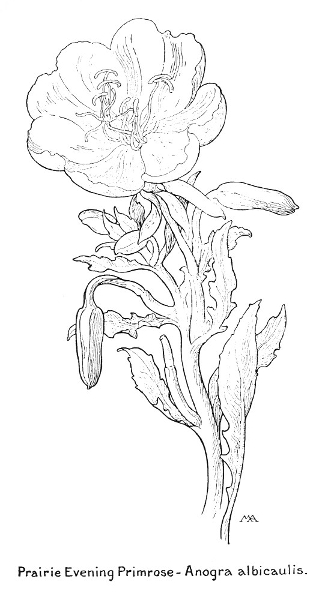
Prairie Evening Primrose—Anogra albicaulis.
There are several kinds of Onagra, differing from
Anogra in having yellow flowers and in the arrangement of
the seeds; with stems; leaves alternate, with wavy or
toothed margins; buds erect; flowers night-blooming, in
terminal clusters; calyx-tube long; petals four; stamens
eight, equal in length; stigma four-cleft; capsule four-angled,
more or less tapering.
Evening Primrose
Ónagra Hóokeri
(Oenothera)
Yellow
Summer
West
A fine biennial, with stout, leafy stems,
from three to six feet high, bearing
splendid flowers, over three inches across,
with clear yellow petals, fading to pink,
and reddish calyx-lobes. The leaves,
stems, and buds all downy and the buds
erect. The stigma has four, slender lobes, forming a little
cross, and the yellow pollen is loosely connected by cobwebby
threads, clinging to visiting insects, and is thus
carried from flower to flower; the capsule is an inch long.
This is much handsomer than the common Evening Primrose,
O. biénnis, and especially fine in Yosemite. As the
mountain shadows begin to slant across the Valley the
blossoms commence to open, until the meadows are
thickly strewn with "patens of bright gold." They stay
open all night, withering with the noonday sun.
There are several kinds of Lavauxia; low, usually stemless;
leaves mostly from the root; calyx-tube slender; petals
four; stamens eight, the alternate ones longer; ovary short,
stigma four-cleft; capsule stout, four-angled or winged.
Sun-cups
Lavaùxia primivèris
(Oenothera)
Yellow
Spring
Arizona
An attractive little plant, in the desert,
with no stem, the flowers with long,
slender calyx-tubes, resembling stems,
springing from a clump of rather downy
root-leaves. The buds are hairy and the
flowers are about an inch across, light
yellow, with pale yellow stamens and stigma. This plant
varies a good deal in size, bearing one or several flowers,
and the margins of the leaves almost toothless or irregularly
slashed. It superficially resembles Taráxia ovàta,
the Sun-cups so common on the southwestern coast, for
the flowers have the same little fresh, sunny faces, but the
latter has a round-topped stigma.
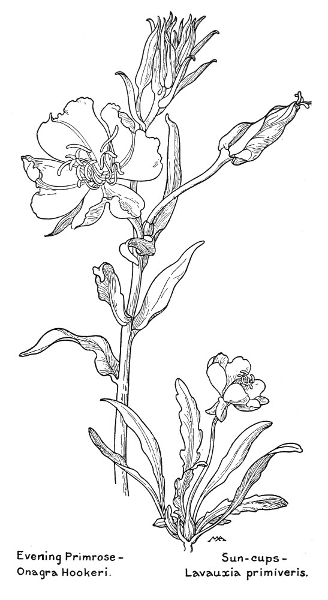
Evening Primrose—Onagra Hookeri.
Sun-cups—Lavauxia primiveris.
A large family, widely distributed, not abundant in the
tropics; usually strong-smelling herbs, remarkable for their
aromatic oil, mostly with hollow, grooved stems; leaves
alternate, compound, generally deeply cut, leaf-stalks
often broadened at base; flowers very small, usually in
broad, flat-topped clusters, generally with bracts; calyx
usually a five-toothed rim around the top of the ovary;
petals five, small, usually with tips curled in, inserted on a
disk, which crowns the ovary and surrounds the base of the
styles; stamens five, with threadlike filaments and swinging
anthers, also on the disk; ovary two-celled, inferior, with
two threadlike styles; fruit two, dry, seedlike bodies, when
ripe separating from each other, and usually suspended
from the summit of a slender axis, each body marked with
ribs, usually with oil-tubes between the ribs. The examination
of these oil-tubes in mature fruits, with a microscope,
is necessary to determine most of the genera and species,
so description of genera is omitted here, and botanists
have added to the difficulties of the amateur by giving
almost every genus more than one name. The flowers are
much alike, yet the leaves often differ very much in the
same genus. Many kinds are poisonous, although others,
such as Parsley, Carrot, and Parsnip, are valuable food plants.
Peucédanum
Euryptèra
Yellow
Spring
California
A fine robust plant, a foot or more tall,
with stout, purplish stems and smooth,
crisp leaves, the lower ones with three
leaflets, the upper with five, and the teeth
tipped with bristles. The flowers are
greenish-yellow and the main cluster measures four or five
inches across, with no bracts at base, but the small clusters
have bracts. The flowers are ugly, but the foliage is
handsome and the seed vessels richly tinted with wine-color,
making the plant decorative and conspicuous on the
sea cliffs of southern California.
Turkey Peas
Orogènia
linearifòlia
White
Spring
Northwest and
Utah
A quaint little plant, only about three
inches high, with a tuberous root, spreading,
slanting stems, and smooth leaves, all
from the root, with three, long, narrow
leaflets; a reddish, stiff, papery scale
sheathing the stem at base. The minute,
white flowers form a cluster less than an
inch across, without bracts, with a stout, ridged flower-stalk
and composed of from two to ten smaller clusters,
with small bracts; the anthers red. This grows in rich
moist soil, in shady valleys, on mountain ridges; in the
Wasatch Mountains, sometimes on the edge of the snow.
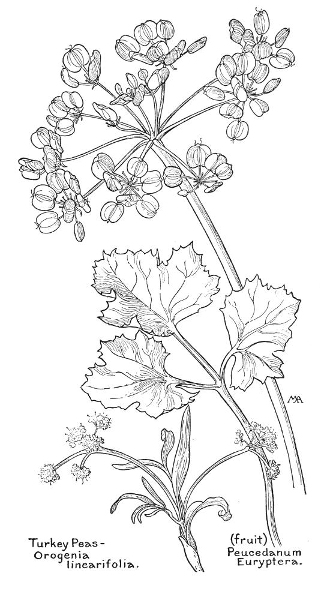
Turkey Peas—Orogenia linearifolia.
(fruit) Peucedanum Euryptera.
Pterýxia Califórnica
(Cymópterus)
Yellow
Summer
Cal., Oreg.
Over a foot tall, with very pretty, dark
green foliage and rather ugly, dull yellow
flowers, in flat-topped clusters, three inches
across. The leaves are in a cluster at the
root, with long leaf-stalks sheathing at
base, very finely cut and toothed, with
stiffish points; the main flower-cluster without bracts, but
the smaller clusters with narrow bracts.
Whisk-broom
Parsley
Cogswéllia platycàrpa
(Peucedanum
simplex)
Yellow
Spring
Northwest and
Utah
An odd-looking plant, for the foliage
looks like pieces of a whisk-broom stuck
in the ground. It is six to fourteen inches
tall, with a thickish root and minute,
sulphur-yellow flowers, forming a flat-topped
cluster, about two inches across,
without bracts, and composed of three to
fifteen smaller clusters, with small bracts;
usually only the outermost flowers of both
the large and small clusters are fertile. The stem and
leaves are stiff and sage-green, the root-leaves with broad
leaf-stems, reddish and papery at base, sheathing the stem,
and all the leaves cut into narrow divisions, not much
thicker than pine needles, folded together so that they
appear to be cylindrical. This grows on dry gravelly
hills, at an altitude of from six to eight thousand feet.
Leptotaènia
multífida
(Ferula)
Yellowish-green
Spring, summer
Northwest, Nev.,
Utah, New Mex.
A fine, stout plant, about two feet tall,
with a thick, spindle-shaped root and dark,
rich-green, feathery foliage; the large
leaves, over a foot long, appearing smooth
but really imperceptibly downy, finely cut
and lobed, with long, stout leaf-stalks;
the small flowers, yellowish-green or
bronze-color, in flat-topped clusters, two or three inches
across, with few or no bracts, with tall, stout flower-stalks,
and composed of about eighteen, small clusters, forming
round knobs, with many bracts, on slender pedicels of
various lengths. This grows in rich soil and is conspicuous
on account of its size and foliage.
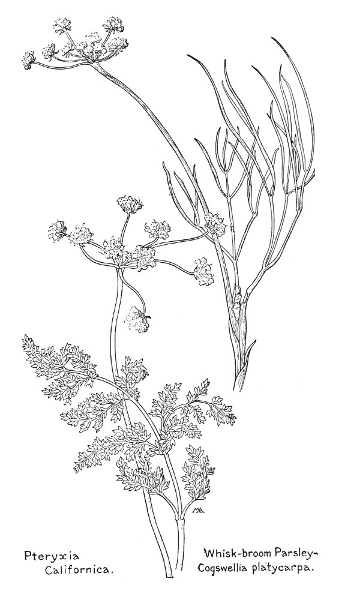
Pteryxia Californica.
Whisk-broom Parsley—Cogswellia platycarpa.
Velaèa argùta
Yellow
Spring
California
This has a stout, brownish stem, about
eight inches tall, and fine, conspicuous
foliage, mostly in a clump at the base, the
leaves rich-green and very glossy, stiff
and crisp in texture, though not thick, with bristle-tipped
teeth. The rather ugly little flowers are greenish-yellow
and the main cluster has no bracts. This grows in canyons
in southern California.
Purple Sanicle,
Nigger-babies
Sanícula
bipinnatífida
Purplish
Spring, summer
Cal., Oreg.
This has branching, purplish stems,
from six inches to three feet tall, and
handsome foliage. The flowers are
maroon-color and are crowded into balls,
less than half an inch across, forming a
loose, irregular cluster, with leafy bracts
at the base. The effect of the dark flowers
and fine foliage is rather attractive and it is common on
grassy slopes in the hills.
Eulòphus
Bolánderi
White
Summer
Northwest
This has a smooth, stiff stem, one to
two feet tall, the leaves cut into long,
narrow divisions, and the flowers very
small, cream-white or pinkish, forming a
flat-topped cluster, about two inches
across, with narrow, pale bracts. This is quite pretty and
common in Yosemite.
Indian Parsnip
Aulospérmum lóngipes
(Cymopterus)
Yellow
Spring
Utah, Col., Wyo.
Decorative in form and color and unusual
looking, with smooth, pale bluish-green
foliage, with a "bloom," the leaves
prettily cut and lobed, with pinkish leafstalks,
forming, when young, a large
rosette, close to the ground, but the stem
gradually lengthens until the cluster of
leaves, after the flowers are gone, finds itself on the summit
of a long stem, sheathed at base. The minute, bright
yellow flowers form flat-topped clusters, with flower-stems
two or three inches tall, not hollow, the main cluster about
an inch across, usually without bracts, and composed of
five to ten smaller clusters, with bracts. When the plant
is young the general effect of the flat, pale gray rosette of
fern-like leaves, spotted with the contrasting yellow of the
flowers, is pretty and striking. Sometimes a few of the
flowers are purple. This has a thick root and grows on dry
sunny hills, in gravelly soil.
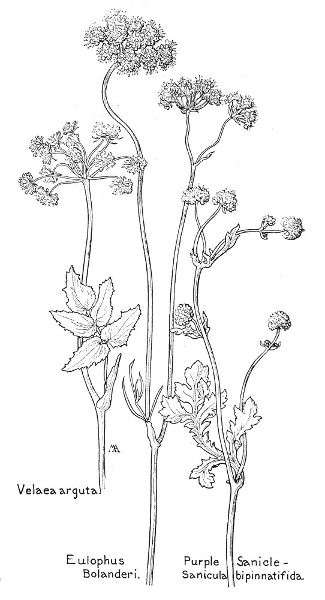
Velaea arguta.
Eulophus Bolanderi.
Purple Sanicle—Sanicula bipinnatifida.
Not a very large family, most abundant in the northern
hemisphere, mostly trees or shrubs. They have simple,
mostly toothless leaves, without stipules, usually opposite
or in whorls. The flowers are in round or flat-topped
clusters and have four or five sepals and petals and four to
many stamens. The inferior ovary becomes a stone-fruit
that looks like a berry. Cornus is from the Greek for
"horn," in allusion to the toughness of the wood.
There are many kinds of Cornus, some natives of Mexico
and Peru, with small, white, greenish or purple flowers, in
clusters, which often have an involucre of large, white
bracts.
Pacific Dogwood
Córnus Nuttállii
White
Spring, summer
Oreg., Wash., Cal.
A handsome shrub or small tree, from
ten to thirty feet high and growing in rich
woods, often near streams. The flower
clusters are composed of numerous, small,
greenish flowers, forming a large, protruding
knob, which is surrounded by large, white, petal-like
bracts, usually six in number, giving the effect of a
single handsome flower, measuring from three to six inches
across. It resembles the Flowering Dogwood of the East,
but as the flowers have six instead of four "petals," the
tips of which in Yosemite are neither puckered nor stained
with pink, they look different to eastern eyes and the
general appearance, though equally fine, is less picturesque,
probably because the shrub is rather larger and less straggling,
the flowers bigger and more symmetrical, and the
leaves brighter green. The effect of the flat masses of
creamy white bloom among the darker forest trees is
magnificent, and in Washington and Oregon the leaves turn
to brilliant red in the autumn. The fruit is a cluster of
bright red berries. The wood is exceedingly hard and is
used in cabinet-making. There is a tradition that when
Dogwood blooms corn should be planted.
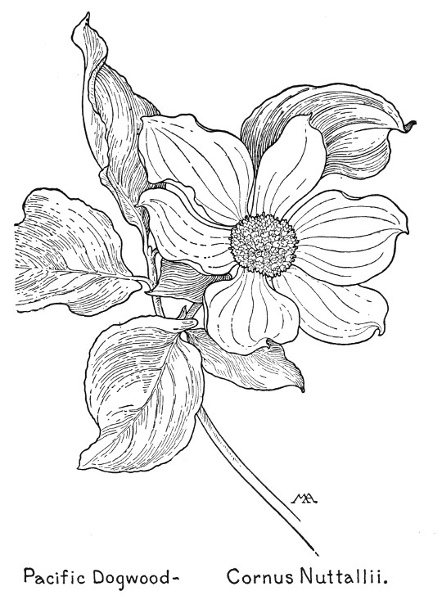
Pacific Dogwood—Cornus Nuttallii.
Red-osier Dogwood
Córnus stolonífera
var. ripària
White
Spring, summer,
autumn
Utah, Ariz., New
Mex., Col.
A handsome shrub, five to eight feet
high, with smooth, dark red branches and
bright red twigs. The leaves are thin in
texture, smooth and rich-green on the
upper side, paler on the under, and the
small, cream-white flowers, with long,
yellow stamens, form handsome, flat-topped
clusters, about two inches across,
smelling pleasantly of honey; the berries
are dull white. This is common.
Bunchberry
Córnus
Canadénsis
White
Summer
West, except Ariz.
A charming little plant, about six inches
high, growing in moist, cool woods and
common in the East. The slender stem,
with one or two pairs of small leaves,
springs from creeping, woody shoots and
is crowned by a circle of larger leaves, six,
or rarely four, in number, smooth and bright green, setting
off a pretty white blossom, with a slender flower-stalk.
This looks like a single flower, measuring about an inch
across, but it is really composed of a number of tiny,
greenish flowers, forming a cluster in the center, and
surrounded by four white bracts, which look like large
petals. The flowers are succeeded by a bunch of red
berries, insipid in flavor, but vivid scarlet in hue.
A large and interesting family, of very wide geographic
distribution, in temperate and cold regions; herbs, shrubs,
or trees; the leaves undivided, without stipules; the flowers
mostly perfect; the calyx with four or five divisions; the
corolla usually regular, with four or five, usually united,
petals; the stamens inserted under the pistil, usually as
many, or twice as many, as the petals; the ovary usually
superior, with one style; the fruit a capsule, berry, or stone-fruit,
usually with many small seeds.
There are many kinds of Gaultheria, mostly of the
Andes; ours are evergreen shrubs, with alternate, aromatic
leaves and nodding flowers; the calyx five-cleft; the corolla
more or less urn-shaped, with five teeth; the stamens ten;
the fruit a berry, composed of the fleshy calyx surrounding
the ovary and containing many seeds. The Wintergreen,
or Checkerberry, used for flavoring, belongs to this genus.
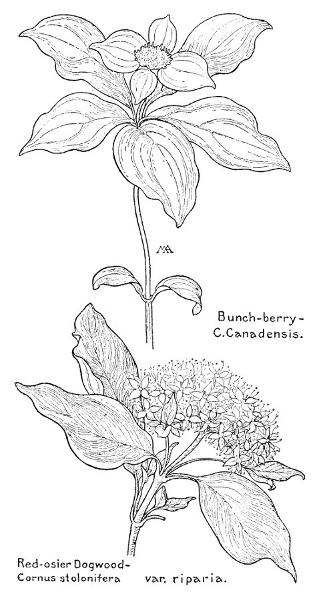
Bunch-berry—C. Canadensis.
Red-osier Dogwood—Cornus stolonifera var. riparia.
Western Wintergreen
Gaulthèria
ovatifòlia
White
Summer
Northwest
A pretty little shrub, growing in mountain
woods, a few inches high, with woody
stems, spreading on the ground, and
glossy foliage, almost hiding the flowers.
The twigs are fuzzy and the leaves are
dark rich-green, the small flowers white
and the berries red.
Salal, Shallon
Gaulthèria
Shállon
White, pink
Spring, summer
Northwest
An attractive little shrub, usually from
one to three feet high, with handsome
foliage. The leaves are finely toothed,
dark olive-green, leathery and rather
glossy, pale on the under side, and the
waxy flowers hang gracefully on a stiffly
bending flower-stem, which is sticky and hairy and often
bright red, with large, scaly, red bracts at the base of the
pedicels and smaller bracts halfway up. The flowers are
nearly half an inch long, with a yellowish calyx, covered
with reddish hairs, and a white corolla, tipped with pink,
or all pink; the filaments hairy, with orange anthers.
There is often so much bright pinkish-red about the flower-stems
and bracts that the effect, with the waxy flowers
and dark foliage, is very pretty. This plant often grows in
great quantities, thickly covering the floor of the redwood
forests. It is called Salál by the Oregon Indians, who value
the black, aromatic berries as an important article of food.
There are many kinds of Azalea, of North America and
Asia, mostly tall, branching shrubs; leaves alternate,
thin, deciduous; flowers large, in terminal clusters, developing
from cone-like, scaly buds; calyx small, five-parted;
corolla funnel-form, five-lobed or somewhat two-lipped;
stamens five, rarely ten, protruding, usually drooping;
style long, slender, drooping; capsule more or less oblong.
Western Azalea
Azàlea occidentàlis
(Rhododendron)
White
Summer
Cal., Oreg.
One of the most beautiful western
shrubs, from two to ten feet high, loosely
branching, with splendid clusters of
flowers and rich-green leaves, almost
smooth, from one to four inches long, with
a small, sharp tip and clustered at the
ends of the twigs. The corolla is from one
and a half to three inches long, slightly irregular, white
with a broad stripe of warm-yellow on the upper petal
and often all the petals striped with pink. The western
woodland streams are bordered with these wonderful
blossoms, leaning over the water and filling the air with
their delicious fragrance.
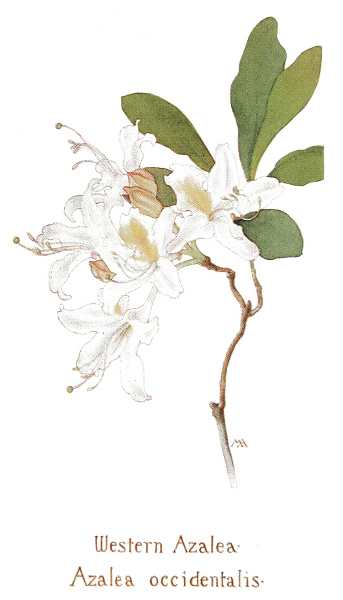
Western Azalea—Azalea occidentalis.
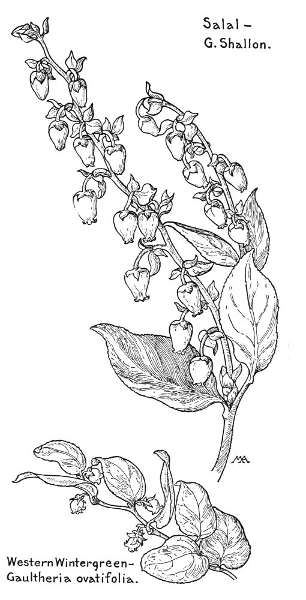
Salal—G. Shallon.
Western Wintergreen—Gaultheria ovatifolia.
There are many kinds of Rhododendron, most abundant
in Asia, resembling Azalea, but with evergreen, leathery
leaves. The name is from the Greek, meaning "rose-tree."
California Rose
Bay
Rhododéndron
Califórnicum
Pink
Spring, summer
Northwest
A magnificent shrub, the handsomest
in the West, from three to fifteen feet
high, with a grayish trunk and fine,
evergreen foliage. The leaves are from
three to ten inches long, rich-green and
leathery, smooth but not shiny, paler on
the under side, spreading out around the
large flower-clusters, so as to set them off to great advantage,
and the flowers are over two inches across, scentless,
with small, pale sepals and pink corollas, almost white
at the base and shading to deep pink at the edges, which
are prettily ruffled. The upper petal is freckled with
golden-brown, or greenish spots and arrow-shaped
markings, the pistil is crimson and the stamens, with pale
pink filaments and pale yellow anthers, curve in, like little
serpents' heads. The coloring of the flower clusters, mixed
with the crimson-tipped buds, is a combination of delicate
and brilliant tints and in such places as the redwood
forests, along the Noyo River in California, where the
shrub develops into a small tree, the huge clusters, glowing
high above us among the dark forest trees, are a wonderful
sight. This is the "State flower" of Washington.
There are a good many kinds of Arctostaphylos, mostly
western; evergreen shrubs, with very crooked branches;
smooth, dark red or brown bark; alternate leaves, and
usually nodding, white or pink flowers, with bracted
pedicels, in terminal clusters, the parts usually in fives;
the corolla urn-shaped; the stamens usually ten, not protruding,
the filaments hairy; the ovary raised on a disk on
the receptacle; the fruit berry-like, several nutlets surrounded
by soft pulp. The leaves, by a twisting of their
stalks, assume a vertical position on the branches, a habit
which enables many plants of dry regions to avoid unnecessary
evaporation. These shrubs are often very
abundant and with Chaparral Pea, Buck Brush, Scrub
Oak, etc., form the extensive brush thickets known as
chaparral, so characteristic of the western mountain
scenery. The Greek name means "bear-berry," as bears
are fond of the berries, and Manzanita is from the Spanish
for "little apple," as the fruits often resemble tiny apples.
They are dry but pleasantly acid and are popular with
Indians, bears, and chipmunks, and jelly can be made from
them. The largest Manzanita tree known is one in Napa
County, California, thirty-five feet high and as large across.
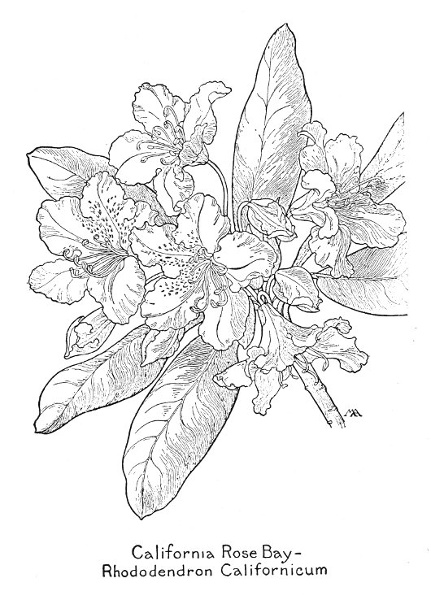
California Rose Bay—Rhododendron Californicum.
Green Manzanita
Arctostáphylos
pátula
Pink
Winter, spring
California
A decorative shrub, from four to six
feet high, with spreading branches. The
leaves are from one to two inches long,
smooth, pale green, and leathery and the
flowers are waxy, a quarter of an inch or
more long, crowded in pretty, roundish
clusters, of various shades of pink. The very smooth
trunk and branches are picturesquely gnarled and twisted
and, in fine contrast to the pale foliage, are rich mahogany-color,
with here and there openings in the outer bark,
showing the gray, under layer, as if the branches had been
dipped in hot chocolate, which had melted off in some
places. The berry is about a quarter of an inch across,
smooth and fleshy. This forms most of the chaparral on
the slopes around the Yosemite Valley, ranging from over
four thousand to nine thousand feet in altitude, and is
widely distributed in the Sierra Nevada Mountains.
Manzanita
Arctostáphylos
bícolor
Pink
Spring
California
A handsome shrub, three or four feet
high, with rich-green leaves, very glossy
on the upper side and covered with close
white down on the under. The waxy
flowers are a lovely shade of pink and the
pretty fruit is about the size of a pea, like a
tiny greenish-yellow apple, with a brownish-red cheek.
This grows in the South near the coast.
Kinnikinic.
Red Bearberry
Arctostáphylos
Ùva-Úrsi
White
Spring, summer
West, etc.
An attractive little shrub, with many
trailing branches, creeping over the
ground and often covering the rocks with
a beautiful mat of evergreen foliage. The
leaves are small, toothless, shining and
leathery and the little white or pinkish,
bell-shaped flowers hang in pretty little
clusters and are succeeded by smooth, round, red berries.
This is common in the mountains, across the continent,
reaching an altitude of ten thousand feet. The Indians
use it medicinally and in the curing of animal skins. There
is a picture of this in Schuyler Mathews' Field Book.
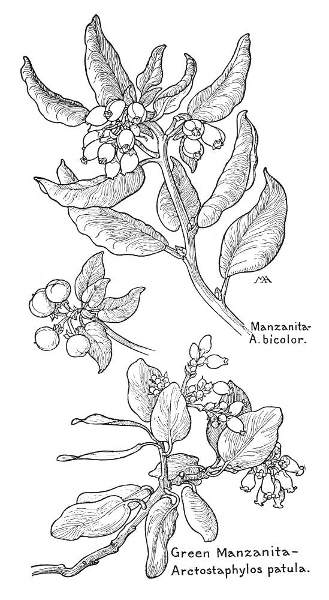
Manzanita—A. bicolor.
Green Manzanita—Arctostaphylos patula.
There are a great many kinds of Vaccinium, widely
distributed; branching shrubs, with alternate leaves and
small flowers, usually in clusters; the ovary inferior, the
fruit a many-seeded berry, crowned with the remains of
the calyx-teeth. This is the classic Latin name. These
plants include Blueberry, Huckleberry, and Bilberry.
California
Huckleberry
Vaccínium ovàtum
White, pink
Spring, summer
Cal., Oreg.
An attractive shrub, from four to eight
feet high, with beautiful, glossy, evergreen
foliage, which is very ornamental and
much used in household decoration. The
older leaves are rich dark green, contrasting
finely with the younger, apple-green
leaves and, in the spring, with the charming little red ones,
with which the twigs are tipped. They are leathery in
texture and very neatly arranged along the branches, which
are ornamented with pretty clusters of waxy, white or pink
flowers, a quarter of an inch long, or with purple berries,
without a "bloom," which are edible and make excellent
preserves. This grows on hills near the coast, especially
among the redwoods.
There is one kind of Azaleastrum; resembling Rhododendron,
but with deciduous leaves; and resembling
Azalea, but the flowers developing from lateral instead of
terminal buds, the corolla with five, regular lobes, and the
stamens shorter.
Small Azalea
Azaleástrum albiflòrum
(Rhododendron)
White
Summer
Northwest
An attractive shrub, from two to six
feet high and loosely branching, with
grayish-brown bark and rich-green leaves,
glossy, but not stiff or leathery. The
flowers are about an inch across, with a
sticky, aromatic, pale green calyx and
waxy-white corolla, the style and stamens
pale yellow or white. They have no scent and are not
so handsome as the last, but are very beautiful, growing
in high mountains, often close to the snow line.
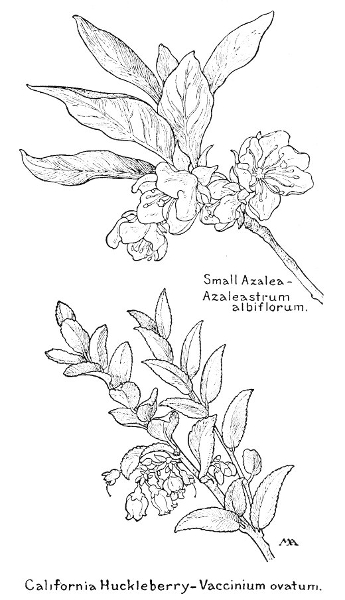
Small Azalea—Azaleastrum albiflorum.
California Huckleberry—Vaccinium ovatum.
There are several kinds of Kalmia, almost all of eastern
North America, the flowers alike in form.
Swamp Laurel
Kálmia microphýlla
(K. glauca var. microphylla)
Pink
Summer
Northwest, etc.
A very pretty little evergreen shrub,
from a few inches to over a foot high, with
glossy, leathery, rich-green leaves, whitish
on the under side, with the margins rolled
back. The flowers are single or in clusters,
each about half an inch across, with five
sepals and a bright purplish-pink, saucer-shaped
corolla, with five lobes, which is
prettily symmetrical and intricate in form. There are ten
little pouches below the border and in these the tips of the
ten anthers are caught, so that the filaments curve over
from the center, and at the touch of a visiting insect they
spring out of the pouches and dust the visitor's back with
pollen, which is carried to another flower. The little,
pointed buds, angled and deep in color, are also pretty and
the capsule is roundish, with many small seeds. This
grows in northern swamps, across the continent.
There are several kinds of Menziesia, some Japanese;
branching shrubs, with alternate, deciduous, toothless
leaves, and small, nodding flowers, in clusters, developing
from scaly buds, their parts almost always in fours; stamens
eight, not protruding; capsule more or less egg-shaped.
Fool's Huckleberry
Menzièsia
urcelolària (M.
ferruginea)
Yellowish, reddish
Summer
Northwest
A rather attractive little bush, from
two to six feet high, with light brown bark,
hairy twigs and slightly hairy leaves, with
hairy margins. The flowers are less than
half an inch long, with a hairy calyx and
dull cream-colored corolla, tinged with
dull-pink or red, and hang prettily in a
circle, on drooping pedicels, which become
erect as the capsules ripen. When crushed, the stems
and foliage have a strong skunk-like smell.
There are only a few kinds of Ledum, all much alike.
Woolly Labrador
Tea
Lèdum Groenlándicum
White
Spring, summer
Northwest, etc.
A loosely-branching, evergreen shrub,
from one to four feet high. The bark is
reddish and the twigs are covered with
reddish wool, the color of iron rust, and
the leathery, dark green leaves, which are
alternate, with rolled-back margins, are
also covered with reddish wool on the
under side. The flowers are a good deal less than half an
inch across, with five, very small sepals; five, spreading,
white petals; a green ovary, and from five to seven, long,
conspicuous stamens, giving a feathery appearance to the
pretty flower-clusters, which before blooming are enclosed
in large, scaly buds. Both foliage and flowers are
aromatic. This is found across the continent, as far south
as Pennsylvania, and in Greenland. L. glandulòsum is
similar, but not woolly. These plants grow in swamps and
damp places and are considered poisonous.
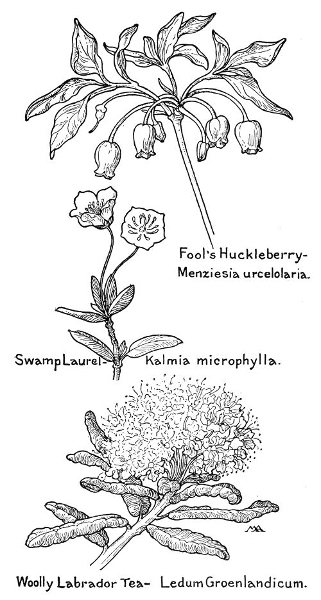
Fool's Huckleberry—Menziesia urcelolaria.
Swamp Laurel—Kalmia microphylla.
Woolly Labrador Tea—Ledum Groenlandicum.
There are only a few kinds of Phyllodoce, of arctic and
alpine regions; low shrubs, with small, leathery, evergreen
leaves; flowers nodding, with bracts, in terminal clusters;
calyx usually with five divisions; corolla more or less bell-shaped,
usually five-lobed; stamens usually ten; stigma
with a round top, or four to six lobes; capsule roundish:
often called Heather, but we have no native Heather.
Red Heather
Phyllódoce Bréweri
(Bryanthus)
Pink
Summer
Northwest
A charming little shrub, from six to ten
inches tall, with gay flowers and dark
yellowish-green leaves, standing out
stiffly from the stem, like the bristles of a
bottle-brush. The flowers are sweet-scented,
nearly half an inch across, with
reddish calyxes and pedicels and bright pink, saucer-shaped
corollas, with from seven to ten, long, purple
stamens, a purple pistil and crimson buds. This makes
heathery patches on high mountain slopes, up to twelve
thousand feet in the Sierra Nevadas.
Red Heather
Phyllódoce empetrifórmis
(Bryanthus)
Pink
Summer
Northwest
Much like the last, but the nodding
flowers are smaller and not quite so
pretty, with bell-shaped corollas and the
stamens not protruding. It forms beautiful
patches of bright purplish-pink color
on mountainsides, up to eleven thousand
feet, farther north than the last.
Yellow Heather
Phyllódoce
glanduliflòra
(Bryanthus)
Yellowish
Summer
Northwest
This makes heather-like patches on
rocks and has many rough, woody stems,
crowded with yellowish-green leaves,
shorter and broader than those of Red
Heather. The drooping flowers are about
three-eighths of an inch long, with a hairy,
greenish-yellow calyx and yellowish corolla,
something between cream and pale-lemon in color. At a
distance the effect of the flowers is much more yellow than
close by, but they are not so pretty as either the red or
white heathers.
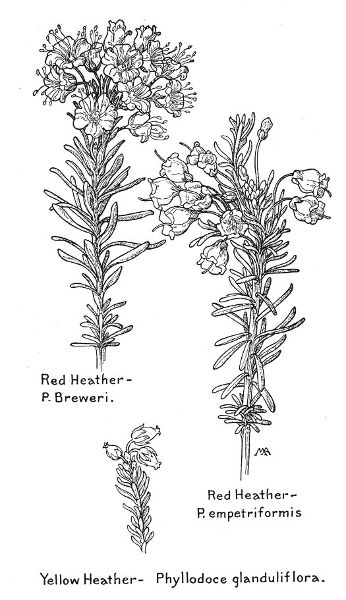
Red Heather—P. Breweri.
Red Heather—P. empetriformis.
Yellow Heather—Phyllodoce glanduliflora.
There are several kinds of Cassiope, named for the
mother of Andromeda, resembling Heather; the sepals four
or five, without bracts at the base; the corolla bell-shaped,
with four or five lobes; differing from Phyllodoce in capsule,
form of corolla and filaments.
White Heather
Cassìope
Mertensiàna
White
Summer
Northwest
This makes thick patches of many woody
stems, a few inches high, the twigs thickly
clothed with odd-looking, small, dark
green leaves, overlapping like scales and
ridged on the back. The single flowers
are white and waxy, resembling the bells
of Lily-of-the-valley, often with red calyxes and pedicels,
and are pretty and delicate, set off by the stiff, dark foliage.
This grows in the highest mountains, at an altitude of ten
thousand feet and above.
A small family, natives of the northern hemisphere; low,
generally evergreen, perennials, with branched rootstocks;
leaves with leaf-stalks; flowers perfect, nearly regular,
white or pink; calyx with four or five lobes; corolla with
four or five lobes, or five petals; stamens twice as many as
the divisions of the corolla; ovary superior, stigma more or
less five-lobed; fruit a capsule, with many minute seeds.
Single Beauty
Monèses uniflòra
White
Summer
Northwest, etc.
The only kind, much like Chimaphila, a
charming little perennial, with a single
flower-stalk, from two to six inches tall,
springing from a cluster of glossy, bright
green leaves, with toothed edges, and
bearing a single, lovely sweet-scented blossom, about
three-quarters of an inch across, with usually five sepals
and five, spreading, waxy-white petals; the long, straight
style, with a five-lobed stigma, projecting from the ovary,
which forms a green hump in the center of the flower,
surrounded by eight or ten stamens. This little flower
modestly turns its face down to the ground and we have to
pick it to find how very pretty it is. It grows in wet,
northern mountain woods, across the continent.
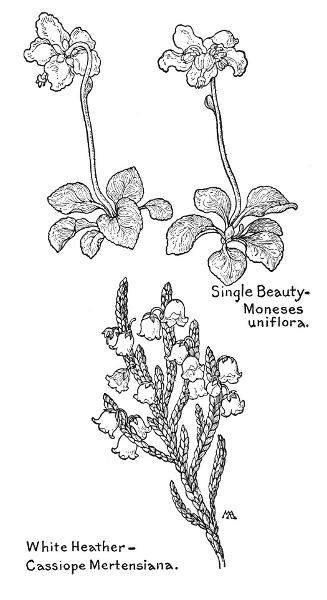
Single Beauty—Moneses uniflora.
White Heather—Cassiope Mertensiana.
There are a good many kinds of Pyrola; leaves mostly
from the root; flowers usually nodding, in clusters, with
bracted flower-stalks; sepals and petals five; stamens ten;
capsule roundish, five-lobed, cobwebby on the edges.
These plants are often called Shinleaf, because English
peasants used the leaves for plasters. Pyrola is from the
Latin for "pear," because of the resemblance of the leaves of
some kinds. The aromatic Wintergreen, or Checker-berry,
used for flavoring, is a Gaultheria, of the Heath Family.
Pyrola
Pýrola bracteàta
Pink
Summer
California
One of our most attractive woodland
plants, from six to twenty inches tall,
with handsome, glossy, rather leathery,
slightly scalloped leaves. The buds are
deep reddish-pink and the flowers are
half an inch across, pink or pale pink, and waxy, with deep
pink stamens and a green pistil, with a conspicuous style,
curving down and the tip turning up. The pretty color
and odd shape of these flowers give them a character all their
own and they are sweet-scented. This is found in Yosemite
and in other cool, shady, moist places, and there are several
similar kinds.
There are several kinds of Chimaphila, of North America
and Asia, with reclining stems and erect, leafy branches.
Pipsissewa
Chimáphìla
Menzièsii
White
Summer
Northwest and
California
A very attractive little evergreen plant,
three to six inches high, with dark green,
glossy, leathery, toothed, leaves, sometimes
mottled with white, and one to three,
pretty flowers, about three-quarters of an
inch across, with yellowish sepals and
waxy-white or pinkish petals, more or less
turned back. The ovary forms a green hump in the center
and has a broad, flat, sticky stigma, with five scallops, and
the ten anthers are pale yellow or purplish. This has a
delicious fragrance, like Lily-of-the-valley, and grows in
pine woods in the Sierra Nevada and Coast Ranges.
Chimaphila is a Greek name, meaning "winter-loving."
A small family, mostly North American; saprophytes,
(plants growing on decaying vegetable matter,) without
leaves; flowers perfect; calyx two- to six-parted; corolla united
or not, with three to six lobes or petals, occasionally lacking;
stamens six to twelve; ovary superior; fruit a
capsule.
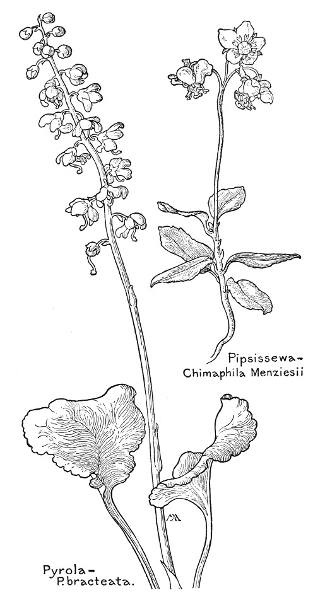
Pipsissewa—Chimaphila Menziesii.
Pyrola—P. bracteata.
Snow-plant
Sarcòdes
sanguínea
Red
Spring, summer
Cal., Oreg., Nev.
The only kind, a strange plant, widely
celebrated for its peculiar beauty. The
name is misleading, for the splendid
creatures push their way, not through the
snow, but through the dark forest carpet
of pine-needles, soon after the snow has
melted. The fleshy stems are from six inches to over a
foot tall, the leaves reduced to red scales, and the bell-shaped
flowers, with five lobes, are crowded towards the
upper half of the stem and mingled with long, graceful,
curling, red bracts. The plants are shaded with red all
over, from flesh color, to rose, carmine, and blood-red, and
are translucent in texture, so that when a shaft of sunlight
strikes them they glow with wonderful brilliance, almost
as if lighted from within. They sometimes grow as many
as fifteen together, and are found in the Sierras, up to nine
thousand feet. They are pointed out to tourists by Yosemite
stage drivers, but the government forbids their
being picked, for fear of extermination.
Indian Pipe
Monótropa
uniflòra
White
Summer
West, etc.
The only American kind, an odd plant,
all translucent white, beautiful but unnatural,
glimmering in the dark heart of
the forest like a pallid ghost, mournfully
changing to gray and black as it fades.
The stem is about six inches tall, springing
from a mass of fibrous roots and bearing a single flower,
beautiful but scentless, about three-quarters of an inch
long, with two to four sepals, five or six petals, and ten or
twelve stamens, with pale yellow anthers. Sometimes the
whole plant is tinged with pink. This grows in rich moist
woods, almost throughout temperate and warm North
America, in Japan and India, and is also called Ghost-flower
and Corpse-plant.
Pine-sap
Hypópitys
Hypópitys
(Monotropa)
Flesh-color
Summer
West, etc.
There are two kinds of Hypopitys.
This is much like the last, but not so
pallid, with several stout stems, about
eight inches tall, bearing a long one-sided
cluster of flowers, sometimes slightly
fragrant, each about half an inch long.
The whole plant is waxy, flesh-color or
yellowish, tinged with red or pink, and though interesting
is not so delicately pretty as Indian Pipe. It seems to be a
stouter plant around Mt. Rainier than in the East and
grows in thick woods, across the continent and in Europe
and Asia. H. sanguínea is a new kind, recently discovered
in the Arizona mountains; six to twelve inches tall, growing
in dense shade at high altitudes, and brilliant red throughout.
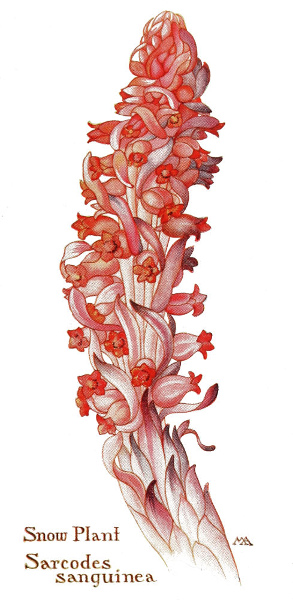
Snow Plant—Sarcodes sanguinea.
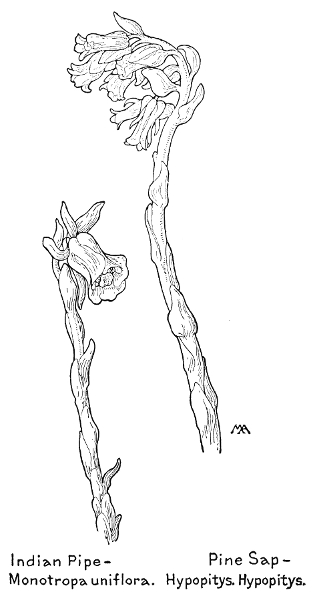
Indian Pipe—Monotropa uniflora.
Pine Sap—Hypopitys Hypopitys.
Pine-drops
Pteróspora
Andromedèa
White
Summer
Across the
continent
The only kind, found only in North
America, a strange plant, harmonious in
color, with a fleshy, brownish or reddish
stem, from one to four feet tall, with
yellowish bracts and covered with sticky
hairs, springing from a mass of matted,
fibrous, astringent roots. The flowers are
a quarter of an inch long, with pink pedicels, brownish
bracts, a brownish-pink calyx, with five lobes, and an
ivory-white corolla, with five teeth; the stamens ten, net
protruding; the style short, with a five-lobed stigma; the
capsule roundish, five-lobed, with many winged seeds.
We often find dead insects stuck to the stem. In winter,
the dry, dark red stalks, ornamented with pretty
seed-vessels, are attractive in the woods. This usually
grows among pine trees, across the continent, but nowhere
common. The Greek name means "wing-seeded."
It is also called Giant Bird's-nest and Albany Beech-drops.
Allótropa virgàta, of the Northwest, is similar, but
smaller, with five, roundish sepals and no corolla.
Flowering-fungus
Pleuricóspora
fimbriolàta
Flesh-color
Summer
California
There are two kinds of Pleuricospora;
this is from three to eight inches tall, with
flowers half an inch long, deliciously fragrant,
with four or five, scale-like, fringed
sepals, four or five, separate, fringed
petals, resembling the sepals, and eight
or ten stamens. The ovary is egg shaped, one-celled, with
a thick style and flattish stigma, and the fruit is a watery
berry. If the waxy, flesh-colored flowers were set off by
proper green leaves they would be exceedingly pretty, but
they are crowded on a fleshy stem, of the same color as
themselves, mixed with fringed bracts, with brownish
scales instead of leaves, and have an unnatural appearance.
I found thirty of these curious plants, growing in a little
company, pushing their way up through the mold and
pine-needles, in the Wawona woods.
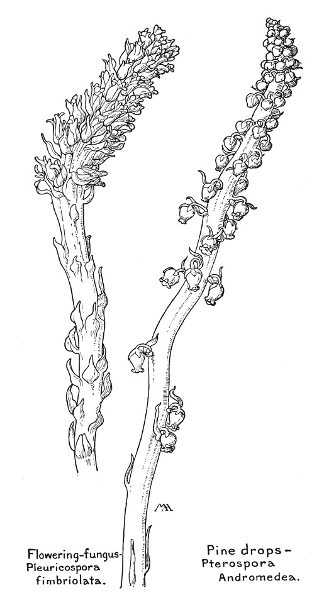
Flowering-fungus—Pleuricospora fimbriolata.
Pine drops—Pterospora Andromedea.
A rather large family, widely distributed; herbs; leaves
undivided; flowers perfect, regular, parts usually in fives,
corolla mostly with united petals, stamens on the base or
tube of the corolla, opposite its lobes, sometimes with some
extra, sterile filaments; ovary one-celled, mostly superior,
with one style and round-headed stigma; fruit a capsule,
with one or many seeds.
There are several kinds of Anagallis, not native in this
country.
Scarlet Pimpernel
Poor-man's
Weather-glass
Anagállis
arvénsis
Red
Summer
West, etc.
A little weed, common in gardens and
waste places, with smooth, four-sided,
stems, branching and half trailing on the
ground, smooth, toothless, bright green
leaves and charming little flowers, a
quarter of an inch or more across, with a
five-lobed calyx and wheel-shaped, five-lobed
corolla, usually bright orange-red
and darker in the center, rarely white; the stamens five,
with hairy filaments; the capsule smooth and roundish,
containing many minute seeds. The flowers and leaves
are usually in pairs, the seed-vessels on the tips of slender
stems, curving around and toward each other, as if the
plant were stretching out its little hands, and opening its
little blossoms only in bright weather and closing them at
night. The Greek name means "amusing." The plant
was used medicinally by the ancients.
There are three kinds of Trientalis, much alike, perennials,
with tuberous roots. The Latin name means "one
third of a foot," the height of these plants.
Star-flower
Trientàlis
latifòlia
White, pink
Spring, summer
Northwest, Cal.,
Nev.
A little woodland plant, with a slender
stem, from three to six inches tall, bearing
at the top a circle of from four to six,
smooth, bright green leaves and one or two,
threadlike flower-stalks, each tipped with
a delicate flower. The corolla is about half
an inch across, wheel-shaped, with no tube
and usually with six, white or pinkish petals, sometimes
deep pink, or flecked with lilac outside. The ovary makes
a purplish dot in the center, surrounded by curling, yellow
anthers, with threadlike filaments united at base. The
capsule contains a few, rather large, white seeds. We often
find these dainty little plants growing in companies, their
starry blossoms glimmering in the shade, prettily set off
by their neat circle of leaves.
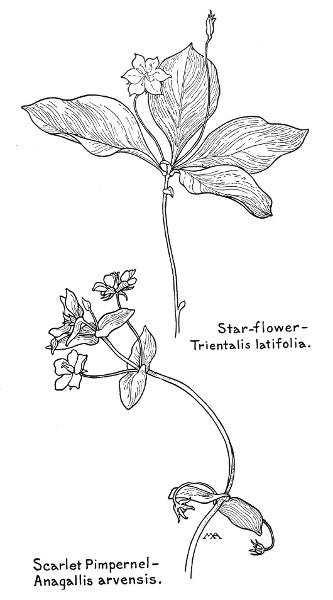
Star-flower—Trientalis latifolia.
Scarlet Pimpernel—Anagallis arvensis.
There are a good many kinds of Dodecatheon, of North
America and Asia; perennials, with root-leaves; flowers in
bracted, terminal clusters; calyx with four or five lobes,
turned back in flower but erect in fruit; corolla with four or
five, long lobes, turned strongly back over the short tube
and thick throat; stamens of the same number as the lobes,
the anthers pointing straight forward, inserted on the
throat of the corolla, filaments short, flat and united, or
lacking; style long; capsule containing many seeds. The
Greek name, meaning "twelve gods," seems far-fetched,
but Linnaeus fancied the cluster of flowers resembled a
little assembly of divinities. Common names are Prairie
Pointers, Mosquito-bills, Wild Cyclamen, and American
Cowslip, the latter poor, because misleading.
Large Shooting-star
Dodecàtheon
Jéffreyi
Pink
Summer
Cal., Oreg.
A very decorative plant, with a smooth,
stout, reddish stem, five to eighteen inches
tall, very slightly hairy towards the top,
springing from a cluster of root-leaves,
five to eighteen inches long, smooth,
sometimes slightly toothed, and bearing a
cluster of from five to fifteen beautiful
flowers. The corolla is usually an inch or more long,
usually with four petals, purplish-pink, paler at the base,
with a yellow and maroon ring and maroon "bill." This
has a faint, oddly sweet scent and grows in wet, mountain
meadows. I found a very beautiful white form at Lost
Lake, in Yosemite, more delicate, with lighter green foliage
and pure white corollas, ringed with yellow and maroon.
Shooting-star
Dodecàtheon
Clèvelandi
White
Spring
California
Not so handsome as the last, but very
attractive, with a slightly roughish stem,
twelve to sixteen inches tall, bearing a
fine crown of flowers and springing from a
cluster of smooth, slightly thickish leaves,
paler on the under side, with a few teeth.
The sepals are slightly downy and the corollas are about
three-quarters of an inch long, with pure-white petals,
sometimes lilac-tinged, yellow at base, with a ring of
maroon scallops and a dark purple "bill." The flowers are
deliciously fragrant, like Clove Pinks. This grows in the
south.
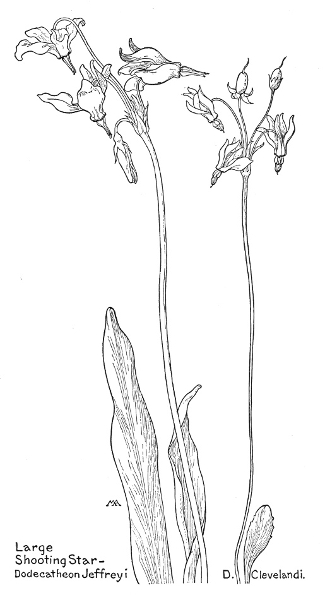
Large Shooting Star—Dodecatheon Jeffreyi.
D. Clevelandi.
Small Shooting-star
Dodecàtheon
pauciflòrum
Pink
Spring, summer
West
A charming little plant, growing in wet,
rich mountain meadows, with a smooth
reddish stem, about eight inches tall,
bearing a bracted cluster of several delicate
flowers, and springing from a loose clump
of smooth leaves. The flowers are about
three-quarters of an inch long, with bright
purplish-pink petals, with a ring of crimson, a ring of
yellow and a wavy line of red, where they begin to turn
back; the stamens with united filaments and long purplish-brown
anthers; the pistil white.
A rather large family, widely distributed, including Olive,
Lilac, and Privet; trees and shrubs; leaves mostly opposite;
without stipules; flowers perfect or imperfect, with two
to four divisions, calyx usually small or lacking, corolla
with separate or united petals, sometimes lacking; stamens
two or four, on the corolla, ovary superior, two-celled,
with a short style or none; fruit a capsule, berry, stone-fruit,
or wing-fruit.
There are many kinds of Fraxinus, almost all trees.
Flowering Ash,
Fringe-bush
Fráxinus
macropétala
White
Spring
Arizona
An odd and beautiful shrub, growing on
Bright Angel trail, in the Grand Canyon,
about as large as a lilac bush, with smooth,
bright-green leaves, some of the leaflets
obscurely toothed, and drooping plumes of
fragrant white flowers. The calyx is very
small, and the four petals are so long and
narrow that the effect of the cluster is of a bunch of white
fringe. The fruit is a flat winged-seed.
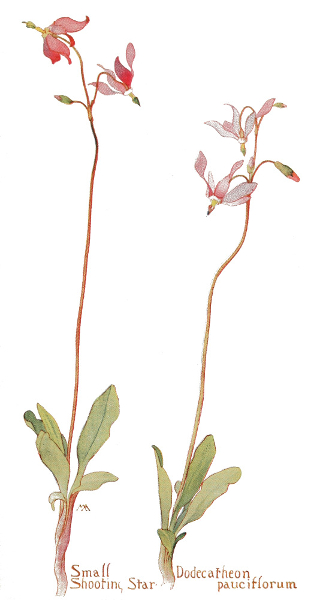
Small Shooting Star—Dodecatheon pauciflorum.
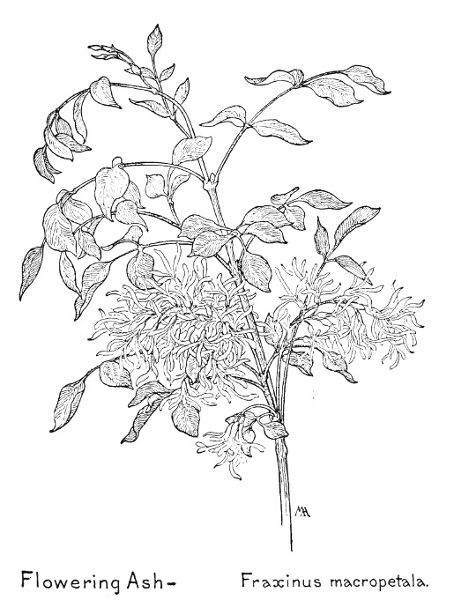
Flowering Ash—Fraxinus macropetala.
A large family, widely distributed, most abundant in
temperate regions; smooth herbs, with colorless, bitter
juice; leaves toothless, usually opposite, without leaf-stalks
or stipules; flowers regular; calyx four to twelve-toothed;
corolla with united lobes, twisted or overlapping
in the bud, of the same number as the calyx-teeth; stamens
inserted on the tube or throat of the corolla, as many as its
lobes, alternate with them; ovary superior, mostly one-celled,
with a single style or none, and one or two stigmas;
fruit a capsule, mostly with two valves, containing many
seeds. These plants were named for King Gentius of
Illyria, said to have discovered their medicinal value.
There are several kinds of Frasera, North American, all
but one western; herbs, with thick, bitter, woody roots;
leaves opposite or in whorls; flowers numerous; corolla
wheel-shaped, with four divisions, each with one or two
fringed glands and sometimes also a fringed crown at base;
stamens on the base of the corolla, with oblong, swinging
anthers, the filaments often united at base; ovary egg-shaped,
tapering to a slender style, with a small, more or
less two-lobed, stigma; capsule leathery, egg-shaped, with
flattish seeds.
Columbo, Deer's Tongue
Fràsera speciòsa
Greenish-white
Spring, summer,
autumn
West, etc.
A handsome plant, though rather coarse,
from two to six feet tall, with a pale glossy
stem, very stout, sometimes over two
inches across at the base, and very smooth,
pale green leaves, in whorls of four and
six, the lower ones sometimes a foot long.
The flowers are mixed with the leaves all
along the upper part of the stem, but mostly crowded at
the top in a pyramidal cluster about six inches long, and
are each nearly an inch and a half across, with a greenish
or bluish-white corolla, the lobes bordered with violet
and dotted with purple, and on each lobe two glands
covered by a fringed flap, resembling a small petal, these
fringes forming a sort of cross on the corolla. The four
stamens stand stiffly out between the corolla-lobes and the
general effect of the flower is so symmetrical that it suggests
an architectural or ecclesiastical ornament. Though the
flowers are not bright, this plant is decorative on account
of its luxuriant size and pale foliage, and if Mr. Burbank
could make the flowers clear white or purple it would be
magnificent. It grows in the western mountains, as far
east as Dakota and New Mexico. The finest I ever saw
were on an open slope, in a high pass in the Wasatch
Mountains, where they reared their pale spires proudly far
above the surrounding herbage.
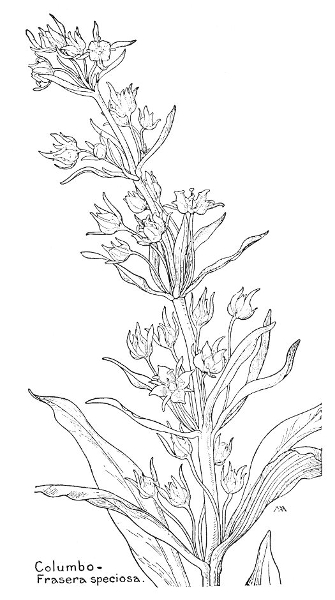
Columbo—Frasera speciosa.
Small Columbo
Fràsera nitìda
Bluish-white
Summer
Cal., Oreg.
Quite a pretty plant, too colorless to be
effective at a distance, but not coarse,
with a smooth, pale stem, over a foot tall,
and smooth, dull, bluish-green leaves,
slightly stiffish, prettily bordered with
white, mostly in a clump near the base. The flowers are
about half an inch across, shaped like the last; with bluish-white
petals, specked with dull-purple, with a green line
on the outside, with one green gland near the center,
fringed all around; large whitish anthers, becoming
pinkish, and a white pistil.
There are a good many kinds of Erythraea, widely distributed,
usually with red or pink flowers; calyx with five or
four, narrow lobes, or divisions; corolla salver-form, with
five or four lobes; anthers twisting spirally after shedding
their pollen; stigmas two, oblong or fan-shaped. The Greek
name means "red" and the common name, Centaury,
from the Latin, meaning "a hundred gold pieces," alludes
to the supposedly valuable medicinal properties of these
plants.
Canchalagua,
California
Centaury
Erythraèa venústa
(Centaurium)
Pink
Spring, summer
California
From three to twelve inches tall, with
apple-green leaves, mostly on the stems,
smooth and thin in texture, and flowers
an inch or more across, a very vivid shade
of purplish-pink, with a yellow or white
"eye," bright yellow anthers and green
pistil. These are attractive, because they
look so gay and cheerful, but the color is a
little crude. The flowers are not so large in Yosemite as
they are in some places, such as Point Loma, but are very
numerous and cover large patches with brilliant color.
These plants are called Canchalagua by Spanish-Californians,
who use them medicinally.
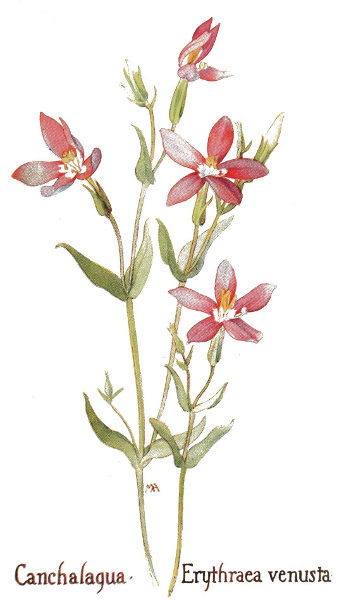
Canchalagua—Erythraea venusta.
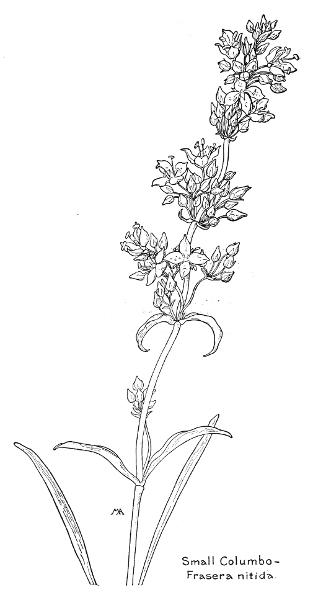
Small Columbo—Frasera nitida.
Tall Centaury
Erythraèa
exaltàta (E.
Douglasii)
(Centaurium)
Pink
Spring, summer,
autumn
West, etc.
This has a slender, leafy stem, from a
few inches to over a foot tall, and flowers
not so large as the last, but pretty and gay,
about half an inch across, bright pink with
a distinct white "eye." This grows in
sandy soil, as far east as Wyoming.
There are many kinds of Gentiana, of
northern regions and the Andes; calyx
tubular, usually with five teeth; corolla
variously shaped with from four to seven lobes, often
fringed, or with folds between the teeth; style short or
lacking; stigma two-lipped.
Northern Gentian
Gentiàna acùta
Purple
Summer
West, etc.
A pretty plant, with leafy, often branching
stems, from six to twenty inches tall,
and numerous flowers, with stiff pedicels
and leafy bracts, forming several small
clusters along the upper part of the stem.
They are each about half an inch long, various shades of
purple or blue, sometimes white, and easily recognized
by the little crown of white fringe in the throat of the
rather tubular, five-lobed corolla. These plants have very
small roots, so that it is difficult to pick them without
pulling them up, and as they are annuals they are easily
exterminated. They are common in northern mountains,
in moist places across the continent, and in Europe and Asia.
Gentian
Gentiàna
propínqua
Purple
Summer
Northwest
This has smooth, thin leaves and pretty
flowers, three-quarters of an inch long,
with lilac or purple corollas, satiny in
texture, with four lobes, pointed at the
tips and more or less fringed. This
grows in high mountains.
Blue Gentian
Gentiàna calycòsa
Blue
Autumn
Northwest
A handsome perennial, with leafy stems,
from five to fifteen inches tall, bearing one
or several, fine flowers at the top. They
are an inch and a half long, with a bright
blue corolla, dotted with green, with
plaited folds and small teeth between the five lobes. This
has been found in Yosemite, but is more common at Lake
Tahoe. There are many other handsome large Blue
Gentians in the West. G. lùtea, with yellow flowers, is the
German kind from which the well-known drug, gentian, is
made.
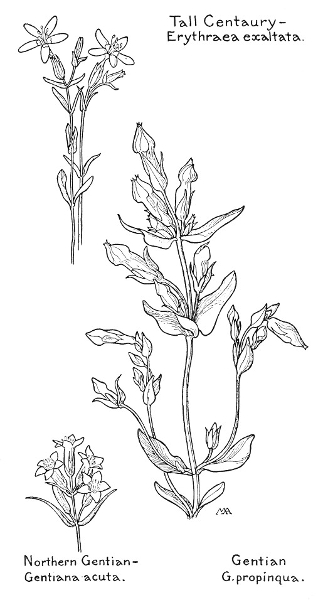
Tall Centaury—Erythraea exaltata.
Northern Gentian—Gentiana acuta.
Gentian—G. propinqua.
A large family, widely distributed, most abundant in
warm regions; ours are perennial herbs, usually with milky
juice and tough fibrous inner bark; leaves generally large,
toothless, without stipules; flowers peculiar in shape, in
roundish clusters; calyx with a short tube or none and five
lobes; corolla five-lobed; stamens five, on the base of the
corolla, with short, stout filaments, anthers more or less
united around the disk-like stigma, which covers and unites
the two short styles of the superior ovary. The two parts
of the ovary develop into two conspicuous pods, opening
at the side, containing numerous flattish seeds, arranged
along a thick, central axis, usually each with a tuft of
silky down to waft it about.
There are many kinds of Asclepias, with oddly-shaped
flowers, interesting and decorative in form; calyx rather
small, the pointed sepals turned back; corolla with its
petals turned entirely back, so as to cover the sepals and
expose the peculiar-looking central arrangements of the
flower, called the "crown." In the middle is the large, flat,
shield-shaped, five-lobed or five-angled stigma, surrounded
by the anthers, which are more or less united to each other
and to the stigma, encircled by five, odd, little honey-bearing
hoods, the same color as the petals, each with a
horn, either enclosed within it or projecting from it, the
whole collection of stigma, anthers, and hoods, forming the
"crown." The pods are thick and pointed. Named for
Æsculapius, as some of these plants are medicinal. Indians
used to make twine from the fibrous bark of some kinds.
Showy Milkweed
Asclèpias speciòsa
Pink
Spring, summer
West
A handsome plant, decorative in form
and harmonious in coloring, with a stout
stem, from one to four feet tall, and light
bluish-green leaves, usually covered with
white down. The flowers are sweet-scented,
with woolly pedicels, purplish-pink petals, and
waxy, white "hoods," the buds yellowish-pink. The
cluster, about three inches across, sometimes comprises
as many as fifty flowers and is very beautiful in tone, being
a mass of delicately blended, warm, soft tints of pink,
cream, and purple. This grows in canyon bottoms and
along streams.
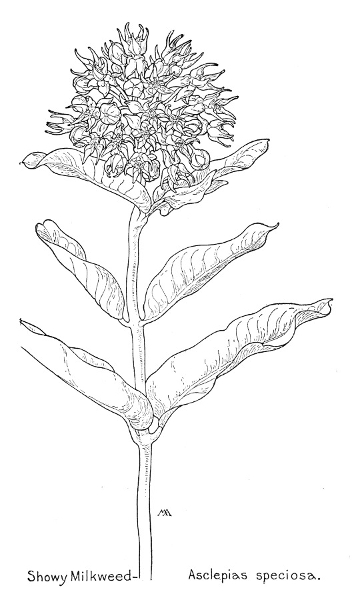
Showy Milkweed—Asclepias speciosa.
Pale Milkweed
Asclèpias eròsa
Greenish-white
Spring
California
This is three feet or more tall, fine-looking,
though too pale, with a stout,
smooth, gray-green stem and gray-green
leaves, mottled with white and very stiff,
the under side white-woolly, and flower-clusters
two and a half inches across, composed of numerous
greenish-white flowers, each half an inch long, their
stalks covered with white wool.
Desert Milkweed
Asclèpias vestìta
var. Mohavénsis
Yellow and pink
Spring
California
A foot and a half tall, with very fragrant
flowers, and very woolly all over, especially
the upper leaves, stems and buds, which
are thick with long white wool. The buds
are pinkish-purple and the flowers have
dull pink petals and cream-colored hoods,
becoming yellow, and form clusters over two inches across.
This grows in the Mohave Desert and the effect is harmonious,
but not so handsome as the last.
The genus Gomphocarpus is distinguished from Asclepias
by the absence of horns or crests in the hoods.
Purple Milkweed
Gomphocàrpus
cordifòlius
(Asclepias)
Purple and yellow
Summer
Oreg., Cal.
A handsome plant, smooth all over and
more or less tinged with purple, with a
stout, purple stem, from one and a half
to three feet tall, with rubbery, dull, light
bluish-green leaves. The flowers are
scentless, with purplish sepals, maroon or
purple petals, and yellowish or pinkish
hoods, and form a very loose graceful cluster, over three
inches across, dark in color and contrasting well with the
foliage. This is common in Yosemite and elsewhere in
California, at moderate altitudes.
The genus Asclepiodora, of the southern part of North
America, resembles Asclepias, but the flowers are larger,
the petals not turned back, the hoods flatter, with crests
instead of horns; leaves mainly alternate; corolla wheel-shaped;
petals spreading; hoods oblong, blunt, spreading
and curving upward, crested inside; five tiny appendages
alternating with the anthers and forming an inner crown
around the stigma. The name is from the Greek, meaning
the gift of Æsculapius.
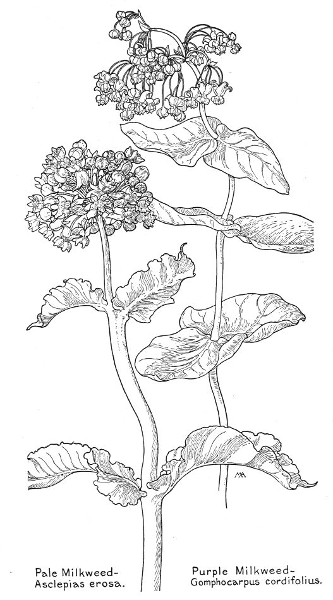
Pale Milkweed—Asclepias erosa.
Purple Milkweed—Gomphocarpus cordifolius.
Spider Milkweed
Asclepiodòra
decúmbens
Green and
maroon
Spring, summer
Southwest
A striking plant, though dull in color,
from one to one and a half feet tall, with a
rough, rather slanting stem, dull green,
roughish, rather leathery leaves, and
clusters of slightly sweet-scented, queer-looking
flowers, each over half an inch
across, with greenish-yellow petals, the
hoods white inside and maroon outside, their tips curved in,
a green stigma and brown anthers. The effect is a dull-yellow
rosette, striped with maroon, curiously symmetrical
and stiff in form, suggesting an heraldic "Tudor rose."
The pods, three or four inches long, stand up stiffly, on
pedicels curved like hooks. This grows on dry hillsides
and is widely distributed.
A large family, widely distributed, chiefly tropical; ours
are perennial herbs, with milky, bitter juice; leaves toothless,
usually opposite, without stipules; flowers perfect,
parts in fives; corolla united; stamens on the corolla, as
many as its lobes, alternate with them, ovary superior,
in two parts, united by a single or two-parted style, developing
into two pods; seeds often tufted with hairs. The
Greek name alludes to the superstition that these plants
are poisonous to dogs.
There are many kinds of Apocynum, with branching
stems, tough fibrous bark, and small, white or pink flowers,
in clusters; calyx with pointed teeth, its tube adhering to
the ovaries by means of a thickish, five-lobed disk; corolla
bell-shaped, five-lobed, with five, small, triangular appendages,
inside the tube, opposite the lobes; stamens with
short, broad filaments and arrow-shaped anthers, slightly
adhering to the blunt, obscurely two-lobed stigma; pod
slender, cylindrical; seeds numerous, small, feathery.
Spreading Dogbane,
Honey-bloom
Apócynum androsaemifòlium
White, pink
Summer
West, etc.
An attractive plant, from one to four
feet high, with many, smooth, widely
spreading branches, purplish on one side,
and smooth leaves, rather dark green
above, pale underneath, with yellowish
veins. The little flowers are white, tinged
with pink, often striped with pink inside,
mainly in loose clusters at the ends of the
branches, and though not conspicuous are delicate and
pretty. The pods are from two to seven inches long. This
is widely scattered in fields and open woods, occurring in a
variety of forms, and common in the East.
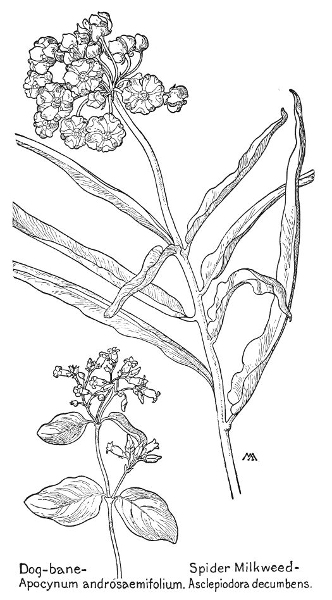
Dog-bane—Apocynum androsaemifolium.
Spider Milkweed—Asclepiodora decumbens.
A small family, widely distributed; perennial herbs, with
creeping rootstocks, growing in water or marshes; the
leaves smooth, alternate, or from the root; the flowers
perfect, regular, in clusters; the calyx five-lobed; the
corolla more or less funnel-form with five lobes or teeth;
the stamens five, on the corolla and alternate with its
lobes; the ovary superior, or partly so, with one cell; the
fruit usually an oval capsule, with a few flattish, smooth
seeds.
Buck-bean
Menyánthes
trifoliàta
White
Spring, summer
Northwest
This is the only kind, a handsome plant,
eight or ten inches tall, with a stout,
yellowish-green stem and rich green
leaves, with long, sheathing leaf-stalks
and three leaflets, with toothless or somewhat
scalloped edges. The flowers are
about half an inch long, with a white corolla, tinged with
pink or lilac, the spreading lobes covered with white hairs,
with black and yellow, swinging anthers and a green pistil,
with a two-lipped stigma. There are from ten to twenty
flowers in each cluster and the effect is charming, suggesting
a bunch of little fringed lilies. This grows in northern
bogs across the continent and also in Europe and Asia.
It used to be found around San Francisco, but is now
extinct.
A large family, most abundant in the tropics; ours are
herbs, usually with twining or trailing stems; the leaves
alternate, or mere scales, without stipules; the flowers
perfect, with five sepals; the corolla with united petals,
more or less funnel-form and more or less five-lobed,
folded lengthwise and twisted in the bud; the stamens five,
on the base of the corolla; the ovary superior, with from
one to three styles; the fruit usually a capsule, with from
one to four large seeds.
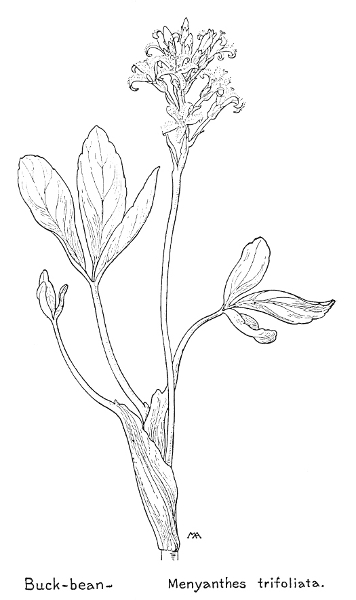
Buck-bean—Menyanthes trifoliata.
There are a great many kinds of Convolvulus, widely
distributed; ours are mostly twining or prostrate perennials;
the flowers large, with a slender style and two stigmas; the
fruit a capsule, usually with two large seeds. The name
is from the Latin, meaning "to entwine." These plants
are often called Bindweed.
Field Morning-glory
Convólvulus
arvénsis
White, pinkish
Spring, summer,
autumn
West, etc.
This is a troublesome weed, introduced
from Europe, with very deep roots and
pretty flowers. The leaves are dull green
and look roughish, though they are
smooth or nearly so, and the flowers are
about an inch across, white inside, striped
with pink and tinged with yellow at the
base, and pink outside, striped with duller,
deeper color. The stamens and pistil are white and the
buds purplish-pink. The flower stalks usually have a pair
of bracts near the middle.
Yellow Morning-glory
Convólvulus
occidentàlis
Cream-color
Summer
Northwest
An attractive plant, with pretty foliage
and large, pale flowers, the stems trailing
on the ground and climbing over low
bushes. The leaves are smooth and dark
bluish-green and the flowers are about
two inches and a half across, very pale
yellow, almost cream-color, with stripes
of slightly deeper yellow, tinged with pink. The anthers
and the pistil are pale yellow and the flower-stalks have
two bracts just beneath the calyx.
There are many kinds of Cuscuta, or Dodder, widely
distributed and difficult to distinguish; leafless parasites,
without green coloring, with twining, threadlike stems and
inconspicuous flowers, in clusters. The seed germinates in
the soil and produces a twining stem, which attaches itself
to a neighbor by means of suckers. These plants are
easily recognized, for they look like tangled bunches of
coarse thread, and are often very conspicuous on account of
their coloring, sometimes making fine masses of bright
orange-color, beautiful in tone, though the plants are very
unattractive. They have other names, such as Love-vine
and Strangle-weed.
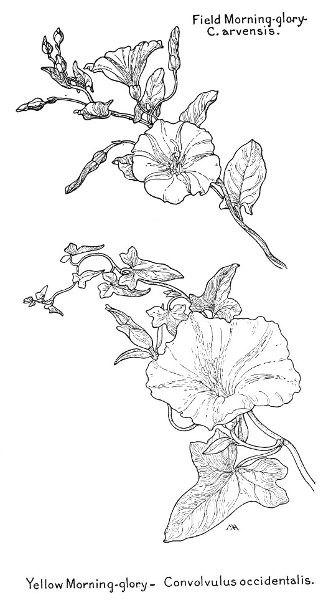
Field Morning-glory—C. arvensis.
Yellow Morning-glory—Convolvulus occidentalis.
Not a large family, most abundant in western North
America, a few in Europe and Asia; sometimes slightly
woody; the leaves without stipules; the flowers generally
regular; the calyx with five united sepals; the corolla with
five united petals, rolled up in the bud and often remaining
more or less twisted to one side in the flowers; the stamens
with slender filaments, with swinging anthers, often unequally
inserted, on the tube or throat of the corolla and
alternate with its lobes; the ovary superior, with a slender
style and three-lobed stigma, but in immature flowers the
three branches are folded together so that the style appears
to have no lobes; the pod with three compartments, containing
few or many seeds, which are sometimes winged
and sometimes mucilaginous.
There are a good many kinds of Polemonium, growing
in cool places, usually perennials; the leaves alternate, with
leaflets, not toothed; the calyx not ribbed or angled, bell-shaped;
the corolla more or less bell-shaped; the stamens
equally inserted, but often of unequal lengths; the seeds
mucilaginous when wet. This is the Greek name, used by
Dioscorides.
Jacob's Ladder
Polemònium
occidentàle (P.
coeruleum)
Blue
Summer
Northwest
A graceful plant, with attractive and
unusual-looking foliage. The juicy stem
and tender, bright green leaves are smooth
or hairy and the pretty flowers are nearly
three-quarters of an inch across, bright
rather purplish blue, paler inside and
delicately veined with blue, with a yellow
"eye." The stamens are protruding, with white anthers,
and the pistil is long and protruding, even in quite small
buds. This is variable and grows in damp places in the
mountains, across the continent and also in the Old World.
The common name comes from the shape of the leaf and it
is also called Greek Valerian. Another handsome sort is
P. carnèum, with flowers varying in color from salmon to
purple, growing in the mountains of California and Oregon,
but rather rare.
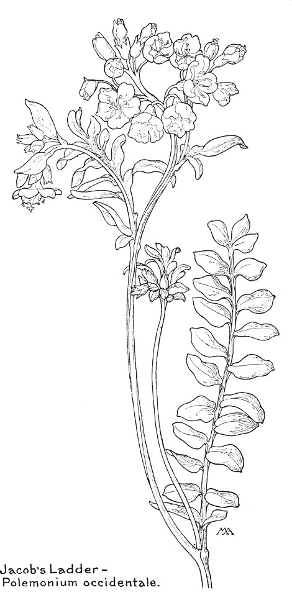
Jacob's Ladder—Polemonium occidentale.
There are many kinds of Linanthus; low, slender
annuals, with opposite, palmately-divided leaves and thus
differing from Gilia, the divisions narrow or threadlike,
looking almost like whorls in some kinds, or rarely toothless,
occasionally some of the upper leaves alternate; the flowers
scattered, or in terminal, roundish clusters; the calyx-tube
thin and dry between the ribs or angles, the teeth equal; the
corolla more or less wheel-shaped, funnel-form, or salver-form;
the stamens equally inserted on the corolla; the
seeds few or many, developing mucilage when moistened.
The Greek name means "flax flower."
Linánthus
Párryae (Gilia)
White
Spring
California
A queer little plant, only about two
inches high, with almost no stem, very
small, stiff leaves, and several large,
pretty flowers, with cream-white corollas,
about an inch across, with five crests in
the throat, and the tube tinged with purple on the outside.
They are exceedingly fragile and diaphanous in texture
and form little white tufts, which look very odd and attractive,
sprinkled over the sand in the Mohave Desert.
Linánthus brevicùlus
(Gilia)
Pink, violet
Spring
California
This has slender, purplish, rather hairy
stems, from six to eight inches tall, stiff,
dull green, hairy leaves, tipped with bristles,
and flowers over half an inch across,
with sticky, hairy calyxes. The slender
corolla-tubes are half an inch long, with delicate rose-pink or
violet petals, white anthers, and a whitish pistil. This looks
very pretty growing on the bare sand of the Mohave Desert.
Linánthus androsàceus
(Gilia)
Lilac, pink, or
white
Spring, summer
California
This is very pretty, with a stiff, slender,
hairy, branching stem, from three inches to
a foot tall, with stiffish, dull green leaves,
apparently in whorls and cut into very narrow
divisions, with bristles or hairs along the
margins. The flowers are over half an inch
across, with a long threadlike tube, and are usually bright
lilac but sometimes pink or white, with a yellow, white, or
almost black "eye," orange-colored anthers and a long,
yellow pistil. The flower-cluster is mixed with many bracts
and the stems often branch very symmetrically, with
clusters at the tips. This is common on dry hillsides,
growing in the grass, and often makes bright patches of
color. There are several named varieties.
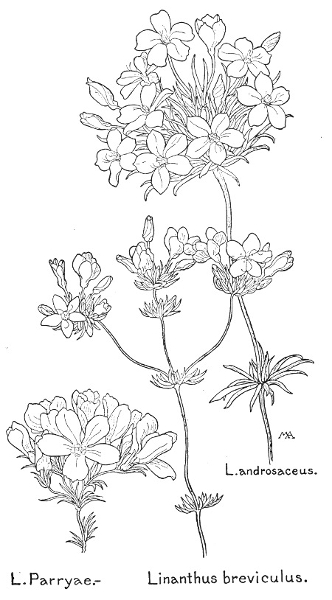
L. androsaceus.
L. Parryae.
Linanthus breviculus.
Evening Snow
Linánthus dichótomus
(Gilia)
White
Spring
California
Exceedingly pretty flowers, with very
slender, brown stems, often branching,
from two to twelve inches tall, and a few,
rather inconspicuous, dull green leaves.
The flowers are an inch or more across,
with a salver-form corolla, with a long
slender tube, white and beautifully sheeny in texture,
bordered with dull pink on the outside, showing where the
petals overlapped in the bud; the stamens and pistil not
showing in the throat. They have a strong and unpleasant
odor, but the effect of the airy flowers is beautiful, especially
in the desert, as they sway to and fro in the wind
on their slender stalks. They open only in the evening,
but stay open all night and keep on opening and closing
for several days, getting larger as they grow older. This is
common on open slopes and hills, but is variable and not
easily distinguished from similar species.
Yellow Gilia
Linánthus
àureus (Gilia)
Yellow
Spring
Arizona
A charming little desert plant, about
three inches tall, with a very slender,
usually smooth, widely branching stem
and small, pale green leaves, apparently in
whorls and cut into very narrow divisions,
quite stiff and tipped with a bristle. The
flowers are about half an inch across, bright yellow, with an
orange-colored "eye" and tube, orange anthers and a
yellow pistil, and they look exceedingly gay and pretty on
the pale sand of the desert.
Linánthus parviflòrus
(Gilia)
White, pink, lilac
Spring
California
A very pretty little plant, slightly hairy,
with a slender stem, from three to ten
inches tall, and clusters of small, stiff,
dark green leaves. The flowers are about
three-quarters of an inch across, with long,
threadlike, yellow tubes, sometimes an inch and a half
long, and white, pink, or lilac petals, with an orange or
white "eye" and often brownish on the outside, with
yellow anthers and a conspicuously long, yellow pistil.
This is common throughout California, growing in open
ground on hills and sea-cliffs. L. parviflorus var. aciculàris
is similar, but smaller. The flowers are similar, but often
have so little white about them that they are yellow in
general effect, and are sometimes specked with crimson at
the base of the petals. They grow in sandy places in
southern California.
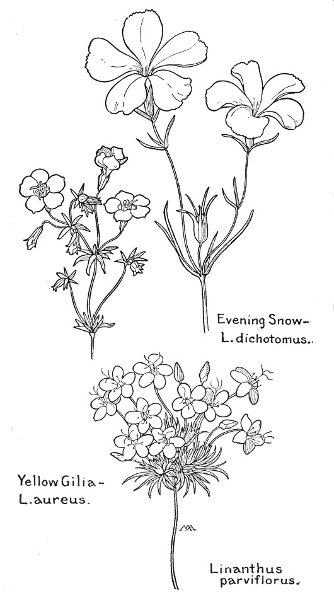
Evening Snow—L. dichotomus.
Yellow Gilia—L. aureus.
Linanthus parviflorus.
Ground Pink,
Fringed Gilia
Linánthus dianthiflòrus
(Gilia)
Pink
Spring
California
Charming little flowers, exceedingly
delicate and gay. The stem is usually
only a few inches tall, the leaves are very
narrow, and the flowers are three-quarters
of an inch across, with bright pink petals,
prettily toothed at the tips, shading to
white and yellow in the center and often
with a purple ring in the throat. This is common in
southern California and often grows in quantities, sprinkling
the ground with its bright little flowers.
Linánthus liniflòrus
(Gilia)
White
Spring, summer
California
This is a few inches tall, with purplish
stems, which are so very slender and wiry
that they look hardly thicker than hairs
and the flowers seem to be hovering in the
air, giving an exceedingly pretty and delicate
effect. The leaves are stiff and dark green and the
flowers are half an inch or more across, with a yellowish
tube and white petals, delicately veined with blue, with a
pale yellow pistil and orange anthers. This grows on the
dry tops of mesas, in southern California.
There are many kinds of Phlox, natives of North
America and Asia, usually perennials, the leaves toothless,
mostly opposite, at least the lower ones; the calyx five-ribbed;
the corolla salver-form; the stamens inserted very
unequally in the tube and not protruding; the seeds not
mucilaginous. The salver-form corolla and the seeds not
being mucilaginous distinguishes Phlox from Gilia. The
name is from the Greek, meaning "flame."
Alpine Phlox
Phlóx Douglásii
White, lilac
Summer
Northwest, etc.
A charming little plant, with woody
stems a few inches tall and partly creeping
along the ground, densely crowded with
numerous needle-like leaves, forming dull
green, cushion-like mats, sometimes over a
foot across and suggesting some sort of prickly moss.
These prickly cushions are sprinkled thickly all over with
pretty lilac flowers and the effect is most attractive. The
flowers vary in tint from white to pink and purple and are
nearly three-quarters of an inch across and slightly sweet-scented.
The tube is longer than the hairy calyx, and the
petals fold back in fading. This grows on gravelly slopes
and summits around Yosemite and in the Northwest, from
the Rocky Mountains to Nebraska, and its patches of
pale color are often conspicuous in dry rocky places, or in
open forests, at an altitude of three to seven thousand feet.
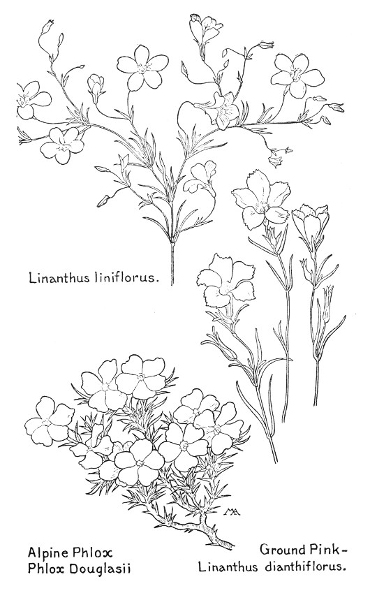
Linanthus liniflorus.
Alpine Phlox—Phlox Douglasii.
Ground Pink—Linanthus dianthiflorus.
Wild Sweet
William
Phlóx longifòlia
Pink
Spring, summer,
autumn
West, etc.
Very attractive common flowers, with
many stems, three to eight inches high,
from a woody base. The leaves are
smooth or somewhat downy, stiffish, pale
gray-green and rather harsh, and the
flowers are over three-quarters of an inch
across, clear pink, of various shades from
deep-pink to white, with an angled calyx. Only two yellow
stamens show in the throat and the style is long and
slender. This grows on hills and in valleys, as far east as
Colorado, and its pretty flowers are very gay and charming,
particularly when growing in large clumps in fields or
beside the road. P. Stánsburyi, common on the plateau
in the Grand Canyon, blooming in May, is similar, but has
sticky hairs on the calyx.
There are many kinds of Gilia, variable and not easily
distinguished; the leaves nearly always alternate and thus
differing from Linanthus; the corolla funnel-form, tubular,
or bell-shaped, but, unlike Phlox, rarely salver-form and the
seeds are usually mucilaginous when wet. These plants
were named for Gil, a Spanish botanist.
Scarlet Gilia,
Skyrocket
Gília aggregàta
Red
Spring, summer,
autumn
Southwest, Utah,
etc.
A brilliant biennial or perennial plant,
varying in general form and color. In
Utah it is somewhat coarse and usually
has a single, leafy, roughish, rather
sticky stem, from one to two feet tall,
purplish towards the top, and thickish,
somewhat sticky leaves, deeply lobed and
cut, in a cluster at the root and alternate
along the stem, dull bluish-green in color, smooth on the
under side, with more or less sparse woolly down on the
upper side, as if partially rubbed off. The flowers have no
pedicels, or very short ones, and form small clusters in the
angles of the leaves along the upper part of the stem, but
are mainly at the top, in a large, handsome, somewhat
flat-topped, loose cluster. They are each more than half
an inch across, with a corolla of clear scarlet, the lobes
shading at base to white, finely streaked with crimson and
prettily fringed at the tips. The stamens are equally or
unequally inserted in the corolla throat, the buds are
prettily twisted and fringed at the tips and usually have
a dark purplish calyx. Sometimes the flowers are all
scattered along the stalk, making a wand of bloom. This
grows on mountain sides and sometimes has a very disagreeable
smell, hence the local name of Polecat Plant.
In Yosemite it is much more delicate in character, with
several, smooth or downy, reddish, leafy stems, from one to
four feet high, from a branched base, bearing very graceful
clusters of flowers, the petals of various shades of scarlet,
pink, and crimson, often streaked with white, or yellowish
dotted with red, their long points curled back. Often the
buds are scarlet and the flowers pink, giving a very vivid
effect. The protruding stamens are inserted in the notches
between the lobes of the corolla, with red or pink filaments
and yellow or purple anthers. This has the look of a hothouse
flower and is very beautiful and striking when
growing in masses in high mountain woods. This has
several common names which are very misleading, such as
Wild Cypress and Wild Honeysuckle. There are several
named varieties. It grows in the Southwest and also from
British Columbia to New Mexico.
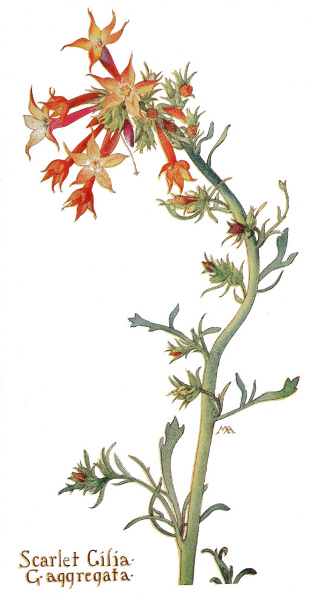
Scarlet Gilia—G. aggregata.
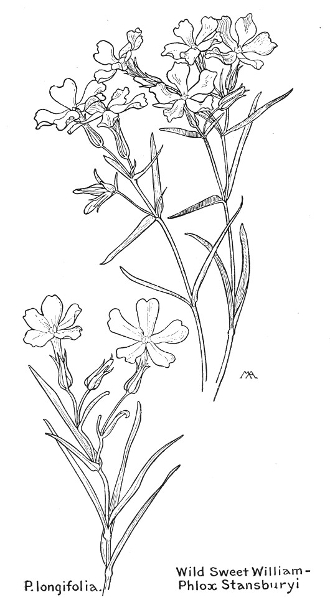
P. longifolia.
Wild Sweet William—Phlox Stansburyi.
Bird's Eyes
Gília trìcolor
White and purple
and yellow
Spring
Southwest
A beautiful kind, with rather hairy,
branching stems, from six inches to over
a foot tall, and dull green, rather hairy
leaves, prettily cut into long narrow lobes.
The flowers are in clusters, sweet-scented
and beautifully marked, with corollas a
half-inch or more in length, open funnel-shaped, with a
yellow tube marked by a white border, and two dark
purple spots in the throat below each of the blue or whitish
corolla-lobes, forming an "eye." The calyx lobes often
have purple margins, the anthers are bright blue, with
lilac filaments, and the pistil is lilac. This is common on
low hills in western California.
Blue Desert Gilia
Gília rigídula
Blue
Summer
Arizona
A strange little desert plant, stunted-looking
but with brilliant flowers, forming
low, prickly clumps of stiff, dry, dull
green, needle-like foliage, suggesting cushions
of harsh moss, with numerous woody
stems, two or three inches high, and numbers of pretty
flowers, half an inch across, deep bright blue, with a little
yellow in the center; the stamens, with bright yellow
anthers, projecting from the throat. This bravely opens
its bright blue eyes in the desert wastes of the Petrified
Forest.
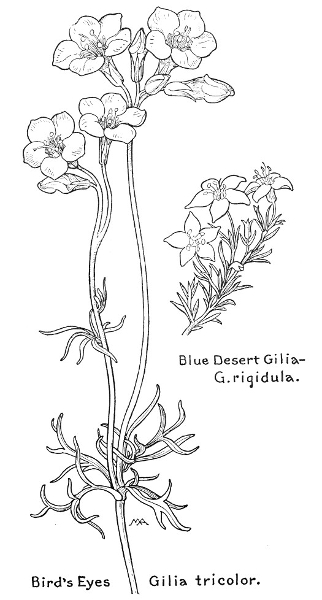
Blue Desert Gilia—G. rigidula.
Bird's Eye—Gilia tricolor.
Downy Gilia
Gília floccòsa
Blue
Spring
Southwest
A little desert plant, about three inches
tall, more or less downy all over, the upper
leaves and buds covered with soft white
down and the lower leaves dark green
and stiff, tipped with a bristle. The tiny
flowers have a blue corolla, varying from sky-blue to
almost white, with a yellow throat and white stamens, and
although they are too small to be conspicuous, the effect
of the bits of blue on the desert sand is exceedingly pretty.
Small Prickly
Gilia
Gília púngens
White
Summer
California
This resembles Alpine Phlox in general
effect, but the corolla is funnel-form instead
of salver-form, for the lobes do not
spread so abruptly. The many stems are
woody below, a few inches high, and
crowded with leaves, which are dull green,
stiff, and cut into needle-like divisions, which look like
single leaves, about half an inch long. The flowers are
pretty and fragrant, half an inch across, white or pale pink,
often with purplish streaks on the outside, with rounded
lobes, the edge of each overlapping the next, and yellow
anthers, not projecting from the throat of the corolla.
This forms loose mats on rocky ledges, at high altitudes.
Gília multicàulis
Lilac
Spring
California
A rather pretty little plant, about eight
inches tall, with several slender, slightly
hairy stems and leaves cut into very
narrow divisions. The little flowers are
pale lilac, quite delicate and pretty, though not conspicuous,
and form clusters at the tips of the branches. This
sometimes grows in quantities in the hills of southern
California and is variable.
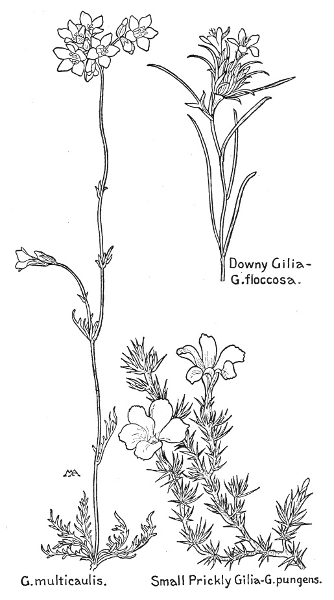
Downy Gilia—G. floccosa.
G. multicaulis.
Small Prickly Gilia—G. pungens.
Large Prickly Gilia
Gília Califórnica
Pink
Summer
California
An unusual-looking, conspicuous, shrubby
plant, suggesting some kind of small
prickly pine or cedar, with lovely flowers.
It forms large straggling clumps, about
two feet high, with many woody stems and
rich-green foliage, the leaves cut into small,
spreading, needle-like lobes, and ornamented with numbers
of brilliant flowers. They are an inch or more across,
with bright pink petals and a white "eye," and are most
delicate in texture, with a satiny sheen and smelling sweet
like violets. This grows on hills and is very beautiful on
Mt. Lowe.
Gília
achillaefòlia
Blue, white
Spring, summer
California
This varies a good deal in color and
beauty. The stems are smooth and
slender, from one to two feet tall, and the
leaves are alternate, smooth or downy,
delicately cut into many fine divisions.
The numerous small flowers are funnel-form, with projecting
stamens, and form a close round head, which is an
inch or more across, without bracts. The calyx is more or
less woolly, with sharp triangular teeth, the tips turned
back. Usually the flowers are blue of some shade, deep
or pale, sometimes forming patches of color in the fields,
but the prettiest I have seen grew in the woods near Santa
Barbara, the individual flowers larger than usual and pure
white, with bright blue anthers. It is common in Yosemite,
but rather dull bluish-white and not pretty.
Gília capitàta
Blue
Spring, summer
Northwest and
California
Very much like the last, but the flowers
are smaller and form a smaller, more
compact head. The corollas are blue, with
narrow petals, varying in tint from purplish-blue
to pale lilac, the calyx not woolly,
and the cluster is about an inch across, the stamens giving
it a fuzzy appearance. The leaves are smooth or slightly
downy and the seed-vessels form pretty pale green heads.
This is common and sometimes grows in such quantities
as to be very effective.
Gília multiflòra
Blue
Summer
Ariz., New Mex.
The general effect of this plant is inconspicuous,
though the flowers are quite
pretty close by. The roughish woody
stem is only a few inches tall and then
branches abruptly into several long sprays, clothed with
many very small, narrow, pointed, thickish, dull green
leaves and ornamented towards the end with small clusters
of flowers, which are lilac or blue, marked with purple
lines, less than half an inch across, with five irregular
lobes and blue anthers. This grows at the Grand Canyon
and in dry open places in the mountains.
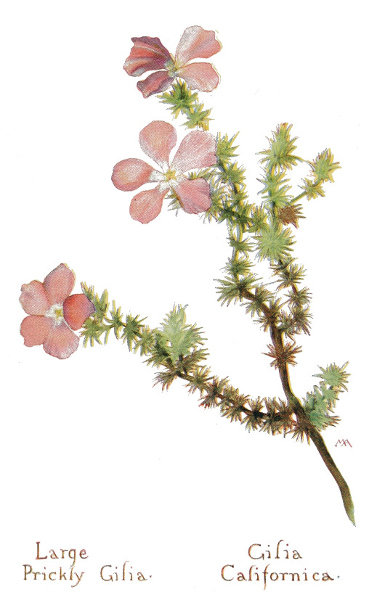
Large Prickly Gilia—Gilia Californica.
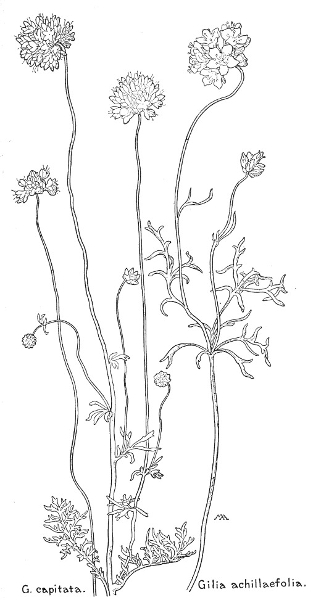
G. capitata.
Gilia achillaefolia.
There are several kinds of Collomia, almost all annuals;
leaves alternate, usually toothless; flowers in clusters;
differing from Gilia and Linanthus in the calyx, which
increases in size as it grows older; corolla tube-shaped,
funnel-form, or salver-form, with spreading lobes; stamens
unequally inserted on the corolla-tube, with unequal
filaments; seeds usually mucilaginous.
Collòmia grandiflòra
(Gilia)
Buff
Summer
Cal., Utah, Wash.
Very pretty flowers, which attract attention
because of their unusual coloring.
The leafy stem is from one to two feet
tall and slightly downy and the leaves are
generally toothless, smooth, and rather
dark green. The flowers form a roundish terminal cluster,
which is about two inches across, surrounded by broad
bracts, which are sticky to the touch. The corolla is
funnel-form, about an inch long, various shades of buff or
salmon-color, and as the downy buds are yellow, the newly-opened
flowers buff, and the older ones pinkish or cream-white,
the combinations of color are odd and effective.
This is quite common in Yosemite, in warm situations, and
much cultivated in Germany. It is sometimes called Wild
Bouvardia, but this is a poor name, as it is that of a plant
belonging to an entirely different family.
Collòmia lineàris
(Gilia)
Pink
Summer
West
From six inches to over a foot tall, with
a rather stout, very leafy stem, more or
less branching, and alternate leaves,
smooth, toothless, and rather dark green,
the upper stems and buds hairy and sticky.
The flowers have no pedicels and narrow funnel-form or
salver-form corollas, bright pink, about a quarter of an
inch across, and are crowded in roundish clusters, at the
tips of the leafy branches, the larger clusters toward the
top. Though the tiny flowers are bright and pretty this is
not an effective plant. It grows in dry, open, sandy
places and the foliage has a rather disagreeable smell when
crushed.
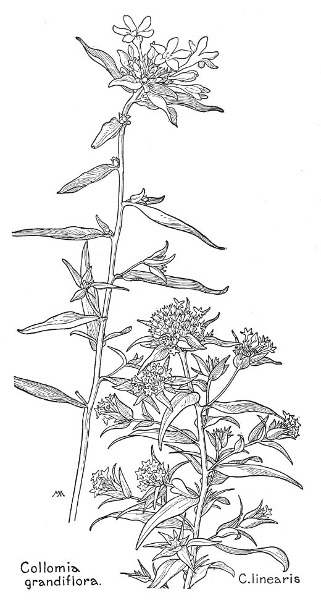
Collomia grandiflora.
C. linearis.
Herbs or shrubs, mostly natives of western North
America; often hairy; with no stipules; the leaves mainly
alternate or from the root; the flowers chiefly blue or white,
often in coiled clusters; the calyx with five united sepals;
the corolla with five united petals; the stamens five, on the
base of the corolla and alternate with its lobes, with threadlike
filaments and usually with swinging anthers; the
ovary superior, the styles two or two-cleft; the fruit a
capsule, containing few or many seeds. The leaves were
formerly supposed to have water-cavities in them, hence
the misleading name. Some of this family resemble some
of the Borages, but the stamens are long, the styles are
two, at least above, and the ovary has not the four conspicuous
lobes of the latter family.
There are many kinds of Phacelia, hairy plants, with no
appendages between the sepals; resembling Hydrophyllum,
except that the petals overlap in the bud, instead of being
rolled up, and the seeds are different. The name is from
the Greek, meaning "cluster."
Phacelia
Phacèlia lóngipes
Purple
Spring
California
This has pretty and rather unusual
looking foliage, for the leaves are a peculiar
shade of bluish-green, with purplish
margins. They are somewhat sticky,
soft and velvety, and although hairy are
not disagreeable to touch. The hairy, purplish stems grow
from a few inches to a foot tall and the pretty flowers are
lilac or purple, with yellow anthers, and measure three-quarters
of an inch across. This grows on sunny, sandy
mountain slopes.
Phacelia
Phacèlia glechomaefòlia
Lilac, white
Summer
Ariz., Utah, Cal.
A low plant, partly creeping, with weak,
brittle, sticky stems and soft, slightly
thickish, very dull yellowish-green leaves,
sticky and often dingy with dust. The
flowers are usually violet, but sometimes
pure white, about three-eighths of an inch
across, with yellow stamens, and are rather pretty. I
found this little plant growing under a huge red rock in the
Grand Canyon, on apparently perfectly dry, bare soil.
It has an aromatic and slightly unpleasant smell and is
rare.
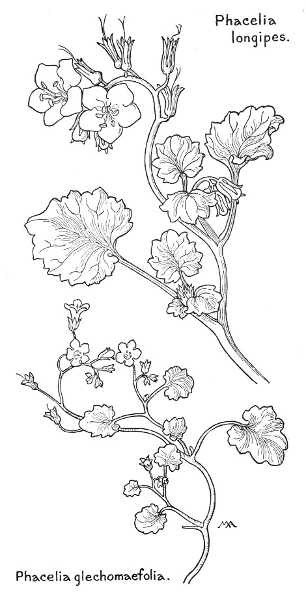
Phacelia longipes.
Phacelia glechomaefolia.
Phacelia
Phacèlia serícea
Purple
Summer
Northwest, Nev.,
Utah
A mountain plant, which in favorable
situations is exceedingly handsome and
conspicuous, about a foot tall, but sometimes
more, with downy, leafy stems, and
handsome, silky-downy foliage, cut into
many narrow divisions. The bell-shaped
flowers are three-eighths of an inch across, rich purple,
with very long, purple filaments and yellow anthers, and
are crowded in magnificent clusters, sometimes eight inches
long and very feathery. The corolla dries up and remains
on the fruit. This has a disagreeable smell and grows at
very high altitudes, where it is unusual to find such large
showy flowers. In dry unfavorable situations it is often
small and pale in color.
Phacelia
Phacèlia Párryi
Purple
Spring
California
This has very handsome flowers, but
the plant is too straggling. The branching,
reddish stems are very hairy and rather
sticky, from one to nearly two feet tall,
with dull green, hairy leaves, which are
harsh but not disagreeable to touch, and the flowers are
over three-quarters of an inch across, with a very hairy
calyx and a bright purple corolla, with a cream-colored
spot, the shape of a horseshoe, at the base of each petal.
The filaments are purple and hairy, with cream-colored
anthers and the style is white, tipped with purple. This
sometimes grows in such quantities as to give a very
brilliant color effect and is found from Los Angeles to San
Diego.
Vervenia
Phacèlia dístans
Violet
Spring
Southwest
This is from eight inches to two feet
high, with hairy, soft, dull green leaves and
hairy stems, which are usually branching
and spreading. The flowers are less than
half an inch across, with a very hairy,
sticky calyx, a violet corolla, varying in tint from dull
white to bright blue, fading to purple, and purple filaments
with whitish anthers. This grows in dry places and is
common, often forming large clumps covered with flowers
which are quite effective in color, though the plants are too
straggling and hairy to be very attractive close by. P.
ramosíssima is similar but coarser, the flowers are larger,
and the plant is exceedingly hairy, the calyxes being covered
with conspicuous, long, white hairs, and the whole
plant unpleasant to touch.
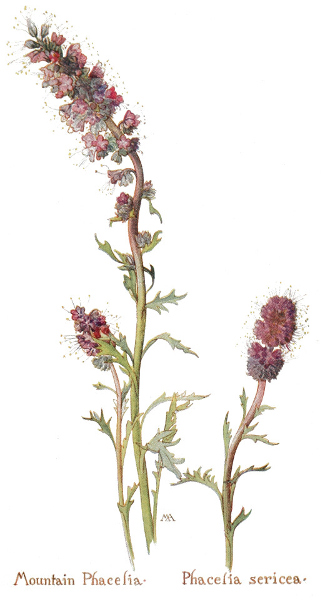
Mountain Phacelia—Phacelia sericea.
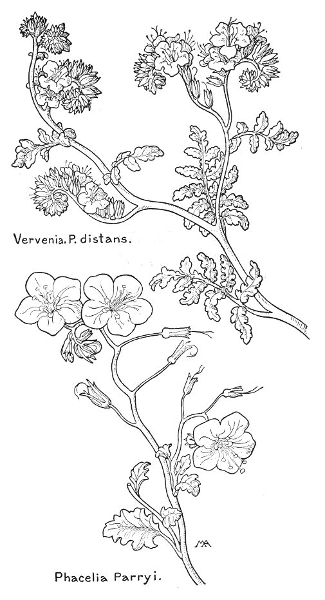
Vervenia. P. distans.
Phacelia Parryi.
Phacelia
Phacèlia
Fremóntii
Purple
Spring
Southwest and
Utah
A charming little desert plant, four or
five inches high, with one or more, purplish,
branching stems, springing from a
pretty cluster of thickish, dull green root-leaves.
The flowers are half an inch
across, with sticky, hairy calyxes and buds
and bright purple corollas, with bright
yellow throats, from which the stamens do not protrude.
These little flowers look very gay and pretty against the
desert sand.
Phacelia
Phacèlia lineàris
Purple
Spring, summer
Northwest and
Utah
This is a delicate and pretty plant, in
spite of its hairy foliage, from six inches to
a foot high, with a hairy stem, purplish
and somewhat branching, and alternate
leaves, which are sometimes deeply cleft,
usually have no leaf-stalks and are hairy
and light yellowish-green in color. The flowers are pretty,
grouped in rather long clusters, and are each about half an
inch across, with a hairy calyx and a corolla delicately
tinted with various shades of clear lilac and blue, shading
to white in the center, with long narrow appendages in the
throat between the stamens, which are long and conspicuous,
giving a feathery appearance to the cluster. The
anthers are dark purple and mature before the stigma, and
the buds are pink and white. This grows on dry hillsides,
often under sage-brush.
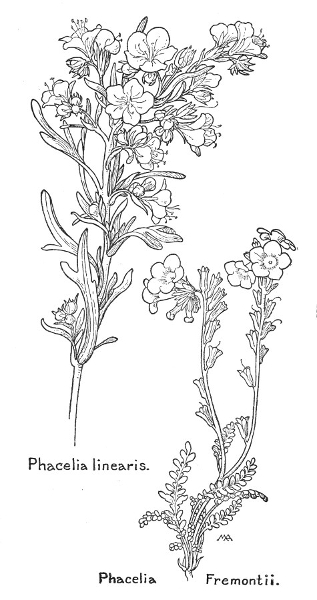
Phacelia linearis.
Phacelia Fremontii.
Phacelia
Phacèlia
grandiflòra
Lilac
Summer
California
A very handsome kind, though rather
coarse, and hairy and sticky all over, but
with lovely, delicate flowers. The stems
are from one to three feet tall and the
dark green leaves are velvety on the upper
side and hairy on the under. The flowers
often measure two inches across, with a lilac or mauve
corolla, shading to white in the center, flecked and streaked
with brown, blue, or purple, and the stamens have purple
filaments and pale yellow anthers. This plant is unpleasantly
sticky, with a viscid fluid which stains everything
with which it comes in contact, is poisonous to some
people, and is found from Santa Barbara to San Diego.
Phacèlia víscida
var. albiflòra
White
Spring
California
This is a white variety, with pretty,
delicate white flowers. Phacelia viscida is
very much like P. grandiflora, and has
about the same range, but is not so large
a plant, usually about a foot tall, with
smaller flowers, about an inch across. The corollas are
blue, with purple or white centers.
Wild Canterbury-bell
Phacèlia
Whitlàvia
Purple
Summer
California
Charming flowers, though the foliage
is rather too hairy. The stout, reddish
stems are hairy, brittle, and loosely
branching, about a foot tall, and the leaves
dull green and hairy. The handsome
flowers are in graceful nodding clusters,
with a bell-shaped corolla, about an inch
long, a rich shade of bluish-purple, the long conspicuous
stamens and pistils giving an airy look to the blossoms.
The filaments are purple and the anthers almost white
and, as in other Phacelias, when the corolla drops off the
long forked style remains sticking out of the calyx like a
thread. This grows in light shade in rich moist soil in the
hills.
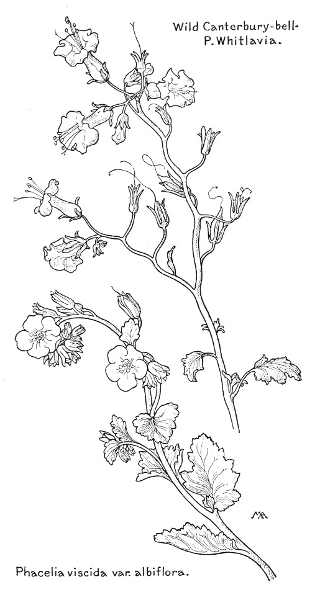
Wild Canterbury-bell—P. Whitlavia.
Phacelia viscida var. albiflora.
Alpine Phacelia
Phacèlia alpìna
Lilac
Summer
Utah, Nev., etc.
This just misses being a very pretty
plant, for the leaves are attractive, but the
flowers are too small and too dull in color
for the general effect to be good. The
stems are about ten inches tall, purplish
and downy, and the leaves are dull green and rather
downy, with conspicuous veins. The buds are hairy and
the flowers are lilac and crowded in coiled clusters, to
which the long stamens give a very feathery appearance.
This is found in the mountains, as far east as Montana
and Colorado, and reaches an altitude of over twelve
thousand feet.
Wild Heliotrope
Phacèlia crenulàta
Lilac
Spring
Arizona
This is a fine plant, from six to eighteen
inches tall, with purplish stems and handsome
coarse foliage, all rough, hairy, and
very sticky. The flowers are lilac, with
purple stamens and pistil, and the general
effect is that of a large coarse Heliotrope. The flowers have
a pleasant scent, but the foliage has a strong and disagreeable
smell, and it grows on the plateau in the Grand Canyon.
Arizona Phacelia
Phacèlia
Arizònica
White, mauve
Spring
Arizona
A little desert plant, not very pretty,
with several hairy flower-stalks, from
three to six inches tall, springing from a
rosette of soft thickish leaves, slightly
hairy, dull green in color, and something
the shape of the leaves of P. Fremontii,
but the lobes not nearly so small. The flowers are in
tightly coiled clusters; the corolla a little more than a
quarter of an inch across, dull white, with a pinkish line on
each lobe and lilac anthers, the general effect being mauve.
There are a good many kinds of Nemophila, natives of
North America, mostly Californian, slender, fragile herbs,
with alternate or opposite leaves, more or less divided, and
usually large, single flowers, with rather long flower-stalks.
The calyx has an appendage, resembling an extra
little sepal, between each of the five sepals, which makes
these plants easy to recognize, and the corolla is wheel-shaped
or bell-shaped, usually with ten, small appendages
within, at the base, and the petals are rolled up in the bud;
the stamens are short; the styles partly united. The name
is from the Greek, meaning "grove lover," because these
plants like the shade.
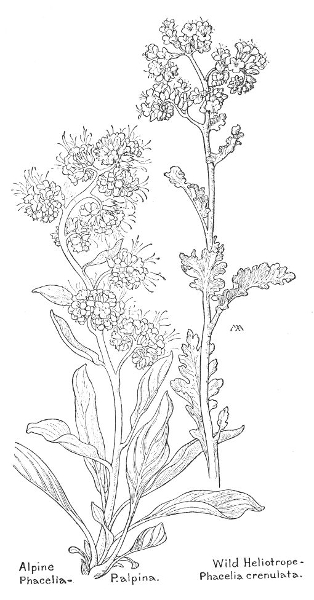
Alpine Phacelia—P. alpina.
Wild Heliotrope—Phacelia crenulata.
Baby Blue-eyes,
Mariana
Nemóphila insígnis
Blue and white
Spring
California
These are exceedingly charming little
plants, with slender, weak, hairy stems,
varying a good deal in height, but usually
low and spreading, and pretty, light
green, soft, hairy foliage, sprinkled with
many lovely flowers, an inch or more
across, with hairy calyxes and sky-blue corollas, which are
clear white in the center and more or less specked with
brown, with ten hairy scales in the throat. The blue of
their bright little faces is always wonderfully brilliant, but
they are variable and are usually deeper in color and rather
smaller in the South. This is one of the commonest kinds
of Nemophila in California and it is a general favorite.
It is called Mariana by the Spanish Californians.
Baby Blue-eyes
Nemóphila
intermèdia
Blue and white
Summer
California
This is much like the last, but it is a
taller and more slender plant, usually
about ten inches high. The lovely delicate
flowers are less than an inch across,
with light blue corollas, usually shading to
white at the center and delicately veined
with blue, or speckled with purple dots. This grows among
the underbrush.
Spotted Nemophila
Nemóphila
maculàta
White and purple
Summer
California
These are charming flowers, their
corollas oddly and prettily marked. The
weak, hairy stems, from three to twelve
inches long, are usually spreading and the
leaves are opposite, hairy, and light green.
The flowers are about an inch across, with
hairy calyxes and white corollas, which are
prettily dotted with purple and usually have a distinct
indigo spot at the tip of each petal, which gives an unusual
effect. The filaments are lilac and the anthers and pistil
are whitish. This is common in meadows around Yosemite
and in other places in the Sierras at moderate altitudes.
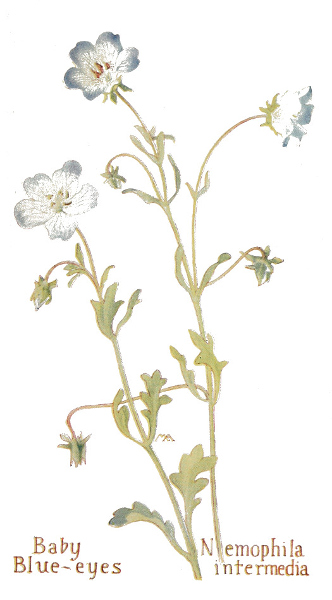
Baby Blue-eyes—Nemophila intermedia.
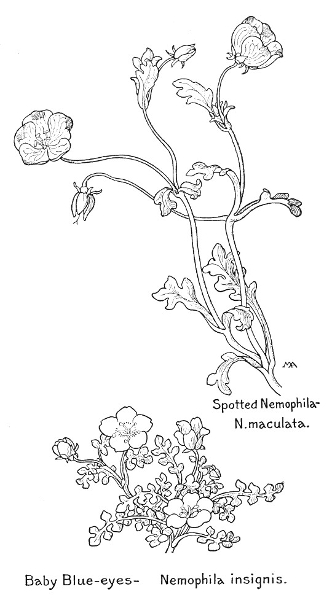
Spotted Nemophila—N. maculata.
Baby Blue-eyes—Nemophila insignis.
Climbing
Nemophila
Nemóphila aurìta
Purple
Summer
California
This is a straggling plant, with pretty
delicate flowers, which suggest some sort of
Nightshade. The stems are pale, square,
juicy and very brittle, from one to three
feet long, and the leaves are bright green
and most of them are alternate, with leafstalks
which are winged and clasping at base. The backs
of the leaves, and the stems and calyxes, are covered with
hooked bristles, which enable the plant to climb over its
neighbors and give it the feeling of Bed-straw to the touch.
The flowers are nearly an inch across, with purple corollas,
shading to white in the center and paler outside, with
purple scales in the throat and purple stamens. This is
rather coarser than most Nemophilas and grows in light
shade on hillsides.
There are several kinds of Conanthus, low hairy herbs,
with alternate, toothless leaves. The calyx and corolla
are without appendages; the stamens are not protruding,
and are unequal in length and unequally inserted in the
tube of the corolla; the style is two-lobed and the capsule
is roundish and contains from ten to twenty, smooth seeds.
Conanthus
Conánthus
aretioìdes
Pink
Spring
Idaho, Nev.,
Ariz.
This is a pretty little desert plant,
spreading its branches flat on the ground
and bearing tufts of grayish-green, very
hairy foliage and a number of charming
little flowers, which are three-eighths of an
inch across, with very hairy calyxes and
bright purplish-pink corollas, with a white
and yellow "eye" and a long, slender, yellow tube, which
is slightly hairy on the outside. The styles and anthers
are of various lengths in different plants. These gay little
flowers look very pretty on the dreary mesas around Reno
and suggest some sort of Gilia.
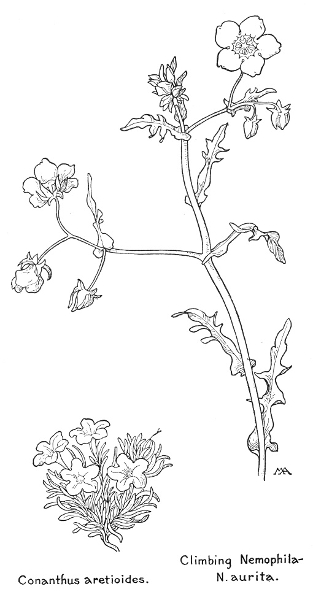
Conanthus aretioides.
Climbing Nemophila—N. aurita.
There are only two kinds of Romanzoffia.
Romanzoffia
Romanzóffia
sitchénsis
White
Summer
Northwest, etc.
This is a charming little perennial
plant, which forms beautiful clumps of
delicate foliage and flowers, suggesting
some sort of Saxifrage. The many,
smooth, slender, pale green stems, from
four to nine inches tall, spring from slender,
threadlike rootstocks, bearing tubers, and the leaves are
mostly from the root, smooth, bright green, and prettily
scalloped, with long leaf-stalks. The flowers are in loose
clusters and are each half an inch or more long, with a
white corolla, which is without appendages inside and is
exceedingly beautiful in texture, with yellow stamens,
unequally inserted, and a long, threadlike style, with a
small stigma. These little plants grow in moist, shady
spots among the rocks, as far north as Alaska and often
reach very high altitudes, where it is a delight to find their
pearly flowers and lovely foliage in some crevice in the
cliffs watered by a glacier stream. These plants are found
as far north as Alaska and were named in honor of Count
Romanzoff, who sent the Kotzebue expedition to Alaska.
There are several kinds of Emmenanthe, much like
Phacelia, but the stamens not protruding, and the corolla
bell-shaped, cream-color or yellow, becoming papery in
withering and not falling off, hence the Greek name,
meaning "lasting flower."
Emmenanthe
Emmenánthe
lùtea
Yellow
Spring, summer
Idaho, Nev., etc.
A low plant, with many, downy branches,
spreading almost flat on the ground, and
small, thickish leaves, light dull green, and
slightly downy. The flowers are rather
more than a quarter of an inch across,
with hairy calyxes, and bright yellow
corollas, hairy outside, with ten little appendages inside,
and grow in coiled clusters. The little flowers are gay and
pretty and look bright and cheerful on the desert sands
where they live. This is found as far east as Oregon.
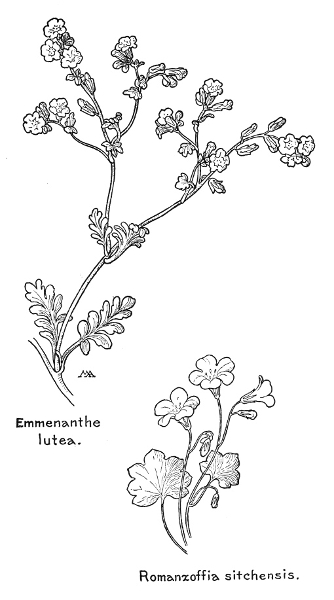
Emmenanthe lutea.
Romanzoffia sitchensis.
Whispering Bells
Emmenánthe
penduliflòra
Yellowish
Spring, summer
Southwest
Pretty plants, from eight to fourteen
inches tall, with branching, hairy stems
and light green, soft, downy leaves. The
flowers are less than half an inch long,
with pale yellow corollas, and are at first
erect, but gradually droop until they hang
gracefully on their very slender pedicels. They become
dry and papery as they wither, but keep their form, and
when the wind shakes their slender stems they respond
with a faint rustling sound. This grows in dry places and
is common in the South. In Arizona it grows only in
protected canyons.
There are several kinds of Hydrophyllum, perennial or
biennial herbs, with fleshy running rootstocks and large,
more or less divided leaves, mostly alternate. The corolla
is bell-shaped, with a honey-gland at the base of each of the
petals, which are rolled up in the bud. The filaments are
hairy, the style two-cleft above, both stamens and style
are generally long and protruding, and the ovary is one-celled
and hairy, containing from one to four seeds.
Cat's Breeches,
Waterleaf
Hydrophýllum
capitàtum
Lilac
Spring
Northwest, Utah
This is a pretty plant, from six to
twelve inches high, with a rather weak
stem and conspicuous leaves, which are
alternate, pale green, soft and downy, or
hairy, with five or seven divisions, prettily
lobed and cut, with rather prominent
veins, and long, succulent, pinkish leafstalks,
sheathing the stem. The flowers are rather small,
with short pedicels, and a number are crowded together in
roundish clusters, about an inch across, with almost no
flower-stalk. The calyx is covered with white hairs, the
corolla is lilac or white, somewhat hairy on the outside, and
the stamens and style are long and conspicuous, sticking
out like cats' whiskers and giving a pretty feathery appearance
to the whole cluster, which becomes in fruit a conspicuous,
very fuzzy, round head, covered with bristly
white hairs, making the children's quaint common name
for this plant quite appropriate. It grows in rich soil, in
mountain woods, and is one of the earliest spring flowers.
It is sometimes called Bear's Cabbage, but this name is far
fetched, both as regards bears and cabbages!
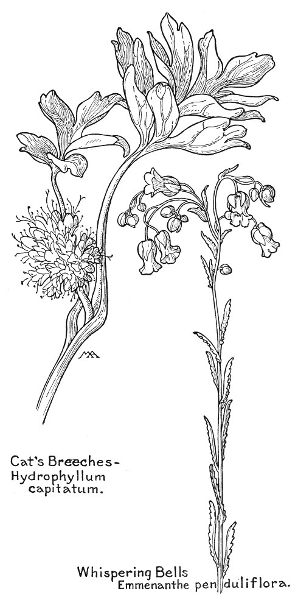
Cat's Breeches—Hydrophyllum capitatum.
Whispering Bells—Emmenanthe penduliflora.
There are several kinds of Eriodictyon, shrubs, with
alternate, toothed, leathery, evergreen leaves, which are
netted-veined, generally green and smooth on the upper
side and whitish and downy on the under, with leaf-stalks;
the flowers in coiled clusters; the corolla more or less
funnel-form or salver-form, without appendages in the
tube; the stamens and the two distinct styles not protruding;
the capsule small, with few seeds. The name is
from the Greek for "wool" and "net," in allusion to the
netted wool on the under surface of the leaves.
Yerba Santa,
Mountain Balm
Eriodíctyon
Califórnicum
White, lilac
Summer
Cal., Oreg., Wash.
A branching shrub, from two to six
feet high, with thickish leaves, with toothed
or wavy margins, from two to six inches
long, dark and shiny on the upper side,
pale with close down and netted-veined on
the underside. The flowers are not
especially pretty, about half an inch long,
with white, lilac, or purple corollas, and are slightly sweet
scented. The leaves are strongly and pleasantly aromatic
when they are crushed and were used medicinally by the
Indians, hence the Spanish name, meaning "holy herb."
Cough-syrup is made from them and also substitutes for
tobacco and hops. This grows on dry hills and is very
variable, being sometimes a handsome shrub. There are
intermediate forms between this and the next, E. tomentosum,
which are difficult to distinguish.
Woolly Yerba
Santa
Eriodíctyon
tomentòsum
Lilac
Spring
California
A large leafy shrub, about five feet
high and much handsomer than the last,
with velvety, light green branches and
very velvety, purplish twigs. The beautiful
leaves are veined like chestnut leaves
and made of the thickest, softest, sea-green
or gray velvet, like a mullein leaf in
texture, but much smoother and softer. The flowers are
three-quarters of an inch long, with a pale pinkish-lilac
corolla, shading to purple and white, downy on the outside,
and form quite handsome clusters, mixed with pretty gray
velvet buds, the lilac of the flowers harmonizing well with
the gray foliage. This grows in quantities on Point Loma,
and other places along the coast, from San Diego to Santa
Barbara. There are several similar varieties.
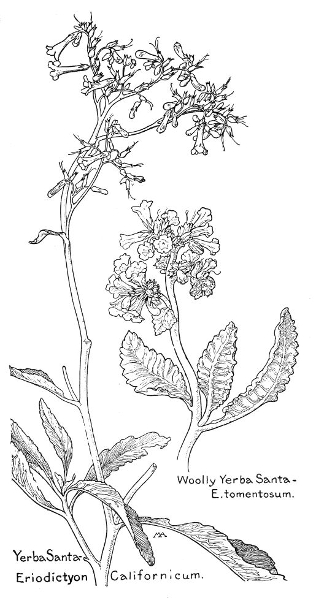
Woolly Yerba Santa—E. tomentosum.
Yerba Santa—Eriodíctyon Californicum.
A large family, widely distributed, chiefly rough-hairy
herbs, without stipules; usually with alternate, toothless
leaves; flowers usually in coiled, one-sided clusters; calyx
usually with five sepals; corolla usually symmetrical, with
five united petals, often with crests or appendages in the
throat; stamens five, inserted in the tube of the corolla,
alternate with its lobes; ovary superior, with a single,
sometimes two-cleft, style, and usually deeply four-lobed,
like that of the Mint Family, forming in fruit four seed-like
nutlets. Mature fruit is necessary to distinguish the
different kinds. These plants superficially resemble some
of the Waterleaf Family, but the four lobes of the ovary are
conspicuous.
There are many kinds of Lappula, chiefly of the north-temperate
zone; leaves narrow; corolla blue or white,
salver-form or funnel-form, with a very short tube, the
throat closed by five short scales, the stamens, with short
filaments, hidden in the tube; ovary deeply four-lobed;
style short; nutlets armed with barbed prickles, forming
burs, giving the common name, Stickseed, and the Latin
name, derived from "bur." Some of them resemble
Forget-me-nots, but are not true Myosotis.
White Forget-me-not
Láppula
subdecúmbens
White
Spring, summer
Northwest
Though the foliage is harsh, this plant
is so graceful and has such pretty flowers
that it is most attractive. It is from ten
to eighteen inches tall, with several
yellowish, hairy stems, springing from a
perennial root and a cluster of root-leaves,
the stem-leaves more or less clasping at
base, all bluish-green, covered with pale hairs, with
prominent veins on the back and sparse bristles along the
edges. The flowers form handsome, large, loose clusters
and the hairy buds are tightly coiled. The calyx is hairy,
with blunt lobes, and the corolla, about half an inch across,
is pure white, or tinged with blue, often marked with blue,
with two ridges on the base of each petal, and the throat
closed by five yellow crests, surrounded by a ring of fuzzy
white down. This grows on dry plains and hillsides, sometimes
making large clumps.
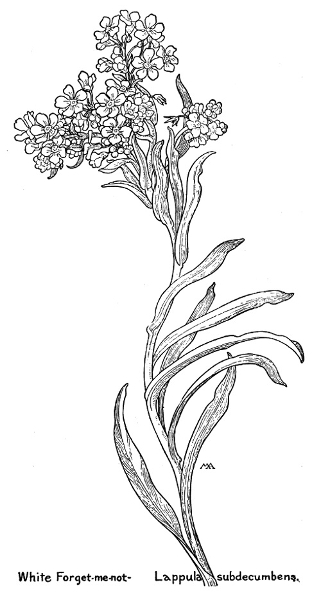
White Forget-me-not—Lappula subdecumbens.
Wild Forget-me-not
Láppula
velùtina
Blue
Summer
California
Beautiful flowers, resembling true Forget-me-nots,
but larger, with velvety, often
reddish stems, from one to two feet tall,
velvety leaves, and flowers in handsome,
loose, somewhat coiling clusters. The
corolla is about half an inch across, sky-blue,
the most brilliant blue of any flower
in Yosemite, with five, white, heart-shaped crests in the
throat; the buds pink. This is rather common in the Sierra
Nevada at moderate altitudes. L. nervòsa, of high altitudes,
is similar, but with smaller flowers, the leaves
rough-hairy, but green. This has very prickly nutlets,
which stick in the wool of sheep and are dreaded by
shepherds. L. floribúnda, also growing in the mountains of
California and Oregon, has similar, small, blue flowers,
sometimes pink, and hairy, gray foliage. L. Califórnica,
of the northern Sierra Nevada mountains, has small white
flowers.
There are many kinds of Lithospermum, chiefly of the
northern hemisphere; with reddish, woody roots, hairy
leaves, without leaf-stalks, and flowers crowded in clusters,
mixed with leaves and leafy bracts; corolla funnel-form or
salver-form, the throat often hairy or crested; stamens with
short filaments, not protruding from the throat of the
corolla; ovary four-lobed, with a slender style, stigma with a
round head or two lobes; nutlets usually white and smooth.
The Greek name means "stony seed." Puccoon is the
Indian name, and these plants are also called Gromwell,
and sometimes Indian Dye-stuff, because the Indians made
dye from the roots, which yield a beautiful delicate purple
color.
Hairy Puccoon
Lithospérmum
pilòsum
Yellow
Spring, summer
Northwest, Utah,
etc.
A rather pretty plant, about a foot tall,
with several, stout, yellowish-green stems,
covered with white hairs and very leafy,
springing from a thick perennial root.
The leaves are bluish-gray green and
downy, harsh on the under side, and the
flowers are numerous and pleasantly
scented, with a very hairy calyx and a salver-form corolla,
about three-eighths of an inch across, silky outside, the
throat downy inside, but without crests. The flowers are
yellow, an unusual shade of pale corn-color, and harmonize
with the pale foliage, but are not conspicuous, and the
flower cluster is so crowded with leaves and leafy bracts
that it is not effective. This grows in dry fields, as far
east as Nebraska, and sometimes makes pretty little
bushes, over two feet across.
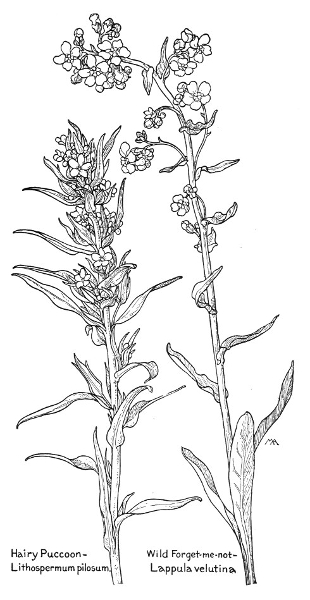
Hairy Puccoon—Lithospermum pilosum.
Wild Forget-me-not—Lappula velutina.
Pretty Puccoon
Lithospérmum
angustifòlium
Yellow
Spring
West, etc.
These are pretty flowers, but have a
disagreeable smell. They are perennials,
with a deep root and hairy or downy,
branching stems, from six inches to two
feet high, and hairy or downy leaves, which
are rather grayish green. The flowers are
in terminal leafy clusters and are of two sorts. The corollas
of the earlier ones are very pretty, clear bright yellow,
sometimes nearly an inch and a half long, with toothed
lobes, which are charmingly ruffled at the edges, and with
crests in the throat, but the later flowers are small, pale,
and inconspicuous. This grows in dry places, especially on
the prairies, and is very widely distributed in the western
and west central states.
Gromwell
Lithospérmum
multiflòrum
Yellow
Summer
Ariz., Utah, etc.
This has a rough, hairy stem, about a
foot tall, and dull green, rough, hairy
leaves, with bristles along the edges. The
yellow flowers are half an inch long and
form rather pretty coiled clusters. This
grows in open woods at the Grand Canyon,
and is found as far east as New Mexico and Colorado.
There are a good many kinds of Amsinckia, natives of
the western part of our country and of Mexico and South
America. They are rather difficult to distinguish, rough,
hairy or bristly, annual herbs, the bristles usually from a
raised base, and with yellow flowers, in curved, rather
showy, clusters. The corolla is more or less salver-form,
without crests, but with folds; the stamens and pistil not
protruding, the stigma two-lobed. In order to insure cross
pollination by insects, in some kinds the flowers are of two
types, as concerns the insertion of the stamens on the
corolla and the length of the style. Several of these plants
are valuable in Arizona for early spring stock feed, and the
leaves of young plants are eaten by the Pima Indians for
greens and salads.
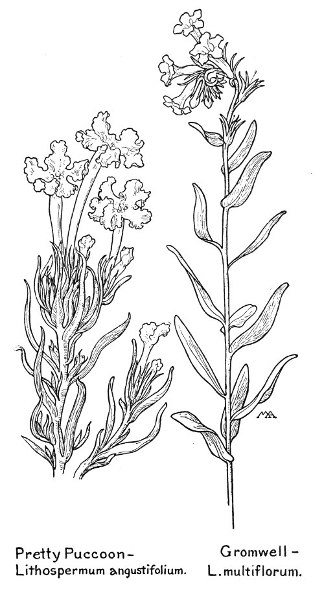
Pretty Puccoon—Lithospermum angustifolium.
Gromwell—L. multiflorum.
Saccato Gordo,
Fiddle-neck,
Buckthorn Weed
Amsínckia
inlermèdia
Yellow
Spring, summer
West
This has bright flowers, but the foliage
is dreadfully harsh. The stem is from one
to three feet tall, often widely branching,
with white bristles scattered over it, and
the leaves are dull green and bristly.
The flowers are pretty, about half an inch
long, with narrow sepals and bright
orange corollas, with five bright red spots
between the lobes. The nutlets are roughened with short,
hard points. These plants are very common and sometimes
form rank thickets in fields and waste places. They
are very abundant in southern Arizona and are valued as a
grazing plant for stock and are therefore known as Saccato
Gordo, which means "fat grass."
There are many kinds of Cryptanthe, most of them
western and difficult to distinguish. They are slender,
hairy plants, with small flowers, which are usually white, in
coiled clusters; the calyx bristly; the corolla funnel-form,
usually with five crests closing the throat; the nutlets
never wrinkled. These plants resemble white Forget-me-nots
and are sometimes so called. The Greek name means
"hidden flower," perhaps because of the minute flowers of
some kinds.
Nievitas
Cryptánthe
intermèdia
White
Spring
Cal., Ariz.
A rather attractive little plant, but inconspicuous
except when it grows in
patches, when it powders the fields with
white, like a light fall of snow, and suggests
the pretty Spanish name, which is a
diminutive of "nieve," or snow. The
slender, roughish stem is about ten inches tall, the light
green leaves are hairy, with fine bristles along the edges,
and the pretty little flowers are white, about a quarter of
an inch across, with yellow crests in the throat. Popcorn
Flower, Plagiobòthrys nothofúlvus, of the Northwest,
is also called Nievitas, as it often whitens the ground
with its small, fragrant, white flowers, which are very much
like the last.
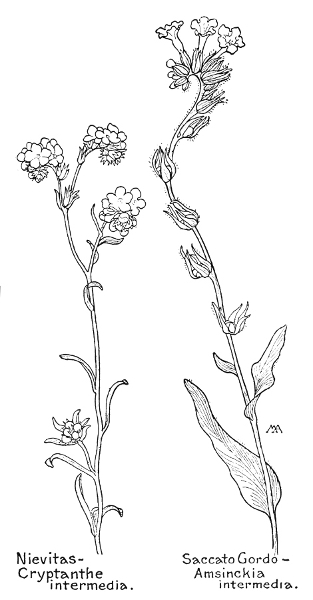
Nievitas—Cryptanthe intermedia.
Saccato Gordo—Amsinckia intermedia.
There are a good many kinds of Mertensia, natives of
the northern hemisphere. They are handsome perennials,
never very hairy and sometimes perfectly smooth all over,
with leafy stems and broad leaves, sometimes dotted, the
lower ones with leaf-stalks. The pretty, nodding flowers
are in clusters and have a purple, blue, or white corolla,
often turning pink, more or less trumpet-shaped, the lobes
not spreading much, the throat open, with or without
crests; the ovary deeply four-lobed, with a threadlike
style and one stigma; the nutlets wrinkled. These plants
are all commonly called Lungwort.
Languid Lady,
Lungwort
Merténsia Sibírica
Blue
Summer
Northwest
A very attractive and graceful mountain
plant, with pretty flowers and fine
foliage. The stems are hollow and usually
smooth, from one to five feet tall, and the
leaves are rather thin and soft in texture,
usually smooth, with a "bloom." The
flowers are in handsome loose clusters, most of them
drooping, and have a corolla over half an inch long, which
is a beautiful shade of bright light blue, often tinged with
pink, with white crests in the throat, and the style is long
and protruding. The buds are bright pink, contrasting
well with the blue flowers. This grows near streams, in the
higher mountains. It is often called Mountain Bluebell,
but that name belongs to Campanula and is therefore
misleading. (This has recently been "separated" into
several species.)
Lungwort
Merténsia
brevístyla
Blue
Spring, summer
Utah, Col., Wyo.
This is an attractive plant and looks
a good deal like a Forget-me-not. It
grows from four to ten inches tall and has
dull bluish-green leaves, which are downy
on the upper side and smooth on the under,
and graceful clusters of pretty little flowers.
The buds are pinkish-purple and the flowers are small,
with hairy calyxes and brilliant sky-blue corollas, the
stamens and style not protruding. This grows in mountain
canyons, up to an altitude of seven thousand feet.
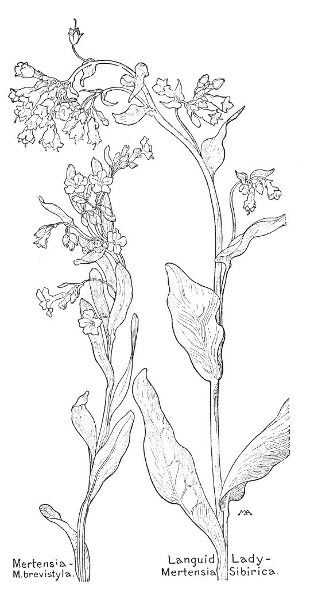
Mertensia—M. brevistyla.
Languid Lady—Mertensia Sibirica.
There are many kinds of Heliotrope, widely distributed
in temperate and tropical regions; ours have small, white
or blue flowers, in coiled spikes; the corolla salver-form or
funnel-form, without crests or hairs; the stamens not
protruding, the filaments short or none, the anthers sometimes
joined by their pointed tips; the ovary not four-lobed,
but sometimes grooved, with a short style, the
stigma cone-shaped or round.
Sea-side Heliotrope,
Chinese
Pusley
Heliotròpium
Curassávicum
White
Summer, autumn
Cal., Oreg., etc.
This is not a pretty plant and is rather
insignificant because of its dull coloring.
It forms low, branching, straggling clumps,
with thickish stems and leaves, which
are succulent and perfectly smooth, with a
"bloom," and the flowers are small, the
corolla white or pale lilac, with a yellow
"eye" which changes to purple, forming
crowded coiled spikes, mostly in pairs, without bracts.
The fruit consists of four nutlets. This is widely distributed,
in moist, salty or alkaline places, growing also
in the East and in South America and the Old World.
There are several kinds of Oreocarya, natives of western
North America and Mexico, coarse, hairy, perennial or
biennial herbs, with thick woody roots; the leaves narrow,
alternate or from the root; the flowers small, mostly white,
in clusters, with a funnel-form or salver-form corolla, usually
with crests and folds in the throat; the stamens not protruding;
the style usually short. The name is from the
Greek, meaning "mountain-nut," which does not seem
very appropriate.
Oreocarya
Oreocàrya
multicàulis
White
Spring
Ariz., Utah, etc.
A rather pretty plant, about six inches
tall, not rough and harsh like most kinds
of Oreocarya, for the pale grayish-green
stem and leaves are covered with white
down. The flowers are quite pretty, about
three-eighths of an inch across, with
white corollas, with yellow crests in the throat. This is
found as far east as southern Colorado and New Mexico.
O. setosíssima is quite tall, growing in the Grand Canyon,
and has a large cluster of small white flowers and is harsh
and hairy all over, covered with such long stiff white
hairs as to make it conspicuous and very unpleasant to
touch.
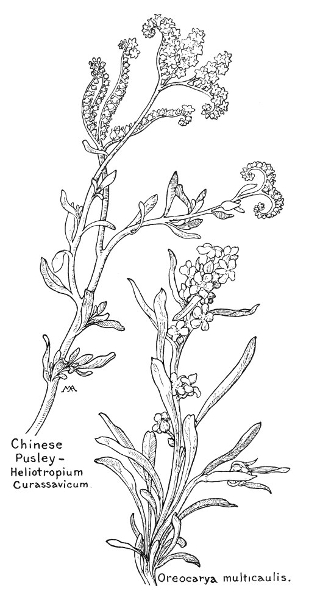
Chinese Pusley—Heliotropium Curassavicum.
Oreocarya multicaulis.
A large family, widely distributed; herbs and shrubs;
leaves opposite, or in whorls; flowers perfect, in clusters;
calyx with four or five lobes or teeth; corolla with four or
five united lobes, almost regular or two-lipped; stamens on
the corolla, usually four, in two sets; ovary superior, with
one style and one or two stigmas, when ripe separating
into from two to four, one-seeded nutlets.
There are many kinds of Verbena, chiefly American;
perennials; calyx tubular, with five teeth; corolla usually
salver-form, with five lobes, usually slightly two-lipped;
stigmas with two lobes, only the larger lobe fertile; fruit
four nutlets. This is the Latin name of some sacred plant.
Wild Verbena
Verbèna
Arizònica
Lilac
Spring
Arizona
This is very much like a garden Verbena,
an attractive little plant, from four to six
inches tall, with hairy stems and prettily
shaped leaves, dull green, soft and hairy.
The gay little flowers are about half an
inch across, with a bright pinkish-lilac
corolla, with a white or yellowish "eye," and a sticky-hairy
calyx, and form a charming flat-topped cluster.
This grows among the rocks, above the Desert Laboratory
at Tucson and in similar places.
Common Vervain
Verbèna prostràta
Lilac
Spring, summer,
autumn
California
A loosely-branching plant, from one to
two feet tall, with dull green, hairy stems,
dull green, soft, hairy leaves, and very
small flowers in a long spike, too few open
at one time to be effective. The corolla is
lilac or bluish, often with a magenta tube
and magenta "eye." This grows in dry
open hill country.
A very large family, with distinctive characteristics;
widely distributed. Ours are herbs or low shrubs, generally
aromatic, with usually square and hollow stems; leaves
opposite, with no stipules; flowers perfect, irregular, in
clusters, usually with bracts; calyx usually five-toothed,
frequently two-lipped; corolla more or less two-lipped,
upper lip usually with two lobes, lower lip with three;
stamens usually four, in pairs, on the corolla-tube, alternate
with its lobes; ovary superior, with four lobes, separating
when ripe into four, small, smooth, one-seeded
nutlets, surrounding the base of the two-lobed style, like
the four nutlets of the Borage Family, but the flowers of the
latter are regular. These plants are used medicinally and
include many herbs used for seasoning, such as Sage,
Thyme, etc.
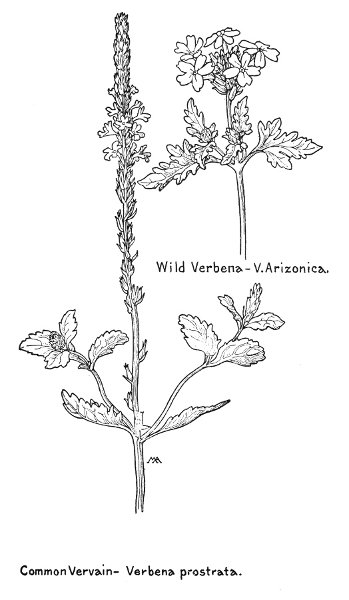
Wild Verbena—V. Arizonica.
Common Vervain—Verbena prostrata.
There are a few kinds of Micromeria; trailing perennials;
flowers small; calyx tubular, with five teeth; corolla two-lipped,
with a straight tube; stamens four, all with anthers,
not protruding. The Greek name means "small."
Yerba Buena,
Tea-vine
Micromèria
Chamissónis
(M. Douglasii)
Lilac, white
Spring, summer
Cal., Oreg., Wash.
An attractive little plant, resembling
the little eastern Gill-over-the-ground,
with slender trailing stems, slightly downy
foliage, and lilac or whitish flowers, about
a quarter of an inch long. The calyx and
corolla are hairy on the outside; the
corolla has an erect upper lip, sometimes
notched, and a spreading, three-lobed
lower lip, and the stamens are four, the lower pair shorter.
This is common in shady places near the coast. It has a
pleasant aromatic fragrance and was used medicinally by
California Indians, so it was called "good herb" by the
Mission Fathers, and is still used as a tea by Spanish-Californians,
who call it Yerba Buena del Campo, "field
herb," distinguishing it from Yerba Buena del Poso, "herb
of the well," the garden mint.
There are several kinds of Monardella, fragrant herbs,
all western, chiefly Californian; leaves mostly toothless;
flowers small, in terminal heads, on long flower-stalks, with
bracts, which are often colored; calyx tubular, with five,
nearly equal teeth; corolla with erect upper lip, two-cleft,
lower lip with three, nearly equal lobes; stamens four,
protruding, sometimes the lower pair longer.
Western Pennyroyal,
Mustang
Mint
Monardélla
lanceolàta
Lilac
Summer
California
An attractive plant, pretty in color and
form, with purplish, often branching
stems, from six inches to over two feet
high, smooth leaves, and small bright
pinkish-lilac flowers, crowded in terminal
heads, about an inch across, with purplish
bracts. The outer ring of flowers blooms
first and surrounds a knob of small green
buds, so that the effect of the whole flower-head slightly
suggests a thistle. This has a strong, pleasant smell like
Pennyroyal and is abundant in Yosemite, and elsewhere in
the Sierra Nevada foothills.
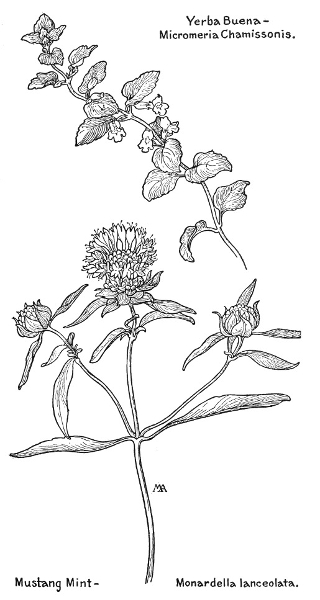
Yerba Buena—Micromeria Chamissonis.
Mustang Mint—Monardella lanceolata.
There are several kinds of Ramona, abundant in southern
California; shrubby plants, with wrinkled leaves and
flowers like those of Salvia, except for differences in the
filaments; stamens two. They are very important honey-plants,
commonly called Sage, and by some botanists
considered to be a species of Salvia.
Desert Ramona
Ramòna incàna
(Audibertia)
Blue
Spring
Southwest
A low desert shrub, from two to three
feet high, varying very much in color.
On the plateau in the Grand Canyon it is
delicate and unusual in coloring, with pale
gray, woody stems and branches and
small, stiffish, gray-green, toothless leaves,
covered with white down. The small flowers are bright
blue, projecting from close whorls of variously tinted
bracts, and have long stamens, protruding from the
corolla-tube, with blue filaments and yellow anthers, and
a blue style. The bracts are sometimes lilac, sometimes
pale blue, or cream-color, but always form delicate pastelle
shades, peculiar yet harmonizing in tone with the vivid
blue of the flowers and with the pale foliage. This is
strongly aromatic when crushed. In the Mohave Desert it
is exceedingly handsome, but the coloring is often less
peculiar, as the foliage is not quite so pale as in other
places, such as the Grand Canyon, and the flowers vary
from blue to lilac or white. It blooms in spring and when
its clumps of purple are contrasted with some of the yellow
desert flowers, clustered about the feet of the dark Joshua
Trees which grow around Hesperia, the effect is very fine.
Humming-bird
Sage
Ramòna grandiflòra
(Audibertia)
Red
Spring
California
This is a handsome and very decorative
plant, though rather coarse and sticky,
with a stout, bronze-colored stem, which
is woody at base, from two to three feet
tall, and velvety, wrinkled leaves, from
three to eight inches long, with scalloped
edges and white with down on the under
side. The flowers are an inch and a half long, with crimson
corollas of various fine shades, which project from the
crowded whorls of broad, bronze or purplish bracts,
arranged in tiers along the stem. Sometimes there are as
many as nine of these clusters and the effect of the whole is
dark and very rich, especially in shady places. This is
common in the hills, from San Francisco south. Humming-birds
are supposed to be its only visitors.
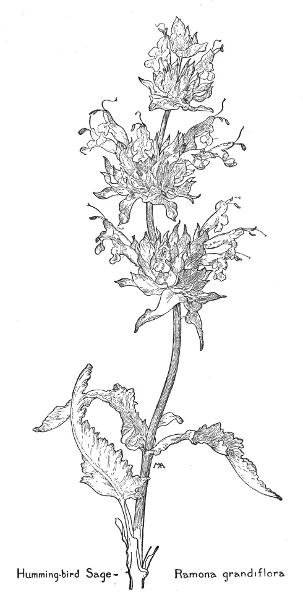
Humming-bird Sage—Ramona grandiflora.
White Ball Sage
Ramòna nívea
(Audibertia)
Lilac
Spring
California
A very conspicuous, shrubby plant,
much handsomer than Black Sage, from
three to six feet high, with many, downy,
stout, leafy stems, woody below, forming
enormous clumps of pale foliage. The
leaves are covered with pale down and are
a delicate shade of sage-green and feel like soft thick
velvet, and the mauve or lilac flowers, about three-quarters
of an inch long, are arranged in a series of very round,
compact balls along the stiff stalks. This is a honey-plant
and smells strong of sage, and is common in the South,
giving a beautiful effect of mingled mauve and gray.
White Sage
Ramòna polystàchya
(Audibertia),
(Salvia
apiana)
White, lilac
Spring
California
Not so handsome as the last, but a very
conspicuous plant, on account of its size
and the pale tint of its foliage, though the
flowers are too dull in color to be striking.
It is shrubby and has a number of stems,
which form a loose clump from three to
six feet high, with rather leathery, resinous
leaves, all but the upper ones with scalloped
edges, and the whole plant is covered with fine
white down, so that the general effect is pale gray, blending
with the white or pale lilac flowers and purplish buds. The
flowers are about half an inch long and are very queer in
form, for the only conspicuous part is the lower lip, which
is very broad with a ruffled edge and is turned straight up
and backward, so as to conceal almost all the rest of the
flower. The long jointed stamens, which are borne on the
lower lip, stand out awkwardly like horns and from one
side of the flower's face a long white pistil sticks out, with
something the effect of a very long cigar hanging out of the
corner of its mouth! All these eccentric arrangements are
apparently for the purpose of securing cross-pollination
from the bees, which frequent these flowers by the thousand,
as this is a famous bee-plant and the white honey
made from it is peculiarly delicious. It grows abundantly
in valleys and on hillsides, from Santa Barbara to San
Diego, and has a very strong disagreeable smell.
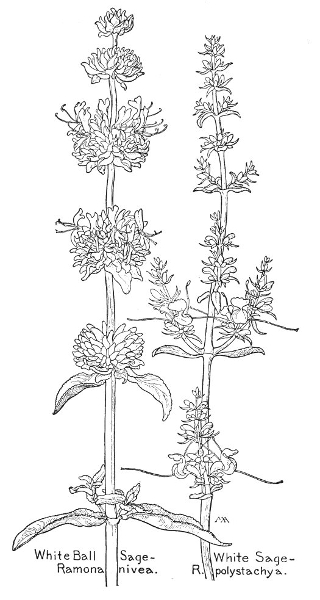
White Ball Sage—Ramona nivea.
White Sage—R. polystachya.
Black Sage,
Ball Sage
Ramòna stachyoìdes
(Audibertia)
Lilac, white
Spring
California
A conspicuous shrubby plant, from
three to six feet high, with stiffish leaves,
which are downy on the under side,
wrinkled on the upper, and grayish-green
and downy when young, but become
smoother and dark green as they grow
older. The flowers are pale lilac or white,
half an inch long, and the calyx-lobes and bracts are tipped
with bristles. The compact flower clusters, usually about
five in number and rather small, are arranged in tiers on
long slender stalks, which stand up stiffly all over the
bush. This is common on southern hillsides, often forming
dense thickets for long distances, smells strong of sage and
is an important bee-plant.
There are several kinds of Hyptis, very abundant in
South America and Mexico, but only a few reaching the
southwestern border of our country; the calyx with five
almost equal teeth; the corolla short, the lower lip sac-shaped
and abruptly turned back, the other four lobes
nearly equal and flat; the stamens four, included in the
sac of the lower lobe.
Hyptis
Hýptis Émoryi
Purple
Spring
Arizona
A shrub, from three to five feet high,
with very pale, roundish, woody stems
and branches and small, very pale gray
leaves, thickish and soft, covered with
white woolly down. The little fragrant,
bluish-purple flowers, with white woolly calyxes, are
crowded in close clusters about an inch long. Only a few
flowers are out at one time and they are too small to be
pretty, but the effect of the shrub as a whole is rather
conspicuous and attractive, on account of its delicate
coloring, the lilac of the flower-clusters harmonizing with
the gray foliage, which gives out a very strong smell of
sage when crushed. This grows among the rocks above the
Desert Laboratory at Tucson and in similar places, blooming
in early spring and much visited by bees.
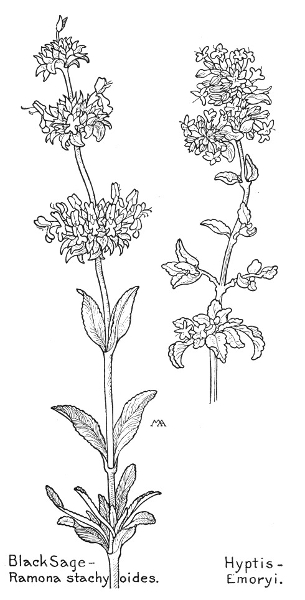
Black Sage—Ramona stachyoides.
Hyptis—Emoryi.
Self-heal
Prunélla vulgàris
Purple
Spring, summer,
autumn
Across the
continent
There are several kinds of Prunella,
widely distributed, but this is the only one
common in this country and is probably
not native. It is abundant in dampish
places, in the far West often staying green
all winter, a perennial, sometimes hairy,
from two inches to over a foot high. The
leaves, often obscurely toothed, have leaf-stalks and the
small flowers are crowded in a series of whorls, with purplish
bracts and forming a spike or head. The calyx is two-lipped,
with five teeth and often purplish, and the corolla is
purple, pink, or occasionally white, with an arched upper
lip, a spreading, three-lobed lower lip, and four stamens,
under the upper lip of the corolla, the lower pair longer.
This is usually not pretty, but in favorable situations in
the West is often handsome, with brighter-colored, larger
flowers. The name, often spelled Brunella, is said to
be derived from an old German word for an affection of the
throat, which this plant was supposed to cure. There is a
picture in Mr. Mathews' Field Book.
There are many kinds of Stachys, widely distributed;
herbs, often hairy, with a disagreeable smell; the calyx with
five, nearly equal teeth; the corolla with a narrow tube, the
upper lip erect, the lower lip spreading and three-lobed, the
middle lobe longest; the stamens four, in pairs, usually
under the upper lip of the corolla.
Hedge Nettle
Stàchys ciliàta
Magenta
Spring, summer
Northwest
This is a handsome plant, with a stout,
rough, hairy stem, over two feet tall, and
very bright green leaves, which are thin in
texture but velvety. The flowers are in
whorls, making a large cluster, and have a
purplish calyx, smooth or with a few stiff hairs, and a
corolla about an inch long, deep pink or magenta, sometimes
spotted with white inside. Though the flowers are
rather crude in color, they contrast finely with the bright
green foliage. S. coccínea is a very handsome kind, with
a tubular scarlet corolla, and grows in the mountain
canyons of Arizona.
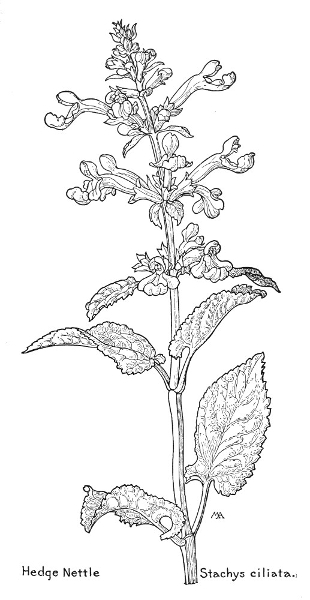
Hedge Nettle Stachys ciliata.
Common Hedge
Nettle
Stàchys bullàta
Pink, purple
Spring, summer
Wash., Oreg., Cal.
This is common and varies in appearance,
being often a coarse-looking weed,
but sometimes the flowers are pretty.
The rough, hairy stem is about a foot tall,
the wrinkled leaves are soft and more or
less hairy, and the flowers are about half
an inch long, usually pale purplish-pink or purple, streaked
and specked with deeper color, but are sometimes bright
pink and then the long clusters are quite effective, growing
in the road-side hedges. The plant is aromatic when
crushed.
There are many kinds of Scutellaria, widely distributed;
bitter herbs, some shrubby, with blue or lilac flowers; the
calyx with two lips, the upper one with a protuberance on
its back; the corolla smooth inside, the upper lip arched,
sometimes notched, the lower lip more or less three-lobed;
the stamens four, under the lip, all with anthers, the upper
pair hairy. The curious helmet-shaped calyx, in which the
seeds are generally enclosed at maturity, suggests the
common names, Skullcap and Helmet-flower.
Skullcap
Scutellària
angustifòlia
Blue
Spring, summer
Cal., Oreg., Wash.
A pleasing plant, from six inches to
over a foot tall, not aromatic, with almost
smooth leaves, most of them toothless.
The flowers are pretty, though not striking,
in pairs from the angles of the leaves,
with a purplish-blue corolla, nearly an
inch long, with a white tube, the lower lip woolly inside.
The calyx is curiously shaped and after the flower drops
off resembles a tiny green bonnet. When these little
calyxes are pinched from the sides they open their mouths
and show the seeds inside. This is quite common throughout
the Sierras. S. antirrhinoìdes is similar, growing in
Utah and the Northwest. S. Califórnica has cream-white
flowers, less than an inch long, the lower lip hairy inside,
and downy leaves, narrow at base, the lower leaves purplish
on the under side and more or less toothed, the upper
ones toothless. It grows in open woods in the Coast
Ranges and Sierra Nevada mountains. S. tuberòsa is from
three to five inches high, with tuberous rootstocks; the
leaves more or less oval, downy, thin in texture, with a
few teeth, the lower ones purplish on the under side, with
long leaf-stalks, the flowers dark blue, about three-quarters
of an inch long, each pair, instead of standing out at
opposite sides of the stem, generally turn sociably together,
first to one side and then to the other. This blooms in
spring and grows in the Coast Ranges of California and
Oregon.
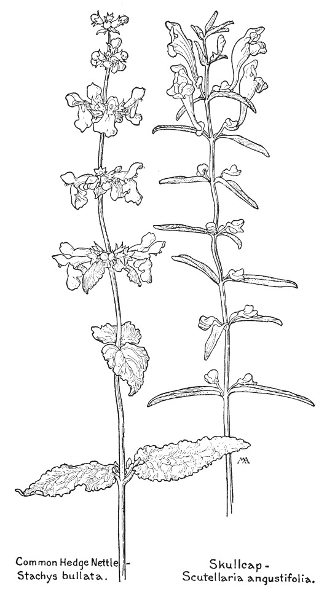
Common Hedge Nettle—Stachys bullata.
Skullcap—Scutellaria angustifolia.
Bladder-bush
Salazària
Mexicàna
Blue and white
Spring
Southwest
This is the only kind, a very curious
spiny desert shrub, about three feet high,
varying a great deal in general appearance
in different situations. The stems and
foliage are gray-green and imperceptibly
downy and the flowers are over three-quarters
of an inch long, with a corolla which is hairy
outside and has a lilac and white upper lip and a dark
blue lower one. The calyxes become inflated and form
very curious papery globes, over half an inch in diameter,
very pale in color, tinged with yellow, pink, or lilac, and
extremely conspicuous. In the desert around Needles,
in California, the general form of the shrub is very loose
and straggling, with slender twisting branches and small,
pale gray-green leaves, both flowers and leaves very
scanty and far apart, so that the bunches of bladder-like
pods are exceedingly conspicuous. In the Mohave Desert
it becomes a remarkably dense shrub, a mass of dry-looking,
criss-cross, tangled branches, spiky twigs, and
dull green leaves, speckled all over with the dark blue and
white flowers and the twigs crowded with pods. Sometimes
the flowers are magenta instead of blue, but are all
alike on one bush. The stems are not square, as in most
Mints. The drawing is of a plant at Needles.
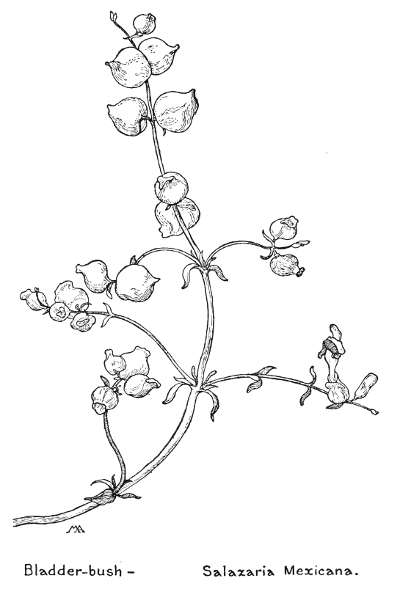
Bladder-bush—Salazaria Mexicana.
There are only a few kinds of Sphacele.
Pitcher Sage,
Wood-balm
Sphácele calycìna
White
Spring, summer
California
This is a rather handsome shrubby
plant, from two to five feet high, woody at
base, with many stout, leafy, woolly or
hairy stems, and rather coarse leaves,
hairy, more or less wrinkled and toothed,
and rather dark green. The flowers are
over an inch long, in pairs along the upper stem, something
the shape of a Monkey-flower, with a five-toothed calyx
and a corolla with four, short, spreading lobes and the
fifth lobe much longer and erect, the tube broad and dull-white,
with a hairy ring at the base inside, the lobes tinged
with pink or purple; the stamens four, one pair shorter.
After the flowers have faded the large, pale green, inflated
calyxes, veined with dull purple, become conspicuous.
If the flowers were brighter in color this would be very
handsome. It is strongly but rather pleasantly aromatic
and grows on dry hills in southern California. The name
is from the Greek, meaning "sage," as these plants have
sage-like foliage and smell, but the flowers are quite
different.
There are several kinds of Salvia, widely distributed,
herbs or shrubs; flowers usually in whorls, with bracts;
upper lip of the corolla erect, seldom two-lobed, lower lip
spreading and three-lobed; resembling Ramona, except
that the two stamens have filaments which are apparently
two-forked, one fork bearing an anther cell and the other
only the mere rudiment of an anther; the smooth nutlets
are mucilaginous when wet. The Latin name means "to
save," as some kinds are medicinal.
Thistle Sage,
Persian Prince
Sálvia carduàcea
Lilac
Spring, summer
California
A fantastically beautiful and decorative
plant, very individual in character. The
stout purplish stem, a foot or two tall and
covered with white wool, springs from a
rosette of thistle-like leaves of palest
green, so thickly covered with cushions
of white wool that they appear to be inflated, their teeth
tipped with brown spines. The stem bears a series of
flower-clusters, resembling large, round, pale balls of wool,
pierced here and there by long prickles and encircled by
lovely flowers, so etherial that they appear almost to hover
in the air. They are each about an inch long, the corolla
clear bright lilac with an erect upper lip with two lobes,
their fringed tips crossed one over the other, and the
lower lip with small side lobes and a very large, fan-shaped,
middle lobe, which is delicately fringed with white. The
pistil is purple and the anthers are bright orange, which
gives a piquant touch to the whole color scheme of pale
green and lilac. There are several tiers of these soft yet
prickly balls, which suggest the pale green turbans of an
eastern potentate, wreathed with flowers. The buds
poke their little noses through the wool, in a most fascinating
way, like babies coming out of a woolly blanket,
and fresh buds keep on coming through and expanding as
the faded blossoms fall, so that these flowers last longer in
water than we would expect from their fragile appearance.
The plants when they are crushed give out a rather heavy
smell of sage, with a dash of lemon verbena. They grow
on the dry open plains of the South.
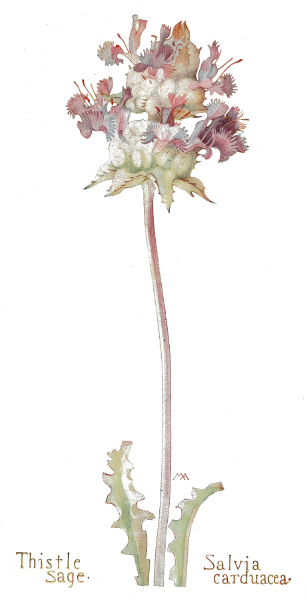
Thistle Sage—Salvia carduacea.
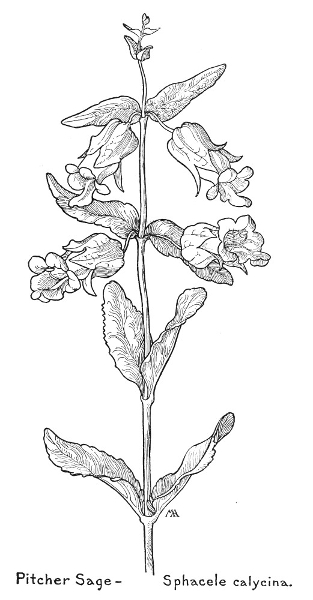
Pitcher Sage—Sphacele calycina.
Chia
Sálvia columbàriae
Blue
Spring
Southwest
This is an odd-looking plant, but is
often quite handsome. The stout purplish
stem, from six inches to over two feet tall,
springs from a cluster of rough, very
dull green leaves, sometimes so wrinkled
as to look like the back of a toad, and bears a series of
round, button-like heads, consisting of numerous, purple,
bristly bracts, ornamented with small, very bright blue
flowers. Though the flowers are small, the contrast
between their vivid coloring and the purple or wine-colored
bracts is very effective. The seeds have been
for centuries an important food product among the aborigines
and this plant in ancient Mexico was cultivated as
regularly as corn, the meal being extremely nourishing
and resembling linseed meal. The Mission Fathers used it
for poultices and it is still in demand among the Spanish-Californians.
This grows on dry hillsides and smells of
sage.
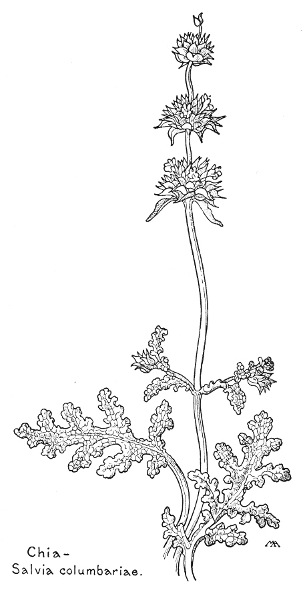
There are several kinds of Trichostema, all North
American; herbs, sometimes shrubby; leaves toothless, or
with wavy margins; flowers in clusters; calyx usually with
five unequal lobes; corolla with a long slender tube and
five oblong lobes nearly alike, forming in bud a roundish
ball, enclosing the coiled stamens; stamens four, the upper
pair longer, with very long, blue or purple filaments,
conspicuously protruding from the corolla, suggesting
both the Greek name, meaning "hair-like stamens," and
the common name, Blue-curls.
Romero, Woolly
Blue-curls
Trichostèma
lanàtum
Blue
Summer, autumn
California
This is shrubby and usually has many
stems, from two to four feet high, with
stiffish leaves, dark green on the upper
side, paler and woolly on the under, the
margins rolled back, and beautiful flower-clusters,
which are sometimes a foot long.
The bright blue corolla is nearly an inch
long, with a border shaped like a violet, the smaller
buds are pink, and the purple stamens and style are
two inches long and very conspicuous. The calyxes,
stems, and buds are all covered with fuzzy, pink wool,
forming a most unusual and beautiful color scheme,
giving a changeable almost iridescent effect of mauve
and pink, in remarkable contrast to the brilliant blue
of the flowers. This grows on rocky hills in southern
California, is pleasantly aromatic and used medicinally by
Spanish-Californians. T. lanceolàtum is called Camphor
Weed, because of its strong odor, like camphor but
exceedingly unpleasant. It grows on dry plains and low
hills in the Northwest and is an important bee-plant,
blooming in summer and autumn, and is also called
Vinegar Weed.
There are a few kinds of Agastache, all North American,
perennial herbs, mostly tall and coarse; leaves toothed,
with leaf-stalks; flowers small, in a terminal spike, with
bracts; calyx bell-shaped, with five teeth and slightly two-lipped;
corolla with a two-lobed, erect, upper lip, the lower
lip spreading and three-lobed, the middle lobe broader and
scalloped; stamens four, all with anthers, the upper pair
longer; nutlets smooth. The Greek name means "many
spikes."
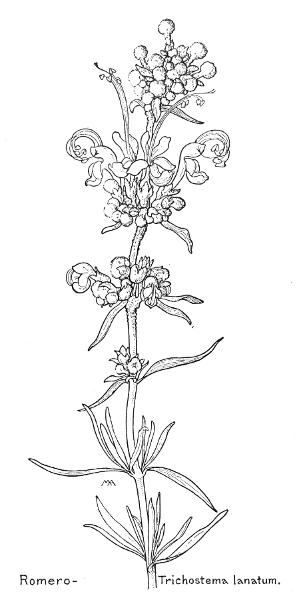
Romero—Trichostema lanatum.
Giant Hyssop
Agástache urticifòlia
(Lophanthus)
Pink
Summer
West, etc.
A handsome plant, from three to five
feet high, with stout, branching stems,
usually smooth, sometimes hairy, and
smoothish, dark green leaves. The small
flowers have a green calyx, with mauve
teeth, a white or pale violet corolla, and
long, protruding stamens, with lilac
anthers. They are crowded in spikes, from two to six
inches long, and the whole effect is rather bright purplish-pink,
feathery and pretty. This has a strong aromatic
smell and grows along the edges of meadows and is abundant
in Yosemite at moderate altitudes, but in other places
reaches an altitude of over eight thousand feet and is
found as far east as Colorado. A. pallidiflòra, with
greenish-white calyxes and white corollas, too dull in
color to be pretty, grows in the Grand Canyon and in
New Mexico and Colorado.
There are several kinds of Monarda, all North American;
aromatic herbs; leaves toothed; flowers crowded in heads,
usually with bracts, which are sometimes colored; calyx
tubular, with five teeth, often hairy inside; corolla more or
less hairy outside, two-lipped, upper lip erect or arched,
sometimes notched, lower lip spreading and three-lobed,
the middle lobe larger; stamens two, with swinging
anthers, sometimes also two rudimentary stamens; nutlets
smooth. These plants are called Balm, Bergamot, and
Horse-mint.
Horse-mint
Monàrda pectinàta
(M. citriodora
in part)
Pink
Summer
Ariz., Utah, etc.
This is handsome when growing in
masses, though the flowers are not
sufficiently positive in color. It grows
from one to three feet high, with a stout,
roughish stem, sometimes branching, and
leaves which are thin and soft in texture,
with a dull surface, but not rough, and
more or less toothed. The flowers are nearly an inch long
and project from crowded heads of conspicuous purplish
bracts, tipped with bristles. The calyx is very hairy inside,
the lobes tipped with long bristles, and the corolla is pale
pink, lilac, or almost white, not spotted, with a very wide
open, yawning mouth, the stamens and the curling tips of
the pistil protruding from under the upper lip. This
grows on dry plains, especially in sandy soil, as far east as
Colorado and Texas, reaching an altitude of six thousand
feet, and is strongly aromatic when crushed.
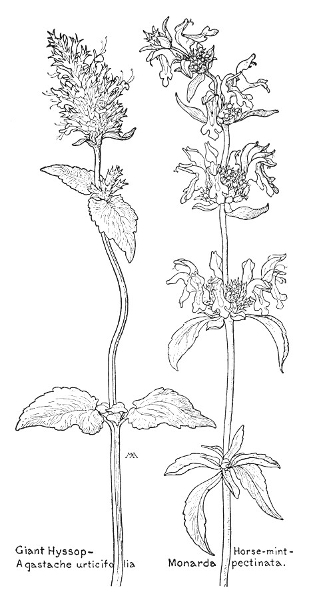
Giant Hyssop—Agastache urticifolia.
Horse-mint—Monarda pectinata.
A large family, widely distributed, most abundant in the
tropics. Ours are herbs, shrubs, or vines; leaves alternate,
without stipules; flowers perfect, usually regular, in clusters;
calyx and corolla usually with five united lobes; stamens on
the throat of the corolla, as many as its lobes and alternate
with them; ovary superior, two-celled, with a slender
style; fruit a berry or capsule, with many seeds. Many
important plants, such as Tobacco, Belladonna, Tomato,
Egg-plant, Red-pepper, and Potato, belong to this family.
Many have a strong odor.
There are several kinds of Datura, widely distributed;
ours are chiefly weeds, coarse, tall, branching herbs, with
rank odor and narcotic properties; leaves large, toothed
or lobed, with leaf-stalks; flowers large, single, erect, with
short stalks, in the forks of the stems; calyx with a long
tube and five teeth, the lower part remaining in the form
of a collar or rim around the base of the capsule; corolla
funnel-form, with a plaited border and broad lobes with
pointed tips; stamens with very long, threadlike filaments,
but not protruding; style threadlike, with a two-lipped
stigma; fruit a large, roundish, usually prickly capsule,
giving these plants the common name, Thorn-Apple.
Datura is the Hindoo name.
Tolguacha,
Large-flowered
Datura
Datùra meteloìdes
White
Spring, summer
Southwest, Nev.,
Utah
A handsome and exceedingly conspicuous
plant, forming a large clump of rather
coarse, dark foliage, adorned with many
magnificent flowers. The stout, velvety
stems are bronze-color, from two to four
feet high, the leaves are dark green,
velvety on the under side, and the flowers
are sometimes ten inches long, white,
tinged with lilac outside, drooping like wet tissue-paper
in the heat of the afternoon, and with sweet though heavy
scent. I remember seeing a grave in the desert, marked
by a wooden cross and separated from a vast waste of sand
by clumps of these great white flowers. It grows in valley
lands, reaching an altitude of six thousand feet. It is used
as a narcotic by the Indians and resembles D. stramònium,
Jimson-weed, from Asia, common in the East and found
also in the West, but it is far handsomer. D. suaveòlens,
Floriponda or Angels' Trumpets, is a large shrub, with very
large, pendulous, creamy flowers, and is often cultivated
in the old mission gardens in California. The flowers are
very fragrant at night.
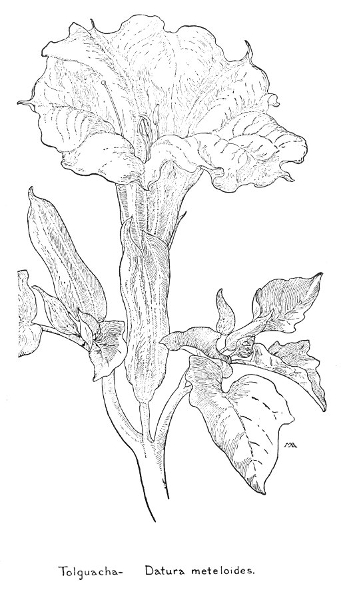
Tolguacha—Datura meteloides.
There are many kinds of Physalis, most of them American,
difficult to distinguish; herbs, often slightly woody
below; flowers whitish or yellowish; corolla more or less
bell-shaped, with a plaited border; style slender, somewhat
bent, with a minutely two-cleft stigma. In fruit the calyx
becomes large and inflated, papery, angled and ribbed,
wholly enclosing the pulpy berry, which contains numerous,
flat, kidney-shaped seeds. The name is from the Greek,
meaning "bladder," and refers to the inflated calyx, and
the common names, Ground-cherry and Strawberry-tomato,
are suggested by the fruit, which is juicy, often
red or yellow, and in some kinds is edible.
Ground-cherry
Phýsalis
crassifòlia
Yellow
Southwest
A pretty, delicate, desert plant, from
six to eight inches high, with branching
stems and light green leaves. It is
sprinkled with pretty cream-yellow
flowers, which are not spotted or dark in
the center, with yellow anthers, and is hung with odd little
green globes, each about three-quarters of an inch long,
which are the inflated calyxes containing the berries.
Bladder-cherry
Phsýalis Féndleri
Yellow
Summer
Ariz., Utah
A straggling perennial plant, about a
foot high, with widely-branching, roughish
stems, springing from a deep tuberous
root. The leaves are dull green, roughish,
rather coarse in texture, but not large,
mostly less than an inch long, coarsely and irregularly
toothed, and the flowers are the shape of a shallow Morning-glory,
half an inch across, pale dull-yellow, marked
with brown inside, with yellow anthers. This does not
bear its berries close to the ground, as do many of its
relations, and is not pretty. It grows in dry places, reaching
an altitude of eight thousand feet.
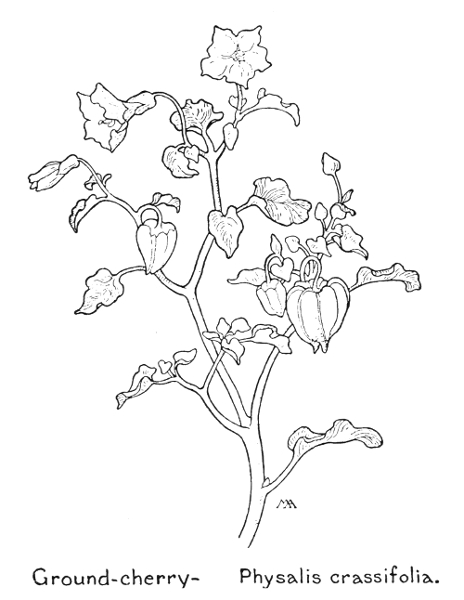
Ground-cherry—Physalis crassifolia.
There are a great many kinds of Solanum, abundant in
tropical America; herbs or shrubs, sometimes climbing;
often downy; calyx wheel-shaped, with five teeth or lobes,
corolla wheel-shaped, the border plaited, with five angles
or lobes and a very short tube; anthers sometimes grouped to
form a cone, filaments short; fruit a berry, either enclosed
in the calyx or with the calyx remaining on its base. This
is the Latin name of the Nightshade, meaning "quieting."
Purple Nightshade
Solànum Xánti
Purple
Spring, summer
California
This is much handsomer than most of
the eastern Nightshades, hairy and sticky,
with several spreading stems, from one to
three feet high, springing from a perennial
root, with thin, roughish leaves, more or
less toothed. In favorable situations the flowers are
beautiful, each about an inch across, and form handsome
loose clusters. The corolla is saucer-shaped, bright purple,
with a ring of green spots in the center, bordered with
white and surrounding the bright yellow cone formed by
the anthers. The berry is pale green or purple, the size
of a small cherry. This is sometimes sweet-scented and is
very fine on Mt. Lowe and elsewhere in southern California,
but is paler and smaller in Yosemite. Blue Witch,
S. umbellíferum, is very similar, more woody below, with
deep green stems, shorter branches, smaller, thicker leaves,
and a dull white or purplish berry. It grows in the foothills
of the Coast Ranges and Sierra Nevada Mountains
and flowers chiefly in summer, but more or less all through
the year.
Nightshade
Solànum Douglásii
White
Spring, summer
Southwest
A branching plant, about two feet high
and across, with roughish stems and thin,
smooth or slightly hairy, dark green leaves,
toothless, or the margins more or less
coarsely toothed. The flowers are white,
tinged with lilac, with a purplish ring surrounding the
yellow cone formed by the anthers. In southern California
the flowers are nearly half an inch across, but smaller
elsewhere. The berries are black. This is common throughout
California near the coast. S. nìgrum, the common
Nightshade, is a weed in almost all countries, common in
waste places and in cultivated soil, and has small white
flowers and black berries, about as large as peas and said to
be poisonous.
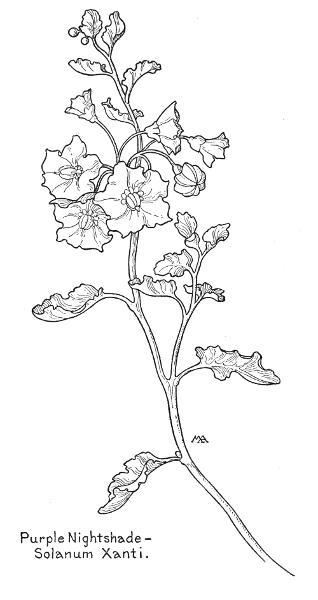
Purple Nightshade—Solanum Xanti.
There are many kinds of Nicotiana, or Tobacco, chiefly
American; acrid, narcotic herbs or shrubs, usually sticky-hairy;
leaves large, toothless; corolla funnel-form or salver-form,
with a long tube and spreading border, plaited in the
bud; stamens with threadlike filaments and broad anthers,
not protruding; capsule smooth, containing numerous
small seeds. The name is in honor of Nicot, diplomat and
author of the first French dictionary, who sent some of
these plants to Catherine de' Medici from Portugal in 1560.
San Juan Tree,
Tree Tobacco
Nicotiàna glaùca
Yellow
Spring
Southwest
A very slender, loosely-branching evergreen
shrub, from six to fifteen feet high,
with graceful, swaying branches and
smooth, thick leaves, with a "bloom,"
the lower leaves eight inches long. The
flowers are nearly two inches long, greenish
at first and then becoming a rather pretty shade of
warm dull-yellow, and hang in graceful clusters from the
ends of the branches. The calyx is unequally five-toothed,
the tube of the corolla downy on the outside; the anthers
whitish; the ovary on a yellowish disk, with a long style
and two-lobed stigma, and the capsule oblong, half an
inch long. This was introduced into California from South
America about fifty years ago and is now common in waste
places and cultivated valleys.
There are many kinds of Lycium, shrubs or woody
vines, named for the country Lycia.
Desert
Matrimony
Lycium Còoperi
White
Spring
Southwest
An odd-looking desert shrub, everything
about it so closely crowded as to give a
queer bunchy and clumsy effect. It is
three or four feet high, with thick, dark
gray, gnarled, woody branches, crowded
with tufts of small, dull, light green leaves,
which are thickish, stiffish, obscurely downy and toothless,
and mingled with close little bunches of flowers. The
flowers are about half an inch long, with a large, yellowish,
hairy calyx, with five lobes, a white corolla, which is
slightly hairy outside, with five lobes and a narrow, greenish
tube, and pale yellow anthers, not protruding. They
are rather pretty near by, but the appearance of the whole
shrub is too pale to be effective. The familiar Matrimony
Vine of old-fashioned gardens belongs to this genus.
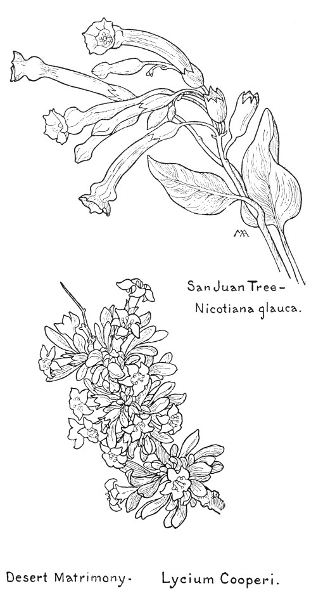
San Juan Tree—Nicotiana glauca.
Desert Matrimony—Lycium Cooperi.
A large family, widely distributed, most of them natives
of temperate regions; chiefly herbs, with bitter juice,
sometimes narcotic and poisonous; without stipules; the
flowers usually irregular; the calyx usually with four or
five divisions, sometimes split on the lower or upper side,
or on both sides; the corolla with united petals, nearly
regular or two-lipped, two of the lobes forming the upper
lip, which is sometimes beaklike, and three lobes forming
the lower lip; the stamens on the corolla and alternate with
its lobes, two or four in number, two long and two short,
and sometimes also a fifth stamen which often has no
anther, the anthers two-celled; the ovary superior, usually
two-celled, the style slender, the stigma sometimes forked;
the fruit a pod, splitting from the top into two parts and
usually containing many seeds. This is a curious and interesting
family, its members very dissimilar in appearance,
having expressed their individuality in many striking and
even fantastic forms.
There are several kinds of Maurandia, perennial herbs,
climbing by their slender twisted leaf-stalks and occasionally
also by their flower-stalks; the leaves triangular-heartshaped
or halberd-shaped, only the lower ones
opposite; the flowers showy, purple, pink, or white; the
corolla with two lines or plaits, instead of a palate, which
are usually bearded.
Snap-dragon Vine
Maurándia antirrhìniflora
(Antirrhinum
maurandioides)
Purple or pink
and yellow
Spring
Ariz., New Mex.
This is a beautiful trailing or climbing
vine, smooth all over, with charming
foliage and twining stems, much like
those of a Morning-glory, springing from
a thickened, perennial root. The pretty
flowers are over an inch long, with a
purple or raspberry-pink corolla, with
bright yellow blotches on the lower lip,
forming an odd and striking combination
of color. This blooms all through the spring and
summer and may be found growing in the bottom of the
Grand Canyon, near the river, where its delicate prettiness
is in strange contrast to the dark and forbidding rocks
over which it clambers and clothes with a mantle of tender
green.
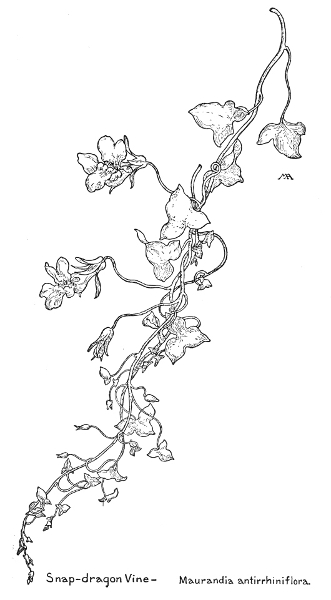
Snap-dragon Vine—Maurandia antirrhiniflora.
There are many kinds of Antirrhinum, natives of Europe,
Asia, and western North America; herbs; the lower leaves
often opposite, and the upper ones alternate; the sepals
five; the corolla two-lipped, swollen at the base on the
lower side, but with no spur, the palate nearly closing the
throat; the stamens four. The name is from the Greek,
meaning "nose-like," because the shape of the flowers
suggests the snout of an animal.
Sticky Snap-dragon
Antirrhìnum
glandulòsum
Pink, purple
Spring
California
This is a conspicuous perennial, handsome
though rather coarse, hairy and
sticky all over, with stout leafy stems,
from two to five feet tall, with branches
but no tendrils, and soft, rather dark
green leaves. The flowers are half an
inch long, the corolla pink with a yellow
palate, and they are crowded in fine, long, one-sided
clusters. This is common in the South and looks a good
deal like some of the cultivated kinds; when its flowers are
pinched from the sides they open their mouths in the same
funny way.
White Snap-dragon
Antirrhìnum
Coulteriànum
White and lilac
Spring
California
This has tendril-like pedicels, which
curl around nearby plants, but the stem is
stout and erect, over two feet tall, smooth
below and hairy above, with smooth,
dark green leaves, and bears a long,
crowded, one-sided cluster of pink buds
and pretty white flowers. They are each
about half an inch long, with hairy calyxes, and the corollas
are prettily tinged with lilac or pink, but are too pale in
color, though the general effect of the plant is rather
striking. The anthers are bright yellow. This grows in
the South. A. vírga is a smooth plant, from two and a half
to five feet tall, with many wand-like stems, springing
from a perennial base, and reddish-purple flowers, about
half an inch long, forming a long, rather one-sided cluster.
This grows in the chaparral, on ridges of the Coast Ranges,
blooming in June, but is not common.
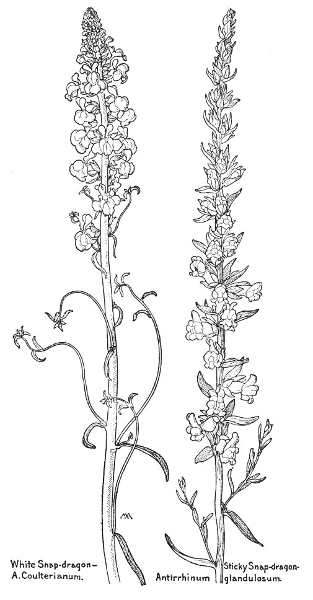
White Snap-dragon—A. Coulterianum.
Sticky Snap-dragon—Antirrhinum glandulosum.
Trailing Snap-dragon
Antirrhìnum
stríctum
Blue
Spring
California
This is an odd-looking plant, from one
to two feet tall, which seems unable to
decide whether or not it is a vine, for the
pedicels of the flowers are exceedingly
slender and twist like tendrils and by their
means the plant clings to its neighbors and
raises its weak stems from the ground, or,
if it finds no support, it stands almost erect and waves its
tendrils aimlessly in the air. It is smooth all over, with
dark green leaves and pretty, bright purplish-blue flowers,
about half an inch long, with a pale, hairy palate, which
almost closes the throat. This grows in the South, near
the sea. A. vàgans is similar and is common farther north
in California, growing on dry open wooded hills or in
canyons of the Coast Ranges, blooming in summer and
autumn.
There are many kinds of Castilleja, almost always
perennials, usually parasitic on the roots of other plants,
usually handsome and striking, the conspicuous feature
being the large leafy bracts, colored like flowers, which
adorn the upper part of the stem. They usually have
several stems, springing from woody roots; leaves alternate,
without leaf-stalks, green below and gradually merging
above into colored bracts; flowers crowded in terminal
clusters, mixed with bracts; calyx tubular, flattened, more
or less cleft in front or behind, or on both sides, the lobes
sometimes two-toothed, colored like the bracts, enclosing
the tube of the corolla; corolla less conspicuous and duller
in color than the calyx, tubular, two-lipped, the lower lip
short and very small, not inflated, with three small teeth,
the upper lip long and beaklike, enclosing the four
stamens and single threadlike style; stigma cap-shaped or
two-lobed; anther-sacs unequally attached to the filament,
one by its middle and the other hanging by its tip; capsule
egg-shaped or oblong, splitting open, containing many
seeds. These gaudy plants are well named Indian Paint
Brush, for the flower-cluster and leaf-tips look as if they
had been dipped in color. Red Feather is also good but
Painted Cup is rather poor, as there is nothing cup-like
about the flower. They were named for Castillejo, a
Spanish botanist.
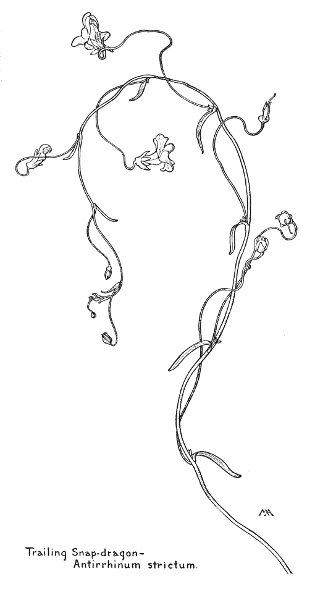
Trailing Snap-dragon—Antirrhinum strictum.
Paint Brush
Castillèja miniàta
Red
Summer
Northwest
This is a very handsome kind, from two
to four feet tall, with a smooth stem, and
smooth leaves, which are not crinkled,
toothed, or lobed, and with more or less
hairy bracts, which are beautifully tinted
with many shades of pink, red, and purple. This is a
magnificent plant, especially when we find it growing
along irrigation ditches, among blue Lupines, yellow Mimulus
and other bright flowers, where the combinations of
color are quite wonderful, and it is the handsomest and
commonest sort around Yosemite, where it grows in meadows
and moist places, from the foothills nearly up to
timber-line.
Scarlet Paint
Brush
Castillèja
pinetòrum
Red and yellow
Summer
Cal., Oreg.
This is not quite so large or handsome as
the last, but gives much the effect of a
brush dipped in red paint, for the yellowish
bracts are beautifully tipped with
scarlet and the flowers are also bright red.
The rough stem is a foot or more tall, the
roughish dark green leaves are not toothed
or lobed, but have crinkled edges, and the bracts usually
have three lobes. These plants grow in the mountains and
often make bright patches of color in the landscape.
Paint Brush
Castillèja
angustifòlia
Red
Spring, summer
Utah., Nev.
This is very variable, and is usually
about a foot high, with several hairy
stems, springing from a long yellow root.
The leaves are slightly rough, but not
coarse, with fine white hairs along the
margins, and light gray-green in color,
the lowest ones not lobed, a few of the upper ones with two
lobes, but most of the leaves, and the bracts, slashed into
three lobes. The calyx is covered with white hairs, and
the upper lip of the corolla is bright green. The whole
plant is most beautiful and harmonious in color, not coarse
like many Castillejas, and the upper part is clothed with
innumerable delicate yet vivid tints of salmon, rose, and
deep pink, shading to scarlet and crimson, forming a
charming contrast to the quiet tones of the lower foliage.
This grows in gravelly soil, on dry plains and hillsides, and
the clumps of bloom are very striking among the sage-brush.
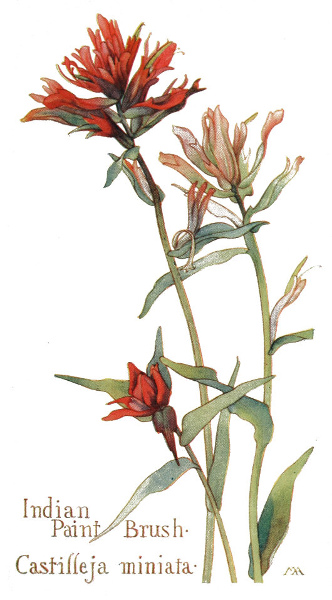
Indian Paint Brush—Castilleja miniata.
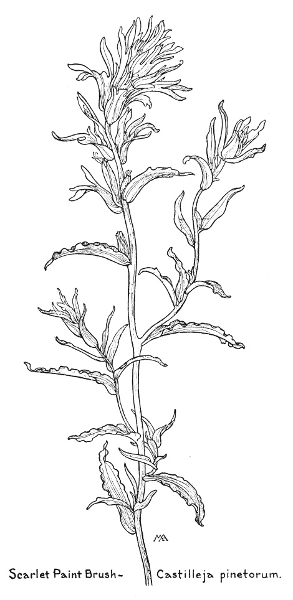
Scarlet Paint Brush—Castilleja pinetorum.
There are a good many kinds of Stemodia, widely distributed,
only two in the United States; the corolla blue or
purplish and two-lipped; the stamens four, not protruding.
Stemodia
Stemòdia
durantifòlia
Blue
Spring
Southwest, etc.
This is a rather pretty plant, which is
quite effective when growing in quantities.
The stem is hairy and sticky, from a foot
to a foot and a half tall, with hairy leaves,
which have a few sharp teeth. The
flowers are three-eighths of an inch long,
with sticky-hairy calyxes and bright purplish-blue corollas,
white and hairy in the throat. This has a slightly unpleasant,
aromatic smell and grows in moist spots, often in
mountain canyons near streams, as far east as Texas and
also in the tropics.
There are many kinds of Linaria, most abundant in the
Old World; herbs; the upper leaves alternate, the lower
opposite, usually toothless; the corolla like Antirrhinum,
but with a spur; the stamens four, not protruding.
Toad Flax
Linària
Canadénsis
Blue, lilac
Spring, summer
West, etc.
A slender plant, from six to eighteen
inches tall and smooth all over, with
branching stems, dark green leaves, and
pretty little flowers, delicately scented,
from a quarter to half an inch long, with
bright purplish-blue or pale lilac corollas,
veined with purple. This is found in dry soil across the
continent and sometimes grows in such quantities around
San Diego as to form blue patches in the landscape.
There are many kinds of Veronica; ours are rather low
herbs, though some are trees in the tropics, widely distributed,
living in meadows and moist places; flowers
small, usually blue or white, never yellow; calyx with four
divisions, rarely five; corolla wheel-shaped, with a very
short tube and four, rarely five, lobes, the lower one
narrower than the others; stamens two, sticking out at
each side of the base of the upper lobe; anthers blunt, with
slender filaments; ovary two-celled, with a slender style
and round-top stigma; capsule more or less flattened, two-lobed
or heart-shaped, splitting open, containing few or
many seeds. They were named in honor of St. Veronica.
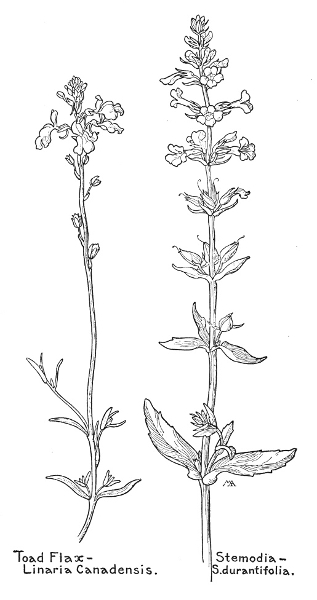
Toad Flax—Linaria Canadensis.
Stemodia—S. durantifolia.
Hairy Speedwell
Verónica
Tournefórtii
Blue
Spring, summer,
autumn
Utah, Cal., etc.
This is one of the most attractive of the
little Speedwells, for its flowers are bright
and quite large. The stems are branching,
hairy and purplish, some short and erect,
others long and trailing, and the leaves
are alternate above and opposite below,
dull yellowish-green, hairy and rather
soft, with scalloped edges. The flowers grow singly, on
slender flower-stalks over an inch long, springing from the
angles of the upper leaves, and the corolla is three-eighths of
an inch across, the upper lobe deep brilliant blue, veined
with dark blue, the side lobes similar in color but not so
bright, the lower lobe almost white, without blue veins,
and each lobe with a little pale yellow at its base. The
stamens and pistil are white, the anthers becoming brown
and the style bent to one side, and the capsule is somewhat
heart-shaped, containing several cup-shaped seeds. This
forms patches along roadsides and in fields, the soft foliage
dotted with the quaint bright blue flowers, opening a few
at a time in bright sunlight and closing at night. This is a
native of Europe and Asia and is found across the continent.
American Brooklime
Verónica
Americàna
Blue
Summer
Across the
continent
In shallow water, or in very wet
meadows, we find these little flowers.
They are smooth perennials, with straggling,
branching, purplish stems, more or
less creeping, and rooting from the lower
joints, from one to three feet long. The
yellowish-green leaves usually have short
leaf-stalks and are often toothed and the
very small, pale blue flowers, with white centers and
veined with purple, grow in loose spreading clusters.
Alpine Speedwell
Verónica
Wormskjòldii
Blue
Summer
Northwest, Ariz.,
etc.
A pretty little plant, with smooth,
stiffish, toothless leaves and deep bright
blue flowers, with a little white at the
base of the petals and veined with purple.
This is found in damp spots in the mountains,
up to twelve thousand feet, in
northern places across the continent, and
as far south as Arizona.
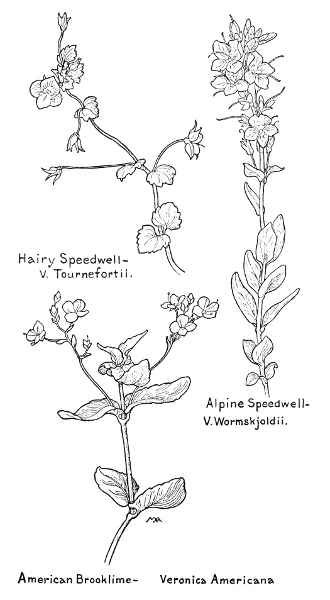
Hairy Speedwell—V. Tournefortii.
Alpine Speedwell—V. Wormskjoldii.
American Brooklime—Veronica Americana.
There are a great many kinds of Pentstemon and some
of our handsomest and most conspicuous western flowers
are included among them. They are natives of North
America, chiefly herbs, sometimes branching below; the
leaves usually opposite, the upper ones without leaf-stalks
and more or less clasping; the flowers showy, in long clusters;
the calyx with five lobes; the corolla two-lipped,
with a more or less swollen tube, the upper lip two-lobed,
the lower three-cleft and spreading; the stamens four, in
pairs, and also a fifth stamen, which is merely a filament
without any anther, but is conspicuous and often hairy;
the style threadlike, with a round-top stigma; the pod
usually pointed; the seeds numerous. The common name,
Beard-tongue, is in allusion to the usually hairy tip of the
sterile filament. Pentstemon is from the Greek meaning
five stamens. This name is often mispronounced; the
accent should be on the second syllable and long.
Large Beard-tongue
Pentstèmon
glandulòsus
Lilac, purple
Summer
Oreg., Wash.,
Idaho
An exceedingly handsome plant, a foot
and a half tall, with a stout reddish stem,
rather downy and sticky, and dark green
leaves, rather shiny and stiff, and downy
on the under side. The flowers are an inch
and a half long, so large that they look
like Fox-glove, and are beautifully shaded
from pale lilac to deep reddish-purple,
with purple filaments and white anthers and pistil. The
calyx is reddish, sticky and downy, and the outside of the
corolla glistens with sticky fuzz. This grows in the mountains.
Pentstemon
Pentstèmon
Rattáni var.
mìnor
Blue
Summer
Utah, Oreg., Cal.
This forms pretty clumps of bright
color, with several stems about eight
inches tall, smooth below, and smooth
dark green leaves. The flowers are less
than half an inch long, with a downy calyx
and bright purplish-blue corolla, with a
purplish throat. This grows in mountain
canyons.
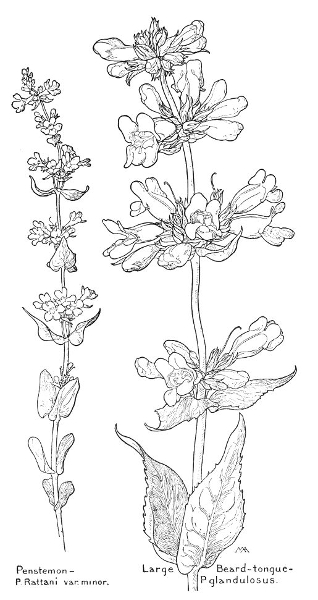
Penstemon—P. Rattani var. minor.
Large Beard-tongue—P. glandulosus.
Blue Pentstemon,
Beard-tongue
Pentstèmon
cyanánthus
Blue
Spring, summer
Utah, Ariz., Wyo.
This is perhaps the most beautiful of
all the Pentstemons, with several smooth,
stoutish, pale green, leafy stems, from one
to two feet tall and smooth, pale bluish-green
leaves, with more or less "bloom,"
toothless and thickish, the upper ones
somewhat clasping. The flowers are not
hairy or sticky, and are over an inch long, forming a handsome
cluster about eight inches long. The sepals are
narrow and pointed, the corolla is tinted with various
beautiful shades of blue and purple, often with a white
throat and blue lobes, or with a pink throat and deep blue
lobes, the sterile filament has a thickened, more or less
hairy, yellow tip, and the pale yellow anthers are more or
less hairy. This plant is beautiful in every way, for the
foliage is fine in form and color and the flowers are brilliantly
variegated, yet harmonious and graceful. This
grows on hillsides and in mountain valleys, at rather high
altitudes, and used to be common and conspicuous on the
"benches" around the Salt Lake Valley, but it is gradually
being exterminated by sheep. It thrives and improves
when transplanted into gardens. P. acuminàtus is similar,
but the cluster is looser and the flowers often pink and purple.
It forms fine patches of color at the Grand Canyon.
Honeysuckle
Pentstemon
Pentstèmon
cordifòlius
Red
Summer
California
A handsome shrub, with much the
general appearance of a Honeysuckle,
woody below, with long slender branches
and pretty heart-shaped leaves. The
flowers are often in pairs and are each an
inch and a half long, with bright scarlet
corollas, conspicuously two-lipped, the
stamens protruding, and form large clusters towards
the ends of the branches. This grows in light shade in
the woods and trails its long branches and garlands of
bright flowers over the neighboring shrubs and trees.
Pride-of-the-mountain
Pentstèmon
Newbérryi
Pink, lilac
Summer
California
A beautiful little shrub, making splendid
patches of vivid color on high bare
rocks in the mountains, where it is very
conspicuous, hanging over the edges of
inaccessible ledges. The stems are woody
below and very branching, about a foot
high, and the leaves are usually toothed,
smooth, stiffish, and thickish. The flowers are an inch
and a quarter long, with a rather sticky calyx and bright
carmine-pink corolla, moderately two-lipped, with a patch
of white hairs on the lower lip; the stamens protruding,
with conspicuous, white, woolly anthers, and the style
remaining on the tip of the capsule like a long purple
thread. This is slightly sweet-scented and is common
around Yosemite. The alpine form is less than four inches
high, with larger, lilac flowers and toothless leaves.
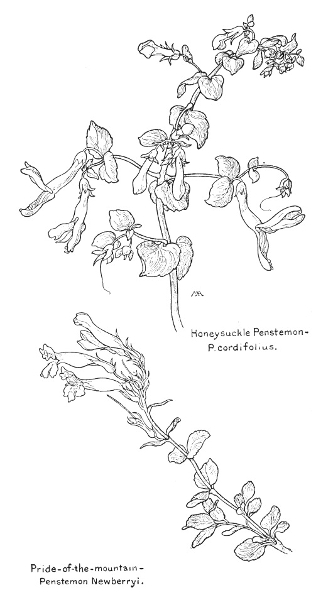
Honeysuckle Penstemon—P. cordifolius.
Pride-of-the-mountain—Penstemon Newberryi.
Bushy Beard-tongue
Pentstèmon
antirrhinoìdes
Yellow
Spring
California
This is a rather pretty shrub, about four
feet high, with pale woody branches,
purplish twigs, and many, small, rich
green leaves. The flowers have a glossy,
bright green calyx and a yellow corolla,
which is three-quarters of an inch long,
streaked with dull-red outside and slightly
hairy, the sterile stamen hairy and yellow.
Variable
Pentstemon
Pentstèmon
confértus
Yellow, blue,
purple
Summer
Northwest and
Cal.
This has a smooth stem and smooth,
toothless leaves, but is very variable both
in form and color, for the typical plant,
from Oregon and the Rocky Mountains,
has yellow flowers, but in Yosemite the
variety caerùleo-purpùreus always has
blue or purple flowers, but the plants vary
in general appearance. In good soil,
such as the floor of the Valley, the stem is
sometimes two feet tall and the flowers are about half an
inch long, grouped in whorls along the stem, but at high
altitudes the plant shrinks to a few inches in height.
Cardinal
Pentstemon
Pentstèmon
Párryi
Scarlet
Spring
Arizona
These wands of flaming scarlet are
conspicuous along the trails in the Grand
Canyon and are exceedingly beautiful,
very graceful in form and vivid in color.
The smooth, purplish, somewhat leafy
stems, from one and a half to two feet
tall, spring from a clump of rather small
leaves, which are toothless, smooth, and rather light green
in color. The flowers are three-quarters of an inch long,
the corolla with five rounded lobes and very slightly two-lipped,
and look something like Scarlet Bugler, but are
smaller and more delicate, and are sometimes mistaken for
Cardinal Flowers by people from the East.
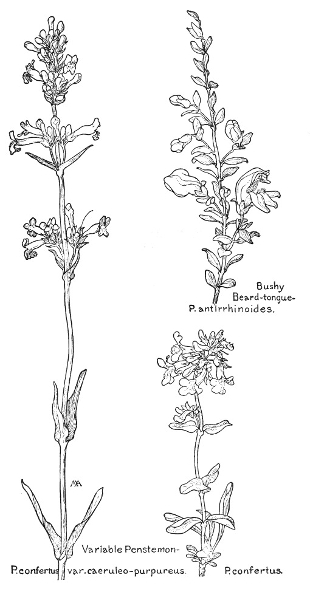
Bushy Beard-tongue—P. antirrhinoides.
Variable Penstemon—P. confertus. var. caeruleo-purpureus.
P. confertus.
Pentstemon
Pentstèmon
Wrìghtii
Pink, purple
Spring
Arizona
This is very much like the last in every
way, except the color of its flowers. The
leaves are smooth and thickish, bluish-green,
with a "bloom," the lower ones
with a few irregular, blunt teeth, or with
wavy margins, and the flowers, which are
the same shape and size as the last, are deep, bright
pink, with a magenta line on each lobe and some white
hairs on the lower lip. The filaments are purple, with
whitish anthers, and the fifth stamen resembles a tiny
brush, with yellow bristles on the upper side and pointing
into the throat. The whole effect of the graceful flower-cluster
is bright, beautiful, and conspicuous, growing among
the rocks, on hillsides and in canyons.
Pentstemon
Pentstèmon laètus
Blue, purple
Summer
California
This is very beautiful and varied in
color and is the commonest kind in Yosemite,
from one to two feet high, with roughish,
toothless leaves and several slender,
erect, somewhat hairy branches, ending in
long loose clusters of flowers. The corollas are an inch
long, and vary from deep bright blue through all shades
of violet to deep pink, with two white ridges in the throat,
and with two white anthers visible and two purple ones
hidden in the throat. The flowers' faces have a quaint,
wide-awake expression. This grows on dry rocky slopes
and is often mistaken for P. heterophýllus, which is rather
common in open places in the Coast Ranges. P. linarioìdes,
blooming in late summer at the Grand Canyon, is somewhat
similar, but the flowers are smaller and more delicate,
and the leaves are smooth, small, and narrow.
Scarlet Bugler
Pentstèmon Èatoni
Red
Spring
Ariz., Utah
Very beautiful, from two to three feet
high; with purplish stems, smooth leaves,
and flowers an inch long, with a bright
scarlet, funnel-shaped corolla, not much
two-lipped, the stamens not protruding.
These graceful wands of vivid color are conspicuous in the
Grand Canyon. P. centranthifòlius, common in California,
is similar, the corolla less two-lipped, and has very
smooth, thickish leaves. P. Bridgésii, found in Yosemite,
is similar, but the corolla is decidedly two-lipped.
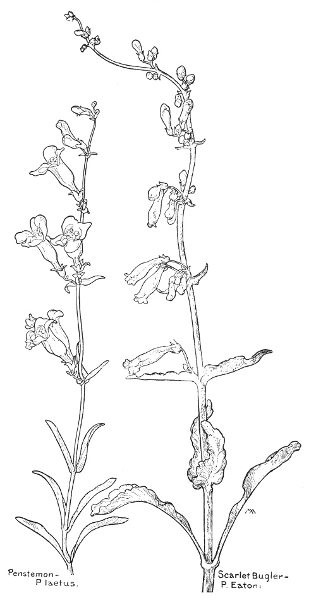
Penstemon—P. laetus.
Scarlet Bugler—P. Eatoni.
Yawning
Pentstemon
Pentstèmon
breviflòrus
Flesh-color
Summer
California
A bushy plant, from two to five feet
high, with many smooth, slender branches,
terminating in long loose clusters of
flowers. The leaves are smooth, rather
dark green, the lower ones sharply toothed,
and the flowers are three-quarters of an
inch long; the corolla flesh-color, tipped
with pink, with some purple lines on the lower lip, and
some fine white hairs on the upper; the buds yellow, tipped
with dark red. These flowers are too dull in color to be
effective, but they are sweet-smelling and have ridiculous
faces with widely yawning mouths. This is quite common
in Yosemite, forming large clumps on open rocky slopes.
Indians use the tough stems for making baskets.
Scarlet
Pentstemon
Pentstèmon
Tórreyi
Red
Summer
Arizona
Exceedingly handsome, with smooth,
pale green stems, two feet or more tall,
and smooth, rather bluish-green leaves,
with slightly rippled edges. The corolla
is an inch and a quarter long, vivid scarlet,
paler inside, strongly two-lipped, with
long, conspicuous stamens, with pale
yellow anthers, the style remaining on the tip of the capsule
like a long purple thread. This makes splendid clumps
of gorgeous color and is common on the rim of the Grand
Canyon.
There are a number of kinds of Collinsia, natives of
North America, with the leaves opposite or in whorls; the
flowers single or in whorls; the calyx five-cleft; the corolla
irregular, with a short tube and two-lipped; the upper lip
two-cleft and more or less erect, the lower lip larger and
three-lobed, the side lobes spreading or drooping, the middle
lobe keel-like and folded together and enclosing the two
pairs of stamens and the threadlike style, which has a
small round-top or two-lobed stigma. The fifth stamen is
represented by a minute gland on the upper side of the
corolla tube near the base. The form of the flowers somewhat
suggests those of the Pea Family. If we pull the
lower lip apart we find the odd little crevice in which the
stamens are concealed.
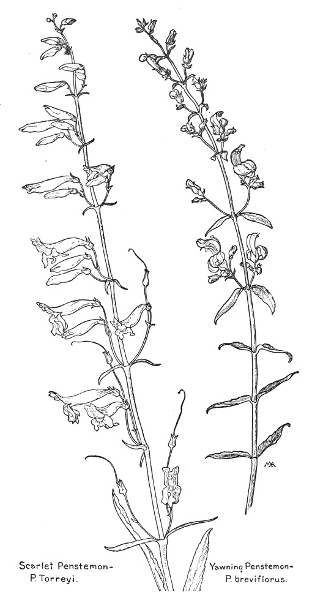
Scarlet Penstemon—P. Torreyi.
Yawning Penstemon—P. breviflorus.
Chinese Houses
Collínsia bícolor
Purple and white
Spring, summer
California
These are charming plants, from six
inches to a foot and a half tall, with very
delicately made flowers. The leaves are
smooth or downy and more or less toothed,
with rough edges, and the flowers are
arranged in a series of one-sided clusters along the upper
part of the stem, which is more or less branching. The
corollas are about three-quarters of an inch long and vary
in color, being sometimes all white. In the shady woods
around Santa Barbara they often have a white upper lip,
which is tipped with lilac and specked with crimson, and a
lilac lower lip, and here they are much more delicate in
appearance than on the sea-cliffs at La Jolla, where they
grow in quantities among the bushes and are exceedingly
showy. In the latter neighborhood the flowers are nearly
an inch long and the upper lip is almost all white and
marked with a crescent of crimson specks above a magenta
base, and the lower lip is almost all magenta, with a white
stripe at the center, the contrast between the magenta
and white being very striking and almost too crude. The
arrangement of the flowers is somewhat suggestive of the
many stories of a Chinese pagoda and the plant is common.
Blue-lips
Collínsia
multiflòra
Lilac, blue, and
pink
Summer
Northwest
A very attractive little plant, smooth
all over, about six inches tall, with toothless,
light green leaves and pretty flowers,
each over half an inch long. The upper
petals are pinkish-lilac, the lower petals a
peculiar shade of bright blue, and the
tube is pink; the contrast between the
blue and pink giving an odd and pretty effect. This grows
in the woods around Mt. Shasta.
There are many kinds of Scrophularia, most of them
natives of Europe. They are rank perennial herbs, usually
with opposite leaves; the corolla with no spur and with
five lobes, all erect except the lowest one, which is small
and turned back; the stamens five, four of them with
anthers and the fifth reduced to a scale under the upper
lip. These plants are supposed to be a remedy for scrofula.
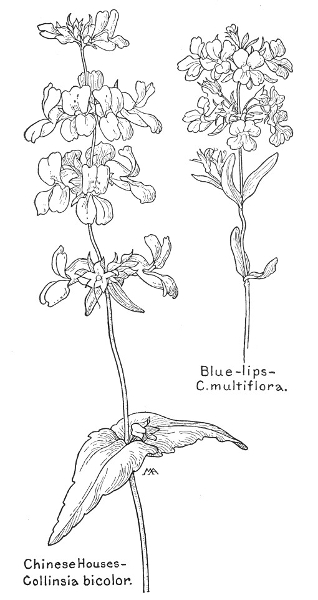
Blue-lips—C. multiflora.
Chinese Houses—Collinsia bicolor.
California Bee-plant
Scrophulària
Califórnica
Red, green
Spring, summer
Northwest, Cal.
This is a coarse plant, smooth, or
rather sticky and hairy, with several stout,
square stems, and forming a large clump,
from two to six feet high. The little
flowers have a quaint appearance, but
are usually only about a quarter of an
inch long, with brownish-red or greenish
corollas, which are neither pretty nor conspicuous, but the
variety floribúnda, of southern California, has flowers
which are nearly half an inch long, with rich red corollas,
handsome and brilliant in effect. These plants yield a
great deal of honey and are common and widely distributed.
There are several kinds of Diplacus, much resembling
Mimulus, except that they are shrubs, with evergreen
leaves.
Sticky Monkey-flower,
Bush Monkey-flower
Diplácus longiflòrus
(Mimulus)
Salmon-color
(varying from pale
yellow to red)
Spring, summer
California
When in full bloom, this is a handsome
and very conspicuous shrub, for the
flowers are numerous and unusual in
coloring, being usually a peculiar shade
of salmon-color, which at a distance gives
the effect in the landscape of some sort
of exotic rhododendron. It is from two to
six feet high, with very dark green, sticky,
usually toothless leaves, with their margins
rolled back, dark sticky buds and
large flowers, which are sometimes three
inches long, the corolla varying in color from almost white
to scarlet, with a white stigma. They bloom more or less
all the year round and there are several similar, named
varieties.
Bush Monkey-flower
Diplácus puníceus
(Mimulus)
Red
Spring, summer,
autumn
California
This is much like the last, and is often
very handsome. In the crevices of the
sea-cliffs at La Jolla it makes tangled
thickets of woody stems and dark green
foliage, ornamented with many scarlet or
rich deep-red flowers, with a velvety
surface like that of a pansy and with
orange ribs in the throat. This is common
throughout California.
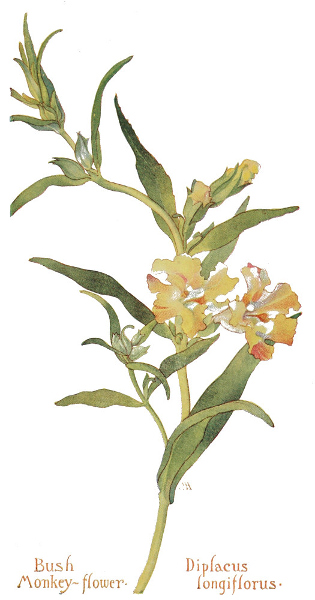
Bush Monkey-flower—Diplacus longiflorus.
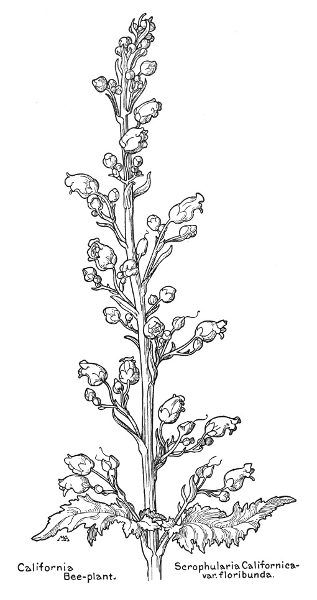
California Bee-plant—Scrophularia Californica var. floribunda.
There are many kinds of Mimulus, or Monkey-flower,
usually growing in moist places, with erect or slanting,
juicy stems; leaves opposite, usually toothed; flowers
generally handsome, on flower-stalks from the axils of the
leaves; calyx covering the tube of the corolla, bell-shaped,
five-angled and five-toothed, upper tooth usually larger;
corolla two-lipped, the upper lip with two lobes, erect or
turned back, the lower with three, rounded, spreading
lobes, the tube not swollen at base and with a pair of
ridges within on the lower side; stamens four, in pairs, not
inclosed in the upper lip, their two anther-cells spreading
apart, no rudiment of a fifth stamen; style threadlike,
stigma with two, flat, spreading tips. When an insect
alights it touches the stigma, which immediately folds its
tips together, thus exposing the anthers, so that the insect
becomes dusted with pollen. This can be observed by
touching the stigma with a pencil. The odd little grinning
face of these flowers suggested both the common name and
the Greek, derived from "ape."
Monkey-flower
Mímulus brévipes
Yellow
Spring
California
A very handsome plant, from one to
two feet high, rather hairy and sticky all
over, with dark green leaves, usually
toothless, and large, clear bright yellow
flowers, an inch and a half long, with a
pair of ridges in the throat and a pale green stigma. This
grows on hillsides, the rich green foliage and bronze-colored
buds contrasting finely with the bright flowers.
The leaves are quite unlike those of the Common Yellow
Monkey-flower.
Pink Monkey-flower
Mímulus Lewísii
Pink
Spring, summer
West, etc.
A graceful mountain perennial, growing
near streams, from two to three feet tall,
with bright green, toothed leaves, thin in
texture, more or less hairy, without leafstalks;
the stems and buds slightly sticky.
The lovely flowers are nearly two inches
long, the corolla varying from pale pink to rose-red, with
two, hairy, yellow ridges in the throat, the stamens not
protruding from the tube. This pink kind takes the place
in the high mountains of the Scarlet Monkey-flower of
lower altitudes and is found as far east as Colorado.
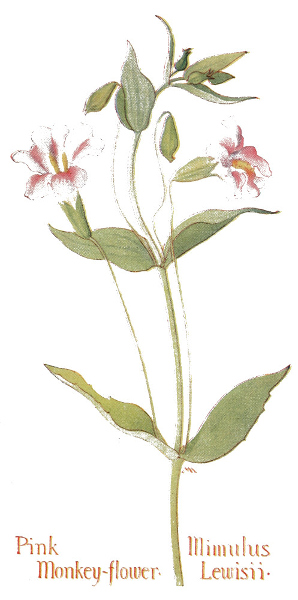
Pink Monkey-flower—Mimulus Lewisii.
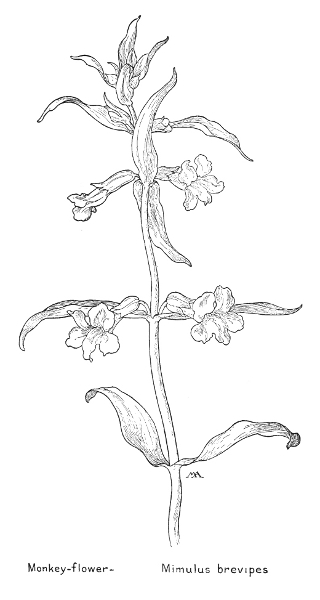
Monkey-flower—Mimulus brevipes.
Scarlet Monkey-flower
Mímulus
cardinàlis
Red
Spring, summer
Southwest. Oreg.
An exceedingly handsome kind, sometimes
nearly five feet high, much like the
last, but with vivid scarlet corollas,
decidedly two-lipped, the upper lip erect
and the lower lobes turned back, the
stamens protruding from the tube. I
first saw these gorgeous flowers glowing
like bits of flame among the ferns and grasses that bordered
a beautiful spring in a cave in the Grand Canyon, where
icy water fell on them drop by drop through a crevice in
the rocky roof far above them and kept them glistening
with moisture. This is often cultivated in gardens.
Little Yellow
Monkey-flower
Mímulus
primuloìdes
Yellow
Summer
Cal., Oreg.
A charming little plant, from three to
six inches tall, with pretty delicate flowers,
from half an inch to an inch long, the
corolla-lobes all alike, bright yellow, often
dotted with crimson, growing singly on
the tips of very slender flower-stalks,
springing from a cluster of bright yellowish-green
leaves, usually toothed, smooth, or sometimes
hairy. This grows in moist mountain meadows.
Little Pink
Monkey-flower
Mímulus Tórreyi
Pink
Summer
California
A delicate little plant, from three inches
to a foot high, rather hairy and sticky,
with very slender branching stems,
yellowish-green, toothless leaves, and
bright flowers, about three-quarters of an
inch long, with almost no flower-stalks;
the corolla-lobes pink, veined with purple, the tube
crimson, with two yellow ridges in the throat. A patch of
these little flowers scattered over a sandy slope in Yosemite,
sometimes growing with a tiny blue and white Lupine
that likes the same sort of place, is an exceedingly pretty
sight. It grows in the mountains, preferring moderate
altitudes, becoming lower and deeper in color in higher
places.
Desert Monkey-flower
Mímulus
Fremóntii
Pink
Spring
California
A charming little plant, something
like the last but prettier, three or four
inches tall, with very slender, stiff, purplish,
branching stems and smooth, thickish,
light green leaves, purplish on the under
side. The flowers are nearly an inch
across, with a hairy calyx and bright
purplish-pink corolla, streaked with magenta, with yellow
ridges on the lower lip and plaits inside the throat. They
look exceedingly pretty on the pale sand of the Mojave
Desert.
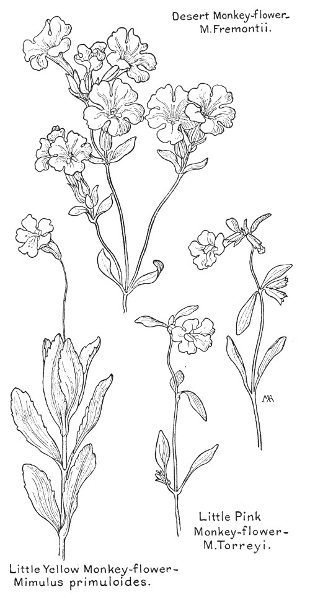
Desert Monkey-flower—M. Fremontii.
Little Pink Monkey-flower—M. Torreyi.
Little Yellow Monkey-flower—Mimulus primuloides.
Common Yellow
Monkey-flower
Mímulus
Langsdórfii
Yellow
Spring, summer
Southwest, Utah,
etc.
There are several varieties of this
common and attractive plant, some tall
and robust, others very short. The stems
are smooth, not sticky, thickish and pale,
sometimes branching, about a foot tall,
and the leaves are from one to three inches
long, smooth, or slightly downy, especially
on the under side of the upper leaves, and
usually bright green, the veins prominent on the back, the
upper leaves without leaf-stalks and more or less clasping,
the lower ones with leaf-stalks varying in length. The
flowers are from three-quarters of an inch to two inches
long, clear bright yellow, the throat nearly closed and hairy,
usually with some dark red dots between the hairy ridges
on the lower lip. This grows in wet places in the mountains
and in canyons, is widely distributed in the West, and has
now strayed as far east as Connecticut.
Musk-plant
Mímulus
moschàtus
Yellow
Spring, summer
West, etc.
This plant is more or less hairy and
seems to be wet all over with slimy dew
and smells of musk. When the stems are
cut and put in water a slimy sort of mucilage
drips from them. It is about ten
inches tall, with rather pretty yellow
flowers, barely an inch long, with some hairs and reddish
specks in the throat. This is widely distributed, in wet
places, from Ontario westward.
There are numerous kinds of Orthocarpus, many of
them Californian, difficult to distinguish. Like Castilleja,
their upper leaves often pass into colored bracts and the
calyx is colored, but the corolla is not similar, for the upper
lip is small and the three-lobed lower lip is swollen and
conspicuous; calyx short, four-cleft; stamens four, two of
them short, enclosed in the upper lip; style long, with a
round-top stigma; leaves without leaf-stalks, usually alternate,
often cut into three to five narrow divisions; fruit
an oblong capsule with many seeds. Perhaps it is called
Owl's-clover because, in some kinds, the flowers look like
the faces of owls.
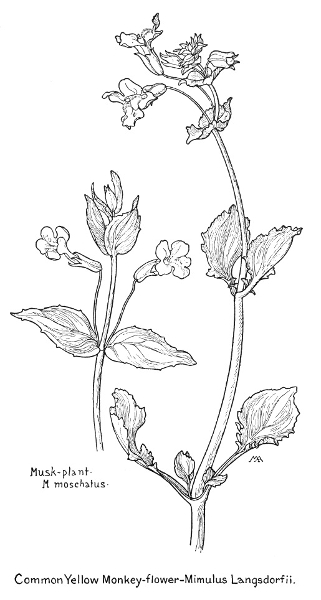
Musk-plant—M. moschatus.
Common Yellow Monkey-flower—Mimulus Langsdorfii.
Yellow Pelican
Flower
Orthocàrpus
faucibarbàtus
Yellow, whitish
Spring
California
One of the handsomest of its kind, a
fine thrifty plant, but not at all coarse,
and much prettier and more effective
than the next. The branching stem is
about a foot tall, and the leaves are very
light, bright yellowish-green, and thin in
texture. The flowers are about an inch
long, with very clear bright yellow "pouches" and
greenish "beaks" tipped with white. They have a curiously
solid appearance, as if carved out of yellow wax, and
are very pleasing and fresh in color, harmonizing well with
the light green bracts, which give a very feathery effect to
the top of the cluster. Like most of its relations, the
flowers are more effective when we look down on them,
growing among the grass, than when they are picked and
we see them in profile. The corollas are sometimes pinkish-white.
This is common in the valleys of the Coast Ranges.
Johnny-tuck
Orthocàrpus
eriánthus
Yellow
Spring
Cal., Oreg.
From five to ten inches tall, with a
slender, downy, purplish stem, often
branching, dull green, downy leaves and
purplish-tipped bracts. The sulphur-yellow
flowers are usually an inch long,
with a magenta "beak" and a very slender,
white tube. They are pretty and very common on plains.
Pink Johnny-tuck,
Pink Popcorn
Flower
Orthocàrpus eriánthus
var. rosèus
Pink
Spring
California
A delicate little plant, from five to ten
inches tall, with a slender, downy, reddish
stem, hairy, dull green leaves and bracts,
and very pretty little flowers, nearly an
inch long; the corollas varying from almost
white to bright pink, but all the same
shade on one plant, with a little yellow at
the center and a maroon-colored "beak."
They are deliciously sweet-scented, like
violets, and grow in dry places. The variety versícolor,
Popcorn Beauty, has fragrant white flowers.
Yellow Owl's
Clover
Orthocàrpus
lùteus
Yellow
Summer
West, etc.
This often makes patches of bright
color. It is from six to twelve inches tall,
with stiff, slender, hairy stems, hairy leaves,
and pretty bright yellow flowers, nearly
half an inch long. This grows in dry
sunny places as far east as Colorado,
reaching an altitude of ten thousand feet.
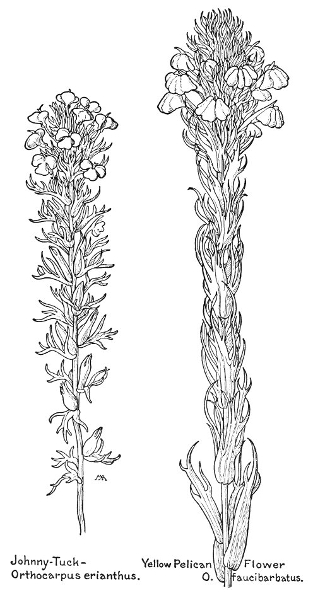
Johnny-Tuck—Orthocarpus erianthus.
Yellow Pelican Flower—O. faucibarbatus.
Escobita, Owl's
Clover
Orthocàrpus
densiflòrus
Purplish-pink
Spring
California
The Spanish name, which means "little
broom," is very appropriate for this pretty
plant. The stiff, downy stem is from five
to fifteen inches tall and the downy leaves
are light green and become tipped with
purplish-pink as they mount up the stalk.
The flowers are about three-quarters of an
inch long and have a white lower lip, which is tipped with
yellow and has a crimson dot on each lobe, and the straight,
erect "beak" is crimson. The cluster is crowded with
purplish-pink and white bracts and though the flowers
themselves are not conspicuous the effect is feathery and
very pretty, especially when the plants grow in such
quantities as to color a whole field with soft pink, or when
mixed with beautifully contrasting patches of blue Lupine.
This is common along the coast. O. purpuráscens,
common in the Northwest and Southwest, is similar, but
it has a hairy "beak," hooked at the tip, and the general
effect is handsomer and much brighter in color, but less
feathery.
Owl's Clover
Orthocàrpus purpureo-álbus
Pink and White
Summer
Ariz., Utah,
New Mex.
An interesting annual plant, quite
pretty, about a foot high, the stem sometimes
branching and the branches suggesting
those of a candelabrum, clothed with
soft, finely divided, dull green leaves and
ending in spikes of green bracts and
pretty little flowers, three-quarters of an
inch long. The calyx is green, the upper lip of the corolla
is purplish-pink and the lower lip is swollen, three-lobed
and cream-white, turning pink in fading. This grows
in dry places at altitudes of from six to eight thousand
feet. Only one of the branches is given in the picture.
Owl's Clover
Orthocàrpus
exsértus
White and pink
Spring, summer
California
A pretty little plant, from six to eight
inches high, with hairy leaves cut into
narrow divisions and passing into pinkish-lilac
bracts towards the top of the stalk,
which are mixed with pink and white
flowers, each about an inch long, so that
the effect of the whole is a spike of pink and white. The
lower lip of the corolla is white and the upper lip is pink,
with a furry tip. This grows in fields. O. attenuàtus,
common in fields in the Northwest, is a slender inconspicuous
kind, about nine inches tall, with soft, thin, dull
green leaves, most of them not lobed, and pale green bracts,
often tipped with white. The corollas are dull white, the
lower lip dotted with purple or yellow, and the whole effect
of the cluster is feathery, very slender, and pale in color.
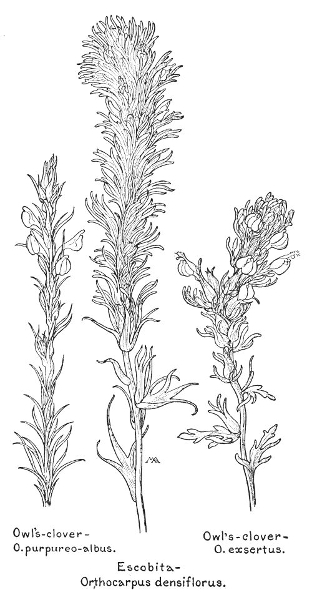
Owl's-clover—O. purpureo-albus.
Escobita—Orthocarpus densiflorus.
Owl's-clover—O. exsertus.
There are a good many kinds of Pedicularis, usually with
finely-cut leaves and spikes of queerly-shaped flowers,
usually yellow, sometimes red or white; the corolla conspicuously
two-lipped, the upper lip hood-like, long and
narrow, the lower lip three-lobed; the stamens four, two
of them short, in the upper lip; the capsule flattened or
compressed, beaked, splitting open, and containing many
seeds. These plants are supposed to cause lice in sheep
that feed on them, so they have the ugly name of Lousewort,
both in English and Latin.
Indian Warrior
Pediculàris
densiflòra
Crimson
Spring
Cal., Oreg.
A robust and very decorative plant,
with rich coloring. The stout, purplish
stems are slightly hairy, from nine inches
to nearly two feet tall, and spring from a
graceful cluster of large leaves, which are
crisp in texture and smooth or slightly
downy, rich green and often tinged with bronze. The
flowers are an inch or more long, with purplish, hairy
calyxes and crimson corollas, and form a very handsome
though rather coarse-looking cluster, mixed with purplish
bracts, and finely shaded in color, from the carmine buds
at the top to the wine-color of the faded flowers at the
base. This grows on wooded hillsides and in deep shade.
The flowers are sometimes white.
Duck-bill
Pediculàris
ornithorhýncha
Pink
Summer
Wash., Oreg.
This is an odd-looking plant, about six
inches tall, with a stout, purplish stem,
woolly at the top, springing from a pretty
cluster of smooth, bright green leaves.
The flowers are about three-quarters of an
inch long, with purplish, woolly calyxes
and bright pink corollas, which are veined and tipped with
deeper color, with purplish bracts. They are very eccentric
in shape and the upper lip has a ludicrous resemblance
to the head of a duck. This grows in the mountains.
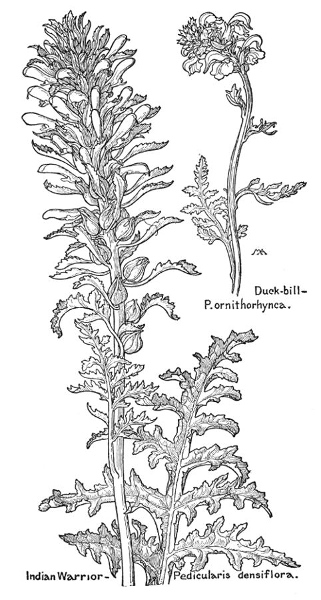
Duck-bill—P. ornithorhynca.
Indian Warrior—Pedicularis densiflora.
Alpine Betony
Pediculàris
centranthèra
Magenta and
white
Spring
Utah, Ariz.,
New Mex.
This grows in dry rocky soil at high
altitudes, forming a low clump of pretty
bronze-colored leaves, cut into many
small crinkled lobes, and giving the effect
of stiff little ferns, with a short spike of
oddly pretty flowers, each over an inch
long, with a purplish, hairy calyx and a
corolla with a white tube and magenta
lips, the anthers projecting like sharp little teeth from
under the arching upper lip. P. semibarbàta, growing in
dry woods in Yosemite, forms a rosette of crinkled bronze
foliage, with short spikes of yellow flowers.
Elephants' Heads,
Butterfly-tongue
Pediculàris
Groenlándica
Pink
Summer
West, etc.
A handsome plant, with quaint flowers.
The smooth, slender, purplish stem is a
foot or more tall, with a few alternate
leaves, and springs from a cluster of
smooth, fern-like foliage, much like that of
P. ornithorhyncha, often tinged with bronze,
and bears a long, crowded spike of many
flowers. They are slightly fragrant, about three-quarters
of an inch long, with purplish calyxes and deep pink or
reddish corollas, which look absurdly like little elephants'
heads. This grows in the mountains, across the continent.
A rather small family, resembling Scrophulariaceae,
widely distributed; parasitic herbs, without green foliage,
with alternate scales instead of leaves; flowers perfect,
irregular; calyx five-cleft, or split on one or both sides;
corolla two-lipped; stamens four, in pairs, with slender
filaments, on the corolla-tube (sometimes also the rudiment
of a fifth stamen); ovary superior, style slender,
stigma disk-like, with two or four lobes; fruit a capsule.
There are several kinds of Thalesia.
One-flowered
Cancer-root
Thalèsia uniflòra
(Orobanche)
Purplish
Spring, summer
Northwest, Utah,
etc.
A queer little thing, but pretty and
delicate, with a very short stem, mostly
underground, bearing one or more slender,
slightly hairy, dull yellow, scaly flower-stems
from three to eight inches tall, each
with a single flower, less than an inch long,
with a dull yellow, hairy calyx, and a
hairy, lilac corolla, tinged with dull
yellow and veined with purple, with two yellow ridges in
the throat. This is not common and is found across the
continent.
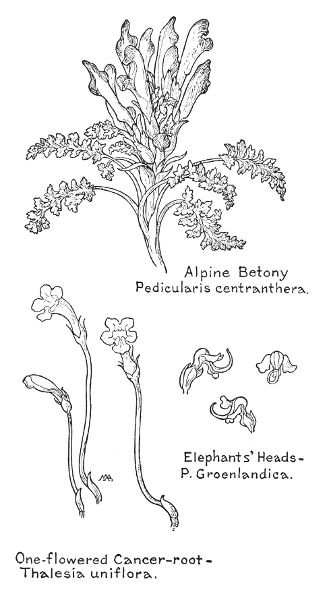
Alpine Betony—Pedicularis centranthera.
Elephants' Heads—P. Groenlandica.
One-flowered Cancer-root—Thalesia uniflora.
A large family, widely distributed, chiefly tropical. Ours
are herbs, or shrubs; leaves opposite or in whorls; flowers
regular, usually perfect; calyx with four teeth or none;
corolla with four or five united lobes, often hairy inside;
stamens on the corolla, as many as its lobes and alternate
with them; ovary inferior, with one or two styles; fruit a
capsule, berry, or stone-fruit. Coffee, Quinine, and Madder,
used for dye, belong to this family. I am told that the
latter plant is escaping around Salt Lake and is well
established there. The Latin name means "red."
There are many kinds of Houstonia, North American,
usually growing in tufts, leaves opposite; flowers small;
calyx four-lobed; corolla funnel-form or salver-form, four-lobed;
style slender, with two long stigmas; fruit a capsule.
Sometimes the flowers are perfect, but usually they are of
two kinds, one kind with high anthers and short pistil,
the other kind with long pistil and anthers inside the corolla-tube;
visiting insects carry pollen from the high anthers of
the one to the high stigmas of the other, and from the low
anthers to the low stigmas, thus ensuring cross-pollination.
Desert Innocence
Houstònia rùbra
Pink and white
Summer
Arizona
A pretty little desert plant, about two
inches high, forming close tufts of sage-green
foliage, like harsh moss, with stiff
needle-like leaves and woody stems,
sprinkled with charming little pink and
white flowers. The corolla is three-eighths of an inch
across, with a long slender tube, the stamens lilac, and the
odd little nodding capsules have two round lobes. This
grows in the dreadful sandy wastes of the Petrified Forest.
Kelloggia
Kellóggia
galioìdes
Spring, summer
White, pink,
yellowish
West, etc.
The only kind, a slender little plant,
from six inches to a foot tall, usually with
smooth leaves, with small stipules. The
tiny flowers are white, pink, or greenish-yellow,
with a bristly calyx, and the
corolla usually has four petals, but
sometimes five or three; the stigmas
two. The fruit is covered with hooked bristles. This
grows in mountain woods, as far east as Wyoming.
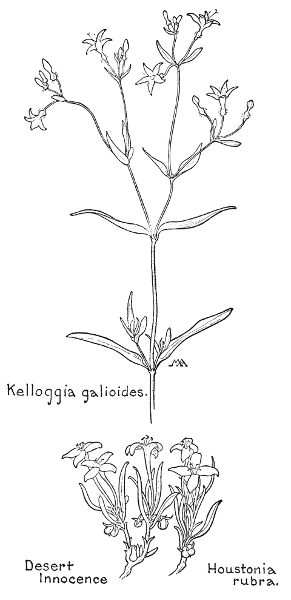
Kelloggia galioides.
Desert Innocence—Houstonia rubra.
There are many kinds of Galium, widely distributed;
sometimes shrubs; stems square; leaves in whorls, without
stipules; flowers small, usually perfect, in clusters; calyx
usually with no border; corolla wheel-shaped, four-lobed;
stamens four, short; ovary two-lobed; styles two, short,
with round-top stigmas; fruit dry or fleshy, consisting of
two similar, rounded parts, each with one seed. The
common name, Bed-straw, comes from a tradition that the
manger of the Infant Christ was filled with these plants.
Other names are Goose-grass and Cleavers.
Northern Bed-straw
Gàlium boreàle
White
Summer
Northwest, etc.
A rather attractive, smooth, perennial,
with a stout, leafy stem, sometimes
branching, and the leaves in fours, with
three veins, the margins sometimes rough
and hairy. The small flowers are white
and so numerous as to be quite pretty.
The fruit is small, at first bristly, but smooth when ripe.
This grows in northern mountains across the continent,
also in Europe and Asia, up to ten thousand feet.
Not a large family, widely distributed, most abundant
in the northern hemisphere; herbs, with opposite leaves
and no stipules; flowers usually perfect, rather small, in
clusters; the calyx sometimes lacking, or small, but often
becoming conspicuous in fruit; corolla somewhat irregular,
tube sometimes swollen or spurred at base, lobes united and
spreading, usually five; stamens one to four, with slender
filaments, on the corolla, alternate with its lobes; ovary
inferior, with one to three cells, only one containing an
ovule, the others empty; style slender; fruit dry, not
splitting open, containing one seed.
There are many kinds of Valerianella, much alike,
distinguished principally by their fruits.
Corn-salad
Valerianélla
macrosèra
(Plectritis)
Pink
Spring, summer
Northwest, Cal.
This has a juicy stem, from a few inches
to over a foot tall, springing from a clump
of smooth, very bright green leaves, and
bearing most of the flowers at the top, in
a small close cluster, with narrow purplish
bracts. They are tiny, with a slightly
irregular corolla, light pink, with two tiny
crimson dots on each side of the lowest lobe, three dark
brown anthers, and a calyx without a border. This is
rather pretty, growing in long grass in damp places, but
the flowers are too small to be effective.
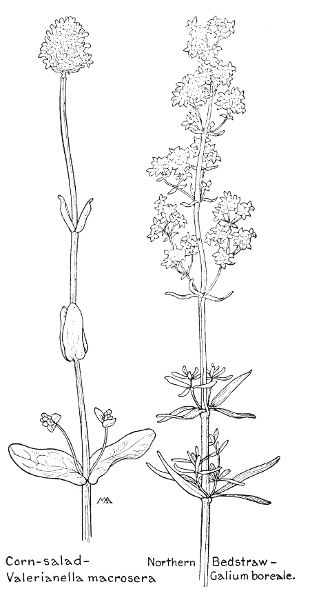
Corn-salad—Valerianella macrosera.
Northern Bedstraw—Galium boreale.
There are many kinds of Valerian, rather tall perennials,
chiefly of cool regions and some in the Andes. They are
more or less bad-smelling plants, especially the root; the
leaves mostly from the base and the small flowers in
terminal clusters, some of them perfect, some with stamens
and pistils on separate plants, some with the two sorts
mixed; the calyx with from five to fifteen bristle-like teeth,
curled up and inconspicuous in flower, but spread out and
feathery in fruit; the corolla white or pink, more or less
funnel-form, with five nearly equal lobes; the stamens
three; the style sometimes with three minute lobes. The
name is from the Latin, meaning "strong," in allusion to
the medicinal properties.
Wild Valerian
Valeriàna
sitchénsis
White, pinkish
Summer
Wash., Oreg.
A very handsome and attractive plant,
much like the kind that is cultivated in
gardens. It grows from one to three feet
tall, from a creeping rootstock, with
smooth, juicy, hollow stems and handsome
bright green foliage. The leaves are
smooth and the leaflets of the stem-leaves are coarsely
toothed. The flowers are white or pinkish, with pink
buds, and are crowded in fine large, rather flat-topped
clusters. The stamens are long and give a pretty feathery
appearance to the cluster. The flowers are strongly sweet-scented,
but the roots usually have a horrible smell when
they are broken. V. sylvática looks much the same, but
the leaves are mostly toothless, and it is widely distributed
in the United States, both East and West, also growing in
Asia. Both are woodland plants, liking rich moist soil.
Arizona Valerian
Valeriàna
Arizònica
Pink
Spring
Arizona
An attractive plant, from three to nine
inches tall, with smooth hollow stems,
smooth leaves, and pretty clusters of
flowers, but not nearly so large as the last.
They are purplish-pink and slightly sweet-scented.
This grows in crevices in the
rocks in moist places.
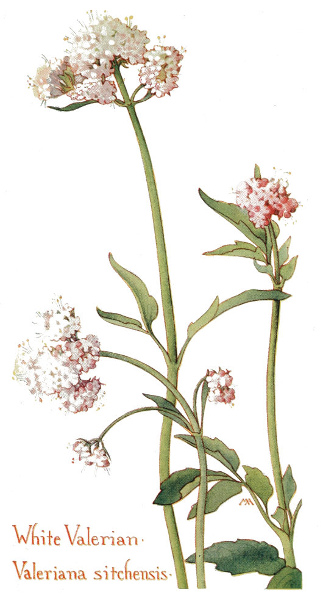
White Valerian—Valeriana sitchensis.
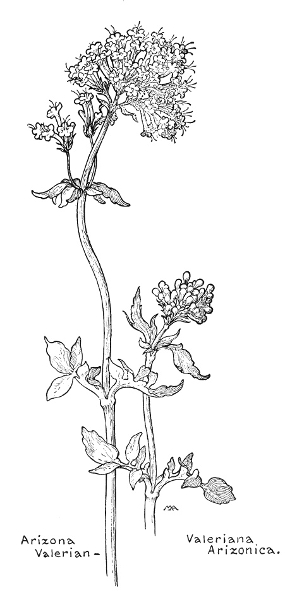
Arizona Valerian—Valeriana Arizonica.
Not a large family, mostly of the northern hemisphere;
herbs, shrubs, shrubby vines or trees; leaves opposite,
usually without stipules; flowers perfect, regular or irregular;
calyx with three to five divisions; corolla usually with
five united lobes, sometimes two-lipped; stamens on the
corolla tube, usually as many as its lobes and alternate
with them; ovary inferior, with one style; fruit a berry,
stone-fruit, or capsule.
There are many kinds of Lonicera, shrubs, or twining
woody vines; leaves usually without teeth or lobes, the
upper ones sometimes united around the stem; flowers
usually irregular; calyx with five, minute teeth; corolla
more or less funnel-shaped, often two-lipped, four lobes
forming the upper lip and one lobe the under, tube often
swollen at base; stamens five; style with a cap-like stigma;
fruit berrylike.
Orange Honeysuckle
Lonicèra ciliòsa
Orange and
scarlet
Summer
Northwest
A climbing or trailing shrub, with
brilliant flowers, set off by bright green
leaves, thin in texture, with pale "bloom"
on the under side and usually hairy
margins, the lower ones with short leaf-stalks,
the upper usually united and
forming a disk. The flowers are scentless,
about an inch and a quarter long, with smooth, trumpet-shaped
corollas, bright orange at base, shading to scarlet
above, with a bright green stigma and crimson or brownish
anthers. This lives in the woods and sometimes climbs to
the tops of quite tall trees, ornamenting them with its
splendid clusters of flowers and sprinkling the forest floor
with its fallen blossoms in a shower of scarlet and gold.
Black Twinberry
Lonicèra
involucràta
Yellow
Spring, summer
West
A bush, from three to seven feet high,
with thick, woody, pale gray stems and
bright green leaves, glossy and thin in
texture, or rather coarse and hairy, with
fine hairs along the margins. The flower-stalks
each bear a pair of flowers, without
scent, emerging from an involucre of two bracts. The
corolla is rather hairy and sticky, half an inch or more
long, a pretty shade of warm dull yellow, sometimes
tinged with red outside, with five, short, nearly equal
lobes, the tube swollen at base. The involucre becomes
dark red, its lobes turn back and display a pair of berries,
disagreeable to the taste, as large as peas, nearly black,
the whole affair striking in color and form. This grows in
moist mountain woods and seems to have smoother,
glossier foliage, and smaller flowers, in Utah than elsewhere.
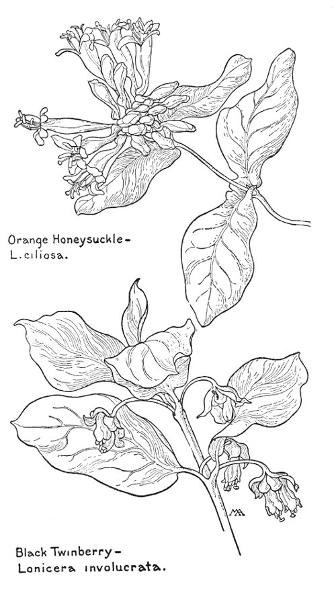
Orange Honeysuckle—L. ciliosa.
Black Twinberry—Lonicera involucrata.
Pink Honeysuckle
Lonicèra hispídula
Pink
Summer
Wash., Oreg., Cal.
Rather pretty, with a woody trunk and
hairy twigs, climbing over shrubs and
trees, sometimes to a height of twenty
feet. The leaves are pale on the under
side, the upper ones usually united around
the stem, and the flowers are about three-quarters
of an inch long, with pink corollas and long
stamens, and form long clusters, which are pretty but not
effective, though the translucent, orange-red berries are
handsome and conspicuous. This varies very much,
especially in hairiness and color of the foliage, and is quite
common in canyons and along streams in the Coast Ranges.
The Yellow Honeysuckle, L. Califórnica, is similar, but
with smooth branches and leaves and pale yellow flowers;
growing in Oregon and northern California.
There are two kinds of Linnaea.
Twin-flower
Linnaèa boreàlis
var. Americàna
Pink
Summer
Northwest,
Utah, etc.
One of the loveliest of woodland plants;
the long, woody stems trail over the
ground and send up straight, slender
branches, a few inches tall, clothed with
leathery, evergreen leaves, bright green
and glossy, and terminating in a slender,
slightly hairy flower-stalk, which bears
a pair of little nodding flowers, about half an inch long,
hanging on very slender pedicels, with two bracts. The
corollas are regular, with five lobes, delicate pink, veined
with deeper color and paler at the margins, with a white
pistil and four, white stamens, not protruding. The fruit
is roundish and dry, with one seed. This often carpets the
forest floor with its glossy foliage, ornamenting the moss
with its fairy-like blossoms, which perfume the air with a
fragrance like Heliotrope. It is found in cold, mountain
woods, up to thirteen thousand feet, across the continent
and also in Europe and Asia, and was named after Linnaeus
because it was a favorite of his.
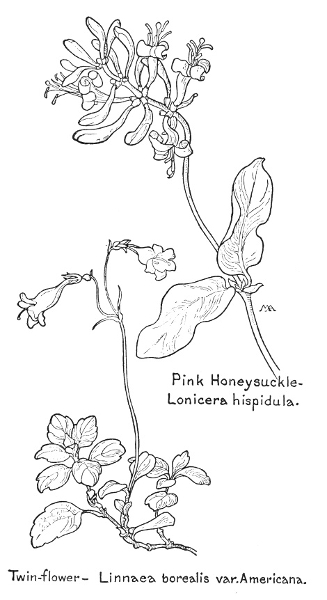
Pink Honeysuckle—Lonicera hispidula.
Twin-flower—Linnaea borealis var. Americana.
There are several kinds of Symphoricarpos, of North
America and Mexico; low, branching shrubs, with small
leaves, scaly leaf-buds, and small, pink or white flowers,
with two bracts, in clusters; the calyx roundish, with four
or five teeth; the corolla regular, more or less bell-shaped,
with four or five lobes; the fruit a roundish, white or red
berry, containing two bony seeds. We often find Snowberries
cultivated in old-fashioned gardens.
Snowberry
Symphoricàrpos
racemòsus
Pink
Spring, summer
U. S.
An attractive shrub, about four feet
high, with slender branches and yellowish
twigs. The pretty leaves are mostly
smooth, rich green, but not glossy, paler
and sometimes downy on the under side,
thin, but rather crisp in texture, usually
with a few shallow scallops along the margins. The
flowers are about a quarter of an inch long, with bell-shaped
corollas, purplish-pink outside, white and woolly
in the inside, the stamens and style not protruding. The
berry is large and pure-white, with white, almost tasteless
pulp, which is said to be slightly poisonous. This is very
common in California, in the hill country, and is found
across the continent.
Snowberry
Symphoricàrpos
longiflòrus
White
Summer
Arizona
A straggling shrub, from two to three
feet high, with small, slightly velvety,
rather pale green leaves, white on the
under side, sometimes set edgewise on the
stem. The flowers are about half an
inch long, with a slender, white, salver-form
corolla, with widely separating lobes and very smooth
inside, the anthers partially protruding from the throat,
and the pretty berries are waxy-white. This grows at
the Grand Canyon.
Snowberry
Symphoricàrpos
oreóphilus
Pink
Spring, summer
Idaho, Utah,
Ariz.
A branching shrub, not especially
pretty, about three feet high, with shreddy
bark, pinkish twigs, and light, bluish-green,
toothless leaves, usually smooth.
The flowers are about half an inch long,
with a tubular corolla, with short lobes,
flesh-color, tinged with purplish-pink, the
stamens and style not protruding and the buds purplish-pink.
This grows in the mountains, up to eight or ten
thousand feet.
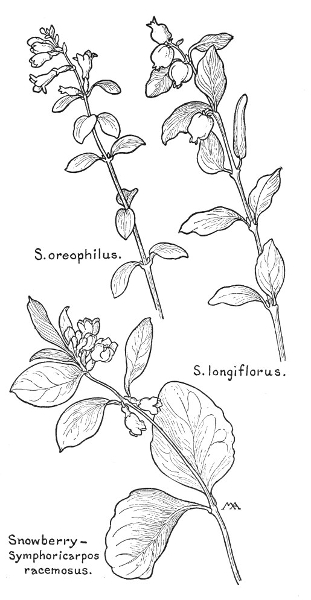
S. oreophilus.
S. longiflorus.
Snowberry—Symphoricarpos racemosus.
A large family, chiefly of the tropics, climbing or trailing,
herbaceous vines, usually with tendrils, rather juicy, with
no stipules; leaves alternate, with leaf-stalks, usually lobed
or cut; flowers some staminate and some pistillate; calyx
bell-shaped or tubular, usually five-lobed; petals mostly
united, usually five, on the calyx; stamens generally three,
with short filaments, often united; ovary inferior; fruit
fleshy, often with a hard rind, usually with flat seeds.
There are many kinds of Micrampelis, natives of America.
Chilicothe,
Wild Cucumber
Micrámpelis
fabàcea (Echinocystis)
White
Summer
California
A graceful, decorative vine, with many
tendrils and spreading to a great distance,
sometimes as much as thirty feet, partly
climbing over bushes and partly on the
ground, springing from an enormous
bitter root as large as a man's body, the
leaves slightly rough. The pretty little
flowers are half an inch across, the calyx
with small teeth or with none and the corolla cream-white,
with from five to seven lobes; the staminate flowers in
loose clusters and the pistillate ones single. The fruit is
peculiar and conspicuous, a big green ball, very prickly
and measuring two inches across. The Indians used to
make hair-oil out of the seeds. This is also called Big-root
and Man-in-the-ground.
There are several kinds of Cucurbita, natives of America,
Asia, and Africa. This is the Latin name for the Gourd.
Calabazilla,
Gourd
Cucúrbita
foetidíssima
Yellow
Spring
Southwest, etc.
This is a near relation of the common
Pumpkin and Squash and resembles them.
It is an exceedingly coarse, but very
decorative vine, with bristly stems, trailing
on the ground and sometimes twenty-five
feet long. The leaves are about eight
inches long, bluish-gray, thick and velvety,
covered with bristles and exceedingly unpleasant to touch
but handsome in appearance. The gaudy flowers measure
five or six inches across, with a bristly calyx and bell-shaped,
orange-yellow corolla. The root is enormous, sometimes
six feet long, the fruit is a smooth, yellow gourd, and the
whole plant has a horrible smell. This is found in dry soil,
from Nebraska west, and is common in southern California.
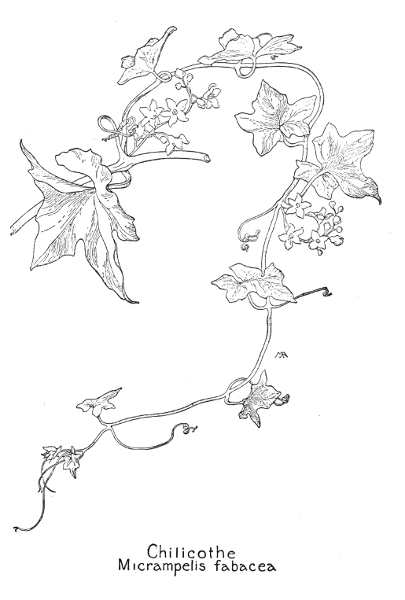
Chilicothe—Micrampelis fabacea.
A large family, widely distributed. Ours are small
herbs, with bitter milky juice; leaves alternate, without
stipules; flowers perfect, usually with five sepals; corolla
with five united lobes; stamens five; ovary inferior, style
long, sometimes hairy, with two to five stigmas, which do
not expand until some time after the flower opens.
There are a great many kinds of Campanula; ours are
chiefly perennials, with more or less bell-shaped corollas;
the capsule tipped with the remains of the calyx and opening
at the sides by minute holes. The name is from the
Latin, meaning "little bell."
Harebell, Blue
Bells of Scotland
Campánula
rotundifòlia
Violet
Summer
West, etc.
This is the well-known kind, sung by
the poets, and found across our continent
and in Europe and Asia, reaching an
altitude of twelve thousand feet. A
charming, graceful little plant, with
slender stems, from six inches to two feet
tall, springing from a cluster of dull green,
roundish or heart-shaped leaves, which usually wither
away before the flowers bloom; the stem-leaves long and
narrow. The flowers hang on threadlike pedicels, usually
in a loose cluster, and are less than an inch long, violet
or blue and paler at the base, with a long white pistil and
pale yellow or lilac anthers. Neither the plants nor the
flowers are nearly so fragile as they look, for the stems are
wiry and the flowers are slightly papery in texture. This
plant is variable and may include more than one kind. It
seems hardly necessary to remark that it is not to be
confused with Calochortus albus, which is unfortunately
sometimes called Hairbell and is entirely different, but I
have several times been asked whether they were the same.
Bellflower
Campánula
Scoúleri
White, lilac
Summer
Northwest, Cal.
A pretty little plant, with smooth,
slender stems, from six to eight inches
tall, and smooth, toothed leaves. The
flowers are in a loose cluster and are more
the shape of little Lilies than of Blue
Bells, white tinged with lilac, or pale blue,
with yellow anthers and a long pistil with three pink
stigmas. The California Harebell, C. prenanthoìdes, has
blue flowers, similar in shape.
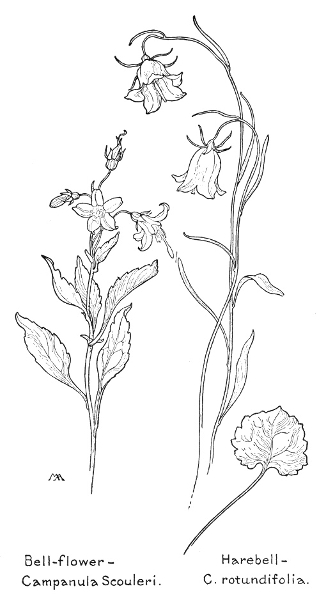
Bell-flower—Campanula Scouleri.
Harebell—C. rotundifolia.
The youngest and largest plant family, comprising about
seven hundred and fifty genera and ten thousand species,
highly specialized for insect pollination, easily recognized
as a whole, but many of its members difficult to distinguish.
Some tropical kinds are trees; ours are usually herbs,
sometimes shrubs, without stipules; the leaves opposite,
alternate or from the root; the flowers all small and
crowded in heads, on the enlarged top of the flower-stalk,
which is called the "receptacle," and surrounded by a
common involucre of separate bracts, few or many, arranged
in one or more rows; the receptacle also sometimes
having scale-like or bristle-like bracts among the flowers, its
surface smooth, or variously pitted and honey-combed. The
flowers are sometimes perfect, or with only pistils, or only
stamens, or with stamens and pistils on different plants, or
all kinds mixed. The calyx-tube is sometimes a mere ring,
or its margin consists of hairs, bristles or scales, called the
"pappus." The corollas are chiefly of two sorts; they are
tubular and usually have five lobes or teeth, but often the
flowers around the margin of the head are strap-shaped, that
is, the border of the corolla is expanded into what is called
a "ray." For instance, the yellow center, or "disk," of a
Daisy is composed of a crowded mass of tiny tube-shaped
flowers, which is surrounded by a circle of white, strap-shaped
flowers, or rays, which look like petals. A Thistle,
on the other hand, has no rays and the head is made up of
tube-shaped flowers only. Stamens usually five, on the
corolla-tube, alternate with its lobes, anthers usually united
into a tube surrounding the style, which has two branches
in fertile flowers, but usually undivided in sterile flowers;
ovary inferior, one-celled, maturing into an akene, often
tipped with hairs from the pappus to waft it about, or with
hooks or barbs to catch in fur of animals. (Descriptions
of genera have been omitted as too technical.)
There are many kinds of Carduus (Cnicus) (Cirsium),
widely distributed; with tubular flowers only.
Thistle
Càrduus Còulteri
Pink, crimson
Spring, summer
California
A strikingly handsome, branching plant,
from three to seven feet high, with light
green leaves, very decorative in form, more
or less downy on the upper side and pale
with down on the under. The flower-heads,
about two inches long, have bright lilac-pink or
crimson flowers and more or less woolly involucres. This
grows in the hills and mountains of the Coast Ranges.
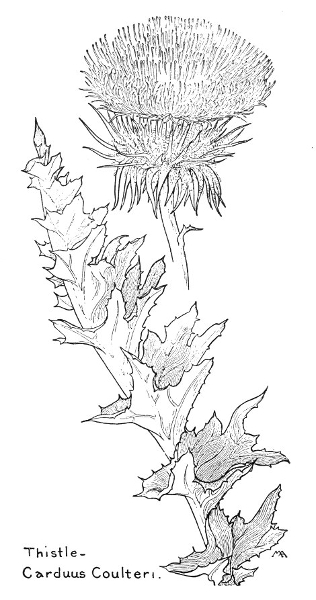
Thistle—Carduus Coulteri.
Arizona Thistle
Càrduus
Arizònicus
Pink
Summer
Arizona
A very striking and decorative plant,
both in form and color, from two to six
feet tall, with a pale, branching, leafy stem,
covered with close, white down, springing
from a cluster of large root-leaves. The
leaves are gray-green, covered with white
down, and show great beauty of design, being sharply and
symmetrically lobed and toothed, the margins armed with
long yellow prickles. The flower-heads are an inch and a
half long, with beautiful carmine and pale-pink flowers,
all with no tinge of purple, the vivid spots of color giving
a very brilliant effect in contrast with the pale foliage.
This grows in the Grand Canyon and is conspicuous along
the Berry trail, a little way below the rim.
Thistle
Càrduus candadíssimus
Pink, crimson
Summer
California
A very handsome and decorative plant,
about three feet tall, with spreading stems,
covered with white down, and dull-green
leaves, pale with down on the under side
and often covered with white down all
over. The handsome flower-heads are
two inches or more long and have deep pink or crimson
flowers and very woolly involucres.
California Thistle
Càrduus
Califórnicus
White
Spring
California
A branching plant, from two to six feet
tall, very leafy below, with very dark
bluish-green leaves, with more or less
woolly down on the upper side and pale
with matted down on the under side. The
flower-heads are nearly three inches across,
with cream-white or rarely purple flowers, and the bracts
are caught together with silky, cobwebby down. This is
common in the Sierra Nevada.
Western Thistle
Càrduus
occidentàlis
Red, purple
Spring
Cal., Oreg.
A stout plant, two or three feet high,
with large prickly leaves, and more or less
covered all over with cottony wool. The
flower-head is about two inches long, and
nearly as wide, and is a ball of white,
cobwebby wool, pierced all over with
brown spines, and tipped with wine-colored flowers. This
is common on sandy hills, near the coast, from San Francisco
south. Yellow-spined Thistle, C. ochrocéntrus, found
in Nevada and Arizona and as far east as Colorado, has
purple flowers and leaves deeply slashed and armed with
long yellow spines. This grows at the Grand Canyon.
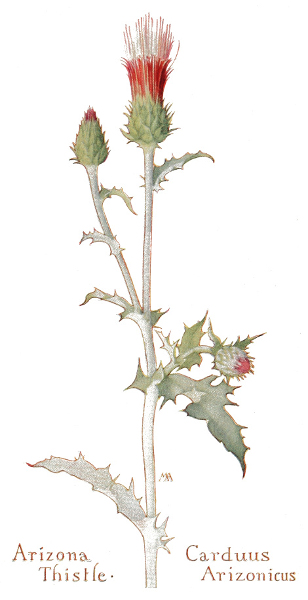
Arizona Thistle—Carduus Arizonicus.
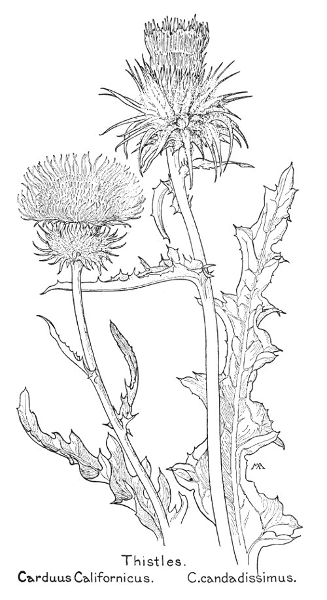
Thistles.
Carduus Californicus.
C. candadissimus.
There are a good many kinds of Anaphalis, natives of the
north temperate zone, but only one in North America.
Pearly Everlasting
Anáphalis
margaritàcea
White
Summer
U. S., etc.
This is the prettiest of the Everlastings,
from one to three feet tall, with a leafy
stem, covered with white wool, and alternate,
toothless leaves, which are rather
long and narrow, gray-green and more or
less woolly on the upper side, pale and
woolly on the under. The flower-heads are numerous,
forming close, roundish clusters. The heads are without
rays, but the tiny, yellow, tubular flowers are surrounded
by many small, white, papery bracts, resembling petals,
making the involucre the conspicuous feature and forming
a pretty little, round, white head. This is common in dry
places, East and West, and found in Asia. There is a
picture in Mathews' Field Book. Rosy Everlasting,
Antennària ròsea, has the same general appearance, but
the bracts are pink, giving a pretty pink tint to the flower-cluster,
and is found in the Northwest at high altitudes.
Another kind of Everlasting is Gnaphàlium microcéphalum,
Cudweed, a mountain plant of the Northwest and California,
with similar foliage, but with larger, looser clusters of
cream-white flowers, conspicuous at a distance, though
not pretty close by. There is a picture of a similar species
in Mathews' Field Book.
There are several kinds of Encelia.
Encelia
Encèlia
eriocéphala
Yellow
Spring
Southwest
A handsome, desert plant, with rough,
purplish stems, a foot and a half tall, dull-green,
hairy leaves, and flowers over an
inch across, in loose clusters, with bright
golden-yellow rays, yellow centers, and
woolly involucres. This makes fine
conspicuous clumps of bright color on the pale desert sand.
Golden Hills,
Brittle-bush
Encèlia farinòsa
Yellow
Spring
Arizona
A conspicuous shrubby plant, from two
to four feet high, with many stout, branching
stems, grayish, downy twigs, and large
clumps of downy, gray-green leaves,
from which spring the long, slender flower-stalks,
bearing loose clusters of handsome
flowers. They are each over an inch and a quarter across,
with bright yellow rays and orange centers and are well
set off by the rather pale foliage. This grows on hillsides
among the rocks and gives a golden hue which may be
seen at a distance of seven or eight miles.
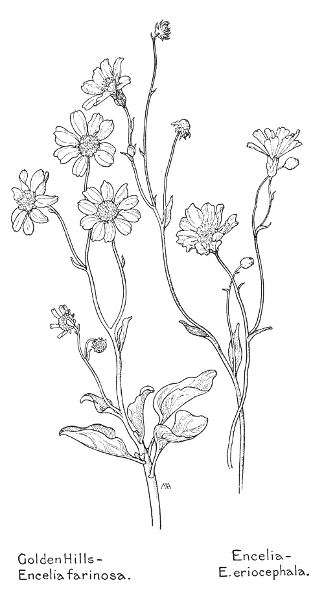
Golden Hills—Encelia farinosa.
Encelia—E. eriocephala.
California Encelia
Encèlia
Califórnica
Yellow
Spring
California
A handsome conspicuous shrub, two
feet or more high, gray and downy when
young but becoming smoother and greener,
with downy, reddish twigs, dark green
leaves, and numerous flowers, on long
flower-stalks. They are two or three
inches across, with three-toothed, bright yellow rays and
very dark maroon or brown centers, specked with yellow,
and velvety or hairy involucres. This grows on sea-cliffs,
where it makes very effective masses of color, in fine
contrast to the blue of the sea below and the sky above.
Encèlia frutéscens
Yellow
Spring
Southwest
A rather straggling shrub, about two
feet high, with whitish, woody stems,
pale reddish twigs, and bright green leaves,
which are roughened with minute prickles
on the margins and under sides, but look quite shiny. The
flower-heads are over half an inch long, in western Arizona
usually without any rays, and are not especially pretty, like
a starved Sunflower whose rays have shrivelled away in the
dry heat of the desert, but the effect of the foliage, which
suggests little apple leaves, is decidedly attractive in the
arid sandy places it frequents.
There are many kinds of Helianthus, natives of the New
World.
Common
Sunflower
Heliánthus
ánnuus
Yellow
Summer
West, etc.
A handsome kind, with a rough stem,
from two to ten feet tall, roughish leaves,
more or less toothed, the upper alternate,
the lower opposite, and a flower-head from
two to four inches across, with bright
golden-yellow, toothless rays, a maroon
center, and a very dark green involucre,
with stiff, overlapping bracts. This is larger in cultivation
and is a very useful plant, for its flowers yield honey
and a yellow dye, its seeds oil and food, the leaves are good
for fodder, and the stalks for textile fiber. It is common
nearly everywhere along roadsides, as far east as Missouri,
and is found as a stray in the East.
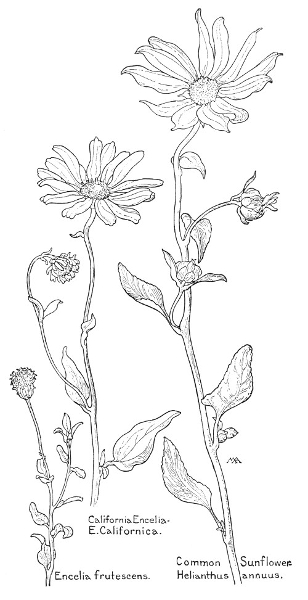
California Encelia—E. Californica.
Encelia frutescens.
Common Sunflower—Helianthus annuus.
Sunflower
Heliánthus
fasciculàris
Yellow
Spring
Nev., Ariz., etc.
A handsome kind, forming a clump from
two to four feet high, with several leafy,
rough stems and harsh, rather shiny leaves.
The fine flowers measure four inches
across, with bright yellow rays, deeper
yellow centers, and bronze, rough, rather
resinous involucres. This is common around Reno and
grows in dry mountain valleys as far east as Colorado.
Hairy Golden
Aster
Chrysópsis villòsa
Yellow
Summer
Arizona, etc.
A striking plant, quite handsome, with
a hairy, pale, leafy stem, from six inches
to two feet tall, and gray-green, rather
velvety leaves, generally toothless. The
flowers are an inch or more across, with
bright golden-yellow rays and centers of
the same shade, growing singly, or in a more or less crowded
cluster at the top of the stalk. This is common in open
ground and dry hills, up to an altitude of ten thousand
feet, as far east as Alabama, and there are many varieties.
The Greek name means "golden aspect."
Velvet-rosette
Psathyròtes ánnua
Yellow
Spring
Southwest
A curious and pretty little desert plant,
that looks as if it were trying to protect
itself from cold rather than heat, as its
pretty foliage and stems seem all made of
silvery, gray velvet, forming a symmetrical
rosette, dotted with the small, rayless, yellow flower-heads,
like fuzzy buttons. The rosette is decorative in
form, about a foot across, spreading flat and close to the
ground, and is conspicuous on the bare sand of the desert.
Only one of the branches is given in the picture.
Easter Daisy,
Ground Daisy
Townséndia
exscàpa
Pink
Spring
Ariz., New Mex.
to Saskatchewan
This is a charming and quaint little
plant, with close, downy rosettes of small,
gray-green leaves and two or three, pretty,
daisy-like flowers, all crowded together
close to the ground. The flowers are over
an inch across, with numerous, pale-pink
rays, deeper pink on the under side, and a
bright yellow center, and when they bloom in early spring,
on bare rocky soil, they are exceedingly attractive.
There are a great many kinds of Erigeron, widely distributed,
most abundant in the New World, easily confused
with Asters, but usually with numerous and finer
rays, so that the effect is more delicate.
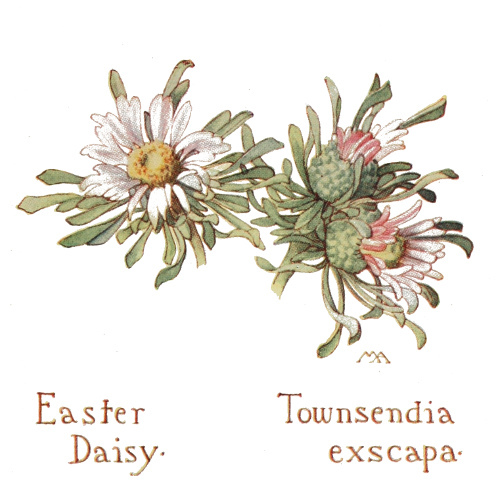
Easter Daisy—Townsendia exscapa.
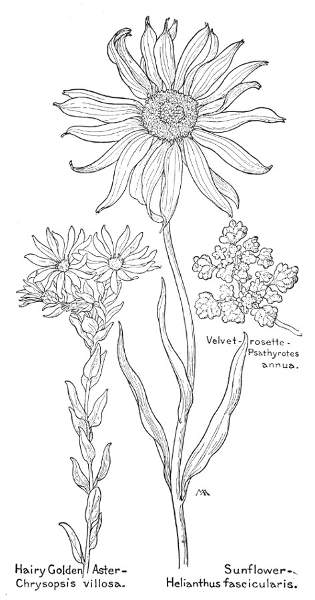
Velvet-rosette—Psathyrotes annua.
Hairy Golden Aster—Chrysopsis villosa.
Sunflower—Helianthus fascicularis.
Fleabane
Erígeron Bréweri
Purple
Summer
California
This is rather pretty, with slender,
brittle, downy stems, from six to eighteen
inches tall, and small, narrow, rough, dull
green leaves. The flowers grow singly, at
the ends of short leafy branches, and are
each less than an inch across, with rather few violet or
pinkish-purple rays and a yellow center. This is common
around Yosemite and looks a good deal like an Aster.
Whip-lash
Fleabane
Erígeron
flagellàris
White, pink
Summer
Ariz., Utah, etc.
A rather odd-looking plant, with numerous,
very slender, weak, branching stems,
trailing on the ground, and very small,
toothless, grayish-green, downy leaves,
forming a rather dense, low bush, about
two and a half feet across, the long sprays
interlacing and dotted here and there
with pretty little flowers, with numerous fine, white, pink-tipped
rays and a yellow center. The sprays often take
root at the tip. This grows in the Grand Canyon, and
is found as far east as Colorado.
Rayless Fleabane
Erígeron concínnus
var.
aphanáctis
Yellow
Spring
Utah, Nev., Cal.
etc.
A rather attractive little plant, forming
small clumps, about five inches high, with
several very hairy stems and light dull
green, very hairy leaves. The many
flower-heads are less than half an inch
across, deep yellow, without rays. This
grows on dry plains and mesas, as far
east as Colorado, and has a rather starved appearance.
Spreading
Fleabane
Erígeron
divérgens
Violet
Spring, summer,
autumn
West, etc.
A dear little common plant, from six
to fifteen inches high, with several slender,
branching, hairy stems, and soft, hairy,
gray-green leaves, the upper ones small
and narrow, without leaf-stalks and the
lower ones sometimes with two or three
lobes and with leaf-stalks. The flower-heads,
several or many, on slender flower-stalks,
measure nearly an inch across in spring, but are
smaller in summer, and have numerous very narrow rays,
white towards the center, shading to bright violet or pink
at the tips, with a bright yellow center. This often grows
in quantities on dry plains and mountain-sides, as far
east as Texas, and is quite charming, the tufts of foliage,
dotted with pretty delicate little flowers, not touching
each other, but sprinkled over a large space, recalling the
little flowers in early Italian pictures. E. pùmilis, of the
Northwest and Utah, is much the same, with white rays.
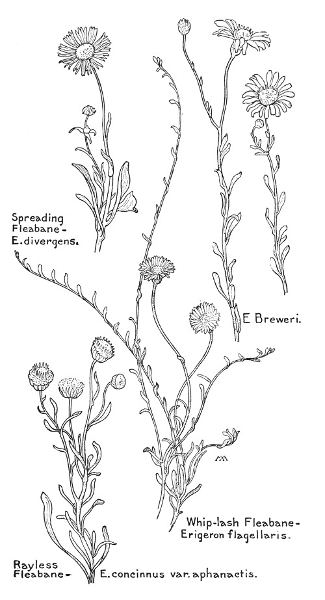
Spreading Fleabane—E. divergens.
E Breweri.
Whip-lash Fleabane—Erigeron flagellaris.
Rayless Fleabane—E. concinnus var. aphanactis.
Large Mountain
Fleabane
Erígeron salsuginòsus
Lilac
Summer
West, etc.
A large, handsome kind, abundant in
the higher mountains and growing in
moist places, as far east as Colorado.
The stems are downy and leafy, from one
to two feet tall, the leaves are smooth or
slightly hairy, with bristle-like points,
and the flowers are an inch and a half or
more across, with bright yellow centers and clear bright
lilac rays, not very narrow.
Yellow Fleabane
Erígeron àureus
(Aplopappus
Brandegei)
Yellow
Summer
Wash., Oreg.
A little alpine plant, about three inches
tall, with downy stems, thickish, gray-green
leaves, covered with close white
down and forming a mat of foliage on the
rocks at high altitudes. The flowers are
rather more than half an inch across, with
a woolly involucre, dark yellow center, and
deep yellow rays, an unusual color among Fleabanes.
Seaside Daisy,
Beach Aster
Erígeron glàucus
Violet, pink
Spring, summer
Cal., Oreg.
Very cheerful, sturdy-looking flowers,
with stout, hairy stems, four to ten inches
tall, and stiffish, slightly hairy leaves,
rather pale in color. The handsome
flowers are an inch and a half across, with
numerous violet, lilac, or pink rays and
rather dark yellow centers. This grows near the sea and is
common on cliffs and sandy shores, where it makes beautiful
spots of bright color.
Skevish, Philadelphia
Fleabane
Erígeron
Philadélphicus
Pink, mauve
Spring, summer
U. S.
A pretty perennial, from one to three
feet tall, usually soft and hairy, the slender
stems usually branching above and most
of the leaves toothed. The flowers usually
form a loose cluster at the top, the buds
drooping, and the heads are from half an
inch to an inch across, with yellow centers
and a very feathery fringe of pink or pinkish rays. This
grows in fields and woods. There is a picture in Mathews'
Field Book. E. Còulteri, the large White Mountain Daisy,
is a beautiful kind, from six to twenty inches tall, with
bright green leaves, often toothed, sometimes downy, and
the flowers usually single, an inch and a half across,
usually with pure white rays. This grows in Yosemite
meadows and similar mountain places, in Utah, California,
and Colorado. E. compósitus is a little Alpine plant,
forming dense leafy mats, easily recognized by the broad
tips of the leaves being cut into lobes, usually three. The
flowers are an inch or more across, with violet or white
rays. This grows on the granite peaks around Yosemite,
and in other Alpine regions, as far east as Colorado.
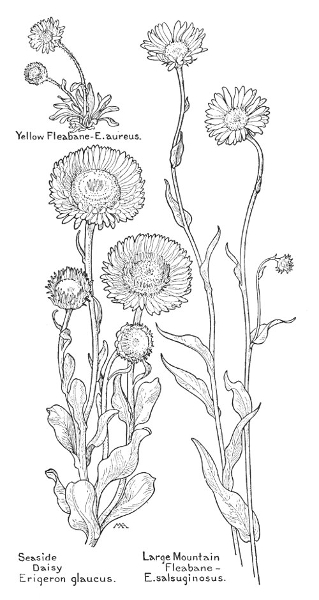
Yellow Fleabane—E. aureus.
Seaside Daisy—Erigeron glaucus.
Large Mountain Fleabane—E. salsuginosus.
Ptilonella
Ptilonélla scàbra
(Blepharipappus)
White
Spring
Oreg., Ida.,
Nev., Cal.
A charming little desert plant, graceful
and airy in character, with stiff, very
slender, branching, roughish stems, about
ten inches tall, and dull green leaves, very
rough to the touch, with the edges rolled
back. The delicate little flowers are an inch
across, with pure white rays, and with white centers, which
are specked with black and pink. This is common on the
mesas around Reno and looks much like some kinds of Madia.
Desert Holly
Perèzia nàna
Pink
Spring
Ariz., Tex.
An odd little desert plant, only two or
three inches high, with stiff, smooth, dull
bluish-green leaves, with prickly edges,
like holly leaves but not so stiff, and one
quite pretty, light purplish-pink flower, the
head about an inch long, with purplish bracts. The effect
of the whole plant is of a little sprig stuck into the sand.
Brown-foot
Perèzia Wrìghtii
Pink
Spring
Ariz., Tex.
Much like the last, but more commonplace
looking, for the flowers are smaller
and the plant much larger. It is about a
foot high and grows among rocks, and the
general effect of dull mauve is rather
pretty, though not bright in color. The common name
alludes to the plant being covered with a mass of brown
hairs at the base.
There are several kinds of Gutierrezia, all American.
Brown-weed
Gutierrèzia Saròthrae (G.
Euthamiae)
Yellow
Summer, autumn
West, etc.
A bushy plant, resinous, smooth or
nearly so, from six inches to two feet high,
with many stiff, upright branches and
alternate, toothless, narrow leaves, an inch
or so long. The flowers have yellow
centers and small yellow rays, forming
clusters at the ends of the branches, and
though very small are so numerous as to make effective
clumps of bright color. This grows at the Grand Canyon,
and in dry rocky places, as far east as the Central States.
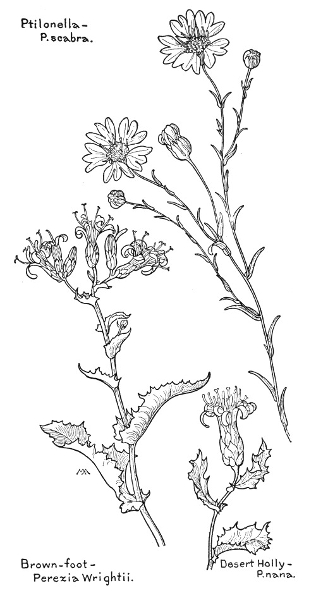
Ptilonella—P. scabra.
Brown-foot—Perezia Wrightii.
Desert Holly—P. nana.
There are a good many kinds of Helenium, natives of
North and Central America.
Sneeze-weed
Helènium
Bigelòwii
Yellow
Summer, autumn
Cal., Oreg.
A handsome plant, with a roughish stem,
from two to four feet tall, and toothless,
rather coarse leaves, rougher on the underside,
the lower part of the leaf grown to the
stem along its middle in a curious way. The
flowers are from an inch and a half to two
inches across, with bright golden-yellow rays and a rich-brown
center, powdered with yellow pollen, and the budding
flower heads look like brown buttons. This grows in
meadows and along streams, at moderate altitudes, and is
found in Yosemite.
Hymenopáppus
lùteus
Yellow
Summer
Ariz., New Mex.,
Col., Utah
A pretty and rather unusual-looking
plant, with a cluster of root-leaves, gray-green
and downy, cut into many fine
divisions, and slender stems, about a foot
tall, with two or three, narrow, alternate,
toothless leaves, and bearing at the top a few pretty,
bright yellow flower-heads, nearly an inch across, with
tube-shaped flowers only. This grows in dry, open places.
There are many kinds of Madia, sticky, heavy-scented
herbs, commonly called Tarweed and called Madi in Chili.
They are used medicinally by Spanish-Californians.
Common Madia,
Tarweed
Màdia élegans
Yellow
Summer, autumn
West
Pretty flowers, with hairy stems, from
six inches to three feet tall, and velvety or
hairy leaves, more or less sticky and the
upper ones alternate. The flowers grow
in loose clusters and are from one to over
two inches across, with bright yellow rays,
sometimes with a spot of maroon at the base which gives
an extremely pretty effect, and a yellow or maroon center.
This often makes pretty patches of color in sandy places,
and is widely distributed and very variable. Woodland
Madia, M. madioìdes, is similar, but not so pretty.
Gum-weed
Màdia dissitiflòra
Yellow
Summer
California
A slender plant, over a foot tall, with
hairy stem and leaves, which are aromatic
when crushed, and rather pretty little
flowers, about half an inch across, with
pale yellow rays, yellow centers specked
with black, and sticky-hairy involucres. This grows along
roadsides and the edges of woods.
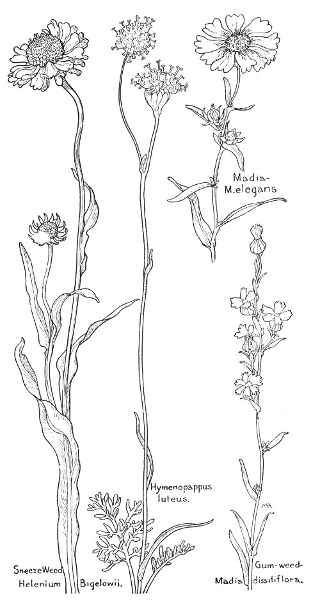
Madia—M. elegans.
Hymenopappus luteus.
Sneeze Weed—Helenium Bigelowii.
Gum-weed—Madia dissitiflora.
There are many kinds of Coreopsis, natives of America,
South Africa, and Australasia, several of them cultivated
in gardens. They are called Tickseed.
Desert Coreopsis
Coreópsis
Bigelòwii
Yellow
Spring
California
This is very pretty, with one or several,
slender, smooth stems, about ten inches
tall, springing from a tuft of pretty, bright
green, smooth, shiny leaves, cut into
narrow divisions and slightly succulent.
The flowers are an inch and a half to two
inches across, with bright yellow rays, lighter at the tips,
and an orange center, and look exceedingly pretty in the
Mohave Desert.
Sea Dahlia
Coreópsis marítima
(Leptosyne)
Yellow
Spring
California
A magnificent plant, forming large
clumps, two feet high, but not at all
coarse in character. The leaves are very
bright green, smooth and quite succulent,
and cut into narrow lobes, so that the
effect is graceful and unusual looking.
The superb flowers are often four inches across, with clear
light yellow rays and orange-yellow centers, and the lower
row of bracts stand out stiffly like a ruffle and are like the
leaves in texture and color, contrasting oddly with the
upper bracts, which are satiny in texture and almost as
yellow as the rays. These plants are conspicuously beautiful
on the sea cliffs near San Diego.
Trixis
Tríxis angustifòlia
var.
latiúscula
Yellow
Spring
Southwest, New
Mex.
A small evergreen shrub, about a foot
high, with smooth, light dull green leaves,
with a few fine teeth, and loose clusters
of rather pretty, bright yellow flowers,
the heads about three-quarters of an inch
long. This grows on rocky hillsides and is
quite effective.
There are a great many kinds of
Chrysanthemum, widely distributed in the northern
hemisphere.
Ox-eye Daisy
Chrysánthemum
Leucánthemum
White
Spring, summer,
autumn
Northwest, etc.
This is the well known common kind, a
general favorite, except with farmers,
naturalized from Europe and also found
in Asia; a perennial weed in pastures,
meadows, and waste places, more or less
all over the United States, but much more
common in the Northeast. It grows from
one to three feet high, the leaves toothed and cut, and the
flower-heads measuring from one to two inches across,
with bright golden centers and pure white rays.
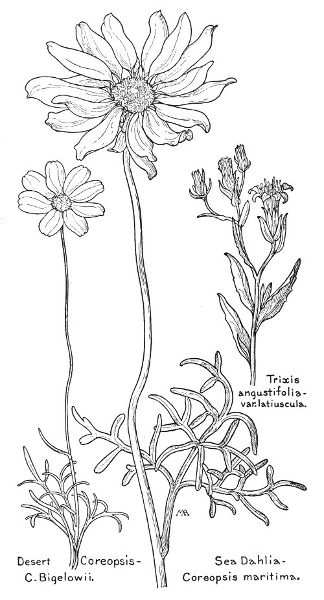
Trixis angustifolia—var. latiuscula.
Desert Coreopsis—C. Bigelowii.
Sea Dahlia—Coreopsis maritima.
There are several kinds of Coreothrogyne, some resembling
Lessingia, others Aster.
Woolly Aster
Coreothrógyne
filaginifòlia
Pink, purple
Spring, summer,
autumn
California
This forms a clump from one to three
feet high, with many erect stems, white
with woolly down, at least when young,
and crowded with alternate, pale grayish-green
leaves, thin and soft in texture and
covered with down. The flower-heads are
an inch across, with purplish-pink rays
and dark yellow centers, and contrast rather prettily with
the pale foliage. In Yosemite this grows on rocky ledges
below five thousand feet and blooms late. It is common
from Monterey to Santa Barbara, blooming at almost all
seasons, and is very variable.
Psilóstrophe
tagetìna var.
sparsiflòra
(Riddellia)
Yellow
Spring, summer
Arizona
These flowers do not look much like
those of a composite, but give more the
effect of yellow Wallflowers. The plant
is very attractive, from one to two feet
tall, with alternate, bluish-green leaves,
most of them toothless, and handsome
clusters of lemon-yellow flowers. They
are each about three-quarters of an inch across, delicately
scented, and usually have four large rays, mixed with a
few smaller and more irregularly shaped, all much more
like petals than rays and becoming papery in fading. The
picture is of a plant growing in the Grand Canyon.
Paper Flowers
Psilóstrophe
Coòperi
Yellow
Spring
Southwest
A pretty, compact, shrubby plant,
woody below, about a foot high, with
tangled branches, pale downy twigs, and
thickish, dull green, downy leaves. The
pretty flowers are an inch and a quarter
across, with an orange-yellow center and
five or six, large, clear bright yellow rays, twisted to one
side and puckered at the base, turning back and becoming
papery as they fade. This plant is at its best in sandy soil
and is very effective in the desert. When fully developed
it is very symmetrical in outline, forming a charming
yellow globe of flowers.
There are several kinds of Xylorrhiza, nearly related to
the Aster group and by some authorities regarded as
Asters.
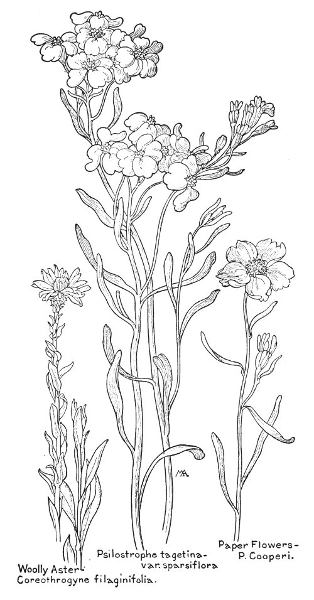
Woolly Aster—Coreothrogyne filaginifolia.
Psilostrophe tagetina—var. sparsiflora.
Paper Flowers—P. Cooperi.
Xylorrhiza
Xylorrhìza
tortifòlia
Lilac
Spring
Southwest,
Utah, Col.
A handsome plant, growing in clumps
over two feet high, with prickly leaves and
beautiful flowers, two inches and a half
across, with rays shading from bright
lilac to nearly white and yellow centers.
This is common in the Grand Canyon.
There are a good many kinds of Arnica, natives of the
northern hemisphere. This is the ancient name and a
European kind is much used medicinally.
Heart-leaved
Arnica
Árnica cordifòlia
Yellow
Summer
West, except Ariz.
A handsome mountain flower, with a
hairy stem, from six inches to two feet
tall, and velvety leaves, coarsely toothed,
the lower ones usually heart-shaped. The
flower-heads are usually single, over two
inches across, with bright yellow rays, an
orange center, and a hairy involucre. This is common in
rich moist soil in mountain valleys, as far east as Colorado.
Broad-leaved
Arnica
Árnica latifòlia
Yellow
Summer
Northwest
A handsome kind, sometimes a foot
and a half tall, with pretty flowers, about
two inches across, with very bright yellow
rays. The bright green leaves are thin in
texture and practically smooth, the lower
ones more or less roundish, with leaf
stalks. This grows in mountain woods.
There are many kinds of Artemisia; herbs or shrubs,
usually bitter and aromatic, widely distributed.
Common Sage-brush
Artemísia
tridentàta
Yellow
Summer, autumn
West, etc.
This is the characteristic sort, often
immensely abundant and found as far east
as Colorado, often tinting the landscape
for miles with its pale and beautiful
foliage and one of the dominant shrubs in
the Great Basin. It is very branching,
from one to twelve feet high, with a distinct
trunk and shreddy bark, and the twigs and alternate
leaves are all gray-green, covered with silvery down, the
upper leaves small and toothless, the lower wedge-shaped,
with usually three, blunt teeth. The small yellow flowers
have no rays and grow in small, close clusters, forming long
sprays towards the ends of the branches. Sagebrush is a
"soil indicator" and when the prospective rancher finds
it on land he knows at once that it will be good for even
dry farming, as the soil contains no salt or alkali.
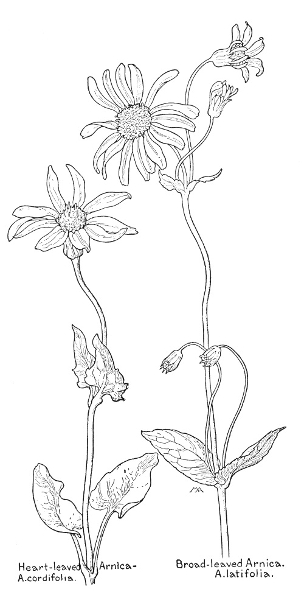
Heart-leaved Arnica—A. cordifolia.
Broad-leaved Arnica—A. latifolia.
There are a good many kinds of Eriophyllum, common
and very variable, woolly plants.
Woolly Yellow
Daisy
Eriophýllum
lanàtum
Yellow
Spring, summer
Cal., Oreg., Wash.
This is a handsome kind, in favorable
situations forming large conspicuous
clumps, from one to two feet high, covered
with bright golden flowers, each over an
inch across. The leaves are dull green on
the upper side, but the under side and the
buds and stems are all covered with fine
white down. The leaves are variable in form, sometimes
neither lobed nor toothed, and sometimes cut into narrow
toothed divisions. This has a variety of forms and grows
on hillsides.
Eriophyllum
Eriophýllum
caespitòsum var.
integrifòlium
Yellow
Summer
Northwest, etc.
This forms low tufts of pale gray downy
foliage, contrasting well with the bright
yellow flower-heads, each about an inch
across. This grows around Yosemite and
in other mountain places, as far east as
Wyoming, and has a variety of forms.
Golden Yarrow
Eriophýllum
confertiflòrum
Yellow
Summer
California
This has small flowers, but it forms such
large clumps that the effect of the golden-yellow
clusters is handsome and very
conspicuous, on dry hills and mountains
and along roadsides in summer. It is
woody below, from one to two feet high,
and the leaves are more or less woolly. The variety
discoídeum has no rays.
There are many kinds of Anthemis, natives of Europe,
Asia, and Africa.
Mayweed,
Chamomile,
Dog Fennel
Ánthemis Cótula
White
Summer, autumn
U. S., etc.
This little weed is common in waste
places and fields and along roadsides,
almost all over the world. It is a branching
annual, from one to two feet tall, with
feathery light green foliage, cut into many
long, narrow divisions, almost smooth,
with a disagreeable smell and strong acrid
taste. The many daisy-like flowers have heads about an
inch across, with from ten to eighteen white rays and
convex yellow centers. There is a picture of this plant in
Mathews' Field Book.
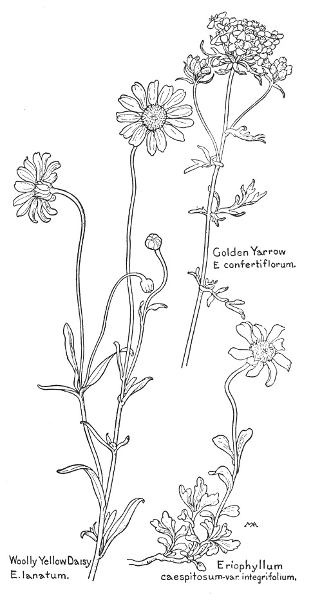
Golden Yarrow—E. confertiflorum.
Woolly Yellow Daisy—E. lanatum.
Eriophyllum caespitosum—var. integrifolium.
There are a good many kinds of Chaenactis, the flower-heads
with tubular flowers only, but in some kinds the
marginal flowers are larger and have a broad border resembling
a kind of ray.
Chaenactis
Chaenáctis
Douglásii
White
Spring, summer
Utah, Cal., New
Mex.
A rather pretty plant, from eight inches
to over a foot tall and more or less downy,
with stiffish, gray-green, leaves, cut into
many short, blunt lobes and teeth. The
flower-heads are about an inch long, and
contain numerous small, pearly-white or
pinkish, tube-shaped flowers, with long,
purplish pistils. This grows in dry open places, the flowers
turn pink in fading and are sweet-smelling and quite
pretty, though not striking. C. macrántha, which grows
in the Grand Canyon, has similar flowers, rather prettier,
with a somewhat sickly scent, but it is a lower plant.
Golden Girls
Chaenáctis lanòsa
Yellow
Spring
California
A charming desert plant, with several
downy stems, over a foot tall, springing
from a feathery cluster of pretty, bright
green, thickish leaves, cut into narrow
divisions, rather downy and often tinged
with red. The flower-head is nearly an inch and a half
across, without rays, but the marginal flowers in the head
are larger and have broad borders that look like rays.
They are a beautiful shade of clear bright yellow.
Morning Bride
Chaenáctis
Fremóntii
White
Spring
Southwest
This is very much like the last in size,
form, and foliage and is equally charming,
but the flowers are all pure white, or
pinkish, instead of yellow. It is one of
the most attractive of the white desert
flowers.
Desert Star
Erimiástrum
bellidoìdes
Lilac
Spring
Arizona
A charming little desert plant, with
spreading stems and small, narrow, toothless,
gray bluish-green leaves, which are
soft, but sprinkled with small, stiff, white
bristles, the whole forming a rosette, five
or six inches across, growing flat on the
sand and ornamented with many pretty little flowers.
They are each set off by a little rosette of leaves and are
over half an inch across, with pinkish-lilac rays, shading
to white towards the yellow center and tinted with bright
purple on the back.
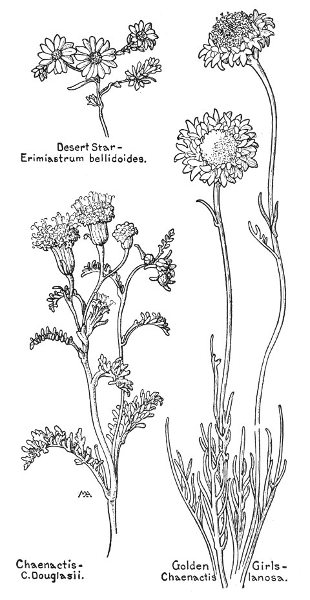
Desert Star—Erimiastrum bellidoides.
Chaenactis—C. Douglasii.
Golden Girls—Chaenactis lanosa.
Venegasia
Venegàsia
carpesioìdes
Yellow
Summer
California
These big, leafy plants, with their bright
flowers, are a splendid feature of the
California woods and canyons in June,
especially on the slopes of the Santa Inez
mountains, where they often cover large
areas with green and gold; unfortunately
the smell is rather disagreeable. The leafy stems are four
or five feet high, nearly smooth, with alternate, bright
green leaves, almost smooth and thin in texture, and the
flowers, resembling Sun-flowers, are over two inches across,
with clear yellow rays, an orange center, and an involucre
of many green scales, overlapping and wrapped around
each other, so that the bud looks much like a tiny head of
lettuce. This was named for Venegas, a Jesuit missionary,
and is the only kind, growing near the coast in the South.
Lessingia
Lessíngia
leptóclada
Lilac
Summer
California
This is a slender plant, from six inches
to two feet tall, with pale gray green,
woolly leaves, the lower ones somewhat
toothed, and pale pinkish-lilac flowers, not
very conspicuous in themselves, but sometimes
growing in such quantities that they
form pretty patches of soft pinkish color in sandy places.
The flower-head is about half an inch long, with no rays,
but the outer flowers in the head are larger and have long
lobes resembling rays. This is very variable, especially in
size, and is common along dry roadsides and quite abundant
in Yosemite. The picture is of a small plant. L.
Germanòrum, which is common on sandy hills along the
coast from San Francisco to San Diego, has yellow flowers
and blooms in autumn.
There are many kinds of Baeria, not easily distinguished.
Sunshine,
Gold Fields
Baéria grácilis
Yellow
Southwest
This is a dear little plant, often covering
the fields with a carpet of gold. The
slender stems are about six inches tall,
with soft, downy, light green leaves,
usually opposite, and pretty fragrant
flowers, about three-quarters of an inch across, with bright
yellow rays and darker yellow centers. This is sometimes
called Fly Flower, because in some places it is frequented
by a small fly, which is annoying to horses. B. macrántha
is a much larger plant, a biennial, with a tuberous root,
from seven inches to a foot and a half tall, with long,
narrow, toothless leaves, with hairy margins, and flower-heads
from an inch to an inch and a half across, with
yellow rays and hairy involucres. This grows along the
coast in California, blooming in May and June.
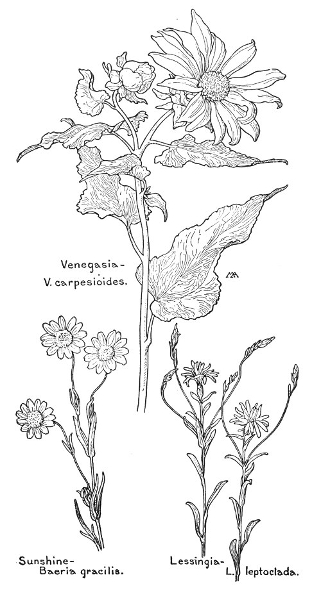
Venegasia—V. carpesioides.
Sunshine—Baeria gracilis.
Lessingia—L. leptoclada.
There are several kinds of Bahia, natives of western
North America, Mexico, and Chile, herbs or shrubs, more
or less woolly.
Bahia
Bàhia absinthifòlia
Yellow
Spring
Arizona
This is from eight to fifteen inches tall,
with pretty flowers, an inch and a half
across, with bright yellow rays and deep
yellow centers, contrasting well with the
pale gray-green foliage, which is covered
with close white down. This grows in
arid situations on the mesas and often forms clumps.
There are several kinds of Crassina, natives of the United
States and Mexico.
Desert Zinnia
Crassìna pùmila
(Zinnia)
White
Spring
Arizona
Nothing could look much less like a
garden Zinnia than this dry, prickly-looking
dwarf shrub. It is from three inches to a
foot high, the branches crowded with very
small, stiff, dull green leaves, and the
flowers are about an inch across, rather
pretty but not conspicuous, with a yellow center and four
or five, broad, cream-white rays, often tinged with dull pink.
This plant grows on the plains and is a "soil-indicator," as
it flourishes on the poorest, stoniest, and most arid land.
Wild Marigold
Bàileya
multiradiàta
Yellow
Spring, summer,
etc.
Southwest, Tex.
Charming flowers, with a thrifty,
cultivated appearance like that of a garden
flower. The plant is a foot tall, with
grayish-green, woolly stems and foliage,
and the handsome flower is an inch and a
half across, with a fine ruffle of many
bright yellow rays, prettily scalloped,
and a yellow center, rather deeper in color. In Arizona
bouquets of these flowers may be gathered during every
month in the year.
Bàileya
pauciradiàta
Yellow
Spring
Southwest
An odd little desert plant, about six
inches tall, with a thickish stem and soft,
thickish leaves, covered all over with
silky, white wool, giving a pale, silky
effect to the whole plant, which is quite
pretty, though the pale yellow flowers, each about half an
inch across, are not striking.
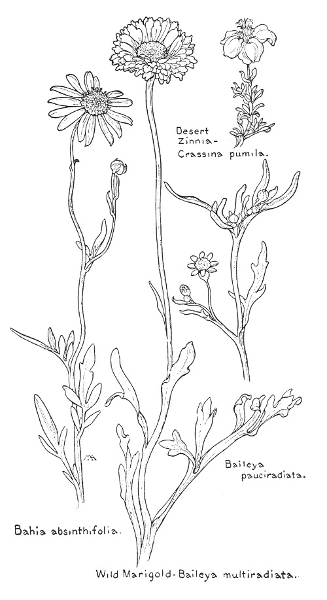
Desert Zinnia—Crassina pumila.
Baileya pauciradiata.
Bahia absinthifolia.
Wild Marigold—Baileya multiradiata.
Pentachaeta
Pentachaèta àurea
Yellow
Spring
California
Gay, yet delicate little flowers, with
slender branching stems, about eight
inches tall, and light green, very narrow
leaves. The flowers are an inch across,
with a feathery ruffle of very numerous
narrow rays, light yellow at the tips, growing deeper
towards the orange-colored center, and the pretty buds are
often tinged with pink or purple. This often grows in
patches and is common in southern California.
Daisy Dwarf
Actinolèpis lanòsa
White
Spring
Arizona
A quaint little desert plant, only two or
three inches tall, with thickish, pale gray-green
leaves, covered with close white
down, and pretty little flowers, growing
singly at the ends of tiny branches, each
half an inch across, with a yellow center and pure white
rays, which fold back at night. These little flowers are too
small to be very conspicuous, but are charming in effect,
sprinkled over the bare sand, and when growing in quantities
on nearly bare mesas give a whitish appearance to the
ground.
There are a good many kinds of Blepharipappus.
Yellow Tidy-tips
Blepharipáppus
élegans (Layia)
Yellow
Spring
California
Very pretty flowers, with slender,
branching, hairy stems, about a foot tall,
and light green, hairy leaves. The flowers
are about two inches across, with yellow
rays, tipped with white or very pale
yellow, neatly arranged around the deep
yellow centers, which are specked with black. The rays
twist up in fading and turn to a pretty shade of dull
pink. This is common and a very handsome kind.
White Tidy-tips
Blepharipáppus
glandulòsus
(Layia)
White
Spring
Southwest, Oreg.,
Wash.
A beautiful kind, eight or nine inches
tall, with pale green, hairy leaves, the
lower ones toothed, and a slender stem,
bearing a charming flower, nearly an
inch and a half across, with neat pure
white rays and a bright yellow center.
This grows in mountain canyons and is
widely distributed as far north as British
Columbia.
There are several kinds of Gaillardia, all American.
They are much cultivated in gardens, were named in
honor of Gaillard de Merentonneau, a French botanist.
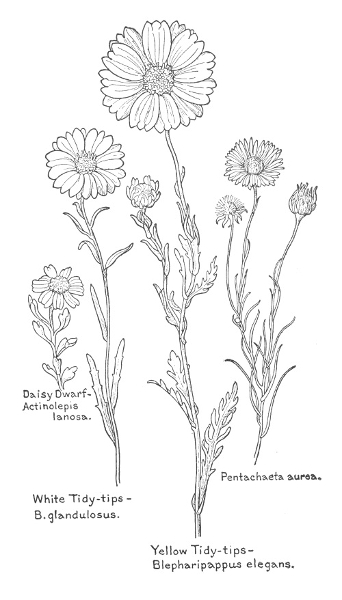
Daisy Dwarf—Actinolepis lanosa.
Pentachaeta aurea.
White Tidy-tips—B. glandulosus.
Yellow Tidy-tips—Blepharipappus elegans.
Blanket-flower,
Gaillardia
Gaillàrdia
pinnatífida
Yellow
Summer
Ariz., Col., Tex.
This is handsome and conspicuous, with
a slender, rough stalk, about a foot tall,
dull green, stiff, rather hairy leaves,
mostly from the root, and beautiful
flowers, an inch and a half across, with
golden-yellow rays, with three teeth, and
a center of shaded maroon and yellow,
which is very velvety and pretty and becomes an attractive,
purplish, fuzzy, round head when the rays drop off. This
grows on the plains. G. aristàta, found throughout the
West and as far east as Colorado, is an exceedingly handsome
kind, sometimes over two feet tall, with beautiful
yellow flowers, sometimes measuring four inches across.
Arizona Gaillardia
Gaillàrdia
Arizònica
Yellow
Spring
Arizona
A pretty little desert plant, from four to
eight inches tall, with a slender, downy
flower-stalk, springing from a cluster of
roughish, light dull green leaves, more or
less hairy and bearing a single handsome
flower, nearly two inches across, with a
downy involucre and three-toothed rays of an unusual
and pretty shade of dull light yellow, finely veined with
brown on the back, surrounding a darker yellow, fuzzy
center.
Tiny Tim
Hymenathèrum
Hartwégi
Yellow
Spring
Arizona
A neat little evergreen, shrubby plant,
only about three inches high, with branching
stems, clothed with small, narrow,
dull green leaves, which look prickly but
are actually not very stiff, though tipped
with tiny bristles. The flowers are three-eighths
of an inch across, very perfect in outline, with
bright yellow rays and deeper yellow centers, and the
whole effect, of a tiny shrub sprinkled with flowers, is quite
attractive, growing on very dry ground along the roadside.
The plant has a pronounced smell, which is not unpleasant.
Tall Purple Aster
Machaeranthèra
incàna (Aster)
Purple
Spring
Southwest, Utah,
New Mex.
This looks a good deal like an Aster,
a branching plant, from two to nearly
three feet high, with grayish-green,
slightly downy leaves, with very sharp
teeth. The flowers are an inch and a
half across, with narrow, bright violet
rays and bright yellow centers. This
grows abundantly in valleys.
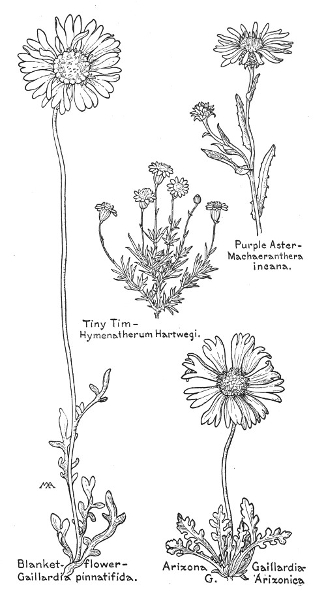
Purple Aster—Machaeranthera incana.
Tiny Tim—Hymenatherum Hartwegi.
Blanket-flower—Gaillardia pinnatifida.
Arizona Gaillardia—G. Arizonica.
Laphàmia
bisetòsa
Yellow
Summer
Ariz., New Mex.,
Tex.
An insignificant plant, except that it
grows on the sides of bare, red rocks or
head-downward on the under side of overhanging
ledges, apparently needing little
or no soil, and is therefore noticeable. It
forms round clumps, one or two feet across, with many
slender stems, about six inches high, small, pale yellowish-green,
roughish leaves, and small yellow flower-heads,
without rays. This is rare and grows in the Grand Canyon.
There are several kinds of Grindelia, common in the
West, recommended as a remedy for Poison Oak.
Gum Plant
Grindèlia
latifòlia
Yellow
Spring
California
Coarse but rather effective flowers, with
smooth, stiff, branching stems, about
three feet high, and dark dull green leaves.
The flower-heads are over an inch and a
half across, with bright yellow rays and
centers and very resinous, shiny buds.
There are several kinds of Balsamorrhiza. Both the
Latin and common names allude to the aromatic roots.
Arrow-leaf
Balsam-root, Big
Root
Balsamorrhìza
sagittàta
Yellow
Spring
Utah, Ida., Cal.,
Nev., Col.
A very handsome plant, the contrast
between the gray-velvet leaves and the
great yellow flowers being very striking.
It forms large clumps, about a foot and a
half high, with slightly downy flower-stalks
and heart-shaped or arrow-shaped,
toothless leaves, pale gray-green and velvety,
covered with silvery down, whiter
on the under side. The flowers are over
three inches across, with clear bright yellow rays, and a
deeper yellow center, fuzzy and greenish-yellow in the
middle. The involucre is almost white, thickly covered
with silvery, silky wool, and the flowers are pleasantly
sweet-smelling. This grows on dry hillsides.
Cut-leaved Balsam-root
Balsamorrhìza
macrophýlla
Yellow
Spring, summer
Utah, Wyo.
A strikingly handsome plant, forming
clumps even larger than the last, with
similar flowers, but with quite different
foliage. The leaves are rich-green, and
decorative in form, more or less slashed
into lobes and very sticky, with hairy
margins and leaf-stalks, and are nearly as
tall as the hairy, sticky flower-stems, from one to two feet
high. This grows in rich soil in mountain valleys.
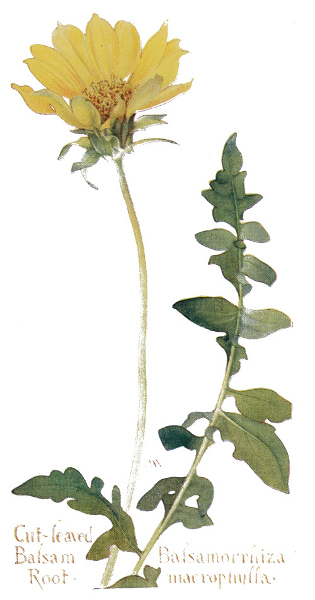
Cut-leaved Balsam Root—Balsamorrhiza macrophylla.
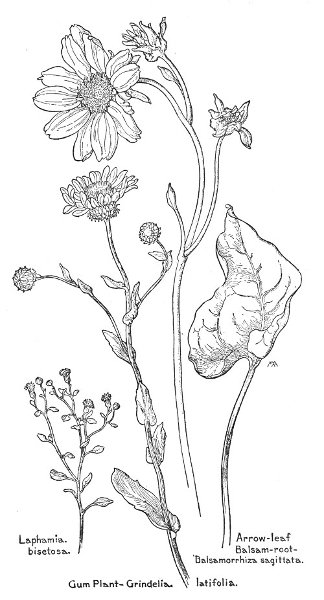
Laphamia bisetosa.
Gum Plant—Grindelia latifolia.
Arrow-leaf Balsam-root—Balsamorrhiza sagittata.
Balsam-root
Balsamorrhìza
Hóokeri
Yellow
Spring
West, except
Ariz.
Rather handsome, though a coarse
plant, over a foot tall, with hairy, dull
green or grayish leaves, crisp and harsh to
the touch, variously lobed and cut,
chiefly in a clump at the root. The flowers
are numerous, from an inch and a half to
over two inches across, with deep orange-yellow
rays, and grow singly on long flower-stalks. This
flourishes on dry plains and mesas.
There are several kinds of Wyethia, resembling Balsam-roots,
but their thick roots not resinous.
Yellows,
Mule-ears
Wyéthia
amplexicàulis
Yellow
Spring, summer
Utah, Nev., etc.
A robust and exceedingly handsome
plant, one or two feet tall, with rich
foliage and gorgeous flowers. The leaves
are stiffish, dark rich green, smooth but
somewhat sticky, often toothed; the stem-leaves
alternate, their bases partly clasping,
and the root-leaves a foot or two long
and two or three inches broad, with leaf-stalks. The
flower-heads are about four inches across, with bright
yellow rays, almost orange color, and the center with three
rows of yellow disk-flowers, surrounding a clump of pointed,
overlapping, stiff, greenish scales in the middle. This
sometimes forms immense patches on dry hills at rather
high altitudes, as far east as Colorado. It is sometimes
called Compass Plant, because its leaves are thought to
point North and South, and the Indian name is "Pe-ik."
Woolly Wyethia
Wyéthia móllis
Yellow
Summer
California
Not so handsome as the last, but a
striking plant, from one to four feet high,
with gray-green, velvety foliage, all
covered with soft wool, forming large
clumps of leaves, from six to fifteen inches
long. The flowers are two or three inches across, with
orange rays and very woolly involucres. This is common
in dry places in Yosemite.
There are several kinds of Rudbeckia, all North American.
Black Eyed Susan
Rudbéckia hírta
Yellow
Summer
California, etc.
From one to four feet high, with rough
leaves and one or a few handsome flowers,
from one to four inches across, with deep
yellow rays and a purplish-brown conical
center. This comes from the Mississippi
Valley, is very common in the East, and becoming common
in Yosemite meadows.
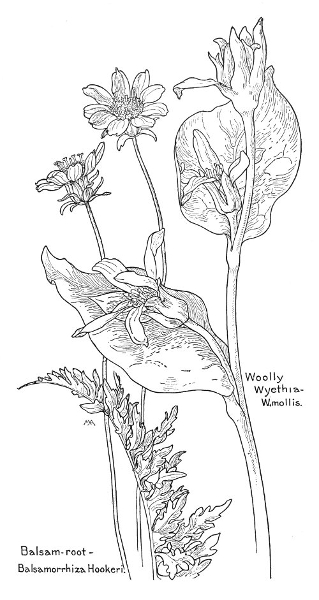
Woolly Wyethia—W. mollis.
Balsam-root—Balsamorrhiza Hookeri.
Brass Buttons,
Butter-heads
Cótula
coronopifòlia
Yellow
Spring, summer,
autumn
Cal., Oreg.
This little weed comes from South
Africa, but is now common in wet places,
especially in the salt marshes around San
Francisco Bay, often carpeting the sand
and mud with its succulent, trailing stems.
The bright green leaves are alternate and
smooth, clasping the stem at base, some
with toothless edges, others variously
cut and lobed, and the flower-heads are about half an inch
or less across, like the bright yellow center of a Daisy,
without rays. Matricària matricarioìdes is another little
weed, common along roadsides, with conical, greenish-yellow
flower-heads, without rays, and feathery foliage,
which has a strong pleasant fruity smell when crushed,
giving it the name of Pineapple-weed and Manzanilla.
Tetradymia
Tetradýmia
spinòsa
Yellow
Spring
West, etc.
An odd desert shrub, about three feet
high, with gray bark and crooked, gnarly,
tangled branches, armed with long spines
and clothed with small, downy, pale green
leaves. The flower-heads are three-quarters
of an inch long, without rays,
with pale yellow tube-shaped flowers and downy, white
involucres, and are so crowded on the twigs that they
appear to be loaded with them, but the coloring is too
pale to be effective. This is common in the Mohave Desert
and elsewhere on dry hills and plains, as far east as
Colorado.
There are a great many kinds of Solidago, most of them
natives of North America. On the whole, the western
Golden-rods are not so fine as the eastern ones, nor are
there so many kinds, though there are quite enough to
puzzle the amateur, as they are difficult to distinguish.
Arizona Golden-rod
Solidàgo
trinervàta
Yellow
Summer
Arizona
A handsome kind, from one to two
feet high, with flower-heads nearly three-eighths
of an inch across, with bright
yellow rays and centers, forming a large,
handsome, plume-like cluster. The stem
and leaves are dull bluish-green, rather
stiff and rough, the lower leaves with a
few obscure teeth. This grows at the Grand Canyon.
S. occidentàlis, Western Golden-rod, is smooth all over, with
leafy stems, from three to five feet tall, toothless leaves, and
flat-topped clusters of small, yellow, sweet-scented flowers.
This grows in marshes and along the banks of streams, in
California, Oregon, and Washington, blooming in summer
and autumn. S. Califórnica, California Golden-rod, is
from two to four feet high, with grayish-green, roughish
leaves, the lower ones toothed, and small yellow flowers,
forming dense pyramidal clusters, from four to thirteen
inches long. This grows on dry plains and hillsides and in
the mountains, throughout California and in Oregon,
blooming in the autumn. It is called Orojo de Leabre
by the Spanish-Californians.
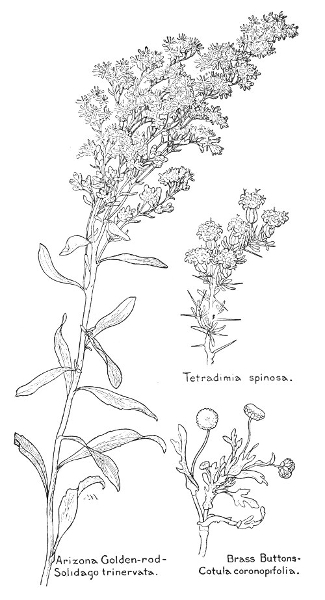
Tetradymia spinosa.
Arizona Golden-rod—Solidago trinervata.
Brass Buttons—Cotula coronopifolia.
There are probably over a thousand different kinds of
Senecio, very widely distributed. The name is from the
Latin for "old man," in allusion to the long white hairs of
the pappus, when "gone to seed." Our kinds have many
common names, such as Groundsel, Ragwort, and Squaw-weed.
Ragwort
Senècio perpléxus
var. díspar
Yellow
Spring, summer
Utah, Idaho
A conspicuous plant and quite handsome,
though its flowers are rather untidy-looking,
for, like many other Senecios,
the rays do not come out evenly. It is
about two feet high, with a stout, hollow,
ridged stem, sparsely woolly, and dark
green, thickish leaves, with shallow and uneven teeth and
covered with sparse, fine, white woolly hairs, as if partially
rubbed off. The flowers are over an inch across, with
bright yellow rays, curling back in fading, an orange center,
fading to brown, and the bracts of the involucre tipped with
black. This grows in moist rich soil, in mountain valleys.
Creek Senecio
Senècio Douglásii
Yellow
Spring, summer,
autumn
Southwest
A handsome bush, about three feet high,
covered with many flowers, on slender
flower-stalks, sticking up out of a mass of
rather delicate foliage, which is often
covered with white cottony wool. The
flowers are an inch and three-quarters
across, with bright light yellow, rather untidy rays and
yellow centers. This grows in dry stream beds and on
warm slopes in the foothills.
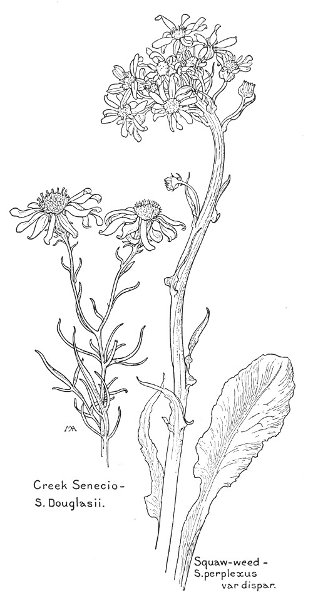
Creek Senecio—S. Douglasii.
Squaw-weed—S. perplexus var. dispar.
Senècio Lémmoni
Yellow
Spring
Arizona
This is quite effective, with attractive
flowers and foliage, growing among rocks
on hillsides and forming large clumps
over a foot high. The stems are slender
and often much bent, the leaves are dark green and thin
in texture with toothed edges, rolled back, and the numerous
flowers are an inch across, with bright yellow rays and
deep yellow centers. This plant blossoms both as an
annual and as a perennial.
White Squaw-weed
Senècio cordàtus
White
Summer
Northwest
A rather handsome plant, with a stout
stem, about two feet tall; the upper leaves
more or less downy and the root-leaves
rather thick and soft, covered with whitish
hairs on the under side. The flower-heads
are about three-quarters of an inch
across, with a fuzzy, pale yellow center and white rays.
This grows in open woods, at rather high altitudes.
Senècio Riddéllii
Yellow
Spring, winter
Arizona
A rather showy plant, from six inches
to two feet tall, blossoming both as an
annual and as a biennial, after which it
dies. The whole plant is smooth and the
foliage is green or bluish-green, rather delicate and pretty.
The flowers are an inch to an inch and a half across and
they begin to appear in winter when there is little else to
brighten the desert mesas. This plant is abundant in
valley lands, though it has a wide range.
S. multilobàtus
Yellow
Summer
Ariz., Utah, etc.
A rather pretty plant, about a foot
tall, with a few small leaves on the slightly
woolly stem, but most of them in a rosette
at the base. They are smooth, thickish
and slightly stiff, about an inch and a half long, and neatly
cut into small, toothed lobes. The few flowers are in a
loose cluster at the top of the stem and have heads about
three-quarters of an inch across, with pale yellow rays
and brighter yellow centers. This grows at the Grand
Canyon and on the dry plains of Utah and Colorado, at
altitudes of about seven thousand feet.
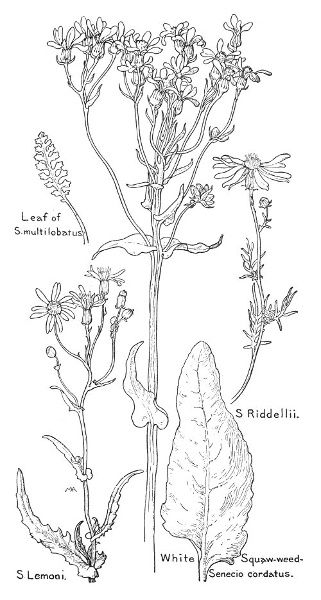
Leaf of S. multilobatus.
S. Riddellii.
S. Lemmoni.
White Squaw-weed—Senecio cordatus.
African Senecio
Senècio élegans
White and mauve
Spring
California
A handsome plant, which is noticeable
on account of its unusual coloring. The
stout, smooth stem is two or three feet
tall, with smooth, slightly thickish leaves,
the margins rolled back, a very peculiar
shade of light bright yellowish-green. The handsome
flowers are an inch and three-eighths across, with bright
deep yellow centers and white rays shading to mauve at
the tips, and form a large flat-topped cluster. This is a
native of Africa and is not yet common in this country,
but grows on the sand dunes near San Francisco.
There are many kinds of Baccharis, all American,
chiefly shrubs.
Groundsel-tree
Chaparral Broom
Báccharis
pilulàris
Whitish, yellowish
Autumn
Cal., Oreg., Wash.
A branching evergreen shrub, from two
to five feet high, with smooth dark green,
leathery leaves, an inch or less long, rather
wedge-shaped, usually coarsely toothed.
The flower-heads are very small, without
rays, and are crowded at the ends of the
twigs. Some plants have only staminate
flowers and some only pistillate ones, and the effect of the
two sorts is very different, for the staminate flowers are
ugly, but the pistillate ones are provided with quantities
of long, white, silky pappus, giving a beautiful, snowy
appearance to the shrub. This is very variable, being a
fine shrub in favorable situations, and is common along the
coast on the sand dunes, on low hills and on high mountain
slopes.
There are a great many kinds of Aster, most abundant in
North America, difficult to distinguish, the flowers never
yellow. Though there are some fine ones in the West, they
are not so numerous or so handsome as in the East.
Aster
Aster Chamissónis
Purple
Summer, autumn
Cal., Oreg.
This is one of the commonest kinds and
is quite handsome, from two to five feet
high, with leafy, branching stems and
alternate, lance-shaped leaves, from two
to five inches long, usually toothless,
without leaf-stalks. The many flowers are an inch or more
across, with yellow centers and white, violet, or purple
rays, the bracts of the involucre in several rows, with short
and rounded tips. This is rather variable. A. radulìnus,
Broad-leaf Aster, has stiff, rough leaves, sharply toothed
towards the broad tips, and usually many flowers, an inch
or so across, with whitish rays. This is rather common on
dry hills in California and Oregon, blooming in summer and
autumn. A. Andersóni, of Yosemite, has toothless, grasslike
root-leaves and one beautiful flower, an inch across,
with purple rays.
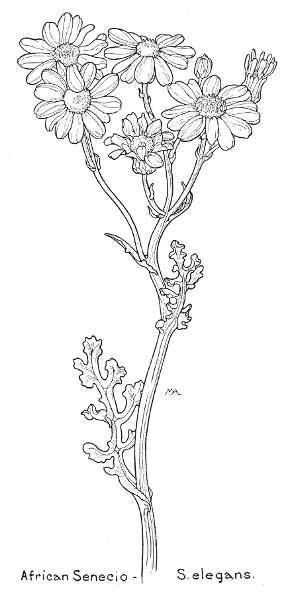
African Senecio—S. elegans.
A large family, of wide geographic distribution, resembling
the Sunflower Family and by some authors
included in it. They are herbs, rarely trees, almost always
with milky, acrid, or bitter juice; the leaves alternate or
from the root; the flowers small and crowded in heads,
with involucres, the bracts in one or several rows; the
receptacle flat or flattish, sometimes naked or smooth,
sometimes scaly, pitted or honeycombed; the flowers all
perfect; the calyx-tube without pappus, or with pappus of
scales or bristles, sometimes feathery; the corollas not of
two sorts, like those of the Sunflower Family, but all with
a strap-shaped border, usually five-toothed, and a short
or long tube; the anthers united into a tube around the
style, which is very slender and two-cleft or two-lobed; the
ovary one-celled and inferior, developing into an akene.
There are several kinds of Ptiloria, of western and
central North America.
Flowering-straw
Ptilòria pauciflòra
(Stephanomeria
runcinata)
Pink
Spring
West, etc.
In the desert this is a very strange-looking,
pale plant, forming a scanty,
straggling bush, about two feet high, with
slender, brittle, gray stems, most of the
leaves reduced to mere scales, and delicate,
pale pinkish-lilac flowers, less than half
an inch long. This grows on the plains, as
far east as Texas, and is not always so leafless as in the
picture, which is that of a desert plant, but has some
coarsely-toothed leaves.
Desert Pink
Ptilòria Wrìghtii
(Stephanomeria)
Pink
Summer
Ariz., New Mex.
Much like the last, but not a queer-looking
plant, with pale green foliage and
larger, prettier flowers, three-quarters of
an inch long, giving the effect of tiny,
pale pink carnations. This grows at the
Grand Canyon.
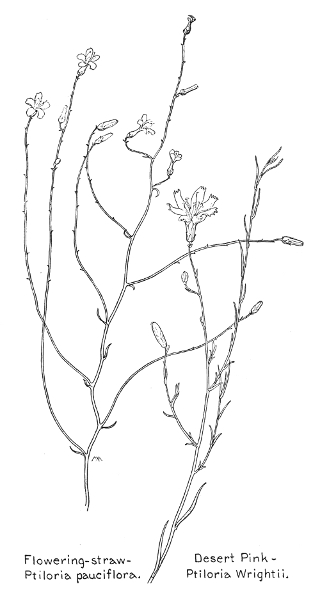
Flowering-straw—Ptiloria pauciflora.
Desert Pink—Ptiloria Wrightii.
There are a good many kinds of Agoseris, natives of
western and southern North America and of southern
South America.
Goat Chicory,
Large-flowered
Agoseris
Agóseris glàuca
Yellow
Spring
Utah, Ida., Wash.,
etc.
A pretty perennial plant, about fourteen
inches tall, with a slender, slightly woolly
flower-stem, springing from a pretty
cluster of smooth bluish-green leaves,
sometimes toothless, and bearing a handsome
bright yellow flower, from one to two
inches across, the involucre often covered
with white wool. This grows on dry
slopes, as far east as Colorado.
There are a good many kinds of Malacothrix, natives of
the western and southwestern United States.
Malácothrix
glabràta
Yellow
Spring
Southwest, Nev.,
Utah
A very attractive plant, with several
flower-stalks, from six inches to a foot
tall, springing from a pretty feathery tuft
of bright green root-leaves, cut into
almost threadlike divisions and often
tinged with deep red. The handsome
flowers are nearly two inches across, clear very pale
yellow, shading to brighter color towards the middle.
This is common on open plains in southern California,
where it passes almost gradually into M. Califórnica, which
is similar, but conspicuously woolly when young, covered
with very long, soft hairs.
Snake's Head
Malácothrix
Còulteri
White
Spring
California
A smooth plant, with a "bloom," from
five to sixteen inches high, often branching
from the base, the leaves cut into wavy
lobes, with no leaf-stalk. The handsome
flowers are about an inch across, white,
turning pink in fading, the involucres
with shining, papery, green and white bracts. This is one
of the most conspicuous annuals in the San Joaquin Valley.
M. saxàtilis, the Cliff Aster, is a handsome perennial,
common in southern California and often growing on sea-cliffs.
It has a leafy branching stem, from one to four feet
high, the leaves toothless, or cut into slender divisions, and
often quite fleshy, and many pretty flowers at the ends of
the branches. They are each about an inch across, white,
changing to pink or lilac, with an involucre of many narrow
bracts, running down the flower-stalk. This is common in
southern California, blooming in summer and autumn.
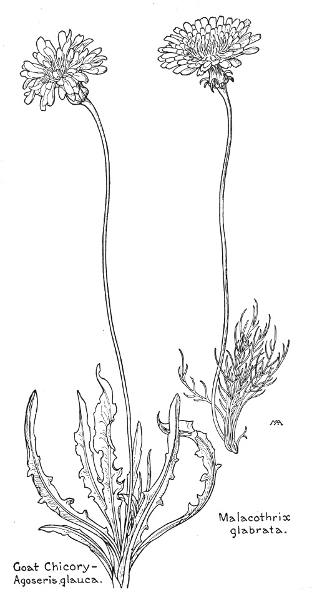
Malacothrix glabrata.
Goat Chicory—Agoserìs glauca.
Desert Dandelion
Malácothrix
Féndleri
Yellow
Spring
Arizona
An attractive little desert plant, about
five inches tall, with stiffish, pale bluish-green
leaves, forming a rosette, and pretty,
very pale yellow flowers, nearly an inch
across, like a delicate sort of Dandelion.
It is a near relation of the common Dandelion
and blooms early in the spring.
Salsify, Oyster
Plant
Tragopògon
porrifòlius
Purple
Spring, summer
West, etc.
This is the common Salsify, the root of
which is used as a vegetable. It is naturalized
from Europe and is now quite
common in the West as a "stray" and
also in the East. It has a smooth, stout,
hollow stem, from two to over four feet
tall, rather dark green, smooth leaves,
clasping at base, and handsome flowers from two to four
inches across, which are a very peculiar shade of reddish-purple,
not usually seen in flowers. They open early in
the morning, closing by midday and fading almost immediately
when picked, and may be seen growing along
the edges of fields and just outside garden fences where
they are often quite conspicuous. This plant has many
common names, such as Jerusalem Star, Nap-at-noon, and
Vegetable Oyster.
Desert Chicory
Nemosèris Neo-Mexicàna
(Rafinesquia)
White
Spring
Ariz., New Mex.
A straggling desert plant, from a few
inches to a foot and a half high, with
smooth branching stems and smooth, very
pale bluish-green leaves, rather thick in
texture. The pretty flowers are from one
to two inches across, white, tinged with
pink or cream-color and a little yellow in
the middle, often striped with magenta on the outside, and
the bracts of the involucre tinged with pink and bordered
with white. N. Califórnica is a branching plant, from one
to five feet tall, with a stout stem and smooth oblong
leaves, lobed, toothed, or almost toothless, and quite
pretty flowers at the ends of the branches. They are about
an inch across, white, often tinged with magenta on the
outside. This grows in California and Oregon, usually in
shady or moist places.
There are several kinds of Cichorium, natives of the Old
World. The name is from the Arabic.
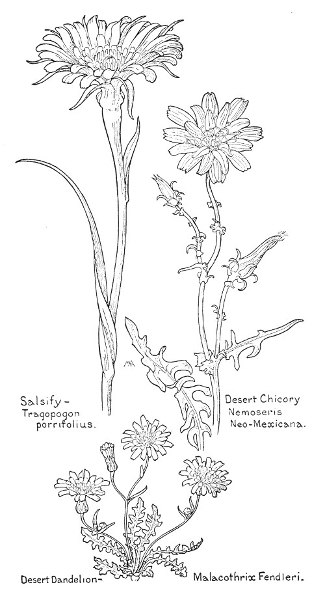
Salsify—Tragopogon porrifolius.
Desert Chicory—Nemoseris Neo-Mexicana.
Desert Dandelion—Malacothrix Fendleri.
Chicory, Blue
Sailors
Cichòrium Íntybus
Blue
Summer, autumn
Northwest, etc.
This is a straggling plant, from one to
three feet tall, a perennial, with a long,
deep tap-root, stiff, branching stems, and
leaves irregularly slashed into toothed
lobes and chiefly from the root. The
pretty flowers are from an inch to an inch
and a half across, much like those of Desert Chicory, but
very brilliant blue, occasionally white. This plant has
escaped from cultivation and is now very common in waste
places and along roadsides in the East and often found
in the West. The ground-up root is used as a substitute
for coffee. There is a picture in Mathews' Field Book.
There are several kinds of Microseris, rather difficult to
distinguish.
Silver-puffs
Microsèris
linearifòlia
Yellow
Spring
Southwest, Nev.
This is about a foot tall, with smooth,
hollow flower-stems, smooth leaves, and
rather small yellow flowers, not particularly
pretty. The "gone-to-seed" flower-heads
are, however, very conspicuous, for
they are nearly an inch and a half across,
and each seed is tipped by a little silvery paper star, the
effect before the wind carries them away being exceedingly
pretty, a good deal like a Dandelion puff. This grows in
the Grand Canyon on the plateau.
There are many kinds of Sonchus, natives of the Old
World.
Sow Thistle
Sónchus oleràceus
Yellow
All seasons
West, etc.
A common weed, from Europe, found
across the continent, coarse but decorative
in form, with a stout leafy stem, from one
to four feet tall, and smooth leaves, with
some soft prickles on the edges, the upper
ones clasping the stem and the lower ones with leaf-stalks.
The pale yellow flowers are three-quarters of an inch or
more across.
There are several kinds of Taraxacum, natives of the
northern hemisphere and southern South America.
Dandelion
Taráxacum
Taráxacum
Yellow
All seasons
U. S., etc.
This is a weed in all civilized parts of
the world, growing in meadows, fields, and
waste places. It has a thick, deep, bitter
root, a tuft of root-leaves, slashed into
toothed lobes, and several hollow flower-stalks,
from two to eighteen inches tall,
each bearing a single, handsome, bright yellow flower,
from one to two inches across, which is succeeded by a
beautiful silvery seed puff. This plant has many common
names, such as Blow-ball, Monk's-head, Lion's-tooth, etc.
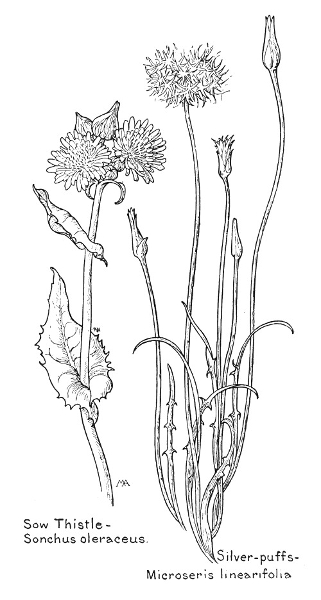
Sow Thistle—Sonchus oleraceus.
Silver-puffs—Microseris linearifolia.
There are a great many kinds of Crepis, natives of the
northern hemisphere.
Gray Hawksbeard
Crèpis occidentàlis
Yellow
Spring, summer
West, etc.
This is a pretty plant, for the gray-green
foliage sets off the yellow flowers.
It is from six to eighteen inches high,
more or less hairy or downy all over, with
one or several, stout, branching, leafy
stems, and thickish leaves, variously cut,
mostly jagged like Dandelion leaves, with crisp margins,
dark bluish-green in color and often covered on the under
side with obscure white down, the root-leaves narrowed to
leaf-stalks at the base. The flower-heads are about an inch
across, with bright yellow rays, the involucre sprinkled
with short, dark hairs. This grows on dry plains, as
far east as Colorado.
Smooth Hawksbeard
Crèpis vìrens
Yellow
Summer
Cal., Oreg., etc.
This is a weed from Europe, growing in
fields and waste places, in the East and on
the Pacific Coast. It is a smooth plant,
from one to two feet tall, with green leaves
the shape of Dandelion leaves, chiefly in a
bunch at the root. The many, small,
yellow flowers, each about a quarter of an inch long, are in
a loose cluster at the top of the stem. This is very variable.
Hawksbeard
Crèpis acuminàta
Yellow
Spring, summer
West, except
Ariz.
A handsome and conspicuous plant,
often forming large clumps, from one to
three feet tall, with dull green, downy,
rather leathery leaves, irregularly slashed
and cut, and large clusters of light bright
yellow flowers, each about three-quarters
of an inch across. This grows on hillsides and on high dry
mesas.
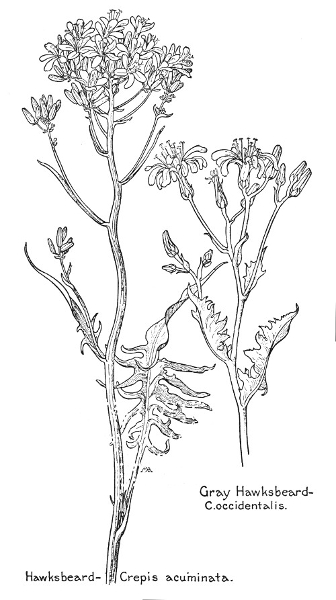
Gray Hawksbeard—C. occidentalis.
Hawksbeard—Crepis acuminata.
- Abronia, 102.
- Abronia latifolia, 106.
- Abronia maritima, 104.
- Abronia salsa, 104.
- Abronia umbellata, 104.
- Abronia villosa, 104.
- Achlys triphylla, 156.
- Aconitum, 136.
- Aconitum Columbianum, 136.
- Actaea, 140.
- Actaea arguta, 140.
- Actaea viridiflora, 140.
- Actinolepis lanosa, 554.
- Adam and Eve, 28.
- Adder's tongue, 28.
- Adenostoma, 228.
- Adenostoma fasciculatum, 228.
- Adenostoma sparsifolium, 228.
- Aesculus, 280.
- Aesculus Californica, 280.
- Agastache, 454.
- Agastache pallidiflora, 456.
- Agastache urticifolia, 456.
- Agoseris, 572.
- Agoseris glauca, 572.
- Agoseris, Large-flowered, 572.
- Aizoaceae, 108.
- Alfalfa, 242.
- Alfilerilla, 276.
- Alismaceae, 2.
- Allionia, 106.
- Allionia linearis, 106.
- Allium, 14.
- Allium acuminatum, 14.
- Allium bisceptrum, 14.
- Allium serratum, 14.
- Allotropa virgata, 360.
- Alpine Avens, 232.
- Alsine, 118.
- Alsine longipes, 118.
- Alumroot, 200, 202.
- Amapola, 164.
- Amaranthus albus, 98.
- Amelanchier, 214.
- Amelanchier alnifolia, 216.
- Amole, 12.
- Amsinckia, 426.
- Amsinckia intermedia, 428.
- Anagallis, 362.
- Anagallis arvensis, 362.
- Anaphalis, 526.
- Anaphalis margaritacea, 526.
- Anemone, 142, 144.
- Anemone deltoidea, 144.
- Anemone occidentalis, 146.
- Anemone parviflora, 144.
- Anemone quinquefolia var. Grayi, 144.
- Anemone sphenophylla, 144.
- Anemone, Canyon, 144.
- Anemone, Northern, 144.
- Anemone, Three-leaved, 144.
- Anemone, Western, 146.
- Anemone, Wood, 144.
- Anemopsis Californica, 80.
- Angels' Trumpets, 460.
- Anisolotus, 242.
- Anisolotus argyraeus, 242.
- Anisolotus decumbens, 244.
- Anisolotus formosissimus, 242.
- Anisolotus glaber, 244.
- Anisolotus strigosus, 244.
- Anisolotus Wrightii, 244.
- Anogra, 328.
- Anogra albicaulis, 328.
- Anogra coronopifolia, 328.
- Antennaria rosea, 526.
- Anthemis, 546.
- Anthemis Cotula, 546.
- Anthericum, 4.
- Anthericum Torreyi, 4.
- Antirrhinum, 468.
- Antirrhinum Coulterianum, 468.
- Antirrhinum glandulosum, 468.
- Antirrhinum maurandioides, 466.
- Antirrhinum strictum, 470.
- Antirrhinum vagans, 470.
- Antirrhinum virga, 468.
- Apache Plume, 218.
- Aplopappus Brandegei, 534.
- Apocynaceae, 378.
- Apocynum, 378.
- Apocynum androsaemifolium, 378.
- Apple Family, 214.
- Apple, 214.
- Aquilegia, 134.
- Aquilegia leptocera, 134.
- Aquilegia truncata, 134.
- Arabis, 176.
- Arabis Fendleri, 176.
- Arabis, Fendler's, 176.
- Arctostaphylos, 344.
- Arctostaphylos bicolor, 346.
- Arctostaphylos patula, 346.
- Arctostaphylos Uva-Ursi, 346.
- Arenaria, 112.
- Arenaria Fendleri, 112.
- Argemone, 162.
- Argemone hispida, 162.
- Argentina, 232.
- Argentina Anserina, 232.
- Aristolochiaceae, 84.
- Arnica, 544.
- Arnica cordifolia, 544.
- Arnica latifolia, 544.
- Arnica, Broad-leaved, 544.
- Arnica, Heart-leaved, 544.
- Arrowhead, 2.
- Arrow-leaf, 558.
- Artemisia, 544.
- Artemisia tridentata, 544.
- Aruncus, 226.
- Aruncus sylvester, 226.
- Asarum Hartwegi, 84.
- Asclepiadaceae, 374.
- Asclepias, 374, 376.
- Asclepias erosa, 376.
- Asclepias speciosa, 374.
- Asclepias vestita var. Mohavensis, 376.
- Asclepiodora, 376.
- Asclepiodora decumbens, 378.
- Ash, Flowering, 366.
- Aster, 532, 542, 544, 556, 568.
- Aster Andersoni, 570.
- Aster Chamissonis, 568.
- Aster radulinus, 568.
- Aster, Beach, 534.
- Aster, Broad-leaf, 568.
- Aster, Cliff, 572.
- Aster, Hairy Golden, 530.
- Aster, Tall Purple, 556.
- Aster, Woolly, 542.
- Astragalus, 256.
- Astragalus MacDougali, 260.
- Astragalus Menziesii, 256.
- Astragalus nothoxys, 258.
- Astragalus pomonensis, 258.
- Astragalus Utahensis, 258.
- Atragene, 150.
- Atragene occidentalis, 150.
- Audibertia, 438, 440, 442.
- Aulospermum longipes, 336.
- Azalea, 342.
- Azalea occidentalis, 342.
- Azalea, Small, 348.
- Azalea, Western, 342.
- Azaleastrum, 348.
- Azaleastrum albiflorum, 348.
- Azulea, 70.
-
- Baby Blue-eyes, 412.
- Baccharis, 568.
- Baccharis pilularis, 568.
- Baeria, 550.
- Baeria gracilis, 550.
- Baeria macrantha, 550.
- Bahia, 552.
- Bahia absinthifolia, 552.
- Baileya multiradiata, 552.
- Baileya pauciradiata, 552.
- Balm, 456.
- Balm, Mountain, 420.
- Balsam-root, 558, 560.
- Balsam-root, Cut-leaved, 558.
- Balsamorrhiza, 558.
- Balsamorrhiza Hookeri, 560.
- Balsamorrhiza macrophylla, 558.
- Balsamorrhiza sagittata, 558.
- Baneberry, 140.
- Barberry Family, 152.
- Barberry, 154.
- Barberry, Trailing, 154.
- Barrenwort, 152.
- Bean, 242.
- Bearberry, Red.
- Bear's Cabbage, 418.
- Bear-clover, 222.
- Bear Grass, 44.
- Bear-mat, 222.
- Beard-tongue, 478, 480.
- Beard-tongue, Bushy, 482.
- Beard-tongue, Large, 478.
- Bedstraw, Northern, 508.
- Beech-drops, Albany, 360.
- Bee-plant, 188.
- Bee-plant, California, 490.
- Beet, 98.
- Belladonna, 458.
- Bellflower Family, 520.
- Bellflower, 520.
- Betony, Alpine, 504.
- Berberidaceae, 152.
- Berberis, 154.
- Berberis aquifolium, 154.
- Berberis Fendleri, 154.
- Berberis repens, 154.
- Bergamot, 456.
- Berry, Salmon, 236, 238.
- Berry, Thimble, 238.
- Bicuculla, 168.
- Bicuculla chrysantha, 170.
- Bicuculla formosa, 168.
- Bicuculla uniflora, 170.
- Big Root, 558.
- Bilberry, 348.
- Bird's Eyes, 394.
- Bird-foot, 242, 244.
- Bird-foot, Pretty, 242.
- Bird-of-paradise, 264.
- Birthroot, 42.
- Birthwort Family, 84.
- Biscutella, 178.
- Bishop's Cap, 204.
- Bisnaga, 306.
- Blackberry, 236.
- Blackberry, Common, 236.
- Black-eyed Susan, 560.
- Bladder-bush, 448.
- Bladder-cherry, 460.
- Bladderpod, 184, 190.
- Bladderpod, White, 184.
- Bladderpod, Yellow, 184.
- Blanket-flower, 556.
- Blazing Star, 300.
- Bleeding Heart Family, 168.
- Bleeding Heart, 168.
- Blepharipappus, 536, 554.
- Blepharipappus elegans, 554.
- Blepharipappus glandulosus, 554.
- Bloomeria, 22.
- Bloomeria aurea, 22.
- Bloomeria Clevelandi, 22.
- Blow-ball, 578.
- Bluebell, Mountain, 430.
- Blue Bells of Scotland, 520.
- Blueberry, 348.
- Blue-curls, 454.
- Blue-curls, Woolly, 454.
- Blue Dicks, 16.
- Blue-eyes, Baby, 412.
- Blue-eyed Grass, 70.
- Blue-lips, 488.
- Blue Sailors, 576.
- Blue-weed, 136.
- Blue Witch, 462.
- Boraginaceae, 422.
- Borage Family, 422.
- Borage, 402.
- Bottle-plant, 90.
- Bouvardia, Wild, 400.
- Brass Buttons, 562.
- Brassica, 184.
- Brassica nigra, 184.
- Brevoortia, Ida-Maia, 26.
- Brittle-bush, 526.
- Brodiaea, 16.
- Brodiaea capitata, 16.
- Brodiaea capitata var. pauciflora, 16.
- Brodiaea coccinea, 26.
- Brodiaea congesta, 16.
- Brodiaea Douglasii, 24.
- Brodiaea grandiflora, 18.
- Brodiaea lactea, 24.
- Brodiaea minor, 18.
- Brodiaea volubilis, 20.
- Brodiaea, Golden, 22.
- Brodiaea, Harvest, 18, 24.
- Brodiaea, Twining, 20.
- Brodiaea, White, 24.
- Bronze Bells, 38.
- Brooklime, American, 476.
- Broom, Chaparral, 568.
- Broom, Scotch, 264.
- Broom-rape Family, 504.
- Brown-foot, 536.
- Brown-weed, 536.
- Brunella, 444.
- Brussels Sprouts, 184.
- Bryanthus, 352.
- Buck-bean Family, 380.
- Buck-bean, 246, 380.
- Buckbrush, 282.
- Buckeye Family, 280.
- Buckeye, California, 280.
- Buckthorn Family, 282.
- Buckthorn Weed, 428.
- Buckwheat Bush, 94.
- Buckwheat Family, 86.
- Buckwheat, Wild, 96.
- Buena Mujer, 302.
- Bugbane, False, 142.
- Bunchberry, 340.
- Butter Balls, 92.
- Buttercup Family, 126.
- Buttercup, 38, 234.
- Buttercup, Common Western, 126.
- Butter-heads, 562.
- Butterfly-tongue, 504.
- Butterfly Tulip, 62.
-
- Cabbage, 184.
- Cactaceae, 304.
- Cactus Family, 304.
- Cactus, 310.
- Cactus Grahami, 310.
- Cactus, Barrel, 306.
- Cactus, Column, 310.
- Cactus, Fish-hook, 306.
- Cactus, Hedgehog, 306.
- Cactus, Pincushion, 310.
- Calabazilla, 518.
- Calliandra, 266.
- Calliandra eriophylla, 266.
- Calochortus, 56.
- Calochortus albus, 58.
- Calochortus amabilis, 56.
- Calochortus Benthami, 60.
- Calochortus Kennedyi, 64.
- Calochortus luteus, 62.
- Calochortus luteus var. citrinus, 62.
- Calochortus luteus var. oculatus, 62.
- Calochortus Maweanus, 60.
- Calochortus nudus, 60.
- Calochortus Nuttallii, 64.
- Calochortus venustus, 62.
- Caltha, 146.
- Caltha leptosepala, 146.
- Caltha palustris, 146.
- Caltrop Family, 268.
- Calycanthaceae, 158.
- Calycanthus, 158.
- Calycanthus occidentalis, 158.
- Calyptridium, 124.
- Camass, 48.
- Camass, Death, 8, 48.
- Camassia, 48.
- Camassia quamash, 48.
- Campanulaceae, 520.
- Campanula, 520.
- Campanula prenanthoides, 520.
- Campanula rotundifolia, 520.
- Campanula Scouleri, 520.
- Camphor Weed, 454.
- Campion, Moss, 114.
- Cancer-root, One-flowered, 504.
- Canchalagua, 370.
- Candle Flower, 294.
- Candle, Our Lord's, 40.
- Candytuft, 174.
- Candytuft, Wild, 178.
- Canterbury Bell, Wild, 408.
- Caper Family, 186.
- Caper, 186.
- Capnoides, 170.
- Capnoides aureum, 172.
- Capnoides Scouleri, 172.
- Capparidaceae, 186.
- Caprifoliaceae, 512.
- Cardinal Flower, 482.
- Carduus, 522.
- Carduus Arizonicus, 524.
- Carduus Californicus, 524.
- Carduus candadissimus, 524.
- Carduus Coulteri, 522.
- Carduus occidentalis, 524.
- Carduus ochrocentrus, 524.
- Carolina Allspice, 158.
- Carpet-weed Family, 108.
- Carrot, 332.
- Caryophyllaceae, 112.
- Cassiaceae, 264.
- Cassia, 264.
- Cassia armata, 266.
- Cassia, Golden, 266.
- Cassiope, 354.
- Cassiope Mertensiana, 354.
- Castilleja, 470.
- Castilleja angustifolia, 472.
- Castilleja miniata, 472.
- Castilleja pinetorum, 472.
- Catchfly, 112.
- Cat's Breeches, 418.
- Cat's-clover, 242.
- Cauliflower, 184.
- Cavalier's Spur, 128.
- Ceanothus, 282.
- Ceanothus integerrimus, 284.
- Ceanothus parvifolius, 284.
- Ceanothus prostratus, 282.
- Ceanothus velutinus, 282.
- Centaurium, 370, 372.
- Centaury, California, 370.
- Centaury, Tall, 372.
- Cephalanthera, 72.
- Cephalanthera Austinae, 72.
- Cerastium, 118.
- Cerastium arvense, 118.
- Cereus, 310.
- Cereus giganteus, 310.
- Chaenactis, 548.
- Chaenactis Douglasii, 548.
- Chaenactis Fremontii, 548.
- Chaenactis lanosa, 548.
- Chaenactis macrantha, 548.
- Chamaebatia foliolosa, 222.
- Chamaebatiaria, 230.
- Chamaebatiaria millefolium, 230.
- Chamaenerion, 314.
- Chamaenerion angustifolium, 314.
- Chamaenerion latifolium, 314.
- Chamise, 228.
- Chamomile, 546.
- Chatter-box, 74.
- Checkerberry, 340, 356.
- Checker-bloom, 288.
- Chenopodiaceae, 96.
- Cherry, 216.
- Cherry, Holly-leaved, 216.
- Chia, 452.
- Chickweed, 112.
- Chickweed, Field, 118.
- Chickweed, Mouse-ear, 118.
- Chickweed, Tall, 118.
- Chicorium, 574.
- Chicorium Intybus, 576.
- Chicory Family, 570.
- Chicory, 576.
- Chicory, Desert, 574.
- Chicory, Goat, 572.
- Chilicothe, 518.
- Chimaphila, 356.
- Chimaphila Menziesii, 356.
- Chinese Houses, 488.
- Chinese Pusley, 432.
- Chlorogalum pomeridianum, 12.
- Cholla, 308.
- Chorizanthe, 86.
- Chorizanthe fimbriata, 86.
- Chorizanthe staticoides, 86.
- Christmas-horns, 132.
- Christmas-rose, 138.
- Chrysanthemum, 540.
- Chrysanthemum leucanthemum, 540.
- Chrysopsis villosa, 530.
- Chylisma, 326.
- Chylisma scapoidea var. clavaeformis, 326.
- Cicoriaceae, 570.
- Cinquefoil, 126, 234.
- Cinquefoil, Arctic, 234.
- Cinquefoil, Silky, 234.
- Cinquefoil, Shrubby, 234.
- Cirsium, 522.
- Cistaceae, 304.
- Clarkia, 320, 322.
- Clarkia concinna, 322.
- Clarkia elegans, 320.
- Clarkia pulchella, 322.
- Clarkia rhomboidea, 322.
- Claytonia, 120, 122.
- Claytonia lanceolata, 122.
- Cleavers, 508.
- Cleistoyucca, 40.
- Cleistoyucca arborescens, 40.
- Clematis, 126, 148, 150.
- Clematis lasiantha, 148.
- Clematis, Lilac, 151.
- Clematis, Purple, 150.
- Cleome, 188.
- Cleome platycarpa, 190.
- Cleome serrulata, 188.
- Cleome, Yellow, 190.
- Cleomella, 186.
- Cleomella longipes, 186, 190.
- Cliff Rose, 226.
- Clintonia, 50.
- Clintonia Andrewsiana, 50.
- Clintonia uniflora, 50.
- Clintonia, Red, 50.
- Clintonia, White, 50.
- Clocks, 276.
- Clover, 242, 260, 262.
- Clover, Sour, 262.
- Cnicus, 522.
- Cogswellia platycarpa, 334.
- Coffee, 506.
- Coleogyne ramosissima, 230.
- Collinsia, 486.
- Collinsia bicolor, 488.
- Collinsia multiflora, 488.
- Collomia, 400.
- Collomia grandiflora, 400.
- Collomia linearis, 400.
- Columbine, Blue, 134.
- Columbine, Scarlet, 134.
- Columbine, White, 134.
- Columbo, 368.
- Columbo, Small, 370.
- Comandra, 82.
- Comandra pallida, 82.
- Comandra, Pale, 82.
- Compass Plant, 560.
- Compositae, 522.
- Conanthus, 414.
- Conanthus aretioides, 414.
- Convolvulaceae, 380.
- Convolvulus, 382.
- Convolvulus arvensis, 382.
- Convolvulus occidentalis, 382.
- Copa de Oro, 164.
- Coral-root, 76.
- Corallorrhiza, 76.
- Corallorrhiza Bigelowii, 76.
- Corallorrhiza multiflora, 76.
- Coreopsis, 540.
- Coreopsis Bigelowii, 540.
- Coreopsis maritima, 540.
- Coreopsis, Desert, 540.
- Coreothrogyne, 542.
- Coreothrogyne filaginifolia, 542.
- Cornaceae, 338.
- Cornus, 338.
- Cornus Canadensis, 340.
- Cornus Nuttallii, 338.
- Cornus stolonifera var. riparia, 340.
- Corn-salad, 508.
- Corpse-plant, 358.
- Corydalis, 172.
- Corydal, Golden, 172.
- Corydalis, Pink, 172.
- Cotton, Arizona Wild, 286.
- Cotula coronopifolia, 562.
- Cotyledon, 194.
- Covena, 16.
- Covillea glutinosa, 268.
- Cowania Stansburiana, 226.
- Cow-herb, 116.
- Cowslip, American, 364.
- Crane's-bill, 274.
- Crane's-bill, Long-stalked, 276.
- Crassina, 552.
- Crassina pumila, 552.
- Crassulaceae, 192.
- Cream-cups, 166.
- Creosote-bush, 268.
- Crepis, 578.
- Crepis acuminata, 578.
- Crepis occidentalis, 578.
- Crepis virens, 578.
- Crimson-beak, 268.
- Crocus, 38.
- Crown Imperial, 38.
- Crowtoes, 242.
- Cruciferae, 174.
- Cryptanthe, 428.
- Cryptanthe intermedia, 428.
- Cucurbitaceae, 518.
- Cucurbita, 518.
- Cucurbita foetidissima, 518.
- Cucumber, Wild, 518.
- Cudweed, 526.
- Currant, Black, 212.
- Currant, Buffalo, 214.
- Currant, Golden, 214.
- Currant, Missouri, 214.
- Currant, Sierra, 212.
- Cuscuta, 382.
- Cyclamen, Wild, 364.
- Cycloloma, 98.
- Cycloloma atriplicifolium, 98.
- Cymopterus, 334, 336.
- Cypress, Wild, 394.
- Cypripedium, 78.
- Cypripedium Californicum, 78.
- Cypripedium montanum, 78.
- Cypripedium parviflorum, 78.
- Cytisus, 264.
- Cytisus scoparius, 264.
-
- Dahlia, Sea, 540.
- Daisy, 522
- Daisy Dwarf, 554.
- Daisy, Easter, 530.
- Daisy, Ground, 530.
- Daisy, Ox-eye, 540.
- Daisy, Seaside, 534.
- Daisy, White Mountain, 534.
- Daisy, Woolly Yellow, 546.
- Dalea, 248.
- Dandelion, 576.
- Dandelion, Desert, 574.
- Dasiphora fruticosa, 234.
- Datura, 458.
- Datura meteloides, 458.
- Datura stramonium, 460.
- Datura suaveolens, 460.
- Datura, Large-flowered, 458.
- Deer-brush, 284.
- Deer-foot, 156.
- Deer-weed, 244.
- Deer's Tongue, 368.
- Delphinium, 128.
- Delphinium cardinale, 132.
- Delphinium bicolor, 130.
- Delphinium Hanseni, 128.
- Delphinium nudicaule, 132.
- Delphinium Parryi, 130.
- Delphinium scaposum, 128.
- Delphinium variegatum, 132.
- Dendromecon, 156.
- Dendromecon rigida, 166.
- Dentaria, 174.
- Dentaria Californica, 174.
- Desert Holly, 536.
- Desert Star, 548.
- Desert Zinnia, 552.
- Deutzia, 206.
- Dicentra, 168, 170.
- Diplacus, 490.
- Diplacus longiflorus, 490.
- Diplacus puniceus, 490.
- Disporum, 54.
- Disporum Hookeri, 54.
- Disporum trachycarpum, 54.
- Dithyrea, 178.
- Dithyrea Wislizeni, 178.
- Dock, 86, 88.
- Dock, Sand, 88.
- Dodder, 382.
- Dodecatheon, 364.
- Dodecatheon Clevelandi, 364.
- Dodecatheon Jeffreyi, 364.
- Dodecatheon pauciflorum, 366.
- Dogbane Family, 378.
- Dogbane, Spreading, 378.
- Dog Fennel, 546.
- Dog-tooth Violet, 28.
- Dogwood Family, 338.
- Dogwood, Flowering, 338.
- Dogwood, Pacific, 338.
- Dogwood, Red-osier, 340.
- Dormidera, 164.
- Drops of Gold, 54.
- Drupaceae, 216.
- Dryas, 232.
- Dryas octopetala, 232.
- Dryopetalon runcinatum, 182.
- Duck-bill, 502.
- Dudleya, 194.
- Dudleya Nevadensis, 194.
- Dudleya pulverulenta, 194.
- Dutchman's Breeches, 168, 172.
-
- Easter Bells, 28, 30.
- Echeveria, 194.
- Echinocactus, 304.
- Echinocactus Wislizeni, 306.
- Echinocereus, 306.
- Echinocereus polyacanthus, 306.
- Echinocystis, 518.
- Egg-plant, 458.
- Elephants' Heads, 504.
- Emmenanthe, 416.
- Emmenanthe lutea, 416.
- Emmenanthe penduliflora, 418.
- Encelia, Californica, 528.
- Encelia eriocephala, 526.
- Encelia farinosa, 526.
- Encelia frutescens, 528.
- Encelia, California, 528.
- Epilobium, 314, 316.
- Epilobium Franciscanum, 316.
- Epipactis, 74.
- Ericaceae, 340.
- Erigeron, 532.
- Erigeron aureus, 534.
- Erigeron Breweri, 532.
- Erigeron compositus, 536.
- Erigeron concinnus var. aphanactis, 532.
- Erigeron Coulteri, 534.
- Erigeron divergens, 532.
- Erigeron flagellaris, 532.
- Erigeron glaucus, 534.
- Erigeron Philadelphicus, 534.
- Erigeron pumilis, 532.
- Erigeron salsuginosus, 534.
- Erimiastrum bellidoides, 548.
- Eriodictyon, 420.
- Eriodictyon Californicum, 420.
- Eriodictyon tomentosum, 420.
- Eriogonum, 90.
- Eriogonum Bakeri, 94.
- Eriogonum compositum, 92.
- Eriogonum elatum, 90.
- Eriogonum fasciculatum, 94.
- Eriogonum flavum, 94.
- Eriogonum incanum, 94.
- Eriogonum inflatum, 90.
- Eriogonum orthocaulon, 92.
- Eriogonum racemosum, 96.
- Eriophyllum, 546.
- Eriophyllum caespitosum var. integrifolium, 546.
- Eriophyllum confertiflorum, 546.
- Eriophyllum confertiflorum var. discoideum, 546.
- Eriophyllum lanatum, 546.
- Erodium, 276.
- Erodium cicutarium, 276.
- Erodium moschatum, 276.
- Erysimum, 176.
- Erysimum asperum, 176.
- Erysimum asperum var. perenne, 178.
- Erysimum capitatum, 178.
- Erythraea, 370.
- Erythraea Douglasii, 372
- Erythraea exaltata, 372.
- Erythraea venusta, 370.
- Erythronium, 26.
- Erythronium grandiflorum, 28.
- Erythronium montanum, 28.
- Erythronium parviflorum, 28.
- Eschscholtzia, 164.
- Eschscholtzia Californica, 164.
- Escobita, 500.
- Espuela del caballero, 128.
- Eucharidium, 322.
- Eulobus Californicus, 312.
- Eulophus Bolanderi, 336.
- Evening Primrose Family, 312.
- Evening Primrose, 324, 330.
- Evening Primrose, Cut-leaved, 328.
- Evening Primrose, Prairie, 328.
- Evening Primrose, White, 326.
- Evening Snow, 388.
- Evening Star, 302.
- Everlasting, Pearly, 526.
- Everlasting, Rosy, 526.
-
- Fabaceae, 242.
- Fairy Bells, 54.
- Fairy Dusters, 266.
- Fallugia paradoxa, 218.
- Farewell-to-Spring, 318.
- Fendlera, 206.
- Fendlera rupicola, 206.
- Fern-bush, 230.
- Ferula, 334.
- Fig-marigold, 110.
- Figwort Family, 466.
- Fiddle-neck, 428.
- Filaree, Red-stem, 276.
- Filaree, White-stem, 276.
- Fire-cracker Flower, 26.
- Fire-weed, 314.
- Flag, Western Blue, 66.
- Flaming Sword, 294.
- Flat-top, 94.
- Flax Family, 270.
- Flax, Blue, 270.
- Fleabane, 532.
- Fleabane, Large Mountain, 534.
- Fleabane, Philadelphia, 534.
- Fleabane, Rayless, 532.
- Fleabane, Spreading, 532.
- Fleabane, Whip-lash, 532.
- Fleabane, Yellow, 534.
- Fleur-de-lis, 66.
- Floerkia, 278.
- Floerkia Douglasii, 278.
- Floriponda, 460.
- Flower-de-luce, 66.
- Flowering-fungus, 360.
- Flowering-straw, 570.
- Fly Flower, 550.
- Forget-me-not, 422, 430.
- Forget-me-not, White, 422, 428.
- Forget-me-not, Wild, 424.
- Fouquieriaceae, 294.
- Fouquiera Family, 294.
- Fouquiera splendens, 294.
- Four-o'clock Family, 100.
- Four-o'clock, 100.
- Four-o'clock, California, 102.
- Fragaria, 240.
- Fragaria bracteata, 240.
- Fragaria Chiloensis, 240.
- Frasera, 368.
- Frasera nitida, 370.
- Frasera speciosa, 368.
- Fraxinus, 366.
- Fraxinus macropetala, 366.
- Friar's cap, 136.
- Fried-eggs, 162.
- Fringe-bush, 366.
- Fritillaria, 38.
- Fritillaria atropurpurea, 38.
- Fritillaria pudica, 38.
- Fritillary, Brown, 38.
- Fritillary, Yellow, 38.
- Fumariaceae, 168.
-
- Gaillardia, 556.
- Gaillardia aristata, 556.
- Gaillardia Arizonica, 556.
- Gaillardia pinnatifida, 556.
- Gaillardia, Arizona, 556.
- Galium, 508.
- Galium boreale, 508.
- Gallito, 300.
- Gaultheria, 340, 356.
- Gaultheria ovatifolia, 342.
- Gaultheria Shallon, 342.
- Gayophytum, 316.
- Gayophytum eriospermum, 316.
- Gentianaceae, 368.
- Gentiana, 372.
- Gentiana acuta, 372.
- Gentiana calycosa, 372.
- Gentiana lutea, 372.
- Gentiana propinqua, 372.
- Gentian Family, 368.
- Gentian, 372.
- Gentian, Blue, 372.
- Gentian, Northern, 372.
- Geraniaceae, 274.
- Geranium, 274.
- Geranium columbinum, 276.
- Geranium Fremontii, 274.
- Geranium furcatum, 274.
- Geranium incisum, 274.
- Geranium Family, 274.
- Geranium, Wild, 274.
- Ghost Tree, 246.
- Ghost-flower, 358.
- Giant Bird's-nest, 360.
- Gilia, 386, 388, 390, 392, 400.
- Gilia achillaefolia, 398.
- Gilia aggregata, 392.
- Gilia Californica, 398.
- Gilia capitata, 398.
- Gilia floccosa, 396.
- Gilia multicaulis, 396.
- Gilia multiflora, 398.
- Gilia pungens, 396.
- Gilia rigidula, 394.
- Gilia tricolor, 394.
- Gilia, Blue Desert, 394.
- Gilia, Downy, 396.
- Gilia, Fringed, 390.
- Gilia, Large Prickly, 398.
- Gilia, Scarlet, 392.
- Gilia, Small Prickly, 396.
- Gilia, Yellow, 388.
- Ginger, Wild, 84.
- Globe-flower, 142.
- Globe Tulip, White, 58.
- Globe Tulip, Yellow, 56.
- Gnaphalium microcephalum, 526.
- Goat's Beard, 226.
- Godetia, 318.
- Godetia deflexa, 318.
- Godetia Dudleyana, 320.
- Godetia Goddardii var. capitata, 318.
- Godetia quadrivulnera, 318.
- Godetia viminea, 320.
- Golden Eardrops, 170.
- Golden-eyed Grass, 70.
- Golden Girls, 548.
- Golden Hills, 526.
- Golden Stars, 22.
- Golden-rod, Arizona, 562.
- Golden-rod, California, 564.
- Golden-rod, Western, 564.
- Gold Fields, 550.
- Gomphocarpus, 376.
- Gomphocarpus cordifolius, 376.
- Gooseberry Family, 210.
- Gooseberry, Canyon, 210.
- Gooseberry, Fuchsia-flowered, 210.
- Gooseberry, Wild, 210.
- Goose-grass, 508.
- Gourd Family, 518.
- Gourd, 518.
- Grass Nuts, 16.
- Grass of Parnassus, 196.
- Grayia, 98.
- Grayia polygaloides, 98.
- Grayia spinosa, 98.
- Greasewood, 228.
- Greek Valerian, 384.
- Grindelia, 558.
- Grindelia latifolia, 558.
- Gromwell, 424, 426.
- Grossulariaceae, 210.
- Grossularia, 210.
- Grossularia Menziesii, 210.
- Grossularia Roezli, 210.
- Grossularia speciosa, 210.
- Ground-cherry, 460.
- Groundsel, 564.
- Groundsel-tree, 568.
- Gum Plant, 558.
- Gum-weed, 538.
- Gutierrezia, 536.
- Gutierrezia Euthamiae, 536.
- Gutierrezia Sarothrae, 536.
-
- Hairbell, 58, 520.
- Harebell, 58, 520.
- Harebell, California, 520.
- Hardhack, 230.
- Hastingsia, 10.
- Hastingsia alba, 10.
- Hawksbeard, 578.
- Hawksbeard, Gray, 578.
- Hawksbeard, Smooth, 578.
- Hawthorn, 214.
- Heartsease, Western, 296.
- Heath Family, 340.
- Heather, 352.
- Heather, Red, 352.
- Heather, White, 354.
- Heather, Yellow, 352.
- Hediondilla, 268.
- Hedysarum, 260.
- Hedysarum pabulare, 260.
- Helenium, 538.
- Helenium Bigelowii, 538.
- Helianthemum, 304.
- Helianthemum scoparium, 304.
- Helianthus, 528.
- Helianthus annuus, 528.
- Helianthus fascicularis, 530.
- Heliotropium, 432.
- Heliotropium Curassavicum, 432.
- Heliotrope, Sea-side, 432.
- Heliotrope, Wild, 410.
- Hellebore, 8.
- Hellebore, False, 10.
- Helmet-flower, 446.
- Hen-and-Chickens, 194.
- Hesperocallis undulata, 30.
- Hesperonia, 100.
- Hesperonia Californica, 102.
- Hesperonia glutinosa, 102.
- Hesperonia glutinosa var. gracilis, 102.
- Heuchera, 200.
- Heuchera micrantha, 200, 202.
- Heuchera rubescens, 202.
- Hippocastanaceae, 280.
- Hog's Potato, 8.
- Hog-onion, 16.
- Holly, Desert, 536.
- Hollyhock, Wild, 288.
- Holly-leaved Cherry, 216.
- Holodiscus, 236.
- Honey-bloom, 378.
- Honey-locust, 264.
- Honeysuckle Family, 512.
- Honeysuckle, Pink, 514.
- Honeysuckle, Orange, 512.
- Honeysuckle, Yellow, 514.
- Honeysuckle, Wild, 394.
- Hookera coronaria, 18.
- Horkelia, 224.
- Horkelia fusca, 224.
- Horse Chestnut, 280.
- Horse-mint, 456.
- Horse-radish, 174.
- Hosackia, 242, 244.
- Houstonia, 506.
- Houstonia rubra, 506.
- Huckleberry, 348.
- Huckleberry, California, 348.
- Huckleberry, Fool's, 350.
- Hyacinth, Indian, 24.
- Hyacinth, Wild, 16, 48.
- Hydrangeaceae, 206.
- Hydrangea Family, 206.
- Hydrangea, 206.
- Hydrophyllaceae, 402.
- Hydrophyllum, 418.
- Hydrophyllum capitatum, 418.
- Hymenatherum Hartwegi, 556.
- Hymenopappus luteus, 538.
- Hypericaceae, 292.
- Hypericum, 292.
- Hypericum anagalloides, 292.
- Hypericum concinnum, 292.
- Hypericum formosum var. Scouleri, 292.
- Hypopitys Hypopitys, 358.
- Hypopitys sanguinea, 360.
- Hyptis, 442.
- Hyptis, Emoryi, 442.
- Hyssop, Giant, 456.
-
- Ice-plant, 108.
- Incense-shrub, 212.
- Indian Dye-stuff, 424.
- Indian Pipe Family, 356.
- Indian Pipe, 358.
- Indian Warrior, 502.
- Ingenhouzia triloba, 286.
- Innocence, Desert, 506.
- Inside-out Flower, 152.
- Iridaceae, 66.
- Iris, 66.
- Iris Douglasiana, 68.
- Iris Hartwegi, 68.
- Iris macrosiphon, 68.
- Iris Missouriensis, 66.
- Iris Family, 66.
- Iris, Douglas, 68.
- Iris, Ground, 68.
- Iris, Hartweg's, 68.
- Islay, 216.
- Isomeris arborea, 190.
- Ithuriel's Spear, 18, 24.
- Ivesia, 224.
-
- Jacob's Ladder, 384.
- Jerusalem Star, 574.
- Jimson-weed, 460.
- Johnny Jump-up, 300.
- Johnny-Tuck, 498.
- Johnny-Tuck, Pink, 498.
- Joshua Tree, 40.
- Judas Tree, 264.
- June-berry, 216.
-
- Kalmia, 350.
- Kalmia glauca var. microphylla, 350.
- Kalmia microphylla, 350.
- Kelloggia galioides, 506.
- Kentucky Coffee-tree, 264.
- Kinnikinic, 346.
- Kittikit, 222.
- Kit-kit-dizze, 222.
- Knot-weed, 96.
- Krameriaceae, 268.
- Krameria Grayi, 268.
- Krameria Family, 268.
-
- Labiatae, 434.
- Labrador Tea, Woolly, 350.
- Lady's Slipper, Mountain, 78.
- Lamb's Quarters, 98.
- Languid Lady, 430.
- Lantern of the Fairies, 58.
- Laphamia bisetosa, 558.
- Lappula, 422.
- Lappula Californica, 424.
- Lappula floribunda, 424.
- Lappula nervosa, 424.
- Lappula subdecumbens, 422.
- Lappula velutina, 424.
- Larkspur, 128.
- Larkspur, Blue, 128, 130.
- Larkspur, Foothills, 129.
- Larkspur, Sacramento, 132.
- Larkspur, Scarlet, 132.
- Larrea Mexicana, 268.
- Lathyrus, 254.
- Lathyrus graminifolius, 254.
- Lathyrus splendens, 256.
- Lathyrus Utahensis, 254.
- Laurel, Swamp, 350.
- Lavatera, 290.
- Lavatera assurgentiflora, 290.
- Lavauxia, 330.
- Lavauxia primiveris, 330.
- Layia, 554.
- Ledum, 350.
- Ledum glandulosum, 352.
- Ledum Groenlandicum, 350.
- Leptasea, 196.
- Leptasea austromontana, 198.
- Leptaxis Menziesii, 200.
- Leptosyne, 540.
- Leptotaenia multifida, 334.
- Lesquerella, 184, 190.
- Lesquerella Arizonica, 184.
- Lesquerella Gordoni, 184.
- Lesquerella purpurea, 184.
- Lessingia, 542, 550.
- Lessingia Germanorum, 550.
- Lessingia leptoclada, 550.
- Lettuce, Indian, 122.
- Lilac, Blue Mountain, 284.
- Lilac, Mountain, 282, 284.
- Liliaceae, 4.
- Lilium, 32.
- Lilium Columbianum, 36.
- Lilium pardalinum, 36.
- Lilium Parryi, 34.
- Lilium parvum, 32.
- Lilium rubescens, 36.
- Lilium Washingtonianum, 34.
- Lily Family, 4.
- Lilies, 32.
- Lily, Amber, 4.
- Lily, Avalanche, 28.
- Lily Bell, Golden, 56.
- Lily, Chamise, 28.
- Lily, Chaparral, 36.
- Lily, Cluster, 16.
- Lily, Desert, 30.
- Lily, Fawn, 28.
- Lily, Glacier, 28.
- Lily, Indian Pond, 156.
- Lily, Lemon, 34.
- Lily, Leopard, 36.
- Lily, Ruby, 36.
- Lily, Sego, 64.
- Lily, Shasta, 34.
- Lily, Small Tiger, 32.
- Lily, Tiger, 36.
- Lily-of-the-valley, Wild, 44.
- Lily, Washington, 34.
- Lily, Water, 156.
- Limnanthaceae, 278.
- Limnanthes, 278.
- Limnorchis, 78.
- Limnorchis leucostachys, 78.
- Linaceae, 270.
- Linanthus, 386.
- Linanthus androsaceus, 386.
- Linanthus aureus, 388.
- Linanthus breviculus, 386.
- Linanthus dianthiflorus, 390.
- Linanthus dichotomus, 388.
- Linanthus liniflorus, 390.
- Linanthus Parryae, 386.
- Linanthus parviflorus, 388.
- Linanthus parviflorus var. acicularis, 388.
- Linaria, 474.
- Linaria Canadensis, 474.
- Linnaea borealis var. Americana, 514.
- Linum, 270.
- Linum Lewisii, 270.
- Linum usitatissimum, 270.
- Lion's-tooth, 578.
- Lithophragma, 198.
- Lithophragma heterophylla, 198.
- Lithospermum, 424.
- Lithospermum angustifolium, 426.
- Lithospermum multiflorum, 426.
- Lithospermum pilosum, 424.
- Lizard-tail Family, 80.
- Loasaceae, 300.
- Loasa Family, 300.
- Loco-weed, 256, 258, 260.
- Lonicera, 512.
- Lonicera Californica, 514.
- Lonicera ciliosa, 512.
- Lonicera hispidula, 514.
- Lonicera involucrata, 512.
- Lophanthus, 456.
- Lotus, 242, 244.
- Lousewort, 502.
- Love-vine, 382.
- Lungwort, 430.
- Lupinus, 250.
- Lupinus arboreus, 250.
- Lupinus citrinus, 252.
- Lupinus lacteus, 252.
- Lupinus laxiflorus, 252.
- Lupinus rivularis, 250.
- Lupinus Stiversii, 252.
- Lupine, Bi-colored, 253.
- Lupine, False, 246.
- Lupine, Milk-white, 252.
- Lupine, Parti-colored, 252.
- Lupine, River, 250.
- Lupine, Tree.
- Lycium, 464.
- Lycium Cooperi, 464.
-
- Machaeranthera incana, 556.
- Madder Family, 506.
- Madder, 506.
- Madia, 538.
- Madia dissitiflora, 538.
- Madia elegans, 538.
- Madia madioides, 538.
- Madia, Common, 538.
- Madia, Woodland, 538.
- Mahala Mats, 282.
- Maianthemum, 44.
- Maianthemum bifolium, 44.
- Malacothrix, 572.
- Malacothrix Californica, 572.
- Malacothrix Coulteri, 572.
- Malacothrix Fendleri, 574.
- Malacothrix glabrata, 572.
- Malacothrix saxatilis, 572.
- Mallow Family, 284.
- Mallow, 286, 288.
- Mallow, False, 290.
- Mallow, Oregon, 286.
- Mallow, Rose, 286.
- Mallow, Salmon Globe, 291.
- Mallow, Scarlet, 290.
- Mallow, Spotted, 288.
- Mallow, Tree, 290.
- Malvaceae, 284.
- Malvastrum, 288.
- Malvastrum rotundifolium, 288.
- Malvastrum Thurberi, 290.
- Mamillaria, 310.
- Manzanilla, 562.
- Manzanita, 346.
- Manzanita, Green, 346.
- Mariana, 412.
- Marigold, White Marsh, 146.
- Marigold, Wild, 552.
- Marigold, Yellow Marsh, 146.
- Mariposa Tulip, 62, 64.
- Mariposa Tulip, Orange, 64.
- Mariposa Tulip, Yellow, 62.
- Matricaria matricarioides, 562.
- Matrimony, Desert, 464.
- Matrimony Vine, 464.
- Maurandia, 466.
- Maurandia antirrhiniflora, 466.
- Mayweed, 546.
- Meadow Foam Family, 278.
- Meadow Foam, 278.
- Meadow Rue, 150.
- Meadowsweet, Flat-top, 278.
- Mentzelia, 300.
- Mentzelia gracilenta, 302.
- Mentzelia laevicaulis, 300.
- Mentzelia Lindleyi, 302.
- Mentzelia multiflora, 302.
- Menyanthaceae, 380.
- Menyanthes trifoliata, 380.
- Menziesia, 350.
- Menziesia ferruginea, 350.
- Menziesia urcelolaria, 350.
- Mertensia, 430.
- Mertensia brevistyla, 430.
- Mertensia Sibirica, 430.
- Mesembryanthemum, 108.
- Mesembryanthemum aequilaterale, 110.
- Mesembryanthemum crystallinum, 108.
- Micrampelis, 518.
- Micrampelis fabacea, 518.
- Micranthes, 202.
- Micranthes Oregana, 202.
- Micranthes rhomboidea, 202.
- Micromeria, 436.
- Micromeria Chamissonis, 436.
- Micromeria Douglasii, 436.
- Microseris, 576.
- Microseris linearifolia, 576.
- Milk Maids, 174.
- Milkweed Family, 374.
- Milkweed, Desert, 376.
- Milkweed, Pale, 376.
- Milkweed, Purple, 376.
- Milkweed, Showy, 374.
- Milkweed, Spider, 378.
- Milkwort Family, 278.
- Milkwort, California, 278.
- Mimosaceae, 266.
- Mimosa Family, 266.
- Mimulus, 490, 492.
- Mimulus brevipes, 492.
- Mimulus cardinalis, 494.
- Mimulus Fremontii, 494.
- Mimulus Langsdorfii, 496.
- Mimulus Lewisii, 492.
- Mimulus moschatus, 496.
- Mimulus primuloides, 494.
- Mimulus Torreyi, 494.
- Miner's Lettuce, 120.
- Mint Family, 434.
- Mint, Horse, 456.
- Mint, Mustang, 436.
- Mirabilis, 100, 102.
- Myosotis, 422.
- Mission Bells, 38.
- Mitella, 204.
- Mitella ovalis, 204.
- Mitrewort, 204.
- Moccasin, Indian, 78.
- Mock-orange, 208.
- Modesty, 204.
- Monarda, 456.
- Monarda citriodora, 456.
- Monarda pectinata, 456.
- Monardella, 436.
- Monardella lanceolata, 436.
- Moneses uniflora, 354.
- Monkey-flower, 492.
- Monkey-flower, Bush, 490.
- Monkey-flower, Common-yellow, 496.
- Monkey-flower, Desert, 494.
- Monkey-flower, Little Pink, 494.
- Monkey-flower, Little Yellow, 494.
- Monkey-flower, Pink, 492.
- Monkey-flower, Scarlet, 494.
- Monkey-flower, Sticky, 490.
- Monk's-head, 578.
- Monkshood, 136.
- Monotropaceae, 356.
- Monotropa, 358.
- Monotropa uniflora, 358.
- Montia, 120.
- Montia parviflora, 120.
- Montia parvifolia, 122.
- Montia perfoliata, 122.
- Morning Bride, 548.
- Morning-glory Family, 380.
- Morning-glory, Field, 382.
- Morning-glory, Yellow, 382.
- Mosquito-bills, 364.
- Moss Campion, 114.
- Mountain Ash, 214.
- Mountain Lilac, 282, 284.
- Mountain Misery, 222.
- Muilla, 26.
- Muilla maritima, 26.
- Mule-ears, 560.
- Muscaria, 198.
- Muscaria caespitosa, 198.
- Musk-plant, 496.
- Mustard Family, 174.
- Mustard, 174.
- Mustard, Black, 184.
- Mustard, Tumbling, 98.
- Myosotis, 422.
-
- Nap-at-noon, 574.
- Nemophila, 410.
- Nemophila aurita, 414.
- Nemophila insignis, 412.
- Nemophila intermedia, 412.
- Nemophila maculata, 412.
- Nemophila, Climbing, 414.
- Nemophila, Spotted, 412.
- Nemoseris Californica, 574.
- Nemoseris Neo-Mexicana, 574.
- Nettle, Common Hedge, 446.
- Nettle, Hedge, 444.
- Nicotiana, 464.
- Nicotiana glauca, 464.
- Nievitas, 428.
- Nigger-babies, 70, 336.
- Nightshade, 462.
- Nightshade, Purple, 462.
- Ninebark, 218.
- Noonas, 56.
- Nuphar, 156.
- Nyctaginaceae, 100.
- Nymphaceae, 156.
- Nymphaea polysepala, 156.
-
- Ocean Spray, 236.
- Ocotillo, 294.
- Oenothera, 324, 326, 328, 330.
- Oenothera cheiranthifolia var. suffruticosa, 324.
- Oleaceae, 366.
- Olive Family, 366.
- Onagraceae, 312.
- Onagra, 330.
- Onagra biennis, 330.
- Onagra Hookeri, 330.
- Onion, Pink Wild, 14.
- Onion, Wild, 14.
- Ookow, 16.
- Opulaster, 218.
- Opulaster malvaceus, 218.
- Opuntia, 306, 310.
- Opuntia acanthocarpa, 306.
- Opuntia basilaris, 308.
- Opuntia fulgida, 308.
- Orchidaceae, 72.
- Orchid Family, 72.
- Orchis, Phantom, 72.
- Orchis, Sierra Rein, 78.
- Orchis, Stream, 74.
- Oregon Grape, 154.
- Oreocarya, 432.
- Oreocarya multicaulis, 432.
- Oreocarya setosissima, 432.
- Ornithogalum, 200.
- Orobanchaceae, 504.
- Orobanche, 504.
- Orogenia linearifolia, 332.
- Orojo de Leabre 564.
- Orpine Family, 192.
- Orthocarpus, 496.
- Orthocarpus attenuatus, 500.
- Orthocarpus densiflorus, 500.
- Orthocarpus erianthus, 498.
- Orthocarpus erianthus var. roseus, 498.
- Orthocarpus erianthus var. versicolor, 498.
- Orthocarpus exsertus, 500.
- Orthocarpus faucibarbatus, 498.
- Orthocarpus luteus, 498.
- Orthocarpus purpureo-albus, 500.
- Orthocarpus purpurascens, 500.
- Owl's-clover, 496, 500.
- Owl's-clover, Yellow, 498.
- Oxalidaceae, 272.
- Oxalis, 272.
- Oxalis corniculata, 272.
- Oxalis Oregana, 272.
- Oyster Plant, 574.
- Oyster, Vegetable, 574.
-
- Pachylophus, 326.
- Pachylophus marginatus, 326.
- Paeonia Brownii, 138.
- Paint Brush, 472.
- Paint Brush, Indian, 470.
- Paint Brush, Scarlet, 472.
- Painted Cup, 470.
- Palo Verde, 264.
- Pansy, Yellow, 300.
- Papaveraceae, 160.
- Papaver, 162.
- Papaver heterophyllum, 164.
- Papaver somniferum, 162.
- Paper Flowers, 542.
- Parnassia, 196.
- Parnassia fimbriata, 196.
- Parnassia Californica, 196.
- Parosela, 246.
- Parosela Californica, 248.
- Parosela Emoryi, 248.
- Parosela spinosa, 246.
- Parsley Family, 332.
- Parsley, 332.
- Parsley, Whisk-broom, 334.
- Parsnip, 332.
- Parsnip, Indian, 336.
- Pea Family, 242.
- Pea, 242.
- Pea, Chaparral, 248.
- Pea, Golden, 246.
- Pear, 214.
- Pedicularis, 502.
- Pedicularis centranthera, 504.
- Pedicularis densiflora, 502.
- Pedicularis Groenlandica, 504.
- Pedicularis ornithorhynca, 502.
- Pedicularis semibarbata, 504.
- Pe-ik, 560.
- Pelargonium, 274.
- Pelican Flower, Yellow, 498.
- Pennycress, 178.
- Pennyroyal, Western, 436.
- Penstemon, 478.
- Penstemon acuminatus, 480.
- Penstemon antirrhinoides, 482.
- Penstemon breviflorus, 486.
- Penstemon Bridgesii, 484.
- Penstemon centranthifolius, 484.
- Penstemon confertus, 482.
- Penstemon confertus var. caeruleo-purpureus, 482.
- Penstemon cordifolius, 480.
- Penstemon cyananthus, 480.
- Penstemon Eatoni, 484.
- Penstemon glandulosus, 478.
- Penstemon heterophyllus, 484.
- Penstemon laetus, 484.
- Penstemon linarioides, 484.
- Penstemon Newberryi, 480.
- Penstemon Parryi, 482.
- Penstemon Rattani var. minor, 478.
- Penstemon Torreyi, 486.
- Penstemon Wrightii, 484.
- Penstemon, Blue, 480.
- Penstemon, Cardinal, 482.
- Penstemon, Honeysuckle, 480.
- Penstemon, Scarlet, 486.
- Penstemon, Variable, 482.
- Penstemon, Yawning, 486.
- Pentachaeta aurea, 554.
- Peony, Wild, 138.
- Peppergrass, 174.
- Pepper-root, 174.
- Perezia nana, 536.
- Perezia Wrightii, 536.
- Persian Prince, 450.
- Peucedanum Euryptera, 332.
- Peucedanum simplex, 334.
- Phacelia, 402, 404, 406, 408.
- Phacelia alpina, 410.
- Phacelia Arizonica, 410.
- Phacelia crenulata, 410.
- Phacelia distans, 404.
- Phacelia Fremontii, 406.
- Phacelia glechomaefolia, 402.
- Phacelia grandiflora, 408.
- Phacelia linearis, 406.
- Phacelia longipes, 402.
- Phacelia Parryi, 404.
- Phacelia ramosissima, 406.
- Phacelia sericea, 404.
- Phacelia viscida, 408.
- Phacelia viscida var. albiflora, 408.
- Phacelia Whitlavia, 408.
- Phacelia, Alpine, 410.
- Phacelia, Arizona, 410.
- Phacelia, Mountain, 405.
- Philadelphus, 206.
- Philadelphus Californicus, 208.
- Philadelphus microphyllus, 208.
- Phlox, 390.
- Phlox Douglasii, 390.
- Phlox longifolia, 392.
- Phlox Stansburyi, 392.
- Phlox Family, 384.
- Phlox, Alpine, 390, 396.
- Phyllodoce, 352.
- Phyllodoce Breweri, 352.
- Phyllodoce empetriformis, 352.
- Phyllodoce glanduliflora, 352.
- Physalis, 460.
- Physalis crassifolia, 460.
- Physalis Fendleri, 460.
- Physocarpus, 218.
- Pickeringia, 248.
- Pigweed Family, 96.
- Pimpernel, Scarlet, 294, 362.
- Pinclover, 276.
- Pineapple-weed, 562.
- Pine-drops, 360.
- Pine-sap, 358.
- Pink Family, 112.
- Pink, 112.
- Pink, Cushion, 114.
- Pink, Desert, 570.
- Pink, Ground, 390.
- Pink, Indian, 114, 116.
- Pink, Windmill, 114.
- Pink Lady-fingers, 258.
- Pink Fairies, 322.
- Pinkets, 276.
- Pipe-stem, 148.
- Pipsissewa, 356.
- Plagiobothrys nothofulvus, 428.
- Platystemon, 166.
- Platystemon Californicus, 166.
- Plectritis, 508.
- Pleuricospora fimbriolata, 360.
- Plum Family, 216.
- Plum, 216.
- Polecat Plant, 394.
- Polemoniaceae, 384.
- Polemonium, 384.
- Polemonium carneum, 384.
- Polemonium coeruleum, 384.
- Polemonium occidentale, 384.
- Polygalaceae, 278.
- Polygala Californica, 278.
- Polygonaceae, 86.
- Polygonum, 96.
- Polygonum bistortoides, 96.
- Pomaceae, 214.
- Poor-man's Weather-glass, 362.
- Popcorn Beauty, 498.
- Popcorn Flower, 428.
- Popcorn Flower, Pink, 498.
- Poppy Family, 160.
- Poppy, Bush, 167.
- Poppy, California, 164.
- Poppy, Giant, 160.
- Poppy, Matilija, 160.
- Poppy, Thistle, 162.
- Poppy, Tree, 166.
- Poppy, Wind, 164.
- Portulacaceae, 120.
- Portulaca, 120.
- Potato Family, 458.
- Potato, 458.
- Potentilla, 232, 234.
- Potentilla emarginata, 234.
- Potentilla pectinisecta, 234.
- Prairie Pointers, 364.
- Prickly Pear, 306, 308, 310.
- Pride of California, 256.
- Pride-of-the-mountain, 480.
- Primulaceae, 362.
- Primrose Family, 362.
- Primrose, Beach, 324.
- Prince's Plume, Golden, 182.
- Prosartes, 54.
- Prunus, 216.
- Prunus ilicifolia, 216.
- Prunella vulgaris, 444.
- Psathyrotes annua, 530.
- Psilostrophe Cooperi, 542.
- Psilostrophe tagetina var. sparsiflora, 542.
- Psoralea, 262.
- Psoralea physodes, 262.
- Pterospora Andromedea, 360.
- Pteryxia Californica, 334.
- Ptilonella scabra, 536.
- Ptiloria, 570.
- Ptiloria pauciflora, 570.
- Ptiloria Wrightii, 570.
- Puccoon, Hairy, 424.
- Puccoon, Pretty, 426.
- Purslane Family, 120.
- Purslane-tree, 120.
- Pusley, 120.
- Pusley, Chinese, 432.
- Pussy's Ears, Yellow, 60.
- Pussy's Ears, White, 60.
- Pussy-paws, 124.
- Pussy-tails, 224.
- Pyramid Bush, 228.
- Pyrolaceae, 354.
- Pyrola, 356.
- Pyrola bracteata, 356.
-
- Quaker Bonnets, 252.
- Quamash, 48.
- Quamoclidion, 100.
- Quamoclidion multiflorum, 100.
- Queen-cup, 50.
- Quinine, 506.
- Quinine Bush, 226.
-
- Radish, 174.
- Rafinesquia, 574.
- Ragwort, 564.
- Ramona, 438.
- Ramona grandiflora, 438.
- Ramona incana, 438.
- Ramona nivea, 440.
- Ramona polystachya, 440.
- Ramona stachyoides, 442.
- Ramona, Desert, 438.
- Ranunculaceae, 126.
- Ranunculus, 126.
- Ranunculus Californicus, 126.
- Raspberry, 236.
- Raspberry, Creeping, 238.
- Rattleweed, 256, 258.
- Red-bud, 264.
- Red Feather, 470.
- Red-pepper, 458.
- Red-root, 282.
- Reed-lily, 10.
- Rhamnaceae, 282.
- Rhododendron, 342, 344, 348.
- Rhododendron Californicum, 344.
- Ribes, 210, 212.
- Ribes aureum, 214.
- Ribes glutinosum, 212.
- Ribes Hudsonianum, 212.
- Ribes Nevadense, 212.
- Rice Root, 38.
- Riddellia, 542.
- Rocket, 174.
- Rock-rose Family, 304.
- Rock-rose, 304.
- Romanzoffia, 416.
- Romanzoffia sitchensis, 416.
- Romero, 454.
- Romneya, 160.
- Romneya Coulteri, 160.
- Romneya trichocalyx, 160.
- Rosaceae, 218.
- Rosa, 220.
- Rosa Californica, 220.
- Rosa Fendleri, 220.
- Rosa gymnocarpa, 222.
- Rose Family, 218.
- Rose Bay, California, 344.
- Rose, California Wild, 220.
- Rose, Cliff, 226.
- Rose, Fendler's, 220.
- Rose, Redwood, 222.
- Rubiaceae, 506.
- Rubus, 236.
- Rubus parviflorus, 236, 238.
- Rubus pedatus, 238.
- Rubus spectabilis, 236.
- Rubus vitifolius, 236.
- Rudbeckia, 560.
- Rudbeckia hirta, 560.
- Rumex, 88.
- Rumex venosus, 88.
-
- Saccato Gordo, 428.
- Sage, 436, 438.
- Sage, Ball, 442.
- Sage, Black, 442.
- Sage, Hop, 98.
- Sage, Humming-bird, 438.
- Sage, Pitcher, 450.
- Sage, Thistle, 450.
- Sage, White, 440.
- Sage, White Ball, 440.
- Sage-brush, Common, 544.
- Sagittaria, 2.
- Sagittaria latifolia, 2.
- Sahuaro, 310.
- Sailors, Blue, 576.
- Salal, 342.
- Salazaria Mexicana, 448.
- Salmon-berry, 236.
- Salsify, 574.
- Salvia, 438, 450.
- Salvia apiana, 440.
- Salvia columbariae, 452.
- Salvia carduacea, 450.
- Sandalwood Family, 82.
- Sand Dock, 88.
- Sanicle, Purple, 336.
- Sanicula bipinnatifida, 336.
- San Juan Tree, 464.
- Sand Puffs, 104.
- Sandwort, 112.
- Sandwort, Fendler's, 112.
- Santalaceae, 82.
- Saponaria, 116.
- Sarcodes sanguinea, 358.
- Satin-bell, 58.
- Saururaceae, 80.
- Saxifragaceae, 196.
- Saxifraga, 198, 202.
- Saxifraga Bongardi, 204.
- Saxifraga bronchialis, 198.
- Saxifraga Nutkana, 204.
- Saxifrage Family, 196.
- Saxifrage, 202.
- Saxifrage, Dotted, 198.
- Saxifrage, Tall Swamp, 202.
- Saxifrage, Tufted, 198.
- Scarlet Bugler, 482, 484.
- Schoenolirion, 10.
- Scrophulariaceae, 466.
- Scrophularia, 488.
- Scrophularia Californica, 490.
- Scrophularia Californica var. floribunda, 490.
- Scutellaria, 446.
- Scutellaria angustifolia, 446.
- Scutellaria antirrhinoides, 446.
- Scutellaria Californica, 446.
- Scutellaria tuberosa, 448.
- Sea Dahlia, 540.
- Sea Fig, 110.
- Sedum, 192.
- Sedum Douglasii, 192.
- Sedum Yosemitense, 192.
- Sego Lily, 64.
- Sego, Poison, 6.
- Self-heal, 444.
- Senecio, 564.
- Senecio cordatus, 566.
- Senecio Douglasii, 564.
- Senecio elegans, 568.
- Senecio Lemmoni, 566.
- Senecio multilobatus, 566.
- Senecio perplexus var. dispar, 564.
- Senecio Riddellii, 566.
- Senecio, African, 568.
- Senecio, Creek, 564.
- Senna Family, 264.
- Senna, Desert, 266.
- Serapias, 74.
- Serapias gigantea, 74.
- Sericotheca, 236.
- Sericotheca discolor, 236.
- Service-berry, 216.
- Shadbush, 214.
- Shallon, 342.
- Sheep-pod, 258.
- Shepherd's Purse, 174.
- Shield-leaf, 180.
- Shinleaf, 356.
- Shooting-star, 364.
- Shooting-star, Large, 364.
- Shooting-star, Small, 366.
- Sidalcea, 286.
- Sidalcea Californica, 286.
- Sidalcea malvaeflora, 288.
- Sidalcea Neo-Mexicana, 288.
- Sidalcea Oregana, 286.
- Silene, 112.
- Silene acaulis, 114.
- Silene Anglica, 114.
- Silene Californica, 114.
- Silene Gallica, 114.
- Silene Hookeri, 114.
- Silene laciniata, 116.
- Silene laciniata var. Greggii, 116.
- Silene Lyalli, 116.
- Silver-puffs, 576.
- Silver-weed, 232.
- Single Beauty, 354.
- Sisymbrium allissimum, 98.
- Sisyrinchium, 70.
- Sisyrinchium Arizonicum, 70.
- Sisyrinchium bellum, 70.
- Sisyrinchium Californicum, 70.
- Sisyrinchium Elmeri, 70.
- Skevish, 534.
- Skullcap, 446.
- Skunk-weed, 188.
- Skyrocket, 392.
- Smartweed, 86.
- Smartweed, Alpine, 96.
- Smoke Tree, 246.
- Snake's Head, 572.
- Snap-dragon, Sticky, 468.
- Snap-dragon, Trailing, 470.
- Snap-dragon Vine, 466.
- Snap-dragon, White, 468.
- Sneeze-weed, 538.
- Snow-Balls, 92, 104.
- Snowberry, 516.
- Snow Brush, 282.
- Snowdrop, 38.
- Snow-plant, 358.
- Soap-bush, 282.
- Soap Plant, 12.
- Solanaceae, 458.
- Solanum, 462.
- Solanum Douglasii, 462.
- Solanum nigrum, 462.
- Solanum umbelliferum, 462.
- Solanum Xanti, 462.
- Solidago, 562.
- Solidago Californica, 564.
- Solidago occidentalis, 564.
- Solidago trinervata, 562.
- Solomon's Seal, False, 52.
- Solomon's Seal, Star-flowered, 52.
- Sonchus, 576.
- Sonchus oleraceus, 576.
- Sorrel, 86.
- Sorrel, Redwood, 272.
- Sow Thistle, 576.
- Spanish Bayonet, 40.
- Spatter-dock, 156.
- Spatularia, 204.
- Spatularia Brunoniana, 204.
- Speedwell, Alpine, 476.
- Speedwell, Hairy, 476.
- Spek-boom, 120.
- Sphacele calycina, 450.
- Sphaeralcea, 290.
- Sphaeralcea pedata, 290.
- Sphaerostigma, 324.
- Sphaerostigma bistorta, 324.
- Sphaerostigma tortuosa, 326.
- Sphaerostigma Veitchianum, 324.
- Sphaerostigma viridescens, 324.
- Spikenard, Wild, 52.
- Spinach, 98.
- Spiraea, 228, 230, 236.
- Spiraea aruncus, 226.
- Spiraea betulaefolia, 228.
- Spiraea corymbosa, 228.
- Spiraea Douglasii, 230.
- Spiraea pyramidata, 228.
- Spraguea, 124.
- Spraguea umbellata, 124.
- Spring Beauty, 122.
- Squaw Cabbage, 122.
- Squaw Carpets, 282.
- Squaw-grass, 44.
- Squaw-weed, 564.
- Squaw-weed, White, 566.
- Squirrel Corn, 170.
- Stachys, 444.
- Stachys bullata, 446.
- Stachys ciliata, 444.
- Stachys coccinea, 444.
- Stanleya, 182.
- Stanleya pinnatifida, 182.
- Star of Bethlehem, 200.
- Star, Blazing, 300.
- Star, Evening, 302.
- Star-flower, 362.
- Star Tulip, White, 60.
- Star Tulip, Yellow, 60.
- Star, Woodland, 198.
- Steeple-bush, 230.
- Steer's Head, 170.
- Stellaria, 118.
- Stellariopsis, 224.
- Stellariopsis santolinoides, 224.
- Stemodia, 474.
- Stemodia durantifolia, 474.
- Stenanthella, 46.
- Stenanthella occidentalis, 46.
- Stephanomeria, 570.
- Stephanomeria runcinata, 570.
- Stickseed, 422.
- Stitchwort, 118.
- St. Johnswort Family, 292.
- St. Johnswort, 292.
- St. Johnswort, Creeping, 292.
- Stock, 174.
- Stonecrop, Douglas, 192.
- Stonecrop, Yosemite, 192.
- Storksbill, 276.
- Strangle-weed, 382.
- Strawberry, 240.
- Strawberry, Sand, 240.
- Strawberry, Wood, 240.
- Strawberry Shrub Family, 158.
- Strawberry Shrub, 158.
- Strawberry-tomato, 460.
- Streptanthus, 178, 180.
- Streptanthus Arizonicus, 180.
- Streptanthus tortuosus, 180.
- Streptanthus, Arizona, 180.
- Streptopus, 46.
- Streptopus amplexifolius, 46.
- Streptopus roseus, 46.
- Stropholirion Californicum, 20.
- Sulphur Flower, 94.
- Sun-cups, 330.
- Sunflower Family, 522.
- Sunflower, 530, 550.
- Sunflower, Common, 528.
- Sunshine, 550.
- Sweet-after-Death, 156.
- Sweet Alyssum, 174.
- Sweet Pea, Narrow-leaved, 254.
- Sweet Pea, Utah, 254.
- Sweet Shrub, 158.
- Sweet William, Wild, 392.
- Swollen-stalk, 90.
- Symphoricarpos, 516.
- Symphoricarpos longiflorus, 516.
- Symphoricarpos oreophilus, 516.
- Symphoricarpos racemosus, 516.
- Syringa, 208.
- Syringa, Small, 208.
-
- Taraxia ovata, 330.
- Taraxacum, 576.
- Taraxacum Taraxacum, 576.
- Tarweed, 222, 538.
- Tea, Native California, 262.
- Tea-tree, White, 284.
- Tea-vine, 436.
- Tetradymia spinosa, 562.
- Thalesia uniflora, 504.
- Thalictrum, 150.
- Thalictrum Fendleri, 150.
- Thalictrum Fendleri var. Wrightii, 150.
- Thelypodium, 176.
- Thelypodium torulosum, 176.
- Themopsis, 246.
- Themopsis Californica, 246.
- Themopsis montana, 246.
- Thimble-berry, 238.
- Thistle, 522, 524.
- Thistle, Arizona, 524.
- Thistle, California, 524.
- Thistle, Milk, 162.
- Thistle, Sow, 576.
- Thistle, Western, 524.
- Thistle, Yellow-spined, 524.
- Thlaspi, 178.
- Thlaspi alpestre, 178.
- Thlaspi glaucum, 178.
- Thorn-Apple, 458.
- Thurberia thespesioides, 286.
- Thyme, 436.
- Tickseed, 540.
- Tidy-tips, White, 554.
- Tidy-tips, Yellow, 554.
- Tiny Tim, 556.
- Toad-flax, 474.
- Tobacco, 458, 464.
- Tobacco, Tree, 464.
- Tolguacha, 458.
- Tolmiea, 200.
- Tomato, 458.
- Torosa, 164.
- Townsendia exscapa, 530.
- Tragopogon porrifolius, 574.
- Trautvetteria, 142.
- Trautvetteria grandis, 142.
- Trefoil, 242.
- Trichostema, 454.
- Trichostema lanatum, 454.
- Trichostema lanceolatum, 454.
- Trientalis, 362.
- Trientalis latifolia, 362.
- Trifolium, 260.
- Trifolium fucatum, 262.
- Trifolium tridentatum, 262.
- Trillium, 42.
- Trillium ovatum, 42.
- Triteleia, 24.
- Triteleia grandiflora, 24.
- Triteleia hyacinthina, 24.
- Triteleia laxa, 18, 24.
- Trixis, 540.
- Trixis angustifolia var. latiuscula, 540.
- Trollius laxus, 142.
- Tule Potato, 2.
- Tulip, Alabaster, 58.
- Tulip, Butterfly, 62.
- Tulip, Mariposa, 56, 62, 64.
- Tulip, Orange Mariposa, 64.
- Tulip, Yellow Mariposa, 62.
- Tulip, Globe, 56.
- Tulip, White Globe, 58.
- Tulip, Yellow Globe, 56.
- Tulip, Star, 56.
- Tulip, White Star, 60.
- Tulip, Yellow Star, 60.
- Tumbleweed, 98.
- Turkey Peas, 332.
- Turkish Rugging, 86.
- Turnip, 184.
- Twinberry, Black, 512.
- Twin-flower, 514.
- Twisted Stalk, Pink, 46.
- Twisted Stalk, White, 46.
-
- Umbelliferae, 332.
- Umbrella-wort, Narrow-leaved, 106.
-
- Vaccaria, 116.
- Vaccaria vaccaria, 116.
- Vaccinium, 348.
- Vaccinium ovatum, 348.
- Vagnera, 52.
- Vagnera amplexicaulis, 52.
- Vagnera sessilifolia, 52.
- Valerianaceae, 508.
- Valeriana, 510.
- Valeriana Arizonica, 510.
- Valeriana sylvatica, 510.
- Valeriana sitchensis, 510.
- Valerian Family, 508.
- Valerian, Arizona, 510.
- Valerian, Greek, 384.
- Valerian, Wild, 510.
- Valerianella, 508.
- Valerianella macrosera, 508.
- Vancouveria, 152.
- Vancouveria chrysantha, 152.
- Vancouveria hexandra, 152.
- Vancouveria parviflora, 152.
- Vanilla Leaf, 156.
- Velaea arguta, 336.
- Velvet-rosette, 530.
- Venegasia carpesioides, 550.
- Veratrum, 8.
- Veratrum Californicum, 10.
- Verbenaceae, 434.
- Verbena, 434.
- Verbena Arizonica, 434.
- Verbena prostrata, 434.
- Verbena Family, 434.
- Verbena, Yellow Sand, 106.
- Verbena, Pink Sand, 104.
- Verbena, Wild, 434.
- Veronica, 474.
- Veronica Americana, 476.
- Veronica Tournefortii, 476.
- Veronica Wormskjoldii, 476.
- Vervain, Common, 434.
- Vervenia, 404.
- Vetch, 250.
- Vetch, Milk, 256.
- Villela, 70.
- Vinegar Weed, 454.
- Violaceae, 296.
- Viola, 296.
- Viola adunca var. glabra, 298.
- Viola adunca var. longipes, 300.
- Viola Canadensis, 298.
- Viola lobata, 296.
- Viola ocellata, 296.
- Viola pedunculata, 300.
- Viola venosa, 298.
- Violet Family, 296.
- Violet, Blue, 300.
- Violet, Canada, 298.
- Violet, Dog-tooth, 28.
- Violet, Pine, 296.
- Violet, Pale Mountain, 298.
- Violet, Yellow Mountain, 298.
- Virgin's Bower, 148.
-
- Wake-robin, 42.
- Wallflower, Cream-colored, 178.
- Wallflower, Western, 176.
- Wapato, 2.
- Water-cress, 174.
- Waterleaf Family, 402, 422.
- Waterleaf, 418.
- Water Lily Family, 156.
- Water-plantain Family, 2.
- Whipplea modesta, 204.
- Whispering Bells, 418.
- Willow-herb, 316.
- Willow-herb, Great, 314.
- Willow-herb, Water, 314.
- Wineflowers, 158.
- Wintergreen Family, 354.
- Wintergreen 340, 356.
- Wintergreen, Western, 342.
- Wolfsbane, 136.
- Wood-balm, 450.
- Woodland Star, 198.
- Wood-sorrel Family, 272.
- Wood-sorrel, Yellow, 272.
- Wyethia, 560.
- Wyethia amplexicaulis, 560.
- Wyethia mollis, 560.
- Wyethia, Woolly, 560.
-
- Xerophyllum tenax, 44.
- Xylorrhiza, 544.
- Xylorrhiza tortifolia, 544.
- Xylothermia montana, 248.
-
- Yarrow, Golden, 546.
- Yellows, 560.
- Yerba Buena, 436.
- Yerba Buena del Campo, 436.
- Yerba Buena del Poso, 436.
- Yerba Mansa, 80.
- Yerba del Pasmo, 228.
- Yerba Santa, 420.
- Yerba Santa, Woolly, 420.
- Youth-on-age, 200.
- Yucca, 40.
- Yucca Whipplei, 40.
- Yucca, Tree, 40.
-
- Zinnia, 552.
- Zinnia, Desert, 552.
- Zygadene, 6, 8.
- Zygadene, Star, 8.
- Zygadenus, 6.
- Zygadenus elegans, 8.
- Zygadenus Fremontii, 8.
- Zygadenus paniculatus, 6.
- Zygadenus venenosus, 8.
- Zygophyllaceae, 268.
A Selection from the
Catalogue of
G. P. PUTNAM'S SONS
Complete Catalogue sent
on application
| By F. SCHUYLER MATHEWS |
| FIELD BOOK OF WILD BIRDS AND THEIR MUSIC |
| 16mo. With 38 Colored and 15 other Full-page
Illustrations, and numerous Musical Diagrams. |
| Cloth, net |
$2.00 |
| Full Flexible leather, net |
2.50 |
| (Postage, 15 cents) |
| FIELD BOOK OF AMERICAN WILD FLOWERS |
| 16mo. Revised and Enlarged Edition. With 24
Colored Plates and 215 Full-page Illustrations
in the text. |
| Cloth, net |
$2.00 |
| Full leather, net |
2.50 |
| (Postage, 15 cents) |
| FIELD BOOK OF AMERICAN TREES AND SHRUBS |
| 16mo. Uniform with "Field Book of Wild
Birds." Many Illustrations, some in color,
and maps. |
| Cloth, net |
$2.00 |
| Full leather, net |
2.50 |
| (Postage, 15 cents) |
| G. P. PUTNAM'S SONS |
| New York |
|
London |
Transcriber's Note:
Page 79, "Limnorchis leuchostachys" was changed to read "Limnorchis leucostachys", typo in illustration text.
Page 563, "Tetradimia spinosa" was changed to read "Tetradymia spinosa", typo in illustration text.
Inconsistent spelling and punctuation are as in the original.