The beginner will often find it difficult, and sometimes quite
impossible, to identify some of the flowers seen or gathered during a
country ramble; and he will hardly be surprised to experience many
disappointments in his attempts to do this when he realises the large
number of species among our flowering plants, and the very close
resemblance that allied species frequently bear to one another. But
there are right and wrong methods of setting to work for the purpose of
determining the identity of a plant, and the object of this chapter is
to put the beginner on the right track. He must remember, however, that
the aid given here is intended to assist him principally in the
identification of the commoner species, though it may, at the same time,
help him to determine the natural affinities or relationships of other
flowers that fall in his way.
The directions we are about to give the reader regarding this portion of
his work will be understood by him only if he is fairly well acquainted
with the general characters of a flowering plant and with the structure
of flowers; and as it would hardly be advisable to assume such
knowledge, we shall give a brief outline of this part of the subject,
dealing only with those points that are essential to our purpose, and
explaining the meaning of those terms which are commonly employed in the
description of plants and their flowers.
The root is that portion of the plant which descends into the soil for
the absorption of the mineral food required. It really serves a double
purpose, for, in addition to the function just mentioned, it fixes the
plant in its place, thus forming a basis of support for the stem and its
appendages.
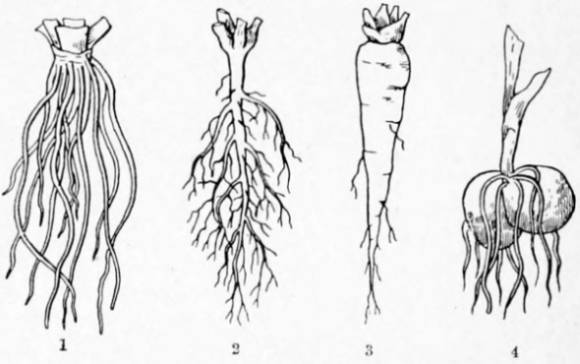
Forms of Roots
1. Simple fibrous. 2. Branched fibrous. 3. Tap root. 4. Tuberous root.
Roots are capable of absorbing liquids only, and all fertile soils
contain more or less soluble mineral matter which is dissolved by the
moisture present. This matter is absorbed mainly by the minute
root-hairs—outgrowths of the superficial cells—which are to be found
on the rootlets or small branches that are given off from the main
descending axis.
The principal forms of roots occurring in our flowering plants are:—
1. The simple fibrous root, consisting of unbranched fibres such as we
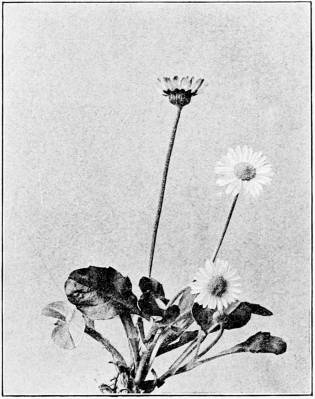
see in the Bulbous Buttercup and the Common Daisy.
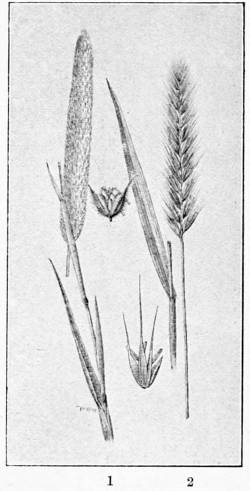
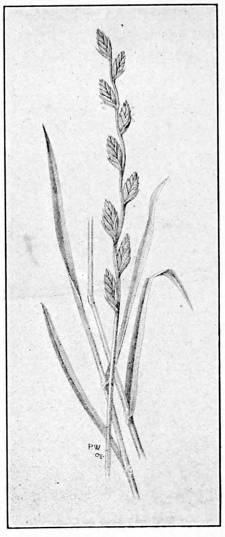
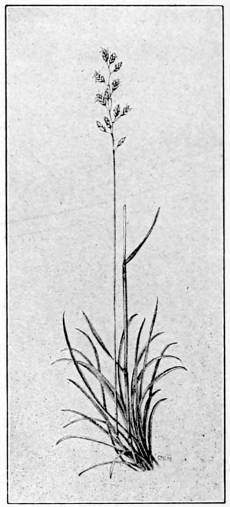
2. The branched fibrous root, as that of the Chickweed and Grasses.
3. The tap root, which is thick above and tapers downwards, like the
roots of the Dandelion, Carrot and Wild Parsnip.
4. The tuberous root, common among the Orchids.
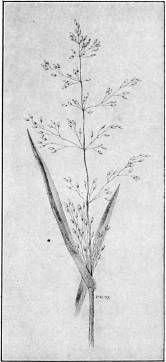
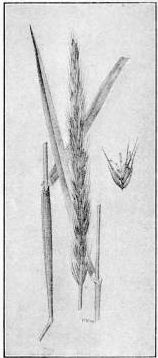
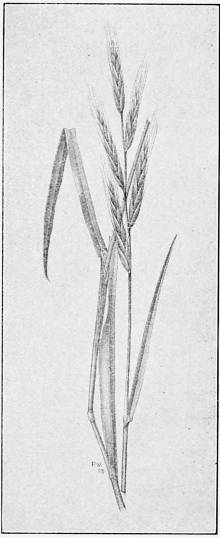
5. The creeping root, possessed by some Grasses in addition to their
fibrous roots.
Besides these common forms there are roots of a somewhat exceptional
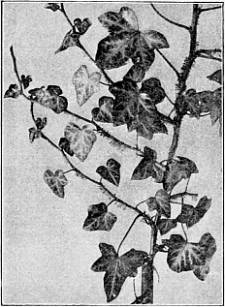
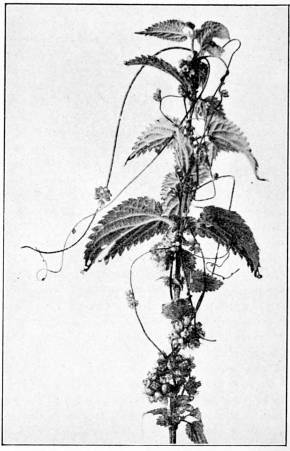
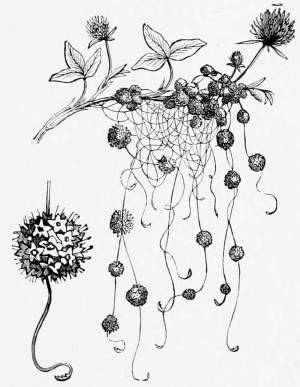
character, such as the aerial roots or suckers which grow from the
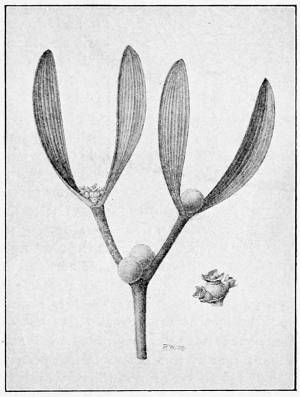
stem of the Ivy and serve to support the plant; and the roots of the
Mistletoe, which, instead of penetrating the soil, force their way into
the substance of certain trees, from which they derive the necessary
nourishment.
The student of plant life must always be careful to distinguish between
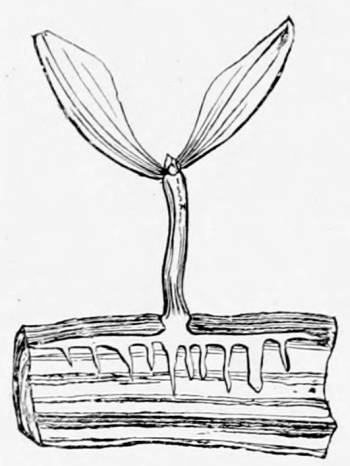
roots and underground stems, for there are many examples of creeping and
tuberous stems which resemble certain roots in general appearance. A
true root bears no buds, and, therefore, is not capable of producing new
plants. If a root creeps under the ground, as does the root of the
Barley Grass, it merely serves the purpose of collecting nourishment
from a wider area—a matter of considerable importance when the soil is
dry and deficient in suitable mineral food. A creeping stem, on the
other hand, developes buds as it proceeds, each bud giving rise to a new
plant; and the creeping itself is the result of the growth of a
permanent terminal bud.
Again, when studying plants for the purpose of identification, it is
often important to note whether the root is annual, biennial, or
perennial; that is, whether the root lives for one season only, lives
throughout the winter, and supports the plant for a second season, or
retains its life for an indefinite number of years.
Most of the roots that live over one season are of a fleshy nature,
thick and tapering, or tuberous, and contain more or less stored
nourishment which assists the new growths that are called forth by the
warmth and light of the early spring sun.
The stems of plants exhibit a much greater variety of structure and
habit than do the roots. Their chief functions are to support the leaves
and flowers, and to arrange these parts in such a manner that they
obtain the maximum of light and air; also to form a means of
communication by which the sap may pass in either direction. Stems also
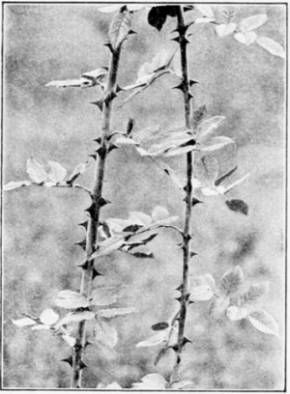
frequently help to protect the plant, either by the development of
thorns or prickles, or by producing hairs which prevent snails and slugs
from reaching and devouring the leaves and flowers.
The character of the stem is often of some importance in determining the
species, so we must now note the principal features that should receive
our attention.
As regards surface, the stem may be smooth or hairy. In general
form, as seen in transverse section, it may be round, flattened,
triangular, square, or traversed longitudinally by ridges and
furrows more or less distinct. Flattened stems are sometimes more or
less winged with leaf-like extensions, as in the Everlasting Pea, in
which case the wings perform the functions of foliage leaves. It should
also be noted whether the stems are herbaceous, or woody, and
whether they are hollow, or jointed.
In some plants the stem is so short that the leaves appear to start
direct from the root, as in the Dandelion and Primrose. Such stems are
said to be inconspicuous.
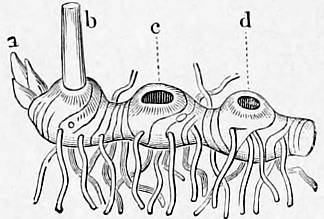
Running Underground Stem of Solomon's Seal
a, Terminal bud from which the next
year's stem is developed; b, Stem of the present year; c, and d, Scars of the
stems of previous years.
The longer and conspicuous stems are either simple or branched, and
they may be erect, prostrate, trailing, climbing, or running.
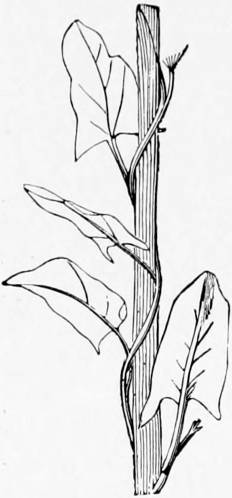
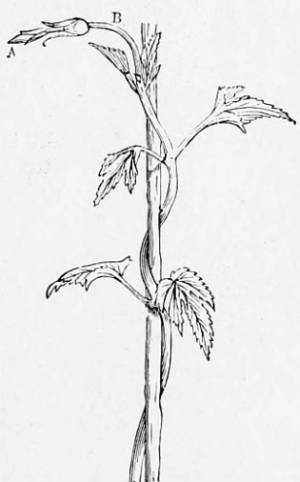
In the case of climbing stems it should be noted whether the necessary
support is obtained by means of tendrils, rootlets, or suckers, or by
the twining of the stem itself.
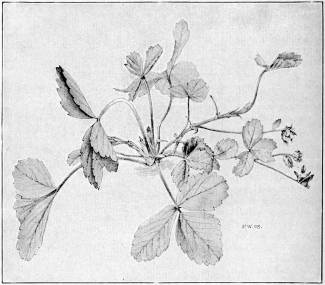
Running stems are those which run along the surface of the ground by the
continued growth of a terminal bud, and produce new plants at intervals,
as in the case of the Wild Strawberry. Many stems, however, creep under
the ground, and these should always be distinguished from running roots,
from which they may be known by the production of buds that develop into
new plants, as in the Iris and Solomon's Seal.
The arrangement of the leaves on the stem is a matter of great
importance for purposes of identification. Especially should it be noted
whether the leaves are opposite, alternate, whorled (arranged in
circles round the stem), or radical (apparently starting direct from
the root).
Some leaves have smaller leaves or scales at their bases, that is, at
the points where they are attached to the stem of the plant. Such leaves
or scales are termed stipules. They are often so well developed that
they are as conspicuous as the ordinary foliage leaves, and in such
instances they perform the functions of the latter. The presence and
character of the stipules should always be noted. A leaf without
stipules is said to be exstipulate.
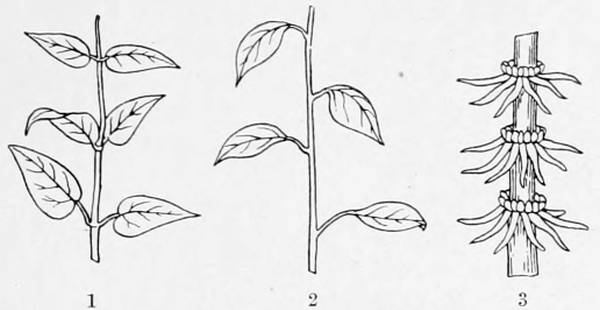
Arrangement of Leaves
1. Opposite. 2. Alternate. 3. Whorled.
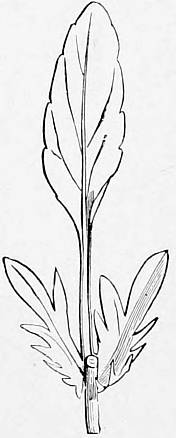
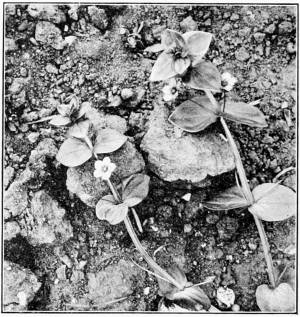
Leaf of the Pansy with Two Large Stipules.
A leaf usually consists of two distinct parts—the petiole or stalk,
and the lamina or blade. Some, however, have no petiole, but the blade
is in direct contact with the stem. These leaves are said to be
sessile, and some of them clasp the stem, or even extend downwards on
the stem, forming a wing or a sheath.
A leaf is said to be simple when the blade is in one continuous whole,
even though it may be very deeply divided; but when the blade is cut
into distinct parts by incisions that extend quite into the midrib (the
continuation of the stalk to the tip of the leaf), the leaf is
compound.
The student must be careful to distinguish between compound leaves and
little branches or twigs bearing several simple leaves, for they are
often very similar in general appearance. The compound leaf may always
be known by the total absence of buds, and often by the presence of one
or more stipules at the base of its stalk; while a branch bearing a
similar appearance usually has a terminal bud, also buds in the exils of
its leaves, and never any stipules at the point where it originates. The
distinct parts of compound leaves are termed leaflets.
Attention to the form and character of the leaf is often of as much
importance as the observation of the flower in the determination of
species. Not only should we note the general shape of the leaf, but also
the character of its surface, its margin, and its apex. The surface may
be smooth, hairy, downy, velvety, shaggy, rough, wrinkled
or dotted. The margin is said to be entire when it is not broken by
incisions of any kind. If not entire it may be toothed, serrate
(sawlike), crenate or wavy. Sometimes it happens that the teeth bear
still smaller teeth, in which case the margin is said to be doubly
toothed; or, if the teeth are sawlike, it is doubly serrate. As
regards the apex, it is generally sufficient to note whether it is
acute (sharp), obtuse (blunt), or bifid (divided into two).
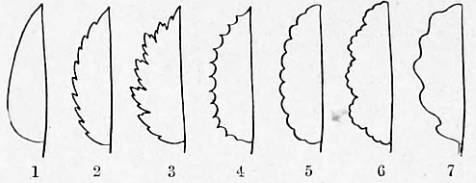
Margins of Leaves
1. Entire. 2. Serrate or sawlike. 3. Doubly serrate. 4. Dentate or
toothed. 5. Crenate. 6. Doubly crenate. 7. Sinuate or wavy.
It is not necessary to describe separately all the principal forms of
simple and compound leaves. These are illustrated, and the student
should either make himself acquainted with the terms applied to the
different shapes, or refer, as occasion requires, to the illustrations.
Concerning the compound leaves, however, their segments are themselves
sometimes divided after the manner of the whole, and even the secondary
segments may be similarly cut. Thus, if the segments of a pinnate leaf
are themselves pinnately compound, the leaf is said to be bi-pinnate;
and, if the secondary segments are also compound, it is a tri-pinnate
leaf.
We must now turn our attention to the different kinds of inflorescence
or arrangement of flowers. Flowers are commonly mounted on stalks
(peduncles), but in many cases they have no stalks, being attached
directly to the stem of the plant, and therefore said to be sessile.
Whether stalked or sessile, if they arise from the axils of the
leaves—the angles formed by the leafstalks and the stem—they are said
to be axillary. When only one flower grows on a stalk it is said to be
solitary; but in many cases we find a number of flowers on one
peduncle, in which instances, should each flower of the cluster have a
separate stalk of its own, the main stalk only is called the peduncle,
and the lesser stalks bearing the individual flowers are the
pedicels.
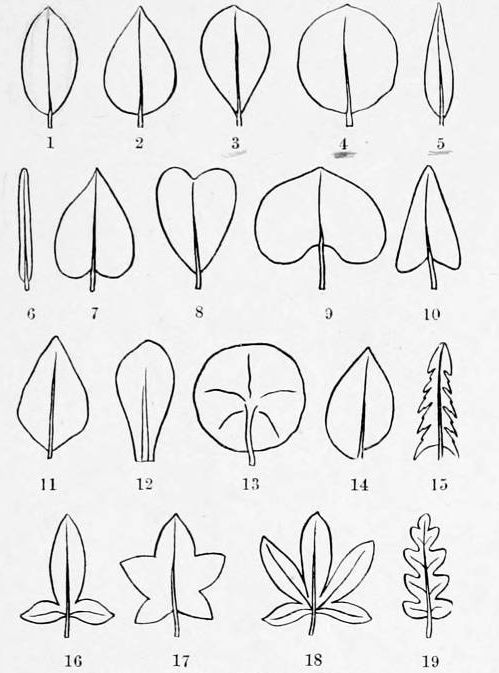
Various Forms of Simple Leaves
1. Oval or elliptical.
2. Ovate.
3. Obovate.
4. Orbicular.
5. Lanceolate.
6. Linear.
7. Cordate (heart-shaped).
8. Obcordate.
9. Reniform (kidney-shaped).
10. Sagittate (Arrow-shaped).
11. Rhomboidal.
12. Spathulate (spoon-shaped).
13. Peltate (stalk fixed to the centre).
14. Oblique.
15. Runcinate (lobes pointing more or less downwards).
16. Hastate (halberd-shaped).
17. Angled.
18. Palmate.
19. Pinnatifid.
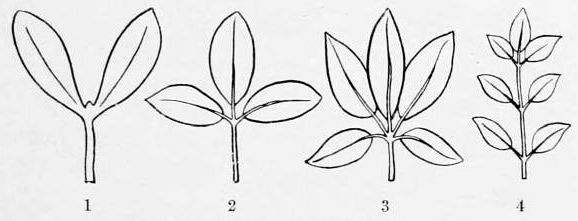
Forms of Compound Leaves
1. Binate. 2. Ternate. 3. Digitate. 4. Pinnate.
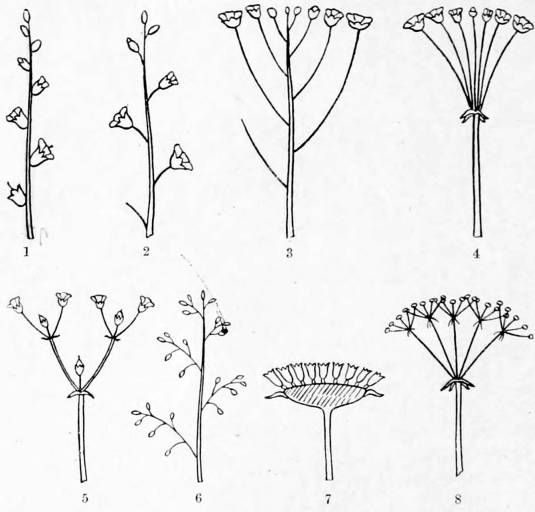
Forms of Inflorescence
1. Spike. 2. Raceme. 3. Corymb. 4. Umbel. 5. Cyme. 6. Compound
Raceme or Panicle. 7. Capitulum or Head. 8. Compound Umbel.
It is often convenient to make use of certain terms to denote the
various arrangements of flower-clusters, and the principal of these are
as follows:—
1. Spike.—Sessile flowers arranged along a common axis.
2. Raceme.—Flowers stalked along a common axis.
3. Corymb.—Flowers stalked along a common axis, but the lengths of
the pedicels varying in such a manner as to bring all the flowers to the
same level.
4. Umbel.—The pedicels all start from the same level on the peduncle.
5. Cyme.—An arrangement in which the flower directly at the end of
the peduncle opens first, followed by those on the branching pedicels.
6. Panicle.—A compound raceme—a raceme the pedicels of which are
themselves branched.
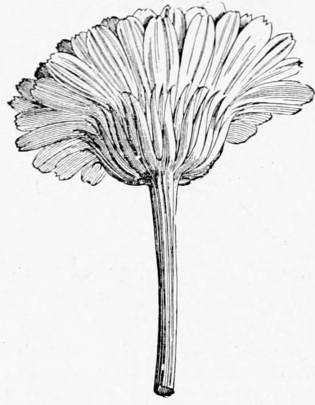
7. Capitulum or Flower-head.—A dense cluster of flowers, all
attached to a common broad disc or receptacle.
Other forms of inflorescence may also be compound. Thus, a compound
umbel is produced when the pedicels of an umbel are themselves
umbellate.
A flower, if complete in all its parts, consists of modified leaves
arranged in four distinct whorls, the parts being directly or indirectly
attached to a receptacle.
The outer whorl is the calyx, and is composed of parts called
sepals, which may be either united or distinct. The calyx is usually
green; but, in some cases, is more or less highly coloured. Sometimes
the calyx is quite free from the pistil or central part of the flower,
the sides of which are thus left naked, and the calyx is then said to be
inferior. If, however, it is united to the surface of the pistil it is
superior. When it remains after other parts of the flower have
decayed, it is said to be persistent.
The second whorl—the corolla—is usually the whorl that gives most
beauty to the flower. It is composed of parts, united or distinct,
called petals.
Both calyx and corolla vary very considerably in shape. They may be
cup-shaped, tubular, bell-shaped, spreading, funnel-shaped, lipped, &c.
If the sepals and petals are arranged symmetrically round a common
centre, the calyx and corolla, respectively, are said to be regular;
if otherwise, they are irregular.
The third whorl consists of the stamens, each of which, in its most
perfect form, is made up of a filament or stalk, and an anther
which, when mature, splits and sets free the pollen that is formed
within it. Sometimes the stamen has no filament, and the anther is then
said to be sessile.
The mode of attachment of the stamens is very variable. They may grow
from immediately below the pistil, or from its summit; or they may be
attached to either the petals or the sepals. The filaments are usually
distinct, but sometimes they are united in such a manner as to form a
tube, or grow into two or more bundles. The anthers are usually
distinct, even when the filaments are united; but these sometimes grow
together.
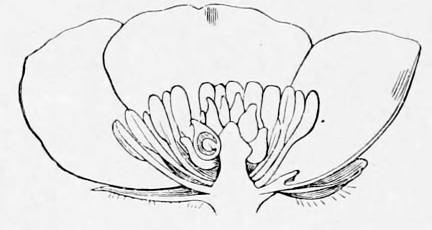
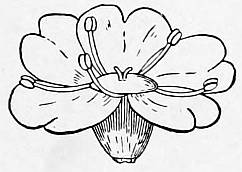
Longitudinal Section Through the Flower of the Buttercup
Showing the calyx, corolla, stamens and pistil. The pistil consists of several
distinct carpels, one of which is represented in section to show its single ovule.
The central part of the flower is the pistil, and this is made up of
one or more parts called carpels. Each carpel, when distinct, is a
hollow case or ovary, prolonged above into one or more stalks or
styles, tipped by a viscid secreting surface called the stigma. The
ovary contains the ovules, attached to a surface called the
placenta; and these ovules, after having been impregnated by the
pollen, develop into seeds which are plants in embryo. The ovary may
have no style, and the stigma is then sessile.
Where the pistil consists of more than one carpel, these carpels may
unite in such a manner as to form a single cell, or an ovary of two or
more cells. In other cases the carpels remain quite distinct, thus
forming a number of distinct ovaries, each with its own stigma. For
purposes of identification it is often necessary to note the position of
the placenta. This may be at the side of the ovary, in which case it is
said to be parietal; or it may stand up in the centre of the ovary,
without any attachment to the sides, when it is described as free
central. If, however, it occupies the centre of the ovary, but is
attached by means of radiating partitions to the sides, it is termed
axile.
If the ovary is quite free in the centre of the flower, the surrounding
parts being attached below it, it is said to be superior; but if the
perianth (p. 11) adheres to it, it is inferior.
A leaf or scale will often be observed at the foot of a flower stalk or
at the base of a sessile flower. This is termed a bract, and a flower
possessing a bract is said to be bracteate. The bract is sometimes so
large that it almost completely encloses the flower, or even a cluster
of flowers.
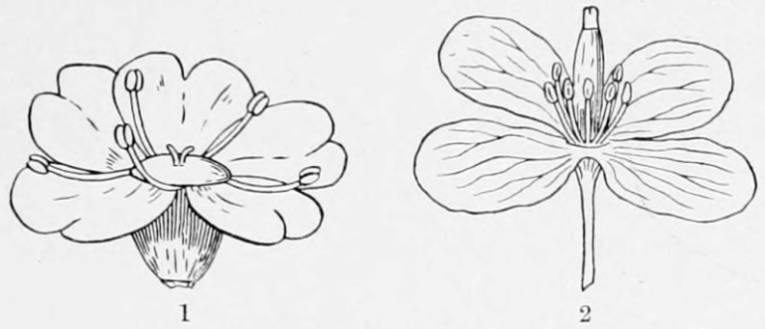
Inferior (1) and Superior (2) Ovary.
The flower is the reproductive part of the plant, being concerned in the
production of the seeds; but the organs directly connected with the
seed-formation are the pistil and the stamens, the former containing the
ovules, and the latter producing the pollen cells by means of which the
ovules are impregnated. Thus the stamens and the pistil are the
essential parts of the flower, though the corolla and the calyx may
perform some subsidiary function in connexion with the reproduction of
the species.
This being the case, a flower may be described as perfect if it
consists of stamens and pistil only, without any surrounding calyx or
corolla; and imperfect if it possesses no pistil or no stamens,
regardless of the presence or absence of calyx and corolla.
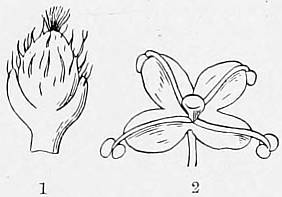
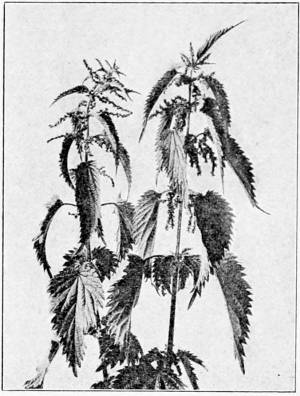
Unisex Flowers of the Nettle
1. Pistillate. 2. Staminate.
The two outer whorls of a well-developed perfect flower (calyx and
corolla) together form the perianth. Some flowers, however have only
one whorl outside the anthers, representing both the calyx and corolla
of the more highly organised flower. This one whorl, therefore, is the
perianth, and its parts are not correctly termed either petals or
sepals, since they represent both.
A perfect flower is sometimes spoken of as bisexual, for it includes
the two sexual organs of the plant—the ovary or female part, producing
the ovules; and the stamens or male part, which is concerned in the
impregnation or fertilisation of the ovules.
Many plants produce only unisexual (and therefore imperfect) flowers,
which contain either no stamens or no pistil. If such possess stamens
and no pistil, they are called staminate or male flowers; and if
pistil and no stamens, pistillate or female flowers. These two kinds
are sometimes borne on the same plant, when they are said to be
monœcious; but often on separate plants (diœcious), as in some
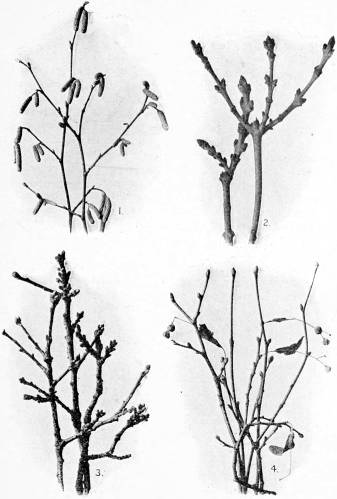
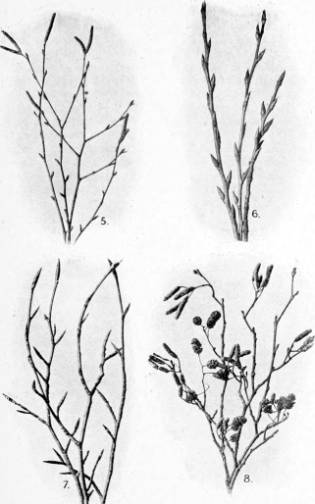
of the Nettleworts and the Willow Tree. Spikes of unisexual flowers,
such as are common among our forest trees, are called catkins.
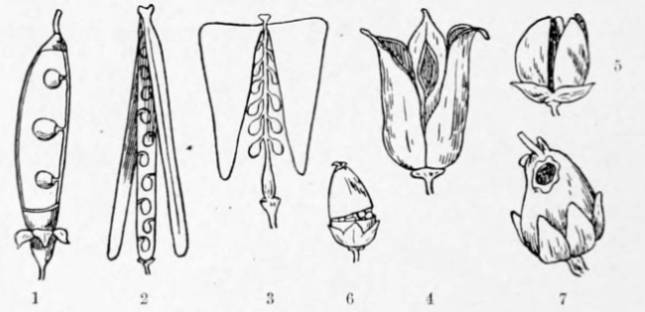
Dehiscent Fruits
1. Pod. 2. Siliqua. 3. Silicula.
4. Follicles(cluster of three). 5. Capsule splitting longitudinally.
6. Capsule splitting transversely. 7. Capsule splitting by pores.
After the ovules have been impregnated by the pollen they develop into
seeds, each of which consists of or contains an embryo plant; and, at
the same time, the ovary itself enlarges, changing its character more or
less, till it becomes a ripened fruit.
Fruits vary very considerably in their general characters, but may be
divided into two main groups—those that split when ripe (dehiscent
fruits) and those which do not split (indehiscent fruits).
The principal forms of dehiscent fruits are:—
1. The pod or legume, which splits into two valves, with placenta on
one side.
2. The siliqua, a long, narrow fruit that splits into two valves which
separate from a membrane with placenta on both sides.
3. The silicula, of the same nature as the siliqua, but about as broad
as it is long.
4. The follicle, which splits on one side only, through the placenta.
5. All other fruits that split are termed capsules. Some of these
split longitudinally, some transversely, and others by forming pores for
the escape of the seeds.
The chief kinds of indehiscent fruits are:—
1. The drupe or stone-fruit, which consists of a hard stone surrounded
by a fleshy covering, as the plum and the cherry.
2. The berry, which is soft and fleshy, and contains several seeds,
like the currant and the grape.
3. The nut or achene—a fruit with hard and dry walls, as the
filbert and the acorn.
4. The samara or winged fruit, like that of the sycamore.
Various modifications of these indehiscent fruits are to be met with;
thus, the blackberry is not really a berry, but a cluster of little
drupes formed from a single pistil of many carpels. A berry, too, may be
made up of many parts, as is the case with the orange. The apple and
similar fruits consist of a core (the true fruit) surrounded by a fleshy
mass that is produced from the receptacle of the flower; and the
strawberry is a succulent, enlarged receptacle of the flower, with a
number of little achenes (the true fruits) on its surface.
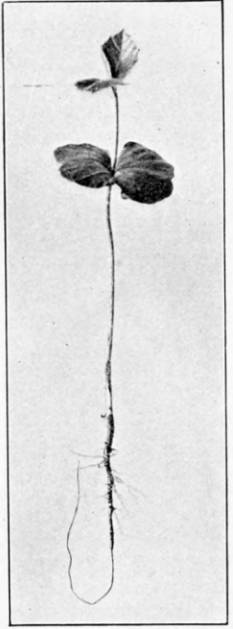
The seed, as we have already observed, is the embryo plant. It consists
of one or more seed-leaves or cotyledons, a radicle or young root,
and a plumule or young bud. In many cases the skin of the seed
encloses nothing more than the three parts of the embryo, as named
above; but it sometimes contains, in addition, a quantity of nutrient
matter in the form of albumen, starch, oil, gum, or other substance.
Our flowering plants are divided into two main groups, the
dicotyledons and the monocotyledons. These terms suggest that the
division is based on the nature of the seed, which is really the case,
but the groups are characterised by differences in other parts. Thus,
the plants which produce seeds with two cotyledons may be known by the
nature of the stem, which consists of a central pith, surrounded by wood
arranged in one or more rings, and the whole enclosed in an outer
epidermis or in a bark. These plants also bear leaves with netted veins,
and the parts of the flower are usually in whorls of four or five or
multiples of four or five. Those plants whose seeds have only one
cotyledon may be known by the absence of a central pith and true bark in
the stem, while the wood is arranged in scattered bundles instead of in
a ring or rings. They have also, generally, leaves with parallel veins;
and the parts of the flower are usually in threes or multiples of three.
The following table shows these features at a glance:—
| Dicotyledons |
Monocotyledons |
| Embryo with two cotyledons. |
Embryo with one cotyledon. |
| Stem with central pith, wood in rings or rings, and bark. |
Stem with no central pith, no true bark, and wood not in rings. |
| Leaves with netted veins. |
Leaves with parallel veins. |
| Parts of flower usually in fours or fives. |
Parts of flower arranged in threes or multiples of three. |
These two great divisions or classes are split up into sub-classes,
each embracing a large number of plants with common characters; and the
sub-classes are again divided into orders, and the orders into
genera.
The student should always endeavour to determine the order to which any
flower he finds belongs; and, if possible, the genus and the species. It
is certainly a pleasure to be able to call flowers by their names, but
at the same time it must be remembered that a vast deal of pleasure may
be gained by the study of flowers—their peculiar structure, habits and
habitats—even though their names are unknown; and the student who has
learnt to recognise these characters, and to discover the relationships
that exist between certain flowers of different species, is certainly
much more fortunate than the one who knows abundance of names with only
a meagre acquaintance with the flowers themselves.
Our table of classification gives the most important distinguishing
characters of the classes, sub-classes, and orders, of a very large
proportion of our wild flowers, and will enable the reader to determine
the natural order of almost every one he sees. In order to show how this
table is to be used we will take an imaginary example.
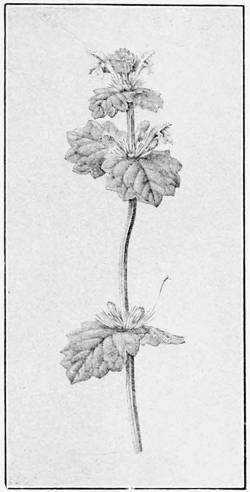
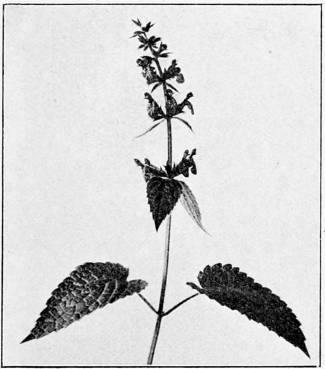
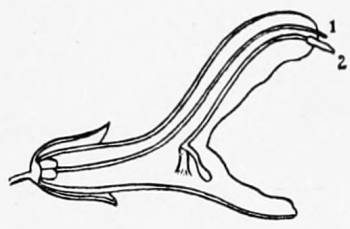
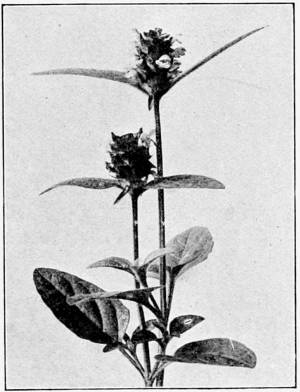
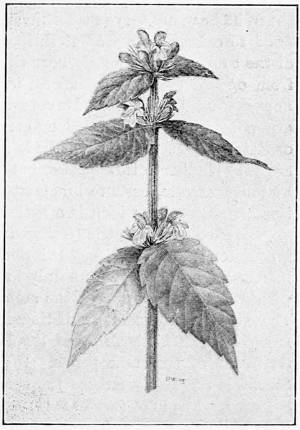
Let us suppose that we find a plant with a square stem; opposite, simple
leaves with netted veins; flowers apparently in whorls, in the axils of
the leaves; persistent calyx of five united sepals; a lipped corolla, of
five united petals, two forming the lower, and three the upper lip; four
stamens, attached to the corolla, two longer than the others; a
superior, four-lobed ovary; and a fruit of four little nuts; then we
proceed to determine the natural order to which it belongs as follows:—
The netted veins of the leaves, and the arrangement of the parts of the
flower in whorls of four and five, show us at once that the plant is a
dicotyledon. Then, the presence of both calyx and corolla enables us
to decide that the plant belongs to Division I. of the
dicotyledons—that it belongs to one of the orders 1 to 59. Noting, now,
that the corolla is composed of united petals, we are enabled to fix its
position in the subdivision I.B, among orders 37 to 59. Next, the
superior ovary shows that it must be located in the group I.B 2—orders
44 to 59; and as the stamens are attached to the corolla, we see at once
that it is not a member of order 44. Turning now to the Synopsis of the
Natural Orders (p. 17), we find that the irregular flowers of
this group of orders occur only in 51, 52, 53, 54, and 56. Finally, the
square stem, opposite leaves, and character of the fruit, show us that
the plant must belong to the order Labiatæ.
The student should, as far as possible, deal with all flowers in this
manner, assigning each one to its proper order; and, if he preserves his
specimens for future observation, the names of the orders should always
be attached, and the plants arranged accordingly.
Again, should the reader meet with a common flower the name of which was
previously known, while he is as yet ignorant as to the order to which
it belongs; or, should he find a flower that he can at once identify by
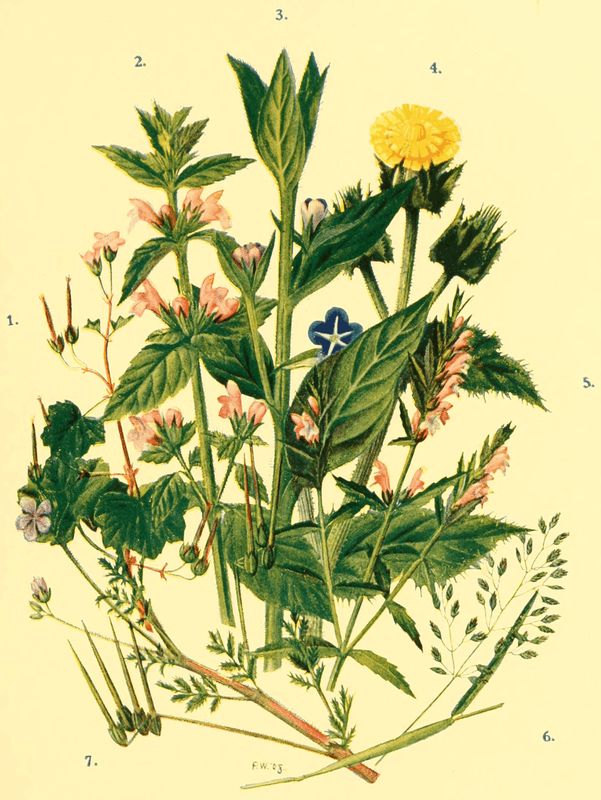
means of one of our illustrations; he should not rest satisfied on
seeing that the name of the order is given beside the name of the plant,
but turn to the synopsis, and note the distinguishing characters which
determine the natural position of the plant. In this way he will
cultivate the habit of careful observation; will make much more rapid
progress in forming an acquaintance with plants in general, and will
soon become familiar with those natural affinities which mark, more or
less distinctly, a cousinship among the flowers.
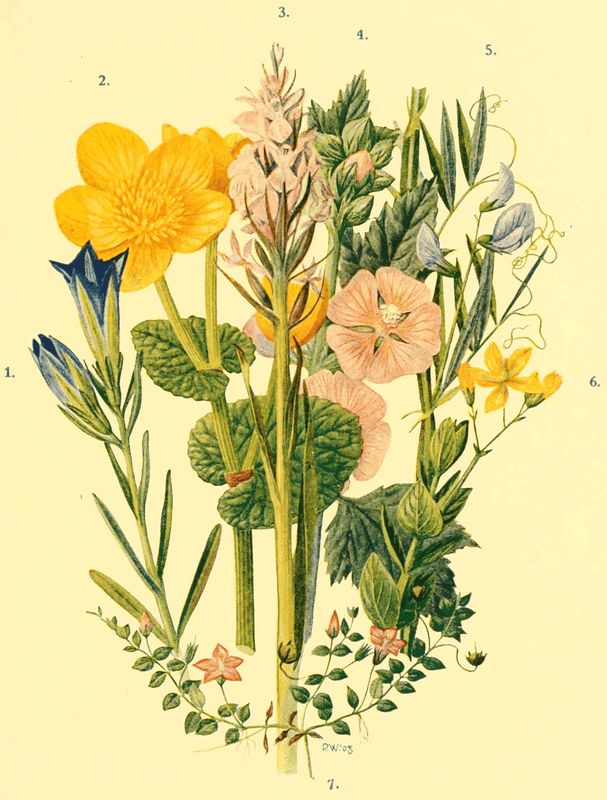
To aid the reader in this part of his work we have given the name of the
natural order with the name of every plant described; and, where
difficulties are likely to occur in the identification of similar common
species of the same genus, though perhaps only one member of the genus
has been selected for description, a few notes are often included with
the object of assisting in the identification of the others.
In our descriptions of wild flowers we do not always repeat those
features which are common to the species of their respective orders.
These features are, however, of the greatest importance; and thus it is
essential that the reader makes himself acquainted with them, by
referring to the synopsis of the orders, before noting those characters
which are given as being more directly concerned in the determination of
the species themselves. Thus, when we describe the Pasque Flower (p.
297) we do not refer to those general characters that apply to
all the Ranunculaceæ or Buttercup family, and which may be seen at
once by referring to p. 17, but give all those details that are
necessary to enable one to distinguish between the Pasque Flower and the
other members of the same order.
Dicotyledons
(Leaves with netted veins. Parts of flower generally in fours or fives
or multiples of four or five)
- I. Flowers with both calyx and corolla.
- A. Corolla composed of free and separate petals.
- 1. Stamens attached to base of flower, beneath the pistil—Orders 1-22.
- 2. Stamens attached above or around the pistil—Orders 23-36.
- B. Corolla of united petals.
- 1. Ovary inferior.
- a. Stamens on the corolla—Orders 37-41.
- b. Stamens on the ovary—Orders 42-43.
- 2. Ovary superior.
- a. Stamens free from the corolla—Order 44.
- b. Stamens on the corolla—Orders 45-59.
- II. Flowers with calyx or corolla or both absent.
- A. Flowers with corolla absent, and, generally, with stamens and pistil in the same flower.
- 1. Ovary superior—Orders 60-64.
- 2. Ovary inferior—Orders 65-67.
- B. Corolla and calyx usually absent. Stamens and pistil usually in separate flowers.
- 1. Flowers not in catkins—Orders 68-71.
- 2. Flowers in catkins—Orders 72-76.
Monocotyledons
(Leaves usually with parallel veins. Parts of flower in
threes or multiples of three)
- I. Perianth (see p. 11), coloured or petal-like, not scaly. (Sometimes absent.)
- A. Ovary inferior.
- 1. Leaves with parallel veins—Orders 77-80.
- 2. Leaves with netted veins—Order 81.
- B. Ovary superior—Orders 82-88.
- II. Flowers without perianth, enclosed in scales or husks.
- A. Grassy herbs, with solid stems; leaves forming unsplit
sheaths round the stem; flowers in spikelets, with one
to three stamens—Order 89.
- B. Grassy herbs, with hollow stems; leaves generally forming
split sheaths round the stem; flowers generally
perfect, with three stamens—Order 90.
1. Ranunculaceæ.—Herbs mostly with alternate leaves and regular
flowers. Sepals generally 5, distinct. Petals 5 or more. Stamens 12 or
more. Pistil of many distinct carpels. Fruit of many one-seeded achenes.
(The Buttercup Family.)
2. Berberidaceæ.—Shrub with compound spines; alternate, spiny leaves;
and pendulous flowers. Sepals 6. Petals 6. Stamens 6. Fruit a berry.
(The Berberry Family.)
3. Nymphæaceæ.—Aquatic plants with floating leaves and solitary
flowers. Petals numerous, gradually passing into sepals outwards, and
into stamens inwards. Ovary of many cells, with many seeds. (The
Water-lily Family.)
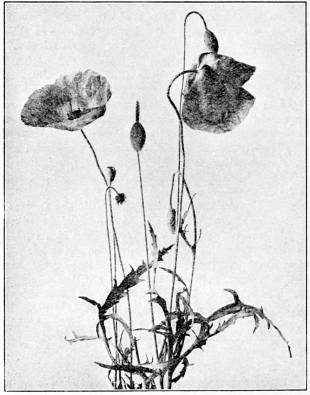
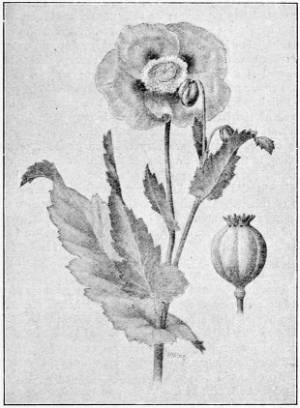
4. Papaveraceæ.—Herbs with a milky sap; alternate leaves without
stipules; and regular (generally nodding) flowers. Sepals 2, deciduous.
Fruit a capsule. Petals 4. Stamens many. Ovary one-celled, but with many
membranous, incomplete partitions. (The Poppy Family.)
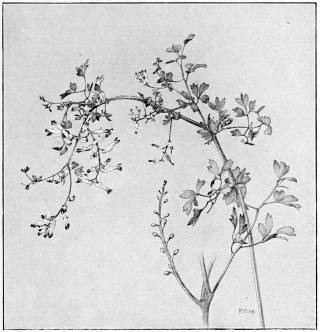
5. Fumariaceæ.—Herbs with much divided, exstipulate leaves; and racemes
of small irregular, bracteate flowers. Sepals 2 or 0, deciduous. Petals
4, irregular. Stamens 6, in two bundles. Ovary of two carpels,
one-celled. (The Fumitory Family.)
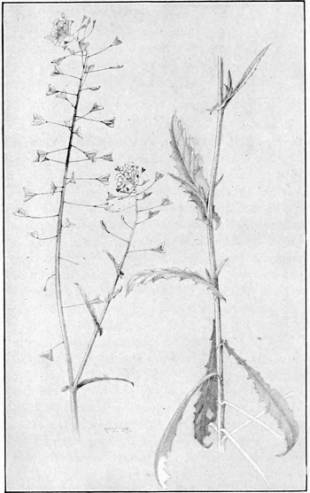
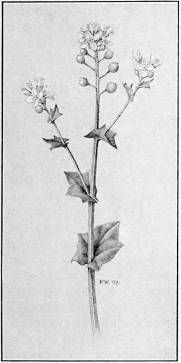
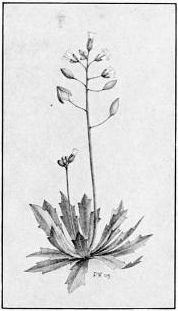
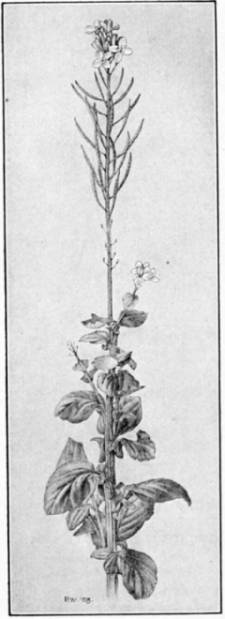
6. Cruciferæ.—Herbs with alternate, exstipulate leaves, and racemes of
regular flowers. Sepals 4. Petals 4, cruciform. Stamens 6, four longer
and two shorter. Ovary one-or two-celled. Fruit a siliqua. (The Cabbage
Family.)
7. Resedaceæ.—Herbs or shrubs with alternate, exstipulate leaves; and
spikes of irregular, greenish flowers. Sepals 4 or 5, persistent. Petals
4 to 7, irregular. Stamens many. Ovary of 3 lobes, one-celled. (The
Mignonette Family.)
8. Cistaceæ.—Herbs or undershrubs with entire, opposite leaves; and
conspicuous, regular flowers. Sepals 3 to 5. Petals 5, twisted in the
bud. Stamens many. Ovary of 3 carpels, one-chambered. (The Rock-rose
Family.)
9. Violaceæ.—Herbs with alternate, stipuled leaves; and axillary,
irregular flowers. Sepals 5, persistent. Petals 5, unequal, the lower
one prolonged into a spur. Stamens 5. Ovary of three carpels,
one-celled. (The Violet Family.)
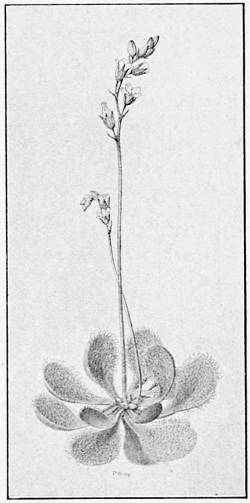
10. Droseraceæ.—Small marsh plants with radical, glandular leaves; and
cymes of small, white, regular flowers. Sepals 5. Petals 5. Stamens 5 or
10. Ovary of 3 to 5 carpels, one-celled. (The Sundew Family.)
11. Polygalaceæ.—Herbs with alternate, scattered, exstipulate, simple
leaves; and racemes of irregular flowers. Sepals 5, the inner ones
resembling petals. Petals 3 to 5, unequal. Stamens 8, in two bundles.
Ovary two-celled. Fruit a capsule. (The Milkwort Family.)
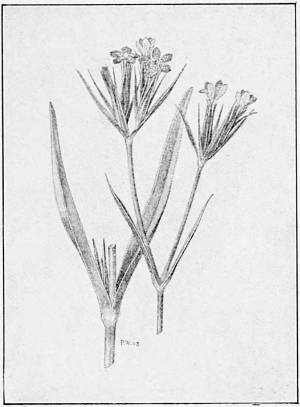
12. Frankeniaceæ.—Herb with opposite, exstipulate leaves; and small,
axillary, red, regular flowers. Sepals 4 to 6, united into a tube.
Petals 4 to 6. Stamens 4 to 6. Ovary of 2 to 5 carpels, one-celled. (The
Sea Heath.)
13. Elatinaceæ.—Small aquatic herbs, with opposite, stipulate,
spathulate leaves; and minute, axillary, red flowers. Sepals, petals and
stamens 2 to 5. Fruit a capsule with 2 to 5 valves. (The Waterwort
Family.)
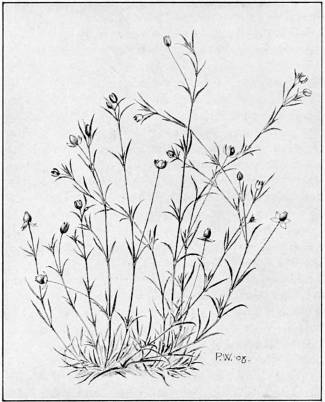
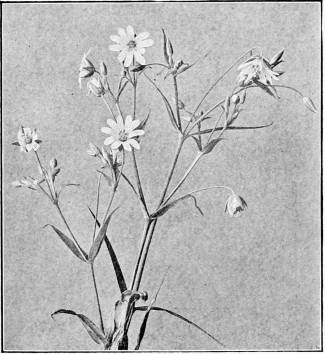
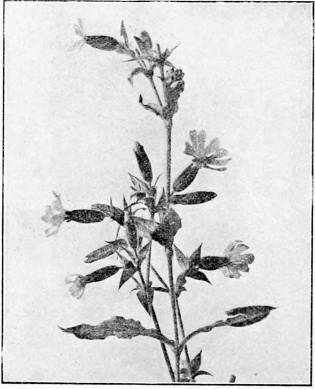
14. Caryophyllaceæ.—Herbs mostly with jointed stems; opposite, simple
leaves; and red or white, regular flowers. Sepals 4 or 5. Petals 4 or 5.
Stamens 8 or 10. Styles 2 to 5. Fruit a one-celled capsule, opening at
top by teeth. (The Pink Family.)
15. Linaceæ.—Herbs with slender stems; narrow, simple, entire,
exstipulate leaves; and cymes of regular flowers. Sepals, petals,
stamens, and carpels 4 or 5. Petals twisted in the bud, fugacious
(falling early). Carpels each with two ovules. Fruit a capsule of 3 to 5
cells. (The Flax Family.)
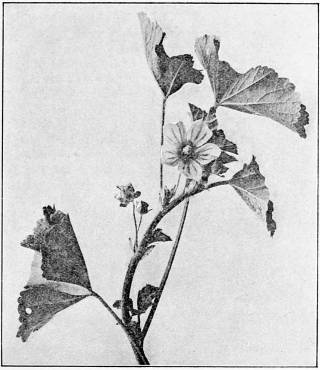
16. Malvaceæ.—Herbs or shrubs with alternate, stipuled leaves; and
conspicuous, axillary, regular flowers. Sepals 5. Petals 5, twisted in
the bud. Stamens many, united into a tube. Carpels many, each with one
ovule. (The Mallow Family.)
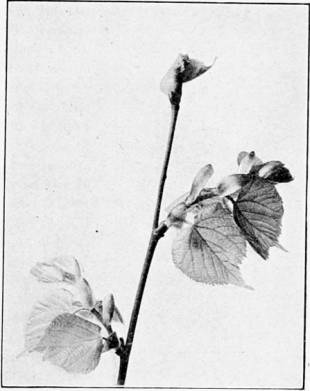
17. Tiliaceæ.—Trees with alternate, stipuled, oblique, serrate leaves;
a large bract adherent to the flower stalk; and cymes of greenish,
regular flowers. Sepals and petals 5. Stamens many. Carpels 5, each with
two ovules. (The Linden Family.)
18. Hypericaceæ.—Herbs or shrubs with opposite, simple, exstipulate
leaves, often dotted with glands; and cymes of conspicuous yellow,
regular flowers. Sepals 4 or 5, with glandular dots. Petals 4 or 5,
twisted in the bud. Stamens many, united into several bundles. Carpels 3
to 5, with many ovules. Fruit a capsule with 3 to 5 cells. (The St.
John's-wort Family.)
19. Aceraceæ.—Trees with opposite, palmately-lobed leaves; and small,
green, regular flowers. Sepals and petals 4 to 9. Stamens 8, on the
disc. Fruit a samara. (The Maple Family.)
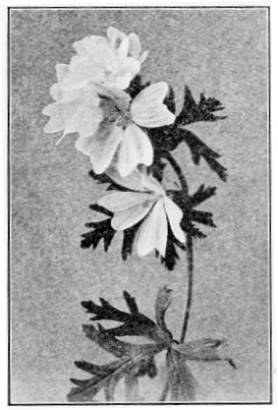
20. Geraniaceæ.—Herbs with lobed, generally stipulate leaves; and
conspicuous, regular flowers. Sepals 3 to 5, persistent. Petals 3 to 5.
Stamens 5 to 10. Carpels 3 to 5, surrounding a long beak. (The
Crane's-bill Family.)
21. Balsaminaceæ.—Herbs with simple, alternate leaves; and axillary,
irregular, yellow flowers. Sepals 3 or 5, one forming a wide-mouthed
spur. Petals 5, four of which are united in pairs. Stamens 5. Fruit a
capsule with five elastic valves. (The Balsam Family.)
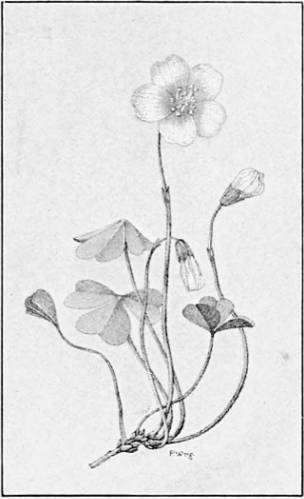
22. Oxalidaceæ.—Low herbs, with radical, generally trifoliate leaves;
and axillary, regular flowers. Sepals 5. Petals 5, united at the base.
Stamens 10. Ovary five-celled, with many ovules. (The Wood Sorrel
Family.)
23. Celastraceæ.—Trees or shrubs, with opposite leaves; and small,
regular flowers in axillary cymes. Sepals and petals usually 4. Stamens
usually 4, alternating with the petals. Carpels 4. Fruit a fleshy
capsule. (Spindle Tree.)
24. Rhamnaceæ.—Shrubs with simple leaves; small, greenish flowers; and
berry-like fruit. Sepals, petals, and stamens 4 or 5. Stamens opposite
the petals. Ovary superior, three-celled, with one ovule in each cell.
(The Buckthorn Family.)
25. Leguminosæ.—Herbs or shrubs with alternate, stipuled leaves,
generally pinnate or ternate, often tendrilled; and papilionaceous
(butterfly-like) flowers. Sepals 5, combined. Petals 5, irregular.
Stamens generally 10, all, or nine of them united. Ovary superior. Fruit
a pod. (The Pea Family.)
26. Rosaceæ.—Trees, shrubs, or herbs with alternate, stipuled leaves;
and conspicuous, regular flowers. Sepals 4 or 5. Petals 4 or 5. Stamens
many. Carpels 1, 2, 5, or many. (The Rose Family.)
27. Onagraceæ.—Herbs with mostly entire, simple, exstipulate leaves;
and conspicuous, regular flowers. Sepals 2 to 4. Petals 2 to 4, twisted
in the bud, or absent. Stamens 2 to 4, or 8. Ovary inferior, with
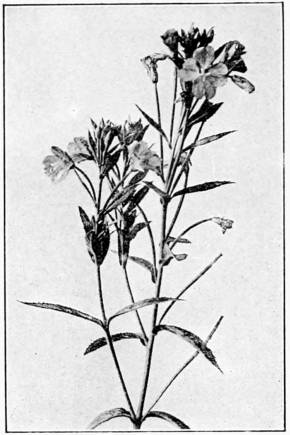
carpels 1 to 6 (usually 4), many-seeded. (The Willow-herb Family.)
28. Haloragiaceæ.—Aquatic herbs with whorled leaves and minute flowers.
Sepals 2 to 4 or absent. Petals 2 to 4 or absent. Stamens 1, 2, 4, or 8.
Ovary inferior. Carpels 1 to 4. (The Mare's-tail Family.)
29. Lythraceæ.—Herbs with opposite or whorled, entire leaves; and
conspicuous, regular flowers. Sepals, and petals 3 to 6. Stamens
generally twice as many as petals. Ovary superior. Carpels 2 to 6. Fruit
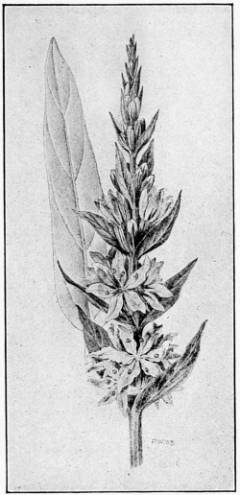
a many-seeded capsule. (The Loosestrife Family.)
30. Tamariscaceæ.—Shrub with minute, scale-like leaves; and lateral
spikes of small, regular flowers. Sepals and petals 4 or 5. Stamens 4 to
10, on the disc. Styles 3. (The Tamarisk.)
31. Cucurbitaceæ.—Rough, climbing herb, with tendrilled,
palmately-lobed leaves; greenish, diœcious flowers in axillary
racemes; and scarlet berries. Sepals and petals 5, united. Stamens 3.
Ovary inferior. Carpels 3. (The White Bryony.)
32. Saxifragaceæ.—Shrubs and herbs with regular flowers. Sepals and
petals 4 or 5. Stamens 4 or 10. Carpels 2 or 4, united. (The Saxifrage
Family.)
33. Crassulaceæ.—Succulent herbs with simple leaves; and small,
regular, starry flowers. Sepals, petals, and carpels 3 to 20, usually 5.
Stamens twice as many as the petals. Carpels superior, forming
follicles. (The Stonecrop Family.)
34. Araliaceæ.—Climbing shrub with clinging rootlets, evergreen leaves,
umbels of yellowish flowers, and black berries. Sepals, petals, stamens,
carpels, and seeds 5 each. Ovary inferior. (The Ivy.)
35. Cornaceæ.—Herbs and shrubs with opposite leaves, small flowers, and
berry-like fruits. Sepals, petals, and stamens 4 or 5. Ovary inferior.
Carpels 2, each with one ovule. (The Dogwood Family.)
36. Umbelliferæ.—Herbs with mostly compound, pinnate leaves, sheathing
at the base; and compound umbels of small, white flowers. Sepals,
petals, and stamens 5. Ovary inferior. Fruit of two adhering carpels.
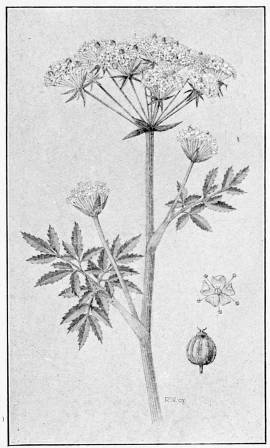
(The Parsley Family.)
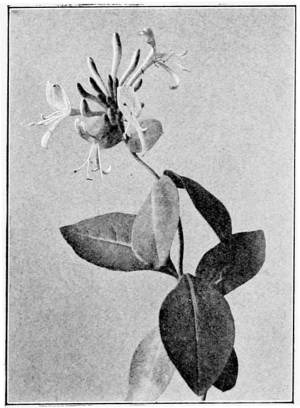
37. Caprifoliaceæ.—Shrubs and herbs with opposite leaves, and
conspicuous (sometimes irregular) flowers. Sepals and petals 3 to 5.
Stamens 4 to 10. Fruit a berry. (The Honeysuckle Family.)
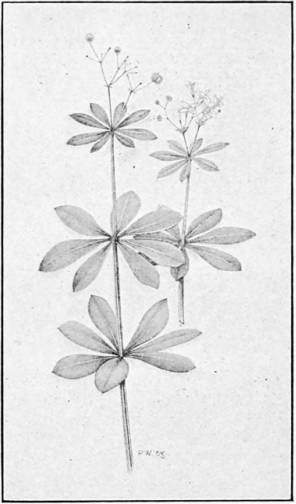
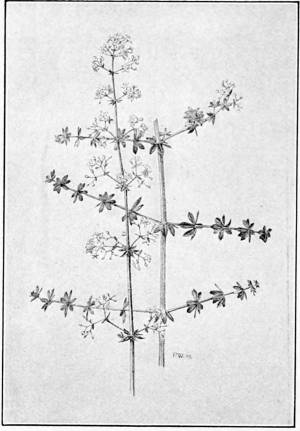
38. Rubiaceæ.—Herbs with whorled leaves; and small, regular flowers.
Sepals, petals, and stamens 4 to 6. Carpels 2. (The Bedstraw Family.)
39. Valerianaceæ.—Herbs with opposite leaves and small (sometimes
irregular) flowers. Sepals 3 to 5, often downy. Petals 3 to 5. Stamens 1
or 3. Ovary of three carpels, one-celled. (The Valerian Family.)
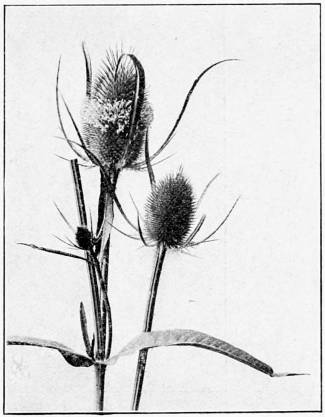
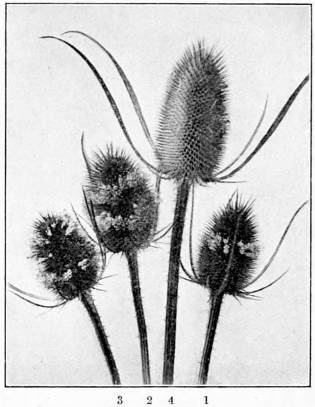
40. Dipsaceæ.—Herbs with opposite leaves; and heads of small flowers,
mostly blue. Calyx enclosed in a whorl of scaly bracts. Petals 4 or 5.
Stamens 4, free. Ovary one-celled and one-seeded. (The Teasel Family.)
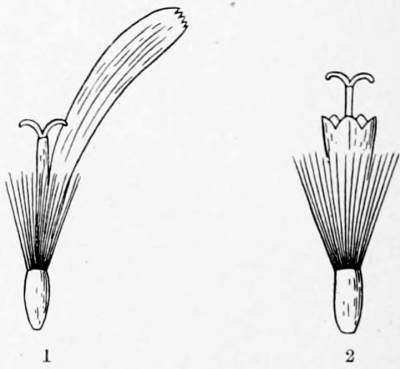
41. Compositæ.—Herbs with heads of small flowers with tubular or
strap-shaped corollas. Calyx absent or represented by a whorl of silky
hairs (pappus). Stamens 4 or 5, anthers generally united. (The Daisy
Family.)
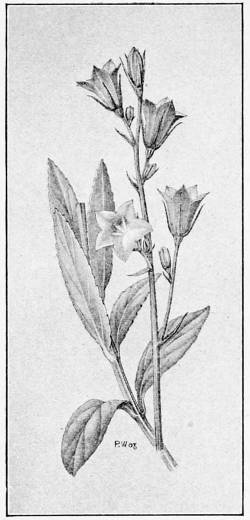
42. Campanulaceæ.—Herbs with milky sap; alternate, entire, scattered
leaves; and usually conspicuous, blue, regular flowers. Sepals, petals,
and stamens 5. Ovary of 2 to 8 carpels. (The Bellflower Family.)
43. Vacciniaceæ.—Low (mostly mountainous) shrubs, with scattered,
simple, alternate leaves; small drooping, reddish or pink, regular
flowers; and edible berries. Sepals, petals, and carpels 4 or 5. Stamens
8 or 10. (The Cranberry Family.)
44. Ericaceæ.—Shrubs or herbs with opposite or whorled, evergreen
leaves; and small conspicuous, regular, flowers. Sepals, petals, and
carpels 4 or 5. Stamens 5 to 10. (The Heath Family.)
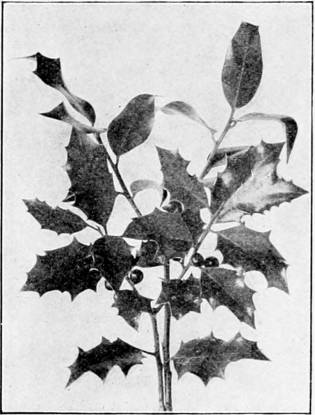
45. Aquifoliaceæ.—Shrub with evergreen, spiny leaves; and small,
greenish, regular flowers. Sepals, petals, stamens, and carpels 4 or 5.
Fruit berry-like, with one-seeded stones. (The Holly.)
46. Oleaceæ.—Trees or shrubs with opposite leaves; and small, regular
flowers. Sepals and petals 4, sometimes absent. Stamens 2. Fruit a berry
or a samara. (The Olive Family.)
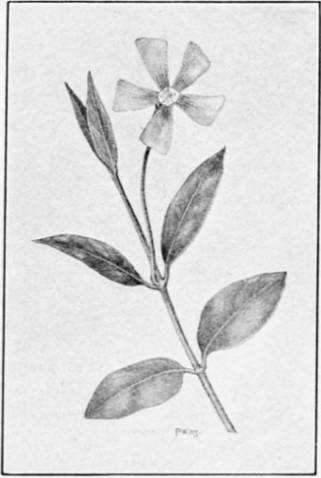
47. Apocynaceæ.—Slender, prostrate shrubs, with milky sap; opposite,
evergreen, entire leaves; and conspicuous, regular, purple flowers.
Sepals, petals, and stamens 5. Corolla salver-shaped. (The Periwinkle
Family.)
48. Gentianaceæ.—Bitter herbs with opposite, simple, entire leaves; and
regular, conspicuous flowers. Sepals, petals, and stamens 4 to 10.
Carpels 2. Fruit a capsule. (The Gentian Family.)
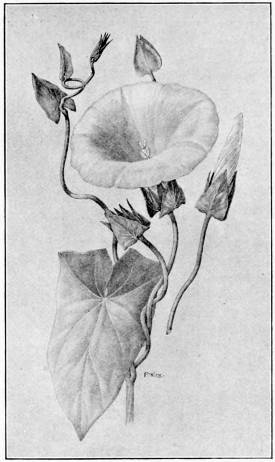
49. Convolvulaceæ.—Herbs, generally twining, with alternate, simple
leaves (sometimes absent); and mostly conspicuous, regular flowers.
Sepals, petals, and stamens 4 or 5. Ovary two-or four-celled. Fruit a
four-seeded capsule. (The Bindweed Family.)
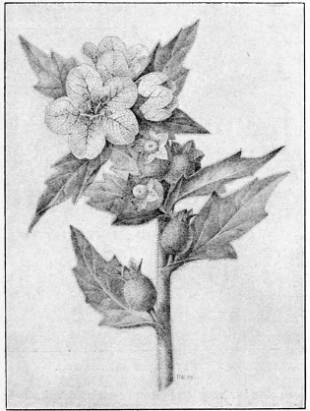
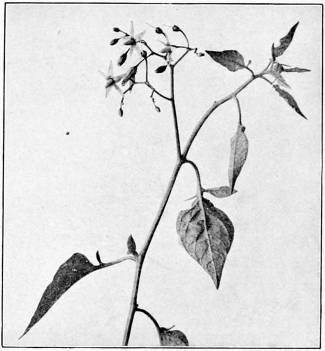
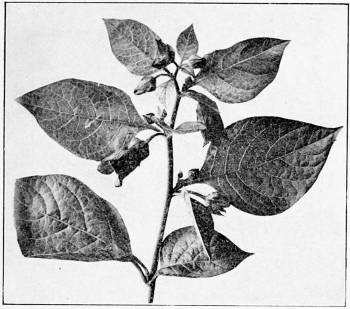
50. Solanaceæ.—Herbs or shrubs with alternate leaves, and axillary
cymes of regular flowers. Sepals, petals, and stamens 5. Ovary
two-celled. Fruit berry-like or a capsule, many seeded. (The Nightshade
Family.)
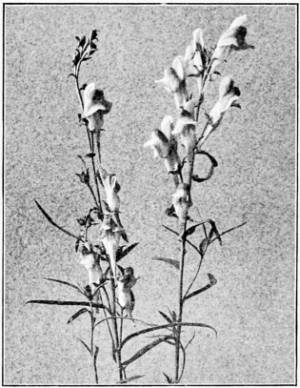
51. Scrophulariaceæ.—Herbs with mostly irregular, lipped flowers.
Sepals and petals 4 or 5. Stamens 2, or 4, two longer than the others.
Carpels 2. Fruit a many-seeded capsule. (The Figwort Family.)
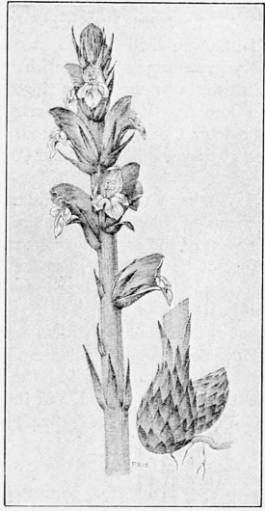
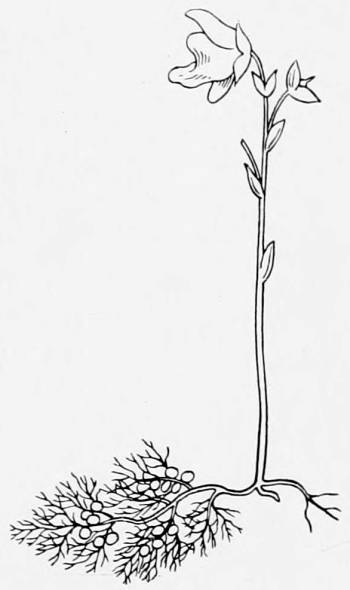
52. Orobanchaceæ.—Fleshy, brown, parasitic plants, with scattered
scale-leaves; and mostly brownish, irregular flowers. Sepals 4 or 5.
Petals 5, lipped. Stamens 4, two longer than the others. Carpels 2.
Fruit a one-chambered, many-seeded capsule. (The Broom-rape Family.)
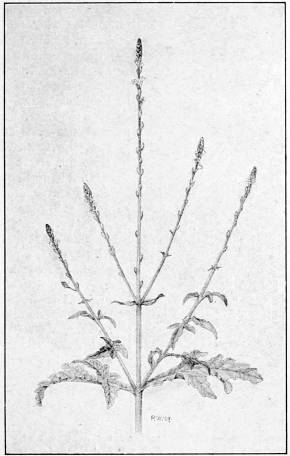
53. Verbenaceæ.—An erect, branched herb, with opposite leaves; and a
compound spike of small, irregular flowers. Sepals and petals 5. Corolla
lipped. Stamens 4, two longer than the others. Ovary four-celled. Fruit
of 4 nutlets. (The Vervain.)
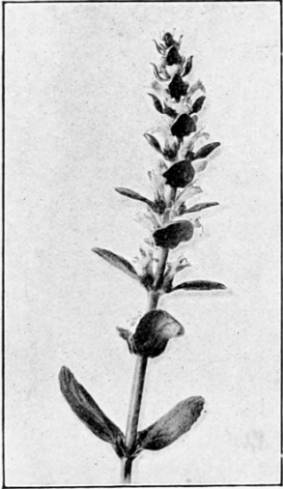
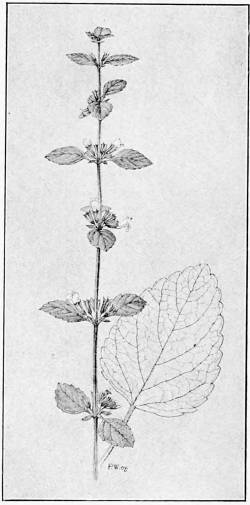
54. Labiatæ.—Herbs, mostly aromatic, with square stems, opposite
leaves, and whorls or cymes of irregular flowers. Sepals and petals 5.
Corolla usually lipped. Stamens 4 (rarely 2), two longer than the
others. Fruit of 4 one-seeded nutlets. (The Dead Nettle Family.)
55. Boraginaceæ.—Herbs, mostly rough, with alternate, simple leaves;
and spikes of conspicuous, regular flowers. Sepals, petals, and stamens
5. Carpels 2. Fruit of 4 one-seeded nutlets. (The Borage Family.)
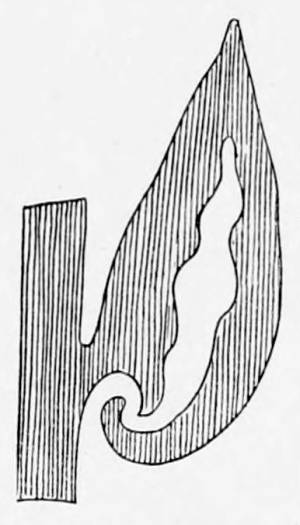
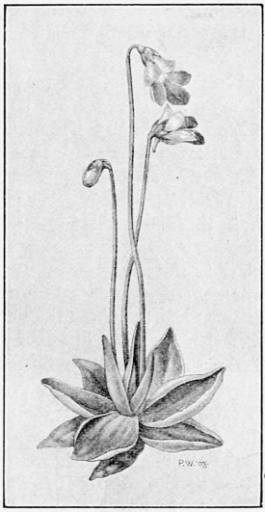
56. Lentibulariaceæ.—Insectivorous, marsh herbs, with radical, entire
leaves, or much-divided floating leaves with bladders; and conspicuous,
irregular flowers. Sepals and petals 5. Corolla usually lipped. Stamens
2. Fruit a one-chambered, many-seeded capsule. (The Butterwort Family.)
57. Primulaceæ.—Herbs, mostly with radical leaves; and conspicuous,
regular flowers. Sepals, petals, and stamens 4 to 9. Stamens opposite
the petals. Ovary one-celled, with free central placenta. Fruit a
many-seeded capsule. (The Primrose Family.)
58. Plumbaginaceæ.—Herbs, mostly maritime, with radical or alternate
leaves; and mostly blue, regular flowers. Sepals, petals, and stamens 5.
Stamens opposite the petals, and usually free. Carpels 3 to 5. Ovary
one-celled and one-seeded. (The Thrift Family.)
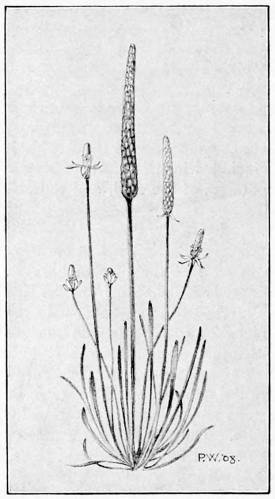
59. Plantaginaceæ.—Herbs with (generally) simple, entire, radical
leaves; and spikes of greenish flowers. Sepals, petals, and stamens 4.
Corolla scaly. Carpels usually 2 or 4. Fruit a one-to four-chambered
capsule. (The Plantain Family.)
Note.—Plants in which calyx or corolla are, or appear to be, absent
occur in orders 1, 6, 14, 26, 27, 28, 29, and 32.
60. Amaranthaceæ.—A smooth, prostrate herb, with scattered, stalked,
exstipulate, simple leaves; and small, axillary, green, monœcious
flowers. Sepals and stamens 3 to 5. (The Amaranth.)
61. Chenopodiaceæ.—Herbs with simple, exstipulate leaves, or leafless,
jointed stems; and small green flowers. Sepals 3 to 5, persistent.
Stamens 1 to 5, opposite the sepals. Fruit indehiscent. (The Goosefoot
Family.)
62. Polygonaceæ.—Herbs with sheathing stipules; alternate, simple
leaves; and small flowers. Sepals 3 to 6, green or coloured, usually
persistent. Stamens 5 to 8. Fruit indehiscent. (The Dock Family.)
63. Eleagnaceæ.—A shrub with silvery scales; alternate, entire,
exstipulate leaves; and inconspicuous, diœcious flowers. Sepals 2 to
4, persistent. Stamens 4. Fruit berry-like. (The Sea Buckthorn.)
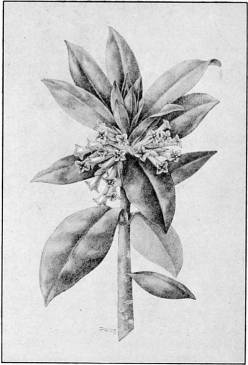
64. Thymelaceæ.—Shrubs with tough inner bark; simple, entire,
exstipulate leaves; and conspicuous, perfect, sweet-scented flowers.
Sepals 4. Stamens 8. Fruit berry-like. (The Spurge Laurel Family.)
65. Loranthaceæ.—A green, parasitic, much branched shrub, with
opposite, simple, entire leaves; inconspicuous, diœcious flowers; and
whitish viscid berries. Sepals and stamens 4. Ovary one-chambered. Berry
one-seeded. (The Mistletoe.)
66. Aristolochiaceæ.—Herbs and climbing shrubs, with alternate leaves
and perfect flowers. Sepals 2 or 3, sometimes coloured, sometimes
lipped. Ovary with 4 to 6 chambers, containing many ovules. (The
Birthwort Family.)
67. Santalaceæ.—A slender, prostrate, root-parasite, with alternate,
linear leaves; and inconspicuous, perfect flowers. Sepals and stamens 4
or 5. Ovary one-celled. Fruit dry, one-seeded. (The Bastard Toad-flax.)
68. Empetraceæ.—A mountain, evergreen, resinous shrub, with alternate,
narrow leaves; and inconspicuous, diœcious flowers. Perianth of 6
scales. Stamens 3. Ovary of 3 to 9 cells, with one ovule in each cell.
(The Crowberry.)
69. Euphorbiaceæ.—Trees, shrubs, or herbs, generally with a milky sap;
simple, entire leaves; and small, inconspicuous flowers, sometimes
enclosed in calyx-like bracts. Perianth of 3 or 4 parts, or absent.
Stamens 1 or many. Fruit separating into 2 or 3 carpels elastically.
(The Spurge Family.)
70. Urticaceæ.—Herbs, often with simple, stinging leaves; and small,
green, clustered, unisexual flowers. Stamens 4 or 5, opposite the
sepals. Ovary superior, one-celled. Fruit indehiscent. (The Nettle
Family.)
71. Ulmaceæ.—Trees with alternate, distichous leaves, and perfect
flowers. Perianth of 4 or 5 parts, bell-shaped. Stamens 4 or 5. Ovary
superior, with one or two cells. Fruit a thin, one-seeded samara. (The
Elm Family.)
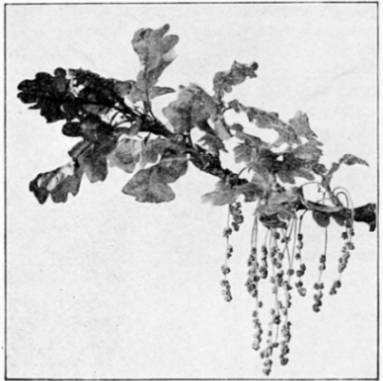
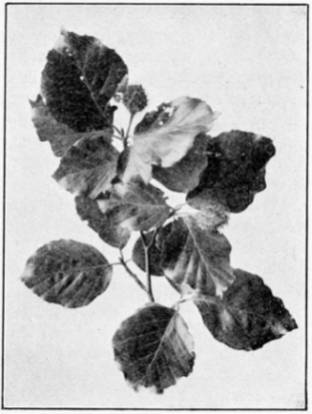
72. Cupuliferæ.—Trees or shrubs with alternate, stipuled, simple
leaves; and small, green flowers. Perianth of 5 or 6 parts. Stamens 5 to
20. Fruit a nut, enclosed in a tough cupule. (The Oak Family.)
73. Betulaceæ.—Trees or shrubs with alternate leaves and small flowers.
Stamens 1 or more. Fruit small, indehiscent, winged, not enclosed in a
cup. (The Birch Family.)
74. Salicaceæ.—Trees with alternate, simple leaves; and flowers which
generally appear before the leaves. Stamens one or more to each scale.
Fruit many-seeded, not enclosed in a cup. (The Willow Family.)
75. Myricaceæ.—A small aromatic shrub, with alternate, simple leaves;
and inconspicuous flowers. Stamens 4 to 8. Fruit a drupe. (The Bog
Myrtle.)
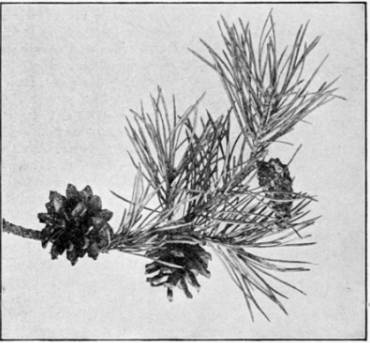
76. Coniferæ.1—Shrubs or trees with rigid evergreen, linear leaves;
and resinous juices. Male flowers in catkins. Female flowers generally
in cones. Seeds not enclosed in an ovary. (The Pine Family.)
1 The members of the Pine family do not really belong to the
Dicotyledons, although their stems increase in thickness in the same way
as those of our other trees and shrubs. They belong to the Gymnosperms
(naked-seeded group), in which the seeds are not produced in ovaries;
but it is more convenient, for our present purpose, to place them near
our other forest trees.
77. Orchidaceæ.—Herbs mostly with tuberous roots, and conspicuous,
irregular, perfect flowers in spikes or racemes. Sepals, petals, and
carpels 3. Stamens 1 or 2, united to the style. (The Orchid Family.)
78. Iridaceæ.—Herbs with fleshy, underground stems; narrow leaves; and
handsome, irregular, perfect flowers. Perianth of 6 parts. Stamens and
carpels 3. Ovary 3-celled. Fruit a many-seeded capsule with three
valves. (The Iris Family.)
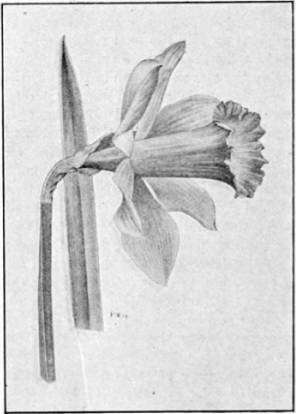
79. Amaryllidaceæ.—Herbs with bulbs, narrow leaves, and handsome,
regular, perfect flowers. Perianth of 6 parts. Stamens 6. Ovary
3-celled. Fruit a 3-valved capsule. (The Narcissus Family.)
80. Hydrocharidaceæ.—Aquatic herbs, with floating or submerged leaves;
and conspicuous, regular, diœcious flowers. Sepals and petals 3.
Stamens 3 to 12. Carpels 3 or 6. Fruit a berry. (The Frog-bit Family.)
81. Dioscoriaceæ.—A climbing herb, with broad, glossy leaves; and
small, monœcious flowers. Sepals, petals, and carpels 3. Stamens 6.
Ovary 3-celled. Fruit a berry. Seeds 6. (The Black Bryony.)
82. Liliaceæ.—Herbs with mostly narrow leaves, and conspicuous,
regular, perfect flowers. Perianth of 6 parts, Stamens 6. Ovary
3-celled. Fruit a berry or capsule. (The Lily Family.)
83. Alismaceæ.—Aquatic plants with radical, net-veined leaves; and
conspicuous, white, perfect flowers. Perianth of 6 parts. Stamens 6 or
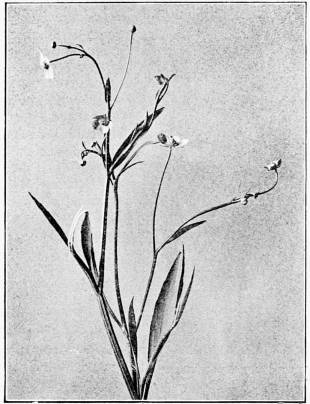
more. Carpels numerous, and distinct or nearly so. (The Water-plantain
Family.)
84. Naidaceæ.—Aquatic plants with mostly floating or submerged leaves;
and inconspicuous flowers. Perianth of 4 to 6 scales, or absent. Stamens
and carpels 1 to 6. (The Pond-weed Family.)
85. Lemnaceæ.—Minute floating plants, with green, cellular fronds,
rarely flowering. Flowers very small, enclosed in a bract. Stamen 1.
Ovary one-celled. Ovules 1 to 7. (The Duckweed Family.)
86. Araceæ.—Herbs with net-veined, radical leaves; and small flowers on
a fleshy spadix enclosed in a leafy sheath. Perianth of 6 parts, or
absent. Stamens 1 to 6. Ovary of one to three cells. Fruit berry-like.
(The Cuckoo Pint Family.)
87. Typhaceæ.—Erect marsh plants, with long, narrow leaves; and small
monœcious flowers in conspicuous spikes or heads. Perianth absent.
Stamens many. Fruit a one-seeded drupe. (The Reed-mace Family.)
88. Juncaceæ.—Rush-like herbs, with cylindrical or narrow leaves, and
small, brown flowers. Perianth membranous, of 6 parts. Stamens 6.
Carpels 3. Fruit a 3-valved capsule. (The Rush Family.)
89. Cyperaceæ.—Grassy herbs, with usually solid, triangular stems; and
linear leaves, with tubular sheaths. Flowers in spikelets, unisexual or
perfect. Stamens 1 to 3. Carpels and stigmas 2 or 3. (The Sedge Family.)
90. Gramineæ.—Grassy herbs, with hollow stems; and linear leaves, with
split sheaths. Flowers usually perfect. Stamens usually 3. Stigmas 1 or
2. (The Grass Family.)