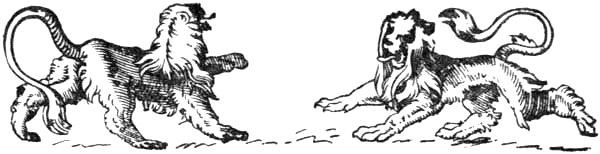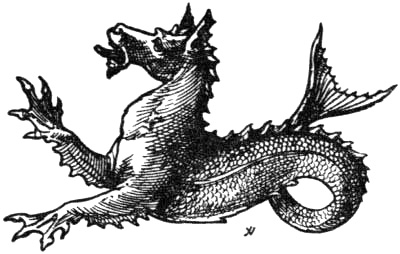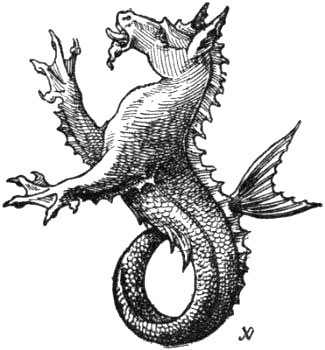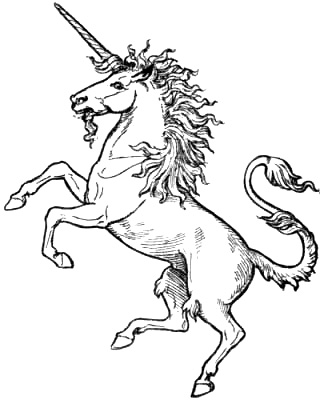
Unicorn salient.[11]
“Yon lion placed two unicorns between
That rampant with a silver sword is seen
Is for the king of Scotland’s banner known.”
Ariosto (Hoole’s translation).
“The lion and the unicorn fighting for the crown.”
Old Nursery Rhyme. |
 he unicorn is represented by heraldic usage as having the head and body
of a horse, with the tail of a lion, and the limbs and hoofs of a stag; a
twisted horn grows out from the centre of its forehead. It is rarely met
with as a coat-of-arms. As a crest or supporter it is of more frequent
occurrence. A unicorn’s head is a favourite bearing, either erased, or
couped, at the shoulder, and always represented in profile.
he unicorn is represented by heraldic usage as having the head and body
of a horse, with the tail of a lion, and the limbs and hoofs of a stag; a
twisted horn grows out from the centre of its forehead. It is rarely met
with as a coat-of-arms. As a crest or supporter it is of more frequent
occurrence. A unicorn’s head is a favourite bearing, either erased, or
couped, at the shoulder, and always represented in profile.
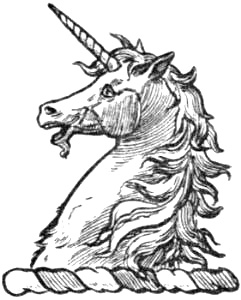
Crest: A Unicorn’s head, couped.
The unicorn was a famous device all over Europe, and symbolised the virtue
of the mind and the strength of the body. It is well known as a supporter
of the Royal Arms of England, a position it has occupied since the
accession of James VI. of Scotland to the English throne as James I. Two
silver unicorns were the supporters to the arms of that kingdom. On the
legislative union with England, the red dragon of Wales, introduced by
Henry VII., gave place to the unicorn as the sinister supporter.
James III. of Scotland had it figured on coins which were thence called
“unicorns.” James V. first used it with the national arms as supporters.
Although the silver unicorn came into England with James I., Queen Jane
Seymour had already adopted it.
“Unicorn” was the pursuivant of Lord Lyon King-at-Arms, the Royal
Scottish Herald.
As a supporter to the Royal arms it is thus blazoned: A unicorn argent,
armed, unguled, crined and gorged or, with a royal coronet (i.e.,
composed of crosses patée and fleurs-de-lis), having a chain affixed
thereto, and reflexed over his back of the last. The term “armed” has
reference to his horn, “unguled” to his hoofs, and “crined” to his
flowing mane. “Gorged” implies that the coronet encircles his “gorge” or
throat. The term “or” (that is, the metal gold or the tincture of it)
being only mentioned after the several parts implies that they are all
alike to be gold. “Of the last” means of the last colour mentioned.
In “The History of Caricature and Grotesque in Literature and Art,” by
Thomas Wright, M.A., F.S.A. (p. 8), appears a curious illustration from an
Egyptian papyrus of the Roman period, in the British Museum. It represents
a lion and a unicorn playing a game resembling draughts, perhaps the
earliest instance of the two animals depicted in conjunction. As the
author says: “The lion has evidently gained the victory and is fingering
the money; his bold air of swaggering superiority as well as the look of
surprise and disappointment of his vanquished opponent are by no means
ill-pictured.”
The animosity which existed between the lion and unicorn is referred to by
Spenser, and is allegorical of the animosity which once existed between
England and Scotland:
“Like as a lyon whose imperiall powre
A proud rebellious unicorne defyes.”
Faerie Queen, ii. 5.
The mediæval conception of the unicorn as the water-conner of the beasts
was doubtless suggested by that belief of earlier ages which made the
unicorn not merely symbolical of virtue and purity, but the more immediate
emblem of Christ as the horn of our salvation (Psalms xcii. 10 and lxxxix.
17, 24), expressly receiving its general fulfilment in him (St. Luke i.
69). The horn, as an antidote to all poison, was also believed to be
emblematical of the conquering or destruction of sin by the Messiah, and
as such it appears in the catacombs at Rome. The unicorn is the companion
of St. Justiana, as an emblem betokening in the beautiful legend her pure
mind, resisting all the Geraldine-like dreams sent by magic art to haunt
her, till she converted her tormentor himself.
He is remarkable, say the old writers, for his great strength, but more
for his great and haughty mind, as he would rather die than be brought
into subjection (Job xxxix. 10-12).
It was believed the only way to capture him was to leave a beautiful young
virgin in the place where he resorted. When the animal perceived her, he
would come and lie quietly down beside her, resting his head upon her lap,
and fall asleep, when he would be surprised by the hunters who lay in wait
to destroy him.
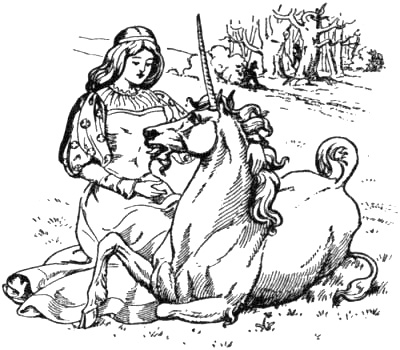
The Legend of the Unicorn.
The unicorn is one of the most famous of all the chimerical monsters of
antiquity. The Scriptures make repeated mention of such a creature, but of
its shape we can form little conception. In Early Christian Art the
unicorn symbolised the highest and purest virtue; not only was it one of
the noblest bearings in the heraldry of the Middle Ages, but was viewed as
the immediate emblem of our Blessed Lord. Philippe de Thaun says in his
“Bestiarius”:
“Monocéros est beste
Une corne a en la tête
Cette beste en verité nous signifie Dieu.”
Whence comes the unicorn? It is older than the days of Job. Among the
hieroglyphics of Ancient Egypt this wonderful creature is depicted.
Sometimes the body is that of an ass, sometimes that of a bull, sometimes
that of a horse with the long twisted frontal horn for which he is noted.
Is the myth derived from some mysterious single-horned antelope, as has
been said, or is the one-horned rhinoceros the prototype of the legendary
unicorn? As an emblem it figures on the obelisks of Nimroud and the
catacombs of Rome. We read of this strange creature in Herodotus, and in
Aristotle, who calls it the “wild ass”; Pliny calls it the “Indian ass,”
describing it as like a horse with a horn fixed in the front of his head.
Cæsar counts it among the fauna of the Hyrcinian Forest. The earliest
author who describes it is Ctesias (B.C. 400), who derives it from India.
According to an Eastern legend the unicorn is found in Abyssinia. Lobo
also describes it in his history of that country: there the animals are
undisturbed by man, and live after their own laws. “Of the many ancient
and famous men,” says a modern writer, “who have written about the
unicorn, no two seem to agree except when they copy from one another.”
“Some writers” (says Guillim, p. 175) “have made doubt whether there be
any such beast as this or no. But the great esteem of his horn (in many
places to be seen) may take away that needless scruple.”
“The unicorn whose horn is worth a city.”
Decker, “Gull’s Hornbook.” |
The horn of the unicorn was supposed to be the most powerful antidote
against, as it was a sure test of, poisons. He was therefore invested by
the other beasts of the forest with the office of “water-conner,” none
daring to taste of fountain or pool until he had stirred the water with
his horn, to discover whether any dragon or serpent had deposited his
venom therein, and render it innocuous. So complete was the faith in the
efficacy of the wonder-working horn as a test of poisons, that fabulous
store was set upon the possession of even a portion. In old inventories
the “Essai” of Unicorn’s horn is frequently mentioned.
1391. Un manche d’or d’un essai de licourne pour attoucher aux viandes
de monsigneur le Dauphin.—“Comptes Royaux.”
1408. Une pièce de licorne à pour faire essai, à ung bou.
d’argent.—Inv. des ducs de Bourgogne.
1536. Une touche de licorne, garni d’or, pour faire essai.—Inv. de
Charles Quint.
An Italian author who visited England in the reign of Henry VII., speaking
of the wealth of the religious houses in this country, says: “And I have
been informed that, amongst other things, many of these monasteries
possess unicorns’ horns of an extraordinary size.” Hence such a horn was
worthy to be placed among the royal jewels. At the head of an inventory
taken in the first year of Queen Elizabeth and preserved in the Harleian
Library (No. 5953) we read “Imprimis, a piece of unicorn’s horn,” which,
as probably the most important object, is named first. This was no doubt
the piece seen by the German traveller Hentzner, at Windsor: “We were
shown here, among other things, the horn of a unicorn of about eight spans
and a half in length, valued at about £10,000.” Peacham places “that horne
of Windsor, of an unicorn very likely,” amongst the sights worth seeing.
“One little cup of unicorn’s horn” was also in possession of Queen
Elizabeth, and was subsequently given by James I. to his Queen.
Alviano, a celebrated general of the Venetian Republic, when he took
Viterbo, and dispersed the Gatesca faction, whom he called the poison of
the city, caused to be embroidered upon his standard a unicorn at a
fountain surrounded by snakes and toads and other reptiles, and stirring
up the water with his horn before he drinks, with the motto or legend
“Venene pello” (I expel poison). Although the unicorn has not been seen
and described by any modern writer, its horn has been occasionally found,
sometimes preserved in museums, but alas! the cherished horn, whenever it
is examined, turns out to be a narwhal’s tooth. To this, Wood’s “Natural
History” makes special reference: “In former days, an entire tusk of a
narwhal was considered to possess an inestimable value, for it was looked
upon as the weapon of the veritable unicorn reft from his forehead in
despite of his supernatural strength and intellect. Setting aside the
rarity of the thing, it derived a practical value from its presumed
capability of disarming all poisons of their terrors, and of changing the
deadliest draught into a wholesome beverage.”
This antidotal potency was thought to be of vital service to the unicorn,
whose residence was in the desert among all kinds of loathsome beasts and
poisonous reptiles, whose touch was death and whose look was
contamination. The springs and pools at which such monsters quenched their
thirst were saturated with poison by their contact, and would pour a fiery
death through the veins of any animal that partook of them. But the
unicorn, by dropping the tip of his horn into the pool, neutralised the
venom and rendered the deadly waters harmless. This admirable quality of
the unicorn’s horn was a great recommendation in days when the poisoned
chalice crept too frequently upon the festive board, and a king could
receive no worthier present than a goblet formed from such valuable
material.
Even a few shavings of the unicorn’s horn were purchased at high prices,
and the ready sale for such antidotes led to considerable adulteration—a
fact which is piteously recorded by an old writer, who tells us that “some
wicked persons do make a mingle-mangle thereof, as I saw among the
Venetians, being, as I here say, compounded with lime and sope, or
peradventure with earth or some stone (which things are apt to make
bubbles arise), and afterwards sell it for the unicorn’s horn.” The same
writer, however, supplies an easy test, whereby the genuine substance may
be distinguished from the imposition. “For experience of the unicorn’s
horn to know whether it be right or not; put silk upon a burning coal, and
upon the silk the aforesaid horn, and if so be that it be true, the silk
will not be a whit consumed.”
Examples.—Argent, a unicorn rampant (sometimes sejant sable armed and
unguled or), is borne by Harling, Suffolk.
Another of the name bears the unicorn courant in chief with additional
charges upon the shield.
Azure, a unicorn couchant, argent between twelve cross crosslets,
or.—Doon.
Argent a chevron engrailed gules between three unicorns’ heads, erased
azure.—Horne.
Religious emblems were in great favour with the early printers; some of
them for this reason adopted the unicorn as their sign. Thus John Harrison
lived at the Unicorn and Bible in Paternoster Row, 1603.
Again, the reputed power of the horn caused the animal to be taken as a
supporter for the Apothecaries’ arms, and as a constant signboard by
chemists.
The great value set upon unicorn’s horn caused the Goldsmiths of London to
adopt this animal as their sign.
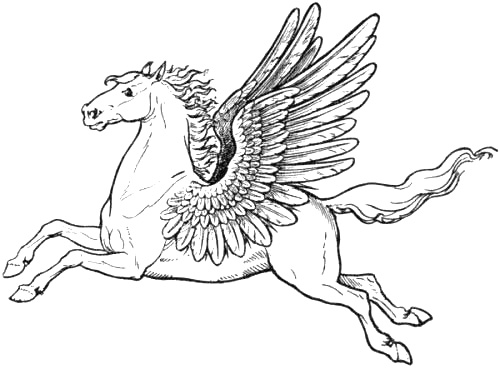
Pegasus or Pegasos.
“The cheval volant—the pegasus—
He bounds from the earth; he treads the air.” |
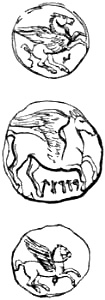
Coins of
Corinth and
Syracuse.
A poetic creation of the ancients, a winged horse captured by Bellerophon,
the great hero of Corinthian legend. In this he was assisted by the
goddess Minerva, who also taught him how to tame and use it. At Corinth
there was a temple erected to Αθηναχαλινίτις (Minerva the
Bridler), in allusion to that part of the myth which describes Minerva as
instructing Bellerophon in the mode of placing the bridle on the winged
steed. The legend states that the hero caught this wonderful animal as it
descended at the Acro-Corinthus to drink of the spring of Pirene. Mounted
on his winged steed Pegasus, Bellerophon engaged the dire Chimera, and
succeeded in destroying the monster by rising in the air and shooting it
with arrows.
Pegasus is the steed of the Muses, and classic story ascribes to it the
origin of the Castalian fountain “Hippocrene,” situated on Mount Helicon,
part of Parnassus, a mountain range in Greece. When the Muses contended
with the daughters of Pieros, “Helicon rose heavenward with delight”; but
Pegasus gave it a kick, stopped its rise, and there gushed out of the
mountain “the soul-inspiring waters of Hippocrene.”
The Standard of Corinth was a winged horse, in consequence of the
tradition connecting the fountain called Pirene, near the city, with
Pegasus, the fiery winged steed of Apollo and the Muses. The same device
was the leading type upon the ancient coins of the city of Corinth. The
Corinthians founded the colony of Syracuse, in Sicily, which city likewise
adopted the winged horse and the head of Athena upon its coinage.
Pindar, who grandly relates the feat of the hero Bellerophon, says that he
incurred the enmity of the gods by attempting to fly to heaven on his
winged horse. Zeus sent a gadfly to sting the horse, who thereupon cast
its rider and flew of his own accord to the stables of Zeus, whose
thunder-chariot he has ever since drawn.
The pegasus is of frequent occurrence in heraldry. In its classic
allusions it denotes fame, eloquence, poetic study, contemplation.
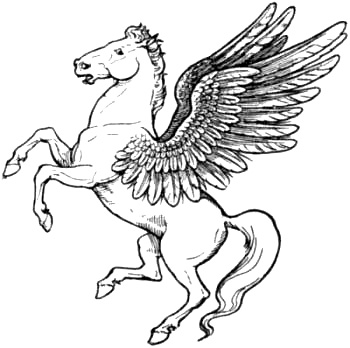
Pegasus salient.
Some modern heraldic writers, however, discarding its classic references,
regard it merely in the matter-of-fact light as an emblem of swiftness.
But it is impossible to disassociate the old and well-known ideas
respecting the horse of Apollo and the Muses. In fancy the poet mounts his
winged steed to bear his soaring spirit in its wayward flight through the
realms of fancy.
As a type of the perfect horseman, Shakespeare pictures Prince Henry as
able to—
“Turn and wind a fiery pegasus
And witch the world with noble horsemanship.”
1 King Henry IV., Act 4, sc. 1.
Elsewhere he takes up the later interpretation of the myth, which connects
it with Perseus:
“The strong-ribbed bark through liquid mountains cut
Like Perseus’ horse.”
Troilus and Cressida, Act i. sc. 3.
Cardinal Bembo, poet and historian, secretary to Pope Leo X., used as his
impress a pegasus and a hand issuing from a cloud holding a wreath of
laurel and palm, with the motto, “Si te fata vocant” (“If the fates call
thee”).
Azure, a pegasus salient, the wings expanded argent, is borne as the
arms of the Society of the Inner Temple, London.
A very early seal of the Knights Templars exhibits two knights riding upon
one horse.
A recent writer remarks upon this strange device that “it is exceedingly
probable that some rude and partially defaced representation of this
device was mistaken by the lawyers of the reign of Queen Elizabeth for a
pegasus. The fact that the Middle Temple adopted the device which appears
upon the other seal of the ancient Knights strongly confirms this view.”
One of the supporters of the arms of Oliver Cromwell is a horse having the
wings and tail of a dragon.
“... the dreadful sagittary
Appals our numbers.”
“Troilus and Cressida,” Act v. sc. 5.
“Feasts that Thessalian centaurs never knew.”
Thomson, “Autumn.” |
Under these names is blazoned a fabled monster of classic origin, half
man, half horse, holding an arrow upon a bended bow. It is one of the
twelve signs of the Zodiac, commonly called Sagittarius, otherwise
Arcitenens, and marked by the hieroglyph ♐. In its signification
in arms it may properly be applied to those who are eminent in the field.
The arms traditionally assigned to King Stephen are thus described by
Nicholas Upton: “Scutum rubeum, in quo habuit trium leonum peditantium
corpora, usque ad collum cum corporibus humanis superius, ad modum signi
Sagittarii, de auro.” In this, as in some other early examples, it is
represented as half man, half lion.
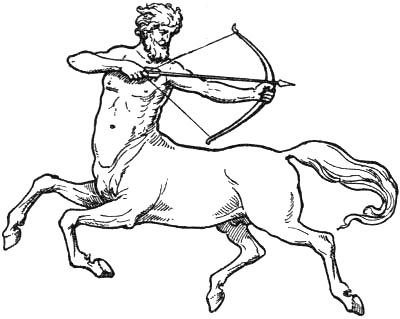
The Sagittary—Centaur.
The arms of Stephen are sometimes represented with but one sagittary, and
is said to have been assumed by him in consequence of his having commenced
his reign under the sign of Sagittarius. Others say because he gained a
battle by the aid of his archers on entering the kingdom. Others, again,
say that the City of Blois used the ensign of a sagittary as an emblem of
the chase; and Stephen, son of the Compte de Blois, assumed that ensign in
his contest with the Empress Maude or Matilda. There is no contemporary
authority, however, it must be confessed, for any of these derivations. A
sagittary is seen upon the seal of William de Mandeville (temp. Henry
III.), but not as an heraldic bearing.
The crest of Lambart, Earl of Cavan, is: On a mount vert, a centaur
proper, drawing his bow gules, arrow or. It also appears as the crest of
Askelom, Bendlowes, Cromie, Cruell, Lambert, Petty, Petty-Fitzmaurice.
The term Centaur is most probably derived from the words κεντέω
(to hunt, or to pursue) and ταῦρος (a bull), the Thracians and
Thessalians having been celebrated from the earliest times for their skill
and daring in hunting wild bulls, which they pursued mounted on the noble
horses of those districts, which were a celebrated breed even in the later
times of the Roman Empire. A centaur carrying a female appears on a coin
of Lete, which, according to Pliny and Ptolemy, was situated on the
confines of Macedonia, and the fables of the centaurs, &c., in that and
neighbouring districts abounding in a noble breed of horses, arose no
doubt from the feats performed by those who first subjugated the horse to
the will of man, and who mounted on one of these beautiful animals and
guiding it at will, to approach or retreat with surprising rapidity, gave
rise in the minds of the vulgar to the idea that the man and the horse
were one being.
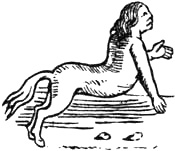
Ipotane, from
Mandeville’s travels.
Sir John de Mandeville in his travels (printed by Wynken de Worde, 1499),
tells us that in Bacharie “ben many Ipotanes that dwellen sometime in the
water and sometime on the land; and thei ben half men and half hors and
thei eten men when thei may take him.”
We have in modern history a singular and interesting example of a similar
superstition. When the natives of South America—where the horse was
unknown—first saw their invaders, the Spaniards, mounted on these animals
and in complete armour, they imagined that the cavalier and steed formed
but one being of supernatural powers and endowments.
Such groups as those exhibited on the rude money of Lete and other places
were doubtless the first steps toward the treatment of similar subjects by
Phidias, the celebrated Greek sculptor, whose works illustrating the
battle of the Lapithæ and the Centaurs adorned the metopes of the
Parthenon at Athens, to which they also bear a striking affinity in the
simplicity of their conception.
A curious example of the compounded human and animal forms similar to the
sagittary is represented upon a necklace found in the Isle of Rhodes, and
now in the Musée Cluny, Paris. It is formed of a series of thin gold
plates whereon is represented in relief the complete human figure
conjoined to the hinder part of a stag (or horse). This is alternated with
another compound figure, human and bird, holding up two animals by the
tails, both subjects, each in their own way, suggestive of the fleet and
dexterous hunter.
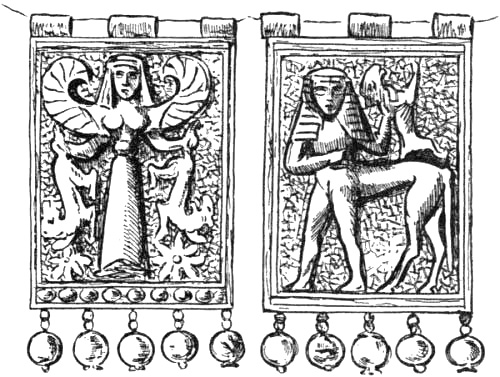
Compound figures, gold necklace, Musée Cluny, Paris.
In Homer’s account the centaurs are obviously no monsters, but an old
Thessalian mountain tribe, of great strength and savage ferocity. They are
merely said to have inhabited the mountain districts of Thessaly, and to
have been driven thence by the Lapithæ into the higher mountains of
Pindus. Their contest with the Lapithæ is generally conceived as a symbol
of the struggle of Greek civilisation with the still existing barbarism of
the Early Pelasgian period. This may be the reason why Greek art in its
prime directed itself so especially to this subject.
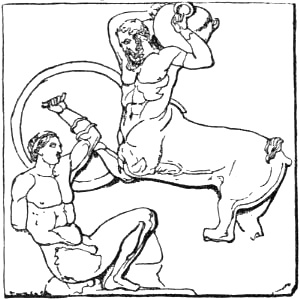
Centaur, Greek sculpture.
The origin of this contest is referred to the marriage feast of Pirithous
and Hippodamia, to which the principal centaurs were invited. The centaur
Eurytion, heated with wine, attempted to carry off the bride. This gave
rise to a struggle for supremacy which, after dreadful losses on both
sides, ended in the complete defeat of the centaurs, who were driven out
of the country. The custom of depicting the centaurs as half man, half
horse arose in later times, and became a favourite subject of the Greek
poets and artists.
Amongst the centaurs, Chiron, who was famous alike for his wisdom and his
knowledge of medicine, deserves mention as the preceptor of many of the
heroes of antiquity. Homer, who knew nothing of the equine shape of the
centaurs, represents him as the most upright of the centaurs, makes him
the friend of Achilles, whom he instructed in music, medicine and hunting.
He was also the friend of Heracles, who, by an unlucky accident, wounded
him with a poisoned arrow. The wound being incurable, he voluntarily chose
to die in the place of Prometheus. Jupiter placed him among the stars,
where he is called Sagittarius.
Bucentaur, from Greek Βοῦς (bous) an ox, and κένταυρος
(kentauros) a centaur, was, in classic mythology, a monster of double
shape, half man, half ox. The state barge of the Doge of Venice was so
termed.
The Minotaur slain by Theseus had the body of a man and the head of a
bull.
The griffin, gryfin, or gryphon, as it is variously termed by old writers,
is best known as one of the chimerical monsters of heraldry—the mediæval
representative of the ancient symbolic creature of Assyria and the East.
It may be classed with the dragon, wyvern, phœnix, sphynx, “gorgons
and hydras and chimeras dire,” and other imaginary beings, that world of
unreality grown up in the mind of man from the earliest times, the
influence of whose terrors have exercised no little power in the progress
of humanity.
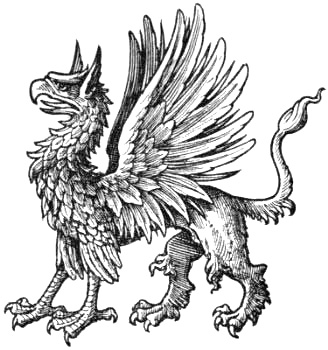
A Griffin statant, wings endorsed.
This favourite bearing was very early adopted in English armory. So early
indeed as 1167 A.D. we find it on a seal of Richard de Redvers, Earl of
Exeter, attached to a charter at Newport, Isle of Wight. It also appears
on a seal of Simon de Montacute (temp. Henry III. and Edward I.). It is
one of the principal bearings in heraldry, either charged upon the shield,
as the arms, or as the crest placed upon the helm, also as supporters to
the shield of arms of many noble and eminent families in this country and
the continent.
The griffin, “sacred to the sun,” combines the bodily attributes of the
“cloud-cleaving eagle” and the “king of beasts,” that is, it has the head,
neck, wings, and talons of an eagle, conjoined to the hinder parts of a
lion. It is usually represented with projecting ears, indicating an acute
sense of hearing, in addition to its other supposed extraordinary
qualities.
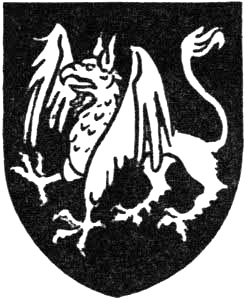 |
|
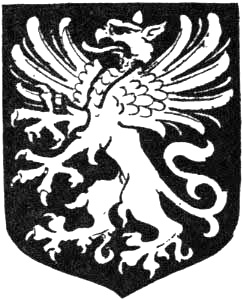 |
A Griffin passant, wings raised.
(Early English.) |
|
A Griffin segreant, wings displayed.
(German.) |
The griffin is rarely borne in other than two positions, viz., passant
and segreant. The latter term is peculiar to the griffin, and seems to
refer to the expanded wings. When called segreant only, it means the
same as rampant applied to a lion. As a crest, it is not unfrequently
borne sejant, i.e., sitting. Parts of the creature, as a
demi-griffin, a griffin’s head, &c., are also of common use.
The arms of Trafford, Lancashire, are: Argent a griffin segreant
gules. Motto: Gripe griffin hold fast. The supporters of the arms of
Viscount Halifax are two griffins.
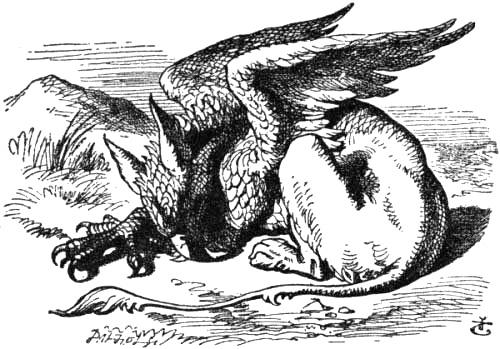
Sleeping Griffin, by John Tenniel, from “Alice in Wonderland.”
(By permission of Macmillan & Co., Limited, proprietors of the copyright.)
Old heralds gravely relate of this creature that when he attains his full
growth he will never be taken, hence he is a fit emblem of a valiant hero,
who, rather than yield himself to his enemy, exposes himself to the worst
of dangers. As a general symbol in heraldry the griffin expresses strength
and vigilance.
Sir Thomas Browne says it is emblematical of watchfulness, courage,
perseverance and rapidity of execution.
The description of the griffin by the old traveller, Sir John Mandeville,
is a wonderful record of credulity and belief in the marvellous; he states
it to be a native of “Bacharie, where ben many griffones, more plentee
than in any other countree. Sum men seyn that they have the body upwards
of an egle and benethe as a lyonn, and truly they seyne soethe that thei
ben of that schapp. But one griffoun hath the body more great and stronger
than one hundred egles, such as we have amonges us. For one griffoun there
will be flynge to his nest a great hors, or two oxen yoked togidre, as
thei gon to the plowghe. For he hath his talouns so longe and so grete and
large upon his feet as though thei were hornes of grete oxen, or of bugles
(bulls), or of kygn, so that men maken cuppes of hem to drynke of, and of
hire (their) ribbes and of the pennes of hire wenges men maken bowes fulle
stronge to schote with arrews and quarell.” Gerard Leigh, an old heraldic
writer, discoursing of the griffin, gives his reason for belief, he says,
“I thinke they are of a great hugeness, for I have a clawe of one of
their pawes, whiche should shewe them to be as bigge as two lyons.”
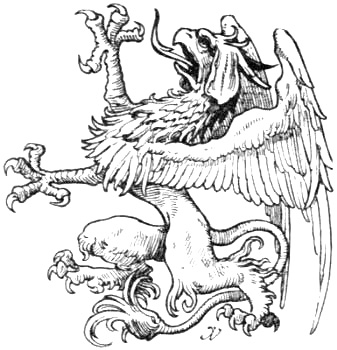
Griffin segreant, German version.
In the cathedral of Brunswick there is still preserved the horn of some
kind of antelope, brought from the Holy Land as “a griffin’s claw,” by
Henry the Lion. Three talons of the griffin were preserved at Bayeux, and
fastened on high festival days to the altar, and there seems to be some
curious legend concerning a cup formed of a gryphon’s claw dedicated to
St. Cuthbert A gryphon’s egg was also considered a valuable curiosity,
being used as a goblet in old times when natural history was greatly
misunderstood and grossly exaggerated. As an example of the absurd
misstatements of the earlier writers and naturalists who so delighted our
wonder-loving forefathers, a writer in the “Museum of Animated Nature”
refers to a large species of vulture, the Condor (Sarcoramphus Gryphus),
which was painted as rivalling the Rukh of Oriental fable. He adds that
“such descriptions have given place to the moderate details of
sober-minded observers, and we no longer look upon this creature as the
winged guardian of mountain mines within whose depths were entombed ‘gems
and barbaric gold,’ we no longer imagine it the giant of the winged race,
dimming the light of the sun by its widespread pinions, and by the mighty
rushing sound as it sweeps down from some lofty pinnacle or the upper
regions of the sky deafening and stupefying the terror-stricken
beholders.”
As the stern avenger of human crimes, the dreaded Nemesis appears in Roman
Art, as a young woman with wings, in a chariot drawn by griffins, with a
whip or sword in her hand.[12]
Smith’s “Classical Dictionary” gives the following: “Gryps or gryphus, a
fabulous monster dwelling in the Rhiphæan mountains between the
Hyperboreans and the one-eyed Arimaspians, and guarding the treasures of
the north. The Arimaspians mounted on horseback attempted to steal the
gold, and hence arose the hostility between the horse and the griffin. The
body of the griffin was that of a lion, while the head, fore-feet and
wings were those of an eagle. It is probable that the origin of the belief
in griffins must be looked for in the East, where it seems they have been
very ancient. They are also mentioned among the fabulous beasts which
guarded the gold of India.”
The Arimaspians were a one-eyed people of Scythia who adorned their hair
with gold. They were constantly at war with the Gryphons who guarded the
gold mines.
“As when a gryphon, through the wilderness ...
Pursues the Arimaspian, who by stealth
Had from his wakeful custody purloined
The guarded gold.”
Paradise Lost, ii.
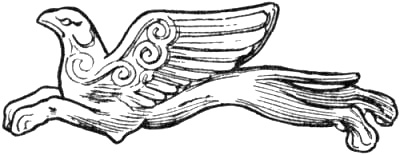
Gold Flying Griffin, found by Dr. Schliemann at Mycenæ.
That the form of the griffin must have been a well understood symbol is
evident from the frequency with which it is met in ancient art. Dr.
Schliemann, in his explorations of the ancient city of Mycenæ, among other
treasures found a gold-winged griffin, about two inches in length, in one
of the sepulchres of the kings (Figure No. 272 in his book), which in
every particular as to shape is identical with the heraldic griffin of
to-day; the same may be said of a coin of Abdera, a city in Thrace, which
bears the device of a griffin. Abdera was a place of importance when
Xerxes invaded Greece B.C. 554.
Herodotus relates that the Teians, dreading the encroachments of the
Persians in Ionia, abandoned their city and founded Abdera in Thrace. The
coinage of the latter place bears the same type (the griffin) as the
parent city, but with a slight difference in treatment. This consists in
the form of the wings of the griffin, which are pointed on the coins of
Abdera, while in those of Teos they are rounded. The griffin was sacred to
Apollo, to whom an especial worship was devoted in most of the Ionian
cities, but more particularly in Teos.[13]
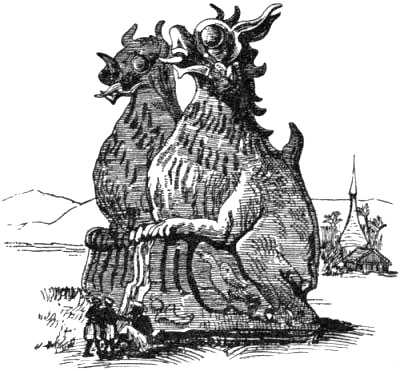
Colossal Griffins, Burmah.
In the Illustrated London News of October 21, 1876, is an engraving of
two gigantic wingless griffons, and also a description by the traveller
who visited that strange place. “At Thyetmo, 250 miles up the river
Irrawaddy from Rangoon in British Burmah, are two colossal ‘chin thay’ or
figures of sacred griffins, standing at the entrance to one of the great
pagodas dedicated to the worship of Gautama Buddha; the outer terraces and
steps of these temples are frequently adorned with such mythical monsters.
Near the ancient ruined city of Paghan, which flourished a thousand years
ago, the bank of the river for a length of eight miles is lined with the
remains of this quaint architecture and sculpture, covering a space of two
miles in breadth from the water’s edge. It is not known by what nation of
old times they were constructed, for Burmese history is apocryphal or at
least very obscure.”
The symbolic use of images of living creatures was in the instance of the
cherubim permitted under the Mosaic dispensation, and on this will be
found to turn the distinction between the symbolic use and its forbidden
and dangerous use as a supposed means of assisting devotion. Mr. Henry
Hayman in “Smith’s Dictionary,” s.v., “cherub,” as quoted by Tyrwhit,
says: “On the whole it seems likely that the word ‘cherub’ meant not only
the composite creature-form of which the man, lion, ox, and eagle were the
elements, but further, some peculiar and mystical form which Ezekiel,
being a priest, would know and recognise as ‘the face of a cherub,’
κατ’ εξοχήν, but which was kept secret from all others.... Such
were probably those on the ark, which when moved was always covered,
though those on the hangings and panels might be of the popular device.
The griffin of northern fable, watching the gold in the wilderness, has
been compared with the cherub both as regards his composite form and his
functions as guardian of a treasure. He goes on to point out the possible
affinity between the Greek root γρυπ (γρυψ, gryps,
griffin), and the Hebrew and Arabic derivation of the word ‘cherub,’ which
gives it the original meaning of ‘carved image,’ and says that though the
exact form is uncertain, it must have borne a general resemblance to the
composite religious figures found upon the monuments of Egypt, Assyria,
Babylonia and Persia.”
Mr. Ruskin,[14] describing the emblematical griffins on the front of the
Duomo of Verona, points out that the Lombard carver was enabled to form so
intense a conception, mainly by the fact that his griffin is a great and
profoundly felt symbolism. Two wheels are under its eagle’s wings, which
connect it with the living creatures of the vision of Ezekiel, “where they
went the wheels went by them, and whithersoever the spirit was to go, they
went, and the wheels were lifted up over against them, for the spirit of
the living creatures was in the wheels.” The winged shape thus became at
once one of the acknowledged symbols of the divine nature. Elsewhere, we
think in the “Stones of Venice,” the connection is pointed out between the
Assyrian and Gothic personations.
Gian-Paolo Baglione (+ 1520), who usurped the sovereignty of Perugia,
bore a silver griffin on a red field with the motto, “Unguibus et
rostro atque alis armatus in hostem” (“Armed against the enemy with
talons and beak and wings”), which means of defence proved of no avail
when he was seized by Pope Leo X., who, pretending to consult Baglione on
affairs of importance, sent him a safe conduct to Rome, but when he
arrived, he caused him to be tortured and beheaded, and afterwards took
possession of his states. This gave occasion to his enemies to say, “This
ugly bird has not used his wings as at other times, to flee from the snare
which has been laid for him.”[15]
In Dante’s description of the triumph of the Church, in the “Purgatorio,”
we have the mediæval conception of this wondrous creature, the gryphon.
“The mystic shape that joins two natures in one form”—as he is called by
the noble Italian poet—draws the car to which he is harnessed, and
“He above
Stretched either wing uplifted ’tween the midst
····
···
And out of sight they rode. The members, far
As he was bird, were golden; white the rest,
With vermeil interveined.”
And when the eyes of Beatrice
“stood
Still, fix’d toward the gryphon, motionless.
As the sun strikes a mirror, even thus
Within those orbs the twyfold being shone;
For ever varying, in one figure now
Reflected, now in other. Reader! muse
How wondrous in my sight it seem’d, to mark
A thing, albeit steadfast in itself,
Yet in its imaged semblance mutable.”
Cary’s Dante, Purgatory, c. xxix.
“Some commentators of Dante,” says M. Dideron,[16] “have supposed the
griffin to be the emblem of Christ, who, in fact, is one single person
with two natures; of Christ in whom God and man are combined. But in
this,” says M. Dideron, “they are mistaken. There is, in the first place,
a manifest impropriety in describing the car as drawn by God as a beast of
burden.” “Commentators,” it is added, “have been misled by the two-fold
nature of the gryphon, but that difficulty is removed by recollecting that
the Pope resembles the eagle in his spiritual character, and in his
temporal authority the lion. The Pope is one person, but of two natures
and two distinct forms. Thus considered the allegory of Dante becomes
clear and intelligible.”
The gryphon is very frequently seen sculptured in Gothic churches, more
especially in those of the Lombard and early Norman style, and is
evidently intended to refer to the union of the divine and human natures.
A curious example of this compound form of bird and beast occurs on an
Italian bronze medal of the fifteenth century, about 3½ in. in diameter
(No. 57.51 in the fine collection in South Kensington Museum). On one side
it bears a portrait of Niccolo Picininus of Perugia, a celebrated
mercenary soldier—and on the reverse a griffin, the eagle’s head, wings,
and feet united to the Roman she-wolf, with Romulus and Remus suckling.
Dante’s emblem of the Popedom is here apparently adapted to the peculiarly
Roman national symbol—the nursing mother of nations and the Catholic
religion.
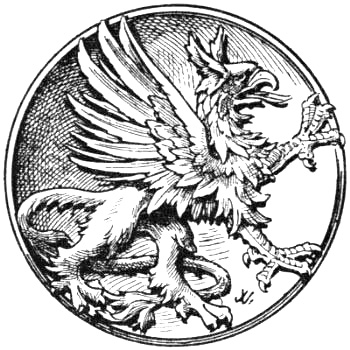
Carved panel, a Griffin segreant.
The griffin is sometimes borne sans wings and termed a male griffin, as
in the supporters to the arms of the Marquis of Ormond, but spikes or
rays proceed from various parts of its body; sometimes it has two long
straight horns.
Two other varieties of the griffin family, the “Hippogriff” and the
“Simoorgh” appear in the highly wrought imaginings of the poets, and may
here be very briefly alluded to. They do not, however, appear in British
Heraldry.
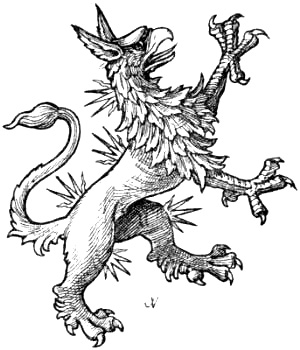
Male Griffin.
Hippogryph, or Hippogrif, the winged horse whose father was a griffin and
mother a filly (Greek, hippos, a horse, and gryps, a griffin)—a
symbol of love.[17]
Simoorgh, a sort of griffin or hippogryph, which took some of its breast
feathers for Tahmura’s helmet. This creature forms a very striking figure
in the epic poems of Saadi and Ferdusi, the Persian poets.
Milton also makes allusion to this mythical creature:
“So saying he caught him up, and without wing
Of hippogrif, bore through the air sublime
Over the wilderness and o’er the plain.”
Paradise Regained, iv.
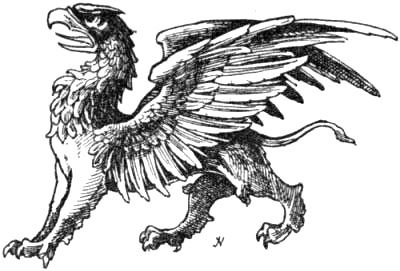
Opinicus statant.
This creature appears to be a variety of the griffin family. Authorities
blazon it as having its body and four legs like those of a lion; the head
and neck and wings like an eagle, and the short tail of a camel, sometimes
borne sans wings.
Such a monster with wings endorsed or, was the crest of the Barber
Surgeons of London.
Two opinici vert, purfled or, beaked sable, wings gules, support the
insignia of the Plasterers’ Company.
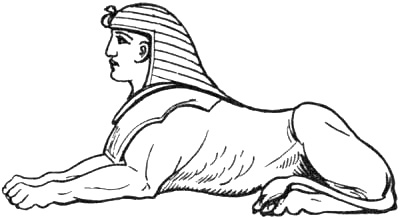
Egyptian Sphynx.
“That monster whom the Theban knight
····
···
Made kill herself for very heart’s despite
That he had read her riddle, which no wight
Could ever loose, but suffered deadly doole.”
Spenser’s “Faerie Queen,” Bk. v. cxi. |
According to some heraldic writers, the sphynx should possess the head and
bust of a woman, the paws of a lion, the body of a dog, and the tail of a
dragon. In Lord Chancellor Bacon’s book on “The Wisdom of the Ancients,”
there is an exposition of the meaning of the sphynx, which, says Dr.
Woodward, is as curious as the creature itself.
It frequently figures in heraldry as a convenient hieroglyph to
commemorate some service in Egypt. It is the crest of British families of
Asgill, Baronets Lambert, Goatley, &c., and appears in the arms of
Sir John Moore, the hero of Corunna.
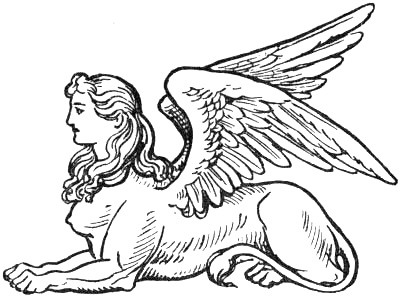
Theban, or Greek Sphynx.
The strange combination of human and animal features in the figure known
as the sphynx is of frequent occurrence in both Greek and Egyptian
mythology and art. The Egyptian sphynx is supposed to represent the
combination of physical power, or the kings, as incarnations of such
attributes. They are also associated with the special forms and attributes
of the great Egyptian deities Osiris and Ammon, Neph or Jupiter, and Phreh
or Helios. That is, we have the man-sphynx, the ram-sphynx, and the
hawk-sphynx, or the lion’s body with the head of the man, the ram, or
the hawk, according to the deity worshipped. The sphynx itself was
probably a religious symbol of the Egyptians, which was transferred to
Greece, and subsequently underwent a change of meaning. Among the
Egyptians the sphynx seems to have been a symbol of Royal dignity
betokening a combination of wisdom and strength. By the Greeks, however,
it appears to have been regarded as the symbol of the burning
pestilence-breeding heat of the summer sun. The form of the Theban sphynx
was that of a lion, generally in a recumbent position, with the breast and
upper part of a beautiful woman, and was in imitation of the original male
sphynxes of Egypt. Greek Art was only acquainted with the sphynx in its
female form, and also departed from the Egyptian type by adding wings to
the lion’s body.
“There is a great difference,” says Sir Gardiner Wilkinson in his account
of the sphynx,[18] “between the Greek and Egyptian sphynxes. The latter is
human-headed, ram-headed, or hawk-headed, and is always male; while the
Greek is female, with the head of a woman, and always has wings, which the
Egyptian never has.”
In the Greek story the monster was sent by Hera (Juno) to devastate the
land of Thebes. Seated on a rock close to the town, she put to every one
that passed by the riddle, “What walks on four legs in the morning, on two
legs at noon, and on three legs in the evening?” Whoever was unable to
solve the riddle was cast by the sphynx from the rock into a deep abyss.
Œdipus succeeded in answering it, and thus delivered the country from
the monster, who cast herself into the abyss.
The sphynx occurs upon a coin of Chios (B.C. 478-412). It is represented
seated before an amphore, above which is a bunch of grapes. Chios was
famed for its wine, and the sphynx was a symbol of Dionysius.[19]
The Emperor Augustus, on his seal, used the device of the sphynx—“maid’s
face, bird’s wings, and lion’s paws”—“implying,” says Mrs. Bury Palliser
(“Historical Devices,” &c.), “that the secret intentions of a prince
should not be divulged. When Augustus was in Asia, he authorised Agrippa
and Mecænas, who administered affairs during his absence, to open and read
the letters he addressed to the Senate before any one else; and for this
purpose he gave them a seal upon which was engraved a sphynx, the emblem
of secrecy. The device gave occasion to ridicule, and to the saying that
it was not surprising if the sphynx proposed riddles; upon which Augustus
discontinued it, and adopted one with Alexander the Great, to show that
his ideas of dominion were not inferior to Alexander’s. Subsequently
Augustus used his own effigy, which practice was continued by his
successors.”
Maurice (“Oriental Trinities,” p. 315) says the sphynx was the Egyptian
symbol of profound theological mystery, and was therefore placed on either
side of the dromoi, or paths leading to the temples of the gods. “They
are black,” he says, “in allusion to the obscure nature of the deity and
his attributes. The white head-dress may allude to the linen tiaras
wrapped round the heads of the priests.” The origin of the myth was not
definitely known even to the ancients. Some early writers say it was
symbolical of the overflowing of the Nile, which happened when the sun was
in the signs of Leo and Virgo; and that it had its name from this
circumstance. “For,” they say, “the word sphynx in the Chaldæan language
signifies overflowing.” The fact of the Egyptian sphynx being always male
does not, however, accord with this derivation.
A statue of the Theban sphynx found in Colchester, and now in the museum
of that town, gives the Greek conception of that creature. It is carved in
oolite, twenty-five inches high, evidently a relic of the Roman occupation
of Britain. It represents the monster seated over the mangled remains of
one of its victims. Llewellin Jewett, in the Art Journal 1871, p. 113,
describes it as “combining the five-fold attributes of a virgin, a lion, a
bird, a dog, and a serpent. The head, breast and arms are those of a
beautiful virgin; the body and teats of a female dog; hinder parts, hind
legs and fore paws are those of a lioness; the tail doubled in short folds
is serpent, and the wings those of a bird.”
The same writer says: “The sphynx appears on the reverses of some coins of
Cunobeline (Cymbeline, of Shakespeare), struck in the city of Camalodunum
(Colchester).”
The gigantic statue of the sphynx half buried in the sand near the Great
Pyramids, at Gizeh, is hewn and sculptured out of a spur of solid rock, to
which masonry was added in places to complete the form. The actual age of
the great sphynx is not known, but it is supposed to have been commenced
under Cheops and finished by order of King Chefren, under whose reign also
was probably built the second great pyramid. The able author of “Eothen”
thus describes the appearance of the sphynx of Egypt, and the sentiments
to which its contemplation gave rise in his mind: “And near the Pyramids,
more numerous and more awful than all else in the land of Egypt, there
rests the lonely sphynx. Comely the creature is, but the comeliness is not
of this world. The once worshipped beast is a deformity and a monster to
this generation, and yet you can see that these lips, so thick and heavy,
were fashioned according to some ancient mould of beauty—some mould of
beauty now forgotten—forgotten because that Greece drew forth Cytheræa
from the flashing bosom of the Ægean, and in her image created new forms
of beauty, and made it a law among men that the short and proudly wreathed
lips should stand for the sign and main condition of loveliness through
all generations to come! Yet there still lives on the race of those who
were beautiful in the fashion of the elder world; and Christian girls of
Coptic blood will look on you with sad, curious gaze, and kiss your
charitable hand with the big pouting lips of the very sphynx. Laugh and
mock if you will at the worship of stone idols; but mark ye this, ye
breakers of images, that in one regard the stone idol bears awful
semblance of deity—unchangefulness in the midst of change—the same
seeming will and intent for ever inexorable! Upon ancient dynasties of
Ethiopian and Egyptian kings—upon Greek and Roman, upon Arab and Ottoman
conquerors—upon Napoleon dreaming of an Eastern empire—upon battle and
pestilence—upon the ceaseless misery of the Egyptian race—upon keen-eyed
travellers—Herodotus yesterday and Warburton to-day—upon all, and more,
this unworldly sphynx has watched, and watched like a Providence, with the
same earnest eyes and the same sad, tranquil mien. And we shall die, and
Islam shall wither away; and the Englishman, straining far over to hold
his loved India, will plant a firm foot on the banks of the Nile, and sit
on the seats of the faithful; and still that sleepless rock will lie
watching and earnest the work of the new busy race with those same sad
eyes and the same tranquil mien everlasting. You dare not mock at the
sphynx.” The conclusion of this rhapsody at the present time sounds almost
like a half-fulfilled prophecy.
The sphynx is the special device of several British regiments which landed
in Egypt, in the Bay of Aboukir, in the face of the French Army; and
borne as a memento of the battle of Alexandria, when General Sir Ralph
Abercrombie fell in the moment of victory. It also appears upon the war
medals of the English occupation of Egypt, resulting in the battle of
Tel-el-Kebir, 1882, and subsequent victories. In heraldry the sphynx is
usually couchant; it is, however, borne in other positions, sometimes
winged, and when so borne the wings are always endorsed, i.e., back to
back.
A sphynx passant, wings endorsed argent crined or, is the crest of
Asgill (Bart. 1701).
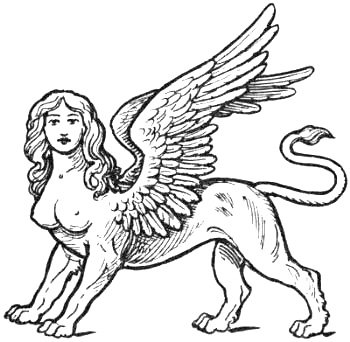
A Sphynx passant guardant, wings endorsed.
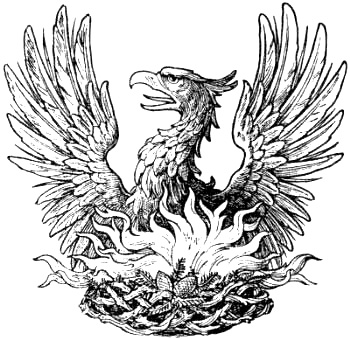
The Phœnix.
“Rara avis in terris.”
An imaginary bird, described by ancient writers as in form like an eagle,
but more beautiful in its plumage. Among the ancient classical writers it
was an emblem of those existing in paradise, enjoying eternal youth and
never-ending pleasure. Tacitus describes the phœnix as a singular bird,
consecrated to the sun, and distinguished by its rich appearance and
variegated colours. Herodotus naïvely says: “I never saw one, indeed, but
in a picture, but if he is like his picture his plumage is partly golden
and partly red.” Philippe de Thaun says: “The phœnix lives five hundred
years and a little more, when it will become young again and leave its old
age.” It was said to be sometimes seen in Egypt, and only one was believed
to exist at a time. When it is advanced in age and its time of change is
at hand, it hides itself away somewhere in Arabia, and makes itself a nest
of the rarest spices, which, by the heat of the sun or other secret
agency, and the fanning of the sacred bird’s own wings, soon rises into
flames and consumes it. Out of its ashes rises another with new life and
vigour to pursue the same never-ending life and re-birth.
Fum or Fung (the phœnix) is one of the four symbolical animals
supposed to preside over the destinies of the Chinese Empire; the sacred
Ho-ho or phœnix also figures with the dragon largely in Japanese
mythology, and bears a striking analogy to the bird of classic fame. It is
fabled to have a miraculous existence, and is sent on earth for the
performance of extraordinary works in the manifestation of the Divinity
and in the development of humanity and nature. It appears at different
stages of the world’s progress and in successive ages; after the
accomplishment of which it reascends to heaven to come down again at the
commencement of a new era.
From the pagans the Early Christians adopted the symbol, and with them
its significance had reference to the resurrection and immortality. Like
the pelican “in her piety,” it was peculiarly an emblem of our Saviour in
His resurrection. As the phœnix when old and wearied seeks the rays of
the sun to consume its body, again to be revived in life and vigour, so
the Christian, worn and exhausted by worldly labour and suffering, turns
to the Son of Righteousness for regeneration and newness of life.
Tertullian makes the phœnix an image of the resurrection.
In corroboration of this it must be borne in mind that Jesus Christ, who
died A.D. 34, is termed the phœnix by monastic writers.
The Phœnix period or cycle is said to consist of 300 years. “The bird
of wonder” is said to have appeared in Egypt five times:
1. In the reign of Sesostris, B.C. 866.
2. In the reign of Amasis, B.C. 566.
3. In the reign of Ptolemy Philadelphus, B.C. 266.
4. In the reign of Tiberius, 34 A.D.
5. In the reign of Constantine, 334 A.D.
Tacitus in the “Annales,” vi. 28, mentions the first three of these
appearances.
The Phœnix-tree is the palm. In Greek φοίνιξ (phoinix)
means both phœnix and palm-tree. It is thus alluded to in Shakespeare:
“Now will I believe ... that in Arabia
There is one tree, the phœnix throne—one phœnix
At this hour reigneth there.”
The Tempest, Act iii. sc. 3.
Pliny[20] gives
minute particulars concerning the natural history of this
rara avis in terris. But the ancient fable is most fully given by Ovid
and translated by Dryden. Ariosto, also, and many early writers refer to
the wonderful creature with fullest faith in its reality. It is no wonder
then, that it became a favourite emblem in an age when it was the fashion
among persons of distinction to have an impress or device with its
accompanying legend or motto. Many persons of historical importance
employed the phœnix to express in metaphor the idea they wished to
convey regarding themselves. Thus we find the phœnix in flames painted
for the device of Jeanne d’Arc, in the Gallery of the Palais Royal, with
the motto: “Invito funere vivat” (“Her death itself will make her live”).
Vittoria Colonna (+ 1547) the beautiful and accomplished wife of the
Marquis of Pescara, used the device of a phœnix on her medal.
Mary Queen of Scots used the impress of her mother, Mary of Lorraine, a
phœnix in flames, and the motto: “En ma fin est mon commencement.” A
phœnix in flames upon a castle was the badge of Queen Jane Seymour, the
crest of the Seymours being a phœnix in flames issuing from a ducal
coronet. Her son, Edward VI., added the motto, “Nascatur ut alter” (“That
another may be born”), alluding to the nature of her death. She lies
buried in St. George’s Chapel, Windsor, with a Latin epitaph by Bishop
Godwin, which has been thus translated by his son Morgan:
“Here a phœnix lieth, whose death
To another phœnix gave birth.
It is to be lamented much
The world at once ne’er knew two such.”
Queen Elizabeth placed a phœnix upon her medals and tokens with her
favourite motto: “Semper eadem” (“Always the same”), and sometimes with
the motto “Sola phœnix omnis mundi” (“The sole phœnix of the whole
world”); and on the other side, “Et Angliæ gloria” (“And the glory of
England”), with her portrait full-faced. By the poets of the time,
Elizabeth was often compared to the phœnix. Sylvester, in his “Corona
Dedicatoria,” says:
“As when the Arabian (only) bird doth burne
Her aged bodie in sweet flames to death,
Out of her cinders a new bird hath birth,
On whom the beauties of the first return;
From spicy ashes of the sacred urne
Of our dead phœnix (deare Elizabeth)
A new true phœnix lively flourisheth.”
And Shakespeare, in the prophecy which he puts into the mouth of Cranmer
at the baptism of the Princess Elizabeth, her great and glorious reign is
foreshadowed, and finally:
“... as when
The bird of wonder dies, the maiden phœnix,
Her ashes new create another heir,
As great in admiration as herself.”
Shakespeare elsewhere uses the simile to denote a phœnix among women—a
phœnix, a paragon, unique, because alone of its kind:
“If she be furnished with a mind so rare,
She is alone the Arabian bird.”
Cymbeline, Act i. sc. 7.
Many other heraldic mottoes have been associated with this celebrated
device. The following are from “Historic Devices, Badges,” &c., by Mrs.
Bury Palliser:
Eleanor, Queen of Francis I. of Austria: “Non est similis illi”
(“There is none like her”). She afterwards changed her motto, either
showing how much she was neglected, or to express her determination to
remain single: “Unica semper avis” (“Always a solitary bird”).
Bona of Savoy: “Sola facta solum deum sequor.”
Cardinal Trent: “Ut vivat” (“That it may live”).
Linacre: “Vivat post funera virtus” (“Virtue survives death”).
“De mi muerte ma vida” (“From my death my life”).
“De mort à vie” (“From death to life”).
“Et morte vitam protulit” (“And by death has prolonged his life”).
“Ex morte, immortalitas” (“Out of death, immortality”).
“Murio y nacio” (“I die and am born”).
“Ne pereat” (“That it should not perish”).
“O mors, ero mors tua” (“O death, I shall be thy death”).
“Se necat ut vivat” (“Slays himself that he may live”).
“Trouva sol nei tormenti il suo gioire” (“It finds alone its joy in
its suffering”).
“Vivre pour mourir,
mourir pour vivre” (“Live to die, die to live”).
“Uror, morior, orior” (“I am burnt, I die, I arise”).
The phœnix in heraldry is never represented in other than in one
position, rising from flames, that is, with expanded wings and enveloped
in flames of fire in which it is being consumed. It is usually represented
exactly as an eagle in shape, but may be of any of the heraldic tinctures.
The phœnix is of frequent use in heraldry, and borne by many families
in the United Kingdom. A phœnix issuing from a ducal coronet is the
crest of the Duke of Somerset.
Linacre, founder of the College of Physicians, and honorary physician to
four sovereigns has on his tomb in Westminster Abbey the device of the
phœnix, with the motto, “Vivat post funera virtus” (“Virtue survives
death”).
From the association of this fabulous bird with alchemy, Paracelsus wrote
concerning it, and several alchemists employed it to symbolise their
vocation. It was adopted by the Apothecaries’ Company as crest, and is a
frequent sign over chemists’ shops.
A phœnix in flames proper, gorged with a mural coronet, is the
allusive crest of the Fenwicks; the motto over the crest is the cri de
guerre, “A Fenwick! a Fenwick!” They were a family noted in border
warfare. “The house of Percy,” says Mrs. Bury Palliser, “ever ranked the
Fenwicks among the most valiant of its retainers, and in border warfare
the banner of the gorged phœnix in the burning flame always appeared
with that of the silver crescent of the Percys.”
The bird of paradise is interesting as having for a time been accepted as
the veritable phœnix, a fact which has escaped Gibbon. That luxurious
Emperor, Heliogabalus, having eaten, as he thought, of every known
delicacy, bethought him one day of the fabled phœnix. What mattered it
that only one bird existed at a time; that one, the imperial gourmand
must have, and was inconsolable that he had not thought of it before. The
zeal of proconsuls was equal to the great occasion, and from all parts of
the earth came strange and wondrous birds, each affirmed with confidence
to be “the sacred solitary bird, that knows no second, knows no third.”
The cankerworm of doubt remains! At last, one day there was brought to
Rome from the far islands of the Eastern seas a bird, the like of which
for the glory of its plumage had never been seen out of paradise, the
veritable phœnix, “Bird of the Sun!” The sight of the magnificent
creature carried conviction with it. Heliogabalus ate in faith, and went
to his fathers contented.
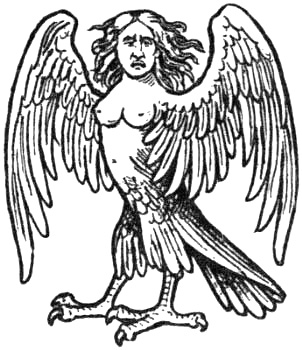
A Harpy, wings disclosed.
“Of monsters all, most monstrous this; no greater wrath
God sends ’mongst men; it comes from depth of pitchy hell:
And virgin’s face, but womb like gulf unsatiate hath,
Her hands are griping claws, her colour pale and fell.”
Virgil.
“Thou art like the harpy,
Which to betray, doth wear an angel’s face,
Seize with an eagle’s talons.”
“Pericles Prince of Tyre,” Act iv. sc. 4. |
A poetical monstrosity of classical origin, described as “winged creatures
having the head and breasts of a woman, and the body and limbs of a
vulture; very fierce and loathsome, living in an atmosphere of filth and
stench, and contaminating anything which they come near. Pale and
emaciated, they were continually tormented with insatiable hunger.” They
are best known from the story of the Argonauts, where they appear as the
tormentors of the blind king Phineus, whose table they robbed of its
viands, which they either devoured or spoiled. They were regarded by the
ancients as ministers of sudden death.
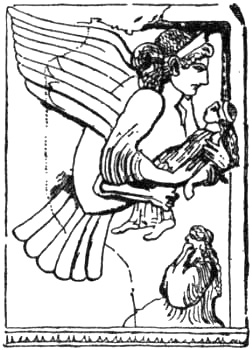
The Harpy, Greek sculpture.
In Miss Millington’s admirable book, “Heraldry in History, Poetry and
Romance,” it is stated that unlike the generality of such mythical beings,
the harpies appear originally, as in Homer’s “Odyssey,” as persons instead
of personations; while later authors for the most part reduced them to
whirlwinds and whirlpools. Homer mentions but one harpy. Hesiod gives two,
later writers three. The names indicate that these monsters were
impersonations of whirlwinds and storms. The names were: Ocypeta
(rapid), Celeno (blackness), Aello (storm).
“I will ... do any embassage ... rather than
Hold three words’ conference with this harpy.”
Much Ado About Nothing, Act ii. sc. 1.
“Bravely the figure of this harpy hast thou
Performed, my Ariel; a grace it had devouring.”
Tempest, Act iii. sc. 3.
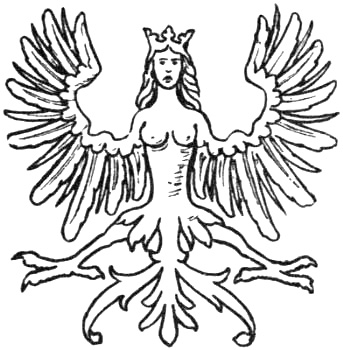
A Harpy displayed and crowned. German version.
Azure, a harpy with her wings disclosed, her hair flotant, or, armed of
the same. This coat existed in Huntingdon Church in Guillam’s time.
The arms of the City of Nuremberg are: azure, a harpy displayed armed,
crined and crowned, or. It occurs as the city device as early as 1243. In
German heraldry it is termed jungfraundler.
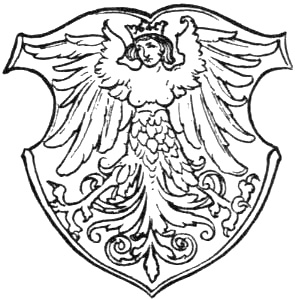
Shield of Nüremberg.
A creature very similar to the harpy (a combination of several badges),
was one of the favourite devices of Richard III., viz., a falcon with the
head of a maiden holding the white rose of York.
“Then sayd the pellycane
When my byrats be slayne
With my bloude I them reuyue (revive)
Scrypture doth record,
The same dyd our Lord,
And rose from deth to lyue.”
Skelton, “Armory of Birds.” |
The character ascribed to the pelican is nearly as fabulous as that of the
phœnix. From a clumsy, gluttonous, piscivorous water-bird, it was by
the growth of legends transformed into a mystic emblem of Christ, whom
Dante terms “Nostro Pelicano.” St. Hieronymus gives the story of the
pelican restoring its young ones destroyed by serpents as an illustration
of the destruction of man by the old Serpent, and his salvation by the
blood of Christ.
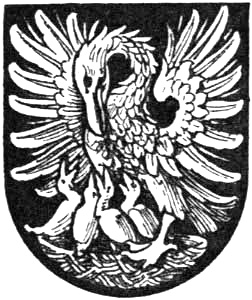
A Pelican in her piety, wings displayed.
The Pelican in Christian Art is an emblem of Jesus Christ, by “whose blood
we are healed.” It is also a symbol of charity.
The “Bestiarum” says that Physiologus tells us that the pelican is very
fond of its brood, but when the young ones begin to grow they rebel
against the male bird and provoke his anger, so that he kills them; the
mother returns to the nest in three days, sits on the dead birds, pours
her blood over them, and they feed on the blood.
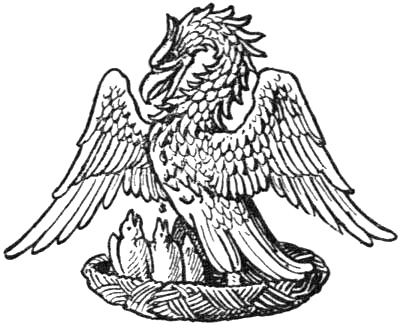
Heraldic Pelican in her piety.
Heralds usually represent this bird with wings endorsed and neck embowed,
wounding her breast with her beak. Very many early painters mistakenly
represented it similar to an eagle, and not as a natural pelican, which
has an enormous bag attached to the lower mandible, and extending almost
from the point of the bill to the throat. When in her nest feeding her
young with her blood, she is said to be IN HER PIETY.
The Romans called filial love piety, hence Virgil’s hero is called the
“pious Æneas,” because he rescued his father from the flames of Troy.
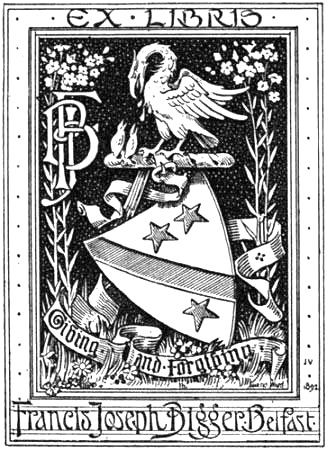
Crest, a Pelican vulning herself proper, wings endorsed.
The myth that pelicans feed their young with their blood arose from the
following habit, on which the whole superstructure of fable has been
erected: They have a large bag attached to their under-bill. When the
parent bird is about to feed its brood, it macerates small fish in this
bag or pouch; then, pressing the bag against its breast, transfers the
macerated food to the mouths of the young ones.
The pelican in her piety is not an uncommon symbol upon monumental
brasses. That of William Prestwick, Dean of Hastings, in Warbleton Church,
Sussex, has it with the explanatory motto: “Sic Xtus dilexit nos.”
Examples.—Gules, a pelican in her piety, or.—Chauntrell.
Azure, three pelicans argent, vulning themselves proper.—Pelham,
Somerset, &c.
A pelican’s head erased, or otherwise detached from the body, must always
be drawn in the same position and vulning itself. It should always be
separated as low as the upper part of the breast.
It is said naturalists of old, observing that the pelican had a crimson
stain on the tip of its beak, reported that it was accustomed to feed its
young with the blood flowing from its breast, which it tore for the
purpose. In this belief the Early Christians adopted the pelican to figure
Christ, and set forth the redemption through His blood, which was
willingly shed for us His children.
Alphonso the Wise, King of Castile (+ 1252). A pelican in its piety.
Motto: “Pro lege et grege.”
William of Nassau, founder of the Republic of the United Provinces, one of
the noblest characters of modern history. He bore on some of his
standards the pelican, and on others the motto: “Pro lege, grege et rege.”
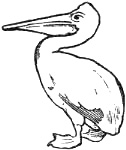
The natural Pelican.
Pope Clement IX. One of his devices was the pelican in its piety. Motto:
“Aliis non sibi clemens” (“Tender-hearted to others, not himself”).
Other mottoes for the pelican:
“Ut vitam habeant” (“That they may have life”).
“Immemor ipse sui” (“Unmindful herself of herself”).
“Mortuos vivificat” (“Makes the dead live”).
“Nec sibi parcit” (“Nor spares herself”).
“The guest of summer,
The temple-haunting martlet.”
“Macbeth.” |
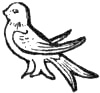
The Martlet (Merlette or Merlot, French; Merula, Latin). The
house-marten or swallow is a favourite device in heraldry all over Europe,
and has assumed a somewhat unreal character from the circumstance that it
catches its food on the wing and never appears to alight on the ground as
other birds do. It builds its nest frequently under the eaves of houses,
from whence it can take flight readily, rarely alighting, as it gains its
food while on the wing; the length of its wings and the shortness of its
legs preventing it from rising should it rest on the ground.
“No jutty friese,
Buttress, nor coign of vantage, but this bird
Hath made his pendant bed, and procreant cradle.”
Macbeth, Act i. sc. 6.
It is depicted in armory with wings close, and in profile, with thighs,
but with no visible legs or feet.
The martlet is the appropriate “difference” or mark of cadency for the
fourth son. Sylvanus Morgan says: “It modernly used to signify, as that
bird seldom lights on land, so younger brothers have little land to rest
on but the wings of their own endeavours, who, like the swallows, become
the travellers in their seasons.”
The swallow (hirondelle) is the punning cognisance for Arundell. The
seal of the town of Arundel is a swallow, Baron Arundell of Wardour bears
six swallows for his arms. The great Arundells have as motto, “De
Hirundine” (“Concerning the swallow”), and “Nulli præda” (“A prey to
none”). A Latin poem of the twelfth century is thus rendered:
“Swift as the swallow, whence his arms’ device
And his own arms are took, enraged he flies
Thro’ gazing troops, the wonder of the field,
And strikes his lance in William’s glittering shield.”
“We find it in Glovers’ roll,” says Planché, “borne by Roger de Merley,
clearly as ‘armes parlantes,’ although in a border.” Roger de Merley:
“barée d’argent et de goulz à la bordure d’azur, et merlots d’or en le
bordure”; showing it was some difference of a family coat.
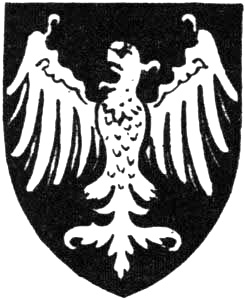
is a heraldic bird, represented as an eaglet displayed, but without beak
or claws. Some writers confound it with the martlet, stating that the
alerion is the same bird with its wings displayed or extended. They are
first found in the arms of Lorraine, which are blazoned or, on a bend
gules, three Alerions argent, and are said to be assumed in commemoration
of an extraordinary shot made by Godfrey de Boulogne, “who at one draught
of his bow, shooting against David’s Tower in Jerusalem, broched three
feetless birds called Alerions, which the House of Lorraine, decending
from his race, continued to this day.” It is impossible, says Planché, who
broached this wonderful story, but it is perfectly evident that the
narrator was the party who drew the longbow, and not the noble Godfrey.
 |
|
 |
| Alerion displayed. |
|
Heraldic Eagle. |
The letters of the word Alerion appear to be merely an anagram formed by
the same letters Loraine, and may account for the birds on the shield
(probably eaglets) being called alerions.
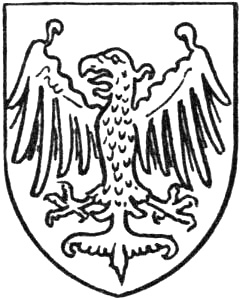
The eagle displayed and the two-headed eagle are but extreme
conventionalised representations of the natural bird.
Liver, a fabulous bird, supposed to have given its name to Liverpool and
commemorated in the arms of that city. It is traditionally described as a
bird that frequented the pool, near which the town was afterwards
founded. The arms granted in 1797 are thus blazoned: Argent a cormorant,
in the beak a branch of seaweed all proper, and for crest, on a wreath
of the colours, a cormorant, the wings elevated, in the beak a branch of
Laver proper. It is more than probable that the bird on the arms
suggested the name “Liver” being applied to it. The fiction naturally
arose from the desire to find a derivation for the name of the town. It
is, however, always depicted as a cormorant. On the shield the bird is
always depicted with the wings close, and on the crest the wings are
elevated.
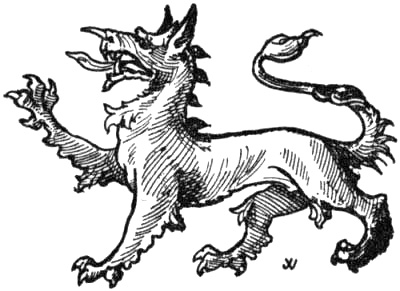
An Heraldic Tigre passant.
“A savage tygress on her helmet lies;
The famous badge Clorinda us’d to wear.”
Fairfax’s “Tasso.” |
The tigre or tyger of the old heralds still holds its place in English
armory, retaining the ancient name to distinguish it from the natural
tiger, to which it bears but little resemblance except the name. The early
artists probably had no better authority for the strange creature they
depicted than the wild tales of Eastern travel and their own lively
imaginations. The habit of drawing in a conventional manner may also have
assisted in producing such a monster. This type of wild and ruthless
ferocity, approaching the draconic in its power and destructiveness, was
to their minds fitly suggested by exaggerations of those attributes of
savageness and bloodthirstiness with which it was supposed to be endowed.
Shakespeare makes King Henry V., when urging on his “noblest English” and
“good yeomen” to the assault at Harfleur, declare that
“When the blast of war blows in our ears
Then imitate the action of the tiger;
Stiffen the sinews, summon up the blood,
Disguise fair Nature with hard-favoured rage.”
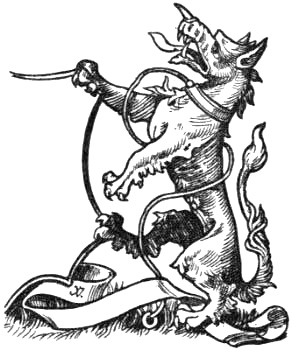
Supporter, an Heraldic Tigre, collared and lined.
“The tyger,” says Bossewell, “is a beast wonderful in strength, and most
swift in flight as it were an arrow. For the Persians call an arrow
tygris. He is distinguished with diverse speckes; and of him the floode
Tygris tooke the name. It is said Bacchus used these beastes in his
chariot, for their marveilous swiftness in conveying of the same.”
The heraldic tigre, the invention of the early heralds, is depicted as
having the body similar to a wolf, but more strong and massive; powerful
jaws armed with prominent canine tusks, and with a short curved horn or
spike at the end of his nose. A row of knotted tufts of hair adorn the
back of his neck as a mane; tufts also on his breast and thighs, and with
strong claws; the tail of a lion completes his equipment. He is a most
effective creature in a heraldic emblazonment, especially when “armed”
and “tufted” of tinctures differing from his body.
The sinister supporter of the Marquess of Dufferin and Ava is an heraldic
tigre ermine, gorged with a tressure flory counter flory or.
Gules a chevron argent, between three tigres, &c., of the
second.—Butler, Calais.
Vert, a tigre passant or, maned and tufted argent.—Love, Norfolk
(granted 1663).
Or, a tigre passant gules.—Lutwych, Lutwich, Salop.
Baron Harlech has for dexter supporter, and also for crest, an heraldic
tigre argent, maned and tufted sable.
The tigre and mirror is an uncommon but very remarkable bearing. Amongst
other remarkable ideas which our ancestors entertained respecting foreign
animals, “some report that those who rob the tigre of her young use a
policy to detaine their damme from following them by casting sundry
looking-glasses in the way, whereat she useth to long to gaze, whether it
be to beholde her owne beauty or because when she seeth her shape in the
glasse she thinketh she seeth one of her young ones; and so they escape
the swiftness of her pursuit.”[21]
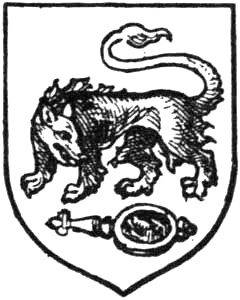
Tigre and Mirror.
“Argent, a tigre passant regardant looking into a mirror lying fessways,
the handle to the dexter all proper,” is said to have been the coat of
Hadrian de Bardis (probably an Italian), Prebendary of Oxfordshire. These
arms still remain, or were lately remaining, in a window of Thame Church.
Only two other examples occur, viz.:
“Argent a tigre and mirror (as before) gules.”—Sibell, Kent.
Next to the lion in power is the tiger, an animal not possessed of the
noble qualities of the lion, being fierce without provocation, and cruel
without cause. The chief difference of the tiger from every other animal
of the mottled kind is in the shape of the spots on the skin, which run in
streaks or bands in the direction of the ribs. The leopard, panther and
the ounce are all, in a certain degree, marked like this animal, except
that the lines are broken by round spots, which cover the whole surface
of the skin. The use of the royal tiger in modern coats of arms is
frequent, and has reference to services in the East.
Outram, Bart., has for supporters: two royal Bengal tigers guardant
proper, gorged with a wreath of laurel vert, crowned with an Eastern
crown.
Note.—In a heraldic description (or blazon as it is termed) it is
necessary for the sake of greater clearness, and to prevent confusion, to
name the older mythical creature the “Heraldic Tigre,” that it may not be
confounded with its natural representative usually called the “Royal
Tiger.”
“Upon his shoulders a scheld of stele
With the lybbardes painted wele.”
“The Metrical Romance of Richard
Cœur de Lyon.”
“Make the libbard stern
Leave roaring, when in rage he for revenge did yearn.”
Spenser, “Faerie Queen,” Book i. canto vi. |
A curious character, partly real and partly fictitious has been ascribed
to the lybbard or leopard of heraldry. It was said to be the offspring of
a lioness and a panther, the Northmen or Normans, according to some
authorities, having adopted that beast of prey, noted for rashness, as
typical of themselves, so characterised by boldness and impetuosity. The
standard of Rollo, first Duke of Normandy, they say, bore a leopard. A
second lion or leopard was added to the Norman shield when the county of
Maine became annexed to the Duchy of Normandy; and the two lions or
leopards—for they are indiscriminately so termed—were thus borne, it is
said, upon the standard of William the Conqueror, and by his descendants.
A third lion was added by Henry II. on his marriage with Eleanor of
Aquitain, a lion being also the arms of that province.
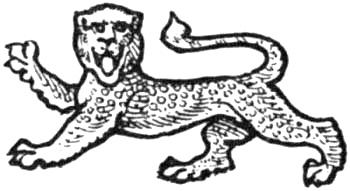
A Leopard passant.
It has been keenly contested whether the three animals in the royal shield
of England were lions or leopards. The subject has been ably treated by
Mr. J. R. Planché in the “Pursuivant of Arms,” and also by Charles
Boutell, M.A., in several of his works. The case seems to stand thus:
In ancient coats the name is believed to be given to the lion in certain
attitudes. The French heralds call a lion passant a leopard. Thus
Bertrand du Guesclin, the famous Breton, declared that men “devoyent bien
honorer la noble fleur-de-lis, qu’ils ne faissaient le félon liépard,” and
Napoleon, strongly to excite the valour of his soldiers, exclaimed, “Let
us drive these leopards (the English) into the sea!”
“Lion Léoparde” is the term used in French heraldry for the lion when
borne passant guardant as in the royal shield of England. When rampant
they call it “léoparde lionné,” as if in this attitude the leopard assumed
the position and bold character of the lion. The attitude passant
guardant thus denoted the peculiar stealthy tread and cat-like
watchfulness of the leopard and panther.
The Emperor Frederick II. (1235) sent King Henry of England three leopards
as a present in token of his armorial bearings.
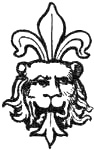
A Leopard’s Face,
jessant-de-lis.
It is a great argument in favour of the substitution of the lion for the
leopard, Mr. Boutell thinks, that the latter should have almost
disappeared from English heraldry, the face and head only retaining their
place in modern coats.
“A leopard’s head” should show part of the neck, couped or erased,
as the case may be; guardant, affronté or front face, is always to be
understood of the leopard, and never in profile.
“A leopard’s face” shows no part of the neck, and in conjunction with
the term “jessant-de-lis” is used with respect to a leopard’s face
having a fleur-de-lis passing through it.
The insignia of the See of Hereford is: gules three leopards’ heads
reversed jessant-de-lis, or.
In heraldry the leopard represents those brave and generous warriors who
have performed some bold enterprise with force, courage, promptitude, and
activity. Thus Shakespeare alludes to the character of the bold soldier
“Full of strange oaths, and bearded like the pard,
Jealous in honour, sudden and quick in quarrel,
Seeking the bubble reputation
Even in the cannon’s mouth.”
In Christian Art the leopard is employed to represent that beast spoken of
in the Apocalypse, with seven heads and ten horns. Six of the heads are
nimbed, but the seventh, being “wounded to death,” has lost its power, and
consequently has no nimbus.
Three leopards passant guardant or, pelletée, appear on the arms of the
Marquis of Downshire. It is also the sinister supporter.
The supporters of the town of Aberdeen are leopards.
Sable three leopards rampant argent spotted sable are given as the arms
of Lynch. It is, however, probable that the lynx was the animal
originally blazoned as “arms parlantes” for the name.
Ermine on a cross patonce sable, a leopard’s head, issuing out of a ducal
coronet or, crest, a demi-leopard erect, proper.—Dickens.
A leopard’s face, breaking with his mouth a sword, is the crest of
Disne.
The supporters of the Earl of Northesk are two leopards reguardant.
The leopard or panther, says Dr. P. M. Duncan, F.R.S.,[22] was the only
one of the greater feline animals, except the lion and tiger, which seems
to have been known to the ancients. It is always represented as drawing
the chariot of Bacchus, and the forlorn Ariadne is sculptured as riding on
one of the spotted steeds of her divine lover. The panther was also
constantly used in the barbarous sports of the amphitheatre, and, in
common with the lion and tiger, has been both executioner and grave to
many a bold-hearted martyr.
The leopard’s skin was a favourite mantle in the olden times in Greece. In
the “Iliad,” Homer, speaking of Menelaus, says:
“With a pard’s spotted hide his shoulders broad
He mantled o’er,”
and the leopard, or panther, is given in the “Odyssey” as one of the forms
assumed by Proteus, “the Ancient of the Deep.”
A curious ancient superstition about the leopard is embodied in its name.
It was thought not to be actually the same animal as the panther or pard,
but to be a mongrel or hybrid between the male pard and the lioness, hence
it was called the lion-panther, or leopardus. This error, as Archbishop
Trench tells us, “has lasted into modern times”; thus Fuller: “Leopards
and mules are properly no creatures.”
Some writers, says Boutell, describe the leopard as the issue of the pard
and lioness, and they assign the unproductiveness of such hybrids as a
reason for its frequent adoption in the arms of abbots and abbesses.
“Mulus et abbates sunt in honore pares.”
The leopard and panther are now acknowledged to be but slight varieties of
the same species. In Wood’s “Natural History” some slight difference is
mentioned as to the number of spots. “The panther is fawn-coloured above,
white underneath, with six or seven ranges of patches resembling
rosettes—that is to say, each composed of an assemblage of five or six
simple black spots. It very much resembles the leopard, which inhabits the
same region (but has ten rows of spots which are of smaller size), It is
the wildest of the feline tribe, always retaining its fierce aspect and
perpetual growl.”
“The panther, knowing that his spotted hide
Doth please all beasts, but that his looks them fray,
Within a bush his dreadful head doth hide
To let them gaze, while he on them doth prey.”
Spenser, Sonnet. |
This beast, like the leopard, has been the object of much mistaken or
fictitious history. Pliny, who is responsible for many of the errors in
natural history since his time, says of the panther: “It is said that all
four-footed beasts are wonderfully delighted and enticed by the smell of
panthers; but their hideous looke and crabbed countenance which they
bewray so soon as they show their heads skareth them as much again:
therefore their manner is to hide their heads, and when they have trained
other beasts within their reach by their sweet savour, they fall upon them
and worry them.”[23] And again, Sir William Segar, Garter King-of-Arms,
following the same credulous historian, says: “The panther is admired of
all other beasts for the beauty of his skyn, being spotted with variable
colours, and beloved of them for the sweetness of his breath that
streameth forth of his nostrils and ears like smoke which our paynters
mistaking, corruptly do make fire.”[24]
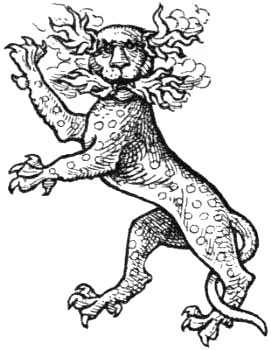
Panther incensed.
It is, however, more probable that the creature was represented emitting
flame and smoke to denote and give characteristic expression to the native
savagery of the brute when irritated. If one can imagine the terror
inspired by remorseless and unpitying fury, sudden and impetuous, we see
its object fairly typified in the panther “incensed.” The idea of fire and
smoke darting from its mouth, eyes and ears was doubtless suggested by
that habit peculiar to the feline race, observable even in the domestic
cat, to “spit fire” and “swear” when rudely attacked, and as an emblem in
this sense it is extremely well indicative of sudden fury.
Guillam says: “Some authors are of opinion that there are no panthers bred
in Europe; but in Africa, Lybia and Mauritania they are plentiful. The
panther is a beast of a beautiful aspect, by reason of the manifold
variety of his divers coloured spots wherewith his body is overspread. As
a lion doth in most things resemble the nature of a man, so, after a sort,
doth the panther of a woman; for it is a beautiful beast, and fierce, yet
very loving to their young ones, and will defend them with the hazard of
their own lives; and if they miss them, they bewail their loss with loud
and miserable howling.”
The Lancastrian badge “the panther,” says Planché, “which is attributed by
Sir William Segar to Henry VI. and blazoned passant guardant argent
spotted of all colours with vapour issuant from her mouth and ears; but
there is no authority quoted for it, and there is no example extant, the
only collateral evidence being the supporters of the Somerset Dukes of
Beaufort, who are supposed to have used it as a token of their Lancastrian
descent.” The dexter supporter of the Duke of Beaufort thus is blazoned:
Dexter, a panther argent, semée of torteaux, hurts and pomies
alternately, flames issuant from the mouth and ears proper, gorged with a
plain collar, chained, or.
The heraldic panther, or as it is more frequently termed, a panther
incensed, is always borne guardant, i.e., full-faced; and “incensed,”
that is to say, it is depicted with flames and smoke issuing from its
mouth and ears. Its coat is spotted of various tinctures as the blazon may
state.
Odet de Foix, Sieur de Lautrec, Marshal of France (+ 1528) being
considered a person of fierce appearance, took for device a panther, with
the motto “Allicit ulterius” (“He entices further”), alluding to the
attractive power of that animal notwithstanding its fierce exterior, “an
evidence,” remarks a modern writer, “that he had as much vanity as
ambition.”
The town of Lucca for arms bears a panther: “La pantera, che Lucca
abbraccia e onora.”
Gian Giacomo Trivulzio, surnamed the Great (+ 1518), a celebrated Italian
soldier, bore a panther on his standard, with the motto, “Mens sibi
conscia facti” (“The mind conscious to itself of the deed”), the panther
signifying foresight (providence) from the number of eyes in his coat.
Others said he wished to imply that he knew how to manage for himself in
the various changes of his capricious fortune.[25]
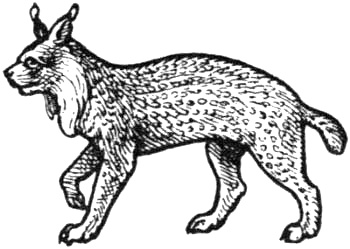
The Lynx.
Felis Lynx, or mountain cat, is found in the northern parts of Europe,
Asia and America, and climbs the highest trees. He preys on squirrels,
deer, hares, &c. He is fond of blood and kills great numbers of animals to
satisfy his unconquerable thirst. He is smaller than the panther, about
three feet and a half in length, his tail is much shorter and black at the
extremity. His ears are erect with a pencil of black hair at the tips. The
fur is long and thick, the upper part of the body is a pale grey, the
under parts white.
The sight of the lynx is said to be so piercing that the ancients
attributed to it the faculty of seeing through stone walls: it may,
however, be asserted with truth that it distinguishes its prey at a
greater distance than any other carnivorous quadruped. On this account it
is frequently employed in heraldry, symbolising watchfulness, keenness of
vision, and also the ability to profit by it.
Lynx-eyed, “oculis lynceis,” originally referred to Lynceus, the argonaut,
who was famed for the keenness of his vision; then it was transferred to
the lynx and gave rise to the fable that it could see through a wall
(notes to “Philobiblon,” by E. C. Thomas).
The Accademia de Lincei, founded in Rome in 1603, with the object of
encouraging a taste for natural history, adopted the name and device of
the lynx because the members should have the eyes of a lynx to penetrate
the secrets of nature. Galileo, Fabio Colonna, and Gianbattista Porta were
among the members of the academy, the latter philosopher and
mathematician, who was the inventor of the camera obscura, bore the device
of the academy, the lynx, and the motto “Aspicit et inspicit” (“Looks at
and looks into”).
Charles IV. of Luxemburg, Emperor of Germany, adopted the lynx for his
impress, with the motto, “Nullius pavit occursum” (“He fears not meeting
with any one”).
The Lizard Lynx is an animal of the lynx or wild cat kind of a dark brown
colour, spotted black; the ears and tail are short. They are frequent in
the woods of Sweden, Denmark and Norway, where they are usually termed
lizards.
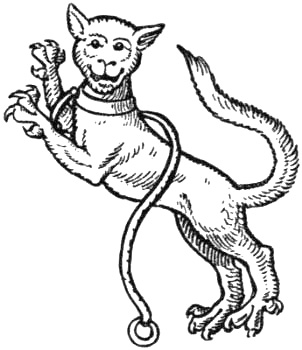
Cat-a-Mountain saliant, collared and lined.
The Clan Chattan, who gave their name to the county of Caithness, bore as
their cognisance the wild mountain cat, and called their chieftain, the
Earl of Sutherland, “Mohr an chat” (The Great Wild Cat). The Mackintoshes
still bear as their crests and supporters these ferocious cats, with the
appropriate warning as a motto, “Touch not the cat but a glove.”
The whole is a pun upon the word “Catti,” the Teutonic settlers of
Caithness, i.e., Catti-ness, and means “Touch not the Clan Cattan (or
mountain cat) without a glove.” Here “but” is used in the original
meaning, beout, i.e., without. For another example of “but” meaning
without, see Amos iii. 7. The same words are also used as the motto of
several Scottish families.
None will forget how the cat-a-mountain showed her claws to the Clan Kay,
in the Wynds of Perth in Sir Walter Scott’s “Fair Maid of Perth.”
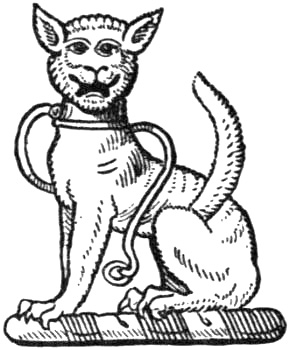
Crest, a Cat-a-Mountain, sejant, collared and lined.
The Heraldic Musion.—Bossewell, in his work on heraldry published 1572,
describes a musion as “a beaste that is enimie to myse and rattes.” He
adds also that he is “slye and wittie, and seeth so sharply, that he
overcommeth darkness of the nighte by the shyninge lighte of his eyne. In
the shape of body, he is like unto a leoparde, and hath a greate mouthe.
He doth delighte that he enjoyeth his libertie, and in his youthe he is
swifte, plyante, and merrie. He maketh a rufull noyse, and a gastefull
when he proffereth to fighte with another. He is a cruel beaste when he is
wilde and falleth on his owne feet from moste high places, and uneth
(scarce) is hurte therewith. When he hathe a fayre skinne, he is, as it
were, prowde thereof, and then he goeth fast aboute to be seene.”
Childebert, King of France, in token of his having taken captive
Gondomar of Bourgogne, assumed the device of a tiger-cat or ounce behind a
grating or troillis, gules cloué argent. This recalls the famous scene
between Sanglier Rouge and Toison d’Or in “Quentin Durward,” when Charles
the Bold’s jester professes to help the unhappy envoy of De la Marck by
describing it as a cat looking out of a dairy window.
The cat, though domesticated, is considered as possessed of ingratitude;
in its friendship so uncertain and so vicious in its nature, “that,” say
old writers, “it is only calculated for destroying the obnoxious race of
rats and other small game.”
From the mediæval superstition that Satan’s favourite form was a black
cat, it was superstitiously called “a familiar.” Hence witches were said
to have a cat as their familiar.
The Cat: A symbol of liberty.—The Roman goddess of Liberty was
represented as holding a cup in one hand, a broken sceptre in the other,
and a cat lying at her feet. No animal is so great an enemy to all
constraint as a cat.
The cat was held in veneration by the Egyptians as sacred to the goddess
Bubastis. This deity is represented with a human body and a cat’s head.
Diodorus tells us that whoever killed a cat, even by accident, was by the
Egyptians punished with death. According to Egyptian tradition, Diana
assumed the form of a cat, and thus excited the fury of the giants. The
London Review says: “The Egyptians worshipped the cat as a symbol of
the moon, not only because it is more active after sunset, but from the
dilation and contraction of its orb, symbolical of the waxing and waning
of the night goddess.”
In heraldry it should always be represented full-faced like the leopard.
Erminois three cats-a-mountain passant gardant, in pale azure, each
charged on the body with an ermine spot or. Crest: a demi cat-a-mountain
gardant, azure, gorged with a collar gemel, and charged with ermine spots,
two and one.—Tibbets.
The supporters of the Earl of Clanricarde are wild cats, and also those of
the Earl of Belmore. It is the crest of De Burgh.
“Æneas.—His mantle was the lion’s,
With all its tawny bars,
His falchion, like Orion’s,
Was gemmed with golden stars.
Upon his lofty helmet
A brazen terror rode;
No sword could overwhelm it
When in the fight it glowed.
For like a wild cat brindled,
It spat with eyes on fire,
And in the battle kindled
Immortal rage and ire,
Now in the sunshine sleeping,
How gently it reposed;
But still in wisdom keeping
A single eye unclosed.”
Queen Dido, by T. S.
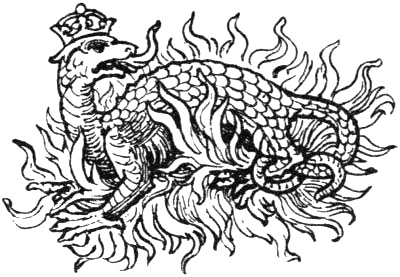
The Crowned Salamander of Francis I.
The salamander has been immemorially credited with certain fabulous
powers. Less than a century ago the creature was seriously described as a
“spotted lizard, which will endure the flames of fire.” Divested of its
supernatural powers it is simply a harmless little amphibian of the “newt”
family, from six to eight inches in length, with black skin and yellow
spots. The skin was long thought to be poisonous, though it is in reality
perfectly harmless; but the moist surface is so extremely cold to the
touch that, from this peculiar quality in the creature, the idea must have
arisen, not only that it could withstand any heat to which it was exposed,
but it would actually subdue and put out fire.
This was a widespread belief long before the time of Pliny, whose
account of the creature is thus paraphrased by Swift:
“Further, we are by Pliny told
This serpent is extremely cold;
So cold that, put it in the fire,
’Twill make the very flames expire.”
Marco Polo, the early Venetian traveller, who tells of many strange and
wonderful things seen and heard of in his journeyings, was not a believer
in the fabulous stories of the salamander, for he dismisses the subject
with the curt remark, “Everybody knows that it could be no animal’s nature
to live in fire.” An early heraldic writer of a somewhat later period,
with greater credulity, stoutly maintains its reality, and in describing
the creature states that he actually possessed some of the hair or down of
the salamander. “This,” he goes on to say, “I have several times put in
the fire and made it red-hot, and after taken out; which, being cold, yet
remaineth perfect wool, or fine downy hair.”
Marco Polo further on assures his readers that the true salamander is
nothing but an incombustible substance found in the earth, “all the rest
being fabulous nonsense.” He tells of a mountain in Tartary, “there or
thereabouts,” in which a “vein” of salamander was found; and so we arrive
at the fact that this salamander’s wool was nothing but the “asbestos” of
the ancients. It is easy to see why asbestos became known as “salamanders’
wool.” The name resulted from the juxtaposition of ideas, and shows how
deeply impressed was the belief in the salamander’s mysterious powers. A
late writer tells us that some of the lizard tribe are known to enjoy
warmth, and alligators are said to revel in hot water. It needed only that
an insignificant member of the genus should have been found among the dead
embers of a fire to prove at once the invulnerability of the reptile and
its ability to extinguish the flames.
The salamander of mediæval superstition was a creature in the shape of a
man, which lived in fire (Greek, salambeander, chimney-man), meaning a man
that lives in a chimney. It was described by the ancients as bred by fire
and existing in flames, an element which must inevitably prove destructive
of life. Pliny describes it as “a sort of lizard which seeks the hottest
fire to breed in, but quenches it with the extreme frigidity of its body.”
He tells us he tried the experiment once, but the creature was soon
reduced to powder.[26]
Gregory of Nazianzen says that the salamander not only lived in and
delighted in flames, but extinguished fire. St. Epiphanius compares the
virtues of the hyacinth and the salamander. The hyacinth, he states, is
unaffected by fire, and will even extinguish it as the salamander does.
“The salamander and the hyacinth were symbols of enduring faith, which
triumphs over the ardour of the passions. Submitted to fire the hyacinth
is discoloured and becomes white. We may here perceive,” says M. Portal,
“a symbol of enduring and triumphant faith.”
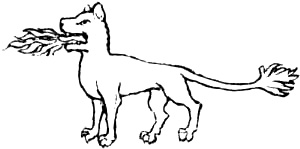
Salamander crest of James, Earl of Douglas.
From garter-plate.
This imaginary creature is generally represented as a small wingless
dragon or lizard, surrounded by and breathing forth flames. Sometimes it
is represented somewhat like a dog breathing flames. A golden salamander
is so represented on the garter-plate of James, Earl of Douglas, K.G., the
first Scottish noble elected into the Order of the Garter, and who died
1483 A.D. Tinctured vert; and in flames proper it is the crest of
Douglas, Earl of Angus.
François I. of France adopted as his badge the salamander in the midst of
flames, with the legend, “Nutrisco et extinguo” (“I nourish and
extinguish”). The Italian motto from which this legend was borrowed was,
“Nudrisco il buono e spengo il reo” (“I nourish the good and extinguish
the bad;” “Fire purifies good metal, but consumes rubbish”). In his castle
of Chambord, the galleries of the Palace of Fontainebleau, and the Hôtel
St. Bourg Thoroulde at Rouen, this favourite device of the crowned
salamander, with the motto, may be everywhere seen.
Azure, a salamander or, in flames proper, is the charge on the shield of
the Italian family of Cennio.
The “lizards” which form the crest of the Ironmongers’ Company, were
probably intended for salamanders on the old seal of the company in 1483,
but are now blazoned as lizards.
The heraldic signification of the salamander was that of a brave and
generous courage that the fire of affliction cannot destroy or consume.
In the animal symbolism of the ancients the salamander may be said to
represent the element of Fire; the eagle, Air; the lion, Earth; the
dolphin, Water.
This fictitious animal, when depicted in heraldry, has a body like that of
a stag, the tail of a unicorn, a head like the heraldic tiger, with two
serrated horns, and a tusk growing from the tip of his nose, a row of
tufts down the back of his neck, and the like on his tail, chest and
thighs. Thus represented it is termed an heraldic antelope to distinguish
it from the real or natural antelope, which is also borne in modern coats
of arms.
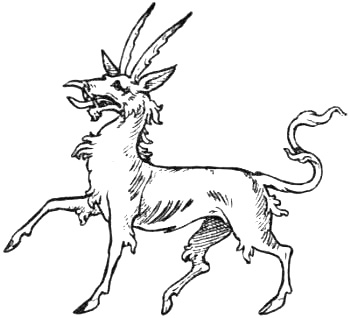
Heraldic Antelope.
The old heralds, with their scant knowledge of the rarer kinds of
foreign animals, represented the antelope as a fierce beast of prey, and
totally unlike in appearance and in disposition to the beautiful
small-limbed gentle creature with which we are acquainted. That such was
the prevailing opinion in the time of Spenser is evident. In the “Faerie
Queen” he makes the stout Sir Satyrane—
“In life and manners wild,
Amongst wild beasts and woods from laws of man exiled.”
—more than a match for the most ferocious brutes, all of whom he subdues:
“Wild beasts in iron yokes he would compel;
The spotted panther, and the tuskèd boar;
The pardale swift, and the tiger cruel,
The antelope and wolf, both fierce and fell;
And them constrain in equal team to draw.”
Some authorities give the heraldic antelope with two straight horns, but
as the ancient badge of the House of Lancaster it was represented with two
serrated horns curving backward.
In blazon, the term “heraldic antelope” should always be used unless the
natural antelope is intended.
is an imaginary beast resembling the heraldic antelope in appearance, with
the exception of the horns projecting from his forehead, which are
serrated like a saw. Perhaps it would not be erroneous to consider it
identical with the heraldic antelope.
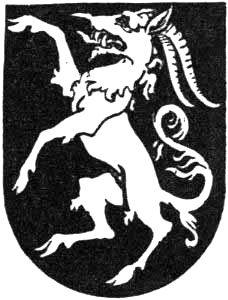
The Heraldic Ibex.
The real or natural ibex is a native of the Alps, the Pyrenees and the
Grecian mountains, where they abound in defiance of the hunters. It
resembles a goat, but the horns are much larger, bent backwards, and full
of knots, one of which is added every year.
A fabulous beast like the heraldic antelope, but having the tail of a
horse, and long horns of a goat curved backwards. The dexter supporter of
the arms of Carey, Lord Hundson, in Westminster Abbey, is a Bagwyn.
The Giraffe figures a few times in blazon under these names. It is
described by old heralds as half camel and half leopard. A curious
word-combination was made by the Romans when wishing to find a name for
the giraffe. “It is,” says Archbishop Trench, “a creature combining,
though with infinitely more grace, yet some of the height and even the
proportions of a camel, with the spotted skin of the pard.” They
called it “camelopardus,” the camel-panther.
There are two heraldic creatures based upon the above which are referred
to in heraldic works, viz., the Allocamelus or ass-camel, having the body
of the camel conjoined to the head of an ass; and the Camelopardel, which
is like the camelopard, but with two long horns curved backwards.
A fictitious animal mentioned by Guillim and others. It nearly resembles
a goat, with the head and horns of a ram, but has besides the horns of
that beast, a pair of goat’s horns. It is also mentioned in Guillim’s
“Display,” where it is said to be a bigenerous beast, of unkindly
procreation, engendered between a goat and a ram, like the Tityrus, the
offspring of a sheep and goat, as noted by Upton.
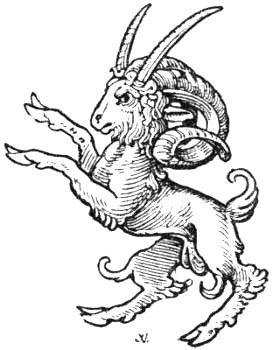
Musimon, Tityrus.
An imaginary hybrid animal with the head of a fox, chest of a greyhound,
talons of an eagle, and body of a lion; the hind legs and tail of a wolf.
It occurs as the crest of some Irish families of the name of Kelly.
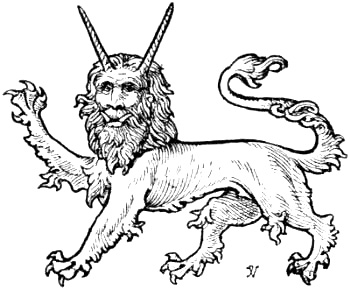
Mantygre—Satyral.
A chimerical creature of mediæval invention, having the body of an
heraldic tiger with mane, and the head of an old man with long spiral
horns. Some heraldic authorities make the horns more like those of an ox,
and the feet like a dragon’s.
The Satyral is apparently identical with the man-tiger.
The belief that certain persons have the power of assuming the shape of
the tiger is common in India, and the Khonds say that a man-killing tiger
is either an incarnation of the Earth’s goddess or a transfigured man. It
is thus with the Lavas of Birma, supposed to be the broken-down remains
of a cultured race and dreaded as man-tigers.[27]
Two satyrals supported the arms of the Lords Stawell.
The supporters of the arms of the Earl of Huntingdon are mantigers, but
are represented without horns.
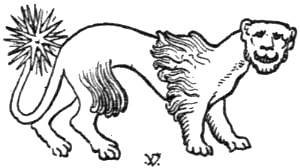
Manticora. From ancient Bestiaria.
From a mediæval “Bestiaria” we have a description and illustration of a
gruesome creature of this name (manticora), evolved no doubt from some
traveller’s marvellous tale. We are told that it is “bred among the
Indians,” has a triple row of teeth, in bigness and roughness like a
lion’s, face and ears like a man’s, a tail like a scorpion’s “with a sting
and sharp-pointed quills,” and that “his voice is like a small trumpet,”
and that he is “very wild,” and that after having his tail bruised, he can
be tamed without danger.
There are several other fictitious creatures, which, if we may believe
certain old writers, excited the minds of our credulous wonder-loving
forefathers. Of these little need be said, as they rarely, if ever, appear
in modern works on heraldry, and may therefore be classed as extinct
monsters.
A curious creature of the imagination is the lamia, of which we are told
many fictitious stories. It is said to be “the swiftest of all four-footed
creatures, that it is very treacherous and cruel to men. It is stated to
be bred in Lybia, and sometimes devours its own young.” It is represented
in an ancient “Bestiaria” as having the head and breasts of a woman, and
the body of a four-footed animal with flowing tail, the hind feet having
divided hoofs. It is “thought to be the creature mentioned in Isaiah
xxxiv., called in Hebrew Lilith, as also the same which is mentioned in
Lamentations iv.”
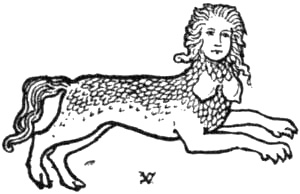
Lamia. From old Bestiary.
In Dr. Brewer’s “Dictionary of Phrase and Fable,” Lamia is “a female
phantom whose name was used by the Greeks and Romans as a bugbear to
children, from the classic fable of a Lybian Queen beloved by Jupiter, but
robbed of her children by Juno; and in consequence she vowed vengeance
against all children, whom she delighted to entice and murder.” They are
again described as spectres of Africa, who attracted strangers and then
devoured them. In the story of “Machatës and Philemon,” a young man is
represented as marrying an Empusa, who sucks his blood at night. Goethe
borrowed his ballad of the “Bride of Corinth” from this tale.
Beyond casual mention this mythical creature does not appear in heraldry.
A fictitious creature having two heads, male and female, the rest of the
body female; said to be used as an idol or symbol by the Templars in their
mysterious rites. The word is a corruption of Mahomet. Though mentioned in
old works it does not now appear in British heraldry.
A fictitious animal resembling a bull, with a short tail like that of a
bear. It is the sinister supporter of the arms of the Company of Muscovy
Merchants.
The supporters of the Ironmongers’ Company of London are two lizards.
Bossewell describes beasts of similar shape—“Stelliones” as he terms
them, evidently in allusion to steel. He says, “Stellio is a beaste like a
lysard, having on his back spotts like starres.”[28]
Stellione-serpent, a serpent with the head of a weasel, borne by the name
of Baume.