’Mong blooming woods, at twilight dim,
The throstle chants with glee, o!
But the plover sings his evening hymn
To the ferny wild so free, o!
Wild an’
free!
Wild an’
free!
Where the moorland breezes blow!
Edwin
Waugh.
L’amour nous enlève notre libre-arbitre: on peut
choisir ses amitiés, mais on subit l’amour.
Princesse
Karadja.
One lovely sparkling April day a
man was slowly pushing his bicycle up a certain steep incline
which is situated a little way out of Dorchester, and which is
known as Yellowham Hill.
The road climbed upwards between woods, the banks on either
side being surmounted by a dense growth of rhododendrons and
gorse, the latter in full bloom, its brilliant yellow contrasting
with the glossy dark leaves of the bushes behind, which were already
covered with a myriad of buds, and the little bronze crooks of
the bracken curling upwards through the moss beneath.
The long spring day wanted yet some hours of its close, but
already delicious spicy odours came forth from the woods, which
spoke of falling dew; and the birds were making mysterious
rustlings in the boughs, as though preparing to go to roost.
The young man paused every now and then to draw a long breath,
and to look round him with evident delight.
‘This is good,’ he said to himself once.
‘This is fairyland—the place is full of
magic.’ Then a sudden change came over his face, and
he added: ‘It is better than fairyland—it is
home.’
He was a pleasant-looking young fellow, with a handsome
intelligent face and a tall well-knit figure. He had grey
eyes, very alert and keen in their expression, and when he smiled
his face lit up in an unexpected and attractive way. His
complexion was browner than might have been looked for in
connection with his hair, which was not very dark, and he had a
certain wideawake air as of one who had seen many men and
things.
He
had almost reached the crest of the hill when his glance,
sweeping appreciatively over the curving bank at the turn of the
road, rested upon a woman’s figure amid the tangle of
sunlit green and gold which crowned it.
Rosalie Fiander—who would be Rosalie Fiander for some
three months longer, it having been agreed between her and Isaac
that their marriage should not take place till her year’s
widowhood was completed—had halted here on her return to
Branston, after a flying business-visit to Dorchester.
These Yellowham Woods had been much loved by her during her
childhood, and she had yielded to the temptation of alighting
from the gig to spend a few minutes in what had once been to her
a very paradise.
Nigger was placidly cropping the grass at a little distance
from her, and she had been on her way to re-enter the vehicle,
when she had paused for a last glance round.
She had marked, at first idly, then with some interest, the
figure which was toiling up the hill, feeling somewhat
embarrassed when she discovered on its nearer approach that she
was herself the object of a somewhat unusual scrutiny. The
grey eyes which looked at her so intently from out of the brown
face had a very peculiar mixture of expressions. There was
curiosity in them and admiration—to that she was
accustomed—but there was something more: a wonder, an
almost incredulous delight. Thus might a man look upon the
face of a very dear friend whom he had not expected to
see—thus almost might he meet the sweetheart from whom he
had been parted for years.
As he approached the bank he slackened his pace, and presently
came to a standstill immediately beneath Rosalie’s pinnacle
of moss-grown earth.
They remained face to face with each other for a moment or
two, Rosalie gazing down, fascinated, at the man’s eyes, in
which the joyful wonder was growing ever brighter. Rousing
herself at last with an effort, and colouring high, she turned
and hastened along the crest of the bank until she came to the
gig, descended, rapidly gathered up the reins, and mounted into
the vehicle.
Seeing that the stranger, though he had begun to walk slowly
on, continued to watch her, and being, besides, annoyed and
confused at her own temporary embarrassment, she jerked the reins
somewhat sharply, and touched up Nigger with the whip. The
astonished animal, unaccustomed to such treatment,
started off at a brisk pace, and the gig rattled down the steep
incline with a speed which would have filled its late owner with
horror.
The disaster which he would certainly have prophesied was not
long in coming. Nigger’s legs were not quite on a par
with his mettle, and presently, stumbling over a loose stone, he
was unable to recover himself, and dropped fairly and squarely on
both knees.
He was up in an instant, but Rosalie, jumping out of the cart,
and running to his head, uttered a cry of anguish. Through
the white patches of dust which testified to Nigger’s
misfortune she saw blood trickling. A moment later rapid
footsteps were heard descending the hill, and the bicyclist came
to her assistance.
Bending forward, he carefully examined Nigger’s knees,
and then turned to Rosalie; the curious expression which had so
puzzled and annoyed her having completely vanished and given
place to one of respectful concern.
‘Don’t be frightened,’ he said; ‘it is
not much—barely skin-deep—I doubt if there will be
any marks.’
‘He has never been down before,’ said she tearfully. ‘Poor Nigger! Good old
fellow! I should n’t have driven you so fast down the
hill.’
‘His legs should be attended to at once,’ said the
stranger practically. ‘Have you far to go?’
‘Oh yes—sixteen miles. To
Branston.’
He darted a keen glance at her.
‘Branston,’ he echoed. ‘I am going
there myself to-morrow, or rather I am going to a place about a
mile this side of it.’
‘Well, I, too, stop a little this side of the
town,’ said Rosalie. ‘But poor Nigger will
never get so far. What am I to do? I must get home
to-night.’
‘There is a village a mile or so from here,’
observed the young man. ‘I think your best plan would
be to leave the horse at the inn there. They would probably
lend you another to take you home. If you will get into the
trap I will lead the horse slowly back.’
‘Oh no, I will walk,’ cried Rosalie; ‘I can
lead him myself,’ she added diffidently. ‘I
don’t like to take you out of your way—besides, you
have your bicycle. I suppose you are going to
Dorchester?’
‘I can go to Dorchester any time,’ returned
he. ‘’T is merely a fancy of mine that takes me
there. I’ve a wish to see the old place again, having
been away from it for ten years. But I am really on my way
to visit my uncle. If you know Branston, I dare say you
have met him. He lives near Littlecomb Village, at a place
called the Down Farm.’
‘Mr. Isaac Sharpe!’ ejaculated Rosalie.
‘Indeed, I do know him. I live next door to
him.’
She broke off, not deeming it necessary to disclose, on so
short an acquaintance, her peculiar relations with the person in
question.
‘Good!’ cried the young man gaily. ‘It
is strange our meeting like this. I am Richard Marshall,
his nephew. You live next door to him, you say,’ he
added, with a puzzled look; ‘then you must be—you
are—?’
‘I am Mrs. Fiander,’ returned she.
‘You remember Elias Fiander, of Littlecomb Farm?’
‘Of course I do; and I used to know his wife.’
‘Oh, you have been so long away that a great many
changes have taken place. I was Elias Fiander’s third
wife.’
‘Was?’ cried he.
‘Yes,’ said Rosalie blushing, she knew not
why. ‘My dear husband died last July.’
The look of blank dismay which had overspread the young man’s
face gave way to an expression of relief; but he made no
reply.
Rosalie took hold of the nearest rein, turned Nigger round,
and began to lead him slowly up the hill again.
‘I can really manage quite well,’ she said,
somewhat stiffly.
‘I must see you out of your difficulties,’
returned the other with quiet determination; and he too began to
retrace his steps, pausing a moment at the crest of the hill to
repossess himself of his bicycle, which he had left propped
against the bank.
‘I will ride on to the village,’ he said,
‘and make arrangements about leaving your horse there and
getting a fresh one. It will save time, and there is none
to spare if you want to get home before dusk.’
He raised his cap, mounted, and disappeared before Rosalie had
time to protest.
Indeed, she was glad enough of Richard Marshall’s
helpful company when she presently arrived at the Black Horse
Inn, where, in spite of the framed poetical effusion which hung
beneath the sign, and which testified to the merits of the
establishment, there was some difficulty in procuring
accommodation and attention for poor Nigger, and even greater in finding
a substitute. In fact, the only animal available proved to
be a huge rawboned three-year-old, who was with great difficulty
persuaded to enter the shafts of the gig, and who, when
harnessed, tilted up the vehicle in such a peculiar manner that
Rosalie shrank back in alarm.
‘He does n’t look safe,’ she faltered;
‘and I’m quite sure that boy is n’t capable of
driving him. I have been shaken by the fright, I suppose,
for I feel quite unnerved.’
‘I will drive you,’ said Richard, with decision,
waving aside the lad who had been appointed charioteer and who
now began to assert his perfect competence to perform the
task. ‘I guess I can manage most things in the way of
horseflesh; and in any case I intended to go to my uncle’s
to-morrow.’
‘Oh no; I could n’t think—’ Rosalie
was beginning, when he interrupted her eagerly:
‘Nothing will be easier, I assure you; my bag is here,
strapped on to my bicycle. I meant to take my uncle by
surprise—he does n’t know I am in England. You
can send back the horse to-morrow—even if you took the lad,
it would be difficult for him to return to-night. My
bicycle can stay here until I send for it or fetch it.
Perhaps I had better get in first, Mrs. Fiander, to keep this
wild animal quiet, while you get up. Hand over the reins
here—that’s it; hold on by his head till the lady
mounts. Put that machine of mine in a dry place, will
you? Now then, Mrs. Fiander, give me your hand. Whoa,
boy! Steady! There we are—Let go!’
He laid the whip lightly on the animal’s back, and they
were off before Rosalie had had time to protest or to demur.
The long legs of the three-year-old covered the ground in a
marvellous manner, and with that tall masterful figure by her
side she could feel no fear. Indeed the sensation of
swinging along through the brisk air was pleasant enough, though
she felt a little uncomfortable at the thought of the
astonishment which her arrival in such company would produce at
home; and she was, moreover, not quite certain if she relished
being thus peremptorily taken possession of by the
new-comer. Rosalie was used to think and act for herself
and it was quite a new experience to her to have her will
gainsaid and her objections overborne, even in her own
interests. But, after all, the man was Isaac’s
nephew, and no one could find fault with her for accepting his
assistance. In a few months’ time she would be his
aunt—perhaps he would then allow her wishes to have more
weight. She smiled to herself as she glanced up at
him—what would he say if she told him the relationship
which he would shortly bear to her? He would be her
nephew. How ridiculous it seemed! He must be some
years older than she was; there were firm lines in that brown
face, and the hands looked capable and strong, as if they had
accomplished plenty of work.
When they reached Yellowham Hill once more and began to
descend at a foot’s pace, Richard broke silence.
‘I have seen and done a good many things in the course
of my travels, but I have never come across so beautiful a spot
as this, and none of my adventures have been so curious as the
one which introduced me to you.’
‘Really,’ said Rosalie drily; ‘I cannot see
that there was anything so very extraordinary in it. Even
if Nigger had not had this accident we should have been certain
to meet while you are staying at Mr. Sharpe’s.’
‘I wonder,’ said the young man, speaking half to
himself and half to her—‘I wonder if I should have
preferred to meet you first in your own fields—in a
cornfield. But the corn, of course, will not be ripe
for months to come. No, on the whole I am content. I
said to myself when I was climbing the hill, “There is
magic in this place,” and I felt it was home.’
‘I don’t know what you mean,’ said
Rosalie. ‘What can it matter where one first meets a
new acquaintance, and why should it be in a cornfield?’
‘I saw you first in a cornfield,’ said he.
‘But surely you were not in England last harvest
time,’ she cried. ‘What are you talking
about? You have only just said that you would like to
have met me first in a cornfield, which proves—what
is true—that you have never seen me before.’
‘I have seen you before,’ he murmured in a low
voice.
‘Nonsense, nonsense,’ she cried sharply;
‘you must have dreamt it.’
‘Yes—I did dream—about you,’ he owned,
glancing at her; and once more that curious look of wondering joy
stole over his face.
Rosalie drew a little away from him in a displeasure which he
was quick to observe.
‘I will explain some day,’ he said, looking down
at her with a smile which disarmed her; and then, having reached
the bottom of the hill, he chirruped to the horse, and they sped along
once more at an exhilarating pace.
By-and-by he began to talk about his uncle, speaking of him
with such evident affection that the heart of the future Mrs.
Sharpe warmed to him. Her grateful regard for Isaac had
increased during their four months’ betrothal.
Indeed, it could not have been otherwise: he was so placid, and
good-natured, and obliging. Moreover, he took a lot of
trouble off her hands, for he had assumed the management of the
farm immediately after their engagement. No one could cavil
at this arrangement: it was natural that the man who was so
shortly to be master should at once take over the control of
affairs. Even the gossips of the neighbourhood could make
no ill-natured comments; one and all, indeed, agreeing that it
was pretty behaviour on the part of the Widow Fiander to postpone
the wedding till after the year was out.
So Rosalie listened, well pleased, while Richard spoke of
Isaac’s past generosity to him and his mother, of the high
esteem in which he held him, and of his desire to spend a few
weeks in his company before going out into the world afresh.
‘Perhaps I ought to tell him that I am going to
marry his uncle,’ thought Rosalie, and then she dismissed
the notion. Let Isaac make the announcement himself; she
felt rather shy about it—and possibly Richard Marshall
might not like the idea.
She began to question him, instead, anent his past
achievements and future prospects, and heard with astonishment
and concern that the young man had not only failed to make his
fortune in the distant lands he had visited, but had come back in
some ways poorer than he had set out.
‘Only in some things, though,’ he said.
‘I reckon I am richer on the whole.’
‘How are you poorer and how are you richer?’
queried Rosalie.
‘I am poorer in pocket; my uncle sent me out with a nice
little sum to start me in life. Ah, as I tell you,
he’s a first-rate old chap. He could n’t have
done more for me if I had been his son. Well, that’s
gone long ago, but I have come back richer all the
same—rich in experience, for one thing. I have seen a
lot and learnt a lot. I educated myself out there in more
ways than one. Dear old Dorset holds a very fine place on
the map of England, yet ’t is but a tiny corner of the
world after all.’
As
she listened there came to Rosalie a sudden inexplicable
envy. She had never been out of her native county—she
had never wanted to travel beyond its borders, but for a moment
the thought struck her that it might be a fine and desirable
thing to see the world.
‘I wonder,’ she said tartly, for her irritation at
this discovery recoiled on its unsuspicious cause—‘I
wonder, Mr. Marshall, you should care to come back to Dorset
since you have such a poor opinion of it. Why did n’t
you settle out there?’
‘Out where?’ he inquired with a smile.
‘I have tried to settle in a good many places. I was
in a newspaper office in New York—it was while I was there
that I did most in the way of educating myself—and then I
went to San Francisco, and then to Texas. I’ve been
pretty well over the States, in fact, and I’ve been to
Mexico and Brazil and Canada. I might have done well in
several places if I could have made up my mind to stick to the
job in hand—but I could n’t. Something was
drawing me all the time—drawing me back to
England—drawing me home, so that at last I felt I must come
back.’
‘And what will you do now?’ she inquired with
curiosity.
‘Oh,’ he cried, drawing a deep breath,
‘I must work on a farm. The love for farm-work is in
my blood, I believe. I want the smell of the fresh-turned
earth; I want my arms to be tired heaving the sheaves into the
waggons; I want to lead out the horses early in the morning into
the dewy fields—I want, oh, many things!’
Rosalie considered him wonderingly: these things were done
around her every day as a matter of course, but how curiously the
man spoke of them, how unaccountable was that longing of which he
spoke! She had never seen anyone the least like him, and,
now that the conversation had drifted away from herself, she felt
a real pleasure and interest in listening to his talk. As
they drove onward through the gathering twilight she, too, was
moved to talk, and was charmed by his quick understanding and
ready response. Her own wits were quick enough, but she had
fallen into the habit of keeping her opinions on abstract
subjects to herself: the concrete was all that the people with
whom she associated were capable of discussing; and, indeed, they
had not much to say on any matter at any time. This young
bright personality was something so absolutely new to her, his
point of
view so original and vigorous, and his sympathy so magnetic, that
Rosalie enjoyed her adventure as she had never enjoyed anything
in her life before. Her eyes shone, her cheeks flushed, her
merry laugh rang out; she felt that she, too, was young and
light-hearted, and that life and youth and gay companionship made
a very delightful combination.
As they drew near their destination a sudden silence fell
between them, and presently Richard broke it, speaking in a soft
and altered tone.
‘How familiar the country grows! Even in the dark
I recognise a friend at every turn. Is not that your house
yonder where the lights are glimmering?’
‘Yes,’ said Rosalie, with a little unconscious
sigh.
‘The cornfield where I saw you lies just to the right of
it.’
‘I wish you would not talk in riddles,’ said
Rosalie, breathing rather quickly. Through the dusk he
could see the wrathful fire in her eyes.
‘Do not be angry,’ he said quickly; ‘I meant
to tell you another time when I had come to know you better, but
after all why should I not tell you now? I saw a picture of
you in London. I stayed a day or two there on my way
through from Liverpool—I had some business to do for a
friend in New York—and I went to the Academy, and there, in
the very first room, I saw your picture.’
‘My picture!’ ejaculated she. ‘It must
have been the one that London gentleman said he would
paint.’
‘Yes, it was you—you yourself; and you were lying
in a cornfield under a shock of wheat, and the corner of your
house could just be seen in the distance, and some of the men
were reaping a little way off—but you were fast
asleep.’
Rosalie’s heart was thumping in a most unusual way, and
her breath came so pantingly that she did not trust herself to
speak.
‘’T was a big picture,’ he said; ‘full
of sunshine, and when I saw it—the whole thing—the
great field stretching away, and the men working, and the quiet
old house in the distance, and the girl sleeping so
placidly—it was all so glowing, and yet so peaceful and
homelike that my heart went out to it. “That’s
Dorset,” I said, and I believe I cried—I know I felt
as if I could cry. After all those years of wandering to
find, when I thought myself all alone in a great strange city, that
piece of home smiling at one—I tell you it made one feel
queer.’
Rosalie remained silent, angry with herself for the agitation
which had taken possession of her.
‘So you see I was not quite so far wrong in saying that
to-day’s meeting was a very strange one. The first
instant my eyes fell upon you I recognised you.’
She felt she must say something, but her voice sounded husky
and quite unlike itself when she spoke.
‘It certainly was odd that we should come across each
other near Dorchester. It would of course have been quite
natural if you had recognised me when you came to your
uncle’s.’
‘I thought you would have been more interested in my
story,’ he said reproachfully, after a pause.
‘I am—I am very much interested; I think it a very
funny story.’
‘Funny!’ he repeated, and then relapsed into
silence, which remained unbroken until they turned in at
Rosalie’s gate.
A thousand thorns, and briers, and stings
I have in my poor breast;
Yet ne’er can see that salve which brings
My passion any rest.
Herrick.
‘Well, my boy, I be main glad
you be come back. There bain’t no place like home, be
there?’
As Isaac Sharpe repeated these words for the twentieth time
since his nephew’s arrival, he beamed affectionately upon
him through the fragrant steam of the bowl of punch specially
brewed in his honour, and then, leaning back in his chair, sighed
and shook his head.
‘Ye be wonderful like your mother, Richard,’ he
said, and sighed again, and groaned, and took another sip of
punch, blinking the while, partly from the strength of the
decoction and partly because he was overcome by emotion.
Richard, sitting opposite to him, stretched out his legs
luxuriously to the warmth of the crackling wood fire, and,
removing his pipe from his lips, gazed contentedly round the familiar
kitchen, which was now looking its best in the homely
radiance.
‘It is good to come back to the dear old place and to
find everything exactly the same as ever. You don’t
seem to have grown a day older, Uncle Isaac—nothing is
changed. I can’t tell you how delightful that
is. I had been tormenting myself during the journey with
fancying I should find things altered—but, thank Heaven,
they are not.’
He glanced brightly at the broad, rubicund face opposite to
him, and took his glass from the table.
‘Your health, Uncle! May you live a thousand
years, and may you be the same at the end of them!’
He half emptied his glass, and set it down with a cheery
laugh.
Isaac drank slowly from his, peering meanwhile at his nephew
over the rim.
‘Thank you, my lad,’ he said, replacing it on the
table at last. ‘I’m obliged to you,
Richard. ’T is kindly meant, but changes, d’ ye
see’—here he paused and coughed—‘changes,
Richard, is what must be looked for in this here
world.’
His colour, always sufficiently ruddy, was now so much
heightened, and his face assumed so curiously solemn an
expression, that Richard paused with his pipe half-way to his
lips and stared at him with amazement and gathering alarm.
‘What’s the matter?’ he said,
anxiously. ‘Are n’t you feeling well?
You’re looking first-rate.’
‘Never felt better in my life,’ rejoined his uncle
in sepulchral tones.
‘Come, that’s all right! You quite
frightened me. What do you mean by talking about
changes?’
Isaac took a gulp from his tumbler and fixed his round eyes
dismally on the young man.
‘There may be sich things as changes for the
better,’ he remarked, still in his deepest bass.
‘Don’t believe in ’em,’ cried Richard
gaily. ‘Don’t tell me you’re going to
turn Methody, or Salvationist, or anything of that kind. I
like you as you are—and I don’t want you to be any
better.’
‘Dear heart alive, what notions the chap d’ take
in his head!’ ejaculated the farmer, relaxing into a
smile. ‘Nay now, I never thought on sich things; but
there’ll be a change in this here house for all that, Richard. I be a-goin’’—here
Isaac leaned forward, with a hand on either knee, and fixed his
eyes earnestly, almost tragically, on his nephew—‘I
be a-goin’, Richard, for to change my state.’
He slowly resumed an upright position, drawing in his breath
through dilated nostrils.
‘I be a-goin’, Richard,’ he continued,
observing the other’s blank and uncomprehending
stare—‘I be a-goin’ to get married.’
‘Bless me!’ exclaimed Richard, taken aback for a
moment; then rising from his chair he stepped up to his uncle,
and slapped him heartily on the back. ‘Well
done!’ he cried. ‘Well done! I give you
joy! Upon my life I did n’t think you had so much go
in you—you’re a splendid old chap!’
‘Thank ’ee,’ said Isaac, without much
enthusiasm. ‘I’m glad you’re not agen
it.’
‘Why should I be against it?’ returned Richard
hilariously. ‘I’m a little surprised, because I
did n’t think that was in your line; but, after all,
“Marry in haste and repent at leisure,” the saying
goes—your case is the reverse; you have taken your time
about marrying, so perhaps it will be all the better for
you.’
‘I hope so, I’m sure,’ said the bridegroom-elect, dolefully; adding, as Richard, still
laughing, resumed his seat, ‘I thought I’d best tell
’ee at once as there was goin’ to be a
change.’
‘Well, well, a change for the better, as you say,’
cried the other. ‘There’ll be two to welcome me
when I pay the Down Farm a visit instead of one. I shall
find a jolly old aunt as well as a jolly old uncle.’
Isaac took his pipe out of his mouth with a perturbed
expression.
‘She bain’t so very old,’ he remarked.
‘No, no—of course not. Neither are you for
that matter. May she be an evergreen like
yourself!’
‘Thank ’ee, Richard, thank ’ee.
I’m glad as you approve o’ my thinking on
matrimony.’
‘Why, matrimony’s the best thing going,’
said Richard, still gaily, yet with an undercurrent of something
curiously like tenderness. ‘Every grief is lessened
by half, and every joy is doubled. Always a bright cheery
face at the fireside, always a kind true hand in yours—a
woman’s wit to point out where the man has been at
fault.’
‘Ah,’ interrupted his uncle, with a groan,
‘they be willin’ enough to do that!’
‘Always ready to comfort you when you are in
trouble,’ went on the young man without heeding him,
‘ready to advise you when you are in a difficulty—the
best of companions, the most faithful of friends, the kindest of
helpmates—that’s a wife!’
The farmer was gazing across at him with bewilderment mixed
with delight.
‘Well said, Richard,—very well said! Ye be
wonderful quick wi’ your tongue. If that’s the
way ye feel about wedlock you ought to be lookin’ out for a
wife o’ your own.’
‘Nonsense, Uncle Isaac. Why, I have n’t a
penny. I shall have hard work to keep myself to begin
with.’
‘Come, come, we mid be able to manage summat.
I’ve a notion in my head. Ye be a-goin’ to take
up farm-work agen, ye tell me; well, an’ as I says to you:
Why not work on the farm where ye was brought up, and why not
take wage from your own flesh and blood instead of lookin’
to strangers for ’t?’
‘There’s no one I should like to work for better
than you, Uncle Isaac—you know that.’
‘I do know it, Richard. I d’ know it very
well. “But,” says you to me, “I must have
somewheres to live,” says you.’
‘No, I don’t, Uncle Isaac! I say nothing of the
kind,’ put in the young man hastily. ‘If you
intended to remain a bachelor it would be a different matter,
but—’
‘I’m not axing you to live wi’ me,’
returned Isaac, throwing out his hand in a lordly manner.
‘If I was a-goin’ to keep single it ’ud come
nat’ral enough, but my new missus—Well, ’t is
this way. She have got a house of her own, and she’s
anxious for me to live over there along o’ her.’
‘I see,’ said Richard, looking rather astonished,
however.
‘’Ees, I were agen it at first, but I come round
to it arter. So I reckoned to let this here house to
somebody—one of the men, p’r’aps; but now has
you’ve a-comed back, Richard, my boy, there bain’t
nobody I’d like to see livin’ here so much as
yourself. My notion ’ud be for you to settle down
wi’ a wife to do for you and keep the place tidy, and work
this here farm under me. My hands ’ull be pretty
full, and I’ll be glad o’ your help.
She’s got a biggish place to manage, and I’ll
be glad to think as there’s somebody here as I can rely
on. Well, what do you say?’
‘What do I say?’ cried Richard, stammering with
joy. ‘What can I say? I don’t know how to
thank you!’
‘Well,’ said the farmer jovially;
‘and now, what about the missus? ’Ave ’ee
got your eye on anyone as ’ud suit?’
‘Why,’ began Richard eagerly; he paused, and then
continued laughingly, ‘you must give me a little time, you
know. I’ve only been a few days in
England.’
‘That’s true. I’m glad to think, my
lad, as you don’t want to take a wife from abroad.
Nay, don’t ye go travellin’ for a wife. Take my
word for ’t, the best is often to be picked up close at
hand. Not always, though,’ he continued,
reflectively. ‘Poor Elias Fiander—ye mind
’Lias Fiander? He went travellin’ all the way
to Dorchester to buy a turmit-hoin’ machine, and it was
there, nigh upon eighteen miles off, as he come across his last
missus. But you know her,’ he went on with
animation—‘aye, now as I call it to mind, you were
a-tellin’ me how you drove her back to-day. Ah, sure,
so ye did.’
‘Yes,’ said Richard quickly; ‘yes, I told
you all about that.’
‘Ah, so ye did. ’Twere funny how you come
across her. I be pleased to think as ye’ve met.
She were a good missus to Elias—she were, indeed—and
a good missus to one man is like to be a good one to
another.’
Richard caught his breath and leaned forward; his face
was flushed, his eyes shining.
‘Why do you say this to me now?’ he said
eagerly.
His uncle removed his pipe from his mouth, took a sip of
punch, and then looked at him solemnly.
‘Because, Richard, my boy, ’t is but nat’ral
I should talk of her, seein’ as we be goin’ to be man
an’ wife so soon.’
‘What do you mean?’ cried Richard, almost
violently. ‘What are you talking about?’
‘Why,’ returned Isaac, raising his voice to a kind
of mild roar, ‘you have n’t been listenin’ to
me. I’ve been a-talkin’ about Mrs.
Fiander—’Lias’s widow. I be a-goin’
to get married to she!’
‘You!’ exclaimed his nephew in the same loud
fierce tone.
‘’Ees,’ bellowed Farmer Sharpe.
‘Have n’t I been a-tellin’ ye this hour and
more? Did n’t I say I were a-goin’ to change my
state, and did n’t I tell ’ee she’d a house of
her own and wanted me to live over there along of her? But
your brains was wool-gatherin’—I’ll lay a
shillin’ you was a-thinkin’ o’ your own young
woman!’ cried Isaac, with a roar of laughter, stretching
forward a long arm that he might give his nephew a facetious dig
on the nearest available portion of his person.
Richard laughed too, spasmodically, and with a wry face.
‘You’re a sly dog, Uncle Isaac,’ he
said. ‘Ah, you’re a cunning old
chap—you’ve got your wits about you if mine have gone
astray! Yes, and you’ve very good taste
too—you’ve picked out the greatest beauty in
Dorset.’
‘Except your young woman, eh?’ put in Isaac, with
a chuckle and another dig.
‘Except my young woman, of course,’ agreed
Richard, laughing again with that odd contortion of the
face. ‘But I have n’t found her yet, you
know.’
‘My weddin’-day is fixed for the end o’
Ju—ly,’ said his uncle ruminatively.
You’ll have to look out for your missus afore that
time. I doubt as you and Bithey ’ud scarce get on so
very well—I’m used to her, you see, but she’s a
cranky old body, and it ’ud never do for ye to settle down
wi’out a woman o’ some kind to do for
’ee. We might ha’ the two weddin’s same
day: I’d like to know as you was settled when I have to
shift.’
‘Thank you kindly, uncle; you’ve always been like a
father to me, and I can’t tell you how grateful I am to you
for the welcome you’ve given me, and for wanting to do so
much for me. But I don’t know about settling down
after all—I’ve been a rover so long, you see,
I—I might n’t be able to stick to it and then you
might be disappointed.’
‘Stuff an’ nonsense! I’ll not hear
o’ no objections. Why, Richard, you never were one to
blow hot one minute and cold the next. It bain’t half
an hour since you said there was naught you wished for so much as
to take up farm-work again and live on the old place—did
n’t ’ee?’
‘Yes, but—’
‘But nothin’! You’re
a-wool-gatherin’—that’s it. Your thoughts
is a-wanderin’ off to the new missus.’
‘Is not that to be expected?’ returned his nephew
idly.
Resting his elbows on his knees and his chin in his hands he
leaned forward, gazing thoughtfully into the fire:
‘I have n’t got over my surprise at your piece of
news yet,’ he said, after a pause. ‘I thought
you so determined a bachelor.’
‘So I thought myself,’ put in Isaac with a
nod.
‘And then—from what I’ve seen of Mrs.
Fiander I should never have imagined that she would be the wife
you would choose when you did make up your mind to take
one.’
‘Why so?’ inquired Isaac, somewhat roughly.
‘She’s so young—forty years younger than
you, I should think.’
‘Thirty-nine,’ corrected his uncle succinctly.
‘Then she is so beautiful—so full of life, and
spirit, and dash. I can’t imagine how you came to
think of her.’
There was a pause, during which Isaac meditatively smoked and
rubbed his knees.
‘Well,’ he said at last, ‘I did n’t
exactly think of it myself, ye see—but I could n’t
someways find it in my heart to say No.’
‘To say what?’ cried the young man, dropping his
hands and whisking round in his chair.
Isaac gazed at him mildly, and continued to polish his
corduroys.
‘To say No,’ he repeated, slightly uplifting his
voice, and speaking very slowly and distinctly. ‘I
say I could n’t find it i’ my ’eart
to—say—No—when she axed me!’
‘She asked you! Do you mean to say that the
proposal came from her?’
His
uncle nodded.
‘’T war n’t very likely it ’ud
ha’ come fro’ me,’ he remarked
dispassionately. ‘As I told her at the time, I never
was a marryin’ man.’
A silence ensued, during which Richard vainly endeavoured to
readjust his ideas. At length he said faintly:
‘And what did she say to that?’
‘She said,’ returned Farmer Sharpe stolidly,
‘that it would n’t be a bad thing for
me—“’t is a fine farm,” says she,
“and a good business. You could easy work the two
farms together,” says she.’
Richard gazed at his uncle with starting eyes and a dropping
jaw.
‘But why, in the name of Fortune?’ he
ejaculated. ‘I could understand her marrying
again—but why you?’
‘She knowed I’d work the farm right, d’ ye
see? Things was goin’ wrong all round, and she knowed
I understood the work. Ah, I told her myself at the time
that she ought to look out for a younger man; but she says,
“I don’t want no counter-jumpers,” says
she—meanin’ the Branston folks. Ah, there were
a good few after her, but she did n’t fancy none o’
them. She thought some was arter the money,
and none o’ them knowed anythin’ about
dairy-farmin’.’
‘In fact,’ struck in Richard, rising from his
chair and beginning to pace hastily about the room, ‘she
has proved herself to be a most practical woman. You
won’t make away with her money—you won’t allow
mismanagement of the business.’
‘Jist so,’ agreed his uncle, sucking vigorously at
his partially extinguished pipe.
Richard continued to walk about the room, and presently paused
opposite the hearth.
‘Did she make an offer to Elias Fiander too?’ he
inquired sharply.
Isaac removed his pipe and stared up at him. The idea
was evidently presented to him for the first time.
‘He never telled me so,’ he said. ‘It
were made up in a hurry, to be sure. ’Lias had
n’t no notion o’ sich a thing when he started off
from here. He went arter a turnip-hoer arter her
granfer’s death. They sold ’en up, poor old
chap, and Rosalie—that’s Mrs. Fiander—had
n’t nowhere to go.’
‘Ha!’ remarked Richard sardonically.
‘But I think,’ pursued the farmer, averting his
eyes from his nephew’s face and gazing stolidly at the
fire—‘I think ’twas ’Lias as axed
her. ’Ees, now I can mind he told me so at the
time. “Me wantin’ a wife so bad,” says
he, “and her bein’ such a good hand at the
dairy-work, I thought I’d make sure o’ her,” he
says.’
‘She told him, I suppose, that she was a good hand at
dairy-work,’ commented Marshall. ‘Yes, I
understand the matter now. She is, as I say, a practical
woman.’
‘She is—she is,’ agreed Farmer Sharpe
warmly. ‘She be a wonderful good manager.
Many’s the time I’ve said that. Ah, I reckon I
can say I’m in luck.’
Richard murmured something inarticulate and returned to his
chair, re-lighting his pipe and beginning to smoke without
further remark. On the opposite side of the hearth Isaac
ruminated contentedly, without appearing to notice his
nephew’s preoccupation, and tumblers and pipes were emptied
in almost unbroken silence.
When Richard sought his room that night—the familiar
little attic-room which had been his in childhood—his first
act after a cursory glance of recognition and approval was to set
down his candle on the little deal table and to draw carefully
from his pocket a large envelope. Opening this, he took out
a print,
evidently cut from some illustrated paper, or collection of
‘Pictures of the Year.’ Holding it close to the
light, he looked at it intently. Underneath were the words,
‘A Sleeping Beauty,’ followed by the artist’s
name. The picture represented a cornfield with a large
‘shock’ of sheaves to the front, beneath which lay
the outstretched figure of a girl asleep. Even in this
rough reproduction a certain likeness to Rosalie was discernible,
and Richard’s fancy supplied the rest. Indeed, as he
gazed, he contemplated not only the glowing and highly-finished
work of art which had haunted him persistently since he had first
beheld it, but the vision of that afternoon—the exquisite
face, the lithe, graceful form which had suddenly appeared to him
against its background of bloom and sunlit green. He seemed
to hear again the blithe young voice which had thrilled him as it
prattled at his side; he seemed to see the large eyes lifted a
little shyly to his, and then modestly dropped because of his too
evident admiration.
He had deemed these things the outward indication of absolute
womanly perfection. His young imagination, fired by the
unexpected meeting with Rosalie, and further stimulated
by his uncle’s chance remarks, had created a marvellous
romance before Isaac had pronounced the name of his own future
bride. Now the golden glow had vanished, all was flat, and
dull, and grey; and, what was worse, he knew his ideal to have
been delusive. Young bloom and beauty and fascination meant
nothing—Rosalie Fiander was a calculating, mercenary woman,
devoid even of feminine reticence. Not content with
‘setting her cap’—odious phrase!—at the
man whom she considered best likely to protect her interests, she
had actually offered herself to him, haggled over the prospective
bargain, weighed with him the gains which must accrue to
both. When she was little more than a child she had angled
for old Elias Fiander. Well, she was homeless and penniless
then, and might from her extreme youth be supposed to know no
better, but now in the ripeness of her womanhood, with wealth,
liberty, all that she could desire, at her command, she must
needs sell herself again! Pah! such a nature must
positively be depraved.
With an impetuous movement he held the paper over the candle,
but as suddenly snatched it away again, extinguishing the flame with
his finger and thumb, and rubbing the burnt edge ruefully:
‘This at least is a thing of beauty,’ he said;
‘why destroy it?’
Then, hastily restoring the print to its wrapper and thrusting
it into his pocket again, he muttered: ‘I wish I had never
seen her.’
Butter? rolls o’t!
Cream? why, bowls o’t!
William
Barnes.
Come, come away,
Or let me go;
Must I here stay?
*
* *
Troth, lady, no!
Herrick.
Isaac was somewhat disappointed at
his nephew’s lack of enthusiasm over a project which had at
first seemed to take his fancy so much. Talk as he might
about Richard’s future, and his own desire that he should
pass the remainder of his days on the Down Farm, he could extract
nothing from the young man but vague expressions of gratitude,
and a doubtful promise to think the matter over.
‘I’m goin’ up yonder to
Fiander’s,’ remarked Isaac, after breakfast;
‘there’s a little matter there as I must see
to. Ye mid as well step up along wi’ me,
Richard.’
‘I was thinking of taking a stroll round this
place,’ rejoined Richard.
‘Why, what’s all your hurry? Ye may
as well wait till I am ready to go wi’ ye. I’ll
not be above two or three minutes at Littlecomb, and then we mid
walk round together. Besides, ye’ll be wantin’
to pay your respects to Mrs. Fiander, won’t ye, arter
drivin’ her from Dorchester yesterday—and her
that’s goin’ to be your aunt?’
‘To be sure: I must keep on good terms with my aunt,
must n’t I? Else perhaps she won’t make me
welcome when I come to see you.’
‘No fear o’ that—she’ll make ’ee
welcome enough. She al’ays behaved uncommon civil and
respectful to I in ’Lias’s time. Ah, sure, that
she did.’
‘Perhaps she won’t be pleased at my calling so
early?’
‘Early! Dear heart alive! You don’t
know that woman, Richard. She’s astir soon arter four
in the morning, and she has her maids afoot afore that.
Aye, and the men knows if they comes late they’ll get
fined. Ah, she be a wonderful manager.’
‘Then, what in the name of wonder,’ said Richard
to himself, as he followed the portly white figure across the
yard and over the downs—‘what in the name of wonder
can she want with you?’
Despite Farmer Sharpe’s protest most people would
have considered the hour at which they betook themselves to call
at Littlecomb Farm a sufficiently early one. The dew lay
thick and sparkling upon the short herbage of the downs, and the
air was still sharp and keen. A lark was circling over
their heads, its jubilant notes piercing Richard’s heart
with an odd sense of pain. What was this heaviness which
had come upon him, and which even the brisk walk through the
exhilarating air, and the delightfully familiar scents, and
sounds, and sights could not drive away?
Now they had entered Rosalie’s demesne. These wide
fields were hers; yonder were her cattle grazing by the river;
and here, peeping through the trees and compassed about by a
goodly array of stacks, was her house with its bodyguard of
farm-buildings.
Richard, who had not spoken much throughout the walk, became
altogether silent as he crossed the well-kept yard, and even
lagged behind when his uncle approached the open milkhouse
door. Through this open door the sound of female voices
could be heard, raised, one in voluble excuse, another, whose
tone Richard recognised with a little shiver of
inexplicable anguish, in vituperation. But Isaac Sharpe
boldly advanced into the building, and beckoned to him to
follow.
‘Why, what’s the matter here?’ he inquired
good-humouredly. ‘Fine mornin’, Mrs. F.
I’ve brought my nevvy to see ye.’
‘He’ll find us rather in a mess, I’m
afraid,’ returned Rosalie’s clear voice, still with a
distinct note of sharpness in it; ‘but I am very glad he
has come; I want to thank him for his kindness to me
yesterday.’
Peering over his uncle Richard descried the mistress of the
establishment stooping over the large cheese-vat already alluded
to, one white arm, bare almost to the shoulder, vigorously
kneading and stirring a huge mass of curds. Her buff print
dress appeared to imprison the sunshine, and attitude and
movement alike showed off her supple figure to the very best
advantage.
Most lovers, thought the young man, would have been unable to
resist the temptation of putting an arm about that inviting waist
for the morning greeting—the arm of the future husband had
surely a right to be there. But Isaac Sharpe stood bluff
and square in the doorway, his hands in his pockets, his hat on
his head.
‘You’ll excuse my shaking hands,’
said Rosalie, looking up with eyes in which the angry light still
lingered, and a puckered brow. ‘Everything is upset,
and I can’t leave the curds for a minute. Indeed, as
it is I fancy the whole of this batch will be good for
nothing.’
A hitherto imperceptible dimple peeped out near her lips when
she spoke—such red ripe lips! Such a bewitching
dimple! Isaac, however, merely thrust his hands a little
deeper into his pockets, and again inquired with increased
concern:
‘Why, what’s wrong?’
‘This morning I happened to be late,’ said
Rosalie, uplifting her voice, evidently for the benefit of the
culprit, Jane, who had suddenly melted into tears; a fact which
was betrayed by her heaving shoulders as she stood with her back
to the visitors.
‘I happened to be a little late,’ repeated Rosalie
severely, ‘so I desired one of the maids’—here
Jane sniffed deprecatingly—‘to start work without
me. And when I came down, what do you think? I
actually found the careless girl pouring the rennet in out of the
bottle.’
‘Tch, tch, tch!’ commented the farmer, clicking
his tongue commiseratingly.
‘There were n’t but a few spoonfuls
left,’ explained Jane, almost inarticulately.
‘How could you possibly tell how many were left?’
retorted her mistress, with increased acerbity. ‘You
know how particular I always am to measure it out drop for drop
almost—a spoonful too much may make all the
difference—particularly at this time of year. I call
it downright wicked of you to run the risk of spoiling the whole
vat-ful! There are a hundred and fifty gallons of milk in
this vat—it should make nearly a hundredweight of
cheese. And just because you are so idle and careless it
may all go to waste!’
Jane turned her pretty tear-bedabbled face over her shoulder,
and inconsequently and incoherently protested that she always did
her best; then, with a gasp and a moan, she darted past the group
in the doorway and ran round the house.
Richard looked after her with a disgusted air, and then his
glance reverted to Mrs. Fiander, whose beautiful round arm was
still embedded in curds, and whose face, a little paler than its
wont, continued to be full of ire. What could this trifling
mistake matter after all to such a rich woman, a woman who would
soon be richer still? Besides being cold-blooded and
self-interested, she was evidently miserly; she was, moreover,
distinctly bad-tempered. His imagination, already warped by
the revulsion of feeling consequent on his uncle’s
disclosures, was ready to take alarm at every trivial
detail. Rosalie’s pallor, and the slightly drawn look
on her face—both due in reality to a sleepless night,
resulting from an unaccountable perturbation of mind—were
immediately attributed to an acute and unreasonable
disappointment over an insignificant money loss. The eyes
which had gazed on Rosalie so ardently yesterday were now busily
tracing lines of fancied meanness in her face; those frowning
brows surely revealed the shrew, the compressed lips spoke of
parsimony. When that lovely colour faded, and those
clear-cut features had become coarsened by age and self-imposed
toil, what would remain? None of that beauty of soul which
he had thought to find there.
‘Well, well,’ remarked Isaac placidly,
‘these accidents will happen, but I would n’t advise
’ee to be cast down by ’em. These here curds
d’ seem to be a-settin’ all right. I know how
’t is wi’ young folks. A body has to stand over
them all the time. Why, when we be a-shearin’ I d’ scarce dare go in for a bit
o dinner for fear o’ findin’ them poor ewes snipped
to pieces when I come back.’
Rosalie jerked the mass of curds up with additional
impetuosity, but made no reply.
‘My nevvy,’ pursued Isaac, ‘thought
he’d like to drop in an’ pay his respects to
’ee, my dear, an’ inquire how you was a-feelin’
arter the accident yesterday.’
Here he nudged Richard as a tacit reproach for his
muteness.
‘I hope,’ said the young man formally, ‘that
you are none the worse for the shock, Mrs. Fiander?’
The blue eyes shot up an inquiring glance, and the industrious
arm paused for a moment. What was the meaning of this
altered tone, and why was the gaze now bent on her fraught with
such cold disapproval? They had parted like old friends,
and she had looked forward more than she knew to their next
meeting.
‘Thank you,’ she returned, in a tone almost as
frigid as Richard’s own; ‘my nerves are not easily
upset.’
She believed the statement to be true; yet the equilibrium of
her system was at that moment, if she had but realised it, very
seriously disturbed.
‘Have ’ee sent for Nigger, Mrs. F.?’
inquired Isaac.
‘I sent James Bundy to look after him. He may not
be fit to move for a day or two.’
‘Ah, he were a good beast,’ remarked the farmer;
‘’t is a pity ye did let ’en slip.
’T was wi’ drivin’ fast down-hill, my nevvy
here d’ tell me, an’ that’s what he’ve
never been used to. Ye should have druv ’en more
carefully, my dear.’
Rosalie thought of the cause of her unusual haste on the
previous day; it was her anxiety to escape from the too evident
admiration of the grey eyes which were now bent on her with so
different an expression. The memory confused her; the
contrast stung her; she answered sharply, and with assumed
indifference:
‘One cannot crawl down every slope to suit the
convenience of a worn-out animal!’
‘He bain’t worn-out, though,’ returned her
future husband, who invariably took things literally.
‘Nay, I should say he’d last a good few years yet,
though he be past ’ard work. ’Lias al’ays
used ’en gentle; ’t is wonderful how far
that’ll go both with man an’ beast. “Fair
an’ soft do go far in a day,” the sayin’ goes. Fair an’ soft—ah,
’t is trew, ’t is trew!’
Rosalie bent her head over the vat in silence, her face
averted, so that her visitors could see only the outline of her
cheek, the exquisite curves of ear and neck.
‘Fair and soft,’ muttered Richard to
himself. ‘Fair and soft enough to look at, but her
heart is as the nether millstone!’
His uncle gazed reproachfully at him; he was proud of his
travelled and book-learned nephew, and had eagerly looked forward
to the impression he was sure to produce on ‘Mrs.
F.,’ who had also been highly educated, and was considered
an authority on matters appertaining to culture—and he was
not showing off at all! He was standing there, mum-chance,
as stupid as any other body might be. He gave him another
admonitory nudge and remarked:
‘Richard, that’s my nevvy, did quite take me by
surprise last night. I was n’t expectin’ to see
’en at all. To tell the trewth I had no kind o’
notion o’ where he mid be. He had n’t
wrote—How long were it since you’ve a-wrote me last,
Richard?’ inquired Isaac, driving home the query with his
elbow, and again frowning and winking.
‘I don’t know,’ answered his nephew,
in muffled tones. ‘A long time, I’m afraid;
but, you see, you never wrote to me,’ he added with a
laugh.
‘That be different, my boy,’ returned the farmer
seriously. ‘There was reasons why I did n’t
write, Richard. I never was a writin’ man.
Lard, no,’—and here he relaxed, and uttered a jolly
laugh,—‘’t is as much as I can do to put my
name to a receipt, an’ then Bithey d’ do it for I,
and I do jist stick my mark under it. Nay, Richard, I never
was one for writing much—nay, I was n’t.’
He continued to roll his shoulders and to chuckle
‘nay’ meditatively at intervals, but his eyes were
meanwhile fixed appealingly upon the face of Richard, who
remained obstinately dumb.
Presently their hostess came to his assistance.
‘I suppose, now that you are here, you’ll remain
some time, Mr. Marshall?’ she asked, without looking round;
her voice in consequence sounding nearly as muffled as the young
man’s own as she bent over her cauldron.
‘That depends, Mrs. Fiander. Of course I want to
see as much as I can of my uncle, but I’m restless by nature,
and—and I never stay very long in one place.’
‘There now,’ cried Isaac, in loud
remonstrance. ‘What, ye be at it again, be ye?
Did n’t we arguefy enough about it last night?
I’ll not take No, an’ so I tell ’ee!
Ye’ve a-comed home, and now ye may bide at home.
Lard, I did n’t think ye could be sich a voolish
chap. What need have ye to go travellin’ the world
when ye have a good berth offered ye, an’ them that’s
al’ays been your friends ready an’ anxious to keep
ye? Here’s Mrs. F. will tell ’ee the same as I
do, won’t ’ee, my dear?’
‘I don’t quite understand what it is all
about,’ said Rosalie, pausing in her labours, however, and
straightening herself.
Why, ’t is this way,’ explained the farmer.
‘When Richard come last night he says to me, says he,
“I’ve been a-longing for years an’ years to get
back to the wold place. An’ now,” says he,
“I d’ feel as if I could n’t settle to naught
but the old work. Farm-work,” he says.
“Well then, this here house ’ull be empty afore very
long; an’, moreover,” says I, “I shall need to
have somebody responsible to look after this place,” for it
stands to reason, Mrs. F., as I can’t be in two places at
one time.’
Rosalie endorsed this statement with an inarticulate
murmur, and he continued:
‘“Well, then,” says I, “since you want
to come back to the wold place an’ take up the farm-work,
why not live here and work for I?”’
‘Why not, indeed?’ said Rosalie.
‘Jist what I d’ say,’ said the farmer
indignantly; ‘why not? First he were quite took
wi’ the notion, but arter a bit he did n’t seem to
relish it. Now I want to know,’ pursued Isaac,
extending an aggrieved forefinger, ‘why don’t
’ee relish it, Richard?’
‘Suppose you should be disappointed in me—suppose
I should n’t give you satisfaction?’ said Richard
hesitatingly.
‘Pooh! nonsense! I’ll let ’ee know
fast enough if ye don’t give satisfaction. Have
n’t I brought ’ee up? Bain’t he much same
as a son to I?’
‘But if—if I should find I could n’t settle,
then you’d be more vexed than if I had n’t given in
to the plan.’
‘But why should n’t ’ee settle, that’s
what I want to know? Ax ’en that, Mrs. F., ax
’en why he should n’t settle?
Ha’n’t ’ee travelled enough?’
‘Yes, indeed,’ said Rosalie, ‘I should think
you
ought to be glad of a little quiet, Mr. Marshall.’
‘Well said!’ cried Isaac. ‘Tell
’en he’ll be a fool if he lets my offer
slip.’
‘Indeed,’ repeated Rosalie, gazing in surprise
from the heated and excited countenance of the elder man to the
inscrutable one of his nephew—‘indeed I think Mr.
Marshall would be very unwise if he did not accept it. It
seems to me entirely to his advantage.’
‘And of course,’ said Richard, with a momentary
gleam in his steel-grey eyes, ‘of course my personal
advantage should outweigh every other consideration! It is
obvious. Nothing like a woman’s clear head for
solving a difficulty. I will take your advice.’
Rosalie’s pretty face wore a look of such absolute
bewilderment, and she was evidently so much at a loss to account
for his sarcastic tone, that Richard suddenly burst out laughing;
the cloud lifted from his brow, giving place to an expression of
frank good-humour. ‘Uncle Isaac,’ he cried,
clapping him heartily on the shoulder, ‘forgive my chopping
and changing so often; this time my mind is made up. I
accept your offer. Shake hands on it!’
The blackthorn-flower hath fallen away—
The blackthorn-flower that wise men say
Keeps wild and variable skies
As long as it may stay;
But here’s the gorse, and here’s the whin,
And here the pearlèd may appears,
And poison-weeds of satin skin
Through every bank prick long green ears
To hear the cuckoo-cries.
Elinor
Sweetman.
To gather flowers Sappho went,
And homeward she did bring,
Within her lawny continent,
The treasure of the spring.
Herrick.
Richard Marshall drove the plough
slowly up the brown slope, half turned at the summit, halted,
and, having established his horses at a comfortable angle, sat
down, with his back against a tall mossy bank sheltered by a
little copse, to eat his breakfast.
He had already partaken of a ‘dew bit’ shortly
after dawn; but two or three hours’ exercise in the brisk
morning air had whetted his appetite afresh, and he now fell
to work on his bread and bacon with the utmost zest and
relish.
The great field, all glittering green save for the brown strip
which testified to recent labours, stretched away for many goodly
acres. On a lesser slope beneath he could see the roofs of
Littlecomb Farm and its appurtenances, but the sight of the amber
and ruddy outlines awakened in him now no feeling of
repulsion. During the past weeks he had laughed himself out
of his whilom fancy for the fascinating and disappointing widow;
he had even taken himself to task somewhat severely for his
strictures on that unconscious young woman. Was it her
fault, after all, that her outer parts belied her real
self? Why had he been so unreasonably angry because she had
failed to correspond to the high estimate which he had formed on
slight and inadequate premises? She was a very beautiful
creature, and, no doubt, good enough in her way; if she was
common-place, and had a sharp eye for the main chance, she would
make the better wife to a practical farmer. He would in all
probability get on well enough with her when she became his aunt,
but meanwhile life was too full of congenial work and ever-growing
interest to admit of his wasting time in improving his
acquaintance with the future Mrs. Sharpe.
He had thrown himself into his new pursuits with
characteristic energy, and found them daily more and more
engrossing. He possessed a gift not often to be met with in
the cultivator of the soil—a love of Nature for her own
sake—a sympathy with her moods, not from the practical, but
from the poetical standpoint. Clouds and sunlight, frosts
and dew, meant more to him than to his brother-toiler; the very
odour of the damp earth, the fragrance of the bursting buds in
copse and hedgerow, of the crushed herbage beneath his feet,
intoxicated him. The homely thud of the horses’ hoofs
as they trod the furrow, the ripping up of the green sod as he
drove the plough through it, the mere consciousness of his own
vigour and life and manhood dominating this solitude, filled him
with a kind of ecstasy. ‘This is what I want,’
he had said to himself over and over again that morning;
‘this is what I have always wanted!’
He had finished his breakfast now, but he permitted himself
the luxury of repose for a few moments longer. He threw
himself back on the bank, his head resting on his clasped hands, and
his eyes gazing up, up, through the interlacing boughs of the
trees, outlined now with shifting silver in the morning light,
through the ethereal leafage, still half unfolded, up to the
heights of delicate blue beyond. He had fancied that there
was not much breeze this morning; yet, as he lay thus quiet he
could hear a faint rustling in the undergrowth, and the
occasional crackling of twigs—a squirrel perhaps; but when
was a wood known to be absolutely still? Besides the
incidental noises attending the passage of living
things—flying, running, creeping—the creaking and
swaying of boughs, the fluttering of leaves, had not such places
a mysterious movement and vitality of their own? Was there
not always a stir, a whisper, in their midst produced by no
ostensible cause?
Smiling upwards, his head still pillowed on his hands, Richard
was meditating on some half-forgotten page of Thoreau which
seemed to bear upon this fancy of his, when suddenly a
woman’s figure appeared on the crest of the bank close to
him, and without warning sprang down beside him. Rosalie
Fiander, with the skirt of her print gown gathered up so as to
form a receptacle for the mass of primroses which she had been
gathering, and the fragrance of which was now wafted to
Richard’s nostrils—Rosalie Fiander, with minute
dewdrops clinging to her dark hair, with morning roses on her
cheeks, and the morning light shining in her eyes—a vision
of grace and beauty, more captivating even than the glowing
pictured Rosalie of the cornfield or the stately heroine of
Yellowham Woods.
Richard sat up, the colour rushing over his sunburnt face; he
had divested himself of hat and coat, his waistcoat hung loosely
open, and his shirt was unfastened at the throat. For a
moment Rosalie did not identify him; then, as he slowly rose to
his feet, she too blushed.
‘I beg your pardon; I did not know anyone was
here. I had a half-hour to spare before breakfast and ran
out to pick some primroses. This is my wood, you
know,’ she added hastily; ‘I am not trespassing
unless when I take a short cut home across your uncle’s
field.’
Ploughman Richard, with his bare brown arms and ruffled head,
was not at all alarming. She scarcely recognised in him the
trim, severe young man who had called on her ceremoniously a few
weeks before, still less the mysterious personage who had
driven her home from Dorchester, who had said such strange
things, and looked at her so oddly—Isaac Sharpe’s
nephew was just like anybody else after all. Being blithe
of heart this bright spring morning, she smiled on him
pleasantly, and, lowering the folds of her gown, displayed the
primroses.
‘Are they not lovely? I like them better than any
other flower—in fact, I love them. Almost the first
thing that I can remember is holding on to my mother’s
finger while she took me up to a bank of primroses; afterwards,
when I grew old enough to pick them for myself, oh, the delight,
each spring, of finding the first primrose!’
Now, curiously enough, the gay tone and easy manner had the
effect of filling Richard with wrath; the very grace of her
attitude, the child-like candour of her eyes were to him
obnoxious, the more so because he could not repress a momentary
thrill of admiration. He knew how much they were worth; he
knew the sordid nature beneath this attractive disguise.
‘Primroses are fine things,’ he said, with assumed
carelessness. ‘You should have picked some before the
nineteenth; then you would have had a good sale for
them.’
‘But I don’t want to sell them,’
cried she, her white teeth flashing out as she laughed, and the
dimples coming and going. ‘I picked them for
myself—I shall fill every vase in the house.
Primroses should never be sold; those you see in the streets look
so miserable, all huddled together with their dear little faces
crushed and faded, and even their scent gone! It seems a
sin to sell primroses.’
‘Yes, particularly as I don’t suppose they fetch a
big price in the market.’
She had gathered up a bunch in one hand, and now raised it to
her soft cheek.
‘They are like satin,’ she said.
Somehow the gesture and the smile which accompanied it
provoked Richard beyond endurance.
‘They are pretty little yellow things,’ he said,
‘but not worth the attention of practical people.
There are other yellow things more deserving of
admiration—rolls of beautiful fresh butter, for instance;
fine round cheeses!—The beauty of these is that they can be
exchanged for still finer yellow things—golden coin, Mrs.
Fiander, that is the only yellow thing really worth thinking
about.’
‘Are you so fond of money?’ she asked innocently;
and once more she laid the dew-drenched flowers caressingly
against her cheek. How could she look so guileless; how had
she the face to turn the tables on him thus; above all, how dared
she be so beautiful! He had almost succeeded in forgetting
his transitory hallucination; he wanted to ignore her
charm—and here she was tantalising him afresh.
‘Are we not all fond of money?’ he said, with a
forced laugh. ‘Are not you fond of money?’
‘Am I?’ queried she; and the blue eyes glanced up
with genuine astonishment.
‘Why, of course you are! We’re all fond of
it, I say. We men toil for it: we sell our brains for
it—we sell our strength and power, and the best years of
our lives for it. And you women—’
He paused. Rosalie, surprised at his vehemence, but
still half amused, inquired lightly:
‘Well, what do we do? Take care of it when
we’ve got it, and do without it when we have
n’t?’
‘Not always,’ he added; and this time there was no
mistaking the deliberate insolence of his tone.
‘Sometimes a woman sells herself when she has n’t got
it, and sometimes, mistrusting her own powers of management, she
invites other people to take care of it for her.’
There
was a dead silence for a moment. Richard, fixing his
merciless gaze upon her face, saw the colour ebb from it, leaving
the very lips white. His shot had struck home—he was
glad of it.
‘What do you mean?’ said Rosalie at last, lifting
her eyes, which she had involuntarily lowered, and looking at him
steadily.
‘I think you must know what I mean,’ he returned,
with a smile almost insulting in its contemptuousness.
‘Why should you attack me?’ she inquired, without
flinching, though her large eyes looked pathetic in their
surprise and pain.
‘Am I attacking you? I am merely stating
facts. When a penniless young girl marries a prosperous old
man one is bound to conclude that his money is the chief
attraction, and when that same girl, finding herself a few years
later rich and free, offers herself for the second time to a man
forty years older than herself—’
‘Offers herself?’ cried Rosalie, turning upon him
fiercely while the blood returned impetuously to her face;
‘how dare you say such an insulting thing to me?’
‘Is it not true?’ he inquired. ‘I have
the statement on most excellent authority.’
Rosalie dropped her flower-laden skirt, a yellow shower
falling at her feet, and buried her face in her hands.
‘Oh,’ she groaned, ‘Isaac told you
that! He—he said—oh, how could he!’
The beautiful shoulders heaved, tears trickled through her
fingers, but Richard steeled his heart against her. Let her
suffer—let her cry! These selfish tears could not
expiate the things that she had done. Tears and subterfuges
were woman’s natural weapons, but they should not avail
her. She should be made to realise her own vileness.
‘Do you deny it?’ he said sternly.
Rosalie dropped her hands, and raised her head: her lip was
still quivering, but her eyes shone through the tears.
‘I deny nothing,’ she said; and without another
word walked away from him, down the slope, and across the field,
passing through a gate at the further end.
Richard stood looking after her until she was out of sight;
then his eyes reverted to the heap of primroses lying at his
feet—a tumbled heap, sweet, and dewy, and fresh—just
as they had fallen from her gown.
Mechanically he stooped and began to gather them
together, but presently he threw back again the flowers he had
picked up.
‘What should I do with them?’ he murmured, half
aloud. Straightening himself he passed his hand across his
brow, and looked round him with a blank stare. ‘What
have I done?’ he said.
Colin, the grass was grey and wet the sod
O’er which I heard her velvet footfall come;
But heaven, where yet no pallid crescent rode,
Flowered in fire behind the bloomless plum;
There stirred no wing nor wind, the wood was dumb,
Only blown roses shook their leaves abroad
On stems more tender than an infant’s thumb—
Soft leaves, soft hued, and curled like Cupid’s
lip—
And each dim tree shed sweetness over me,
From honey-dews that breathless boughs let slip
In the orchard by the sea.
Elinor
Sweetman.
‘Ye bain’t sich very
good company to-night, Richard,’ remarked Mr. Sharpe,
laying down his knife and fork, and gazing critically at his
nephew. ‘Nay, I can’t say as ye be. You
have n’t opened your mouth since we sat down, except just
to put a bit into it now and again, and not too often
neither. Ye bain’t eatin’ nothing to speak on,
an’ ye have n’t a word to throw to a dog.
What’s amiss?’
‘Why—nothing,’ returned Richard, rousing
himself with a startled look from the brown study into which he
had fallen. ‘I suppose I am tired,’ he added,
as an afterthought.
‘Ah, very like ye be,’ agreed the farmer
commiseratingly. ‘It just depends on what a
man’s used to how soon he gets knocked up. You be
used to town, an’ travellin’, and that, and when you
come back to the ploughin’ it tries you a bit to start
wi’. ’T is just the other way wi’ I;
I’m used to the country, d’ ye see, and when I do
have to go to town—to Dorchester, or Weymouth, or any big
place like that—Lard, I do get mortal tired!
Walkin’ them streets, now, and lookin’ in at the
shop-winders—dear heart alive, it makes me so weary as I
could very nigh drop down in the middle of ’em! As
for travellin’—goin’ in trains an’
sich-like—it do make me so stiff I can scarce lay legs to
the ground when I do ’light from ’em. But I
dare say you found it a hardish bit o’ work turnin’
up the big field yonder?’
His nephew made no response, and Isaac bawled out the question
afresh.
The young man, who had been absently balancing a fork on his
fore-finger, started, and replied hastily that he had n’t
found it at all hard—at least—yes, perhaps rather
hard, but very pleasant; and he liked the work.
Isaac took a farewell pull at his pint mug, set it down, and
pushed his plate away.
‘Draw up to the fire, lad,’ he said,
‘and smoke your pipe quick, and then turn in—ye
bain’t fit for nothin’ but bed.’
‘No, no,’ returned Richard hastily, as he rose,
‘I could not go to bed yet—it is not much past
eight. I don’t think I’ll sit down by the
fire—I’ll go out for a stroll to stretch my
legs.’
‘Stretch your legs!’ commented his uncle
indignantly. ‘Ha’n’t ye stretched them
enough to-day already? You’ve a-worked hard enough
for two men.’
‘No remedy so good as a hair of the dog that bit you,
you know,’ said Richard. ‘A brisk turn will
take the stiffness off, and it is a lovely evening.’
‘Lard, how restless these young chaps do be!’
ejaculated Isaac, as he scraped his chair across the tiled floor
to the hearth; ‘a body mid think he’d be glad enough
to set down for a bit. I’ll engage he’ll find
it hard enough to turn out to-morrow morn.’
When Richard had proceeded a little way he paused, and drew a
long breath; then, wheeling round swiftly, began to retrace his
steps, brought himself to a stand-still for the second time, his
hands clenched, his eyes fixed; finally, crying aloud: ‘I
will do it—I must do it!’ He turned once
more, and pursued his former course.
The sun had set some time before, but the heavens were still
luminous; the rosy glow which lingered at the horizon merging
into soft primrose, which in its turn melted into an exquisite
ethereal green. Against this lambent background the hills
and woods stood out darkly purple, while the little copses
scattered here and there upon the downs, and the hedge at the
further end, appeared to be almost black. Little parties of
his uncle’s sheep scurried out of Richard’s way, a
bell tinkling here and there among them; birds flew almost into
his face as he passed the groups of trees before alluded to; when
he forced his way through the hedge a trailing tendril of
honeysuckle, wet with the heavy dew, flapped against his face;
every now and then a rabbit crossed his path, its passage
scarcely noticeable in the dusk save for the flash of its little
white tail. There must have been thyme growing on or about
those downs, for its fragrance was strong in the air.
Richard did not, however, pause to inhale it—it is even
doubtful if he noticed it; yet, when by-and-by entering
Rosalie’s fields he skirted a bank overgrown with
primroses, their perfume for a moment turned him almost
faint.
Here
was the house at last—how quiet at this hour! Nothing
seemed to be stirring; no one was about.
Susan appeared in answer to a somewhat tremulous knock, and
informed him that her mistress was in the garden.
‘I’ll soon call her,’ she added.
‘No, no,’ he returned quickly. ‘I will
go to her—I only want to see her for a moment.’
Who knew? She might refuse to obey the summons; it was
best to come upon her without warning.
‘Round to the left,’ explained Susan; ‘the
path leads you up to the gate.’
Following her directions, and passing through the little
wicket, Richard presently found himself in the walled enclosure
which had once been the Manor House garden, for Littlecomb had
been the dower house of a noble family; along the straight prim
paths stately ladies had loved to pace, and the lavender hedge
which was Rosalie’s pride had been the pride of many a
titled dame before her. It was more of a pleasant
wilderness than a garden now, having been neglected by Elias and
his predecessors on the farm; but Rosalie was endeavouring to
reclaim it, and already had made progress with the work. Richard,
walking slowly onward, glanced anxiously down the dim alleys, and
peered into various overgrown bowers. At length, amid a
mass of distant greenery, he descried a moving figure, and,
quickening his pace, advanced towards it. The afterglow had
now almost faded, and the moon had not yet risen; here beneath
these high walls and amid this dense growth everything looked
shadowy and unreal.
He would scarcely have distinguished which was path and which
was flower-border had he not been guided towards the spot where
she stood by a double line of white pinks. Now a
blossom-laden apple-bough barred his progress; now he passed
beneath an arch of monthly roses, brushing off the moisture from
leaf and bloom as he went.
All at once Rosalie’s voice called through the dusk:
‘Is that you, Susan? Come here for a moment; I
want you to hold this branch.’
Richard made no reply, but hastened on. The shadowy
figure turned, and he saw the pale silhouette of her face.
She was standing beneath a great bush laden with white blossoms,
which from their size and perfume he judged to be lilac; she had
drawn down a branch and was endeavouring to detach one of the
clustering blooms.
‘Who is it?’ she said quickly.
‘It is I,’ he returned.
She loosed the branch, which flew rustling up to join its
fellows, and made a step forward; he could see her face more
clearly now; the gleam of her white teeth between her parted
lips; he even fancied that he could detect an angry sparkle in
her eyes.
‘Why do you come here?’ she said.
‘Here at least I supposed myself safe.’
‘I came,’ replied Richard, in an unsteady voice,
‘to beg your pardon most humbly, most sincerely, for my
conduct to you to-day.’
‘It was inexcusable,’ she said, after a
pause. It seemed to him that she was breathing
quickly—perhaps with a just and natural anger.
‘I do not attempt to excuse it,’ he murmured.
‘I cannot even understand it,’ she pursued.
‘What had I done to you? How do my private concerns
affect you?’
There was a long silence, and then Richard said, almost in a
whisper:
‘I can make no excuse—I think I must have been
mad! When I came to myself I felt—as if I could kill
myself for my brutality to you. All day the shame of
it has been eating into my soul—I feel branded,
disgraced! I cannot rest until you tell me you have
forgiven me.’
There was silence again, broken only by the faint warbling of
a thrush singing to his mate in the warm dusk.
‘You ask a great deal,’ said Rosalie at
last. ‘I scarcely know how I can forgive
you.’
She saw the dark figure sway a little, but he spoke
quietly:
‘I can only say that I would give my life to recall
those insulting words of mine.’
‘Words!’ she repeated. ‘Words count
for little! That you should think of me thus—that you
should judge me so harshly!’
He said nothing; the thrush sang on, the liquid notes rising
and falling with almost unendurable sweetness.
Then, ‘I entreat you!’ he pleaded once more.
‘I entreat you to forgive me!’
She stretched out her hand in silence, and he took it without
a word; it was cold, very cold, and it trembled.
She drew it away almost as soon as his fingers had closed upon
it, and he turned and went away, his footsteps falling with unaccustomed heaviness on the little path; and
presently the gate swung to behind him.
Isaac was sitting by the dying fire, a foot resting on either
hob, and surrounded by a haze of tobacco-smoke, when his nephew
entered. He looked towards Richard with an aggrieved
expression as he crossed the room.
‘Well, them there legs o’ yourn should be pretty
well stretched by now. I was wonderin’ whether you
were comin’ back at all to-night. Where have ye been
all this while?’
Richard hesitated, and then, throwing back his head, answered
deliberately:
‘I’ve been to see Mrs. Fiander.’
‘What! to Littlecomb at this time o’ night!
What ever took ’ee there so late?’
‘Why, to tell you the truth, I went to make an apology
to Mrs. Fiander. She came across the top field to-day when
I was ploughing, and I said something which hurt her
feelings—in fact, I offended her very much, and I felt I
could not rest to-night without begging her pardon.’
‘Oh,’ said the farmer, and then paused, eyes and
mouth round with astonished concern. ‘Well,’ he
continued presently, ‘I’m glad as ye
’polygised. I’m very glad as ye ’polygised, Richard. ’Ees, that was
very well done of ’ee. But what did you go for to
offend her for?’
He leaned forward, anxious wrinkles still furrowing his brow,
and puckering up his mouth as though he was going to
whistle. By-and-by, indeed, he did actually whistle under
his breath and without any regard for tune. Richard,
meanwhile, stood looking down into the fire as though he had not
heard the question.
‘Eh?’ hinted his uncle at last.
‘Oh, I beg your pardon! I can’t think,
I’m sure, how I came to forget myself so. I was out
of temper, I suppose.’
‘Ah,’ commented the farmer. ‘Well, I
can say truly as she and me ha’ never had a word, not since
I knowed her. Nay, not so much as one word! We did
al’ays get on wonderful well in ’Lias’ time,
and now I do really think as we gets on better than
ever.’
‘So you ought to,’ said Richard, a trifle
irritably; then he added in a softer tone: ‘I don’t
believe anyone could quarrel with you, Uncle Isaac.’
‘Well, d’ ye see,’ explained Isaac, waving
his pipe impressively, ‘even if I was a quarrelsome
man—which I bain’t—I never should ax to
quarrel wi’ she. I’m oncommon fond o’
Mrs. F.!’
To this Richard made no rejoinder. Stretching out his
foot he pushed the logs together, and then stood looking down at
them again.
‘I’m sorry, Richard, as ye should ha’ hurt
her feelings,’ went on the farmer, after ruminating for
some time in evident distress of mind. ‘Ah, I be very
sorry for that, but ye could n’t do no more nor
’polygise; nay, ye could n’t do more nor that.
I’m glad ye did ’polygise, Richard.’
‘So am I,’ said Richard huskily; adding, with the
same irritation which he had previously displayed: ‘Not
that it makes much difference one way or the other.’
‘’T is a bad thing,’ went on the farmer,
‘for to hurt a woman’s feelin’s in the
beginning of acquaintance; it makes a bad start, d’ ye
see? It do rouse up notions as they’d maybe never
ha’ thought on if they was n’t crossed in the
beginning. Now my poor mother—your grandmother,
Richard—she did have sich tender feelin’s there was
no livin’ in th’ house wi’ her. And my
father—ah, I’ve heard ’en tell the tale many a
time—he did always set it down to his not havin’ been
careful
to keep the right side o’ her when they was
a-coortin’. ’Twas this way, d’ ye
see? My father was a bit of a buck in his day, an’
a’most up to the time when he had his banns put up
wi’ my mother he liked to have his fling, d’ye
see? He’d walk o’ one Sunday wi’ one
maid, and the next maybe he’d go along wi’ another;
and the third maybe he’d go a-fishin’, and
there’d be my poor mother wi’ her best bonnet on all
the time a-lookin’ out for ’en so anxious. And
she got that upset in her feelin’s, and that nervous, ye
know, that she was n’t the better for it all her life
after. Ah, I’ve heard my father say often when
she’d scratched his face for him, or thrown his hat into
the wash-tub, “’T is my own fault,” he ’d
say, “I did n’t use to consider her feelin’s as
a young ’un, and her feelin’s is a-comin’ agen
me now.”’
Isaac shook his head slowly over this affecting reminiscence,
and restored his pipe to its favourite corner. Richard said
nothing for a moment, but presently turned towards his uncle with
a smile.
‘Don’t you be afraid, Uncle Isaac. Mrs.
Fiander’s temper is perfect, I am sure. I was
entirely in fault to-day, and I will promise most faithfully not
to do anything which might disturb your peace of mind in
future.’
Though he spoke with assumed lightness, there was an earnest
look in his eyes.
Some friendship is feigning, most loving mere
folly:
Then heigh, ho, the holly!
This life is most jolly!
Shakespeare.
When Sunday came round Isaac Sharpe
surprised his nephew by inviting him to accompany him on his
usual visit to Littlecomb.
‘I don’t think you want me,’ said Richard,
colouring and hesitating; ‘I should only be in the
way. Two are company, and three are none, you
know.’
‘Nay now, ’t is a silly notion that.
“The more the merrier,” I say. Besides, I have
particular reasons for wanting you to come to-day. You and
Mrs. F. have n’t met since that night as ye
’polygised, have ye?’
‘No,’ said Richard.
‘And I noticed you hung behind when I was talkin’
to her arter church this mornin’. Was ’ee
ashamed o’ meetin’ her?’
‘That’s about it,’ said Richard.
‘Nay, but that will never do. If ye go on
a-hangin’ back, and a-keepin’ out o’ her way,
things
will get awk’arder and awk’arder a-tween ye.
Now, take my advice and come along wi’ I quite quiet and
nat’ral; it’ll all pass off so easy as ye could
wish. Just drop in same as myself. I want ’ee
to be friends.’
‘Well, I can’t refuse if you put it like
that,’ said Marshall. And the two sallied forth
together.
In spite of Mr. Sharpe’s prognostication, there was
decidedly a little awkwardness about the young people’s
meeting. Rosalie greeted Richard somewhat stiffly, and
invited him with formal politeness to take a seat.
‘’T is a fine day,’ began Isaac, as he
installed himself in the high-backed elbow-chair which had now
become his by consecrated right. Rosalie responded hastily
that it was a very fine day.
‘Ah,’ remarked the farmer, with a covert note of
warning in his voice, ‘my nevvy was a-sayin’ as we
come along that it was a wonderful fine day for the time o’
year—did n’t ’ee, Richard?’
As it happened to be the time of year when fine days were not
uncommon, this alleged observation would not have testified to
any extraordinary perspicacity on Richard’s part; but as a
matter of fact it was entirely fictitious.
Nevertheless the young man did not repudiate it.
‘Yes,’ he said, with his eyes on the floor;
‘yes, to be sure.’
‘Did n’t ’ee find it oncommon warm in
church, Mrs. F.?’ pursued Mr. Sharpe, after a short
silence.
‘Yes, I did,’ agreed she. ‘I was
longing for someone to open the door.’
‘Mrs. F. d’ say,’ cried Isaac, turning to
his nephew with an explanatory bawl, which was intended to
stimulate him to further efforts at
conversation—‘Mrs. F. d’ say, Richard, as she
found it oncommon warm in church.’
Richard’s eyes travelled slowly from the carpet to his
uncle’s face, where they rested; for the life of him he
could not muster courage to move them to the blooming face on the
other side.
‘Oh,’ he commented faintly, ‘did
she?’
‘’Ees,’ said Isaac emphatically; ‘do
’ee ax her—’ Here he jerked his thumb
significantly in Rosalie’s direction. ‘She
d’ say as she was a-wishin’ as somebody ’ud
open the door—did n’t ’ee, my dear?’
‘Yes, indeed,’ said Rosalie.
‘Ah, she’ll tell ’ee about that,
Richard,’ went on Isaac; and his enormous boot came slowly
sliding across the floor till it reached Richard’s foot,
which it proceeded to kick in an admonitory fashion.
‘Jist ax her about that—If ye’d ha’ known
she was wantin’ the door open you’d ha’ opened
it fast enough for Mrs. F., would n’t ’ee,
Richard?’
‘Certainly,’ responded Marshall, with his eyes
still glued on his uncle’s face.
‘Ah, you can jist talk about that,’ hinted the
latter, as he proceeded to search in his pocket for his pipe.
A dead silence ensued. Isaac looked from one to the
other, and the perspiration stood upon his brow. His
strenuous efforts had exhausted him, but the desired consummation
seemed just as far off as ever.
‘Have you got your tobacco-box, Uncle Isaac?’
inquired the dutiful nephew presently.
‘Let me give you a light,’ said Rosalie.
There they were again! What was the good of their
talking to him? He wanted them to talk to each other.
‘Richard,’ said Isaac, after sucking for a moment
at his pipe—when Rosalie applied the match a flash of
inspiration had come to him—‘Richard, my boy, ye have
n’t been round this here farm since ye come home, have
’ee?’
‘No,’ said Richard; ‘but I know it
well of old.’
‘Ah, but there’s been improvement since ye
left—there’s been a many improvements.
Ye’d better take him round, Mrs. F., and show him all
what’s been done the last few years. He be oncommon
fond o’ stretching his legs—Richard be—and
it’ll just suit him—won’t it,
Richard?’
Richard stammered confusedly that he should like it of all
things.
‘And you be a wonderful one for fresh air yourself, Mrs.
F.,’ went on the diplomatist. ‘Jist take
’en out and show ’en everything, there’s a good
soul.’
Rosalie had risen willingly enough, for she had found the
previous constraint exceedingly uncomfortable; but she now paused
hesitatingly.
‘Are n’t you coming, Mr. Sharpe?’
‘Nay, my dear, I’ll stay where I be.
’T is very comfortable here i’ th’ chimney
corner, and I bain’t so young as I was, d’ ye
see? Nay, you two young folks can go out and freshen
yourselves up a bit, and make acquaintance; and the wold man will
bide at home, and smoke his pipe, and be ready for tea when you
come back.’
He
nodded at them both with an air of finality, and twisted round
his chair so as to present to their gaze a large and inflexible
back.
‘Well, then, we had better start if we are to be back by
tea-time,’ said Rosalie, a little sharply; and Richard took
up his hat, and followed her out in silence.
The whole place was wrapped in Sabbath stillness; milking was
over, and a distant line of red and dappled cows was vanishing
down the lane, followed by one or two of the dairy
‘chaps,’ with white pinners protecting their Sunday
clothes. Save for the calves, which thrust their blunt,
moist noses through the bars of their enclosure, and the fowl
cackling lazily as they lay sunning themselves in the angle of
the barn, the barton was absolutely deserted.
‘We drained the big mead four years ago,’ said
Rosalie, ‘and threw the twenty-acre into it; ’t is
beautiful pasture now. Would you like to see it?’
Richard hurriedly expressed a desire to that effect, and the
two betook themselves in silence along a narrow farm-track to the
rear of the house, which led to the field in question. They
walked with the breadth of the lane between them, and in
unbroken silence; their eyes, by common accord, gazing straight
in front, and both secretly rebelling against the expedient which
Isaac had deemed so happily devised. At length they came to
a gate set in the hedge, and turned to look over it. A
great green expanse stretched away before their gaze, meeting the
sky-line on one side where it sloped upwards, and melting on the
other into the lighter, more delicate green of springing corn;
beyond were the woods, which, as well as the low line of hills
behind them, were covered by a gentle haze.
Richard leaned his elbows on the topmost rail of the gate, and
his face gradually cleared as his eyes roamed over the
landscape.
This county of Dorset has given birth to more than one great
writer of lowly origin, whose early nurture amid field, and
heath, and woodland has fostered an intimate and loving sympathy
with Nature, to which each in turn has given exquisite
expression. Richard Marshall, born of the same sturdy
peasant stock, brought up amid the same pastoral surroundings,
possessed a somewhat kindred spirit, though he was denied this
gift of expression. Yet the inglorious rustic Milton was
not always mute; he had read so much, and meditated so much, and,
above all, felt so deeply, that at times something of what he
thought and felt struggled to his lips and found vent in words,
inadequate, indeed, but suggestive.
‘How beautiful it all is!’ he said, turning to
Rosalie, with a very poet’s rapture in his eyes.
‘It seems to fill one like music.’
‘Yet I suppose you have seen far finer sights during
your travels,’ returned she, speaking naturally for the
first time, as she too leaned over the gate.
‘Finer things? Oh, yes, perhaps; but this homely
beauty touches me as no other sight could do. Something
about a great sketch of green like this always affects me
curiously. I love these wide fields.’
‘Yes, I remember your saying so,’ said
Rosalie. The ice was broken now and she could talk to him
freely, even taking courage to broach a subject which had much
occupied her thoughts lately. ‘You told me, you know,
how pleased you were at the sight of the cornfield in—in my
picture.’
He did not turn towards her, and continued to scan the mead;
but over his brown face she saw the colour rush quickly.
‘Oh, yes,’ he said; ‘of course I
remember telling you about it.’
‘I wanted to ask you was—was the picture a very
large one; and was it well painted?’
‘Yes, very large indeed, and beautifully painted.
There was an iron railing in front of it because people pressed
round it so. I was told it was the picture of the
year.’
‘Was it?’ cried Rosalie; and at the note of
delight in her voice he turned and looked at her with a
smile. Her cheeks were pink with excitement, her eyes
shining. ‘Oh!’ she cried, with a sigh of
longing, ‘I would give anything to see it.’
‘I have a little print of it here,’ returned he
impulsively; ‘I cut it out of a paper. It will give
you some idea of it, though of course a very poor one.’
In another moment he partly withdrew from its enclosure the
print in question, holding the envelope firmly in his own hand,
however, so that the charred margin was hidden.
‘See,’ he said, pointing with his disengaged hand,
‘there is your house—over there in the corner, and
here are your men, and here, under the piled-up sheaves, are
you. But of course the figure in the picture is far more
like you.’
‘I see,’ said Rosalie. ‘Yes, it
must be a nice picture; and you say it is beautifully
done?’
‘It is beautifully done. It is so real, so vivid,
that I felt as if I could walk into the picture. These
sheaves stand out so that one might think it easy to pass behind
them.’
He glanced up as he said these words, and was surprised to see
Rosalie colour almost to the temples. His own heart gave a
sudden throb. Was it possible that she had divined the
audacious thought which had so often come to him as he recalled
that picture, and which, since his uncle’s revelations, he
had resolutely striven to banish?
As a matter of fact there did happen to be a certain
similarity between this thought of his and that which had caused
Rosalie to change colour. For there had flashed across her
mind the remembrance of the unknown artist’s words:
‘Perhaps if I come across a very attractive specimen of a
rustic I may place him just behind the stook.’
‘This is the name underneath, I suppose?’ she said
hastily. ‘What is the picture called? I cannot
see from here.’
‘It is called “A Sleeping Beauty,”’
returned Richard.
She was dumb for a moment, hot waves of colour
rushing over brow and neck. What was it the man had said
last year? ‘You will wake up some day, my
beauty.’ Words of ill omen! They had often
tantalised and tormented her, but now, as they recurred to her,
her heart seemed to stand still. Ashamed of her burning
face, on which the young man’s eyes were now fixed, and of
the agitation which she could not master, she suddenly bent
forward confusedly.
‘What is the name of the painter? Let me
look.’
Before Richard could divine her intention she had snatched the
print from his hand, its black and jagged edges immediately
catching her eye.
‘Why,’ she said in an altered
tone—‘why, it is burnt.’
It was now Richard’s turn to look confused.
‘I began to burn it, but repented of my
intention.’
‘You wanted to burn it,’ said Rosalie,
‘because you were so angry with me. Why were you so
angry with me? Was it because of—of what your uncle
told you?’
‘Yes.’
‘I know he did not mean to do me harm,’ said
Rosalie tremulously, ‘but I don’t think he—he
can have made you understand properly. Everything was going
wrong, and—and I was so much bothered; I found I could not
manage by myself, and he had been my poor Elias’s
friend’—she was beginning to sob now—‘and
I knew I could trust him not to do anything Elias would n’t
have liked, and—oh, it is so difficult to
explain!’
‘Pray do not try to explain,’ said Richard very
gently.
‘But you should n’t misjudge me as you do,’
cried she, and then burst into tears.
‘I do not misjudge you now,’ said Richard in a low
voice. ‘Oh, don’t cry! I assure you I
understand. You have been quite right—quite right all
along.’
The big tearful blue eyes looked at him over the crumpled
handkerchief.
‘But you said—you said I sold myself,’ she
gasped. ‘You should n’t have said that! I
loved my husband.’
‘I am sure you did,’ said Richard gravely and
tenderly.
‘Yes, indeed I did. I loved him from the
first. He was like a father to me.’
‘Yes, yes,’ said Richard, and he looked at her
with an odd mixture of wonder and compassion.
‘He was just as kind and dotingly fond of me as
my own dear granfer.’
‘To be sure,’ said Richard. ‘Yes; no
wonder you loved him.’
Something in his tone caused Rosalie to pull down her
handkerchief and to cast a keen glance at him.
‘Why do you look at me like that?’ she said
passionately.
‘Was I looking at you in any particular way?’
returned he, averting his eyes quickly.
‘Yes, you were. You were looking at me as if you
were sorry for me! How dare you be sorry for me?’
‘Were you not telling me,’ he said quietly,
‘how much you felt the loss of your good old
husband?’
‘You know it was not that,’ she retorted.
‘You looked at me as if I were a child who had no
sense—as if I did not know what I was saying.’
‘Did I?’ said Richard. ‘I beg your
pardon.’
‘Is that what you really think of me?’ pursued
she, her eyes full of wrathful fire, though the tears were still
standing on her cheeks. ‘Answer me—I insist on
your answering me!’
Richard’s gaze had been fixed on the little print which
she was holding, and Rosalie, marking this, had felt an increase
of indignation. Did he dare to share the opinion which the
artist had so impertinently pronounced? Rousing himself,
however, he turned towards her, and their eyes met.
‘I do think,’ he said, ‘that you know very
little of life. Perhaps it is all the better for you.
The fruit of the tree of knowledge is nearly always
bitter—and sometimes it is poisonous.’
Rosalie was about to make a very angry rejoinder when the
sound of steps close to them made them both suddenly start; on
looking round they beheld a loving couple, such as are so
frequently to be met with in rural districts on Sunday
afternoons, sauntering down the lane.
Rosalie hastily restored her handkerchief to her pocket, and
again leaned over the gate, endeavouring to assume a careless
attitude; but she was secretly much annoyed, for the young man
who was so gallantly escorting a much befringed and beribboned
lady was no other than Sam Belbin. At any other time she
would have been somewhat amused on discovering how soon her lowly
admirer had consoled himself. He was working at Branston
now, and his companion was evidently a townswoman; but that he
should come on her just then, in the midst of her tears and
wrath, with Richard Marshall in such close proximity, was most
vexatious.
Sam stared hard as he approached, taking in, as Rosalie felt
though she did not again look towards him, every compromising
detail of the situation. When they had passed on he made
some facetious remark to the girl on whose arm he was hanging, to
which she responded by loud laughter.
The little incident impressed Rosalie disagreeably: she turned
to Richard petulantly, holding out the little print which had
been the cause of so much agitation.
‘You had better finish burning this,’ she
said.
‘Perhaps I had,’ returned he, with unexpected
docility.
Isaac looked so placid and cheery when they entered, and
greeted them with so bright a smile, that Rosalie was conscious
of a sudden rush of remorse.
Going up to him she placed her hand upon his shoulder, a
caress which astonished its recipient mightily, for he was not
accustomed to endearments from her. Rosalie kept her hand there,
however, glancing defiantly at Richard the while, as though to
say, ‘You are wrong in thinking me so ignorant; see how I
love and appreciate this good man;’ and Richard smiled back
kindly, as if replying, ‘I see it, indeed, and I am glad
that you are content.’
‘Well,’ said Isaac, squinting down sideways at
Rosalie’s hand. ‘Well, Mrs. F., did you take
’en all over the place?’
‘I took Mr. Marshall to see the big mead,’
returned she, a little doubtfully.
‘Ah, I’m sure he thought that improved.
Well, and then you took ’en up to see the root
crop?’
‘No—no, we did n’t go there; we did
n’t like to go too far, as you were here by
yourself.’
‘Why, I were all right.’ Here Isaac slowly
lifted the shoulder on which Rosalie’s hand still lingered,
and again glanced down at it. As, taking the hint, she
withdrew it, he gently rubbed the place where it had rested.
‘You took ’en down to the carnfield,
though,’ he continued. ‘I’ll engage he
thought them oats was a-comin’ on wonderful.’
But they had not been to the cornfield, it appeared, nor yet
to see the potatoes, nor round by the vegetable garden, nor
through the orchard; they had just been to the big mead and
back.
‘Well,’ commented Mr. Sharpe, gazing at them in
amazement, ‘ye must ha’ walked oncommon
slow!’
‘We stood for some time looking at the view,’ said
Richard, seeing Rosalie somewhat confounded.
‘Lookin’ at the view, eh?’ echoed his
uncle. ‘There bain’t any view to speak on from
the mead. If you’d ha’ gone a bit further up
the lane and turned the corner ye’d ha’ had a
beautiful view o’ Branston. But if you enj’yed
yourselves it’s all right.’
He wheeled round in his chair as he made this last remark, and
looked from one to the other of the young folks. Both faces
were alike downcast, and somewhat paler than usual. After a
moment’s scrutiny Isaac became as crestfallen as they.
‘So long as you enj’yed yourselves,’ he
repeated slowly. ‘So long as ye’ve a-made
friends—I want ’ee to be friends, d’ ye
see?’
Rosalie and Richard glanced at each other. He read in
her face a kind of antagonism mingled with fear, and dropped his
eyes quickly lest they might betray the anguish and longing
with which his heart was full to bursting.
‘I want ’ee to be friends, d’ ye see?’
repeated the farmer anxiously and pleadingly.
‘There’s me and you, Mrs. F., as friendly as can be;
and there’s you and me, Richard—you’re much the
same’s a son to me, bain’t ye?—well, then
there’s you and Mrs. F., why should n’t ’ee be
friendly wi’ her?’
Richard, to whom the question was directed, remained
dumb. Friends! Could they ever be friends?
Rosalie, however, made a step forward and extended her
hand.
‘Why should we not, indeed?’ she said.
‘To tell you the truth, Isaac, we have done nothing but
quarrel since we first met each other, which was very silly and
unreasonable of us. Now, for your sake I am determined not
to quarrel any more; and for your sake, I think, he too should be
willing to keep the peace.’
‘Well said!’ cried Isaac heartily.
‘Well said, Mrs. F.! Now, Richard, my boy,
where’s your hand? Just catch hold o’ Mrs.
F.’s. That’s it—that’s it!
Shake it well!’ Here he thumped the arm of his chair
jubilantly. ‘You’ll be the best o’
friends from this day for’ard! Here we be, we
three, friends all! Jist as me and poor ’Lias and
Mrs. F. was friends—dear heart alive! yes, we was friends
too—the best o’ friends! We was three then, and
we be three now, bain’t us, Mrs. F.? We three!
I do mind a old song as your poor dear mother used to sing,
Richard:
‘When shall we three meet agen?
In starm, in zunshine, ar in rain!’
Lard, yes, she used to sing it, poor soul! Well, now we
be three agen, bain’t us? Three good friends!
So, if you’ll mix the usu’l glass, Mrs. F.,
we’ll drink to the bond o’ good
fellowship.’
‘Yes, of course,’ said Rosalie indistinctly.
‘I forgot all about your glass, Isaac; I’m so sorry;
I’ll see to it at once.’
She ran out of the room, glad to make her escape, and Richard
sat down near the hearth.
Friends! They were to be friends as his uncle, and
Elias, and Rosalie had once been friends! He had felt her
hand twitch in his as Isaac had spoken; to her the proposition
was doubtless as distasteful as to him it was impossible.
What was his uncle thinking of? There were some things
which flesh and blood—young flesh and blood—could not
brook,
and this triangular bond was one of them. But he would be
patient for a little while; he would choke down his rebellious
sense of injury. His secret, thank Heaven! was secure;
neither the guileless Isaac nor Rosalie herself had the faintest
idea of the miserable passion which he was striving so hard to
conquer. What was it she had said? They were to be
friends—friends for his uncle’s sake. His
uncle, to whom he owed everything—his kind, faithful,
generous old benefactor. Well, he would try.
That night, in the seclusion of his attic room, he once more
drew forth Rosalie’s picture.
‘Sleep on, Beauty,’ he said. ‘Sleep on
in peace! I shall not try to wake you. Sleep soundly;
do not even dream.’
And, after a last silent look, he held it steadily in the
flame of the candle, watching its destruction unflinchingly until
the last feathery film dropped from his fingers.
And times he saith: ‘Why must man aye
forego?
And why is life a nobler thing through pain?’
And times: ‘Since Love’s sweet apple hangs so low,
Shall I not strongly grasp and count it gain?’
Elinor
Sweetman.
For some time after Isaac’s apparently successful
peace-making the friendly relations between the parties concerned
remained unbroken. Richard was frequently sent on messages
to Littlecomb, acquitting himself on these occasions in a
strictly business-like manner; and when he accompanied his uncle
thither he made such strenuous efforts to appear at his ease and
to entertain its hostess that Isaac was delighted beyond
measure.
‘How th’ chap d’ talk!’ he would say
sometimes under his breath, with an admiring nod and wink.
‘Bless me, he d’ talk like prent! I d’
’low there is n’t very much as my nevvy don’t
know.’
Richard, indeed, in his desire to avoid those terrible long
silences which had so much discomposed him during his first
visits to Littlecomb, embarked upon wild flights of fancy,
related at length his past experiences, and delivered his opinion
upon men and things with a fluency which frequently surprised
himself. The fact was that he was afraid to pause; were he
to come to a halt when those blue eyes were fixed upon him, could
he ever take up the thread of his discourse again? Even as
it was, the mere consciousness of that intent gaze made him
sometimes falter; but, recovering himself, he would go on with a
rush, knowing that he was making many wild statements, but
persevering nevertheless. He was bound to do all the
talking, if talking there must be, for Rosalie was very silent,
and his uncle was at no time garrulous.
But the harmony of these relations was rudely broken by an
unexpected incident.
One warm afternoon, early in June, Farmer Sharpe chanced to be
standing by his own gate, gazing abstractedly up and down the
lane. Presently he descried an undersized, narrow-chested
figure making its way towards him, and, as it drew near,
recognised Mr. Samuel Cross.
‘Fine evenin’,’ remarked Isaac, nodding
sideways in his direction, and expecting him to pass on.
‘A very fine evening, Mr. Sharpe,’ returned
Samuel, pausing, and leaning against the gatepost, with the
evident intention of entering into conversation. ‘The
very evenin’ for a quiet walk.’
‘Walkin’ bain’t much in my line,’
returned Isaac. ‘Nay, not without I’m obliged
to—seein’ after the men and goin’ round the
fields, and across the downs to look after the sheep; but
walkin’—meanin’ goin’ for a walk jist for
pleasure—it bain’t in my line at all.’
‘It’s in other people’s line, though,’
said Samuel; and he shot a cunning glance at the older man out of
his little red-rimmed eyes. ‘I met your nephew
strolling up towards Littlecomb just now.’
‘Very like ye did,’ agreed Sharpe. ‘He
do often go up there on business.’
‘Lucky chap!’ exclaimed Cross. ‘The
rest of us don’t often contrive to make business agree so
well with pleasure.’
He paused to snigger, and Isaac turned his mild grey eyes
inquiringly upon him.
‘Nay, Samuel Cross,’ he remarked, ‘I
don’t suppose as you do.’
The slight stress laid upon the personal pronoun appeared to
irritate the young gentleman, and he replied with a certain
acerbity:
‘There is n’t, as a rule, much pleasure to
be found in doing honest business, Mr. Sharpe.’
‘Not among lawyers,’ said Isaac, nodding
placidly. ‘So I’ve been told.’
‘There’s others besides lawyers, though,’
cried Samuel, ‘as are n’t so very honest! He!
he! You’re a very confiding man, Mr. Sharpe—a
very confiding uncle. ’T is n’t everyone in
your situation that would care to make such a handsome young man
his business-manager where a handsome young woman was
concerned. He! he! Your nephew, no doubt, will do the
business thoroughly—perhaps a little too
thoroughly.’
‘My nevvy,’ returned Isaac loftily, ‘may be
trusted to do his dooty, Sam’el. ’T is more nor
can be said for many folks as be all for pokin’ their noses
where they bain’t wanted!’
Mr. Cross’s always sallow complexion assumed an even
more jaundiced hue as he retorted:
‘Most people do no business on Sunday—in England
they don’t at least; but I suppose Mr. Richard Marshall has
brought foreign notions back with him. He was seen two or
three weeks ago doing business with Mrs. Fiander quite as
per usual. They were standin’ close together
lookin’ over a gate, just as if he and she were
keepin’ company. And he was tellin’ her such
touchin’ business details that she was actually crying, Mr.
Sharpe.’
‘Cryin’!’ ejaculated Isaac, in a kind of
roar. ‘Stuff and nonsense! What had she to cry
for?’
‘How should I know? Because prices had gone down,
I suppose, since, according to you, they talk nothing but
business when they are together.’
‘Oh, drop that,’ cried the farmer, losing patience
at last. ‘What be you a-drivin’ at,
Sam’el Cross, wi’ your hints?’
‘Why,’ rejoined Samuel, thrusting his thumbs into
his waistcoat pockets—‘why, the remark as was passed
by the young man that saw them in the lane will perhaps throw
some light on the subject. Says he, “I
believe,” he says, “as the widow Fiander be
a-takin’ on wi’ the new love before she is off
wi’ the old.” So if I do drop a hint, Mr.
Sharpe’—and Samuel assumed a virtuous air, and struck
an appropriate attitude—‘I do it in the way of
kindness. Take my advice and look sharp—look like
your name, sir! We lawyers see a deal of the world, a deal
of the wickedness of the world, and we know that worthy folks are
often caught napping. But don’t you be caught,
farmer—keep a good look-out, or your bride will be snapped
up from under your very nose.’
‘Now I’ll tell you what it is, Sam’el
Cross,’ cried Isaac, who had been shifting from one foot to
the other during the latter part of the clerk’s speech, and
was purple in the face with suppressed ire, ‘since
you’re so fond of advice maybe you’ll take a bit from
me. Jist you keep that long tongue o’ yourn
quiet. What do ye mean, ye little treecherous spy, by
poking your nose into other people’s business and
tryin’ to make mischief between them that’s as good
as father and son? I know my nevvy a deal better than you
know him. My nevvy bain’t a snapper, an’ so I
tell ’ee! Now you jist take yourself off out of this,
and don’t ’ee come here wi’ no more lyin’
tales, else maybe ye’ll find this here stick o’ mine
laid about your shoulders. I bain’t so strong as I
were, but I could make a shift to hit ’ee a crack or
two—so now ye know.’
Samuel had started back as words and gestures grew
threatening, and now deemed it better to beat a retreat; turning,
however, at a safe distance to bestow a withering valedictory
smile upon his adversary, and to remark that he was sorry for
him.
Ever
since his rejection by Rosalie he had been burning with
resentment against her, and desirous of an opportunity of venting
it. A chance meeting with Sam Belbin had resulted in the
latter’s imparting to him a highly-coloured version of the
scene which he had witnessed between Rosalie and Richard in the
lane. The desired opportunity seemed to have arrived, and
Samuel had hastened to take advantage of it, with, as has been
seen, indifferent success. As he now hastened away as
rapidly as his short legs would carry him he encountered the very
person he had been so anxious to traduce. Richard nodded,
and would have passed on, but that Cross, who was still suffering
from a redundancy of spite, thought the opportunity favourable
for venting it.
‘You are back already,’ he remarked.
‘I wonder you did n’t contrive to be a bit longer
over your business! You would n’t ha’
been missed yonder. Your uncle seems quite content with
your doings. As I told him just now—he has a
confiding nature.’
‘What do you mean?’ said Richard, speaking in a
low even voice, but with an ominous flash of the eyes.
‘Ha! you know what I mean well enough, you sly
young dog! If you don’t, ask the fascinating young
widow—ask lovely, dainty Mrs. F. She knows what
she’s about, though she contrives to look so demure.
Come,’ marking the expression of Richard’s face,
‘you need n’t turn rusty over it—I’ll
tell no tales, bless you! But there’s others besides
me that has been passing remarks about the Widow Fiander’s
new business-manager. Ha! ha!—You may carry on,
though, as far as I am concerned—perhaps I know a little
too much about the lady to envy you; she has played a double game
before now. As for the old man, he’ll find out
nothing; he’s as blind as a bat—as blind as a
bat!’
Here Mr. Cross thrust his tongue into his cheek, and made a
hideous contortion of countenance calculated to convey an
impression of his own extreme artfulness and of his contempt for
the old farmer’s short-sightedness.
His own vision, perhaps, might with advantage have been a
little clearer; a man of quicker perceptions would have realised
that Richard’s persistent silence was more fraught with
danger to him than a torrent of wrathful words. He was,
therefore, considerably surprised when Marshall suddenly brought
down his vigorous right hand upon the cheek at that moment
distended by Samuel’s malevolent tongue, and, before he had
time to spring backwards, the other palm inflicted similar
chastisement on its fellow.
The lawyer’s clerk gasped, spluttered, and finally
uttered a choking howl.
‘Hang you! You’ve made me nearly bite my
tongue off!’
‘Serve you right if I had,’ cried Richard.
‘You little reptile, if you so much as say another word of
this kind I’ll half kill you!’
He had seized Samuel by the shoulders and was now shaking him
slowly backwards and forwards:
‘Do you take back every word of your vile
slanders?’
‘Ye—ye—yes,’ gasped Cross, in an agony
of terror.
‘Will you give me your word to keep that foul tongue of
yours quiet in future?’
‘Oh Lord, yes, Richard Marshall. For
Heaven’s sake let me go! You’ve about half
killed me as it is!’
Richard released him with a parting admonition to look out,
and Cross went on his way with a staggering gait, and stuffing
his pocket-handkerchief into his mouth.
Richard, still in a white heat of passion, was
striding along at a tremendous rate, when he suddenly observed
the large white-clad person of his uncle standing contemplatively
some twenty yards away from the scene of the encounter. His
good humoured face wore a pleasant and satisfied smile.
‘Well done, lad!’ he remarked, as soon as Richard
came within hearing. ‘Ye did give it ’en in
style! I never did see nothing more neat. I do rather
think, Richard, as Mr. Sam’el Cross ’ull have the
toothache. I d’ ’low he will.’
‘I only wish I had made every bone in his body
ache!’ cried Richard, still fuming.
‘I d’ ’low as he said something as
ann’yed ’ee, Richard,’ said the farmer, ceasing
his placid chuckles and looking intently at his nephew.
‘Yes,’ returned Richard, ‘he annoyed me very
much. He—in point of fact, he insulted me.’
‘Well, now,’ commented Isaac, ‘that was
strange. I did n’t think he’d insult ’ee
to your face, Richard. He was a-talkin’ to me jist
now, and he did say some very insultin’ things agen
you—but that was behind your back, d’ ye see? I
did n’t think the chap would acshally go for to say
’em to your face.’
‘What did he say of me?’ said Richard
breathlessly.
‘Why, he did say redic’lous things about you and
Mrs. F. Ah, the little raskil could n’t so much as
leave Mrs. F.’s name out! And he were very oncivil to
me—ye ’d scarce believe how oncivil he were. Up
and told me straight out as if I did n’t look out
you’d be snappin’ up Mrs. F. without “By your
leave,” or “With your leave.” But I give
it ’en back well, I can tell ’ee. Says I,
“My nevvy bain’t a snapper,” says I. Them
was my very words. “Ye little treecherous spy,”
I says, “don’t ’ee be a-pokin’ your nose
into other folks’ business. I know my nevvy,” I
says, “and my nevvy bain’t a
snapper.”’
Here Isaac paused to chuckle jubilantly, and, turning, slapped
his nephew jovially on the back.
‘What do you think of that for an answer, eh?’
‘Why, that it was an excellent one,’ said Richard,
beginning to stride on again so rapidly that his uncle could
scarcely keep pace with him.
‘And I told him too,’ pursued the latter,
‘that if he came agen with sich lyin’ tales I’d
lay my stick about his shoulders.’
‘I’m glad you said that,’ exclaimed
the young man without turning his head. ‘I’m
glad you told him they were lying tales. They are
lying tales!’
‘And the stick,’ Isaac reminded him with modest
triumph. ‘I reckon I brought it in rather neat about
the stick. Says I, “I bain’t quite so young as
I were, but I could make shift to hit ’ee a crack or two
yet.”’
‘I wish I had thrashed him within an inch of his
life!’ came the savage comment thrown over Richard’s
shoulder.
‘Lard, Richard, how you do lay them long legs o’
yourn to the ground,’ panted Isaac, pausing to wipe his
brow. ‘I’m fair out o’ breath. Bide
a bit—bide a bit; let me blow. There, don’t
’ee be in sich a takin’, lad. I reckon them
there little taps as ye gave Sam’el Cross ’ull keep
’en quiet for some time. He be gone t’other
way, anyhow; and it won’t do ’ee no good to run me
off my legs.’
Richard came slowly back; his face was fixed and stern, but he
spoke more quietly.
‘Uncle, I blame myself to a certain extent for what has
happened. I might have guessed that in a gossiping little
place like this people would talk if I went so often to
Littlecomb. I must keep away altogether for the
present.’
‘Nay now, don’t ’ee let yourself get
so upset. What signifies a bit of idle chatter! You
don’t need to take no notice of it at all.’
‘But I will take notice of it,’ cried
Richard. ‘I don’t choose that people should
take liberties with my name; and what is worse—with
hers. I need not assure you, Uncle Isaac, that I have never
said one word to Mrs. Fiander that anyone need find fault
with.’
‘To be sure,’ agreed Isaac, ‘of course
not.’ He came to a sudden pause, however, and cast a
sidelong look at his nephew, scratching his jaw
meditatively. ‘There was one day—one
Sunday—Sam’el Cross was a-sayin’, somebody seed
you both standin’ a-lookin’ over a gate, and Mrs. F.
was a-cryin’. That was n’t very likely, I
don’t think. ’T was n’t very likely as
you’d say aught as ’ud make Mrs. F. cry.’
Richard drew a quick breath, and his hands involuntarily
clenched themselves.
‘She did cry one day,’ he said. ‘It
was the first Sunday you took me to Littlecomb. She
imagined’—hesitatingly—‘that I had a bad
opinion of her, and she cried, and said I was unjust.’
‘That’ll be the day you went to see the big mead,’ said Farmer Sharpe reflectively.
‘Ye had n’t made friends then. Ye have
n’t made her cry since, Richard, have ’ee?’
‘Of course not.’
‘Women be so fanciful. Ye did n’t really
have a bad opinion of her, Richard?’
‘Far from it.’
‘She be a very dear woman—a very dear woman.
’T is n’t very likely as anybody ’ud have a bad
opinion of Mrs. F. Well, ye be real trew friends now, and
ye don’t need to take no notice of idle talk. Let
there be no coolness between ye on that account.’
Richard, however, remained fixed in his determination to avoid
Littlecomb for the future, and in spite of his uncle’s
protests adhered to his resolution. On the following Sunday
he was somewhat discomposed to find Rosalie’s eyes straying
towards him once or twice as he knelt on the opposite side of the
church, and it seemed to him that they wore a questioning,
pleading expression.
His purpose, however, remained unshaken, and immediately after
the early dinner he went out without saying anything to his
uncle, and could not be found when the hour came for their weekly
pilgrimage to Littlecomb. After waiting some time, and
vainly bellowing his name, the farmer was obliged to go
without him.
Richard was in a very taciturn mode at the evening meal, and
his uncle’s announcement that Mrs. F. had inquired why he
had not come and remarked that she saw nothing of him nowadays,
did not render him more inclined for conversation. After
supper, too, instead of smoking quietly, he sat fidgeting in his
chair for a few minutes, and then, rising hastily, fell to pacing
about the room.
‘You seem mortal onaisy this evening,’ remarked
the farmer, after these perambulations had continued some
time. ‘Sit down, and light up like a decent
Christian.’
He pushed forward a chair invitingly with his foot, and
Richard took it and drew his pipe from his pocket.
Ugh! How hot and stuffy it was in this kitchen, where,
in spite of the warm weather, a fire was blazing! The
windows had not been opened all day, he felt sure; the odour of
their recent repast still lingered in the air, mingled with the
fumes of the particularly rank pipe which his uncle was then
enjoying. He thought of the cool twilight without, of the
downs with the fresh breeze blowing across them, of the path
beside the hedge that led to Littlecomb, of the garden there—the
garden where the thrush was singing, and where the roses and
syringa were in full bloom. Ah, he could picture to himself
the syringa with its white blossoms shining like pale lamps amid
the dusky boughs. The garden still, and sweet, and
dewy—where she was wandering at this hour!
‘Light up, man,’ said Isaac, pointing to
Richard’s pipe.
His nephew obeyed, but held it absently between his
fingers.
Isaac poked the blazing logs with his foot and bent forward,
extending his hands to the glow; his big red face looked
unnaturally large through the surrounding haze of smoke.
Richard half rose from his chair, and then sank back again.
Outside, came the tantalising thought again, outside—a few
paces away, were the downs and the lonely path through the
fields, and then the garden.
The farmer was slowly nodding in the comfortable
radiance. Richard’s unused pipe had gone out.
The garden! The garden!
Suddenly he rose from his chair, strode across the room, flung
open the door, and was gone before his uncle had time to do more
than turn his head.
Away! the moor is dark beneath the moon,
Rapid clouds have drunk the last pale beam of even:
Away! the gathering winds will call the darkness soon,
And profoundest midnight shroud the serene lights of heaven.
Pause not! The time is past! Every voice cries,
away!
Shelley.
Once outside, Richard flew along as
though pursued by a thousand demons; here were the downs, with
their delicious tart air—but he raced across them without
pausing to inhale it; now to swing over the hedge and to cover
the ground that still lay between him and the garden. The
garden and her! His heart was thumping loudly against his
ribs; a sound as of a rushing sea was in his ears. On, on!
there were the lights twinkling from under the dark
eaves—there was the gate set in the high wall. How it
shook beneath his violent hand as he flung it open! He
stood still at last, hardly breathing in his suspense. Was
she there? All was still save for the rustling of the
boughs and the faint warbling of the birds—more than one
was celebrating evensong to-night. What if she
should not be there! He walked on, slowly and unsteadily
now, and presently there was a movement amid the greenery close
at hand. Out of a little arbour set amid the shrubs a
figure came gliding forth to meet him. She paused two paces
away from him and her hands fell by her sides.
‘It is you?’ she said, almost in a whisper.
‘Yes, it is I.’
They stood facing each other in unbroken silence for a full
minute, and then she asked, still in that breathless whisper:
‘Why did you come?’
‘Because I could not keep away.’
She turned and began slowly to pace down the path between the
roses. Waves of perfume were wafted to their nostrils from
the syringa blossom. Yes, yonder stood the bush just as he
had pictured to himself. The remembrance suddenly flashed
across Richard as he walked beside her that these shrubs were
sometimes called ‘Mock Orange Trees.’ Mock
Orange Trees! Mock Orange Blossom!—he must
not pursue that thought further.
‘I kept away for four days,’ he said
suddenly. ‘I tried to keep away to-day.’
After a long pause she faltered:
‘I was wondering why you did not come.’
He
made no answer, and they walked in silence till the end of the
path was reached, and then she said, still falteringly:
‘I don’t think you ought to have come
now.’
‘I know I ought not!’
They turned and began to retrace their steps, but when about
mid-way up the garden she came to a standstill and looked him
full in the face.
‘Go now,’ she said. ‘Go! You
must not stay here any longer.’
Even in the dim light he could see that she was pale and that
her figure wavered; but he gazed at her as though without
realising the sense of her words.
‘Will you not leave me,’ she entreated,
‘when I ask you?’
He stood looking at her stupidly for a moment or two longer;
then the meaning of her request seemed to reach his
understanding.
‘I will go,’ he said hoarsely, ‘if you will
give me those flowers in your hand.’
‘How foolish you are!’ she cried.
‘There, yes, take them, and for Heaven’s sake
go!’
She thrust them towards him, and he took them from her
hand—a cluster of roses, moist and sweet. Instead of
fulfilling his promise, however, he made a step closer to
her.
‘Will you put them in my coat?’ he
asked. His eyes in his haggard face seemed to burn.
‘No,’ said Rosalie, drawing back.
The movement and the icy tone that accompanied it recalled him
to himself. He, too, drew back, hesitated, and then,
throwing the flowers on the ground with a passionate gesture,
departed. Back again through the gate, across the yard,
under the lea of the hedge, over the downs.
Here was home; there was the warm light of the fire by which
his uncle sat. Now the door was open, and he stood once
more in his presence; now, he, Richard, would be forced to look
him in the face.
For a moment he stood with the door-handle in his hand, and
then, as the old man turned to smile inquiringly upon him, he
suddenly wheeled and fled.
‘I can’t,’ he cried, as he mounted the
stairs. ‘I can’t!’
Isaac stared at the closed door for some moments as though
expecting it to open again, then, slowly turning back to the
fire, listened.
In the room overhead hasty steps were walking up and down.
‘He be gone to fetch summat, very like,’ remarked
the farmer as he restored his pipe to his mouth. But after
smoking and listening a little longer, and marking that the
pacing to and fro continued without intermission, he jerked his
thumb upwards, nodded, and said, ‘He bain’t
a-comin’ back.’ Then, after pausing a moment to
ruminate over this circumstance, he made up his mind to the
inevitable, tapped his pipe upon the hob, extinguished the lamp,
and went upstairs to bed.
And long after he was sunk in dreamless slumbers those hasty
footsteps might have been heard in the adjoining room, pacing up
and down, up and down, like the restless tread of a caged
beast.
Richard was not the only one who spent an unquiet night.
Rosalie, too, could find no rest for her aching heart.
After some hours of feverish tossing she rose, dressed in the dim
grey light that was just stealing over the world, and seated
herself by the open window. She could meditate here without
risk of being disturbed, for the sun would not rise for an hour
and more; and even the earliest of her men would not appear until
some time after dawn.
With her chin resting on her hand, she hearkened
vaguely to the succession of sounds which betokened the awakening
of Nature. The cock had crowed long before she had left her
uneasy pillow; the young sparrows had been chirping while she had
clothed her weary frame; but now the cuckoo’s note was
sounding faintly from a neighbouring copse, and the starlings
were chattering in their nests on the ivied wall. The grey
veil was being gradually withdrawn from the face of the earth,
but even yet familiar objects were only half revealed, and the
most well-known had a strange and unreal look.
The first sunbeam had not yet struck across the sky when
Rosalie, whose eyes had been absently fixed upon the irregular
line of hedge which marked the approach to the barton, saw a dark
object moving slowly along it, and presently into the open space
before her gate there stepped the figure of a man. She knew
what man it was even before he had vaulted the locked gate and
taken up his stand beneath her window. She would have given
worlds to close this window and hasten out of sight, but a spell
seemed to be laid upon her, and she could neither move nor speak,
only gaze downward with dilated frightened eyes.
‘You are there?’ said Richard, looking up with a face
as drawn and white as her own. ‘Thank God! I
wanted to see you before I go. I wanted to say
Good-bye.’
The power of speech returned to her, and she leaned forth
impulsively with a faint cry. ‘Going! You are
going?’
‘Yes, I am going. Is it not the only thing I can
do? Do you think I can bear to sit at his table and take
his pay, and know that I am a traitor to him in my
heart?’
Rosalie did not speak; but Richard, gazing upwards, saw the
clasp of her hands tighten, as they rested on the sill, till the
nails and knuckles showed white.
He went on passionately: ‘Every word he says to me stabs
me. Every time I look at his honest, unsuspicious face I
feel—surely you must know what I feel! I’m not
quite a brute yet! And later, when you are his
wife—do you think it would be possible for me to go on
living within a stone’s throw—to see you every
day—to keep up the farce of friendship? What do you
think I am made of?’
Her face was set like marble; only the eyes moved. After
a long pause she whispered: ‘Will you—ever come
back?’
‘Who knows?’ he answered with a harsh laugh. ‘Some time perhaps—when I am
quite old—when I can no longer feel.’
She put her hand before her eyes, and then let it drop.
Richard saw the irrepressible anguish in them, and his face
changed. He threw up his arms suddenly with a kind of a
sob:
‘I will not go—if you tell me to stay!’
For a moment longer the agonised eyes looked down into his,
and he thought he saw her waver; but it was only for a
moment. Her lips moved, at first without emitting any
sound, but presently mastering herself, she said firmly:
‘No, I tell you to go—it is right for you to
go.’
‘Good-bye,’ said Richard hoarsely.
‘Good-bye,’ faltered Rosalie; and then there came
a great sob: ‘God bless you!’
He turned as if to leave her, but wheeling round, looked
back.
‘Am I to have nothing? Am I to be sent away
without so much as a clasp of the hand?’
She had vanished from the window, and for a moment he stood
holding his breath; would she come down to him—would she
meet him at the door?
But
within all was silent.
‘She will not come,’ he said to himself; and once
more went on his way, staggering blindly forward, with his head
sunk upon his breast.
Had he looked back again he might have seen her creep to the
window and kneel by it, straining her eyes through streaming
tears.
Poor Rosalie! Poor Beauty! Did she wake at last
only to look upon the vanishing form of her Prince?
*
* *
Later in the day Isaac Sharpe came to Littlecomb in great
perturbation of mind. He found Rosalie lying on the couch
in the parlour, the blind being drawn down—she had a
headache, she said.
‘Dear heart alive!’ said Isaac, sitting down, a
hand on either knee. ‘Everything d’ seem to be
goin’ wrong this day! Here’s my nevvy gone off
wi’ himself!’
‘Gone?’ echoed Rosalie, faintly, turning her face
to the wall.
‘’Ees, took himself off this morning wi’out
a word to anyone, and left this here bit of a note for to
explain. I bain’t much of a hand at letter
readin’, but Bithey did read it for me, and he does
n’t seem to give no excuse at all, except that he were
feelin’ restless. He says he al’ays told me he
were a rover, and could n’t settle down, and now the
travellin’ fit have come on him and he felt he must be
off. And he thanks me very handsome, and he tells me he
don’t know where he be a-goin’ to yet, but when he
does he’ll write and let me know where to send his
luggage. And that’s all.’
That’s all,’ repeated Rosalie, looking at the
kind, troubled old face with a bewildered stare. That was
all, of course; and she had known it before. She had with
her own eyes watched Richard’s departing figure until it
had disappeared from sight. She had known quite well that
he would never return; she had even told him to go, agreed with
him that it was the right and honourable thing to do—the
only thing to do. Ever since the morning she had been
telling herself so over and over again; yet none the less the
farmer’s words fell like a knell upon her heart.
‘You do look bad, to be sure—I am sorry your head
be so bad. Lard! Lard, what a world this be!
I’m that upset I don’t know whether I’m on my
head or my heels.’
The quaver in his voice smote Rosalie. She must make an
effort to overcome her selfish grief; above all, to conquer
that mad spirit of rebellion which every now and then rose
rampant within her. This good man had need of her sympathy;
should she not give it all the more willingly that there was so
large an element of remorse mingled with her misery? She
sat up and looked affectionately towards him:
‘I’m very, very sorry for you,’ she
said.
‘’T was so sudden, ye see,’ pursued Isaac
dolefully. ‘He never so much as said a word to
I—never so much as hinted as he war n’t
satisfied. I mid ha’ seen that the restless fit were
a-comin’ on if I had n’t ha’ been sich a
sammy. Restless! He were that restless last night, he
were more like a dog at a fair as had lost his master nor a
reasonable human being! It was up and down, and in and out
the whole blessed evening. Ah, I be terrible upset; I be
oncommon fond o’ Richard, d’ ye see. Always was
from the time he were a little ’un. I was oncommon
fond o’ his mother afore him; she were the only woman I
ever could put up wi’—present company
excepted.’
As Isaac ducked his head towards her with a melancholy attempt
at jocularity, Rosalie’s heart sank lower still; she turned
away hastily that he might not see her face. At an earlier
period she might have been gratified by the knowledge that she
was one of the few women in the world whom Isaac Sharpe could
‘put up with’—phrases of the kind were his
nearest approach to ardour, and indicated, as she knew, a
considerable amount of solid attachment; but the passionate tones
of Richard’s voice had rung too recently in her
ear—the look in his eyes was too fresh in her memory.
Ah, what had she not seen in those eyes!
‘’Ees,’ went on her unconscious future
husband, ‘’ees, I’ll be like to miss ’en;
him and me was the best of friends—and that’s not
all. His leaving me like this be terrible ill-convenient
just now—’t is the busy time of year, d’ye
see—haymaking time—every pair o’ hands is
wanted. Richard did very near the work o’ two men;
and he must go trapesing off wi’ hisself, giving me no time
at all to find somebody to take his place.’
There was a distinct sense of injury in his tone now.
‘I am sure he never thought of that,’ cried
Rosalie, quickly and resentfully. How could Isaac find it
in his heart to think of such things in the face of the
overwhelming fact that Richard was gone!
‘Ah, sure he did n’t,’ agreed
Isaac. ‘’T is a very bad job! A very bad
job indeed; but I suppose there bain’t nothing to be
done.’
Rosalie agreed with a sigh. It was too true; there was
nothing to be done.
L’absence est à l’amour
Ce qu’est au feu le vent;
Il éteint le petit,
Mais it allume le grand.
Several days passed, and Richard
made no sign. Rosalie went about looking like the ghost of
herself. It was known that she was suffering from a very
severe attack of neuralgia, which, oddly enough, had first seized
her on the very day of Richard Marshall’s sudden
departure.
Some guileless people believed in the neuralgia—poor
Mrs. Fiander did look so very bad, and a body could n’t
make believe to be so pale. Others, among whom was Mrs.
Belbin, folded their arms and assumed a knowing air.
’T was likely enough, averred this matron, for folks to
look pale as had reason to. Mrs. Fiander’s conscience
was very likely a-troublin’ o’ she. She was a
terrible one for carryin’ on wi’ young
men—a-leadin’ of them on, and then a-sendin’
them off
wi’out no reason. Her Sam could say somethin’
if he ’d a mind—her Sam did know more than he did
like to talk about. Others, again, were of opinion that
Mrs. Fiander was just wasting away for love of Mr. Sharpe’s
nephew, and that that young man had gone of his own accord, and
had not been dismissed by the widow. ’T was n’t
very likely, said these sages, that Richard Marshall, who had his
own way to make in the world, and who was known to have great
expectations from his uncle, would wish to have any
unpleasantness with him. In response to the suggestion that
the young man would n’t be a-doin’ so very bad for
hisself if he and Widow Fiander made a match of it, they returned
conclusively that it was quite unpossible for him and Widow
Fiander to make a match of it, since her banns were to be given
out almost immediately with Farmer Sharpe. Somebody had up
and axed Mrs. Fiander when the wedding was to be, and she had
answered that the day was not yet fixed, but that the wedding was
to take place as agreed at the end of July.
Isaac heard none of these rumours, but he too wandered about
with an unusually lengthy and gloomy face.
One
day, however, Rosalie, looking out from the darkened room where
she was sitting, saw him hastening towards her house with every
appearance of excitement, waving a piece of paper in his
hand.
In a moment she stood on the threshold. ‘You have
heard from Richard?’ she cried eagerly. ‘You
have had a letter?’
‘Nay, my dear, I have n’t had no letter,’
panted Isaac, as soon as he was near enough. ‘I
’ve had a graft.’
‘You have had what?’ inquired Rosalie.
‘I have had a graft, my dear, a tele-graft—in one
of them nasty-lookin’ yeller wrappers as al’ays seems
to bring bad news.’
‘I hope it has n’t brought bad news this
time,’ said she tremulously, as they went into the house
together.
‘Nay, I hope not,’ said the farmer
doubtfully. ‘It does n’t say much, d’ ye
see—not much one way or t’ other.’
Smoothing out the paper, he handed it to her upside down.
Rosalie reversed it, and read the brief message:
‘Send luggage as soon as possible Lime Street Station,
Liverpool, to be called for.—Richard.’
‘Liverpool! Then he must intend to go to
America again!’
Isaac flushed, and his jaw dropped.
‘Now, Mrs. F., I do call that a-jumpin’ to
conclusions,’ he said presently, quite testily for
him. ‘You have n’t no earthly reason for
sayin’ sich a thing. Is it likely my nevvy ’ud
go off to ’Merica again when he’s only just a-comed
back? Did n’t he say he was a-longin’ and
a-longin’ to be back to the old country—’
‘I know,’ interrupted Rosalie quickly; ‘but
for all that I’m sure he means to return to America
now. He told me he landed at Liverpool, and, depend upon
it, he intends to start from there again. Yes, yes,
I’m quite sure of it. He did not rest, you see, until
he had put the length of the country between us, and now he means
to go further still—perhaps when he is at the other side of
the world he will be contented.’
She spoke with irrepressible bitterness, but Isaac did not
notice it.
‘If that’s your opinion, Mrs. F.,’ he said,
‘we ’d best lose no time in carryin’ out my
little plan. I ’ve got a plan, d’ ye
see,’ he added, with modest triumph. ‘Ah, it
comed to me all of a sudden. We’ll write to him, Mrs.
F.’
‘But what would be the use of writing?’
said Rosalie. ‘We cannot force him to come back
against his will.’
‘Nay, we can’t force him, but I think ’t is
only some notion the chap’s got in his head. He
seemed quite settled till last week, and maybe the rovin’
fit will ha’ wore off a bit by now. He’s gone
all the way to Liverpool, d’ ye see—that ought to
ha’ let off a bit o’ steam. Maybe, if we wrote
him a letter and just axed him straight out, he might change his
mind. We can send a letter with his luggage—’t
won’t be too late so long as he has n’t left the
country; and he can’t leave the country wi’out his
luggage, d’ ye see? We can but try.’
‘Of course—you can try,’ said Rosalie,
pressing her hand to her head with a bewildered air.
‘So, I were thinkin’, Mrs. F., if ye ’d jist
set down and drop a line to ’en for me—that’s
to say, if your head bain’t a-troublin’ you too
much—’
He was looking at her pleadingly, misunderstanding the
expression of her face.
‘Oh, never mind about my head. I’m only
wondering—I’m only thinking. Must the letter go
to-day?’
‘Well ye see, Richard did ax most perticlar for his
traps to be sent off at once,’ replied the farmer, his eyes
round with anxiety; ‘and if we don’t send the letter
at the same time we mid miss him.’
‘Bithey used always to write to him for you,
didn’t she?’ said Rosalie, catching at the last
straw. ‘Perhaps it would have more effect if she
wrote.’
‘Nay now, my dear, if ye ’d be so obligin’,
I ’d take it very kind o’ you to do it. It
d’ take Bithey very near three days to write a
letter—I ’d be very much obliged to ’ee, my
dear,’ he repeated persuasively.
Thus adjured she had no resource but to comply, and with a
beating heart and throbbing brain she set about her
preparations. Going to the window, she drew up the blind a
little way, and then, collecting pen, ink, and paper, sat down
opposite Isaac at the table. When she had thus inaugurated
proceedings Isaac might have been observed to gather himself up,
concentrating, as it were, all his forces in preparation to the
effort of composition.
Having dipped her pen in the ink, Rosalie looked inquiringly
at him.
‘How do you wish me to begin?’ she said.
‘Bithey do al’ays start off wi’ “My
dear Nevvy,”’ responded Isaac in a husky tone, as though he
were speaking from beneath a blanket, which evidently resulted
from the mighty constraint he was putting upon himself.
‘My dear Nephew,’ wrote Rosalie, and then
she raised her eyes again.
The farmer cleared his throat, drew a long breath, and
continued slowly, and with apparently immense difficulty:
‘Your uncle Isaac do say—’
‘Say,’ repeated Rosalie, when she had written the
last word.
Isaac, crimson in the face, was absorbed in the mental
struggle, but presently perceived with a start that her pen had
stopped moving.
‘Have ’ee got Say? Well, Your
uncle Isaac do say—as I hope you’ll change
your mind—’
‘Had n’t I better put he hopes?’ said
the secretary.
The farmer came out of his brown study, and looked up at her
inquiringly:
‘Who’s he?’
‘Why you, of course. If I say, “Your uncle
Isaac,” I ought to go on in the same way, “He
says.” If I say “I” it will look as if I
were speaking of myself—as if it were I who wished
he would change his mind.’
‘Well, and don’t ’ee wish it?’
asked Isaac sharply, but reproachfully too.
Rosalie bent her head over the paper, and answered
hurriedly:
‘I? Oh, of course, of course; but it would not do
for me to tell him so—it would be too much of a
liberty.’
‘Lard, no, my dear. Richard would n’t think
it such. But there, I be dathered with so much
talk—you must n’t cut in again, Mrs.
F.—’t is terrible hard work writin’ letters,
and if ye go for to speak to I in the middle I’ll be all
mixed up. Let me tell ’ee my own way, d’ ye
see?—Richard knows my ways, and he’ll understand fast
enough. Now, let me see:—“Your uncle Isaac
wishes for to say as I hope ye’ll change your mind and come
back. Mrs. F. is a-writin’ this for I,
and she wishes for to say ’t is Uncle Isaac as wants
’ee back”—that’ll make it all right,
d’ ye see?’ he continued, dropping the high unnatural
tone which seemed essential to dictation, and adopting a
confidential one—‘now he can’t go for to make
no mistakes. Have ’ee wrote that?’
‘No.—Oh, don’t make me write that, Mr.
Sharpe—I don’t want him to think me
unkind.’
Isaac
clicked his tongue in desperation.
‘Lard ha’ mercy!’ he ejaculated, ‘this
here letter ’ull never get wrote. Now, my dear, jist
put down what I d’ tell ’ee—and don’t
flurry me. When I do get flurried I can’t for the
life o’ me think o’ nothin’. Jist be
a-puttin’ o’ that down, and I’ll go on
thinkin’, d’ ye see. It’ll come
right—ye’ll find it’ll come right.’
Rosalie reluctantly set down the required sentence, and found
at its conclusion that Isaac had already inflated himself in
preparation for a further effort.
‘Mrs. F. d’ wish ’ee to come back
too, as is nat’ral, but she thinks it more
becomin’ not to say so.’
He fixed his eyes sternly upon her as he enunciated this
statement, and in sheer desperation Rosalie set it down.
‘Now ye have n’t nothing to complain of, I
don’t think,’ he remarked triumphantly.
‘Now we can get on. Well—what next?’
After deep reflection the following words came forth:
‘’T is most onconvenient for ’ee to be
a-leavin’ me at such short notice.
I—wish—’ee—most—pertic’lar—to—come—back—to-week.
We be a goin’ to cut the church meadow, and
every hand be wanted. I do feel a bit
hurt in my feelin’s’—Here Isaac paused to
brush his coat sleeve across his eyes, and continued
brokenly—‘hurt in my feelin’s to think as
you have a-left your old uncle like that. ’T war
n’t well done o’ him,’ he muttered,
parenthetically, ‘nay, I can’t say as it were well
done o’ Richard.’
He wiped his eyes again, sniffed, drew an immense breath, and
started off afresh:
‘Like that. I do think ye mid ha’
said a word, but I will not find fault no more, but
jist ax ye to come straight back—an’ all will
be forgive and forgot. Now I think, Mrs. F., we mid
finish, ye mid jist write my name and I’ll put my mark to
it.’
He heaved a deep sigh of relief, wiped his brow, and sat
gazing at her as she appended his signature to the page.
‘That be my name, be it?’ he inquired.
‘It do look very pretty wrote out so nice and small.
’Ees, I can see as this here’s my name.
I—S—A—. You put
A twice, Mrs. F.’
‘Yes, it should be written twice.’
‘Ah,’ said the farmer, gazing at the page
doubtfully. ‘Bithey now do only put it once—it
be a matter o’ taste, I suppose. Well, now,
I’ll put my mark.’
He
ground his pen slowly into the paper, horizontally and
perpendicularly, and remained gazing at it with a certain modest
pride.
‘There, shut ’en up now, and write his name
outside.’
Rosalie obeyed, and held out the document towards Isaac, but
as he was about to take it she drew it back, a deep flush
overspreading her face. After a moment’s hesitation,
however, she again tendered it to him.
‘There—take it,’ she said, with a note of
sharpness in her voice which would have struck a more acute
observer than Isaac; but he duly pocketed it without noticing
that anything was amiss.
Left to herself she sat for a moment or two in deep thought,
her chin propped upon her hands; then suddenly rising, rushed out
into the yard.
‘Mr. Sharpe!’ she called.
‘Isaac!’
But the farmer’s broad back was already vanishing down
the lane. Evidently her voice failed to reach him as he did
not turn his head. Rosalie stood looking after him, without
making further attempts to attract his attention, and then slowly
returned to the house. Why should she call him back, after
all—what need was there for her thus to disturb
herself? Could she help writing the letter exactly as he
wished; and how foolish were the qualms of conscience which the
remembrance of certain phrases in it evoked. It was his
letter, not hers: it was he who had insisted on stating that she
wished Richard to return—she had never authorised him to do
so. If Richard did come back she could not be blamed for
it. If he did come back!
Again supporting her throbbing head with her hands, she tried
to reason with herself, but the turmoil in heart and brain for a
time forbade any consecutive train of ideas. During the
long blank days which had passed since Richard’s departure,
and often in the course of the weary, restless nights, this
thought had constantly recurred to her with a never-failing
stab:—He has gone—he will never come
back!
And now, if he did come back—if he came back even for a
little while! If she might just see him again, if it were
only to be once or twice! At the mere suggestion she was
conscious of a lifting of the load which had been crushing
her. If he were made to know, through no fault of hers but
rather against her will, that she did wish him to
return—she who had let him go forth without a word to stay
him—if he even guessed that she longed to see him—oh,
it would be sweet to think he knew, that he would henceforth
judge her less harshly, that he would realise how hard had been
her struggle!
She raised her head, her lips parted in a smile, her eyes
dreamily gazing at the strip of sunlit green outside her
window. There he had stood; thence he had turned away so
mournfully, and now he was to come back. To come
back! Would he not read between the lines of the oddly
composed missive—would not the very words have for him a
deeper meaning than their guileless originator guessed
at—would he not come flying to her side? In a few
days—in little more than a few hours, perhaps, he would be
with her; and then!
She gave a sudden gasp, and flung herself forward across the
table. And then! In a moment the web of
self-deception with which she had been endeavouring to cloak the
situation was torn to shreds, and she saw the truth. A
crisis was impending: it was folly to pretend that it would take
her unawares, it was worse than folly to endeavour to shift the
responsibility to poor unsuspicious Isaac. If
Richard returned the struggle would have to be gone through
again: it would be even harder than before, for she would have
lured him back after he had broken from her. If thus sorely
tempted and wrongfully encouraged he were to speak those words
which she had seen so often trembling on his lips, what answer
could she make? Could she look him in the face and affect
unconsciousness, or—what did she mean to do? Did she
mean to keep her plighted troth as an honest woman should, or did
she mean to cast aside, for good and all, truth, and honour, and
self-respect, and jilt the man who had been her faithful
friend?
‘I want to do right,’ said Rosalie, with another
gasping sigh. ‘I have never told a lie in my life; I
won’t tell one now; I won’t act one either. If
he comes back it will only be on false pretences; he must
n’t be allowed to come back.’
She lay still for a moment, her arms extended, a kind of
tremor passing every now and then over her frame. Presently
she said again, half aloud:
‘I won’t be deceitful; I won’t break my
word; but oh, how hard it is to do right! God help
me.’
She
straightened herself all at once, and pushed back the hair from
her forehead; then, drawing the blotter towards her, wrote a
hasty line on a sheet of paper—‘Do not come back, I
implore you. R. F.’—thrust it into an envelope,
and directed it to Richard. With little convulsive sobs at
intervals she went upstairs, bathed her swollen eyes, and put on
her hat.
There was no one about the Down Farm when she approached it,
but, on entering, she almost fell over a strapped portmanteau
that had been placed just inside the doorway. As she
recovered herself Bithey appeared at the kitchen door.
‘I thought you was the carrier,’ she
remarked. ‘Master did say as he ’d sent for him
to fetch that there box o’ Richard Marshall’s.
’T is to go to Liverpool to-day.’
‘Is Mr. Sharpe in?’ asked Rosalie
falteringly. Somehow the sight of that portmanteau made her
turn suddenly faint.
‘Nay, he bain’t. But I’m
expectin’ him back every minute. He be gone some time
now, and he said he ’d just catch the carrier. I had
a hard job to get all packed and ready, but ’t is done
now.’
It was all packed, the straps fastened, the lock made
secure. Rosalie was too late after all; the important
postscript which was to supplement the letter could not, as she
intended, be slipped among Richard’s effects. Her
heart gave a sudden throb that was not altogether of pain.
She had honestly tried, but fate willed otherwise.
‘I don’t think I’ll wait,’ she
stammered, scarcely knowing what she said. ‘I shall
see Mr. Sharpe to-morrow, and I should only be in your way.
I dare say you are busy.’
‘Nay, not that busy now, ma’am. I’m
just a-makin’ a parcel of a big thick coat o’
Richard’s. ’T would n’t go in the box
nohow, and I’m tryin’ to pack it in paper, but
’t is that heavy it do slip out at one side so soon as I
get t’ other wrapped up.’
‘Let me help you,’ said Rosalie. ‘Four
hands are better than two.’
She had never seen Richard wear this coat, yet the mere sight
of it—the mere consciousness that it was his caused a
recurrence of that strange wave of faintness.
‘We want a little bit more string, Bithey,’ she
said with the quaver in her voice which had been noticeable
before.
‘I think there’s a little bit on the dresser
shelf,’ returned the old woman; and, dropping her end of
the parcel, she went across the kitchen.
This was Rosalie’s chance. She was white to the
very lips, but she did not flinch. With cold, trembling
fingers, she hid away the note in the breast-pocket of the coat;
he would be sure to find it there.
Bithey discovered nothing, and presently, the packet being
secured, Rosalie betook herself homewards.
‘I ’ve done it!’ she said, pausing when she
reached the solitude of the downs. ‘Thank God!
I ’ve done it! It will be all right now.’
But it was not surprising that in the midst of her
self-congratulations on having so successfully barred herself out
of Eden she should once more melt into tears.
Had we never loved sae kindly,
Had we never loved sae blindly,
Never met, or never parted,
We had ne’er been broken-hearted.
Burns.
The cutting and making of
Rosalie’s hay had been proceeding briskly in the Church
Meadow; the last swathes had fallen, and every available pair of
hands had been called upon to assist in the work, for experienced
weather-prophets had foretold gloomily that the actual
‘fine spell’ could not be expected to last.
Towards evening on the second day Farmer Sharpe stood alone in
the centre of the field; mopped, for the hundredth time, his
perspiring brow, and cast a contemplative look round.
’T was past seven o’clock; the men had gone home
some time before, but he had remained to take a final survey of
the scene of their labours.
‘I don’t think it’s so very like to
rain,’ remarked Isaac, looking up at the sky, where,
indeed, no trace of a cloud was to be seen. ‘Nay,
I don’t hold wi’ Job—’t will keep up for
a bit yet. Mrs. F. ’ull ha’ gone home by now, I
should think—she’d begin to find it a bit damp in the
dell. The dew be falling very fast. Well, I’ll
go home to my supper.’
He passed through the gate at the further end of the field,
and had traversed more than half the distance which separated him
from his home when the sound of heavy but rapid steps behind him
made him halt and turn round.
Job Hunt, who had evidently been hastening in pursuit of him,
paused too, his great red face wearing an appearance of unusual
excitement, and his sly blue eyes positively goggling in his
head. Owing to the unusual press of work, and the need for
accomplishing it in a given time, Isaac had persuaded Rosalie to
consent to his engaging this unwelcome addition to her forces,
and she had agreed with a meekness that sufficiently indicated
her spiritless condition. Job it was who had been most
energetic in foretelling a coming storm, partly in order to
render his services the more valuable, and partly because of a
natural pleasure in predicting disaster to Mrs. Fiander’s
crops.
‘Well,’ said Isaac, gazing at him in
astonishment.
‘Have ’ee seen what be goin’ on
yonder, sir?’ was Job’s counter-query.
‘What be a-goin’ on where?’ inquired the
farmer.
‘Why, there,’ returned Hunt, with a significant
jerk of the thumb in the direction of the Church Meadow.
‘There bain’t nothin’ at all a-goin’
on there,’ returned his employer sternly. ‘I be
just come from there—the field’s empty.’
‘Nay, Mr. Sharpe,’ returned Job, half closing one
eye, and assuming a very knowing look. ‘Nay, it
bain’t empty. Jist you step back and see. If
you was to step up to the dell very cautious—I’d
advise ’ee to go very cautious, sir—you ’d
maybe see summat as ’ud surprise ’ee. Jist you
come along wi’ I, Mr. Sharpe—I’ll show
’ee where to look, and I d’ ’low ye’ll be
astonished.’
Isaac surveyed him for half a minute or so without speaking,
and then slowly jerked his thumb forwards.
‘Cut away,’ he said briefly.
‘’Ees, I don’t mind if I do come, but I
don’t expect to see nothin’ surprisin’ at
all.’
Job grinned derisively for all rejoinder, and led the way as
requested; walking with exaggerated caution, and turning his
malevolent red-bearded face over his shoulder every now and then
to make sure that Isaac was following. The latter shambled
along at his usual pace and with a perfectly imperturbable
face.
As they drew near the dell, a small cup-shaped pit surrounded
by bushes at the upper end of the field, the sound of voices was
distinctly audible—two voices, a man’s and a
woman’s—speaking, however, so low that even when
Isaac and his companion were close to the brink they could
distinguish no words.
‘Jist step for’ard, Mr. Sharpe, sir,’
whispered Job excitedly. ‘Jist look down through the
bushes; I’ll bide here till ye come back.’
Sharpe paused for a moment or two, staring at him with evident
displeasure, and then went forward. Presently his tall form
towered above the bushes, and he looked down into the pit
beneath.
After a long and steady gaze he returned to Job, took him by
the shoulder, and propelled him to a safe distance from the
tantalising spot. Job, when finally released, examined him
with great curiosity; but the farmer’s face, though a
little redder than usual, in consequence probably of his recent
exertions, was stolid as ever.
‘Well?’ he said in answer to the
man’s inquiring gaze.
‘Well, sir, did ’ee see who was there?’
‘Of course I did. Mrs. Fiander was there, where I
left her, and my nevvy was there. He ’ve comed home,
I see, as I axed him.’
‘Oh,’ said Job, much disappointed, ‘I
didn’t know you were expectin’ of him.’
‘Did n’t ’ee, Job? I ’ve been
expectin’ of ’en all this week. I’m glad
he’s come.’
‘It seems a bit queer as he should be in Mrs.
Fiander’s hayfield, instead o’ goin’ straight
to your place,’ urged Job almost plaintively. It was
a little disappointing to find that his great discovery had been
anticipated. ‘When I did see ’en
bi-cycling along the road I made sure he must be
going straight to you, and then when I did see his
bi-cycle leanin’ agen’ the hedge, I
jist thought I ’d see where he ’d got to—and
there he were in the dell.’
‘And a very nat’ral place for ’en to
be,’ returned Isaac in his most matter-of-fact tone.
‘I did tell ’en most pertic-lar we was cuttin’
the Church Meadow, and when he saw Mrs. Fiander in the dell
’t was most nat’ral he should go and speak to
her. I don’t see nothin’ queer, Job
Hunt.’
‘He was a-holdin’ o’ both her hands
when I see ’en,’ muttered Job.
‘Ah,’ commented Isaac. ‘Well,
he’ll be a-holdin’ both mine soon. I be main
glad he be come back. Now I’m a-goin’ home to
my supper, and I think you ’d do well to go back to yours,
Job. I’ll expect you early in the field to-morrow; so
the sooner ye get back to look arter your own business the
better. I would n’t advise ’ee to go
interfering wi’ my nevvy. He bain’t so very
fond o’ folks axin’ questions or pryin’
about. Ah, I ’ve known ’en take his fists to a
man once as he thought too curious. ’T is the way
wi’ young chaps.’
He nodded, fixed his eyes impressively on Hunt, as though to
make sure that the meaning of his words had penetrated to that
somewhat dull-witted gentleman’s consciousness, and finally
rolled homewards, to all appearance placid as ever.
He had not proceeded very far before he paused, however, shook
his head, and finally stood stock-still.
‘Two hands,’ said Farmer Sharpe
reflectively. ‘Two hands!’
*
* *
It now becomes necessary to ascertain what passed before Isaac
Sharpe, looking down through the willow-bushes, descried
Richard Marshall in such close proximity to Mrs. Fiander.
Nothing certainly was farther from Rosalie’s thoughts
when she had taken refuge in that sheltered spot from the glare
of the afternoon sun than the expectation of the advent of this
companion. She had, in fact, quite decided that he was by
this time out of the country, and had, indeed, made up her mind
to erase his image definitely from her memory.
Henceforward, as she frequently told herself, she must think only
of Isaac—Isaac, who had always been her friend, who was so
soon to be her husband. Her husband!—she must face
the thought though she unconsciously shrank from it. Oh,
would—would that this sweet cup of forbidden love had never
been held to her lips! She had dashed it from her, but the
taste of it remained and had taken all the savour out of her
life. It had been to her a poisonous cup, containing as it
did wine from the fruit of the tree of knowledge.
‘You know very little of life,’ Richard had
said to her once. Alas, alas! she knew now more than
enough.
‘Oh, Elias—poor Elias,’ she groaned to
herself sometimes, ‘why did you die? If you had lived I
should have known nothing—I should have guessed at
nothing. I might have gone down to my grave without knowing
that there was any other love besides that which I gave
you.’
As an antidote to the rebellious longing of which she was too
often conscious, Rosalie had recourse to the panacea she had
hitherto found unfailing in times of affliction: hard work.
Since the writing of that letter to Richard, and the subsequent
battle with herself, she had resumed her old energetic
habits. Once more she rose with the dawn, once more she
passed hours in toil no less arduous than that allotted to her
servants. She avoided solitude as much as possible, and
strove by every means in her power to tire herself out.
So tired was she, indeed, on this particular afternoon, that,
having sought the friendly shade of the grassy nook already
referred to, she acknowledged herself to be incapable of further
effort. Even when the great heat had somewhat abated, and
the retreating voices and heavy tread of her labourers as they
trooped homewards warned her that it was growing late, she sat
on, her hands clasping her knees, her eyes gazing vacantly on the
ground, too weary even to think.
A
footstep sounded in the neighbourhood of her retreat, but she did
not raise her eyes: it was some straggler, probably, hastening to
rejoin the others. She could hear the bushes rustling, as
though brushed by a passing form, and kept very still; she wanted
nobody to speak to her, nobody even to look at her. But now
the step faltered, halted—there was a pause; and then rapid
feet began to descend towards where she sat. She raised her
eyes, first in surprise and a little irritation, then in
incredulous wonder, then—oh, what was it that Richard saw
in them?
In a moment he was bending over her and both her hands were
clasped in his.
Was it that particular moment that Job Hunt chose to pursue
his investigations, or did the acknowledged lovers remain thus
longer than they knew? Rosalie could never afterwards tell,
nor could Richard. They felt as if they were in a dream;
time, place, circumstances, were alike forgotten; a vague
undefined bliss—the intangible bliss of
dreams—haunted them both, and in the minds of both lurked
the same dread of awakening.
It was Rosalie who was first recalled to life. Her eyes,
which had been fixed on Richard’s face, dropped gradually
to his hands; gazed idly, first at those hands, then at
her own which he was holding; then the idea gradually took shape
in her mind—those were her hands, Rosalie Fiander’s
hands, that were lying in Richard’s clasp; and they had no
right to be there!
She snatched them away instantly, and the charm was
broken.
‘You have come back!’ she cried. ‘Why
did you come back?’
‘I came,’ said he, ‘because I received your
letter.’
Her face was white with anguish; his, on the contrary,
flushed, eager, triumphant.
‘But did you not find the note which I put in your
pocket?’ she murmured, gazing at him with frightened
eyes. ‘I thought you would be sure to find it.
The other was not—was not really mine. I had to write
what he wanted.’
‘I know,’ he answered blithely. ‘I
could see it plainly enough. It was not that which brought
me home. It was your own precious little note—the
little line which laid bare your heart to me. I had already
sailed before I found it, but we touched at Queenstown and I
landed there and took the first boat home. I have travelled
night and day since.’
She
was shaking like a reed in the wind. ‘But—I
begged you not to come,’ she whispered.
‘You begged me not to come, sweet, and so I guessed, I
knew—you betrayed your secret, my dear love, and I felt my
own power.’
‘No, no,’ she gasped; ‘you must not speak to
me like this, Richard—I will not listen. You know
quite well that I cannot listen. I belong to another
man!’
But Richard bent nearer still, his face alight with the same
inexplicable triumph—a triumph that was almost fierce.
‘You belong to me,’ he said; and his words were
perhaps the more passionate because spoken so low.
‘You have belonged to me from the first. Even from
the moment when I saw you in the picture I said to
myself—’
‘Oh, no,’ pleaded Rosalie, in tones as passionate
as his, but infinitely piteous. ‘Do not say it,
Richard—do not—do not put it into words!’
Her hand flew out involuntarily as though to stop his mouth:
he caught it and kissed it though it fluttered in his grasp.
‘Why should I not say it—why should I not be brave
enough to put into words the thought which has been in both our
minds so often? When I saw your picture I fancied myself
standing beside you, bending over you—’
‘Oh, hush, hush!’
She had withdrawn her hand, and was covering her face.
‘I said to myself,’ he persevered, his words
coming brokenly because of his quick breathing. ‘I
said to myself, “If that woman lives she shall be my
wife—I will search for her until I find her!”
And then when I found you—I thought you were
free.’
‘But I was not free,’ she interrupted, dropping
her hands and looking up with eyes fierce and wild like those of
a hunted animal. ‘I am not free now, neither are you
free. You are bound to him as much as I am—your duty
stares you in the face—’
‘It is too late to talk of duty! I ought never to
have seen you. Do you suppose there is anything which you
can tell me that I have not told myself a hundred times? He
is my uncle—yes! He has been my benefactor
always—more than a father to me—yes, yes! He is
the kindest, the most warm-hearted, the most guileless of
men. It would never enter his honest, innocent mind to
suspect me of trying to supplant him; in acting as I do I
am a traitor, a liar—vile, ungrateful, dishonourable,
dishonest—Oh, there are no words strong enough, or black
enough to paint me as I am! I know it and I agree to it;
but I love you, Rosalie, and I will not give you up!’
Some of his words were scarcely audible as they came in gusts
from his quivering lips; the veins on his forehead stood out;
there was no mistaking the bitter contempt with which he
stigmatised his own conduct, but there was even less possibility
of misapprehending his deadly earnestness of purpose.
‘I mean to have you,’ he went on; ‘I mean to
let everything go—except you.’
She was so much taken aback at the suddenness of the
onslaught, so confounded at the quickness with which he had
forestalled all she had intended to urge, that she stood before
him for a moment absolutely mute; trembling, moreover, with the
growing consciousness of her own weakness, and at his confident
assumption of mastery over her.
Meanwhile he, with his eyes fixed upon her face, read it like
a book. His own suddenly changed.
‘It is useless to struggle, love,’ he said,
speaking very gently and tenderly. ‘We have both
done our best—we have tried to do right, but Fate has been
too strong for us. We must just make up our minds to let
ourselves go with the tide—and be happy.’
Rosalie was, as has been seen, very impressionable, very
emotional—in a word, very womanly; but for all that there
was at her heart’s core the little kernel of strength which
is to be found in the hearts of most good women—an
instinctive sense of rectitude, the love of duty for duty’s
sake, even when the accomplishment of it involves great
sacrifice. She looked Richard full in the face now.
‘No,’ she said; ‘I will not take any
happiness that has to be bought by doing wrong. I made my
own choice and fixed my lot in life before I knew you, and now I
will abide by it.’
The very severity of the struggle gave her courage, and
Richard, all passion-swayed as he was, had in him a certain
element of chivalrousness that responded to the effort she was
making.
He was silent, and Rosalie, quick to perceive her advantage,
went on eagerly:
‘I ask you to leave me, Richard; I want you to go
now. It is quite true that you have a kind of power over me, and
that if you’—her voice faltered for a moment, but she
steadied it—‘if you go on urging me and persuading me
you will very likely make me give in in the end; but I ask you,
because you love me, not to do this. We could not be
really happy if—if we came together through being
dishonourable and ungrateful. It is better to do right at
all costs. As for me, I mean to keep my word to your
uncle. I will try my best to make him a good wife and to
forget you.’
‘And have you thought,’ returned he, with a
bitterness which he could not control—‘have you
thought at all of what is to become of me? The whole thing
is absurd,’ he went on with increasing irritation.
‘Do you think for a moment that my uncle could suffer a
tithe of what I shall suffer? You know very well he is not
capable of it. Besides—’ He broke
off.
‘I know what you mean,’ said Rosalie, colouring
faintly. ‘He would not have thought of marrying me if
I had not first suggested it. But I did suggest it, and he
is very fond of me now.’
‘Fond!’ echoed the young man scornfully.
‘Yes, as fond as it is in his nature to be. He has been
faithful to me, and I will be faithful to him. I will do
nothing that could pain or humiliate him. Some day you too
will feel glad that you have not injured your
benefactor.’
‘Then what do you want me to do?’ said Richard,
still half sullenly, though she saw by his face that her words
had struck home.
‘I want you to go away now—go quite away as you
intended—as fast as you can—before—before
anything happens to make us change our minds.’
In the words, in her pleading eyes there was that same piteous
confession of weakness which had before touched Richard, and
which now roused afresh his most generous instincts.
‘I will do what you wish,’ he said.
‘You are a good woman, Rosalie; I—will go.’
‘To-night?’
‘Yes; now!’
She glanced at him quickly, opened her mouth as if to speak,
and then turned away without carrying out her intention.
Thus they parted, without another word or a clasp of the
hands. Richard climbed up the bank and disappeared from
view, and Rosalie remained standing where he had left her.
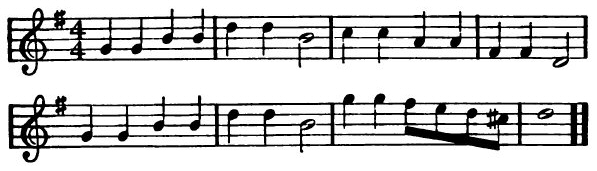
When Richard emerged from the
shadowy hollow where he had left his mistress standing as if
turned to stone, he found all the land about him bathed with the
rosy glow of sunset. The long ‘rollers’ of
newly-cut grass over which he stepped were touched here and there
by arrows of light, and the twigs of the hedge towards which he
made his way were outlined as by fire.
He saw none of these things, however; but when, climbing the
low bank and passing through a gap in the hedge, he descended
into the road, he was suddenly recalled to actualities by the
unexpected appearance of a colossal figure which seemed to be
mounting guard over his bicycle.
As Richard started back Farmer Sharpe rose from his seat on
the bank, and stood square and determined before him,
the ruddy light playing upon his rugged face and shaggy hair and
glorifying his white smock. One great hand still rested on
the saddle of the bicycle, which it almost entirely
covered. As Richard remained dumbly gazing at him, his
fingers began to drum an impatient tune on its smooth
surface.
The young man gazed desperately first at him and then at the
bicycle, filled with an insane desire to possess himself of it
and ride away at full speed. But whether because his
courage failed him, or because nobler and more manly feelings
gained the ascendency over this momentary cowardice, he did not
put the design into execution.
After gazing steadily at his nephew for what seemed an
interminable time, Isaac removed his hand from the bicycle and
pointed in the direction of the little dell.
‘I seed ’ee there, Richard,’ he remarked in
a sepulchral tone. ‘I seed ’ee there with Mrs.
F.’
Richard braced himself, and looked him full in the face, but
made no rejoinder.
‘’Ees,’ said the farmer, ‘I seed ye
both; and I’ve been a-waiting here for ye,
Richard.’
Still silence. Richard, indeed, felt that it would be
useless to enter upon either explanation or apology.
Mr. Sharpe’s hand crept back to the saddle and resumed
its impatient tune; he planted his legs a little more widely
apart, continuing the while to stare unwinkingly in his
nephew’s face.
When the tension had become almost unbearable, he spoke
again.
‘I thought I ’d wait for ’ee here,’ he
said. ‘I thought ye ’d very likely have summat
to say to me.’
The young man bit his lip and clenched his hands; he could
scarcely brook the expectant look in those eyes.
‘What am I to say, Uncle Isaac? I—what can I
say? I’m going away at once.’
The combined effect of sunshine and emotion had already
intensified the farmer’s usually healthy colour, but this
announcement caused it to deepen to a positively alarming
extent. For a moment he seemed in danger of suffocation; he
raised his hand mechanically to the loose collar of his smock and
clutched at it; his eyes seemed ready to start from their
sockets, and, though he opened his mouth and rolled his head from
side to side as though about to fulminate against his nephew, no
words came.
‘Don’t,’ cried Richard, much
alarmed—‘don’t be so angry, uncle—you
really need n’t be so much upset. I tell you
I’m going away at once—to-night.’
Farmer Sharpe sank down on the bank, sliding his legs out
before him rigid as a pair of compasses; his head continued to
roll threateningly, and his eyes to gaze fiercely at Richard, but
it was some time before he could find voice.
‘Ye can’t go to-night,’ he said at last, in
husky, suffocating tones: ‘there bain’t no train
to-night.’
‘Not from Branston, I know; but I mean to ride to
Wimborne, and catch the night train there.’
Somehow this catching of the night train at Wimborne seemed to
be the culminating point of Richard’s depravity.
Isaac positively groaned aloud; the fierceness went out of his
eyes, and to Richard’s infinite distress they filled with
tears.
‘What more can I do?’ he faltered, torn with
remorse and grief as he bent over him.
‘I did n’t think it of ’ee,
Richard—nay, if anybody had told me ye ’d go for to
do such a thing I would n’t ha’ believed
’em. To go off wi’out a word to
I—me as has been a father to ’ee—nay, not so
much as a word!’
He paused, choked with emotion, and fell to wiping his eyes
and shaking his head disconsolately; while Richard, slowly
straightening himself, stood looking down at him.
‘When Job Hunt did call me, and did p’int out as
you was standin’—you and Mrs. F.—hand in hand:
both hands in both hands,’ he added, correcting himself,
‘I didn’t let on to take no notice. I did send
Job about his business, and I did say to myself,
“I’ll wait,” says I. “My nevvy
’ull tell me all about it jist now.” And I did
go and sit me down here. Says I, “I’ll not
interfere; I’ll wait,” I says; “Richard will
out wi’ it all to I—he’ll act straight,”
I says. “He’ll tell me.”’
He spoke almost appealingly. Richard’s face, which
had turned from white to red, was now white again.
‘I wanted to spare you, uncle,’ he murmured at
last, falteringly.
Isaac groaned, and shook his head; then drawing a long breath,
and peering anxiously at his nephew, he whispered pleadingly:
‘What was you a-sayin’ to Mrs. F. when you was
a-holdin’ of her hands, Richard?’
‘Oh,’ groaned the other impatiently, ‘there
are some
things that can’t be talked about! I should n’t
have held her hands—I scarcely knew that I was holding
them. What does it matter now? We have said good-bye
to each other for ever; we have made up our minds never to see
each other again.’
Isaac’s jaw dropped; he brought down his fist heavily on
the bank beside him.
‘Well,’ he muttered under his breath,
‘I’m danged! I can’t get no
satisfaction. Not a word!’
‘You know enough,’ said Richard fiercely.
‘Be content with what I tell you—I will never darken
your doors again.’
Isaac brought down his fist once more on the bank, and then
slowly hoisted himself on to his feet.
‘If ye have n’t naught to say to I, I’ve
summat to say to you,’ he announced, speaking very
slowly. ‘I bain’t a-goin’ to let
’ee go off like that. ’T is my way to be
straightfor’ard. I’ll speak my mind plain to
’ee this night, and I’ll speak my mind to Mrs.
F. Where be Mrs. F.? Come along of I, Richard, and
find her.’
He had squeezed through the gap in the hedge while still
speaking, and Richard had no choice but to follow him. A
few strides brought them to the dell, and, looking down, they
descried Rosalie standing in the same attitude as that in which
Richard had left her.
‘Mrs. Fiander,’ called Isaac, bending over the
brink, ‘will ’ee oblige me by stepping up here?
The sides be a bit steep, and I bain’t so young as I
were—I can’t very well go down, but I ’d be
obliged if you ’d step up. I ’ve summat to say
to you and my nevvy here.’
Rosalie had started violently at the sound of his voice, and
now obeyed his summons in silence; but she trembled so much, and
the wet grass had become so slippery, that she stumbled often,
and it was some time before she completed the ascent.
Meanwhile both men stood watching her, motionless, and in
silence. Once or twice she had raised her eyes towards the
great white figure which awaited her on the brink, and it seemed
to her that Isaac’s face was grave and stern like the face
of a judge. She did not dare once glance at Richard, but
she felt, even without looking at him, that their secret was
discovered.
The farmer backed a little away from the edge of the dell when
Rosalie came forth, and stood looking from one to the other; then he
spoke very solemnly, and with some hesitation.
‘Mrs. Fiander, as I was a-sayin’ to Richard jist
now, ’t is best to be
straightfor’ard—’ees, ’t is best to speak
out, even when it be hard to speak out. I can’t get
no satisfaction from Richard—he did acshally tell I to my
face as he had made up his mind to go straight off wi’out a
single word to I. He comes wi’out a word and he goes
wi’out a word! Now, Mrs. F., I did see you together
jist now, and I did think as you ’d have summat to tell
me.’
There was a long pause. Isaac looked once more from
Rosalie’s graceful, shrinking figure to the other culprit,
who stood with bent head, awaiting the storm of reproach and
vituperation.
‘From the very first,’ pursued Isaac, still in
that solemn and somewhat stern tone, ‘I did tell ’ee
my mind plain, Mrs. Fiander. I did tell ’ee straight
out, did n’t I? as I had n’t never fixed my thoughts
on materimony. ’T was you as was set on
it—’
‘Oh, I know,’ interrupted Rosalie. ‘I
know it too well. Do not throw it in my face
now!’
‘Throw it in your face, Mrs. F.! Who’s
a-throwing o’ what in your face? All I do say is I
did al’ays do my best for ’ee—don’t you go for
to blame me, for blame I do not deserve.’
Both raised their heads and looked at him, astonished at the
change of tone, for now the old man seemed to speak more in
sorrow than in anger.
‘I did al’ays do my best for ’ee. I
did al’ays think and act as kind as I could, and you did
never once think of I. ’Ees, I did never
interfere,’ he went on, more emphatically; ‘I left ye
both to yourselves—did n’t I? I never comed in
your way. But ye mid ha’ given me a
thought.’
The penitent heads drooped again. What need had they to
be reminded how guileless he had been, how unsuspicious, how
chivalrous in thought and deed!
‘’Ees,’ went on Isaac, ‘I did leave ye
to yourselves—I did ax ye to make friends. Do you
mind how often I axed ye to be friends?’
True indeed; only too true! They had taken a base
advantage of his confidence; they had profited of the
opportunities he had given them only to be more and more
unfaithful to him in their hearts.
‘I thought you ’d be different to what you do
be,’ he continued, with increasing severity. ‘When
Sam’el Cross did tell I as you ’d snap up Mrs. F.,
Richard, what did I say? Says I, “My nevvy
bain’t a snapper!” D’ ye mind? I
said the same thing to you. Well, I thought maybe you
’d say summat then—but not a word!’
‘Uncle, I—it is n’t fair to reproach me like
this. I kept away from Littlecomb as long as I could; you
know that.’
‘’Ees, I do know it, Richard—I know it very
well; you would n’t come with me when I did ax ’ee
that Sunday. You would n’t come along o’ me to
Littlecomb; nay, but you went out by yourself that night, and
when you comed back ye would n’t so much as sit down and
smoke a pipe like an honest Christian; and next day you must get
up and go off wi’ yourself before ’t were
light. And what did I do then—what did I do, Richard,
though you ’d gone off and left me wi’out so much as
a line? I did n’t give up hopes of ’ee
yet. I went and wrote ’ee a letter and told ’ee
to come back, and all ’ud be forgive and forgot.
There now, and what do ’ee say to that?’
His face was working with emotion, his voice tremulous for all
its strength. Never in his life, probably, had Isaac Sharpe
put so many words together, and every one of them came from
his heart. To the young people it seemed as though all
their struggles had been futile, their good desires vain, their
great sacrifice useless: for all their days they would be branded
with infamy. They had, indeed, stopped short of the breach
of faith to which both had been so strongly tempted, but they had
nevertheless violated trust.
‘And even now,’ said Isaac—‘even at
the very last, when you were for cuttin’ off wi’out
no explanation, I did give ’ee one more chance—and
you would n’t take it.’
‘What in Heaven’s name do you want to say?’
cried Richard, goaded to desperation. ‘Do you want me
to tell you to your face that I love the woman you are going to
marry?’
‘Nay now,’ returned his uncle in an expostulatory
tone, ‘I would n’t go so far as that. I
bain’t onreasonable. All I did ever think o’
axin’ ye was for you and Mrs. F. to see if ye could
n’t take to each other. That were my notion. Ye
might ha’ gived each other a fair trial—a fair
trial!’
The young couple stared at him blankly, hardly believing their
ears; then Richard cried out with a gasp: ‘Rosalie, do you hear—do you
understand? He wanted us to love each
other!’
‘Nay,’ interrupted the farmer, in a tone that was
at once dignified and explanatory, ‘I did n’t expect
so much straight off—Love! No, no, not love—but
ye mid ha’ jist tried to fancy one another! Ye mid
ha’ had a bit o’ consideration for me, I think.
Ye knowed, both on ye, as materimony would n’t come easy to
I; and seein’ as you did tell me plain, Richard, the very
first night you come home, as you was on the look-out for a wife,
why not Mrs. F. so well as another?’
It was Rosalie’s turn to gasp now, and her face bloomed
like a rose in the evening light; but neither she nor Richard
spoke; both were so suddenly brought down from their heights of
heroics that it was natural they should feel somewhat dizzy and
confused.
‘I’m a man o’ my word,’ said Isaac,
‘and if ye have made up your mind and fixed your
ch’ice on I, Mrs. F., why’—drawing a deep
breath—‘I’ll keep my promise, my dear.
But if Richard ’ud do so well as me ’t ’ud be a
deal more convenient, d’ ye see? It ’ud seem a
bit queer to change my state at my time o’ life, and to
leave the old home where I was born and bred. And Richard,
he has a
very good notion o’ farmin’, and he ’d be
willing to carry on the work in the old way, and to take advice
from I, d’ ye see? Ah, the notion did come to I soon
arter he comed here. Thinks I to myself, I wonder if
Richard ’ud do—’t ’ud be a deal more
suitable, thinks I; and more satisfactory to all
parties.’
Here Isaac was interrupted by a sudden burst of laughter from
his nephew—laughter which was indeed the outlet of such an
extraordinary mixture of emotions that they had nearly found vent
in tears. The exquisite sense of relief, the unhoped-for
joy stirred his very heart’s depths; but, on the other
hand, the humour of the situation struck him with almost equal
force. After the overwhelming remorse, the bitter sense of
shame which but a few moments ago had tortured them, to discover
that their contemplated sacrifice had very nearly set at naught
good old Isaac’s dearest wish!
‘Oh, uncle, uncle!’ he cried as soon as the first
ecstatic outburst of mirth had subsided, ‘why did you not
speak before?’
‘’T would n’t ha’ been very
becomin’ for me to speak,’ returned the farmer, still
with great dignity. ‘I knowed my dooty to Mrs. F., and I were
n’t a-goin’ to say nothin’ as mid hurt her
feelin’s. But I did try and bring ye together,
Richard; and I did try to give ye so many hints as I could.
D’ ye mind how often I did say what a dear woman Mrs. F.
were, and what a good wife she ’d make? Ah, many a
time I did. And d’ ye mind how I used to tell
’ee it was bad to hurt a woman’s
feelin’s? And you would n’t take a bit o’
pains to be friendly and pleasant wi’ her! I did look
for some return from ’ee, Richard, and I were
disapp’inted. And I did expect at least as ye would
tell me straight whether you could take to the notion or whether
ye could n’t. ’T was the least ye mid do, I
think. I were that anxious, and that upset—I
don’t see as it’s any laughin’ matter,’
he continued with gathering wrath, for Rosalie’s face was
now dimpling all over with smiles and Richard’s hilarity
seemed to increase rather than diminish. ‘Come,
I’ll have a straight answer one way or t’
other. Will ye give up this here stupid notion o’
going out o’ the country, Richard, and bide here and see if
you and Mrs. F. can’t make it up between ye? And you,
Mrs. F., my dear, will ’ee jist think over this here
matter, and see if Richard would n’t do as well as
me?’
Richard suddenly ceased laughing, and stepped to
Rosalie’s side.
‘Will you, Rosalie?’ he said, very gently and
tenderly. ‘Will you try to like me a
little?’
And, without waiting for an answer, he took her hands and laid
them softly about his own neck, and stooped and kissed her.
‘Dear heart alive!’ exclaimed Isaac, clapping his
hands. ‘That were n’t sich a bad beginning,
Richard, I will say! You bain’t very slack once you
do make a start.’ He paused to laugh, long and
loud. ‘Well, I never!’ he cried.
‘Nay, Richard, ye don’t do things by halves.
Well, Mrs. F., my dear,’ he added, more anxiously, seeing
that Rosalie did not speak, ‘what d’ ye
say?’
‘I suppose,’ returned Rosalie faintly, with her
face half hidden on Richard’s shoulder, ‘I suppose
I’ll have to try.’
‘Do ’ee now, my dear,’ cried Isaac, much
relieved. ‘Ye’ll find ye won’t
re-pent it. And ye’ll not lose nothing by it
neither,’ he added as an afterthought. ‘Richard
be jist the same as a son to I—he’ll have all as I
’ve a-got to leave when I be gone. I don’t want
for to seem unkind, but it ’ud be a very great comfort to
me if ye could make up your mind to’t.’
‘Oh, I think,’ murmured Rosalie,
‘that I can make up my mind to it.’
‘Well, then,’ cried Isaac, chuckling and rubbing
his hands, ‘all’s well as ends well!
’Ees, we may say that—all’s well as ends
well! We’ll be the best o’ friends as ever; but
I do think as Richard ’ull be more suitable as a husband,
my dear. Ye mid as well see Mrs. F. home now,
Richard. I think I’ll go back to my bit o’
supper; ’t will be cold enough by now, I reckon.’
With a nod and a broad smile he left them, and pursued his
homeward way, pausing ever and anon to look backwards at the two
lithe young figures which moved slowly along above the dark
irregular line of hedge—the bent heads, very close
together, outlined against the lambent evening sky. Once,
after one of these backward glances, he began to chuckle.
‘They’ve a-took to the notion nicely,’ he
said. ‘’Ees, I reckon they’ll
do!’
THE END
