FATHER TIME AND HIS CHILDREN — FATHER TIME AND HIS CHILDREN — Characters
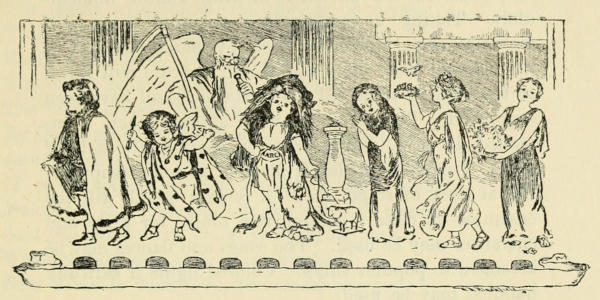
Father Time and the Twelve Months of the Year.
Costumes, etc.: Time, an emblematic figure; Months
dressed according to characters: January wears a
mask at back of head, resembling face; February is
the shortest child, and walks with a skipping leap at
every fourth step; March’s costume suggests the
lion and the lamb, etc. Scenery may be elaborate, or
simple, or dispensed with entirely. A sun-dial or a
clump of rocks may be placed at back of stage, where
Time will take his position while the Months recite.
Snow may be simulated by small pieces of white paper
being gently dropped from above, or by a little salt
being placed in the folds of a character’s coat, so
that it drops off lightly, or by a frosty little dab of
soap-suds on the shoulder melting almost immediately.
Taking a commanding position Time will
summon each Month in turn by name, through a
megaphone, then when the Month appears will retire
to the back of stage till the recitation shall have been
concluded. The Months will appear when summoned,
in turn, disappearing on the opposite side of
stage, if possible behind a piece of scenery, reappearing
at back of stage, there to remain quietly till the
ensemble at close. Appropriate music for exits and
entrances may be used. The songs and dances may be
arranged to popular tunes. Colored lights if skilfully
handled may be used.
Music: It ends with heavy chords marking time. Curtain
rises disclosing Father Time. He blows blast
through megaphone, then speaks.
Time.
What ho, hilly ho! Before you you see
A being as ancient as old can be.
Methuselah’s decades a thousandfold
Would not have made him one thousandth as old.
The ages of all the world and his wife
Are not a speck on a patch on my life;
Nay, all your ancestors strung in a line
Would not reach back with their birthdays to mine;
And though the agedest ancient you know
The longer I live the older I grow!
Oh, no one was ever so old as I,
Nor ever will be, so ’twere vain to try!
For, lo! I am Time, your old Father Time,
The reason of wrinkles, the rhythm of rhyme;
First aboriginal native of space;
Earliest settler all over the place;
The oldest inhabitant here, or there;
The latest arrival everywhere.
By the wink of my eye your clocks are set,
And the corn you cut when my scythe I whet.
’Tis the wag of my beard marks music’s sound,
Makes the sun come up, and the world go round.
And you tell by my smile, or shake of head
When to turn out, or to turn into bed!
Now Time is money, so, therefore, you see
Whoever wants gold must reckon with me;
Though if I should look with a frown your way
The gold of your hair might be changed to grey!
Or, if your gold is a counterfeit crime,
You may cheat the world, but you can’t cheat Time!
The wealth I bring is a golden chance
For making the best of your circumstance;
But if too freely you spend what I give
I shorten your days, as sure as you live!
So you, the neighbours, the world and his wife
Must come to me for the time of your life!
For I can make you dance to ...
[Dances and sings.]
Quick time and slack time; nick o’ time and back time!
Back time and fast time; lack of time and past time!
Last time and least time; fasting time and feast time!
Little time and long time; tittle-tattle wrong time!
Sleep time, and train time; keeping time to gain time!
Best time to find time; lest you be behind time!
Saint time and sinner time; fainting-for-dinner time!
Night-time and daytime; right-you-are-time; playtime!
Make time and meantime; take-your-time between time!
Some time and no time; coming time and go time!
Zig time and zag time; jigging time and rag-time!
Prime time and high time; Time-to-say-good-by time!
[Stops; wipes brow; speaks.] Not so bad for an ancient eh?... And that is the way I shall dance to the End of Time!
[Goes to centre of stage.] And now let me present to you my twelve beautiful children! [Begins to call through megaphone.]
What, ho! [Just then an unseen clock strikes twelve. Time counts the strokes. As the last dies away he summons January.
Instantly there is a great to-do behind the scenes: bells, horns, whistles, people cheering, etc. January appears.]
January.
When the old year dies at midnight’s chime
Behold, I appear!
The eldest and youngest child of Time,
The Happy New Year!
Two faces I wear, like the Roman god
At the temple door,
Surveying the path by pilgrims trod,
And the path before.
Backward looking, and looking ahead,
Like that god in Rome;
We read the roads we have yet to tread
By the roads we’ve come.
Then, Janus-wise, with our double view,
Let us bear in mind
To bring no faults to the year that’s new
From the years behind;
Only good counsels by which we live,
Good thoughts and good cheer,
For that is the way to get and give
A Happy New Year! [Exit January.]
[Enter February.]
February.
Behold the shortest month in all the year—
And yet I hold my head as high
As January or July,
Since Washington by birth belongs to me,
And Lincoln. Greater glory could there be?
I’m sure you’ll all applaud and cry Hear, hear! [Pauses for this to be done.]
Also I proudly claim for mine
That favourite Saint Valentine,
Upon whose day birds pair and build their nest,
Lads rhyme about the maidens they love best,
And maids dream of the lads they hold most dear.
And then, each fourth time I come round
I have to give a mighty bound,
Like this! As if at leap-frog did I play.
Thus to my twenty-eight an extra day
I add, to keep the almanac in gear! [Exit February.]
March.
[Enters roaring.]
Wrapped in clouds and a flurry of snow,
Like a roaring lion March comes in;
All a boisterous, blustering blow!
I rattle windows, and doors I slam;
And people’s hats, to their great chagrin,
I snatch and send on a whirling spin;
Then, hiding in chimneys, laugh Ho, ho!
Oh, what a practical joker I am!
Or, rocking the tree-tops to and fro,
I climb aloft like a harlequin
To play my pranks on the world below.
Stout timbers creak when ice-flows jam
From sea to harbour where ships come in;
And flood and freshet their foam-wreaths throw,
And mill-wheels turn with furious din
As the mill-stream rushes over the dam!
“O wintry March, will it never go!”
You cry, “and suffer sweet spring to win,
With fields for ploughing and seed to sow?”
Then how I laugh, for ’tis all a sham,
My blustering roar and lion’s skin ...
My practical joke, to take you in!
For, see! I’m the mildest month you know,
As I tiptoe off like a gentle lamb! [Exit March.]
[Enter April.]
April.
Ha, ha! Ha, ha! Ha, ha, ha, ha! Oh, dear, Oh, dear, Oh, dear!
I am the saddest and the gladdest month of all the year!
I cry and cry and cry until my tears make little pools
Because upon my way I meet so many April Fools!
And then I laugh and laugh until my sunshine dries my tears,
Because though foolish April Fools those April Fools are dears!
For some are foolish flowers that get out of bed too soon,
Mistaking April’s laughter for the call of May or June;
And some are foolish children who get out of bed too late,
And go to school with tousled hair and most unseemly gait;
And some are foolish grown-ups. But, in strictest confidence,
I think.... Don’t you? ’tis time that these should have some common-sense!
Ha ha, ha ha, ha ha, ha ha! Oh, dear, Oh, dear, Oh, dear!
I am the saddest and the gladdest month of all the year! [Exit April.]
[Enter May.]
May.
Oh, I’m the merry month of May,
The time of white and tender green
That nature makes a gala day!
Of May-crowned queens I am the queen,
The happy, singing heart of spring—
A maiden turning seventeen.
The fairies weave a magic ring
About my footsteps where I roam:
I have not learned that nettles sting.
Beneath the blue of Heaven’s dome,
Brushed by a feather from Time’s wing,
The world at large I call my home.
Where flowers bloom and linnets sing
Within the heart, is aye my home,
The shrine of May, the soul of spring! [Exit May.]
[Enter June.]
June.
See! The Heavens beam more brightly.
Days are strewn
Flowerful, like gardens sightly ...
I am June!
Hark! The bird-note sounds more tender.
Sweetest rune
To my praises poets render ...
I am June!
Speed the parting, hail the comer,
Sun, stars, moon!
I’m the rose, sweetheart of summer ...
I am June! [Exit June.]
[July and August enter together.]
August.
August is my name, and I ...
July.
[Interrupts.]
I speak first. I am July.
[Together.]
Hand in hand we come.
August.
Because!
July.
That’s no reason. Nature’s laws!
August.
Nature’s laws? Same thing! Because!
[Together.]
We together on our ways
Scatter summer holidays.
July.
All the joys that we unfold
Children would not change for gold.
August.
Nor would teachers, I am told!
July.
Boating ’mid the lily pads,
Swimming; fishing for the lads ...
August.
With a worm upon a hook!
July.
Or with interesting book ...
August.
[Interrupts.]
Dozing in some shady nook!
July.
Picking berries by the road;
Riding on a haycart’s load!
[Together.]
Oh, the pleasures that we bring ...
August.
Sitting idly in a swing,
Just not doing anything!
[Together.]
But, alas! our song must close.
Summer passes with the rose!
[August starts to go. July
restrains August.]
July.
Wait until July has passed!
August.
[Yawns.]
Nothing done from first to last!
Nothing wears one out so fast! [Exeunt July and August.]
September.
It is easy to remember the enchanting month September,
With its mellow days, and nights starbright and clear,
When Jack Frost starts to make merry then red leaf and scarlet berry
And the purpling grape proclaim that autumn’s here!
Maples flame upon the grey side of the mountains, and the wayside
Golden-rod, gold-hearted asters now adorn:
Like old friends returned from places far away we greet their faces
As we hasten to the husking of the corn.
There are dry leaves for the raking, there are bonfires for the making;
There are ruddy apples heaped upon the grass;
And in spells of stormy weather, in some attic, barn, together,
Oh, how gaily do we make the moments pass!
Aye, in sport and happy pastime we were quite forgetting class-time
As it swiftly steals upon us unawares,
With its sums that must be slated, and its dates that won’t stay dated,
And the rocky road to learning’s many snares!
Then, as misers hoard their treasure, so we count our days of pleasure,
Days that slip away as thread reels off a spool,
Till resounding lamentation marks the close of the vacation,
As we gather up our books and start for school! [Exit September.]
[Enter October.]
October.
Who says my month is dismal, sober?
Now that’s a libel on October!
The winds come tumbling from the hills,
Like boys at play;
Like happy girls the mountain rills
Dance on their way.
The trees wear coats of golden brown;
Each breeze that stirs
From chestnut boughs is bringing down
The ripened burrs.
Then, when abroad the spirits flit,
Unheard, unseen,
A night of revels they permit ...
All Hallowe’en.
For apples in a tub you duck,
Or seek to know
The spell to bring you love and luck
From candle’s glow;
Or in a shadowed looking-glass
Your future lot
You may behold behind you pass,
Or you may not!
A merry month indeed, not sober.
I ought to know, for I’m October! [Exit October.]
[Enter November.]
November.
November’s the month for whole-hearted thanksgiving;
For thanks for your being, and thanks for your living;
For plenty to-day, and enough for to-morrow;
For freedom from sorrow, or hope beyond sorrow.
And if for naught else are you thankful, remember:
BE THANKFUL YOU STILL ARE ALIVE IN NOVEMBER! [Exit November.]
[Enter December.]
December.
There are snowdrifts by the wayside, there is writing on the pane,
Where Jack Frost has left a message about winter come again;
There’s that tingling in the blood and there are sleigh-bells in the air,
There is coasting down the hills, and slipping, sliding, ev’rywhere!
There’s a stocking by the chimney hung on Christmas eve because
There’s a chance you’ll have a visit from our old friend Santa Claus.
There’s a bright star in the Heavens that proclaimed a wondrous birth
When the Chosen Child of Children brought His Christmas day to earth;
There are mistletoe and holly in the woods to deck the hall,
And
Here’s the Christmas spirit wishing Merry Christmas to you all! [Exit December.]
Time.
[Blows a blast.]
What, ho! Stand forth, all ye, my children!
[The Months appear.]
Time.
These are my children, my children dear.
Months.
Yes, we are the Twelve Months of the Year!
Time.
Every year, for a bite and sup,
I gobble them up!
Months.
Gobbles us up!
Time.
And every year, despite my pain,
They bob up again!
Months.
Bob up again!
Time.
Throughout the world, in every clime;
And so ’twill be, to the End of Time!
Months.
Throughout the world, in every clime;
And so ’twill be, to the End of Time!
[Dance and sing.]
With our play days, jolly days; heydays and holidays!
May days and mirth days; gala days and birthdays!
Olden days; new days; golden days and blue days!
Work days and school-days; shirk days, April Fool days!
Sundays and sleek days; wonder days and week-days!
Sundays and Mondays; rather underdone days!
Mondays and Tuesdays; please-to-pay-your-dues days!
Tuesdays and Wednesdays; women’s days and men’s days!
Wednesdays and Thursdays; kittens’ days and curs’ days!
Thursdays and Fridays; up-and-do-or-die days!
Fridays and Saturdays; mad-as-a-hatter days!
[They form a ring about Time
and dance round him, repeating the song, while Time in
the centre repeats his dance and song, “Quick time and slack time,” etc.]
CURTAIN.
TERTULLA’S GARDEN or THE MIRACLE OF GOOD ST. VALENTINE (founded on a legend)
Valentine’s Day
TERTULLA’S GARDEN or THE MIRACLE OF GOOD ST. VALENTINE — Characters
Valentinus, a priest of the Christian Church in Rome.
Asterius, chief officer of the Prefect Calpurnius.
Pertinax, overseer of farm and gardens at the country villa of Asterius.
Nerva, a boy, servant in the town house of Asterius.
Tertulla and Quartilla, unmarried daughters of Asterius.
Maronis, a woman servant in attendance on Tertulla and Quartilla.
Other servants.
Time: The fourteenth of February [the sixteenth day before
the Kalends of March] during the reign of the
Roman Emperor Claudius II [A. D. 268-270].
Scene: A room in the town house of Asterius. The
scene shows a room furnished in Roman style, but
plainly, with table, chair, bench and stool. High up
on one wall is an aperture with wooden shutters, now
open to admit light and air. Through this window
may be seen the branches of a tree, bare of leaf, yet
with buds swelling, and a glimpse of sky. In the
same wall is a door which gives exit to the lane at the
back of the house. On the other side is a curtained
opening to another room.... On the table are writing
materials of the kind in use at the time. Seated so
as to catch the light Valentinus is busily engaged
in writing. Enter Nerva bearing a jar of steaming
pottage, with a spoon, also a platter with a square,
flat cake of bread.
Nerva.
Behold, your supper, Valentinus! [He sets down his
burden.] Supper, I say. And though but prisoner’s
fare, yet, through some bewitchment you exercise over the
entire household, myself excepted, seasoned with the cook’s
best art! [He sniffs the pottage.] M-m-m!
Quartilla.
[Head between the curtains.] Bo!... Valentinus!
Tilla says Bopeep!
Valentinus.
Ah, my little Quartilla! One sixtieth portion of an hour
and I shall have done!... [Still engrossed with work.]
Quartilla.
Sh! [She enters on tiptoe, and one sees that she is an
attractive child.]
Nerva.
What have you there, Quartilla? [He tries to help himself
from a basket of dainties she carries.] What, cheese
cakes, almond cakes, and little tarts! M-m-m!
Quartilla.
Nerva! Audacious one, forbear! These are for Valentinus!
Nerva.
Wasted on him, when all day he does nothing but spoil
good parchment with the juice of the cuttle-fish, only pausing
to mend his split reed, or erase a mark with pumice-stone!
Quartilla.
He writes words of comfort to his afflicted people whom
our godlike Emperor thinks fit to persecute!
Nerva.
[Devouring a tart.] Persecute! By the immortal gods
I like such persecution!
Quartilla.
Peace, brazen one! [She goes to the curtains.] Enter,
Pertinax, and gaze on our distinguished guest!
Nerva.
Distinguished guest! A jail-bird whom the jail is too
full to hold, and so committed by the Prefect Calpurnius
to the care of my master, Asterius, and in his absence to
mine! Distinguished guest, forsooth!
Pertinax.
[Enters, a manly young fellow of pleasing personality.
His arms are full of flowering branches, also he carries a
basket of flowers.] So this is Quartilla’s wizard!
Nerva.
Quartilla’s wizard, everybody’s wizard. Well may you
say so! How else but by wizardry do you account for Asterius
sending him dainties from his own table ... Asterius
who seals up the very salt-cellar in his thrift!
Quartilla.
[Laughs.] Hush! That is my secret! I steal them
for him! Though I present them to him with my father’s
greetings, else, so honest is he, he would make me put them
back! [The Others exclaim.] Yet, do you know, sometimes
I fancy my father sees the theft, but turns his head
aside!
Nerva.
Magic! [Going.] By the gods and goddesses, why am
not I a Christian and a prisoner!
Valentinus.
[Laying work aside.] These lengthening days tempt
me to prolong work! Now, Tilla; is it a doll to be
mended, or a table in weights and measures to be learned,
or.... [He pauses, seeing Pertinax.]
Quartilla.
This is Pertinax, overseer at my father’s farm!
Valentinus.
Greetings to you, Pertinax!
Pertinax.
And to you kindly, Valentinus. May the blessing of
the gods be to you as a plenteous year’s harvest! [He sets
down his burden.] Though I am told that you Christians
no longer believe in our ancient gods of Rome!
Valentinus.
But we believe in blessings, from whatever source!
Pertinax.
That lies beyond my comprehension. But then, I am
told, you work miracles!
Quartilla.
Indeed he does! He has mended my doll’s nose, and
made me remember how many quarts of water you can
pour into an amphora!
Nerva.
[Entering with an amphora of water while she speaks.]
As if anyone could not do as much!
Quartilla.
None other has ever done it, all the same!
Nerva.
[Arms akimbo.] Come, then, wizard; prove yourself!
dispose for us some prodigy!
Valentinus.
What, Nerva, would you consider such?
Nerva.
Oh, that a hen should crow, or a black dog should suddenly
bound through the room, or a snake come down the
pipe into the cistern, or that the statue of Jupiter should
laugh!
Valentinus.
None of which things can I bring to pass! Nor do I
call them miracles!
[Nerva laughs, sneering.]
Pertinax.
How, sir, do you define a miracle?
Quartilla.
Instruct them, Valentinus! Give them proof!
Valentinus.
[Rolling up his parchment, thoughtfully.] Hm! Well,
then, will you, Pertinax, and you, Nerva, walk a few paces
from me toward the door?
Quartilla.
[Dancing with joy.] A proof! A demonstration!
Valentinus.
Not so! Merely a definition!... Toward the door!
Nerva.
[Mocking, though complying.] Which, no doubt, will
fly open of its own accord at our approach!
[The Two comply, walking toward the door.]
Quartilla.
[Dancing about.] Now you’ll see; you’ll see!
[With his rolled parchment Valentinus gives each
youth a sharp blow across the shoulders. With an
indignant cry they turn about.]
Pertinax.
Now, by Hercules...!
Nerva.
May Castor and Pollux rend me if I see...!
Valentinus.
[Mildly.] Did you feel that blow, Pertinax?
Pertinax.
By Hercules, how should I not do so!
Valentinus.
Ah! And you, Nerva?
Nerva.
By Castor and Pollux, am I a stone!
Valentinus.
Ah! Well, it would have been a miracle if you had not
felt it!
[The Two look rather discomfited, then Pertinax
laughs, seeing the humour of it, while Nerva goes,
crest-fallen.]
Quartilla.
[Recovering from delighted mirth.] Oh, that was
lovely! But, come, now. Pertinax has a secret to confide
in you. Meanwhile eat your supper. It is past the ninth
hour, and all day you have worked fasting! Oh, not that
bread! My father’s greetings and will you partake of this!
[Substitutes fine bread from her basket for that which
Nerva has brought, whereon Nerva at the curtains
coughs.] Now, Pertinax! What, bashful? Then I’ll
tell! He writes poetry! Beautiful poetry!
Pertinax.
[Modestly, though flattered.] Oh, modest strophes that
call for an indulgent ear! Numbers whose measures course
through my brain while I superintend the pruning and
grafting, the ploughing and planting! As for instance,
by your leave! [Taking out a scroll he reads.]
LOVE CAPTIVE
Love Captive bound the Muses fast
With garlands fair!
Love into prison then they cast,
In Beauty’s care!
When Venus fain would set him free
Love ransomed will not go his way,
Since, if a youth, ensnared he be,
A slave forever Love will stay!
Quartilla.
[Rapturously.] Is it not heavenly?
Valentinus.
Truly it has ever been a favourite of mine since in my
schoolboy days I conned my Anacreon! [Pertinax looks
discomfited, Quartilla sympathetic, while Nerva, looking
in at the curtains, bursts into peals of laughter.]
Nerva.
Anacreon! By Momus, but that’s funny! Anacreon,
indeed, my poet!
Pertinax.
[Seizing on Nerva.] Shameless one than whom none
is more contemptible! To perdition with you! May the
gods give you your deserts! May you be buffeted with
fists, jerked with rods, pricked with goads, pinched with
red-hot tongs, roasted over a scorching fire, and thrown
to wild beasts to be devoured!
[Dancing for joy.] Thumbs up! Don’t spare him,
Pertinax! Thumbs up! [She presses her thumbs upward
in the manner of the spectators at a gladiatorial contest
when they wished the vanquished contestant to be
slain.]
Valentinus.
[Interposing, rescues Nerva.] There, there! That is
punishment enough for youthful levity!
Pertinax.
[Sinks into a seat and wipes a heated brow.] Levity?
No cork on water was ever of character more light! Had
I you under me at the farm ... [Threatens Nerva who
runs off.] ... I’d change your tune!
Nerva.
[As he goes, taunting.] Anacreon! Ha, ha! Anacreon!
Pertinax.
Master, I confess to the theft of an older poet’s words,
but the feeling they clothe is all my own, generated here!
[Hand on breast.] Suffer me to explain! But, first,
Quartilla, leave us!
Quartilla.
[Grumbling.] As usual! Whenever things become interesting
it is, “Quartilla, leave us!”
Valentinus.
How fares our sister Tertulla whom not since early
morning have I seen?
Quartilla.
Not well!
Pertinax.
[Starting up, agitated.] What! Tertulla ... Asteria
Tertia ... she is ill?
Quartilla.
Oh, not ill! Tulla is sad. All day Tulla sits apart
and sighs, “Eheu! Woe is me!” And all because my
father has not taken her as usual to the country!
Valentinus.
Tertulla has fewer pleasures than those who can see!
Quartilla.
That is true! Wait! [She has an inspiration.] I
have a way to cheer her! I’ll tell her Pertinax is here!
[About to go.]
Pertinax.
[Greatly agitated.] The gods forbid! Quartilla, if so
you do, never again will I pluck sweet pears for you and
grapes and pomegranates when you steal out to me in the
orchard!
Quartilla.
[Teasing.] See now how frightened he is! One would
think my poor sister to be accursed, the way he always
runs from her! However as I love sweet pears and grapes
and pomegranates I promise I won’t tell!
Pertinax.
The heavens reward you!
Quartilla.
[Running off.] I’ll make her guess it for herself!
Pertinax.
[Sighs.] Eheu! Wretched I! Master ... [He waxes
confidential.] I have a secret! I love!
Valentinus.
In the springtime of your life and of the year why not?
Pertinax.
Why not, indeed! But.... There is a but!
Valentinus.
As always!
Pertinax.
But never was a but so insurmountable as mine!
Valentinus.
Again, as always!
Pertinax.
While occupying an enviable position as overseer of my
master’s farm I should be happier as a public slave working
in the stone-quarries or the mill! Worn to the heart
with longing I am of mortals the most wretched! I cannot
sleep, I cannot eat! [Absent-mindedly he helps
himself to a little cake from Quartilla’s basket and nibbles
it with relish.] To such a degree has love inflamed
me that, but for my tears, I should be consumed with fire!
My wits wander like cows at pasture! No longer do I
remember when to sow the three months’ wheat, or how to
set out a rose-bed! A row of lilies or of leeks, it is all the
same to me! [Sighs deeply.]
Valentinus.
Not so, judging by the fruits of your husbandry! [Indicating
the flowers.]
Pertinax.
Ah-h! These are different! These are sacred blooms
... my source of inspiration! These come from Tertulla’s
garden!
Valentinus.
[Understanding the position.] Hm! Tertulla!
Pertinax.
[Corroborating.] Even so! Tertulla! I have looked
with inclination on the maid from the day when I, a by-standing
youth, drew her from the reach of the fateful
flames of her mother’s funeral pile into which in her grief
she was about to cast herself ... an act of filial piety
which, combined with excessive weeping, cost her the sight
of her lovely eyes! When, rewarding me, Asterius purchased
me, I rejoiced in the exchange of masters, for the
opportunity this would afford me constantly to behold my
divinity-on-earth! I have watched her grow like the sapling
trees under my care ... and with her growth and
mine my love has kept apace! The garden she calls her
own have I made my especial care, tending it not only
by day, but also by night when none might guess my secret,
till the fame of Tertulla’s garden is a proverb! [He
pauses a second for breath.] To me she is the breath of
life! But.... Eheu! Woe’s me!
Valentinus.
You fear the opposition of Asterius?
Pertinax.
That, doubtless, would be terrible, since, when roused,
he blusters like the Adriatic in a storm! However, the
more violent the tempest, the shorter-lived! With your
all-powerful intercession, Valentinus, Asterius might be
reconciled! He might suffer me with my hoardings to
buy my freedom, and since, through the merits of the gods
and of my ancestors, my name is no less honourable than
his own, and since no wooers besiege his door for his blind
daughter he might be brought to look with favour on me
as a son-in-law! Lies not the trouble there!
Valentinus.
Then where?
Pertinax.
With Tertulla! With the maid herself!
Valentinus.
You mean she holds you in aversion!
Pertinax.
Worse, worse! O by a thousand times worse! Myself
as Pertinax she hardly knows, hardly ever has thrown a
word to, yet she loves me! More, she worships me!...
She thinks me an emissary from the immortal gods, if not,
indeed, myself a god!
Valentinus.
You offer riddles to one called Valentinus, not Œdipus!
Pertinax.
Let me unravel it that you may extricate me from the
sacrilegious maze in which, all-unheeding, I, wretchedest
of men, have lost myself!... Thus did it begin!...
But, hark! [Voices are heard in the adjoining room.]
She comes! Tertulla!
[In great perturbation he hastily opens the door and
passes out.]
Maronis.
[In the adjoining room, parting the curtains.] Come,
my honeysuckle-sprig, and talk with the disposer of prodigies
who always comforts you!
[Enter Maronis and Quartilla leading Tertulla,
a young girl of great beauty. Her hair hangs
loose, she wears a chaplet and a white, flowing robe;
also her feet are bare, or sandaled. Her general
aspect is of one prepared to offer sacrifice. Her
eyes are bandaged, and her countenance and voice
are sad.]
Tertulla.
Salutations, Valentinus!
Valentinus.
And to you kindly, Tertulla! Whatever you wish I
desire it may befall you! [Tertulla sighs.] But wherefore
thus deject of countenance?
Quartilla.
I know why!
Tertulla.
Peace, Tilla! At your age how should one comprehend
such matters?
Quartilla.
Does one have to be tall as a fig-tree to know that you
are bursting with longing for your garden? “Eheu!
wretchedest of women I as many as ever have been born!
Woe’s me!” [Mimicking her sister.]
Maronis.
It is true. If it were not for the bandage that you,
Valentinus, make her wear she would weep so immoderately
that she would be turned into a river, like to Ilia, the
mother of Romulus and Remus!
Tertulla.
[Explaining.] Always, ever since I was a child, in the
days that cut the month of February in twain my father
has taken me with him to the country, journeying thither
to give directions for the spring work at his farm. But
this year, business detaining him in town, he has sent for
his overseer to come here to him, instead, and so ...
Eheu!
Valentinus.
But the year is young. Barely have the heavens ceased
to scatter snow on the Albanian hills. As yet the relaxing
earth suffers only the hardiest of her green children to put
their noses out of bed! Later you will all go to your
father’s villa, avoiding the scorching heat of dog-star days!
Tertulla.
Ah, then it will not be the same! Then will it be too
late.
Valentinus.
[Puzzled.] Too late?
Maronis.
[Explaining.] If you were not a deserving but unfortunate
Christian, Valentinus, you would not have forgotten
that in the days about the Ides of February the
young god Faunus, protector of those same green children
of the earth, returns from his winter quarters in Arcadia
to Italy!
[Continuing.] And Tertulla is wonted to celebrate the
feast of the Faunalia at the villa, offering sacrifice in her
garden to the two-horned god!
Tertulla.
It is indeed so!
[Pertinax opens the door softly a crack and peeps in,
seen only by Valentinus.]
Valentinus.
I begin to understand! Well, since Tertulla cannot go
to the country perhaps the country will come to Tertulla!
Quartilla.
[Dancing about gleefully.] A miracle! A prodigy!
I said Valentinus would work one and set things right!
Valentinus.
My child, I promise nothing! But Tertulla must remember
that true sacrifices can be made anywhere, in country
or in town!
Maronis.
[To Tertulla.] Aha, girl! Have I not worn out my
tongue telling you as much all day?
Tertulla.
But will the god hear, missing me from my accustomed
place?
Valentinus.
No honest petition ever goes unheeded anywhere!
Maronis.
[Nodding approval.] Another statement of my own,
and therefore full of wisdom!
Tertulla.
[To Valentinus.] Oh, how you comfort me! And
yet ... there is something further!
Quartilla.
[Excited.] Aha! A secret!
Tertulla.
But not for your ears, O little pitcher of two handles!
Go from us awhile!
Quartilla.
[Pouting.] As usual when things grow interesting:
“Quartilla, leave us!” But this time Valentinus will have
to use magic to make me budge!
Valentinus.
Alas! No sorcerer am I! Yet, perhaps.... Hark!
Quartilla.
What do you hear?
Valentinus.
Surely not the first swallow, returning on the wings of
the bird-wind, and seeking where to build a nest! Up,
Tilla! Let us see! [Mounting the bench he draws her
up, then lifts her to the window.]
Quartilla.
Oh, the wee darling, flitting from plane to cypress, cypress
back to plane! And, see! There goes a man with
a ring-dove in a cage! Come, Maronis! We’ll go buy it
of him! [Assisted by Valentinus she scrambles down
and runs out into the lane.]
Maronis.
Oh, what a runabout! I should have wings to my feet
like Mercury to keep up with her! [She follows Quartilla
out.]
Tertulla.
Are we alone?... How wonderful you are! All your
perhapses come to pass!
Valentinus.
Perhaps I only “perhaps” when I see events well on
their advancing road!
Tertulla.
But never do they turn down a side street! Never do
they lose their way! Always they come, straight as a bow-shot,
to the door! Everyone else said, “Afflicted of the
gods for over-much grieving Tertulla will never see
again!” But you ... you said, “I promise nothing, yet
perhaps....” And, now, though you will not suffer me
to test it, I feel that my eyes have been born again; that I
can see!
Valentinus.
Hush!
Tertulla.
Oh, never fear; I will keep my vow, not, without your
permission, to reveal this to mortal ears! But I, I know
that so it is! Accordingly when you say, “Since Tertulla
cannot go to the country perhaps the country will come to
Tertulla,” I feel sure that, in spite of inauspicious beginnings,
all will yet be well! And indeed, strangely, ever
since I set foot in the room my nostrils have been filled
with the accustomed fragrances from my garden; my spirit
has received the message of spring from her harbingers:
the hardy rose, and early flowering almond; the branches
of a forth-putting cherry-tree on a sunny slope, and bloom
of narcissus and violet from the nurseries! But Faunus
... Faunus himself! Will he, as is his wont, reveal
himself in this place, to his handmaiden? That, Valentinus,
is my great secret! To no one heretofore have I disclosed it!
[Again the door is cautiously opened, and Pertinax peeps
in.] Every year in these days the god Faunus himself
has accepted my sacrifice in person, promising me protection
for my flowers through the coming season, a promise
which has been miraculously redeemed! Work a wonder
for me, good Valentinus! Bring it to pass that the god
will reveal himself here, no less than in the country, to
his handmaiden! [Pertinax enters softly; sighs.]
What! do I hear his footstep cross the threshold with a
sound as of the favouring breeze of spring? Faunus!
Faunus! Do you see him, Valentinus? You could not
mistake him, with his youthful countenance of great
beauty, his two horns, and feet like those of a goat that he
may skip lightly over the hills!
Valentinus.
No such one is manifest to my sight, Tertulla!
Tertulla.
And yet ... and yet.... O Faunus, if indeed it be
you, speak! [With palms turned upward.]
Pertinax.
[Sighs.] The one who always comes to you at this season
stands before you now, Tertulla!
Tertulla.
[Ecstatically.] You hear! Valentinus! You hear?...
Mark then, how great the prodigy when the god
comes, invisible to mortal eyes! O Faunus, had I expected
this I would have brought the cheese and almond
cakes and little tarts you love!
Valentinus.
These shall not be wanting! [Places Quartilla’s basket
in Tertulla’s hand.]
Tertulla.
O happy omen! Deign to accept them, deity! [Pertinax
helps himself from the basket.] But you do not
partake of them as wontedly. [Pertinax, encouraged
by a kindly smile from Valentinus, eats.] That is better!
Now Tertulla knows that you look on her with favour!
And my garden, Faunus; as heretofore you will
grant me abundance of bloom interspersed with grateful
shade of strawberry tree and sycamore? And linden dear
to honey-gathering bee?
Pertinax.
As heretofore, Tertulla!
Tertulla.
And my friends, the flowers: crocus, and anemone, and
the blossom springing from the blood of Hyacinth—?
Pertinax.
[Always eating little cakes, which Tertulla keeps offering
him.] These, and the twining ivy, source of poetic
inspiration!
Tertulla.
And viburnum, beloved of wayfarers, and sleep-bringing
poppies?
Pertinax.
And violet sweet-scented, and the short-lived lily.
Tertulla.
And the amaranth the never-fading! You see he has
taught me all their habits and their stories, Valentinus!...
And the rose and myrtle beloved of Venus?
Pertinax.
These, these above all!
Tertulla.
[Clasping hand ecstatically.] O wonderful!... And
the box trees cut into strange figures that I can pass my
hands over: centurions with eagles on their helmets?
Pertinax.
And chariots in the circus!
Tertulla.
And gladiators fighting?
Pertinax.
And the sharp prows of sea-conquering galleys!
Tertulla.
Is it not wonderful, Valentinus? But the god has
ceased to eat! Ah, Tertulla was forgetting! The libation!
[Claps hands.] Wine! Bring wine, Nerva!
Pertinax.
[Alarmed.] It is not necessary, Tertulla!
Tertulla.
Nothing shall be omitted that pleases Faunus! Ho,
Nerva!
Nerva.
[Appears between curtains.] Nerva here, Nerva there!
Who calls Nerva now?
Tertulla.
Impudent and brazen one! Bring a goblet of honied
wine! My father’s best!
Nerva.
Wine! Honied wine! What next! [He goes.]
Pertinax.
[Who fled hastily at Nerva’s approach.] There are occasions
when one may dispense with such ceremonies!
Tertulla.
Nothing shall be lacking from the feast, not only as
propitiation for favours hoped for, but in gratitude for
benefits received! Bethink you how wonderful the scroll
you have spread out before me, painting the dark chambers
of my spirit with blossoms of many colours, and filling
my life with sweet savours, and with fancies no less sweet!
Pertinax.
Asteria Tertia, I speak truly in saying that at too high
a value do you estimate the service I, all-joyful, have
rendered you! Your own imagination divinely gifted is
the Apelles that has so pleasingly depicted the wonders
of nature, heightened, I grant you, by assiduous cultivation,
in a manner to adorn the chambers of your spirit!
Tertulla.
My imagination is even as my garden that had lain a
fallow waste fit only for the hunting ground of hoarse-baying
wolves had not Faunus taken it under his divine
protection!... And now this present miracle is indeed
reserved for me alone? You, keen-sighted Valentinus,
you do not mock me with vain words, saying that you do
not discern the form of the god? Not a single feature?
Valentinus.
Only as all created things are manifestations of the divine,
Tertulla!
Tertulla.
Marvelous! But wherefore tarries Nerva with the libation?
Nerva.
[Entering.] Here’s your wine! I had to climb up to
the wine-cellar to find a proper vintage! All mixed with
our choicest honey, too! [As Pertinax has retreated at
the sound of his voice he sees Tertulla standing in an
attitude of adoration before empty space, and pauses to
stare at her.] Well, now, what project is the girl on now?
Tertulla.
Enter, Nerva, fearlessly! Your dull eyes will perceive
no unexpected presence!
Nerva.
Truly a clever speech! [He sets down the goblet, lingering
to sniff at it.] M-m-m! One would think certain
persons were soldiers celebrating the victory of the godlike
Claudius over Goths and Allemanes! By Bacchus, there
are times when I could wish myself a persecuted Christian!
[He goes. Pertinax returns.]
Tertulla.
[Lifts the goblet from the table and holds it toward
Pertinax.] Take it, Faunus, from thy handmaiden!
[Pertinax obeys, drinking the wine.]
Valentinus.
[Smiling.] Ahem! Not so were libations poured in
my ante-Christian days!
Tertulla.
[Explaining.] Faunus likes it best that way rather
than spilled upon the ground!
Valentinus.
Not without reason! The vintage of Asterius is famed!
Tertulla.
And now, O Deity, listen, while I reveal to you my great
secret known only to Valentinus here!
Valentinus.
[Starting up, interposing.] Tertulla, forbear! Remember
your vow!
Tertulla.
[Assenting.] Not without your permission to tell any
living mortal! But....
Valentinus.
Then, till I give you leave, forbear!
Tertulla.
[Impetuously.] But, Valentinus ... that will not be
breaking faith! Faunus is no mortal! Faunus is a god!
Faunus, he has cured me! Valentinus here has cured me!
I can see! I can see!
[Impetuously she tears the bandage from her eyes.]
Pertinax.
[Startled and terrified.] What!... Ah, woe is me,
accursed of Jupiter and sport of men! [Throwing away
the now emptied goblet he rushes out, by the door.]
Tertulla.
[Hands up to her dazzled eyes.] Ah! The light!...
[Valentinus restores the bandage, binding it gently on
again.] Faunus!... What happened, Valentinus?...
Why did the god cry out? And has he gone? Eheu!
Oh, woe! Is he angry with poor Tertulla?
Valentinus.
Not angry; only taken by surprise!
Tertulla.
But surely he does not begrudge me vision! Surely
he believes that Tertulla seeing will serve him no less
faithfully than Tertulla blind!
Maronis.
[Enters running, at the door.] Tulla ... I heard
Tulla who cried out! Has aught befallen Tulla?
Valentinus.
It is nothing! Take her where she may rest awhile!
Maronis.
Come, then, my honeysuckle-sprig! Come with Maronis!
Quartilla.
[Entering, with a bird-cage.] We bought the dove!
Oh, is my sister ill? I’ll give it to her to cheer her!
[Follows after Tertulla who is being led off by Maronis.]
Tertulla.
[Breaks from Maronis, returns to Valentinus. Whispers.]
Faunus ... you’ll seek him, and plead with him
for me?
Valentinus.
I promise nothing, but I’ll do my best!
Tertulla.
[Reassured.] Ah, then, I know it will come out right!
[She goes with Maronis and Quartilla.]
Pertinax.
[Returns.] O woe, woe! A plague may all the gods
and goddesses send upon you for a Thessalian sorcerer!
O gladly with these two hands would I choke you like a
noxious nettle and cast you out to extreme and uttermost
perdition, so abominably by our arts in restoring sight
to Tertulla have you destroyed my happiness!
Valentinus.
Is that word worthy of an incarnate god?
Pertinax.
You speak truly! Blameworthy am I alone! By my
impious and sacrilegious act I have upset my apple-waggon
for all eternity! I am a wretch, one born with all
the gods my foes! [He throws himself into a chair and
covers his face with his cloak.]
Nerva.
[Entering.] Ho, Valentinus! Your company is much
demanded in these days it would seem! Maronis asks that
you will give a soothing potion to Tertulla who is restless
as the wind that blows between the old moon and the
new!
Valentinus.
Willingly! [He goes.]
Nerva.
[Noticing the door which Pertinax entering left ajar.]
By Jupiter, for a prison we keep open house! [Taking a
key from his girdle he locks the door.] I will kill two
flies with one flap, preventing thieves from entering and
jail-birds from taking flight! [Turning to go he notices
Pertinax.] What, is the lyre of Anacreon unstrung?
Pertinax.
[Angrily.] Silence, brazen one!
Nerva.
Oh, if my conversation is not desired I will even stop
my mouth, so great my zeal to please! [He helps himself
to little cakes. Suddenly the door is tried from without.]
Hear that! My precaution was none too soon! [There
is a violent knocking on the door.] Knock away, whoever
you may be! My motto is the same as that of the great
Fabius, “Hasten slowly!”
Asterius.
[Outside.] Open! Open! Open, I say!
Pertinax.
[Looks up.] It is Asterius! In this state bordering on
distraction I cannot meet him! [Goes out.]
Nerva.
[In a panic.] My master! [Hastens to open the door.]
Asterius.
Why in the daytime is the door locked?
Nerva.
Master, is it not a prison?
Asterius.
Shameless one and well named Nerva on account of
strength of tongue, have I not allowed the freedom of the
lane by day to my prisoner for exercise? [Threatens him
with walking-stick.] A thousand lashes if ever again you
so disobey me!
Nerva.
[Going.] Oh, very well! Only one might think you
not unwilling that your prisoner should extend his exercise,
going to join his comrades who hide in the Catacombs!
Asterius.
[Going for Nerva.] Now, get you from me to perdition
everlasting! [Nerva runs off. Asterius looks
about.] Ho, Valentinus! Kindly saluta.... What!
The door was locked too late, it seems!... Now, may the
gods be praised, for it grieves me to detain so holy a man
... in which I am more of a well-wisher to him than to
myself!... [Valentinus enters.] Not so, however, it
seems!... Ah, Valentinus! Save you! I was just
about to give the alarm, thinking you a fugitive!
Valentinus.
Kindly greetings, Asterius!... Oh, I could not so
take advantage of the most confiding of jailors! I was
with Tertulla!
Asterius.
[With anxiety.] My child is not ill again? [Valentinus
signifies that this is not the case.] The gods reward
you for what you have done in bringing her to health!
My poor afflicted child! [Sighs heavily.]
Valentinus.
Tertulla may yet find happiness! [Asterius again
sighs, thinking this impossible. Valentinus lifts a spray
of blossoms to inhale its fragrance.] Your overseer, Pertinax,
is here; a youth of a hundred accomplishments, it
seems!
Asterius.
A deserving fellow! I bought him, as you know, from
gratitude, but never have I repented me of the investment!
Never does he give orders to hoe the barley in wet weather
or cheat me in the number of elm and poplar saplings
needed to prop up the vines!
Valentinus.
And the generous Asterius will no doubt soon reward
him with his freedom!
Asterius.
[In pleased surprise.] Now how marvellous that you
should perceive a thought that as yet has hardly come to
the surface of my own mind! [Again Valentinus makes
a deprecating gesture.] I only wait some fitting opportunity,
some general rejoicing, to bring about this matter!
Valentinus.
What better than the recovery of the daughter he in a
day gone by rescued from the funeral flames?
Asterius.
Felicitous omen! It shall be done immediately! [He
claps his hands.] Ho, Pertinax!... Nerva, summon
my household! [Pertinax enters, then Nerva.]
Valentinus.
Softly! Let us go softly! [Tertulla enters with
Maronis followed by Quartilla.] First, Tertulla has
something to tell her father!
Asterius.
[Arms out to Tertulla.] My child! My poor, afflicted
child! Well, what has she to tell me: that good
Valentinus has made her strong and well again?
Tertulla.
Oh, more ... far more than that! Look, father....
Valentinus.
[Interposing.] Wait! [He loosens the bandage that
Tertulla still wears.] Give me what you hold, Maronis!
[Maronis hands him a mirror with a handle, worn at her
girdle.] Keep your eyes closed, Tulla! [He holds the
mirror in front of her.] Now ... what see you?
[Great general excitement.]
Tertulla.
[Looks with interest into mirror.] Oh ... why ...
it is a painting of one of my older sisters!
Valentinus.
What! A pretty girl who does not recognise her own
face!
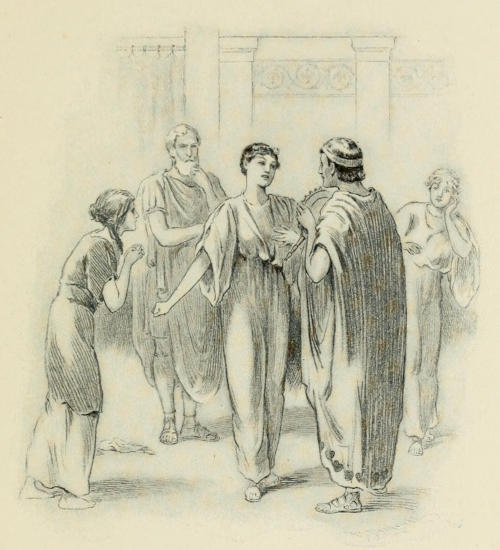
“What! A pretty girl who does not recognize her own face!”
[There is general amusement which is however near
to tears.]
Tertulla.
Why, it never can be I! Why, last time I looked in a
glass I saw....
Valentinus.
[Putting Quartilla in front of Tertulla.] This!
Tertulla.
Oh, my little sister! Tilla is what Tulla was, when her
sky grew dark!
Quartilla.
Dear Tulla!
[They embrace tenderly.]
Valentinus.
Come, now! There is one other who can wait no
longer! [He turns Tertulla toward Asterius who
stands rigid and speechless with emotion.]
Tertulla.
[Doubtfully.] Oh ... that gentleman.... Surely he
never can be Jupiter! [In awe-struck tone.]
Asterius.
[Holds out his arms to her.] Tulla ... my child!
Tertulla.
[Running to his embrace.] My father! O my father!
Asterius.
She sees ... my daughter sees, thanks to the immortal
gods and goddesses, and this blessed worker of prodigies!
Valentinus.
Oh, merely a little skill, reinforced by healing onion
juice and oil of balsam!
Asterius.
We must have a feast, a regular banquet to celebrate the
glorious event! Nerva, give orders that this shall be done
instantly!
Tertulla.
Oh, joyful day! A banquet! But first, Maronis, come,
help me improve the fashion of my hair! [Looking at
herself critically in the mirror.]
Maronis.
[Laughing happily.] Hear that now! Like Narcissus
she will fall in love with her own reflection! [Tertulla
goes with Maronis and Quartilla, all talking happily.]
Asterius.
[To Valentinus.] Ask of me, demand what you will
in repayment! It is yours unchallenged! Meanwhile to
each of my household his heart’s desire! For you, you
impudent rascal Nerva, remission of all the floggings you
already deserve, and will deserve during the coming hebdomad.
Also all the sweets you can stuff yourself with! As
for you, Pertinax, my faithful Pertinax, on the soonest day
that the Prætor sits in Court, you shall go before him to
have the rod of liberty laid on your head! More. In addition
to your freedom will I bestow on you the beginnings
and makings of a farm of your own!
Pertinax.
[Overcome with joy.] Freedman and landed proprietor
... I ... Pertinax! Oh, felicitous omen!
Asterius.
In gratitude I declare myself follower of your faith,
Valentinus! Myself and my entire household!
Valentinus.
Again, softly! It may not be achieved so hastily!
Asterius.
What! If any one of my family refuses to believe what
I order him to believe I’ll have him flogged till he does so
believe! Oh, come what may of it, you’ll find there’s no
better Christian in Italy than I! Come, now; to the banquet!
Pertinax.
[Advancing.] Master ... I mean, Asterius; as one
freedman and landed proprietor to another I ask your
daughter Asteria Tertia in marriage!
Asterius.
[Nearly speechless with wrath.] What! Do my ears
play me tricks? This ... this ... this scum asks ...
Tertulla....
Pertinax.
My blood, Asterius, is not ignoble! I was not bought
from a dealer’s cage in the market! I am no tippler at
the hot liquor shops, or gossiper in the ante-room, like certain
ones! [Looking at Nerva who is stifling his mirth
at the anger of Asterius.] I have some scholarship, and,
as you should know, no little agricultural skill! And if
the maid should not look on me with disfavour....
Asterius.
Away with you to extreme and uttermost perdition!
May you be buffeted with fists....
Nerva.
[Enjoying this, echoes.] Buffeted with fists!
Asterius.
... jerked with rods....
Nerva.
That’s it; jerked with rods!
Asterius.
... pricked with goads!...
Nerva.
Pricked with goads ... sharp, sharp goads!
Asterius.
... pinched with red-hot tongs....
Nerva.
... with sizzling, red-hot tongs....
Asterius.
... roasted over scorching flames and thrown to wild
beasts to be devoured! [He goes by the curtained way.]
Nerva.
... hungry wild beasts ... munch ... crunch! to
be devoured! M-m-m! [He follows Asterius.]
Pertinax.
Oh, infamous! And all because of your abominable
miracles! [To Valentinus. He goes out by the door.]
[Valentinus sits quietly meditating in the waning
light, and to him comes Quartilla with her caged
bird.]
Quartilla.
Everybody is unhappy and my dove has ceased to coo!
[She sets the cage among the flowers, then, seating
herself beside Valentinus, slips her hand into his.
Thus are they when Asterius enters quietly, and
also seats himself. After a slight pause he speaks.]
Asterius.
Will you baptise me a Christian to-night or to-morrow,
Valentinus?
Valentinus.
Neither then nor now, Asterius, nor ever, while your
heart remains hard and your spirit proud!
Asterius.
But, consider, now.... Had Tulla remained blind I
could have borne with the fellow’s impudence; might even
have reconciled myself to the match! But Tulla with her
eyesight is another matter! My eldest daughter is married
to a man with a porch to his house as large as one belonging
to a public building! My second son-in-law has an
estate at the seventh milestone on the Appian Way! I
myself do not need to go to the public baths; I have added
a fine equipment to the house with the most elaborate devices
for warm and cold water and hot air!
[There is a slight pause.]
Valentinus.
Hark!
Quartilla.
What do you hear?
Valentinus.
A ring-dove, calling for its mate!... Quick, Tilla!
Set your poor prisoner free! [Putting the cage into her
hand and opening the door that leads into the lane.]
Quartilla.
[Almost crying.] What, my dove that I paid money
for?... Let it go?
Valentinus.
Why, now, child, it is for this very thing you paid your
money ... to give it back its stolen happiness!... See,
already it lifts its drooping head ... ready to answer the
call of life, and spring, and love!
Quartilla.
[Opening the door of the cage as she goes out.] Farewell,
my dove!... Drop a feather from the wing of your
happiness, and send a note from your song of joy back to
Quartilla!... Kindly fare you well!
Asterius.
[Rising, addresses Valentinus.] You think me in the
wrong, but Tulla herself is averse to the idea! [Valentinus
makes no reply.] I will send her here that you
yourself may question her!
Tertulla.
[Entering.] How wonderful to learn the world all over
again! Valentinus! I would speak with Valentinus!
Quartilla.
[Enters with her empty cage.] It has flown away!
[She sighs.] I’m glad someone is happy at last! Poor
Pertinax is pacing up and down the lane with a face three
cubits long!
Asterius.
[With contempt.] Pertinax, forsooth! Come with me,
Quartilla! [Quartilla goes with him.]
Tertulla.
[Also with contempt.] Pertinax, indeed! My father
informed me of his presumptuous proposal! Shall one
who has been honoured by a god put on the saffron-coloured
wedding veil and slippers for a gardener? [Pertinax
appears at the door.]
Valentinus.
But such a gardener! [Indicating the flowers.]
Tertulla.
[In surprise.] Oh! How came these here? Flowers
that by the grace of Faunus, blossom for Tertulla while
the gardens of others are still a barren waste!
Valentinus.
Brought by the human deputy of the divinity ... good
Pertinax!
Tertulla.
[Thoughtfully.] Pertinax! [She fondles the flowers.]
My friends! Do you know that at last I see you with the
eyes of my body as of my spirit? [Kisses the flowers.]
[Pertinax sighs. Tertulla hearing, starts up.]
Who sighed then? Surely not Faunus! Surely Faunus
is no longer angry with his handmaiden? Valentinus, you
always counsel wisely! How can I propitiate the god, assuring
him of my continued loyal service?
Valentinus.
True service implies many things, Tertulla, among
which not the least is gratitude! Under the favour of
Heaven human hands were needed to protect the tender
roots from the cruelties of winter, to water them in days
of drought, and foster their growth! The miracle of the
god could be wrought only by the devotion of a man!
Tertulla.
[After a slight pause.] If Pertinax is within hearing
let him advance to receive my thanks!
[At a sign from Valentinus, Pertinax obeys, on
which Tertulla addresses him with much dignity.]
Although not condoning the presumption of your suit,
Pertinax, yet.... [She breaks off with a slight cry.]
Why ... yours was the last face I saw before my vision
went to sleep, when you, a boy, drew me from the reach of
the all-devouring flames! [She turns aside with emotion.]
An act but for which I should still be.... How unmindful
have I been all these years! But now ... you shall
find me not ungrateful!
Pertinax.
I ask nothing, Asteria Tertia, but pardon for the offence
of having lifted my own eyes toward you!... With the
freedom your Jove-like father has this day bestowed on me
I withdraw from his service, never to cross the threshold
of your life again!... Kindly fare-you-well! [He turns
to go.]
Tertulla.
[With a little cry.] Oh! But my garden!... Valentinus,
what, think you, would Faunus have me do with my
affairs in such case? [In a whisper to Valentinus.]
Valentinus.
What does your own heart counsel you, Tertulla? [He
places in her hand a blossoming spray.] Close your eyes
again and dwell for a space in the chambers of your spirit!
[Tertulla does as he bids.] What see you now?
Tertulla.
Of course the image of the god Faunus is lodged in the
sacred penetralia, never to be displaced by other object
of veneration. [Pertinax sighs heavily. She continues
hesitatingly.] And yet....
Valentinus.
Ah? And how appears the god; in what image, Tulla?
Tertulla.
Strange! A circumstance beyond my power to explain,
but.... [She speaks confidentially so that Pertinax
shall not overhear.] Think me not sacrilegious, Valentinus,
when I say he resembles Pertinax!
Pertinax.
[Having crept close to listen.] O felicitous omen!
Accept it, Asteria Tertia, and that you shall not repent
yourself of it will I dedicate my life!
Tertulla.
[Opening eyes.] Would you? [To Valentinus.]
Valentinus.
[Nodding assent.] I would indeed, were I Tertulla!
Tertulla.
Then, Pertinax, since what even now seemed presumption
on your part is presented to me as an act commended
by the immortal gods and goddesses...!
[Holds out a hand to him.]
Pertinax.
O joyful day! Words fail me! Even Anacreon disowns
me! I can only express myself in terms of horticulture!
Already the myrtle beloved of Venus puts forth
shoots, and blossoming with the rose, twines itself in a
nuptial wreath about Tertulla’s brow!
Tertulla.
How beautiful! Speak more to me in such fashion!
[Draws him aside.]
Asterius.
[In the inner room.] Bring in the banquet. Set the
tables. Place the couches! Let nothing be wanting to
the feast! [He enters, followed by Nerva and slaves
bearing lamps, dishes, and all the material for a royal
feast.] This spot, which witnessed the prodigy of my
child’s restoration to sight, shall witness equally our gratitude!...
Well, Valentinus! Has Tulla convinced you
of her loathing for that insect Pertinax? If so we will
amuse ourselves while feasting in devising means to torture
him, after which we will all be baptised! I understand
your god insists on mercy to one’s enemies, wherefore
I delay allegiance to him till Pertinax shall have been
torn limb from limb!
Nerva.
[Smacking his lips.] Limb from limb! M-m! [Suddenly
catches sight of the two lovers, and exclaims, nearly
dropping the dish he holds.] Now, by Hercules...!
Asterius.
[Making for Nerva with stick.] Thumb-fingered one!
Quartilla.
O see my sister who clasps hands with Pertinax!
Asterius.
[Also seeing the two.] What! Does my vision play
me tricks? Worker of prodigies, is this your deed?
Quartilla.
[Dancing about.] A miracle! A miracle!
Valentinus.
Only the miracle of youth!
Tertulla.
[Imploring.] Father!
Pertinax.
[Also imploring.] Father-in-law!
Asterius.
[Almost speechless.] Father and father-in-law! Now,
by— [Nerva splutters with laughter, on which he raises
his stick to him, then drops it.] O ye gods! In vain do
I remind myself that I am a Roman father! Vainly do
I call to mind the portico of one son-in-law, the estate
at the seventh milestone of the other! Even the bath
fails me, the bath equipped with hot and cold water and
hot air! I am not enraged as I should be! Even the
brazen-tongued Nerva causes me mirth rather than fury!
Quartilla.
[Dancing about.] A miracle! A miracle!
Valentinus.
Only the miracle of kindness working in your own good
heart, Asterius!
Asterius.
Then without more words let us to the banquet lest the
meats grow cold while miracles are multiplied!
[All take places at table.]
Tertulla.
[Whispers to Valentinus.] Think you will Pertinax
forgive me for my adoration for the god Faunus?
Valentinus.
Surely, by the aid of the miracle of love!
Pertinax.
[Also goes to Valentinus, speaking to him apart.]
Think you that my wife will expect impossible deeds of
me, mistaking me for a god?
Valentinus.
Fear not! That danger will be prevented by the miracle
of marriage!
[All take places at the tables, reclining on the couches
that servants have brought. Musicians begin a prelude
on flute, lyre, and harp. Suddenly Quartilla
starts up, lifting a hand for silence.]
Quartilla.
Oh, listen! [There is a general hush.] My dove ...
my dove has found its mate!
THE SEVEN SLEEPERS OF EPHESOS
Easter
THE SEVEN SLEEPERS OF EPHESOS — Characters — FOREWORD
The Seven Sleepers. Lads, of the time of Decius who
reigned over the Roman Empire from A. D. 249 to
251, named Constantine, Dion, Maximus, Ioannes,
Martinus, Malchus, and Serapíon.
A Young Slave named Constantine and six Schoolboys,
of the time of Theodosius II, who reigned from A. D.
408 to 450, named Dion, Maximus, Ioannes, Martinus,
Malchus and Serapíon.
Other persons of the same day, including
The Emperor and his suite,
The Schoolmaster, called by the boys Didaskalos,
A Priest, a Contractor, an Overseer, a Centurion and
Soldiers, the Magistrate, the Townclerk, other
Officials, Slaves working in the quarry, An Old
Slave Woman, grandmother of Constantine,
Holiday-Makers with their attendant Slaves, and
A Friend who belongs to all ages and countries.
Let us take a flight backward over fifteen centuries to
a date somewhere about A. D. 410. The Roman Empire
is the centre of the civilised world, with Constantinople
for its capital and Theodosius II upon the throne. Let
us imagine ourselves in Asia Minor, visiting a city of
Lydia which we are accustomed to call in Roman fashion
Ephesus, but which we will to-day spell Ephesos to remind
us of a fact of which it was too proud ever to forget ...
its Greek origin. Indeed Ephesos at all times seems to
have held its head high. It prided itself for one thing
on its commercial importance, its situation rendering it
an admirable starting-place for Roman legions on their
eastward march of conquest no less than an admirable port
from which the spoils of the orient, brought across the
desert routes by caravan, could be shipped to western
markets. From this it gained the name of Key, or Gateway,
to the eastern Empire. In the earlier days of its
history Ephesos had also proudly styled itself the Temple-Keeper
City on account of its devotion to the great nature-goddess
Artemis in whose honour a magnificent sanctuary
had been erected there some thousand years before this day
we are to relive in the reign of Theodosius II. Little gold
and silver shrines of Artemis were fabricated and sold in
Ephesos while Christianity was still under a ban, and,
as you will recall, it was the fear of the guild of smith-craftsmen
that the new religion would deprive them of this
industry that caused an uprising against the Apostle Paul
during his missionary labours there. Then when Constantine
the Great declared in favour of Christianity,
causing it to be the officially established religion of Imperial
Rome, we find Ephesos priding itself on the zeal
with which it renounces its ancient deities, and either
razing the temples of these or converting them into
churches with forms of worship adapted to the new creed.
It is a holiday in spring, and holidays here seem much
the same as elsewhere. Schoolboys freed from the rule
of didaskalos go to the shores of the River Kaÿstros to skip
oyster shells, or they play hide-and-seek in the fields of
wheat and millet that grow high as a man’s head. Perhaps
when the back of the Centurion with his vine-branch
rod is turned they will form a group in the pleasant shade
of some portico to match coins. “Heads or ships?” we
shall hear them say, if by chance a Roman piece has found
its way among the locally minted currency. Picnic parties
attended by slaves bearing huge baskets of provisions
will be seeking the quarried sides of Prion and Kóressos,
the beautiful mountains that overlook Ephesos. Stories
will be told by the old to the young: legends of the days
when the Temple of Artemis ... now but a picturesque
ruin ... was sanctuary during a Persian invasion; later
fables of the persecutions instituted by the Emperor Decius
against the professors of the new religion who were fain
to meet by stealth in upper chambers to worship, or be
scourged, thrown, perchance, to beasts in the arena. Perhaps
some antiquarian will have discovered a papyrus on
which he has deciphered a hymn in praise of Artemis,
coupled with an ode to the City, to be sung by the Epheboi,
the youths of the place, and the girls destined to be
Temple priestesses, at the great festival of springtide when
nature’s self celebrates the glory of resurrection after its
winter sleep, and decks the world with flowers. In those
days the month of festival was called Artemision, but
now it is known as Easter! Listen to the chants from the
churches dedicated to St. Paul, St. John! But even as
you hear the “Glory to the Father” the winds that acknowledge
no religion, old or new, and the echoes that witness
them all, bring back to life the strains of the ancient
processional, sung to flute, harp and lyre, in praise of
the banished goddess Artemis by boys and girls over whose
graves the flowers of nigh two centuries have grown!
HYMN TO ARTEMIS
O Artemis,
Great goddess-mother, born
When from primeval night’s abyss
Primeval rose the morn!
To well-strung lyre
Thy choric praise we sing,
Libations pour, tend sacred fire,
Bear garland-offering.
As Prion’s peak
Strains toward sky-swung star
So conquerors thy favour seek,
O goddess tutelar!
Unbought, unsold,
Abides thine altar-stone,
Nor subjugate by Crœsus’ gold,
Nor pride of Macedon!
Thy columned fane
From quarries hewn of time,
Oft razed, but rears itself again
In grandeur more sublime!
In war or peace
Then grant, as aye before,
Arms’ victory and earth’s increase,
In peace, goddess, or war!
HYMN IN PRAISE OF THE CITY EPHESOS
O City Temple-Keeper, praise be thine
For fruitful olive, corn, and clustered vine,
Sweet-watered plain,
And prospered orchard, flocks on sunny sides
Of hills where silver-tracked Kaÿstros glides
To trackless main!
O wide thy roads that height and desert span
For mustered troop and laden caravan,
An Empire’s key
From morning star to star at eve that dips
Into yon harbour whence our gallied ships
Go down to sea!
O fair thine iris-mead and cypress grove
Where Egypt’s queen and Roman soldier wove
Love’s dream of joy!
Mighty thy pride of old Ionic race,
Altar and hearth no power can abase
Nor time destroy!
The winds fold their wings among the hills and the
echoes slip back into the valleys with their memories of
boys and girls with their flowering garlands, incense bearers,
priests and priestesses of long ago who used to march
through the city and climb the hill to the Temple in the
month of Artemision; and the cross over the gateway
that we see in the distance, and the peal of the Gloria
from the churches remind us that this is a modern and
Christian Ephesos through which we are wandering at
Eastertide in the year 410. From the market-place we
have passed to the stadion where the young athletes of
the place are practising for the games that will be held
later on, and now our steps have brought us beyond city
bounds in the direction of Kóressos. Here we find that,
although it is a holiday, gangs of slaves directed by an
overseer are busily quarrying the grey marble for which
this mountain is famed. Mingling with the bystanders
we pause to watch them as they tear down a pile of loose,
large stones that seem at some time to have been stacked
up against what looks like a solid wall of masonry. As
the sun is high and we are wearied with our climb we
join a group sitting in the shadow of a plane tree, enjoying
the view, listening to the distant chimes and the anthems
of praise from the churches. Meanwhile our attention
is arrested by the talk that goes on about us.
The Overseer.
[As a huge block rolls down.]
Good! Still a few such blocks, and lo! fulfilled
My contract!
A Priest.
[Passing, pauses.]
Working! Through what greed of gain
Profane you thus the holy festival
Of Eastertide?
The Overseer.
A holy work, in truth,
Good presbyter! Aye; albeit delayed
Through curious reluctance of these slaves ...
Dogs, Would you slacken when my back is turned! [He
menaces the Slaves who seem to work most unwillingly;
then continues] ... to quarry the grey ribs of Kóressos
For marble for the final resting-place
Of an Apostle!
The Priest.
[Enlightened.]
What! To line the tomb
Of blessed Paulos destined, then, these stones?
The Overseer.
The contract so attests!
A Dandy.
[Passing by with an Official pauses.]
Increased the land
In value, neighbouring the tomb, since all
Of ardent faith interred will seek to lie
Near bones canonical and sanctified!
Let us go bargain for it secretly!
The Official.
Forget you, marts are closed and business waits
On Eastertide?
The Dandy.
’Tis true, worse luck to it!
A Young Slave.
This is the last stone that I roll away! [The other Slaves mutter assent.]
The Overseer.
[Angrily.]
Silence! Or taste the lash!
The Priest.
[Apostrophising the mountain.]
O Kóressos,
How many pagan fanes in bygone days
Your sides have yielded! Now your very heart
The mortal part of immortality
Shall shrine! Hallow’d such toil on hallow’d day,
How must ye love it! [To the Slaves.]
The Slaves.
[In contemptuous derision.]
We!
The Young Slave.
[Offering his tools to the Priest.]
An like it you
So greatly, come, then; take my place at it! [This daring act causes a sensation.]
The Priest.
[Unable to credit his ears.]
What, I? A father of the church!
The Young Slave.
Why not,
If hallowed task you deem it fits it not
Your calling?
The Priest.
[Unable to credit his senses.]
Eyes, deceive ye me? O ears,
Be ye discredited! Slave this? Ye gods! [No
sooner has he made this slip of the tongue than he becomes uncomfortably
conscious of it from the shocked amusement of the bystanders.]
The Young Slave.
[With sardonic mirth.]
Upon the gods he calls! This man of God
On ancient gods, on banished gods and banned
Is fain to call for witness! Hear him, gods! [This daring speech causes a great sensation.]
The Priest.
O blasphemous! For trifling tongue-slip thus
To be construed as utterance profane!
Heaven, avenge Thy servant! Lightning-shaft
And bolted thunder strike this slave! [With arms upraised.]
The Young Slave.
[With a sneer.]
Too clear
The face of morning! Did fulfilment wait
Such miracle though, easier its death
Than the life-haunting frenzy that predooms
Who delve into this mountain’s mystery!
An Old Slave.
Truth speaks he! [The other Slaves murmur assent.]
The Overseer.
[Angrily.]
Truth or falsehood, his next word
Will earn a whipping!... Are the oxen yoked? [He
looks toward a point beyond our vision.]
Then load with these the drays! [He indicates
the stones already quarried, accordingly the Slaves
slip a noosed rope about the largest of these and drag it away.]
The Priest.
[In a temper.]
Lash-threat I deem
Too light a penance for his saucy tongue!
Centurion! [He calls and beckons to someone.] What, ho! Centurion!
This city’s wretchedly policed!
The Centurion.
[Majestically stalks on.]
Who calls,
And wherefore?
The Priest.
Yon’s a slave whose tongue offends.
Centurion.
In course of nature! Slaves should all be born
Untongued, were I consulted!... Slaves, and boys
Of schooling years! [He shakes his rod threateningly
at a group of Schoolboys who are imitating his
stride, then continues, addressing the Overseer.]
The wretch your chattel is.
Why not yourself chastise him?
The Overseer.
[Shaking his head.]
Sinewed brawn
I can’t afford to quarrel with. His lead
The others follow. Mutiny ’twould cause.
The Priest.
[Appealing, angrily.]
Unscathed such blasphemy? Centurion....
The Overseer.
[Appealing, anxiously.]
Undone the work! Centurion....
The Centurion.
The noon
Is sunful, steep the climbing hill, and I
No longer in my sapling years. Where shade
Invites I’ll weigh the matter duly, which
Hath greater claim on Rome’s authority:
A partly holy man, wholly alive, [Indicating the Priest]
Or an Apostle, wholly holy, dead! [He sits under the tree and falls into a doze.]
Ioannes [a Schoolboy].
Let’s to the river and skip oyster-shells,
Or sail our galleys!
Maximus.
In the stadion
I’m all for diskos-throwing, sprinting. Come,
A trial race! [To Dion.]
Dion.
[Agreeing.]
I’m with you!
[The two athletes, Dion and Maximus
strip off their outer garments, throw these down, under the tree.]
Serapíon.
[A small boy, with a slight limp.]
O Dion, brother! Let me come with you!
Dion.
Too small is Serapíon, and too lame!...
Ready, Maximus?
Maximus.
Ready!
[They stand ready to start. The Others give the signal, “One, Two, Three, Off!” and they run off.]
Serapíon.
Always too little, and too lame! Ah, well:
My Æsop’s fables must I learn by heart!
[He walks apart, trying to recall his lesson.]
“A nightingale did sing ... did sing ... sing ... sing....
[Pointing to the Centurion
who is snoring slightly. They laugh, tickle his ear with a spear of grass. He brushes this aside, saying, “Shoo, fly!” The Boys,
feeling safe, sit on the ground, and prepare to play flipcoin.]
Maximus.
See, here’s a Roman piece. Who matches me?
Ioannes, you? [Ioannes shakes his head.] What now? Afraid to lose?
Ioannes.
[With some heat.]
You know it is not so, Malchus. My word
I passed I would not!
Malchus.
You’re too good
To live! Martinus, then?
Martinus.
[Shakes head, refusing.]
No money!
Malchus.
Eh?
What’s that? A tetradrachm! [Pointing to
a coin Martinus has been clutching, and now
tosses up and catches nimbly.]
Martinus.
[Explains.]
’Tis for a loaf
Of bread. My mother bade me careful be
To count the change!... Ah, well; no harm to stake
A little sum against a large one!
Malchus.
Good!
Then.... Heads or ships!
Martinus.
Ships!
Malchus.
Heads it is! You lose!
Martinus.
[Suddenly realising what he has done.]
I’ve lost! Oh, oh!
Malchus.
[With some heat.]
Well, stood you not to lose or win?
Martinus.
True! Oh, fair play was it! ’Twas fairly won!
Not fairly lost, though. Since not mine was it
To play with! [To himself, bitterly.]
Ioannes.
Look! Here come the racers! Mark
How Dion leads!
[All
run to watch the two runners as they approach, crying, “Well run! Good Dion! Good old Maximus!” etc.]
Maximus.
Again! Again ’tis Dion’s victory!
Dion.
To-morrow better luck for Maximus!
[They dress themselves assisted by the Others. Voices are heard approaching.]
Ioannes.
Here comes Didaskalos! A stranger-friend
He shows the sights! Now hearken to him prate
As owned he city, mountain, view, and all!
[Enter the Schoolmaster with The Friend. The Boys hide.]
The Schoolmaster.
Here panoramic spreads itself a view
Of Ephesos, our city fair of fame....
The Boys.
[Put their heads forth reciting.]
By Greek-Ionians founded. Subjugate
By Persian satrap, Great Aléxandros
Of Macedon, in turn; and finally
By Romans!
The Schoolmaster.
Eh? Who speaks?
The Boys.
[Showing themselves.]
We echo you,
Didaskalos! [They laugh, and hide again as he threatens them.]
The Schoolmaster.
[Angrily.]
The rascals!
The Friend.
[Smiling.]
Well they know
Their history!
The Schoolmaster.
[Propitiated, continues to point out the sights.]
Mount Prion, yonder, twin
To Kóressos here, limestone famed. Mark well
The valley-sweep between!... The city-gates
Within you see the agora, buildings
Municipal; and at Kaÿstros’ mouth
Our sally-port!... Odeîon! Library!
Theatre which seats about three thousand!
And churches of Saints Peter, Paul and John!
The Friend.
And yon, those ruins of a grandeur passed,
Still splendid, awe-inspiring ... aye, sublime...?
The Schoolmaster.
[Shocked.]
Good friend ... a pagan temple, justly razed....
The Priest.
[Who has been sitting, making notes on his tablets, starts up and joins in the discussion.]
Not razed yet low enough! Not stone on stone
Should still be standing, were the city keen
On matters sacred as on secular! [The
Friend looks from one to the other for explanation.]
The Schoolmaster.
Yon ruins mark the one-time templed site
Of Artemis....
The Priest.
[Taking the words from him.]
In days of error, now
Thank Heaven, passed! the city’s tutelar!
The Schoolmaster.
[Trying to continue his lecture.]
No kin to Græco-Roman Artemis,
But Asian, autochthonic, to be classed
With nature-worship idols!
The Boys.
Ahem! Hear, hear!
More information, pray, Didaskalos!
The Schoolmaster.
[Threatening them.]
Rascals! Wait till I get you in the classroom!
The Friend.
How beautiful! There never was a time
When heart of man aloof from worship stood;
No age so dark but best of hand and brain
To temple-rearing has been consecrate!
Receive, O ruined fane, my homage! [He bows toward the Temple.]
The Two Others.
[Shocked.]
What!
Some heretic is this?
The Schoolmaster.
You called yourself,
Methought, a student of divinity!
The Friend.
[Bowing assent.]
Therefore see spark divine wherever burns
An altar-flame in any human breast!
The Priest.
[Returning to his work.]
Such laxity ... I doubt he’s orthodox!
Schoolmaster.
[To the Friend.]
Shall we be going?... Ouch! My toe I stubbed!
[He kicks a small object, lying among the rubble, and suddenly arrested by some peculiarity in its appearance, stoops and picks it up.]
What’s this? Upon my word, a silver shrine ... [He dusts off the object.]
An Artemis ... and dated, A. U. C.... [Reckons, mentally.]
A century and half a century
Would take us back to, let me see ... whose reign?
The Boys.
[Appearing, deride him.]
Ha, ha, Didaskalos! Oh, dunce, forget you thus your tables?
I’ll birch you, when I get you in the classroom! Wait and see!
The Schoolmaster.
Rascals!... The reign of Decius! That’s it!
[He brushes off more dust to examine the shrine.]
Made by Demetrios....
The Priest.
[Who has come to look.]
Not the Demetrios of Paulos’ time!
Not by two centuries!
The Schoolmaster.
Generic name,
In Ephesos, for silversmiths! A find
Indeed! [Holds up the shrine.] My name as antiquarian
’Twill render known!
The Priest.
It should be exorcised
As heathen trash, and cast into the fire!
The Friend.
[Protesting mildly.]
Someone once held it sacred! Still a form
Of beauty is it!
The Boys.
[Capering about.]
“Great is Artemis! Great is Ephesian Artemis! O great is Artemis of the Ephesians!”
The Priest.
What sinful words are these?
The Boys.
’Tis history
We quote! You ask Didaskalos!
The Schoolmaster.
Rascals!
I’ll birch you well to-morrow! Just you see!
The Priest.
My birching will not keep! Till orthodox
And proper Christians do they show themselves
I’ll thrash them black and blue! [He and the Schoolmaster chase the Boys.]
The Centurion.
[Waking.]
How now! How now!
What’s this disturbance! Who is chasing whom
And wherefore? Or is ’t some game you play? [To
the Priest and the Schoolmaster,
who are highly disgusted at the question.]
The Priest.
Some game, forsooth!
The Schoolmaster.
Instead of swelling out
Your chest to show your medals, why not use
Your vine-rod on those boys!
The Centurion.
Boys! Show me boys
To use my vine-rod on and I will use
My vine-rod on those boys! [They look about
for the Boys who, needless to say, have profited
by this dispute to vanish.]
The Boys.
[Appear on a height, and shout.]
Sanctuary! Sanctuary! Come, catch us, an you dare!
[Again they disappear as the three make a feint of pursuing them.]
The Centurion.
Too tender of them are you!
The Schoolmaster.
[Unable to believe his ears.]
I?
The Priest.
[Equally amazed.]
I?
The Centurion.
Aye!
The Friend.
[With great kindliness.]
Young, growing creatures, full of living’s joy,
O be not hard on them!
The Centurion.
Said Solomon,
The vine-rod spare, the birch-twig spare, and spoil
The schoolboy and the Christian! Mark you, so
Said Solomon! [He stalks off with great majesty.]
[The Overseer and The Slaves
now return. The former, by gesture, indicates that the work of quarrying is to be resumed. The Young Slave
gives one blow to the side of the rock, then throws down his tools.]
The Young Slave.
So far I work. No farther. Not one stroke!
The Other Slaves.
So I!—I follow his example!—I
Also! The word we stand by! All! Aye, all!
The Overseer.
[Furious.]
Accurséd dogs! But one more stone we need!
But one! [Changing to a placative tone.] One!
The Young Slave.
Quarry it yourself, then!... Here! [Offers the Overseer his pick.]
The Overseer.
An extra dole of corn, measure of wine
Compliance shall reward!
The Young Slave.
Bribes tempt us not,
Nor threats affright! [The Other Slaves assent.]
The Overseer.
[Calls.]
Centurion! What ho!
The Centurion.
[Enters.]
Who calls, and wherefore?... What; these slaves refuse
The pick and axe?... Well, are you wool-weavers,
Or bakers, even, that a guild you form?
Or fishmongers who would run up the cost
Of living? Now, by Hercules ... I mean,
By Heaven, freedmen do you think yourselves
Daring to hold opinions of your own! [With scathing sarcasm.]
The Contractor.
[Hastens on.]
Why this delay? What’s happening? The slaves
Leagued in rebellion!... Cut them into strips!
[Voices are heard of people approaching. A crowd gathers. There is great general excitement.]
Bystanders.
[Cry.]
Soldiers! Here come the townclerk, magistrate! [Enter
Soldiers, Townclerk,
Magistrate and others.]
The Townclerk.
[Arriving first, and stuttering with excitement.]
Wh-what’s the matter? [He grasps the situation.]
What, a gang of slaves
Their will asserting? Know you not no will
You have, hence how may ye assert it? [To the Slaves.] Eh? Answer me that!
The Magistrate.
[Arriving, pompously.]
Am I to understand...?
The Centurion.
[Interrupting.]
Precisely, Magistrate! You are to understand....
That is to say, if understand you can! My understanding,
I confess, it passes, that dogs who are not citizens
should so defy the might of Rome! [Indicating himself.]
The Magistrate.
Breath’s wasted! Seize them; bind them. Send a score
To take their place! [The Soldiers prepare to obey.]
The Young Slave.
Bind, torture us! In vain!
Aye, crucify us! All in vain! You’ll find
No one in Ephesos our place to take!
[This produces a sensation. The Soldiers
shrink from obeying orders to seize the Slaves.]
The Magistrate.
[Hands upraised in consternation.]
With Cæsar here in town ... Great Cæsar’s self ...
Blest Theodosius here the feast to bless!
The Priest.
The resting place to bless of Paulos ... he who came
To preach ... to preach ... [Referring to tablets] ... to preach ...
The Schoolmaster.
My speech his life rehearses. “He who came
To preach ... to preach ... [Referring to tablets] to preach....”
The Magistrate.
[To the Centurion.]
We waste the day! Example make of these!
We’ll test if others will not take their place!
The Priest.
And be accurséd! Let the Church’s curse
Fall on who shame our city, Christian heart
Of Christian-empired Rome.
An Old Slave Woman.
[Wailing.]
Oh, my little one! My daughter’s child ... Son to mine old age ... Oh, take him not away! [She tries to make her way to the Young Slave.]
So good a lad and dutiful ... my Constantine! See, now, masters ... named for that great emperor who set the cross above our city gates ... and now you take him from me! Constantine ... would I might suffer in your stead!
The Magistrate.
Remove the woman! [Soldiers force her back.]
The Young Slave.
There, good mother, hush! [Soothingly.]
This deed the mountain’s self will yet avenge! [The other Slaves assent.]
The Friend.
[Steps forward.]
Pardon. A word I’d venture, by your leave! [To the Magistrate.]
The Townclerk.
Your name, young man?
The Centurion.
[Glad of something to do.]
The townclerk asks your name!
The Friend.
Unknown, a stranger, matters not. A friend!
These faithful souls, all trembling, ill with fear—
What bodes it? [The Slaves
all turn to him intuitively, with hope and trust.]
The Magistrate.
[Impatiently.]
That, who knows or cares to know!
The Friend.
Ah, pardon me! A Christian land methought
You called this!
All.
[Indignant.]
As it is!
The Priest.
Have you not marked
The cross above each city gate? And hear you not
The chanted Glorias! [The chants are heard in the distance.]
Prepare we not
A tomb for sacred Apostolic bones!
What infidel denies our faith? [This creates a
reaction against the Friend.]
The Friend.
In name
Of Christos, too, my country far away
Is signed. Strange customs, though, with us obtain.
A slave, the meaner is his task and hard,
The lowlier his spirit, so his rank
We hold exalted! [This causes amusement to some, but interests all.
The Slaves reach their hands toward the
Friend who continues.]
By oppression crushed
His heart? With love we seek to heal it, arm
Anew with hope! His wealth who gives away
To feed God’s poor our richest citizen
We count! To dry the tears of sorrow kings
Contend! Our rod of empire is the rule—
The golden rule—Judge none, while loving all! [This
produces a great effect on all, and for a moment there is silence, broken by]
The Schoolmaster.
Where lies this country, pray? Geography,
As I have learned it, teach it, knows it not!
The Priest.
[Slightly dazed.]
Strange! As in dreams ... Where have I heard
A land
Where kindness rules and service is but love!
Several.
[With hands to head, seeking to recall.]
I too have heard ... Where is that country, now
Where kindness rules and service is but love?
The Magistrate.
[With irony.]
Since order in your land, it seems, prevails,
Without so much as clash and show of arms,
How bring you sullen dogs like these to time?
With kindness?
The Friend.
Give you leave that I may try? [The Crowd favour this, but the Officials
demur, conferring apart. Finally they decide to try the experiment.]
The Magistrate.
[With a wave of the hand.]
’Tis Eastertide. Such pleasantry will feed
The holidaying humour of the crowd! [All
watch with deepest interest, some hoping the Friend
will fail, others in sympathy with him.]
The Friend.
[To the Slaves.]
Friends, brothers, weary are ye? Sit, then! [This
provokes a murmur of incredulity from the Slaves.]
Come,
Your welcome gather from the kindly looks
Of these, the city fathers! Hungry, ye?
Athirst?... Here’s bread ... and fruit, and wine ...
And gentle hands to minister!
[The Slaves sit, and the Friend signs to the Holiday-makers
who, obeying, hasten to open their baskets, and bring forth their stores, waiting with kindest solicitude on their wants.]
’Tis well!
Feast not as almoners, but guests who share
The blessedness of hospitality!
The Magistrate.
[Working himself up.]
If Babylonian sorcerer he prove
Alive shall he be flayed, his skin nailed up
On the Cathedral door!
The Contractor.
Oh, stay your hand
Till by his arts the work is finished!
The Magistrate.
[With growing uneasiness.]
But
Who is the man?... ’Twas you who brought him! [To the Schoolmaster.]
The Schoolmaster.
[Disclaiming responsibility.]
Oh,
Not I his bondsman! Student, said he; once
A carpenter’s apprentice, from some spot
Beyond the Lake of Galilee!
[The Magistrate shakes his head doubtfully. The Priest
puzzles more than ever, seeking to place the Stranger. Meanwhile, the banquet, which has been progressing in a spirit of true democracy, has come to an end.]
The Young Slave.
[Addressing the Friend.]
With love love to requite, our lives are yours!
Ask what you will! [The other Slaves assent to this.]
The Officials.
[Prompt the Friend.]
Bid them the work complete!
The Young Slave.
Even to that last bitterness his voice,
Tender as heaven’s mercy that you preach [To the Priest]
Shall nerve our flagging courage. Where he leads
Blindly we follow, knowing him our friend! [The
other Slaves assent, while all marvel at this change.]
The Friend.
[To the Slaves.]
First voice your trouble. Give it words. Wherefore
Ye fear this grey old mountain? See where wait
In kindness all your friends ... the Magistrate,
And all who love ye, judging not!
The Magistrate.
[Smiles.]
How well
My thought unspoken reads he!
The Others in Authority.
Mine as well!
The Young Slave.
Then let my mother’s mother tell the tale
As she has told it me! [The Old Slave Woman is thrust forward.]
The Magistrate.
[Handing her to a seat.]
Good dame, your years
Entitle you to ease!... So, now; your tale!
The Old Slave Woman.
Long years gone by ... Oh, years agone, when Decius was Cæsar, monster bloodthirsty....
Martinus.
Horns, tail, had he, cleft foot, and spat he flames?
And munched and crunched the bones of little boys?
The Old Slave Woman.
My mother’s mother told me not. She had it from her mother’s mother. She from her mother’s mother. She....
The Magistrate.
[Kindly.]
Pray you, skip antecedent mothers!
The Old Slave Woman.
Hard was the heart of Decius, hard, hard,
Stone-hard!... Who loved the Christos whom we love
He hated, had them beaten, burned alive,
Or thrown to hungry lions! [Enthralled, the Children exclaim.]
Even so,
Children as you are, too!
The Schoolmaster.
In terms precise
The edict reads....
All.
Oh, hush!
The Old Slave Woman.
Seven there were ...
Of names and years like yours! [To the Schoolboys.]
One, Constantine,
A slave-boy, noble though by birth and soul.
Then Dion, splendid, athlete; Maximus
His dearest rival; then a widow’s son
Martinus; next Ioannes, orphan he.
And Malchus with a fowl. Thrice he denied
His Lord, repented of it, though. And last
Wee Serapíon with a halting foot!
All Christians!
Malchus.
[In all good faith.]
Was the fowl a Christian too?
The Old Slave Woman.
[In equally good faith.]
That surely!... Fled these seven boys by night,
Beyond the city gates, sought refuge here,
Right on this spot. Within a cave they hid!
Then came the soldiers and the furied mob,
And walled them in alive with heaped-up stones,
And here alive they bide till Judgment-Day! [This
produces a great sensation, though many seem to pooh-pooh the tale.]
And still their chanting voices may you hear,
Give Glory to the Father, to the Son,
And to the Holy Spirit.... Three in One!
[She pauses, impressively, and indeed at this moment may be heard a sweet, faint sound, as of boys’ voices, seeming to issue from the mountain.]
The Priest.
’Tis the Cathedral choir that practises!
The Schoolmaster.
Thus fact of fantasy disposes, mocks
An old wife’s tale!
The Old Slave Woman.
I give you what I heard!
If it displease you, punish me ... but not
My boy, my Constantine!... If proof you lack
Another stone rolled down, rough-hewn will show
A cross to mock their sleeping-place!
The Schoolmaster.
[Seizing a tool.]
Deathblow
To fiction, first am I to strike!
The Priest.
[Also seizing a tool.]
So I
To superstition!
The Magistrate.
[Doing the same.]
I to mutiny!
[Assisted by willing hands the three roll down the stone indicated by the old Slave Woman.
As the cloud of dust it raises subsides a cry arises from all, for on the side of the mountain thus exposed is seen rough-hewn a cross. All now hasten to clear away the rubble beneath this, and soon the entrance to a cave is visible. A ray of light, as from a sunbeam, falls athwart this opening, whereupon there is a faint cock-crow within the cave. So great a panic does this cause that most of the people run away, the Magistrate, the Priest, and the Schoolmaster in the lead. Only the Schoolboys remain with the Friend. Then, one by one the people creep back, the Old Slave Woman and her grandson first, and the officials last and most cautiously of all.]
The Seven Sleepers.
[Within the cave call one to another.]
What, ho! ’Tis morning! See the sun hath risen! [One
by one yawning and stretching they come from the cave.]
Constantine [the Sleeper].
After night’s tempest, ah, how sweet the morn!
But ... what a change! All hushed the frenzied din
That rent the skies of yesterday! No more
The market-place runs blood, with fire and sword
As man hunts down his fellow-creatures! Calm
The city rests, and rises like a song
The hum of gently avocationed lives
And happy people! And ... surely I dream!
Above the city gate a cross ... the cross
Of Christos ... Him for love of whom we fled,
Were prisoned here last night!
“What, ho! ’tis morning! See, the Sun hath risen.”
The Schoolmaster.
[Explaining.]
That night, how long!
A century and half a century!
[All hush him, though the young Sleeper seems not to have heard him, nor indeed to be aware that others are present.]
Ioannes [the Sleeper].
[Coming forth.]
Let’s to the river and skip oyster-shells,
Or sail our galleys! ’Tis a holiday.
’Tis Artemision!
The Priest.
[Kindly correcting.]
Come, come, my child;
Forbear such terms and call it Easter!
[The other watchers silence him, though still the Sleepers fail to notice them.]
Dion [the Sleeper].
[Coming forth.]
Fine weather for the games! Ho, Maximus!
I’ll race you to the city gate and back!
Maximus [the Sleeper].
[Coming forth.]
Wait, Dion, till I get my breath! [Yawns.] How stiff
My muscles! [Stretching.]
Dion and Maximus [the Schoolboys].
[Advancing with outstretched hands.]
Dion and Maximus,
Even as we, come to the stadion! [But the others
fail to see them or to heed the invitation.]
Martinus [the Sleeper].
[Coming forth.]
That loaf of bread my mother sent me for
I was forgetting it! That tetradrachm
She bade me change, where is it?... I forgot!
At flipcoin lost I it to Malchus!
Martinus [the Schoolboy].
Just
As I did!
Malchus [the Sleeper].
[Coming forth, carrying a basket.]
Here, Martinus! Take your coin!
We slept on it, Aléxandros and I!
Your mother’s is it, so not yours to lose,
Nor mine to win!
Martinus [the Sleeper].
[Accepting the coin the other holds out to him.]
I thank you, Malchus!
Malchus [the Schoolboy].
I,
Too, thank you, namesake mine! Martinus, here!
Take back your mother’s tetradrachm!
Martinus [the Schoolboy].
[Accepting the coin his friend holds out to him.]
Malchus,
I say, that’s fine!
Serapíon [the Sleeper].
My Æsop’s fables must I get by heart! “A nightingale
did sing ... did sing ... did sing....”
Serapíon [the Schoolboy].
[Prompting.]
“When hungry hawk espied her!” My name is Serapíon,
too!
Serapíon [the Sleeper].
[Seeing him.]
Oh, what a funny looking little boy!
Serapíon [the Schoolboy].
Funny looking yourself! I knew more of the fable than
you did, anyway!
Serapíon [the Sleeper].
[To his fellows.]
Look! A little boy!... And, oh, crowds and crowds
of people!
The Other Sleepers.
No, dear child! There’s no one but ourselves!
Serapíon [the Sleeper].
But I see them clearly!... Come and play with me! [To the other Serapíon.]
Serapíon [the Schoolboy].
[Timidly advancing.]
I’d like to, but ... somehow ... you seem ... not
real.... No, I don’t mean that! But just as if you
came out of a dream!
Serapíon [the Sleeper].
Dream yourself! Why, as I look at you you fade and
fade away ... and now I don’t see you at all!... Constantine,
is it true we shall be put to death for loving
Christos?
The Other Sleepers.
[Suddenly recalling their plight.]
Aye; truth is it, or dream?
Constantine [the Sleeper].
Dream of a night
Forever vanished!... Listen to the song
Praising the God of Love! [Clear and sweet rises
the sound of the Gloria. The Sleepers, rejoicing,
seek to join in it, but their voices fail them.]
Serapíon [the Sleeper].
Home ... then may we go home?
The Other Sleepers.
Home! That’s the word!
May we go home?
[The Friend stands forth, and a radiance comes from him. Constantine
the Sleeper sees him, and exclaims, joyfully.]
Constantine [the Sleeper].
Home, home! Here is a friend
Will guide us!
[The Friend passes quietly from the scene, a light streaming from the direction he has taken. The Sleepers
stretch their hands toward him, with a joyful cry.]
The Seven Sleepers.
Lead, Master! We follow ... follow ... home!
[Even while speaking they sink down on the ground near the cave, and close their eyes as if in sleep. The Emperor
and his suite approach, as if they had been looking on, near by, and fall reverently on their knees, their example being followed by the multitude, while the chant rises ever more clear and sweet. The Seven Schoolboys pluck brightly flowering branches and lay these beside the Sleepers and shower blossoms over them. And so the scene fades from our sight.]
PRINCESS MOSS-ROSE — GREETING TO THE AUDIENCE
For Every Child’s Birthday
Spoken in front of the curtain
by
THE CHILD WHOSE BIRTHDAY IT IS
To-day it is my birthday. Yes! Now who this group among
Can guess, I wonder, just how old I am, or just how young:
One, two, three, four, five, six, or seven; eight, nine, ten, or ... stay!
I’m one year older than I was this same hour yesterday!
Wait till you see my birthday cake in which a candle burns
For every year I’ve lived, plus one for luck and glad returns!
I’ve read that children carefully their birthdays ought to keep,
And yet how can we, when they come, and go, when we’re asleep?
Still, if you’ll kindly help me keep this one I’ll do my best
That no one ... no, not even Time, shall rob me of the rest!
Then when I’m very, very old I’ll tell you what I’ll do:
I’ll give those birthdays all away. And some I’ll give to you!
PRINCESS MOSS-ROSE — THE FIRST EVENT — THE SECOND EVENT — THE THIRD EVENT
We shall now witness Three Events in the Life of the
Princess Moss-Rose. These take place in the hall
of her father’s castle. Besides the Princess herself
her parents, the King and Queen, will assist at the
Events, also the Court: the Lord High Chancellor,
the Royal Nurse, Governess, Butler, Cook,
Gardener, and Lords and Ladies of Quality.
Huntsmen, Pages and Lackeys, too, will come and
go as they are needed. Then there is a Frog of high
degree in Frogdom, who will receive the knightly accolade,
thereafter being known as Sir Amphibious
Batrachian, with the right also to call himself
Baron Freshwater. Two Tadpoles who grow up
into rather grouchy, rheumatic elderly Frogs are of
his retinue. The Three Fates and Destiny have
inconspicuous, but important parts in the Events.
Then we shall also see several Fragments of Kings’
Sons who have perished in their quest for the fabled
Moss-Rose, and, accompanied by his tutor, Mentor,
the victorous King’s Son, Prince Charming. Sixteen
years divide the Second Event from the first,
and one hundred years the Third from the Second.
These passages of time, however, touch our royal
friends but lightly, and do not cause their royal
clothes to wear out, or their royal furniture to become
shabby in the least. The scene is laid in the hall of
the King’s castle, an apartment of suitable magnificence.
Entrances lead to banqueting-hall, servants’
offices, and other parts of the establishment. Windows
overlook the attractive grounds with a glimpse
of the forest beyond.
shows a pleasant morning in summer. The King
and his Huntsmen are assembled in the hall, singing
a jovial hunting-chorus, while without the Dogs bay,
and the Horses champ with proper impatience for
the start.
HUNTING CHORUS
Ho, Yoicks! ho!
Hey, tally-ho!
A-hunting, hunting, hunting; a-hunting will we go!
We’ll hunt by day, and we’ll hunt by dark;
We’ll hunt the slipper, we’ll hunt the snark;
The lion, tiger and buffalo,
We’ll hunt them all, Ho, Yoicks, ho!
We’ll hunt the bulrush and bull-moose,
We’ll hunt mongander and mongoose!
We’ll hunt the pole-cat, polar bear,
The hairy musk-ox and the hare,
We’ll hunt the dodo, dinosaur,
The wild-boar and tame, talking bore!
Aye, all the beasts in Noah’s Ark
We’ll hunt by day and hunt by dark!
And every one of them, you’ll see,
Will love the sport as much as we,
Because to kill is not our aim,
Or hurt, since that would spoil the game!
So, Yoicks, so,
Hey, tally-ho!
A-hunting, hunting, hunting; a-hunting will we go!
[At the close of the Hunting Song the King and his
suite are about to go when the Lord High Chancellor
enters with as much haste as his girth and
dignity allow.]
The Chancellor.
The King, the King, where is the King!... Oh, Sire,
I feared I should be too late! Her Majesty the Queen
begs you to forego your day’s hunting, as she has a piece
of news of the utmost importance to communicate to you!
The King.
My dear Lord High Chancellor, I am always most anxious
to please the Queen, as well you know, but as you can
see and hear for yourself, the nettlesome steeds are saddled,
and are champing and pawing the ground, the
hounds are baying, and all the wild animals in the royal
forest are gnashing their teeth and growling fearsomely,
impatient for the day’s sport to begin!
The Chancellor.
Nevertheless, Sire, under the circumstances ... the extraordinary
circumstances....
The King.
Does the Queen’s news concern itself with house-cleaning
the castle? Or is Her Majesty desirous of purchasing
a new crown? If so, can’t you suggest to her to get
the old one turned and made over? The jewels in it are
not in the least shabby; they are as good as new, in fact!
The Chancellor.
Sire, this is more important even than a crown! Here
comes the Queen herself to tell you all about it!
[The Queen enters to a flourish of trumpets, attended
by her Ladies. Following these comes the
Royal Nurse bearing a tiny infant, wrapped in a
magnificent silken coverlet. The Nurse stands
in the background, with the Ladies, while the
Queen converses with the King.]
The Queen.
Oh, my dear, what luck to have caught you!
The King.
How can I serve my gracious consort?
The Queen.
[About to tell him the news.] Listen, then, and I’ll
begin at the beginning.
The King.
As you please! Hark! What noise is that!
[He listens, while a slight wail issues from the bundle
the Nurse carries.]
The Queen.
Guess!
The King.
If it is the throne-room door that is screaking it had
better be oiled!
[Protesting exclamations rise from all the Ladies
and the Nurse at this prosaic idea.]
The Queen.
[Amused, as if it were a game.] Oh, cold, cold!
The King.
If any of the Dukes have on new boots that creak they
must be banished from Court for a while. Boots should
be seen but not heard!
The Queen and the Ladies.
Boots, indeed! Cold, cold!
The King.
There it goes again. Sounds like a kitten, or a little
squealing pig!
[The Queen, Nurse and Ladies protest violently.]
The Chancellor.
Warm—in the temperate zone!
The King.
I have it. It’s a mechanical toy. One of those dolls
from Paris that say “Papa, Mama,” when you pinch them!
[All laugh at this.]
The Queen.
Hot! Getting hot! My dear, suppose it were a doll,
what should we wish for?
The King.
I don’t know, I’m sure! Is it a doll?
The Queen.
It most certainly is not!
The King.
Then what is the use of wishing anything, or of guessing
what we should wish for, if it were a doll!...
Mayn’t I go hunting now?
The Queen.
No! You darling stupid, I shall have to tell you!
But let me begin at the beginning.
The King.
[With resignation.] As you please! Only that Bengalese
tiger does so hate to be kept waiting.! [All sit.]
The Queen.
This morning I went into the garden to watch the
gardener set out the rose bed, and while sitting there beside
the fountain a great big frog jumped out of the basin,
and spoke to me. It is true that he splashed me a wee
bit, but he apologised so prettily I didn’t really mind!
“Good morning, fair Queen,” said he. “I know wherefore
you are sad!”
The King.
Oh! But were you sad?
The Queen.
No! But that’s what he said! “Cease weeping and dry
your lovely eyes,” he then went on!
The King.
But were you weeping, and did you dry your lovely eyes?
The Queen.
No, I can’t say I was or did! However that’s what he
said!
The Chancellor.
[Explains.] Queens and princesses generally weep beside
a fountain, Sire! You’ll find it here in the “Book of
Royal Etiquette”! [He turns over the leaves of a huge
volume.] It is customary for them accidentally to drop
a precious ring into its green depths, and then to shed
tears over it!
The King.
I see! Go on, my love!
The Queen.
The frog continued, “It is your birthday!” “Oh,” I
replied, “I know that! And I’m sure the dear King is
going to surprise me with a beautiful present!”
The King.
Of course! I was just on my way to inquire why it
has not been sent!
The Queen.
But it has been sent! It is here! That is the great
news! That is what the frog told me! “Go home,” said
he, “and look in your work-basket, and see what you will
find all rolled up in the red and yellow comforter you are
knitting for a surprise for the King on his birthday!”
And there indeed I found it! And, oh, nothing else in
all the world could have given me one millionth part of
the pleasure!
The King.
I thought you’d like it. Is it becoming? Does it fit?
The Queen.
Eh?
The King.
I told them to send the very latest style, but you can
have it changed if it isn’t the right size!
The Queen.
It is perfect in every respect, absolutely perfect! Eh,
my Ladies?
The Ladies.
[Enthusiastically.] Yes, indeed, Your Majesty!
The King.
Good!... Whatever is that queer noise?
The Queen.
Why, didn’t you know it could do that?
The King.
It sounded very different in the shop! But we can get
the piano-tuner to attend to it!
The Chancellor.
His Majesty is so full of humour!
The Queen.
Come and have a peep at it!
[The Nurse approaches with her precious bundle,
but the King draws back.]
The King.
Those little kinds are so snappish! Did they send the
collar and the chain?
The Queen.
Now, my love, I know you are very absent-minded!
Last year when I wanted a diamond bracelet you got me
a silver thimble, but when it comes to a little daughter
... a sweet little baby daughter...!
The King.
Bless my soul ... a daughter! To be sure! I hope
they packed her carefully!
The Ladies.
Her Royal Highness is perfect! Absolutely the loveliest
baby that ever was!
The King.
[Looking at the baby which is now presented for his
closer inspection.] As babies go she really is ... well,
she is a baby! My Lord High Chancellor, what does one
say to them?
The Chancellor.
I have been looking that up, Sire, and I find that “Diddums
wasms” is not unacceptable in the earlier stages of
conversation with little Royal Highnesses!
The King.
[As if learning a lesson.] Diddums wasms! Wasms
Diddums! I never shall remember that!
The Chancellor.
How about simple Duckums, or Ooo-galloo-galloo?
The King.
[Experiments with these.] That’s better. [He turns
again to the group.] Now what shall we do to celebrate
this joyful occasion? Suppose I go a-hunting and bring
in a pretty spotted leopard, a great, big, huggy bear, or a
gaudy tiger with orange stripes to play with the little one!
The Chancellor.
The usual thing, Sire, is to hold a feast ... a christening
feast!
The Queen.
Yes, my dear; our child must have a name! Now what
shall it be?
The Chancellor.
Why not call the Princess after Your Majesties?
The King.
Too commonplace. I am King Johannes, Ivor, Ivan,
Ian, Giovanni, Juan, John! And the Queen is Marietta,
Marina, Marequita, Marioletta, Polyanthus Mary! No;
we want something more distinguished! Now who has
something to suggest? Begin with A.
The ladies.
[One after another.] Abel, Abraham, Apple-dumpling,
Andalusia, Artichoke.
The King.
Artichoke! That’s a good name for a baby!
The Chancellor.
That’s a boy’s name, Sire!
The King.
Why not Asparagus—Gussie for short?
The Chancellor.
Too kitchen-gardeny!
The King.
Well, let’s try B. Benjamin, Bohemia, Bank-account,
Bootblack, Baronet....
The Chancellor.
Too masculine!
The King.
Well, then, go on with C.
The Ladies.
[Suggesting in turn.] Calico, Caramel.... That’s a
sweet one! Crystal-gazer, Caraway-seed....
The Queen.
My dear, why not name her after a flower?
The King.
Good! What flower begins with C? I have it: Cauliflower!
Or Castor-Oil bean! Columbine!
The Queen.
No, no! Let us call her after the queen of flowers,
rose! And as the gardener was just setting out one when
the frog accosted me, why not Moss-Rose?
All.
Oh, yes; Moss-Rose! Princess Moss-Rose!
The King.
I like that! There’s something soft and tender about
it! It moves me to tears, or at least to a tear! That is,
if the Lord High Chancellor has no objection, and I can
find my pocket-handkerchief!
The Chancellor.
Tears on the part of Your Majesty are quite appropriate!
Let the Court Chronicler note that the King shed
tears!
The King.
A tear ... a single one! I insist that history shall
not be falsified!
The Chancellor.
A single tear.... Really, Sire, it is never done! Try
and screw out another, I beg!
The King.
Oh, have it your own way, then! Tears! [He wipes
his eyes, and the Court Chronicler records the episode.]
The Chancellor.
[Considering.] Moss-Rose. And for extra names
without which, of course, no person of royal birth should
be, the Princess can have the botanical terms, Rosa Centifolia,
Rosaceæ!
The Queen.
I don’t think I want my baby called that!
The Chancellor.
Madam, no one would ever think of using these! But
Royal Persons have to own them!
The Queen.
Oh, then, it is all right! Now we must choose godparents!
For godmothers I want all the wise women
and good fairies in the kingdom! Because instead of the
usual commonplace sterling silver mug they will bestow
on our child blessings: virtues and talents!
The King.
A capital idea! Have we their names, my Lord High
Chancellor?
The Chancellor.
[Referring to a volume.] The latest census gives the
list: Fairy Good-Looks, Fairy Good-Heart, Fairy Good-Temper,
and Fairy Good-Manners!
The King and Queen.
Excellent!
The Chancellor.
Then there are the Wise Women: Dame Honesty, Dame
Diligence, Dame Order and Dame Thrift. Then there’s
Lady Generosity and Countess Courage!
The Queen.
Oh, we must have them all, every one!
The King.
[Agreeing.] Surely! Every blessed one!
The Chancellor.
Then there are those two old-fashioned gentlewomen
whom everybody respects, the Sisters Purity and Piety!
The Queen.
Oh, these above all!
The King.
By all means! Let Heralds be sent forth north, south,
east and west, inviting them! What about the godfather?
The Chancellor.
Some neighbouring potentate. Some reigning monarch!
The King.
[Demurring.] Um-m-m! They’re all so uneducated!
They only talk foreign languages. And I never can feel
sociable with people through an interpreter!
The Queen.
My dear, I have a suggestion. I know you’ll think it
odd, but why not that dear, delightful frog who brought
me the joyful news?
The King.
Hm! A frog for godfather. Is that ever done, my
Lord High Chancellor?
The Chancellor.
I can’t at this moment recall an instance, Sire, but I’ll
look it up!
[He consults a volume.]
The Queen.
He has charming manners. And he would not mind
being splashed if he held the baby at the font!
The King.
I wonder if it would be considered anarchistic by the
populace?
The Chancellor.
You could bestow a title on him. Puss-In-Boots was
knighted, I find!
The King.
I wonder how he would mix in with the rest of the
company. For example, however would he sit down to
table?
The Queen.
Why not have a large finger-bowl, or a sitz-bath, placed
on a chair for him?
The Chancellor.
A very happy suggestion on the part of Your Majesty!
But....
The Queen.
And what a figure he would make at the Court ball!
I’m sure he can do the latest dances beautifully!
The King.
I’ll take it under consideration. It is not a matter in
which to act hastily!... Whatever noise is that?
Surely not another birthday present!
[The Frog is heard approaching with a measured
ker-plunk.]
The Chancellor.
[Looking down the corridor.] Why, speak of a distinguished
visitor, and here he comes!
The Herald.
[Blows a blast.]
The Butler.
[Announces.] The Honorable Mr. Frog of Frog-Pond!
[The Frog enters. He wears high rubber boots, and
carries a storm-coat over his arm.]
The Queen.
My dear Mr. Frog, how kind this is!
The Frog.
Not at all! How-do! How-do!
The Queen.
[Presenting.] The King. The Princess Royal. The
Lord High Chancellor. The Court.
The Frog.
How-do! How-do! [The Butler approaches him
and discreetly tries to get his storm-coat away from him,
but he resists.] Let it alone!... I always carry it with
me when I’m likely to be asked to stay to lunch.... [He
pauses and coughs slightly. All do the same. He continues.]
Sometimes the ladies next me complain of the
damp!... These boots, too, they protect me from dripping
and slipping! Slipping and dripping!
The Queen.
Most considerate! [She sits and indicates a seat which
the Frog takes. All sit.] You come upon us in family
conclave. We are trying to find a godfather for the Princess!
[All cough meaningly.]
The Frog.
My stars, what an extraordinary coincidence!
All.
[Interested.] Eh? What’s that?
The Frog.
Speaking of such things—Excuse me. [He breaks off,
and skipping toward the entrance, croaks very loud. He
is answered by two smaller croaks, uttered by two small
frogs, dressed like lackeys, who now enter, bearing a huge
silver mug. This our Frog presents to the King and
Queen, after a suitable explanation.] This little token ...
oh, a mere trifle, but, as you observe, solid silver and richly
chased ... I found it at the bottom of a pond! It was
probably dropped there by some prehistoric princess when
babies were larger than they are nowadays! I fancied it
might come in useful, so took the liberty...!
The Queen.
How very, very kind!... My dear, isn’t it very, very
kind?
The King.
Oh, very, very, very kind! Eh, my Lord High Chancellor?
The Chancellor.
Oh, very, very, very, very kind!
The Court.
Very, very, very, very, very kind!
The King.
It would make a lovely umbrella-stand!... I mean, of
course, till the baby is large enough to drink from it!
The Frog.
So glad you’re pleased!... Well, as it’s near my lunch
hour I must be going!... Any time you’re near my
pond just drop in!
The Queen.
Oh, but you must stay! To lunch, and to the christening.
We want you to be baby’s godfather; eh, my love?
The King.
Of course we do! I was saying so when you came in!
The Frog.
That’s very nice of you. I can sing to the little one,
you know! [Croaks in imitation of an opera-singer.]
I’m soloist in our glee-club, in the pond!
The Queen.
Delightful! And I’m sure you can dance with those
springy legs of yours!
The Frog.
Good gracious, yes! I can lift any lady clear off her
feet, and throw her plump into the fountain! [He starts
to dance, but the King restrains him.]
The King.
Later you shall give us an exhibition of your skill. But
first you must be knighted!... Is there a sword handy,
my Lord?
The Chancellor.
Here, Sire! The carving-knife will serve! [He gets
the carving-knife from the table and hands it to the King.]
The Frog.
[Shrinking back.] The carving-knife! Now, really I....
My skin is very sensitive, in spite of appearances!
The King.
Bless my soul, you needn’t be afraid! It was a wedding-present
to myself and the Queen! There never was
the slightest edge to it!... Will you kindly kneel as well
as you can? [The Frog does so, and the King gives him
a slap with the flat of the blade, saying:] Rise up, Sir
Amphibious Batrachian of Pondmere, Baron Freshwater
Warden of the Marshes, and Court Croaker Extraordinary!
All.
Hurrah! Three cheers for Sir Amphibious Batrachian
of Pondmere, Baron Freshwater, Warden of the Marshes,
and Court Croaker Extraordinary!
The Frog.
Ha, ha! Pretty fine, eh, what? But to my intimates,
as always, Frog, plain Frog!
The King.
And now to lunch. The christening shall be held as
soon as the godmothers arrive.
The Chancellor.
[Who has been consulting one of his books.] Sire,
there is one Wise Woman we omitted!
The King.
Her name?
The Chancellor.
She has several aliases, so that she can always prove an
alibi! Envy, Hatred, Malice, and All-Uncharitableness!
She is best known as Gossip, or Busy-Body!
The King.
Has she ever been presented here at Court?
The Chancellor.
Not yet, Sire, though she has repeatedly sought to be.
She has never quite passed her examination on the Nine
Points of Etiquette.
The Queen.
It would make no difference if she had. I never would
consent to receive such a person! Besides, we haven’t
spoons and forks enough!
The Chancellor.
But, Madam, unless we conciliate her I fear she may
make some trouble for the Princess!
The Queen.
What, hurt my baby!
The King.
What, annoy my heiress-apparent!
The Frog.
What, disturb my goddaughter!
The Court.
What, injure our Princess! [All surround the Nurse
and Baby protectingly.]
The Chancellor.
Really, I do think it would be advisable to placate the
person!
The Frog.
[Waving his hand so as to splash the Chancellor while
speaking.] Now, my dear fellow, while I hate to throw
cold water on your scheme, yet I will not stand for such
measures! Reptile as technically I am, there are human
toads I simply won’t associate with!
The Chancellor.
Oh, very well! [He closes his huge volume with a
bang.] And suppose the old gossip comes uninvited to
the feast, what then?
The Frog.
Tell her to meet me beside the fountain by moonlight,
and I’ll hold her hand and give her the worst cold in her
head she ever had, so that she won’t be able to put two
and two words together! Is it for nothing I am Sir Amphibious
Batrachian, etcetera, etcetera? [He slaps his
chest.]
The Queen.
You dear! Oh, what a birthday! I’m so happy I
could dance!
The King.
So could I!
The Frog.
[Prancing about.] Here we go round the mulberry
bush, the mulberry bush, the mulberry bush!
The Court.
Do look out for the baby!
The Frog.
Put H. R. H. in a safe place! Here, in the christening-mug!
[Assisted by members of the Court he lifts
the Nurse with the Baby into the mug. The Gardener
at this moment enters with a huge bunch of moss-roses.]
All.
[Clapping their hands.]
Oh, moss-roses, moss-roses, for the Princess Moss-Rose!
[Seizing the bouquet The Frog tosses it into the
mug, and instantly long festoons of the flowers
stream out of this, as from a fountain. Laughing
delightedly, All seize these, as if they were the ribbons
of a Maypole. Outside, joy-bells ring and
music sounds. The Butler appears, beating on a
gong. The mug with the Baby seen above its brim
is borne aloft, and the gay procession passes on as
the Curtain falls.]
The Second Event takes place in the same hall. Everybody
is now sixteen years older, for it is the sixteenth
anniversary of the birth of the Princess Moss-Rose.
The christening mug stands in the centre of the floor
and in it grows a beautiful moss-rose bush. The
Hunting Song again is heard, and when the Curtain
rises we see the King ready to start off on his
day’s sport. To him comes the Queen somewhat hurriedly.
The Queen.
My dear, surely you’re not going hunting to-day!
The King.
I had some idea of doing so, my love! The lions are
complaining terribly that they don’t get enough exercise!
The Queen.
But have you forgotten what day it is?
The King.
Surely not Sunday again! Now it isn’t sporty of Sunday
to come round more than once a week! It’s taking
advantage of its exalted standing and the respect we
owe it!
The Queen.
[Laughing.] Will you never grow up? And our
daughter sixteen years old to-day!
The King.
Bless my soul, I had forgotten!
Moss-Rose.
[Enters singing happily.] Good-morning, father!
The King.
Good-morning, my darling!
Moss-Rose.
Aren’t you going to wish me many happy—
The King.
[Interrupting.] Come, wish me many happy returns
of the day!
Moss-Rose.
What, wish you many happy returns of my birthday and
mother’s?
The King.
Why not? Isn’t it always the happiest day of the year
to me?
Moss-Rose.
[Mischievously.] Thank you so much for your lovely
present!
The Queen.
Yes, indeed!
The King.
Eh? [Puzzled.]
Moss-Rose.
We’ve been through your pockets, mother and I! And,
oh, to think of finding a fine new meerschaum pipe, and
my favourite brand of tobacco! [She produces the articles.]
The King.
[Slightly nettled and confused.] Now, really, Moss-Rose....
The Queen.
And these six new neckties ... my favourite colours!
[She produces the articles.]
The King.
[Recovering poise.] The pipe was for my prize elephant.
And the ties were to be competed for in a scratch
race—the spotted ones for the leopards and the striped
ones for the zebras!
The Queen and Moss-Rose.
[Laughing.] You dear! [They kiss the King and
thrust their booty into his pockets.]
The King.
And now what’s the programme for the day’s festivities?
A ball as usual to-night, I suppose!
The Queen.
[Hastily.] No, not to-night! Not till to-morrow!
Moss-Rose.
[Pouting slightly.] Mother is so mysterious about it!
Why should our celebration be put off till to-morrow?
Put-off things are never quite so nice!
The Queen.
It is only the dance that is postponed. You shall have
your cake as usual! See; here comes the cook with it
now!
[Enter the Cook bearing triumphantly aloft a huge
cake decorated with candles, unlighted. He is followed
respectfully by a Kitchen-boy carrying a
lighted taper.]
The Cook.
With the compliments of the Cook to Her Royal Highness
Princess Moss-Rose! [He sets the cake down on the
table.] Now, Boy, do your duty, but don’t drop wax all
over the place!
Moss-Rose.
Thank-you, dear Cooky! Oh, what a beauty it is!
[Enter the Lord Chancellor followed by the Gardener
who bears a watering-pot. He is followed
by a Boy who carries a small ladder.]
The Chancellor.
Good-morning to your Majesties, and to your Royal
Highness!
King, Queen and Princess.
Good-morning, my Lord High Chancellor!
The Chancellor.
My congratulations to Your Majesty [to the Queen]
and to your Royal Highness!
Queen and Princess.
We thank you, my Lord High Chancellor!
The Gardener.
My homage to Your Majesties and to Your Royal Highness!
King, Queen and Princess.
We thank you kindly, Court Gardener!
[The Boy sets the ladder against the christening
mug, and mounting this the Gardener waters the
moss-rose bush in it. Instantly this shoots up several
feet in height, broadening increasingly. All
exclaim with admiration.]
The Gardener.
Ah, there’s nothing like it in the history of floriculture!
And this the wee slip of a plant I was setting out the day
our little Princess was born!
The Cook.
[Calling attention to the cake.] Sixteen, and one for
luck!
The Gardener.
[Approaching Moss-Rose with a bunch of the flowers
that he has plucked.] Sixteen, and one for luck!
Moss-Rose.
How good you all are to me!
[The Gardener and The Cook followed by their attendants,
go.]
The Chancellor.
Sixteen!... We soon shall be having to find a suitable
alliance for our Princess!
The King.
Dear, dear, there you go again! I’ve been all over the
map, and there’s nobody, positively nobody, that will do!
They are all so ignorant; they only speak foreign languages!
What do I want with a son-in-law who can only
laugh at my jokes through an interpreter?
The Chancellor.
None the less, Sire, we cannot have our Princess remain
a sp... er ... unmarried!
Moss-Rose.
[With quick curiosity.] What is the word you were
going to say, beginning with s-p?
The Chancellor.
Ahem! Pardon, my dear; I was not going to say anything
of the sort! There is no word applicable to the
situation beginning with s-p!
Moss-Rose.
Oh, but there is; a word that has been blotted out of all
the dictionaries in my school-room!
The King.
[Hastily.] By special Act of Parliament! Royal Prerogative,
and all that, you know!
Moss-Rose.
It is the same way with music; some kinds of songs are
blotted out for Princesses, it seems! There was the prettiest
song I came upon. It sounded buzz, buzz, buzz, like
the turning of a wheel! But my teacher said that I must
never, never sing it! Now why not, I wonder!
[The Others exchange anxious glances.]
The Queen.
Everything shall be explained to you to-morrow! Go
to your room now, dear, and you will find there the linen
chest we have been preparing for your dowry, ready for
the time Prince Charming comes to claim your hand!
The Governess.
[Entering with a fine table-cloth in her hand.] Madam,
I brought a table-cloth to show you the marking ... a
moss-rose!
The Queen.
[Approving.] That is right! See, daughter! The
finest linen ever sp... manufactured!
Moss-Rose.
How is linen-thread sp-manufactured?
All.
[Hastily.] It isn’t!
Moss-Rose.
[Persisting.] Linen is woven of thread; that I know.
And thread is made of flax, and flax grows in the garden;
that I know! But how is flax made into thread? No one
ever will answer me that! And it has been blotted out
of the encyclopedia!
[There is a slight pause.]
The King.
Come, come, child; trust your parents to-day, and to-morrow
I’ll sp... I’ll reel you a long yarn about it!
Moss-Rose.
There again! Everyone begins a word with s-p, and
then stops short as if they had bumped their heads or
stubbed their toes against it!
[Enter The Frog in a bathrobe under which it is
seen that he wears a bathing-suit.]
The Frog.
Good-morning, friends! Congratulations to those to
whom congratulations are due, eh, what?
The King.
Morning, old man!
The Queen.
[At the same time.] Thank you, dear Sir Amphibious!
The Chancellor.
Good-morning, Sir Amphibious!
Moss-Rose.
Oh, godfather, where are you going? Not to your pond
again?
The Frog.
Only for a dip, my dear! Truth is I’m feeling rather
dry!
The Chancellor.
Can’t I ring for a glass of water for you?
The Frog.
My dear fellow! Do give me credit for some command
of proper language! Even reptiles know that dry refers
to the outside, while for the inner man one says thirsty!
Moss-Rose.
Oh, stay and play with me!
The Frog.
When I’ve had my dip! Till I’ve had my dip I’m poor
company; my head positively sp— [He stops short, then
lamely finishes] aches! Turns round and round, you
know!
Moss-Rose.
Isn’t there a word that means all that; turns round and
round, you know! Something beginning with s-p?
The Frog.
Not in Court circles! [There is a slight pause.] Let
me go now, there’s a love, and I’ll bring you something
pretty from the bottom of the pond!
The Governess.
Come, dear, and see your linen chest!
Moss-Rose.
[Going with the Governess.] Even my godfather, my
pet Froggy, bites his tongue off sooner than finish the mysterious
word beginning with s-p! [She goes with the
Governess. Those who remain look at one another meaningly.]
The King.
I wonder if we hadn’t better have told the child all
along!
The Frog.
That was my advice, as you know!
The Queen.
Perhaps it would have been wiser, but how can one inform
a beloved child of a threatened danger?
The Chancellor.
[Turning over the volumes.] Most perplexing! A situation
absolutely without precedent!
The King.
Well, after all, it is only getting through this day, and
then we can all breathe freely forever after! Suppose
we summon the Court and arrange what measures must be
taken for the safety of the Princess! Eh, my Lord?
The Chancellor.
That seems quite lucid, Sire; in fact, almost sensible!...
I mean, er.... [He rings and the Butler appears
immediately.] Summon the ladies and gentlemen of the
Court! [The Butler disappears. There is a bugle-call
outside.]
The Queen.
It’s too ridiculous, but ever since I wakened this morning
I have seemed to hear a buzz-buzz-buzz, whir-r-r,
humm-m-m, just as if there were a sp—one of the things
concealed in the room!
The Others.
So have I! [The faint, very faint sound of a spinning-wheel
is heard and a soft voice crooning the Spin-wheel
Song. All start.] There it is now!
The Chancellor.
[Recovering himself.] Imagination! Why, there isn’t
one in existence in the kingdom!
[The Lords and Ladies enter, and take ceremonial
positions, bowing and curtseying to their Majesties.
The King and Queen sit, motioning all to
do likewise. All obey. The King then begins.]
The King.
My Lords and Ladies.... This, as you know, is the
sixteenth anniversary of the birth of our beloved daughter,
the Princess Moss-Rose. For the benefit of such of
you as were not here when Heaven sent her to us we will
rehearse an incident that then took place. To her christening
feast as godmothers were bidden all the Good
Fairies and Wise Women in our kingdom—
The Frog.
—to co-operate with me as godfather! I held the child
at the font!
The King.
There were twelve of these ladies.
The Chancellor.
Thirteen, Sire!
The King.
True, but thirteen is an unlucky number! That is why
I suppressed one!
The Queen.
And the thirteenth wasn’t a nice person at all! Not at
all! Besides we had only a dozen extra spoons and forks!
The King.
But all the same, this Dame Envy-Hatred-Malice-and-All-Uncharitableness
got wind of the affair and came uninvited!
The Chancellor.
Oh, if you had only let me manage it!
The King.
Well—she came!
The Queen.
She wasn’t at all nice! And I didn’t like the way she
was dressed one bit! Not one bit!
The King.
Our valued Sir Amphibious presented the mug—[Indicates
the mug.] Sterling silver and richly chased!
The Frog.
Aye, indeed! I chased it round and round the pond
when it was first dropped in, for at least three centuries!
The King.
The twelve godmothers bestowed good wishes on our
child—
The Chancellor.
[Referring to a volume.] Entered over their own signatures
in the guest-book. The kindest wishes, though
expressed in verse of an impromptu and inferior cast!
The King.
But the uninvited and unwelcome one revenged herself
by putting on our child a curse! [All echo, “A curse!”]
Read it, my Lord Chancellor!
The Chancellor.
[Referring to volume.] That on the sixteenth anniversary
of her birth the Princess Moss-Rose should prick
her finger with the spindle of a spinning-wheel, and die
of the wound. [All, even those who are familiar with the
story, exclaim with horror.]
The King.
No wonder you shudder! No wonder tongue and pen
alike recoil from chronicling the incident! However, our
dear Sir Amphibious exercised his prerogative, in also
making for our child a wish.
The Queen.
So sweet of him when he had already given the mug!
The Frog.
Oh, don’t mention it! What godfather under like circumstances
would not do the same? I could not unwish
the old hag’s wish, but at least it was within my humble
powers to modify it!
The Chancellor.
[Referring to the volume.] Sir Amphibious fortunately
was able to cross out the unpleasant word die and substitute
for it, sleep for a term not exceeding one hundred
years!
The Frog.
That’s it! A mere bagatelle, one hundred years, when
measured up with eternity, eh, what!
The King.
But, even so, do we want the light of our eyes and sunshine
of our lives suspended for a century!
All.
[With emphasis.] No!
The Queen.
Even suppose that the King and I were to survive it, it
would be most awkward to introduce to society a débutante
Princess of a hundred and sixteen years of age!
The Chancellor.
[Shaking his head mournfully.] The only suitable alliance
would be found in a Home for Aged Princes! It
is true that some of the abdicated ones are in an excellent
state of preservation, but it isn’t the same thing!
All.
Not at all the same thing!
The King.
To prevent these little contre-tempses, as the French
call them, I forthwith issued a proclamation—
The Chancellor.
[Referring to volume.] All spinning-wheels to be banished
from the kingdom—
The Queen.
It has made the price of household linen dreadfully
high, but what else could we do?
The Chancellor.
[Continuing, from volume.] The word spin with all its
variants to be blotted from dictionaries, dropped from conversation.
To compose or sing a spinning-wheel song a
capital offence. All spinsters to choose between death or
matrimony!
The Queen.
And all of the self-sacrificing dears chose matrimony!
So loyal of them!
The King.
Now while we flatter ourselves that our Anti-spindle
campaign has been an unqualified success, yet there is this
day with its fatal possibilities to be safely passed through!
The question before us is, how best to guard the Princess
from the one chance in a million-billion that a spindle yet
exists!
The Frog.
Let her spend it with me at the bottom of the pond!
[All murmur appreciatively.]
The Queen.
How dear of you! But she isn’t used to the damp!
The King.
Besides, someone might have thrown a spinning-wheel,
or just the spindle, into it, you know!
All.
[Considering.] That’s true!
The Chancellor.
So long as there’s no precedent to go by, suppose we
ourselves adopt an original measure. Suppose we take the
Princess into our confidence so that she can herself be on
her guard! [This gives rise to murmurs, some approving,
others dissenting.]
The King.
It’s rather radical, not to say subversive, to teach young
people anything that isn’t perfectly pleasant, but—isn’t
it best to let them find out for themselves that roses have
thorns?
The Chancellor.
Hardly, Sire, considering the price of the prick!
The Frog.
That’s what I have always said!
The Queen.
Yes, but then you two haven’t the feelings of a mother!
If you think there are no pricks, why, then there are none!...
Ouch! What was that?
The King.
Oh, nothing, my love! I only stuck a pin into your
arm to test your theory!
The Queen.
But it isn’t a fair test unless you tell that you are going
to do it, so that I can make up my mind not to feel it!
The King.
I see! Well, but to come back to the question, who is
to tell our child of the peril in which she stands?
The Queen.
Why, you, of course! You are head of the family!
The King.
Only when there’s something unpleasant to be done!
When it’s a matter of buying new head-gear, Paris hats,
and all that, who is head of the family then, I’d like to
know!—However, I suppose I had better take the child
into the library, and say: “My child, I do not wish to
alarm you, but—” [All murmur, protesting against
this.] Oh, very well, then! Someone else will have to
do it!
The Chancellor.
Couldn’t it be led up to diplomatically, Sire? Use
tact! As thus: “How pretty you look to-day, my little
daughter! Which reminds me; speaking of the uncertainty
of life—” [Again All protest.] Oh, as you
please! I only threw out the suggestion!
The Frog.
Why not be playful? Introduce death jocosely into
the conversation! Begin with dead letters and go on to
the dead languages! Ask her how long a dead-weight is!
And if a dead-lock grows on a dead-head! [Again All
protest strongly.] Oh, very well! Do it your own way!
The King.
Why can’t the child’s governess teach her all about it?
It seems to me it is a matter of education, entirely!
The Governess.
Pardon, Sire. Questions concerning life and death were
strictly barred from the curriculum on which my diploma
was obtained!
The King.
Well, something has to be done; that’s clear!
All.
Yes, that’s clear!
The King.
But what? And how? That’s the question!
All.
Yes, that’s the question!
The Queen.
I have an idea! Let us all tell her, together, in concert!
[All assent.] Let us all begin, “My dear little
Moss-Rose—Our dear little Moss-Rose—”
All.
[Clap hands.] Oh, excellent!
The King.
Yes! Well, and then—?
The Queen.
Yes; what then?
All.
Yes; what then?
The Nurse.
Madam, if I may make so bold—
The Queen.
Well, nurse? What have you to suggest?
The Nurse.
The Princess has always been keen about fairy-stories!
Why not tell it to her, each contributing a bit, as if it
were a fairy-story? Begin, Once upon a time!
[All exclaim, interested.]
The Queen.
But, my dear soul; this is true! How can we pretend
about it?
[All agree to this view of the matter.]
The Nurse.
Madam, it’s by pretending that truth is a fairy-story we
make children know it’s true!
The Queen.
Nurse, you’re a darling, but so old-fashioned! Fairy-stories
don’t happen nowadays, do they, Sir Amphibious?
The Frog.
My old grandmother, Mother Goose, believes in them!
But then, she’s a Mother Goose!
The Gardener.
Fairy-stories happen in the greenhouse, and miracles in
the garden all the time! I help ’em along! Why, look
at that bonny moss-rose bush! Sixteen years from to-day
it was but a wee slip, as tiny in its way as the Princess in
hers!
The King.
But, my dear fellow, that’s only nature, and we are
talking about life and death, which are social functions,
eh, my Lord High Chancellor?
The Chancellor.
[Corroborating this.] Social functions, Sire! Greatly
copied by the lower classes!
[There is a pause.]
The King.
Well, what are we to do? [Moss-Rose is heard, singing,
approaching.] Here comes the child now! Why
didn’t we prepare for this long ago?
The Gardener.
Sixteen years ago, when I planted that wee slip!
The King.
Something has to be done! Nurse’s suggestion—it’s
the simplest! We’ll tell her her own story as if it were
a fairy-story! Remember, all must help! All must begin,
Once upon a time! [Moss-Rose enters, laden with
presents.] Ah, my dear child! Come here! We’re going
to tell you something—a fairy-story, eh, my Lords and
Ladies?
All.
Yes, indeed! Once upon a time—
Moss-Rose.
Oh, you darlings! But, wait! Wait till I have
thanked you all for the lovely presents you have given me!
[She lays them heaped on the table.] They’re all of them
just exactly what I wanted! Just as if they came out of
a fairy-book! So, now, then, for your story! [She seats
herself on a step of the throne.]
The King and Queen.
My dear little Moss-Rose—
All.
Our dear little Moss-Rose—
Moss-Rose.
Oh, wait! My candles! [She runs toward the cake.]
Before they burn down you must all blow them out together!
But first each must make me a wish! Now,
wish, in silence, then when I count three, blow! Blow
hard, all together! Ready! One, two, three—Blow!
[All blow, and the candle-flames are extinguished.]
Good! Now I am going to have luck till my next birthday!
[She returns to her place on the throne-step.]
Now, then, for the fairy-story! Once upon a time—
All.
Once upon a time—
Moss-Rose.
[Starts up.] Wait! Hush! Oh, listen! Listen! [All
show alarm at her manner.]
The Queen.
Moss-Rose—my child—what is it!
Moss-Rose.
[As if drawn slowly nearer the enchanted mug.] Oh,
wonderful! So soft—but always growing louder, coming
nearer—like the turning of a wheel! [All exclaim, in
alarm.] Oh, it sounds like—Oh, it is that forbidden word
beginning with s-p!
[Again All cry out in wildest alarm. Moss-Rose,
however, begins to dance, and grow excited. Meanwhile
the sound of the Wheel is heard whirring,
and a faint voice croons the Spin-Wheel’s Song.]
The King.
[Trying to catch Moss-Rose.] My precious one, come
to your father!
The Queen.
[Also trying to catch her.] My baby, come hide your
head in mother’s lap where you won’t hear it!
Moss-Rose.
[Eluding capture.] Oh, but I want to hear it! It is
beautiful, but terrible! Terrible, but beautiful! It is
drawing me away from you all! Oh, now I begin to understand!
Strange voices are telling me the word you all
bump your heads and stub your poor toes against!—Consider
the lilies of the field, How they grow! That’s what
the archbishop preached about. They toil not, he said,
neither do they sp— Then he broke off, just as everybody
does, as if a thread were snapped when anyone said something
beginning with s-p!
The Chancellor.
Your Royal Highness—my precious Princess—Listen!
I’ll explain! Oh, listen to your old friend!
Moss-Rose.
I’d like to please you, my dear Lord, but—buzz, whir—sp-p—
[Everyone shrieks, preventing her saying the word.]
The Frog.
[Seizing her hand.] Come, my darling goddaughter—to
the pond—the pond!
Moss-Rose.
Oh, but my dear, dear Sir Amphibious, I can’t! Don’t
you hear it calling me? Buzz-whir—telling me it is the
appointed day! [Again All cry out.]
The Cook.
[Followed by his assistants rushes in, agitated, brandishing
a soup-ladle.] Oh, Sire, Madam—in the kitchen—the
strangest noise—There it is now! Buzz, whir, sp—
[Again All cry out.]
Moss-Rose.
[In an ecstasy.] Spin! That’s what it says! Spin-Spin-Spin!
[All shriek with horror. Confusion prevails.]
The King.
[In wildest alarm.] Hunt it! Kill it! Loose the
dogs! Turn the hose upon it!
All.
[Rushing about wildly.] Hunt it! Kill it! Destroy
the spinning-wheel! Loose the dogs! Turn the hose on
it! Banish it! Behead it! Death to the spinning-wheel!
[Brandishing whatever comes to hand as weapon All
rush out in different directions, seeking the enemy.
Meanwhile the buzzing sound seems to pervade the
place, as if myriad spinning-wheels were at work.
Moss-Rose, who alone remains, dances in ecstasy.
Rising from her christening mug appear the Three
Fates, known to the ancients as Atropos, Clotho
and Lachesis in their traditional attitudes. They
are singing as they work.]
THE SPIN-WHEEL SONG
Hear the merry spin-wheel’s song:
Wake! Day’s begun!
Thread comes short and thread comes long,
Spin, spinning, spun!
Baby wakes and crows with glee.
Spin-wheel sings and so sings she:
Mm-m-m! Spin-wheel sings M-m!
See the King ride forth at noon,
Heralds before.
Life and death are in his boon,
Sweet peace and war.
Baby laughs and claps her hands;
She knows what the King commands.
Br-r-r! King commands Br!
God’s own angels from aloft
Down white moon’s beam
Gently slide and whisper soft
In baby’s dream.
Baby smiles, as well she may,
For she hears the angels say,
Hush! Angels say Hush-sh!
[During this Moss-Rose looks up and seeing the
Three Weird Sisters dances and claps her hands
in an ecstasy of glee, joining in the chorus of the
song. At one point, noticing the spindle, she holds
up her hands for this entreatingly, on which the
Fate holding it, lowers it to her by its thread.
Moss-Rose delightedly dances about, playing with
it, its thread still retained by the Fate. Suddenly
the maiden pricks her finger, and stops in her
dance. She staggers slightly, as if dizzy, looks at
her finger, sucks this, and laughs, as if it were but
a trifling matter. Then she passes her hand over
her brow, as if dazed, becomes more and more
sleepy, and finally falls on a couch at the foot of
the mug in enchanted slumber. The King, Queen
and all the Court return, breathless with their
quest. The Fates disappear as they came, but the
spindle with its attaching thread remains in the
young girl’s hand.]
The King.
Strange, it’s nowhere to be found!
The Queen.
Nowhere! We must just have thought there was one!
The Chancellor.
High and low—nowhere!
The Frog.
By land or water—nowhere!
All.
Nowhere!
The King.
It is all right, Moss-Rose! Where are you, child?
The Queen.
She’s hiding, frightened! Moss-Rose! There’s nothing
to be afraid of, darling! Where can the child be?
All.
[Searching.] Moss-Rose! Princess Moss-Rose!
The King.
Search the forest! Drag the pond!
The Court.
Aye, search the forest, drag the pond!
The Frog.
You look to the forest; leave the pond to me! [While
about to run out he sees Moss-Rose and utters a wild cry.]
Ah-h!
All.
What is it? [They run to the spot, and seeing her, also
cry out.]
The King.
My child, my little daughter, my Moss-Rose!
The Queen.
Moss-Rose! Oh, my baby!
The King.
But however did it happen?
The Chancellor.
[Lifting the spindle.] See! See! A spindle! [All
exclaim.]
The King.
But how, where, why.... Where did it come from?
The Chancellor.
Attached to a thread that reaches ... reaches....
[Growing sleepy.]
The Frog.
Clear to the centre of the earth ... and the waters under
the earth! [Yawning.]
The Chancellor.
[Dropping the spindle.] No precedent.... I don’t recall
any precedent! [Yawning, he staggers over to the
statute books and tries to turn over the leaves of these.]
The King.
[Chafing a hand of the sleeping girl.] But, my child—surely
she is not dead? [All echo, “Not dead?”]
The Queen.
[Kissing Moss-Rose.] No, no! Only sleeping!
All.
Ah, only sleeping!
The Chancellor.
Term not exceeding one hundred years—[Sleepily.]
Kind courtesy of Sir Amphid—Amphid—phib—phib—phib—ib—ib—
The Frog.
Just a trifling matter of a century!
The Queen.
So kind of him when already—given—mug! [Sleepily.]
Good-night, my darling, for one hundred years!
[Again kisses Moss-Rose and staggers to throne, falls on
this, in sound slumber.]
The King.
[Following the Queen’s example.] Good-night, daughter—good-night,
everybody—one hundred—
You see, moral is, no escaping Fate! Fate! [Yawns.]
Oh, I am so dry! Can’t you spray me? [To the Gardener.]
The Gardener.
[To his assistants who hold garden hose and watering-pot.]
Don’t you hear? Let spray!
The Frog.
Aye, let spray! Always spray before going to bed!
’specially one hundred years!
[Drops off to sleep.]
The Gardener.
[Catching hold of a branch of the wonderful moss-rose
bush.] It’s the finest moss-rose bush in all the world!—Little
slip—this size—sixteen years—Just think!—One
hundred years—whole forest—moss roses!
[Drops off to sleep.]
The Cook.
[Waking slightly.] Left roast on spit—bread in oven—Slightly
overdone—one hundred years!
The Butler.
[Very drowsy, taking an alarm clock from his pocket,
and trying to set it.] Those lazy footmen—Set alarm—wake
promptly—one hundred years!
The Governess.
[Almost asleep.] Have to go to work—learn new set of
dates—important events—one hundred years!
The Queen.
[Waking slightly.] How the fashions will have
changed—one hundred years!—New clothes—Shall have
to order—entire new wardrobe! From Paris—one hundred—new
hats!
The King.
[Slightly waking.] No, no! Same old styles—come
back—into fashion again—every hundred years! [He settles
himself comfortably, and is about to doze again when
some sound without arrests his attention.] Hark! Hark!
All.
[Slightly roused.] Hark, hark, the lark!
The King.
Aye, the lark, and the hawk; bird of song and bird of
prey alike; the lion and the lamb—all, all falling fast
asleep! Hear old lion snore! Sleep one hundred years!
[He drops into slumber again.]
The Frog.
Oh, I am so dry! I am so dry!
All.
Do keep still—not wake—everybody—one hundred—
The Frog.
But I am so dry! [A Gardener’s Boy sprays him.]
That’s better! Oh, I was so dry! I was so dry! [Again
All murmur.] All very well for landlubbers, but first
time—I ever went without bath—one hundred years!
[There is a slight somnolent pause, then softly,
faintly the whir of the wheels of Fate and the
Spin-wheel Song rise from the enchanted mug;
meanwhile roses bubble over its sides, their long
trailing sprays falling like a veil over the sleeping
Princess.]
The Gardener.
[Catching a handful of sprays, crosses the hall, these
lengthening in his progress, as if by miraculous growth
from their root in the enchanted mug.] Little slip—whole
forest—one hundred years! [Still holding the ends
of the trailing sprays he falls down, asleep.]
The King and Queen.
[In their sleep.] Good-night, Moss-Rose! Good-night,
everybody, one hundred years!
All.
[In their sleep.] Good-night—everybody—one hundred
years!
[The Curtains now shut out the scene from our view,
but if by any chance these are lifted again we see
roses, always moss-roses, fountaining from the mug
over the assemblage in their enchanted sleep.]
[The Curtains lifted, now disclose the same scene, but
with the Gardener’s prophecy evidently fulfilled, for
we seem to be on the outskirts of a dense forest of
moss-roses. As we gaze on this, wondering what ever
will come of it, we hear two voices, one which might
properly belong, and proves so to do, to a charming
Young Prince, while the other is that of his Tutor.]
The Prince.
This way! What ho, Mentor! This way! [He blows
a blast on his horn.]
Mentor.
What ho! Oh, I’m nearly smothered! And I’m almost
pricked to death! Where, in the name of forestry,
are you?
The Prince.
Here! This way!... To the right! So! Here we
are!
[They come from opposite directions, and meet on the
outskirts of the thicket confronting us, and we now
see that Prince Charming fully justifies his name,
while Mentor is no doubt a tutor with excellent
references. Each carries or drags a number of trophies
in the way of arms and legs and other portions
of the anatomy, or some piece of the outfit, of
other Princes. They pause to rest.]
Mentor.
What a wild-goose chase! And so far, not even the
ghost of a wild-goose! Only this human bric-a-brac!
[Throws down his burden.]
The Prince.
Still, as an antiquarian, you ought not to grumble!
[Throwing down his burden, also. Both sit.] Did you
ever see such a collection?
Mentor.
[Picking up specimens.] Leg of the time of your great
grandfather! Right arm dating, let me see, fifty years
back! Torso ninety-nine years old!
The Prince.
And we can’t construct one symmetrical skeleton out
of them! None of the rights match the lefts! Whatever
shall we do with them? As trophies they are interesting,
yet one wouldn’t want them on the walls of the dining-room!
Mentor.
As soon as you ascend the throne you must build a new
wing to the Royal Museum for them. Ouch! Another
thorn in my foot!
The Prince.
Oh, I’m getting used to thorns! As for these fellows,
look at them! Everyone of them a human pin-cushion!
Well, they certainly made a valiant battle for the rose!
Mentor.
The rose, the rose, always the rose! Haven’t you got
that old tale out of your mind yet?
The Prince.
How can I, when I was brought up on it? It is true,
nurses in long succession were dismissed for attempting
to tell me fairy-tales, but these things will out! There
was a jackdaw who used to sit on the barn door and talk
to himself about it, hour after hour. Then in the pond
were two venerable frogs who told me that in their tadpole
youth they had been to the palace itself to carry a
mug as christening present for the Rose!
Mentor.
Fudge! Have you any sandwiches left?
[The Prince offers him the lunch-box that he carries,
also a flask, then proceeds with his discourse.]
The Prince.
Also there was a robin whose grandmother had escaped
from the forest just before the slumber-spell fell on it!
Mentor.
[With his mouth full.] Fudge! Stuff and nonsense!
The Prince.
And in my nursery there is a tiger-skin rug, you remember!
Well, one day it whispered to me—
Mentor.
Gammon and spinach! I beg your pardon, my dear
Prince, but really, when you talk this way—Why, the
thesis on which I took my doctor’s degree is a refutation
of the tissue of lies—very poetic ones, I grant you—which
form the myth of the Sleeping Beauty! [He takes a
drink.] There’s a presentation copy in the Royal library!
The trouble is that the poetic myth is a best seller, while
the leaves of the presentation-copy-refutation remain uncut!
The Prince.
But, my dear Mentor, how do you account for the disappearance
of King Johannes Johann Ivor Ivan Ian
Giovanni Juan Jean John? The sudden mysterious
disappearance with all his court that caused my royal ancestors
to annex the kingdom to their own! It’s an historical
fact, you know!
Mentor.
Oh, probably good King Jack got into some slight
trouble—violated the game laws, or something, so abdicated
and went quietly abroad, leaving the Court Chronicler
to invent some pretty tale to hush up the scandal!
The Prince.
But this forest that we have hewed and hacked our way
through—How do you account for it that every living
thing in it, bird and beast, is fast, fast asleep?
Mentor.
The sleeping sickness is nothing new! Everyone, from
Adam down, who has had to sit through after-dinner oratory
has felt a touch of it! It is only the orators who
are immune!
The Prince.
And this forest—this marvellous forest of moss-roses?
Mentor.
Just moss-roses! The soil in this region happens to be
peculiarly favourable to their growth!
The Prince.
And the Princess herself, the heart and soul and living
embodiment of a moss-rose?
Mentor.
My dear lad, all youths of the princely temperament
are like you! All want to turn the cold hard facts of science
into romance, with a beautiful maid at the root of
a beautiful mystery! To let you into a family confidence,
it originated with my great-aunt! Oh, she was not beautiful;
she was practical and punctual, like me! In order
to be always in the right and put her husband always in
the wrong she used to turn the hands of the clock to whatever
hour she thought would be for his best good! It
was one of those large, old-fashioned clocks, you know!
And one night, while inside the case, she got caught in
the works, and for eight days went up and down, clinging
to the weights, ticking off the seconds, striking the hours,
before she was rescued by the little Swiss man who came
periodically to wind and regulate the household time-pieces!
My great-uncle-by-marriage, though at the time
distracted with anxiety, has since been heard to say that
those were the happiest because the most unpunctual hours
of his life! Since which time it has passed into a proverb
when anything is wrong with the works of anything to
look for a woman in the case!
The Prince.
What you say no doubt is true, and yet—
Mentor.
And yet, like all young fools you won’t believe me till
you yourself have proved it! In spite of all these warnings,
in the shape of fragments of Kings’ Sons who have
lost their lives in the attempt! If these poor witnesses
could speak, which, think you, would say, go forward,
Prince Charming? Persevere unto the end!
The Prince.
Which, think, you, would say, Turn back, Prince Charming!
Give it up!
Mentor.
All! Every mother’s son of them!
The Prince.
Not one! Not one protoplasmic atomy of one!
[At this challenge the Fragments of Kings’ Sons
become endowed with the powers of life. The
Hands applaud, clap the Prince on the back, or
shake hands with him, the Legs dance, and indeed
the ruder of these buffet Mentor, one going so far
as to kick his hat off. The Torso inclines itself
approvingly, the Heads bow, and many Voices cry
“Go forward, Prince Charming! Persevere to the
end!”]
The Prince.
You hear? [To Mentor.] I thank you, comrades, or
fragments of comrades; I thank you with all my heart!
Mentor.
More fools they!... You see that while we have found
countless hearts we have not come upon one single set of
brains! Now, now! [Evading some of the Fragments
who seem disposed to resent this.] Since you are in pieces
can’t you rest in peace?
The Prince.
Forward, that’s the word! With the Heart for my device,
let my motto be: Forward, to success, or death in
the attempt!
[He hacks away at the hedge, on which all the Fragments
aid him.]
Mentor.
Since you are determined to go on, why not try skill instead
of strength! See how all these branches seem to
radiate from a common centre, somewhere not far away,
as if they had fountained, tent-wise, over a clear space!...
What’s that noise?
The Prince.
People approaching! Who can it be?
[We now hear a swish-swash approaching from the
outer forest, also the sound of an old man’s stick.
Pausing, the Prince and Mentor turn, and see two
elderly Frogs. These halt, and salute.]
First Frog.
Pardon. Prince Charming, I believe!
Second Frog.
We believe!
The Prince.
[Salutes.] At your service, gentlemen!—Why, you are
my two old friends from the Frog-pond!
The Frogs.
[Gratified.] The same. The same!
First Frog.
It’s a long time since Your Highness has made mud pies
and listened to our tales!
The Prince.
But never have I forgotten these! The proof is, I am
here, following the prickly quest for the Sleeping Beauty
in the enchanted forest of moss-roses!
First Frog.
All Kings’ Sons to whom the tale is told sooner or later
follow the same quest!
The Prince.
And fall beside the way! [Sighs, on which all the
Hearts sigh also.]
Second Frog.
True! Failures, but glorious! They fell because they
were in advance of their time! But you—
The Prince.
I?
Second Frog.
You will succeed, because you are the Man of the Hour!
The Prince.
[Bows.] I thank you much for telling me this!
First Frog.
Don’t mention it! We have followed you, every step
of the way, rather slowly, because of my brother’s rheumatism—
Second Frog.
I always get rheumatism unless I have wet feet! To
sit in a puddle on a chilly evening, that’s the only way to
keep well!
First Frog.
At any rate we got ahead of the jackdaw and the robin.
Flighty things, they stopped to wake up everybody and
have a bit of worm with every old acquaintance on the
way!—There they are now! Flighty things! [He shakes
his stick at two birds whom we hear chattering and whistling
in a nearby thicket.]
The Prince.
My old friends! [He waves his hand, whistling to the
Birds who respond in kind.] But, come! To work!
First Frog.
Sir, we ask the privilege of following the adventure with
you! In our tadpole days, aye, even as pollywogs, we
were devoted to the Frog who was the oldest and most respected
inhabitant of our pond. When he was chosen godfather
to the Princess it was we who carried the christening
mug to the palace. We were present when he was
knighted, and baroneted! And now, if he has dried up
we wish to bestow on him a watery grave and dig a mud-hole
to his memory. [He weeps.]
Second Frog.
That’s it; a mud-hole to the memory of Sir Amphibious!
[Weeps.]
The Prince.
Gentlemen, your sentiments do you credit, and believe
me, if there is anything I can do in the way of restoratives
... casting a wet blanket, or the like—! Why,
what’s this? [Stepping aside, he stoops to examine something
against which his foot had brushed.]
All.
[Excited.] What is it?
The Prince.
The hand of a man—not dead, but warm with sleep!
Mentor.
[Excited, stoops to examine.] A man wearing the
badge of Court Gardener, of the time of King Johannes
Giovanni John!
[Releasing the spray from the Gardener’s hand the
Prince raises this, whereupon it snaps back toward
the still invisible mug. All exclaim, and set to
work vigorously, assisted by the Fragments, and
soon all the sprays are drawn aside, curtain-wise,
or pulled back by unseen forces toward the mug.
At last the scene is revealed, of the Court asleep,
Princess Moss-Rose in the centre, on her couch,
against the mug. All exclaim, and do homage.]
The Prince.
At last, at last!
The Head Fragments.
At last!
[The Hearts sigh.]
The Prince.
Poor dears, to think that I should succeed where such
good men and true have failed!
First Frog.
Ah, to be the Man of the Hour—that’s success! If
only one knows enough to realise it!
Second Frog.
And there, there, is our own dear Sir Amphibious!
Not changed one bit!
Mentor.
Well, it’s all very well to talk of success, but after all
you have only come upon a bit of still-life, a canvas by
an old master, as it were! And the chances are it would
crumble to dust if you were to transfer it to the Royal
Museum!
The Prince.
But they’re only asleep!
The Frogs.
That’s all!
Mentor.
What’s the difference, if you can’t wake them?
The Prince.
But I must! I must!... Eh, my friends?
Voices.
[From invisible sources.] You must!
The Prince.
[Gazing on Moss-Rose from afar.] And yet, so beautiful,
how dare I?
The Voices.
You must!
The Prince.
[To Mentor.] You hear? They say I must!
Mentor.
Who say so? Simply the echoes of your sophomoric
fancy!
The Voices.
Fiddlestrings!
Mentor.
Eh? I beg your pardon?
The Voices.
Fudge! Gammon and spinach!
Mentor.
[Piqued.] Oh, very well! Only I don’t see the good
of getting a degree if I’m not allowed to know anything
about anything!
A Single Voice.
Go forward! Take your fate into your own hands!
The Prince.
Who gave me that counsel? You, my jackdaw? You,
friend robin?
First Frog.
Oh, that’s Destiny! Destiny always is in at the death!
The Prince.
The death?
First Frog.
Or the other ending!
Mentor.
Well, if they have to be wakened let’s go to work and
waken them! Here, I’ll begin with the governess! [He
approaches the Governess.] Miss! I regret to disturb
you, Miss, but do you happen to know the date? Where
was the first nail knocked, eh? How many scruples make
a conscience? Bah! Things that I could answer in my
sleep!
The Frogs.
[Stroking Sir Amphibious.] Dry as a bone, poor
dear! Lucky we brought a wet sponge with us! [After
repeated efforts to arouse their friend, they desist in despair.]
Dear, dear, if we could only get him down to the
marshes!
The Prince.
What can I do? [He appeals to the Hearts who sigh
in response. He listens to them more closely.] What’s
that? You want to sing! [He sets them in the window
where they give the notes of the scale, like an Æolian
harp.] Do, re, mi, fa, sol, la, si—and the scale is closed
by the echo in my own heart! What is it you sing,
King’s son, King’s son,
Nothing ventured, nothing won!
Forward! Forward! To your bliss!
Wake your Princess with your kiss!
[At this the Prince throws up his arm in an ecstasy
of understanding, then reverently approaches the
sleeping Moss-Rose, and, stooping, kisses her.
The Hearts sigh in musical sympathy not unmixed
with personal regret. Moss-Rose stirs slightly,
then, by degrees wakens fully. Meanwhile the
Prince stands aside. All waken.]
Moss-Rose.
Oh, mother, father, I had such a dream! I dreamed
that I was asleep!
The King.
Oh, my child, impossible! Though I believe I’ve had
forty winks myself! What were we saying, love?
The Queen.
About our daughter’s future. You know it’s time we
thought of a suitable, ahem!
The Chancellor.
A suitable alliance, madam! I was just running over
the list of marriageable princes!
The Gardener.
[Waking.] Eh, a bonny bush from a wee slip!
The Frog.
Oh, I am so dry! Eh? Who’s this? And this?
[Seeing the other Frogs.]
Moss-Rose.
I dreamed I had been asleep one hundred years—We
all had been asleep one hundred years! I wonder if it
could be true!
The Governess.
But, my dear, such things don’t happen!
Mentor.
Yes, they do! And you’re a living illustration!
The Governess.
[Surprised.] I beg your pardon! Whoever you are,
if you had a diploma you would know better!
Mentor.
If you had a degree you’d know better, so there!
Moss-Rose.
[Half rising from her couch.] Haven’t we all been
asleep one hundred years?
The Queen.
What can the child mean?
The Chancellor.
There’s no precedent for it, Your Royal Highness!
And yet—[Yawns and rubs eyes.]
Moss-Rose.
There was a word that everyone was afraid to say to
me!
All.
[Beginning to remember.] Oh, yes!
Moss-Rose.
Beginning with s-p!
All.
Oh, hush!
Moss-Rose.
Oh, but one mustn’t be afraid of anything!... What’s
this? [Noticing the spindle in her hand. All look, interested.]
Mentor.
[Advances, examines it.] Spindle belonging to a spinning-wheel
of a century ago!
All.
[Exclaim, remembering.] Oh!
Moss-Rose.
That’s the word! Spin! Oh, it won’t ever hurt me
any more!
[As she speaks the spindle is drawn by its thread back
into the mug.]
The Chancellor.
[Remembering.] To be sure. Sentence commuted—kindness
of Sir Amphibious—sleep for one hundred years!
All.
[Remembering.] To be sure!
The Frog.
[Waking fully.] Oh, I am so dry! Eh, what? Why,
here are my two tadpoles! Quite grown up, eh, lads!
Moss-Rose.
[Rising.] And here’s my birthday cake, uncut! But
now I’m one hundred and sixteen years old! But my
dream—A great many Kings’ Sons tried to hack their
way through the moss-rose forest! [The Hearts sigh
loud, the Fragments salute, and do homage, as best they
can.] See! See! There they all are, what’s left of
them! But one—Prince Charming was his name! Ah,
me! [She turns away, and so comes face to face with the
Prince who now steps forward.] Ah! You—are you
real, or my dream?
The Prince.
By my faith, lady, I do not know! It is all as I myself
have hoped and dreamed, only more beautiful!
The King.
[Grasping the situation.] What’s this? What’s this?
A son-in-law who can laugh at my jokes in my own language!
If it’s a dream, why, I trust no one will dare to
wake me up!
The Queen.
Heaven bless ye, my children! Prince, do tell me what
the latest fashions are!
The Cook.
[Waking with a start.] That roast is done to a turn!
The Butler.
[His alarm-clock going off, wakes.] Shut up! I’m not
asleep! Your Majesties, dinner is served!
The King.
Come! No formality! Really after such a hearty nap
I must stretch my legs a bit! [Giving the Queen his
hand he dances round the hall and to the dining-room.
Mentor takes the Governess for partner; All choose
partners, The Prince and Moss-Rose of course together.
In the middle of the dance Moss-Rose stops short.]
Moss-Rose.
Hush! Listen!
All.
What is it?
Moss-Rose.
The Spin-Wheel song! Hark, the merry Spin-Wheel’s
song!
Wake! Day’s begun!
All.
[Joining in gleefully.]
Thread comes short and thread comes long,
Spin, spinning, spun!
[As they dance out, singing, the Curtain of Moss-Roses
falls over them again, closing the Third
Event in the life of the Princess Moss-Rose, and
leaving us in the pleasant certainty that she and
her Prince Charming lived happily forever after.
May you who have peeped through the veil with me
do the same!]
THE TESTING OF SIR GAWAYNE
All Hallowe’en
THE TESTING OF SIR GAWAYNE
All Hallowe’en
What follows takes place at King Arthur’s Court in merry
Carlisle, on the Eve of All-Hallowmass when strange
things happen ... when the wicked crafts of sorcery
work havoc with knightly adventure, and when enchantments
bring about marvelous endings in affairs
of love. We find ourselves looking backward through
the years upon a scene that renews itself before our
eyes in the castle hall. On one side is the banqueting-hall,
and this way the servants pass to the
kitchen [kitching we shall hear it called by Sir Kay,
the steward or Seneschal.] On the other side the
members of the Court pass to their sleeping-chambers
or to the massive door that opens to the outer world.
A window gives, first, the light of late afternoon in
autumn, then moonlight, and finally a bright dawn.
A fire on the great hearth affords a cheerful glow.
When it is necessary to light the hall servants will set
torches in their sockets against the wall. The walls
are adorned with trophies of the chase, and with the
arms of knight-errantry. A table, settees, a few
plain chairs, and throne-chairs for the King and Queen
suffice for furnishing. We shall now and then be
taxed in our memory of French and Latin to understand
some of the expressions we shall hear ... as,
for instance, when someone bidding others leave the
room cries, “Avoid! Avoid!” or when the word
“quest” is used at one time as we should say “question,”
and at another for “adventure.” We shall observe,
too, that forms we have been taught to consider
common or ungrammatical, obtained then in
polite language, such as “afore” where we now say
“before,” or the double negative, “not never.” This
is something that should make us hesitate before we
criticise the speech of simple people, country-folk, and
ask ourselves if their homely phrase is not after all
but a survival of the elegance of days gone by. It
will interest us furthermore to note how in these days
of chivalry when religion, love, and deeds of arms
are the topics of the chronicler how freely, though not
lightly, the names of Holy Persons are invoked in conversation.
The Characters whom we shall see
enact the little drama are King Arthur and his
lovely Queen Guinevere, several Knights of the
Round Table, including Sir Kay, the gruff steward
or Seneschal, Sir Bors, Sir Bleoberis, Sir Meliogrance,
and Sir Gawayne about whom the story
concerns itself. Then there is the Knight the rescue
of whom nearly cost Arthur his realm, his life,
and his queen. Also there is the Little Page who
for his precocious valour was dubbed knight and thereafter
known as Sir Griflet, and there is the Outrageous
Giant who was but the gallant Knight
Déliveré under a spell of enchantment. Among the
ladies we find Dame Laurel, and the Damosel who
rode in such breathless haste to Arthur’s court, seeking
aid for her captive Knight. And, most important
is the Déliverance La Belle Pilgrim who
was mocked at for being “a loathly lady.” And of
course there are Pages and Servants and Gentlemen
and Women in waiting and Squires and all the
royal rest.
The Queen is seated at her embroidery-frame, some of
her Ladies similarly occupied about her. The Damosel
sits near trying to fix her thoughts upon a
scroll that she however does not read. Some of the
Knights are occupying themselves peacefully in divers
ways, two playing a game of chess. Someone
sings to the harp. Meanwhile the Little Page keeps
watch at the window.
Guinevere.
Are there no signs yet of my lord that he doth return?
The Page.
Not yet, madam!
Guinevere.
Alas! Evensong time is overpassed, and my lord comes
not!
The Damosel.
Now is my heart more heavier than ever it was before
for the sorrow I have brought upon the gentlest and fairest
lady of the world!
Guinevere.
Ah, you do well to let fall down your head for shame,
for we had never been in this sorry pass if you had never
come hitherward, praying King Arthur for succour for
your knight!
The Damosel.
Ah, Madam, I pray you of mercy to mis-say me no more,
for my heart is like to brast with its own woe!
Sir Kay.
Madam, you are greatly to blame so to rebuke the
damosel, for, wit ye well, of his own will my Lord King
Arthur did seek and take him upon that hard adventure
he is gone upon!
Guinevere.
So God me help, it is all the greater shame to all you
noble knights that your fellowship should suffer your king
to take such an adventure upon him to his destruction!
[The Knights exclaim, crying, “Gramercy, Madam!
Now by my head, etc.” But much wrought up, the Queen
continues.] Ah, now, I see well that all coward knights
be not dead, sith you, Sir Bors, and you, Sir Bleoberis, sit
playing at the chess, the while my dear Lord, your King,
may be mishandled and smitten down, horse and man, or
villainously wounded, or, peradventure, slain!
[The Two Knights thus addressed start up, angrily.]
Sir Bleoberis.
Gramercy, Madam! It passeth bounds that you should
put the suspection of cowardice on me, and there is no
knight under heaven that dare make it good on me!
Sir Bors.
Madam, you are a woman, and may not fight, but let
now some worshipful knight of our fellowship take on
himself your quarrel, and call me coward, and here is my
glove to prove the contrary with my hands upon his body!
[Throws down his glove.]
Sir Meliogrance.
Then here am I known to all men as Sir Meliogrance,
and I will take on me my lady the Queen’s quarrel, and
I will joust with you, Sir Bleoberis, and you, Sir Bors,
proving you recreant knights with my hands upon your
bodies! [He throws down his glove.]
The Damosel.
[Moans.] Now am I right heavy for the sorrow I have
brought upon King Arthur’s Court!
A Little Page.
[Runs forward, challengingly.] Now though hardly of
years to bear a shield, yet if some worshipful knight of
this fellowship will dub me his knight, then will I too
take on me the Queen’s quarrel, jousting with the knights
of these worshipful knights’ following, for leaver would
I be cut into an hundred pieces than that my dear Lady
should be gainsayed! [The closing words, spoken almost
with sobs.]
Some of the Ladies.
Oh, spoken like a sweet and noble child!
[Many of the Knights laugh.]
Sir Bors.
[Affecting to shudder.] Boo-oo! My gentlemen had
best look well to their arms, now that a raging lion is
come among us!
[A Fellow-Page giggles tauntingly at our hero who
turns on him.]
The Little Page.
I am of gentle blood, and but for lack of beard, as well
entitled to bear arms as any of this worshipful fellowship,
and if anyone is so venturesome that he would say the
contrary I will make it good with my body upon his body,
with these two hands tearing him limb from limb! [The
Giggling Page retreats, affrighted.]
Sir Bleoberis.
[With impatience.] Is this a pages’ affair or a quarrel
among knights of worship and renown?
Guinevere.
[With emotion.] Peace, my good Griflet! And you,
gentlemen, forbear! I spake over hastily!
Sir Kay.
Peace, daffish knights! Pick up your gloves! See ye
not that the Queen is distraught and clean out of her
wits with anxiousness for the safety of the King?...
Madam, you do ill to begrudge King Arthur his lone questings,
sith all men of high courage find it merry to serve
under a chieftain that will put his person in adventure
as other poor knights do! [To this there is a general
murmur of assent.] And now, as the tables have been
spread this long while, for the third time of asking, will
it pleasure you to sit down to supper?
[Another general murmur shows that this suggestion
meets with favour.]
Guinevere.
Let those eat and drink who can! My heart is too
heavy, but go you all, my lords and ladies, gentlemen and
gentlewomen! Sit you down to meat and enjoy the feast!
Later will I sup privily with my lord on his return!...
As for you, worshipful knights, let me who provoked the
quarrel between you heal it without the letting of good
blood!
[Before the would-be combatants can prevent her she
herself picks up and restores their thrown-down
gloves. All do her fitting obeisance, and pass into
the banqueting-hall with the exception of the Damosel
and the Little Page.]
Sir Bleoberis.
[As they go out, to Sir Bors.] Gramercy, but a good
game was spoiled! I had you mated in three moves!
Sir Bors.
Not so! I had your queen in forfeit!
Sir Bleoberis.
Ah, the Queen, the Queen! ’Tis ever the Queen that
will make or mar the fortunes of the King!
[From the banqueting-hall one hears the sounds of
merry-making subdued, and the strains of minstrelsy,
as an heroic lay is sung to the accompaniment
of the harp.]
Guinevere.
Now let saddle horses, and guided by you, good damosel,
I will follow after my lord!... Hark! I hear an
horn!... Arthur!
[The winding notes of the horn are heard.]
The Little Page.
[At the window.] Nay, Madam! It is but Sir Gawayne
who returns from hunting!
Guinevere.
Sir Gawayne! Let send for him! [The Page hastens
out.] It may be he brings tidings of my Lord!
[The Page returns, attending on Sir Gawayne.]
Sir Gawayne.
[Kneeling to kiss the hand of the Queen.] Fair Queen
and dear Aunt Guinevere! But wherefore do I find you
in such heavy cheer with the tears upon your cheeks?
Guinevere.
Ah, Gawayne! Your dear Uncle, my good Lord, the
King.... But sit we down and ye shall hear! [They
sit.] It was yestreen at the undern hour that we sat here,
listening to minstrelsy! All of a sudden the King cried
out, “Now by the Holy Rood the third day hence will be
All-Hallowmass! Now by the faith of my body and on
my head as anointed king will I not set me down to meat
on All-Hallowmass until I shall have taken on me and
brought to a good end some high quest that shall bring
to me and my goodly fellowship great worship and renown!”
Hardly had he so spoken when riding into the
hall came this damosel who thereon alighted from her
palfrey and threw herself flatling at my good lord’s feet
and lay there grovelling and praying him for succour for
her knight!
Damosel.
[Weeping.] Alas that ever I came!
Guinevere.
Fie upon you for weeping when tears are all no boot!
Relate your errand to Sir Gawayne!
The Damosel.
It fortuned in this wise: my troth was plighted that I
should be wedded to a passing fair gentleman and knight
of haut renown, a true lover and deserving of a good end!
As together we rode forth, planning for our marriage, we
passed through a dark forest till we happed upon a grimly
castle! As we gazed upon its towers wondering who might
dwell therein out rushed a churlish knight, Oh, a mighty
giant, one of the world’s perilous fighters, seven times the
height of mortal man, and with the strength of seven men!
[In spite of his bravado the Little Page shivers audibly.]
Nathless all undaunted my knight dressed his shield and
set his spear, crying, “How now, rude Saracen! An ye
be a true fighter come and prove it, spear to spear, and
sword to sword, and body to body!” But the miscreant
laughed in mockage, and set on my poor love, belabouring
him with a huge club, and dragged him down from his
saddle, shivering his spear, and shattering his sword, and
splitting his helm clear through to the brain-pan! [At
this the Little Page shudders in delighted horror.]
Ah, little page, I see well now that ye like this tale, but I
do assure you it is no matter for enjoyment!... And
all this while I shrieked shrilly and kneeled in the mire
before the churlish wight, with my two hands lifted, praying
him for the love of Heaven to have mercy on my
knight! But the murtherous monster only laughed the
louder, with a great noise like thunder, spitting flames
from his enormous mouth, and bound my knight hand
and feet and threw him into the dungeon keep, the while
I, leaping on my palfrey, made my escape, riding hither,
like the wind, to merry Carlisle, to King Arthur’s court,
clear into this very hall, and threw myself at the King’s
feet, praying succour for my love! [Weeps.]
Guinevere.
And did my Lord stay his hand? “Gramercy,” cried
he, “but this is the quest that even now I prayed for!
Nor by the faith of my body as anointed king will I set
me down to meat on All-Hallowmass or ever I shall have
brought it to a good end!” And then he made no more
words, but took his shield and buckled it about his neck,
and girt on his good sword Excalibur, and lightly he took
his horse and leaped upon him, and departed on his way!
And, though it is but a little faring hence, last night went
by, and to-day the hour of evensong is overpassed, and he
comes not back! [Weeps.]
Sir Gawayne.
[Walks, perturbed.] Now meseemeth for to tempt God
it is no wisdom, and the King hath put this realm into
the greatest domage that ever realm was in by jeoparding
his life in hazard with a giant!
Guinevere.
Ye say truth!—Gawayne—[She advances toward the
knight, and speaks impressively.] All other knights of
the good fellowship say that it would put rebukes on Arthur,
shaming him through England, Ireland, Wales and
Scotland, for to seek to rescue him in an adventure he
has made oath to enterprise alone! But I say, not so,
sithen it is no mortal man he has to do with, but a churlish
wight, an outrageous giant, armed with the craft of
sorcery!
Sir Gawayne.
[Struck by this argument.] By my head that sounds
like a good counsel!
Guinevere.
[Following up her advantage.] Then by your knighthood
and fealty do I charge ye, take upon yourself this
matter!
Sir Gawayne.
[With due solemnity.] That will I do, and that will I
swear to do, by my blood; as a Knight of the Round Table,
and on the Four Evangelists! [He kisses the hand of
the Queen and is about to go, but pauses, as the winding
notes of a horn are heard. All exclaim.]
All.
[Excited.] Hark! An horn!
The Little Page.
[Excited, at the window.] Madam, it is the King who
rides hither attended by a knight, their horses all-to-beswet!
Guinevere.
Arthur ... God be praised!
Sir Gawayne.
[At the same time.] Thanks be to Heaven, the King!
The Damosel.
My knight, thank Heaven!
[All hasten to meet the arrivals, meanwhile the harping
in the banquet hall is stilled, and the banqueters
crowd in, exclaiming joyfully, for the King’s
safe return.]
Sir Kay.
[Announcing it to the others.] It is Arthur who comes
back from his quest ... and the Knight to his damosel!
Ah, now there will be clippings and kissings and calling
of sweet names, I warrant!
[Arthur and Guinevere enter, attended by Sir Gawayne
and the Little Page, and followed by the
Damosel and her Knight. Now ensues a moment
of excited welcome, and general greeting.
Attendants bring torches.]
Arthur.
[To Guinevere, as they enter.] Ah, my dear love, it
was indeed an adventure of great marvel ... greater hath
no knight never happed upon, I dare be sworn!
Guinevere.
And, thanks be to God, you came through it unscathed!
[She places him tenderly in his chair of state, and looks
at him with scrutiny.] Not so! For here is blood upon
your hand!... Haste, now! Let bring water and a
healing salve! [Giving orders.]
Arthur.
It is not needed! It is but a little scratch of which I
shall be hastily whole, by the will of God!
Guinevere.
Come, then, relate your adventure! But you must be
a-hungered and athirst!... Let make a banquet of
royalness as great as may be, in honour of my Lord’s return!
[Going toward the banquet-hall.]
Arthur.
[Detaining her.] Stay! This is no time for feastings!
[This announcement causes a sensation.] Bring me a
little deal of water, for my tongue is parched! [He
drains the cup which is brought to him, while all look on,
struck from his far from joyous tone.]
Sir Bleoberis.
[To Sir Bors.] What ails the King? Think you he
has been mischieved in some sort?
Sir Bors.
Truly his countenance is heavy as did he see himself like
to be soonly in checkmate!
Arthur.
[Refreshed by the draught.] Ah! Later will I have
meat and wine. But first must I lay bare my breast,
making clean avowals! My lords and ladies, gentlemen
and gentlewomen, you see here before you Arthur, King
of Britain, having under my obeisance Wales, Ireland and
Scotland, by the grace of God, and many other realms,
also head of the worshipful fellowship of the Knights of
the Round Table. And ... [He pauses, impressively]
by the sinful crafts of the devil, a prisoner on parole; under
pain of forfeiture of my lands, my life, my queen!
[This, as well may be imagined, causes a profound
sensation.]
Several Knights and Ladies.
My lord, what say you!
Other Knights and Ladies.
Sir! What words be these!
Guinevere.
My lord ... Arthur!
Several Voices.
The Queen! Look to the Queen!... Oh, almost she
fell down in a swound!
Guinevere.
[Recovering herself.] It is naught.... My Lord, I
pray you that you will expound your fearsome rede!
Arthur.
That will I do!... Let all be seated. [All obey the
King, whereupon Arthur explains.] How I took oath
on my head as anointed king not to set me down to meat
on All-Hallowmass or I had undertaken some haut quest
already do ye know. [All assent.] Also know ye how
this damosel came riding hither into this hall, seeking
succour for her knight! [Again All assent.] And none
is there that knows not how forthwith I enterprised the
matter! [Again All assent.] Now hear ye how I fared
with it! [All settle themselves like children to whom a
thrilling tale is to be told.] Arrived afore the grimly
tower I blew my horn and cried, “How now, Sir Knight,
an ye be a fair fighter come, prove it, spear to spear and
sword to sword, and body to body!” Whereon rushed
forth the most outrageous churl and greatest murtherer
was ever seen, with a huge laughter like thunder, and
spitting flames of fire from his monstrous mouth! And
by sorcery he cast an evil spell on me, so that its scabbard
would not loose my sword Excalibur, and my arm fell
helpless to my side like as it had been the arm of a dead
corp! [The Ladies and the younger Pages shudder audibly.]
“How, now, King Arthur,” cried the rude churl,
“I have you at a vantage, so best yield yourself without
ado!” “Now not ever, nor never on my head,” I answered
him, “for I had leaver to be hacked to bits than
cry mercy of such a fiendly knight that it is no true knight
at all!” [General exclamations of approval greet this,
many crying, “Oh well said!” ... “Spoken in kingly-wise!”
etc.] “Then,” said he, “you leese, not alone your
life the which you seem to hold so light, but also your
realms, and your queen!” [Again there is a shuddering
sensation.] Well, for to curtail a long tale short, “Come,”
said he, “I will release the knight the which to deliver
you came, and suffer you to depart as you came upon certain
conditions!” “Name them,” said I. “That you
shall promise by the Holy Rood that you will not set you
down to meat on All-Hallowmass until you shall have
brought me the answer to a rede that I shall now propound
to you!” “I assent to these,” I said!
[All breathe a long sigh of relief, with exclamations
of thankfulness that all has turned out so well.]
Guinevere.
Now, scarce can I wait to go to the Minster to do my
thankings to God for such deliverance!... But the rede,
my Lord! The rede!
All.
Aye, Sir, the rede!
Arthur.
Well may you ask! “What is it that all women most
desire?”
All.
[Repeat, as it were a lesson.] “What is it that all
women most desire?”
Guinevere.
“What is it that all women most desire?” Oh, my dear
love, as if there could be but one answer to that! All
women most desire what I, most fortunate of women,
have: A loving husband which is also a true and faithful
knight of worship and renown!
[Many of those present concur in this, saying, “In
sooth the Queen speaks for all!” and, “Now, could
there be two minds about that!” and, “Gramercy,
so also say I!” Others, however, differ, murmuring,
“I doubt that is right!” and, “What is truth
for one may not be truth for other!” and the like.
Guinevere notices this and exclaims, saying] How
now! It seems we are not all of one opinion!
Dame Laurel.
Madam, is it permitted that we may speak freely, each
the thought in mind?
Guinevere.
In sooth, Dame Laurel, I ordain and command that ye
do so, for so only shall we arrive at true conclusions!
Dame Laurel.
Then, above the desire of a woman for a loving husband
and worshipful knight do I set the desire of all women
to be beautiful! [There is a murmur of assent from
many. The Dame continues.] For in the end beauty
wins the husband, and so, possessing one, shall the woman
be ensured of both! [This provokes a general laugh.]
Guinevere.
Many minds, many counsels, it would seem! Let now
a clerkly scribe set down in writing these divers answers to
our quest, to the end that my Lord may take his choice of
them! [A Scribe prepares to write. Meanwhile, at a
sign from Sir Kay a Servant brings food and wine to the
King who sits and partakes of this. Guinevere continues
her quest.] Our knights have not spoken! Sir Bors,
what, say you, do all women most desire?
Sir Bors.
Madam, I know not what all women do most desire, but
I do know what all women should most desire! [There
is an expectant hush, as he pauses impressively.] To be
pleasing in the eyes of their lords! [This provokes laughter,
though some gentlemen seem to agree with the
speaker.]
Dame Laurel.
Our thanks to you, Sir Bors!
Guinevere.
And what says Sir Bleoberis?
Sir Bleoberis.
To be richly beseen, Madam; to be arrayed with the
goodliest guise, in silk attire, with precious stones, perfumes
of sweet savour, and gold and silver, great plenty,
for to spend!
[This is received with amusement, and protest from
the Ladies.]
Sir Kay.
[Nods assent.] Ye say well! [To Sir Bleoberis.]
And add to these things, good cheer; meat, and spiced
drinkings, and sweet eatings out of measure!
[More mirth, and renewed protests. Cries of: “Fie
on you, Sir Kay! For shame for an ungentle
knight, Sir Kay! Oh, knight of the discourteous
tongue, Sir Kay!” etc.]
Guinevere.
Meseemeth our faithful Seneschal hath a grutch against
all ladies!... How sayeth Sir Meliogrance?
Sir Meliogrance.
Madam, I hold that all women in their hearts crave flattery,
fair words and sooth, on the tongue of men! [This
also provokes mirth, and some protest, whereupon the
Knight turns on the Ladies.] Aye, and is there one
among you will dare gainsay me?
Guinevere.
Now we know wherefore the shield of Sir Meliogrance
is always kept so bright, sithence he pays for gentle service
with fair words and sooth! Has any one withheld counsel?
[Looks about the group.]
Several Ladies.
Sir Gawayne! Sir Gawayne has not spoken!
Sir Gawayne.
Now by the faith of my body should I be acquitted of
answer! [This is greeted with cries of, “And wherefore,
Sir Knight?” on which Sir Gawayne explains, addressing
himself to the Queen.] Madam, by your own ordinance
was not a quest of these ladies set upon me, for my dolorous
mishap whereby I slew a lady, smiting off her head!...
And by their judgment am not I upon covenant to
be courteous to all ladies and to fight for their quarrels
while ever I shall live?
[This is received with some amusement and with general
assent to the justice of the plea.]
Guinevere.
So then, my good Lord! [She takes the parchment
from the Scribe and hands this to the King.] Seal with
your signet and let send to the churlish knight these true
answers to his quest!
Arthur.
Alas, good dame! All these answers and more did I
make incontinent, out of my own wit and with such simple
cunning as it hath pleased Heaven to grant me. But....
[He sighs.]
Guinevere.
[With anxiety.] But! Aye, my good Lord; but?
Arthur.
Labour lost and in vain! [All exclaim, amazed.] For
all my pains, the outrageous wight put great rebukes and
mockage on me, and made sport at me, and miscalled me
fool! [This produces a profound sensation.] And, an I
bring him the true rede or ever I set me down to meat upon
All-Hallowmass, my life is forfeit to him, and my lands,
and fairest flower of my garland, my Queen!
[Sighs, and exclamations of sorrow are heard on all
sides.]
The Damosel’s Knight.
[Weeping.] Alas, alas, that ever such a captive knight
as I should have power by misadventure to bring sorrow
upon the greatest king and most champion of all the world!
Sir Bleoberis.
[Starting up.] Shall our worshipful fellowship be
shamed to the world’s end by a churlish Saracen that is an
outrageous giant and no true knight? Let us gather a
great host, well furnished and garnished of all manner of
things that belong to the war, and let us do battle against
him!
[This suggestion is greeted with general acclaim.]
Sir Bors.
Oh, well said! And as Sir Bleoberis has devised so let
it be done!
Sir Meliogrance.
Aye, sir! [To Arthur.] In the name of our goodly
fellowship let dress forthwith to the adventure!
The Little Page.
[Casting himself at Arthur’s feet.] Oh, Sir, for the
love of Heaven I pray you give me the order of knighthood
that I too may joust upon this quest!
Arthur.
A beardless boy, thou art full young and tender of age,
methinketh, for to take so high an order upon thee!
The Little Page.
Sir, I beseech you! For leaver would I be cut into an
hundred pieces than that my Queen should be devoured
by an horrible giant!
Arthur.
Gramercy, it were pity to deny thee, for thou wilt be a
passing good man and fearless knight when thou comest
to age! [He draws his sword, and touches the lad’s shoulders
with the flat of it, saying] In the name of high errantry,
receive now the knighthood accolade! [Then he raises
the new Knight to his feet, and kisses him on both cheeks,
saying] Rise up, Sir Griflet! See to it that ye wear your
new honours ever as beseems a chivalrous knight and honest
gentleman! And God’s blessing be on ye! [Sir
Griflet bows low, and returns to his place with becoming
dignity, drawing himself up with great hauteur as he
passes his fellow Page who before had mocked at him.
Arthur now looks about the group.] Gramercy, there
never was no king that had so noble knights and valiant
as have I? But this is no matter for deeds of arms! For
did I not carry my sword Excalibur, the which is the
sharpest and marvelest that was ever in any knight’s hand!
It is only by miracle that we can be delivered from the
subtle crafts of enchantment, and discover the true rede to
the outrageous monster’s quest: What is it that all women
most desire?
[A great sigh goes up as all realise the truth of this.]
Guinevere.
[Takes a decision.] Now for the night let this quest
overpass! Aye, my Lords.... [Addressing the Knights
who seem to demur.] For this night let us leave of this
dolorous matter! This night we will take our rest, and
to-morrow betimes we will send messengers north and
south and east and west, seeking good counsel! Come,
avoid! Avoid! To your chambers, all! And who knows
but in a marvelous dream shall be expounded to us, What
is it that all women most desire?
[Taking Arthur by the hand she leads him out.
All follow, repeating in some sort the question,
“What is it ... Gramercy, now what is it that all
women do most desire?” Sir Kay and the Servants
remain, the former giving directions for barring
doors, extinguishing torches, and the like.]
Sir Kay.
Bar well the door! [To one Servant.] For, sooth,
this is the eve of All-Hallowmass, when all manner of
strange visitants may be abroad!... How now, ye lazy
lusks! [To other Servants who are stealthily gobbling
up the leavings of the King’s repast.] Back to your
kitching, ye turners of broaches and washers of dishes!
In the divil’s name shall ye wax fat as a porke hog on good
browesse, purveyance for a king! Back to your kitching,
knaves! [In consternation the Servants make their escape,
by way of the banqueting-hall. Alone, Sir Kay
looks about to see that all is in order, kicks a forward log
into place upon the hearth, then stands beside the chimney,
lost in thought. Speaks as if thinking aloud.] What is
it that all women do most desire? By my head I know
not, and so to bed. [He is about to go, when there is a
knock at the door, at first timid and hesitating, then gaining
strength. The Knight starts.] Now who may that
be? [A Shadow now crosses the moonlight that streams
in through the window, and a voice is heard.]
The Voice.
Unshut the door! For the love of Heaven, good Seneschal,
unshut the door!
Sir Kay.
By the faith of my body, ’tis a woman!
The Voice.
Gentle Knight Seneschal, of your charity, unshut the
door!
Sir Kay.
Not I! For it was a gentlewoman and no knight that
led Adam into deadly sin, and well I wot it is the foul
fiend himself hath sent ye hither for to shame me in my
stewardship! Aroint thee! Aroint thee! [He makes
the sign of a cross in the air.]
The Voice.
Alas! [The Shadow disappears.]
Sir Kay.
Ha! No fiend in the guise of a gentlewoman shall so
mischieve me! [He lays himself down on a bench and
sleeps.]
[Enter Sir Gawayne, musing, shield in one hand, in
the other a cloth.]
Sir Gawayne.
What is it that all women do most desire? Now by my
knighthood it would seem a simple quest, yet it hath set
the whole Court by the ears, and put the kingdom in jeopard ...
and the Queen! [He sits near the window and
polishes his shield.]
[Guinevere enters in sad meditation.]
Guinevere.
What is it all women do most desire? Fair Heaven,
here am I a woman, with all I love in hazard for the answer,
yet I know it not! [She sees Sir Gawayne in the
shadow, and starts, exclaiming, then recognises him, reassured.]
Sir Gawayne!
Sir Gawayne.
[Rising.] Madam! Doth aught ail you or the King?
Guinevere.
Finding my Lord restless and almost out of his mind,
I gave him a potion of simples by which he fell on sleep!
But I ... I cannot rest for sorrow, when, or ever the morrow
is overpassed, we may all be chased from our lands
and made to yield to a great mighty and outrageous giant!
Sir Gawayne.
[Polishing vigourously.] It shall go hard with the knavish
churl or ever he carries out his foul intent, I warrant
you, Madam!
Guinevere.
Ah, dear nephew, if it were a matter of prowess, then
should we be making great joy and feasting! But how
can fair chivalry prevail against the wicked crafts of sorcery?
[Again the knock at the door is heard. Both start
and exclaim. The Shadow appears again at the
window.]
The Voice.
Who dwell herein, I pray you of your charity unshut the
door!
Guinevere.
A woman! Seeking shelter!
Sir Kay.
[Waking, and realising the state of affairs.] Madam, I
pray you, withhold, for well am I sure it is no woman!
The Voice.
For the love of Heaven I pray you give me entertainment
here!
Guinevere.
A very gentlewoman! A well-languaged lady!
Sir Kay.
An enchanter and multiplier of subtile words!
Sir Gawayne.
[Looking at the reflection in his shield.] Oh, but young
and passing fair!
Sir Kay.
[In desperation.] A serpent! The divil in woman’s
semblance!
Guinevere.
Now in truth, Sir Kay, you are the shamefulest knight
of your tongue that now is living in the world, and an ye
do not yourself unshut the door to this poor wight then
will I myself!
Sir Kay.
On your own head be it, then!... [Strides to the door
and throws it wide.] Who stands without, enter, by ordinance
of the Queen! And under protest from the Seneschal!
[All watch with interest, Sir Kay crossing himself,
as the Stranger enters, showing herself to be a woman,
bent and hobbling, close-muffled in scarlet cloak and hood.
Sir Gawayne starts, realising that appearances have deceived
him. Sir Kay mutters, mimicking the other.] O
passing young and peerless fair! [All hang back, slightly
fearful, scrutinising the Stranger.]
Guinevere.
[To Sir Kay.] This is no beggar asking alms! I
charge you, Sir Kay, speak fair to her, and ask her who
she may be, whence come, and on what errand?
Sir Kay.
Pray, fair damosel, of what kin come ye, and by what
name may we know ye, and wherefore do you honour our
poor Court with your gracious presence?
The Stranger.
Sir Kay, ye shall hold me excused, for not to you will
I discover my blood, my name, and wherefore I am come!
Guinevere.
Gawayne, do you greet her and question her in seemly
sort!
Sir Gawayne.
Lady, I pray you tell us, who may ye be, and whence,
and on what cause hither come?
The Stranger.
Full fain will I answer you, Sir Gawayne! I come of
a strange country, and I am hight Déliverance La Belle
Pilgrim, and I bring you a great reward because you
knew me to be young and passing fair!
Sir Kay.
[Laughs, scoffing.] Déliverance La Belle Pilgrim!
Now on my head....
Guinevere.
Peace, Sir Kay! A truce to your mockage and scornings!...
’Tis but a poor daffish witless wight! [She
advances hospitably.] Whoever ye be, ye are right heartily
welcome! Give place, Gawayne, the hearth hereby!
And you, gentle Knight Seneschal, let bring refreshing
of good meats and drinks!
Sir Kay.
Now on my head, let beggars find sustenance in the
kitching, nor seek to fare with great pride and bobbance
among their betters!... Or let Sir Gawayne serve his
lovely damosel!
Sir Gawayne.
Beware what thou sayest in disworship of me, or....
Sir Kay.
What, are ye not upon covenant sworn never to refuse
courtesy to lady or gentlewoman?
Sir Gawayne.
Now sith ye have such despite of me I require ye to
joust with me!
Sir Kay.
Oh, an ye seek an adventure you will find me soonly
ready!
Guinevere.
Fie upon you both! Sir Kay, for the love of Heaven
and the high order of knighthood forbear! Gawayne,
hold thee still and say nothing!
Sir Gawayne.
But, Madam, an I revenge my fellow he will say dishonour
of me!
Sir Kay.
I never was proved coward of none earthly knight in
all my life!
Guinevere.
I beseech of you both, in the peril in which we now
stand, to be friends!
Sir Kay.
[Reluctantly yielding.] I will hold you excused! [To
the other Knight.]
Sir Gawayne.
[Equally reluctant.] All is pardoned on my part!
Sir Kay.
[With gruff friendliness, laughs.] The lion is of a
more gentler nature than his roaring would beseem!
Sir Gawayne.
In my heart I thought not amiss against ye!
The Stranger.
[To the Queen.] Madam, I thank you of your great
goodness to me! In recompensation I may do you some
service! I need not meat nor drink. My errand is with
the King! I crave speech with the King!
Guinevere.
[Surprised.] With the King?
Sir Kay.
[Whispers, to the Queen.] ’Ware, now! ’Tis the eve
of All-Hallowmass!
Guinevere.
Speech with the King! Good dame, this would be a
simple asking, but my Lord is now on sleep! Because he
was restless and full of heaviness I gave him a potion,
so that he will not awake till dawning! Not within three
hours!
The Stranger.
Arthur wakens ... anon he comes this way!
Sir Kay.
Mark well my words, a sorcerous witch!
[At this moment Arthur enters slowly, as if in a
trance. All exclaim.]
Guinevere.
[Goes to the King.] Dear love, I left ye soundly
sleeping!
Arthur.
[Waking fully, with a start.] Guinevere! I had a
marvellous vision, but it lacks interpretation! I dreamed
one came knocking on this door ... a damosel passing
young and of peerless loveliness who called herself Déliverance
La Belle Pilgrim.... [He breaks off with a
start and an exclamation, seeing the Stranger, saying,]
By the faith of my body, ’tis the loathly lady!
The Stranger.
God keep ye, Arthur!
Arthur.
God keep ye, dame! [To the Others he explains in an
undertone.] ’Tis a witless wight that I encountered in
the forest, saying her prayers between an oak and an holly
tree!
The Stranger.
Because of your bounty ye gave me alms and proffered
me aid when I called after ye as I sat between oak and
holly tree I am come to do ye a service, so that ye shall
be glad that ye ever showed me goodness!... I would
have speech with ye in privity!
[The Others seem about to protest against this.]
Arthur.
Whatsomever ye would say, may not this be said in open
audience?
The Stranger.
[Shakes her head.] So would it lose its helping virtue!
Arthur.
[To the Others.] Then, avoid, a little while! I
pray you all, avoid! [To the Queen.] Fear naught,
dear love! An aged woman of an hundred winters, who
knows but she may expound my vision, and discover to me
what all women do most desire!
[Sir Gawayne gives his hand to Guinevere and
leads her away.]
Sir Kay.
[Following, grumbling.] The original serpent! The
divil himself!
The Stranger.
Sir, the signification of your dream is this: the dragon
betokeneth the giant, being right horrible and abominable,
whose peer for outrageousness ye never saw in all your
days, and before the dawning will he come knocking on
your doors to claim his forfeit, and unless ye make conditions
with me for the true answer to his rede....
[At this juncture a terrible roaring is heard without,
also resounding blows on the door. The Queen
and the Two Knights come in running, crying,
“The giant! The giant!”]
Guinevere.
[At the window.] Oh, an outrageous churl seven times
the height of mortal man, and spitting flames of fire from
his monstrous mouth!
Sir Kay.
[Running about, shouting.] Awake! Awake! Ho,
there, and here, awake! Lazy lusks, ye ought to be
ashamed so to sleep when knights have ado in the field!
Sir Gawayne.
[Also calling.] Awake, all men of arms! Ho, to the
defence!
[Great confusion prevails. People come running
from all sides, meanwhile the loud knocking and
shouting is heard at intervals.]
The Stranger.
In vain! Arms profit ye naught! He has ye at a
vantage!
The Giant.
[Outside.] How now, King Arthur! What is it that
all women do most desire?
Arthur.
O help me, Heaven! What is it that all women do
most desire?
Stranger.
That well can I tell to ye!
Arthur.
[Turning to her.] How now, dame? Beware what
thou sayest, for thou speakest a great word!
The Stranger.
Sir, if God give me grace that I may speed you well,
delivering you from this peril, in recompensation will ye
give me a reward that I will ask of ye?
Arthur.
Certainly, so that it be not unreasonably asked, and
may be honourably granted....
The Stranger.
That is well said!
Arthur.
Speak, then. Name your petition!
The Stranger.
I will ask my gift when I see my time!
Arthur.
Now, by my faith, but this is emprising an adventure
in the dark!
The Giant.
[Without.] Arthur, for the second time of asking,
what is it that all women do most desire?
[This produces great general consternation.]
The Stranger.
Arthur, for the second time of asking will ye entreat
with me?
Guinevere.
Oh, my dear Lord, for the love of Heaven, whatsomever
boon the dame seeketh, that grant to her, for there is none
other remedy in the peril we are in!
[The Giant knocks louder than ever.]
Sir Griflet.
[Runs forward with sword and shield.] How, now,
varlet! [To his former fellow-Page.] Attend me! Ho,
now! On to the assay! [The doughty child is restrained
by a fat Gentlewoman.]
The Stranger.
Fools, fools! Your pains and preparations are vain,
for the deed shall never be achieved but by me!
Guinevere.
[Again beseeching the King who still demurs.] Dear
love, bethink you of all that is in jeopard: your kingdom,
your life, and me, your queen!
Arthur.
[Considering the Stranger.] Now, my heart giveth
me to thee greatly that thou art come on a good errand,
and greatly my conceit faileth me but thou shalt prove
our true deliverance! Therefore....
The Stranger.
Ye will grant my boon? Upon covenant.... Sworn
upon a book?
Arthur.
By the faith of my body and the Holy Rood!
The Stranger.
Then.... [Going to Arthur she whispers in his ear.]
The Giant.
[Without.] Arthur, for the third time of asking....
Arthur.
[Breaking into immoderate mirth, on hearing the
Stranger’s whispered communication.] Oh, ho, ho!
Let blow! Let blow! [While speaking he hastens to the
window, the while horns are blown and great excitement
prevails.] Hark, ye, varlet! Learn now from Arthur
the true answer to your rede: What is it that all women
do most desire? [There is an expectant hush, as the
King pauses before announcing.] Their own sweet will,
that they may do in all things as they list!
[Immoderate laughter seizes the assemblage, and all
repeat.]
All.
[Stamping about and slapping knees, etc.] Oh, aye!
All women do most desire their own sweet will, that they
may do in all things as they list!
The Giant.
[Without, unable to believe his ears.] Eh? Eh?
What word do I hear?
All.
[Shouting in concert and carefully syllabling.] All
women most desire their own sweet will that they may do
in all things as they list!
[At this The Giant utters a mighty roar of wrath
and frustration, and falls to the ground with a
tremendous thud; lies there groaning, and obviously
writhing, a short space, then with one final
yell gives up the ghost, All, meantime, mocking
and with ejaculations recording the phases of his
passing: “Aha, now! How like you that!...
Mark how he flames and smokes with wrath!...
Oh, what a fall! Almost he brings down the castle!...
Hear him groan!... Ah, fellow; that
wraths you finely!... Now he dies! He dies!
He gives up the ghost!” They all dance about, exulting.]
Guinevere.
[Falling on Arthur’s neck.] Saved! Now am I
more gladder than I ever was! Oh, my dear love! Mercifully
saved!
Arthur.
[Embracing her.] Aye, saved indeed, give laudings
and praisings unto God, and His messenger, La Belle Pilgrim
Déliverance!
Guinevere.
Aye, soothly! And now let us put aside all sorrowful
thoughts and speak of rejoicing!... Sir Kay, good
Knight Seneschal, let make a great feast! Let there be
harping and minstrelsy!... Let ceremony be overpassed,
and all make good cheer!
All.
[Excited.] Aye; a feast! A feast!
[Harpings and song are heard in the banqueting-hall,
and in joyous confusion the Lords and Ladies
repair thither.]
Arthur.
[Offering his hand to the Stranger.] Lady!
The Stranger.
First, Sir King, as I have done well by ye and holpen
ye out of the peril in which ye stood, I require of ye my
reward!
Arthur.
Require or desire of me anything, dame! I wot not
what your will is, but howbeit I promised ye largely, whatsomever
ye demand ye shall have it without any fail!
The Stranger.
Then do I ask a noble knight, and full of prowess to
take and wed me unto his wife!
Arthur and Guinevere.
[Start, amazed.] Good dame! What words are these?
Arthur.
Ye ask a Knight for husband! Now, on my head—!
Guinevere.
A damosel of an hundred years of age, would ye not
do better to let make yourself a nun, and wear white
clothes and black, and end your days in alms’ deeds and
prayers and fastings in an abbey?
The Stranger.
I require upon covenant that ye grant my will!
Arthur.
Aye, dame; what the King hath promised on his avows
shall not be gainsayed!... Ho, Sir Knights: Sir Kay,
Sir Bors and Sir Bleoberis, Sir Gawayne and Sir Meliogrance,
and all the worshipful company! [The Knights
come hastening from the banqueting-hall, the Ladies
also.] Which of ye will emprise an adventure of passing
peril? [The Knights press forward eagerly, saying: “I,
Sir King!... Sir, I am your fellow!... Oh, my liege,
choose me!... Nay, then; me!” The King, however,
finds it hard to break the news.] It is required of us upon
covenant, in recompensation for our deliverance that one
of ye.... Oh, how can I say the word! ... that one of
ye shall take and wed this dame unto his wife!
[A horrified exclamation goes up from the Knights
on this, while the Ladies seem inclined to laugh.]
Sir Bors.
Is not this questing in the dark? Will not the lady
show us her visage?
Arthur.
Unwimple your visage, dame!
[Turning her face to the window, the Stranger
raises her hood for a few seconds. All crowd forward
to gaze on her, then turn away, the men with
suppressed horror and the women with ill-suppressed
mirth. Exclamations rise from all sides:
“Oh, what an unlovely lady!... By my soul, a
loathly lady!”]
Sir Meliogrance.
[His voice quaking with fear.] Is there no way but
this? Leaver would I shed the best blood of my body
than ... than.... [Breaks off, stammering, not wishing
to be rude.]
Arthur.
There is none other way!
Sir Bors.
I am hors de combat! Already is my troth plighted to
... to ... to several ladies!
Sir Bleoberis.
[Hastily.] And mine! To the same ladies!
The Other Knights.
Cowards! Cowards!
Sir Griflet.
[Runs forward and casts himself at Arthur’s feet.]
Sir, I never yet applied me to be married, but an it please
ye, I will win worship in this wise!
[All the Ladies murmur admiringly, “Gallant
child!”]
Arthur.
Rise, Sir Griflet! This adventure is for your elders
... your betters could not be!... Sir Kay....
Sir Kay.
[Hurriedly.] This is matter for Sir Gawayne! [This
is greeted with a slight general exclamation; the Knight
continues.] For the slaying of a lady by misadventure
and smiting off her head is he not sworn upon the Four
Evangelists never to refuse courtesy to lady ne gentlewoman
so long as he shall live?
[All the Knights heartily assent to this.]
Sir Gawayne.
Now by faith of my body....
All the Knights.
[Hurriedly.] Aye! Sir Gawayne is the fellow for this
adventure!
Guinevere.
[Imploring, hands out to him.] Dear nephew ...
for the love of the high order of knighthood, assent to
this, I beseech ye!
Sir Gawayne.
[After a pause.] I assent me!
[A sigh of relief goes up from all sides.]
Arthur.
Truly, nephew, ye have a mighty heart! [He presents
the Stranger to the Knight.] Take her, and God be
your speed!
Guinevere.
[To the assembled people.] Avoid! Avoid! Together
will they be more at their hearts’ ease! [All go. The
Queen continues, addressing the Stranger.] Lady, we
will make ready in the goodliest wise that may be devised
for the betrothal feast! [She and the King also go.]
[Left together Gawayne and Déliverance gaze on
one another, then, involuntarily, the young man
turns away and covers his face with his hands.
He then resumes his interrupted task of polishing
his shield. The Lady goes to him with a brisker
step than we have yet seen her employ, and touches
him on the shoulder. With a start and an ejaculation
he looks up at her hopefully.]
Sir Gawayne.
Gramercy! The face in the shield!... Ah! [He
sighs heavily.] ’Twas but a trick of fantasy! Woven
of moonlight and dawn! [He goes on polishing.]
Déliverance.
Pluck up heart. All may yet be well!
Sir Gawayne.
All is well, madam. [He rises.] An ye have no commands
for me I will go make me ready in seemly sort for
our betrothal!
Déliverance.
Rather abide, and suffer me to do thankings unto thee,
for much have ye done for me! An ye wist how ye have
holpen a dolorous lady!
Sir Gawayne.
I but stand upon my knighthood, madam! [He is
about to go, when there enters, confronting him, a young
and gallant Knight, in full armour. Gawayne stops
short, staring at him.] Now, by my head ... the face
I saw in my shield! [He passes a hand over his puzzled
brow.] Of whence be ye, and how called?
The Knight [Déliveré].
I am extract of noble blood. I am hight Déliveré! I
am brother to this lady!
Sir Gawayne.
Brother to...! [He looks from one to the other,
incredulous.]
Déliveré.
[Corroborating his own assertion.] To Déliverance La
Belle Pilgrim!
Sir Gawayne.
Now by my head you speak a great wonder!
Déliveré.
By the crafts of sorcery I was turned into the outrageous
giant, keeping the evil customs whereby Arthur and
his Court were put in jeopard! My sister alone knew the
true answer to my rede, but none could learn it or ever
a worshipful knight should promise to take and wed
her unto his wife! In this ye stand a proved knight of
matchless chivalry! But an ye would save yourself unshamed
from this marriage, come and joust with me!
Sir Gawayne.
[With a cry of joy.] Now Heaven be praised, right
glad and blithe am I, for liefer an hundred times would I
die with fighting worship than live with wedded woe!
Come, Sir Knight, to the assay, and spare me not, for I
warn thee I will not spare thee! Come and prove who
will be first to say Ho! [Déliverance, who has hobbled
back to the hearth, cowers in her chair, moaning.
“Now am I the wofullest lady of the world!”] Now
wherefore this dolorous moaning?
Déliverance.
I require thee, good knight, as thou art a gentleman,
not to gainsay your avows to me!
Sir Gawayne.
[Pauses irresolute.] Now was ever knight in such
plight, between fire and water as it might be!
Déliveré.
Coward! Coward!
Sir Gawayne.
[Starting to go to him.] Now by the faith of my body
never will I yield me nor say the loth word!
Déliverance.
Traitor! Traitor!
Sir Gawayne.
[Stopping short.] Now by the Four Evangelists....
[He takes a sudden decision, and goes toward his bride.]
Lady, love is free in himself, and never will be bound,
but I shall be your servant and knight in right and wrong,
and I shall never fail you to do as much as a knight may
do, and I promise you faithfully that I shall be all the
days of my life your knight!
Déliveré.
Coward!
“Look, Sir Knight! Behold the visage of your bride!”
Sir Gawayne.
Not so, Sir Déliveré, for, God wot, I have chosen the
more perilous part!
Déliverance.
Now this gladdeth well my heart, for so have ye delivered
me from the bondage of enchantment! Look,
Sir Knight! Behold the visage of your bride! [Standing
erect, and throwing back her hood she discloses the
countenance of a young woman of great beauty.]
Sir Gawayne.
[With a cry of great joy.] Lady! The damosel I saw
in my shield ... all passing young and peerless fair!...
Sir Knights and Ladies! [He goes toward the banqueting-hall,
calling:] Come, and witness a great marvel!
[All come in, in great excitement, and from the
other direction come the King and Queen, with their
attendants, bringing a rich robe and sparkling jewels for
the bride. Excitedly Sir Gawayne invites their attention
to Déliverance.] Behold my bride ... the damosel
I saw anon, all passing young and peerless fair!
[But, even as he had turned from her, Déliverance drew
her hood over her head, wrapped her mantle, huddling,
about her bent shoulders, and relapsed into the form of
an aged crone. All look amazed.]
Sir Kay.
[Takes her by the arm and turns her toward the light,
then bursts into great laughter.] By my head, he’s clean
out of his wits!... Passing fair? The loathly lady!
[All echo this, and troop off, mocking Sir Gawayne.]
Guinevere.
[Who with the King remains.] The unlovely lady, the
loathly lady passing fair? Poor, poor gentleman! He is
under the spell of a dolorous enchantment!
Arthur.
Pray Heaven he may never get well of it!
Sir Gawayne.
[Sternly, to his bride.] What means this: now young
and fair, now old and wizened? This is no stability!
Déliverance.
Alas, dear love! The spell is still on me, whereby I
may be young and fair to you alone, and old and bent in
company; or young and fair in company, and old and bent
to you alone! It is for you to choose!
Sir Gawayne.
Oh, what a burden is thrust upon me! Alone with you
to enjoy your delectable beauty, and in company to endure
the tauntings and mockage of men ... or in company
to have the envy of all for my lovely bride, and
alone with you to discover a loathly crone of an hundred
years of age! [He groans, throwing himself into a chair
and covering his face.]
Déliveré.
[Sharply.] Choose ye now, or look well to yourself!
Sir Gawayne.
Leave that, Sir Déliveré!... [He goes to Déliverance.]
I give it to thee, for my wedding-gift, the thing
that all women do most desire ... your own will in this
affair, to do as you may list!
Déliverance.
[Casting aside her mantle and throwing up her arms
with a great cry of joy.] Oh, laudings and praisings to
Heaven, for now is my cup of happiness brim-filled and
running over!... Sir Gawayne, ye have passed the third
and last test of chivalry, and so have delivered me forever
from the crafts of sorcery!
Sir Gawayne.
[Overjoyed, almost in a whisper.] What! Is it true?
Ye are all fair for all times, in company and for me alone?
Déliveré.
It is true! She is a full fair maid, good and gentle,
and right well taught, so may each love other entirely!
[Arthur and Guinevere, who were standing at a distance,
have joined the group, attracted by Déliverance’s
cry, and now offer their felicitations.
Guinevere kisses the bride, and places a jewel in
her lovely hair and a chain about her fair neck.]
Arthur.
[To the two Servants, who stand at the entrance to the
banqueting-hall.] Let blow! Let blow! [At a bugle
blast from these All enter hurriedly. The King addresses
them.] Now is greater worship than ever before won
to our goodly fellowship, sithence our dear nephew
Sir Gawayne hath passed the third and final test of chivalry!
[All exclaim rejoicing.]
Sir Kay.
But ... where is the loathly lady?
All.
Aye, where is the unlovely lady ... the loathly lady?
Arthur.
Yon stands she, freed forever from the evil spell of
sorcery! And by the faith of my body I do think she
is the fairest lady of the world but if it were Queen
Guinevere!
A CHRISTMAS PARTY — Characters
Christmas
Three Lobs, Lob here, Lob there, Lob everywhere.
Three Present-day Children: Ethel who is called
Babs, Janet called Beeswax, and Richard called
Dick.
Some Children of History and Fable, including
Christopher Columbus, Peter Schlemihl, Sleeping
Beauty and Napoleon.
Santa Claus.
The Father and Mother.
A CHRISTMAS PARTY
Before the curtains part the voice of the Mother is
heard singing her babes to sleep with A Christmas Evensong.
At Bethlehem beneath the hill
Where herded sheep lay slumber-still,
All wrapped in snowy fleece,
Within a humble khan, where lay
A band of farers on their way,
Was born the Prince of Peace,
Prince of Peace!
Then from the wakened skies there came
A wonder-song, a starry flame,
By star and song to tell
That prince’s hall or wayside khan
Shall Heaven be, when child of man
Is child of God as well!
God as well!
The angels sing to-day, as then,
God’s peace on earth, goodwill to men
His pledge divine who keep,
And by the tower on the hill
Lo! Christ the Shepherd watches still,
So, lambkins, go to sleep!
Go to sleep!
The curtains have parted slowly, noiselessly, disclosing
a room in such deep shadow that only by peering can one
discern three small white beds far up against the wall of
a real everyday nursery, a companionable fire purring on
the hearth, and a real everyday Mother, the kind every
happy child knows, sitting singing. When her song is
ended she rises, bends over the pillows, nods as if satisfied
that, though three soft, warm little bodies lie snugly
tucked in between sheets and blankets, the Children themselves
have gone off on their nightly journey, to Sleep,
smoothes a coverlet in the quite unnecessary way that
Mothers have, draws a screen about the beds to keep out
the draught that grown-ups always think is trying to get
at children, but that in reality could not be coaxed to stay
in a house with all outdoors to play in, then, going to
the hearth, she seizes the poker, and in a fashion rather
violent for so gentle a being, she beats the reddest of the
logs until it sneezes sparks, as if to caution it against
breaking out in greedy flames that make everything within
reach catch fire like measles. Finally, since there is not
the least, wee excuse for further lingering, she kisses her
hand to the forms of the Children who by this time are
very far away, and steals noiselessly from the room.
The fire goes out with a disgruntled pop, as if remarking
that it has no desire to remain where it is not trusted
to behave itself, and the room becomes so dark you think
it is all over, and that it is not much of a play after all,
when, hark! You hear the jingle of sleigh-bells, and
the laughter of a merry party passing by. Now the warm
glow returns slowly to the hearth and the logs start talking.
“Crack, crack! Splutter, splutter,” cries one, turning
its torch in the direction of the book-shelves.
“What’s all this learned nonsense? Works on botany, and
what’s that long word? Yes, ornithology! Why don’t
they say birds and beasts and flowers and forests and
things? And why go to books to learn when one has
eyes and ears ... five senses, all told, and a sixth, if
people did but know it!”
“Stupid as a log,” cries another. “That’s what I overheard
a teacher call a boy whose poor little body was kept
in a school-room while its soul had its arms about my neck,
learning True History, and the Real Meaning of Things,
in the forest! For my part, at the risk of seeming vain
I consider a log the brightest thing I know!”
“Right, O,” concurred a third. “Really human beings
are the dullest creatures! probably because someone invented
words for them to talk with! Now if you’re seeking
a professor of language let me recommend the head
of the squirrel family that used to be my top-front lodgers.
He could chatter more fluently about a hazel-nut
without articulating a single word than any human that
has addled his brains getting an University diploma!”
“True,” replied the first speaker. “And the longer humans
live in the world the duller they become from read—read—reading,
and talk—talk—talking words, words,
words, words, words! Now take babies. Babies are the
wise ones. Babies who cheep like birds when pleased and
squeal the way little pigs do when they are hungry can always
be depended on to make their meaning understood!
Nobody has to consult a dictionary or employ an interpreter
to hold a conversation with a baby in any language!
Old people, too, when they lose their teeth and forget
words, they grow wise again! What a pleasure it is to
burn brightly for old people as they sit beside the hearth,
warming their hearts, and telling them over and over again
the forgotten tales they heard from us before their wits
were cluttered up with words like rank growths of underbrush
in the forest!”
All paused a moment to reflect on this fine sentiment,
when a log at the back of the pile that had hitherto held
itself aloof, rolled up in a ragged cloak of charred bark,
now turned over with a snort, falling on the others heavily.
“The forest, indeed! Landlubbers all! I have been
to sea! I have been shipwrecked! I have stood on my
head and turned somersaults in mid-ocean!” And he
stuck out his tongue, sending forth darts of the most
wonderful green and blue. Thoroughly roused now, the
logs all talk at the same time, bragging of their adventures
and of the family trees from which they have sprung,
and there’s no knowing how it would end if it were not
that some people passing sing a snatch of an old Christmas
Carol, a great favourite with the hearth-logs, so that
they cease wrangling to listen to it.
Carol, carol, Christian!
Carol, carol joyfully!
Carol for the coming of Christ’s nativity!
Go ye to the forest
Where the myrtles grow,
Where the pine and laurel bend beneath the snow!
Gather them for Jesus,
Wreathe them for his shrine,
Make his temple glorious with the box and vine!
Now there is dead silence in the nursery which soon is
filled with a strange light made up of hearth-glow, moon-beam
and the blueness that only comes from fairyland.
For the first time you notice that the Children have hung
their stockings from the mantelpiece. Then you see,
asleep on the hearthrug, three small brown beings, each
cuddling a broom, by which token you know them to be
the Good Little People who make their home with happy
Children, called Lobs for short, though if ever you address
one by his full title you’ll say Lob-Lie-By-The-Fire.
First Lob.
[Waking, stirs.] Pray is it time?
Second Lob.
[Waking, turns.] Eh? Time? ’Tis always time.
Is ever there a time when ’tis not time?
First Lob.
I mean, is it the hour for chanticleer
To crow the sun up, Lob to vanish?
Second Lob.
Nay!
So warm the hearth, so bright the embers glow,
The night must still be young! Sleep out your sleep,
And let me do the same! [Drowsily.]
First Lob.
Brother, no work
Is there for us to-night as usual
In redding up the place?
Second Lob.
’Tis Christmas Eve!
A holiday! Our task comes later. Scraps
And string and littered paper, leaves that dry
And crackling fall from holly boughs, burnt-out
The candles on the Tree, soon will our hands
With these be full!
[He turns over and hums drowsily.]
Lob here, Lob there,
Lob everywhere!
Lob, sweep the hearth and mend the toys,
Lob, do the tasks of girls and boys,
Who would not be a Lob like me,
A merry Lob-lie-by-the-fire like me!
[Again there is silence. The mysterious light which we now see proceeds from the night-light in the corner grows brighter. One of the children, Dick, probably, says something in his sleep.]
Third Lob.
[Starting up.] What’s that?
Second Lob.
What’s what?
Third Lob.
Surely
Someone said something!
Second Lob.
Someone I could name
Said something! If someone would learn to say
A trifle less, do more, ’twere better far
For someone!
Dick.
Bells! His flying reindeer cleave
The crystal air, shaking the golden stars
Out of their sockets, scattering their dust
All-sparkling on the snow! Oh, listen!
Third Lob.
Hark!
The children wake! And we still here!
Second Lob.
Why not?
A nosey dog, the household cat with brains
In every whisker-tip, on friendly terms
With these ’twere best to be, I grant you. But
A dull-sensed human child between whose feet
We sweep unheeded shall we fear?
Third Lob.
Only
On Christmas Eve when fairy-tales come true!
Second Lob.
O wise the word! Come, brother; wake! [He pokes the First Lob with his broom.]
First Lob.
Let be!
I’m weary! [The Children
now are heard, yawning and stretching. He starts up.] Eh? What’s this?
That rowdy horde
Of heavy-footed Children, coming back
Like runaways deserting school, before
Dawn and the birds, from Sleep! O trespassers
Upon our ancient province of the night!
[The Children come pattering toward the hearth dragging on their dressing-gowns over their night-gowns.]
Dick.
I’m sure I heard him!
Babs.
Nonsense, Dick. For, see!
Unfilled our stockings from the mantel hang,
Dangling as when we left them for him!
Dick.
Oh!
You do not think he can have passed us by?
O Santa Claus, come back!
Beeswax.
[Catching sight of the Three
Lobs, who stand, brooms shouldered, guarding the hearth.] Oh, look!
Dick, Babs! Just look!
Three wee brown men with brooms! [She approaches the Lobs.]
I know you! Yes,
I’ve read about you in a picture-book!
You’re Lobs!
First Lob.
[Saluting.] Lob here!
Second Lob.
[Saluting.] Lob there!
Third Lob.
[Saluting.] Lob everywhere!
Dick and Babs.
[Excited.] What! Real Lobs? Alive?
The Lobs.
[Laugh derisively.] O silly ones! Whoever heard of Lobs
Unreal, not alive? [They dance about, singing.]
Lob here, Lob there, Lob everywhere,
Lob sweep the hearth, Lob mend the toys,
Lob do the tasks of girls and boys!
Who would not be a Lob like me!
A merry Lob-lie-by-the-fire like me!
Babs.
I’m charmed to meet you. Make yourselves at home!
The Lobs.
We are at home. We live here! But, pray you
Feel quite at home!
The Children.
In our own home of course
At home we feel! We live here!
The Lobs.
Just by day!
By night when you go off to sleep the place
Is ours!
First Lob.
But, Christmas Eve, a holiday,
As guests we welcome you. Our hearth-fire share!
Second and Third Lobs.
Pray do so! [With a gesture inviting the Children to sit.]
The Children.
Thank you, Lobs! How kind they are. [All sit.]
Babs.
I’m Ethel, Babs for short, since I myself
Was short to start with, when a baby!
First Lob.
Oh,
I know you, Babs. (Still short sometimes in marks
At school, I fear! However you mean well!)
Beeswax.
Named Janet, Beeswax am I called, because
So tidy am I!
Second Lob.
[With a burst of laughter.] Tidy? Ha, ha, ha!
Behold who overnight fulfills the tasks
Undone that Beeswax leaves! However well
You mean, and so I grumble not!
Dick.
[To the Third Lob.] And you
My lessons for me learn, no doubt you’ll say?
Third Lob.
No, Richard, no! My best I do, but you
Are lazy! Well you mean, however, so
We’ll let it pass!
Dick.
[Listens.] What’s Billy barking for? [He explains to the Lobs.]
Billy’s our dog!
The Lobs.
[Correcting him.] By day! But after dark
Our dog is Billy!
Dick.
Well, your dog or ours,
Billy is barking! Yet in friendly wise,
As greeting someone! Listen! [He starts up.] There are steps
Upon the stairs, above, and roundabout!
Beeswax.
I also hear them! Little footfalls light
As snowflakes!
Babs.
Pat-pat-pattering this way
They come! [All have
risen from the hearthrug where they have been sitting, to listen.]
The Lobs.
[Explaining.] ’Tis but the children of the house
At play!
The Children.
[Puzzled.] But we the children of the house
Are surely!
The Lobs.
[Explaining.] Daytime calls you so! But night
The gate sets wide for Children of the Past,
All children that have ever been, to roam
At pleasure, enter where they will!
Beeswax.
[Clasping her hands in ecstasy.] In here
Their little feet have sometimes wandered? Oh,
I wish ... Oh, how I wish that I might see,
Might speak with, play with them!
First Lob.
Call them by name!
If lovingly, I’ll answer for ’t, they’ll come!
Babs.
I’ll choose!
Dick.
No. I will!
Beeswax.
I spoke first! Oh, hush! [She listens.]
Fleeing, their footsteps turn the other way!
Oh, Children, stay!
Second Lob.
Never where wrangling jars
They enter. Only where love reigns!
Babs.
Then I
Give up to Beeswax.
Beeswax.
I to Dick!
Dick.
And I
To both!... Well, just to start the game.... Here goes
For playmates: boys!
Babs and Beeswax.
[Clapping hands with delight.] That’s it; just playmates: girls!
[Children of the Past,
of many nationalities, peep forth from under beds, chairs, tables; from behind curtains, screens and doors, crying, “Here we are! Come, catch us, if you can!”]
Babs, Beeswax, and Dick.
[Running toward them.] O Children, come and
play with us! [But the Children of the Past
disappear whenever The Present-Day Children
draw close to them. The latter exclaim, disappointed:] Oh, they’ve gone!
Third Lob.
Wait! Yonder comes one! [He points toward the
screen from behind which emerges a fair little lad, about
Dick’s age, in a blue smock and barefooted.]
The Present-Day Children.
[Delighted.] Oh, a little boy!
The Visitor.
[Introducing himself.] Son to the weaver by the Olive Gate
In Genoa, Colombo. Named am I
For Saint Cristoforo!
The Present-Day Children.
[Excited.] ’Tis Christopher Columbus! Oh-oh-h-h!
Babs.
[Hospitably.] Pray rest yourself! Do take this easy chair!
How weary must you be for centuries
Standing upon a monument!
Beeswax.
[Assisting Columbus to climb into the chair that Babs draws up.] Somehow
I always think of you as middle-aged!
Columbus.
[Bursting into laughter.] Me middle-aged! Me on a monument! [Then becoming suddenly grave.]
But keep your eye on me! I’ll get there yet!
Dick.
Why don’t you speak Italian?
Columbus.
[Staring with surprise.] So I do!
First Lob.
[Explains.] At fairy-parties everybody speaks
One language!
Columbus.
[Jumping up and down in the chair.] What a jolly chair! Hurrah.
A caravel riding the waves it seems!
Come close! [He beckons.] I’ll whisper you my secret! When
Grown up am I no carding wool for me!
I mean to be a sailor! [The
Children clap hands delighted, and cry, “Bravo, Christopher!”]
Round the world,
The round, round world around I’ll sail! From Court
To Court I’ll begging go till Queens and Kings
Help make my dreams come true!
[A Boy and Girl
in the Court dress of Spain enter, hand in hand, as if having heard themselves summoned.]
The Present-Day Children.
[Sing.] These royal children hand in hand
From olden time and far-off land
Are Isabel and Ferdinand—
’Tis plain as plain can be!
Isabel and Ferdinand.
[Sing.] We’re Isabel and Ferdinand!
’Tis plain as plain can be!
Columbus.
[Sings.] O Ferdinand and Isabel,
Your jewels pray you pawn or sell
To fit me out a caravel
That I may go to sea!
The Present-Day Children.
[Sing.] Aye; fit him out a caravel
That he may go to sea!
Columbus.
[Making a telescope of his hands, sings.]
This world of ours is growing old.
And by the sunset’s gateway gold
A brand-new world can I behold
As plain as plain can be!
All.
[Making telescopes of their hands, sing.]
A brand-new world can he behold
As plain as plain can be!
Isabel and Ferdinand.
[Sing.] Brave lad, your prayer is not in vain.
When king are we and queen of Spain
We’ll send you speeding o’er the main
To find that new world’s key!
The Others.
[Sing, dancing.]
They’ll send him speeding o’er the main
To find that new world’s key!
[Ferdinand, Isabella and Columbus
retire to a corner to discuss their plans. Dick joins them. The Lobs
busy themselves shaking up the cushions of the easy chair and setting the room in order.]
Babs.
[To Beeswax.] Girls, fairy-story playmates let us call:
Red Riding Hood and Snow White, Cinderella, Sleeping Beauty ... all the rest!
Beeswax.
[Echoing the wish.] Yes, yes! O fairy-story playmates, come to life!
[Again Children
peer forth from shadowy hiding-places, calling, “Here we are! Come, catch us if you can!” The two little girls try to catch these fairy visitors, who, however, always elude them.]
Babs.
[Grieved.] They mocking flee us though we love them so!
Beeswax.
[Grieved.] O Children! One ... if only one would stay!
[A little girl whom we will call The Rose-Girl enters, clad in homely clothes of green, with a large flower-like sunbonnet.]
The Rose-Girl.
Well; here I am!
Babs.
Now who may this be, pray?
The Rose-Girl.
Anon I heard you summon me by name,
And though tucked safely in my wintry bed
I dressed myself as quickly as I could
And clambered to your window as I do
In June! What, don’t you know me?
Beeswax.
[Struggling with some remembrance.] Wait! Your clothes
Of leaf-like green ... and sunbonneted like
A petal’d flower ... and sweet-scented.... Oh,
Of course I know you!
Babs.
So do I! Welcome,
O rose of summer!
Beeswax.
Welcome, summer rose!
[The Rose-Girl
laughs for pleasure and returns the kisses with which the two little girls greet her.]
Babs.
But all the same, and though I love you well
You’re not a princess from a fairy-book!
The Rose-Girl.
Oh, but I am! The earth’s great wonder-book
The story tells of Sleeping-Beauty! [She sings.]
The Song of the Sleeping Beauty Rose.
We flowers never die!
All tucked abed we lie
Through our long winter trance,
Till comes a sunbeam bright,
A golden-armoured knight,
With golden lance!
Our icy bonds he breaks;
Our comrade-birds he wakes,
And lights our darkened room,
As with a kiss he cries,
“O flowers, ope your eyes!
Come forth and bloom!”
[While the little girls are applauding the Sleeping Beauty Flower’s
song a long, lank boy comes in, lamenting: “My shadow! I can’t find my shadow! O help me find my shadow!” All turn to him in surprise, saying, “Now who may this be, crying for his shadow, pray?”]
The Shadowless Boy.
[Explaining.] I’m Peter, son to that Schlemihl who sold
His shadow to the Evil One! Since when
His name who answer to fare shadowless!
Babs.
Poor boy! Draw near the hearth and warm yourself!
Peter Schlemihl.
[Shrinking back.] I dare not, lest its glow should show my lack
Of full equipment! Nightly thus I roam,
Seeking if someone has not cast away
A worn-out shadow that could be patched up
To fit me!
Beeswax.
O poor Peter! See! Here’s mine! [She stands so
that the hearth-glow throws her shadow on the wall.]
Do take it for a Christmas present!
Peter Schlemihl.
[Looks at the shadow, then shakes his head.] Kind
The thought, but think how funny I should look,
A long, lank boy, when walking heel to heel
With the dark pattern of small, plump maid!
Dick.
Now what a fuss to make about a thing
That is not anything: a shadow!
Peter Schlemihl.
Oh,
You think so, do you? Try it then and see! [He recites or sings.]
The Lament of the Shadowless Boy.
When from a cloud the sun
Peeps forth I frightened run
The city through,
While throwing stones with jeering noise
A shadowed troop of girls and boys
Pursue!
In class the master stern
Says, “Peter, can’t you learn
To keep the rule,
And bring your shadow clean and neat,
All dressed in black from head to feet,
To school?”
And so, through all my days
I shun life’s sunny ways.
Though cold it be
’Tis always pleasant in the shade
For one without a shadow made,
Like me!
[While all are applauding this song and condoling with the singer another boy enters, short, stocky, with masterful air.]
The Newcomer.
Talking of shadows, watch mine grow! Erelong
Over the map of Europe will it spread
And spread itself!
Ferdinand.
[Hand in hand with Isabel.] We trust you will keep off
Our joint dominion, Castile, Aragon!
The Newcomer.
Paf! Pouf! Your petty realm is but a patch
On my ambition! Still, I will not come
Till you yourselves are shadows and no more!
Dick.
[Consulting the Lobs.] Who is he: Alexander, Prince Eugene,
Or Julius Cæsar?
The Lobs.
[Tearing their hair.] Dick, Dick, Dick! O Dick,
Is it for this we try to clear your brain
Of cobwebs!
The Newcomer.
[To Dick.] Not so far afield, my lad!
I’m all the generals that ever were
Rolled into one ... or shall be, when I’m grown!
Babs.
[Recognising Napoleon.] Napoleon! Or Mr. Bonaparte, perhaps
I ought to say! I’m charmed to meet you!
Napoleon.
So
You ought to be! Now, all keep silence while
A piece I speak! I made it up myself,
Or, rather, ’tis a dream I had! Shorter
Than I could wish myself, help me to stand
Upon the table! [Assisted by the others he clambers up on the table and recites.]
My Dream.
I dreamed I was a kite
With, O, the loveliest long tail!
You should have seen me catch the breeze,
And, taking flight,
Sail upward. Sail
High over houses, trees;
Over the church steeple,
While, O, such crowds of people
Tossed caps, and shouted, “Hip, hurrah!
Bravo! Well done!”
While I said, “Bah!
sun!”
the
reach
I
until
and up,
up,
Just watch me mount up,
Soon I had gone so far,
The world looked like a tiny ball!
Yet all was darkness. In the sky
No moon, no star,
No sun at all!
The breeze began to die.
I felt myself falling
Down, down. I called, but, calling,
No answer heard. I seemed a lump
Of ice and lead
When I came Bump!
And wakened up, all snug and warm,
in
my
own
soft,
white
bed!
[While his hearers are crowding about Napoleon,
applauding him, and assisting him to climb down from the table, Children of many periods and nationalities come from their hiding-places.]
One Group.
[In Puritan garb.] Prithee, may we enter? Maids are we
And lads from Plymouth Colony! And this
Our Indian playmate!
[They introduce an Indian Child.
While they are being welcomed a fine brave lad in riding-clothes enters.]
The Youth in Riding-Clothes.
Riding garb
But ill equips me for society.
Yet my respects I’d fain in passing pay!
[A smartly dressed Little Girl in Colonial Costume runs in.]
The Colonial Little Girl.
I’m Patsy Dandridge. Please may I come in?
[Patsy is followed by a very plainly dressed little Country Boy.]
The Country Boy.
Plain folk from Illinois ... Tom Lincoln’s boy ...
I’m Abe!
The Present-Day Children.
Abe Lincoln, Patsy, and Virginia George,
Be sure you were expected!
Napoleon.
[To George.] Can you fight?
George.
I would not brag, and yet anon I fought ...
Aye, licked him, too! a lad named Bustle, twice
My own weight!
Napoleon.
[Reflectively.] Hm! [He turns to Abe.] Can you fight?
Abe.
Try me!
Napoleon.
[Laughs.] Not to-night!
[Crowds of Children now appear from the shadows.]
These New Children.
O let us in! O Children, let us in!
So many are we, matter not our names!
We are just children, born to carry on
That endless fairy-tale called history!
Time was when we, like you, on Christmas Eve
Hung up our stockings for good Santa Claus
To fill! O let us once again relive
That happy hour!
The Present-Day Children.
O welcome, welcome all!
Beeswax.
Where’s Santa Claus! Why tarries the good saint?
First Lob.
At midnight is he due! Hark! Even now
The old clock on the landing clears its throat
To strike!
[All
listen. A clock in the house strikes twelve. Then there is heard a fanfare of elfin horns mingled with the cheery sound of approaching sleigh-bells.]
All.
[Delighted.] He comes! He comes, good Santa Claus!
[A rushing breeze sweeps through the nursery, as if the window were suddenly opened, and then closed. The heavy window curtains part, and Santa Claus appears.]
Santa Claus.
Well, children! Here I am! And here it seems are you!
[All make a rush for the good Saint,
welcoming him, and preferring their several petitions: “O welcome, Santa Claus!... Here’s my stocking! Yonder’s mine! Mine are on my legs! Did you bring me a horse? A motor-car I asked for! Please give me a sword, cocked hat and uniform, also an army to command!... I want a doll! Oh, yes; a doll its eyes that opens, please! A silver thimble. Bow and arrow and a pair of dancing shoes!” etc., etc.]
Santa Claus.
One at a time! One at a time, I say!...
To each and all one only gift I bring:
The world!
All.
[Puzzled.] The world ... a Christmas present?
Santa Claus.
[Nods kindly.] Aye!
I’ll show you! Lobs, bring hither pipes and bowl!
[From behind the curtains the Lobs bring a huge crystal bowl filled with soap-suds and a tray of pipes.]
[Taking a huge pipe and blowing bubbles.] And see!
The world, a perfect sphere, all rainbow-bright,
Is yours to make, with every breath you draw!
[The Children have taken pipes and now blow bubbles.]
Children.
O Santa, see my world ... my round, round world,
My rainbow world!
Columbus.
My teacher says the world
Is flat, but I know better! From the cliffs
Feluccas watch I, masted caravels,
Rise from the distance, climbing up a curve!
You’ll not forget your promise, will you? [To Ferdinand and Isabel.]
Ferdinand and Isabel.
Trust
Our honour, Christopher!
George from Virginia.
A seaman’s life,
I trust, my portion, also!... But, how now? [Blowing bubbles.]
Red, buff and blue ... the colours mingle, clash!
The smoke of battle! What! a soldier I! [Horrified.]
Why, I can’t spur a horse or whip a dog!
How then my fellow-creatures could I kill?
Oh, sir, my lot pray change?
Santa Claus.
[Kindly.] So may I not!
Wear as becomes a gallant gentleman
Your sword!
Patsy.
[To George.] I’ll belt it on for you!
The Rose-Girl.
[Blowing bubbles.] A storm
Passes across my bubble!
Santa Claus.
What of that?
Your rainbow, Rose, will overcome the storm!
Peter Schlemihl.
[Mournfully, blowing bubbles.] All bright ... all rainbow-bright my bubbles! Not
The ghostly semblance of a shadow there!
Oh, Santa Claus, is there no place to buy
A shadow misfit, second-hand? Or just
The raw material from which are spun
New shadows like umbrellas, parasols,
For well-dressed children?
Santa Claus.
Face the sun
All fearlessly, good Peter! You will find
A proper escort shadow in its place ...
Behind you! Mind you keep it there!
Babs.
[Blowing bubbles.] How bright
My world! All full of happy smiles!
Beeswax.
[Blowing bubbles.] And mine ...
Just like a song at morning!
Dick.
[Blowing bubbles.] As for mine,
It is just the finest ... [breaks off, sleepily] ... finest....
Santa Claus.
[Rising as if to end the game.] Come, press your glowing bubbles not too far,
Lest they should break before their time! And now
I leave you for another year, to build
A rounded world and keep it rainbow bright!
Several Children.
[Cry out.] O Santa Claus, our bubbles break unread!
Like butterflies we chase them, but in vain!
O tell us what the future holds for us!
Santa Claus.
I’ll tell you fifty years ... a hundred ... hence!
[He goes toward the curtains, then turns to say a parting word.]
The world’s my Christmas present to each child,
Each child’s my Christmas present to the world!
Farewell!
[He disappears, the Children
crying after him, “Farewell, O Santa Claus! Next Christmas Eve, good Santa Claus, come next Christmas Eve, good Santa Claus!” Then there is another rush of breeze through the nursery, followed by the fanfare of elfin horns, and the jingle of departing sleigh-bells.]
The Lobs.
[Who have been clearing away the pipes and bowl, now take up their brooms and address the Visiting Children.]
Come, come. ’Tis nearly time for cock to crow!
So vanish! Not a word! be off with you! [They sweep
the Visiting Children back into the shadows whence
they came.]
The Visiting Children.
Good-bye, O Children of the present-day!
The Present-Day Children.
Good-bye! O Children! Come again and soon! [They
become more and more sleepy, and finally fall down in heavy slumber.]
The Lobs.
[Looking down on them.] Well, on the floor! Untidy, lumpy things!
Some Visiting Children.
[Peering forth.] Good-bye! Until next Christmas Eve!
The Lobs.
[Chasing these with brooms.] Clear out!
Get back to history where you belong!
Dick.
[In his sleep.] I thought I heard voices ... visitors ... children ... Santa Claus.
The Lobs.
[Severely.] Nothing of the sort! Here, back with you to bed!
[They take the Children
in hand, dragging them across the floor, and then are heard behind the screen, breathing heavily as they heave them into bed. Just as they have done this the door is opened, and the Father and Mother enter stealthily, their arms full of Christmas packages.]
The Father.
Hush! Don’t wake them!
The Mother.
Do not wake them! Hush!
Tread lightly!
The Father.
Careful, lest you wake them!
Both.
Hush!
The Lobs.
[Come from behind the screen.] Hush! Do not wake them!
The Mother.
[Turns.] What was that? I thought
Someone said Hush! [The Lobs conceal themselves.]
The Father.
’Twas you yourself said Hush!
The Mother.
Oh, hush! You’ll wake them!
The Father.
[Tiptoes toward the beds.] Sound asleep as when
I kissed them all good-night!
The Mother.
[Tiptoes toward beds.] All sound asleep
As when I sang them off to sleep! And, see!
Their precious little stockings all a-row!
The Father.
[Proudly.] And not so little either! Children grow
Like weeds! God bless them!
The Mother.
Aye, God bless them!
Both.
Hush!
[They put some gifts into the stockings, and lay the others in three piles on the hearthrug. The Lobs
stealing forth, assist them, though without being discovered. This done, the Father and Mother
give a parting glance toward the beds.]
The Mother.
The pretty dears!
The Father.
Of course our geese are swans!
Both.
Sh! [An arm about
her The Father leads the Mother
softly from the room.]
The Lobs.
[Laughing, imitate them.] Sh!
[Then, sweeping up the room, they sing softly:]
Lob here, Lob there, Lob everywhere!
Lob sweep the hearth, Lob mend the toys,
Lob do the tasks of girls and boys!
Who would not be a lob like me,
A merry Lob-lie-by-the-fire like me!
[A streak of daylight makes its way between the window-curtains, and a distant cock-crow is heard, whereupon the Lobs
hastily shoulder brooms, salute us as we sit in the audience, and vanish as the play is ended and the curtains close upon the scene.]