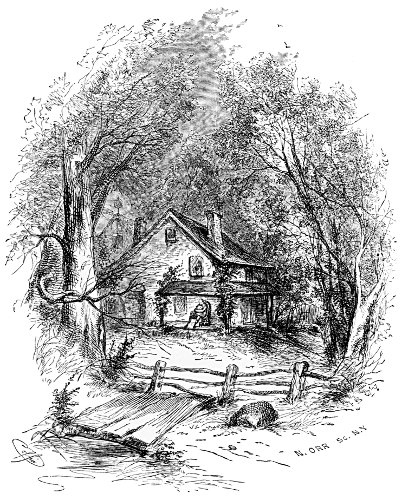
I can see it now: the little brown house, with its sloping
roof, its clumsy old chimneys, and its vine-clad porch; where
the brown bee hummed his drowsy song, and my silver-haired
old father sat dozing the sultry summer noons away, with
shaggy Bruno at his feet. The bright earth had no blight
or mildew then for me. The song of the little birds, resting
beneath the eaves, filled my heart with a quiet joy. It was
sweet, when toil was over, to sit in the low door-way, and
watch the golden sun go down, and see the many-tinted clouds
fade softly away (like a dying saint) into the light of heaven,
and evening’s glittering star glow, like a seraph’s eye, above
them. ’Twas sweet, when Autumn touched the hill-side foliage
with rainbow dyes, to see the gorgeous leaves come circling
down on the soft Indian-summer breeze. ’Twas sweet, when
the tripping, silver stream lay still and cold in Winter’s icy
clasp, and the flowers fainted beneath his chilly breath, and
the leafless trees stretched out their imploring arms, and shook
off, impatiently, their snowy burthen, and the heavy wagon-wheels
went creaking past, and the ruddy farmer struck his
brawny arms across his ample chest, for warmth, and goaded
the lazy, round-eyed oxen up the icy hill. Even then, it was
sunshine still, in the little brown house: in the ample chimney
glowed and crackled the blazing faggots; rows of shining pans
glittered upon the shelves; the fragrant loaf steamed in the little
oven; the friendly tea-kettle, smoking, sang in the chimney
corner, and by its side still sat the dear old father, with the
faithful newspaper, that weekly brought us news from the busy
world, from which our giant forest-trees had shut us out.
Ah! those were happy days: few wants and no cares:
the patriarch’s head was white with grave blossoms, yet his
heart was fresh and green. Alas! that, under the lowliest door-way,
as through the loftiest portal, the Guest unbidden cometh.
The morning sun rose fair, but it shone upon silver locks that
stirred with no breath of life, upon loving lips forever mute,
upon a palsied, kindly hand that gave no returning pressure.
Soon, over the heart so warm and true, the snow lay white and
cold; the winter wind sang its mournful requiem, and from out
the little brown house, the orphan passed with tearful gaze and
lingering footstep.
Oh, the bitter, bitter bread of dependence! No welcome by
the hearth-stone: no welcome at the board: the mocking tone,
the cutting taunt, the grudged morsel. Weary days, and sleepless,
memory-torturing nights.
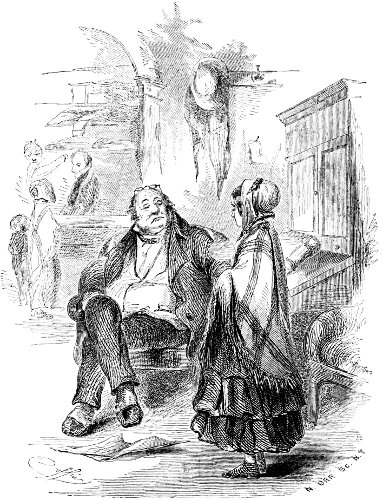
“Well, Josiah’s dead and gone,” said my uncle, taking down
his spectacles from the mantel, to survey me, as I sank on the
settle, in the chimney corner. “Take off your bonnet, Hetty.
I suppose we must give you house-room. Josiah never had
the knack of saving anything—more’s the pity for you. That
farm of his was awfully mismanaged. I could have had twice
the produce he did off that land. Sheer nonsense, that shallow
ploughing of his, tiring the land all out; he should have used
the sub-soil plough. Then he had no idea of the proper
rotation of crops, or how to house his cattle in winter, or to
keep his tools where they wouldn’t rust and rot. That new
barn, too, was a useless extravagance. He might have roofed
the old one. It’s astonishing what a difference there is in brothers,
about getting beforehand in the world. Now I’ve a cool
thousand in the bank, all for taking care of little things. (There,
Jonathan! Jonathan! you’ve taken the meal out of the wrong
barrel: it was the damaged meal I told you to carry to Widow
Folger.)
“Well, as I was saying, Hetty, in the first place, your father
didn’t know how to manage; then he didn’t know how to say
No. He’d lend money to anybody who wanted it, and pay his
workmen just what they took it into their heads it was right to
ask. Now, there’s Jonathan, yonder; a day or two since, he
struck for higher wages. Well, I let him strike, and got an
Irishman in his place. This morning he came whining back,
saying that his wife was sick, and his youngest child lay dead
in the house, and that he was willing to work on at the old
wages. That’s the way to do, Hetty. If Jonathan chose to
saddle himself with a wife and babies, before he was able to
feed them, I don’t see the justice of my paying for it. But it’s
time for family prayers: that will be something new to you, I
suppose. I don’t want to judge any body: I hope your father
has gone to Heaven, but I’m afraid he didn’t let his light shine.
Don’t whimper, child; as the tree falls so it must lie. You
must see that you do your duty: make yourself useful here in
my house, and try to pay your way. Young people of your
age consume a great deal in the way of food and clothes.”
Oh, the monotony of those weary days! how memory lingered
over the sunny past: how thought shrank back affrighted
from the gloomy future: how untiringly and thanklessly I
strove to cancel the debt for daily bread, and how despairingly
I prayed for relief from such bitter thraldom.
“Make up the bed in the north room, Hetty,” said my aunt;
“it’s our turn to board the schoolmaster this week. You
needn’t put on the best sheets: these book-learning folks are
always wool-gathering. He never’ll know the difference. What
a hungry set these schoolmasters are, to be sure: it keeps a
body all the time cooking. A bushel of doughnuts is a mere
circumstance. When the last master was here, our winter
barrel of cider went off like snow in April. I hope Jonathan
learned enough at school to pay for it, but I have my doubts:
he trips in the multiplication table yet. Your uncle and I
think that this boarding schoolmasters is a poor business—a
losing bargain. He says I must put less on the table, but it is
no use to try that game with George Grey. He’s as independent
as Adam in Eden, before the serpent and his wife got in.
He’d just as lief call for anything he wanted as not, and somehow
or other, when he does, I always feel as if I had no choice
about bringing it. That eye of his always makes me think of
forked lightning; and yet he’s kindly spoken, too. He is as
much of a riddle to unravel, as one of Parson Jones’ doctrinal
sermons. But, go make his bed, Hetty, and mind you stuff a
few rags in that broken pane of glass over it. I spoke to your
uncle about getting it mended, but he said warm weather would
be along in three months, and that’s very true, Hetty. Hist!
your uncle is calling you. He says he is going out in the barn
to thresh, and if Peter Tay comes up the road, and stops in
here again, for him to subscribe towards the minister’s new
cloak, you must say that he has gone to Jifftown, and will not
be home for a week at least. Now don’t forget, Hetty: people
seem to think one earns money now-a-days on purpose to
give away. A new cloak! humph! I wonder if the Apostle
Paul’s hearers ever gave him a new cloak? I wonder if John
the Baptist ever had a donation party? Don’t the minister
have his salary, two hundred dollars a year—part in produce,
part in money; paid regularly, when the times ain’t too hard?
Go make the school-master’s bed now, Hetty. One pillow will
do for him. Goodness knows he carries his head high enough
when he is awake. I shouldn’t wonder if he had been captain
or colonel, or something, some muster day.”
The schoolmaster! Should I be permitted to go to school?
or should I be kept drudging at home? Would this Mr. Grey
think me very ignorant? I began to feel as if his forked-lightning
eyes were already on me. My cheeks grew hot at the
idea of making a blunder in his awful presence. What a miserable
room my aunt had provided for him! If I could but
put up some nice white curtains at the window, or get him a
cushioned chair, or put in a bureau, or chest of drawers. It
looked so comfortless—so different from the welcome my dear
old father was wont to give to “the stranger within the gates;”
and now memory pictured him, as he sat in the old arm chair,
and I knelt again at the low foot-stool at his feet, and his hand
strayed caressingly over my temples, and I listened to old continental
stories, till the candle burned low in the socket, and
only the fire-light flickered dimly on the old portrait of General
Washington, and on my father’s time-worn face.
My aunt’s shrill voice soon roused me from my reverie.
Dinner time had come, and with it Mr. Grey—a gentlemanly
young man, of about two and twenty, with a bright, keen, blue
eye, and a frank, decided, off-hand manner, that seemed to me
admirably in keeping with his erect, imposing figure and firm
step. Even my uncle reefed in a sail or two in his presence,
and my aunt involuntarily qualified her usual bluntness of manner.
I uttered a heartfelt thanksgiving when dinner was over.
“Hetty,” said my uncle, as the door closed upon Mr. Grey.
“I suppose you must go to school, or the neighbors will say
we don’t treat you well. You ought to be very thankful for
such a home as this, Hetty; women are poor miserable creatures,
left without money. I wish it had pleased Providence
to have made you a boy. You might then have done Jonathan’s
work just as well as not, and saved me his wages and board.
There’s a piece of stone wall waiting to be laid, and the barn
wants shingling. Josiah now would be at the extravagance of
hiring a mason and a carpenter to do it.
“Crying? I wonder what’s the matter now? Well, it’s
beyond me to keep track of anything in the shape of a woman.
One moment they are up in the attic of ecstasy; the next, down
in the cellar of despondency, as the Almanac says; and it is
as true as if it had been written in the Apocrypha. I only said
that it is a thousand pities that you were not a boy; then you
could graft my trees for me, and hoe, and dig, and plant, and
plough, and all that sort of thing. This puttering round, washing
dishes a little, and mopping floors a little, and wringing out
a few clothes, don’t amount to much toward supporting yourself.
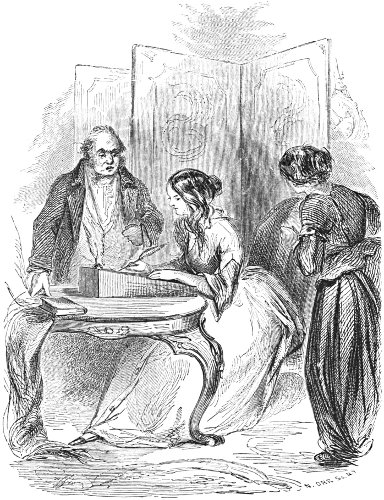
Let me see, you have had, since you came here”—and
my uncle put on his spectacles, and pulled out a well-thumbed
pocket memorandum—“You’ve had two pairs of shoes, at
three shillings a pair, and nine yards of calico, for a
dress, at six cents a yard. That ’mounts up, Hetty, ’mounts
up. You see it costs something to keep you. I earned my
money, and if you ever expect to have any, you must earn
yours”—and my uncle took out his snuff-box, helped himself
to a pinch, and, with the timely
aid of a stray sunbeam, achieved
a succession of very satisfactory sneezes.
The following day, under the overwhelming consciousness of
my feminity and consequent good-for-nothingness, I made my
debut at Master Grey’s school.
It was a huge barn of a room, ill lighted, ill warmed, and
worse ventilated, crowded with pupils of both sexes, from the
little, chubby A B C D-arian, to the gaunt Jonathan of thirty,
who had begun to feel the need of a little ciphering and geography,
in making out his accounts, or superscribing a business letter.
There were rows of awkward, mop-headed, freckled, red-fisted
boys; and rosy-cheeked, buxom lasses, bursting out of their
dresses, half-shy, half-saucy, who were much more conversant
with “apple bees,” and “husking frolics,” than with grammar
or philosophy. There was the parson’s son, and the squire’s
and the blacksmith’s son, besides a few who hadn’t the remotest
idea whose sons they were, having originally been indentured
to their farming masters, by the overseers of the
county alms-house.
Amid these discordant elements, Master Grey moved as serenely
as the August moon of a cloudless night; now patting
some little curly head, cruelly perplexed by “crooked S;” now
demonstrating to some slow, older brain, a stumbling block in
Euclid; now closing the creaking door after an ill-mannered
urchin; now overlooking the pot-hooks and trammels of an unsophisticated
scribe, who clutched the pen as if it were a hoe-handle;
now feeding the great, draftless Behemoth of a stove
with green hickory knots, and vainly attempting to thaw out
his own congealed fingers.
In a remote corner of the school-room sat Zeb Smith, the
village blacksmith’s son, who came into the world with his fists
doubled up, and had been pugilist-ing ever since. It was Zeb’s
proud boast that “he had whipped every schoolmaster who
had ever appeared in Frog-town,” and in his peaceful retreat
from under his bent brows, he was now mentally taking the
measure of Master Grey, ending his little reverie with a loud,
protracted whistle.
Master Grey turned quickly round, and facing his overgrown
pupil of thirty, said in a voice clear as the click of a pistol,
“You will be pleased not to repeat that annoyance, Mr. Smith.”
Zeb bent his gooseberry eyes full upon the master, and gave
him a blast of “Yankee Doodle.”
All eyes were bent on Master Grey. The gauntlet of defiance
was thrown in his very teeth. Zeb had a frame like an
ox, and a fist like a sledge-hammer, and he knew it. Master
Grey was slight, but panther-y; to their unscientific eyes, he
was already victimized.
Not a bit of it! See! Master Grey’s delicate white fingers
are on Zeb’s check shirt-collar; there is a momentary struggle:
lips grow white; teeth are set; limbs twist, and writhe, and
mingle, and now Zeb lies on the floor with Master Grey’s handsome
foot on his brawny chest. Ah, Master Grey! science is
sometimes a match for bone and muscle. Your boxing master,
Monsieur Punchmellow, would have been proud of his pupil.
Peace restored, Master Grey shakes back from his broad
forehead his curly locks, and summons the first class in geography.
A row of country girls, round as little barrels and red
as peonies, stand before him, their respect and admiration for
“the master” having been increased ten per cent. by his victory
over Zeb. Feminity pardons any thing in a man sooner
than lack of courage. The recitation goes off very well, with
the exception of Miss Betsey Jones, who persists in not reciting
at all. Master Grey looks at her: he has conquered a man,
but that’s no reason why he should suppose he can conquer a
woman. He sees that written in very legible characters in
Miss Bessie’s saucy black eye. Miss Bessy is sent to her seat,
and warned to stay after school, till her lesson is learned and
recited perfectly. With admirable nonchalance, she takes her
own time to obey, and commences drawing little caricatures of
the master, which she places in her shoe, and passes round under
the desk, to her more demure petticoat neighbors.
School is dismissed: the last little straggler is kicking up his
heels in the snow drifts, and Master Grey and Miss Bessie are
left alone. Master Grey inquires if the lesson is learned, and
is told again by Miss Bessie, with a toss of her ringlets, that
she has no intention of learning it. Master Grey again reminds
her that the lesson must be recited before she can go
home. Bessie looks mischievously at the setting sun, and plays
with the master’s commands and her apron strings. An hour
passes, and Bessie has not opened the book. Master Grey consults
his watch, and reminds her “that it is growing dark.”
Bessie smiles till the dimples play hide and seek on her cheek,
but she says nothing. Another hour: Master Grey bites his
lip, and, replacing his watch in his pocket, says, “I see your
intention, Miss Betsey. It is quite impossible, as you know,
for us to remain here after dark. To-morrow morning, if your
lesson is not learned, I shall punish you in the presence of the
whole school. You can go.”
“Thank you, sir,” says Bessie, with mock humility, as she
crushed her straw hat down over her bright ringlets.
“Mischief take these women,” Master Grey was heard to
utter, as he went through the snow by starlight to a cold supper.
“Shall I conquer Zeb, to strike my colors to a girl of
sixteen?”
There was plenty to talk about over the brown bread and
milk, at the farmers’ tea-tables that night; the youngsters all
made up their minds that if there was “a time to play,” it was
not in Master Grey’s school-room, and the old farmers said they
were glad the District had a schoolmaster at last that was good
for something, and that they should think better of city chaps
in future for his sake. Even Zeb himself acknowledged, over
his father’s forge, as he mended his broken suspenders, that
Master Grey was a “trump.”
The nine o’clock bell summoned again the Frog-town pupils
to the District School. Master Grey in vain looked in Bessie’s
face for any sign of submission. She had evidently made up
her mind to brave him. After the usual preliminary exercises,
she was called up to recite. Fixing her saucy black eyes upon
him, she said, “I told you I would not learn that lesson, and
I have not learned it.” “And I told you,” said Master Grey, (a
slight flush passing over his forehead) “that I should punish you
if you did not learn it? Did I not?” Bessie’s red lip quivered,
but she deigned him no reply.
“You will hold out your hand, Betsey,” said Mr. Grey, taking
up a large ferule that lay beside him. The color left
Bessie’s cheek, but the little hand was extended with martyr-like
determination, and amid a silence that might be felt, the ferule
came down upon it, with justice as unflinching as if it were not
owned by a woman. Betsey was not proof against this humiliation;
she burst into tears, and the answering tear in Master
Grey’s eye showed how difficult and repugnant had been the
task.
From that day, Master Grey was “monarch of all he surveyed,”
and, truth compels me to own, by none better loved
or more implicitly obeyed, than by Miss Bessie.
Master Grey’s “boarding week” at my uncle’s had now expired.
What a change had it effected in me! Life was no
longer aimless: the old, glad sparkle had come back to my
heavy eye; I no longer dreaded the solitude of my own thoughts.
The dull rain dropping on my chamber roof had its music for
my ears; the stars wore a new and a glittering brightness,
and Winter, with his snowy mantle, frosty breath, and
icicle diadem, seemed lovelier to me than violet-slippered
Spring, with roses in her hair. I still saw Master Grey each
day at school. How patiently he bore with my multiplied
deficiencies, and with what a delicate and womanly appreciation
of my extreme sensitiveness, he soothed my wounded pride.
No pale-eyed flower fainting beneath the garish noonday heat
ever so thirsted for the cool dews of twilight, as did my desolate
heart for his soothing tones and kindly words.
“Betsey,” said my uncle, “we shall want you at home now.
It will be impossible for me to get along without you, unless I
hire a hand, and times are too hard for that: so you must leave
school. You’ve a good home here, for which you ought to be
thankful, as I’ve told you before; but you must work, girl,
work! Some how or other the money goes;” (and he pulled
out the old pocket-bock;) “here’s my grocer’s bill—two shillings
for tea, and three shillings for sugar; can’t you do with
out sugar, Hetty? And here’s a dollar charged for a pair of
India rubbers. A dollar is a great deal of money, Hetty; more
than you could earn in a month. And here’s a shilling for a
comb; now that’s useless, you might cut your hair off. It
won’t do—won’t do. I had no idea of the additional expense
when I took you in. Josiah ought to have left you something
no man has a right to leave his children for other people to support;
’tisn’t Christian. I’ve been a professor these twenty
years, and I ought to know. I don’t know as you have any
legal claim on me because you are my niece. Josiah was
thriftless and extravagant. I suppose ’tis in your blood, too,
for I can’t find out that you have begun to pay your way by
any chores you have done here. If you must live on us, (and
I can’t say that I see the necessity,) I repeat, I wish you had
been born a boy.”
“But as I am not a boy, Uncle, and as I do not wish to be a
burthen to you, will you tell me how to support myself?”
“Don’t ask me. I’m sure I don’t know. That is your
business. I have my hands full to attend to my own affairs.
I am deacon of the church, beside being trustee of the Sandwich
Island Fund. I don’t get a copper for the office of deacon;
nobody pays me for handing round the contribution box; not a
cent of the money that passes through my hands goes into my
till; not a mill do I have by way of perquisite, for doling it
out to bed-ridden Widow Hall, or asthmatic Mr. Price. Not
a penny the richer was I, for that twenty dollars I collected in
the contribution box at last communion: no, I am a poor man,
comparatively speaking. I may die yet in the almshouse; who
knows? You must work, girl, work; can’t have any drones
in my hive.”
A shadow just then passed the window. I should know
that retreating footstep! Could it be that Master Grey had
come to the door with the intention of calling, and overheard
my uncle? At least, then, I was spared the humiliation of exposing
his parsimony.
It was the night for the weekly vestry lecture. I was left
quite alone in the old kitchen. My uncle had extinguished the
lamp in leaving, saying that it was “a waste to burn out oil for
me.” The fire, also, had been carefully taken apart, and the
brands laid at an incombustible distance from each other. The
old clock kept up a sepulchral, death-watch tick, and I could
hear the falling snow drifting gloomily against the windows.
I drew the old, wooden settle closer between the tall andirons,
and sat sorrowfully gazing into the dying embers. What
was to become of me? for it seemed impossible to bear longer
the intolerable galling of my yoke. Even the charity of
strangers seemed to me preferable to the grudging, insulting
tolerance of my kindred. But, with my sixteen years’ experience
of quiet valley-life, where should I turn my untried footsteps?
To Him who guideth the little bird through the pathless
air, would I look.
Weeping, I prayed.
“My poor child,” said a voice at my side; and Master Grey
removed my hands gently from my tear-stained face, and held
them in his own. “My poor Hetty, life looks very dark to
you, does it not? I know all you suffer. Don’t pain yourself
to tell me about it; I overheard your uncle’s crushing
words. I know there are none to love you—none to care for
you—none on whom you can lean. It is a bitter feeling, my
poor child. I, too, have passed through it. You would go
from hence, but where? Life is full of snares, and you are too
young, and too inexperienced to brave them.
“Hetty,” and Master Grey drew me gently toward him,—“Hetty,
could you be happy with me?”
Is the ship-wrecked mariner happy, who opens his despairing
eyes at length in the long looked for, long prayed for,
home?
Is the little bird happy, who folds her weary wings safe from
the pursuer’s talons, in her own fleece-lined nest?
Is the little child happy, who wakes, sobbing, in the gloomy
night, from troubled dreams, to find his golden head still safely
pillowed on the dear, maternal bosom?
It was very odd and strange to me, my new home in the
great, busy city; with its huge rows of stores and houses, its
myriad restless feet, and anxious, care-worn faces; its glittering
wealth, its squalid poverty; the slow moving hearse, and the
laughing harlequin crowd; its noisy Sabbaths, and its gorgeous
churches, with its jeweled worshippers, and its sleepy
priests; its little children, worldly-wise and old, and its never-ceasing,
busy hum, late into the day’s pale light. I had no acquaintances:
I needed none; for I moved about my pretty
little home as in a glad dream. My husband was still “Master
Grey,” but over a private school of his own, bounded by no
“District,” subject to the despotic dictation of no “Committee.”
In his necessary absence, I busied myself in arranging
and re-arranging his books, papers and wardrobe, thinking the
while such glad thoughts! And when the little mantel clock
chimed the hour of return, my cheek flushed, my heart beat
quick, and my eyes grew moist with happy tears, at the sound
of the dear, loved footstep.
How very nice it seemed to sit at the head of that cheerful
little table—to make, with my own hands, the fragrant cup of
tea—to grow merry with my husband, over crest-fallen Zeb,
and poor, stubborn little Bessie, and my uncle’s time-worn bug-bear
of a memorandum book!
And how proud I was of him, as he sat there correcting some
school-boy’s Greek exercise, while I leaned over his shoulder,
looking attentively at his fine face, and at those unintelligible
hieroglyphics, and blushing that he was so much wiser than his
little Hetty.
This thought sometimes troubled me. I asked myself, will
my husband never weary of me? I even grew jealous of his
favorite authors, of whom he was so fond. Then I pondered
the feasibility of pursuing a course of reading unknown to him,
and astonishing him some day with my profound erudition. In
pursuance of my plan, I would sit demurely down to some
great, wise book; but I saw only my husband’s face looking
out at me from every page, and my self-inflicted task was sure
to end in some blissful dreamy reverie, with which Cupid had
much more to do than Minerva.
“A proposition, Hetty!” said my husband, throwing aside
his coat and hat, and tossing a letter in my lap. “It is from
a widow lady, who desires that I should take charge of her
little boy, and give him a home in my family, while she goes
to the continent, to secure some property lately left her by a
foreign relative. It will be advantageous to us, in a pecuniary
way, to have him board with us, unless it should increase your
cares too much. But, as you are so fond of children, it may,
perhaps, after all, prove a pleasant care to you. She is evidently
a superior woman. Every line in her letter shows it.”
My husband immediately answered in the affirmative, and
the child arrived a week after. He was a fine, intelligent, gentlemanly
boy of eight years, with large hazel eyes, and transparently
beautiful temples: disinclined to the usual sports of
childhood, sensitive, shy, and thoughtful beyond his years—a
human dew-drop, which we look to see exhale. He brought
with him a letter from his mother, which powerfully affected
my husband. During its perusal he drew his hand repeatedly
across his eyes, and sat a long while after he had finished reading
it, with his eyes closed, in a deep reverie. By-and-by he
said, handing me the letter, “there is genius there, Hetty. I
never read anything so touchingly beautiful. Mrs. West must
be a very talented and superior woman.”
I glanced over the letter. It fully justified my husband’s encomiums.
It was a most touching appeal to him to watch with
paternal care over her only child; but while she spoke with a
mother’s tenderness of his endearing qualities, she wished him
taught implicitly, that first of all duties for the young, obedience.
Then followed allusions to dark days of sorrow, during which
the love of that cherished child, was the only star in her sky.
I folded the letter and sat very still, after my husband left,
in my little rocking-chair, thinking. Such a gifted woman as
that my husband should have married. One who could have
sympathised with him and shared his intellectual pursuits; who
would have been something besides a toy to amuse an idle
hour, or to minister to his physical necessities. Perhaps it was
of this that my husband was thinking, as he sat there with his
eyes closed over the open letter. Perhaps he had wed me
only from a generous impulse of pity, and that letter had suddenly
revealed to him the happiness of which he was capable
with a kindred spirit. I was very miserable. I wished the
letter had never reached us, or that I had declined the care of
the child. Other letters, of course, would come, and the boy
would keep alive the interest in the intervals. I wept long and
bitterly. At length I was aroused by the entrance of little
Charley. A bright flush mounted to his forehead, when he
saw my swollen eyes. He hesitated a moment, then gliding
up to my side he said, sweetly, “Are you sick? Shall I bathe
your head? I used to bathe mamma’s head when it pained
her.”
I stood abashed and rebuked in the child’s angel presence,
and taking the boy, her boy, in my arms, I kissed him as
tenderly as if I had been his mother; while in his own
sweet way he told me with childish confidence of his own
dead papa; how much he loved mamma; how many, many
beautiful things he used to bring her, saying that they were not
half good, or half handsome enough for her; how distressed
he used to be if she were ill; how carefully he closed the shutters,
and tip-toed about the house, with his finger on his lip,
telling the servants to close the doors gently; and how he promised
him little toys, if he would not disturb mamma’s slumbers;
and then, how like diamonds his eyes shone, when she
got well; and what beautiful flowers he brought her for her
vases; and what a nice, soft-cushioned carriage he brought for
her to take the air; and how tenderly he wrapped the shawls
about her, and how many charges he gave the coachman, to
drive slowly and carefully. And then, how dear papa, at last,
grew sick himself; and how mamma watched day and night
beside his bed, forgetting to sleep, or eat, or drink; and how
nobody dared to tell her that the doctor said he must die; and
how papa grew fainter and weaker, and how he said, “Kiss me,
Mary, and lay your cheek to mine; I can’t see you.” And
then, how mamma fainted and was carried out, and for many,
many long days didn’t know even her own little Charley;—and
how dreadful it was when she first waked, and tried to remember
what had happened; and how nobody could comfort
her but Charley; and how he used often to wake up
in the night, and find her with a lamp looking at him, because
when he was asleep he looked so much like dear, dead
papa; and how bitterly she would sob when she was sick, because
papa was not there to pity her, and bathe her aching
head; and how he (Charley) meant, when he grew up to be a
man, to get a nice house for her, and put everything she wanted
in it, and make her just as happy as he could.
Well has the Saviour said, “Of such is the kingdom of
Heaven.” That night I bent over little Charley’s bed, blessing
the little sleeper for his angel teachings, with a heart as calm
and peaceful as the mirrored lake, reflecting only the smile of
Heaven.
Time passed on. Life became earnest; for a little heart pulsated
beneath my own, and a strange, sweet, nameless thrill
sent to my chastened lips a trembling prayer. Tiny caps and
robes, with many a hope and fear interwoven in their delicate
threads, lay awaiting the infant’s advent. I, myself should
know the height, and breadth, and depth of a mother’s undying
love. What could come between me and this new found
treasure?
Meantime letters continued to come from Charley’s mother
to her boy, and my husband. It was impossible for me to
blind myself to his growing interest in them. On the days
they were expected, (for she wrote at regular intervals,) he
would be absent and abstracted, or if any delay occurred, almost
irritable. When they were received, his eye kindled, his
step became elastic, and his whole face grew radiant with happiness.
As the time drew near for the birth of my infant, I grew timid
with sad forebodings. I was sitting, one evening at twilight,
watching the setting sun, and thinking of the quiet grave it was
gilding, where my silver-haired father slept, in the old church
yard, when my husband entered. An expression of pain flitted
over his features, as he looked at me, and taking my hand, he
said, gently, almost tenderly, “You are less well than usual,
Hetty; you must not sit here, moping, by yourself.”
I laid my head upon his shoulder with a happiness I had not
known for many months. “Listen to me, dear Grey,” said I;
“I have a confidence to repose in you that will ease my heart.
“It was pity, only, that drew your heart to mine; you do not
love me. I have known it a long while since. At first, the
discovery gave me a pang keener than death; but I have had
a long and bitter struggle with myself, and have conquered.
It is not your fault that you cannot love me. To the many
voices of your heart, which cry, ‘Give, give,’ my response is
weak and unsatisfying. Your wife should be gifted. She
should sympathise with you in your intellectual pursuits. She
should stimulate your pride, as well as your love. Such an
one is Charley’s mother. Your heart has already wed her, and
as God is my witness, I have ceased to blame you. We cannot
help our affections. I cannot help loving you, though I
know her mysterious power over your heart. I have seen your
struggles, your generous self-reproaches, in some sudden outburst
of kindness toward me, after the indulgence of some
bright dream, in which I had no share. Dear Grey, she is
worthy of your love. She has a heart, noble, good and true;
a heart purified by suffering. I see it in every line she writes.
Should I not survive the birth of my infant, I could give your
happiness into her keeping without a misgiving, though I have
never looked upon her face.”
Little Hetty’s noble heart has long since ceased to throb with
joy or pain. To her husband’s breast is folded the babe, for
whose little life her own was yielded up. Threads of silver
prematurely mingle amid his ebon locks; for memory writes
only on bereaved hearts the virtues of the dead, while, with torturing
minuteness, she pictures our own short-comings, for which,
alas! we can offer no atonement but our tears.