Whichever way my days decline,
I felt and feel, though left alone,
His being working in mine own,
The footsteps of his life in mine.
* * * * *
Dear friend, far off, my lost desire
So far, so near, in woe and weal;
Oh, loved the most when most I feel
There is a lower and a higher!
—Tennyson: In Memoriam.
After that morning on which Esther found herself reddened and confused
by the sense of having made a distant allusion to Felix Holt, she felt
it impossible that she should even, as she had sometimes intended, speak
of him explicitly to Harold, in order to discuss probabilities as to the
issue of his trial. She was certain she could not do it without
betraying emotion, and there were very complex reasons in Esther's mind
why she could not bear that Harold should detect her sensibility on this
subject. It was not only all the fibres of maidenly pride and reserve,
of a bashfulness undefinably peculiar toward this man, who, while much
older than herself, and bearing the stamp of an experience quite hidden
from her imagination, was taking strongly the aspect of a lover—it
was not only this exquisite kind of shame which was at work within her:
there was another sort of susceptibility in Esther, which her present
circumstances tended to encourage, though she had come to regard it as
not at all lofty, but rather as something which condemned her to
littleness in comparison with a mind she had learned to venerate. She
knew quite well that, to Harold Transome, Felix Holt was one of the
common people who could come into question in no other than a public
light. She had a native capability for discerning that the sense of
ranks and degrees has its repulsions corresponding to the repulsions
dependent on difference of race and color; and she remembered her own
impressions too well not to foresee that it would come on Harold
Transome as a shock, if he suspected there had been any love-passages
between her and this young man, who to him was of course no more than
any other intelligent member of the working class. "To him," said Esther
to herself, with a reaction of her newer, better pride, "who has not had
the sort of intercourse in which Felix Holt's cultured nature would have
asserted its superiority." And in her fluctuations on this matter, she
found herself mentally protesting that, whatever Harold might think,
there was a light in which he was vulgar compared with Felix. Felix had
ideas and motives which she did not believe Harold could understand.
More than all, there was this test: she herself had no sense of
inferiority and just subjection when she was with Harold Transome; there
were even points in him for which she felt a touch, not of anger, but of
playful scorn; whereas with Felix she had always a sense of dependence
and possible illumination. In those large, grave, candid gray eyes of
his, love seemed something that belonged to the high enthusiasm of life,
such as now might be forever shut out from her.
All the same, her vanity winced at the idea that Harold should discern
what, from his point of view, would seem like a degradation of her taste
and refinement. She could not help being gratified by all the
manifestations from those around her that she was thought thoroughly
fitted for a high position—could not help enjoying, with more or less
keenness, a rehearsal of that demeanor amongst luxuries and dignities
which had often been a part of her day-dreams, and the rehearsal
included the reception of more and more emphatic attentions from Harold,
and of an effusiveness in his manners, which, in proportion as it would
have been offensive if it had appeared earlier, became flattering as the
effect of a growing acquaintance and daily contact. It comes in so many
forms in this life of ours—the knowledge that there is something
sweetest and noblest of which we despair, and the sense of something
present that solicits us with an immediate and easy indulgence. And
there is a pernicious falsity in the pretence that a woman's love lies
above the range of such temptations.
Day after day Esther had an arm offered her, had very beaming looks upon
her, had opportunities for a great deal of light, airy talk, in which
she knew herself to be charming, and had the attractive interest of
noticing Harold's practical cleverness—the masculine ease with which he
governed everybody and administered everything about him, without the
least harshness, and with a facile good-nature which yet was not weak.
In the background, too, there was the ever-present consideration, that
if Harold Transome wished to marry her, and she accepted him, the
problem of her lot would be more easily solved than in any other way. It
was difficult, by any theory of Providence, or consideration of results,
to see a course which she could call duty: if something would come and
urge itself strongly as pleasure, and save her from the effort to find a
clue of principle amid the labyrinthine confusions of right and
possession, the promise could not but seem alluring. And yet, this life
at Transome Court was not the life of her day-dreams: there was
dullness already in its ease, and in the absence of high demand; and
there was a vague consciousness that the love of this not unfascinating
man who hovered about her gave an air of moral mediocrity to all her
prospects. She would not have been able perhaps to define this
impression; but somehow or other by this elevation of fortune it seemed
that the higher ambition which had begun to spring in her was forever
nullified. All life seemed cheapened; as it might seem to a young
student who, having believed that to gain a certain degree he must write
a thesis in which he would bring his powers to bear with memorable
effect, suddenly ascertained that no thesis was expected, but the sum
(in English money) of twenty-seven pounds ten shillings and sixpence.
After all, she was a woman, and could not make her own lot. As she had
once said to Felix, "A woman must choose meaner things, because only
meaner things are offered to her." Her lot is made for her by the love
she accepts. And Esther began to think that her lot was being made for
her by the love that was surrounding her with the influence of a garden
on a summer morning.
Harold, on his side, was conscious that the interest of his wooing was
not standing still. He was beginning to think it a conquest, in which it
would be disappointing to fail, even if this fair nymph had no claim to
the estate. He would have liked—and yet he would not have liked—that
just a slight shadow of doubt as to his success should be removed. There
was something about Esther that he did not altogether understand. She
was clearly a woman that could be governed: she was too charming for him
to fear that she would ever be obstinate or interfering. Yet there was a
lightning that shot out of her now and then, which seemed the sign of a
dangerous judgment; as if she inwardly saw something more admirable than
Harold Transome. Now, to be perfectly charming, a woman should not see
this.
One fine February day, when already the golden and purple crocuses were
out on the terrace—one of those flattering days which sometimes precede
the north-east winds of March, and make believe that the coming spring
will be enjoyable—a very striking group, of whom Esther and Harold made
a part, came out at midday to walk upon the gravel at Transome Court.
They did not, as usual, go toward the pleasure grounds on the eastern
side, because Mr. Lingon, who was one of them, was going home, and his
road lay through the stone gateway into the park.
Uncle Lingon, who disliked painful confidences, and preferred knowing
"no mischief of anybody," had not objected to be let into the important
secret about Esther, and was sure at once that the whole affair, instead
of being a misfortune, was a piece of excellent luck. For himself, he
did not profess to be a judge of women, but she seemed to have all the
"points," and to carry herself as well as Arabella did, which was saying
a good deal. Honest Jack Lingon's first impressions quickly became
traditions, which no subsequent evidence could disturb. He was fond of
his sister, and seemed never to be conscious of any change for the worse
in her since their early time. He considered that man a beast who said
anything unpleasant about the persons to whom he was attached. It was
not that he winked; his wide-open eyes saw nothing but what his
easy disposition inclined him to see. Harold was a good fellow, a
clever chap; and Esther's peculiar fitness for him, under all the
circumstances, was extraordinary; it reminded him of something in the
classics, though he couldn't think exactly what—in fact, a memory
was a nasty uneasy thing. Esther was always glad when the old rector
came. With an odd contrariety to her former niceties she liked his rough
attire and careless frank speech; they were something not point device
that seemed to connect the life of Transome Court with that rougher,
commoner world where her home had been.
She and Harold were walking a little in advance of the rest of the
party, who were retarded by various causes. Old Mr. Transome, wrapped in
a cloth cloak trimmed with sable, and with a soft warm cap also trimmed
with fur on his head, had a shuffling uncertain walk. Little Harry was
dragging a toy vehicle, on the seat of which he had insisted on tying
Moro with a piece of scarlet drapery round him, making him look like a
barbaric prince in a chariot. Moro, having little imagination, objected
to this, and barked with feeble snappishness as the tyrannous lad ran
forward, then whirled the chariot round, and ran back to "Gappa," then
came to a dead stop, which overset the chariot, that he might watch
Uncle Lingon's water-spaniel run for the hurled stick and bring it in
his mouth. Nimrod kept close to his old master's legs, glancing with
much indifference at this youthful ardor about sticks—he had "gone
through all that"; and Dominic walked by, looking on blandly, and
taking care both of young and old. Mrs. Transome was not there.
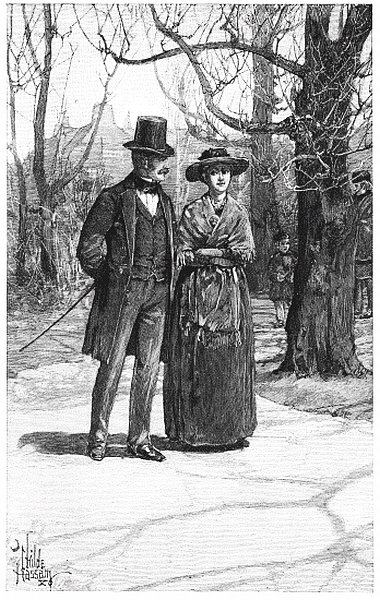 Esther Lyon and Harold Transome.
Looking back and seeing that they were a good deal in advance of the
rest, Esther and Harold paused.
"What do you think about thinning the trees over there?" said Harold,
pointing with his stick. "I have a bit of a notion that if they were
divided into clumps so as to show the oaks beyond it would be a great
improvement. It would give an idea of extent that is lost now. And there
might be some very pretty clumps got out of those mixed trees. What do
you think?"
"I should think it would be an improvement. One likes a 'beyond'
everywhere. But I never heard you express yourself so dubiously," said
Esther, looking at him rather archly: "you generally see things so
clearly, and are so convinced, that I shall begin to feel quite
tottering if I find you in uncertainty. Pray don't begin to be doubtful;
it is infectious."
"You think me a great deal too sure—too confident?" said Harold.
"Not at all. It is an immense advantage to know your own will, when you
always mean to have it."
"But suppose I couldn't get it, in spite of meaning?" said Harold, with
a beaming inquiry in his eyes.
"Oh, then," said Esther, turning her head aside, carelessly, as if she
were considering the distant birch-stems, "you would bear it quite
easily, as you did your not getting into Parliament. You would know you
could get it another time—or get something else as good."
"The fact is," said Harold, moving on a little, as if he did not want to
be quite overtaken by the others, "you consider me a fat, fatuous,
self-satisfied fellow."
"Oh, there are degrees," said Esther, with a silvery laugh; "you have
just as much of those qualities as is becoming. There are different
styles. You are perfect in your own."
"But you prefer another style, I suspect. A more submissive, tearful,
devout worshipper, who would offer his incense with more trembling."
"You are quite mistaken," said Esther, still lightly. "I find I am very
wayward. When anything is offered to me, it seems that I prize it less,
and don't want to have it."
Here was a very baulking answer, but in spite of it Harold could not
help believing that Esther was very far from objecting to the sort of
incense he had been offering just then.
"I have often read that that is in human nature," she went on, "yet
it takes me by surprise in myself. I suppose," she added, smiling, "I
didn't think of myself as human nature."
"I don't confess to the same waywardness," said Harold. "I am very fond
of things that I can get. And I never longed much for anything out of my
reach. Whatever I feel sure of getting I like all the better. I think
half those priggish maxims about human nature in the lump are no more to
be relied on than universal remedies. There are different sorts of human
nature. Some are given to discontent and longing, others to securing and
enjoying. And let me tell you, the discontented longing style is
unpleasant to live with."
Harold nodded with a meaning smile at Esther.
"Oh, I assure you I have abjured all admiration for it," she said,
smiling up at him in return.
She was remembering the schooling Felix had given her about her Byronic
heroes, and was inwardly adding a third sort of human nature to those
varieties which Harold had mentioned. He naturally supposed that he
might take the abjuration to be entirely in his own favor. And his face
did look very pleasant; she could not help liking him, although he was
certainly too particular about sauces, gravies, and wines, and had a way
of virtually measuring the value of everything by the contribution it
made to his own pleasure. His very good-nature was unsympathetic; it
never came from any thorough understanding or deep respect for what was
in the mind of the person he obliged or indulged; it was like his
kindness to his mother—an arrangement of his for the happiness of
others, which, if they were sensible, ought to succeed. And an
inevitable comparison which haunted her, showed her the same quality in
his political views: the utmost enjoyment of his own advantages was the
solvent that blended pride in his family and position, with the adhesion
to changes that were to obliterate tradition and melt down enchased gold
heirlooms into plating for the egg-spoons of "the people." It is
terrible—the keen bright eye of a woman when it has once been turned
with admiration on what is severely true; but then, the severely true
rarely comes within its range of vision. Esther had had an unusual
illumination; Harold did not know how, but he discerned enough of the
effect to make him more cautious than he had ever been in his life
before. That caution would have prevented him just then from following
up the question as to the style of person Esther would think pleasant to
live with, even if Uncle Lingon had not joined them, as he did, to
talk about soughing tiles, saying presently that he should turn across
the grass and get on to the Home Farm, to have a look at the
improvements that Harold was making with such racing speed.
"But you know, lad," said the rector, as they paused at the expected
parting, "you can't do everything in a hurry. The wheat must have time
to grow, even when you've reformed all us old Tories off the face of the
ground. Dash it! now the election's over, I'm an old Tory again. You
see, Harold, a Radical won't do for the county. At another election, you
must be on the look-out for a borough where they want a bit of blood. I
should have liked you uncommonly to stand for the county; and a Radical
of good family squares well enough with a new-fashioned Tory like young
Debarry; but you see, these riots—it's been a nasty business. I shall
have my hair combed at the sessions for a year to come. But, heyday!
What dame is this, with a small boy?—not one of my parishioners?"
Harold and Esther turned, and saw an elderly woman advancing with a tiny
red-haired boy, scantily attired as to his jacket, which merged into a
small sparrow-tail a little higher than his waist, but muffled as to his
throat with a blue woollen comforter. Esther recognized the pair too
well, and felt very uncomfortable. We are so pitiably in subjection to
all sorts of vanity—even the very vanities we are practically
renouncing! And in spite of the almost solemn memories connected with
Mrs. Holt, Esther's first shudder was raised by the idea of what things
this woman would say, and by the mortification of having Felix in any
way represented by his mother.
As Mrs. Holt advanced into closer observation, it became more evident
that she was attired with a view not to charm the eye, but rather to
afflict it with all that expression of woe which belongs to very rusty
bombazine and the limpest state of false hair. Still, she was not a
woman to lose the sense of her own value, or become abject in her
manners under any circumstances of depression; and she had a peculiar
sense on the present occasion that she was justly relying on the force
of her own character and judgment, in independence of anything that Mr.
Lyon or the masterful Felix would have said, if she had thought them
worthy to know of her undertaking. She courtesied once, as if to the
entire group, now including even the dogs, who showed various degrees of
curiosity, especially as to what kind of game the smaller animal Job
might prove to be after due investigation; and then she proceeded at
once toward Esther, who, in spite of her annoyance, took her arm from
Harold's, said, "How do you do, Mrs. Holt?" very kindly, and stooped to
pat little Job.
"Yes—you know him, Miss Lyon," said Mrs. Holt, in that tone which
implies that the conversation is intended for the edification of the
company generally; "you know the orphin child, as Felix brought home for
me that am his mother to take care of. And it's what I've done—nobody
more so—though it's trouble is my reward."
Esther had raised herself again, to stand in helpless endurance of
whatever might be coming. But by this time young Harry, struck even more
than the dogs by the appearance of Job Tudge, had come round dragging
his chariot, and placed himself close to the pale child, whom he
exceeded in height and breadth, as well as in depth of coloring. He
looked into Job's eyes, peeped round at the tail of his jacket and
pulled it a little, and then, taking off the tiny cloth-cap, observed
with much interest the tight red curls which had been hidden underneath
it. Job looked at his inspector with the round blue eyes of
astonishment, until Harry, purely by way of experiment, took a bon-bon
from a fantastic wallet which hung over his shoulder, and applied the
test to Job's lips. The result was satisfactory to both. Every one had
been watching this small comedy, and when Job crunched the bon-bon while
Harry looked down at him inquiringly and patted his back, there was
general laughter except on the part of Mrs. Holt, who was shaking her
head slowly, and slapping the back of her left hand with the painful
patience of a tragedian whose part is in abeyance to an ill-timed
introduction of the humorous.
"I hope Job's cough has been better lately," said Esther, in mere
uncertainty as to what it would be desirable to say or do.
"I dare say you hope so, Miss Lyon," said Mrs. Holt, looking at the
distant landscape. "I've no reason to disbelieve but what you wish well
to the child, and to Felix, and to me. I'm sure nobody has any occasion
to wish me otherways. My character will bear enquiry, and what you, as
are young, don't know, others can tell you. That was what I said to
myself when I made up my mind to come here and see you, and ask you to
get me the freedom to speak to Mr. Transome. I said, whatever Miss Lyon
may be now, in the way of being lifted up among great people,
she's our minister's daughter, and was not above coming to my house and
walking with my son Felix—though I'll not deny he made that figure
on the Lord's Day, that'll perhaps go against him with the judge, if
anybody thinks well to tell him."
Here Mrs. Holt paused a moment, as with a mind arrested by the painful
image it had called up.
Esther's face was glowing, when Harold glanced at her; and seeing this,
he was considerate enough to address Mrs. Holt instead of her.
"You are then the mother of the unfortunate young man who is in prison?"
"Indeed I am, sir," said Mrs. Holt, feeling that she was now in deep
water. "It's not likely I should claim him if he wasn't my own; though
it's not by my will, nor my advice, sir, that he ever walked; for I gave
him none but good. But if everybody's son was guided by their mothers,
the world 'ud be different; my son is not worse than many another
woman's son, and that in Treby, whatever they may say as haven't got
their sons in prison. And as to his giving up the doctoring, and then
stopping his father's medicines, I know it's bad—that I
know—but it's me has had to suffer, and it's me a king and
Parliament 'ud consider, if they meant to do the right thing, and had
anybody to make it known to 'em. And as for the rioting and killing the
constable—my son said most plain to me he never meant it, and
there was his bit of potato-pie for dinner getting dry by the fire, the
whole blessed time as I sat and never knew what was coming on me. And
it's my opinion as if great people make elections to get themselves into
Parliament, and there's riot and murder to do it, they ought to see as
the widow and the widow's son doesn't suffer for it. I well know my
duty: and I read my Bible; and I know in Jude where it's been stained
with the dried tulip-leaves this many a year, as you're told not to rail
at your betters if they was the devil himself; nor will I; but this I do
say, if it's three Mr. Transomes instead of one as is listening to me,
as there's them ought to go to the king and get him to let off my son
Felix."
This speech, in its chief points, had been deliberately prepared. Mrs.
Holt had set her face like a flint, to make the gentry know their duty
as she knew hers: her defiant defensive tone was due to the
consciousness, not only that she was braving a powerful audience, but
that she was daring to stand on the strong basis of her own judgment in
opposition to her son's. Her proposals had been waived off by Mr
Lyon and Felix; but she had long had the feminine conviction that if she
could "get to speak" in the right quarter, things might be different.
The daring bit of impromptu about the three Mr. Transomes was
immediately suggested by a movement of old Mr. Transome to the
foreground in a line with Mr. Lingon and Harold; his furred and unusual
costume appearing to indicate a mysterious dignity which she must hasten
to include in her appeal.
And there were reasons that none could have foreseen, which made Mrs.
Holt's remonstrance immediately effective. While old Mr. Transome
stared, very much like a waxen image in which the expression is a
failure, and the rector, accustomed to female parishioners and
complainants, looked on with a smile in his eyes, Harold said at once,
with cordial kindness—
"I think you are quite right, Mrs. Holt. And for my part, I am
determined to do my best for your son, both in the witness-box and
elsewhere. Take comfort; if it is necessary, the king shall be appealed
to. And rely upon it, I shall bear you in mind as Felix Holt's mother."
Rapid thoughts had convinced Harold that in this way he was best
commending himself to Esther.
"Well, sir," said Mrs. Holt, who was not going to pour forth
disproportionate thanks, "I am glad to hear you speak so becoming; and
if you had been the king himself, I should have made free to tell you my
opinion. For the Bible says the king's favor is toward a wise servant;
and it's reasonable to think he'd make all the more account of them as
have never been in service, or took wage, which I never did, and never
thought of my son doing; and his father left money, meaning otherways,
so as he might have been a doctor on horseback at this very minute,
instead of being in prison."
"What! was he regularly apprenticed to a doctor?" said Mr. Lingon, who
had not understood this before.
"Sir, he was, and most clever, like his father before him, only he
turned contrary. But as for harming anybody, Felix never meant to harm
anybody but himself and his mother, which he certainly did in respect of
his clothes, and taking to be a low workingman, and stopping my living
respectable, more particular by the pills, which had a sale, as you may
be sure they suited people's insides. And what folks can never have
boxes enough of to swallow, I should think you have a right to sell. And
there's many and many a text for it, as I've opened on without ever
thinking; for if it's true, 'Ask, and you shall have,' I should think
it's truer when you're willing to pay for what you have."
This was a little too much for Mr. Lingon's gravity; he exploded, and
Harold could not help following him. Mrs. Holt fixed her eyes on the
distance, and slapped the back of her left hand again; it might be that
this kind of mirth was the peculiar effect produced by forcible truth on
high and worldly people who were neither in the Independent nor the
General Baptist connection.
"I'm sure you must be tired with your long walk, and little Job too,"
said Esther, by way of breaking this awkward scene. "Aren't you, Job?"
she added, stooping to caress the child, who was timidly shrinking from
Harry's invitation to him to pull the little chariot—Harry's view being
that Job would make a good horse for him to beat, and would run faster
than Gappa.
"It's well you can feel for the orphin child, Miss Lyon," said Mrs.
Holt, choosing an indirect answer rather than to humble herself by
confessing fatigue before gentlemen who seemed to be taking her too
lightly. "I didn't believe but what you'd behave pretty, as you always
did to me, though everybody said you held yourself high. But I'm sure
you never did to Felix, for you let him sit by you at the Free School
before all the town, and him with never a bit of stock round his neck.
And it shows you saw that in him worth taking notice of;—and it is
but right, if you know my words are true, as you should speak for him to
the gentlemen."
"I assure you, Mrs. Holt," said Harold, coming to the rescue—"I assure
you that enough has been said to make me use my best efforts for your
son. And now, pray, go on to the house with the little boy and take some
rest. Dominic, show Mrs. Holt the way, and ask Mrs. Hickes to make her
comfortable, and see that somebody takes her back to Treby in the
buggy."
"I will go back with Mrs. Holt," said Esther, making an effort against
herself.
"No, pray," said Harold, with that kind of entreaty which is really a
decision. "Let Mrs. Holt have time to rest. We shall have returned, and
you can see her before she goes. We will say good-by for the present,
Mrs. Holt."
The poor woman was not sorry to have the prospect of rest and food,
especially for "the orphin child," of whom she was tenderly careful.
Like many women who appear to others to have a masculine decisiveness of
tone, and to themselves to have a masculine force of mind, and who come
into severe collision with sons arrived at the masterful stage, she
had the maternal cord vibrating strongly within her toward all tiny
children. And when she saw Dominic pick up Job and hoist him on his arm
for a little while, by way of making acquaintance, she regarded him with
an approval which she had not thought it possible to extend to a
foreigner. Since Dominic was going, Harry and old Mr. Transome chose to
follow. Uncle Lingon shook hands and turned off across the grass, and
thus Esther was left alone with Harold.
But there was a new consciousness between them. Harold's quick
perception was least likely to be slow in seizing indications of
anything that might affect his position with regard to Esther. Some time
before, his jealousy had been awakened to the possibility that before
she had known him she had been deeply interested in some one else.
Jealousy of all sorts—whether for our fortune or our love—is ready at
combinations, and likely even to outstrip the fact. And Esther's renewed
confusion, united with her silence about Felix, which now first seemed
noteworthy, and with Mrs. Holt's graphic details as to her walking with
him and letting him sit by her before all the town were grounds not
merely for a suspicion, but for a conclusion in Harold's mind. The
effect of this which he at once regarded as a discovery, was rather
different from what Esther had anticipated. It seemed to him that Felix
was the least formidable person that he could have found as an object of
interest antecedent to himself. A young workman who had got himself
thrown into prison, whatever recommendations he might have had for a
girl at a romantic age in the dreariness of Dissenting society at Treby,
could hardly be considered by Harold in the light of a rival. Esther was
too clever and tasteful a woman to make a ballad heroine of herself, by
bestowing her beauty and her lands on this lowly lover. Besides, Harold
cherished the belief that, at the present time, Esther was more wisely
disposed to bestow these things on another lover in every way eligible.
But in two directions this discovery had a determining effect on him;
his curiosity was stirred to know exactly what the relation with Felix
had been, and he was solicitous that his behavior with regard to this
young man should be such as to enhance his own merit in Esther's eyes.
At the same time he was not inclined to any euphemisms that would seem
to bring Felix into the lists with himself.
Naturally when they were left alone, it was Harold who spoke first. "I
should think there's a good deal of worth in this young fellow—this
Holt, notwithstanding the mistakes he has made. A little queer and
conceited, perhaps; but that is usually the case with men of his class
when they are at all superior to their fellows."
"Felix Holt is a highly cultivated man; he is not at all conceited,"
said Esther. The different kinds of pride within her were coalescing
now. She was aware that there had been a betrayal.
"Ah?" said Harold, not quite liking the tone of this answer. "This
eccentricity is a sort of fanaticism, then?—this giving up being a
doctor on horseback, as the old woman calls it, and taking to—let me
see—watchmaking, isn't it?"
"If it is eccentricity to be very much better than other men, he is
certainly eccentric; and fanatical too, if it is fanatical to renounce
all small selfish motives for the sake of a great and unselfish one. I
never knew what nobleness of character really was before I knew Felix
Holt."
It seemed to Esther as if in the excitement of this moment, her own
words were bringing her a clearer revelation.
"God bless me!" said Harold, in a tone of surprised yet thorough belief,
and looking in Esther's face. "I wish you had talked to me about this
before."
Esther at that moment looked perfectly beautiful, with an expression
which Harold had never hitherto seen. All the confusion which had
depended on personal feeling had given way before the sense that she had
to speak the truth about the man whom she felt to be admirable.
"I think I didn't see the meaning of anything fine—I didn't even see
the value of my father's character, until I had been taught a little by
hearing what Felix Holt said, and seeing that his life was like his
words."
Harold looked and listened, and felt his slight jealousy allayed rather
than heightened. "This is not like love," he said to himself, with some
satisfaction. With all due regard to Harold Transome, he was one of
those men who are liable to make the greater mistakes about a particular
woman's feelings, because they pique themselves on a power of
interpretation derived from much experience. Experience is enlightening,
but with a difference. Experiments on live animals may go on for a long
period, and yet the fauna on which they are made may be limited. There
may be a passion in the mind of a woman which precipitates her, not
along the path of easy beguilement, but into a great leap away from it.
Harold's experience had not taught him this; and Esther's enthusiasm
about Felix Holt did not seem to him to be dangerous.
"He's quite an apostolic sort of fellow, then," was the self-quieting
answer he gave to her last words. "He didn't look like that; but I had
only a short interview with him, and I was given to understand that he
refused to see me in prison. I believe he's not very well inclined
toward me. But you saw a great deal of him, I suppose, and your
testimony to any one is enough for me," said Harold, lowering his voice
rather tenderly. "Now I know what your opinion is, I shall spare no
effort on behalf of such a young man. In fact, I had come to the same
resolution before, but your wish would make difficult things easy."
After that energetic speech of Esther's, as often happens, the tears had
just suffused her eyes. It was nothing more than might have been
expected in a tender-hearted woman, considering Felix Holt's
circumstances, and the tears only made more lovely the look with which
she met Harold's when he spoke so kindly. She felt pleased with him; she
was open to the fallacious delight of being assured that she had power
over him to make him do what she liked, and quite forgot the many
impressions which had convinced her that Harold had a padded yoke ready
for the neck of every man, woman, and child that depended on him.
After a short silence, they were getting near the stone gateway, and
Harold said, with an air of intimate consultation—
"What could we do for this young man, supposing he were let off? I shall
send a letter with fifty pounds to the old woman to-morrow. I ought to
have done it before, but it really slipped my memory, amongst the many
things that have occupied me lately. But this young man—what do you
think would be the best thing we could do for him, if he gets at large
again. He should be put in a position where his qualities could be more
telling."
Esther was recovering her liveliness a little, and was disposed to
encourage it for the sake of veiling other feelings, about which she
felt renewed reticence, now that the overpowering influence of her
enthusiasm was past. She was rather wickedly amused and scornful at
Harold's misconceptions and ill-placed intentions of patronage.
"You are hopelessly in the dark," she said, with a light laugh and toss
of her head. "What would you offer Felix Holt? a place in the Excise?
You might as well think of offering it to John the Baptist. Felix has
chosen his lot. He means always to be a poor man."
"Means? Yes," said Harold, slightly piqued, "but what a man means
usually depends on what happens. I mean to be a commoner; but a peerage
might present itself under acceptable circumstances."
"Oh, there is no sum in proportion to be done there," said Esther, again
gaily. "As you are to a peerage so is not Felix Holt to any offer of
advantage that you could imagine for him."
"You must think him fit for any position—the first in the county."
"No, I don't," said Esther, shaking her head mischievously. "I think him
too high for it."
"I see you can be ardent in your admiration."
"Yes, it is my champagne; you know I don't like the other kind."
"That would be satisfactory if one were sure of getting your
admiration," said Harold, leading her up to the terrace, and amongst the
crocuses, from whence they had a fine view of the park and river. They
stood still near the east parapet, and saw the dash of light on the
water, and the pencilled shadows of the trees on the grassy lawn.
"Would it do as well to admire you, instead of being worthy to be
admired?" said Harold, turning his eyes from that landscape to Esther's
face.
"It would be a thing to be put up with," said Esther, smiling at him
rather roguishly. "But you are not in that state of self-despair."
"Well, I am conscious of not having those severe virtues that you have
been praising."
"That is true. You are quite in another genre."
"A woman would not find me a tragic hero."
"Oh, no! She must dress for general comedy—such as your mother once
described to me—where the most thrilling event is the drawing of a
handsome check."
"You are a naughty fairy," said Harold, daring to press Esther's hand a
little more closely to him, and drawing her down the eastern steps into
the pleasure-ground, as if he were unwilling to give up the
conversation. "Confess that you are disgusted with my want of romance."
"I shall not confess to being disgusted. I shall ask you to confess that
you are not a romantic figure."
"I am a little too stout."
"For romance—yes. At least you must find security for not getting
stouter."
"And I don't look languishing enough?"
"Oh, yes—rather too much so—at a fine cigar."
"And I am not in danger of committing suicide?"
"No; you are a widower."
Harold did not reply immediately to this last thrust of Esther's. She
had uttered it with innocent thoughtlessness from the playful
suggestions of the moment; but it was a fact that Harold's previous
married life had entered strongly in her impressions about him. The
presence of Harry made it inevitable. Harold took this allusion of
Esther's as an indication that his quality of widower was a point that
made against him; and after a brief silence he said, in an altered, more
serious tone—
"You don't suppose, I hope, that any other woman has ever held the place
that you could hold in my life?"
Esther began to tremble a little, as she always did when the love-talk
between them seemed getting serious. She only gave the rather stumbling
answer, "How so?"
"Harry's mother had been a slave—was bought, in fact."
It was impossible for Harold to preconceive the effect this had on
Esther. His natural disqualification for judging of a girl's feelings
was heightened by the blinding effect of an exclusive object—which was
to assure her that her own place was peculiar and supreme. Hitherto
Esther's acquaintance with oriental love was derived chiefly from
Byronic poems, and this had not sufficed to adjust her mind to a new
story, where the Giaour concerned was giving her his arm. She was unable
to speak; and Harold went on—
"Though I am close on thirty-five, I never met with a woman at all like
you before. There are new eras in one's life that are equivalent to
youth—are something better than youth. I was never an aspirant till I
knew you."
Esther was still silent.
"Not that I dare to call myself that. I am not so confident a personage
as you imagine. I am necessarily in a painful position for a man who has
any feeling."
Here at last Harold had stirred the right fibre. Esther's generosity
seized at once the whole meaning implied in that last sentence. She had
a fine sensibility to the line at which flirtation must cease; and she
was now pale and shaken with feelings she had not yet defined for
herself.
"Do not let us speak of difficult things any more now," she said,
with gentle seriousness. "I am come into a new world of late, and have to
learn life all over again. Let us go in. I must see poor Mrs. Holt
again, and my little friend Job."
She paused at the glass door that opened on the terrace, and entered
there, while Harold went round to the stables.
When Esther had been up-stairs and descended again into the large
entrance-hall, she found its stony capaciousness made lively by human
figures extremely unlike the statues. Since Harry insisted on playing
with Job again, Mrs. Holt and her orphan, after dining, had just been
brought to this delightful scene for a game at hide-and-seek, and for
exhibiting the climbing powers of the two pet squirrels. Mrs. Holt sat
on a stool, in singular relief against the pedestal of the Apollo, while
Dominic and Denner (otherwise Mrs. Hickes) bore her company; Harry, in
his bright red and purple, flitted about like a great tropic bird after
the sparrow-tailed Job, who hid himself with much intelligence behind
the scagliola pillars and the pedestals; while one of the squirrels
perched itself on the head of the tallest statue, and the other was
already peeping down from among the heavy stuccoed angels on the
ceiling, near the summit of a pillar.
Mrs. Holt held on her lap a basket filled with good things for Job, and
seemed much soothed by pleasant company and excellent treatment. As
Esther, descending softly and unobserved, leaned over the stone
banisters and looked at the scene for a minute or two, she saw that Mrs.
Holt's attention, having been directed to the squirrel which had
scampered on to the head of the Silenus carrying the infant Bacchus, had
been drawn downward to the tiny babe looked at with so much affection by
the rather ugly and hairy gentleman, of whom she nevertheless spoke with
reserve as of one who possibly belonged to the Transome family.
"It's most pretty to see its little limbs, and the gentleman holding it.
I should think he was amiable by his look; but it was odd he should have
his likeness took without any clothes. Was he Transome by name?" (Mrs.
Holt suspected that there might be a mild madness in the family.)
Denner, peering and smiling quietly, was about to reply, when she was
prevented by the appearance of old Mr. Transome, who since his walk had
been having "forty winks" on the sofa in the library, and now came out
to look for Harry. He had doffed his fur cap and cloak, but in lying
down to sleep he had thrown over his shoulders a soft Oriental scarf
which Harold had given him, and this still hung over his scanty white
hair and down to his knees, held fast by his wooden-looking arms and
laxly-clasped hands, which fell in front of him.
This singular appearance of an undoubted Transome fitted exactly into
Mrs. Holt's thought at the moment. It lay in the probabilities of things
that gentry's intellects should be peculiar: since they had not to get
their own living, the good Lord might have economized in their case that
common-sense which others were so much more in need of; and in the
shuffling figure before her she saw a descendant of the gentleman who
had chosen to be represented without his clothes—all the more eccentric
where there were the means of buying the best. But these oddities "said
nothing" in great folks, who were powerful in high quarters all the
same. And Mrs. Holt rose and courtesied with a proud respect, precisely
as she would have done if Mr. Transome had looked as wise as Lord
Burleigh.
"I hope I'm in no way taking a liberty, sir," she began, while the old
gentleman looked at her with bland feebleness; "I'm not that woman to
sit anywhere out of my own home without inviting and pressing to. But I
was brought here to wait, because the little gentleman wanted to play
with the orphin child."
"Very glad, my good woman—sit down—sit down," said Mr. Transome,
nodding and smiling between his clauses. "Nice little boy. Your
grandchild?"
"Indeed, sir, no," said Mrs. Holt, continuing to stand. Quite apart from
any awe of Mr. Transome—sitting down, she felt, would be a too
great familiarity with her own pathetic importance on this extra and
unlooked-for occasion. "It's not me has any grandchild, nor ever shall
have, though most fit. But with my only son saying he'll never be
married, and in prison besides, and some saying he'll be transported,
you may see yourself—though a gentleman—as there isn't much
chance of my having grandchildren of my own. And this is old Master
Tudge's grandchild, as my own Felix took to for pity because he was
sickly and clemm'd, and I was noways against it, being of a tender
heart. For I'm a widow myself, and my son Felix, though big, is
fatherless, and I know my duty in consequence. And it's to be wished,
sir, as others should know it as are more in power and live in great
houses, and can ride in a carriage where they will. And if you're the
gentleman as is the head of everything—and it's not to be thought
you'd give up to your son as a poor widow's been forced to do—it
behooves you to take the part of them as are deserving; for the Bible
says gray hairs should speak."
"Yes, yes—poor woman—what shall I say?" said old Mr.
Transome, feeling himself scolded, and, as usual, desirous of mollifying
displeasure.
"Sir, I can tell you what to say fast enough; for it's what I should say
myself if I could get to speak to the king. For I've asked them that
know, and they say it's the truth, both out of the Bible, and in, as the
king can pardon anything and anybody. And judging by his countenance on
the new signs, and the talk there was a while ago about his being the
people's friend, as the minister once said it from the very pulpit—if
there's any meaning in words, he'll do the right thing by me and my son,
if he's asked proper."
"Yes—a very good man—he'll do anything right," said Mr. Transome,
whose own ideas about the king just then were somewhat misty, consisting
chiefly in broken reminiscences of George III. "I'll ask him anything
you like," he added, with a pressing desire to satisfy Mrs. Holt, who
alarmed him slightly.
"Then, sir, if you'll go in your carriage and say, this young man, Felix
Holt by name, as his father was known the country round, and his mother
most respectable—he never meant harm to anybody, and so far from bloody
murder and fighting, would part with his victual to them that needed it
more—and if you'd get other gentlemen to say the same, and if they're
not satisfied to enquire—I'll not believe but what the king 'ud let my
son out of prison. Or if it's true he must stand his trial, the king 'ud
take care no mischief happened to him. I've got my senses, and I'll
never believe as in a country where there's a God above and a king
below, the right thing can't be done if great people was willing to do
it."
Mrs. Holt, like all orators, had waxed louder and more energetic,
ceasing to propel her arguments, and being propelled by them. Poor old
Mr. Transome, getting more and more frightened at this severe-spoken
woman, who had the horrible possibility to his mind of being a novelty
that was to become permanent, seemed to be fascinated by fear, and stood
helplessly forgetful that if he liked he might turn round and walk away.
Little Harry, alive to anything that had relation to "Gappa," had paused
in his game, and discerning what he thought a hostile aspect in this
naughty black old woman, rushed toward her and proceeded first to beat
her with his mimic jockey's whip, and then, suspecting that her
bombazine was not sensitive, to set his teeth in her arm. While Dominic
rebuked him and pulled him off, Nimrod began to bark anxiously, and the
scene was become alarming even to the squirrels, which scrambled as far
off as possible.
Esther, who had been waiting for an opportunity of intervention, now
came up to Mrs. Holt to speak some soothing words; and old Mr. Transome,
seeing a sufficient screen between himself and his formidable suppliant,
at last gathered courage to turn round and shuffle away with unusual
swiftness into the library.
"Dear Mrs. Holt," said Esther, "do rest comforted. I assure you, you
have done the utmost that can be done by your words. Your visit has not
been thrown away. See how the children have enjoyed it! I saw little Job
actually laughing. I think I never saw him do more than smile before."
Then turning round to Dominic, she said, "Will the buggy come round to
this door?"
This hint was sufficient. Dominic went to see if the vehicle was ready,
and Denner, remarking that Mrs. Holt would like to mount it in the inner
court, invited her to go back into the housekeeper's room. But there was
a fresh resistance raised in Harry by the threatened departure of Job,
who had seemed an invaluable addition to the menagerie of tamed
creatures; and it was barely in time that Esther had the relief of
seeing the entrance hall cleared so as to prevent any further encounter
of Mrs. Holt with Harold, who was now coming up the flight of steps at
the entrance.