Passing of the
Brook Trout
THE brook trout, or char, with the
beautiful and suggestive name of
Salvelinus fontinalis, by which it is known
to the naturalist, is fast disappearing from
its native streams. The altered conditions
of its aboriginal environment, owing to
changes brought about by the progress of
civilization, have resulted in its total extinction
in some waters and a sad diminution
in others. In many instances the trout
brooks of our childhood will know them
no more. The lumberman has gotten in
his work—the forests have disappeared—the
tiny brooks have vanished.
The lower waters still remain, but are
robbed of their pristine pureness by the
contamination due to various manufacturing
industries. In such streams the supply
of trout is only maintained through the
efforts of the federal and state fish commissions.
It is to be hoped that by this
means the beautiful brook trout, the loveliest
and liveliest fish of all the finny world,
may be preserved and spared to us for yet
a little while. Its introduction to the pure
mountain streams of the Far West has
given it a new lease of life, and the time
may come when, outside of the game and
fish preserves of wealthy clubs, it will be
only in its new home that it can be found.
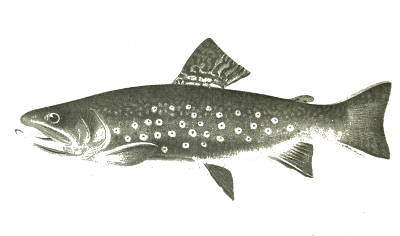
From a color sketch by Sherman F. Denton.
Brook Trout. (Salvelinus fontinalis.)
Back Log
Reveries
On long winter evenings the angler, sitting
before his cheerful fire, may be meditating
on the passing of the brook trout—that
his angling record for the last season
was not so good as the year before, and
that next summer it may be still worse. But
such disheartening thoughts are quickly dispelled
as his glance falls on the fly-book
and tackle box within his reach. His fly-book
is eagerly overhauled and frayed
snells and leaders and rusty hooks discarded.
Some well-worn flies that recall
the big trout that gave him sport galore in
the long summer days are, on second
thought, snugly and affectionately tucked
away in a separate pocket of the book, to
be brought forth on occasion, to excite the
envy of some brother angler, while relating
with minute detail the story of the part
they took in the capture of the "big ones."
Pipe Dreams
Through the rings of smoke rising from
his brier-root he sees the stream rippling
and sparkling as it courses around the bend.
And in fancy he is wading and casting, and
as eagerly expectant of a rise, with his feet
encased in slippers, as when plodding along
in clumsy wading boots. The pipe-dreams
of retrospection are as engrossing and
enjoyable as those of anticipation to the
appreciative angler. The pleasures though
passed are not forgotten.
Pride After a
Fall
He even smiles as he remembers the slippery
and treacherous rock that caused his
downfall, and the involuntary bath that
followed, just as he hooked the biggest fish
in the pool. He is even conscious of the
chill that coursed up his spine as the stream
laughed and gurgled in his submerged
ear—but he remembers, best of all, that he
saved the fish, and that he laughs best who
laughs last. There is a saving clause of
compensation in every untoward event to
the philosophic mind.
Mother Nature's
Sanitarium
In "the good old summer time" thousands
of weary toilers from every station in
life are leaving the home, the school, the
workshop, the office, for a few weeks of
rest, recreation and recuperation. And nowhere
else can the overstrung nerves and
tired muscles find surer relief and tone
than beside the shimmering lake or brawling
stream. The voices of many waters
are calling them, the whispering leaves are
coaxing them, the feathered songsters are
entreating them—to leave the busy haunts
of men and repair to the cool shadows and
invigorating breezes of sylvan groves and
shining waters.
Balm in Gilead
Here, indeed, may be found a solace for
every care, a panacea for every ill, furnished
without cost and without stint, from
Mother Nature's pharmacopœia of simples:
fresh air, pure water and outdoor exercise.
But while all of this is patent to the seasoned
angler, the preachment of the resources
of Nature for the relief of the
"demnition grind" of those who dwell in
cities cannot be too often reiterated.
Beginning of
the Season
Trout fishing is lawful in several states
during a part or throughout the entire
month of April; but unless the season is
exceptionally forward and pleasant the wise
angler will lose nothing by ignoring the
privilege.
May and June are, by all odds, the best
months for brook trout fishing. By May
Day most of the streams of the Eastern
States have cleared sufficiently for fly-fishing,
and their temperature has sensibly
diminished.
Signs of Spring
"About this time," as the almanacs say,
the most interesting literature for the impatient
angler is the catalogue of fishing
tackle. After a final overhauling and inspection
of his tools and tackle he is impelled,
irresistibly, to pay a visit to the
tackle store for such additions to his stock,
be it large or small, as he thinks he needs,
and is not happy until his wants, real or
fancied, are supplied.
Embarrassment
of Riches
A woman at a bargain counter is a sedate,
complacent and uninterested personage compared
with an angler in a tackle store at the
opening of the fishing season. He is covetous
to a degree, and would walk off with the
entire stock should he follow the dictates
of his inclination as to his fancied requirements.
As it is, he buys many things he will
never have any use for; but he thinks he
will, all the same, and leaves the attractive
place an impoverished but happier man.
Tools and
Tackle
Of course it is best, when one can afford
it, to provide duplicate rods and reels and
a liberal supply of minor articles. But the
careful angler, with but one ewe lamb in the
shape of a tried and trusty rod, and a single,
reliable click reel, with a limited but well-selected
supply of leaders and flies, will take
as many fish as his prodigal brother with a
superabundant equipment.
The length and weight of the rod depends
on the character of the waters to
be fished: whether open water or a small
brushy stream. Good rods can be obtained
running from nine to eleven feet and from
four to seven ounces. For narrow, shallow
streams overhung with trees and shrubbery,
and where the fish are small, the lightest
and shortest rod is sufficient and most
convenient. For larger streams or open
water the rod should not exceed ten feet,
and six ounces. Where trout are exceptionally
large, as in the Lake Superior region
or in Maine, the maximum of eleven feet,
and seven ounces will be about right for
most anglers.
The Chief
Function of a
Rod
Fly-rods built for tournament work, especially
for long-distance casting, are marvels
in their way, but it does not follow that they
are adapted, or the best, for work on the
stream. The essential and most important
office of a rod is that which is exhibited
after a fish is hooked—in other words, in
the playing and landing of the fish. In
practical angling the act of casting, either
with fly or bait, is merely preliminary and
subordinate to the real uses of a rod. The
poorest fly-rod made will cast a fly thirty
or forty feet, which is about as far as called
for in ordinary angling. But it is the continuous
spring and yielding resistance of
the bent rod, constantly maintained, that
not only tires out the fish, but protects the
weak snell or leader from breakage, and
prevents a weak hold of the hook from giving
way; and this is the proper function of
a rod.
Reel, Line and
Leader
The reel should be a single-action click
reel, the lighter the better, if well made.
The best, and in fact the only, line for fly-fishing,
is one of enameled silk, its caliber
corresponding with the weight of the rod.
Only the best quality of silkworm fiber
should be purchased in leaders for sizable
fish. A leader of six feet is long enough
for three flies, and one of four feet with
two flies is still better.
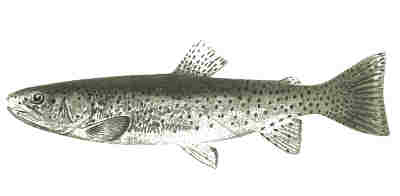
From a color sketch by Sherman F. Denton.
Red Throat, or Cut Throat Trout. (Salmo clarkii.)
Artificial Flies
The subject of artificial flies is a most
complex one. All fly-fishers have their
favorites, with or without reason, and swear
by them on all occasions. Some confine
themselves to the various hackles, others
to half-a-dozen winged flies, while still
others are only satisfied with a fly-book
filled to bursting with scores of all sizes
and colors. In this connection it is as well
to say that about the beginning of the century
there was a discussion in the London
Fishing Gazette as to what artificial fly, in
case an angler was restricted to a single one,
would be preferred for use during an entire
season. The consensus of opinion was in
favor of the "March brown," with the
"olive dun" as a good second. These are
both killing flies in America as well as in
England for trout fishing.
Selection of
Flies
In addition to them the coachman, professor,
Montreal, dotterel or yellow dun,
with the black, brown, red and gray hackles
should be sufficient on almost any stream,
if tied in several sizes, say on hooks Nos.
6 to 12, with a preference for the intermediate
numbers. From my experience I
would be satisfied with such an assortment.
Other anglers, of course, would think otherwise,
and would prefer quite a different
selection—but this is in accordance with one
of the accepted and acknowledged privileges
of the gentle art. And this, at the same
time, is as it should be. One who has had
more success with certain flies than with
others, all things being equal, should pin
his faith to them. And this, moreover, explains
why there is such an extensive list to
choose from in the fly-tier's catalogue, which
contains the preferences of many generations
of fly-fishers.
Philosophy of
Artificial Flies
The question as to the best fly to use at
certain seasons, or at any season, is a vexed
one. Whether it is the colored dressing of
the fly, or its form, that is most enticing to
the fish, will perhaps never be known, except
approximately. Of the long list of
named artificial flies the choice of most
anglers has been narrowed to a score or
two, and for the only reason that they have
been more or less successful with them. We
are apt to look at the matter from our own
viewpoint, and often without reference to
that of the fish.
Reasoning from the appearance of artificial
flies in general, it would seem that on
a fretted surface almost any one of the
many hundreds should get a rise from a
fish, if in a biting mood, and, indeed, this
is in a measure true. But one swallow does
not make a summer. There are times and
places when any old thing, even a bit of
colored rag, will coax a rise. I have had
good success with a bit of the skin of a
chicken neck with a feather or two attached.
Then there are times when nothing but
natural bait proves alluring.
Why a Trout
Takes a Fly
We may assume as almost a self-evident
proposition that a fish takes an artificial fly
under the delusion that it is a natural one,
or something good to eat—otherwise it
would not take it at all. If this assumption
is correct, then it would follow that the best
imitations of natural flies or insects should
be the most successful. This is, in the
main, a reasonable conclusion, though on
the other hand certain flies that are universally
considered and used as good ones,
do not, to our eyes at least, bear any resemblance
to any known insect—for instance
the coachman, professor and other so-called
fancy flies.
The Angler's
Viewpoint
An artificial fly on the ruffled surface of
the water presents a very different appearance
to the same fly when held in one's
hand, even to our own eyes; what, then, does
it look like to the fish? That's the question.
I have often attempted to solve it by
diving beneath and viewing the fly on the
surface. If the water was perfectly clear
and calm, without a ripple, it simply looked
like a dark fly, no matter what its color,
though I could sometimes discern the lighter
color of the wings when formed of undyed
mallard or wood-duck feathers. When the
surface was ruffled it was so indistinct that
a bit of leaf would have seemed the same.
A somewhat similar experiment may be performed,
in a minor degree, by placing a
mirror at the bottom of a barrel of water
and viewing the reflection of the fly on the
surface.
The Trout's
Viewpoint
We can surmise that fish are not color-blind,
otherwise there would be no reason
for the beautiful colors that many male
fishes assume during the breeding season.
Fishes are possessed of keen vision, and
possibly have the faculty of distinguishing
colors in a fly, even when on a fretted surface,
where to our eyes they are very indistinct,
and where even the form can not be
well defined.
Flies in Their
Season
In Great Britain it is the rule to use certain
flies at different seasons, that is, to
employ the imitations of such natural flies
as are on the water at the time. This
seems quite reasonable in view of the fact
that the trout streams there are shallow, and
especially so in the case of the chalk-streams
whose bright colored bottoms may enhance
the visual powers of the fish in discerning,
by the reflected light, the form and colors
of the artificial fly.
Imitations of
Natural Flies
We may conclude, then, that as trout are
in the habit of feeding on such flies and insects
as resort to, or are hatched in, the
water, that the best imitations of such
natural flies, from the trout's viewpoint,
would be the most alluring. I think it goes
without saying, that all past experience has
proven that the imitations of some of the
commonest aquatic insects have been the
most successful under all conditions. This
would include not only the imago, but the
larva, as represented by the various hackle
flies.
Dark or Light
Colored Flies
The old rule to use light-colored flies on
dark days and high or discolored water, and
darker flies on bright days, or with low and
clear water, has been followed for centuries,
and in the main is true and reliable. As
some anglers have found that a reversed
application of it has been successful, at
times, they are inclined to doubt it altogether.
However, they do not look at it
intelligently. With clear water and a clear
atmosphere a light-colored fly will show as
plainly on the surface as a dark one to the
fish below. If we gaze upward during a
fall of snow, the flakes appear quite dark,
while on a level or below the eye they appear
white. Apparently, then, there are
other conditions that must be taken into
account. With a sunken fly, for instance,
the case is different, for a dark fly then appears
more distinct than a light one, in clear
water; but with milky or discolored water
a bright fly is more easily discerned below
the surface—hence the rule. And on the
same principle smaller flies are suitable for
bright days and clear water, and larger ones
for dark days and discolored water.
The Non-Rising
of Trout
In a very interesting address delivered
before the Anglers Club, of Glasgow, Scotland,
on "Why do trout sometimes not
rise to the artificial fly?" the lecturer after
naming and discussing many of the reasons
usually advanced, said:
"And what is the conclusion of the whole
matter? Shortly, this—that there is a
great deal about the question that we know
little or nothing about."
He advised his brother anglers to
"Watch narrowly the facts as observed in
nature, note them down carefully at the
time, compare them with those of brother
anglers on occasions such as this, and out of
all evolve theories which, when reduced to
practice, will be found to have carried us
nearer to the truth."
Condition
Versus Theory
This is very good advice freely given—and
by the way advice is more easily given
than reliable information in a case like this.
Nevertheless fly-fishers should consider
that a "condition, not a theory," confronts
them in the rising or non-rising of a trout
to an artificial fly, and should endeavor to
ascertain, if such be possible, just what conditions
are present to account for the peculiar
actions, at different times, of those elusive
creatures of the adipose fin, that
according to popular opinion seem to have
as many moods as specks or spots.
A Probable
Reason
There is one feature of this subject, however,
that I have never known to be alluded
to, which is this: That the rising or non-rising
of trout may depend on the scarcity
or abundance of the fish. In regions where
trout are unusually abundant I have never,
in my experience, known them to fail to
rise to the artificial fly, at any time of day,
or under almost any condition of wind or
weather. It is only in sections that are
much fished, and fish consequently scarce,
or "educated," as some term it for want of
a better reason, that trout fail to respond
to the solicitations of the fly-fisher.
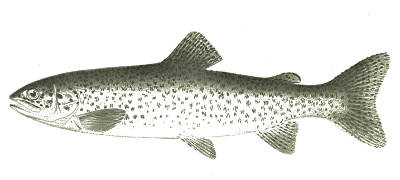
From a color sketch by Sherman F. Denton.
Steelhead Trout. (Salmo gairdneri.)
Abundance of
Trout
In the wilds of Canada I have had trout
rise to my fly by the dozen, day after day,
so that all semblance of sport disappeared,
and only enough were taken for the frying-pan.
In Yellowstone Lake the merest tyro
can take the red-throat trout until his arms
ache, at any time of day, beneath clouds
or sunshine. And in the river below the
lake one can stand on the bank in plain
sight of the trout, which, with one eye on
the angler and the other on the fly, rushes
to his doom by snapping up the tinseled
lure, contrary to all conventional lore. This
is an extreme case, of course, for the trout
are extremely abundant, or were so as late
as the summer of 1904.
Scarcity of
Trout
One can imagine that in the clear and
shallow streams of England, which have
been thrashed by the flies of anglers, good,
bad and indifferent, for centuries, and
where trout are consequently and necessarily
scarce, or "educated," that they fail
to rise—in other words they are not always
there. This, I think, is the reason that dry
fly-fishing is becoming the vogue in that
country, where the angler waits patiently by
the stream until a trout rising to a natural
fly proclaims its presence. The rest is easy.
Practical Hints
For obvious reasons it is always best to
fish down stream where there is a current;
in comparatively still water one may fish
up-stream or down. I would advise the
angler, by all means, to wade, as he has
more command of the water on either hand,
with plenty of room for the back cast, and
can float his flies under overhanging bushes
and banks, or in the eddies of rocks. As
the water is cold at this season he should
be warmly clad, putting on two pairs of
woolen socks or stockings, with rubber hip
boots or wading pants. He should move
slowly and cautiously, fishing every available
spot before advancing a step. By
hurrying along as some anglers do, he soon
gets heated, even in cool weather, with the
result that his nether extremities are soon
bathed in a more or less profuse perspiration,
and he is altogether a "dem'd, damp,
moist, unpleasant body." To make haste
slowly is the wise and proper thing in wading
a stream. It is the slow, deliberate
angler who gets the trout.
A Timely Tip
Some streams are likely to be occasionally
swollen or roiled by spring rains or by
the June rise. At such times, when not too
much discolored for fly-fishing, the angler
will do well to avoid the channel of the
stream and cast his flies along the edges,
where the water is clearer. This tip may
add many a fish to an otherwise scanty
creel.
Likely Places
When the stream is at its ordinary stage,
and clear, the riffles and eddies are the
most likely places at this season, and will
be pretty sure to reward the careful angler.
In fishing such places the flies should be
floated over them, allowing them to sink
below the surface occasionally. In addition
to the flies mentioned for May, the stone
fly, gray drake and brown drake will be
found useful, especially in localities where
the May-fly or sand-fly puts in an appearance.
During the hottest days of summer,
when the water is warmer, trout are more
apt to be found at the mouths of small
spring brooks, or in the deepest portions of
the stream.
Management
of Flies
Churning the flies up and down, or wiggling
and dancing them, should be avoided;
the only motion, if any, should be a very
slight fluttering, such as a drowning insect
might make as it floats down stream.
Strike lightly. Should the trout leap after
being hooked, as it sometimes does in the
shallow water of riffles, lower the tip
slightly for half a second, but recover it
immediately—in other words it is simply
a down and up movement about as quickly
as it can be done.
Lowering the
Tip
And talking of lowering the tip—it may
not seem out of place to make a few observations
concerning that proceeding which
some anglers do not seem to understand,
or at least do not fully appreciate. The rule
of lowering the tip to a leaping fish is a
very old one, centuries old in fact, and is
founded on the experience of anglers for
many generations past. Its usefulness and
reasonableness is as manifest in the twentieth
century as at any former time.
But because some thoughtless anglers at
the present day have succeeded in landing
a leaping and well-hooked fish without observing
the rule, they decry it as entirely
unnecessary, and declare that it ought to be
relegated to the limbo of obsolete and
fanciful notions and useless practices. The
iconoclast usually attacks his images without
thought or reason, and often in sheer
ignorance. A little reflection might enlighten
him and cause him to stay his hand.
Origin of the
Rule
The rule originated in Great Britain and
pertained particularly to fly-fishing. The
very small hooks on which trout flies were
tied offered but a slight hold on the mouth
of the fish, and in case that a leaping fish
threw its weight on a taut line and raised
rod it was almost sure to break away—hence
the rule to lower the tip and release
the tension for a brief moment. As the
fish regained the water the tip was raised
and the former tension resumed. It must
be understood, however, that "lowering the
tip" does not mean to touch the water with
the tip, but as the rod is usually held at an
angle of forty-five degrees, a downward
deflection of the tip for a foot will usually
suffice.
They Who
Differ
So far as my observation goes the objections
to the rule have been raised by black
bass bait-fishers who use heavy rods, strong
tackle and large hooks. Under these circumstances
a fish is usually so securely
hooked by a vigorous yank that the lowering
of the tip, when it leaps from the water,
is not so essential, inasmuch as the angler
has a cinch on his quarry whether the line
be slack or taut.
Long and Short
Line
But even in bait-fishing, with a light rod
and corresponding tackle and a small hook,
it is a wise plan to follow a leaping fish
back to the water by slightly lowering the
tip, especially on a short line—with a long
line it does not matter so much, as the
"give" of a pliant rod and long line is
usually sufficient to relieve the increased
tension when a fish is in the air.
Dry Fly-Fishing
Dry fly-fishing is the latest angling cult
in England, but I do not think that it will
find many adherents in this country. For
one reason, the dry fly must be cast up-stream,
which will never be a favorite
method with American anglers for well-known
reasons. Then again, our trout
streams are usually swift and broken, and
under these conditions the dry fly is soon
drowned and becomes a wet fly, thus subverting
the cardinal principle of dry fly-fishing.
In England this method is practiced
on comparatively smooth, shallow
streams with but little current. The flies
are constructed with rather large, upright
wings and spreading hackle, and often with
cork bodies, to enhance their capacity for
floating and buoyancy.
Comparisons
are Odious
While fly-fishing, wet or dry, is unquestionably
the highest branch of angling, and
far preferable to bait-fishing for trout, it
does not follow that fishing with the dry
fly, or floating fly, is a superior art to
fishing with the wet or sunken fly, as
claimed by some of the dry fly-fishers of
England. Indeed, some of the ultra dry
fly enthusiasts have arrogated to themselves
the distinction of practicing the most artistic
and sportsmanlike method of angling, and
look askance, if not with disdain and contempt,
at the wet fly-fishers, whom they designate
as the "chuck and chance it" sort.
I can not think that the position they
have assumed can be justly maintained, or
that it is warranted by the facts of the case.
As dry fly-fishing is being taken up by a
few American anglers, it may be well
enough to give the alleged superiority of
the method some consideration.
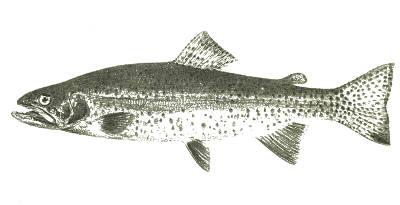
From a color sketch by Sherman F. Denton.
Rainbow Trout. (Salmo irideus.)
Modus
Operandi
Some years ago the modus operandi of
dry fly-fishing was explained to me, personally,
by Mr. William Senior, editor of the
London Field. The angler waits beside the
swim until a trout betrays its whereabouts
by rising to a newly hatched gnat or fly,
creating a dimple on the surface. The
angler then, kneeling on one knee, sometimes
having a knee-pad strapped on, cautiously
casts his floating May-fly, with
cocked wings, and anointed with paraffin
or vaseline. The fly is deftly and lightly
cast up-stream, a little above the swirl of
the trout, and is permitted to float down, as
naturally as possible, over the fish. There
being no response after a cast or two, the
angler switches the fly in the air to dry it,
and awaits the tell-tale evidence of a fish
before again offering the buoyant lure.
Now, I cannot imagine why this method is
claimed to be on a higher plane of angling
than the "chuck and chance it" method.
Certainly a knowledge of the habits of the
trout is not essential, inasmuch as the angler
makes his cast only on the appearance
of the fish.
The Wet Fly-Fisher
On the other hand the wet fly-fisher, wading
down stream or up stream, brings to his
aid his knowledge of the habits and haunts
of the trout, and casts his flies over every
likely spot where his experience leads him to
think a fish may lie. It is this eager expectancy,
or fond anticipation, with every
cast, that makes up much of the real pleasure
of angling, and which is utterly lost to
the dry fly-fisher, who waits and watches on
the bank, like a kingfisher on his perch.
While there can be no objection to dry
fly-fishing, per se, and which, moreover, I
welcome as a pleasing and meritorious innovation,
I feel compelled to enter a protest
against claiming for it a higher niche
in the ethics of sport than wet fly-fishing.
And with all due respect for the dry fly men
of Great Britain, I can not admit that they
trot in a higher class than those "chuck
and chance it" fishers of honored and
revered memory: Sir Humphry Davy,
"Christopher North" and Francis Francis.
Bait Fishing
It is the practice of some anglers to confine
themselves entirely to natural bait in
trout fishing, the favorite bait being the
earthworm or "barnyard hackle"; also
grasshoppers, grubs, crickets, or bits of
animal flesh. While not so artistic, or for
that matter not so successful as fly-fishing
when the streams are clear, there are times
when bait-fishing can be practiced without
prejudice, and to better advantage than fly-fishing:
as when streams are rendered turbid
or roily by rains.
A capital bait is the beautifully tinted
anal fin of a trout, which in water with
some current waves, wabbles and flutters in
a most seductive manner on the hook. Its
effect is heightened, and its resemblance to
a living insect is more pronounced, if the eye
of a trout is first impaled on the hook
through its enveloping membrane, care
being taken not to puncture the eyeball.
A Fish Story
I was once fishing with fin-bait in Wisconsin,
early in the season when the stream
was milky, when one trout was badly
hooked, the point of the hook forcing out
the eyeball, which hung on its cheek. I
carefully unhooked the fish and plucked off
the eye, when the unfortunate trout flopped
out of my hand into the stream before I
could kill it. I added the eyeball to my fin-bait,
and strange to say I soon caught the
same trout with its own eye! While this
story may be more difficult for the uninitiated
to swallow than for the trout to bolt
its own eye, it is nevertheless true, and may
be taken as proof that fish are not very
sensitive to pain.
Tools and
Tackle
The equipment recommended for fly-fishing
will answer just as well for bait-fishing,
as the baits commonly used are
light. In some instances, however, a
slightly heavier or stiffer rod may be employed,
especially if the small casting-spoon
or a small minnow is used for large trout.
Hooks from Nos. 5 to 7 are about right.
The Sea Trout
Whether the sea-trout, or salmon-trout,
of the Gulf of St. Lawrence is a different
species from the speckled brook trout of
the upper parts of rivers emptying into said
Gulf has been a mooted question for many
years, arguments pro and con having been
advanced by a number of intelligent and
observant anglers. In 1834 Hamilton
Smith described it as a new species under
the name of Salmo canadensis, and in 1850
H. R. Storer named it Salmo immaculatus.
Later and better authorities, however, have
decided that it is only a sea-run form of the
speckled brook trout, Salvelinus fontinalis.
I unhesitatingly indorse this opinion. Many
years ago Dr. W. W. Dawson and myself
investigated the matter thoroughly while
salmon fishing on the Restigouche River.
About the Metapediac, and below the railroad
bridge, we caught the brook trout with
its crimson and yellow spots, and near
Campbellton, at the mouth of the river,
we took the fresh-run form of bright silvery
coloration, with scarcely any markings
on the back and without spots. We
also caught them a little higher up the river
in transition stages, when the characteristic
spots were beginning to appear, more or
less pronounced. We compared hundreds,
from plain silvery form to those with bright
crimson and golden spots, but could find no
structural differences.
Changes in
Coloration
Marine fishes are very constant in coloration,
the non-colored portions being quite
silvery, while fishes of fresh waters are subject
to frequent changes in hue, being much
influenced in this respect by the character
of their haunts. So when the brook trout
"goes to sea" it loses its spots and takes
on the silvery livery of marine fishes, but
resumes its original coloration soon after
entering fresh water.
The Winninish
Just why the winninish of the upper St.
Lawrence, which is but a dwarfed form of
the Atlantic salmon, does not also proceed
to sea after the spawning season, like its
prototype, is another puzzling proposition.
It has been argued by some that the winninish
is the original, or typical species, and
that the anadromous salmon is descended
from individuals that took on the seafaring
habit. But such speculative theories can
never be proven.
A Virgin Trout
Stream
Twenty years ago, Dr. W. W. Dawson,
of Cincinnati—then president of the American
Medical Association—and myself were
guests of Surgeon-General Baxter, U.S.A.,
at his fishing lodge near Metapedia, on
the Restigouche River, New Brunswick.
Twenty years ago! How time flies! Since
then my dear friends, Doctors Dawson and
Baxter, have both crossed the silent river,
though it seems but a few weeks since we
were casting our lines in the pleasant places
on the famous Restigouche. Indeed, that
pleasant summer seems as but yesterday,
when Mrs. Baxter killed with her own rod
six salmon, running from twenty to thirty
pounds, and was not more than thirty minutes
in bringing any of them to gaff.
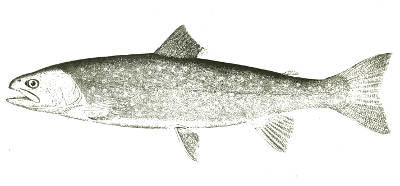
U. S. Bureau of Fisheries.
Dolly Varden Trout. (Salvelinus parkei.)
One day at Campbellton, at the mouth
of the river, I met Mr. Dean Sage, of
Albany, N. Y., who kindly gave me permission
to fish his excellent waters, farther
up the Restigouche. I also met there Mr.
Light, Chief Engineer of the Dominion of
Canada, who gave me such a glowing account
of the trout streams that had just been
rendered accessible by the Quebec and Lake
St. John railway, that Dr. Dawson and myself
gave up our contemplated trip to the
Nipigon, and decided to go up the Batiscan
River in accordance with the advice of Mr.
Light.
The Batiscan
River
He recommended taking with us from
the Restigouche two Gaspé canoes and
canoemen who were accustomed to swift
and rocky water; for the Batiscan, he informed
us, contained numerous rapids that
would tax the strength and prowess of the
most experienced canoemen. We engaged
two Restigouche men to accompany us, and
decided to take but one Gaspé wooden
canoe, thirty feet long, and to procure a
smaller and lighter one at Quebec.
In Old Quebec
Arriving at that quaint and historic
town, we obtained, with the help of the
American consul, Mr. Downes, a new basswood
canoe, built on the model of a birch
bark, about fifteen feet in length; this we
procured from an Indian tribe near the city.
Through our letter of introduction from
Mr. Light to Mr. Beemer, the contractor
of the Q. & L. St. John railway, we had no
difficulty in getting transportation for our
canoes and camp equipage to the Batiscan
River, which was then the terminus of the
railway. Indeed, Mr. Beemer kindly went
with us to that point, to see that we were
started right on our exploration of the
Upper Batiscan. Our objective point was
Batiscan Lake, some ten miles as the crow
flies, but the distance by river unknown, for
its upper waters had never been fished by
white men. A railroad survey party had
gone a short distance up the stream by land,
but beyond that it was a terra incognita to
the angler. I questioned an old French
trapper, who told me that he had been to
the lake with sled and snowshoes in winter,
and had fished through the ice; also that the
trout ran up to ten pounds in weight. It
was to be a veritable voyage of discovery,
and Mr. Light was quite desirous to know
something of the resources and particulars
of the region, having leased the fishing privileges
from the Dominion.
Lacs du Rognon
Arriving at the river, I found Mr.
Farnsworth—who has written so entertainingly
of the French inhabitants—established
in a pleasant camp a mile below the railroad
crossing. I also met Captain Seaton, president
of a Quebec fishing club, the lessee of
the Lacs du Rognon, near the railroad
crossing of the Batiscan. Captain Seaton
showed me a basket of brook trout averaging
five pounds, but to my surprise he stated
that they were taken with the trolling
spoon, as the trout of those lakes—more's
the pity—utterly refused to take the fly,
giving as a reason that those waters
abounded in myriads of chub, on which the
trout habitually fed.
Up the River
We embarked in the canoes and proceeded
up the river, which we found to be
a wild, rocky stream, with long rapids, up
which it was impossible to propel the canoes.
This entailed the labor and delay of long
portages, making our progress extremely
slow. Between the rapids were long
stretches of smooth, but very rapid water.
The mountains rose up on each side from
the edge of the stream, so that the portages
were on a side hill of Laurentian rocks overgrown
with moss a foot or two in depth.
Owing to these difficulties we were six days
in traveling five miles, and failed to reach
Batiscan Lake, though I saw its waters
from the top of a mountain.
Trout Galore
That we found trout galore is no name
for it. They were as numerous as the
black flies by day or the mosquitoes by
night. And the chub were both plentiful
and gamy—great dark, round, stout fellows,
weighing sometimes two pounds, and
gamier than the trout. We at last reached
a fall, or rather twin falls, aggregating
some thirty feet in height, and the most
beautiful sight I have ever seen on any
stream. The summit of the fall flowed in
a straight, unbroken line across the river,
over a solid ledge of rocks, with a curve as
true, uniform, and unbroken as a mill dam.
|Batiscan Falls|The waters fell into a circular basin of considerable
extent, and then, divided by a
small island in the middle of the lower fall,
plunged down again to the lower level. On
this little isle were twin fir trees of remarkable
beauty and symmetry, standing like
silent sentinels in the silent Canadian forest—for
no sound was ever heard except the
rushing of the tumultuous waters beneath.
The absence of birds was remarkable, only
an occasional song sparrow being heard.
Our last camp was at the summit of the
fall, a few feet from its edge. Above the
fall were nothing but brook trout; not a
chub to be seen; great lusty trout from one-half
to three pounds—none less, none more.
And they were too plentiful for real sport.
A dozen would rise to the single fly at once,
knocking it about sometimes like a tennis
ball. We fished only a few minutes in the
early morning and toward sundown, as we
took only enough to supply the camp.
Fishing on the
Verge
Most of my fishing here was from the
very verge or curve of the fall, where the
trout were playing. Strange to say, none
went over, as I ascertained by careful
watching below. Indeed, there seemed to
be none in the circular basin below. I could,
at least, see none, neither could I get a rise,
though I tried repeatedly. When hooked,
on the verge of the fall, the fish always
started up stream. As there were two feet
of water going over the fall with a velocity
of five or six miles an hour, or more, the
strength and activity of the trout can be
imagined. These trout were the most
beautiful and highly colored I have ever
seen; their bellies a bright orange-red, and
their sides sprinkled with gold and intensely
crimson spots, and their fins edged with
jet black and pure white. The coloration
was unusually vivid and pronounced.
Lake Edward
From this camp we could hear all day
the workmen on the railroad blasting near
Lake Edward, which was but a few miles
away, and which has since become so noted
as a fishing resort.
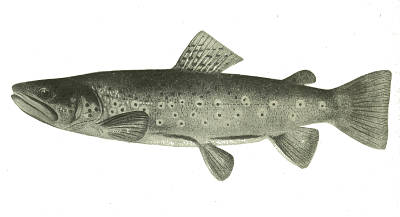
From a color sketch by Sherman F. Denton.
Brown Trout. (Salmo fario.)
This was, in truth, a virgin trout stream.
No artificial fly had ever before fretted the
surface of its pristine waters. The only
sign of man was the mark on a tree, near
our camp, where a chip had been cut out
by a trapper, years before. Just above our
camp was a narrow trail leading from the
cliffs to the river, but the only tracks were
those of caribou, bears, 'coons, and porcupines.
There Are
Others
There are other species of trout in
American waters that are fished for in much
the same way as for brook trout; they are
the rainbow, steelhead, red-throat, golden,
Dolly Varden and Sunapee trout; also the
introduced European brown trout. These
various species are being introduced in
trout waters in a number of states, so that
it may be well to briefly refer to some of
their characteristics.
Rocky Mountain
Species
In the Rocky Mountain region there are
three groups of trout belonging to the
Salmo genus—the steelhead, rainbow and
red-throat, or cut-throat as it is sometimes
called. They are all black spotted. In
widely separated sections of country these
different species may be readily distinguished
by certain characteristics, but in
other localities, where they co-exist naturally,
it is sometimes a difficult matter to
distinguish one group from another. At
one time, indeed, the rainbow and steelhead
were pronounced by competent authority
to be the same fish, the steelhead being supposed
to be the sea-run form of the species.
At the present time, however, they are held
to be distinct species.
The Dolly Varden, or bull-trout, belongs
to a different genus (Salvelinus), and is
related to the brook trout of Eastern
waters, having also red spots. While the
red-throat trout inhabits both slopes of the
Rockies, the others named belonged originally
to the Pacific Slope.
The Red
Throat Trout
(Salmo clarkii)
The red-throat trout is the most widely
distributed of the Western trouts. It inhabits
both slopes of the Rocky Mountains,
and, as might be inferred from this extensive
range, it varies in external appearance
more than any of the trout species. There
are a dozen or more well-defined sub-species
or geographical varieties, but all have the
characteristic red splashes on the membrane
of the throat. By means of this "trademark"
it may be readily distinguished from
the rainbow or steelhead trouts, both of
which are also black-spotted.
Nomenclature
But while the red-throat trout varies considerably
in contour, coloration and markings,
in different localities, it is identical
in structure wherever found. It is known by
the United States Bureau of Fisheries as the
"black-spotted trout," a most unfortunate
designation, inasmuch as the rainbow and
steelhead trouts are also "black-spotted."
The name red-throat is distinctive, and is
preferable to the rather repulsive name of
"cut-throat" trout by which it is also
known. The red-throat trout is designated
in its native waters by such names as
"trout," "brook trout," "speckled mountain
trout," etc. As the Eastern red-spotted
"brook trout" is rapidly being introduced
to Western waters, the name "brook trout"
should be applied only to that species.
Growth and
Weight
Where the red-throat trout grows to a
larger size than usual, as in the Yellowstone
and other lakes, it is often called
"salmon-trout," and the bull-trout of the
Pacific Slope is also sometimes known by
the same name, but the only "salmon-trout"
is the steelhead trout. The red-throat
trout rises to the fly more freely than
the Eastern brook trout, though in gameness
and flavor it is hardly its equal. Its
habits are also somewhat different. It usually
lies in pools and holes, and does not
frequent the riffles so much as the Eastern
trout. In size it is somewhat larger than
the Eastern trout in streams of the same
relative width and depth, and like all trout
species grows to greater weight in lakes
and large streams. I have taken them on
the fly weighing from three to five pounds
in Soda Butte Lake in the Yellowstone
Park, and in Yankee Jim Cañon on the
Yellowstone River. In Yellowstone Lake
some are infested with the white pelican
parasite, rendering them emaciated and
lacking in game qualities; this condition,
however, seems to be disappearing somewhat,
while those in the river below are
well-nourished and gamy.
Tools and
Tackle
The same tackle and artificial flies used
for the Eastern brook trout are as suitable,
as a rule, for the red-throat, though preference
is given to the stone fly, coachman, professor,
black gnat, cinnamon, Henshall, and
the various hackles by Montana anglers.
The red-throat seldom breaks water when
hooked, but puts up a vigorous fight beneath
the surface. As the mountain streams
are usually swift and rocky and fringed
with alders, willows and other small trees,
the angler must be wide awake to land his
fish and save his tackle.
The Steelhead
Trout (Salmo
gairdneri)
The steelhead, or salmon-trout, is the
trimmest and most graceful and the
gamest of all the trout species, being more
"salmon-like" in shape and appearance.
On the Pacific Coast, where it is native, and
runs to salt water, it grows to twenty pounds
or more in weight, when it is known as
steelhead salmon, and many are canned
under this name. Its spots are smaller than
in the other black-spotted species. It has,
sometimes, especially the males, a pink flush
along the sides, but not so pronounced as
in the rainbow trout. Its color is also of a
lighter hue, with steely reflections. Its
scales are somewhat larger than those of the
red-throat, but not so large as in the rainbow
trout.
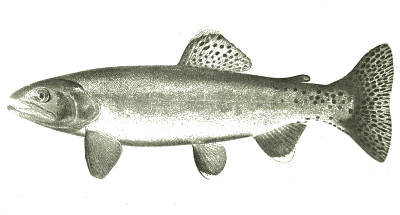
From a color sketch by Charles B. Hudson.
Golden Trout of Volcano Creek. (Salmo roosevelti.)
As a Game-Fish
It seems to be pretty well established in
Lake Superior, where it was introduced by
the United States Bureau of Fisheries, some
fine catches having been made of late years.
It has also been introduced into several
states on the eastern slope of the Rockies,
which seem to be very suitable for this fine
fish. In Montana I have taken it up to five
pounds. It rises eagerly to the fly, and
when hooked breaks water repeatedly like
the black bass. It is very trying to light
tackle, and must be carefully handled by
the angler. The flies named for the red-throat
trout are just as killing for the steelhead.
Like the red-throat it is also susceptible
to bait, which in Montana is the
"rock-worm," the larva of the caddis fly.
As a food fish it excels all of the trout
species as might be surmised. |Remarkable
Growth|In fresh
water lakes it should grow to eight or ten
pounds. Near Virginia City, Montana, is
located Axolotl Lake, so named from being
inhabited by a species of axolotl, but it contained
no fish of any kind until stocked with
a few thousand steelhead trout fingerlings
from the Bozeman Fisheries Station, in
1902. In September, 1907, two of my
friends, while trolling from a canvas boat
on this lake, caught eleven trout weighing
in the aggregate seventy pounds, the largest
weighing thirteen pounds, an extraordinary
weight for a five-year-old trout. But this
is easily explained when it is considered
that the trout had been feasting for several
years on such nutritious diet as these
curious amphibians afforded, and in great
abundance, but which now are said to be
scarce.
The Rainbow
Trout (Salmo
irideus)
The rainbow trout has also been introduced
to Eastern waters by the United
States Bureau of Fisheries, and seems to be
well adapted to ponds of considerable extent,
where water plants and grasses flourish.
Such waters seem to be more congenial
than the colder mountain streams;
and moreover it has a way of disappearing
from the smaller streams to seek those of
greater depth. It will thrive in warmer
water than the other trouts. The rainbow is
similar in contour to the red-throat, though
somewhat deeper, and with shorter head,
smaller mouth, and larger scales. Its distinguishing
feature is the broad red band
along the lateral line, common to both male
and female. It is a handsome fish, with
considerably more gameness than the red-throat,
but is not so vigorous on the rod as
the steelhead of the same size. Owing to
its tendency to descend streams it is particularly
liable to enter irrigation ditches, in
which event its doom is sealed. As a food-fish
it is superior to the native red-throat
trout.
In New Waters
In no new waters has the rainbow done so
well as in those of Michigan and Colorado.
In the former state it has populated streams
that were once the home of the grayling,
more's the pity. In Colorado, in the Gunnison
and neighboring streams, it furnishes
sport galore to hundreds of delighted anglers,
who visit the locality especially for
the fine fishing. No trout surpasses the
rainbow in rising to the artificial fly, and
almost any trout fly will capture it, though
the silver doctor, coachman, and the different
hackles, seem to be more favored than
others.
The Dolly
Varden Trout
(Salvelinus
parkei)
The Dolly Varden, or bull-trout, sometimes
erroneously called "salmon-trout," is
the only red-spotted trout native to Western
waters. It belongs to the same genus as the
Eastern brook trout, but grows much
larger. It is found only on the Pacific
Slope, in both lakes and streams, growing
to twelve or fifteen pounds under favorable
conditions. In the streams it is a gamer
fish than in lakes, though the larger fish are
rather lazy and logy. Compared with its
Eastern relative it is hardly so vigorous on
the rod, when of similar weight, and not
quite so good for the table.
It takes the fly readily, also any kind of
natural bait, and in lakes or broad streams
succumbs to the trolling-spoon. It is not
so great a favorite as the other Western
trouts, except in Alaska, where it is abundant
in all lakes and streams.
The Brown
Trout (Salmo
fario)
The brown trout is the brook trout of
Europe, and was introduced to the United
States from England and Germany, under
the auspices of the United States Bureau of
Fisheries. Those from Germany (the
eggs), were donated by Von Behr, and his
name was unfortunately applied to the fish
as "Von Behr trout," also "German
trout," two most unfortunate and ridiculous
names. It is the "brook trout" of Europe
and "brown trout" of Great Britain. In
Germany it is "bach forelle," which means
brook trout. Among English-speaking
people it has been known since before the
day of Walton and Cotton as "brown
trout," and brown trout it should be world
without end. To rob this fine fish of its
good name and substitute the misnomers
mentioned was both unwise and absurd.
Absurd Names
I sincerely hope that those names, together
with the equally absurd name of
"black-spotted trout," as applied to the red-throat
trout, will soon be relegated to the
shades of oblivion, never to be mentioned
in polite angling society. If the fish mentioned
was the only black-spotted trout inhabiting
its native waters, it would be a
good and suitable name, but unfortunately
its congeners, the rainbow and steelhead
trouts, are also "black-spotted" as before
mentioned. The name originated, I think,
about the same time as "Von Behr."
When the first eggs were taken East and
hatched the fry were called Rocky Mountain
trout and California trout, the former
name being more applicable than the latter,
but neither were very suitable. Our technical
knowledge of the Western trouts must
have been sadly deficient, however, when
they were displaced for "black-spotted
trout."
As a Game- and
Food-Fish
The brown trout has both reddish-brown
and black spots, of a larger size than those
of its American cousins. Altogether it is
a fine fish, much prized in Great Britain,
but in American waters it is hardly so
gamy, and not quite so good a food-fish
as our native trouts. It grows to a larger
size than our brook trout, and will thrive
in warmer water. A variety of the brown
trout, the Loch Leven, was introduced into
Firehole River, in the Yellowstone National
Park, some years ago, and it is remarkable
how well they thrive in the warm geyser
water. They must have been planted in
some stream in the Park tributary to the
Yellowstone River also, for I know of two
being taken near Livingston, Montana, one
weighing more than ten pounds, the other
about twelve. In a pond near Bozeman,
Montana, some brown trout fry were
planted, and at the end of four years two
were taken weighing six pounds each, both
of which were weighed by myself.
Fly-Fishing
The brown trout rises well to the fly, as
well if not better in American waters
than in England, and does not seem to be
so fastidious as to the color or shape of the
fly offered. Any of the popular trout flies
will answer, and it seems to have an inherited
fancy for the imitations of the May-fly,
the green and gray drakes, when the
natural May-fly is on the water. This fly
is also known as the sand-fly.
Golden Trout of
the Sierras
High up in the Southern Sierras, about
10,000 feet, in the neighborhood of Mount
Whitney, California, are several species or
sub-species, of "golden trout," apparently
related to the rainbow trout. For beautiful
and varied coloration they excel all fishes
of fresh waters and rival those of the coral
reefs of the tropics.
Varieties of
Golden Trout
For many years the golden trout of
Mount Whitney has been described at various
times by enthusiastic anglers in the
sportsmen's journals, but not until lately
have these fishes been properly systematized.
In the summer of 1904 a party
headed by Dr. Barton W. Evermann, under
the auspices of the United States Bureau of
Fisheries, proceeded to the locality mentioned,
and thoroughly explored the different
streams, and collected hundreds of
specimens of the trout inhabiting them. As
a result of this expedition the following
species of golden trout have been established
by Dr. Evermann:
Golden Trout of Soda Creek (Salmo
whitei),
Golden Trout of South Fork of Kern
River (Salmo agua-bonita),
Golden Trout of Volcano Creek (Salmo
roosevelti).
These trout are all small, averaging six
to eight inches, but are quite gamy and
very free biters. The golden trout of Volcano
Creek is the handsomest and gamest.
Of this fish Dr. Evermann says:
"This is the most beautiful of all the
trouts; the brilliancy and richness of the
coloration is not equaled in any other
known species…. In form it is no less
beautiful; its lines are perfect, the fins large
and well proportioned, and the caudal
peduncle strong; all fitting it admirably
for life in the turbulent waters in which it
dwells. It is a small fish, however. The
largest example collected by us was eleven
and one-fourth inches in total length, and
the heaviest one weighed ten ounces."
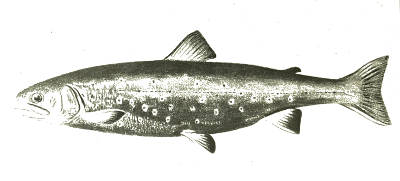
From a color sketch by Sherman F. Denton.
Sunapee Trout. (Salvelinus aureolus.)
"As a game-fish the golden trout is one
of the best. It will rise to any kind of lure,
including the artificial fly, and at any time
of day. A No. 10 fly is large enough, perhaps
too large; No. 12 or even smaller is
much better. In the morning and again in
the evening it would take the fly with a
rush and make a good fight, jumping frequently
when permitted to do so; during
the middle of the day it rose more deliberately
and could sometimes only be
tempted with grasshoppers. It is a fish
that does not give up soon but continues
the fight. Its unusual breadth of fins and
strength of caudal peduncle, together with
the turbulent water in which it dwells, enable
it to make a fight equaling that offered
by many larger trout."
Propagation of
Golden Trout
In the autumn of 1906 several hundred
golden trout from Volcano Creek were
brought by a fish-car to the Bozeman Fisheries
Station. In the following spring several
hundred eggs were taken from a few
of the largest fish, about six inches long,
and it is hoped that this beautiful trout
may be successfully propagated, if only for
its handsome coloration.
Sunapee Golden
Trout (Salvelinus
aureolus)
This fine fish was first described by Dr.
Tarleton H. Bean, in 1887, from Sunapee
Lake, New Hampshire. It exists, also,
only in one or two ponds or small lakes in
the vicinity. It is almost identical with the
European char (Salvelinus alpinus). It is
generally supposed to be native to the
waters mentioned, but there is a possibility
that it was introduced from Europe. However
that may be it is now recognized as a
different species and a fine example of American
trout. It grows to about twelve pounds
in weight, but unfortunately does not rise to
the fly. I have had no experience with this
fish, but Dr. J. D. Quackenbos, who, more
than any one else brought the fish to notice,
says:
Not a Fly Fish
"As far as known it does not rise to the
fly…. Through the summer months
it is angled for with a live minnow or smelt,
in sixty or seventy feet of water, over cold
bottom, in localities that have been baited.
While the smelt are inshore, trolling with
a light fly-rod and fine tackle, either with a
Skinner spoon, No. 1, |Trolling with
Smelt|or a small smelt on a
single hook, will sometimes yield superb
sport."
HIS MAJESTY: THE SILVER
KING