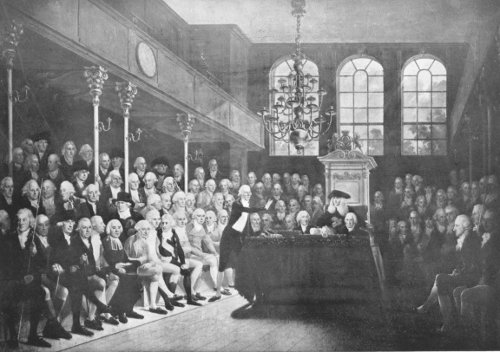
LAST YEARS
The King's health was a matter of great anxiety
to the royal physicians, even after his recovery
in 1789, and during the hot weather of the following
year their watchfulness had to be redoubled.
"The present object of the doctors was to prevent
the King from dozing during the day, and also to
try and keep him from brooding over things too
closely. The French Revolution was going on,
and affairs in that country were becoming very
serious. Holland, too, was unsettled, and they
were very anxious that his Majesty should be
called upon to do as little business as possible.
The King could not be on horseback after twelve
o'clock, as the heat of the sun on his head was
much feared. The Queen, therefore, had three
double carriages made with cane bodies, and
covered in with silk or oilskin, according to the
weather, and thus they were enabled to pay noon
visits to the sweet country seats near at hand,
and beguile the time until dinner, at four."[300]
This trouble passed in due course, and it seemed
as
if George was in thoroughly good health, and
likely to continue so indefinitely. "It is impossible
to describe to you how perfectly well the
King is," Lord Auckland wrote to Morton Eden
on December 12, 1791. "He is quite an altered
man, and not what you knew him even before his
illness. His manner is gentle, quiet, and, when
he is pleased, quite cordial. He speaks, even of
those who are opposed to his government, with
complacency, and without sneer or acrimony.
As long as he remains so well, the tranquillity of
this country is on a rock, for the public property
is great and the nation is right-minded, and the
commerce and resources are increasing."[301]
Years passed without any mental trouble, but
gradually events happened that preyed upon the
mind of the King, who, now no longer a young
man, was less able to resist them. For a long
time he had been perturbed by the unhappy
relations between the Prince and Princess of Wales
and, when in 1801 Pitt demanded permission to
introduce a measure for the emancipation of the
Catholics, he brooded over the matter until his
mind became again unhinged.[302] On February 15
he took a severe cold, always the first symptom
of one of his attacks—but this apparently gave
way
to treatment. "As for my cold, it is well,"
he said then to Lord Chatham; "but what else
I have, I owe to your brother." On the 22nd
inst., however, his mind wandered, and on the
following day he was unconscious until evening
when he exclaimed, "I am better now, but I will
remain true to the Church—I will remain true to the
Church,"[303] and anathematized Pitt and other
ministers favourable to the obnoxious measure.
He was seriously ill on March 2, but from that
day grew slowly better, and on the 6th instructed
Dr. Willis to write to the minister. "Tell him I
am now quite well—quite recovered from my
illness; but what has he not to answer for who is
the cause of my having been ill at all?" It was
then that Pitt, much perturbed and perplexed,
told George he would never re-introduce the
subject during his reign, whereupon the King
exclaimed joyfully, "Now my mind will be at
ease!"[304] He received in person and with much
kindliness the resignation of Pitt on March 14, and
handed the seals of office to Henry Addington.
The excitement attendant upon these political
events caused a relapse, and George remained for
some time at Kew under the care of the Willises.
"I'm very, very sorry the poor King has been, and
continues
ill, for it has been and will be a public
calamity from its consequences, but exclusive of
public ills among which the loss of Lord Cornwallis
here is irreparable, the private misfortunes of the
royal family goes to one's heart," Lady Sarah
Napier wrote from Dublin to Lady Susan O'Brien
on April 20, 1801. "Great people suffer sorrow
doubly; poor souls, they are not made to it, till it
comes with violence, and then it drives to indifference
or despair."[305] In May those who were
allowed to see George inclined to the belief that
he was well, but the Duke of Clarence declared that
"he pitied the (royal) family, for he saw something
in the King that convinced him he must soon be
confined again." Still, in spite of this distressing
prognostication, on May 25 Dr. Thomas Willis
was able to send an assuring report to Lord Eldon:
"This morning I walked with his Majesty, who was
in a perfectly composed and quiet state. He
told me, with great seeming satisfaction, that he
had a most charming night, 'he could sleep from
eleven to half after four,' when, alas! he had but
three hours sleep in the night, which, upon the
whole, was passed in restlessness—in getting out of
bed, opening the shutters, in praying violently,
and in making such remarks as betray a consciousness
of his own situation, but which are evidently
made for the purpose of concealing it from the
Queen.
He frequently called out, 'I am perfectly
well, and my Queen, my Queen has saved me.'"[306]
However, the improvement was not sustained,
for on June 12 Willis wrote in a different strain:
"His Majesty still talks much of his prudence,
but shows none. His body, mind, and tongue are
all upon the stretch every minute; and the manner
in which he is now expending money, which is so
unlike him when well, all evince that he is not so
right as he should be."[307] A few days later, however,
the King pronounced himself well when he,
who hated the Willises, father and son, dismissed
from attendance Dr. Robert Willis, and, in spite of
the Lord Chancellor's remonstrances, declined to
reinstate the physician.
"Kew, June 21, 1801.
"The King would not do justice to the feelings
of his heart, if he an instant delayed expressing his
conviction of the attachment the Lord Chancellor
bears him, of which the letter now before him is a
fresh proof; but at the same time he cannot but in
the strongest manner decline having Dr. Robert
Willis about him. The line of practice followed
with great credit by that gentleman, renders it
incompatible with the King's feelings that he
should—now by the goodness of Divine Providence
restored
to reason—consult a person of that description.
His Majesty is perfectly satisfied with
the zeal and attention of Dr. Gisborne, in whose
absence he will consult Sir Francis Milman, but
cannot bear consulting any of the Willis family,
though he will ever respect the character and
conduct of Dr. Robert Willis. No person that
ever had a nervous fever can bear to continue
the physician employed on the occasion; and this
holds much more so in the calamitous one that
has so long confined the King, but of which he is
now completely recovered.
"George R."[308]
"The subject of the Princess of Wales is still in
the King's mind, to a degree that is distressing,
from the unfortunate situation of the family,"
Princess Elizabeth wrote to Dr. Thomas Willis
during the illness of her father, who was no sooner
able to go out than he visited his persecuted
daughter-in-law. "The first time he rode out
after his illness he rode over Westminster Bridge
to Blackheath, never telling any one where he
was going till he turned up to the Princess's door.
She was not up, but jumped out of bed, and went
to receive him in her bed-gown and night-cap. He
told Lord Uxbridge that the Princess had run in his
head during his illness perpetually, and he had
made
a resolution to go and see her the first time
he went out, without telling anybody."[309] After
this visit George went to Weymouth, returning to
London on October 29 to open Parliament in
person, after which he settled down at Windsor,
where at the end of November Lord Malmesbury
visited him. "I was with the King nearly two
hours. I had not seen him since the end of
October, 1800—of course not since his last illness.
He appeared rather more of an old man, but not
older than men of his age commonly appear. He
stoops rather more, and was apparently less firm
on his legs; but he did not look thinner, nor were
there any marks of sickness or decline in his
countenance or manner. These last were much
as usual—somewhat less hurried and more conversable;
that is to say, allowing the person to
whom he addressed himself more time to answer and
talk than he used to do when discussing on common
subjects, on public or grave ones."
[310]
This illness aged him considerably, and though
henceforth he lived very quietly and almost
entirely secluded at Windsor, "his health, both
as regards his bodily ailments, and the state of his
mind, became daily more and more unsatisfactory."
[310]
Indeed, it is a moot point if he was ever for any length
of
time quite well after this year, and even during
the periods when he was free from a suspicion of
his malady, the fear of its recurrence undoubtedly
influenced his whole life. It was not until 1804,
however, that he was again seriously ill, and then
the attack was probably precipitated by his
furious indignation at the publication of some of
his letters by the Prince of Wales, though this
fact was, of course, suppressed in the physician's
report.[311] "The fact is I believe, as I have always
done, that the regal function will never more be
exercised by him," Creevey wrote on April 2:
and on May 2 stated, "I feel certain he is devilish
bad."[312] A regency was again in sight, but to the
general surprise George recovered, and early
in May was able to drive through the streets by
the side of the Queen, but after this, as General
Harcourt told Lord Malmesbury, he was "in
looks, manners, conduct, and conversation, quite
different from what he had been before his illness."[313]
"Mrs. Harcourt confirms all that Lady Uxbridge
had told me; that the King was apparently quite
well when speaking to his ministers, or those who
kept him a little in awe; but that towards his
family and dependents his language was incoherent
and
harsh; quite unlike his usual character.
She said that Dr. Symonds did not possess in any
degree the talents required to lead the mind from
wandering to steadiness; that in the King's two
former illnesses, this had been most ably managed
by the Willises, who had this faculty in a wonderful
degree, and were men of the world, who saw
ministers, and knew what the King ought to do;
that the not suffering them to be called in was an
unpardonable proof of folly (not to say worse) in
Addington; and that now it was impossible,
since the King's aversion was rooted; that Pitt
judged ill in leaving the sole disposal of the Household
to the King; that this sort of power in his
present weak (and, of course, suspicious) state of
mind had been exercised by him most improperly;
he had dismissed, and turned away, and made
capricious changes everywhere, from the Lord
Chamberlain to the groom and footman; he had
turned away the Queen's favourite coachman;
made footmen grooms, and vice versâ, and what
was still worse, because more notorious, had
removed Lords of the Bedchamber without a shadow
of reason; that all this afflicted the royal family
without measure; that the Queen was ill and
cross; the Princesses low, depressed, and quite
sinking under it; and that unless means could be
found to place some very strong-minded and
temperate
persons about the King, he would either
commit some extravagance, or he would, by
violent carelessness and exercise, injure his health,
and bring on a deadly illness."[314]
Though the King was now suffering from an
increasing deafness and a defective sight, he was
better towards the end of 1805 than he had been
for years. According to Lord Henley he was
quite cheerful, and troubled only by his blindness.
"He talked to me, indeed, in an affecting manner,
of his situation, saying that he had tried this
morning, but in vain, to read the docket of one of
the despatches, but is convinced that he perceives
an amendment, and that even with the left eye
he can perceive the light.[315] Lady Henley says
that he presented the muffins to the ladies last
night in his old jocose and good-humoured manner.[316]
"Our Sovereign's sight is so much improved
since last spring, that he can now clearly distinguish
objects at an extent of twenty yards. The
King,
in consequence of this favourable change,
has discontinued the use of the large flapped hat
which he usually wore, and likewise the silk shade.
His Majesty's mode of living is now not quite so
abstemious. He now sleeps on the north side
of the Castle, next to the Terrace, in a roomy
apartment, not carpeted, on the ground floor.
The room is neatly furnished, partly in a modern
style, under the tasteful direction of the Princess
Elizabeth. The King's private dining-room and the
apartments en suite, appropriated to his Majesty's
use, are all on the same side of the Castle.
"The Queen and the Princesses occupy the
eastern wing. When the King rises, which is
generally about half-past seven o'clock, he proceeds
immediately to the Queen's saloon, where his
Majesty is met by one of the Princesses; generally
either Augusta, Sophia or Amelia; for each in
turn attend their revered parent. From thence
the sovereign and his daughter, attended by the
lady-in-waiting, proceed to the Chapel in the
Castle, wherein Divine service is performed by
the Dean or Sub-Dean: the ceremony occupies
about an hour. Thus the time passes until nine
o'clock, when the King, instead of proceeding to
his own apartment, and breakfasting alone, now
takes that meal with the Queen and the five
Princesses. The table is always set out in the
Queen's
noble breakfasting-room, which has been
recently decorated with very elegant modern
hangings; and, since the late improvements by
Mr. Wyatt, commands a most delightful and
extensive prospect of the Little Park. The
breakfast does not occupy half-an-hour. The King
and Queen sit at the head of the table, and the
Princesses according to seniority. Etiquette in
every other respect is strictly adhered to. On
entering the room, the usual forms are observed,
agreeably to rank.
"After breakfast, the King generally rides out
on horseback, attended by his equerries, three of
the Princesses, namely, Augusta, Sophia, Amelia,
are usually of the party. Instead of only walking
his horse, his Majesty now proceeds at a good round
trot. When the weather is unfavourable, the
King retires to his favourite sitting-room, and
sends for Generals Fitzroy or Manners to play at
chess with him. His Majesty, who knows the
game well, is highly pleased when he beats the
former, that gentleman being an excellent player.
"The King dines regularly at two o'clock;
the Queen and Princesses at four. His Majesty
visits, or takes a glass of wine and water with
them at five. After this period, public business
is frequently transacted by the King in his own
study, wherein he is attended by his private
secretary,
Colonel Taylor. The evening is, as
usual, passed at cards in the Queen's drawing-room,
where three tables are set out. To these
parties many of the principal nobility, etc., residing
in the neighbourhood are invited. When the
Castle clock strikes ten, the visitors retire. The
supper is set out, but that is merely a matter of
form, and of which none of the family partake.
These illustrious personages retire at eleven
o'clock, to rest for the night. The journal of one
day is the history of a whole year."[317]
Slowly but surely his sight gave way, and in
the winter of 1806 he was nearly blind. Pitt
noted "a great change of handwriting ... it
has grown much larger, and the characters are very
indistinct and ill-formed;"[318] and in 1810 Lady
Jerningham wrote, "John Bedingfield has shewn
to me the poor King's signature, and it would be impossible
to read in it George Rex if the paper did not
announce it had that official signature."[319] George
bore the affliction bravely. "I am quite resigned,"
he said, "for what have we in this world to do, but
to suffer and perform the will of the Almighty."[320]
Soon
he could ride only when the horse was led
by a servant; while on foot he had to grope his
way with a stick. In spite of his determination
to bear his ills with fortitude he grew morbid,
frequently asked to hear Handel's "Total Eclipse,"
and one day was overheard by the Queen to quote
Milton's lines on his blindness:[321]
"O! loss of sight, of thee I most complain!
O, dark, dark, dark, amid the blaze of noon,
Irrecoverably dark, total eclipse
Without all hope of day!
O, first created Beam, and thou great Word,
'Let there be light, and light was over all';
Why am I thus bereaved thy prime decree?"
In 1810 the King was greatly worried by the
failure of the Walcheren expedition, and the
notorious "Duke and Darling" scandal that
brought disgrace upon the Duke of York and
resulted in his resignation of the office of Commander-in-Chief.
On October 24 he was very
unwell, and at the Drawing-room on the next day
every one noticed his excited manner. On the
29th the Prime Minister and the Lord Chancellor
visited him at Windsor, where they came to the
conclusion that he was not in a fit state to discharge
his kingly duties, and orders were given
that
only physicians and medical attendants
should have access to the royal apartments.
Then came the crowning blow in the form of the
death of his youngest and favourite daughter,
Amelia, on November 2. She was deeply attached
to him, and placed on his finger a ring, containing
a lock of her hair, enclosed under a crystal tablet
and inscribed "Remember me." Even that
inveterate opponent of royalty, "Peter Pindar,"
was touched, and commemorated the event in
some of the worst lines he ever wrote.
"With all the virtues blent, and every grace,
To charm the world and dignify her race,
Life's taper losing fail its feeble fire,
The fair Amelia, thus bespoke her sire:
Faint on the bed of sickness lying,
My spirit from its mansion flying,
Not long the light these languid eyes will see:
My friend, my father, and my King,
O, wear a daughter's mournful ring,
Receive the token, and 'Remember me.'"
On November 7, Sir Henry Halford, Dr.
Reynolds and Dr. Baillie were called in, and, with
the approval of the Queen, in spite of his Majesty's
known wish, Dr. Willis was sent for. Prayers were
publicly offered for his recovery, and though once
or twice he was a little better, there was little or
no hope of permanent improvement and on
December
21 Perceval introduced a Regency Bill,
which became law on February 4, 1811.
Hitherto all the attacks had been of short
duration, none of them continuing much beyond
six months, but when deprived of his reason in
1810, he was never again in a fit state to be
entrusted with the cares of sovereignty. He
had made his last appearance at a social function
at Windsor on the anniversary of his accession
in 1810, haggard, infirm, nearly blind and almost
deaf, leaning on the arm of the Queen, and speaking
in the hurried, almost unintelligible manner that
was an invariable sign of a forthcoming illness.
On May 20, 1811, he was seen for the last time by
any one outside his immediate family and entourage.
"On Sunday night, May 20, our town was in a
fever of excitement at the authorized report that
the next day the physicians would allow his Majesty
to appear in public," an inhabitant of Windsor
wrote. "On that Monday morning it was said
that his saddle-horse was to be got ready. This
truly was no wild rumour. We crowded to the
park and the castle-yard. The favourite horse
was there. The venerable man, blind but steady,
was soon in the saddle, as I had often seen him, a
hobby groom at his side with a leading rein. He
rode through the Little Park to the Great Park.
The bells rang. The troops fired a feu de joie.
The
King returned to the Castle within an hour.
He was never again seen without those walls."[322]
It was thought that the King could not long
survive. "The general opinion is that the King will
die before the 22nd inst., (the date to which Parliament
was prorogued),"[323] Creevey wrote on July
12; and a fortnight later Lord Grenville expressed
the same opinion when writing to Lord Auckland:
"It is, I believe, certainly true that the King has
taken for the last three days scarcely any food at
all, and that, unless a change takes place very
shortly in that respect, he cannot survive many
days."[324] Lord Buckinghamshire, however, was
able to state on August 13, "The King, I should
suppose, is not likely to die soon, but I fear his
mental recovery is hardly to be expected."[325]
According to Mrs. Papendiek, who obtained her
information from "private sources," the King's
malady was caused more by a loss of mental
power than an aberration of intellect, and it never
assumed a condition of actual insanity.[326] There
was some hope in February 1811 that the King
would recover, and some members of the
Council
were actually of opinion that at this time
he was in full possession of his faculties, so calmly
and sensibly had he spoken on various topics, and
they were prepared to pronounce him restored
and able to resume his power, Lord Ellenborough
using the words of Pilate, "I find no fault at all
in that just person." To this opinion Sir Henry
Halford could not subscribe, for, knowing the
cunning of mad persons, he was aware that often
only the greatest vigilance could detect the
existence of the delusions from which the patient
suffered.
"One day when the King fancied himself
surrounded by servants only, and when a medical
attendant was watching unseen, he took a glass
of wine and water and drank it to the health
conjugia meæ dilectissimæ Elizabethæ, meaning
Lady Pembroke. Here was a delusion clearly
established and noted down immediately: the
use of Latin, which was not to be understood by
those whom he supposed only to hear him, affording
a singular proof of the old cunning of insanity.
A few days later, Sir Henry was walking with him
on the Terrace; he began talking of the Lutheran
religion, of its superiority to that of the Church
of England, and ended with growing so vehement
that he really ranted forth its praises without
mentioning that which Sir Henry believes to have
been
the real motive of this preference—the
left-handed marriages allowed. He was very
anxious to see whether traces of this delusion
would appear again, and went to the Duke of
York to ask for information as to the tenets,
practices, etc., etc., of the Lutheran Church. The
Duke said, "Watch him in Passion Week; if he
fancies himself a Lutheran, you will see an extraordinary
degree of mortification and mourning,"
etc., etc. When Sir Henry returned to the
assembled physicians he wrote down the substance
of this conversation, and without communicating
it to anybody, requested those present to seal the
paper and keep it in a chest where their notes and
other papers of importance are kept, under locks
of which each had a separate key. When the
Monday in Passion Week arrived, and Sir Henry
had nearly forgotten the conversation, he went
into the King's dressing-room while he was at his
toilet, and found the attendants in amazement
at his having called for and put on black stockings,
black waistcoat and breeches, and a grey coat
with black buttons. It was curious to hear that
his delusions assumed, like those of other madmen,
the character of pride, and that a Sovereign ever
fancied himself in a station more elevated than
his own. He would sometimes fancy himself
possessed of a supernatural power, and when
angry
with any of his keepers, stamp his foot and
say he would send them down into hell."[327]
It was during the lucid interval to which
reference has just been made that Sir Henry Halford
was deputed to broach an awkward subject
to the King. George had known of the death of
Princess Amelia, and every day his attendants
dreaded lest he should ask questions as to her
property and her will. There had been a close
intimacy between the Princess and General Fitzroy—there
was the rumour of a secret marriage—and
the trouble was that she had left everything
to him. The Queen was afraid to mention this
to the King, and Perceval and the Lord Chancellor
successively undertook the disclosure and shrunk
from it, imposing it upon Sir Henry. "Never,"
said the latter subsequently, "could I forget the
feelings with which, having requested some private
conversation with the King, after the other
physicians were gone, I was called into a window
with the light falling so full on my countenance
that even the poor nearly blind King could see it.
I asked whether it would be agreeable to him to
hear now how Princess Amelia had disposed of
her little property. "Certainly, certainly, I want
to know," with great eagerness. I reminded him
at the beginning of his illness he had appointed
Fitzroy
to ride with her at Weymouth; how it
was natural and proper she should leave him some
token for these services; that, excepting jewels,
she had nothing to leave, and had bequeathed
them all to him; that the Prince of Wales, thinking
jewels a very inappropriate bequest for a
man, had given Fitzroy a pecuniary compensation
for them (his family, by the bye, always said it
was very inadequate) and had distributed slight
tokens to all the attendants and friends of the
Princess, giving the bulk of the jewels to Princess
Mary, her most constant and kindest of nurses.
Upon this the poor King exclaimed, "Quite right,
just like the Prince of Wales," and no more was
said."[328]
It was in the summer of 1814 that the Queen
entered the King's apartment during one of these
lucid intervals, and found him singing a hymn
and accompanying himself on the harpsichord.
When he had concluded, he knelt down and prayed
aloud for his consort, for his family, for the nation,
and, lastly, for himself, that it might please God
to avert his heavy calamity, or, if not, give him
resignation under it. Then his emotions overpowered
him, he burst into tears, and his reason
fled. He was never again sane.[329]
"The public bulletins which have been issued
for some months past, have all stated that his
Majesty's disorder remains undiminished; and
we understand that it is the opinion of the medical
gentlemen attending him that nothing far short
of a miracle can bring about a recovery from his
afflicting malady, "so runs a contemporary account.
"At times, we are happy to learn, he is tolerably
composed. The number of persons specially
appointed by the doctors is reduced from six to
two, and his principal pages are admitted, and
have been for some time, to attend upon him, as
when he enjoyed good health. His Majesty dines
at half past one o'clock, and, in general, orders
his dinners: he invariably has roast beef upon
the tables on Sundays. He dresses for dinner,
wears his orders, etc.
"He occupies a suite of thirteen rooms (at
least, he and his attendants) which are situated
on the North side of Windsor Castle, under the
State rooms. Five of the thirteen rooms are
wholly devoted to the personal use of the King.
Dr. John Willis sleeps in the sixth room, adjoining,
to be in readiness to attend his Majesty. Dr.
John attends the Queen every morning after
breakfast, and about half-past ten o'clock, and
reports to her the state of the afflicted monarch;
the Doctor, afterwards, proceeds to the Princesses,
and
other branches of the Royal family, who may
happen to be at Windsor, and makes a similar
report to them. In general the Queen returns
with Dr. Willis, through the state rooms, down a
private staircase, leading into the King's suite of
rooms, appropriated to this special purpose.
Sometimes she converses with her Royal husband.
The Queen is the only person who is admitted to
this peculiar privilege, except the medical gentleman,
and his Majesty's personal attendants. In
the case of Dr. John Willis's absence, Dr. Robert
Willis, his brother, takes his place. The other
medical gentlemen take it in rotation to be in
close attendance upon the King.
"The suite of rooms which his Majesty and
his attendants occupy, have the advantage of very
pure and excellent air, being on the North side
of the terrace round the Castle; and he used to
occasionally walk on the terrace; but, we
understand, he now declines, owing to the bad
state of his eyes, not being able to enjoy the view.
The Lords and Grooms of the King's Bedchamber,
his Equerries and other attendants are occasionally
in attendance at Windsor Castle, the same as if
the King enjoyed good health. Two King's
Messengers go from the Secretary of State's offices
daily to Windsor, and return to London, as they
have been accustomed to do for a number of years
past.
The messenger who arrives at noon brings
a daily account of the King's health to the Prince
Regent, and the Members of the Queen's Council.
His Majesty has never been left since his afflicting
malady, without one of the Royal Family being in
the Castle, and a member of the Queen's council,
appointed under the Regency Act."[330]
During his last years George III was subject
to harmless and not unpleasing delusions. "The
good King's mania consists in pleasant errors of
the mind,"[331] said Lady Jerningham; and this
statement was confirmed by Princess Elizabeth:
"If anything can make us more easy under the
calamity which it has pleased God to inflict on
us, it is the apparent happiness that my revered
father seems to feel."[332] He found much comfort
in religion, and on one occasion declared, "Although
I am deprived of my sight, and am shut
out from the society of my beloved family, yet I
can approach my Blessed Lord," and thereupon
administered to himself the Sacrament.[333] Indeed,
he was unhappy only when he could not have his
favourite dinner of cold mutton and salad, plover's
eggs, stewed peas, and cherry tart; and fearful—he
who
in his senses had never known fear—only
when it was proposed to shave his beard. "If
it must be," he said, "I will have the battle axes
called in."[334]
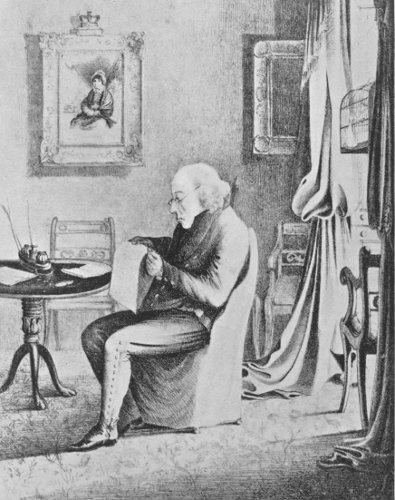
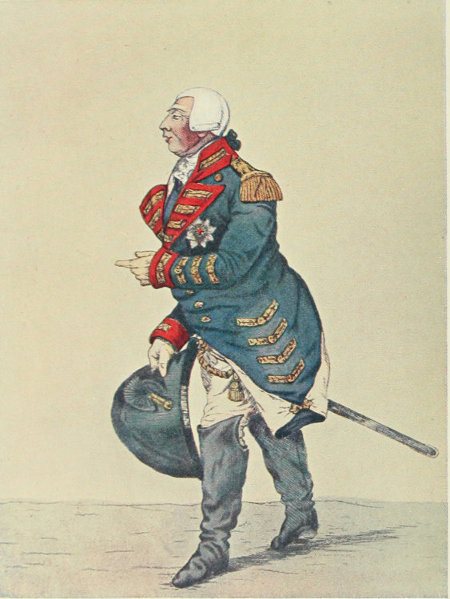
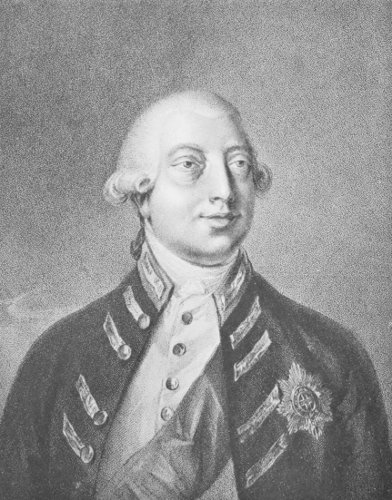
GEORGE III IN HIS STUDY
The King loved to wander through the corridors,
a venerable figure with long silvery beard, attired
in a silk morning gown and ermine night cap,
holding imaginary conversations with ministers
long since dead, "rationally as to the discourse,
but the persons supposed present"; and so pleasantly
did he while away the time that sometimes
his dinner was ready before he expected it. "Can
it be so late?" he would ask. "Quand on
s'amuse le temps vole."[335] He was fully convinced
that Princess Amelia—"my poor Am"—was
alive and happy at Hanover, enjoying perennial
youth and beauty; and believed that he was
prosecuting an amorous intrigue with Lady
Pembroke, whom he often believed to be his wife,
and whose absence angered him. "Is it not
a strange thing, Adolphus," he said to the
Duke of Cambridge, "that they still refuse to
let me go to Lady Pembroke, although every one
knows I am married to her; but what is worse,
that infamous scoundrel Halford was at the
marriage, and has now the effrontery to deny it
to
my face."[336] He considers himself no longer
an inhabitant of this world, and often, when he
had played one of his favourite tunes, observes
that he was very fond of it when he was in the
world. He speaks of the Queen and all his family,
and hopes they are doing well now, for he loved
them very much when he was with them," Princess
Elizabeth remarks, and the belief that he was dead
was one of his regular delusions. "I must have
a new suit of clothes, he said one day, "and I
will have them black in memory of George the
Third, for he was a good man."[337]
The King lived on, recognizing no one, and
knowing nothing of contemporary events. Waterloo
was fought and won, and Napoleon overthrown;
Princess Charlotte of Wales married and died,
his consort went down to her grave, and his sons
and daughters contracted matrimonial alliances,
yet he lived on. Indeed, his constitution was so
sound that, in spite of all infirmities, his physical
health continued good. "In 1818, however, he
had ceased even to walk, being conveyed in his
chair from his bed to another room, and placed
near an old harpsichord of Queen Anne's, said
not to have been tuned since her time. On this
he
would play for hours, in the belief that he
was making music."[338]
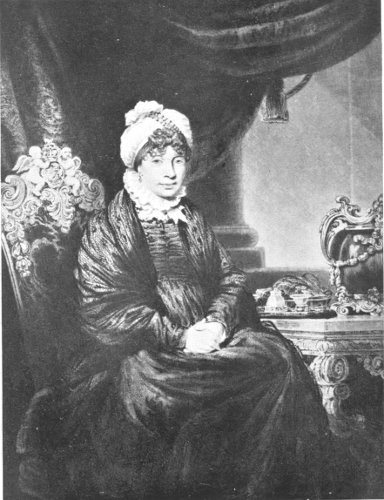
From a portrait by H. Eldridge
QUEEN CHARLOTTE
Queen Charlotte had been ailing for a long time.
"The severe affliction and constant anxiety she was
in was probably the cause, and from this time (1789)
her Majesty's health was less uniformly good,"
wrote Mrs. Papendiek. "The dropsy, which had
been floating in her constitution since the birth of
Prince Alfred, now made its deposit, and caused
her at times much suffering." She had been
much upset by the King's various outbreaks of
violence in 1804, and was, indeed, so alarmed that
thereafter she saw little of him. "The Queen lives
upon ill terms with the King. They never sleep
or dine together; she persists in living entirely
separate," wrote Lord Colchester; and Lord
Malmesbury recorded: "The Queen will never
receive the King without one of the Princesses
being present; never says in reply a word.
Piques herself on this discreet silence, and when
in London, locks the door of her white-room—her
boudoir—against him." On April 23, 1817,
she was seized with a severe spasmodic attack,
but with indomitable endurance she continued
to hold Drawing-rooms and was present at the
royal weddings that took place during the year.
She was anxious to be taken to Windsor, but
the
step was long delayed, and she never
got further than Kew, where she died after a
lingering and painful illness, on November 16, 1818.
In that year Byron wrote, "the poor good King
may live to 200; he continues in good bodily
health, and is perfectly happy, conversing with
the dead, and sometimes relating pleasant things.
They say it is a most charming illusion."[339]
Early in January, 1820, it became known that
the old King was unwell, and though a reassuring
bulletin was issued—"His Majesty's disorder has
undergone no sensible alteration. His Majesty's
bodily health has partaken some of the infirmities
of age, but has been generally good during
the last month"—it was still believed that he
would not recover. He could not get warm,
his food did not nourish him, and his frame grew
more and more emaciated; but it was not until
January 27, when for the first time he kept his
bed, that the physicians pronounced his life in
danger. Two days later death claimed him.
"A few minutes before this venerable monarch
expired, he extended his arms, and bade his
attendants raise him up—the doctors signified to
his attendants not to do so, in the supposition that
the effort would extinguish life,—but upon his
repeating the request, they obeyed, and he thanked
them.
His lips were parched, and occasionally
wetted with a sponge. He, with perfect presence
of mind, said: 'Do not wet my lips but when
I open my mouth.' And when done he added,
thank you, it does me good.'"[340]
So on January 29, 1820, died George III in the
sixtieth year of his reign, and at the patriarchal
age of eighty-one, unhonoured and unsung, the
monarch of the greatest country that the world
has yet seen, yet unenvied by the lowest of his
subjects. "What preacher need moralize on
this story; what words save the simplest are
requisite to tell it? It is too terrible for tears."
So runs Thackeray's exquisite passage on the
downfall of George III, with which this work
may fittingly conclude. "The thought of such
misery smites me down in submission before the
Ruler of kings and men, the Monarch supreme over
empires and republics, the inscrutable Dispenser
of Life, death, happiness, victory.... Low he
lies, to whom the proudest used to kneel once, and
who was cast lower than the poorest: dead, whom
millions prayed for in vain. Driven off his throne,
buffeted by rude hands; with his children in
revolt; the darling of his old age killed before
him untimely; our Lear hangs over her breathless
lips and cries, 'Cordelia, Cordelia, stay a little!'
'Vex not his ghost—Oh! let him pass—he hates him
That would upon the rack of this tough world
Stretch him out longer!'
Hush! Strife and Quarrel, over the solemn grave!
Sound, trumpets, a mournful march! Fall, dark
curtain, upon his pageant, his pride, his grief,
his awful tragedy!"