"No. XLV"
Lord Bute, to support his policy, had founded
two newspapers, "The Auditor," and, under the
editorship of Smollett, "The Briton," and these
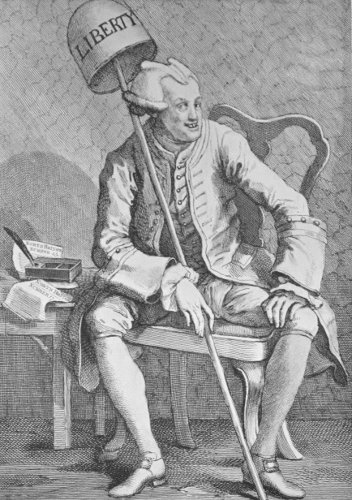
inspired John Wilkes, member of Parliament for
Aylesbury, to set up, as a weapon for the Opposition,
"The North Briton," the onslaughts in which were
so ferocious that "The Auditor" on February 8,
1763, and "The Briton", four days later, died
of sheer fright. Wilkes and Charles Churchill,[249]
the most valuable contributor to "The North
Briton," did indeed fight with the buttons off the
foils, and, while other papers still retained the
custom of referring to persons by their initials,
they disdained this foolish method, and gave
their enemies the poor comfort of seeing their
names in the full glory of print.
When Bute resigned, No. xliv of "The North
Briton" had appeared, and the next issue was in
preparation. Wilkes, on hearing this important
intelligence, delayed the publication to see if
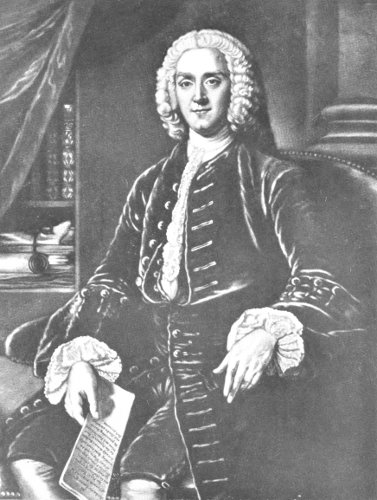
George
Grenville,[250] the new Prime Minister, would
offer a new policy, or follow in the footsteps of his
late leader. Pitt and Lord Temple showed Wilkes
an early copy of the King's Speech, and, learning
from this that no change would take place, the
latter proceeded with the composition of the since
historic No. xlv. The King's Speech was read on
April 19, 1763, and on April 23 appeared the
famous sheet, wherein the terms of the peace,
the Cyder tax, and other acts of the Ministry were
attacked, and the Address was stigmatised as
"the most abandoned instance of ministerial
effrontery ever attempted to be imposed upon
mankind." In the paper it was stated very clearly
that the King's Speech was always regarded, not
as the personal address of the sovereign, but as
the utterance of ministers. "Every friend of his
country," said "The North Briton," "must
lament
that a prince of so many great and amiable
qualities, whom England truly reveres, can be
brought to give the sanction of his sacred name
to the most odious measures and to the most
unjustifiable declarations from a throne ever
renowned for truth, honour and unsullied
virtue."
This attack on ministers was not more violent
than others that had appeared in earlier issues of
the same paper, but the adherents of Bute, whom
Wilkes had taken an active part in ousting from
the Ministry, now saw an opportunity to avenge
their fallen leader. The severe criticism of his
speech made the King furious, and on the principle
of "L'étât, c'est moi," he disregarded the distinction
that Wilkes had so carefully drawn between the
utterances of the monarch and the utterances of
ministers in the monarch's name, and encouraged,
if, indeed, he did not instigate, a prosecution. The
Secretary of State, Lord Halifax, issued a general
warrant, that is, a warrant which specified neither
the name nor names nor described the person
nor persons of the offender or offenders, but only
gave instructions "to make a strict and diligent
search for the authors, printers and publishers of
a seditious and treasonable paper entitled 'The
North Briton,' No. xlv, Saturday, April 23, 1763,
printed for G. Kearsley, in Ludgate Street, London,
and
them, or any of them, having found, to
apprehend and seize, together with their papers,
etc."
The printer and publisher were at once arrested,
and, when brought before Halifax and Egremont,
gave the names of the authors as John Wilkes
and Charles Churchill. The warrant was shown
to Wilkes at his house in Great George Street on
the night of April 29, but he declined then to
comply with it, stating his objection to a general
warrant as such, pointing out that his name
was not mentioned, that he was a Member of
Parliament, and concluded by threatening the first
who should offer violence to him in his own house
at that hour of the night; but when the officers
returned in the morning he offered no further
opposition. Just after he was arrested and before
he had been removed from his house, Churchill
walked into the room, where were Wilkes and
his captors. Wilkes knew the messengers wanted
also to arrest Churchill, and observing they did
not know the poet by sight, before the latter could
speak, with great presence of mind, said, "Good
morning, Mr. Thomson. How is Mrs. Thomson
to-day? Does she dine in the country?" Churchhill
took the hint, said Mrs. Thomson was waiting
for him, left the room, and fled from the
metropolis.
Wilkes's
papers were seized, and he was taken
before the Secretaries of State, and by them, after
he had asserted his privileges as a Member of
Parliament and had refused to answer any
questions, was committed a prisoner to the
Tower. Such were the preliminaries of the great
battle that made Wilkes a great and popular
figure in the struggle for the liberty of the subject
and the liberty of the press in England.
Wilkes's friends moved at once for a writ of
habeas corpus, and after some delay, on May 6,
the prisoner was produced before Chief-Justice
Pratt[251] in the Court of King's Bench, when counsel
applied for his discharge on the ground that the
commitment was not valid. The Judge gave
his decision in favour of Wilkes, declaring that
general warrants were illegal, and that, anyhow,
the charge against the accused was not sufficient
to destroy his privileges as a Member of Parliament.
Wilkes was no sooner at liberty than he showed
he was not a man who could be maltreated with
impunity. He republished the numbers of "The
North Briton" in a volume with notes, reasserting
that the King's Speech could only be regarded as
a ministerial pronouncement. He addressed to
Lord Halifax and Lord Egremont an open letter,
of
which many thousand copies were distributed
throughout the country, complaining that his
home had been robbed, and that he was informed
that "the stolen goods are in possession of one or
both of your Lordships." His papers were not
returned, and he brought an action against
Robert Wood, the Under-Secretary of State,
against whom he received a verdict giving £1,000
damages, and another action against Lord Halifax
for unlawful seizure, from whom also, after many
years' delay, he recovered heavy damages. In
the meantime Lord Egremont had written to
Lord Temple that the King desired the latter, as
Lord-Lieutenant of the county, to inform Wilkes
that he was dismissed from the Colonelcy of the
Buckinghamshire Militia, which task Temple duly
discharged, saying, "I cannot, at the same time,
help expressing the concern I feel in the loss of an
officer, by his deportment in command, endeared
to the whole corps." As a punishment for this
expression of sympathy, the King removed Lord
Temple from the Lord-Lieutenancy, and with
his own hand struck his name out of the Council
books.
"To honour virtue in the Lord of Stowe,
The pow'r of courtiers can no further go;
Forbid him Court, from Council blot his name,
E'en these distinctions cannot rase his fame.
[Pg 241]
Friend to the liberties of England's state,
'Tis not to Courts he looks to make him great;
He to his much lov'd country trusts his cause,
And dares assert the honour of her laws."[252]
The ministers in this struggle had found a
powerful ally in Hogarth, who, though he had
been friendly with Wilkes and Churchill, had been
high in Bute's favour, even before the accession
of George III, and now saw an opportunity to
repay his patron. The quarrel between the
painter and the agitator had begun with Hogarth's
political cartoon, "The Times," in which Wilkes
was ignominiously portrayed; and Wilkes, who
let no man attack him with impunity, had replied
in "The North Briton" with a violent onslaught
upon the caricaturist. When Wilkes appeared
in the Court of King's Bench, Hogarth, it is said,
from behind a screen made a sketch for a caricature
of the accused, in which the latter's squint was
most malignantly exaggerated. Wilkes took this
in good part, and, indeed, in later days said
jocularly that he found himself every day growing
more and more like the unflattering portrait;
but Churchill, who was devoted to his friend,
replied in "An Epistle to William Hogarth," in
which—after the model furnished by Pope in his
immortal reprimand to Addison—while praising
Hogarth's
genius, he poured vitriolic scorn upon
his vanity and other weaknesses, concluding with
a tremendous indictment of the painter's supposed
dotage.
"Sure, 'tis a curse which angry fates impose,
To mortify man's arrogance, that those
Who're fashioned of some better sort of clay,
Much sooner than the common herd decay.
What bitter pangs must humbl'd Genius feel
In their last hours to view a Swift and Steele!
How must ill-boding horrors fill her breast,
When she beholds men mark'd above the rest
For qualities most dear, plunged from that height,
And sunk, deep sunk, in second-childhood's night!
Are men, indeed, such things? and are the best
More subject to this evil than the rest?
To drivel out whole years of idiot breath,
And set the monuments of living death?
Oh, galling circumstance to human pride!
Abasing thought, but not to be denied!
With curious art the brain, too finely wrought,
Preys on herself, and is destroyed by thought.
Constant attention wears the active mind,
Blots out her powers, and leaves a blank behind.
But let not youth, to insolence allied,
In heat of blood, in full career of pride,
Possess'd of genius, with unhallow'd rage
Mock the infirmities of reverend age;
The greatest genius to this fate may bow;
Reynolds, in time, may be like Hogarth now."
Hogarth replied to the "Epistle" by a savage
caricature of Churchill, entitled, "The Bruiser,
C.
Churchill (once the Reverend!) in the character
of a Russian Hercules, regaling himself after
having killed the monster Caricatura, that so
sorely-galled his virtuous friend, the Heaven-born
Wilkes." The poet is portrayed as a bear, with
torn clerical bands and ruffles, seated upon
Massinger's "A New Way to Pay Old Debts,"
and "A List of the Subscribers to 'The North
Briton,' etc., one arm holding a quart pot, and
the other round a massive club, on which the
knots are inscribed "Lye 1," "Lye 3," "Lye
5," "Lye 8," "Fallacy," etc.
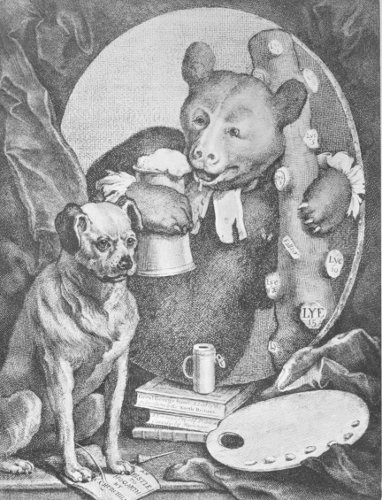
A caricature of C. Churchill by Wm. Hogarth
THE BRUISER
Ministers, having been defeated on a point of
law, were now determined to ruin Wilkes,[253] and
proceeded, so far as lay in their power, to damn
his reputation for all time, although, as will be
seen, the method adopted did not have the desired
effect.
That Wilkes was a man of high moral character,
as some few of his eulogists have endeavoured to
sustain, is a theory incapable of acceptance, though
perhaps his lack of principle in early days has
been more severely castigated than it deserved,
considering that morality is, after all, comparative,
and that a dragon of virtue in the days that were
earlier would now be looked upon as a monster
of
iniquity. The son of a rich merchant, Wilkes
was educated in England and at Leyden, and on
his return to England at the age of two-and-twenty,
had been persuaded by his father to espouse a
wealthy woman ten years his senior. Not unnaturally
the marriage was unhappy, and, indeed,
Wilkes never even professed to regard it except
as a convenience, but notwithstanding this circumstance
his behaviour to his wife leaves the deepest
stain on his character. He squandered her money
in debauchery, and, after they had separated,
endeavoured to deprive her of an annuity of £200
a year, all she had kept of her estates. He was
initiated by Sir Francis Dashwood into the brotherhood
of Medmenham Abbey, where he fraternised
with Lord Sandwich,[254] Thomas Potter,[255] and other
men of fashion, and with them proceeded to
outrage all canons of decency.[256] In connexion
with
the brotherhood Potter and Wilkes in collaboration
composed an obscene parody of Pope's
"Essay on Man" called "An Essay on Woman,"
which, in imitation of the original poem, was
furnished with notes under the name of Bishop
Warburton; and to the burlesque was attached
a blasphemous paraphrase of Veni Creator.
Without setting up any defence of these compositions,
it may in extenuation be said that the
circulation was limited to twelve or thirteen
copies, which were distributed among members
of the club, that it was printed at Wilkes's house,
and that the latter took the greatest care to prevent
the workmen from carrying away any sheets.
Disgraceful as the amusement was, at least it
could be pleaded it had no evil effect upon the
circle of vicious men who inspired it; but it gave
the Government a handle against their uncompromising
foe of which they were not slow to take
advantage.
In spite of all precautions, one of the printers
had stolen some sheets of the "Essay on Woman"
and this fact, which came to the knowledge of
John Kidgell, then chaplain to the Earl of March,
was by him imparted to a minister, who incited
the clergyman to publish a pamphlet giving an
account of Potter and Wilkes's jeu d'esprit. This
in itself was an unworthy proceeding, but a greater
folly
threw this into the shade, for, when it was
decided to bring to the notice of Parliament the
stolen copy of the "Essay," the person chosen
to raise the matter in the House of Lords was
Lord Sandwich, than whom, Mr. Justin McCarthy
has rightly said, "no meaner, more malignant,
or more repulsive figure darkens the record of
the last century."[257] This was a bad blunder,
for Sandwich, as a member of the Franciscan
brotherhood at Medmenham, had received a copy
of the production, had read it with amusement,
and had expressed his approval; and, even apart
from this, was notorious for profligacy even
among his immoral associates—rumour has it he
was expelled for blasphemy from the Beefsteak
Society, and Horace Walpole has stated that
"very lately, at a club with Mr. Wilkes, held at
the top of the play-house in Drury Lane, Lord
Sandwich talked so profanely that he drove two
harlequins out of the company."[258]
"Hear him but talk, and you would swear
Obscenity itself were there,
And that Profaneness had made choice,
By way of trump, to use his voice;
That, in all mean and low things great,
He had been bred at Billingsgate;[Pg 247]
And that, ascending to the earth
Before the season of his birth,
Blasphemy, making way and room,
Had mark'd him in his mother's womb."[259]
At the moment, to make bad worse, it was
known that Sandwich had some personal animus
against Wilkes, arising out of a quarrel at an orgy
at which Sandwich when very drunk had invoked
the devil, and Wilkes had thereupon let loose a
monkey and nearly scared his fellow reprobate
out of his wits. What the public thought of the
part Sandwich took in this affair was not long
afterwards made manifest at a performance at
Covent Garden Theatre of "The Beggar's Opera,"
when, in the third act, Macheath exclaims, "That
Jemmy Twitcher should peach me I own surprised
me. 'Tis a proof that the world is all alike, and
that even our gang can no more trust each other
than other people," there were cries from all
parts of the house of "Jemmy Twitcher! Jemmy
Twitcher!" and for the rest of his life by that
sobriquet was Sandwich known, even, as Horace
Walpole says, to the disuse of his own name.
"Extremes in nature prove the same,
The profligate is dead to shame,
No conscious pangs ensue;
Satire can't wound the virtuous heart,
Nor Savile fell her venom'd dart,
No more, my lord, than you.
[Pg 248]
"To peach the accomplice of one's crimes,
A gracious pardon gains sometimes,
When treachery recommends;
For you, my lord, is clearly seen,
For close the sacred tie between
King's evidence and friends."[260]
Parliament met on November 15, 1763; and
Lord Sandwich, before the Address was taken
into consideration, placed on the table the "Essay
on Woman," and denounced it as a "most
blasphemous, obscene, and abominable libel," in a
speech which drew from Lord le Despencer the
remark that never before had he heard the devil
preach. Bishop Warburton's language on this
occasion was, perhaps, such as no divine has ever
before or since employed in public—"the blackest
fiends in Hell would not keep company with
Wilkes," he declared, and then apologised to
Satan for comparing them. This intemperance
of attack coupled with the underhand methods
employed by the Ministry, brought forth a remonstrance
from Pitt; while later Churchill avenged
Wilkes by some lines of terrible ferocity on the
Bishop:
"He drank with drunkards, lived with sinners,
Herded with infidels for dinners;
With such an emphasis and grace
Blasphemed, that Potter kept not pace:[Pg 249]
He, in the highest reign of noon,
Bawled bawdy songs to a Psalm tune;
Lived with men infamous and vile,
Truck'd his salvation for a smile;
To catch their humour caught their plan,
And laughed at God to laugh with man;
Praised them, when living, in each breath,
And damn'd their memories after death."[261]
The House of Lords voted the "Essay" a
breach of privilege, a "scandalous, obscene and
impious libel," and presented an address to the
King demanding the prosecution of the author
for blasphemy; while at the same time the House
of Commons declared No. xlv of "The North
Briton" to be a "false, scandalous, and seditious
libel," and ordered the paper to be burnt by the
common hangman. In the debate in the lower
house, Samuel Martin, an ex-Secretary of the
Treasury, who had been denounced in "The
North Briton" as a "low fellow and a dirty tool
of power," took the opportunity to denounce
Wilkes as a cowardly, scandalous, and malignant
scoundrel, and immediately afterwards challenged
him to a duel, in which the latter was severely
wounded. Wilkes, although the challenged person,
had generously allowed his assailant the choice
of weapons, and Martin selected pistols. Subsequently,
however, it became known that, since the
insult
appeared in "The North Briton" eight
months earlier, he had regularly practised shooting
at a target, whereupon Churchill took the not
unnatural view that Martin was, to all intents
and purposes, a would-be assassin.
"But should some villain, in support
And zeal for a despairing Court,
Placing in craft his confidence,
And making honour a pretence
To do a deed of deepest shame,
Whilst filthy lucre is his aim;
Should such a wretch, with sword or knife,
Contrive to practise 'gainst the life
Of one who, honour'd through the land,
For Freedom made a glorious stand;
Whose chief, perhaps his only crime,
Is (if plain Truth at such a Time
May dare her sentiments to tell)
That he his country loves too well;
May he—but words are all too weak
The feelings of my heart to speak—
May he—oh, for a noble curse,
Which might his very marrow pierce!—
The general contempt engage,
And be the Martin of his age!"[262]
Though Wilkes was confined to his house by
his wound, ministers, in spite of his petition that
no further steps should be taken before his recovery,
pressed forward their measures against him.
During the Christmas recess Wilkes became
convalescent
and went to France, from whence,
when Parliament reassembled, he sent a medical
certificate stating he was unable to travel without
endangering his health; but his enemies declared,
and perhaps some of his friends secretly believed,
that this was a subterfuge, and that in reality the
reason for his continued absence was because he
dared not face the trials for libel and blasphemy.
On January 19, 1764, Wilkes was expelled from
the House of Commons for having written a
scandalous and seditious libel; and on February
21 the Court of King's Bench found him guilty of
having reprinted "No. XLV" and of printing the
"Essay on Woman," and, as he did not appear
to receive sentence, outlawed him for contumacy.
Ministers now congratulated themselves upon
having got rid of their dangerous opponent, but,
as a matter of fact, they had only driven him away,
which was a very different thing, for in his absence
he, standing as the persecuted champion of liberty,
was a very potent factor in affairs. Lord Temple
paid the greater part of Wilkes's law expenses,
and, subsequently, the Rockingham Whigs made
the outlaw an allowance of £1,000 a year. Wilkes's
popularity was, indeed, immense. When on
December 3, "No. XLV" was to be burnt at
the Royal Exchange, a great mob collected, and
showed so threatening a spirit that Harley, one
of
the sheriffs, went to consult the Lord Mayor as
to what steps should be taken to avert danger,
and the hangman followed in his wake. The
partly-burnt copy of "The North Briton" was
rescued by the crowd, carried off in triumph, and
displayed in the evening at Temple Bar, where a
bonfire was made into the midst of which, amidst
great cheering, a huge jack-boot was thrown.
Chief Justice Pratt was rewarded for his impartial
judgment with the freedom of the cities of London
and Dublin; and all adherents of Wilkes became
popular personages. Astute tradesmen disposed
easily of inferior goods by marking them "45,"
and the turmoil created by this affair penetrated
even the recesses of the Court, with the result
that some years later the young Prince of Wales,
when he had been punished, avenged himself by
crying in his father's presence "Wilkes and No.
XLV for ever!"
Kearsley, the publisher of "The North Briton"
was discharged by the Court on his own recognizances;
but in 1765 Williams, who had re-issued
"No. XLV" was fined £100, ordered to stand in
the pillory in Old Palace Yard for an hour on
March 1, and to give security in the sum of £1,000
for his good behaviour for seven years. This was
an opportunity that gave Wilkes's supporters a
chance to display their feelings. Williams was
taken
in a triumphant procession in a hackney-coach
numbered forty-five and brought back in
the same way; while he stood in the pillory a
collection was made, and £200 subscribed for him;
and close by were erected four ladders, with cords
running from each other, on which were displayed
a jack-boot, an axe, and a Scotch bonnet, to testify
to the prevalent belief that the moving spirit of
the prosecution was Lord Bute.
"The Pillory Triumphant, or, No. 45 for Ever.
"Ye sons of Wilkes and Liberty,
Who hate despotic sway,
The glorious forty-five now crowns
This remarkable day.
And to New Palace Yard let us go, let us go.
"An injured martyr to her cause
Undaunted meets his doom:
Ah! who like me don't wish to see
Some great ones in his room?
Then to New Palace Yard let us go, let us go.
"Behold the laurel, fresh and green,
Attract all loyal eyes;
The haughty thistle droops his head,
Is blasted, stinks, and dies.
Then to New Palace Yard let us go, let us go.
"High mounted on the gibbet view
The Boot and Bonnet's fate;
But where's the Petticoat, my lads?
The Boot should have its mate.
Then to New Palace Yard let us go, let us go.
[Pg 254]
"In vain the galling Scottish yoke
Shall strive to make us bend;
Our monarch is a Briton born,
And will our rights defend.
Then to New Palace Yard let us go, let us go.
"For ages still might England stand,
In spite of Stuart arts,
Would Heaven send us men to rule
With better heads and hearts.
Then to New Palace Yard let us go, let us go."
For a while, engaged in an amorous adventure,
Wilkes remained at Paris, but in 1767 he issued
a pamphlet explaining his position, and just before
the general election of March, 1768, he reappeared
in London[263] and offered himself as a candidate
for the parliamentary representation of the City,
thus presenting the very strange spectacle, as
Lecky
puts it, "of a penniless adventurer of
notoriously infamous character, and lying at this
very time under a sentence of outlawry, and under
a condemnation for blasphemy and libel, standing
against a popular alderman in the metropolis of
England."[264] In spite of his late appearance upon
the scene, Wilkes polled 1,200 votes; and, thus
encouraged, and supported by Lord Temple, who
furnished the necessary freehold qualification,
the Duke of Portland, and Horne Tooke, he stood
for the county of Middlesex, and was elected by
1,290 votes against 827 of the Tory George Cooke
and 807 of the Whig, Sir William Procter.
As Wilkes had received no reply to his petition
for a pardon addressed to the King, he, according
to the undertaking he had given, surrendered
himself on the first day of term, April 20, before
Lord Mansfield in the Court of King's Bench.
The proceedings dragged on until June 8, when,
his outlawry having been annulled, he was
sentenced for republication of "No. XLV" to a
fine of £500 and ten months' imprisonment, and
for the printing of the "Essay on Woman" to
another fine of £500 and a further twelve months'
imprisonment. The populace, delighted to have
their hero again among them, escorted him to
prison, illuminated their houses, and broke the
windows
of those who took no part in the rejoicings,
with the result that there ensued a riot in which
six people met their death.
The election of Wilkes to the House of Commons
perplexed ministers, who at first sought
refuge in inaction, but eventually, after much
provocation from the new member[265] moved to
expel him from Parliament and carried their
resolution by 219 to 137 votes. This, however,
led only to further trouble, for when a new writ
for Middlesex was issued, Wilkes was re-elected
on February 16. Again, on the following day,
he was expelled, and a resolution passed that he
was incapable of sitting in the existing Parliament.
This was clearly illegal, and the people avenged
this attempted infringement of their rights by
returning Wilkes for the third time on March 16.
On the 17th he was once more expelled; and,
when returned once more, a few days later, the
House of Commons by 197 to 143 votes declared
the defeated candidate, Colonel Luttrell,[266] duly
elected.
The
popularity of Wilkes was gall and wormwood
to the King, whose authority and wishes were
openly set at defiance, and who was openly
threatened by the mob. It was known he had
taken an active part in the prosecution of the
popular demagogue, and this was deeply resented.
"If you do not keep the laws, the laws will not
keep you," so ran the lettering of a placard thrown
at this time into the royal carriage. "Kings
have lost their heads for their disobedience to the
laws." George III's courage was undeniable,
and no threat could make him connive at any
action likely to lessen the royal prerogative. "My
spirits, I thank heaven, want no rousing," he
wrote to Lord Chatham in May, 1767. "My
love to my country, as well as what I owe to my
own character and to my family, prompt me not
to yield to faction. Though none of my ministers
stand by me, I cannot truckle."[267] Lord North,
too, was well acquainted with the royal firmness
and intrepidity: "The King," he said, "would
live on bread and water to preserve the constitution
of his country. He would sacrifice his life to
maintain it inviolate."
The courage George III displayed in politics
was not lacking in moments of personal danger.
Though, unlike George I and George II, he could
not
prove his valour on the field of battle, the
several attacks upon his life gave him sufficient
opportunity to show his fearlessness. It was,
indeed, at these times he appeared at his best,
not only in dignity, but in kind-heartedness and
in tender consideration for his consort. The first
murderous attack upon him was made August
2, 1786, as he alighted from his coach at the
garden entrance of St. James's Palace. A woman,
Margaret Nicholson, held out to him a paper,
which, assuming it to be a petition, he took from
her; but as he did so she struck at him with a
knife, and the attempt to kill him only failed from
the knife being so thin about the middle of the
blade that, instead of entering the body, it bent
with the pressure of his waistcoat.[268] The would-be
assassin was at once seized, and seeing she was
roughly handled, "The poor creature is mad,"
cried the King; "do not hurt her. She has not
hurt me." He held the levée, and then drove
hastily to Windsor to let the Queen know he was
unhurt. "I am sure you must be sensible how
thankful I am to Providence for the late wonderful
escape of his Majesty from the stroke of an
assassin,"
Mrs. Delany wrote to Miss Hamilton.
"The King would not suffer any one to inform the
Queen of that event till he could show himself in
person to her. He returned to Windsor as soon as
the Council was over. When his Majesty entered
the Queen's dressing-room he found her with the
two eldest Princesses; and entering in an animated
manner, he said, "Here I am, safe and well!"
The Queen suspected from this saying that some
accident had happened, on which he informed her
of the whole affair. The Queen stood struck and
motionless for some time, till the Princesses burst
into tears, on which she immediately found relief."[269]
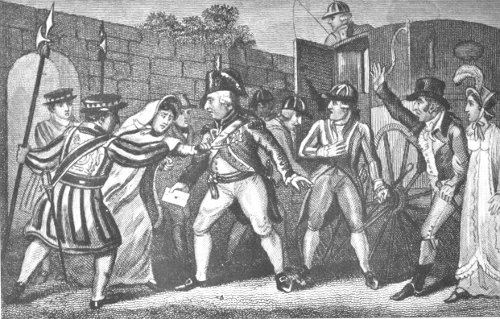
From an old print
THE KING'S LIFE ATTEMPTED
Thirteen years later, on October 29, 1795, on
his way to open Parliament, he was surrounded
by a violent mob, who threw stones into the
carriage, and demanded peace and the dismissal of
Pitt. Lord Onslow, who was with the King, has left
an account of the distressing incident. "Before
I sleep let me bless God for the miraculous
escape which my King, my country, and myself,
have had this day. Soon after two o'clock, his
Majesty, attended by the Earl of Westmoreland
and myself, set out for St. James's in his state
coach, to open the session of Parliament. The
multitude of people in the park was prodigious.
A sullen silence, I observed to myself, prevailed
through
the whole, very few individuals excepted.
No hats, or at least very few, pulled off; little or
no huzzaing, and frequently a cry of 'give us
bread': 'no war': and once or twice, 'no King'!
with hissing and groaning. My grandson Cranley,
who was on the King's guard, had told me, just
before we set out from St. James's that the park
was full of people who seemed discontented and
tumultuous, and that he apprehended insult
would be offered to the King. Nothing material,
however, happened, till we got down to the
narrowest part of the street called St. Margaret's,
between the two palace yards, when, the moment
we had passed the Office of Ordnance, and were
just opposite the parlour window of the house
adjoining it, a small ball, either of lead or marble,
passed through the window glass on the King's
right hand and perforating it, leaving a small hole,
the bigness of the top of my little finger (which I
instantly put through to mark the size), and passed
through the coach out of the other door, the glass
of which was down. We all instantly exclaimed,
'This is a shot!' The King showed, and I am
persuaded, felt no alarm; much less did he fear,
to which indeed he is insensible. We proceeded
to the House of Lords, when, on getting out of
the coach, I first, and the King immediately after,
said to the Lord Chancellor, who was at the bottom
of
the stairs to receive the King, 'My Lord, we
have been shot at.' The King ascended the
stairs, robed, and then perfectly free from the
smallest agitation, read his speech with peculiar
correctness, and even less hesitation than usual.
At his unrobing afterwards, when the event got
more known (I having told it to the Duke of York's
ear as I passed under the throne, and to the others
who stood near us), it was, as might be supposed,
the only topic of conversation, in which the King
joined with much less agitation than anybody
else. And afterwards, in getting into the coach,
the first words he said were, 'Well, my Lords, one
person is proposing this, and another is supposing
that, forgetting that there is One above us all who
disposes of everything, and on whom alone we
depend.' The magnanimity, piety, and good
sense of this, struck me most forcibly, and I shall
never forget the words.
"On our return home to St. James's, the mob
was increased in Parliament Street and Whitehall,
and when we came into the park, it was still
greater. It was said that not less than 100,000
people were there, all of the worst and lowest sort.
The scene opened, and the insulting abuse offered
to his Majesty was what I can never think of but
with horror, or ever forget what I felt, when they
proceeded to throw stones into the coach, several
of
which hit the King, which he bore with signal
patience, but not without sensible marks of
indignation and resentment at the indignities
offered to his person and office. The glasses were
all broken to pieces, and in this situation we were
during our passage through the park. The King
took one of the stones out of the cuff of his coat,
where it had lodged, and gave it to me, saying,
'I make you a present of this, as a mark of the
civilities we have met with on our journey
to-day.'"[270]
In connexion with this episode an accusation of
ingratitude was brought against the King. "Now
the tradition is," wrote Lady Jerningham, "that
at a certain critical moment, when the guards
had actually been pushed back or disorganized
for a while by a rush of the rabble, a gentleman
sprang forward in front of the carriage door, drew
on the assailants, threatening to kill forthwith
any one who approached nearer, and thus kept
the mob at bay sufficiently long to allow the
guards to rally round the coach, and prevent
further assault. The King inquired about 'the
name
of his rescuer,' and was informed that
it was Mr. Bedingfeld."[271] According to Lady
Jerningham, "no further notice was taken," but
this was not so, although there was some delay,
owing to Mr. Bedingfeld's sense of humour
offending a minister. The King instructed Dundas to
give his preserver an appointment of some profit,
and Dundas asked Bedingfeld what could be done
for him, to which question came the witty but
unfortunate reply: "The best thing, sir, you
can do for me is to make me a Scotchman."
Dundas angrily dismissed the humorist, but George,
after making frequent inquiries as to what had
been done, and each time receiving the reply that
no suitable position was vacant, at last said very
tartly: "Then, sir, you must make a situation
for him," and a new office with a salary of £650 a
year was created for Mr. Bedingfeld.
Twice more and on the same day, May 31, 1800,
was the King's life in danger. In the morning
he was present at a review of the Grenadier
Guards in Hyde Park, and during one of the
volleys of, presumedly, blank cartridge, a bullet
struck Mr. Ongley, a clerk in the Admiralty, who
was standing only a few paces from his Majesty.
It was never discovered, however, whether this
accident was deliberate or unintentional. George
visited
Drury Lane Theatre the same evening,
and the moment he appeared in his box, a man
in the pit near the orchestra discharged a pistol
at him. "It's only a squib, a squib; they are
firing squibs," he reassured the Queen as she
entered the box; and, when the man was removed,
"We will not stir," he added, "but stay the
entertainment out." "No man ever showed so
much courage as our good King's disregard of
his person, and confidence in the overshadowing
Providence on the pistol being fired," Lady
Jerningham wrote. "He went back one step
and whispered to Lord Salisbury: it is now known
that it was to endeavour to stop the Queen, for
that it was likely another shot would be fired, he
himself remaining at his post. The Queen,
however, arrived a moment after, and he then
said they had fired a squib."[272] When Sheridan said
to the King that after the shot he should have
left the box lest the man fired again, "I should
have despised myself for ever, had I but stirred a
single inch. A man on such an occasion should
need no prompting but immediately see what is
his duty," the latter rejoined; and indeed he had
his nerves so well under control that "he took
his accustomed doze of three or four minutes
between the conclusion of the play and the
commencement
of the farce, precisely as he would
have done on any other night."[273] "I am going
to bed with a confidence that I shall sleep soundly,"
he said later in the evening, "and my prayer is
that the poor unhappy person, who aimed at
my life, may rest as quietly as I shall." It was
à propos of this attempt that Sheridan at once
composed an additional verse for the Royal
Anthem, which was sung at the conclusion of the
performance.
"From every latent foe,
From the assassin's blow,
God save the King!
O'er him Thine arm extend;
For Britain's sake defend
Our father, Prince, and friend;
God save the King!"
In spite of these attacks, which had no
political significance, for the perpetrators, Margaret
Nicholson and James Hatfield, were mad, the King
would have no guards except on state occasions,
and when remonstrated with by a member of his
Court, "I very well know that any man who
chooses to sacrifice his own life may, whenever he
pleases take away mine, riding out, as I do
continually, with a single equerry or footman," he
said calmly. "I only hope that whoever may
attempt
it will not do it in a barbarous or brutal
manner."[274]
A king who could face death without a tremor
was not to be frightened by any demagogue.
"Though entirely confiding in your attachment
to my person, as well as in your hatred of every
lawless proceeding," he wrote to Lord North
on April 25, "yet I think it highly proper to apprise
you that the exclusion of Mr. Wilkes appears to
be very essential, and must be effected."[275]
The King's anger greatly handicapped ministers.
"The ministers are embarrassed to the last degree
how to act with regard to Wilkes," the Bishop of
Carlisle wrote to Grenville. "It seems they are
afraid to press the King for his pardon as that is a
subject his Majesty will not easily hear the least
mention of; and they are apprehensive, if he has
it not, that the mob of London will rise in his
favour."[276] When the City of London presented
an address, complaining of the arbitrary conduct
of the House of Commons, the King burst out
laughing and turned his back on the Lord Mayor.
A second deputation was treated in much the
same way, when the Lord Mayor, William
Beckford, replied to the King's abrupt reply with
an
impromptu speech, that was subsequently
inscribed on a monument erected in his honour
in the Guildhall. "Permit me, Sire, further to
observe that whosoever has already dared, or shall
hereafter endeavour, by false insinuations, and
suggestions, to alienate your Majesty's affections
from your loyal subjects in general, and from the
City of London in particular, is an enemy to
your Majesty's person and family, a violator of
the public peace, and a betrayer of our happy
constitution as it was established at the glorious
and necessary revolution."
While Wilkes was in prison his admirers paid
his debts, it is said, to the amount of £17,000, and
on his release on April 17, 1770, he was greeted
with as much enthusiasm as a king on his
coronation. "It seemed," as Heron remarked, "as
if the population of London and Middlesex were
the plebs of ancient Rome, and Wilkes a tribune."
The Common Council of the City elected him, in
quick succession, Alderman and Sheriff, and,
after the Court of Aldermen had twice selected
another candidate, he became Lord Mayor in
1774, the year that witnessed his return for the
fifth time as Member of Parliament for Middlesex,
"Thus," said Walpole, summing up the career of
this indomitable man, "after so much persecution
by the Court, after so many attempts upon
his
life, after a long imprisonment in gaol, after
all his own crimes and indiscretions, did this extraordinary
man, of more extraordinary fortune,
attain the highest office in so grave and important
a city as the capital of England, always reviving
the more opposed and oppressed, and unable
to shock Fortune, and make her laugh at him
who laughed at everybody and everything."
In the end, however, Wilkes made his peace
with the King, was received at Court, and became
somewhat of a courtier, declaring that himself had
never been a Wilkite. The strange spectacle of
the monarch and the demagogue engaged in
amicable conversation delighted Byron, who could
not miss so excellent an opportunity for humour.
"Since old scores are past
Must I turn evidence? In faith not I.
Besides, I beat him hollow at the last,
With all his Lords and Commons: in the sky.
I don't like ripping up old stories, since
His conduct was but natural in a prince.
Foolish, no doubt, and wicked, to oppress
A poor unlucky devil without a shilling;
But then I blame the man himself much less
Than Bute and Grafton, and shall be unwilling
To see him punished here for their excess,
Since they were both damn'd long ago, and still in
Their place below: for me, I have forgiven,
And vote his habeas corpus into Heaven."[277]
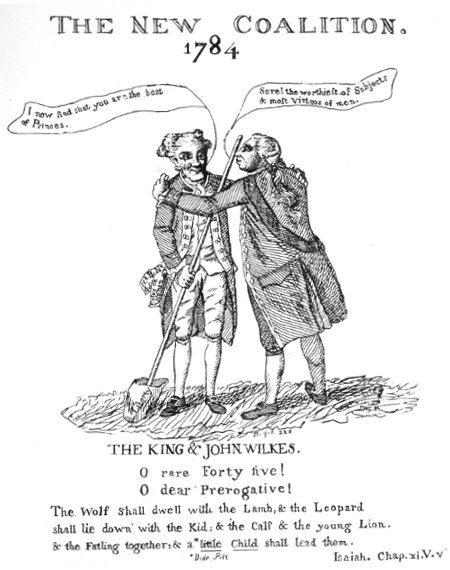
THE KING & JOHN WILKES.
O rare Forty five!
O dear Prerogative!
The Wolf shall dwell with the Lamb, & the Leopard
shall lie down with the Kid; & the Calf & the young Lion.
& the Fatling together: & a little Child
[A] shall lead them.
Isaiah. Chap. xi.V.v
THE RECONCILIATION