Q. If you were called on to take charge of a plant,
what would be your first duty?
A. To ascertain the exact condition of the boiler and
all its attachments (safety valve, steam gauge, pump, injector),
and engine.
Q. How often would you blow off and clean your
boilers if you had ordinary water to use?
A. Once a month.
Q. What steam pressure will be allowed on a boiler
50 inches diameter ⅜ inch thick, 60,000 T. S. 1-6 of
tensile strength factor of safety?
A. One-sixth of tensile strength of plate multiplied
by thickness of plate, divided by one-half of the diameter
of boiler, gives safe working pressure.
Q. How much heating surface is allowed per horse
power by builders of boilers?
A. Twelve to fifteen feet for tubular and flue boilers.
Q. How do you estimate the strength of a boiler?
A. By its diameter and thickness of metal.
Q. Which is the better, single or double riveting?
A. Double riveting is from sixteen to twenty per cent
stronger than single.
Q. How much grate surface do boiler makers allow
per horse power?
A. About two-thirds of a square foot.
Q. Of what use is a mud drum on a boiler, if any?
A. For collecting all the sediment of the boiler.
Q. How often should it be blown out?
A. Three or four times a day.
Q. Of what use is a steam dome on a boiler?
A. For storage of dry steam.
Q. What is the object of a safety valve on a boiler?
A. To relieve pressure.
Q. What is your duty with reference to it?
A. To raise it twice a day and see that it is in good
order.
Q. What is the use of check valve on a boiler?
A. To prevent water from returning back into pump
or injector which feeds the boiler.
Q. Do you think a man-hole in the shell on top of a
boiler weakens it any?
A. Yes, to a certain extent.
Q. What effect has cold water on hot boiler plates?
A. It will fracture them.
Q. Where should the gauge cock be located?
A. The lowest gauge cock ought to be placed about
an inch and a half above the top row of flues.
Q. How would you have your blow-off located?
A. In the bottom of mud-drum or boiler.
Q. How would you have your check valve arranged?
A. With a stop cock between check and boiler.
Q. How many valves are there in a common plunger
force pump?
A. Two or more—a receiving and a discharge valve.
Q. How are they located?
A. One on the suction side, the other on the discharge.
Q. How do you find the proper size of safety valves
for boilers?
A. Three square feet of grate surface is allowed for
one inch area of spring loaded valves; or two square
feet of grate surface to one inch area of common lever
valves.
Q. Give the reasons why pumps do not work sometimes?
A. Leak in suction, leak around the plunger, leaky
check valve, or valves out of order, or lift too long.
Q. How often ought boilers to be thoroughly examined
and tested?
A. Twice a year.
Q. How would you test them?
A. With hammer and with hydrostatic test, using
warm water.
Q. Describe the single acting plunger pump; how it
gets and discharges its water?
A. The plunger displaces the air in the water pipe,
causing a vacuum which is filled by the atmosphere forcing
the water therein; the receiving valve closes and the
plunger forces the water out through the discharge
valve.
Q. What is the most economical boiler-feeder?
A. The (Trix) Exhaust Injector.8
Q. What economy is there in the Exhaust Injector?
A. From 15 to 25 per cent saving in fuel.
Q. Where is the best place to enter the boiler with
the feed water?
A. Below the water level, but so that the cold water
can not strike hot plates. If injector is used this is not
so material as feed water is always hot.
Q. What are the principal causes of priming in boilers?
A. To high water, not steam room enough, misconstruction,
engine too large for boiler.
Q. How do you keep boilers clean or remove scale
therefrom?
A. The best “scale solvent” and “feed water purifier”
is an honest, intelligent engineer who will regularly open
up his boilers and clean them thoroughly, soaking boilers
in rain water now and then.
Q. If you found a thin plate, what would you do?
A. Put a patch on it.
Q. Would you put it on the inside or outside?
A. Inside.
Q. Why so?
A. Because the action that has weakened the plate
will then set on the patch, and when this is worn it can be
repeated.
Q. If you found several thin places, what would you
do?
A. Patch each and reduce the pressure.
Q. If you found a blistered plate?
A. Put a patch on the fire side.
Q. If you found a plate on the bottom buckled?
A. Put a stay through the center of buckle.
Q. If you found several of the plates buckled?
A. Stay each and reduce the pressure.
Q. What is to be done with a cracked plate?
A. Drill a hole at each end of crack, caulk the crack
and put a patch over it.
Q. How do you change the water in the boiler when
the steam is up?
A. By putting on more feed and opening the surface
blow cock.
Q. If the safety valve was stuck how would you relieve
the pressure on the boiler if the steam was up and
could not make its escape?
A. Work the steam off with engine after covering fires
heavy with coal or ashes, and when the boiler is sufficiently
cool put safety valve in working order.
Q. If water in boiler is suffered to get too low, what
may be the result?
A. Burn top of combustion chamber and tubes, perhaps
cause an explosion.
Q. If water is allowed to get too high, what result?
A. Cause priming, perhaps cause breaking of cylinder
covers or heads.
Q. What are the principal causes of foaming in boilers?
A. Dirty and impure water.
Q. How can foaming be stopped?
A. Close throttle and keep closed long enough to
show true level of water. If that level is sufficiently high,
feeding and blowing off will usually suffice to correct
the evil.
Q. What would you do if you should find your water
gone from sight very suddenly?
A. Draw the fires and cool off as quickly as possible.
Never open or close any outlets of steam when your water
is out of sight.
Q. What precautions should you take to blow down
a part of the water in your boiler while running with a
good fire?
A. Never leave the blow-off valve, and watch the
water level.
Q. How much water would you blow off at once while
running?
A. Never blow off more than one gauge of water at
a time while running.
Q. What general views have you in regard to boiler
explosions—what is the greatest cause?
A. Ignorance and neglect are the greatest causes of
boiler explosions.
Q. What precaution should the engineer take when
necessary to stop with heavy fires?
A. Close dampers, put on injector or pump and if a
bleeder is attached, use it.
Q. Where is the proper water level in boilers?
A. A safe water level is about two and a half inches
over top row of flues.
Q. What is an engineer’s first duty on entering the
boiler room?
A. To ascertain the true water level.
Q. When should a boiler be blown out?
A. After it is cooled off, never while hot.
Q. When laying up a boiler what should be done?
A. Clean thoroughly inside and out; remove all oxidation
and paint places with red lead; examine all stays
and braces to see if any are loose or badly worn.
Q. What is the last thing to do at night before leaving
plant?
A. Look around for greasy waste, hot coals, matches,
or anything which could fire the building.
Q. What would you do if you had a plant in good
working order?
A. Keep it so, and let well enough alone.
Q. Of what use is the indicator?
A. The indicator is used to determine the indicated
power developed by an engine, to serve as a guide in
setting valves and showing the action of the steam in
the cylinder.
Q. How would you increase the power of an engine?
A. To increase the power of an engine, increase the
speed; or get higher pressure of steam, use less expansion.
Q. How do you find the horsepower of an engine?
A. Multiply the speed of piston in feet per minute
by the total effective pressure upon the piston in pounds
and divide the product by 33,000.
Q. Which has the most friction, a perfectly fitted, or
an imperfectly fitted valve or bearing?
A. An imperfect one.
Q. How hot can you get water under atmospheric
pressure with exhaust steam?
A. 212 degrees.
Q. Does pressure have any influence on the boiling
point?
A. Yes.
Q. Which do you think is the best economy, to run
with your throttle wide open or partly shut?
A. Always have the throttle wide open on a governor
engine.
Q. At what temperature has iron the greatest tensile
strength?
A. About 600 degrees.
Q. In what position on the shaft does the eccentric
stand in relation to the crank?
A. The throw of the eccentric should always be in
advance of the crank pin.
Q. About how many pounds of water are required to
yield one horsepower with our best engines?
A. From 25 to 30.
Q. What is meant by atmospheric pressure?
A. The weight of the atmosphere.
Q. What is the weight of atmosphere at sea level?
A. 14.7 pounds.
Q. What is the coal consumption per hour per indicated
horsepower?
A. Varies from one and a half to seven pounds.
Q. What is the consumption of coal per hour on a
square foot of grate surface?
A. From 10 to 12 pounds.
Q. What is the water consumption in pounds per
hour per indicated horsepower?
A. From 25 to 60 pounds.
Q. How many pounds of water can be evaporated
with one pound of best soft coal?
A. From 7 to 10 pounds.
Q. How much steam will one cubic inch of water
evaporate under atmospheric pressure?
A. One cubic foot of steam (approximately).
Q. What is the weight of a cubic foot of fresh water?
A. Sixty-two and a half pounds.
Q. What is the weight of a cubic foot of iron?
A. 486.6 pounds.
Q. What is the weight of a square foot of one-half
inch boiler plate?
A. 20 pounds.
Q. How much wood equals one ton of soft coal for
steam purposes?
A. About 4,000 pounds of wood.
Q. How long have you run engines?
Q. Have you ever done your own firing?
Q. What is the source of all power in the steam engine?
A. The heat stored up in the coal.
Q. How is the heat liberated from the coal?
A. By burning it; that is, by combustion.
Q. Of what does coal consist?
A. Carbon, hydrogen, nitrogen, sulphur, oxygen and
ash.
Q. What are the relative proportions of these that
enter into coal?
A. There are different proportions in different specimens
of coal, but the following shows the average per
cent: Carbon, 80; hydrogen, 5; nitrogen, 1; sulphur, 2;
oxygen, 7; ash, 5.
Q. What must be mixed with coal before it will
burn?
A. Atmospheric air.
Q. What is air composed of?
A. It is composed of nitrogen and oxygen in the proportion
of 77 of nitrogen to 23 of oxygen.
Q. What parts of the air mix with what parts of the
coal?
A. The oxygen of the air mixes with the carbon and
hydrogen of the coal.
Q. How much air must mix with the coal?
A. 150 cubic feet of air for every pound of coal.
Q. How many pounds of air are required to burn one
pound of carbon?
A. Twelve.
Q. How many pounds of air are required to burn one
pound of hydrogen?
A. Thirty-six.
Q. Is hydrogen hotter than carbon?
A. Yes, four and one-half times hotter.
Q. What part of the coal gives out the most heat?
A. The hydrogen does part for part, but as there is
so much more of carbon than hydrogen in the coal we
get the greatest amount of heat from carbon.
Q. In how many different ways is heat transmitted?
A. Three; by radiation, by conduction and by convection.
Q. If the fire consisted of glowing fuel, show how
the heat enters the water and forms steam?
A. The heat from the glowing fuel passes by radiation
through the air space above the fuel to the furnace
crown. There it passes through the iron of the crown
by conduction. There it warms the water resting on the
crown, which then rises and parts with its heat to the
colder water by conduction till the whole mass of water
is heated. Then the heated water rises to the surface and
parts with its steam, so a constant circulation of water is
maintained by convection.
Q. What does water consist of?
A. Oxygen and hydrogen.
Q. In what proportion?
A. Eight of oxygen to one of hydrogen by weight.
Q. What are the different kinds of heat?
A. Latent heat, sensible heat and sometimes total
heat.
Q. What is meant by latent heat?
A. Heat that does not affect the thermometer and
which expands itself in changing the nature of a body,
such as turning ice into water or water into steam.
Q. Under what circumstances do bodies get latent
heat?
A. When they are passing from a solid state to a
liquid or from a liquid to a gaseous state.
Q. How can latent heat be recovered?
A. By bringing the body back from a state of gas
to a liquid or from that of a liquid to that of a solid.
Q. What is meant by a thermal unit?
A. The heat necessary to raise one pound of water
at 39 degrees Fn. 1 degree Fahrenheit.
Q. If the power is in coal, why should we use steam?
A. Because steam has some properties which make it
an invaluable agent for applying the energy of the heat
to the engine.
Q. What is steam?
A. It is an invisible elastic gas generated from water
by the application of heat.
Q. What are its properties which make it so valuable
to us?
A. 1.—The ease with which we can condense it.
2.—Its great expansive power. 3.—The small space it
occupies when condensed.
Q. Why do you condense the steam?
A. To form a vacuum and so destroy the back pressure
that would otherwise be on the piston and thus get
more useful work out of the steam.
Q. What is vacuum?
A. A space void of all pressure.
Q. How do you maintain a vacuum?
A. By the steam used being constantly condensed
by the cold water or cold tubes, and the air pump as
constantly clearing the condenser out.
Q. Why does condensing the used steam form a
vacuum?
A. Because a cubic foot of steam, at atmospheric
pressure, shrinks into about a cubic inch of water.
Q. What do you understand by the term horse
power?
A. A horse power is equivalent to raising 33,000
pounds one foot per minute, or 550 pounds raised one
foot per second.
Q. How do you calculate the horse power of tubular
or flue boilers?
A. For tubular boilers, multiply the square of the
diameter by length, and divide by four. For flue boilers,
multiply the diameter by the length and divide by
four; or, multiply area of grate surface in square feet
by 1½.
Q. What do you understand by lead on an engine’s
valve?
A. Lead on a valve is the admission of steam into
the cylinder before the piston completes its stroke.
Q. What is the clearance of an engine as the term is
applied at the present time?
A. Clearance is the space between the cylinder head
and the piston head with the ports included.
Q. What are considered the greatest improvements
on the stationary engine in the last forty years?
A. The governor, the Corliss valve gear and the
triple compound expansion.
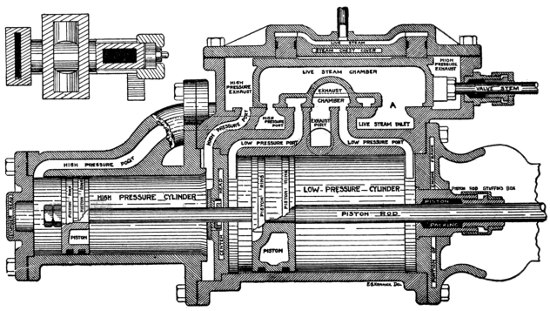
Q. What is meant by triple expansion engine?
A. A triple expansion engine has three cylinders
using the steam expansively in each one.
Q. What is a condenser as applied to an engine?
A. The condenser is a part of the low pressure engine
and is a receptacle into which the exhaust enters and is
there condensed.
Q. What are the principles which distinguish a high
pressure from a low pressure engine?
A. Where no condenser is used and the exhaust
steam is open to the atmosphere.
Q. About how much gain is there by using the condenser?
A. 17 to 25 per cent where cost of water is not figured.
Q. What do you understand by the use of steam expansively?
A. Where steam admitted at a certain pressure is
cut off and allowed to expand to a lower pressure.
Q. How many inches of vacuum give the best results
in a condensing engine?
A. Usually considered 25.
Q. What is meant by a horizontal tandem engine?
A. One cylinder being behind the other with two
pistons on same rod.
Q. What is a Corliss valve gear?
A. (Describe the half moon or crab claw gear, or
oval arm gear with dash pots.)
Q. From what cause do belts have the power to
drive shafting?
A. By friction or cohesion.
Q. What do you understand by lap?
A. Outside lap is that portion of valve which extends
beyond the ports when valve is placed on the
center of travel, and inside lap is that portion of valve
which projects over the ports on the inside or towards
the middle of valve.
Q. What is the use of lap?
A. To give the engine compression.
Q. Where is the dead center of an engine?
A. The point where the crank and the piston rod
are in the same right line.
Q. What is the tensile strength of American boiler
iron?
A. 40,000 to 60,000 pounds per square inch.
Q. What is very high tensile strength in boiler iron
apt to go with?
A. Lack of homogeneousness and lack of toughness.
Q. What is the advantage of toughness in boiler
plate?
A. It stands irregular strains and sudden shocks better.
Q. What are the principal defects found in boiler
iron?
A. Imperfect welding, brittleness, low ductility.
Q. What are the advantages of steel as a material
for boiler plates?
A. Homogeneity, tensile strength, malleability, ductility
and freedom from laminations and blisters.
Q. What are the disadvantages of steel as a material
for boiler plates?
A. It requires greater skill in working than iron,
and has, as bad qualities, brittleness, low ductility and
flaws induced by the pressure of gas bubbles in the ingot.
Q. When would you oil an engine?
A. Before starting it and as often while running as
necessary.
Q. How do you find proper size of any stay bolts
for a well made boiler?
A. First, multiply the given steam pressure per
square inch by the square of the distance between centers
of stay bolts, and divide the product by 6,000, and
call the answer “the quotient.” Second, divide “the quotient”
by .7854, and extract the square root of the last
quotient; the answer will give the required diameter of
stay bolts at the bottom of thread.
Q. In what position would you place an engine, to
take up any slack motion of the reciprocating parts?
A. Place engine in the position where the least wear
takes place on the journals. That is, in taking up the
wear of the crank-pin brasses, place the engine on either
dead center, as, when running, there is but little wear
upon the crank-pin at these points. If taking up the
cross-head pin brasses—without disconnecting and swinging
the rod—place the engine at half stroke, which is the
extreme point of swing of the rod, there being the least
wear on the brasses and cross-head pin in this position.
Q. What benefits are derived by using flywheels on
steam engines?
A. The energy developed in the cylinder while the
steam is doing its work is stored up in the flywheel, and
given out by it while there is no work being done in the
cylinder—that is, when the engine is passing the dead
centers. This tends to keep the speed of the engine shaft
steady.
Q. Name several kinds of reducing motions, as used
in indicator practice?
A. The pantograph, the pendulum, the brumbo pulley,
the reducing wheel.
Q. How can an engineer tell from an indicator diagram
whether the piston or valves are leaking?
A. Leaky steam valves will cause the expansion curve
to become convex; that is, it will not follow hyperbolic
expansion, and will also show increased back pressure.
But if the exhaust valves leak also, one may offset the
other, and the indicator diagram would show no leak.
A leaky piston can be detected by a rapid falling in
the pressure on the expansion curve immediately after
the point of cut-off. It will also show increased back
pressure.
A falling in pressure in the upper portion of the compression
curve shows a leak in the exhaust valve.
Q. What would be the best method of treating a
badly scaled boiler, that was to be cleaned by a liberal
use of compound?
A. First open the boiler up and note where the loose
scale, if any, has lodged. Wash out thoroughly and put
in the required amount of compound. While the boiler
is in service, open the blow-off valve for a few seconds,
two or three times a day, to be assured that it does not
become stopped up with scale.
After running the boiler for a week, shut it down, and,
when the pressure is down and the boiler cooled off,
run the water out and take off the hand-hole plates. Note
what effect the compound has had on the scale, and where
the disengaged scale has lodged. Wash out thoroughly
and use judgment as to whether it is advisable to use a
less or greater quantity of compound, or to add a small
quantity daily.
Continue the washing out at short intervals, as many
boilers have been burned by large quantities of scale
dropping on the crown sheets and not being removed.
Q. If a condenser was attached to a side-valve engine,
that had been set to run non-condensing, what
changes, if any, would be necessary?
A. More lap would have to be added to the valve to
cut off the steam at an earlier point of the stroke; if not,
the initial pressure into the cylinder would be throttled
down and the economy, to be gained from running condensing,
lessened.
Q. If you are carrying a vacuum equal to 27½ inches
of mercury, what should the temperature of the water
in the hot well be?
A. 108 degrees Fahrenheit.
Q. Define specific gravity.
A. The specific gravity of a substance is the number
which expresses the relation between the weights of equal
volume of that substance, and distilled water of 60 degrees
Fahrenheit.
Q. Find the specific gravity of a body whose volume
is 12 cubic inches, and which floats in water with 7 cubic
inches immersed.
A. When a body floats in water, it displaces a quantity
of water equal to the weight of the floating body.
Thus, if a body of 12 cubic inches in volume floats with
7 cubic inches immersed, 7 cubic inches of water must
be equal in weight to 12 cubic inches of the substance
and one cubic inch of water to twelve-sevenths cubic
inches of the substance.
As specific gravity equals weight of one volume of
substance divided by weight of equal volume of water,
then specific gravity of the substance in this case equals
1 divided by twelve-sevenths.
To find circumference of a circle, multiply diameter
by 3.1416.
To find diameter of a circle, multiply circumference
by .31831.
To find area of a circle multiply square of diameter
by .7854.
To find area of a triangle, multiply base by one-half
the perpendicular height.
To find surface of a ball, multiply square of diameter
by 3.1416.
To find solidity of a sphere, multiply cube of diameter
by .5236.
To find side of an equal square, multiply diameter by
.8862.
To find cubic inches in a ball multiply cube of diameter
by .5236.
Doubling the diameter of a pipe increases its capacity
four times.
A gallon of water (U. S. standard) weighs 8 1-3
pounds and contains 231 cubic inches.
A cubic foot of water contains 7½ gallons, 1728 cubic
inches, and weighs 62½ pounds.
To find the pressure in pounds per square inch of a
column of water multiply the height of the column in
feet by .434.
Steam rising from water at its boiling point (212 degrees)
has a pressure equal to the atmosphere (14.7
pounds to the square inch).
A standard horse power: The evaporation of 30 lbs.
of water per hour from a feed water temperature of 100
degrees F. into steam at 70 lbs. gauge pressure.
To find capacity of tanks any size; given dimensions
of a cylinder in inches, to find its capacity in U. S. gallons:
Square the diameter, multiply by the length and
by .0034.
To ascertain heating surface in tubular boilers, multiply
two-thirds of the circumference of boiler by length
of boiler in inches and add to it the area of all the tubes.
One-sixth of tensile strength of plate multiplied by
thickness of plate and divided by one-half the diameter
of boiler gives safe working pressure for tubular boilers.
For marine boilers add 20 per cent for drilled holes.
To find the horsepower of an engine, the following
four factors must be considered: Mean effective or average
pressure on the cylinder, length of stroke, diameter
of cylinder, and number of revolutions per minute.
Find the area of the piston in square inches by multiplying
the diameter by 3.1416 and multiply the result
by the steam pressure in pounds per square inch; multiply
this product by twice the product of the length of
the stroke in feet and the number of revolutions per
minute; divide the result by 33,000, and the result will
be the horsepower of the engine.
(Theoretically a horsepower is a power that will raise
33,000 pounds one foot in one minute.)
The power of fuel is measured theoretically from the
following basis: If a pound weight fall 780 feet in a
vacuum, it will generate heat enough to raise the temperature
of one pound of water one degree. Conversely,
power that will raise one pound of water one degree in
temperature will raise a one pound weight 780 feet.
The heat force required to turn a pound of water at 32
degrees into steam would lift a ton weight 400 feet high,
or develop two-fifths of one horsepower for an hour.
The best farm engine practically uses 35 pounds of water
per horsepower per hour, showing that one pound of
water would develop only one-thirty-fifth of a horsepower
in an hour, or 7 1-7 per cent of the heat force
liberated. The rest of the heat force is lost in various
ways, as explained in the body of this book.
The following9 will assist in determining the amount
of power supplied to an engine:
“For instance, a 1-inch belt of the standard grade with
the proper tension, neither too tight or too loose, running
at a maximum speed of 800 feet a minute will
transmit one horsepower, running 1,600 feet two horsepower
and 2,400 feet three horsepower. A 2-inch belt
at the same speed, twice the power.
“Now if you know the circumference of your flywheel,
the number of revolutions your engine is making and
the width of belt, you can figure very nearly the amount
of power you can supply without slipping your belt. For
instance, we will say your flywheel is 40 inches in diameter
or 10.5 feet nearly in circumference and your engine
was running 225 revolutions a minute, your belt would
be traveling 225×10.5 feet = 2362.5 feet, or very nearly
2,400 feet, and if one inch of belt would transmit three
horsepower running this speed, a 6-inch belt would
transmit eighteen horsepower, a 7-inch belt twenty-one
horsepower, an 8-inch belt twenty-four horsepower,
and so on. With the above as a basis for figuring you
can satisfy yourself as to the power you are furnishing.
To get the best results a belt wants to sag slightly, as it
hugs the pulley closer, and will last much longer.”
A key must be of equal width its whole length and
accurately fit the seats on shaft and in pulley. The thickness
should vary enough to make the taper correspond
with that of the seat in the pulley. The keys should be
driven in tight enough to be safe against working loose.
The hubs of most of the pulleys on the machine run
against the boxes, and in keying these on, about 1-32
of an inch end play to the shaft should be allowed, because
there is danger of the pulley rubbing so hard
against the end of the box as to cause it to heat.
A key that is too thin but otherwise fits all right can
be made tight by putting a strip of tin between the key
and the bottom of the seat in the pulley.
Drawing Keys. If a part of the key stands outside of
the hub, catch it with a pair of horseshoe pinchers and
pry with them against the hub, at the same time hitting
the hub with a hammer so as to drive pulley on. A key
can sometimes be drawn by catching the end of it with
a claw hammer and driving on the hub of pulley. If
pulley is against box and key cut off flush with hub, take
the shaft out and use a drift from the inside, or if seat
is not long enough to make this possible, drive the pulley
on until the key loosens.
To babbitt any kind of a box, first chip out all of the
old babbitt and clean the shaft and box thoroughly with
benzine. This is necessary or gas will be formed from
the grease when the hot metal is poured in and leave
“blow holes.” In babbitting a solid box cover the shaft
with paper, draw it smooth and tight, and fasten the
lapped ends with mucilage. If this is not done the shrinkage
of the metal in cooling will make it fast on the shaft,
so that it can’t be moved. If this happened it would be
necessary to put the shaft and box together in the fire
and melt the babbitt out or else break the box to get it
off. Paper around the shaft will prevent this and if
taken out when the babbitt has cooled the shaft will be
found to be just tight enough to run well.
Before pouring the box, block up the shaft until it is
in line and in center of the box and put stiff putty around
the shaft and against the ends of the box to keep the
babbitt from running out. Be sure to leave air-holes at
each end at the top, making a little funnel of putty
around each. Also make a larger funnel around the
pouring hole, or, if there is none, enlarge one of the air-holes
at the end and pour in that. The metal should be
heated until it is just hot enough to run freely and the
fire should not be too far away. When ready to pour
the box, don’t hesitate or stop, but pour continuously
and rapidly until the metal appears at the air holes. The
oil hole may be stopped with a wooden plug and if this
plug extends through far enough to touch the shaft, it
will leave a hole through the babbitt so that it will not
be necessary to drill one.
A split box is babbitted in the same manner except
that strips of cardboard or sheet-iron are placed between
the two halves of the box and against the shaft to divide
the babbitt. To let the babbitt run from the upper half
to the lower, cut four or six V-shaped notches, a quarter
of an inch deep, in the edges of the sheet-iron or cardboard
that come against the shaft. Cover the shaft with
paper and put cardboard liners between the box to allow
for adjustment as it wears. Bolt the cap on securely
before pouring. When the babbitt has cooled, break the
box apart by driving a cold chisel between the two halves.
Trim off the sharp edges of the babbitt and with a round-nose
chisel cut oil grooves from the oil hole towards the
ends of the box and on the slack side of the box or the
one opposite to the direction in which the belt pulls.
The ladle should hold six or eight pounds of metal.
If much larger it is awkward to handle and if too small
it will not keep the metal hot long enough to pour a good
box. The cylinder boxes on the separator take from
two to three pounds of metal each. If no putty is at
hand, clay mixed to the proper consistency may be used.
Use the best babbitt you can get for the cylinder boxes.
If not sure of the quality, use ordinary zinc. It is not
expensive and is generally satisfactory.
Lime may be taken out of an injector by soaking it
over night in a mixture of one part of muriatic acid
and ten parts soft water. If a larger proportion of acid
is used it is likely to spoil the injector.
A good blacking for boilers and smokestacks is asphaltum
dissolved in turpentine.
To polish brass, dissolve 5 cents’ worth of oxalic acid
in a pint of water and use to clean the brass. When
tarnish has been removed, dry and polish with chalk
or whiting.
It is said that iron or steel will not rust if it is placed
for a few minutes in a warm solution of washing soda.
Grease on the bottom of a boiler will stick there and
prevent the water from conducting away the heat. When
steel is thus covered with grease it will soon melt in a
hot fire, causing a boiler to burst if the steel is poor, or
warping it out of shape if the steel is good.
Sulphate of lime in water, causing scale, may be counteracted
and scale removed by using coal oil and sal
soda. When water contains carbonate of lime, molasses
will remove the scale.
One short sound means to stop.
Two short sounds means the engine is about to begin
work.
Three medium short sounds mean that the machine
will soon need grain and grain haulers should hurry.
One rather long sound followed by three short ones
means the water is low and water hauler should hurry.
A succession of short, quick whistles means distress
or fire.
The following table gives the number of pounds per
bushel required by law or custom in the sale of grain
in the several states:
| |
Barley. |
Beans. |
Buckwheat. |
Clover. |
Flax. |
Millet. |
Oats. |
Rye. |
Shelled Corn. |
Timothy. |
Wheat. |
| Arkansas |
48 |
60 |
52 |
60 |
.. |
.. |
.. |
56 |
56 |
45 |
60 |
| California |
50 |
.. |
40 |
.. |
.. |
.. |
32 |
54 |
52 |
.. |
60 |
| Connecticut |
.. |
.. |
45 |
.. |
.. |
.. |
32 |
56 |
56 |
.. |
56 |
| District of Columbia |
47 |
62 |
48 |
60 |
.. |
.. |
32 |
56 |
56 |
45 |
60 |
| Georgia |
40 |
.. |
.. |
60 |
.. |
.. |
35 |
56 |
56 |
45 |
60 |
| Illinois |
48 |
60 |
52 |
60 |
56 |
45 |
32 |
56 |
56 |
.. |
60 |
| Indiana |
48 |
60 |
50 |
60 |
.. |
.. |
32 |
56 |
56 |
45 |
60 |
| Iowa |
48 |
60 |
52 |
60 |
56 |
48 |
32 |
56 |
56 |
45 |
60 |
| Kansas |
50 |
60 |
50 |
.. |
.. |
.. |
32 |
56 |
56 |
45 |
60 |
| Kentucky |
48 |
60 |
52 |
60 |
56 |
.. |
32 |
56 |
56 |
45 |
60 |
| Louisiana |
32 |
.. |
.. |
.. |
.. |
.. |
32 |
.. |
56 |
.. |
60 |
| Maine |
48 |
64 |
48 |
.. |
.. |
.. |
30 |
.. |
56 |
.. |
60 |
| Manitoba |
48 |
.. |
48 |
60 |
56 |
34 |
.. |
56 |
56 |
.. |
60 |
| Maryland |
48 |
64 |
48 |
.. |
.. |
.. |
32 |
56 |
56 |
45 |
60 |
| Massachusetts |
48 |
48 |
.. |
.. |
.. |
.. |
32 |
56 |
56 |
.. |
60 |
| Michigan |
48 |
.. |
48 |
60 |
56 |
.. |
32 |
56 |
56 |
45 |
60 |
| Minnesota |
48 |
60 |
42 |
60 |
.. |
48 |
32 |
56 |
56 |
.. |
60 |
| Missouri |
48 |
60 |
52 |
60 |
56 |
50 |
32 |
56 |
56 |
45 |
60 |
| Nebraska |
48 |
60 |
52 |
60 |
.. |
.. |
34 |
56 |
56 |
45 |
60 |
| New York |
48 |
62 |
48 |
60 |
.. |
.. |
32 |
56 |
58 |
44 |
60 |
| New Jersey |
48 |
.. |
50 |
64 |
.. |
.. |
30 |
56 |
56 |
.. |
60 |
| New Hampshire |
.. |
60 |
.. |
.. |
.. |
.. |
30 |
56 |
56 |
.. |
60 |
| North Carolina |
48 |
.. |
50 |
64 |
.. |
.. |
30 |
56 |
54 |
.. |
60 |
| North Dakota |
48 |
.. |
42 |
60 |
56 |
.. |
32 |
56 |
56 |
.. |
60 |
| Ohio |
48 |
60 |
50 |
60 |
.. |
.. |
32 |
50 |
56 |
45 |
60 |
| Oklahoma |
48 |
.. |
42 |
60 |
56 |
.. |
32 |
56 |
56 |
.. |
60 |
| Oregon |
46 |
.. |
42 |
60 |
.. |
.. |
36 |
56 |
56 |
.. |
60 |
| Pennsylvania |
47 |
.. |
48 |
62 |
.. |
.. |
30 |
56 |
56 |
.. |
60 |
| South Dakota |
48 |
.. |
52 |
60 |
56 |
50 |
32 |
56 |
56 |
.. |
60 |
| South Carolina |
48 |
60 |
56 |
60 |
.. |
.. |
33 |
56 |
56 |
.. |
60 |
| Vermont |
48 |
64 |
48 |
.. |
60 |
.. |
32 |
56 |
56 |
42 |
60 |
| Virginia |
48 |
60 |
48 |
64 |
.. |
.. |
32 |
56 |
56 |
45 |
60 |
| West Virginia |
48 |
60 |
52 |
60 |
.. |
.. |
32 |
56 |
56 |
45 |
60 |
| Wisconsin |
48 |
.. |
48 |
60 |
.. |
.. |
32 |
56 |
56 |
.. |
60 |

![[enlarge]](images/i_032-large.jpg)
![[enlarge]](images/i_051-large.jpg)
![[enlarge]](images/i_125-large.jpg)
![[enlarge]](images/i_147-large.jpg)
![[enlarge]](images/i_160-large.jpg)