When Jason, the son of the dethroned King of Iolchos, was
a little boy, he was sent away from his parents and placed
under the queerest schoolmaster that ever you heard of. This
learned person was one of the people, or quadrupeds, called
Centaurs. He lived in a cavern, and had the body and legs
of a white horse, with the head and shoulders of a man. His
name was Chiron; and in spite of his odd appearance, he was
a very excellent teacher and had several scholars who afterward
did him credit by making a great figure in the world.
The famous Hercules was one, and so was Achilles, and
Philoctetes likewise, and Æsculapius, who acquired immense
repute as a doctor. The good Chiron taught his pupils how
to play upon the harp, and how to cure diseases, and how to
use the sword and shield, together with various other branches
of education in which the lads of those days used to be instructed
instead of writing and arithmetic.
I have sometimes suspected that Master Chiron was not
really very different from other people, but that, being a
kind-hearted and merry old fellow, he was in the habit of
making believe that he was a horse, and scrambling about
the schoolroom on all fours and letting the little boys ride
upon his back. And so, when his scholars had grown up and
grown old and were trotting their grandchildren on their
knees, they told them about the sports of their school-days;
and these young folks took the idea that their grandfathers
had been taught their letters by a Centaur, half man and half
horse. Little children, not quite understanding what is said
to them, often get such absurd notions into their heads, you
know.
Be that as it may, it has always been told for a fact (and
always will be told, as long as the world lasts) that Chiron,
with the head of a schoolmaster, had the body and legs of a
horse. Just imagine the grave old gentleman clattering and
stamping into the schoolroom on his four hoofs, perhaps
treading on some little fellow's toes, flourishing his switch
tail instead of a rod and now and then trotting out of doors
to eat a mouthful of grass! I wonder what the blacksmith
charged him for a set of iron shoes.
So Jason dwelt in the cave, with this four-footed Chiron
from the time that he was an infant only a few months old,
until he had grown to the full height of a man. He became a
very good harper, I suppose, and skilful in the use of weapons
and tolerably acquainted with herbs and other doctor's stuff,
and above all, an admirable horseman; for, in teaching young
people to ride, the good Chiron must have been without a
rival among schoolmasters. At length, being now a tall and
athletic youth, Jason resolved to seek his fortune in the
world without asking Chiron's advice or telling him anything
about the matter. This was very unwise, to be sure; and I
hope none of you, my little hearers, will ever follow Jason's
example. But, you are to understand, he had heard how that
he himself was a prince royal, and how his father, King Æson,
had been deprived of the kingdom of Iolchos by a certain
Pelias, who would also have killed Jason had he not been
hidden in the Centaur's cave. And being come to the strength
of a man, Jason determined to set all this business to rights
and to punish the wicked Pelias for wronging his dear father,
and to cast him down from the throne and seat himself there
instead.
With this intention he took a spear in each hand and threw
a leopard's skin over his shoulders to keep off the rain, and set
forth on his travels, with his long yellow ringlets waving in
the wind. The part of his dress on which he most prided
himself was a pair of sandals that had been his father's.
They were handsomely embroidered and were tied upon his
feet with strings of gold. But his whole attire was such as
people did not very often see; and as he passed along, the
women and children ran to the doors and windows, wondering
whither this beautiful youth was journeying, with his leopard's
skin and his golden-tied sandals, and what heroic deeds he
meant to perform, with a spear in his right hand and another
in his left.
I know not how far Jason had traveled when he came to
a turbulent river, which rushed right across his pathway
with specks of white foam along its black eddies, hurrying
tumultuously onward and roaring angrily as it went. Though
not a very broad river in the dry seasons of the year, it was
now swollen by heavy rains and by the melting of the snow on
the sides of Mount Olympus; and it thundered so loudly and
looked so wild and dangerous that Jason, bold as he was,
thought it prudent to pause upon the brink. The bed of
the stream seemed to be strewn with sharp and rugged rocks,
some of which thrust themselves above the water. By and
by an uprooted tree, with shattered branches, came drifting
along the current and got entangled among the rocks. Now
and then a drowned sheep and once the carcass of a cow
floated past.
In short, the swollen river had already done a great deal of
mischief. It was evidently too deep for Jason to wade and
too boisterous for him to swim; he could see no bridge, and as
for a boat, had there been any, the rocks would have broken
it to pieces in an instant.
“See the poor lad,” said a cracked voice close to his side.
“He must have had but a poor education, since he does not
know how to cross a little stream like this. Or is he afraid
of wetting his fine golden-stringed sandals? It is a pity his
four-footed schoolmaster is not here to carry him safely
across on his back!”
Jason looked round greatly surprised, for he did not know
that anybody was near. But beside him stood an old woman,
with a ragged mantle over her head, leaning on a staff, the
top of which was carved into the shape of a cuckoo. She
looked very aged and wrinkled and infirm; and yet her
eyes, which were as brown as those of an ox, were so extremely
large and beautiful that when they were fixed on Jason's
eyes he could see nothing else but them. The old woman had
a pomegranate in her hand, although the fruit was then quite
out of season.
“Whither are you going, Jason?” she now asked.
She seemed to know his name, you will observe; and,
indeed, those great brown eyes looked as if they had a knowledge
of everything, whether past or to come. While Jason
was gazing at her a peacock strutted forward and took his
stand at the old woman's side.
“I am going to Iolchos,” answered the young man, “to
bid the wicked King Pelias come down from my father's
throne and let me reign in his stead.”
“Ah, well, then,” said the old woman, still with the same
cracked voice, “if that is all your business, you need not be
in a very great hurry. Just take me on your back, there's
a good youth, and carry me across the river. I and my
peacock have something to do on the other side, as well as
yourself.”
“Good mother,” replied Jason, “your business can hardly
be so important as the pulling down a king from his throne.
Besides, as you may see for yourself, the river is very boisterous;
and if I should chance to stumble, it would sweep both
of us away more easily than it has carried off yonder uprooted
tree. I would gladly help you if I could, but I doubt whether
I am strong enough to carry you across.”
“Then,” said she very scornfully, “neither are you strong
enough to pull King Pelias off his throne. And, Jason, unless
you will help an old woman at her need, you ought not to be a
king. What are kings made for, save to succor the feeble
and distressed? But do as you please. Either take me on
your back, or with my poor old limbs I shall try my best to
struggle across the stream.”
Saying this, the old woman poked with her staff in the river
as if to find the safest place in its rocky bed where she might
make the first step. But Jason by this time had grown
ashamed of his reluctance to help her. He felt that he could
never forgive himself if this poor feeble creature should come
to any harm in attempting to wrestle against the headlong
current. The good Chiron, whether half horse or no, had
taught him that the noblest use of his strength was to assist
the weak; and also that he must treat every young woman
as if she were his sister and every old one like a mother.
Remembering these maxims, the vigorous and beautiful young
man knelt down and requested the good dame to mount upon
his back.
“The passage seems to me not very safe,” he remarked,
“but as your business is so urgent I will try to carry you
across. If the river sweeps you away it shall take me, too.”
“That, no doubt, will be a great comfort to both of us,”
quoth the old woman. “But never fear! We shall get safely
across.”
So she threw her arms around Jason's neck; and, lifting
her from the ground, he stepped boldly into the raging and
foamy current, and began to stagger away from the shore.
As for the peacock, it alighted on the old dame's shoulder.
Jason's two spears, one in each hand, kept him from stumbling
and enabled him to feel his way among the hidden rocks;
although every instant he expected that his companion and
himself would go down the stream together with the driftwood
of shattered trees and the carcasses of the sheep and cow.
Down came the cold, snowy torrent from the steep side of
Olympus, raging and thundering as if it had a real spite against
Jason or, at all events, were determined to snatch off his
living burden from his shoulders. When he was half way
across the uprooted tree (which I have already told you about)
broke loose from among the rocks and bore down upon him
with all its splintered branches sticking out like the hundred
arms of the giant Briareus. It rushed past, however, without
touching him. But the next moment his foot was caught in a
crevice between two rocks and stuck there so fast that in the
effort to get free he lost one of his golden-stringed sandals.
At this accident Jason could not help uttering a cry of
vexation.
“What is the matter, Jason?” asked the old woman.
“Matter enough,” said the young man. “I have lost a
sandal here among the rocks. And what sort of a figure shall
I cut at the court of King Pelias with a golden-stringed sandal
on one foot and the other foot bare!”
“Do not take it to heart,” answered his companion cheerily.
“You never met with better fortune than in losing that
sandal. It satisfies me that you are the very person whom
the Speaking Oak has been talking about.”
There was no time just then to inquire what the Speaking
Oak had said. But the briskness of her tone encouraged the
young man; and, besides, he had never in his life felt so
vigorous and mighty as since taking this old woman on his
back. Instead of being exhausted he gathered strength as
he went on; and, struggling up against the torrent, he at
last gained the opposite shore, clambered up the bank and
set down the old dame and her peacock safely on the grass.
As soon as this was done, however, he could not help looking
rather despondently at his bare foot, with only a remnant of
the golden string of the sandal clinging round his ankle.
“You will get a handsomer pair of sandals by and by,”
said the old woman, with a kindly look out of her beautiful
brown eyes. “Only let King Pelias get a glimpse of that
bare foot and you shall see him turn as pale as ashes, I promise
you. There is your path. Go along, my good Jason, and my
blessing go with you. And when you sit on your throne
remember the old woman whom you helped over the river.”
With these words she hobbled away, giving him a smile
over her shoulder as she departed. Whether the light of her
beautiful brown eyes threw a glory round about her, or whatever
the cause might be, Jason fancied that there was something
very noble and majestic in her figure after all, and that,
though her gait seemed to be a rheumatic hobble, yet she
moved with as much grace and dignity as any queen on earth.
Her peacock, which had now fluttered down from her shoulder,
strutted behind her in prodigious pomp and spread out its
magnificent tail on purpose for Jason to admire it.
When the old dame and her peacock were out of sight
Jason set forward on his journey. After traveling a pretty
long distance he came to a town situated at the foot of a
mountain and not a great way from the shore of the sea. On
the outside of the town there was an immense crowd of people,
not only men and women, but children, too, all in their best
clothes and evidently enjoying a holiday. The crowd was
thickest toward the seashore, and in that direction, over the
people's heads, Jason saw a wreath of smoke curling upward
to the blue sky. He inquired of one of the multitude what
town it was near by and why so many persons were here
assembled together.
“This is the kingdom of Iolchos,” answered the man, “and
we are the subjects of King Pelias. Our monarch has summoned
us together, that we may see him sacrifice a black bull
to Neptune, who, they say, is his majesty's father. Yonder
is the king, where you see the smoke going up from the altar.”
While the man spoke he eyed Jason with great curiosity;
for his garb was quite unlike that of the Iolchians, and it
looked very odd to see a youth with a leopard's skin over his
shoulders and each hand grasping a spear. Jason perceived,
too, that the man stared particularly at his feet, one of which,
you remember, was bare, while the other was decorated with
his father's golden-stringed sandal.
“Look at him! only look at him!” said the man to his next
neighbor. “Do you see? He wears but one sandal!”
Upon this, first one person and then another began to stare
at Jason, and everybody seemed to be greatly struck with
something in his aspect; though they turned their eyes much
oftener toward his feet than to any other part of his figure.
Besides, he could hear them whispering to one another.
“One sandal! One sandal!” they kept saying. “The
man with one sandal! Here he is at last! Whence has he
come? What does he mean to do? What will the king say
to the one-sandaled man?”
Poor Jason was greatly abashed and made up his mind that
the people of Iolchos were exceedingly ill-bred to take such
public notice of an accidental deficiency in his dress. Meanwhile,
whether it were that they hustled him forward or that
Jason of his own accord thrust a passage through the crowd,
it so happened that he soon found himself close to the smoking
altar, where King Pelias was sacrificing the black bull. The
murmur and hum of the multitude, in their surprise at the
spectacle of Jason with his one bare foot, grew so loud that it
disturbed the ceremonies; and the king, holding the great
knife with which he was just going to cut the bull's throat,
turned angrily about and fixed his eyes on Jason. The people
had now withdrawn from around him, so that the youth
stood in an open space, near the smoking altar, front to front
with the angry King Pelias.
“Who are you?” cried the king, with a terrible frown.
“And how dare you make this disturbance, while I am sacrificing
a black bull to my father Neptune?”
“It is no fault of mine,” answered Jason. “Your majesty
must blame the rudeness of your subjects, who have raised
all this tumult because one of my feet happens to be bare.”
When Jason said this the king gave a quick, startled glance
at his feet.
“Ha!” muttered he, “here is the one-sandaled fellow, sure
enough! What can I do with him?”
And he clutched more closely the great knife in his hand,
as if he were half a mind to slay Jason instead of the black
bull. The people round about caught up the king's words,
indistinctly as they were uttered; and first there was a murmur
among them and then a loud shout.
“The one-sandaled man has come! The prophecy must be
fulfilled!”
For you are to know that many years before King Pelias
had been told by the Speaking Oak of Dodona that a man
with one sandal should cast him down from his throne.
On this account he had given strict orders that nobody should
ever come into his presence unless both sandals were securely
tied upon his feet; and he kept an officer in his palace whose
sole business it was to examine people's sandals and to supply
them with a new pair at the expense of the royal treasury as
soon as the old ones began to wear out. In the whole course
of the king's reign he had never been thrown into such a
fright and agitation as by the spectacle of poor Jason's bare
foot. But as he was naturally a bold and hard-hearted man,
he soon took courage and began to consider in what way he
might rid himself of this terrible one-sandaled stranger.
“My good young man,” said King Pelias, taking the
softest tone imaginable in order to throw Jason off his guard,
“you are excessively welcome to my kingdom. Judging
by your dress, you must have traveled a long distance, for
it is not the fashion to wear leopard-skins in this part of the
world. Pray, what may I call your name, and where did you
receive your education?”
“My name is Jason,” answered the young stranger. “Ever
since my infancy I have dwelt in the cave of Chiron the Centaur.
He was my instructor, and taught me music and horsemanship
and how to cure wounds, and likewise how to inflict
wounds with my weapons!”
“I have heard of Chiron the schoolmaster,” replied King
Pelias, “and how that there is an immense deal of learning
and wisdom in his head, although it happens to be set on a
horse's body. It gives me great delight to see one of his
scholars at my court. But to test how much you have profited
under so excellent a teacher, will you allow me to ask you a
single question?”
“I do not pretend to be very wise,” said Jason; “but ask
me what you please and I will answer to the best of my ability.”
Now King Pelias meant cunningly to entrap the young man
and to make him say something that should be the cause of
mischief and destruction to himself. So with a crafty and
evil smile upon his face, he spoke as follows:
“What would you do, brave Jason,” asked he, “if there
were a man in the world by whom, as you had reason to believe,
you were doomed to be ruined and slain—what would you do,
I say, if that man stood before you and in your power?”
When Jason saw the malice and wickedness which King
Pelias could not prevent from gleaming out of his eyes, he
probably guessed that the king had discovered what he came
for, and that he intended to turn his own words against himself.
Still, he scorned to tell a falsehood. Like an upright
and honorable prince, as he was, he determined to speak out
the real truth. Since the king had chosen to ask him the
question and since Jason had promised him an answer, there
was no right way save to tell him precisely what would be
the most prudent thing to do if he had his worst enemy in his
power.
Therefore, after a moment's consideration, he spoke up
with a firm and manly voice:
“I would send such a man,” said he, “in quest of the
Golden Fleece!”
This enterprise, you will understand, was, of all others, the
most difficult and dangerous in the world. In the first place,
it would be necessary to make a long voyage through unknown
seas. There was hardly a hope or a possibility that any young
man who should undertake this voyage would either succeed
in obtaining the Golden Fleece or would survive to return
home and tell of the perils he had run. The eyes of King
Pelias sparkled with joy, therefore, when he heard Jason's
reply.
“Well said, wise man with the one sandal!” cried he. “Go,
then, and at the peril of your life bring me back the Golden
Fleece!”
“I go,” answered Jason composedly. “If I fail, you need
not fear that I will ever come back to trouble you again.
But if I return to Iolchos with the prize, then, King Pelias,
you must hasten down from your lofty throne and give me
your crown and scepter.”
“That I will,” said the king, with a sneer. “Meantime
I will keep them very safely for you.”
The first thing that Jason thought of doing after he left
the king's presence was to go to Dodona and inquire of the
Talking Oak what course it was best to pursue. This wonderful
tree stood in the center of an ancient wood. Its stately
trunk rose up a hundred feet into the air and threw a broad
and dense shadow over more than an acre of ground. Standing
beneath it, Jason looked up among the knotted branches and
green leaves and into the mysterious heart of the old tree, and
spoke aloud, as if he were addressing some person who was
hidden in the depths of the foliage.
“What shall I do,” said he, “in order to win the Golden
Fleece?”
At first there was a deep silence, not only within the shadow
of the Talking Oak, but all through the solitary wood. In
a moment or two, however, the leaves of the oak began to stir
and rustle as if a gentle breeze were wandering among them,
although the other trees of the wood were perfectly still.
The sound grew louder and became like the roar of a high
wind. By and by Jason imagined that he could distinguish
words, but very confusedly, because each separate leaf of the
tree seemed to be a tongue and the whole myriad of tongues
were babbling at once. But the noise waxed broader and
deeper until it resembled a tornado sweeping through the oak
and making one great utterance out of the thousand and
thousand of little murmurs which each leafy tongue had caused
by its rustling. And now, though it still had the tone of a
mighty wind roaring among the branches, it was also like a
deep bass voice speaking, as distinctly as a tree could be
expected to speak, the following words:
“Go to Argus, the shipbuilder, and bid him build a galley
with fifty oars.”
Then the voice melted again into the indistinct murmur of
the rustling leaves and died gradually away. When it was
quite gone Jason felt inclined to doubt whether he had actually
heard the words or whether his fancy had not shaped them out
of the ordinary sound made by a breeze while passing through
the thick foliage of the tree.
But on inquiry among the people of Iolchos, he found that
there was really a man in the city by the name of Argus, who
was a very skilful builder of vessels. This showed some
intelligence in the oak, else how should it have known that
any such person existed? At Jason's request Argus readily
consented to build him a galley so big that it should require
fifty strong men to row it, although no vessel of such a size
and burden had heretofore been seen in the world. So the
head carpenter and all his journeymen and apprentices began
their work; and for a good while afterward there they were
busily employed hewing out the timbers and making a great
clatter with their hammers, until the new ship, which was
called the Argo, seemed to be quite ready for sea. And as the
Talking Oak had already given him such good advice, Jason
thought that it would not be amiss to ask for a little more.
He visited it again, therefore, and standing beside its huge,
rough trunk, inquired what he should do next.
This time there was no such universal quivering of the
leaves throughout the whole tree as there had been before.
But after a while Jason observed that the foliage of a great
branch which stretched above his head had begun to rustle
as if the wind were stirring that one bough, while all the other
boughs of the oak were at rest.
“Cut me off!” said the branch, as soon as it could speak
distinctly; “cut me off! cut me off! and carve me into a figurehead
for your galley.”
Accordingly, Jason took the branch at its word and lopped
it off the tree. A carver in the neighborhood engaged to
make the figurehead. He was a tolerably good workman and
had already carved several figureheads in what he intended
for feminine shapes, and looking pretty much like those
which we see nowadays stuck up under a vessel's bowsprit,
with great staring eyes that never wink at the dash of the
spray. But (what was very strange) the carver found that
his hand was guided by some unseen power and by a skill
beyond his own, and that his tools shaped out an image which
he had never dreamed of. When the work was finished it
turned out to be the figure of a beautiful woman, with a helmet
on her head, from beneath which the long ringlets fell down
upon her shoulders. On the left arm was a shield and in its
center appeared a lifelike representation of the head of Medusa
with the snaky locks. The right arm was extended as if
pointing onward. The face of this wonderful statue, though
not angry or forbidding, was so grave and majestic that perhaps
you might call it severe; and as for the mouth, it seemed just
ready to unclose its lips and utter words of the deepest wisdom.
Jason was delighted with the oaken image and gave the
carver no rest until it was completed and set up where a
figurehead has always stood, from that time to this, in the
vessel's prow.
“And now,” cried he, as he stood gazing at the calm,
majestic face of the statue, “I must go to the Talking Oak and
inquire what next to do.”
“There is no need of that, Jason,” said a voice which, though
it was far lower, reminded him of the mighty tones of the great
oak. “When you desire good advice you can seek it of me.”
Jason had been looking straight into the face of the image
when these words were spoken. But he could hardly believe
either his ears or his eyes. The truth was, however, that the
oaken lips had moved, and to all appearance, the voice had
proceeded from the statue's mouth. Recovering a little from
his surprise, Jason bethought himself that the image had been
carved out of the wood of the Talking Oak, and that, therefore,
it was really no great wonder, but, on the contrary, the most
natural thing in the world, that it should possess the faculty
of speech. It should have been very odd indeed if it had not.
But certainly it was a great piece of good fortune that he should
be able to carry so wise a block of wood along with him in his
perilous voyage.
“Tell me, wondrous image,” exclaimed Jason, “since you
inherit the wisdom of the Speaking Oak of Dodona, whose
daughter you are—tell me, where shall I find fifty bold youths
who will take each of them an oar of my galley? They must
have sturdy arms to row and brave hearts to encounter perils,
or we shall never win the Golden Fleece.”
“Go,” replied the oaken image, “go, summon all the heroes
of Greece.”
And, in fact, considering what a great deed was to be done,
could any advice be wiser than this which Jason received from
the figurehead of his vessel? He lost no time in sending
messengers to all the cities, and making known to the whole
people of Greece that Prince Jason, the son of King Æson,
was going in quest of the Fleece of Gold, and he desired the
help of forty-nine of the bravest and strongest young men
alive, to row his vessel and share his dangers. And Jason
himself would be the fiftieth.
At this news the adventurous youths all over the country
began to bestir themselves. Some of them had already fought
with giants and slain dragons; and the younger ones, who had
not yet met with such good fortune, thought it a shame to
have lived so long without getting astride of a flying serpent
or sticking their spears into a Chimæra, or at least thrusting
their right arms down a monstrous lion's throat. There was
a fair prospect that they would meet with plenty of such
adventures before finding the Golden Fleece. As soon as they
could furbish up their helmets and shields, therefore, and gird
on their trusty swords, they came thronging to Iolchos and
clambered on board the new galley. Shaking hands with
Jason, they assured him that they did not care a pin for their
lives, but would help row the vessel to the remotest edge of
the world and as much further as he might think it best to go.
Many of these brave fellows had been educated by Chiron,
the four-footed pedagogue, and were therefore old schoolmates
of Jason and knew him to be a lad of spirit. The mighty
Hercules, whose shoulders afterward held up the sky, was one
of them. And there were Castor and Pollux, the twin brothers,
who were never accused of being chicken-hearted, although
they had been hatched out of an egg; and Theseus, who was
so renowned for killing the Minotaur; and Lynceus, with his
wonderfully sharp eyes, which could see through a millstone
or look right down into the depths of the earth and discover
the treasures that were there; and Orpheus, the very best of
harpers, who sang and played upon his lyre so sweetly that
the brute beasts stood upon their hind legs and capered merrily
to the music. Yes, and at some of his more moving tunes the
rocks bestirred their moss-grown bulk out of the ground, and
a grove of forest trees uprooted themselves and, nodding their
tops to one another, performed a country dance.
One of the rowers was a beautiful young woman named
Atalanta, who had been nursed among the mountains by a
bear. So light of foot was this fair damsel that she could step
from one foamy crest of a wave to the foamy crest of another
without wetting more than the sole of her sandal. She had
grown up in a very wild way and talked much about the rights
of women, and loved hunting and war far better than her
needle. But in my opinion, the most remarkable of this
famous company were two sons of the North Wind (airy
youngsters, and of rather a blustering disposition), who had
wings on their shoulders, and, in case of a calm, could puff
out their cheeks and blow almost as fresh a breeze as their
father. I ought not to forget the prophets and conjurers,
of whom there were several in the crew, and who could foretell
what would happen tomorrow, or the next day, or a hundred
years hence, but were generally quite unconscious of what was
passing at the moment.
Jason appointed Tiphys to be helmsman, because he was a
star-gazer and knew the points of the compass. Lynceus, on
account of his sharp sight, was stationed as a lookout in the
prow, where he saw a whole day's sail ahead, but was rather
apt to overlook things that lay directly under his nose. If
the sea only happened to be deep enough, however, Lynceus
could tell you exactly what kind of rocks or sands were at the
bottom of it; and he often cried out to his companions that
they were sailing over heaps of sunken treasure, which yet he
was none the richer for beholding. To confess the truth, few
people believed him when he said it.
Well! But when the Argonauts, as these fifty brave adventurers
were called, had prepared everything for the voyage,
an unforeseen difficulty threatened to end it before it was
begun. The vessel, you must understand, was so long and
broad and ponderous that the united force of all the fifty was
insufficient to shove her into the water. Hercules, I suppose,
had not grown to his full strength, else he might have set her
afloat as easily as a little boy launches his boat upon a puddle.
But here were these fifty heroes, pushing and straining and
growing red in the face without making the Argo start an
inch. At last, quite wearied out, they sat themselves down on
the shore, exceedingly disconsolate and thinking that the
vessel must be left to rot and fall in pieces and that they must
either swim across the sea or lose the Golden Fleece.
All at once Jason bethought himself of the galley's miraculous
figurehead.
“Oh, daughter of the Talking Oak,” cried he, “how shall
we set to work to get our vessel into the water?”
“Seat yourselves,” answered the image (for it had known
what had ought to be done from the very first and was only
waiting for the question to be put), “seat yourselves and handle
your oars, and let Orpheus play upon his harp.”
Immediately the fifty heroes got on board, and seizing their
oars, held them perpendicularly in the air, while Orpheus
(who liked such a task far better than rowing) swept his
fingers across the harp. At the first ringing note of the music
they felt the vessel stir. Orpheus thrummed away briskly
and the galley slid at once into the sea, dipping her prow so
deeply that the figurehead drank the wave with its marvelous
lips, and rising again as buoyant as a swan. The rowers
plied their fifty oars, the white foam boiled up before the prow,
the water gurgled and bubbled in their wake, while Orpheus
continued to play so lively a strain of music that the vessel
seemed to dance over the billows by way of keeping time to it.
Thus triumphantly did the Argo sail out of the harbor amid
the huzzas and good wishes of everybody except the wicked
old Pelias, who stood on a promontory scowling at her and
wishing that he could blow out of his lungs the tempest of
wrath that was in his heart and so sink the galley with all on
board. When they had sailed above fifty miles over the sea
Lynceus happened to cast his sharp eyes behind, and said
that there was this bad-hearted king, still perched upon the
promontory, and scowling so gloomily that it looked like a
black thunder-cloud in that quarter of the horizon.
In order to make the time pass away more pleasantly during
the voyage, the heroes talked about the Golden Fleece. It
originally belonged, it appears, to a Bœotian ram, who had
taken on his back two children, when in danger of their lives,
and fled with them over land and sea as far as Colchis. One
of the children, whose name was Helle, fell into the sea and
was drowned. But the other (a little boy named Phrixus)
was brought safe ashore by the faithful ram, who, however,
was so exhausted that he immediately lay down and died.
In memory of this good deed, and as a token of his true heart,
the fleece of the poor dead ram was miraculously changed
to gold and became one of the most beautiful objects ever seen
on earth. It was hung upon a tree in a sacred grove, where
it had now been kept I know not how many years, and was
the envy of mighty kings who had nothing so magnificent in
any of their palaces.
If I were to tell you all the adventures of the Argonauts
it would take me till nightfall and perhaps a great deal longer.
There was no lack of wonderful events, as you may judge
from what you have already heard. At a certain island they
were hospitably received by King Cyzicus, its sovereign,
who made a feast for them and treated them like brothers.
But the Argonauts saw that this good king looked downcast
and very much troubled, and they therefore inquired of him
what was the matter. King Cyzicus hereupon informed
them that he and his subjects were greatly abused and incommoded
by the inhabitants of a neighboring mountain, who
made war upon them and killed many people and ravaged the
country. And while they were talking about it Cyzicus
pointed to the mountain and asked Jason and his companions
what they saw there.
“I see some very tall objects,” answered Jason, “but they
are at such a distance that I cannot distinctly make out what
they are. To tell your majesty the truth, they look so very
strangely that I am inclined to think them clouds which have
chanced to take something like human shapes.”
“I see them very plainly,” remarked Lynceus, whose eyes,
you know, were as far-sighted as a telescope. “They are a
band of enormous giants, all of whom have six arms apiece,
and a club, a sword or some other weapon in each of their
hands.”
“You have excellent eyes,” said King Cyzicus. “Yes, they
are six-armed giants, as you say, and these are the enemies
whom I and my subjects have to contend with.”
The next day, when the Argonauts were about setting sail,
down came these terrible giants, stepping a hundred yards at
a stride, brandishing their six arms apiece and looking very
formidable so far aloft in the air. Each of these monsters
was able to carry on a whole war by himself, for with one of
his arms he could fling immense stones and wield a club with
another and a sword with a third, while a fourth was poking
a long spear at the enemy and the fifth and sixth were shooting
him with a bow and arrow. But luckily, though the giants
were so huge and had so many arms, they had each but one
heart and that no bigger nor braver than the heart of an
ordinary man. Besides, if they had been like the hundred-armed
Briareus, the brave Argonauts would have given them
their hands full of fight. Jason and his friends went boldly
to meet them, slew a great many and made the rest take to
their heels—so that if the giants had had six legs apiece instead
of six arms, it would have served them better to run away with.
Another strange adventure happened when the voyagers
came to Thrace, where they found a poor blind king named
Phineus, deserted by his subjects and living in a very sorrowful
way all by himself. On Jason's inquiring whether they could
do him any service, the king answered that he was terribly
tormented by three great winged creatures called Harpies,
which had the faces of women and the wings, bodies and claws
of vultures. These ugly wretches were in the habit of snatching
away his dinner, and allowed him no peace of his life.
Upon hearing this the Argonauts spread a plentiful feast
on the seashore, well knowing from what the blind king said
of their greediness that the Harpies would snuff up the scent
of the victuals and quickly come to steal them away. And so
it turned out, for hardly was the table set before the three
hideous vulture-women came flapping their wings, seized the
food in their talons and flew off as fast as they could. But
the two sons of the North Wind drew their swords, spread
their pinions and set off through the air in pursuit of the
thieves, whom they at last overtook among some islands, after
a chase of hundreds of miles. The two winged youths blustered
terribly at the Harpies (for they had the rough temper of
their father), and so frightened them with their drawn swords
that they solemnly promised never to trouble King Phineus
again.
Then the Argonauts sailed onward and met with many
other marvelous incidents, any one of which would make a
story by itself. At one time they landed on an island and
were reposing on the grass, when they suddenly found themselves
assailed by what seemed a shower of steel-headed
arrows. Some of them stuck in the ground, while others hit
against their shields and several penetrated their flesh. The
fifty heroes started up and looked about them for the hidden
enemy, but could find none nor see any spot on the whole
island where even a single archer could lie concealed. Still,
however, the steel-headed arrows came whizzing among them;
and, at last, happening to look upward, they beheld a large
flock of birds hovering and wheeling aloft and shooting their
feathers down upon the Argonauts. These feathers were the
steel-headed arrows that had so tormented them. There was
no possibility of making any resistance, and the fifty heroic
Argonauts might all have been killed or wounded by a flock
of troublesome birds without ever setting eyes on the Golden
Fleece if Jason had not thought of asking the advice of the
oaken image.
So he ran to the galley as fast as his legs would carry him.
“O daughter of the Speaking Oak,” cried he, all out of
breath, “we need your wisdom more than ever before! We
are in great peril from a flock of birds, who are shooting us
with their steel-pointed feathers. What can we do to drive
them away?”
“Make a clatter on your shields,” said the image.
On receiving this excellent counsel, Jason hurried back to
his companions (who were far more dismayed than when they
fought with the six-armed giants) and bade them strike with
their swords upon their brazen shields. Forthwith the fifty
heroes set heartily to work, banging with might and main,
and raised such a terrible clatter that the birds made what
haste they could to get away; and though they had shot half
the feathers out of their wings, they were soon seen skimming
among the clouds, a long distance off and looking like a flock
of wild geese. Orpheus celebrated this victory by playing a
triumphant anthem on his harp, and sang so melodiously
that Jason begged him to desist, lest, as the steel-feathered
birds had been driven away by an ugly sound, they might be
enticed back again by a sweet one.
While the Argonauts remained on this island they saw a
small vessel approaching the shore, in which were two young
men of princely demeanor, and exceedingly handsome, as
young princes generally were in those days. Now, who do
you imagine these two voyagers turned out to be? Why, if
you will believe me, they were the sons of that very Phrixus,
who in his childhood had been carried to Colchis on the back
of the golden-fleeced ram. Since that time Phrixus had married
the king's daughter, and the two young princes had been
born and brought up at Colchis, and had spent their play days
on the outskirts of the grove, in the center of which the Golden
Fleece was hanging upon a tree. They were now on their way
to Greece, in hopes of getting back a kingdom that had been
wrongfully taken from their father.
When the princes understood whither the Argonauts were
going they offered to turn back and guide them to Colchis.
At the same time, however, they spoke as if it were very doubtful
whether Jason would succeed in getting the Golden
Fleece. According to their account, the tree on which it
hung was guarded by a terrible dragon, who never failed to
devour at one mouthful every person who might venture
within his reach.
“There are other difficulties in the way,” continued the
young princes. “But is not this enough? Ah, brave Jason,
turn back before it is too late! It would grieve us to the heart
if you and your forty-nine brave companions should be eaten
up, at fifty mouthfuls, by this execrable dragon.”
“My young friends,” quietly replied Jason, “I do not wonder
that you think the dragon very terrible. You have grown up
from infancy in the fear of this monster, and therefore still
regard him with the awe that children feel for the bugbears
and hobgoblins which their nurses have talked to them about.
But in my view of the matter, the dragon is merely a pretty
large serpent who is not half so likely to snap me up at one
mouthful as I am to cut off his ugly head and strip the skin
from his body. At all events, turn back who may, I will
never see Greece again unless I carry with me the Golden
Fleece.”
“We will none of us turn back!” cried his forty-nine brave
comrades. “Let us get on board the galley this instant,
and if the dragon is to make a breakfast of us, much good may
it do him.”
And Orpheus (whose custom it was to set everything to
music) began to harp and sing most gloriously, and made
every mother's son of them feel as if nothing in this world
were so delectable as to fight dragons and nothing so truly honorable
as to be eaten up at one mouthful, in case of the worst.
After this (being now under the guidance of the two princes,
who were well acquainted with the way) they quickly sailed
to Colchis. When the king of the country, whose name was
Æetes, heard of their arrival, he instantly summoned Jason to
court. The king was a stern and cruel-looking potentate,
and though he put on as polite and hospitable an expression
as he could, Jason did not like his face a whit better than that
of the wicked King Pelias, who dethroned his father.
“You are welcome, brave Jason,” said King Æetes. “Pray,
are you on a pleasure voyage?—or do you meditate the discovery
of unknown islands?—or what other cause has procured
me the happiness of seeing you at my court?”
“Great sir,” replied Jason, with an obeisance—for Chiron
had taught him how to behave with propriety, whether to
kings or beggars-.”I have come hither with a purpose which
I now beg your majesty's permission to execute. King Pelias,
who sits on my father's throne (to which he has no more right
than to the one on which your excellent majesty is now
seated), has engaged to come down from it and to give me his
crown and scepter, provided I bring him the Golden Fleece.
This, as your majesty is aware, is now hanging on a tree here
at Colchis; and I humbly solicit your gracious leave to take
it away.”
In spite of himself, the king's face twisted itself into an
angry frown; for, above all things else in the world, he prized
the Golden Fleece, and was even suspected of having done a
very wicked act in order to get it into his own possession.
It put him into the worst possible humor, therefore, to hear
that the gallant Prince Jason and forty-nine of the bravest
young warriors of Greece had come to Colchis with the sole
purpose of taking away his chief treasure.
“Do you know,” asked King Æetes, eyeing Jason very
sternly, “what are the conditions which you must fulfill
before getting possession of the Golden Fleece?”
“I have heard,” rejoined the youth, “that a dragon lies
beneath the tree on which the prize hangs, and that whoever
approaches him runs the risk of being devoured at a
mouthful.”
“True,” said the king, with a smile that did not look
particularly good-natured. “Very true, young man. But
there are other things as hard, or perhaps a little harder, to be
done before you can even have the privilege of being devoured
by the dragon. For example, you must first tame my two
brazen-footed and brazen-lunged bulls, which Vulcan, the
wonderful blacksmith, made for me. There is a furnace in
each of their stomachs, and they breathe such hot fire out of
their mouths and nostrils that nobody has hitherto gone nigh
them without being instantly burned to a small, black cinder.
What do you think of this, my brave Jason?”
“I must encounter the peril,” answered Jason composedly,
“since it stands in the way of my purpose.”
“After taming the fiery bulls,” continued King Æetes,
who was determined to scare Jason if possible, “you must yoke
them to a plow and must plow the sacred earth in the grove
of Mars and sow some of the same dragon's teeth from which
Cadmus raised a crop of armed men. They are an unruly
set of reprobates, those sons of the dragon's teeth, and unless
you treat them suitably, they will fall upon you sword in hand.
You and your forty-nine Argonauts, my bold Jason, are hardly
numerous or strong enough to fight with such a host as will
spring up.”
“My master Chiron,” replied Jason, “taught me long ago
the story of Cadmus. Perhaps I can manage the quarrelsome
sons of the dragon's teeth as well as Cadmus did.”
“I wish the dragon had him,” muttered King Æetes to
himself, “and the four-footed pedant, his schoolmaster, into
the bargain. Why, what a foolhardy, self-conceited coxcomb
he is! We'll see what my fire-breathing bulls will do for him.
Well, Prince Jason,” he continued aloud, and as complacently
as he could, “make yourself comfortable for today, and tomorrow
morning, since you insist upon it, you shall try your
skill at the plow.”
While the king talked with Jason a beautiful young woman
was standing behind the throne. She fixed her eyes earnestly
upon the youthful stranger and listened attentively to every
word that was spoken, and when Jason withdrew from the
king's presence this young woman followed him out of the
room.
“I am the king's daughter,” she said to him, “and my name
is Medea. I know a great deal of which other young princesses
are ignorant and can do many things which they would
be afraid so much as to dream of. If you will trust to me I can
instruct you how to tame the fiery bulls and sow the dragon's
teeth and get the Golden Fleece.”
“Indeed, beautiful princess,” answered Jason, “if you will
do me this service I promise to be grateful to you my whole
life long.”
Gazing at Medea, he beheld a wonderful intelligence in her
face. She was one of those persons whose eyes are full of
mystery; so that while looking into them, you seem to see a
very great way, as into a deep well, yet can never be certain
whether you see into the furthest depths or whether there be
not something else hidden at the bottom. If Jason had been
capable of fearing anything he would have been afraid of making
this young princess his enemy; for, beautiful as she now
looked, she might the very next instant become as terrible as
the dragon that kept watch over the Golden Fleece.
“Princess,” he exclaimed, “you seem indeed very wise and
very powerful. But how can you help me to do the things
of which you speak? Are you an enchantress?”
“Yes, Prince Jason,” answered Medea, with a smile,
“you have hit upon the truth. I am an enchantress. Circe,
my father's sister, taught me to be one, and I could tell you,
if I pleased, who was the old woman with the peacock, the
pomegranate and the cuckoo staff, whom you carried over
the river; and likewise, who it is that speaks through the lips
of the oaken image that stands in the prow of your galley.
I am acquainted with some of your secrets, you perceive.
It is well for you that I am favorably inclined, for otherwise
you would hardly escape being snapped up by the dragon.”
“I should not so much care for the dragon,” replied Jason,
“if I only knew how to manage the brazen-footed and fiery-lunged
bulls.”
“If you are as brave as I think you, and as you have need
to be,” said Medea, “your own bold heart will teach you that
there is but one way of dealing with a mad bull. What it is
I leave you to find out in the moment of peril. As for the fiery
breath of these animals, I have a charmed ointment here
which will prevent you from being burned up and cure you
if you chance to be a little scorched.”
So she put a golden box into his hand and directed him
how to apply the perfumed unguent which it contained, and
where to meet her at midnight.
“Only be brave,” added she, “and before daybreak the
brazen bulls shall be tamed.”
The young man assured her that his heart would not fail
him. He then rejoined his comrades, and told them what
had passed between the princess and himself, and warned
them to be in readiness in case there might be need of their
help.
At the appointed hour he met the beautiful Medea on the
marble steps of the king's palace. She gave him a basket,
in which were the dragon's teeth, just as they had been pulled
out of the monster's jaws by Cadmus long ago. Medea then
led Jason down the palace steps and through the silent streets
of the city and into the royal pasture-ground, where the two
brazen-footed bulls were kept. It was a starry night, with a
bright gleam along the eastern edge of the sky, where the moon
was soon going to show herself. After entering the pasture
the princess paused and looked around.
“There they are,” said she, “reposing themselves and chewing
their fiery cuds in that furthest corner of the field. It will
be excellent sport, I assure you, when they catch a glimpse of
your figure. My father and all his court delight in nothing
so much as to see a stranger trying to yoke them in order
to come at the Golden Fleece. It makes a holiday in Colchis
whenever such a thing happens. For my part, I enjoy it
immensely. You cannot imagine in what a mere twinkling
of an eye their hot breath shrivels a young man into a black
cinder.”
“Are you sure, beautiful Medea,” asked Jason, “quite
sure, that the unguent in the gold box will prove a remedy
against those terrible burns?”
“If you doubt, if you are in the least afraid,” said the
princess, looking him in the face by the dim starlight, “you
had better never have been born than go a step nigher to the
bulls.”
But Jason had set his heart steadfastly on getting the
Golden Fleece, and I positively doubt whether he would have
gone back without it even had he been certain of finding
himself turned into a red-hot cinder, or a handful of white
ashes the instant he made a step further. He therefore let
go Medea's hand and walked boldly forward in the direction
whither she had pointed. At some distance before him he
perceived four streams of fiery vapor, regularly appearing
and again vanishing after dimly lighting up the surrounding
obscurity. These, you will understand, were caused by the
breath of the brazen bulls, which was quietly stealing out of
their four nostrils as they lay chewing their cuds.
At the first two or three steps which Jason made the four
fiery streams appeared to gush out somewhat more plentifully,
for the two brazen bulls had heard his foot-tramp and were
lifting up their hot noses to snuff the air. He went a little
further, and by the way in which the red vapor now spouted
forth he judged that the creatures had got upon their feet.
Now he could see glowing sparks and vivid jets of flame. At
the next step each of the bulls made the pasture echo with a
terrible roar, while the burning breath which they thus belched
forth lit up the whole field with a momentary flash.
One other stride did bold Jason make; and suddenly, as a
streak of lightning, on came these fiery animals, roaring like
thunder and sending out sheets of white flame, which so kindled
up the scene that the young man could discern every object
more distinctly than by daylight. Most distinctly of all he
saw the two horrible creatures galloping right down upon him,
their brazen hoofs rattling and ringing over the ground and
their tails sticking up stiffly into the air, as has always been the
fashion with angry bulls. Their breath scorched the herbage
before them. So intensely hot it was, indeed, that it caught
a dry tree under which Jason was now standing and set it all
in a light blaze. But as for Jason himself (thanks to Medea's
enchanted ointment), the white flame curled around his body
without injuring him a jot more than if he had been made of
asbestos.
Greatly encouraged at finding himself not yet turned into a
cinder, the young man awaited the attack of the bulls. Just
as the brazen brutes fancied themselves sure of tossing him
into the air he caught one of them by the horn and the other
by his screwed-up tail and held them in a grip like that of an
iron vise, one with his right hand, the other with his left.
Well, he must have been wonderfully strong in his arms, to
be sure! But the secret of the matter was that the brazen
bulls were enchanted creatures and that Jason had broken
the spell of their fiery fierceness by his bold way of handling
them. And ever since that time it has been the favorite
method of brave men, when danger assails them, to do what
they call “taking the bull by the horn.”; and to grip him by
the tail is pretty much the same thing—that is, to throw
aside fear and overcome the peril by despising it.
It was now easy to yoke the bulls and to harness them to
the plow which had lain rusting on the ground for a great
many years gone by, so long was it before anybody could be
found capable of plowing that piece of land. Jason, I suppose,
had been taught how to draw a furrow by the good old Chiron,
who, perhaps, used to allow himself to be harnessed to the
plow. At any rate, our hero succeeded perfectly well in breaking
up the greensward; and by the time that the moon was a
quarter of her journey up the sky the plowed field lay before
him, a large tract of black earth, ready to be sown with the
dragon's teeth. So Jason scattered them broadcast and
harrowed them into the soil with a brush-harrow, and took
his stand on the edge of the field, anxious to see what would
happen next.
“Must we wait long for harvest-time?” he inquired of
Medea, who was now standing by his side.
“Whether sooner or later, it will be sure to come,” answered
the princess. “A crop of armed men never fails to spring up
when the dragon's teeth have been sown.”
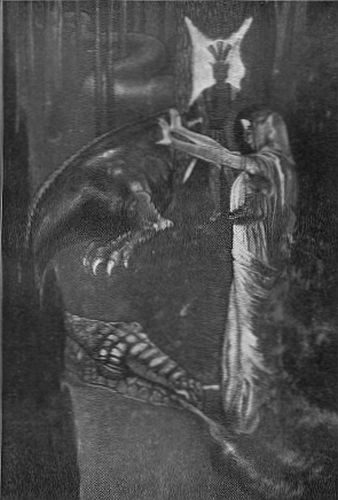 The dragon fell at full length upon the ground
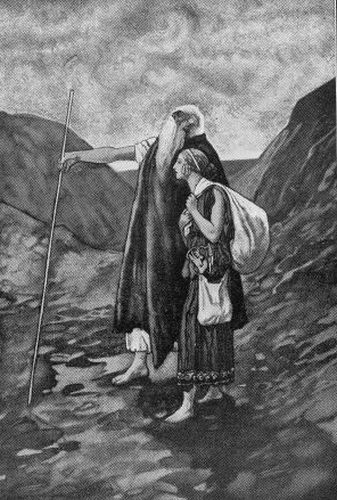 The blind Œdipus, led by his daughter Antigone
The moon was now high aloft in the heavens and threw its
bright beams over the plowed field, where as yet there was
nothing to be seen. Any farmer, on viewing it, would have
said that Jason must wait weeks before the green blades would
peep from among the clods, and whole months before the
yellow grain would be ripened for the sickle. But by and by,
all over the field, there was something that glistened in the
moonbeams like sparkling drops of dew. These bright objects
sprouted higher and proved to be the steel heads of spears.
Then there was a dazzling gleam from a vast number of
polished brass helmets, beneath which, as they grew further
out of the soil, appeared the dark and bearded visages of
warriors, struggling to free themselves from the imprisoning
earth. The first look that they gave at the upper world was a
glare of wrath and defiance. Next were seen their bright
breastplates; in every right hand there was a sword or a
spear and on each left arm a shield; and when this strange
crop of warriors had but half grown out of the earth, they
struggled—such was their impatience of restraint—and, as
it were, tore themselves up by the roots. Wherever a dragon's
tooth had fallen, there stood a man armed for battle. They
made a clangor with their swords against their shields, and
eyed one another fiercely; for they had come into this beautiful
world and into the peaceful moonlight full of rage and
stormy passions and ready to take the life of every human
brother in recompense for the boon of their own existence.
There have been many other armies in the world that seemed
to possess the same fierce nature with the one which had now
sprouted from the dragon's teeth; but these in the moonlit
field were the more excusable, because they never had women
for their mothers. And now it would have rejoiced any great
captain who was bent on conquering the world, like Alexander
or Napoleon, to raise a crop of armed soldiers as easily as
Jason did!
For awhile the warriors stood flourishing their weapons,
clashing their swords against their shields and boiling over
with the red-hot thirst for battle. Then they began to shout,
“Show us the enemy! Lead us to the charge! Death or
victory! Come on, brave comrades! Conquer or die!” and
a hundred other outcries, such as men always bellow forth
on a battle-field and which these dragon people seemed to have
at their tongues' ends. At last the front rank caught sight
of Jason, who, beholding the flash of so many weapons in the
moonlight, had thought it best to draw his sword. In a
moment all the sons of the dragon's teeth appeared to take
Jason for an enemy; and crying with one voice, “Guard the
Golden Fleece!” they ran at him with uplifted swords and
protruded spears. Jason knew that it would be impossible
to withstand this blood-thirsty battalion with his single arm,
but determined, since there was nothing better to be done,
to die as valiantly as if he himself had sprung from a dragon's
tooth.
Medea, however, bade him snatch up a stone from the
ground.
“Throw it among them quickly!” cried she. “It is the
only way to save yourself.”
The armed men were now so nigh that Jason could discern
the fire flashing out of their enraged eyes, when he let fly the
stone and saw it strike the helmet of a tall warrior who was
rushing upon him with his blade aloft. The stone glanced
from this man's helmet to the shield of his nearest comrade,
and thence flew right into the angry face of another, hitting
him smartly between the eyes. Each of the three who had
been struck by the stone took it for granted that his next
neighbor had given him a blow; and instead of running any
further toward Jason, they began to fight among themselves.
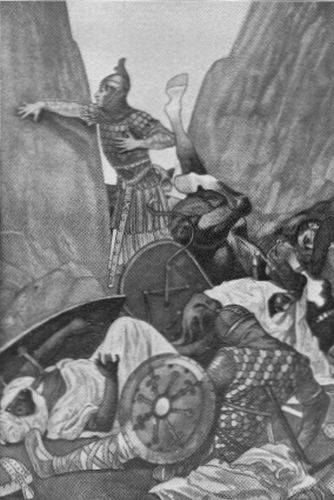
The confusion spread through the host, so that it seemed
scarcely a moment before they were all hacking, hewing and
stabbing at one another, lopping off arms, heads and legs and
doing such memorable deeds that Jason was filled with immense
admiration; although, at the same time, he could not help
laughing to behold these mighty men punishing each other
for an offense which he himself had committed. In an incredibly
short space of time (almost as short, indeed, as it
had taken them to grow up) all but one of the heroes of the
dragon's teeth were stretched lifeless on the field. The last
survivor, the bravest and strongest of the whole, had just
force enough to wave his crimson sword over his head and give
a shout of exultation, crying, “Victory! Victory! Immortal
fame!” when he himself fell down and lay quietly among his
slain brethren.
And there was the end of the army that had sprouted from
the dragon's teeth. That fierce and feverish fight was the
only enjoyment which they had tasted on this beautiful earth.
“Let them sleep in the bed of honor,” said the Princess
Medea, with a sly smile at Jason. “The world will always
have simpletons enough, just like them, fighting and dying for
they know not what, and fancying that posterity will take the
trouble to put laurel wreaths on their rusty and battered
helmets. Could you help smiling, Prince Jason, to see the
self-conceit of that last fellow, just as he tumbled down?”
“It made me very sad,” answered Jason gravely. “And
to tell you the truth, princess, the Golden Fleece does not
appear so well worth the winning, after what I have here
beheld.”
“You will think differently in the morning,” said Medea.
“True, the Golden Fleece may not be so valuable as you have
thought it; but then there is nothing better in the world, and
one must needs have an object, you know. Come! Your
night's work has been well performed; and tomorrow you can
inform King Æetes that the first part of your allotted task is
fulfilled.”
Agreeably to Medea's advice, Jason went betimes in the
morning to the palace of king Æetes. Entering the presence
chamber, he stood at the foot of the throne and made a low
obeisance.
“Your eyes look heavy, Prince Jason,” observed the king;
“you appear to have spent a sleepless night. I hope you have
been considering the matter a little more wisely and have concluded
not to get yourself scorched to a cinder in attempting
to tame my brazen-lunged bulls.”
“That is already accomplished, may it please your majesty,”
replied Jason. “The bulls have been tamed and yoked;
the field has been plowed; the dragon's teeth have been sown
broadcast and harrowed into the soil; the crop of armed
warriors has sprung up and they have slain one another
to the last man. And now I solicit your majesty's permission
to encounter the dragon, that I may take down the Golden
Fleece from the tree and depart with my forty-nine comrades.”
King Æetes scowled and looked very angry and excessively
disturbed; for he knew that, in accordance with his kingly
promise, he ought now to permit Jason to win the fleece if
his courage and skill should enable him to do so. But since
the young man had met with such good luck in the matter of
the brazen bulls and dragon's teeth, the king feared that he
would be equally successful in slaying the dragon. And
therefore, though he would gladly have seen Jason snapped
up at a mouthful, he was resolved (and it was a very wrong
thing of this wicked potentate) not to run any further risk
of losing his beloved fleece.
“You never would have succeeded in this business, young
man,” said he, “if my undutiful daughter Medea had not
helped you with her enchantments. Had you acted fairly,
you would have been at this instant a black cinder or a handful
of white ashes. I forbid you, on pain of death, to make any
more attempts to get the Golden Fleece. To speak my mind
plainly, you shall never set eyes on so much as one of its
glistening locks.”
Jason left the king's presence in great sorrow and anger.
He could think of nothing better to be done than to summon
together his forty-nine brave Argonauts, march at once to
the grove of Mars, slay the dragon, take possession of the
Golden Fleece, get on board the Argo and spread all sail for
Iolchos. The success of this scheme depended, it is true, on
the doubtful point whether all the fifty heroes might not be
snapped up as so many mouthfuls by the dragon. But as
Jason was hastening down the palace steps, the Princess
Medea called after him and beckoned him to return. Her
black eyes shone upon him with such a keen intelligence that
he felt as if there were a serpent peeping out of them, and
although she had done him so much service only the night
before, he was by no means very certain that she would not
do him an equally great mischief before sunset. These
enchantresses, you must know, are never to be depended
upon.
“What says King Æetes, my royal and upright father?”
inquired Medea, slightly smiling. “Will he give you the
Golden Fleece without any further risk or trouble?”
“On the contrary,” answered Jason, “he is very angry with
me for taming the brazen bulls and sowing the dragon's teeth.
And he forbids me to make any more attempts, and positively
refuses to give up the Golden Fleece, whether I slay the
dragon or no.”
“Yes, Jason,” said the princess, “and I can tell you more.
Unless you set sail from Colchis before tomorrow's sunrise,
the king means to burn your fifty-oared galley and put yourself
and your forty-nine brave comrades to the sword. But
be of good courage. The Golden Fleece you shall have if it
lies within the power of my enchantments to get it for you.
Wait for me here an hour before midnight.”
At the appointed hour you might again have seen Prince
Jason and the Princess Medea, side by side, stealing through
the streets of Colchis on their way to the sacred grove, in the
center of which the Golden Fleece was suspended to a tree.
While they were crossing the pasture ground the brazen bulls
came toward Jason, lowing, nodding their heads and thrusting
forth their snouts, which, as other cattle do, they loved to
have rubbed and caressed by a friendly hand. Their fierce
nature was thoroughly tamed; and with their fierceness, the
two furnaces in their stomaches had likewise been extinguished,
insomuch that they probably enjoyed far more comfort in
grazing and chewing their cuds than ever before. Indeed,
it had heretofore been a great inconvenience to these poor
animals that, whenever they wished to eat a mouthful of grass,
the fire out of their nostrils had shriveled it up before they
could manage to crop it. How they contrived to keep themselves
alive is more than I can imagine. But now, instead of
emitting jets of flame and streams of sulphurous vapor, they
breathed the very sweetest of cow breath.
After kindly patting the bulls, Jason followed Medea's
guidance into the Grove of Mars, where the great oak trees
that had been growing for centuries threw so thick a shade
that the moonbeams struggled vainly to find their way through
it. Only here and there a glimmer fell upon the leaf-strewn
earth, or now and then a breeze stirred the boughs aside and
gave Jason a glimpse of the sky, lest in that deep obscurity
he might forget that there was one overhead. At length,
when they had gone further and further into the heart of
the duskiness, Medea squeezed Jason's hand.
“Look yonder,” she whispered. “Do you see it?”
Gleaming among the venerable oaks there was a radiance,
not like the moonbeams, but rather resembling the golden
glory of the setting sun. It proceeded from an object which
appeared to be suspended at about a man's height from the
ground, a little further within the wood.
“What is it?” asked Jason.
“Have you come so far to seek it,” exclaimed Medea,
“and do you not recognize the meed of all your toils and perils
when it glitters before your eyes? It is the Golden Fleece.”
Jason went onward a few steps further, and then stopped
to gaze. Oh, how beautiful it looked, shining with a marvelous
light of its own, that inestimable prize which so many heroes
had longed to behold but had perished in the quest of it,
either by the perils of their voyage or by the fiery breath of
the brazen-lunged bulls.
“How gloriously it shines!” cried Jason in a rapture.
“It has surely been dipped in the richest gold of sunset. Let
me hasten onward and take it to my bosom.”
“Stay,” said Medea, holding him back. “Have you forgotten
what guards it?”
To say the truth, in the joy of beholding the object of his
desires, the terrible dragon had quite slipped out of Jason's
memory. Soon, however, something came to pass that
reminded him what perils were still to be encountered. An
antelope that probably mistook the yellow radiance for
sunrise came bounding fleetly through the grove. He was
rushing straight toward the Golden Fleece, when suddenly
there was a frightful hiss and the immense head and half
the scaly body of the dragon was thrust forth (for he was
twisted round the trunk of the tree on which the fleece hung),
and seizing the poor antelope, swallowed him with one snap
of his jaws.
After this feat, the dragon seemed sensible that some other
living creature was within reach, on which he felt inclined to
finish his meal. In various directions he kept poking his ugly
snout among the trees, stretching out his neck a terrible long
way, now here, now there and now close to the spot where
Jason and the princess were hiding behind an oak. Upon my
word, as the head came waving and undulating through the
air and reaching almost within arm's length of Prince Jason,
it was a very hideous and uncomfortable sight. The gape
of his enormous jaws was nearly as wide as the gateway of the
king's palace.
“Well, Jason,” whispered Medea (for she was ill natured,
as all enchantresses are, and wanted to make the bold youth
tremble), “what do you think now of your prospect of winning
the Golden Fleece?”
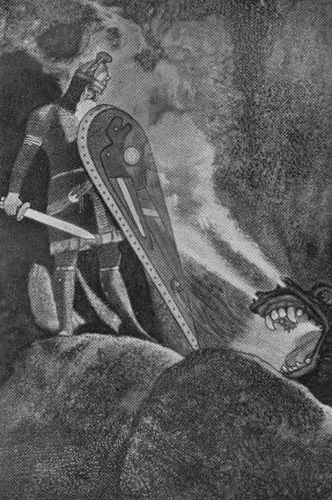
Jason answered only by drawing his sword and making a
step forward.
“Stay, foolish youth,” said Medea, grasping his arm. “Do
not you see you are lost without me as your good angel?
In this gold box I have a magic potion which will do the
dragon's business far more effectually than your sword.”
The dragon had probably heard the voices, for swift as
lightning his black head and forked tongue came hissing
among the trees again, darting full forty feet at a stretch.
As it approached, Medea tossed the contents of the gold box
right down the monster's wide-open throat. Immediately,
with an outrageous hiss and a tremendous wriggle—flinging
his tail up to the tip-top of the tallest tree and shattering all
its branches as it crashed heavily down again—the dragon
fell at full length upon the ground and lay quite motionless.
“It is only a sleeping potion,” said the enchantress to Prince
Jason. “One always finds a use for these mischievous creatures
sooner or later; so I did not wish to kill him outright.
Quick! Snatch the prize and let us begone. You have won
the Golden Fleece.”
Jason caught the fleece from the tree and hurried through
the grove, the deep shadows of which were illuminated as
he passed, by the golden glory of the precious object that he
bore along. A little way before him he beheld the old woman
whom he had helped over the stream, with her peacock beside
her. She clapped her hands for joy, and beckoning him to
haste, disappeared among the duskiness of the trees. Espying
the two winged sons of the North Wind (who were disporting
themselves in the moonlight a few hundred feet aloft), Jason
bade them tell the rest of the Argonauts to embark as speedily
as possible. But Lynceus, with his sharp eyes, had already
caught a glimpse of him, bringing the Golden Fleece, although
several stone walls, a hill, and the black shadows of the Grove
of Mars intervened between. By his advice the heroes had
seated themselves on the benches of the galley, with their
oars held perpendicularly, ready to let fall into the water.
As Jason drew near he heard the Talking Image calling to
him with more than ordinary eagerness, in its grave, sweet
voice:
“Make haste. Prince Jason! For your life, make haste!”
With one bound he leaped aboard. At sight of the glorious
radiance of the Golden Fleece, the forty-nine heroes gave a
mighty shout, and Orpheus, striking his harp, sang a song of
triumph, to the cadence of which the galley flew over the
water, homeward bound, as if careering along with wings!
THE CYCLOPS
When the great city of Troy was taken, all the chiefs who
had fought against it set sail for their homes. But there was
wrath in heaven against them, for indeed they had borne
themselves haughtily and cruelly in the day of their victory.
Therefore they did not all find a safe and happy return.
For one was shipwrecked and another was shamefully slain
by his false wife in his palace, and others found all things at
home troubled and changed and were driven to seek new
dwellings elsewhere. And some, whose wives and friends
and people had been still true to them through those ten long
years of absence, were driven far and wide about the world
before they saw their native land again. And of all, the wise
Ulysses was he who wandered farthest and suffered most.
He was well-nigh the last to sail, for he had tarried many
days to do pleasure to Agamemnon, lord of all the Greeks.
Twelve ships he had with him—twelve he had brought to
Troy—and in each there were some fifty men, being scarce
half of those that had sailed in them in the old days, so many
valiant heroes slept the last sleep by Simoïs and Scamander
and in the plain and on the seashore, slain in battle or by the
shafts of Apollo.
First they sailed northwest to the Thracian coast, where
the Ciconians dwelt, who had helped the men of Troy. Their
city they took, and in it much plunder, slaves and oxen, and
jars of fragrant wine, and might have escaped unhurt, but
that they stayed to hold revel on the shore. For the Ciconians
gathered their neighbors, being men of the same blood, and
did battle with the invaders and drove them to their ship.
And when Ulysses numbered his men, he found that he had
lost six out of each ship.
Scarce had he set out again when the wind began to blow
fiercely; so, seeing a smooth, sandy beach, they drove the
ships ashore and dragged them out of reach of the waves,
and waited till the storm should abate. And the third morning
being fair, they sailed again and journeyed prosperously till
they came to the very end of the great Peloponnesian land,
where Cape Malea looks out upon the southern sea. But
contrary currents baffled them, so that they could not round
it, and the north wind blew so strongly that they must fain
drive before it. And on the tenth day they came to the land
where the lotus grows—a wondrous fruit, of which whosoever
eats cares not to see country or wife or children again. Now
the Lotus eaters, for so they call the people of the land, were
a kindly folk and gave of the fruit to some of the sailors, not
meaning them any harm, but thinking it to be the best that
they had to give. These, when they had eaten, said that
they would not sail any more over the sea; which, when the
wise Ulysses heard, he bade their comrades bind them and
carry them, sadly complaining, to the ships.
Then, the wind having abated, they took to their oars and
rowed for many days till they came to the country where the
Cylopes dwell. Now, a mile or so from the shore there was
an island, very fair and fertile, but no man dwells there or
tills the soil, and in the island a harbor where a ship may be
safe from all winds, and at the head of the harbor a stream
falling from the rock, and whispering alders all about it. Into
this the ships passed safely and were hauled up on the beach,
and the crews slept by them, waiting for the morning. And
the next day they hunted the wild goats, of which there was
great store on the island, and feasted right merrily on what
they caught, with draughts of red wine which they had carried
off from the town of the Ciconians.
But on the morrow, Ulysses, for he was ever fond of adventure
and would know of every land to which he came what
manner of men they were that dwelt there, took one of his
twelve ships and bade row to the land. There was a great
hill sloping to the shore, and there rose up here and there a
smoke from the caves where the Cylopes dwelt apart, holding
no converse with each other, for they were a rude and savage
folk, but ruled each his own household, not caring for others.
Now very close to the shore was one of these caves, very huge
and deep, with laurels round about the mouth, and in front
a fold with walls built of rough stone and shaded by tall oaks
and pines. So Ulysses chose out of the crew the twelve
bravest, and bade the rest guard the ship, and went to see
what manner of dwelling this was and who abode there. He
had his sword by his side, and on his shoulder a mighty skin
of wine, sweet smelling and strong, with which he might win
the heart of some fierce savage, should he chance to meet
with such, as indeed his prudent heart forecasted that he
might.
So they entered the cave and judged that it was the dwelling
of some rich and skilful shepherd. For within there were
pens for the young of the sheep and of the goats, divided all
according to their age, and there were baskets full of cheeses,
and full milk pails ranged along the wall. But the Cyclops
himself was away in the pastures. Then the companions of
Ulysses besought him that he would depart, taking with him,
if he would, a store of cheeses and sundry of the lambs and of
the kids. But he would not, for he wished to see, after his
wont, what manner of host this strange shepherd might be.
And truly he saw it to his cost!
It was evening when the Cyclops came home, a mighty
giant, twenty feet in height or more. On his shoulder he bore
a vast bundle of pine logs for his fire, and threw them down
outside the cave with a great crash, and drove the flocks
within, and closed the entrance with a huge rock, which
twenty wagons and more could not bear. Then he milked
the ewes and all the she-goats, and half of the milk he curdled
for cheese and half he set ready for himself when he should
sup. Next he kindled a fire with the pine logs, and the flame
lighted up all the cave, showing Ulysses and his comrades.
“Who are ye?” cried Polyphemus, for that was the giant's
name. “Are ye traders or, haply, pirates?”
For in those days it was not counted shame to be called a
pirate.
Ulysses shuddered at the dreadful voice and shape, but
bore him bravely, and answered, “We are no pirates, mighty
sir, but Greeks, sailing back from Troy, and subjects of the
great King Agamemnon, whose fame is spread from one end
of heaven to the other. And we are come to beg hospitality
of thee in the name of Zeus, who rewards or punishes hosts
and guests according as they be faithful the one to the other,
or no.”
“Nay,” said the giant, “it is but idle talk to tell me of
Zeus and the other gods. We Cylopes take no account
of gods, holding ourselves to be much better and stronger than
they. But come, tell me where have you left your ship?”
But Ulysses saw his thought when he asked about the
ship, how he was minded to break it and take from them all
hope of flight. Therefore he answered him craftily:
“Ship have we none, for that which was ours King Poseidon
brake, driving it on a jutting rock on this coast, and we whom
thou seest are all that are escaped from the waves.”
Polyphemus answered nothing, but without more ado
caught up two of the men, as a man might catch up the whelps
of a dog, and dashed them on the ground, and tore them limb
from limb and devoured them, with huge draughts of milk
between, leaving not a morsel, not even the very bones. But
the others, when they saw the dreadful deed, could only
weep and pray to Zeus for help. And when the giant had
ended his foul meal, he lay down among his sheep and slept.
Then Ulysses questioned much in his heart whether he
should slay the monster as he slept, for he doubted not that
his good sword would pierce to the giant's heart, mighty as he
was. But, being very wise, he remembered that, should he
slay him, he and his comrades would yet perish miserably.
For who should move away the great rock that lay against the
door of the cave? So they waited till the morning. And the
monster woke and milked his flocks, and afterward, seizing
two men, devoured them for his meal. Then he went to the
pastures, but put the great rock on the mouth of the cave,
just as a man puts down the lid upon his quiver.
All that day the wise Ulysses was thinking what he might
best do to save himself and his companions, and the end of
his thinking was this: There was a mighty pole in the cave,
green wood of an olive tree, big as a ship's mast, which Polyphemus
purposed to use, when the smoke should have dried
it, as a walking staff. Of this he cut off a fathom's length, and
his comrades sharpened it and hardened it in the fire and then
hid it away. At evening the giant came back and drove his
sheep into the cave, nor left the rams outside, as he had been
wont to do before, but shut them in. And having duly done
his shepherd's work, he made his cruel feast as before. Then
Ulysses came forward with the wine skin in his hand and
said:
“Drink, Cyclops, now that thou hast feasted. Drink and
see what precious things we had in our ship. But no one
hereafter will come to thee with such like, if thou dealest with
strangers as cruelly as thou hast dealt with us.”
Then the Cyclops drank and was mightily pleased, and said,
“Give me again to drink and tell me thy name, stranger, and
I will give thee a gift such as a host should give. In good
truth this is a rare liquor. We, too, have vines, but they bear
no wine like this, which indeed must be such as the gods drink
in heaven.”
Then Ulysses gave him the cup again and he drank. Thrice
he gave it to him and thrice he drank, not knowing what it
was and how it would work within his brain.
Then Ulysses spake to him. “Thou didst ask my name,
Cyclops. Lo! my name is No Man. And now that thou
knowest my name, thou shouldst give me thy gift.”
And he said, “My gift shall be that I will eat thee last of
all thy company.”
And as he spake he fell back in a drunken sleep. Then
Ulysses bade his comrades be of good courage, for the time
was come when they should be delivered. And they thrust
the stake of olive wood into the fire till it was ready, green as
it was, to burst into flame, and they thrust it into the monster's
eye; for he had but one eye, and that in the midst of his forehead,
with the eyebrow below it. And Ulysses leaned with
all his force upon the stake and thrust it in with might and
main. And the burning wood hissed in the eye, just as the
red-hot iron hisses in the water when a man seeks to temper
steel for a sword.
Then the giant leapt up and tore away the stake and cried
aloud, so that all the Cylopes who dwelt on the mountain
side heard him and came about his cave, asking him, “What
aileth thee, Polyphemus, that thou makest this uproar in the
peaceful night, driving away sleep? Is any one robbing thee
of thy sheep or seeking to slay thee by craft or force?”
And the giant answered, “No Man slays me by craft.”
“Nay, but,” they said, “if no man does thee wrong, we
cannot help thee. The sickness which great Zeus may send,
who can avoid? Pray to our father, Poseidon, for help.”
Then they departed, and Ulysses was glad at heart for the
good success of his device when he said that he was No Man.
But the Cyclops rolled away the great stone from the door
of the cave and sat in the midst, stretching out his hands
to feel whether perchance the men within the cave would
seek to go out among the sheep.
Long did Ulysses think how he and his comrades should
best escape. At last he lighted upon a good device, and much
he thanked Zeus for that this once the giant had driven the
rams with the other sheep into the cave. For, these being
great and strong, he fastened his comrades under the bellies
of the beasts, tying them with osier twigs, of which the giant
made his bed. One ram he took and fastened a man beneath
it, and two others he set, one on either side. So he did with
the six, for but six were left out of the twelve who had ventured
with him from the ship. And there was one mighty ram, far
larger than all the others, and to this Ulysses clung, grasping
the fleece tight with both his hands. So they waited for the
morning. And when the morning came, the rams rushed
forth to the pasture; but the giant sat in the door and felt
the back of each as it went by, nor thought to try what might
be underneath. Last of all went the great ram. And the
Cyclops knew him as he passed and said:
“How is this, thou, who art the leader of the flock? Thou
art not wont thus to lag behind. Thou hast always been the
first to run to the pastures and streams in the morning and
the first to come back to the fold when evening fell; and now
thou art last of all. Perhaps thou art troubled about thy
master's eye, which some wretch—No Man, they call him—has
destroyed, having first mastered me with wine. He has
not escaped, I ween. I would that thou couldst speak and
tell me where he is lurking. Of a truth I would dash out
his brains upon the ground and avenge me of this No Man.”
So speaking, he let him pass out of the cave. But when
they were out of reach of the giant, Ulysses loosed his hold of
the ram and then unbound his comrades. And they hastened
to their ship, not forgetting to drive before them a good store
of the Cyclops' fat sheep. Right glad were those that had
abode by the ship to see them. Nor did they lament for those
that had died, though they were fain to do so, for Ulysses
forbade, fearing lest the noise of their weeping should betray
them to the giant, where they were. Then they all climbed
into the ship, and sitting well in order on the benches, smote
the sea with their oars, laying-to right lustily, that they might
the sooner get away from the accursed land. And when they
had rowed a hundred yards or so, so that a man's voice could
yet be heard by one who stood upon the shore, Ulysses stood
up in the ship and shouted:
“He was no coward, O Cyclops, whose comrades thou didst
so foully slay in thy den. Justly art thou punished, monster,
that devourest thy guests in thy dwelling. May the gods
make thee suffer yet worse things than these.”
Then the Cyclops in his wrath broke off the top of a great
hill, a mighty rock, and hurled it where he had heard the
voice. Right in front of the ship's bow it fell, and a great
wave rose as it sank, and washed the ship back to the shore.
But Ulysses seized a long pole with both hands and pushed
the ship from the land and bade his comrades ply their oars,
nodding with his head, for he was too wise to speak, lest the
Cyclops should know where they were. Then they rowed
with all their might and main.
And when they had gotten twice as far as before, Ulysses
made as if he would speak again; but his comrades sought to
hinder him, saying, “Nay, my lord, anger not the giant any
more. Surely we thought before we were lost, when he threw
the great rock and washed our ship back to the shore. And
if he hear thee now, he may crush our ship and us, for the man
throws a mighty bolt and throws it far.”
But Ulysses would not be persuaded, but stood up and
said, “Hear, Cyclops! If any man ask who blinded thee,
say that it was the warrior Ulysses, son of Laertes, dwelling
in Ithaca.”
And the Cyclops answered with a groan, “Of a truth, the
old oracles are fulfilled, for long ago there came to this land
one Telemus, a prophet, and dwelt among us even to old age.
This man foretold me that one Ulysses would rob me of my
sight. But I looked for a great man and a strong, who should
subdue me by force, and now a weakling has done the deed,
having cheated me with wine. But come thou hither, Ulysses,
and I will be a host indeed to thee. Or, at least, may Poseidon
give thee such a voyage to thy home as I would wish thee to
have. For know that Poseidon is my sire. May be that he
may heal me of my grievous wound.”
And Ulysses said, “Would to God, I could send thee down
to the abode of the dead, where thou wouldst be past all
healing, even from Poseidon's self.”
Then Cyclops lifted up his hands to Poseidon and prayed:
“Hear me, Poseidon, if I am indeed thy son and thou my
father. May this Ulysses never reach his home! or, if the
Fates have ordered that he should reach it, may he come
alone, all his comrades lost, and come to find sore trouble in
his house!”
And as he ended he hurled another mighty rock, which
almost lighted on the rudder's end, yet missed it as if by a
hair's breadth. So Ulysses and his comrades escaped and
came to the island of the wild goats, where they found their
comrades, who indeed had waited long for them, in sore fear
lest they had perished. Then Ulysses divided among his
company all the sheep which they had taken from the Cyclops.
And all, with one consent, gave him for his share the great
ram which had carried him out of the cave, and he sacrificed
it to Zeus. And all that day they feasted right merrily on
the flesh of sheep and on sweet wine, and when the night was
come, they lay down upon the shore and slept.
 Book Cover