TSU-SHIMA
1905
When the war of 1894–5 between China and Japan
was brought to a close by the Treaty of Shimonoseki
(17 April, 1895), the Japanese were in possession of
Korea and Southern Manchuria, Port Arthur and the Liao-tung
Peninsula, Wei-hai-wei and the Pescadores Islands,
and a joint naval and military expedition was ready to
seize Formosa.
By the second article China ceded to Japan the fortress
and dockyard of Port Arthur and the Liao-tung Peninsula.
As soon as the terms of the treaty were published, Russia,
which was the northern neighbour of China along the
borders of Manchuria and Mongolia, and the neighbour of
Japan by the possession of Vladivostock and Saghalien,
protested against the cession of Port Arthur and its territory
to the victors, arguing that the permanent occupation
of Port Arthur by a foreign Power would be a standing
menace to the Government at Pekin, and would put an
end to the independence of China. Germany and France
joined in the Russian protest, and the three Powers began
to move their ships eastward. Their combined squadrons
would have been more than a match for Admiral Ito's
cruisers. England had a powerful squadron in the Eastern
seas, but observed a strict neutrality in the diplomatic strife.
If England had joined her, Japan would undoubtedly
have fought rather than yield up the fruit of her hard-won
victories. But the Mikado's Ministers realized that single-handed
they could not face a Triple Alliance of aggressive
European Powers. The treaty was revised, the cession of
Port Arthur and its territory being struck out of it. They
were to be restored to China.
But the statesmen of Japan, while they yielded the
point, recognized in Russia their future rival for the empire
of the East, and resolved to begin at once preparing for a
struggle in years to come which would give them back
more than they were now forced to abandon. They set to
work to create a powerful navy, and at the same time added
steadily to the fighting strength of their army, which for a
while found useful war training in the subjugation of the
hill tribes of Formosa. The millions of the war indemnity
and loans negotiated abroad were expended on a great
scheme of armaments. A fleet of battleships, cruisers, and
torpedo craft was built in foreign shipyards, and the
personnel of the navy was increased to provide officers and
crews. The Japanese Government went on for years
patiently preparing, regardless of conduct on the part of
Russia that might have tempted a less self-possessed Power
to premature action.
The Russian Government had hardly forced Japan to
abandon so large a part of her conquests when it took
advantage of the weakness of China to obtain from the
Pekin Government the right to make a railway through
Manchuria to the treaty port of Niu-chwang, and to place
garrisons along the new line for its protection, and further
the right to garrison Port Arthur, use it as a naval station,
and occupy the adjacent territory. When the first rumours
of the Russo-Chinese Treaty reached Europe they were
treated with incredulity. It was said that it was impossible
that Russia could cynically claim a position which she had
just declared was incompatible with the independence of
China, and which she had argued the nations of Europe
could not permit to Japan or any other Power. But presently
the treaty was published, and acted upon, Russia
making Port Arthur her chief naval station in the East,
announcing a project for a great commercial port at
Talienwan Bay, and, further, occupying the treaty port of
Niu-chwang. There was a brief period of tension, during
which there was a talk of various Powers resisting this
barefaced aggression, but European statesmen thought
that an easier course was open to them. Instead of resisting
the aggressor, they embarked in a policy of aggression
themselves, on the plea of securing compensations and
guarantees. The weakness of China made her the ready
victim of this policy.
Foreign aggression from so many quarters called forth a
patriotic movement in China, which in 1900 culminated in
the "Boxer" revolt. For a while Japan and the European
Powers, including Russia, became allies, to save their
embassies and repress the rising about Pekin. In the
campaign the Japanese forces proved themselves the most
efficient of all, and their chiefs returned home with an
absolute confidence that they could successfully meet
European soldiers in the field.
Japan had made the most unsparing use of its rights
in Korea, acquired by the Treaty of Shimonoseki, all but
absolutely annexing the country. After the Boxer revolt
Admiral Alexieff, who was governor of the Russian possessions
in the Far East, embarked on a dangerous policy of
provocation towards Japan. He had an ill-informed contempt
for the hardy islanders. He underrated their power
of resistance, and felt sure that the mere fact that the
Russian fleet outnumbered theirs would secure the command
of the sea for Russia, and have a decisive effect in
the event of a conflict. He believed that the sooner it
came the better.
The Russian fleet in the East was steadily reinforced,
unit by unit. The Japanese people began to see in these
proceedings, and in the work done at Port Arthur, a threat
of early hostilities, and there was a general call on the
Government to anticipate the blow, when relations became
strained between the two countries in 1903. The Tokio
Government was anxious not to precipitate the war, for the
organization of the army required some months for completion,
but the feeling in the navy, army, and civil population
forced its hand. After a brief delay of negotiations,
during which both parties worked with feverish energy to
secure additional armaments, diplomatic relations were
broken off at the beginning of February, 1904, and then,
without waiting for any formal declaration of war, the
Japanese torpedo flotilla swooped down on the Russian
fleet lying in the roads outside the narrow entrance of Port
Arthur, found them utterly unprepared to meet this sudden
attack, and crippled several of the ships. A second blow
was the destruction of the first-class armoured cruiser
"Variag," the Russian guardship at Chemulpo, by a
Japanese squadron.
Most of the best ships in the Russian navy were in the
East at the outbreak of the war. Alexieff had, however,
made the initial mistake of dividing the force at his disposal.
Away north at Vladivostock was a squadron of
three large armoured cruisers, the "Gromoboi," "Rossia,"
and "Rurik," and the protected cruiser "Bogatyr." The
"Variag" was isolated at Chemulpo, the port of Seoul,
doing duty that might have been left to a gunboat. At Port
Arthur, under Admiral Stark, there was a strong fleet, including
seven battleships, the "Petropavlosk," "Poltava,"
"Peresviet," "Pobieda," "Retsivan," "Sebastopol," and
"Tsarevitch," the cruisers "Askold," "Boyarin,"
"Bayan," "Pallada," "Diana," and "Novik," and a
flotilla of torpedo craft and the mine-laying steamer
"Yenessei." In the torpedo attack on the evening of
8 February the "Retsivan," "Tsarevitch," and "Pallada"
were badly damaged. The "Variag" was destroyed next
day, and a few days later the "Yenessei" accidentally blew
herself up while laying mines. This series of disasters
seemed for a while to have almost destroyed the morale of
the fleet. Stark set to work to repair his damaged ships,
made no attempt to meet the Japanese at sea, or interfere
with the transport of their armies to the mainland of Asia,
and, subordinating his fleet to the defence of Port Arthur,
even landed guns and men to strengthen the landward
works. The Japanese blockaded the port, insulted it with
long-range bombardments, and tried to block the narrow
entrance by sinking old steamers across it.
In March the arrival of the best officer in the Russian
Navy, Admiral Makharoff, for a while inspired new energy
into the Port Arthur fleet. The repairs of the injured ships
were completed, and on 13 April the admiral steamed out to
challenge Togo and the main Japanese fleet to battle. Notwithstanding
precautions taken against the known danger
of floating mines, the fleet entered a tract of water where
several were afloat, and the flagship "Petropavlosk" was
destroyed with fearful suddenness by the explosion of one
of them. There was great loss of life, but the most serious
blow to Russia was the death of the admiral.
After the fleet returned to the harbour there came another
period of irresolute inactivity. It was not till August, when
several ships had been injured at their anchors by the
bombardment from the land batteries of the Japanese
attack, and it was evident that the port would soon be a
dangerous place for the ships, that Admiral Witjeft proceeded
to sea, announcing that he was going to Vladivostock,
the cruiser squadron from that port having been
warned to come out and reinforce him on his way.
The sea-fight, known as the battle of the Tenth of
August, took place a few miles to seaward of the port.
Witjeft led the fleet in his flagship the "Tsarevitch,"
followed by the battleships "Retsivan," "Sebastopol,"
"Pobieda," "Poltava," and "Peresviet" (carrying the
flag of the second in command, Rear-Admiral Prince
Ukhtomsky), and the cruiser division made up of the
"Askold" (carrying the flag of Rear-Admiral Reitzenstein),
"Pallada," "Diana," and "Novik," besides eight
destroyers. The cruiser "Bayan" had been so damaged
that she was left in port. Witjeft had a marked superiority
in battleships. Togo had had six new first-rate ships of
the class under his command at the outset of the war, but
on 15 May he had lost two of them, one-third of his battleship
fleet, by a disaster like that of the "Petropavlosk."
On that May morning, while cruising off Port Arthur, he
ran into a field of drift mines, and in a few minutes the
battleships "Hatsuse" and "Yashima," and the cruiser
"Yoshino," were destroyed. The Japanese managed till
the end of the war to conceal the fact that the "Yashima"
had been lost, and the Russians up to the battle of Tsu-shima
believed Togo had five of his big battleships intact.
In the battle of 10 August he put in his main fighting-line
the two powerful armoured cruisers "Nisshin" and
"Kasuga," purchased from the Argentine Government on
the eve of the war.
The battle began with long-range firing at 1 p.m.,
and continued till after seven in the evening. It was decided
by the superior gunnery of the Japanese, and the
damage done by their high explosive shells. The "Tsarevitch,"
badly cut up and set on fire, was driven out of the
line. Witjeft was killed by a shell. His last word was to
reiterate his order to push for Vladivostock. As darkness
came on Ukhtomsky lost heart, and led the fleet back to
Port Arthur. If he had held on he might have got through
the Japanese fleet, for their ammunition was almost exhausted
when the firing ceased. Reitzenstein, with the
cruisers, tried to execute Witjeft's last order. The "Pallada,"
however, left him and followed the battleships. The
rest of the cruiser squadron and the destroyers that accompanied
it were forced to part company, and only the
"Novik" got through to the northwards. The "Diana"
fled southwards to the French port of Saigon; the "Askold,"
with a destroyer, reached Shanghai. The battered
"Tsarevitch," with three destroyers, took refuge at Kiao-chau.
All these ships were disarmed by the French, German,
and Chinese authorities, and detained till the end of
the war, when they were restored to the Russian Government.
The "Novik" failed to get into Vladivostock, but
reached a Russian port in Saghalien, where a few days later
she was tracked down and destroyed by Japanese cruisers.
The Vladivostock squadron had come out to meet the
unfortunate Witjeft. The "Boyarin" was left behind,
damaged by accidentally grounding, so the squadron was
made up of the three big armoured cruisers "Gromoboi,"
"Rossia," and "Rurik." They were approaching the
straits of Tsu-shima, and were as far south as Fusan,
when they were discovered and attacked by Admiral
Kamimura's cruiser squadron, on 14 August. Once more
good gunnery against poor shooting decided the fight. The
"Rurik" was sunk, and the "Gromoboi" and "Rossia"
returned to Vladivostock, bearing marks of very hard
hitting—riddled funnels, and sides hastily patched with
plates of iron, told of the straight shooting of the Japanese
cruisers. In both the action with the Port Arthur battleship
fleet and the Vladivostock cruiser squadron the losses
of the Japanese had been very slight.
On paper the Russians had had a distinct superiority
over the Japanese in sea-power at the outset, so far as it
can be measured by balancing off battleships, cruisers, and
minor craft in parallel columns. In the months before the
war there was ample material for the enterprising journalist
to work up a navy scare at Tokio. But once more it was
shown that not the number of ships but the temper and
training of the men are the true measure of power on the
sea. From the first Togo had asserted his superiority, and
by asserting secured it. After the naval engagements of
10 and 14 August the Russian Navy in the Far East accepted
a position of helpless inaction. Ukhtomsky kept
what was left of the fine fleet, that had been originally
assembled at Port Arthur, anchored in the land-locked
harbour till the ships were sunk by fire of the besieging
batteries.
While the Far Eastern fleet was still in being, and Port
Arthur was holding out, the Russian Government had
announced its intention of sending a second fleet from
Europe to the seat of war. It had two fleets in European
waters, those of the Black Sea and the Baltic. The Black
Sea fleet was not available. International treaties barred
its exit from the Dardanelles. Only the Baltic dockyards
could supply the new armada.
As soon as the news of the first torpedo attack on Port
Arthur arrived, in February, 1904, there was talk of the
new fleet for the East, and unofficially the end of June was
spoken of as the time when it would be ready to sail. From
the first it was obvious that this was an over-sanguine
estimate, unless the fleet was to be made up entirely of old
and weak ships. The best units that could be made available,
and without some at least of which the fleet could
hardly be sent out, were five powerful battleships that were
being completed in the Neva yards and at Cronstadt. Two
had been launched in 1901, two in 1902, and the fifth in
1903, but even on the 1901 ships there was a large amount
of work to be done. Naval experts declared that the fleet
would not be ready for a year, and that even then the
difficulty of coaling would make its voyage to the other
side of the world in war time a hopeless task for the admiral
in command.
By hard work the fleet was made ready for sea by the
middle of September. The coaling difficulty was overcome
by taking colliers with the fleet, contracting with a German
firm to send large coal-laden steamers to various points on
the route selected, and straining to the utmost the benevolent
neutrality of France, and using her colonial ports as
halting places on the way. There was some difficulty in
recruiting a sufficient number of engineer officers, and of
stokers who could manage the novel tubular boilers of the
new battleships, and the fleet was undoubtedly handicapped
by the inexperience of its engine-room and stokehold
staff.
Admiral Rojdestvensky, the officer chosen for the
supreme command, had an excellent record. He was fifty-six
years of age, and had served in the navy since 1865. In
the Russo-Turkish War he had distinguished himself by
brilliant attacks on Turkish ships of war with a small
torpedo gunboat, the "Vesta." He had been naval
attaché in London, and had filled important technical and
official positions at St. Petersburg, being for a while
chief of the general Naval Staff. Finally he had personal
knowledge of the Eastern seas and of the Japanese navy,
for he had commanded the Russian squadron in the Far
East during the war between China and Japan.
On 14 August—just after the news of the disastrous sortie
of the Port Arthur fleet had reached Europe, and on the
very day that Kamimura defeated the Vladivostock
squadron and sank the "Rurik"—Admiral Rojdestvensky
hoisted his flag on board his flagship, the "Knias Suvaroff,"
at Cronstadt. But there was still much work to be done,
and recent mishaps to some of the ships' machinery to be
made good, so the fleet did not sail till 25 August. Even
then it was only for a few days' training cruise in the Baltic.
On the 30th the fleet was back again at Cronstadt.
Engineers and mechanics worked night and day, setting
right defects in the ships, and on 11 September there was
another start, this time for the port of Libau.
The fleet consisted of seven battleships, two armoured
cruisers, and some protected cruisers and torpedo-boat
destroyers. It was to be joined at Libau by a miscellaneous
collection of craft—some small cruisers and a number of
merchantmen to be used as auxiliary cruisers, store, hospital,
and repair ships.
Of the five new battleships in the Neva yards four had
been got ready for sea. These were the "Borodino,"
"Orel," "Imperator Alexander III," and "Knias Suvaroff."
They were powerful ships of 13,000 to 13,500 tons
displacement, with engines of nominal 16,000 horse-power,
and their official speed, which they never realized, was
eighteen knots. Their heaviest armour was nine inches,
and they carried two pair of 12-inch guns fore and aft in
armoured turrets, with an auxiliary armament of twelve
6-inch quick-firers besides lighter guns. The three other
battleships, the "Ossliabya," "Navarin," and "Sissoi
Veliki" were older ships. The newest of them, the
"Ossliabya," launched in 1898, was on her way to the East
when the war broke out, and had turned back. She was
of 12,600 tons displacement, and claimed a speed of eighteen
knots. She carried four 10-inch and eleven 6-inch guns.
The other two ships were rated as having sixteen knots
speed, but probably could not much exceed twelve. Their
displacement and principal armament were:—
- Navarin, 10,000 tons, four 12-inch guns, eight 6-inch Q.F.
- Sissoi Veliki, 8880 tons, four 12-inch guns, six 6-inch Q.F.
The two armoured cruisers were old ships:—
- Admiral Nakhimoff, 8500 tons, eight 8-inch, ten 6-inch guns.
- Dimitri Donskoi, 7796 tons, six 6-inch, ten 4.7 inch guns.
Two of the protected cruisers, the "Aurora" and
"Oleg," were ships of about 7000 tons, carrying for their
main armament the former eight and the latter twelve
6-inch guns. The other cruisers were four smaller ships,
but some of them were comparatively new vessels with
good speed—useful as scouts.
Well manned with competent engineers and trained
gunners the fleet would have been formidable enough,
notwithstanding its weaker units. But here again it was
the men that counted.
In the first week of October the fleet was taken to Revel.
The Tsar arrived there on the 9th and inspected it next
day. On the 11th it sailed. But it stopped again at Libau,
until October 15, when at last it started for the East.
There had been wild rumours that the Japanese had sent
emissaries to Europe, obtained some light craft, and fitted
them as improvised torpedo-boats for the purpose of
attacking the fleet on its voyage through the narrow
waters that form the exit from the Baltic or during the
crossing of the North Sea. The Russian police attached
such importance to these canards that Rojdestvensky was
warned to take precaution against attack until he was out
on the open ocean. He passed the Danish straits with his
ships partly cleared for action, fired on a Swedish merchantman
and a German fishing-boat, and, avoiding the
usual course from the Skaw to the Channel, ran by the
Dogger Bank, and in a panic of false alarm opened fire on
the steam trawling fleet, sinking a boat and killing and
wounding several men. The result was an outburst of
indignation in England, a partial mobilization of the
British fleet, and some days of extreme tension, when it
seemed likely that England would be drawn into the war,
with the probability that France would then, under the
terms of her alliance with Russia, have also to enter into
the conflict. An agreement was arranged under which
there was to be an international inquiry into the Dogger
Bank incident, and Russia promised to make full reparation.
Meanwhile the Baltic fleet had run down Channel and
across the Bay of Biscay, and southwards to Tangier,
where it was concentrated on 3 November, watched by
Lord Charles Beresford and the Channel Fleet, for the
period of sharp tension was not over. At Tangier Rojdestvensky
divided his force. He went southward along the
African coast with the first division, and sent the second
division under Admiral Fölkersham into the Mediterranean
to go eastwards by the Suez Canal route. A third division
had been formed at Libau to reinforce the fleet. It was
composed of the armoured cruisers "Izumrud" and
"Oleg," three auxiliary cruisers (armed liners of the
volunteer fleet), the "Terek," "Rion," and "Dnieper,"
a flotilla of destroyers, and a number of storeships. It
sailed from Libau on 7 November.
Rojdestvensky put into various African ports, mostly in
the French colonies, and coaled his ships from his colliers.
He was at Dakar, in West Africa, on 13 November; at
Gaboon on the 26th; in Great Fish Bay on 6 December;
and at Angra Pequeña on the 11th. He passed Cape Town
on 19 December. Rounding the Cape, he steered for
Madagascar, and on 1 January, 1905, he anchored in the
Bay of Ste. Marie, near Tamatave.
On that same New Year's Day General Stoessel sent a flag
of truce out to General Nogi, to inform him that he was
anxious to arrange the immediate surrender of Port Arthur.
The capitulation was signed next day. Thus at the very
moment that Rojdestvensky and the main fighting force
of the Baltic fleet established itself in the Indian Ocean,
its nearest possible base in the Eastern seas passed into
Japanese hands, and the problem the Russian admiral
had to solve became more difficult.
Fölkersham, with the second division, rejoined Rojdestvensky's
division in the waters of Madagascar.
From Ste. Marie the fleet moved to the roadstead of
Nossi-Bé, at the north end of Madagascar, where it was
joined in February by the reinforcements for Libau.
Rojdestvensky had now under his command an armada of
some forty ships of all kinds, including storeships and
colliers. Now that Port Arthur had fallen he seemed in no
hurry to proceed eastwards.
There had been an agitation in Russia for a further reinforcement
of the fleet, and though the addition of a few
more old and weak ships could add no real strength to
Rojdestvensky's armada, the Government yielded to the
clamour, and on February 15 dispatched from Libau a
fourth division, under the command of Admiral Nebogatoff.
The flagship was an armoured turret-ship, the
"Imperator Nikolai I," of 9700 tons, dating from 1889,
and classed in the Navy List as a battleship; with her
went three small armoured "coast-defence battleships,"
the "General Admiral Apraxin," the "Admiral Ushakoff,"
and the "Admiral Senyavin," all of about 4000 tons, and
the cruiser "Vladimir Monomach," of a little over 5500
tons. Rojdestvensky seemed inclined to wait at Nossi-Bé
for Nebogatoff's arrival, but the Japanese addressed strong
protests to Paris against Madagascar being made a base
of operations for a huge expedition against them; the
French Government sent pressing remonstrances to their
friends at St. Petersburg, and the admiral was ordered by
cable to move on.
Sailing from Nossi-Bé on 25 March, Rojdestvensky
steered first for the Chagos Archipelago, and then for the
Straits of Malacca. In the afternoon of 8 April the fleet
passed Singapore, keeping well out to sea. The ships were
burning soft coal, and an enormous cloud of black smoke
trailed from the forest of funnels. Steamers ran out from
the port to see the splendid sight of the great crowd of
ships moving four abreast into the China Sea. Before the
fleet sailed many critics of naval matters had prophesied
that as Russia had no coaling stations the coaling difficulty
would make it impossible for Rojdestvensky ever to carry
his fleet so far. The successful entry into the Eastern seas
was therefore regarded as something of an exploit. It was
a revelation of the far-reaching power that would belong
to better-equipped fleets in future wars.
While the Baltic fleet was on its way the Japanese
Government, patriotically supported by the Press and the
people, kept a strict silence on all naval matters. There
were wild conjectures that under this veil of secrecy Togo
had moved southwards, that he would fall on his enemy
during the voyage across the Indian Ocean, or wait for
him in the China Sea. But the Japanese admiral had no
reason for embarking in such adventures. He knew that
if he kept his fleet near the shores of Japan his enemy
must come sooner or later within effective striking distance.
Rojdestvensky might attempt a raid on the coasts of
Japan, or make a dash for Niu-chwang to seize that port,
now the nearest base of supply of the Japanese field army.
Far-seeing precautions were taken against this eventuality
by accumulating enormous stores of supplies in the immediate
rear of the army. But it was far more likely that
the Russian admiral would try to reach Vladivostock, either
with or without a battle. To do so he would have ultimately
to pass through one of three channels into the Sea of Japan.
He must choose between the Korean or Tsu-shima straits
between Japan and Korea, or the Tsugaru channel between
Nippon and Yozo, or the La Pérouse Straits (known to the
Japanese as the Soya channel) still further north. Whatever
course he chose, the best position for the Japanese
fleet was near the Tsu-shima straits, with the arsenal and
dockyard of Shimonoseki close by on the Japanese shore.
This the Russians themselves foresaw would be the most
likely position for Togo to select.
He made Masampho Bay on the Korean side of the
straits, and inside them (the "Douglas Bay" of our
Admiralty Charts), the station for his fleet. Freed from all
harassing blockading and cruising work, he devoted the
period between the retirement and destruction of the Port
Arthur fleet in the late summer of 1904, and the approach
of the Russians in May, 1905, to repairing his ships very
thoroughly, substituting new guns for those they had
mounted at the beginning of the war, which had had their
rifling worn down. Continual target practice and manœuvre
exercises kept every ship and every man up to the
mark. Charts of the sea around Japan were ruled off into
small numbered squares, so as to facilitate the reporting of
the enemy's position and movements from the moment he
would be first sighted. An elaborate system of scouting by
light cruisers was organized; signal stations were established
on islands and headlands, and wireless installations
erected at central and outlying points. If Rojdestvensky
made for the Tsu-shima channels, Togo was there to meet
him. If he went for either of the more northern straits, the
Japanese admiral counted on having news of his movements
in sufficient time to enable him to steam at full speed by a
shorter route, and still interpose between the Baltic
armada and Vladivostock.
After passing Singapore, on 25 March, there was another
delay before the final advance of the Russian fleet. Rojdestvensky
was anxious to give time to Nebogatoff to join
him. This last reinforcement was coming by the Mediterranean
route. The Russian commander-in-chief again
strained French neutrality to the utmost. In April and
May he passed week after week in the ports of French
Cochin China, first at Kamranh and then at Van Fong or
Honkohe. Here, early in May, he was at last joined by
Nebogatoff's squadron.
Again Japan protested against the use of French harbours
by her enemy. The diplomatic tension became acute, and
at one moment it seemed as if the Russian admiral were
anxious to produce complications that would force France
into the war. But at last, to the general relief, on 14 May
he sailed from Honkohe Bay. He passed through the
Bashi Strait between Formosa and the Philippines, and
then steered for Shanghai. Here, on 25 May, the fighting
portion of the fleet lay out at sea, while a crowd of auxiliary
steamers, colliers, store-ships, and armed merchantmen
were sent into the Wusung River, the mouth of the Yang-tse,
and anchored there.
Their appearance without the fleet to which they belonged
led to many conjectures. The Japanese at once
grasped its real meaning. To quote the message cabled by
the Tokio correspondent of "The Times":—
"They read it as a plain intimation that Rojdestvensky
intended to put his fate to the test at Tsu-shima, since,
had it been his purpose to make for Tsugaru or Soya, he
must have retained the services of these auxiliary ships
during several days longer. It is apparent, indeed, that
the Russian admiral here made his first cardinal mistake;
he should have kept his non-combatant vessels out of
sight as long as possible. Their absence from the arena
would have been a mysterious element, whereas their apparition,
especially as a segregated squadron in the Yang-tse
River, furnished an unerring clue to expert observers."
With the fleet the admiral retained only the hospital and
repairing ships and those laden with naval stores for the
Vladivostock dockyard. On the evening of the 25th the
fleet stood out to sea heading for Tsu-shima. The weather
was bad, with a probability that it would be worse. There
was a rising wind and sea with cold rain that made a
blinding haze, but the Russian staff officers were rather
pleased than depressed at such unpleasant conditions.
Thick weather would baffle the Japanese scouts and lookout
stations, and rough seas would keep their torpedo
flotillas at anchor.
Out ahead were the fast cruisers of the scouting division,
the "Svietlana," "Almaz," and "Ural." After these
came the main body of the fleet in line ahead in two
columns, the heavy armour-clads on the starboard (right
side), the rest of the armoured ships and four cruisers in the
port line. Abreast of the leading ships each flank was
guarded by a cruiser and two torpedo destroyers. After
the fighting lines and between their foaming wakes steamed
four store-ships and two repairing ships. Last of all were
the two steamers fitted as hospital ships. The arrangement
is best shown by a rough diagram:—
| Svietlana. |
| Almaz. |
(Cruisers.) |
Ural. |
| |
| Port Line. |
Starboard Line. |
| (Cruiser.) |
|
(Cruiser.) |
| Jemschug. |
|
Imperator Nikolai. |
|
Knias Suvaroff. |
|
Izumrud. |
| 2 torpedo |
|
Admiral Senyavin. |
|
Imperator Alexander. |
|
2 torpedo |
| destroyers. |
|
Admiral Apraxin. |
|
Borodino. |
|
destroyers. |
| |
Admiral Ushakoff. |
|
Orel. |
|
| |
Cruisers. |
|
Oleg. |
|
Ossliabya. |
|
| |
Aurora. |
|
Sissoi Veliki. |
|
| |
Dimitri Donskoi. |
|
Navarin. |
|
| |
Alexander Monomach. |
|
Admiral Nakhimoff. |
|
| |
5 torpedo destroyers. |
|
| |
| |
Anadir. |
|
Store-ships. |
| |
Irtish. |
| |
Korea. |
| |
Kamschatka. |
| |
Svir. |
|
Repairing ships and tugs. |
| |
Russ. |
| |
| |
Orel. |
|
Kostroma. |
| |
|
|
| |
Hospital ships. |
|
In this order the great fleet steamed slowly through the
rain and darkness. On board the great battleships there
was much grumbling at "Nebogatoff's old tubs," though
they themselves could not do much better, for poor coal, inefficient
stoking, and weed-grown bottom-plates handicapped
even the newest of them. The next day, 26 May,
was the eve of the greatest naval battle in all history.
"The clouds began to break and the sun shone fitfully,"
says Captain Semenoff,[23] "but although a fairly fresh
south-westerly wind had sprung up, a thick mist still lay
upon the water." Rojdestvensky meant to pass the
perilous straits in daylight, and he calculated that by noon
next day the fleet would be in the narrows of Tsu-shima.
Behind that portal of the Sea of Japan Togo was waiting
confidently for his enemy, who, he knew, must now be near
at hand. Never before had two such powerful fleets met
in battle, and the fate of the East hung upon the result of
their encounter.
That result must depend mainly upon the heavy armoured
ships. In these and in the number of guns of the
largest calibre, the Russians had an advantage so far as
mere figures went, as the following tables show:—
ARMOURED SHIPS
|
| Class. |
Japan. |
Russia. |
| Battleships |
04 |
08 |
| Coast-defence armour-clad |
— |
03 |
| Armoured cruisers |
08 |
03 |
| |
— |
— |
| Total |
12 |
14 |
| HEAVY GUNS |
| |
Quick-firers. |
| |
|
| Guns. |
12-inch. |
10-inch. |
9-inch. |
8-inch. |
6-inch. |
4.7-inch. |
| Japan |
16 |
01 |
— |
30 |
160 |
— |
| Russia |
26 |
15 |
04 |
08 |
102 |
30[24] |
The annexed tables (pp. 315, 316) give some details of
Russian and Japanese armoured ships.
With regard to the armour it must be kept in mind for
purposes of comparison that the armoured belts of the
newer ships, nine inches at the thickest part, were of
Harveyized or Krupp steel, and could resist penetration
better than the thicker belts of the older ships. It
will be noticed that the Japanese carried fewer of the
heavier types of guns, but had more 6-inch quick-firers
than the Russians. This is a point to bear in mind in
following the story of the battle. It was the steady rain of
100-pounder shells from the quick-firers that paralysed the
fighting power of the Russian ships.
Far more important than the mere number of guns was
the fact that the Japanese shot straighter and had a more
effective projectile. There was such a marked difference
between the effect of the Japanese shells at Tsu-shima and
in the naval battle of 10 August, 1904, that Captain
Semenoff, who was present at both battles, thought that
in the interval the Japanese must have adopted a more
powerful kind of high explosive for their bursting charges.
This was not the case. Throughout the war the Japanese
used for their bursting charges the famous Chimose powder.
But perhaps between 10 August, 1904, and the following
May they had improved their fuses, so as to detonate the
charge more certainly and thoroughly.
The first five battleships on the Russian list were up-to-date
modern vessels. The "Navarin" was fairly fit to lie
in line with them. The rest were, to use a familiar expression,
"a scratch lot," coast-defence ships of small
speed and old craft quite out of date. The decks of the
larger ships were encumbered with an extra supply of coal,
and this must have seriously diminished their margin of
stability, with, as we shall see, disastrous results.
Admiral Togo could oppose to them only four modern
battleships. But his two heavy cruisers, the "Nisshin"
and "Kasuga" (the ships bought from Argentina on the
eve of the war), might almost have been classed as smaller
battleships, and certainly would have been given that
rank a few years earlier. His fine fleet of armoured cruisers
were at least a match for the Russian coast-defence ships
and the older battleships.
RUSSIA
|
| Class. |
Ships. |
Displace-
ment.
Tons. |
Thickest
Armour.
Inches. |
Principal
Armament.
Guns. |
Men. |
Remarks. |
| |
| Battleships. |
|
Knias Suvaroff |
|
13,516 |
09.0 |
|
4 12-inch
12 6-inch |
|
740 |
Flagship of Admiral Rojdestvensky. |
| Imperator Alexander III |
These four ships were all completed in 1904. |
| Borodino |
| Orel |
| Ossliabya |
|
12,674 |
09.0 |
|
4 10-inch
11 6-inch |
|
732 |
Flagship of Rear-Admiral Fölkersham.
Completed 1901. |
| Sissoi Veliki |
|
08,880 |
15.7 |
|
4 12-inch
6 6-inch |
|
550 |
Comp"eted 1894. |
| Navarin |
|
10,206 |
16.0 |
|
4 12-inch
8 6-inch |
|
550 |
Comp"eted 1895. |
| Imperator Nikolai I |
|
09,672 |
14.0 |
|
4 9-inch
8 6-inch |
|
604 |
Comp"eted 1892. Flagship of Rear-Admiral Nebogatoff. |
| Coast-defence Armour-clads. |
|
General Admiral Apraxin |
|
04,162 |
10.0 |
|
3 10-inch
4 6-inch |
|
400 |
Completed 1898. |
| Admiral Senyavin |
|
04,684 |
10.0 |
|
4 9-inch
4 6-inch |
|
400 |
Comp"eted 1895. |
| Admiral Ushakoff |
| Armoured Cruisers. |
|
Admiral Nakhimoff |
|
08,524 |
10.0 |
|
8 8-inch
10 6-inch |
|
567 |
Completed 1898.
Reconstructed 1895. |
| Dimitri Donskoi |
|
06,200 |
07.0 |
|
6 6-inch
10 4.7-inch |
|
510 |
Completed 1885.
Reconstructed 1896. |
| Vladimir Monomach |
|
05,593 |
10.0 |
|
5 8-inch
12 6-inch |
|
550 |
Completed 1885.
Rearmed 1898. |
JAPAN
|
| Class. |
Ships.[25] |
Displace-
ment.
Tons. |
Thickest
Armour.
Inches. |
Principal
Armament.
Guns. |
Men. |
Remarks. |
| |
| Battleships. |
|
Mikasa |
|
15,200 |
09 |
|
4 12-inch
14 6-inch |
|
795 |
Completed 1902. Flagship of Admiral Togo. |
| Skikishima |
|
14,850 |
09 |
|
4 12-inch
14 6-inch |
|
810 |
Completed 1899. |
| Asahi |
| Fuji |
|
12,320 |
14 |
|
4 12-inch
10 6-inch |
|
600 |
Comp"eted 1897. |
| Armoured Cruisers. |
|
Nisshin |
|
07,294 |
06 |
|
4 8-inch
14 6-inch |
|
500 |
Comp"eted 1904. Nisshin was flagship of Vice-Admiral Misu. |
| Kasuga |
| Idzumo |
|
09,750 |
07 |
|
4 8-inch
14 6-inch |
|
500 |
Completed 1901. Idzumo—flagship of Vice-Admiral Kamimura. |
| Iwate |
| Adzumo |
|
09,436 |
07 |
|
4 8-inch
12 6-inch |
|
500 |
Completed 1901. |
| Asama |
|
09,700 |
07 |
|
4 8-inch
14 6-inch |
|
500 |
Comp"eted 1899. |
| Tokiwa |
| Yakumo |
|
09,850 |
07 |
|
4 8-inch
12 6-inch |
|
498 |
Comp"eted 1901. |
Besides his armoured ships, Admiral Rojdestvensky had
a squadron of six protected cruisers under Rear-Admiral
Enquist, whose flag flew in the "Oleg," a vessel of 6750
tons launched in 1903, and completed next year. She had
for her principal armament twelve six-inch quick-firers.
The other cruisers were the "Aurora," of a little over 6000
tons, the "Svietlana," of nearly 4000, the "Jemschug,"
and "Izumrud," of 3000 tons (these two armed with 47
quick-firing guns), and the "Almaz," of 3285, a "scout"
of good speed, carrying nothing heavier than 12-pounders.
There was one auxiliary cruiser, the "Ural,"[26] a flotilla of
nine destroyers, four transports, two repairing ships, and
two hospital steamers.
Awaiting the battle in sight of his own shores, Togo
had concentrated as auxiliary squadrons to his armoured
fleet a considerable number of protected cruisers and a
whole swarm of torpedo craft. At this stage of her naval
development, and on the eve of a life-and-death struggle,
Japan had no idea of "scrapping" even the older ships.
Anything that could carry a few good guns, and brave men
to fight them, might be useful, so even the old Chinese ironclad
which had carried Ting's flag at the Yalu battle, a
ship dating from 1882, was under steam in one of the
auxiliary squadrons, with four new 12-inch guns in her
barbettes.
There were three of these auxiliary squadrons, commanded
by Rear-Admiral Dewa, Rear-Admiral Uriu,
and Rear-Admiral Kataoka, the last having as a subordinate
commander Rear-Admiral Togo, a relative of the
commander-in-chief. Dewa's flag flew in the "Kasagi,"
a fine cruiser of nearly 5000 tons, built in America, and he
had with him her sister ships, the "Chitose" and "Taka-sago."
Uriu's flag flew in the "Naniwa," Togo's ship when
he was a captain in the Chinese war. Several of the fine
cruisers which Ito had then led to victory were present,
many of them remodelled, and all provided with new guns.
Then there were a number of small protected cruisers, built
in Japanese dockyards since the Chinese war, the heralds of
the later time when the Japanese navy would all be home-built.
Battleships, armoured cruisers, and protected
cruisers were all swifter than the Russian ships. The fleet
as a whole could manœuvre at fully fifty per cent greater
speed than the enemy, and this meant that it could choose
its own position in battle.
The five torpedo squadrons included two or three
torpedo-gunboats, twenty-one fine destroyers, and some
eighty torpedo-boats. Togo's plans had the simplicity which
is a necessity in the rough game of war, where elaborate
schemes are likely to go wrong. Some of the swift protected
cruisers were scouting south of the straits. The
fleet was anchored in a body in Masampho Bay, and in
wireless communication with its scouts. The armoured
fleet was to make the main attack on the head of the
Russian advance. The protected cruiser squadrons were
to sweep round the enemy's flanks, fall upon his rear, and
destroy his transports and auxiliaries. The torpedo
flotilla was to be ready to dash in and complete the defeat
of the enemy when his fleet was crippled by the fight with
the heavy ships.
Most of the officers and men of the Russian fleet had the
dogged courage that could carry them through even a hopeless
fight, but they looked forward to the immediate future
with forebodings of disaster. Even among the officers on
board the great "Suvaroff" there was a feeling that the
most that could be hoped for was that a few ships would
struggle through to Vladivostock, if there was a battle, and
that the best thing that could happen would be for the thick
weather and rough seas to enable them to avoid anything
like a close fight with the Japanese.
During the last day before the fight Rojdestvensky, who
did not want to hurry forward, but was timing his advance
so as to pass the straits in the middle of the next day, spent
some time in manœuvres. Captain Semenoff's notes on the
proceedings convey a useful lesson.
"Once again" (he says), "and for the last time, we were
forcibly reminded of the old truism that a 'fleet' is created
by long practice at sea in time of peace (cruising, not
remaining in port), and that a collection of ships of various
types hastily collected, which have only learned to sail
together on the way to the theatre of operations, is no
fleet, but a chance concourse of vessels."[27]
Wireless telegraphy had come into use since the last
naval war, and a fleet could now try to overhear the aerial
messages of an enemy. In the Russian fleet the order had
been given that no wireless messages were to be sent. In
other words, the operators were to keep silence, and listen
by watching their apparatus. In the morning of the 26th
they thought they detected messages passing. In the
evening these were more frequent—"short messages of a
word or two" was the interpretation that the experts in
the signal cabins put upon the unintelligible flickerings of
the indicator, and they suggested that they were mere
negative code-signals from the Japanese scouts to their
main fleet, repeating an indication that they were on the
alert, and had seen nothing. This was mere guesswork,
however, and Politovsky's diary of the voyage[28] shows that
near the Cape, at Madagascar, and out in the midst of the
Indian Ocean, Rojdestvensky's wireless operators had
thought that they detected Japanese aerial signalling,
simply because the receivers gave indications they could
not understand. Possibly these were merely the effect of
electric storms on the apparatus.
Once or twice, on 26 May, they thought they could read
fragments of sentences, such as—"Last night—nothing—eleven
lights—not in line." The short messages in the
evening came at fixed times. This showed that prearranged
signalling was really going on. It gave the impression that
perhaps the fleet was being watched by unseen enemies.
As the sun went down the ships closed up, and half the
officers were detailed for duty at the guns during the hours
of darkness. The rest lay down fully dressed, ready to turn
out at a moment's notice. Many slept on the decks. No
lights were shown. Semenoff's description of that night of
anxious expectation is worth quoting. He was on board
the flagship, the "Suvaroff":—
"The night came on dark. The mist seemed to grow
denser, and through it but few stars could be seen. On
the dark deck there prevailed a strained stillness, broken
at times only by the sighs of the sleepers, the steps of an
officer, or by an order given in an undertone. Near the
guns the motionless figures of their crews seemed like
dead, but all were wide awake, gazing keenly into the
darkness. Was not that the dark shadow of a torpedo-boat?
They listened attentively. Surely the throb of
her engines and the noise of steam would betray an invisible
foe. Stepping carefully, so as not to disturb the
sleepers, I went round the bridges and decks, and then
proceeded to the engine-room. For a moment the bright
light blinded me. Here life and movement were visible
on all sides. Men were nimbly running up and down
the ladders; there was a tinkling of bells and a buzzing of
voices. Orders were being transmitted loudly, but on
looking more intently, the tension and anxiety—that
same peculiar frame of mind so noticeable on deck—could
also be observed."[29]
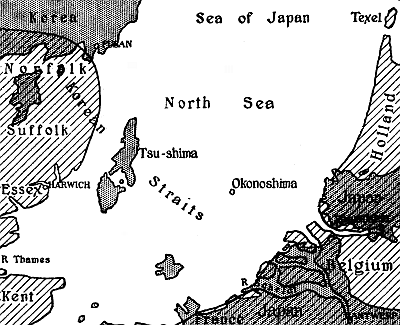
BATTLE OF TSU-SHIMA
sketch map to show the extent of the waters in which the first part
of the fight took place. the main features of the korean (or tsu-shima)
straits are mapped in black, & an outline map of the north sea between
the eastern counties of england & the opposite coast of the continent
is sketched over the map in RED on the same scale
At daybreak the Japanese scouts were in touch. As the
day came in grey light over the misty broken sea, one of
their scouts, the auxiliary cruiser "Siano Maru" (an armed
passenger liner), sweeping round through the haze, almost
collided with the hospital ships, and then dashed off and
disappeared in the twilight. In former wars she would
have had to run back to the fleet with her news. Now from
her wireless apparatus the information was sent through
the air to the receivers of the "Mikasa" in Masampho Bay,
and in a few minutes Togo knew that "the enemy's fleet
was in square No. 203 of the chart, apparently steering for
the eastern passage," i.e. the strait between Tsu-shima
Island and Japan.
In the straits and outside Masampho Bay a heavy sea
was running, and though the wind blew strongly from the
south-west, the weather was still hazy at sunrise, with
patches of fog here and there. The main body of the
Japanese fleet began to get up anchors and slip from its
moorings.[30]
At dawn Rojdestvensky had called in the "Almaz,"
leaving the "Jemschug" and "Izumrud" steaming in
advance of his two divisions. The six auxiliary ships had
closed up, so that the leading ship, the transport "Anadir,"
was abreast of the centre of the two lines. The "Almaz,"
"Svietlana," and "Ural," steamed at the rear of this
central line of transports, to protect them in that direction.
The two hospital ships, flying the Red Cross flag and
trusting to it for safety, were well astern. About 6 a.m.
the huge "Ural" came running up between the lines, and
semaphored to the flagship that four ships in line ahead
were passing across the rear of the fleet, but could not be
clearly made out in the mist.
They could only be some of Togo's cruisers "shepherding"
the fleet. Just before seven a fine cruiser was seen
some five miles away on the starboard beam of the "Suvaroff."
She closed up to three miles, and was soon identified
as the "Idzumo." The big turret-guns were swung
round to bear on her, but the Japanese cruiser, having seen
what she wanted, increased her distance, but could be seen
still keeping the fleet in sight. Togo's report notes that at
7 a.m. the "Idzumo" sent by wireless the second definite
report of the enemy, stating that he was twenty-five miles
north-west of Ukushima, steering north-east. This would
make the Russian position about thirty miles south of
the Tsu-shima Islands, heading for the channel to the east
of them. An hour later, about 8 a.m., some Japanese ships
showed themselves the other side of the fleet. Semenoff
notes how:—
"The 'Chin-yen,' 'Matsushima,' 'Itsukushima,' and
'Hashidate,' appeared out of the mist, steaming on
an almost parallel course. Ahead of them was a small,
light cruiser, apparently the 'Akitsushu,' which hurriedly
drew off to the north as soon as we were able to see her
well (and equally she us), and the whole squadron began
slowly to increase their distance and gradually to disappear
from sight."
This was Vice-Admiral Takeomi's division, composed of
three of the cruisers that had fought at the Yalu battle,
eleven years before, and the "Chin-yen," which had
fought against them as the "Ting-yuen." The ship that
ran out ahead was the only quick or modern ship in the
squadron, the small Clyde-built armoured cruiser "Chiyoda."
If Rojdestvensky had had any speedy cruisers
available, he might have severely punished this slow
squadron of old ships. Takeomi showed he knew his enemy
by thus boldly approaching in the mist.
The Russians now realized that they had watchful
enemies all round them, and rightly conjectured that they
would find the enemy's heavy ships in the straits ready
for battle.
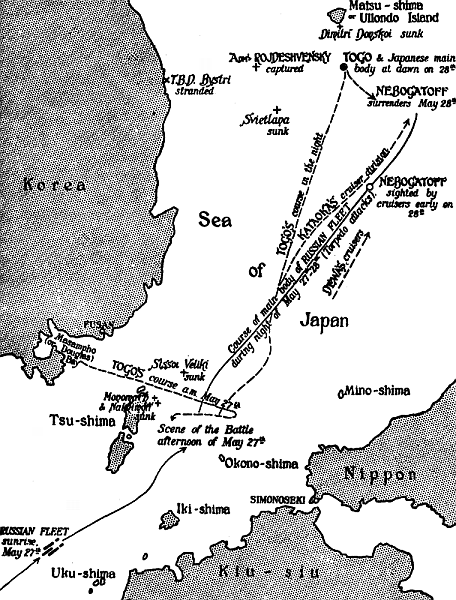
BATTLE OF TSU-SHIMA—general map
At 10 a.m. another cruiser squadron appeared on the
port beam. This was Dewa's division, made up of the
American-built sister ships "Kasagi" and "Chitose," of
nearly 5000 tons, and two smaller protected cruisers, the
"Niitaka" and "Otowa," lately turned out by Japanese
yards. They seemed to invite attack. At a signal from
the admiral, the eight armour-clads of the starboard line
steamed ahead of the port line, turned together to port,
and then, turning again, formed line ahead, leading the
whole fleet. At the same time the transports moved out to
Starboard, guarded by the "Vladimir Monomach"
(detached from the port division), the "Svietlana,"
"Almaz," and "Ural."
Dewa's cruisers held a parallel course with the Russian
battleships for more than an hour, still apparently unsupported.
The range was about five miles. At 11.20
the Russians opened fire on them. Semenoff says that it
was the result of a mistake. "The 'Orel' fired an accidental
shot (which she immediately reported by semaphore).
Unable, with smokeless powder, to tell by which of the
leading ships it had been fired, the fleet took it as a signal
from the 'Suvaroff' and opened fire. Of the whole fleet
the fire of the 3rd Squadron was the heaviest."
This squadron was made up of Nebogatoff's "old tubs."
Their heavy fire was probably the result of undisciplined
excitement. The Japanese fired a few shots in reply, but
no harm was done on either side. Rojdestvensky, who had
kept the guns of his flagship silent, signalled "Ammunition
not to be wasted," and the firing ceased in five minutes,
just as the Japanese turned slowly and increased their
distance.
Orders were now signalled for the men of the Russian
fleet to have their dinners, and the officers lunched in turn.
The harmless skirmish encouraged some of the Russian
crews with the idea that they had been in action and were
none the worse, and had driven the Japanese away. At
noon the fleet was due south of Tsu-shima, which towered
like a mountain out of the sea a few miles ahead. The
signal was hoisted, "Change course N.23°E. for Vladivostock."
It was the anniversary of the Tsar's coronation.
Round the wardroom tables in his doomed fleet the officers
stood up and drank with enthusiasm to the Emperor, the
Empress, and "victory for Russia!"
The cheering had hardly died down when the bugles
sounded the alarm. Every one hurried to his post. The
enemy's cruisers had again shown themselves, this time
accompanied by a flotilla of destroyers, that came rolling
through the rough sea with the waves foaming over their
bows. On a signal from the admiral the four leading
battleships turned to starboard and stood towards the
enemy, then re-formed line ahead on a course parallel to
the rest of the fleet, and slightly in advance of it. The
Japanese on the threat of attack had turned also and
went off at high speed to the northwards.
At 1.20 p.m. the admiral signalled to the four next ships
of the fleet to join the line of battleships, forming astern of
them. The Russian armada was now well into the wide
eastern strait of Tsu-shima, and far ahead through the mist
a crowd of ships could be dimly seen. The crisis was near
at hand.
On receiving the first wireless message from the "Shinano
Maru" at daybreak, Togo had weighed anchor and come
out of Masampho Bay, with his main fleet steering east, so
as to pass just to the north of Tsu-shima. He had with
him his twelve armoured ships, and Rear-Admiral Uriu's
division of protected cruisers ("Naniwa," "Takachico,"
"Tsushima," and "Akashi"), and a strong flotilla of
destroyers. The smaller torpedo-boats, more than sixty
in number, had been already sent to shelter in Miura Bay
in the island of Tsu-shima, on account of the heavy seas.
During the morning Togo received a succession of wireless
messages from his cruisers, and every mile of the enemy's
progress, every change in his formation was quickly signalled
to him. Shortly after noon he was able to note that
the Russians were entering the straits, steaming at about
12 knots on a north-easterly course; that they were
formed in two columns in line ahead, the starboard column
being the stronger, and that they had their transports
astern between the columns. He decided to attack them
on the weaker side at 2 p.m., when he calculated that they
would be near Okinoshima, a small island in the middle of
the eastern strait, about half-way between Tsu-shima and
the south-western headlands of Nippon.
At half-past one he was joined by Dewa's division of
cruisers, and a few minutes later the divisions of Kataoka
and the younger Togo rejoined. They had till now hung
on the flanks of the Russian advance. At a quarter to two
the enemy's fleet came in sight away to the south-westward
of Okinoshima. Flags fluttered up to the signal yards of
the "Mikasa," and the fleet read with enthusiasm Togo's
inspiring message:—
"The rise or fall of the Empire depends upon to-day's
battle. Let every man do his utmost."
He had been about ten miles north of Okinoshima at noon
(by which time he had steamed some 90 miles from Douglas
Bay since 5 a.m.), thence he turned back slowly, going
west and a little south, till he sighted the Russians. He
crossed their line of advance diagonally at about 9500
yards distance. His light cruiser divisions had received
orders to steam southwards and attack the Russian rear,
and were already well on their way.
The heavy Japanese ships, circling on the left front of the
enemy's advance, put on speed, and were evidently intending
to recross the bows of the battleship division, bringing a
converging fire to bear on the leading ships—the manœuvre
known as "crossing the T." As the "Mikasa" led the
Japanese line on its turning movement Rojdestvensky
swung round to starboard and opened fire at 8500 yards.
Togo waited till the distance had shortened to 6500, and
then the guns of the "Mikasa" flashed out. At that
moment only three other of his ships had made the turn.
They also opened fire, and ship after ship as she came round
into line joined in the cannonade. The Russians turned
more slowly, and it was some time before the whole of their
line was in action. Meanwhile a storm of fire had burst
upon the leading ships of Rojdestvensky's lines, the
"Suvaroff" and the "Ossliabya" at the head of the
starboard and port divisions being each made a target by
several of the enemy.
The Japanese gunners were firing with a rapidity that
surprised even those who had been in the action of 10
August, and with much more terrible effect. In Captain
Semenoff's narrative of the fate of the "Suvaroff" we have
a remarkably detailed description of the execution done by
the Japanese shells in this first stage of the battle. The
opening shots went high. They flew over the "Suvaroff,"
some of the big 12-inch projectiles turning over and over
longitudinally in their flight. But at once Semenoff remarked
that the enemy were using a more sensitive fuse
than on 10 August. Every shell as it touched the water
exploded in a geyser of smoke and spray. As the Japanese
corrected the range shells began to explode on board or
immediately over the deck, and again there was proof of
the improved fusing. The slightest obstacle—the guy of
a funnel, the lift of a boat derrick—was enough to burst
the shell.
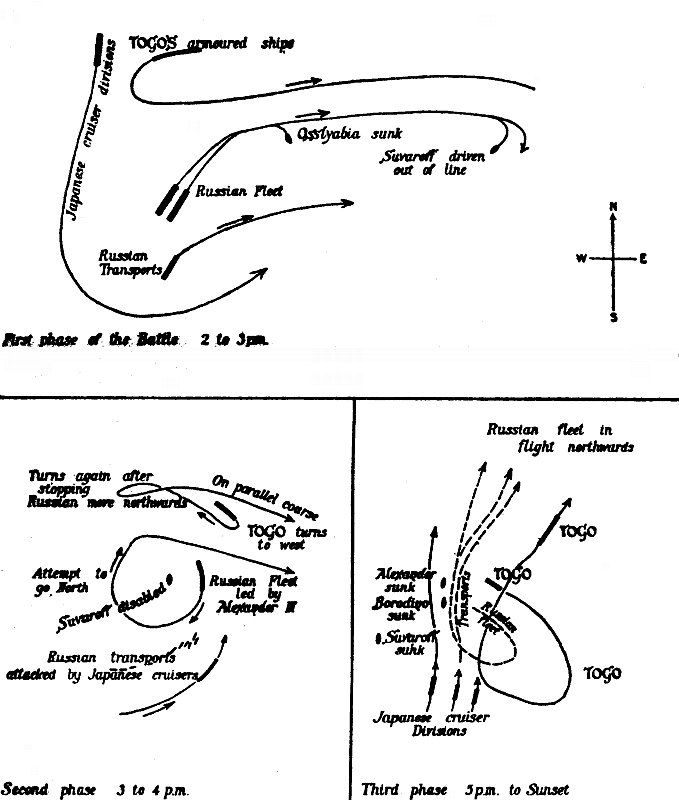
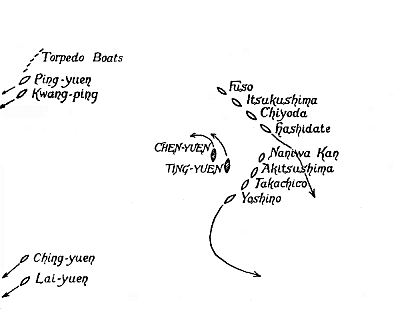
BATTLE OF TSU-SHIMA
diagrams of movements during the fighting of may 27th
The first fair hit was on the side, abreast of the forward
funnel. It sent up a "gigantic column of smoke, water, and
flame." Then several men were killed and wounded near
the fore-bridge, and then there was a crash beside one of the
quick-firers, and, the shell bursting as it penetrated the deck,
set the ship on fire. In the battle of 10 August the flagship
"Tsarevitch," which had borne the brunt of the Japanese
fire, had been hit just nineteen times, but now that the
"Mikasa" and her consorts had got the range hit followed
hit on the leading Russian ships. "It seemed impossible,"
says Semenoff, "even to count the number of projectiles
striking us. I had not only never witnessed such a fire
before, but I had never imagined anything like it. Shells
seemed to be pouring upon us incessantly one after another....
The steel plates and superstructure on the upper deck
were torn to pieces, and the splinters caused many casualties.
Iron ladders were crumpled up into rings, and guns
were literally hurled from their mountings. Such havoc
would never be caused by the simple impact of a shell, still
less by that of its splinters. It could only be caused by the
force of the explosion.... In addition to this there was the
unusually high temperature and liquid flame of the explosion,
which seemed to spread over everything. I
actually watched a steel plate catch fire from a burst. Of
course, the steel did not burn, but the paint on it did. Such
almost incombustible materials as hammocks and rows of
boxes, drenched with water, flared up in a moment. At
times it was almost impossible to see anything with glasses,
owing to everything being so distorted with the quivering,
heated air. No! It was different to the 10th of August!"
In this storm of fire there was heavy loss of life. A shell-burst
killed and wounded most of the signallers as they
stood together at their station. An explosion against the
opening of the conning-tower killed two officers beside
Rojdestvensky, and slightly wounded the admiral. The
fight had not lasted more than twenty minutes, and the
"Suvaroff," the "Alexander," and "Borodino," the
three leading Russian ships, were all wrapped in black
smoke from the fires lighted on board of them by the
Chimose shells.
How was the Japanese line faring? I talked over his
battle experiences with a Japanese officer not long after
the day of Tsu-shima. He told me his impression was
that at first the Russians shot fairly well, causing some loss
of life at the more exposed stations on board the leading
Japanese ships. "But," he added, "after the first twenty
minutes they seemed suddenly to go all to pieces, and their
shooting became wild and almost harmless." No wonder
that under such a tornado of explosions, death and destruction,
and with their ships ablaze, and range-finding and fire-controlling
stations wrecked, the gunnery of the Russians
broke down. One of the pithy sayings of the American
Admiral Farragut was: "The best protection against the
enemy's fire is the steady fire of your own guns." Tsu-shima
gave startling proof of it.
Semenoff hoped that the Japanese were also suffering
from the stress of battle. From the fore-bridge of the
"Suvaroff" he scanned their line with his glasses. In the
sea-fights of other wars both fleets were wrapped in a dense
fog of powder smoke, but now with the new powder there
was no smoke except that of bursting shells and burning
material. So he could distinguish everything plainly.
"The enemy had finished turning. His twelve ships
were in perfect order at close intervals, steaming parallel to
us, but gradually forging ahead. No disorder was noticeable.
It seemed to me that with my Zeiss glasses (the
distance was a little more than two miles) I could distinguish
the mantlets of hammocks on the bridges and
the groups of men. But with us? I looked round. What
havoc! Burning bridges, smouldering débris on the
decks, piles of dead bodies. Signalling and judging distance
stations, gun-directing positions, all were destroyed. And
astern of us the 'Alexander' and the 'Borodino' were
also wrapped in smoke."
Men were killed in the turrets by shell splinters flying
through the narrow gun openings. The fire hose was
repeatedly cut to ribbons, and the men fighting the fire
killed. The injuries caused by near explosions were terrible.
Men were literally blown to atoms, or limbs were torn off.
Eleven wooden boats piled up on the spar-deck were a
mass of roaring flame. Gun after gun was disabled. And
all the while a glance at the Japanese fleet showed them
steaming and firing as if at peace manœuvres, without even
one of their numerous flagstaffs and signal yards shot away.
The battle had not lasted an hour, and it was already
evident that it could have only one ending.
In the smoke and confusion Semenoff could only see what
was happening in the front of the line, but the other ships
were exposed to a heavy fire, and had less resisting power.
The "Ossliabya," the fifth of the battleships, and Fölkersham's
flagship during the voyage,[31] was the first to succumb.
The firing had hardly begun when a 12-inch projectile
penetrated her forward above the water-line. In fine
weather the effect would not have been very serious, but
the heavy sea flooded her two bow compartments. Then
another shell started an armour plate on the water-line
amidships, flooded the bunkers on the port side, and gave
her a heavy list in that direction. Unsuccessful attempts
were made to right her by opening valves and admitting
water on the other side. Then a shell burst in the fore-turret
and put all the crews of the two guns out of action.
She was now settling down by the head and heeling over
more and more to port. Suddenly the sea reached her
lower gun-ports and poured into her. Then, like the unfortunate
"Victoria," she "turned turtle," and sank. It
was at 2.25 that she disappeared thus suddenly, the first
battleship ever sunk by gun-fire. Three of the destroyers
picked up some of the crew who had jumped overboard.
As she sank, the three other ships of her division
("Sissoi," "Navarin," and "Nakhimoff"), under the
stress of the Japanese fire, sheered for a while out of the line
with their upper works ablaze in several places. The four
stately battleships at the head of the line had then to face
the concentrated attack of the enemy. The "Orel" was
suffering like her consorts. Though her armour was nowhere
penetrated, the shells burst their way into her unarmoured
superstructure, and reduced everything on her
upper decks to tangled wreckage. Five minutes after the
"Ossliabya" sank a shell wrecked the after-turret of the
"Suvaroff," tearing the after-bridge to pieces with the
flying fragments. Her steering gear was temporarily
disabled, and she drifted from her station at the head of
the line. One by one in quick succession the heavy steel
masts and two huge funnels crashed down. The upper
deck was impassable from end to end. In the midst of the
confused wreckage handfuls of brave men fought the fires
with buckets as they broke out now here now there. Most
of the guns were silent. "She no longer looked like a ship,"
says a Japanese account.
When the "Suvaroff" swerved out of the line at a few
minutes before three o'clock her steering gear had been
disabled, and probably for a few minutes before the crisis
she had not been answering her helm. The course of the
fleet, while she led it during the fight with the Japanese
armoured fleet, had been due east, but, as she lost her
direction, it turned slightly to the south. When she drifted
away from the line the "Imperator Alexander III" became
the leading ship. Captain Buchvostoff, who commanded
her, led the fleet in a circle round the disabled
"Suvaroff," first running southwards, increasing the
distance from the enemy, and then sweeping round as if
trying to break through to the northward. Togo followed
on a parallel course until the Russian fleet seemed to be
going due south, then he signalled an order, and, as accurately
as if they were performing a practice evolution at
manœuvres, his twelve ships turned simultaneously
through half a circle, thus reversing the direction and
changing the order of the fleet so that the last ship in the
line became the leader. As the Russians swept round to
the north Togo was thus ready to cross their bows, and the
"Alexander" received the concentrated fire of several
ships.
She turned eastwards, followed by her consorts in a
straggling line, and then drifted out of her place at the
head of it, leaking badly, and with her upper works ablaze.
On a smoother sea the "Tsarevitch" had been hit once
below the armour belt on 10 August.
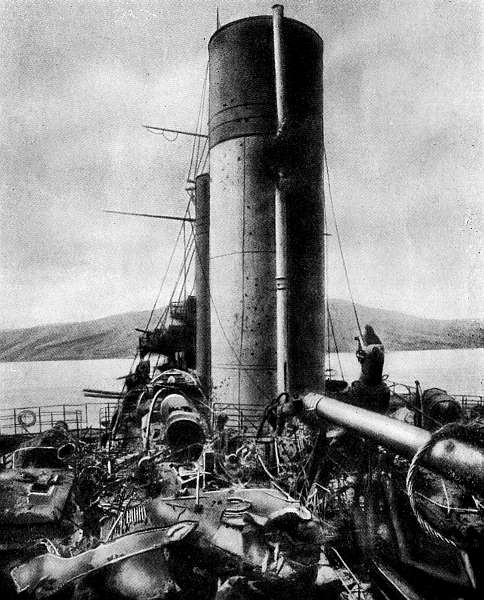
the russian battleship 'orel'
Taken after the battle of Tsu-Shima, showing effects of Japanese shell fire
The "Borodino" now had the dangerous post at the
head of the line. It steamed eastwards for nearly an hour,
followed by Togo on a parallel course, the Japanese fire
only slackening when fog and smoke obscured its targets,
and the fire of the Russians dwindling minute by minute,
as gun position after position became untenable or guns
were disabled and dismounted.
Long before this the divisions of protected cruisers under
Admiral Dewa and his colleagues had worked round to the
southward of the Russians. Dewa and Uriu, with their
swift ships, were in action by a quarter to three. The slower
ships of Takeomi and the younger Togo's squadrons,
united under the command of Rear-Admiral Kataoka, came
into the fight a little later. In the heavy sea that was
running the light cruisers afforded a less steady platform
for the guns than the big armoured ships, and their fire was
not so terribly destructive. But it was effective enough, and
that of the Russian rear ships was hopelessly bad. The
Japanese cruisers drove the transports and their escort, in
a huddled crowd, north-eastwards towards the main Russian
fleet. The great wall sides of the German liner, now the
auxiliary cruiser "Ural," were riddled, and the giant
began to settle down in the water. The cruiser "Svietlana,"
hit badly in the forepart, was dangerously down by the
head. The transports "Kamschatka" and "Irtish" were
both set on fire, and the latter was also pierced along
the water-line. She sank at four o'clock. The "Oleg" and
"Aurora" were both badly damaged. But the Japanese
unarmoured cruisers did not escape scathless. Dewa's
fine cruiser, the "Kasagi," was badly hit below the waterline,
and was in such danger of sinking that he handed the
command of his squadron over to Uriu and, escorted by
the "Chitose," steamed out of the fight, steering for the
Japanese coast. Togo's old ship, the famous "Naniwa
Kan," was also hit below the water-line, and had to cease
firing and devote all the energy of the crew to saving the
ship.
At five o'clock the Russian fleet, battleships, cruisers, and
transports, were huddled together in a confused crowd,
attacked from the eastward by Togo and Kamimura with
the heavy squadrons, while from the south the line of light
cruisers under Uriu and Kataoka poured a cross-fire into
them. Away to the westward lay the disabled and burning
"Suvaroff" with the Russian naval flag, the blue cross of
St. Andrew on a white ground, still flying from a flagstaff
in the smoke. The admiral had been twice wounded, the
second blow slightly fracturing his skull, and making it
difficult for him to speak. Her captain, Ignazius, had been
simply blown to pieces by a Japanese shell while, after
being already twice wounded, he was directing a desperate
effort to master the conflagration on board. The decks
were strewn with dead, the mess-deck full of helpless
wounded men. Most of the guns were out of action, but a
6-inch quick-firer and a few lighter guns were kept in
action, and drove off the first attempt of the Japanese
destroyers to dash in and sink her. Still there was no
thought of surrender. The few survivors of her crew
fought with dogged Russian courage to the last. A torpedo
destroyer, the "Buiny," taking terrible risks, came up to
her, hung on for a few moments to her shattered side, and
succeeded in getting off the wounded admiral and a few
officers and men. Rojdestvensky sent a last message to
Nebogatoff, telling him to take over the command and try
to get through with some part of the fleet to Vladivostock.
About half-past five some of the Russian ships struggled
out of the press, led by the burning "Borodino," with the
"Orel" next to her. In the straggling line battleships and
cruisers, armoured and unarmoured, were mingled together.
The "Alexander" had succeeded in stopping
some of her leaks and had rejoined the line. She was near
the end of it. The "Ural," deserted by her crew, was drifting,
till one of Togo's battleships sank her with a few shots.
The Russians were now steering northwards, and for the
moment there was no large ship in front of them. The
Japanese could have easily headed them off, but Togo now
regarded them as a huntsman regards a herd of deer that
he is driving before him. The Japanese squadron steamed
after them at reduced speed, just keeping at convenient
range, the heavy ships on their right, the light squadrons
behind them. At first the armoured ships concentrated
their fire on the "Alexander." Shells were bursting all
over her, and throwing up geysers of water about her bows.
Then the merciless fire was turned on the "Borodino."
A few minutes after seven the "Alexander" was seen to
capsize and disappear. A quarter of an hour later there
was an explosion on board of the "Borodino." Next
moment a patch of foam on the waves showed where she
had been. About the same time a division of torpedo-boats
came upon the unfortunate "Suvaroff," torpedoed her,
and saved some of the crew, who were found floating on the
water after she sank.
As the sun went down, and the twilight darkened into
night, the firing died away. What was left of the Russian
fleet was steaming slowly into the Sea of Japan, some of
the ships isolated, others holding together in improvised
divisions, all bearing terrible marks of the fight, some of
them still on fire, others leaking badly.
Togo had been hit during the fight, but it was only a
slight bruise. The losses of his fleet had been trifling. Of
the armoured ships the only one that had been badly hit
was the "Asama." She was struck by three shells aft near
the water-line, her rudder was disabled, and she was leaking
badly. She left the fighting-line for a while, but was able
temporarily to repair damages, and rejoined later in the
day.
At sunset Togo ordered his squadrons to steam north-eastward
during the night, and unite at sunrise at a point
south of Matsu-shima or Ullondo Island. They were to
keep away from the Russian ships in the darkness. The
victorious admiral was about to let loose his torpedo
flotillas, to complete the destruction of the flying enemy,
and meant that his torpedo officers should have no anxiety
about hitting friends in the dark.
He had with the main fleet twenty-one destroyers
organized in five squadrons. In the bays of Tsu-shima
nearly eighty torpedo-boats had been sheltering all day.
The destroyers had been directed to pursue and attack the
beaten enemy during the night. No orders had been given
to the torpedo-boats. The sea was going down, but it was
still rough, and Togo had doubts about risking the smaller
craft. But without orders, sixteen groups of four boats
each, sixty-four in all, got up steam and sallied out into
the darkness.
It was an awful night for the Russians. After dark they
had extinguished the fires lighted by the enemy's shells,
and in some cases got collision mats over the leaks. The
dead were committed to the sea, the wounded collected and
cared for. For more than an hour they were allowed to
hold their course uninterrupted, and the lights of the
Japanese fleet were disappearing far astern. After all,
Vladivostock might be reached. But just after eight
o'clock the throb of engines, the hurtling beat of propellers,
came sounding through the night from all sides.
On the sea black, low objects were rushing along with
foaming phosphorescent wakes trailing behind them.
Bugles ran out the alarm; crews rushed to quarters;
searchlights blazed out, and the small quick-firers that
were still serviceable mingled their sharp ringing reports
with the crackle of machine-gun fire. The sea seemed to
be swarming with torpedo craft. They appeared and disappeared
in the beams of the searchlights, and the surface
of the water was marked with the long white ripples raised
by the rush of discharged torpedoes. Loud explosions, now
here now there, told that some of them had found their
target, though in the confusion and the rough sea there
were more misses than hits. The "Sissoi Veliki," which
had been on fire in the action, and pierced below the waterline,
had a new and more serious leak torn open in her
stern, the rudder was damaged and two propeller blades
torn off. But she floated till next day. Several ships received
minor injuries, but kept afloat with one or more
compartments flooded. But the effect of the attack was
to disperse the fugitive Russians in all directions.
When it began Nebogatoff was at the head of a line of
ships in the old battleship "Imperator Nikolai I." In the
confusion only three of the line kept up with him, the
much-battered "Orel" and the "Admiral Apraxin" and
"Admiral Senyavin." The "Orel" had no searchlight
left intact. The "Nikolai" and the two others did not
switch on their searchlights, and kept all other lights
shaded. The remarkable result was that as they moved
northwards through the darkness they were never attacked,
though more than once between 8 p.m. and midnight
they saw the enemy's torpedo craft rushing past
them. The ships with searchlights drew all the attacks.
Admiral Enquist, with his flag in the "Oleg," and
followed by the "Aurora" and "Jemschug," had run in
amongst the remains of the transport flotilla at the first
alarm, narrowly escaping collision with them. Then he
turned south, in the hope of shaking the enemy off, but
came upon another flotilla arriving from that direction.
He had some narrow escapes. The look-outs of the "Oleg"
counted seventeen torpedoes that just missed the ship.
Having got away, he tried more than once to turn back to
the northward, but each time he ran in among hostile
torpedo-boats, and saw that beyond them were ships with
searchlights working and guns in action, so he steered
again south. At last he gave up the attempt and headed
for the Tsu-shima Straits. He got safely through them,
because the main Japanese fleet was miles away, steaming
steadily north, with tired men sleeping by the guns. Next
day he was in the open sea with no enemy in sight, and set
his course for Shanghai.
At midnight the defeated Russians thought they had at
last shaken off the pursuit of the sea-wolves. But at
2 a.m. the attacks began again. The "Navarin" and the
"Admiral Nakhimoff," among the rearmost ships, were
attacked by Commander Suzuki's squadron of destroyers.
The "Navarin" was sunk after being hit by two torpedoes.
The "Nakhimoff" was severely damaged. About the
same time the "Vladimir Monomach" and the "Dimitri
Donskoi" were torpedoed, but managed to keep afloat.
The attacking force had a good many casualties. Torpedo-boats
Nos. 35 and 65 were sunk by the Russian fire. Their
crews were rescued by their consorts. Four destroyers (the
"Harusami," "Akatsuki," "Izazuchi," and "Yugiri")
and two torpedo-boats (Nos. 31 and 68) were so seriously
damaged by hostile fire, or by collision in the darkness,
that they were put out of action. As the dawn began to
whiten the eastern sky the torpedo flotillas drew off.
At sunrise the Russian fleet was scattered far over the
Sea of Japan. Some of the ships for a while steamed alone
with neither consort nor enemy in sight within the circle of
the horizon. But new dangers came with the day. Togo's
fleet was at hand, flinging out a wide net of which the
meshes were squadrons and detached cruisers to sweep the
sea northwards, and gather up the remnants of the defeated
enemy. The weather was clearing up, and it was a fine,
bright day—just the day for the work the Japanese had
to do.
Steaming steadily through the night, Togo, with the main
body of the Japanese fleet, had passed to eastward of the
scattered Russians, and was about twenty miles south of
Ullondo. The distances covered in this battle of Tsu-shima
were beyond any that had ever been known in naval war.
The running fight during the night had passed over more
than 150 miles of sea. At 5.20 a.m. the admiral on board
the "Mikasa" received a wireless message from Kataoka's
cruisers, reporting that they were sixty miles away to the
southward of him, and that they could see several columns
of black smoke on the horizon to the eastward. Shortly
after Kataoka sent another wireless message—"Four of the
enemy's battleships and two cruisers are in sight, steering
north-west." Togo at once signalled to his own ships to
head off this detachment of the enemy, and sent wireless
orders to Kataoka and Uriu to close in on their rear. It
was probably the main fighting division left to the Russians,
and would soon be surrounded by an overwhelming
Japanese force.
The ships sighted by the cruisers were those that Admiral
Nebogatoff had led through the night, and was trying to
take to Vladivostock. He had with him the battleships
"Nikolai I" and "Orel," the coast-defence armour-clads
"Admiral Apraxin" and "Admiral Senyavin," and the
cruisers "Izumrud" and "Svietlana." This last ship was
leaking badly and down by the bows. She could not keep
up with the others, and at daylight fell far astern and lost
sight of them. At 7 a.m. Uriu's division in chase of Nebogatoff
came up with her, and the cruisers "Niitaka" and
"Otowa" were detached to capture her. The Russian
captain, Schein, had held a council with his officers. He
had only a hundred shells left in the magazines, and the
"Svietlana" was being kept afloat by her steam pumps.
Under the regulations he could have honourably surrendered
to a superior force, but it was unanimously resolved to fight
to the last shot, and then sink with colours flying. The
fight lasted an hour. There were heavy losses. The
Japanese fire riddled the ship, and first the starboard, then
the port engine was disabled. As the hundredth shot rang
out from the "Svietlana's" guns, Captain Schein stopped
the pumps and opened the sea-cocks, and the ship settled
down rapidly in the water. The Japanese cruisers went off
to join the fleet as the "Svietlana" disappeared, but an
armed Japanese liner, the "America Maru," stood by and
picked up about a hundred men.
At 10.30 a.m. Nebogatoff was completely surrounded
eighteen miles south of the island of Takeshima. The
"Izumrud" had used her superior speed to get away to
the south-west. The four battered ships that remained
with him saw more than twenty enemies appear from all
points of the compass, including Togo's battleships and
heavy armoured cruisers, all as fit for work as when the
first fighting began. They opened fire at long range with
their heavy guns.
The situation was desperate. Nebogatoff consulted his
officers, and all those on board the "Nikolai" agreed that
he must surrender. In a memorandum he subsequently
wrote he pointed out that, though some ammunition was
left, the Japanese were using their superior speed to keep
a distance at which he could not reply effectively to their
overwhelming fire; neither the shore nor other ships were
within reach; most of the boats had been shattered, the
rest could not be lowered; even the life-belts had been
burned or used to improvise defences in the ships; continued
resistance or the act of sinking the ships would only
mean the useless sacrifice of some 2000 men. After the
ships had been only a short time in action, during which
time they received further severe damage, he hauled down
his colours. Togo allowed the Russian officers to retain
their swords, as a proof of his opinion that they had acted
as befitted brave and honourable men.
While the brief action with Nebogatoff's squadron was in
progress, the third of the Russian coast-defence battleships,
the "Admiral Ushakoff," hove in sight. She turned off to
the westward pursued by the armoured cruisers "Iwate"
and "Yakumo." They soon overhauled her, and signalled
a summons to surrender, adding that Nebogatoff had
already done so. The "Ushakoff" replied with her 9-inch
guns. The cruisers sank her in an hour, and then rescued
some three-fourths of her crew of 400 men.
The "Sissoi Veliki," badly injured in the action of the
day before, and torpedoed during the night, was in a sinking
condition when the sun rose on 28 May. No ships were in
sight, all the boats had been destroyed, and while the
pumps were still kept going the crew was set to work to
construct rafts. While this was being done with very
scanty materials, the "Vladimir Monomach" hove in sight,
accompanied by the destroyer "Iromki." In reply to a
signal for help, the "Monomach" answered that she could
do nothing, as she was herself expecting to sink soon. The
"Iromki" offered to take a few men, but the captain of the
"Sissoi" generously refused to deprive the "Monomach"
of her help. The two ships then steamed away. An hour
later the "Sissoi" was just settling down in the water,
when three Japanese armed merchant steamers appeared
and took off her crew. At half-past ten the "Sissoi"
heeled over to starboard and sank.
Soon after she lost sight of the "Sissoi," the "Monomach"
came upon the armoured cruiser "Admiral Nakhimoff,"
which also signalled that she was in a sinking condition.
Presently there was smoke on the horizon, and
then the armed steamer "Sadu Maru" and the Japanese
destroyer "Shiranui" appeared. In such conditions the
enemy proved a friend. The crews of the two unfortunate
ships were transferred to the "Sadu," which stood by till,
about ten o'clock, both the "Nakhimoff" and the "Monomach"
went to the bottom.
The "Navarin" was comparatively little injured in the
battle, but was torpedoed during the night. Leaking
badly, she struggled northward at a slow rate till two in the
afternoon of the 28th, when she was found and attacked
by a Japanese destroyer flotilla. She still made a fight with
her lighter guns, and was hit by two torpedoes. The crew
were all at their battle stations when she began suddenly
to sink. The order, "All hands on deck," came too late,
and very few lives were saved.
The armoured cruiser "Dimitri Donskoi," last survivor
of Rojdestvensky's fourteen battleships and armoured
cruisers, escaped the torpedo attacks in the night, and
eluded pursuit all through the morning of the 28th. At
4 p.m., when she was near the island of Ullondo, she sighted
some Japanese ships in the distance, Uriu's cruiser
division and some destroyers. They closed slowly on her,
and it was not till six o'clock that she was attacked by the
cruisers "Niitaka" and "Otowa," and three destroyers.
The "Donskoi" made a gallant fight for two hours,
beating off the torpedo-boats, losing sixty killed and twice
as many wounded, and finally disengaging herself in the
darkness about eight o'clock. The water-line armour was
intact, but one boiler was penetrated and ammunition was
nearly exhausted. In the night, the captain, who was
himself slightly wounded, decided to land his men on
Ullondo Island and sink the ship. All the boats had been
shattered and the cutter that was left had to be hastily repaired
before it could be lowered. With the one boat the
disembarkation went on slowly during the night. At dawn
the enemy's torpedo-boats were sighted. The rest of the
crew jumped overboard and swam ashore, leaving a few
men with the second-in-command on the ship. They ran
the "Donskoi" out into a hundred fathoms of water,
opened the sea-cocks, embarked in their one boat, and
saw their ship go down as they pulled ashore. The
Japanese sent a couple of steamers to take the crew off the
island.
The torpedo destroyer that conveyed the wounded
Admiral Rojdestvensky, Captain Semenoff, and a few other
officers and men away from the fight was found and captured
by a Japanese flotilla during the afternoon of the 28th.
The cruiser "Izumrud," one of the few fast ships the
Russians had with them, escaped the torpedo attacks in the
night. In the morning she was chased by several of the
enemy's cruisers. She kept up a good speed, and one by
one they abandoned the chase, the "Chitose" being the
last to give it up. By 2 p.m. all pursuit was left behind, and
she reduced speed. In the battle and the chase she had
burned so much coal that she had not enough left to make
for Vladivostock, so she steered for Vladimir Bay, in the
Russian Coast Province of Siberia, north of Korea. She
was off the entrance of the Bay at midnight with only ten
tons of coal left in her bunkers. Unfortunately, in trying to
go in in the dark on the flood-tide she drove hard on a reef.
Next day unsuccessful efforts were made to get his ship off
and in the afternoon, as her captain expected the enemy's
ships might arrive to secure the "Izumrud" and refloat
her, he landed his crew on Russian ground, destroyed his
guns one by one with blasting charges, and then blew up
the ship.
The destroyer "Groki" was chased and captured by the
Japanese destroyer "Shiranui" and a torpedo-boat, and
after a sharp fight close to Tsu-shima Island surrendered
at 11.30 a.m. She was so injured that she sank within an
hour of her capture. Admiral Enquist, with the three protected
cruisers "Oleg," "Aurora," and "Jemschug," had,
after turning south for the last time during the night of
torpedo attacks, got through the Tsu-shima Straits in the
darkness. Next day no enemy was in sight, and he steered
for Shanghai under easy steam, repairing damages on the
way. He intended to lie off the port, bring a couple of
colliers out of the Woosung River, fill his bunkers at sea,
and try to reach Vladivostock by the Pacific and the La
Pérouse Straits. On the morning of the 29th he was overtaken
by the repairing ship and tug "Svir," and from her
learned the full extent of the disaster. Fearing that if he
approached Shanghai he would be driven into the port and
blockaded by the enemy, he changed his course for Manila,
where he arrived on 3 June. The "Svir," after communicating
with him, had gone on to the Woosung River. She
was joined on her way there by the transport "Anadir,"
which had got successfully south through the Tsu-shima
Straits. The transport "Korea," which had escaped in the
same way, and had a cargo of coal, did not go to Woosung,
but crossed the Indian Ocean and appeared unexpectedly
in the French port of Diego Suarez in Madagascar. Of the
nine torpedo destroyers with the Russian fleet seven were
hunted down and sunk or taken by the Japanese.
The only ships of all the Russian armada that finally
reached Vladivostock were the two destroyers "Brawy"
and "Gresny," and the small swift cruiser "Almaz." She
had been with Enquist's cruiser division in the first hours
of the night after the battle. During the torpedo attacks
she had become separated from her consorts. Escaping
from the destroyers, she headed at full speed first towards
the coast of Japan, then northward. At sunrise on the 28th
she was well on her way and many miles north-east of
Togo's fleet. Next day she reached Vladivostock with
160 tons of coal still on board.
A hundred years after Trafalgar Togo had won a
victory as complete and as decisive. The Russian power
had been swept from the Eastern Seas, and the grey-haired
admiral who had secured this triumph for his native land—"Father
Togo," as the Japanese affectionately call him—had
lived through the whole evolution of the Imperial
Navy, had shared in its first successes, and for years had
been training it for the great struggle that was to decide
who was to be master in the seas of the Far East.
The war was followed by an immediate expansion of the
Japanese Navy. Numbers of captured Russian ships were
repaired, re-armed, and placed in the Navy List under
Japanese names. No longer dependent on foreign builders,
the Japanese yards were kept busy turning out yet a new
navy of every class, from the battleship to the torpedo-boat.
The laying down of the gigantic "Aki" and "Satsuma,"
battleships of over 20,000 tons, opened a new
period in naval construction, and nations began to count
their sea-power by the number of "Dreadnoughts" afloat
or on the slips.
The great maritime powers are now engaged in a race of
construction, and the next naval war will see forces in
action far surpassing even the armadas that met at Tsu-shima.
And maritime war, hitherto confined to the surface
of the sea, will have strange auxiliaries in the submarine
stealing beneath it, and the airship and aeroplane scouting
in the upper air. But still, whatever new appliances, whatever
means of mutual destruction science supplies, the
lesson taught by the story of all naval war will remain true.
Victory will depend not on elaborate mechanical structures
and appliances, but on the men, and will be the reward of
long training, iron discipline, calm, enduring courage, and
the leadership that can inspire confidence, command self-sacrificing
obedience, divine an enemy's plans, and decide
swiftly and resolutely on the way in which they are to be
frustrated.