“‘War is Hell,’ said General William T. Sherman. But,—better
have war than bow to an inferior nation.”—Doctrines of
the Strenuous Life.
GEORGE WALKER
WINNER OF THE GAMEST SEA FIGHT OF
THE ENGLISH CHANNEL
(1727-1777)
“If Britain can but breed th’ men,
Who are like Walker made,
She’ll have no fear of danger,
When th’ foe starts to invade.
When th’ foe starts to invade, my boys,
An’ creep along th’ shore,
Where th’ curling breakers wash th’ cliffs,
Where th’ breeching combers roar.
Then, lift a glass to Walker,
Of Glorioso fame,
May we ne’er forget his deed lads,
May we ne’er forget his name.”
—Chants from The Channel.—1769.
IT was the year 1739, and the good people of
Charleston, South Carolina, were in a great state
of agitation. Little knots of merchants, sailors,
clerks, and dock-hands clustered about each other in
the narrow streets. And, above the hub-bub of many
voices, could be heard the solemn sentence, oft repeated:
“The pirate is off the narrows! The pirate will
soon be here!”
Then all would gaze seaward with startled faces,
and would murmur:
“The pirate—the Spanish pirate will be here.”
As they thus stood irresolutely, a strongly-knit
fellow came walking towards the dock-end. He was
clad in gray; his face was deeply seamed by long exposure
to the elements; and high top-boots of leather
encased his lower limbs.
“What ho! Good citizens,” said he. “Do I understand
that a Spaniard has frightened you all?
Why, where’s your courage?”
“Courage?” answered a rotund-bodied merchant.
“Of that we have a plenty. But we have no ship with
which to combat this fellow—or fellows—for some
of my skippers tell me that there are two of them off
the coast, and that they’ve captured twenty trading
vessels.”
The newcomer smiled.
“I’ve got a staunch craft here,” said he. “My
name is Walker, and I hail from Bristol, England.
My ship—the Duke William—mounts but twenty
guns, and my crew is but of thirty-two, yet, I know
that many of you gentlemen will volunteer your services,
particularly if there is to be a nice little battle.”
“Hear! Hear!” came from all sides. “You’re the
boy for us! You’re the chap we’ve been looking for!
Hear! Hear!”
It did not take long to increase the crew of the
Duke William. Several of the wealthy colonists volunteered
their services; many sailors were there who
had been fighting on the Spanish Main. They were
eager and anxious to join. So, before three days were
out, the Duke William spread her canvas for the open
sea, carrying one hundred men and an additional
twenty guns. Now—you see—she could put up an
excellent fight with the average pirate-ship which
cruised about the low-lying and sandy coast.
Out into the broad expanse of the Atlantic glided
the little barque and eagerly the mariners scanned the
horizon for some signs of the pirate.
“She’s been hereabouts!” cried one stout seaman.
“For several of my mess-mates saw her sails down
near the channel islands. And her flag was surely
black with th’ skull an’ cross-bones.”
“Must have heard that we were coming, then,”
growled Captain Walker, “for there’s nothing in
view.”
In an hour’s time he thought differently, for,
“Sail ho!” sounded from the forward deck, and
there, far off to leeward, was the outline of a long,
blackish vessel, bearing no flag at her mizzen or stern.
Crowding on all canvas—for the breeze was light—the
Duke William bore away towards her. “It
must be the pirate!” said all, for, also crowding on
all sail, the vessel headed up the coast, and did her
utmost to get away.
On, on, went pursuer and pursued; on, on, and the
Duke William began to draw dangerously close to
the fleeing vessel, which now could be easily seen.
She was a brigantine, carrying about eighteen guns,
with a high stern and graceful lines. No flags waved
from her mast-heads.
Suddenly the scudding sea-warrior pointed her nose
in-shore, ran around the corner of a sandy island, and
bore away into a seemingly large lagoon upon the
other side. The Duke William followed, and, as she
rounded a jutting sand-spit, there before her lay a
little schooner, on the deck of which were seen several
sailors, waving and gesticulating frantically. Behind,
and on the shore, was an earth-work, from which
several cannon pointed their black muzzles. On a
flag-pole in the centre, waved a Spanish flag, and,
beneath it, a black ensign upon which was the skull-and-cross-bones.
“It’s the pirate stronghold!” cried several, at once.
“We’re in for a tight skirmish!”
But Captain Walker only smiled.
The brigantine, which he had been following, now
rounded-to, opened her port-holes, and fired a couple
of shots toward the pursuing craft. At the same
time an English flag was hoisted on the schooner, and
a fellow on her deck sang out through a speaking
trumpet.
“Thank Heaven you have come! We were only
captured two days ago! Hurrah for the English
flag!”
The Duke William kept on after the brigantine, her
mixed crew yelling with joy, now that they were to
have an action.
Bang! Bang!
Her two forward guns spoke, and a shot went ripping
through one of the foresails of the pirate.
This was enough for the fighting spirit of those who
sailed the Spanish Main. For, putting about, the
brigantine scudded through a narrow channel, known
only to her skipper (for no one else could have followed
without grounding upon a sand-spit), and was
soon running away upon the opposite side of a low-lying
island, now flaunting the pirate-flag from her
halyards.
“She’s gone!” sadly remarked the gallant Captain
Walker, “but we can capture the gun-battery. Make
ready to go ashore, if needed!”
Steering for the coast, the guns of the Duke William
opened upon the sandy barricade, and shot after shot
was soon making the dirt and gravel fly in every direction:
Poom! Poom! Cu-poom!
The cannon in the earth-work next began to speak,
and, it was apparent, from the strange noises which
some of them made, that they were full of rust.
Cu-Poom! Cu-Pow! Chuck-chuck-cu-swash! they
roared, and a few balls began to whistle about the
spars of the Duke William.
There were some accurate marksmen upon the
deck of the British vessel, and, as she lay broadside
to the fortification, one well-aimed shot struck a cannon
and dismounted it; while another shattered the
flag-pole and brought down the flag with a crash.
“Hurrah!” shouted the men from Charleston.
“Now we’ll even up with these cursed pirates for all
the damage that they’ve done us. Now, we’ll teach
them not to ravage our coasts and catch our merchant
ships!”
Cu-whow! barked the rust-caked guns of the barricade.
“Go-slow! Go-back! Go-home!”
To this a full broadside roared, and the balls tore
the top of the earth-work to shreds.
“Now let thirty men take to the boats!” commanded
Captain Walker. “Steer for the beach and
rush the barricade with pistols and cutlasses. I don’t
believe that there are more than a dozen men inside
the earth-work.”
“Huzzah!” was the cheerful answer to this order,
and, in a few moments, several boats were racing for
the beach, each eager to be the first ashore.
As they approached, the antiquated guns on the
sand-spit became strangely silent, and, as the eager
raiders rushed valiantly upon the pirate fortress, no
shots were fired at them to impede their progress.
With a wild yell they leaped over the side of the barricade,
only to find it deserted; for whatever had been
the force that had fired these cannon, it had taken to
the brush as the English seamen drew near. Only a
few charges of ammunition were there, so it was
plainly evident that the pirates (whatever their
strength might have been) could only have held out
for a few more rounds.
“Hurrah! Hurrah!” shouted the raiders. “The
fort is ours!”
“And it’s a sorry victory,” said one of the crew,
“for there’s nothing here worth the having, except
the cannon, and they couldn’t stand more than two
more shots without blowing up. I call it a pretty
hollow success.”
In spite of this the men of Charleston were well
pleased. They had dispersed the pirates; taken their
fort; and had re-captured a schooner which had recently
been taken only a few miles from the harbor-mouth
of that fair, southern city.
When they sailed into their home port they received
a tremendous ovation. The bells were rung in all the
churches; shots were fired; trumpets were blown.
“We could fall in with nothing that would stay for
us upon the seas,” said Captain Walker, modestly; but,
in spite of this, he was treated like a great hero. All
the influential persons in the Colony offered to sign
a request that he might be given the command of a
king’s ship; but this he declined. So they tendered
him an immense tract of land if he would remain in
that country and drive off the pirates when next they
became too bold and daring; but this he also declined,
and stuck to his ship. In a few weeks he sailed for
the Barbadoes, and then to England, in company with
three unarmed trading-vessels which placed themselves
under his convoy. The good people of Charleston
bade him a sad and affectionate farewell.
George Walker sailed forth smiling, but he was now
to have far more trouble than his little affair with the
pirates.
When half way to England, a terrific gale struck
the Duke William and her convoys, which separated
them by many miles, and made this good vessel
(which had dispersed the pirates) leak like a sieve.
The gale continued in its violence, while Captain
Walker was so ill that the ship’s surgeon despaired of
his life. But note how grit and nerve pulled him
through!
On the second day of the tempest, a sailor rushed
into his cabin, crying:
“Captain! Captain! We’ll founder, for the water
is pouring into our bottom by the hogshead. We’re
gone for unless we take to the boats!”
Captain Walker was not the man to leave his ship
in such a crisis.
“Throw all of the guns overboard, but two!” he
ordered. “We need those in order to signal for help
if a vessel comes near us. That will lighten us so that
we can still float awhile.”
This was done, but, as the last cannon shot into the
waves, a sailor burst into his cabin with the intelligence
that the men had prepared to desert in the tenders.
“Carry me on deck!” roared the resolute captain.
“I’ll give these cowards a piece of my mind.”
Three sailors seized him and bore him aloft, where
he remonstrated with his men in the strongest language
possible. In spite of this, many clustered about
one of the boats.
“The ship’s a-sinking,” cried one. “She won’t
stand up for an hour.”
As he spoke, the welcome sound of, “Sail ho!”
arose, above the wash and roar of the angry water.
Sure enough, a ship was bearing down upon them,
but, to the dismay of all, she hastily hauled off again.
Captain Walker was astonished. “She thinks us an
armed enemy,” said he. “Fire a gun, men, and cut
the mizzen-mast in two, so that it falls overboard.
That will show the stranger that we’re a friend in distress.”
His orders were immediately obeyed and the mast
came ripping and tearing over the side. A gun also
roared, and the stranger, now convinced that the ship
was a friend, and not a foe, came bearing down upon
the crippled Duke William, to the rescue.
“She’s one of our own convoy!” shouted a seaman,
waving his hand joyfully. And such she proved
to be. Captain Walker had saved his crew by his
foresight and quickness of decision. Had he thrown
all of his cannon overboard he would have had no
gun with which to hail the stranger, and, had he not
cut away his own mast, she would have gone away,
fearful that he was an enemy. Three cheers for the
brave and thoughtful Captain Walker! He reached
England, at last, but he and his men were in a sorry
plight, for the vessel which had rescued them was
almost as unseaworthy as their own, which sank in
a great whirl of eddying foam, not half an hour after
they had left her. Thus ended the career of the good
ship which had chased all of the pirates away from the
harbor of Charleston. A sad fate, indeed, for such a
gallant craft.
Captain Walker was not long idle, for he soon took
charge of a brigantine trading to the Baltic Sea, in
spite of the fact that war had been declared with
France, and the privateers and gun-boats of that nation
hovered in his path, eager and anxious to secure
some English merchant vessel, as a prize.
“I see that these fellows mean to catch me, if they
can,” said the keen-witted mariner. “So I intend to
be ready for them if I do not happen to be near an
English man-of-warsman when they come sailing
by.”
He therefore shipped a number of wooden guns,
which were painted black, so that, at a distance, they
looked exactly like the real thing. Upon his vessel
were only six cannon, so when—a short time afterwards—he
was chased by a French privateer off the
coast of Scotland—he had an excellent opportunity
to “bluff” the bold marauder.
As the Frenchman drew near, the vessel which Captain
Walker was on kept steadily upon her way, and,
through his glass, the cautious mariner saw that his
pursuer carried fully twenty guns.
“Run out our dummy cannon!” he ordered.
Out were thrust the black, wooden muzzles, twenty-five
in number, and—as the Frenchman was now
within shooting distance—the English boat was
luffed into the wind. In a second the British jack,
ensign, and man-of-war’s pendant were hoisted, and a
gun was fired across the bow of the arrogant privateer.
“Come on!” shouted bold Walker. “I am waiting
for you!”
But the enemy did not come on. Instead of this,
she turned tail in a hurry, filled away, and made off
as fast as a freshening breeze would drive her.
“Ha! Ha! Ha!” laughed the genial, English
skipper. “Bluffed by a lot of wooden guns. Ha!
Ha! Ha!”
And all of his sailors gave a rousing cheer.
This was indeed good fortune, but Captain Walker
was soon to meet with some fortune which was quite
the reverse.
It was the year 1744 and the doughty sailor had
accepted the command of the privateer Mars, of
twenty-six guns and one hundred and thirty men,
which sailed from London for a cruise in the English
channel. With her was the Boscawen, another privateer
with about the same number of guns, but with a
crew of fully one hundred and eighty. They soon
had an adventure which was not all to the liking of
bold George Walker.
At midnight, late in December, the two privateers
were running near the coast of France. There
was a heavy mist and rain, also a fresh breeze,
so the steersmen could not well see what way they
were going. Suddenly the hulls of two large vessels
loomed up in the blackness, and the twinkling lights
from their port-holes shone upon the dripping sides of
the British privateers. Voices came through the mist—French
voices—so it was apparent that the ships
were not friends.
“Those fellows are showing much alarm,” said
Captain Walker, a few moments later. “I therefore
believe that the vessels are full of treasure. We’ll
hang on until daylight, at any rate, and see whether
or no we cannot capture a rich cargo.”
Next morning, at eight o’clock, the fog suddenly
lifted, disclosing—not two treasure ships—but two
French men-of-war; one bearing seventy-four guns,
the other sixty-four.
“Egad!” ejaculated the startled Walker. “We’re
in a hornet’s nest! I guess we’d better run for
it!”
The Frenchmen, however, were both treasure-ships,
as well as men-of-war; both bound from the West
Indies, with cargoes worth about four millions sterling
($20,000,000), which they were carrying into the
harbor of Brest. They were not in good fighting
trim, as their heavy cargoes made them low in the
water, and very unwieldy. It is probable that they
would not have attacked the two Englishmen, had not
the captain of the Boscawen turned tail and fled, leaving
the Mars all alone.
“Did you ever see such a coward?” cried Captain
Walker, with heat. “Boys! We’re in for it now!”
Sure enough, they were: for the Frenchmen saw
that only one enemy was left, and immediately sent
the sixty-four gun ship—the Fleuron—in pursuit.
Walker turned his vessel about and clapped on
all sail, but the large gun-boat quickly overhauled
him.
“Gentlemen!” said Captain Walker, as she rapidly
approached. “I do not mean to be so rash as to attempt
a regular engagement with so superior a force;
all I ask of you is to confide in me and my orders, to
get away—if possible—without striking our flag;
and, be assured, I shall not call upon you to fight unless
there is excellent opportunity for success. The
ship which pursues us is certainly the better sailer of
the two French men-of-war; yet, if we have good
fortune with our shots, we may bring down a topmast
or yard; or hurt her rigging so as to retard her
pursuit. We may yet get entirely clear. So, my hearties,
do not lose your nerve!”
These wise remarks were greeted with a “Hip!
Hip! Hooray!”
Now was a lively chase. The Mars hoisted the
English flag, opened with her stern guns, and put on
all available canvas. But she was not a fast sailer,
and gradually but surely, the Fleuron crept up on one
side, and the other French man-of-war upon the other.
She, too, had entered the chase.
Finally the French vessels had the British privateer
directly between them.
“The jig is up!” cried Captain Walker, sadly.
“Gentlemen, we do not strike to one ship only. Haul
down the colors!”
Down came the proud ensign, the sails were lowered,
and the gallant Walker entered a boat, in order
that he might be put aboard the Fleuron and give up
his sword. When he arrived on the deck he found the
French captain by no means in the politest of humors.
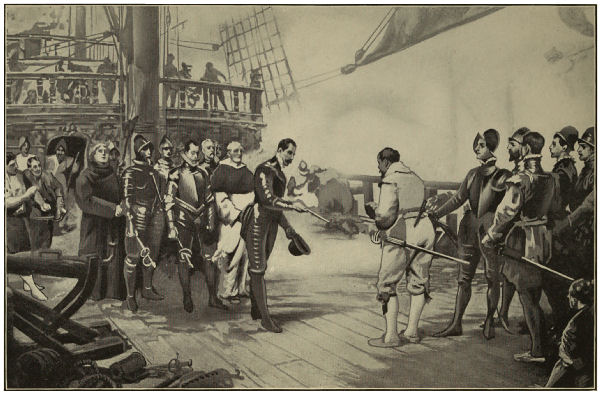
After receiving the weapon of the vanquished privateersman,
the Frenchman thundered in very good
English:
“How dare you fire against a force like mine in so
small a ship? Sirrah, you must be stark mad. I
compliment you upon your lack of judgment.”
Captain Walker was nettled.
“Sir,” he replied, with warmth, “if you will look
at my commission you will find that I had as good a
right to fight as you, yourself, had. Furthermore, if
my force had not been so inferior to yours, I would
have shown you more civil treatment on board my
own ship, after I had captured you.”
The Frenchman winced.
“How many of your bushwhackers have I killed?”
said he.
“None at all, sir!” replied the Englishman.
“Then, sir, you should be well ashamed of your
scurvy fighting. For you have killed six of my brave
men and have wounded several with pieces of glass.
Pray, when, sir, did the rules of war allow glass to
be used as ammunition?”
“You lie,” cried Captain Walker. “No glass was
used by my men.”
The Frenchman curbed his anger.
“Then what was it?” said he.
Here a British seaman interrupted.
“If it would please your French Majesty,” he said,
with a bow, “I reckon I know what it was that you
took for glass. The captain of one of our stern guns,
when he found out that we must surrender, sir, took
about sixteen shillings from his pocket, saying:
‘Sooner than let these French rascals plunder me of
all I’ve got in the world, I’ll see what a bribe can do!’
So he wrapped the money up in a bag, sir, crammed
it into a gun, and let fly at your deck. Faith, your
men were lucky to be struck by good, British coin!”
At this all had a good laugh, and the unpleasantness
between the French captain and George Walker was
at an end. The privateersman was treated with the
greatest courtesy and was made as comfortable as
could be.
The action took place on Friday and the ships were
headed for Brest, about three days’ sail away. At daybreak
on Sunday morning, four large boats were
sighted astern, and it did not take long to realize that
they were coming up pretty fast and were flying the
English colors.
“Hurray!” shouted Captain Walker. “No French
prison for me. Hurray!”
The English squadron gained steadily. The boats
grew nearer and nearer, while Walker’s hopes soared
higher and higher. Finally, the French officer, who
was in charge of his own boat—the Mars—put his
helm up and ran to leeward, hoping to draw one of
the British vessels after him. He was successful, for
a seventy-gun ship made after him, chased him for
several miles, and finally re-captured the English
privateer. The other ships kept on and drew closer
and closer.
Seeing that an action would soon take place, the
French captain politely requested Walker and his
officers to go below.
“Messieurs!” said he. “There will soon be a leetle
affair in which the balls will fly. You will be better
off in the hold, where they cannot reach you so easily
as up here.”
“Sir!” replied the English privateer-captain. “I
go below with the greatest of pleasure, for I am now
certain of my liberty. Au revoir!”
“Do not count your chickens before they hatch!”
cried the Frenchman, after his retreating form.
The British vessels were the Hampton Court of
seventy guns, and the Sunderland and Dreadnought of
sixty each; so, being three to two, they should have
had a fairly easy victory over the Frenchmen. But
the Sunderland lost a spar overboard, and dropped
astern; so it left but two to two: an even affair.
Alas for gallant Captain Walker! Although the
Englishmen came near the two French men-of-war,
they hung about without firing a shot; allowed the
Frenchmen to sail on unmolested, and thus carry their
astonishingly rich treasure into Brest, amid wild and
enthusiastic cheering of their crews, and groans of disappointment
from the English prisoners.
Yet these same prisoners had little cause to complain
of their treatment when they arrived at Brest;
for they were landed at once, and the captain and officers
were liberated on parole. The French also
treated them very well and invited the valorous George
Walker to many a repast, where they laughed at the
narrow shave that he had had from death,—for they
had left the Fleuron none too soon.
On the day following the landing, Captain Walker
was seated in the office of a counting-house, near the
dock-end, and was writing a letter to the captain of
the Fleuron, requesting him to send him his letter-of-credit,
which was in a tin box in a cabin of the French
man-of-war, when a terrible Boom! sounded upon his
ears.
A sailor came running past the open window.
“The Fleuron has blown up!” he cried. “The
Fleuron is a total loss!”
Captain Walker dashed into the street; to the end
of the quay; and there a sad spectacle greeted his
eager gaze. Strewn about upon the surface of the
water were broken spars; pieces of sail; and the débris
of a once gallant man-of-war. The remnants of
the Fleuron were burning brightly.
The captain of the French ship came running by.
“Helas!” he wailed. “A careless gunner has destroyed
my gallant vessel. Helas! Helas!”
It was too true. Four or five powder barrels had
been left in the magazine for saluting purposes, and
quite a little loose powder had been allowed to lie upon
the floor. Some careless seamen had gone down into
the hold with a decrepit, old lantern. The handle
broke, the flame set fire to the loose powder,—and
that was the end of the gallant ship Fleuron. She
burned to the water’s edge and then went down to the
bottom with a dull, sizzling hiss; while the treasure
also disappeared. Later on, divers secured a part of
it, but much that was of value was never recovered.
Captain Walker did not long grieve over the loss of
his letter-of-credit, left on board the ill-starred Fleuron,
for he was exchanged, after a few weeks, and
was sent back to England with his crew. This was in
1745. He lost no time in reporting to the owners of
the Mars, and so well did they think of him, that in
a short while they sent him upon another privateering
venture aboard the Boscawen, which, as you remember,
had run away from the Mars, after she had fallen in
with the two French men-of-war. Now occurred his
greatest sea-fight.
The Boscawen had been built in France and had
been a prize, taken at sea. She mounted twenty-eight
guns (nine-pounders), but Walker added two more,
and shipped a crew of three hundred and fourteen men.
Without waiting for the Mars, the stout sea-dog put
out to sea on April 19th, 1745, steering for the shores
of France where cruised the prize-laden clipper ships,
and the unwelcome men-of-warsmen. The British
privateersman cruised about for a whole month without
any luck, and, falling in with the privateer Sheerness,
joined with her in a little run in search of inoffensive
merchantmen. At daybreak a cry came from
the forward watch,—
“Sails ho! Sails ho! Off the starboard quarter!
There’re eight o’ them an’ heading no’ east.”
Both the privateers started in pursuit, but the Sheerness
was left far astern, as the Boscawen was a speedy
sailer. The latter drew near the eight scudding sail,
which suddenly veered about and formed a line, awaiting
an attack. The Sheerness was way astern. Would
Captain Walker advance?
It was eight against one, and there was no certainty
what was the armament of the vessels now standing
in a row, all ready for action. The faces of the officers
on the Boscawen showed anxiety and suspense, but
there was no shadow of fear upon the countenance of
Captain Walker, who now addressed them in the following
words:
“Gentlemen, I hope that you do not think the number
of prizes before us too many. Be assured, my
good friends, that by their being armed, they have
something on board of them that is worth defending.
I take them to be merchantmen with letters of marque
(privateers), and homeward bound. Without doubt
we shall meet with some opposition, in which I know
that you will exhibit your usual courage. We must
conquer these superior numbers by superior skill. Be
cool. Be careful that you aim correctly, for, as we
shall be pressed on all sides, let every man do his best
to engage the enemy that he sees before him.
“In a word, Gentlemen, if you will put full confidence
in me for leading you on, I will pawn my life
upon the fact that I will bring you off victorious.”
“Hurray! Hurray for Walker!” came the reassuring
response.
“Then go to your quarters, my hearties! Fight like
Britishers of old, and all will be well!” cried the brave
mariner.
Like a hornet among a group of snap-dragons, the
Boscawen now sailed into the centre of the enemy’s
line.
“Do not fire until I give the word!” cried Captain
Walker, as the salt spray kicked and splashed about
the bow of the on-coming Boscawen. “Then hammer
away like anvils on a sledge!”
Sixty men were ill on board the stout little English
privateer, but all save three crawled on deck in order
to render what assistance they could in pointing and
handling the guns.
Now was a glorious fight.
Bang! Crash! Z-i-i-p!
The French privateers were hammering away as the
Englishman approached and their balls cut and tore
through the rigging, damaging the mizzen topsail,
and splitting a topmast. Steering straight for the
largest vessel, Walker waited until he was within close
range and then gave the order:
“Fire, and hull her if you can.”
Poof! Cr-a-a-sh!
A blinding broadside rolled from the port of the
Boscawen, and the solid shot bit and tore the stranger
like a terrier mouthing a rat.
The valiant little privateer was now in the midst
of the enemy. Two were to right of her; two to the
left of her; one across her bow; and one across her
stern. Two of the eight decamped, at this juncture;
making the odds six, instead of eight, to one.
“Pow! Pow! Cu-boom!”
The vessel astern was banging away like a Banshee,
but a sudden crash from the stern guns so badly damaged
her that she hauled off. It was now five to one.
“Keep it up, boys!” cried Walker, above the roar
and rattle of the fray. “You’re doing splendidly.
You all deserve statues in the temple of fame.”
“Huzzah!” shouted his men. “Hurray for the
Boscawen. Down with the Frenchmen!”
“Cu-pow! Boom! Boom!” roared the cannon,
while the broadsides from the Boscawen were delivered
without either confusion or disorder. The five were
sparring gamely, but they were lightly armed, with
only a few guns to each, so the thirty nine-pounders
on board the English privateer were about an equal
match for the greater numbers of the foe.
Thus the fight raged for an hour, when, suddenly,
the ensign upon the mast of the French flagship was
seen to flutter to the deck. Ten minutes later a cry
arose from a sailor aboard the Boscawen:
“Look, Captain, she’s sinking!”
Sure enough, the accurate fire from the British
privateer had so riddled the hull of the Frenchman,
that she fast filled with water, and sank, stern first,
her men escaping in their small boats.
“That’s one less, anyway,” mused Captain Walker.
The remaining four continued the fight, but the
little privateer was too much for them. Around and
around she veered, broadsiding with astonishing accuracy,
and knocking the spars about like a foot-ball
team kicking a ball. “Pow! Pow!” the guns roared,
and the men cried, “Remember the oath of our captain!
Let’s take ’em all!”
It began to look as if they would do it, too; for,
now upon the starboard quarter appeared the white
sails of a vessel, and, as she approached, a joyous cheer
arose from the deck of the Boscawen, for it was the
Sheerness.
“Now we’ll get ’em! Now we’ll get ’em!” yelled
the British sailors, and they plied their guns with renewed
activity and care.
Down came the flag upon one of the Frenchmen,
and—in a few moments—down came another.
Then, as the Sheerness rolled closer, two more ensigns
fluttered to the deck. There was but one Frenchman
left, and she made off, with the newcomer hot in pursuit.
“Hurray! Hurray! Hurray!” The sailors on
board the Boscawen were fairly jumping for joy.
“Hurray! Hurray! Hurray!” they yelled.
And well might they cheer, for had they not won
one of the pluckiest sea-fights of all history? The
enemy is said to have had one hundred and thirteen
killed and drowned, while the casualties of the Boscawen
amounted to but one killed and seven wounded.
“And this,” says an old chronicler of the spirited affair,
“was due to the fact that the British privateer
had a bulwark of elm-planking, man-high, around her
deck. It was so fashioned that there was a step on
which the marines could mount and fire, and then
come down in order to load. Furthermore, this elm-wood
did not splinter; but kept out the bullets, and
closed up around the holes made by shot.”
At any rate, it was a glorious victory, and when—a
few hours later—the Sheerness came back with the
other French vessel a prize, the total capture amounted
to six vessels: homeward bound traders from Martinique,
provided with letters of marque, and with
about six guns each. Their crews were undoubtedly
undisciplined and ill-used to shooting, else how could
they have done so badly with the Boscawen?
The prizes were headed for the English coast and
arrived at King’s Road, Bristol, in a few days, where
a swarm of eager sight-seers crowded about the shattered
craft.
“My! My!” said many. “This Walker is another
Drake. He is a valiant soul!”
And so thought the British Admiralty, for they sent
him a letter (upon his reporting to them) which read:
“We cannot too highly congratulate and commend
you upon the seamanship and courage which you have
displayed in the capture of these French vessels. Your
daring and ability should always make your name one
to be revered by those Britishers who follow the sea.
May your future career upon the ocean but add to the
laurels which you have already won!”
And were they not right?
Seldom has such a feat been accomplished, and
seldom has one vessel come off victorious against such
odds. If you love a game warrior, cheer for George
Walker, for he deserves it. If you are an admirer of
the fighting quality in a man, give three times three
for the privateersman who had the nerve to sail into
eight vessels,—and won out.
So much, indeed, did the British owners of the privateer
vessels think of Captain Walker, that he was
now placed in command of four ships, known as “The
Royal Family of Privateers,” for each was named
after some member of the English royal family. These
were the Princess Amelia, of twenty-four guns and
one hundred and fifty men: the Prince Frederick of
twenty-six guns and two hundred and sixty men: the
Duke of twenty guns and two hundred and sixty men;
and the King George, of thirty-two guns and three
hundred men. This last boat was commanded by
Walker, himself; the Duke by Edward Dottin, a
staunch sailor; the Prince Frederick by Hugh
Bromedge; and the Princess Amelia by Robert Denham.
The entire squadron carried nearly a thousand
men and one hundred and two guns, so, you see, that
it could do quite a little damage to the enemies of
Merrie England.
Sailing in May, 1746, the squadron soon met with
hard luck, for the Prince Frederick ran upon a rock
in Bristol Channel, and had to be left behind; for she
was badly punctured below the water-line. The three
others sailed for the coast of France, and—a week
later—had a startling little adventure.
A heavy fog lay over the sobbing water, and the
three English sea-robbers were gliding along within
easy gun-shot of each other, when it was evident that
they were near some other vessels. Voices came out
of the mist, lights flashed (for it was near the close of
day), and the wash of water could be heard, as the
waves beat against solid oak planking.
“Egad!” whispered Captain Walker to one of his
lieutenants. “Listen, my boy, and tell me whether
these voices are French, Spanish, or English.”
The lieutenant held a speaking-trumpet to his ear.
The swish, swish of water came to the eager senses
of the anxious privateersman. That was all!
Captain Walker passed the word around among
his men to be absolutely silent, and, as he strained his
hearing, in order to catch the faintest sound from the
strangers, suddenly he heard the sentence,
“Pressy! Chantez une chanson. Je vais me
coucher.” (Sing a song, Pressy. I am going to
bed.)
In a second the gallant Walker knew that, as once
before, he was in the midst of some French vessels.
“Caught!” he whispered. “And I believe that
they’re men-of-warsmen! Now we’re in a pretty
pickle!”
His officers scowled.
“I know that they’re men-o’-warsmen,” said one,
“for, just now, the fog lifted for a second, and I could
make out—by their lights—that they were large
gun-ships.”
Captain Walker looked dejected.
“The deuce,” said he.
But he soon regained his composure.
“Put every light out on board,” he ordered.
“These fellows see us, for I hear them bearing over
our way.”
Sure enough, from the swashing of water and glimmer
of lights in the fog, it could be seen that the great
lumbering men-of-war were closing in upon the privateer.
But the Frenchmen had a human eel to capture
and he was equal to the occasion.
“Bring up a couple of casks from below!” cried
Captain Walker. They were soon on deck.
“Now put a lantern in one and lash them together,”
he continued. “We’ll alter our course and skip, while
the Frenchies will follow this light.”
The ruse worked magnificently, and, when morning
dawned and the bright sun burned off the fog, the
French men-of-war found themselves hovering around
a couple of old casks with a lantern tied to the top;
while Captain Walker in the King George was scudding
along the French coast, many miles away. At
which the French captain remarked,
“Sapristi! L’oiseau s’est envolé.” (Egad! The
bird has flown!)
Not long after this “The Royal Family of Privateers”
took some valuable prizes, and, having chased
a small, French merchantman into the bay of Safia, in
Morocco, Captain Walker determined to capture her
at night, by sending a party against her in the long-boats.
A second lieutenant was put in charge of this
venture, and, at dark three tenders, crowded with
armed seamen and propelled by muffled oars, started
after the prize. As they neared the merchantman a
hail came through the blackness:
“Qui est la?” (Who is there?)
No answer was made to this, but the boats kept
straight on.
Crash! Bang!
A gun roared in the faces of the privateers, and
shots came falling around them like hail-stones,—but
still they kept on.
Again Crash! Crash! Crash!
The Frenchmen were plying their guns right willingly,
but the English sailors could not be stopped,
and they neared the vessel under vigorous sweeps of
the oars. The lieutenant in command was badly
wounded, and was forced to lie in the bottom of his
boat, but—in a few moments—the tenders were
alongside the merchantman, and the sailors, with a
wild yell, were clambering to her deck. There was a
fierce hand-to-hand struggle, but nothing would gainsay
the rush of the British tars. In twenty minutes
the fight was all over and the vessel was towed out of
the bay, in triumph, next morning. As she was a
smart, little craft she was turned into a privateer in
place of the Prince Frederick (which had run
aground) and was christened the Prince George.
The “Royal Family” continued upon its way, made
many captures, and—after eight months—put into
the harbor of Lisbon with prizes and prize-money
amounting to £220,000 (about $1,100,000). So you
can see that privateering was a very lucrative trade in
those days, when successfully pursued. Not a single
man had been killed aboard the little fleet, but many
had been severely wounded. The ships were overhauled,
refitted, and, being joined by the Prince
Frederick, amounted to six in number, for the vessel
captured in the harbor of Safia had been converted
into a full-fledged privateer. Now was to be one of
the most gruelling sea-fights in which George Walker
ever engaged.
In the month of October the squadron was cruising
off of Lagos Bay, on the coast of Portugal, when a
large sail was sighted at about five in the morning.
The Princess Amelia was at anchor in the harbor of
Lagos, so Captain Walker sent a small sloop (a recent
capture) after her to tell her to “Hurry up and
get under way,” while he gave signal to the other
vessels to chase the stranger at once. All started after
the foreigner, who stood to the northward and could
be seen to be crowding on all possible canvas. There
were four ships in this merry little chase, but two of
them—the Duke and the Prince George—dropped
out, after about an hour’s run. They either could not
get up, or else their captains grew tired of the affair.
On, on, went the other privateers, and—at about
noon—Walker drew near the fugitive, in the King
George. The Prince Frederick, with her twenty-six
guns, was still some distance away, but Walker kept
after the stranger, although he now saw that she was
a large vessel,—much more powerful than the King
George, with her thirty-two guns and three hundred
men. He was rapidly nearing the big fellow, when it
grew suddenly calm, so that neither could move.
At this moment an ejaculation of astonishment
burst from the lips of some of the officers aboard the
saucy King George.
“She’s a seventy-four!” cried several. “We’re in
a tight hole!”
Sure enough, the pursued hoisted her colors, ran
out her guns, and showed herself to be a man-of-warsman
carrying seventy-four cannon: over double
the amount of armament aboard the plucky King
George.
“I can’t make out whether she’s Spanish or Portuguese,”
said Captain Walker, gazing carefully at her
drooping flag.
The colors hung down in the dead calm, and it was
impossible to tell whether they were Spanish or Portuguese;
for the two ensigns—at that period—were
very similar.
The sea-warriors drifted along, eyeing each other,
for about an hour, when the stranger ran in her lower
deck-guns and closed her port-holes.
“She’s a treasure ship,” cried a sailor. “And she
won’t fight if she can avoid it!”
Walker turned to his officers and asked,
“Gentlemen, shall we fight her?”
“Aye! Aye!” came from all. “She’s afraid of
us!”
The vessel, in fact, was a treasure ship which had
been recently chased by some English men-of-war and
had already landed her treasure, to the value of about
one million sterling (about $5,000,000). A slight
breeze sprang up, at about five in the afternoon, and
the big ship kept on her course; the gamey King
George following, while the white sails of the Prince
Frederick were far astern, as the breeze had not yet
struck her. So they swashed along, the Englishmen
anxious for a fight, and a chance to overhaul the supposed
treasure which the stranger was carrying. At
eight o’clock the King George was struck by a favorable
puff of wind, and came quite close to the seventy-four.
It was time for battle.
“What ship is that?” hailed Captain Walker, in
the Portuguese tongue. He was cleared for action
and his men were all lying down at their quarters.
There was no answer to his challenge.
“What ship is that?” he asked again; this time in
English.
A voice came back,—also in English,
“And what ship may you be?”
“The King George.”
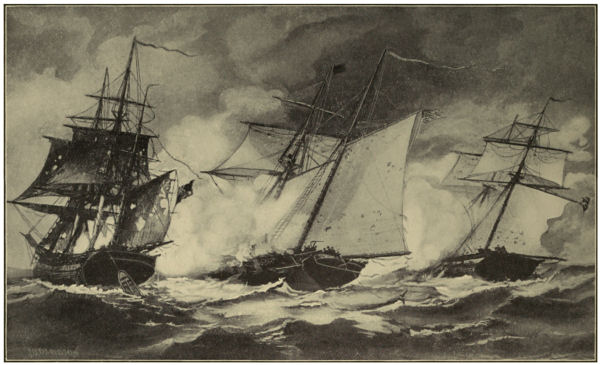
Crash! B-oo-m!
A thundering broadside belched from the side of
the seventy-four, dismounting two guns on the port
side of the King George, and bringing the main topsail
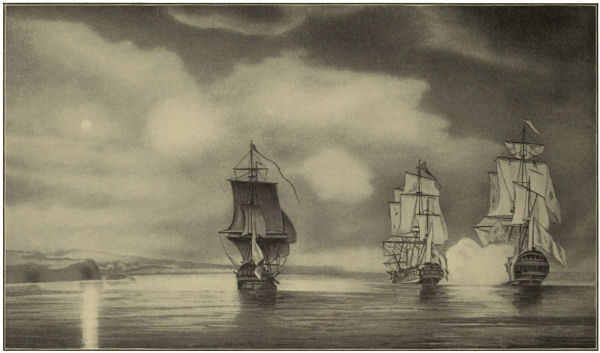
yard crashing to the deck. It was now bright moonlight,
and in its radiance the flag of the stranger was
seen to blow straight out, disclosing her nationality to
be Spanish. She was the Glorioso: a strong and powerful
vessel, ably officered and ably manned. She
towered above the little King George like a church-spire,
and her broadsides now sputtered with great
regularity.
Crash! Crash! Crash!
The sprightly little King George kept after the big
warship like a sword-fish chasing a whale. She drew
so close that some burning wads from the Spanish
guns set fire to her mainsail. Continually hoping that
the Prince Frederick would come up, the gallant
Walker hammered away at the Glorioso with furious
precision, and drove her so near the rocks off Cape
Vincent that the castle guns began to play upon the
two grappling warriors of the sea. The British sea-captain
fought and commanded with “a calmness
peculiar to himself” and his example secured order
and discipline even in the thickest of the fight, when
the mainsail was set on fire. He was magnificent in
action.
So the unequal struggle kept on. By half-past ten
the King George had been so severely damaged aloft
that she could not have escaped if she had tried. All
the braces were shot away; the foremast was quite
disabled; and the mainmast was badly splintered.
Battered, torn, and distressed she kept banging away
at the great, towering Spaniard; while the big fellow
ceased her fire somewhat, and ever now and again
let go a broadside, like the blow from the mouth of a
huge whale. It sounded like, Chu-spow!
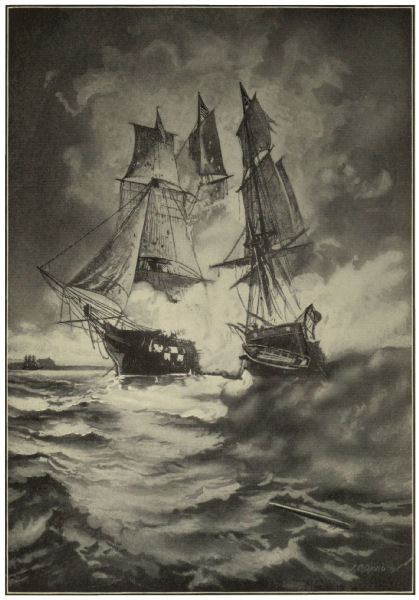
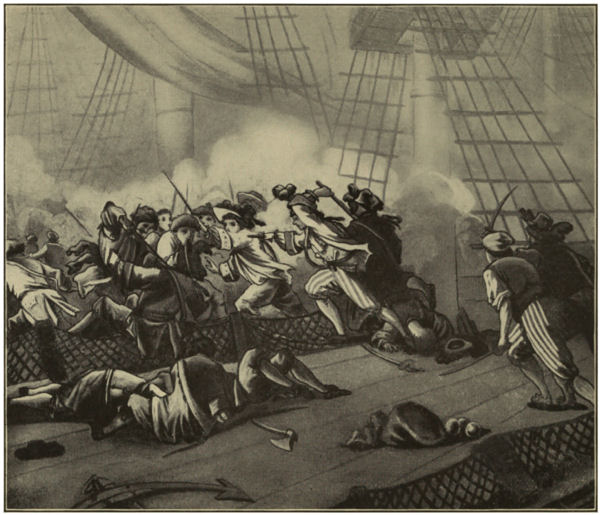
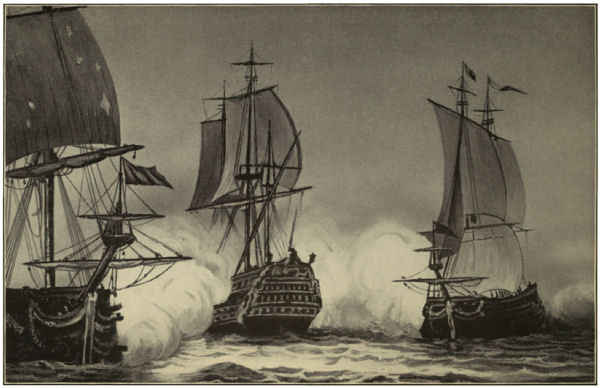
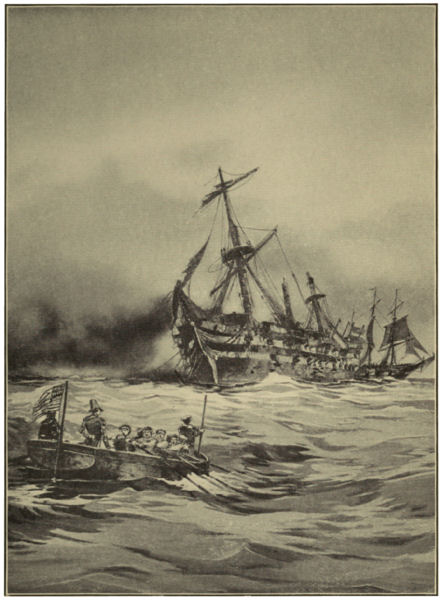
ACTION BETWEEN THE “GLORIOSO” AND THE “KING GEORGE” AND “PRINCE FREDERICK” UNDER GEORGE WALKER.
But hurrah! hurrah! The Prince Frederick had at
last caught the breeze, and came bouncing by, her little
pennons fluttering like so many silk stockings on a
clothes-line.
“Are you all well?” shouted her commander, as
he neared the splintered King George. “You look as
if you’re sinking.”
Captain Walker came to the rail with the speaking-trumpet
in his hand.
“One killed and fifteen wounded,” he answered.
“Now sail after that Spanish villain and take her,
in revenge for all the damage that she has done me.
She’s a treasure ship.”
“All right,” Captain Dottin called back, and he
kept on after the Glorioso, which was now rapidly
drawing away.
By the bright moonlight it could be seen that the
Duke and the Prince George were also approaching.
And, when they came close enough to the maimed
and battered King George, her captain called to them,
“to keep on after the Spaniard, and catch the rascal.”
They continued on their way, and, at daybreak the
three vessels could be seen, through the glass, as they
closed in upon the Spanish game-cock from three
sides. “She’ll be ours before nightfall,” said Captain
Walker, chuckling.
The headmost ship, apparently the Duke under
Captain Dottin, could now be seen to hotly engage the
Glorioso, which greatly displeased the captain of the
dismantled King George.
“Dottin will fire away all of his cartridges,” said
he, turning to a few of his officers, who clustered
around him. “He will shoot them all off at too great
a distance, and will afterwards be obliged to load
with loose powder, by which some fatal accident is
sure to occur. He’s a brave fellow, but a rash one!”
He had scarcely spoken, when a broadside rang out.
Simultaneously, with the discharge of the guns, a
pillar of smoke and flame shot high into the air.
“Good Heavens, the Duke has blown up!” cried
Captain Walker. “Dottin and his brave followers
have found a watery grave!”
“It is merely the smoke of a broadside,” one of the
officers interrupted.
“No! No!” answered Walker, dejectedly. “It’s
the last that will ever be seen of noble Dottin and his
men!”
The smoke now cleared away and no ship was to be
seen upon the surface of the water. The Glorioso
was still-belching both smoke and flame, and near her
were three sails, indistinctly seen through a haze of
smoke and fog. Could it not have been the Duke,
after all? “Vain thought,” cried bold Walker, aloud.
“Our bravest and best ship has gone to the bottom.”
This terrible incident had such an effect upon the
seamen of the King George that Captain Walker called
the officers aside into the companionway, and there
made them a speech.
“My brave men,” said he, “you must keep up an
air of cheerfulness before these fellows of ours, for,
otherwise they will be backward in fighting, and will
not have the courage which we desire. Go among
them and show no sign that you are lacking in pleasantry.”
As he ceased speaking there was a series of sudden
explosions, mingled with cries of alarm.
“Gad zooks! What’s happened!” cried all, rushing
to the deck.
They found matters in a sorry state, for the crew
was in a panic; some clinging outside the ship; some
climbing out upon the bowsprit, all ready to jump
overboard should the vessel blow up.
Captain Walker was astonished. “Why, men!”
said he. “What means this confusion?”
It was easily explained, for the alarm had been
caused by a seaman who stepped upon a number of
loaded muskets, which had been covered by a sail.
One was fired off accidentally, and this exploded some
spare ammunition, set the sail on fire, and completely
demoralized the crew; who still were thinking of the
sad tragedy which they had just witnessed. Order
was quickly restored, the blazing sail was torn down
and bucketed, and the terrified sailors came back to
their posts. When men have their nerves shattered, it
is easy to startle them.
But how about the Glorioso?
The fair-fighting Spaniard was far out of sight, by
now, still whanging away at her many enemies, and
still proudly flaunting the flag of Arragon in the faces
of the British war-dogs, who were snapping and snarling
at her like a wolf pack. What became of her was
not known for several days, when the poor, battered
King George staggered into a sheltering harbor, there
to meet with the Duke herself, which was Dottin’s
good ship,—the one which all had thought to have
exploded and sunk.
“Hurray!” shouted many. “She’s afloat after
all!”
Eager questioning brought out the fact that it had
been the frigate Dartmouth which had exploded; a
vessel which had run near the fight in order to see
the fun. Some loose powder had set fire to her magazine,
and thus she had suffered the same fate as the
Fleuron, which, as you remember, had blown up, when
at anchor in the harbor of Brest. It’s a wise ship that
keeps away from a sea battle.
Only seventeen of the crew of this unfortunate
craft had been picked up by the boats of the Prince
Frederick; one of whom was an Irish lieutenant
named O’Brien, who was hauled aboard Dottin’s vessel,
clad only in a night shirt.
“Sirrah!” said he, bowing politely. “You must
excuse the unfitness of my dress to come aboard a
strange ship, but really I left my own in such a hurry
that I had no time to stay for a change.” He had
been blown out of a port-hole!
An additional vessel, the Russel, had aided in the
capture of the powerful Glorioso, so it had taken four
privateers to down the proud Castilian: the Duke, the
Prince George, the Prince Frederick, and the Russel.
Certainly she had put up a magnificent battle and she
had completely crippled the stout little craft sailed by
Captain Walker, who was now filled with chagrin and
mortification, when he found that the treasure (which
he had been sure was in the hold) had been safely
landed at Ferrol, before he had sighted this valorous
man-of-warsman. It was a great blow both to him
and to his men, and, upon arriving at Lisbon he was
met by one of the owners of his own vessel, who
severely reprimanded him for fighting with such a
powerful boat.
“Captain Walker,” said he, “I fear that your fighting
blood is superior to your prudence!”
But to this, the game old sea-dog replied, with considerable
heat:
“Had the treasure been aboard the Glorioso, as I
expected, my dear sir, your compliment would have
been far different. Or had we let her escape from us
with the treasure aboard, what would you have said
then?”
To these sage reflections the owner did not reply.
The honesty and courage of this able seaman were
never questioned, and the following incident bears
good witness to the first quality. Upon one occasion
he was sailing for Lisbon in a well-armed privateer,
when a couple of East India trading ships offered him
£1,000 ($5,000) if he would act as their guard and
protect them from the enemy.
“Gentlemen,” said he to the captain of these vessels,
“I shall never take a reward for what I consider it
my duty to do without one. I consider it my bounden
duty to conduct you both safely into port, for you
are both British ships, and I am engaged to fight the
enemies of our King.”
So he convoyed them safely into port and would
not take even the smallest present, in recompense for
his services.
As a fighter he had no superior. War is simply
glorified sport and those who are best trained athletically
can usually win upon the battle-field. Did not
Wellington say, “The battle of Waterloo was won
upon the foot-ball grounds of Eton and Harrow?”
Which was another way of saying that the boys who
had learned to stand punishment upon the athletic
field, could take it manfully and well upon the field of
battle.
Walker believed in athletic exercise and made his
sailors continually practice both gunnery and work
with the cutlass. They were always in training and
always prepared. That is the reason why they won.
As you know, if you want to win in athletics you have
to train hard and practice daily. If you want to win
at warfare you have to do likewise. The most athletic
nation is the nation which will win in the long fight,
providing that it has sufficient resources and money
to carry out a war, once that it has placed its men in
the field. It takes a great deal of money to fight a
war, but it takes trained men also, and those who are
the most fit will win every time.
The English are an athletic nation, an island nation,
and great numbers of her people have had to
follow the sea as a matter of course. Hence England
has always had a vast quantity of well-trained seamen
at her beck and call. For this reason she has been
more successful upon the ocean than many of her
neighbors. Will she continue to be?
If she continues to breed men like George Walker
there is little reason to doubt that she will always be
a winner in sea fighting.
As for this famous mariner, little is known of his
later life save that he was once imprisoned for debt,
but this was no disgrace in those times and I am sure
that he was soon liberated. He died September 20th,
1777, but where he was buried is not known, nor is
there any record of his marriage. At any rate he has
left the reputation of a brave and valiant seaman who
was beloved by his men, feared by his enemies, and
appreciated by his contemporaries.
“Britannia’s glory first from ships arose;
To shipping still her power and wealth she owes.
Let each experienced Briton then impart,
His naval skill to perfect naval art.”