The war waged by King Philip had put an end to
all further hindrance to the settlement of New
England by the whites, and the hostile Indians
had been wellnigh exterminated. But, as the restless
settlers pressed westward, ever westward, to populate
the untouched wilderness and to build hamlets and cultivate
farms, it was only natural that the western
Indians would view their advance with the same anger
that had smouldered in the bosom of the chief Sachem
of the Wampanoags. The French, in Canada, were
more peaceably disposed towards the savages than were
the English; they treated them with some consideration
and kindness; sent their Jesuit Missionaries among them;
and endeavored to teach them the ways of civilization.
As the English pressed onward they were continually in
altercations with the various tribes which lay in the
path of their steady emigration, and they showed them
little consideration, kindness, or toleration.
In 1755 war broke out between the French and
English for the possession of America. Both were rival
claimants for the soil of the New World, and the people
of the northern English colonies had learned to regard
their Canadian neighbors—the French—with the bitterest
enmity. They hated them because they were
of a different religious faith than their own, and they
hated them because they were friends of the very
Indians who made depredations upon their frontier
settlements and slaughtered the peace-loving white
settlers. The Indians were plyed with gifts and flattered
by the French, so that, in the fierce struggle for the
possession of America, the red warriors sided, for the
most part, with those who held dominion over Canada
and the Great Lakes. The English won the war, and
thus the wilderness beyond the Allegheny mountains,
over which France had claimed sovereignty, passed into
the hands of her rival, who, with a force of but five or
six hundred men, expected to keep it secure. Little
apprehension was felt of an attack from the red inhabitants
of the woods, and, as the French had signed a
capitulation, the English considered themselves safe in
the possession of this new-won territory. But they
were far from being safe, and much fighting was still
to be done before peace and tranquility were to come
to the frontier.
The furthermost settlement of the English was at
Detroit, between Lake Erie and Lake St. Clair, and
upon the river of the same name. There were about
twenty-five hundred inhabitants in this little community.
Straggling huts were along the river banks,
and in the centre was a fortified town, called the Fort,
consisting of about a hundred houses surrounded by
a palisade. A British garrison, consisting partly of
regulars and partly of provincial rangers, was quartered
in well-built barracks inside the town, or Fort. There
were about one hundred and twenty soldiers, forty fur-traders,
and a few half-breed scouts who could not be
relied upon in case of a war with the redskins. Several
light pieces of artillery were mounted upon the
bastions, while two small armed schooners—the Beaver
and the Gladwyn—lay anchored in the stream. The garrison
was commanded by a splendid English officer,
named Gladwyn, whose courage was that of a lion,
and whose fighting qualities were far superior to most
of the British officers who were engaged in the struggles
upon the frontier. A large Indian village of the Pottawattamies
was on the western shore of the river, a little
below the fort; while, nearly opposite, on the eastern
side, was a village of the Wyandots; and on the same
side, five miles away, the Ottawas, under Chief Pontiac,
had fixed their abode.
Although the Indians appeared to be on friendly terms
with those in the town, the country had scarcely been
transferred to the English—at the conclusion of the
French and Indian war—when smothered murmurs of
discontent began to be heard among all the Indian
tribes of the interior. From the headwaters of the
Potomac River to Lake Superior, and along the winding
courses of the Mississippi, a deep-seated hatred of the
English increased with great rapidity. When the French
had held possession of Detroit and the forts upon the
frontier, they had supplied the surrounding Indians
with guns, ammunition and clothing, but the English
would give them nothing. The French had been kind
to the savages when they visited their forts, but the
English received them with cold looks and harsh words,
when, as was their custom, they would lounge about the
fort and lazily stretch themselves out in the shadow
of the walls. This was galling to their proud and haughty
spirits. Then, too, the best lands of the red men were
being invaded by white settlers and all remonstrances
had been useless. The Delawares and Shawanoes, in
particular, were highly exasperated at this, and their
feelings were shared by all the surrounding tribes, in
whose breasts slumbered a terrible hatred and distrust
of the oncoming English, who had been their enemies in
the late war and towards whom the Indians had the
rancorous enmity that an Indian always feels against
those to whom he has been opposed in battle.
Pontiac was principal chief of the Ottawas and head
of a loose confederacy of the Ottawas, Ojibwas, and
Pottawattamies. He was about fifty years of age: tall,
sinewy, strong. Over those around him his authority
was almost despotic, while his name was known and
respected among all the savages who resided in the country,
stretching from the Ohio River to the lowest waters
of the Mississippi. He possessed great energy, craftiness,
and oratorical prowess, while his courage in war
was far-famed. It is said that he commanded the
Ottawas in the defeat of General Braddock at Fort Du-Quesne—during
the French and Indian war—and it
is certain that he was treated with much honor by the
French officers, for one of them had presented him with
the regimentals of a soldier of that country, which he
is only known to have worn upon one occasion. Not
long before the beginning of the French and Indian war,
he had saved the French garrison at Detroit from an
attack from some discontented tribes of the North, who
had marched to destroy it. For this he had been made
much of by the French officers. "He puts on an air of
majesty and princely grandeur," said Major Rogers,
(one of his opponents), "and is greatly honored and
revered by his subjects."
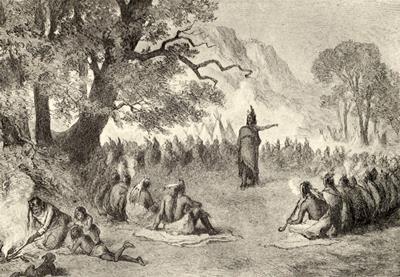
Pontiac saw that the Indian race was now confronted
with a grave crisis, for, when Canada had become an
English province, the tribes had sunk from their former
position of importance. Up to this time, France and
England—the two rival European nations—had kept
each other in check upon the American continent and
the Indians had been flattered by each, for their services
were needed by both. Now the English had gained undisputed
control of America, and the Indians, being no
longer important as allies, were treated as animals of a
lower order of intellect who could be trampled upon with
impunity. Thus the mind of the wily Ottawa Chief
conceived the idea of driving the English into the sea,
of once more restoring the French to power, in the West,
and thus to again place the Indians in their former position
of influence. The French Canadians continually
told him falsehoods, assuring him that the war had not
been lost by the French, that the armies of King Louis
were now on their way to recover Canada, and that the
French and their red allies could soon drive the hated
English away from their beloved country. Stirred by
these lies, and urged on by revenge, ambition, and
patriotism, Pontiac decided upon war.
The various Indian tribes which lived along the
Mississippi; in the country of the Ohio River and its
many tributaries; and along the cold waters of the
Ottawa to the north, were visited in 1762 by ambassadors
from Pontiac. They carried with them a tomahawk
stained red and a war-belt of wampum, and, as
they went from camp to camp, they would fling down
the tomahawk on the ground, hold the war-belt above
their heads, and deliver a long speech, urging the warriors
to join in the extermination of the English. Everywhere
this appeal was heard with nods and gesticulations
of approval, and all of the Algonquin nation—including
the Wyandots, the Senecas, and several tribes of the
lower Mississippi—pledged themselves to aid in this
important movement. Of the powerful Iroquois nation
of New York State only the Senecas would join, but the
force against the whites was so overwhelming that it
seemed hardly possible that the few scattered English
garrisons could escape a terrible slaughter. Yet, confident
in that supreme race confidence which has made the
English the most all-powerful nation since the Roman
legions held dominion over the greater part of Europe,
the white garrisons of the wilderness kept their posts in
fancied peace and seclusion.
The dreary winter drew to a close, and the Indians hid
their intentions beneath calm and serious countenances.
They still lounged about the forts, begged for tobacco,
gunpowder, and whiskey, and gave no sign of intended
wrong or violence. Yet they were busy sawing the
muzzles of their guns in half so that they could conceal
them underneath their blankets, were gathering a
large supply of powder and ammunition from the
French traders, and were holding war-dances in their
far-distant habitation. Now and again intimations
of their danger reached the garrisons and startled
them from their fancied security. An English trader
came into Detroit one day, and reported that he had
heard a half-breed scoundrel boast that before next
summer he would have English scalp-locks as a fringe
to his hunting-shirt. The commander of the garrison
laughed at the tale. Later on—in March 1763—the
British commander Holmes, at Fort Miami, on the
Maumee River (about one hundred and ninety miles
southwest from Detroit) was told of Pontiac's conspiracy
by a friendly Indian. "The warriors of the
neighboring village," said he, "have received a war-belt
and bloodstained hatchet, with a message urging
them to destroy you and your soldiers. If you do not
kill them first, they will do so." Holmes believed the
tale, called the warriors together, and told them of his
suspicions. The savages acted as many of them have
done under similar circumstances—confessed that they
had meditated an attack upon the garrison, said that a
neighboring tribe had told them they must do it, under
pain of death, and professed eternal love and good
will towards the English. This allayed the suspicions
of the commander of Fort Maumee, but he reported his
discovery to Major Gladwyn, at Detroit, who, seeing
the peaceful condition of the Indians in the three villages
near his own fort, expressed the opinion that there
was apparently some trouble among the Indians, but that
it would soon blow over. He little suspected that
Pontiac—the arch-conspirator—was in a village but a
short distance away, and that his heart was burning
with revenge and hate against him and his small garrison.
He little believed that, as the savages came in from
their winter hunting grounds, on the approach of spring,
and did not come into the fort, as usual, they were fast
making preparations for an assault upon him. In a
few weeks he was to learn more of the Indians' character
than he had ever suspected.
Pontiac had a small cabin of bark and rushes upon
an island in Lake St. Clair, and here, with his squaws
and children, he waited for the time to arrive when his
braves would be ready to strike. His plan of operations
was to make a sudden and simultaneous attack upon all
the British forts on the Great Lakes and rivers of the
Middle West—at St. Joseph, Ouiantinon, Green Bay,
Michillimackinac, Detroit, the Maumee, and the Sandusky—and
also upon the forts at Niagara, Presqu'-Isle,
Le Boeuf, Venango, and Pittsburg. Most of these
strongholds were badly protected; they were mere
trading places, yet to the Indians they seemed to be
great obstacles. It was evident to the mighty war
Chief that the destruction of these posts and their
garrisons would be a blow from which the hated English
could never recover. And, as he lay upon his skins,
looking out across the hazy waters of the Lake, his heart
beat with the fierceness of his passions, and the hot
blood surged tumultuously through his veins. All was
going well with his plans; on all sides his allies were
preparing for the great blow, and, viewing once more
the supremacy of the French and of his own people, the
fierce light of ambition glittered in the eye of Pontiac,
the red Napoleon. Thus, as spring came to the wilderness,
and the leafy forests were resounding with the
chant of bright-colored birds, the wild death songs of
the Indians sounded harshly discordant from the
depths of the green wood.
On the afternoon of the fifth of May, a Canadian
woman, called St. Aubin, who was the wife of one of the
principal settlers, crossed over the Detroit River to obtain
some maple sugar and venison from the Ottawa
Indians. When she entered the village, she was surprised
to find several of the warriors filing off the muzzles
of their guns, so as to reduce them to the length of
about a yard, and upon her return home she mentioned
this to several of her neighbors. The blacksmith of
the village remarked that many of the Indians had been
to his shop within the past month, and had attempted
to borrow files and saws for purposes which they could
not tell him of. These revelations excited the suspicions
of the older Canadians who had lived long among the
Indians, so, going to the Fort, one of them—as spokesman—told
Major Gladwyn to be upon his guard, for the
Indians meditated treachery. The courteous commandant
treated this advice with scorn, and scoffed at the
news of an outbreak.
But, in a day or two, news came to him which changed
his ideas very materially. In the Pottawattamie
village was an Ojibwa girl, called Catherine, who was
much attached to this gallant Major in charge of the
British troops. On the day following the first announcement
of trouble, she came to Gladwyn's quarters, bringing
with her a pair of elkskin moccasins which he had
requested her to make, and, showed by her downcast
face and sad look that she had something unusual on
her mind. Her demeanor was so peculiar that Gladwyn
called her to him and requested that she tell him what
weighed upon her spirits. "Promise me that you will
not betray me," said the Indian girl, "and I will reveal
my secret."
"I promise," answered the intrepid soldier.
"Then I will speak," continued the Ojibwa maiden.
"Tomorrow Pontiac will come to the fort with sixty of
his chiefs. Each will be armed with a gun cut short off
and hidden beneath his blanket. Pontiac will demand
a council, and, after he has delivered his speech, he will
offer you a peace-belt of wampum, holding it in a reversed
position. This will be the signal for an attack.
The chiefs will spring up and fire upon the officers, and
the Indians in the street will fall upon the garrison.
Every Englishman will be killed, but not the scalp of a
single Frenchman will be touched."
The English Major was now thoroughly aroused to his
peril. He called together his officers and told them
what he had heard. Immediately, every preparation
was made to meet the expected attack, half the garrison
was ordered under arms, and all the officers made ready
to spend the night upon the ramparts, for, as the Indians
nearly numbered from six hundred to two thousand,
the commandant feared that they might learn that their
plan had been discovered and would storm the fort before
morning. The sentries were doubled, and, again
and again, during the night, Gladwyn mounted the ramparts
to look far out into the gloom of the soft, moist
air. The shrill piping of frogs sounded from the still
banks of the river, while, as the night wind swept across
the clearing before the doomed defenses, the sullen booming
of Indian drums, and the wild chorus of quavering
yells came ominously to his startled ears. The savages
were holding their war dances around their distant
camp fires, and were preparing for their work of ruin
and destruction upon the following day.
Next morning the sun rose brightly and soon dissolved
the waving mist which hung over the river, disclosing to
the eager eyes of the sentries a fleet of birch-bark
canoes, crossing from the other shore. They seemed
to be heavily laden and moved very slowly through the
water, propelled by two or three warriors in each.
But there were ten or fifteen warriors in every canoe,
lying flat upon their faces, so that their number would
not arouse the suspicions of the keen-eyed English
troops. The frail boats reached the bank behind a
cluster of trees, the warriors sprang out, unnoticed,
upon the shore, and soon the common—behind the fort—was
thronged with squaws, children, and braves, some
naked, and others brilliantly painted white, vermilion,
and pale blue. They moved restlessly to and fro,
while many of the savages, wrapped in their blankets,
and holding them close up to their faces, stalked up to
the fort, scowling at the palisades and glowering evilly
at the sentries.
Meanwhile the alarmed Major in command of Detroit
had not been idle. The whole garrison was ordered
under arms. Bayonets were placed in the end of the
muskets, revolvers were strapped to waists, powder
horns were filled to the brims. The English fur traders
in the fort closed their storehouses and armed their
men, who, with long flintlocks, scraggy beards, tawny
hunting shirts, and weather-beaten faces, looked as if
they could put up a very excellent fight. All were cool,
confident, and ready for whatever might transpire.
It was not long before Pontiac, himself, approached
at the head of sixty Indian chiefs, all marching in single
file. They were wrapped to the throat in colored
blankets and some had hawk, eagle, and raven plumes
fluttering from their heads, while others had shaved
their crowns, leaving only a scalp-lock hanging to one
side. Their cheeks were smeared with white lead, soot,
ochre, and vermilion, while their keen, beady eyes
gleamed in their sockets vindictively, and gave them
a grim and horrible aspect. As they crossed the bridge
leading over a creek near by, a Canadian settler, named
Beaufait, met them, and stepped to one side in order
to allow them to pass. This they did, without glancing
at him, but, as the last warrior approached, he recognized
him as an old friend and associate. Uttering a
vindictive "Ugh!" the warrior opened his blanket,
disclosing the hidden gun, and, pointing with his arm to
the fort, showed by a wave of his hand that he meant
to use it with effect upon the English. The Canadian
was too startled to move and stood looking after them,
like a person suddenly paralyzed.
It was ten o'clock when the Chief of the Ottawas
reached the fort, and, at his request to be admitted, the
gateway was immediately thrown open to him. In an
instant the cruel traitor was inside the palisade, but, as
his keen eye gazed around him, he started back, and a
deep ejaculation escaped from behind the folds of his
gaudy blanket. The sight that met his eyes might
well have terrified his crafty soul, for at a glance he saw
that his long-meditated plot was ruined. Ranks of red-coated
soldiers stood upon either side of the gateway,
their guns at parade-rest, and their glittering bayonets
flashing in the rays of the gleaming sun. He pressed
on with his followers, but, as he passed the first house,
he saw the motley collection of fur traders armed to
the teeth, standing upon the corner of the street, and
glowering at him and his warriors like fierce wolf-hounds
on the leash. A drum beat, the soldiers closed the gate
and formed a double line in the rear, but, regaining his
composure, Pontiac strode forward into the narrow
street, while his chiefs, glancing uncertainly from side
to side, marched after their leader to the council chamber.
The council house was a large building near the
river, and, as the Indians entered, they saw Gladwyn,
with several of his officers, seated in readiness to receive
them. The now cautious chiefs could not help seeing
that every British officer had a sword at his side and a
brace of pistols at his belt. Therefore, the red conspirators
began to be afraid, and, eying each other with
uneasy glances, they began to back away towards the
doorway through which they had just entered. But
Pontiac strode before the commandant and spoke with
a loud voice. "Why do I see so many of my father's
young men standing in the street with their guns?"
said he. "Is it for warfare against the French that
they are preparing?"
Gladwyn could not speak the Ottawa tongue, so replied
through his interpreter La Butte.
"I have ordered my soldiers under arms for the sake
of order and discipline," said he. "We are to hold a
parade this afternoon."
Still gazing cautiously around them, the chiefs at
length sat down upon some mats on the floor, and, after
a long pause, in which the pipe of peace was passed
cautiously around, Pontiac arose to address the assembly.
In his right hand was the belt of wampum,
and, as he addressed the officers, assuring them that
he had come only to smoke the pipe of peace and promote
their friendship, the British soldiers kept their
eyes fastened upon it with looks of eager expectation.
Suddenly, he raised the belt as if to give the signal for
attack, and, as he did so, Major Gladwyn motioned
slightly with his hand.
Immediately the roll of a drum sounded from beyond
the doorway, the rattle of muskets and tramp of many
feet reverberated through the silent hall, while the shrill
blast of a bugle woke the echoes of the almost silent
fortification. Pontiac stood as if confounded, and, as
he saw the unruffled brow and keen eye of the British
commandant fixed full upon him, he turned and sat
upon the ground in stupid amazement.
Gladwyn now rose to speak, and, as he did so, his eye
flashed fire and determination. "Friendship and protection
shall be given you as long as you deserve it,
O chiefs," said he, "but as soon as you show that you
are not deserving of our friendship, then you will see
our vengeance. We wish to be at peace with our red
brethren, but, if you injure a single one of our Great
Father's children, then our friendship shall be at an
end, forever." At this he sat down and the council
closed with a speech by Pontiac in which he said that he
would return in a few days with his squaws and children,
for he wanted them to shake hands with their fathers,
the English. Gladwyn did not make reply to this.
At his command, the gates of the fort were thrown aside,
the cowering savages filed out into the open, and, with
a sigh of relief, the British soldiers mounted the ramparts
and watched their retreating forms as they disappeared
in the distance. The great plot of the crafty
Pontiac had been a complete failure.
Furious with rage and disappointment, the mighty
chief of the Ottawas withdrew to his camp, bitterly
cursing the turn of fortune, but resolved to visit the
English once more, and to convince them if possible that
their suspicions against him were unfounded. So, early
the next day, he came to the fort with three of his chiefs,
bearing in his right hand the sacred calumet or peace
pipe. He was permitted to enter, and, offering it to
Gladwyn and his officers, addressed them as follows:
"My fathers, evil birds have sung lies into your ears.
We that stand before you are friends of the English.
We love them as our brothers, and, to prove our love,
we have come this day to smoke the pipe of peace."
At his departure, he presented the pipe to one of the
British soldiers as a token of his regard, while in the
afternoon the Indians engaged in a game of ball on the
flat plain near the fort. Pontiac went to the Pottawattamie
village and had a long consultation upon
the best method of gaining an entrance to the fort,
for he now saw that the white men had been keen
enough to see through his evil designs.
Early next day the garrison saw the common behind
the fort fairly swarming with Indians, and Pontiac,
advancing from the black crowd of painted warriors, approached
the gate. He walked up to it and attempted
to open the door, but it was fast closed against him.
"Open, open, to me," he shouted to the sentinels, "I
would speak with Major Gladwyn." To this the Major
himself replied, stating that he might enter, if he wished
to, alone, but that the crowd he had brought with him
must remain outside. Intense hatred and malice
shone in the eyes of the Ottawa chief, as he saw that he
could not pass the gates, and, with a fierce gesture of his
arm, he turned abruptly from the palisade and walked
off to his followers, who, in black multitudes, lay upon
the ground just beyond reach of the guns of the bastions.
It was time to throw off the mask of dissimulation.
As the soldiers of the garrison gazed after his retreating
figure, they saw the Indians leap from their positions,
"yelping like a lot of devils," and begin to run, in a
body, towards the house of an old English woman who
lived at a distant part of the common with her family.
With fierce blows of their tomahawks and war clubs
they soon beat down the doors, and, in a moment more,
the long scalp-yell told only too plainly what had been
the fate of the inmates. While this was occurring
another large body ran, whooping and yelping, to the
river bank, and, leaping into their birch-bark canoes,
paddled with speed to an island in the river where lived
an old English sergeant called Fisher. He was soon
routed out of the cellar, where he had taken refuge, was
dragged outside, and murdered. Every Englishman in
the fort, whether officer, trader, or soldier, was now
ordered under arms. Gladwyn, himself, walked the
ramparts throughout the night. He expected an
attack in the morning, and his expectations were fully
realized.
When the sleepy sentinels on the ramparts saw the
first red tinge of dawn tint the hazy east, next morn,
a savage chorus of war whoops arose from every side
of the fort. The men leaped to their posts on the bastion
and behind the loopholes of the palisade, and, as they
did so, a vast swarm of savage warriors—Wyandots,
Pottawattamies, and Ojibwas—rushed furiously at the
walls, discharging their guns incessantly, and screeching
like so many wildcats. But, as they came near enough
to be seen, suddenly they scampered behind barns and
fences, skulked behind bushes, or lay flat upon their
stomachs in hollows of the ground. Each—with a mouth
filled with bullets—charged and fired recklessly, while
uttering the most blood-curdling yells. They were
naked, painted all colors of the rainbow, and with the
agility of monkeys dodged the shot from the cannon of
the fort. Every loophole was a target for their bullets,
but they were poor shots and hardly ever hit the mark.
The soldiers, on the other hand, took deliberate aim, and
now and again a painted devil would leap high into the
air with a fierce yell of pain, showing that some good,
British lead had taken effect. A host of Indians found
shelter behind a cluster of outbuildings, but a cannon,
loaded with red-hot spikes, was aimed at the strategic
point. The wooden houses were soon in flames, and the
savages fled, howling dismally, while the soldiers peppered
them with ball, as they decamped. Gladwyn
walked continually among his men, encouraging them
by word and gesture, while the stern features of Pontiac
could be seen eagerly watching the turn of events from
a hillock in the rear of his barbarous crew.
So the fight waged for six hours, but, as the sun grew
hot overhead, the yelping masses of Indians became
weary of their useless efforts. Gradually their rifle
fire ceased, their war whoops died away, and their
painted bodies began to disappear from the fence rails,
bushes, and houses, which partly hid them from the
eyes of the garrison. Few had been hit by bullets from
the fort, for few had exposed themselves. Among the
garrison only five men had been wounded and these not
seriously. The first honor of the fight for the possession
of Detroit had thus distinctly been with the British
troops, and Major Gladwyn smiled with pleasure as he
gazed out across the river at the clusters of Indian tepees
which sheltered those who were thirsting for his lifeblood
and for that of his men. Provisions were scarce,
but the courage of his soldiers was not lacking, and he
determined to fight to the last ditch rather than to capitulate
to such an enemy.
Still under the impression that the whole affair was a
sudden outbreak of no particular importance, and that
the anger of the Indians would soon subside, Major
Gladwyn, being in great want of provisions, opened
negotiations with the savages, under cover of which
he hoped to smuggle in necessary supplies from the
French Canadians, whom the followers of Pontiac would
not attack. Some of his officers advised him to embark
the troops aboard the two sloops and depart for Niagara,
but to this advice the gallant soldier would not listen.
Three ambassadors were, therefore, sent to the Indian
camp, among whom was a Major Campbell, a brave
and hardy officer. Five or six of the French also went
along.
Pontiac took the ambassadors by the hand and led
them to his camp, where, after a long conference, Campbell
appreciated his danger and asked to be allowed to
retire. "My father," said the Ottawa chief to him,
"you will sleep tonight in the lodges of your red children."
Thus the gallant officer was betrayed into the hands of
the enemy, nor did he ever live to again see the British
garrison, as an Indian warrior murdered him shortly
afterwards.
Word was then sent by Pontiac to the fort that the
troops should immediately surrender, lay down their
arms, as their fathers, the French, had been obliged to
do, leave the cannon, magazines, and merchants'
goods, and the two vessels, and be escorted in batteaux
(long boats) by the Indians to Niagara. To this Major
Gladwyn answered that his commanding officer had
not sent him there to deliver up the fort to Indians or
anybody else, and he would, therefore, defend it as long
as a single man could stand at his side. So day after day
the Indians continued their attacks until their shrill
whoops and the rattle of their guns became familiar
sounds. For weeks none of the soldiers lay down to
sleep, except in their clothes, and their guns were always
loaded and standing at their sides. The outbuildings,
which gave shelter to the Indians, were burned down
by volunteers from the palisades, while orchard trees
and fences were leveled near the fort so that the savage
enemy had no cover to shelter him. Still, worming
themselves along in the grass, the savages would crawl
close to the bastions, and shoot arrows, tipped with
burning tow, upon the roofs of the houses. Tanks of
water were everywhere provided for fire, and, although
the thatched roofs were frequently alight, they were
always extinguished before the blaze had any headway.
Pontiac was furious with anger at not reducing the
fort, and begged the French inhabitants to teach him the
foreign method of making ditches and trenches in order
to approach a fortification, under cover. But the ignorant
Canadians knew nothing of civilized warfare and
could not aid him. One hundred and twenty Ojibwa
warriors now joined the forces of Pontiac and assisted
in the attack, while every man in the fort slept upon the
ramparts, even in the stormiest of weather, and repelled
every attempt of the savages to rush the defenses.
Pontiac had a friend, called Baby—a French Canadian—who
lived near by, and, one evening, he entered his
house, seated himself before the fire and looked steadily
at the glowing embers for a long time. At length, raising
his head, he said: "Friend, I have heard that the English
have offered you a bushel of silver for my scalp. Is it
true?" "The story is false," replied the Canadian. "I
will never betray you, for an instant." The Chief of
the Ottawas keenly studied the features of the white
man for a number of minutes. "My brother has spoken
the truth," he said, "and I will show that I believe him
by spending the night at his house." So saying, he
wrapped himself in his blanket, lay down upon a bench,
and slept peacefully until the morning, with perfect
confidence that no harm would be done him; which
proves that, although cruel and vindictive, he had trust
and confidence in his friends.
Another anecdote also shows that his trust in his
friends was sincere and absolute. Shortly after the
beginning of the siege a Captain Rogers came up to
Detroit, with a detachment of troops, and on landing
sent a bottle of brandy, by a friendly Indian, as a present
to Pontiac—an old-time friend and acquaintance.
The Ottawas were always suspicious that the English
meant to poison them, and so those around the great
chief endeavored to persuade him that the brandy was
drugged. Pontiac quietly listened to what they had
to say, and, as they ceased speaking, replied: "I have
saved this man Rogers' life. No man whose life I have
saved has the power to kill me, for when he and his men
came, not many moons ago, to demand the surrender
of Detroit from the French, I kept my Indians from attacking
him. He knows this." So saying, he immediately
drank the brandy, which, of course, was perfectly
pure, and from which he suffered no evil effects.
Not long after his conversation with the Canadian,
Pontiac discovered that a few of the young Wyandot
braves were stealing his white friend's hogs and cattle,
under cover of the darkness. He consequently decided
to put an end to these depredations, and, arriving at the
white man's home one evening, he walked to and fro,
among the barns and enclosures, waiting for a sight of
the marauders. Nothing occurred until late in the
evening, when, looking keenly through the blackness,
the great Sachem of the Ottawas saw the dark forms of
the thieves stealing through the gloom. At this he
walked up near to them, and thundered in fierce tones:
"Go back to your village, you Wyandot dogs. If you
tread again on this man's land you shall die!" The
Wyandots trembled, and slunk away abashed, while,
from then on, the Canadian's property was no longer
molested. This well illustrates the power which Pontiac
exercised over the minds of his followers.
While perils were thickening around the brave garrison
at Detroit, the allied Indians had, meanwhile, not
been idle. Late one afternoon the soldiers of the garrison
were startled by seeing a naked line of warriors
issuing from the woods near the fort, each painted
black and with a scalp fluttering from the end of a pole.
They dismally howled a death wail and shook their
sticks at the fort, which made it only too clear that some
new disaster had befallen the English. Such was the
truth, for at nightfall a Canadian came to the gate with
tidings that Fort Sandusky had been taken and that all
the garrison there had either been slain or made captive.
It seems that—on the sixteenth of May—the commandant
of the Fort (Ensign Paully) had been informed
that seven Indians were at the gate to speak to him, and,
as several of them were known to him, he ordered them
to be admitted. Arriving at his quarters, two of the
visitors seated themselves on either side of him, while the
rest dispersed themselves around the room. Pipes
were lighted, and the conversation began, when an Indian
near the doorway suddenly made a signal with his head.
In a moment Paully was captured and bound, while the
entire garrison was shot down. The savages, conducting
him to a canoe, soon set fire to the fort and burned
it to the ground. Paully was adopted by a widow of the
tribe, but subsequently made his escape and joined the
defenders of Detroit.
The port of St. Josephs lay at the mouth of the river
of that name near the head of Lake Michigan, and the
fort, recently abandoned by the French, was garrisoned
by Ensign Schlosser, with a command of fourteen men—a
mere handful in the heart of a wilderness swarming
with enemies. Thus, when a large force of Pottawattamies
of Detroit came to have a friendly "talk,"
Schlosser was on his guard, for he feared treachery.
But this did him no good. The sentinel at the gate was
tomahawked, the Indians rushed into the fort, eleven
Englishmen were killed, and the rest were made prisoners.
They were conducted to Detroit, where Schlosser
and three soldiers were exchanged for an equal number
of Indian captives who had fallen into the hands of the
garrison. This news was followed by the announcement
that Fort Miami had also capitulated to the Indians,
while painted warriors passing along the opposite bank
in great numbers—a short time afterwards—announced
by their yells that Presqu' Isle had also succumbed to
their treachery. Le Boeuf, Venango, and Michillimackinac
likewise capitulated, and only Detroit and Fort
Pitt, in Pennsylvania, held out against the fury of Chief
Pontiac and his confederacy.
The fate of Michillimackinac was particularly depressing,
as the garrison there had been a good one of about
thirty-five men, with their officers. The Commandant—Captain
Etherington—had been told by a Canadian
trader that the Indian had formed a design to destroy,
not only his garrison, but all the English on the lakes,
but to this he not only turned a deaf ear, but also
threatened to send prisoner to Detroit the next person
who should disturb him with such tidings. Therefore,
the fate which awaited him could possibly have been
averted had he not shown the same contempt for danger
that lured many an Englishman upon the frontier to
his doom.
The fourth of June was a warm and sultry day, and,
as it was the birthday of King George of England, the
discipline of the garrison was relaxed. Many of the
soldiers were allowed to go outside the palisade, leaving
just enough behind to act as sentinels and patrols in the
fort. Encamped in the woods, not far distant, were a
large number of Ojibwas and Sacs, who, early in the
morning, informed the soldiers that they were to play
a game of baggattaway, or lacrosse. The British were
invited to come out and view the game, and, in consequence,
the fort was soon deserted. Captain Etherington
stood near the gate talking to some Indian chiefs.
The soldiers stood—for the most part unarmed—in the
shadow of the palisades, while a number of Indian
squaws, wrapped in blankets, lounged near the entrance
to the fort. Hundreds of lithe warriors rushed about
the plain, with bats in their hands, endeavoring to
catch the ball and hurl it through their adversaries'
goal, while their whoops and yells were mingled with
the cheers of the eager spectators.
Thus the game continued, when suddenly, from the
midst of the multitude, the ball soared into the air, and,
descending in a wide curve, fell near the doorway of the
fort. Immediately the entire mass of whooping savages
had followed it, and, as they dashed to the doorway,
their shrill cries were turned to the death-bringing
war whoop. This was not a hasty assault. It was a
preconceived stratagem to surprise and destroy the
unsuspecting British troops. And, as the ball-players
ran by their women, they snatched the hatchets which
the latter had concealed beneath their blankets. The
startled English had no time to run and seize their
muskets. They were struck down by the infuriated
warriors, butchered upon the spot, and soon the quiet
parade ground was red with the blood of the defenseless
garrison. Thus the fate of Michillimackinac was similar
to that of every other fortification upon the Great Lakes.
Meanwhile the garrison at Detroit was eagerly awaiting
the arrival of reinforcements from Fort Niagara.
The siege was being so vigorously pushed that soldiers,
merchants, and servants were upon the ramparts every
night, no one sleeping in a house, except the sick and
wounded in the hospital. Naturally, then, they were
much overjoyed when—on May 30th—the English
sentinel on duty announced that a fleet of boats was
coming around the point, at a place called the Huron
Church. The garrison flocked to the bastions, and, for
a moment, hope shone upon the haggard countenances
of all. But, as the boats drew nearer, the Indian death-cry
sounded from them, and they were seen to be full
of painted warriors instead of white troops. Then
the fact dawned upon the defenders of Detroit—the
detachment had been captured by the followers of
Pontiac.
This was the truth, for, their approach having been
ascertained by the great leader, he had stationed a body
of warriors to intercept the progress of the relieving
party at Point Pelée. Twenty small batteaux, manned
with a considerable number of soldiers and laden with
stores, landed here in the evening. The Indians watched
their movements from the brush and fell upon them
about daylight. One officer and thirty men escaped
upon the lake, but the others were either killed or captured.
The line of barges ascended the Detroit River
near the opposite shore, escorted by the Indians on the
bank and guarded by detachments in each boat, in full
view of the garrison and of the French settlement
near by.
In the foremost boat were four soldiers and only three
savages, and, as the shallop came opposite the larger of
the two sloops which lay anchored before the fort, the
one who acted as steersman determined to escape. He
called out in English to his companion, who was near one
of the Indians, and told him to throw the Indian overboard.
The soldier answered that he was not strong
enough; whereupon the steersman directed him to
change places with him, as if tired out from rowing, so
that no suspicion would be excited in the minds of the
guard. The soldier who had conceived the plot now
slipped forward, as if to take his companion's oar, but,
instead of doing so, he suddenly seized the Indian by
the hair, and, gripping him by the waist with the other
hand, lifted him from the seat and threw him into the
river. As the savage shot out over the gunwale, he
seized fast to the clothes of the soldier, and, drawing himself
up out of the water, stabbed him again and again
with his knife. This knocked the Englishman overboard,
and, holding fast to the redskin, both went down
the current, rising and sinking in the swift tide, and
grappling in the embrace of death. Meanwhile the two
other Indians had leaped out of the boat, while the soldiers
turned about, and pulled for the neighboring vessel,
crying aloud for assistance as they did so. But the Indians
in the other canoes came after them in hot pursuit,
while the followers of Pontiac on the bank kept up a rapid
fire upon them with their muskets. It seemed as if they
must be captured, for the bullets hissed about their heads
and the birch-bark canoes gained upon them with every
thrust of the paddle. Escape seemed impossible, when
suddenly a cannon blazed from the side of the vessel, and
a ball, flying past the boat, just escaped hitting the foremost
canoe. This was enough for the Indians. They
withdrew in fear and dismay; while a second ball, exploding
among the warriors on the shore, made them
take to the bushes. With a few lusty heaves the soldiers
reached the side of the vessel where they were warmly
greeted, as men coming from the jaws of death, and as a
living monument to the old adage that "Fortune favors
the brave." Lest the other prisoners might escape, they
were immediately landed by the Indians, and were
marched to a point well beyond the view of the garrison
at Detroit. In the morning their scarred and mutilated
bodies began to float by the fort, on the surface of the
water, warning the soldiers what would be their fate,
should they fail to hold out against the ferocious warriors
of Pontiac's Confederacy.
During the month of June another attempt to relieve
the garrison proved to be more successful than the last.
One of the two vessels, anchored near the fort, had been
sent to Niagara for men and for supplies. She had a
safe passage, and, before long, arrived at the mouth of
the river with about fifty soldiers on board, and a goodly
supply of stores. The Indians saw her coming up the
stream, realized that they must sink her if they could,
and consequently surrounded her in their canoes and
pumped lead at her sides, as if they hoped to scuttle her
with bullet holes. But the vessel kept on, until it
reached a very narrow part of the river where the wind
died away, and so the anchor was dropped. Immediately
above this place the Indians had made a breastwork
of logs, carefully concealed in the bushes, and behind
this they lay in force, waiting for the schooner to
pass. This the crew were not aware of, but, from the
moment the sun went down, they kept a keen watch
upon the waters of the river.
Hours passed, the rapid current gurgled about the
bow of the trim little vessel, and on either side frogs
croaked from the black shores of the stream. Occasionally
a night heron squawked in the marshy land
near by, but nothing else disturbed the peace and quiet
of the night. Suddenly the sentry started to his feet, for
dark forms were seen moving upon the surface of the
stream. "Indians! Indians!" he whispered, and, in a
moment, the decks were crowded with soldiers, armed
to the teeth. Meanwhile hundreds of canoes crept towards
the vessel, and were within a few rods of their
fancied prize, when a blow from a hammer sounded upon
the foremast of the British boat. It was the signal to
fire. Immediately a dull roar sounded through the still
night, the sides of the vessel burst into a blaze of sheeted
flame, and grape and musket shot tore into the clustering
line of canoes. Fierce yells of pain and chagrin welled
into the air as canoe after canoe sank before the fusillade,
and, with fourteen of their number dead and dying, the
remaining braves turned about and fled precipitously.
But their friends opened a brisk fire from their log
breastwork, so the vessel weighed anchor and dropped
down stream with the current. When it again threw
out the chain and swivel, not an Indian was to be seen.
For six days the vessel had to remain where she was,
until a wind sprang up which was sufficiently strong to
blow her up stream. So sails were hoisted and she
tacked between the shores until the fort was reached.
As she passed the Wyandot village the guns were brought
to bear upon the wigwams, a shower of grapeshot was
fired among them, and, before the yelling savages
were fully aware of the nearness of the schooner, many
of them had been struck down. The rest ran off, yelping
like a band of those cur-dogs which follow every Indian
encampment, and quickly scurried to the protection of
the forest, while the welcome vessel furled her sails
abreast of the fort and came peacefully to anchor.
She brought much-needed ammunition and supplies,
and the tidings that peace had, at last, been declared between
France and England. This was heartily cheered
by the brave defenders of Detroit, for now, with fresh
supplies, more soldiers, and the renewed confidence
which these could bring, they looked more cheerfully
into the future. They were still in grave peril, and
brave Major Gladwyn still counselled his men to use
every care in watching the savages, both by night and
by day, for their death chants sounded from the edge
of the forest most ominously.
As Pontiac watched the frowning palisades which
he could not subdue, his heart was black with anger.
"You must destroy those boats of the English," said he
to his followers. "When they are gone, we can starve
the white men out; but we must sink or burn them."
So the Ottawas speedily constructed a raft formed of
two boats, secured together with a rope and filled with
pitch pine, birch bark, and other easily lighted wood.
This they set on fire, on the night of the tenth of July,
and shoving it well out into the current with their
canoes, watched it as it floated down upon the schooners,
anchored before the fort. The soldiers saw the blazing
peril as it journeyed slowly towards them and prepared
themselves with boat hooks, oars, and buckets, to meet
it, but a fortunate gust of wind blew the burning pile out
into the stream, and it sailed by the two vessels, well
beyond their bowsprits. A cheer went up from those
upon the decks as the sputtering, gleaming mass floated
slowly out of harm's way, lighting up the shores with an
ominous and sinister glare, plainly revealing the white
houses of the Canadian settlers on the banks. Far
down the stream the fire was extinguished with a dull
and sickening hiss.
But this was not the only attempt which the Indians
made to put an end to the two schooners, for, upon the
morning of July twelfth, the sentinel on duty saw a
glowing spark of fire on the surface of the river, and soon
another blazing raft bore down upon the vessels and their
startled crews. The men watched the oncoming blaze
with no particular terror, as they knew that they could
push aside the burning logs with sticks and boat hooks,
but they had no necessity to do this, as the raft was
driven over towards the fort by the swift current, and
glided swiftly by, lighting up the dark shores as it
did so, disclosing the dusky forms of many naked
spectators who stood there, expectantly awaiting the
burning of the hated vessels. A gunner trained one of
the cannon upon them in the bright light. Suddenly,
with a deep boom, an iron ball crashed among the followers
of Pontiac, who, with wild yells of defiance,
dashed into the brush. The soldiers laughed derisively
as their forms retreated into the gloom and burst into a
song of jollification as the raft burned to the water's
edge and the last gleaming spark was extinguished by
the black waters of the rushing stream.
Soon after the failure of this affair, the savages were
busily seen constructing another raft of larger dimensions.
The gallant Major in charge of Detroit was now
determined to protect his vessels from further harm,
and so procured a number of boats which he moored
across the stream with hawsers, at some distance above
the schooners, so that if any rafts should drop down the
river they would lodge against these before they struck
the sides of the two vessels. When the followers of
Pontiac saw this they were very angry and it is said that
they stood upon the shores and shook their clenched
fists vindictively at the soldiers, for they now saw that
their attempts to burn the vessels would be fruitless.
Pontiac, himself, was somewhat disheartened at the turn
which affairs were taking, but his heart was cheered, a
few days later, by the appearance of an Abenaki brave
from lower Canada who told him that the King of France—the
Indians' Great Father—was advancing up the
St. Lawrence River with a large and formidable army.
This untruth was believed by the leader of the uprising,
and, when a body of Wyandot warriors came in, not long
afterwards, with the news that every English fortification,
save that of Fort Du Quesne, had fallen before
the onslaughts of the savages, the heart of Pontiac was
glad, and he bitterly upbraided his own followers for not
having sufficient courage to subdue the handful of Englishmen
and trappers in Detroit.
Really the Indians had done well, for they had persisted
in the siege for two full months, which was an
extraordinarily long time for savages to remain constant
to anything. Their usual method was to make a quick
attack and to then retreat, if unsuccessful. Yet here—under
guidance of the Great Pontiac—they had steadily
persevered in hemming in the doughty garrison for a
long and tedious period of from between two to three
months. The only way in which they could possibly
subdue the English would be by scaling the palisades,
and, although they twice attempted this feat, none had
the courage to complete the task after the garrison began
to pour hot volleys into the ranks of the attackers.
Pontiac, himself, should have led the advance, but even
he did not have sufficient nerve to mount the log breastworks
of Detroit.
What the spirit of the doughty Gladwyn was on this
occasion is easily seen from the following letter. On
July the ninth he wrote to a friend in the East, and
his missive was carried past the Indians by a trusty
scout.
"You have long ago heard of our pleasant situation.
Was it not very agreeable to hear every day of the
savages cutting, carving, boiling, and eating our companions?
To see every day dead bodies floating down
the river, mangled and disfigured? But Britons, you
know, never shrink; we always appeared gay, to spite the
rascals. They boiled and ate Sir Robert Deras, and we
are informed by Mr. Paully, who escaped the other day
from one of the stations—surprised at the breaking out
of the war, and commanded by himself—that he had seen
an Indian have the skin of Captain Robertson's arm for
a tobacco pouch.
"Three days ago, a party of us went to demolish a
breastwork they had made. We finished our work and
were returning home, but the fort espying a party of
Indians coming up, as if they intended to fight, we were
ordered back, made our dispositions, and advanced
briskly. Our front was fired upon warmly and we
returned the fire for about five minutes. In the meantime,
Captain Hobkins, with about twenty men, filed
off to the left, and about twenty French volunteers filed
off to the right, and got between them and their fires.
The villains immediately fled, and we returned, as was
prudent; for a sentry I had placed behind me informed
me that he saw a body of them coming down the woods,
and our party, being about eighty, was not able to cope
with their united bands. In short, we beat them
handsomely, and yet did not much hurt to them, for
they ran extremely well. We only killed their leader
and wounded three others. One of them fired at me
at the distance of fifteen or twenty paces, but I suppose
my terrible visage made him tremble. I think I shot
him."
Gladwyn says: "Britons, you know, never shrink,"
and, in this one phrase lies the secret of the white man's
success against the redskins. For, with order, knowledge
of firearms, the construction of fortifications,
houses, and redoubts, and obedience to the commands
of their officers, this mere handful of soldiers had been
able to stand off the overwhelming masses of the enemy
with apparent ease. Then, too, combined with a knowledge
of fighting, they possessed the spirit which "never
shrank." Their hearts were big with courage—that
courage for which the Britons have always been noted:
that bulldog courage which carried them up the sides
of Bunker Hill right into the bullets of the American
forces, although they could have easily conquered their
opponents by an advance upon the right flank; that
resolution which later on was to sacrifice numberless
brave men at Modder River and Spion Kop in South
Africa needlessly, and, to our way of thinking, unintelligently.
For here, as at Bunker Hill, red-coated
and tartaned British soldiers marched courageously
and firmly, straight up to the breastworks of the enemy,
there to be mown down by thousands, when a flanking
movement could easily have dislodged the foe. One
cannot fail to admire such bravery, for, like Burnsides'
frontal attack at Fredericksburg during the Civil War
in America, such courage is great and awe-inspiring,
but ill-advised. We are thrilled by it, yet we cannot
applaud.
While the siege progressed at Detroit, a force gathered
at Niagara to relieve the garrison, and, in the meanwhile,
the Indians made a violent and fierce attack upon
the fortifications upon the New York and Pennsylvania
frontier. Fort Le Boeuf and Fort Venango fell before
the wiles of the savages and only their smouldering
ruins marked where traders, soldiers, homesteaders,
and red men had once congregated in apparent peace
and good will. At Fort Pitt (formerly Fort Du Quesne),
every preparation was made for an attack from the
Indians.
This formidable stockade (where now is the city of
Pittsburg) had three hundred and thirty soldiers,
traders, and hardy backwoodsmen in the garrison, with
numbers of women and children. In command was
Captain Simeon Ecuyer, a brave Swiss officer who had
enlisted with the British and who was as doughty a
warrior as the stubborn Gladwyn,—and with an equal
contempt for the red men. "I believe from what I
hear that I am surrounded by Indians," he wrote to his
commanding officer in the settlements, two hundred
miles away. "I tremble for our outposts. I neglect
nothing to give them a good reception, and I expect
to be attacked tomorrow morning. Please God I may
be, I am fairly well prepared. Everybody is at work,
and I do not sleep; but I tremble lest my messenger
should be cut off." Well might he tremble, for the
Tuscaroras and the Delawares were gathering in force
to attack the fort, burn it to the ground, and, if possible,
to massacre the captured garrison. Rumors of terrible
outrages upon the settlers came hourly to the ears of
the startled soldiers. Men, women and children flocked
to the protection of the walls of the fort, while it became
dangerous to venture outside the palisades, as the few
who did were shot and scalped by lurking Indians. All
night the savages fired upon the sentinels, and soon
during the day no one dared to put his head above the
rampart, because of the hidden redskins on the edge
of the forest. It was apparent that the surrounding
woods were full of Indians, whose numbers daily increased,
though they made no attempt at a general
attack upon the frowning log walls of Fort Pitt, where,
with courage, cheer, and resolution, those within waited
for the onslaught which they knew to be at hand.
Finally, on a bright June day, numbers of painted
warriors appeared in the cleared lands behind the fort,
drove off the horses which were grazing there, killed a
herd of cattle belonging to the soldiers, and then began
a hot fire at the stockades, which soon broke with a dull
roar from every thicket of the forest. In reply, the
garrison turned some howitzers upon the woodland,
touched them off, and, as the iron shells burst in the
dense underbrush with a loud and ominous report, the
frightened red men could be seen scurrying out of
harm's way, in every direction. The day wore to a
close, and, as darkness settled upon the forest, the flashes
from the guns of the Indians grew less; gradually their
weird war whoops melted away, and in their place
sounded the shrill piping of frogs. As darkness came,
occasionally the sharp crack of a rifle warned the sentinels
on the ramparts that the savages were still upon
the alert.
Next morning gallant Ecuyer was watching the woodland
through a glass, when several painted warriors
strode from the shade of the trees to the ditch beyond
the palisades. One of them stepped forward, and,
proclaiming that he was a great chief of the Delawares
called Turtle's Heart, addressed the garrison with the
following words:
"My brothers, we that stand here are your friends;
but we have bad news to tell you. Six great nations
of Indians have taken up the hatchet, and have cut off
all the English garrisons, excepting yours. They are
now on their way to destroy you also.
"My brothers, we are your friends, and we wish to
save your lives. What we desire you to do is this:
You must leave this fort, with all your women and
children, and go down to the English settlements, where
you will be safe. There are many bad Indians already
here, but we will protect you from them. You must go
at once, because if you wait till the six nations arrive
here, you will all be killed, and we can do nothing to
protect you."
Certainly this was a bold proposal to an old warhorse
like Ecuyer, and, like a true English bulldog, he
voiced a reply which made the Indians wince. He
spoke in loud and eloquent tones, so that all could not
fail to hear him.
"My brothers," said he, "we are very grateful for
your kindness, though we are convinced that you must
be mistaken in what you have told us about the forts
being captured. As for ourselves, we have plenty of
provisions, and are able to keep the fort against all the
nations of Indians that may dare to attack it. We are
very well off in this place, and we mean to stay here.
"My brothers, as you have shown yourselves such
true friends, we feel bound in gratitude to inform you
that an army of six thousand English will shortly arrive
here, and that another army of three thousand is gone
up the lakes to punish the Ottawas and Ojibwas. A
third has gone to the frontiers of Virginia, where they
will be joined by your enemies, the Cherokees and
Catawbas, who are coming here to destroy you. Therefore,
take pity on your women and children, and get out
of the way as soon as possible. We have told you this
in confidence, out of our great solicitude lest any of you
should be hurt, and we hope that you will not tell the
other Indians, lest they should escape from our vengeance."
At the close of this speech the Indians withdrew, but
it could be easily seen that the tale of the approach of
the three armies had the desired effect, for the faces of
some of the braves showed fear and consternation.
Next day most of the savages moved away from the
neighborhood and marched to meet a great body of
warriors who were advancing from the westward to
make an attack upon the fort, while the garrison labored
with vim to make the palisades shot proof, to fill up a
part of the palisades which had fallen into the ramparts,
and to construct a fire engine, so that any flames which
came from the burning arrows of the Indians could be
extinguished with ease. But for several weeks no attacks
came from the skulking foes, although they frequently
appeared in the vicinity of the stockade and
fired random shots at the sentinels. All communication
was cut off with the settlements, and the soldiers nerved
themselves for the coming affray which they knew would
be a desperate affair.
Finally, on the twenty-sixth of July, a small party
of Indians approached the gate bearing a flag of truce,
and requesting that they be admitted. They were
brought inside, and again—in a long and pompous
address—requested the English to withdraw, or they
would be overwhelmed by the attack of their own
braves, assisted by Pontiac's Ottawas. But, although
listening to them with respect, Ecuyer was not to be
frightened by savage bravado. "I have warriors,
ammunition, and provisions enough to defend this place
for three years" he replied, "and against all the Indians
on earth. We shall not abandon Fort Pitt as
long as a white man lives in America. I despise the
Ottawas of Pontiac, and am very much surprised at
our brothers, the Delawares, for proposing to us to leave
this place and go home. This is our home. You have
attacked us without reason or provocation. You have
murdered and plundered our warriors and traders;
you have taken our horses and cattle; and at the same
time you tell us that your hearts are good towards your
brethren, the English. How can I have faith in you?
Therefore, now, brothers, I will advise you to go home
to your towns and to take care of your wives and children.
Moreover, I tell you that if any of you appear
again about this fort, I will throw bombshells, which
will burst and blow you to atoms, and I will fire a
cannon among you loaded with a whole bag full of
bullets. Therefore, take care, for I don't want to
hurt you."
The chiefs departed, glowering with anger and hatred,
and bitterly disappointed in not gaining a bloodless
possession of the fort, while the men of the garrison
nerved themselves for the impending attack. On the
night succeeding the conference it came. At dusk, dark
forms could be seen stealing from the edge of the woodland.
Hundreds of savages crawled as noiselessly as
possible towards the log stockade, many of them dropping
down behind the banks of the river and digging
holes in the earth with their knives, so that they could
be sheltered from the bullets from the fort. Silently
and surely they made their line around the palisades,
and, when the first flush of dawn reddened the East, a
wild war whoop announced that the attack was to begin.
Immediately a gruelling fire was opened upon the silent
walls of Fort Pitt, bullets and arrows flew thick and fast
into the palisades, but hiding behind the stout log
breastwork, the garrison paid little heed to the rain of
shot and other missiles. Occasionally a red man would
expose his head from one of the holes in the bank, whereupon
a dozen rifles would speak from the stockade, and
as many bullets would whizz past the ears of the wily
brave. Several were hit and died where they fell, and,
although the Royal American troops had on the customary
red uniforms which offered a bright mark to the
Indians, not a single one was killed. Ecuyer ran among
his men, exhorting them to do their best, and himself
firing a rifle from the ramparts at the screeching savages.
In broken English he was yelling defiance at the redskins,
when an arrow hit him in the leg and pierced
him through. Pulling it out immediately, he continued
to direct the fire of his own men with as much spirit as
before, and, when approached by the backwoodsmen
with the request that they be allowed to make a sortie
against the foe, called out with much spirit: "Allow you
to go outside, my hearties? No, by Heaven, you are too
valuable to me to permit me to risk even one of your
necks in the open. Fight here, my boys, and we'll
make good my boast to the redskins that I can hold
this fort against all the Indians in the woods. Lie low,
shoot straight, and when you see an Indian's head be sure
that you hit it." As he ceased speaking a burning
arrow flew into the stockade and ignited the roof of one
of the houses, while the women and children—much
terrified—rushed into the street with wails of distress.
The savages fairly howled with joy when they saw the
flames burst from the thatched roof, but water from
the fire engine quickly put out the blaze, and, as several
of the Indians exposed themselves in order to fire more
arrows into the fort, they were killed by well-directed
volleys of the Royal Americans. As darkness shut
down upon the first day of fighting, there had been
nothing accomplished by the besiegers.
For five days the redskins continued their screeching,
howling, and desultory firing upon the palisades. As
at Detroit, they did not have the heart to rush the stockade,
and, as at Detroit, their irregular attack did little
damage. The troops enjoyed the fun, shot carefully
and did some damage. "The redskins were well under
cover and so were we," wrote the gallant Ecuyer to
Sir Geoffrey Amherst. "They did us no harm: nobody
killed, seven wounded, and I, myself, slightly. Their
attack lasted five days and five nights. We are certain
of having killed and wounded twenty of them, without
reckoning those we could not see die. I let nobody fire
until he had marked his man; and not an Indian could
show his nose without being pricked with a bullet, for
I have some good shots here. Our men are doing admirably,
regulars and the rest. All that they ask
is to go out and fight. I am fortunate to have the
honor of commanding such brave men. I only wish the
Indians had ventured an assault. They would have
remembered it to the thousandth generation.
I forgot to tell you that they threw fire-arrows to burn
our works, but they could not reach the buildings, nor
even the rampart. Only two arrows came into the
fort, one of which had the insolence to make free with
my left leg."
On the sixth day of the attack, suddenly the men of
the garrison saw the Indians crawling out of their burrows
in the river bank and running away to the woods.
As they moved off they were peppered by the shots of
the backwoodsmen and Royal Americans, who knocked
over two half-clad braves as they leaped from the
waters of the river. Heavy firing could be heard to the
southwest, which lasted for a short time only. Then
wild yells sounded from the forest which seemed deeper
and more human than those of the redskins. Brave
Ecuyer jumped to the top of the stockade with a glass
in his hand and eagerly scanned the edge of the timber,
and, as he did so, a loud cheer arose from the defenders
of Fort Pitt, for, bursting into the open, came
the red coats of British soldiers, the tartans and plaids
of Highlanders, the fringed buckskin shirts of Virginia
rangers, and a torn and battered rag of a flag, half shot
away from the pole to which it was fastened. The
doors of the fort were thrown wide open, the defenders
made a rush for the oncoming army of deliverance, and,
before very many moments the men of Colonel Bouquet's
army—for such they were—were being clasped
in the arms of the rough soldiers who had held the
stockade at Fort Pitt. A mighty cheer welled into the
clear air, women cried, children laughed, and the doughty
Ecuyer was seen to dance a cantata on the walls of the
stockade, for the garrison was saved, and the power
of Pontiac in Pennsylvania was irrevocably broken.
This little force which had come to succor the beleaguered
garrison on the Allegheny had just been
through one of the stiffest fights in the annals of Indian
warfare. Colonel Bouquet had marched from Carlisle,
Pennsylvania, a town which was filled with refugees
from the outlying districts, ravaged by the friends and
allies of Pontiac. His total numbers did not exceed
five hundred men, and they were unused to frontier
warfare, although he himself had served for seven
years on the border and knew how to fight a redskin
and how to give him measure for measure. When
they reached Fort Ligonier—forty-five miles from Fort
Pitt—a crowd of Indians, who were besieging the place,
vanished into the depths of the wood, and the small
garrison was overjoyed to be suddenly relieved from
a siege which had lasted over a month. They had heard
nothing of Fort Pitt, so, fearing that the oxen and
wagons would be greatly in the way should he be suddenly
attacked, Bouquet left them behind him, and
pressed onward to the banks of a stream called Bushy
Run. The forest was deep, vast, impenetrable, wild,
and rugged boulders impeded the progress of the hardy
troops. They marched compactly with scouts on either
flank to warn them of any lurking foe, and a number
of backwoodsmen thrown well out to the front and to
the rear. Before them was Turtle Creek, a stream
flowing at the bottom of a deep hollow, flanked by steep
precipices, where an ambuscade could be most effective;
and, fearing this, Bouquet decided to camp at Bushy
Run and to pass through this gorge during the night,
when the savages could not see how to make a formidable
attack. So the men pressed cautiously on, feeling their
way and ever ready for a brush with the lurking foe. It
was soon to come.
At one o'clock that day, when the little force was
within half a mile of Bushy Run, a rifle shot sounded
through the stillness of the forest, and a wild yell far
to the front was followed by that volley for which the
English had been waiting during every hour of the past
week. A rattle of musketry and a round British cheer
showed that the guard had been furiously attacked,
so the foremost companies were at once ordered
to rush forward and aid the backwoodsmen of the
advance. As they fixed bayonets for the assault, a
tremendous volley warned Bouquet that the enemy were
there in numbers. The troops were, therefore, halted,
formed in line, and ordered to charge with the bayonet.
With a wild cheer they bore down through the forest, ran
into a band of yelping redskins, and drove them, "screeching
like wildcats," into the dim forest. But as this
foe vanished, a tremendous yelling and firing was heard
upon either flank, while cheers, shots, and war whoops in
the rear showed that the entire force was attacked,
and that—if not protected—the horses would be stampeded.
So, turning about, the Highlanders and backwoodsmen
hastened to form a circle around the terrified
animals, while from all sides wild cries and yells showed
that a vast number of Pontiac's allies were thirsting
for their life blood. But steady, firm, and resolute, the
Regulars crouched upon one knee; hid behind trees
and logs; carefully aimed at the puffs of smoke which
issued from the underbrush, and cheerfully awaited
the charge of the savages; while Bouquet—in the centre—urged
them with voice and gesture to be calm, to take
certain aim, and to make every bullet count.
The Indians did not content themselves with remaining
hidden within the dark brush and shadows of the
forest. Suddenly a considerable body of them charged
furiously upon the British line, holding their knives
and tomahawks ready for a close encounter. But they
were met by a gruelling volley, and with the cry of
"No quarter!" the Highlanders charged with fixed
bayonets and drove the whooping warriors into the
forest, where they scampered away like deer. Few
of them were either shot or stabbed, while over fifty
of the English were soon writhing upon the ground
with severe wounds from bullets and arrows. Again
and again the red men thus charged; again and
again they were repulsed; while the hoarse shouts of
the sturdy backwoodsmen were mingled with the bloodthirsty
whoops of the Indian braves, the rattle of
musketry, the screams of the wounded, and the snorting
of the terrified horses. Twilight came, but the red men
and white still fought on in the forest, and only night
with its blackness put an end to this furious fight in
the wilderness. The combatants parted only to sleep
upon their arms, and wait for the renewal of the struggle
which the first flush of daylight was again to bring.
The watchful sentries of the English camp no sooner
saw the dim red light of dawn in the far east than
hideous and awe-inspiring whoops arose from all sides
of the British camp. The English soldiers sprang to
their guns, and it was not a moment too soon, for,
with a thundering roar, a volley was poured in upon
them. Under cover of the trees and bushes the enemy
crept up close to where courageous Bouquet stood in
the centre of his men, crying to them to fight the red
men as they themselves fought: to crouch behind logs,
boulders, bushes, and to shoot with the greatest accuracy.
Terrible thirst beset the English, for no water
was at hand and they could not reach the stream near
by, while the groans of the wounded stirred the savages
to renewed vigor in the assault. Again and again the
English charged, but the Indians vanished into the brush
like serpents, and reappeared to the onslaught just as
soon as the Highlanders and backwoodsmen had reformed
their line. The redskins redoubled their yells
and saw the horses plunging and rearing to gain their
freedom from behind a wall of flour bags, which also
sheltered the wounded, and aiming at them, endeavored
to stampede the entire herd. This had its effect.
Many maddened brutes broke away from their halters,
galloped through the ring of kneeling troops and yelping
Indians, and rushed madly into the forest, sweating
with fear and terror. The savages yelled with pleasure
at this and taunted the troops in broken English from
behind the shelter of trees and boulders, saying, "We
got you! We got you!"
The fight had now waged from daylight until ten
o'clock, and there was a lull in the battle—a lull which
allowed Bouquet to perfect a plan for drawing the
Indians into an ambuscade, which he hoped would finish
the affair. This was: to allow two companies on the
centre of the line to fall back and swing around to the
left, behind some thick brush where they could not be
seen. The place vacated by them was not to be filled
up, and thus the British commander hoped to entice
the Indians into the gap in his line. When they had
come well inside, the two companies which had retreated
were to close in upon their rear, and then hem them in
so that they could be slaughtered. At the word of
command, the two companies fell back and disappeared
from view.
When the savages saw this retreat, they were sure
that they at last had the British on the run, and so
pressed onward with loud and exultant yells of defiance.
A thin line of troops had filled up the gap in
the line, and these were pushed back towards the interior
of the camp, while the Indians seemed to be about to break
into the very heart of the circle. With wild, hilarious
yelpings they ran headlong into the gap, but, as they
did so, the two companies which had retreated broke
from the cover of the bushes which had hidden them,
and bore down upon their rear with yells as fierce as
those of the men of the forest. The Indians faced about
with great courage and fired into the oncoming mass of
men, but the Highlanders fell upon them with the
bayonet. Nothing could stand such an attack; the
red warriors broke and fled, while two companies which
had advanced from their position in the line and had
lain down upon the ground, poured a murderous fire into
them as they passed. Numbers fell to the ground in
their death agony. The remainder fled precipitously,
while the four companies united and chased them
furiously through the woods. Seeing which, the remaining
Indians gave up all hope of success against the
stalwart British, and, with one parting volley and yell of
defiance, they, too, melted away into the forest. The
fight at Bushy Run was over. About sixty Indian
corpses lay upon the ground, among which were those
of several chiefs, while eight English officers and one
hundred and fifteen men had breathed their last amidst
the dark forests of Pennsylvania. Next day the victorious
troops marched onward to the relief of Fort
Pitt—with their wounded upon litters—and, although
frequently attacked by small bands of savages, reached
there without further loss or mishap.
At far-away Detroit the siege went merrily on, but a
detachment of three hundred regular troops was hastening
to its relief. On July the 26th the seasoned veterans
of this remarkable siege were overjoyed to see the red
coats of their brethren-in-arms as they silently entered
the fort, after coming down the river under cover of
the night. This was fortunate, for so bold had Pontiac's
warriors become that it would have fared ill with them
had they advanced by daylight. Commanded by
Dalzell, a brave and courageous man, the detachment
was composed of seasoned British soldiers and twenty
independent forest rangers, who were so anxious to get
at the enemy that arrangements were immediately made
for an attack upon Pontiac. But by some unknown
means this arch-conspirator and Napoleonic designer
of the movement against the English learned of the
plan, and not only removed the women and children
from his camp, but stationed two strong parties of his
warriors in an ambuscade, behind piles of cord-wood
which lay on either side of the road that the English
had to take. Three hundred of the British left the
fort about an hour before day, and marched rapidly
up the bank of the stream in the direction of the Ottawa
camp. They proceeded in silence until they reached a
small bridge over a stream called Bloody Run, and were
half way across it before they knew that the Indians had
the slightest suspicion of their approach. Suddenly
terrific yells burst from their front and a roar of musketry
sounded in their ears from the high banks on either
side. Half the advance party fell in their tracks,
while the rest turned to run, but Dalzell raised his
voice above the uproar, rushed to the front, sword in
hand, and led on his men. They pushed across the
bridge, and ran up the banks, but not an Indian was
in sight. In vain the British looked for them—they
had fled—but in the murk of the early morn their
guns flashed from behind outhouses and fences, while
fierce war cries rose with vigor and intensity. Again
and again the soldiers advanced, but it was useless,
and so, abandoning all idea of a successful attack upon
Pontiac's camp, they retreated to the stockade at
Detroit, fired at all the way and presenting somewhat
the same appearance as Lord Percy's troops in the
retreat from Lexington some years later, at the outbreak
of the American Revolution.
As the soldiers were retreating before the warriors
of Pontiac, Dalzell used every effort to restore order,
and at last succeeded in doing so. The Indians had taken
possession of a house, near the road, from the windows
of which they fired down upon the English; so some of
the rangers broke down the door with an axe, rushed in,
and drove the redskins away. A captain was ordered
to drive off some braves from behind some neighboring
fences, and, as he charged them with his company, he
fell, mortally wounded, shouting: "On, on, England
forever!" The Indians ran off, but no sooner had the
men turned about than the savages came running in
upon the flank and rear, cutting down the stragglers
with their tomahawks and scalping all who fell. A
Sergeant of the 55th Regiment lay helplessly wounded,
and realizing that he soon would be scalped, he gazed
with a look of despair after his comrades as they made
off. This caught the eye of warm-hearted Dalzell.
So—with the true spirit of a hero—he ran over to the
wounded man to pull him away out of danger, where he
could be carried to the fort. But as he leaned over
him, a rifle shot sounded through the dense mist which
shrouded the battle field, and he fell dead across the
body of the disabled private. Few saw him struck, and
no one dared to turn back to recover his body, and
thus, deserted and alone, the brave Englishman lay
upon the field of battle to be scalped and plundered by
the exultant savages.
This was the last important event attending the remarkable
siege of Detroit. Winter was approaching,
the Indians had nothing laid by which could sustain
them through the winter, and so they had to repair into
the forests in order to trap, hunt, and fish. When
spring arrived, the various bands, as they came in to see
the great chief Pontiac, told him that they were tired
of the war and that they wished for peace. The Hurons
and Pottawattamies, who had partly been forced into
the war by threats of the followers of Pontiac, withdrew
altogether, and thus completely ruined the ambitions
of the great Ottawa chief, who had been so sure
of success that he had already made arrangements with
the French of dividing the conquered territory with
them. The garrison at Detroit still watched his movements
with anxiety. "'Tis said that Pontiac has gone
to the Mississippi, but we don't believe it," wrote one
of the soldiers at this time, and so constant watch and
guard was kept up within the palisades which had
successfully defied the might of the cruel leader of the
conspiracy. He was still near by; no one dared to
venture far into the wilderness; and there was constant
dread of a fresh assault.
But the reign of terror was drawing to its close, and
when, in the early summer of 1764, General Bradstreet
arrived with a force of three thousand men, all the tribes
in the vicinity of Detroit came in and concluded a
peace, with the exception of the fierce Delawares and
Shawnees, who had so unsuccessfully besieged the
ramparts of Fort Pitt. Pontiac, himself, took no part
in the council and was no longer seen. He abandoned
both the country and his followers, and, according to
report, went far to the southwest to the territory of
the Illinois. Here, nursing in silence his wrath, resentment,
and mortification, he brooded upon his fate,
and contemplated a fresh outbreak against the English,
trusting that the tribes in the vicinity of the Illinois
River—the St. Josephs, the Miamis, the Marcontens,
the Pians, and the Illinois—would be sufficiently
strong to cope with the force and intelligence of
the British. His plot against Detroit had been a complete
failure. True—the smaller forts upon the frontier
had fallen before the unexpected assaults of his allies—but
the great prize, Detroit, had slipped his grasp.
Now a large garrison was there, his Indians were starved
and awed into submission. Fort Pitt still frowned
down from its height in perpetual menace to his allies,
and rumors of an advance upon the warlike Delawares
and Shawnees filled him with chagrin and mortification.
His confederacy was fast breaking.
And the advance came. The brave and hardy
Bouquet with an army of Pennsylvania rangers, Virginia
trappers, and regular troops, pushed far into the
country of the warlike Delawares in the valley of the
Ohio. Reaching a spot in the very heart of the Indian
country, he erected a stout palisade, and awaited a
deputation from the fierce enemies of the Pennsylvania
frontier. All the villages of the Shawnees were within
a few days' march, so no choice was left to the Indian
warriors but to sue for peace or else battle with a man,
who, at the desperate encounter of Bushy Run, had
routed their entire force of fighting braves, with an
army one-third the size of that which he now had with
him. Bouquet meant business, and the Indians knew it.
The frontiersmen were tired of scalpings, burnings, and
robberies on the border. They had marched out to
conclude a treaty of perpetual peace, or to give these
wild rangers of the forest such a beating that they would
remember it forever. Confident in their strength and
the justice of their cause, they awaited the advent of
the Indian Chiefs, with rifles loaded, bullet pouches
well filled, and spirits fired with hatred for the cruel
savages.
When the Indian Chiefs arrived next day, they found
a small-sized army of over fifteen hundred fighting men
drawn up in battle array. The soldiers were silent,
their bright red coats of the Royal Americans shone
brightly against the green of the forest, the bayonets
flashed; the flags fluttered; and the even ranks of backwoodsmen
in fringed hunting-frocks and moccasins had
stern determination written upon their weather-beaten
countenances. The Highlanders, with bare legs and
kilts, leaned carelessly upon their rifles and gazed with
indifference at the painted chieftains of the forest, who,
seating themselves with sullen dignity, appointed one of
their number to deliver a speech. In this the orator
promised to give up all the white captives which
the Indians held and to make peace. "I am come
among you to force you to make atonement for the injuries
you have done us," answered the martial Bouquet.
"I have brought with me the relatives of those you have
murdered. They are eager for vengeance, and nothing
restrains them from taking it but my assurance that this
army shall not leave your country until you have given
them ample satisfaction. You are all in our power, and,
if we choose, we can exterminate you from the earth,
but the English are a merciful and generous people,
adverse to shed the blood even of their greatest enemies;
and if it were possible that you could convince us that
you sincerely repent of your past perfidy, and that we
could depend on your good behavior for the future,
you might yet hope for mercy and peace. If I find that
you faithfully execute the conditions which I shall
prescribe, I will not treat you with the severity which
you deserve. I give you twelve days from this date
to deliver into my hands all the prisoners in your possession,
without exception—Englishmen, Frenchmen,
women, and children—whether adopted into your
tribes, married, or living among you under any denomination
or pretense whatsoever. And you are to
furnish these prisoners with clothing, provisions, and
horses, to carry them to Fort Pitt. When you have
fully complied with these conditions, you shall then
know on what terms you may obtain the peace you sue
for." This speech had the desired effect; prisoners by
the hundreds were soon brought in, and, after forcing
the Indians to give him hostages to insure the keeping
of peace, Bouquet went back to the settlements with his
army, threatening that if the Indians again went upon
the war path he would return with a larger force and
completely annihilate the warring tribes.
News of this was reported to Pontiac, as he sullenly
meditated further plans for revenge in his wigwam
among the Illinois. Daily he saw his followers dropping
off from him. To hold out longer against the whites
was folly. He was surrounded by enemies. In the
West were unfriendly Indian tribes; to the South were
the hereditary enemies of his people, the Cherokees;
in the East were the whites, and to the North a strong
and vigorous garrison held the fortress of Detroit.
Foiled, defeated, dismayed, he determined to accept
that peace which he knew that the English would give,
to smoke the calumet (or peace pipe) with his white
conquerors, and to wait for some favorable opportunity
for revenge. Consequently he attended a council
between his tribesmen—the Ottawas—and the English
at Detroit, promised allegiance to the British flag, and,
requesting that the past be forgotten, threw down a
wampum belt upon the floor, saying: "By this belt I
remove all evil thoughts from my heart. Let us live
together as brothers." In the spring he attended a
council at Oswego, New York, presided over by Sir
William Johnson, and, being requested for a speech,
rose to say: "Father, when our great father of France
was in this country, I held him fast by the hand. Now
that he is gone, I take you, my English father, by the
hand, in the name of all nations, and promise to keep
this covenant as long as I live." Here he delivered a
belt of wampum. "Father, when you address me, it is
the same as if you addressed all the nations of the West.
Father, this belt is to cover and strengthen our chain
of friendship, and to show you that if any nation shall
lift the hatchet against our English brethren we shall be
the first to feel and resent it."
True to his promise, the Great War Chief remained
at peace with the whites from now on. Who can
reckon what bitter thoughts must have assailed this
red Napoleon when he considered the humiliating close
of his campaign? Proud, ambitious, savage, he saw
the oncoming rush of the men of a different race with
revengeful apprehension. His great plan of extermination
of the British had completely failed. The Indian
lack of order, well-defined plan, and knowledge of warfare,
had failed to make but a temporary impression
upon the garrison of the frontier. Their non-providence
of provisions and forethought in gathering them, had
caused the abandonment of the siege of Detroit. Their
inability to successfully approach a well-built stockade
had made it impossible for them to damage the walls of
Fort Pitt. Pontiac had plead with his white Canadian
allies—during the attack on Detroit—and had requested
them to show his Indians how to make tunnels of approach
as the English did in their own warfare. But
the French said that they did not, themselves, know
how to dig these trenches—which was an untruth—and
so he had to give up this proper method of attack. Had
his followers been taught in the civilized schools of
military discipline, they would, by mere numbers, have
annihilated the brave defenders of Detroit; but they
were children of the forest—rude, untutored huntsmen—and
as such only could they make war.
Across from the present city of St. Louis, Missouri, is
an old hamlet called Cahokia, and here were gathered
several Illinois Indians one pleasant day of the early
spring of 1769. Pontiac had wandered to St. Louis to
see an old acquaintance called St. Ange, and, hearing
that some drinking bout, or social gathering was in progress,
told his white acquaintance that he was going to
cross the river to see what the warriors of Illinois were
doing. St. Ange besought him not to join them, for
he was not popular with this tribe. "I am a match for
the English; I am a match for twenty red men," answered
the Ottawa Chief, boastfully, "and I have no
fear for my life." So saying, he entered a canoe and
crossed to the other shore of the river.
A feast was in progress, and to it the mighty Pontiac
was invited as soon as his presence among the Illinois
was known. There were songs, boasts, speeches, and the
whiskey bottle was passed freely about. There is no
doubt that the red Emperor drank deeply, and, when
the affair was over, he walked majestically down the
village street to the adjacent woods, where he was
heard to chant his medicine songs in the dark and silent
wood. An English trader who had an intense dislike
for the mighty war chief was then in the village, and,
seeing that the moment was propitious for an assault
upon him, bribed a strolling warrior of the Kaskaskia
tribe of the Illinois with a barrel of liquor to kill the
fierce leader of the Ottawas. Fired, perhaps, by an
equal hatred for Pontiac, the red assassin soon consented
to do the deed, for he was promised still further reward
if he should be successful. As the dark figure of the
leader of the great Indian conspiracy loomed strangely
erect in the shadow of the forest, a silent form crept—like
a wildcat—close to where he stood. A twig snapped.
Pontiac turned to see what disturbed the quiet of the
forest, and, as he did so, a tomahawk was buried in his
brain. He fell prostrate upon the green carpet of moss.
A shrill wail of triumph startled the night birds from
the branches, and thus, foully and brutally assaulted,
died the mighty Sachem of the Ottawas.